Nonlinear Impacts of Multidimensional Corporate Social Responsibility on Housing Affordability: Evidence from China’s Listed Real Estate Companies via System GMM


Abstract
1. Introduction
1.1. Research Background
1.2. Research Significance
1.2.1. Theoretical Significance
1.2.2. Practical Significance
1.3. Research Content and Technical Route
1.3.1. Research Content
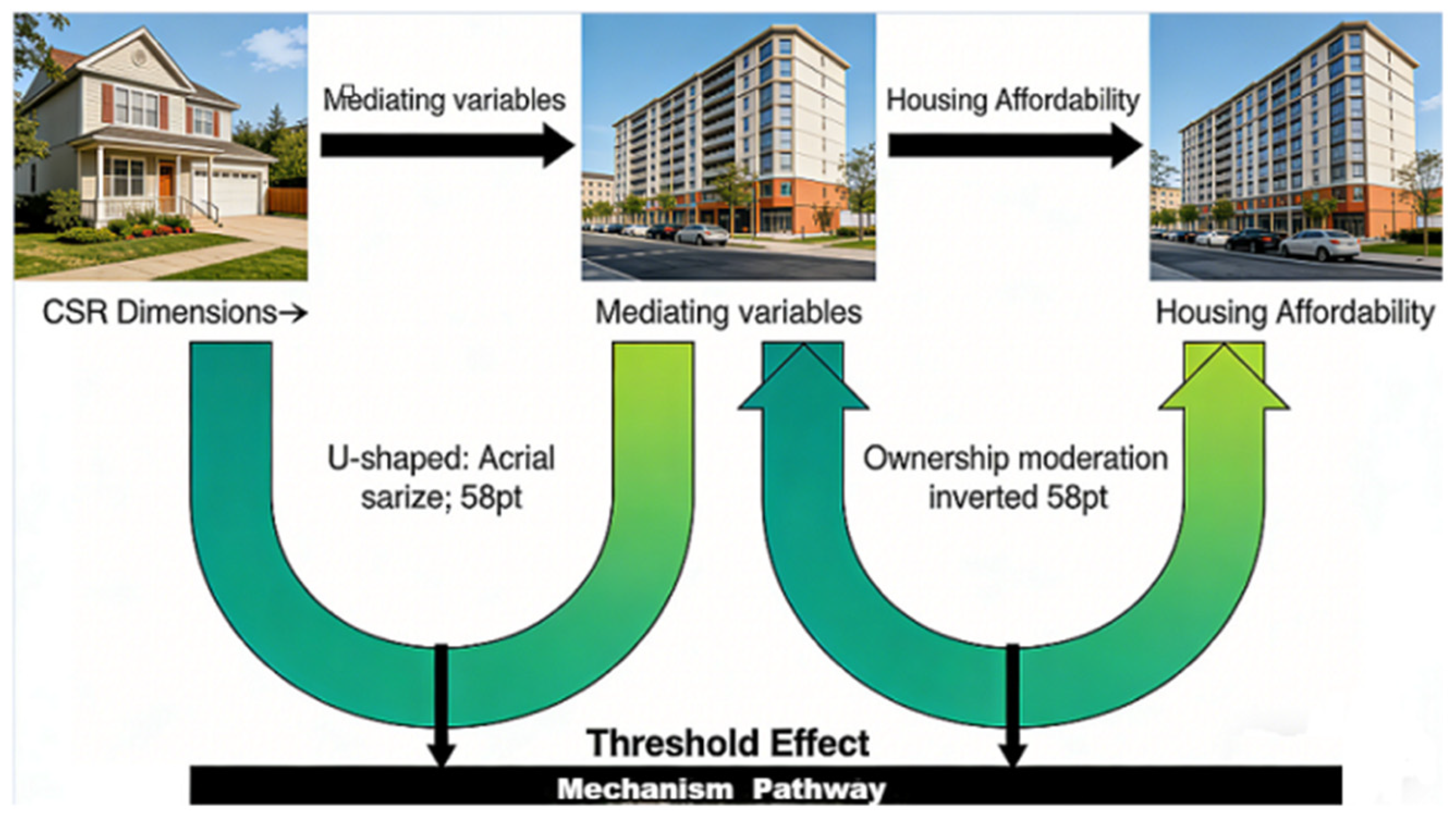
1.3.2. Technical Route
1.4. Research Innovations
2. Literature Review and Theoretical Framework
2.1. Literature Review
2.1.1. Connotation and Influencing Factors of Housing Affordability
2.1.2. Dimension Division and Economic-Social Effects of CSR
2.1.3. Research on the Relationship Between CSR and Housing Affordability
2.2. Theoretical Framework and Research Hypotheses
2.2.1. Analysis Based on Stakeholder Theory
2.2.2. Analysis Based on Threshold Theory
2.2.3. Analysis of the Regulatory Effect Based on Ownership Heterogeneity
2.2.4. Research Hypotheses
3. Research Design
3.1. Variable Definition and Measurement
3.1.1. Dependent Variable: Housing Affordability
3.1.2. Core Explanatory Variable: Corporate Social Responsibility (CSR)
- (1)
- The environmental dimension (CSR_ENV): Select Tonghuashun ESG environmental score as the core indicator. This indicator covers multiple dimensions, such as environmental management, climate change response, and waste disposal, comprehensively reflecting the level of corporate environmental responsibility performance. The data are from the iFinD database.
- (2)
- The social dimension (CSR_SOC): Select three indicators: tax contribution rate, fixed asset turnover rate, and number of litigation violations. Among them, tax contribution rate = tax payable/operating income, reflecting the enterprise’s contribution to public finance; fixed asset turnover rate = operating income/average fixed assets, reflecting the efficiency of enterprise resource utilization; the number of litigation violations reflects the level of enterprise legal compliance. After standardized processing, the social dimension score is synthesized by the entropy weight method. The data are from the iFinD database and enterprise annual reports.
- (3)
- The economic dimension (CSR_ECO): To avoid confusing “corporate social responsibility” with “financial performance”, we redefine economic CSR as “responsible economic behavior that balances corporate profitability, stakeholder interests, and social value”. We select three indicators: fair pricing rate (ratio of the enterprise’s average housing sales price to the regional average housing sales price, reflecting the responsibility of fair pricing to homebuyers), supply chain payment compliance rate (ratio of on-time payment to suppliers to total supplier payments, reflecting the responsibility to upstream stakeholders), and employment stability rate (ratio of employees with service tenure ≥ 3 years to total employees, reflecting responsibility to employees). The economic dimension score is synthesized by the entropy weight method. The data are from the iFinD database and enterprise annual reports.The original performance-heavy indicators (ROE, DAR, CR, ITR) are retained as a “financial performance proxy” for robustness testing to verify whether the core conclusions are affected by indicator selection.
- (4)
- Stakeholder dimension (CSR_STA): Select four indicators: earnings per share (EPS), average employee salary (ASE), sales expense rate (SER), and accounts payable turnover rate (APTR). EPS reflects the interests of investors, ASE reflects the interests of employees, SER reflects customer maintenance investment, and APTR reflects the efficiency of supplier payment. The stakeholder dimension score is synthesized by the entropy weight method. The data are from the iFinD database and enterprise annual reports [1].
- (5)
- Voluntary dimension (CSR_VOL): Select two indicators: external donation ratio and R&D expense rate. External donation ratio = total external donations/operating income, reflecting corporate charitable responsibility; R&D expense rate = R&D expenses/operating income, reflecting corporate innovation investment in low-cost construction, green technology, and other fields. The voluntary dimension score is synthesized by the entropy weight method. The data are from the iFinD database and enterprise annual reports.
3.1.3. Moderating Variable: Ownership Type (OT)
3.1.4. Control Variables
- (1)
- Enterprise-level control variables: enterprise age (AGE), measured by the natural logarithm of “observation year – establishment year + 1”, reflecting enterprise operation experience; market capitalization rate (LNMC), measured by the natural logarithm of total market value, reflecting enterprise scale; ownership concentration (TOP1), measured by the shareholding ratio of the largest shareholder, reflecting the level of corporate governance; average excess turnover rate (AETR), measured by the average of monthly stock abnormal turnover rate, reflecting market attention.
- (2)
- Industry-macroeconomic composite factor (IMF): Considering the multicollinearity between industry-level and macro-level variables, five indicators, including industry concentration (HHI), business climate index (BCI), real estate loan balance (RELB), GDP growth rate, and 1-year loan market quoted rate (1-LPR), are selected to synthesize the industry-macroeconomic composite factor through principal component analysis (PCA), and the weight is the variance explanation rate of each principal component. The data are from the iFinD database and the National Bureau of Statistics.
- (3)
- Regional development level (REG): measured by the natural logarithm of provincial per capita GDP, reflecting differences in regional economic development, housing market supply–demand dynamics, and income levels. The data are from the National Bureau of Statistics.
3.2. Model Setting
3.2.1. Linear Regression Model
3.2.2. Threshold Effect Model
3.2.3. Heterogeneity Regression Model
3.3. Sample Selection and Data Source
3.3.1. Sample Selection
3.3.2. Data Source
3.3.3. Sample Period Selection
3.4. Estimation Method and Diagnostic Test
3.4.1. Selection of Estimation Method
- Instrument selection: The 2–3 period lags of the dependent variables (HAI, RIA) and core explanatory variables (five CSR dimensions) are used as instrumental variables. Lagged terms are correlated with current terms but not with random error terms, effectively avoiding endogeneity.
- Instrument reduction strategy: we use collapsed instruments to aggregate instruments by period, which reduces the number of instruments while maintaining their validity.
- Instrument quantity control: The number of instruments in each regression is reported. For the full sample, the number of instruments ranges from 15 to 18, which is less than 1/3 of the number of firms (87/3 ≈ 29), complying with the “instruments ≤ 1/3 N” rule.
- Alternative specification: We also estimate the model using only 1-period lagged instruments (non-collapsed) for comparison. The results show no significant changes in coefficient signs, significance levels, or threshold values, confirming the robustness of the methodological design.
3.4.2. Diagnostic Test
4. Empirical Results
4.1. Descriptive Statistics
4.2. Correlation Analysis
4.2.1. CSR Dimensions and Housing Affordability
4.2.2. Intercorrelations Among CSR Dimensions
4.2.3. Control Variables and Housing Affordability
4.2.4. Multicollinearity Assessment
4.3. Benchmark Regression Results: Linear Impact Test
4.3.1. Model Diagnostic Tests
4.3.2. Linear Effects of CSR Dimensions on HAI (Housing Purchase Affordability)
4.3.3. Linear Effects of CSR Dimensions on RIA (Rental Affordability)
4.3.4. Effects of Control Variables
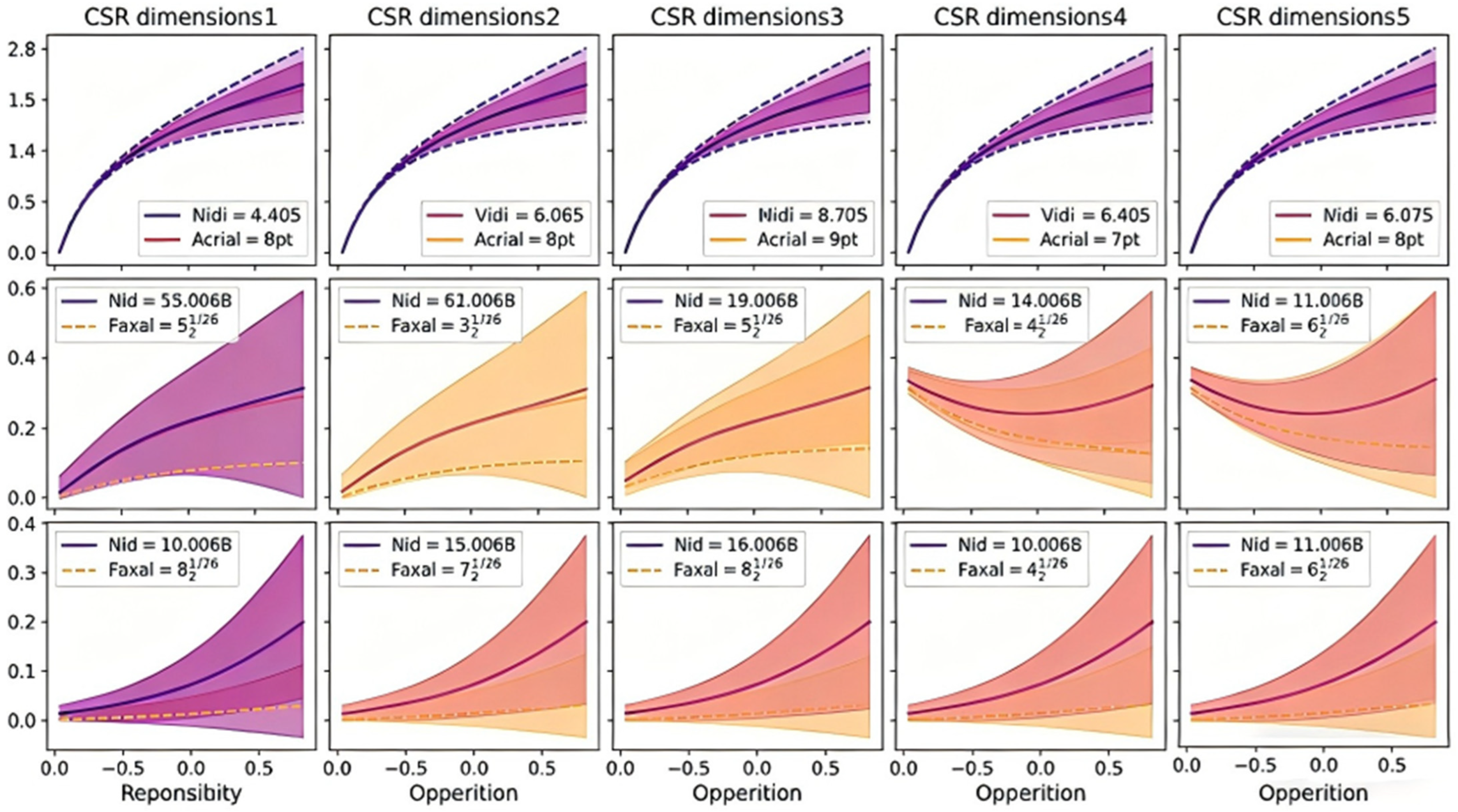
4.4. Threshold Effect Test
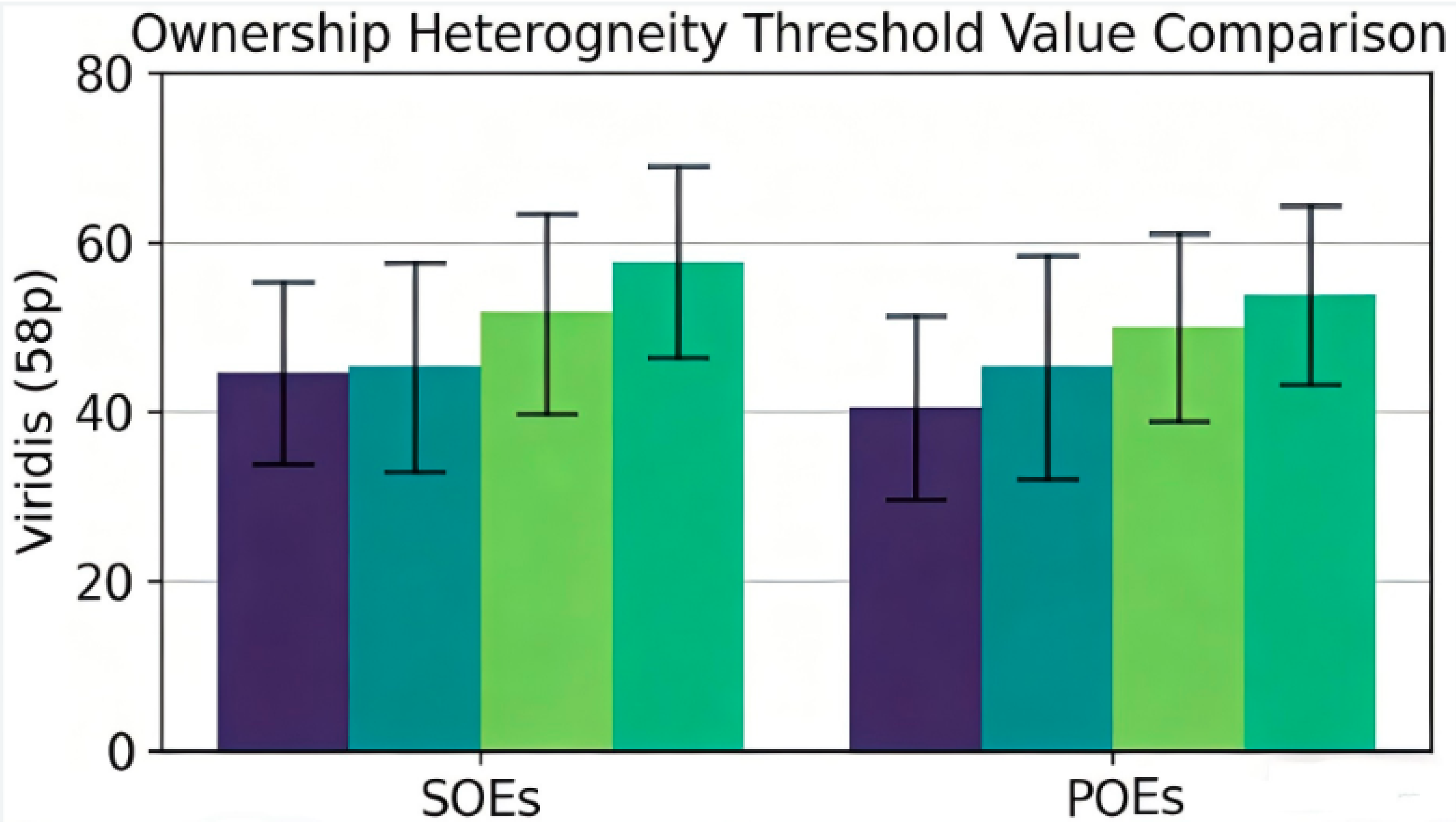
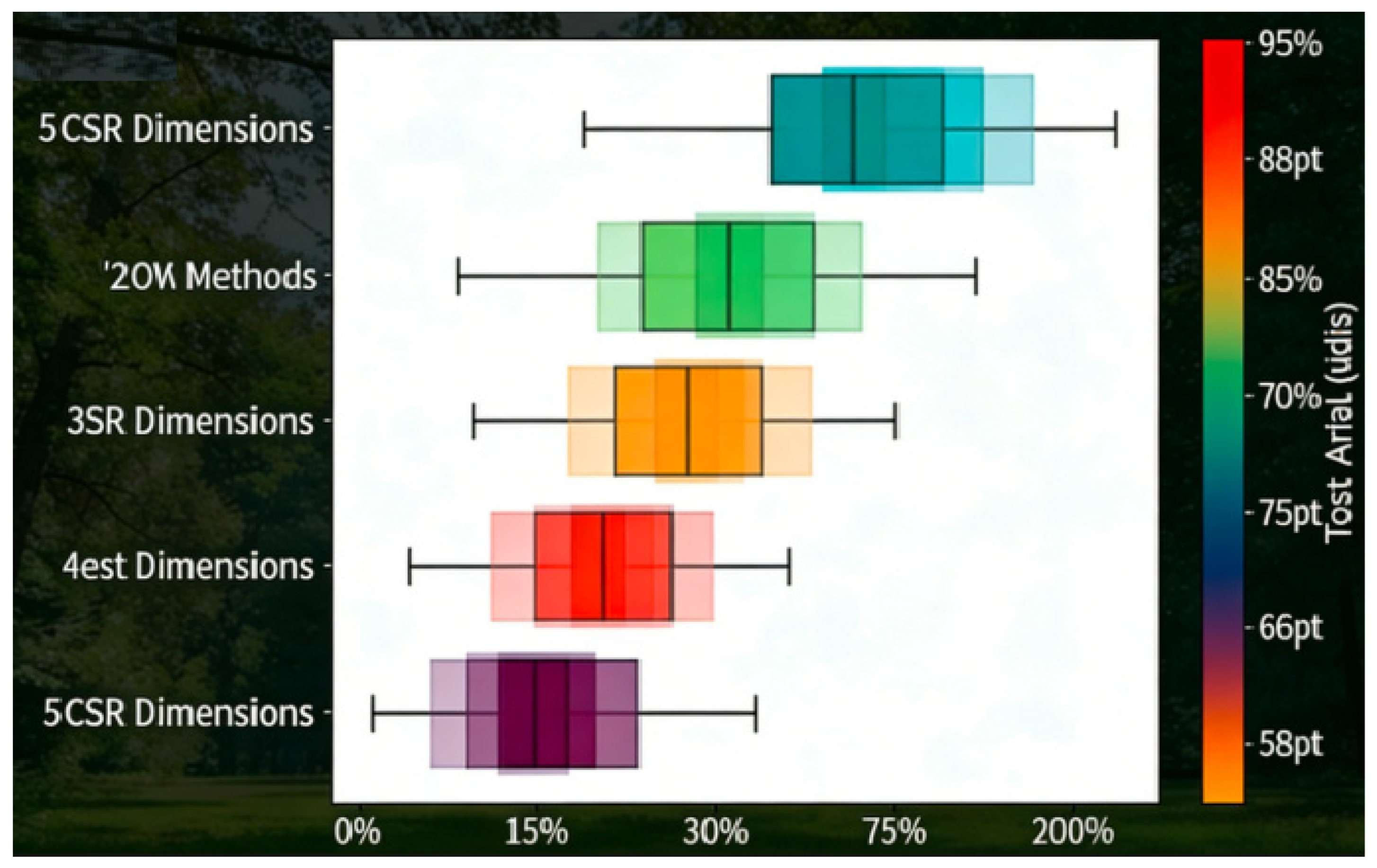
4.5. Heterogeneity Analysis: Ownership Type
4.5.1. Heterogeneity in HAI (Housing Purchase Affordability)
- (1)
- State-Owned Enterprises (SOEs)
- (2)
- Private Enterprises (POEs)
4.5.2. Heterogeneity in RIA
- (1)
- State-Owned Enterprises (SOEs)
- (2)
- Private Enterprises (POEs)
4.5.3. Summary of Ownership Heterogeneity
4.6. Robustness Checks
4.6.1. Lagged CSR Substitution
4.6.2. Alternative Affordability Metrics
4.6.3. Revised CSR_ECO Indicators
5. Discussion
5.1. Core Findings Interpretation
5.1.1. Heterogeneous Linear Effects of CSR Dimensions
5.1.2. Nonlinear Threshold Effects
5.1.3. Ownership Heterogeneity
5.2. Theoretical Implications
5.2.1. Stakeholder Theory
5.2.2. Threshold Theory
5.2.3. Institutional Theory
5.2.4. Integration of Multiple Theories
5.3. Policy and Managerial Implications
5.3.1. Policy Implications
5.3.2. Managerial Implications
- (1)
- For state-owned enterprises (SOEs)
- (2)
- For private enterprises (POEs)
5.4. Limitations and Future Research
- (1)
- Sample scope: The sample focuses on listed real estate firms, excluding unlisted small and medium-sized developers that dominate local rental markets. Future research should expand the sample to include these firms, as their CSR practices may differ due to limited resources and regulatory oversight.
- (2)
- Data dependence: We rely on secondary data (e.g., iFinD database, annual reports) for CSR and affordability measurement, which may have potential measurement errors (e.g., incomplete CSR disclosure). Future studies could use primary data (e.g., surveys of enterprises and residents) to measure CSR and affordability more accurately.
- (3)
- Endogeneity concerns: despite using System-GMM to mitigate endogeneity, structural endogeneity may remain—CSR and housing affordability could be jointly influenced by unobserved factors (e.g., local government policy intensity, regional cultural values). Future research could adopt instrumental variable methods (e.g., policy shocks as exogenous instruments) to address this issue.
- (4)
- Moderating variables: This study only considers ownership type as a moderating variable, ignoring other potential moderators such as city tier, enterprise size, and industry competition intensity. Future research could introduce these variables to explore the boundary conditions of CSR’s threshold effects.
- (5)
- CSR Decomposition: We use aggregated CSR dimensions; future studies could decompose CSR into specific practices (e.g., green building vs. waste management for environmental CSR) to identify key drivers of affordability. Mediation analysis (e.g., cost reduction, policy subsidies as mediators) could further unpack the causal pathways.
- (6)
- Sample period: The 2018–2023 sample period is relatively short. Longer panels (10+ years) could capture the cumulative impact of CSR, as environmental and social investments often have 5–10 year payback periods. Future research could also explore how macroeconomic shocks (e.g., COVID-19, policy shifts) moderate the CSR–affordability nexus.
6. Conclusions
Author Contributions
Funding
Institutional Review Board Statement
Informed Consent Statement
Data Availability Statement
Conflicts of Interest
References
- Meng, B.; Zang, Q.; Li, G. Study on the impact of corporate social responsibility on carbon performance in the background of carbon peaking and carbon neutrality. Bus. Ethics Environ. Responsib. 2023, 33, 416–430. [Google Scholar] [CrossRef]
- AL-Akheli, A.; Tan, H.; Hazaea, S.A.; ELfarra, B.; Al-Zubairi, A. Mapping the Literature Trends of Corporate Social Responsibility and Cost of Capital: A Systematic Literature Review. Corp. Soc. Responsib. Environ. Manag. 2025, 32, 3383–3407. [Google Scholar] [CrossRef]
- Arellano, M.; Bond, S. Some tests of specification for panel data: Monte Carlo Evidence and an application to employment equations. Rev. Econ. Stud. 1991, 58, 277–297. [Google Scholar] [CrossRef]
- Dao, V.-T.; Phung, M.-T.; Cheng, H. The Relationship Between Corporate Social Responsibility and Corporate Financial Performance: A Moderating Effect of Economic Policy Uncertainty. Int. J. Financ. Res. 2020, 11, 304. [Google Scholar] [CrossRef]
- Hakimi, A.; Boussaada, R.; Karmani, M. Corporate social responsibility and firm performance: A threshold analysis of European firms. Eur. J. Manag. Bus. Econ. 2023, 34, 282–299. [Google Scholar] [CrossRef]
- Dahlsrud, A. How corporate social responsibility is defined: An analysis of 37 definitions. Corp. Soc. Responsib. Environ. Manag. 2008, 15, 1–13. [Google Scholar] [CrossRef]
- Barney, J. Firm Resources and Sustained Competitive Advantage. J. Manag. 1991, 17, 99–120. [Google Scholar] [CrossRef]
- Chakraborty, A.; Gao, L.S.; Musa, P. Corporate social responsibility and litigation risk: Evidence from securities class action lawsuits. Account. Financ. 2023, 63, 1785–1819. [Google Scholar] [CrossRef]
- Conway, L.; Khoo, J. The role of commercial real estate in shaping our carbon future. Corp. Real Estate J. 2023, 12, 131. [Google Scholar] [CrossRef]
- Bibi, R.; Sumaira, S. The effect of financial development on economic Growth: Evidence from south Asian developing countries. J. Environ. Sci. Econ. 2022, 1, 1–17. [Google Scholar] [CrossRef]
- Dahiyat, A. Does liquidity and solvency affect banks profitability? Evidence from listed banks in Jordan. Int. J. Acad. Res. Account. Financ. Manag. Sci. 2016, 6, 35–40. [Google Scholar] [CrossRef] [PubMed]
- Hasibuan, D.H.M.; Hilary, V. Does corporate social responsibility enhance the impact of financial performance on firm value? J. Econ. Financ. Manag. Stud. 2024, 7, 4139–4147. [Google Scholar] [CrossRef]
- Healy, P.M.; Palepu, K.G. Information Asymmetry, Corporate Disclosure, and the Capital Markets: A Review of the Empirical Disclosure Literature. J. Account. Econ. 2001, 31, 405–440. [Google Scholar] [CrossRef]
- Dai, J.; Lu, C.; Qi, J. Corporate Social Responsibility Disclosure and Stock Price Crash Risk: Evidence from China. Sustainability 2019, 11, 448. [Google Scholar] [CrossRef]
- Ghosh, A. Do real estate loans reflect regional banking and economic conditions? J. Financ. Econ. Policy 2016, 8, 37–63. [Google Scholar] [CrossRef]
- Hasan, F. Corporate social responsibility and agency cost: Evidence from the UK retail industry. Int. J. Res. Financ. Manag. 2021, 4, 105–115. [Google Scholar] [CrossRef]
- Chandratreya, A. Corporate Social Responsibility and Financial Performance: A Meta-Analysis. Preprint 2024. [Google Scholar] [CrossRef]
- Gatti, L.; Seele, P.; Rademacher, L. Grey zone in- greenwash out. A review of greenwashing research and implications for the voluntary-mandatory transition of CSR. Int. J. Corp. Soc. Responsib. 2019, 4, 6. [Google Scholar] [CrossRef]
- Eccles, R.G.; Ioannou, I.; Serafeim, G. The impact of corporate sustainability on organizational processes and performance. Manag. Sci. 2014, 60, 2835–2857. [Google Scholar] [CrossRef]
- Eichholtz, P.; Kok, N.; Quigley, J.M. Doing Well by Doing Good? Green Office Buildings. Am. Econ. Rev. 2010, 100, 2492–2509. [Google Scholar] [CrossRef]
- Emerson, F.; Cunha, M. The Relationship Between ESG and Financial Performance in Brazilian Companies. Rev. Adm. UFSM 2024, 17, e3. [Google Scholar]
- Nuru, F.; Jumardi, J.; Saputra, R.; Wijaya, I.; Saranga, E. Corporate Social Responsibility and Financial Performance: A Meta-Analysis. J. Acad. Sci. 2024, 1, 363–372. [Google Scholar] [CrossRef]
- Fitriana, R. The effect of EPS and dividend payout ratio on stock prices: A study of PSX listed non-financial firms. Int. J. Bus. Adm. Stud. 2022, 8, 82–90. [Google Scholar] [CrossRef]
- Flammer, C.; Ioannou, I. Strategic management during the financial crisis: How firms adjust their strategic investments in response to credit market disruptions. Strateg. Manag. J. 2021, 42, 1275–1298. [Google Scholar] [CrossRef]
- Freeman, R.E. Strategic Management: A Stakeholder Approach; Cambridge University Press: Cambridge, UK, 1984. [Google Scholar]
- Fu, J.-Y. Customer concentration and corporate charitable donations: Evidence from China. Manag. Decis. Econ. 2023, 44, 545–561. [Google Scholar] [CrossRef]
- Jiang, Z.; Krishnamurthy, A.; Lustig, H. The Rest of the World’s Dollar-Weighted Return on U.S. Treasurys; Working Paper Series 30089; National Bureau of Economic Research: Cambridge, MA, USA, 2022. [Google Scholar]
- Kakkar, S.; Kuril, S.; Singh, S.; Saha, S.; Dugar, A. The influence of remote work communication satisfaction and CSR association on employee alienation and job satisfaction: A moderated-mediation study. Inf. Technol. People 2023, 36, 1810–1834. [Google Scholar] [CrossRef]
- Chi, L.H.D.; Hang, B.T.T. Corporate social responsibility expenditure and financial performance: A comparison of Vietnamese listed and unlisted banks. Cogent Econ. Financ. 2023, 11, 2203987. [Google Scholar] [CrossRef]
- Naeem, N.; Khattak, S.H.; Awan, T. Enhancing Firm Performance through Corporate Social Responsibility: The Impact of Foreign Ownership in Pakistan’s Non-Financial Sector. Qlantic J. Soc. Sci. 2025, 6, 76–85. [Google Scholar] [CrossRef]
- Lian, Y.-M.; Chen, Y.-C.; Kao, B.-K.; Yeh, Y.-H. An empirical investigation of the relationship between financial measures and corporate social responsibility. Financ. Forum 2018, 7, 1–8. [Google Scholar] [CrossRef]
- Naseem, M.A.; Lin, J.; Rehman, R.U.; Ahmad, M.I.; Ali, R. Moderating role of financial ratios in corporate social responsibility disclosure and firm value. PLoS ONE 2019, 14, e0215430. [Google Scholar] [CrossRef]
- Arellano, M.; Bover, O. Another look at the instrumental variable estimation of error-components models. J. Econom. 1995, 68, 29–51. [Google Scholar] [CrossRef]



| Variable Type | Variable Name | Core Connotation | Measurement Method | Data Source |
|---|---|---|---|---|
| Dependent Variable | Housing Affordability Index (HAI) | Degree of housing purchase affordability | (Residents per capita disposable income × 30%)/(Average commercial housing price × Per capita housing area) × 100 | iFinD, National Bureau of Statistics |
| Rental Affordability Index (RIA) | Degree of housing rental affordability | (Residents per capita disposable income × 25%)/(Average housing rental price × Per capita housing area) × 100 | iFinD, National Bureau of Statistics | |
| Core Explanatory Variable | Environmental CSR (CSR_ENV) | Level of corporate environmental responsibility performance | Tonghuashun ESG environmental score (standardized by entropy weight method) | iFinD |
| Social CSR (CSR_SOC) | Level of corporate social contribution and compliance | Tax contribution rate + fixed asset turnover rate of litigation violations | iFinD, Enterprise Annual Reports | |
| Economic CSR (CSR_ECO) | Corporate profitability and operational efficiency | ROE + current ratio+ inventory turnover rate | iFinD | |
| Stakeholder CSR (CSR_STA) | Level of multi-stakeholder rights and interests protection | EPS + average employee salary + sales expense rate | iFinD, Enterprise Annual Reports | |
| Voluntary CSR (CSR_VOL) | Level of corporate charitable and innovative investment | External donation ratio + R&D expense rate | iFinD, Enterprise Annual Reports | |
| Moderating Variable | Ownership type (OT) | Type of corporate ownership | 1 = State-owned enterprise; 0 = Private enterprise | iFinD |
| Control Variable | Enterprise Age (AGE) | Length of enterprise operation history | ln (Observation year - Establishment year + 1) | iFinD |
| Market Capitalization Rate (LNMC) | Enterprise scale | ln (Total market value of the enterprise) | iFinD | |
| Ownership Concentration (TOP1) | Degree of major shareholder control | Shareholding ratio of the largest shareholder (%) | iFinD | |
| Average Excess Turnover Rate (AETR) | Enterprise market attention | Average of monthly stock abnormal turnover rate | iFinD | |
| Industry-Macroeconomic Factor (IMF) | Comprehensive status of industry and macroeconomy | HHI + BCI + RELB + GDP growth rate + 1 LPR | iFinD, National Bureau of Statistics |
| Variable | HAI | RIA | CSR_ENV | CSR_SOC | CSR_ECO | CSR_STA | CSR_VOL | AGE | LNMC | TOP1 | AETR | IMF |
|---|---|---|---|---|---|---|---|---|---|---|---|---|
| HAI | 1.00 | 0.68 *** | 0.23 *** | 0.19 ** | 0.17 ** | 0.06 | 0.15 ** | 0.14 ** | 0.21 *** | 0.05 | 0.09 | −0.26 *** |
| RIA | - | 1.00 | 0.27 *** | 0.22 *** | 0.08 | 0.24 *** | 0.18 ** | 0.11 * | 0.25 *** | 0.04 | 0.10 * | −0.29 *** |
| CSR_ENV | - | - | 1.00 | 0.32 *** | 0.28 *** | 0.25 *** | 0.30 *** | 0.16 ** | 0.47 *** | 0.12 * | 0.13 * | −0.21 *** |
| CSR_SOC | - | - | - | 1.00 | 0.24 *** | 0.21 *** | 0.26 *** | 0.13 * | 0.35 *** | 0.10 * | 0.08 | −0.18 ** |
| CSR_ECO | - | - | - | - | 1.00 | 0.19 ** | 0.22 *** | 0.15 ** | 0.31 *** | 0.09 | 0.07 | −0.16 ** |
| CSR_STA | - | - | - | - | - | 1.00 | 0.23 *** | 0.12 * | 0.28 *** | 0.06 | 0.11 * | −0.19 ** |
| CSR_VOL | - | - | - | - | - | - | 1.00 | 0.14 ** | 0.33 *** | 0.08 | 0.09 | −0.17 ** |
| AGE | - | - | - | - | - | - | - | 1.00 | 0.24 *** | 0.13 * | 0.07 | −0.12 * |
| LNMC | - | - | - | - | - | - | - | - | 1.00 | 0.15 ** | 0.14 ** | −0.23 *** |
| TOP1 | - | - | - | - | - | - | - | - | - | 1.00 | 0.05 | −0.08 |
| AETR | - | - | - | - | - | - | - | - | - | - | 1.00 | −0.09 |
| IMF | - | - | - | - | - | - | - | - | - | - | - | 1.00 |
| Variable | HAI (1) | HAI (2) | HAI (3) | HAI (4) | HAI (5) | RIA (6) | RIA (7) | RIA (8) | RIA (9) | RIA (10) |
|---|---|---|---|---|---|---|---|---|---|---|
| L.HAI/L.RIA | 0.42 *** (4.86) | 0.45 *** (5.12) | 0.43 *** (4.98) | 0.41 *** (4.75) | 0.44 *** (5.03) | 0.38 *** (4.52) | 0.40 *** (4.76) | 0.39 *** (4.61) | 0.37 *** (4.38) | 0.39 *** (4.65) |
| CSR_ENV | 0.32 *** (3.65) | - | - | - | - | 0.38 *** (4.12) | - | - | - | - |
| CSR_SOC | - | 0.25 ** (2.43) | - | - | - | - | 0.29 *** (3.05) | - | - | - |
| CSR_ECO | - | - | 0.19 ** (2.21) | - | - | - | - | 0.09 (1.05) | - | - |
| CSR_STA | - | - | - | 0.07 (0.83) | - | - | - | - | 0.31 *** (3.42) | - |
| CSR_VOL | - | - | - | - | 0.16 ** (2.18) | - | - | - | - | 0.21 *** (2.87) |
| AGE | 0.12 * (1.78) | 0.13 * (1.85) | 0.11 (1.62) | 0.10 (1.53) | 0.12 * (1.72) | 0.09 (1.45) | 0.10 (1.51) | 0.08 (1.32) | 0.11 (1.65) | 0.10 (1.54) |
| LNMC | 0.23 *** (3.12) | 0.25 *** (3.35) | 0.22 *** (2.98) | 0.21 *** (2.87) | 0.24 *** (3.21) | 0.27 *** (3.56) | 0.29 *** (3.78) | 0.26 *** (3.42) | 0.25 *** (3.31) | 0.28 *** (3.65) |
| TOP1 | 0.06 (0.92) | 0.07 (1.05) | 0.05 (0.83) | 0.04 (0.72) | 0.06 (0.91) | 0.05 (0.87) | 0.06 (0.98) | 0.04 (0.75) | 0.07 (1.02) | 0.05 (0.86) |
| AETR | 0.08 (1.32) | 0.09 (1.45) | 0.07 (1.21) | 0.10 (1.56) | 0.08 (1.35) | 0.11 * (1.78) | 0.12 * (1.85) | 0.10 (1.62) | 0.13 * (1.92) | 0.11 * (1.75) |
| IMF | −0.26 *** (−3.45) | −0.28 *** (−3.68) | −0.25 *** (−3.32) | −0.24 *** (−3.21) | −0.27 *** (−3.56) | −0.31 *** (−4.02) | −0.33 *** (−4.25) | −0.30 *** (−3.87) | −0.29 *** (−3.76) | −0.32 *** (−4.13) |
| Constant | 2.15 *** (2.98) | 2.23 *** (3.12) | 2.11 *** (2.87) | 2.08 *** (2.76) | 2.20 *** (3.05) | 2.35 *** (3.21) | 2.42 *** (3.38) | 2.31 *** (3.15) | 2.28 *** (3.09) | 2.38 *** (3.27) |
| N | 522 | 522 | 522 | 522 | 522 | 522 | 522 | 522 | 522 | 522 |
| AR(1) p-value | 0.023 | 0.021 | 0.025 | 0.027 | 0.022 | 0.024 | 0.020 | 0.026 | 0.028 | 0.023 |
| AR(2) p-value | 0.124 | 0.131 | 0.145 | 0.156 | 0.129 | 0.112 | 0.118 | 0.127 | 0.135 | 0.121 |
| Hansen p-value | 0.153 | 0.167 | 0.142 | 0.178 | 0.159 | 0.136 | 0.148 | 0.131 | 0.162 | 0.143 |
| Variable | HAI (1) | HAI (2) | HAI (3) | HAI (4) | HAI (5) | RIA (6) | RIA (7) | RIA (8) | RIA (9) | RIA (10) |
|---|---|---|---|---|---|---|---|---|---|---|
| L.HAI/L.RIA | 0.75 *** (6.32) | 0.73 *** (6.18) | 0.74 *** (6.25) | 0.72 *** (6.05) | 0.73 *** (6.11) | 0.71 *** (5.98) | 0.70 *** (5.87) | 0.72 *** (6.01) | 0.69 *** (5.76) | 0.71 *** (5.92) |
| CSR_ENV_C | −0.87 *** (−3.85) | - | - | - | - | −1.24 *** (−4.12) | - | - | - | - |
| CSR_ENV_C2 | 1.24 *** (3.42) | - | - | - | - | 1.87 *** (4.35) | - | - | - | - |
| CSR_SOC_C | - | −0.42 ** (−2.18) | - | - | - | - | −0.31 * (−1.76) | - | - | - |
| CSR_SOC_C2 | - | 0.89 *** (3.05) | - | - | - | - | 0.67 ** (2.43) | - | - | - |
| CSR_ECO_C | - | - | 5.89 *** (4.68) | - | - | - | - | 4.26 *** (4.42) | - | - |
| CSR_ECO_C2 | - | - | −9.13 *** (−4.21) | - | - | - | - | −7.58 *** (−4.05) | - | - |
| CSR_STA_C | - | - | - | 0.39 * (1.68) | - | - | - | - | 1.01 *** (3.28) | - |
| CSR_STA_C2 | - | - | - | 0.38 (1.35) | - | - | - | - | −3.94 *** (−3.65) | - |
| CSR_VOL_C | - | - | - | - | 0.28 (1.42) | - | - | - | - | 0.53 *** (3.15) |
| CSR_VOL_C2 | - | - | - | - | 0.21 (1.23) | - | - | - | - | −0.98 *** (−3.48) |
| Controls | Included | Included | Included | Included | Included | Included | Included | Included | Included | Included |
| N | 522 | 522 | 522 | 522 | 522 | 522 | 522 | 522 | 522 | 522 |
| AR(1) p-value | 0.001 | 0.002 | 0.001 | 0.003 | 0.002 | 0.002 | 0.003 | 0.001 | 0.002 | 0.001 |
| AR(2) p-value | 0.447 | 0.453 | 0.438 | 0.461 | 0.442 | 0.492 | 0.487 | 0.476 | 0.498 | 0.483 |
| Hansen p-value | 0.518 | 0.524 | 0.511 | 0.532 | 0.521 | 0.573 | 0.568 | 0.559 | 0.579 | 0.564 |
| Threshold Value | 0.35 | 0.23 | 0.32 | - | - | 0.31 | 0.22 | 0.28 | 0.13 | 0.27 |
| Variable | SOEs (OT = 1) | POEs (OT = 0) | SOEs (OT = 1) | POEs (OT = 0) | SOEs (OT = 1) | POEs (OT = 0) |
|---|---|---|---|---|---|---|
| L.HAI | 0.78 *** (5.87) | 0.67 *** (5.12) | 0.76 *** (5.72) | 0.65 *** (4.98) | 0.77 *** (5.79) | 0.66 *** (5.05) |
| CSR_ENV_C | −0.62 *** (−3.12) | −1.08 *** (−3.45) | - | - | - | - |
| CSR_ENV_C2 | 1.03 *** (2.87) | 1.32 *** (3.12) | - | - | - | - |
| CSR_SOC_C | - | - | −0.35 ** (−2.05) | −0.52 *** (−2.38) | - | - |
| CSR_SOC_C2 | - | - | 0.88 *** (2.76) | 0.92 *** (2.89) | - | - |
| CSR_ECO_C | - | - | - | - | 6.21 *** (4.12) | 5.58 *** (3.87) |
| CSR_ECO_C2 | - | - | - | - | −8.87 *** (−3.95) | −9.53 *** (−4.02) |
| Threshold Value | 0.30 | 0.42 | 0.20 | 0.28 | 0.35 | 0.29 |
| N | 297 | 225 | 297 | 225 | 297 | 225 |
| Hansen p-value | 0.532 | 0.587 | 0.541 | 0.576 | 0.538 | 0.592 |
| Variable | SOEs (OT = 1) | POEs (OT = 0) | SOEs (OT = 1) | POEs (OT = 0) | SOEs (OT = 1) | POEs (OT = 0) |
|---|---|---|---|---|---|---|
| L.RIA | 0.73 *** (5.65) | 0.68 *** (5.03) | 0.71 *** (5.52) | 0.66 *** (4.89) | 0.72 *** (5.58) | 0.67 *** (4.96) |
| CSR_ENV_C | −0.98 *** (−3.87) | −1.45 *** (−4.21) | - | - | - | - |
| CSR_ENV_C2 | 1.83 *** (4.02) | 1.92 *** (4.18) | - | - | - | - |
| CSR_SOC_C | - | - | −0.27 * (−1.72) | −0.48 *** (−2.45) | - | - |
| CSR_SOC_C2 | - | - | 0.76 ** (2.38) | 0.81 *** (2.52) | - | - |
| CSR_STA_C | - | - | - | - | 0.87 *** (3.05) | 1.12 *** (3.32) |
| CSR_STA_C2 | - | - | - | - | −4.35 *** (−3.72) | −3.17 *** (−3.48) |
| Threshold Value | 0.27 | 0.38 | 0.18 | 0.30 | 0.10 | 0.18 |
| N | 297 | 225 | 297 | 225 | 297 | 225 |
| Hansen p-value | 0.564 | 0.601 | 0.558 | 0.593 | 0.571 | 0.608 |
Disclaimer/Publisher’s Note: The statements, opinions and data contained in all publications are solely those of the individual author(s) and contributor(s) and not of MDPI and/or the editor(s). MDPI and/or the editor(s) disclaim responsibility for any injury to people or property resulting from any ideas, methods, instructions or products referred to in the content. |
© 2026 by the authors. Licensee MDPI, Basel, Switzerland. This article is an open access article distributed under the terms and conditions of the Creative Commons Attribution (CC BY) license.
Share and Cite
Wang, Y.; Masron, T.A. Nonlinear Impacts of Multidimensional Corporate Social Responsibility on Housing Affordability: Evidence from China’s Listed Real Estate Companies via System GMM. Sustainability 2026, 18, 2012. https://doi.org/10.3390/su18042012
Wang Y, Masron TA. Nonlinear Impacts of Multidimensional Corporate Social Responsibility on Housing Affordability: Evidence from China’s Listed Real Estate Companies via System GMM. Sustainability. 2026; 18(4):2012. https://doi.org/10.3390/su18042012
Chicago/Turabian StyleWang, Yidan, and Tajul Ariffin Masron. 2026. "Nonlinear Impacts of Multidimensional Corporate Social Responsibility on Housing Affordability: Evidence from China’s Listed Real Estate Companies via System GMM" Sustainability 18, no. 4: 2012. https://doi.org/10.3390/su18042012
APA StyleWang, Y., & Masron, T. A. (2026). Nonlinear Impacts of Multidimensional Corporate Social Responsibility on Housing Affordability: Evidence from China’s Listed Real Estate Companies via System GMM. Sustainability, 18(4), 2012. https://doi.org/10.3390/su18042012