Review

Applications of IoT and Machine Learning in Photovoltaic (PV) Systems: A Comprehensive Review

1
Intelligent Electrical Systems, Materials and Components (SEIMC) Research Group, Laboratory of Spectrometry of Materials and Archaeomaterials (LASMAR), Higher School of Technology Meknes, Moulay Ismail University of Meknes, Meknes 50000, Morocco
2
Laboratory of Spectrometry of Materials and Archaeomaterials (LASMAR), Faculty of Sciences, Moulay Ismail University of Meknes, Meknes 50000, Morocco
*
Author to whom correspondence should be addressed.
Sustainability 2026, 18(4), 2005; https://doi.org/10.3390/su18042005
Submission received: 22 January 2026 / Accepted: 10 February 2026 / Published: 15 February 2026

Abstract

Photovoltaic (PV) system monitoring, optimization, and control have completely changed as a result of the convergence of internet of things (IoT) and machine learning (ML) technologies. While IoT makes it possible to gather, transmit, and store electrical and environmental data, ML offers intelligent data analysis for prediction and adaptive decision-making. This review provides a comprehensive analysis of recent advances in the application of IoT as well as ML for improving PV performance and efficiency. It examines the IoT hardware and communication architectures and highlights their roles in achieving high-resolution and real-time monitoring. In addition, this paper explores the application of ML in PV systems, including power forecasting, maximum power point tracking (MPPT), fault detection, and energy management. Moreover, it analyzes the benefits and performance improvements as well as challenges and limitations of the combined IoT–ML framework with PV systems. It outlines the future directions, such as federated learning, edge intelligence, and digital-twin integration. This combination enhances the system performance by improving tracking efficiency, reducing forecasting error, and decreasing operational cost, which makes these technologies key parts of the next generation of PV systems.

1. Introduction

The world’s energy landscape is undergoing a significant transformation and requires a transition due to the mitigation of climate change and the need for environmentally clean power technologies. Currently, PV solar power, as well as its modularity, lower installation costs, and geographical spread, makes up an increasingly important sector in the evolving energy mix. PV technologies have become increasingly popular over the past decade and are competing for energy use at a utility and decentralized scale in many regions [1,2]. However, despite these advantages, PV systems alone cannot fully satisfy global electricity demand and should be considered as part of a broader portfolio of energy sources that includes dispatchable low-carbon generation and energy storage solutions.
Though the use of PV technology poses numerous benefits to the environment and economy, there are some challenges related to its operation and maintenance for large-scale application. The intermittent nature of PV power generation lies in its strong dependence on weather conditions, daily and seasonal cycles, and the reduction in efficiency over time. Moreover, the phenomenon of internal and external faults, such as partial shading, soiling, arc faults, and module deterioration or breakages, can significantly affect the efficiency and feasibility of the PV systems [3]. Historically, operation and maintenance strategies for the PV systems have engaged with reactive and preventive methods that are informed by statistical models and have a predefined maintenance schedule. These approaches are ineffective for describing the non-linear behavior of PV systems under real-world operating conditions and dynamic environmental influences, limiting their effectiveness in ensuring long-term performance and reliability [4].
Conventional PV systems depend on periodic manual inspections, static maximum power point tracking (MPPT) algorithms, and rule-based diagnostics. While these approaches have served the industry for years, they fall short in dynamic or extreme conditions, leading to energy losses, suboptimal performance, and prolonged fault periods. To overcome these limitations of conventional PV management, the industry is increasingly leveraging the integration of two main key technological domains: the internet of things (IoT) and machine learning (ML) [5,6].
The internet of things enables real-time connectivity and distributed data collection across diverse components, including PV modules, inverters, environmental sensors, and power-conversion units, operating seamlessly across locations and time. This technology facilitates comprehensive data acquisition, transmission, processing, analysis, and storage, forming a data-rich infrastructure that supports advanced analytics, intelligent control, and automated decision-making in photovoltaic systems [7]. Numerous works on IoT-based PV systems have shown their promise in enabling remote supervision, fault detection, and performance tracking of the system [8]. More recently, the concept of artificial intelligence of things (AIoT), or embedding AI/ML models within IoT-enabled systems, has emerged, allowing intelligence to migrate closer to the data source and reduce latency, bandwidth usage, and central dependencies [9,10].
Machine learning, on the other hand, provides very efficient tools for pattern recognition, anomalous event detection, output forecasting, and control strategy optimization. Regarding PV system applications, ML algorithms have been considered for the tasks of solar power forecasting, predictive maintenance, anomalous event detection, adaptive MPPT control, and energy management [11]. Thus, ML algorithms have shown the possibility of developing prognostic models that monitor the MPPT control process in stand-alone solar power systems with faster convergence and enhanced robustness relative to the conventional approach. Further, ML algorithms based on classification algorithms have proposed the capability of separating events due to shading effects, soiling degradation, string mismatching issues, or aged inverters based on their characteristics of the terminal currents-voltages and external variables [12,13].
The fusion of IoT and ML in PV systems for solar energy promises a smart PV paradigm that enables continuous sensing, edge-level intelligence, predictive analytics, and closed-loop control. This synergy supports not only higher energy yield and lower downtime but also more efficient maintenance scheduling, early anomaly warnings, and adaptive control under uncertainty [9,14]. Despite the rapid growth of research on IoT-enabled PV monitoring and ML-based optimization techniques, existing studies remain largely fragmented, focusing on isolated functionalities such as data acquisition, forecasting, or control. A comprehensive and integrated review that systematically examines how IoT infrastructures and ML mutually enhance PV system performance, reliability, and sustainability is still lacking. This review is, therefore, motivated by the need to bridge this gap and to provide a unified perspective on IoT–ML-driven PV systems, that are driving PV operations from a reactive state to one that is predictive, autonomous, and highly efficient.
This thorough review evaluates the literature from 2020 to 2025 on analyzing all fundamental aspects of the IoT–ML data acquisition process in the context of advanced applications in the life cycle of PV systems. The primary contributions of the review are highlighted in the following points:
  • Offer in-depth descriptions of the different components of IoT architecture that can be used in PV systems;
  • Explain the incorporation of ML methods in PV operations for functions such as solar power forecasts, predictive maintenance tasks, anomaly detection analysis, adaptive MPPT control methods, and energy management strategies;
  • Outline the different architectures that might link the IoT and ML together in terms of integrations in the cloud compared to the use of edge intelligence;
  • Identify the major technical, operational, and cybersecurity issues involved in PV systems integrating IoT and ML;
  • Suggest areas for future research in the field of PV system implementation through the means of embedded AI research in the topic of PV system implementation.
This paper is organized in the following way: Section 2 introduces an explanation of the key ideas involved in PV systems. Section 3 describes the uses of the IoT, covering the relevant system architectures. Section 4 illustrates the applications of ML, covering the topics of forecasting, diagnostics for faults, and system optimization. Section 5 describes the combination of IoT and ML in PV systems. Section 6 assesses the advantages and improvements brought by the IoT–ML combination. Section 7 describes the key challenges related to this combination. Section 8 provides the future research avenues. Finally, Section 9 gives the concluding summarization.

2. Photovoltaic Systems: Components and Performance Parameters

PV cells translate the incident solar radiation into electricity through crystalline silicon or thin-film semiconductor materials. The major benefit offered by these cells emanates from the noiseless and clean production of electricity. Note that the nature of electricity generated by PV cells is varied and influenced by environmental conditions. A clear overview of the different aspects of PV systems should come before delving into the topic of the application of IoT and ML technologies.

2.1. Basic Components of a PV System

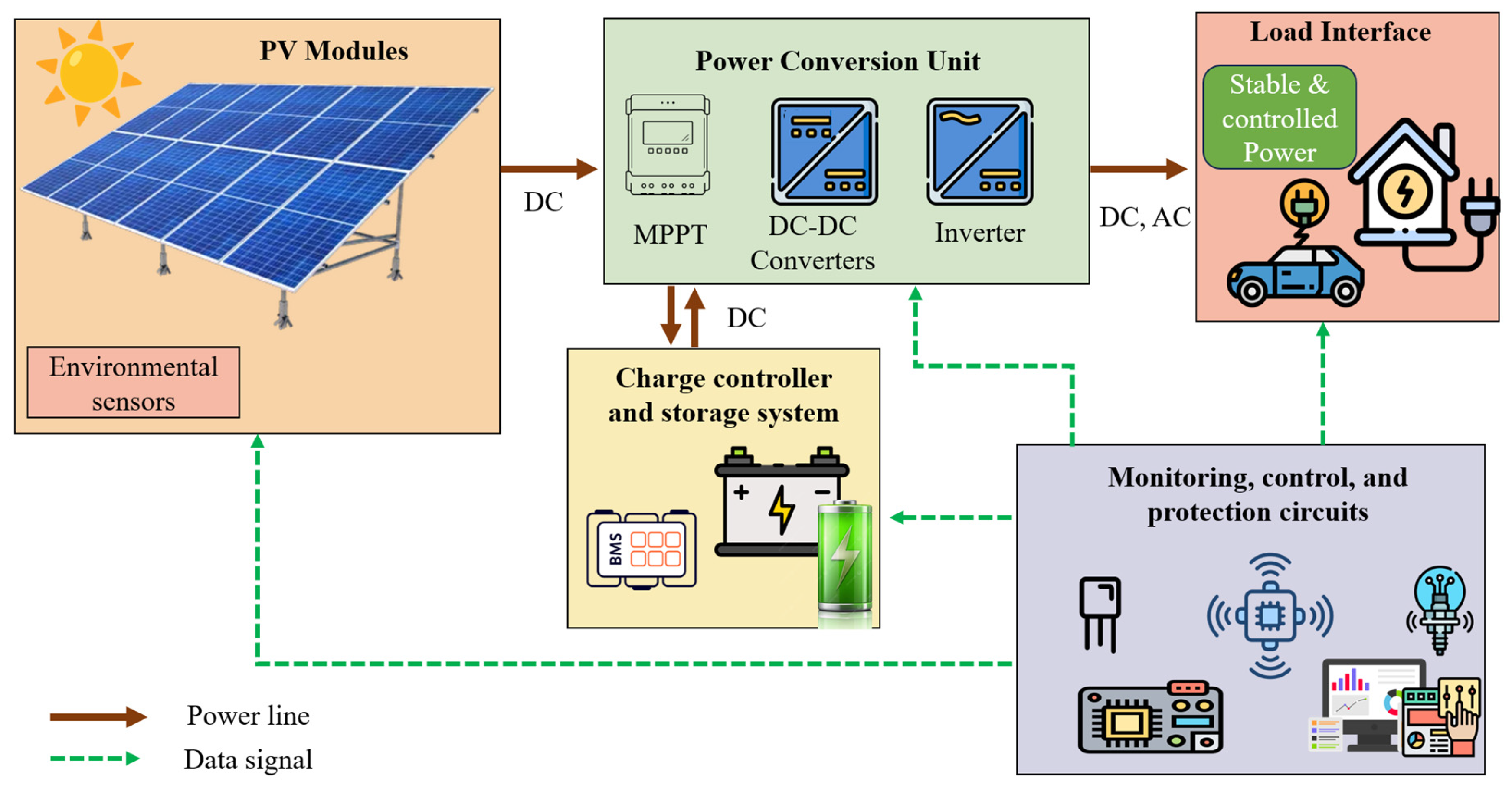
As shown in Figure 1, a typical PV system consists of a number of interconnected elements: the solar PV array; the power conversion unit; the energy storage system; the charge controller; monitoring, control, and protection circuits; and load interface [15,16]. Moreover, a sensor integration at every stage of these proceedings offers the setup of the essential data required for IoT-related monitoring and ML analyses. Recurrent measurements of the voltage and current allow power and efficiency calculations, whereas temperature and irradiation sensors offer the PV system performance.

2.2. Electrical Characteristics and Performance Indicators

IEC 61724 standard 1998 [17] describes the set of parameters that must be measured for the comparison of PV installations. To effectively make comparisons between different PV installations, parameters specific to each installation must be measured. These parameters will provide the means for the accurate determination of the installation’s efficiency. Table 1 lists the parameters for measurement according to their respective categories.

2.3. Operational Challenges Affecting Efficiency

Table 2 lists several common operational challenges introduced by the complex interaction of system components and dynamic environmental conditions. These challenges lead to energy losses and require intelligent management [18].

3. Internet of Things (IoT) for PV System Monitoring

IoT signifies the advent of a new technology paradigm with regard to the remote monitoring and control of PV installations. As it enables seamless communication between the dense networks of sensor systems and cloud servers, the technology makes it feasible for PV systems to transform from passive solar power production entities into active entities driven by intelligent decision-making algorithms linked with remote cloud services [25,26].

3.1. IoT Architecture for PV Applications

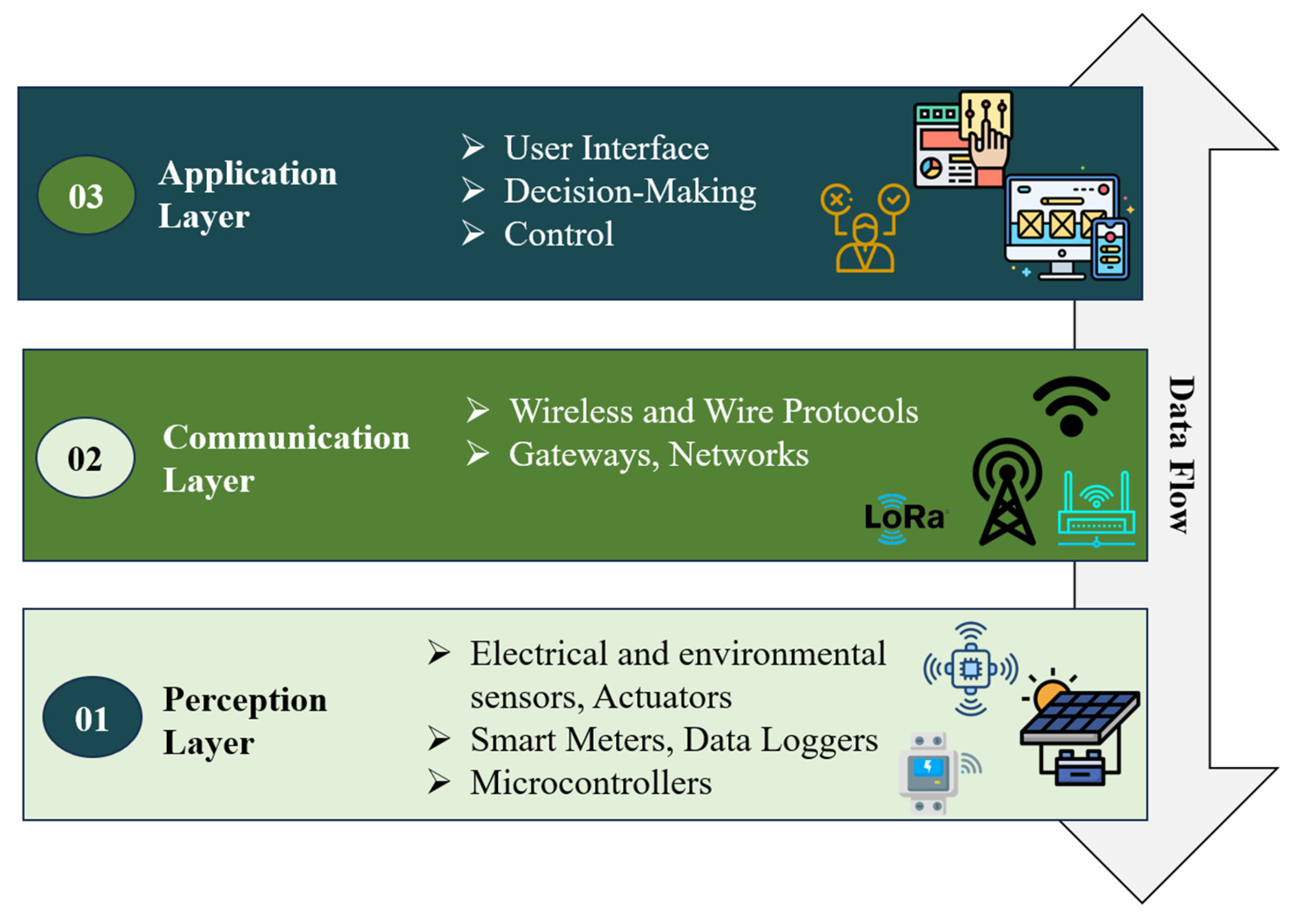
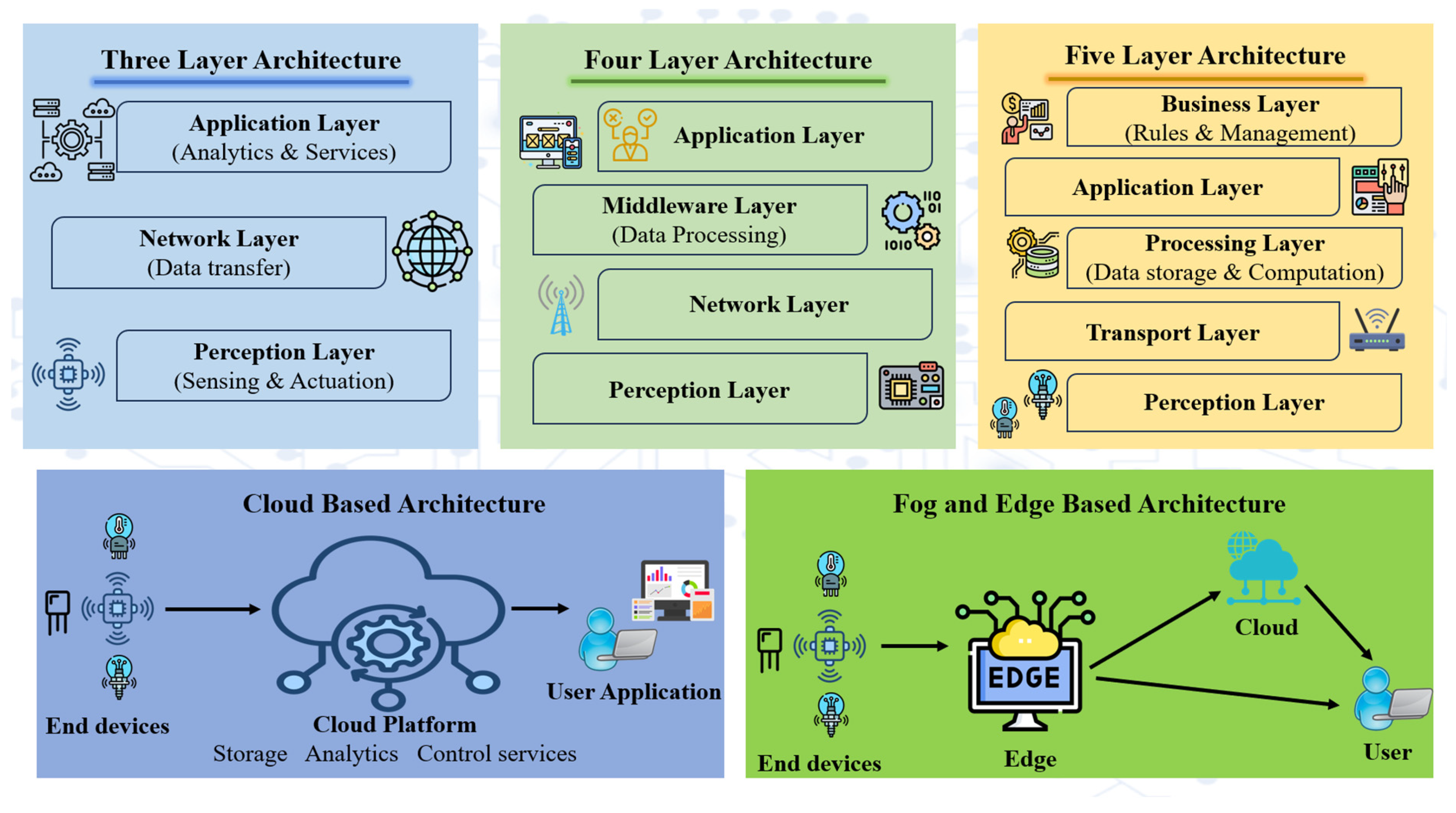
A typical IoT-based PV monitoring framework consists of three main functional layers that together create a real-time feedback loop, connecting field measurements with control modules, as shown in Figure 2.
  • Perception layer: It is the bottom most level of architecture, which communicates with the physical environment to collect electrical and environmental data such as voltage, current, irradiance, temperature, humidity, and wind speed, or to control the operation system using sensors, actuation, and microcontrollers.
  • Network layer: This is responsible for managing bidirectional communication between local sensor nodes and centralized gateways or cloud platforms using wireless or wired protocols.
  • Application layer: This layer provides the user interfaces and analytical environments where the vast quantities of collected data are visualized, stored, and processed. It hosts advanced computational models for decision support, predictive maintenance scheduling, and optimization.
This multi-layered model enables real-time feedback loops that connect field measurements with analytical or control modules, forming the backbone of autonomous PV operation [8,27].
Recently, several more advanced and multilayer IoT architectures have been proposed to address the increasing complexity and scalability demands of modern IoT systems [8,28]. As shown in Figure 3, the four-layer IoT architecture consisting of perception, communication, processing, and application layers enables efficient processing of the high-volume flow of information from sensors. To account for the rapid growth in the adoption of IoT solutions, a new five-layer IoT architecture was also proposed. The new layers in the architecture include middleware and business layers instead of the basic IoT architecture. The middleware layer controls services, including the processing of incoming information for the purpose of making decisions. The business logic layer supervises the overall application services of the system and develops business models in terms of workflow analysis of the already processed information.
Building on this evolution, cloud-based architectures rely on end devices that send data to remote servers where advanced analytics, long-term storage, and control tasks run. Fog and edge architectures shift part of the processing to local nodes to reduce latency and limit traffic. In addition, hybrid cloud edge architectures combine both approaches. Edge nodes handle fast tasks such as low-level data preprocessing, filtering, and initial diagnostics occur locally on microcontrollers or single-board computers. Cloud servers handle long-term analytics, visualization, and system management. This structure improves responsiveness and supports stable operation for energy systems and IoT deployments.

3.2. Sensor Technologies, Data Acquisition, and Transmission Modules

High-quality data acquisition is one of the most basic requirements for any IoT-enabled PV monitoring setup. Sensors are essentially the key point of interaction between the physical environment and digital analytics. They are responsible for translating raw measurements from the physical world to usable data points for control and analysis. The performance of all ML-related IoT analytics is dependent on the measurements’ precision and synchronization settings.
The key electrical parameters are monitored using integrated sensor modules that combine measurement and communication capabilities. Accurate synchronization between voltage and current measurements is critical for calculating instantaneous power, power factor, and efficiency. Moreover, high sampling rates and precise timestamping enable advanced analyses such as harmonic distortion, transient detection, and MPPT performance assessment. Table 3 summarizes the common electrical sensing technologies used in IoT-enabled PV systems [29].
Irradiance sensors, such as pyranometers, photodiodes, and calibrated light-dependent resistors, measure the solar irradiance incident on the PV cell surface [30]. Temperature sensors, such as the DS18B20 digital thermistor, DHT22, thermocouple modules, and PT100/PT1000 resistance temperature detectors, measure both cell and ambient temperatures in order to analyze thermal derating factor effects [29]. Other environmental sensors for monitoring humidity level and dust accumulation can be also integrated. These parameters enhance the diagnostic capabilities for soiling, heating effects, and environmental stresses on PV performance.
At the hardware level of IoT-based PV systems, data acquisition modules typically employ microcontrollers, such as ESP32, Arduino, and STM32, or embedded computing modules, for example, Raspberry Pi or Jetson Nano [8,25,31]. The choice of an appropriate module, therefore, depends on the functional requirements, performance objectives, and scale of the designed PV monitoring system.

3.3. Communication and Networking

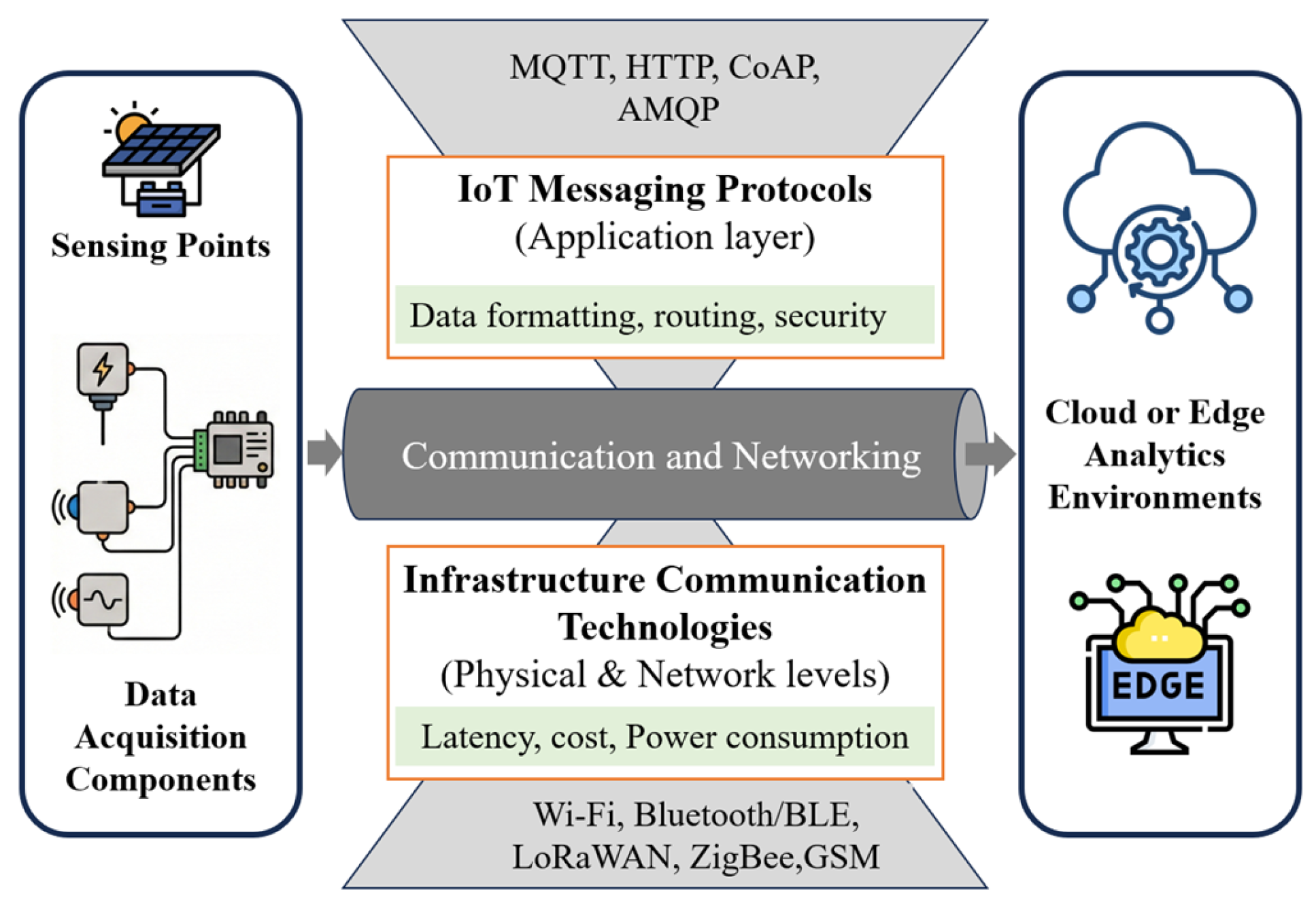
Efficient and reliable communication is one of the basic components of IoT-based PV monitoring systems. Communication infrastructure is viewed as the transmission channel between the sensing points, data acquisition components, and cloud or edge analytics environments. Communication technology is associated not only with latency and network reliability but also with the cost of ownership and power consumption by the communications infrastructure itself. From a wide perspective, the PV system IoT communication is divided into two major categories: (i) infrastructure communication technologies, which is charged entirely with data transport at physical and network levels; and (ii) IoT messaging protocols, which define data formatting, routing, and exchange at the application layer [32,33]. Figure 4 illustrates the IoT communication protocols and technologies.

3.3.1. Infrastructure Communication Technologies

The infrastructure layer is made up of hardware and transmitting components for connectivity between IoT nodes, gateways, and cloud servers. This may use short-range or long-range connectivity based on the scale of installation and geographical scenarios [34].
Such short-range communications are suited for residential or small-scale PV applications where devices are no more than tens of meters distant. Wi-Fi (IEEE 802.11) is simply the most widely adopted communication standard for PV devices today because of its high bandwidth (operating at hundreds of Mbps) and simplicity for home use router connectivity [35]. It supports real-time data transfer for dashboards and control, but is very power-hungry, making it inappropriate for battery-powered nodes. Bluetooth low energy (BLE) or ZigBee (IEEE 802.15.4) communications have network capabilities to create meshes for reliable data transfer among devices widely distributed around home or building environments. Moreover, they exhibit power consumption significantly lower than Wi-Fi [36,37]. BLE is suited for point-to-point or simple mesh network communications. It can also be used for many-to-many communications that cover hundreds of meters to connect PV array systems for power data management or control. Ethernet or RS-485 communication cables may occasionally be seen for industrial or lab-scale PV communications, where robust electromagnetic immunity against interference is required for guaranteed latency time performance [38].
In larger PV power plants or for distant off-grid PV installations, wide-area communications begin to become critically required. This is where cellular communications (GSM/GPRS/3G/4G or 5G) come into play [39]: they have wide geographical coverage and comparatively high data transfer rates, making it possible to retrieve data remotely in very distant areas too. Nevertheless, they come with recurring data fees for subscriptions and require investments to have 4G or 5G infrastructure already established for connectivity to work properly at high capacities. Another popular option for solar-based IoT PV power plants is LoRa (for “Long Range”) or LoRaWAN for wide-area communications: they offer incredibly low power consumption combined with high range (up to 20 km at “line of sight” unobstructed communications) [40]. This makes them very compelling for agricultural or distant PV power plant setups, for example, while having very limited use for high-speed communications, but being energy self-reliant for many IoT devices around town or for plant local subunits. Cellular-based narrow band IoT (NB-IoT) and LTE-M NR (Long-Term Evolution for Machines Network) are cellular-oriented IoT communications upgrades focusing on devices requiring very low power consumption while ensuring high geographical reach and carrier-grade connectivity and reliability for many devices or sensors distributed geographically around an area [39].
Choosing the right communication infrastructure involves making a series of compromises between requirements for bandwidth transmission speed, latency, power consumption, cost, and geographical limitations. For example, hybrid systems may consist of Wi-Fi or ZigBee communications inside the array and GSM or LoRaWAN for transport between more distant locations.

3.3.2. IoT Messaging Protocols

IoT messaging protocols set the rules for how data is structured, sent, and received between field devices and cloud servers. They work on top of the physical and network layers. These messaging protocols for IoT should function properly even under intermittent connectivity to ensure efficient data transfer between resource-constrained devices and cloud servers [27,28]. MQTT (message queuing telemetry transport) is currently the most widely adopted standard for PV monitoring systems overall. This standard functions on a publish/subscribe principle where the IoT devices publish PV monitoring information to a central entity called a broker (for instance, ThingsBoard or AWS IoT-Core), and this information is received asynchronously by database servers or analysis engines, among others. The primary advantage of MQTT is its efficiency in terms of header overhead and bandwidth utilization, and its native support for transport-layer security protocols for encryption [41]. CoAP (constrained application protocol) follows a request/response paradigm similar to HTTP but is designed for devices and environments where data transfer is unacknowledged or lossy. It supports RESTful APIs for accessing data from resources and is usually layered on UDP to reduce latency and overhead compared with TCP-based approaches for device communications. Both the advanced message queueing protocol (AMQP) and data distribution service (DDS) are largely deployed in industrial or supervisory control scenarios because of their high reliability and determinism requirements for message transfer and real-time performance guarantees. In web-based visualization and system integration, HTTP/HTTPS is widely adopted because of its universality and compatibility with cloud services, but it is associated with high communication overhead compared to MQTT or CoAP protocols. In addition, for experimental or hybrid solutions of the SCADA and IoT concepts implemented at power plants’ measuring points, open platform communications unified architecture (OPC-UA) and Modbus TCP are preferred to improve compatibility with power-electronic controllers or monitoring systems [42,43].
Present-day IoT messaging protocols also have strong security features such as transport layer security (TLS), secure sockets sayer (SSL), and token authentication to guarantee end-to-end confidentiality, integrity, and authenticity of PV data streams. The continuous development of such protocols to support lightweight encryption techniques, adaptive compression algorithms, and standardized levels of quality of service (QoS) will also improve the scalability and robustness of futuristic IoT-based PV systems.

3.4. Data Storage, Cloud Platform, and Visualization

The growing use of sensors within PV power plants generates continuous big data streams capturing numerous variables that need to be properly stored and analyzed for effective use. Modern IoT designs include coordinated data management processes considering full connectivity between sensing devices at physical levels and cloud-stored databases where analyses are conducted for informed comparison. This is achieved while ensuring data sustainability for analysis and prediction processes.

3.4.1. Data Storage and Database Management

Data generated from PV sensors, such as voltage, current, irradiance, and temperature readings, also requires a structured storage system to enable easy analysis and recall. A hybrid approach to data storage uses two different models: Relational databases, for example, MySQL or PostgreSQL, are robust and efficient for storing structured data for which schema definitions have already been established, making them ideal for storing data for analysis or further development of SCADA systems. Time-series databases (TSDBs), such as InfluxDB, TimescaleDB, PostgreSQL, or OpenTSDB, are highly efficient for storing high-volume timestamps and high-speed sensor input values for use in IoT devices [44,45].
Data is typically buffered locally on microcontrollers or gateways to avoid loss during connectivity disruptions. Edge nodes may do initial processing, like noise filtration, anomaly elimination, or data compression before transmission to minimize bandwidth and cloud storage expenses. In hybrid systems, edge-cloud synchronization guarantees data consistency upon the restoration of connectivity.

3.4.2. Cloud Platforms for PV Monitoring

Cloud platforms provide the necessary computer infrastructure to store, analyze, and visualize PV systems’ performance. The most popular IoT cloud platforms supporting PV monitoring and controlling can be classified into three categories.
Open-source platforms such as ThingsBoard, ThingSpeak, and Node-RED are widely utilized for academic and prototyping activities. These include features of MQTT/HTTP connectivity, rule engineering automation, and dashboards for customization. Commercial cloud platforms also include additional capabilities like secure device enrollment and load balancing for real-time analytics and machine learning capabilities through services like SageMaker for AWS IoT Core and Azure ML for Azure IoT Hub, and Google Cloud IoT Core. These together create end-to-end data management environments for ingestion to deployment. A growing preference now is for edge cloud hybrid designs where near real-time operations, such as MPPT control or fault detection, are done at the local level, and analytics for past data and also forecasting are cloud-based [46,47,48,49].

3.5. Literature Review on IoT-Based PV Monitoring

Over the last decade, IoT-based monitoring of PV systems has evolved from simple data-logging prototypes to sophisticated, networked platforms that support real-time supervision, fault detection, and integration with advanced analytics.
Recent studies increasingly demonstrate the potential of open-source IoT hardware as well as software for real-time monitoring, control, and optimization of PV systems. These solutions aim to overcome the limitations of conventional monitoring approaches, such as high cost, limited scalability, and lack of flexibility, particularly for small-scale and distributed PV installations. Several conference studies have focused on low-cost IoT architectures for PV monitoring and control. Ndukwe et al. [50] developed a 4th-generation IoT-based SCADA system for remote microgrids using LoRa communication, combining Arduino and Raspberry Pi platforms with open-source tools, such as Node-RED, InfluxDB, and Grafana, and validated the system on a PV-battery setup. Similarly, Mimouni et al. [49] proposed an energy-efficient PV monitoring system integrating an ESP32 microcontroller with sensor-based data acquisition and MQTT communication toward the ThingsBoard platform, enabling real-time visualization and data storage. IoT-based power management and hybrid energy supervision have also been explored. Islam et al. [51] implemented an IoT-enabled power management system for a solar-powered poultry farm, allowing real-time monitoring and automatic switching between PV and grid sources using NodeMCU, sensors, relays, and the Sinric Pro cloud. Brinda et al. [52] introduced an Arduino- and ESP8266-based PV-integrated energy monitoring system with ThingSpeak visualization, emphasizing efficient power utilization and user awareness. Other works extended IoT solutions to performance enhancement and control strategies. Rahman Akash et al. [53] presented a low-cost dual-axis IoT-based solar tracking system using ESP32, Arduino IoT Cloud, and Blynk, achieving higher energy yield compared to fixed and single-axis systems. Daou et al. [54] developed an IoT-based MPPT solar charger implementing a P&O algorithm on a 32-bit RA4M1 microcontroller, demonstrating tracking efficiencies exceeding 97% with real-time mobile monitoring via Wi-Fi WebSocket communication. Iksan et al. [55] further proposed an Arduino-based IoT system capable of monitoring and intelligently managing energy flow between PV and utility networks in a 1 kW installation, with web- and mobile-based visualization. More advanced hardware platforms have also been investigated. Oton and Iqbal [56] proposed a low-cost IoT-based SCADA system for rural base transceiver station sites using ESP32 and Arduino IoT Cloud to monitor electrical and environmental parameters, ensuring operational safety and reliability. Kumar et al. [57] introduced an FPGA-based IoT-enabled smart PV grid monitoring system integrating a mayfly-optimized ANN MPPT controller and a Luo DC–DC converter, demonstrating improved voltage gain and power tracking under partial shading conditions through MATLAB/Simulink validation. In parallel, several journal articles have addressed scalability, intelligence, and fault diagnosis in IoT-enabled PV systems. Radia et al. [46] presented a wireless PV monitoring system based on Raspberry Pi and NodeMCU, leveraging open-source tools, such as Node-RED, Mosquitto, InfluxDB, and Grafana for comprehensive data analysis. Sadeeq et al. [58] investigated a decentralized IoT-based energy management system using ESP32, combining electrical and environmental sensing with MQTT and HTTP communication via Blynk Cloud and web hosting platforms. Advanced intelligence and learning-based approaches have also emerged. Kumar et al. [59] addressed PV fault detection by proposing a low-cost IoT-enabled framework combining sensorless electronic detection, ESP32-based data acquisition, and deep learning-based fault classification, achieving an accuracy of 99.67%. Cloud-edge intelligence has further expanded PV monitoring capabilities. Tang et al. [60] developed a UAV-assisted IoT cloud-edge architecture for PV defect detection using embedded deep learning models, enabling low-latency and high-accuracy inspection. Kashyap et al. [61] proposed a self-learning IoT framework for PV array reconfiguration under nonuniform shading using ATmega2560, ESP8266, Node-RED, and MQTT, where an Advantage Actor-Critic algorithm dynamically optimized module placement. Additional contributions include real-time monitoring prototypes using Arduino-based platforms and open-source dashboards [62,63,64], hybrid IoT architectures for remote PV supervision [40,65,66,67], and centralized or semi-centralized control architectures integrating MPPT and environmental sensing [68,69,70,71,72,73]. Table 4 depicts some of the research recently conducted on the use of IoT for PV monitoring systems.
In addition, the literature shows a clear path from low-cost small-scale prototypes to reliable, secure, and scalable IoT architectures that are more and more connected to cloud platforms and machine-learning tools. But most implementations are still site-specific and differ greatly in terms of sensors, communication protocols, and data models. This makes it even more important to have standardized architectures and frameworks that can work together.

3.6. Advantages and Limitations of IoT in PV Systems

IoT integration in PV systems provides diverse correlated benefits, cumulatively improving performance, effectiveness, and informed decision-making capabilities. It is now possible to continuously monitor and track all electrical and environmental factors for PV installations to timely recognize any inconsistencies and monitor more distant installations. It is also possible to acquire continuous information for advanced predictive maintenance strategies to realize timely warning systems and minimize maintenance activities and associated expenditure. The continuous data stream from IoT can also power smart control strategies, especially for PV-based MPPT and energy management systems, thereby ensuring tangible efficiency gains between 5% to 15% and preventing performance during partial shading situations [74,75]. The modularity offered by standard communication protocols, such as MQTT, LoRaWAN, and NB-IoT, makes easy scalability and compatibility for the effortless integration of new sensors and devices for PV plants of diverse capacities. In addition, flexible continuous information generation directly supports diverse informed decisions associated with performance assessment, utility connectivity, and investment strategies for standard PV power plants to become highly efficient adaptive energy plants. However, many technological limitations exist for its actual realization, especially for giant installations or off-grid systems [45,76,77,78]:
  • Sensor Reliability and Calibration: The reliability of IoT is inherently dependent upon its sensors’ precision and robustness. Low-cost sensors tend to drift or become noisier or lose their calibration mannerisms once exposed to environmental settings, leading to biased readings that propagate through data-analytics layers. Maintaining calibration consistency across hundreds of nodes remains labor-intensive and costly, particularly in remote regions.
  • Communication Latency and Data Loss: Wireless communication technologies, including GSM, Wi-Fi, and LoRa, are prone to latency, interference, and packet loss under adverse environmental or electromagnetic conditions. Network instability can delay data updates or interrupt command execution, compromising real-time responsiveness. Multi-hop mesh networks reduce these problems but also add complexities to protocols and power consumption.
  • Energy Consumption of IoT Nodes: While designed for efficiency, IoT modules also need constant or periodic power sourcing, which may come from additional PV cells or batteries. However, ensuring autonomy for each node may become increasingly difficult for IoT devices operating in environments receiving low irradiance levels for cloud-covered areas or at nighttime.
  • Cybersecurity Vulnerabilities: IoT networks are spread out and networked, which makes them very vulnerable to cyberattacks. Unauthorized access, data spoofing, or denial-of-service attacks can put system integrity and operational safety at risk. The implementation of secure connections (encryption using TLS/SSL or authentication tokens) incurs high computation costs on low-power devices, whereas full cybersecurity solutions for PV-related IoT applications are still being developed.
  • Data Management and Interoperability Challenges: The use of IoT technology in PV systems ensures large amounts of heterogeneous data produced from electrical sensors, environmental measurement devices, intelligent inverters, and communication gateway devices. Data diversity in management raises significant issues at every stage in data management, from data acquisition to data transmission, storage, processing, and merging. Also, an important issue to consider relates to the compatibility of devices and platforms. Most of the data generated by IoT technology in PV systems involves the use of non-standardized hardware components, communication subsystems, and incompatible data standards. Although there exist standards, like IEC 61724, in the performance measurement of these technologies, there are no generally accepted standards at present that can standardize metadata, ontology definitions in devices, or application programming interfaces;
  • Economic and Environmental Considerations: The initial investment required for the deployment of sensors, gateways, and data services is still high for small-scale or rural areas. In addition to this, electronics have also added new environmental concerns, starting from disposal to manufacturing, which should focus on being eco-friendly to match the environmental goals of PV.

4. Machine Learning Applications in PV Systems

In PV systems, ML depends on data acquired through IoT-based monitoring infrastructures that continuously capture electrical and environmental parameters. Before feeding these datasets into ML algorithms, rigorous preprocessing is required to ensure data reliability and model accuracy. This process typically involves data cleaning to remove outliers, sensor noise, and missing values; feature engineering to derive informative indicators such as power ratio, normalized irradiance, or temperature-corrected efficiency; normalization and scaling to maintain consistent feature ranges; and data augmentation to enrich limited datasets using simulated or transferred data from similar environments [79,80]. Together, these steps yield a robust, high-quality dataset that enhances the predictive performance and generalization ability of ML models in PV analysis and optimization. Beyond data preparation, ML serves as a transformative analytical and control framework capable of learning complex, nonlinear relationships between environmental and operational variables. Unlike conventional rule-based algorithms, ML approaches adaptively refine their predictive and decision-making capabilities using real-world data collected through IoT networks. Their applications encompass solar energy forecasting, MPPT, fault detection, predictive maintenance, and energy management, collectively contributing to higher efficiency, reliability, and autonomy in both grid-connected and stand-alone PV installations [5,81,82].

4.1. Overview of Machine Learning Approaches in PV Systems

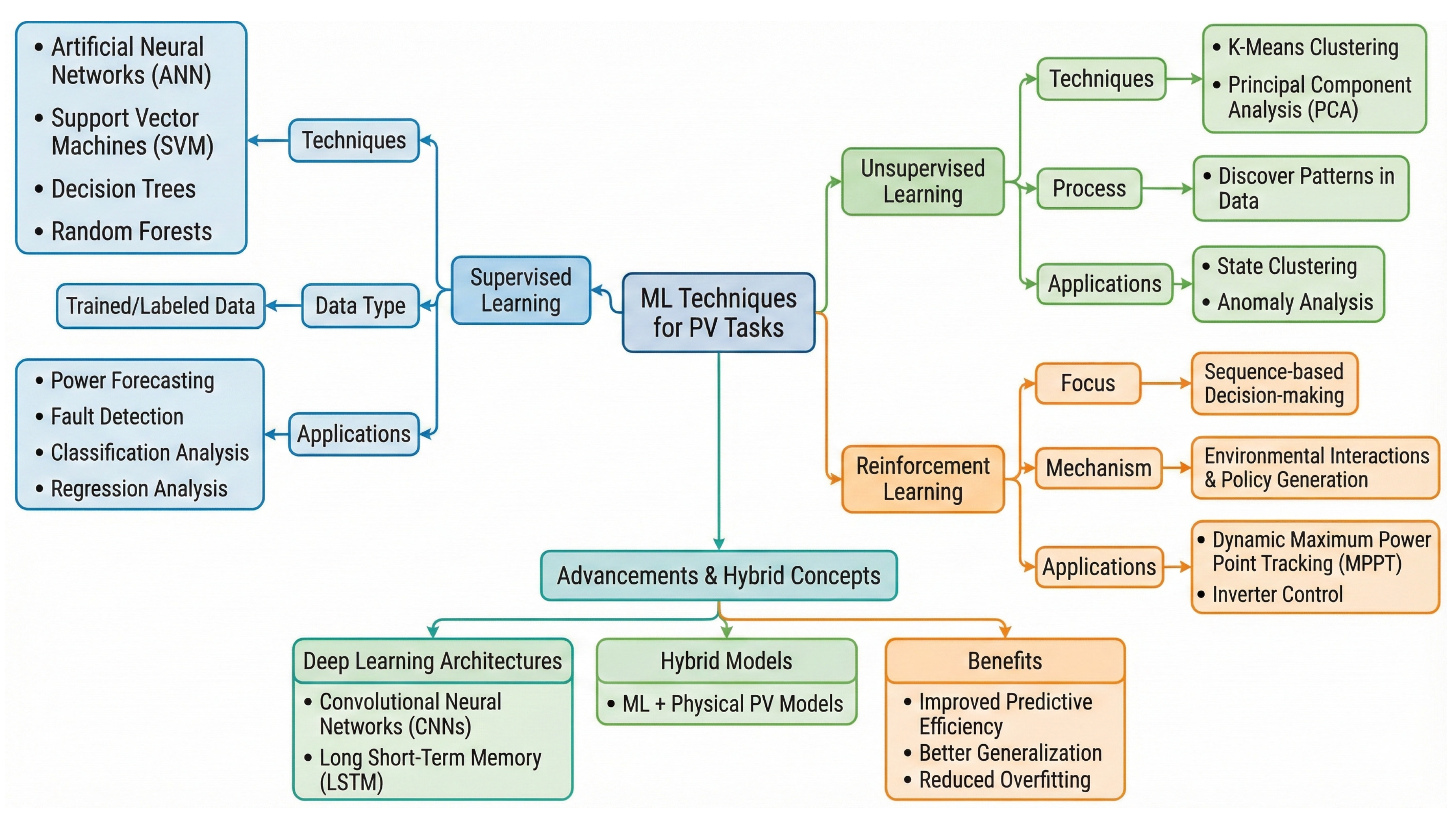
A classification of ML techniques for PV tasks can be grouped into supervised learning, unsupervised learning, and reinforcement learning, as shown in Figure 5 [12].
  • A supervised learning approach using artificial neural networks (ANN), support vector machines (SVM), decision trees, and random forests makes use of labeled training data for power forecasting and fault detection tasks or any sort of classification or regression analysis.
  • Unsupervised learning techniques like K-means clustering and principal component analysis (PCA) help discover patterns in the data to accomplish state clustering and anomaly analysis.
  • Reinforcement learning gives high emphasis to sequence-based decision-making tasks. Based on environmental interactions, the learning algorithm acquires effectiveness to generate control policies that make it highly effective for dynamic MPTT and inverters.
In addition, present advancements in deep learning architectures, such as convolutional neural networks (CNNs), long short-term memory (LSTM) network designs, or hybrid concepts, have positively impacted predictive efficiency and generalization capabilities for diverse climatic scenarios [83,84]. Hybrid concepts of machine learning designs, constructing physical PV models, can also minimize difficulties of overfitting. Table 5 summarizes major ML applications in PV systems.

4.2. Ensemble Learning Within ML-Enabled PV Systems

Ensemble learning approaches are becoming increasingly prevalent in photovoltaics based on ML because they are faster to generalize and more predictive. Rather than using single model, ensemble methods use multiple learners to address overfitting and uncertainty in the data such as random forests, boosting algorithms, stacking frameworks, or hybrid deep learning models such as CNN–LSTM ensembles [116]. In PV power forecasting, ensemble models use a range of meteorological inputs from IoT infrastructures to improve the prediction accuracy in both the short- and medium-term. In the same context, ensemble MPPT approaches are highly reliable for partial shading and rapidly changing environment. Ensemble classifiers perform better in fault detection and diagnosis for imbalanced datasets and noisy sensor measurements typical of large-scale PV monitoring systems. This combination of ensemble learning and IoT-based sensing thus represents a key trend towards more reliable and adaptive intelligent PV systems in real-world operating conditions with uncertainty and nonlinearity [12,13].

4.3. Power Output and Energy Forecasting

For grid integration, energy trading, and storage management, it is very important to be able to accurately predict how much power a PV system will produce. Standard empirical and statistical techniques, such as autoregressive integrated moving average and regression models, are constrained by their failure to identify nonlinear correlations between irradiance, temperature, and module performance. ML methods solve this problem by using past data to learn how to map complex inputs to outputs. ANNs are one of the most common methods to predict short-term PV power as they can model nonlinear data and learn quickly. Solar irradiance, ambient and module temperature, wind speed, humidity, and historical power data are all common input variables. For instance, Wentz et al. [85] analyzed the accuracy of an ANN and an LSTM network with two different sets of input atmospheric variables to predict solar irradiance for the short-term at three different forecast horizons of 1 min, 15 min, and 60 min. Results show that the LSTM model performs significantly better than the ANN model with an overall mean absolute percentage error (MAPE) of about 19.5%. Sharkawy et al. [86] used three neural-network architectures: a multilayer feed-forward neural network (MLFFNN), a recurrent neural network (RNN), and an NARX neural network (NARXNN) to estimate and forecast the total output power of four real PV substations, using only surface temperature and solar radiation as inputs. Rivero-Cacho et al. [90] used minute-by-minute data (irradiance, ambient and cell temperature) from a PV plant over one year to forecast energy production via multiple neural-network models (MLP, feed-forward, modular ANN, and LSTM). Their results show that the LSTM model achieved the best performance (MSE = 0.0089 p.u., MAE = 0.0527 p.u., RMSE = 0.0944 p.u.), while a modular ANN model delivered comparable accuracy with lower computational cost. Xiang et al. [91] proposed a hybrid model for short-term PV power forecasting, achieving superior seasonal performance with a normalized RMSE of 0.0195 and R2 of 99.72%, outperforming baseline methods and demonstrating strong multi-step prediction capability. Similarly, Wu et al. [117] proposed a hybrid CNN–LSTM deep learning model for ultra-short-term photovoltaic power forecasting, where parallel CNN and LSTM branches jointly capture spatiotemporal features, achieving superior multi-step forecasting accuracy for horizons ranging from 1 to 4 h compared to existing models. Shi et al. [87] propose a four-stage space time hybrid forecasting framework for distributed PV plants based on a Global and Local Feature Fusion Network and Copula-based correlation modeling, achieving significantly reduced forecasting errors and superior 1-h-ahead prediction accuracy compared with multiple neural models. Yang et al. [94] introduced a model for PV power forecasting using historical features with reuse to increase PV power accuracy for these systems. The model combined a weather type classification method using K-means clustering with an Elkan clustering algorithm, a distance-based feature matching using Markov chains, and bidirectional residual networks. The model showed efficiency with a day-by-day forecast accuracy of 91.12% for a PV plant.

4.4. Intelligent MPPT Optimization

The MPPT algorithm is very crucial for efficient energy harvesting from PV modules under different irradiation and temperature levels. The classical techniques of perturb and observe (P&O) and incremental conductance (INC) are simple but result in oscillatory behavior around the actual point of maximum power and are not efficient under dynamic environmental conditions [118]. Machine learning-based MPPT controllers overcome these limitations through adaptive learning processes. Fuzzy logic controllers (FLCs), ANN-based MPPT techniques, and adaptive neuro-fuzzy inference Systems (ANFIS) help learn non-linear relationships between environmental parameters and the converter’s control pulses. Smart controllers learn to adapt to operating points quickly while avoiding oscillations to some extent [95,96,97,98,99,100]. In this regard, learning controllers based on reinforcement learning have already shown high tracking efficiency values of over 99% and sub-100ms convergence speeds for partial shading cases of PV modules. Additionally, ML controllers executed on low-cost microcontrollers or Digital Signal Processors (DSPs) have also become capable of edge learning.

4.5. Fault Detection and Diagnosis

PV faults, such as module degradation, partial shading, short circuits, and inverter malfunctions, can cause PV systems to generate power below their expected capacities while also being potentially dangerous to PV system users. Methods of AI have become central to auto-diagnosis for PV system fault classification. According to machine learning processes, supervised classifiers [119], including support vector machines (SVMs) [105,106,107], random forest classifiers [102,108], and k-nearest neighbor classifiers (kNN) [103,104], are trained on labeled datasets that include electrical signals, which lets them find specific types of faults with a high level of accuracy.
Deep learning techniques, especially CNNs, can look at current voltage (I–V) characteristics or thermographic images to find cracks, shading patterns, and hotspots. CNN-based methods have been able to find faults with more than 95% accuracy in both simulated and real-world settings [101,120,121,122]. In addition, unsupervised models, like autoencoders and Gaussian mixture models, can find anomalies without any labeled data [123,124].

4.6. Energy Management and Optimization

In addition to control and diagnostic tasks, ML is one of the most significant aspects of energy management applied to hybrid systems that include PV energy sources, batteries, and energy demands. Predictive learning algorithms can anticipate energy generation or consumption trends based on environmental and load information to allow for effective scheduling of energy recharge or release from energy storage and prioritized load consumption. Reinforcement learning and Q deep learning techniques improve energy dispatch management schemes continuously to minimize energy loss and enhance self-consumption [111,112].

5. Integration of IoT and ML for Intelligent PV Systems

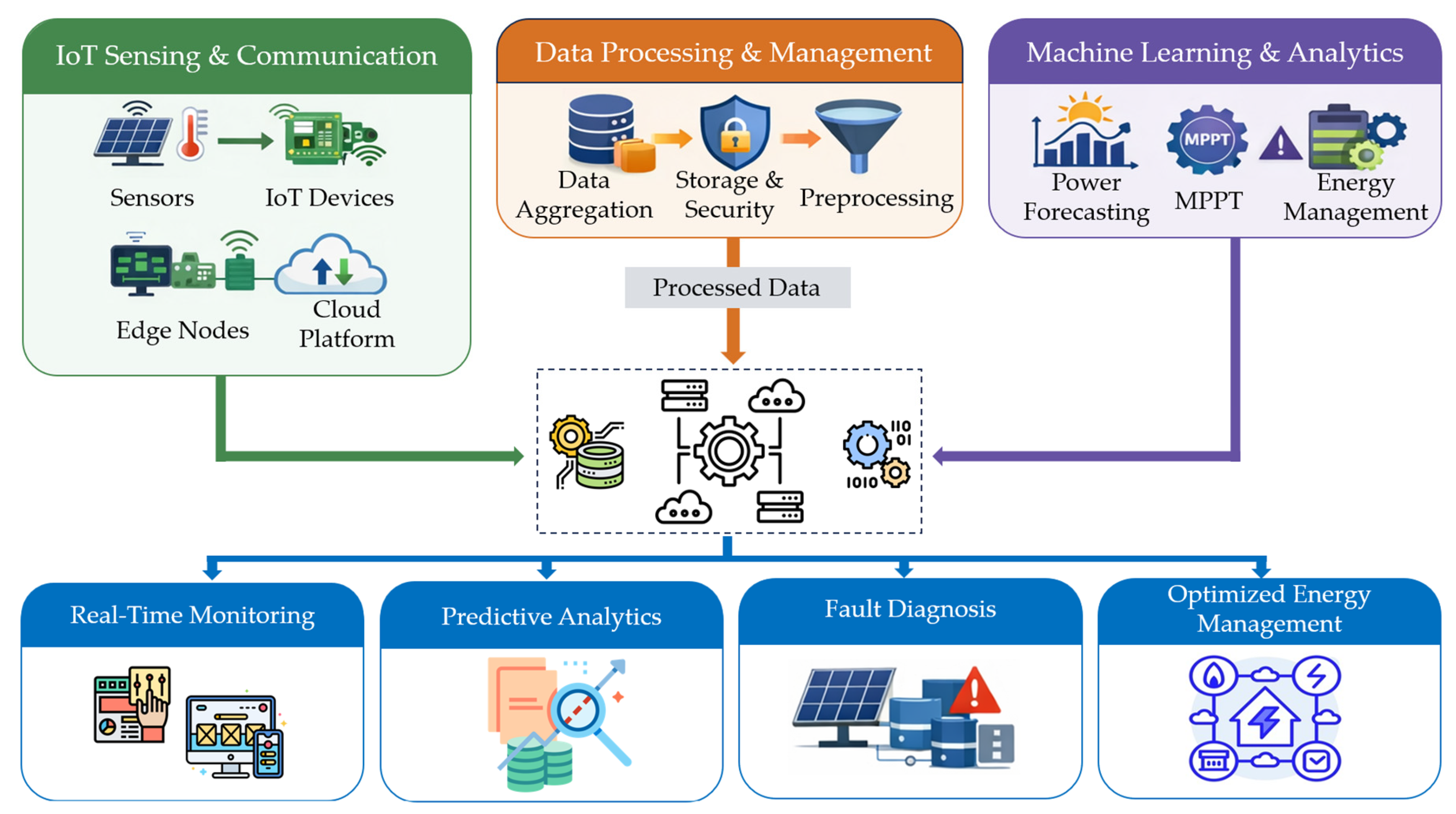
The confluence of IoT and ML techniques has resulted in the development of a novel paradigm of new Artificial-Intelligence-of-Things (AIoT) systems, which make it possible to carry out automatic, data-driven management of PV plants [9,125]. While IoT lends itself to real-time sensing and data acquisition capabilities of the network, ML provides generation capabilities for predictive or prescriptive data analysis to create informed decisions. Figure 6 presents the overall framework of IoT and ML based PV systems, highlighting the logical relationships among IoT sensing, communication, data management, ML analytics, and application layers in PV systems.

5.1. Concept and Architecture of AIoT in PV Systems

An AIoT-enabled PV system combines sensors, built-in controllers, communication interfaces, and analytics that are either in the cloud or on the edge into one system. In general, this setup has four layers [126]. Perception layer: Sensors and actuators to read electrical and environmental data and control the system. The network layer sends data to local gateways or cloud servers using communication technologies like Wi-Fi, LoRaWAN, NB-IoT, or 5G. The processing layer, where edge or cloud computing resources filter, store, and make inferences from data. The application layer is in charge of visualization, control, and user interaction through dashboards or SCADA interfaces. This hierarchical integration provides for data and control information to flow from both directions: The IoT network provides real-time feedback for field measurements, while the ML algorithm foresees system behavior for optimized parameters like the converter duty cycle or inverter reference voltage.

5.2. Data Flow and Real-Time Interaction Between IoT and ML Layers

In the integrated IoT–ML PV systems, data flow remains a crucial enabler of intelligent process in real-time. IoT systems allow a high-speed, continuous data acquisition and transmission, and ML algorithms make raw sensor data into useful insights. After pre-treatment processes such as noise filtering, normalization, and feature extraction, IoT data are converted to ML models for power forecasting, MPPT tracking, fault detection, and energy management. ML models outputs, such as expected power profiles, optimal operating points, or fault alerts, and are routed back over the IoT network to controllers, inverters or supervisory platforms. This bidirectional exchange of data allows for a rapid system response to change in environment and operational conditions [113,127].

5.3. Edge Versus Cloud Deployment Strategies

The choice between edge and cloud intelligence represents a critical design decision in AIoT architectures for PV and energy systems. This decision directly affects system latency, scalability, security, energy efficiency, and operational autonomy, particularly in distributed and resource-constrained environments.
Cloud computing has virtually unlimited computing and storage resources, making it suitable for analytics where data is a major concern and for a training of advanced machine and deep learning models such as CNNs and LSTM, and transformer-based architectures. This has led to the use of cloud-based intelligence for fleet level energy forecasting, predictive maintenance, and large-scale optimization. Indeed, Emamian et al. [128] developed an intelligent IoT monitoring platform that leverages the low cost of hardware, the personal cloud infrastructure, and deep ensemble learning models for PV power prediction and fault diagnosis using I–V. Thus, Mehmood et al. [129] developed a cloud-based solar conversion recovery system using IoT sensors, MQTT communication, and ANNs to predict PV soiling and improve cleaning cycles with low prediction error. Cloud intelligence is used in addition to plant-level monitoring and has been applied to a wider problem of system management, such as blockchain-based PV logistics optimization [130], remote monitoring of distributed PV stations [131], Industry 4.0-style predictive maintenance methodologies [132], and energy consumption prediction for electric vehicles [133]. Despite these advantages, constant streaming of data to the cloud adds non-negligible latency, increases bandwidth costs, and raises security, privacy, and reliability concerns if connectivity is intermittent. These are especially relevant in the context of off-grid or remote PV installations where access to the network may be challenging or expensive.
To address these challenges, edge computing has emerged as a complementary paradigm, enabling data processing and intelligence deployment directly at or near IoT devices and gateways [134,135]. By performing inference locally, edge intelligence significantly reduces latency and dependence on cloud connectivity, making it especially suitable for real-time tasks such as fault detection, inverter diagnostics, and adaptive MPPT. Recent advances in lightweight ML frameworks, such as TinyML and TensorFlow Lite, have further facilitated the deployment of ML and DL models on resource-constrained edge devices. In this context, Rayhan et al. [136] proposed an AI-driven edge-based condition monitoring framework for solar inverters, achieving improved fault detection accuracy and system responsiveness through decentralized decision-making. Shi [137] demonstrated how edge-end collaborative resource scheduling can reduce queuing delay and energy consumption in distributed PV monitoring systems. Zhang et al. [138] introduced an edge-based deep learning framework for estimating PV power losses due to soiling using image data, highlighting performance trade-offs across CPUs, EdgeTPUs, FPGAs, and VPUs. Broader edge-enabled IoT frameworks for renewable energy systems have also been shown to enhance real-time monitoring, proactive maintenance, and load balancing in decentralized smart grids [139]. In the context of smart cities, Ait Abdelmoula et al. [140] demonstrated that lightweight ML models deployed at edge nodes can achieve high anomaly detection accuracy with low latency and limited resource consumption. Furthermore, Chang et al. [141] proposed a lightweight short-term PV power prediction framework based on LightGBM, explicitly designed for edge computing environments with constrained computational resources.
A growing interest in this work is hybrid edge-cloud architectures, which attempt to use the strengths of both paradigms. In such architectures, computationally intensive modeling training and longitudinal analysis are done in the cloud with latency sensitive inferences and control actions taken from the edge. This division of labor makes operation more efficient by reducing the overhead of communication, improving system response time and protecting data security by minimizing raw data transmission. These advantages are particularly important in the case of large scale, or geographically spread PV plants, where connectivity to the network is limited or intermittent. Li et al. [142] have reviewed complete reviews of these architectures, reviewing edge-cloud computing frameworks for smart grids across the entire energy value chain. Its practical applications also provide evidence of the potential benefits of this convergent intelligence, such as cloud-edge measures of PV soiling detection by sensors free [19]; real-time defect detection using transfer learning and edge-deployed deep vision models [143]; and layered cloud-edge control systems for offshore floating PV power plants that significantly reduce cloud storage requirements and energy consumption [144].

5.4. Role of IoT–ML Integration in Enhancing Sustainability and Reliability

IoT and ML together offer a key feature of connected-loop intelligent control in PV systems. IoT sensors continuously record the performance of a PV system, while ML models automatically analyze this data and make control decisions. These lasts, such as adjusting MPPT duty cycles, optimizing inverter setpoints, or initiating maintenance actions, can be implemented via interfaces control and evaluated with new sensor measurements. This feedback loop allows for adaptive learning and continuous performance improvement, allowing PV systems to operate at a much closer quality level while retaining control of environmental variables, component aging, and load variability [127].
In addition to performance enhancement, the IoT–ML integration directly improves PV installations’ sustainability and reliability. Intelligent monitoring and predictive analytics dramatically reduce unplanned downtime and maintenance costs and adaptive control improves energy yield and system efficiency. Additionally, scalable IoT–ML frameworks allow the deployment of distributed PV assets at large scale, which enables grid integration and the move to decentralized and scalable energy systems. The combined IoT–ML paradigm is instrumental in the development of sustainable solar energy systems by allowing data-driven decision-making across PV lifecycles [10,145].

6. Benefits and Performance Improvements of IoT–ML Integration in PV Systems

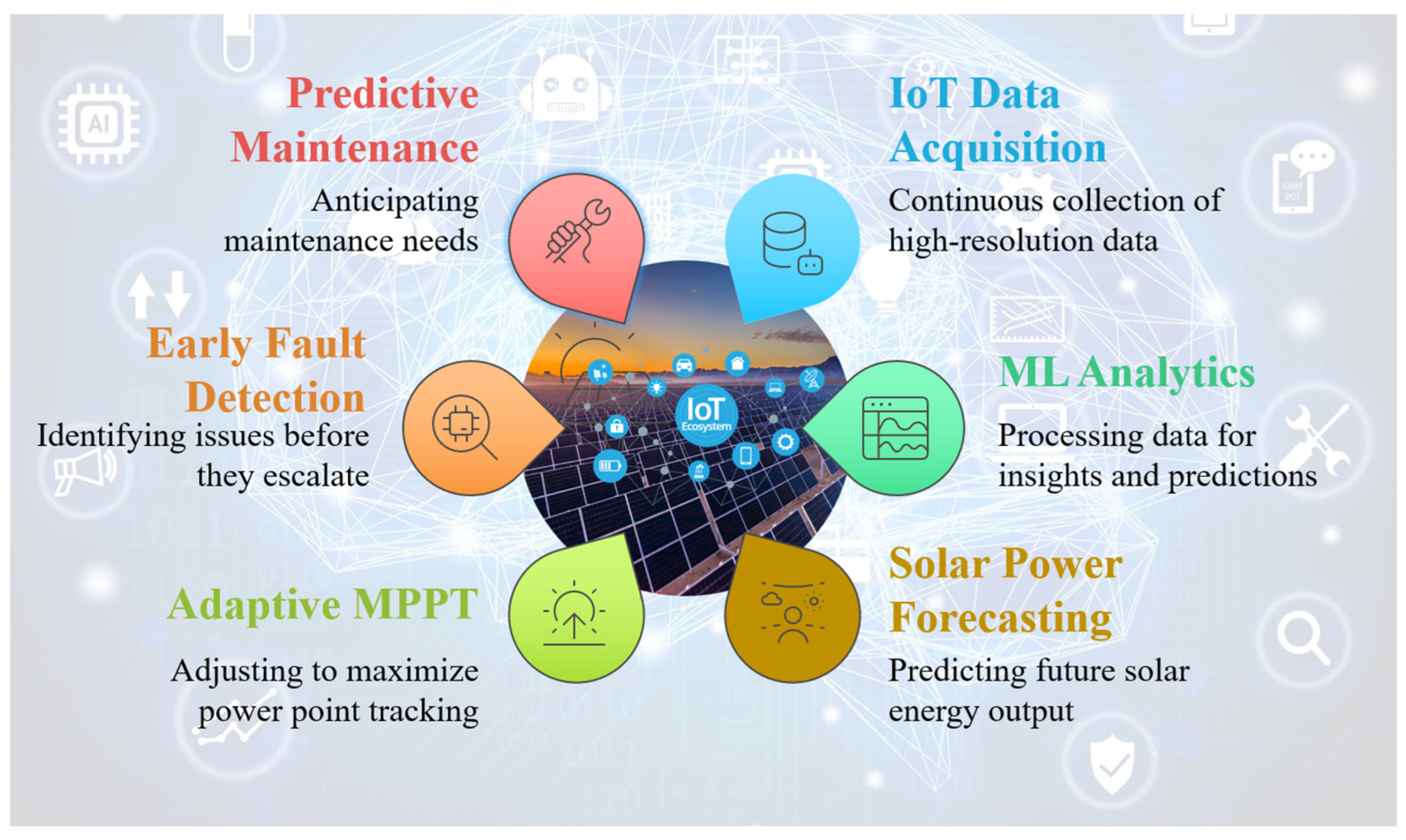
The integration of IoT and ML offers several systemic advantages for PV systems, as presented in Figure 7. These include enhanced autonomy, as self-learning models continuously refine operational parameters without manual recalibration; improved scalability, since modular IoT networks allow additional sensors or subsystems to be incorporated with minimal configuration while retrained ML models adapt to expanded data domains; greater resilience, as distributed intelligence supports local operation during network outages and enables rapid system recovery; and superior performance optimization, achieved through coordinated sensing and adaptive learning that concurrently enhance MPPT accuracy, fault detection, and power forecasting. This section synthesizes the principal benefits reported in the recent literature, highlighting quantitative performance indicators, operational reliability, and cost-effectiveness. Table 6 summarizes some case studies and practical implementations of the IoT and ML integrated PV systems.

6.1. Enhanced Energy Harvesting and MPPT Efficiency

The major advantage of interlinking IoT and machine learning for MPPT is the improvement achieved in energy harvesting by utilizing smart MPP tracking. The classical approach of perturb and observe or the incremental conductance method, is simple but may display some oscillations around the actual MPP or may not track properly under equal irradiation scenarios. The MPPT method developed using machine learning techniques like those based on fuzzy logic, adaptive neuro-fuzzy inference system (ANFIS), and reinforcement learning offers faster convergence and higher precision by identifying non-linear correlations between irradiance values, temperature levels, and electrical power outputs [70,146,155].
It is shown through empirical field analysis that tracking efficiency of over 98–99% can be achieved by employing ANN-based MPPT controllers within IoT modules, while traditional approaches result in efficiencies of 94–96%. Similarly, energy improvement of 6–12% can also be achieved through reinforcement learning-based MPPT designs implemented on controllers, considering dynamic shading cases. Gains provided by these improvements could further be assisted by real-time tuning possibilities offered by IoT technology for controller coefficients [151,156].

6.2. Improved Reliability and Fault Management

IoT–ML algorithms greatly enhance PV system reliability by leveraging predictive analytics and ML to automatically diagnose any fault conditions. This is because voltage, current, and temperature information is collected continuously to allow ML to learn deviations and diagnose fault types such as open circuit fault, short circuit fault, inverter fault, or soiling fault.
Recent studies using CNN and SVM have resulted in fault classification accuracy of over 95% within 2 s as response time. In an IoT-enabled setting, such detections can trigger automatic warning or compensatory control operations like isolating the respective string or modifying the reference parameters of inverters to reduce energy wastage or minimize safety risks. Additionally, ML-based predictive maintenance techniques using performance data can predict inverter or module degradation before vital failures occur. This warning system also shows promise for reducing the unavailability of inverters because of unforeseen breakdowns by 20–30% and increasing the lifespan of inverters by 10–15% [59,147,149,152].

6.3. Real-Time Monitoring and Operational Transparency

IoT-enabled sensing infrastructure offers unparalleled insights into photovoltaic plant performance. When combined with cloud-based dashboards and machine learning analytics, such infrastructure offers operators detailed and time-stamped information and analysis regarding plant performance. Live plots of current, voltage, and power values help to instantly highlight any areas of anomaly, while machine learning algorithms learn constantly from new input data to improve performance norms.
Such continuous monitoring helps facilitate decisions based on data analysis, for example, changes to cleaning cycles according to soiling factors or adjusting MPPT settings according to irradiance values. Performance ratio improvement of 5–10% has been achieved in large-scale PV systems integrated with IoT–ML-based supervisory systems, and this is mainly because of efficient fault troubleshooting and scheduling [19,137,148,149].

6.4. Energy Forecasting and Load Optimization

ML-based forecast algorithms integrated in IoT systems improve the forecast ability of solar power output, which is an aspect of prime importance for the stability of power grids as well as energy markets. Based on environmental and electric parameters measured through devices connected to an IoT setup, hybrid and LSTM-based models are capable of accurately estimating the power output of solar systems within a root mean square error (RMSE) of less than 5% and a mean absolute error (MAE) of less than 3% for hourly predictions. Accurate estimates of power outputs can be used for intelligent energy resource management in hybrid solar, battery, and load-based systems. Based on expected solar power outputs and load profiles, reinforcement learning-based control systems can be trained to minimize power curtailing and maximize self-consumption. System efficiency can be increased between 8% and 15%, and battery life increased approximately by 12% due to intelligent control [132,148,153,154,157].

6.5. Economic and Environmental Gains

From an economic point of view, combining IoT and ML lowers the costs of operating and maintaining (O&M) systems and the levelized cost of electricity (LCOE). Remote monitoring and predictive maintenance decrease the number of times manual inspections are needed, which saves 15–25% on O&M costs. Also, better energy harvesting and fixing problems early lead to more money made per installed watt [154].
Environmentally, increased efficiency and equipment life help to reduce carbon emissions. By reducing losses and keeping hardware replacements within control, the use of AIoT in PV systems supports eco-friendly and resource-saving ways of energy generation, aligning with international efforts towards achieving carbon neutrality [48,140].

6.6. Broader Systemic Impact

In addition to technological capacity, the integration of IoT and ML is another factor that accelerates the digital transformation in the renewable energy industry. Smart solar power plants constructed through the use of AIoT are prototype systems of smart grids and smart cities that can connect and work together in extreme scenarios, such as smart charging systems for electric vehicles. Thus, the role of IoT and ML integration is not only centered on improving the efficiency of solar power plants, as explained above, but it is also at the forefront of realizing intelligent, decentralized, and sustainable energy systems [133,158,159].

6.7. Inverter Control in Photovoltaic Systems

Recent advances indicate that in PV systems, IoT and ML technologies are increasingly integrating to the power of inverter-level intelligence. Currently the primary point of contact between PV generators, energy storage units, and the electrical grid, new smart inverters are connected to the internet of things, and can capture current, temperature, and grid condition data in real time [136]. By using these data sets, ML-based control strategies have been implemented to further improve MPPT, dynamic voltage and frequency regulation, harmonic reduction, and early fault diagnosis. Smart inverters also support additional grid services, such as reactive power control, ride-through capability, and predictive maintenance, thus enhancing system reliability and grid stability. Using IoT based sensing coupled with data driven ML control, PV inverters are able to turn from passive power conversion units into autonomous, adaptive, and grid-supportive devices that are integral for high renewable energy penetration and resilient smart grids [157,160,161].

7. Challenges and Limitations of IoT–ML Integration in PV Systems

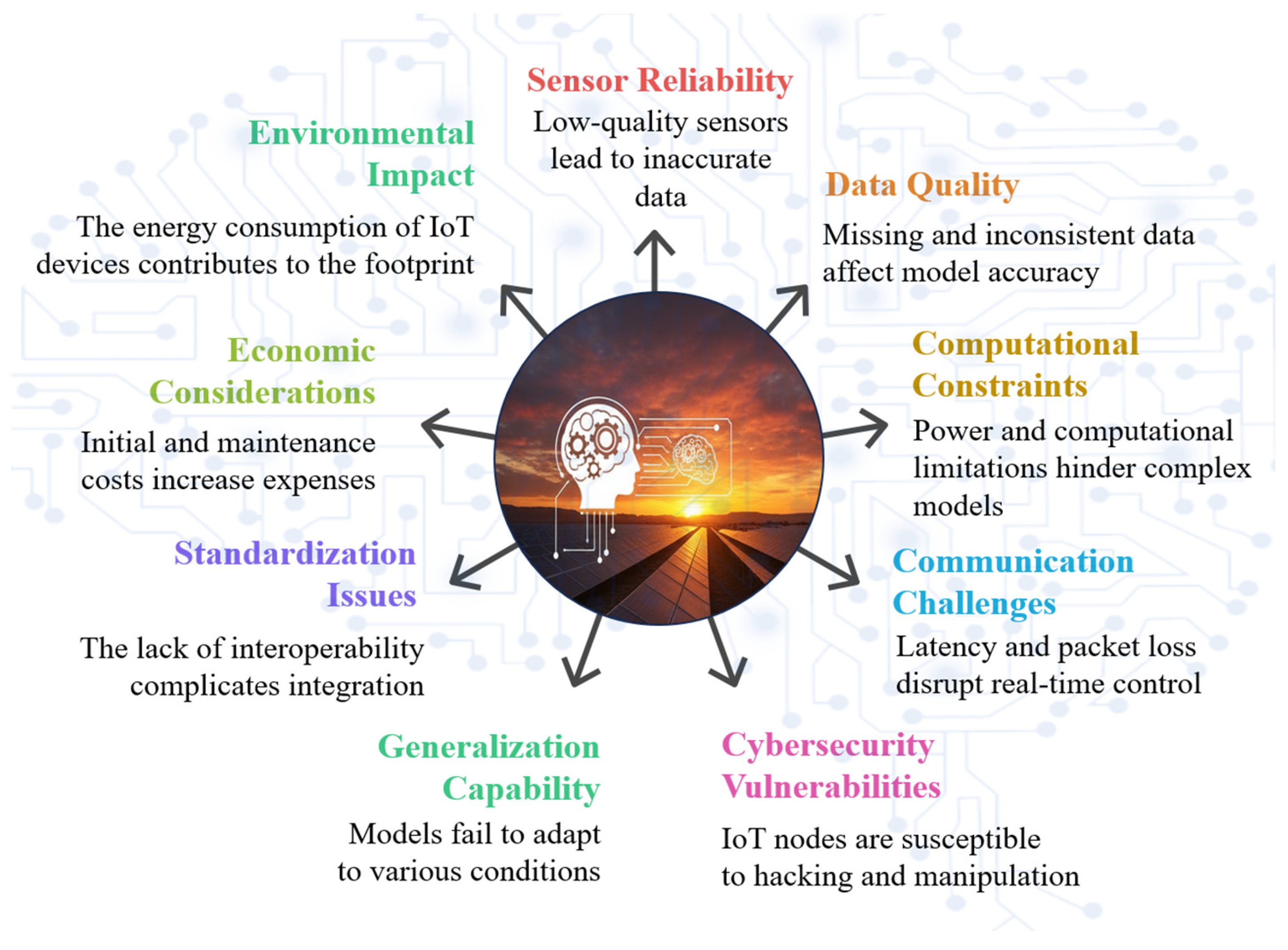
Despite remarkable advancements, the large-scale deployment of IoT and ML in PV systems remains constrained by several technical, computational, and operational challenges. The complexity of integrating heterogeneous sensors, wireless communication, cloud infrastructure, and learning algorithms introduces potential vulnerabilities and trade-offs. This section critically discusses the key limitations, ranging from hardware precision and data quality to cybersecurity and model reliability, that must be addressed before achieving fully autonomous, intelligent PV operations, as shown in Figure 8. Table 7 summarizes the challenges and the potential mitigation strategies of IoT and ML in PV systems.

7.1. Sensor Accuracy, Calibration, and Environmental Degradation

The reliability of any IoT-enabled PV system relies, in essence, on the accuracy and robustness of sensors. Many low-cost sensors, such as INA219 modules, as well as Hall Effect sensors like ACS712, often display temperature drift, aging effects, or calibration issues with tolerance rates beyond ±2% once exposed to outdoor conditions. Conditions such as dust buildup, rain, and temperature variations accelerate the sensor degradation process, often producing biased estimates, which in turn affect ML models [22].
Periodical calibration against reference instruments is not required for IoT enabled PV systems in order to achieve measurement fidelity, but is costly and increasingly impractical as system scale increases. In addition to calibration, time synchronization between electrical and environmental measurements is an important but often overlooked challenge. Even a few hundred millisecond sampling time can cause temporal differences between irradiance, temperature, voltage, and current, and can impact the quality of training data for successful machine learning. This temporal shift leads to model learning biases and poor predictive or control accuracy. More sophisticated mitigation strategies including self-calibrating sensor nodes, temperature-compensation models, and Kalman filter-based drift correction techniques have been proposed to address sensor aging and measurement uncertainty. However, these approaches are largely exploratory or in early development and not well documented on commercial PV monitoring platforms, illustrating the gap between research and practice [29].

7.2. Data Quality, Completeness, and Label Scarcity

ML models rely heavily on the availability of well-prepared, high-quality, and properly annotated datasets. In real applications, PV datasets may often show some incompleteness issues such as sensor breakdowns, network downtimes, or unavailability of cloud-based storage. Missing information, along with some anomalous points, increases the uncertainties within models as well as hampers their generalizability. Also, properly annotated fault exemplars for models designed through the process of supervised learning remain limited, as in real applications, the concerned PV systems rarely operate under controlled scenarios [29,36,79].
While these data are partially offset by synthetic or simulation-generated datasets, their performance is not fully compensated in real-world PV installations including stochastic variability, noise, and operational uncertainties. This may result in weakening of ML models that are usually built around simulated data. For these reasons, recent research has increasingly promoted the use of data augmentation, transfer learning, and semi-supervised learning approaches for models to in order incorporate small amounts of labeled data and larger amounts of unlabeled or cross-domain data. Nevertheless, the lack of standardized open-access PV datasets for various climate conditions, PV technologies, system scales, and fault types remains an ongoing limitation. This does not allow fair benchmarking, cross-study comparison, and generalization of ML solutions, and it also creates a barrier to future research and data driven collaborative research.

7.3. Computational Constraints and Energy Overhead

Processing and memory capabilities in most of the IoT devices typically used in PV installations, such as ESP32, Arduino, or STM32, can be considered constrained. Running complex ML models on such devices might increase latency in addition to increasing energy overhead and thermal stress. Edge processing run rates that continually operate with a high CPU utilization rate may increase the energy consumption of the node by as much as 40% despite achieving better MPPT [36,140,162].
Mitigation approaches such as TinyML and quantized neural networks reduce the size of models for inference on microcontrollers, but cloud infrastructure is still required. However, hybrid designs that move computationally expensive tasks, such as inference into the cloud, enabling fast edge decisions, address the aforementioned constraint. The challenge of finding the right edge cloud workload distribution with real-time responsiveness still lies in optimization [163].

7.4. Communication Latency, Network Reliability, and Scalability

For distributed PV installations, reliable connectivity is very important. GSM and Wi-Fi networks in remote or rural areas frequently suffer from problems with intermittent coverage, packet loss, or transmission latency [28,67,164]. These kinds of delays interrupt the feedback loops between sensors, controllers, and cloud analytics, which makes ML-driven control actions less timely.
Further, large deployments with hundreds of IoT nodes can cause problems with bandwidth and synchronization. The lightweight MQTT protocol reduces the amount of traffic; nevertheless, it lacks built-in quality-of-service guarantees for streaming data at high frequencies. New options like CoAP, 6LoWPAN, and LoRaWAN networks are more scalable, but they need more work to manage gateways. It is still a research priority to make networks more resilient by adding extra communication paths and making packet scheduling more flexible [40,165].

7.5. Cybersecurity and Privacy Risks

Serious cybersecurity risks are introduced by the convergence of IoT, cloud computing, and machine learning. Unsecured communication channels or weak authentication expose PV networks to attacks such as data spoofing, denial of service, or malicious parameter manipulation. Because ML models often act on sensor data in real time, falsified inputs could trigger unsafe inverter commands or disable protection relays [166,167].
Data privacy is another emerging issue, particularly for grid-connected systems that share operational metrics with external utilities or aggregators. Mitigation strategies, such as implementing TLS/SSL encryption, token-based authentication, and blockchain-backed transaction logs can enhance trust, but these add computational and storage overhead to constrained IoT nodes. In additions, integrating lightweight encryption standards such as elliptic-curve cryptography (ECC) and AES-128 remains an active area of research for low-power environments [168,169].

7.6. Model Robustness, Interpretability, and Generalization

ML models are effective at identifying patterns; nevertheless, they are limited in terms of robustness and interpretability. Models trained on data from a specific site may fail when they are moved to a new place with different irradiance spectra, module technologies, or inverter dynamics. Overfitting to local conditions can make tests seem very accurate, but the model may not work well in the real world [8,170].
Moreover, the nature of deep learning makes the verification of safe control, such as in the power regulation, more complex. This has led to the evolution of a relatively new field called explainable artificial intelligence (XAI), which aims to improve transparency by identifying the relative importance of input variables and elucidating the decision pathways followed by ML models. By providing insights into model reasoning, XAI techniques facilitate trust, debugging, and partial verification of control decisions in safety-critical PV applications. Nevertheless, despite these advances, the standardization of verification, validation, and certification procedures for ML-based control algorithms in PV systems remains an open challenge, especially when models are deployed in dynamic and uncertain operating environments [9,171].

7.7. Economic, Standardization, and Lifecycle Considerations

Although IoT hardware costs have declined, deploying hundreds of sensor nodes, gateways, and communication modules can still constitute a substantial capital investment, especially for small or off-grid installations. Maintenance of dispersed nodes, including calibration, firmware updates, and battery replacement, adds to lifecycle costs [172,173].
The absence of standardized interoperability protocols causes the challenges of integration among devices from various manufacturers. IEC 61724-1 sets standards for monitoring PV performance; however, it doesn’t say anything about IoT or AI-based analytics. The establishment of open communication standards and cross-vendor APIs is, therefore, essential to ensure long-term compatibility and scalability.

7.8. Environmental and Ethical Concerns

Cloud computing and continuous data transmission consume more energy and release more carbon, which partially goes against the goals of PV sustainability. Although individual IoT nodes consume little power, the cumulative effect across thousands of installations can be significant. Future AIoT design must, therefore, prioritize energy-aware computing, low-power electronics, and green-data-center operations to maintain net environmental benefits [174,175].
With the increasing level of autonomy in machine learning-based control systems, questions of ethics come up. Unattended decision-making may pose accountability problems, especially when there are equipment failures or occurrences of grid disturbances. With more autonomous AIoT, well-defined governance frameworks will be required.

8. Future Research Directions

The combination of the IoT and ML in PV systems has already shown clear benefits in monitoring, predicting, and controlling. However, the evolution toward fully autonomous, intelligent, and sustainable PV infrastructures demands further innovation. This section outlines emerging research directions expected to shape the next generation of AIoT-enabled PV systems, spanning from edge intelligence and federated learning to digital twins, explainable AI, cybersecurity, and environmental sustainability.

8.1. Edge Intelligence and On-Device Learning

Localized intelligence is the future of smart PV systems, where data is processed directly at or near the sensing node. Moving beyond the essential gathering of IoT data, the application of Edge AI or TinyML facilitates inference on devices with limited capabilities, such as the Arduino UNO Q, ESP32, STM32, or the Raspberry Pi. This lowers the need for bandwidth and cloud connectivity, which are very important for off-grid applications [134,162].
Recent studies have shown that the use of quantized deep neural networks or pruning-based ML models requiring less than 1 MB of memory can realize real-time processing for tasks, such as anomaly detection, as well as MPPT control. Future research will concentrate on adaptive edge learning, enabling models to self-optimize by leveraging patterns in their environment, thereby eliminating the necessity for comprehensive model retraining. Combining neuromorphic computing designs with low-power AI accelerators like Google Coral or NVIDIA Jetson Nano will also make advanced edge analytics easier and cheaper [176,177,178,179].

8.2. Federated and Collaborative Learning Across PV Systems

A significant issue with current ML applications in PV systems is the lack of generalization in a wide range of climates and hardware setups. Federated learning (FL) is a promising solution because it enables several PV sites to collaborate to train shared models without sending raw data to each other. Each node works on model updates on its own, and then those updates are combined into a global model that is stored on a secure server [180,181].
This method promotes privacy, scalability, and robust models, as well as addressing issues with heterogeneity. An FL technique facilitates the establishment of global solar forecasting grids that can be trained on thousands of geographically separated PV systems, thus being able to identify site-and climate-dependent behaviors. Moreover, the combination of FL and transfer learning may serve as a catalyst for even faster convergence rates, especially within the underrepresented regions of the dataset. Initial applications of FL in renewable energy applications have shown improvements of accuracy within the range of 10–15% with the preservation of privacy. Future work must aim at optimizing low-bandwidth communication protocols within FL-based IoT applications, such as those via compressed gradients through blockchain-based consensus.

8.3. Digital Twins and Virtual PV Modeling

Digital twins, or digital replicas with a high level of fidelity of real components, have found much interest in the energy domain. In the case of PV technology, digital twins provide real-time operation and forecast degradation, as well as simulation-based control strategies. Coupling digital twins with IoT infrastructure provides real-time feedback, as sensor inputs can update digital twins, with simulation results providing recommendations for adjustments in the real system. Such two-way interaction facilitates predictive analytics, scenario simulation, and real system optimization [182,183,184].
Recent improvements in hybrid twin models that use both model-based models and existing knowledge, as well as hybrid models that adopt ML predictions, will offer a more realistic perspective on the system. Future studies must focus on devising models that provide standard requirements for digital twins for PV systems, as well as their link with control systems.

8.4. Explainable and Trustworthy Artificial Intelligence (XAI)

With the growing reliance of PV technology on black box ML algorithms, explainability and trustworthiness have become essential areas of focus for researchers. Entities concerned with PV system safety, reliability, and grid integrity increasingly seek explanations for the output of such models. Explainable AI tools, such as SHAP (shapley additive explanations), LIME (local interpretable model-agnostic explanations), and saliency maps, offer additional insights into the relative importance of individual input variables for a specific model output [185]. Using explainable AI in PV systems, one may better explain feature sets with the highest effects on diagnosis. In weather-based models, it provides a better assessment of weather variables responsible for uncertainties in weather forecasts. In addition, using XAI with IoT platforms will give human-in-the-loop explainability, allowing experts to contest or confirm black box output. Standardization of metrics for explainability, along with working towards reliability, will be the most important next steps.

8.5. Secure and Resilient AIoT Infrastructures

As AIoT ecosystems grow, security and resilience will always be the most important issues [32]. Zero-trust security models, in which every step of communication and computation is verified and encrypted, must be part of future architectures. Lightweight cryptographic protocols, such as ECC and post-quantum encryption, will be required for long-term data integrity. Further, the integration of blockchain enables decentralized authentication in addition to tamper-evident logging of events in IoT–ML procedures, thus improving traceability in multi-location PV systems. The combination of blockchain technologies and federated learning may promote secure, traceable, and collective AI chains for global solar asset administration [186,187].
Future research should also explore resilience-by-design frameworks, embedding fault-tolerance and self-healing algorithms into IoT networks to maintain operational continuity under cyber or physical disturbances.

8.6. Sustainability and Green AI

Despite the effectiveness of the IoT–ML technologies in improving the efficiency of PV systems, there are additional computational and communication requirements that result in overall power consumption. To this end, future studies should focus more on “Green AI”, developing more energy-efficient algorithms and hardware that require minimal carbon emissions. This may be possible through model compression or sparse modeling [188,189].
At the same time, there needs to be simultaneous assessments regarding the life cycle sustainability impacts of digital infrastructure sensors, communication modules, and servers in a PV system. The use of data centers and edge computing devices that are renewable-energy-based would be possible through micro-PV-battery solutions [190]. Also, effective governance and clear AI guidelines must be deployed to assist with ethical concerns of autonomy, privacy, and accountability in decision-making.

8.7. Toward Autonomous, Self-Optimizing PV Ecosystems

Finally, these technological advancements come together in the formation of a vision for self-sustaining autonomous PV ecosystems that incorporate perception, cognition, and action in a closed-loop process. IoT sensors provide perception, ML delivers cognition, and power-electronic converters execute intelligent control actions. Future PV systems will be able to self-diagnose, self-adapt, and self-optimize in response to environmental and operational variability, embodying the principles of Industry 5.0 and sustainable digitalization [191].
Integration of AIoT-enabled PV technologies with smart grids, electric vehicles, and energy storage solutions would enable the formation of adaptive, decentralized, and resilient renewable energy networks and would place solar energy in the intelligent core position in the global shift towards clean energy.

9. Conclusions

The integration of the internet of things (IoT) and machine learning (ML) in photovoltaic (PV) systems represents one of the most revolutionary developments in modern renewable-energy engineering. Together, these technologies enable PV installations to evolve from static, manually monitored systems into intelligent, adaptive, and self-optimizing infrastructures capable of sustaining maximum efficiency under dynamically changing environmental conditions.
This review has comprehensively examined the foundations, applications, and implications of IoT–ML convergence for PV systems. The IoT layer, through dense networks of voltage, current, and environmental sensors, provides continuous, high-resolution data on system status and energy flow. Simultaneously, the ML layer transforms these data into actionable intelligence, driving forecasting, anomaly detection, and optimized control of power-electronic and inverter level. Empirical evidence from the recent literature shows that IoT–ML integration can improve MPPT tracking efficiencies, fault-classification accuracies, power-electronic and inverter-level control, and overall performance-ratio improvements of 5–15% relative to conventional systems. In addition, predictive maintenance frameworks have reduced unplanned downtime by nearly 30%, while optimized energy scheduling has increased storage utilization and extended battery life by 10–15%.
Furthermore, IoT–ML systems enhance operational transparency and reliability through real-time monitoring, remote supervision, and autonomous corrective actions. These advances are translated directly into reduced operational and maintenance costs, often 15–25% lower than baseline, and contribute to longer component lifetimes and lower Levelized cost of electricity (LCOE). The environmental benefits are substantial with the objective of furthering sustainability under global schemes of decarbonization.
However, the challenges are ever-present in the context of providing mass deployment possibilities. The issues of sensor drift, data incompleteness, reduced capacity of edge nodes for processing data from IoT devices, communication latency, and cybersecurity threats are ever-present obstacles. Furthermore, the challenge of standard frameworks being developed in connection with PV system functionality and IoT-AI compatibility would appear to be impacting the scalability issue across multiple platforms. Increasing attention needs to be paid to ethical and environmental factors.
In addition, there are various emerging lines of research that may be harnessed to overcome the current challenges. Edge intelligence and TinyML will enable on-device learning with minimal power consumption, while federated learning could allow global models to learn together in a collective manner without worrying about privacy constraints. Digital twin setups are envisioned to provide real-time modeling and replication of the PV system in predictive control applications. Moreover, Explainable AI would further provide interpretation support in automated decision-making. Blockchain technologies would help in securing the system, while green AI would culminate in environmentally sustainable systems.
Consequently, the combination between IoT and ML establishes the foundation for next-generation AIoT-based PV systems self-aware, interconnected, and environmentally responsible. As research progresses, these systems are expected to play a central role in decentralized energy networks, microgrids, and smart-city infrastructures. By coupling data-driven intelligence with renewable-energy generation, IoT–ML technologies not only improve PV performance but also redefine how humanity produces, manages, and consumes clean energy. Their continued evolution will be pivotal in achieving the global transition toward autonomous, carbon-neutral, and digitally sustainable power systems.

Author Contributions

Conceptualization, A.M. and Y.C.; Methodology, A.M.; Software, A.M.; Validation, A.E.A., M.E.A. and M.A.; Formal Analysis, A.M. and Y.C.; Investigation, A.E.A., M.E.A., M.A. and L.B.; Resources, A.M. and A.E.A.; Data Curation, A.M.; Writing—Original Draft Preparation, A.M. and Y.C.; Writing—Review & Editing, A.E.A. and M.A.; Visualization, A.E.A., M.A. and L.B.; Supervision, A.E.A., M.E.A. and M.A.; Project Administration, A.E.A. All authors have read and agreed to the published version of the manuscript.

Funding

This research received no external funding.

Institutional Review Board Statement

Not applicable.

Informed Consent Statement

Not applicable.

Data Availability Statement

No new data were created or analyzed in this study.

Acknowledgments

This work was carried out with the support of the National Scientific and Technical Research Centre (CNRST) as part of the “PhD-ASsociate Scholarship-PASS” programme.

Conflicts of Interest

The authors declare no conflict of interest.

Abbreviations

The following abbreviations are used in this manuscript:
AIArtificial Intelligence
AIoTArtificial Intelligence of Things
ANFISAdaptive Neuro-Fuzzy Inference System
ANNArtificial Neural Network
AWSAmazon Web Services
BLEBluetooth Low Energy
CNNConvolutional Neural Network
CoAPConstrained Application Protocol
DCDirect Current
DLDeep Learning
DNNDeep Neural Network
ECCElliptic Curve Cryptography
FLCFuzzy Logic Controller
INCIncremental Conductance
IoTInternet of Things
I–VCurrent–Voltage Characteristics
LCOELevelized Cost of Energy
LoRaWANLong-Range Wide-Area Network
LSTMLong Short-Term Memory
LTTSMCLimited-Time Terminal Sliding Mode Control
MAEMean Absolute Error
MAPEMean Absolute Percentage Error
MCUMicrocontroller Unit
MLMachine Learning
MPPTMaximum Power Point Tracking
MQTTMessage Queuing Telemetry Transport
NARXNNNonlinear Autoregressive Exogenous Neural Network
OPC-UAOpen Platform Communications–Unified Architecture
P&OPerturb and Observe
PLCProgrammable Logic Controller
PVPhotovoltaic
QPSOQuantum Particle Swarm Optimization
RBFRadial Basis Function
RLReinforcement Learning
RMSERoot Mean Square Error
SCADASupervisory Control and Data Acquisition
SMCSliding Mode Control
SoCState of Charge
SoHState of Health
SPISerial Peripheral Interface
TLSTransport Layer Security
TinyMLMachine Learning for Embedded Systems

References

  1. Al-Shahri, O.A.; Ismail, F.B.; Hannan, M.A.; Lipu, M.S.H.; Al-Shetwi, A.Q.; Begum, R.A.; Al-Muhsen, N.F.O.; Soujeri, E. Solar Photovoltaic Energy Optimization Methods, Challenges and Issues: A Comprehensive Review. J. Clean. Prod. 2021, 284, 125465. [Google Scholar] [CrossRef]
  2. Ang, T.-Z.; Salem, M.; Kamarol, M.; Das, H.S.; Nazari, M.A.; Prabaharan, N. A Comprehensive Study of Renewable Energy Sources: Classifications, Challenges and Suggestions. Energy Strategy Rev. 2022, 43, 100939. [Google Scholar] [CrossRef]
  3. Orosz, T.; Rassõlkin, A.; Arsénio, P.; Poór, P.; Valme, D.; Sleisz, Á. Current Challenges in Operation, Performance, and Maintenance of Photovoltaic Panels. Energies 2024, 17, 1306. [Google Scholar] [CrossRef]
  4. Shafiullah, M.; Ahmed, S.D.; Al-Sulaiman, F.A. Grid Integration Challenges and Solution Strategies for Solar PV Systems: A Review. IEEE Access 2022, 10, 52233–52257. [Google Scholar] [CrossRef]
  5. Datta, S.; Baul, A.; Sarker, G.C.; Sadhu, P.K.; Hodges, D.R. A Comprehensive Review of the Application of Machine Learning in Fabrication and Implementation of Photovoltaic Systems. IEEE Access 2023, 11, 77750–77778. [Google Scholar] [CrossRef]
  6. Poulek, V.; Aleš, Z.; Finsterle, T.; Libra, M.; Beránek, V.; Severová, L.; Belza, R.; Mrázek, J.; Kozelka, M.; Svoboda, R. Reliability Characteristics of First-Tier Photovoltaic Panels for Agrivoltaic Systems—Practical Consequences. Int. Agrophysics 2024, 38, 383–391. [Google Scholar] [CrossRef] [PubMed]
  7. Srivastava, N.; Pandey, P. Internet of Things (IoT): Applications, Trends, Issues and Challenges. Mater. Today Proc. 2022, 69, 587–591. [Google Scholar] [CrossRef]
  8. Mimouni, A.; Amrani, A.E.; Amraoui, M.E.; Bejjit, L. Internet of Things for Photovoltaic Solar Energy Systems. In NanoRevolution; CRC Press: Boca Raton, FL, USA, 2025; pp. 212–245. [Google Scholar]
  9. Boucif, O.H.; Lahouaou, A.M.; Boubiche, D.E.; Toral-Cruz, H. Artificial Intelligence of Things for Solar Energy Monitoring and Control. Appl. Sci. 2025, 15, 6019. [Google Scholar] [CrossRef]
  10. Das, D.K. Integrating IoT and AI for Sustainable Energy-Efficient Smart Building: Potential, Barriers and Strategic Pathways. Sustainability 2025, 17, 10313. [Google Scholar] [CrossRef]
  11. Singh, S.K.; Tiwari, A.K.; Paliwal, H.K. A State-of-the-Art Review on the Utilization of Machine Learning in Nanofluids, Solar Energy Generation, and the Prognosis of Solar Power. Eng. Anal. Bound. Elem. 2023, 155, 62–86. [Google Scholar] [CrossRef]
  12. Noura, H.N.; Yaacoub, J.P.A.; Salman, O.; Chehab, A. Advanced Machine Learning in Smart Grids: An Overview. Internet Things Cyber-Phys. Syst. 2025, 5, 95–142. [Google Scholar] [CrossRef]
  13. Hamad, S.A.; Ghalib, M.A.; Munshi, A.; Alotaibi, M.; Ebied, M.A. Evaluating Machine Learning Models Comprehensively for Predicting Maximum Power from Photovoltaic Systems. Sci. Rep. 2025, 15, 10750. [Google Scholar] [CrossRef]
  14. Adefarati, T.; Sharma, G.; Bokoro, P.N.; Kumar, R. Advancing Renewable-Dominant Power Systems Through Internet of Things and Artificial Intelligence: A Comprehensive Review. Energies 2025, 18, 5243. [Google Scholar] [CrossRef]
  15. Madeti, S.R.; Singh, S.N. Monitoring System for Photovoltaic Plants: A Review. Renew. Sustain. Energy Rev. 2017, 67, 1180–1207. [Google Scholar] [CrossRef]
  16. Hernández-Callejo, L.; Gallardo-Saavedra, S.; Alonso-Gómez, V. A Review of Photovoltaic Systems: Design, Operation and Maintenance. Sol. Energy 2019, 188, 426–440. [Google Scholar] [CrossRef]
  17. International Electrotechnical Commission. IEC 61724, Photovoltaic System Performance Monitoring-Guidelines for Measurement, Data Exchange and Analysis, 1st ed.; IEC—International Electrotechnical Commission: Geneva, Switzerland, 1998. [Google Scholar]
  18. Hasan, K.; Yousuf, S.B.; Tushar, M.S.H.K.; Das, B.K.; Das, P.; Islam, M.S. Effects of Different Environmental and Operational Factors on the PV Performance: A Comprehensive Review. Energy Sci. Amp; Eng. 2022, 10, 656–675. [Google Scholar] [CrossRef]
  19. Zhou, K.; Gao, F.; Hou, Z.; Liu, J.; Meng, X. Cloud-Edge Collaborated Dust Deposition Degree Monitoring for Distributed Photovoltaic Systems. Int. J. Electr. Power Energy Syst. 2023, 153, 109298. [Google Scholar] [CrossRef]
  20. Al-Sharafi, A.; Ahmadullah, A.B.; Hassan, G.; Al-Qahtani, H.; Abubakar, A.A.; Yilbas, B.S. Influence of Environmental Dust Accumulation on the Performance and Economics of Solar Energy Systems: A Comprehensive Review. Clean. Energy Syst. 2024, 8, 100125. [Google Scholar] [CrossRef]
  21. Bamisile, O.; Acen, C.; Cai, D.; Huang, Q.; Staffell, I. The Environmental Factors Affecting Solar Photovoltaic Output. Renew. Sustain. Energy Rev. 2025, 208, 115073. [Google Scholar] [CrossRef]
  22. Sepúlveda-Oviedo, E.H. Impact of Environmental Factors on Photovoltaic System Performance Degradation. Energy Strategy Rev. 2025, 59, 101682. [Google Scholar] [CrossRef]
  23. Aifan, G.; Alsulami, A.; Alhussainy, A.A.; Allehyani, A.; Alturki, Y.A.; Alghamdi, S.M.; Alruwaili, M.; Alharthi, Y.Z. A Comparison of Several Maximum Power Point Tracking Algorithms for a Photovoltaic Power System. Front. Energy Res. 2024, 12, 1413252. [Google Scholar] [CrossRef] [PubMed]
  24. Taghezouit, B.; Harrou, F.; Sun, Y.; Merrouche, W. Model-Based Fault Detection in Photovoltaic Systems: A Comprehensive Review and Avenues for Enhancement. Results Eng. 2024, 21, 101835. [Google Scholar] [CrossRef]
  25. Ansari, S.; Ayob, A.; Lipu, M.S.H.; Saad, M.H.M.; Hussain, A. A Review of Monitoring Technologies for Solar PV Systems Using Data Processing Modules and Transmission Protocols: Progress, Challenges and Prospects. Sustainability 2021, 13, 8120. [Google Scholar] [CrossRef]
  26. Rao, C.K.; Sahoo, S.K.; Yanine, F.F. A Review of IoT-Based Smart Energy Solutions for Photovoltaic Systems. Electr. Eng. 2025, 107, 15049–15068. [Google Scholar] [CrossRef]
  27. Islam, M.M.; Nooruddin, S.; Karray, F.; Muhammad, G. Internet of Things: Device Capabilities, Architectures, Protocols, and Smart Applications in Healthcare Domain. IEEE Internet Things J. 2023, 10, 3611–3641. [Google Scholar] [CrossRef]
  28. Qays, M.O.; Ahmad, I.; Abu-Siada, A.; Hossain, M.L.; Yasmin, F. Key Communication Technologies, Applications, Protocols and Future Guides for IoT-Assisted Smart Grid Systems: A Review. Energy Rep. 2023, 9, 2440–2452. [Google Scholar] [CrossRef]
  29. Kalay, M.Ş.; Kılıç, B.; Sağlam, Ş. Systematic Review of the Data Acquisition and Monitoring Systems of Photovoltaic Panels and Arrays. Sol. Energy 2022, 244, 47–64. [Google Scholar] [CrossRef]
  30. Pazikadin, A.R.; Rifai, D.; Ali, K.; Malik, M.Z.; Abdalla, A.N.; Faraj, M.A. Solar Irradiance Measurement Instrumentation and Power Solar Generation Forecasting Based on Artificial Neural Networks (ANN): A Review of Five Years Research Trend. Sci. Total Environ. 2020, 715, 136848. [Google Scholar] [CrossRef]
  31. Rao, C.K.; Sahoo, S.K.; Yanine, F.F. A Literature Review on an IoT-Based Intelligent Smart Energy Management Systems for PV Power Generation. Hybrid Adv. 2024, 5, 100136. [Google Scholar] [CrossRef]
  32. Gerodimos, A.; Maglaras, L.; Ferrag, M.A.; Ayres, N.; Kantzavelou, I. IoT: Communication Protocols and Security Threats. Internet Things Cyber-Phys. Syst. 2023, 3, 1–13. [Google Scholar] [CrossRef]
  33. Aldin, H.N.S.; Ghods, M.R.; Nayebipour, F.; Torshiz, M.N. A Comprehensive Review of Energy Harvesting and Routing Strategies for IoT Sensors Sustainability and Communication Technology. Sens. Int. 2024, 5, 100258. [Google Scholar] [CrossRef]
  34. Daousis, S.; Peladarinos, N.; Cheimaras, V.; Papageorgas, P.; Piromalis, D.D.; Munteanu, R.A. Overview of Protocols and Standards for Wireless Sensor Networks in Critical Infrastructures. Future Internet 2024, 16, 33. [Google Scholar] [CrossRef]
  35. Helmy, H.A.; El-Rifaie, A.M.; Youssef, A.A.F.; Haggag, A.; Hamad, H.; Eltokhy, M. Improving Solar Energy-Harvesting Wireless Sensor Network (SEH-WSN) with Hybrid Li-Fi/Wi-Fi, Integrating Markov Model, Sleep Scheduling, and Smart Switching Algorithms. Technologies 2025, 13, 437. [Google Scholar] [CrossRef]
  36. Kreković, D.; Krivić, P.; Podnar Žarko, I.; Kušek, M.; Le-Phuoc, D. Reducing Communication Overhead in the IoT–Edge–Cloud Continuum: A Survey on Protocols and Data Reduction Strategies. Internet Things 2025, 31, 101553. [Google Scholar] [CrossRef]
  37. Padma, B.; Erukala, S.B. End-to-End Communication Protocol in IoT-Enabled ZigBee Network: Investigation and Performance Analysis. Internet Things 2023, 22, 100796. [Google Scholar] [CrossRef]
  38. Jha, B.K.; Tiwari, A.; Kuhada, R.B.; Pindoriya, N.M. IoT-Enabled Smart Energy Management Device for Optimal Scheduling of Distributed Energy Resources. Electr. Power Syst. Res. 2024, 229, 110121. [Google Scholar] [CrossRef]
  39. Vaezi, M.; Azari, A.; Khosravirad, S.R.; Shirvanimoghaddam, M.; Azari, M.M.; Chasaki, D.; Popovski, P. Cellular, Wide-Area, and Non-Terrestrial IoT: A Survey on 5G Advances and the Road Toward 6G. IEEE Commun. Surv. Tutor. 2022, 24, 1117–1174. [Google Scholar] [CrossRef]
  40. Hameed, B.H.; Kurnaz, S. Secure Low-Cost Photovoltaic Monitoring System Based on LoRaWAN Network and Artificial Intelligence. Discov. Comput. 2024, 27, 36. [Google Scholar] [CrossRef]
  41. Quincozes, S.; Emilio, T.; Kazienko, J. MQTT Protocol: Fundamentals, Tools and Future Directions. IEEE Lat. Am. Trans. 2019, 17, 1439–1448. [Google Scholar] [CrossRef]
  42. G.S., V.; Karthikeyan, A.; Karthikeyan, K.; Sanjeevikumar, P.; Karapparambil Thomas, S.; Babu, A. Critical Review Of SCADA And PLC in Smart Buildings and Energy Sector. Energy Rep. 2024, 12, 1518–1530. [Google Scholar] [CrossRef]
  43. He, W.; Baig, M.J.A.; Iqbal, M.T. An Internet of Things—Supervisory Control and Data Acquisition (IoT-SCADA) Architecture for Photovoltaic System Monitoring, Control, and Inspection in Real Time. Electronics 2024, 14, 42. [Google Scholar] [CrossRef]
  44. Ayele, E.D.; Gavriel, S.; Gonzalez, J.F.; Teeuw, W.B.; Philimis, P.; Gillani, G. Emerging Industrial Internet of Things Open-Source Platforms and Applications in Diverse Sectors. Telecom 2024, 5, 369–399. [Google Scholar] [CrossRef]
  45. Domínguez-Bolaño, T.; Barral, V.; Escudero, C.J.; García-Naya, J.A. An IoT System for a Smart Campus: Challenges and Solutions Illustrated over Several Real-World Use Cases. Internet Things 2024, 25, 101099. [Google Scholar] [CrossRef]
  46. Radia, M.A.A.; Nimr, M.K.E.; Atlam, A.S. IoT-Based Wireless Data Acquisition and Control System for Photovoltaic Module Performance Analysis. e-Prime-Adv. Electr. Eng. Electron. Energy 2023, 6, 100348. [Google Scholar] [CrossRef]
  47. Supo, J.F.; Puma, P.Y.; Ramos, J.M.; Beltrán, N.J. Implementation of a Monitoring System for a Photovoltaic Installation Based on IoT Technology. J. Phys. Conf. Ser. 2023, 2538, 012003. [Google Scholar] [CrossRef]
  48. Muñiz, R.; Del Coso, R.; Nuño, F.; Villegas, P.J.; Álvarez, D.; Martínez, J.A. Solar-Powered Smart Buildings: Integrated Energy Management Solution for IoT-Enabled Sustainability. Electronics 2024, 13, 317. [Google Scholar] [CrossRef]
  49. Mimouni, A.; Chahet, Y.; El Amrani, A.; El Amraoui, M.; Bejjit, L. Internet of Things Technology for an Autonomous Photovoltaic Solar Energy System Monitoring. In E3S Web of Conferences; EDP Sciences: Les Ulis, France, 2025; Volume 601, p. 00056. [Google Scholar] [CrossRef]
  50. Ndukwe, C.; Iqbal, M.T.; Khan, J. Development of a Low-Cost LoRa Based SCADA System for Monitoring and Supervisory Control of Small Renewable Energy Generation Systems. In Proceedings of the 2020 11th IEEE Annual Information Technology, Electronics and Mobile Communication Conference (IEMCON), Vancouver, BC, Canada, 4–7 November 2020; IEEE: New York City, NY, USA, 2020; pp. 479–484. [Google Scholar]
  51. Islam, T.; Uddin Qureshi, M.J.; Mitra, P.; Nasir, M.F. IoT Based Solar System Monitoring and Load Management for Small Farm. In Proceedings of the 2022 IEEE IAS Global Conference on Emerging Technologies (GlobConET), Arad, Romania, 20–22 May 2022; IEEE: New York City, NY, USA, 2022; pp. 781–785. [Google Scholar]
  52. Brinda, S.; Singh, R.; Savitha, P.B.; Singh, R.; Ahmad, T. Design and Implementation of IoT Based PV Integrated Power Monitoring System. IOP Conf. Ser. Mater. Sci. Eng. 2023, 1295, 012012. [Google Scholar] [CrossRef]
  53. Rahman Akash, M.S.; Shiddique, T.; Hazari, M.R.; Hasan Imam, M. IoT Based Low-Cost Azimuth-Elevation Dependent Dual Axis Solar Tracking & Monitoring System. In Proceedings of the 2025 International Conference on Electrical, Computer and Communication Engineering (ECCE), Chittagong, Bangladesh, 13–15 February 2025; IEEE: New York City, NY, USA, 2025; pp. 1–6. [Google Scholar]
  54. Daou, N.; Sawma, J.; Khatounian, F. Real-Time Mobile Monitoring of an IoT-Based MPPT Solar Charger Using Arduino UNO R4 WiFi and WebSocket Communication. In Proceedings of the 2025 7th International Conference on Renewable Energy for Developing Countries (REDEC), Beirut, Lebanon, 24–26 September 2025; IEEE: New York City, NY, USA, 2025; pp. 1–5. [Google Scholar]
  55. Iksan, N.; Purwanto, P.; Sutanto, H. Real-Time Monitoring of Photovoltaic Systems and Control of Electricity Supply for Smart Micro Grid-PV Using IoT. TEM J. 2024, 13, 514–523. [Google Scholar] [CrossRef]
  56. Oton, C.N.; Iqbal, M.T. Low-Cost Open Source IoT-Based SCADA System for a BTS Site Using ESP32 and Arduino IoT Cloud. In Proceedings of the 2021 IEEE 12th Annual Ubiquitous Computing, Electronics & Mobile Communication Conference (UEMCON), New York, NY, USA, 1–4 December 2021; IEEE: New York City, NY, USA, 2021; pp. 0681–0685. [Google Scholar]
  57. Kumar, M.J.; Kumar, R.T.; Sujatha, G.; Immanuvelbright, E.; Dhananjeyan, S.; Sasikumar, M. High Speed FPGA Assisted IoT Development for Smart PV Grid Monitoring System. In Proceedings of the 2023 International Conference on Energy, Materials and Communication Engineering (ICEMCE), Madurai, India, 14–15 December 2023; IEEE: New York City, NY, USA, 2023; pp. 1–6. [Google Scholar]
  58. Sadeeq, M.A.M.; Zeebaree, S.R. Design and Implementation of an Energy Management System Based on Distributed IoT. Comput. Electr. Eng. 2023, 109, 108775. [Google Scholar] [CrossRef]
  59. Kumar, U.; Mishra, S.; Dash, K. An IoT and Semi-Supervised Learning-Based Sensorless Technique for Panel Level Solar Photovoltaic Array Fault Diagnosis. IEEE Trans. Instrum. Meas. 2023, 72, 3521412. [Google Scholar] [CrossRef]
  60. Tang, W.; Yang, Q.; Hu, X.; Yan, W. Edge Intelligence for Smart EL Images Defects Detection of PV Plants in the IoT-Based Inspection System. IEEE Internet Things J. 2023, 10, 3047–3056. [Google Scholar] [CrossRef]
  61. Kashyap, M.; Pathak, D.; Gautam, A.; Sharma, V.; Verma, G. Design and Implementation of Self-Learning Enabled Wireless IoT Framework to Enhance P-V Characteristics of Nonuniformly Shaded PV Arrays. IEEE Internet Things J. 2025, 12, 33635–33646. [Google Scholar] [CrossRef]
  62. Jamroen, C.; Yonsiri, N.; Odthon, T.; Wisitthiwong, N.; Janreung, S. A Standalone Photovoltaic/Battery Energy-Powered Water Quality Monitoring System Based on Narrowband Internet of Things for Aquaculture: Design and Implementation. Smart Agric. Technol. 2023, 3, 100072. [Google Scholar] [CrossRef]
  63. Rouibah, N.; El Hammoumi, A.; Bouttout, A.; Haddad, S.; Oukaci, S.; Limam, A.; Benghanem, M. Smart Monitoring of Photovoltaic Energy Systems: An IoT-Based Prototype Approach. Sci. Afr. 2025, 30, e02973. [Google Scholar] [CrossRef]
  64. Alombah, N.H.; Mungwe, J.N.; Harrison, A.; Mbasso, W.F.; Fotsin, H.B. Advanced IoT-Based Monitoring System for Real-Time Photovoltaic Performance Evaluation: Conception, Development and Experimental Validation. Sci. Afr. 2025, 28, e02763. [Google Scholar] [CrossRef]
  65. Ma, M.; He, B.; Wang, N.; Shen, R. A Method for Monitoring the Solar Resources of High-Scale Photovoltaic Power Plants Based on Wireless Sensor Networks. Sustain. Energy Technol. Assess. 2022, 53, 102678. [Google Scholar] [CrossRef]
  66. González, I.; Calderón, A.J.; Folgado, F.J. IoT Real Time System for Monitoring Lithium-Ion Battery Long-Term Operation in Microgrids. J. Energy Storage 2022, 51, 104596. [Google Scholar] [CrossRef]
  67. Khalid, W.; Jamil, M.; Khan, A.A.; Awais, Q. Open-Source Internet of Things-Based Supervisory Control and Data Acquisition System for Photovoltaic Monitoring and Control Using HTTP and TCP/IP Protocols. Energies 2024, 17, 4083. [Google Scholar] [CrossRef]
  68. Boubakr, G.; Gu, F.; Farhan, L.; Ball, A. Enhancing Virtual Real-Time Monitoring of Photovoltaic Power Systems Based on the Internet of Things. Electronics 2022, 11, 2469. [Google Scholar] [CrossRef]
  69. Andal, C.K.; Jayapal, R. Design and Implementation of IoT Based Intelligent Energy Management Controller for PV/Wind/Battery System with Cost Minimization. Renew. Energy Focus 2022, 43, 255–262. [Google Scholar] [CrossRef]
  70. Fernández-Bustamante, P.; Calvo, I.; Villar, E.; Barambones, O. Centralized MPPT Based on Sliding Mode Control and XBee 900 MHz for PV Systems. Int. J. Electr. Power Energy Syst. 2023, 153, 109350. [Google Scholar] [CrossRef]
  71. He, W.; Baig, M.J.A.; Iqbal, M.T. An Open-Source Supervisory Control and Data Acquisition Architecture for Photovoltaic System Monitoring Using ESP32, Banana Pi M4, and Node-RED. Energies 2024, 17, 2295. [Google Scholar] [CrossRef]
  72. Rao, C.K.; Sahoo, S.K.; Yanine, F.F. Development of a Smart Cloud-Based Monitoring System for Solar Photovoltaic Energy Generation. Unconv. Resour. 2025, 6, 100173. [Google Scholar] [CrossRef]
  73. Nkinyam, C.M.; Ujah, C.O.; Asadu, C.O.; Anyaka, B.; Olubambi, P.A. Development of a Low-Cost Monitoring Device for Solar Electric (PV) System Using Internet of Things (IoT). Results Eng. 2025, 28, 107324. [Google Scholar] [CrossRef]
  74. Sahu, N.; Joddumhanthi, V.; Behera, S. Review on IoT in Solar PV System. In Proceedings of the 2024 2nd International Conference on Signal Processing, Communication, Power and Embedded System (SCOPES), Paralakhemundi Campus, Centurion University of Technology and Management, Odisha, India, 19–21 December 2024; IEEE: New York City, NY, USA, 2024; pp. 1–6. [Google Scholar]
  75. Jundi, Z.S.; Al-Waeli, A.H.A.; Switzner, N.T. A Systematic Review of Low-Cost Photovoltaic Monitoring Systems: Technologies, Challenges, and Opportunities. Renew. Sustain. Energy Rev. 2026, 226, 116417. [Google Scholar] [CrossRef]
  76. Alsafran, A.S.; Alwabari, M.; Al-Bahrani, M. Challenges in Implementing IoT for Enhanced Reliability and Effectiveness in Smart Grids: Literature Review. Int. Trans. Electr. Energy Syst. 2025, 2025, 5514628. [Google Scholar] [CrossRef]
  77. Ud Din, I.; Guizani, M.; Hassan, S.; Kim, B.-S.; Khurram Khan, M.; Atiquzzaman, M.; Ahmed, S.H. The Internet of Things: A Review of Enabled Technologies and Future Challenges. IEEE Access 2019, 7, 7606–7640. [Google Scholar] [CrossRef]
  78. Orumwense, E.F.; Abo-Al-Ez, K. Internet of Things for Smart Energy Systems: A Review on Its Applications, Challenges and Future Trends. AIMS Electron. Electr. Eng. 2022, 7, 50–74. [Google Scholar] [CrossRef]
  79. Gupta, P.; Singh, R. PV Power Forecasting Based on Data-Driven Models: A Review. Int. J. Sustain. Eng. 2021, 14, 1733–1755. [Google Scholar] [CrossRef]
  80. Subedi, S.; Gui, Y.; Xue, Y. Applications of Data-Driven Dynamic Modeling of Power Converters in Power Systems: An Overview. IEEE Trans. Ind. Appl. 2025, 61, 2434–2456. [Google Scholar] [CrossRef]
  81. Gaviria, J.F.; Narváez, G.; Guillen, C.; Giraldo, L.F.; Bressan, M. Machine Learning in Photovoltaic Systems: A Review. Renew. Energy 2022, 196, 298–318. [Google Scholar] [CrossRef]
  82. Ishrat, Z.; Gupta, A.; Nayak, S. A Comprehensive Review of MPPT Techniques Based on ML Applicable for Maximum Power in Solar Power Systems. J. Renew. Energy Environ. 2024, 11, 28–37. [Google Scholar] [CrossRef]
  83. Alharkan, H.; Habib, S.; Islam, M. Solar Power Prediction Using Dual Stream CNN-LSTM Architecture. Sensors 2023, 23, 945. [Google Scholar] [CrossRef] [PubMed]
  84. Klaiber, J.; Van Dinther, C. Deep Learning for Variable Renewable Energy: A Systematic Review. ACM Comput. Surv. 2024, 56, 1–37. [Google Scholar] [CrossRef]
  85. Wentz, V.H.; Maciel, J.N.; Gimenez Ledesma, J.J.; Ando Junior, O.H. Solar Irradiance Forecasting to Short-Term PV Power: Accuracy Comparison of ANN and LSTM Models. Energies 2022, 15, 2457. [Google Scholar] [CrossRef]
  86. Sharkawy, A.-N.; Ali, M.M.; Mousa, H.H.H.; Ali, A.S.; Abdel-Jaber, G.T.; Hussein, H.S.; Farrag, M.; Ismeil, M.A. Solar PV Power Estimation and Upscaling Forecast Using Different Artificial Neural Networks Types: Assessment, Validation, and Comparison. IEEE Access 2023, 11, 19279–19300. [Google Scholar] [CrossRef]
  87. Shi, J.; Chen, Y.; Cheng, X.; Yang, M.; Wang, M. Four-Stage Space-Time Hybrid Model For Distributed Photovoltaic Power Forecasting. IEEE Trans. Ind. Appl. 2023, 59, 1129–1138. [Google Scholar] [CrossRef]
  88. Rangelov, D.; Boerger, M.; Tcholtchev, N.; Lämmel, P.; Hauswirth, M. Design and Development of a Short-Term Photovoltaic Power Output Forecasting Method Based on Random Forest, Deep Neural Network and LSTM Using Readily Available Weather Features. IEEE Access 2023, 11, 41578–41595. [Google Scholar] [CrossRef]
  89. Zhang, M.; Zhen, Z.; Liu, N.; Zhao, H.; Sun, Y.; Feng, C.; Wang, F. Optimal Graph Structure Based Short-Term Solar PV Power Forecasting Method Considering Surrounding Spatio-Temporal Correlations. IEEE Trans. Ind. Appl. 2023, 59, 345–357. [Google Scholar] [CrossRef]
  90. Rivero-Cacho, A.; Sanchez-Barroso, G.; Gonzalez-Dominguez, J.; Garcia-Sanz-Calcedo, J. Long-Term Power Forecasting of Photovoltaic Plants Using Artificial Neural Networks. Energy Rep. 2024, 12, 2855–2864. [Google Scholar] [CrossRef]
  91. Xiang, X.; Li, X.; Zhang, Y.; Hu, J. A Short-Term Forecasting Method for Photovoltaic Power Generation Based on the TCN-ECANet-GRU Hybrid Model. Sci. Rep. 2024, 14, 6744. [Google Scholar] [CrossRef]
  92. Han, B.; Han, Z.; Fan, H.; Feng, S. Design and Implementation of a Deep Learning-Based Distributed Photovoltaic Power Forecasting System. In Proceedings of the 2024 10th International Conference on Computer and Communications (ICCC), Chengdu, China, 13–16 December 2024; IEEE: New York City, NY, USA, 2024; pp. 73–77. [Google Scholar]
  93. Mollick, T.; Jobayer, M.; Hossin, M.S.; Khan, S.I.; Huda, A.S.N.; Sabuj, S.R. An Interpretable Deep Learning Model for Solar Power Generation Forecasting in a Grid-Connected Hybrid Solar System. IEEE J. Photovolt. 2025, 15, 941–954. [Google Scholar] [CrossRef]
  94. Yang, M.; Guo, Z.; Wang, D.; Wang, B.; Wang, Z.; Huang, T. Short-Term Photovoltaic Power Forecasting Method Considering Historical Information Reuse and Numerical Weather Forecasting. Renew. Energy 2026, 256, 123933. [Google Scholar] [CrossRef]
  95. Revathy, S.R.; Kirubakaran, V.; Rajeshwaran, M.; Balasundaram, T.; Sekar, V.S.C.; Alghamdi, S.; Rajab, B.S.; Babalghith, A.O.; Anbese, E.M. Design and Analysis of ANFIS—Based MPPT Method for Solar Photovoltaic Applications. Int. J. Photoenergy 2022, 2022, 9625564. [Google Scholar] [CrossRef]
  96. Sharmin, R.; Chowdhury, S.S.; Abedin, F.; Rahman, K.M. Implementation of an MPPT Technique of a Solar Module with Supervised Machine Learning. Front. Energy Res. 2022, 10, 932653. [Google Scholar] [CrossRef]
  97. Abouzeid, A.F.; Eleraky, H.; Kalas, A.; Rizk, R.; Elsakka, M.M.; Refaat, A. Experimental Validation of a Low-Cost Maximum Power Point Tracking Technique Based on Artificial Neural Network for Photovoltaic Systems. Sci. Rep. 2024, 14, 18280. [Google Scholar] [CrossRef]
  98. Demirci, A.; Dagal, I.; Mirza Tercan, S.; Gundogdu, H.; Terkes, M.; Cali, U. Enhanced ANN-Based MPPT for Photovoltaic Systems: Integrating Metaheuristic and Analytical Algorithms for Optimal Performance Under Partial Shading. IEEE Access 2025, 13, 92783–92799. [Google Scholar] [CrossRef]
  99. Rizki, H.; Lamzouri, F.E.; Boufounas, E.-M.; Amrani, A.E.; Bejjit, L. Advanced Global MPPT Strategy for PV Systems Using High-Order Sliding Mode Control, ABC Optimization, and Neural Network Prediction under Partial Shading Conditions. Comput. Electr. Eng. 2025, 127, 110562. [Google Scholar] [CrossRef]
  100. Rashid, A. A Comparative Performance Analysis of Fuzzy Logic and Artificial Neural Network-Based MPPT Algorithms for Solar Photovoltaic Systems Under Rapidly Varying Weather Conditions. In Proceedings of the 2025 International Conference on Green Energy, Computing and Sustainable Technology (GECOST), Miri Sarawak, Malaysia, 12–14 November 2025; IEEE: New York City, NY, USA, 2025; pp. 1–5. [Google Scholar]
  101. Alrifaey, M.; Lim, W.H.; Ang, C.K.; Natarajan, E.; Solihin, M.I.; Juhari, M.R.M.; Tiang, S.S. Hybrid Deep Learning Model for Fault Detection and Classification of Grid-Connected Photovoltaic System. IEEE Access 2022, 10, 13852–13869. [Google Scholar] [CrossRef]
  102. Yang, N.-C.; Ismail, H. Robust Intelligent Learning Algorithm Using Random Forest and Modified-Independent Component Analysis for PV Fault Detection: In Case of Imbalanced Data. IEEE Access 2022, 10, 41119–41130. [Google Scholar] [CrossRef]
  103. Lavador-Osorio, M.; Zuñiga-Reyes, M.-A.; Álvarez-Alvarado, J.M.; Sevilla-Camacho, P.-Y.; Garduño-Aparicio, M.; Rodríguez-Reséndiz, J. An Enhanced Frequency Analysis and Machine Learning Based Approach for Open Circuit Failures in PV Systems. IEEE Access 2024, 12, 96342–96357. [Google Scholar] [CrossRef]
  104. Sripada, D.; Sugumaran, V.; Aghaei, M. Detection of Visual Faults in Photovoltaic Modules Using a Stacking Ensemble Approach. Heliyon 2024, 10, e27894. [Google Scholar] [CrossRef]
  105. Lu, S.-D.; Liu, H.-D.; Wang, M.-H.; Wu, C.-C. A Novel Strategy for Multitype Fault Diagnosis in Photovoltaic Systems Using Multiple Regression Analysis and Support Vector Machines. Energy Rep. 2024, 12, 2824–2844. [Google Scholar] [CrossRef]
  106. Zhong, Y.; Zhang, B.; Ji, X.; Wu, J. Fault Diagnosis of PV Array Based on Time Series and Support Vector Machine. Int. J. Photoenergy 2024, 2024, 2885545. [Google Scholar] [CrossRef]
  107. Suliman, F.; Anayi, F.; Packianather, M. Electrical Faults Analysis and Detection in Photovoltaic Arrays Based on Machine Learning Classifiers. Sustainability 2024, 16, 1102. [Google Scholar] [CrossRef]
  108. Amiri, A.F.; Oudira, H.; Chouder, A.; Kichou, S. Faults Detection and Diagnosis of PV Systems Based on Machine Learning Approach Using Random Forest Classifier. Energy Convers. Manag. 2024, 301, 118076. [Google Scholar] [CrossRef]
  109. Pa, M.; Uddin, M.N.; Rezaei, N. An Adaptive Neuro-Fuzzy Model-Based Algorithm for Fault Detection in PV Systems. IEEE Trans. Ind. Appl. 2024, 60, 1919–1927. [Google Scholar] [CrossRef]
  110. Gomathi, S.; Shyamalagowri, M.; Rajaraman, G.; Brindha, S.G. Deep Learning-Based Real-Time Fault Diagnosis and Adaptive Control in Partially Shaded Solar Photovoltaic Systems. In Proceedings of the 2025 International Conference on Next Generation Computing Systems (ICNGCS), Coimbatore, India, 21–22 August 2025; IEEE: New York City, NY, USA, 2025; pp. 1–7. [Google Scholar]
  111. Alam, M.M.; Rahman, M.H.; Ahmed, M.F.; Chowdhury, M.Z.; Jang, Y.M. Deep Learning Based Optimal Energy Management for Photovoltaic and Battery Energy Storage Integrated Home Micro-Grid System. Sci. Rep. 2022, 12, 15133. [Google Scholar] [CrossRef]
  112. Rojek, I.; Mikołajewski, D.; Mroziński, A.; Macko, M. Machine Learning- and Artificial Intelligence-Derived Prediction for Home Smart Energy Systems with PV Installation and Battery Energy Storage. Energies 2023, 16, 6613. [Google Scholar] [CrossRef]
  113. Huang, J.; Zhou, S.; Li, G.; Shen, Q. Real-Time Monitoring and Optimization Methods for User-Side Energy Management Based on Edge Computing. Sci. Rep. 2025, 15, 24890. [Google Scholar] [CrossRef]
  114. Watil, A. Smart Home Power Management Algorithm Using Real-Time Model Predictive Control for a Stand-Alone PV System with Battery Energy Storage. e-Prime-Adv. Electr. Eng. Electron. Energy 2024, 10, 100789. [Google Scholar] [CrossRef]
  115. Saxena, S.; Saroch, S.; Sharma, N.K.; Modem, S. Distributed Energy Management in Solar-Powered EV Charging: Monitoring and Forecasting. In Proceedings of the 2025 14th International Conference on Renewable Energy Research and Applications (ICRERA), Vienna, Austria, 27–30 October 2025; IEEE: New York City, NY, USA, 2025; pp. 835–840. [Google Scholar]
  116. Tabatabaei, M.; Antonini, E. Machine Learning for Optimizing Urban Photovoltaics: A Review of Static and Dynamic Factors. Sustainability 2025, 17, 8308. [Google Scholar] [CrossRef]
  117. Wu, J.; Wang, K.; Ma, W.; Zhang, J.; Wang, S. PVTimesNet: A Hybrid Deep Learning Method for Enhancing Ultra-Short-Term PV Power Forecasting. In Proceedings of the 2024 China Automation Congress (CAC), Qingdao, China, 1–3 November 2024; IEEE: New York City, NY, USA, 2024; pp. 2509–2513. [Google Scholar]
  118. Mao, M.; Cui, L.; Zhang, Q.; Guo, K.; Zhou, L.; Huang, H. Classification and Summarization of Solar Photovoltaic MPPT Techniques: A Review Based on Traditional and Intelligent Control Strategies. Energy Rep. 2020, 6, 1312–1327. [Google Scholar] [CrossRef]
  119. Khandeparkar, V.; Shreshtha; Ramu, S.K. Effectiveness of Supervised Machine Learning Models for Electrical Fault Detection in Solar PV Systems. Sci. Rep. 2025, 15, 34919. [Google Scholar] [CrossRef] [PubMed]
  120. Fonseca Alves, R.H.; Deus Júnior, G.A.D.; Marra, E.G.; Lemos, R.P. Automatic Fault Classification in Photovoltaic Modules Using Convolutional Neural Networks. Renew. Energy 2021, 179, 502–516. [Google Scholar] [CrossRef]
  121. Teta, A.; Korich, B.; Bakria, D.; Hadroug, N.; Rabehi, A.; Alsharef, M.; Bajaj, M.; Zaitsev, I.; Ghoneim, S.S.M. Fault Detection and Diagnosis of Grid-Connected Photovoltaic Systems Using Energy Valley Optimizer Based Lightweight CNN and Wavelet Transform. Sci. Rep. 2024, 14, 18907. [Google Scholar] [CrossRef]
  122. Arifeen, M.; Petrovski, A.; Hasan, M.J.; Noman, K.; Navid, W.U.; Haruna, A. Graph-Variational Convolutional Autoencoder-Based Fault Detection and Diagnosis for Photovoltaic Arrays. Machines 2024, 12, 894. [Google Scholar] [CrossRef]
  123. Cheng, Z.; Wang, S.; Zhang, P.; Wang, S.; Liu, X.; Zhu, E. Improved Autoencoder for Unsupervised Anomaly Detection. Int. J. Intell. Syst. 2021, 36, 7103–7125. [Google Scholar] [CrossRef]
  124. Harrou, F.; Dairi, A.; Taghezouit, B.; Khaldi, B.; Sun, Y. Automatic Fault Detection in Grid-Connected Photovoltaic Systems via Variational Autoencoder-Based Monitoring. Energy Convers. Manag. 2024, 314, 118665. [Google Scholar] [CrossRef]
  125. Venkatesan, G.; Marimuthu, M.; Gomathy, V.; Saranya, N.; Anandaram, H.; Arun Kumar, U. Integrating Machine Learning and IoT Technologies for Advancements in Solar Energy Systems. In Proceedings of the 2024 3rd International Conference on Applied Artificial Intelligence and Computing (ICAAIC), Salem, India, 5–7 June 2024; IEEE: New York City, NY, USA, 2024; pp. 1699–1705. [Google Scholar]
  126. Muhammed, D.; Ahvar, E.; Ahvar, S.; Trocan, M.; Montpetit, M.-J.; Ehsani, R. Artificial Intelligence of Things (AIoT) for Smart Agriculture: A Review of Architectures, Technologies and Solutions. J. Netw. Comput. Appl. 2024, 228, 103905. [Google Scholar] [CrossRef]
  127. Schuhmacher, L.; Fernandez Landivar, J.; Gryech, I.; Sallouha, H.; Rossi, M.; Pollin, S. Machine Learning on the Edge for Sustainable IoT Networks: A Systematic Literature Review. Internet Things 2026, 36, 101846. [Google Scholar] [CrossRef]
  128. Emamian, M.; Eskandari, A.; Aghaei, M.; Nedaei, A.; Sizkouhi, A.M.; Milimonfared, J. Cloud Computing and IoT Based Intelligent Monitoring System for Photovoltaic Plants Using Machine Learning Techniques. Energies 2022, 15, 3014. [Google Scholar] [CrossRef]
  129. Ul Mehmood, M.; Ulasyar, A.; Ali, W.; Zeb, K.; Zad, H.S.; Uddin, W.; Kim, H.-J. A New Cloud-Based IoT Solution for Soiling Ratio Measurement of PV Systems Using Artificial Neural Network. Energies 2023, 16, 996. [Google Scholar] [CrossRef]
  130. Pan, H.; Bayanati, M.; Vaseei, M.; Chobar, A.P. Empowering Solar Photovoltaic Logistic Operations through Cloud-Enabled Blockchain Technology: A Sustainable Approach. Front. Energy Res. 2023, 11, 1293449. [Google Scholar] [CrossRef]
  131. Qin, H.; Li, S.; He, C.; Rao, Z.; Gan, D. Research on Distributed Photovoltaic Monitoring System Based on Internet of Things and Cloud Computing. In Proceedings of the 2024 3rd International Conference on Energy, Power and Electrical Technology (ICEPET), Chengdu, China, 17–19 May 2024; IEEE: New York City, NY, USA, 2024; pp. 145–150. [Google Scholar]
  132. Diniță, A.; Rosca, C.-M.; Stancu, A.; Popescu, C. Distributed IoT-Based Predictive Maintenance Framework for Solar Panels Using Cloud Machine Learning in Industry 4.0. Sustainability 2025, 17, 9412. [Google Scholar] [CrossRef]
  133. Aldossary, M.; Alharbi, H.A.; Ayub, N. Optimizing Electric Vehicle (EV) Charging with Integrated Renewable Energy Sources: A Cloud-Based Forecasting Approach for Eco-Sustainability. Mathematics 2024, 12, 2627. [Google Scholar] [CrossRef]
  134. Minh, Q.N.; Nguyen, V.-H.; Quy, V.K.; Ngoc, L.A.; Chehri, A.; Jeon, G. Edge Computing for IoT-Enabled Smart Grid: The Future of Energy. Energies 2022, 15, 6140. [Google Scholar] [CrossRef]
  135. Shehu Yalli, J.; Hilmi Hasan, M.; Abubakar Badawi, A. Internet of Things (IoT): Origins, Embedded Technologies, Smart Applications, and Its Growth in the Last Decade. IEEE Access 2024, 12, 91357–91382. [Google Scholar] [CrossRef]
  136. Rayhan, F. AI-Powered Condition Monitoring for Solar Inverters Using Embedded Edge Devices. Preprints 2025, 474, v1. [Google Scholar]
  137. Shi, Z. Edge-End Collaborative Communication and Computing Resource Scheduling for IoT Empowered PV Monitoring. IEEE Trans. Consum. Electron. 2025, 71, 218–229. [Google Scholar] [CrossRef]
  138. Zhang, W.; Archana, V.; Gandhi, O.; Rodríguez-Gallegos, C.D.; Quan, H.; Yang, D.; Tan, C.-W.; Chung, C.Y.; Srinivasan, D. SoilingEdge: PV Soiling Power Loss Estimation at the Edge Using Surveillance Cameras. IEEE Trans. Sustain. Energy 2024, 15, 556–566. [Google Scholar] [CrossRef]
  139. Alaguraj, R.; Kathirvel, C. Edge Computing and IoT-Driven Renewable Energy Integration for Decentralized Smart Grid Optimization. In Proceedings of the 2024 7th International Conference on Circuit Power and Computing Technologies (ICCPCT), Kollam, India, 8–9 August 2024; IEEE: New York City, NY, USA, 2024; pp. 1775–1780. [Google Scholar]
  140. Ait Abdelmoula, I.; Idrissi Kaitouni, S.; Lamrini, N.; Jbene, M.; Ghennioui, A.; Mehdary, A.; El Aroussi, M. Towards a Sustainable Edge Computing Framework for Condition Monitoring in Decentralized Photovoltaic Systems. Heliyon 2023, 9, e21475. [Google Scholar] [CrossRef]
  141. Chang, X.; Li, W.; Zomaya, A.Y. A Lightweight Short-Term Photovoltaic Power Prediction for Edge Computing. IEEE Trans. Green Commun. Netw. 2020, 4, 946–955. [Google Scholar] [CrossRef]
  142. Li, J.; Gu, C.; Xiang, Y.; Li, F. Edge-Cloud Computing Systems for Smart Grid: State-of-the-Art, Architecture, and Applications. J. Mod. Power Syst. Clean Energy 2022, 10, 805–817. [Google Scholar] [CrossRef]
  143. Wang, H.; Li, F.; Mo, W.; Tao, P.; Shen, H.; Wu, Y.; Zhang, Y.; Deng, F. Novel Cloud-Edge Collaborative Detection Technique for Detecting Defects in PV Components, Based on Transfer Learning. Energies 2022, 15, 7924. [Google Scholar] [CrossRef]
  144. Zheng, M.; Kong, X.; Wang, C.; Yu, Z.; Fu, Q.; Jin, H. Cloud Edge Collaboration-Based Architecture for Offshore Floating Photovoltaic Power Plants. In Proceedings of the 2024 IEEE 25th China Conference on System Simulation Technology and its Application (CCSSTA), Tianjin, China, 21–23 July 2024; IEEE: New York City, NY, USA, 2024; pp. 662–668. [Google Scholar]
  145. Shafiq, M.; Ali, A.; Ali, F.; Choi, J.-G. Machine Learning, Data Mining, and IoT Applications in Smart and Sustainable Networks. Sustainability 2024, 16, 8059. [Google Scholar] [CrossRef]
  146. Chang, E.-C. Applying Robust Intelligent Algorithm and Internet of Things to Global Maximum Power Point Tracking of Solar Photovoltaic Systems. Wirel. Commun. Mob. Comput. 2020, 2020, 8882482. [Google Scholar] [CrossRef]
  147. Mellit, A.; Herrak, O.; Rus Casas, C.; Massi Pavan, A. A Machine Learning and Internet of Things-Based Online Fault Diagnosis Method for Photovoltaic Arrays. Sustainability 2021, 13, 13203. [Google Scholar] [CrossRef]
  148. Patel, A.; Swathika, O.V.G.; Subramaniam, U.; Babu, T.S.; Tripathi, A.; Nag, S.; Karthick, A.; Muhibbullah, M. A Practical Approach for Predicting Power in a Small-Scale Off-Grid Photovoltaic System Using Machine Learning Algorithms. Int. J. Photoenergy 2022, 2022, 9194537. [Google Scholar] [CrossRef]
  149. Mellit, A.; Benghanem, M.; Kalogirou, S.; Massi Pavan, A. An Embedded System for Remote Monitoring and Fault Diagnosis of Photovoltaic Arrays Using Machine Learning and the Internet of Things. Renew. Energy 2023, 208, 399–408. [Google Scholar] [CrossRef]
  150. Singh, A.R.; Sujatha, M.S.; Kadu, A.D.; Bajaj, M.; Addis, H.K.; Sarada, K. A Deep Learning and IoT-Driven Framework for Real-Time Adaptive Resource Allocation and Grid Optimization in Smart Energy Systems. Sci. Rep. 2025, 15, 19309. [Google Scholar] [CrossRef]
  151. Tabassum, S.; Vijay Babu, A.R.; Dheer, D.K. Real-Time Power Quality Enhancement in Smart Grids through IoT and Adaptive Neuro-Fuzzy Systems. Sci. Tech. Energ. Transit. 2024, 79, 89. [Google Scholar] [CrossRef]
  152. Segovia Ramírez, I.; García Márquez, F.P.; Parra Chaparro, J. Convolutional Neural Networks and Internet of Things for Fault Detection by Aerial Monitoring of Photovoltaic Solar Plants. Measurement 2024, 234, 114861. [Google Scholar] [CrossRef]
  153. Li, G.; Wang, W.; Pang, D.; Wang, Z.; Tan, W.; Wang, Z.; Ge, J. A Cloud-Edge Collaborative Optimization Control Strategy for Voltage in Distribution Networks with PV Stations. Int. J. Electr. Power Energy Syst. 2025, 167, 110632. [Google Scholar] [CrossRef]
  154. Marangis, D.; Tziolis, G.; Livera, A.; Makrides, G.; Kyprianou, A.; Georghiou, G.E. Intelligent Maintenance Approaches for Improving Photovoltaic System Performance and Reliability. Sol. RRL 2025, 9, 2500289. [Google Scholar] [CrossRef]
  155. Rabah, S.; Zaier, A.; Lloret, J.; Dahman, H. Efficiency Enhancement of a Hybrid Sustainable Energy Harvesting System Using HHHOPSO-MPPT for IoT Devices. Sustainability 2023, 15, 10252. [Google Scholar] [CrossRef]
  156. Khan, M.; Raza, M.A.; Faheem, M.; Sarang, S.A.; Panhwar, M.; Jumani, T.A. Conventional and Artificial Intelligence Based Maximum Power Point Tracking Techniques for Efficient Solar Power Generation. Eng. Rep. 2024, 6, e12963. [Google Scholar] [CrossRef]
  157. Meng, X.; Gao, F.; Xu, T.; Zhou, K.; Li, W.; Wu, Q. Inverter-Data-Driven Second-Level Power Forecasting for Photovoltaic Power Plant. IEEE Trans. Ind. Electron. 2021, 68, 7034–7044. [Google Scholar] [CrossRef]
  158. Iwendi, C.; Wang, G.-G. Combined Power Generation and Electricity Storage Device Using Deep Learning and Internet of Things Technologies. Energy Rep. 2022, 8, 5016–5025. [Google Scholar] [CrossRef]
  159. Varone, A.; Heilmann, Z.; Porruvecchio, G.; Romanino, A. Solar Parking Lot Management: An IoT Platform for Smart Charging EV Fleets, Using Real-Time Data and Production Forecasts. Renew. Sustain. Energy Rev. 2024, 189, 113845. [Google Scholar] [CrossRef]
  160. Wang, F.; Tuluhong, A.; Luo, B.; Abudureyimu, A. Control Methods and AI Application for Grid-Connected PV Inverter: A Review. Technologies 2025, 13, 535. [Google Scholar] [CrossRef]
  161. Francisti, J.; Fodor, K.; Balogh, Z.; Magdin, M. Predictive Modeling and Anomaly Detection in Solar PV Inverters Using Machine Learning. Results Eng. 2025, 28, 108348. [Google Scholar] [CrossRef]
  162. Bourechak, A.; Zedadra, O.; Kouahla, M.N.; Guerrieri, A.; Seridi, H.; Fortino, G. At the Confluence of Artificial Intelligence and Edge Computing in IoT-Based Applications: A Review and New Perspectives. Sensors 2023, 23, 1639. [Google Scholar] [CrossRef] [PubMed]
  163. Liu, L.; Zhang, J.; Song, S.H.; Letaief, K.B. Client-Edge-Cloud Hierarchical Federated Learning. In Proceedings of the ICC 2020-2020 IEEE International Conference on Communications (ICC), Dublin, Ireland, 7–11 June 2020; IEEE: New York City, NY, USA, 2020; pp. 1–6. [Google Scholar]
  164. Sefati, S.S.; Halunga, S. Ultra-reliability and Low-latency Communications on the Internet of Things Based on 5G Network: Literature Review, Classification, and Future Research View. Trans. Emerg. Telecommun. Technol. 2023, 34, e4770. [Google Scholar] [CrossRef]
  165. Scott, T.L.; Eleyan, A. CoAP Based IoT Data Transfer from a Raspberry Pi to Cloud. In Proceedings of the 2019 International Symposium on Networks, Computers and Communications (ISNCC), Istanbul, Turkey, 18–20 June 2019; IEEE: New York City, NY, USA, 2019; pp. 1–6. [Google Scholar]
  166. Harrou, F.; Taghezouit, B.; Bouyeddou, B.; Sun, Y. Cybersecurity of Photovoltaic Systems: Challenges, Threats, and Mitigation Strategies: A Short Survey. Front. Energy Res. 2023, 11, 1274451. [Google Scholar] [CrossRef]
  167. Sanjalawe, Y.; Al-E’Mari, S.; Fraihat, S.; Naser Makhadmeh, S.; Alzubi, E. AI-Powered Smart Grids in the 6G Era: A Comprehensive Survey on Security and Intelligent Energy Systems. IEEE Open J. Commun. Soc. 2025, 6, 7677–7719. [Google Scholar] [CrossRef]
  168. Kumar, K.; Pandey, N.K.; Verre, F.; Shah, R. Cybersecurity Challenges in the Digitization and Integration of Renewable Energy Systems: A Review. IEEE Trans. Eng. Manag. 2025, 72, 3042–3054. [Google Scholar] [CrossRef]
  169. Rekeraho, A.; Cotfas, D.T.; Balan, T.C.; Cotfas, P.A.; Acheampong, R.; Tuyishime, E. Cybersecurity Threat Modeling for IoT-Integrated Smart Solar Energy Systems: Strengthening Resilience for Global Energy Sustainability. Sustainability 2025, 17, 2386. [Google Scholar] [CrossRef]
  170. Kabir, M.R.; Halder, D.; Ray, S. Digital Twins for IoT-Driven Energy Systems: A Survey. IEEE Access 2024, 12, 177123–177143. [Google Scholar] [CrossRef]
  171. Vubangsi, M.; Mubarak, A.S.; Al-Turjman, F. Enhancing Predictive Modeling of Photovoltaic Materials’ Solar Power Conversion Efficiency Using Explainable AI. Energy Rep. 2024, 11, 3824–3835. [Google Scholar] [CrossRef]
  172. Reindl, K.; Dalhammar, C.; Brodén, E. Circular Economy Integration in Smart Grids: A Nexus for Sustainability. Circ. Econ. Sustain. 2024, 4, 2119–2145. [Google Scholar] [CrossRef]
  173. Rabah, S.; Zaier, A.; Sendra, S.; Lloret, J.; Dahman, H. Optimizing IoT Network Lifetime through an Enhanced Hybrid Energy Harvesting System. Sustain. Comput. Inform. Syst. 2025, 46, 101081. [Google Scholar] [CrossRef]
  174. Wang, B. Ethical Reflections on the Application of Artificial Intelligence in the Construction of Smart Cities. J. Eng. 2024, 2024, 8207822. [Google Scholar] [CrossRef]
  175. Lamnatou, C.; Cristofari, C.; Chemisana, D. Artificial Intelligence (AI) in Relation to Environmental Life-Cycle Assessment, Photovoltaics, Smart Grids and Small-Island Economies. Sustain. Energy Technol. Assess. 2024, 71, 104005. [Google Scholar] [CrossRef]
  176. Chen, L.-B.; Huang, X.-R.; Chen, W.-H.; Pai, W.-Y.; Huang, G.-Z.; Wang, W.-C. Design and Implementation of an Artificial Intelligence of Things-Based Autonomous Mobile Robot System for Cleaning Garbage. IEEE Sens. J. 2023, 23, 8909–8922. [Google Scholar] [CrossRef]
  177. Reis, M.J.C.S. Lightweight Signal Processing and Edge AI for Real-Time Anomaly Detection in IoT Sensor Networks. Sensors 2025, 25, 6629. [Google Scholar] [CrossRef]
  178. Velasquez, J.D.; Cadavid, L.; Franco, C.J. Emerging Trends and Strategic Opportunities in Tiny Machine Learning: A Comprehensive Thematic Analysis. Neurocomputing 2025, 648, 130746. [Google Scholar] [CrossRef]
  179. Abushahla, H.A.; Varam, D.; Panopio, A.J.N.; AlHajri, M.I. Quantized Neural Networks for Microcontrollers: A Comprehensive Review of Methods, Platforms, and Applications. arXiv 2025, arXiv:2508.15008. [Google Scholar] [CrossRef]
  180. Zhou, L.; Huo, D.; Chen, J.; Bo, B.; Li, H. Federated Reinforcement Learning with Constrained Markov Decision Processes and Graph Neural Networks for Fair and Grid-Constrained Coordination of Large-Scale Electric Vehicle Charging Networks. Sci. Rep. 2025, 15, 39593. [Google Scholar] [CrossRef]
  181. Michalakopoulos, V.; Sarantinopoulos, E.; Sarmas, E.; Marinakis, V. Empowering Federated Learning Techniques for Privacy-Preserving PV Forecasting. Energy Rep. 2024, 12, 2244–2256. [Google Scholar] [CrossRef]
  182. Yuan, J.; Ma, J.; Tian, Z.; Man, K.L. Digital Twin Integration With Data Fusion for Enhanced Photovoltaic System Management: A Systematic Literature Review. IEEE Open J. Power Electron. 2024, 5, 1045–1058. [Google Scholar] [CrossRef]
  183. Hamid, A.-K.; Farag, M.M.; Hussein, M. Enhancing Photovoltaic System Efficiency through a Digital Twin Framework: A Comprehensive Modeling Approach. Int. J. Thermofluids 2025, 26, 101078. [Google Scholar] [CrossRef]
  184. Patil, A.K.; Chanda, N.; Danda, J.; M, V.; Menon, K.; Honnavalli, P. Revolutionizing Photovoltaic Asset Performance with Digital Twin and AI. In Proceedings of the 2025 10th International Conference on Smart and Sustainable Technologies (SpliTech), Bol and Split, Croatia, 16–20 June 2025; IEEE: New York City, NY, USA, 2025; pp. 1–6. [Google Scholar]
  185. Devanathan, B.; Jnana Varshitha, K.; Pavan Kumar, L.; Lakshmanan, S.A.; Krishna Prakash, N. Explainable AI Framework Using XGBoost With SHAP and LIME for Multi-Scale Household Energy Forecasting. IEEE Access 2025, 13, 149750–149764. [Google Scholar] [CrossRef]
  186. Baig, M.J.A.; Iqbal, M.T.; Jamil, M.; Khan, J. Design and Implementation of an Open-Source IoT and Blockchain-Based Peer-to-Peer Energy Trading Platform Using ESP32-S2, Node-Red and, MQTT Protocol. Energy Rep. 2021, 7, 5733–5746. [Google Scholar] [CrossRef]
  187. Amer, M.; Sajjad, U.; Hamid, K.; Rubab, N. Reliable Prediction of Solar Photovoltaic Power and Module Efficiency Using Bayesian Surrogate Assisted Explainable Data-Driven Model. Results Eng. 2024, 24, 103226. [Google Scholar] [CrossRef]
  188. Dash, S. Green AI: Enhancing Sustainability and Energy Efficiency in AI-Integrated Enterprise Systems. IEEE Access 2025, 13, 21216–21228. [Google Scholar] [CrossRef]
  189. Tabbakh, A.; Al Amin, L.; Islam, M.; Mahmud, G.M.I.; Chowdhury, I.K.; Mukta, M.S.H. Towards Sustainable AI: A Comprehensive Framework for Green AI. Discov. Sustain. 2024, 5, 408. [Google Scholar] [CrossRef]
  190. Ali, A.; Shaukat, H.; Elahi, H.; Taimur, S.; Manan, M.Q.; Altabey, W.A.; Kouritem, S.A.; Noori, M. Advancements in Energy Harvesting Techniques for Sustainable IoT Devices. Results Eng. 2025, 26, 104820. [Google Scholar] [CrossRef]
  191. Khan, S.; Mazhar, T.; Shahzad, T.; Amir Khan, M.; Rehman, A.U.; Hamam, H. Integration of Smart Grid with Industry 5.0: Applications, Challenges and Solutions. Meas. Energy 2025, 5, 100031. [Google Scholar] [CrossRef]
Figure 1. Architecture of the PV-battery power conversion and IoT-based monitoring system.
Sustainability 18 02005 g001
Figure 2. Typical IoT-based PV monitoring framework.
Sustainability 18 02005 g002
Figure 3. Advanced and multilayer IoT architectures.
Sustainability 18 02005 g003
Figure 4. IoT communication protocols and technologies.
Sustainability 18 02005 g004
Figure 5. Machine learning approaches in PV Systems.
Sustainability 18 02005 g005
Figure 6. The overall framework of IoT and ML based PV systems.
Sustainability 18 02005 g006
Figure 7. Benefits of integrating IoT and ML in PV systems.
Sustainability 18 02005 g007
Figure 8. Challenges and limitations of IoT and ML in PV Systems.
Sustainability 18 02005 g008
Table 1. Classification of monitoring parameters and required measurements in IoT-enabled PV systems.
Monitoring
Category
Required Parameters
Utility GridGrid voltage; grid current (import/export); active and reactive power (import/export); grid impedance or equivalent grid strength indicators
Photovoltaic ArrayDC output voltage, DC output current; instantaneous PV power; cumulative energy yield; I–V characteristics (optional for diagnostics)
Energy Storage SystemBattery operating voltage; charge current; discharge current; charge/discharge power; state of charge (SoC); state of health (SoH) (optional)
Electrical LoadLoad voltage; load current; instantaneous load power; load energy consumption (optional)
Meteorological ConditionsGlobal horizontal/plane-of-array irradiance; ambient temperature; PV module temperature; wind speed and direction (optional); relative humidity (optional); atmospheric pressure (optional)
Table 2. Common operational challenges in PV systems.
Operational
Challenge
The Impact on the SystemReferences
Soiling and Dust AccumulationThese factors reduce optical transmittance and power output by typically 5–25%, depending on climatic conditions and cleaning frequency[19,20]
Temperature EffectsHigh module temperature decreases open-circuit voltage (Voc) and overall efficiency by approximately 0.4–0.5% °C−1[21]
Partial ShadingLeads to multiple local maxima in the P-V curve, significantly complicating the MPPT algorithm and causing considerable mismatch losses[22]
Component DegradationAge-related decay in module, inverter, or interconnect performance, including potential induced degradation and light induced degradation, results in predictable annual losses of 0.5–1% over the system lifespan[22]
Inverter and Converter Performance-based MPPTAlthough the functioning of an inverter or converter-based MPPT algorithm is very crucial in the context of DC to AC or DC power conversion, its defective functioning causes immense power loss. The inability of the algorithm’s tracker part to follow the actual value of MPP under varied climatic conditions causes direct system performance effects[23]
Faults and AnomaliesFailures such as open-circuit strings, line faults, ground faults, sensor failures, and inverter malfunctions are sporadic events that can cause severe downtime. They often go undetected for extended periods in systems lacking high-granularity, real-time supervision[24]
Table 3. Electrical sensing technologies commonly used in IoT-enabled PV systems.
Sensor TypeExamplesOperating PrincipleTypical ApplicationsKey
Advantages
Limitations
Shunt-based current/voltage sensorsINA219, INA226, INA322,
PZEM-017
Measures differential voltage across a precision shunt resistor, integrated ADC with a communication interfaceLow- to medium-current PV measurements, module-level monitoringHigh resolution, low offset error (<1%), built-in digital interfaceRequires a shunt resistor, not galvanically isolated
Hall-effect sensorsACS712, MCS1805, LV 25-PDetect the magnetic field produced by current flow and convert it to a proportional voltageMedium- to high-current paths, systems requiring galvanic isolationElectrical isolation, good safety, simple integrationModerate accuracy, influenced by external magnetic fields
Magnetoresistive (MR) sensorsCommercial MR current sensorsResistance changes under a magnetic field from a current-carrying conductorIndustrial PV systems, precise current monitoringHigh linearity, low noise, wide dynamic rangeHigher cost, sometimes greater power consumption
Fluxgate sensorsIndustrial fluxgate current transducersUses saturating magnetic cores excited by an AC signal to measure DC and AC currents accuratelyUtility-scale PV plants, inverter-level instrumentationVery high accuracy, excellent stability, wide bandwidthHigh cost, significant power, and circuit complexity
Table 4. Recent works on IoT-based PV monitoring systems.
Reference, YearSensorsData
Processing & Transmission Modules
Communication Protocol (s)IoT/Cloud PlatformAchievements
Andal and Jayapal (2022) [69]Low-cost sensorsArduino UNO board, ESP8266 Wi-Fi ModuleNot mentionedThingSpeakDeveloped an energy management controller for PV/Wind/Battery system that includes the IoT for real-time device monitoring and the processing of control data
Gonzalez et al. (2022) [66]Not mentionedRaspberry PiModbusGrafanaThis research introduces an IoT-enabled system designed for the real-time, long-term monitoring of lithium-ion battery operation in microgrids
Jamroen et al. (2023) [62]ACS217, Voltage divider circuit, environmental sensorsArduino Mega, NB-IoT BoardHTTPGrafana, MySQLA standalone water quality monitoring system, powered by PV-battery energy storage and using Narrowband Internet of Things (NB-IoT) technology, was proposed for applications in aquaculture
Radia et al. (2024) [46]Resistive divider, ACS712-5A, LM35, Pyranometer LP02, DHT11Raspberry Pi + ESP8266MQTTNode-Red, Mosquitto broker, Grafana, and InfluxDBThis paper presents a cost-effective wireless monitoring system for PV modules, including NodeMCU boards, Raspberry Pi, and IoT technologies, and using open-source software
Alombah et al. (2025) [64]PZEM-017, SHT35, and DS18B20 sensorsArduino UnoNot mentionedDesktop AppThe authors developed an advanced IoT-based monitoring system for the real-time evaluation of PV performance.
Nkinyam et al. (2025) [73]PZEM-017, PZEM-004TArduino Mega, ESP32, and GSMHTTPMATLAB-based ThingSpeakDeveloped an IoT-based device for real-time remote monitoring of PV systems, which includes PV array, a battery bank, and an inverter
Table 5. Summary of major machine-learning applications in PV systems.
Application AreaML Technique/
Model Type
Input VariablesPredicted
Output/Target
Typical
Performance Metrics
Reported
Outcomes/
Advantages
Representative Studies
Power Output ForecastingANN, LSTM, CNN–LSTM hybrid, Random ForestSolar irradiance, ambient & module temperature, humidity, wind speed, historical powerPV output power, energy yield (short- or medium-term)R2, RMSE, MAE, MAPERMSE reduced by 20–40% vs. empirical models; R2 > 0.98; enhanced grid predictability[85,86,87,88,89,90,91,92,93,94]
Maximum Power Point Tracking (MPPT)Fuzzy Logic, ANFIS, Reinforcement Learning (DQN, SARSA), and ANN-based controlIrradiance, temperature, voltage, currentConverter duty cycle/optimal MPP voltageTracking efficiency, response time, steady-state errorTracking efficiency ≥ 98%; fast dynamic response (<100 ms); reduced oscillation under shading[95,96,97,98,99,100]
Fault Detection and DiagnosisSVM, Random Forest, CNN, Autoencoder, kNN, PCAI–V curves, voltage/current signals, thermal images, irradiance dataFault classification/anomaly detectionAccuracy, precision, recall, F1-scoreFault-detection accuracy ≥ 95%; automatic isolation; predictive maintenance capability[101,102,103,104,105,106,107,108,109,110]
Energy Management and Dispatch OptimizationReinforcement Learning, Deep Q-Network (DQN), Gradient BoostingPV generation, battery SoC, load demand, weather forecastOptimal charging/discharging policy, load schedulingEfficiency, loss reduction, and self-consumption ratioSystem efficiency +10–15%; improved battery life and load balancing; real-time adaptive control[111,112,113,114,115]
Table 6. Summary of some case studies and practical implementations of the IoT and ML integrated PV systems.
Study (Year)Application/ContextIoT/ML ApproachReported Results/Performance
Chang (2020) [146]Global MPPT under partial shading with IoT-based monitoringRobust intelligent algorithms (RIA) such as the limited-time terminal sliding-mode control (LTTSMC) and a quantum particle swarm optimization (QPSO) radial basis function (RBF) neural network integrated with IoTRIA significantly enhanced tracking accuracy, eliminated steady-state error & tremble, provided fast convergence, and achieved superior robustness vs. classical terminal sliding-mode control. IoT integration enabled remote supervision and real-time performance tracking
Adel Mellit et al. (2021) [147]Real-time fault detection and classification for PV arraysI–V curve acquisition via IoT module; ML-based fault detection and classification executed on Raspberry Pi 4; cloud dashboard for visualizationAchieved 98% detection accuracy and 96% classification accuracy for faults such as dust, shading, module disconnection, and bypass-diode failure
Aadyasha Patel et al. (2022) [148]Remote standalone PV system monitoring and power forecastingIoT-enabled datalogger collecting temperature, humidity, and electrical data; ML models (linear regression, polynomial regression, case-based reasoning) used for forecastingLinear regression provided the most accurate predictions of power generation; the ML-enhanced IoT platform successfully forecasted environmental variables and PV output
Emamian et al. (2022) [128]PV monitoring, fault diagnosis, power predictionIoT-based IMS with cloud infrastructure; LSTM ensemble for power prediction; ML (NB, KNN, SVM) for fault detectionAccurate power prediction and fault classification; scalable and interoperable PV monitoring
Mehmood et al. (2023) [129]PV soiling monitoring and cleaning optimizationCloud-centric IoT system; low-cost sensors; ANN-based soiling estimation; MQTT communicationSoiling estimation error ≈ 4.33%; ANN MSE = 0.0117; R2 = 0.905
Zhou et al. (2023) [19]Sensorless dust-deposition monitoring for distributed PV systemsCloud-edge collaborative ML using operational + historical PV performance data; temporal + interaction models; data-based random grouping for adaptivityAchieved >98% accuracy in identifying when PV systems require cleaning; validated as a scalable, equipment-free maintenance method
Fernández-Bustamante et al. (2023) [70]Wireless MPPT control for PV arraysWireless SMC-based MPPT using XBee 900 MHz modulesSMC outperformed PID and P&O under rapid irradiance changes; wireless architecture removed wiring constraints
Adel Mellit et al. (2023) [149]Embedded IoT system for real-time PV fault diagnosis and monitoringANN-based fault detection + stacking ensemble classifier embedded on low-cost edge device; remote alerts (SMS/email) and monitoring via the Blynk IoT platformHigh diagnostic performance based on RMSE, MAE, MAPE, r, and confusion matrix; demonstrated practical feasibility for field deployment
Singh et al. (2024) [150]Smart-grid resource allocation and energy-management optimizationORA-DL framework combining deep neural networks, reinforcement learning, multi-agent control, and IoT-enabled sensing with edge/cloud execution93.38% demand-prediction accuracy; 96.25% grid-stability improvement; 12.96% reduction in energy wastage; 22.96% reduction in operational cost; +15.22% resource-distribution efficiency
Tabassum et al. (2024) [151]Power Quality (PQ) improvement in hybrid Solar PV–Wind smart gridsIoT-based energy surveillance using ANFIS (ANN + fuzzy logic) and wireless sensor networks for real-time PQ monitoring and adaptive controlAchieved 20.50% performance increase during Solar PV-Wind startup; enhanced PQ management, energy regulation, and cost efficiency
Ramírez et al. (2024) [152]Aerial/I–V + image-based fault detection in PV solar plantsTwo-stage CNN pipeline, image analysis + IoT monitoring for hotspot detectionHigh fault-detection accuracy in real PV plants; demonstration of practical aerial & IoT-based PV fault diagnosis
Li et al. (2025) [153]Smart-grid voltage optimization using cloud–edge collaborationCloud-based precomputation using enhanced reactive voltage sensitivity and improved modularity; edge devices perform localized optimization using mixed-integer second-order conic programmingAchieved accurate, minute-level voltage control with high efficiency and flexibility; demonstrated great improvement over traditional centralized optimization
Diniță et al. (2025) [132]Predictive maintenance for PV systems using Industry 4.0 technologiesAzure Custom Vision ML model for dust detection integrated into a distributed IoT architecture; Raspberry Pi performs edge-level decision-making and triggers cleaning and real-time alerts via centralized platformDemonstrated practical feasibility of a decentralized predictive-maintenance workflow, reducing operational costs and enabling real-time dust-related alerts
Marangis et al. (2025) [154]Smart predictive maintenance for PV systemsComprehensive review highlighting IoT and AI integration for real-time monitoring, diagnostics, and automated warning systemsDemonstrates how predictive analytics reduce downtime, improve maintenance decisions, and decrease LCOE; proposes future frameworks for standardized smart maintenance
Table 7. Summary of challenges and the potential mitigation strategies.
CategoryPrimary ChallengePotential Mitigation Strategies
Sensor ReliabilityMeasurement drift, temperature sensitivity, aging, and calibration degradationDeploy self-calibrating sensor nodes; implement temperature compensation models; periodic remote calibration via IoT
Data QualityMissing values, mislabeled records, outliers, and inconsistent samplingAdvanced data cleaning pipelines; augmentation using simulated or synthetic datasets; transfer learning from similar PV environments
Computational ConstraintsLimited processing power, memory, and energy availability on microcontrollersUse TinyML and lightweight neural models; offload heavy computation to hybrid edge-cloud architectures
Communication ReliabilityLatency, packet loss, and limited range in remote PV plantsUtilize LoRaWAN mesh networks, redundant gateways, adaptive data-rate control, and error-correction encoding
CybersecurityData spoofing, weak authentication, vulnerability to intrusionApply TLS/SSL, AES-128 encryption, elliptic-curve cryptography (ECC), and blockchain-based device authentication
Model GeneralizationOverfitting to local conditions; poor transfer across climatesCross-climate retraining, domain adaptation, and use of explainable AI (XAI) for model transparency
Standardization & InteroperabilityHeterogeneous protocols and device incompatibilityAdoption of extended IEC 61724-1 standards; integration via OPC-UA, Modbus TCP, and MQTT bridges
Economic FactorsHigh O&M costs, sensor replacement, and communication feesModular retrofitting strategies, scalable deployments, and predictive maintenance to reduce field visits
Environmental ImpactEnergy consumption of IoT/ICT devices; electronic wasteLow-power IoT design, duty-cycled sensing, energy-aware communication, recyclable hardware components
Disclaimer/Publisher’s Note: The statements, opinions and data contained in all publications are solely those of the individual author(s) and contributor(s) and not of MDPI and/or the editor(s). MDPI and/or the editor(s) disclaim responsibility for any injury to people or property resulting from any ideas, methods, instructions or products referred to in the content.