Applications of IoT and Machine Learning in Photovoltaic (PV) Systems: A Comprehensive Review

 ,
,  , and
, and
Abstract
1. Introduction
- Offer in-depth descriptions of the different components of IoT architecture that can be used in PV systems;
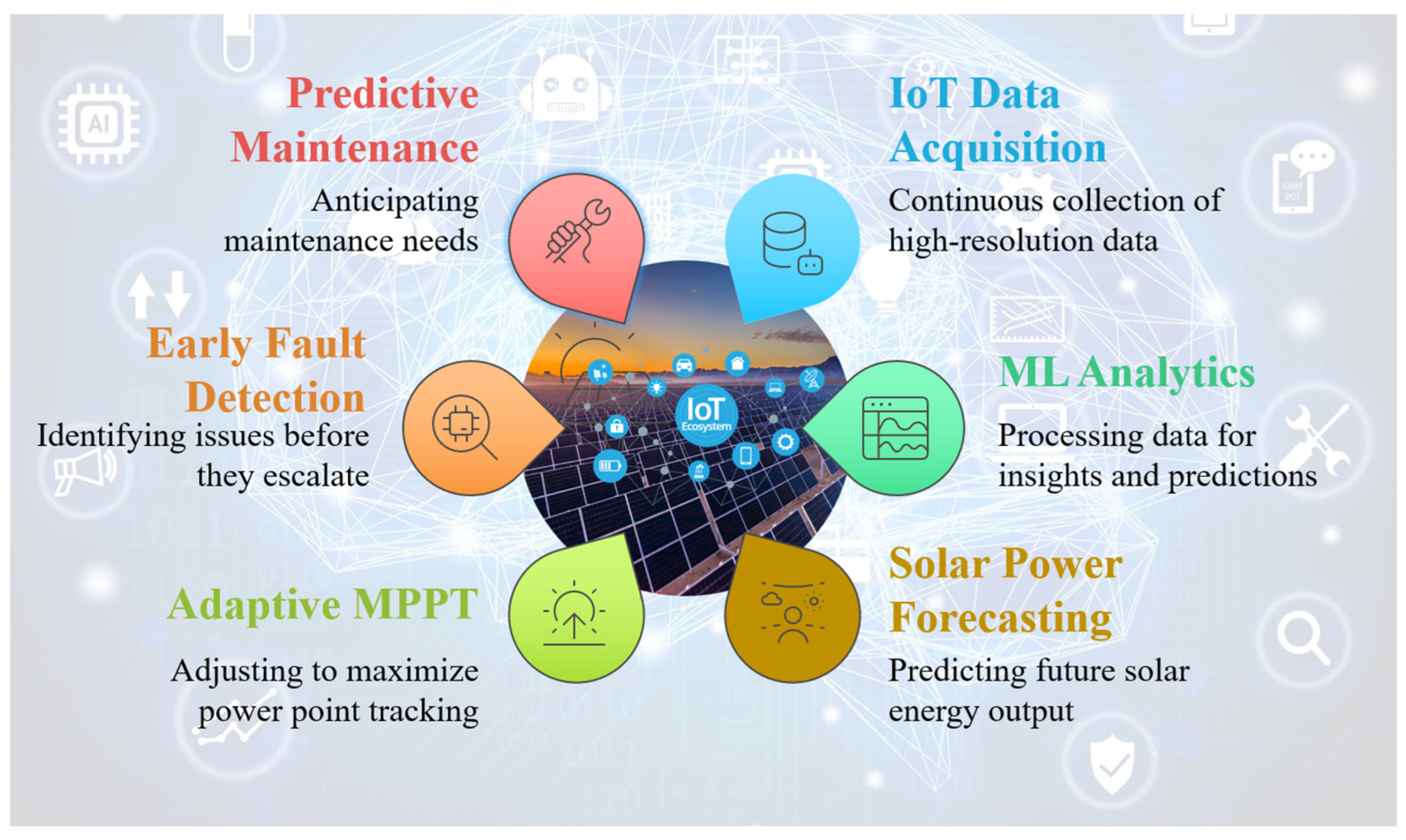
- Explain the incorporation of ML methods in PV operations for functions such as solar power forecasts, predictive maintenance tasks, anomaly detection analysis, adaptive MPPT control methods, and energy management strategies;
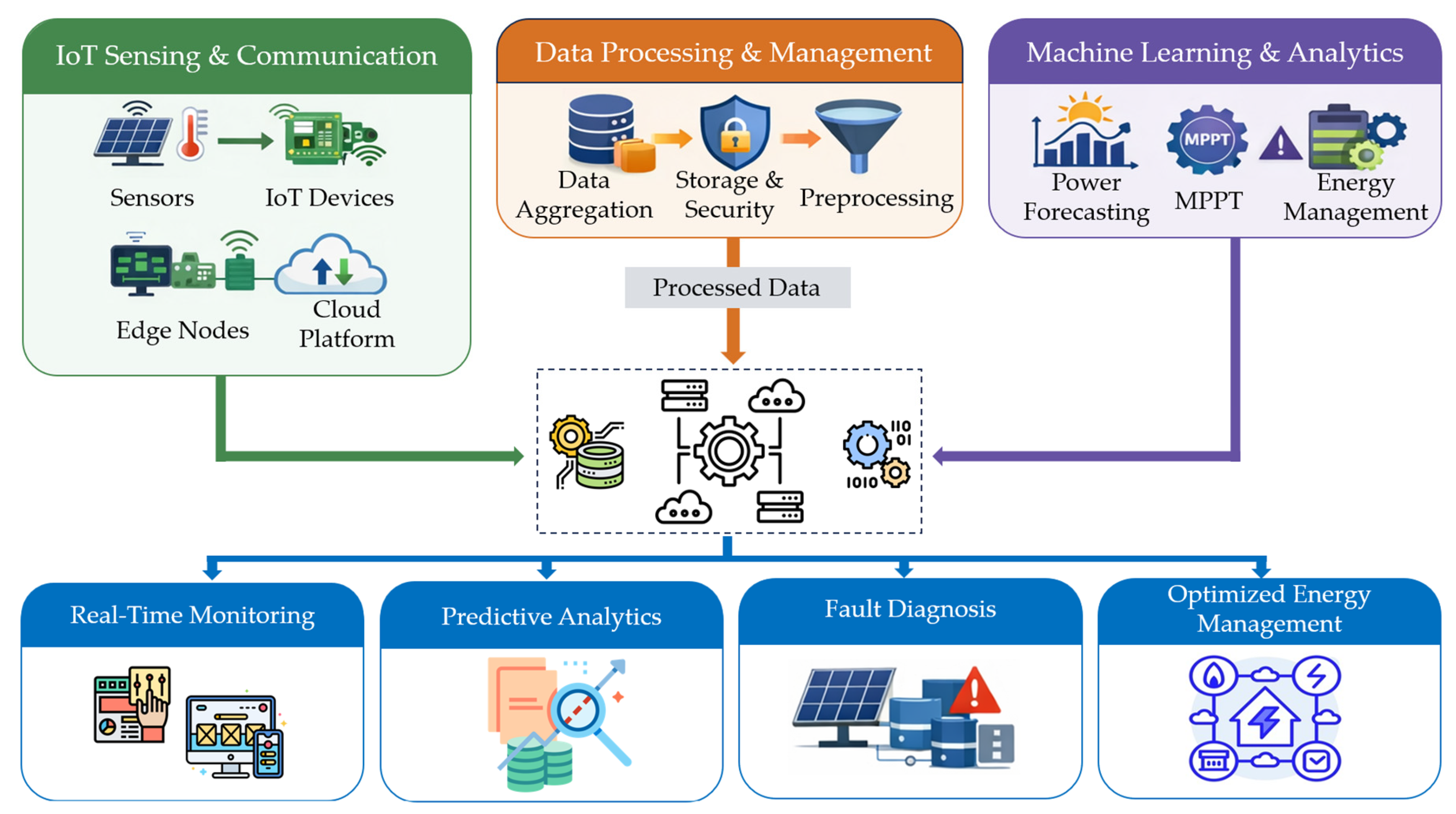
- Outline the different architectures that might link the IoT and ML together in terms of integrations in the cloud compared to the use of edge intelligence;
- Identify the major technical, operational, and cybersecurity issues involved in PV systems integrating IoT and ML;
- Suggest areas for future research in the field of PV system implementation through the means of embedded AI research in the topic of PV system implementation.
2. Photovoltaic Systems: Components and Performance Parameters
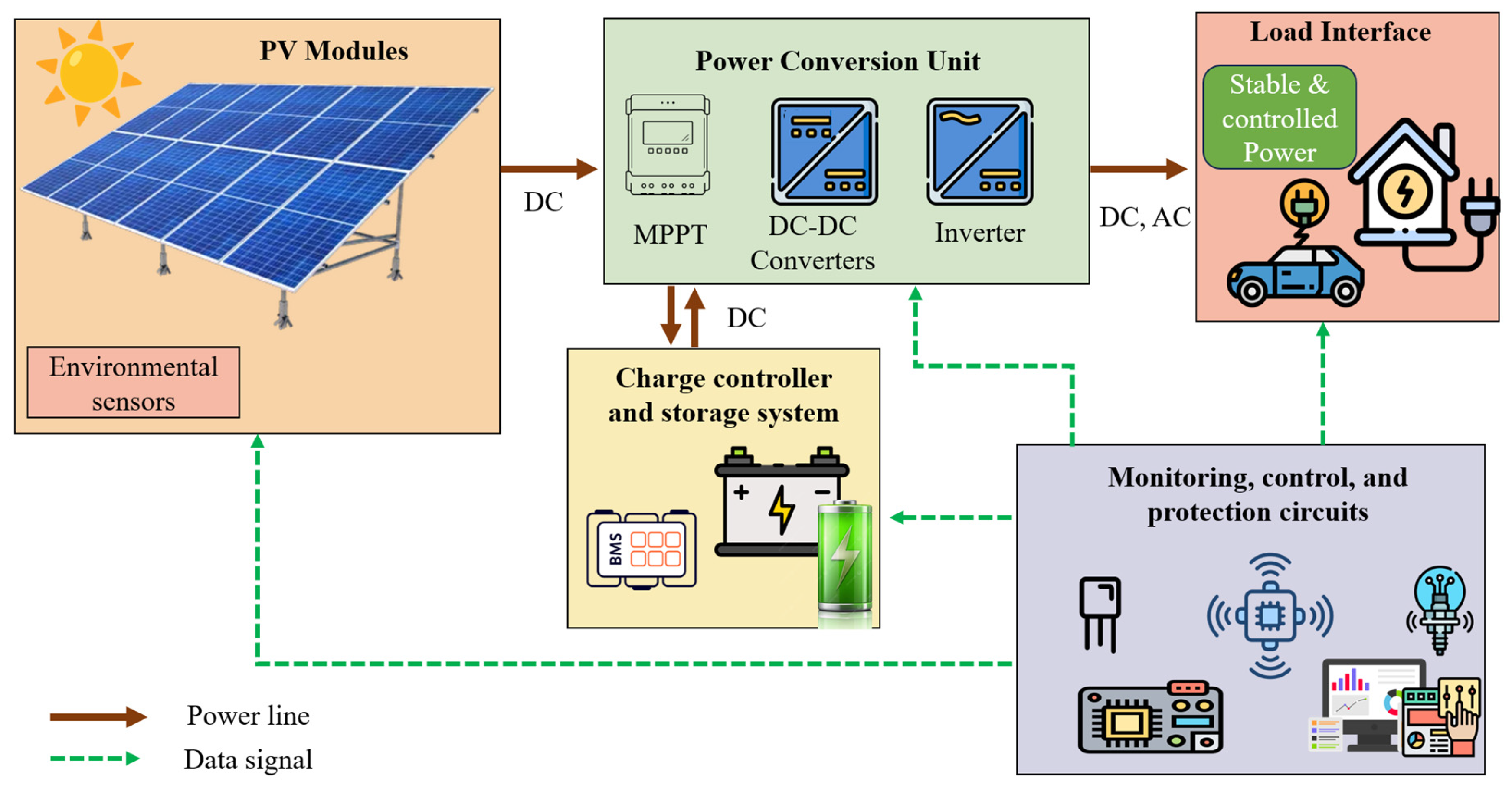
2.1. Basic Components of a PV System
2.2. Electrical Characteristics and Performance Indicators
2.3. Operational Challenges Affecting Efficiency
3. Internet of Things (IoT) for PV System Monitoring
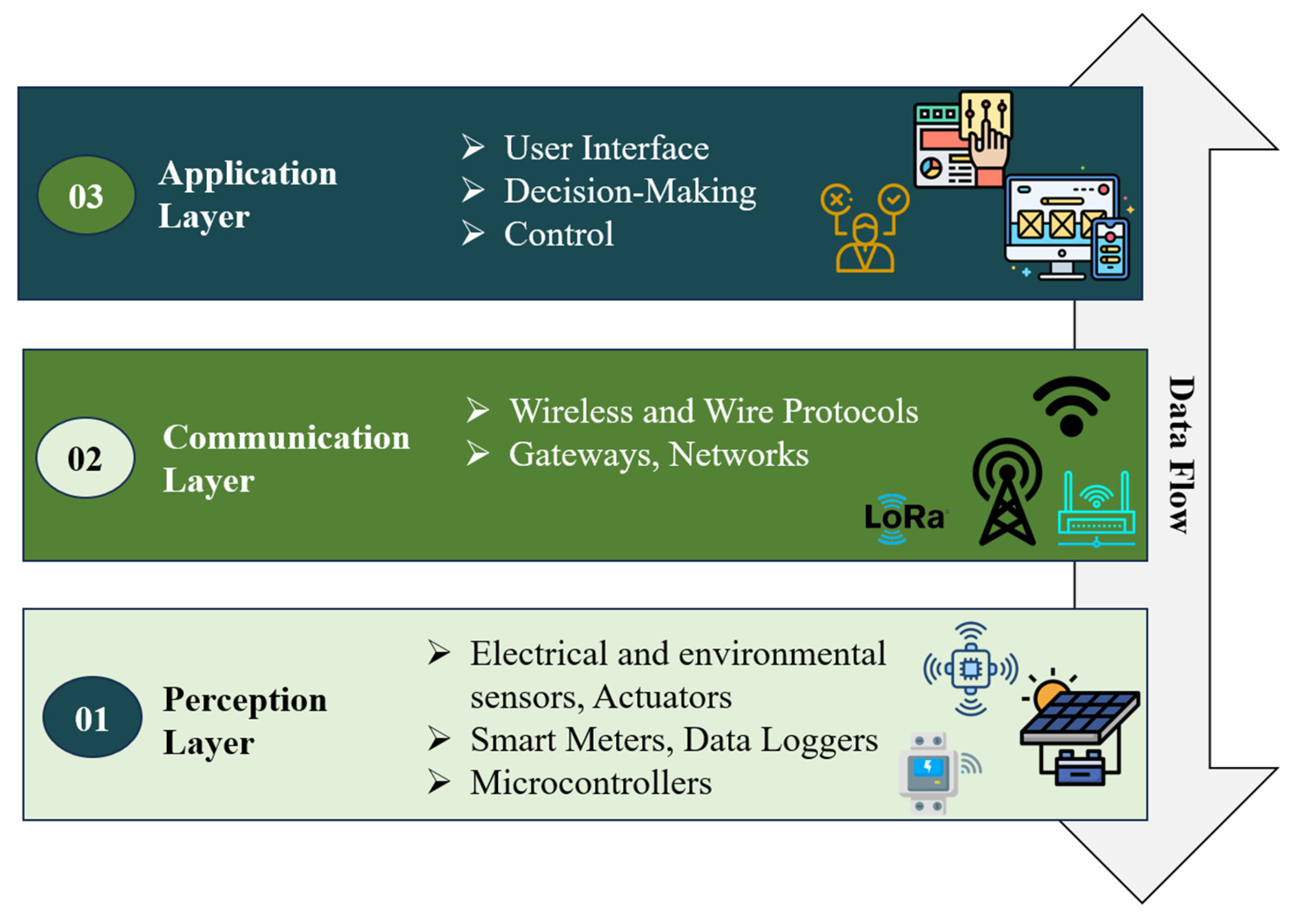
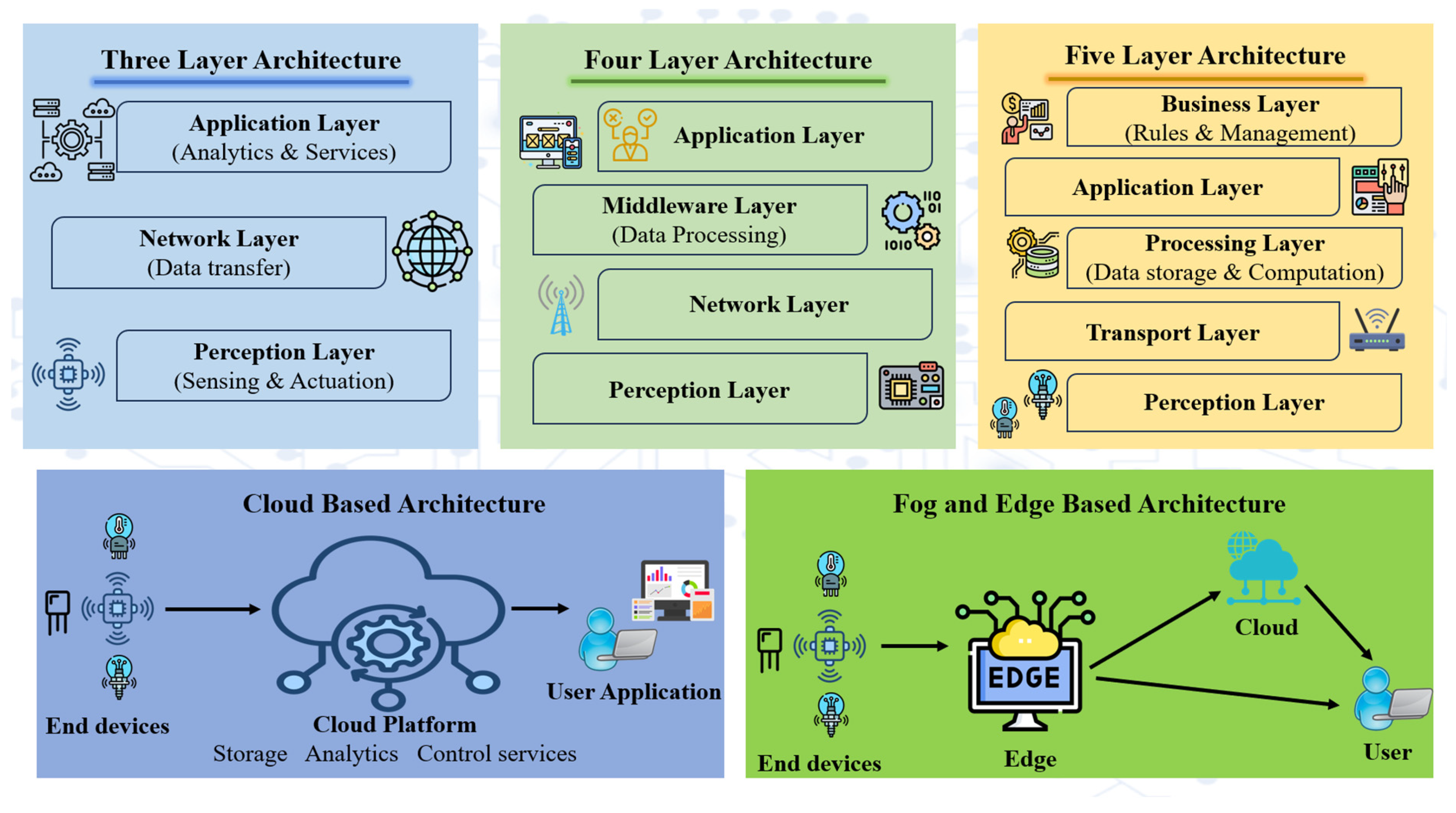
3.1. IoT Architecture for PV Applications
- Perception layer: It is the bottom most level of architecture, which communicates with the physical environment to collect electrical and environmental data such as voltage, current, irradiance, temperature, humidity, and wind speed, or to control the operation system using sensors, actuation, and microcontrollers.
- Network layer: This is responsible for managing bidirectional communication between local sensor nodes and centralized gateways or cloud platforms using wireless or wired protocols.
- Application layer: This layer provides the user interfaces and analytical environments where the vast quantities of collected data are visualized, stored, and processed. It hosts advanced computational models for decision support, predictive maintenance scheduling, and optimization.
3.2. Sensor Technologies, Data Acquisition, and Transmission Modules
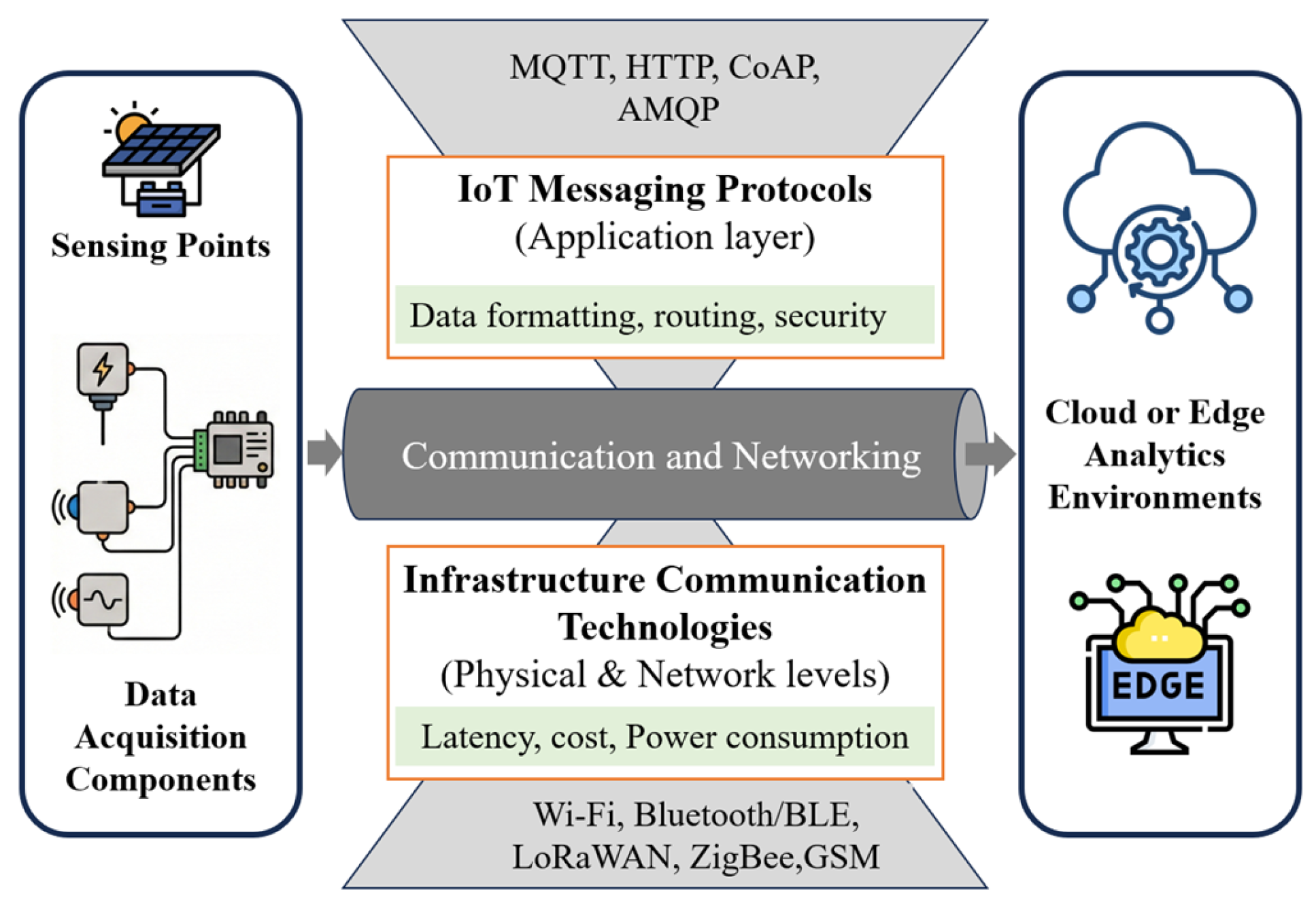
3.3. Communication and Networking
3.3.1. Infrastructure Communication Technologies
3.3.2. IoT Messaging Protocols
3.4. Data Storage, Cloud Platform, and Visualization
3.4.1. Data Storage and Database Management
3.4.2. Cloud Platforms for PV Monitoring
3.5. Literature Review on IoT-Based PV Monitoring
3.6. Advantages and Limitations of IoT in PV Systems
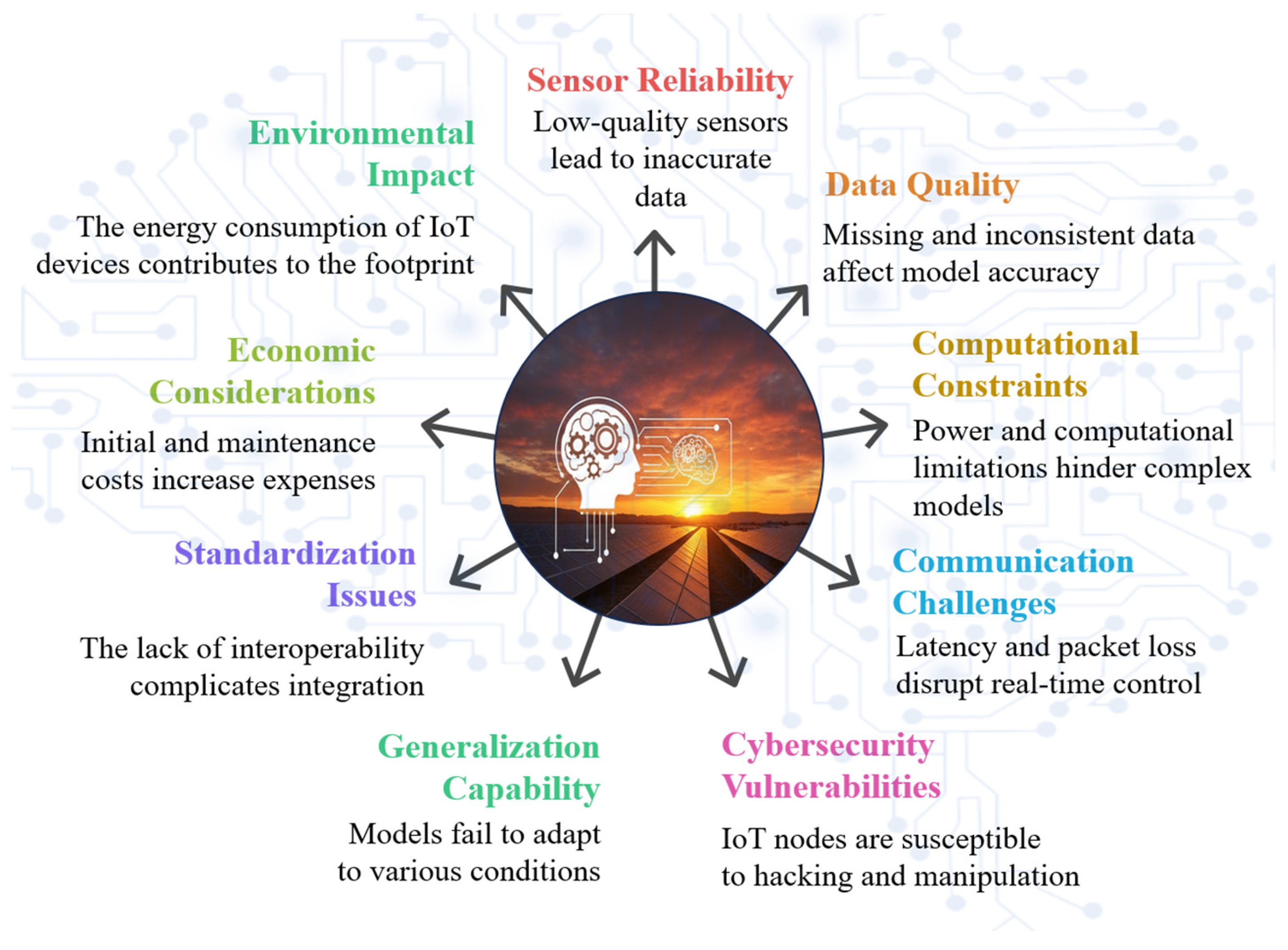
- Sensor Reliability and Calibration: The reliability of IoT is inherently dependent upon its sensors’ precision and robustness. Low-cost sensors tend to drift or become noisier or lose their calibration mannerisms once exposed to environmental settings, leading to biased readings that propagate through data-analytics layers. Maintaining calibration consistency across hundreds of nodes remains labor-intensive and costly, particularly in remote regions.
- Communication Latency and Data Loss: Wireless communication technologies, including GSM, Wi-Fi, and LoRa, are prone to latency, interference, and packet loss under adverse environmental or electromagnetic conditions. Network instability can delay data updates or interrupt command execution, compromising real-time responsiveness. Multi-hop mesh networks reduce these problems but also add complexities to protocols and power consumption.
- Energy Consumption of IoT Nodes: While designed for efficiency, IoT modules also need constant or periodic power sourcing, which may come from additional PV cells or batteries. However, ensuring autonomy for each node may become increasingly difficult for IoT devices operating in environments receiving low irradiance levels for cloud-covered areas or at nighttime.
- Cybersecurity Vulnerabilities: IoT networks are spread out and networked, which makes them very vulnerable to cyberattacks. Unauthorized access, data spoofing, or denial-of-service attacks can put system integrity and operational safety at risk. The implementation of secure connections (encryption using TLS/SSL or authentication tokens) incurs high computation costs on low-power devices, whereas full cybersecurity solutions for PV-related IoT applications are still being developed.
- Data Management and Interoperability Challenges: The use of IoT technology in PV systems ensures large amounts of heterogeneous data produced from electrical sensors, environmental measurement devices, intelligent inverters, and communication gateway devices. Data diversity in management raises significant issues at every stage in data management, from data acquisition to data transmission, storage, processing, and merging. Also, an important issue to consider relates to the compatibility of devices and platforms. Most of the data generated by IoT technology in PV systems involves the use of non-standardized hardware components, communication subsystems, and incompatible data standards. Although there exist standards, like IEC 61724, in the performance measurement of these technologies, there are no generally accepted standards at present that can standardize metadata, ontology definitions in devices, or application programming interfaces;
- Economic and Environmental Considerations: The initial investment required for the deployment of sensors, gateways, and data services is still high for small-scale or rural areas. In addition to this, electronics have also added new environmental concerns, starting from disposal to manufacturing, which should focus on being eco-friendly to match the environmental goals of PV.
4. Machine Learning Applications in PV Systems
4.1. Overview of Machine Learning Approaches in PV Systems
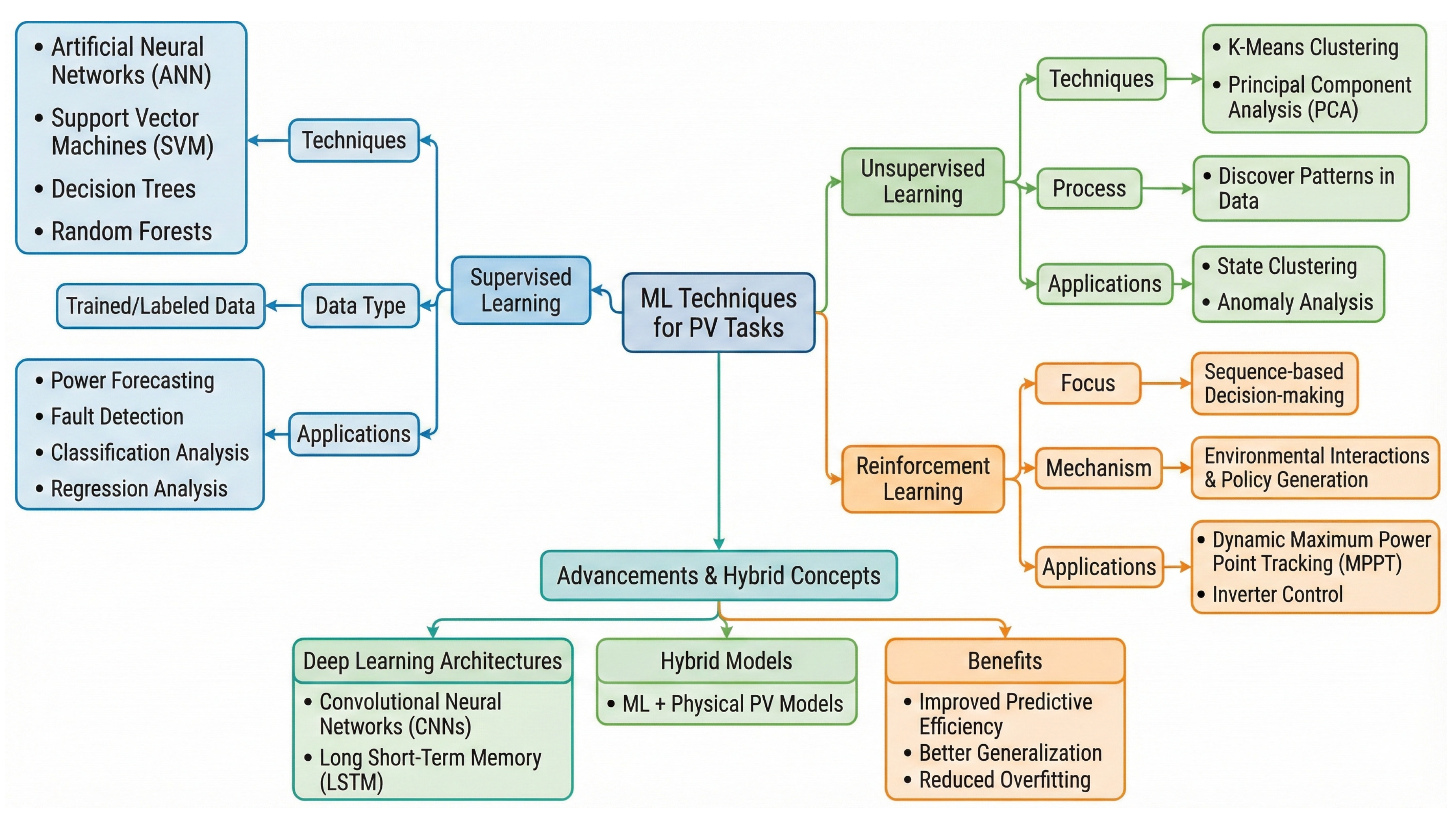
- A supervised learning approach using artificial neural networks (ANN), support vector machines (SVM), decision trees, and random forests makes use of labeled training data for power forecasting and fault detection tasks or any sort of classification or regression analysis.
- Unsupervised learning techniques like K-means clustering and principal component analysis (PCA) help discover patterns in the data to accomplish state clustering and anomaly analysis.
- Reinforcement learning gives high emphasis to sequence-based decision-making tasks. Based on environmental interactions, the learning algorithm acquires effectiveness to generate control policies that make it highly effective for dynamic MPTT and inverters.
4.2. Ensemble Learning Within ML-Enabled PV Systems
4.3. Power Output and Energy Forecasting
4.4. Intelligent MPPT Optimization
4.5. Fault Detection and Diagnosis
4.6. Energy Management and Optimization
5. Integration of IoT and ML for Intelligent PV Systems
5.1. Concept and Architecture of AIoT in PV Systems
5.2. Data Flow and Real-Time Interaction Between IoT and ML Layers
5.3. Edge Versus Cloud Deployment Strategies
5.4. Role of IoT–ML Integration in Enhancing Sustainability and Reliability
6. Benefits and Performance Improvements of IoT–ML Integration in PV Systems
6.1. Enhanced Energy Harvesting and MPPT Efficiency
6.2. Improved Reliability and Fault Management
6.3. Real-Time Monitoring and Operational Transparency
6.4. Energy Forecasting and Load Optimization
6.5. Economic and Environmental Gains
6.6. Broader Systemic Impact
6.7. Inverter Control in Photovoltaic Systems
7. Challenges and Limitations of IoT–ML Integration in PV Systems
7.1. Sensor Accuracy, Calibration, and Environmental Degradation
7.2. Data Quality, Completeness, and Label Scarcity
7.3. Computational Constraints and Energy Overhead
7.4. Communication Latency, Network Reliability, and Scalability
7.5. Cybersecurity and Privacy Risks
7.6. Model Robustness, Interpretability, and Generalization
7.7. Economic, Standardization, and Lifecycle Considerations
7.8. Environmental and Ethical Concerns
8. Future Research Directions
8.1. Edge Intelligence and On-Device Learning
8.2. Federated and Collaborative Learning Across PV Systems
8.3. Digital Twins and Virtual PV Modeling
8.4. Explainable and Trustworthy Artificial Intelligence (XAI)
8.5. Secure and Resilient AIoT Infrastructures
8.6. Sustainability and Green AI
8.7. Toward Autonomous, Self-Optimizing PV Ecosystems
9. Conclusions
Author Contributions
Funding
Institutional Review Board Statement
Informed Consent Statement
Data Availability Statement
Acknowledgments
Conflicts of Interest
Abbreviations
| AI | Artificial Intelligence |
| AIoT | Artificial Intelligence of Things |
| ANFIS | Adaptive Neuro-Fuzzy Inference System |
| ANN | Artificial Neural Network |
| AWS | Amazon Web Services |
| BLE | Bluetooth Low Energy |
| CNN | Convolutional Neural Network |
| CoAP | Constrained Application Protocol |
| DC | Direct Current |
| DL | Deep Learning |
| DNN | Deep Neural Network |
| ECC | Elliptic Curve Cryptography |
| FLC | Fuzzy Logic Controller |
| INC | Incremental Conductance |
| IoT | Internet of Things |
| I–V | Current–Voltage Characteristics |
| LCOE | Levelized Cost of Energy |
| LoRaWAN | Long-Range Wide-Area Network |
| LSTM | Long Short-Term Memory |
| LTTSMC | Limited-Time Terminal Sliding Mode Control |
| MAE | Mean Absolute Error |
| MAPE | Mean Absolute Percentage Error |
| MCU | Microcontroller Unit |
| ML | Machine Learning |
| MPPT | Maximum Power Point Tracking |
| MQTT | Message Queuing Telemetry Transport |
| NARXNN | Nonlinear Autoregressive Exogenous Neural Network |
| OPC-UA | Open Platform Communications–Unified Architecture |
| P&O | Perturb and Observe |
| PLC | Programmable Logic Controller |
| PV | Photovoltaic |
| QPSO | Quantum Particle Swarm Optimization |
| RBF | Radial Basis Function |
| RL | Reinforcement Learning |
| RMSE | Root Mean Square Error |
| SCADA | Supervisory Control and Data Acquisition |
| SMC | Sliding Mode Control |
| SoC | State of Charge |
| SoH | State of Health |
| SPI | Serial Peripheral Interface |
| TLS | Transport Layer Security |
| TinyML | Machine Learning for Embedded Systems |
References
- Al-Shahri, O.A.; Ismail, F.B.; Hannan, M.A.; Lipu, M.S.H.; Al-Shetwi, A.Q.; Begum, R.A.; Al-Muhsen, N.F.O.; Soujeri, E. Solar Photovoltaic Energy Optimization Methods, Challenges and Issues: A Comprehensive Review. J. Clean. Prod. 2021, 284, 125465. [Google Scholar] [CrossRef]
- Ang, T.-Z.; Salem, M.; Kamarol, M.; Das, H.S.; Nazari, M.A.; Prabaharan, N. A Comprehensive Study of Renewable Energy Sources: Classifications, Challenges and Suggestions. Energy Strategy Rev. 2022, 43, 100939. [Google Scholar] [CrossRef]
- Orosz, T.; Rassõlkin, A.; Arsénio, P.; Poór, P.; Valme, D.; Sleisz, Á. Current Challenges in Operation, Performance, and Maintenance of Photovoltaic Panels. Energies 2024, 17, 1306. [Google Scholar] [CrossRef]
- Shafiullah, M.; Ahmed, S.D.; Al-Sulaiman, F.A. Grid Integration Challenges and Solution Strategies for Solar PV Systems: A Review. IEEE Access 2022, 10, 52233–52257. [Google Scholar] [CrossRef]
- Datta, S.; Baul, A.; Sarker, G.C.; Sadhu, P.K.; Hodges, D.R. A Comprehensive Review of the Application of Machine Learning in Fabrication and Implementation of Photovoltaic Systems. IEEE Access 2023, 11, 77750–77778. [Google Scholar] [CrossRef]
- Poulek, V.; Aleš, Z.; Finsterle, T.; Libra, M.; Beránek, V.; Severová, L.; Belza, R.; Mrázek, J.; Kozelka, M.; Svoboda, R. Reliability Characteristics of First-Tier Photovoltaic Panels for Agrivoltaic Systems—Practical Consequences. Int. Agrophysics 2024, 38, 383–391. [Google Scholar] [CrossRef] [PubMed]
- Srivastava, N.; Pandey, P. Internet of Things (IoT): Applications, Trends, Issues and Challenges. Mater. Today Proc. 2022, 69, 587–591. [Google Scholar] [CrossRef]
- Mimouni, A.; Amrani, A.E.; Amraoui, M.E.; Bejjit, L. Internet of Things for Photovoltaic Solar Energy Systems. In NanoRevolution; CRC Press: Boca Raton, FL, USA, 2025; pp. 212–245. [Google Scholar]
- Boucif, O.H.; Lahouaou, A.M.; Boubiche, D.E.; Toral-Cruz, H. Artificial Intelligence of Things for Solar Energy Monitoring and Control. Appl. Sci. 2025, 15, 6019. [Google Scholar] [CrossRef]
- Das, D.K. Integrating IoT and AI for Sustainable Energy-Efficient Smart Building: Potential, Barriers and Strategic Pathways. Sustainability 2025, 17, 10313. [Google Scholar] [CrossRef]
- Singh, S.K.; Tiwari, A.K.; Paliwal, H.K. A State-of-the-Art Review on the Utilization of Machine Learning in Nanofluids, Solar Energy Generation, and the Prognosis of Solar Power. Eng. Anal. Bound. Elem. 2023, 155, 62–86. [Google Scholar] [CrossRef]
- Noura, H.N.; Yaacoub, J.P.A.; Salman, O.; Chehab, A. Advanced Machine Learning in Smart Grids: An Overview. Internet Things Cyber-Phys. Syst. 2025, 5, 95–142. [Google Scholar] [CrossRef]
- Hamad, S.A.; Ghalib, M.A.; Munshi, A.; Alotaibi, M.; Ebied, M.A. Evaluating Machine Learning Models Comprehensively for Predicting Maximum Power from Photovoltaic Systems. Sci. Rep. 2025, 15, 10750. [Google Scholar] [CrossRef]
- Adefarati, T.; Sharma, G.; Bokoro, P.N.; Kumar, R. Advancing Renewable-Dominant Power Systems Through Internet of Things and Artificial Intelligence: A Comprehensive Review. Energies 2025, 18, 5243. [Google Scholar] [CrossRef]
- Madeti, S.R.; Singh, S.N. Monitoring System for Photovoltaic Plants: A Review. Renew. Sustain. Energy Rev. 2017, 67, 1180–1207. [Google Scholar] [CrossRef]
- Hernández-Callejo, L.; Gallardo-Saavedra, S.; Alonso-Gómez, V. A Review of Photovoltaic Systems: Design, Operation and Maintenance. Sol. Energy 2019, 188, 426–440. [Google Scholar] [CrossRef]
- International Electrotechnical Commission. IEC 61724, Photovoltaic System Performance Monitoring-Guidelines for Measurement, Data Exchange and Analysis, 1st ed.; IEC—International Electrotechnical Commission: Geneva, Switzerland, 1998. [Google Scholar]
- Hasan, K.; Yousuf, S.B.; Tushar, M.S.H.K.; Das, B.K.; Das, P.; Islam, M.S. Effects of Different Environmental and Operational Factors on the PV Performance: A Comprehensive Review. Energy Sci. Amp; Eng. 2022, 10, 656–675. [Google Scholar] [CrossRef]
- Zhou, K.; Gao, F.; Hou, Z.; Liu, J.; Meng, X. Cloud-Edge Collaborated Dust Deposition Degree Monitoring for Distributed Photovoltaic Systems. Int. J. Electr. Power Energy Syst. 2023, 153, 109298. [Google Scholar] [CrossRef]
- Al-Sharafi, A.; Ahmadullah, A.B.; Hassan, G.; Al-Qahtani, H.; Abubakar, A.A.; Yilbas, B.S. Influence of Environmental Dust Accumulation on the Performance and Economics of Solar Energy Systems: A Comprehensive Review. Clean. Energy Syst. 2024, 8, 100125. [Google Scholar] [CrossRef]
- Bamisile, O.; Acen, C.; Cai, D.; Huang, Q.; Staffell, I. The Environmental Factors Affecting Solar Photovoltaic Output. Renew. Sustain. Energy Rev. 2025, 208, 115073. [Google Scholar] [CrossRef]
- Sepúlveda-Oviedo, E.H. Impact of Environmental Factors on Photovoltaic System Performance Degradation. Energy Strategy Rev. 2025, 59, 101682. [Google Scholar] [CrossRef]
- Aifan, G.; Alsulami, A.; Alhussainy, A.A.; Allehyani, A.; Alturki, Y.A.; Alghamdi, S.M.; Alruwaili, M.; Alharthi, Y.Z. A Comparison of Several Maximum Power Point Tracking Algorithms for a Photovoltaic Power System. Front. Energy Res. 2024, 12, 1413252. [Google Scholar] [CrossRef] [PubMed]
- Taghezouit, B.; Harrou, F.; Sun, Y.; Merrouche, W. Model-Based Fault Detection in Photovoltaic Systems: A Comprehensive Review and Avenues for Enhancement. Results Eng. 2024, 21, 101835. [Google Scholar] [CrossRef]
- Ansari, S.; Ayob, A.; Lipu, M.S.H.; Saad, M.H.M.; Hussain, A. A Review of Monitoring Technologies for Solar PV Systems Using Data Processing Modules and Transmission Protocols: Progress, Challenges and Prospects. Sustainability 2021, 13, 8120. [Google Scholar] [CrossRef]
- Rao, C.K.; Sahoo, S.K.; Yanine, F.F. A Review of IoT-Based Smart Energy Solutions for Photovoltaic Systems. Electr. Eng. 2025, 107, 15049–15068. [Google Scholar] [CrossRef]
- Islam, M.M.; Nooruddin, S.; Karray, F.; Muhammad, G. Internet of Things: Device Capabilities, Architectures, Protocols, and Smart Applications in Healthcare Domain. IEEE Internet Things J. 2023, 10, 3611–3641. [Google Scholar] [CrossRef]
- Qays, M.O.; Ahmad, I.; Abu-Siada, A.; Hossain, M.L.; Yasmin, F. Key Communication Technologies, Applications, Protocols and Future Guides for IoT-Assisted Smart Grid Systems: A Review. Energy Rep. 2023, 9, 2440–2452. [Google Scholar] [CrossRef]
- Kalay, M.Ş.; Kılıç, B.; Sağlam, Ş. Systematic Review of the Data Acquisition and Monitoring Systems of Photovoltaic Panels and Arrays. Sol. Energy 2022, 244, 47–64. [Google Scholar] [CrossRef]
- Pazikadin, A.R.; Rifai, D.; Ali, K.; Malik, M.Z.; Abdalla, A.N.; Faraj, M.A. Solar Irradiance Measurement Instrumentation and Power Solar Generation Forecasting Based on Artificial Neural Networks (ANN): A Review of Five Years Research Trend. Sci. Total Environ. 2020, 715, 136848. [Google Scholar] [CrossRef]
- Rao, C.K.; Sahoo, S.K.; Yanine, F.F. A Literature Review on an IoT-Based Intelligent Smart Energy Management Systems for PV Power Generation. Hybrid Adv. 2024, 5, 100136. [Google Scholar] [CrossRef]
- Gerodimos, A.; Maglaras, L.; Ferrag, M.A.; Ayres, N.; Kantzavelou, I. IoT: Communication Protocols and Security Threats. Internet Things Cyber-Phys. Syst. 2023, 3, 1–13. [Google Scholar] [CrossRef]
- Aldin, H.N.S.; Ghods, M.R.; Nayebipour, F.; Torshiz, M.N. A Comprehensive Review of Energy Harvesting and Routing Strategies for IoT Sensors Sustainability and Communication Technology. Sens. Int. 2024, 5, 100258. [Google Scholar] [CrossRef]
- Daousis, S.; Peladarinos, N.; Cheimaras, V.; Papageorgas, P.; Piromalis, D.D.; Munteanu, R.A. Overview of Protocols and Standards for Wireless Sensor Networks in Critical Infrastructures. Future Internet 2024, 16, 33. [Google Scholar] [CrossRef]
- Helmy, H.A.; El-Rifaie, A.M.; Youssef, A.A.F.; Haggag, A.; Hamad, H.; Eltokhy, M. Improving Solar Energy-Harvesting Wireless Sensor Network (SEH-WSN) with Hybrid Li-Fi/Wi-Fi, Integrating Markov Model, Sleep Scheduling, and Smart Switching Algorithms. Technologies 2025, 13, 437. [Google Scholar] [CrossRef]
- Kreković, D.; Krivić, P.; Podnar Žarko, I.; Kušek, M.; Le-Phuoc, D. Reducing Communication Overhead in the IoT–Edge–Cloud Continuum: A Survey on Protocols and Data Reduction Strategies. Internet Things 2025, 31, 101553. [Google Scholar] [CrossRef]
- Padma, B.; Erukala, S.B. End-to-End Communication Protocol in IoT-Enabled ZigBee Network: Investigation and Performance Analysis. Internet Things 2023, 22, 100796. [Google Scholar] [CrossRef]
- Jha, B.K.; Tiwari, A.; Kuhada, R.B.; Pindoriya, N.M. IoT-Enabled Smart Energy Management Device for Optimal Scheduling of Distributed Energy Resources. Electr. Power Syst. Res. 2024, 229, 110121. [Google Scholar] [CrossRef]
- Vaezi, M.; Azari, A.; Khosravirad, S.R.; Shirvanimoghaddam, M.; Azari, M.M.; Chasaki, D.; Popovski, P. Cellular, Wide-Area, and Non-Terrestrial IoT: A Survey on 5G Advances and the Road Toward 6G. IEEE Commun. Surv. Tutor. 2022, 24, 1117–1174. [Google Scholar] [CrossRef]
- Hameed, B.H.; Kurnaz, S. Secure Low-Cost Photovoltaic Monitoring System Based on LoRaWAN Network and Artificial Intelligence. Discov. Comput. 2024, 27, 36. [Google Scholar] [CrossRef]
- Quincozes, S.; Emilio, T.; Kazienko, J. MQTT Protocol: Fundamentals, Tools and Future Directions. IEEE Lat. Am. Trans. 2019, 17, 1439–1448. [Google Scholar] [CrossRef]
- G.S., V.; Karthikeyan, A.; Karthikeyan, K.; Sanjeevikumar, P.; Karapparambil Thomas, S.; Babu, A. Critical Review Of SCADA And PLC in Smart Buildings and Energy Sector. Energy Rep. 2024, 12, 1518–1530. [Google Scholar] [CrossRef]
- He, W.; Baig, M.J.A.; Iqbal, M.T. An Internet of Things—Supervisory Control and Data Acquisition (IoT-SCADA) Architecture for Photovoltaic System Monitoring, Control, and Inspection in Real Time. Electronics 2024, 14, 42. [Google Scholar] [CrossRef]
- Ayele, E.D.; Gavriel, S.; Gonzalez, J.F.; Teeuw, W.B.; Philimis, P.; Gillani, G. Emerging Industrial Internet of Things Open-Source Platforms and Applications in Diverse Sectors. Telecom 2024, 5, 369–399. [Google Scholar] [CrossRef]
- Domínguez-Bolaño, T.; Barral, V.; Escudero, C.J.; García-Naya, J.A. An IoT System for a Smart Campus: Challenges and Solutions Illustrated over Several Real-World Use Cases. Internet Things 2024, 25, 101099. [Google Scholar] [CrossRef]
- Radia, M.A.A.; Nimr, M.K.E.; Atlam, A.S. IoT-Based Wireless Data Acquisition and Control System for Photovoltaic Module Performance Analysis. e-Prime-Adv. Electr. Eng. Electron. Energy 2023, 6, 100348. [Google Scholar] [CrossRef]
- Supo, J.F.; Puma, P.Y.; Ramos, J.M.; Beltrán, N.J. Implementation of a Monitoring System for a Photovoltaic Installation Based on IoT Technology. J. Phys. Conf. Ser. 2023, 2538, 012003. [Google Scholar] [CrossRef]
- Muñiz, R.; Del Coso, R.; Nuño, F.; Villegas, P.J.; Álvarez, D.; Martínez, J.A. Solar-Powered Smart Buildings: Integrated Energy Management Solution for IoT-Enabled Sustainability. Electronics 2024, 13, 317. [Google Scholar] [CrossRef]
- Mimouni, A.; Chahet, Y.; El Amrani, A.; El Amraoui, M.; Bejjit, L. Internet of Things Technology for an Autonomous Photovoltaic Solar Energy System Monitoring. In E3S Web of Conferences; EDP Sciences: Les Ulis, France, 2025; Volume 601, p. 00056. [Google Scholar] [CrossRef]
- Ndukwe, C.; Iqbal, M.T.; Khan, J. Development of a Low-Cost LoRa Based SCADA System for Monitoring and Supervisory Control of Small Renewable Energy Generation Systems. In Proceedings of the 2020 11th IEEE Annual Information Technology, Electronics and Mobile Communication Conference (IEMCON), Vancouver, BC, Canada, 4–7 November 2020; IEEE: New York City, NY, USA, 2020; pp. 479–484. [Google Scholar]
- Islam, T.; Uddin Qureshi, M.J.; Mitra, P.; Nasir, M.F. IoT Based Solar System Monitoring and Load Management for Small Farm. In Proceedings of the 2022 IEEE IAS Global Conference on Emerging Technologies (GlobConET), Arad, Romania, 20–22 May 2022; IEEE: New York City, NY, USA, 2022; pp. 781–785. [Google Scholar]
- Brinda, S.; Singh, R.; Savitha, P.B.; Singh, R.; Ahmad, T. Design and Implementation of IoT Based PV Integrated Power Monitoring System. IOP Conf. Ser. Mater. Sci. Eng. 2023, 1295, 012012. [Google Scholar] [CrossRef]
- Rahman Akash, M.S.; Shiddique, T.; Hazari, M.R.; Hasan Imam, M. IoT Based Low-Cost Azimuth-Elevation Dependent Dual Axis Solar Tracking & Monitoring System. In Proceedings of the 2025 International Conference on Electrical, Computer and Communication Engineering (ECCE), Chittagong, Bangladesh, 13–15 February 2025; IEEE: New York City, NY, USA, 2025; pp. 1–6. [Google Scholar]
- Daou, N.; Sawma, J.; Khatounian, F. Real-Time Mobile Monitoring of an IoT-Based MPPT Solar Charger Using Arduino UNO R4 WiFi and WebSocket Communication. In Proceedings of the 2025 7th International Conference on Renewable Energy for Developing Countries (REDEC), Beirut, Lebanon, 24–26 September 2025; IEEE: New York City, NY, USA, 2025; pp. 1–5. [Google Scholar]
- Iksan, N.; Purwanto, P.; Sutanto, H. Real-Time Monitoring of Photovoltaic Systems and Control of Electricity Supply for Smart Micro Grid-PV Using IoT. TEM J. 2024, 13, 514–523. [Google Scholar] [CrossRef]
- Oton, C.N.; Iqbal, M.T. Low-Cost Open Source IoT-Based SCADA System for a BTS Site Using ESP32 and Arduino IoT Cloud. In Proceedings of the 2021 IEEE 12th Annual Ubiquitous Computing, Electronics & Mobile Communication Conference (UEMCON), New York, NY, USA, 1–4 December 2021; IEEE: New York City, NY, USA, 2021; pp. 0681–0685. [Google Scholar]
- Kumar, M.J.; Kumar, R.T.; Sujatha, G.; Immanuvelbright, E.; Dhananjeyan, S.; Sasikumar, M. High Speed FPGA Assisted IoT Development for Smart PV Grid Monitoring System. In Proceedings of the 2023 International Conference on Energy, Materials and Communication Engineering (ICEMCE), Madurai, India, 14–15 December 2023; IEEE: New York City, NY, USA, 2023; pp. 1–6. [Google Scholar]
- Sadeeq, M.A.M.; Zeebaree, S.R. Design and Implementation of an Energy Management System Based on Distributed IoT. Comput. Electr. Eng. 2023, 109, 108775. [Google Scholar] [CrossRef]
- Kumar, U.; Mishra, S.; Dash, K. An IoT and Semi-Supervised Learning-Based Sensorless Technique for Panel Level Solar Photovoltaic Array Fault Diagnosis. IEEE Trans. Instrum. Meas. 2023, 72, 3521412. [Google Scholar] [CrossRef]
- Tang, W.; Yang, Q.; Hu, X.; Yan, W. Edge Intelligence for Smart EL Images Defects Detection of PV Plants in the IoT-Based Inspection System. IEEE Internet Things J. 2023, 10, 3047–3056. [Google Scholar] [CrossRef]
- Kashyap, M.; Pathak, D.; Gautam, A.; Sharma, V.; Verma, G. Design and Implementation of Self-Learning Enabled Wireless IoT Framework to Enhance P-V Characteristics of Nonuniformly Shaded PV Arrays. IEEE Internet Things J. 2025, 12, 33635–33646. [Google Scholar] [CrossRef]
- Jamroen, C.; Yonsiri, N.; Odthon, T.; Wisitthiwong, N.; Janreung, S. A Standalone Photovoltaic/Battery Energy-Powered Water Quality Monitoring System Based on Narrowband Internet of Things for Aquaculture: Design and Implementation. Smart Agric. Technol. 2023, 3, 100072. [Google Scholar] [CrossRef]
- Rouibah, N.; El Hammoumi, A.; Bouttout, A.; Haddad, S.; Oukaci, S.; Limam, A.; Benghanem, M. Smart Monitoring of Photovoltaic Energy Systems: An IoT-Based Prototype Approach. Sci. Afr. 2025, 30, e02973. [Google Scholar] [CrossRef]
- Alombah, N.H.; Mungwe, J.N.; Harrison, A.; Mbasso, W.F.; Fotsin, H.B. Advanced IoT-Based Monitoring System for Real-Time Photovoltaic Performance Evaluation: Conception, Development and Experimental Validation. Sci. Afr. 2025, 28, e02763. [Google Scholar] [CrossRef]
- Ma, M.; He, B.; Wang, N.; Shen, R. A Method for Monitoring the Solar Resources of High-Scale Photovoltaic Power Plants Based on Wireless Sensor Networks. Sustain. Energy Technol. Assess. 2022, 53, 102678. [Google Scholar] [CrossRef]
- González, I.; Calderón, A.J.; Folgado, F.J. IoT Real Time System for Monitoring Lithium-Ion Battery Long-Term Operation in Microgrids. J. Energy Storage 2022, 51, 104596. [Google Scholar] [CrossRef]
- Khalid, W.; Jamil, M.; Khan, A.A.; Awais, Q. Open-Source Internet of Things-Based Supervisory Control and Data Acquisition System for Photovoltaic Monitoring and Control Using HTTP and TCP/IP Protocols. Energies 2024, 17, 4083. [Google Scholar] [CrossRef]
- Boubakr, G.; Gu, F.; Farhan, L.; Ball, A. Enhancing Virtual Real-Time Monitoring of Photovoltaic Power Systems Based on the Internet of Things. Electronics 2022, 11, 2469. [Google Scholar] [CrossRef]
- Andal, C.K.; Jayapal, R. Design and Implementation of IoT Based Intelligent Energy Management Controller for PV/Wind/Battery System with Cost Minimization. Renew. Energy Focus 2022, 43, 255–262. [Google Scholar] [CrossRef]
- Fernández-Bustamante, P.; Calvo, I.; Villar, E.; Barambones, O. Centralized MPPT Based on Sliding Mode Control and XBee 900 MHz for PV Systems. Int. J. Electr. Power Energy Syst. 2023, 153, 109350. [Google Scholar] [CrossRef]
- He, W.; Baig, M.J.A.; Iqbal, M.T. An Open-Source Supervisory Control and Data Acquisition Architecture for Photovoltaic System Monitoring Using ESP32, Banana Pi M4, and Node-RED. Energies 2024, 17, 2295. [Google Scholar] [CrossRef]
- Rao, C.K.; Sahoo, S.K.; Yanine, F.F. Development of a Smart Cloud-Based Monitoring System for Solar Photovoltaic Energy Generation. Unconv. Resour. 2025, 6, 100173. [Google Scholar] [CrossRef]
- Nkinyam, C.M.; Ujah, C.O.; Asadu, C.O.; Anyaka, B.; Olubambi, P.A. Development of a Low-Cost Monitoring Device for Solar Electric (PV) System Using Internet of Things (IoT). Results Eng. 2025, 28, 107324. [Google Scholar] [CrossRef]
- Sahu, N.; Joddumhanthi, V.; Behera, S. Review on IoT in Solar PV System. In Proceedings of the 2024 2nd International Conference on Signal Processing, Communication, Power and Embedded System (SCOPES), Paralakhemundi Campus, Centurion University of Technology and Management, Odisha, India, 19–21 December 2024; IEEE: New York City, NY, USA, 2024; pp. 1–6. [Google Scholar]
- Jundi, Z.S.; Al-Waeli, A.H.A.; Switzner, N.T. A Systematic Review of Low-Cost Photovoltaic Monitoring Systems: Technologies, Challenges, and Opportunities. Renew. Sustain. Energy Rev. 2026, 226, 116417. [Google Scholar] [CrossRef]
- Alsafran, A.S.; Alwabari, M.; Al-Bahrani, M. Challenges in Implementing IoT for Enhanced Reliability and Effectiveness in Smart Grids: Literature Review. Int. Trans. Electr. Energy Syst. 2025, 2025, 5514628. [Google Scholar] [CrossRef]
- Ud Din, I.; Guizani, M.; Hassan, S.; Kim, B.-S.; Khurram Khan, M.; Atiquzzaman, M.; Ahmed, S.H. The Internet of Things: A Review of Enabled Technologies and Future Challenges. IEEE Access 2019, 7, 7606–7640. [Google Scholar] [CrossRef]
- Orumwense, E.F.; Abo-Al-Ez, K. Internet of Things for Smart Energy Systems: A Review on Its Applications, Challenges and Future Trends. AIMS Electron. Electr. Eng. 2022, 7, 50–74. [Google Scholar] [CrossRef]
- Gupta, P.; Singh, R. PV Power Forecasting Based on Data-Driven Models: A Review. Int. J. Sustain. Eng. 2021, 14, 1733–1755. [Google Scholar] [CrossRef]
- Subedi, S.; Gui, Y.; Xue, Y. Applications of Data-Driven Dynamic Modeling of Power Converters in Power Systems: An Overview. IEEE Trans. Ind. Appl. 2025, 61, 2434–2456. [Google Scholar] [CrossRef]
- Gaviria, J.F.; Narváez, G.; Guillen, C.; Giraldo, L.F.; Bressan, M. Machine Learning in Photovoltaic Systems: A Review. Renew. Energy 2022, 196, 298–318. [Google Scholar] [CrossRef]
- Ishrat, Z.; Gupta, A.; Nayak, S. A Comprehensive Review of MPPT Techniques Based on ML Applicable for Maximum Power in Solar Power Systems. J. Renew. Energy Environ. 2024, 11, 28–37. [Google Scholar] [CrossRef]
- Alharkan, H.; Habib, S.; Islam, M. Solar Power Prediction Using Dual Stream CNN-LSTM Architecture. Sensors 2023, 23, 945. [Google Scholar] [CrossRef] [PubMed]
- Klaiber, J.; Van Dinther, C. Deep Learning for Variable Renewable Energy: A Systematic Review. ACM Comput. Surv. 2024, 56, 1–37. [Google Scholar] [CrossRef]
- Wentz, V.H.; Maciel, J.N.; Gimenez Ledesma, J.J.; Ando Junior, O.H. Solar Irradiance Forecasting to Short-Term PV Power: Accuracy Comparison of ANN and LSTM Models. Energies 2022, 15, 2457. [Google Scholar] [CrossRef]
- Sharkawy, A.-N.; Ali, M.M.; Mousa, H.H.H.; Ali, A.S.; Abdel-Jaber, G.T.; Hussein, H.S.; Farrag, M.; Ismeil, M.A. Solar PV Power Estimation and Upscaling Forecast Using Different Artificial Neural Networks Types: Assessment, Validation, and Comparison. IEEE Access 2023, 11, 19279–19300. [Google Scholar] [CrossRef]
- Shi, J.; Chen, Y.; Cheng, X.; Yang, M.; Wang, M. Four-Stage Space-Time Hybrid Model For Distributed Photovoltaic Power Forecasting. IEEE Trans. Ind. Appl. 2023, 59, 1129–1138. [Google Scholar] [CrossRef]
- Rangelov, D.; Boerger, M.; Tcholtchev, N.; Lämmel, P.; Hauswirth, M. Design and Development of a Short-Term Photovoltaic Power Output Forecasting Method Based on Random Forest, Deep Neural Network and LSTM Using Readily Available Weather Features. IEEE Access 2023, 11, 41578–41595. [Google Scholar] [CrossRef]
- Zhang, M.; Zhen, Z.; Liu, N.; Zhao, H.; Sun, Y.; Feng, C.; Wang, F. Optimal Graph Structure Based Short-Term Solar PV Power Forecasting Method Considering Surrounding Spatio-Temporal Correlations. IEEE Trans. Ind. Appl. 2023, 59, 345–357. [Google Scholar] [CrossRef]
- Rivero-Cacho, A.; Sanchez-Barroso, G.; Gonzalez-Dominguez, J.; Garcia-Sanz-Calcedo, J. Long-Term Power Forecasting of Photovoltaic Plants Using Artificial Neural Networks. Energy Rep. 2024, 12, 2855–2864. [Google Scholar] [CrossRef]
- Xiang, X.; Li, X.; Zhang, Y.; Hu, J. A Short-Term Forecasting Method for Photovoltaic Power Generation Based on the TCN-ECANet-GRU Hybrid Model. Sci. Rep. 2024, 14, 6744. [Google Scholar] [CrossRef]
- Han, B.; Han, Z.; Fan, H.; Feng, S. Design and Implementation of a Deep Learning-Based Distributed Photovoltaic Power Forecasting System. In Proceedings of the 2024 10th International Conference on Computer and Communications (ICCC), Chengdu, China, 13–16 December 2024; IEEE: New York City, NY, USA, 2024; pp. 73–77. [Google Scholar]
- Mollick, T.; Jobayer, M.; Hossin, M.S.; Khan, S.I.; Huda, A.S.N.; Sabuj, S.R. An Interpretable Deep Learning Model for Solar Power Generation Forecasting in a Grid-Connected Hybrid Solar System. IEEE J. Photovolt. 2025, 15, 941–954. [Google Scholar] [CrossRef]
- Yang, M.; Guo, Z.; Wang, D.; Wang, B.; Wang, Z.; Huang, T. Short-Term Photovoltaic Power Forecasting Method Considering Historical Information Reuse and Numerical Weather Forecasting. Renew. Energy 2026, 256, 123933. [Google Scholar] [CrossRef]
- Revathy, S.R.; Kirubakaran, V.; Rajeshwaran, M.; Balasundaram, T.; Sekar, V.S.C.; Alghamdi, S.; Rajab, B.S.; Babalghith, A.O.; Anbese, E.M. Design and Analysis of ANFIS—Based MPPT Method for Solar Photovoltaic Applications. Int. J. Photoenergy 2022, 2022, 9625564. [Google Scholar] [CrossRef]
- Sharmin, R.; Chowdhury, S.S.; Abedin, F.; Rahman, K.M. Implementation of an MPPT Technique of a Solar Module with Supervised Machine Learning. Front. Energy Res. 2022, 10, 932653. [Google Scholar] [CrossRef]
- Abouzeid, A.F.; Eleraky, H.; Kalas, A.; Rizk, R.; Elsakka, M.M.; Refaat, A. Experimental Validation of a Low-Cost Maximum Power Point Tracking Technique Based on Artificial Neural Network for Photovoltaic Systems. Sci. Rep. 2024, 14, 18280. [Google Scholar] [CrossRef]
- Demirci, A.; Dagal, I.; Mirza Tercan, S.; Gundogdu, H.; Terkes, M.; Cali, U. Enhanced ANN-Based MPPT for Photovoltaic Systems: Integrating Metaheuristic and Analytical Algorithms for Optimal Performance Under Partial Shading. IEEE Access 2025, 13, 92783–92799. [Google Scholar] [CrossRef]
- Rizki, H.; Lamzouri, F.E.; Boufounas, E.-M.; Amrani, A.E.; Bejjit, L. Advanced Global MPPT Strategy for PV Systems Using High-Order Sliding Mode Control, ABC Optimization, and Neural Network Prediction under Partial Shading Conditions. Comput. Electr. Eng. 2025, 127, 110562. [Google Scholar] [CrossRef]
- Rashid, A. A Comparative Performance Analysis of Fuzzy Logic and Artificial Neural Network-Based MPPT Algorithms for Solar Photovoltaic Systems Under Rapidly Varying Weather Conditions. In Proceedings of the 2025 International Conference on Green Energy, Computing and Sustainable Technology (GECOST), Miri Sarawak, Malaysia, 12–14 November 2025; IEEE: New York City, NY, USA, 2025; pp. 1–5. [Google Scholar]
- Alrifaey, M.; Lim, W.H.; Ang, C.K.; Natarajan, E.; Solihin, M.I.; Juhari, M.R.M.; Tiang, S.S. Hybrid Deep Learning Model for Fault Detection and Classification of Grid-Connected Photovoltaic System. IEEE Access 2022, 10, 13852–13869. [Google Scholar] [CrossRef]
- Yang, N.-C.; Ismail, H. Robust Intelligent Learning Algorithm Using Random Forest and Modified-Independent Component Analysis for PV Fault Detection: In Case of Imbalanced Data. IEEE Access 2022, 10, 41119–41130. [Google Scholar] [CrossRef]
- Lavador-Osorio, M.; Zuñiga-Reyes, M.-A.; Álvarez-Alvarado, J.M.; Sevilla-Camacho, P.-Y.; Garduño-Aparicio, M.; Rodríguez-Reséndiz, J. An Enhanced Frequency Analysis and Machine Learning Based Approach for Open Circuit Failures in PV Systems. IEEE Access 2024, 12, 96342–96357. [Google Scholar] [CrossRef]
- Sripada, D.; Sugumaran, V.; Aghaei, M. Detection of Visual Faults in Photovoltaic Modules Using a Stacking Ensemble Approach. Heliyon 2024, 10, e27894. [Google Scholar] [CrossRef]
- Lu, S.-D.; Liu, H.-D.; Wang, M.-H.; Wu, C.-C. A Novel Strategy for Multitype Fault Diagnosis in Photovoltaic Systems Using Multiple Regression Analysis and Support Vector Machines. Energy Rep. 2024, 12, 2824–2844. [Google Scholar] [CrossRef]
- Zhong, Y.; Zhang, B.; Ji, X.; Wu, J. Fault Diagnosis of PV Array Based on Time Series and Support Vector Machine. Int. J. Photoenergy 2024, 2024, 2885545. [Google Scholar] [CrossRef]
- Suliman, F.; Anayi, F.; Packianather, M. Electrical Faults Analysis and Detection in Photovoltaic Arrays Based on Machine Learning Classifiers. Sustainability 2024, 16, 1102. [Google Scholar] [CrossRef]
- Amiri, A.F.; Oudira, H.; Chouder, A.; Kichou, S. Faults Detection and Diagnosis of PV Systems Based on Machine Learning Approach Using Random Forest Classifier. Energy Convers. Manag. 2024, 301, 118076. [Google Scholar] [CrossRef]
- Pa, M.; Uddin, M.N.; Rezaei, N. An Adaptive Neuro-Fuzzy Model-Based Algorithm for Fault Detection in PV Systems. IEEE Trans. Ind. Appl. 2024, 60, 1919–1927. [Google Scholar] [CrossRef]
- Gomathi, S.; Shyamalagowri, M.; Rajaraman, G.; Brindha, S.G. Deep Learning-Based Real-Time Fault Diagnosis and Adaptive Control in Partially Shaded Solar Photovoltaic Systems. In Proceedings of the 2025 International Conference on Next Generation Computing Systems (ICNGCS), Coimbatore, India, 21–22 August 2025; IEEE: New York City, NY, USA, 2025; pp. 1–7. [Google Scholar]
- Alam, M.M.; Rahman, M.H.; Ahmed, M.F.; Chowdhury, M.Z.; Jang, Y.M. Deep Learning Based Optimal Energy Management for Photovoltaic and Battery Energy Storage Integrated Home Micro-Grid System. Sci. Rep. 2022, 12, 15133. [Google Scholar] [CrossRef]
- Rojek, I.; Mikołajewski, D.; Mroziński, A.; Macko, M. Machine Learning- and Artificial Intelligence-Derived Prediction for Home Smart Energy Systems with PV Installation and Battery Energy Storage. Energies 2023, 16, 6613. [Google Scholar] [CrossRef]
- Huang, J.; Zhou, S.; Li, G.; Shen, Q. Real-Time Monitoring and Optimization Methods for User-Side Energy Management Based on Edge Computing. Sci. Rep. 2025, 15, 24890. [Google Scholar] [CrossRef]
- Watil, A. Smart Home Power Management Algorithm Using Real-Time Model Predictive Control for a Stand-Alone PV System with Battery Energy Storage. e-Prime-Adv. Electr. Eng. Electron. Energy 2024, 10, 100789. [Google Scholar] [CrossRef]
- Saxena, S.; Saroch, S.; Sharma, N.K.; Modem, S. Distributed Energy Management in Solar-Powered EV Charging: Monitoring and Forecasting. In Proceedings of the 2025 14th International Conference on Renewable Energy Research and Applications (ICRERA), Vienna, Austria, 27–30 October 2025; IEEE: New York City, NY, USA, 2025; pp. 835–840. [Google Scholar]
- Tabatabaei, M.; Antonini, E. Machine Learning for Optimizing Urban Photovoltaics: A Review of Static and Dynamic Factors. Sustainability 2025, 17, 8308. [Google Scholar] [CrossRef]
- Wu, J.; Wang, K.; Ma, W.; Zhang, J.; Wang, S. PVTimesNet: A Hybrid Deep Learning Method for Enhancing Ultra-Short-Term PV Power Forecasting. In Proceedings of the 2024 China Automation Congress (CAC), Qingdao, China, 1–3 November 2024; IEEE: New York City, NY, USA, 2024; pp. 2509–2513. [Google Scholar]
- Mao, M.; Cui, L.; Zhang, Q.; Guo, K.; Zhou, L.; Huang, H. Classification and Summarization of Solar Photovoltaic MPPT Techniques: A Review Based on Traditional and Intelligent Control Strategies. Energy Rep. 2020, 6, 1312–1327. [Google Scholar] [CrossRef]
- Khandeparkar, V.; Shreshtha; Ramu, S.K. Effectiveness of Supervised Machine Learning Models for Electrical Fault Detection in Solar PV Systems. Sci. Rep. 2025, 15, 34919. [Google Scholar] [CrossRef] [PubMed]
- Fonseca Alves, R.H.; Deus Júnior, G.A.D.; Marra, E.G.; Lemos, R.P. Automatic Fault Classification in Photovoltaic Modules Using Convolutional Neural Networks. Renew. Energy 2021, 179, 502–516. [Google Scholar] [CrossRef]
- Teta, A.; Korich, B.; Bakria, D.; Hadroug, N.; Rabehi, A.; Alsharef, M.; Bajaj, M.; Zaitsev, I.; Ghoneim, S.S.M. Fault Detection and Diagnosis of Grid-Connected Photovoltaic Systems Using Energy Valley Optimizer Based Lightweight CNN and Wavelet Transform. Sci. Rep. 2024, 14, 18907. [Google Scholar] [CrossRef]
- Arifeen, M.; Petrovski, A.; Hasan, M.J.; Noman, K.; Navid, W.U.; Haruna, A. Graph-Variational Convolutional Autoencoder-Based Fault Detection and Diagnosis for Photovoltaic Arrays. Machines 2024, 12, 894. [Google Scholar] [CrossRef]
- Cheng, Z.; Wang, S.; Zhang, P.; Wang, S.; Liu, X.; Zhu, E. Improved Autoencoder for Unsupervised Anomaly Detection. Int. J. Intell. Syst. 2021, 36, 7103–7125. [Google Scholar] [CrossRef]
- Harrou, F.; Dairi, A.; Taghezouit, B.; Khaldi, B.; Sun, Y. Automatic Fault Detection in Grid-Connected Photovoltaic Systems via Variational Autoencoder-Based Monitoring. Energy Convers. Manag. 2024, 314, 118665. [Google Scholar] [CrossRef]
- Venkatesan, G.; Marimuthu, M.; Gomathy, V.; Saranya, N.; Anandaram, H.; Arun Kumar, U. Integrating Machine Learning and IoT Technologies for Advancements in Solar Energy Systems. In Proceedings of the 2024 3rd International Conference on Applied Artificial Intelligence and Computing (ICAAIC), Salem, India, 5–7 June 2024; IEEE: New York City, NY, USA, 2024; pp. 1699–1705. [Google Scholar]
- Muhammed, D.; Ahvar, E.; Ahvar, S.; Trocan, M.; Montpetit, M.-J.; Ehsani, R. Artificial Intelligence of Things (AIoT) for Smart Agriculture: A Review of Architectures, Technologies and Solutions. J. Netw. Comput. Appl. 2024, 228, 103905. [Google Scholar] [CrossRef]
- Schuhmacher, L.; Fernandez Landivar, J.; Gryech, I.; Sallouha, H.; Rossi, M.; Pollin, S. Machine Learning on the Edge for Sustainable IoT Networks: A Systematic Literature Review. Internet Things 2026, 36, 101846. [Google Scholar] [CrossRef]
- Emamian, M.; Eskandari, A.; Aghaei, M.; Nedaei, A.; Sizkouhi, A.M.; Milimonfared, J. Cloud Computing and IoT Based Intelligent Monitoring System for Photovoltaic Plants Using Machine Learning Techniques. Energies 2022, 15, 3014. [Google Scholar] [CrossRef]
- Ul Mehmood, M.; Ulasyar, A.; Ali, W.; Zeb, K.; Zad, H.S.; Uddin, W.; Kim, H.-J. A New Cloud-Based IoT Solution for Soiling Ratio Measurement of PV Systems Using Artificial Neural Network. Energies 2023, 16, 996. [Google Scholar] [CrossRef]
- Pan, H.; Bayanati, M.; Vaseei, M.; Chobar, A.P. Empowering Solar Photovoltaic Logistic Operations through Cloud-Enabled Blockchain Technology: A Sustainable Approach. Front. Energy Res. 2023, 11, 1293449. [Google Scholar] [CrossRef]
- Qin, H.; Li, S.; He, C.; Rao, Z.; Gan, D. Research on Distributed Photovoltaic Monitoring System Based on Internet of Things and Cloud Computing. In Proceedings of the 2024 3rd International Conference on Energy, Power and Electrical Technology (ICEPET), Chengdu, China, 17–19 May 2024; IEEE: New York City, NY, USA, 2024; pp. 145–150. [Google Scholar]
- Diniță, A.; Rosca, C.-M.; Stancu, A.; Popescu, C. Distributed IoT-Based Predictive Maintenance Framework for Solar Panels Using Cloud Machine Learning in Industry 4.0. Sustainability 2025, 17, 9412. [Google Scholar] [CrossRef]
- Aldossary, M.; Alharbi, H.A.; Ayub, N. Optimizing Electric Vehicle (EV) Charging with Integrated Renewable Energy Sources: A Cloud-Based Forecasting Approach for Eco-Sustainability. Mathematics 2024, 12, 2627. [Google Scholar] [CrossRef]
- Minh, Q.N.; Nguyen, V.-H.; Quy, V.K.; Ngoc, L.A.; Chehri, A.; Jeon, G. Edge Computing for IoT-Enabled Smart Grid: The Future of Energy. Energies 2022, 15, 6140. [Google Scholar] [CrossRef]
- Shehu Yalli, J.; Hilmi Hasan, M.; Abubakar Badawi, A. Internet of Things (IoT): Origins, Embedded Technologies, Smart Applications, and Its Growth in the Last Decade. IEEE Access 2024, 12, 91357–91382. [Google Scholar] [CrossRef]
- Rayhan, F. AI-Powered Condition Monitoring for Solar Inverters Using Embedded Edge Devices. Preprints 2025, 474, v1. [Google Scholar]
- Shi, Z. Edge-End Collaborative Communication and Computing Resource Scheduling for IoT Empowered PV Monitoring. IEEE Trans. Consum. Electron. 2025, 71, 218–229. [Google Scholar] [CrossRef]
- Zhang, W.; Archana, V.; Gandhi, O.; Rodríguez-Gallegos, C.D.; Quan, H.; Yang, D.; Tan, C.-W.; Chung, C.Y.; Srinivasan, D. SoilingEdge: PV Soiling Power Loss Estimation at the Edge Using Surveillance Cameras. IEEE Trans. Sustain. Energy 2024, 15, 556–566. [Google Scholar] [CrossRef]
- Alaguraj, R.; Kathirvel, C. Edge Computing and IoT-Driven Renewable Energy Integration for Decentralized Smart Grid Optimization. In Proceedings of the 2024 7th International Conference on Circuit Power and Computing Technologies (ICCPCT), Kollam, India, 8–9 August 2024; IEEE: New York City, NY, USA, 2024; pp. 1775–1780. [Google Scholar]
- Ait Abdelmoula, I.; Idrissi Kaitouni, S.; Lamrini, N.; Jbene, M.; Ghennioui, A.; Mehdary, A.; El Aroussi, M. Towards a Sustainable Edge Computing Framework for Condition Monitoring in Decentralized Photovoltaic Systems. Heliyon 2023, 9, e21475. [Google Scholar] [CrossRef]
- Chang, X.; Li, W.; Zomaya, A.Y. A Lightweight Short-Term Photovoltaic Power Prediction for Edge Computing. IEEE Trans. Green Commun. Netw. 2020, 4, 946–955. [Google Scholar] [CrossRef]
- Li, J.; Gu, C.; Xiang, Y.; Li, F. Edge-Cloud Computing Systems for Smart Grid: State-of-the-Art, Architecture, and Applications. J. Mod. Power Syst. Clean Energy 2022, 10, 805–817. [Google Scholar] [CrossRef]
- Wang, H.; Li, F.; Mo, W.; Tao, P.; Shen, H.; Wu, Y.; Zhang, Y.; Deng, F. Novel Cloud-Edge Collaborative Detection Technique for Detecting Defects in PV Components, Based on Transfer Learning. Energies 2022, 15, 7924. [Google Scholar] [CrossRef]
- Zheng, M.; Kong, X.; Wang, C.; Yu, Z.; Fu, Q.; Jin, H. Cloud Edge Collaboration-Based Architecture for Offshore Floating Photovoltaic Power Plants. In Proceedings of the 2024 IEEE 25th China Conference on System Simulation Technology and its Application (CCSSTA), Tianjin, China, 21–23 July 2024; IEEE: New York City, NY, USA, 2024; pp. 662–668. [Google Scholar]
- Shafiq, M.; Ali, A.; Ali, F.; Choi, J.-G. Machine Learning, Data Mining, and IoT Applications in Smart and Sustainable Networks. Sustainability 2024, 16, 8059. [Google Scholar] [CrossRef]
- Chang, E.-C. Applying Robust Intelligent Algorithm and Internet of Things to Global Maximum Power Point Tracking of Solar Photovoltaic Systems. Wirel. Commun. Mob. Comput. 2020, 2020, 8882482. [Google Scholar] [CrossRef]
- Mellit, A.; Herrak, O.; Rus Casas, C.; Massi Pavan, A. A Machine Learning and Internet of Things-Based Online Fault Diagnosis Method for Photovoltaic Arrays. Sustainability 2021, 13, 13203. [Google Scholar] [CrossRef]
- Patel, A.; Swathika, O.V.G.; Subramaniam, U.; Babu, T.S.; Tripathi, A.; Nag, S.; Karthick, A.; Muhibbullah, M. A Practical Approach for Predicting Power in a Small-Scale Off-Grid Photovoltaic System Using Machine Learning Algorithms. Int. J. Photoenergy 2022, 2022, 9194537. [Google Scholar] [CrossRef]
- Mellit, A.; Benghanem, M.; Kalogirou, S.; Massi Pavan, A. An Embedded System for Remote Monitoring and Fault Diagnosis of Photovoltaic Arrays Using Machine Learning and the Internet of Things. Renew. Energy 2023, 208, 399–408. [Google Scholar] [CrossRef]
- Singh, A.R.; Sujatha, M.S.; Kadu, A.D.; Bajaj, M.; Addis, H.K.; Sarada, K. A Deep Learning and IoT-Driven Framework for Real-Time Adaptive Resource Allocation and Grid Optimization in Smart Energy Systems. Sci. Rep. 2025, 15, 19309. [Google Scholar] [CrossRef]
- Tabassum, S.; Vijay Babu, A.R.; Dheer, D.K. Real-Time Power Quality Enhancement in Smart Grids through IoT and Adaptive Neuro-Fuzzy Systems. Sci. Tech. Energ. Transit. 2024, 79, 89. [Google Scholar] [CrossRef]
- Segovia Ramírez, I.; García Márquez, F.P.; Parra Chaparro, J. Convolutional Neural Networks and Internet of Things for Fault Detection by Aerial Monitoring of Photovoltaic Solar Plants. Measurement 2024, 234, 114861. [Google Scholar] [CrossRef]
- Li, G.; Wang, W.; Pang, D.; Wang, Z.; Tan, W.; Wang, Z.; Ge, J. A Cloud-Edge Collaborative Optimization Control Strategy for Voltage in Distribution Networks with PV Stations. Int. J. Electr. Power Energy Syst. 2025, 167, 110632. [Google Scholar] [CrossRef]
- Marangis, D.; Tziolis, G.; Livera, A.; Makrides, G.; Kyprianou, A.; Georghiou, G.E. Intelligent Maintenance Approaches for Improving Photovoltaic System Performance and Reliability. Sol. RRL 2025, 9, 2500289. [Google Scholar] [CrossRef]
- Rabah, S.; Zaier, A.; Lloret, J.; Dahman, H. Efficiency Enhancement of a Hybrid Sustainable Energy Harvesting System Using HHHOPSO-MPPT for IoT Devices. Sustainability 2023, 15, 10252. [Google Scholar] [CrossRef]
- Khan, M.; Raza, M.A.; Faheem, M.; Sarang, S.A.; Panhwar, M.; Jumani, T.A. Conventional and Artificial Intelligence Based Maximum Power Point Tracking Techniques for Efficient Solar Power Generation. Eng. Rep. 2024, 6, e12963. [Google Scholar] [CrossRef]
- Meng, X.; Gao, F.; Xu, T.; Zhou, K.; Li, W.; Wu, Q. Inverter-Data-Driven Second-Level Power Forecasting for Photovoltaic Power Plant. IEEE Trans. Ind. Electron. 2021, 68, 7034–7044. [Google Scholar] [CrossRef]
- Iwendi, C.; Wang, G.-G. Combined Power Generation and Electricity Storage Device Using Deep Learning and Internet of Things Technologies. Energy Rep. 2022, 8, 5016–5025. [Google Scholar] [CrossRef]
- Varone, A.; Heilmann, Z.; Porruvecchio, G.; Romanino, A. Solar Parking Lot Management: An IoT Platform for Smart Charging EV Fleets, Using Real-Time Data and Production Forecasts. Renew. Sustain. Energy Rev. 2024, 189, 113845. [Google Scholar] [CrossRef]
- Wang, F.; Tuluhong, A.; Luo, B.; Abudureyimu, A. Control Methods and AI Application for Grid-Connected PV Inverter: A Review. Technologies 2025, 13, 535. [Google Scholar] [CrossRef]
- Francisti, J.; Fodor, K.; Balogh, Z.; Magdin, M. Predictive Modeling and Anomaly Detection in Solar PV Inverters Using Machine Learning. Results Eng. 2025, 28, 108348. [Google Scholar] [CrossRef]
- Bourechak, A.; Zedadra, O.; Kouahla, M.N.; Guerrieri, A.; Seridi, H.; Fortino, G. At the Confluence of Artificial Intelligence and Edge Computing in IoT-Based Applications: A Review and New Perspectives. Sensors 2023, 23, 1639. [Google Scholar] [CrossRef] [PubMed]
- Liu, L.; Zhang, J.; Song, S.H.; Letaief, K.B. Client-Edge-Cloud Hierarchical Federated Learning. In Proceedings of the ICC 2020-2020 IEEE International Conference on Communications (ICC), Dublin, Ireland, 7–11 June 2020; IEEE: New York City, NY, USA, 2020; pp. 1–6. [Google Scholar]
- Sefati, S.S.; Halunga, S. Ultra-reliability and Low-latency Communications on the Internet of Things Based on 5G Network: Literature Review, Classification, and Future Research View. Trans. Emerg. Telecommun. Technol. 2023, 34, e4770. [Google Scholar] [CrossRef]
- Scott, T.L.; Eleyan, A. CoAP Based IoT Data Transfer from a Raspberry Pi to Cloud. In Proceedings of the 2019 International Symposium on Networks, Computers and Communications (ISNCC), Istanbul, Turkey, 18–20 June 2019; IEEE: New York City, NY, USA, 2019; pp. 1–6. [Google Scholar]
- Harrou, F.; Taghezouit, B.; Bouyeddou, B.; Sun, Y. Cybersecurity of Photovoltaic Systems: Challenges, Threats, and Mitigation Strategies: A Short Survey. Front. Energy Res. 2023, 11, 1274451. [Google Scholar] [CrossRef]
- Sanjalawe, Y.; Al-E’Mari, S.; Fraihat, S.; Naser Makhadmeh, S.; Alzubi, E. AI-Powered Smart Grids in the 6G Era: A Comprehensive Survey on Security and Intelligent Energy Systems. IEEE Open J. Commun. Soc. 2025, 6, 7677–7719. [Google Scholar] [CrossRef]
- Kumar, K.; Pandey, N.K.; Verre, F.; Shah, R. Cybersecurity Challenges in the Digitization and Integration of Renewable Energy Systems: A Review. IEEE Trans. Eng. Manag. 2025, 72, 3042–3054. [Google Scholar] [CrossRef]
- Rekeraho, A.; Cotfas, D.T.; Balan, T.C.; Cotfas, P.A.; Acheampong, R.; Tuyishime, E. Cybersecurity Threat Modeling for IoT-Integrated Smart Solar Energy Systems: Strengthening Resilience for Global Energy Sustainability. Sustainability 2025, 17, 2386. [Google Scholar] [CrossRef]
- Kabir, M.R.; Halder, D.; Ray, S. Digital Twins for IoT-Driven Energy Systems: A Survey. IEEE Access 2024, 12, 177123–177143. [Google Scholar] [CrossRef]
- Vubangsi, M.; Mubarak, A.S.; Al-Turjman, F. Enhancing Predictive Modeling of Photovoltaic Materials’ Solar Power Conversion Efficiency Using Explainable AI. Energy Rep. 2024, 11, 3824–3835. [Google Scholar] [CrossRef]
- Reindl, K.; Dalhammar, C.; Brodén, E. Circular Economy Integration in Smart Grids: A Nexus for Sustainability. Circ. Econ. Sustain. 2024, 4, 2119–2145. [Google Scholar] [CrossRef]
- Rabah, S.; Zaier, A.; Sendra, S.; Lloret, J.; Dahman, H. Optimizing IoT Network Lifetime through an Enhanced Hybrid Energy Harvesting System. Sustain. Comput. Inform. Syst. 2025, 46, 101081. [Google Scholar] [CrossRef]
- Wang, B. Ethical Reflections on the Application of Artificial Intelligence in the Construction of Smart Cities. J. Eng. 2024, 2024, 8207822. [Google Scholar] [CrossRef]
- Lamnatou, C.; Cristofari, C.; Chemisana, D. Artificial Intelligence (AI) in Relation to Environmental Life-Cycle Assessment, Photovoltaics, Smart Grids and Small-Island Economies. Sustain. Energy Technol. Assess. 2024, 71, 104005. [Google Scholar] [CrossRef]
- Chen, L.-B.; Huang, X.-R.; Chen, W.-H.; Pai, W.-Y.; Huang, G.-Z.; Wang, W.-C. Design and Implementation of an Artificial Intelligence of Things-Based Autonomous Mobile Robot System for Cleaning Garbage. IEEE Sens. J. 2023, 23, 8909–8922. [Google Scholar] [CrossRef]
- Reis, M.J.C.S. Lightweight Signal Processing and Edge AI for Real-Time Anomaly Detection in IoT Sensor Networks. Sensors 2025, 25, 6629. [Google Scholar] [CrossRef]
- Velasquez, J.D.; Cadavid, L.; Franco, C.J. Emerging Trends and Strategic Opportunities in Tiny Machine Learning: A Comprehensive Thematic Analysis. Neurocomputing 2025, 648, 130746. [Google Scholar] [CrossRef]
- Abushahla, H.A.; Varam, D.; Panopio, A.J.N.; AlHajri, M.I. Quantized Neural Networks for Microcontrollers: A Comprehensive Review of Methods, Platforms, and Applications. arXiv 2025, arXiv:2508.15008. [Google Scholar] [CrossRef]
- Zhou, L.; Huo, D.; Chen, J.; Bo, B.; Li, H. Federated Reinforcement Learning with Constrained Markov Decision Processes and Graph Neural Networks for Fair and Grid-Constrained Coordination of Large-Scale Electric Vehicle Charging Networks. Sci. Rep. 2025, 15, 39593. [Google Scholar] [CrossRef]
- Michalakopoulos, V.; Sarantinopoulos, E.; Sarmas, E.; Marinakis, V. Empowering Federated Learning Techniques for Privacy-Preserving PV Forecasting. Energy Rep. 2024, 12, 2244–2256. [Google Scholar] [CrossRef]
- Yuan, J.; Ma, J.; Tian, Z.; Man, K.L. Digital Twin Integration With Data Fusion for Enhanced Photovoltaic System Management: A Systematic Literature Review. IEEE Open J. Power Electron. 2024, 5, 1045–1058. [Google Scholar] [CrossRef]
- Hamid, A.-K.; Farag, M.M.; Hussein, M. Enhancing Photovoltaic System Efficiency through a Digital Twin Framework: A Comprehensive Modeling Approach. Int. J. Thermofluids 2025, 26, 101078. [Google Scholar] [CrossRef]
- Patil, A.K.; Chanda, N.; Danda, J.; M, V.; Menon, K.; Honnavalli, P. Revolutionizing Photovoltaic Asset Performance with Digital Twin and AI. In Proceedings of the 2025 10th International Conference on Smart and Sustainable Technologies (SpliTech), Bol and Split, Croatia, 16–20 June 2025; IEEE: New York City, NY, USA, 2025; pp. 1–6. [Google Scholar]
- Devanathan, B.; Jnana Varshitha, K.; Pavan Kumar, L.; Lakshmanan, S.A.; Krishna Prakash, N. Explainable AI Framework Using XGBoost With SHAP and LIME for Multi-Scale Household Energy Forecasting. IEEE Access 2025, 13, 149750–149764. [Google Scholar] [CrossRef]
- Baig, M.J.A.; Iqbal, M.T.; Jamil, M.; Khan, J. Design and Implementation of an Open-Source IoT and Blockchain-Based Peer-to-Peer Energy Trading Platform Using ESP32-S2, Node-Red and, MQTT Protocol. Energy Rep. 2021, 7, 5733–5746. [Google Scholar] [CrossRef]
- Amer, M.; Sajjad, U.; Hamid, K.; Rubab, N. Reliable Prediction of Solar Photovoltaic Power and Module Efficiency Using Bayesian Surrogate Assisted Explainable Data-Driven Model. Results Eng. 2024, 24, 103226. [Google Scholar] [CrossRef]
- Dash, S. Green AI: Enhancing Sustainability and Energy Efficiency in AI-Integrated Enterprise Systems. IEEE Access 2025, 13, 21216–21228. [Google Scholar] [CrossRef]
- Tabbakh, A.; Al Amin, L.; Islam, M.; Mahmud, G.M.I.; Chowdhury, I.K.; Mukta, M.S.H. Towards Sustainable AI: A Comprehensive Framework for Green AI. Discov. Sustain. 2024, 5, 408. [Google Scholar] [CrossRef]
- Ali, A.; Shaukat, H.; Elahi, H.; Taimur, S.; Manan, M.Q.; Altabey, W.A.; Kouritem, S.A.; Noori, M. Advancements in Energy Harvesting Techniques for Sustainable IoT Devices. Results Eng. 2025, 26, 104820. [Google Scholar] [CrossRef]
- Khan, S.; Mazhar, T.; Shahzad, T.; Amir Khan, M.; Rehman, A.U.; Hamam, H. Integration of Smart Grid with Industry 5.0: Applications, Challenges and Solutions. Meas. Energy 2025, 5, 100031. [Google Scholar] [CrossRef]




| Monitoring Category | Required Parameters |
|---|---|
| Utility Grid | Grid voltage; grid current (import/export); active and reactive power (import/export); grid impedance or equivalent grid strength indicators |
| Photovoltaic Array | DC output voltage, DC output current; instantaneous PV power; cumulative energy yield; I–V characteristics (optional for diagnostics) |
| Energy Storage System | Battery operating voltage; charge current; discharge current; charge/discharge power; state of charge (SoC); state of health (SoH) (optional) |
| Electrical Load | Load voltage; load current; instantaneous load power; load energy consumption (optional) |
| Meteorological Conditions | Global horizontal/plane-of-array irradiance; ambient temperature; PV module temperature; wind speed and direction (optional); relative humidity (optional); atmospheric pressure (optional) |
| Operational Challenge | The Impact on the System | References |
|---|---|---|
| Soiling and Dust Accumulation | These factors reduce optical transmittance and power output by typically 5–25%, depending on climatic conditions and cleaning frequency | [19,20] |
| Temperature Effects | High module temperature decreases open-circuit voltage (Voc) and overall efficiency by approximately 0.4–0.5% °C−1 | [21] |
| Partial Shading | Leads to multiple local maxima in the P-V curve, significantly complicating the MPPT algorithm and causing considerable mismatch losses | [22] |
| Component Degradation | Age-related decay in module, inverter, or interconnect performance, including potential induced degradation and light induced degradation, results in predictable annual losses of 0.5–1% over the system lifespan | [22] |
| Inverter and Converter Performance-based MPPT | Although the functioning of an inverter or converter-based MPPT algorithm is very crucial in the context of DC to AC or DC power conversion, its defective functioning causes immense power loss. The inability of the algorithm’s tracker part to follow the actual value of MPP under varied climatic conditions causes direct system performance effects | [23] |
| Faults and Anomalies | Failures such as open-circuit strings, line faults, ground faults, sensor failures, and inverter malfunctions are sporadic events that can cause severe downtime. They often go undetected for extended periods in systems lacking high-granularity, real-time supervision | [24] |
| Sensor Type | Examples | Operating Principle | Typical Applications | Key Advantages | Limitations |
|---|---|---|---|---|---|
| Shunt-based current/voltage sensors | INA219, INA226, INA322, PZEM-017 | Measures differential voltage across a precision shunt resistor, integrated ADC with a communication interface | Low- to medium-current PV measurements, module-level monitoring | High resolution, low offset error (<1%), built-in digital interface | Requires a shunt resistor, not galvanically isolated |
| Hall-effect sensors | ACS712, MCS1805, LV 25-P | Detect the magnetic field produced by current flow and convert it to a proportional voltage | Medium- to high-current paths, systems requiring galvanic isolation | Electrical isolation, good safety, simple integration | Moderate accuracy, influenced by external magnetic fields |
| Magnetoresistive (MR) sensors | Commercial MR current sensors | Resistance changes under a magnetic field from a current-carrying conductor | Industrial PV systems, precise current monitoring | High linearity, low noise, wide dynamic range | Higher cost, sometimes greater power consumption |
| Fluxgate sensors | Industrial fluxgate current transducers | Uses saturating magnetic cores excited by an AC signal to measure DC and AC currents accurately | Utility-scale PV plants, inverter-level instrumentation | Very high accuracy, excellent stability, wide bandwidth | High cost, significant power, and circuit complexity |
| Reference, Year | Sensors | Data Processing & Transmission Modules | Communication Protocol (s) | IoT/Cloud Platform | Achievements |
|---|---|---|---|---|---|
| Andal and Jayapal (2022) [69] | Low-cost sensors | Arduino UNO board, ESP8266 Wi-Fi Module | Not mentioned | ThingSpeak | Developed an energy management controller for PV/Wind/Battery system that includes the IoT for real-time device monitoring and the processing of control data |
| Gonzalez et al. (2022) [66] | Not mentioned | Raspberry Pi | Modbus | Grafana | This research introduces an IoT-enabled system designed for the real-time, long-term monitoring of lithium-ion battery operation in microgrids |
| Jamroen et al. (2023) [62] | ACS217, Voltage divider circuit, environmental sensors | Arduino Mega, NB-IoT Board | HTTP | Grafana, MySQL | A standalone water quality monitoring system, powered by PV-battery energy storage and using Narrowband Internet of Things (NB-IoT) technology, was proposed for applications in aquaculture |
| Radia et al. (2024) [46] | Resistive divider, ACS712-5A, LM35, Pyranometer LP02, DHT11 | Raspberry Pi + ESP8266 | MQTT | Node-Red, Mosquitto broker, Grafana, and InfluxDB | This paper presents a cost-effective wireless monitoring system for PV modules, including NodeMCU boards, Raspberry Pi, and IoT technologies, and using open-source software |
| Alombah et al. (2025) [64] | PZEM-017, SHT35, and DS18B20 sensors | Arduino Uno | Not mentioned | Desktop App | The authors developed an advanced IoT-based monitoring system for the real-time evaluation of PV performance. |
| Nkinyam et al. (2025) [73] | PZEM-017, PZEM-004T | Arduino Mega, ESP32, and GSM | HTTP | MATLAB-based ThingSpeak | Developed an IoT-based device for real-time remote monitoring of PV systems, which includes PV array, a battery bank, and an inverter |
| Application Area | ML Technique/ Model Type | Input Variables | Predicted Output/Target | Typical Performance Metrics | Reported Outcomes/ Advantages | Representative Studies |
|---|---|---|---|---|---|---|
| Power Output Forecasting | ANN, LSTM, CNN–LSTM hybrid, Random Forest | Solar irradiance, ambient & module temperature, humidity, wind speed, historical power | PV output power, energy yield (short- or medium-term) | R2, RMSE, MAE, MAPE | RMSE reduced by 20–40% vs. empirical models; R2 > 0.98; enhanced grid predictability | [85,86,87,88,89,90,91,92,93,94] |
| Maximum Power Point Tracking (MPPT) | Fuzzy Logic, ANFIS, Reinforcement Learning (DQN, SARSA), and ANN-based control | Irradiance, temperature, voltage, current | Converter duty cycle/optimal MPP voltage | Tracking efficiency, response time, steady-state error | Tracking efficiency ≥ 98%; fast dynamic response (<100 ms); reduced oscillation under shading | [95,96,97,98,99,100] |
| Fault Detection and Diagnosis | SVM, Random Forest, CNN, Autoencoder, kNN, PCA | I–V curves, voltage/current signals, thermal images, irradiance data | Fault classification/anomaly detection | Accuracy, precision, recall, F1-score | Fault-detection accuracy ≥ 95%; automatic isolation; predictive maintenance capability | [101,102,103,104,105,106,107,108,109,110] |
| Energy Management and Dispatch Optimization | Reinforcement Learning, Deep Q-Network (DQN), Gradient Boosting | PV generation, battery SoC, load demand, weather forecast | Optimal charging/discharging policy, load scheduling | Efficiency, loss reduction, and self-consumption ratio | System efficiency +10–15%; improved battery life and load balancing; real-time adaptive control | [111,112,113,114,115] |
| Study (Year) | Application/Context | IoT/ML Approach | Reported Results/Performance |
|---|---|---|---|
| Chang (2020) [146] | Global MPPT under partial shading with IoT-based monitoring | Robust intelligent algorithms (RIA) such as the limited-time terminal sliding-mode control (LTTSMC) and a quantum particle swarm optimization (QPSO) radial basis function (RBF) neural network integrated with IoT | RIA significantly enhanced tracking accuracy, eliminated steady-state error & tremble, provided fast convergence, and achieved superior robustness vs. classical terminal sliding-mode control. IoT integration enabled remote supervision and real-time performance tracking |
| Adel Mellit et al. (2021) [147] | Real-time fault detection and classification for PV arrays | I–V curve acquisition via IoT module; ML-based fault detection and classification executed on Raspberry Pi 4; cloud dashboard for visualization | Achieved 98% detection accuracy and 96% classification accuracy for faults such as dust, shading, module disconnection, and bypass-diode failure |
| Aadyasha Patel et al. (2022) [148] | Remote standalone PV system monitoring and power forecasting | IoT-enabled datalogger collecting temperature, humidity, and electrical data; ML models (linear regression, polynomial regression, case-based reasoning) used for forecasting | Linear regression provided the most accurate predictions of power generation; the ML-enhanced IoT platform successfully forecasted environmental variables and PV output |
| Emamian et al. (2022) [128] | PV monitoring, fault diagnosis, power prediction | IoT-based IMS with cloud infrastructure; LSTM ensemble for power prediction; ML (NB, KNN, SVM) for fault detection | Accurate power prediction and fault classification; scalable and interoperable PV monitoring |
| Mehmood et al. (2023) [129] | PV soiling monitoring and cleaning optimization | Cloud-centric IoT system; low-cost sensors; ANN-based soiling estimation; MQTT communication | Soiling estimation error ≈ 4.33%; ANN MSE = 0.0117; R2 = 0.905 |
| Zhou et al. (2023) [19] | Sensorless dust-deposition monitoring for distributed PV systems | Cloud-edge collaborative ML using operational + historical PV performance data; temporal + interaction models; data-based random grouping for adaptivity | Achieved >98% accuracy in identifying when PV systems require cleaning; validated as a scalable, equipment-free maintenance method |
| Fernández-Bustamante et al. (2023) [70] | Wireless MPPT control for PV arrays | Wireless SMC-based MPPT using XBee 900 MHz modules | SMC outperformed PID and P&O under rapid irradiance changes; wireless architecture removed wiring constraints |
| Adel Mellit et al. (2023) [149] | Embedded IoT system for real-time PV fault diagnosis and monitoring | ANN-based fault detection + stacking ensemble classifier embedded on low-cost edge device; remote alerts (SMS/email) and monitoring via the Blynk IoT platform | High diagnostic performance based on RMSE, MAE, MAPE, r, and confusion matrix; demonstrated practical feasibility for field deployment |
| Singh et al. (2024) [150] | Smart-grid resource allocation and energy-management optimization | ORA-DL framework combining deep neural networks, reinforcement learning, multi-agent control, and IoT-enabled sensing with edge/cloud execution | 93.38% demand-prediction accuracy; 96.25% grid-stability improvement; 12.96% reduction in energy wastage; 22.96% reduction in operational cost; +15.22% resource-distribution efficiency |
| Tabassum et al. (2024) [151] | Power Quality (PQ) improvement in hybrid Solar PV–Wind smart grids | IoT-based energy surveillance using ANFIS (ANN + fuzzy logic) and wireless sensor networks for real-time PQ monitoring and adaptive control | Achieved 20.50% performance increase during Solar PV-Wind startup; enhanced PQ management, energy regulation, and cost efficiency |
| Ramírez et al. (2024) [152] | Aerial/I–V + image-based fault detection in PV solar plants | Two-stage CNN pipeline, image analysis + IoT monitoring for hotspot detection | High fault-detection accuracy in real PV plants; demonstration of practical aerial & IoT-based PV fault diagnosis |
| Li et al. (2025) [153] | Smart-grid voltage optimization using cloud–edge collaboration | Cloud-based precomputation using enhanced reactive voltage sensitivity and improved modularity; edge devices perform localized optimization using mixed-integer second-order conic programming | Achieved accurate, minute-level voltage control with high efficiency and flexibility; demonstrated great improvement over traditional centralized optimization |
| Diniță et al. (2025) [132] | Predictive maintenance for PV systems using Industry 4.0 technologies | Azure Custom Vision ML model for dust detection integrated into a distributed IoT architecture; Raspberry Pi performs edge-level decision-making and triggers cleaning and real-time alerts via centralized platform | Demonstrated practical feasibility of a decentralized predictive-maintenance workflow, reducing operational costs and enabling real-time dust-related alerts |
| Marangis et al. (2025) [154] | Smart predictive maintenance for PV systems | Comprehensive review highlighting IoT and AI integration for real-time monitoring, diagnostics, and automated warning systems | Demonstrates how predictive analytics reduce downtime, improve maintenance decisions, and decrease LCOE; proposes future frameworks for standardized smart maintenance |
| Category | Primary Challenge | Potential Mitigation Strategies |
|---|---|---|
| Sensor Reliability | Measurement drift, temperature sensitivity, aging, and calibration degradation | Deploy self-calibrating sensor nodes; implement temperature compensation models; periodic remote calibration via IoT |
| Data Quality | Missing values, mislabeled records, outliers, and inconsistent sampling | Advanced data cleaning pipelines; augmentation using simulated or synthetic datasets; transfer learning from similar PV environments |
| Computational Constraints | Limited processing power, memory, and energy availability on microcontrollers | Use TinyML and lightweight neural models; offload heavy computation to hybrid edge-cloud architectures |
| Communication Reliability | Latency, packet loss, and limited range in remote PV plants | Utilize LoRaWAN mesh networks, redundant gateways, adaptive data-rate control, and error-correction encoding |
| Cybersecurity | Data spoofing, weak authentication, vulnerability to intrusion | Apply TLS/SSL, AES-128 encryption, elliptic-curve cryptography (ECC), and blockchain-based device authentication |
| Model Generalization | Overfitting to local conditions; poor transfer across climates | Cross-climate retraining, domain adaptation, and use of explainable AI (XAI) for model transparency |
| Standardization & Interoperability | Heterogeneous protocols and device incompatibility | Adoption of extended IEC 61724-1 standards; integration via OPC-UA, Modbus TCP, and MQTT bridges |
| Economic Factors | High O&M costs, sensor replacement, and communication fees | Modular retrofitting strategies, scalable deployments, and predictive maintenance to reduce field visits |
| Environmental Impact | Energy consumption of IoT/ICT devices; electronic waste | Low-power IoT design, duty-cycled sensing, energy-aware communication, recyclable hardware components |
Disclaimer/Publisher’s Note: The statements, opinions and data contained in all publications are solely those of the individual author(s) and contributor(s) and not of MDPI and/or the editor(s). MDPI and/or the editor(s) disclaim responsibility for any injury to people or property resulting from any ideas, methods, instructions or products referred to in the content. |
© 2026 by the authors. Licensee MDPI, Basel, Switzerland. This article is an open access article distributed under the terms and conditions of the Creative Commons Attribution (CC BY) license.
Share and Cite
Mimouni, A.; Chahet, Y.; El Amrani, A.; El Amraoui, M.; Azeroual, M.; Bejjit, L. Applications of IoT and Machine Learning in Photovoltaic (PV) Systems: A Comprehensive Review. Sustainability 2026, 18, 2005. https://doi.org/10.3390/su18042005
Mimouni A, Chahet Y, El Amrani A, El Amraoui M, Azeroual M, Bejjit L. Applications of IoT and Machine Learning in Photovoltaic (PV) Systems: A Comprehensive Review. Sustainability. 2026; 18(4):2005. https://doi.org/10.3390/su18042005
Chicago/Turabian StyleMimouni, Abdelmalek, Youssef Chahet, Aumeur El Amrani, Mohamed El Amraoui, Mohamed Azeroual, and Lahcen Bejjit. 2026. "Applications of IoT and Machine Learning in Photovoltaic (PV) Systems: A Comprehensive Review" Sustainability 18, no. 4: 2005. https://doi.org/10.3390/su18042005
APA StyleMimouni, A., Chahet, Y., El Amrani, A., El Amraoui, M., Azeroual, M., & Bejjit, L. (2026). Applications of IoT and Machine Learning in Photovoltaic (PV) Systems: A Comprehensive Review. Sustainability, 18(4), 2005. https://doi.org/10.3390/su18042005