Article

PESTEL Analysis of External Factors Influencing CSR Performance Toward Sustainable Development: Evidence from Small and Medium Construction Enterprises


1
Faculty of Civil Engineering, Chongqing Vocational Institute of Engineering, Chongqing 402260, China
2
Faculty of Built Environment, Universiti Malaya, Kuala Lumpur 50603, Malaysia
3
Faculty of Management Science and Real Estate, Chongqing University, Chongqing 400044, China
4
Faculty of Computer Science, Universiti Malaya, Kuala Lumpur 50603, Malaysia
*
Authors to whom correspondence should be addressed.
Sustainability 2026, 18(4), 1922; https://doi.org/10.3390/su18041922
Submission received: 19 December 2025 / Revised: 20 January 2026 / Accepted: 9 February 2026 / Published: 12 February 2026
(This article belongs to the Special Issue Sustainable Development of Construction Engineering—2nd Edition)

Abstract

Corporate social responsibility (CSR) plays a critical role in promoting sustainable development in the construction industry. However, existing PESTEL-based studies have predominantly focused on large construction firms, and empirical evidence on how macro-environmental factors influence CSR performance in construction small and medium-sized enterprises (SMEs) remains limited, particularly in emerging economies. To address this gap, this study integrates the PESTEL framework with stakeholder and contingency theories to quantify the effects of political, economic, social, technological, environmental, and legal external forces on CSR performance in Chinese construction SMEs. Based on 380 valid survey responses and analyzed using partial least squares structural equation modeling (PLS-SEM), the findings reveal that political, economic, and social factors exert the strongest positive effects on CSR performance, while legal factors have a moderate influence. Technological and environmental pressures, although statistically significant, exhibit comparatively weaker impacts, which reflects construction SMEs’ limited financial and absorptive capability, fragmented workflows, and uneven institutional enforcement. Theoretically, this study extends stakeholder and contingency theories by showing that, in emerging-economy construction SMEs, CSR performance is driven primarily by coercive power and institutional legitimacy, and that the effects of macro-environmental pressures are conditional on firm-specific capacities. Practically, the findings suggest that effective CSR promotion requires combining political mandates with capacity-building policies, targeted financing, and SME-oriented technological and environmental support.

1. Introduction

The construction industry serves as an engine of global economic growth and urban development, but it also faces increasing pressures to balance urban expansion with sustainable development [1]. SMEs, particularly in construction, are the “actual construction activities participants” and play a vital role in driving infrastructure expansion [2], employment generation [3], and technological innovation [4]. However, excessive urban development and an uncertain business environment have intensified the challenges faced by construction SMEs [5], including environmental degradation, worker health and safety risks, regulatory compliance costs, resource constraints, and shifting societal expectations for environmental and social responsibility [6,7,8]. For instance, the building sector accounts for a significant 40% of global energy use and a quarter of worldwide CO2 emissions [9]. Furthermore, the industry contends with social issues, particularly concerning labor. Worker safety and inadequate health and welfare provisions remain persistent problems, evidenced by frequent construction site accidents and insufficient protection for workers’ rights [7,10].
Against this backdrop, CSR has emerged as a critical strategy for SMEs in the construction industry to align business operations with sustainable development goals (SDGs), promote responsible business practices, and enhance organizational performance by strengthening long-term resilience and stakeholder relationships. CSR is defined by the European Commission (2011) as “a process through which enterprises integrate social, environmental, ethical, human rights and consumer concerns into their business operations and core strategy in cooperation with stakeholders, aiming to maximize shared value while mitigating adverse societal and environmental impacts” [11]. Increasingly, CSR is viewed not just as an ethical imperative but also as a strategic tool for gaining a competitive edge [12], while simultaneously serving as a critical mechanism through which construction SMEs can align their business strategies with sustainable development.
Developed economies have pioneered regulatory frameworks and incentive mechanisms to promote CSR adoption. For instance, the European Union’s Corporate Sustainability Reporting Directive (CSRD) mandates transparency in environmental and social impacts, driving SMEs toward standardized sustainability practices [13]. Similarly, tax incentives for green technologies in the United States have accelerated CSR integration in the construction industry [14]. These regions have established comprehensive governance models that link CSR performance to market access, providing valuable lessons for emerging economies. However, as Ran et al. [15] noted, businesses in developed countries tend to adopt CSR practices more readily, whereas those in developing nations encounter difficulties in fully integrating CSR into their business strategies. Moreover, such frameworks often assume institutional stability and financial capacity—conditions that are rarely met by SMEs in rapidly industrializing contexts such as China, India, and Southeast Asia.
The implementation of CSR in construction SMEs is inherently complex, shaped by diverse external influencing factors spanning political, economic, social, technological, environmental, and legal domains, collectively termed the PESTEL framework [15]. Despite the growing studies explored CSR in strategic management, empirical studies that quantitatively assess the effects of PESTEL factors on CSR performance in construction SMEs remain limited. Existing PESTEL-based CSR research has concentrated on large construction enterprises (e.g., Ran et al. [15] and Nguyen [16]) or tend to adopt a descriptive use of PESTEL framework (e.g., Ran et al. [15]), with relatively little attention given to construction SMEs that operate under severe resource constraints and heightened external vulnerability. This limitation restricts a nuanced understanding of how construction SMEs strategically respond to heterogeneous external pressures. Moreover, this gap is particularly pronounced in emerging economies such as China, where rapid urbanization, fragmented policy environments, and volatile markets amplify the complexity of CSR adoption by construction SMEs [17].
To address these gaps, the objective of this study is to systematically examines how external macro-environmental factors, conceptualized through the PESTEL framework, directly influence CSR performance in construction SMEs in China. The implementation of CSR in construction SMEs constitutes a complex, multi-stakeholder process that requires strategic alignment of external institutional pressures with internal structural configurations. Therefore, underpinned by stakeholder theory and contingency theory, this study employs PLS-SEM, a method uniquely suited to dissect complex relationships among latent constructs with limited sample sizes and non-normal data distributions [18]. PLS-SEM enables the simultaneous examination of multiple PESTEL dimensions and their direct impacts on CSR performance by construction SMEs, providing granular insights into causal pathways often obscured in traditional regression models. By grounding the analysis in the context of developing countries, specifically China, this study provides empirical evidence to inform policy design and managerial strategies tailored to the realities of construction SMEs.
The study is structured as follows: Section 2 reviews the relevant literature on CSR in construction SMEs, external influencing factors under the PESTEL framework and presents the theoretical framework. Section 3 develops the research hypotheses. Section 4 describes the research methodology and data collection process. Section 5 reports the empirical results, followed by a discussion in Section 6. Section 7 concludes the paper by summarizing the main findings, theoretical and practical implications, and directions for future research.

2. Literature Review

2.1. CSR on Construction SMEs

The concept of CSR was first coherently defined by Carroll [19] as encompassing the economic, legal, ethical, and discretionary expectations placed on organizations. Subsequently, international standards such as ISO 26000 [20], ISO 14001 [21], and SA 8000 [22] have since been established to promote CSR, each emphasizing different aspects of responsible practice [23]. In the construction industry, CSR is commonly understood as firms’ voluntary and strategic engagement within social, environmental, and economic responsibilities [24,25,26], with a shared, focuses on addressing the social and environmental challenges inherent in industry activities.
Since Lantos [27] linked CSR to strategic decision-making, CSR research has increasingly incorporated stakeholder-oriented perspective. Freeman et al. [28] further advanced this perspective by emphasizes the role of multiple stakeholder groups in corporate management. Building on this foundation, construction-related CSR studies have sought to operationalize CSR dimensions in line with stakeholder expectations, including stakeholder-based classifications by Zhao et al. [29], Wu et al. [30], and Zhang et al. [31]. CSR performance is therefore commonly conceptualized as the outcome of CSR practices, as demonstrated by Nguyen et al. [26], who used Yu and Choi’s [32] activity categories to assess CSR performance in Vietnam’s construction industry. However, despite these efforts to establish a structured framework to CSR in the construction industry, most studies have focused on large or international construction enterprises. SMEs, in particular, continue to face significant challenges in systematically implementing CSR.
SMEs in the construction sector occupy a pivotal yet underexplored role in advancing CSR. Unlike large corporations, SMEs often lack the financial, technical, and managerial capacities to systematically integrate CSR into their operations [33,34], yet their collective impact on sustainable development is substantial due to their importance in the industry’s value chain [33,35]. CSR implementation in SMEs is frequently characterized by informal, project-specific initiatives rather than strategic frameworks, and is often driven by compliance motives or stakeholder pressure [17,36,37]. For example, studies by Magrizos et al. [38] reveal that, due to resource constraints, SMEs tend to prioritize CSR actions that address the most powerful and proximate stakeholders, such as suppliers or local communities, leading to a selective rather than comprehensive CSR strategy [36]. While such adaptive behavior may reduce short-term operational risks, its effectiveness in enhancing overall CSR performance remains inconclusive across empirical studies. As a result, these efforts frequently lack long-term alignment with sustainable development strategies, such as those promoted by the European Commission, reflecting a fragmented approach to CSR governance in construction SMEs [33,39].
The construction industry’s structural complexities, including subcontracting dependencies and price-driven competition, further exacerbate challenges in standardizing CSR implementation. As Loosermore et al. [40] highlight, SMEs dominate construction enterprises but are frequently constrained by short-term profit imperatives and a lack of institutional support, leading to reactive rather than proactive strategies [41,42]. This misalignment underscores a critical paradox: while SMEs constitute over 90% of the construction market in many countries, such as England [43], Vietnam [37], and China [44], their CSR potential remains underleveraged due to systemic barriers such as resource scarcity, knowledge gaps, and insufficient policy incentives [45]. Consequently, existing studies have not researched a consensus on the mechanisms through which construction SMEs translate CSR engagement into measurable performance outcomes, highlighting the need for a context-sensitive and externally oriented analytical framework.
While existing literature has extensively examined both internal and external factors impacting CSR implementation in the construction industry—including drivers such as human resource benefits, employee commitment [17], policy pressure, market pressure, and innovation and technology development [31]; critical success factors such as financial resources, top management support, and internal CSR [46]; barriers such as lack of awareness, knowledge, and information about CSR [37,47,48], and the low priority of CSR [37]; and internal factors such as organizational culture and strategic business orientation [49]. While this literature has generated valuable insights, most empirical studies focus either on large construction enterprises or isolated drivers of CSR, rather than offering a systematic evaluation of how macro-environmental forces jointly influence CSR performance, particularly in the context of construction SMEs.

2.2. Impacts of External Factors on CSR Performance Under PESTEL Framework

In recent years, there has been increasing recognition of the vital role that external factors play in shaping the CSR performance of organizations, particularly within the construction industry. As Campbell [50] emphasizes, CSR is a “voluntary process of managing external expectations”, and the context of organizational CSR strategy is largely shaped by the external factors a firm faces. For SMEs, these external factors are even more critical, as they are often more dependent on external resources and more vulnerable to changes in the business environment compared to larger firms [51]. Therefore, construction SMEs must comprehensively understand the external influences on CSR implementation to strategically integrate internal capabilities while adapting to the external environment to enhance CSR performance. External factors influencing CSR implementation are multifaceted and stem from a variety of macro-environmental domains.
The PESTEL framework evaluates the broad macro-environmental forces that guide an organization’s strategic direction by assessing political, economic, social, technological, environmental, and legal dimensions [52]. As Nguyen et al. [16] and Ran et al. [15] emphasized, the PESTEL framework provides a holistic lens to analyze the external macro-environmental factors shaping CSR initiatives and strategies in the construction industry. However, existing PESTEL-based CSR studies have largely adopted descriptive approaches or focused on large construction enterprises, there is a lack of empirical testing about their differentiated effects on CSR performance. Therefore, this study adopts the PESTEL framework to evaluate the external macro factors influencing CSR performance, applying it specifically to the context of construction SMEs in China. It is worth noting that the terms “external factors”, “macro-environmental factors”, and “external influencing factors” are often used interchangeably in the literature, reflecting the interconnectedness of the factors that shape CSR performance. This study adopts consistent terminology of “external factors” to ensure clarity and coherence in understanding the impact of external factors on CSR in construction SMEs.

2.3. Development on Measurement Indicators

An extensive literature review was conducted to identify the external influencing factors of CSR implementation in the construction industry, utilizing the PESTEL framework as a guiding structure. This framework considers the political, economic, social, technological, environmental, and legal dimensions impacting CSR practices within the sector. Several measurement items were adapted from the literature, such as Ran et al. [15], who identified CSR implementation factors in developing countries relevant to China’s construction industry, and Zhang et al. [49], who established the mechanisms influencing CSR factors in Chinese construction firms. We also incorporated indicators from Nguyen et al. [16], who empirically analyzed the impact of PESTEL factors on CSR performance in Vietnam’s construction sector. To ensure the relevance and validity of our framework, a multi-stage validation process was conducted to confirm these items’ clarity, relevance, and contextual appropriateness. The integration of these findings, along with expert feedback, led to the identification of 26 key external factors across six dimensions: political aspects (4 factors), economic aspects (4 factors), social aspects (6 factors), technological aspects (4 factors), environmental aspects (4 factors), and legal aspects (4 factors). In addition, eight CSR performance indicators were specified. Detailed descriptions of these constructs and their measurement items are presented in Table 1.
Table 1. Measurable indicators in this study.
ConstructsCodeIndicators/External FactorsReference
Political aspectsPOa1A well-regulated political environment that fosters CSR implementation through strong policy frameworks and enforcement[15,16,49]
POa2 High levels of national transparency promoting ethical business practices and corporate integrity[15]
POa3Effective political structures that encourage multi-stakeholder collaboration and CSR integration[15,31,49,53]
POa4Government contracts and incentives that actively support and reward CSR initiatives in the construction sector[16,31,53]
Economic aspects ECa1Sustainable economic growth creating opportunities for CSR investments and long-term business resilience[15,16,53]
ECa2A stable economic environment that enables firms to allocate resources effectively toward CSR implementation[15,31]
ECa3Economic globalization fostering knowledge exchange and the adoption of internationally recognized CSR practices[15,53]
ECa4Investor preferences encouraging construction firms to adopt CSR strategies, enhancing corporate reputation[16,31]
Social aspectsSOa1 A strong focus on perceived reputation, driving businesses to engage in CSR activities that enhance brand value[15,31,49]
SOa2Increased CSR awareness due to COVID-19, reinforcing corporate responsibility and community support[15]
SOa3Ethical and cultural values shaping CSR practices, ensuring social responsibility aligns with societal expectations[15,16,31,49,53]
SOa4Commitment to collective well-being and community harmony through active CSR engagement[16,49,53]
SOa5Promotion of ethical business conduct and social inclusivity in corporate decision-making[16,31]
SOa6Adoption of social responsibility practices aligned with societal norms of equality, diversity, and inclusion[16,49]
Technological aspectsTEa1Widespread adoption of BIM (Building Information Modeling) to enhance CSR-driven sustainability in construction[15,54]
TEa2Advanced social media technologies improving CSR transparency and stakeholder engagement[15]
TEa3Sustainable technologies and green innovations enhancing environmental conservation and energy efficiency[16,31,53,54]
TEa4Digital transformation optimizing CSR performance through innovative solutions and data-driven decision-making[16]
Environmental aspectsENa1Development of eco-friendly workplaces and green office initiatives supporting environmental sustainability[16,49]
ENa2Proactive waste management strategies reducing environmental impact and promoting circular economy practices[15,16]
ENa3Commitment to carbon reduction and sustainable development through energy-efficient construction practices[15,54]
ENa4Integration of green construction principles into project planning and execution, advancing corporate sustainability[16]
Legal aspectsLEa1Strong collaboration between construction firms and universities to advance CSR education and workforce development[16,49,54]
LEa2Active employee participation in social responsibility initiatives, enhancing corporate citizenship[16,31,49]
LEa3Well-defined mechanisms for CSR compliance, ensuring responsible corporate governance and ethical conduct[16]
LEa4Comprehensive legislative frameworks promoting CSR disclosure and corporate accountability[15,16,54]
CSR performanceCSR1Our organization upholds equitable treatment of all employees[16]
CSR2Our firm prioritizes the sustained financial interests and long-term value creation for its shareholders[16]
CSR3We actively establish and maintain productive, trustworthy partnerships with suppliers and business collaborators[16]
CSR4Our business conducts all competitive activities with integrity[16]
CSR5We engage with our customers transparently and sincerely[16]
CSR6Our organization rigorously complies with all relevant governmental laws, policies, and industry-specific regulations[16]
CSR7We actively contribute to addressing societal challenges[16]
CSR8We promote the adoption and integration of eco-conscious products and sustainable materials[16]

2.4. Theoretical Framework

Although a range of theoretical perspectives has been applied to understand CSR in the construction industry—including self-determination theory for intrinsic and extrinsic motivations by Zhang et al. [55]; institutional theory for external normative pressures by Nguyen et al. [16]; the theory of planned behavior for attitudes toward CSR importance by Zhang et al. [49]; resource dependence theory for informal institutional influences on CSR performance by Zhou et al. [56]; resource-based view for the effects of CSR practices on firms’ competitiveness by Nguyen et al. [57]; signaling theory for CSR disclosure effects by Hetze [58]; social relationship theory for consumer–brand dynamics around CSR by Sreejesh et al. [59]; dynamic capabilities theory for drivers of CSR practices to adapt to a changing market by Nguyen et al. [16]; and stakeholder theory in explaining CSR implementation in response to different stakeholders’ expectations by Wu et al. [60]—the specific interaction between such external macro drivers and the internal adaptations of small and medium-sized construction enterprises in the context of China remains underexplored. The implementation of CSR in construction SMEs constitutes a complex, multi-stakeholder process that requires strategic alignment of external institutional pressures with internal structural configurations. To address this complexity, this study integrates stakeholder theory with contingency theory to develop a comprehensive, PESTEL-based framework for understanding CSR performance in Chinese construction SMEs.
Stakeholder theory, first introduced by Freeman [61], suggests that businesses have a purpose beyond just making money for their owners. It argues that companies should also create value for everyone who has a stake in their operations. This includes, but is not limited to, their employees, suppliers, customers, the communities they operate in, and even government regulators. The interests and legitimacy claims of these groups must be managed for sustained success. Early work by Clarkson [61] refined this idea by distinguishing between primary stakeholders, whose engagement is critical for survival, and secondary stakeholders, whose concerns shape reputational and normative pressures. In the CSR context, stakeholder theory explains why firms respond to external demands for ethical, environmental, and social performance: power-dependent relationships and legitimacy imperatives compel organizations to align their strategies with stakeholder expectations [62]. As O’Riordan and Fairbrass [63] substantiate, effective CSR implementation necessitates proactive engagement with stakeholders’ evolving expectations through relationship management mechanisms. Hence, this study is well underpinned by stakeholder theory, as it provides an understanding of how construction SMEs navigate and respond to external stakeholder-driven CSR pressures from a managerial perspective.
Originally articulated by Lawrence and Lorsch [64] and later formalized by Donaldson [65], contingency theory asserts that there is no single best way to organize; rather, organizational effectiveness depends on the fit between internal structures and external environmental conditions. Within CSR research, contingency theory suggests that the impact of external forces (e.g., market volatility, regulatory stringency, technological change) on CSR performance will vary according to an organization’s resource endowments, capabilities, and strategic orientation [66]. Empirical studies have demonstrated that industry-specific contingencies, such as environmental dynamism [67], competitive intensity [68], and market turbulence [69], moderate how firms translate CSR pressures into tangible outcomes. However, most contingency-based studies in the CSR literature have focused on how variations in CSR performance affect corporate financial outcomes (e.g., Javed et al. [66]; Yuen et al. [70]; Ganescu [71]), with comparatively little research examining the effects of macro-environmental factors on CSR performance in the resource-constrained context of construction SMEs in China.
This study addresses this gap by integrating stakeholder theory’s managerial perspective with contingency theory’s environmental determinism to establish a PESTEL-oriented analytical framework for examining external determinants of CSR performance.

3. Hypotheses Development

3.1. Political Factors and CSR Performance

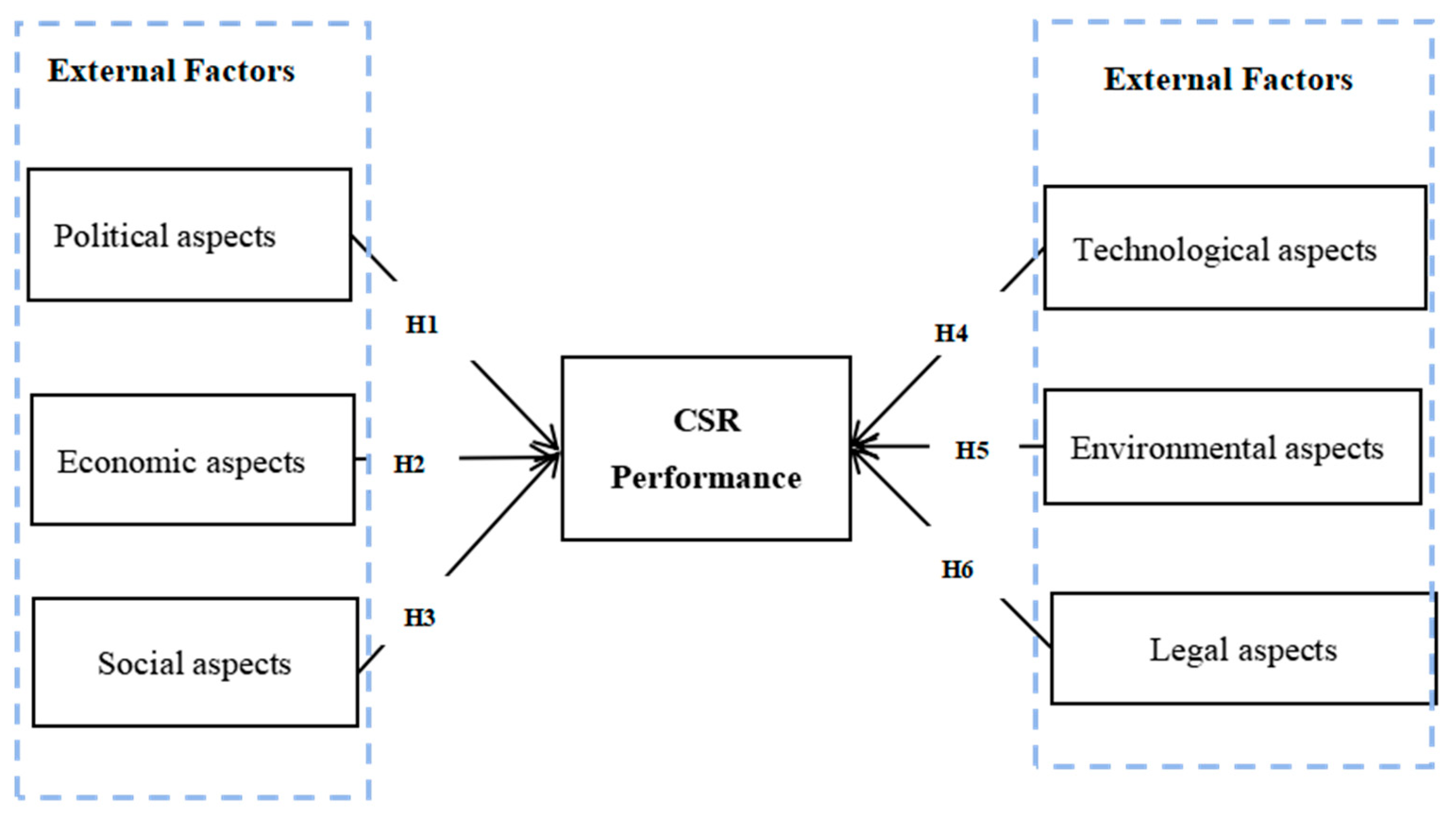
Based on stakeholder theory, the political aspect of external factors in the “P” of the PESTEL framework encompasses governmental policies, political stability, and regulations, which are key external stakeholders whose demands and mandates can strongly influence firm behavior. In institutional contexts, strong government pressure and enforceable regulations induce CSR isomorphism, and firms take cues from official mandates to align with societal expectations. As highlighted by Boubakri et al. [72], government-imposed institutional pressures play a critical role in shaping CSR practices through the establishment and enforcement of relevant regulations. These regulatory frameworks guide organizational behavior under the influence of coercive isomorphism, where companies conform to rules and norms in order to gain legitimacy [73,74]. For example, Zhang et al. [49] utilizing stakeholder theory, observed that CSR engagement among large construction firms in China is largely influenced by external pressures and societal expectations. Similarly, Ran et al. [15] identified institutional pressure as a key determinant in the adoption of CSR initiatives. However, in regions where institutional structures and enforcement mechanisms are weak, CSR may be used strategically to pursue self-serving interests, such as rent-seeking and profit enhancement, thereby reducing the effectiveness of such pressures on guiding CSR behavior [15,34]. In line with earlier research that connects political dynamics to CSR adoption, we hypothesize the following:
H1. 
Political factors have a positive direct impact on CSR performance.

3.2. Economic Factors and CSR Performance

Economic factors in the “E” of the PESTEL framework include market growth, economic stability, and the availability of financial and material resources. Contingency theory suggests that firms must align their strategies with prevailing economic conditions to achieve optimal performance [75]. In a flourishing economy marked by rising income and wealth, firms benefit from the financial slack necessary to invest in CSR initiatives. For example, Zahidy et al. [46] found that increased national prosperity enables firms to expand sustainable practices by absorbing their associated costs. Similarly, Marshall et al. [76] demonstrate that, in France, companies complying with CSR mandates not only attracted new foreign institutional investors but also saw existing investors increase their holdings. Conversely, research by Magrizos et al. [38] found that during economic downturns, SMEs tend to focus on the survival of their core operations and prioritize immediate stakeholder concerns over long-term sustainability and social responsibility performance. Based on this reasoning and the literature indicating that economic progress drives CSR implementation, we hypothesized as follows:
H2. 
Economic factors have a positive direct impact on CSR performance.

3.3. Social Factors and CSR Performance

Within the PESTEL framework, social factors encompass cultural norms, community values, and public expectations. Stakeholder theory implies that societal and community groups are influential stakeholders, and firms should respond to social legitimacy, as well as customer and employee demands [77,78]. National culture further shapes CSR strategies, as societal values inform corporate priorities and stakeholder expectations [79]. In several Asian countries such as China, Taiwan, Hong Kong, and Singapore, Confucian and Daoist principles emphasize social harmony and environmental stewardship, encouraging firms to adopt responsible business practices [80,81]. Additionally, religious beliefs can foster a moral imperative for CSR. For example, the Prophet Muhammad’s teaching, “Whoever wishes to be delivered from the fire and to enter Paradise should treat people as he wishes to be treated”, has been shown to motivate Islamic firms toward greater social responsibility [82]. Moreover, research on Asian SMEs indicates that family-owned and community-oriented enterprises often prioritize ethical and philanthropic CSR activities to generate social value [15]. Therefore, due to reputational and moral pressures, these cultural and social norms effectively lead firms to improve CSR performance. We hypothesized:
H3. 
Social factors have a positive direct impact on CSR performance.

3.4. Technological Factors and CSR Performance

Within the PESTEL framework, technological factors refer to the adoption of emerging technologies and a firm’s capacity for innovation. Based on contingency theory, contextual changes in technology require firms to adapt their strategies [83]. With the advent of Construction 4.0, the adoption of cutting-edge technologies—such as Building Information Modeling (BIM), renewable energy solutions, and digital data analytics—offers construction companies new opportunities to integrate CSR directly into their operational frameworks [84]. For example, Pham et al. [54] highlight how technology contributes to environmental sustainability by prioritizing the selection of eco-friendly materials and promoting energy-saving products. Additionally, Zhang et al. [85] note that the tools associated with Industry 4.0—including digital BIM platforms [86], smart devices powered by the Internet of Things (IoT), artificial intelligence systems, and augmented reality (AR) technologies [87]—can significantly improve the monitoring of worker safety and optimize resource efficiency, thereby reinforcing CSR performance. Meanwhile, due to advances in digital technology, social media can drive positive, transparent, and new forms of collective action [88]. Based on this, we advanced the following hypothesis:
H4. 
Technological factors have a positive direct impact on CSR performance.

3.5. Environmental Factors and CSR Performance

Environmental factors in the “E” of the PESTEL framework include ecosystem health, climate change pressures, and concerns about environmental pollution. From the perspective of stakeholder theory, governments, environmental groups, and local communities are key stakeholders whose legitimacy and urgency drive firms to adopt green CSR initiatives and sustainable practices [89,90]. Empirical research by Nguyen et al. [16] confirms that climate change considerations motivate Vietnamese construction companies to implement energy-efficient designs and integrate renewable energy solutions. To address the large volumes of demolition waste, Kim et al. [91] developed a Construction and Demolition Waste Management (CDWM) performance framework that engages project stakeholders, including owners, design consultants, and contractors, to ensure responsible waste management. Similarly, Zhang et al. [49] found that Chinese large-scale construction firms’ recognition of the importance of environmental protection motivates them to establish environmental management systems, green office practices, employee environmental training programs, and green design and construction principles (e.g., low-carbon site equipment, water-use reduction, and noise mitigation). Based on these findings, we hypothesize:
H5. 
Environmental factors have a positive direct impact on CSR performance.

3.6. Legal Factors and CSR Performance

Legal factors in the “L” of the PESTEL framework include the body of laws, regulations, and enforcement mechanisms that govern corporate conduct. From a stakeholder theory perspective, regulatory systems represent powerful stakeholders whose statutory mandates and oversight authority exert coercive pressure on firms to meet societal expectations [16,89]. Contingency theory further suggests that organizational strategies should adapt to the demands of the external context to achieve effectiveness [65]. Empirical evidence shows that firms operating under robust CSR-related legislation tend to exhibit higher levels of CSR engagement, as compliance measures often evolve into strategic initiatives that enhance reputation and stakeholder trust [66]. For example, in Saudi Arabia, the Ministry of Finance mandated in 2017 that large companies disclose their CSR activities, leading to significant increases in corporate reporting [92]. Similarly, the adoption of the SA 8000 standard in India and Brazil has reinforced social responsibility practices such as establishing clear communication channels, promoting ethical conduct, and ensuring safe working conditions, thereby embedding CSR into firms’ operational frameworks [91]. Based on this, we hypothesize as follows:
H6. 
Legal factors have a positive direct impact on CSR performance.
Figure 1 presents the study’s conceptual framework, structured around the six hypotheses outlined above.

4. Research Methodology

This study adopts a quantitative research design to examine how external macro-environmental factors (PESTEL dimensions) shape CSR performance in China’s construction SMEs. Grounded in stakeholder theory [62,89] and contingency theory [65], our framework captures both the legitimacy claims of external actors (e.g., government, communities) and the fit between external environmental demands and internal firm-level capabilities. Data were gathered via a structured online questionnaire administered to executives and senior managers of SMEs in four directly administered municipalities: Beijing, Shanghai, Tianjin, and Chongqing. Data collection took place between September and November 2024. A simple random sampling approach was employed to ensure representativeness, and PLS-SEM was used to test the hypotheses in the context of China.

4.1. Research Design and Instrument Development

Building on the measurement indicators established in Section 2.3, we operationalized the online questionnaire to capture both the external factors—political, economic, social, technological, environmental, and legal dimensions—and CSR performance in Chinese construction SMEs. As detailed in Section 2.3, twenty-six external influencing factors and CSR performance indicators were identified (Table 1). Measured items were drawn from proven scales in the literature, such as [15,16,31,49,54], and these items were measured using multi-item scales adapted from validated studies, all anchored on a seven-point Likert scale (1 = “strongly disagree”; 7 = “strongly agree”) to maximize sensitivity and reliability [93,94]. To confirm the instrument’s clarity, relevance, and contextual appropriateness, we followed a multi-stage validation process. In the first stage, three senior scholars in CSR and construction management examined the draft items to confirm that each question accurately reflected its intended PESTEL dimension and CSR performance. In the second stage, ten practitioners—including construction SME owners, project managers, and government CSR consultants—participated in a structured focus-group session. These practitioners, with extensive knowledge of CSR practices in China’s construction sector, specifically within SMEs, were consulted to refine the proposed factors. Their expertise in CSR implementation, business strategy, and understanding of the unique challenges facing Chinese construction SMEs played a critical role in shaping the final framework. They evaluated each item for clarity and relevance to day-to-day CSR practices in Chinese construction SMEs. Feedback from this session prompted revisions such as simplifying technical terminology under technological factors and specifying local regulatory references under legal factors. The online questionaire was shown in Appendix A.

4.2. Sampling and Data Collection

The target population comprised executives of SMEs in China’s construction industry, defined according to the “Qualification Standard for Construction Enterprises” and the “Criteria for the Classification of Small and Medium-sized Firms” [95] as follows: (1) small enterprises (SEs): an annual turnover of no more than 20 million RMB; (2) medium enterprises (MEs): an annual turnover of more than 20 million RMB and no more than 200 million RMB. We selected four municipalities—Beijing, Shanghai, Tianjin, and Chongqing—for their high concentration of construction activity, diverse SME profiles, and robust regulatory oversight [96]. These sites capture variations in institutional pressures, market dynamics, and technological readiness across China’s major urban clusters.
A simple random sampling method was used to select participants from the defined population of construction SME executives in the selected cities. Every member of the population had an equal probability of being included in the sample. We adopted this sampling method because the sampling frame of the study was clearly defined and the target population shared relatively homogeneous characteristics. When the sampling frame is clearly defined and the population is relatively homogeneous, simple random sampling provides each unit with an equal probability of selection and is therefore suitable for minimizing selection bias [97]. This sampling method is widely used in CSR research within the construction sector, such as in Loosemore and Lim [40] and Zhang et al. [49], and involves randomly selecting firms without stratification, thereby ensuring unbiased representation [98]. The target sample size was established following Krejcie and Morgan’s [99] guidelines, which ensure statistically robust inference for our PLS-SEM analysis.
Although respondent anonymity was assured, the data were collected through self-reported questionnaires, which may be subject to social desirability bias. Procedural remedies were applied to mitigate common method bias inherent in self-reported data. Specifically, data collection was conducted in two waves over a two-month period (September to November 2024), with a two-week interval between them. The first wave gathered demographic and firmographic information, while the second wave collected data on the PESTEL dimensions of external factors and CSR performance. A total of 1200 questionnaires were distributed, yielding 445 completed returns. Following data cleaning to remove incomplete, inconsistent, or straight-lined responses, 380 valid surveys were retained, corresponding to an effective response rate of 31.7%, which exceeds the acceptable threshold of 20% [100].
Table 2 summarizes the demographic characteristics of the 380 respondents. Quantity surveyors represent the largest job function group at 37.1 percent, followed by construction schedulers at 32.4 percent. More than half of the participants (53.4 percent) are under 30 years of age, while those aged 50–59 account for only 4.7 percent. Regarding educational attainment, half of the sample hold a bachelor’s degree, and just 8.9 percent possess a master’s or doctoral qualification. Male respondents predominate at 76.1 percent. In terms of tenure, 32.1 percent have over ten years of experience, compared to 13.2 percent each for the one- to three-year and three- to five-year bands. Geographically, 34.7 percent of respondents are based in Beijing, whereas only 12.6 percent are from Chongqing. Ownership structures are split almost evenly between private enterprises (49.7 percent) and state-owned enterprises (47.1 percent), with a small remainder classified as individual proprietorships. The majority of firms (70.3 percent) qualify as medium-sized enterprises, with the remainder categorized as small companies. This diverse profile confirms that our sample effectively represents the demographic and organizational heterogeneity of China’s construction SME sector.

4.3. Analysis Approach

To test the hypothesized relationships between external factors and CSR performance, this study employs PLS-SEM, a second-generation multivariate technique well-suited for both predictive and exploratory research [101,102]. PLS-SEM is more robust than covariance-based SEM, as it tolerates smaller samples and non-normal data, which is particularly relevant given the 380 responses in this study [103]. Its iterative algorithm estimates latent variable scores as linear combinations of observed indicators, thereby accommodating measurement error and delivering more accurate construct estimates. Moreover, PLS-SEM’s composite measurement model focuses on maximizing the explained variance (R2) of endogenous constructs, aligning with our goal of predicting CSR performance under varying external pressures. All PLS-SEM analyses were conducted using SmartPLS 4.1.0, proceeding in two stages: first, validating the measurement model (reliability, convergent validity, discriminant validity); and second, testing the structural model (path coefficients with 5000 bootstrap resamples, R2, and effect sizes).

5. Results

5.1. Measurement Model Evaluation

Before proceeding to analyze the structural model, the study first assessed the reliability and validity of the reflective measurement constructs. Internal consistency for the first-order dimensions was evaluated using Cronbach’s alpha, rho_A, and composite reliability (CR). All constructs recorded values above the recommended cutoff of 0.70, confirming the scales’ reliability [104]. As illustrated in Table 3, the survey results show a strong level of internal consistency. The study also verified convergent validity, which reflects how consistently a group of indicators measures the same underlying construct. This was established by meeting three criteria: indicator loadings exceeded 0.70, average variance extracted (AVE) values were above 0.50, and CR values surpassed the 0.70 threshold [103]. These metrics confirm that each set of indicators effectively captured their associated latent variables. The findings in Table 3 support this, indicating strong convergent validity and adequate internal correlations. Discriminant validity, which ensures distinctiveness among latent constructs, was evaluated using two approaches: the Fornell-Larcker criterion and the heterotrait-monotrait (HTMT) ratio. According to the Fornell-Larcker method, the square root of each construct’s AVE should be greater than its correlations with other constructs. The HTMT values, used as an additional validation, all remained below the threshold of 0.85 [105]. As presented in Table 4, all constructs in this study satisfied the HTMT requirement. Table 5 further confirms discriminant validity by showing that the square roots of the AVEs for all constructs exceeded the highest inter-construct correlations. For instance, the AVE square root for CSR is 0.769, which is higher than its maximum correlation coefficient of 0.519.
Together, the results demonstrate that the measurement model possesses both strong reliability and validity, establishing a solid foundation for subsequent structural modeling analysis.

5.2. Structural Model Analysis

We employed PLS-SEM (SmartPLS 4.0) to test the hypothesized relationships. The structural model was assessed in terms of explanatory power, path significance, and predictive relevance.

5.2.1. Explanatory Power

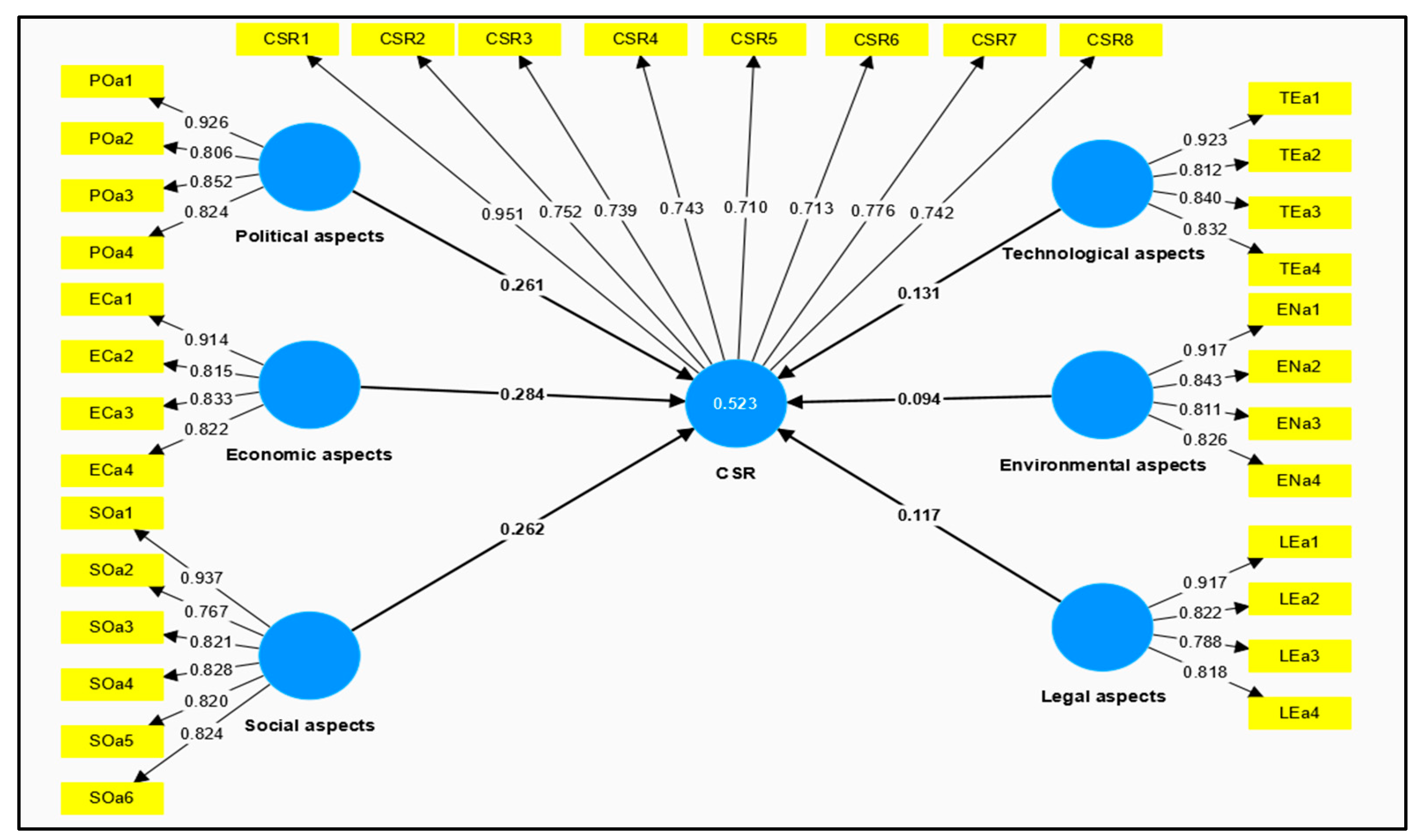
We used the explanatory power of endogenous variables in Table 6, specifically the R2 value, to assess the model’s goodness of fit. The results in Table 6 show that the R2 value for CSR is 0.523 (adjusted R2 = 0.515), indicating that the six PESTEL external factors in this study explain about 52.3% of the variation in the dependent variable of CSR performance. This suggests that the model has good explanatory power [106].

5.2.2. Path Analysis

The path coefficient outcomes summarized in Table 7 provide insights into the distinct effects of each relationship within the model. The table details the coefficient values, corresponding T-statistics, confidence intervals, and significance levels (p-values) for every path analyzed.
The direct relationships between the six external macro factors under the PESTEL framework and CSR performance are examined in Figure 2 and Table 7. Using the bootstrapping method with 5000 resamples, we generated 95% confidence intervals to affirm the robustness of our findings, as detailed in Table 7. Furthermore, the variance inflation factor (VIF) scores in Table 7 range from 1.037 to 2.042, all well below the threshold of 5, indicating that there is no multicollinearity problem [103].
The study evaluated the significance of the proposed relationships through hypothesis testing. The results in Table 7 show that all six relationships and hypotheses were supported (i.e., at p < 0.05 or less), demonstrating that economic, environmental, legal, political, social, and technological aspects all have a significant positive impact on CSR performance. Economic factors (β = 0.284, t = 7.771, f2 = 0.139), social factors (β = 0.262, t = 6.491, f2 = 0.118), and political factors (β = 0.261, t = 6.529, f2 = 0.114) emerged as the strongest significant factors impacting CSR performance, supporting H1 to H3. This is followed by the impact of legal factors on CSR performance (β = 0.131, t = 3.631, f2 = 0.03), which supports H6. In the supported paths H4 and H5, technological factors (β = 0.117, t = 2.811, f2 = 0.026) and environmental factors (β = 0.094, t = 2.369, f2 = 0.017) have a relatively smaller impact on CSR performance.

5.2.3. Predictive Power

Q2 is a key metric for assessing the model’s predictive capability. As illustrated in Table 8, the Q2 value reflects how well the model can forecast endogenous variables. A Q2 value above zero suggests that the model possesses predictive relevance for those variables [103]. In this study, the Q2 value for CSR performance is 0.468, indicating a substantial level of predictive accuracy. Generally, higher Q2 values point to stronger prediction power, and in this case, the results confirm that the model effectively explains and anticipates the behavior of the endogenous variables involved.
According to Table 9, the predictive power of the PLS-SEM model was evaluated by comparing its prediction errors with those generated by a linear model (LM), following the criteria outlined by Chua [107] and He et al. [108]. When PLS-SEM exhibits lower prediction errors (e.g., RMSE and MAE) across all indicators compared to the LM, the model is considered to have strong predictive power. As shown in Table 9, for all six CSR indicators (CSR1 to CSR6), the prediction errors produced by PLS-SEM are consistently lower than those of the linear model. This result indicates that the PLS-SEM model demonstrates superior predictive accuracy and is more effective in forecasting CSR performance in the context of construction SMEs. Therefore, the proposed research model shows strong predictive power and effectively captures real-world phenomena.

6. Discussion

This study empirically examines how six external macro factors—political, economic, social, technological, environmental, and legal—collectively shape CSR performance within Chinese construction SMEs. Utilizing PLS-SEM, the analysis supported all six hypotheses (H1 to H6). Political, economic, and social factors emerged as the most potent drivers of CSR performance, while environmental and technological factors, though statistically significant, exerted comparatively weaker effects. Legal factors demonstrated a moderate influence.
The pronounced impact of political factors (β = 0.261, t = 6.529, f2 = 0.114) supports H1. This finding aligns with Zhang et al. [49], Boubakri et al. [72], and Ran et al. [15], who confirmed that governmental directives are primary motivators. Under China’s unique context, the government plays a pervasive role in shaping CSR priorities through coercive pressures such as regulatory mandates (e.g., “dual carbon” goals, green building standards) [109], policy standards, and the ongoing anti-corruption campaign [110]. Construction SMEs actively seek political legitimacy and access to benefits such as participation in public tenders and state-backed financing [111].
Economic factors demonstrated the largest coefficient (β = 0.284, t = 7.771, f2 = 0.139), providing robust support for H2. China’s remarkable economic transformation since 1978 has been significantly driven by the construction sector. In 2021, the construction sector contributed 7.7% to GDP, with projected annual growth of approximately 4.2% [112]. This growth generates crucial financial slack for construction SMEs. Periods of robust growth, averaging 8.9% between 1980–2012 and 6.4% between 2013–2019, have enabled resource accumulation, facilitating investments beyond immediate operational needs, including CSR [113]. This finding aligns with previous studies by Zahidy et al. [46] and Magrizos et al. [38]. Furthermore, intense competition within China’s vast construction market compels SMEs to leverage CSR for differentiation, reputation building, and securing stakeholder trust, which is vital for long-term financial success. As Jun [114] observed, China is transitioning from a resource-intensive growth model toward one that emphasizes entrepreneurial vitality, such as incentivizing innovation and patent development, and a stronger commitment to social responsibility, thereby reinforcing the economic imperative for CSR engagement [115].
Social factors also had a significant impact on CSR performance (β = 0.262, t = 6.491, f2 = 0.118), supporting H3. Consistent with the findings of Birkin et al. [80], Chiou and Shu [81], and Atmeh et al. [82], cultural norms and community expectations play a critical role in encouraging CSR engagement among construction SMEs. In the Chinese sociocultural context, Confucian philosophy deeply shapes societal values and ideologies [116]. Core Confucian virtues such as filial piety, ritual propriety, and social harmony foster respect for hierarchical relationships, collective interests, and the maintenance of social order. These values promote a strong sense of collectivism and place social welfare above individual rights, reinforcing societal expectations that corporations contribute to cohesion and harmony [116]. This cultural orientation significantly shapes public attitudes toward the role of CSR in advancing community well-being and ethical responsibility.
Legal factors exerted a moderate positive effect (β = 0.131, t = 3.631, f2 = 0.03), supporting H6. This finding aligns with Halkos and Nomikos [92] and Kim et al. [91], who argue that robust legal frameworks encourage CSR adoption by mandating disclosure and reinforcing worker safety and ethical standards. In China, the legal environment underpinning CSR is rapidly evolving. Beginning in 2008, the Shenzhen and Shanghai stock exchanges required leading firms to publish social responsibility reports [117]. Further strengthening this trend, the China Securities Regulatory Commission introduced a corporate governance code in June 2018 that established an ESG reporting framework for all listed companies [117]. As a result, large state-controlled and publicly traded construction contractors have increasingly issued sustainability or CSR reports [118]. Beyond disclosure mandates, Chinese construction firms must comply with stringent labor and safety regulations, including the Labor Law, the Construction Law, the Work Safety Law, and the Administrative Regulations on the Work Safety of Construction Projects, which explicitly require safe working conditions, comprehensive training, and insurance for construction workers [119,120]. Collectively, these legal provisions compel firms to integrate CSR practices into their core operations.
Technological factors produced a modest effect on CSR performance (β = 0.117, t = 2.811, f2 = 0.026), supporting H4 but falling short of the strong influence predicted by Industry 4.0 scholarship, such as that of Zhang et al. [85] and Abdel-Tawab et al. [84]. Despite the potential of advanced technologies—such as BIM, IoT, and AI—to enhance CSR practices, their uptake in SMEs remains limited. High upfront costs and resource constraints hinder adoption [15], and larger firms tend to have more capabilities for technological integration [121]. Additionally, a significant skills gap exists, particularly in digital literacy and technical expertise among workers and managers. Integrating such tools into the fragmented workflows of construction projects requires substantial investment in training and time, as emphasized by Wang et al. [122]. Moreover, many construction SMEs face substantial barriers to digital transformation due to the complexity and limited adaptability of existing commercial digital solutions [123]. In the Chinese construction industry, the absence of unified data standards across government agencies, industry bodies, and enterprises further exacerbates this challenge, as persistent data-sharing issues hinder system interoperability [124]. Such technical fragmentation means that standardized digital tools are often poorly aligned with the informal workflows of construction SMEs. In addition, as Xia et al. [33] observed, construction SMEs typically participate in CSR initiatives as occasional or subordinate partners to large contractors within fragmented supply chains, which further constrains their ability to adopt integrated digital solutions and leverage technology for systematic CSR performance improvements.
Moreover, environmental factors, although statistically significant, had the weakest effect on CSR performance (β = 0.094, t = 2.369, f2 = 0.017), supporting H5. This subdued impact contrasts with the global emphasis on climate change and environmental stewardship as key drivers of CSR [16]. In China, despite national initiatives such as the “Ecological Civilization” campaign [125] and carbon neutrality targets [126], many construction SMEs view environmental compliance primarily as a financial burden given their narrow profit margins. As Zhong et al. (2025) noted [127], limited resources constrain investments in green technologies and sustainable materials, and there is often a lag between increased environmental awareness, driven by policy and public concern, and SMEs’ operational capacity to adopt costly ecological measures [128]. Moreover, the legacy of China’s rapid construction boom, during which speed and volume were historically prioritized over sustainability [129], continues to influence construction SMEs’ environmental priorities. Moreover, within China’s environmental governance system, some construction enterprises adopt a free-riding or “wait-and-see” approach, relying on other firms to take the lead in advancing industry-level environmental standards [130]. In practice, construction SMEs often engage in environmental CSR only to the extent required for regulatory compliance, rather than proactively improving their environmental performance. This behavioral pattern is reinforced by institutional and enforcement-related uncertainties. Although political factors in China exert strong coercive pressure, environmental governance is still largely implemented through administrative measures (e.g., departmental regulations and normative policy documents) rather than high-level, legally binding statutes, which weakens the legal accountability mechanisms associated with environmental responsibility [130]. The limited legal authority of many environmental regulations reduces the perceived risk of non-compliance among construction SMEs, encouraging minimal compliance strategies. Furthermore, significant regional variation in policy implementation—where some local governments initially adopt a lenient stance while others enforce stricter standards—creates uneven regulatory pressure across regions, leading to divergent environmental responses among construction SMEs [127].
Summarily, this study confirms that political, economic, and social forces are the primary external levers for driving CSR performance in Chinese construction SMEs, while the establishment of a legal framework exerts a moderate influence. Technological and environmental factors, while statistically significant, impact CSR performance more gradually as SMEs contend with financial and capacity constraints.

7. Contribution

7.1. Theoretical Contribution

By integrating stakeholder theory and contingency theory, this study enriches CSR knowledge by explicitly theorizing how heterogeneous external pressures are filtered through firm-specific contingencies in resource-constrained construction SMEs. Stakeholder factors determines the direction of CSR pressure, whereas contingency factors determine the speed and depth with which such pressure is translated into CSR performance.
Firstly, under stakeholder theory, we empirically demonstrate that diverse external factors—including government bodies, economic conditions, local communities, and regulatory agencies—exert different pressures that drive CSR engagement in construction SMEs in China. The pronounced effects of economic, political, and social factors extend classic stakeholder salience theory by showing that, in emerging-economy contexts, coercive power and institutional legitimacy outweigh normative stakeholder expectations in driving CSR performance. While stakeholder theory developed largely in developed economies assumes relatively balanced stakeholder influence, our findings suggest that state actors and market-related stakeholders dominate CSR decision-making in China’s construction SMEs, which reflects institutional dependence.
Simultaneously, drawing on contingency theory, we show that the translation of external demands into CSR performance depends critically on construction SMEs’ internal alignment and the fit between resource availability (financial resources), organizational capacity (digital literacy), and the nature of external pressure. Although technological and environmental factors are significant, their relatively weaker impacts refine contingency theory by demonstrating that external CSR pressures do not yield uniform outcomes unless they align with firms’ absorptive capacity and operational routines. This finding highlights the conditional nature of CSR outcomes in construction SMEs.
Secondly, by contextualizing the PESTEL framework within Chinese construction SMEs—a sector characterized by project-centric operations, intense price competition, and institutional complexity—this study extends stakeholder-contingency theorizing to emerging-economy settings. We reveal that each PESTEL dimension generates distinct pressures: political mandates and economic conditions establish foundational legitimacy and resource availability; sociocultural expectations fuel normative commitments; legal frameworks enforce compliance; while technological and environmental factors, despite their strategic relevance, remain contingent on SMEs’ internal capacities and institutional enforcement mechanisms. This integrated perspective advances existing theory by explaining not only whether external influencing factors matter for CSR performance, but also why their effects vary across dimensions and contexts, thereby offering a more nuanced and context-sensitive theoretical explanation of CSR pathways in construction SMEs.

7.2. Practical Implication

From the perspective of construction SMEs, the findings highlight the importance of establishing robust partnerships with local government bodies and financial institutions to secure the legitimacy and resources necessary for meaningful CSR investment. In China’s policy-driven environment, construction SMEs can collaborate with banks and national guarantee funds, such as the National Financing Guarantee Fund’s expanded support for SMEs, to help firms overcome funding barriers during economic cycles and invest in CSR-related projects that might otherwise be unaffordable. To build capacity in facing technological and environmental pressures, SMEs should pursue industry–education integration through partnerships with vocational colleges and technical training institutions. By engaging in digital literacy and green-technology training programs such as BIM, IoT, and energy efficiency, construction SMEs can gradually strengthen the internal capabilities required to comply with future regulations and elevate CSR performance.
From a policy-maker standpoint, practical support mechanisms are essential to enable SME adoption of CSR in China’s construction sector. Regulators in China can catalyze CSR adoption by establishing knowledge-sharing platforms through local builders’ associations or government-led industry clusters. First, such platforms should organize regular forums and workshops that bring together SME leaders, association experts, government representatives, and academia to exchange case studies on CSR implementation. Research on China’s construction sector demonstrates that peer learning and stakeholder mapping—covering governance, worker welfare, and environmental compliance—can enhance understanding and uptake of socially responsible practices. Second, integrating vocational colleges, technical universities, and research institutes into the platform aligns with China’s cluster-based innovation ecosystem: local industry clusters, reinforced by government subsidies and infrastructure, can pilot and demonstrate green technologies and safety innovations in real-world SME environments. These demonstration projects serve as living laboratories where technical feasibility and CSR value are jointly evaluated. Third, platforms should produce SME-friendly toolkits, including CSR reporting templates, green procurement checklists, and basic environmental and social performance indicators, which can be tailored to the scale and resource limitations of small construction enterprises. By translating complex standards into actionable local guidance and disseminating these through associations’ newsletters or cluster portals, regulators reduce informational barriers and foster practical CSR adoption in construction SMEs.

8. Conclusions

This study provides an empirical exploration of six external macro factors—political, economic, social, technological, environmental, and legal—and how they collectively influence CSR performance in Chinese construction SMEs. Drawing on 380 validated survey responses and applying PLS-SEM, we confirmed all six hypotheses, finding that political mandates, economic conditions, and sociocultural pressures are the dominant drivers of CSR performance, while legal requirements exert a moderate effect. Technological and environmental pressures, although statistically significant, lead to CSR gains more slowly due to SMEs’ financial, capabilities, and gestation-period constraints.
Theoretically, this study advances the body of CSR knowledge by integrating the PESTEL framework with stakeholder theory and contingency theory to explain not only whether external pressures matter, but how and why their effects differ across dimensions and contexts. The findings demonstrate that stakeholder salience in emerging-economy settings is strongly shaped by coercive power and institutional legitimacy, particularly from state actors and market-related stakeholders, rather than by relatively balanced normative expectations as often assumed in developed-economy contexts. In doing so, the study extends PESTEL–CSR research by illustrating how heterogeneous external pressures are filtered through firm-specific contingencies to produce differentiated CSR pathways in construction SMEs.
In terms of managerial implications, the findings suggest that, construction SME managers should prioritize establishing partnerships with government, financial institutions, and vocational-education providers to secure political legitimacy and financial slack for CSR investment. Strengthening internal capabilities—particularly in digital literacy and environmental management—through partnerships with vocational colleges and technical training institutions can help SMEs better respond to emerging technological and environmental pressures. Rather than treating CSR as a compliance-driven cost, SMEs can leverage CSR strategically to enhance reputation, stakeholder trust, and long-term competitiveness in an increasingly regulated and transparent market environment.
From a policy perspective, the results indicate that effective CSR promotion in China’s construction sector requires more than coercive mandates. Policymakers should complement political pressure with capacity-building mechanisms, such as cluster-based knowledge-sharing platforms, SME-oriented digital and environmental toolkits, and targeted green financing schemes. Reducing regional disparities in policy enforcement and strengthening the legal authority of environmental regulations would further discourage minimal-compliance behavior and encourage proactive CSR engagement among construction SMEs.
Despite these contributions, several limitations should be acknowledged. First, by focusing exclusively on Chinese construction SMEs, our findings provide deep, context-specific insights but may not be directly generalizable to firms in other emerging economies or industries with different regulatory regimes and cultural norms. Second, the cross-sectional design and reliance on PLS-SEM capture static relationships and this cannot capture the dynamic evolution of CSR practices over time. Methodologically, integrating qualitative interviews with SME managers, government officials, and industry experts would yield richer, more nuanced perspectives on how external pressures are interpreted, prioritized, and operationalized at the project level.
Future research could adopt longitudinal designs to examine how changes in policy intensity, technological maturity, and environmental governance affect CSR trajectories in SMEs. In addition, incorporating qualitative methods—such as in-depth interviews or case studies—would provide richer insights into how SME managers interpret, prioritize, and operationalize external CSR pressures at the project level. Moreover, comparative studies across multiple emerging economies with different regulatory and institutional configurations would further test the robustness and boundary conditions of the stakeholder–contingency framework proposed in this study.

Author Contributions

Conceptualization, Y.R. and A.S.A.; methodology, L.S. and M.Z.; software, K.J.; validation, Z.Z., H.B.S. and Y.R.; formal analysis, Y.R.; investigation, L.S.; resources, L.S. and A.S.A.; data curation, M.Z. and K.J.; writing—original draft preparation, Y.R.; writing—review and editing, L.S.; visualization, H.B.S.; supervision, A.S.A.; project administration, L.S.; funding acquisition, Y.R. All authors have read and agreed to the published version of the manuscript.

Funding

This research received no external funding.

Institutional Review Board Statement

Ethical review and approval were waived for this study. After review, this study did not obtain formal approval from a University Institutional Review Board (IRB) for the following reasons: 1. All participants involved in the study were adults aged 18 years or above; 2. The research focused on organizational-level perceptions, managerial practices, and firm-level behaviors, rather than individual medical, psychological, or physiological interventions; 3. The study did not involve medical procedures, vulnerable populations, minors, or sensitive personal data; 4. Participation in the study was entirely voluntary, and informed consent was obtained from all participants prior to data collection; 5. All responses were collected and processed in an anonymous manner, with no personally identifiable information recorded; 6. The research qualifies as non-clinical and non-sensitive organizational research, for which formal IRB approval is not required according to the relevant research ethics policies of the institution. Based on the above considerations, this study meets the criteria for ethical review exemption, and formal approval from a university-level ethics committee was therefore not required.

Informed Consent Statement

Informed consent was obtained from all subjects involved in the study.

Data Availability Statement

The original contributions presented in the study are included in the article, further inquiries can be directed to the corresponding author.

Acknowledgments

The authors are grateful to Azlan Shah Bin Ali, Hafez Bin Salleh, and Liyin Shen for their guidance and support, and to the Faculty of Built Environment, Universiti Malaya, for providing the necessary resources for this research.

Conflicts of Interest

The authors declare no conflicts of interest.

Appendix A. Questionnaire Survey Instrument

Dear Participants,
I am inviting you to participate in this research with the following survey. This information you provide will help us better understand the corporate social responsibility (CSR) in construction industry. Because you are the one who can give us a correct picture of how CSR go through under your working experience. I hope you to response to the questions frankly and honestly. This questionnaire aims to investigate how external macro-environmental factors influence CSR performance in construction Small and Medium-sized Enterprises (SMEs) in China. All responses will be kept confidential and used solely for academic research purposes.
Your answer and information will be kept confidential by this research team and will not be made public unless disclosure is required by law. Only members of the research team will have access to the information you give. An identification number will be provided for each participant. The numbers, names, and the completed questionnaires will not be made available to anyone other than the research team.
The survey consists of a set of online questionnaires which usually takes around 20 min to complete. The questionnaires ask about your experience in regards to CSR implementation and organizational factors at your organization circumstance. Its also includes questions about how you perceive yourself as an individual. Participation in this research is entirely voluntary.
Disclosure statement: No potential conflict of interest was reported by the author(s)
Thank you very much for your time and cooperation. I greatly appreciate the help of your organization and yourself in furthering this research endeavor.
Part A. Respondent and Firm Profile
Gender: ☐ Male ☐ Female
Age: ☐ Under 30 ☐ 30–39 ☐ 40–49 ☐ 50–59
Education Level: ☐ Below college ☐ College ☐ Bachelor ☐ Master ☐ Doctoral
Position: ☐ Construction Contractor ☐ Project Manager ☐ Quantity Surveyor ☐ Scheduler
Work Experience: ☐ <1 year ☐ 1–3 years ☐ 3–5 years ☐ 5–10 years ☐ >10 years
Company Location: ☐ Beijing ☐ Shanghai ☐ Tianjin ☐ Chongqing
Ownership Type: ☐ State-owned ☐ Private ☐ Individually owned
The company’s public listing status: ☐ Listed company ☐ Un-listed company
Company Size: ☐ Small-sized ☐ Medium-sized
Part B. External (PESTEL) Factors
Please indicate your level of agreement with each statement and it reflects your organization’s actual external environment and contextual conditions faced by your organization.
Responses should be based on your organization’s actual external operating environment in recent years.
A seven-point Likert scale is used, where
1 = Strongly disagree, 2 = Disagree, 3 = Somewhat disagree, 4 = Neither agree nor disagree, 5 = Somewhat agree, 6 = Agree, 7 = Strongly agree.
Political Factors
PO1. The political environment provides clear and well-enforced policies that support CSR implementation in the construction sector.
PO2. High levels of political transparency in the external environment promote ethical business conduct.
PO3. Political institutions encourage collaboration among government, enterprises, and other stakeholders for CSR implementation.
PO4. Government incentives, contracts, or policy support actively encourage construction firms to engage in CSR initiatives.
Economic Factors
EC1. Sustained economic growth in the external environment enables construction SMEs to invest in CSR activities.
EC2. A stable economic environment allows firms to allocate resources more effectively toward CSR implementation.
EC3. Economic globalization facilitates knowledge exchange and the adoption of internationally recognized CSR practices.
EC4. Investor and market expectations in the external environment encourage firms to adopt CSR strategies.
Social Factors
SO1. Social emphasis on corporate reputation motivates firms to engage in CSR activities.
SO2. Social awareness of corporate responsibility due to COVID-19 increases external expectations for corporate responsibility and community support.
SO3. Prevailing ethical and cultural values in society influence firms’ CSR-related decisions.
SO4. Societal expectations emphasize corporate contributions to community well-being and social harmony.
SO5. Social norms promote ethical conduct and social inclusiveness in business operations.
SO6. Expectations regarding equality, diversity, and social inclusion are reflected in CSR-related societal pressures.
Technological Factors
TE1. The external technological environment encourages the adoption of BIM to support sustainable construction practices.
TE2. Advanced information platforms or social media in the external environment enhance CSR transparency and stakeholder engagement.
TE3. Availability of sustainable technologies and green innovations supports environmental conservation and energy efficiency.
TE4. Digital transformation in the industry environment through innovative solutions and data-driven decision-making facilitates improvements in CSR-related performance.
Environmental Factors
EN1. External environmental expectations encourage the development of green workplaces and eco-friendly office practices.
EN2. Environmental regulations and societal pressure promote proactive waste management practices.
EN3. Environmental policies and expectations emphasize energy efficiency and carbon reduction in construction activities.
EN4. Green construction principles are increasingly emphasized in the external construction environment.
Legal Factors
LE1. Legal and institutional arrangements (collaboration with universities) support CSR-related education, training, and workforce development.
LE2. Legal requirements emphasize employee participation in social responsibility for enhancing corporate citizenship.
LE3. Clearly defined legal compliance mechanisms support responsible corporate governance and ethical conduct.
LE4. Legislative frameworks encourage CSR-related disclosure and corporate accountability.
Part C. CSR Performance
Please indicate your level of agreement with each statement based on your organization’s actual CSR practices and performance over recent years. Responses should reflect what your organization has done or currently does, rather than external expectations.
A seven-point Likert scale is used, where
1 = Strongly disagree, 2 = Disagree, 3 = Somewhat disagree, 4 = Neither agree nor disagree, 5 = Somewhat agree, 6 = Agree, 7 = Strongly agree.
CSR1. Our organization ensures fair and equitable treatment of all employees.
CSR2. Our firm prioritizes long-term sustained financial interests and long-term value creation.
CSR3. We actively establish and maintain productive, trustworthy partnerships with suppliers and business collaborators.
CSR4. Our business operations are conducted ethically and with integrity.
CSR5. We engage with our customers transparently and sincerely.
CSR6. Our organization rigorously complies with all relevant governmental laws, policies, and industry-specific regulations.
CSR7. We actively contribute to addressing societal challenges.
CSR8. We promote the adoption and integration of eco-conscious products and sustainable materials.

References

  1. Wang, N. The Role of the Construction Industry in China’s Sustainable Urban Development. Habitat Int. 2014, 44, 442–450. [Google Scholar] [CrossRef]
  2. Herr, H.; Nettekoven, Z.M. The Role of Small and Medium-Sized Enterprises in Development: What Can Be Learned from the German Experience; International Labour Organization: Geneva, Switzerland, 2017. [Google Scholar]
  3. Balogun, O.A.; Ansary, N.; Agumba, J. Assessment of Credit Accessibility to Construction SMEs in the South African Construction Industry Using Binary Logistic Regression. In Proceedings of the DII-2016 Conference on Infrastructure Development and Investment Strategies for Africa: Achieving Solutions for Renewable Energy and Sustainable Development, Livingstone, Zambia, 31 August–2 September 2016. [Google Scholar]
  4. Mabasa, K.; Akinradewo, O.; Aigbavboa, C.; Oguntona, O. Contributions of Construction Small, Medium, and Micro Enterprises towards the Sustainable Growth of Zambia. Sustainability 2023, 15, 7746. [Google Scholar] [CrossRef]
  5. Naradda Gamage, S.K.; Ekanayake, E.; Abeyrathne, G.; Prasanna, R.; Jayasundara, J.; Rajapakshe, P. A Review of Global Challenges and Survival Strategies of Small and Medium Enterprises (SMEs). Economies 2020, 8, 79. [Google Scholar] [CrossRef]
  6. Šelih, J. Environmental Management Systems and Construction SMEs: A Case Study for Slovenia. J. Civ. Eng. Manag. 2007, 13, 217–226. [Google Scholar] [CrossRef]
  7. Mavroulidis, M.; Vouros, P.; Fotiadis, S.; Konstantakopoulou, F.; Fountoulakis, G.; Nikolaou, I.; Evangelinos, K. Occupational Health and Safety of Multinational Construction Companies through Evaluation of Corporate Social Responsibility Reports. J. Saf. Res. 2022, 81, 45–54. [Google Scholar] [CrossRef] [PubMed]
  8. Bello, H.O.; Idemudia, C.; Iyelolu, T.V. Navigating Financial Compliance in Small and Medium-Sized Enterprises (Smes): Overcoming Challenges and Implementing Effective Solutions. World J. Adv. Res. Rev. 2024, 23, 42–55. [Google Scholar] [CrossRef]
  9. Hong, J.; Shen, G.Q.; Feng, Y.; Lau, W.S.; Mao, C. Greenhouse Gas Emissions during the Construction Phase of a Building: A Case Study in China. J. Clean. Prod. 2015, 103, 249–259. [Google Scholar] [CrossRef]
  10. Mohandes, S.R.; Zhang, X. Developing a Holistic Occupational Health and Safety Risk Assessment Model: An Application to a Case of Sustainable Construction Project. J. Clean. Prod. 2021, 291, 125934. [Google Scholar] [CrossRef]
  11. Moczadlo, R. Creating Competitive Advantages–the European Csr-Strategy Compared with Porter’s and Kramer’s Shared Value Approach. Ekon. Vjesn. Rev. Contemp. Entrep. Bus. Econ. Issues 2015, 28, 243–256. [Google Scholar]
  12. Quairel-Lanoizelée, F. Are Competition and Corporate Social Responsibility Compatible? The Myth of Sustainable Competitive Advantage. Soc. Bus. Rev. 2011, 6, 77–98. [Google Scholar] [CrossRef]
  13. Hummel, K.; Jobst, D. An Overview of Corporate Sustainability Reporting Legislation in the European Union. Account. Eur. 2024, 21, 320–355. [Google Scholar] [CrossRef]
  14. Krass, D.; Nedorezov, T.; Ovchinnikov, A. Environmental Taxes and the Choice of Green Technology. Prod. Oper. Manag. 2013, 22, 1035–1055. [Google Scholar] [CrossRef]
  15. Ran, Y.; Ali, A.S.; Shen, L.; Salleh, H.B.; Zhu, M.; Li, K.; Wang, R.; Cao, Y. The Identification and Prioritization of the Factors Affecting Corporate Social Responsibility Implementation in the Construction Industry—The Perspective of Developing Countries. Buildings 2025, 15, 632. [Google Scholar] [CrossRef]
  16. Nguyen, M.V.; Thuc, L.D.; Nguyen, T.T. PESTEL Analysis of Corporate Social Responsibility Performance in Construction Organizations. Eng. Constr. Archit. Manag. 2024, 32, 7266–7298. [Google Scholar] [CrossRef]
  17. Nguyen, M.V.; Phan, C.T.; Ha, K.D. What Drives Construction SMEs on CSR Implementation during Economic Uncertainty? J. Clean. Prod. 2024, 449, 141664. [Google Scholar] [CrossRef]
  18. Sarstedt, M.; Ringle, C.M.; Hair, J.F. Partial Least Squares Structural Equation Modeling. In Handbook of Market Research; Springer: Berlin/Heidelberg, Germany, 2021; pp. 587–632. [Google Scholar]
  19. Carroll, A.B. A Three-Dimensional Conceptual Model of Corporate Performance. Acad. Manag. Rev. 1979, 4, 497. [Google Scholar] [CrossRef]
  20. ISO 26000; Guidance on Social Responsibility. International Organization for Standardization: Geneva, Switzerland, 2010.
  21. ISO 14001; Environmental Management Systems—Requirements with Guidance for Use. International Organization for Standardization: Geneva, Switzerland, 2015.
  22. SA 8000; Foundational Criteria. Social Accountability International: New York, NY, USA, 2014.
  23. Somachandra, W.D.I.V.; Sylva, K.K.K.; Bandara, C.S.; Dissanayake, P.B.R. Corporate Social Responsibility (CSR) Practices in the Construction Industry of Sri Lanka. Int. J. Construct. Manag. 2023, 23, 2230–2238. [Google Scholar] [CrossRef]
  24. Zhao, Z.-Y.; Zhao, X.-J.; Zuo, J.; Zillante, G. Corporate Social Responsibility for Construction Contractors: A China Study. J. Eng. Des. Technol. 2016, 14, 614–640. [Google Scholar] [CrossRef]
  25. Ma, T.; Liu, Y. Multiple Paths to Enhancing the Resilience of Project-Based Organizations from the Perspective of CSR Configuration: Evidence from the Chinese Construction Industry. Eng. Constr. Archit. Manag. 2024, 31, 835–865. [Google Scholar] [CrossRef]
  26. Nguyen, M.V. Assessment of Corporate Social Responsibility Performance for Vietnamese Construction Organizations. J. Eng. Des. Technol. 2023, 23, 477–500. [Google Scholar] [CrossRef]
  27. Lantos, G.P. The Boundaries of Strategic Corporate Social Responsibility. J. Consum. Mark. 2001, 18, 595–632. [Google Scholar] [CrossRef]
  28. Freeman, R.E. A Stakeholder Theory of the Modern Corporation. Perspect. Bus. Ethics 2001, 3, 38–48. [Google Scholar]
  29. Zhao, Z.-Y.; Zhao, X.-J.; Davidson, K.; Zuo, J. A Corporate Social Responsibility Indicator System for Construction Enterprises. J. Clean. Prod. 2012, 29–30, 277–289. [Google Scholar] [CrossRef]
  30. Wu, C.-L.; Fang, D.-P.; Liao, P.-C.; Xue, J.-W.; Li, Y.; Wang, T. Perception of Corporate Social Responsibility: The Case of Chinese International Contractors. J. Clean. Prod. 2015, 107, 185–194. [Google Scholar] [CrossRef]
  31. Zhang, Q.; Oo, B.L.; Lim, B.T.H. Drivers, Motivations, and Barriers to the Implementation of Corporate Social Responsibility Practices by Construction Enterprises: A Review. J. Clean. Prod. 2019, 210, 563–584. [Google Scholar] [CrossRef]
  32. Yu, Y.; Choi, Y. Stakeholder Pressure and CSR Adoption: The Mediating Role of Organizational Culture for Chinese Companies. Soc. Sci. J. 2016, 53, 226–234. [Google Scholar] [CrossRef]
  33. Xia, B.; Olanipekun, A.; Chen, Q.; Xie, L.; Liu, Y. Conceptualising the State of the Art of Corporate Social Responsibility (CSR) in the Construction Industry and Its Nexus to Sustainable Development. J. Clean. Prod. 2018, 195, 340–353. [Google Scholar] [CrossRef]
  34. Ferri, L.M.; Pedrini, M.; Minciullo, M. Corporate Social Responsibility and Stakeholder Dialogue under Institutional Voids: Decoupling the Role of Corporate Motives, Ethics, and Resources. J. Manag. Gov. 2022, 26, 159–188. [Google Scholar] [CrossRef]
  35. Lepoutre, J.; Heene, A. Investigating the Impact of Firm Size on Small Business Social Responsibility: A Critical Review. J. Bus. Ethics 2006, 67, 257–273. [Google Scholar] [CrossRef]
  36. Bevan, E.A.M.; Yung, P. Implementation of Corporate Social Responsibility in Australian Construction SMEs. Eng. Constr. Archit. Manag. 2015, 22, 295–311. [Google Scholar] [CrossRef]
  37. Nguyen, M.V. Barriers to Corporate Social Responsibility Performance in Construction Organizations. Eng. Constr. Archit. Manag. 2024, 31, 1473–1496. [Google Scholar] [CrossRef]
  38. Magrizos, S.; Apospori, E.; Carrigan, M.; Jones, R. Is CSR the Panacea for SMEs? A Study of Socially Responsible SMEs during Economic Crisis. Eur. Manag. J. 2021, 39, 291–303. [Google Scholar] [CrossRef]
  39. Avotra, A.A.R.N.; Chenyun, Y.; Yongmin, W.; Lijuan, Z.; Nawaz, A. Conceptualizing the State of the Art of Corporate Social Responsibility (CSR) in Green Construction and Its Nexus to Sustainable Development. Front. Environ. Sci. 2021, 9, 774822. [Google Scholar] [CrossRef]
  40. Loosemore, M.; Lim, B.T.H. Linking Corporate Social Responsibility and Organizational Performance in the Construction Industry. Constr. Manag. Econ. 2017, 35, 90–105. [Google Scholar] [CrossRef]
  41. Ernst, R.-A.; Gerken, M.; Hack, A.; Hülsbeck, M. SMES’ Reluctance to Embrace Corporate Sustainability: The Effect of Stakeholder Pressure on Self-Determination and the Role of Social Proximity. J. Clean. Prod. 2022, 335, 130273. [Google Scholar] [CrossRef]
  42. Martinez-Conesa, I.; Soto-Acosta, P.; Palacios-Manzano, M. Corporate Social Responsibility and Its Effect on Innovation and Firm Performance: An Empirical Research in SMEs. J. Clean. Prod. 2017, 142, 2374–2383. [Google Scholar] [CrossRef]
  43. Glass, J.; Achour, N.; Parry, T.; Nicholson, I. Engaging Small Firms in Sustainable Supply Chains: Responsible Sourcing Practices in the UK Construction Industry. Int. J. Agil. Syst. Manag. 2012, 5, 29–58. [Google Scholar] [CrossRef]
  44. Zhang, L.; Zhang, X.; An, J.; Zhang, W.; Yao, J. Examining the Role of Stakeholder-Oriented Corporate Governance in Achieving Sustainable Development: Evidence from the SME CSR in the Context of China. Sustainability 2022, 14, 8181. [Google Scholar] [CrossRef]
  45. Mega, V.P.; Mega, V.P. Towards Purposeful, Circular, and Sustainable Economies. In Eco-Responsible Cities and the Global Ocean: Geostrategic Shifts and the Sustainability Trilemma; Springer: Berlin/Heidelberg, Germany, 2019; pp. 167–202. [Google Scholar]
  46. Zahidy, A.A.; Sorooshian, S.; Abd Hamid, Z. Critical Success Factors for Corporate Social Responsibility Adoption in the Construction Industry in Malaysia. Sustainability 2019, 11, 6411. [Google Scholar] [CrossRef]
  47. Dixit, S.K.; Priya, S.S. Barriers to Corporate Social Responsibility: An Indian SME Perspective. Int. J. Emerg. Mark. 2023, 18, 2438–2454. [Google Scholar] [CrossRef]
  48. Mahmood, A.; Naveed, R.T.; Ahmad, N.; Scholz, M.; Khalique, M.; Adnan, M. Unleashing the Barriers to CSR Implementation in the SME Sector of a Developing Economy: A Thematic Analysis Approach. Sustainability 2021, 13, 12710. [Google Scholar] [CrossRef]
  49. Zhang, Q.; Oo, B.L.; Lim, B.T.-H. Modeling Influence Mechanism of Factors on Corporate Social Responsibility Implementation: Evidence from Chinese Construction Firms. Eng. Constr. Archit. Manag. 2024, 31, 324–362. [Google Scholar] [CrossRef]
  50. Campbell, J.L. Why Would Corporations Behave in Socially Responsible Ways? An Institutional Theory of Corporate Social Responsibility. Acad. Manag. Rev. 2007, 32, 946–967. [Google Scholar] [CrossRef]
  51. Freel, M.S. Perceived Environmental Uncertainty and Innovation in Small Firms. Small Bus. Econ. 2005, 25, 49–64. [Google Scholar] [CrossRef]
  52. Song, J.; Sun, Y.; Jin, L. PESTEL Analysis of the Development of the Waste-to-Energy Incineration Industry in China. Renew. Sustain. Energy Rev. 2017, 80, 276–289. [Google Scholar] [CrossRef]
  53. Das, M.; Rangarajan, K.; Dutta, G. Corporate Sustainability in SMEs: An Asian Perspective. J. Asia Bus. Stud. 2020, 14, 109–138. [Google Scholar] [CrossRef]
  54. Pham, H.; Pham, T.; Dang, C.N. Barriers to Corporate Social Responsibility Practices in Construction and Roles of Education and Government Support. Eng. Constr. Archit. Manag. 2022, 29, 2714–2735. [Google Scholar] [CrossRef]
  55. Zhang, Q.; Oo, B.L.; Lim, B.T.-H. Key Practices and Impact Factors of Corporate Social Responsibility Implementation: Evidence from Construction Firms. Eng. Constr. Archit. Manag. 2023, 30, 2124–2154. [Google Scholar] [CrossRef]
  56. Zhou, J.; Ye, S.; Liu, X.; Tang, Y. The Role of Social Media in CSR Performance: An Integrated Institutional and Resource Dependence Perspective. J. Bus. Res. 2024, 184, 114880. [Google Scholar] [CrossRef]
  57. Nguyen, M.V. Investigating the Relationship between Corporate Social Responsibility Implementation and Contractor Competitiveness. Eng. Constr. Archit. Manag. 2024, 31, 3895–3920. [Google Scholar] [CrossRef]
  58. Hetze, K. Effects on the (CSR) Reputation: CSR Reporting Discussed in the Light of Signalling and Stakeholder Perception Theories. Corp. Reput. Rev. 2016, 19, 281–296. [Google Scholar] [CrossRef]
  59. Sreejesh, S.; Sarkar, J.G.; Sarkar, A. CSR through Social Media: Examining the Intervening Factors. Mark. Intell. Plan. 2019, 38, 103–120. [Google Scholar] [CrossRef]
  60. Wu, C.-C.; Cheng, F.-C.; Sheh, D.-Y. Exploring the Factors Affecting the Implementation of Corporate Social Responsibility from a Strategic Perspective. Humanit. Soc. Sci. Commun. 2023, 10, 179. [Google Scholar] [CrossRef]
  61. Clarkson, M.E. A Stakeholder Framework for Analyzing and Evaluating Corporate Social Performance. Acad. Manage. Rev. 1995, 20, 92–117. [Google Scholar] [CrossRef]
  62. Mitchell, R.K.; Agle, B.R.; Wood, D.J. Toward a Theory of Stakeholder Identification and Salience: Defining the Principle of Who and What Really Counts. Acad. Manage. Rev. 1997, 22, 853. [Google Scholar] [CrossRef]
  63. O’riordan, L.; Fairbrass, J. Corporate Social Responsibility (CSR): Models and Theories in Stakeholder Dialogue. J. Bus. Ethics 2008, 83, 745–758. [Google Scholar] [CrossRef]
  64. Lawrence, P.R.; Lorsch, J.W. Differentiation and Integration in Complex Organizations. Adm. Sci. Q. 1967, 12, 1–47. [Google Scholar] [CrossRef]
  65. Donaldson, L. The Contingency Theory of Organizations; Sage: Newcastle upon Tyne, UK, 2001. [Google Scholar]
  66. Javed, M.; Rashid, M.A.; Hussain, G. When Does It Pay to Be Good—A Contingency Perspective on Corporate Social and Financial Performance: Would It Work? J. Clean. Prod. 2016, 133, 1062–1073. [Google Scholar] [CrossRef]
  67. Wang, H.; Li, J. Untangling the Effects of Overexploration and Overexploitation on Organizational Performance: The Moderating Role of Environmental Dynamism. J. Manag. 2008, 34, 925–951. [Google Scholar] [CrossRef]
  68. Hull, C.E.; Rothenberg, S. Firm Performance: The Interactions of Corporate Social Performance with Innovation and Industry Differentiation. Strateg. Manag. J. 2008, 29, 781–789. [Google Scholar] [CrossRef]
  69. Bai, X.; Chang, J. Corporate Social Responsibility and Firm Performance: The Mediating Role of Marketing Competence and the Moderating Role of Market Environment. Asia Pac. J. Manag. 2015, 32, 505–530. [Google Scholar] [CrossRef]
  70. Yuen, K.F.; Thai, V.V.; Wong, Y.D. Corporate Social Responsibility and Classical Competitive Strategies of Maritime Transport Firms: A Contingency-Fit Perspective. Transp. Res. Part A Policy Pract. 2017, 98, 1–13. [Google Scholar] [CrossRef]
  71. Ganescu, M.C. Assessing Corporate Social Performance from a Contingency Theory Perspective. Procedia Econ. Finance 2012, 3, 999–1004. [Google Scholar] [CrossRef]
  72. Boubakri, N.; Guedhami, O.; Kwok, C.C.Y.; Wang, H.H. Is Privatization a Socially Responsible Reform? J. Corp. Finance 2019, 56, 129–151. [Google Scholar] [CrossRef]
  73. Khan, M.; Lockhart, J.; Bathurst, R. The Institutional Analysis of CSR: Learnings from an Emerging Country. Emerg. Mark. Rev. 2021, 46, 100752. [Google Scholar] [CrossRef]
  74. Roy, T.; Burchell, J.; Cook, J. Playing to the Audience? Multilevel Interactions between Stakeholders and Institutions around CSR in Bangladesh. Account. Audit. Account. J. 2023, 36, 464–493. [Google Scholar] [CrossRef]
  75. Wu, T.; Wu, Y.-C.J.; Chen, Y.J.; Goh, M. Aligning Supply Chain Strategy with Corporate Environmental Strategy: A Contingency Approach. Int. J. Prod. Econ. 2014, 147, 220–229. [Google Scholar] [CrossRef]
  76. Marshall, A.; Rao, S.; Roy, P.P.; Thapa, C. Mandatory Corporate Social Responsibility and Foreign Institutional Investor Preferences. J. Corp. Finance 2022, 76, 102261. [Google Scholar] [CrossRef]
  77. Awa, H.O.; Etim, W.; Ogbonda, E. Stakeholders, Stakeholder Theory and Corporate Social Responsibility (CSR). Int. J. Corp. Soc. Responsib. 2024, 9, 11. [Google Scholar] [CrossRef]
  78. Freeman, R.E.; Dmytriyev, S. Corporate Social Responsibility and Stakeholder Theory: Learning from Each Other. Symph., Emerg. Issues Manag. 2017, 51, 7–15. [Google Scholar] [CrossRef]
  79. Kucharska, W.; Kowalczyk, R. How to Achieve Sustainability?—Employee’s Point of View on Company’s Culture and CSR Practice. Corp. Soc. Responsib. Environ. Manag. 2019, 26, 453–467. [Google Scholar] [CrossRef]
  80. Birkin, F.; Margerison, J.; Monkhouse, L. Chinese Environmental Accountability: Ancient Beliefs, Science and Sustainability. Resour. Environ. Sustain. 2021, 3, 100017. [Google Scholar] [CrossRef]
  81. Chiou, C.-L.; Shu, P.-G. How Does Foreign Pressure Affect a Firm’s Corporate Social Performance? Evidence from Listed Firms in Taiwan. J. Multinatl. Financ. Manag. 2019, 51, 1–22. [Google Scholar] [CrossRef]
  82. Atmeh, M.; Shaban, M.; Alsharairi, M. Corporate Social Responsibility: Motives and Financial Performance. Int. J. Financ. Stud. 2020, 8, 76. [Google Scholar] [CrossRef]
  83. Pateli, A.G.; Giaglis, G.M. Technology Innovation-induced Business Model Change: A Contingency Approach. J. Organ. Change Manag. 2005, 18, 167–183. [Google Scholar] [CrossRef]
  84. Abdel-Tawab, M.; Kineber, A.F.; Chileshe, N.; Abanda, H.; Ali, A.H.; Almukhtar, A. Building Information Modelling Implementation Model for Sustainable Building Projects in Developing Countries: A PLS-SEM Approach. Sustainability 2023, 15, 9242. [Google Scholar] [CrossRef]
  85. Zhang, Q.; Liu, Z.; Yang, S. Enhancing Construction Workers’ Health and Safety: Mechanisms for Implementing Construction 4.0 Technologies in Construction Organizations. Eng. Constr. Archit. Manag. 2025, 32, 68–103. [Google Scholar] [CrossRef]
  86. Wang, T.-K.; Zhang, Q.; Chong, H.-Y.; Wang, X. Integrated Supplier Selection Framework in a Resilient Construction Supply Chain: An Approach via Analytic Hierarchy Process (AHP) and Grey Relational Analysis (GRA). Sustainability 2017, 9, 289. [Google Scholar] [CrossRef]
  87. Rokooei, S.; Shojaei, A.; Alvanchi, A.; Azad, R.; Didehvar, N. Virtual Reality Application for Construction Safety Training. Saf. Sci. 2023, 157, 105925. [Google Scholar] [CrossRef]
  88. Gaur, A.; Vazquez-Brust, D.A. Sustainable Development Goals: Corporate Social Responsibility? A Critical Analysis of Interactions in the Construction Industry Supply Chains Using Externalities Theory. In Sustainable Development Goals and Sustainable Supply Chains in the Post-Global Economy; Yakovleva, N., Frei, R., Murthy, S., Eds.; Greening of Industry Networks Studies; Springer: Berlin/Heidelberg, Germany, 2019; Volume 7, pp. 133–157. ISBN 978-3-030-15066-2. [Google Scholar]
  89. Freeman, R.E. The Politics of Stakeholder Theory: Some Future Directions. Bus. Ethics Q. 1994, 4, 409–421. [Google Scholar] [CrossRef]
  90. Novitasari, M.; Wijaya, A.L.; Agustin, N.M.; Gunardi, A.; Dana, L. Corporate Social Responsibility and Firm Performance: Green Supply Chain Management as a Mediating Variable. Corp. Soc. Responsib. Environ. Manag. 2023, 30, 267–276. [Google Scholar] [CrossRef]
  91. Kim, S.Y.; Nguyen, M.V.; Luu, V.T. A Performance Evaluation Framework for Construction and Demolition Waste Management: Stakeholder Perspectives. Eng. Constr. Archit. Manag. 2020, 27, 3189–3213. [Google Scholar] [CrossRef]
  92. Halkos, G.E.; Nomikos, S.N. Reviewing the Status of Corporate Social Responsibility (CSR) Legal Framework. Manag. Environ. Qual. Int. J. 2021, 32, 700–716. [Google Scholar] [CrossRef]
  93. Dillman, D.A.; Smyth, J.D.; Christian, L.M. Internet, Phone, Mail, and Mixed-Mode Surveys: The Tailored Design Method; John Wiley & Sons: Hoboken, NJ, USA, 2014. [Google Scholar]
  94. Joshi, A.; Kale, S.; Chandel, S.; Pal, D. Likert Scale: Explored and Explained. Br. J. Appl. Sci. Technol. 2015, 7, 396–403. [Google Scholar] [CrossRef]
  95. Chang, R.-D.; Zuo, J.; Zhao, Z.-Y.; Soebarto, V.; Lu, Y.; Zillante, G.; Gan, X.-L. Sustainability Attitude and Performance of Construction Enterprises: A China Study. J. Clean. Prod. 2018, 172, 1440–1451. [Google Scholar] [CrossRef]
  96. Feng, K.; Hubacek, K.; Sun, L.; Liu, Z. Consumption-Based CO2 Accounting of China’s Megacities: The Case of Beijing, Tianjin, Shanghai and Chongqing. Ecol. Indic. 2014, 47, 26–31. [Google Scholar] [CrossRef]
  97. Thompson, S.K. Sampling (Wiley Series in Probability and Statistics), 3rd ed.; John Wiley & Sons: Hoboken, NJ, USA, 2012; Volume 755, ISBN 978-1-118-16293-4. [Google Scholar]
  98. Lohr, S.L. Sampling: Design and Analysis, 2nd ed.; Chapman and Hall/CRC: Boca Raton, FL, USA, 2019; ISBN 978-0-429-29628-4. [Google Scholar]
  99. Krejcie, R. Determining Sample Size for Research Activities. Educ. Psychol. Meas. 1970, 30, 607–610. [Google Scholar] [CrossRef]
  100. Malhotra, M.K.; Grover, V. An Assessment of Survey Research in POM: From Constructs to Theory. J. Oper. Manag. 1998, 16, 407–425. [Google Scholar] [CrossRef]
  101. Joreskog, K.G. The ML and PLS Techniques for Modeling with Latent Variables: Historical and Comparative Aspects. In Systems under Indirect Observation: Causality, Structure, Prediction, Part I; Joreskog, K.G., Wold, H., Eds.; Elsevier: Amsterdam, The Netherlands, 1982; pp. 263–270. [Google Scholar]
  102. Chin, W.W. The Partial Least Squares Approach to Structural Equation Modeling. In Modern Methods for Business Research; Psychology Press: London, UK, 1998; pp. 295–336. [Google Scholar]
  103. Hair, J.F.; Risher, J.J.; Sarstedt, M.; Ringle, C.M. When to Use and How to Report the Results of PLS-SEM. Eur. Bus. Rev. 2019, 31, 2–24. [Google Scholar] [CrossRef]
  104. Nunnally, J.; Bernstein, I. Psychometric Theory, 3rd ed.; McGraw-Hill: New York, NY, USA, 1994. [Google Scholar]
  105. Henseler, J.; Ringle, C.M.; Sarstedt, M. A New Criterion for Assessing Discriminant Validity in Variance-Based Structural Equation Modeling. J. Acad. Mark. Sci. 2015, 43, 115–135. [Google Scholar] [CrossRef]
  106. Cohen, J. Statistical Power Analysis for the Behavioral Sciences; Routledge: Oxfordshire, UK, 2013. [Google Scholar]
  107. Chua, Y.P. A Step-by-Step Guide PLS-SEM Data Analysis Using SmartPLS 4. (Partial Least Squares Structural Equation Modeling); Independently Published: Chicago, IL, USA, 2022. [Google Scholar]
  108. He, D.; Zainol, R.; Shahida Azali, N. Navigating Challenges in the Sustainable Development of Urban Brownfields: A PLS Path Modeling Perspective. Ain Shams Eng. J. 2024, 15, 103002. [Google Scholar] [CrossRef]
  109. Zhu, Y.; Hu, Y.; Zhu, Y. Can China’s Energy Policies Achieve the “Dual Carbon” Goal? A Multi-Dimensional Analysis Based on Policy Text Tools. Environ. Dev. Sustain. 2024. [Google Scholar] [CrossRef]
  110. Zhang, J. Public Governance and Corporate Fraud: Evidence from the Recent Anti-Corruption Campaign in China. J. Bus. Ethics 2018, 148, 375–396. [Google Scholar] [CrossRef]
  111. Wang, T.; Jiao, H.; Xu, Z.; Yang, X. Entrepreneurial Finance Meets Government Investment at Initial Public Offering: The Role of Minority State Ownership. Corp. Gov. Int. Rev. 2018, 26, 97–117. [Google Scholar] [CrossRef]
  112. Jia, S.Z.; Wei, G.C.; Yutang, L.W. Factors Affecting Construction Sector Safety Performance: Exploratory Factor Analysis Evidence from China. J. Entrep. Proj. Manag. 2022, 6, 21–33. [Google Scholar] [CrossRef]
  113. Rogoff, K.; Yang, Y. Rethinking China’s Growth. Econ. Policy 2024, 39, 517–548. [Google Scholar] [CrossRef]
  114. Jun, T. New Quality Productivity and China’s Strategic Shift towards Sustainable and Innovation-Driven Economic Development. J. Interdiscip. Insights 2024, 2, 36–45. [Google Scholar] [CrossRef]
  115. Liang, K.; Cao, Z.; Tang, S.; Hu, C.; Zhang, M. Evaluating the Influence of Environmental, Social, and Governance (ESG) Performance on Green Technology Innovation: Based on Chinese a-Share Listed Companies. Sustainability 2025, 17, 1085. [Google Scholar] [CrossRef]
  116. Yang, Z.; Yang, Y.; Kuan, Z. A Cross-Cultural Examination of Corporate Social Responsibility Frameworks: Contrasting Paradigms in China and the West. Her. UNU. Int. Econ. Relat. World Econ. 2024. [Google Scholar] [CrossRef]
  117. Shen, H.; Lin, H.; Han, W.; Wu, H. ESG in China: A Review of Practice and Research, and Future Research Avenues. China J. Account. Res. 2023, 16, 100325. [Google Scholar] [CrossRef]
  118. Zhang, Q.; Oo, B.L.; Lim, B.T.H. Corporate Social Responsibility Practices by Leading Construction Firms in China: A Case Study. Int. J. Construct. Manag. 2022, 22, 1420–1431. [Google Scholar] [CrossRef]
  119. Fang, D.P.; Zhang, J.; Vickridge, I. Construction Safety Legislation Framework in China. Proc. Inst. Civ. Eng. Munic. Eng. 2003, 156, 169–173. [Google Scholar] [CrossRef]
  120. Pi, Z.; Gao, X.; Chen, L.; Liu, J. The New Path to Improve Construction Safety Performance in China: An Evolutionary Game Theoretic Approach. Int. J. Environ. Res. Public Health 2019, 16, 2443. [Google Scholar] [CrossRef]
  121. Zhao, Y.; Hao, S.; Chen, Z.; Zhou, X.; Zhang, L.; Guo, Z. Critical Factors Influencing the Internet of Things Technology Adoption Behavior of Construction Companies: Evidence from China. Eng. Construction. Archit. Manag. 2025, 32, 760–784. [Google Scholar] [CrossRef]
  122. Wang, K.; Xu, X.; Mao, P.; Deng, X.; Cao, D. Digital Transformation and Organizational Readiness: Evidence from Chinese Construction SMEs with a Dynamic Managerial Capabilities Lens. Eng. Constr. Archit. Manag. 2025. [Google Scholar] [CrossRef]
  123. Yilmaz, G.; Salter, L.; McFarlane, D.; Schönfuß, B. Low-Cost (Shoestring) Digital Solution Areas for Enabling Digitalisation in Construction SMEs. Comput. Ind. 2023, 150, 103941. [Google Scholar] [CrossRef]
  124. Zhang, N.; Ye, J.; Zhong, Y.; Chen, Z. Digital Transformation in the Chinese Construction Industry: Status, Barriers, and Impact. Buildings 2023, 13, 1092. [Google Scholar] [CrossRef]
  125. Bai, Y.; Huang, Y.; Wang, M.; Huang, S.; Sha, C.; Ruan, J. The Progress of Ecological Civilization Construction and Its Indicator System in China. Shengtai Xuebao/Acta Ecol. Sin. 2011, 31, 6295–6304. [Google Scholar]
  126. Hu, S.; Zhang, Y.; Yang, Z.; Yan, D.; Jiang, Y. Challenges and Opportunities for Carbon Neutrality in China’s Building Sector—Modelling and Data. Build. Simul. 2022, 15, 1899–1921. [Google Scholar] [CrossRef]
  127. Zhong, Y.; Yao, X.; Lin, W. The Impact of Environmental Regulation on the Growth of Small and Micro Enterprises: Insights from China. Sustainability 2025, 17, 2118. [Google Scholar] [CrossRef]
  128. Lewis, K.V.; Cassells, S.; Roxas, H. SMEs and the Potential for a Collaborative Path to Environmental Responsibility. Bus. Strategy Environ. 2015, 24, 750–764. [Google Scholar] [CrossRef]
  129. Zhou, Y. State Power and Environmental Initiatives in China: Analyzing China’s Green Building Program through an Ecological Modernization Perspective. Geoforum 2015, 61, 1–12. [Google Scholar] [CrossRef]
  130. Tian, Z.; Yang, W.; Tang, X. Evolutionary Characteristics of Corporate Environmental Governance Policies in China: A Policy Instrument Analysis (1982–2023). Front. Environ. Sci. 2025, 13, 1528831. [Google Scholar] [CrossRef]
Figure 1. The Conceptual Framework of this Study.
Sustainability 18 01922 g001
Figure 2. SmartPLS Output.
Sustainability 18 01922 g002
Table 2. Demographic Information of Respondents.
CategoryProfileNumberPercentage (%)
Job roleConstruction contractor287.37
Project Manager8823.16
Quarantines surveying14137.11
Construction scheduler12332.37
AgeUnder 30 years20353.42
30–39 years9725.53
40–49 years6216.32
50–59 years184.74
Education levelBelow college level143.68
College Diploma14237.37
Bachelor’s degree19050
Master’s degree328.42
Doctoral degree (PhD)20.53
GenderMale28976.05
Female9123.95
Work experience in current roleLess than 1 year8422.11
1–3 years5013.16
3–5 years5013.16
5–10 years7419.47
More than 10 years12232.11
Company locationBeijing13234.7
Shanghai10427.4
Chongqing4812.6
Tianjin9625.3
Company ownership typeState-Owned Enterprise (SOE) 17947.11
Private Enterprise 18949.74
Individually Owned 123.16
Public listing statusListed company12432.63
Unlisted company25667.37
Company size Medium-sized company26770.26
Small-sized company11329.74
Total380100
Table 3. Results Summary for Reflective Measurement Models.
Construct(s)Item(s)Indicator ReliabilityInternal Consistency ReliabilityConvergent ValidityDiscriminant Validity
LoadingCronbach’s AlphaComposite Reliability (rho_a)Composite Reliability (rho_c)AVEHTMT
>0.70>0.70>0.70>0.70>0.5Significantly Lower Than 0.90?
CSR performanceCSR10.9510.8990.9070.8270.592Y
CSR20.752
CSR30.739
CSR40.743
CSR50.71
CSR60.713
CSR70.776
CSR80.742
Economic aspectsECa10.9140.8680.870.8150.717Y
ECa20.815
ECa30.833
ECa40.822
Environmental aspectsENa10.9170.8720.8810.8610.723Y
ENa20.843
ENa30.811
ENa40.826
Legal aspectsLEa10.9230.8740.880.7140.727Y
LEa20.812
LEa30.84
LEa40.832
Political aspectsPOa10.9260.8750.8780.8630.728Y
POa20.806
POa30.852
POa40.824
Social aspectsSOa10.9370.9120.9150.8950.696Y
SOa20.767
SOa30.821
SOa40.828
SOa50.82
SOa60.824
Technological aspectsTEa10.9170.8570.8620.8420.701Y
TEa20.822
TEa30.788
TEa40.818
Table 4. Discriminant Validity—HTMT.
CSRECaENaLEaPOaSOaTEa
CSR
Economic aspects0.585
Environmental aspects0.2870.164
Legal aspects0.5930.1940.17
Political aspects0.5750.3740.1510.22
Social aspects0.5530.3570.1680.2460.354
Technological aspects0.420.2840.2580.2030.3390.229
Table 5. Discriminant Validity—Fornell-Larcker Criterion.
CSRECaENaLEaPOaSOaTEa
CSR0.769
Economic aspects0.5190.847
Environmental aspects0.2590.1450.85
Legal aspects0.3760.170.1520.838
Political aspects0.5110.3260.1370.1950.853
Social aspects0.5020.3180.1510.220.3160.834
Technological aspects0.3120.2490.230.1780.2960.2090.853
Table 6. R2.
Table 6. R2.
R-SquareR-Square Adjusted
CSR0.5230.515
Table 7. Path Analysis Results.
Path CoefficientVIFT Statistics5%95%p Valuesf2
Economic aspects → CSR0.2841.0377.7710.1350.3940.0000.139
Environmental aspects → CSR0.0941.042.3690.0740.1870.0180.017
Legal aspects → CSR0.1311.0633.6310.1290.1050.0000.03
Political aspects → CSR0.2611.0946.5290.2280.3230.0000.114
Social aspects → CSR0.2621.046.4910.1560.3560.0000.118
Technological aspects → CSR0.1172.0422.8110.080.20.0050.026
Table 8. Q2.
Table 8. Q2.
Endogenous VariablesQ2RMSEMAEMean
CSR performance0.4680.5460.3940.000
Table 9. Model Comparison.
Q2 PredictPLS-SEM_RMSEPLS-SEM_MAELM_RMSELM_MAE
CSR11.521.2111.3521.2251.505
CSR21.5251.0171.1731.0341.322
CSR31.4951.0351.1981.0491.341
CSR41.5391.1821.341.1931.48
CSR51.5721.1781.3371.1971.445
CSR61.5351.1061.2131.1191.386
Disclaimer/Publisher’s Note: The statements, opinions and data contained in all publications are solely those of the individual author(s) and contributor(s) and not of MDPI and/or the editor(s). MDPI and/or the editor(s) disclaim responsibility for any injury to people or property resulting from any ideas, methods, instructions or products referred to in the content.