Article

Bridging Effect–Efficiency Gaps in Low-Carbon Resilient Cities: Evidence on Synergistic Development and Nonlinear Drivers from Chinese Cities


1
School of New Energy, Yulin University, Yulin 719000, China
2
Faculty of Environmental Engineering, Graduate School of Environmental Engineering, The University of Kitakyushu, Kitakyushu 808-0135, Japan
3
School of Energy Engineering, Yulin University, Yulin 719000, China
*
Author to whom correspondence should be addressed.
Sustainability 2026, 18(4), 2126; https://doi.org/10.3390/su18042126
Submission received: 22 December 2025 / Revised: 20 January 2026 / Accepted: 5 February 2026 / Published: 21 February 2026
(This article belongs to the Special Issue Sustainable Development of Construction Engineering—2nd Edition)

Abstract

Advancing the low-carbon and resilient transformation of urban systems has become a crucial strategy for addressing the climate crisis. Current research predominantly focuses on either the effect of governance or the efficient utilization of urban systems, overlooking the potential structural mismatches and synergistic development governance logic between the two. This paper systematically proposes a theoretical research framework integrating the synergistic development of urban system effect and efficiency, and constructs a multi-level analytical methodology. Through an in-depth examination of 278 prefecture-level cities in China from 2010 to 2023, the following key conclusions emerge: (1) The overall level of synergistic development within urban systems has steadily increased. Specifically, the proportion of cities at low levels of synergistic development decreased from 65.11% to 17.63%, while the proportion at medium and high levels rose from 18.70% to 46.40%. (2) Spatial disparities in urban system coordination have progressively narrowed, as evidenced by the overall Gini coefficient decreasing from 0.195 to 0.153. (3) Key influencing factors for urban system coordination include foreign enterprise attraction, urban infrastructure development, and green technological innovation. Overall, this study reveals the long-standing structural mismatch between effect and efficiency in China’s urban system’s low-carbon resilience transformation, emphasizing the importance of their coordinated development. It provides theoretical foundations and empirical references for the sustainable development of urban low-carbon resilience transformation.

1. Introduction

The accelerating pace of urbanization has not only resulted in a surge in greenhouse gas emissions but also a rise in global warming [1]. Moreover, it has also driven climate change and increased the frequency of extreme weather events, posing significant challenges to the sustainable development of human society [2]. Research indicates that cities contribute approximately 80% of global carbon emissions [3]. Furthermore, the United Nations Sustainable Development Goals (SDGs) explicitly state that building resilient, sustainable cities is a crucial pathway to ensuring sustainable human development [4]. Consequently, exploring effective governance solutions at the urban scale has become a focal point for the international community. Previous research has primarily focused on emission-side governance in cities, employing low-carbon mitigation measures to curb carbon emissions, with some success achieved [5]. However, given the increasingly complex and volatile nature of extreme weather events, relying solely on low-carbon mitigation is insufficient to counter existing climate impacts effectively. Consequently, advancing the low-carbon and resilient transformation of urban systems, which leverages the synergistic advantages of both mitigation and adaptive resilience, has emerged as a widely accepted global consensus for addressing the climate crisis and advancing sustainable development [6].
Existing research has yielded a series of valuable outcomes in the field of urban low-carbon and resilient transformation. Based on differing research emphases and outcome orientations, these can broadly be categorized into three types, as detailed in Table 1. These include: (1) Research on the synergistic development of urban low-carbon and resilience subsystems. This category primarily examines the macro-level co-evolutionary characteristics of the urban low-carbon and resilience subsystems, emphasizing inter-system coordination. However, it pays relatively little attention to performance outcomes across different governance pathways within the urban low-carbon resilience system or to variations in resource utilization structures [7,8,9]. (2) Effect governance of urban low-carbon resilience systems. This research centers on the governance of urban low-carbon resilience systems, prioritizing the assessment of the attainment of external governance objectives. However, it tends to pay less attention to governance input costs and efficiency issues under varying regional governance resource constraints [10,11]. (3) Research on resource efficiency within urban low-carbon resilience systems. This strand concentrates on internal resource allocation and efficiency enhancement within such systems, emphasizing optimization of input-output relationships. However, it relatively seldom incorporates governance outcomes or target achievement into comprehensive analysis, potentially limiting its effect in evaluating governance across different research contexts [12,13].
From the perspective of low-carbon, resilient, and sustainable development within urban systems, there may be complex interrelationships between achieving external governance objectives and the efficiency of internal resource allocation. Research focusing solely on governance outcomes or resource utilization efficiency may struggle to comprehensively characterize the overall operational characteristics of a city system’s low-carbon, resilient transformation. This also provides scope for conducting integrated analysis from a dual perspective of both effect and efficiency.
Since 2010, China has successively launched multiple rounds of pilot programmers for low-carbon, resilient cities [14]. Furthermore, the nation’s relatively constrained economic foundations and resource allocation mean that urban systems undergoing low-carbon and resilient transformation may be more susceptible to influences from infrastructure, technological innovation, economic development, and other factors, thereby exhibiting distinct phased and non-linear developmental characteristics [15,16,17]. Against this backdrop, China offers an ideal experimental case for examining the low-carbon and resilient transformation of urban systems from the perspective of synergistic development of effect and efficiency.
To address potential systemic structural mismatches arising from research on urban system low-carbon resilience transformation that focuses solely on either effect or efficiency, this study selects 278 prefecture-level cities in China from 2010 to 2023 as its sample. It constructs a theoretical framework for the synergistic development of effect and efficiency in urban system low-carbon resilience. Building upon this, the entropy value method and Super-SBM model are employed to measure the governance effect and efficiency utilization of urban systems. Through the coupling coordination model, Boston matrix quadrant model, Dagum–Gini coefficient model, and XGBoost-SHAP analysis, this study explores structural mismatches, spatial-temporal differentiated evolution, and associated influencing factors within urban systems from the perspective of synergistic effect governance and efficiency utilization. The primary marginal contributions of this paper are as follows: (1) Theoretical research contribution. This study constructs a theoretical framework linking the governance of effect and the utilization of efficiency in urban systems’ low-carbon resilience, addressing limitations arising from single-dimensional research. By adopting a synergistic perspective on effect and efficiency, it explores the dynamic evolution of structural mismatches between effect and efficiency within urban systems’ low-carbon resilience, deepening understanding of the intrinsic mechanisms of sustainable urban development. (2) Methodological expansion contribution. A multi-level analytical framework is developed, employing entropy values and the Super-SBM model to measure the developmental levels of effect and efficiency within urban systems. The coupling coordination degree model is utilized to assess their synergistic development. Building on this, the Boston Matrix is introduced to identify potential structural mismatches between effect and efficiency, whilst the Dagum–Gini coefficient model analyses the evolution of spatial-temporal divergence. Finally, the XGBoost-SHAP model is employed to identify factors influencing the collaborative development level of urban systems. (3) Contributions to optimizing empirical analysis pathways. By examining the spatiotemporal evolution of synergistic development between effect and efficiency in urban systems’ low-carbon resilience, this study reveals a pervasive structural mismatch between effect governance and efficiency utilization. It further identifies the dynamic transition from divergent mismatch to convergent synergy. These findings provide theoretical foundations for sustainable urban development and empirical guidance for policymakers.
The structure of this paper is as follows: Section 2 introduces the data sources and indicator system. Section 3 elaborates on the research methodology. Section 4 presents the empirical findings. Section 5 discusses the research results. Moreover, Section 6 provides conclusions and policy recommendations.

2. Data Sources and Indicator System

2.1. Study Area

According to China’s current administrative divisions, there are 293 prefecture-level cities nationwide [18,19]. Given the requirement for continuous sample data in panel time-series studies, certain prefecture-level cities experienced data gaps in relevant statistical yearbooks during the research period. These must be excluded to prevent compromising the validity of research conclusions. Data gaps in this study are explicitly defined as two scenarios, either of which qualifies a city for exclusion. The specific definitions are as follows: (1) During the study period, more than 5% of the observed values within the indicator system are missing. (2) Any single indicator exhibits consecutive missing values exceeding one year in the time series, rendering reliable imputation through reasonable methods unfeasible. Consequently, 15 cities were excluded from the study sample of 293 prefecture-level cities nationwide based on the aforementioned criteria, after consulting relevant municipal statistical yearbooks. The retained sample comprises 278 prefecture-level cities. The list of excluded cities is detailed in Appendix A Table A1 (excluded cities: Suihua City, Pingxiang City, Laiwu City, Huangshi City, Xiangyang City, Qinzhou City, Sansha City, Danzhou City, Bijie City, Tongren City, Pu’er City, Lhasa City, Haidong City, Turpan City, Hami City).
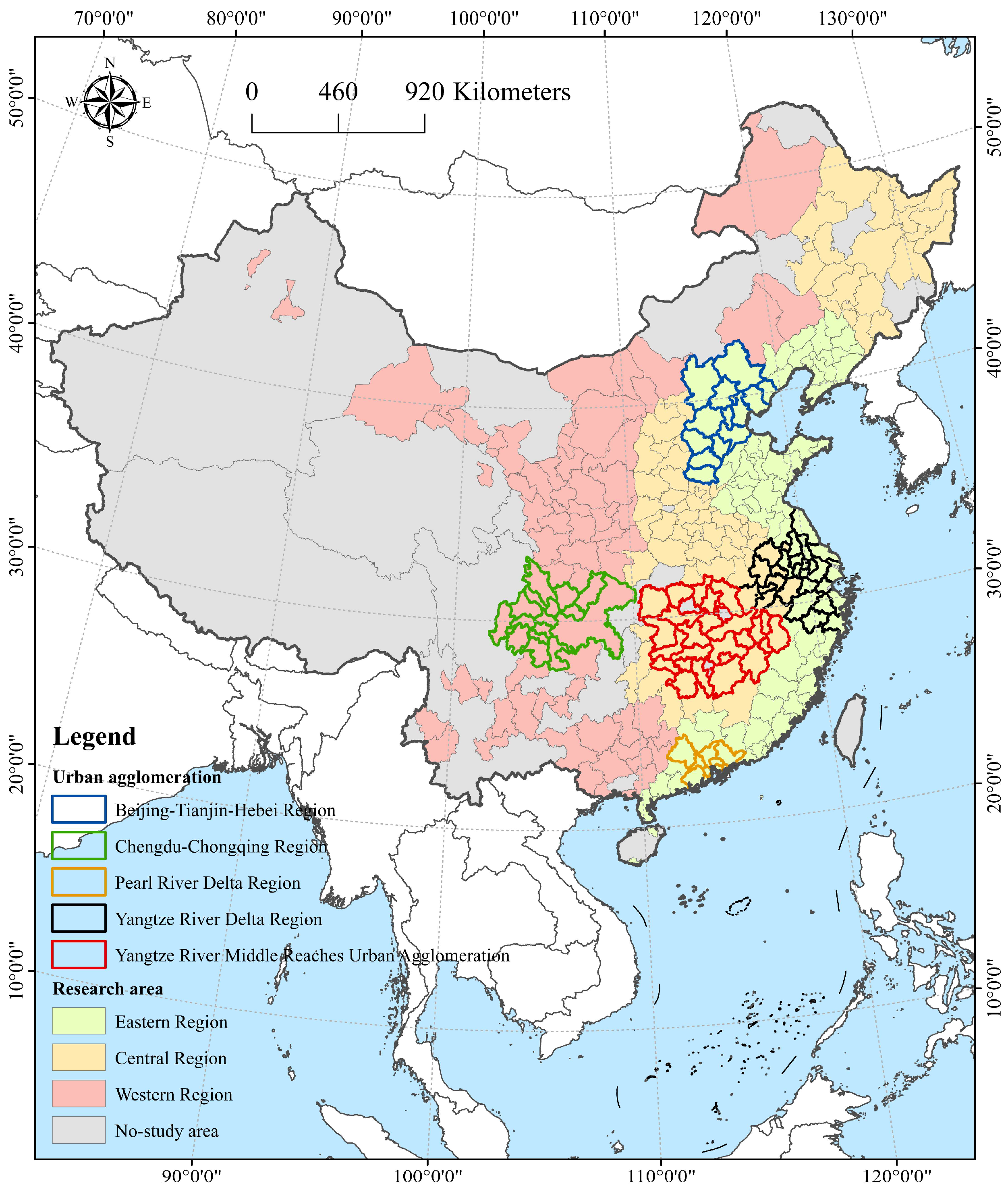
In accordance with China’s regional coordination and economic belt development plans, the research samples can be categorized into eastern, central, and western regions. This aims to comprehensively reflect the differences in low-carbon resilience development systems among cities across distinct regions within a gradient development context [20]. The selected research samples encompass major national strategic urban clusters, including the Beijing–Tianjin–Hebei region, the Yangtze River Delta, the Pearl River Delta, the Chengdu–Chongqing region, and the Mid-Yangtze River Urban Agglomeration. These urban agglomerations constitute critical zones where China’s population, economic activity, energy consumption, and carbon emissions are highly concentrated. Simultaneously, they represent focal units for low-carbon urban development and climate resilience governance. Their inclusion in this study effectively enhances the representativeness of the analytical findings and the policy applicability of the conclusions [21]. The spatial distribution and regional delineation of the study areas are illustrated in Figure 1.

2.2. Data Sources

This study constructs evaluation systems for both the effect of governance and the efficiency of utilizing low-carbon, resilient transformation in urban systems. Relevant data primarily originates from the National Statistical Yearbook, energy statistics, and publicly available government data. Indicators concerning urban socio-economic development, energy consumption, and infrastructure construction were primarily drawn from the Statistical Yearbook of Chinese Cities, the Statistical Yearbook of Energy in China, the Statistical Bulletin on China’s National Economic and Social Development, and provincial statistical yearbooks. Data on disaster response, ecological governance, and public safety were sourced from the Statistical Bulletin of the Ministry of Emergency Management of China and from the official websites of local ecological environment bureaus and statistics bureaus. Patent-related indicator data originated from the China National Intellectual Property Administration.
Regarding carbon dioxide emissions from urban energy consumption, this paper employs methodologies drawn from the existing literature, calculating emissions based on three categories of terminal energy consumption: natural gas, liquefied petroleum gas, and urban electricity use [22]. Specifically: (1) Carbon dioxide emission factors for natural gas and liquefied petroleum gas were determined according to the IPCC 2006 National Greenhouse Gas Inventory Guidelines and relevant official Chinese climate change technical documents. Emission factors for all energy types were assumed to be constant throughout the study period. (2) Urban electricity consumption was first converted to standard coal equivalents using conversion factors published in the China Energy Statistical Yearbook. Carbon emissions from electricity consumption were then calculated using the power sector’s CO2 emission factor and converted to a uniform tonnage. (3) Given the difficulty in obtaining long-term, continuous, and regionally comparable provincial or city-specific grid emission factor data at the urban scale, this study employs a nationally uniform average electricity emission factor, assuming its relative stability throughout the study period. This approach is widely adopted in existing urban-scale carbon emission studies. Specific carbon emission parameters and accounting methodologies are detailed in Appendix A Table A2.

2.3. Theoretical Boundaries and Indicator System Construction

2.3.1. Theoretical Boundaries

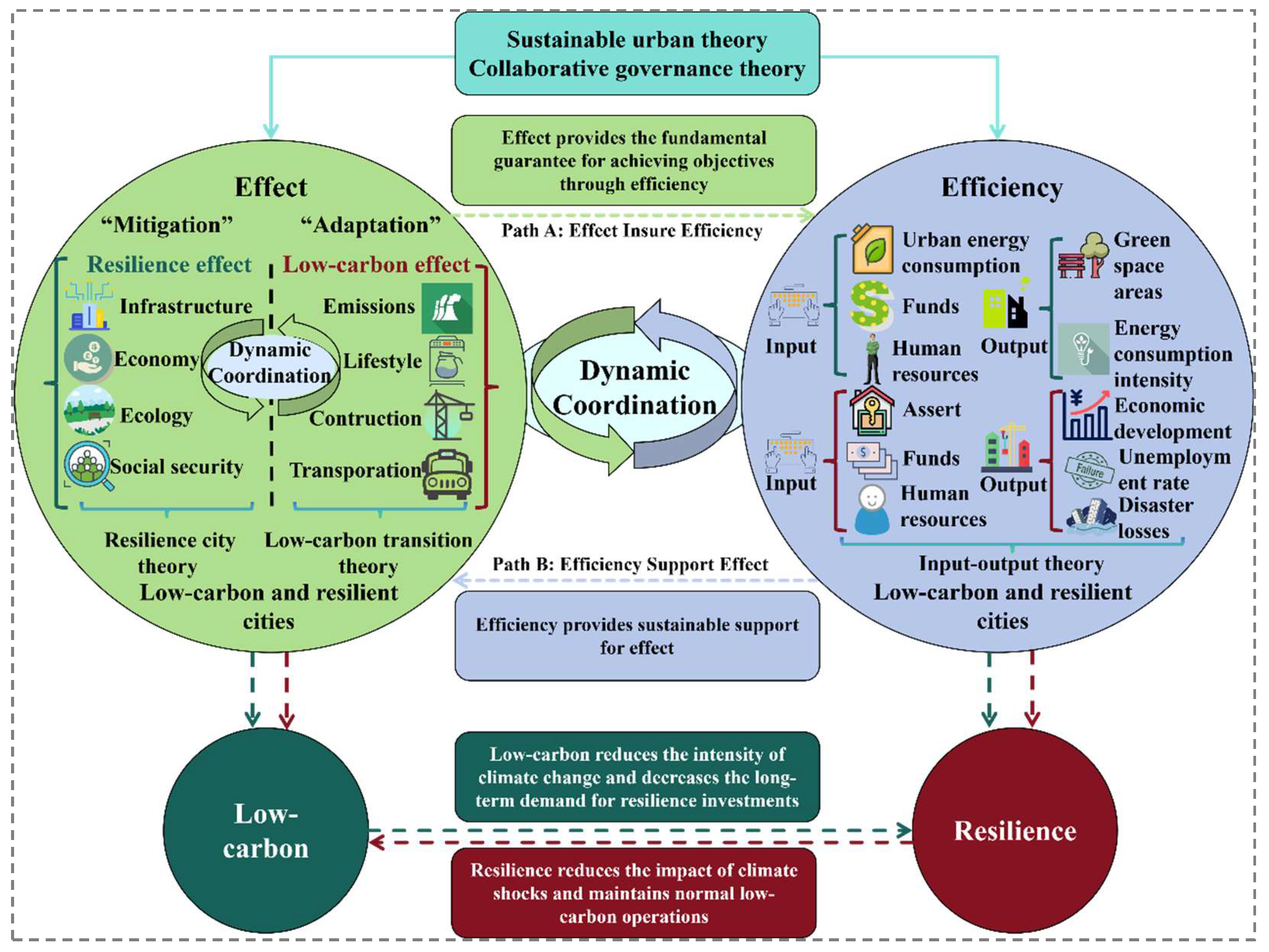
Against the backdrop of global warming and frequent extreme weather events, cities have emerged as pivotal actors in reducing carbon emissions and adapting to the impacts of extreme climate shocks. Drawing on existing research findings and relevant theories, this paper proposes a theoretical framework for urban low-carbon resilience, grounded in the synergistic development of effect and efficiency, as illustrated in Figure 2. The development of low-carbon resilience within urban systems can be explored through two dimensions: (1) Effect governance of urban system low-carbon resilience exhibits external manifestations, specifically reflected in the integrated state of emission reduction outcomes, environmental improvements, and systemic resilience [23,24]. (2) The governance process of urban system low-carbon resilience exhibits internal transformative properties, emphasizing the quality of resource allocation towards governance outputs and the efficiency of conversion and utilization [25,26]. This theoretical analysis underscores the distinct emphases on urban system effect, governance, and the utilization of efficiency within the urban transformation process. Specifically, outcome governance reflects the external operational status of urban systems, ensuring the achievement of low-carbon resilience objectives. Efficiency utilization, conversely, reveals the internal quality of resource allocation and governance processes within urban systems, serving as the driving force for sustainable development in low-carbon resilience construction. From the perspective of internal synergistic development within urban systems, these two dimensions are interdependent and mutually constraining, collectively constituting the intrinsic driving logic for sustainable transformation.
To clearly define the theoretical boundaries of the research framework, this paper delineates the scope of the urban low-carbon resilience system based on theories of low-carbon transition and urban resilience. The low-carbon transition theory emphasizes reducing the impact on global climate change through greenhouse gas emission reductions, optimization of energy structures, and promotion of green lifestyles, falling within the mitigation category [27]. Urban resilience theory, conversely, focuses on a city system’s capacity to adapt, withstand impacts, and recover when confronted with external shocks, falling within the adaptation domain [28,29]. This paper contends that mitigation and adaptation are not linearly separated but constitute a dynamically coupled, mutually reinforcing process. Mitigation actions, by curbing carbon emissions and reducing future extreme climate risk levels, alleviate the long-term pressure on cities to invest in adaptation. Conversely, resilience-building enhances the stability of energy systems, infrastructure, and governance frameworks, ensuring that low-carbon measures remain operational during climate shocks and thereby reinforcing mitigation objectives. Consequently, the theoretical boundaries of urban low-carbon resilience systems encompass both mitigation and adaptation dimensions while emphasizing their dynamic synergy. Within this integrated theoretical framework, outcome governance evaluates cities’ comprehensive external performance in low-carbon transition and resilience management. Efficiency utilization, grounded in input-output theory, measures a city’s resource deployment and process governance capabilities in advancing low-carbon resilience development within defined resource constraints. In other words, effect determines the degree to which urban system transformation governance objectives are achieved, while efficiency determines the sustainable momentum of urban system transformation development. To elaborate further, any singular emphasis on either effective governance or efficient utilization in urban system development and governance may constrain the sustainable progress of low-carbon resilience transformation.
This paper proposes a theoretical framework for synergistically developing low-carbon resilience in urban systems that integrates effect and efficiency. This approach addresses the limitations of previous studies that tended to focus on single systems or perspectives. The theoretical framework provides a basis for subsequent comprehensive measurement of urban system development levels, identification of spatial disparities, and analysis of non-linear influencing factors.

2.3.2. Effect Indicator System

This paper adheres to the scientific selection of indicators and the external outcomes of urban low-carbon mitigation and resilience adaptation. A comprehensive urban low-carbon transformation indicator system is constructed across four dimensions: pollution emissions, resource consumption, the ecological built environment, and the green transport structure. This aims to fully reflect the city’s low-carbon system’s external governance performance, as detailed in Table 2. Three indicators—CO2, SO2, and industrial wastewater discharge volume—are selected to comprehensively reflect the city’s internal pollution control level [30,31]. Per capita domestic water consumption and electricity usage were selected to comprehensively measure residents’ green lifestyle resource consumption within the urban system [32,33,34,35]. Per capita Park green space area and built-up area green coverage rate were chosen to comprehensively evaluate the ecological built environment within the urban system [36,37]. The selected indicators systematically characterize the external governance outcomes of urban low-carbon transformation, providing a scientific basis for evaluating cities’ developmental progress in the low-carbon domain.
A governance indicator system for urban resilience transformation has been established across four dimensions: infrastructure, economy, ecology, and social security. This framework comprehensively reflects a city’s capacity to withstand external shocks. Infrastructure resilience is measured by the proportion of land designated for construction and per capita road area, which characterizes the physical space’s carrying capacity and service provision [41,42]. Economic resilience is measured by residents’ disposable income and total retail sales of consumer goods, reflecting the stability and recovery potential of the economic system [43,44]. Ecological resilience is assessed through sewage treatment rates and waste harmless treatment rates, gauging the stability and restorative capacity of the urban environmental system [45,46]. Social security resilience is demonstrated through the number of university students and the number of participants in the three types of insurance (pension, medical, and unemployment), reflecting the resilience of human capital reserves and the social safety net [47,48,49]. This indicator system aims to comprehensively reflect the adaptive and recovery capabilities demonstrated by urban systems when confronting extreme event shocks. The construction of the aforementioned systemic indicator framework lays a crucial foundation for subsequent analyses of measurement and coordination mechanisms for low-carbon and resilient development within urban systems.

2.3.3. Efficiency Indicator System

The efficiency utilization level of urban low-carbon subsystems aims to reflect a city’s capacity to effectively transform energy, industrial, and labor inputs into low-carbon governance outputs within established resource constraints. Based on in-put-output theory, this is explicitly measured across three dimensions: input side, desirable output side, and undesirable output side, as detailed in Table 3. Specifically, this paper selects total energy consumption, the proportion of the secondary industry in the economy, and the number of secondary industry employees as inputs. These, respectively, measure the scale of internal energy consumption, industrial structure pressure, and labor input related to energy development within the city [50,51]. On the desirable output side, urban green space area and energy utilization intensity are selected to measure the ecological environment quality and energy utilization level within the urban system [50,51]. On the undesirable output side, energy intensity and per capita carbon emissions are selected to measure the level of energy utilization and greenhouse gas emissions within the urban system, respectively [51,52]. This indicator system adheres to the Super-SBM model’s selection principles, providing a scientific basis for evaluating urban low-carbon resource utilization efficiency under energy allocation constraints.
The efficiency utilization level of the urban resilience subsystem aims to reflect a city’s capacity for resistance and recovery against external shocks, formed through the allocation of infrastructure, human capital, and economic resources within the system. Based on input-output theory, it is explicitly measured across three dimensions: the input side, the desirable output side, and the undesirable output side. Specifically, this paper selects total fixed-asset investment, total retail sales of consumer goods, and the number of employees in public facility management and social security departments as inputs. These, respectively, gauge a city’s capacity for physical development, the scale of economic growth, and governance resilience and operational recovery [53,54]. Desirable output is measured by regional gross domestic product (GDP), reflecting a city’s economic vitality and recovery level following external shocks [55]. The undesirable output dimension incorporates per capita disaster-related economic losses and urban unemployment rates, reflecting, respectively, the city’s exposure and vulnerability to climate shocks, as well as the extent of impact on residents’ livelihoods [56,57]. This efficiency indicator framework aligns with the Super-SBM model’s principle of indicator selection, enabling systematic evaluation of urban resource allocation efficiency and recovery quality within disaster risk scenarios.

3. Methodology

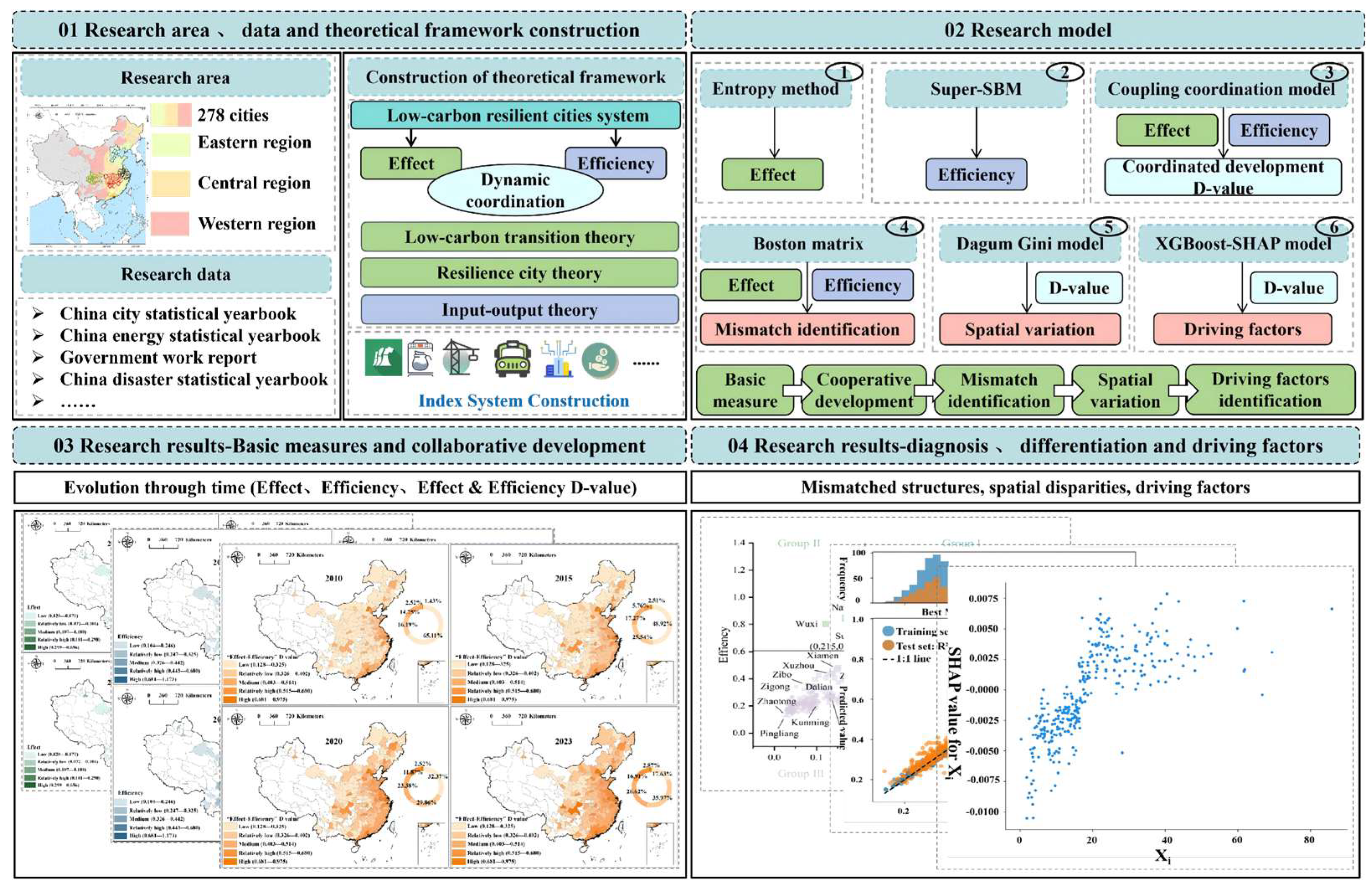
The methodological framework of this study comprises three principal components, designed to systematically characterize the spatiotemporal characteristics, structural mismatches, spatial disparities, and associated influencing factors of urban systems’ low-carbon resilient transformation from the perspective of synergistic development of effect and efficiency. The specific research approach is illustrated in Figure 3. Firstly, this study employs the entropy value method and the Super-SBM model to measure the effect of governance and the efficiency of utilization in urban low-carbon resilience, respectively. The entropy method enables objective weighting and quantitative assessment, mitigating biases from subjective weighting and enhancing measurement objectivity and comparability [58]. The Super-SBM model re-ranks cities with efficiency values of 1 in the traditional SBM model, improving the differentiation and explanatory power of urban efficiency utilization evaluations [59]. Building on this, this paper constructs a coupling coordination degree model to reveal the synergistic evolutionary relationship between the effect of governance and the utilization of efficiency in urban low-carbon resilience. Subsequently, based on the analysis results of the coupling coordination degree model, the Boston Matrix is employed to conduct a refined diagnosis of the collaborative development types within urban systems, identifying the structural mismatch between effect and efficiency that is prevalent during the transformation process. Furthermore, by incorporating the Dagum Gini coefficient and its decomposition methodology, spatial evolution patterns of synergistic development between effect and efficiency in urban low-carbon resilience are revealed across three dimensions: intra-regional, inter-regional, and hyper-density. Finally, utilizing the XGBoost-SHAP model, the non-linear influence mechanisms of relevant factors on the synergistic development level of urban low-carbon resilience effect and efficiency are explored through marginal effects and feature contributions.
The aforementioned research methodology reveals the spatial-temporal characteristics, structural mismatches, spatial disparities, and specific manifestations of non-linear impacts within the dimensions of synergistic development of effect and efficiency in urban low-carbon resilience systems. It provides a reference model for research on urban sustainable transformation.

3.1. Entropy Method

The entropy method is a multi-attribute decision analysis technique that determines indicator weights by calculating the information entropy of metrics. It assigns relative importance based on the extent to which each indicator influences the overall system. Due to its objectivity and scientific rigor, this approach has gained widespread application in weighting metrics. Data analysis proceeds with these assigned weights: higher entropy values correspond to lower weights, while lower entropy values imply higher weights. The specific steps for calculating indicator weights using the entropy value method are as follows:
Assume there are n independent indicators evaluating m sample cities. the matrix shown in Equation (1) can be obtained:
R = r i j n × m = r 11 r 12 r 1 m r 21 r 22 r 2 m r n 1 r n 2 r n m n × m
where r i j represents the original data value of the i city under the j indicator.
(a)
Indicator standardization
Firstly, the data must be standardized. Discrepancies in the dimensions of different indicators can compromise computational accuracy; hence, the raw data must be unified into dimensionless values. The extreme value method (Min-Max Normalization) is employed for indicator standardization, as shown in Equations (2) and (3):
X i j = r i j M i n i r i j M a x i r i j M i n i r i j
X i j = M a x i r i j r i j M a x i r i j M i n i r i j
where M a x i r i , j and M i n i r i , j represent the maximum and minimum values, respectively, under the i indicator. x i , j is the unified standardized value of the i city under the j indicator. Equation (2) is used for the standardization of positive indicators, meaning a larger value of the indicator indicates better performance. Equation (3) is employed for the standardization of negative indicators, meaning a smaller value of the indicator indicates better performance.
(b)
Indicator entropy value
e i = k j = 1 m p i j · ln p i j = 0
The calculation of the coefficient k and p i j adopts Equations (5) and (6), respectively:
k = 1 ln m
p i j = x i j j = 1 m x i j
In Equation (4), when p i j = 0 , p i j · ln p i j = 0 .
(c)
Indicator weight
The calculation of the weight of a single indicator w i is given by Equation (7):
w i = 1 e i i = 1 n 1 e i
where w i is the weight value of the i indicator, and n is the total number of indicators.

3.2. Super SBM Model

In the field of efficiency measurement, the traditional Super-SBM model exhibits certain limitations when ranking efficient decision-making units. Moreover, because this model’s efficiency score is capped at 1, it cannot further distinguish between efficiency levels when multiple units are simultaneously efficient. To address this issue, the Super-SBM model extends the traditional framework, thereby enhancing the accuracy and comparability of efficiency measurement outcomes. Given that cities exhibit heterogeneity due to diverse factors such as resource endowments, population size, and economic development, this paper introduces the Variable Returns to Scale (VRS) assumption to better reflect efficiency measurement. The Super-SBM model is consequently established, with the efficiency calculation formula detailed as follows:
Assuming that each decision-making unit has q inputs, μ 1 desirable outputs, and μ 2 undesirable outputs, the input and output vectors can be represented x R q , y g R μ 1 , y b R μ 2 . The specific formula is as follows:
X = x 1 , x 2 , x 3 x n R q × n
Y g = y 1 g , y 2 g , y 3 g y n g R μ 1 × n
Y b = y 1 b , y 2 b , y 3 b y n b R μ 2 × n
If all input-output vectors are greater than zero, the production possibility set is defined as:
P = x , y g , y b x X θ , y g Y g θ , y b Y b θ , θ 0
In this case, if the decision-making unit x 0 , y 0 g , y 0 b contains undesirable outputs, the model can be further represented as:
ρ = 1 1 q i = 1 q S i x i 0 1 + 1 μ 1 + μ 2 r = 1 μ 1 S r g y r 0 g + r = 1 μ 2 S r b y r 0 b
s . t . x 0 = X θ + S y 0 b = Y b θ S b y 0 g = Y g θ + S g S 0 , S b 0 , S g 0
Equation (12) calculates the efficiency value of the decision-making unit where ρ 0 , 1 . Applying the Charnes-Cooper transformation to Equations (9) and (10), the equivalent form after transformation is as follows:
τ = min t 1 q i = 1 q S i x i 0
s . t . t + 1 μ 1 + μ 2 r = 1 μ 1 S r g y r 0 g + r = 1 μ 2 S r b y r 0 b = 1 x 0 t = X μ + S y 0 b t = Y b μ S b y 0 g t = Y g μ + S g S 0 , S b 0 , S g 0 μ 0 , t 0
In the calculation process of the above formulas, the result may lead to a scenario where multiple decision-making units simultaneously have an efficiency value of 1, making horizontal comparison impossible. Consequently, to analyze the efficiency values more accurately, the aforementioned model is improved to allow efficiency values greater than 1. The specific calculation steps are as follows:
ρ = min 1 q i = 1 q x ¯ i x i 0 1 μ 1 + μ 2 r = 1 μ 1 y r g ¯ y r 0 g + r = 1 μ 2 y r b ¯ y r 0 b
s . t . x ¯ j = 1 , k n θ j x j , y ¯ g j = 1 , k n θ j y j g , y ¯ b j = 1 , k n θ j y j b x ¯ x 0 , y ¯ g y 0 g , y ¯ b y 0 b , y ¯ g 0 , j k θ j = 1 , θ j 0

3.3. Coupling Coordination Degree Model

The coupling coordination degree model is employed to analyze the extent of coordinated development among systems. This model finds extensive application across economic, social, and environmental development domains, aiming to assess whether different systems or dimensions interact positively and develop in a coordinated manner. Based on the development levels of low-carbon resilience, effective governance, and efficiency utilization in cities as examined herein, a coupling coordination degree model is constructed. The specific calculation formula is as follows:
C = 2 × U 1 × U 2 U 1 + U 2
T = α U 1 + β U 2
α = β = 1 2
D = C × T
In the aforementioned formula, U 1 and U 2 denote the levels of effective governance and efficiency utilization in urban low-carbon resilience, respectively, calculated through the entropy method and Super-SBM model. C denotes the specific numerical value of the coupling degree between effect governance and efficiency utilization within the urban system. At the same time, T represents the composite development index value for effective governance and efficiency utilization. α and β , respectively, reflect the relative importance coefficients for effective governance and efficiency utilization in urban low-carbon resilience. This paper assumes that effect and efficiency are equally important and sets their values at α = β = 1 / 2 .
D denotes the degree of coordination between the effect of governance and the efficiency of utilization within a city’s low-carbon resilience system. A higher D value indicates stronger coordination between these aspects, signifying greater sustainability within the urban system. The value of D ranges from 0 , 1 . Drawing on established classification criteria from the existing research literature, this paper categorizes D values into 10 distinct levels, as detailed in Table 4 [60].

3.4. Boston Matrix Method

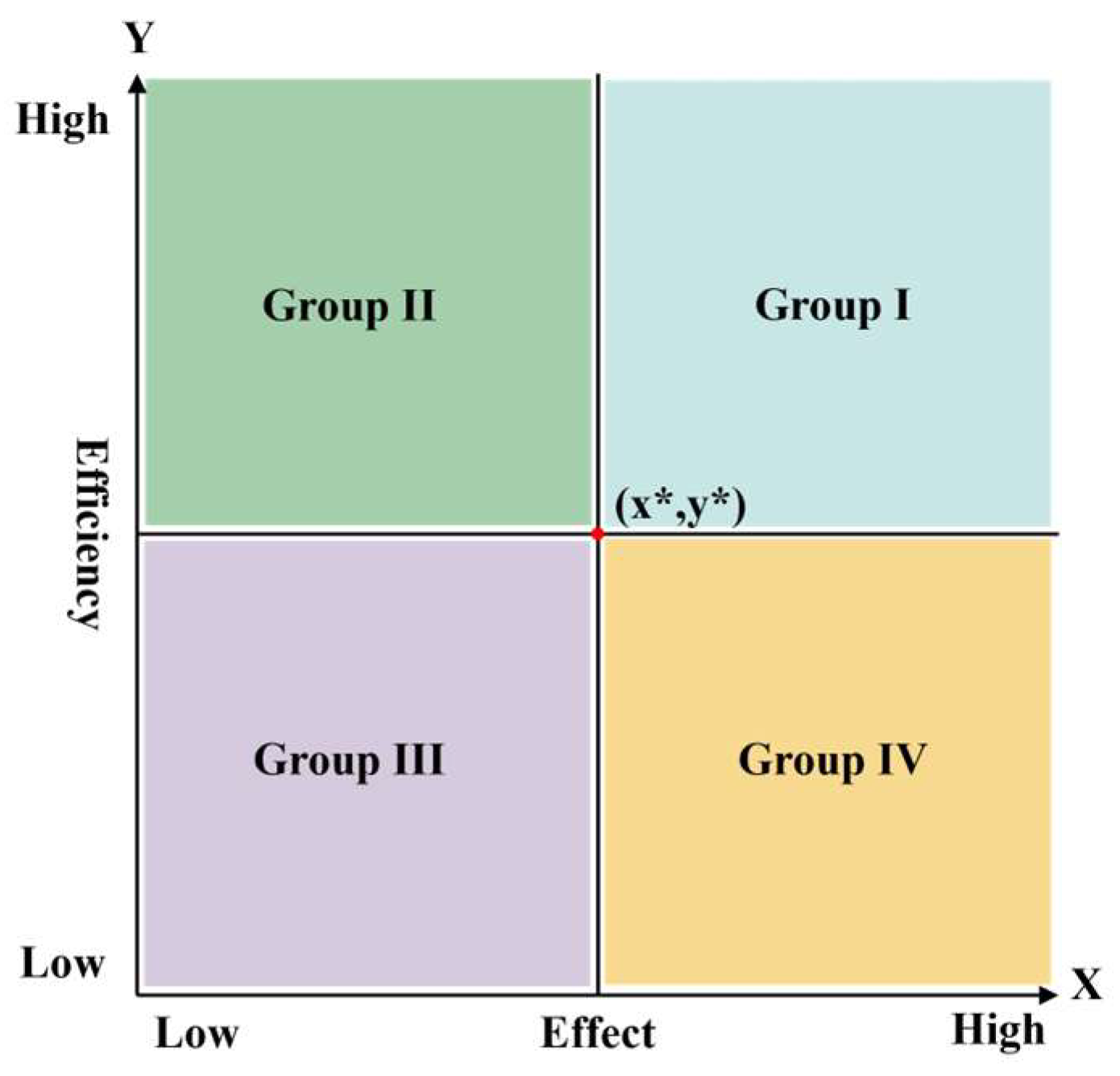
Employing the Boston Matrix framework, a comprehensive analysis of urban systems’ low-carbon resilient transformation is conducted from dual perspectives of effect and efficiency. The X-axis and Y-axis, respectively, represent the developmental levels of low-carbon resilience governance effect and efficiency utilization within urban systems. Figure 4 illustrates the four quadrants of urban low-carbon resilience system development. The first quadrant denotes high effect and high efficiency, with cities in this range serving as exemplary models. The second quadrant denotes high efficiency with low effect. Cities in this category demonstrate high development efficiency but relatively poor concrete outcomes. The third quadrant represents low efficiency coupled with low effect, where cities are trapped in a vicious cycle of inadequate progress on both fronts. The fourth quadrant signifies high effect with low efficiency. Cities in this quadrant achieve commendable results in effective governance but exhibit relatively poor efficiency in input-output utilization.
The Boston Quadrant thresholds for low-carbon resilience effect, governance, and efficiency utilization within urban systems were objectively delineated and confirmed through K-means clustering methodology. Specifically, the number of clusters, K, was initially set to 2, representing high-level and low-level categories, respectively. Subsequently, the K-means++ initialization method was employed to mitigate the impact of initial center selection on outcomes. The algorithm was run 50 times iteratively, and the final clustering solution was selected based on the minimum within-group sum of squares. Upon completion of the clustering analysis, the thresholds for each dimension were determined as the dividing points between the two cluster centers. This yielded the thresholds X* and Y* for urban low-carbon resilience effect governance and efficiency utilization, which were valued at 0.215 and 0.605. These thresholds were then applied to the four-quadrant division of the Boston Matrix. To verify the stability of the threshold division for urban system effect governance and efficiency utilization, this study compared the consistency of threshold positions and city quadrant assignments across multiple repeated clusters. Results indicate minimal variation in cluster center positions across different runs, with over 90% of cities maintaining identical quadrant assignments in repeated clusters, demonstrating high stability of the threshold division.

3.5. Dagum Gini Coefficient

This study employs the Dagum Gini coefficient and decomposition method to investigate regional differentiation in the spatial dimension of synergistic development between the effect of low-carbon resilience governance and the efficiency of resource utilization within urban systems. Unlike traditional Gini decomposition, the Dagum Gini analysis method simultaneously identifies intra-regional, inter-regional, and supra-regional density disparities, thereby providing more detailed structural information for analyzing regional differences in coordinated development. The specific calculation formula is as follows:
G = j = 1 k h = 1 k i = 1 n j r = 1 n h y j i y h r / 2 n 2 y ¯
Y ¯ h Y ¯ j Y ¯ k
The overall Gini coefficient G w is composed of the intra-regional disparity contribution G n b , the inter-regional disparity contribution G t , and the hyper-variance density contribution G , following the relationship: G = G w + G n b + G t .
G j j = 1 2 Y ¯ j i = 1 n j r = 1 n j y j i y j r n j 2
G j h = i = 1 n j r = 1 n h y j i y h r n j n h Y j + Y h
G w = j = 1 k G j j P j S j
G n b = j = 2 k h = 2 j = 1 G j h P j S h + P h S j D j h
G t = j = 2 k h = 1 j 1 G j h P j S h + P h S j 1 D j h
D j h = d j h P j h d j h + P j h
d j h = 0 d F j y 0 y y x d F h x
P j h = 0 d F j y 0 y y x d F j x
In the formulas, P j = n j / n , S j = n j Y ¯ j n μ is the cumulative probability density function of the regional system efficiency. d j h represents the inter-regional efficiency difference, which is the expected value of the sum of all sample values in regions j and h where y i j y h r > 0 . P j h is the first moment of the hyper-variable, which represents the expected value of the sum of all sample values in regions j and h where y i j y h r < 0 .

3.6. Interpretable Machine Learning Models

3.6.1. Machine Learning Model Selection

This paper examines the impact of ten selected variables across six dimensions—energy consumption transformation, economic development support, foreign enterprise attraction, talent reserve cultivation, infrastructure development, and green technological innovation—on the synergistic development of effective governance and efficiency utilization within urban low-carbon resilience systems. Variable descriptions are presented in Table 5. To comprehensively evaluate the performance of different machine learning models in this process, indicators were selected based on both error metrics and interpretability. Among these, Root Mean Square Error (RMSE) measures the deviation between predicted outcomes and actual values, reflecting a model’s precision in numerical forecasting. This metric calculates the average squared difference between predicted and actual values (Equation (32)) and is highly sensitive to outliers. Occasional significant errors in the forecasting process can inflate RMSE values, significantly distorting the overall assessment of model performance. Consequently, a lower RMSE value indicates superior model performance.
R M S E = 1 m i = 1 m y j y ^ i 2
R a d j 2 = 1 1 R 2 N 1 N k 1
R 2 = 1 i = 1 N y i y ^ i 2 i = 1 N y i y ¯ 2
R2 (Coefficient of Determination) serves to measure the explanatory power of a model over the outcome variable. A value closer to 1 indicates a better model fit. It quantifies the proportion of variation in the dependent variable explained by the independent variables within the model. An R 2 approaching 1 indicates a higher degree of data fit. Where y ¯ i represents the mean of the observed values, the formula for calculating R 2 is as shown in Equation (34).
The performance of the machine learning ensemble models depends critically on the configuration of key hyperparameters, including the number of base learners, maximum tree depth, learning rate, and regularization terms. During model training and validation, the entire panel dataset was randomly split at the observation level into a training set (70%) and a test set (30%), rather than by time period or city. The training set comprised 10,892 observations, while the testing set included 4676 observations. To reduce dependence on a single random partition and enhance robustness, a ten-fold cross-validation (K = 10) procedure was employed during model evaluation.
To further improve model robustness and generalization performance, the Optuna automated hyperparameter optimization framework was integrated with cross-validation to tune model hyperparameters. During optimization, the mean R2 across ten-fold cross-validation folds was used as the objective function, and each model was optimized over 50 iterations. The resulting optimal hyperparameter configurations for the XGBoost model are reported in Table 6.
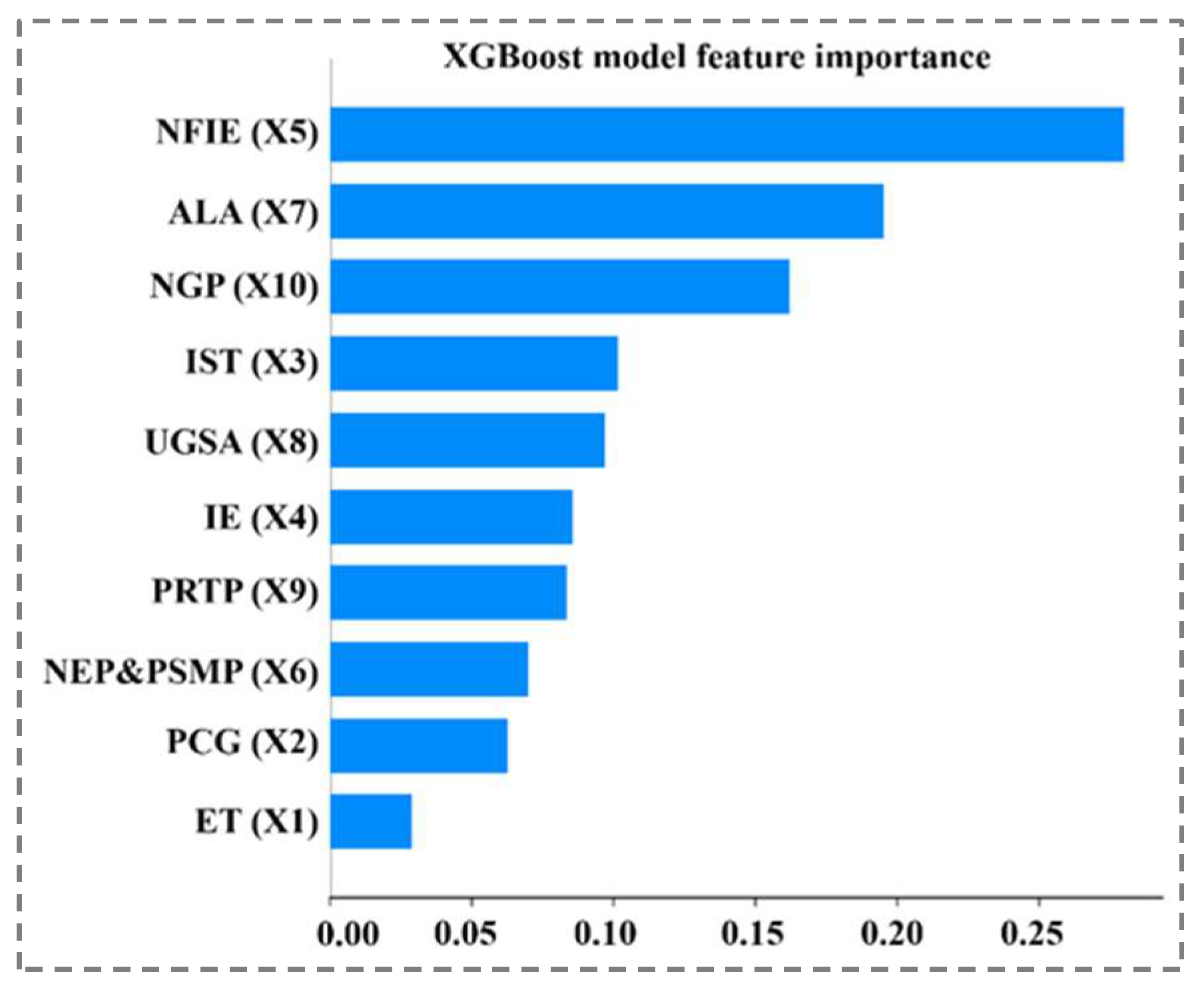
By comparing the importance rankings of input variables across six model types, we identify the key factors most explanatory of collaborative development within urban systems under different algorithms. Table 7 presents the relative importance of each variable for urban system synergy across the RF, XGBoost, LightGBM, GBM, AdaBoost, and CatBoost models. It shows that the XGBoost model performs better than the others and is thus selected as the model for subsequent research. The specific ranking of XGBoost’s influential factors is illustrated in Figure 5.

3.6.2. Interpretation of the Machine Learning Model: SHAP

This paper employs the SHAP (Shapley Additive explanations) analysis method to assess the importance of factors influencing the synergistic development of low-carbon resilience, effective governance, and utilization efficiency within urban systems. SHAP, grounded in the Shapley value from cooperative game theory, quantifies the marginal contribution of individual features across all possible feature combinations. This aims to provide machine learning models with interpretability underpinned by theoretical justification. For the i feature, its SHAP value (i.e., Shapley value) is computed using Formula (35).
ϕ i = S M i S ! N S 1 ! N f S i f S
In the formula, ϕ i denotes the SHAP value of the i feature, reflecting its average marginal contribution to the model’s prediction outcome. N denotes the entire feature set. In this study, N = n = 10 represents any subset excluding the feature. S denotes any subset excluding feature i . S denotes the number of features within subset S . f S and f S i denote the prediction values obtained using only the feature subset and after incorporating the S feature, respectively. S ! N S 1 ! N ! is the combination weighting term, ensuring a weighted average across all possible feature subsets to guarantee fairness in contribution allocation.
SHAP exhibits additivity, enabling granular explanations for individual predicted samples. For any sample’s predicted value, it can be decomposed as:
y ^ = ϕ 0 + i = 1 n ϕ i
y ^ denotes the model’s predicted value for this sample, ϕ 0 = E f X represents the model’s average predicted value across all training samples (i.e., the baseline expectation), and i = 1 n ϕ i is the sum of all feature SHAP values. This decomposition achieves precise explanations for local individual predictions while maintaining global consistency.
The SHAP value ϕ i quantifies the extent to which each feature and its specific value raise or lowers the final prediction relative to the baseline expectation ϕ 0 . A positive ϕ i > 0 indicates that the feature elevates the prediction above the average, while a negative ϕ i < 0 indicates the opposite. The absolute magnitude of the SHAP value ϕ i directly represents the strength of a feature’s influence. Based on this, the sample prediction can be further rewritten as:
y ^ = ϕ 0 + ϕ s u m
ϕ s u m = i = 1 n ϕ i denotes the aggregate predictive deviation relative to the overall baseline, resulting from the combined effects of all features. By systematically analyzing the SHAP values for each feature, one can clearly delineate the contribution pathways of different factors towards the specific predictive objective of synergistic development in both the effect and utilization efficiency of low-carbon resilience governance within urban systems. This enables precise identification of the key drivers of synergistic development and their respective directions of influence.

4. Results

This paper employs the natural break method throughout its spatial data visualization analysis to categorize the performance of urban systems in low-carbon resilience transformation across three dimensions: governance effect, efficiency utilization, and collaborative development levels. This approach aims to maximize the representation of homogenous changes within similar tiers of urban systems, thereby enhancing the interpretation of spatial-temporal developmental characteristics in the data.

4.1. Spatiotemporal Characteristics of LCRC System Construction Effect and Efficiency

4.1.1. Spatiotemporal Characteristics of Effect

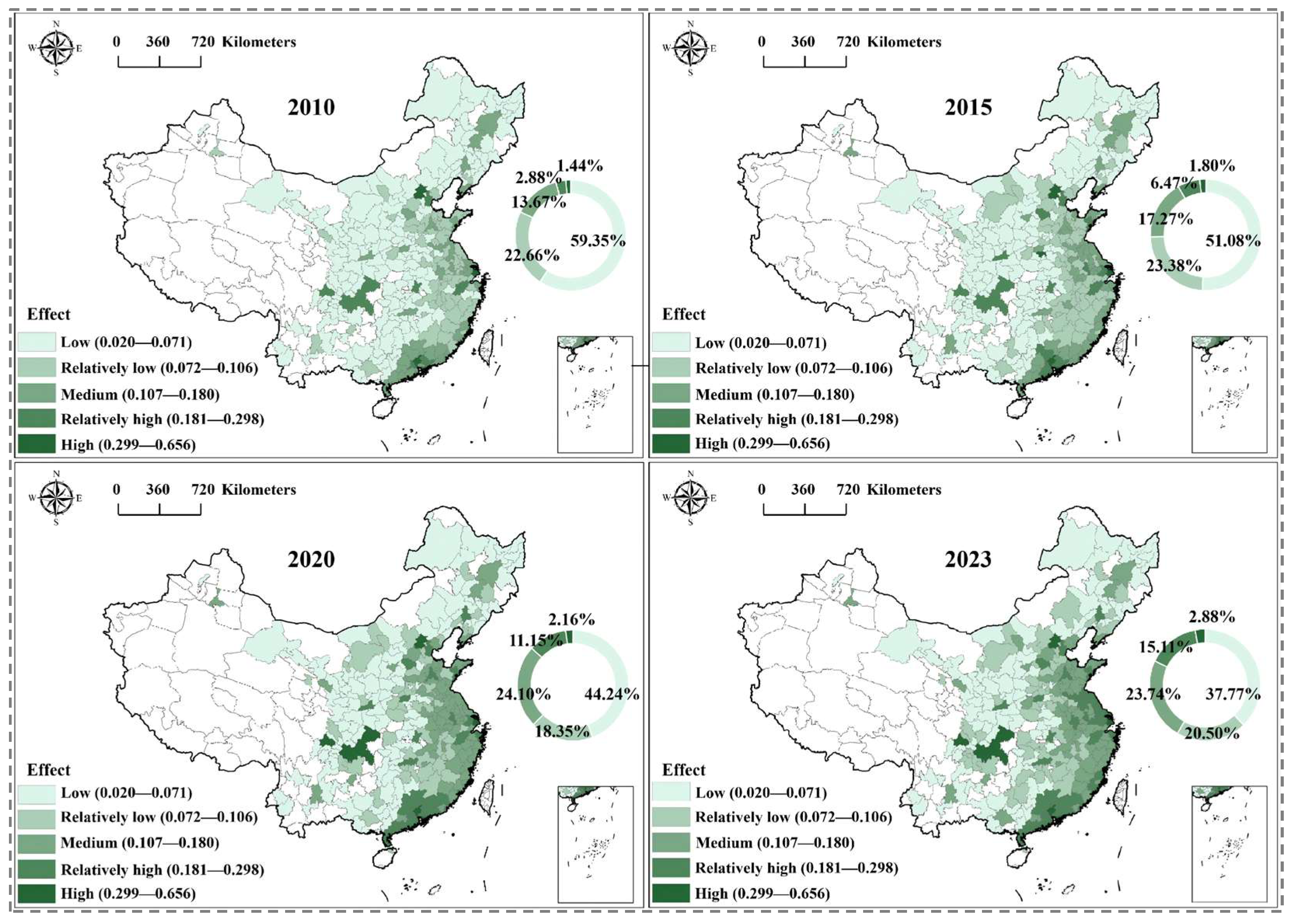
Figure 6 illustrates the spatio-temporal evolution of the effect of the urban low-carbon resilience system. The chart shows a pronounced, sustained upward trajectory in system effect levels throughout the study period. Overall, the proportion of cities achieving medium-to-high effect steadily expanded, rising significantly from 17.99% in 2010 to 41.73% by 2023. Concurrently, the proportion of cities at low levels of development rapidly contracted from 59.35% to 37.77%, indicating substantial progress in urban low-carbon resilience governance. Spatially, the effect levels consistently showed a stable pattern of high concentrations in the eastern coastal regions and generally lower levels in the central and western regions. However, high-value zones exhibited a pronounced trend of diffusion and multi-centered development. In 2010, high-value cities were primarily concentrated in the Yangtze River Delta and the Pearl River Delta, and subsequently expanded to include the Bohai Rim. Post-2020, a continuous high-value belt formed, extending from the eastern coastal regions to the inland regions. By 2023, core cities within the Chengdu-Chongqing and Beijing–Tianjin–Hebei urban clusters, alongside specific provincial capital systems in central China, had also seen markedly enhanced adequate governance levels. This reflects the gradual crystallization of a multi-centered, high-value governance pattern centered upon China’s nationally designated urban clusters.

4.1.2. Spatiotemporal Characteristics of Efficiency

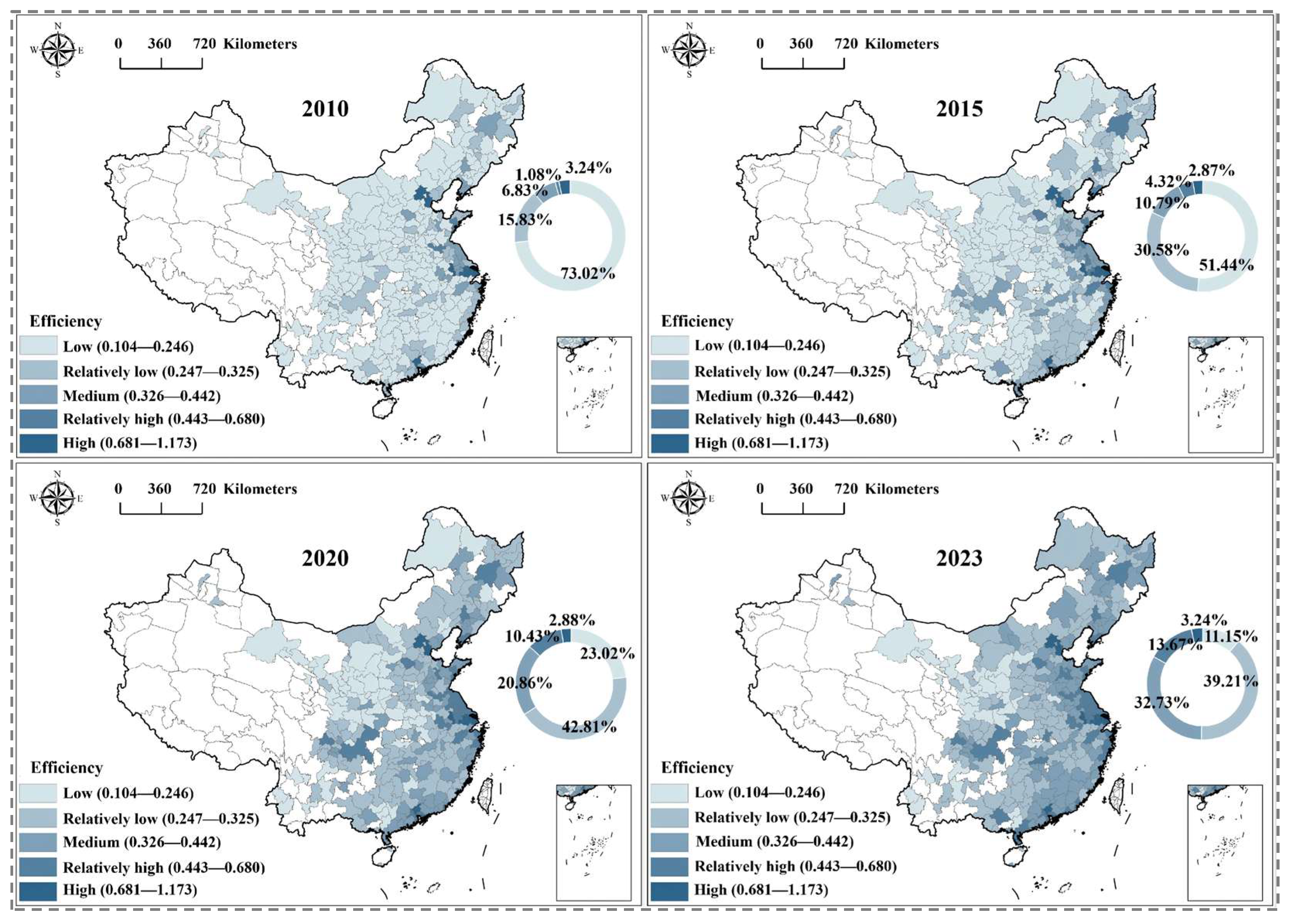
Figure 7 illustrates the spatiotemporal evolution of low-carbon resilience efficiency levels within urban systems. The chart reveals a pronounced and sustained upward trajectory in efficiency levels throughout the study period, accompanied by increasingly discernible regional gradients. Nationally, the distribution of efficiency tiers has undergone structural optimization. At the outset of the study, low-efficiency cities accounted for 73.02% of the total, whilst cities at medium or higher efficiency levels accounted for less than 12%, with medium-efficiency cities representing merely 15.83%. By 2023, the proportion of low-efficiency cities had markedly decreased to 11.15%, while cities at medium or higher efficiency levels rose to 49.64%. Medium-efficiency cities increased to 32.73%, emerging as the primary contributor to the improvement in efficiency grade structure. Spatially, urban efficiency consistently exhibited a stable pattern of higher efficiency along the coast and lower efficiency inland, accompanied by pronounced agglomeration evolution. In 2010, high-efficiency cities were primarily concentrated in eastern coastal regions such as the Pearl River Delta and Yangtze River Delta. By 2015, efficiency in the eastern coastal areas had further increased and expanded into the Bohai Rim region. Post-2020, the agglomeration effect of high-efficiency zones intensified, with the Pearl River Delta and Yangtze River Delta forming stable, contiguous high-efficiency belts. By 2023, high-efficiency zones evolved from point-like to regionalized distributions. Notable efficiency gains were also observed in the Beijing–Tianjin–Hebei region, the Chengdu-Chongqing urban agglomeration, and certain core cities in central China, reflecting a nationwide leap in resource utilization efficiency within urban low-carbon resilience systems.

4.2. Spatiotemporal Characteristics of LCRC from a Compound Effect and Efficiency Perspective

4.2.1. Spatiotemporal Evolution of Coupling Coordination Development

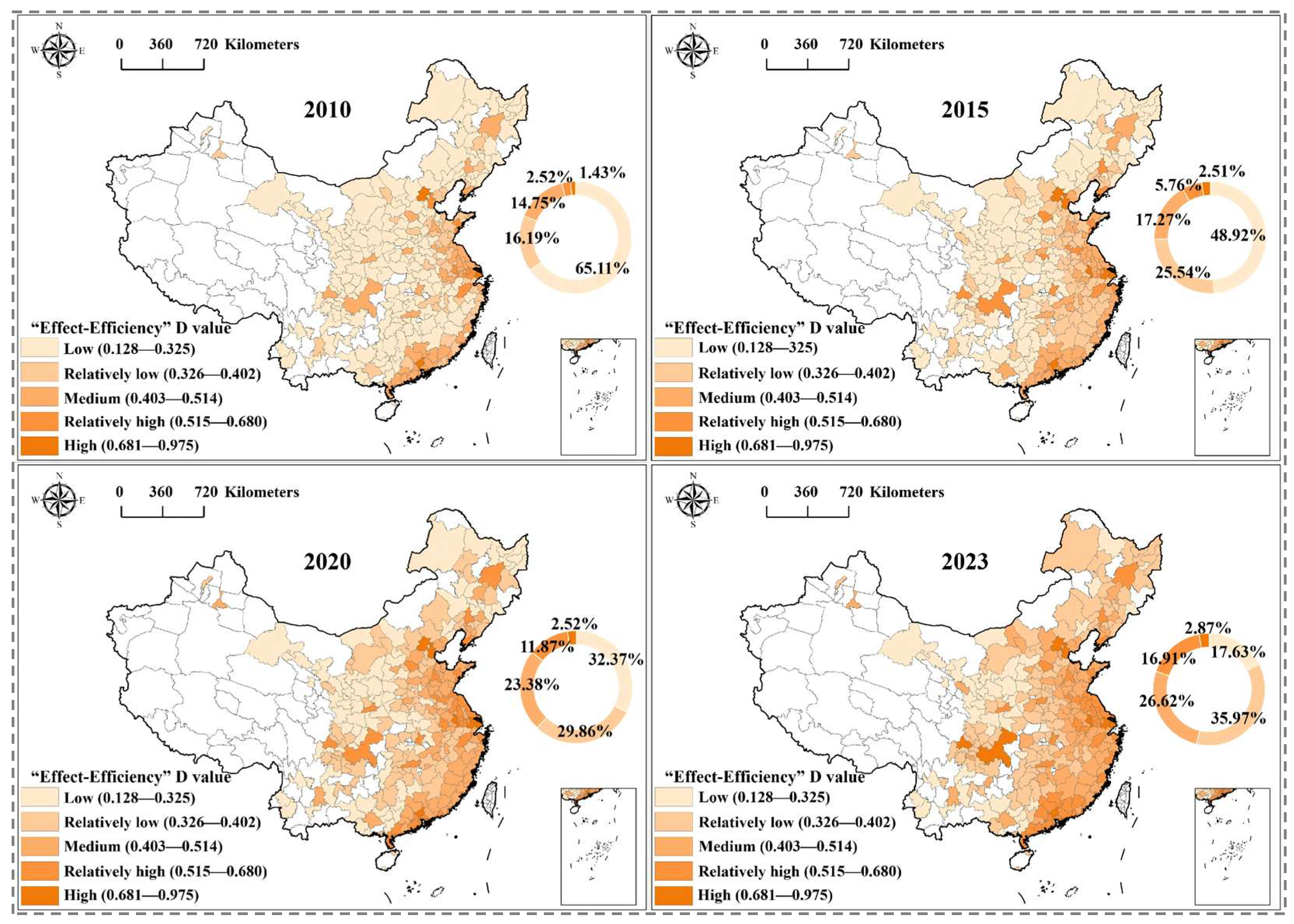
Figure 8 illustrates the spatiotemporal evolution of coupled coordination levels in urban low-carbon resilience systems, specifically regarding the governance of system effect and the utilization of efficiency. During the study period, the degree of coupled coordination between system effect and efficiency exhibited a marked upward trajectory, characterized by intensified regional gradients and enhanced agglomeration within urban clusters. Chronologically, the national level of coupled coordination development showed significant improvement. In 2010, cities with low-level coordination accounted for 65.11% of the total, while those with medium or higher coordination accounted for 18.7%. By 2023, the proportion of cities with low-level coordination had decreased to 17.63%, whilst cities demonstrating medium or higher coordination levels had substantially increased to 46.40%. This indicates a marked strengthening of the synergistic development between system-effect governance and the utilization of efficiency. Spatially, cities with high coordination levels have consistently concentrated in eastern core urban clusters, such as the Yangtze River Delta, the Pearl River Delta, and the Shandong Peninsula, forming a development pattern characterized by high levels in the east and low levels in the west. Concurrently, high-level regions have expanded inland since 2020. Specifically, core cities in the Chengdu-Chongqing, Middle Yangtze River, and central Beijing–Tianjin–Hebei regions have driven the evolution from isolated high-value points to regional clusters. Moreover, although the overall coordination of systemic effect governance and efficiency utilization remains relatively low in central and western cities, provincial capitals and resource-advantaged cities demonstrate a pronounced catch-up trend. This underscores the critical importance of urban agglomerations in enhancing coordinated development of systemic effect, governance, and efficiency utilization.

4.2.2. Boston Matrix Distribution

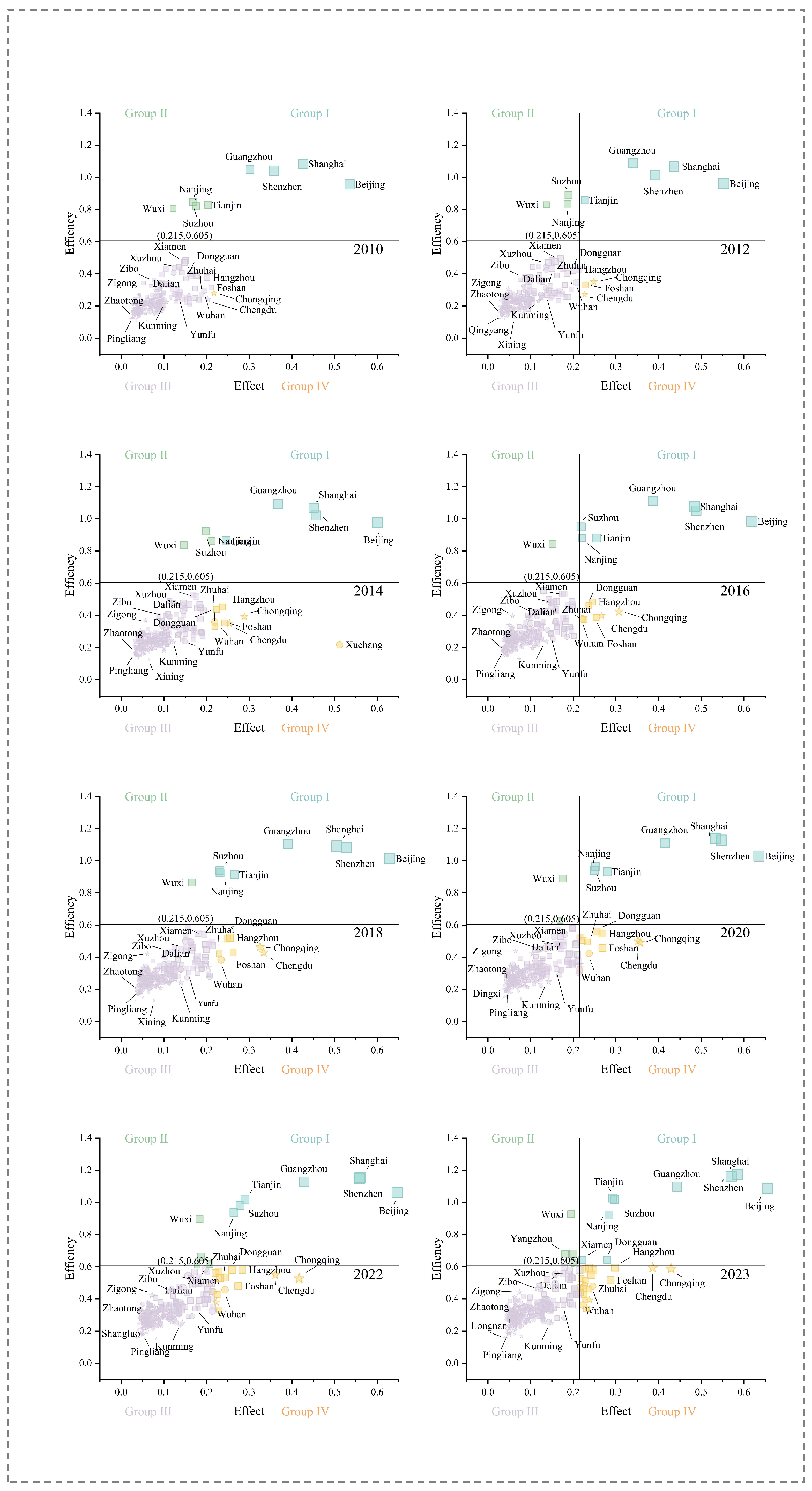
This section identifies the thresholds for the effect, governance, and efficiency utilization of urban low-carbon resilience systems through K-means clustering analysis, determined to be 0.215 and 0.605, respectively. The Boston Matrix is employed to characterize the synergistic development patterns and evolutionary traits of these systems, as illustrated in Figure 9.
From the perspective of urban system development, the types of collaborative development within urban systems during the study period exhibited a marked trend of optimization, shifting from dispersion to concentration and from mismatch to synergy. Furthermore, urban systems progressively evolved from low effect and low efficiency towards high effect and high efficiency.
From the perspective of quadrant distribution, although the number of cities in the first quadrant (high effect, high efficiency) remains relatively limited, it is consistently occupied by national first-tier core cities such as Beijing, Shanghai, Shenzhen, and Guangzhou. Their coupling coordination levels generally range from 8 to 10, making these regions the nation’s most optimally coordinated. The second quadrant, characterized by high efficiency and low effect, is represented by innovation-driven cities such as Suzhou and Wuxi. These exhibit a mismatch in which efficiency leads while effect lags, with coupling coordination at medium to high levels. Cities in the fourth quadrant, such as Chongqing, Chengdu, and Foshan, exhibit high-input-driven, effect-oriented development patterns and maintain medium-to-high coordination levels. The third quadrant, characterized by low effect and efficiency, comprises the most significant proportion of cities, primarily located in central, western, and parts of northeastern China. Their coupling coordination levels generally cluster between 1 and 3, representing typical low-effect, low-efficiency cities in a state of extreme imbalance and stagnation. From a temporal evolution perspective, the quadrant structure showed significant optimization during the study period.
Overall, the number of cities in the first quadrant has increased gradually, with spatial concentration continuously strengthening. In the second and fourth quadrants, the coordination between cities exhibiting mismatches in effect and efficiency has progressively improved. Some cities have moved closer to the first quadrant by either compensating for effect through efficiency or enhancing efficiency through effect. In summary, the coordinated development of effective governance and efficiency utilization within urban low-carbon resilience systems has progressed from an initial phase of unilateral advancement towards a stage of synchronous, bidirectional enhancement and collaborative optimization across the urban system. The system as a whole is steadily converging towards higher levels of effect, efficiency, and synergy.

4.3. Spatial Disparities of the LCRC System from a Dual Perspective

4.3.1. Dagum Gini Coefficient and Contribution Rate

Table 8 presents the specific results of spatial disparity analysis for the coupled and coordinated development level of urban low-carbon resilience systems, utilizing the Dagum Gini coefficient model to assess both effective governance and efficient utilization. The table indicates that during the study period, spatial disparities in the coupled and coordinated development level exhibited a sustained convergence trend. Specifically, the overall Gini coefficient for system synergy decreased from 0.195 in 2010 to 0.151 in 2023, indicating that spatial disparities in the coordinated development of system effect and efficiency gradually converged, with regional differences continuously narrowing. From a decomposition perspective, the intra-regional disparity Gw consistently remained low and declined slowly, suggesting relatively limited variation in coordination within each region. Inter-regional disparity (Gb) decreased from 0.123 to 0.095, also exhibiting stable convergence.
Regarding disparity contribution rates, inter-regional disparity (Gb) has long dominated, consistently accounting for approximately 62% of the contribution rate and serving as the primary source of spatial variation in the coordinated development of urban system effect, governance, and efficiency utilization. Furthermore, concerning intra-regional disparity, the contribution of hyper-variable density (Gt) has remained stable at around 12%, showing little overall change. Overall, while spatial disparities in the coordinated development of urban system effect, governance, and efficiency utilization converged during the study period, inter-regional differences remain the dominant factor shaping the spatial distribution of system coordination levels. This reflects the persistent existence of significant gradient differences in coordinated development across distinct regions.

4.3.2. Disparity Decomposition of the Dagum Gini Coefficient

Table 9 presents the regional variance decomposition results based on the Dagum Gini coefficient model. Overall, the synergistic development level of urban low-carbon resilience systems in terms of effective governance and efficient utilization exhibits a general convergence trend both within and between regions. However, inter-regional disparities remain significantly higher than intra-regional ones. Regarding intra-regional disparities, the Gini coefficients for the eastern, central, and western regions decreased from 0.160, 0.120, and 0.153 in 2010 to 0.129, 0.091, and 0.110 in 2023, respectively, indicating a persistent narrowing of collaborative development gaps among cities within these three major regions. Notably, the convergence of intra-regional disparities was relatively more pronounced in the western region.
Regarding inter-regional disparities, the Gini coefficients for the eastern-central, eastern-western, and central-western regions all decreased, from 0.201, 0.287, and 0.164 to 0.171, 0.223, and 0.114, respectively. The disparity between eastern and western regions remained the most pronounced, with the Gini coefficient consistently exceeding 0.220—significantly higher than other regional pairings. This indicates that the coordinated development of effective governance and efficient utilization within China’s urban low-carbon resilience systems continues to exhibit a pronounced gradient, with the eastern and western regions as distinct poles. Overall, although inter-regional disparities continued to converge during the study period, the absolute level of differences and the gradient structure indicate that uneven regional development remains the core factor influencing the spatial pattern of synergistic development in the governance of effect and the utilization of efficiency within China’s urban low-carbon resilience systems.

4.4. Factors Influencing the Level of Synergistic Development in Effect Governance and Efficiency Utilization Within the LCRC System

4.4.1. Relative Importance Ranking of Influencing Factors

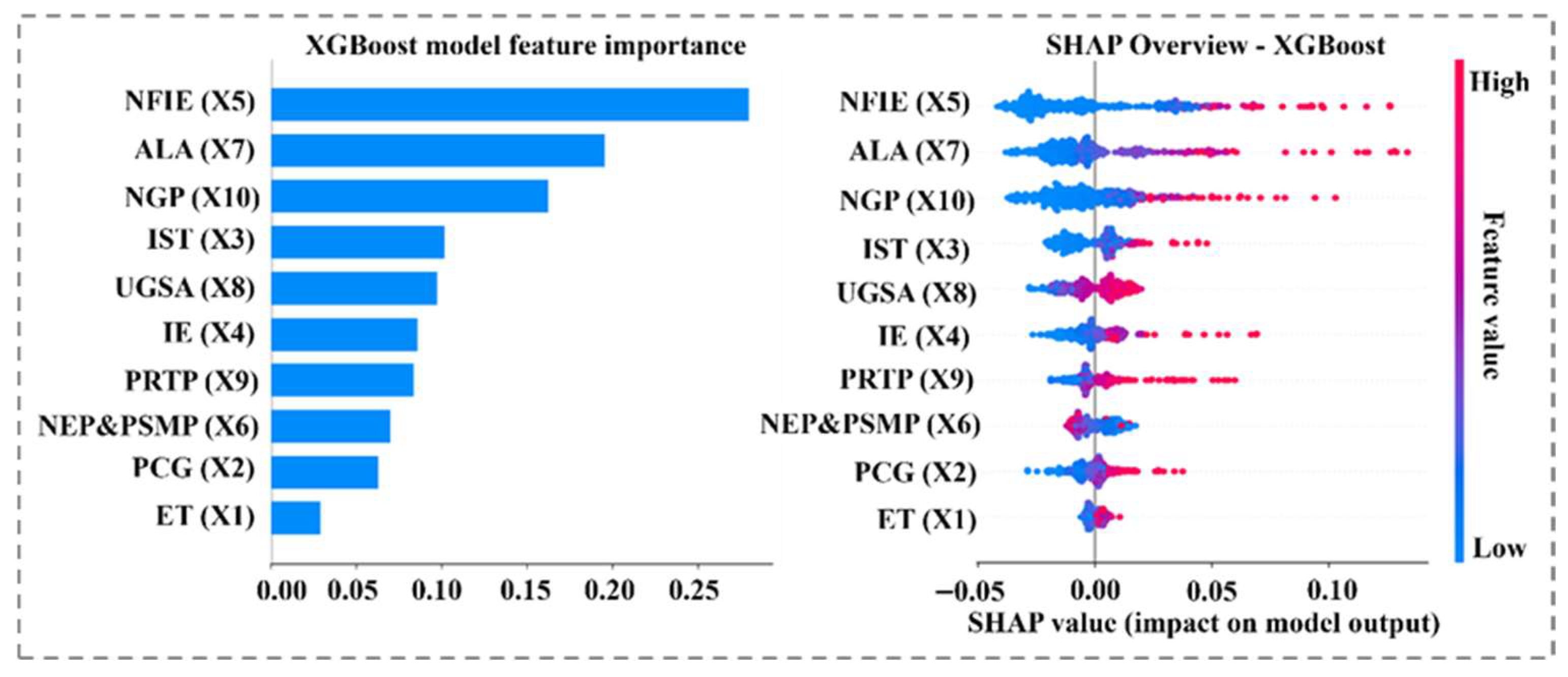
Based on the predictive performance of the XGBoost model, this paper further employs the SHAP method to interpret the influence characteristics of urban low-carbon resilience systems on the development level of coordinated governance effect and efficient utilisation. Specific findings are illustrated in Figure 10. The global feature importance ranking shows that NFIE, ALA, and NGP make substantial contributions to model predictions, indicating a significant correlation among these variables and the coordinated development level of urban systems. Moreover, IST and UGSA are also of considerable importance, indicating a non-negligible explanatory role in the predictive process. The SHAP distributions reveal that most core variables display positive correlations with the predicted levels of urban system synergy, with their SHAP values predominantly concentrated within higher numerical ranges. Notably, NFIE and ALA exhibit broader SHAP distribution ranges, reflecting heterogeneous predictive contributions across different urban samples. Overall, the feature importance ranking aligns with SHAP interpretation in both direction and contribution magnitude, providing robust model explanatory support for identifying key associated features of urban system synergistic development levels.

4.4.2. Nonlinear Effects of Influence Factors

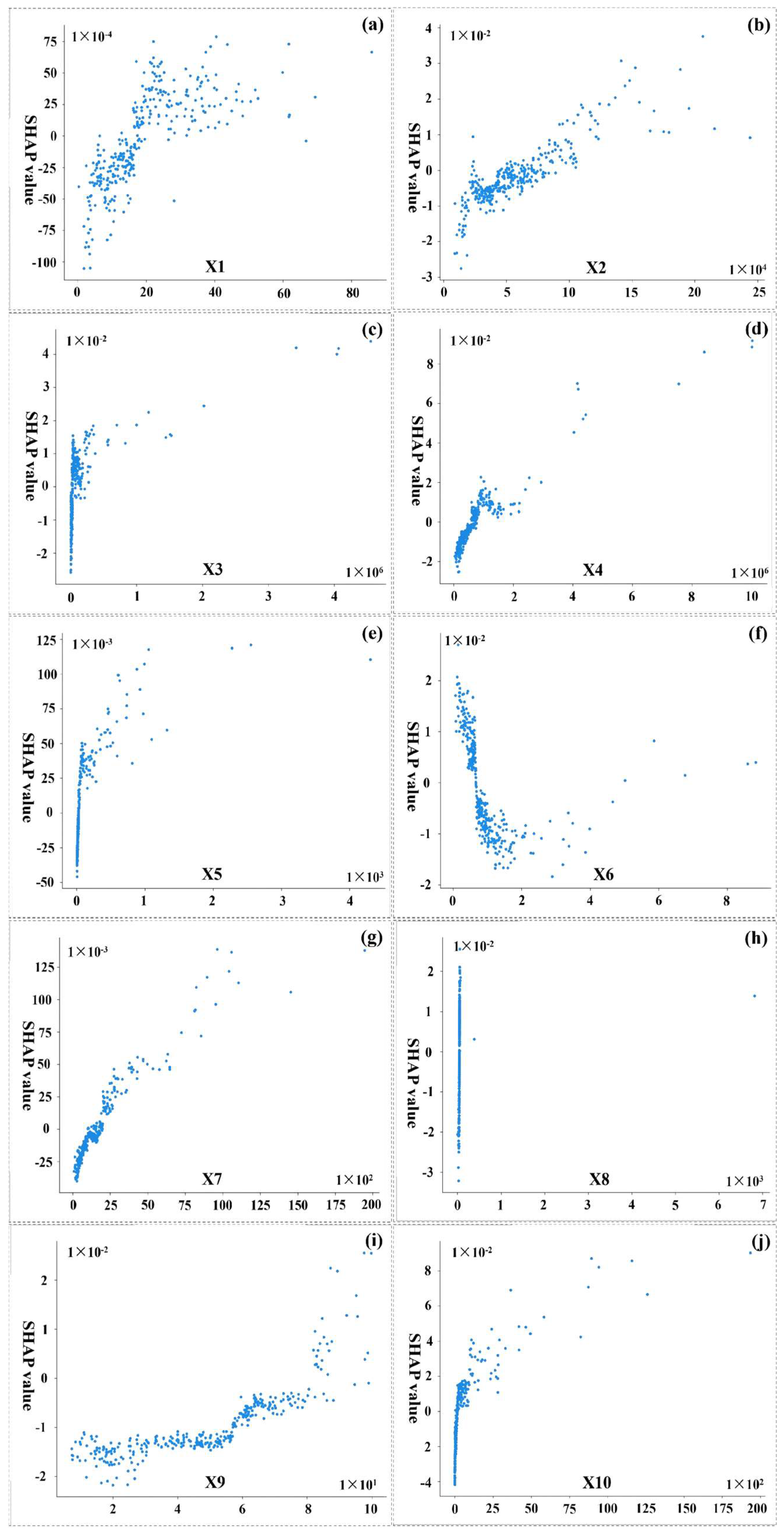
To further characterize the responses of relevant factors across different value ranges towards the predicted levels of synergistic development in low-carbon resilience effect governance and efficiency utilization within urban systems, this paper analyses the non-linear correlations of primary variables using SHAP dependency plots of the Boost model. The results are presented in Figure 11. Overall, the variation trends exhibited by each variable in the SHAP dependency plots are highly consistent with the global feature importance rankings. However, their predictive contributions show pronounced nonlinearity across distinct value intervals.
From the perspective of high-contribution variables, NGP, NFIE, and ALA exhibit a relatively strong positive correlation across their entire ranges. Their SHAP values increase overall as the variable’s levels rise, demonstrating a stable, monotonically increasing relationship. Notably, NGP’s SHAP value continues to rise with increasing investment scale, indicating this variable makes a persistently strengthening positive contribution to the level of coordinated development within the urban system in the model’s predictions. Infrastructure-related variables exhibit a similar upward trend, with their predictive contribution becoming more pronounced at higher values. NFIE demonstrates positive SHAP values even at lower levels, indicating an early manifestation of its positive correlation with synergistic development levels in model predictions.
Although PRTP and PCG exhibit an overall positive correlation, their SHAP dependency demonstrates a pronounced diminishing marginal effect. Specifically, as variable levels increase, the corresponding SHAP values grow gradually more slowly, indicating that within high-value intervals, the marginal contribution of these variables to predicting collaborative development levels diminishes. IST and IE exhibit robust positive correlations across their entire value ranges. Notably, IST shows a more pronounced increase in SHAP values across the medium-to-high value range, indicating that the explanatory power of education and human capital variables in model predictions increases as development advances. By contrast, the SHAP distributions for HGSA and NEP&PSMP are relatively dispersed, indicating heterogeneous predictive contributions across samples, with contributions concentrated in the medium-value range. The SHAP values for ET remain relatively low overall but show a positive distribution in the high-value range. This indicates that this variable maintains a specific positive correlation with the collaborative development level of urban low-carbon resilience systems in model predictions, albeit with relatively delayed and limited contribution intensity.

5. Discussion

5.1. Evolution and Disparity Analysis of Effect and Efficiency

This study analyses the spatio-temporal evolution of the effect of governance and the utilization of efficiency in urban low-carbon resilience systems. Findings indicate distinct differences between the two in terms of evolutionary trajectories, spatial response mechanisms, and growth structures. The theoretical analysis of the dual nature of urban system transformation dimensions aims to deepen understanding of the mechanisms that build pathways for urban low-carbon resilience systems. Specifically, the effect of governance of such systems is primarily determined by fixed capacities, including greenhouse gas emissions, ecological conservation, and infrastructure [61]. The development of system effect governance exhibits typical path dependency, with relatively slow regional convergence rates. Spatially, it consistently displays a stable pattern of stronger development in the east and weaker development in the west. Conversely, the efficient utilization of urban low-carbon resilience systems primarily emphasizes fluid capacities such as reshaping resource allocation and fostering technological innovation. This approach may more readily achieve efficient internal development through technology diffusion [62]. The system as a whole exhibits faster improvement rates and stronger convergence of regional disparities, with spatial patterns gradually revealing a catch-up-and-overtake development trajectory in central and western regions. This analysis reflects the dual developmental logic of urban low-carbon resilience systems, consistent with existing literature on the spatiotemporal evolution of effect governance and efficiency utilization in urban low-carbon resilience transformation [63,64].
Combining findings from XGBoost-SHAP research, this paper reveals that the actual land area utilized for urban development is a significant factor influencing the coordinated advancement of urban system effect governance and efficient resource utilization, with a positive, progressively increasing impact. This heavy reliance on urban economic development and infrastructure construction creates inherent barriers for underdeveloped regions during their transformation. While prior research indicates that the level of low-carbon resilient transformation in urban systems primarily stems from the scale effects of infrastructure investment and long-term institutional enforcement [65], this study contends that precisely these inherent regional development disparities lead to persistent and stable differences in transformation levels across cities. Furthermore, this study contends that technological factors, such as the introduction of foreign-invested enterprises and green technological innovation, contribute relatively significantly to the coordinated development of urban systems, with a positive and significant marginal effect. Specifically, the introduction of high-quality foreign-invested enterprises brings advanced management expertise and financial support to urban transformation. Concurrently, green technological innovation provides a driving force for urban transformation. Leveraging the synergies of advanced production management concepts, high-quality financial support, and green technological innovation can sustain momentum for urban transformation. Existing research indicates that technological innovation, as a crucial factor influencing urban sustainable development, can significantly propel the transformation of urban systems. This aligns with the conclusions drawn in this paper [66].

5.2. Research on Structural Mismatch of Effect and Efficiency

This study employs the Boston Matrix to reveal the long-standing structural mismatch between the effective governance and efficient utilization of low-carbon resilience within urban systems during their development. It posits that systems divorced from efficient utilization cannot sustain development, while those detached from effective governance may exhibit suboptimal governance. Consequently, this paper emphasizes the synergistic development of both impact governance and efficiency utilization within urban low-carbon resilience systems, aiming to advance sustainable development in urban low-carbon resilience transformation. From the perspective of internal structural mismatches within urban systems, the essence of such mismatches lies in the asynchronous evolution of urban governance investment structures, institutional arrangements, and factor endowments. (1) One category of cities achieves significant improvements in outcome governance through high-input infrastructure and ecological development. However, due to inefficient resource allocation, their system efficiency lags, resulting in a development pattern characterized by high outcomes but low efficiency. (2) Another category of cities possesses high efficiency utilization levels, leveraging industrial agglomeration, innovation resources, and factor mobility. However, owing to relatively insufficient environmental outcomes or resilience infrastructure, they tend to exhibit a development pattern of high efficiency but low outcomes. This structural mismatch is interpreted as an uneven evolution of governance capabilities across different dimensions within the urban system. This aligns with existing research, which highlights that urban transformation is influenced by multiple factors, including resource endowments and geographical location [67]. Consequently, sustainable urban development transitions exhibit regional heterogeneity, underscoring the necessity for integrated consideration of diverse factors in transformation planning.
Structural mismatch not only indicates severe inconsistencies in the utilization of urban governance resources but also reflects path dependency and governance inertia encountered during urban transformation. This aligns with the existing literature, which emphasizes the pivotal role of collaborative governance in urban transition processes [68]. From the perspective of spatio-temporal evolution in urban mismatch structures, the emergence of systemic convergence is not a natural outcome but rather stems from critical linkages within metropolitan clusters at the strategic level of integrated development—such as transport connectivity and industrial cooperation. China’s major metropolitan core cities, having evolved from mismatched development patterns, are progressively converging towards high-impact, high-efficiency collaborative development while gradually radiating influence to surrounding urban centers. This aligns with existing research indicating that regional integration strategies within Chinese metropolitan areas significantly impact sustainable urban development [69]. Overall, cities exhibiting high-impact, low-efficiency mismatches require efficiency enhancements to alleviate resource constraints, while those with high-efficiency, low-impact mismatches should elevate governance objectives and environmental standards. Both types converge towards the high-effect, high-efficiency quadrant of the urban system development spectrum, following distinct pathways: the former by supplementing effect, the latter by aligning effect with efficiency. This indicates that collaborative convergence is not an autonomous process but necessitates institutional arrangements grounded in urban cluster and regional integration governance policies to rectify structural mismatches within the urban system.

5.3. Research on the Nonlinear Characteristics of Driving Mechanisms and Innovation Factors

This study employs the XGBoost-SHAP model to reveal that the introduction of foreign enterprises, green technological innovation, and urban construction land area all exert a strong positive, monotonically increasing, and nonlinear influence on the synergistic development of effective governance and efficiency utilization within urban low-carbon resilience systems. This finding underscores the significant impact of advanced management concepts, technological innovation development, and green innovation factors on the transformative synergistic development of effective governance and efficient utilization within urban low-carbon resilience systems. This aligns with existing research highlighting technological advancement, innovation agents, and infrastructure development as critical determinants of urban transformative development [70,71,72]. Moreover, in contrast to innovation factors, both urbanization processes and economic development exhibit mildly positive yet marginally diminishing developmental characteristics in terms of systemic synergy. This phenomenon aligns with findings from existing research indicating a diminishing scale effect in environmental Kuznets curves [73]. High-base cities must guard against the diminishing marginal returns inherent in traditional growth models. Accelerating the transition towards knowledge- and innovation-driven, high-quality growth models is essential to sustain high-level synergistic governance patterns that propel urban sustainable development transformations.

5.4. Limitations and Prospects

This study constructs a theoretical framework for the coordinated development of effective governance and efficient utilization within urban low-carbon resilience systems. Although it has systematically revealed the spatio-temporal characteristics of urban systems, structural misalignments in coordinated development, and nonlinear influencing factors, the following shortcomings remain: (1) The dynamism of indicator selection is somewhat lacking. Although a comprehensive indicator system for evaluating the effect and efficiency of urban low-carbon resilience has been developed based on relevant research theories and literature, indicator selection primarily relies on annual static metrics. This limits the ability to capture the short-term dynamics and shock responses that characterize urban resilience systems. Furthermore, urban carbon emissions calculations currently consider only three primary energy sources; future research may incorporate additional energy consumption data. (2) While the spatial evolution characteristics of synergistic urban system development were discussed, the absence of spatial econometric models hindered rigorous testing of spillover effects and inter-city interaction effects. (3) Although a larger urban sample was selected to enhance the generalizability of findings, all samples originated from Chinese cities, potentially limiting the applicability of conclusions to different institutional and national contexts. (4) The indicator system for urban low-carbon resilience effect and efficiency places greater emphasis on infrastructure and technological inputs, while exhibiting lower representativeness of governance quality and societal dimensions. (5) Although the XGBoost-SHAP method has been employed to reveal the nonlinear influence of relevant factors on the synergistic development of urban low-carbon resilience governance effect and efficiency utilization, the underlying causal logic driving urban system coordination remains unexplored.
Future research may enhance the completeness of this study’s conclusions by adopting the following measures: (1) Incorporating high-frequency event dynamics indicators to capture short-term dynamics and shock responses within urban resilience systems. (2) Employing spatial econometric models (such as SDM models) to investigate spillover effects in the spatial evolution of synergistic development within urban systems. (3) Expanding the sample to include cities from other nations (e.g., Japan, the United States) to refine existing research findings. (4) Enhance the comprehensiveness of urban system transformation evaluations by incorporating additional dimensional indicators such as governance and social development. (5) Integrate causal diagnostic frameworks to delve into the underlying causal relationships governing the synergistic development of effect governance and efficiency utilization within urban low-carbon resilience systems.

6. Conclusions and Policy Recommendations

6.1. Conclusions

A theoretical research framework for urban low-carbon resilience systems encompassing effective governance and efficient utilization is established in this paper. Based on relevant theoretical foundations and existing studies, multi-dimensional evaluation indicator systems for both effective governance and efficient utilization within urban systems are constructed. Within this framework, the entropy value method, the Super-SBM model, the coupling coordination degree model, the Boston Matrix model, the Dagum Gini coefficient model, and the XGBoost-SHAP model are integrated to enable precise identification of the spatiotemporal evolution, structural mismatches, spatial disparities, and influencing factors associated with the synergistic development level of effective governance and efficient utilization in urban low-carbon resilience systems. Using this integrated methodological framework, a systematic investigation is conducted on 278 prefecture-level cities in China over the period 2010–2023, with the aim of exploring the development pathways and underlying mechanisms shaping urban low-carbon resilience systems. The study yields the following key conclusions:
(1)
A marked upward trajectory in the effect dimension of urban low-carbon resilience systems was observed during the study period. Nevertheless, persistent regional disparities were identified, with eastern regions exhibiting stronger performance than their western counterparts. Specifically, in 2010, a low level of effect was achieved by 59.35% of cities, whereas only 17.99% reached medium or higher levels. By 2023, the proportion of cities with low effect had declined to 37.77%, while the share of cities attaining medium or higher effect levels increased to 41.73%. Overall, a significant improvement trend in effect-oriented governance within China’s urban low-carbon resilience systems was demonstrated. Moreover, relatively superior performance in this dimension was exhibited by eastern coastal cities such as Beijing, Shenzhen, Guangzhou, and Shanghai, whereas cities in central and western regions were found to lag behind. At the same time, core cities within major national strategic clusters—including Chongqing, Chengdu, Zhuhai, Shanghai, and Shenzhen—were shown to perform robustly, progressively driving the development of surrounding urban areas.
(2)
A marked upward trajectory in the efficiency dimension of urban low-carbon resilience systems was observed throughout the study period, with notable momentum in catching up and surpassing being exhibited by cities in central and western regions. Specifically, in 2010, low efficiency levels were recorded for 73.02% of cities, while only 11.15% were classified as medium or above. By 2023, the proportion of cities operating at low efficiency levels had declined to 11.15%, whereas cities achieving medium or higher efficiency levels accounted for 49.64%. Overall, a substantial improvement in the efficiency utilization level of China’s urban low-carbon resilience systems was demonstrated. Moreover, outstanding efficiency utilization was observed in first-tier and new first-tier cities such as Beijing, Shanghai, Guangzhou, Shenzhen, Chongqing, and Chengdu, while cities in central and western regions were found to lag comparatively. Nevertheless, from a spatial evolution perspective, an advantage in the pace of catching up and surpassing eastern counterparts was identified for cities in central and western regions.
(3)
A marked upward trajectory in the coordinated development level between effective governance and efficiency utilization within urban low-carbon resilience systems was observed throughout the study period. Nevertheless, regional disparities were identified, with stronger coordination being exhibited by eastern cities and weaker coordination by western cities. Specifically, in 2010, low levels of coordinated development were recorded for 65.11% of cities, while only 18.70% were classified as medium or above. By 2023, the proportion of cities with low levels of coordinated development had declined to 17.63%, whereas the share of cities achieving medium or higher levels increased to 46.40%. Moreover, outstanding performance in the coordinated development of urban systems was demonstrated by cities such as Beijing, Shanghai, Guangzhou, Shenzhen, and Chongqing, which represent national first-tier and new first-tier cities. At the same time, pronounced regional disparities were revealed, with coastal cities in eastern China exhibiting strong coordinated development, while inland cities in central and western regions were found to lag behind.
(4)
A long-standing structural misalignment in the coordination between the effect of low-carbon resilience systems and the efficient utilization of urban resources was identified. Nevertheless, during the study period, a progressive shift from misaligned diffusion toward coordinated convergence was observed within urban systems. Moreover, although an overall convergence trend in spatial disparities of coordinated urban development was detected, significant regional development imbalances were found to persist. This pattern was manifested by robust coordinated development in eastern urban systems, whereas weaker coordinated development was exhibited by western urban systems.
(5)
A positive and statistically significant non-linear relationship in the synergistic development of urban low-carbon resilience systems with respect to effective governance and efficient utilization was identified, and this relationship was found to be influenced by the introduction of foreign capital and green technological innovation. The importance of advanced management experience and technological innovation factors in the transformative synergistic development of urban systems was thereby highlighted. Meanwhile, based on the XGBoost-SHAP model analysis, it was revealed that although urbanization processes and regional economic development exert positive effects on the synergistic development of urban systems, these effects were characterized by diminishing marginal returns. This finding underscored the imperative for Chinese cities to shift from factor-driven development patterns toward innovation- and knowledge-capital-driven models, thereby mitigating the potential adverse effects associated with traditional path dependencies.

6.2. Policy Recommendations

This paper conducts an empirical analysis of the coordinated development of effective governance and efficiency utilization within urban low-carbon resilience systems. It offers the following three policy implications for advancing the sustainable development transition of cities:
(1)
Establish differentiated, diagnostic collaborative governance mechanisms to eliminate structural misalignments in urban transformation. For eastern cities exhibiting high impact but low efficiency, policy priorities should shift from expanding inputs to optimizing governance processes and enhancing the conversion efficiency of energy and capital. For central and western cities demonstrating high efficiency but low impact, it is recommended to leverage their efficient resource endowments by expanding green infrastructure investment. Whilst enhancing efficiency utilization, elevating governance standards, and output effect to achieve convergence towards high-impact, high-efficiency collaborative development. A dual performance assessment framework is proposed, incorporating both systemic impact governance and efficiency utilization into urban transformation evaluations. For cities demonstrating high impact but insufficient efficiency, assessments should priorities resource utilization efficiency, eliminating governance redundancies through technological and institutional innovation. Implement a coordinated resource allocation mechanism linking the distribution of fiscal funds, land resources, and energy quotas to the level of synergistic development in effective governance and efficient utilization, rather than solely evaluating regional economic growth or isolated environmental indicators. Simultaneously, guide cities to direct limited resources to address systemic weaknesses, aiming for precise allocation.
(2)
Implement differentiated regional strategies to enhance catch-up momentum precisely. This paper reveals divergent evolutionary trajectories in the effect of governance and the utilization of efficiency across regions in urban low-carbon resilience systems. Based on the research findings, it recommends that policymakers consider tailored, region-specific interventions. Specifically, for core eastern city clusters, this paper suggests shifting from scale expansion to efficiency-driven growth, fully leveraging the eastern regions’ technological innovation and human capital advantages. The focus should be on minimizing undesirable outputs while maintaining high efficiency levels under intensive investment. For catching-up cities in the central and western regions, policies should priorities enhancing resilience in efficient utilization. Encourage rapid breakthroughs through flexible elements such as green technology adoption and management innovation. Given the relatively high fixed investment thresholds for transformative outcomes in urban systems, efficiency improvements are proposed as a viable pathway for underdeveloped regions to achieve catch-up. Regarding regional collaborative network development, this paper recommends encouraging highly synergistic eastern regions to establish cross-regional cooperation mechanisms and technology spillover channels. This would elevate efficiency levels in central and western regions while simultaneously facilitating targeted inter-regional assistance, aiming to achieve balanced urban transformation nationwide.
(3)
Optimize the input structure and reinforce the strategic position of innovation factors. This study reveals that foreign investment attraction and green technological innovation exert a strong, monotonically increasing effect on the synergistic development of effective governance and efficient utilization within urban low-carbon resilience systems. Consequently, it is recommended that urban transformation priorities increased funding for green technology R&D and scientific-technological support, ensuring the marginal benefits of urban development transformation investments consistently exceed those of traditional material inputs. Furthermore, this paper suggests employing policies such as tax incentives and venture capital to motivate enterprises and universities to intensify green technological innovation, thereby sustaining the momentum for coordinated systemic transformation. Whilst increased infrastructure investment can enhance both systemic effect and efficiency through rational resource utilization, vigilance is required regarding diminishing marginal returns in traditional urban transformation processes. Given the diminishing marginal returns inherent in economic growth and urbanization, policymakers must guard against overreliance on traditional capital-driven expansion models that may yield diminishing returns in urban transformation. The focus should shift from prioritizing scale expansion to fostering qualitative, synergistic development by expanding knowledge and technological capabilities.

Author Contributions

Writing—original draft preparation, X.L.; Project administration Conceptualization, Funding acquisition, F.L.; Methodology, Y.Z.; Software, P.L.; Validation, J.F.; Formal analysis, J.C.; Investigation, X.W.; resources, supervision, H.F. All authors have read and agreed to the published version of the manuscript.

Funding

This research was funded by the National Natural Science Foundation of China, under grant number (No. 12265025), the Yulin Science and Technology Talent Project, grant number (No. 2023KJXX05), and Shaanxi Provincial Department of Education Youth Innovation Team, grant number (No. 23JP201).

Institutional Review Board Statement

This study does not involve any ethical review.

Informed Consent Statement

This study does not concern.

Data Availability Statement

The author does not have permission to share data.

Conflicts of Interest

The authors disclosed no conflicts of interest.

Abbreviations

The following abbreviations are used in this manuscript:
LCRCLow-carbon resilience cities
PCECProportion of clean energy consumption
PCGPer capita GDP
ISTInvestment in science and technology
IEInvestment in education
NFIENumber of foreign invested enterprises
NEP&PSMPNumber of environmental protection and public service management personnel
ALAUCActual land area for urban construction
GCRBAGreen coverage rate in built-up areas
PURTPProportion of urban residents in the total population
NGPNumber of green patents

Appendix A

Table A1. Removal of the list of prefecture-level cities.
City NameYears with Missing DataMissing IndicatorReasons for Exclusion
Suihua city2010~2015Per capita economic losses from disastersIndicator data has been missing for over a year consecutively
2010~2014Urban sewage treatment rate
Pingxiang city2013~2016, 2018Per capita economic losses from disastersIndicator data has been missing for over a year consecutively
Laiwu city2010~2014Urban sewage treatment rateIndicator data has been missing for over a year consecutively
2010~2016Per capita economic losses from disasters
Huangshi city2010~2016, 2019Per capita economic losses from disastersIndicator data has been missing for over a year consecutively
2014, 2016~2020Total social fixed asset investment
Xiangyang city2010, 2014~2016Urban solid waste treatment rateIndicator data has been missing for over a year consecutively
2014, 2017, 2020Per capita economic losses from disasters
Qinzhou city2010~2014Urban sewage treatment rateIndicator data has been missing for over a year consecutively
2013~2016Per capita urban road area
2010~2018Per capita economic losses from disasters
Sansha city2010~2020Per capita economic losses from disastersIndicator data has been missing for over a year consecutively
2014~2018Total social fixed asset investment
2014, 2016~2021Green coverage rate in built-up areas
Danzhou city2010~2019Per capita economic losses from disastersIndicator data has been missing for over a year consecutively
2013, 2016~2020Green coverage rate in built-up areas
2010~2013, 2016Per capita Park green space area
Bijie city2010~2016Green coverage rate in built-up areasIndicator data has been missing for over a year consecutively
2014, 2017~2020Total social fixed asset investment
2010, 2014~2018Per capita economic losses from disasters
Tongren city2010, 2015~2018Per capita economic losses from disastersIndicator data has been missing for over a year consecutively
2010~2016Total social fixed asset investment
2010, 2015~2017Green coverage rate in built-up areas
Pu’er city2010, 2014, 2017Green coverage rate in built-up areasIndicator data has been missing for over a year consecutively; More than 5% of data is missing
2010, 2014, 2017Proportion of land occupied by urban construction
2010~2016, 2019Per capita economic losses from disasters
2010, 2013~2018Per capita urban road area
Lhasa city2010~2021Per capita economic losses from disastersIndicator data has been missing for over a year consecutively; More than 5% of data is missing
2013, 2016~2021Per capita urban road area
2010, 2014~2019Proportion of land occupied by urban construction
2010~2015, 2018Total social fixed asset investment
Haidong city2010~2016, 2020Per capita economic losses from disastersIndicator data has been missing for over a year consecutively; More than 5% of data is missing
2013~2019, 2021Per capita urban road area
2010~2016, 2020Total social fixed losses from disasters
2012, 2015~2019Proportion of land occupied by urban construction
2012, 2016~2020Green coverage rate in built-up areas
2012, 2016~2020Per capita Park green space area
Turpan city2010~2020, 2022Per capita economic losses from disastersIndicator data has been missing for over a year consecutively; More than 5% of data is missing
2011, 2014~2019Per capita urban road area
2010, 2014~2018Green coverage rate In built-up areas
2010, 2014~2018Per capita Park green space area
2011, 2013~2016Urban sewage treatment rate
Hami city2010~2023Per capita economic losses from disastersIndicator data has been missing for over a year consecutively; More than 5% of data is missing
2011, 2014~2019Urban sewage treatment rate
2010~2018, 2020Per capita Park green space area
2010~2020Proportion of land occupied by urban construction
Table A2. Urban system energy consumption and carbon emission parameter calculation.
Energy TypeOriginal UnitConversion FactorCO2
Emission Factor
UnitData SourcesNote
Natural gasm3-2.162 kg CO2/m3t CO2IPCC
(2006)
Constant
Liquefied petroleum gaskg-3.101 kg CO2/m3t CO2IPCC
(2006)
Constant
Electric powerkWh0.1229 kgce/kWh2.66 t CO2/tcet CO2China Energy Statistical Yearbook;
China Electricity Yearbook
National average

References

  1. Zhang, Y.; Zhang, Y.; Chen, W.; Zhang, Y.; Quan, J. Decomposition of driving factors and peak prediction of carbon emissions in key cities in China. Carbon Balance Manag. 2025, 20, 20. [Google Scholar] [CrossRef]
  2. Shi, L.; Wang, J.; Li, G.; Chew, M.Y.L.; Zhang, H.; Zhang, G.; Dlugogorski, B.Z. Increasing fire risks in cities worldwide under warming climate. Nat. Cities 2025, 2, 254–264. [Google Scholar] [CrossRef]
  3. Yi, T.; Qiu, M.; Zheng, H.; Liu, J. Multi-perspective influence mechanism analysis and multi-scenario prediction of China’s carbon emissions. Int. J. Glob. Warm. 2020, 20, 61–79. [Google Scholar] [CrossRef]
  4. Zyoud, S.; Zyoud, A.H. Advancing sustainable cities and communities with internet of things: Global insights, trends, and research priorities for SDG 11. Results Eng. 2025, 26, 104917. [Google Scholar] [CrossRef]
  5. Fu, D.; Zhang, L. How can low-carbon help high-quality urban development?—Empirical evidence from low-carbon city pilot policies. PLoS ONE 2024, 19, e0302683. [Google Scholar] [CrossRef] [PubMed]
  6. Adeel, A.; Shivaji, P.P.; Patil, S.T.; Ahadi, A. Low-Carbon and Climate-Resilient Cities. In Climate Change and Sustainable Development; CRC Press: Boca Raton, FL, USA, 2025; pp. 193–206. [Google Scholar]
  7. Zhou, X.; Chen, X.; Wang, T.; Huang, J.; Zhou, G. Towards low-carbon and resilient cities: Coordinated development and its driving factors in 29 Chinese cities. Sustain. Cities Soc. 2025, 131, 106790. [Google Scholar] [CrossRef]
  8. Peng, B.; Gao, F.; Chen, H.; Wei, G. From fragmentation to synergy: Exploring the coordinated development of urban resilience and urban low-carbon transformation. Sustain. Cities Soc. 2025, 131, 106748. [Google Scholar] [CrossRef]
  9. Bleicher, J.; Kumar, P. A Novel Framework integrating Resilient and Sustainable Urbanism for Designing Climate Resilient Sustainable Urban Neighbourhoods. Sustain. Cities Soc. 2025, 130, 106577. [Google Scholar] [CrossRef]
  10. Zhang, Z.; Zhou, D.; Zhu, L.; Xie, Z.; Cheng, W.; Yang, Q.; Wang, J.; Yuan, Z.; Liu, Y.; Li, Y.; et al. Comparison of Flood Resilience Between Low-Carbon and Traditional Communities: A Case Study of Kunming, China. Land 2025, 14, 1368. [Google Scholar] [CrossRef]
  11. Wang, D.; Chen, S. Synergistic action on mitigation and adaptation pilot policies to enhance low-carbon resilience of Chinese cities. Nat. Cities 2025, 2, 812–824. [Google Scholar] [CrossRef]
  12. Yang, S. Spatiotemporal evolution and driving mechanisms of coupling coordination between green innovation efficiency and urban ecological resilience: Evidence from yangtze river delta, China. Sustainability 2025, 17, 8528. [Google Scholar] [CrossRef]
  13. Han, S.; Wang, H.; Ao, Y.; Wang, B.; Chen, B.; Martek, I. Resilient city construction efficiency and its influencing factors in China’s Chengdu-Chongqing Economic Circle: Considering both construction input and resilience level of the city. Sustain. Cities Soc. 2024, 114, 105726. [Google Scholar] [CrossRef]
  14. Li, H.; Wang, J.; Yang, X.; Wang, Y.; Wu, T. A holistic overview of the progress of China’s low-carbon city pilots. Sustain. Cities Soc. 2018, 42, 289–300. [Google Scholar] [CrossRef]
  15. Zhang, P.; Yuan, H.; Tian, X. Sustainable development in China: Trends, patterns, and determinants of the “Five Modernizations” in Chinese cities. J. Clean. Prod. 2019, 214, 685–695. [Google Scholar] [CrossRef]
  16. Zhou, L.; Zhou, C.; Che, L.; Wang, B. Spatio-temporal evolution and influencing factors of urban green development efficiency in China. J. Geogr. Sci. 2020, 30, 724–742. [Google Scholar] [CrossRef]
  17. Yang, B.; Xu, T.; Shi, L. Analysis on sustainable urban development levels and trends in China’s cities. J. Clean. Prod. 2017, 141, 868–880. [Google Scholar] [CrossRef]
  18. National Bureau of Statistics of China. Available online: https://www.stats.gov.cn/ (accessed on 22 December 2025).
  19. Zheng, J.; Xu, X. Does the digital economy contribute to low-carbon development? Evidence from China’s 278 cities. J. Knowl. Econ. 2025, 16, 7250–7280. [Google Scholar] [CrossRef]
  20. Feng, L. New trends in China’s regional economic development. Reg. Econ. Dev. China 2009. [Google Scholar] [CrossRef]
  21. Yuan, C.; Ren, S.; Han, Z.; Shang, M.; Hu, Z. Do national urban agglomeration policies reduce regional disparity? Evidence from nineteen urban agglomerations in China. Int. J. Urban Sci. 2024, 1–35. [Google Scholar] [CrossRef]
  22. Guo, Q.; Wang, Y.; Dong, X. Effects of smart city construction on energy saving and CO2 emission reduction: Evidence from China. Appl. Energy 2022, 313, 118879. [Google Scholar] [CrossRef]
  23. Abdullah, Y.A.; Jamaluddin, N.B.; Yakob, H.; Hassan, M.A.; Nasrudin, N.A.; Yusup, M.; Zaki, Z.A.; Zanudin, K. Urban governance approaches for low carbon cities. The case of Shah Alam local government, Malaysia. Plan. Malays. 2022, 20, 311–330. [Google Scholar] [CrossRef]
  24. Rivero-Villar, A.; Vieyra Medrano, A. Governance for urban resilience in popular settlements in developing countries: A case-study review. Clim. Dev. 2022, 14, 208–221. [Google Scholar] [CrossRef]
  25. Xu, X.; Chen, L.; Du, X.; Chen, Q.; Yuan, R. Development pathways for low carbon cities in China: A dual perspective of effectiveness and efficiency. Ecol. Indic. 2024, 169, 112848. [Google Scholar] [CrossRef]
  26. Zucaro, A.; Agostinho, F. Urban sustainability: Challenges and opportunities for resilient and resource-efficient cities. Front. Sustain. Cities 2025, 7, 1556974. [Google Scholar] [CrossRef]
  27. Bulkeley, H.; Broto, V.C.; Maassen, A. Governing urban low carbon transitions. In Cities and Low Carbon Transitions; Routledge: London, UK, 2010; pp. 45–57. [Google Scholar]
  28. Meerow, S.; Newell, J.P.; Stults, M. Defining urban resilience: A review. Landsc. Urban Plan. 2016, 147, 38–49. [Google Scholar] [CrossRef]
  29. Romero-Lankao, P.; Gnatz, D.M.; Wilhelmi, O.; Hayden, M. Urban sustainability and resilience: From theory to practice. Sustainability 2016, 8, 1224. [Google Scholar] [CrossRef]
  30. Gao, Z.; Zhou, P.; Wen, W. What drives urban low-carbon transition? Findings from China. Environ. Impact Assess. Rev. 2025, 110, 107679. [Google Scholar] [CrossRef]
  31. Han, X.; Shi, W.Y.; Yao, Y.X. A review of the water–carbon nexus in urban systems. Water 2023, 15, 1005. [Google Scholar] [CrossRef]
  32. Wang, G.; Li, M.; Li, Y.; Chen, T.; Heng, C.K. The correlation between water-carbon and urban spatial form in built-up areas: Evidence from Shenzhen City, China. Urban Clim. 2025, 59, 102292. [Google Scholar] [CrossRef]
  33. Zhu, P.; Lin, B. Is the ladder green? Social mobility and residents’ low-carbon behavior. Cities 2025, 159, 105804. [Google Scholar] [CrossRef]
  34. Chen, Z.; Wan, L.; Zheng, Q.; Wang, S. Life makes cities greener: The impact of dual-policy of China in urban transformation on residents’ green lifestyles. J. Environ. Manag. 2024, 365, 121469. [Google Scholar] [CrossRef]
  35. Guo, Q.; Sun, H. Spatial distribution of Chinese urban residents’ electricity consumption and its driving factors—An empirical study based on the MGWR model. Energy 2025, 319, 135076. [Google Scholar] [CrossRef]
  36. Ge, K.; Wang, Y.; Liu, X.; Hu, L.; Ke, S.; Jiang, X.; Zhang, W. Spatial effects and influence mechanisms of urban land use green transition on urban carbon emissions. Ecol. Indic. 2025, 172, 113261. [Google Scholar] [CrossRef]
  37. Ren, Y.; Zhou, M.; Zhu, A.; Shi, S.; Zhu, H.; Chen, Y.; Li, S.; Fan, T. Evolution, Reconfiguration and low-carbon performance of green space pattern under diverse urban development scenarios: A machine learning-based simulation approach. Ecol. Indic. 2024, 169, 112945. [Google Scholar] [CrossRef]
  38. Zhang, Y.; Zhang, Y.; Fukuda, H.; Liu, P.; Lai, X. Exploring the multilevel coordinated development characteristics and obstacle mechanisms of the smart city–urbanization–low-carbon city system. J. Urban Manag. 2025. [Google Scholar] [CrossRef]
  39. Dai, X.; Ma, T.; Zhou, E. New energy commuting optimization under low-carbon orientation: A case study of Xi’an metropolitan area. Energies 2023, 16, 7916. [Google Scholar]
  40. Gao, S.; Zhang, H. Urban planning for low-carbon sustainable development. Sustain. Comput. Inform. Syst. 2020, 28, 100398. [Google Scholar]
  41. Nop, S.; Thornton, A. Urban resilience building in modern development. Ecol. Soc. 2019, 24, 23. [Google Scholar] [CrossRef]
  42. Umoh, A.A.; Nwasike, C.N.; Tula, O.A.; Ezeigweneme, C.A.; Gidiagba, J.O. Green infrastructure development: Strategies for urban resilience and sustainability. World J. Adv. Res. Rev. 2024, 21, 020–029. [Google Scholar] [CrossRef]
  43. Wang, H.; Peng, G.; Du, H. Digital economy development boosts urban resilience—Evidence from China. Sci. Rep. 2024, 14, 2925. [Google Scholar] [CrossRef]
  44. Drobniak, A. The urban resilience–economic perspective. J. Econ. Manag. 2012, 10, 5–20. [Google Scholar]
  45. Abdillah, A. Environmental sustainable in household waste management for urban resilience: Insight from Makassar City, Indonesia. Gov. Resil. 2023, 1, 1–22. [Google Scholar] [CrossRef]
  46. Moradi, R.; Yazdi, M.; Haghighi, A.; Nedjati, A. Sustainable resilient E-waste management in London: A circular economy perspective. Heliyon 2024, 10, e34071. [Google Scholar] [CrossRef]
  47. Cochrane, W.; Poot, J.; Roskruge, M. Urban resilience and social security uptake: New Zealand evidence from the global financial crisis and the COVID-19 pandemic. Australas. J. Reg. Stud. 2023, 29, 155–184. [Google Scholar] [CrossRef]
  48. Liou, J.; Jiao, Z.; Wei, K.; Peng, Y. Social security and economic resilience—A new structural economics perspective. Econ. Anal. Policy 2025, 88, 705–719. [Google Scholar] [CrossRef]
  49. Fekete, A.; Fiedrich, F. Introduction to ‘Urban Disaster Resilience and Security—Addressing Risks in Societies’. In Urban Disaster Resilience and Security: Addressing Risks in Societies; Springer International Publishing: Cham, Switzerland, 2017; pp. 1–9. [Google Scholar]
  50. Zhang, Y.; Lai, X.; Zhang, Y.; Liu, P.; Fukuda, H. Revealing the multi-level comprehensive development efficiency and influencing factors of the smart city–urbanization–low-carbon city system: A case study of key cities in China. Sustain. Cities Soc. 2025, 132, 106820. [Google Scholar] [CrossRef]
  51. Xiang, C.; Li, Y.; Liu, N. Evaluation of urban low-carbon development efficiency: Evidence from 30 cities in China. Environ. Res. Commun. 2024, 6, 095030. [Google Scholar] [CrossRef]
  52. Du, X.; Meng, C.; Guo, Z.; Yan, H. An improved approach for measuring the efficiency of low carbon city practice in China. Energy 2023, 268, 126678. [Google Scholar] [CrossRef]
  53. Lin, Y.; Peng, C.; Shu, J.; Zhai, W.; Cheng, J. Spatiotemporal characteristics and influencing factors of urban resilience efficiency in the Yangtze River Economic Belt, China. Environ. Sci. Pollut. Res. 2022, 29, 39807–39826. [Google Scholar] [CrossRef]
  54. Nassar, U.A.; El-Samaty, H.S.; Waseef, A.A. Identifying Urban Factors Affecting Resilience. Int. J. Environ. Sustain. 2019, 15, 35. [Google Scholar] [CrossRef]
  55. van der Waldt, G. Local economic development for urban resilience: The South African experiment. Local Econ. 2018, 33, 694–709. [Google Scholar] [CrossRef]
  56. Rus, K.; Kilar, V.; Koren, D. Resilience assessment of complex urban systems to natural disasters: A new literature review. Int. J. Disaster Risk Reduct. 2018, 31, 311–330. [Google Scholar] [CrossRef]
  57. Wilkinson, S.J.; Remøy, H. (Eds.) Building Urban Resilience Through Change of Use; John Wiley & Sons: Hoboken, NJ, USA, 2018. [Google Scholar]
  58. Qu, Y.; Liu, Y. Evaluating the low-carbon development of urban China. Environ. Dev. Sustain. 2017, 19, 939–953. [Google Scholar] [CrossRef]
  59. Liang, N.; Zhao, L. An Efficiency and Coupling Analysis of Chinese Regional Economic and Environmental Sustainability Based on a Super-SBM Model and Coupling Coordination Model. Sustainability 2024, 16, 3818. [Google Scholar] [CrossRef]
  60. Wang, Y.; Wang, T.; Gao, W.; Guo, Y. Assessment of urban sustainability and coupling coordinated development: An empirical study in Anhui Province, China. Sustainability 2024, 16, 2282. [Google Scholar] [CrossRef]
  61. Cheshmehzangi, A.; Chen, H. China’s Sustainability Transitions: Low Carbon and Climate-Resilient Plan for Carbon Neutral 2060; Springer Nature: Berlin, Germany, 2021. [Google Scholar]
  62. Golubchikov, O. Climate Neutral Cities: How to Make Cities Less Energy and Carbon Intensive and More Resilient to Climatic Challenges; Springer Nature: Berlin, Germany, 2011. [Google Scholar]
  63. Newton, P.W.; Rogers, B.C. Transforming built environments: Towards carbon neutral and blue-green cities. Sustainability 2020, 12, 4745. [Google Scholar] [CrossRef]
  64. Guo, X.; Li, J.; Ma, Y.; Chen, X.; Li, Y. Study on the coupling and coordination between urban resilience and low-carbon development of central plains urban agglomeration. Sustainability 2023, 15, 16748. [Google Scholar] [CrossRef]
  65. Mohamed, S.A.; Hamid, N.A.; Othmani, N.I.; Kurzi, N.S.; Hassan, R.; Mohamad, W.W.; Zahari, Z. Sustainable urbanism: Pathway to resilient strategies in adapting early Malay town towards low carbon city. In IOP Conference Series: Earth and Environmental Science; IOP Publishing: Bristol, UK, 2022; Volume 1102, p. 012071. [Google Scholar]
  66. Goi, C.L. The impact of technological innovation on building a sustainable city. Int. J. Qual. Innov. 2017, 3, 6. [Google Scholar] [CrossRef]
  67. Li, H.; Du, G.; Qamri, G.M.; Li, S. Green innovation and natural resource efficiency: The role of environmental regulations and resource endowment in Chinese cities. J. Environ. Manag. 2024, 370, 122338. [Google Scholar] [CrossRef]
  68. Hamann, R.; April, K. On the role and capabilities of collaborative intermediary organisations in urban sustainability transitions. J. Clean. Prod. 2013, 50, 12–21. [Google Scholar] [CrossRef]
  69. Xu, Z.; Luo, J. Sustainable Urbanization: Unpacking the Link Between Urban Clusters and Environmental Protection. Sustainability 2025, 17, 873. [Google Scholar] [CrossRef]
  70. Alfonso Piña, W.H.; Pardo Martínez, C.I. Influence of Science, Technology and Innovation on Urban Sustainability. In Analysis of Science, Technology, and Innovation in Emerging Economies; Springer International Publishing: Cham, Switzerland, 2019; pp. 1–19. [Google Scholar]
  71. Guo, J.; Fu, Y.; Sun, X. Green innovation efficiency and multiple paths of urban sustainable development in China: Multi-configuration analysis based on urban innovation ecosystem. Sci. Rep. 2023, 13, 12975. [Google Scholar] [CrossRef] [PubMed]
  72. Ferrer, A.L.C.; Thomé, A.M.T.; Scavarda, A.J. Sustainable urban infrastructure: A review. Resour. Conserv. Recycl. 2018, 128, 360–372. [Google Scholar] [CrossRef]
  73. Stern, D.I. The environmental Kuznets curve. In Companion to Environmental Studies; Routledge: London, UK, 2018; pp. 49–54. [Google Scholar]
Figure 1. Research area.
Sustainability 18 02126 g001
Figure 2. Interaction relationship framework of effect and efficiency system.
Sustainability 18 02126 g002
Figure 3. Research flow chart.
Sustainability 18 02126 g003
Figure 4. Boston consulting group matrix division.
Sustainability 18 02126 g004
Figure 5. Ranking of relative importance for variables in the XGBoost Model.
Sustainability 18 02126 g005
Figure 6. Evolution and distribution map of spatiotemporal characteristics of effect.
Sustainability 18 02126 g006
Figure 7. Evolution and distribution map of spatiotemporal characteristics of efficiency.
Sustainability 18 02126 g007
Figure 8. Spatiotemporal evolution and distribution map of the coupling coordination D value degree of effect and efficiency.
Sustainability 18 02126 g008
Figure 9. Effect and efficiency Boston quadrant matrix distribution chart.
Sustainability 18 02126 g009
Figure 10. Factor importance and influence mechanism based on the XGBoost-SHAP model.
Sustainability 18 02126 g010
Figure 11. Analysis of the mechanisms of influencing factors.
Sustainability 18 02126 g011
Table 1. Analysis of research findings on low-carbon resilient transformation in urban systems.
Research TopicsMain ConclusionAdvantages & Limitations
(1) Coordination among subsystemsRef. [7] Education and governmental support are key factors influencing the synergistic development of low-carbon and resilient urban systemsAdvantages: Establishing a comprehensive evaluation framework for urban low-carbon and resilient subsystems. Investigating factors influencing synergistic development across Systems; Limitations: Neglecting the importance of utilizing internal efficiency within the urban system
Ref. [8] The level of coordinated development within urban systems has been steadily improving year by year. Green technological innovation is a key factor influencing the coordinated development of these systemsAdvantages: Establishing an indicator evaluation system for urban low-carbon and resilient subsystems, utilizing machine learning models to reveal non-linear influencing factors; Limitations: Neglecting the utilization of urban system efficiency
Ref. [9] The study emphasizes that the coordinated development planning of urban low-carbon resilience systems requires appropriate adjustments based on urban population densityAdvantages: Through a literature review, the study establishes a theoretical framework for the coordinated development of low-carbon resilience in urban settings; Limitations: The research primarily focuses on theoretical studies concerning the transformation of urban systems
(2) System effect governanceRef. [10] Research indicates that advancing the low-carbon and resilient transformation of urban systems demonstrates particularly significant benefits in terms of flood disastersAdvantages: Highlighting the significance of low-carbon, resilient transformation in urban systems for managing urban disasters; Limitations: Overlooking the potential importance of enhancing efficiency within urban systems
Ref. [11] Research indicates that government policy pilot schemes can significantly advance the low-carbon and resilient transformation of urban systemsAdvantages: Reveals the impact of policy trials on the low-carbon, resilient transformation of urban systems; Limitations: Neglects research into the efficient utilization of urban systems
(3) System efficiency utilizationRef. [12] Green innovation and development are key factors influencing the efficiency of low-carbon, resilient transformation within urban systemsAdvantages: Examining the low-carbon and resilient transformation of urban systems from an efficiency perspective; Limitations: Overlooking the level of effect in governance within urban systems
Ref. [13] Green technologies and infrastructure development are key factors influencing the efficiency and effect of low-carbon, resilient transformation within urban systemsAdvantage: Research into constructing an evaluation framework for assessing the efficiency of low-carbon, resilient transformation within urban systems; Limitations: Overlooking the significance of governance effect within urban systems
Table 2. Low-carbon resilience cities effect indicator system.
SubsystemSpecific
Dimension
Specific
Indicators
UnitAttributeReferences
Low-carbon cityLow-carbon emissionsCO2 emissionsTonsnegative[30]
SO2 emissionsTonsnegative[30]
Industrial wastewater dischargeTonsnegative[31]
Low-carbon lifePer capita domestic water useLnegative[32,33,34]
Per capita electricity usekWhnegative[34,35]
Low-carbon constructionPark green space aream2/
Person
positive[36,37]
Green coverage rate in built-up%positive[36,37]
Low-carbon transportationNumber of public buses (and Electric buses)Vehiclepositive[38,39,40]
Total Passenger Transport of Public Buses (and Electric Buses)10,000 personspositive[38,39,40]
Resilience cityInfrastructure resilienceProportion of land occupied by urban construction%positive[41,42]
Per capita urban road aream2/
Person
positive[41,42]
Economic resilienceDisposable income of urban residentsYuanpositive[43,44]
Total retail sales of consumer goods10,000 Yuanpositive[43,44]
Ecological resiliencesewage treatment rate%positive[45,46]
Urban solid waste treatment rate%positive[45,46]
Social security resilienceNumber of colleges students per ten thousand peoplePersonspositive[47,48,49]
Number of people participating in Pension insurancePersonspositive[47,48,49]
Number of people enrolled in health insurancePersonspositive[47,48,49]
Number of people participating in unemployment insurancePersonspositive[47,48,49]
Table 3. Low-carbon resilience cities efficiency indicator system.
SubsystemIndicator TypeVariableUnitReferences
Low-carbon citiesInputTotal urban energy consumption10,000 tons of standard coal[50,51]
Proportion of secondary industry in the economy%[50,51]
Number of people employed in the secondary industry10,000 Persons[50,51]
Desirable outputGreen space areaHectares[50,51]
Energy intensityTons of standard coal/10,000 Yuan[50,51]
Undesirable outputPer capita CO2 emissionsTons/Person[51,52]
Resilience citiesInputTotal social fixed asset Investment10,000 Yuan[53,54]
Total retail sales of consumer goods10,000 Yuan[54]
Number of personnel in public facility management and social securityPerson[53,54]
Desirable outputOverall economic development 10,000 Yuan[55]
Undesirable outputPer capita economic losses from disasters10,000 Yuan
/Person
[56,57]
Urban resident unemployment rate%[56,57]
Table 4. Classification of coupling coordination levels.
Coupling Coordination DegreeGradeCoordination Level
[0.0~0.1)1Extreme incoordination
[0.1~0.2)2High incoordination
[0.2~0.3)3Moderate incoordination
[0.3~0.4)4Mild incoordination
[0.4~0.5)5Basic coordination
[0.5~0.6)6Low coordination
[0.6~0.7)7Moderate coordination
[0.7~0.8)8Favorable coordination
[0.8~0.9)9Excellent coordination
[0.9~1.0]10High-quality coordination
Table 5. Explanation of characteristics variables of influencing factors.
CategoryMeasuring
Indicators
AbbreviationMeaningUnit
Energy consumption transitionProportion of clean energy consumptionPCECReflect the level of energy transition and consumption development%
Economic development and supportPer capita GDPPCGCharacterize the economic development level of a cityYuan
Investment in science and technologyISTReflect the support for the development of science and technology10,000
Yuan
Investment in educationIEReflect the support for educational development10,000
Yuan
Introduction of foreign enterprisesNumber of foreign- invested enterprisesNFIEReflects the level of introduced advanced technology and management experiencePiece
Talent reserve and developmentNumber of environmental protection and public service management PersonnelNEP&PSMPReflect the city’s green development and basic management manpower reservePiece
Infrastructure constructionActual land area for urban constructionALAUCReflect the level of urban infrastructurekm2
Green coverage rate in built-up areasGCRBALevel of Achievements in urban green development%
Proportion of urban residents in the total populationPURTPReflect the level of urban infrastructure upgrading and renovation%
Green innovation developmentNumber of green patentsNGPReflect the level of green technology innovationPiece
Table 6. Optimal parameter values for the XGBoost model.
ParametersDetailed DescriptionNumerical Value
Learning_rateBoosting learning rate, controlling the contribution of each tree0.017
SubsampleSubsample ratio of the training data used for each tree0.571
IterationsNumber of boosting iterations, representing the total number of trees to be built in the ensemble model2538
DepthMaximum depth of each decision tree, controlling the complexity of individual trees and the model’s ability to capture nonlinear relationships5
L2_leaf_regL2 regularization coefficient applied to leaf values, used to prevent overfitting by penalizing large leaf weights3.797
Bagging_temperatureParameter controlling the strength of Bayesian bootstrap sampling, where higher values increase randomness in sample weights and enhance model regularization0.217
Table 7. Optimal parameter values for the Machine Learning model.
ModelR2_TrainR2_TestRMSE_TrainRMSE_Test
XGBoost0.9279150.8913130.032960.04473
RF0.9776540.8599630.0383510.048747
LGBM0.9369520.8777530.0308250.045545
GBM0.9150480.8762320.0357810.045828
Adaboost0.840090.8260450.0490910.05433
Catboost0.9292510.8778310.0326530.045531
Table 8. Results of the coupling coordination degree D value between effect and efficiency, Dagum Gini, and contribution rate analysis.
YearsGini CoefficientContribution Rate (%)
TotalGwGbGtGw (%)Gb (%)Gt (%)
20100.1950.050.1230.02225.64163.07711.282
20120.1820.0470.1130.02225.82462.08812.088
20140.1720.0450.1060.02126.16361.62812.209
20160.1650.0420.1030.0225.45562.42412.121
20180.160.040.10.022562.512.5
20200.1560.040.0970.01925.64162.17912.179
20220.1530.0390.0950.01925.4962.09212.418
20230.1510.0380.0940.01925.16662.25212.583
Table 9. Coupling coordination degree D value of effect and efficiency Dagum Gini decomposition results.
YearsGini Coefficient with the GroupInter Group Gini Coefficient
Eastern
Region
Central
Region
Western
Region
E&C
Region
E&W
Region
C&W
Region
20100.160.120.1530.2010.2870.164
20120.1540.1140.1380.1920.2650.148
20140.1470.1120.1320.1850.250.14
20160.1410.1020.1180.1830.240.126
20180.1340.0960.1150.1780.2320.12
20200.1340.0950.1140.1760.2270.117
20220.1310.0920.1110.1720.2240.114
20230.1290.0910.110.1710.2230.114
Disclaimer/Publisher’s Note: The statements, opinions and data contained in all publications are solely those of the individual author(s) and contributor(s) and not of MDPI and/or the editor(s). MDPI and/or the editor(s) disclaim responsibility for any injury to people or property resulting from any ideas, methods, instructions or products referred to in the content.