Article

Incorporating Water Quality into the Assessment of Water–Energy–Food System Pressure in China: Spatiotemporal Evolution and Drivers


1
School of Economics and Finance, Hohai University, Changzhou 213200, China
2
Business School, Hohai University, Nanjing 211100, China
3
College of Geospatial Information, Information Engineering University, Zhengzhou 450001, China
*
Authors to whom correspondence should be addressed.
Sustainability 2026, 18(4), 1856; https://doi.org/10.3390/su18041856
Submission received: 8 January 2026 / Revised: 31 January 2026 / Accepted: 9 February 2026 / Published: 11 February 2026
(This article belongs to the Section Social Ecology and Sustainability)

Abstract

Understanding information on the regional water–energy–food system pressure (WEFSP) is crucial for ensuring resource security and promoting sustainable regional development. Existing studies often lack a focus on water quality issues, which cannot fully reveal the current situation of WEFSP. This study incorporated the grey water footprint as a measurement indicator to integrate water quality into the WEF nexus, re-examining the WEFSP across 30 Chinese provinces from 2006 to 2020. The spatiotemporal evolutionary characteristics of the WEFSP were characterized using Standard Deviation Ellipse (SDE) and Kernel Density Estimation (KDE). Furthermore, the GeoDetector method was employed to identify the key driving factors and their interactive effects. The results revealed that (1) China’s WEFSP initially increased and then decreased, and the WEFSP changes the most during the five-year plan transition period. The energy subsystem was under the greatest pressure, while water quality scarcity caused by pollution was the dominant driver of pressure within the water subsystem. (2) Spatially, the WEFSP exhibited an east-high and west-low pattern, with the center of gravity of the WEFSP mainly located in Anhui and Henan provinces, and during the study period, it experienced two stages of transfer: from northwest to southeast and vice versa. (3) The explanatory power of driving factors for the spatial heterogeneity of the WEFSP exhibited dynamic variability. The most influential factor shifted from annual average precipitation to per capita consumption expenditure. Significant interactive effects were identified among factors, all demonstrating either bilateral or nonlinear enhancement. These findings provide a comprehensive insight into the current state of WEFSP and the influence of external factors, offering a scientific basis for formulating targeted resource management strategies to ensure the security of the WEF nexus.

1. Introduction

Maintaining the stable supply of water, energy, and food (WEF), as fundamental resources essential for human existence and economic growth, is key to sustainable regional development [1], and over the past few decades, rapid socio-economic growth and population expansion have led to increasing global demands for WEF: it is projected that by 2050, global demand for these resources will increase by 55%, 80%, and 60%, respectively [2]. Climate change and geopolitical conflicts have exacerbated water scarcity as well as the supply pressures of energy and food, resulting in imbalanced resource availability that poses significant challenges to economic development, social stability, and national security [3]. Therefore, it is necessary to investigate the supply–demand conditions of WEF to achieve sustainable development.
The interconnections among WEF were first summarized as a “nexus” at the Bonn Conference in Germany in 2011, emphasizing their close and complex linkages. The Stockholm Environment Institute subsequently proposed the “nexus” conceptual framework and highlighted water as its core element [4]. Since then, research on the WEF nexus has attracted widespread attention. One of its core motivations is to enhance the sustainable management of WEF systems under dynamic environmental and socio-economic conditions [5]. Thus, evaluating overall system performance has become essential for understanding the long-term functioning of the system under changing environment. In existing research, aspects such as system coupling coordination, security, resilience, and sustainability are commonly discussed [6,7,8,9]. As an important representation of resource supply and demand status, the assessment of WEF system pressure (WEFSP) has also garnered significant attention. Bai & Zhang (2018) [10], Zhang et al. (2022) [11], Xiao & He (2023) [12], and Jin et al. (2023) [13] constructed pressure indices using resource supply–demand indicators to capture the dynamic changes of WEF systems. Given that changes in the external environment can reshape the demand and supply of WEF resources through the interrelationships within the WEF system, thereby affecting its performance [5]. Thus, understanding and quantifying the impacts of external factors are critical for implementing effective management measures, mitigating WEFSP, and ensuring system security. Bai & Zhang (2018) [10] and Xiao & He (2023) [12] employed Geographically Weighted Regression (GWR) to examine the factors affecting WEFSP. Zhang et al. (2022) used correlation analysis to explore the impact mechanism of urbanization on WEFSP [11], while Jin et al. (2023) [13] applied an extended STIRPAT model to explore drivers of WEFSP.
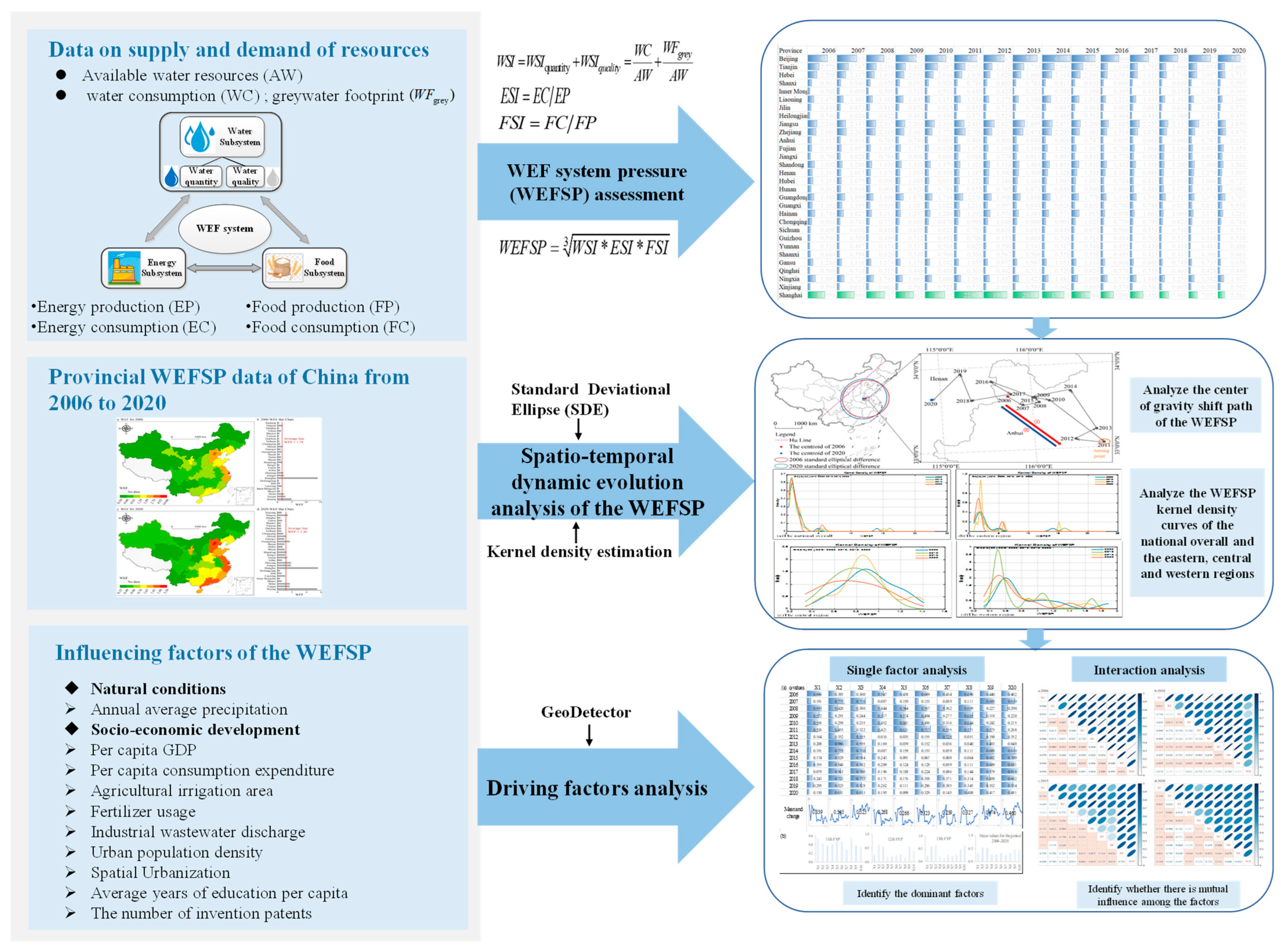
While the studies provide important guidance for identifying WEF supply–demand status and influencing factors, current research still has the following shortcomings. First, existing assessments of WEFSP often neglect water quality issues, while focusing solely on water quantity is insufficient for achieving water-related goals within the WEF nexus. Research by Schull et al. (2020) [14] and Heal et al. (2021) [15] has demonstrated that water quality is a crucial component of the nexus. Poor water quality not only exacerbates local water scarcity risks but also threatens food and energy security [16]. Therefore, incorporating water quality into the WEFSP assessment provides a more comprehensive understanding of the system and contributes to the achievement of the sustainable development goals. The grey water footprint, which links pollution from human activities to the water volume required to dilute pollutants, offers a novel method for assessing water scarcity caused by water quality [17]. Second, due to regional variations in resource endowment and economic and social development levels across China, there are significant spatial differences in WEFSP among Chinese provinces. The effects of external factors on the spatial differentiation of the WEFSP may be nonlinear and interactive, and the traditional correlation tests and linear regression analysis methods may struggle to effectively reveal the influence mechanism [18]. Moreover, in situations with numerous independent variables, linear regression models are prone to issues such as overfitting and multicollinearity [19,20]. To fill the above research gap, this study constructs a WEFSP assessment framework that incorporates both water quantity and quality, re-examining the spatiotemporal evolution and driving factors of provincial WEFSP in China. The research framework diagram is shown in Figure 1.
Compared with existing studies, the main contributions and novelties of this research can be summarized as follows. Firstly, it incorporates water quality, measured by the grey water footprint, into the WEFSP assessment, thereby expanding the existing research framework and assessment system. Secondly, the Standard Deviational Ellipse (SDE) model is applied to identify the center of gravity shift path of the WEFSP, providing scientific evidence and decision support for sustainable resource management and policy-making. Thirdly, the GeoDetector model is employed to reveal the influence of natural conditions and socio-economic development factors on the spatial differentiation of WEFSP and to address the nonlinear relationships and interactive mechanisms that traditional methods fail to capture. The structure of the paper is as follows. Section 2 introduces the research methods and data sources. The spatiotemporal evolution of the WEFSP and its driving factors are analyzed in Section 3. Section 4 provides further discussion, and Section 5 summarizes the conclusions and proposes corresponding policy recommendations.

2. Material and Methods

This study aims to reassess the WEFSP by improving the evaluation indicator system and to reveal its spatiotemporal variation across 30 provinces from 2006 to 2020. Based on this analysis, the study seeks to identify the key driving factors of WEFSP and their interactions. The research is expected to provide a theoretical basis for formulating targeted resource management strategies to ensure the security of the WEF system.

2.1. Comprehensive Evaluation of the WEFSP

2.1.1. Construction of the WEFSP Evaluation Index System

To comprehensively assess the pressures on the WEF system, this study introduced water quality into the analytical framework and constructed a composite indicator system that includes three subsystems, water, energy, and food:
(1)
Water subsystem: The water stress index ( W S I ) in this subsystem is a resource stress evaluation indicator that simultaneously considers both quantity and quality of water and can be expressed by the formula:
W S I = W S I quantity + W S I q u a l i t y = W C A W + W F g r e y A W
W S I quantity refers to water stress due to insufficient water, and it is usually expressed as the proportion of water consumption ( W C ) to locally available water resources ( A W ) during a specific period in a given region. W S I q u a l i t y refers to water stress caused by water pollution. As defined in the previous section, the greywater footprint ( W F g r e y ) can reflect the degree and scale of water pollution [21]. Therefore, W S I q u a l i t y is typically expressed as the ratio of the greywater footprint ( W F g r e y ) to locally available water resources ( A W ) over a specific period [17,22]. This paper refers to the study of Zeng et al. (2013) [17] to account for the greywater footprint, which is calculated by the formula:
W F g r e y = L C max C n a t
where L represents the pollutant emission ( kg ), C max denotes the maximum concentration of the pollutant allowed by ambient water quality standards ( kg / m 3 ), and C n a t is the initial concentration of pollutants in natural water ( kg / m 3 ).
(2)
Energy subsystem: The energy stress index ( E S I ) in this subsystem is defined as the ratio of energy consumption ( E C ) to energy production ( E P ), i.e., E S I = E C / E P . E C in this paper refers to the consumption of raw coal, crude oil and its derivatives, natural gas, electricity, etc, which are then converted into standard coal equivalents; E P is measured by the primary energy production converted to standard coal equivalents.
(3)
Food subsystem: In the food subsystem, the food stress index ( F S I ) is represented by the proportion of food consumption ( F C ) to food production ( F P ), i.e., F S I = F C / F P . F C in this paper is calculated by multiplying the total population of the province by the per capita consumption of food (including grains, meat, poultry, eggs, and milk). F P is quantified by the total output of grains, meat, poultry, eggs, and milk.

2.1.2. Quantification of the WEFSP

WEFSP is composed of the pressures from three subsystems: water, energy, and food. To quantify the WEFSP, we adopted the method of constructing the Human Development Index [23,24], which involves computing the geometric mean of WSI, ESI and FSI to integrate the subsystems. The specific calculation formula is as follows:
WEFSP = W S I E S I F S I 3

2.2. Spatiotemporal Dynamic Evolution

2.2.1. Standard Deviational Ellipse (SDE)

SDE is a spatial statistical method developed by American sociologist Welty Lefever to characterize the spatial distribution characteristics of elements such as socio-economics and natural environment [25]. This study quantitatively depicts the spatial distribution features of the WEFSP in China by calculating basic parameters such as the mean center, azimuth, major axes, and minor axes of the SDE. The mean center is the center of the WEFSP in two-dimensional space, and its migration trajectory indicates the relative position and spatial evolution characteristics of the WEFSP at different time series. The primary trend of the WEFSP distribution is indicated by the azimuth. The major and minor axes of the ellipse indicate the directions and scopes of the distribution of the WEFSP and their degree of dispersion. Oblateness is defined as the disparity between the lengths of the major and minor axes of the SDE. A higher oblateness signifies a more pronounced directional trend, indicating that WEFSP are spatially concentrated along a specific axis. Conversely, a lower oblateness reflects a more uniform spatial distribution, with weaker directional characteristics [26]. The specific calculation formula is as follows:
X ¯ w = i = 1 n w i x i i = 1 n w i ;       Y ¯ w = i = 1 n w i y i i = 1 n w i
tan θ = i = 1 n w i 2 x ˜ i 2 i = 1 n w i 2 y ˜ i 2 + i = 1 n w i 2 x ˜ i 2 i = 1 n w i 2 y ˜ i 2 2 + 4 i = 1 n w i 2 x ˜ i 2 y ˜ i 2 2 i = 1 n w i 2 x ˜ i y ˜ i
σ x = i = 1 n w i x ˜ i cos θ w i y ˜ i sin θ 2 i = 1 n w i 2 ;   σ y = i = 1 n w i x ˜ i sin θ w i y ˜ i cos θ 2 i = 1 n w i 2
where x i ,       y i   is the spatial location coordinates of province i and w i represents the spatial weight of province i . In this paper, it refers to the WEFSP value of the province. X ¯ w ,       Y ¯ w   is the weighted mean center of the province.   θ denotes the ellipse’s azimuth; x ˜ i ,     y ˜ i are the coordinate deviations between province i to the weighted mean center, respectively; σ x ,   σ y denote the ellipse’s standard deviations along the x -axis and y -axis, respectively.

2.2.2. Kernel Density Estimation (KDE)

KDE is a nonparametric estimation method, the principle of which is to fit sample data via a smoothed peak function and to characterize the distribution of random variables using a continuous density curve [27]. This method offers advantages such as strong robustness and weak model dependency in application, making it widely used in studies on spatial disequilibrium among variables. The most common form of the density function used in research is as follows:
f ( x ) = 1 N h i = 1 N K ( X i x h )
where N represents the number of provinces. X i denotes the independent and identically distributed observed values, which in this study refer to the WEFSP of the 30 provinces. x is the mean value of WEFSP across the 30 provinces. K ( ) denotes the kernel density function, and h indicates the bandwidth, which was obtained in this study based on Silverman’s rule. This paper uses the Gaussian kernel density function to analyze the regional disparities and dynamic evolution of provincial WEFSP in China, which can be expressed as follows:
K ( x ) = 1 2 π exp ( x 2 2 )
Based on China’s economic development level and geographical location, the 30 provinces were divided into three regions, the eastern, central, and western regions [27], to further compare the differences and evolution characteristics of WEFSP distribution patterns at different macro-regional scales on a national basis. Using annual cross-sectional data from 2006 to 2020 as the study objects, the kernel density distribution curves were utilized to analyze the interprovincial disequilibrium of WEFSP and its dynamic evolution trends.

2.3. Driver Factor Analysis Based on the GeoDetector Model

2.3.1. Factors Selection

Based on the availability of data and referring to relevant research, this study selects the indicators shown in the Table 1 to explain the spatial variation of provincial WEFSP in terms of natural conditions and socio-economic development. The GeoDetector is applied to explore the individual and interactive effects of the spatial variation drivers of provincial WEFSP in China. The specific indicators are explained as follows:
Natural conditions: Precipitation is not only one of the important sources of water resources but also one of the key factors affecting agricultural production and hydropower generation. This study primarily uses the annual average precipitation (X1) for analysis.
Socio-economic development: Rapid economic development has led to the continuous improvement in living standards, and changes in residents’ dietary structure and consumption habits can affect the consumption of water resources, energy, and food [28,29]. This article mainly selects two indicators, per capita GDP (X2) and per capita consumption expenditure (X3), to explore their impact on the WEFSP from an economic perspective. In agricultural development, agricultural irrigation, and the usage of agrochemicals such as fertilizers and pesticides, not only consume a large amount of water and energy but may also contribute to water pollution [30,31]. In this study, two indicators, agricultural irrigation area (X4) and fertilizer usage (X5), are applied to explore the impact of agricultural development [32]. During industrial development, the discharge of industrial wastewater can pollute water and soil, thereby affecting water resource utilization and food production [32]. This study selects the industrial wastewater discharge (X6) to examine the impact of industrial development on the WEFSP. During the process of urbanization, increasing urban populations inevitably lead to growing demands for WEF [33]. Additionally, the expansion of housing and infrastructure to accommodate this growing population has encroached upon agricultural land, and the reduction of agricultural land poses a risk to food security [34]. This paper employs the metrics of population urbanization (X7) and spatial urbanization (X8) to examine the effects of urbanization. In addition, regional educational attainment and technological innovation capacity may also shape the production and consumption patterns of water, energy, and food by influencing resource utilization efficiency and sustainable practices. This article refers to the studies of Bai & Zhang (2018) [10] and Ma et al. (2024) [35] and, respectively, selects the average years of education per capita (X9) and the number of invention patents granted per 10,000 people (X10) for research.

2.3.2. GeoDetector

GeoDetector is a set of statistical methods for identifying spatial heterogeneity and uncovering its underlying drivers. This approach posits that if a certain independent variable significantly influences a dependent variable, then their spatial distributions should exhibit similarity [36]. The advantage of GeoDetector lies in its independence from linear assumptions, allowing it to flexibly capture nonlinear relationships without being affected by multicollinearity. This characteristic enables a more comprehensive explanation of the complex relationships between influencing factors and the dependent variable [37]. Currently, it has been widely applied in the study of environmental and socio-economic influencing factors [38,39,40].
The GeoDetector comprises four core modules: the risk detector, factor detector, ecological detector, and interaction detector. A detailed description of the GeoDetector can be found at http://www.geodetector.cn/. This study mainly used the factor detector and the interaction detector modules to identify key factors influencing the spatial distribution of the provincial WEFSP and to examine their interactive effects. The factor detector is primarily employed to quantify the explanatory power of the influencing factors on the spatial distribution of provincial WEFSP, which is expressed by the q-value, and the main calculation formula is as follows [37]:
q = 1 1 n σ 2 h = 1 L n h σ h 2
where n ,     σ 2 denote the total sample size and variance, respectively. n h , σ h 2 denote the sample size and sample variance of the h-th layer ( h = 1 , 2 , ... , L ) , respectively. The q value ranges from [0,1], the larger the q value, the stronger the explanatory power of the factor for provincial WEFSP, and vice versa indicating a weaker explanatory power.
The interaction detector is employed to detect the explanatory power of two different factors when they act together on the object of study. Under the joint interaction of two factors, the impact on the spatial distribution of the provincial WEFSP may be enhanced or diminished, or the influence of the two factors on it is independent. The specific evaluation method involves separately calculating the q values of two factors, X 1 and X 2 , on the Y (WEFSP), i.e., q ( X 1 ) and q ( X 2 ) , and computing the q value under their joint interaction, i.e., q ( X 1 X 2 ) , and comparing q ( X 1 ) , q ( X 2 ) with q ( X 1 X 2 ) [41]. The interaction effects can be categorized into five scenarios as shown in Appendix A, Table A1: nonlinear weaken, single-factor nonlinear weaken, bi-factor enhancement, independent and nonlinear enhancement. Among these, bi-factor enhancement and nonlinear enhancement indicate that the explanatory power of the interaction between the influencing factors is greater than the individual effects of each factor or greater than the sum of the explanatory powers of the two factors.

2.4. Data Sources and Processing

China formulates and implements a social and economic development plan every five years. This study covers three five-year plans (FYP): the 11th FYP (2006–2010), the 12th FYP (2011–2015), and the 13th FYP (2016–2020), which holds certain reference significance for China’s development during the 14th (2021–2025). Due to the unavailability of data for Hong Kong, Macao, and Taiwan, and the lack of energy-related data for Tibet, this study mainly analyzes the WEFSP of 30 provinces. The data needed for calculating WEFSP and the indicator data of influencing factors in this study are primarily collected from the China Water Resources Bulletin, various national or provincial statistical yearbooks, which can be available from the Ministry of Water Resources of the People’s Republic of China (http://www.mwr.gov.cn/sj/tjgb/szygb/ (accessed on 19 August 2025)), the National Bureau of Statistics (https://www.stats.gov.cn/ (accessed on 19 August 2025)), and the Chinese Economic and Social Big Data Research Platform (https://data.cnki.net/ (accessed on 19 August 2025)).
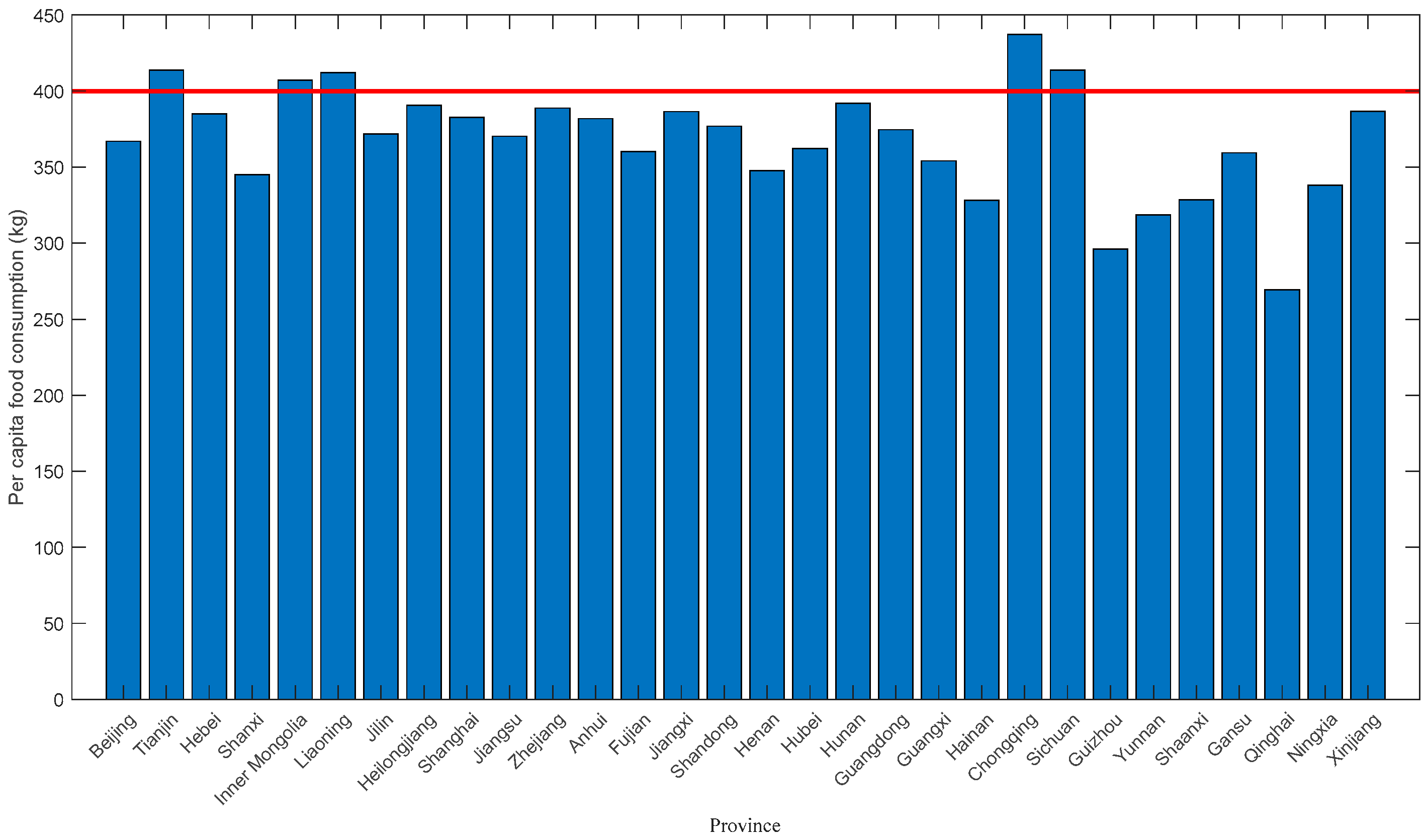
During the data collection process, interpolation was employed to fill in missing data. In addition, it should be noted that some studies only consider grains when calculating food subsystem pressure, using 400 kg/person as per capita food consumption, and multiplying it with the total population of each province each year to calculate the annual food consumption of each province [10,11]. However, this data processing method ignores the heterogeneity of each province and has large errors. The China Statistical Yearbook published data on per capita consumption of major foods of households by region from 2015 to 2021, with food categories covering grains, edible oils, vegetables and mushrooms, meat, poultry, aquatic products, eggs, milk, dried and fresh fruits, and sugar. From Figure 2, it can be found that provincial per capita food consumption has large differences, and some provinces, such as Qinghai, Guizhou, Yunnan, and Hainan, have per capita food consumption much lower than 400 kg/person. Therefore, considering the differences between provinces and the missing data in some years (2006–2014), this paper selects the annual average value of provincial per capita food consumption (including grains, meat, poultry, eggs, and milk) from 2015 to 2021 to replace 400 kg/person and multiplies it with the total population of each province in each year to calculate the food consumption of each province in each year.
Furthermore, the dependent variables in GeoDetector are numerical, and the independent variables are typological. When the independent variables in the study are numerical, they need to be discretized. This paper references the research of Hou et al. (2022) [41] and uses the natural breakpoint method to classify the indicator data of influencing factors into 9 categories to preserve the gradient information of the explanatory variables as much as possible and better capture their potential impact on WEFSP.

3. Results

3.1. Spatiotemporal Variation Characteristics of the WEFSP in China

3.1.1. The Overall Change Characteristics of the WEFSP from 2006 to 2020

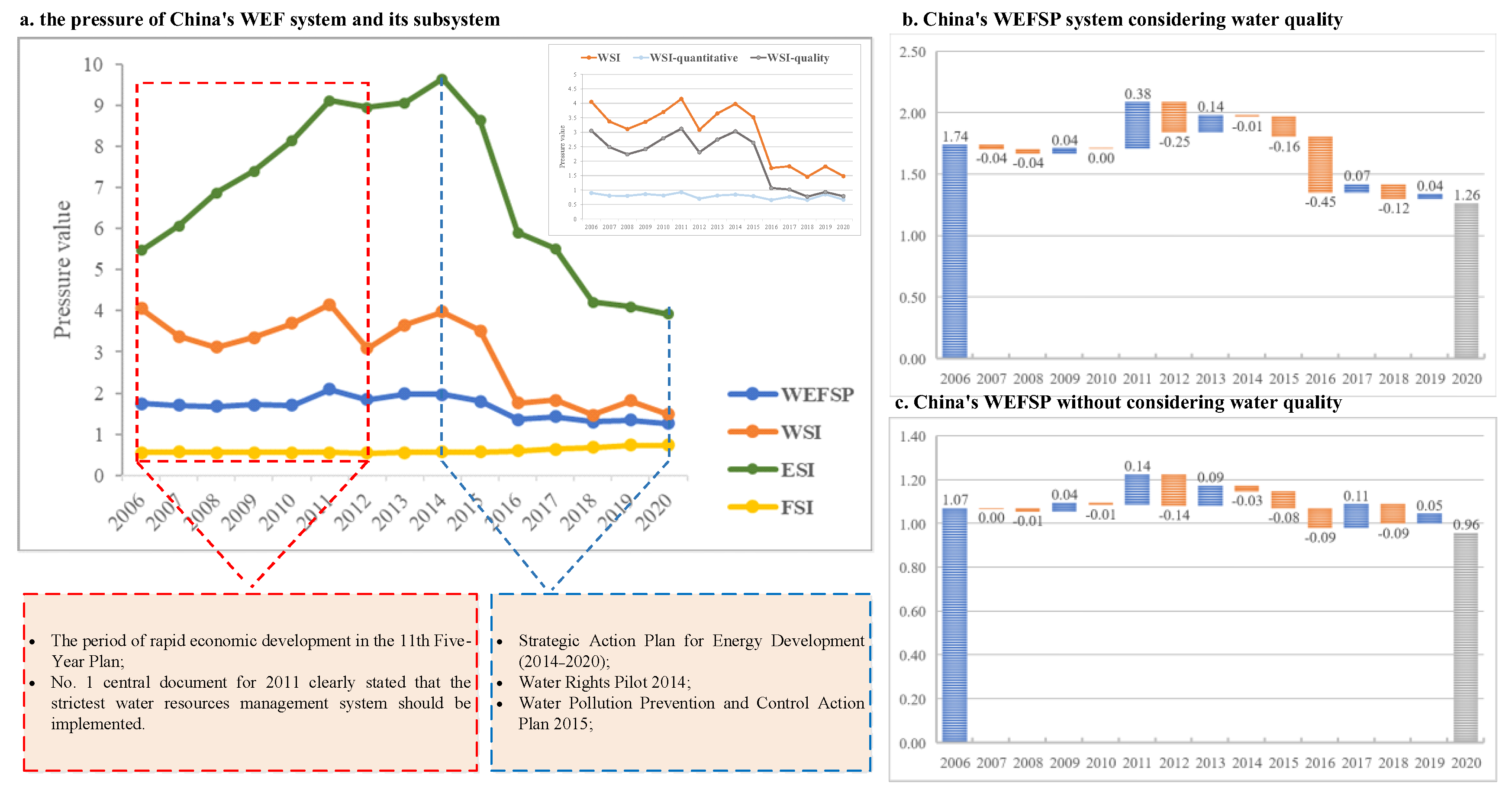
The WEFSP of China from 2006 to 2020 is illustrated in Figure 3. It can be seen from Figure 3a; during the research period, China’s WEFSP initially increased and then decreased, showing an overall downward trend, from 1.74 in 2006 to 1.26 in 2020. In the WEF subsystem, the overall trend of WSI also shows a fluctuating downward trend. Furthermore, the trend in WSI aligns with the variation trend in water resource pressure caused by water pollution, indicating that water pollution plays a dominant role in the WSI. Additionally, the volatility of WSI variation is highly correlated with regional development policies. For example, No. 1 central document for 2011 specifically suggested the implementation of the most stringent water resource management system, focusing on changing prominent issues like excessive water resource development, water wastage, and severe water pollution, from three aspects: water quantity, water use efficiency, and water quality. Moreover, the water conservation policy released in 2014 and the water environment governance policy enacted in 2015 had a significant positive impact on alleviating water resource pressure. The ESI experienced an upward and then downward trend over the study period. According to statistics, China’s GDP annual growth rate was 11.2% over the 11th FYP period, marking one of the fastest periods since the reform and opening of China. The rapid rise of industrialization and urbanization has led to an increasingly severe energy constraints in China. To address this issue, China released the Energy Development Strategy Action Plan (2014–2020) in 2014, which emphasizes expanding energy supply, energy conservation, and emission reduction and aims to alleviate pressure on the energy subsystem by enhancing energy supply capacity, adjusting the energy structure, and improving energy efficiency. During the study period, FSI maintained a continuous growth status. Given that food security serves as a crucial foundation for national security, increased attention is needed.
Figure 3b,c show the temporal variation trends of China’s WEFSP under the two scenarios of considering and neglecting water quality, respectively. Comparative analysis of these figures reveals that China’s overall WEFSP has the same change trend under both scenarios. The key difference lies in the underestimation of China’s WEFSP level that occurs when water quality is neglected.

3.1.2. Spatial Distribution Characteristics of the WEFSP

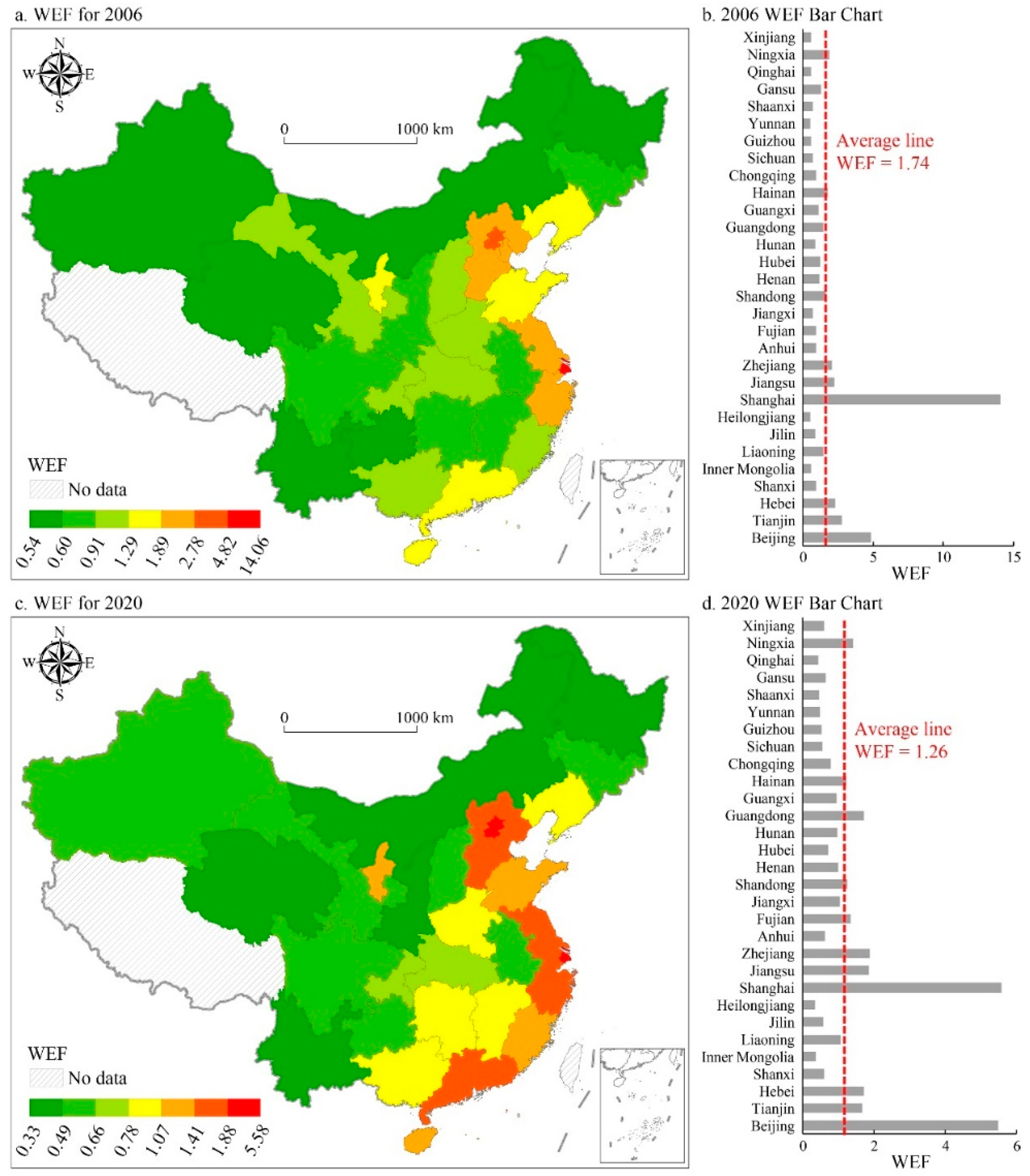
To maintain objectivity, the WEFSP assessment results were classified in ArcGIS 10.7 software using the natural break method. Due to space constraints, it is inconvenient to plot the distribution of WEFSP for each year in this article. Figure 4 depicts the distribution of WEFSP in 2006 and 2020. From the figure, it can be found that the WEFSP generally exhibits an east-high and west-low spatial distribution pattern. Moreover, from 2006 to 2020, WEFSP exhibited a tendency to aggregate from the eastern to the southeastern regions. Provinces with high levels of the WEFSP are mainly concentrated in Beijing-Tianjin-Hebei (BTH), i.e., Beijing (4.82/5.49), Tianjin (2.78/1.66), and Hebei (2.29/1.72), and the Yangtze River Delta (YRD) region, i.e., Shanghai (14.06/5.58), Jiangsu (2.25/1.85), Zhejiang (2.08/1.88), and Ningxia (1.89/1.41). In these regions, dense populations and limited land resources lead to a mismatch between energy and food consumption (EC and FC) and the constrained local production capacities (EP and FP), resulting in elevated ESI and FSI. In terms of water resources, intensive industrial activities generate large volumes of industrial wastewater, which increase grey water footprint and exacerbate WSI. Compared with 2006, although the average value of provincial WEFSP in China in 2020 has decreased, there are more provinces with WEFSP exceeding the provincial average, e.g., Guangdong (1.49/1.71) and Fujian (0.95/1.35). A possible explanation is the increase in energy consumption and water pollution emissions caused by industrial relocation, as well as the growth in food demand resulting from population inflows and urbanization. These factors jointly intensified subsystem pressures.
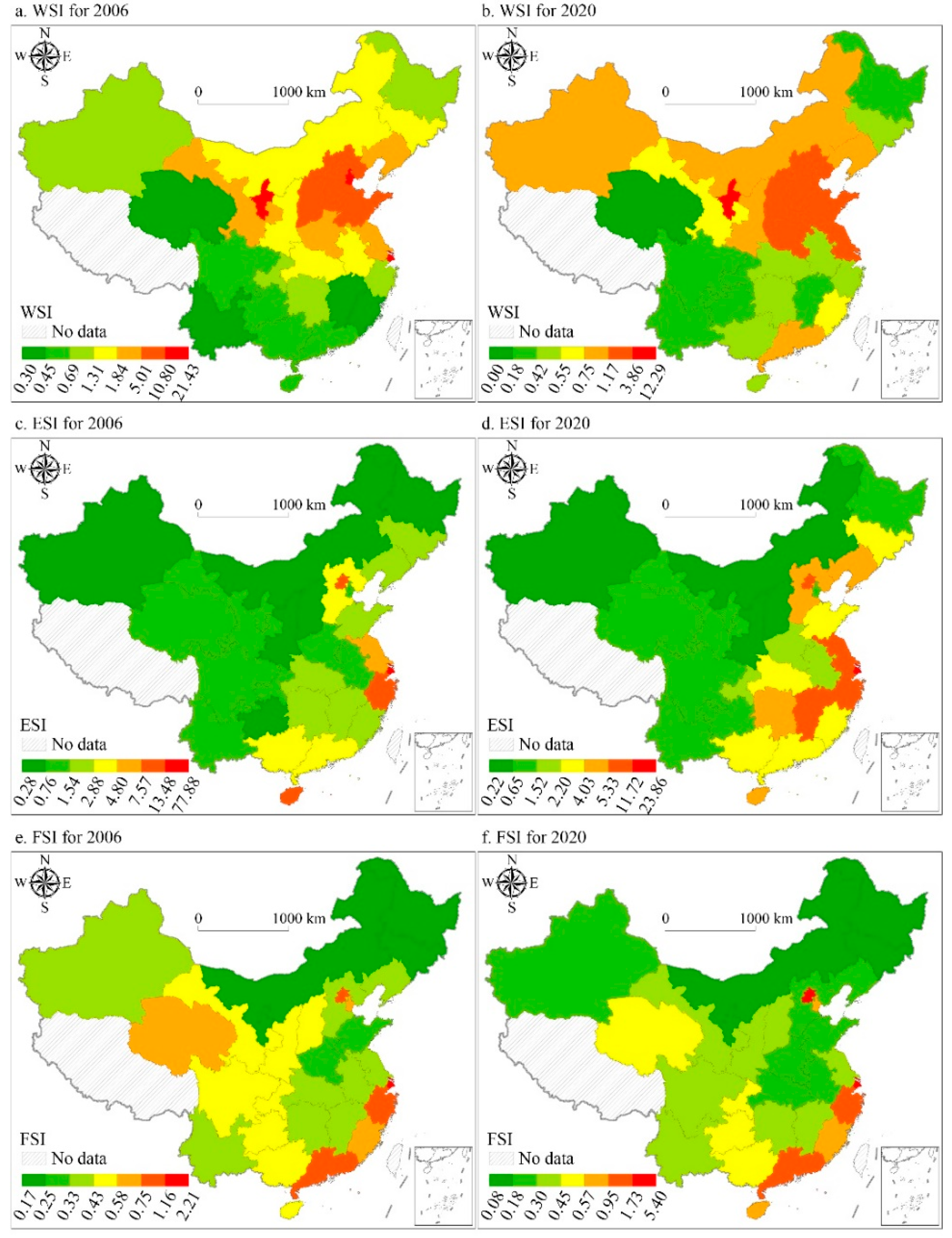
By comparing the subsystems of the WEF, we can see that the spatial distribution of subsystems exhibits significant differences due to regional natural endowments and socio-economic development characteristics. From Figure 5, regions with high pressure on the water system are mainly concentrated in the north, where Ningxia faces severe water scarcity due to its climate and geographic location, making it one of China’s most water-scarce provinces, followed by the BTH region, which has a high level of economic development. The areas with high ESI are mainly clustered in the YRD region and Beijing and shifted to the northeast (e.g., Liaoning and Jilin) and south-central regions (e.g., Jiangxi and Hunan) during the study period. Shanxi, Shaanxi, Inner Mongolia, and Xinjiang, as China’s important energy bases, have low ESI. Due to regional differences in population density and grain productivity, regions with high FSI are mainly clustered in developed and coastal regions in the east, such as Shanghai, Beijing, Tianjin, Zhejiang, Fujian and Guangdong.

3.2. Characteristics of the Spatial Evolution of the WEFSP

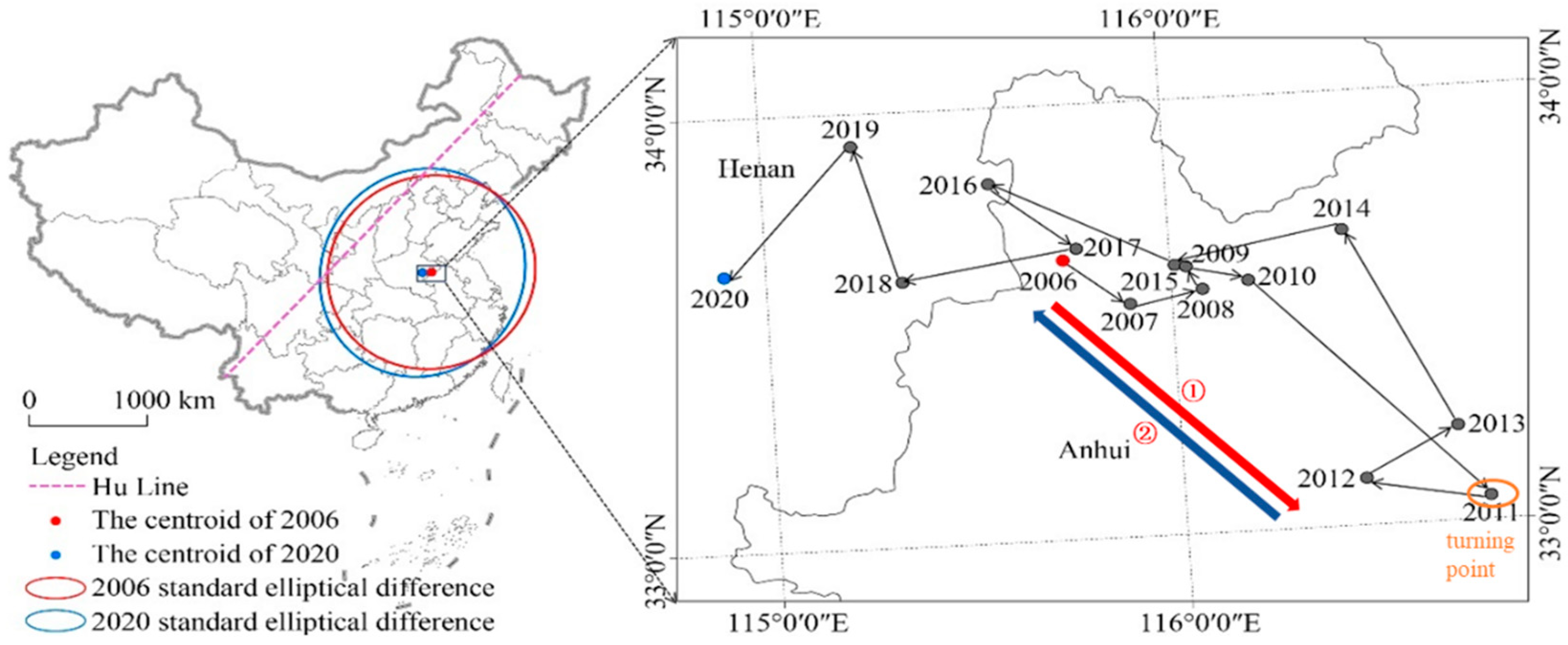
In this paper, we utilized the SDE statistics module in ArcGIS10.7 software to visualize the center of gravity (CG) movement of the WEFSP in China from 2006 to 2020, as shown in Figure 6. Additionally, key statistical parameters of the SDE for the WEFSP were calculated and are summarized in Appendix A, Table A2.

3.2.1. Analysis of the CG Movement Path

According to the CG calculation formula, the CG of the WEFSP in China during 2006–2020 varies between 33°03′12″~33°55′30″ N and 114°53′54″~116°44′60″ E, mainly in Anhui and Henan. According to the plotted trajectory of the CG movement (Figure 6), the overall CG movement of the WEFSP can be divided into two stages: during 2006–2011, the CG shifted from the northwest toward the southeast, and in 2011, it was a turning point, after which the CG moved in the opposite direction.
From 2006 to 2011, the CG shifted from the northwest to the southeast, with the distance and speed of the CG movement experiencing a trend of initially reducing and then rising. The possible explanation is that the coastal regions such as Shanghai, Jiangsu, and Zhejiang, which have a better foundation for economic development, are usually accompanied by a large amount of resource consumption in the process of rapid economic and urbanization development. This results in the CG movement of the WEFSP towards the southeast. The overall reduction in China’s WEF resource consumption during the backdrop of the global financial crisis is the main reason for the gradual reduction of the distance and speed of the CG movement in the early period. In 2010–2011, the CG movement reached its maximum distance at 79.27 km. This period coincided with the transition from China’s 11th FYP to the 12th FYP, during which economic growth continued at a relatively high level. According to statistics, China’s GDP reached US$ 5879.1 billion in 2010, surpassing Japan to become the world’s second-largest economy after the United States [42].
From 2011 to 2020, the CG of the WEFSP shifted in the opposite direction from the southeast to the northwest. Notably, during the transition from China’s 12th FYP to the 13th FYP, i.e., 2015–2016, the CG movement distance is the largest at 48.92 km, which is less than the CG movement distance in the transition period from the 11th FYP to the 12th FYP. Possible explanations include that China considers transforming the economic growth mode and strengthening ecological environmental protection as crucial issues during the 12th FYP period [43]. Therefore, during the three FYP period, China’s economy experienced a shift from high speed → medium-high speed → high-quality development.

3.2.2. Analysis of Kernel Density Estimation (KDE)

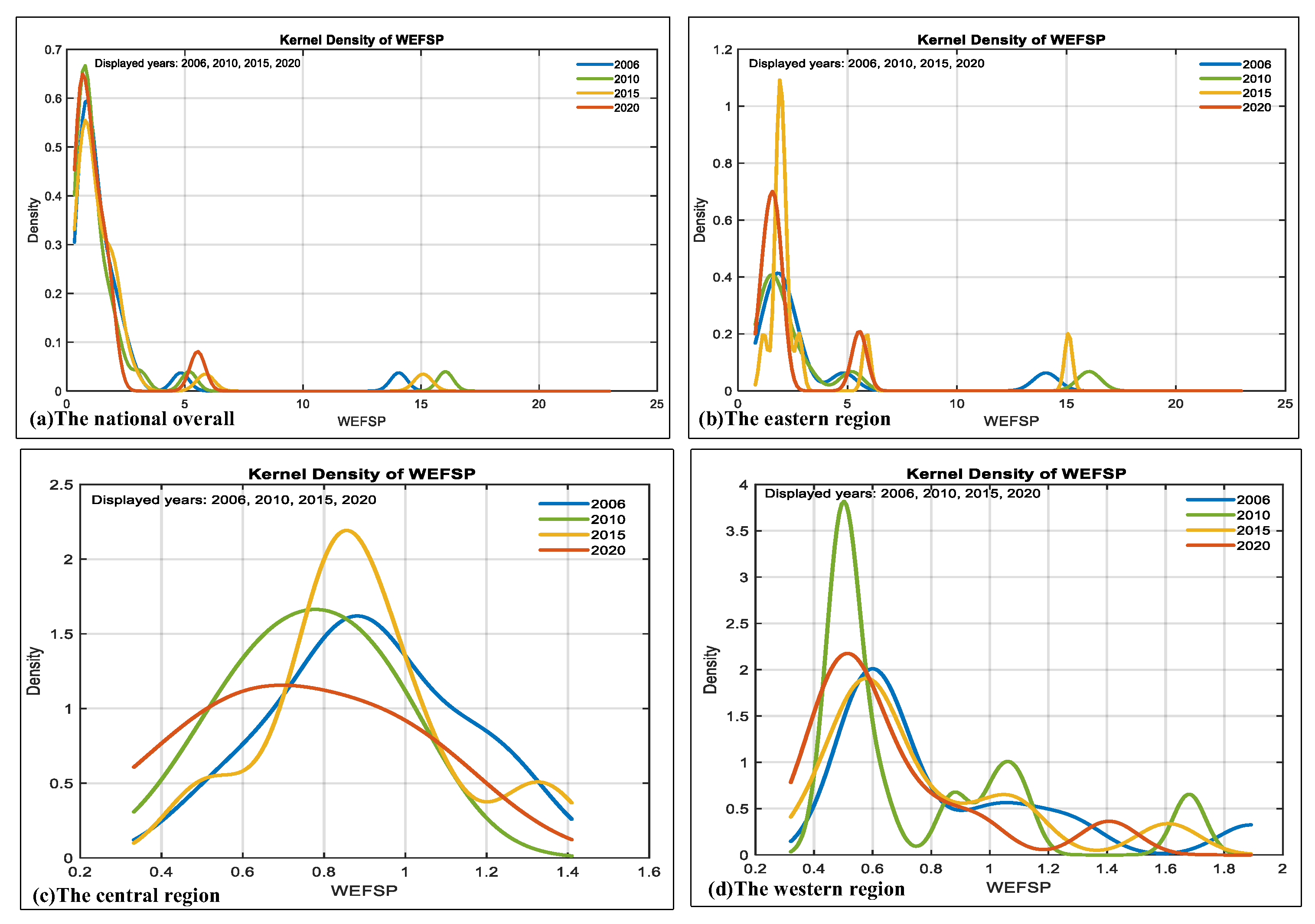
To explore the dynamic evolution trend of the WEFSP, this study employs KDE method, selecting 2006, 2010, 2015, and 2020 as observation time points. The analysis focuses on the distribution position, shape, tail characteristics, and polarization trends of the kernel density curves of WEFSP at the national level as well as in the eastern, central, and western regions. The results are illustrated in Figure 7.
The distribution position from the figure reveals distinct trends. At the national level, the central position of the WEFSP curve exhibited a slight leftward shift over time, indicating a reduction in the imbalance of WEFSP at the national level from 2006 to 2020. In the eastern, central, and western regions, the center of the WEFSP distribution curve showed a pattern of shifting leftward during 2006–2010, then rightward during 2010–2015, and again leftward during 2015–2020. Overall, a leftward movement was observed, suggesting that the imbalance in WEFSP levels in these regions experienced fluctuating changes but generally decreased.
Regarding distribution shape, from 2006 to 2020, the height of the main peak of the curve for the national level and the western region underwent a sequence of increase → decrease → increase, resulting in an overall upward trend. This indicates that the imbalance of the WEFSP levels in these areas first narrowed, then expanded, and narrowed again, with an overall reduction in dispersion. In the eastern and central regions, from 2010 to 2020, the height of the main peak initially increased and then decreased, while the peak width first narrowed and then widened. This suggests that the imbalance in WEFSP levels in these regions first decreased and then increased during this period. Overall, the eastern region exhibited a reduction in the dispersion of WEFSP levels, while the central region showed the opposite trend, demonstrating the differential changes in WEFSP among different regions.
In terms of tail characteristics, the kernel density curves for both the national level and the eastern region exhibit a significant right-tailed trait, indicating that certain provinces within the country—particularly in the eastern region—have significantly higher WEFSP levels compared to other provinces within the same region. Regarding polarization phenomena, the kernel density curves for the national level and the eastern region display a distinct multi-peak distribution state, indicating that there is a multi-level differentiation phenomenon in the WEFSP level in this region. The kernel density curve in the central region exhibits a clear unimodal distribution, suggesting an absence of polarization or multi-level differentiation in WEFSP levels. This pattern reflects a relatively balanced development of WEFSP across the region.

3.3. Driving Factors of the WEFSP

3.3.1. Identify the Dominant Factors

Investigating the driving factors behind WEFSP evolution is vital for having a comprehensive understanding of its process and underlying mechanisms. Potential factors influencing the spatial differentiation of WEFSP were selected from two dimensions: natural conditions and socio-economic development. The dominant factors and their interactive effects were subsequently determined using GeoDetector.
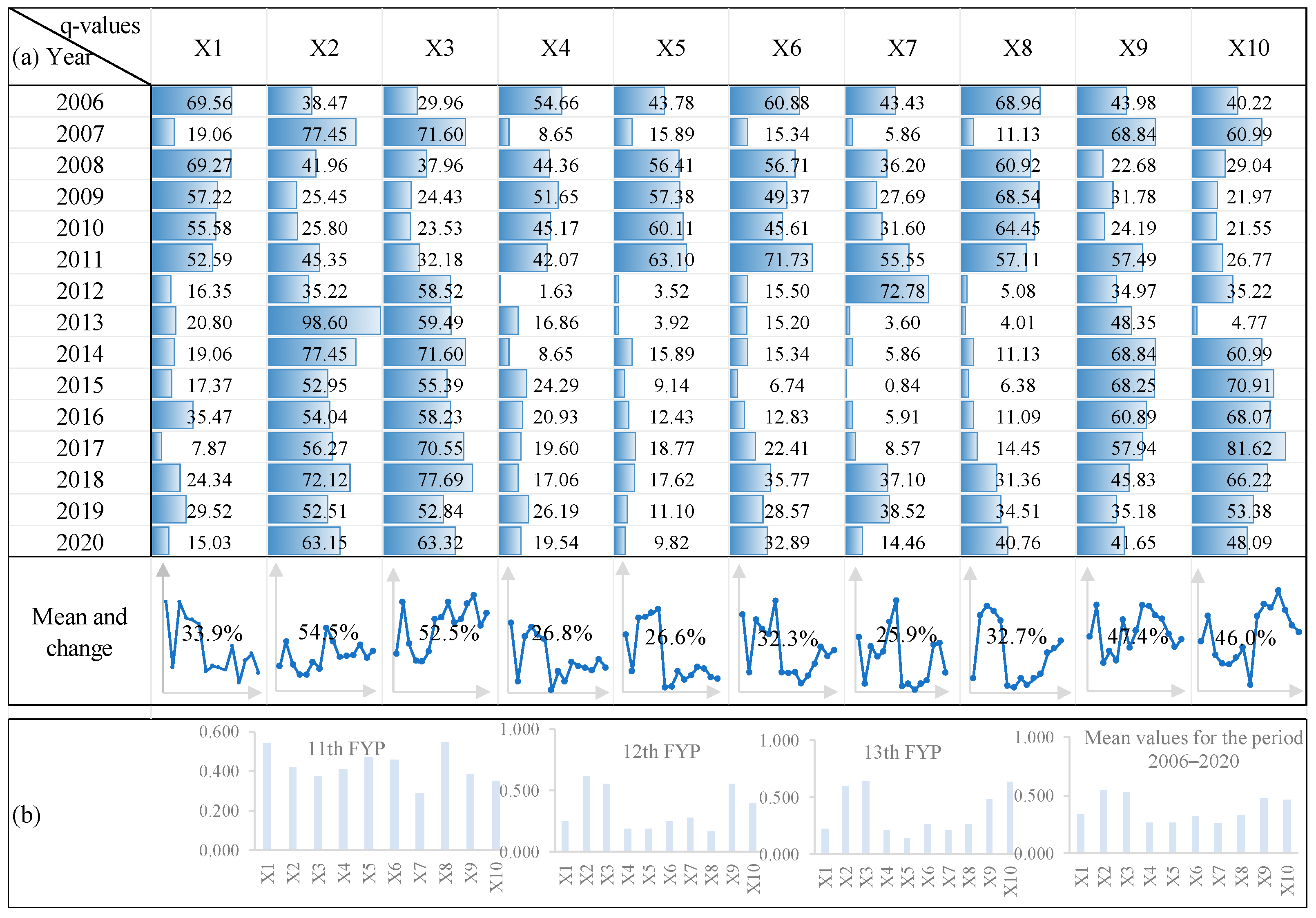
Factor detection analysis was employed to assess the explanatory power of various factors on WEFSP and to identify the dominant factors influencing its spatial heterogeneity by comparing the explanatory power of the factors. Figure 8 depicts the factor detection results of the GeoDetector, with the q-value representing the explanatory power of the driving factors. The results indicate that the p values of all driving factors are less than 0.01, suggesting that each factor has a significant impact on the spatial differentiation of WEFSP.
As shown in Figure 8, there are certain differences in the dominant factors each year during the research period. Due to space limitations, this paper selects 2006, 2010, 2015 and 2020 as examples for analysis. In 2006, X1 exhibited the highest explanatory power (q = 0.696), followed by X8 (0.690) and X6 (0.609). In 2010, X8 ranked first (0.644), ahead of X5 (0.601) and X1 (0.556). By 2015, X10 became the most influential factor (0.709), followed by X9 (0.682) and X3 (0.554). In 2020, X3 showed the strongest explanatory power (0.633), followed closely by X2 (0.631) and X10 (0.481). Notably, X8, X2, and X3 were identified as the dominant factors during the 11th FYP, 12th FYP, and 13th FYP periods, respectively. In terms of average explanatory power, the q-values of the driving factors ranked in descending order are as follows: X2 (0.545) > X3 (0.525) > X9 (0.474) > X10 (0.460) > X1 (0.339) > X8 (0.327) > X6 (0.323) > X4 (0.268) > X5 (0.266) > X7 (0.259). This indicates that economic development, consumption expenditure, per capita education level, and technological innovation had significantly stronger average effects on WEFSP than natural conditions and traditional input factors, with X2 being the most influential and X7 the least. Furthermore, the explanatory power of each driving factor for WEFSP showed a fluctuating trend during the research period. Overall, the influence of X1, X4, X5, X6, X7, and X8 weakened, while that of X2, X3, X9, and X10 increased. This result indicates that the dominant drivers of WEFSP have shifted from traditional natural conditions and extensive inputs toward more profound socio-economic factors like economic development, consumption upgrading, and social structure changes.

3.3.2. Interaction Between Factors

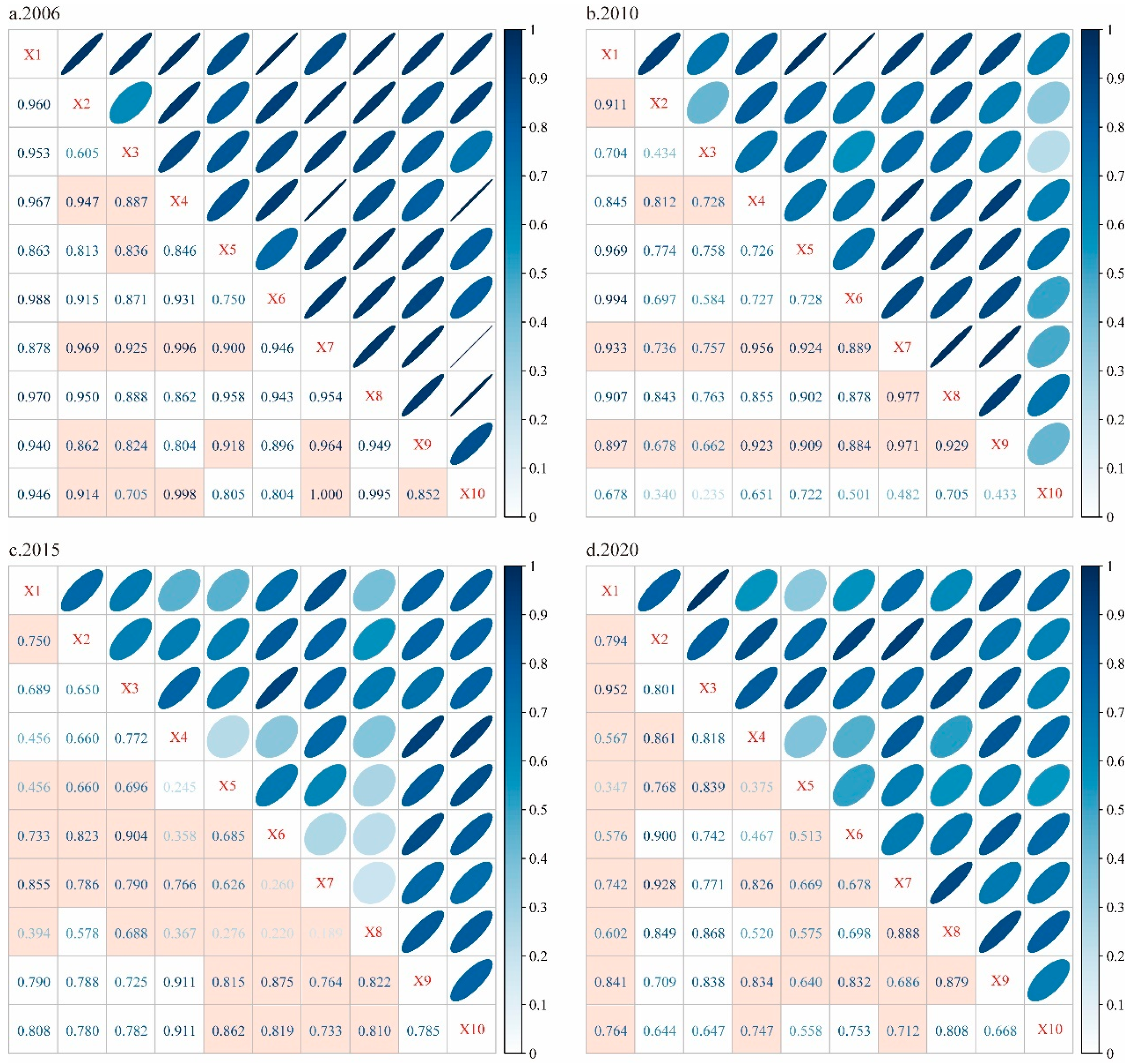
Factor detection analysis aims to quantify the explanatory power of individual driving factors on the spatial differentiation of WEFSP. However, given that the WEF system is a highly coupled complex system, driving factors often do not act in isolation but may interact through synergistic or trade-off effects when influencing WEFSP collectively [9]. Therefore, this paper further applied interaction detection to examine whether the interaction between different influencing factors enhances or weakens their explanatory power regarding the spatial heterogeneity of WEFSP. Figure 9 presents the interaction detection results of WEFSP spatial differentiation driving factors in 2006, 2010, 2015, and 2020. The results show that the types of interactions are primarily characterized by two-factor enhancement or nonlinear enhancement. This indicates that the interactive effect of any two factors on the spatial distribution of WEFSP is greater than the impact of any single factor alone. In other words, the combined influence of drivers yields stronger explanatory power regarding the spatial differentiation of WEFSP, whereas the explanatory capacity of individual factors may be limited. Taking X3 as an example, in 2006, it had the weakest individual explanatory power (q = 0.300) regarding the spatial variation of WEFSP. However, when interacting with X4, X5, X7, X9, and X10, its explanatory power increased nonlinearly, with all interaction q-values exceeding 0.700.
In 2006, 2010, 2015, and 2020, the strongest interaction effects were observed between the factor pairs X10 X7, X1 X6, X10 X4 and X1 X3, with the explanatory power of each of these interactions exceeding 0.900. In 2015, X6 and X7 functioned as core factors, and each of their combinations with any other factor produced a nonlinear enhancement effect of “1 + 1 > 2”, indicating that these two factors acted as central hubs within the spatial differentiation network of WEFSP that year. Specifically, industrial wastewater discharge is closely linked spatially to industrial structure and economic density, while urban population is closely coupled with consumption demand, domestic sewage discharge, and land use patterns. When these factors interact with others, they amplify the interconnections among population, industry, and resources, leading to a significant increase in explanatory power. For instance, rapid urbanization leads to population concentration and increased domestic sewage generation, which, when coupled with high levels of industrial wastewater discharge, exacerbates water quality pressure. This compounded pressure propagates through the water subsystem and subsequently affects food production and energy use, thereby intensifying WEFSP.

4. Discussion

China’s Five-Year Plan (FYP), as one of the most pivotal government documents, outlines national strategies for the planned period and serves as a blueprint for comprehensive economic and social development. This paper further extends the examination of the spatiotemporal evolution and driving factors of WEFSP in China from the perspective of the FYP and draw some interesting findings.
Viewed from the perspective of the three FYPs, China’s WEFSP demonstrates a trend of initial increase followed by decline. Specifically, the WEFSP rose sharply during the transition period from the 11th FYP to the 12th FYP (i.e., 2010–2011) and reaches a maximum over the 12th FYP period. In the transition from the 12th FYP to the 13th FYP (i.e., 2015–2016), there was a rapid decline, followed by stabilization. The former can be explained by China’s official promotion system, where local officials often face assessments from their superiors on economic, investment, and tax revenue growth. This assessment mechanism motivates local officials to prioritize expanding regional GDP by increasing investment and land development to pursue resource-intensive, short-term economic growth [44]. The possible explanation for the latter is that, on the one hand, the 13th FYP period is an important transition period for China’s economy, shifting from high-speed growth to high-quality development. On the other hand, a number of policies and actions were implemented to enhance water, energy, and food security. For instance, in the energy sector, the “Action Plan for Energy Conservation, Emissions Reduction, and Low-Carbon Development from 2014 to 2015” and the “Energy Development Strategy Action Plan (2014–2020)” were introduced in 2014 to strengthen energy conservation and reduce emissions, achieve low-carbon development, and ensure energy security. In terms of water resources, the State Council issued the “Action Plan for Water Pollution Prevention and Control” in 2015 to intensify efforts in water pollution treatment and safeguard national water security. These policies and measures have played a significant role in alleviating the WEFSP and advancing sustainable resource development goals.
From a subsystem perspective, the energy subsystem experienced significantly higher pressure during the study period compared to the water and food subsystems, which is consistent with existing research findings [10,13]. This phenomenon is closely related to the characteristics of China’s economic and social development stage. The rapid increase in ESI during the 11th FYP period was primarily attributable to the peak phase of industrialization and infrastructure construction, the substantial share of energy-intensive industries, and relatively low energy efficiency, which collectively drove up both energy demand and pressure. During the 12th FYP period, the growth rate of ESI slowed and began to decline sharply after 2014. This shift was closely linked to the concentrated implementation of energy structure optimization and energy-saving policies. Measures such as increasing the proportion of non-fossil energy, adjusting the industrial structure, and controlling the total consumption of coal played a significant role during the 13th FYP period. Meanwhile, technological advancements, improvements in energy efficiency, and the deepening of green low-carbon transition strategies significantly reduced energy consumption per unit of GDP, fundamentally alleviating the resource and environmental pressures on the energy subsystem [45]. WSI exhibited phased fluctuations during the study period. Furthermore, it was found that water scarcity driven by pollution is more severe than that caused by insufficient water quantity, underscoring the necessity of incorporating water quality into the water subsystem assessment [46,47]. One possible explanation is that, on the one hand, pollution-induced water losses can exceed actual water consumption, effectively reducing usable water resources. On the other hand, water management measures such as water conservation and efficiency improvements often require extended periods to demonstrate effect, whereas the advances in pollution control technology have enabled a relatively rapid and effective response to water quality challenges [22]. For the WEF systems, water quality deterioration not only reduces water availability but may also amplify downstream impacts on agricultural and energy production through cascading effects, affecting WEFSP through pressure transmission across subsystems. FSI remained relatively stable during the 11th and 12th FYP periods, followed by a slight increase in the 13th FYP period. One possible explanation is that, on the one hand, cultivated land resources have been constrained by both rapid urbanization and ecological conservation policies, leading to a reduction in food production space in certain regions and resulting in localized supply tensions. On the other hand, with the upgrading of domestic consumption, food demand has shifted from mere accessibility to sufficiency and quality, creating a growing mismatch between dynamic changes on the demand side (including increased quantity and structural shifts) and adjustments on the supply side. These issues pose new challenges to national food security [48].
The spatial distribution of the WEFSP in China displays an east-high and west-low pattern, which corresponds to the unequal spatial patterns of urbanization and economic development. The agglomeration of population, space, and economy in the BTH and YRD regions has resulted in higher levels of WEF resource demand. Meanwhile, the utilization and development of land during the urbanization process have constrained local energy and food production capacities [33,49,50]. After 2011, there was a significant reversal in the direction of the CG shift for WEFSP, changing from northwest → southeast to southeast → northwest. Possible explanations include, on the one hand, China proposed the policy of New-Type Urbanization during the 12th FYP period, which encourages and guides people to gather in small- and medium-sized cities to alleviate the “urban diseases” in economically developed areas [51]. On the other hand, to address issues like resource shortages and environmental pollution caused by rapid economic development in the eastern regions, China issued the “Guidance on Undertaking Industrial Transfer in the Central and Western Regions” in 2010, leading to the transfer of some highly energy-intensive and high-pollution industries from the eastern regions to the central and western regions. Simultaneously, this initiative prompted the return of a portion of the labor force to the central and western regions [52]. Under the background of regional development strategies and industrial layout adjustments, the double transfer of population and industries caused the CG of China’s WEFSP to shift towards the northwest regions. In addition, the spillover of capital and technology from the eastern region promoted the economic development of the western region, which was one of the important reasons for the reversal of the direction of the shift in the CG at a later stage.
The dominant drivers of spatial heterogeneity in the WEFSP varied across different FYP periods. During the 11th FYP period, X8 (spatial urbanization), X1 (annual average precipitation), X5 (fertilizer usage), and X6 (industrial wastewater discharge) exhibited relatively strong explanatory power regarding the spatial variation of WEFSP. At this stage, China’s economy was undergoing rapid industrialization and urbanization. The accelerated expansion of construction land not only altered land use patterns but also intensified disturbances in the spatial pattern of water, energy, and food production [11]. With the sustained and rapid economic development, the explanatory power of per capita consumption level, per capita education level and technological progress on the spatial differences in the WEFSP has been enhanced. During the 12th FYP period, the top four driving factors in terms of explanatory power were X9 (average years of education per capita), X2 (per capita GDP), X3 (per capita consumption expenditure) and X10 (the number of invention patents granted per 10,000 people) in sequence. During the 13th FYP period, they were X3, X10, X2 and X9 in sequence. Overall, during the period from the 11th to the 13th FYP periods, the dominant factors of WEFSP spatial differentiation showed a trend of shifting from natural factors and extensive investment to socio-economic development and structural factors.

5. Conclusions and Policy Implications

5.1. Main Conclusions

The assessment of the WEFSP, as a crucial component of the WEF system’s security assessment, is beneficial for clarifying the supply–demand relationship of regional WEF resources and revealing the current state of these resources. In addition, understanding and quantifying the effects of external factors on WEFSP is significant for scientifically formulating relevant resource management measures to ensure the WEF system’s safety. In this study, grey water footprint was selected as a measurement indicator, incorporating water quality into the WEF system, and re-examining the WEFSP in China from 2006–2020. Based on this, the SDE and KDE were applied to investigate the spatial evolution characteristics of WEFSP, while the GeoDetector model was applied to identify driving factors behind its spatial heterogeneity.
The main conclusions of this study are as follows: (1) The WEFSP in China showed an overall trend of initially increasing and then decreasing during the research period, with the most significant changes occurring during the transition period of the FYP. Among the subsystems, the energy system was under the greatest pressure, and the trend of the WEFSP changes was generally consistent with that of the WSI. Furthermore, it was found that within the water resource subsystem, water scarcity caused by pollution was more severe than that caused by insufficient water quantity. (2) The spatial distribution of the WEFSP exhibited an east-high and west-low pattern, with the CG of the WEFSP mainly located in Anhui and Henan provinces. Against the backdrop of regional development strategies and industrial layout adjustments, the CG of the WEFSP underwent a two-phase shift: first from northwest to southeast and then in the reverse direction from southeast to northwest. The kernel density curves of the WEFSP at both the national and regional levels generally shifted leftward to varying degrees. Among these, the dispersion of WEFSP among provinces decreased at the national level and in the eastern region, indicating overall convergence alongside emerging internal polarization. (3) The explanatory power of each driving factor on the spatial heterogeneity of the WEFSP showed dynamic variations. During the study period, the influence of X1 (annual average precipitation), X4 (agricultural irrigation area), X5 (fertilizer usage), X6 (industrial wastewater discharge), X7 (population urbanization), and X8 (spatial urbanization) weakened, while that of X2 (per capita GDP), X3 (per capita consumption expenditure), X9 (average years of education per capita), and X10 (the number of invention patents granted per 10,000 people) strengthened. The factor with the strongest explanatory power shifted from X1 to X3, reflecting a transition in the dominant drivers of spatial differentiation from natural factors to socio-economic development factors. The interactions between driving factors were characterized primarily by two-factor enhancement or nonlinear enhancement. This indicates that the spatial heterogeneity of China’s WEFSP is driven by significant multi-factor synergy, where interactions between different factors amplify their combined explanatory power.

5.2. Policy Implications

Based on these findings, several policy recommendations are proposed.
Firstly, efforts should be made through the coordinated efforts of both supply and demand sides to alleviate regional WEFSP. On the supply side, optimizing the energy structure remains essential, particularly through accelerating the deployment of renewable energy sources such as hydropower, wind, solar, and hydrogen to diversify energy supply and reduce dependence on fossil fuels. Given that extreme weather events induced by climate change may threaten the production and supply of renewable energy, advancing energy storage technologies will enhance the stability and reliability of renewables and reduce the risk of energy supply chain disruptions [53,54]. In parallel, strengthening water supply resilience through expanded reclaimed water utilization and the construction of climate-adaptive water conservancy infrastructure is particularly important in water-stressed regions. On the demand side, efforts should promote technological upgrading and green transformation in energy- and water-intensive industries to improve resource use efficiency. Water-saving irrigation and fertilizer reduction measures should be widely adopted in agriculture, and public engagement in green and sustainable lifestyles and consumption behaviors should be encouraged to gradually reduce per capita resource consumption.
Secondly, differentiated regulatory strategies should be formulated to promote coordinated development across the eastern, central, and western regions and prevent further regional disparities. The eastern region, characterized by high urbanization and economic agglomeration, faces significant pressure on its water, energy, and food systems, particularly in the YRD and the BTH region. Due to geographical constraints, the eastern region should simultaneously leverage its technological and financial advantages to accelerate green innovation and industrial upgrading, thereby alleviating resource constraints. The central and western regions should fully exploit their comparative advantages and development potential, actively undertake suitable industries, and optimize local industrial layouts. Moreover, cross-regional cooperation mechanisms need to be strengthened, enabling the eastern region to provide technological, talent, and managerial support to the central and western regions to foster green and high-quality development of transferred industries.
Finally, focus on the transformation of dominant driving factors by enhancing socio-economic regulation and constructing a multi-factor collaborative governance mechanism. For example, the interaction between per capita consumption expenditure (X3) and industrial wastewater discharge (X6) exacerbates WEFSP. This indicates that increased consumption demand driven by urbanization amplifies industrial production intensity and wastewater discharge, thereby exacerbating water quality pressures and their impact on food production and energy use. Addressing this compounded pressure requires coordinated demand-side and supply-side interventions. On the demand side, policies promoting green consumption and guiding sustainable lifestyles can help curb excessive resource demand. On the supply side, stricter industrial wastewater discharge standards, cleaner production technologies, and water recycling practices should be implemented. This coordinated governance, through joint regulation of consumption-driven demand growth and pollution-intensive industrial activities, can effectively mitigate systemic risks and enhance the resilience of the WEF system.

5.3. Limitations and Future Work

Despite the current research aiding in identifying the evolution of WEFSP and its influencing factors, there are still certain limitations. For example, WEF is a vast and complex system. This paper quantifies it by constructing a composite index, which, although it helps to understand the status of WEFSP, may not fully reflect all the connections that exist in the system. Furthermore, in the food subsystem, due to data limitations, the provincial FSI for the period 2006–2014 may be overestimated or underestimated. Future research will further explore more accurate approaches to address this issue. In terms of the selection of influencing factors, the research in this paper is limited and may not comprehensively reflect the driving mechanisms behind the spatial differentiation of the WEFSP. For instance, this paper only analyzes the effects of climate change on the WEF system from the perspective of precipitation, overlooking the roles of temperature, carbon dioxide, and other factors. Research indicates that an increase in carbon dioxide concentration can enhance the yield of wheat and rice but may be offset by high temperatures [55]. Therefore, there is a need to further refine the research on WEFSP influencing factors in the future.

Author Contributions

Q.X.: Methodology, Data curation, Software, Investigation, Writing–original draft, Visualization, and Writing—review and editing. G.T.: Conceptualization, Funding acquisition, Resources, and Project administration. W.C.: Conceptualization, Methodology, Visualization, and Supervision. Q.Z.: Data curation, Visualization, and Writing—review and editing. X.W.: Visualization and Writing—review and editing. All authors have read and agreed to the published version of the manuscript.

Funding

This work was supported by the National Natural Science Fund Project (42371312) and the Fundamental Research Funds for the Central Universities (B250207030).

Institutional Review Board Statement

Not applicable.

Informed Consent Statement

Not applicable.

Data Availability Statement

The data used in this article will be provided on request.

Conflicts of Interest

The authors declare that they have no known competing financial interests or personal relationships that could have appeared to influence the work reported in this paper.

Appendix A

Table A1. Types of interaction of two independent variables on the dependent variable.
Basis for JudgmentInteraction Type
q     ( X 1 X 2 )         <     min ( q ( X 1 ) ,     q ( X 2 ) ) Nonlinear weaken
min ( q ( X 1 ) ,     q ( X 2 ) ) < q     ( X 1 X 2 )     < max     ( q ( X 1 ) ,     q ( X 2 ) ) Single-factor nonlinear weaken
q     ( X 1 X 2 )     >       max   ( q ( X 1 ) ,     q ( X 2 ) ) Bi-factor enhancement
q     ( X 1 X 2 )     = q ( X 1 ) + q ( X 2 ) Independent
q     ( X 1 X 2 )     > q ( X 1 ) + q ( X 2 ) Nonlinear enhancement
Table A2. SDE parameters for the WEFSP in China, 2006–2020.
YearCenter Coordinates x -Axis (km) y -Axis (km) θ Offset DirectionOffset Distance
(km)
2006115°44′17″ E, 33°38′51″ N873.86945.5815.44————
2007115°53′57″ E, 33°32′12″ N866.76965.8712.02East by South19.45
2008116°04′36″ E, 33°33′49″ N878.74926.266.50East by North17.65
2009116°02′37″ E, 33°36′57″ N861.11934.3510.76West by North6.96
2010116°11′24″ E, 33°34′35″ N851.39908.683.20East by South15.23
2011116°44′60″ E, 33°03′12″ N830.35882.8110.14East by South79.27
2012116°26′46″ E, 33°06′38″ N850.59896.9012.37West by North29.70
2013116°40′56″ E, 33°12′60″ N867.93828.4717.55East by North25.70
2014116°25′47″ E, 33°40′45″ N836.17922.807.08West by North56.86
2015116°00′52″ E, 33°37′03″ N856.64953.7614.33West by South40.92
2016115°33′58″ E, 33°49′36″ N906.19932.5511.71West by North48.92
2017115°46′22″ E, 33°40′17″ N880.54944.809.42East by South26.62
2018115°20′21″ E, 33°36′34″ N876.53974.1412.37West by South42.35
2019115°13′33″ E, 33°55′30″ N852.56971.1814.58West by North36.65
2020114°53′54″ E, 33°38′29″ N862.751016.8811.66West by South45.29

References

  1. Wostl, C. Governance of the water-energy-food security nexus: A multi-level coordination challenge. Environ. Sci. Policy 2019, 92, 356–367. [Google Scholar] [CrossRef]
  2. Zhang, Z.Y.; Liu, J.G.; Wang, K.; Tian, Z.; Zhao, D.D. A review and discussion on the water-food-energy nexus: Bibliometric analysis. Chin. Sci. Bull. 2020, 65, 1569–1580. [Google Scholar] [CrossRef]
  3. Wang, X.K.; Jiang, C.B.; Dong, Z.C.; Long, Y.N.; Song, X.Y.; Zhou, G.Q. Spatial-temporal evolution and obstacle factors of regional water–energy–food nexus coordinated development: A case study of 14 cities in Hunan Province, China, 2011–2022. J. Hydrol. Reg. Stud. 2025, 61, 102644. [Google Scholar] [CrossRef]
  4. Hoff, H. Understanding the Nexus. Background Paper for the Bonn 2011 Conference: The Water, Energy and Food Security Nexus; Stockholm Environment Institute: Stockholm, Sweden, 2011. [Google Scholar]
  5. Zhang, C.; Chen, X.X.; Li, Y.; Ding, W.; Fu, G.T. Water-energy-food nexus: Concepts, questions and methodologies. J. Clean. Prod. 2018, 195, 625–639. [Google Scholar] [CrossRef]
  6. Wang, Y.R.; Song, J.X.; Sun, H.T. Coupling interactions and spatial equilibrium analysis of water-energy-food in the Yellow River Basin, China. Sustain. Cities Soc. 2023, 88, 104293. [Google Scholar] [CrossRef]
  7. Ju, K.Y.; Wang, J.; Wei, X.Z.; Li, H.; Xu, S.Y. A comprehensive evaluation of the security of the water-energy-food systems in China. Sustain. Prod. Consum. 2023, 39, 145–161. [Google Scholar] [CrossRef]
  8. Tian, G.L.; Li, J.W.; Wu, Z.; Zhao, Q.Y.; Xia, Q.; Zhang, J.Y.; Niu, X.C. Unveiling the resilience of the water-energy-food nexus: A context-specific framework and evolutionary insights for the Yellow River Basin. Agric. Water Manag. 2025, 315, 109514. [Google Scholar] [CrossRef]
  9. Yang, Y.; Yang, L.; Gao, H.H. A novel assessment framework for analyzing the sustainability of water-energy-food nexus system from a pressure-support perspective. Energy Convers. Manag. 2025, 332, 119715. [Google Scholar] [CrossRef]
  10. Bai, J.F.; Zhang, H.J. Spatio-temporal variation and driving force of water-energy-food pressure in China. Sci. Geogr. Sin. 2018, 38, 1653–1660. [Google Scholar] [CrossRef]
  11. Zhang, Z.H.; Sun, S.M.; Gao, J. Evolution characteristic and influencing mechanism of water energy-food stress in Yangtze River Delta Urban Agglomeration. J. Nat. Resour. 2022, 37, 1586–1597. [Google Scholar] [CrossRef]
  12. Xiao, W.; He, M. Characteristics, regional differences, and influencing factors of China’s water-energy-food (W-E–F) pressure: Evidence from Dagum Gini coefficient decomposition and PGTWR model. Environ. Sci. Pollut. Res. 2023, 30, 66062–66079. [Google Scholar] [CrossRef] [PubMed]
  13. Jin, B.Y.; Shi, R.; Chen, S.L.; He, Y.; Zhao, M.J. Analysis of the factors influencing the water-energy-food system stress in China. Environ. Sci. Pollut. Res. 2023, 31, 46686–46702. [Google Scholar] [CrossRef] [PubMed]
  14. Schull, V.Z.; Daher, B.; Gitau, M.W.; Mehan, S.; Flanagan, D.C. Analyzing FEW nexus modeling tools for water resources decision-making and management applications. Food Bioprod. Process. 2020, 119, 108–124. [Google Scholar] [CrossRef]
  15. Heal, K.V.; Bartosova, A.; Hipsey, M.R.; Chen, X.; Buytaert, W.; Li, H.Y.; McGrane, S.J.; Gupta, A.B.; Cudennec, C. Water quality: The missing dimension of water in the water-energy-food nexus. Hydrol. Sci. J. 2021, 66, 745–758. [Google Scholar] [CrossRef]
  16. Yang, J.X.; Li, J.L.; van Vliet, M.T.H.; Jones, E.R.; Huang, Z.W.; Liu, M.M.; Bi, J. Economic risks hidden in local water pollution and global markets: A retrospective analysis (1995–2010) and future perspectives on sustainable development goal 6. Water Res. 2024, 252, 121216. [Google Scholar] [CrossRef]
  17. Zeng, Z.; Liu, J.G.; Savenije, H.H.G. A simple approach to assess water scarcity integrating water quantity and quality. Ecol. Indic. 2013, 34, 441–449. [Google Scholar] [CrossRef]
  18. Zhu, L.J.; Meng, J.J.; Zhu, L.K. Applying Geodetector to disentangle the contributions of natural and anthropogenic factors to NDVI variations in the middle reaches of the Heihe River Basin. Ecol. Indic. 2020, 117, 106545. [Google Scholar] [CrossRef]
  19. Shi, X.P.; Wang, K.Y.; Cheong, T.S.; Zhang, H.W. Prioritizing driving factors of household carbon emissions: An application of the LASSO model with survey data. Energy Econ. 2020, 92, 104942. [Google Scholar] [CrossRef]
  20. Chen, P.P.; Wu, Y.; Zhong, H.L.; Long, Y.; Meng, J. Exploring household emission patterns and driving factors in Japan using machine learning methods. Appl. Energy 2022, 307, 118251. [Google Scholar] [CrossRef]
  21. Feng, H.Y.; Sun, F.Y.; Liu, Y.Y.; Zeng, P.; Deng, L.Z.; Che, Y. Mapping multiple water pollutants across China using the grey water footprint. Sci. Total Environ. 2021, 785, 147255. [Google Scholar] [CrossRef] [PubMed]
  22. Wang, Y.; Zhang, Y.H.; Sun, W.X.; Zhu, L. The impact of new urbanization and industrial structural changes on regional water stress based on water footprints. Sustain. Cities Soc. 2022, 79, 103686. [Google Scholar] [CrossRef]
  23. Lim, S.S.; Allen, K.; Bhutta, Z.A.; Dandona, L.; Forouzanfar, M.H.; Fullman, N.; Gething, P.W.; Goldberg, E.M.; Hay, S.I.; Holmberg, M.; et al. Measuring the health-related Sustainable Development Goals in 188 countries: A baseline analysis from the Global Burden of Disease Study 2015. Lancet 2016, 388, 1813–1850. [Google Scholar] [CrossRef]
  24. He, P.; Liu, Z.; Baiocchi, G.; Guan, D.B.; Bai, Y.; Hubacek, K. Health–environment efficiency of diets shows nonlinear trends over 1990–2011. Nat. Food 2024, 5, 116–124. [Google Scholar] [CrossRef]
  25. Lefever, D.W. Measuring geographic concentration by means of the standard deviational ellipse. Am. J. Sociol. 1926, 32, 88–94. [Google Scholar] [CrossRef]
  26. Xu, W.X.; Cen, J.M.; Fan, L. Land use and climatic drivers of early 21st-century fire activity in the Amazon. Agric. For. Meteorol. 2025, 372, 110664. [Google Scholar] [CrossRef]
  27. Han, Z.A.; Zhao, J.F.; Wu, H.Z. A study on the scale measurement, disequilibrium and regional differences of China’s inter-provincial digital economy. J. Quant. Technol. Econ. 2021, 38, 164–181. [Google Scholar] [CrossRef]
  28. He, G.H.; Zhao, Y.; Wang, L.Z.; Jiang, S.; Zhu, Y.N. China’s food security challenge: Effects of food habit changes on requirements for arable land and water. J. Clean. Prod. 2019, 229, 739–750. [Google Scholar] [CrossRef]
  29. Avelino, A.F.T.; Dall’erba, S. What factors drive the changes in water withdrawals in the U.S. agriculture and food manufacturing industries between 1995 and 2010? Environ. Sci. Technol. 2020, 54, 10421–10434. [Google Scholar] [CrossRef]
  30. Han, X.X.Q.; Hua, E.; Engel, B.A.; Guan, J.J.; Yin, J.L.; Wu, N.; Sun, S.K.; Wang, Y.B. Understanding implications of climate change and socio-economic development for the water-energy-food nexus: A meta-regression analysis. Agric. Water Manag. 2022, 269, 107693. [Google Scholar] [CrossRef]
  31. Wang, M.R.; Bodirsky, B.L.; Rijneveld, R.; Beier, F.; Bak, M.P.; Batool, M.; Droppers, B.; Popp, A.; van Vliet, M.T.H.; Strokal, M. A triple increase in global river basins with water scarcity due to future pollution. Nat. Commun. 2024, 15, 880. [Google Scholar] [CrossRef] [PubMed]
  32. Li, C.Y.; Zhang, S.Q. Chinese provincial water-energy-food coupling coordination degree and influencing factors research. China Popul. Resour. Environ. 2020, 30, 120–128. [Google Scholar]
  33. Paiva, A.C.D.; Nascimento, N.; Rodriguez, D.A.; Tomasella, J.; Carriello, F.; Rezende, F.S. Urban expansion and its impact on water security: The case of the Paraiba do Sul River Basin, Sao Paulo, Brazil. Sci. Total Environ. 2020, 720, 137509. [Google Scholar] [CrossRef]
  34. Shen, W.C.; Hu, Q.Y.; Zhang, Z.F. Impacts of in situ urbanization on grain production: Evidence from the Yangtze River Delta, China. Habitat Int. 2024, 143, 102989. [Google Scholar] [CrossRef]
  35. Ma, H.L.; Guo, J.X.; He, Z.Q.; Zhang, C. The impact of digital finance on water use intensity in China and mechanisms. Resour. Sci. 2024, 46, 1–14. [Google Scholar] [CrossRef]
  36. Wang, J.; Xu, C. Geodetector: Principle and prospective. Acta Geogr. Sin. 2017, 72, 116–134. [Google Scholar] [CrossRef]
  37. Cui, W.J.; Wei, Y. Spatio-temporal evolution and the driving factors of municipal solid waste in Chinese different geographical regions between 2002 and 2020. Environ. Res. 2024, 240, 117456. [Google Scholar] [CrossRef]
  38. Guo, B.; Wei, C.X.; Yu, Y.; Liu, Y.F.; Li, J.L.; Meng, C.; Cai, Y.M. The dominant influencing factors of desertification changes in the source region of Yellow River: Climate change or human activity? Sci. Total Environ. 2021, 813, 152512. [Google Scholar] [CrossRef] [PubMed]
  39. Chen, Y.L.; Li, H.C.; Karimian, H.; Li, M.M.; Fan, Q.; Xu, Z.G. Spatio-temporal variation of ozone pollution risk and its influencing factors in China based on Geodetector and Geospatial models. Chemosphere 2022, 302, 134843. [Google Scholar] [CrossRef]
  40. Dong, S.M.; Xue, Y.T.; Ren, G.X. Urban green innovation efficiency in China: Spatiotemporal evolution and influencing factors. Land 2023, 12, 75. [Google Scholar] [CrossRef]
  41. Hou, M.Y.; Deng, Y.J.; Yao, S.B. Coordinated relationship between urbanization and grain production in China: Degree measurement, spatial differentiation and its factors detection. J. Clean. Prod. 2022, 331, 129957. [Google Scholar] [CrossRef]
  42. Ma, J.T. Comprehensively Understand China’s Position in the World Economy. In People’s Daily; 17 March 2011. Available online: http://www.npc.gov.cn/npc/c2/c189/c222/201905/t20190522_89882.html (accessed on 8 February 2026).
  43. Hu, A. The Five-Year Plan: A new tool for energy saving and emissions reduction in China. Adv. Clim. Change Res. 2016, 7, 222–228. [Google Scholar] [CrossRef]
  44. Lu, M. Governance of major countries: An analysis of the spatial political economics of high-quality development and local competition. Comp. Econ. Soc. Syst. 2023, 3, 94–103. [Google Scholar]
  45. Fu, M.Y. Can low-carbon technology transfer accelerate energy efficiency convergence. Energy 2025, 333, 137365. [Google Scholar] [CrossRef]
  46. Arnbjerg-Nielsen, K.; Gain, A.K.; Keskinen, M.; Varis, O.; McKnight, U.S. To what extent should we ensure the explicit inclusion of water quality within the WEF nexus? Discussion of “Water quality: The missing dimension of water in the water-energy-food nexus. Hydrol. Sci. J. 2022, 67, 1287–1290. [Google Scholar] [CrossRef]
  47. Han, X.X.Q.; Hua, E.; Guan, J.J.; Engel, B.A.; Liu, R.; Bai, Y.W.; Sun, S.K.; Wang, Y.B. Development of a method to assess synergy and competition for water use among water-energy-food nexus in the Yellow River basin: Water quantity-quality dimensions. J. Hydrol. 2024, 639, 131607. [Google Scholar] [CrossRef]
  48. Liu, X.J.; He, S.Q.; Chen, W.Q.; Yan, D.; Liu, L.T.; Ding, G.Q.; Zhang, Z.J.; Liu, G. Strategic thinking on China’s food system transition from perspective of sustainable development goals. Bull. Chin. Acad. Sci. 2023, 38, 112–122. [Google Scholar] [CrossRef]
  49. Deng, C.Y.; Wang, H.R.; Gong, S.X.; Zhang, J.; Yang, B.; Zhao, Z.Y. Effects of urbanization on food-energy-water systems in mega-urban regions: A case study of the Bohai MUR, China. Environ. Res. Lett. 2020, 15, 044014. [Google Scholar] [CrossRef]
  50. Yu, Y.T.; Zhang, N.; Kim, J.D. Impact of urbanization on energy demand: An empirical study of the Yangtze River Economic Belt in China. Energy Policy 2020, 139, 111354. [Google Scholar] [CrossRef]
  51. Chen, M.X.; Liu, W.D.; Lu, D.D. Challenges and the way forward in China’s new-type urbanization. Land Use Policy 2016, 55, 334–339. [Google Scholar] [CrossRef]
  52. Zhang, J.W.; Gao, C.; Zhao, J. Research on the changing spatial gravity of China’s population, economy, and industry center: Based on the provincial data from 1978 to 2019. Chin. J. Popul. Sci. 2021, 1, 64–78+127. [Google Scholar]
  53. Gernaat, D.E.H.J.; de Boer, H.S.; Daioglou, V.; Yalew, S.G.; Müller, C.; van Vuuren, D.P. Author Correction: Climate change impacts on renewable energy supply. Nat. Clim. Change 2021, 11, 119–125. [Google Scholar] [CrossRef]
  54. He, Y.; Guo, S.; Zhou, J.X.; Wu, F.; Huang, J.; Pei, H.J. The quantitative techno-economic comparisons and multi-objective capacity optimization of wind-photovoltaic hybrid power system considering different energy storage technologies. Energy Convers. Manag. 2021, 229, 113779. [Google Scholar] [CrossRef]
  55. Rezaei, E.E.; Webber, H.; Asseng, S.; Boote, K.; Durand, J.L.; Ewert, F.; Martre, P.; MacCarthy, D.S. Climate change impacts on crop yields. Nat. Rev. Earth Environ. 2023, 4, 831–846. [Google Scholar] [CrossRef]
Figure 1. Research framework diagram of this study.
Sustainability 18 01856 g001
Figure 2. Provincial per capita food consumption (annual average value from 2015 to 2021).
Sustainability 18 01856 g002
Figure 3. China’s WEFSP from 2006 to 2020.
Sustainability 18 01856 g003
Figure 4. Spatial distribution of the WEFSP in Chinese provinces in 2006 and 2020.
Sustainability 18 01856 g004
Figure 5. Spatial distribution of pressure on WEF subsystems in Chinese provinces in 2006 and 2020.
Sustainability 18 01856 g005
Figure 6. The trajectory of the CG movement of the WEFSP in China, 2006–2020.
Sustainability 18 01856 g006
Figure 7. Distribution dynamics of the WEFSP in various regions.
Sustainability 18 01856 g007
Figure 8. Factor detection of spatial differentiation of WEFSP. Note: X1—Annual average precipitation; X2—Per capita GDP; X3—Per capita consumption expenditure; X4—Agricultural irrigation area; X5—Fertilizer usage; X6—Industrial wastewater discharge; X7—Population urbanization; X8—Spatial urbanization; X9—Average years of education per capita; X10—The number of invention patents granted per 10,000 people.
Sustainability 18 01856 g008
Figure 9. Results of the interaction detection of each driving factor on the WEFSP. Note: X1—Annual average precipitation; X2—Per capita GDP; X3—Per capita consumption expenditure; X4—Agricultural irrigation area; X5—Fertilizer usage; X6—Industrial wastewater discharge; X7—Population urbanization; X8—Spatial urbanization; X9—Average years of education per capita; X10—The number of invention patents granted per 10,000 people.
Sustainability 18 01856 g009
Table 1. Indicator system of factors influencing the spatial pattern of the WEFSP.
RespectsVariablesMeasurementUnitCode
Natural conditionsAnnual average precipitationTotal multi-year rainfall/total number of yearsHundred billion cubic metersX1
Socio-economic
development
Per capita GDPGDP/population10,000 YuanX2
Per capita consumption expenditureThe total expenditure of the residents to meet the daily consumption of the household10,000 YuanX3
Agricultural irrigation area-Million hectaresX4
Fertilizer usage-10,000 tonsX5
Industrial wastewater discharge-10,000 tonsX6
Population UrbanizationUrban population/ built district areaPeople/km2X7
Spatial UrbanizationThe proportion of built district area to urban district area%X8
Average years of education per capitaAverage years of schooling above the age of 6YearX9
The number of invention patents granted per 10,000 peopleTotal number of invention patents /total populationPiece/10,000 personsX10
Disclaimer/Publisher’s Note: The statements, opinions and data contained in all publications are solely those of the individual author(s) and contributor(s) and not of MDPI and/or the editor(s). MDPI and/or the editor(s) disclaim responsibility for any injury to people or property resulting from any ideas, methods, instructions or products referred to in the content.