Article

Revegetation Enriched Microbial Carbon-, Nitrogen- and Phosphorus-Cycling Genes in Pb-Zn Tailings, Promoted Their Coupling, and Was Regulated by Plant Type and Colonization Time


1
Guangxi Key Laboratory of Theory and Technology for Environmental Pollution Control, Guilin University of Technology, Guilin 541006, China
2
Collaborative Innovation Center for Water Pollution Control and Water Safety in Karst Area, Guilin University of Technology, Guilin 541006, China
3
Guangxi Key Laboratory of Hidden Metallic Ore Deposits Exploration, Guilin University of Technology, Guilin 541006, China
*
Author to whom correspondence should be addressed.
Sustainability 2026, 18(4), 1811; https://doi.org/10.3390/su18041811
Submission received: 15 January 2026 / Revised: 4 February 2026 / Accepted: 7 February 2026 / Published: 10 February 2026

Abstract

Revegetation is recognized as one of the most effective strategies for the ecological restoration of tailings ponds. However, a systematic understanding of how both plant colonization time and plant type shape the microbial functional potential for coupled biogeochemical cycles remains insufficient. Here, we collected 24 samples comprising bare tailings and rhizosphere tailings from four dominant plant species (Miscanthus sinensis, Pinus massoniana, Lespedeza bicolor, Patrinia villosa) colonizing a lead–zinc mine tailings pond to investigate the effects of revegetation on the contents of carbon (C), nitrogen (N) and phosphorus (P) and microbial functional genes related to their cycles. The results showed that revegetation significantly increased the C, N and P contents in the rhizosphere tailings (p < 0.05), and these increased with plant colonization time. Compared with the bare tailings, the contents of C, N and P increased by 1.10 to 4.12 times, 1.06 to 4.84 times and 0.63 to 7.30 times, respectively. Furthermore, revegetation significantly enriches microbial C-, N- and P-cycling genes. The abundance of C fixation, organic degradation, nitrate reduction and organic P mineralization genes in tailings significantly increased after revegetation. Additionally, revegetation substantially enhanced the density, links and average degree of the network of microbial C-, N- and P-cycling genes. Pathway analysis using partial least squares path modeling indicated that revegetation positively affected microbial C-, N- and P-cycling genes, which were regulated by plant type and colonization time. Collectively, these findings suggest that revegetation can substantially enhance the biogeochemical cycling functions of microorganisms in tailings while also promoting their coupling.

1. Introduction

Lead (Pb) and zinc (Zn) are widely used in industries such as the chemical, metallurgy and construction material industries, highlighting their importance in global economic development [1]. However, extensive mining and processing have generated large amounts of Pb–Zn tailings [2], which are characterized by low nutrient content, poor soil structure and high levels of heavy metals [3]. These properties damage ecosystem integrity and function, resulting in biodiversity loss and disruption to the biogeochemical cycles of carbon (C), nitrogen (N) and phosphorus (P) [4]. Additionally, poor management of tailings ponds leads to long-term environmental pollution [5]. Consequently, the ecological restoration of Pb–Zn tailings ponds is an urgent priority.
Revegetation, an ecological restoration approach centered on plant-based methods for in situ applications, embodies a sustainable and cost-effective strategy for the rehabilitation of tailings ponds [6]. Our previous research demonstrated that revegetation was successfully achieved by artificially planting Miscanthus sinensis in a 26,000 m2 Pb–Zn tailings pond, where the vegetation coverage dramatically increased from <5% to nearly 90% in just three years [7]. Revegetation not only significantly enhanced the species diversity in the Pb–Zn tailings pond but also improved the physicochemical properties of the tailings. However, the fragile ecological functions of tailings may still lead to restoration failure [8]. Therefore, the recovery of belowground ecological processes, particularly nutrient cycling, is often the limiting factor for long-term restoration success and sustainability.
C, N and P are fundamental elements that mediate the functions and sustainability of soil ecosystems, with their biogeochemical cycles being intimately interlinked and interdependent [9]. Microorganisms are the primary engineers of these cycles, acting as the key mechanistic drivers that regulate C, N and P transformation and availability [10,11,12]. Specifically, they mediate organic matter decomposition; drive nitrogen fixation, nitrification and denitrification; and facilitate phosphorus solubilization and mineralization [13,14]. However, mining activities severely degrade this microbial engine [15], causing a broadening of ecological niches, community fragmentation, and a loss of functional linkages, ultimately leading to decoupled and inefficient biogeochemical processes [16]. Our previous research has confirmed that revegetation can restore the microbial community and diversity of Pb–Zn tailings [7]. However, the response of the C-, N- and P-cycling microbial functional groups and the state of functional coupling between tailings and revegetation remain unclear. By examining changes in the abundance of microbial functional genes, we can more accurately predict processes involving C, N and P cycling [17]. Therefore, it is essential to investigate changes in the abundance of these functional genes to elucidate how revegetation influences tailing C-, N- and P-cycling processes. This understanding is vital for providing critical insights into assessing the ecological impacts of revegetation projects.
It was found that, after revegetation, the improvement in extreme environmental conditions subsequently facilitated the colonization of pioneer plants in a tailings pond [18]. Similarly, spontaneous colonization by pioneer plants can induce significant alterations in microbial communities and nutrient conditions within tailings by providing C, N and P from litter and root exudates [19]. In addition, this legacy effect mediated by plants is directly influenced by colonization time [20]. Therefore, plant types and colonization time may affect the abundance of microbial C-, N- and P-cycling genes in tailings. Currently, there are relatively few studies on the microbial genes involved in C, N and P cycling in tailings for different plant types and colonization times.
In this study, we determined the physicochemical properties, heavy metal contents, microbial communities and functional genes of bare tailings and rhizosphere tailings for different plant types and colonization times. The purposes of the present study are to (1) assess the impact of revegetation on the contents of C, N and P in tailings; (2) investigate the rhizosphere microbial community structure and functional genes involved in C, N and P cycling under different plant types and colonization times; and (3) explore the coupling of C, N and P cycles in tailings under revegetation. These findings provide novel insights into how vegetation restoration reshapes biogeochemical cycling in lead–zinc mine tailings, linking the recovery of microbial functional diversity and coupling to the development of ecosystem resilience, self-sustaining fertility and natural pollutant attenuation.

2. Materials and Methods

2.1. Site Description

The study site was an abandoned Pb–Zn mine tailings pond located in Guilin, Guangxi Zhuang Autonomous Region, China (N 25°0′5″–25°0′10″, E 110°36′24″–110°36′29″), covering an area of 26,000 m2. This mine has been left undisturbed since its abandonment in 1996. Following two decades of natural recovery, the vegetation coverage within the tailings pond remains below 5%, attributed to factors such as insufficient clay content, poor water retention capacity, significant heavy metal contamination and low nutrient availability (Table S1). In June 2017, we began the project of artificially revegetating this tailings pond by planting the pioneer plant M. sinensis [7]. In 2024, the area without vegetation cover was again revegetated to artificially plant M. sinensis. During natural succession, different species have spontaneously colonized this tailings pond (Figure S1, Table S2). By 2025, the vegetation cover of the tailings pond had exceeded 95%, with dominant species such as Miscanthus sinensis (Gramineae, Perennial herb, artificial planting for 8 years or 1 year); Pinus massoniana (Pinaceae, Tree, spontaneous colonization for 4 years); Lespedeza bicolor (Fabaceae, Shrub, spontaneous colonization for 2 years); and Patrinia villosa (Valerianaceae, Perennial herb, spontaneous colonization for 1 year). The plants in this area also include Pseudognaphalium affine, Pueraria montana, Artemisia argyi and Polygonum chinense.

2.2. Tailings Sample Collection

Bare tailings without vegetation cover and rhizosphere tailings with different plants were collected in the tailings pond (0–15 cm). Rhizosphere tailings samples were taken with four biological replicates per plant species (M. sinensis, P. massoniana, L. bicolor, Patrinia villosa) that exhibited uniform size and growth patterns (Figure S1). A total of 24 samples were collected in May 2025. Spontaneously colonizing plants were tracked through annual vegetation surveys to determine the colonization times of the plants. The rhizosphere, including the tailings fractions adhering to the roots of each pioneer plant species, was collected as described in a previous study [21,22]. The collected tailings samples were quickly transported to the lab on ice. Each sample was then divided into two subsamples. One subsample was air-dried and sieved through a 0.149 mm mesh for the analysis of basic physicochemical properties. The other subsample was stored at −80 °C for DNA extraction and subsequent analyses of tailings’ microbial function genes.

2.3. Determination of the Tailings’ Physicochemical Properties

The tailings’ pH was determined using a PHS-3G digital pH meter (Shanghai Leici Instrument Factory, Shanghai, China). The K2Cr2O7–H2SO4 oxidation method was used to measure organic carbon. The total nitrogen (N), total phosphorus (P), bulk density, available potassium, ammonium nitrogen, nitrate nitrogen, available nitrogen, available phosphorus and cation exchange capacity were determined as previously described [23]. Tailings samples (0.5 g) were ground to a fine powder and digested using a mixture of HNO3 and HClO4 (v/v = 5:1) in a graphite digestion system. The digestion program involved heating to 180 °C and maintaining this temperature for 20 min to ensure complete dissolution. After cooling and dilution, the contents of Pb, Zn and cadmium (Cd) were measured using an inductively coupled plasma mass spectrometer (ICP-MS, NexION 350X, INEL, PerkinElmer, Shelton, CT, USA) [24]. All the analyses for the tailings samples were performed in duplicate to ensure reliability, achieving relative standard deviations within ±5%. To validate the accuracy of these analytical procedures, Chinese National Standard Materials (GBW07405 GSS-5) were employed in all measurements; the recovery rates for all the elements fell within ±5%.

2.4. DNA Extraction and Metagenomic Analyses

DNA was extracted from the tailings samples using the CTAB method. The DNA degradation degree, potential contamination and DNA concentration were measured using the Agilent 5400 (Agilent technologies, Santa Clara, CA, USA). The quality control for the DNA extracted from the tailings samples is shown in Table S3. Metagenomic libraries were constructed utilizing the NEBNext® Ultra™ DNA Library Prep Kit for Illumina (NEB, San Diego, CA, USA) in accordance with the manufacturer’s instructions prior to sequencing. High-throughput sequencing of the soil metagenomes was carried out on the Illumina Novaseq 6000 platform, with an average sequencing depth per sample of ~6 Gb and paired-end read length of 150 bp. The metagenomic sequencing was conducted by WEKEMO Co., Ltd. (Shenzhen, China). Kraken2 and the microbial database (sequences belonging to bacteria, fungi, archaea and viruses were screened from the NT nucleic acid database and RefSeq whole genome database of NCBI) were used to identify the species contained in the samples, and then, Bracken was used to predict the actual relative abundance of species in the samples [25]. Following the quality control and de-hosting, the clean reads underwent BLAST analysis against Uniref90 using HUMAnN2 (based on Diamond) to retrieve annotation information and relative abundance tables for each functional database related to the corresponding Uniref90 IDs [26,27]. Using DiTing, specific formulas were employed to calculate the relative abundances of the C-, N- and P-cycling pathways. The specific formulas can be found in the research of Xue, et al. [28] (https://github.com/xuechunxu/DiTing, accessed on 8 January 2026.). The CCycDB database for carbon cycling (https://ccycdb.github.io, accessed on 8 January 2026.); NCycDB database for nitrogen cycling (https://github.com/qichao1984/NCyc, accessed on 8 January 2026.); and PCycDB database for phosphorus cycling (https://github.com/ZengJiaxiong/Phosphorus-cycling-database, accessed on 8 January 2026.) were used.

2.5. Data Calculation and Statistical Analysis

All data were analyzed using Microsoft Excel 2022, with the figures created in GraphPad Prism 10.3.0 and R (version 4.2.3). The Kolmogorov–Smirnov test and Levene’s test were used to check the data normality (p > 0.05). Statistical differences were evaluated via one-way ANOVA followed by the least significant difference (LSD) test, with significance set at p < 0.05. The variability in microbial community structure among tailings was assessed using principal coordinate analysis (PCoA). Beta-diversity was assessed using Bray–Curtis dissimilarity, and PERMANOVA was performed using the adonis2function in the R package vegan with 999 permutations. To quantify the microecosystem functional coupling of C, N and P cycles within tailings, we computed absolute Spearman rank correlation coefficients for all pairs of functional genes using SPSS 22.0. To reveal the impact of revegetation on functional coupling patterns, co-occurrence networks for rhizosphere tailings and bare tailings were, respectively, constructed by determining Spearman’s rank correlations among genes’ abundance (|r| > 0.85, p < 0.01). Higher correlations indicate stronger biogeochemical coupling. Co-occurrence network visualization was performed using Gephi 0.9.2 software. Heat maps were used to depict the Z-Score of the microbial functional genes in tailings as generated by the R package pheatmap. The relationships among the revegetation (plant type and colonization time), tailing factors (C, N, P and heavy metal content) and microbial community (diversity and C-, N- and P-cycling genes) were further examined via partial least squares path modeling (PLS-PM) based on the plspm package. The overall model fit of the PLS-PM results was evaluated based on the Goodness-of-Fit (GoF) and the average explanatory power of latent variables (R2). When GoF > 0.65 and R2 ≥ 0.5, the model has a good fit.

3. Results

3.1. Responses of Tailings C, N and P Contents to Revegetation

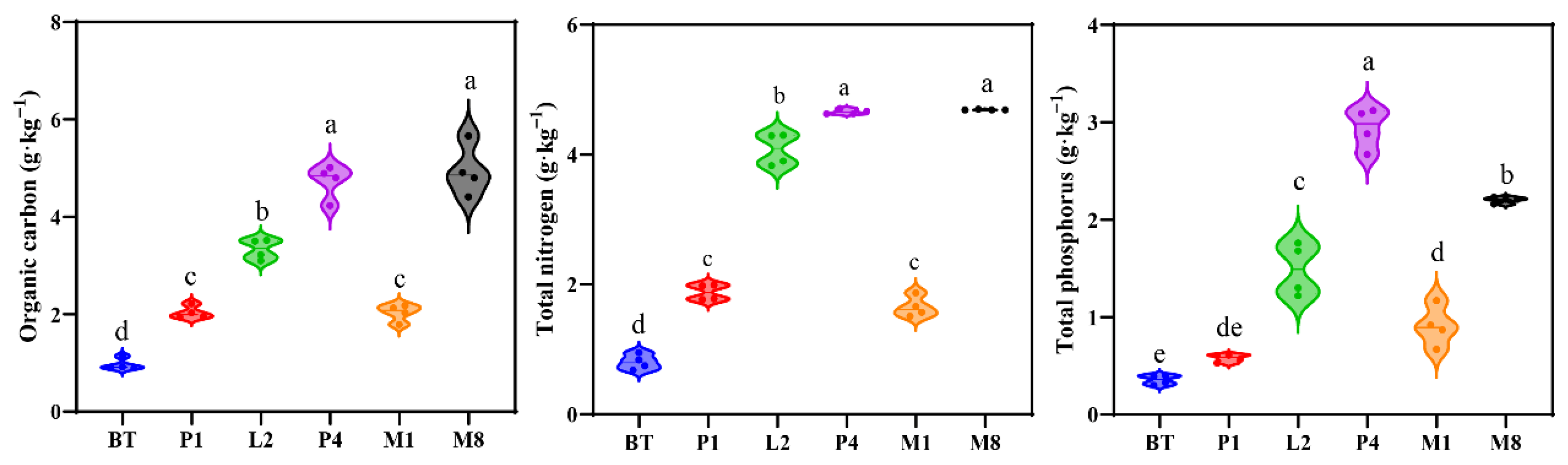
Tailings are extremely low in organic carbon (C), total nitrogen (N) and total phosphorus (P) after mining activity. Unvegetated bare tailings remain extremely low in C (0.97 g/kg), N (0.80 g/kg) and P (0.35 g/kg). Plant colonization significantly increased the C, N and P content in the rhizosphere tailings (p < 0.05, Figure 1), and these increased with colonization time. Specifically, artificially planting M. sinensis for 8 years (M8) increased the C, N and P content of tailings to 4.94, 4.69 and 2.20 g/kg, respectively. Furthermore, compared to the bare tailings (BT), the P content in the rhizosphere tailings of P. massoniana (P4) increased by 7.30 times, and the N content of L. bicolor (L2) increased by 4.08 times. Only one year of colonization with M. sinensis (artificial planting, M1) and P. villosa (spontaneous colonization, P1) increased the C content in the tailings by 110%, and the N content by 106% and 134%, respectively. In addition, plant colonization increased the cation exchange capacity and bulk density of tailings (Table S1). Pioneer plants, especially spontaneously colonizing plants (L2 and P4), significantly decreased the concentrations of heavy metals.

3.2. Responses of Tailings Microbial Community to Revegetation

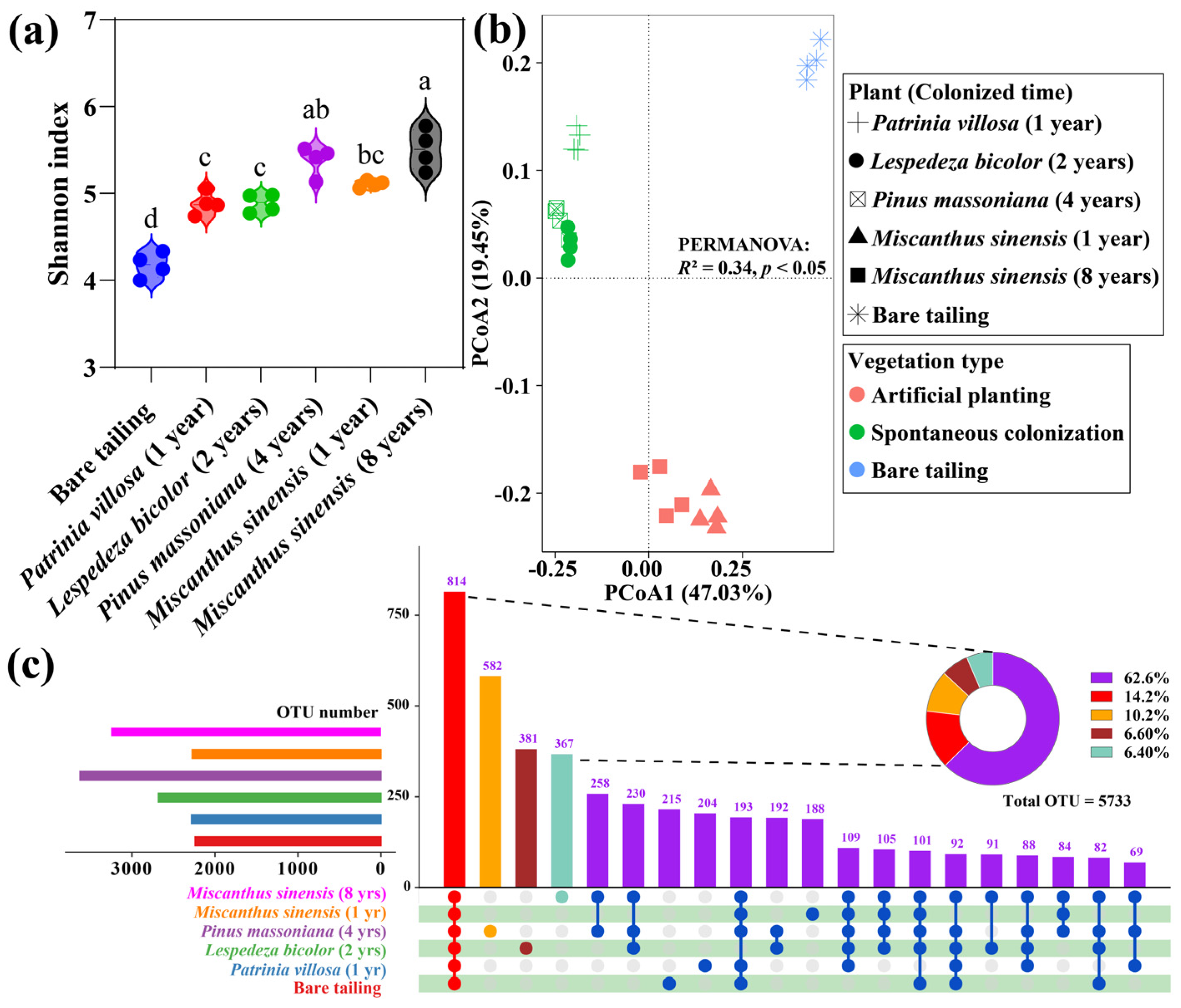
The microbial diversity and community structures of tailings were significantly altered by revegetation. Specifically, the Shannon diversity index for microorganisms in tailings under pioneer species exhibited a significant increase compared to bare tailings, with the highest index value recorded in M8 (Figure 2a, p < 0.05). After revegetation, the abundance of tailing fungi increased and that of bacteria decreased (Figure S2). In addition, plant species changed the tailings’ microbial community’s composition, as shown in the PCoA and PERMANOVA results (Figure 2b). M1 and M8 are similar in composition; P1, L2 and P4 are similar; and BT is independent. The dominant phyla in all the tailings were Actinomycetota (2.32–15.3%) and Pscudomonadota (40.8–66.0%) (Figure S3). The relative abundances of Actinomycetota exhibited an increasing trend, while those of Pseudomonadota demonstrated a decreasing trend when compared with bare tailings across all the pioneer plant species evaluated. Further analysis at the genus level showed that revegetation significantly increased the relative abundance of Cupriavidus but decreased the relative abundance of Sulfuricaulis and Xanthomonas (Figure S4). In addition, 367, 381 and 582 specific species were, respectively, discovered in M8, L2 and P4, representing 6.40%, 6.65% and 10.2% of the total species found in the tailings (Figure 2c). One year after revegetation (M1 and P1), there were relatively few specific species in the tailings. These findings indicate that the pioneer plants changed the tailings’ microbial community’s composition and structure, in a manner dependent on the plant species and colonization time. Furthermore, certain microorganisms involved in C-, N- and P-cycling were significantly enriched in the rhizospheres of different plant species. For instance, the abundance of Lysobacter (N cycle) in sample P4 rose from 0.006% in BT to 1.759%, Rhizobium (N cycle) in L2 increased from 0.006% to 0.504%, Bradyrhizobium (N and P cycles) in P4 increased from 0.771% to 3.070%, Sphingobium (C cycle) in M8 surged from 0.148% to 1.293%, and Cupriavidus (C cycle) in rhizosphere tailings jumped from 0.665% to a range of 5.122–15.68% (Figure S4).

3.3. Abundance of Functional Genes Involved in Tailings Carbon, Nitrogen and Phosphorus Cycles

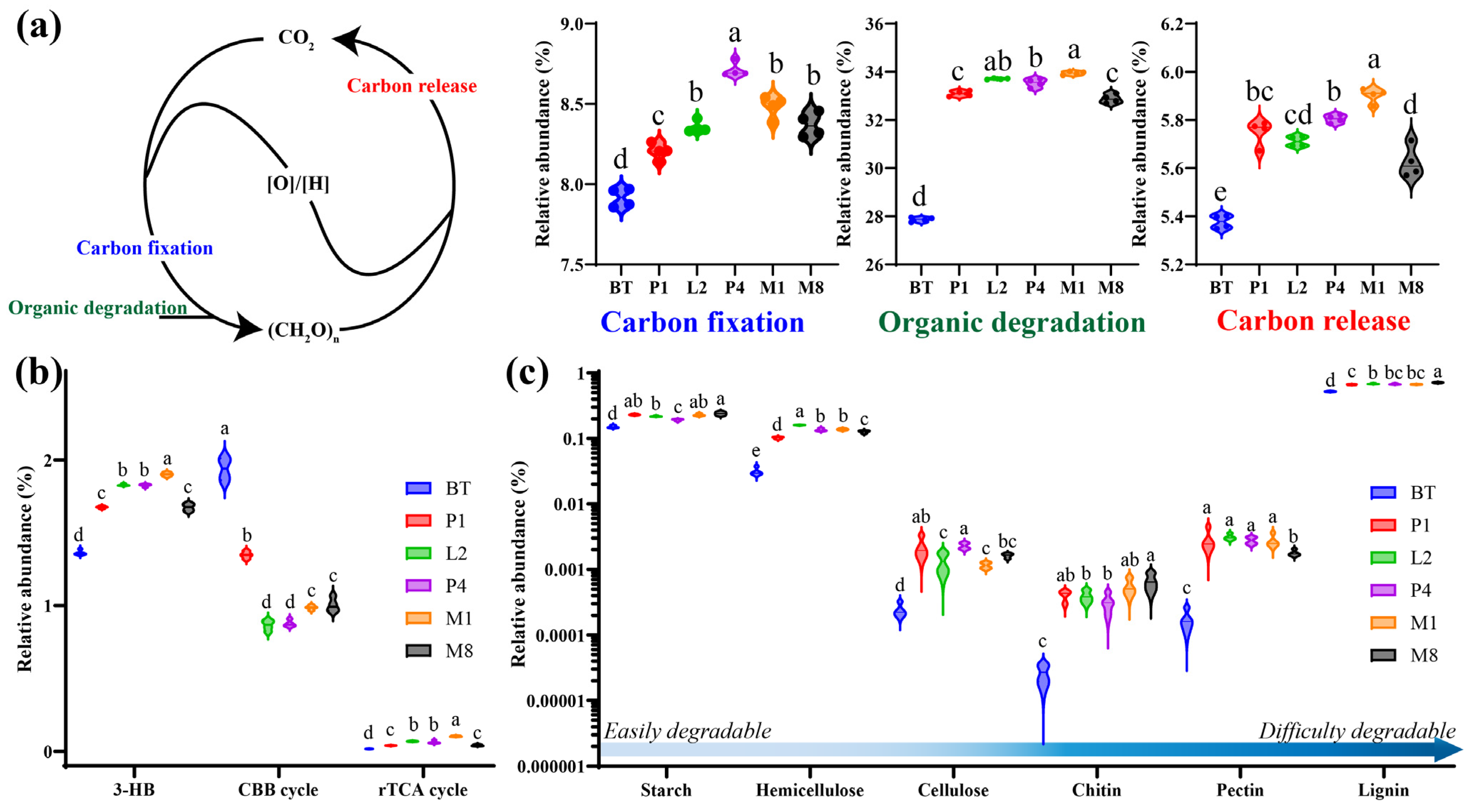
Microorganisms mediate important material cycling and functional recovery in tailings. In this study, revegetation substantially changed the tailings’ microbial C-, N- and P-cycling functional genes (Figure S5). The functional genes related to microbial C cycling in tailings are primarily composed of three pathways: organic degradation (with relative abundance ranging from 27.87% to 33.95%), C fixation (7.915% to 8.712%) and C release (5.377% to 5.902%) (Figure 3a). In this study, the abundance of C fixation, organic degradation and C release genes in tailings significantly increased after revegetation (p < 0.05). Among these, the abundance of C fixation genes in P4 was the highest, increasing by 10.07% compared to the bare tailings (BT). The abundance of organic degradation and C release genes in M1 reached 33.95% and 5.902%, respectively, representing increases of 21.81% and 9.751% compared to BT. Notably, in naturally colonized species (P1, L2 and P4), the abundance of genes involved in C fixation, organic degradation and C release increased with the duration of revegetation. Moreover, the relative abundance of organic degradation and C release genes in M1 was significantly higher than that in M8. Additionally, the microbial C fixation in tailings involves three pathways: 3-HB (with relative abundance ranging from 1.362% to 1.901%), CBB cycle (0.8639% to 1.937%), and rTCA (0.01670% to 0.1047%) (Figure 3b). Compared to BT, the relative abundance of 3-HB and rTCA in rhizosphere tailings significantly increased, while the CBB cycle significantly decreased. In tailings, the functional genes related to the degradation of easily degradable organic compounds such as starch (relative abundance ranging from 0.1509% to 0.2398%) and hemicellulose (0.03118% to 0.1458%), as well as recalcitrant lignin (0.5220% to 0.7113%), exhibited higher abundance (Figure 3c). After revegetation, the abundance of functional genes related to the degradation of various organic compounds significantly increased.
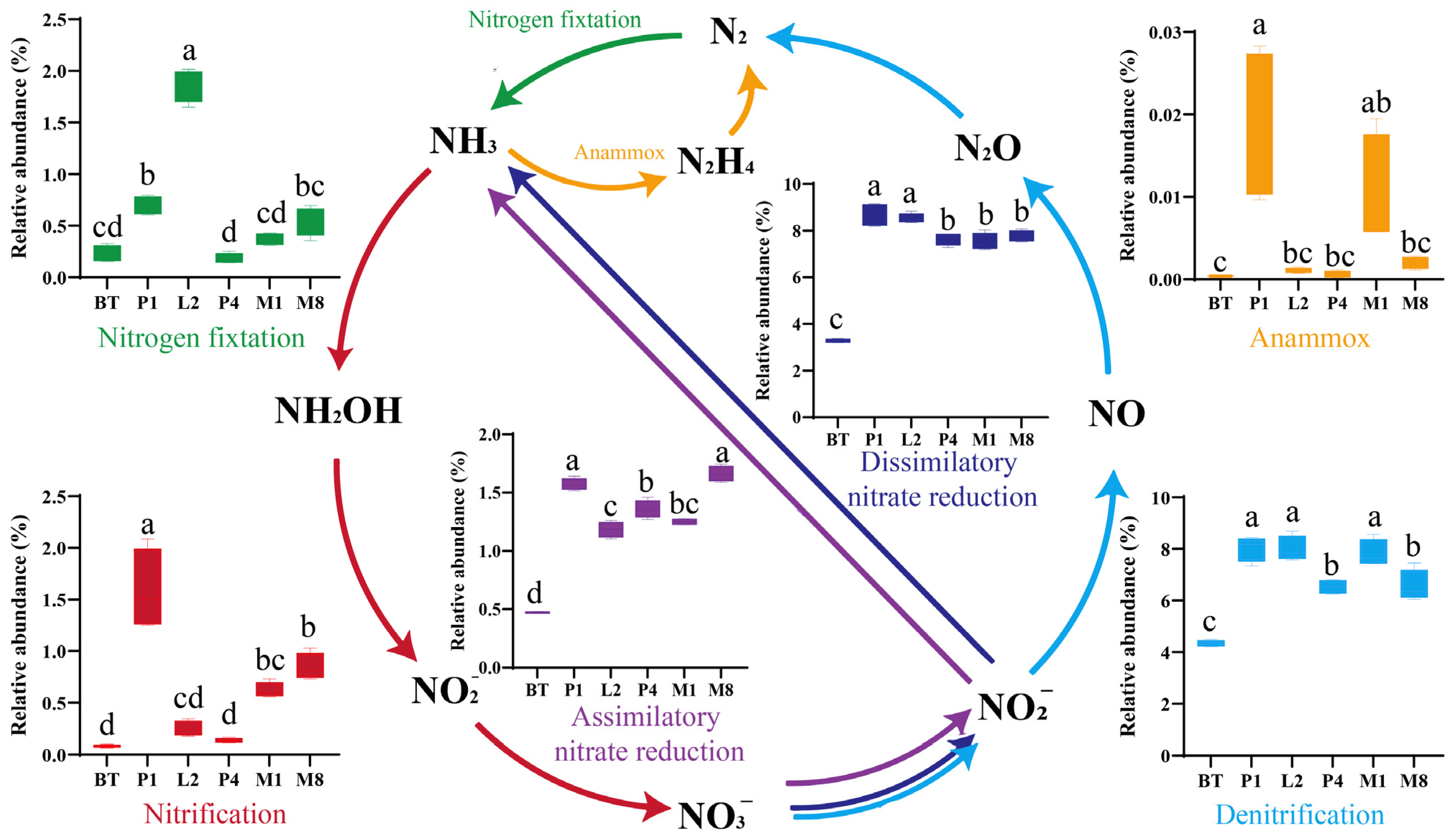
The functional genes associated with microbial N cycling in tailings primarily encompass six pathways: N fixation, anammox, nitrification, denitrification, assimilatory nitrate reduction and dissimilatory nitrate reduction (Figure 4). Our study found that revegetation significantly enhanced the abundance of genes related to nitrate reduction and denitrification pathways in tailings (p < 0.05), while the nitrification, N fixation and anammox increased under specific plant colonization, not linearly with the increase in colonization time. The abundance of assimilatory and dissimilatory nitrate reduction genes also showed varying degrees of increase compared to BT in spontaneously colonizing plants (P1, L2 and P4). Notably, the abundance of N fixation genes in L2 was the highest, being 7.23 times that of BT. In M8, the abundance of nitrification and denitrification genes reached 0.8446% and 6.556%, respectively, which are increases of 928.8% and 33.89% compared to BT. P1 and M1 exhibited higher abundances of genes related to anammox and nitrification, while the abundance of N fixation genes was lower.
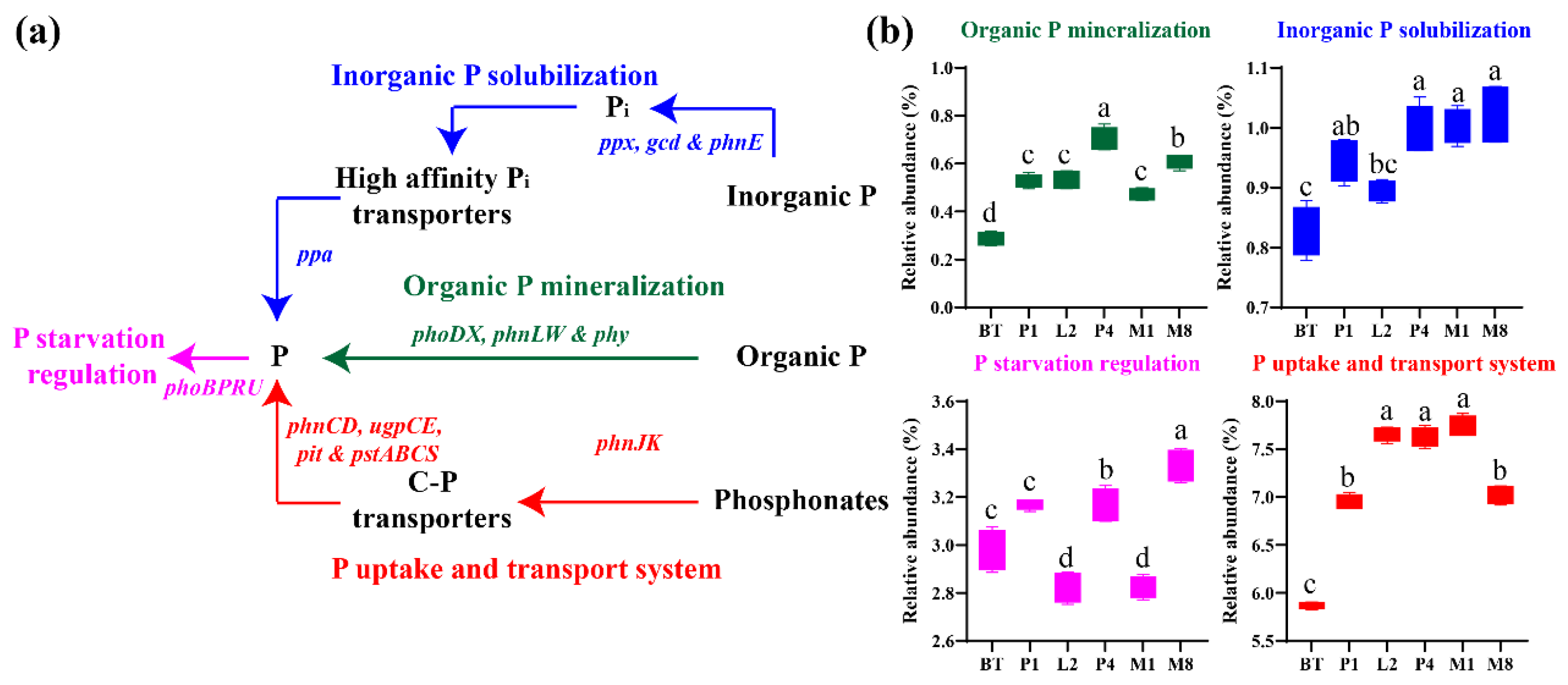
The functional genes associated with microbial P cycling in tailings mainly include four pathways: organic P mineralization, inorganic P solubilization, P starvation regulation, and P uptake and transport systems (Figure 5a). The abundance of P starvation regulation and P uptake and transport systems is higher in tailings, ranging from 2.82% to 3.33% and 5.87% to 7.73%, respectively (Figure 5b). Revegetation significantly increased the abundance of the P uptake and transport systems. P mineralization and inorganic P solubilization gradually increased with plant colonization time. Among them, P4 and M8 had higher abundances of genes related to P starvation regulation and inorganic P solubilization. In M8, the inorganic P solubilization and P starvation regulation reached 1.022% and 3.330%, respectively, which are increases of 19.1% and 10.6% compared to BT. The organic P mineralization genes in P4 were the highest, being 2.45 times those of BT.

3.4. Co-Occurrence Networks of Microbial C-, N- and P-Cycling Genes in Tailings

To construct a quantitative index of the degree of microecosystem functional coupling of the C-, N- and P-cycles within tailings, we constructed co-occurrence networks of related genes (Figure 6a). Based on the topological properties of the co-occurrence network, the rhizosphere tailings (R) networks demonstrated a greater graph density and average degree compared to the BT. Although there was no significant difference in the total number of nodes between the BT and R networks, the number of links in the R networks increased to 2.20 times that of BT. The Zi-Pi plot confirmed the unique topological roles played by different genes within the networks (Figure 6b). There were many key genes within R networks, including nuoI, fdaA, sdhB, ttuC, nuoK, nuoA and sucC as key genes in the C-cycling genes; narY, nrfA, norB and nasB in the N-cycling genes; and pstA and phnW in the P-cycling genes. Notably, pstB in the P cycle acted as a module hub uniquely, while the others served as connectors (Figure 6b). A further correlation network showed that nrfA, phnW and sucC, among the key genes, have strong correlations with the physicochemical properties of the tailings, such as available phosphorus (AP), P, available nitrogen (AN) and pH (Figure 6c).
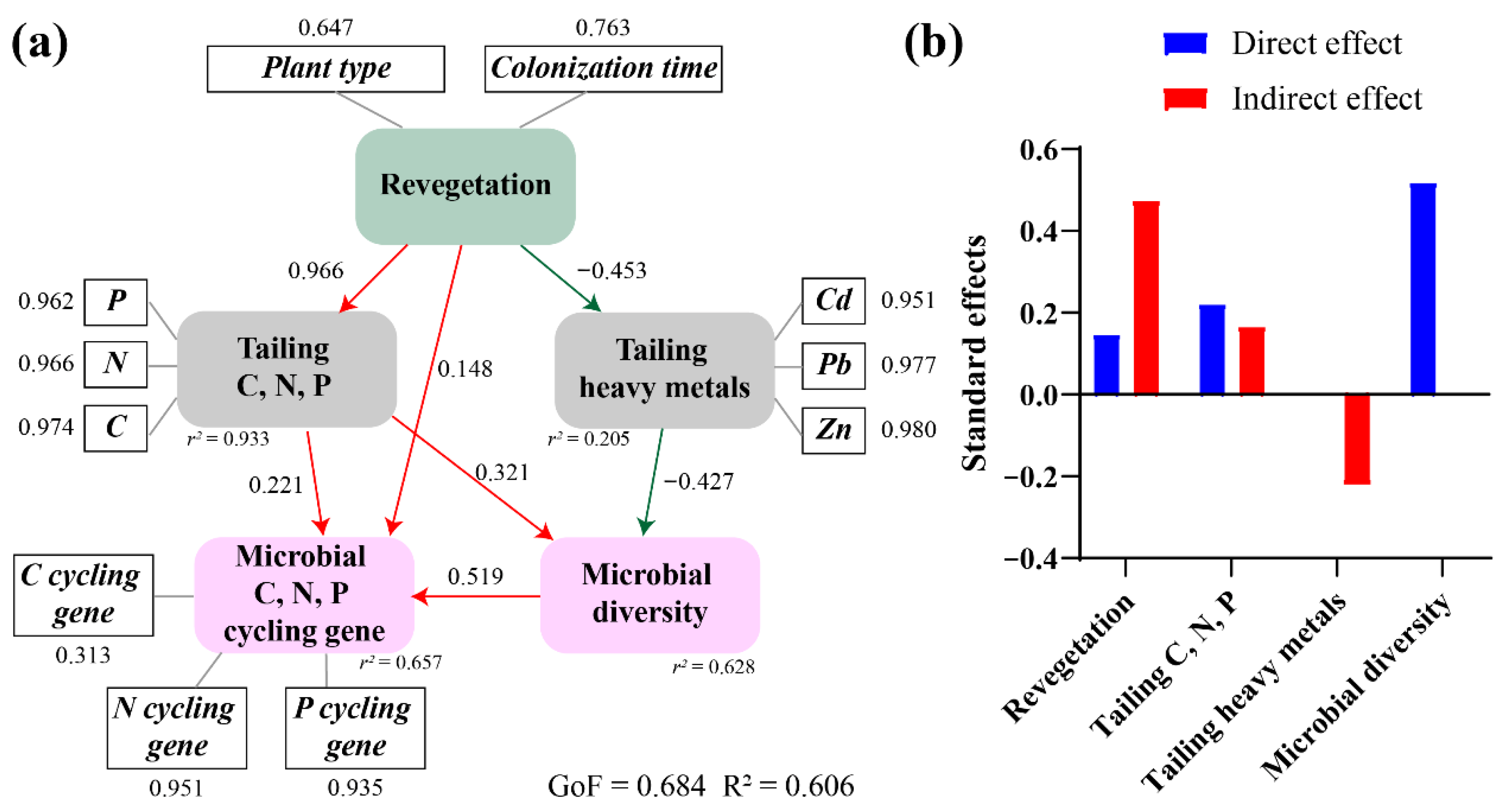
The PLS-PM was used to explore the multiple direct and indirect relationships among revegetation; the C, N, P and heavy metal content of tailings; microbial diversity; and C-, N- and P-cycling genes (Figure 7a). The PLS-PM indicated that revegetation is influenced by plant type and colonization time, and the path coefficients are 0.647 and 0.763, respectively. Revegetation; microbial diversity; and the C, N and P content of tailings had positive effects on microbial C-, N- and P-cycling genes, but the heavy metal content of tailings had negative effects (Figure 7b). Among them, the direct and indirect effects of revegetation on the C-, N- and P-cycling genes were 0.148 and 0.475, respectively. The direct effect of microbial diversity on C-, N- and P-cycling genes was 0.519.

4. Discussion

4.1. Revegetation Increased the Contents of C, N and P and Was Affected by Plant Types and Colonization Time

Because mining activities lead to extremely low C, N and P contents in tailings, without supplementation from biological sources (plants and microorganisms), it is difficult to increase the C, N and P contents in tailings [4,17]. In this study, the contents of C, N and P in the unvegetated bare tailings were extremely low (Figure 1), even lower than those in the tailings of 2018 [7]. The loss of C, N and P in bare tailings can be attributed to their extremely low cation exchange capacity (Table S1) as well as the lack of humus and organic matter [19]. Plant colonization significantly increased the content of C, N and P in tailings, regardless of whether it was artificial planting or spontaneous colonization, and the C, N and P contents showed an increasing trend with an increase in colonization time. As the colonization time extends, the root system continuously develops, the microbial community constantly evolves and enriches (Figure 2a), the rhizosphere effect continues to strengthen, and tailings fertility can be gradually and stably formed [30]. Although the C content in tailings remains significantly lower than that of the surrounding soils even after revegetation [31], both P. massoniana (colonized for 4 years) and M. sinensis (colonized for 8 years) greatly increased the N and P contents in the tailings, which were comparable to those in the soil. The differentiated restoration of C, N and P reveals the phased nature of ecological restoration: the ecosystem prioritizes addressing the bottlenecks most critical to survival (such as N and P scarcity), while the development of complex and stable C pools requires a considerably longer evolutionary timeframe. In addition, Wang et al. [32] demonstrated that a majority of newly fixed carbon is preferentially allocated to sustain microbial activity and metabolism in tailings, rather than contributing to the formation of a stable carbon pool.
Different plants have different accumulation capabilities for C, N and P in tailings (Figure 1). Firstly, this can be attributed to the intrinsic physiological characteristics of the plants themselves. For instance, the Fabaceae species L. bicolor possesses a natural advantage in N fixation through root nodules [33], and P. massoniana enhances phosphorus acquisition by secreting acid phosphatase and increasing leaf P resorption efficiency [34]. Secondly, the rhizosphere microbial community exhibited significant differences among the various plant species (Figure 2b). Plants selectively promote the growth and reproduction of specific microorganisms through their inherent traits [19]. In this study, compared to M. sinensis, L. bicolor and P. massoniana induced a greater increase in the abundance of microorganisms involved in N or P cycling (Figure S4). Furthermore, PLS-PM indicated that revegetation positively affected C, N and P in tailings, which were regulated by plant type and colonization time (Figure 7). Notably, path coefficients (colonization time: 0.763 > plant type: 0.647) indicate that the duration of colonization contributes more significantly to the increase in C, N and P contents in tailings than the differences in selected plant species. This implies that, over time, ecological succession guided by distinct plant species may lead to a “convergence effect”—where the restoration of ecosystem functions largely depends on a sufficiently long recovery period, allowing diverse biological processes to fully unfold [35,36]. In tailings pond ecological restoration projects, beyond the rational selection and allocation of plant species, it is imperative to implement long-term maintenance and monitoring plans, patiently fostering the ecosystem’s inherent capacity for self-recovery and functional development.

4.2. Revegetation Significantly Enriches Tailings Microbial C-, N- and P-Cycling Genes and Promotes Their Coupling

In this study, revegetation substantially modulated microbial functional genes involved in C, N and P cycling in tailings (Figure S5). Although both increases and decreases in gene abundance were observed, the majority of these genes showed increased abundance. The C-cycling genes in tailings are mainly involved in organic degradation, followed by C fixation. Plants input a large amount of organic matter into the originally barren tailings through root secretions and litter after revegetation [37]. In order to utilize these new “foods” as C sources, the microbial community must up-regulate the expression of genes related to the decomposition of these organic matters (such as starch, cellulose and lignin), thereby leading to a significant increase in the abundance of organic degradation genes (Figure 3a). Generally, in polluted and barren mining environments, microorganisms preferentially utilize anaerobic or microaerobic pathways characterized by low ATP consumption and high C fixation efficiency, such as WL and rTCA, followed by the CBB cycle with high ATP consumption [38,39]. However, in this study, the C fixation of bare tailings was mainly based on the 3-HB cycle and the CBB cycle, followed by rTCA (Figure 3b). Although rTCA is theoretically the most energy-efficient C fixation pathway, it imposes stringent demands on strictly anaerobic or highly stable microaerobic conditions [40]. The tailings environment, characterized by loose particles and large pores (Table S1), experiences relatively rapid wet–dry alternation, leading to frequently unstable redox conditions. This instability is unfavorable for the vigorous growth and sustained activity of rTCA cycle-dependent microorganisms, resulting in their relatively low gene abundance. The high energy consumption of the CBB cycle is a huge energy burden in tailings, and revegetation optimizes the C fixation pathway. Revegetation significantly reduced the CBB cycle and increased the 3-HB cycle. The 3-HB cycle consumes less energy compared to the CBB cycle [38]. In addition, the respiration of plant roots and the decomposition of organic matter by microorganisms consume oxygen, creating a rich microaerobic environment in the rhizosphere, which precisely provides an ideal venue for the activities of 3-HB cycle microorganisms.
Six N-cycling pathways in tailings exhibited differentiated enrichment patterns upon revegetation. Regardless of the plant species that colonized the tailings, the abundance of genes associated with assimilatory nitrate reduction (which generates ammonium for the synthesis of cellular components like amino acids and proteins) and dissimilatory nitrate reduction (which produces energy to sustain microbial activity) were significantly increased (Figure 4) [40]. In contrast, nitrification, anammox and N fixation showed increased abundance only under specific plant colonization conditions. The development of microbial communities in the rhizosphere tailings requires both cellular components and energy [41]. The universal enhancement of the former two pathways underscores their role as fundamental microbial life-support strategies in the newly established rhizosphere environment. This pattern aligns with the concept that early successional microbial communities prioritize securing basic biosynthetic building blocks and energy sources [42]. The constraints on nitrification and nitrogen fixation arise from initial tailings conditions: the substrate for nitrification (ammonium nitrogen) is extremely scarce in tailings, at only 0.23 mg/kg (Table S1), while N fixation is highly energy-intensive [43]. However, different plants employ unique physiological and ecological strategies to recruit specific functional microorganisms [44]. In the study, two-year colonization by L. bicolor increased the abundance of N fixation genes 7.23-fold through a symbiotic system with Rhizobium and Bradyrhizobium (Figure 4 and Figures S4).
Among the four tailings P-cycling pathways, the abundance of P starvation regulation and P uptake and transport systems was high (Figure 5b), reflecting microbial adaptive strategies to maintain P nutrition under low-P conditions (0.35 g/kg). Revegetation further intensified this process, with a significant increase in the abundance of genes involved in P uptake and transport, indicating that plant colonization effectively enhanced the microbial capacity for P acquisition [45]. Notably, in revegetation, pstB functioned as an independent module hub within the co-occurrence network of genes (Figure 6b). The pstB protein hydrolyzes ATP to release energy, which is transferred to transmembrane channel proteins, ultimately facilitating phosphate translocation into the cell [46]. The key gene phnW—governing C-P bond cleavage and the mineralization of recalcitrant organic P—exhibited strong correlations with physicochemical properties such as C, AN and pH (Figure 6c) [47]. Additionally, Peng et al. [48] showed that the phnW gene is highly correlated with synergistic changes in C and N content. These results demonstrate that revegetation shifts microbial P-cycling strategies from passive P acquisition to a synergistic model coupled with N and C cycles [10]. Furthermore, compared to bare tailings, revegetation transformed the C-, N- and P-cycling gene network from several independent modules into an integrated one, and significantly increased the average degree and links (Figure 6a). This demonstrates a substantial enhancement in the complexity and tightness of potential functional association among microbial groups driving the C-, N- and P-cycling pathways. Revegetation does not simply increase the abundance of C-, N- and P-cycling genes in parallel. Rather, through a complex co-occurrence pattern within the plant–tailings–microbial system, it fundamentally reorganizes the functional linkages among microbial communities. It is important to note that these correlations suggest potential ecological linkages or shared environmental responses among microbial taxa harboring these genes, and do not imply direct biochemical interactions or causal relationships. Within this system, plants act as the initial drivers by supplying resources and habitats; microorganisms serve as the core executors, enabling material transformation through the coupled expression of C-, N- and P-cycling genes, and coupling constitutes the key mechanism ensuring efficient nutrient flux and stable system development. Our research results have functionally highlighted the positive impact of “revegetation on the functional coupling of C, N and P cycles”, and future studies should be supplemented by measuring process rates (such as through isotope tracing or absolute gene quantification) to confirm the actual biogeochemical functions achieved.

5. Conclusions

The findings of this study demonstrate that revegetation significantly enhances the diversity of microbial communities and the abundance of functional genes associated with C, N and P cycling in tailings. Meanwhile, the study results also emphasize the importance of plant type and colonization time in shaping the microbial community and promoting C, N and P cycling. Revegetation not only increases the abundance of functional genes but also strengthens the coupling between C, N and P cycles, which is crucial for ecosystem recovery. These outcomes provide valuable insights for guiding revegetation projects in mining areas and highlight the potential of using vegetation to restore ecosystem functions in degraded environments. Based on the analysis of published papers, the research gaps that require further exploration are as follows: (1) Future research on C, N and P cycling during revegetation should prioritize elucidating the differentiated impacts of plant functional types and temporal dimensions, supported by gene quantitative analyses. (2) The coupling processes of C, N and P on tailings particle surfaces during ecological restoration should be explored.

Supplementary Materials

The following supporting information can be downloaded at: https://www.mdpi.com/article/10.3390/su18041811/s1, Figure S1: The location of the test site in China (a) and photos of the plants on the site (b)–(f); Figure S2: The relative abundance of microorganisms in bare and rhizosphere tailings at the kingdom level; Figure S3: The relative abundance of microorganisms in bare and rhizosphere tailings under different species of pioneer plants at the phylum level (Top 30); Figure S4: The relative abundance of microorganisms in bare and rhizosphere tailings under different species of pioneer plants at the genus level (Top 40); Figure S5: Heat map of the abundance of functional genes involved in the carbon (a), nitrogen (b), and phosphorus (c) cycles in lead-zinc tailings. Microbial genes that were significantly changed compared to bare tailings were labelled using plus and minus signs (+, increased; −, decreased. p < 0.05, LSD); Table S1: Basic physicochemical properties of Pb-Zn mine tailings; Table S2: Sampling design and grouping structure of the experimental samples; Table S3: Quality control for DNA extraction of tailings samples title.

Author Contributions

Conceptualization, X.J. and X.Z.; methodology, L.T.; software, S.Z.; validation, S.Z., L.T. and Y.Y.; formal analysis, S.Z. and L.T.; investigation, X.L.; resources, M.L.; data curation, S.Z. and Y.Y.; writing—original draft preparation, S.Z.; writing—review and editing, X.J.; visualization, S.Z. and Y.Y.; supervision, H.Q.; project administration, X.L.; funding acquisition, J.L., X.Z. and X.J. All authors have read and agreed to the published version of the manuscript.

Funding

This research was funded by the Natural Science Foundation of China (52230006, 32271700), the Project for Enhancing Young and Middle-aged Teacher’s Research Basis Ability in Colleges of Guangxi (2025KY0295) and the Guangxi Science and Technology Program (Guike AD25069074).

Data Availability Statement

The data presented in this study are available on request from the corresponding author.

Conflicts of Interest

The authors declare no conflicts of interest.

References

  1. Zhang, H.; Yu, H.; Sun, W.; Lin, S.; Zhang, C. Beneficiation of silver and silver-bearing lead-zinc ores: A review. Miner. Eng. 2024, 208, 108608. [Google Scholar] [CrossRef]
  2. Chen, T.; Wen, X.; Zhou, J.; Lu, Z.; Li, X.; Yan, B. A critical review on the migration and transformation processes of heavy metal contamination in lead-zinc tailings of China. Environ. Pollut. 2023, 338, 122667. [Google Scholar] [CrossRef]
  3. Su, C.; Rana, N.M.; Zhang, S.; Wang, B. Environmental pollution and human health risk due to tailings storage facilities in China. Sci. Total Environ. 2024, 928, 172437. [Google Scholar] [CrossRef]
  4. Rouhani, A.; Gutierrez, M.; Newton, R.A.; Al Souki, K.S. An overview of potentially toxic element pollution in soil around lead-zinc mining areas. Environ. Rev. 2025, 33, 1–16. [Google Scholar] [CrossRef]
  5. French, A.D.; Conway, W.C.; Canas-Carrell, J.E.; Klein, D.M. Exposure, Effects and Absorption of Lead in American Woodcock (Scolopax minor): A Review. Bull. Environ. Contam. Toxicol. 2017, 99, 287–296. [Google Scholar] [CrossRef]
  6. Liu, C.; Li, B.; Chen, X.; Dong, Y.; Lin, H. Insight into soilless revegetation of oligotrophic and heavy metal contaminated gold tailing pond by metagenomic analysis. J. Hazard. Mater. 2022, 435, 128881. [Google Scholar] [CrossRef] [PubMed]
  7. Jiang, X.; Guo, Y.; Li, H.; Li, X.; Liu, J. Ecological evolution during the three-year restoration using rhizosphere soil cover method at a Lead-Zinc tailing pond in Karst areas. Sci. Total Environ. 2022, 853, 158291. [Google Scholar] [CrossRef] [PubMed]
  8. Luo, Y.; Zheng, Z.; Wu, P.; Wu, Y. Effect of different direct revegetation strategies on the mobility of heavy metals in artificial zinc smelting waste slag: Implications for phytoremediation. Chemosphere 2022, 286, 131678. [Google Scholar] [CrossRef]
  9. Liang, M.; Wu, Y.; Jiang, Y.; Zhao, Z.; Yang, J.; Liu, G.; Xue, S. Microbial functional genes play crucial roles in enhancing soil nutrient availability of halophyte rhizospheres in salinized grasslands. Sci. Total Environ. 2025, 958, 178160. [Google Scholar] [CrossRef]
  10. Su, H.; Lai, H.; Gao, F.; Zhang, R.; Wu, S.; Ge, F.; Li, Y.; Yao, H. The proliferation of beneficial bacteria influences the soil C, N, and P cycling in the soybean-maize intercropping system. Environ. Sci. Pollut. Res. 2024, 31, 25688–25705. [Google Scholar] [CrossRef]
  11. Xiao, J.; Dong, S.; Shen, H.; Li, S.; Wessell, K.; Liu, S.; Li, W.; Zhi, Y.; Mu, Z.; Li, H. N Addition Overwhelmed the Effects of P Addition on the Soil C, N, and P Cycling Genes in Alpine Meadow of the Qinghai-Tibetan Plateau. Front. Plant Sci. 2022, 13, 860590. [Google Scholar] [CrossRef] [PubMed]
  12. Yang, Z.; He, G.; Yang, Q.; Zhang, D.; Zhang, Y.; Wen, S.; Yang, X.; Yang, L.; Ji, L. Nitrogen enrichment stimulates nutrient cycling genes of rhizosphere soil bacteria in the Phoebe bournei young plantations. J. Environ. Manag. 2024, 371, 123101. [Google Scholar] [CrossRef]
  13. Wu, Y.; Sun, Z.; Liu, R.; Cai, B. Funneliformis mosseae Enhances the Function of C, N and P Cycling Bacteria in Continuous Soybean Rhizosphere Soil. J. Soil Sci. Plant Nutr. 2024, 24, 8263–8279. [Google Scholar] [CrossRef]
  14. Lv, H.; Yang, J.; Su, S.; Liu, Y.; Feng, J.; Sheng, Y.; Wang, T.; Pan, J.; Tang, L.; Chen, L.; et al. Distribution of Genes and Microbial Taxa Related to Soil Phosphorus Cycling across Soil Depths in Subtropical Forests. Forests 2023, 14, 1665. [Google Scholar] [CrossRef]
  15. Zhou, W.-H.; Wang, Y.-T.; Lian, Z.-H.; Yang, T.-T.; Zeng, Q.-W.; Feng, S.-W.; Fang, Z.; Shu, W.-S.; Huang, L.-N.; Ye, Z.-H.; et al. Revegetation approach and plant identity unequally affect structure, ecological network and function of soil microbial community in a highly acidified mine tailings pond. Sci. Total Environ. 2020, 744, 140793. [Google Scholar] [CrossRef]
  16. Shen, H.; Huang, Y.; Lin, X.; Dai, Z.; Zhao, H.; Su, W.-Q.; Dahlgren, R.A.; Xu, J. Recoupling of Soil Carbon, Nitrogen, and Phosphorus Cycles along a 30 Year Fire Chronosequence in Boreal Forests of China. Environ. Sci. Technol. 2025, 59, 4432–4443. [Google Scholar] [CrossRef]
  17. Gao, Y.; Liu, S.; Liu, Y.; Zhang, H.; Li, J. Influences of revegetation type and age on soil C-, N- and P- cycling genes in opencast mining areas on the Loess Plateau. Appl. Soil Ecol. 2024, 203, 105649. [Google Scholar] [CrossRef]
  18. Zhu, X.; Lan, J.; Huang, F.; Wang, D.; Dai, L.; Chen, C.; Xiang, L.; Wu, W. Multidimensional Effects of Revegetation on Antimony Mine Waste Slag: From Geochemical Responses to Ecological Risk Regulation. Appl. Sci. 2025, 15, 7587. [Google Scholar] [CrossRef]
  19. Li, W.; He, E.; Van Gestel, C.A.M.; Peijnenburg, W.J.G.M.; Chen, G.; Liu, X.; Zhu, D.; Qiu, H. Pioneer plants enhance soil multifunctionality by reshaping underground multitrophic community during natural succession of an abandoned rare earth mine tailing. J. Hazard. Mater. 2024, 472, 134450. [Google Scholar] [CrossRef]
  20. Iskandar, I.; Suryaningtyas, D.T.; Baskoro, D.P.T.; Budi, S.W.; Gozali, I.; Suryanto, A.; Kirmi, H.; Dultz, S. Revegetation as a driver of chemical and physical soil property changes in a post-mining landscape of East Kalimantan: A chronosequence study. Catena 2022, 215, 106355. [Google Scholar] [CrossRef]
  21. Jiang, X.; Lin, M.; Zhang, X.; Yu, G.; Jiang, P.; Liu, J. Pioneer plants promote soil formation in a mixture of bauxite tailings and red mud. J. Environ. Manag. 2024, 370, 122590. [Google Scholar] [CrossRef]
  22. Jiang, X.S.; Zhang, X.H.; Liu, X.J.; Qiu, H.; Lin, M.T.; Yu, G.; Zhang, S.H.; Liu, J. Ecological disposal of bauxite tailings and red mud: A sustainable strategy for bauxite industrial waste reuse. Resour. Conserv. Recycl. 2025, 218, 108259. [Google Scholar] [CrossRef]
  23. Bao, S.D. Agriculture and Chemistry Analysis of Soil; China Agriculture Press: Beijing, China, 2000. [Google Scholar]
  24. Gao, H.; Guo, Z.; Xu, R.; He, X.; Fernio, J.U.; Li, S.; Liu, X.; Liu, H.; Xue, W. Chemolithoautotrophic Antimonite Oxidation Coupled Nitrogen Fixation in the Rhizosphere of Local Plant in Antimony Tailing Area. Environ. Sci. Technol. 2025, 59, 12703–12716. [Google Scholar] [CrossRef]
  25. Brum, J.R.; Ignacio-Espinoza, J.C.; Roux, S.; Doulcier, G.; Acinas, S.G.; Alberti, A.; Chaffron, S.; Cruaud, C.; de Vargas, C.; Gasol, J.M.; et al. Patterns and ecological drivers of ocean viral communities. Science 2015, 348, 1261498. [Google Scholar] [CrossRef] [PubMed]
  26. Franzosa, E.A.; McIver, L.J.; Rahnavard, G.; Thompson, L.R.; Schirmer, M.; Weingart, G.; Lipson, K.S.; Knight, R.; Caporaso, J.G.; Segata, N.; et al. Species-level functional profiling of metagenomes and metatranscriptomes. Nat. Methods 2018, 15, 962–968. [Google Scholar] [CrossRef] [PubMed]
  27. Xue, C.X.; Lin, H.Y.; Zhu, X.Y.; Liu, J.W.; Zhang, Y.H.; Rowley, G.; Todd, J.D.; Li, M.; Zhang, X.H. DiTing: A Pipeline to Infer and Compare Biogeochemical Pathways From Metagenomic and Metatranscriptomic Data. Front. Microbiol. 2021, 12, 698286. [Google Scholar] [CrossRef]
  28. Chen, Z.Q.; Fu, Q.Q.; Wen, Q.X.; Wu, Y.Q.; Bao, H.Y.; Guo, J.B. Microbial community competition rather than high-temperature predominates ARGs elimination in swine manure composting. J. Hazard. Mater. 2022, 423, 127149. [Google Scholar] [CrossRef]
  29. Dan, X.Q.; He, M.Q.; Meng, L.; He, X.X.; Wang, X.G.; Chen, S.D.; Cai, Z.C.; Zhang, J.B.; Zhu, B.; Müller, C. Strong rhizosphere priming effects on N dynamics in soils with higher soil N supply capacity: The ‘Matthew effect’ in plant-soil systems. Soil Biol. Biochem. 2023, 178, 108949. [Google Scholar] [CrossRef]
  30. Li, Q.; Hu, Q.; Zhang, C.; Müller, W.E.G.; Schröder, H.C.; Li, Z.; Zhang, Y.; Liu, C.; Jin, Z. The effect of toxicity of heavy metals contained in tailing sands on the organic carbon metabolic activity of soil microorganisms from different land use types in the karst region. Environ. Earth Sci. 2015, 74, 6747–6756. [Google Scholar] [CrossRef]
  31. Wang, S.; Li, T.; Yuan, X.; Yu, J.; Luan, Z.; Guo, Z.; Yu, Y.; Liu, C.E.; Duan, C. Biotic and abiotic drivers of soil carbon, nitrogen and phosphorus and metal dynamic changes during spontaneous restoration of Pb–Zn mining wastelands. J. Hazard. Mater. 2025, 490, 137818. [Google Scholar] [CrossRef] [PubMed]
  32. Acharya, P.; Ghimire, R.; Idowu, O.J.; Shukla, M.K. Cover cropping enhanced soil aggregation and associated carbon and nitrogen storage in semi-arid silage cropping systems. Catena 2024, 245, 108264. [Google Scholar] [CrossRef]
  33. Tie, L.H.; Peñuelas, J.; Huang, C.; Sardans, J.; Bose, A.K.; Ouyang, S.; Kong, Y.X.; Guo, Y.; Wu, Y.J.; Cheng, W.; et al. Phosphorus limitation of Pinus massoniana reforestation increases with stand development: Evidence from plant, leaf litter, and soil. Plant Soil 2024, 504, 817–832. [Google Scholar] [CrossRef]
  34. Backhaus, L.; Albert, G.; Cuchietti, A.; Nino, L.M.J.; Fahs, N.; Lisner, A.; Kolár, V.; Kermavnar, J.; Widmer, S.; Zimmermann, Z.; et al. Shift from trait convergence to divergence along old-field succession. J. Veg. Sci. 2021, 32, e12986. [Google Scholar] [CrossRef]
  35. Chang, C.C.; Turner, B.L. Ecological succession in a changing world. J. Ecol. 2019, 107, 503–509. [Google Scholar] [CrossRef]
  36. Liao, J.; Dou, Y.; Yang, X.; An, S. Soil microbial community and their functional genes during grassland restoration. J. Environ. Manag. 2023, 325, 116488. [Google Scholar] [CrossRef]
  37. Beaver, R.C.; Neufeld, J.D. Microbial ecology of the deep terrestrial subsurface. ISME J. 2024, 18, wrae091. [Google Scholar] [CrossRef]
  38. Bar-Even, A.; Noor, E.; Milo, R. A survey of carbon fixation pathways through a quantitative lens. J. Exp. Bot. 2012, 63, 2325–2342. [Google Scholar] [CrossRef]
  39. Zhang, X.W.; Paoletti, M.M.; Izon, G.; Fournier, G.P.; Summons, R.E. Late acquisition of the rTCA carbon fixation pathway by Chlorobi. Nat. Ecol. Evol. 2023, 7, 1398–1407. [Google Scholar] [CrossRef] [PubMed]
  40. Deng, D.L.; He, G.; Ding, B.J.; Liu, W.Z.; Yang, Z.J.; Ma, L. Denitrification dominates dissimilatory nitrate reduction across global natural ecosystems. Glob. Change Biol. 2024, 30, e17256. [Google Scholar] [CrossRef]
  41. Sun, X.X.; Kong, T.L.; Huang, D.Y.; Chen, Z.Y.; Zhang, Y.X.; Häggblom, M.M.; Soleimani, M.; Liu, H.Q.; Ren, Y.H.; Wang, Y.Z.; et al. Microbial Sulfur and Arsenic Oxidation Facilitate the Establishment of Biocrusts during Reclamation of Degraded Mine Tailings. Environ. Sci. Technol. 2024, 58, 12441–12453. [Google Scholar] [CrossRef] [PubMed]
  42. Li, Y.B.; Sun, X.X.; Yang, R.; Guo, L.F.; Li, C.B.; Wang, X.Y.; Li, B.Q.; Liu, H.Q.; Wang, Q.; Soleimani, M.; et al. Phototrophic Nitrogen Fixation, a Neglected Biogeochemical Process in Mine Tailings? Environ. Sci. Technol. 2024, 58, 6192–6203. [Google Scholar] [CrossRef] [PubMed]
  43. Wang, J.P.; Zhao, Q.; Zhong, Y.Q.; Ji, S.H.; Chen, G.R.; He, Q.Q.; Wu, Y.H.; Bing, H.J. Biological nitrogen fixation in barren soils of a high-vanadium region: Roles of carbon and vanadium. Soil Biol. Biochem. 2023, 186, 109163. [Google Scholar] [CrossRef]
  44. Qiao, M.J.; Sun, R.B.; Wang, Z.X.; Dumack, K.; Xie, X.G.; Dai, C.C.; Wang, E.R.; Zhou, J.Z.; Sun, B.; Peng, X.H.; et al. Legume rhizodeposition promotes nitrogen fixation by soil microbiota under crop diversification. Nat. Commun. 2024, 15, 2924. [Google Scholar] [CrossRef]
  45. Park, Y.; Solhtalab, M.; Thongsomboon, W.; Aristilde, L. Strategies of organic phosphorus recycling by soil bacteria: Acquisition, metabolism, and regulation. Environ. Microbiol. Rep. 2022, 14, 3–24. [Google Scholar] [CrossRef]
  46. Liu, Y.; Liu, R.; Ghimire, R.; Zhang, N.N.; Zhou, S.; Zhao, F.Z.; Wang, J. Linking soil phosphorus fractions to associated microbial functional profiles under crop rotation on the Loess Plateau of China. Soil Tillage Res. 2023, 233, 105809. [Google Scholar] [CrossRef]
  47. Chen, X.D.; Wang, Y.; Guo, B.; Liu, J.L.; Qiu, G.Y.; Yakov, K.; Li, H. Long-term green manuring increases phosphorus availability in soil by modifying microbial functional genes and enzyme activities. Appl. Soil Ecol. 2025, 213, 106284. [Google Scholar] [CrossRef]
  48. Peng, N.; Wang, Y.; Wu, H.F.; Hao, H.J.; Sailike, A.; Yu, Z.C.; Li, S.C.; Shi, R.H.; Hao, W.F.; Zhang, W. Phosphorus Cycling Dominates Microbial Regulation of Synergistic Carbon, Nitrogen, and Phosphorus Gene Dynamics During Robinia pseudoacacia Restoration on the Loess Plateau. Agronomy 2025, 15, 797. [Google Scholar] [CrossRef]
Figure 1. Carbon, nitrogen and phosphorus content in bare tailings and rhizosphere tailings. Notes: Different letters represent significant differences between averages of different treatment groups (LSD, p < 0.05, n = 4). Notes: BT, bare tailings; P1, Patrinia villosa (1 year); L2, Lespedeza bicolor (2 years); P4, Pinus massoniana (4 years); M1, Miscanthus sinensis (1 year); M8, Miscanthus sinensis (8 years).
Sustainability 18 01811 g001
Figure 2. The microbial diversity index (a), community structure (b) and microbial overlap between bare tailings and rhizosphere tailings (c) with different species of pioneer plants. Notes: Different letters represent significant differences between averages of different treatment groups (LSD, p < 0.05, n = 4).
Sustainability 18 01811 g002
Figure 3. The abundance of functional genes involved in the carbon cycle in bare tailings and rhizosphere tailings. (a) Carbon fixation, organic degradation and carbon release in the carbon cycle; (b) three carbon fixation pathways (3-HB, 3-hydroxypropionate bicycle; CBB cycle, Calvin–Benson–Bassham Cycle; rTCA cycle, reductive tricarboxylic acid cycle); (c) six types of organic degradation. Notes: BT, bare tailings; P1, Patrinia villosa (1 year); L2, Lespedeza bicolor (2 years); P4, Pinus massoniana (4 years); M1, Miscanthus sinensis (1 year); M8, Miscanthus sinensis (8 years). Different letters represent significant differences between averages of different treatment groups (LSD, p < 0.05, n = 4).
Sustainability 18 01811 g003
Figure 4. The abundance of functional genes of the six nitrogen cycle pathways in bare tailings and rhizosphere tailings. Notes: Different letters represent significant differences between averages of different treatment groups (LSD, p < 0.05, n = 4). Notes: BT, bare tailings; P1, Patrinia villosa (1 year); L2, Lespedeza bicolor (2 years); P4, Pinus massoniana (4 years); M1, Miscanthus sinensis (1 year); M8, Miscanthus sinensis (8 years). Error bars represent the standard deviations.
Sustainability 18 01811 g004
Figure 5. The abundance of functional genes involved in the phosphorus cycle in bare tailings and rhizosphere tailings. (a) The genes involved in the phosphorus cycle pathway; (b) four phosphorus-cycling pathways. Notes: Different letters represent significant differences between averages of different treatment groups (LSD, p < 0.05, n = 4). Notes: BT, bare tailings; P1, Patrinia villosa (1 year); L2, Lespedeza bicolor (2 years); P4, Pinus massoniana (4 years); M1, Miscanthus sinensis (1 year); M8, Miscanthus sinensis (8 years). Error bars represent the standard deviations.
Sustainability 18 01811 g005
Figure 6. Co-occurrence networks of microbial C-, N- and P-cycling genes in the tailings. (a) Microbial networks in bare tailings and rhizosphere tailings; (b) Z-P plot showing key genes (i.e., module hubs and connectors) in networks; (c) the correlation network between key genes and physicochemical properties. Notes: Keystone genes were obtained by assigning within-module connectivity (Zi) and among-module connectivity (Pi), and no keystone gene was analyzed in M1. Nodes where Zi > 2.5 or Pi > 0.62 are generally considered keystone genes. Peripherals: Zi < 2.5 and Pi < 0.62, which represent nodes with few links connecting to other nodes within one module; connectors: Zi < 2.5 and Pi ≥ 0.62, which are predominantly connected to the nodes within different modules; module hubs: Zi ≥ 2.5 and Pi < 0.62, which are highly connected to many nodes in their own modules. Organic carbon, C; available nitrogen, AN; available phosphorus, AP; cation exchange capacity, CEC; total nitrogen, N; total phosphorus, P.
Sustainability 18 01811 g006
Figure 7. The relationships among the revegetation (plant type and colonization time), tailings factors (C, N, P and heavy metal content), and microbial community (diversity and C-, N- and P-cycling genes). (a) The partial least squares path modeling; (b) the direct and indirect effects of revegetation; tailings C, N and P; heavy metals; and bacterial diversity on microbial functional genes. Notes: The red and green arrows represent significantly positive and negative effects (p < 0.05), respectively. The figures adjacent to the arrows denote the standard path coefficients, while r2 indicates the variance explained by the model. A higher path coefficient indicates a stronger direct effect of one latent variable on another [29].
Sustainability 18 01811 g007
Disclaimer/Publisher’s Note: The statements, opinions and data contained in all publications are solely those of the individual author(s) and contributor(s) and not of MDPI and/or the editor(s). MDPI and/or the editor(s) disclaim responsibility for any injury to people or property resulting from any ideas, methods, instructions or products referred to in the content.