Article

Immobilization of Cadmium in Soil by the Addition of Humic Acid-Modified Montmorillonite, Sepiolite, and Albite


Environment Research Institute, Shandong University, Qingdao 266237, China
*
Author to whom correspondence should be addressed.
Sustainability 2026, 18(4), 1760; https://doi.org/10.3390/su18041760
Submission received: 8 January 2026 / Revised: 26 January 2026 / Accepted: 3 February 2026 / Published: 9 February 2026

Abstract

To support secure and sustainable agricultural production, immobilization agents were developed in this study. Montmorillonite (Mont), sepiolite (Sep), and albite (Alb) were modified with humic acid (HA) to remediate cadmium (Cd-contaminated soil. Characterization analysis showed HA-Mont, HA-Sep, and HA-Alb had greater pore diameter than the unmodified forms which may favor the immobilization of Cd. During the short-time incubation (15 days) experiment, the immobilization efficiencies of HA-Mont, HA-Sep, and HA-Alb at a 4% addition rate were 12.87%, 5.86%, and 6.20% higher than those of Mont, Sep, and Alb. The reduction in the soil DTPA-Cd content was greater under the 0.5% HA-Sep treatment (31.35%) than under the 4% HA-Mont (26.95%) and the 4% HA-Alb (15.44%) treatment. Successive BCR extractions confirmed that HA-Mont, HA-Sep, and HA-Alb promoted the transformation of unstable Cd fractions to stable Cd fractions. Application of 4% HA-Sep produced the highest immobilization effect, with a 19% decrease in exchangeable fraction and reducible fraction. The findings of the long-term incubation (120 days, 1% application rate) experiment showed that the immobilization efficiencies of HA-Mont, HA-Sep, and HA-Alb increased rapidly during the first 30 days and then gradually increased or decreased slowly. In the HT (pH = 7.46) soil, HA-Mont was found to have the highest immobilization efficiency with 25.87% at the 30th day of incubation. HA-Sep had promising potential for long-term Cd immobilization, with the highest immobilization efficiency (48.27% and 29.97%) in the LT (pH = 5.17) and MT (pH = 6.56) soil occurring on the 120th day of incubation. The increase in pH was one of the important mechanisms for Cd immobilization of the LT and MT soil. Overall, humic acid modification of minerals is a beneficial strategy for remediating Cd-contaminated soil while aligning with sustainable agricultural goals.

1. Introduction

Cadmium (Cd) is highly toxic to humans due to its cumulative effects and is regarded as a human carcinogen [1,2]. The pollution of soil by Cd is a major environmental problem associated with rapid global urbanization and industrialization. Crops polluted by Cd pose significant health risks, including kidney failure, brain impairment, renal tubular dysfunction, lung damage, bone weakness, Itai-Itai disease, and cancer [3,4,5]. Due to this, the remediation of Cd in the soil has become a global environmental priority. It is essential for reducing toxicity, restoring soil health, and securing the future of agricultural production.
Remediation techniques, including immobilization, soil-washing technology, phytoremediation, microbial remediation, and electrokinetic remediation, are generally used for the treatment of Cd-contaminated soil [6,7,8]. Among these methods, soil washing may damage soil structure and generate wastewater during treatment process [9], phytoremediation is extremely time-consuming and faces difficulties in the subsequent disposal of enriched plants [10], microbial remediation exhibits unstable effects due to high susceptibility to environmental conditions [11], while electrokinetic remediation is energy-intensive and heavily dependent on soil types (such as low-permeability clay) [12], immobilization has attracted particular attention because of its low cost, easy available, high efficiency, and simplicity of implementation [13,14]. The application of immobilization agents facilitates the reduction of cadmium availability in the soil and has an impact on agricultural production [15]. To date many immobilization agents, such as minerals, biochar, red mud, hydroxyapatite, activated carbon, and nanomaterials, have been extensively reported [16,17,18]. It is important to identify and utilize environmentally friendly and cost-effective soil immobilization agents, and minerals meet both these criteria [19,20].
Minerals are components of the Earth’s crust, and, as a result, the application of most minerals has a low risk of secondary pollution [21]. Minerals serve as low-cost immobilization agents and have attracted considerable interest in soil remediation due to their inherent properties, including alkalinity, abundant active sites, high specific surface area and cation exchange capacity, and strong adsorption affinity for Cd [22,23,24]. Natural minerals, such as sepiolite, montmorillonite, attapulgite, bentonite, vermiculite, and zeolite, demonstrate potential for remediating Cd-contaminated soils. Furthermore, an increasing number of studies have shown that modifying minerals can improve their remediation effect [25,26,27]. Organic modification methods, including silane coupling agent modification, surfactant modification, and humic acid modification, are effective. However, silane coupling agents and surfactants can easily cause secondary pollution of the soil, and their toxic effects on soil enzyme activity and microbial activity must be considered [28,29]. Conversely, humic acid is a natural organic product which has a framework of large polycyclic aromatic hydrocarbons containing various functional groups such as carboxyl, phenolic, carbonyl, and hydroxy groups [30]. The modification of minerals with humic acid results in surfaces enriched with these functional groups. Humic acid facilitates immobilization mainly through the complexation of Cd with carboxyl and hydroxyl groups [31]. Wang et al. reported that humic acid-modified montmorillonite reduced Cd leachate concentrations by 69.5% compared to the unmodified material [32]. Moreover, humic acid-modified minerals can additionally improve soil quality and enhance plant growth [33]. However, limited information on the mechanism of Cd immobilization by minerals combined with humic acid substances hampers the optimization of humic acid-modified minerals and restricts the further development of commercial applications.
This study investigates the potential of humic acid-modified montmorillonite (HA-Mont), humic acid-modified sepiolite (HA-Sep), and humic acid-modified albite (HA-Alb) as immobilization agents in Cd-contaminated soil. Our aims were to (1) study the influence of humic acid-modified minerals on Cd states, (2) research its performance in different soils, and (3) clarify the mechanism by which humic acid-modified minerals immobilize Cd in soil.

2. Materials and Methods

2.1. Materials and Soil Samples

Pure humic acid was purchased from Tianjin Guangfu Fine Chemical Research Institute (Tianjin City, China). Raw montmorillonite was purchased from Feilaifeng Bentonite Factory (Sihui City, Guangdong Province, China). Raw sepiolite was purchased from Xinglei Sepiolite Co., Ltd. (Nanyang City, Henan Province, China). Albite was purchased from the Muping Albite Factory (Yantai City, Shandong Province, China). All chemical reagents used in this study were of analytical grade.
The soil samples were collected from unpolluted farmland (for preparation of Cd-polluted soil) and Cd-polluted farmland (Low-pollution soil, LT and SD) in Yantai City, Shandong Province, and Cd-polluted farmland (High-pollution soil, HT) in Yunnan Province. Unpolluted soil from Shandong was mixed with a 5 mg/L CdSO4 solution at the rate of 1 L/kg soil, and the mixture was thoroughly blended in a sealed bag and subjected to a one-month aging period (Moderate-pollution soil, MT). The soil samples were air-dried, homogenized, and passed through a 2 mm sieve. Large impurities such as stones and residues were excluded. SD was used in the short-time incubation experiment, and LT, MT, and HT were used in the long-time incubation experiment. The physicochemical characteristics of the soil are listed in Table S1.

2.2. Preparation of Humic Acid-Modified Minerals

In summary, 10 g of humic acid was dissolved in 1 L of 0.1 mol/L NaOH, and 30 g of each mineral powder was added to 3 separate containers of 300 mL of humic acid solution. The resultant mixtures were shaken on a shaker (25 °C, 170 rpm) for 24 h. The solids were washed with de-ionized water and separated by centrifugation (4000 rpm/min). The solids were then oven-dried (60 °C), ground, and screened through a 0.149 mm sieve to obtain HA-Mont, HA-Sep, and HA-Alb. The characterization method of minerals and their modified materials is found in Text S1. The physicochemical characteristics of these materials are listed in Table S2.

2.3. Short-Time Incubation Experiment

For each mixture, fifty grams of air-dried soil sample was passed through a 2 mm sieve and placed in a plastic pot. The soil samples were treated with HA-Mont, HA-Sep, HA-Alb, and Mont, Sep, and Alb (the mass state of minerals was set as 0.5%, 1%, 2%, and 4%). The control was soil without minerals (CK treatment). All treatments were completely mixed, and the experiments were replicated three times. The moisture content of the soil samples was maintained at 60% by weight. Samples were incubated at 25 °C for 15 days.

2.4. Long-Time Incubation Experiment in Different Soil

Three hundred grams of different pollution levels air-dried soil samples (LT soil, MT soil, and HT soil) were thoroughly mixed with a specified amount of humic acid-modified minerals, maintaining the soil water-holding capacity at approximately 60%. The mixtures were placed in a constant temperature and humidity incubator set at 25 °C and 80% relative humidity for cultivation. Soil samples were collected after 3, 7, 15, 30, 60, and 120 days of incubation. For each collection, the DTPA-Cd content and pH of the soil samples were measured. Additionally, the physicochemical properties of the soil collected at the final 120-day time point were analyzed. Each treatment was performed in triplicate. The physical and chemical analyses methods for soil are listed in the Supplementary Materials Text S1.

3. Results

3.1. Characterization

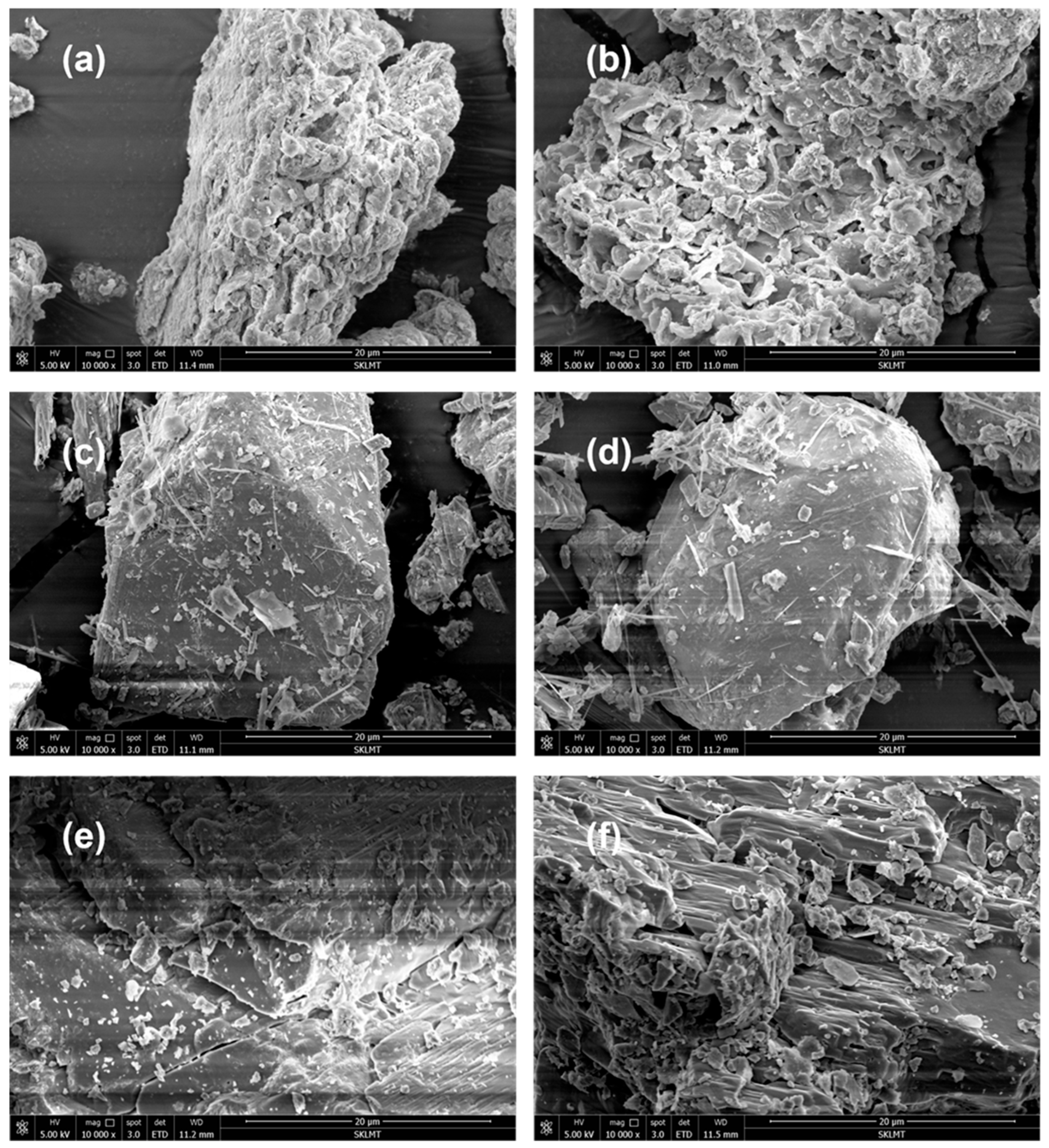
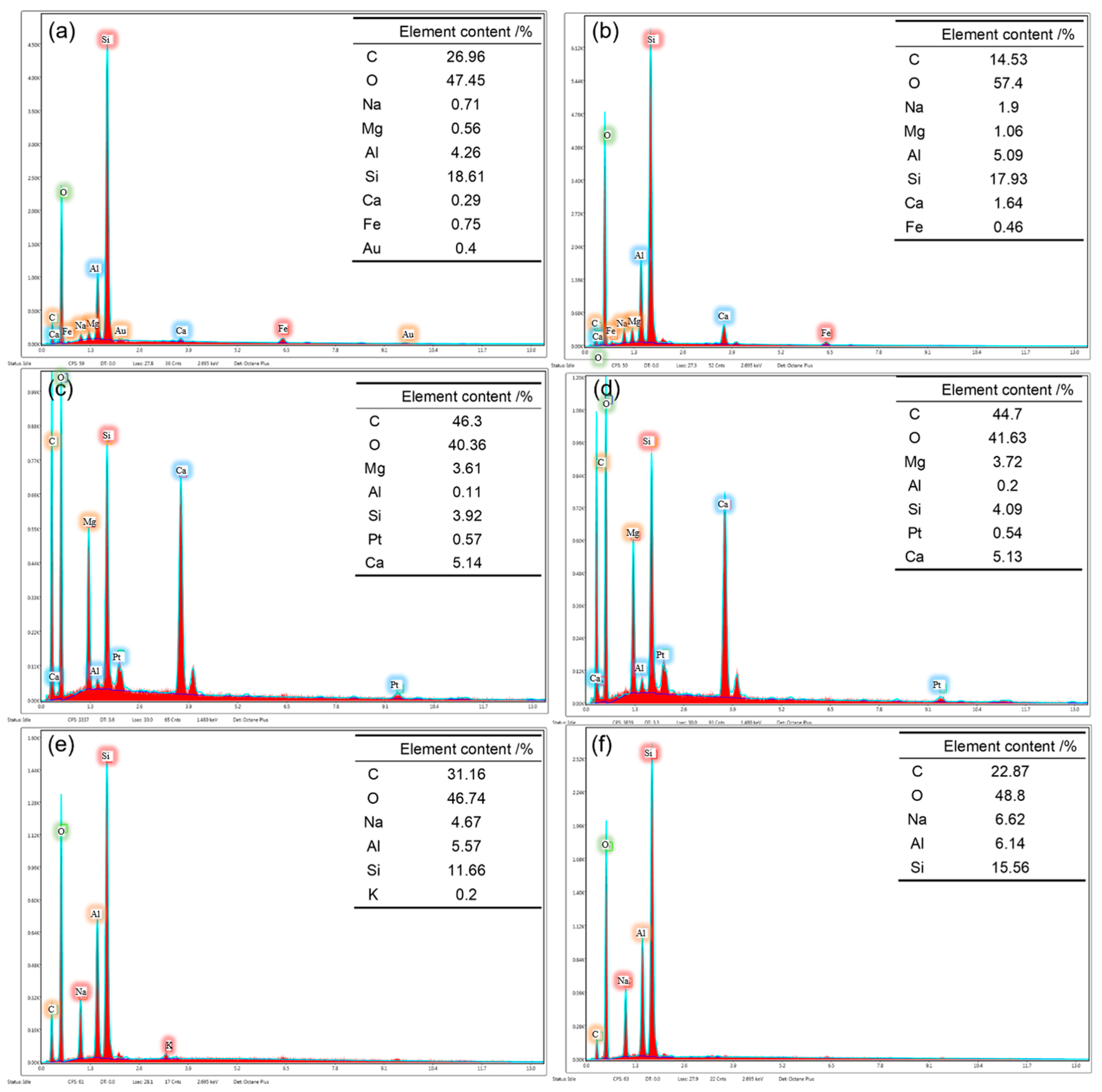
The morphologies of pre- and post-modified montmorillonite, sepiolite, and albite are shown in Figure 1. After modification, the crystal structures of montmorillonite, sepiolite, and albite exhibited no significant alteration. The modification resulted in a looser and more porous morphology for montmorillonite but had minimal impact on the surfaces of sepiolite and albite, possibly due to their inherently compact structures. The surface elemental compositions of the materials were determined using EDS (Figure 2). The major surface elements were C, O, Si, and Al for montmorillonite; C, O, Si, and Mg for sepiolite; and C, O, Si, Al, and Na for albite. The minerals modified with humic acid did not show any remarkable changes in chemical composition. However, the oxygen content of HA-Mont was higher than that of Mont, which suggests that the addition of humic acid provided more oxygen-containing functional groups for montmorillonite.
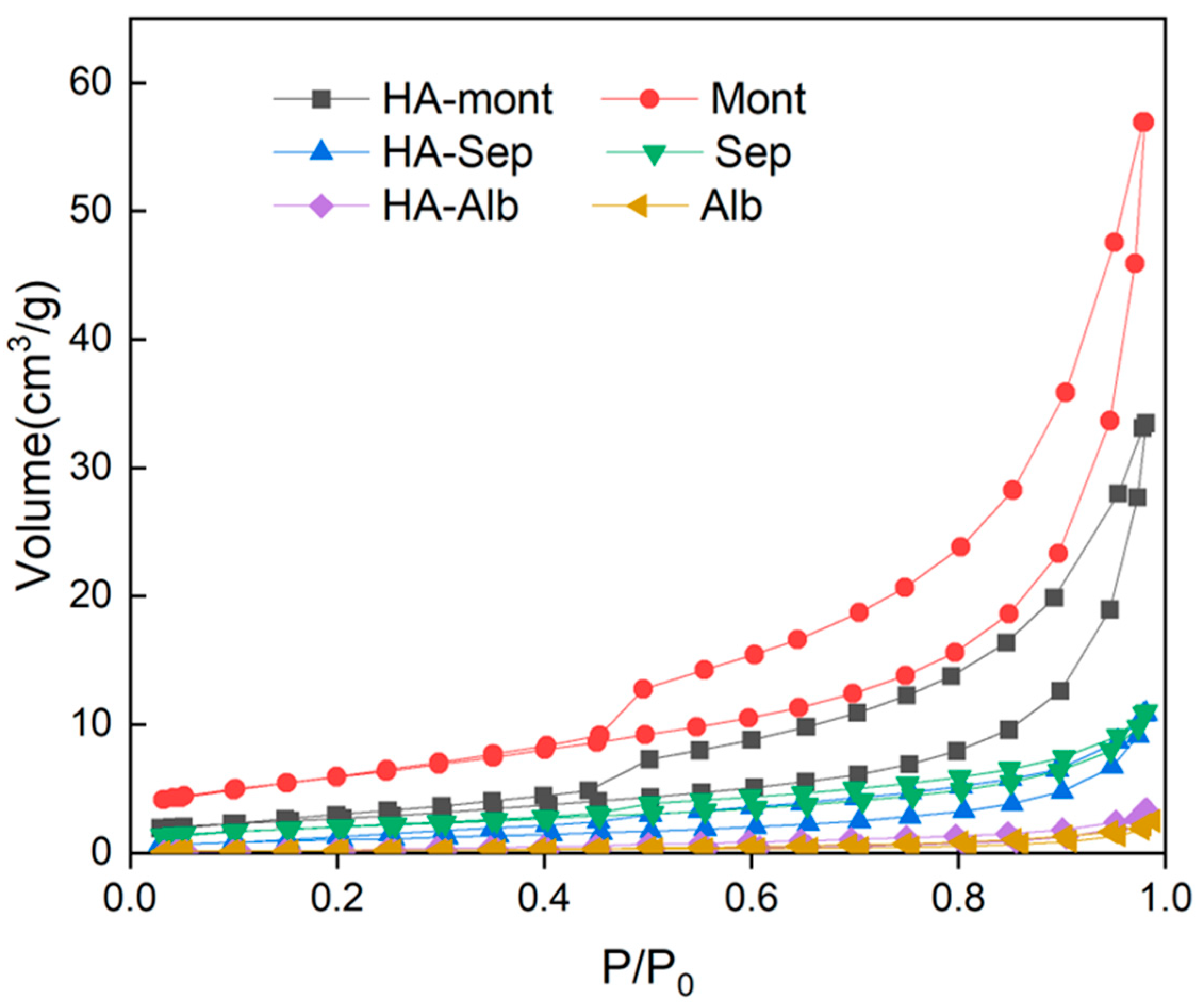
The adsorption–desorption isotherms of the pre- and post-modified montmorillonite, sepiolite, and albite are presented in Figure 3. According to the International Union of Pure and Applied Chemistry (IUPAC) classification system, the isotherms were identified as Type IV, characteristic of mesoporous materials [34]. The specific surface areas, average pore diameters, and pore volumes are listed in Table S3. After modification, the BET surface areas of montmorillonite and sepiolite decreased from 21.410 to 9.586 m2/g and from 7.266 to 3.712 m2/g, respectively. This was probably because the pores of the montmorillonite and sepiolite were filled or partially blocked by humic acid particles. In contrast, the surface area of albite showed no change after modification, while the average pore diameter increased by 34.8%. Overall, the BET results were consistent with the FESEM observations, indicating that humic acid-modified minerals were successfully prepared and the mineral surface was covered by humic acid. Among the three modified minerals, HA-Mont had the largest specific surface area, suggesting the greatest potential adsorption effect.
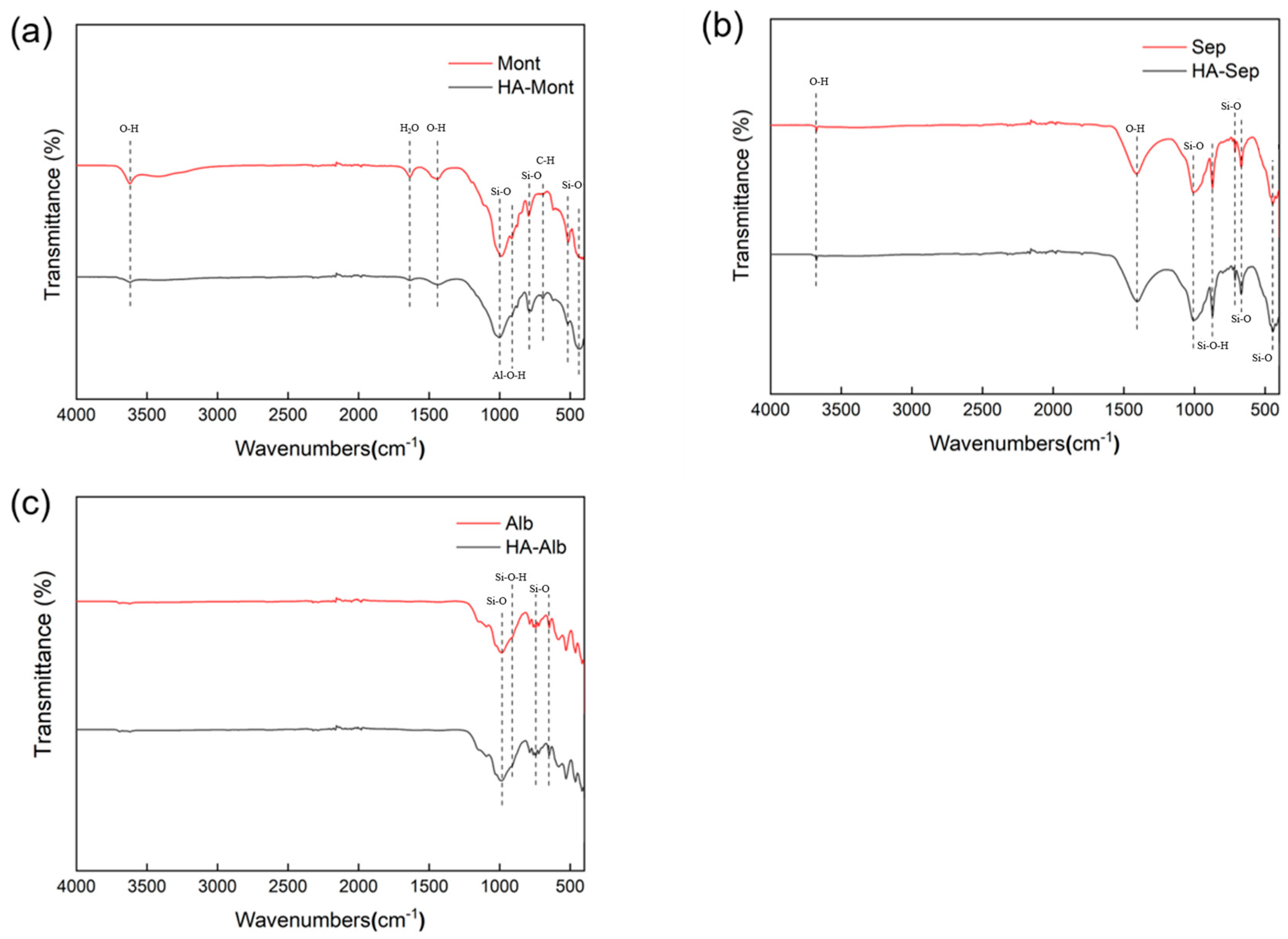
To identify the surface functional groups of the pre- and post-modified montmorillonite, sepiolite, and albite, FTIR spectroscopy was employed (Figure 4). In the case of unmodified montmorillonite, the absorption peaks at 3618 and 1444 cm−1 are assigned to the stretching vibrations of the O-H groups, which indicate the existence of O-H groups on the mineral surface [35]. The band at 1635 cm−1 is identified as the H-O-H bending vibration of adsorbed water molecules in tetrahedral sheets [36]. Peaks observed at 988, 794, and 514 cm−1 are attributed to Si-O groups, while the band at 920 cm−1 is assigned to Al-O-H stretching vibrations [37,38]. For sepiolite, the bands appearing at 3675 and 1409 cm−1 are attributed to the stretching vibration of the structural O-H groups. The peaks at 1007, 712, and 448 cm−1 are associated with Si-O groups, and the peak at 872 cm−1 is associated with Si-O-H groups [39]. For albite, the peaks at 985, 743, and 648 cm−1 are attributed to Si-O groups, and the peak at 915 cm−1 corresponds to the Si-O-H groups [40].
For the three modified minerals, the positions of the mineral peaks remained almost unchanged after modification, indicating that the structure of the minerals was not damaged. The intensity of the Si-O and -OH stretching bands decreased following humic acid modification, a change attributed to the surface attachment of humic acid. This attenuation was particularly pronounced for montmorillonite. The reduction is likely due to interactions between humic acid and surface -OH groups. In addition, the characteristic band of HA-Mont was found at approximately 694 cm−1, which may be associated with the C-H groups [41]. Compared with Mont, the band ascribed to the stretching vibration of Si-O (988 cm−1) was blue-shifted to 1001 cm−1. These results indicate that a greater quantity of humic acid was attached to the surface than HA-Sep or HA-Alb.
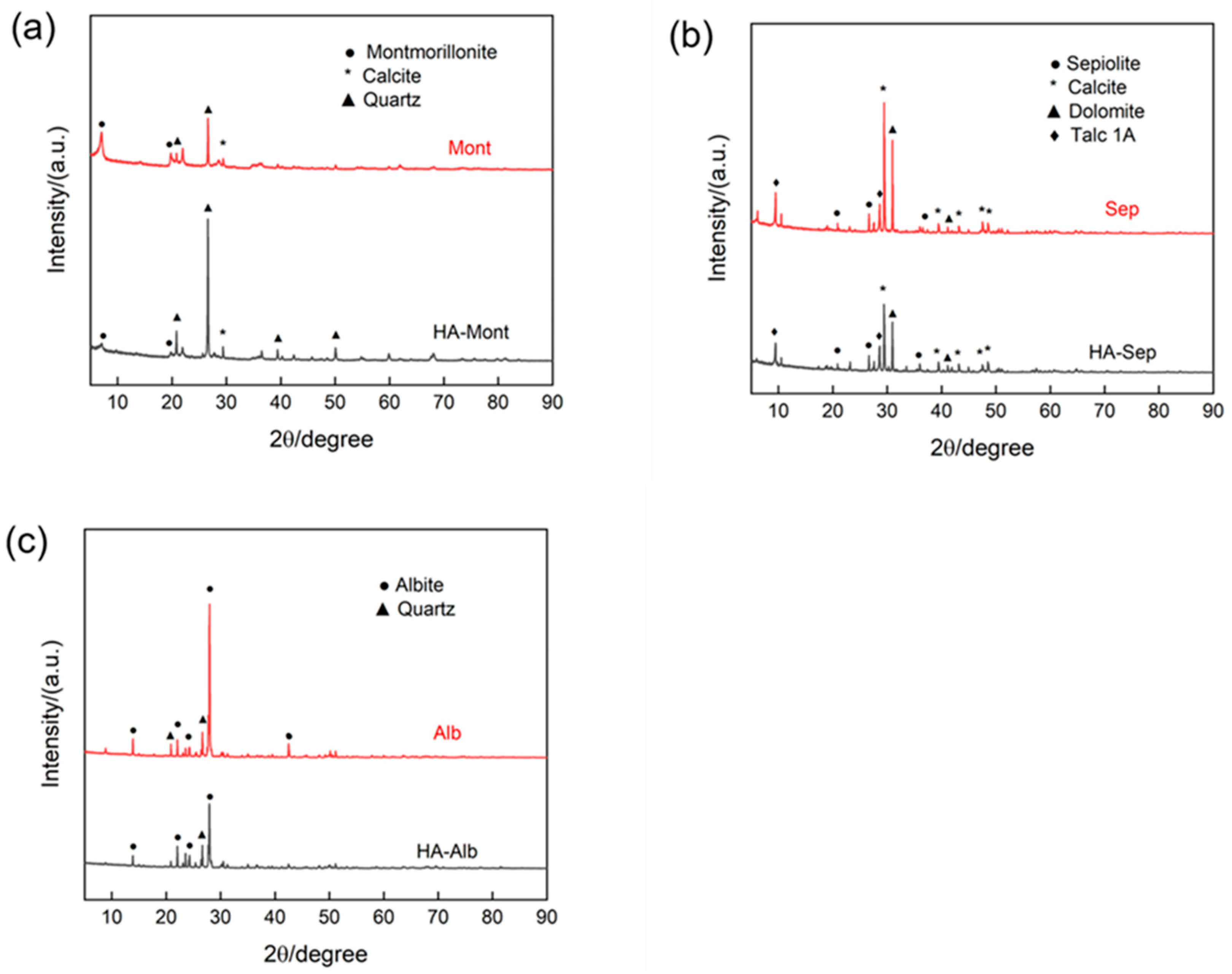
The XRD patterns of montmorillonite ((Na, Ca)0.33(Al, Mg)2(Si4O10)(OH)2·nH2O), sepiolite, (Mg8(OH2)4(Si6O15)2(OH)4·8H2O) and albite (NaAlSi3O8) before and after modification are shown in Figure 5. Mont is primarily composed of montmorillonite, quartz, and calcite, with a characteristic diffraction peak of montmorillonite appearing at 2θ = 7.03°. Sep consists of sepiolite, calcite, dolomite, and talc. Alb is mainly composed of albite and quartz, with a typical albite 040 peak observed at 2θ = 27.92°. The XRD patterns exhibited no significant change after humic acid modification, indicating negligible changes in the crystal structure and interlayer spacing of the minerals. However, a slight decrease in the intensity of the characteristic peaks was observed for HA-Mont, HA-Sep, and HA-Alb, which may be attributed to the suppression of mineral characteristic peaks by humic acid. These results suggest that humic acid does not enter the interlayer spaces of the minerals after modification but instead adheres to their surfaces.

3.2. Effect of Minerals and HA-Minerals on Cd-Contaminated Soil

3.2.1. Cd Availability

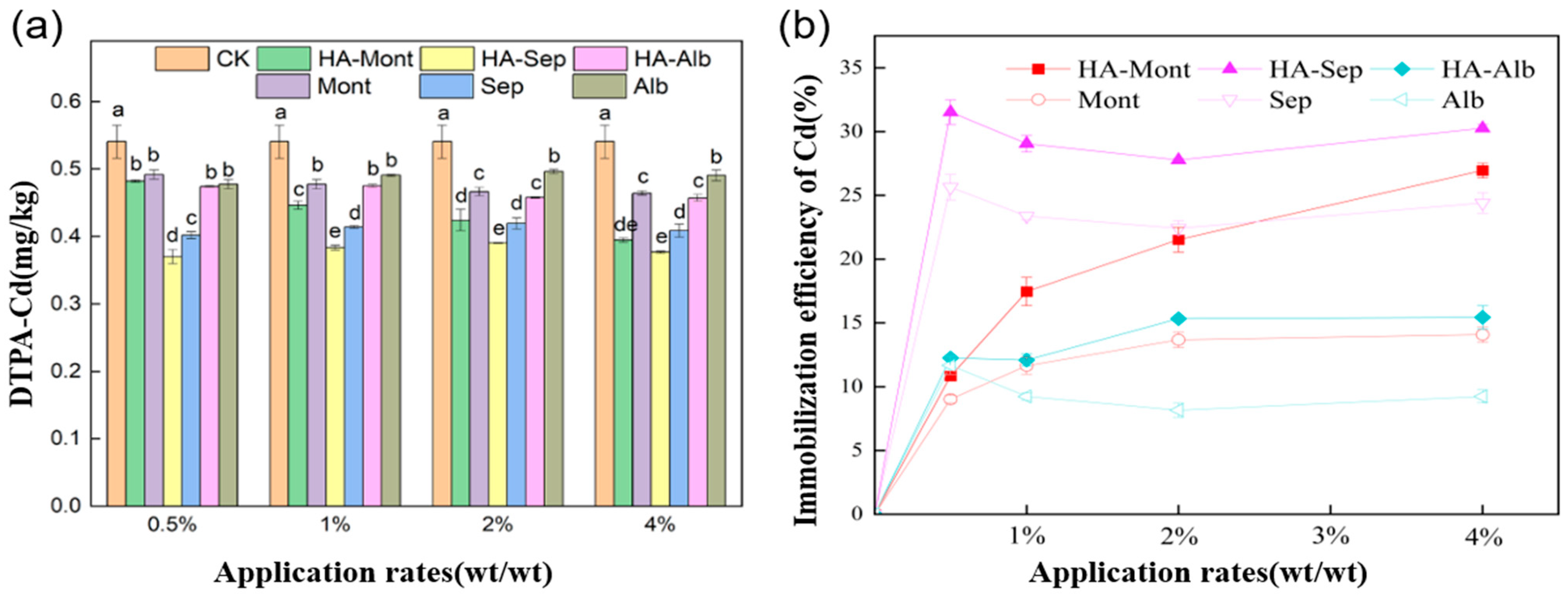
DTPA-Cd is considered the most available form in soil and is readily available for plant uptake. The effect of the application rate of immobilization agents to soil on the immobilization of Cd is illustrated in Figure 6. Humic acid-modified minerals exhibited a greater immobilization effect on Cd than the unmodified minerals. At the highest ratio of 4% (wt/wt) immobilization agents, the concentrations of DTPA-Cd in HA-Mont-, HA-Sep- and HA-Alb-treated soil decreased from the untreated (control) 0.54 mg/kg to respectively 0.39, 0.38, and 0.46 mg/kg, corresponding to 26.95%, 30.27%, and 15.44% immobilization efficiencies. The DTPA-Cd concentrations of the soil treated with Mont, Sep, and Alb were respectively 0.46, 0.41, and 0.49 mg/kg, corresponding to 14.09%, 24.41%, and 9.24% immobilization efficiencies. Compared with the original minerals, there was a significant reduction (p < 0.05) in DTPA-Cd with the modified mineral treatments. HA-Mont treatment exhibited the most significant reduction of 17.61% in the soil DTPA-Cd content at the application rates of 4% (wt/wt). These results indicate that HA-Sep and HA-Mont exhibit excellent potential for the immobilization of Cd in soil.

3.2.2. Cd Distribution

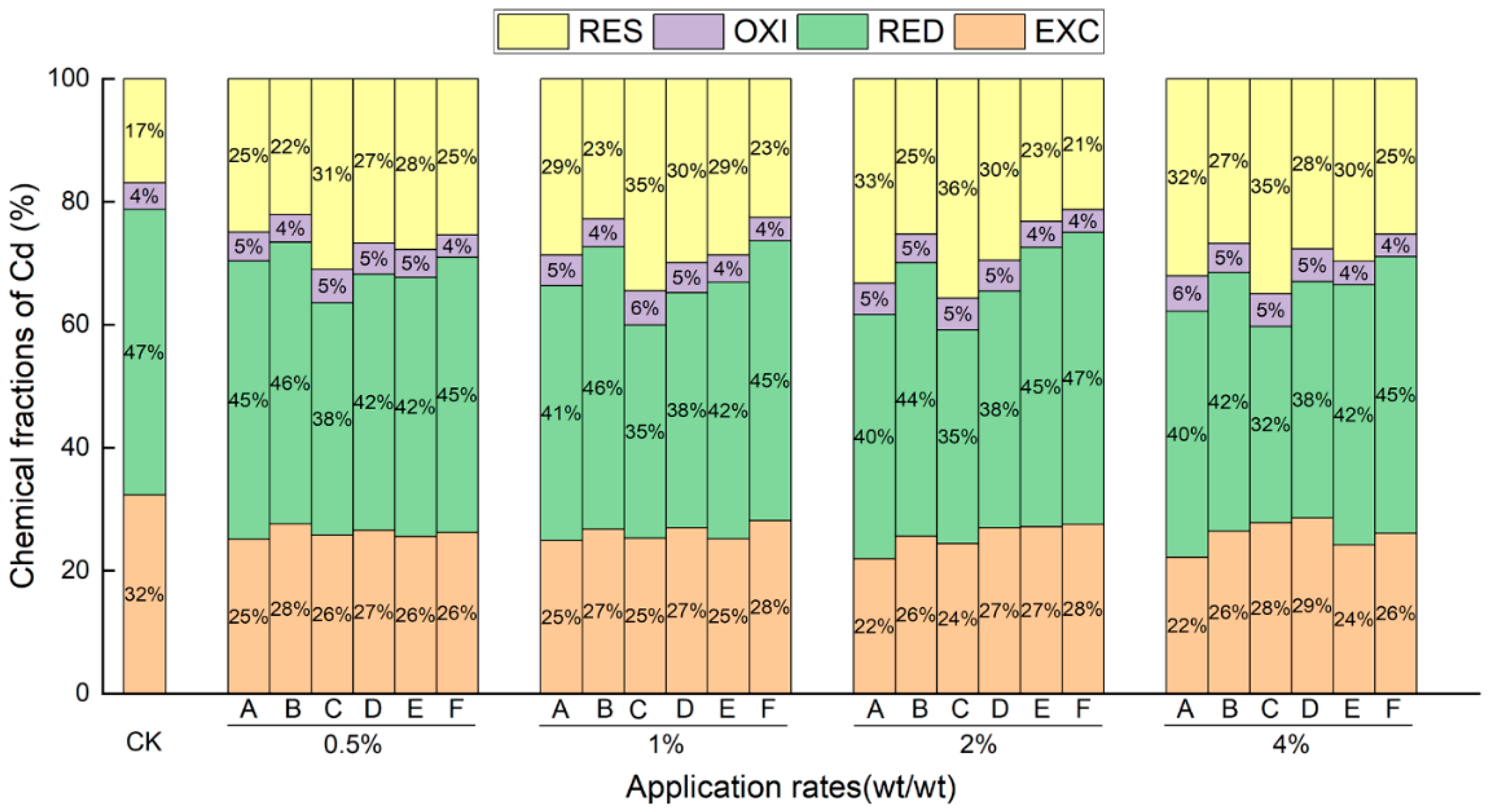
The BCR sequential extraction procedure is a widely adopted standard method for assessing the environmental risk and bioavailability of heavy metals in soils and sediments. The chemical speciation of cadmium (Cd) in soil is operationally defined into four fractions based on its binding strength and lability: exchangeable (EXC), reducible (RED), oxidizable (OXI), and residual (RES). Availability of Cd in soil is related to the states of Cd present; EXC and RED states of Cd are considered available as they are labile and can be absorbed by plants, and the other two states, OXI and RES, are less available. Figure 7 shows the percentage of each chemical state of Cd in the different treatments. The Cd in the control was mainly found in the RED state (47%), followed by the EXC state (32%), and RES state (17%), while the OXI state (4%) was low. The sum of unstable states (EXC and RED) was up to 79%. Compared with the control, the EXC and RED contents decreased with the addition of immobilization agents, whereas the RES showed the opposite trend, suggesting that minerals had the potential to alter Cd forms. When the addition of HA-Mont, HA-Sep, and HA-Alb was increased to 4% (wt/wt), the EXC states were respectively decreased to 22%, 28%, and 24%, and the RED state decreased to 40%, 32%, and 42%, while the RES state increased to 32%, 35%, and 30%. For 4% (wt/wt) additions of Mont, Sep, and Alb, the EXC states were respectively 26%, 29%, and 26%, and the RED state decreased to 42%, 38%, and 45%, while the RES state increased to 27%, 28%, and 25%. Overall, HA-Mont, HA-Sep, and HA-Alb showed greater decreases in EXC and RED and greater increases in RES, compared to those seen with Mont, Sep, and Alb. This indicated that humic acid-modified minerals were more conducive to converting the unstable forms of Cd to stable forms compared with the unmodified minerals. Among the three modified mineral treatments, HA-Sep showed the lowest sum of unstable states (EXC (28%) and RED (32%)) and highest RES (35%), which was consistent with the results of DTPA-Cd.

3.2.3. Physicochemical Properties

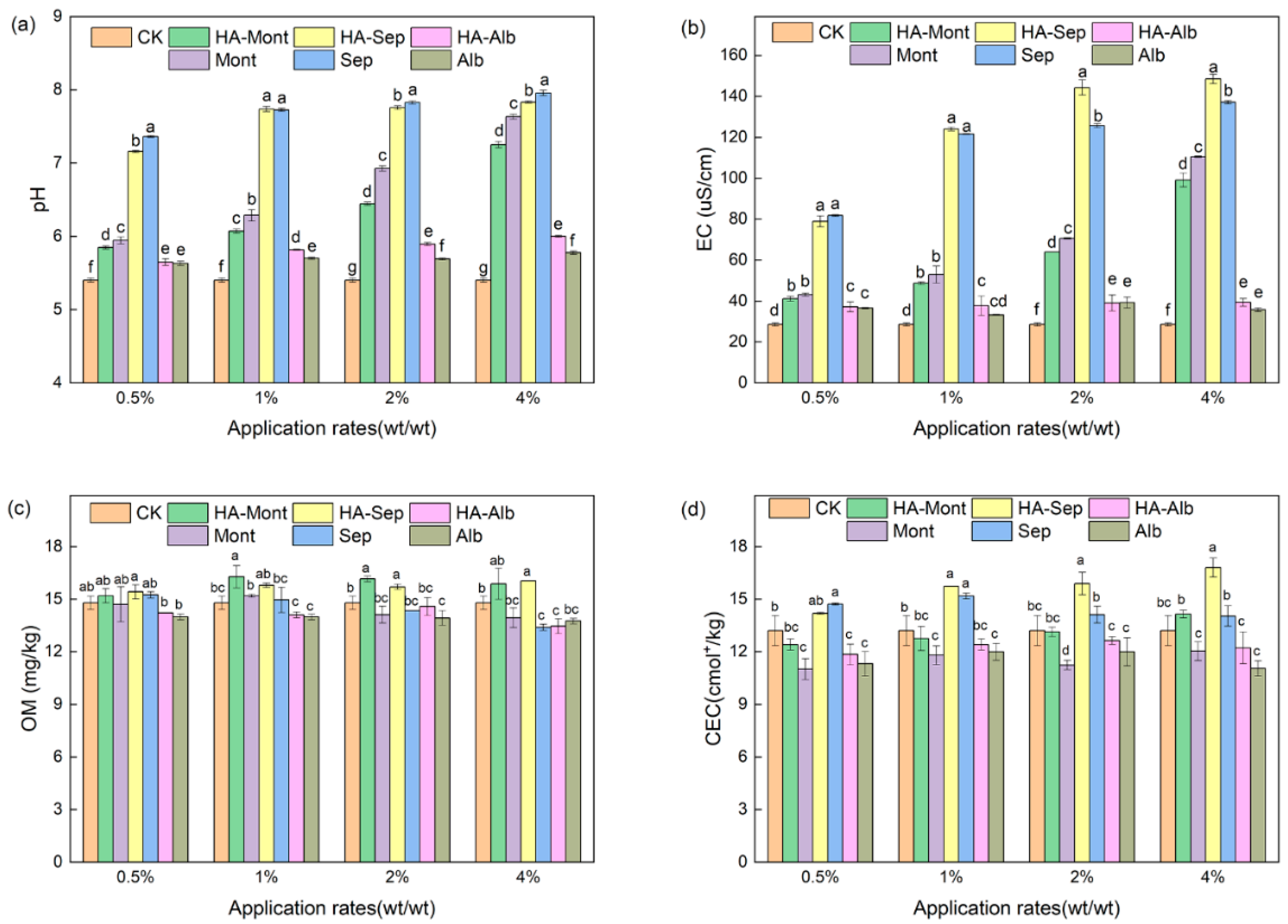
Soil pH is a crucial factor affecting the availability of Cd in the soil, which can influence both the states of Cd and the surface charges of the immobilization agents. Compared to the control soil (pH 5.40), all treatments significantly (p < 0.05) increased soil pH, with rises ranging from 0.23 to 2.56 units (Figure 8a). The most substantial increases were observed with Sep (1.96–2.56) and HA-Sep (1.76–2.43). Specifically, at the 4% (wt/wt) application rate, the pH values in soils treated with Mont and Sep were 0.39 and 0.13 units higher than those in soils treated with their HA-modified counterparts (p < 0.05). In contrast, the pH under Alb treatment was 0.22 units lower than under HA-Alb (p < 0.05). While HA-Mont and Mont significantly raised soil pH in a dose-dependent manner (p < 0.05), the increases induced by HA-Alb and Alb were more modest (0.23–0.60 units). These results indicate that HA-Sep, Sep, HA-Mont, and Mont exert a more pronounced effect on elevating soil pH than do HA-Alb and Alb.
There was a correlation between soil electrical conductivity (EC) and soluble ion content. The different immobilization agents had different effects on soil EC (Figure 8b). All treatments significantly increased soil EC compared to the control (p < 0.05). The magnitude of increase varied: Sep and HA-Sep caused the most substantial rises (50.35–120.00 μS/cm), followed by Mont and HA-Mont, which induced a dose-dependent increase from 28.50 μS/cm (control) to 99.15 and 110.35 μS/cm at 4% application, respectively. Notably, HA-Mont yielded a slightly higher EC than Mont, whereas HA-Sep and HA-Alb induced only marginally greater EC than their unmodified counterparts. The sequence of EC values after treatment decreased from HA-Sep, Sep, Mont, HA-Mont, HA-Alb, to Alb, which may be related to the salt content of the minerals. The observed trends in EC were consistent with those for soil pH.
The influence of immobilization agents on soil organic matter (OM) and cation exchange capacity (CEC) was assessed (Figure 8c,d). Soil OM refers to the organic materials primarily derived from biological sources and subsequently transformed by microorganisms, with humus being the dominant component. Its content was quantified via the dichromate oxidation method. Treatment with HA-Mont and HA-Sep significantly increased (p < 0.05) soil OM content when compared with treatment with Mont and Sep, owing to their high organic matter content. The addition of HA-Sep resulted in a significant increase in soil CEC compared to the control (p < 0.05). There was no significant increase in soil CEC in the other treatments. In most of the modified mineral treatments, CEC values were higher than those in the original mineral treatments. In particular, the CEC values in the HA-Mont and HA-Sep treatments were significantly higher than those in the Mont and Sep treatments at the application rates of 2% and 4% (wt/wt) (p < 0.05). Figure S1 and Text S2 shows Pearson correlation coefficients between DTPA-Cd, Ph, EC, OM, CEC, EXC-Cd, RED-Cd, OXI-Cd, and RES-Cd.

3.3. Long-Time Effects of HA-Minerals on Different Cd-Contaminated Soil

3.3.1. Dynamic Changes in Soils’ Available Cd Content

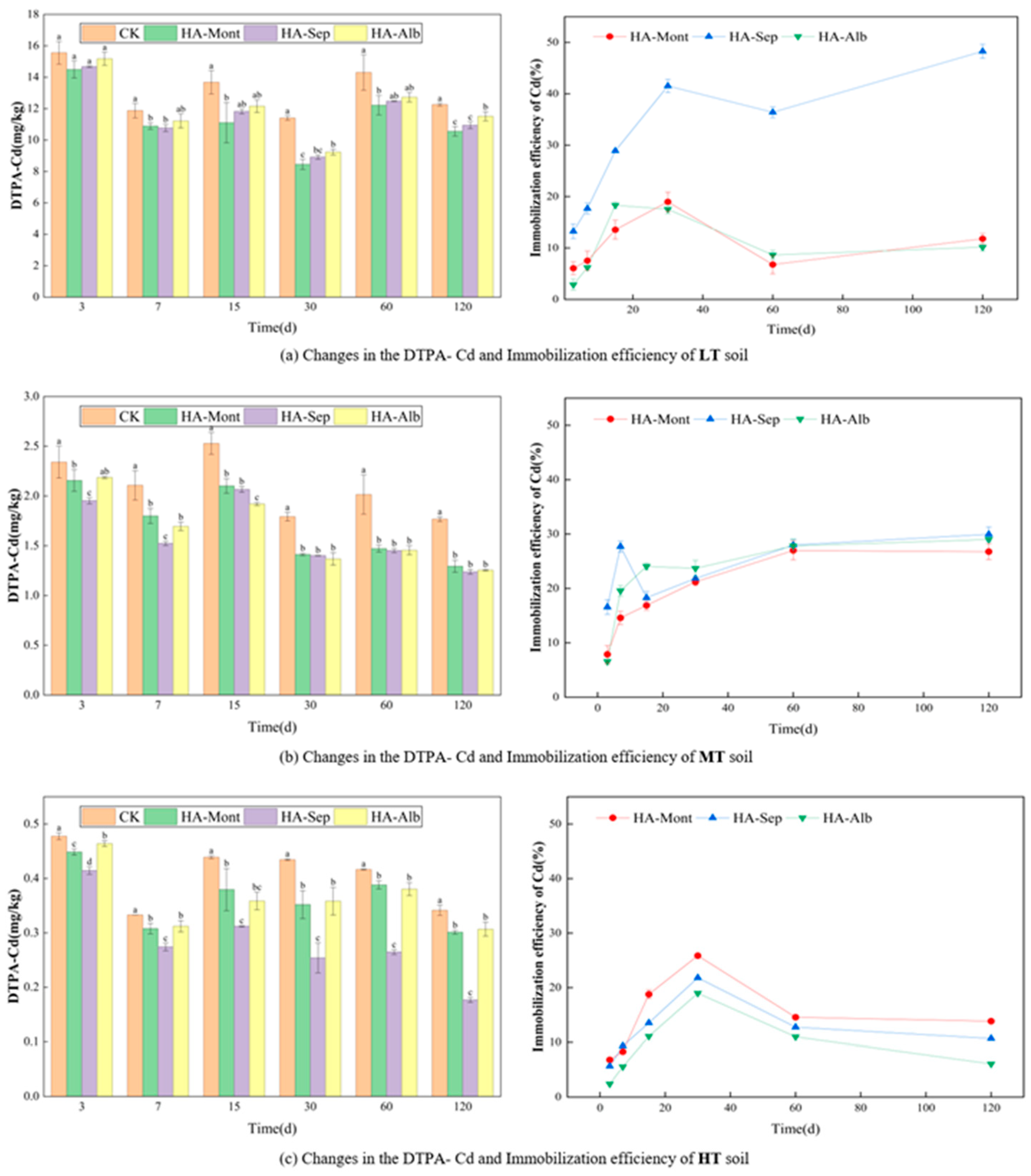
Based on the data of the short-term experiment, taking into account the immobilized effect and cost, the 1% application rate is selected in the long-term experiment. The changes in DTPA-Cd content and Cd immobilization efficiency in soils treated with 1% humic acid-modified minerals over time are shown in Figure 9. In the LT soil, the DTPA-Cd contents in soils treated with HA-Mont, HA-Sep, and HA-Alb decreased by 6.06–18.99%, 13.24–48.27%, and 2.86–18.33%, respectively, compared to the control. All treatments resulted in DTPA-Cd contents significantly lower than the control (p < 0.05), and the DTPA-Cd content in the HA-Sep treatment was significantly lower than those in the HA-Mont and HA-Alb treatments (p < 0.05). The Cd immobilization efficiency for each treatment exhibited a trend of initial increase, followed by a slight decrease, then another increase before stabilizing. After 120 days of incubation, the DTPA-Cd content was reduced by 11.81%, 48.27%, and 10.17% in the HA-Mont, HA-Sep, and HA-Alb treatments, respectively. The immobilization effect of the HA-Sep treatment was significantly higher than those of the HA-Mont and HA-Alb treatments, while the difference between HA-Mont and HA-Alb was minor.
In the MT soil, the DTPA-Cd contents in soils treated with HA-Mont, HA-Sep, and HA-Alb were reduced by 7.88–26.98%, 16.57–29.97%, and 6.56–29.01%, respectively, compared to the control. The DTPA-Cd content in each treatment was significantly lower than that in the control (p < 0.05). Over time, the Cd immobilization efficiency generally showed a continuous increasing trend across all treatments. After 15 days of incubation, the increase in Cd immobilization efficiency became relatively slow. By day 120, the available Cd content in the MT soil reached its lowest value in all treatments. The effectiveness of the humic acid-modified minerals in immobilizing Cd in MT soil, ranked from high to low, was HA-Sep > HA-Alb > HA-Mont, although the differences among the three treatments were not substantial.
In the HT soil, which had a relatively high proportion of available Cd, the Cd immobilization efficiency for each treatment showed a trend of initial increase, followed by a decrease, and then stabilization. The Cd immobilization effects of the HA-Mont, HA-Sep, and HA-Alb treatments reached their peaks at 30 days of incubation, reducing the content by 25.87%, 21.83%, and 18.99%, respectively, compared to the control. After 120 days, the DTPA-Cd contents in the HA-Mont, HA-Sep, and HA-Alb treatments were reduced by 13.85%, 10.70%, and 6.07%, respectively, compared to the control. The effectiveness of the humic acid-modified minerals in immobilizing Cd in HT soil, ranked from high to low, was HA-Mont > HA-Sep > HA-Alb, with HA-Mont showing the best immobilization effect on Cd in HT soil.

3.3.2. Dynamic Changes in Cd Distribution

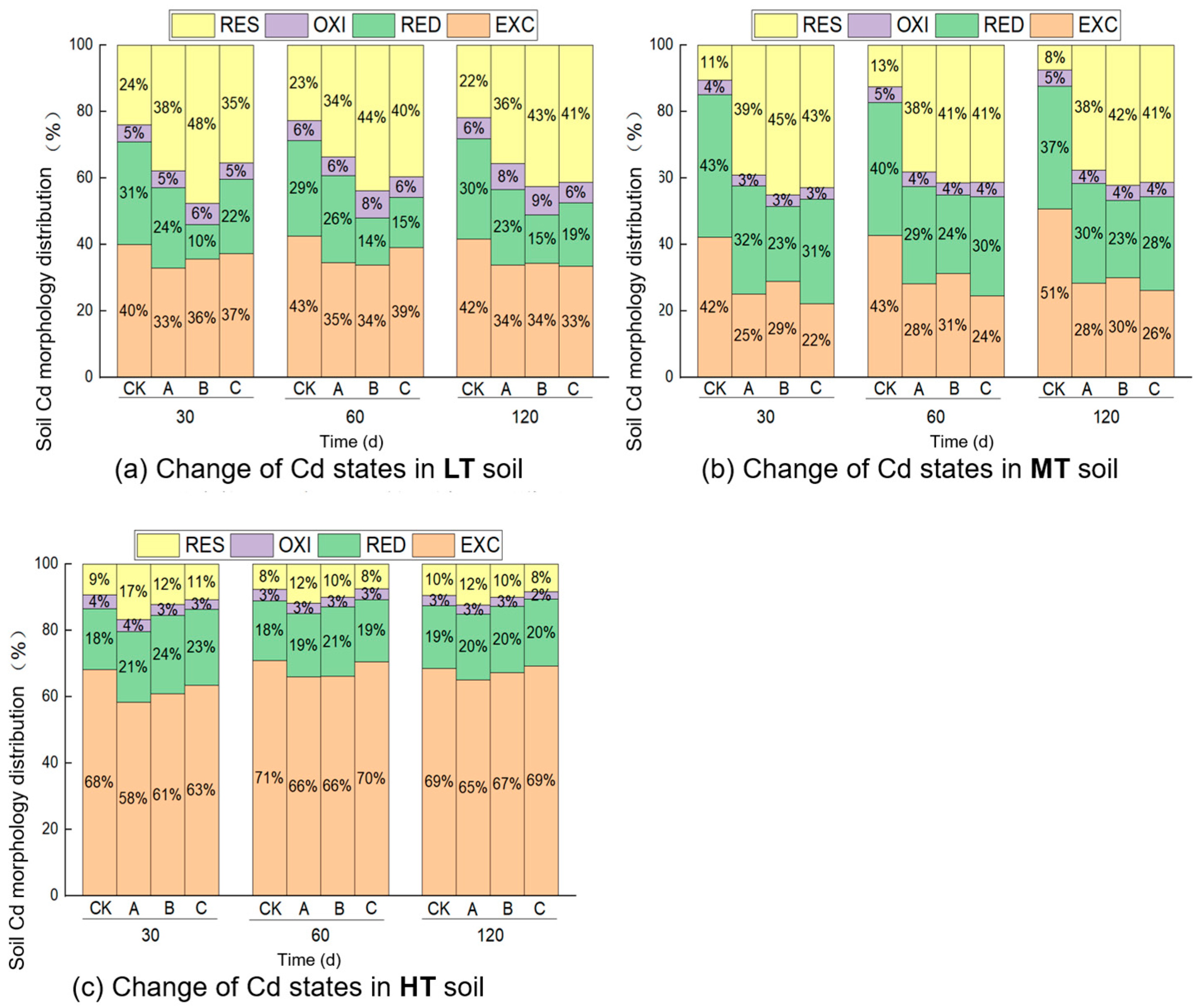
The effects of humic acid-modified minerals on the state changes of soil Cd are shown in Figure 10. In LT soil, after 30 days, the residual Cd state increased from 24% to 38%, 48%, and 35% in the HA-Mont, HA-Sep, and HA-Alb treatments, respectively. The reducible state decreased from 31% to 24%, 10%, and 22%, while the exchangeable state decreased from 40% to 33%, 36%, and 37%. The oxidizable state remained largely unchanged. At 60 and 120 days, the proportions of all states showed a slight rebound. By day 120, compared to the control, the residual state increased by 14%, 21%, and 19% in the HA-Mont, HA-Sep, and HA-Alb treatments, respectively. The oxidizable state increased slightly, whereas the reducible state decreased by 7%, 15%, and 11%, and the exchangeable state decreased by 8%, 8%, and 9%. This demonstrates that in LT soil, the amendments transformed Cd from exchangeable and reducible forms into more stable oxidizable and residual forms.
In the MT soil, Cd was highly active, with a large proportion present in unstable forms (exchangeable and reducible). After 30 days of incubation, the treatments with HA-Mont, HA-Sep, and HA-Alb increased the residual Cd state from 11% to 39%, 45%, and 43%, respectively. Concurrently, the reducible Cd state decreased from 43% to 32%, 23%, and 31%, and the exchangeable Cd state decreased from 42% to 25%, 29%, and 22%. The oxidizable Cd state did not change significantly. Little variation was observed in Cd speciation at 60 and 120 days compared to day 30. These results indicate that the humic acid-modified minerals promoted the transformation of Cd from exchangeable and reducible forms into the more stable residual state in MT soil.
In HT soil, the exchangeable state accounted for approximately 70%. At 30 days, the residual state increased from 9% to 17%, 12%, and 11% in the HA-Mont, HA-Sep, and HA-Alb treatments, respectively. The reducible state increased from 18% to 21%, 24%, and 23%, while the exchangeable state decreased from 68% to 58%, 61%, and 63%. The oxidizable state showed no significant change. The Cd speciation at 60 and 120 days gradually reverted to resemble that of the control soil. These findings suggest that in HT soil, the humic acid-modified minerals initially transformed Cd from the exchangeable form into the more stable reducible and residual states; however, this transformation was not stable over the long term.

3.3.3. Changes in Physicochemical Properties

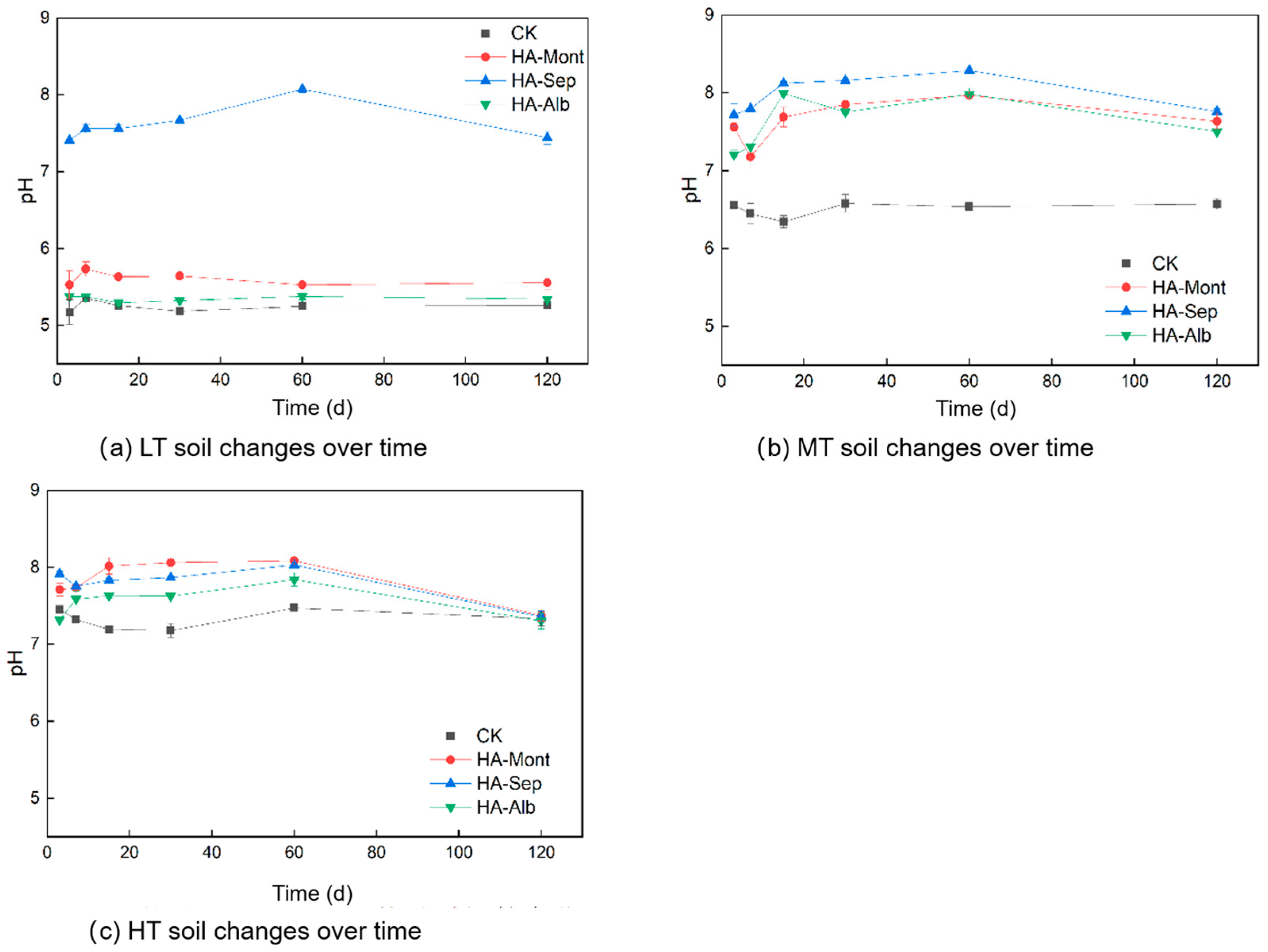
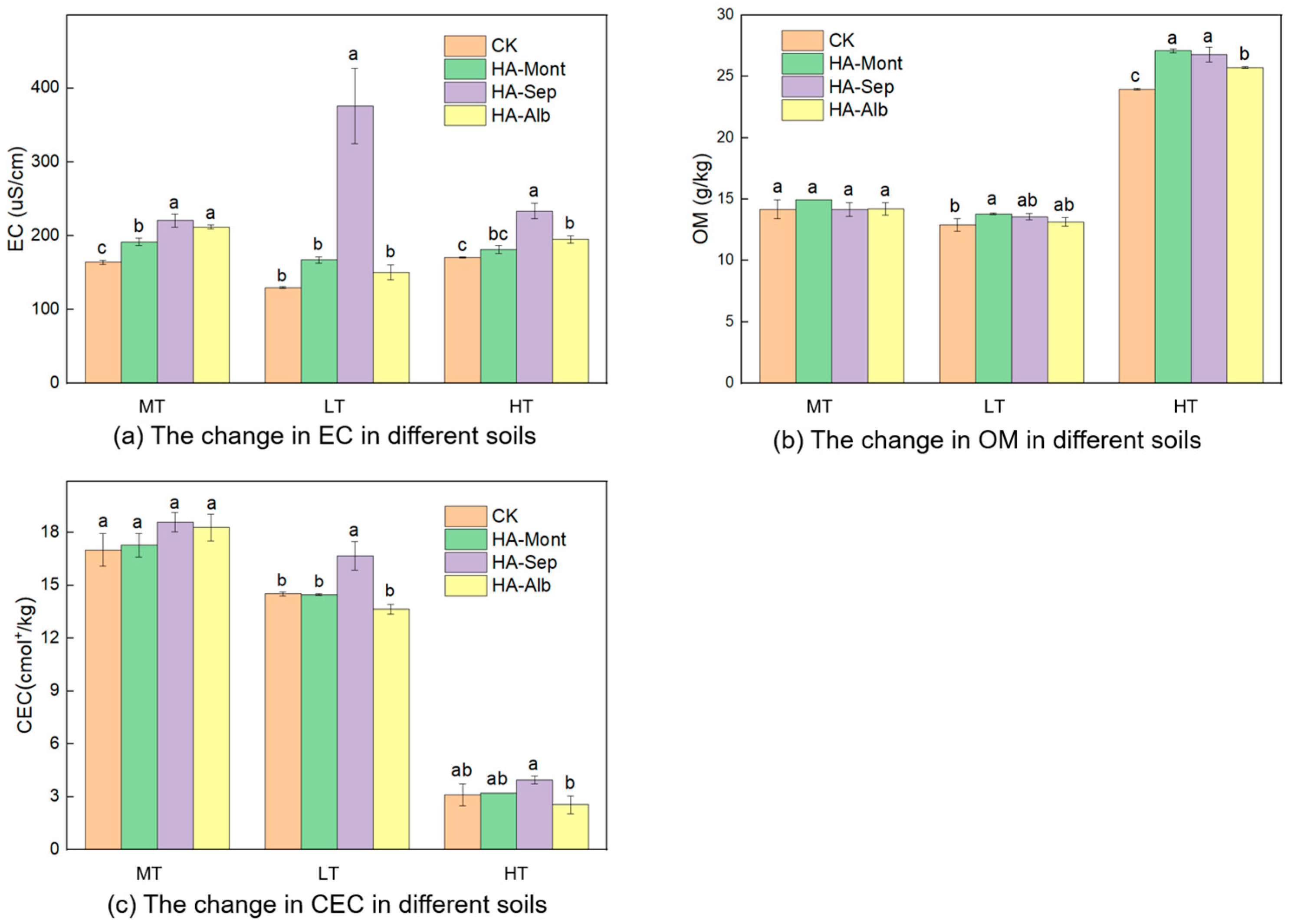
The changes in soil pH during the treatment of the three soils with humic acid modified minerals are shown in Figure 11. The changes in other soil physicochemical properties at day 120 are shown in Figure 12. In LT soil, all treatments increased soil pH to varying degrees, and showed no subsequent significant change over time. After 120 days of incubation, the HA-Sep, HA-Alb, and HA-Mont treatments increased soil pH by 0.30, 2.18, and 0.08 units, respectively, compared to the control. Soil EC increased to varying degrees, and only the HA-Sep treatment significantly enhanced soil EC (p < 0.05), showing an increase of 246.20 μS/cm. No obvious change in soil OM has been observed in the three treatments. The control exhibited a CEC of 14.53 cmol+/kg. A significant increase in CEC (p < 0.05) was observed with the HA-Sep treatment, reaching a value 14.84% higher than that of the control.
In MT soil, the application of humic acid-modified minerals led to a rapid short-term increase in soil pH. The HA-Sep, HA-Alb, and HA-Mont treatments reached their maximum pH values on day 60 (pH = 7.97, 8.29, and 7.99, respectively). Subsequently, soil pH showed a declining trend. After 120 days of incubation, the pH values of the HA-Mont, HA-Sep, and HA-Alb treatment groups were 7.64, 7.76, and 7.50, respectively, representing increases of 1.07, 1.19, and 0.93 units compared to the control group. The EC of the control soil was 164.00 μS/cm, all three humic acid-modified mineral treatments significantly increased soil EC (p < 0.05), with an increase ranging from 16.92% to 34.45%. Among them, the HA-Sep treatment resulted in the highest soil EC. The soil OM content was 14.18 g/kg in the control, and it was not significantly affected by any of the three treatments. The soil CEC was 17.02 cmol+/kg in the control soil. The HA-Mont, HA-Sep, and HA-Alb treatments increased CEC by 1.59%, 9.30%, and 7.48%, respectively, although these increases were not statistically significant.
In HT soil, all treatment groups showed a short-term increase in soil pH. The pH values of the HA-Mont, HA-Sep, and HA-Alb treatments peaked at 30 days of incubation, with increases of 0.88, 0.69, and 0.45 units, respectively, compared to the control. Subsequently, soil pH exhibited a downward trend. After 120 days of incubation, the pH values in all treated soils returned to levels close to that of the control group. The EC of the control soil was 170.27 μS/cm. All three humic acid-modified mineral treatments increased soil EC by 11.03 to 63.23 μS/cm, with the HA-Sep treatment showing the highest value. The soil OM content was 23.95 g/kg in the control. It was significantly increased by the HA-Mont, HA-Sep, and HA-Alb treatments, with respective rises of 13.12%, 11.84%, and 7.43%. The soil CEC content was 3.12 cmol+/kg in the control, indicating poor nutrient-holding capacity. None of the three treatments significantly altered the CEC.

4. Discussion

4.1. Immobilization Mechanisms

The immobilization mechanism of minerals is complex, involving ion exchange, complexation, surface precipitation, and surface adsorption [42]. In addition, the surface hydroxyl groups of the minerals promote adsorption through complexation [32]. In this study, all minerals significantly decreased the availability of Cd in contaminated soils and converted mobile states to stable states. Other studies have reported similar results [43], which pointed out that the addition of montmorillonite resulted in lower soil Cd availability, as it converted the acid-soluble state to the residual state, which may be related to the precipitation of Cd on the montmorillonite surface. It was observed that sepiolite and montmorillonite decreased Cd availability more than albite. This may be related to the composition and structure of clay and feldspar minerals. In this study, the feldspar mineral albite provided fewer active sites for Cd than the clay minerals due to its higher density, smaller specific surface area, and lower abundance of functional groups. In addition, the excellent adsorptive properties of sepiolite lead to a high Cd affinity, resulting in a significant reduction in the availability of Cd [44]. This can be attributed to the equivalent exchange of Cd by Mg within the sepiolite structure. Dinçsoy et al. reported that once Mg is replaced by Cd at the boundary of the octahedral magnesium layers, Cd complexation might occur on the surface of sepiolite [45]. Sepiolite has previously been shown to effectively immobilize Cd in contaminated soils and reduce Cd accumulation in plants [46].
This study demonstrated that humic acid modification effectively enhanced the performance of minerals for immobilizing Cd in polluted soil. The addition of HA-modified minerals led to a greater reduction in bioavailable Cd compared to their unmodified counterparts. Successive BCR extraction showed that HA modification more effectively promoted the transformation of Cd from unstable to stable states. The enhancement is likely attributed to the HA coating on the minerals, which can immobilize Cd through strong complexes formed by oxygen-containing functional groups, hydrogen bonds, and hydrophobic forces [47]. In the three minerals studied, montmorillonite showed the most obvious improvement in immobilization after modification. This may be because the surface of montmorillonite was loaded with the most humic acid. SEM and FTIR revealed that the surface morphology and functional groups showed the greatest changes, and the modified montmorillonite had the most organic matter.
The toxicity and availability of Cd in soil largely depend on the soil structure and physicochemical properties. Minerals can indirectly reduce the availability of soil Cd by affecting soil properties such as the pH, EC, CEC, and OM [48,49,50]. The elevated pH of acidic soils facilitates greater adsorption between the soil particles and Cd ions, and OH- and Cd form a precipitate of hydroxide, which reduces the Cd availability in soil [51,52]. Sepiolite significantly increased the soil pH by 1.96–2.56 units, indicating that the higher soil pH under sepiolite treatment may have also contributed to the immobilization effect. These results are concordant with those of previous studies, which reported that sepiolite immobilization of Cd was mainly due to an increase in soil pH [53,54,55]. The change in soil pH caused by HA-Mont and HA-Sep treatments was consistent with the change in soil organic matter content. Application of HA-Mont and HA-Sep increased the soil organic matter when compared with application of the unmodified montmorillonite and sepiolite. This may be because HA-Mont and HA-Sep contained more humic acid, which contributed to the increase in the soil organic matter content [45]. OM can fix Cd in the soil and is a major factor in Cd release [56]. Soil OM interacts with soil Cd through ion exchange, coordination of surface groups, and surface adsorption, thus increasing stable Cd and reducing unstable Cd in soil [57]. Minerals have a certain degree of influence on the soil conductivity. The increased soil conductivity found in all the treatments was due to the high salt content of the minerals themselves. The highest conductivity was observed in the soil treated with HA-Sep, which was also related to the greatest immobilization effect. Higher conductivity means that more ions can react with Cd, reducing the mobility of Cd and promoting its immobilization, consistent with the results of previous research [58]. The soil CEC reflects the negative charges of soil that can be neutralized by exchangeable cations [59]. The addition of HA-Sep resulted in a significant increase in soil CEC compared to that of the control, suggesting an increase in adsorption ability for cationic Cd, and the mineral substance contained in the immobilization agents can immobilize Cd through precipitation or complexation between inorganic elements and Cd [56,60]. Despite this, the CECs in the HA-Mont and HA-Sep treatments were still significantly higher than those in the Mont and Sep treatments. This indicates that the improvement in CEC also contributed to the greater soil Cd immobilization effect of humic acid-modified minerals compared to the unmodified minerals. The Pearson correlation analysis results from this study also corroborate the aforementioned conclusions. Figure S1 shows Pearson correlation coefficients between DTPA-Cd, pH, EC, OM, CEC, EXC-Cd, RED-Cd, OXI-Cd, and RES-Cd, which showed a negative correlation between soil pH, OM, EC, CEC and DTPA-Cd (r = −0.831**, −0.527**, −0.848**, −0.816**).

4.2. Immobilization of Cd by Humic Acid-Modified Minerals in Different Soils

In this study, soils with distinct properties were used to investigate the specific influence of soil characteristics. The high Cd activity in all three soils was primarily due to conditions favoring high mobility, such as low pH (particularly in LT soil) and low cation exchange capacity (notably in HT soil) [61]. HT soil, with a coarse texture (61.14% sand, 20.58% silt, 18.28% clay), typically exhibits higher elemental mobility due to lower CEC, fewer aggregates, and reduced clay content, all critical for contaminant retention [62]. In MT soil, high Cd availability was mainly related to the relatively short aging period of artificial contamination.
The differences in the immobilization efficacy of humic acid-modified minerals among the three soils are primarily attributed to variations in soil properties and the degree of contamination [63]. Humic acid-modified minerals reduced available Cd in all three soils, regardless of their initial pH. Compared to HT soil, humic acid-modified minerals showed better efficacy in immobilizing available Cd in the more acidic MT and LT soils. This is because acidic soils contain more water-soluble Cd, and the application of alkaline amendments can promote efficient Cd precipitation. Therefore, CdCO3 precipitation is more likely to control Cd solubility in acidic soils, thereby reducing Cd bioavailability. The variable charges on Fe/Al minerals in acidic soils are also highly sensitive to pH increases. Through the reaction Al(OH)3 (or Fe(OH)3) + 3H+ ↔ Al3+ (or Fe3+) + 3H2O, mineral ions such as Al3+ and Fe3+ can hydrolyze into Al(OH)3 and Fe(OH)2 when pH rises, generating more negative charges on acidic soils, which in turn adsorb more Cd ions [61]. The lower the initial soil pH, the greater the difference in pH between the humic acid-modified minerals and the soil, resulting in a more pronounced pH increase [64].
For the near-neutral HT soil, humic acid-modified minerals did not sustainably increase soil pH, resulting in a weaker correlation between pH elevation and a reduction in Cd availability [65]. Since heavy metal precipitation is limited in neutral or alkaline soils, and precipitation is often the primary Cd immobilization mechanism in acidic soils, Cd availability in neutral or alkaline soils is less sensitive to pH increases. Similar conclusions were reported by Bandara et al., who found that amendments applied to near-neutral soils did not significantly increase pH [66]. However, in the neutral, highly Cd-contaminated HT soil, humic acid-modified minerals still exhibited good initial immobilization efficacy. This effectiveness is related to the Cd speciation distribution in HT soil, where the proportion of exchangeable Cd is large, allowing humic acid-modified minerals to convert more of the labile forms into stable forms [67]. Furthermore, adding humic acid-modified minerals to coarse- or medium-textured soils can enhance the stability and size of soil aggregates, as well as their capacity to retain cations [68,69]. Therefore, while humic acid-modified minerals show some immobilization effect on neutral, highly Cd-contaminated HT soil, they are more effective for immobilizing Cd in acidic contaminated soils.

5. Conclusions

In the present study, montmorillonite, sepiolite, and albite were modified with humic acid to obtain novel materials (HA-Mont, HA-Sep, and HA-Alb) for the effective immobilization of Cd in soil. The characterization showed that humic acid could be loaded on the mineral surface without changing the crystal structure, resulting in greater pore diameter. During the short-time incubation (15 days) experiment, HA-Sep emerged as the most effective amendment. It achieved superior Cd immobilization at a lower application rate (0.5%) compared to the other materials at 4%, indicating higher efficiency. Most notably, HA-Sep demonstrated exceptional long-term performance, particularly in acidic and neutral soils, where its immobilization efficiency increased over 120 days. This suggests a strong potential for sustained remediation in challenging environments. In contrast, HA-Mont showed strong initial effectiveness in near-neutral soil but less persistence over time. The mechanism of immobilization is attributed to two synergistic effects. First, the application of HA-modified amendments increased soil pH, CEC, and OM content, creating conditions favorable for Cd adsorption and complexation. Second, the HA coating itself provides additional functional groups that directly bind Cd, while the altered surface morphology facilitates this process. Successive BCR extractions directly confirmed that these mechanisms promote the transformation of Cd from bioavailable, unstable fractions (exchangeable and reducible) to more stable, residual forms. Overall, HA-Sep is identified as the most suitable amendment for long-term immobilization of Cd, especially in acidic soils. Humic acid modification of minerals is a beneficial strategy for remediating Cd-contaminated soil while aligning with sustainable agricultural goals.

Supplementary Materials

The following supporting information can be downloaded at https://www.mdpi.com/article/10.3390/su18041760/s1.

Author Contributions

D.T.: conceptualization, formal analysis, investigation, visualization, writing—original draft; Z.W.: methodology, data curation, software, formal analysis, investigation; Z.H.: visualization, software; J.L.: visualization, formal analysis, R.S.: conceptualization, supervision, writing—review and editing, funding acquisition. All authors have read and agreed to the published version of the manuscript.

Funding

This study was supported by the “National Natural Science Foundation of China” (No. U1906221) and the “National Natural Science Foundation of China” (No. 41601333).

Institutional Review Board Statement

Not applicable.

Informed Consent Statement

Not applicable.

Data Availability Statement

The original contributions presented in this study are included in the article. Further inquiries can be directed to the corresponding author.

Conflicts of Interest

The authors declare no conflicts of interest.

References

  1. Janoušková, M.; Pavlíková, D. Cadmium immobilization in the rhizosphere of arbuscular mycorrhizal plants by the fungal extraradical mycelium. Plant Soil 2010, 332, 511–520. [Google Scholar] [CrossRef]
  2. Qian, W.; Liang, J.-Y.; Zhang, W.-X.; Huang, S.-T.; Diao, Z.-H. A porous biochar supported nanoscale zero-valent iron material highly efficient for the simultaneous remediation of cadmium and lead contaminated soil. J. Environ. Sci. 2022, 113, 231–241. [Google Scholar] [CrossRef]
  3. Farooqi, Z.U.R.; Murtaza, G.; Bibi, S.; Sabir, M.; Owens, G.; Saifullah; Ahmad, I.; Zeeshan, N. Immobilization of cadmium in soil-plant system through soil and foliar applied silicon. Int. J. Phytoremediat. 2022, 24, 1193–1204. [Google Scholar] [CrossRef] [PubMed]
  4. Hu, Y.; Cheng, H.; Tao, S. The Challenges and Solutions for Cadmium-contaminated Rice in China: A Critical Review. Environ. Int. 2016, 92–93, 515–532. [Google Scholar] [CrossRef]
  5. Liu, Q.; Sheng, Y.; Wang, W.; Liu, X. Efficacy and microbial responses of biochar-nanoscale zero-valent during in-situ remediation of Cd-contaminated sediment. J. Clean. Prod. 2021, 287, 125076. [Google Scholar] [CrossRef]
  6. Guo, Z.; Gao, Y.; Cao, X.; Jiang, W.; Liu, X.; Liu, Q.; Chen, Z.; Zhou, W.; Cui, J.; Wang, Q. Phytoremediation of Cd and Pb interactive polluted soils by switchgrass (Panicum virgatum L.). Int. J. Phytoremediat. 2019, 21, 1486–1496. [Google Scholar] [CrossRef]
  7. Lin, X.; Mou, R.; Cao, Z.; Xu, P.; Wu, X.; Zhu, Z.; Chen, M. Characterization of cadmium-resistant bacteria and their potential for reducing accumulation of cadmium in rice grains. Sci. Total Environ. 2016, 569–570, 97–104. [Google Scholar] [CrossRef] [PubMed]
  8. Makino, T.; Sugahara, K.; Sakurai, Y.; Takano, H.; Kamiya, T.; Sasaki, K.; Itou, T.; Sekiya, N. Remediation of cadmium contamination in paddy soils by washing with chemicals: Selection of washing chemicals. Environ. Pollut. 2006, 144, 2–10. [Google Scholar] [CrossRef]
  9. Gu, F.; Zhang, J.; Shen, Z.; Li, Y.; Ji, R.; Li, W.; Zhang, L.; Han, J.; Xue, J.; Cheng, H. A review for recent advances on soil washing remediation technologies. Bull. Environ. Contam. Toxicol. 2022, 109, 651–658. [Google Scholar] [CrossRef]
  10. Cristaldi, A.; Conti, G.O.; Jho, E.H.; Zuccarello, P.; Grasso, A.; Copat, C.; Ferrante, M. Phytoremediation of contaminated soils by heavy metals and PAHs. A brief review. Environ. Technol. Innov. 2017, 8, 309–326. [Google Scholar] [CrossRef]
  11. Li, H.; Cui, X.; Sun, Y.; Zheng, P.; Wang, L.; Shi, X. Advances in Microbial Remediation of Heavy Metal-Contaminated Soils: Mechanisms, Synergistic Technologies, Field Applications and Future Perspectives. Toxics 2025, 13, 1069. [Google Scholar] [CrossRef] [PubMed]
  12. Fardin, A.B.; Jamshidi-Zanjani, A. A critical review on soil remediation using electrokinetic-enhanced permeable reactive barriers: Challenges and enhancements. Chem. Eng. J. Adv. 2025, 23, 100774. [Google Scholar] [CrossRef]
  13. Palansooriya, K.N.; Shaheen, S.M.; Chen, S.S.; Tsang, D.C.W.; Hashimoto, Y.; Hou, D.; Bolan, N.S.; Rinklebe, J.; Ok, Y.S. Soil amendments for immobilization of potentially toxic elements in contaminated soils: A critical review. Environ. Int. 2020, 134, 105046. [Google Scholar] [CrossRef]
  14. Meng, Z.; Huang, S.; Lin, Z.; Wu, J. First “unsaturated soils” view towards quantitative adsorption and immobilization mechanisms of Cd by biochar in soils during aging. Sci. Total Environ. 2022, 846, 157393. [Google Scholar] [CrossRef]
  15. Liu, J.; Huang, W.; Mo, A.; Ni, J.; Xie, H.; Hu, J.; Zhu, Y.; Peng, C. Effect of lychee biochar on the remediation of heavy metal-contaminated soil using sunflower: A field experiment. Environ. Res. 2020, 188, 109886. [Google Scholar] [CrossRef]
  16. Lian, M.; Feng, Q.; Wang, L.; Niu, L.; Zhao, Z.; Li, X.; Zhang, Z. Highly effective immobilization of Pb and Cd in severely contaminated soils by environment-compatible, mercapto-functionalized reactive nanosilica. J. Clean. Prod. 2019, 235, 583–589. [Google Scholar] [CrossRef]
  17. Shi, L.; Guo, Z.; Peng, C.; Xiao, X.; Feng, W.; Huang, B.; Ran, H. Immobilization of cadmium and improvement of bacterial community in contaminated soil following a continuous amendment with lime mixed with fertilizers: A four-season field experiment. Ecotoxicol. Environ. Saf. 2019, 171, 425–434. [Google Scholar] [CrossRef]
  18. Wang, M.; Wu, S.; Guo, J.; Zhang, X.; Yang, Y.; Chen, F.; Zhu, R. Immobilization of cadmium by hydroxyapatite converted from microbial precipitated calcite. J. Hazard. Mater. 2019, 366, 684–693. [Google Scholar] [CrossRef]
  19. Wang, W.; Lu, T.; Liu, L.; Yang, X.; Li, X.; Qiu, G. Combined remediation effects of biochar, zeolite and humus on Cd-contaminated weakly alkaline soils in wheat farmland. Chemosphere 2022, 302, 134851. [Google Scholar] [CrossRef] [PubMed]
  20. Zhang, Z.; Li, M.; Chen, W.; Zhu, S.; Liu, N.; Zhu, L. Immobilization of lead and cadmium from aqueous solution and contaminated sediment using nano-hydroxyapatite. Environ. Pollut. 2010, 158, 514–519. [Google Scholar] [CrossRef] [PubMed]
  21. He, G.; Zhu, X.; An, Y.; Chen, Y.; Fu, C.; Lei, N.; Zeng, Y.; Li, J.; Wang, Z.; Zhao, P. Study on the Effectiveness and Mechanism of Mercapto-Modified Attapulgite for Remediation of Cadmium-Contaminated Paddy Soil. Water Air Soil Pollut. 2022, 233, 397. [Google Scholar] [CrossRef]
  22. Xiang, J.; Zhu, R.; Chen, Q.; Lv, G.; Yang, Y. A novel montmorillonite-based soil amendment for Cd/REEs immobilization and nutrients sustained release. Appl. Clay Sci. 2022, 221, 106464. [Google Scholar] [CrossRef]
  23. Xu, Y.; Liang, X.F.; Xu, Y.M.; Qin, X.; Huang, Q.Q.; Wang, L.; Sun, Y.B. Remediation of Heavy Metal-Polluted Agricultural Soils Using Clay Minerals: A Review. Pedosphere 2017, 27, 193–204. [Google Scholar] [CrossRef]
  24. Yuan, P.; Fan, M.; Yang, D.; He, H.; Liu, D.; Yuan, A.; Zhu, J.; Chen, T. Montmorillonite-supported magnetite nanoparticles for the removal of hexavalent chromium [Cr(VI)] from aqueous solutions. J. Hazard. Mater. 2009, 166, 821–829. [Google Scholar] [CrossRef] [PubMed]
  25. Li, Z.; Wang, L.; Meng, J.; Liu, X.; Xu, J.; Wang, F.; Brookes, P. Zeolite-supported nanoscale zero-valent iron: New findings on simultaneous adsorption of Cd(II), Pb(II), and As(III) in aqueous solution and soil. J. Hazard. Mater. 2018, 344, 1–11. [Google Scholar] [CrossRef]
  26. Lahori, A.H.; Zhang, Z.; Shaheen, S.M.; Rinklebe, J.; Guo, Z.; Li, R.; Mahar, A.; Wang, Z.; Ren, C.; Mi, S.; et al. Mono-and co-applications of Ca-bentonite with zeolite, Ca-hydroxide, and tobacco biochar affect phytoavailability and uptake of copper and lead in a gold mine-polluted soil. J. Hazard. Mater. 2019, 374, 401–411. [Google Scholar] [CrossRef] [PubMed]
  27. Liang, X.; Li, N.; He, L.; Xu, Y.; Huang, Q.; Xie, Z.; Yang, F. Inhibition of Cd accumulation in winter wheat (Triticum aestivum L.) grown in alkaline soil using mercapto-modified attapulgite. Sci. Total Environ. 2019, 688, 818–826. [Google Scholar] [CrossRef] [PubMed]
  28. Sarkar, B.; Megharaj, M.; Xi, Y.; Krishnamurti, G.; Naidu, R. Sorption of quaternary ammonium compounds in soils: Implications to the soil microbial activities. J. Hazard. Mater. 2010, 184, 448–456. [Google Scholar] [CrossRef]
  29. Sarkar, B.; Megharaj, M.; Shanmuganathan, D.; Naidu, R. Toxicity of organoclays to microbial processes and earthworm survival in soils. J. Hazard. Mater. 2013, 261, 793–800. [Google Scholar] [CrossRef]
  30. Xue, S.; Xiao, Y.; Wang, G.; Fan, J.; Wan, K.; He, Q.; Gao, M.; Miao, Z. Adsorption of heavy metals in water by modifying Fe3O4 nanoparticles with oxidized humic acid. Colloids Surf. A Physicochem. Eng. Asp. 2021, 616, 126333. [Google Scholar] [CrossRef]
  31. Bai, H.; Jiang, Z.; He, M.; Ye, B.; Wei, S. Relating Cd2+ binding by humic acids to molecular weight: A modeling and spectroscopic study. J. Environ. Sci. 2018, 70, 154–165. [Google Scholar] [CrossRef]
  32. Wang, L.; Li, X.; Tsang, D.C.; Jin, F.; Hou, D. Green remediation of Cd and Hg contaminated soil using humic acid modified montmorillonite: Immobilization performance under accelerated ageing conditions. J. Hazard. Mater. 2020, 387, 122005. [Google Scholar] [CrossRef] [PubMed]
  33. Mahar, A.; Wang, P.; Li, R.; Zhang, Z. Immobilization of Lead and Cadmium in Contaminated Soil Using Amendments: A Review. Pedosphere 2015, 25, 555–568. [Google Scholar] [CrossRef]
  34. Thommes, M.; Kaneko, K.; Neimark, A.V.; Olivier, J.P.; Rodriguez-Reinoso, F.; Rouquerol, J.; Sing, K.S.W. Physisorption of gases, with special reference to the evaluation of surface area and pore size distribution (IUPAC Technical Report). Pure Appl. Chem. 2015, 87, 1051–1069. [Google Scholar] [CrossRef]
  35. Long, H.; Wu, P.; Zhu, N. Evaluation of Cs+ removal from aqueous solution by adsorption on ethylamine-modified montmorillonite. Chem. Eng. J. 2013, 225, 237–244. [Google Scholar] [CrossRef]
  36. Wang, G.; Liang, G.; Xiao, H.; Qiu, J.; Liu, H.; Ma, S.; Komarneni, S. Immobilization mechanism of As, Mn, Pb and Zn ions in sulfide tailings by the addition of triethylenetetramine-montmorillonite nanocomposite. Chem. Eng. J. 2022, 435, 134817. [Google Scholar] [CrossRef]
  37. Ellerbrock, R.; Stein, M.; Schaller, J. Comparing amorphous silica, short-range-ordered silicates and silicic acid species by FTIR. Sci. Rep. 2022, 12, 11708. [Google Scholar] [CrossRef]
  38. Wu, E.-Y.; Huang, L.-Y.; Chen, Y.-Y.; Wang, H.-W. Rapid hydrogen production via Al-water reaction catalyzed by H2O2-derived Al(OH)3. Int. J. Hydrogen Energy 2026, 205, 153371. [Google Scholar] [CrossRef]
  39. Liu, Q.; Wang, Y.; Liu, X.; Li, S.; Ren, S.; Gao, Z.; Han, T.; Xu, Z.; Zhou, H. Glutaraldehyde base-cross-linked chitosan-silanol/Fe3O4 composite for removal of heavy metals and bacteria. Environ. Sci. Pollut. Res. 2022, 29, 69439–69449. [Google Scholar] [CrossRef]
  40. Alshameri, A.; He, H.; Zhu, J.; Xi, Y.; Zhu, R.; Ma, L.; Tao, Q. Adsorption of ammonium by different natural clay minerals: Characterization, kinetics and adsorption isotherms. Appl. Clay Sci. 2018, 159, 83–93. [Google Scholar] [CrossRef]
  41. Xie, T.; Huo, L.; Yao, Z.; Zhang, X.; Liu, Z.; Jia, J.; Zhao, Y.; Zhao, L. Co-pyrolysis of biomass and polyethylene: Mechanistic insights into functional group transformations on solid matrix. Chem. Eng. J. 2024, 482, 149166. [Google Scholar] [CrossRef]
  42. Sun, Y.; Zhao, D.; Xu, Y.; Wang, L.; Liang, X.; Shen, Y. Effects of sepiolite on stabilization remediation of heavy metal-contaminated soil and its ecological evaluation. Front. Environ. Sci. Eng. 2016, 10, 85–92. [Google Scholar] [CrossRef]
  43. Qin, C.; Yuan, X.; Xiong, T.; Tan, Y.Z.; Wang, H. Physicochemical properties, metal availability and bacterial community structure in heavy metal-polluted soil remediated by montmorillonite-based amendments. Chemosphere 2020, 261, 128010. [Google Scholar] [CrossRef] [PubMed]
  44. Huang, G.; Ding, X.; Liu, Y.; Ding, M.; Wang, P.; Zhang, H.; Nie, M.; Wang, X. Liming and tillering application of manganese alleviates iron manganese plaque reduction and cadmium accumulation in rice (Oryza sativa L.). J. Hazard. Mater. 2022, 427, 127897. [Google Scholar] [CrossRef] [PubMed]
  45. Dinçsoy, M.; Sönmez, F. The effect of potassium and humic acid applications on yield and nutrient contents of wheat (Triticum aestivum L. var. Delfii) Same Soil properties. J. Plant Nutr. 2019, 42, 2757–2772. [Google Scholar] [CrossRef]
  46. Zhou, F.; Ye, G.; Gao, Y.; Wang, H.; Zhou, S.; Liu, Y.; Yan, C. Cadmium adsorption by thermal-activated sepiolite: Application to in-situ remediation of artificially contaminated soil. J. Hazard. Mater. 2022, 423, 127104. [Google Scholar] [CrossRef]
  47. Song, J.; Yu, J.; Wang, W.; Mi, N.; Wei, W.; Li, S.; Zhang, Y. Enhanced adsorption of roxarsone onto humic acid modified goethite from aqueous solution. J. Dispers. Sci. Technol. 2018, 40, 25–32. [Google Scholar] [CrossRef]
  48. Luo, H.; Du, P.; Wang, P.; Chen, J.; Li, Y.; Wang, H.; Teng, Y.; Li, F. Chemodiversity of dissolved organic matter in cadmium-contaminated paddy soil amended with different materials. Sci. Total Environ. 2022, 825, 153985. [Google Scholar] [CrossRef]
  49. Sun, L.; Chen, S.; Chao, L.; Sun, T. Effects of Flooding on Changes in Eh, pH and Speciation of Cadmium and Lead in Contaminated Soil. Bull. Environ. Contam. Toxicol. 2007, 79, 514–518. [Google Scholar] [CrossRef]
  50. Wu, Y.-J.; Zhou, H.; Zou, Z.-J.; Zhu, W.; Yang, W.-T.; Peng, P.-Q.; Zeng, M.; Liao, B.-H. A three-year in-situ study on the persistence of a combined amendment (limestone+sepiolite) for remedying paddy soil polluted with heavy metals. Ecotoxicol. Environ. Saf. 2016, 130, 163–170. [Google Scholar] [CrossRef]
  51. Xue, W.; Huang, D.; Zeng, G.; Wan, J.; Zhang, C.; Xu, R.; Cheng, M.; Deng, R. Nanoscale zero-valent iron coated with rhamnolipid as an effective stabilizer for immobilization of Cd and Pb in river sediments. J. Hazard. Mater. 2018, 341, 381–389. [Google Scholar] [CrossRef]
  52. Yang, D.; Zhang, J.; Yang, S.; Wang, Y.; Tang, X.; Xu, J.; Liu, X. Biochar-supported nanoscale zero-valent iron can simultaneously decrease cadmium and arsenic uptake by rice grains in co-contaminated soil. Sci. Total Environ. 2022, 814, 152798. [Google Scholar] [CrossRef] [PubMed]
  53. Sun, Y.; Sun, G.; Xu, Y.; Wang, L.; Liang, X.; Lin, D.; Hu, F. Assessment of natural sepiolite on cadmium stabilization, microbial communities, and enzyme activities in acidic soil. Environ. Sci. Pollut. Res. 2012, 20, 3290–3299. [Google Scholar] [CrossRef] [PubMed]
  54. Liang, X.; Xu, Y.; Xu, Y.; Wang, P.; Wang, L.; Sun, Y.; Huang, Q.; Huang, R. Two-year stability of immobilization effect of sepiolite on Cd contaminants in paddy soil. Environ. Sci. Pollut. Res. 2016, 23, 12922–12931. [Google Scholar] [CrossRef]
  55. Hamid, Y.; Tang, L.; Sohail, M.I.; Cao, X.; Hussain, B.; Aziz, M.Z.; Usman, M.; He, Z.-L.; Yang, X. An explanation of soil amendments to reduce cadmium phytoavailability and transfer to food chain. Sci. Total Environ. 2019, 660, 80–96. [Google Scholar] [CrossRef]
  56. Dong, Y.; Lin, H.; Zhao, Y.; Menzembere, E.R.G.Y. Remediation of vanadium-contaminated soils by the combination of natural clay mineral and humic acid. J. Clean. Prod. 2021, 279, 123874. [Google Scholar] [CrossRef]
  57. Han, H.; Wu, X.; Bolan, N.; Kirkham, M.; Yang, J.; Chen, Z. Inhibition of cadmium uptake by wheat with urease-producing bacteria combined with sheep manure under field conditions. Chemosphere 2022, 293, 133534. [Google Scholar] [CrossRef] [PubMed]
  58. Zhao, H.; Huang, X.; Liu, F.; Hu, X.; Zhao, X.; Wang, L.; Gao, P.; Li, X.; Ji, P. Potential of using a new aluminosilicate amendment for the remediation of paddy soil co-contaminated with Cd and Pb. Environ. Pollut. 2021, 269, 116198. [Google Scholar] [CrossRef]
  59. Wu, J.; Li, Z.; Huang, D.; Liu, X.; Tang, C.; Parikh, S.J.; Xu, J. A novel calcium-based magnetic biochar is effective in stabilization of arsenic and cadmium co-contamination in aerobic soils. J. Hazard. Mater. 2020, 387, 122010. [Google Scholar] [CrossRef]
  60. Yuan, C.; Li, Q.; Sun, Z.; Sun, H. Effects of natural organic matter on cadmium mobility in paddy soil: A review. J. Environ. Sci. 2021, 104, 204–215. [Google Scholar] [CrossRef]
  61. Jia, Y.; Li, J.; Zeng, X.; Zhang, N.; Wen, J.; Liu, J.; Jiku, A.S.; Wu, C.; Su, S. The performance and mechanism of cadmium availability mitigation by biochars differ among soils with different pH: Hints for the reasonable choice of passivators. J. Environ. Manag. 2022, 312, 133534. [Google Scholar] [CrossRef]
  62. El-Naggar, A.; Chen, Z.; Jiang, W.; Cai, Y.; Chang, S.X. Biochar effectively remediates Cd contamination in acidic or coarse- and medium-textured soils: A global meta-analysis. Chem. Eng. J. 2022, 442, 136225. [Google Scholar] [CrossRef]
  63. He, H.; Tam, N.F.; Yao, A.; Qiu, R.; Li, W.C.; Ye, Z. Growth and Cd uptake by rice (Oryza sativa) in acidic and Cd-contaminated paddy soils amended with steel slag. Chemosphere 2017, 189, 247–254. [Google Scholar] [CrossRef]
  64. Yang, T.; Xu, Y.; Huang, Q.; Sun, Y.; Liang, X.; Wang, L.; Qin, X.; Zhao, L. An efficient biochar synthesized by iron-zinc modified corn straw for simultaneously immobilization Cd in acidic and alkaline soils. Environ. Pollut. 2021, 291, 118129. [Google Scholar] [CrossRef]
  65. Yang, X.; Wang, L.; Guo, J.; Wang, H.; Mašek, O.; Wang, H.; Bolan, N.S.; Alessi, D.S.; Hou, D. Aging features of metal(loid)s in biochar-amended soil: Effects of biochar type and aging method. Sci. Total Environ. 2022, 815, 152922. [Google Scholar] [CrossRef] [PubMed]
  66. Bandara, T.; Franks, A.; Xu, J.; Bolan, N.; Wang, H.; Tang, C. Chemical and biological immobilization mechanisms of potentially toxic elements in biochar-amended soils. Crit. Rev. Environ. Sci. Technol. 2019, 50, 903–978. [Google Scholar] [CrossRef]
  67. Meng, Z.; Huang, S.; Lin, Z.; Mu, W.; Ge, H.; Huang, D. Cadmium long-term immobilization by biochar and potential risks in soils with different pH under combined aging. Sci. Total Environ. 2022, 825, 154018. [Google Scholar] [CrossRef] [PubMed]
  68. Zhu, Y.; Zhang, M.; Han, X.; Lu, X.; Chen, X.; Feng, H.; Wu, Z.; Liu, C.; Yan, J.; Zou, W. Evaluation of the soil aggregate stability under long term manure and chemical fertilizer applications: Insights from organic carbon and humic acid structure in aggregates. Agric. Ecosyst. Environ. 2024, 376, 109217. [Google Scholar] [CrossRef]
  69. Zhang, W.-Z.; Chen, X.-Q.; Zhou, J.-M.; Liu, D.-H.; Wang, H.-Y.; DU, C.-W. Influence of Humic Acid on Interaction of Ammonium and Potassium Ions on Clay Minerals. Pedosphere 2013, 23, 493–502. [Google Scholar] [CrossRef]
Figure 1. Morphology of (a) montmorillonite, (b) humic acid-modified montmorillonite, (c) sepiolite, (d) humic acid-modified sepiolite, (e) albite, and (f) humic acid-modified albite.
Sustainability 18 01760 g001
Figure 2. Elemental composition of the (a) Mont, (b) HA-Mont, (c) Sep, (d) HA-Sep, (e) Alb, and (f) HA-Alb determined by SEM equipped with EDS.
Sustainability 18 01760 g002
Figure 3. Adsorption/desorption of nitrogen at 77 K of HA-Mont, Mont, HA-Sep, Sep, HA-Alb, and Alb.
Sustainability 18 01760 g003
Figure 4. FTIR spectra of (a) Mont and HA-Mont, (b) Sep and HA-Sep, (c) Alb and HA-Alb.
Sustainability 18 01760 g004
Figure 5. XRD patterns of (a) Mont and HA-Mont, (b) Sep and HA-Sep, (c) Alb and HA-Alb.
Sustainability 18 01760 g005
Figure 6. (a) The DTPA-Cd in soil and (b) the immobilization efficiency at various application rates when the soil samples were treated with pre- and post-modified minerals. Error bars represent ± standard error. Different letters indicate significant differences among different treatments (p < 0.05).
Sustainability 18 01760 g006
Figure 7. Percentage of states distribution of Cd in soil amended with pre- and post-modified minerals at application rate of 0.5%, 1%, 2%, and 4% of soil weight. Capital letters in the figure indicate six treatments (A: HA-Mont, B: Mont, C: HA-Sep, D: Sep, E: HA-Alb and F: Alb).
Sustainability 18 01760 g007
Figure 8. Changes in soil (a) pH, (b) EC, (c) OM, and (d) CEC amended with pre- and post-modified minerals at application rate of 0.5%, 1%, 2%, and 4% of soil weight. Error bars represent ± standard error. Different letters indicate significant differences among different treatments (p < 0.05).
Sustainability 18 01760 g008
Figure 9. The changes in DTPA-Cd content and Cd immobilization efficiency in low-pollution soil (LT soil), moderate-pollution soil (MT soil), and high-pollution soil (HT soil) treated with different amendments. Error bars represent ± standard error. Different letters indicate significant differences among different treatments (p < 0.05).
Sustainability 18 01760 g009
Figure 10. The effects of HA-Mont (A), HA-Sep (B), and HA-Alb (C) on the state changes of Cd in low-pollution soil (LT soil), moderate-pollution soil (MT soil), and high-pollution soil (HT soil).
Sustainability 18 01760 g010
Figure 11. The effects of HA-Mont (A), HA-Sep (B), and HA-Alb (C) on the pH in low-pollution soil (LT soil), moderate-pollution soil (MT soil), and high-pollution soil (HT soil). Error bars represent ± standard error.
Sustainability 18 01760 g011
Figure 12. The effects of HA-Mont (A), HA-Sep (B), and HA-Alb (C) on soil physicochemical properties at day 120 in low-pollution soil (LT soil), moderate-pollution soil (MT soil), and high-pollution soil (HT soil). Error bars represent ± standard error. Different letters indicate significant differences among different treatments (p < 0.05).
Sustainability 18 01760 g012
Disclaimer/Publisher’s Note: The statements, opinions and data contained in all publications are solely those of the individual author(s) and contributor(s) and not of MDPI and/or the editor(s). MDPI and/or the editor(s) disclaim responsibility for any injury to people or property resulting from any ideas, methods, instructions or products referred to in the content.