1. Introduction
In today’s rapidly changing organizational environment, innovation is not only a critical driver for sustaining competitive advantage but also an essential foundation for ensuring organizations’ long-term survival and sustainable growth [
1,
2]. Faced with challenges such as digital transformation, increasingly diversified talent structures, and blurred work boundaries, organizations are no longer satisfied with incremental improvements within existing procedures. Instead, they are increasingly relying on bottom-up innovative initiatives that enhance organizational adaptability and sustainability [
3]. In this context, scholars have turned their attention to bootlegging innovation, a form of innovation that deviates from traditional paths [
4,
5,
6]. Although BI may lack managerial authorization or depart from formal regulations, it is typically motivated by efforts to improve organizational performance and promote change [
7]. With its high levels of autonomy, exploration, and risk-taking, BI has become a crucial source of innovative vitality in complex environments.
Although bootlegging innovation is common in dynamic and knowledge-intensive organizations, existing studies have not clearly explained how this intentional deviation from formal procedures and established rules can help organizations maintain innovation continuity and adaptive resilience in uncertain environments [
8]. In fact, bootlegging innovation often serves constructive purposes: through unauthorized yet beneficial exploratory actions, employees mobilize and accumulate psychological resources, thereby continuously contributing to organizational innovative vitality and long-term competitive advantage. Therefore, understanding its underlying psychological mechanisms is of great significance. Meanwhile, traditional top-down job design practices have increasingly shown limitations in stimulating sustained innovation, making it difficult to meet modern organizations’ demands for innovation resilience and sustainable development [
7]. Thus, a critical question arises: how can organizations activate employees’ psychological resources so that they are willing to take risks and engage in unauthorized but constructive exploratory innovation under institutional constraints, thereby fostering sustainable innovation resilience [
9]?
To address this practical challenge, researchers have begun to focus on employees’ proactive behaviors that “fine-tune structures” and “self-empower” within their roles. One such core concept emerging in this context is job crafting, which refers to the process by which employees, based on their own volition, actively modify their work tasks, interpersonal relationships, and cognitive meanings [
10], reflecting a role shift from passively receiving assignments to proactively redesigning work. Job crafting enhances employee role perception, goal alignment, and positive emotions, thereby stimulating work performance and innovative tendencies [
11,
12].
Although job crafting has been proven to promote innovation, whether it can also drive more challenging forms of innovation, such as bootlegging, and through what mechanisms, remains an important question.
To address the above theoretical gap, this study applied self-determination theory (SDT) to reveal how job crafting activates intrinsic motivation to promote employees’ engagement in bootlegging innovation, thereby sustaining organizational creativity and adaptive capacity in highly dynamic environments. SDT argues that the satisfaction of three basic psychological needs—autonomy, competence, and relatedness—is fundamental to the generation and maintenance of intrinsic motivation [
13,
14]. During job crafting, employees proactively adjust task boundaries and work methods to enhance their sense of control and discretion over work processes, thus satisfying autonomy needs. They strengthen competence needs by undertaking challenging tasks and accumulating successful experiences. They fulfill relatedness needs by building supportive social connections that provide belongingness and recognition [
15,
16]. When these psychological needs are consistently satisfied, employees become less dependent on external directives and are more willing to act based on internal interests and personal values. Crucially, the essence of bootlegging innovation lies not in dysfunctional violations but in constructive exploration beyond formal norms to generate long-term organizational value. Under institutional constraints and environmental uncertainty, only employees with strong intrinsic drive are willing to assume risks, bypass formal procedures, and experiment with unauthorized innovation pathways. Thus, psychological need satisfaction triggered by job crafting not only enhances role engagement, but more importantly, strengthens the employees’ willingness to challenge rules for the organization’s sustainable development, providing a solid motivational foundation for bootlegging innovation.
However, motivation alone is insufficient to ensure the sustained execution of innovative behavior. Employees engaging in bootlegging innovation must cope with failure risks, regulatory sanctions, and potential resource depletion. Therefore, pure intention cannot support continuous action. To explain the transformation from motivational activation to innovation implementation, this study further introduces conservation of resources theory (COR) [
17,
18] to clarify the psychological mechanism underlying the job crafting to bootlegging innovation relationship. Psychological capital, comprising hope, optimism, self-efficacy, and resilience, represents a renewable psychological resource that enables individuals to sustain effort and recover from adversity [
19]. Psychological capital not only prepares resource readiness for intrinsic motivation but also empowers the actual implementation of innovative actions. Consequently, psychological capital acts as a pivotal resource channel linking motivational activation to resource accumulation to innovation execution in the job crafting-driven bootlegging innovation process. It serves as an essential psychological foundation for maintaining innovation continuity and strengthening sustainable organizational resilience.
At the same time, the generation and mobilization of psychological resources do not exert the same effects on all employees. Therefore, this study incorporated regulatory focus theory (RFT) [
20] and examined promotion focus as a key boundary condition. Promotion focus reflects an individual’s tendency to pursue growth, improvement, and goal attainment through proactive means while avoiding unsuccessful outcomes [
21,
22]. It indicates an active approach to deploying psychological resources [
23]. From a conservation of resources (COR) perspective, employees with a high promotion focus are more likely to actively mobilize their psychological resources to engage in riskier but constructive bootlegging innovation, whereas those with a low promotion focus may constrain their behavioral expression due to a preference for conserving resources [
24]. However, prior research has rarely examined whether individual motivational orientations simultaneously shape both resource accumulation and resource mobilization processes in bootlegging innovation. Thus, promotion focus enhances both the resource generation process from job crafting to psychological capital and the resource mobilization process from psychological capital to bootlegging innovation. This dual-path strengthening mechanism within the motivation to resources to behavior chain is essential for sustaining organizational adaptability and innovative vitality in uncertain and rapidly changing environments.
Although bootlegging innovation has received increasing scholarly attention, its underlying formation mechanisms remain insufficiently understood. Existing studies mainly emphasize external drivers such as leadership support, organizational context, and personal traits [
4] while paying insufficient attention to how employees proactively reshape their work under regulatory constraints to initiate innovation. As a result, the self-empowering role of job crafting in triggering bootlegging innovation remains unclear. Furthermore, prior research has mainly focused on the role of job crafting in incremental and routine innovation [
25], while empirical evidence regarding whether and how job crafting leads to riskier and unauthorized but constructive innovation remains scarce. The psychological processes that enable employees to move beyond formal procedures have not been sufficiently demonstrated. In addition, few studies have simultaneously investigated both the resource generation process from job crafting to psychological capital and the resource mobilization process from psychological capital to bootlegging innovation. Individual differences in these two stages have also been largely overlooked, especially motivational orientations as potential boundary conditions. Consequently, existing research cannot fully explain how employees convert proactive motivation activated through job crafting into covert and constructive innovation in highly regulated and uncertain environments.
To address this gap, this study integrates self-determination theory, conservation of resources theory, and regulatory focus theory to construct a dual-stage mechanism linking job crafting and psychological capital to bootlegging innovation. Promotion focus is introduced as a dual-pathway moderator influencing both resource accumulation and resource utilization.
To address this gap, this study integrated self-determination theory, conservation of resources theory, and regulatory focus theory to build a dual-stage mechanism linking job crafting to psychological capital to bootlegging innovation. Promotion focus was introduced as a dual-path moderator that influences both resource accumulation and resource utilization. This theoretical approach deepens our understanding of the antecedents of bootlegging innovation and provides insights into how organizations can encourage constructive deviance under constraints by cultivating psychological resources and sustaining bottom-up innovative vitality. It offers guidance for organizations to develop a sustainable innovation ecosystem and maintain long-term competitive resilience.
In summary, this study proposes a dual-stage mechanism in which job crafting affects bootlegging innovation through psychological capital and examines promotion focus as a dual-path moderator. A two-wave survey was conducted with employees from multiple industries in China. This study contributes to the literature in three ways. First, from an integrated theoretical perspective combining SDT and COR, it reveals the motivation to resources to behavior mechanism underlying bootlegging innovation, enriching the theoretical foundation of sustainable innovation behavior. Second, it highlights the critical role of psychological capital as a renewable psychological resource that enables the continuity of constructive innovation. Third, from the theoretical perspective of RFT, it empirically validates the dual-path moderating effects of promotion focus in the Chinese context, extending the boundary of research on individual differences in sustainable human resource development and innovative resilience. Overall, this study addresses the theoretical gap in the antecedent mechanisms of bootlegging innovation and offers practical pathways for organizations to activate hidden bottom-up innovation and strengthen sustainable competitiveness in uncertain environments.
2. Theoretical Background and Hypotheses
2.1. Self-Determination Theory
Self-determination theory, proposed by Deci and Ryan [
13,
26], is a leading framework in contemporary motivation research that highlights individuals’ inherent inclination toward growth, vitality, and volitional action rather than simple responses to external control or reinforcement. SDT asserts that in any organizational context, three basic psychological needs—autonomy, competence, and relatedness—are essential for the activation and maintenance of intrinsic motivation. When these needs are consistently fulfilled, employees demonstrate stronger self-driven energy, sustained engagement, and continuous adaptability, which are crucial for organizations seeking long-term survival and sustainable innovation capacity.
Job crafting reflects a core form of such intrinsic-motivation-driven behavior. Through proactively modifying job tasks, work relationships, and the cognitive meaning of work, employees reshape their roles to better align with personal values, interests, and strengths [
27,
28]. This process satisfies autonomy by providing discretion and control, strengthens competence through challenging experiences, and enhances relatedness by cultivating resourceful social connections. Once these psychological needs are fulfilled, employees become more willing to take initiative beyond formal role boundaries, including engaging in unauthorized but constructive innovation such as bootlegging innovation, to promote organizational improvement and sustain adaptive resilience. Accordingly, SDT offers a robust theoretical foundation for explaining why employees voluntarily invest additional effort and assume innovation-related risks for the organization’s long-term development, and how intrinsic motivation underpins bottom-up innovative vitality essential for sustainable organizational performance.
2.2. Conservation of Resources Theory
Conservation of resources theory, proposed by Hobfoll [
17,
18], asserts that employees constantly encounter potential resource threats in organizational settings and are thus motivated to continuously acquire, retain, and expand valuable resources—such as time, energy, competence, social support, and psychological strengths—to sustain performance and long-term functioning. Importantly, COR emphasizes two principles: resource protection priority and resource gain spiral. Resource loss evokes stronger negative reactions than equivalent gains, while resource accumulation tends to be expansionary and self-reinforcing, forming upward gain cycles that strengthen adaptive functioning over time. When employees possess abundant resources, they show stronger resilience to stress and are more willing to proactively invest resources into high-risk, high-value activities that contribute to sustained organizational development. Conversely, when resources are scarce, they adopt conservative strategies to avoid further depletion.
Within this perspective, job crafting serves as a proactive resource-generation strategy, enabling employees to adjust work tasks, relational structures, and work meaning to continuously accumulate psychological resources. This process strengthens psychological capital—hope, optimism, efficacy, and resilience—as a renewable resource reservoir that supports sustained effort, recovery, and adaptability [
29]. As this psychological capital accumulates, employees gain greater confidence and capability to mobilize their resources and engage in constructive yet unauthorized innovative behaviors—such as bootlegging innovation—that help organizations maintain innovation vitality and long-term competitive resilience under institutional constraints [
30]. Therefore, COR offers a crucial theoretical lens for explaining how employees leverage resource generation and mobilization to achieve sustainable innovation outcomes while navigating organizational pressures and uncertainty.
2.3. Regulatory Focus Theory
Regulatory focus theory, proposed by E. Tory Higgins, explains how individuals pursue goals through distinct self-regulatory strategies. The theory distinguishes between two regulatory foci: promotion focus and prevention focus. Promotion focus drives individuals to pursue positive outcomes and growth opportunities, whereas prevention focus emphasizes avoiding negative results and minimizing risks [
20,
21]. Research has shown that regulatory focus shapes individuals’ behaviors and information-processing styles across different contexts. For example, promotion-focused individuals tend to prioritize gains and opportunities, whereas prevention-focused individuals are more attentive to risks and detailed information [
31].
Research indicates that leaders or employees with a promotion focus are more inclined to take proactive actions, thereby driving innovation and change. For example, a CEO’s promotion focus can contribute to achieving strategic distinctiveness, which in turn enhances organizational competitiveness [
32]. Individuals with a promotion focus generally exhibit greater flexibility and exploratory tendencies, helping entrepreneurs generate novel ideas and identify opportunities. With the support of entrepreneurship education, this positive effect becomes more pronounced [
33].
2.4. Integrative Theoretical Logic
While SDT, COR, and RFT have each been widely applied to explain employee motivation and behavior, none of these theories alone is sufficient to fully capture the psychological dynamics underlying bootlegging innovation. SDT primarily explains why employees become intrinsically motivated to engage in proactive and potentially rule-challenging behaviors by emphasizing the satisfaction of autonomy, competence, and relatedness needs. However, SDT is largely silent on how such motivation can be sustained over time in the face of uncertainty, failure, and resource depletion. COR theory complements this limitation by explaining how motivated employees accumulate, protect, and deploy psychological resources—such as psychological capital—to sustain innovative action under stressful and resource-constraining conditions. However, COR theory alone does not specify when and for whom these resources are most likely to be actively mobilized toward risky but constructive innovation. RFT addresses this boundary by clarifying how individual motivational orientations shape the direction and intensity of resource utilization, with promotion focus encouraging proactive resource investment rather than defensive conservation. Taken together, these three theories form a sequential and complementary framework in which SDT explains motivational activation, COR elucidates resource accumulation and sustainability, and RFT specifies the mobilization of resources into behavior. Integrating SDT, COR, and RFT therefore enables a more complete understanding of how job crafting-driven motivation is transformed into sustained and constructive bootlegging innovation, rather than offering overlapping or redundant explanations.
To avoid conceptual overlap and redundancy, this study adopts a clear division of theoretical labor. SDT is used exclusively to explain motivation activation through job crafting; COR theory accounts for the generation and sustainability of psychological resources; and RFT specifies whether accumulated resources are mobilized toward risky but constructive bootlegging innovation. By separating these functions, the integrated framework reduces repetitive theorizing and clarifies the distinct psychological processes underlying sustained bootlegging innovation.
2.5. Job Crafting and Bootlegging Innovation
In today’s dynamic workplaces, an increasing portion of innovation stems from employees’ bottom-up and informal initiatives, rather than solely from top-down directives. Although these actions may deviate from formal regulations, they often bring constructive improvements that enhance organizations’ long-term viability and adaptive resilience, and are therefore recognized as bootlegging innovation [
5]. Bootlegging innovation is characterized by positive intent, boundary crossing, and sustainability-oriented exploration, arising without managerial authorization yet driven by the employees’ willingness to challenge constraints and create new value [
34].
Job crafting serves as an internal activation mechanism rooted in self-determined motivation. It refers to employees’ proactive adjustments to their task content, social interactions, and work meaning, thereby reshaping work structures based on personal agency rather than external assignment [
10]. Compared with traditional managerial job design, job crafting embodies high psychological ownership and reflects employees’ continuous efforts to align work with personal strengths and growth aspirations [
25,
35].
Self-determination theory (SDT) posits that intrinsic motivation is activated when the fundamental needs of autonomy, competence, and relatedness are satisfied [
13]. Job crafting provides a practical pathway for employees to fulfill these needs through three forms of crafting [
36]. Specifically: (1) Task crafting enhances autonomy by allowing employees to adjust task load, sequencing, or challenge level; (2) Cognitive crafting enhances competence by strengthening the perceived significance of work and its alignment with organizational value creation; and (3) Relational crafting enhances relatedness by improving social support and belonging in collaborative interactions [
37,
38,
39,
40].
Through these mechanisms, job crafting not only reconstructs external work boundaries but also stimulates intrinsic motivation and psychological vitality, enabling employees to confidently explore uncertain domains, take constructive risks, and exhibit greater creativity. BI, which embodies unauthorized yet beneficial innovation, fundamentally depends on such intrinsically driven exploration and sustained psychological energy. Accordingly, job crafting provides both the structural flexibility and psychological readiness required for employees to break institutional boundaries and engage in meaningful deviance that supports organizational sustainability and innovative resilience.
In summary, job crafting—as a typical bottom-up proactive behavior—strengthens intrinsic motivation and enables employees to conduct boundary-expanding innovation under constraints. Therefore, we propose the following hypothesis:
H1. Job crafting has a significant positive effect on bootlegging innovation.
2.6. The Mediating Role of Psychological Capital
Psychological capital—comprising hope, optimism, self-efficacy, and resilience—is a renewable psychological resource system that can be continuously accumulated through proactive work behaviors and enables employees to maintain sustainable innovation vitality and resilience in dynamic environments [
41]. Based on conservation of resources theory, job crafting represents an active resource acquisition strategy that promotes the development and accumulation of psychological capital through multiple mechanisms, thereby triggering a cascading gain spiral of psychological resources.
Specifically, task crafting enhances employees’ control over work processes and outcomes, fostering positive expectations for goal attainment, namely hope [
42]; overcoming challenges and accumulating successful experiences strengthen beliefs in one’s own capabilities, namely self-efficacy [
43]; relational crafting facilitates emotional support and constructive feedback, enhancing adaptability under stress, namely resilience [
44]; and reinterpreting the meaning and value of work promotes positive attribution and affective experiences, namely optimism [
45]. These psychological resources interactively reinforce each other, forming a sustained resource-generation mechanism, enabling employees to remain proactive and sustain innovative momentum under organizational constraints and environmental uncertainty. As such, psychological capital serves as a crucial resource repository that transforms the positive effects generated by job crafting into the readiness required for high-autonomy and high-risk innovative actions.
However, resource possession alone does not automatically translate into bootlegging innovation. COR theory emphasizes that only when individuals perceive resource surplus and risk-bearing capacity are they more willing to invest resources into highly uncertain and high-cost innovative activities [
40]. Bootlegging innovation often involves unauthorized exploration, covert implementation, and potential conflicts with organizational rules, resulting in considerable psychological costs [
46]. At this stage, psychological capital plays a resource-mobilization function: hope and optimism reduce sensitivity to failure, self-efficacy strengthens confidence to challenge formal boundaries, and resilience enables persistence when encountering obstacles. Thus, psychological capital not only buffers risks but also drives behavioral enactment, transforming latent innovative intentions into actual boundary-breaking behaviors.
In summary, job crafting facilitates psychological resource accumulation through a resource-generation process, whereas psychological capital promotes risk-taking and innovation implementation through a resource-mobilization process. Accordingly, psychological capital acts as a pivotal psychological bridge in the transformation from job crafting to bootlegging innovation, enabling employees to maintain innovation vitality and enhancing organizational innovation resilience and sustainable competitive advantage in uncertain contexts.
H2. Psychological capital plays a positive mediating role between job crafting and bootlegging innovation.
2.7. The Moderating Role of Promotion Focus Between Job Crafting and Psychological Capital
According to regulatory focus theory (RFT), individuals typically pursue goals with two motivational orientations: promotion focus and prevention focus. A promotion focus emphasizes growth, advancement, and the realization of the ideal self, leading individuals to adopt proactive and achievement-oriented strategies; whereas a prevention focus emphasizes security, obligation fulfillment, and risk avoidance [
21,
22].
In the context of job crafting, employees with a high promotion focus are more likely to perceive crafting behaviors as opportunities to enhance capabilities, create value, and pursue development [
23]. They tend to engage more actively in task, relational, and cognitive adjustments and gain stronger feelings of control, accomplishment, and meaning from these adjustments. Such experiences further enhance psychological energy and goal clarity [
47], continuously fueling employees’ innovation vitality.
From the perspective of conservation of resources (COR) theory, promotion focus is not merely a motivational style but also a resource-gain orientation, which influences whether individuals can effectively transform psychological need satisfaction into renewable psychological resources when facing environmental challenges and internally activated motivation [
40]. Specifically, highly promotion-focused employees exhibit stronger willingness and flexibility in resource investment, making them more capable of converting proactive work behaviors into core elements of psychological capital—hope, optimism, self-efficacy, and resilience. This conversion enhances their psychological readiness under uncertainty and supports the sustainability of innovative efforts over time. In contrast, employees with low promotion focus may generate psychological resources less efficiently due to greater risk sensitivity and conservative resource protection tendencies, thereby constraining the sustained release of proactive and innovative potential.
Therefore, promotion focus plays a crucial contextual role in strengthening the transformation of job crafting into psychological capital, ensuring that resource generation can be continuously accumulated and translated into the psychological foundations of sustainable innovation. Based on these arguments, we propose the following hypothesis:
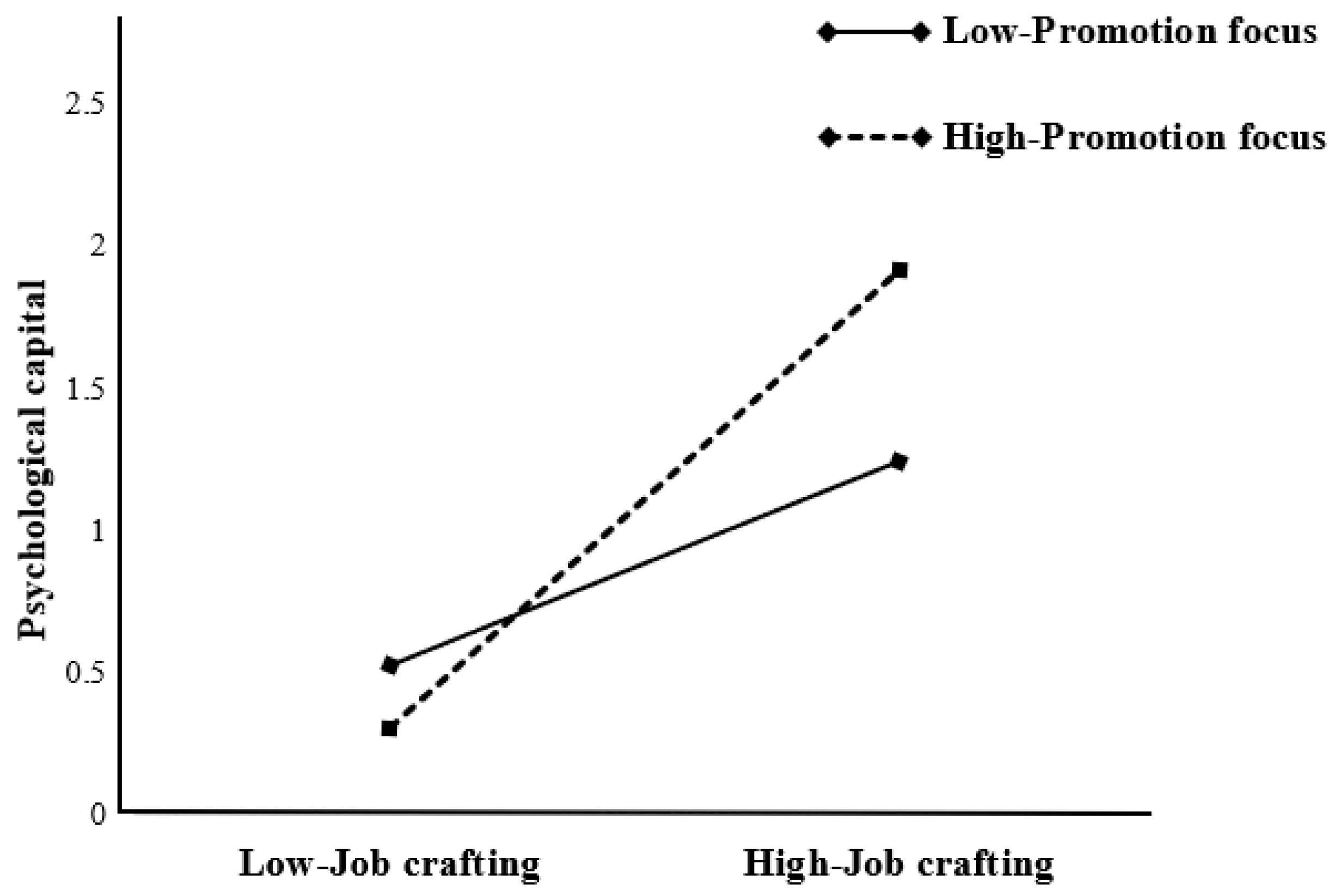
H3. Promotion focus positively moderates the relationship between job crafting and psychological capital, such that the positive effect of job crafting on psychological capital is stronger when promotion focus is high.
2.8. The Moderating Role of Promotion Focus Between Psychological Capital and Bootlegging Innovation
Psychological capital, as a state-like and developable psychological resource, has been widely recognized as a key driver of employees’ long-term positive behavior and sustained innovative vitality under uncertain environments [
48]. However, according to conservation of resources theory, the possession of resources does not necessarily guarantee their utilization. Whether employees are willing to invest their valuable psychological resources in high-risk and high-uncertainty innovation practices depends on their willingness to deploy such resources, their evaluation of expected gains, and their tolerance for potential loss [
24]. Therefore, for psychological capital to truly serve as an engine of sustainable innovation, it must be effectively activated by contextual motivational factors.
In this process, promotion focus serves as a critical resource-activation mechanism. According to regulatory focus theory [
21,
22], employees high in promotion focus tend to pursue growth and advancement, demonstrate proactive and opportunity-seizing orientations, and are more willing to assume reasonable risks in the pursuit of ideal goals. Consequently, they are more likely to actively invest their existing psychological resources—hope, optimism, self-efficacy, and resilience—into innovative activities that deviate from formal procedures but hold potential long-term value, such as bootlegging innovation [
23]. Although these bottom-up innovative attempts may bypass formal channels, they often plant the seeds for future competitive advantages at the organizational level.
In contrast, employees low in promotion focus may adopt conservative strategies toward resource utilization. Even when they possess high levels of psychological capital, their heightened failure avoidance may prevent them from transforming these resources into sustainable innovative behaviors, resulting in resource under-utilization and weakened innovation drive [
47].
From the dynamic resource-allocation perspective of COR theory, promotion focus influences employees’ cognitive assessments of risk–return trade-offs in innovation and redefines the psychological threshold for psychological resource mobilization. Promotion focus thereby determines whether psychological capital shifts from “latent reserve” to active investment, enabling psychological capital to genuinely participate in the organization’s innovation ecosystems and promote long-term adaptability and competitiveness.
In summary, promotion focus plays a pivotal moderating role in transforming psychological capital from a potential psychological reservoir into a sustained innovation driver, strengthening employees’ willingness to engage in constructive boundary-breaking actions and thereby enhancing organizational resilience and sustainable competitive advantage in uncertain environments. Accordingly, this study proposes the following hypothesis:
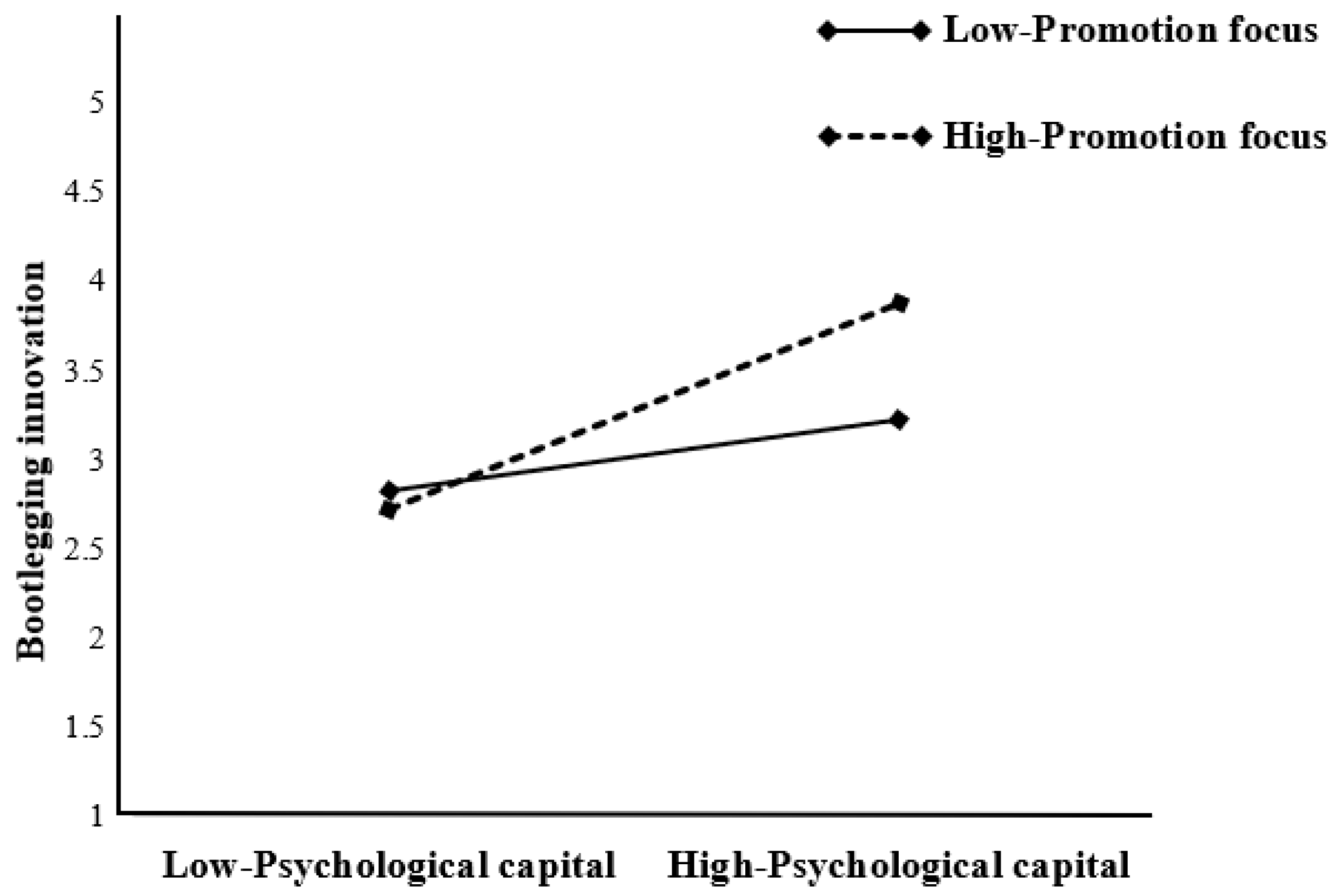
H4. Promotion focus positively moderates the relationship between psychological capital and bootlegging innovation, such that the positive effect of psychological capital on bootlegging innovation is stronger when promotion focus is high.
2.9. The Moderating Effect of Promotion Focus on the Mediating Role of Psychological Capital Between Job Crafting and Bootlegging Innovation
Job crafting enables employees to proactively satisfy their basic psychological needs for autonomy, competence, and relatedness, thereby stimulating intrinsic motivation [
12,
13] and fostering the gradual accumulation of psychological capital. As a developable and renewable psychological resource system, psychological capital improves employees’ resilience, coping capacity, and confidence in navigating uncertain and resource-demanding conditions, which in turn enhances their willingness and ability to engage in covert but constructive innovation such as bootlegging innovation [
48]. Thus, it functions as a pivotal resource-conversion bridge, transforming proactive job redesign into sustainable exploratory innovation.
However, the strength of this indirect effect does not remain constant across all employees. According to RFT [
12,
13], promotion focus reflects employees’ orientation toward growth, advancement, and the attainment of ideal outcomes. Employees high in promotion focus are more likely to recognize job crafting as an opportunity for self-development and capability enhancement, thereby accelerating intrinsic motivation activation and resource generation. Moreover, they are more inclined to actively utilize and invest the acquired psychological resources in challenging and high-uncertainty innovative actions including bootlegging innovation. In contrast, employees with low promotion focus may regard crafting behaviors as risky or unnecessary changes. Even when they obtain psychological resources, their heightened risk avoidance may hinder the conversion of these resources into proactive innovation, ultimately weakening or even suppressing the indirect effect [
49,
50,
51].
From a COR perspective, promotion focus does not alter the structure of the resource pathway itself, but rather shapes the overall effectiveness with which psychological capital, as a mediating resource, is translated into bootlegging innovation. In essence, promotion focus enhances the overall transmission intensity along the chain of “motivation activation → resource generation → resource deployment”, ensuring that proactive efforts lead to sustained innovative vitality and organizational resilience in uncertain environments.
H5. Promotion focus moderates the indirect effect of job crafting on bootlegging innovation through psychological capital, such that this mediating effect is stronger under higher levels of promotion focus.
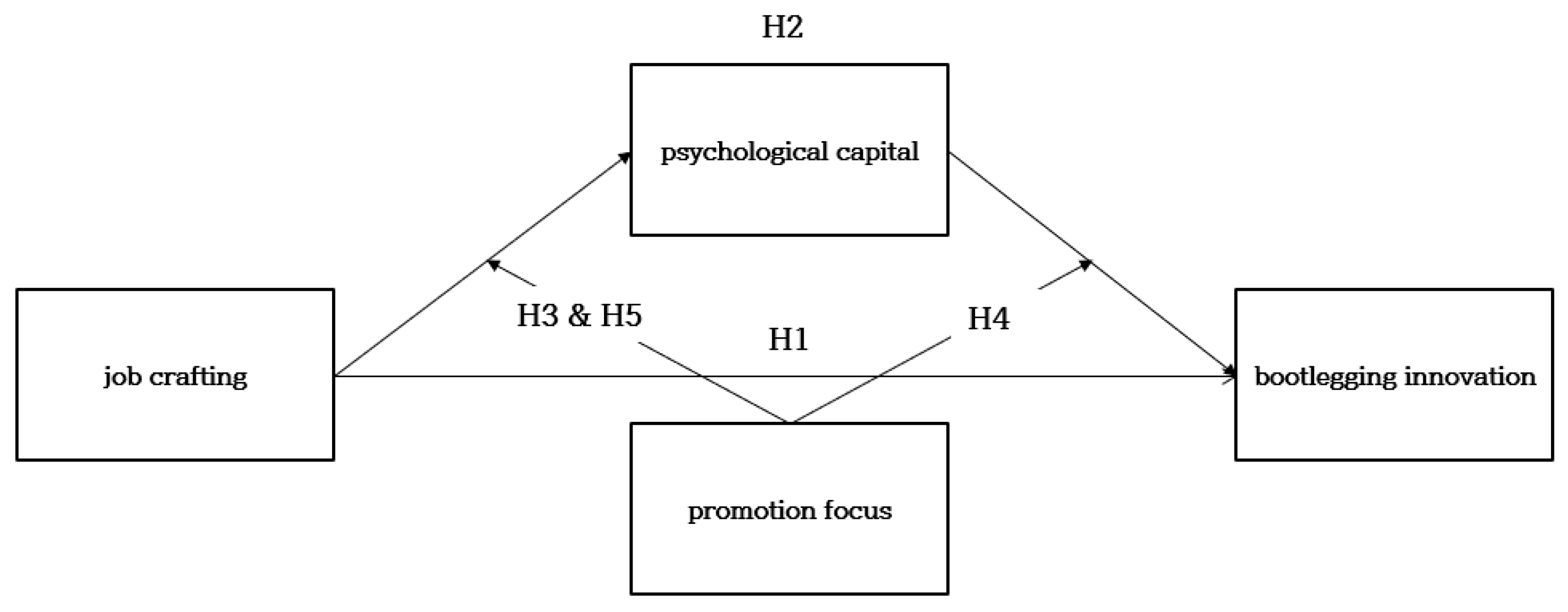
Based on these hypotheses, we developed the following research model (
Figure 1).
5. Conclusions
This study deepens our understanding of how employee job crafting is associated with bootlegging innovation and highlights its implications for sustaining organizational innovation capability. Drawing on SDT and COR, the findings indicate that job crafting is positively related to employees’ bootlegging innovation and is indirectly linked to this behavior through the accumulation of psychological capital, which functions as a renewable psychological resource supporting the continuity of constructive innovation. Moreover, the results show that promotion focus strengthens the associations along both the resource generation process from job crafting to psychological capital and the resource mobilization process from psychological capital to bootlegging innovation, underscoring the role of motivational orientations in shaping organizational resilience and sustaining bottom-up innovative vitality. The moderated mediation analysis further indicates that when promotion focus is high, the indirect association between job crafting and bootlegging innovation via psychological capital becomes stronger. This pattern is consistent with recent research suggesting that motivational orientation shapes whether psychological resources are actively mobilized toward deviant or exploratory innovation while extending prior work by demonstrating a dual-path amplification mechanism across both resource generation and resource mobilization stages. Taken together, these findings suggest that organizations operating under institutional constraints and uncertainty are more likely to sustain constructive innovation when employees’ intrinsic motivation, psychological resource accumulation, and promotion-focused orientations are jointly supported. Such patterns are consistent with the development of long-term adaptive capacity and sustainable competitive advantage.
Based on the findings of this study, organizations can take several concrete actions starting tomorrow. First, managers may intentionally redesign work roles to allow safe and bounded job crafting, granting employees discretion to adjust tasks and methods while maintaining clear ethical and compliance boundaries. Second, organizations can systematically invest in developing employees’ psychological capital—such as hope, self-efficacy, resilience, and optimism—through training, feedback mechanisms, and supportive leadership practices, thereby strengthening the psychological foundation for sustained innovation. Third, by cultivating a promotion-focused climate that emphasizes growth, learning, and long-term gains, organizations may encourage employees to more actively mobilize their psychological resources toward constructive innovation rather than risk avoidance. Together, these actions can help organizations harness bottom-up innovative initiatives in a controlled and sustainable manner, transforming proactive employee behavior into enduring innovation capability.
5.1. Theoretical Contributions
First, this study extends the antecedent framework of bootlegging innovation from the perspective of self-determination-driven proactive work behavior, highlighting its relevance to sustaining innovation vitality under dynamic conditions. Existing research has mainly focused on individual traits (e.g., creativity and self-efficacy) [
4] or external contextual factors (e.g., leadership and organizational climate) [
7], but has paid limited attention to how intrinsically motivated proactive behaviors drive BI. As a bottom-up behavior, job crafting is fundamentally driven by the satisfaction of three basic psychological needs emphasized in SDT, namely autonomy, competence, and relatedness [
34]. When employees activate intrinsic motivation through task, relational, and cognitive crafting, they are more willing to transcend formal role boundaries and explore new resources and innovative opportunities, thereby enhancing the organization’s long-term adaptability and sustainable development capabilities. Therefore, incorporating job crafting into the antecedent framework of BI not only responds to the call for deeper investigation into “positive deviance mechanisms” [
8], but also reveals how intrinsic motivation translates into boundary-breaking innovative behaviors that support sustainable organizational growth.
Second, based on COR theory, this study distinguishes between the two stages of resource generation and resource mobilization, and highlights the pivotal role of psychological capital as a renewable psychological resource for sustaining innovation. Job crafting serves as a proactive resource acquisition behavior, helping employees continuously generate hope, optimism, efficacy, and resilience by adjusting work boundaries and thereby forming a resource gain spiral [
18,
19]. Psychological capital thus becomes the core reservoir that stores and accumulates these psychological resources. However, psychological resources do not automatically transform into BI; only when employees perceive resource surplus and possess adequate risk-bearing capability will they mobilize such resources into highly uncertain and unauthorized innovation contexts [
46]. By enhancing confidence, reducing loss sensitivity, and strengthening persistence, psychological capital enables employees to overcome institutional and psychological barriers and convert innovative intentions into boundary-breaking actions. Therefore, psychological capital bridges the chain of resource generation → resource reserve → resource mobilization → innovative action, explaining how proactive work behaviors contribute to innovation resilience and organizational sustainability.
Third, this study reveals that promotion focus not only strengthens the positive effect of job crafting on psychological capital, but also exerts dual-path amplification effects in both the resource generation and resource mobilization stages. In the resource generation stage, employees high in promotion focus are more likely to view job crafting as an opportunity for growth and goal attainment, thereby actively transforming it into psychological resources such as hope, optimism, efficacy, and resilience [
23,
47]. In the resource mobilization stage, employees with high promotion focus are more willing to invest their psychological resources into nonconforming yet constructive innovative behaviors [
65]. These findings refine the application of RFT [
21] within the motivation–resource–behavior chain and extend the boundary of COR theory [
17,
18] in explaining individual differences in resource use strategies. Moreover, they suggest the necessity of jointly considering both “resource generation tendencies” and “resource utilization tendencies” in future resource-based research to build a resilient, bottom-up sustainable innovation ecosystem.
Importantly, the present findings should not be interpreted merely as context-specific limitations. Instead, the Chinese organizational context serves as a theoretically meaningful boundary condition that clarifies when and why the proposed motivation–resource–behavior mechanism is most likely to operate. In institutional environments characterized by high power distance, strong rule orientation, and formalized control systems, employees face greater constraints on overt rule-challenging behavior. Under such conditions, job crafting becomes a psychologically legitimate and low-visibility pathway through which employees can accumulate psychological resources and engage in covert yet constructive innovation, such as bootlegging. By explicitly theorizing this contextual embeddedness, the study transforms institutional constraints from a defensive limitation into a proactive theoretical boundary condition, thereby strengthening the explanatory power and contextual sensitivity of the proposed framework.
5.2. Managerial Implications
First, the findings of this study indicate that job crafting serves as a critical micro-foundation for activating employees’ bootlegging innovation; however, its effectiveness depends on whether it is embedded within a clear and sustainability-oriented governance framework. Organizations should not interpret job crafting as unrestricted freedom, but rather as a form of bounded autonomy supported by institutional design that balances exploration with accountability. Specifically, managers can redesign work roles by shifting from rigid “task checklist” descriptions to a “goals–boundaries” model in which performance objectives, resource constraints, and non-negotiable compliance bottom lines are explicitly defined, while employees retain discretion over how goals are achieved. In addition, tiered approval processes and lightweight documentation mechanisms can be established to manage exploratory job crafting initiatives at different levels, thereby reducing experimentation costs without undermining responsibility. Such governance-oriented job design helps organizations sustain innovation over time rather than encouraging short-lived or uncontrolled experimentation.
Second, the results further suggest that psychological capital and promotion focus play pivotal roles in enabling job crafting to translate into bootlegging innovation; however, their effective management should be adapted to industry-specific regulatory and sustainability constraints. In knowledge-intensive and less regulated industries (e.g., information technology, R&D, and creative services), organizations may allow broader autonomy and longer exploration cycles, supported by developmental feedback, vision-based communication, and growth-oriented performance management systems. In contrast, in highly regulated or safety-critical industries (e.g., manufacturing, healthcare, and finance), the development of psychological capital and the activation of promotion focus should be accompanied by clearer procedural boundaries, shorter experimentation cycles, and enhanced compliance oversight. Such differentiated implementation reflects a principle of institutional fit, enabling organizations to balance innovative vitality with organizational stability under varying regulatory and risk environments.
Third, although bootlegging innovation holds substantial constructive potential, it inherently involves deviations from formal rules and procedures and therefore entails ethical, compliance, and governance risks, making responsible managerial intervention essential. Encouraging bootlegging innovation should thus be understood as actively guiding and channeling constructive deviance, rather than passively tolerating uncontrolled rule violations. In this regard, managers can intentionally establish a “bootlegging safe zone”—a bounded organizational space in which exploratory and unauthorized innovation is tolerated under clearly articulated ethical and procedural constraints. Such safe zones may include designated discretionary time, small-scale experimentation budgets, and staged risk-review mechanisms that allow managers to monitor innovation intent without prematurely suppressing exploratory behavior. Importantly, these arrangements clarify which boundaries are flexible and which are non-negotiable (e.g., legal compliance, data security, and ethical integrity), thereby reducing ambiguity and moral hazard.
Furthermore, organizations can support these safe zones by providing access to legal, data-protection, and technical advisory resources, which help employees assess risks and align exploratory innovation with organizational values. Reward systems should adopt composite evaluation criteria that emphasize long-term value creation, the sustainability of outcomes, and knowledge diffusion across units, rather than short-term or opportunistic gains. Through such governance mechanisms, organizations can effectively manage the double-edged nature of bootlegging innovation, encouraging its creative potential while preventing ethical erosion and compliance breakdowns, thereby transforming employee-driven exploration into a durable source of sustainable competitive advantage.
5.3. Research Limitations and Future Research
First, although this study adopted a two-wave survey design to mitigate common method bias, the data were primarily collected through employees’ self-reports. As a result, potential influences such as social desirability bias and subjective evaluation cannot be entirely ruled out, and causal inferences remain somewhat limited. Future research could employ longitudinal designs, experimental interventions, or multi-source data (e.g., supervisor ratings, objective performance indicators, or behavioral records) to more rigorously examine the causal relationships and dynamic evolution among job crafting, psychological capital, and bootlegging innovation.
Second, while the sample was drawn from multiple industries, all respondents were embedded within a single national context. Although the theoretical implications of this contextual embeddedness have been explicitly addressed as boundary conditions in the discussion, the use of a single-country sample may still limit the empirical generalizability of the findings [
66]. Future studies could conduct cross-cultural and cross-institutional comparisons to test whether the proposed motivation–resource–behavior mechanism holds across different cultural environments, regulatory regimes, and organizational systems.
Third, this study primarily focused on psychological capital as the key mediating mechanism and promotion focus as a dual-path moderator. However, resource generation and resource mobilization processes may also be influenced by additional individual and organizational factors. For instance, psychological safety, career commitment, or risk tolerance may shape the employees’ willingness to invest psychological resources in innovative behavior [
67], while organizational-level factors such as leadership style, team innovation climate, or structural autonomy may further condition the effectiveness of job crafting [
68]. Future research could incorporate multiple mediators and multilevel moderators and adopt multilevel research designs to more comprehensively capture the complexity of these processes.
Finally, although this study highlights the constructive potential of bootlegging innovation, it did not directly examine its possible dark-side consequences. Because bootlegging involves deviations from formal rules and procedures, it may entail ethical, compliance, or governance risks under certain conditions. Future research should systematically investigate the boundary conditions under which bootlegging innovation shifts from constructive exploration to dysfunctional behavior, for example, by incorporating ethical climate, compliance systems, or leadership monitoring. Examining potential negative outcomes such as burnout or moral disengagement would provide a more balanced understanding of this double-edged phenomenon.