
Endogenous and Exogenous Institutional Compliance in Community-Based Forest Management: Pathways for a Jelled Institutional Arrangement in Namibia

Abstract
1. Introduction
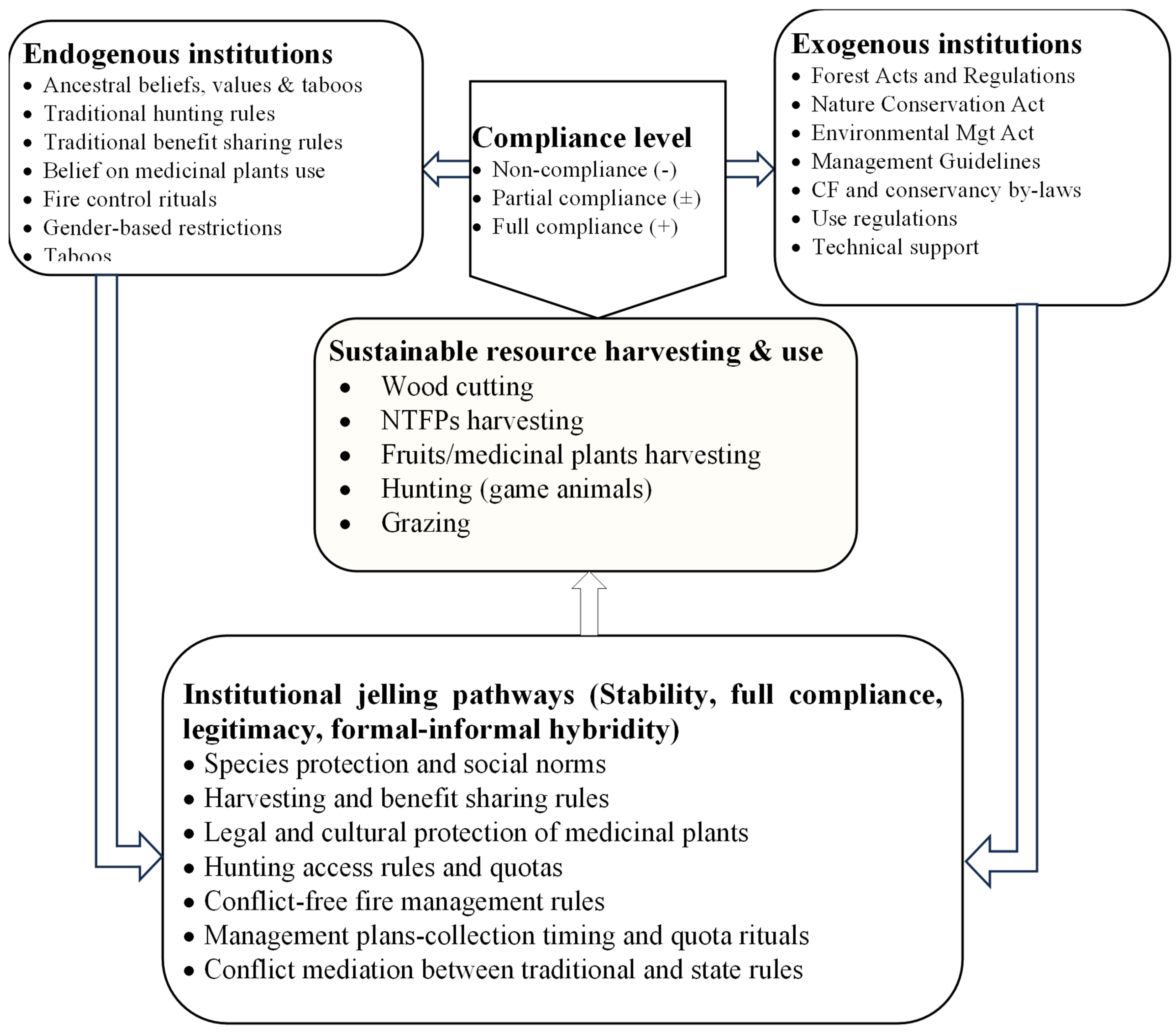
2. Conceptual Framework
3. Materials and Methods
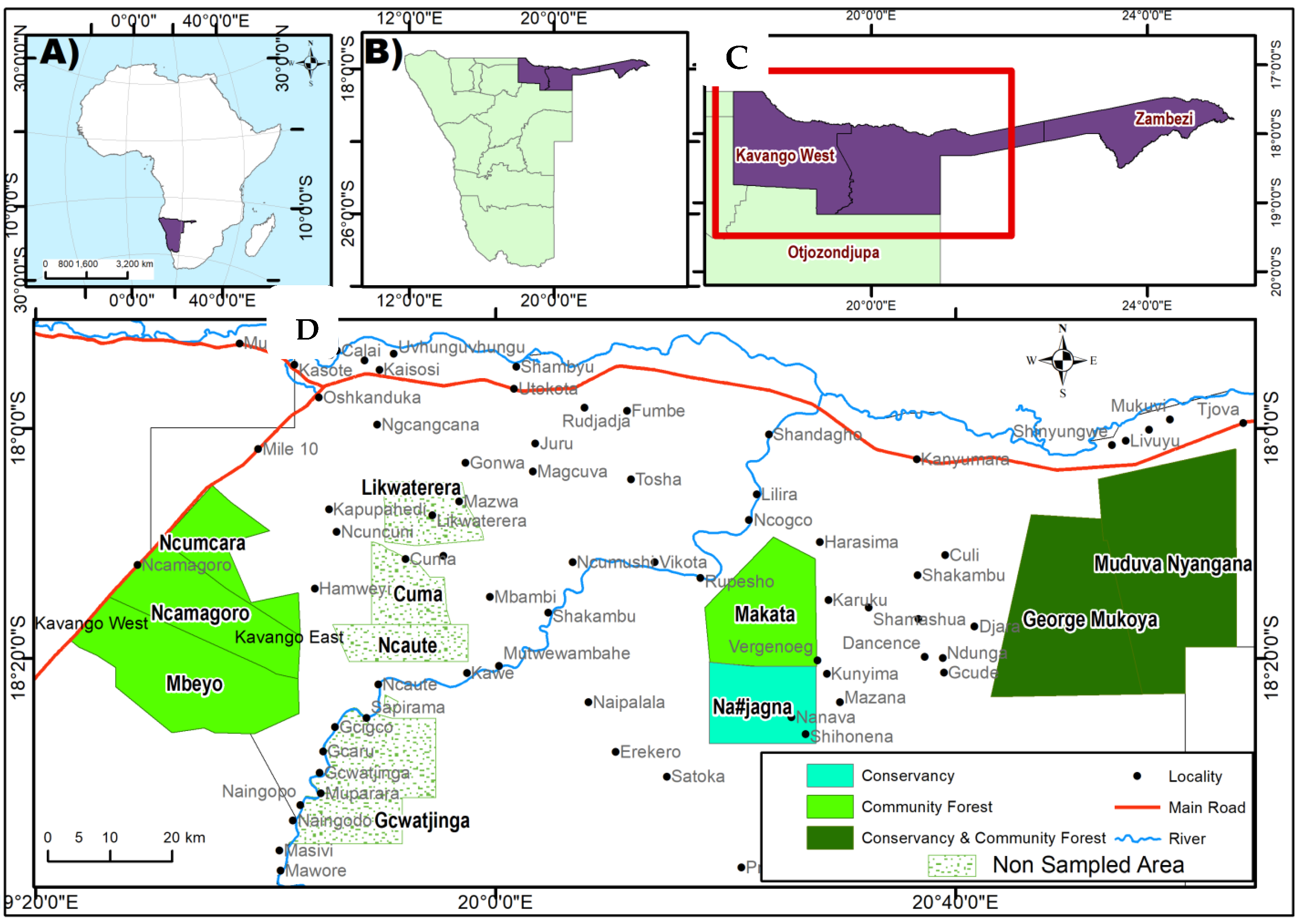
3.1. Study Area
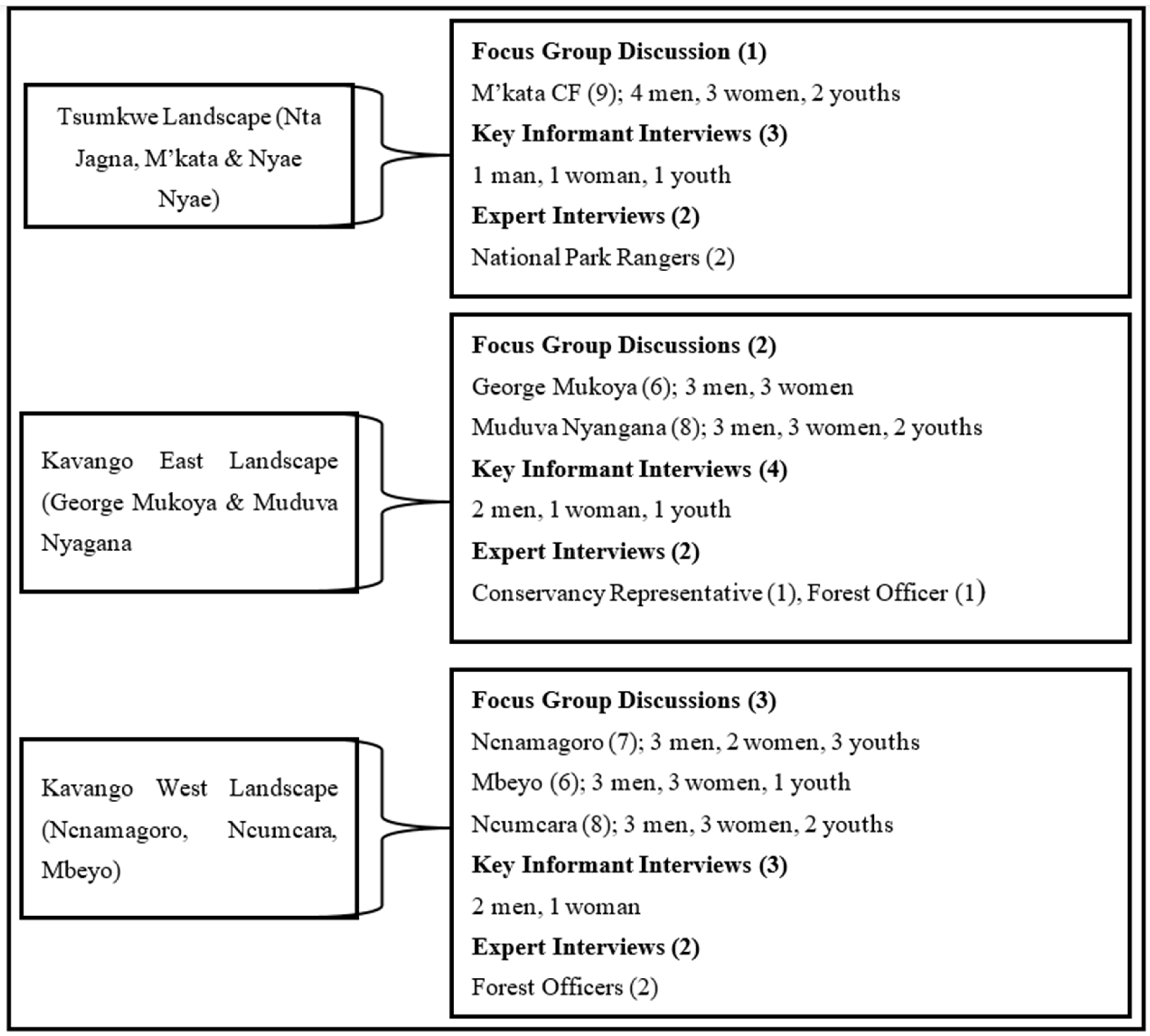
3.2. Data Collection
3.3. Data Analysis
4. Results
4.1. Endogenous Cultural Institutions and Their Current Compliance
4.2. Exogenous Institutional Arrangement in Community-Based Forest Management
4.3. Potentials of Jelled Institutions in Shaping Resource Use and Management
4.3.1. Jelled Institutional Arrangements for Sustainable Timber Harvesting in Namibia
4.3.2. Jelled Institutional Arrangements for Sustainable Wildlife Hunting and Consumption in Namibia
4.3.3. Jelled Institutional Arrangements for Medicinal Plant Conservation and Use in Namibia
4.3.4. Jelled Institutional Arrangements for Sustainable Fruit Harvesting in Namibia
4.3.5. Jelled Institutional Arrangements for Integrated Fire and Grazing Management Protocol in Namibia
4.3.6. Jelled Institutional Arrangements for Settlement Control in Forest Areas in Namibia
5. Discussion
5.1. Variations in ECI Compliance Shaped by Age and Resource Typology
5.2. Exogenous Institutions Characterized by Limited Enforcement and Compliance
5.3. Potentials of Jelled Institutions in Shaping Resource Use and Management
6. Conclusions
Author Contributions
Funding
Institutional Review Board Statement
Informed Consent Statement
Data Availability Statement
Conflicts of Interest
Appendix A
Appendix A.1
- What are the most collected forest resources in your area? Please indicate the uses and rank these resources in order of importance (e.g., economic, ecological, social, cultural importance). Besides the collection of these resources, what are the other activities that people in your community practice?
- Who are the key endogenous actors managing, overseeing, guiding these resources? For instance, village groups, traditional rulers, secret societies, etc. What role do they play in managing these resources?
- Who are the key exogenous actors managing, overseeing, guiding these resources? For instance, forest department, conservation NGOs, migrants, tourism promoters, private enterprises, etc. What role do they play in managing these resources?
- What are the endogenous rules linked to the access, use, and managing of these resources? That is, what are the specific beliefs, customs, taboos, which regulated the use of these resources in the past? What are the specific rules today? Where did these traditional practices, rules, or structures originate, and how have they been preserved or changed over time?
- Have these rules witnessed a change? If so, what accounts for such changes over time? Who are the actors enforcing these rules? What has been the direction of change in these rules? What are the new rules introduced? Which old rules have been maintained and are still effective? What accounts for their stability over these years?
- What is the level of compliance with endogenous institutions? That is, do people adhere to these institutions totally or partially? Are there instances of complete non-adherence to endogenous institutions? What explains the variations in the compliance levels?
- What are the exogenous rules linked to the access, use, and managing of these resources in the past? What are the specific rules today? Have these rules witnessed a change? What has been the direction of change in these rules? What are the new rules introduced? Which old rules have been maintained and are still effective? What accounts for their stability over these years?
- What is the level of compliance with exogenous institutions? That is, do people adhere to these institutions totally or partially? Are there instances of complete non-adherence to exogenous institutions? What explains the variations in the compliance levels?
- What are the interests of the actor constellations in the forest-linked institutional change and how do the different actor constellations steer the enforcement and transformation process of exogenous and endogenous rules in your community?
Appendix A.2
- What are the most commonly collected forest resources in your area? Please indicate the uses and rank these resources in order of importance (e.g., economic, ecological, social, cultural importance). Besides the collection of these resources, what are the other activities that people in your community practice?
- Could you provide a brief history of the laws, regulations, or policies which have regulated the use and management of forest resources in your area? What are the major historical changes and the time each lasted that occurred from the pre-colonial, colonial, and the post-colonial periods?
- Could you provide a brief description of the management structures, such as the departments or organizations or committees responsible for overseeing the management of forest resources?
- What were the motives behind the institution of these regulations, committees, or organizational structures in forest use and management? Who were the main internal and external actors (e.g., individuals, organizations, civil society) driving these changes?
- How have formal institutions (laws, regulations, policies, and government departments) interacted with informal or customary systems in managing forest resources during these periods?
- Are there conflicts between formal structures (e.g., government policies or departments) and customary practices, traditional rules, or norms in the management and use of forest resources?
- What challenges do customary practices, traditional rules, or norms face in the management and use of forest resources?
- In your opinion, what are some of the options to improve on the effectiveness of forest management institutions in your community?
Appendix A.3
- What are the most commonly collected forest resources in your area? Please indicate the uses and rank these resources in order of importance (e.g., economic, ecological, social, cultural importance). Besides the collection of these resources, what are the other activities that people in your community practice?
- Are there any norms, taboos, customs, values, or beliefs in the community that regulate the use and management of forest resources? If so, could you indicate them? What are the specific beliefs, customs, taboos, which regulated the use of these resources in the past? What are the specific rules today? Where did these traditional practices, rules, or structures originate, and how have they been preserved or changed over time?
- Which actors, stakeholders, or structures are responsible for overseeing these norms, taboos, customs, values, or beliefs in the community?
- Are there government regulations or rules that the community recognizes as controlling the use and management of forest resources? Who are the key exogenous actors managing, overseeing, guiding these resources? For instance, forest department, conservation NGOs, migrants, tourism promoters, private enterprises, etc. What role do they play in managing these resources?
- Have these rules witnessed a change? If so, what accounts for such changes over time? Who are the actors enforcing these rules? Do you think there is significant or less compliance to these rules?
- What has been the direction of change in these rules? What are the new rules introduced? Which old rules have been maintained and are still effective? What accounts for their stability over these years?
- Do you think there is significant or less compliance to these rules? What accounts for their stability over these years?
- What are the interests of the actor constellations in the forest-linked institutional change and how do the different actor constellations steer the enforcement and transformation process of exogenous and endogenous rules in your community?
References
- FAO. Global Forest Resources Assessment 2020. In Global Forest Resources Assessment 2020; FAO: Rome, Italy, 2020. [Google Scholar] [CrossRef] [Scilit]
- Wineman, A.; Jayne, T.S.; Stevens, C. The Relationship Between Medium-Scale Farms and Deforestation in Sub-Saharan Africa; United States Agency for International Development (USAID): Washington, DC, USA, 2022.
- Piabuo, S.M.; Foundjem-Tita, D.; Minang, P.A. Community forest governance in Cameroon: A review. Ecol. Soc. 2018, 23, 34. [Google Scholar] [CrossRef] [Scilit]
- Kimengsi, J.N.; Bhusal, P. Community forestry governance: Lessons for Cameroon and Nepal. Soc. Nat. Resour. 2022, 35, 447–464. [Google Scholar] [CrossRef] [Scilit]
- Meinzen-Dick, R.; Quisumbing, A.; Doss, C.; Theis, S. Women’s land rights as a pathway to poverty reduction: Framework and review of available evidence. Agric. Syst. 2019, 172, 72–82. [Google Scholar] [CrossRef] [Scilit]
- Ostrom, E. Governing the Commons: The Evolution of Institutions for Collective Action; Cambridge University Press: Cambridge, UK, 1990; Available online: https://digitalrepository.unm.edu/nrj/vol32/iss2/6 (accessed on 12 April 2023).
- Kimengsi, J.N.; Owusu, R.; Djenontin, I.N.S.; Pretzsch, J.; Giessen, L.; Buchenrieder, G.; Pouliot, M.; Acosta, A.N. What do we (not) know on forest management institutions in sub-Saharan Africa? A regional comparative review. Land Use Policy 2022, 114, 105931. [Google Scholar] [CrossRef] [Scilit]
- Kimengsi, J.N.; Mukong, A.K.; Giessen, L.; Pretzsch, J. Institutional dynamics and forest use practices in the Santchou Landscape of Cameroon. Environ. Sci. Policy 2022, 2022, 68–80. [Google Scholar] [CrossRef] [Scilit]
- Yeboah-Assiamah, E.; Muller, K.; Domfeh, K.A. Two sides of the same coin: Formal and informal institutional synergy in a case study of wildlife governance in Ghana. Soc. Nat. Resour. 2019, 32, 1364–1382. [Google Scholar] [CrossRef] [Scilit]
- Kimengsi, J.N.; Balgah, R.A. Colonial hangover and institutional bricolage processes in forest use practices in Cameroon. For. Policy Econ. 2021, 125, 102406. [Google Scholar] [CrossRef] [Scilit]
- Musonda, G. Institutional Change and Actor Constellations in the Ntambu Community Management Area of Zambia: A Time-Based Classification. Master’s Thesis, Institute of International Forestry and Forest Products, Technische Universität Dresden, Dresden, Germany, 2025; p. 127. [Google Scholar]
- Colding, J.; Folke, C.; Thomas, E. Social institutions in ecosystem management and biodiversity conservation. Trop. Ecol. 2003, 44, 25–41. [Google Scholar]
- Kimengsi, J.N.; Silberberger, M. How endogenous cultural institutions may (not) shape peasant farmers’ climate adaptation practices: Learning from Rural Cameroon. Soc. Nat. Resour. 2023, 36, 460–478. [Google Scholar] [CrossRef] [Scilit]
- Hardin, G. The Tragedy of the Commons. Science 1968, 162, 1243–1248. [Google Scholar] [CrossRef] [Scilit]
- Hobbes, T. Leviathan [1651]; Tuck, R., Ed.; Cambridge University Press: Cambridge, UK, 1991. [Google Scholar]
- Hobbes, T. Leviathan; A&C Black: London, UK, 2006. [Google Scholar]
- Sørensen, G. Development as a Hobbesian dilemma. Third World Q. 1996, 17, 903–916. [Google Scholar] [CrossRef] [Scilit]
- Smith, R.J. Resolving the tragedy of the commons by creating private property rights in wildlife. Cato J. 1981, 1, 439. [Google Scholar]
- Ostrom, E. A General Framework for Analyzing Sustainability of Social-Ecological Systems. Science 2009, 325, 419–422. [Google Scholar] [CrossRef] [Scilit] [PubMed]
- Haller, T.; Acciaioli, G.; Rist, S. Constitutionality: Conditions for crafting local ownership of institution-building processes. Soc. Nat. Resour. 2009, 29, 68–87. [Google Scholar] [CrossRef] [Scilit]
- Kashwan, P.; MacLean, L.M.; García-López, G.A. Rethinking power and institutions in the shadows of neoliberalism: (An introduction to a special issue of World Development). World Dev. 2019, 6, 133–146. [Google Scholar]
- Ensminger, J. Making a Market. The Institutional Transformation of an African Society; Cambridge University Press: Cambridge, UK, 1992. [Google Scholar]
- Cleaver, F. Development Through Bricolage: Rethinking Institutions for Natural Resource Management; Routledge: New York, NY, USA, 2012. [Google Scholar]
- Cleaver, F.D.; de Koning, J. Furthering critical institutionalism. Int. J. Commons 2015, 9, 1–18. [Google Scholar] [CrossRef]
- Sakketa, T.G. Institutional bricolage as a new perspective to analyse institutions of communal irrigation: Implications towards meeting the water needs of the poor communities. World Dev. Perspect. 2018, 9, 1–11. [Google Scholar] [CrossRef] [Scilit]
- Haller, T.; Belsky, J.M.; Rist, S. The constitutionality approach: Conditions, opportunities, and challenges for bottom-up institution building. Hum. Ecol. 2018, 46, 1–2. [Google Scholar] [CrossRef] [Scilit]
- Kimengsi, J.N.; Buchenrieder, G.; Pretzsch JBalgah, R.A.; Mallick, B.; Haller, T.; Gebara, M.F. Institutional jelling in socio-ecological systems: Towards a novel theoretical construct? Land Use Policy 2025, 57, 107681. [Google Scholar] [CrossRef] [Scilit]
- Osaghae, E.E. The Passage from the Past to the Present in African Political Thought: The Question of Relevance. In African Traditional Political Thought and Institutions; Ali, Z.S., Ayoade, J.A.A., Agbaje, A.A.B., Eds.; Centre for Black and African Arts and Civilization: Lagos, Nigeria, 1989; pp. 53–75. [Google Scholar]
- Legesse, A. Gada: Three Approaches to the Study of African; Free Press: New York, NY, USA, 1973. [Google Scholar]
- Ghai, D. Conservation, Livelihood and Democracy: Social Dynamics of Environmental Changes in Africa; Discussion Paper 33; United Nations Research Institute for Social Development: Geneva, Switzerland, 1973. [Google Scholar]
- Mupedziswa, R.; Ntseane, D. The contribution of non-formal social protection to social development in Botswana. Dev. South. Afr. 2013, 30, 84–97. [Google Scholar] [CrossRef] [Scilit]
- Ribot, J.C. Choosing Representation: Institutions and Powers for Decentralized Natural Resource Management. In The Politics of Decentralization—Forests, Power and People; Pierce Colfer, C.J., Capistrano, D., Eds.; Earthscan: London, UK, 2005; pp. 86–106. Available online: https://www.cifor.org/publications/pdf_files/events/documentations/interlaken/papers/Jesse_Ribot.pdf (accessed on 12 March 2023).
- Fearon, J.D. Ethnic structure and cultural diversity by country. J. Econ. Growth 2003, 8, 195–222. [Google Scholar] [CrossRef] [Scilit]
- Shifeta, P. Keynote Speech: Ministry of Environment, Forestry and Tourism towards Sustainable Forest Management. In Proceedings of the 3rd National Conference on The Future of Namibia’s Forests: Sustainable Forest Management as Key to Unlock its Potential, Windhoek, Namibia, 20 September 2023. [Google Scholar]
- Benkenstein, A.; Hengari, S.; Mbongo, W. Community Forests in Namibia: Ensuring Sustainable Local-Level Forest Management. Pretoria: South African Institute of International Affairs. Policy Brief. 2014, 119, 1–4. [Google Scholar]
- Leonard, L.; Iileka, R. Examining local community socioeconomic benefits from community forest programmes in Namibia. J. Contemp. Afr. Stud. 2024, 42, 313–329. [Google Scholar] [CrossRef] [Scilit]
- Murphree, M.W. Congruent Objectives, Competing Interests and Strategic Compromise. Concept and Process in the Evolution of Zimbabwe’s CAMPFIRE Programme. In Proceedings of the Conference Representing Communities: Histories and Politics of Community-based Resource Management, Helen, GA, USA, 1–3 June 1997. [Google Scholar]
- United Nations Development Programme—UNDP. N≠a Jaqna Conservancy, Namibia; Equator Initiative Case Study Series; Equator Initiative: New York, NY, USA, 2012. [Google Scholar]
- Maskey, V.; Gebremedhin, T.G.; Dalton, T.J. Social and Cultural Determinants of Collective Management of Community Forest in Nepal. J. For. Econ. 2006, 11, 261–274. [Google Scholar] [CrossRef] [Scilit]
- Ministry of Agriculture; Water and Forestry. Community Forestry Guidelines; Ministry of Agriculture, Water and Forestry: Windhoek, Namibia, 2005.
- Kabajani, M. Management of a Community Forest, Think Namibia: Sustainable Forest Management. 2021. Available online: https://www.thinknamibia.org.na/images/projects/forest/DRFN_Poster_No4_ENG_final.pdf (accessed on 6 December 2025).
- Owusu, R.; Kimengsi, J.N.; Giessen, L. Institutional Change and Compliance in Forest Landscape Restoration Governance: Insights from the Western Highlands of Cameroon. J. Land Use Sci. 2024, 19, 36–58. [Google Scholar] [CrossRef] [Scilit]
- Atlas of Namibia Team. Atlas of Namibia: Its Land, Water and Life; Namibia Nature Foundation: Windhoek, Namibia, 2022. [Google Scholar]
- Goergen, J.D.; Louis, M.P.; Kellner, K.F.; Roloff, G.J.; Lindeque, M.; Belant, J.L. Local management and governance improve natural resource incomes of communal conservancies in Namibia. Conserv. Sci. Pract. 2025, 7, e70054. [Google Scholar] [CrossRef] [Scilit]
- World Bank Group (WBG). Namibia—Data; WBG: Washington, DC, USA, 2023. [Google Scholar]
- NACSO. The state of community conservation in Namibia (Annual Report 2019); Ministry of Environment, Forestry and Tourism, and Namibian Association of CBNRM Support Organizations: Windhoek, Namibia, 2021. [Google Scholar]
- Otsub, M.D.; Shilongo, M.; Mwiikinghii, J.; Mukonda, J. Forest Management Plan for M’Kata Community Forest; Directorate of Forestry: Windhoek, Namibia, 2003. [Google Scholar]
- Bowen, G.A. Naturalistic inquiry and the saturation concept: A research note. Qual. Res. 2008, 8, 137–152. [Google Scholar] [CrossRef] [Scilit]
- Hays, J.; Hitchcock, R. Land and Resource Rights in the Tsumkwe Conservancies-Nyae Nyae and N ≠ a Jaqna. In Neither Here nor There…: Indigeneity, Marginalisation and Land Rights in Post-Independence Namibia; Odendaal, W., Werner, W., Eds.; Legal Assistance Centre: Windhoek, Namibia, 2020; pp. 183–215. [Google Scholar]
- Hsieh, H.F.; Shannon, S.E. Three approaches to qualitative content analysis. Qual. Health Res. 2005, 15, 1277–1288. [Google Scholar] [CrossRef] [Scilit]
- Makwinja, Y.H.; Kimengsi, J.N. Traditional Institutional Change and Forest Resource Use Practices in Rural Malawi: The Case of M’bona. J. Sustain. For. 2025, 1–28. [Google Scholar] [CrossRef] [Scilit]
- Isokon, B.; Udo, E.; Ekpo, S. Youth and institutional change in Nigerian forest communities. Afr. Stud. Rev. 2022, 65, 78–95. [Google Scholar]
- Amoah, A.; Korle, K.; Kwablah, E.; Asiama, R.K. Sustaining Protected Forests and Forest Resources in Ghana: An Empirical Evidence. J. Sustain. For. 2022, 42, 967–985. [Google Scholar] [CrossRef] [Scilit]
- Chhetri, R.; Yokying, P.; Smith, A.; Van Den Hoek, J.; Hurni, K.; Saksena, S.; Fox, F. Forest, agriculture, and migration: Contemplating the future of forestry and agriculture in the middle-hills of Nepal. J. Peasant Stud. 2021, 50, 411–433. [Google Scholar] [CrossRef] [Scilit]
- Poudyal, B.H.; Khatri, D.B.; Paudel, D.; Marquardt, K.; Khatri, S. Examining forest transition and collective action in Nepal’s community forestry. Land Use Policy 2023, 134, 106872. [Google Scholar] [CrossRef] [Scilit]
- Owusu, R.; Kimengsi, J.N.; Giessen, L. The Effects of Actors’ Interests and Power on Compliance with Institutional Arrangements: Mixed-methods Insights from Cameroon’s Forest Landscape Restoration Governance. J. Environ. Manag. 2025, 397, 128295. [Google Scholar] [CrossRef] [Scilit] [PubMed]
- Murata, C.; Thondhlana, G. Challenges to the Use of Traditional Ecological Knowledge in Natural Resource Management in Rural Eastern Cape, South Africa. In Integrating Indigenous and Scientific Knowledge for Sustainable Food Systems in Africa; Dittoh, S., Bon, A., Akkermans, H., Eds.; Sustainable Development Goals Series; Springer: Cham, Switzerland, 2025. [Google Scholar] [CrossRef] [Scilit]
- Charmakar, S.; Kimengsi, J.N.; Giessen, L. Linking institutional change mechanisms with forest management outcomes: Evidence from community forestry in Nepal. Ecol. Soc. 2024, 29, 1. [Google Scholar] [CrossRef] [Scilit]
- Benedum, M.E.; Cook, N.J.; Vallury, S. Remittance income weakens participation in community-based natural resource management. Ecol. Soc. 2025, 30, 34. [Google Scholar] [CrossRef] [Scilit]
- Kachali, R.N.; Dawson, N.M.; Loos, J. Institutional rearrangements in the north Luangwa ecosystem: Implications of a shift to community based natural resource management for equity in protected area governance. Heliyon 2024, 10, e33549. [Google Scholar] [CrossRef] [Scilit]
- Poudyal, B.H.; Maraseni, T.; Cockfield, G. Scientific Forest Management Practice in Nepal: Critical Reflections from Stakeholders’ Perspectives. Forests 2020, 11, 27. [Google Scholar] [CrossRef] [Scilit]
- Boakye, J. Enforcement of logging regulations in Ghana: Perspectives of frontline regulatory officers. For. Policy Econ. 2020, 115, 102138. [Google Scholar] [CrossRef] [Scilit]
- Basnyat, B. Pitfalls of Scientific Forestry Practices in the Community Forestry of Nepal. For. J. Inst. For. Nepal 2021, 18, 30–40. [Google Scholar] [CrossRef] [Scilit]
- Zhang, Y. Institutions in Forest Management: Special Reference to China. In World Forests, Markets and Policies; Palo, M., Uusivuori, J., Mery, G., Eds.; World Forests; Springer: Dordrecht, The Netherlands, 2001; Volume 3. [Google Scholar] [CrossRef] [Scilit]
- Adhikari, B.; Lovett, J.C. Transaction costs and community-based natural resource management in Nepal. J. Environ. Manag. 2006, 78, 5–15. [Google Scholar] [CrossRef] [Scilit]
- Frey, G.E.; Charnley, S.; Makala, J. Economic viability of community-based forest management for certified timber production in southeastern Tanzania. World Dev. 2021, 144, 105491. [Google Scholar] [CrossRef] [Scilit]
- Meshack, C.K.; Ahdikari, B.; Doggart, N.; Lovett, J.C. Transaction costs of community-based forest management: Empirical evidence from Tanzania. Afr. J. Ecol. 2006, 44, 468–477. [Google Scholar] [CrossRef] [Scilit]
- Friman, J. Gendered woodcutting practices and institutional bricolage processes—The case of woodcutting permits in Burkina Faso. For. Policy Econ. 2020, 111, 102045. [Google Scholar] [CrossRef] [Scilit]
- Charmakar, S.; Kimengsi, J.N.; Giessen, L. The manifestation of institutional bricolage and community forest management outcomes: Insights from four socio-ecological settings in Nepal. J. Land Use Sci. 2024, 19, 278–303. [Google Scholar] [CrossRef] [Scilit]
- Wartmann, F.M.; Haller, T.; Backhaus, N. Institutional shopping for natural resource management in a protected area and indigenous territory in the Bolivian Amazon. Hum. Organ. 2016, 75, 218–229. [Google Scholar] [CrossRef] [Scilit]
- Faggin, J.M.; Behagel, J.H. Institutional bricolage of sustainable forest management implementation in rural settlements in Caatinga biome, Brazil. Int. J. Commons 2018, 12, 275–299. [Google Scholar] [CrossRef] [Scilit]
- Mehring, M.; Seeberg-Elverfeldt, C.; Koch, S.; Barkmann, J.; Schwarze, S.; Stoll-Kleemann, S. Local institutions: Regulation and valuation of forest use—Evidence from Central Sulawesi, Indonesia. Land Use Policy 2011, 28, 736–747. [Google Scholar] [CrossRef] [Scilit]
- Kimengsi, J.N.; Aung, P.S.; Pretzsch, J.; Haller, T.; Auch, E. Constitutionality and the co-management of protected areas: Reflections from Cameroon and Myanmar. Int. J. Commons 2019, 13, 1003–1020. [Google Scholar] [CrossRef] [Scilit]



| SN | ECI | Description | Compliance Levels | Source |
|---|---|---|---|---|
| 1 | Belief-based sanctions on medicinal plant use | Snake plant and Kiet tree are protected, with cutting forbidden to sustain their populations. Their products are used for cleansing, protection from spiritual attacks, and rituals or healing, often via smoke. | Elders still enforce protection and sustainable use of key medicinal resources—Full compliance (+) | KII2, KII7, FGD1 |
| 2 | Gender-based dietary taboos on wild animals | Pregnant women are forbidden from eating giraffe meat unless a ritual with the skin is performed; otherwise, their child risks being born weak and sickly. Leopard and wild cat meat are believed to cause epilepsy and breathing problems in descendants. Men cannot eat rock monitor meat. | Rules followed during pregnancy or menstruation, though knowledge gaps limit consistent compliance—Partial compliance (±) | KII1, KII2, KII5, KII7 FGD2 FGD4 |
| 3 | Witchcraft-related taboos | Witchcraft and supernatural taboos deter unauthorized forest use, with violations believed to cause misfortune, sickness, or death. Certain trees, graveyards, and forest sites are considered sacred and protected by these powers. | Some youths ignore taboos, but fear of supernatural consequences which sustains adherence and limits overexploitation— Full compliance (+) | KII9, FGD6 |
| 4 | Traditional hunting rules and benefit sharing | Traditional hunting rules restricted the hunting of some animal species (e.g., pangolins, giraffes) while the timing for some species (e.g., breeding season) was set by the chief or headman. Killing totem animals (e.g., elephant, frog) without permission violated cultural values, and only certain animals could be hunted for subsistence. Only parts like skins or horns are used for community rituals. | The formal hunting rules replaced traditional hunting rules, but the cultural use of horns and skin are still highly valued— Full compliance (+) | KII2, KII4, KII7, KII10 FGD2, FGD6 |
| 5 | Fruit harvesting rituals and sanctions | Headwomen/elders set collection days; fruits (rosewood, hypoxia, dialup, mangetti) are first offered to ancestors, then blessed and announced for community harvest. Each person may collect up to 10 kg, with excess confiscated. Early consumption is still believed to cause sickness, poor yields, and fruit loss. | Young generation ignores this, leading to unrestricted harvesting— Non-compliance (−) | KII1, KII6, KII7, KII10, FGD3 FGD6 |
| 6 | Ritual grazing and firebreaks | Elders enforce controlled burning and grazing during the early ploughing season, including constructing firebreaks approximately 2–3 m wide, to protect livestock pastures and prevent wildfires. | Youth sometimes ignore them, but key firebreaks are maintained, preventing total loss—Partial compliance (±) | KII7 |
| 7 | Traditional access rules | Thatching grass, firewood, poles are for personal and community use, except banning on harvesting certain trees with medicinal properties. | Full compliance (+) | FGD1, FGD4 FGD5 |
| SN | Institutions | Description | Observed Compliance | Ref. |
|---|---|---|---|---|
| 1 | By-laws and management plans | Standard by-laws developed by the conservancy and DoF, guided by ministry rules, provide the main framework for forest resource management. | Communities expected to follow formal rules; full compliance (+). | KII 4, 7, 10, FA |
| 2 | Fruit trees and penalties | Unauthorized cutting or damaging fruit trees incurs fines (NAD150–850) and tree confiscation by the Forest Committee. | Partial compliance (±) | FGD1 |
| 2 | Timber permits | Commercial timber harvesting requires both approval and ministry-issued permits. | Generally enforced, though bureaucratic in nature; full compliance (+). | KII 1,3, 4, 5, FA |
| 3 | Permits and seasonal quotas | Permits to regulate wildlife/forest product harvesting seasons and species limits. Includes block permits—internal use managed by committees, while exports are controlled by government. | Compliance is partial (±); some youths bypass quotas or harvest off-season, especially in remote areas. | KII 1, 3, FA |
| 4 | Protection of medicinal trees | Certain species (pod Mahogony, Mopane) are legally protected from harvesting. | Partial compliance (±) due to weak monitoring and enforcement capacity. | KII 1, 3, FA, FR |
| 5 | Conservancy hunting quotas | Formal hunting quotas set by conservancies and government regulate wildlife use but exclude traditional benefit sharing arrangements. | Weak, as locals often feel excluded and bypass the system; partial compliance (±) | KII3 |
| 6 | External projects | Government and donor-funded projects (e.g., GIZ) support monitoring, enforcement, and sustainable use through training and resources. | Was effective when funding available. No longer effective (−). | KII 6, 7 |
| 7 | Department of forestry (DoF) | Provides technical support by co-developing by-laws, supplying tools and training, and granting approvals for resource management activities. | Full compliance (+) since community activities cannot proceed without DoF approval. | KII 4–9 |
| 8 | NGO | NGOs such as the Namibian Nature Foundation (NNF) provide technical support, capacity building, and assistance in game counts, fire management, and monitoring. | Partial compliance (±); dependent on resources. | KII5, 6, 7 |
| 9 | Churches | Church influence varies across the sites: some oppose traditions and others discourage rituals, while some remain tolerant. | It weakens traditional rituals depicting partial compliance (±). | KII 1, 3, 4 |
| Institutions | Potential Jelled Institutional Arrangements |
|---|---|
| Sustainable timber harvesting | Ministry regulations (exogenous) require permits; community approves individual harvests based on local norms, and benefit sharing rules (endogenous) |
| Wildlife use for women | Exogenous rules restrict hunting of protected species; endogenous norms restrict pregnant/menstruating women from eating certain meat; combined rules protect both species and social norms |
| Medicinal plant protection | Exogenous forest protection regulations combined with indigenous knowledge restricting cutting of medicinal trees; ensures both legal and cultural protection |
| Sustainable hunting | Exogenous hunting quotas set by the Ministry, aligned with endogenous rules on who can hunt and have access to animals, incl. sharing skins and horns for community rituals. Combined system regulates sustainable hunting |
| Integrated fire and grazing management protocol | The formal requirement for DoF approval aligns with community-led practices, leading to a cohesive fire management strategy. |
| Fruit harvesting timing | Elders/headmen/headwomen set collection days (endogenous), while conservancy by-laws define rights and quota (exogenous); fruits collected post-rituals and recorded in management plan. |
| Settlement control in forest | Exogenous zoning and conservancy rules formally define settlements, while endogenous recognition of traditional authority sustains customary governance. Together, they influence settlement patterns, regulate land claims, and mediate conflicts between state regulations and community traditions. |
Disclaimer/Publisher’s Note: The statements, opinions and data contained in all publications are solely those of the individual author(s) and contributor(s) and not of MDPI and/or the editor(s). MDPI and/or the editor(s) disclaim responsibility for any injury to people or property resulting from any ideas, methods, instructions or products referred to in the content. |
© 2026 by the authors. Licensee MDPI, Basel, Switzerland. This article is an open access article distributed under the terms and conditions of the Creative Commons Attribution (CC BY) license.
Share and Cite
Kimengsi, J.N.; Schusser, C.; Charmakar, S.; Owusu, R. Endogenous and Exogenous Institutional Compliance in Community-Based Forest Management: Pathways for a Jelled Institutional Arrangement in Namibia. Sustainability 2026, 18, 1727. https://doi.org/10.3390/su18041727
Kimengsi JN, Schusser C, Charmakar S, Owusu R. Endogenous and Exogenous Institutional Compliance in Community-Based Forest Management: Pathways for a Jelled Institutional Arrangement in Namibia. Sustainability. 2026; 18(4):1727. https://doi.org/10.3390/su18041727
Chicago/Turabian StyleKimengsi, Jude Ndzifon, Carsten Schusser, Shambhu Charmakar, and Raphael Owusu. 2026. "Endogenous and Exogenous Institutional Compliance in Community-Based Forest Management: Pathways for a Jelled Institutional Arrangement in Namibia" Sustainability 18, no. 4: 1727. https://doi.org/10.3390/su18041727
APA StyleKimengsi, J. N., Schusser, C., Charmakar, S., & Owusu, R. (2026). Endogenous and Exogenous Institutional Compliance in Community-Based Forest Management: Pathways for a Jelled Institutional Arrangement in Namibia. Sustainability, 18(4), 1727. https://doi.org/10.3390/su18041727