Article

Optimizing Sustainable Resource Integration in Cultural and Tourism Communities Considering Community Influence on Spatial Quality

School of Business, Renmin University of China, Beijing 100872, China
*
Author to whom correspondence should be addressed.
Sustainability 2026, 18(4), 1714; https://doi.org/10.3390/su18041714
Submission received: 15 December 2025 / Revised: 26 January 2026 / Accepted: 27 January 2026 / Published: 7 February 2026

Abstract

Achieving sustainable development in emerging cultural and tourism communities requires not only economic efficiency, but also the long-term revaluation and adaptive integration of cultural and tourism resources. A key challenge lies in integrating diverse and interdependent resources in ways that enhance cultural value, satisfy heterogeneous visitor demands, and maintain resilience under uncertainty. As many emerging cultural tourism communities rely on newly constructed, place-based cultural scenes rather than historically rooted heritage, conventional resource evaluation approaches often fail to capture the cultural and social dimensions essential for sustainability. To address this gap, this study proposes a sustainability-oriented resource integration framework for emerging cultural tourism communities. Drawing on scene theory and customer value theory, a quantitative evaluation system is developed to measure tourists’ perceived spatial quality while explicitly incorporating community interaction and social influence. Based on this evaluation, a multi-objective optimization model is constructed to balance perceived spatial quality, system dynamic adaptability, and tourism suppliers’ cost expectation fulfillment. The model is solved using an ant colony aggregation-inspired dynamic allocation algorithm and validated through a case study in China. The results show that integrating spatial quality and community influence into resource selection enhances cultural sustainability and system resilience, while avoiding short-term, efficiency-driven development. This study provides a decision-support approach for responsible, community-oriented local development.

1. Introduction

As economic development continues, material living standards have improved substantially, leading to a corresponding rise in demand for spiritual and cultural fulfillment. Cultural tourism has therefore become an important consumption mode for satisfying such needs. In cultural tourism experiences, individuals project personal emotions onto cultural spaces and derive consumption value from the aesthetic pleasure generated through this process [1]. In recent years, beyond traditional cultural tourism communities developed on the basis of rural resources or historical and cultural heritage, a new development paradigm has emerged—namely, cultural and tourism communities characterized by the deliberate construction of emerging place-based cultures without relying on pre-existing local cultural foundations. These emerging cultural and tourism communities create integrated spaces where culture and tourism intersect, and where cultural tourism development, resident participation, and tourists’ practices jointly shape cultural fields through processes of co-creation [2,3]. In rural areas and historic districts, residents’ attachment to local culture is often transformed into tourists’ perceptions of authenticity within cultural tourism communities [4,5]. By contrast, emerging cultural and tourism communities typically lack historically rooted local cultures; instead, cultural meaning is constructed through existing buildings, cultural facilities, and other external conditions, and is continuously co-created by newly settled residents through community-building practices. Alongside consumption upgrading and the rapid expansion of the cultural tourism industry, visitors have developed increasingly high expectations regarding the aesthetic value and experiential enjoyment that cultural and tourism communities can deliver. In response to these evolving demands, both the establishment and operation of such communities require the effective integration of cultural and tourism resources within and beyond the community. Through the strategic use of cultural symbols and related elements, distinctive cultural scenes can be created to enhance visitors’ overall tourism experiences. The central role of tourism resource integration in the development of cultural and tourism communities is therefore evident.
The challenges associated with resource integration in cultural and tourism communities mainly stem from two aspects. First, under this development model, the diversity of resource types, the multiplicity of resource sources, and the complexity of collaborative relationships among cultural and tourism resources increase substantially. Achieving sustainable development thus requires a long-term perspective that carefully balances the interests of customers, community managers, and service providers [6]. Customers are primarily concerned with the overall spatial quality offered by the community; community managers focus on improving the community’s capacity to respond to uncertainty and environmental change; and service providers emphasize the extent to which their cost expectations can be realized [7,8]. Balancing these heterogeneous interests represents a core challenge in service portfolio-based resource integration. Second, unlike tourism centered on single natural attractions, cultural and tourism products place greater emphasis on contextual and symbolic cultural value, which is inherently difficult to measure using objective indicators. Moreover, due to the distinctive characteristics of community-oriented operations, visitors to cultural and tourism communities often gather to participate in various community-organized activities—such as football leagues or resident-led theatrical performances in the Aranya cultural and tourism community—and engage in social interaction during these activities. Such interactions further shape visitors’ perceptions of spatial quality. If resource integration focuses solely on service types while ignoring the mutual influence of consumers’ perceptions within the same community, genuine supply–demand matching cannot be achieved.
Accordingly, this study poses the following research question: how can a rational evaluation mechanism for tourism resources be established to optimize supply chain resource integration in emerging cultural and tourism communities, so as to satisfy visitors’ comprehensive spatial quality demands while simultaneously improving overall supply chain efficiency and economic returns? Addressing this question offers important insights for the establishment and sustainable development of emerging cultural and tourism communities.
To address this research question, this study adopts a principle-to-indicator approach grounded in Scene Theory. Specifically, drawing on prior studies that employ Scene Theory as an analytical framework for understanding how specific places construct and perform scenes, this study adopts authenticity, theatricality, and legitimacy as three primary dimensions for conceptualizing spatial quality in emerging cultural and tourism communities [9,10]. These conceptual principles are subsequently contextualized to the characteristics of emerging cultural and tourism communities through a systematic review of the literature, and then operationalized into a set of fifteen measurable indicators capturing tourists’ perceived spatial quality. The resulting indicator system provides the basis for formulating the optimization objectives and constraints in the proposed resource integration model, thereby linking abstract theoretical constructs to quantitative decision-making.
The structure of the remainder of this paper is organized as follows: Section 2 reviews the relevant literature by defining emerging cultural and tourism communities as a distinct analytical unit, examining sustainability-oriented resource integration, and identifying the limitations of existing evaluation and supply chain integration models, while also incorporating recent advances in smart tourism, place attachment, and Scene Theory. Section 3 formulates the resource optimization problem and develops a scene-based measurement framework to quantify tourists’ perceived spatial quality and optimization objectives. Section 4 presents the proposed optimization algorithm, including model formulation and algorithmic flow. Section 5 reports the numerical results and evaluates the model performance through computational efficiency and sensitivity analyses. Finally, Section 6 concludes the paper by summarizing the main findings, contributions, limitations, and future research directions.

2. Literature Review

2.1. Typologies of Cultural and Tourism Communities and the Emergence of a New Analytical Unit

Research on cultural and tourism communities has produced a wide range of concepts, including heritage-based tourism communities, rural tourism communities, creative districts, and cultural quarters [5,11,12,13]. While these labels highlight different aspects of tourism development, they often overlap in practice, making it difficult to establish clear analytical boundaries.
Recent studies address this ambiguity by classifying cultural and tourism communities according to cultural resource types, community development forms, and patterns of participation [14,15]. Based on these criteria, three major development modes can be identified: art-driven rural revitalization, heritage-based cultural tourism, and emerging communities that construct place-based culture [16].
Art-driven rural revitalization communities typically rely on rural landscapes and vernacular traditions, where artistic intervention functions as an external catalyst to reactivate everyday rural life. Heritage-based cultural tourism communities, by contrast, are grounded in historically accumulated tangible and intangible heritage and are commonly governed through preservation-oriented institutional arrangements [17]. Despite their differences, both modes share a reliance on pre-existing cultural resources, which provide relatively stable foundations for tourism development.
Emerging cultural and tourism communities depart from this logic in a fundamental way. Rather than drawing primarily on inherited rural culture or historical heritage, these communities actively construct new forms of place-based culture through purpose-built architecture, cultural facilities, and curated experiential programs. Cultural meaning is produced through design, symbolic spaces, and participation, rather than discovered or conserved [2]. This shift has important implications for how spatial quality is formed and how resources must be organized.
To make these distinctions explicit, this study adopts the above three-mode framework and presents a systematic comparison in Table 1. As shown in the table, emerging cultural and tourism communities are characterized by developer-initiated or platform-based institutional structures, flexible coordination-oriented governance, and a strong dependence on the integration of heterogeneous resources. These features justify treating emerging cultural and tourism communities as an independent analytical unit rather than a variant of existing tourism community forms.

2.2. Sustainability-Oriented Resource Integration in Tourism Studies

Sustainability has become a central concern in tourism research and is frequently conceptualized through the four-pillar sustainability model, which integrates environmental, social, economic, and cultural dimensions [18,19]. Within this framework, resource integration is often regarded as a key mechanism for achieving long-term viability.
Much of the existing literature approaches sustainability-oriented resource integration from the perspective of supply chain coordination and service optimization. These studies typically assume that tourism resources are standardized, functionally identifiable, and relatively stable over time, allowing integration strategies to prioritize efficiency and performance improvement [7].
This assumption becomes problematic in emerging cultural and tourism communities. As highlighted in Table 1, value in these communities is not embedded in stable resources but is continuously constructed through experiential design and social interaction. Under such conditions, sustainability cannot be reduced to efficiency-oriented integration alone; it also depends on whether socially and culturally mediated forms of value can be recognized and supported through appropriate evaluation mechanisms [20].

2.3. Limitations of Existing Evaluation and Supply Chain Integration Models

For emerging cultural and tourism communities, studies adopting an economic perspective—particularly those examining how resource allocation can be optimized through supply chain integration—remain relatively limited. Existing research has primarily focused on heritage-based cultural and tourism communities, in which scholars have theoretically examined the opportunities and challenges associated with their modern transformation [17,21,22]. Within this stream of literature, a substantial body of work has addressed resident participation mechanisms, emphasizing existing governance issues and exploring how resident involvement can be leveraged to promote community development [23,24,25]. However, compared with these predominantly conceptual and heritage-oriented studies, systematic optimization models that capture the resource integration process in emerging cultural and tourism communities—especially from a quantitative and multi-objective perspective—are still underdeveloped.
In this study, resource integration refers to the process of selecting and coordinating appropriate tourism resources for inclusion in a cultural tourism community in order to maximize the overall benefits for multiple stakeholders. Effective resource integration can not only improve operational efficiency and reduce costs, but also enhance market competitiveness, stimulate local economic development, increase transparency and trust within the supply chain, better accommodate tourists’ increasingly personalized demands, and promote industrial integration and business model innovation [26,27]. Supply chain integration therefore constitutes a critical yet underexplored dimension in existing research on cultural tourism communities. To integrate tourism resources within the supply chain of a cultural tourism community, it is necessary to first evaluate candidate resources and then select those with higher comprehensive performance for inclusion. However, most existing evaluation models fail to incorporate spatial quality as an analytical lens, making it difficult to capture tourists’ experiential preferences and spatial perceptions—factors that are particularly salient in emerging cultural tourism communities where cultural meaning and place identity are newly constructed rather than historically inherited [28,29]. Traditional tourism evaluation frameworks and supply chain integration models were largely developed for contexts characterized by standardized services and clear functional differentiation [8,30]. Service quality models, for instance, focus on attributes such as reliability, responsiveness, and functional performance.
In emerging cultural and tourism communities, however, resource organization follows a markedly different logic [1]. Architecture, cultural programming, symbolic spaces, and social interaction environments jointly shape experiential and cultural value. These elements are interdependent and often inseparable, making it difficult to isolate individual service components for evaluation [31].
As a result, existing supply chain integration models face structural limitations when applied to emerging cultural and tourism communities. Approaches that prioritize efficiency and functional coordination struggle to account for non-standardized emotional value and socially embedded experiences. This mismatch underscores the need for alternative evaluative perspectives that align more closely with the distinctive resource organization and value creation mechanisms of emerging communities.

2.4. Quantifying Tourist Experience: Smart Tourism and Place Attachment

Recent advances in smart tourism research have demonstrated that tourist experience can be quantified using data-driven approaches, including satisfaction metrics, perception-based indicators, and behavioral data. Such data, collected through digital traces or structured surveys, further enable destinations to identify key experience drivers, allocate tourism resources more effectively, and design targeted interventions to enhance overall tourist experience [32,33].
Research on place attachment complements this perspective by emphasizing the emotional and symbolic bonds between individuals and places, highlighting how affective connections influence spatial perception and behavior [34,35,36]. As one of the most prominent strands within this literature, place attachment is commonly defined as the emotional and functional bond that individuals develop with specific places. Existing studies have extensively examined the antecedents of place attachment and the processes through which it is formed, demonstrating that stronger place attachment is closely associated with higher levels of tourist satisfaction and positive experiential outcomes [37].
Despite these contributions, most existing approaches conceptualize tourist experience primarily at the individual level. This focus limits their applicability in emerging cultural and tourism communities, where experience and value are often shaped through collective participation and social interaction rather than isolated individual perception.

2.5. Scene Theory and the Need to Incorporate Social Influence

Scene theory offers a valuable framework for examining how material environments, cultural expressions, and experiential settings interact to shape spatial quality, and it has been widely applied in studies of cultural spaces and tourism environments [38,39].
However, conventional applications of scene theory tend to rest on an implicit individual perception assumption, whereby scene quality is understood mainly as the aggregation of individual evaluations. In emerging cultural and tourism communities, this assumption becomes increasingly inadequate [40]. Here, spatial quality is not only perceived individually but also collectively shaped through social interaction, shared interpretation, and community dynamics [20].
Recognizing this limitation points to the need for an extension of scene-based evaluation frameworks that explicitly incorporate social influence. Such an extension is essential for capturing the distinctive mechanisms of value creation and resource integration in emerging cultural and tourism communities and provides the theoretical basis for the indicator proposed in this study.

3. Problem Statement and Model Formulation

3.1. Problem Statement: Resource Optimization in Emerging Cultural and Tourism Communities

Emerging cultural and tourism communities represent a distinct form of destination development that differs fundamentally from heritage-based or rural tourism models. Rather than relying on pre-existing cultural assets or historically accumulated meanings, these communities actively construct cultural value through architectural design, cultural facilities, curated events, and spatial narratives. As a result, their competitiveness does not stem from the scarcity of resources, but from the ability to integrate heterogeneous resources into coherent experiential scenes.
In this context, resource optimization cannot be understood merely as cost reduction or efficiency improvement within individual service units. Instead, it refers to a process of resource integration, in which diverse elements—such as physical space, cultural programs, commercial services, and social interaction—are reorganized to generate sustained experiential value. The effectiveness of this integration directly affects whether constructed cultural spaces can maintain vitality beyond initial novelty and avoid rapid functional obsolescence.
However, existing approaches to resource optimization in tourism studies are largely grounded in standardized supply chain logic. These models tend to focus on tangible resources, transactional efficiency, and linear value delivery, assuming that tourist value can be decomposed into discrete service components. While such approaches are applicable to conventional tourism products, they are insufficient for emerging cultural and tourism communities, where value is often produced through situated experience, emotional resonance, and collective perception rather than isolated service encounters.
The challenge becomes more pronounced when cultural value is intentionally constructed rather than inherited. In emerging communities, cultural facilities such as libraries, museums, or symbolic architectural landmarks are introduced not as standalone attractions, but as anchors for scene formation. Their value depends less on individual performance and more on how they interact spatially and socially with surrounding functions. Without effective resource integration, these elements risk becoming fragmented landmarks that fail to generate cumulative or enduring value.
Moreover, resource misallocation in such communities carries broader sustainability implications. Redundant facilities, frequent spatial reconfiguration, and low utilization rates not only undermine economic performance but also lead to increased material consumption and management costs. From this perspective, resource optimization is closely linked to environmental sustainability, even when environmental outcomes are not explicitly measured as independent indicators.
Against this backdrop, a core methodological challenge emerges: how to evaluate resource integration effectiveness in a way that captures experiential value while remaining operationalizable. Traditional resource evaluation frameworks, which emphasize objective attributes or single-dimensional performance metrics, struggle to account for emotional, social, and situational aspects of tourist experience. There is therefore a need for an alternative evaluative approach that can bridge resource integration processes and experiential outcomes.
This study addresses this challenge by conceptualizing spatial quality as the key interface between resource integration and tourist experience. By focusing on how integrated resources are perceived, accessed, and experienced within space, spatial quality provides a means to assess whether resource optimization efforts translate into sustainable value creation in emerging cultural and tourism communities.

3.2. Theoretical Foundations and Sustainability Principles

This study is theoretically grounded in scene theory and sustainability research, and further integrates insights from customer value theory and tourism resource optimization. Rather than treating sustainability as an abstract normative goal, the paper adopts a principle-to-indicator approach, in which sustainability is operationalized through a set of spatially mediated quality indicators that can guide resource integration decisions in emerging cultural and tourism communities.

3.2.1. Scene Theory as the Conceptual Foundation of Spatial Quality

Scene theory provides the core analytical lens for understanding spatial quality in emerging cultural and tourism communities. Unlike traditional approaches that conceptualize space primarily as a physical container or a functional service setting, scene theory emphasizes space as a socially produced and experientially mediated construct, shaped by symbolic meanings, cultural performances, and patterns of interaction. Within this framework, spatial quality is not reducible to infrastructure conditions or service efficiency, but emerges from the alignment between spatial form, cultural expression, and users’ lived experiences.
Following the original formulation of scene theory, this study adopts authenticity, theatricality, and legitimacy as three primary dimensions through which spatial quality is constituted. Authenticity reflects the extent to which spatial experiences resonate with users’ perceptions of sincerity, cultural grounding, and meaningfulness. Theatricality captures the performative and expressive qualities of space, highlighting how spatial arrangements enable emotional engagement, participation, and symbolic consumption. Legitimacy concerns the normative and relational foundations of space, including fairness, inclusiveness, and social recognition, which shape whether a space is perceived as acceptable and trustworthy.
However, while scene theory has traditionally emphasized individual perception, emerging cultural and tourism communities are characterized by dense social interactions and collective meaning-making processes. This study therefore extends scene theory by explicitly incorporating social interaction as a spatially mediating mechanism, arguing that spatial quality in such communities is co-produced through the interaction between individuals, social groups, and spatial settings, rather than formed solely through isolated personal experiences.

3.2.2. Sustainability as a Multi-Pillar Principle Embedded in Spatial Experience

The sustainability framework adopted in this study follows a four-pillar model, encompassing environmental, economic, social, and cultural sustainability. Rather than addressing these pillars independently, the study conceptualizes sustainability as an integrated outcome embedded in spatial experience and resource organization.
From an economic perspective, spatial quality influences sustainability by shaping demand matching, consumption continuity, and the efficiency of resource utilization. High-quality spatial scenes reduce transaction frictions, facilitate diversified value creation, and support long-term operational viability through stable visitor engagement. In this sense, economic sustainability is not treated as short-term profitability, but as the capacity of spatial configurations to sustain value creation over time.
Social sustainability is reflected in indicators related to fairness, freedom, and community interaction. These elements operate through space by affecting who can access, participate in, and benefit from spatial resources. Spatial arrangements that enable open interaction, equitable participation, and social recognition contribute to more resilient community relations and reduce exclusionary dynamics, which are particularly salient in emerging communities lacking historical social cohesion.
Cultural sustainability constitutes a central concern of this study. Unlike heritage-based tourism destinations that rely on pre-existing cultural assets, emerging cultural and tourism communities must actively construct and stabilize local cultural meanings through space. Spatial quality thus plays a critical role in enabling cultural expression, identity formation, and symbolic continuity. Indicators related to tradition, self-expression, and charisma capture how spatial scenes facilitate the reproduction and evolution of localized cultural narratives.
Environmental sustainability, while less directly visible in experiential indicators, is embedded implicitly through spatial rationality and moderation. Indicators such as rationality and pragmatism reflect spatial arrangements that reduce excessive consumption, promote efficient use of facilities, and mitigate environmental pressures by aligning spatial supply with actual experiential needs. In this study, environmental sustainability is therefore treated as an underlying principle guiding spatial efficiency rather than as a set of isolated ecological performance metrics.

3.2.3. From Sustainability Principles to Spatial Quality Indicators

Building on the above theoretical foundations, this study operationalizes sustainability through a set of 15 s-order indicators, organized under the three primary dimensions of authenticity, theatricality, and legitimacy. Each indicator corresponds to one or more sustainability principles and operates through space as a mediating mechanism that links abstract values to concrete experiential outcomes.
Specifically, authenticity-related indicators emphasize cultural grounding and experiential sincerity, supporting cultural sustainability while reinforcing long-term visitor attachment. Theatricality-related indicators focus on expressive intensity and emotional engagement, contributing to economic sustainability by enhancing experiential value and encouraging repeated participation. Legitimacy-related indicators address fairness, inclusiveness, and normative acceptance, forming the spatial basis for social sustainability within community settings.
By structuring the indicator system in this way, the study avoids treating sustainability pillars as parallel checklists. Instead, sustainability is embedded in how spatial quality is perceived, enacted, and reproduced within emerging cultural and tourism communities. This approach not only aligns scene theory with sustainability principles but also provides a coherent theoretical foundation for the subsequent construction of a composite spatial quality index that incorporates social impact considerations.

3.3. Spatialization of Scene-Based Indicators and Measurement Design

In this section, we translate the dimensions of scene theory into the specific indicators that guide resource allocation and optimization within cultural tourism communities. Each indicator reflects a spatially mediated experience, meaning that the way people perceive and interact with space influences their evaluation of the resources available in the community. The following subsections provide detailed explanations of how the theoretical dimensions of authenticity, dramaticity, and legitimacy have been adapted into measurable indicators for the context of cultural tourism.

3.3.1. Authenticity-Oriented Indicators: Anchoring Meaning Through Spatial Experience

Authenticity is a core dimension of scene theory, representing the alignment of spatial experiences with users’ expectations of cultural truth and personal identity. In the context of cultural tourism communities, authenticity is not derived from historical legacy but constructed through the design and functionality of spaces that cater to consumers’ needs and values.
Rationality (Logical Consumption): This indicator reflects the degree to which a space meets the functional needs of the consumer in a logical and coherent manner. Tourists’ perception of the space is mediated by how reasonably priced services align with their expectations. For instance, the perception of whether the prices of products or services are fair is shaped by space-based cues, such as pricing transparency and service delivery efficiency. Rationality is thus measured by the perceived alignment of price, service quality, and space use, emphasizing the consumer’s evaluation of spatially rational consumption. This indicator typically reflects tourists’ psychological expectations and decision preferences, influenced by the perceived fairness and appropriateness of spatially provided services.
Localness (Regional Distinctiveness): Localness concerns how well a space reflects regional cultural characteristics. It operates through spatial design that incorporates local cultural symbols, materials, and environmental cues. This indicator is measured by tourists’ evaluations of the authenticity of regional elements in the space, such as architectural styles, local art, and contextual narratives that highlight the regional identity of the space. Localness can be calculated through a visitor satisfaction survey assessing the cultural alignment of the space with local traditions.
National (Community Characteristics): The national dimension relates to how the space incorporates national cultural elements, which can make the visitor feel that the space represents a broader cultural identity. Spatial characteristics, such as signage, design motifs, and symbolic representations, are evaluated by the degree to which they align with national culture. The indicator is measured by visitors’ perceptions of the cultural authenticity of spaces that represent national values. This dimension is often subject to visitors’ national pride and identity, making its calculation sensitive to personal and cultural biases.
Corporatist (Cultural Distinctiveness): This indicator evaluates the extent to which the space reflects corporate or collective identity. It is operationalized through the spatial design of areas that convey a sense of community or shared cultural values, like collective art spaces or corporate-branded areas. Measurement focuses on how tourists perceive the space as representative of corporate or community identity, shaped by the built environment and community engagement. This indicator is assessed through visitor perception surveys and feedback on how the space represents corporate or social values.
Ethnic (Ethnic Characteristics): Although this dimension is not significant in all cultural tourism communities, for those with specific ethnic identities, it measures how spaces reflect ethnic characteristics. This includes elements like ethnically significant art, music, or architectural styles, which are assessed based on the visibility and impact of these features within the space. It is calculated using visitor evaluations of ethnic representation in the space, often through interviews or questionnaires.
These authenticity-oriented indicators reflect how space functions as a mediator of cultural identity and authenticity, influencing how tourists feel about their experience in the community [41]. These indicators are generally impacted by tourists’ psychological expectations and decision-making preferences, and are typically evaluated through perceptual surveys.

3.3.2. Dramaticity-Oriented Indicators: Enhancing Engagement Through Spatial Staging

Dramaticity concerns the emotional appeal and symbolic value of space. It captures how space is staged to evoke emotions, create experiences, and enhance social interactions. Dramaticity is fundamentally about how space is organized to engage visitors and create an experience beyond just functionality.
Neighborly (Friendliness): This indicator evaluates how the design of service areas fosters feelings of warmth and friendliness. For example, the spatial layout of a commercial service area can influence how comfortable or welcoming a visitor feels. The indicator is measured through visitors’ perceptions of how friendly and engaging the space feels, influenced by spatial features such as seating arrangements and staff interaction areas. It is measured through direct questionnaire surveys that assess the perceived friendliness of the space.
Formal (Sophistication): This indicator focuses on the elegance and refinement of the space, which can enhance the perceived quality of the service. Visitors evaluate spaces based on their formality, which is shaped by architectural design, interior decor, and spatial order. It is measured through tourists’ perceptions of the sophistication of space, especially in high-end venues where aesthetics contribute significantly to the overall experience. This is typically assessed using surveys that ask visitors to rate the level of sophistication or refinement in the spatial experience.
Exhibition (Aesthetic Appeal): This dimension focuses on how the visual appeal of the space impacts the visitor’s perception of value and cultural experience. The indicator is measured by how well-designed and aesthetically pleasing the space is, affecting how tourists view the artistic and cultural value of the environment they are in. Aesthetic appeal is often measured using visitor ratings or direct feedback on the beauty and artistic value of the space.
Trendy (Fashionability): Fashionability refers to how well the space aligns with contemporary design trends, influencing how fashionable and trendy visitors perceive the space to be. This indicator is measured by tourists’ evaluation of the modernity and trendiness of the space, such as whether the design aligns with the latest aesthetic preferences in the broader culture. It is measured through surveys asking visitors to assess whether they believe the space reflects current design trends.
Transgressive (Compliance): This dimension reflects how well the space adheres to social norms and legal standards. The indicator is measured by tourists’ perceptions of how well the space complies with local laws, regulations, and societal standards. It emphasizes whether the space feels safe, reliable, and respectful of social values. It can be measured through surveys or interviews assessing how compliant visitors feel the space is with respect to legal and social norms.
Dramaticity-oriented indicators help to highlight how spatial configurations are used to evoke emotional engagement and create a richer, more immersive experience. These indicators are typically assessed through direct visitor feedback via questionnaires or surveys, focusing on emotional and aesthetic responses [42].

3.3.3. Legitimacy-Oriented Indicators: Structuring Order and Inclusion Through Space

Legitimacy in this context refers to how well a space meets the social and ethical expectations of the community. It is mediated through spatial arrangements that ensure fairness, freedom, and inclusivity. These indicators reflect how well the space fosters a sense of belonging and fairness in its design.
Traditionalist (Credibility): It reflects the presence of clear spatial norms and behavioral expectations, such as regulated exhibition spaces or ceremonial areas. It is measured through perceptions of order, seriousness, and institutional clarity embedded in space. It is calculated through visitor surveys or feedback on whether they perceive the space as orderly and appropriate.
Self-expressive (Degree of Freedom): Degree of Freedom captures the extent to which space allows flexible movement, informal use, and spontaneous behavior without excessive control. Spatially, this is reflected in open layouts, multifunctional zones, and unprogrammed areas. It is measured through visitor perceptions of how much freedom they feel within the space.
Utilitarian (Demand Matching Degree): It reflects the capacity of space to facilitate functional convenience and match tourists’ service demands. It is measured by evaluating how well services satisfy tourists’ functional expectations and the proportion of positive evaluations derived from sentiment analysis of social media texts.
Charismatic (Fairness): Fairness operates through spatial accessibility and resource distribution, including ticketing systems, public–private space balance, and barrier-free design. Measurement evaluates whether spatial resources are perceived as equitably accessible across different user groups. This indicator is measured using surveys that evaluate how fair visitors perceive the spatial allocation to be.
Egalitarianism (Attractiveness): This dimension refers to whether spatial design minimizes hierarchical differentiation, for example through shared spaces and non-exclusive layouts. Measurement focuses on whether users feel spatially equal rather than stratified. This is assessed through visitor feedback on how equal or inclusive they feel the space is.
Legitimacy-oriented indicators focus on how space fosters social equity, creating a sense of fairness, freedom, and ethical inclusion. These indicators are often more objective and are measured through both visitor surveys and the analysis of quantitative data, such as user ratings or social media sentiment [43].

3.3.4. Integrated Measurement and Indicator Summary

Across the three dimensions, indicators are measured using perceptual items that explicitly reference spatial attributes, spatial experience, and spatial affordances, rather than abstract attitudes. This design ensures that governance quality, service quality, or cultural values are not treated as independent variables, but as phenomena operating through space as a mediating mechanism.
To enhance clarity and replicability, Table 2 summarizes the fifteen indicators, their conceptual definitions, and corresponding measurement approaches.

3.4. Calculation of Tourists’ Perceived Spatial Quality (Scene Value)

The evaluation model presented in Table 1 comprises three primary dimensions, each containing various secondary indicators with distinct calculation methods. To derive an overall measure of tourists’ perceived spatial quality, these diverse indicator dimensions must be aggregated according to established criteria. This section describes the methods for determining the relative importance of different indicators within the evaluation system to reflect the collective preferences of community visitors, as well as for standardizing indicators of different units to ensure comparability.

3.4.1. Determination of Indicator Weights

Given the complexity of the spatial quality evaluation index system, a hierarchical structuring of all indicators is first performed. Representatives from the tourist community are invited to assess the relative importance of these indicators. Pairwise comparisons are conducted to form judgment matrices, which are then subjected to a consistency check by the platform. Subsequently, the arithmetic mean method is applied to normalize and sum the judgment matrices, yielding the weight values for indicators at each hierarchical level.
Specifically, the weight set for the primary dimensions influencing tourists’ perceived spatial quality can be denoted as A = a 1 , a 2 , a 3 . The weight sets for the secondary indicators relative to their respective primary dimensions are denoted as: A a 1 = a 11 , a 12 , a 13 , a 14 , a 15 ; A a 2 = a 21 , a 22 , a 23 , a 24 , a 25 ; A a 3 = a 31 , a 32 , a 33 , a 34 , a 35 .

3.4.2. Indicator Quantification Based on the Principle of Comparability

Considering the inherent fuzziness in tourists’ evaluation of perceived spatial quality regarding tourism resources, and to enhance the comparability of evaluation indicators measured in different units, this study establishes a fuzzy comprehensive evaluation set and constructs fuzzy membership functions. The purpose is to transform indicators from various dimensions into a unified evaluative language.
The indicator evaluation set in this study is defined as M = {Excellent (A), Good (B), Fair (C), Poor (D)}. As the calculation methods for each indicator differ, the corresponding threshold values mapping to this evaluation set also vary. The degree of membership for each indicator to different evaluation grades is comprehensively determined based on its specific membership function.
The membership function f ( x ) is defined as shown in Table 3, where ‘u’ represents the actual performance value of each indicator (i.e., the calculated value of U11 to U35), and n 1 , n 2 , n 3 and n 4 represent the threshold values defining the boundaries between the grades within the evaluation set.
Based on this, the fuzzy evaluation for the β -th secondary indicator under the α -th primary dimension is obtained as R α β = r β 1 , r β 2 , , r β ω , where r β ω represents the membership degree of this indicator to the ω -th evaluation term. After consolidation, the fuzzy comprehensive membership matrix for the α -th primary dimension is obtained as R α .
R α = R α 1 R α 2 R α β = r α 1 m 1 r α 1 m 2 r α 1 m ω r α 2 m 1 r α 2 m 2 r α 2 m ω r α β m 1 r α 1 m 2 r α β m ω

3.4.3. Aggregate Evaluation of Tourists’ Perceived Spatial Quality

The relative weights for each secondary indicator, denoted as Aα1 to Aαβ, have been previously determined. Based on these weights and the membership matrix, the evaluation vector for each primary dimension, denoted as B ˙ (α), can be calculated.
B ˙ ( α ) = A α β × R α = a α 1 , a α 2 , , a α β × r α 1 m 1 r α 1 m 2 r α 1 m ω r α 2 m 1 r α 2 m 2 r α 2 m ω r α β m 1 r α 1 m 2 r α β m ω = b α m 1 , b α m 2 , , b α m ω
From the results calculated using Equation (2), the fuzzy comprehensive membership matrix for each primary objective can be compiled. Subsequently, based on the weights of the primary indicators relative to tourists’ perceived spatial quality, the overall evaluation vector B can be computed.
B = a 1 , a 2 , a 3 × b 1 m 1 b 1 m 2 b 1 m ω b 2 m 1 b 2 m 2 b 2 m ω b α m 1 b α m 2 b α m ω = b m 1 , b m 2 , , b m ω
Finally, following the principle of maximum membership degree, the comprehensive evaluation value B k s representing tourist k ’s perceived spatial quality of tourism resource s can be calculated.
B k s = m a x b m 1 , b m 2 , , b m ω

3.4.4. Outcomes Considering Social Influence

As per the preceding analysis, within the context of emerging cultural tourism communities, the perception of spatial quality cannot be calculated using a simple linear function due to the influence of their social operational nature [47]. The positive feedback effect of evaluations must be considered. Generally, others’ evaluations influence an individual’s own subjective assessment level. When others’ evaluations are positive, the individual tends to elevate their own perceived level of service satisfaction; conversely, negative evaluations from others lead the individual to lower their satisfaction rating. Therefore, when considering aggregate evaluation levels within a group, the information exchange among tourists creates a positive feedback effect on the actual degree of demand fulfillment. For instance, when the collective tourist evaluation of spatial quality is high, increased praise within community platforms (e.g., WeChat groups) can make individuals feel more satisfied.
Conversely, a rise in complaints can lead individuals to feel less satisfied. The magnitude of the positive feedback coefficient depends on the frequency and depth of daily communication between an individual and others, as well as the perceived credibility of others’ evaluations. For example, within interest-based communities in Aranya, when a highly trusted group leader provides guidance, mutual trust among members deepens, thereby strengthening the positive feedback effect.
This article refers to the practices in the previous literature and uses an exponential function to calculate the role of social influence [20]. The adoption of a power function to model social influence is theoretically motivated rather than purely computational. In social psychology and behavioral economics, social influence effects—such as social proof, herding behavior, and information cascades—are widely recognized as nonlinear. Early adopters or visible user behaviors tend to exert a disproportionately large influence, while marginal influence diminishes as participation increases. A power function captures this diminishing marginal effect in a continuous and smooth manner. Compared with alternative functional forms, a linear function assumes constant marginal influence, which is inconsistent with observed tourist behavior. Logarithmic functions overly compress differences at higher levels of social participation, while threshold-based functions require exogenously defined breakpoints that may introduce arbitrariness and disrupt algorithmic continuity. In contrast, the power function provides a flexible yet parsimonious representation of social amplification, maintaining interpretability and compatibility with optimization algorithms. Assuming B k s represents the tourist-perceived spatial quality of a tourism resource accounting for social influence, it can be defined as B k s = ( B k s ) 1 + θ c . Here, θ c denotes the positive feedback coefficient, where θ c [ 0 , 1 ] . Based on the above analysis, when the influence of others’ evaluations on an individual’s subjective assessment is at its maximum (i.e., 100%), θ c takes the value of 1. Conversely, when others’ evaluations have no influence on the individual’s assessment, θ c is 0, meaning the individual does not incorporate any external evaluation suggestions, and the outcome depends entirely on their personal perception of spatial quality.

3.5. Analysis of Optimization Objectives

Unlike the traditional tourism model predominantly governed by a single supply-demand relationship, the resource integration process in emerging cultural tourism communities must account not only for tourist demands regarding tourism resources, as analyzed previously, but also for the profit considerations of both the community management and the tourism resource suppliers. Clearly, the objectives of these three stakeholders diverge. The key to constructing an optimization model for resource integration lies in effectively incorporating these diverse objectives into the optimization framework.
Before constructing the multi-objective optimization model, it is necessary to theoretically clarify the potential conflicts and trade-offs among the three stakeholder-oriented objectives. In emerging cultural and tourism communities, the maximization of tourists’ perceived spatial quality does not automatically align with suppliers’ cost expectation fulfillment or with the community’s pursuit of dynamic adaptability. Enhancing spatial quality often requires investments in architectural design, cultural programming, and experiential staging, which may increase operational costs and thus constrain suppliers’ cost satisfaction in the short term. Similarly, strategies that emphasize high adaptability—such as maintaining redundant service capacity or diversified supplier portfolios—can improve resilience to demand and supply uncertainty, but may reduce spatial coherence and cultural consistency if not carefully coordinated. Conversely, an excessive focus on cost efficiency may lead to standardized services and functional simplification, undermining the experiential richness and symbolic value that are central to spatial quality in emerging communities. These inherent tensions suggest that the three objectives represent partially conflicting, yet interdependent dimensions of sustainability. Accordingly, this study does not assume their simultaneous maximization without trade-offs, but instead frames resource integration as a balancing process, in which different objectives are jointly considered within a unified optimization framework. This theoretical recognition of goal conflicts provides the conceptual rationale for adopting a multi-objective model rather than a single-objective optimization approach.
It should be noted that the existence of potential trade-offs does not imply that the three objectives are inherently contradictory in all situations. Under certain institutional arrangements or governance strategies, improvements in spatial quality may simultaneously enhance tourist satisfaction, supplier performance, and community adaptability. However, such synergies are contingent on contextual conditions and cannot be assumed a priori. Therefore, this study adopts a multi-objective framework to capture both possible tensions and alignment among stakeholder goals, rather than presuming either strict conflict or full compatibility.
Based on the analysis of tourists’ perceived spatial quality detailed earlier, this study establishes the maximization of this perceived quality as a primary optimization objective for resource integration. The profit-driven objectives of the community management and the resource suppliers will be introduced into the construction of the overall optimization objective through the following quantitative analysis process.

3.5.1. Maximization of Dynamic Adaptability

Given the significant uncertainty in service demand within cultural tourism communities and the potential variability in the availability of resources provided by suppliers [48], it is essential from the community management perspective to account for the dynamic nature of both supply and demand. Enhancing the overall dynamic adaptability of the community’s service capacity is crucial for mitigating operational risks within the supply chain and, consequently, reducing the operational costs associated with reintroducing service resources [49]. In light of this, dynamic adaptability is incorporated into the present analysis.
Specifically, during the delivery of tourism resource services, uncertainties may arise from external shifts in market demand or internal changes in resource availability. On one hand, the capacity of alternative service resources to adapt to external demand fluctuations—that is, their ability to successfully complete services despite temporary changes in tourist demand—is reflected through two dimensions: the quality of partner relationships ( r q ) and the diversity of service resources ( r d ). Assuming the relative importance assigned by the cultural tourism community to these two aspects during resource integration is denoted as w r q and w r d respectively, the capacity to adapt to external market demand changes can be expressed as:
E C s w = r q s w w r q + r d s w w r d
On the other hand, the capacity of alternative service resources to cope with internal resource supply changes—that is, the ability to successfully complete services despite internal supply instability—is reflected through three aspects: the evaluation of internal collaboration capability ( i c c ), the degree of resource substitutability ( s r ), and the evaluation of resource stability ( e s ). Assuming the relative importance assigned by the cultural tourism community to these three aspects during resource integration is denoted as w i c c , w s r , and w e s respectively, the capacity of alternative resource X s w providing service w to adapt to internal supply changes, denoted as I C s w , can be expressed as:
I C s w = i c c s w w i c c + s r s w w s r + e s s w w e s
In summary, when considering the dynamic adaptability of a resource combination, the evaluation for the tourism resource X s w can be defined as:
D A s w = E C s w w 1 + I C s w w 2
The parameters w 1 and w 2 denote the weights assigned to the indicators of responsiveness to internal and external changes, respectively, during the resource integration process, with the constraint that w 1 + w 2 = 1 .

3.5.2. Maximization of Cost Expectation Fulfillment Rate

Given the significant uncertainty in service demand within cultural tourism communities and the potent
During the resource integration process, service suppliers evaluate the cost-effectiveness of their offerings against expectations. A favorable fulfillment of cost expectations, meaning their profit objectives are met, fosters stronger willingness to cooperate and drives mutually beneficial commercial incentives. To incorporate the objectives of service suppliers, this study introduces the Cost Expectation Fulfillment Rate into the resource integration framework.
The Cost Expectation Fulfillment Rate is determined by the relationship between a tourism resource supplier’s expected service cost range and the actual total cost incurred in providing the services [30]. Let the supplier’s expected cost range for services be E C m i n E C m a x . For a given tourism resource s providing service w , the corresponding cost is denoted as C s w . The total cost for supplier s to provide all its services is therefore w = 1 W C s w . Based on the above analysis, the expression for the supplier’s Cost Expectation Fulfillment Rate is defined as follows:
C E F R s = 0                                               E C m a x   w = 1 W C s w E C m a x w = 1 W C s w E C m a x E C m i n                   E C m i n w = 1 W C s w E C m a x 1                                               w = 1 W C s w E C m i n

4. Introduction to the Algorithm

4.1. Model Parameters and Variable Definitions

The detailed description of parameters in the optimization model is summarized in Table 4.

4.2. Treatment of the Objective Function and Constraints

This study formulates the following optimization model for supply chain resource integration in emerging cultural tourism communities, based on a tripartite equilibrium perspective. In the proposed model, Objective (9) maximizes the overall perceived spatial quality, while Constraint (12) enforces a minimum quality threshold for each resource. This design embodies a “threshold-first, then-optimize” logic commonly adopted in cultural tourism community management: it first ensures that all selected resources meet a basic experiential standard, then seeks to maximize the aggregate quality of the resource portfolio. Constraint (12) is therefore not redundant but essential for maintaining solution feasibility and equitable quality assurance.
Z 1 = max w = 1 W s = 1 S k = 1 K B s k w X s w
Z 2 = m a x w = 1 W s = 1 S D A s w X s w
Z 3 = m a x w = 1 W s = 1 S C E F R s w X s w
s.t.
B s k w X s w M s k
s = 1 S X s w N s w D ( w )
X s w 0 , 1
Equations (9)–(11) constitute the optimization objectives within the supply chain resource optimization model for emerging cultural tourism communities. Equation (9) represents the objective of maximizing tourists’ perceived spatial quality, formulated from the perspective of the tourists. Equation (10) defines the objective of maximizing the dynamic adaptability of the service portfolio, established from the standpoint of the community management. Equation (11) presents the objective of maximizing the cost expectation fulfillment rate, constructed from the viewpoint of the tourism resource suppliers.
Equations (12)–(14) specify the model constraints. Equation (12) ensures that the perceived spatial quality of each tourism resource by tourists meets or exceeds the minimum standard set by the community management. Equation (13) requires that the quantity of each service provided by the community fulfills tourist demand. Equation (14) defines the domain of the decision variables.
In the context of emerging cultural tourism communities, the tourism resource integration problem can be formulated as a constrained multi-objective optimization model. The solution process requires simultaneously balancing multiple, and often conflicting, objectives—such as perceived spatial quality, dynamic adaptability, and expected cost efficiency—under a set of structural and operational constraints. As a result, the proposed mathematical model exhibits the characteristics of an NP-hard problem. With the increase in problem scale, exact algorithms tend to suffer from excessive computational time and rapidly diminishing efficiency, making them economically impractical for real-world applications. Consequently, heuristic and meta-heuristic algorithms are commonly adopted to solve such complex optimization problems, including genetic algorithms, ant colony optimization, particle swarm optimization, tabu search, and simulated annealing [50,51].
Among these approaches, ant colony-based algorithms have demonstrated strong performance in solving large-scale combinatorial optimization problems. Existing studies have shown that ant colony algorithms can achieve favorable convergence behavior and robust global search capability when applied to similar resource allocation and integration models [52]. Moreover, comparative analyses in the literature indicate that particle swarm optimization is primarily suitable for continuous function optimization, while simulated annealing is more effective for local improvement based on an existing solution; neither aligns well with the discrete, multi-objective, and constraint-intensive nature of the problem addressed in this study [53,54]. Although genetic algorithms are known for their robustness and parallel search capability, they often require complex encoding and crossover designs to accommodate multiple constraints. In contrast, the solution approach adopted in this paper is inspired by the core mechanisms of ant colony optimization—such as pheromone updating, probabilistic path construction, and positive feedback—but is tailored to the specific structure of emerging cultural tourism community scenarios. Therefore, rather than a strict implementation of a classical ant colony algorithm, the proposed method can be regarded as an ant colony-based heuristic optimization approach, which offers greater modeling flexibility and computational efficiency while preserving the global search advantages of ant colony mechanisms.
Overall, to solve the aforementioned optimization model, this study employs the Ant Colony Aggregation-inspired Dynamic Allocation Algorithm. The Ant Colony Aggregation-inspired Dynamic Allocation Algorithm offers significant advantages for addressing complex multi-objective, constrained models, including the flexibility to handle multi-attribute characteristics and a relatively fast global convergence rate. It demonstrates strong applicability and superiority in solving resource integration optimization problems under multi-objective constraints.

4.3. Algorithm Flow

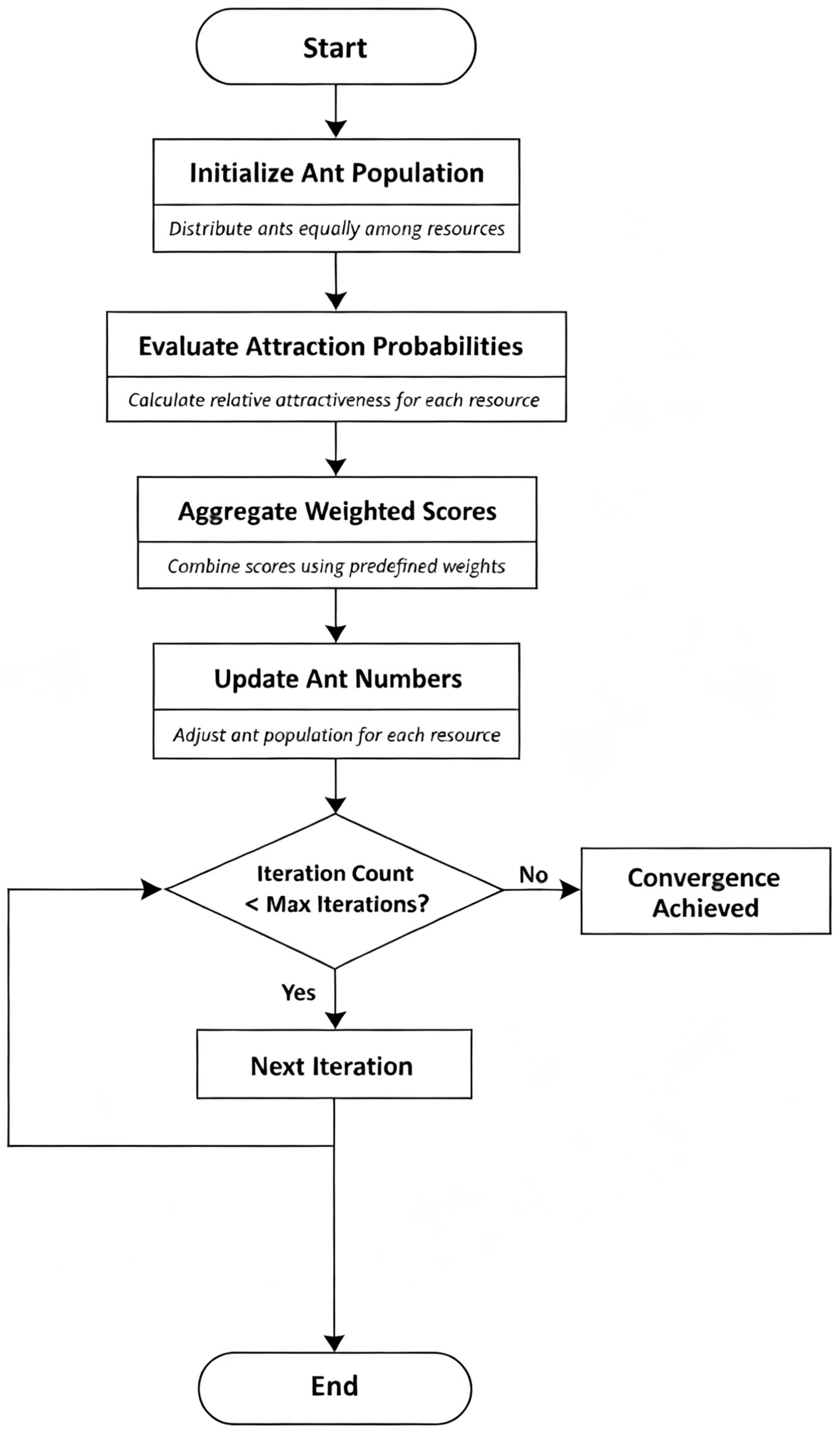
Based on the basic idea of ant colony aggregation, this study constructs an iterative allocation algorithm to simulate the dynamic attraction of different tourism resources under multiple evaluation dimensions. The core logic of the algorithm is to describe how a fixed number of ants gradually converge toward different alternatives according to their relative performance, thereby reflecting the comparative advantages of tourism resources in a competitive environment. We refer to [55] for the design of the algorithm in this paper.
At the initialization stage, the total number of ants is evenly distributed among the three candidate tourism resources. This setting avoids prior bias and ensures that all alternatives start from the same baseline. The iteration process is then carried out over a fixed number of cycles, during which the number of ants associated with each resource is continuously updated. In each iteration, the attractiveness of each tourism resource is evaluated under three dimensions. For each dimension, a proportional allocation mechanism is adopted: the number of ants attracted to a given resource depends jointly on its current ant population and its performance score under the corresponding indicator. Through normalization, the relative attraction probabilities of the three resources are obtained for each dimension, ensuring that competition among alternatives is explicitly reflected rather than evaluated in isolation. After calculating the attraction proportions under different dimensions, a weighted aggregation is performed. The weights represent the relative importance of each evaluation dimension and remain constant throughout the iteration process. The aggregated result determines the updated number of ants assigned to each tourism resource in the next iteration, while the total number of ants in the system is kept unchanged. This mechanism allows resources with stronger overall performance to continuously accumulate more ants, forming a positive feedback process similar to the aggregation behavior observed in ant colonies (Figure 1).
As the iteration proceeds, the ant distribution gradually stabilizes. The convergence of ant numbers indicates that the comparative attractiveness of the tourism resources has reached a steady state under the given parameter settings. The final ant distribution is therefore used to reflect the relative competitiveness of the three tourism resources, providing an intuitive and dynamic evaluation result.

5. Analysis of Algorithms

5.1. Numerical Experiments

A newly established cultural tourism community in Hebei Province, China, centers on providing high-quality lifestyle services while integrating rich cultural activities and diverse public spaces to create a comprehensive cultural tourism experience. Ranging from fundamental residential services to unique cultural and artistic events—such as theater festivals and music festivals—and extending to iconic cultural landmarks, this community is dedicated to offering both residents and visitors profound spiritual and cultural enjoyment as well as platforms for social interaction. With its growing reputation, the scale of tourists has continuously expanded, leading to increasingly higher demands for the quality of its tourism spaces. In response, the community management plans to introduce new resource suppliers to offer additional services. Potential service categories may include daily supplies (sporting goods stores, boutique shops, theater and cultural creative merchandise stores, etc.), cultural and artistic activities (art exhibitions, theater festivals, etc.), and entertainment services (cinemas, teahouses, etc.). Community A aims to optimize the integration of these candidate resources to provide tourist groups with satisfactory and personalized tourism service packages.
The community management categorizes tourists into several segments based on age and profession. This case study focuses on young tourists seeking artistic ambiance as the representative group. Following a three-month market survey, the management has identified four candidate tourism resources. The evaluated levels of tourists’ perceived spatial quality for these four resources (with rating scale values of 1, 0.7, 0.4, 0.1), along with their importance weights, dynamic adaptability parameters, and cost expectation fulfillment rate parameters (all normalized to a uniform dimensionless scale), are presented in Table 4. This design is based on two primary considerations. First, as an innovative resource integration framework proposed specifically for such emerging communities, the primary objective of this research is to establish a complete logical chain from theoretical construction and model formulation to preliminary verification. Selecting a decision context with a limited and clearly defined set of resources helps to intuitively and clearly demonstrate how the model translates multidimensional indicators—such as spatial quality, dynamic adaptability, and cost—into concrete resource selection logic. Second, this design aligns with the typical managerial scenario when an emerging community launches or optimizes a specific service sector. In practice, after initial screening of suppliers, management often faces a small number of critical candidate options. Our case simulates precisely this small-scale, high-stakes resource selection context, and its findings offer direct strategic reference value for initial resource allocation in such communities.
The indicator weights were derived from an AHP judgment matrix provided by tourist representatives. A total of 28 participants were involved in the evaluation process. The sample was designed to reflect the age composition of the tourist population in the case community, which exhibits a spindle-shaped structure: the core young-to-middle adult group (30–45 years old) accounts for approximately 50–60% of tourists, the younger group (20–30 years old) represents around 20–25% and primarily engages in cultural activities, and the older adult group (45–65 years old) constitutes roughly 15–20% and is mainly associated with wellness and family travel. Tourists under 18 or over 65 comprise less than 5% of the population. This distribution ensures that the AHP judgments are informed primarily by the dominant tourist segments while maintaining representation of secondary groups.
The questionnaire used to measure the Spatial Quality indicators from the tourist perspective consisted of four parts. The first part measured Authenticity ( U 1 ) through five sub-indicators related to Logical Consumption ( U 11 U 15 ). These items were operationalized using a direct numerical input format, allowing respondents to report specific values. The questions mainly captured tourists’ economic and preference-related evaluations, including the highest price the tourist was willing to accept and the tourist’s demand preferences for tourism products and services. The second part measured five indicators under Theatricality ( U 2 ) and Credibility ( U 31 ) under Legitimacy ( U 3 ). A four-point Likert-type scale was adopted for this section. Respondents were asked to evaluate each service associated with tourism resources s in terms of Friendliness, Sophistication, Aesthetic Appeal, Fashionability, Compliance, and Credibility. The third part focused on Egalitarianism ( U 35 ) under Legitimacy ( U 3 ), specifically measuring the tourist’s evaluation of the attractiveness of tourism resources. The fourth part included five items related to participants’ demographic characteristics, namely gender, age, education level, and monthly income. These variables were used to describe the sample characteristics of the respondents involved in this study. For the scale-based items in the second part of the questionnaire, factor analysis was conducted to assess the reliability of the measurement. The results showed that the Cronbach’s alpha coefficients for all constructs exceeded the recommended threshold of 0.70, indicating satisfactory internal consistency and acceptable reliability of the scale. It should be noted that other indicators, such as the actual number of service supply combinations ( n u m a n s s ), were derived from objective data provided by the community management organization rather than from the tourist questionnaire.
Data were collected in April 2025 using a convenience sampling approach. A total of 378 questionnaires were distributed to tourists visiting the community, of which 344 questionnaires were returned and completed, yielding an initial response rate of 91.0%. After excluding invalid questionnaires (e.g., incomplete responses or identical answers across all items), 326 valid questionnaires were retained for analysis, corresponding to an effective response rate of 86.2%. The demographic characteristics of the respondents are presented in Table 5.
Among the valid respondents (N = 326), 48.8% were male and 51.2% were female, indicating a relatively balanced gender distribution. In terms of age, the largest group was aged 30–45 years (55.5%), followed by 20–30 years (22.7%) and 45–65 years (18.4%), while respondents under 18 and over 65 together accounted for 3.4% of the sample.
By synthesizing the questionnaire-based data with objective indicators collected from the case community, a set of candidate resource parameters was derived, as presented in Table 6. This study employs MATLAB_R2024a for simulation. It should be noted that the perceived spatial quality of resource S4 fails to meet the minimum standard set by the community management, therefore the algorithm excludes it from further consideration. In other words, the illustrative example considers three alternative tourism service resources (denoted as Resource 1, Resource 2, and Resource 3), which may correspond to different spatial scenes, service modules, or cultural facilities within an emerging cultural and tourism community. A fixed total number of agents (ants) is assumed, representing limited development or allocation capacity.
At the initial stage, the total number of ants is set to 300 and evenly distributed among the three resources:
n 1 1 = 100 n 2 1 = 100 n 3 1 = 100
This symmetric initialization avoids prior bias and allows the algorithm to converge purely based on indicator-driven attractiveness.
At each iteration t , the attractiveness of each resource is evaluated along three groups of spatial quality indicators. These indicator groups correspond to different dimensions of the spatial quality framework constructed in this study. For each group, a normalized attractiveness score is calculated to reflect the relative appeal of each resource under that dimension.
Specifically, for indicator group A, the relative attractiveness of resource i is calculated as:
a i t = n i ( t ) × w A i j = 1 3 n j ( t ) × w A j
where w A i denotes the indicator weight of resource i under group A. Similar normalization procedures are applied to indicator groups B and C, generating attractiveness vectors b i ( t ) and c i ( t ) , respectively.
This normalization ensures that attractiveness is relational rather than absolute, reflecting competition among resources under limited capacity conditions.
From the perspective of the overall optimization model, systematic trade-offs among the three objectives are necessary, requiring the incorporation of objective weights. As the cultural tourism platform primarily aims to attract art enthusiasts and enhance its reputation during its initial development phase, it places the highest priority on perceived spatial quality. Accordingly, the relative weight coefficients ( λ n ) for the three optimization objectives in the service resource integration model are set as λ1 = 0.4, λ2 = 0.3, and λ3 = 0.3. To obtain a composite attractiveness score, the three indicator groups are aggregated using predefined weights (0.4, 0.3, and 0.3 in this example), reflecting their relative importance in the overall spatial quality evaluation. The number of ants allocated to each resource in the next iteration is updated as:
n i t + 1 = N × ( 0.4 × a i t + 0.3 × b i t + 0.3 × c i t )
where N   denotes the total number of ants.
The remaining ants are assigned to ensure conservation of total resources:
n 3 t + 1 = N n 1 t + 1 n 2 ( t + 1 )

5.2. Results of the Algorithm

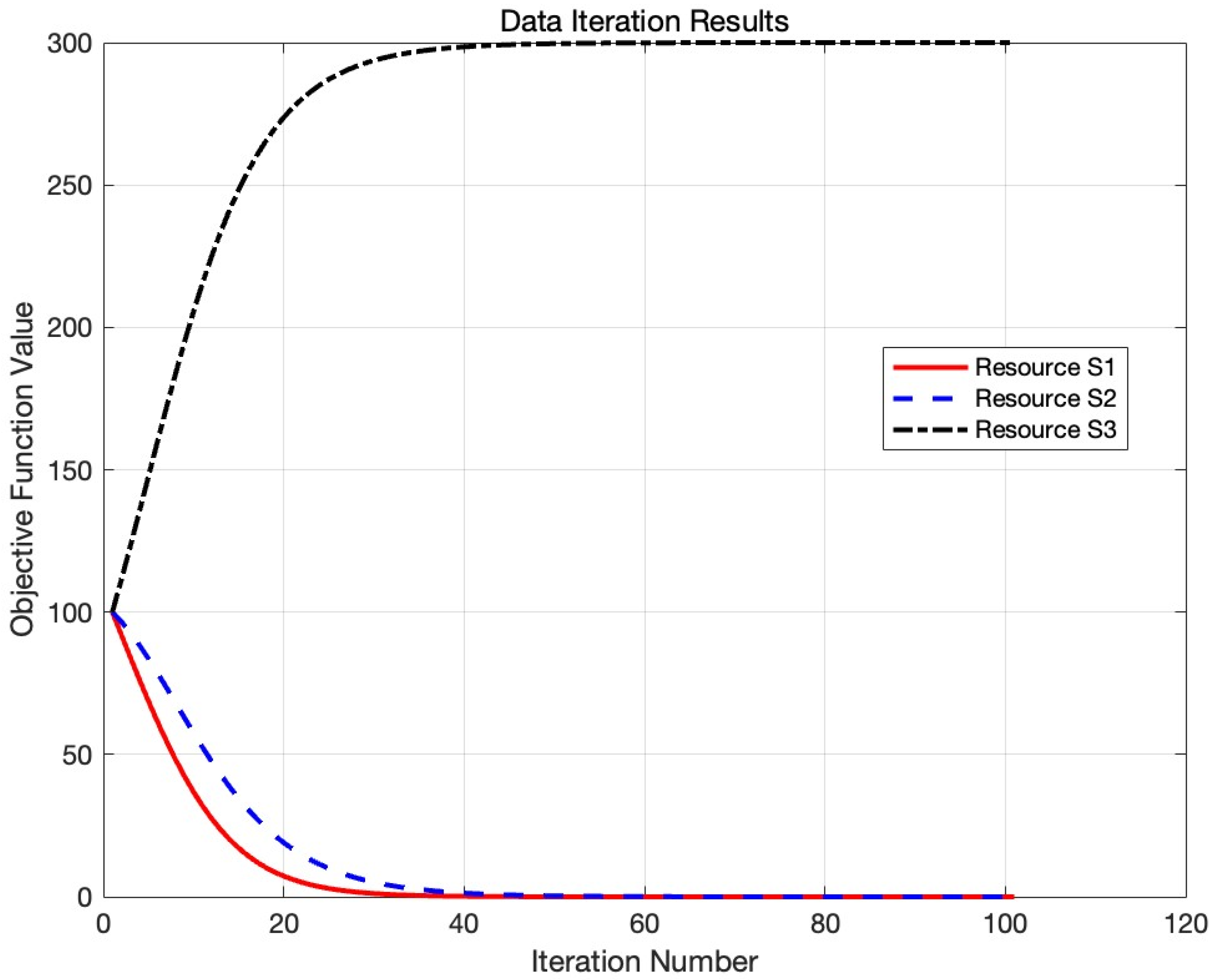
The iterative process is repeated for 100 iterations. During the simulation, the distribution of ants gradually stabilizes, indicating convergence of the allocation process. The convergence trajectory demonstrates that resources with higher spatial quality-based attractiveness consistently attract a larger share of ants, while less competitive resources gradually lose allocation. Figure 2 illustrates the convergence results of the algorithm.
After multiple iterations, the algorithm ultimately converged on selecting resource S3. The rationale for this selection is as follows: In cultural tourism communities, perceived spatial quality exerts the greatest influence on tourist satisfaction. As shown in Table 6, although the cost expectation fulfillment rate of S3 does not hold an advantage over that of S2, S3 demonstrates clear superiority in both perceived spatial quality and dynamic adaptability. Consequently, under stable conditions, S3 presents a stronger attraction within the algorithm’s search process. This outcome indicates that, given the current priorities assigned to various optimization metrics by the emerging cultural tourism community, candidate service supplier S3 is the more suitable choice for service provision during resource integration.
It is important to note that the three optimization objectives in this model represent the maximization of benefits for the three key stakeholders: tourists, community management, and resource suppliers. However, communities at different developmental stages may adopt varying operational strategies, leading to different emphases on these tripartite interests during the integration process. When the community’s strategic focus shifts among these stakeholders, the corresponding weights assigned to the different optimization objectives in the model would also change, potentially altering the final resource integration decision. In practical operations, cultural tourism communities can adjust these objective weights according to their specific circumstances to derive corresponding optimal integration strategies.

5.3. Computational Efficiency Analysis

The computational efficiency of the proposed algorithm is evaluated in terms of its computational complexity and convergence behavior. Unlike classical metaheuristic algorithms designed for large-scale combinatorial optimization, the proposed model adopts a simplified and deterministic update mechanism, which significantly reduces computational burden.
In each iteration, the algorithm updates the ant distribution by performing a limited number of arithmetic operations for each tourism resource. Given K alternatives and T iterations, the overall computational complexity can be expressed as O ( T × K ) . In the numerical experiment presented in this study, K = 3 and T = 100 , resulting in negligible computation time on a standard personal computer. More importantly, the linear growth of computational cost implies that the model can be easily extended to cases involving a larger number of tourism resources.
From the perspective of convergence behavior, the algorithm exhibits rapid stabilization. As shown in Figure 2, the ant allocation undergoes noticeable adjustment in the early iterations and gradually converges to a steady state after a limited number of iterations. This indicates that the algorithm does not rely on prolonged iterative search to identify dominant alternatives, which further enhances its practical efficiency.
Overall, the low computational complexity and fast convergence characteristics suggest that the proposed model is well suited for scenario evaluation and decision support in cultural tourism planning, where interpretability and operational feasibility are often prioritized over exhaustive optimization.

5.4. Sensitivity Analysis of Weight Settings

To further examine the validity and robustness of the proposed calculation methodology, a sensitivity analysis is conducted by adjusting the relative weights of the optimization objectives in the service resource integration model. Unlike conventional algorithm validation approaches that rely on large-scale benchmark instances, this analysis focuses on evaluating whether the model produces stable and interpretable outcomes under plausible variations in decision preferences, which is consistent with its intended role as a decision-support tool.
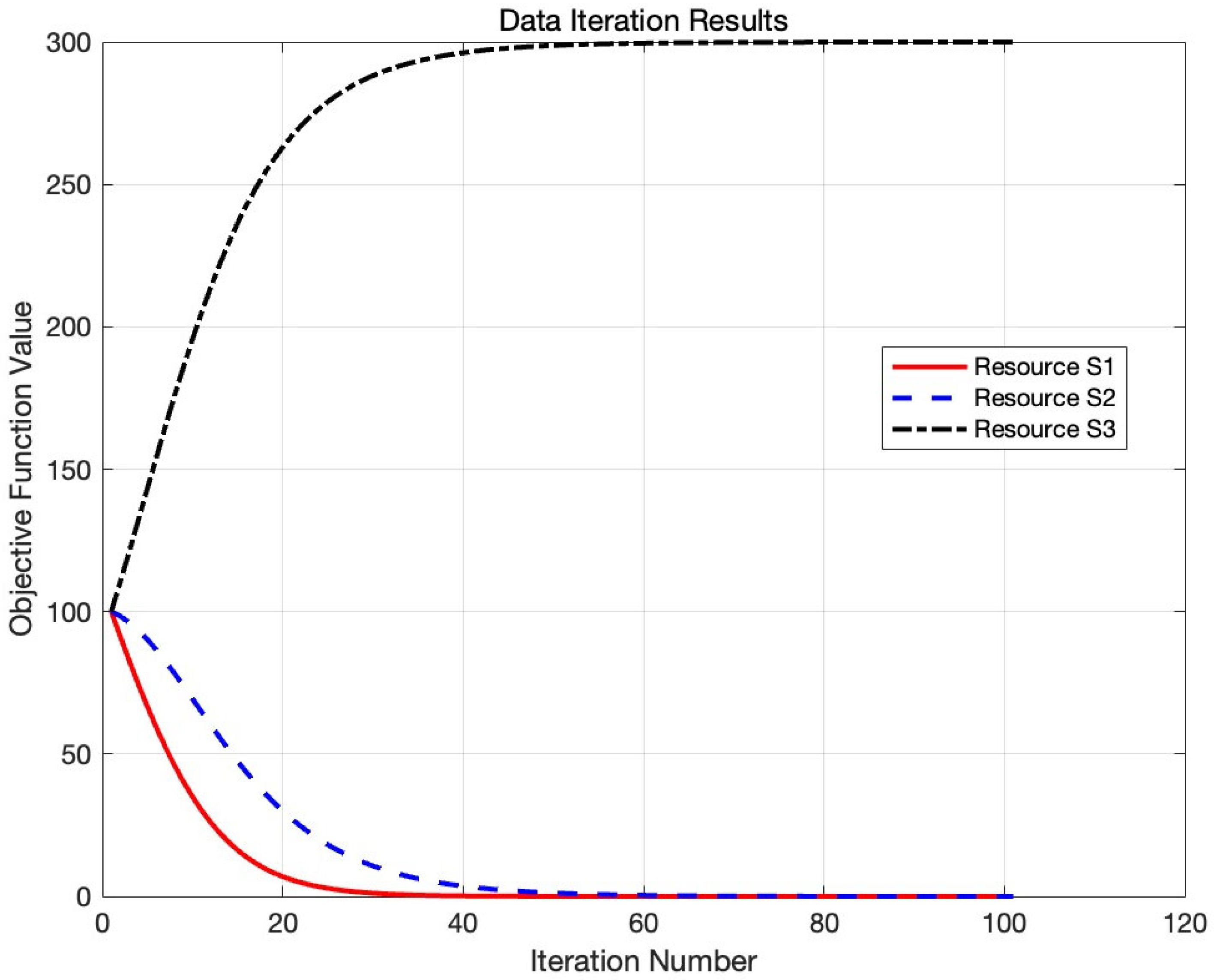
In the baseline setting, the relative weights of perceived spatial quality, dynamic adaptability, and cost expectation realization are set to (0.4, 0.3, 0.3), reflecting a balanced optimization orientation. To simulate an alternative development scenario, the weight configuration is adjusted to (0.3, 0.3, 0.4), placing greater emphasis on cost expectation realization. This scenario corresponds to a realistic managerial context in which the cultural tourism platform has entered a mid-stage expansion phase. After achieving initial visibility and attracting a stable user base, the platform prioritizes financial sustainability and capital accumulation to support further scaling, thereby increasing the relative importance of cost-related objectives.
The simulation results in Figure 3 show that although the cumulative allocation trajectories differ slightly under the two weight configurations, the final convergence outcome remains unchanged, with resource S3 consistently emerging as the preferred solution. This result indicates that the selected resource does not rely on dominance in a single objective dimension, but instead exhibits a stable comparative advantage across multiple optimization criteria. In other words, moderate redistribution of objective weights is insufficient to overturn its overall superiority.
From a methodological perspective, this finding provides evidence of robustness rather than insensitivity. The model responds to changes in preference structure through altered convergence paths, while maintaining stable decision outcomes when structural advantages persist. Such behavior suggests that the calculation methodology captures the underlying performance structure of candidate resources, rather than producing results that are overly dependent on a specific parameter setting.
Overall, the sensitivity analysis demonstrates that the proposed model can accommodate different strategic orientations and planning scenarios without generating erratic or contradictory outcomes. This supports its applicability in real-world cultural tourism platform decision-making, where objective priorities may evolve over time but decision-makers typically seek solutions that remain valid under a range of plausible preference assumptions.

6. Conclusions

Based on the general principles of service resource integration and incorporating the unique characteristics of supply-demand dynamics in emerging cultural tourism communities, this paper proposes a systematic framework and guiding methodology for optimizing tourism resource integration in such contexts. Unlike traditional research on tourism resource integration, this study first establishes a foundational approach by focusing on the construction of spatial quality. Subsequently, building on an in-depth exploration of tourist demands and grounded in Scene Theory and Customer Value Theory, it characterizes and analyzes personalized tourism service needs across multiple dimensions. Furthermore, by incorporating the influence of sociality, the study constructs a spatial quality evaluation system based on tourist perception. Finally, while balancing the interests of community tourists, tourism service resources, and community management, a resource integration optimization model is developed.

6.1. Practical Implications

On one hand, this research contributes to enhancing the overall service capacity of emerging cultural tourism communities, promoting their development, and further improving visitor satisfaction. By analyzing the characteristics of both the demand and supply sides within the supply chains of such communities, this study proposes optimizing supply chain resource integration as a means to meet tourists’ personalized, diversified, and dynamic service needs through the integration of various types of tourism resources. The methodologies presented provide practical support for addressing the operational challenges faced by these communities, thereby facilitating their long-term sustainable development and effectively meeting the growing demand for higher-quality tourism spaces in the context of consumption upgrading.
On the other hand, this study constructs a concrete integration and optimization model applicable to diverse types of supply chain resources, offering strategic solutions grounded in specific data and quantitative analysis for real-world problems. By employing mathematical modeling and optimization techniques, it characterizes the spatial quality of tourism resources within the specific context of integrating different supply chain resources. This provides a data-driven and analytically robust framework for problem-solving. In advancing the construction of emerging cultural tourism communities, various regions can flexibly adopt and adapt the proposed decision-support tools according to their specific developmental contexts to guide practical solutions.

6.2. Theoretical Implications

This study makes contributions to the following four research areas.
First, this study introduces a new analytical unit—emerging cultural and tourism communities—into tourism research, offering a scene-theory-based spatial quality framework to address their unique resource integration challenges, which cannot be adequately handled by traditional models designed for heritage or natural resource-based tourism. Emerging cultural and tourism communities differ fundamentally from other forms of tourism development in that they rely on the deliberate introduction and orchestration of service resources to construct place-based atmosphere and cultural scenes. This inherent need for curated resource integration poses a distinct operational challenge. Previous evaluation and optimization models, which often prioritize objective natural resources or standardized service attributes, fail to capture the experiential and symbolic dimensions essential for scene-making in such communities. By drawing on scene theory to develop a spatially grounded indicator system and embedding it within a multi-objective optimization framework, this study provides a tailored methodology for addressing resource integration problems in emerging cultural and tourism communities. Thus, it advances this nascent research domain by offering a theoretically informed, quantitative approach that aligns with the unique value-creation logic of these communities.
Second, it proposes an extension to scene theory by explicitly incorporating social influence into the evaluation of spatial quality, thereby revising the theory’s conventional individual-perception assumption and better reflecting the collective, interaction-driven experience that characterizes these communities. Scene theory has traditionally relied on an individual-perception assumption, treating spatial quality as an aggregate of personal evaluations. In emerging cultural and tourism communities, however, spatial experience is actively shaped through social interaction—for example, via community WeChat groups, shared activities, and collective interpretation. By incorporating a social-influence factor that modulates perceived spatial quality based on group feedback and interpersonal communication, this study explicitly accounts for the socially mediated nature of experience in such settings. This modification challenges the purely individualistic premise of conventional scene theory and extends its applicability to contexts where collective dynamics and peer influence significantly affect how space is perceived and valued.
Moreover, this study contributes to sustainability theory by extending the four-pillar framework—environmental, social, economic, and cultural sustainability—through a spatialized and experience-oriented perspective tailored to emerging cultural tourism communities. While the four-pillar model is well established, its applicability to contexts characterized by non-standardized emotional value and place-based experiences has remained limited. The proposed scene-based resource integration approach aligns with environmental sustainability by emphasizing spatial quality and balanced resource use, supports economic sustainability through improved long-term resource integration decisions, and advances social sustainability by incorporating experiential preferences and legitimacy-related indicators reflecting stakeholder acceptance. Moreover, by explicitly integrating place attachment and emotional value, this study strengthens cultural sustainability by recognizing the symbolic meanings and affective bonds embedded in emerging cultural tourism communities. By mapping these novel theoretical elements onto the four sustainability pillars via a principle-to-indicator approach, this research demonstrates how innovative modeling strategies can remain conceptually consistent with established sustainability frameworks while extending their relevance to new tourism contexts.
Finally, this research enriches the field of supply chain resource integration. Supply chain resource integration aims to organize and coordinate diverse, independent resources across the supply chain into a coherent and efficient collaborative system. Current research in this area predominantly focuses on product supply chains, with relatively fewer studies dedicated to service supply chains, and even fewer addressing specialized service chains such as those in cultural tourism. To address this theoretical gap, this paper incorporates considerations of the spatial quality and social (community) influence of community service resources into the specific integration process. This approach contributes to the further development of theories related to supply chain resource integration.

6.3. Critical Reflections and Policy Implications

While this study proposes a sustainability-oriented resource integration framework aimed at enhancing spatial quality and balancing multi-stakeholder interests, it is important to critically reflect on its potential limitations and unintended social consequences. The model’s emphasis on optimizing perceived spatial quality and cost efficiency, if implemented without careful governance, may inadvertently lead to several challenges that contradict the original goal of community-oriented sustainable development.
First, there is a risk of cultural commodification. In pursuing high spatial quality and visitor satisfaction, cultural elements within emerging communities may become overly standardized, aesthetically packaged, or performative, primarily serving tourist consumption rather than fostering genuine cultural expression or local identity. This could dilute the authenticity that the framework initially seeks to preserve, transforming cultural resources into marketable products devoid of deeper social meaning.
Second, the model’s focus on community influence and spatial quality could reinforce social stratification and exclusion. If resource integration prioritizes amenities and experiences that appeal to higher-spending or culturally dominant tourist segments, it may marginalize local residents, lower-income visitors, or culturally diverse groups. This could undermine social sustainability and equity, particularly in communities where access to high-quality spaces becomes linked to economic or social capital.
Third, the optimization logic—though multi-objective—remains susceptible to short-term economic pressures. In practice, developers or managers might overemphasize cost expectation fulfillment or rapid scalability at the expense of long-term cultural vitality and community cohesion, especially in contexts where performance metrics are tied to financial returns.
To mitigate these risks, policymakers and community planners should consider the following guardrails.
Firstly, inclusive governance mechanisms that ensure local residents and diverse user groups participate in defining “spatial quality” and resource integration priorities. Secondly, cultural safeguarding protocols to prevent the over-commercialization of cultural assets, such as quotas for community-led programming or guidelines for culturally sensitive design. Thirdly, continuous monitoring and adaptive policy frameworks that allow for the revision of integration strategies based on longitudinal social impact assessments, not just efficiency or satisfaction metrics.
This study thus provides not only a decision-support tool but also a conceptual starting point for more reflective and ethically informed practice. Future research should further examine how optimization models can incorporate explicit justice-oriented constraints—such as fairness thresholds, accessibility guarantees, and cultural integrity indicators—to ensure that sustainability remains inclusive and context-sensitive.

6.4. Future Research Directions

While this study focuses on the resource integration problem within a single emerging cultural and tourism community, its developmental trajectory is, in practice, significantly influenced by competition among different communities, which in turn impacts the integration process. Future research should therefore adopt a broader, macro-level perspective to develop resource integration models that account for the coexistence and interaction of multiple communities. Such models would provide more comprehensive guidance for the sustainable development of this emerging paradigm.
Furthermore, to enhance the robustness and applicability of the proposed framework, future work should extend in several key directions:
  • Parameter Sensitivity Analysis and Scenario Simulation: Research could systematically examine how different tourist market segments (by varying demand parameters and preference parameters) and different community strategic priorities (by adjusting objective weights) influence the optimal resource portfolio. This would allow for a thorough assessment of the model’s dynamic adaptability and decision robustness under diverse conditions.
  • Extended Case Studies with Complex Constraints: Where data availability permits, subsequent studies could design extended cases involving a larger pool of candidate resources (e.g., 10–15) and incorporate multiple real-world constraints, such as total budget caps, spatial capacity limits, and resource exclusivity. This would help explore the potential and boundaries of the model in addressing larger-scale, more complex practical problems.

Author Contributions

Conceptualization, Z.S. and J.Y.; Methodology, Z.S.; Software, Z.S.; Validation, Z.S.; Formal Analysis, Z.S.; Investigation, Z.S.; Resources, Z.S. and J.Y.; Data Curation, Z.S.; Writing—Original Draft Preparation, Z.S.; Writing—Review and Editing, Z.S.; Supervision, J.Y.; Project Administration, J.Y.; Funding Acquisition, J.Y. All authors have read and agreed to the published version of the manuscript.

Funding

This research was funded by National Natural Science Foundation of China, grant number 71872174.

Institutional Review Board Statement

The study complied with institutional policies and Chinese regulations. As it involved questionnaire surveys on tourism and management topics and analysis of publicly available online reviews, without medical intervention or sensitive personal data, formal institutional ethical approval was not required.

Informed Consent Statement

For studies involving human participants, all procedures were conducted in accordance with ethical standards. Participation was voluntary, and informed consent was obtained from all participants prior to data collection. No personally identifiable information was collected, and all responses were analyzed anonymously.

Data Availability Statement

The data presented in this study are available on request from the corresponding author due to confidentiality regulations of the research institution.

Conflicts of Interest

The authors declare no conflicts of interest.

References

  1. Ma, Y.; Tong, Y. From Region to Field: Revisiting the Relationship Between Culture and Tourism. Tour. Trib. 2019, 34, 7–9. [Google Scholar]
  2. Jin, Y.; Xi, H.; Wang, X.; Ren, X.; Yuan, L. Evaluation of the Integration Policy in China: Does the Integration of Culture and Tourism Promote Tourism Development? Ann. Tour. Res. 2022, 97, 103491. [Google Scholar] [CrossRef]
  3. Winter, C. Tourism, Social Memory and the Great War. Ann. Tour. Res. 2009, 36, 607–626. [Google Scholar] [CrossRef]
  4. Lewicka, M. Place Attachment, Place Identity, and Place Memory: Restoring the Forgotten City Past. J. Environ. Psychol. 2008, 28, 209–231. [Google Scholar] [CrossRef]
  5. Navarro, C.J.; Mateos, C.; Rodríguez, M.J. Cultural Scenes, the Creative Class and Development in Spanish Municipalities. Eur. Urban Reg. Stud. 2014, 21, 301–317. [Google Scholar] [CrossRef]
  6. Jin, Z.; Bai, Y. Sustainable Development and Long-Term Strategic Management: Embedding a Long-Term Strategic Management System into Medium and Long-Term Planning. World Futures Rev. 2011, 3, 49–69. [Google Scholar] [CrossRef]
  7. Ivanov, D. Viable Supply Chain Model: Integrating Agility, Resilience and Sustainability Perspectives—Lessons from and Thinking beyond the COVID-19 Pandemic. Ann. Oper. Res. 2022, 319, 1411–1431. [Google Scholar] [CrossRef]
  8. Allred, C.R.; Fawcett, S.E.; Wallin, C.; Magnan, G.M. A Dynamic Collaboration Capability as a Source of Competitive Advantage. Decis. Sci. 2011, 42, 129–161. [Google Scholar] [CrossRef]
  9. Cao, Z.; Chen, X.; Wu, Q.; Wu, K. The Elements and Dimensions of Future Village Construction Under the Framework of Scenes Theory: A Case Study of Dalu Village in Tonglu County, Hangzhou. Planners 2022, 38, 125–130. [Google Scholar]
  10. Liu, C.; Huangfu, Z.; Li, G. Construction of digital tourism scenarios for traditional villages: A case study of Zhangguying Village. Resour. Sci. 2025, 47, 1976–1991. [Google Scholar] [CrossRef]
  11. Lazzaro, E. Cultural and Creative Districts: A Literature Review and a Taxonomy. In Creative Business Education: Exploring the Contours of Pedagogical Praxis; Powell, P., Shankar Nayak, B., Eds.; Springer International Publishing: Cham, Switzerland, 2022; pp. 237–250. [Google Scholar]
  12. Builes-Vélez, A.E.; Escobar, L.M.; Villamil-Mejia, C. Are Innovation and Creative Districts New Scenarios for Sustainable Urban Planning? Bogota, Medellin, and Barranquilla as Case Studies. Sustainability 2024, 16, 3095. [Google Scholar] [CrossRef]
  13. Ottaviani, D.; Demiröz, M.; Szemző, H.; De Luca, C. Adapting Methods and Tools for Participatory Heritage-Based Tourism Planning to Embrace the Four Pillars of Sustainability. Sustainability 2023, 15, 4741. [Google Scholar] [CrossRef]
  14. Chen, B. Dimensional Analysis of Urban Neighborhood Public Cultural Space Based on Scene Theory. Jianghan Trib. 2019, 128–134. Available online: https://kns.cnki.net/KCMS/detail/detail.aspx?dbcode=CJFQ&dbname=CJFDLAST2020&filename=jhlt201912022 (accessed on 10 November 2023).
  15. Zang, H.; Kou, Y. Constructing Public Library Spaces: A Cultural Scenes Perspective. Res. Libr. Sci. 2021, 24–29. [Google Scholar] [CrossRef]
  16. Chen, S. Study on the Construction of Cultural Tourism Community in Scene Vision: A Case Study of Aranya Tourism Community. J. Cent. South Univ. For. Technol. (Soc. Sci.) 2021, 15, 102–110. [Google Scholar]
  17. Guo, W. Tourism Space Production and Form Transformation in Community-based Cultural Heritage Sites—Based on the Investigation of Huishan Ancient Town in Jiangsu Province. J. Sichuan Norm. Univ. (Soc. Sci. Ed.) 2019, 46, 75–82. [Google Scholar]
  18. Duić, N.; Urbaniec, K.; Huisingh, D. Components and Structures of the Pillars of Sustainability. J. Clean. Prod. 2015, 88, 1–12. [Google Scholar] [CrossRef]
  19. Shaikh, Z.H.; Ray, K.S.S.S.; Rout, B.L.; Mahapatra, D.M. Beyond Carbon: Multi-Dimensional Sustainability Performance Metrics for India’s Aviation Industry. Sustainability 2025, 17, 9632. [Google Scholar] [CrossRef]
  20. Liu, C.; Yao, J. Optimization of Supply Chain Terminal Resources Integration under the Community Group Purchase Scenario. Chin. J. Manag. 2022, 19, 1231–1239. [Google Scholar]
  21. Wei, L.; Sun, J. Modernity of Ethnic Minority Communities and Its Indigenous Practices: A Case Study of Luoshui Village in Lugu Lake Area. Tour. Trib. 2017, 32, 47–56. [Google Scholar]
  22. Liu, X.; Sun, J. Traditional cultural adaptation of residents in an ethnic tourism community: Based on personal construction theory. Tour. Trib. 2019, 34, 16–28. [Google Scholar]
  23. Su, M.; Yang, L.; He, S. Tourism Development and Community Participation Paths in Agricultural Cultural Heritage Sites. Tour. Trib. 2022, 37, 9–11. [Google Scholar]
  24. Zhang, J.; Zhao, Z.; Liu, Y.; Li, X. The Spatial Characteristics and Formation Mechanism of Conflicts in Tourism Community Under the Background of Landscape-village Integration: A Case Study of Dong Village in Zhaoxing. Econ. Geogr. 2022, 42, 216–224. [Google Scholar]
  25. Ju, Y.; Li, C. Formation mechanism of heritage responsibility behavior of residents in the tourism community of cultural heritage sites: Based on the fuzzy-set qualitative comparative analysis. J. Nat. Resour. 2023, 38, 1135–1149. [Google Scholar] [CrossRef]
  26. Kalaitzi, D.; Matopoulos, A.; Bourlakis, M.; Tate, W. Supply Chains under Resource Pressure: Strategies for Improving Resource Efficiency and Competitive Advantage. Int. J. Oper. Prod. Manag. 2019, 39, 1323–1354. [Google Scholar] [CrossRef]
  27. Huang, M.; Ren, L.; Lee, L.H.; Wang, X.; Kuang, H.; Shi, H. Model and Algorithm for 4PLRP with Uncertain Delivery Time. Inf. Sci. 2016, 330, 211–225. [Google Scholar] [CrossRef]
  28. Zhang, L. Research on the Fuzzy Comprehensive Evaluation Method of Tourism Service Quality. J. Quant. Technol. Econ. 2003, 85–88. [Google Scholar] [CrossRef]
  29. Yang, F.; Gao, D. Modeling and application of tourism products HOQ based on multi-objective programming. Sci. Res. Manag. 2017, 38, 145–152. [Google Scholar]
  30. Suo, L.; Yao, J.; Zhou, J. Research on the Integration and Optimization of Supply Chain Resources for Unmanned Retail Terminals Based on Customer Demand Preference. Chin. J. Manag. Sci. 2021, 29, 84–95. [Google Scholar]
  31. Park, J.; Jeong, E. Service Quality in Tourism: A Systematic Literature Review and Keyword Network Analysis. Sustainability 2019, 11, 3665. [Google Scholar] [CrossRef]
  32. Pyo, S. Quality Research in Tourism and Hospitality: Perspectives and Research Agenda. J. Qual. Assur. Hosp. Tour. 2000, 1, 1–12. [Google Scholar] [CrossRef]
  33. Blazquez-Resino, J.; Molina Collado, A.; Esteban, Á. Key Quality Attributes According to the Tourist Product. Eur. J. Tour. Res. 2012, 5, 166–170. [Google Scholar] [CrossRef]
  34. Brown, G.; Raymond, C.M.; Corcoran, J. Mapping and Measuring Place Attachment. Appl. Geogr. 2015, 57, 42–53. [Google Scholar] [CrossRef]
  35. Brown, G.; Raymond, C. The Relationship between Place Attachment and Landscape Values: Toward Mapping Place Attachment. Appl. Geogr. 2007, 27, 89–111. [Google Scholar] [CrossRef]
  36. Lewicka, M. Place Attachment: How Far Have We Come in the Last 40 Years? J. Environ. Psychol. 2011, 31, 207–230. [Google Scholar] [CrossRef]
  37. Ujang, N.; Zakariya, K. Place Attachment and the Value of Place in the Life of the Users. Procedia—Soc. Behav. Sci. 2015, 168, 373–380. [Google Scholar] [CrossRef]
  38. Silver, D.A.; Clark, T.N. A Theory of Scenes. In Scenescapes: How Qualities of Place Shape Social Life; University of Chicago Press: Chicago, IL, USA, 2016. [Google Scholar]
  39. Zhang, Z.; Yu, B. Analysis of Development Pathways for China’s Cultural Industry Parks: A Scenes Perspective. Publ. Res. 2019, 33–37+27. [Google Scholar] [CrossRef]
  40. Chen, B.; Yan, S. A Study on the Increase of Cultural Value of Intangible Cultural Heritage Tourism Sites under the Scene Theory: Based on the Data of 27 Intangible Cultural Heritage Tourism Towns in Zhejiang Province. J. Tongji Univ. (Soc. Sci. Ed.) 2022, 33, 20–32. [Google Scholar]
  41. Chen, Z.; Li, Y. Digital Services in Cultural and Tourism Integration Scenarios: Research on Main Types and User Experience. Libr. Inf. 2022, 42, 71–83. [Google Scholar]
  42. Wu, S.; Liu, X. Research on the Influencing Factors and Mechanisms of Customers’ Consumption Willingness in Physical Bookstores from the Perspective of Scene Theory. View Publ. 2024, 52–61. [Google Scholar] [CrossRef]
  43. Chen, B.; Zhao, R. Construction and Empirical Study of Evaluation Index System for Intangible Cultural Heritage Inheritance Scenarios in Chinese Cities. J. Cent. China Norm. Univ. (Humanit. Soc. Sci.) 2020, 59, 78–86. [Google Scholar]
  44. Rixom, J.M.; Rixom, B.A. Perceived Brand Authenticity: Examining the Effects of Inferred Dedication and Anticipated Quality on Consumers’ Purchase Intentions and Actual Choices. J. Consum. Behav. 2023, 22, 721–737. [Google Scholar] [CrossRef]
  45. Gao, G.; Greenwood, B.N.; Agarwal, R.; McCullough, J.S. Vocal Minority and Silent Majority. MIS Q. 2015, 39, 565–590. [Google Scholar] [CrossRef]
  46. Lu, S.F.; Rui, H. Can We Trust Online Physician Ratings? Evidence from Cardiac Surgeons in Florida. Manag. Sci. 2018, 64, 2557–2573. [Google Scholar] [CrossRef]
  47. Chen, H.; Ding, X.; Ding, L. Scenes, Interaction, Community and Values: A Service Experience Design Framework for Museum Public Space Based on the Theory of Experience Preference. In Proceedings of the Design, User Experience, and Usability; Marcus, A., Rosenzweig, E., Soares, M.M., Eds.; Springer Nature: Cham, Switzerland, 2023; pp. 27–39. [Google Scholar]
  48. Fraccascia, L.; Giannoccaro, I.; Albino, V. Rethinking Resilience in Industrial Symbiosis: Conceptualization and Measurements. Ecol. Econ. 2017, 137, 148–162. [Google Scholar] [CrossRef]
  49. Ivanov, D.; Sokolov, B.; Kaeschel, J. A Multi-Structural Framework for Adaptive Supply Chain Planning and Operations Control with Structure Dynamics Considerations. Eur. J. Oper. Res. 2010, 200, 409–420. [Google Scholar] [CrossRef]
  50. Kaveshgar, N.; Huynh, N. Integrated Quay Crane and Yard Truck Scheduling for Unloading Inbound Containers. Int. J. Prod. Econ. 2015, 159, 168–177. [Google Scholar] [CrossRef]
  51. İnkaya, T.; Akansel, M. Coordinated Scheduling of the Transfer Lots in an Assembly-Type Supply Chain: A Genetic Algorithm Approach. J. Intell. Manuf. 2017, 28, 1005–1015. [Google Scholar] [CrossRef]
  52. Deng, W.; Zhu, L.; Shen, Y.; Zhou, C.; Guo, J.; Cheng, Y. A Novel Multi-Objective Optimized DAG Task Scheduling Strategy for Fog Computing Based on Container Migration Mechanism. Wirel. Netw. 2025, 31, 1005–1019. [Google Scholar] [CrossRef]
  53. Wang, J. Research on Route Optimization of Joint Distribution Vehicles for Fresh Food E-Commerce Based on Multi-Objective Decision-Making. Master’s Thesis, Chongqing University, Chongqing, China, 2018. [Google Scholar]
  54. Ge, X.; Zou, D. The vehicle routing problem of cross-warehouse distribution in the supply chain environment. Comput. Eng. Appl. 2018, 54, 252–259. [Google Scholar]
  55. Yao, J. SMC Supply Chain Scheduling Optimization Based on Multi-Stage Differential Scale Effects. Chin. J. Manag. 2015, 12, 126–133. [Google Scholar]
Figure 1. Algorithm Flow of the Dynamic Allocation Model.
Sustainability 18 01714 g001
Figure 2. Baseline Convergence Behavior of the Proposed Model.
Sustainability 18 01714 g002
Figure 3. Convergence Behavior under Alternative Weight Settings.
Sustainability 18 01714 g003
Table 1. Conceptual Comparison of Cultural and Tourism Community Development Modes.
DimensionArt-Driven Rural
Revitalization Communities
Heritage-Based Cultural
Tourism Communities
Emerging Cultural and
Tourism Communities
(This Study)
Primary Cultural
Resource
Rural landscapes, vernacular
culture, artistic intervention
Historical and cultural
heritage (tangible and
intangible)
Purpose-built architecture,
cultural facilities, and curated
experiential resources
Cultural Formation
Logic
External artistic intervention
activates existing rural culture
Heritage preservation and
interpretation
Construction of new place-based culture through design,
programming, and
symbolic spaces
Community
Development Form
Bottom-up or artist-led rural
regeneration
Conservation-oriented
tourism development
Developer-initiated or platform-based community development
Institutional
Structure
Informal or semi-formal
community organizations
Heritage protection
institutions, public-sector dominance
Enterprise-led platforms
integrating multiple stakeholders
Governance
Mode
Participatory and
community-oriented
governance
Regulatory and
preservation-
oriented governance
Flexible and coordination-oriented governance
Resident/Community
Participation
High local resident
participation
Limited resident
participation, expert-driven
Hybrid participation involving residents, visitors, and
cultural actors
Resource OrganizationIncremental integration of
artistic and rural resources
Resource protection and
controlled utilization
Systematic integration of heterogeneous resources (architecture, culture, services, social
interaction)
Role of Cultural
Facilities
Supporting and symbolicInterpretive and educationalCentral anchors of spatial quality and experiential value
Implications for
Resource Integration
Moderate integration needsLimited integration needsHigh dependence on resource integration for value creation and sustainability
Typical ExamplesArt villages, artist-in-residence communitiesHistoric towns, heritage
districts
Anaya Cultural and Tourism Community
Table 2. Tourist Spatial Quality Evaluation Model and Indicator Calculation Methods.
Primary
Dimension
Secondary
Indicator
Adapted
Dimension for
Cultural Tourism Communities
Calculation Method
Authenticity ( U 1 )RationalLogical
Consumption
( U 11 )
The tourist’s perception of price reasonableness is influenced by the relationship between the reference price ( P r ), the actual price ( P a ), and the highest price the tourist is willing to accept ( P h ). The acceptable highest price is related to the tourist’s demand preference; the more price-sensitive the tourist, the lower the acceptable highest price. Therefore, P h = P r ( 1 + 1 θ p ) .
U 11 = 0 ,                                             P a > P r ( 1 + 1 θ p ) P h P a P a P r ,                                 P r < P a P r ( 1 + 1 θ p )           1 ,                                                       P a P r                                
LocalRegional
Distinctiveness
( U 12 )
Authenticity is influenced by factors such as expected levels and consumer preferences [44]; therefore, this study measures authenticity by comparing the expected level, minimum acceptable level, perceived actual level, and demand preference. This article lets T e be the tourist’s expected level of regional uniqueness for the cultural tourism community before the trip, T a be the perceived actual level of regional uniqueness, and T l be the minimum acceptable level of regional distinctiveness. The minimum acceptable level is related to demand preference; the more sensitive the tourist is to regional uniqueness, the closer the acceptable level is to the expected level, hence T l = T e ( 1 1 θ t ) .
U 12 = 0 ,                     T a < T e ( 1 1 θ t ) T a T l T e T a ,       T e ( 1 1 θ t ) T a < T e 1 ,                                         T a T e
NationalCommunity
Characteristics
( U 13 )
Let V e be the tourist’s expected level of community integration before the trip, V a be the perceived actual level of community integration, and V l be the minimum acceptable level. The minimum acceptable level is related to demand preference; the more sensitive the tourist is to community integration, the closer the acceptable level is to the expected level, hence V l = V e ( 1 1 θ v ) .
U 13 = 0 ,                     V a < V e ( 1 1 θ v ) V a V l V e V a ,       V e ( 1 1 θ v ) V a < V e 1 ,                                         V a V e
CorporatistCultural
Distinctiveness
( U 14 )
Let F e be the tourist’s expected level of cultural distinctiveness before the trip, F a be the perceived actual level, and F l be the minimum acceptable level. The minimum acceptable level is related to demand preference; the more sensitive the tourist is to cultural distinctiveness, the closer the acceptable level is to the expected level, hence F l = F e ( 1 1 θ f ) .
U 14 = 0 ,                     F a < F e ( 1 1 θ f ) F a F l F e F a ,       F e ( 1 1 θ f ) F a < F e 1 ,                               F a F e
EthnicEthnic
Characteristics
( U 15 )
Let E e be the tourist’s expected level of ethnic characteristics before the trip, E a be the perceived actual level, and E l be the minimum acceptable level. The minimum acceptable level is related to demand preference; the more sensitive the tourist is to ethnic characteristics, the closer the acceptable level is to the expected level, hence E l = E e ( 1 1 θ e ) .
U 15 = 0 ,                     E a < E e ( 1 1 θ e ) E a E l E e E a ,       E e ( 1 1 θ e ) E a < E e 1 ,                               E a E e
Theatricality ( U 2 )NeighborlyFriendliness
( U 21 )
Each tourism resource supplier ( s ) provides w types of services (e.g., commerce, dining). Each service type contains Q w forms of service delivery, which may differ in perceived friendliness. For example, for a commercial service, supplier s 1 may only offer standard courier online ordering with home delivery, while supplier s 2 may offer both home delivery and in-store VIP reception, leading to different friendliness evaluations for different forms. Let K Q w represent the evaluation by a tourist ( k ) of the friendliness of each service form ( Q w ) under each service type ( w ) provided by resource s, where ‘strong friendliness’ = 1, ‘relatively strong’ = 0.7, ‘relatively weak’ = 0.4, and ‘low’ = 0.1. The calculation method for tourist k is:
U 21 = 1 W 1 Q w K Q w
FormalSophistication
( U 22 )
Similar to U 21 . Let G Q w represent the tourist’s evaluation of the sophistication of each service form ( Q w ) under each service type ( w ) provided by resource s , where ‘strong sophistication’ = 1, ‘relatively strong’ = 0.7, ‘relatively weak’ = 0.4, and ‘low’ = 0.1.
U 22 = 1 W 1 Q w G Q w
ExhibitionAesthetic
Appeal
( U 23 )
Similar to U 21 . Let J Q w represent the tourist’s evaluation of the sophistication of each service form ( Q w ) under each service type ( w ) provided by resource s , where ‘strong appeal’ = 1, ‘relatively strong’ = 0.7, ‘relatively weak’ = 0.4,
and ‘low’ = 0.1.
U 23 = 1 W 1 Q w J Q w
TrendyFashionability
( U 24 )
Similar to U 21 . Let H Q w represent the tourist’s evaluation of the fashionability of each service form ( Q w ) under each service type ( w ) provided by resource s , where ‘strong fashionability’ = 1, ‘relatively strong’ = 0.7, ‘relatively weak’ = 0.4, and ‘low’ = 0.1.
U 24 = 1 W 1 Q w H Q w
TransgressiveCompliance
( U 25 )
Similar to U 21 . Let I Q w represent the tourist’s evaluation of the compliance of each service form ( Q w ) under each service type ( w ) provided by resource s , where ‘strong compliance’ = 1, ‘relatively strong’ = 0.7, ‘relatively weak’ = 0.4,
and ‘low’ = 0.1.
U 25 = 1 W 1 Q w I Q w
Legitimacy ( U 3 )TraditionalistCredibility
( U 31 )
Similar to U 21 . Let I Q w represent the tourist’s evaluation of the credibility of each service form ( Q w ) under each service type ( w ) provided by resource s , where ‘strong credibility’ = 1, ‘relatively strong’ = 0.7, ‘relatively weak’ = 0.4,
and ‘low’ = 0.1.
U 31 = 1 W 1 Q w L Q w
Self-expressiveDegree of
Freedom
( U 32 )
The actual number of service combinations provided is n u m a n s s , and the tourist’s minimum required number of service combinations is n u m m n s s .
U 32 = n u m a n s s n u m m n s s
UtilitarianDemand
Matching Degree
( U 33 )
Referring to previous literature, this paper uses the positive review rate of notes posted by tourists on social media as an indicator [45,46]. Natural language processing techniques are employed for sentiment analysis, categorizing text as positive, neutral, or negative. The ratio of cumulative positive reviews to total reviews for each service provided by resource s in each month is calculated as r a t e g . Let the tourist’s demand for tourism services be O k , and the quantity of tourism services that the resource can provide be O s .
U 33 = O k O s × r a t e g
CharismaticFairness
( U 34 )
The number of complaints regarding fairness received by the community management office is n u m c o m , and the total number of tourism resources within the community is S .
U 34 = 1 n u m c o m S
EgalitarianAttractiveness
( U 35 )
The tourist’s evaluation of the attractiveness of tourism resource s is A s , and the number of services provided by resource s is w .
U 35 = A s w
Table 3. Membership Functions for the Fuzzy Evaluation Set.
Excellent (A)Good (B)Fair (C)Poor (D)
f ( x ) = 1 , u n 1 u n 2 n 1 n 2 , n 2 u < n 1 0 , 0 u < n 2 f ( x ) = 0 , u n 1 , u < n 3 n 1 u n 1 n 2 , n 2 u < n 1 u n 3 n 2 n 3 , n 3 u < n 2 f ( x ) = 0 , u n 2 , u < n 4 n 2 u n 2 n 3 , n 3 u < n 2 u n 3 n 3 n 4 , n 4 u < n 3 f ( x ) = 0 , u n 3 n 3 u n 3 n 4 , n 4 u < n 3 1 , 0 u < n 4
Table 4. Notation and Description for the Supply Chain Resource Integration Optimization Model under the Emerging Cultural Tourism Community Model.
CategorySymbolDescription
Indices w Index for service type, where w = 1,2 , , W . W denotes the total number of service types offered by the cultural tourism community.
k Index for tourist groups, where k = 1,2 , , K . K represents the total number of tourist groups identified by the community management.
s Index for tourism resources, where s = 1,2 , , S . S indicates the total number of candidate tourism resources available for providing service w .
Parameters B s k w The spatially perceived quality of tourism resource s for service w by tourist k , incorporating social influence.
D A s w The dynamic adaptability evaluation of tourism resource s in providing service w .
C E F R s w The cost expectation fulfillment rate of tourism resource s when providing service w .
M s k The minimum acceptable level of spatially perceived quality for tourist k , as set by the community management.
N s w The maximum service capacity of tourism resource s .
D ( w ) The maximum demand for tourism resource w from tourists.
X s w A binary decision variable, where X s w = 1 if tourism resource s is selected by the community management to provide service w ; otherwise, X s w = 0 .
Decision Variable w Index for service type, where w = 1,2 , , W . W denotes the total number of service types offered by the cultural tourism community.
Table 5. Sample profile.
CharacteristicsItemsFrequency%
GenderMale15948.8
Female16751.2
AgeUnder 1851.5
20–30 years7422.7
30–45 years18155.5
45–65 years6018.4
Over 6561.9
EducationSenior high school and below268.0
Junior college5918.1
Undergraduate20262.0
Master’s degree and above3912.0
Monthly income (RMB)≤50004212.9
5001–10,0008827.0
10,001–20,00012438.0
>20,0007222.1
Table 6. Optimization Parameters for Candidate Tourism Resources.
Integration ParameterS1S2S3S4
Perceived
Spatial
Quality
AuthenticityBACC
TheatricalityCDAC
LegitimacyBBCB
Dimension Weights { 0.35 , 0.46 , 0.19 }
Dynamic Adaptability0.3470.3430.4250.536
Cost Expectation Fulfillment Rate0.6980.8570.8240.741
Minimum Acceptable Perceived Spatial Quality0.51
A–D represent four evaluation levels of tourists’ perceived spatial quality for the resources, corresponding to numerical values of 1, 0.7, 0.4, and 0.1, respectively.
Disclaimer/Publisher’s Note: The statements, opinions and data contained in all publications are solely those of the individual author(s) and contributor(s) and not of MDPI and/or the editor(s). MDPI and/or the editor(s) disclaim responsibility for any injury to people or property resulting from any ideas, methods, instructions or products referred to in the content.