Article

Wind Regime Variability and Spatiotemporal Distribution of Aeolian Sand Hazards Along a Gobi Desert Highway in the Ejin Banner, Northern China


1
Department of Geography, Fuyang Normal University, Fuyang 236037, China
2
State Key Laboratory of Ecological Safety and Sustainable Development in Arid Lands, Northwest Institute of Eco-Environment and Resources, Chinese Academy of Sciences, Lanzhou 730000, China
3
Alxa League Transportation Development Center, Alxa 750300, China
4
Dalaihubu Mechanized Border Maintenance Team, Alxa League Transportation Development Center, Alxa 735400, China
*
Author to whom correspondence should be addressed.
Sustainability 2026, 18(3), 1645; https://doi.org/10.3390/su18031645
Submission received: 5 January 2026 / Revised: 29 January 2026 / Accepted: 2 February 2026 / Published: 5 February 2026

Abstract

Aeolian sand hazards severely constrain highway safety and operation in arid regions. To support targeted mitigation along Highway S315 in the Gobi Desert of northern China, this study integrates meteorological observations with sand removal records to quantify wind regimes and classify sand hazard intensity. Event thresholds were objectively identified using change points in semi-logarithmic distributions of daily sand removal volumes, and spatial hazard severity was graded based on annual sand removal per unit road length. The results showed that (1) the study area was subject to intense aeolian activity, with a mean annual sand-driving wind frequency of 23.98%, an annual drift potential of 344.91 vector units (VU), and a resultant sand transport direction of 129.88° (east–southeast). (2) Based on inflection point characteristics, sand hazard events were classified into three intensity levels, namely, slight (<800 m3), moderate (800–3000 m3), and severe (>3000 m3), accounting for 13.0%, 76.1%, and 10.9% of all events along Highway S315, respectively. (3) Spatial grading criteria for sand hazard severity were defined as slight (<3 × 10³ m3 km−1 yr−1), moderate (3 × 10³–1.0 × 10⁴ m3 km−1 yr−1), and severe (>1.0 × 10⁴ m3 km−1 yr−1). Application of these criteria to a representative road section (K9+000–K30+600; 21.6 km) indicated that severe, moderate, and slight sand hazard segments extend over 6.0 km, 9.1 km, and 6.5 km, respectively, thereby delineating priority zones for targeted mitigation measures. This study proposes a quantitative framework that couples regional wind-driven sand dynamics with highway hazard severity, enabling targeted mitigation and offering a transferable reference for sand risk management in arid and desert regions.

1. Introduction

Highway S315 is a first-class arterial road in the Ejin Banner, Inner Mongolia, extending approximately 82.5 km across the transitional zone between the Badain Jaran Desert and the Gobi Desert. As a critical transport corridor linking the Ceke Port with inland regions, Highway S315 plays a key role in regional connectivity and economic exchange [1]. The surrounding landscape is characterized by wind-eroded bare surfaces, active sandy land, and gravelly Gobi terrain, with abundant loose surface materials, pronounced roughness heterogeneity, and generally low resistance to aeolian erosion [2]. During strong wind events, large volumes of sand are mobilized and accumulate along the roadside, forming dunes, sand belts, and episodic road burial, which pose substantial risks to traffic safety and operational efficiency [2,3]. In recent decades, ongoing climate warming and increasing aridity have further intensified wind erosion and sand transport processes in the region, leading to higher hazard frequency, increased event intensity, and an earlier seasonal onset of aeolian sand hazards [4,5,6]. Consequently, windblown sand has emerged as an increasingly critical constraint on the safety and resilience of transportation infrastructure in arid environments [7,8,9].
Understanding the evolution of roadside aeolian environments and the spatial differentiation of sand hazards is essential for elucidating sand hazard formation mechanisms, identifying segment-specific risk levels, and designing scientifically informed mitigation systems. Previous studies have approached this issue from multiple perspectives, including microscale airflow processes, engineering-based protection strategies, and regional-scale risk assessment. At the microscale, wind tunnel experiments and computational fluid dynamics simulations demonstrate the high sensitivity of near-surface airflow and sediment deposition patterns to protective structure parameters such as height, spacing, and porosity. These studies consistently show that increasing barrier height or optimizing porosity can effectively reduce wind velocity on the windward side of roadbeds, suppress saltation intensity, and decrease sediment flux [10,11,12]. At the engineering scale, field monitoring along specific highways indicates that multi-belt composite protection systems—integrating sand barriers, vegetation belts, and roadbed structures—can enhance traffic safety and reduce sand removal frequency, highlighting the importance of structural configuration and material selection [2,13]. At the regional scale, remote sensing- and GIS-based risk zoning studies reveal that the combined effects of prevailing wind regimes, sand-source topography, and road alignment primarily govern the spatial distribution of sand-prone road sections. Integrated evaluation approaches, including weighted index models and cloud models, have proven effective in identifying high-risk segments and prioritizing mitigation efforts [14,15].
Despite these advances, important limitations remain. Wind tunnel experiments and numerical simulations often fail to fully capture the complexity of real-world interactions between highways and aeolian systems. Existing studies tend to emphasize either physical processes or engineering structures, yet they rarely provide quantitative criteria that directly link aeolian dynamics to operational impacts on highways. Moreover, regional risk assessments based on remote sensing typically lack direct measures of operational disruption, including sand removal demand or traffic interruption. Consequently, a persistent gap remains between process-based understanding of aeolian transport and the practical requirements of highway management in arid environments.
Recent advances in automated meteorological stations [16,17], wind speed and direction sensors [18,19], and infrared sediment monitoring systems [20,21] have enabled continuous observation of aeolian environments, providing a robust data foundation for characterizing wind–sand dynamics. Meanwhile, sand removal logs maintained by highway management agencies offer valuable engineering feedback, as records of daily sand removal volumes and hazard duration directly reflect the operational severity of aeolian sand events [2]. In this study, we propose an integrated, operation-oriented framework that explicitly couples regional wind regime characteristics with sand removal records to quantify aeolian sand hazards along Highway S315 in the Ejin Banner. Meteorological observations are used to characterize the dynamic wind environment and sand transport potential, while sand removal logs maintained by highway authorities capture the direct engineering and operational consequences of aeolian hazards. By placing maintenance demand and roadway operability at the core of hazard assessment, this framework shifts sand hazard classification from descriptive analysis to a decision-support perspective. The proposed approach provides a scientific basis for time-specific management, spatially targeted mitigation, and the optimization of sand-control engineering along desert highways.

2. Data and Methods

2.1. Study Area

2.1.1. Geological and Geomorphological Setting

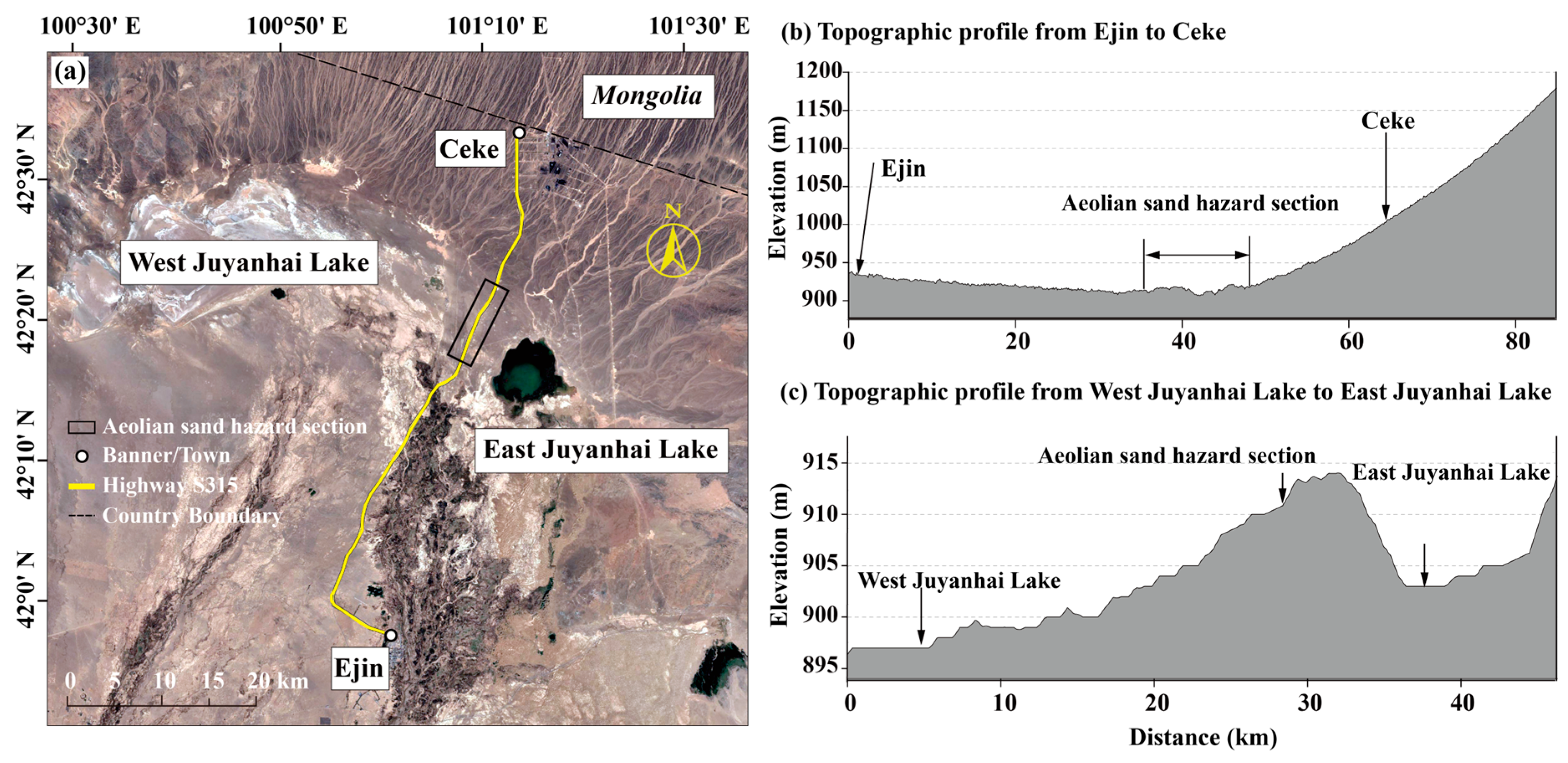
Aeolian sand hazards along Highway S315 are predominantly concentrated in the Heifengkou section between the East and West Juyanhai Lakes [1] (Figure 1a). This section lies within a transitional geomorphic zone, bounded by the Ejin River alluvial fan to the south and the Gobi Desert along the southern margin of the Altai Mountains to the north. The landscape forms a north–south-oriented low-lying corridor, with elevations ranging from approximately 910 to 920 m. The Ejin River alluvial fan slopes gently northward, with an average gradient of 0.06°, whereas the Gobi surface to the north slopes more steeply southward, with an average gradient of 0.65°. These opposing inclinations create a zone of topographic convergence that strongly promotes sand accumulation and retention (Figure 1b). In the east–west direction, the road section is located on a relatively elevated ridge between the desiccated West Juyan Lake, whose basin floor reaches a minimum elevation of 893 m, and the East Juyan Lake, which currently retains surface water at an elevation of 903 m. Consequently, the road surface is approximately 20–30 m higher than the West Juyan Lake basin and 7–17 m higher than the East Juyan Lake (Figure 1c).

2.1.2. Climatic Characteristics

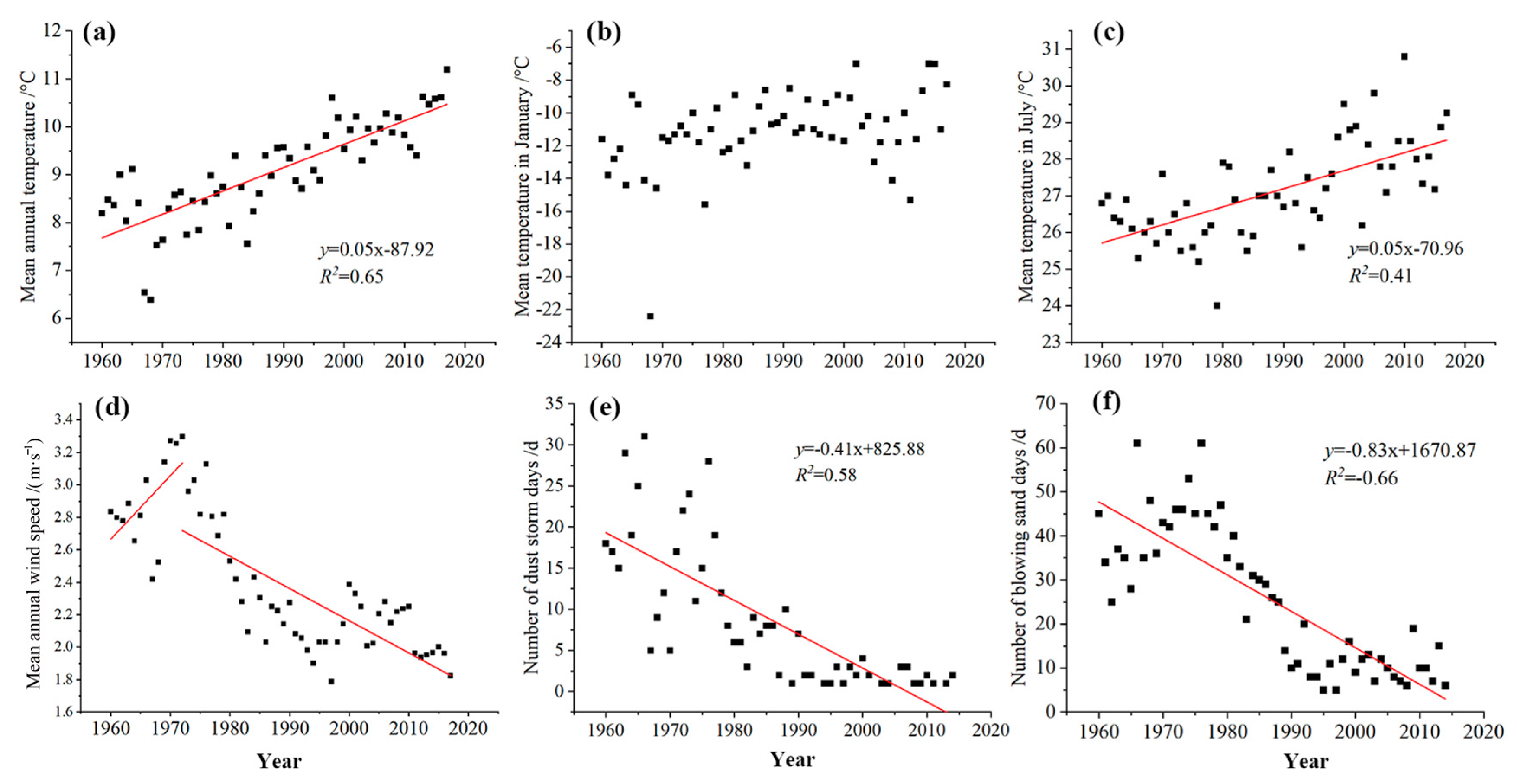
The Heifengkou section is located within a Gobi-dominated zone of concentrated aeolian hazards and is characterized by a typical temperate continental climate, with cold winters, hot summers, pronounced aridity, and persistently strong winds [22]. Long-term observations from the Ejin meteorological station (41.95° N, 101.07° E) for the period 1960–2017 reveal a clear warming trend in mean annual air temperature, with a long-term average of 9.1 °C. Mean monthly temperatures are approximately −11.2 °C in January and 27.1 °C in July, while recent extreme summer temperatures have reached up to 30.8 °C (Figure 2a–c). Mean annual precipitation is exceptionally low, averaging only 35 mm, and exhibits substantial inter-annual variability, ranging from 7 to 101 mm, with approximately 60% occurring between May and August. In contrast, mean annual potential evaporation exceeds 3700 mm, greatly surpassing precipitation inputs, and the long-term mean relative humidity is only 34% [1,23].
The mean annual wind speed increased during 1960–1972, followed by a pronounced decline thereafter. Correspondingly, the annual frequency of sandstorms and blowing dust events has decreased, with long-term averages of approximately 9 and 25 days per year, respectively. Nearly half of these events occur between March and May, predominantly from late afternoon to early evening, reflecting the combined effects of seasonal wind strengthening and diurnal boundary-layer instability [1] (Figure 2d–f).

2.1.3. Grain-Size Characteristics of Surface Sediments

Sediment grain size is a key control on aeolian transport mechanisms and reflects the combined influences of sediment source characteristics and depositional environments [24,25,26]. In a representative sand-affected section of Highway S315, a fully buried sand-control fence was selected as the sampling site. A total of 55 sand samples were collected along a west–east transect, encompassing windward slopes, dune crests, leeward slopes, sand-fixing checkerboards, and interdune flats. Grain-size analysis using a Mastersizer 3000 laser particle analyzer shows that the sediments are dominated by medium sand to very fine sand, with particle sizes between 63 and 500 μm accounting for more than 80% of the total volume. The medium sand content is lowest at dune crests (8.66%) and highest within sand-fixing checkerboards (19.54%), whereas the silt content reaches a maximum on interdune flats (16.69%). The mean grain size varies systematically among geomorphic units, ranging from 124 to 173 μm (Table 1).

2.2. Data Sources

2.2.1. Meteorological Data

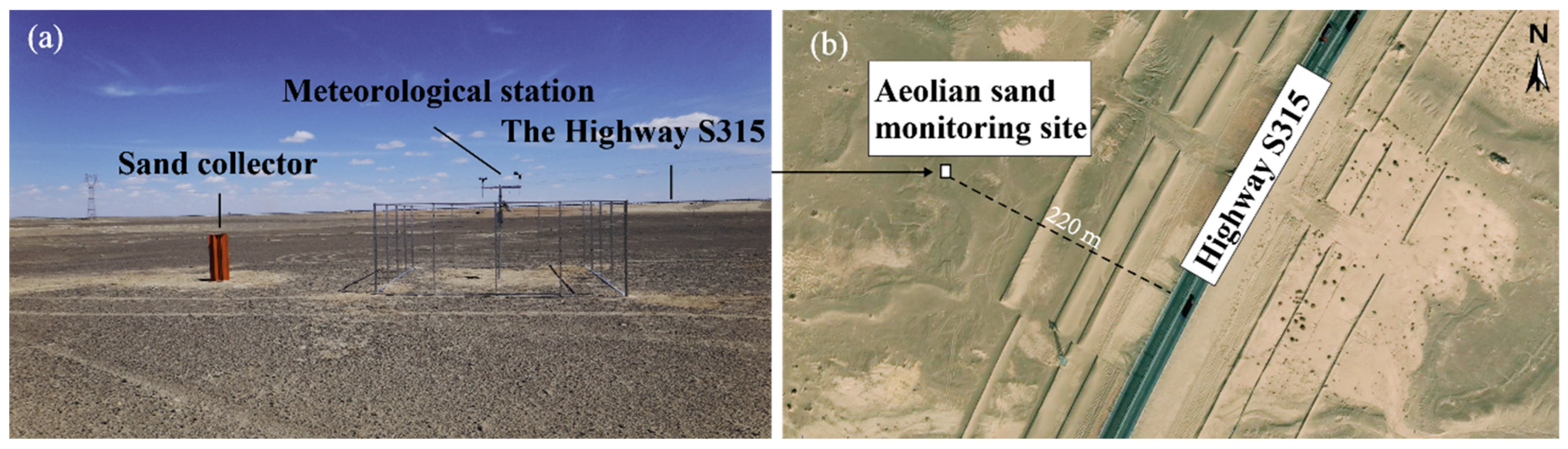
An automatic meteorological station (HOBO, Onset, Bourne, MA, USA) was installed on the western side of the aeolian sand hazard section along Highway S315 (42.36° N, 101.17° E), approximately 220 m from the roadway (Figure 3). Wind speed and wind direction were measured at a height of 2 m above the ground surface at 1 min intervals from 17 May 2016 to 28 April 2017. Wind directions were classified into 16 sectors at 22.5° intervals, with north (N) defined as 0°, east (E) as 90°, south (S) as 180°, and west (W) as 270° (N, NNE, NE, ENE, E, ESE, SE, SSE, S, SSW, SW, WSW, W, WNW, NW, and NNW). Seasonal divisions followed the classification standard of the China Meteorological Administration, with spring defined as March–May, summer as June–August, autumn as September–November, and winter as December–February of the following year [27].
Due to instrument malfunction, data were unavailable from 14 January to 1 February 2017. Although the observation period did not cover a complete calendar year, it encompassed the primary season of aeolian activity in the region and was therefore sufficient to characterize representative wind–sand dynamics [27,28,29,30,31]. Based on the valid dataset, mean wind speed, sand-driving wind frequency, and drift potential were calculated.

2.2.2. Sand Removal Records

Records of sand removal were obtained from the Dalaihubu Mechanized Border Maintenance Unit of the Alxa League Highway Transportation Maintenance Center. All records were compiled by on-site maintenance personnel following sandstorm events and include detailed information on prevailing weather conditions, affected road sections, deployed machinery, and the volume of removed sand.
From October to February, surface freezing substantially suppresses aeolian activity, and the highway enters a seasonal maintenance suspension period, resulting in the absence of adequate sand removal records. Consequently, continuous sand removal data are available only for the period from March to September, comprising a total of 46 sand removal days.

2.3. Data Processing

2.3.1. Mean Wind Speed

Annual and seasonal mean wind speeds were calculated as follows [27]:
U y ¯ = 1 n y i = 1 n y U i
U s ¯ = 1 n s i = 1 n s U i
where U y ¯ is the annual mean wind speed (m·s−1), U s ¯ is the seasonal mean wind speed (m·s−1), U i denotes the instantaneous or time-averaged wind speed at each observation (m·s−1), and n y and n s represent the total numbers of valid observations for the entire year and for each season, respectively.

2.3.2. Frequency of Sand-Driving Winds

Previous studies have shown that a wind speed of 5 m·s−1 represents a typical threshold for the initiation of sand movement over arid surfaces dominated by mobile sand [19]. Accordingly, winds with speeds ≥ 5 m·s−1 were defined as sand-driving winds in this study. The frequency of sand-driving winds was calculated for 16 directional sectors and four wind speed classes (5–7, 7–9, 9–11, and ≥11 m·s−1) using the following equation [27]:
F e = N u > u t N t o t a l × 100 %
where F e is the frequency of sand-driving winds (%), N u > u t is the number of observation intervals with wind speeds equal to or exceeding the threshold velocity ( u t = 5 m·s−1), and N t o t a l is the total number of valid observations. Based on the calculated frequencies, wind roses were constructed to illustrate the directional distribution of sand-driving winds across different wind speed classes. In these diagrams, the radial length of each sector represents the relative occurrence frequency of a given wind direction, while sector colours indicate wind speed classes.

2.3.3. Drift Potential

The drift potential ( Q ) for each of the 16 wind directions was calculated following the Fryberger method [32]:
Q = V 2 V V t t
where Q (VU) represents the potential capacity of wind-driven sand transport, V t is the threshold wind speed for sand initiation (5 m·s−1), V denotes the observed sand-driving wind speed (≥5 m·s−1), and t represents the proportion of time during which wind speeds exceed the threshold relative to the total valid observation period.
Consistent with the wind frequency analysis, sand-driving winds were categorized into four wind speed classes (5–7, 7–9, 9–11, and ≥11 m·s−1) to quantify the relative contribution of different wind intensities to aeolian transport dynamics. The drift potentials from all 16 directional sectors were summed to derive the total drift potential ( Q ). Vector synthesis was subsequently applied to calculate the resultant drift potential ( Q r ) and the resultant drift direction ( Q θ ), which respectively represent the net magnitude and the dominant direction of sand transport arising from the combined action of winds from all directions. The ratio of the resultant drift potential to the total drift potential ( Q r / Q ), defined as the directional variability index, was used to characterize the degree of wind-directional concentration and variability (Table 2).

2.3.4. Classification of Sand Hazard Event Intensity

Daily sand removal volume was used as a proxy for the magnitude and intensity of individual aeolian sand hazard events, as it directly reflects the level of maintenance intervention required during each event. To quantitatively classify event intensity within a given year, daily sand removal volumes (S, m3) were ranked in descending order and analyzed using a semi-logarithmic relationship between log10(S) and the cumulative number of sand hazard days, which allows infrequent high-magnitude events and frequent low-magnitude events to be examined within a unified frequency–magnitude framework.
Change point detection was performed using segmented regression by minimizing the residual sum of squares subject to a minimum segment length constraint. This constraint ensured sufficient data points within each segment and reduced sensitivity to short-term fluctuations and subjective visual interpretation. Compared with a single-segment semi-logarithmic fit, the segmented regression substantially reduced residual variance, indicating an improved goodness of fit in representing the frequency–magnitude structure of sand removal events. Given the episodic nature of aeolian sand hazards and the limited sample size, formal confidence intervals for breakpoint locations were not estimated. Instead, threshold robustness was evaluated by enforcing the segment length constraint and confirming that breakpoint locations remained stable under small perturbations of the dataset.
The first identified change point corresponds to a transition from high-magnitude, low-frequency events to moderate-intensity events, whereas the second change point marks the transition from moderate- to low-intensity events. The sand removal volumes associated with these two change points were therefore adopted as objective thresholds for classifying sand hazard events into severe, moderate, and slight intensity levels.

2.3.5. Classification Criteria for Sand Hazard Severity

To establish a sand hazard classification scheme applicable to highways in Gobi Desert environments, annual sand removal volume per unit road length (m3 km−1 yr−1) was adopted as the core indicator of engineering impact intensity, based on measured sand removal data along Highway S315 during 2015–2016. Because these records were collected prior to the implementation of large-scale sand-control engineering, they provide an unbiased representation of the intrinsic sand hazard pressure in the region; moreover, using two consecutive years of records allows inter-annual variability to be averaged, yielding a more robust basis for defining spatial grading thresholds [2].
Annual sand removal volumes and their spatial distributions were first analyzed for individual road sections. In 2015, severe sand hazards were concentrated between K18+500 and K30+000, extending over approximately 11.5 km, with a total annual sand removal volume of 1.286 × 10⁵ m3 and a mean intensity of approximately 1.12 × 10⁴ m3 km−1. During this period, sand accumulation thickness frequently exceeded 1 m, and road closures often lasted longer than 12 h, indicating substantial engineering impacts [1]. In 2016, sand removal was mainly concentrated along the K19+500–K29+600 section (10.5 km), with a total annual removal volume of 9.15 × 10⁴ m3 and a mean intensity of approximately 0.91 × 10⁴ m3 km−1.
A combined analysis of the two study years indicates that when annual sand removal intensity approaches or exceeds approximately 1.0 × 10⁴ m3 km−1 yr−1, road operation and maintenance are markedly disrupted. This value was therefore identified as an empirical threshold for severe sand hazards. Based on this threshold and the widely applied three-tier resource allocation principle in engineering practice (severe–moderate–mild), intermediate thresholds were determined by considering the statistical distribution of annual sand removal intensities. Most road sections exhibited intensities on the order of several thousand m3 km−1 yr−1, whereas values exceeding 1.0 × 10⁴ m3 km−1 yr−1 were confined to a limited number of high-risk sections. Accordingly, moderate sand hazards were defined as 3 × 10³–1.0 × 10⁴ m3 km−1 yr−1 and mild sand hazards as <3 × 10³ m3 km−1 yr−1. Using these thresholds, a sand hazard severity classification scheme was established for Highway S315 (Table 3) and applied to representative road sections to assess its spatial applicability.

3. Results

3.1. Mean Wind Speed and Sand-Driving Wind

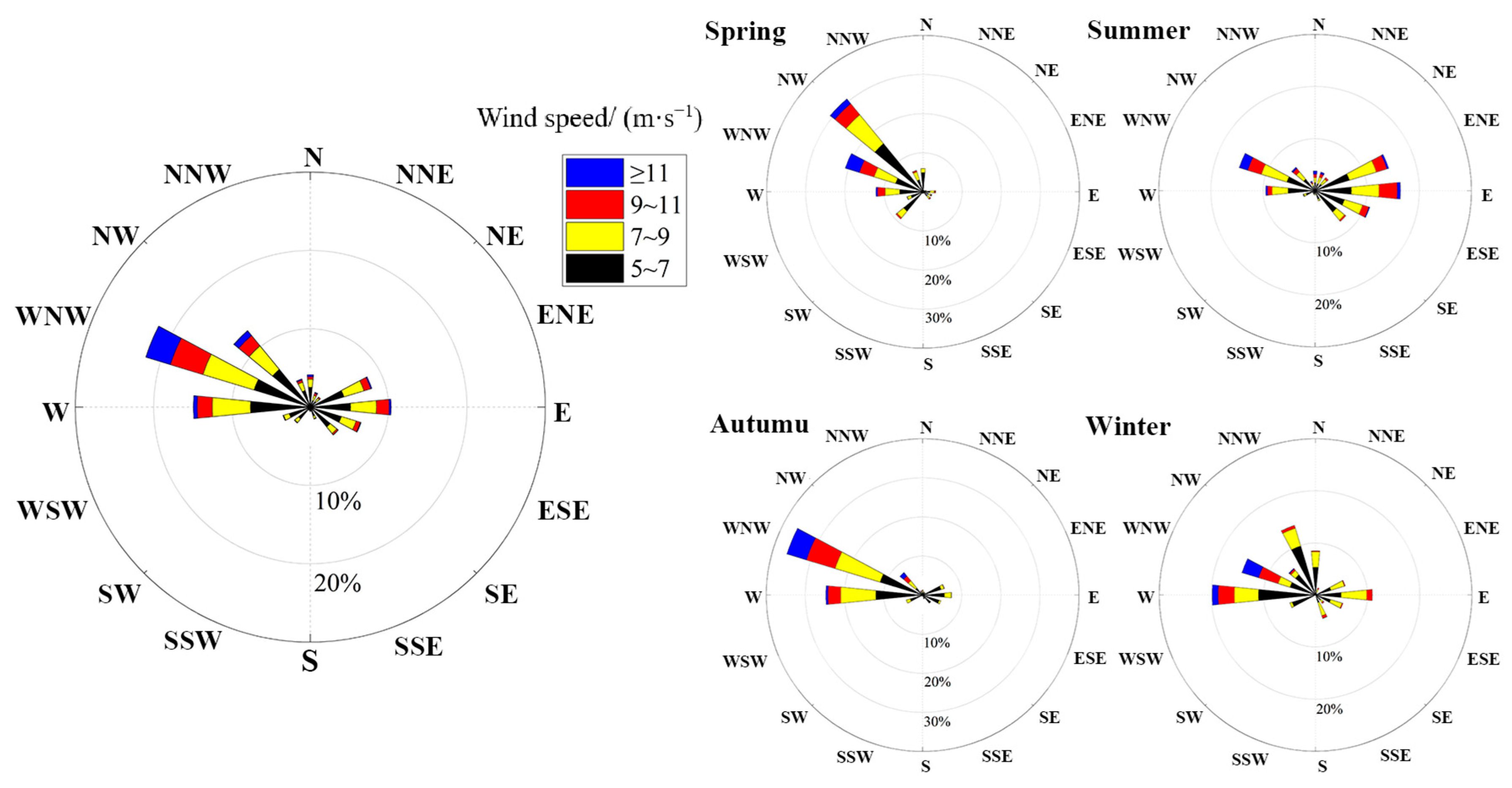
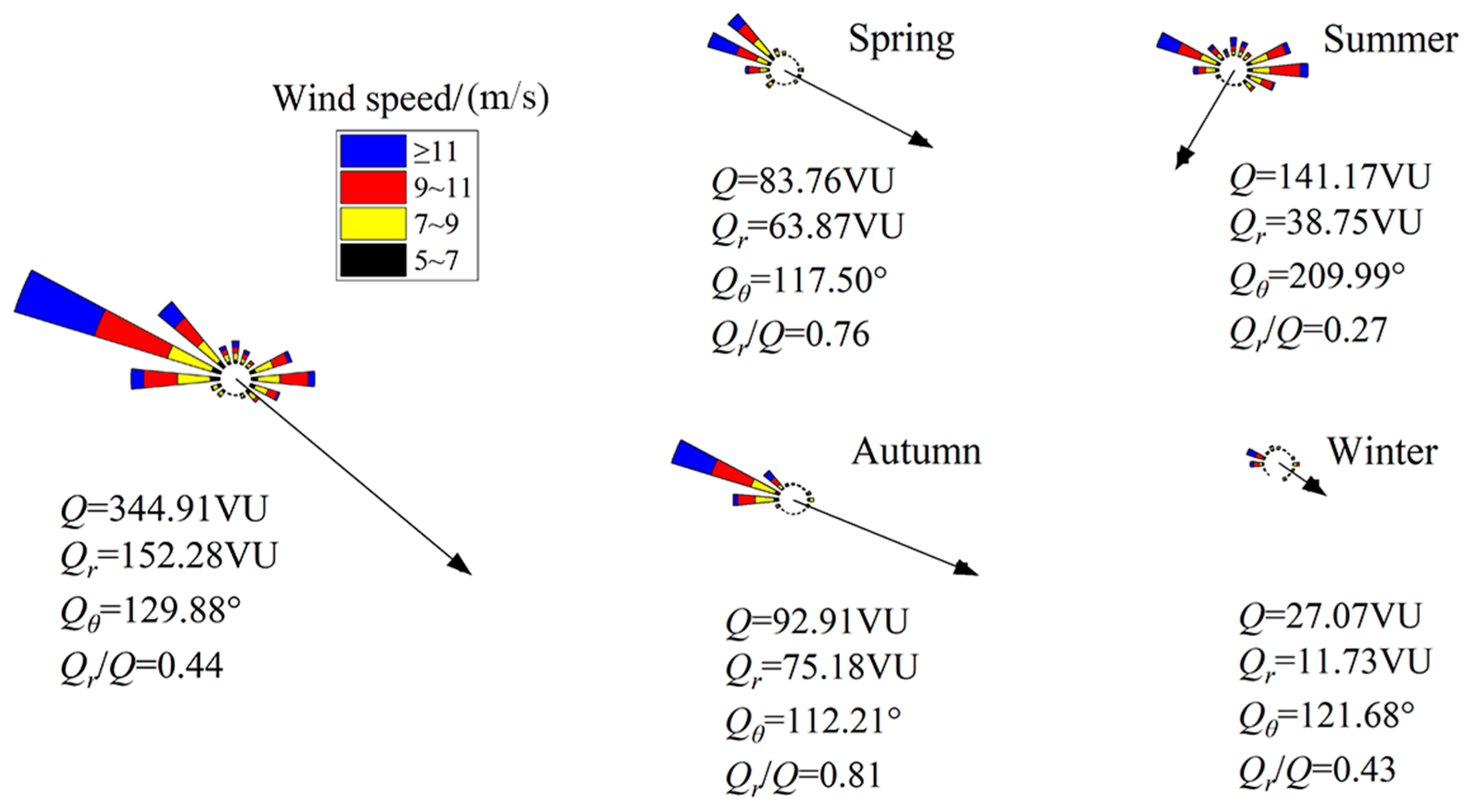
The annual mean wind speed in the sand hazard section of Highway S315 was 3.14 m·s−1. The seasonal mean wind speeds were 3.34 m·s−1 in spring, 4.10 m·s−1 in summer, and 3.03 m·s−1 in autumn, with corresponding maximum wind speeds of 15.60, 17.61, and 16.61 m·s−1, respectively (Figure 4).
Winter exhibited the weakest wind regime, with a mean wind speed of 1.86 m·s−1. Sand-driving winds (≥5 m·s−1) accounted for 23.98% of all wind observations. On an annual basis and during spring, autumn, and winter, sand-driving winds were predominantly from the W, WNW, and W sectors, contributing 63.57%, 68.57%, and 41.26% of the seasonal sand-driving wind frequencies, respectively. In contrast, summer exhibited a more dispersed directional pattern, with WNW, E, and ENE as the dominant sand-driving wind directions, together accounting for 41.41% of occurrences (Figure 4).

3.2. Drift Potential

The annual drift potential along Highway S315 was 344.91 VU, indicating a moderate wind energy environment. The directional variability index was 0.44, reflecting a blunt bimodal wind regime with moderate directional variability. The resultant drift potential was 152.28 VU, and the resultant drift direction was 129.88° (ESE), indicating net sand transport towards the east–southeast (Figure 5).
Seasonally, summer exhibited the highest drift potential (141.17 VU); however, wind directions were highly dispersed ( Q r / Q = 0.27), resulting in a low resultant drift potential of only 38.75 VU, characteristic of a low-ratio composite wind regime. In autumn, the drift potential was 92.91 VU, whereas the resultant drift potential reached 75.18 VU, accompanied by intense directional concentration ( Q r / Q = 0.81), corresponding to a high-ratio narrow unimodal wind regime. Spring showed a drift potential of 83.76 VU and a resultant drift potential of 63.87 VU, with a directional variability index of 0.76, indicative of a moderate-ratio sharp bimodal wind regime. Both the drift potential and resultant drift potential were minimal during winter (Figure 5).

3.3. Spatiotemporal Characteristics of Aeolian Sand Hazards

3.3.1. Intra-Annual Distribution of Sand Hazard Events

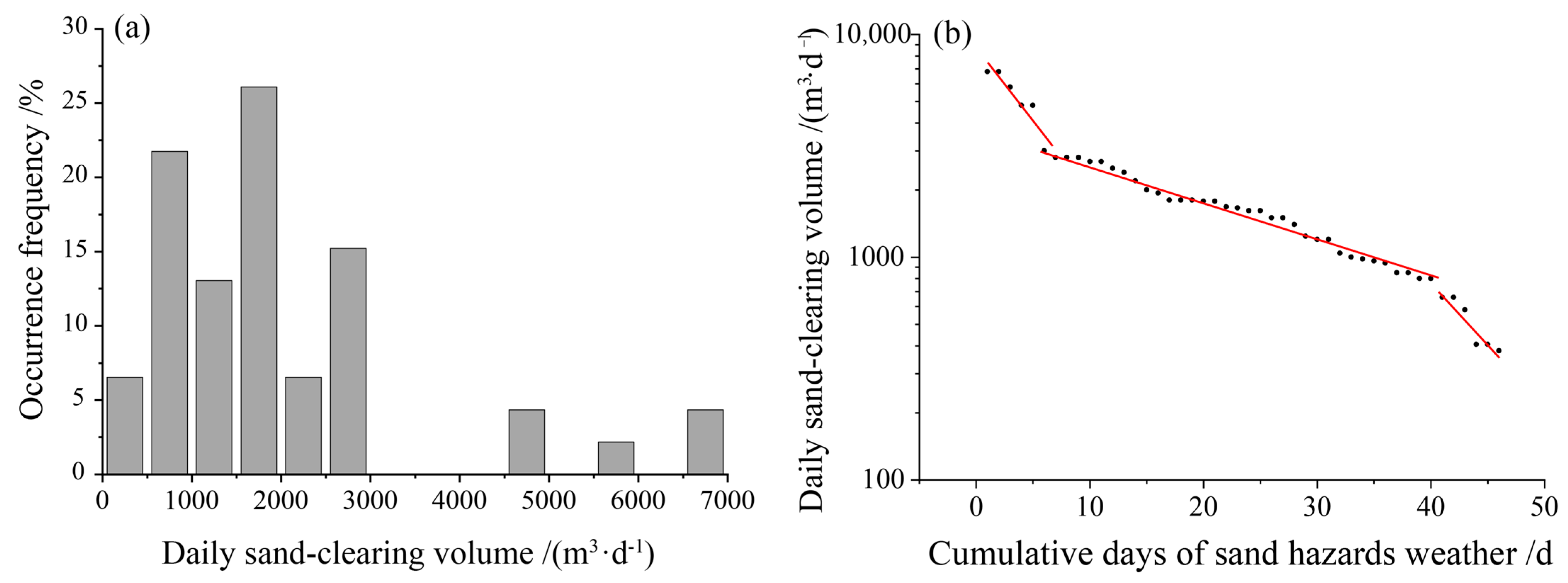
Daily sand removal volumes exhibited an approximately normal distribution (Figure 6a), with the 1500–2000 m3 class representing the most frequent interval (26.1%). The following most frequent intervals were the 500–1000 m3 and 2500–3000 m3 classes, accounting for 21.7% and 15.2% of events, respectively. Events with daily sand removal volumes exceeding 3000 m3 were rare, indicating that extreme sand accumulation events occurred infrequently.
In semi-logarithmic coordinates (Figure 6b), the fitted curve exhibits a pronounced inflection point at approximately 800 m3, marking the transition from mild to moderate sand hazard events, beyond which sand removal volumes increase exponentially. A second inflection point occurs near 3000 m3, where the growth rate of sand removal volume decreases markedly, and the frequency of corresponding events becomes limited, indicating the onset of severe sand accumulation conditions. Based on these inflection points, sand hazard events were classified into three intensity levels: mild (<800 m3), moderate (800–3000 m3), and severe (>3000 m3). These categories account for 13.0%, 76.1%, and 10.9% of all sand hazard events, respectively (Table 4).
Marked monthly variability was observed in sand hazard occurrence (Table 4). April and May were identified as peak periods for severe sand hazards. Although the number of sand removal days during these months was relatively limited (8 days in April and 3 days in May), total sand removal volumes reached 24,985 m3 and 13,380 m3, accounting for 27.3% and 14.6% of the annual total, respectively. This pattern indicates exceptionally high event intensity during this period. March, August, and September were dominated by moderate sand hazards, with 12, 9, and 10 sand removal days and corresponding sand removal volumes of 16,637 m3 (18.2%), 18,540 m3 (20.3%), and 11,540 m3 (12.6%), respectively. These months reflect either high-frequency or moderate-magnitude sand hazard activity with sustained characteristics. Mild sand hazard events were also observed in March, April, and September, whereas no significant sand accumulation was recorded in July, highlighting the pronounced intermittency of aeolian sand hazards within the annual cycle.

3.3.2. Spatial Distribution of Sand Hazards

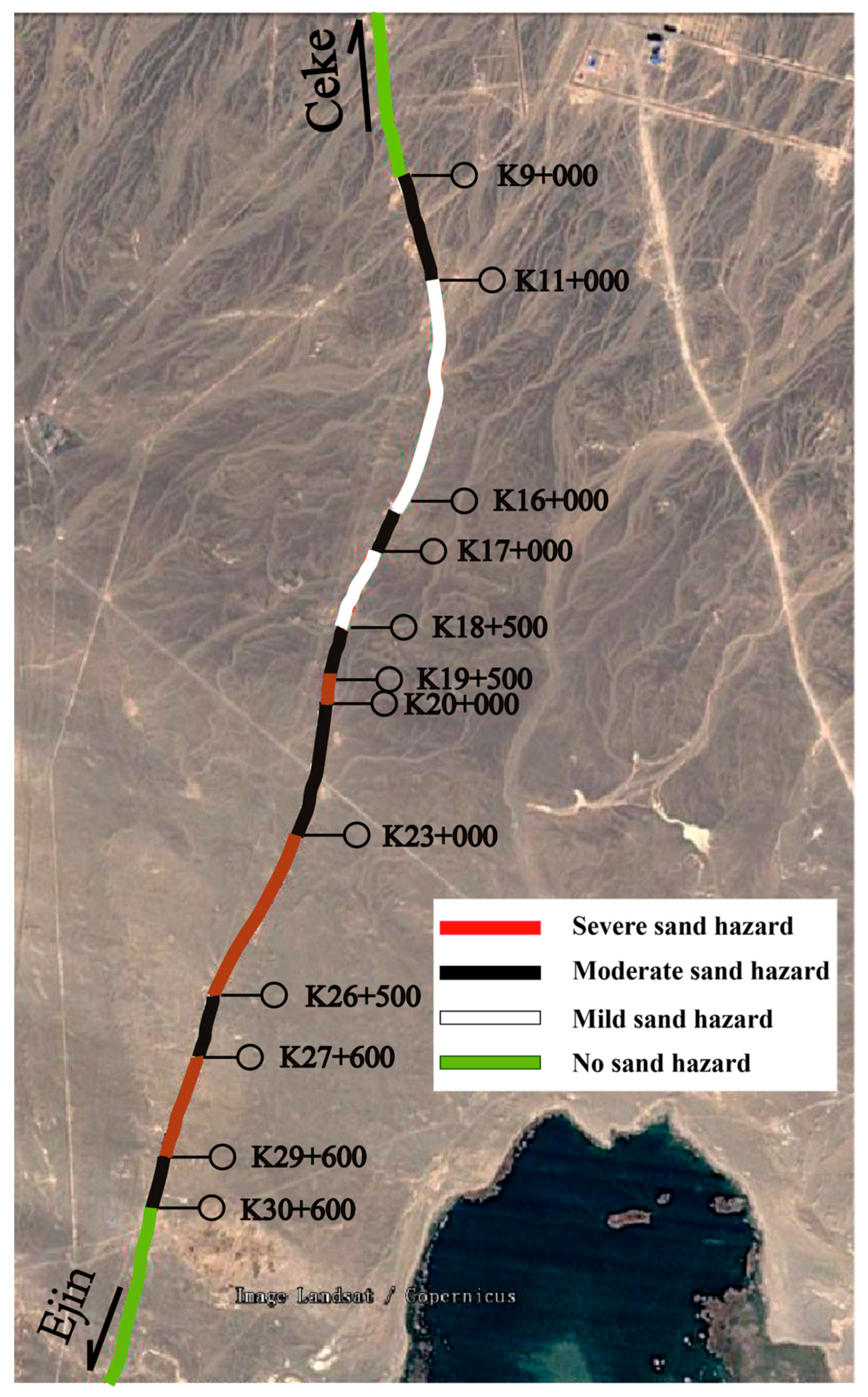
Based on the established sand hazard severity classification criteria (Table 3), sectional analysis along Highway S315 indicates that sand hazards are predominantly concentrated between K9+000 and K30+600, covering a total length of 21.6 km. Severe sand hazard sections extend over 6.0 km and are mainly distributed along K19+500–K20+000, K23+000–K26+500, and K27+600–K29+600. Moderate sand hazard sections span 9.1 km and occur at K9+000–K11+000, K16+000–K17+000, K18+500–K19+500, K20+000–K23+000, K26+500–K27+600, and K29+600–K30+600. Mild sand hazard sections cover 6.5 km and are primarily located along K11+000–K16+000 and K17+000–K18+500 (Figure 7).
To evaluate the robustness of the proposed sand hazard classification scheme, the annual sand removal volume was independently estimated based on the spatial extent of each hazard category using the following expression:
Q e s t = 6 × 10 4 + 9.1 × 6.5 × 10 3 + 6.5 × 1.5 × 10 3 = 12.9 × 10 4   m 3
where Q e s t is the estimated annual sand removal volume; 6.0, 9.1, and 6.5 represent the lengths (km) of severe, moderate, and mild sand hazard sections, respectively; and 1.0 × 10⁴, 6.5 × 10³, and 1.5 × 10³ m3 km−1 correspond to the lower-bound or representative mid-range values of annual sand removal intensity for each hazard category. The estimated value closely matches the measured annual sand removal volume in 2015 (1.286 × 10⁵ m3), demonstrating strong internal consistency between the classification criteria and observed engineering records. This agreement confirms that the sand hazard classification scheme based on annual sand removal volume per unit road length is both reasonable and representative for assessing aeolian sand hazards along highways in Gobi Desert environments.

4. Discussion

Aeolian sand hazards along desert highways emerge from the coupled effects of atmospheric forcing, sediment availability, and corridor-scale geomorphic configuration, rather than from wind intensity alone [1,2,29,33,34,35,36]. In arid and Gobi environments, the efficiency with which wind-driven sediment is delivered onto road surfaces is strongly controlled by wind regime organization—particularly directional persistence and the resultant transport vector—as well as by the spatial continuity of upwind sand sources and transport pathways [33]. Classical wind regime theory highlights that even under high wind energy, strongly dispersed wind directions can markedly reduce net sand transport, whereas moderate but directionally persistent winds tend to produce focused deposition along linear targets such as highways [32]. This framework provides a useful basis for interpreting the spatial concentration of and temporal variability in sand hazards observed along Highway S315.
Within this regional context, the pronounced aeolian activity along Highway S315 reflects the superposition of climatic forcing, sediment supply, and corridor-scale terrain effects. Seasonally, the study area is characterized by a mid-latitude continental arid climate in which springtime surface warming destabilizes the atmospheric boundary layer, favoring the development of strong convective winds [37]. During summer, the region is frequently influenced by the periphery of the subtropical high-pressure system, where intense surface heating enhances thermal perturbations and pressure gradients, generating persistent near-surface winds despite pronounced directional variability [38]. At the same time, the highway is situated near the western margin of the Badain Jaran Desert, where extensive exposed sandy surfaces and fluvial deposits from desiccated channels to the northwest provide abundant, readily mobilized sediment [1,2]. These materials are funneled along corridor-like terrain features, including wind-eroded lowlands flanking the roadway, forming multiple persistent sand transport pathways and promoting the linear aggregation of aeolian activity along the highway corridor (Figure 1) [39]. Superimposed on these regional controls, Highway S315 traverses a transitional zone between Gobi and desert landscapes characterized by broad, low-relief terrain, within which the road itself exerts a pronounced “wind-guiding” effect [32]. Given the northeast–southwest alignment of the highway and the dominance of westerly sand-driving winds (W, WNW, and WN) (Figure 4), wind directions frequently intersect the roadway at near-perpendicular angles, enhancing sediment interception and favoring rapid surface accumulation. Under such conditions, sand particles are efficiently driven onto the pavement, increasing the likelihood of sudden burial-type sand hazards and acute operational disruption [2,40].
While the present analysis captures the dominant wind–sand dynamics during the main aeolian activity season, an important limitation is that the meteorological dataset spans less than one full year and includes a short data gap. Short-term wind records may underrepresent rare but influential extremes and cannot fully characterize inter-annual variability in wind energy environments [16]. This limitation is particularly relevant in arid regions, where long-term climate warming and increasing aridity have been shown to influence wind erosion pressure, drought frequency, and vegetation constraints on sediment availability [4,5,6]. Multi-decadal analyses from northern China further indicate that variations in wind energy environments are closely linked to dune activity and desertification trajectories, underscoring the value of long-term observations for contextualizing aeolian processes [31]. Accordingly, the present dataset should be interpreted as representative of seasonal wind regime structure rather than as a complete climatology. Future work integrating multi-year in situ monitoring with long-term meteorological station records would enable quantitative assessment of inter-annual stability in drift potential and transport direction, thereby strengthening confidence in regional representativeness [31,41,42].
Another source of uncertainty concerns the classification of sand hazard event intensity based on 46 sand removal days. Although this sample size is limited, it reflects the episodic nature of aeolian sand hazards and, crucially, corresponds exclusively to operationally significant events that required maintenance intervention. Unlike purely climatological indicators, sand removal records encode the integrated outcome of wind forcing, sediment supply, and corridor effects in terms directly relevant to road safety and serviceability. Similar operationally oriented approaches have been adopted in evaluating sand-control effectiveness along Gobi expressways, where maintenance demand and clearing frequency are central performance metrics [2]. Nevertheless, limited samples inevitably introduce uncertainty in breakpoint locations. The identified inflection points should therefore be interpreted as operationally meaningful transitions in maintenance demand rather than as exact statistical thresholds. Expanding sand removal datasets across multiple years would enable formal sensitivity analyses and probabilistic characterization of threshold uncertainty, improving reproducibility while preserving the operational relevance of the framework [1].
The proposed framework is transferable as a methodology but not as a set of universal numerical thresholds. Its general applicability lies in the integration of wind regime diagnostics with operational impact indicators, a coupling that can be adapted to other arid and desert highways. However, threshold magnitudes will vary with regional wind regime type and directional stability [32,41,42], sediment grain-size characteristics and mobility [24,25,26], and road geometry, which governs airflow modification and deposition efficiency [8,10,11,12,33]. Consequently, application to new settings requires local calibration using available operational proxies, such as sand removal demand, accumulation thickness, or traffic interruption records. This positioning distinguishes the present approach from remote sensing- or index-based hazard zoning methods, which effectively map relative risk but often lack direct linkage to maintenance decision-making [14,15]. Cross-corridor comparisons, including studies from the Taklimakan Desert Highway, further suggest that while coupling logic is broadly applicable, hazard thresholds remain context dependent [7,39].
Beyond hazard diagnosis, targeted sand hazard management has important implications for sustainability. Sand clearing is energy- and labor-intensive, and indiscriminate maintenance can increase fuel consumption, operational costs, and repeated surface disturbance. Severity-based zoning enables precision maintenance, concentrating intensive interventions where operational impairment is greatest while reducing unnecessary disturbance in lower-risk segments. Evaluations of sand-control systems in Gobi expressways demonstrate that optimized layouts can significantly reduce clearing demand and improve road serviceability, implying direct savings in energy use and maintenance cost [2]. Moreover, minimizing mechanical disturbance helps avoid destabilizing surface sediments that could otherwise enhance local sand re-supply. Integrating engineering measures with corridor-scale planning and ecological monitoring may therefore reduce both hazard pressure and environmental impact, aligning desert highway management with broader sustainability objectives [7,13,20,43].

5. Conclusions

This study provides an integrated assessment of wind regimes, aeolian transport potential, and the spatiotemporal distribution of sand hazards along Highway S315. The principal conclusions are as follows.
(1)
The sand hazard section of Highway S315 is characterized by an annual mean wind speed of 3.14 m·s−1, with stronger winds in spring and summer and the weakest conditions in winter. Sand-driving winds account for 23.98% of all observations and are dominated by westerly sectors (W, WNW, and WN), whereas summer winds exhibit greater directional dispersion. The annual drift potential reaches 344.91 VU, while the resultant drift potential is 152.28 VU with a net transport direction of 129.88° (ESE), indicating persistent sand transport towards the east–southeast. These results highlight the importance of incorporating resultant transport direction into the orientation and layout of sand-control structures to improve interception efficiency.
(2)
Aeolian sand hazards along Highway S315 display pronounced temporal variability and distinct intensity levels. Daily sand removal volumes follow an approximately normal distribution, with the 1500–2000 m3 class most frequent (26.1%). Based on two inflection points at ~800 m3 and ~3000 m3 in the semi-logarithmic frequency–volume relationship, sand hazard events were objectively classified as mild (<800 m3, 13.0%), moderate (800–3000 m3, 76.1%), and severe (>3000 m3, 10.9%). These categories correspond to clearly differentiated accumulation depths and operational impacts, ranging from minor traffic disturbance to complete road closure during severe events.
(3)
Spatially, sand hazards are intensely concentrated between K9+000 and K30+600, covering approximately 21.6 km of Highway S315. Using annual sand removal volume per unit road length as an engineering impact indicator, sand hazard severity was classified as mild (<3 × 10³ m3 km−1 yr−1), moderate (3 × 10³–1.0 × 10⁴ m3 km−1 yr−1), and severe (>1.0 × 10⁴ m3 km−1 yr−1). Severe, moderate, and mild hazard sections extend over 6.0 km, 9.1 km, and 6.5 km, respectively. This spatial differentiation provides a quantitative and operationally relevant basis for prioritizing sand-control measures and optimizing maintenance resource allocation along desert highways.

Author Contributions

Conceptualization, X.M., J.X. and Z.Y.; methodology, X.M.; formal analysis, X.M. and J.X.; writing—original draft preparation, X.M. and Z.Y.; writing—review and editing, X.M. and J.X.; visualization, X.M. and Z.Y.; resources, X.H. and X.G.; investigation, X.H. and X.G.; supervision, J.X.; project administration, J.X.; funding acquisition, J.X. and X.M. All authors have read and agreed to the published version of the manuscript.

Funding

This research was supported by the Major Science and Technology Project of the Inner Mongolia Autonomous Region (No. 2024JHGS0009), the “Western Light” Program of the Chinese Academy of Sciences (CAS) (No. xbzglzb2022018), and the Doctoral Research Start-up Fund of Fuyang Normal University (No. 2024KYQD0123).

Institutional Review Board Statement

Not applicable.

Informed Consent Statement

Not applicable.

Data Availability Statement

The data that support the findings of this study are available from the corresponding author upon reasonable request.

Conflicts of Interest

The authors declare no conflicts of interest.

References

  1. Ma, X.X. Sand Prevention System and Its Efficiency Analysis Along S315 Ceke-Dalaihubu First-Grade Highway. Master’s Thesis, University of Chinese Academy of Sciences, Beijing, China, 2021. (In Chinese) [Google Scholar]
  2. Yao, Z.Y.; Xiao, J.H.; Ma, X.X.; Qu, J.J.; Hong, X.F. Evaluation of the effectiveness of an expressway sand protection system in a gobi region—Case study of the Ceke–Ejina expressway, Ejina Banner, China. Int. Soil Water Conserv. Res. 2025, 13, 177–188. [Google Scholar] [CrossRef]
  3. Cheng, J.J.; Jiang, F.Q.; Xue, C.X.; Xin, G.W.; Li, K.C. Characteristics of the disastrous wind-sand environment along railways in the Gobi area of Xinjiang, China. Atmos. Environ. 2015, 102, 344–354. [Google Scholar] [CrossRef]
  4. Xue, Z.J.; Qin, Z.D.; Cheng, F.Q.; Ding, G.W.; Yan, J.X. Quantitative characterization of climate change and its impact on aeolian desertification: A case study in northwest Shanxi of China. Environ. Earth Sci. 2021, 80, 242. [Google Scholar] [CrossRef]
  5. Chen, Y.N.; Li, Y.P.; Li, Z.; Liu, Y.C.; Hunag, W.J.; Liu, X.G.; Feng, M.Q. Analysis of the Impact of Global Climate Change on Dryland Areas. Adv. Earth Sci. 2022, 37, 111–119. (In Chinese) [Google Scholar]
  6. Liu, H.; Jiang, L.L.; Liu, B.; Liu, R.; Xiao, Z.L. Characteristics of drought in China and its effect on vegetation change in recent 40 years. Acta Ecol. Sin. 2023, 43, 7936–7949. (In Chinese) [Google Scholar]
  7. Li, C.J.; Wang, Y.D.; Lei, J.Q.; Xu, X.W.; Wang, S.J.; Fan, J.L.; Fan, S.Y. Damage by wind-blown sand and its control measures along the Taklimakan Desert Highway in China. J. Arid Land 2021, 13, 98–106. [Google Scholar] [CrossRef]
  8. Gao, L.; Cheng, J.J.; Wang, H.F.; Yuan, X.X. Effects of different types of guardrails on sand transportation of desert highway pavement. J. Arid Land 2022, 14, 993–1008. [Google Scholar] [CrossRef]
  9. Wang, F.; Ma, Y.F.; Xing, G.Y.; Chen, S.Y.; Wang, F. Driving avoidance performance on Sand-Covered roads during sand and dust storms under different visibility conditions. Transp. Res. Part F Traffic Psychol. Behav. 2024, 105, 306–320. [Google Scholar] [CrossRef]
  10. Zhang, M.; Li, Q.; Hou, J.Y.; Ji, S. Evaluation of protection benefit of sand barrier fence with different heights on desert highway. PLoS ONE 2025, 20, e0324869. [Google Scholar] [CrossRef] [PubMed]
  11. Wang, F.; Liu, S.X.; Jiang, Y.J.; Duan, W.J. Research on the effect of sand barriers on highways in desert areas on sand control. Sustainability 2023, 15, 13906. [Google Scholar] [CrossRef]
  12. Ma, X.X.; Xiao, J.H.; Yao, Z.Y.; Xue, X. Wind field disturbance induced by tall vertical sand barriers: A wind tunnel simulation. J. Desert Res. 2026, 46, 1–9. (In Chinese) [Google Scholar]
  13. An, Z.S.; Zhang, K.C.; Tan, L.H.; Niu, Q.H.; Wang, T. Mechanisms responsible for sand hazards along desert highways and their control: A case study of the Wuhai-Maqin highway in the Tengger Desert, Northwest China. Front. Environ. Sci. 2022, 10, 878778. [Google Scholar] [CrossRef]
  14. Han, F.; Wang, C.X.; Liu, Z.L.; Liu, Z.B. Assessment of sand accumulation hazard on desert highway based on variable weight-cloud model theory. Front. Earth Sci. 2023, 11, 1208416. [Google Scholar] [CrossRef]
  15. Li, L.Y.; Lv, L.L.; Tao, Z.Z.; Yin, W.H.; Li, Q.; Wang, Z.Q. Windblown sand hazards risk assessment along the highways based on GIS-game theory combination weight. PLoS ONE 2024, 19, e0292263. [Google Scholar] [CrossRef]
  16. Camargo, M.B.P.; Hubbard, K.G. Spatial and temporal variability of daily weather variables in sub-humid and semi-arid areas of the United States high plains. Agric. For. Meteorol. 1999, 93, 141–148. [Google Scholar] [CrossRef]
  17. El-Metwally, M.; Alfaro, S.C. Correlation between meteorological conditions and aerosol characteristics at an East-Mediterranean coastal site. Atmos. Res. 2013, 132, 76–90. [Google Scholar] [CrossRef]
  18. Xia, G.M.; Kang, S.Z.; Li, F.S.; Zhang, J.H.; Zhou, Q.Y. Diurnal and seasonal variations of sap flow of Caragana korshinskii in the arid desert region of north-west China. Hydrol. Process. 2008, 22, 1197–1205. [Google Scholar] [CrossRef]
  19. Mehdi, M.; Ammari, N.; Merrouni, A.A.; Benazzouz, A.; Dahmani, M. Experimental investigation on the effect of wind as a natural cooling agent for photovoltaic power plants in desert locations. Case Stud. Therm. Eng. 2023, 47, 103038. [Google Scholar] [CrossRef]
  20. Abuzaid, A.S.; El-Shirbeny, M.A.; Fadl, M.E. A new attempt for modeling erosion risks using remote sensing-based mapping and the index of land susceptibility to wind erosion. Catena 2023, 227, 107130. [Google Scholar] [CrossRef]
  21. Mueller, K.; Keller, M.; Stoll, M.; Friedel, M. Wind speed, sun exposure and water status alter sunburn susceptibility of grape berries. Front. Plant Sci. 2023, 14, 1145274. [Google Scholar] [CrossRef] [PubMed]
  22. Zhang, Y.L. The geological study on the plant flora in Erjina County of Inner Mongolia. Arid Zone Res. 1997, 14, 23–32. (In Chinese) [Google Scholar]
  23. Zhang, J.T.; Xi, H.Y.; Wang, C.L.; Li, P.D. Estimation of Evapotranspiration of Riparian Forests in the Desert Region from Diurnal Fluctuation of Groundwater Levels. Plateau Meteorol. 2019, 38, 179–186. (In Chinese) [Google Scholar]
  24. Vandenberghe, J. Grain size of fine-grained windblown sediment: A powerful proxy for process identification. Earth Sci. Rev. 2013, 121, 18–30. [Google Scholar] [CrossRef]
  25. Wang, X.M.; Dong, Z.B.; Zhang, J.W.; Qu, J.J.; Zhao, A.G. Grain size characteristics of dune sands in the central Taklimakan Sand Sea. Sediment. Geol. 2003, 161, 1–14. [Google Scholar] [CrossRef]
  26. Ma, X.X.; Xiao, J.H.; Yao, Z.Y. A comparative study on the three calculation methods of grain-size parameters for aeolian sediments. J. Desert Res. 2020, 40, 95–102. (In Chinese) [Google Scholar]
  27. Zhang, H.X.; Zhang, K.C.; An, Z.S.; Yu, Y.P. Wind dynamic environment and sediment grain size characteristics of shrub desert along Dunhuang-Golmud Railway. J. Desert Res. 2023, 43, 49–58. (In Chinese) [Google Scholar]
  28. Xue, C.J.; Zhang, K.C.; An, Z.S.; Zhang, H.X.; Pan, J.P. Influences of railway viaducts on local wind power: A case study of the Shashangou Bridge used by the Dunge Railway. Arid Zone Res. 2023, 40, 1678–1686. (In Chinese) [Google Scholar]
  29. Cai, D.W.; Zhang, K.C.; An, Z.S.; Guo, Z.C. Wind energy environments and its impacts on railway sand hazards along Gerlha section of the Qinghai-Tibet Railway. J. Desert Res. 2017, 37, 40–47. (In Chinese) [Google Scholar]
  30. Luo, F.M.; Gao, J.L.; Xin, Z.M.; Bian, K.; Hao, Y.G.; Liu, F. Characteristics of sand-driving wind regime and sediment transport in northeast edge of Ulan Buh Desert. Trans. CSAE 2019, 35, 145–152. (In Chinese) [Google Scholar]
  31. Wang, X.M.; Hasi, E.; Zhou, Z.J.; Lin, X.P. Significance of variations in the wind energy environment over the past 50 years with respect to dune activity and desertification in arid and semiarid northern China. Geomorphology 2007, 86, 252–266. [Google Scholar] [CrossRef]
  32. Fryberger, S.G.; Dean, G. Dune forms and wind regime. In A Study of Global Sand Seas; US Geological Survey, Professional Paper; United States Government Printing Office: Washington, DC, USA, 1979; Volume 1052, pp. 137–170. [Google Scholar]
  33. Yu, Y.Y. Study on Sand Transport Patterns of Subgrade Cross-Section Forms of High-Grade Highways: A Case Study of the S315 First-Class Highway in Inner Mongolia. Master’s Thesis, University of Chinese Academy of Sciences, Beijing, China, 2018. (In Chinese) [Google Scholar]
  34. Wang, T.; Qu, J.J.; Ling, Y.Q.; Xie, S.B.; Xiao, J.H. Wind tunnel test on the effect of metal net fences on sand flux in a Gobi Desert, China. J. Arid Land 2017, 9, 888–899. [Google Scholar] [CrossRef]
  35. Zhang, H.X.; Zhang, K.C.; An, Z.S.; Yu, Y.P. Wind dynamic environment and wind-sand erosion and deposition processes on different surfaces along the Dunhuang-Golmud railway, China. J. Arid Land 2023, 15, 393–406. [Google Scholar] [CrossRef]
  36. Alzahrani, A.J.; Alghamdi, A.G.; Ibrahim, H.M. Assessment of Soil Loss Due to Wind Erosion and Dust Deposition: Implications for Sustainable Management in Arid Regions. Appl. Sci. 2024, 14, 10822. [Google Scholar] [CrossRef]
  37. Wang, M.Z.; Zhang, J.T. The relationship among summer atmospheric boundary layer height over the Taklimakan Desert, its land surface parameters and Eurasian circulation. Atmos. Sci. Lett. 2022, 23, e1122. [Google Scholar] [CrossRef]
  38. Latt, M.R.; Hochman, A.; Caldas-Alvarez, A.; Helgert, S.; Pinto, J.G.; Corsmeier, U. Understanding summer wind systems over the eastern Mediterranean in a high-resolution climate simulation. Int. J. Clim. 2022, 42, 8112–8131. [Google Scholar] [CrossRef]
  39. Wei, J.M.; Cheng, J.J.; Ma, B.T. Characteristics of the wind-sand environment along the Tumshuk-Kunyu Desert Highway in the western Tarim Basin. Arid Zone Res. 2024, 41, 135–146. (In Chinese) [Google Scholar]
  40. Han, F.; Wang, C.X.; Liu, Z.B.; Li, L.Y.; Yin, W.H. Study on sand-accumulation changes of highway and formation mechanism of sand damage in drifting dunes areas. Appl. Sci. 2022, 12, 10184. [Google Scholar] [CrossRef]
  41. Liu, Z.Y.; Dong, Z.B.; Zhang, Z.C.; Cui, X.J.; Xiao, N. Spatial and temporal variation of the near-surface wind regimes in the Taklimakan Desert, Northwest China. Theor. Appl. Climatol. 2019, 138, 433–447. [Google Scholar] [CrossRef]
  42. Hu, Z.Y.; Wang, G.P.; Liu, Y.; Shi, P.J.; Zhang, G.M.; Liu, J.F.; Gu, Y.; Huang, X.C.; Zhang, Q.Y.; Han, X. Analysis of spatial and temporal variations of the near-surface wind regime and their influencing factors in the Badain Jaran Desert, China. Atmosphere 2022, 13, 1316. [Google Scholar] [CrossRef]
  43. Cheng, H.X.; Lin, Y.J.; Hu, L.Q. Suitability analysis of vegetation indices for monitoring wind sand disaster in oasis agricultural district. Res. Soil Water Conserv. 2014, 21, 302–305+310. (In Chinese) [Google Scholar]
Figure 1. Location and topographic profiles of Highway S315. (a) Geographic location of Highway S315; (b) North–south topographic profile and (c) East–west topographic profile across the aeolian sand hazard section.
Sustainability 18 01645 g001
Figure 2. Temporal trends in air temperature (ac), annual mean wind speed (d), sandstorm days (e), and blowing dust days (f) in Ejin.
Sustainability 18 01645 g002
Figure 3. (a,b) Overview of the meteorological station.
Sustainability 18 01645 g003
Figure 4. Annual and seasonal wind roses of sand-entraining winds along sand-affected sections of Highway S315.
Sustainability 18 01645 g004
Figure 5. Annual and seasonal drift potentials along sand-affected segments of Highway S315.
Sustainability 18 01645 g005
Figure 6. Frequency distribution of daily sand-clearing volumes in 2016. (a) Frequency distribution of daily sand removal volumes along Highway S315; (b) Semi logarithmic relationship between daily sand removal volume and cumulative aeolian sand hazard days, with two inflection points indicating thresholds for hazard classification.
Sustainability 18 01645 g006
Figure 7. Spatial distribution of sand hazard occurrence along Highway S315.
Sustainability 18 01645 g007
Table 1. Grain-size composition and mean particle size at different geomorphic locations along Highway S315.
Geomorphic PositionGrain-Size Composition
(%)
Mean Particle Size
(μm)
Gravel
(>2000 μm)
Very Coarse Sand
(1000–2000 μm)
Coarse Sand
(1000 μm)
Medium Sand
(250–500 μm)
Fine Sand
(125–250 μm)
Very Fine Sand
(63–125 μm)
Silt and Clay
(<63 μm)
Windward slope toe0.090.915.5812.8840.9331.098.53173
Windward slope mid0.051.088.2318.0638.7125.887.98165
Dune crest0.211.212.798.6646.1632.568.41155
Leeward slope mid0.000.114.8616.2940.6129.868.25153
Leeward slope toe0.000.296.9013.5135.1632.9211.22147
Sand-fixing grid0.000.013.7519.5444.2724.877.56142
Interdune flat0.000.032.9414.5436.1529.6516.69124
Table 2. Classification of wind energy environments [32].
Sand Transport Potential (VU)Wind Energy EnvironmentWind Directional VariabilityRatioWind Regime Type
<200Low wind energy environment0–0.3Low variabilityComposite wind regime
200–400Moderate wind energy environment0.3–0.8Moderate variabilitySharp bimodal or blunt bimodal regime
>400High wind energy environment>0.8High variabilityNarrow unimodal or broad unimodal regime
Table 3. Grading framework for aeolian hazards along Highway S315.
Severity LevelAnnual Sand Accumulation per Unit Road Length (m3/km/yr)
Severe≥10,000
Moderate3000–10,000
Slight<3000
Table 4. Monthly summary of sand hazard events along Highway S315.
MonthSand-Clearing Days (d)Total Sand-Clearing Volume (m3)Proportion of Annual Total (%)Severe Sand Damage Events (times)Moderate Sand Damage Events (times)Slight Sand Damage Events (times)
March1216,63718.20102
April824,98527.3341
May313,38014.6210
June464007.0040
July000.0---
August918,54020.3090
September1011,54012.6073
Total4691,482-5356
Disclaimer/Publisher’s Note: The statements, opinions and data contained in all publications are solely those of the individual author(s) and contributor(s) and not of MDPI and/or the editor(s). MDPI and/or the editor(s) disclaim responsibility for any injury to people or property resulting from any ideas, methods, instructions or products referred to in the content.