Proposing Safety Metrology for Loss Prevention in the Process Industries: An Interdisciplinary Bridge and Its Theoretical Pillars Towards Sustainable Risk Management



Abstract
1. Introduction
2. Conceptual Delineation of Safety Metrology
2.1. Safety and Safety Science
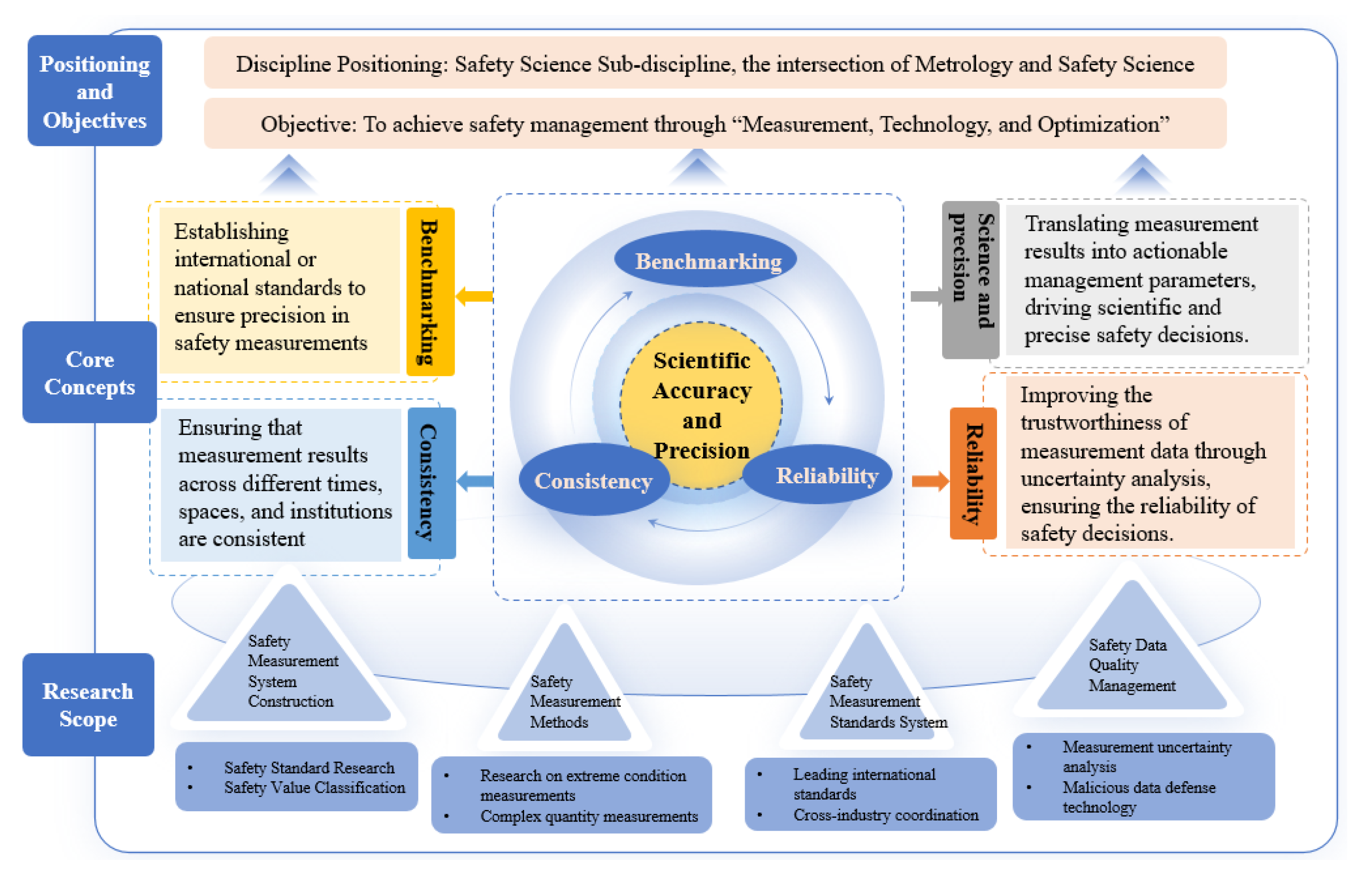
2.2. Safety Metrology and Its Disciplinary Definition
3. Founding Background of Safety Metrology
3.1. Background of Disciplinary Evolution
3.1.1. The Metrological Demand in the Development of Safety Science
3.1.2. The Need for Disciplinary Expansion of Metrology
3.2. Social Demand Background
3.2.1. Demand for Refined Safety Management
3.2.2. Multidimensional Demand for Safety Governance
3.2.3. Contribution to Sustainable Risk Governance
3.2.4. Demand for Intelligent Safety Decision-Making
4. Theoretical Foundations of Safety Metrology
4.1. Philosophical Foundations
4.1.1. Measurement Ontology
- (1)
- The Objective Measurability of Safety States
- (2)
- The Possibility of Quantitative Representation of Safety Risks
4.1.2. Cognitive Methodology
- (1)
- The Paradigm Shift from “Empirical Perception” to “Data Cognition”
- (2)
- The Relationship between Measurement Uncertainty and Safety Decision Confidence
4.2. Disciplinary Theoretical Foundations
4.2.1. Safety Science Theory
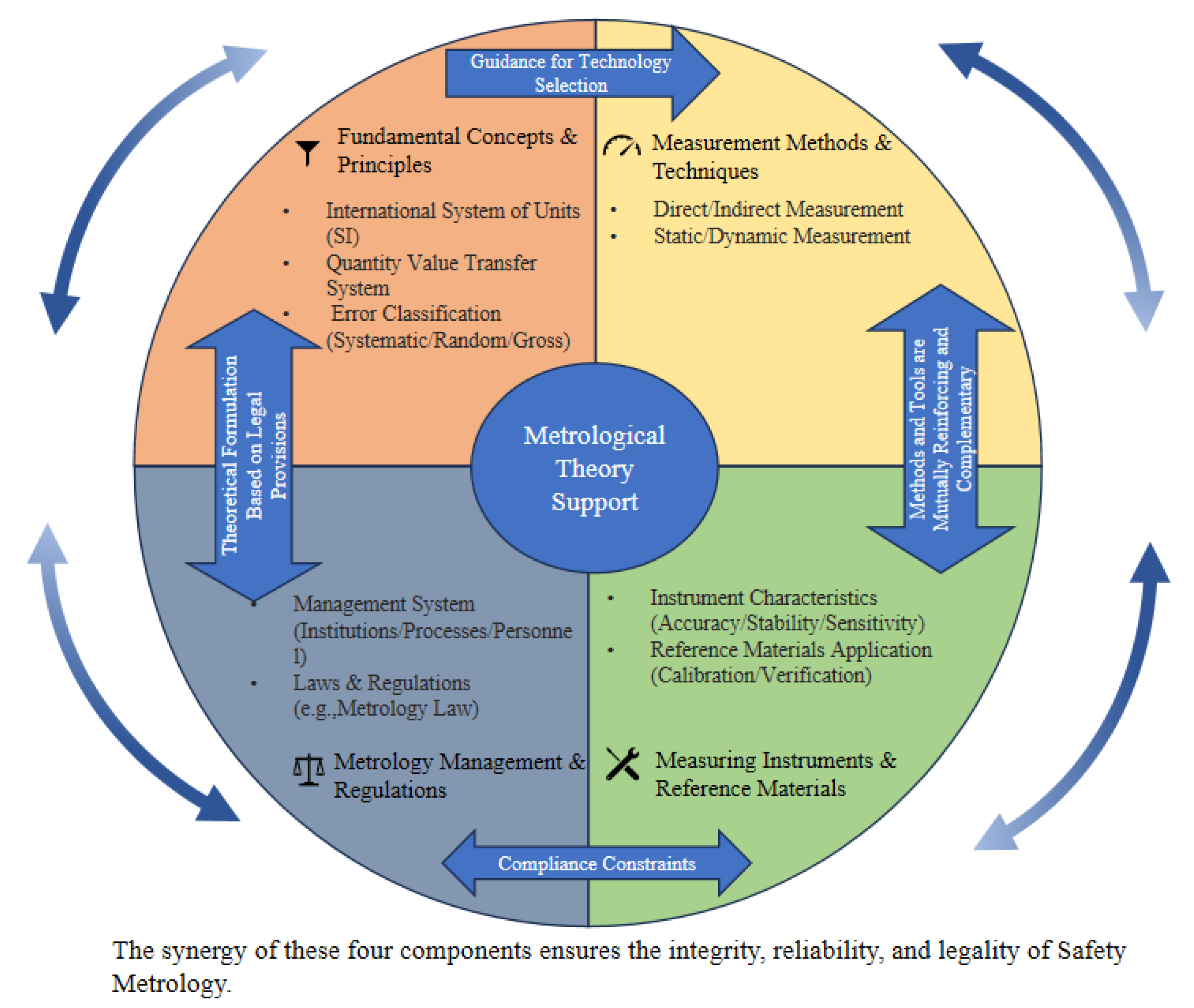
4.2.2. Metrology Theory
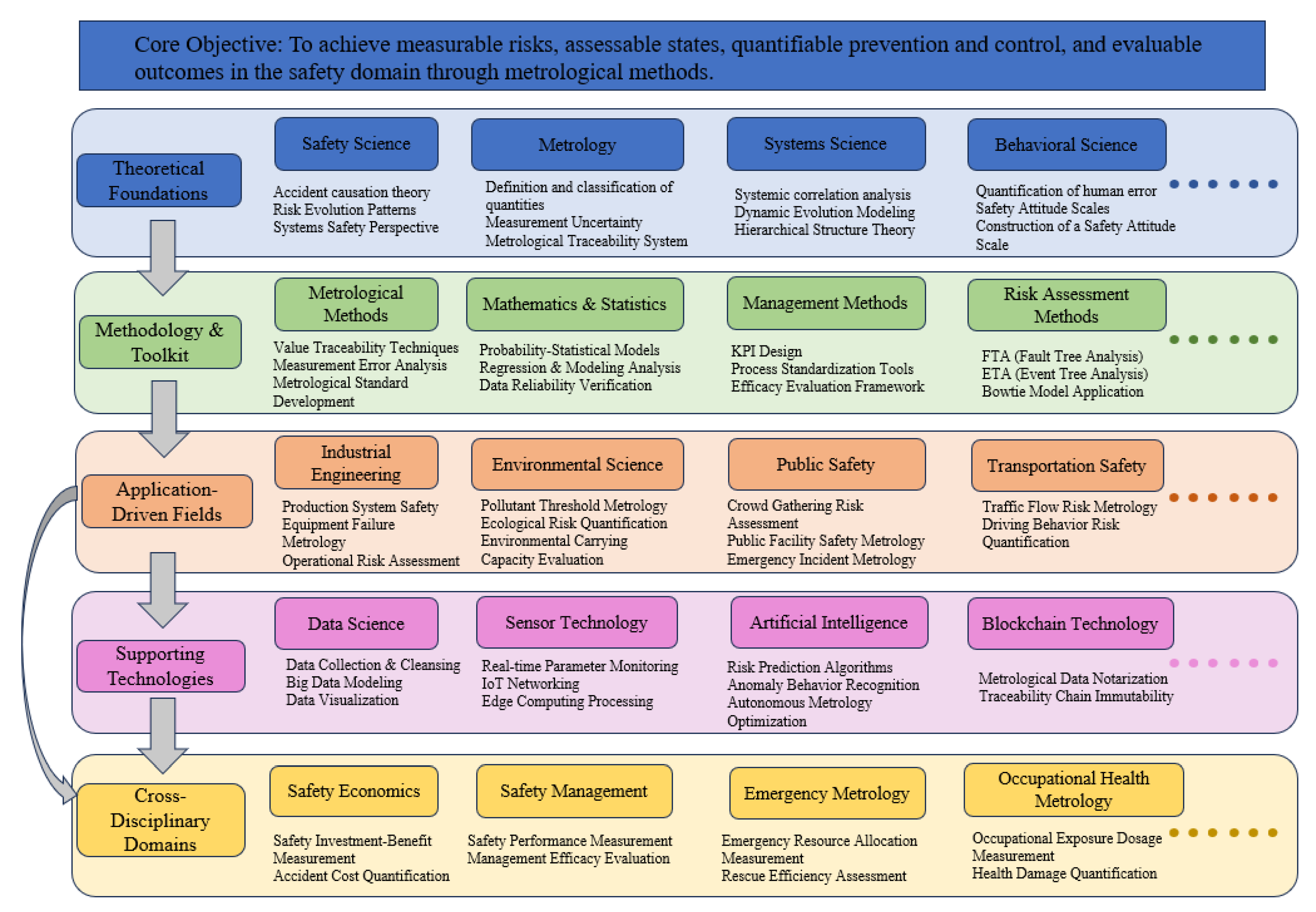
4.2.3. Theories Underpinning the Establishment of Interdisciplinary Fields
5. Discussion
- (1)
- Research Limitations and Future Directions
- (2)
- Managerial and Practical Implications
- (3)
- Practical Value of Safety Metrology in Process Safety Engineering
6. Conclusions
Author Contributions
Funding
Institutional Review Board Statement
Informed Consent Statement
Data Availability Statement
Conflicts of Interest
References
- Qiu, K. Discussion and Case Analysis on the Construction of Dual Prevention Mechanism in Chemical Enterprises. Shandong Chem. Ind. 2023, 52, 229–232. [Google Scholar]
- Yang, T. Problems and Countermeasures of Dual Prevention Mechanism of Risk Hierarchical Control and Hidden Danger Investigation and Treatment in Petrochemical Industry. Mod. Chem. Res. 2022, 3, 23–25. [Google Scholar]
- ISO 31000; Risk Management—Guidelines. ISO: Geneva, Switzerland, 2018.
- UNDRR. GAR Special Report 2023: Mapping Resilience for the Sustainable Development Goals. Retrieved 10 July 2025. Available online: https://www.undrr.org/gar/gar2023-special-report (accessed on 7 January 2026).
- Garvey, P.R.; Lansdowne, Z.F. Risk Matrix: An Approach for Identifying, Assessing, and Ranking Program Risk. Air Force J. Logist. 1998, 22, 16–23. [Google Scholar]
- Editorial Board. Metrology for Safety. Chem. Int. 2012, 34, 20. [Google Scholar] [CrossRef]
- Isigonis, P.; Bouman, E.A.; Varsou, D.D.; Jensen, K.A.; Fransman, W.; Drobne, D.; Rollon, B.P.; Ballesteros, A.; Rodríguez-Llopis, I.; Säämänen, A.; et al. A Nano Risk Governance Portal Supporting Risk Governance of Nanomaterials and Nano-Enabled Products. Comput. Struct. Biotechnol. J. 2025, 29, 177–185. [Google Scholar] [CrossRef]
- Fu, S.; Niu, S.Q.; Lai, Z.B.; Guo, X.Y. Risk Analysis of Civil Aircraft Fire Accidents Based on FTA and BN. J. Zhengzhou Univ. Aeronaut. 2024, 42, 47–53. [Google Scholar]
- Xu, Y.M.; Tian, M.Y.; Li, Z.; Chen, W.T.; Lv, W. Analysis of Influencing Factors of Airport Runway Incursion Accident Based on FTA-BN. J. Saf. Environ. 2023, 23, 1361–1367. [Google Scholar]
- Aven, T.; Zio, E. Some considerations on the treatment of uncertainties in risk assessment for practical decision making. Reliab. Eng. Syst. Saf. 2014, 125, 67–75. [Google Scholar] [CrossRef]
- NIST SP 800-82; Guide to Operational Technology (OT) Security. NIST: Gaithersburg, MD, USA, 2023.
- Hollnagel, E. Safety-I and Safety-II: The Past and Future of Safety Management; CRC Press: Boca Raton, FL, USA, 2014. [Google Scholar]
- Hale, A.; Hovden, J. Management and Culture: The Third Age of Safety. A Review of Approaches to Organizational Aspects of Safety, Health and Environment. In Occupational Injury: Risk, Prevention and Intervention; CRC Press: Boca Raton, FL, USA, 1998; Volume 28, pp. 1–14. [Google Scholar]
- Brown, R.J.C. Measuring measurement—What is metrology and why does it matter? Measurement 2021, 168, 108408. [Google Scholar] [CrossRef]
- Wang, B.; Wu, C. Study on the Background and Foundation for the Establishment of Safety & Security-Related Intelligence Science. J. Intell. 2018, 37, 28–36. [Google Scholar]
- Wu, C. Research on Theory of Developing Safety Science Discipline. Saf. Secur. 2019, 40, 1–6+81. [Google Scholar]
- Wang, W.C.; Chen, S.Y.; Zhang, X.D.; Lai, X.; Sun, J.Q. Low-Altitude Flight Safety Risk Analysis and System Management. Adv. Aeronaut. Sci. Eng. 2025. online First. [Google Scholar]
- Yang, Y.; Zhang, W.B.; Zuo, C.X.; Wang, Z.X. Evolution Analysis of Digital Mine Safety Management Based on “Man-Machine-Environment-Management” Theory. Saf. Coal Mines 2021, 51, 239–243, 247. [Google Scholar]
- Guo, P.; Wang, M.; Dang, G.; Zhu, T.; Wang, J.; He, M. Evaluation method of underground water storage space and thermal reservoir model in abandoned mine. Rock Mech. Bull. 2023, 2, 100044. [Google Scholar] [CrossRef]
- Liu, M.; Sun, Y. Review of Elementary Constants in International System of Units. J. Electron. Meas. Instrum. 2021, 35, 1–9. [Google Scholar]
- Zhi, S.P. Values Define the World, Precision Changes the Future. China Quality Daily, 20 May 2016. p. 001.
- Ye, D.P.; Huang, G.L. Introduction to the Revision of GUM and VIM by the Joint Committee for Guides in Metrology. China Metrol. 2008, 1, 89–92. [Google Scholar]
- Fang, L.D.; Xu, X.X.; Ma, X.Y.; Wang, S.; Li, X.T.; Wei, Z.H. Discussion on Remote Transfer and Traceability of Quantity Values Technology of Measuring Instruments. China Meas. Test 2021, 47, 1–8+35. [Google Scholar]
- Yang, H.X.; Fu, H.J.; Hu, P.C.; Yang, R.T.; Xing, X.; Yu, L.; Chang, D.; Tan, J.B. Ultra-Precision and High-Speed Laser Interferometric Displacement Measurement Technology and Instrument. Laser Optoelectron. Prog. 2022, 59, 305–319. [Google Scholar]
- Meng, F.Z.; Sun, B.; Yang, Z. Impact and Risk Assessment of Feedstock Substitution on New Process Safety in Chemical Production. Chem. Ind. Eng. Prog. 2025, 44, 2955–2971. [Google Scholar]
- Xiang, X.X.; Zhang, X.J.; Liu, Y.; He, L.; Luo, J. Monitoring and Occupational Health Risk Assessment of Key Volatile Organic Compounds in Work Place Air Based on Qualitative Monitoring. J. Environ. Occup. Med. 2024, 41, 1246–1250. [Google Scholar]
- Menéndez, J.; Ordóñez, A.; Álvarez, R.; Loredo, J. Energy from closed mines: Underground energy storage and geothermal generation. Appl. Energy 2019, 108, 498–512. [Google Scholar]
- Cui, C. Planning for the reuse of abandoned mines: Sustainable development and value evaluation. Processes 2025, 13, 3894. [Google Scholar] [CrossRef]
- Gong, J.Y.; Zhang, X.; Xiang, L.G.; Chen, N.C. Progress and Applications for Integrated Sensing and Intelligent Decision in Smart City. Acta Geod. Cartogr. Sin. 2019, 48, 1482–1497. [Google Scholar]
- Guo, G.C.; Xiao, X.J. Measurement Realism. Sci. Technol. Dialectics 1996, 5, 23–28. [Google Scholar]
- Wang, H.S. The Cognitive Methodology of Scientific Imagination. J. Dalian Univ. Technol. 1992, 4, 476–482. [Google Scholar]
- Wu, C. Idea Models for Research on Basic Theory of Safety & Security Science and Its Popularization and Application. Saf. Secur. 2021, 42, 29–34. [Google Scholar]
- Wu, C.; Yang, M. Study of Safety Science Principles and Their Constructions. China Saf. Sci. J. 2012, 22, 3–10. [Google Scholar]
- ISO/IEC Guide 99-2007; International Vocabulary of Metrology—Basic and General Concepts and Associated Terms (VIM). International Organization for Standardization: Geneva, Switzerland, 2007.
- Qiu, J.P.; Xu, Z.Y. Disciplinary Construction and Development Trend of Datametrics. Adv. Inf. Sci. 2022, 45, 27–36. [Google Scholar]
- Yang, P. The Value of Metrological Management in the Construction of Quality Management System. China Qual. Superv. 2025, 2, 74–75. [Google Scholar]
- Wu, C. Construction of Interdisciplinary Knowledge Classification System by Using Science Chunk Matrix. Technol. Innov. Manag. 2021, 42, 470–476. [Google Scholar]
- Wu, C. Research on the Basic Theory of Science of New Disciplines. Technol. Innov. Manag. 2022, 43, 342–350. [Google Scholar]



| Concept | Definition | Core Connotations |
|---|---|---|
| Safety | A state in which a system is free from unacceptable adverse effects caused by internal or external factors [15]. | Relativity: Safety standards evolve with societal awareness. Multidimensionality: Encompasses personal, information, public, and national security domains. Dynamism: Non-static and non-final, requiring continuous maintenance. Systematicity: Results from the synergy of technology, management, and human factors, necessitating a comprehensive “prevention-response-recovery” chain mechanism. |
| Safety Science | The fundamental scientific principles of universal significance, derived through observation, practice, induction, abstraction, and summarization, focusing on protecting humans from physical and mental harm caused by external adverse factors during life, production, and survival activities [16]. | Interdisciplinarity: Integrates theories and methods from multiple disciplines to build theoretical frameworks and systematic risk prevention and control systems. Practice-Oriented: Aims fundamentally to solve real-world safety problems. Dynamic Adaptability: Continuously optimizes technical means and management strategies to address emerging risks and enhance safety resilience. Human-Centric Core: Emphasizes the impact of human behavior, cognition, and organizational culture on safety performance, promoting the coordinated development of “technology-management-culture. |
| Safety Measurement | The process of applying scientific methods, techniques, and tools to conduct quantitative measurement, assessment, and analysis of various safety-related elements, states, and risks. | Technical Precision: Based on high-precision measurement technologies and standardized methods, utilizing advanced instruments for accurate quantification of safety parameters. System Synergy: Integrates four key elements—human operation, equipment status, environmental conditions, and management processes—to build a multi-dimensional, coordinated safety measurement and monitoring system. Risk Pre-Control: Enables early identification and proactive prevention of hazards through trend analysis and early-warning modeling of dynamic monitoring data. Standardization & Normativity: Strictly adheres to national/industry metrological standards to ensure accuracy, comparability, and legal validity of results. Intelligent Development: Integrates new technologies like IoT and big data to advance safety measurement towards real-time and intelligent capabilities. |
| Safety Metrology | An interdisciplinary science studying the methods for quantitative measurement, assessment, and analysis of safety-related elements, aiming to enhance the precision and reliability of safety management through standardized measurement, data modeling, and decision optimization. | Methodological Systematism: Establishes a complete methodological framework including measurement specifications, analytical models, and evaluation criteria. Data Scientism: Integrates modern statistical theory and computer processing for precise data collection, intelligent analysis, and visualization. Domain Universality: Develops technical frameworks applicable across industries like industrial safety, environmental monitoring, and public emergency response. Technological Advancement: Continuously incorporates advancements in IT (e.g., IoT, AI) to drive methodological innovation. Decision Support: Provides objective, quantitative foundations for safety management decisions, shifting from experience-based to data-driven approaches. |
| Comparative Dimension | Safety Metrology | Safety Testing | Safety Assessment |
|---|---|---|---|
| Core Objective | Establish scientific benchmarks and standard systems for safety quantities | Develop detection technologies and equipment for specific scenarios | Evaluate system risk levels based on quantitative data |
| Research Level | Scientific Level (Unit definition, value traceability | Technical Level (Sensor development, instrumentation) | Application Level (Risk modeling, decision support) |
| Key Outputs | International standard units, measurement specifications, traceability methods | Testing instruments, monitoring systems, diagnostic algorithms | Risk assessment reports, safety classification systems |
| Data Role | Provides standardized, traceable reference data | Generates raw detection data | Utilizes metrological data to complete risk quantification |
| Irreplaceability | Ensures comparability and credibility of cross-domain safety data | Enables real-time monitoring capability for specific scenarios | Acts as a bridge linking data and decision-making |
Disclaimer/Publisher’s Note: The statements, opinions and data contained in all publications are solely those of the individual author(s) and contributor(s) and not of MDPI and/or the editor(s). MDPI and/or the editor(s) disclaim responsibility for any injury to people or property resulting from any ideas, methods, instructions or products referred to in the content. |
© 2026 by the authors. Licensee MDPI, Basel, Switzerland. This article is an open access article distributed under the terms and conditions of the Creative Commons Attribution (CC BY) license.
Share and Cite
Kou, M.; Liu, H. Proposing Safety Metrology for Loss Prevention in the Process Industries: An Interdisciplinary Bridge and Its Theoretical Pillars Towards Sustainable Risk Management. Sustainability 2026, 18, 1577. https://doi.org/10.3390/su18031577
Kou M, Liu H. Proposing Safety Metrology for Loss Prevention in the Process Industries: An Interdisciplinary Bridge and Its Theoretical Pillars Towards Sustainable Risk Management. Sustainability. 2026; 18(3):1577. https://doi.org/10.3390/su18031577
Chicago/Turabian StyleKou, Mengyao, and Hui Liu. 2026. "Proposing Safety Metrology for Loss Prevention in the Process Industries: An Interdisciplinary Bridge and Its Theoretical Pillars Towards Sustainable Risk Management" Sustainability 18, no. 3: 1577. https://doi.org/10.3390/su18031577
APA StyleKou, M., & Liu, H. (2026). Proposing Safety Metrology for Loss Prevention in the Process Industries: An Interdisciplinary Bridge and Its Theoretical Pillars Towards Sustainable Risk Management. Sustainability, 18(3), 1577. https://doi.org/10.3390/su18031577