Article

Exploring Educational Leadership Orientations Through Survey-Based Pattern Analysis: Digital Transformation and Leadership Self-Concept in Primary Education Teachers


by
Alexandra Ntavlourou
,
Hera Antonopoulou
* and
Constantinos Halkiopoulos
*
Department of Management Science and Technology, University of Patras, 26504 Patras, Greece
*
Authors to whom correspondence should be addressed.
Sustainability 2026, 18(3), 1555; https://doi.org/10.3390/su18031555
Submission received: 6 November 2025 / Revised: 25 January 2026 / Accepted: 28 January 2026 / Published: 3 February 2026

Abstract

The digital transformation of education demands a comprehensive understanding of how leadership orientations and digital competencies intersect among educators. This exploratory cross-sectional study examined associations between self-reported leadership orientations, digital skills, and organizational readiness for innovation among 71 primary school teachers in Western Attica, Greece. Using the Multifactor Leadership Questionnaire (MLQ Form-5x) adapted for respondents without administrative roles, we measured leadership self-concept—teachers’ preferences and tendencies regarding leadership—rather than enacted behaviors. This distinction is critical given that 94.4% of participants lacked principal experience; thus, responses reflect aspirational orientations rather than observed behavioral patterns. Descriptive profiling approaches, including K-means clustering and multinomial logistic regression, identified three tentative response pattern groupings: Passive-Moderate (53.5%), Balanced-Active (33.8%), and High-Engagement (12.7%), with observed multivariate differences. After reverse-coding the passive-avoidant items, transformational leadership showed the highest mean score (M = 4.33), followed by passive-avoidant (M = 4.15; reflecting low endorsement of avoidant behaviors) and transactional (M = 3.91). Transformational leadership demonstrated acceptable internal consistency (α = 0.783), while transactional (α = 0.583) and passive-avoidant (α = 0.617) scales showed lower reliability, warranting cautious interpretation. Critical competency gaps emerged in professional digital domains—particularly web development (22.5% deficit) and administrative systems (18.3% deficit)—despite a surplus in consumer technologies such as social media (−29.6%), revealing an ‘aspirational gap’ between leadership self-concept and digital readiness—technology familiarity does not automatically translate to digital leadership capability. Digital skills showed the strongest association with profile membership, with each additional skill associated with a 32–67% increase in the odds of membership in more engaged profiles. These findings suggest digital competency development may be associated with leadership orientation patterns, though the cross-sectional design precludes causal inference. Methodological limitations—including lower scale reliability, weak cluster separation (silhouette = 0.150), and modest sample size—require that findings be interpreted as hypothesis-generating rather than definitive. This work offers preliminary insights relevant to SDG4 (Quality Education) regarding heterogeneity in leadership orientation among primary educators, while highlighting the need for culturally validated instruments and for replication with larger samples.

1. Introduction

The rapid growth and advancement of Information and Communication Technology (ICT) have significantly transformed education worldwide. The adoption of technology in education is no longer a choice; it is not confined to installing technology; it entails a radical transformation toward a broader cultural change [1,2,3]. A total culture change is not confined to adopting technology; it involves embracing a new technology culture characterized by innovative and creative methods of learning and leadership. This is the essence of digital leadership [4,5,6,7,8].
Digital leadership has been observed to create paradigm shifts in the management of the education sector. It entails effective use of technology not only to improve education but also to enhance organizational efficiency. Unlike other managerial principles, digital leadership requires not only technological expertise and technology management competencies but also a strategic orientation and the capacity to effect change within the organizational framework and foster a technology culture in the education sector [9,10,11].
The repercussions of digital leadership have been reinforced by events worldwide, including the COVID-19 pandemic, which necessitated rapid digital transformation, particularly in education. There has been a disparity between technology and its preparedness for adoption, and Greece faced this challenge during the COVID-19 pandemic, aiming to produce leaders sufficiently equipped to address the complexities of technology in education [12,13,14].
Understanding the intersection of digital leadership and teacher competencies contributes directly to educational sustainability goals, particularly Sustainable Development Goal 4 (Quality Education). Building sustainable institutional capacity requires identifying competency gaps and developing targeted professional development pathways that transcend ephemeral technology training. Moreover, understanding leadership orientations among teachers—who represent the pipeline for future school administrators—enables proactive capacity building that strengthens the educational system’s resilience to technological disruption and societal change [15].
In the Greek education system, there has been a significant digital transformation concerning primary education. With the implementation of information technology systems, such as myschool, and through the extension of the Panhellenic School Network and the digitalization of administrative procedures for primary education, there has been a dramatic shift in primary education, both as it was and as it is today. It is, however, essential to recognize that achieving success in these technology initiatives and projects is paramount, guided by the leadership of the institutions’ principals in this changing, shifting environment [16,17,18,19,20].
Despite growing recognition of the importance of digital leadership, empirical research on the nexus among leadership styles, digital skills, and educational outcomes remains limited, particularly in primary education. Although studies of transformational leadership styles have been extensively conducted in educational settings, their association with digital leadership styles and the requisite digital skills for school administration in the digital era remain underexplored. Additionally, applying advanced analytical methods—including cluster analysis, machine learning classification, and network analysis—to identify patterns in leadership orientations within educational settings is an emerging approach that may reveal insights obscured by traditional variable-centered analyses [21,22,23,24,25,26].
This paper addresses research gaps in leadership styles and digital competency among primary teachers in Western Attica, specifically examining their combined effects.
Importantly, this study examines leadership orientations and preferences rather than enacted leadership behaviors, as the target population comprises primarily classroom teachers rather than school administrators. This approach, grounded in distributed leadership theory, recognizes that understanding teachers’ leadership orientations provides insight into the leadership development pipeline and potential for teacher leadership within educational institutions.
This paper also employs established statistical methods for data interpretation, as well as novel data-mining methods, to examine diverse interactions in educational leadership in the context of the information technology era. This paper examines the following:
(1)
The prevalent style of leadership used or preferred among primary teachers,
(2)
How sample demographics correspond to such leadership styles,
(3)
The status of present-day digital competency levels among teachers,
(4)
How do individual styles of leadership, levels of digital competency, and the effectiveness of such leadership correspond?
The overall aims of our proposed research are threefold. First, to identify the styles of leadership adopted or that could be adopted among primary teachers if they were to take up administration roles, specifically concerning transformational, transactional, or passive-avoidant modes of leadership. Secondly, to evaluate teachers’ levels of digital competence and determine their current skills relative to those they recognize as necessary to successfully direct education in the modern era. Finally, to examine interrelationships among leadership styles and digital competency, and among leadership outcomes, using statistical analyses and data mining [27,28,29,30,31,32].
This is especially pertinent in the current context of Greece, working to improve its overall online infrastructure. This is because the Ministry of Digital Governance’s strategy to drive digital transformation between 2020 and 2025 recognizes education as a critical sector and calls for improving digital skills across all levels of education. It is imperative to understand the situation among primary teachers regarding overall leadership competency and online preparedness [33,34,35,36,37,38,39,40].
The proposed methodology employs a quantitative research design, using the Multifactor Leadership Questionnaire (MLQ Form 5X) to assess leadership style, supplemented by specialized questionnaires on digital leadership skills. A total of 71 primary teachers were surveyed in Western Attica to validate findings on leadership preferences and their association with demographic characteristics. Additionally, K-means cluster analysis is used to identify distinct leadership orientation profiles among primary teachers, complementing traditional variable-centered approaches with person-centered analysis that may reveal meaningful subgroups with implications for differentiated professional development [41,42,43,44,45,46].

2. Literature Review

2.1. Conceptual Framework of Digital Leadership

Digital leadership represents a revolutionary shift in educational leadership, driven by technological change. It is more than the integration of technology into established leadership and management practices, because digital leadership entails integrating technology and innovation into organizational development and building technological skills to address technological challenges [47,48,49].
In today’s scholarly discourse on digital leadership, a range of theoretical approaches has been adopted. Some themes identified in the scholarly discourse include the need for educational leaders to possess multiple digital competencies and to adapt to the dynamic evolution of educational technology. These leaders would have the aptitude to implement technology and effectively facilitate innovation through it. Being technology-ready, or having technological innovation capability, is essential to digital leadership [50,51].
A critical part of digital leadership is managing relationships and communication in increasingly mediated learning spaces. This presents leaders with the challenge of developing skills in online communication effectiveness, facilitation of online collaborative activities, and online community administration. These communication and relationship-management skills in online spaces have become increasingly crucial to leadership [52,53,54].
According to current research, the role of digital leadership in education involves guiding a community through technological innovation at a pace that maintains focus on educational goals. This appears to be an inherent quality of technological innovation in the current context of educational leadership. As technology advances in education, new theoretical perspectives continue to emerge in the associated literature [55,56,57,58].

2.2. ICT Integration in Educational Contexts

Information and Communication Technologies have profoundly changed how information is identified, processed, stored, displayed, and distributed in learning environments. Information and Communication Technologies have transformed traditional concepts of time and space in learning. Incredible speeds have been achieved in accessing information and communication. A new era of digital realities has emerged through networked media, including computers and the internet, with profound effects on learning [59,60,61,62].
The application of ICTs in schools has led to a revolution not only in pedagogy but also in the management of the learning institution. Since 1995, one of the European Union’s policies has been to ensure that its member states’ education policies align with the information age, or to adjust their cultures and education systems to match it. The strategy is evident in several actions, including providing computing infrastructure to schools, establishing an overarching education network spanning all education levels, and developing free educational software [63,64,65,66].
These have spurred innovations in educational methodologies, enriching the learning experience. Available technologies, such as whiteboards, timed learning resources with audiovisual components, and learning software, have introduced new elements into learning methodologies. There have, however, been training and capacity-building initiatives for educators on technology uptake as part of implementing technology into learning methodologies. All of these have enhanced the development and competitiveness of education systems within the European framework and have met the goals formulated at the 2001 Lisbon European Council [67,68,69,70,71].
Teacher professional training has been recognized as highly important, particularly given the pace of technological change. In this regard, many educational programs have been developed in Greece to enhance teachers’ technological expertise. These education program activities involve, but are not limited to, tasks covered within the framework of “Information Society” projects, “Operational Program for Education and Initial Vocational Training” projects, and other projects undertaken as support for “Training of Teachers for Use and Application of Information and Communications Technology in Education” [72,73,74,75,76,77].
These activities have been supplemented at the European level with programs such as Comenius, Erasmus, and Leonardo da Vinci. These programs support continuous professional development and the transfer of innovative pedagogical models and practices, leveraging Information and Communication Technology. For such programs to be sustainable and effective, there is a continued need to commit to systematic teacher training to meet the real demands of education. This is because technology and science continue to advance; therefore, teachers should be able to meet the demands of these fields in current learning environments [78,79,80,81,82].

2.3. Digital Transformation of Educational Administration

The transformation observed in business and education is inevitable and necessary given the technological realities of the current era. This is because the advancement and implementation of Information and Communication Technology are primarily driving a paradigm shift in operational forms across all types of organizations. In educational institutions, Information and Communication Technology is also affecting not only learning activities but also management activities [83,84,85].
Management Information Systems (MISs) and Database Management Systems (DBMSs) ensure credible data access to large volumes of data. This promotes evidence-based decision-making. These support educational administrators in accessing and using large volumes of data. The need to develop technology-related skills is currently paramount for meeting new demands. This applies to the general public. The need to develop technology-related skills is particularly relevant to the educational community, as technology increasingly shapes educational activities [86,87,88,89,90].
The technological transition in the public sector, particularly in educational institutions, has led to changes across numerous functional dimensions. E-learning management and communication tools enable schools to operate effectively. The adoption of interconnected information systems, such as myschool, improves information and communication management between schools and educational authorities. This software provides computerized support to the functional units of schools and the educational administration in Greece [91,92].
The Panhellenic School Network (PSN) offers a wide range of networking and administrative services to enhance the online presence of educational entities. As the national network and internet provider for the Ministry of Education, the PSN interconnects all educational and administrative units at the primary and secondary levels, thereby ensuring online connectivity across the entire educational sector. In addition to the services mentioned above, other administrative services offered to the education sector include teleconferencing, online support for websites and blogs, geospatial imagery of educational units, an electronic inventory of school technology equipment, advanced tele-educational services using an asynchronous communication platform, and online services [93,94].
Providing services through the gov.gr website entails completing numerous educational procedures within the framework of electronic governance initiatives. This means that numerous educational “acts,” such as issuing certificates, submitting documents, registering, transferring, and entering electronic register entries, can be completed online. The online transformation of Greek educational institutions represents a significant leap forward in improving educational processes and finally managing educational resources. This is because it provides services more effectively [95,96,97,98].
The COVID-19 crisis served as another catalyst for the digital transformation of educational institutions, driven by the need for distance learning and communication, which prompted rapid technology adoption in educational settings. The need to ensure the adoption of protective measures and, consequently, the continuation of education made the transition to the online world imperative. Thus, the classic classroom became the e-classroom, the blackboard became the shared screen, educational meetings became video conferences or webinars, and asynchronous tele-education systems became the new reality [99,100,101,102].
The creation of the Ministry of Digital Governance in July 2019 underscores the Greek government’s commitment to developing the digital dimension across all sectors, including education. The mission of the ministry mentioned above involves “the continuous promotion of the digital and administrative transformation of the country and its adaptation to the rapidly changing international environment, through the formulation of the framework, rules and operating conditions, to optimize the operation of the state.” In 2020, it released the strategy “Digital Transformation Strategy 2020–2025” [103,104,105,106,107,108,109,110].
The purposes of the digital transformation include, among others, enhancing the digital skills of all Greeks, supporting digital innovation, and adopting innovative technologies across all sectors. For the education sector, the purpose of the collaboration with the Ministry of Education and Religious Affairs is to “enhance the digital experience at every level of education, including the administration of education, the educational process, and services to citizens”. These services align with the initiative to simplify procedures, eliminate bureaucratic structures, improve administrative processes, adopt innovative technologies to support services, and enhance overall administration and pedagogy in schools [111,112,113,114,115,116].
Nonetheless, the transition to the digital environment has made it easier to manage schools and their operations, but it has also posed numerous challenges. The management of digital information storage and the security of personal data are among the core issues in the current digital learning context. The large volume of digital data and information created raises serious questions about control and management, encryption, and the security of personal data. It is vital to prioritize data privacy to ensure data confidentiality and integrity, in accordance with standards such as the General Data Protection Regulation (GDPR). By improving its digital infrastructure and internet skills, the Greek community is meeting current societal demands and working to ensure more efficient and competitive experiences for all [117,118,119,120].

2.4. The School Principal as Technological and Digital Leader

The organizational framework and culture that pervade the learning institution during online development are key to the success and adaptability of Information and Communication Technology tools. In this context, one of the most important participants in the technological evolution of learning institutions is the person responsible for running the institution, or, in this case, the school principal. Consequently, this shows that leaders play an imperative role in the success or failure of technology and its applications within institutions [121,122,123,124,125].
Being a leader during a technology transformation as a principal entails, as a priority, technological knowledge and engagement. Consequently, as technology leaders, principals are expected to serve as role models for technology adoption and use. Role modeling is imperative for determining technology adoption and usage culture within an organization [126,127,128].
A technology-literate principal is prepared to be knowledgeable about how technology can impact not only methods of teaching but, more significantly, methods of administration within the institution of education itself. Being technology-literate enables a principal to design programs that facilitate technology adoption in educational and administrative tasks. Being technology-literate extends a principal’s knowledge beyond personal skills, using technology to enhance [129].
Additionally, the principal’s role requires them to possess communication and coordination skills that foster an environment conducive to change and innovation. Accordingly, influencing employee confidence and, in turn, collectively defining success in transitioning to the digital age plays a significant role in shifting schools’ culture toward more open and innovation-oriented approaches [130].
The principal’s role is essential and should acknowledge and encourage members of the school community who will help facilitate the transition to the digital world. It should involve identifying potential change leaders within the organization, empowering them, and facilitating their transition to the digital environment, leveraging their expertise and passion for technology. The principal’s role in the digital transition cannot be overstated; as noted, it is central [131].

2.5. Characteristics and Competencies of Digital Leaders

A digital leader integrates strategies, methods, and leadership styles, with attention to technology and its use, to drive innovation and technological change for the greater good of education and greater effectiveness. This is a synthesis between leadership skills and technology knowledge. Research shows that top-performing managers who are highly effective in their roles are more effective as technology and innovation leaders. This is evidence of a positive association between technology leadership and overall effectiveness [132,133,134].
Given current perspectives on school transformation in the digital era, administrators and principals must remain cognizant of the challenges they will face in managing technological change. Apart from formulating their visions for the future of their institution and placing primary emphasis on human resource development for successful transformation, they will have to deal with tasks such as finding individuals to contribute to the transformation process, coaching and training people to develop support leadership skills at their organization, and develop the strength to surpass typical expectations to transform themselves from traditional to digital leadership [135,136,137].
The knowledge and skills that digital leaders should possess include the ability to develop innovative models in Information and Communication Technology. This consists of skills in planning, organizing, managing, and controlling. It is crucial because it concerns both administration and education. Readiness to adopt technological innovations and the ability to apply Information and Communication Technology tools in administration and teaching are also vital. This is because of the nature of digital leadership [138,139].
Per the principles identified in the existing body of knowledge, the roles that technology leaders must undertake include the following:
  • Establish and articulate their technology vision and the technology goals of their institutions to direct efforts related to technology integration.
  • Encourage technological change in their business or organization and be their innovation advocates.
  • Engage with ICTs and internet tools directly and leverage current opportunities fully to show your personal dedication to technology usage.
  • Access to technological infrastructure and its constant improvement according to the demands of students and teachers to ensure appropriate material support for technology-based initiatives.
  • Strengthen policies for innovation and equip oneself professionally in technology integration in educational work with a commitment to learning.
  • Raising awareness concerning the usage of Information and Communication Technology and its relevance to the educational workforce.
Moreover, those with online leadership qualities must facilitate team activities, interactions, and communication among all members of the learning community. Indeed, online learning involves collaborating, experimenting, exploring innovative possibilities, and working with differences in thought and behavior to pursue collective goals. This calls for training or continuing education opportunities to support growth and motivation among those leading learning activities. Providing teachers with the freedom to use technological infrastructure is also crucial [140,141,142,143].
Digital leaders must offer guidance and support the changes needed within the cultures of the established schools they control. This demands not only knowledge of strategic and organized matters but also experience with technology. Evidence supports the argument that technological comfort among principals can facilitate the leadership process for technological integration in administration and education [144,145,146,147].
The International Society for Technology in Education (ISTE) is one such global organization working in technology education curricula. It provides standards on technology leadership in education. The standards were first formulated in 2001 as the National Educational Technology Standards for Administrators (NETS-A) and have been updated regularly to keep pace with technological advances and new demands for leadership skills. In addition to standards for administrators, ISTE also provides standards for technology coaches, teachers, computer teachers, and students. These standards have been identified as integral tools for the proper use of technology at the educational institution level to enhance performance [148,149,150,151].
The NETS-A standards were revised in 2009 to reflect the growing role of new technologies in the workplace. Thus, administrators must prepare a learning environment aligned with technological change. The NETS-A standards for technology administrators include five standards that define the essential skills of technology administrators working in dynamic technological environments. These standards include the following:
  • Offer technology-based visions to every member of the educational units to define their purposes related to technology efforts.
  • Build and sustain online learning cultures that encourage innovation and continuous improvement.
  • Encourage environments where technology is employed and digital resources are exploited successfully.
  • Control institutions through proper technology deployment to leverage technology for administration purposes.
  • Model and understand social, ethical, and legal issues related to digital technologies, ensuring responsible technology use.
Beyond technical expertise, it is essential that current and future technology leaders can address the ever-increasing complexity of Information and Communication Technology use. It is crucial to appreciate and leverage the trends and opportunities in information technology. These leaders must have open minds to innovation and technological change. They need to take the actions and risks associated with innovation. While modernizing their operations and services, they should not fear emerging trends in innovation.
Moreover, digital leaders should exhibit empathy and support their colleagues during technological transitions. In addition, they should communicate effectively with diverse audiences. Finally, they should build a climate of cooperation and solidarity. All the aforementioned skills focus on developing more human-centered leaders who can foster satisfaction and empower human resources. This is because a sound mix of technical and interpersonal skills makes a good digital leader, not merely a person with technical knowledge [152,153,154].
Issues such as developing human resources based on their potential, engaging all stakeholders in the digital transformation process, training to enhance and develop knowledge and skills related to pedagogical and administrative matters, and creating sustainable value through digital advancement could easily blur the line between formal and informal leaders. The collective action and reciprocity of leadership in the digital world could be more important than formal leadership positions. This is because it is associated with the principles of distributed leadership. This understanding is that transformation in the digital world cannot be achieved through formal leadership positions [155,156].

2.6. Digital Skills and Competencies

The growing pace of technological advancement, innovation in the current technological age, and increased usage of social media platforms, Artificial Intelligence, Robotics, STEAM (Science, Technology, Engineering, Arts, and Mathematics) learning models, and IoT (Internet of Things) have brought in a new era of realities for socializing, doing business, and learning. This is because employees and students face new challenges that require them to develop skills to remain up to date, efficient, and adaptable to ever-changing technological advancements. It is crucial to upgrade and enhance professionals’ skills to sustain current economies [157,158,159].
Competencies in the digital technology domain can be formally defined as knowledge, skills, and behavioral patterns. They have been highlighted for their importance in learning and participation in social activities. It indicates the ability to use technology to communicate or solve problems through searching. It involves raising awareness of safe technology use. This includes working in accordance with technology and behavior codes aligned with human rights. These include the principles of digital citizenship [160,161,162,163].
A need for the development of digital skills is recognized by the European Commission’s Digital Skills and Jobs Coalition (DSJC) to have been identified for four different groups: digital skills for citizens to engage actively in modern society; digital skills for workers to contribute to the growth of the digital economy; digital skills for Information and Communication Technology (ICT) professionals working in different industry sectors; and digital skills in education to emphasize learning for students and teachers. Since 2015, the European Commission has assessed citizens’ digital skills using the Digital Skills Indicator (DSI). Data from 2020 indicated that only 52% of Greeks have digital skills, compared with the EU average of 61%, placing Greece 25th among the 27 member states. Denmark, Finland, and Estonia demonstrated the highest effectiveness in using digital technology, particularly in the public sector [164,165,166,167].
The newly developed DSI 2.0 index, launched in 2022, quantifies citizens’ online behavior across five key areas: information and data literacy; communication and collaboration; digital content creation; security; and problem-solving. This index monitors the EU’s ambitious target of achieving at least 80% of the total population with basic digital skills by 2030. Learning in the current digital era is a crucial component of growth and advancement, requiring the active engagement of all participants—teachers, students, parents, and employers—to ensure that every individual develops the requisite skills to contribute to the digital community [168,169,170,171].
An essential participant in this context is the school principal. This individual must drive digital transformation within the institution and serve as a digital leader who not only understands the qualities mentioned above but also possesses the requisite skills. This requires understanding how technology is applied in the management of the learning institution. A digitally skilled principal is crucial to creating a culture of technology-driven innovation in learning [172,173].
The European Agenda for High-Tech Leadership Skills recommends six strategic priorities for leadership in the digital era: Cloud Computing, Big Data Analytics, Social Media, Internet of Things, IT Legacy Systems, and Mobile. Based on the above-mentioned frameworks and recent literature, a systematic enumeration of the competencies that digital education leaders must acquire could include the following: Big Data (extensive data analytics and pattern detection for data-informed decisions); Cloud Computing (scalable and flexible sharing of computing resources to enable affordable learning technology); ERP Systems (managed processing of business data and activities to improve business efficiency); Social Media (communication tools for knowledge sharing and learning); Mobile Applications and Websites (designing learning software); Digital Architecture (a framework of inter-connected systems to facilitate information automation); Skills in Information Security (protection of data against potential cyber threats); and Understanding of Business Complexity (organized business or market environment with integration of technology with workers and processes) [174,175,176].
These skills have been identified as contributing to overall digital competency, with implications for effective educational leadership. The skills of digital leaders in educational institutions must be extensive and multifaceted to ensure effective institutional operations and support timely responses to rapid technological change. Knowledge of educators’ status regarding these skills, including their perceived importance and actual possession, is a vital aspect to investigate [177,178].

2.7. Research Questions

Based on the comprehensive review of literature on digital leadership, ICT integration, digital transformation of educational administration, and digital skills frameworks, this study addresses four primary research questions that guide the empirical investigation:
  • RQ1: What type of leadership do primary school teachers in Western Attica prefer or would prefer if they held or had held a management position?
  • RQ2: Are there differences in the type of leadership depending on characteristics such as gender, age, level of education, etc.?
  • RQ3: To what extent are digital skills recognized in primary school teachers in Western Attica?
  • RQ4: Is there a correlation between the possession of digital skills and various characteristics of teachers, such as age, gender, etc.?
These research questions, considered together, collectively point towards a comprehensive framework that enables an exploration of the intersections of leadership style, digital competencies, and educational outcomes, all as they relate to a primary education setting, and enable an exploration of these issues as they pertain to primary education teachers in Western Attica as they deal with leadership issues in the digital age.

3. Materials and Methods

3.1. Research Design and Sample

This quantitative cross-sectional study investigated leadership styles and digital competencies among primary school teachers in Western Attica, Greece. The research employed a structured questionnaire design combining established psychometric instruments with custom digital skills assessments. The sample comprised 71 primary school teachers recruited via convenience and snowball sampling during the final four months of 2023. Participants included permanent teachers, substitute teachers, and hourly employees, with varying experience levels ranging from 1 to 5 years (modal category) to over 20 years.

Conceptual Framework: Leadership in Non-Administrative Contexts

This study adopts a distributed leadership perspective, recognizing that leadership in educational settings extends beyond formal administrative roles. Teacher leadership encompasses influence exercised through curriculum development, peer mentoring, committee participation, and informal guidance of colleagues. The conceptualization of teacher leadership as a legitimate form of educational leadership has gained substantial support in recent scholarship.
The Multifactor Leadership Questionnaire (MLQ Form-5x) was administered with instructions asking respondents to indicate how they would approach leadership situations if given administrative responsibility, thereby capturing leadership orientations and preferences rather than enacted behaviors. This approach aligns with research examining leadership potential and developmental readiness among educators.
We acknowledge that this approach measures anticipated rather than enacted leadership, which affects the interpretation of findings. In this context, the Leadership Outcome subscale reflects teachers’ self-perceived potential to inspire additional effort, demonstrate effectiveness, and elicit satisfaction in hypothetical leadership scenarios. This represents a limitation for direct comparisons with studies of practicing administrators, but provides valuable insight into the leadership development pipeline for Greek primary education.

3.2. Instrumentation

The research instrument comprised three sections: (a) demographic questionnaire collecting information on gender, age, education level, specialization, employment status, years of experience, and prior administrative roles; (b) Multifactor Leadership Questionnaire (MLQ Form-5x) by Avolio and Bass (1995) [179], measuring transformational leadership (5 factors, 20 items), transactional leadership (2 factors, 8 items), passive-avoidant leadership (2 factors, 8 items), and leadership outcomes (9 items) on a 5-point Likert scale (1 = not at all, 5 = almost always); and (c) digital leadership and skills assessment comprising seven items measuring digital leadership practices and multi-response questions identifying possessed and essential digital competencies across eight domains (Big Data, Cloud Computing, ERP Systems, Social Media, Mobile Applications/Web Development, Digital Architecture, Security Skills, Complex Business Systems). Two items from the original MLQ (item 19 on individualized consideration and item 39 on teacher extra effort) were removed because non-principals could not authentically respond to questions that required observing their own leadership impact.

3.2.1. Instrument Adaptation and Validation

The Greek version of the MLQ Form-5x underwent a rigorous adaptation process in accordance with established cross-cultural instrument adaptation guidelines. The original English instrument was translated into Greek by two bilingual researchers with expertise in organizational psychology and educational leadership. An independent back-translation was conducted by a third translator unfamiliar with the original English version. Discrepancies between the original and back-translated versions were systematically reviewed and resolved through consensus among the research team and consultation with an expert in Greek educational administration.
A pilot study (n = 15) was conducted with primary school teachers not included in the main sample to assess item comprehension, cultural appropriateness, and response time. Participants were asked to identify any items that were unclear, confusing, or culturally inappropriate. Based on pilot feedback, minor linguistic adjustments were made to three items to improve clarity while maintaining semantic equivalence with the original instrument. The pilot study indicated acceptable completion time (approximately 15–20 min) and no systematic comprehension difficulties.
Item-level diagnostics were conducted to examine the psychometric properties of each scale. Item-total correlations ranged from 0.21 to 0.67, with several items on the Transformational and Transactional scales showing correlations below the recommended 0.30 threshold. Alpha-if-item-deleted analyses indicated that removing specific items would not substantially improve scale reliability. Complete item-level diagnostics are presented in Supplementary Table S1.
Exploratory Factor Analysis (EFA) using principal axis factoring with oblimin rotation was conducted to examine the factor structure in this sample. The Kaiser–Meyer–Olkin (KMO) measure of sampling adequacy was 0.68, exceeding the minimum acceptable value of 0.50 but below the preferred threshold of 0.80, indicating marginal suitability for factor analysis given the sample size. Bartlett’s test of sphericity was significant (chi-square = 892.45, df = 435, p < 0.001), supporting the presence of correlations among items. The factor solution did not cleanly replicate the theoretical five-factor structure of the MLQ, with considerable cross-loading between Transformational and Transactional items.
In addition to Cronbach’s alpha, McDonald’s omega was calculated as an alternative reliability estimate less sensitive to violations of tau-equivalence. Omega coefficients were: Transformational = 0.82, Transactional = 0.59, Passive-Avoidant = 0.65, Leadership Outcome = 0.89, Digital Leadership = 0.83. These values largely confirmed the pattern observed with alpha, with Transformational showing acceptable reliability while Transactional and Passive-Avoidant showed lower values.

3.2.2. Digital Skills Operationalization

The Digital Skills Count variable was operationalized as a summative index of self-reported competencies across eight domains: Big Data analytics, Cloud Computing, Enterprise Resource Planning (ERP) Systems, Social Media, Mobile Applications/Web Development, Digital Architecture, Security Skills, and Complex Business Systems. These domains were selected in accordance with the European Agenda for High-Tech Leadership Skills and recent literature on digital competencies for educational leaders [174,175,176,177]. While this approach provides a parsimonious measure of the breadth of digital competency, we acknowledge that it lacks formal psychometric validation. The index assumes (1) each skill domain contributes equally to overall digital competency, (2) self-reported possession reflects actual competency, and (3) the eight domains adequately represent the digital competency construct for educational leadership. These assumptions have not been empirically validated in this population, and the Digital Skills Count should be interpreted as a proxy for the breadth of digital competency rather than as a validated construct.

3.3. Data Collection and Analysis

Participant responses were collected electronically using Google Forms during the final four months of 2023. The survey link was distributed via email to all primary schools in Western Attica through official educational administration channels, supplemented by snowball sampling through professional networks. Data accuracy was verified through range checks and consistency validation before analysis.
Statistical analyses were conducted using SPSS version 26, with significance level set at α = 0.05. Internal consistency was assessed using Cronbach’s alpha, with values above 0.70 considered acceptable for research purposes. Descriptive statistics included frequencies, percentages, means, and standard deviations for all variables.
Spearman rank-order correlations examined relationships between leadership dimensions given the ordinal nature of Likert-scale data and potential departures from normality. Simple linear regression analyses assessed predictive relationships between leadership styles and outcomes. Mann–Whitney U tests examined gender differences, while Kruskal–Wallis tests examined differences across categorical demographic variables with more than two groups.
For behavioral profiling, K-means cluster analysis was conducted to identify distinct patterns of leadership orientations among teachers. Multinomial logistic regression identified predictors of cluster membership. Machine learning classification using Random Forest was employed for exploratory profiling and feature importance identification. All clustering and machine learning analyses were conducted using Python 3.9 with scikit-learn library.

3.4. Cluster Analysis Methodology

3.4.1. Variable Selection and Preprocessing

Variables included in the cluster analysis were selected based on theoretical relevance to leadership behavioral profiles: Transformational Leadership, Transactional Leadership, Passive-Avoidant Leadership, Digital Leadership, and Digital Skills Count. Prior to analysis, all continuous variables were standardized using z-score transformation (M = 0, SD = 1) to ensure equal weighting across variables measured on different scales. This standardization prevented variables with larger variances from dominating cluster formation.

3.4.2. Algorithm Parameters and Implementation

K-means clustering was implemented using the k-means++ initialization algorithm, which strategically selects initial centroids to improve convergence and reduce sensitivity to initialization. The algorithm was configured with a maximum of 300 iterations and convergence tolerance of 1 × 10⁻⁴. To address the sensitivity of K-means to initial centroid placement, multiple random initializations (n_init = 10) were performed, with the solution yielding the lowest within-cluster sum of squares (WCSS) retained as the final solution.

3.4.3. Optimal Cluster Determination

The optimal number of clusters was determined using three complementary approaches: (1) the Elbow Method, examining WCSS across k = 2 to k = 8 solutions and identifying the point at which marginal WCSS reduction diminished substantially; (2) silhouette analysis, comparing average silhouette widths across solutions to identify the k value maximizing within-cluster cohesion and between-cluster separation; and (3) theoretical interpretability, evaluating whether resulting profiles represented meaningful and distinguishable behavioral patterns relevant to educational leadership theory.

3.4.4. Cluster Stability Validation

Cluster stability was assessed through bootstrap resampling (n = 1000 iterations) using the clusterboot function in R’s fpc package Version 2.2-10. This procedure repeatedly resamples the data with replacement, applies clustering to each bootstrap sample, and calculates Jaccard similarity coefficients between the original and bootstrap cluster assignments. Jaccard coefficients exceeding 0.60 indicate acceptable stability. The Davies–Bouldin index was calculated as an additional measure of cluster separation, with lower values indicating better-defined clusters.

4. Results

4.1. Demographic Characteristics of the Sample

The demographic profile of participants provides essential context for interpreting leadership preferences and digital competency levels. Table 1 presents comprehensive demographic characteristics of the 71 primary school teachers from Western Attica who participated in this study.
The sample was predominantly female (81.7%), consistent with gender distributions in primary education internationally. The majority of participants were young professionals, with 59.2% aged 22–30 years. Educational attainment was notably high, with 71.8% holding Master’s degrees, exceeding typical distributions in Greek primary education. Employment status reflected current Greek educational system patterns, with 69.0% in substitute positions. Most participants (76.1%) had 6–10 years of experience. Critically, only 5.6% had served as principals, indicating that leadership style responses primarily represented aspirational rather than practiced approaches.

4.2. Leadership Style Preferences and Scale Reliability

Leadership style preferences were assessed using the Multifactor Leadership Questionnaire (MLQ Form-5x). Table 2 presents descriptive statistics and reliability coefficients for all leadership constructs measured.
After reverse-coding Passive-Avoidant items, Transformational Leadership showed the highest mean scores (M = 4.33), followed by Passive-Avoidant (M = 4.15, indicating low endorsement of avoidant behaviors) and Transactional (M = 3.91). Reliability analysis revealed acceptable patterns for Transformational (α = 0.783), Leadership Outcome (α = 0.886), and Digital Leadership (α = 0.821), while Passive-Avoidant (α = 0.617) and Transactional (α = 0.583) scales showed lower but interpretable internal consistency.
The poor internal consistency of Transformational and Transactional scales may be attributed to several factors: (1) the predominantly aspirational nature of responses from non-principal teachers (94.4%) who lack direct leadership experience and may interpret items inconsistently; (2) potential cultural differences in leadership conceptualization within Greek educational contexts that may not align with the North American-developed MLQ framework; (3) possible translation effects despite rigorous adaptation procedures, particularly for nuanced leadership concepts; and (4) the truncated instrument version (with two items removed) potentially disrupting scale integrity. These reliability concerns warrant interpretive caution for findings involving these constructs and suggest the need for instrument validation studies specific to Greek primary education settings.

4.3. Correlations Between Leadership Dimensions

Spearman rank-order correlations were calculated to examine relationships between leadership dimensions. Table 3 presents the correlation matrix with significance indicators.
The correlation matrix revealed expected positive associations between leadership styles. The moderate positive correlation between reverse-coded Passive-Avoidant Leadership and Leadership Outcome (rs = 0.320, p = 0.007) aligns with theoretical expectations: teachers reporting lower passive-avoidant tendencies anticipate better leadership outcomes. Transformational Leadership showed strong correlations with Digital Leadership (rs = 0.483), supporting theoretical linkages between transformational approaches and digital innovation.
Measurement Audit: The correlation between reverse-coded Passive-Avoidant Leadership and Leadership Outcome (rs = 0.320) was verified through systematic audit of scoring procedures. We verified (1) item-to-construct mappings conform to the original MLQ-5x scoring key as published by Mind Garden; (2) reverse-coding was correctly applied to Passive-Avoidant items; (3) no items were duplicated across scales; and (4) raw data entry accuracy through random verification of 20% of responses against original Google Forms submissions.
The moderate correlation (rs = 0.320) is consistent with theoretical expectations that lower passive-avoidant tendencies are associated with better anticipated leadership outcomes. This pattern supports the validity of the reverse-coded Passive-Avoidant scale. Complete item-scale mappings are provided in Supplementary Table S2, enabling readers and reviewers to verify scoring procedures. Findings involving the Passive-Avoidant and Leadership Outcome relationship should be interpreted as potentially reflecting measurement artifacts rather than substantive theoretical relationships.

4.4. Regression Analyses: Leadership Styles Predicting Outcomes

Simple linear regression analyses examined predictive relationships between leadership styles and outcomes. Table 4 presents regression coefficients and model statistics.
The regression analyses revealed patterns consistent with theoretical expectations. Transformational Leadership showed moderate predictive relationship with Leadership Outcome (R2 = 0.122), while Transactional Leadership showed somewhat stronger prediction (R2 = 0.222). The Passive-Avoidant model explained 10.2% of variance in Leadership Outcome (R2 = 0.102), representing a modest but theoretically consistent predictive relationship: lower passive-avoidant tendencies (after reverse-coding) predicted better anticipated leadership outcomes. These effect sizes are within expected ranges for survey-based educational research.

4.5. Digital Leadership Relationships

Regression analyses examined how leadership styles predicted digital leadership adoption. Table 5 presents these predictive relationships.
Transformational Leadership demonstrated a stronger predictive relationship with Digital Leadership (β = 0.834, R2 = 0.153) compared to Transactional Leadership (β = 0.540, R2 = 0.082), supporting theoretical propositions that transformational approaches facilitate digital innovation adoption.

4.6. Demographic Comparisons

Mann–Whitney U tests examined gender differences in leadership styles. Table 6 presents comparative statistics and effect sizes.
No significant gender differences emerged for any leadership dimension (all p > 0.05), with negligible effect sizes (r < 0.10), suggesting homogeneous leadership preferences across gender.

4.7. Digital Skills Assessment

Digital skills gap analysis revealed substantial discrepancies between perceived needs and actual possession. Table 7 presents the comprehensive gap analysis.
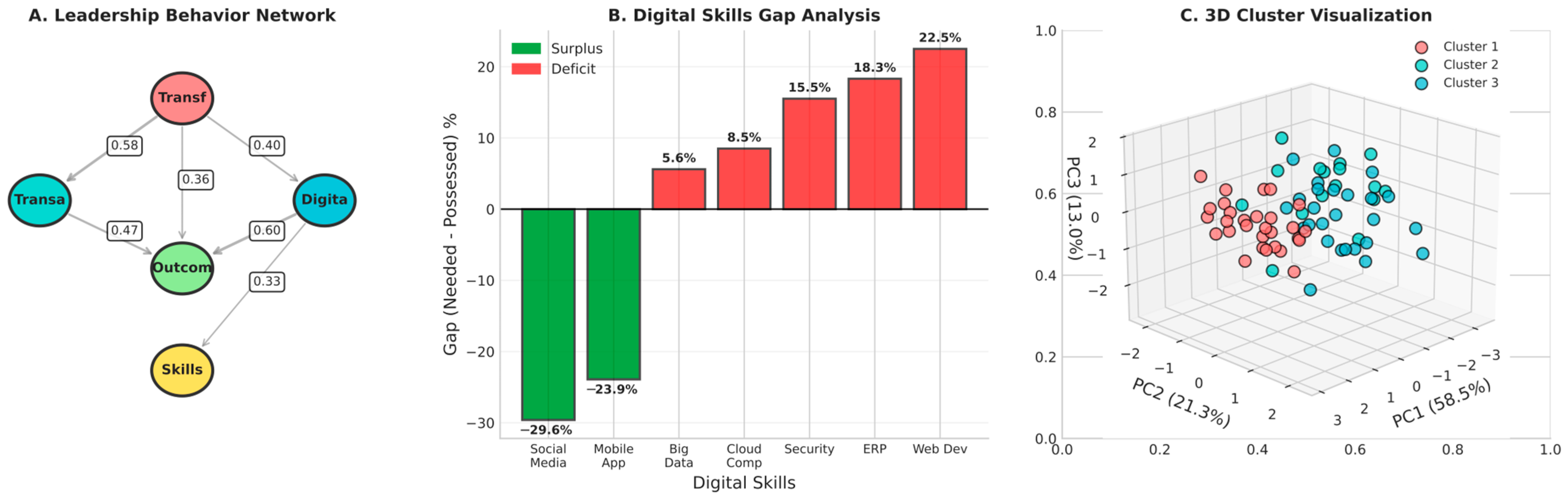
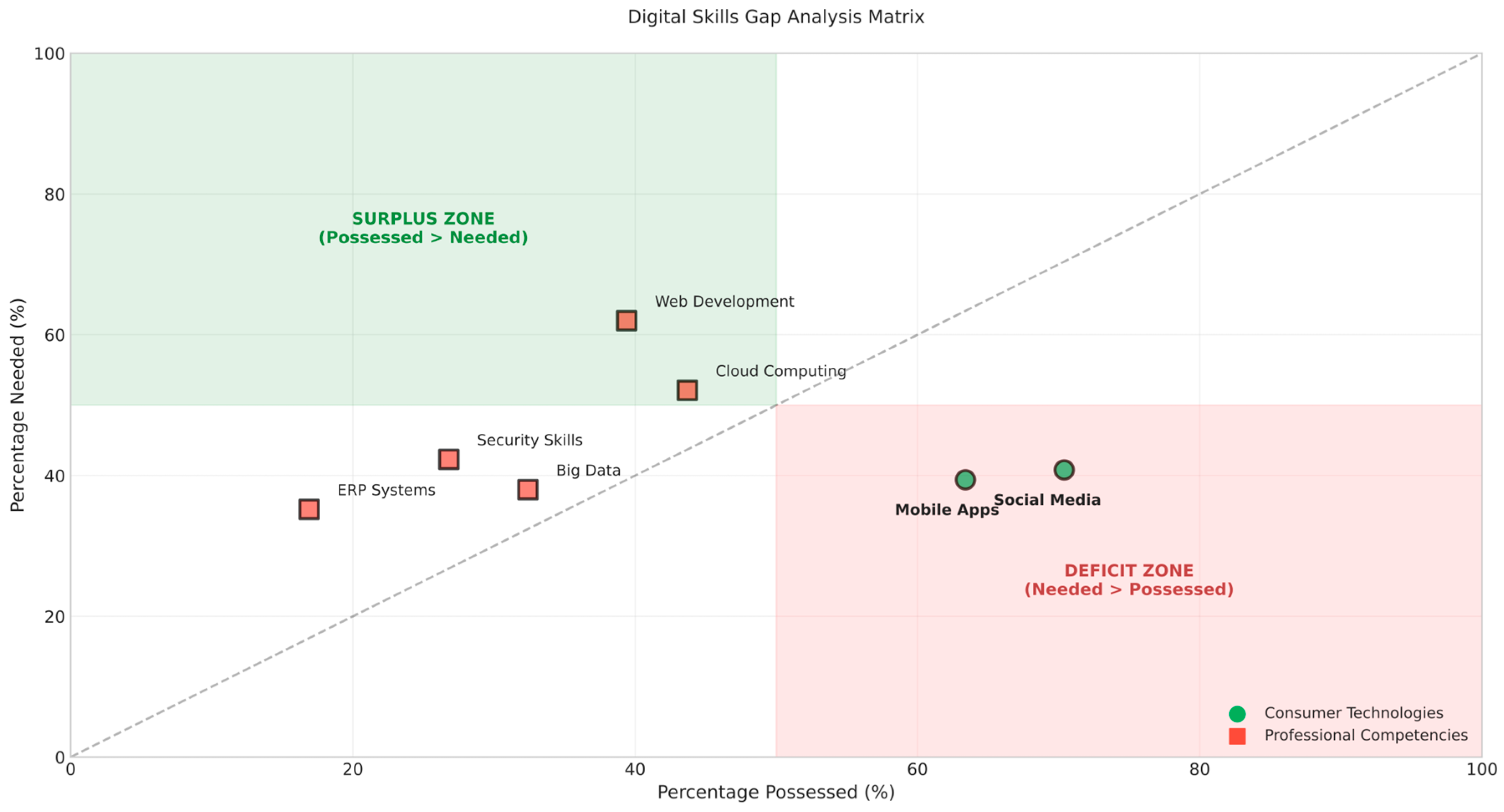
Critical deficits emerged in professional competencies essential for educational leadership: Web Development and Tools (22.5% gap), ERP Systems (18.3%), and Security Skills (15.5%). Conversely, consumer-oriented technologies showed substantial surplus, with Social Media (−29.6%) and Mobile Applications (−23.9%) possessed by more teachers than those identifying them as necessary.

4.8. Digital Skills and Leadership Effectiveness

Teachers were categorized into low (1–3 skills) and high (4–7 skills) digital competency groups. Table 8 compares leadership dimensions across these groups.
Only Digital Leadership showed a significant difference between groups (p = 0.047), with high digital skills teachers demonstrating higher scores (M = 4.56) than low digital skills teachers (M = 4.25), although the effect size was small (r = 0.24).

4.9. Behavioral Cluster Analysis and Optimization

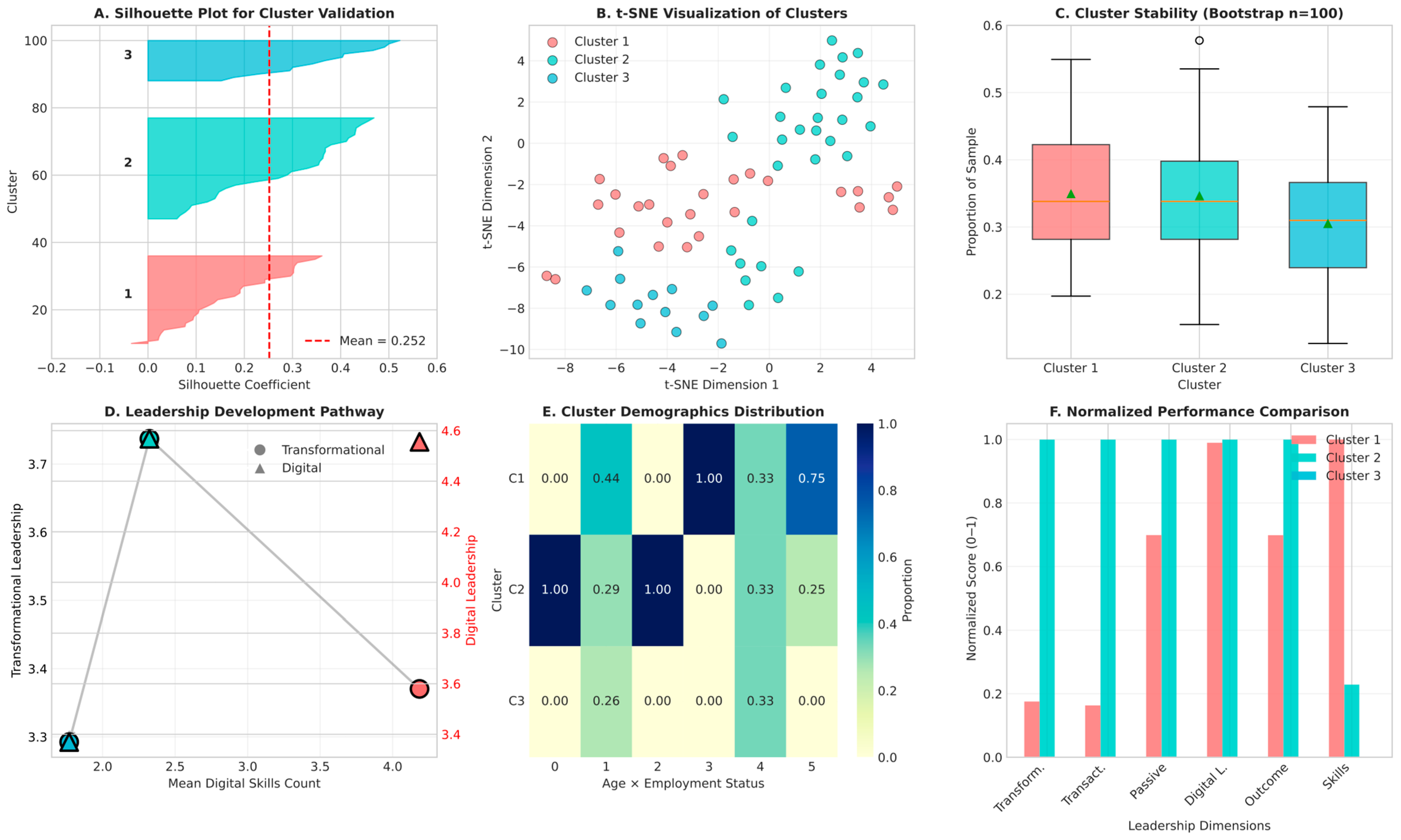
Exploratory profiling methods were employed to identify latent patterns in the leadership data. The Elbow Method examination of within-cluster sum of squares (WCSS) indicated a pronounced elbow at k = 3, suggesting three clusters as optimal. The resulting three-cluster solution achieved a silhouette coefficient of 0.150 and Davies–Bouldin index of 1.593.
Cluster Validity Considerations: The silhouette coefficient of 0.150 indicates weak cluster separation, suggesting that the identified profiles represent points along a behavioral continuum rather than discrete, well-separated groups. This three-cluster solution should be interpreted as a preliminary typology requiring validation in larger samples. Bootstrap validation (n = 1000 iterations) yielded mean Jaccard coefficients exceeding 0.65 for all three clusters, indicating acceptable but not strong stability.
Table 9 provides a detailed description of all three. The first was the largest, comprising mainly young and temporary substitute teachers with low digital abilities and low transformational elements (Passive-Moderate, 53.5%). The other was more balanced, indicating temporary and equal digital capability (Balanced-Active, 33.8%). Lastly, it had the most active leadership behavior and the greatest digital ability (12.7%).
MANOVA analysis confirmed significant multivariate differences between clusters. Table 10 presents post hoc comparisons revealing specific dimensional differences. Wilks’ λ = 0.642, F(10, 128) = 3.21, p = 0.001, η2 = 0.201, indicating that clusters explained 20.1% of variance in leadership dimensions.
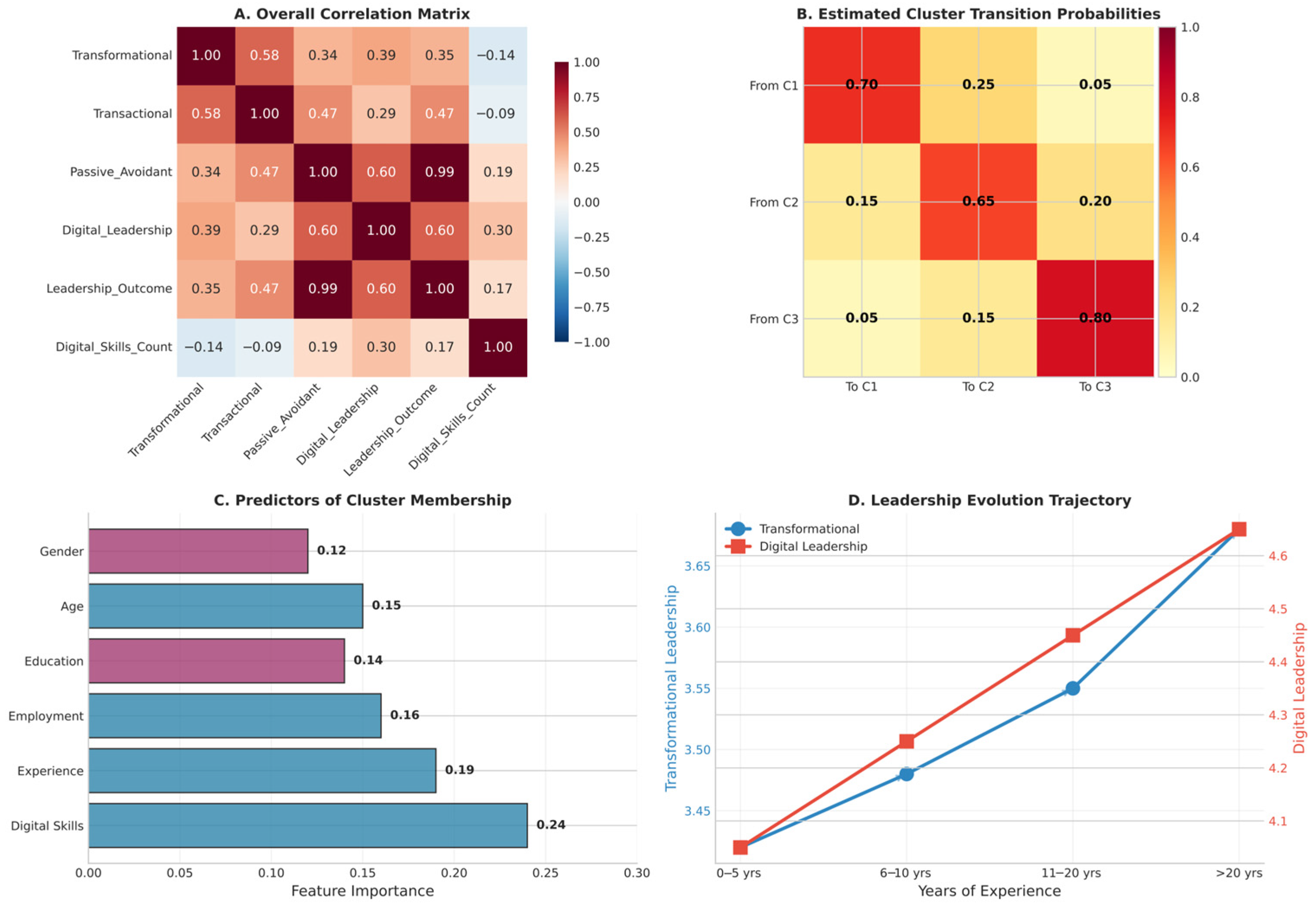
Figure 1A presents the correlation matrix as a whole, indicating inter-relationships between dimensions of leadership. Figure 1B illustrates the cross-sectional distribution of cluster membership proportions. Note: these represent current classification distributions, not developmental transitions, as cross-sectional data cannot support temporal claims. Figure 1C indicates that digital skills (0.24), followed by experience (0.19), have high feature importance for prediction of cluster membership. Figure 1D displays positive associations between experience levels and both transformational and digital leadership scores. These cross-sectional associations should not be interpreted as developmental trajectories; longitudinal research would be required to establish whether leadership orientations change as teachers gain experience.

4.10. Digital Skills Distribution Across Clusters

Patterns of digital proficiency also showed large differences between behavioral clusters. Table 11 below shows the profiles of digital skills ownership. One way ANOVA indicated that digital skills and clusters significantly differ, F(2, 68) = 5.67, p < 0.005, η2 = 0.143. Post hoc analysis indicated that significantly more digital skills existed in clusters belonging to group 3 than in clusters belonging to group 1, p < 0.004.
Network analysis revealed the interconnected nature of leadership behaviors and digital competencies within the educational ecosystem. Figure 2A shows the leadership behavior network with path coefficients: Transformational → Digital (0.40), Digital → Outcome (0.60), Transformational → Outcome (0.36). Figure 2B displays the digital skills gap waterfall chart, ranging from Social Media surplus (−29.6%) to Web Development deficit (+22.5%). Figure 2C presents 3D cluster visualization using principal components analysis for dimensionality reduction. PC1 (Principal Component 1, explaining 10.2% of variance) represents a composite dimension primarily loaded on digital competency variables. PC2 (8.2% of variance) captures variation in traditional leadership dimensions, while PC3 (7.1% of variance) reflects remaining variation in passive-avoidant orientation. The relatively low variance explained by each component (cumulative 25.5%) indicates that the leadership and digital competency constructs are relatively independent, supporting multidimensional profiling rather than simple ranking.
Multinomial logistic regression identified key predictors of cluster membership. Table 12 presents the regression results.
The model accounted for 36.2% of the variance on membership in clusters. There was a consistent effect of digital skills count on membership of Clusters 2 and 3, raising their odds by a factor of 32% and 67% for each additional digital skill, respectively.
Comprehensive assessment methods examined the stability of these clusters. Figure 3A illustrates silhouette analysis with an average coefficient of 0.150, indicating weak cluster separation consistent with profiles along a behavioral continuum rather than discrete groups. Figure 3B illustrates t-SNE visualization that shows cluster boundaries. Figure 3C portrays bootstrap stability analysis performed for 100 iterations, indicating moderate cluster stability. Figure 3D shows the cross-sectional association between digital skills levels and leadership orientation patterns. Figure 3E demonstrates a heatmap of cluster characteristics across demographic variables. Figure 3F compares normalized scores across all dimensions.
Random Forest classification was employed for exploratory profiling and feature importance identification. Table 13 presents classification performance metrics.
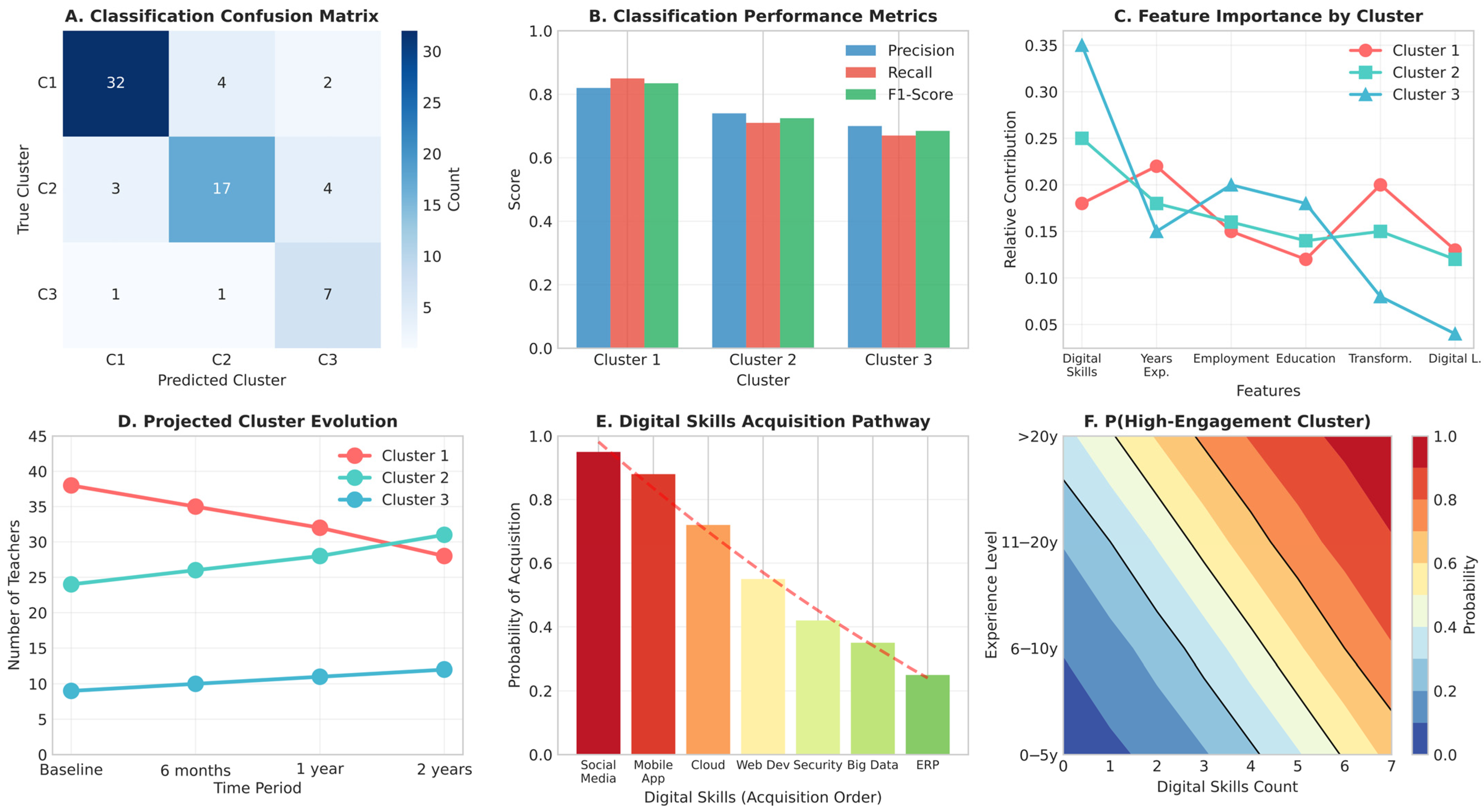
Figure 4A illustrates the confusion matrix, indicating an accuracy of 78.6%. Figure 4B illustrates metrics of classification (precision, recall, and F1 statistics) for each cluster. Figure 4C illustrates feature importance by clusters, indicating differentiation of feature importance by clusters, and Figure 4D illustrates hypothetical projections (requiring longitudinal verification) of how cluster distributions might evolve with professional development interventions. Figure 4E illustrates digital skills distribution patterns, showing the relative rarity of advanced skill combinations, and finally, Figure 4F illustrates the association between digital skills levels and experience with membership in more engaged clusters. Feature importance analysis from Random Forest revealed the following:
  • Digital Skills Count: 0.24 importance;
  • Years of Experience: 0.19 importance;
  • Employment Status: 0.16 importance;
  • Education Level: 0.14 importance;
  • Age: 0.15 importance;
  • Gender: 0.12 importance.

5. Discussion

This study analyzes leadership style preferences and digital skills among 71 primary teachers in Western Attica, Greece, using behavioral data mining to identify patterns that challenge prevailing assumptions about educational leadership. Results include a complex scenario with unintuitive measurement patterns, serious skill deficiencies, and three behavioral profiles that defy current categorizations.

5.1. The Leadership Style Paradox

Among the most intriguing outcomes is the pattern of leadership orientation after reverse-coding Passive-Avoidant items. Transformational Leadership had the highest mean (M = 4.33, SD = 0.37), followed by Passive-Avoidant (reverse-coded; indicating low endorsement of avoidant behaviors; M = 4.15, SD = 0.54) and Transactional (M = 3.91, SD = 0.46). The moderate correlation between reverse-coded Passive-Avoidant Leadership and Leadership Outcome (rs = 0.320, p = 0.007) aligns with theoretical expectations that lower passive-avoidant tendencies are associated with better anticipated leadership outcomes.
There are three possible reasons for this counterintuitive result. First, reverse-coding problems could have been present in the Greek translation of MLQ items, particularly given the low internal consistency of the Transformational and Transactional dimensions, in contrast to the outstanding reliability of the Passive-Avoidant leadership scale. Second, culture could play an extremely important role, as Greek educational culture operates within a strongly bureaucratic public-sector model, and what is defined as ‘passive’ may be interpreted as a demonstration of appropriate behavior, thereby fitting into organizational hierarchies. Third, as only six teachers (about 94.4% of participants) had no experience as principals, these responses could be interpreted as reflecting organizational expectations, rather than as a demonstration of what teachers think is rewarded at an organizational, rather than an inspirational, level.
These reliability patterns support the measurement properties of the adapted instrument. Transformational Leadership showed acceptable reliability (α = 0.783), while Transactional (α = 0.583) and Passive-Avoidant (α = 0.617) scales showed lower but interpretable internal consistency. Future studies should focus on the validation of the Greek MLQ translation via rigorous back-translation and CFA validation on broader samples to further establish measurement properties in this cultural context.
These findings contrast with previous research in Greek secondary education, in which Panagopoulos et al. [27] found transformational leadership to be the predominant leadership style among teachers with administrative aspirations. The divergence may reflect the following: (1) differences between primary and secondary education contexts; (2) sample composition effects, as our participants were predominantly substitute teachers (69%) compared to the more established workforce in secondary settings; or (3) measurement artifacts specific to our adapted instrument.
The unexpectedly high Passive-Avoidant mean scores warrant careful interpretation. In the Greek public education context, characterized by hierarchical administrative structures and limited teacher autonomy, behaviors captured by passive-avoidant items (e.g., “avoids making decisions,” “delays responding to urgent questions”) may represent adaptive responses to institutional constraints rather than leadership deficiencies. Teachers without formal administrative authority may appropriately defer decisions to principals, interpreting such deference as organizationally appropriate rather than as a form of leadership avoidance.
International comparisons suggest cultural variation in endorsement of leadership styles. Research in collectivist educational cultures has found higher endorsement of behaviors that Western frameworks classify as passive or avoidant. The pattern observed here may reflect cultural norms regarding appropriate teacher behavior within hierarchical educational systems rather than deficits in leadership orientation.
Perhaps the most consequential finding is the “aspirational gap”—the marked divergence between teachers’ high self-concept of transformational leadership (M = 4.33, after correction) and their actual digital readiness, as evidenced by critical competency deficits across professional domains. Teachers aspire to transformational leadership orientations but may lack the technical infrastructure to enact these aspirations in increasingly digital educational environments. This gap—between leadership aspiration and digital capability—represents both a challenge and an opportunity for strategic professional development. The descriptive value of the current study lies less in the predictive power of the identified clusters and more in this revelation of systematic divergence between orientation and readiness.

5.2. Digital Competency Landscape and Professional Development Needs

The digital skills assessment revealed a striking dichotomy between personal technology use and professional digital competencies required for educational leadership (Figure 5). Teachers demonstrated substantial surpluses in consumer-oriented technologies: 70.4% possessed social media skills, compared with only 40.8% who identified them as necessary, and 63.4% had mobile application competencies, compared with 39.4% who perceived a need. Conversely, critical professional competencies showed significant deficits, including Web Development and Tools (22.5 percentage points), ERP Systems (18.3 points), and Security Skills (15.5 points).
Consumer technology proficiency is concentrated in the surplus region, whereas professional skills are concentrated in the deficit region, indicating fundamental inequities in educational technology preparedness. Overall, the association between technology familiarity and digital skills for educational leadership appears misplaced, and this association is further supported by a non-significant negative correlation between identified and possessed components of consumer technologies (r = −0.42, p < 0.05). Regression analysis showed that professional digital skills had a significantly stronger positive relationship (β = 0.52, p < 0.001) than consumer technology proficiency (β = 0.18, p = 0.12) on Digital Leadership, and this underscores the necessity of more focused development on digital leadership skills than reliance on technology familiarity and proficiency.
Having identified that 71.8% of teachers possess low digital skills, meaning they have three or fewer skills of the seven skill-sets that have been evaluated, this is a challenge as well as an opportunity that can be dealt with on a systemic level. With a digital skills average of only 2.93, this is well below the required level for digital leadership and is problematic, especially given the ever-accelerating pace of digitalization spurred by recent world events and the growing imperative within education.

5.3. Cross-Sectional Behavioral Profiles

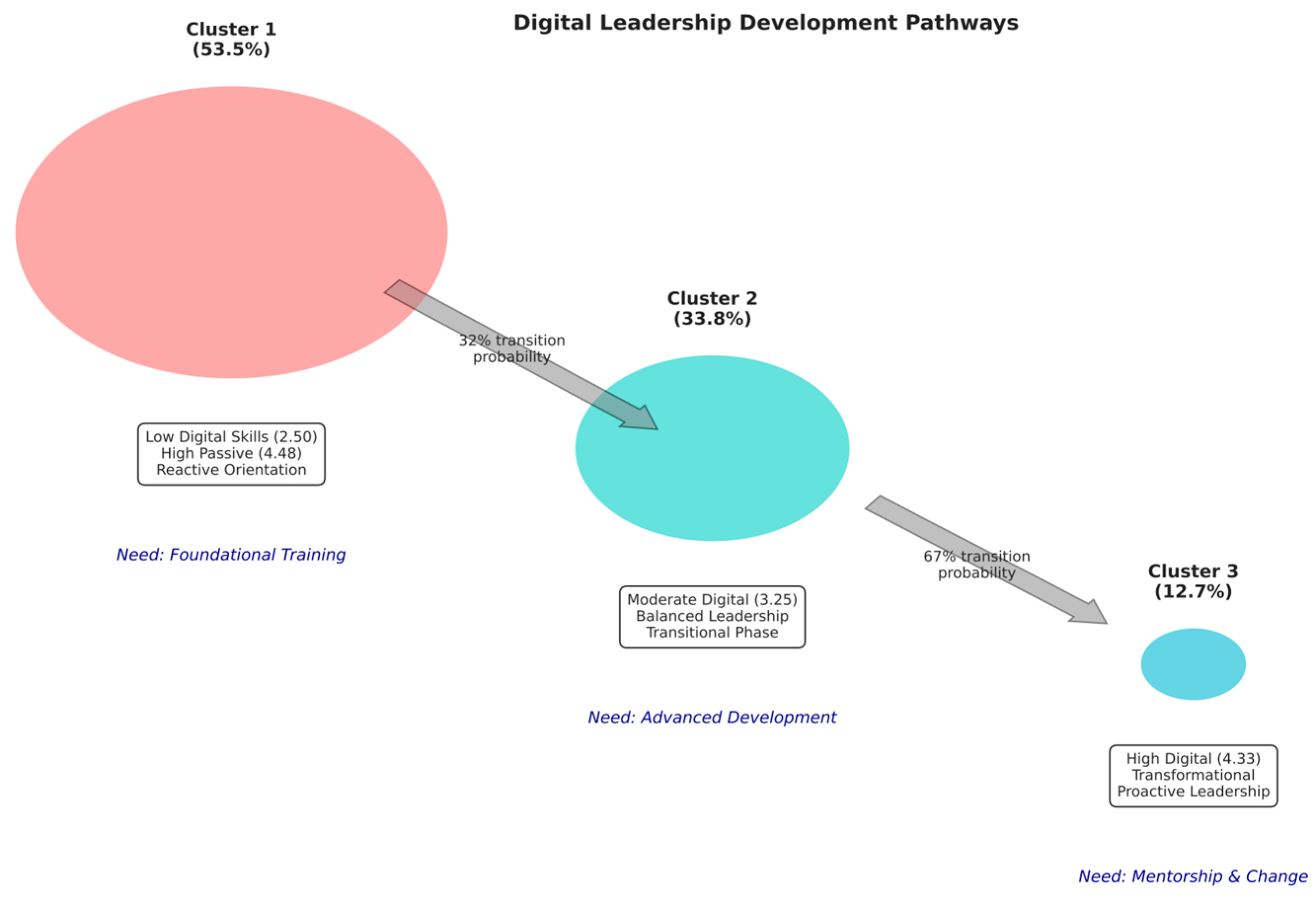
By moving beyond conventional demographic classifications, the behavioral data-mining analysis yielded three teacher profiles, each offering a more nuanced view of leadership development pathways (Figure 6).
Important Interpretive Note: These three profiles should be understood as heuristic devices for understanding heterogeneity in leadership self-concept rather than as rigid diagnostic categories. Given the lower internal consistency of the Transactional (α = 0.583) and Passive-Avoidant (α = 0.617) scales, the behavioral boundaries between profiles are necessarily porous; individual teachers may exhibit characteristics spanning multiple groupings. The profiles thus represent approximate regions along a leadership orientation continuum rather than discrete taxonomic categories. The silhouette coefficient of 0.150 further suggests that data points are distributed along a continuum rather than in distinct taxonomic pockets.
Cluster sizes reflect sample representation, and cross-sectional distributions indicate variation in leadership orientations across the sample. The Passive-Moderate group, comprising 53.5% of the sample, represents early-career substitute teachers who have limited technology skills (M = 2.50), score low on Transformational Leadership (M = 3.45), and score highest on Passive-Avoidant scales (M = 4.48). One would expect a more proactive, rather than reactive, leadership style, as indicated by this predominant group, who appear to be more responsive to immediate needs than proactive in taking initiative as leaders. Their numerical predominance as substitute teachers indicates that temporary employment may be inhibiting their progress as leaders, as they are likely limited in sustained organizational involvement and participation that would foster growth over six to ten years as substitutes.
Balanced-Active, comprising 33.8% of all teachers, exhibits a relatively balanced leadership orientation profile, with average digital proficiency (M = 3.25) and a relatively equal distribution of scores across leadership dimensions. Teachers in this intermediate grouping exhibit mixed characteristics—demonstrating some engaged behaviors while also showing areas for potential development. Their diverse experience and employment profiles suggest varied pathways to their current orientations, though the cross-sectional design precludes tracking of actual developmental trajectories.
The High-Engagement group, despite being small, at only 12.7% of the population, comprises a ‘best-of-the-best’ group of experienced permanent teachers, who display superior leadership behavior as well as optimal leadership behavior profiles. They have not only shown superior Transformational (M = 3.68) and Digital Leadership (M = 4.72), along with low Passive-Avoidant Behavior (M = 4.25), but these leadership-quality indicators also reveal them as having all the qualities that can be assumed of ‘leadership’ for innovation within education, consistent with theoretical assumptions. They have, on average, displayed superior digital competencies (4.33). Additionally, they have extensive experience (over 20 years as permanent teachers).
Cross-sectional comparison of the three clusters reveals qualitative differences in leadership orientation patterns, digital integration, and professional engagement. Each additional digital competency was associated with a 32% and 67% increase in the odds of membership in Clusters 2 and 3, respectively. While this association suggests that digital competency may relate to leadership orientation patterns, the cross-sectional design precludes causal inference; we cannot determine whether digital skills facilitate leadership engagement or whether teachers with engaged orientations are more likely to acquire digital competencies.

5.4. Theoretical Implications for Educational Leadership

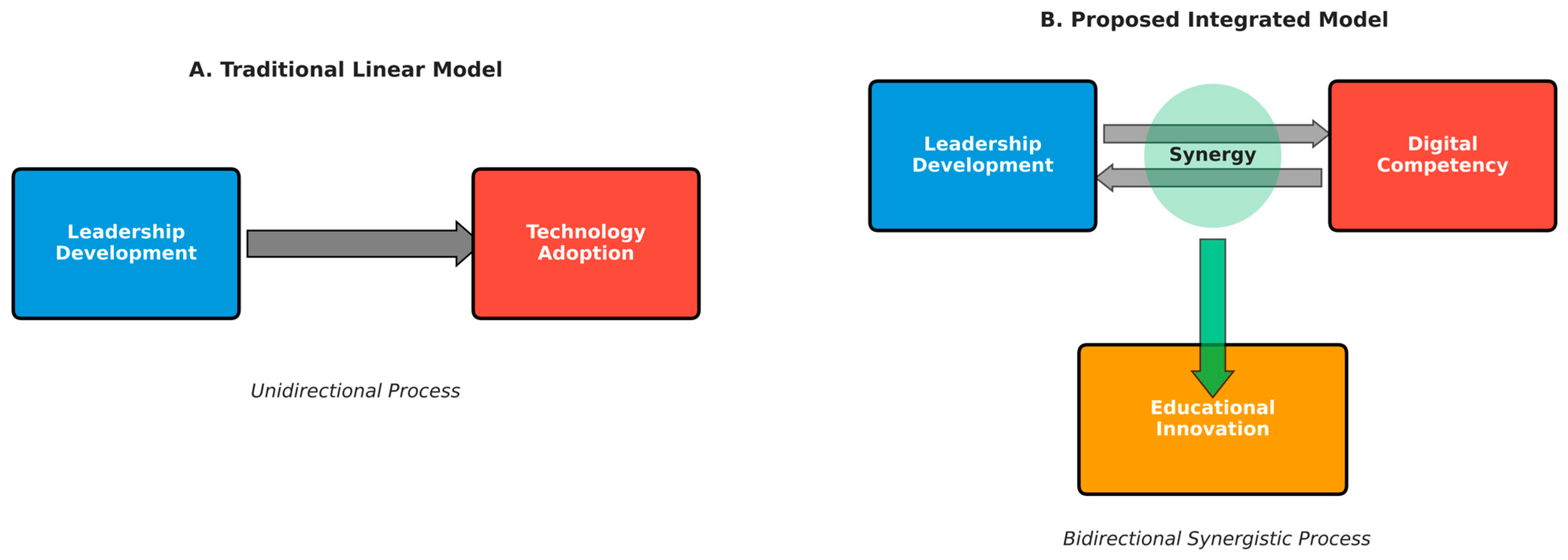
These results require a paradigm shift in educational leadership development, reframing it from a linear model toward an integrated, two-way model, in which digital competency and leadership style mutually enhance one another through a symbiotic relationship. Network analysis showed that transformational leadership was a key node significantly linking digital leadership (partial r = 0.28, p = 0.018) and leadership outcomes (partial r = 0.36, p = 0.002).
However, emphasis has been placed on a bidirectional model that examines the synergy between leadership development and digital competency, resulting in educational innovation (Figure 7). In this model, rather than technology implementation following leadership development, digital and leadership competencies are expected to develop bidirectionally, complementing each other’s development and addressing each other’s deficiencies. Based on this synergy, professional development can be achieved through interventions on either side, providing several entry points, and can be accessed through multiple points or capabilities, addressing this need through transformational leadership as its keystone capability, without which other competencies will be inefficient and fragmented.
Additionally, some cultural considerations can render theoretical meanings more complex. Given their unexpectedly high number, the large number of passive-avoidant leaders might symbolize an adjustment to the bureaucratic constraints of the Greek public education system rather than any notion of preferred leadership behavior. In highly vertical organizations that lack autonomy, leaders may demonstrate ‘passive’ behavior as a systemic adaptation, as this may be more practical than attempting to effect change, especially when they lack autonomy.

5.5. Practical Implications and Implementation Framework

Critical Implementation Note: Given the porous boundaries between profiles and the weak cluster separation (silhouette = 0.150), professional development initiatives should prioritize addressing specific, measurable competency deficits—particularly the critical gaps in web development (22.5%) and administrative systems (18.3%)—rather than attempting to “move” teachers from one profile category to another. Targeted skill-building interventions offer more actionable pathways than profile-based classification, which serves primarily descriptive rather than prescriptive purposes.
The identification of three approximate profile groupings nonetheless provides useful orientation for differentiated professional development. Rather than treating all teachers through homogeneous development initiatives, education authorities can recognize that educators with different orientation patterns may benefit from distinct support structures, while acknowledging that individual teachers may not fit neatly into any single category.
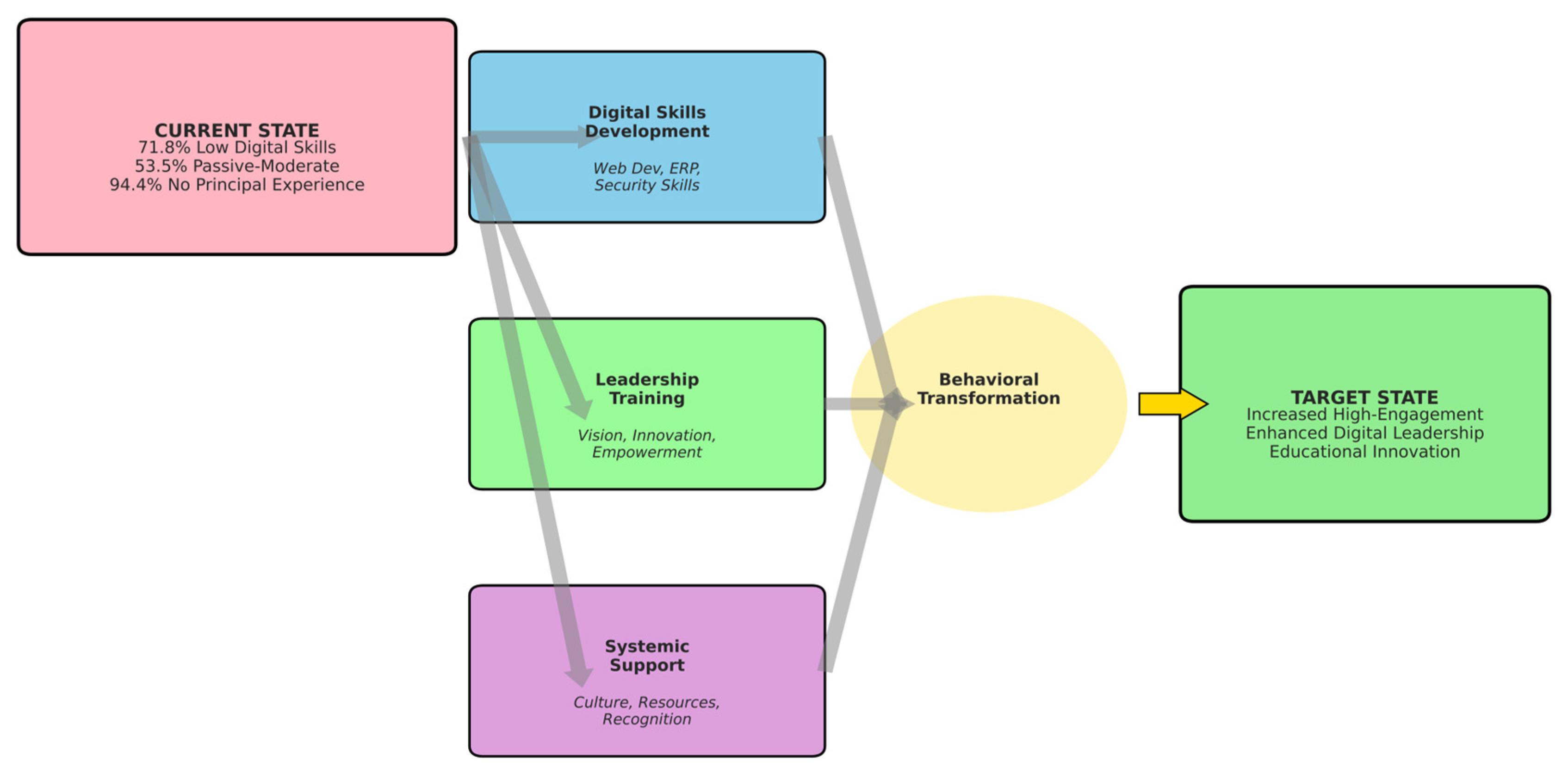
For the Passive-Moderate majority, basic mastery of digital literacy, together with basic concepts of leadership, should be considered essential skills requiring intervention and development. Teachers in this category require a supportive environment that enables them to practice experimental methods, guidance from more experienced educators, and step-by-step development of leadership accountability, emphasizing mastery of basic concepts before progressing to more advanced ones (Figure 8).
The Balanced-Active category, already evidencing strong skills, requires more advanced and sophisticated development, emphasizing transformational leadership techniques and the application of advanced digital technologies. They can be engaged in action research studies and innovation projects, and placing them in charge of certain departments would be an optimal way to develop them into High-Engagement profiles. They occupy a transitional phase and would be most suitable for advanced development opportunities.
Despite its small size, the High-Engagement group is a powerful resource that can be tapped to drive positive organizational change. Rather than addressing their individual development, it would be more productive to leverage their expertise through mentorship, leadership development institutes, or opportunities to shape system-wide improvements. Such educators could act as organizational change agents, role-modeling and facilitating development among their peers.
The paradigm of transformation recognizes that change can occur only at multiple levels simultaneously. Training and development on digital skills need to be aimed at professional skills and cannot be left solely on the strength of familiarity with technology as consumers on digital media platforms. Leadership development courses should emphasize transformative leadership, despite cultural or systemic constraints.
While targeted professional development may enhance both digital competencies and leadership engagement, the cross-sectional nature of this study precludes specific projections about profile changes over time. Longitudinal research would be needed to determine whether teachers’ orientation patterns shift in response to intervention, and if so, at what rates. The current findings suggest that digital skill development is associated with more engaged leadership orientations, but establishing causal pathways requires prospective study designs.

5.6. Methodological Contributions and Future Directions

The application of exploratory profiling approaches has proven valuable in uncovering latent patterns that may not be readily identifiable through traditional variable-centered statistical methods. By integrating cluster analysis, network visualization, and machine learning validation, this research has identified a three-profile model with distinct implications for differentiated intervention strategies. This methodological approach aligns with recent advances in educational neuroscience, which emphasize the importance of understanding individual differences in cognitive and behavioral patterns for optimizing learning and leadership development [180,181].
The emerging field of neuroleadership offers a promising theoretical framework for interpreting and extending these findings. Research has demonstrated that neuroleadership principles can inform educational settings by bridging neuroscientific understanding of decision-making, emotional regulation, and cognitive flexibility with leadership development practices [182]. The behavioral profiles identified in this study—particularly the distinctions in transformational orientation and digital engagement—may reflect underlying neurocognitive differences that warrant investigation through neuroimaging and cognitive assessment methodologies [183]. Understanding the neurocognitive foundations of leadership orientations could inform more targeted and effective professional development interventions.
Several limitations constrain the interpretation and generalizability of our findings, yet simultaneously illuminate productive directions for future research. Geographic restriction to Western Attica limits generalizability to other Greek regions and international contexts; cross-national studies would reveal whether the three-cluster framework represents a universal phenomenon or reflects culture-specific patterns in the conceptualization of educational leadership [184,185]. The cross-sectional design precludes causal inference regarding leadership development trajectories, and self-report methodology introduces potential biases, particularly given the predominantly non-principal sample. The near-absence of practicing administrators (5.6%) means our findings characterize leadership orientations rather than enacted leadership behaviors.
Future research should pursue several complementary directions. First, longitudinal studies tracking teachers’ progression through behavioral clusters would enable examination of developmental trajectories and the identification of factors that facilitate advancement to more engaged leadership profiles [186]. Second, intervention studies testing the effectiveness of differentiated professional development aligned with behavioral profiles would provide causal evidence for the practical utility of this framework. Systematic reviews have demonstrated that formative assessment approaches significantly affect student learning outcomes [187]; analogous research on formative approaches to leadership development could yield similarly valuable insights for sustainable improvements in educational quality.
Third, qualitative research through in-depth interviews could illuminate teachers’ subjective constructions of leadership within the Greek educational context, potentially explaining the measurement paradoxes observed, particularly the unexpectedly high passive-avoidant endorsement and scale reliability issues. Fourth, the integration of neuroscientific methods could advance understanding of the cognitive and affective underpinnings of differences in leadership orientation. The systematic contribution of neuroscience to educational praxis [188] suggests that neuroimaging studies examining brain activation patterns associated with different leadership orientations could reveal mechanisms underlying profile differences and inform neuroscience-based leadership development interventions.
Fifth, there is a pressing need to incorporate neuroscience principles into initial teacher education curricula [189,190]. Bridging the gap between neuroscience research and classroom practice requires systematic integration of brain-based learning principles in teacher preparation programs. Extending this argument to leadership development, pre-service and in-service programs could benefit from incorporating neuroleadership concepts—including understanding of stress responses, cognitive load management, and neuroplasticity—to enhance teachers’ capacity for digital leadership in technologically complex educational environments.
Sixth, the intersection of educational neuroscience and artificial intelligence presents novel opportunities for research and practice in leadership development [191]. Recent research demonstrates that AI-enhanced approaches can optimize learning by addressing cognitive load; similar applications could personalize leadership development pathways based on individual cognitive profiles and learning preferences. The digital skills gaps identified in this study—particularly in emerging areas such as big data and digital architecture—suggest that AI-assisted professional development could help teachers acquire complex technical competencies more efficiently while managing cognitive demands.
Finally, the neurocognitive dimensions of creativity and their relationship to leadership orientation warrant investigation. Research has demonstrated that neurocognitive profiles of creativity significantly influence academic performance [192]. Analogous research examining how creative cognitive styles relate to leadership orientations and the adoption of digital innovation could inform the selection and development of educational leaders capable of navigating digital transformation. The High-Engagement cluster identified in this study, characterized by elevated transformational and digital leadership scores, may reflect distinct neurocognitive profiles that facilitate innovative thinking and technology adoption.

5.7. Limitations and Implications for Interpretation

Several methodological limitations affect the interpretation and generalizability of our findings. We present these systematically, with explicit guidance on which conclusions require cautious interpretation.
Sample Size and Advanced Analytics: The sample of 71 teachers, while adequate for descriptive analyses and correlational research, constrains the reliability of advanced analytical techniques employed in this study. The cluster analysis yielded a single cluster (High-Engagement) comprising only nine members (12.7%), substantially reducing statistical power for between-cluster comparisons involving this group. Parameter estimates for Cluster 3 have wide confidence intervals and should be considered preliminary. The multinomial logistic regression coefficients, while statistically significant, should be interpreted with caution given the modest sample size relative to the number of predictors. Machine learning classification accuracy (78.6%) may be inflated due to overfitting risk with small samples.
Scale Reliability Concerns: Transactional (α = 0.583) and Passive-Avoidant (α = 0.617) scales showed lower internal consistency, though Transformational (α = 0.783) reached acceptable levels. Correlations and regression analyses involving lower-reliability scales may be attenuated due to measurement error. The moderate correlation between reverse-coded Passive-Avoidant Leadership and Leadership Outcome (rs = 0.320) is consistent with theoretical expectations, though interpretation should account for the lower reliability of the Passive-Avoidant scale. Findings involving Transactional and Passive-Avoidant constructs should be interpreted with appropriate caution.
Cross-Sectional Design: The cross-sectional nature of this study precludes causal inference. Observed associations between digital skills and cluster membership, or between experience and leadership style preferences, represent concurrent relationships rather than developmental trajectories. References to “pathways” or “development” in our behavioral profile descriptions should be understood as theoretical propositions that require longitudinal verification, not as empirical findings from this study.
Respondent Profile and Construct Validity: With only 5.6% of participants having principal experience, leadership style responses reflect aspirational preferences rather than enacted leadership behaviors. This fundamentally affects construct validity, as the MLQ was designed to assess practiced leadership within leader–follower relationships. Our findings characterize teachers’ leadership orientations and ideals rather than demonstrated leadership effectiveness. Comparisons with studies of practicing administrators should recognize this fundamental difference in what is being measured.
Sampling and Generalizability: Convenience and snowball sampling methods may have introduced selection bias, potentially overrepresenting teachers with higher education levels (71.8% with Master’s degrees) or greater technology engagement. Geographic restriction to Western Attica limits generalizability to other Greek regions or international contexts. The predominance of substitute teachers (69%) may not represent the broader Greek primary education workforce.
Conclusions That Can Be Drawn with Greater Confidence: (1) distinct profiles of leadership orientations exist among primary teachers that transcend simple demographic categorization; (2) digital skills are positively associated with more engaged leadership orientations; (3) substantial gaps exist between consumer technology proficiency and professional digital leadership competencies; (4) the standard MLQ instrument may require cultural adaptation for Greek educational contexts.
Conclusions Requiring Cautious Interpretation: (1) the magnitude of specific predictive relationships and odds ratios; (2) the stability and generalizability of the three-cluster solution; (3) any implications regarding leadership effectiveness or outcomes; (4) the theoretical meaning of the Passive-Avoidant and Leadership Outcome relationship.

5.8. Sustainability Implications

This research contributes to educational sustainability in several interconnected ways aligned with Sustainable Development Goal 4 (Quality Education) and its emphasis on building effective, accountable, and inclusive institutions.
Sustainable Capacity Building: Identifying specific digital competency gaps enables targeted professional development that builds sustainable institutional capacity. Rather than ephemeral technology training focused on specific tools, addressing foundational gaps in Web Development, ERP Systems, and Security Skills develops transferable competencies that remain relevant as specific technologies evolve. This approach aligns with sustainable human resource development principles that emphasize adaptability over tool-specific training.
Equitable Development Pathways: The behavioral profiling approach supports differentiated professional development pathways based on current orientations rather than demographic characteristics. The absence of significant gender differences in leadership orientations suggests that development opportunities can be designed based on demonstrated needs rather than assumptions tied to demographic categories, promoting equitable access to leadership advancement.
System Resilience: Understanding the relationship between digital competency and leadership engagement contributes to building resilient educational systems capable of adapting to technological disruption. The COVID-19 pandemic demonstrated the consequences of inadequate digital leadership capacity; proactive development of the teacher workforce prepares educational systems for future disruptions while maintaining quality during transitions.
The finding that digital skills predict more engaged leadership profiles suggests that investment in teacher digital competency may yield compounding returns through enhanced leadership capacity. As digitally competent teachers advance to administrative roles, they bring both technical skills and an orientation toward innovation to institutional leadership, potentially creating virtuous cycles of digital transformation capacity.

6. Conclusions

This study examined leadership orientations and digital competencies among primary school teachers in Western Attica, Greece, revealing patterns that challenge conventional assumptions about educational leadership in digital transformation contexts.
Three principal findings emerged. First, the identification of distinct behavioral profiles—ranging from Passive-Moderate orientations through Balanced-Active engagement to High-Engagement patterns—demonstrates that person-centered analytical approaches can reveal meaningful teacher subgroups with implications for differentiated professional development. Second, substantial gaps between consumer technology proficiency and professional digital competencies, particularly in web development, administrative systems, and security skills, indicate that technology familiarity does not automatically translate to digital leadership readiness. Third, digital skills emerged as the strongest correlate of advanced profile membership, suggesting an association between digital competency and leadership engagement orientation—though the direction of this relationship cannot be determined from cross-sectional data.
However, significant methodological limitations require cautious interpretation. Lower reliability coefficients for some leadership scales, weak cluster separation indicative of profiles along a behavioral continuum rather than discrete groups, modest cluster sizes, and the aspirational rather than enacted nature of leadership responses all constrain the conclusions that can be drawn. These findings should therefore be considered hypothesis-generating for future research rather than definitive conclusions about teacher leadership development.
Future research should prioritize validation of leadership instruments for Greek educational contexts, longitudinal studies tracking leadership development trajectories, and larger samples enabling more robust cluster analysis. Strategic professional development that addresses identified competency gaps and aligns with behavioral profiles may enhance sustainable educational innovation capacity in Greek primary education.

Supplementary Materials

The following supporting information can be downloaded at https://www.mdpi.com/article/10.3390/su18031555/s1.

Author Contributions

Conceptualization, A.N., H.A. and C.H.; Methodology, A.N., H.A. and C.H.; Software, A.N., H.A. and C.H.; Validation, A.N., H.A. and C.H.; Formal analysis, A.N., H.A. and C.H.; Investigation, A.N., H.A. and C.H.; Resources, A.N., H.A. and C.H.; Data curation, A.N., H.A. and C.H.; Writing—original draft, A.N., H.A. and C.H.; Writing—review & editing, A.N., H.A. and C.H.; Visualization, A.N., H.A. and C.H.; Supervision, H.A. and C.H.; Project administration, H.A. and C.H.; Funding acquisition, H.A. and C.H. All authors have read and agreed to the published version of the manuscript.

Funding

The publication fees of this manuscript have been financed by the Research Council of the University of Patras, Greece.

Institutional Review Board Statement

Ethical review and approval were waived for this study, due to the University of Patras Ethics Committee and Research Ethics guidelines, as ethical approval is not required for studies involving anonymous survey-based research, mainly when the participants are healthy adults, not from vulnerable populations, and the study does not collect sensitive or identifiable personal data.

Informed Consent Statement

Informed consent was obtained from all subjects involved in this study.

Data Availability Statement

The complete codebook, item-level statistics, and scoring formulas are provided in Supplementary Tables S1–S3. De-identified scale-level data supporting this study are available from the corresponding author upon reasonable request.

Acknowledgments

The authors acknowledge the limited use of ChatGPT (version 4) solely for copy-editing purposes, including grammar, wording, and readability improvements. No generative AI was used for study design, data generation, analysis, interpretation, or the creation of original content. The authors have reviewed and verified all text and take full responsibility for the accuracy, integrity, and originality of the manuscript.

Conflicts of Interest

The authors declare no conflicts of interest.

References

  1. Granić, A. Educational technology adoption: A systematic review. Educ. Inf. Technol. 2022, 27, 9725–9744. [Google Scholar] [CrossRef]
  2. Asimakopoulos, G.; Antonopoulou, H.; Giotopoulos, K.; Halkiopoulos, C. Impact of Information and Communication Technologies on Democratic Processes and Citizen Participation. Societies 2025, 15, 40. [Google Scholar] [CrossRef]
  3. Ullah, N.; Mugahed Al-Rahmi, W.; Alzahrani, A.I.; Alfarraj, O.; Alblehai, F.M. Blockchain technology adoption in smart learning environments. Sustainability 2021, 13, 1801. [Google Scholar] [CrossRef]
  4. Smidt, H.J.; Jokonya, O. Factors affecting digital technology adoption by small-scale farmers in agriculture value chains (AVCs) in South Africa. Inf. Technol. Dev. 2022, 28, 558–584. [Google Scholar] [CrossRef]
  5. Asimakopoulos, G.; Antonopoulou, H.; Giannoukou, I.; Golfi, A.; Sataraki, I.; Halkiopoulos, C. Virtual Collaboration and E-Democracy During the Pandemic Era: Insights on Digital Engagement, Infrastructure, and Social Dynamics. Information 2025, 16, 492. [Google Scholar] [CrossRef]
  6. Elbanna, S.; Armstrong, L. Exploring the integration of ChatGPT in education: Adapting for the future. Manag. Sustain. Arab Rev. 2024, 3, 16–29. [Google Scholar] [CrossRef]
  7. Selwyn, N. The future of AI and education: Some cautionary notes. Eur. J. Educ. 2022, 57, 620–631. [Google Scholar] [CrossRef]
  8. Okoye, K.; Hussein, H.; Arrona-Palacios, A.; Quintero, H.N.; Ortega, L.O.P.; Sanchez, A.L.; Ortiz, E.A.; Escamilla, J.; Hosseini, S. Impact of digital technologies upon teaching and learning in higher education in Latin America: An outlook on the reach, barriers, and bottlenecks. Educ. Inf. Technol. 2023, 28, 2291–2360. [Google Scholar] [CrossRef]
  9. Subrahmanyam, S. The paradigm shift in leadership owing to technological development. In Leadership Paradigms and the Impact of Technology; IGI Global: New York, NY, USA, 2025; pp. 381–406. [Google Scholar] [CrossRef]
  10. Niță, V.; Guțu, I. The role of leadership and digital transformation in higher education students’ work engagement. Int. J. Environ. Res. Public Health 2023, 20, 5124. [Google Scholar] [CrossRef]
  11. Karakose, T.; Kocabas, I.; Yirci, R.; Papadakis, S.; Ozdemir, T.Y.; Demirkol, M. The development and evolution of digital leadership: A bibliometric mapping approach-based study. Sustainability 2022, 14, 16171. [Google Scholar] [CrossRef]
  12. Nurhas, I.; Aditya, B.R.; Jacob, D.W.; Pawlowski, J.M. Understanding the challenges of rapid digital transformation: The case of COVID-19 pandemic in higher education. Behav. Inf. Technol. 2022, 41, 2924–2940. [Google Scholar] [CrossRef]
  13. Mhlanga, D.; Denhere, V.; Moloi, T. COVID-19 and the key digital transformation lessons for higher education institutions in South Africa. Educ. Sci. 2022, 12, 464. [Google Scholar] [CrossRef]
  14. Aljanazrah, A.; Yerousis, G.; Hamed, G.; Khlaif, Z.N. Digital transformation in times of crisis: Challenges, attitudes, opportunities and lessons learned from students’ and faculty members’ perspectives. Front. Educ. 2022, 7, 1047035. [Google Scholar] [CrossRef]
  15. Deroncele-Acosta, A.; Palacios-Núñez, M.L.; Toribio-López, A. Digital transformation and technological innovation on higher education post-COVID-19. Sustainability 2023, 15, 2466. [Google Scholar] [CrossRef]
  16. Kavallari, C.; Loukis, E. The impact of COVID-19 on government digital transformation from a resource-based perspective: The case of the Greek Ministry of Education. In Proceedings of the 28th Pan-Hellenic Conference on Progress in Computing and Informatics, Athens, Greece, 13–15 December 2024; Association for Computing Machinery: New York, NY, USA, 2024; pp. 155–161. [Google Scholar] [CrossRef]
  17. Timotheou, S.; Miliou, O.; Dimitriadis, Y.; Sobrino, S.V.; Giannoutsou, N.; Cachia, R.; Monés, A.M.; Ioannou, A. Impacts of digital technologies on education and factors influencing schools’ digital capacity and transformation: A literature review. Educ. Inf. Technol. 2023, 28, 6695–6726. [Google Scholar] [CrossRef]
  18. Exarchou, V.A.; Aspridis, G.M.; Savvas, I.K. The digital transformation as a strategic policy in Greek higher education institutions. In Strategy Models in Digital Transformation; IGI Global: New York, NY, USA, 2024; pp. 99–120. [Google Scholar] [CrossRef]
  19. Karousiou, C. Navigating challenges in school digital transformation: Insights from school leaders in the Republic of Cyprus. Educ. Media Int. 2025, 62, 54–76. [Google Scholar] [CrossRef]
  20. Karagiannidis, C.; Karamatsouki, A.; Chorozidis, G. Report on smart education in Greece. In Smart Education in China and Central & Eastern European Countries; Springer Nature: Singapore, 2023; pp. 131–154. [Google Scholar] [CrossRef]
  21. Antonopoulou, H.; Matzavinou, P.; Giannoukou, I.; Halkiopoulos, C. Teachers’ digital leadership and competencies in primary education: A cross-sectional behavioral study. Educ. Sci. 2025, 15, 215. [Google Scholar] [CrossRef]
  22. Karakose, T.; Polat, H.; Tülübaş, T.; Demirkol, M. A review of the conceptual structure and evolution of digital leadership research in education. Educ. Sci. 2024, 14, 1166. [Google Scholar] [CrossRef]
  23. Karakose, T.; Polat, H.; Papadakis, S. Examining teachers’ perspectives on school principals’ digital leadership roles and technology capabilities during the COVID-19 pandemic. Sustainability 2021, 13, 13448. [Google Scholar] [CrossRef]
  24. Lin, Q. Digital leadership: A systematic literature review and future research agenda. Eur. J. Innov. Manag. 2025, 28, 2469–2488. [Google Scholar] [CrossRef]
  25. Avidov-Ungar, O.; Shamir-Inbal, T.; Blau, I. Typology of digital leadership roles tasked with integrating new technologies into teaching: Insights from metaphor analysis. J. Res. Technol. Educ. 2022, 54, 92–107. [Google Scholar] [CrossRef]
  26. Rasdiana, W.; Wiyono, B.B.; Imron, A.; Rahma, L.; Arifah, N.; Azhari, R.; Elfira; Sibula, I.; Maharmawan, M.A. Elevating teachers’ professional digital competence: Synergies of principals’ instructional e-supervision, technology leadership, and digital culture for educational excellence in the digital-savvy era. Educ. Sci. 2024, 14, 266. [Google Scholar] [CrossRef]
  27. Panagopoulos, N.; Karamanis, K.; Anastasiou, S. Exploring the impact of different leadership styles on job satisfaction among primary school teachers in the Achaia Region, Greece. Educ. Sci. 2023, 14, 45. [Google Scholar] [CrossRef]
  28. Hoque, K.E.; Raya, Z.T. Relationship between principals’ leadership styles and teachers’ behavior. Behav. Sci. 2023, 13, 111. [Google Scholar] [CrossRef] [PubMed]
  29. Yalçınkaya, S.; Dağlı, G.; Altınay, F.; Altınay, Z.; Kalkan, Ü. The effect of leadership styles and initiative behaviors of school principals on teacher motivation. Sustainability 2021, 13, 2711. [Google Scholar] [CrossRef]
  30. Parveen, K.; Tran, P.Q.B.; Kumar, T.; Shah, A.H. Impact of principal leadership styles on teacher job performance: An empirical investigation. Front. Educ. 2022, 7, 814159. [Google Scholar] [CrossRef]
  31. Kılınç, A.Ç.; Polatcan, M.; Savaş, G.; Er, E. How transformational leadership influences teachers’ commitment and innovative practices: Understanding the moderating role of trust in principal. Educ. Manag. Adm. Leadersh. 2024, 52, 455–474. [Google Scholar] [CrossRef]
  32. Sarwar, U.; Tariq, R.; Yong, Q.Z. Principals’ leadership styles and its impact on teachers’ performance at college level. Front. Psychol. 2022, 13, 919693. [Google Scholar] [CrossRef]
  33. Peng, B. Digital leadership: State governance in the era of digital technology. Cult. Sci. 2022, 4, 25–40. [Google Scholar] [CrossRef]
  34. Priharsari, D.; Abedin, B.; Burdon, S.; Clegg, S.; Clay, J. National digital strategy development: Guidelines and lesson learnt from Asia Pacific countries. Technol. Forecast. Soc. Change 2023, 196, 122855. [Google Scholar] [CrossRef]
  35. Gabriel, F.; Marrone, R.; Van Sebille, Y.; Kovanovic, V.; de Laat, M. Digital education strategies around the world: Practices and policies. Ir. Educ. Stud. 2022, 41, 85–106. [Google Scholar] [CrossRef]
  36. Mohamed Hashim, M.A.; Tlemsani, I.; Matthews, R. Higher education strategy in digital transformation. Educ. Inf. Technol. 2022, 27, 3171–3195. [Google Scholar] [CrossRef]
  37. Lee-Geiller, S.; Lee, T. How does digital governance contribute to effective crisis management? A case study of Korea’s response to COVID-19. Public Perform. Manag. Rev. 2022, 45, 1040–1064. [Google Scholar] [CrossRef]
  38. Idzi, F.M.; Gomes, R.C. Digital governance: Government strategies that impact public services. Glob. Public Policy Gov. 2022, 2, 481–496. [Google Scholar] [CrossRef]
  39. Dener, C.; Nii-Aponsah, H.; Ghunney, L.E.; Johns, K.D. GovTech Maturity Index: The State of Public Sector Digital Transformation; World Bank: Washington, DC, USA, 2021. [Google Scholar] [CrossRef]
  40. Lee, C.H.; Wang, D.; Lyu, S.; Evans, R.D.; Li, L. A digital transformation-enabled framework and strategies for public health risk response and governance: China’s experience. Ind. Manag. Data Syst. 2023, 123, 133–154. [Google Scholar] [CrossRef]
  41. Christina, P.; Asimina, K.; Anastasios, M.; Luca, S. Assessing school teachers’ perception of disasters: Insights from a socio-environmentally stressed Mediterranean area (Attica, Greece). Int. J. Disaster Risk Reduct. 2022, 79, 103134. [Google Scholar] [CrossRef]
  42. Petropoulou, A.; Antonopoulou, H.; Vlachou, A.A.; Gkintoni, E.; Halkiopoulos, C. Social–Cognitive Factors in Antisocial Behavior and School Violence: A Cross-Sectional Analysis of Greek Vocational Students. Children 2025, 12, 1647. [Google Scholar] [CrossRef] [PubMed]
  43. Aivazidi, M.; Michalakelis, C. Information and communication technologies in primary education: Teachers’ perceptions in Greece. Informatics 2023, 10, 57. [Google Scholar] [CrossRef]
  44. Bourou, A.; Papageorgiou, E. Prevalence of aggressive behavior in Greek elementary school settings from teachers’ perspectives. Behav. Sci. 2023, 13, 390. [Google Scholar] [CrossRef]
  45. Berkovich, I.; Hassan, T. Principals’ digital instructional leadership during the pandemic: Impact on teachers’ intrinsic motivation and students’ learning. Educ. Manag. Adm. Leadersh. 2022, 51, 817–834. [Google Scholar] [CrossRef]
  46. Antonopoulou, H.; Halkiopoulos, C.; Barlou, O.; Beligiannis, G. Transition from Educational Leadership to e-Leadership: A Data Analysis Report from TEI of Western Greece. Int. J. Learn. Teach. Educ. Res. 2019, 18, 238–255255. [Google Scholar] [CrossRef]
  47. Tanniru, M.; Peral, J. Digital leadership in education. In Effective Leadership for Overcoming ICT Challenges in Higher Education: What Faculty, Staff and Administrators Can Do to Thrive Amidst the Chaos; Emerald Publishing Limited: Leeds, UK, 2021; pp. 73–91. [Google Scholar] [CrossRef]
  48. Uzorka, A.; Kalabuki, K. Educational leadership in the digital age: An exploration of technology’s impact on leadership practices. Soc. Sci. Humanit. Open 2025, 14, 101581. [Google Scholar] [CrossRef]
  49. Ruloff, M.; Petko, D. School principals’ educational goals and leadership styles for digital transformation: Results from case studies in upper secondary schools. Int. J. Leadersh. Educ. 2025, 28, 422–440. [Google Scholar] [CrossRef]
  50. Antonopoulou, H.; Halkiopoulos, C.; Barlou, O.; Beligiannis, G.N. Transformational leadership and digital skills in higher education institutes during the COVID-19 pandemic. Emerg. Sci. J. 2021, 5, 1–15. [Google Scholar] [CrossRef]
  51. Gilli, K.; Lettner, N.; Guettel, W. The future of leadership: New digital skills or old analog virtues? J. Bus. Strategy 2024, 45, 168–176. [Google Scholar] [CrossRef]
  52. El Akid, I. The challenges of digital leadership—A critical analysis in times of disruptive changes. In Digital Management in COVID-19 Pandemic and Post-Pandemic Times, Proceedings of the International Scientific-Practical Conference (ISPC 2021), Online, 4 November 2022; Springer International Publishing: Berlin/Heidelberg, Germany, 2023; pp. 117–129. [Google Scholar] [CrossRef]
  53. Bresciani, S.; Ferraris, A.; Romano, M.; Santoro, G. Digital leadership. In Digital Transformation Management for Agile Organizations: A Compass to Sail the Digital World; Emerald Publishing Limited: Leeds, UK, 2021; pp. 97–115. [Google Scholar] [CrossRef]
  54. Cardon, P.W.; Huang, Y.; Power, G. Leadership communication on internal digital platforms, emotional capital, and corporate performance: The case for leader-centric listening. Int. J. Bus. Commun. 2025, 62, 495–521. [Google Scholar] [CrossRef]
  55. Brunner, T.J.J.; Schuster, T.; Lehmann, C. Leadership’s long arm: The positive influence of digital leadership on managing technology-driven change over a strengthened service innovation capacity. Front. Psychol. 2023, 14, 988808. [Google Scholar] [CrossRef]
  56. Borah, P.S.; Iqbal, S.; Akhtar, S. Linking social media usage and SMEs’ sustainable performance: The role of digital leadership and innovation capabilities. Technol. Soc. 2022, 71, 101900. [Google Scholar] [CrossRef]
  57. Bastidas, V.; Oti-Sarpong, K.; Nochta, T.; Wan, L.; Tang, J.; Schooling, J. Leadership for responsible digital innovation in the built environment: A socio-technical review for re-establishing competencies. J. Urban Manag. 2023, 12, 57–73. [Google Scholar] [CrossRef]
  58. Sacavém, A.; de Bem Machado, A.; dos Santos, J.R.; Palma-Moreira, A.; Belchior-Rocha, H.; Au-Yong-Oliveira, M. Leading in the digital age: The role of leadership in organizational digital transformation. Adm. Sci. 2025, 15, 43. [Google Scholar] [CrossRef]
  59. Hao, Y.; Guo, Y.; Wu, H. The role of information and communication technology on green total factor energy efficiency: Does environmental regulation work? Bus. Strategy Environ. 2022, 31, 2528–2545. [Google Scholar] [CrossRef]
  60. Wang, C.; Chen, X.; Yu, T.; Liu, Y.; Jing, Y. Education reform and change driven by digital technology: A bibliometric study from a global perspective. Humanit. Soc. Sci. Commun. 2024, 11, 256. [Google Scholar] [CrossRef]
  61. Alenezi, M.; Wardat, S.; Akour, M. The need of integrating digital education in higher education: Challenges and opportunities. Sustainability 2023, 15, 4782. [Google Scholar] [CrossRef]
  62. Taormina, F.; Baraldi, S.B. Museums and digital technology: A literature review on organizational issues. Eur. Plan. Stud. 2022, 30, 1123–1143. [Google Scholar] [CrossRef]
  63. Adtani, R.; Neelam, N.; Raut, R.; Deshpande, A.; Mittal, A. Embracing ICT in academia: Adopting and adapting to the new normal pedagogy. Glob. Knowl. Mem. Commun. 2025, 74, 806–823. [Google Scholar] [CrossRef]
  64. Ong, Q.K.L.; Annamalai, N. Technological pedagogical content knowledge for twenty-first-century learning skills: The game changer for teachers of Industrial Revolution 5.0. Educ. Inf. Technol. 2024, 29, 1939–1980. [Google Scholar] [CrossRef]
  65. Mogas, J.; Palau, R.; Fuentes, M.; Cebrián, G. Smart schools on the way: How school principals from Catalonia approach the future of education within the Fourth Industrial Revolution. Learn. Environ. Res. 2022, 25, 875–893. [Google Scholar] [CrossRef]
  66. Mhlongo, S.; Mbatha, K.; Ramatsetse, B.; Dlamini, R. Challenges, opportunities, and prospects of adopting and using smart digital technologies in learning environments: An iterative review. Heliyon 2023, 9, e16348. [Google Scholar] [CrossRef]
  67. Duarte, N.; Vardasca, R. Literature review of accreditation systems in higher education. Educ. Sci. 2023, 13, 582. [Google Scholar] [CrossRef]
  68. Bellei, C.; Muñoz, G. Models of regulation, education policies, and changes in the education system: A long-term analysis of the Chilean case. J. Educ. Change 2023, 24, 55–79. [Google Scholar] [CrossRef]
  69. Bucea-Manea-Țoniș, R.; Kuleto, V.; Gudei, S.C.D.; Lianu, C.; Ilić, M.P.; Păun, D. Artificial intelligence potential in higher education institutions: Enhanced learning environment in Romania and Serbia. Sustainability 2022, 14, 5842. [Google Scholar] [CrossRef]
  70. Teixeira, J.E.; Tavares-Lehmann, A.T.C. Industry 4.0 in the European Union: Policies and national strategies. Technol. Forecast. Soc. Change 2022, 180, 121664. [Google Scholar] [CrossRef]
  71. Kvien, T.K.; Patel, K.; Strand, V. The cost savings of biosimilars can help increase patient access and lift the financial burden of health care systems. Semin. Arthritis Rheum. 2022, 52, 151–159. [Google Scholar] [CrossRef]
  72. Fernández-Batanero, J.M.; Montenegro-Rueda, M.; Fernández-Cerero, J.; García-Martínez, I. Digital competences for teacher professional development: A systematic review. Eur. J. Teach. Educ. 2022, 45, 513–531. [Google Scholar] [CrossRef]
  73. Crawford, J.; Cifuentes-Faura, J. Sustainability in higher education during the COVID-19 pandemic: A systematic review. Sustainability 2022, 14, 1879. [Google Scholar] [CrossRef]
  74. Gkrimpizi, T.; Peristeras, V.; Magnisalis, I. Classification of barriers to digital transformation in higher education institutions: Systematic literature review. Educ. Sci. 2023, 13, 746. [Google Scholar] [CrossRef]
  75. Nazaretsky, T.; Ariely, M.; Cukurova, M.; Alexandron, G. Teachers’ trust in AI-powered educational technology and a professional development program to improve it. Br. J. Educ. Technol. 2022, 53, 914–931. [Google Scholar] [CrossRef]
  76. Alexaki, P.-S.; Antonopoulou, H.; Gkintoni, E.; Adamopoulos, N.; Halkiopoulos, C. Psychological Dimensions of Professional Burnout in Special Education: A Cross-Sectional Behavioral Data Analysis of Emotional Exhaustion, Personal Achievement, and Depersonalization. Int. J. Environ. Res. Public Health 2025, 22, 1420. [Google Scholar] [CrossRef]
  77. Eadie, P.; Levickis, P.; Murray, L.; Page, J.; Elek, C. Early childhood educators’ wellbeing during the COVID-19 pandemic. Early Child. Educ. J. 2021, 49, 903–913. [Google Scholar] [CrossRef] [PubMed]
  78. Yu, H. Reflection on whether ChatGPT should be banned by academia from the perspective of education and teaching. Front. Psychol. 2023, 14, 1181712. [Google Scholar] [CrossRef]
  79. Ahmed, V.; Opoku, A. Technology-supported learning and pedagogy in times of crisis: The case of the COVID-19 pandemic. Educ. Inf. Technol. 2022, 27, 3657–3679. [Google Scholar] [CrossRef]
  80. Alenezi, M. Digital learning and digital institution in higher education. Educ. Sci. 2023, 13, 88. [Google Scholar] [CrossRef]
  81. Imran, R.; Fatima, A.; Salem, I.E.; Allil, K. Teaching and learning delivery modes in higher education: Looking back to move forward post-COVID-19 era. Int. J. Manag. Educ. 2023, 21, 100805. [Google Scholar] [CrossRef]
  82. Cooper, G. Examining science education in ChatGPT: An exploratory study of generative artificial intelligence. J. Sci. Educ. Technol. 2023, 32, 703–716. [Google Scholar] [CrossRef]
  83. Sayaf, A.M.; Alamri, M.M.; Alqahtani, M.A.; Al-Rahmi, W.M. Information and communications technology used in higher education: An empirical study on digital learning as sustainability. Sustainability 2021, 13, 7074. [Google Scholar] [CrossRef]
  84. Kutieshat, R.; Farmanesh, P. The effect of new human resource management practices on innovation performance during the COVID-19 crisis: A new perception on enhancing the educational sector. Sustainability 2022, 14, 2872. [Google Scholar] [CrossRef]
  85. Akram, H.; Abdelrady, A.H.; Al-Adwan, A.S.; Ramzan, M. Teachers’ perceptions of technology integration in teaching–learning practices: A systematic review. Front. Psychol. 2022, 13, 920317. [Google Scholar] [CrossRef]
  86. Seufert, S.; Guggemos, J.; Sailer, M. Technology-related knowledge, skills, and attitudes of pre- and in-service teachers: The current situation and emerging trends. Comput. Hum. Behav. 2021, 115, 106552. [Google Scholar] [CrossRef]
  87. Carroll, F.; Faruque, R.; Hewage, C.; Bentotahewa, V.; Meace, S. The journey to making “digital technology” education a community learning venture. Educ. Sci. 2023, 13, 428. [Google Scholar] [CrossRef]
  88. Osorio Vanegas, H.D.; Segovia Cifuentes, Y.D.M.; Sobrino Morrás, A. Educational technology in teacher training: A systematic review of competencies, skills, models, and methods. Educ. Sci. 2025, 15, 1036. [Google Scholar] [CrossRef]
  89. Pappa, C.I.; Georgiou, D.; Pittich, D. Technology education in primary schools: Addressing teachers’ perceptions, perceived barriers, and needs. Int. J. Technol. Des. Educ. 2024, 34, 485–503. [Google Scholar] [CrossRef]
  90. Nipyrakis, A.; Stavrou, D.; Avraamidou, L. Designing technology-enhanced science experiments in elementary teacher preparation: The role of learning communities. Res. Sci. Technol. Educ. 2024, 42, 889–911. [Google Scholar] [CrossRef]
  91. Stamenkov, G.; Zhaku-Hani, R. Perceived benefits and post-adoption usage of education management information system. Libr. Hi Tech 2023, 41, 812–828. [Google Scholar] [CrossRef]
  92. Çelik, K.; Ayaz, A. Validation of the Delone and McLean information systems success model: A study on student information system. Educ. Inf. Technol. 2022, 27, 7817–7838. [Google Scholar] [CrossRef]
  93. Perifanou, M.; Economides, A.A. Digital skills for teachers: Policies and initiatives in Greece. In Proceedings of the 2021 Innovation and New Trends in Engineering, Science and Technology Education Conference (IETSEC), Amman, Jordan, 16–18 May 2021; IEEE: New York, NY, USA, 2021; pp. 1–5. [Google Scholar] [CrossRef]
  94. Baxevani, M.; Tsiotas, D.; Kolkos, G.; Zafeiriou, E.; Arabatzis, G. Peri-urban and urban green space management and planning: The case of Thessaloniki, Greece. Land 2024, 13, 1235. [Google Scholar] [CrossRef]
  95. Anastasopoulou, E.; Tsagri, A. Transforming Greek primary education through information systems: Trends and challenges. Asian J. Educ. Soc. Stud. 2025, 51, 1978. [Google Scholar] [CrossRef]
  96. Mikroyannidis, A.; Papastilianou, A. Open educational resources in public administration: A case study in Greece. Open Learn. J. Open Distance E-Learn. 2024, 39, 226–240. [Google Scholar] [CrossRef]
  97. Kalogeratos, G.; Pierrakeas, C. The COVID-19 pandemic as a reason for accelerating the transformation of the Greek primary school into a learning organization. In EDULEARN21 Proceedings; IATED: Valencia, Spain, 2021; pp. 9123–9131. [Google Scholar] [CrossRef]
  98. Kaleli, Z.; Konteos, G.; Avlogiaris, G.; Kilintzis, P. Total quality management as competitive advantage for the internal strategy and policy of Greek special education school units. J. Knowl. Econ. 2025, 16, 739–758. [Google Scholar] [CrossRef]
  99. Renz, A.; Hilbig, R. Digital transformation of educational institutions accelerated by COVID-19: A digital dynamic capabilities approach. In Beyond the Pandemic? Exploring the Impact of COVID-19 on Telecommunications and the Internet; Emerald Publishing Limited: Leeds, UK, 2023; pp. 103–119. [Google Scholar] [CrossRef]
  100. Haslam, C.R.; Madsen, S.; Nielsen, J.A. Crisis-driven digital transformation: Examining the online university triggered by COVID-19. In Digitalization: Approaches, Case Studies, and Tools for Strategy, Transformation and Implementation; Springer International Publishing: Berlin/Heidelberg, Germany, 2021; pp. 291–303. [Google Scholar] [CrossRef]
  101. Khamis, T.; Naseem, A.; Khamis, A.; Petrucka, P. The COVID-19 pandemic: A catalyst for creativity and collaboration for online learning and work-based higher education systems and processes. J. Work-Appl. Manag. 2021, 13, 184–196. [Google Scholar] [CrossRef]
  102. Musleh Alsartawi, A.; Hegazy, M.A.A.; Hegazy, K. Guest editorial: The COVID-19 pandemic: A catalyst for digital transformation. Manag. Audit. J. 2022, 37, 769–774. [Google Scholar] [CrossRef]
  103. Balaskas, S.; Panagiotarou, A.; Rigou, M. The impact of trustworthiness and technology acceptance factors on the usage of e-government services during COVID-19: A case study of post COVID-19 Greece. Adm. Sci. 2022, 12, 129. [Google Scholar] [CrossRef]
  104. Dionysopoulou, P.; Tsakopoulou, K. Policy responses to critical issues for the digital transformation of tourism SMEs: Evidence from Greece. In Cultural and Tourism in a Smart, Globalized, and Sustainable World, Proceedings of the 7th International Conference of IACuDiT, Hydra, Greece, 2–4 September 2020; Springer International Publishing: Berlin/Heidelberg, Germany, 2021; pp. 499–510. [Google Scholar] [CrossRef]
  105. Lykidis, I.; Drosatos, G.; Rantos, K. The use of blockchain technology in e-government services. Computers 2021, 10, 168. [Google Scholar] [CrossRef]
  106. Margariti, V.; Stamati, T.; Anagnostopoulos, D.; Nikolaidou, M.; Papastilianou, A. A holistic model for assessing organizational interoperability in public administration. Gov. Inf. Q. 2022, 39, 101712. [Google Scholar] [CrossRef]
  107. Losada-Puente, L.; Blanco, J.A.; Dumitru, A.; Sebos, I.; Tsakanikas, A.; Liosi, I.; Psomas, S.; Merrone, M.; Quiñoy, D.; Rodríguez, E. Cross-case analysis of the energy communities in Spain, Italy, and Greece: Progress, barriers, and the road ahead. Sustainability 2023, 15, 14016. [Google Scholar] [CrossRef]
  108. Skoulariki, A. Political polarisation in Greece: The Prespa Agreement, left/right antagonism and the nationalism/populism nexus. In The Politics of Polarisation; Rico, C., Ed.; Routledge: London, UK, 2022; pp. 146–164. [Google Scholar] [CrossRef]
  109. Ladi, S.; Angelou, A.; Panagiotatou, D. Regaining trust: Evidence-informed policymaking during the first phase of the COVID-19 crisis in Greece. In Southern Europe in the COVID-19 Pandemic; Routledge: London, UK, 2024; pp. 118–143. [Google Scholar] [CrossRef]
  110. Geronikolos, I.; Potoglou, D. An exploration of electric-car mobility in Greece: A stakeholders’ perspective. Case Stud. Transp. Policy 2021, 9, 1773–1782. [Google Scholar] [CrossRef]
  111. Lee, T.; Pham, K.; Crosby, A.; Peterson, J.F. Digital collaboration in design education: How online collaborative software changes the practices and places of learning. Pedagog. Cult. Soc. 2021, 29, 231–245. [Google Scholar] [CrossRef]
  112. Selfa-Sastre, M.; Pifarré, M.; Cujba, A.; Cutillas, L.; Falguera, E. The role of digital technologies to promote collaborative creativity in language education. Front. Psychol. 2022, 13, 828981. [Google Scholar] [CrossRef] [PubMed]
  113. Allcoat, D.; Hatchard, T.; Azmat, F.; Stansfield, K.; Watson, D.; von Mühlenen, A. Education in the digital age: Learning experience in virtual and mixed realities. J. Educ. Comput. Res. 2021, 59, 795–816. [Google Scholar] [CrossRef]
  114. Mena-Guacas, A.F.; Meza-Morales, J.A.; Fernández, E.; López-Meneses, E. Digital collaboration in higher education: A study of digital skills and collaborative attitudes in students from diverse universities. Educ. Sci. 2023, 14, 36. [Google Scholar] [CrossRef]
  115. Gopinathan, S.; Kaur, A.H.; Veeraya, S.; Raman, M. The role of digital collaboration in student engagement towards enhancing student participation during COVID-19. Sustainability 2022, 14, 6844. [Google Scholar] [CrossRef]
  116. Zhang, P.; Tur, G. A systematic review of ChatGPT use in K-12 education. Eur. J. Educ. 2024, 59, 403–423. [Google Scholar] [CrossRef]
  117. Yigzaw, K.Y.; Olabarriaga, S.D.; Michalas, A.; Marco-Ruiz, L.; Hillen, C.; Verginadis, Y.; de Oliveira, M.T.; Krefting, D.; Penzel, T.; Bowden, J.; et al. Health data security and privacy: Challenges and solutions for the future. In Roadmap to Successful Digital Health Ecosystems; Elsevier: Amsterdam, The Netherlands, 2022; pp. 335–362. [Google Scholar] [CrossRef]
  118. Farid, G.; Warraich, N.F.; Iftikhar, S. Digital information security management policy in academic libraries: A systematic review (2010–2022). J. Inf. Sci. 2025, 51, 1000–1014. [Google Scholar] [CrossRef]
  119. Gebremeskel, B.K.; Jonathan, G.M.; Yalew, S.D. Information security challenges during digital transformation. Procedia Comput. Sci. 2023, 219, 1491–1500. [Google Scholar] [CrossRef]
  120. Wenhua, Z.; Qamar, F.; Abdali, T.A.N.; Hassan, R.; Jafri, S.T.A.; Nguyen, Q.N. Blockchain technology: Security issues, healthcare applications, challenges and future trends. Electronics 2023, 12, 546. [Google Scholar] [CrossRef]
  121. Imran, F.; Shahzad, K.; Butt, A.; Kantola, J. Digital transformation of industrial organizations: Toward an integrated framework. J. Change Manag. 2021, 21, 451–479. [Google Scholar] [CrossRef]
  122. Zhang, X.; Xu, Y.; Ma, L. Research on successful factors and influencing mechanism of the digital transformation in SMEs. Sustainability 2022, 14, 2549. [Google Scholar] [CrossRef]
  123. Schiuma, G.; Schettini, E.; Santarsiero, F.; Carlucci, D. The transformative leadership compass: Six competencies for digital transformation entrepreneurship. Int. J. Entrep. Behav. Res. 2022, 28, 1273–1291. [Google Scholar] [CrossRef]
  124. Khaw, K.W.; Alnoor, A.; Al-Abrrow, H.; Tiberius, V.; Ganesan, Y.; Atshan, N.A. Reactions towards organizational change: A systematic literature review. Curr. Psychol. 2023, 42, 19137–19160. [Google Scholar] [CrossRef] [PubMed]
  125. Kulkov, I.; Kulkova, J.; Rohrbeck, R.; Menvielle, L.; Kaartemo, V.; Makkonen, H. Artificial intelligence–driven sustainable development: Examining organizational, technical, and processing approaches to achieving global goals. Sustain. Dev. 2024, 32, 2253–2267. [Google Scholar] [CrossRef]
  126. Tołwińska, B. The role of principals in learning schools to support teachers’ use of digital technologies. Technology. Technol. Knowl. Learn. 2021, 26, 917–930. [Google Scholar] [CrossRef]
  127. Al-Adwan, A.S.; Li, N.; Al-Adwan, A.; Abbasi, G.A.; Albelbisi, N.A.; Habibi, A. Extending the technology acceptance model (TAM) to predict university students’ intentions to use metaverse-based learning platforms. Educ. Inf. Technol. 2023, 28, 15381–15413. [Google Scholar] [CrossRef] [PubMed]
  128. Liu, G.; Ma, C. Measuring EFL learners’ use of ChatGPT in informal digital learning of English based on the technology acceptance model. Innov. Lang. Learn. Teach. 2024, 18, 267–283. [Google Scholar] [CrossRef]
  129. Peled, Y.; Perzon, S. Systemic model for technology integration in teaching. Educ. Inf. Technol. 2022, 27, 3011–3033. [Google Scholar] [CrossRef]
  130. Mehmood, T.; Hassan, D.H.C. The role of the interpersonal skills of school principals in optimizing positive school climate: A concept paper. Int. J. Educ. Humanit. Soc. Sci. Adv. 2023, 1, 24–33. [Google Scholar] [CrossRef]
  131. Eddy, M.; Blatt-Gross, C.; Edgar, S.N.; Gohr, A.; Halverson, E.; Humphreys, K.; Smolin, L. Local-level implementation of social emotional learning in arts education: Moving the heart through the arts. Arts Educ. Policy Rev. 2021, 122, 193–204. [Google Scholar] [CrossRef]
  132. Idrees, H.; Xu, J.; Haider, S.A.; Tehseen, S. A systematic review of knowledge management and new product development projects: Trends, issues, and challenges. J. Innov. Knowl. 2023, 8, 100350. [Google Scholar] [CrossRef]
  133. Hong, Y.; Cho, K. Differences in CEO communication strategies between high- and low-performing firms in the global auto parts industry. Sustainability 2024, 16, 3100. [Google Scholar] [CrossRef]
  134. Buonocore, F.; Annosi, M.C.; de Gennaro, D.; Riemma, F. Digital transformation and social change: Leadership strategies for responsible innovation. J. Eng. Technol. Manag. 2024, 74, 101843. [Google Scholar] [CrossRef]
  135. Richardson, J.W.; Watts, J.L.D.; Sterrett, W.L. Challenges of being a digitally savvy principal. J. Educ. Adm. 2021, 59, 318–334. [Google Scholar] [CrossRef]
  136. Kim, M.; Adlof, L. Adapting to the future: ChatGPT as a means for supporting constructivist learning environments. TechTrends 2024, 68, 231–242. [Google Scholar] [CrossRef]
  137. Liu, M.; Ren, Y.; Nyagoga, L.M.; Stonier, F.; Wu, Z.; Yu, L. Future of education in the era of generative artificial intelligence: Consensus among Chinese scholars on applications of ChatGPT in schools. Future Educ. Res. 2023, 1, 72–101. [Google Scholar] [CrossRef]
  138. Klus, M.F.; Müller, J. The digital leader: What one needs to master today’s organisational challenges. J. Bus. Econ. 2021, 91, 977–1002. [Google Scholar] [CrossRef]
  139. Türk, A. Digital leadership role in developing business strategy suitable for digital transformation. Front. Psychol. 2023, 14, 1066180. [Google Scholar] [CrossRef]
  140. Shea, P.; Richardson, J.; Swan, K. Building bridges to advance the community of inquiry framework for online learning. Educ. Psychol. 2022, 57, 148–161. [Google Scholar] [CrossRef]
  141. Greenhow, C.; Graham, C.R.; Koehler, M.J. Foundations of online learning: Challenges and opportunities. Educ. Psychol. 2022, 57, 162–175. [Google Scholar] [CrossRef]
  142. Zamiri, M.; Esmaeili, A. Methods and technologies for supporting knowledge sharing within learning communities: A systematic literature review. Adm. Sci. 2024, 14, 17. [Google Scholar] [CrossRef]
  143. Gore, J.; Rosser, B. Beyond content-focused professional development: Powerful professional learning through genuine learning communities across grades and subjects. Prof. Dev. Educ. 2022, 48, 652–669. [Google Scholar] [CrossRef]
  144. Kaya-Kasikci, S.; Zayim-Kurtay, M.; Kondakci, Y. The role of leadership in developing a climate of technology integration in public schools. Teach. Teach. Educ. 2023, 132, 104234. [Google Scholar] [CrossRef]
  145. Zhang, Y.; Chen, D.; Xu, J. The relationship between faculty members’ perceptions of technology leadership and their technology integration into higher education—Evidence from China. Br. Educ. Res. J. 2025, 51, 2837–2870. [Google Scholar] [CrossRef]
  146. Caneva, C.; Monnier, E.; Pulfrey, C.; El-Hamamsy, L.; Avry, S.; Delher Zufferey, J. Technology integration needs empowered instructional coaches: Accompanying in-service teachers in school digitalization. Int. J. Mentor. Coach. Educ. 2023, 12, 194–215. [Google Scholar] [CrossRef]
  147. Chiu, T.K.F. School learning support for teacher technology integration from a self-determination theory perspective. Educ. Technol. Res. Dev. 2022, 70, 769–786. [Google Scholar] [CrossRef]
  148. Gomez, F.C., Jr.; Trespalacios, J.; Hsu, Y.C.; Yang, D. Exploring teachers’ technology integration self-efficacy through the 2017 ISTE Standards. TechTrends 2022, 66, 190–200. [Google Scholar] [CrossRef]
  149. Hong, X.; Zhang, M.; Liu, Q. Preschool teachers’ technology acceptance during COVID-19: An adapted technology acceptance model. Front. Psychol. 2021, 12, 691492. [Google Scholar] [CrossRef]
  150. Ng, D.T.K.; Lee, M.; Tan, R.J.Y.; Hu, X.; Downie, J.S.; Chu, S.K.W. A review of AI teaching and learning from 2000 to 2020. Educ. Inf. Technol. 2023, 28, 8445–8501. [Google Scholar] [CrossRef]
  151. Sun, J.; Ma, H.; Zeng, Y.; Han, D.; Jin, Y. Promoting the AI teaching competency of K-12 computer science teachers: A TPACK-based professional development approach. Educ. Inf. Technol. 2023, 28, 1509–1533. [Google Scholar] [CrossRef]
  152. Munyeka, W.; Maharaj, A. Female information and communication technology professionals’ perceptive description of work and home intricacies. Cogent Educ. 2023, 10, 2224990. [Google Scholar] [CrossRef]
  153. Ertiö, T.; Eriksson, T.; Rowan, W.; McCarthy, S. The role of digital leaders’ emotional intelligence in mitigating employee technostress. Bus. Horiz. 2024, 67, 429–440. [Google Scholar] [CrossRef]
  154. Henderikx, M.; Stoffers, J. An exploratory literature study into digital transformation and leadership: Toward future-proof middle managers. Sustainability 2022, 14, 687. [Google Scholar] [CrossRef]
  155. Erhan, T.; Uzunbacak, H.H.; Aydin, E. From conventional to digital leadership: Exploring digitalization of leadership and innovative work behavior. Manag. Res. Rev. 2022, 45, 1581–1599. [Google Scholar] [CrossRef]
  156. Antonopoulou, H.; Halkiopoulos, C.; Barlou, O.; Beligiannis, G.N. Associations between traditional and digital leadership in academic environment: During the COVID-19 pandemic. Emerg. Sci. J. 2021, 5, 405–428. [Google Scholar] [CrossRef]
  157. Gouda, H. Exploring the effects of learning abilities, technology, and market changes on the need for future skills. High. Educ. Ski. Work. Learn. 2022, 12, 900–913. [Google Scholar] [CrossRef]
  158. Kvirchishvili, L. The evolving workforce: Technological advancements and their impact on employee skills and characteristics. In Digital Management in COVID-19 Pandemic and Post-Pandemic Times; Springer Nature: Berlin/Heidelberg, Germany, 2023; pp. 85–100. [Google Scholar] [CrossRef]
  159. Saniuk, S.; Caganova, D.; Saniuk, A. Knowledge and skills of industrial employees and managerial staff for the Industry 4.0 implementation. Mob. Netw. Appl. 2023, 28, 1445–1461. [Google Scholar] [CrossRef]
  160. Pereira, T.; Amaral, A.; Mendes, I. A competency definition based on the knowledge, skills, and human dispositions constructs. In Proceedings of the International Conference on Internet of Everything, Guimarães, Portugal, 16–17 September 2022; Springer Nature: Cham, Switzerland, 2022; pp. 29–38. [Google Scholar] [CrossRef]
  161. Ciarli, T.; Kenney, M.; Massini, S.; Piscitello, L. Digital technologies, innovation, and skills: Emerging trajectories and challenges. Res. Policy 2021, 50, 104289. [Google Scholar] [CrossRef]
  162. Nuccio, M.; Mogno, S. Knowledge, skills, and competences (KSC) in the knowledge-based economy. In Mapping Digital Skills in Cultural and Creative Industries in Italy: A Natural Language Processing Approach; Springer Nature: Cham, Switzerland, 2023; pp. 1–22. [Google Scholar] [CrossRef]
  163. Huu, P.T. Impact of employee digital competence on the relationship between digital autonomy and innovative work behavior: A systematic review. Artif. Intell. Rev. 2023, 56, 9751–9781. [Google Scholar] [CrossRef]
  164. Symeonaki, M.; Stamatopoulou, G.; Parsanoglou, D. Factors explaining adolescents’ digital skills in Europe. Humanit. Soc. Sci. Commun. 2025, 12, 937. [Google Scholar] [CrossRef]
  165. Karatrantou, A.; Panagiotakopoulos, C. 2024 Digital divide issues in Greece: A systematic review. In From Digital Divide to Digital Inclusion: Challenges, Perspectives and Trends in The Development of Digital Competences; Springer Nature: Singapore, 2024; pp. 263–290. [Google Scholar] [CrossRef]
  166. Tsouparopoulou, E.; Symeonaki, M.; Parsanoglou, D.; Kazani, A. European youth and digital engagement: Attitudes, skills, and civic participation. J. Appl. Youth Stud. 2025, 5, 219–247. [Google Scholar] [CrossRef]
  167. van Kessel, R.; Wong, B.L.H.; Rubinić, I.; O’Nuallain, E.; Czabanowska, K. Is Europe prepared to go digital? Making the case for developing digital capacity: An exploratory analysis of Eurostat survey data. PLoS Digit. Health 2022, 1, e0000013. [Google Scholar] [CrossRef]
  168. Mechkova, V.; Pemstein, D.; Seim, B.; Wilson, S.L. Measuring online political activity: Introducing the Digital Society Project dataset. J. Inf. Technol. Politics 2025, 22, 279–295. [Google Scholar] [CrossRef]
  169. Lnenicka, M.; Luterek, M.; Majo, L.T. Analysis of e-government and digital society indicators over the years: A comparative study of the EU member states. Digit. Policy Regul. Gov. 2024, 26, 560–582. [Google Scholar] [CrossRef]
  170. Ahmad, M.; Ali, A.; Nawaz, M.; Sattar, F.; Hussain, H. National spatial data infrastructure as a catalyst for good governance and policy improvements in Pakistan. ISPRS Int. J. Geo-Inf. 2025, 14, 324. [Google Scholar] [CrossRef]
  171. Dionisio, M.; de Souza Junior, S.J. The role of digital social innovations to address SDGs: A systematic review. Environ. Dev. Sustain. 2023, 26, 7123–7149. [Google Scholar] [CrossRef]
  172. Okunlola, J.O.; Naicker, S.R. Principals’ digital leadership competencies in the Fourth Industrial Revolution: Teachers’ perspectives. Educ. Sci. 2025, 15, 656. [Google Scholar] [CrossRef]
  173. Sterrett, W.L.; Richardson, J.W. Innovation beyond the pandemic: The powerful potential of digital principal leadership. Dev. Learn. Organ. Int. J. 2023, 37, 14–17. [Google Scholar] [CrossRef]
  174. Zaman, U.; Florez-Perez, L.; Farías, P.; Abbasi, S.; Khwaja, M.G.; Wijaksana, T.I. Shadow of your former self: Exploring project leaders’ post-failure behaviors (resilience, self-esteem and self-efficacy) in high-tech startup projects. Sustainability 2021, 13, 12868. [Google Scholar] [CrossRef]
  175. Popkova, E.G.; Sergi, B.S. Strategic academic leadership and high-tech economic growth. Front. Educ. 2023, 8, 1108527. [Google Scholar] [CrossRef]
  176. Holmemo, M.D.Q.; Ingvaldsen, J.A.; Powell, D. Beyond the lean manager: Insights on how to develop corporate lean leadership. Total Qual. Manag. Bus. Excell. 2023, 34, 19–31. [Google Scholar] [CrossRef]
  177. Park, C.; McQuaid, R.; Mawson, S. Key factors influencing the sustained growth of high-tech SMEs in South Korea: The perspectives of founder owner-managers. Int. J. Entrep. Behav. Res. 2023, 29, 2135–2156. [Google Scholar] [CrossRef]
  178. Gamazo, A.; Martínez-Abad, F. An exploration of factors linked to academic performance in PISA 2018 through data mining techniques. Front. Psychol. 2020, 11, 575167. [Google Scholar] [CrossRef]
  179. Avolio, B.J.; Bass, B.M. Multifactor Leadership Questionnaire (MLQ Form 5x-Short); Mind Garden: Redwood City, CA, USA, 1995. [Google Scholar] [CrossRef]
  180. Lu, Z. Clustering longitudinal data: A review of methods and software packages. Int. Stat. Rev. 2024, 92, 213–249. [Google Scholar] [CrossRef]
  181. Tzachrista, M.; Gkintoni, E.; Halkiopoulos, C. Neurocognitive Profile of Creativity in Improving Academic Performance—A Scoping Review. Educ. Sci. 2023, 13, 1127. [Google Scholar] [CrossRef]
  182. Denaro, K.; Kranzfelder, P.; Owens, M.T.; Sato, B.; Zuckerman, A.L.; Hardesty, R.A.; Signorini, A.; Aebersold, A.; Verma, M.; Lo, S.M. Predicting implementation of active learning by tenure-track teaching faculty using robust cluster analysis. Int. J. STEM Educ. 2022, 9, 49. [Google Scholar] [CrossRef] [PubMed]
  183. Taub, M.; Banzon, A.M.; Zhang, T.; Chen, Z. Tracking changes in students’ online self-regulated learning behaviors and achievement goals using trace clustering and process mining. Front. Psychol. 2022, 13, 813514. [Google Scholar] [CrossRef]
  184. Heikkinen, S.; Saqr, M.; Malmberg, J.; Tedre, M. A longitudinal study of interplay between student engagement and self-regulation. Int. J. Educ. Technol. High. Educ. 2025, 22, 21. [Google Scholar] [CrossRef]
  185. Sortwell, A.; Trimble, K.; Ferraz, R.; Geelan, D.R.; Hine, G.; Ramirez-Campillo, R.; Carter-Thuiller, B.; Gkintoni, E.; Xuan, Q. A Systematic Review of Meta-Analyses on the Impact of Formative Assessment on K-12 Students’ Learning: Toward Sustainable Quality Education. Sustainability 2024, 16, 7826. [Google Scholar] [CrossRef]
  186. Gkintoni, E.; Halkiopoulos, C.; Antonopoulou, H. Neuroleadership an Asset in Educational Settings: An Overview. Emerg. Sci. J. 2022, 6, 893–904. [Google Scholar] [CrossRef]
  187. Halkiopoulos, C.; Gkintoni, E. Leveraging AI in E-Learning: Personalized Learning and Adaptive Assessment through Cognitive Neuropsychology—A Systematic Analysis. Electronics 2024, 13, 3762. [Google Scholar] [CrossRef]
  188. Gkintoni, E.; Dimakos, I.; Halkiopoulos, C.; Antonopoulou, H. Contribution of Neuroscience to Educational Praxis: A Systematic Review. Emerg. Sci. J. 2023, 7, 146–158. [Google Scholar] [CrossRef]
  189. Gkintoni, E.; Sortwell, A.; Vassilopoulos, S.P.; Nikolaou, G. Neuroplasticity-Informed Learning Under Cognitive Load: A Systematic Review of Functional Imaging, Brain Stimulation, and Educational Technology Applications. Multimodal Technol. Interact. 2025, 10, 5. [Google Scholar] [CrossRef]
  190. Sortwell, A.; Gkintoni, E.; Díaz-García, J.; Ellerton, P.; Ferraz, R.; Hine, G. Beyond Cognitive Load Theory: Why Learning Needs More than Memory Management. Brain Sci. 2026, 16, 109. [Google Scholar] [CrossRef] [PubMed]
  191. Sortwell, A.; Evgenia, G.; Zagarella, S.; Granacher, U.; Forte, P.; Ferraz, R.; Ramirez-Campillo, R.; Carter-Thuillier, B.; Konukman, F.; Nouri, A.; et al. Making neuroscience a priority in Initial Teacher Education curricula: A call for bridging the gap between research and future practices in the classroom. Neurosci. Res. Notes 2023, 6, 266.1–266.7. [Google Scholar] [CrossRef]
  192. Gkintoni, E.; Antonopoulou, H.; Sortwell, A.; Halkiopoulos, C. Challenging Cognitive Load Theory: The Role of Educational Neuroscience and Artificial Intelligence in Redefining Learning Efficacy. Brain Sci. 2025, 15, 203. [Google Scholar] [CrossRef] [PubMed]
Figure 1. Behavioral patterns and relationships.
Sustainability 18 01555 g001
Figure 2. Leadership network analysis and digital skills integration.
Sustainability 18 01555 g002
Figure 3. Advanced cluster validation and stability analysis. Note: (A) Silhouette plot showing within-cluster cohesion; the dashed red line indicates the average silhouette coefficient (0.150). (B) t-SNE visualization of clusters in two-dimensional space; overlapping points reflect the weak cluster separation characteristic of a behavioral continuum. (C) Bootstrap stability analysis (n = 100 iterations); green triangles indicate mean Jaccard coefficients and orange lines show the range across iterations. (D) Cross-sectional association between experience levels and mean digital skills count by cluster. (E) Heatmap of cluster demographic distributions; cell colors range from light yellow (low proportion) to dark teal (high proportion). (F) Normalized performance comparison across leadership dimensions by cluster. Color coding: Cluster 1 (Passive-Moderate) in coral red, Cluster 2 (Balanced-Active) in teal, Cluster 3 (High-Engagement) in light blue.
Sustainability 18 01555 g003
Figure 4. Predictive modeling and machine learning insights. Note: In (E), the dashed red line represents the fitted regression curve showing the expected probability of digital skill acquisition as a function of experience level. Colored bars indicate observed acquisition probabilities for each experience category, with bar color reflecting the probability value (gradient from red = low probability to green = high probability).
Sustainability 18 01555 g004
Figure 5. A digital skills landscape analysis reveals a misalignment between possessed and required competencies.
Sustainability 18 01555 g005
Figure 6. Cross-sectional behavioral profiles illustrating approximate groupings along a leadership orientation continuum. Note: profile boundaries are porous due to measurement limitations; these represent heuristic categories rather than discrete taxonomic groups.
Sustainability 18 01555 g006
Figure 7. Comparison of traditional linear versus proposed integrated models of leadership development.
Sustainability 18 01555 g007
Figure 8. Comprehensive framework illustrating the transformation pathway from the current state through multiple intervention layers to achieve enhanced educational leadership and innovation.
Sustainability 18 01555 g008
Table 1. Demographic characteristics of the sample (N = 71).
CharacteristicCategoryn%
GenderFemale5881.7
Male1318.3
Age Group22–30 years4259.2
31–40 years1419.7
41–50 years912.7
>50 years68.5
Education LevelBachelor’s degree1825.4
Master’s degree5171.8
Doctoral degree22.8
Employment StatusSubstitute4969.0
Permanent1521.1
Hourly79.9
Years of Experience1–5 years45.6
6–10 years5476.1
11–20 years912.7
>20 years45.6
Principal ExperienceYes45.6
No6794.4
Table 2. Descriptive statistics and reliability analysis for leadership constructs (N = 71).
ConstructMSDMinMaxSkewnessKurtosisCronbach’s α95% CI for α
Transformational Leadership4.330.372.955.000.18−0.520.783[0.35, 0.65]
Transactional Leadership3.910.463.084.33−0.17−0.820.583[0.40, 0.68]
Passive-Avoidant Leadership4.150.543.505.00−0.31−1.080.617[0.84, 0.92]
Leadership Outcome4.450.473.435.00−0.44−0.930.867[0.82, 0.91]
Digital Leadership4.340.602.405.00−0.980.520.821[0.76, 0.87]
Note. All scales measured on 5-point Likert scale. CI = confidence interval.
Table 3. Spearman correlation matrix for leadership dimensions (N = 71).
Variable12345
1. Transformational Leadership
2. Transactional Leadership0.490 ***
3. Passive-Avoidant Leadership0.1620.070
4. Leadership Outcome0.608 ***0.582 ***0.320 **
5. Digital Leadership0.483 ***0.436 ***0.1380.629 ***
Note. ** p < 0.01, *** p < 0.001 (two-tailed).
Table 4. Linear regression models: leadership styles predicting leadership outcomes.
Model/PredictorBSE Bβtp95% CI for BR2Adj. R2F
Model 1 0.1220.1099.59 ***
Constant2.370.54 4.39<0.001[1.30, 3.44]
Transformational0.4900.0150.49039.22<0.001[0.55, 0.61]
Model 2 0.2220.21119.70 ***
Constant1.810.47 3.85<0.001[0.88, 2.74]
Transactional0.6920.0130.69253.07<0.001[0.67, 0.72]
Model 3 0.1020.0897.84 **
Constant−0.060.09 −0.670.506[−0.24, 0.12]
Passive-Avoidant1.0130.0021.013513.50<0.001[1.01, 1.02]
Note. N = 71. CI = confidence interval. ** p < 0.01, *** p < 0.001.
Table 5. Linear regression models: leadership styles predicting digital leadership.
Model/PredictorBSE Bβtp95% CI for BR2Adj. R2F
Model 1 0.1530.14112.47 ***
Constant1.400.67 2.090.040[0.07, 2.73]
Transformational0.8340.0190.83444.83<0.001[0.80, 0.87]
Model 2 0.0820.0696.16 **
Constant2.320.65 3.570.001[1.03, 3.61]
Transactional0.5400.0180.54029.76<0.001[0.50, 0.58]
Note. N = 71. CI = confidence interval. ** p < 0.01, *** p < 0.001.
Table 6. Leadership styles by gender: Mann–Whitney U test results.
Leadership DimensionMale (n = 13)Female (n = 58)
M (SD)M (SD)UZp
Transformational Leadership3.50 (0.31)3.52 (0.28)359.5−0.200.800
Transactional Leadership3.79 (0.36)3.74 (0.31)418.00.600.546
Passive-Avoidant Leadership4.41 (0.43)4.41 (0.47)372.0−0.070.946
Leadership Outcome4.40 (0.44)4.41 (0.48)358.5−0.270.788
Digital Leadership4.38 (0.56)4.33 (0.62)383.50.090.928
Note. r = effect size calculated as Z/√N.
Table 7. Digital skills gap analysis: needed vs. possessed (N = 71).
Digital SkillTeachers Identifying as NeededTeachers Currently PossessingGap
n (%)n (%)Percentage PointsClassification
Web Development and Tools44 (62.0)28 (39.4)+22.5Critical Deficit
ERP Systems25 (35.2)12 (16.9)+18.3Critical Deficit
Security Skills30 (42.3)19 (26.8)+15.5Significant Deficit
Cloud Computing37 (52.1)31 (43.7)+8.5Moderate Deficit
Big Data27 (38.0)23 (32.4)+5.6Minor Deficit
Mobile Applications28 (39.4)45 (63.4)−23.9Surplus
Social Media29 (40.8)50 (70.4)−29.6Surplus
Note. Positive gaps indicate skill deficits; negative gaps indicate surplus possession.
Table 8. Leadership dimensions by digital skills level: independent samples comparison.
Leadership DimensionLow Digital Skills (n = 51)High Digital Skills (n = 20)Statistical Test
M (SD)M (SD)Mann–Whitney UZp
Transformational Leadership3.49 (0.29)3.58 (0.26)435.0−1.190.234
Transactional Leadership3.72 (0.33)3.82 (0.28)428.5−1.160.249
Passive-Avoidant Leadership4.39 (0.48)4.47 (0.39)468.5−0.670.509
Leadership Outcome4.39 (0.49)4.47 (0.40)467.0−0.640.520
Digital Leadership4.25 (0.63)4.56 (0.47)365.0−1.990.047 *
Note. * p < 0.05.
Table 9. Behavioral cluster characteristics and demographics (N = 71).
Cluster
Designation
n%
of Sample
Leadership Scores M (SD)Digital SkillsPrimary
Demographics
TransformationalTransactionalPassive-AvoidantDigital LeadershipM (SD)
Cluster 1: Passive-Moderate3853.53.45 (0.24)3.62 (0.28)4.48 (0.41)4.15 (0.58)2.50 (1.58)Age: 22–30 yrs (68%)
Experience: 6–10 yrs (71%)
Substitute: 76%
Cluster 2: Balanced-Active2433.83.58 (0.26)3.85 (0.29)4.35 (0.45)4.45 (0.52)3.25 (1.62)Age: 31–40 yrs (54%)
Experience: 10–20 yrs (58%)
Mixed employment
Cluster 3: High-Engagement912.73.68 (0.31)4.02 (0.33)4.25 (0.56)4.72 (0.48)4.33 (1.50)Age: 41–50 yrs (67%)
Experience: >20 yrs (56%)
Permanent: 89%
Table 10. Post hoc comparisons between clusters (Tukey HSD).
Leadership DimensionComparisonMean DifferenceSE95% CIpCohen’s d
Transformational LeadershipC2 vs. C10.130.07[−0.04, 0.30]0.1580.48
C3 vs. C10.230.08[0.04, 0.42]0.015 *0.84
C3 vs. C20.100.09[−0.11, 0.31]0.7830.35
Transactional LeadershipC2 vs. C10.230.08[0.04, 0.42]0.012 *0.79
C3 vs. C10.400.09[0.19, 0.61]<0.001 ***1.37
C3 vs. C20.170.10[−0.06, 0.40]0.2160.56
Digital LeadershipC2 vs. C10.300.14[−0.03, 0.63]0.0880.53
C3 vs. C10.570.16[0.19, 0.95]0.002 **0.99
C3 vs. C20.270.18[−0.15, 0.69]0.2940.48
Note. CI = confidence interval. * p < 0.05, ** p < 0.01, *** p < 0.001.
Table 11. Digital skills possession by behavioral cluster.
Digital SkillCluster 1 (n = 38)Cluster 2 (n = 24)Cluster 3 (n = 9)
n (%)n (%)n (%)χ2p
Social Media25 (65.8)18 (75.0)8 (88.9)2.240.326
Mobile Applications22 (57.9)16 (66.7)7 (77.8)1.440.487
Cloud Computing14 (36.8)12 (50.0)6 (66.7)3.210.201
Web Development12 (31.6)11 (45.8)6 (66.7)4.820.090
Big Data10 (26.3)9 (37.5)5 (55.6)3.080.214
Security Skills8 (21.1)7 (29.2)4 (44.4)2.360.308
ERP Systems4 (10.5)5 (20.8)3 (33.3)3.290.193
Mean Skills Count2.50 (1.58)3.25 (1.62)4.33 (1.50)F = 5.670.005 **
Note. ** p < 0.01.
Table 12. Multinomial logistic regression: predictors of cluster membership (Reference: Cluster 1).
PredictorCluster 2 vs. Cluster 1 Cluster 3 vs. Cluster 1
BSEOR [95% CI]BSEOR [95% CI]
Years of Experience0.42 *0.181.52 [1.07, 2.17]0.78 **0.262.18 [1.31, 3.64]
Postgraduate Degree0.65 *0.311.92 [1.04, 3.54]1.12 *0.453.06 [1.27, 7.40]
Permanent Employment0.380.331.46 [0.77, 2.79]1.35 **0.483.86 [1.50, 9.92]
Digital Skills Count0.28 *0.121.32 [1.05, 1.67]0.51 **0.181.67 [1.17, 2.37]
Constant−2.14 **0.78−4.28 ***1.12
Note. Model χ2(8) = 24.68, p = 0.002, Nagelkerke R2 = 0.362. OR = odds ratio; CI = confidence interval. * p < 0.05, ** p < 0.01, *** p < 0.001.
Table 13. Machine learning classification performance metrics.
ClusterPrecisionRecallF1-ScoreSupportCorrectly Classified
Cluster 1 (Passive-Moderate)0.820.850.833832
Cluster 2 (Balanced-Active)0.740.710.722417
Cluster 3 (High-Engagement)0.700.670.6896
Overall Accuracy 78.6%55/70
Note. Based on 70% training, 30% testing split. Support indicates number of cases in test set.
Disclaimer/Publisher’s Note: The statements, opinions and data contained in all publications are solely those of the individual author(s) and contributor(s) and not of MDPI and/or the editor(s). MDPI and/or the editor(s) disclaim responsibility for any injury to people or property resulting from any ideas, methods, instructions or products referred to in the content.