1. Introduction
As global climate change intensifies following the adoption of the Paris Agreement at the 2015 United Nations Climate Change Conference, climate policies have become a critical tool for the global economy’s transition toward a low-carbon future and a core means for nations pursuing carbon neutrality pathways. However, uncertainties in policy formulation and implementation are emerging as significant challenges to corporate sustainability. Examples such as the United States withdrawing from the Paris Agreement in 2017 before rejoining in 2021, the frequent revisions to the EU Carbon Border Adjustment Mechanism (CBAM), and the dynamic adjustments to local policies under China’s “dual carbon” goals highlight the high uncertainty surrounding climate policies in terms of timing, enforcement intensity, and market impact. These uncertainties are critical factors that influence strategic corporate decisions and resource allocation.
Concurrently, international capital markets are experiencing exponential growth in focus on environmental, social, and governance (ESG) performance [
1]. By the end of 2023, the United Nations Principles for Responsible Investment (PRI) had attracted over 7000 institutional investors globally, managing assets exceeding
$120 trillion. ESG has evolved from a peripheral concept to a core dimension of investment decision-making. Asset managers such as BlackRock have incorporated ESG into mandatory portfolio criteria, while assets tracked by the MSCI Global ESG Index surpassed
$1.5 trillion. Concurrently, the European Sustainable Finance Disclosure Regulation (SFDR) and the U.S. Securities and Exchange Commission (SEC) climate disclosure proposal are driving the transition of ESG information from “voluntary disclosure” to “mandatory compliance” [
2].
China has been promoting the in-depth integration of green finance and ESG practices through a systematic top-level design. Since the issuance of the “Guiding Opinions on Establishing a Green Financial System” in 2016, a comprehensive policy framework encompassing green credit, green bonds, and carbon trading markets has been gradually improved and refined. According to data from the WIND database, the issuance scale of China’s green bonds reached 813.4 billion yuan in 2022, a year-over-year increase of 44%, with an outstanding volume ranking second globally. Moreover, the national carbon market covers an annual emission volume of 4.5 billion tons, securing its position as the world’s largest emission trading system. Driven by “dual carbon” goals, ESG performance has evolved into an indispensable “hard threshold” for Chinese enterprises to participate in global competition. Empirical research by foreign scholars supports this evolutionary trend. A study focusing on Chinese listed companies confirmed that green finance policies can effectively optimize corporate ESG performance by enhancing external financing capacity and promoting green technological innovation, which in turn strengthens enterprises’ competitiveness in the international market [
3]. Manufacturing enterprises with outstanding ESG performance achieved a 21.2% improvement in their green transformation efficiency through green technological innovation and a 21.8% transformation gain through the rationalization of industrial upgrading under the impetus of the digital economy. This clearly demonstrates that ESG performance has become crucial support for enterprises to seize opportunities for green development and enhance their core competitiveness [
4]. According to data from the WIND database, the ESG disclosure rate among Chinese listed companies increased from 26.6% in 2015 to 42.65% in 2024. However, approximately 34% of companies provide only qualitative descriptions without quantitative metrics, reflecting a tendency to prioritize form over substance.
Notably, dynamic adjustments to climate policy introduce new uncertainty challenges. Frequent policy changes under China’s “dual carbon” goals, such as local carbon market quota allocation and green technology certification, have caused “compliance cost estimation failures” for enterprises. The China Climate Policy Uncertainty (CCPU) Index, constructed through text mining, reveals that during policy adjustment periods, high-carbon enterprises’ ESG governance scores decline by 0.15 standard deviations. Management tends to shift resources from long-term ESG initiatives to short-term compliance responses [
5]. “Climate policy uncertainty” refers to the inability of economic entities (such as businesses) to accurately predict whether, when, and how governments will alter existing climate policies. This uncertainty primarily manifests in the difficulty for businesses in fully anticipating the timing, intensity, and specific details of climate-policy implementation.
This study empirically examines the impact and mechanisms of climate-policy uncertainty on corporate ESG performance via panel data for 2014–2025 from Chinese A-share listed companies. The findings indicate that heightened climate-policy uncertainty increases operational risk, complicates resource allocation, and significantly weakens ESG performance. Green technological innovation and information transparency mitigate these negative effects, whereas high agency costs exacerbate adverse impacts. Regional heterogeneity among firms significantly influences these outcomes.
Despite the growing body of literature on climate-policy uncertainty and corporate behavior, several critical gaps remain that this study aims to address, thereby advancing existing research in multiple dimensions. First, in terms of the theoretical context, most existing studies focus on climate policy effects in developed economies (e.g., the EU ETS or U.S. clean energy policies) and rarely examine the unique scenario of China’s “dual carbon” goals—an unprecedented systemic climate governance initiative in an emerging economy that requires achieving a carbon peak and neutrality within a compressed 30-year timeframe. This study fills this gap by exploring how policy uncertainty in this distinctive institutional and developmental context affects corporate ESG performance, extending the theoretical boundary of climate-policy economics to emerging economies. Second, with respect to mechanism analysis, previous research often treats policy uncertainty as a monolithic construct and overlooks its specific transmission paths to ESG performance. This study not only verifies that climate-policy uncertainty serves as a core mediating channel but also decomposes the heterogeneous impacts across ESG’s environmental, social, and governance dimensions, clarifying how uncertainty distorts resource allocation between short-term compliance and long-term sustainable investments—an aspect rarely elaborated in the literature. Third, while some studies adopt DID or PSM methods, few combine them with dynamic parallel trend tests, mediating effect models, and regional heterogeneity analysis to form a multi-layered robustness verification framework. This study’s rigorous empirical design addresses potential endogeneity issues (e.g., sample selection bias and omitted variable bias) and enhances the credibility of causal inferences, advancing methodological standards for policy evaluation in the context of climate governance. Fourth, in terms of practical implications, the literature often provides generalized policy recommendations without considering regional disparities in emerging economies. This study identifies significant regional heterogeneity in policy effects (East > Central > West) rooted in resource endowments, governance capacity, and economic development levels, offering targeted insights for differentiated policy design, an advancement that responds to the call for context-specific policy solutions in global climate governance research.
The remainder of this paper is structured as follows:
Section 2 presents the research hypotheses;
Section 3 details the study design, variable definitions, and data sources;
Section 4 reports the empirical results and heterogeneity analysis;
Section 5 provides further analysis; and
Section 6 presents conclusions and policy implications.
2. Research Hypotheses
2.1. China’s Carbon Peaking and Carbon Neutrality and Corporate Environmental, Social, and Governance Performance
Against the backdrop of global collaboration to combat climate change, China’s carbon peaking and neutrality policy has become a focal point for academic and business communities, both domestically and internationally. While the long-term positive implications of policies for advancing environmental sustainability are widely acknowledged, foreign research and theoretical analyses suggest that in the short to medium term, initial policy uncertainties may prompt enterprises to defer irreversible green investments on the basis of real options theory [
6,
7]. At the same time, from the perspective of the resource base, amid tight resource constraints, the significant compliance costs associated with meeting mandatory regulatory requirements may crowd out investments in social responsibility areas such as employee welfare, mirroring the crowding-out effect observed in resource allocation across different innovation domains under environmental policy interventions [
8,
9]. Furthermore, the theory of information asymmetry suggests that information asymmetry within the current ESG framework creates opportunities for tokenistic disclosure rather than substantive transformation [
10]. Collectively, these factors suggest that in the medium- to short-term following policy implementation, carbon peaking and carbon neutrality policies are highly likely to have a suppressive effect on corporate ESG performance.
International research indicates that during periods of intensive climate-policy adjustments, firms divert resources from social responsibility and governance toward environmental compliance, leading to declining ESG scores [
11]. Policy shifts cause management to adopt a wait-and-see approach toward long-term ESG investments and lower rating scores [
12]. Simultaneously, aggressive emission reduction policies prompt companies to scale back ESG investments, thereby weakening their performance [
13].
From an environmental cost perspective, the carbon peaking and neutrality policy resembles the EU Emissions Trading System (EU ETS) in imposing stringent carbon emission reduction requirements on enterprises. Companies often need to invest heavily in R&D, purchase carbon capture and storage (CCS) technology, or buy carbon emission allowances in the carbon market. Research indicates that in the first year of implementing strict carbon reduction policies, high-carbon emitters must allocate an average of 15% of their annual profits to meet carbon emission reduction targets. This substantial capital expenditure inevitably squeezes resources that could otherwise be allocated to the social and governance dimensions, thereby hindering overall ESG performance improvement. From a social perspective, the advancement of carbon peaking and neutrality may lead to significant job loss in traditional high-carbon industries. Research on China’s coal sector reveals that, as carbon peaking and carbon neutrality policies accelerate the phasing out of inefficient coal mining enterprises, numerous coal miners face unemployment [
4]. This not only contradicts the social responsibility that enterprises should bear in caring for their employees but also negatively impacts the stability and development of local communities, running counter to the principles advocated in the social dimension of ESG.
From the corporate governance perspective, the uncertainties introduced by peaking carbon and neutrality pose significant challenges. Frequent adjustments to policy details and enforcement rules, as seen in the evolution of UK climate policies, make it difficult for companies to develop long-term, stable ESG strategic plans [
14]. Research indicates that when climate-related policies undergo frequent changes, corporate management tends to focus on short-term compliance matters while neglecting the refinement and enhancement of long-term ESG governance. This ultimately leads to a decline in ESG performance within the governance dimension [
12].
On the basis of the above theoretical analysis and empirical evidence from international research, this study proposes the following hypothesis:
Hypothesis 1 (H1).
The implementation of carbon peaking and neutrality has a suppressive effect on corporate ESG performance.
2.2. Carbon Peaking, Carbon Neutrality and Climate Policy Uncertainty
Against the backdrop of deepening global climate governance, climate-policy uncertainty has emerged as a critical factor constraining corporate strategic decision making and macroeconomic stability. As a systemic climate governance initiative, China’s carbon peaking and neutrality have sparked extensive discussions regarding policy uncertainty owing to its framework construction and implementation process. Extensive international research indicates that such major policy transitions involving multiple sectors and stakeholders often elevate uncertainty levels through dynamic adjustments in policy design and implementation ambiguities.
On the basis of the theory of policy ambiguity, foreign scholars studying global climate-policy dynamics have proposed that the mismatch between policy objectives and implementation pathways is the core mechanism driving uncertainty [
14]. China’s carbon peaking and carbon neutrality policy has set long-term emission reduction targets; however, key areas such as sector-specific emission quota allocation and green technology certification standards remain subject to ongoing refinements in policy details. For example, local governments’ production restrictions on energy-intensive enterprises vary significantly in enforcement intensity across quarters, whereas the coverage and intensity of new energy subsidies adjust dynamically with technological maturity. This “clear goals but ambiguous pathways” characteristic aligns closely with the observed uncertainty formation mechanism in EU carbon policies [
15].
On the basis of policy tool theory and incremental decision-making theory, with respect to policy tool complexity, the carbon peaking and carbon neutrality policy encompasses a diverse toolkit, including carbon market trading, green financial support, and administrative controls. Cross-country comparative studies reveal that while policy tool diversification enhances emission reduction effectiveness, the coordination costs between tools significantly increase the difficulty for enterprises in interpreting policies [
16]. During China’s transition from regional pilot markets to a unified national carbon market, the quota allocation methodology underwent multiple adjustments from the “historical intensity method” to the “baseline method.” Coupled with continuous updates to green-bond certification standards and ESG disclosure requirements, enterprises struggle to form stable policy expectations, further amplifying uncertainty. Under these dual carbon goals, China must achieve what developed nations took a century to accomplish in 30 years. Policymakers must dynamically adjust their emission reduction pace on the basis of technological breakthroughs and economic fluctuations. Research indicates that while this “incremental trial-and-error policy model enhances flexibility,” it increases the difficulty for enterprises to predict long-term policy trajectories [
17]. Additionally, the mismatch between short-term policy adjustments and long-term corporate strategic planning in emerging economies such as China often leads to resource misallocation, as enterprises struggle to align their investment decisions with evolving policy frameworks [
18]. For example, subsidies for carbon capture technologies in the steel industry fluctuate by more than 30% annually, forcing high-carbon enterprises to continuously allocate resource-tracking policy shifts, a pattern that is consistent with the positive correlation between policy volatility and uncertainty [
5].
By integrating this theoretical framework with international empirical evidence, this study proposes the following hypotheses:
Hypothesis 2 (H2).
The implementation of carbon peaking and carbon neutrality has heightened climate policy uncertainty.
2.3. Climate Policy Uncertainty and Corporate Environmental, Social, and Governance Performance
On the basis of risk transmission theory, climate policy uncertainty, as an external environmental risk, permeates a company’s internal operations and resource allocation processes through risk transmission pathways. This exposes the company to heightened operational risks and resource allocation challenges in response to external environmental changes.
According to compliance theory, climate-policy uncertainty significantly increases firms’ compliance risk. When policies undergo frequent adjustments, companies struggle to gauge the policy direction. For example, during shifts in carbon emission standards or renewable energy subsidy policies, firms may face penalties or reduced subsidies because of delayed adaptation to new regulations, thereby increasing operational costs [
11].
From a resource allocation perspective, research indicates that climate policy uncertainty disrupts companies’ long-term strategic planning and resource allocation. Policy instability makes companies cautious about long-term project investments such as renewable energy R&D and green production facility construction. Fearing that policy changes may prevent investments from yielding expected returns, companies reduce resource allocation in these areas and concentrate their resources on short-term operations that sustain business continuity. This hinders the establishment of sustainable resource allocation systems [
12]. Second, policy uncertainty triggers corporate concerns about “stranded assets.” To safeguard core assets, companies reduce resource allocation in noncore areas, such as social responsibility fulfillment and environmental investments, creating imbalances in resource allocation [
13].
According to transaction cost theory, climate-policy uncertainty may heighten investor concerns about a company’s long-term value, thereby increasing financing costs. Research indicates that climate-policy uncertainty ultimately elevates corporate default risk by suppressing R&D investment, reducing ESG performance, and intensifying financing constraints [
19]. In debt markets, banks may impose higher risk premiums on high-carbon enterprises, restricting access to funds for ESG upgrades [
20]. Financing constraints further inhibit corporate investment in environmental and social responsibility initiatives. On this basis, we propose the following hypotheses:
Hypothesis 3 (H3).
Climate policy uncertainty has an inhibitory effect on ESG outcomes.
2.4. The Implementation of Carbon Peaking and Carbon Neutrality Increases Climate Policy Uncertainty and Jointly Impacts Corporate Environmental, Social, and Governance Performance
On the basis of policy objective-instrument adaptation theory, the dynamic adjustment between long-term policy goals and short-term implementation instruments inherently involves contradictions, which are the core root causes of policy uncertainty [
21]. Although China’s carbon peaking and carbon neutrality policies articulate a long-term emission reduction vision, key areas such as industry-specific emission standards and carbon pricing mechanisms remain subject to ongoing refinement. For example, energy efficiency standards for high-energy-consuming enterprises undergo annual adjustments three to five times across different provinces, whereas subsidy exit timelines for renewable energy projects have repeatedly been revised. This pattern of “stable goals but dynamic tools” closely mirrors the uncertainty formation mechanism observed in Argentina’s clean energy policies [
22]. Frequent policy revisions hinder firms’ ability to form stable expectations, directly elevating climate-policy uncertainty levels.
According to the theory of policy tool coordination, the multi-tool coordination feature of China’s carbon peaking and neutrality policies further amplifies uncertainty. Research using a policy complexity index reveals that when more than three policy tools are employed, enterprises’ policy interpretation costs increase exponentially [
23]. China’s carbon peaking and neutrality policies encompass diverse instruments, including administrative controls, market mechanisms, and technological incentives, with coordination rules between these tools undergoing constant updates. For example, the linkage standards between carbon market quota allocation and green credit support policies underwent four adjustments between 2021 and 2023. Enterprises must continuously allocate resources to track policy changes, aligning with the finding that “policy tool coupling correlates positively with uncertainty” [
24]. Increasing climate-policy uncertainty significantly dampens corporate long-term investment willingness, particularly by exerting a crowding-out effect on sustained ESG investment.
On the basis of uncertainty avoidance theory in organizational behavior, policy uncertainty suppresses ESG performance by altering corporate resource allocation logic and strategic decision-making tendencies. International empirical research has confirmed this inhibitory effect extensively. Using multinational corporate data, it was found that a one-standard-deviation increase in climate-policy uncertainty reduces a company’s overall ESG score by 0.18 points, with the environmental dimension having the greatest impact [
2]. This suppression manifests through three pathways: first, a resource reallocation effect, where companies redirect ESG investments toward short-term compliance expenditures; second, a strategic myopia effect, where management reduces resource allocation to long-term ESG initiatives, such as community relations and employee training [
25]; and third, an information asymmetry effect, where policy volatility degrades ESG disclosure quality and exacerbates stakeholder trust crises [
26]. In China’s Carbon Peaking and Carbon Neutrality policy implementation, high-carbon enterprises experienced a 12% decline in ESG disclosure completeness compared with pre-policy levels, validating these mechanisms.
While existing research has focused primarily on all enterprises, this study concentrates on high-energy-consuming enterprises. This study argues that the implementation of carbon peaking and carbon neutrality policies has heightened climate-policy uncertainty. Together, these two factors have a negative effect on the ESG performance of high-energy-consuming enterprises, thereby further strengthening research in this field [
27].
The generation logic of comprehensive policy uncertainty and ESG suppression mechanisms reveals that carbon peaking and carbon neutrality amplify climate-policy uncertainty, thereby creating a cumulative negative impact on corporate ESG performance. On this basis, we propose the following hypotheses:
Hypothesis 4 (H4).
The implementation of carbon peaking and carbon neutrality policies increases the level of climate-policy uncertainty, and both factors collectively exert a negative effect on corporate ESG performance.
2.5. The Effectiveness of China’s Carbon Peaking and Carbon Neutrality Implementation Exhibits Regional Heterogeneity
According to the theory of regional development imbalance, inherent disparities in factor endowments and development levels across regions lead to divergent implementation outcomes for uniform policies across different spatial dimensions. Against the backdrop of China’s regional development disparities, the outcomes of major policy implementation often exhibit pronounced spatial heterogeneity. As a nationwide strategic initiative, carbon peaking and carbon neutrality policies inevitably impact corporate behavior and performance, which are constrained by regional resource endowments, policy enforcement intensity, and economic development levels. Extensive international research indicates that regional heterogeneity in climate-policy effectiveness is a widespread phenomenon that primarily stems from the interaction between regional characteristics and policy interventions.
According to resource-based theory, differences in the endowment of core regional resources directly shape the marginal effects of policy implementation and the costs of transformation. Studies examining the effects of U.S. clean energy policies reveal that regional resource endowment differences significantly alter the marginal effects of such policies [
28]. China’s energy structures exhibit pronounced regional divergence: in 2023, coal-rich North China maintained over 40% of its high-carbon industries, whereas hydropower-abundant Southwest China achieved 65% clean energy capacity. These resource endowment disparities create fundamentally different implementation barriers and transition costs for China’s carbon peaking and neutrality policies across regions, closely mirroring the observed differentiated effects of EU carbon policies across countries with varying energy structures [
29]. Enterprises in high-carbon resource-dependent regions face greater pressure to reduce emissions, increasing the susceptibility of policy implementation outcomes to transition cost constraints.
On the basis of policy implementation theory, disparities in regional governance capacity amplify spatial variations in policy outcomes. This theory emphasizes that implementation capabilities such as government governance efficiency and enforcement intensity are critical variables that determine policy effectiveness. The constructed local policy implementation index reveals that a one-standard-deviation increase in government governance efficiency can enhance environmental policy implementation outcomes by 23% [
30]. Significant disparities exist among local Chinese governments in terms of their environmental enforcement intensity and policy support capabilities. The density of environmental enforcement personnel in eastern coastal provinces is 2.1 times greater than that in western provinces, whereas the number of policies supporting green finance is 3.4 times greater than that in the central and western regions. This imbalance in governance capacity makes carbon peaking and carbon neutrality more likely to translate into substantive emission reduction actions in eastern regions, whereas areas with weaker governance resources may experience “policy inaction,” confirming the “policy implementation decay theory” [
31].
According to stage theory, gradient differences in regional economic development levels further exacerbate the heterogeneity of policy effects. Cross-country panel data validation revealed an inverted U-shaped relationship between per capita GDP and climate-policy effectiveness, with medium-income regions exhibiting the highest policy response elasticity [
32]. Eastern Chinese provinces, with per capita GDP exceeding
$12,000, possess robust green technology investment capacity, whereas some western provinces have per capita GDP below
$5000, placing enterprises under dual pressures of “emission reduction and survival.” This disparity in economic foundations makes eastern enterprises more likely to respond to carbon peaking and neutrality through technological upgrades, whereas western enterprises may opt for passive emission reduction owing to capital constraints, which is consistent with the observed regional differentiation patterns in developing countries’ climate policies [
33]. Furthermore, regional industrial structure disparities cause divergent policy effects on enterprises. Synthesizing the above theoretical logic and international empirical evidence, differences in regional resource endowments, governance capabilities, and economic foundations, as well as the uneven development of ERM practices, significantly alter the implementation pathways and outcomes of carbon peaking and neutrality [
34].
On this basis, the following hypothesis is proposed:
Hypothesis 5 (H5).
The effectiveness of carbon peaking and carbon neutrality implementation exhibited heterogeneity across the regions. The policy has the strongest suppressive effect on the ESG performance of energy-intensive enterprises in the eastern region, whereas its impact is relatively weak in the western region.
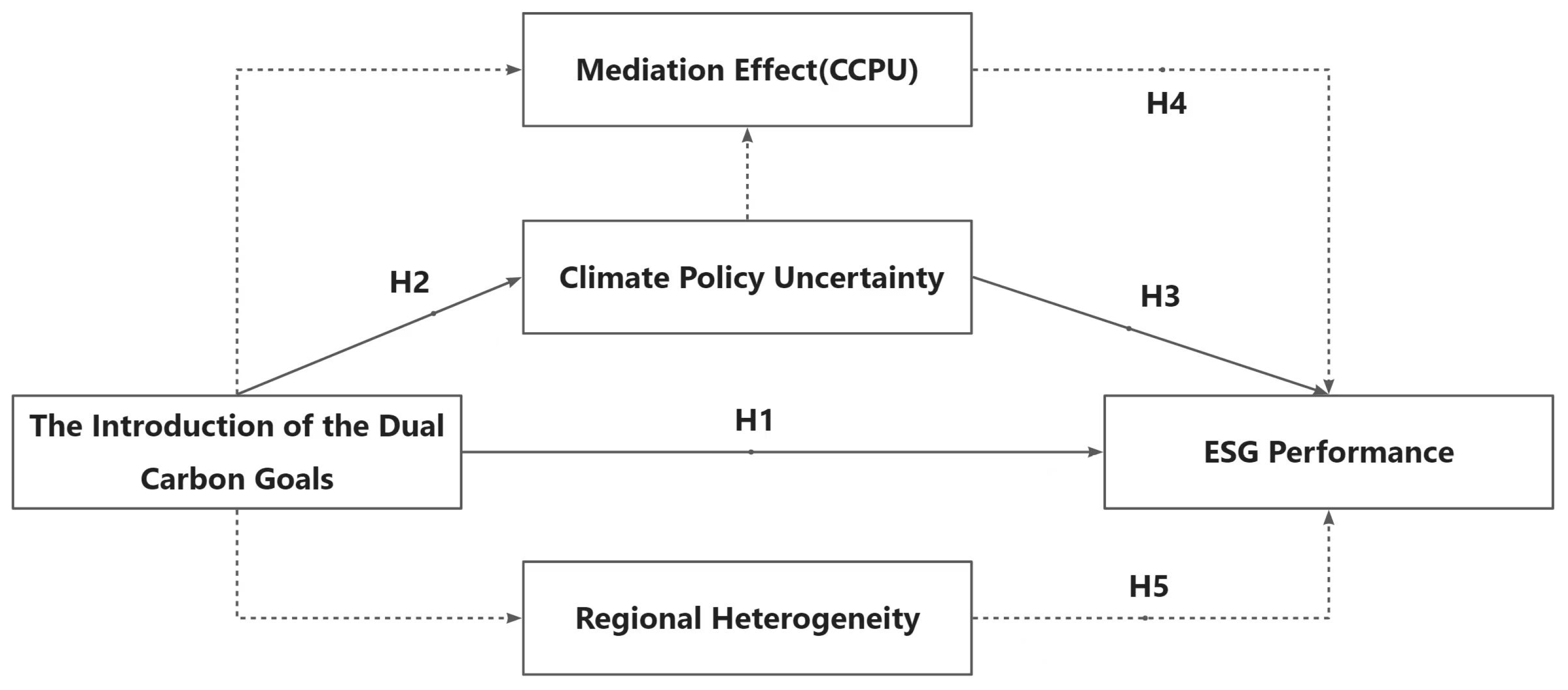
Figure 1 presents a diagram of the research framework to illustrate our study more clearly.
4. Results
This section systematically evaluates the causal effects of China’s dual-carbon goals on the ESG performance of energy-intensive enterprises via rigorous econometric methods. To ensure the reliability of the research conclusions, this study not only conducts benchmark regression analysis but also validates the model’s validity and the robustness of the results through parallel trend tests, propensity score matching (PSM-DID), and other methodologies.
4.1. Descriptive Analysis
The results of the descriptive statistical analysis of the variables are presented in
Table 2, which includes 31,070 observations. The mean ESG performance score for enterprises was 73.576, with a standard deviation of 4.993, a minimum value of 36.620, and a maximum value of 92.930. This finding indicates that the overall ESG performance of the sampled enterprises is moderately high, although significant variations exist among different companies.
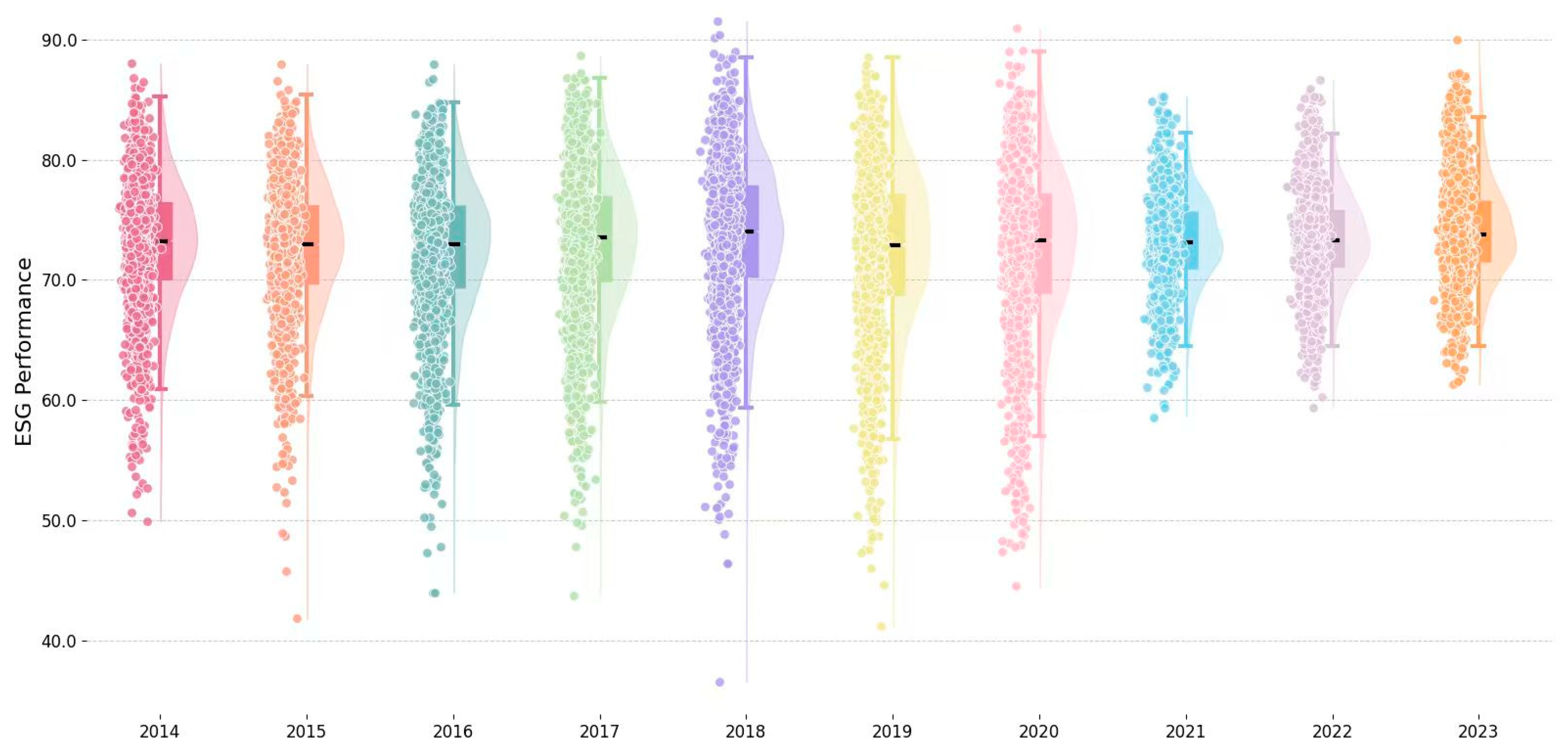
Further analysis of annual ESG performance yielded
Figure 2, revealing a clear positive trajectory of ESG scores across companies from 2014 to 2023. The scores rapidly evolved from a state of moderate performance with significant variation to a stable, high-level state characterized by overall excellence and strong industry consensus. Post-2020, the box plot in
Figure 2 noticeably narrows, indicating a significant reduction in the dispersion of ESG scores among companies. This reflects the broader trend of increasing emphasis on the effective implementation of ESG principles across relevant sectors. Strengthening global and national ESG regulatory policies, such as the EU’s Sustainable Finance Disclosure Regulation and China’s Carbon Peaking and Carbon Neutrality goals, has been key external drivers behind the convergence and high-level stabilization of corporate ESG scores since 2020.
Regarding the distribution characteristics of the other variables, asset size data exhibit pronounced right skewness, indicating a concentration of assets among a few large enterprises, whereas most companies operate at medium scales. The main business growth rate (Growth) shows extreme volatility with a high standard deviation of 12.868, reflecting unstable and high-risk revenue growth among the sample enterprises. The current ratio (Cr) exhibits relatively low volatility, with a standard deviation of 0.066, suggesting consistent liquidity management practices across the sample companies. The Climate Policy Uncertainty Index (CCPU) maintains a stable mean of 0.150, indicating consistent exposure to climate-related risks. The current ratio (Cr) exhibits relatively minor fluctuations with a standard deviation of 0.066, indicating high consistency in liquidity management across the sample companies. The Climate Policy Uncertainty Index (CCPU) had a mean of 1.807 and a standard deviation of 0.622, suggesting variations in climate policy environments across provinces and time periods.
The remaining variables reveal that enterprises exhibit a highly uneven distribution of asset data. Although there is little variation in enterprise scale, most companies fall within the medium range. The revenue growth rates show significant fluctuations, whereas the overall liquidity ratio exhibits minimal variation, indicating consistency in liquidity management across the sample enterprises.
A further analysis of corporate ESG performance over time is shown in
Figure 2, revealing a clear positive trajectory in terms of ESG scores from 2014 to 2023. Over the past decade, companies have rapidly evolved from a state of moderate scores with significant variation to a stable, high-level state characterized by overall excellence and strong industry consensus.
After 2020, the box plot portion in
Figure 2 noticeably decreased, indicating a significant reduction in the dispersion of ESG scores among companies. This reflects the overall trend of increasing emphasis on the effective implementation of ESG principles across relevant sectors. Since 2020, strengthening global and national ESG regulatory policies, such as the EU’s Sustainable Finance Disclosure Regulation and China’s Carbon Peaking and Carbon Neutrality goals, have served as key external drivers propelling the convergence and high-level stabilization of corporate ESG scores.
4.2. Difference-in-Differences Regression Results: The Dual Carbon Goals Exert a Suppressing Effect on Corporate ESG Performance
To identify the net impact of carbon peaking and carbon neutrality policies on the ESG performance of energy-intensive enterprises, this study constructs a difference-in-differences model, as shown in Equation (1). This model captures the change in the ESG performance of the treatment group (energy-intensive enterprises) relative to that of the control group (non-energy-intensive enterprises) following policy implementation.
Using the sample period from 2014 to 2023, this study measures the policy effects following the introduction of the “dual carbon” goals. After controlling for time, firm, and industry fixed effects, the benchmark regression results in
Table 3 reveal that carbon peaking and carbon neutrality policies significantly suppress the ESG performance of energy-intensive enterprises.
Column (1) controls for time fixed effects and firm-specific fixed effects without introducing other control variables. The results show that the coefficient for the interaction term was −0.824, which is statistically significant at the 1% level (standard error in parentheses). This preliminary finding indicates that the implementation of carbon peaking and neutrality significantly suppresses the ESG performance of energy-intensive enterprises. To address potential omitted variable bias further, Column (2) incorporates a series of control variables, including total assets (Asset), the debt-to-asset ratio (Lev), the main business growth rate (Growth), cash flow (Cash), the current ratio (Cr), firm size (Size), CEO risk preference (Rpi), due diligence (DD), corporate default risk (EDF), and the corporate bond financing cost (Cost). The regression results show that the coefficient of the interaction term changes to −0.925 and remains significant at the 1% level. This finding indicates that, after controlling for firm-level heterogeneity, the negative impact of the carbon peaking and carbon neutrality policy on the ESG performance of energy-intensive enterprises remains robust. Column (3) further controls for industry fixed effects to eliminate estimation biases from inherent differences across industries. The results show that the coefficient of the interaction term is −0.952, with a standard error of 0.200, indicating a statistically significant negative effect at the 1% level. The adjusted R2 of the model increases from 0.472 to 0.505, suggesting enhanced explanatory power after incorporating industry fixed effects. Synthesizing the results from all three columns, we conclude that, compared with non-energy-intensive enterprises, the implementation of carbon peaking and carbon neutrality significantly suppresses the ESG performance of energy-intensive enterprises.
In summary, Hypothesis 1 is validated.
4.3. Parallel Trends Test
The key prerequisite for the validity of the difference-in-differences approach lies in the parallel change trends between the treatment and control groups prior to policy implementation. To validate this premise, this study draws on the methodology of event studies to construct a dynamic effects model, as shown in Equations (4) and (5) [
35]. By introducing a multi-period interaction term before and after policy implementation, this model examines the differences in ESG performance between the treatment and control groups before and after the introduction of the “dual carbon” goals (2020).
If systematic differences existed between the two groups prior to policy introduction, biased regression results would be indicated, rendering the scientific assessment of the policy’s effects impossible. Therefore, this study examined the dynamic policy effects of carbon peaking and neutrality via the following model:
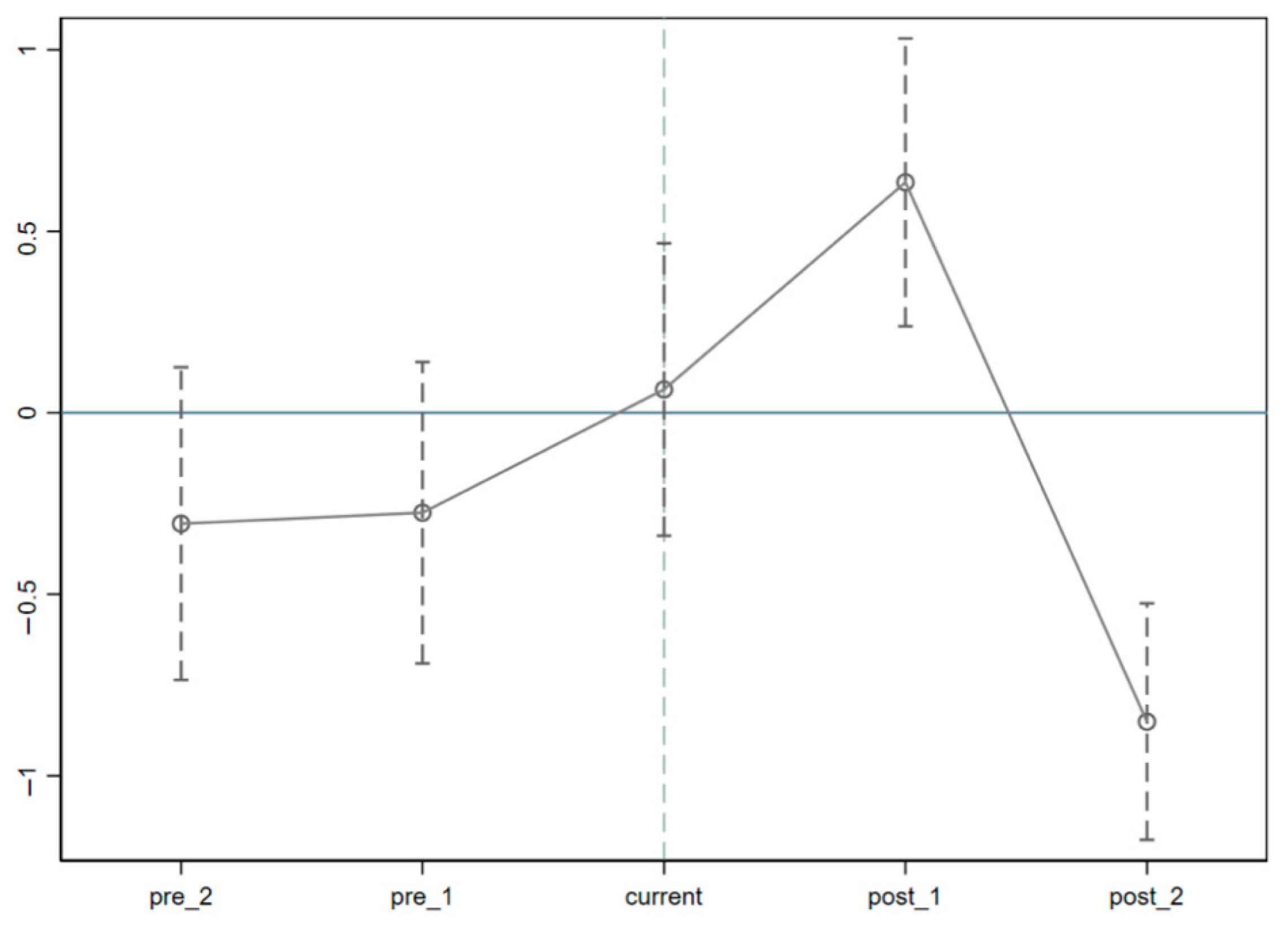
If year t + k is the |k|th year following the implementation year t (t = 2020) of the “dual carbon” initiative, then = 1; otherwise, = 0. The coefficient of in the regression results indicates whether the ESG performance trends of firms in the treatment and control groups are consistent.
Figure 3 presents the results of the dynamic effect tests. Prior to the introduction of the “dual carbon” goals, the coefficients of the interaction terms across all periods were not significantly different from zero, with their confidence intervals encompassing the zero line. This indicates that the ESG performance trends of the treatment and control groups were consistent before policy implementation, thus satisfying the parallel trend assumption. However, after the “dual carbon” goals were proposed, the coefficients of the interaction terms became significantly negative, and the effect values deviated markedly from the zero line. This indicates that after policy implementation, the ESG performance of the treatment group—high-energy-consuming enterprises—declines significantly relative to that of the control group.
Notably,
Figure 3 reveals the fluctuations in the magnitude of the policy effect after implementation. The significant positive result observed in the Post_1 period was followed by a sharp decline in the same period, which may be attributed to an external shock such as the COVID-19 pandemic in early 2020. The pandemic has had extensive and profound impacts on global economic activity, severely deteriorating the business environment, and substantially affecting the ESG performance of most enterprises. However, high-energy-consuming enterprises experienced a relatively small shock to their ESG performance, leading to a significant overall improvement in the ESG levels of such firms during this period. This does not imply that the policy effect promotes the ESG performance of high-energy-consuming enterprises. The subsequent substantial decline further demonstrates that policy implementation significantly constrains the ESG performance of these firms. Therefore, the results of the parallel trend test generally support the rationality of employing the difference-in-differences model.
4.4. Propensity Score Matchingt
Although the DID approach mitigates endogeneity issues to some extent, the systematic observable differences between the treatment and control groups prior to policy implementation may lead to biased estimation results. To avoid sample selection bias affecting regression outcomes, we employed propensity score matching (PSM) for robustness testing [
36].
First, on the basis of sample data from 2019 and earlier, prior to policy implementation, we conducted a logit regression. The dependent variable was whether a firm belonged to a high-energy-consumption industry (Treat i), while the independent variables included control variables such as assets, Lev, growth, cash, Cr, size, Rpi, DD, EDF, and cost. We estimate the propensity score for each sample firm to belong to the treatment group. Using the nearest neighbor matching method, we identified one or more control firms with the closest propensity scores for each treatment firm (high-energy-consuming firm) within the control group (non-high-energy-consuming firms). Finally, we conducted a rerun of the difference-in-differences regression analysis, using a matched balanced sample.
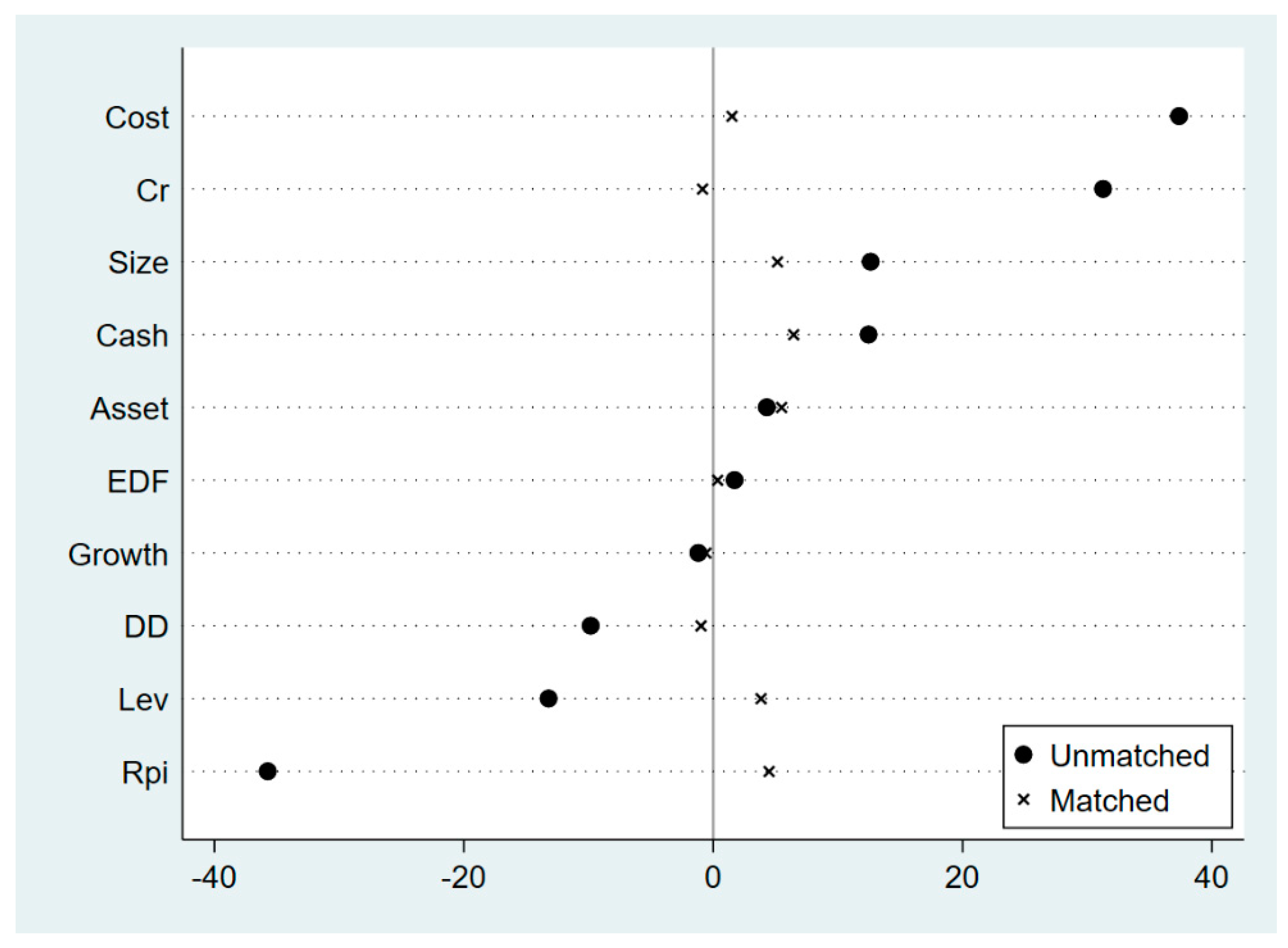
Figure 4 shows the propensity score matching results. The standard deviations between the mean values of each matched variable in the treatment and control groups differ significantly, whereas the matched cross-point distances to the zero line are very close. This finding indicates that the matched data from both groups yielded favorable results.
Table 4 reports the regression results of PSM-DID. Column (2) controls only for time- and firm-level fixed effects on the matched sample without including other control variables. The coefficient for did is −1.013 and significant at the 1% level. Column (3) includes all control variables and controls for industry fixed effects on the matched sample. The coefficient for did is −1.062 and significant at the 1% level. Both results maintain the same sign and significance as the benchmark regression, with slightly larger absolute coefficient values. This finding indicates that even after controlling for sample selection bias, the inhibitory effect on ESG performance in high-energy-consuming enterprises caused by the carbon peaking and carbon neutrality policy remains robust, further supporting Hypothesis 1.
4.5. Placebo Test
Finally, we conduct a placebo test on the model. In the difference-in-differences (DID) model, the importance of performing a placebo test lies in verifying the authenticity and reliability of research findings. The placebo test helps researchers distinguish the intervention effect from the changes caused by other non-policy factors. If a similar effect is observed in the absence of policy intervention, then one cannot be certain that the actual effect was indeed caused by the policy. Therefore, the placebo test can strengthen confidence in the model’s causal inference.
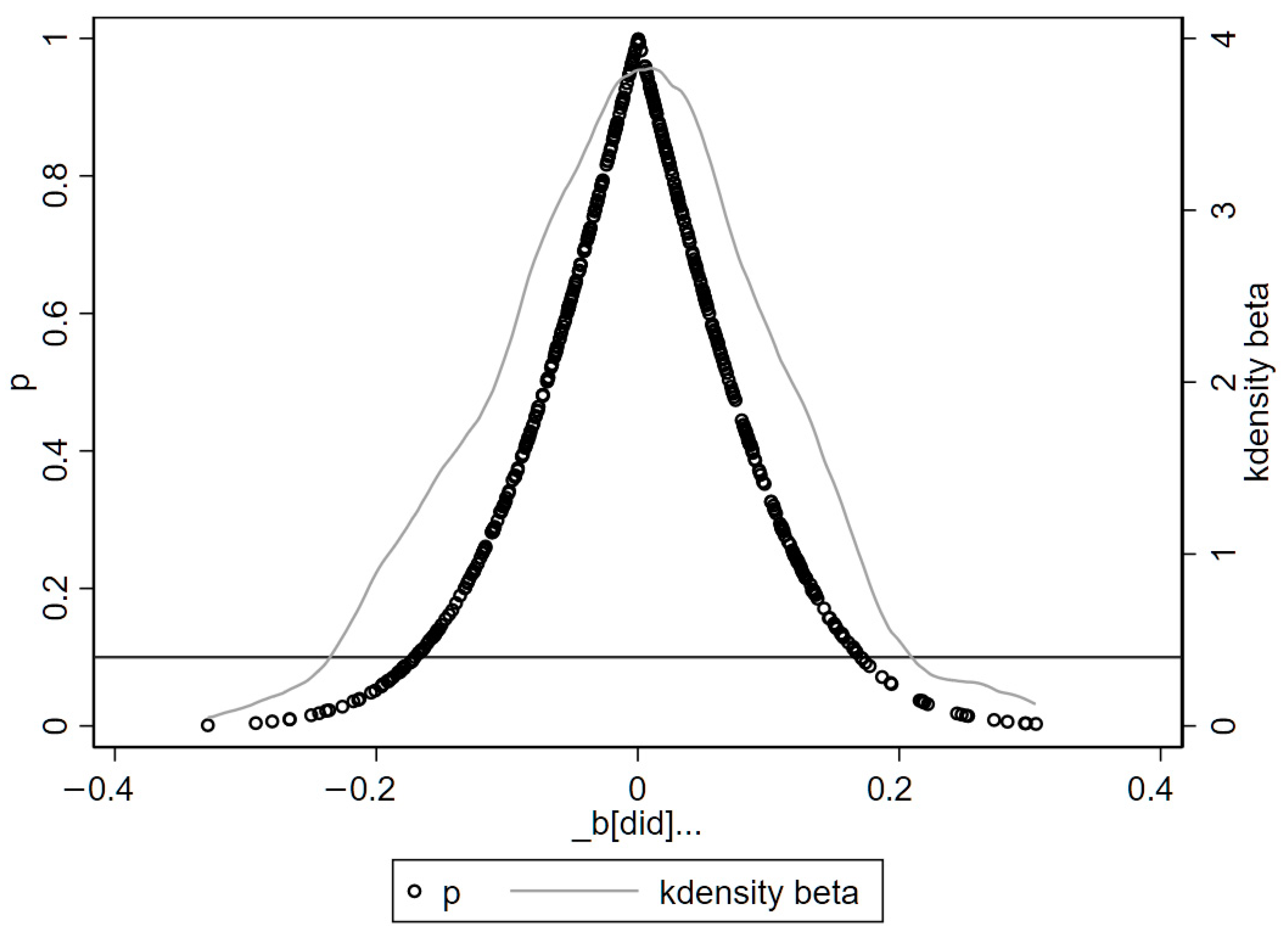
In this study, an individual placebo test was conducted by analyzing the kernel density plot to observe whether the test passed. In terms of the testing method, if the obtained points on the kernel density are highly concentrated near zero, it indicates that the test has passed. The analysis of the results in
Figure 5 shows that the points on the kernel density curve are all very close to zero, indicating that the placebo test is passed and that the model is valid.
4.6. Mechanism Analysis
On the basis of the benchmark regression results presented earlier, this study confirms the significant inhibitory effect of the “dual carbon” goals on the ESG performance of energy-intensive enterprises. To further clarify the underlying logical chain of policy impacts and reveal differentiated effects under various scenarios, this section conducts an in-depth exploration of two dimensions: mechanism path testing and regional heterogeneity analysis. This study aims to provide targeted insights into policy formulation and corporate practices.
4.6.1. Channel Tests
On the basis of the preceding theoretical analysis, following the introduction of dual-carbon goals, governments at all levels must formulate specific implementation plans. Frequent policy adjustments make it difficult for enterprises to predict outcomes. Therefore, the introduction of dual-carbon goals can impact corporate ESG performance by increasing climate-policy uncertainty. This study employs a three-stage test to identify this transmission mechanism and constructs model (2–3) to capture the mediating effect [
37].
The instrumental variable was climate-policy uncertainty (CCPU). This study employed the China Provincial Climate Policy Uncertainty Index developed by Ma to characterize the degree of climate policy uncertainty [
38]. This index was quantified via a combination of manual auditing and deep learning algorithms. First, six mainstream Chinese newspapers—People’s Daily, Guangming Daily, Economic Daily, Global Times, Science and Technology Daily, and China News Service—were selected as primary data sources on the basis of their credibility, influence, and internationalization. Second, the deep learning algorithm MacBERT was employed to automatically identify the text content and extract vocabulary related to climate-policy uncertainty. Third, the number of news articles containing terms related to climate-policy uncertainty within a specific period was calculated and divided by the total number of articles during that period to obtain the raw data. Finally, the raw data were normalized to derive the climate-policy uncertainty index. Columns (2) and (3) of
Table 5 report the test results for the climate-policy uncertainty constraint mechanism. Column (2) indicates that the coefficient for the impact of the “dual carbon” goals on climate policy uncertainty is 0.116, suggesting that the “dual carbon” goals significantly increase climate policy uncertainty. Column (3) shows that the coefficients for the impact of both “dual carbon” goals and climate policy uncertainty on corporate ESG performance are significantly negative, revealing that climate policy uncertainty is the core mediating channel through which carbon peaking and carbon neutrality suppress corporate ESG performance.
China’s resource endowment dictates high economic development. However, with only 30 years between the carbon peak and carbon neutrality, accelerating the low-carbon transition risks disorderly climate policy shifts. This manifests as uncertainty in policy-making bodies, the timing and content of policy issuance, and policy effectiveness and outcomes. Frequent climate-policy adjustments increase corporate compliance costs and financing constraints while blurring long-term strategic clarity, adversely affecting corporate ESG performance [
39]. Consequently, achieving dual carbon goals inevitably triggers disorderly climate-policy shifts, heightening climate-policy uncertainty and further disrupting real economic development. In summary, H2, H3, and H4 were validated.
Given China’s vast territory, significant regional variations exist in economic development, industrial structures, resource endowments, policy enforcement rigor, and market scale. Consequently, the impact of carbon peaking and carbon neutrality policies on the ESG performance of energy-intensive enterprises may not be universally applicable. To explore this potential regional heterogeneity, this study employed a grouped regression analysis based on the geographical classification of China by the National Bureau of Statistics into Eastern, Central, and Western regions.
4.6.2. Analysis of Regional Heterogeneity
Given that enterprises are distributed across the country, objective differences exist in policy implementation, resource endowments, and the market scale among regions, necessitating heterogeneity analysis. This section divides the entire sample into three groups—eastern, central, and western—on the basis of China’s geographical divisions [
40].
As shown in
Table 6, the “dual carbon” goals suppressed the ESG performance of energy-intensive enterprises across different regions. Among these, the policy impact was strongest in the eastern region and weakest in the western region. This disparity stems from the eastern region being an economically dense area with multiple peak carbon pilot zones, which leads to stricter policy enforcement. In contrast, the western region benefits from relatively lenient policies and significant resource endowment advantages, resulting in a weaker impact. This regional variation in policy effectiveness profoundly reflects China’s uneven regional economic development and the localized characteristics of policy implementation. The strong effect in the eastern region highlights its high standards and strict requirements for policy execution, implying that enterprises in this area must proactively address transformation challenges. The comparatively weaker impact in the western region suggests that policymakers should prioritize regional development particularities. When advancing the “dual carbon” goals, they should adopt tailored approaches based on local resource conditions and industrial foundations and develop more flexible implementation pathways to balance economic growth with low-carbon transition objectives. Moreover, central regions must seek optimal integration points between policy execution and industrial transformation.
5. Discussions
On the basis of the empirical findings, mechanism analysis, and heterogeneity analysis, this section presents an in-depth discussion of the data relationship between carbon peaking and carbon neutrality policy and corporate ESG performance. The empirical results primarily stem from difference-in-differences regression, parallel trend tests, and propensity score matching analysis, whereas the mechanism and heterogeneity analysis findings mainly originate from three-stage mediation effect tests and regional heterogeneity analysis.
5.1. Analysis of the Benchmark Regression Results
The benchmark regression results in
Table 3 clearly indicate that the coefficient of the DID for the interaction term between the carbon peaking and carbon neutrality dummy variables and the time dummy variable is significantly negative across the multiple model specifications. Specifically, when controlling for only time- and firm-level fixed effects without additional controls, the estimated coefficient for DID is −0.824, which is significant at the 1% level. After incorporating a series of firm-level controls, the absolute value of the coefficient increases to −0.925, remaining significantly negative. Further controlling for industry fixed effects stabilizes the coefficient at −0.952, maintaining significance while enhancing the model’s explanatory power. These results indicate a stable negative correlation between carbon peaking and carbon neutrality policies and the ESG performance of energy-intensive enterprises. The negative and statistically significant coefficient directly supports H1: the introduction of carbon peaking and carbon neutrality goals suppresses the ESG performance of energy-intensive enterprises. This finding contrasts with some expectations that “policies drive ESG improvement,” revealing the potential short-term compliance pressures and adjustment costs imposed by the policy [
41]. The primary reason why carbon peaking and carbon neutrality goals suppress the ESG performance of energy-intensive enterprises lies in the short-term compliance pressures and high adjustment costs arising during the initial implementation phase of the policies. Energy-intensive enterprises must undertake large-scale technological upgrades, energy structure adjustments, and carbon emission control. These transformations typically require substantial investments and may negatively affect short-term financial performance. Furthermore, policy uncertainty and strict enforcement may heighten corporate risk, causing enterprises to prioritize compliance and cost control over long-term ESG goal advancement when facing regulatory pressure. Consequently, policy initiatives may temporarily increase the corporate burden, thereby affecting ESG performance outcomes.
High-energy firms face a “capital crowding-out effect”—short-term emission-reduction investments (e.g., carbon capture equipment) occupy funds that would otherwise be allocated to social responsibility (e.g., employee welfare) or governance optimization (e.g., board diversity), reducing overall ESG performance. Additionally, policy-driven production restrictions (e.g., output cuts) lower short-term revenue, forcing firms to cut ESG-related expenditures to maintain cash flow. According to institutional theory, mandatory policy pressure drives firms to pursue “minimal compliance” (meeting emission standards) rather than “substantive ESG improvement,” aligning with the “institutional isomorphism” logic (firms conform to external rules to avoid sanctions). From the resource-based view, high-energy firms are locked in “high-carbon path dependence”; their limited green resources (e.g., low-carbon technology reserves) make comprehensive ESG upgrades unfeasible in the short term.
This study’s finding that dual-carbon policy suppresses the ESG performance of high-energy-consuming enterprises aligns with the empirical observation that Chinese energy enterprises generally exhibit “average ESG performance with unbalanced dimensional development.” Specifically, some students reported that the governance (G) dimension of energy enterprises performs the worst, whereas this study further revealed that the environmental (E) dimension bears the brunt of policy-induced suppression. This consistency reflects the structural bottleneck of ESG development in China’s energy sector: energy enterprises struggle to balance multiple goals (emission reduction, energy security, and governance optimization) in the short term. However, a key difference emerges: attributing poor ESG performance to inadequate internal governance mechanisms (e.g., an imperfect board structure), while this study emphasizes external policy uncertainty as a core external shock. This suggests that energy enterprises’ ESG performance is jointly shaped by internal governance deficiencies and external policy pressure [
42]. Additionally, digital economy development has an inverted U-shaped effect on industrial carbon emission efficiency, highlighting the “cost-increase stage” of low-carbon transformation, which resonates with the short-term compliance cost pressure emphasized in this study, both of which verify that the industrial low-carbon transition inevitably entails initial cost burdens that constrain sustainability performance [
43].
5.2. Analysis of Parallel Trend Test Results
Parallel trend testing is a prerequisite to the validity of the difference-in-differences approach. The policy dynamic effect simulation results presented in
Figure 3 show that in the years prior to the introduction of the carbon peaking and carbon neutrality goals, the policy effect value fluctuated stably around −0.5 with little variation, and its confidence intervals included zero. This finding indicates that there was no significant difference in the trend of ESG performance changes between the treatment group (high-energy-consuming enterprises) and the control group (non-high-energy-consuming enterprises) before policy implementation, satisfying the parallel trend assumption. Following policy implementation, the policy effect value significantly increased and diverged from zero, confirming that the policy shock led to a relative deterioration in the ESG performance of the treatment group enterprises. Notably, while the effect size declined after 2020 due to external shocks such as the COVID-19 pandemic, the main policy effect remained prominent. This dynamic pattern reinforces the reliability of the baseline regression results from a temporal perspective, confirming that the deterioration in ESG performance stems directly from policy shocks rather than pre-existing differences before policy implementation.
The pre-policy parallel trend reflects that high- and low-energy firms had similar resource allocation logics (prioritizing traditional production over ESG) in the absence of mandatory carbon constraints; thus, their ESG trends converged. Post-policy divergence arises because high-energy firms bear unique emission-reduction costs (e.g., carbon quota purchases) that low-energy firms avoid, thus widening ESG gaps. The weakening of the 2020 effect is due to pandemic-induced policy flexibility (e.g., delayed emission targets), which reduces short-term compliance pressure. From the causal inference framework, the parallel trend satisfies the “exogeneity assumption” of DID—policy shocks are not confounded by pre-existing firm heterogeneity. Temporal dynamics align with the “policy shock transmission” logic (treatment effects emerge only after policy implementation), supporting the causal link between dual-carbon policy and ESG suppression.
The pre-policy parallel trend of ESG performance in high- and low-energy firms observed in this study is consistent with the spatial convergence characteristics of industrial carbon emission efficiency in Chinese cities [
43]. Before the widespread promotion of low-carbon policies, industrial carbon emission efficiency in most cities showed a slow and synchronous growth trend, which essentially reflects the consistent resource allocation logic of industrial enterprises in the traditional development stage. However, post-policy trends differ: a “south-high and north-low” spatial pattern of carbon emission efficiency due to differences in energy structure (e.g., northern reliance on coal), whereas this study reveals an ESG performance divergence driven by policy shock differences between high- and low-energy firms. This difference arises from research perspectives that focus on spatial resource endowment disparities, whereas this study emphasizes industry-specific policy sensitivity. Additionally, some students did not observe a significant temporal convergence trend in ESG performance across energy enterprises, possibly because their sample included only key pollutant-discharging energy enterprises and lacked a control group of non-high-energy firms, thus failing to capture inter-industry trend consistency [
42].
5.3. Robustness Analysis of Checking Mechanisms
To eliminate the potential impact of sample selection bias on the results, we employed propensity score matching for robustness testing.
Figure 4 shows that, after matching, the standard deviations of all control variables between the treatment and control groups significantly narrowed, with the mean differences approaching zero. This finding indicates that the matching process effectively eliminated intergroup heterogeneity. The PSM-DID regression results reported in
Table 4 further reveal that after controlling for time, firm, and industry fixed effects and incorporating control variables, the DID coefficients remain significantly negative across different settings. Their magnitudes closely aligned with the benchmark model results. This data relationship strongly indicates that the observed policy suppression effect does not stem from sample selection bias but represents a robust causal relationship. Sample selection bias (e.g., larger high-energy firms are more likely to be regulated) could overstate policy effects. Matching aligns firm size, profitability, and ownership between groups, and similar firms face identical market conditions; therefore, the remaining ESG gap can be attributed only to policy shocks (not inherent firm differences). From the counterfactual framework, PSM constructs a “valid control group” (firms similar to the treatment group but unaffected by policy), ensuring that the policy effect reflects the true causal impact (not selection bias). This aligns with the core requirement of causal inference, which isolates the net effect of the independent variable.
In summary, the empirical findings collectively reveal a stable negative causal relationship between carbon peaking and carbon neutrality policies and the ESG performance of energy-intensive enterprises. This discovery offers significant insights for deepening our understanding of the economic effects of China’s carbon peaking and carbon neutrality strategies. Although the long-term goal is to promote green and low-carbon transformation, energy-intensive enterprises may face significant adaptation challenges during the initial stages of policy implementation. This leads to substantial short-term pressure on ESG performance, particularly in the environmental (E) dimension. Long-term policy benefits (e.g., green premium in capital markets) are offset by short-term adjustment costs (e.g., technological transformation). The environmental dimension (E) is most affected because it bears the direct cost of emission reduction (e.g., pollution control equipment), whereas the social (S) and governance (G) dimensions are neglected because of resource constraints. From the dynamic capability view, firms need time to build “low-carbon dynamic capabilities” (e.g., green innovation and carbon management). In the short term, their limited capabilities cannot balance compliance with ESG improvement, leading to a “short-term trade-off” between policy adaptation and ESG performance.
The mediation effect test results in
Table 5 indicate that carbon peaking and neutrality significantly increase climate-policy uncertainty. Furthermore, after introducing CCPU, the DID coefficient remains significantly negative, with an absolute value exceeding the direct effect, whereas the CCPU coefficient is also significantly negative. This aligns with the “partial mediation” model, confirming that climate policy uncertainty serves as a core transmission channel through which the carbon peaking and carbon neutrality policy suppresses corporate ESG performance. Policy uncertainty (e.g., ambiguous carbon quota standards) increases firms’ risk expectations; they delay long-term ESG investments (e.g., green R&D) to avoid sunk costs and reduce ESG performance. Uncertainty also increases financing costs (investors demand a risk premium), further limiting ESG-related expenditures. According to real options theory, firms delay irreversible investments (e.g., ESG projects) when facing uncertainty, waiting for clearer policy signals. This “wait-and-see” strategy reduces short-term ESG input, thus mediating the negative effect of the policy on ESG performance.
The study grouped the sample by China’s geographical regions (East, Central, and West) for the regression analysis.
Table 6 reveals that the carbon peaking and carbon neutrality policy’s ability to suppress ESG performance in energy-intensive enterprises exists across all three regions, but its intensity varies significantly: East China > Central China > West China. The policy effects are relatively strong in East China and weakest in West China. Eastern regions have stricter environmental regulations (e.g., higher carbon taxes) and more developed capital markets; firms face greater compliance pressure and higher financing costs for emission reduction, amplifying ESG suppression. Western regions rely more on high-energy industries for GDP; therefore, policies are enforced more flexibly, reducing short-term adjustment costs. According to institutional theory, regional institutional environments (e.g., regulatory intensity and marketization level) moderate policy effects. The East’s stronger institutional pressure (stricter enforcement) increases firms’ compliance burdens, whereas the West’s weaker institutions reduce policy stringency, leading to heterogeneous effects.
Through rigorous empirical analysis, this study reveals the short-term suppression effect of a carbon peaking and carbon neutrality policy on the ESG performance of energy-intensive enterprises along with its underlying mechanisms and boundary conditions. These findings collectively form a crucial academic foundation for understanding the microeconomic impacts during the initial implementation phase of China’s “dual carbon” strategy. They also provide a starting point for subsequent research exploring the long-term effects of policies, corporate adaptation strategies, and policy optimization pathways.
6. Conclusions
Research indicates that climate-policy uncertainty significantly suppresses corporate ESG performance with regional heterogeneity. To advance the synergy between carbon peaking and carbon neutrality goals and corporate sustainable development, a systematic approach is needed to encompass policy formulation, corporate empowerment, and regional coordination.
6.1. Policy Recommendations
Enterprises can be empowered to increase their ESG resilience and mitigate the impact of uncertainty. Companies must integrate climate-policy uncertainty into their strategic cores. First, a “climate policy tracking and analysis task force” is established to monitor real-time dynamics such as carbon market quotas, combining industry trend forecasts with adjustments to prevent resource misallocation. Second, we optimize resource allocation by ensuring short-term compliance investments while establishing dedicated ESG funds and cobuilding green technology labs to stabilize low-carbon R&D and social responsibility commitments. Finally, enhancing internal governance by linking ESG performance to executive compensation and departmental evaluations requires high-energy-consumption business lines to disclose compliance costs and emission reduction outcomes, thereby shifting ESGs from “formal disclosure” to “substantive implementation”.
Governments must optimize policy-making mechanisms around “stabilizing expectations, reducing costs, and strengthening coordination.” First, establish a “top-level design + dynamic transparency” framework by releasing carbon market and green finance roadmaps 3–5 years in advance, providing buffer periods for high-carbon industries, and publicly disclosing the rationale and impact assessments for policy adjustments. Second, cross-departmental coordination platforms were built to standardize ESG disclosure criteria and green bond standards while establishing a national climate-policy database. Third, implement tiered policies based on regional disparities: promote ESG pilots in eastern regions while prioritizing transition support in central and western areas to balance emissions reduction with regional development.
Investors and market institutions must play a guiding role in driving high-quality ESG development. Institutional investors should incorporate climate-policy uncertainty into investment decisions, prioritizing allocations to companies with strong policy-adaptation capabilities through ESG funds and green bonds while restricting investments in high-carbon enterprises lacking transition plans. Third-party service providers must refine ESG evaluation systems by increasing the weighting of dimensions such as “policy compliance capability” and “low-carbon technology commercialization potential.” They should also offer policy interpretations and ESG verification services to help the market identify companies that practice ESG genuinely, thereby compelling enterprises to increase their ESG management standards.
6.2. Research Limitations
Although this study systematically reveals the impact of climate-policy uncertainty on corporate ESG performance under carbon-peaking and carbon-neutrality policies through a quasinatural experimental design, multidimensional robustness tests (parallel trends test, PSM-DID, etc.), and mechanism analysis, the following limitations remain.
First, the measurement dimensions of climate-policy uncertainty require expansion. Although the CCPU index, constructed from provincial-level news texts, serves as a proxy variable reflecting overall regional policy fluctuations, it fails to delve into industry-specific or firm-level micro-level details. Different industries (e.g., energy-intensive sectors such as steel and chemical industries) exhibit varying sensitivities to carbon peaking and carbon neutrality adjustments, a phenomenon supported by empirical evidence that climate-policy uncertainty exerts heterogeneous impacts across industrial sub-sectors [
5]. For example, pollution-intensive industries are more vulnerable to policy fluctuations, with significant declines in investment activities compared with low-emission sectors. Moreover, the analysis excludes firms’ internal perceptions of policy uncertainty (e.g., management decision preferences and policy interpretation capabilities), which is a critical oversight given that firm-specific responses to climate-policy uncertainty are shaped by internal governance and strategic orientations. This omission potentially leads to imprecise characterizations of its actual impact, as macro-level indices often fail to capture the nuanced effects of policy uncertainty on individual firms’ behaviors and outcomes [
44].
Second, the sample and research context have certain limitations. This study focuses on Chinese A-share listed companies from 2014 to 2023, excluding unlisted firms and SMEs. Unlisted companies remain a significant component of China’s energy-intensive industries, and their ESG management levels and policy responsiveness may differ markedly from those of listed firms, indicating room for improvement in sample representativeness. Second, the difference-in-differences approach does not examine the synergistic or conflicting effects between carbon peaking and carbon neutrality and other macro policies, such as green finance and industrial subsidies. It also does not address the spillover effects of international climate-policy fluctuations, such as the EU Carbon Border Adjustment Mechanism (CBAM), on Chinese firms’ ESG performance. This insufficient coverage of scenario complexity may limit the generalizability of the findings.
Third, the depth of the mechanism analysis lacks a sufficient connection to governance structures. Although this study validated the mediating pathway, it failed to explore further mitigation strategies through governance mechanisms. In a systematic review following the PRISMA guidelines, robust governance mechanisms such as board diversity and the strategic integration of ESG standards are key drivers of enhanced ESG performance [
45]. They also highlight significant gaps in the current research regarding the interaction between governance structures and ESG practices. This study does not incorporate governance mechanisms into its analytical framework. It neither examined the moderating role of climate policy uncertainty and ESG performance nor analyzed how energy-intensive firms mitigate policy uncertainty shocks by optimizing governance structures. Consequently, it fails to fully reveal the internal logic of firms mitigating negative policy impacts and does not address the academic demand for research on governance–ESG interactions. Furthermore, existing analyses have not deconstructed the differentiated impact mechanisms of uncertainty on three ESG dimensions (environmental, social, and governance). For example, the suppression of the “environmental dimension” by policy uncertainty may stem from reduced green investments, whereas its impact on the “social dimension” may be linked to squeezed employee welfare expenditures. However, the unique transmission logic for each dimension remains unclear.
6.3. Future Research
Although this study systematically reveals the impact of climate-policy uncertainty on corporate ESG performance under carbon-peaking and carbon-neutrality policies through a quasinatural experimental design, multidimensional robustness tests (parallel trends test, PSM-DID, etc.), and mechanism analysis, future research can be expanded in the following four directions:
The measurement dimensions of climate-policy uncertainty should be optimized. The existing CCPU index, which is based on provincial-level news texts, lacks precise depictions at the industry and enterprise micro-levels. Future efforts should develop city- or industry-level sub-indicators while incorporating enterprise survey data to quantify subjective perceptions, thereby addressing the limitation that macrolevel indices struggle to reflect the heterogeneous responses of micro-level entities. The sample period is extended, and multiple policy shocks are incorporated. The timeframe should be expanded to track the long-term effects of carbon peaking and carbon neutrality policies, other macro policies, such as green finance and industrial subsidies, should be integrated, and the combined impact of policy coordination or conflicts on corporate ESG performance should be analyzed. Simultaneously, we examine spillover effects from international policy fluctuations, such as the EU carbon border adjustment mechanism (CBAM), to comprehensively reveal cross-regional transmission pathways of uncertainty.
Expanding the DID methodology and integrating diverse research approaches. In addition to DID models, structural equation modeling (SEM) can be used to uncover intrinsic correlations among ESG dimensions, or big data analysis of real-time corporate carbon emissions and energy usage can be used to deepen the research on the impact of policy uncertainty on environmental performance. On the basis of stakeholder theory and the resource-based view (RBV), this study explores how energy-intensive enterprises enhance ESG performance by optimizing governance structures and refining social responsibility measures, offering diverse perspectives for policymakers and corporate managers.
Deepening the mechanism by integrating ESG controversy models with environmental performance models. On the one hand, ESG models can be used to examine how climate policy uncertainty influences corporate compliance decisions and whether it exacerbates or mitigates controversial risks stemming from environmental violations and social responsibility shortcomings during “Carbon Peaking and Carbon Neutrality” implementation, thereby affecting ESG performance. However, the environmental performance model decomposes environmental outcomes into specific metrics such as pollution reduction, green innovation investment, and resource efficiency. This clarifies the differentiated impacts of uncertainty while incorporating the moderating role of ESG controversies, revealing the complete transmission chain, and offering targeted guidance for optimizing corporate ESG management.
These expanded studies are expected to reveal more comprehensively and deeply the relationship between climate policy uncertainty and corporate ESG performance, providing stronger theoretical support and practical guidance for synergistically advancing “dual carbon” goals and high-quality economic development.