
Article

Spatial and Economic Differentiation of Land Use for Organic Farming in the European Union
by
Adam Pawlewicz
1,* and
Katarzyna Pawlewicz
2,*
1
Department of Market and Consumption, Institute of Economics and Finance, Faculty of Economic Sciences, University of Warmia and Mazury in Olsztyn, 10-719 Olsztyn, Poland
2
Department of Socio-Economic Geography, Institute of Spatial Management and Geography, Faculty of Geoengineering, University of Warmia and Mazury in Olsztyn, 10-719 Olsztyn, Poland
*
Authors to whom correspondence should be addressed.
Sustainability 2026, 18(3), 1454; https://doi.org/10.3390/su18031454
Submission received: 30 December 2025 / Revised: 15 January 2026 / Accepted: 23 January 2026 / Published: 1 February 2026

Abstract

This study investigates the spatial and economic differentiation of organic farming across the European Union by analyzing regional specialization patterns using Location Quotients (LQ). The results reveal a highly heterogeneous landscape shaped by the interaction of agro-ecological conditions, production traditions, market development, and structural characteristics of national agricultural systems. Six distinct regional models of organic farming are identified: the Nordic–Baltic cereal–forage model, the Alpine–Central European grassland model, the Mediterranean permanent-crop model, the Central–Eastern European raw-material model, the Western European intensive horticultural model, and the island-based niche-specialization model. Regression analyses show that overall organic specialization is strongly associated with market development, whereas the structure of organic crop production is primarily determined by agro-ecological and structural factors rather than consumer demand or purchasing power. These findings highlight the strong embeddedness of organic farming within long-term regional development pathways and underscore the need for regionally differentiated policy instruments within the Common Agricultural Policy. Effective support measures should be tailored to dominant crop types, production systems, and comparative advantages across Member States.

1. Introduction

The concept of sustainable development, first defined in the 1987 Brundtland Commission report, has evolved from a niche idea into a foundational paradigm shaping global and regional economic and social policy. Sustainable development is therefore understood as development that “meets the needs of the present without compromising the ability of future generations to meet their own needs” [1]. At its core lies the integration of three dimensions—economic, social, and environmental—often referred to as the “triple bottom line” [2,3,4,5]. This framework implies that long-term economic success cannot be assessed solely through GDP growth indicators but must also account for resource efficiency, reduced environmental impacts, social equity, and community well-being [6,7,8,9].
Contemporary challenges—including climate change, biodiversity loss, the depletion of natural resources, environmental pollution, and widening social inequalities—have necessitated a fundamental shift in the prevailing economic paradigm. The traditional linear “take–make–dispose” model is increasingly giving way to more integrated approaches, such as the circular economy [10,11,12], which emphasizes waste minimization, resource reuse, and the design of products for durability and recyclability. The European Union actively promotes this paradigm through strategic frameworks such as the European Green Deal [13], which aims to make Europe the world’s first climate-neutral continent by 2050. The Farm to Fork Strategy constitutes a key component of the Green Deal, seeking to transform food systems toward sustainability, health, and universal accessibility [14,15]. In this context, agriculture—both as a fundamental sector of national economies and as a central domain of natural resource management—has become a focal point of policy attention, with its alignment to sustainable development principles emerging as a priority. Understanding and implementing these principles is therefore not only a matter of ecological and social responsibility but also a critical determinant of long-term economic competitiveness and stability. Consequently, research on economic sectors that actively embody this paradigm, including agriculture and particularly organic farming, has gained growing importance [16,17,18,19].
Organic farming, defined as an agricultural production system aimed at minimizing negative environmental impacts, preserving biodiversity, improving soil and water quality, and employing practices that are safe for both humans and animals, is widely regarded as one of the key pillars of sustainable development within the agricultural sector [20,21,22,23,24]. Its core practices—including the prohibition of synthetic pesticides and mineral fertilizers, the use of crop rotation, composting, natural fertilizers, and the promotion of biodiversity (e.g., through the preservation of ecological buffer strips and the cultivation of melliferous plants)—directly contribute to the environmental objectives of sustainable development [22,25,26]. Empirical studies highlight numerous benefits of organic farming, such as improved soil quality and carbon sequestration capacity, reduced risks of groundwater and surface-water contamination, enhanced biodiversity in rural landscapes, and lower greenhouse gas emissions compared with conventional farming systems [27,28,29,30,31].
The social dimension of organic farming encompasses the promotion of consumer health by providing food free from pesticide residues and potentially with higher nutritional value (although this remains a subject of ongoing debate and research) [32,33,34], as well as improvements in farmers’ working conditions, job satisfaction, and reduced exposure to harmful chemicals [35,36,37,38,39]. Moreover, the development of organic farming can support rural development, job creation, and the preservation of traditional landscapes [40,41,42,43,44].
Economically, the organic farming sector has been experiencing dynamic global growth, driven by increasing consumer awareness and rising demand for healthier food products [45,46,47,48,49]. Although organic products often command higher market prices, studies on the profitability of organic farms yield mixed results, reflecting the influence of multiple factors, including support schemes and management efficiency [50,51,52,53]. Within the framework of EU strategies such as the European Green Deal and the Farm to Fork Strategy, organic farming is viewed as a crucial instrument for transforming food systems toward greater sustainability, aligning with goals such as reducing pesticide and fertilizer use, expanding the share of organic agricultural land, and protecting biodiversity. Consequently, analyzing the dynamics and spatial distribution of this sector is essential for assessing progress toward broader sustainable development objectives.
The development of organic farming is a multifaceted phenomenon shaped by the interaction of numerous factors that can be grouped into several key categories. First, agricultural and regulatory policy factors play a crucial role [54,55,56]. Certification systems, production standards, and—above all—financial support mechanisms (including subsidies for eco-schemes and agri-environment–climate payments under the EU Common Agricultural Policy) directly influence the profitability and overall attractiveness of organic farming for producers [57,58,59,60,61]. National and regional policies implementing EU frameworks may create differentiated support conditions across individual Member States [62,63,64].
Second, market-related factors are of critical importance. Growing consumer demand—driven by concerns about health, environmental protection, and food quality—constitutes a primary stimulus for the expansion of the organic products market [32,33,46,49,65,66]. The availability of organic products across distribution channels (including supermarkets, specialty stores, and direct sales), together with consumer awareness, purchasing power, and willingness to pay premium prices for certified goods, determines the size and dynamics of the market [51,67,68,69,70]. The development of organic food processing and logistics further influences the availability and competitiveness of organic products [71,72,73,74].
Third, farm-level factors play a fundamental role. Farmers’ decisions to convert to organic farming depend on their knowledge, environmental attitudes, assessments of economic profitability, perceived risks, access to information and advisory services, as well as the structural characteristics of their farms (including size, available resources, and type of production) [75,76,77,78]. Common barriers include the costs of conversion, insufficient technical knowledge, difficulties in obtaining certification, and market uncertainty [79,80,81,82,83].
Fourth, environmental and geographical factors—such as soil type, climate, water availability, and topography—can influence the potential for developing specific types of organic crops in a given region [22,29,84,85,86].
Finally, social, and cultural factors, including agricultural traditions and the attitudes of local communities, may also play an important role. The integration of these factors is essential for understanding the differences in the pace and direction of organic farming development observed across regions and EU Member States [87,88,89,90,91].
Despite the growing body of research on organic farming, significant knowledge gaps remain, particularly regarding the spatial and economic differentiation of this sector at the European Union level. Much of the existing literature has focused on general market growth trends, country-level analyses, or specific environmental and social aspects of organic production [92,93,94,95,96,97,98,99]. However, comprehensive studies that integrate the spatial dimension (the distribution of land and crops) with a broad range of economic factors influencing the sector’s development across the EU are still lacking.
There is a particularly strong need for the application of spatial analysis tools that enable the quantitative assessment of the concentration and specialization of organic farming across different EU regions. Indicators such as the Location Quotient (LQ) provide a comparable measure of such specialization, capturing both the total area under organic cultivation and specific crop groups [100,101,102,103,104,105]. However, existing studies rarely employ these indicators together with economic data at the sub-regional or regional level across the EU [96,105,106,107].
Another important gap concerns the insufficient examination of the relationship between the spatial distribution of organic farming and key economic indicators, such as consumer purchasing power (e.g., measured through Purchasing Power Standards, PPS), the dynamics of retail sales of organic products, per capita consumption, and the overall level of economic development (GDP, actual individual consumption). Understanding the extent to which these economic variables shape the concentration of organic production in specific regions is essential for designing effective policies that support the sustainable development of agriculture. Existing analyses often focus either on supply-side factors (farmers, policy frameworks) [107,108,109,110,111] or demand-side determinants (consumers) [49,112,113,114,115,116], yet they rarely integrate both dimensions within a spatial analysis at the EU level, as most research remains limited to individual regional case studies [96,97,108,117,118,119].
The dynamic expansion of organic farming in the European Union (EU) over recent decades reflects, on the one hand, growing consumer demand for sustainably produced food free from synthetic pesticides and fertilizers [120,121,122]. On the other hand, it is driven by EU policies promoting sustainable development objectives, including the Farm to Fork (F2F) Strategy and the European Green Deal [56,57,98,117]. Economic incentives provided under EU policy frameworks help mitigate the risks and uncertainties faced by organic farmers, thereby increasing the attractiveness of organic production [57,123]. The European Green Deal and the F2F Strategy aim to increase the share of agricultural land under organic cultivation to at least 25% by 2030, underscoring the role of organic farming in achieving environmental targets [98,124]. Rising consumer interest, regulatory support, and growing environmental awareness contribute to the gradual expansion of land dedicated to organic production and to the development of markets for organic products. However, this growth is not spatially uniform; its intensity and patterns vary considerably across Member States and within individual regions [94,96,107]. Understanding the factors that determine the spatial distribution and specialization of organic production is essential for designing effective agricultural and environmental policies, as well as for informing business strategies within the sector. Analyzing these spatial disparities makes it possible to identify areas with the greatest development potential, barriers to adoption, and specific market and economic conditions that either facilitate or hinder the expansion of organic farming. Although numerous studies have examined general growth trends or conducted country-level analyses, there remains a lack of in-depth spatial–economic research that simultaneously considers the geographical distribution of organic crops and their relationships with purchasing power, consumption structures, and market dynamics at both regional and national levels across the EU.
The aim of this article is to examine the spatial and economic differentiation of land use for organic farming within the European Union. Based on the collected data, the article advances the following central hypothesis: the spatial distribution and intensity of land used for organic cultivation in the European Union exhibit substantial variation, which is correlated with economic factors such as consumer purchasing power, the dynamics of retail sales of organic products, and the overall level of economic development of individual Member States.
To verify the proposed thesis, four specific research hypotheses were formulated:
H1. 
Regions of the European Union with higher Location Quotients (LQ) for the total area under organic farming also exhibit higher market shares of retail sales of organic products and higher per capita consumption of these products.
H2. 
Location Quotients (LQ) for specific categories of organic crops (e.g., cereals, vegetables, fruits) are positively correlated with local consumer demand and the volume of retail sales for these particular product groups.
H3. 
There is a positive correlation between Location Quotients (LQ) for land used for organic cultivation and indicators of purchasing power (PPS) as well as disposable income (GDP per capita, actual individual consumption per capita) across EU Member States.
H4. 
Internal market factors (sales volume, consumption) play a stronger role in determining the spatial differentiation of organic crop production than general indicators of purchasing power or GDP, particularly in the context of regional specialization.

2. Materials and Methods

The analysis covers 27 Member States of the European Union. For Cyprus, Malta, and Portugal, partial data gaps were identified and subsequently addressed through imputation and extrapolation procedures. Due to the incomplete availability of empirical data for selected years within the 1998–2023 period, a mean-substitution method was applied, whereby missing observations were replaced with the arithmetic average of adjacent years. This method, although simple, is widely used in time-series analysis when the proportion of missing values is limited and the primary objective is to preserve the underlying trend structure [125,126].
In cases where missing data occurred at the boundaries of the temporal horizon, a straightforward extrapolation procedure was employed, consisting of carrying forward or backward the value from the immediately preceding or subsequent year (last/next observation carried forward). Such an approach is consistent with established practices in macro-structural analyses, where maintaining the continuity of the series is prioritized over reconstructing precise point estimates [127,128].
These procedures ensured the continuity of the time series and enabled comparability across countries. Although the applied methods are relatively low in methodological complexity, the literature indicates that they are appropriate in studies aimed at identifying broad developmental tendencies rather than estimating exact missing values [129,130]. The resulting dataset made it possible to identify and interpret long term patterns in the development of organic farming within the European Union and its Member States.
The study draws on statistical data from EUROSTAT, FiBL (Research Institute of Organic Agriculture), FAO (Food and Agriculture Organization of the United Nations), and UNDP (United Nations Development Programme) for the years 1998–2022, depending on availability and analytical requirements. The year 2020 was selected for the main analysis because it was the only year that provided a complete and comparable dataset for all EU Member States. It is important to note that organic farming statistics are subject to substantial reporting delays, meaning that the values attributed to 2020 largely reflect production structures shaped prior to the COVID-19 pandemic. An additional sensitivity analysis, covering the full time series (1998–2022), confirmed the stability of long-term trends and the absence of anomalies in 2020, supporting its use as a representative reference point in the cross-sectional analysis. The variables included in the analysis are listed in Table A1. Statistical analyses were conducted using MS Excel (Microsoft Office 365, Microsoft Corporation, Redmond, WA, USA) and the Predictive Solutions IMAGO PRO software (version 11.0, Predictive Solutions Sp. z o.o., Kraków, Poland). Maps were generated using QGIS (version 3.40, QGIS Development Team).
A key analytical tool employed in this study was the Location Quotient (LQ), which enabled the measurement of the degree of concentration and regional specialization in both the total area under organic farming and specific groups of organic crops. The LQ is one of the most widely used indicators in socio-economic geography, regional statistics, and sectoral analyses, serving to assess the extent to which a given region is specialized in a particular activity relative to the national or supranational average (e.g., the EU average) [131,132]. This indicator helps answer a fundamental question: does a region exhibit a higher share of organic agricultural land within its total utilized agricultural area than the EU as a whole? In doing so, it allows for the identification of “regional leaders” and “peripheral areas” in the context of organic farming, forming a basis for further analysis of the factors underlying such spatial differentiation [105,133].
According to the literature [128,129,130,131,132], the Location Quotient (LQ) is calculated using the following formula:
L Q i = X i T i X t o t a l T t o t a l   ,
where:
LQi—Location Quotient for region i,
Xi—area of agricultural land/organic agricultural land in region i,
Ti—total agricultural area in region i/total agricultural land or organic agricultural land in region i,
Xtotal—total area of organic agricultural land across all analysed EU regions,
Ttotal—total agricultural area/total organic agricultural area across all analysed EU regions.
The indicator is interpreted as follows:
LQ = 1—no specialization (the regional share of organic agricultural land corresponds to the EU average),
LQ > 1—specialization/strong position (the region has a higher share of organic crops than the EU average),
LQ < 1—weak position or structural lag (the share is lower than the EU average).
In practice, qualitative thresholds are also commonly applied:
LQ ≥ 1.5—high specialization,
1.0 ≤ LQ < 1.5—moderate specialization,
LQ < 1.0—low specialization or despecialization.
The advantages of using the Location Quotient (LQ) include its computational simplicity, ease of interpretation, and the ability to compare regions regardless of their size. The measure performs well in sectoral and regional analyses (e.g., agriculture, industry, services) [134,135,136,137]. However, several limitations should be noted. The LQ does not account for the absolute scale of production (for example, a region may exhibit a high LQ despite having a very small organic farming area). It also does not provide information on temporal dynamics and therefore requires complementary trend analysis. Moreover, the indicator may be sensitive to data inaccuracies, particularly in the case of small regions or low absolute values [134,135,137,138].
To identify recurring patterns of organic crop specialization across EU Member States, a two-step analytical–expert procedure was applied. First, location quotients (LQ) were calculated for eleven categories of organic crops in each country. For every Member State, crop categories with the highest LQ values were identified as indicators of above-average specialization.
In the second step, national specialization profiles were systematically compared to detect repeated configurations of dominant LQ categories. This synthesis relied on visual inspection of LQ maps, assessment of similarities in specialization structures, and expert knowledge of regional organic production systems. Based on these recurring patterns, six coherent regional models of organic farming specialization were delineated. The resulting typology is therefore analytical-expert rather than cluster-based, and its purpose is to capture interpretable and recurrent specialization patterns, rather than to perform a formal statistical classification.
The study also included a correlation analysis between the Location Quotients (both overall and crop-specific) and key economic variables identified in the literature. The results of these analyses were used to verify the research hypotheses and to deepen the understanding of the relationships between the development of organic farming and its economic and spatial determinants within the European Union. The economic variables examined included: the market share of organic retail sales (Organic retail sales share [%]), per capita consumption of organic products (Organic per capita consumption [€/person]), the total value of organic retail sales (Organic retail sales [million €]), Purchasing Power Standards (PPS) per adult equivalent, real expenditure per capita (GDP), and real expenditure per capita (actual individual consumption). Additionally, Human Development Index (HDI) indicators were incorporated [139], including the HDI value, life expectancy at birth (years), gross national income per capita (2021 PPP$), carbon dioxide emissions per capita (production, tonnes), and total population (millions).
To examine the relationships between the spatial distribution of organic farming (measured by LQ) and economic factors, correlation techniques based on Spearman’s rank correlation coefficient (r) were applied for continuous variables. This approach was chosen because most variables did not meet the assumption of normal distribution. The analysis enabled the assessment of the strength and direction of monotonic relationships between pairs of variables. It is important to note that correlation does not imply causation; rather, correlation analysis serves as an initial diagnostic tool for identifying potential associations.
Subsequently, regression analysis was conducted to further investigate and describe the relationships between variables. The Backward Elimination stepwise regression method was employed. This method is valued for beginning with a full model, thereby minimizing the risk of omitting important predictors—particularly those whose significance becomes apparent only in the presence of other variables. The process of removing variables based on statistical criteria (e.g., p-values, AIC, BIC) is well established in the literature and facilitates the construction of models with high interpretability. It is also noted that Backward Elimination tends to be more stable than forward selection, especially in the presence of multicollinearity. However, the method is sometimes criticized for its susceptibility to variable-selection instability and the risk of overfitting due to starting with a fully parameterized model [140,141,142].
In the econometric analyses conducted for this study, substantial interdependencies among predictors were observed, as reflected in elevated variance-inflation factors (VIFs). Given the exploratory nature of the research—aimed at identifying broad patterns of co-occurrence and assessing overall model fit rather than producing precise marginal-effect estimates for individual covariates—the retention of theoretically relevant, albeit correlated, variables in the model specification was justified. Excluding such predictors could have increased the risk of omitted-variable bias and distorted the representation of the phenomenon’s structure [143,144,145].
Accordingly, our interpretation emphasizes overall model fit, the directionality of relationships, and the joint effects of variable groups, rather than precise point estimates for single coefficients [146,147]. The limitations section explicitly warns that estimates from models affected by high multicollinearity should be interpreted with caution [143,148].
Regularization methods (e.g., ridge regression) were considered as a potential remedy for estimation instability. However, these methods were not adopted as the primary solution for three reasons: (i) interpretability of parameters and the ability to relate coefficients directly to specific regional factors were prioritized; (ii) the analytical objective was explanatory rather than predictive, reducing the relative benefits of regularization [147,149]; and (iii) the shrinkage inherent in ridge complicates the assessment predictor importance and may impair comparability across regions [150,151]. For full transparency, trial ridge estimations were performed and are reported in the Appendix A; these confirmed the limited usefulness of ridge under conditions of small sample size and a relatively large number of predictors.
In practice, we adopted a variable-selection strategy based on backward elimination, deemed most appropriate given the available sample size, while reporting VIF values explicitly and interpreting results cautiously with reference to overall fit and joint effects. The results of these analyses contributed to the verification of the hypotheses and provided a more comprehensive understanding of the relationships between the development of organic farming and its economic and spatial determinants in the European Union. The models identify only correlational relationships rather than causal effects. It should also be noted that GenAI was used to translate the text.

3. Results

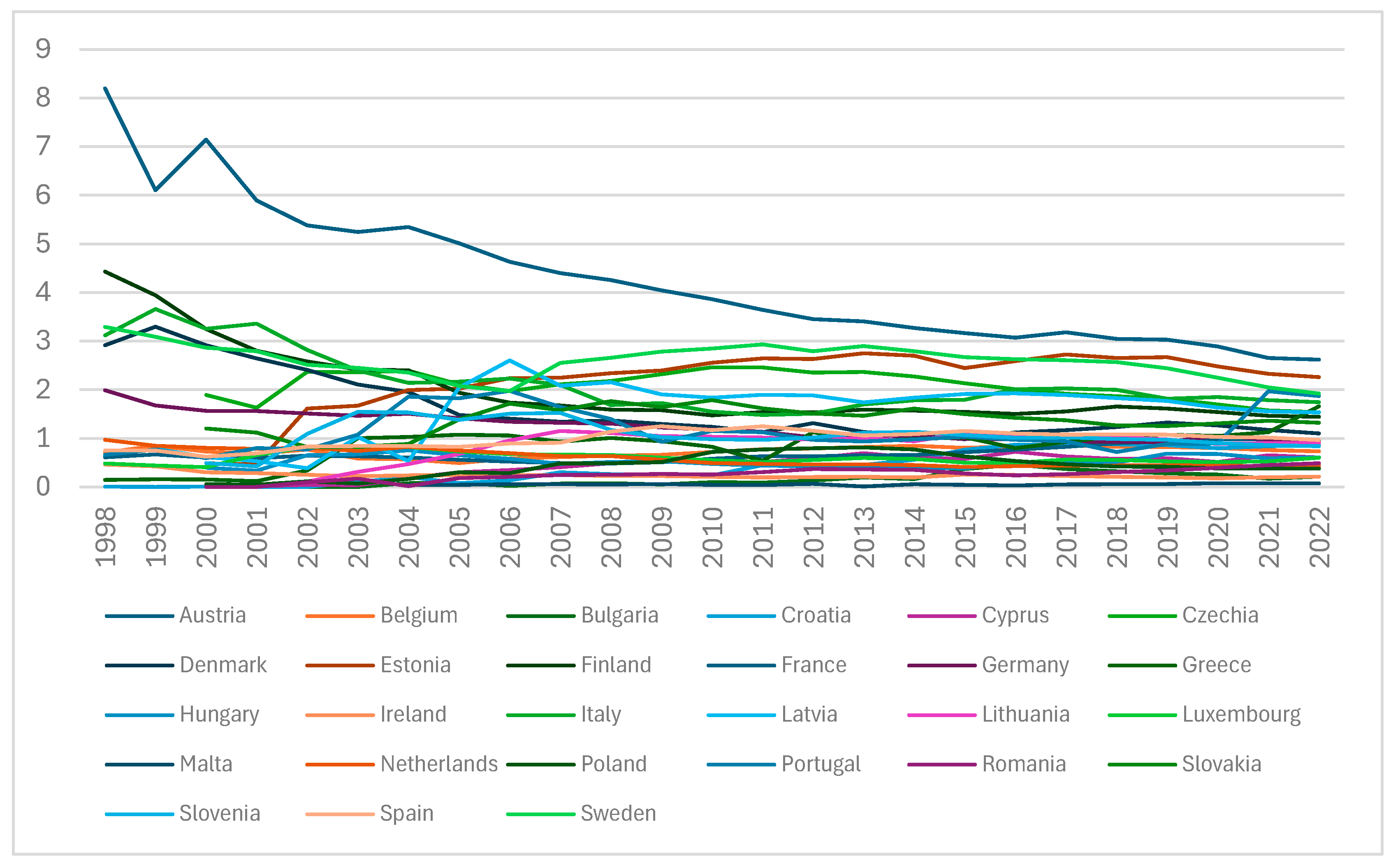
The Location Quotient (LQ) is an analytical tool that enables the assessment of the degree of specialization of individual countries in the production of specific crops. In the context of organic farming—which plays an increasingly important role in EU agricultural policy—the LQ makes it possible to identify regions with above-average significance in the production structure. An analysis of data for the years 1998–2022 reveals both persistent trends and shifts in the spatial distribution of organic cultivation (Figure 1, Table A2). It should be emphasized that LQ captures only relative specialization and does not reflect the absolute scale of organic production or structural dynamics over time. As a result, the interpretation of regional differences must be approached with caution, particularly in cases where high LQ values may coincide with small absolute areas or where temporal changes reflect shifts in the EU average rather than genuine structural developments.
In many countries, a decline in LQ values has been observed after 2000. This pattern may be associated with EU enlargement, the implementation of Green Deal regulations across the Union, diversification of agricultural production, changes in consumer preferences, and increasing competition from other crops. Temporal changes in LQ values appear to reflect broader processes of agricultural restructuring and adaptation to evolving market conditions. Part of the observed decline in LQ values may also reflect a mathematical artefact arising from shifts in the EU-wide average following successive enlargements, rather than substantive structural developments within individual countries.
Between 1998 and 2022, the European organic farming sector exhibited pronounced spatial polarization, reflected in the wide variation of LQ values. The highest levels of specialization were consistently recorded in Northern and Alpine countries such as Austria, Finland, Sweden, and Estonia, which already demonstrated above-average concentrations of organic farmland at the beginning of the study period. In subsequent years, however, their relative advantage gradually diminished—not due to a decline in national organic areas, but rather as a result of the dynamic expansion of organic farming in other EU Member States. This pattern suggests a process of structural convergence, in which leading countries maintain high specialization, yet their dominance becomes less pronounced.
At the same time, the countries of Central and Eastern Europe—particularly the Czech Republic, Latvia, Lithuania, Slovakia, and Slovenia—recorded a substantial increase in LQ values, especially following their accession to the EU in 2004. This growth coincides with the intensification of policies supporting organic farming, including instruments of the Common Agricultural Policy, as well as rising demand for organic products. In many of these countries, the LQ exceeded 1, indicating above average specialization. This dynamic reflects a profound structural transformation of agriculture, in which countries with lower levels of conventional production intensity more rapidly adopted organic farming models, capitalizing on advantages stemming from natural conditions and farm structures.
In contrast, Western European countries with highly intensive agricultural systems—such as Belgium, the Netherlands, and Ireland—maintained consistently low LQ values, indicating a marginal role of organic farming within their land-use structures. These countries are characterized by highly specialized conventional production systems, which limit the potential for expanding organic farmland. At the same time, countries such as France, Spain, Portugal, and Italy exhibited a moderate yet steady increase in LQ values, reflecting the gradual expansion of the organic sector. As a result, the European landscape of organic farming in 2022 displays greater spatial balance than in the late 1990s, although persistent differences remain, shaped by structural, political, and environmental conditions.

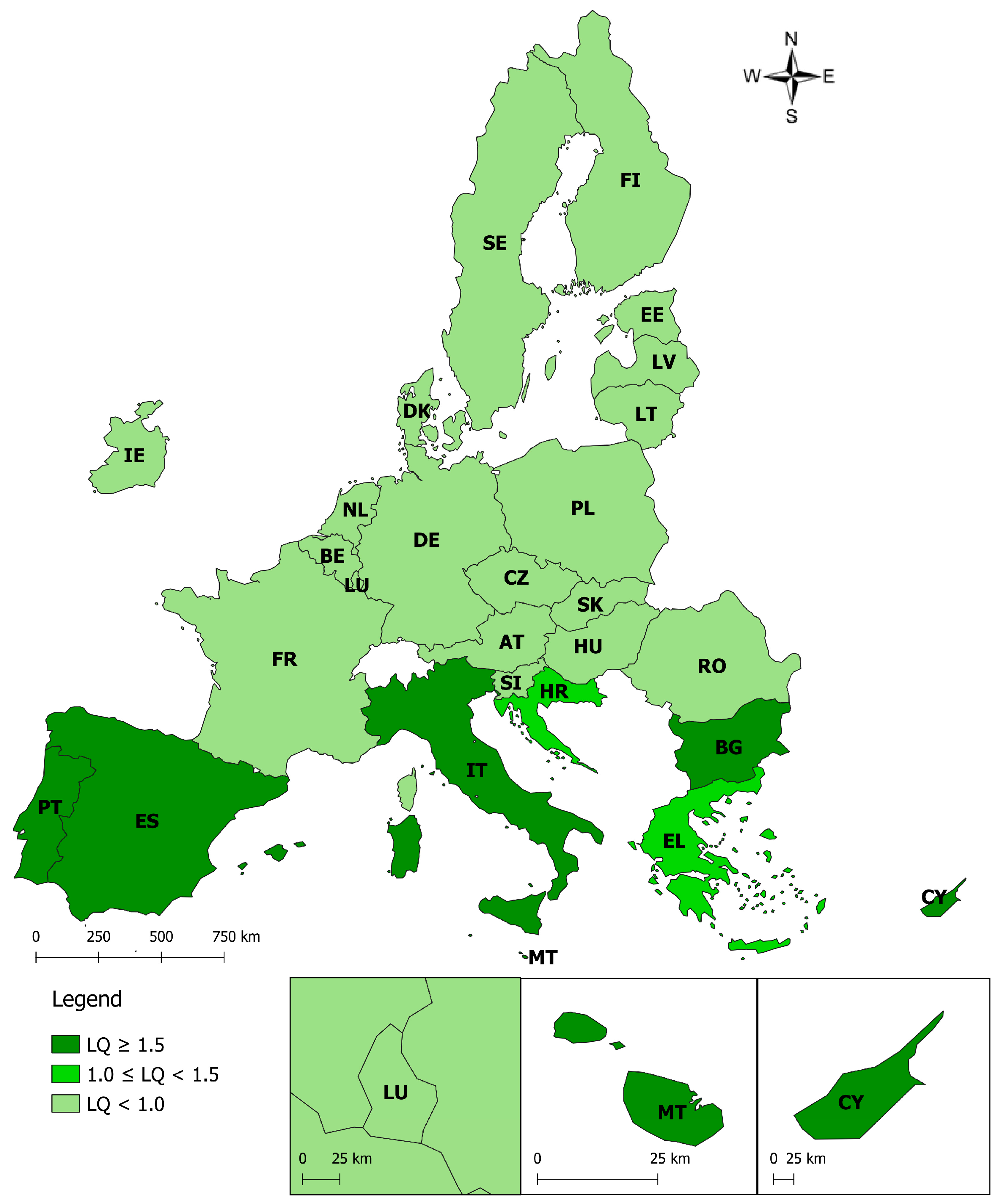
3.1. Location Quotient (LQ) for Organic Utilized Agricultural Area Excluding Kitchen Gardens (X2)

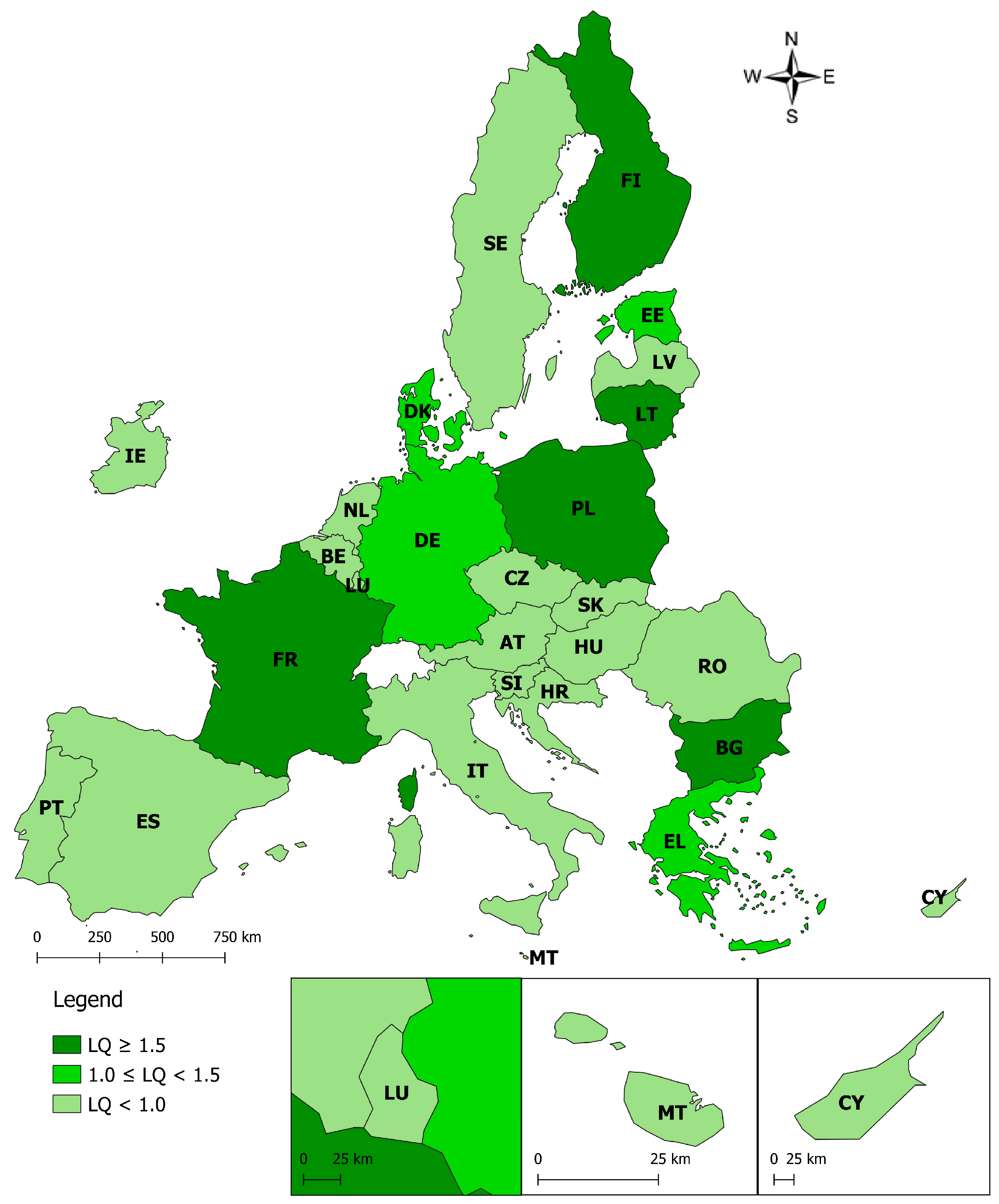
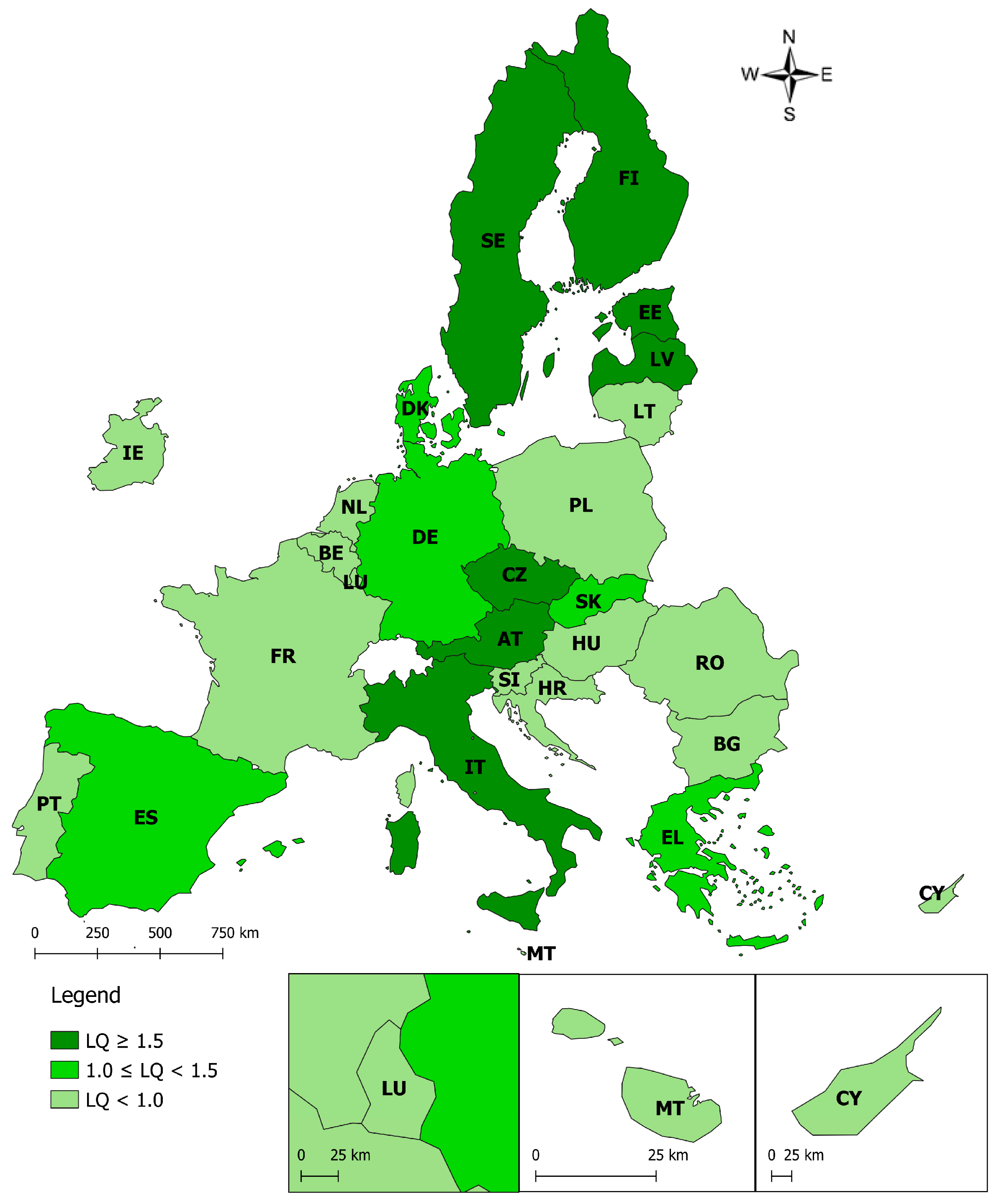
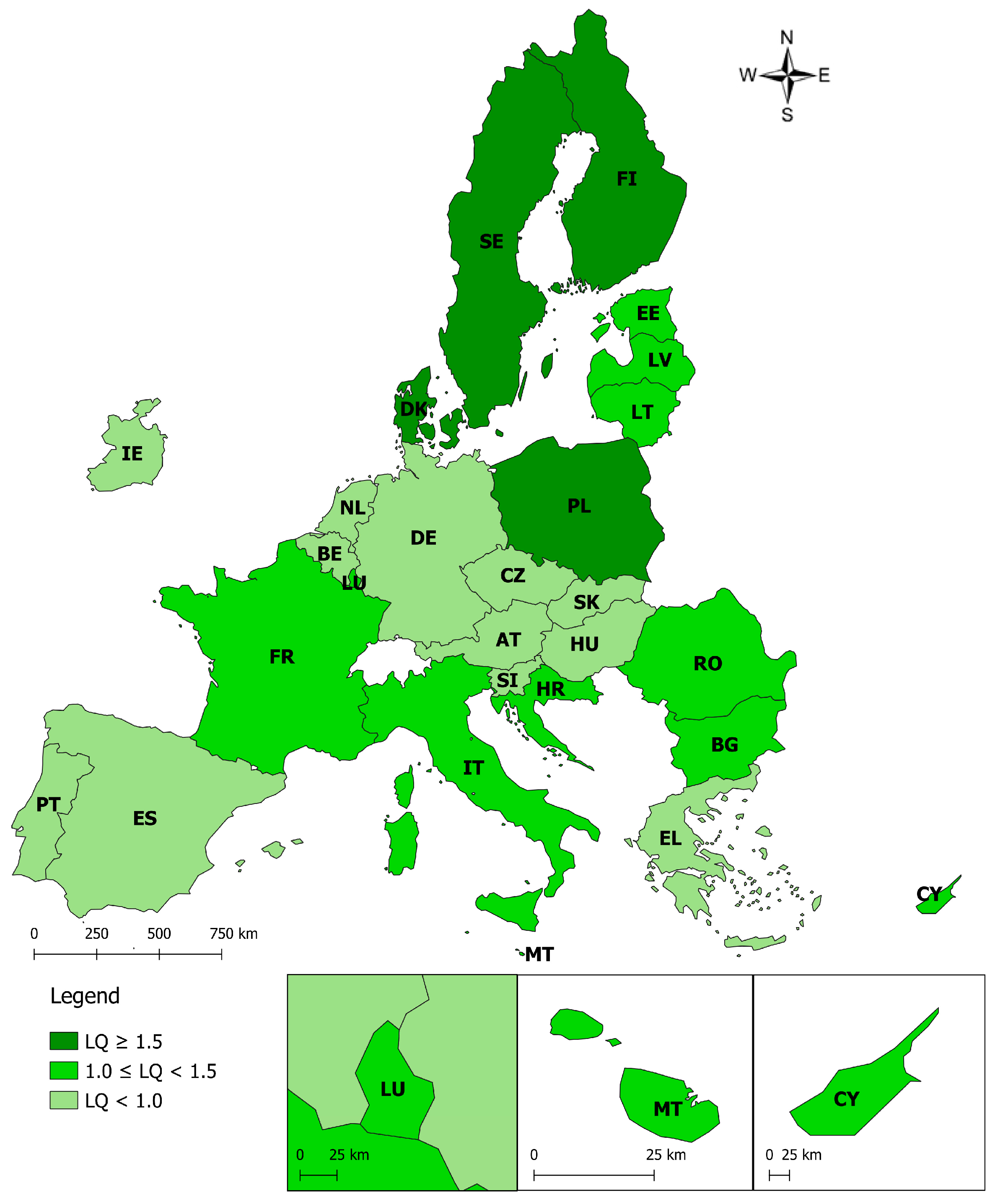
In the analyzed year 2020 (Figure 2), the LQ values for the utilized agricultural area excluding kitchen gardens (X2) reveal a clear pattern: countries with more developed regions or larger economies exhibit markedly higher levels of specialization, while smaller or less economically developed countries rank considerably lower. Austria records the highest value (2.89), followed by Estonia (2.48) and Sweden (2.25). Italy (1.85), the Czech Republic (1.70), Latvia (1.64), and Finland (1.54) also occupy high positions, indicating that the top six countries display relatively similar levels of specialization.
Countries with mid-range values—including Slovakia (1.31), Denmark (1.27), Germany (1.06), Greece (1.05), and Spain (1.03)—show a gradual decline in LQ values but still remain well above those at the lower end of the ranking. In contrast, Poland (0.38), Bulgaria (0.25), Ireland (0.18), and Malta (0.08) occupy the lowest positions, suggesting a lack of specialization in organic utilized agricultural area.
The indicator X2 shows a positive correlation with X1, X14 [organic retail sales share (%)], and X16 [organic retail sales (million €)], and a negative correlation with X9 (fresh vegetables (including melons) and strawberries] and X12 (permanent crops) (Table A2). These correlations suggest that higher values of X1, X14, and X16 tend to co-occur with higher X2, whereas X9 and X12 tend to co-occur with lower X2.
Regression analysis identified three key predictors of X2: X14, X15 [organic per capita consumption (€/person)], and X18 [gross domestic product]. The model explains 66.3% of the variance in X2 (adjusted R2 = 0.619). X14 emerged as the strongest predictor (B = 0.567; p < 0.001), indicating that higher values of X14 are associated with higher X2. X15 showed a significant negative association (B = −0.015; p < 0.001), while X18 displayed a weaker negative association (B ≈ −0.000019; p = 0.031).
It is noteworthy that X14 and X15 exhibit very high VIF values (20.6 and 22.3), indicating strong multicollinearity—expected given that both variables capture closely related aspects of the phenomenon. In contrast, X18 does not show multicollinearity issues (VIF = 1.60). The final regression equation is as follows:
X 2 = 0.945 + 0.567 X 14 0.015 X 15 0.00001896 X 18

3.2. Location Quotient (LQ) for Organic Arable Land (X3)

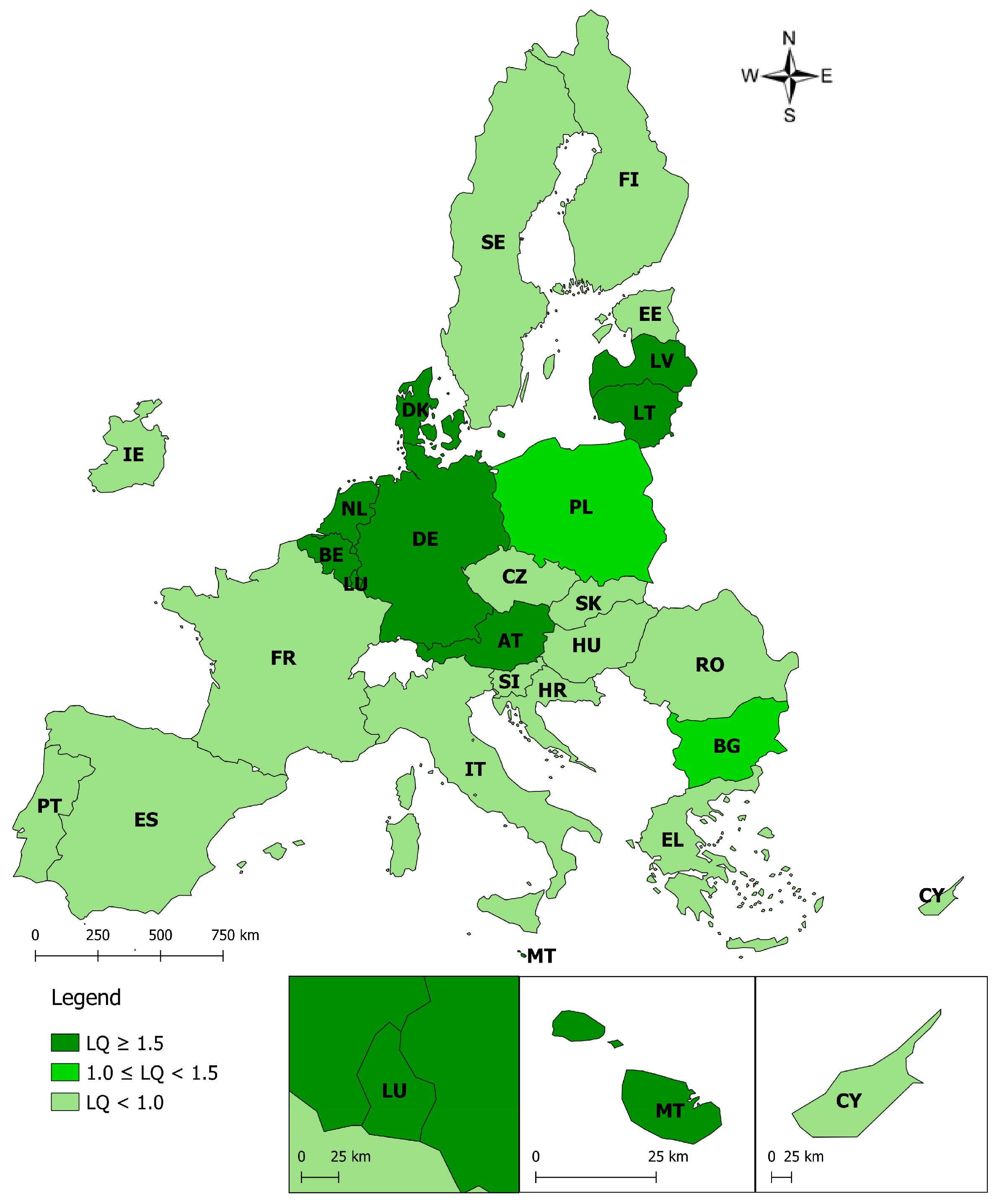
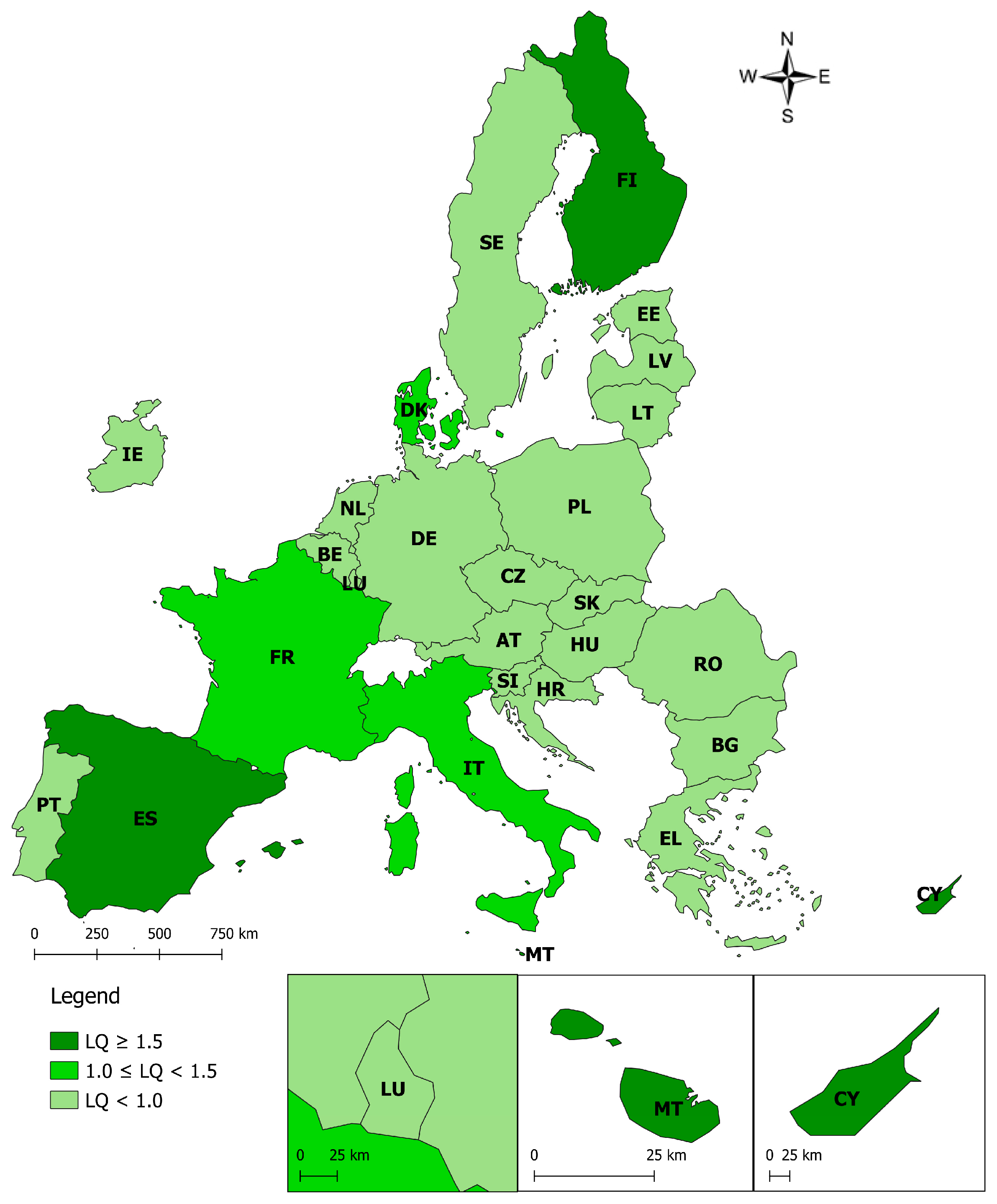
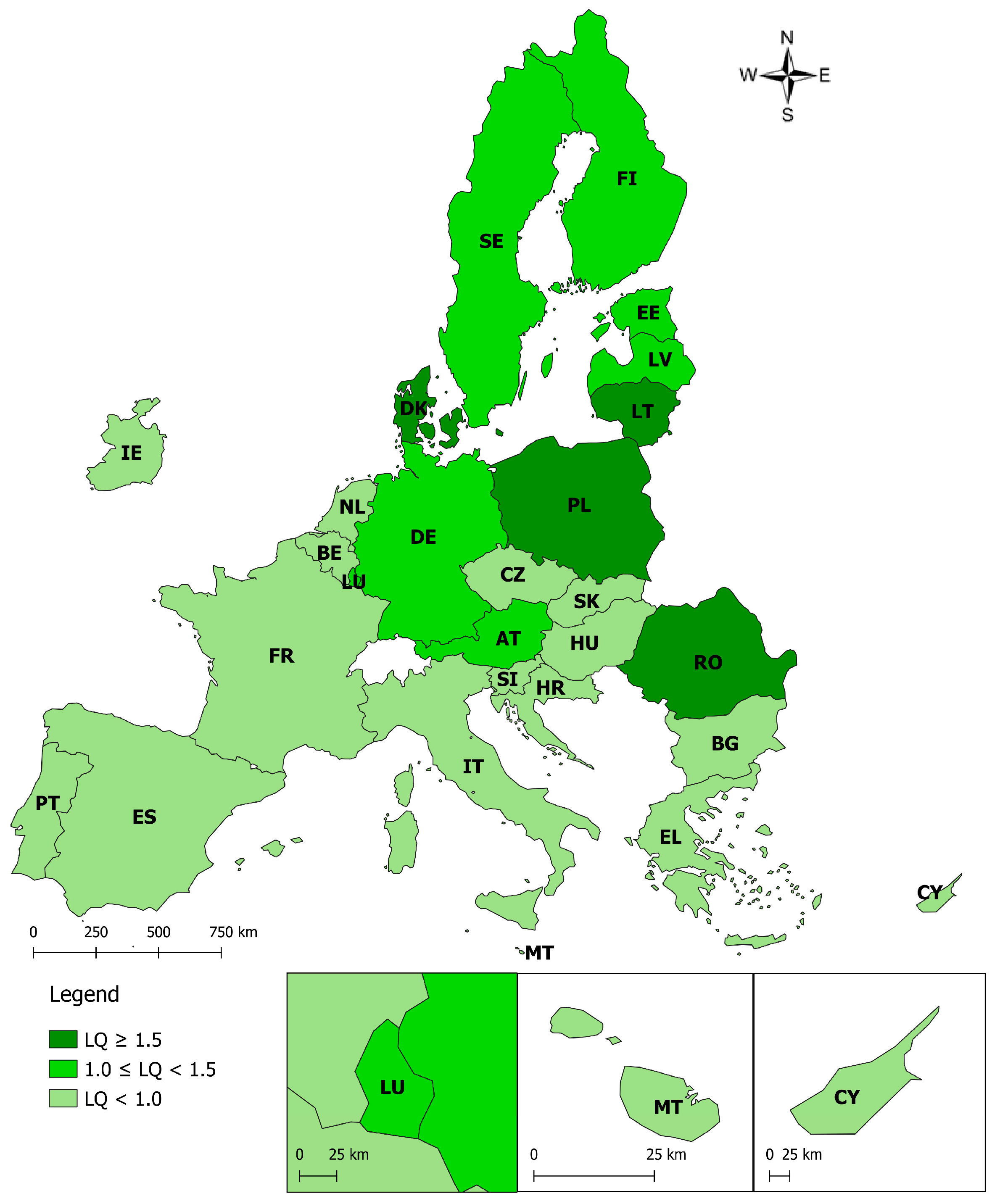
An analysis of the Location Quotient (LQ) for organic arable land (X3) reveals a pronounced north–south divide across the European Union (Figure 3). Northern countries clearly dominate: Finland records the highest value (2.15), indicating a relatively strong development of organic arable farming. Denmark (1.79) and Sweden (1.67) also rank highly. Poland likewise demonstrates an above-average X3 value (1.60), positioning it well above most EU Member States and suggesting dynamic growth in this segment of agriculture.
Countries with moderate LQ values include Lithuania (1.37), Romania (1.35), Malta (1.30), France (1.24), Estonia (1.22), Latvia (1.15), Bulgaria (1.14), Cyprus (1.07), Italy (1.05), Luxembourg (1.01), and Croatia (1.00). These values indicate stability or a moderate level of specialization in organic arable land. In contrast, large economies such as Germany, the Netherlands, Austria, and Belgium exhibit relatively low LQ values, reflecting the structural characteristics of their agricultural sectors.
The indicator X3 shows a positive correlation with X4 [cereals for the production of grain (including seed)], X5 [dry pulses and protein crops for the production of grain (including seed and mixtures of cereals and pulses)], X6 (root crops), X8 (plants harvested green from arable land), and X10 (fallow land), and a negative correlation with X11 (permanent grassland) (Table A2). These correlations suggest that higher values of X4, X5, X6, X8, and X10 tend to co-occur with higher X3, whereas X11 tends to co-occur with lower X3.
Regression analysis identified six predictors of X3: X18, X19 [actual individual consumption], X20 [Human Development Index (value)], X21 [life expectancy at birth (years)], X22 [Gross National Income per capita (2021 PPP$)], and X23 [carbon dioxide emissions per capita (production) (tonnes)]. The model explained 51.5% of the variance in X3 (R2 = 0.515), adjusted R2 of 0.370, indicating a moderate level of model fit. All variables included in the final model were statistically significant or approached statistical significance.
The strongest positive association was observed for X19 (t = 3.510; p = 0.002), indicating that higher values of X19 are associated with higher X3. X20 also showed a positive association, although only at the level of a statistical tendency (p = 0.081). In contrast, X21 (p = 0.006) and X23 (p = 0.007) displayed significant negative associations, suggesting that higher values of these predictors tend to co-occur with lower X3. X22 was close to significance (p = 0.067), likewise showing a negative association. X18 reached marginal significance (p = 0.096), indicating a small positive association with X3.
The final model exhibits very high multicollinearity among some predictors. Particularly elevated VIF values were observed for X18 (VIF ≈ 43) and X22 (VIF ≈ 76), indicating strong interdependencies among explanatory variables. The final regression equation is as follows:
X 3 = 1.909 + 0.00006321 X 18 + 0.000 X 19 + 11.678 X 20 0.150 X 21 0.00008003 X 22 0.180 X 23

3.3. Location Quotient (LQ) for Organic Cereals Cultivated for Grain Production (Including Seed) (X4)

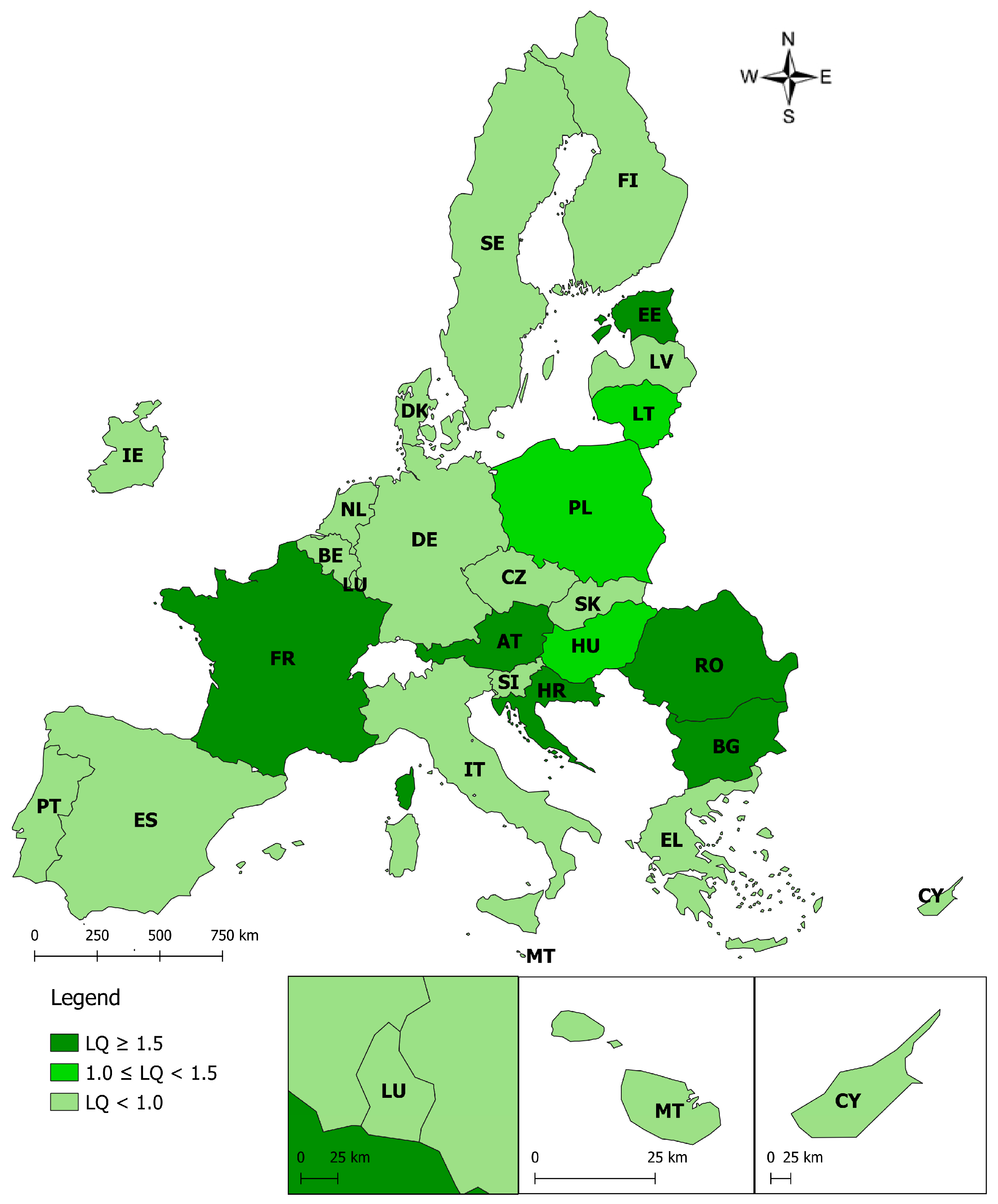
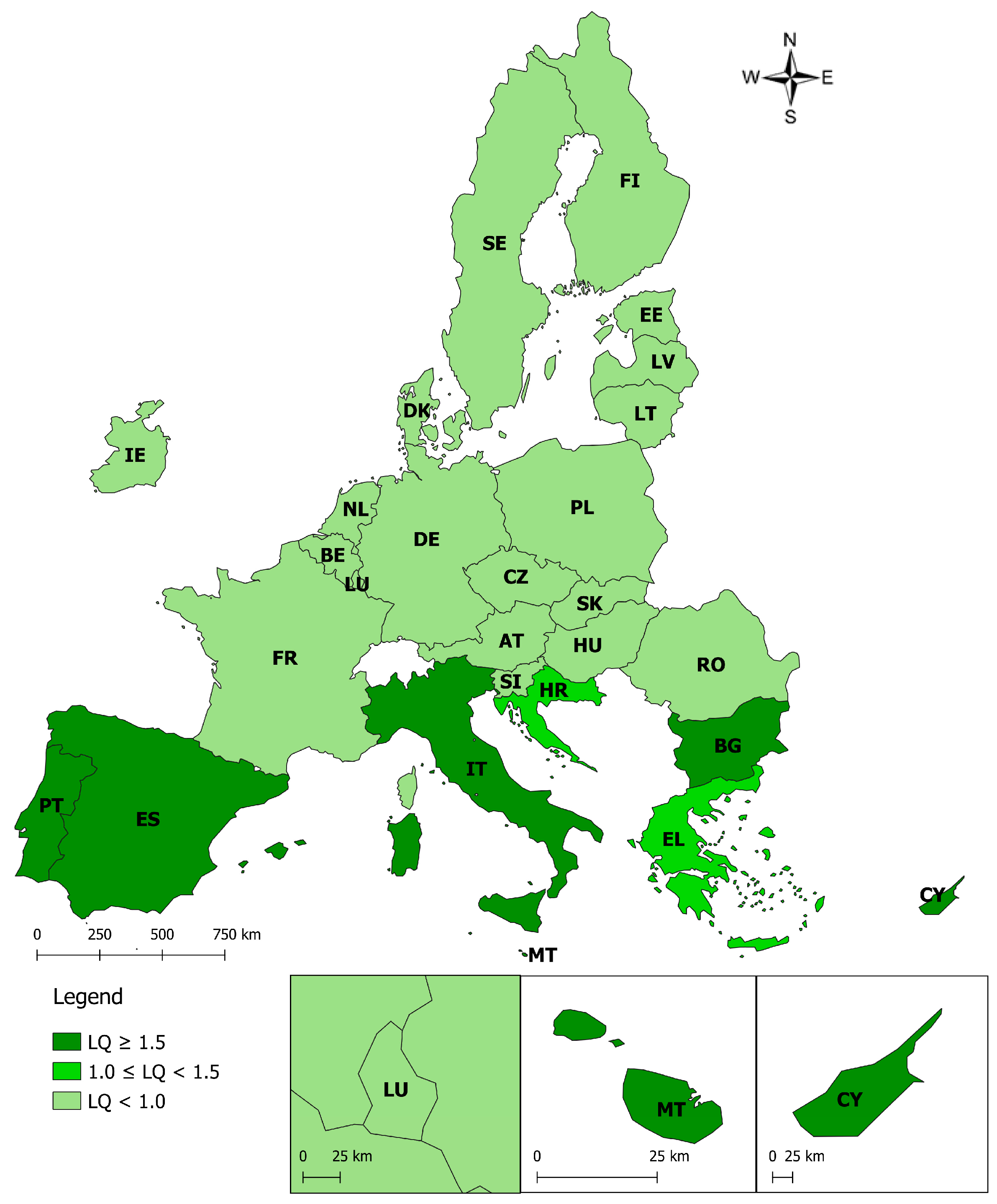
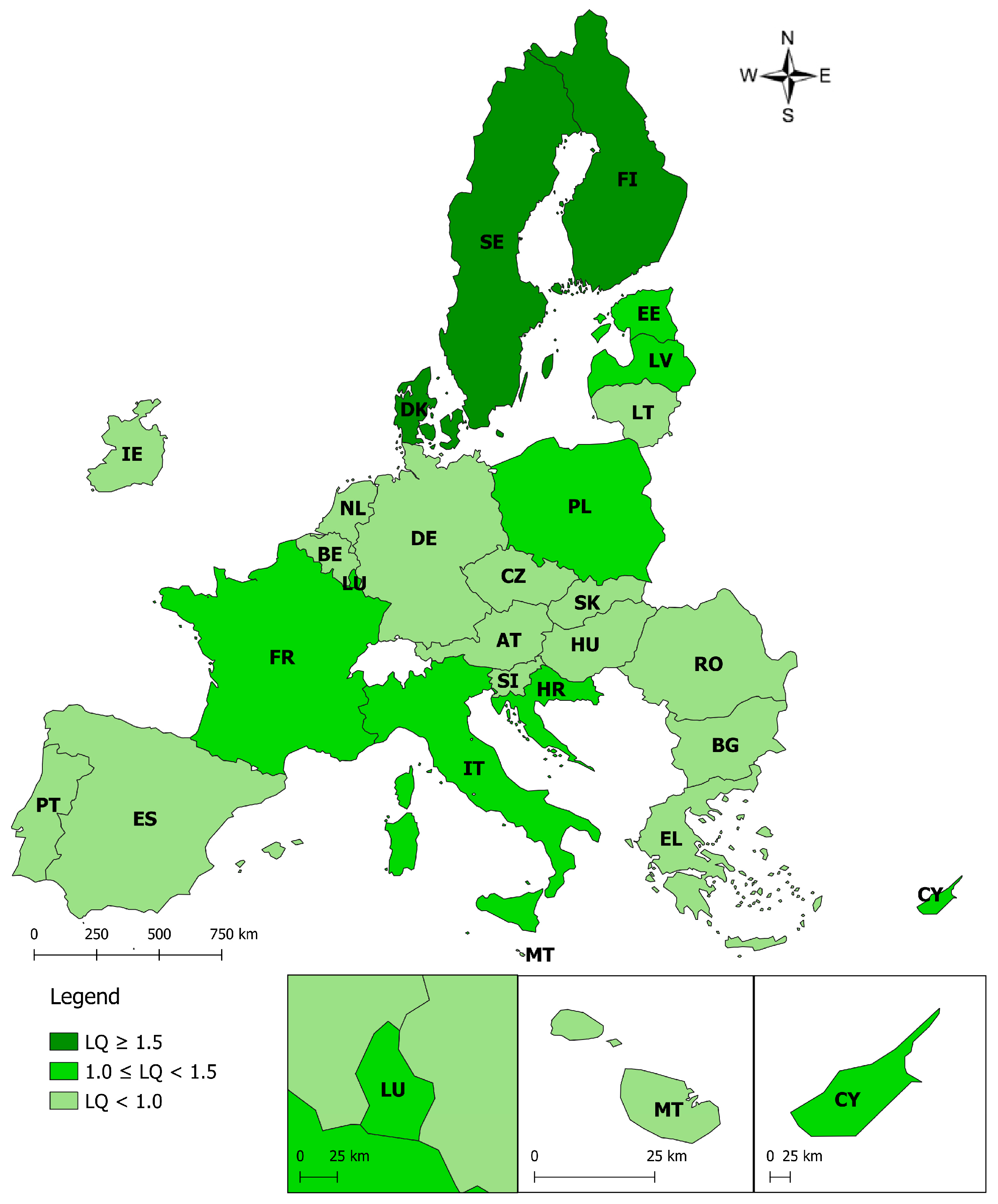
The Location Quotient (LQ) for organic cereals cultivated for grain production (X4) measures the concentration of organic cereal production relative to the total organic agricultural area in each country (Figure 4). This indicator helps identify regions where organic cereal production is particularly well developed and assess their potential within sustainable agriculture. The results show clear variation in X4, allowing countries to be grouped according to specialization intensity.
The leading countries are Lithuania (2.77), Denmark (2.02), Poland (1.77), and Romania (1.74), all demonstrating a high degree of specialization. Moderate specialization is observed in Finland (1.50), Estonia (1.46), Germany (1.35), Sweden (1.32), Latvia (1.27), Luxembourg (1.22), and Austria (1.19).
In contrast, several countries exhibit low specialization—Italy, France, Bulgaria, Cyprus, Belgium, Croatia, Hungary, Slovakia, and Spain—where organic cereal cultivation plays a relatively minor role compared with other organic crops. Very low specialization is characteristic of the Czech Republic, Greece, the Netherlands, Slovenia, Ireland, and Portugal, while Malta shows signs of despecialization.
The indicator X4 shows positive correlations with X3, X5, X7, and X8, and a negative correlation with X11 (Table A2). These correlations suggest that higher values of X3, X5, X7 [industrial crops], and X8 tend to co-occur with higher X4, while X11 tends to co-occur with lower X4.
Regression analysis identified three predictors of X4: X19, X21, and X23. The model explains 57.9% of the variance in X4 (R2 = 0.579; adjusted R2 = 0.524), indicating a moderately good fit. All predictors reached statistical significance.
X19 emerged as the strongest positive association (t = 4.879; p < 0.001), indicating that higher X19 values are associated with higher X4. X21 showed a significant negative association (t = −5.180; p < 0.001), while X23 also displayed a negative association (t = −2.194; p = 0.039).
The final model shows moderate multicollinearity, with VIF values ranging from 1.52 to 2.29. The final regression equation is as follows:
X 4 = 14.403 + 0.000 X 19 0.198 X 21 0.112 X 23

3.4. Location Quotient (LQ) for Organic Dry Pulses and Protein Crops for the Production of Grain (Including Seed and Mixtures of Cereals and Pulses) (X5)

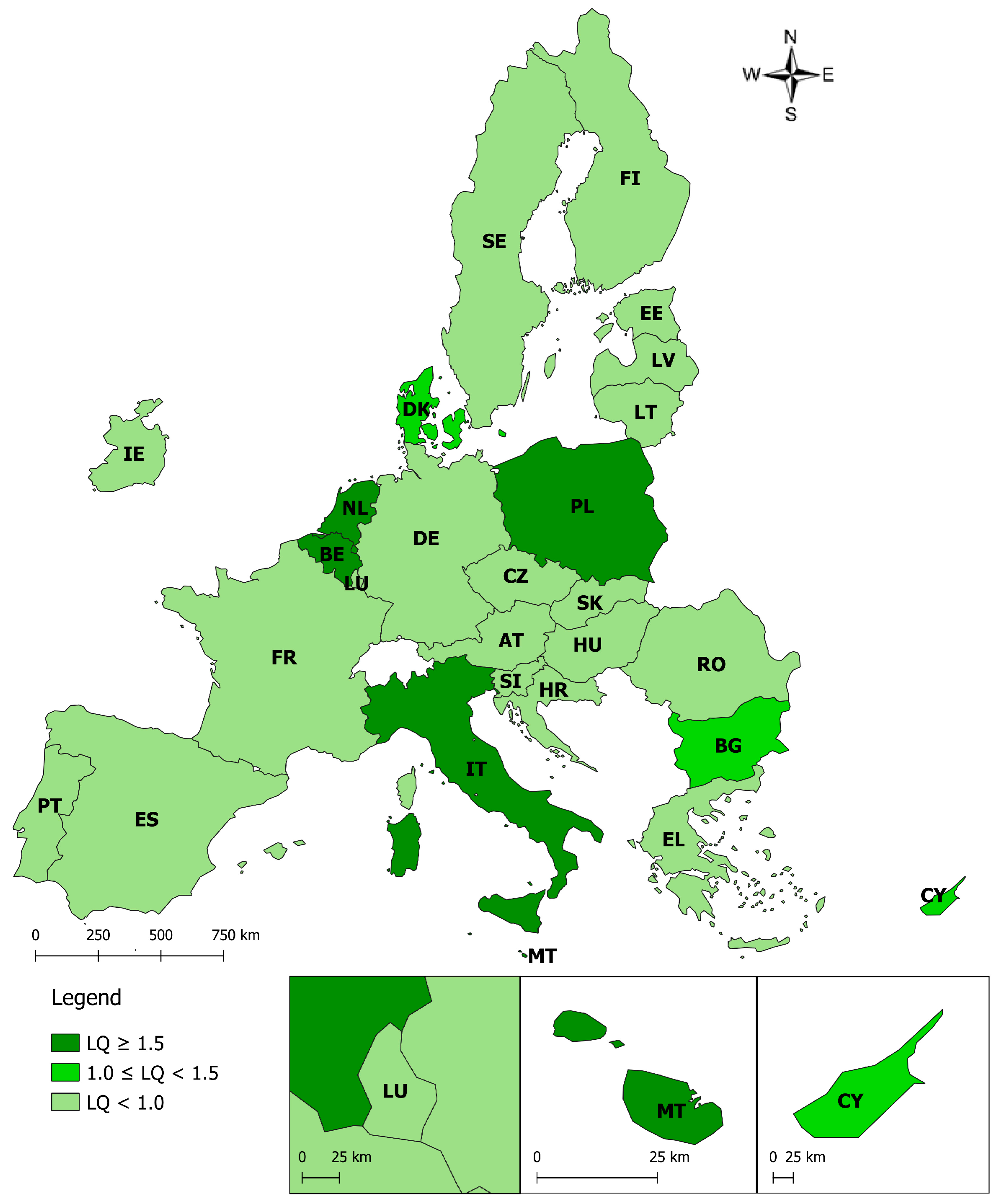
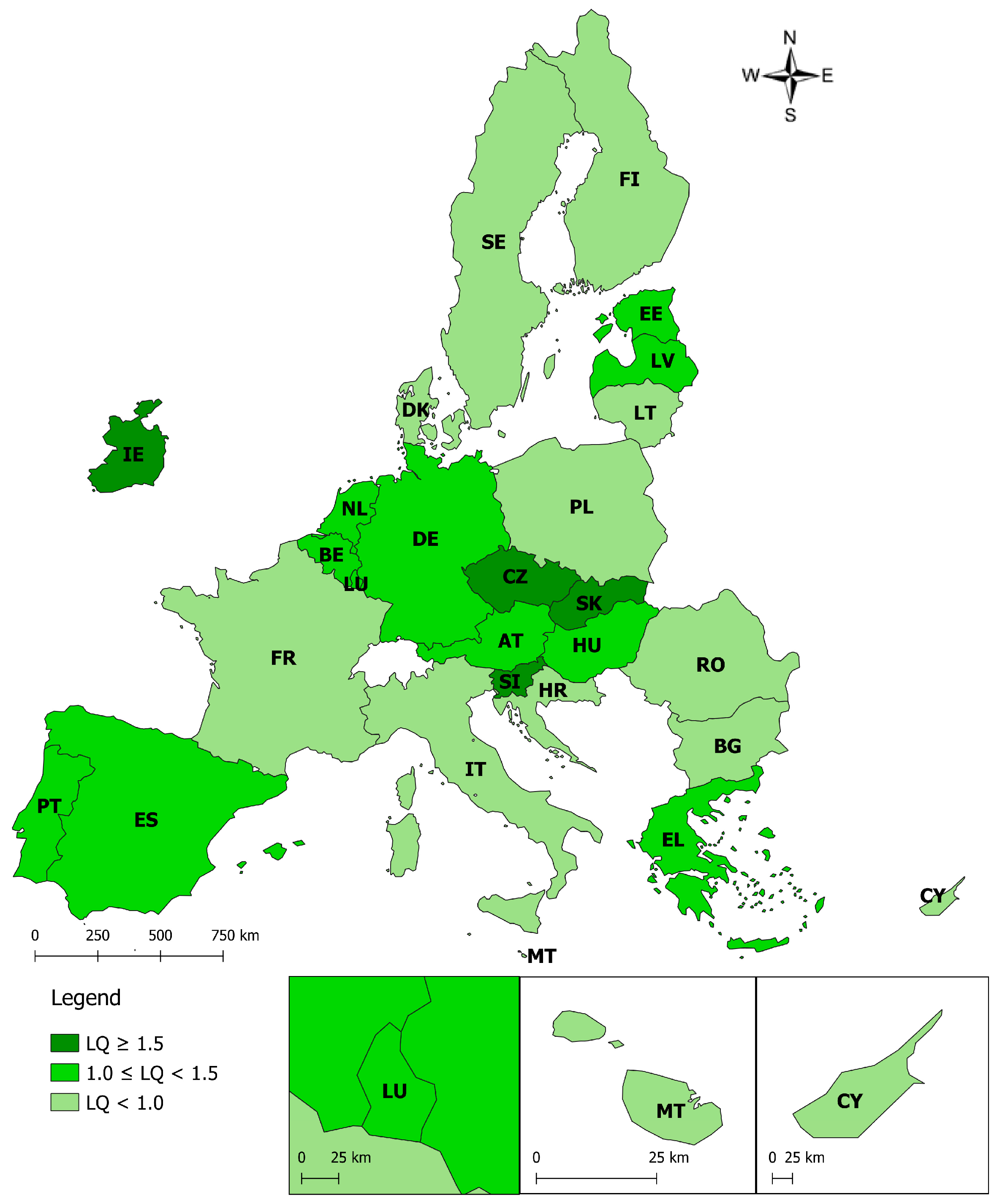
During the analyzed period, the Location Quotient (LQ) for organic dry pulses and protein crops cultivated for grain production (X5) showed substantial variation across EU Member States (Figure 5). High concentrations were observed in several northeastern European countries, which may indicate the growing importance of these crops in regions with more challenging climatic conditions. The countries with the highest specialization—Bulgaria, Lithuania, Poland, and Finland—likely benefit from favorable climatic and soil conditions supporting the development of these crops. Such cultivation contributes to sustainable agriculture, particularly through improvements in soil biodiversity.
Southern and Western European countries generally display low specialization, suggesting that these crops play a relatively minor role within their organic farming systems. Moderate specialization is observed in Denmark, Greece, Estonia, and Germany, where dry pulses and protein crops hold a meaningful, though not dominant, position within the organic sector. In Greece and Estonia, these crops may represent a valuable component of sustainable agricultural development, especially in the context of reducing dependence on imported feed.
In Latvia, Italy, Sweden, Austria, and Luxembourg, these crops are of lesser importance compared with other organic crops. Agricultural production in these regions tends to be more diversified, and dry pulses and protein crops are not prioritized, although they may still contribute to plant based protein supply and soil quality improvement. The remaining countries show low specialization, while Malta and Cyprus exhibit clear despecialization.
The indicator X5 shows positive correlations with X1, X3, X4, X7, and X8, and a negative correlation with X11 (Table A2). These correlations suggest that higher values of X1, X3, X4, X7, and X8 tend to co-occur with higher X5, while X11 tends to co-occur with lower X5.
Regression analysis identified only one predictor of X5–X21. The model explains 11.3% of the variance in X5 (R2 = 0.113; adjusted R2 = 0.078), indicating a very weak model fit. X21 did not reach statistical significance (p = 0.086), although it lies close to the conventional threshold.

3.5. Location Quotient (LQ) for Organic Root Crops (X6)

In the case of organic root crops (X6), the Netherlands clearly dominates within Europe (Figure 6), recording the highest LQ value (8.86). This indicates strong national specialization, particularly in the production of root vegetables, potatoes, and carrots. Malta and Belgium also display high specialization, suggesting a strong concentration of root crop cultivation—especially relevant in countries with limited agricultural land, where production intensity is crucial. Other highly specialized countries include Denmark, Germany, Lithuania, Austria, and Luxembourg.
Moderate specialization is observed in Latvia, Bulgaria, and Poland. In Latvia, this may be linked to favorable climatic and soil conditions, while in Poland and Bulgaria root crops—including potatoes, sugar beets, and other root vegetables—play an important role in agricultural production.
Countries with low specialization include Sweden, Finland, France, Slovenia, Ireland, and Estonia. Although root crops are present in these systems, they do not constitute a dominant component of organic farming. In Ireland, Sweden, and Finland, production may be constrained by climatic factors, yet root crops still represent a relevant segment of organic agriculture in suitable regions.
The remaining countries—Italy, Romania, the Czech Republic, Cyprus, Spain, Greece, Croatia, Portugal, Hungary, and Slovakia—show very low specialization, indicating that root crops play only a minor role in their organic farming sectors.
The indicator X6 shows positive correlations with X3, X9, X14, X15, X17 [Purchasing Power Standard (PPS) per adult equivalent], X18, X19, X20, X22, and X24 [Population, total (millions)] (Table A2). These correlations suggest that higher values of these variables tend to co-occur with higher X6.
Regression analysis identified only one predictor of X6–X19. The model explains 11.3% of the variance in X6 (R2 = 0.113; adjusted R2 = 0.078), indicating a very weak model fit. Although X19 reached statistical significance (p = 0.010), its substantive impact is minimal.
The regression coefficient for X19 is positive (B ≈ 0.000), indicating that higher X19 values are associated with a slight increase in X6. Due to the scale of the variable, the effect is statistically significant but practically negligible. The final regression equation is:
X 6 = 2.883 + 0.000 X 19

3.6. Location Quotient (LQ) for Organic Industrial Crops (X7)

Industrial crops—including sugar beet, sunflower, and oilseed species—play a crucial role in the agricultural economies of several countries, supporting both the food and energy sectors. For organic industrial crops (X7), Bulgaria and Romania are the clear leaders within the EU (Figure 7). Their high LQ values indicate strong specialization in crops used for industrial purposes, such as sugar beet, sunflower, and other plants serving the food and chemical industries. These countries benefit from environmental conditions conducive to intensive industrial crop production. High specialization is also observed in Croatia, Austria, France, and Estonia.
Hungary, Lithuania, and Poland exhibit moderate specialization, suggesting their growing importance in the organic production of industrial crops. In contrast, Slovakia, Latvia, Italy, and Greece show low specialization—although industrial crops are present, they do not dominate their organic farming structures. Production in these countries tends to be more diversified.
In the remaining countries—Sweden, Denmark, Germany, Cyprus, Finland, Slovenia, Spain, the Czech Republic, Belgium, Luxembourg, Portugal, the Netherlands, and Ireland—organic agriculture is not concentrated on industrial crops. Malta displays clear despecialization, largely due to its limited agricultural area and specific climatic conditions.
The indicator X7 shows positive correlations with X4 and X5, and negative correlations with X17, X18, X19, X20, X21, X22, and X24 (Table A2). These correlations suggest that higher values of X4 and X5 tend to co-occur with higher X7, while the remaining variables tend to co-occur with lower X7.
Regression analysis identified two predictors of X7: X14 and X20. The model explains 56.2% of the variance in X7 (R2 = 0.562; adjusted R2 = 0.526), indicating a moderately good fit. Both predictors were statistically significant.
X14 showed a positive association (B = 0.181; p = 0.030), indicating that higher X14 values are associated with higher X7. In contrast, X20 emerged as a strong negative predictor (B = −42.164; p < 0.001), suggesting that higher X20 values co-occur with lower X7.
Tolerance and VIF values (1.565 for both predictors) indicate no multicollinearity issues. The final regression equation is:
X 7 = 38.608 + 0.181 X 14 42.164 X 20

3.7. Location Quotient (LQ) for Organic Green Plants Harvested from Arable Land (X8)

Green plants harvested from arable land (X8) are a key source of fodder in organic farming and contribute to soil fertility, biodiversity, and system resilience. The LQ analysis reveals a clear geographical divide between Northern Europe—where climatic conditions necessitate green fodder cultivation—and Central Europe, where such crops support strong dairy sectors (Figure 8). In contrast, Southern Europe and grain export-oriented countries such as Bulgaria and Lithuania show very low LQ values.
High specialization in Scandinavian countries is driven by climatic constraints (short growing seasons favoring forage crops) and well-developed dairy farming. Finland leads (3.47), followed by Sweden (2.69) and Denmark (2.03).
Moderate specialization is observed in France (1.42), Latvia (1.36), Cyprus (1.33), Poland (1.32), Luxembourg (1.28), Estonia (1.25), Italy (1.18), and Croatia (1.05). These countries typically have strong dairy sectors and cultivate silage maize or leguminous forage crops.
Low specialization is found in countries whose production is roughly proportional to the EU average. Despite intensive livestock production, their LQ values remain moderate—possibly due to imported feed or high crop diversification. This group includes the Netherlands (0.96), Greece (0.95), Belgium (0.92), Germany (0.87), Slovakia (0.86), Portugal (0.71), Hungary (0.68), Romania (0.66), Austria (0.53), and Malta (0.52).
Minimal specialization characterizes the Czech Republic (0.45), Slovenia (0.38), Ireland (0.31), Spain (0.08), Lithuania (0.05), and Bulgaria (0.02), where organic arable land is allocated to other uses or environmental conditions favor alternative organic systems.
The indicator X8 shows positive correlations with X3, X4, and X15, and a negative correlation with X11 (Table A2). These correlations suggest that higher values of X3, X4, and X15 tend to co-occur with higher X8, while X11 tends to co-occur with lower X8.
The final regression model included four predictors: X15, X20, X22, and X24. It explains 36.7% of the variance in X8 (R2 = 0.367; adjusted R2 = 0.252), indicating a moderately weak fit. Two predictors were statistically significant.
X15 showed a positive association (B = 0.005; p = 0.039), indicating that higher X15 values are associated with higher X8. X22 was a significant negative predictor (B ≈ −0.000057; p = 0.034), suggesting that higher X22 values co-occur with lower X8. X20 approached significance (p = 0.057), while X24 reached a statistical tendency (p = 0.073).
Tolerance and VIF values indicate moderate multicollinearity, particularly for X22 (VIF ≈ 9). The final regression equation is:
X 8 = 8.482 + 0.005 X 15 + 11.710 X 20 0.00005721 X 22 + 0.061 X 24

3.8. Location Quotient (LQ) for Organic Fresh Vegetables (Including Melons) and Strawberries (X9)

Fresh vegetables (including melons) and strawberries (X9) are key market products in organic farming and an important source of added value. They support soil health, biodiversity, and the public image of organic farms, but require substantial labor, precise plant protection, and rigorous certification. The LQ analysis reveals a highly distinctive spatial pattern across Europe (Figure 9), one that does not follow a simple North–South divide.
The absolute leaders are the Netherlands (8.99) and Malta (7.03). In the Netherlands, this reflects advanced greenhouse horticulture and extremely intensive land use. In Malta, limited agricultural land drives specialization in high value vegetables for local and tourism-oriented markets.
Poland (3.90) stands out as a notable case of strong specialization in Central Europe. High concentration is also observed in Italy (2.22) and Belgium (2.10).
Moderate specialization is found in Cyprus (1.31), Bulgaria (1.22), and Denmark (1.03). Surprisingly low LQ values occur in France (0.98), Hungary (0.97), Portugal (0.92), Germany (0.71), Luxembourg (0.70), and especially Spain (0.62). In these countries, large areas of olives, vineyards, and cereals reduce the statistical share of vegetables in total organic land use.
Very low specialization characterizes Austria (0.49), Slovenia (0.38), Greece (0.37), Finland (0.35), Ireland (0.34), Sweden (0.26), Slovakia (0.25), Lithuania (0.15), Croatia (0.14), Latvia (0.13), Romania (0.12), Estonia (0.08), and the Czech Republic (0.03). Organic farming in these countries is dominated by cereals, oilseeds, or livestock systems, and vegetable production is marginal—resulting in strong reliance on imports, especially from Poland and The Netherlands.
The indicator X9 shows positive correlations with X6 and X12, and a negative correlation with X2 (Table A2). These correlations suggest that higher values of X6 and X12 tend to co-occur with higher X9, while X2 tends to co-occur with lower X9.
The final regression model included two predictors: X15 and X19. It explains 15.9% of the variance in X9 (R2 = 0.159; adjusted R2 = 0.089), indicating a weak fit. Only X19 reached statistical significance (p = 0.048), while X15 was close to significance (p = 0.064).
X19 showed a positive association, indicating that higher X19 values are associated with higher X9. X15 showed a negative association, but due to lack of statistical significance, this relationship should be interpreted cautiously.
Tolerance and VIF values (2.801 for both predictors) indicate no multicollinearity issues. The final regression equation is:
X 9 = 4.174 0.013 X 15 + 0.000 X 19

3.9. Location Quotient (LQ) for Organic Fallow Land (X10)

Fallow land (X10) is an important component of the EU’s agri environmental policy. Its role extends beyond production—fallowing supports soil fertility restoration, enhances biodiversity, reduces pest and disease pressure, and improves water retention. In organic farming, where synthetic inputs are restricted, fallow land plays an especially important role. The LQ analysis makes it possible to assess how strongly Member States specialize in maintaining fallow areas relative to the EU average (Figure 10).
Very high specialization is observed in Malta (13.04), Cyprus (3.38), and Spain (2.40). These high values may reflect limited arable land (Malta, Cyprus), Mediterranean climatic conditions favoring periodic land withdrawal, drought related soil degradation requiring regeneration, or traditional extensive practices (Spain).
Moderate specialization is found in Finland (1.65), France (1.11), Italy (1.05), and Denmark (1.00). In these countries, fallowing may be linked to soil and biodiversity protection policies, crop rotation requirements in organic systems, or climatic constraints (Finland).
Low specialization characterizes most Central and Northern European countries, including Bulgaria, Sweden, Lithuania, Latvia, Hungary, Portugal, Greece, Romania, Belgium, Germany, Austria, and Croatia. This may reflect higher production intensity, economic pressure to maximize land use, or a limited role of fallow land in national agri-environmental schemes.
Very low specialization is observed in Slovakia (0.18), the Netherlands (0.16), Luxembourg (0.14), Estonia (0.12), Poland (0.10), Ireland (0.07), Slovenia (0.03), and the Czech Republic (0.02). Explanations include intensive agriculture (Netherlands, Czech Republic), dominance of permanent grasslands (Ireland), economic pressure to fully utilize land (Poland), or limited importance of fallowing in national support frameworks.
The indicator X10 shows positive correlations with X3, X12, and X13, and negative correlations with X11 and X23 (Table A2). These correlations suggest that higher values of X3, X12, and X13 [permanent crops for human consumption] tend to co-occur with higher X10, while X11 and X23 tend to co-occur with lower X10.
The regression model included five predictors: X18, X19, X20, X22, and X23. It explains 52.4% of the variance in X10 (R2 = 0.524; adjusted R2 = 0.410). All predictors were statistically significant:
  • X18—strong positive association (t = 4.055; p < 0.001),
  • X19—positive association (t = 2.553; p = 0.019),
  • X20—positive association (t = 2.633; p = 0.016),
  • X22—negative association (t = −3.809; p = 0.001),
  • X23—negative association (t = −4.007; p < 0.001).
These results suggest that higher X18, X19, and X20 values are associated with higher X10, while higher X22 and X23 values co-occur with lower X10.
Tolerance and VIF values indicate moderate multicollinearity, particularly for X22 (VIF ≈ 54). The final regression equation is:
X 10 = 43.857 + 0.001 X 18 + 0.001 X 19 + 58.591 X 20 0.001 X 22 1.082 X 23

3.10. Location Quotient (LQ) for Organic Permanent Grassland (X11)

In organic farming, permanent grasslands (X11) play a crucial role in stabilizing soil structure, supporting biodiversity, storing carbon, and providing the basis for forage production in extensive livestock systems. The LQ analysis assesses whether the share of organic grasslands in a given country is higher or lower than the EU average (Figure 11).
High specialization is observed in Ireland (2.10), Czechia (1.93), Slovenia (1.89), and Slovakia (1.54). In these countries, organic permanent grasslands form a substantial component of land use, likely due to strong links between organic farming and pasture-based livestock systems.
Moderate specialization is found in Belgium (1.47), Portugal (1.45), Hungary (1.42), the Netherlands (1.37), Austria (1.36), Greece (1.30), Germany (1.24), Spain (1.23), Luxembourg (1.21), Latvia (1.07), and Estonia (1.00). These countries maintain significant areas of organic grasslands, though not as dominant as in the first group.
Low specialization characterizes Croatia (0.92), France (0.82), Lithuania (0.82), Romania (0.78), Italy (0.66), Bulgaria (0.61), and Sweden (0.53). Here, organic grasslands compete with other land use types such as arable crops, orchards, or vineyards.
Very low specialization is observed in Poland (0.40), Denmark (0.38), Cyprus (0.07), and Finland (0.01), indicating a stronger orientation toward crop based organic systems. Malta shows despecialization, with an LQ of zero.
The indicator X11 shows a positive correlation with X23 and negative correlations with X3, X4, X5, X8, and X10 (Table A2). These correlations suggest that higher X23 values tend to co-occur with higher X11, while the remaining variables tend to co-occur with lower X11.
The regression model identified four predictors: X18, X19, X22, and X23. It explains 43.2% of the variance in X11 (R2 = 0.432; adjusted R2 = 0.329). All predictors were statistically significant or close to significance:
  • X18—negative predictor (t = −2.076; p = 0.050),
  • X19—negative predictor (t = −3.499; p = 0.002),
  • X22—positive predictor (t = 2.648; p = 0.015),
  • X23—positive predictor (t = 2.962; p = 0.007).
These results suggest that higher X18 and X19 values are associated with lower X11, while higher X22 and X23 values co-occur with higher X11. The final regression equation is:
X 11 = 1.567 0.00006381 X 18 0.000 X 19 + 0.00008675 X 22 + 0.194 X 23

3.11. Location Quotient (LQ) for Organic Permanent Crops (X12)

Organic permanent crops (X12)—including orchards, vineyards, fruit bearing shrubs, and olive groves—play a central role in sustainable agriculture, particularly in regions with strong horticultural and viticultural traditions. These systems are long lived, deeply rooted, carbon sequestering, and capable of forming stable, biodiversity rich agroecosystems. The LQ analysis assesses how strongly their share within national organic farming structures diverges from the EU average (Figure 12).
Very high specialization is observed in Cyprus (4.18), Malta (3.40), Spain (2.38), and Italy (2.07). These Mediterranean countries benefit from favorable climatic and agronomic conditions that support perennial fruit and tree crops. Moderate specialization occurs in Bulgaria (1.87), Portugal (1.80), Croatia (1.30), and Greece (1.12), where permanent crops are clearly overrepresented but not to the extent seen in the leading group. Low specialization is found in Poland (0.82), France (0.68), and Slovenia (0.57), where organic farming is more oriented toward arable crops and grasslands. Marginal specialization characterizes the remaining countries, including Hungary (0.43), Romania (0.42), Luxembourg (0.19), Austria (0.16), Belgium (0.13), Germany (0.13), the Netherlands (0.11), Denmark (0.10), Estonia (0.10), Latvia (0.10), Czechia (0.09), Slovakia (0.08), Finland (0.02), Sweden (0.01), and Ireland (0.01). Explanations include climatic constraints, limited fruit growing sectors, and production systems oriented toward cereals, milk, and meat.
The indicator X12 shows positive correlations with X9, X10, and X13, and negative correlations with X2, X14, X18, X20, X22, and X24. These correlations suggest that higher values of X9, X10, and X13 tend to co-occur with higher X12, while the remaining variables tend to co-occur with lower X12.
Regression analysis identified five predictors: X18, X19, X21, X22, and X23. The model explains 62.9% of the variance in X12 (R2 = 0.629; adjusted R2 = 0.540). All predictors were statistically significant or close to significance:
  • X18—positive predictor (t = 3.619; p = 0.002),
  • X19—positive predictor (t = 2.157; p = 0.043),
  • X21—positive predictor (t = 3.270; p = 0.004),
  • X22—negative predictor (t = −4.274; p < 0.001),
  • X23—negative predictor, borderline significant (t = −2.048; p = 0.053).
These results suggest that higher X18, X19, and X21 values are associated with higher X12, while higher X22 and X23 values co-occur with lower X12. The final regression equation is:
X 12 = 14.207 + 0.000 X 18 + 0.000 X 19 + 0.222 X 21 0.000 X 22 0.227 X 23

3.12. Location Quotient (LQ) for Organic Permanent Crops for Human Consumption (X13)

Organic permanent crops intended for human consumption (X13)—including orchards, vineyards, soft fruit plantations, fruit trees and shrubs, olive groves, and citrus plantations—represent a high value segment of organic agriculture. These systems are long lived, carbon sequestering, and form stable agroecosystems that contribute significantly to local food systems. The LQ analysis assesses the degree of specialization relative to the EU average (Figure 13).
Very high specialization is observed in Cyprus (4.28), Malta (3.49), Spain (2.35), and Italy (2.11), reflecting favorable Mediterranean conditions and long-standing traditions in fruit and wine production. Moderate specialization occurs in Bulgaria (1.92), Portugal (1.76), Croatia (1.33), and Greece (1.14), where permanent crops constitute an important, though not dominant, component of organic agriculture. Low specialization is found in Poland (0.81), France (0.69), and Slovenia (0.58), where organic farming is more strongly oriented toward arable crops and grasslands. The remaining Member States exhibit only marginal specialization, largely due to climatic constraints, limited perennial crop sectors, or production systems focused predominantly on cereals, milk, and meat.
The indicator X13 shows positive correlations with X10 and X12, and negative correlations with X14, X18, X20, X22, and X24. These correlations suggest that higher values of X10 and X12 tend to co-occur with higher X13, while the remaining variables tend to co-occur with lower X13.
Regression analysis identified five predictors: X18, X19, X21, X22, and X23. The model explains 62.7% of the variance in X13 (R2 = 0.627; adjusted R2 = 0.538). All predictors were statistically significant or close to significance:
  • X18—positive predictor (t = 3.609; p = 0.002),
  • X19—positive predictor (t = 2.128; p = 0.045),
  • X21—positive predictor (t = 3.278; p = 0.004),
  • X22—negative predictor (t = −4.260; p < 0.001),
  • X23—negative predictor, borderline significant (t = −2.002; p = 0.058).
These results suggest that higher X18, X19, and X21 values are associated with higher X13, while higher X22 and X23 values co-occur with lower X13. The final regression equation is:
X 13 = 14.598 + 0.000 X 18 + 0.000 X 19 + 0.228 X 21 0.000 X 22 0.227 X 23

4. Discussion

The spatial distribution of organic farming across the European Union is highly heterogeneous, reflecting the interaction of geographical, economic, social, and political determinants. Geographical and environmental conditions form the structural foundation of this variability, shaping the natural suitability for cultivating specific crop groups. Climate, soil quality, water availability, and topography influence both yield potential and the economic viability of agricultural systems—conventional and organic alike [96,99,107,152,153]. As a result, some EU regions are naturally predisposed to organic cereal production [154,155,156,157,158,159], others to grassland based livestock farming [160,161,162,163,164], and still others to fruit or vegetable cultivation [92,165,166,167].
However, socio economic and political factors increasingly shape the observed spatial disparities. The level of economic development and purchasing power directly affects demand for organic products. Wealthier Member States and metropolitan regions—characterized by higher environmental awareness and stronger consumer preferences for organic food—tend to generate higher demand, which in turn stimulates supply and encourages the expansion of organic farming [96,99,168,169,170,171]. Differences in the structure of the retail sector, including the availability of organic products in supermarkets and specialized stores, further reinforce these spatial patterns [171,172,173,174].
Agricultural policy and financial support mechanisms constitute another key driver of differentiation. Although the Common Agricultural Policy provides a shared framework, the implementation, funding intensity, and strategic prioritization of organic farming vary substantially between Member States and even between regions within the same country [56,57,59,61,175]. Regions that offer more attractive support schemes or place stronger emphasis on organic farming in their rural development strategies tend to experience faster growth in organically managed areas and in the number of certified farms [44,56,169,176,177].
Agrarian structure and historical farming traditions also contribute to the spatial mosaic of organic agriculture [94,178,179,180,181]. Regions dominated by small family farms often follow different development trajectories than areas characterized by large, export oriented agricultural enterprises [56,94,179,180,181,182]. Historical differences in the evolution of both conventional and organic farming have created distinct starting points, which continue to shape contemporary spatial patterns [56,96,98,99].
Finally, the organization and efficiency of supply chains—including processing capacity, logistics, and distribution networks—vary across the EU and influence the economic viability of organic production [99,174,183,184,185]. Regions with well-developed processing industries and strong market linkages are better positioned to expand organic farming, while areas with weaker supply chains may face structural barriers to growth. Taken together, these interdependencies highlight that the spatial patterns of organic agriculture in the EU emerge not from a single dominant factor but from the combined effects of environmental suitability, market demand, policy frameworks, agrarian structures, and supply chain organization. Understanding this complexity is essential for interpreting the specialization profiles identified in the empirical analysis.
Within this complex set of conditions, the statistical analysis was designed to identify potential interrelationships between socio economic factors and the level of specialization in organic farming. The correlation analysis served as an initial step for detecting possible associations, while the regression models enabled a more detailed examination of the direction and strength of these relationships. It is essential to emphasize that the models identify correlational linkages, not causal effects. Given the cross-sectional nature of the data, the results should be interpreted as statistical co-occurrences rather than evidence of underlying causal mechanisms.
A complementary interpretation concerns the relationship between the initial hypotheses and the empirical findings. Although the study focused exclusively on economic correlates of organic crop specialization, the relatively weak or inconsistent associations observed in the regression models suggest that demand side economic factors alone do not fully explain the spatial differentiation of organic production. This does not contradict the analytical framework; rather, it indicates that specialization patterns are likely shaped by a broader constellation of determinants, including agro-ecological suitability, historical production structures, and long-term path dependencies—factors that were beyond the scope of the present analysis. These insights highlight the need for future research integrating economic, structural, and agro-ecological variables within a unified empirical framework.
Another important consideration concerns the mathematical properties of the Location Quotient (LQ). As a relative measure, the LQ depends not only on changes occurring within a given country but also on shifts in the EU wide average that forms the denominator of the indicator. The enlargement of the European Union—particularly the accession of Member States with markedly different organic shares—may therefore influence LQ values across all countries, even when national organic areas are increasing. This implies that part of the observed pattern may reflect relative effects generated by changes in the composition of the EU rather than structural transformations within individual countries. Recognizing this property of the LQ is essential for interpreting long-term trends and distinguishing mathematical artefacts from substantive economic or institutional dynamics.
The choice of 2020 as the reference year also requires clarification, as this period coincides with the onset of the COVID 19 pandemic. However, Eurostat’s organic farming statistics are subject to substantial reporting delays, meaning that the values attributed to 2020 largely reflect production structures shaped before the pandemic. Structural variables such as organic area, certification status, or crop composition typically evolve gradually over multiple years, and short-term market disruptions do not immediately translate into changes in these indicators.
A supplementary sensitivity analysis using the full time series (1998–2022) confirmed the stability of long-term trends and revealed no anomalies in 2020. In fact, it is 2022 that displays atypical dynamics in several indicators. These findings align with global observations indicating that the pandemic did not hinder the development of organic farming; in many cases, it accelerated consumer interest in organic and health-oriented food. Taken together, these considerations support the use of 2020 as a representative reference point for the cross-sectional analysis and indicate that its selection does not materially affect the interpretation of the results.
The spatial analysis of Location Quotients (LQ) for land use in organic farming reveals pronounced geographical differentiation across EU Member States (Table 1). The variable describing the share of organic farming in total land use (X2) indicates the presence of a distinct “organic core” encompassing Northern, Alpine, and Baltic countries such as Austria, Estonia, Sweden, Finland, Czechia, and Latvia. These states exhibit the highest levels of specialization in organic production, reflecting both long standing policy support and strong societal acceptance of organic farming systems.
Europe’s macro-regions exhibit clearly differentiated models of organic agricultural development. In the northern and Baltic countries, organic field crops dominate—particularly cereals, protein crops, and green fodder—reflecting production systems based on ruminant livestock and extensive arable land. In Mediterranean countries (Spain, Italy, Portugal, Greece, Cyprus), organic production is concentrated in permanent crops such as vineyards, orchards, and olive groves, supported by favorable climatic conditions and long-standing agricultural traditions; this region is additionally characterized by a high degree of specialization in organic horticulture. Western Europe (the Netherlands, Belgium, and parts of Germany and France) exhibits a profile of intensive organic horticulture, with very high LQ values for vegetables and root crops, reflecting strong market orientation and highly developed production systems with substantial added value. A contrasting model is observed in Central and Eastern Europe (Bulgaria, Romania, Poland, Lithuania), where—despite the relatively low share of organic farming in total land use—there is pronounced specialization in organic raw-material crops, including industrial, protein, and cereal crops, positioning this region as a key supplier of organic raw materials to the wider European market.
The results indicate that the structure of organic land use is closely linked to the existing comparative advantages of individual countries. Organic farming does not represent a uniform production model; rather, it develops along distinct regional pathways shaped by agro-climatic conditions, production traditions, farm structures, and market orientation. This diversity has important implications for agricultural policy: effective support instruments should consider not only the total area under organic management but also the dominant crop types and regional production models.
To assess the extent to which the identified spatial and market related patterns reflect the mechanisms shaping the development of organic farming in EU Member States, a formal verification of the research hypotheses was conducted. This analysis made it possible to determine which factors—market related, structural, or income based—are most important in explaining variation in Location Quotients (LQ) and levels of organic specialization.
Hypothesis H1 is supported by the empirical evidence. The indicator X2 shows positive correlations with X1, X14, and X16, representing market size, retail share, and consumption of organic products. At the same time, X2 correlates negatively with X9 and X12, suggesting that a high level of organic specialization is not associated with intensive vegetable or permanent crop production but rather with the overall structure and maturity of the organic market. The regression model for X2 (R2 = 0.663; adjusted R2 = 0.619) confirms that market related variables—particularly X14—are significant predictors of the degree of organic specialization.
Hypothesis H2 receives only partial support. Many LQ indicators (e.g., X3, X4, X5, X8) correlate primarily with other structural variables rather than with demand side measures. In the regression models, market related predictors (X14, X15, X16) appear sporadically and are typically not statistically significant. This suggests that the structure of organic crop production is shaped more strongly by production related and spatial factors than by local demand for specific product groups.
Hypothesis H3 does not receive clear confirmation. Although income related variables (X18–X24) appear frequently in the regression models, their effects are generally weak, statistically insignificant, or close to zero. Even when significant, their substantive impact is marginal. The best model fit was obtained for X12 and X13 (R2 ≈ 0.63), yet income variables do not play a decisive role. This suggests that purchasing power is not a primary factor shaping the spatial specialization of organic crop production.
Hypothesis H4 is confirmed, but only with respect to X2 (overall organic specialization). In the model for X2, market related variables (X14, X15, X18) explain more than 66% of the variance, indicating a strong relationship between organic market development and the degree of organic farming development. In contrast, for the LQ indicators of individual crop groups (X3–X13), market factors play a limited role, and the regression models are dominated by structural and spatial variables (X18–X24). This suggests that while market development strongly influences the overall level of organic farming, it does not determine the structure of organic crop production, which remains primarily shaped by agro-ecological conditions, production traditions, and regional specializations.
In light of these findings, a broader interpretation is warranted, along with a discussion of implications for public policy and future research. The identified relationships not only describe the heterogeneity of organic farming structures across EU Member States but also reveal the mechanisms underlying observed specialization patterns.
First, the results highlight the deep embeddedness of organic farming within country specific agricultural development pathways. This implies that European policies supporting organic agriculture (e.g., within the CAP) should consider not only the area or share of organic land but also the dominant crop types. Different policy instruments are required in countries where organic pastures prevail than in those where permanent crops or horticultural systems form the core of organic production.
Second, the variation in LQ values suggests that the development of organic farming can both reinforce and transform existing comparative advantages. In countries where organic agriculture builds upon established specializations (e.g., permanent crops in Mediterranean regions), policy interventions may focus on quality enhancement and product promotion. In contrast, in regions where new specializations are emerging (e.g., protein crops in Central and Eastern Europe), organic farming may serve as a modernizing impulse and a source of income diversification.
Third, the high collinearity between potential market related variables (e.g., organic sales share, per capita consumption, total organic area) and structural factors (LQ values for specific crop types) calls for caution when constructing econometric models. The LQ reflects only relative specialization and does not capture absolute production levels or structural dynamics over time.
Fourth, the spatial–economic analysis of LQ values indicates that there is no single, universal model of organic farming in Europe. Instead, the continent exhibits a mosaic of national and regional models (Table 1), differentiated by:
  • the dominant types of crops,
  • the degree of production intensity,
  • the relationship between domestic markets and export orientation,
  • and the extent to which organic farming is embedded in local food systems.

5. Conclusions

The spatial analysis of Location Quotients (LQ) for organic land use reveals a clear and persistent geographical differentiation across EU Member States. A distinct “organic core” emerges in Northern, Alpine, and Baltic countries, where long standing policy support, favorable agro-ecological conditions, and strong societal acceptance have contributed to high levels of organic specialization. In contrast, Mediterranean regions display strong specialization in permanent crops, Western Europe is characterized by intensive organic horticulture, and Central and Eastern Europe—despite lower overall organic shares—plays a key role as a supplier of organic raw materials. These patterns confirm that organic farming in Europe does not follow a single developmental trajectory but instead evolves along region specific pathways shaped by comparative advantages, production traditions, and market orientation.
The econometric analysis further demonstrates that market development is strongly associated with the overall share of organic farming (X2), whereas the structure of organic crop production is primarily shaped by structural and spatial factors. Market related variables play only a limited role in explaining specialization in individual crop groups, and income related variables show weak or inconsistent effects. These findings indicate that organic farming is deeply embedded in national agricultural development paths and that specialization patterns reflect long term structural and agro-ecological conditions rather than short term market dynamics. A methodological consideration is that part of the variation in LQ values may reflect a mathematical artefact arising from changes in the EU wide average following successive enlargements, which can affect national LQ values even when a country’s own organic area is increasing.
The regional diversity of organic farming models across Europe demonstrates that EU agricultural policy must be more flexible and better adapted to the specific conditions of individual Member States. Countries apply different levels of financial support, design distinct eco-schemes, and prioritize different objectives within their national CAP Strategic Plans, resulting in uneven development of the organic sector. Northern and Alpine regions require support for extensive forage systems and livestock production; Mediterranean countries need instruments that enhance the value added of permanent crops and strengthen water resource management; Central and Eastern Europe must develop local value chains and processing capacity; and Western Europe benefits most from innovation support and labor-saving technologies.
At the same time, the analysis is based on relative specialization measures, which do not capture production scale or structural dynamics. This may lead to an overestimation of the importance of some countries. Future research should therefore incorporate panel data to capture long term structural changes and expand the analysis to include economic and environmental indicators such as profitability, emissions, and water pressure. Spatial methods linking production with consumer markets would also help clarify how regional organic farming models integrate into European value chains. A major limitation remains the lack of consistent, comparable, and accessible data across Member States.
These findings indicate that effective organic farming policy must be interpreted with appropriate caution. Although the analysis highlights clear regional differences in the structure of organic production, it does not assess the effectiveness of existing policy instruments, nor does it allow for identifying which interventions would be optimal under specific regional conditions. The recommendation for regionally differentiated policy approaches therefore stems from the observed heterogeneity of organic farming systems rather than from an evaluation of policy performance. These implications are general in nature and point to the need for future research that systematically examines how policy instruments operate across different regional contexts.
In summary, the spatial–economic analysis reveals a mosaic of regional organic farming specializations in Europe, including a cereal forage model in northern countries, a pasture-based model in Alpine and Central European regions, a permanent crop model in the Mediterranean basin, a raw-material-oriented model in Central and Eastern Europe, and an intensive horticultural model in Western Europe. This diversity underscores the need for agricultural policies tailored to regional specificities, differentiated levels of public support, and distinct national priorities, highlighting the multidimensional nature of organic farming development in the European Union.

Author Contributions

Conceptualization, A.P. and K.P.; methodology, A.P. and K.P.; formal analysis, A.P. and K.P.; investigation, A.P. and K.P.; resources, A.P. and K.P.; data curation, A.P.; writing—original draft preparation, A.P. and K.P.; writing—review and editing, A.P. and K.P.; visualization, K.P.; supervision, A.P.; project administration, A.P. All authors have read and agreed to the published version of the manuscript.

Funding

This research received no external funding.

Institutional Review Board Statement

Not applicable.

Informed Consent Statement

Not applicable.

Data Availability Statement

The data used in this study originate from publicly available sources. They can be accessed through the following databases: Eurostat (https://ec.europa.eu/eurostat), FiBL Statistics (https://statistics.fibl.org), FAO FAOSTAT (https://www.fao.org/faostat), and the UNDP Human Development Data Center (https://hdr.undp.org/data-center/human-development-index. Further inquiries can be directed to the corresponding authors.

Conflicts of Interest

The authors declare no conflicts of interest.

Appendix A

Table A1. Variables Used in the Analysis.
Variable CodeVariable NameYearSource
X1LQ for Total fully converted and under conversion to organic farming2020EUROSTAT: Organic crop area by agricultural production methods and crops [online data code: org_cropar]; FAO: Agriculture area under organic agric., Cropland area certified organic
X2LQ for Utilised agricultural area excluding kitchen gardens2020EUROSTAT: Organic crop area by agricultural production methods and crops [online data code: org_cropar]; FAO: Agriculture area under organic agric., Cropland area certified organic
X3LQ for Arable land2020EUROSTAT: Organic crop area by agricultural production methods and crops [online data code: org_cropar]; FAO: Agriculture area under organic agric., Cropland area certified organic
X4LQ for Cereals for the production of grain (including seed)2020EUROSTAT: Organic crop area by agricultural production methods and crops [online data code: org_cropar]; FAO: Agriculture area under organic agric., Cropland area certified organic
X5LQ for Dry pulses and protein crops for the production of grain (including seed and mixtures of cereals and pulses)2020EUROSTAT: Organic crop area by agricultural production methods and crops [online data code: org_cropar]; FAO: Agriculture area under organic agric., Cropland area certified organic
X6LQ for Root crops2020EUROSTAT: Organic crop area by agricultural production methods and crops [online data code: org_cropar]; FAO: Agriculture area under organic agric., Cropland area certified organic
X7LQ for Industrial crops2020EUROSTAT: Organic crop area by agricultural production methods and crops [online data code: org_cropar]; FAO: Agriculture area under organic agric., Cropland area certified organic
X8LG for Plants harvested green from arable land2020EUROSTAT: Organic crop area by agricultural production methods and crops [online data code: org_cropar]; FAO: Agriculture area under organic agric., Cropland area certified organic
X9LQ for Fresh vegetables (including melons) and strawberries2020EUROSTAT: Organic crop area by agricultural production methods and crops [online data code: org_cropar]; FAO: Agriculture area under organic agric., Cropland area certified organic
X10LQ for Fallow land2020EUROSTAT: Organic crop area by agricultural production methods and crops [online data code: org_cropar]; FAO: Agriculture area under organic agric., Cropland area certified organic
X11LQ for Permanent grassland2020EUROSTAT: Organic crop area by agricultural production methods and crops [online data code: org_cropar]; FAO: Agriculture area under organic agric., Cropland area certified organic
X12LQ for Permanent crops2020EUROSTAT: Organic crop area by agricultural production methods and crops [online data code: org_cropar]; FAO: Agriculture area under organic agric., Cropland area certified organic
X13LQ for Permanent crops for human consumption2020EUROSTAT: Organic crop area by agricultural production methods and crops [online data code: org_cropar]; FAO: Agriculture area under organic agric., Cropland area certified organic
X14Organic retail sales share [%]2020FiBL survey based on national data sources, data from certifiers, Eurostat
X15Organic per capita consumption [€/person]2020FiBL survey based on national data sources, data from certifiers, Eurostat
X16Organic retail sales [Million €]2020FiBL survey based on national data sources, data from certifiers, Eurostat
X17Purchasing Power Standard (PPS) per adult equivalent2020EUROSTAT: Mean consumption expenditure per household and per adult equivalent [online data code: hbs_exp_t111]
X18Real expenditure per capita—Gross domestic product (in PPS_EU27_2020)2020EUROSTAT: Purchasing power parities (PPPs), price level indices, and real expenditures for ESA 2010 aggregates [online data code: prc_ppp_ind]
X19Real expenditure per capita—Actual individual consumption (in PPS_EU27_2020)2020EUROSTAT: Purchasing power parities (PPPs), price level indices, and real expenditures for ESA 2010 aggregates [online data code: prc_ppp_ind]
X20Human Development Index (value)2020UNDP All Composite Indices and Components Time Series (1990–2023) 2025.
X21Life Expectancy at Birth (years)2020UNDP All Composite Indices and Components Time Series (1990–2023) 2025.
X22Gross National Income Per Capita (2021 PPP$)2020UNDP All Composite Indices and Components Time Series (1990–2023) 2025.
X23Carbon dioxide emissions per capita (production) (tonnes)2020UNDP All Composite Indices and Components Time Series (1990–2023) 2025.
X24Population, total (millions)2020UNDP All Composite Indices and Components Time Series (1990–2023) 2025.
Table A2. Correlation Matrix of Variables Used in the Analysis.
X1X2X3X4X5X6X7X8X9X10X11X12X13X14X15X16X17X18X19X20X21X22X23X24
X1a--
b
X2a0.555 **--
b0.003
X3a0.0620.031--
b0.7600.880
X4a0.2890.2800.769 ***--
b0.1430.1570.000
X5a0.492 **0.3030.548 **0.714 ***--
b0.0090.1240.0030.000
X6a−0.214−0.1270.422 *0.3110.241--
b0.2830.5280.0280.1140.225
X7a0.3360.1920.3550.526 **0.501 **−0.226--
b0.0860.3380.0690.0050.0080.257
X8a0.1110.3250.556 **0.443 *0.2430.1000.051--
b0.5830.0980.0030.0210.2230.6210.799
X9a−0.137−0.426 *0.086−0.182−0.0610.386 *−0.2890.101--
b0.4960.0270.6690.3640.7620.0470.1430.615
X10a0.1790.0140.469 *0.1320.1870.0630.0580.2060.345--
b0.3700.9450.0140.5120.3500.7530.7740.3030.078
X11a−0.0200.089−0.888 ***−0.550 **−0.386 *−0.269−0.260−0.460 *−0.260−0.668 ***--
b0.9230.6580.0000.0030.0470.1750.1900.0160.1900.000
X12a−0.027−0.401 *−0.056−0.261−0.165−0.2000.098−0.2200.504 **0.426 *−0.304--
b0.8920.0380.7810.1880.4120.3170.6260.2710.0070.0270.123
X13a−0.003−0.357−0.088−0.272−0.168−0.2520.132−0.2350.435 *0.393 *−0.2730.990 ***--
b0.9880.0680.6630.1700.4020.2060.5120.2380.0230.0430.1680.000
X14a0.2360.500 **0.0970.3200.2660.386 *−0.0250.369−0.002−0.1520.076−0.472 *−0.495 **--
b0.2370.0080.6300.1040.1800.0470.9010.0580.9900.4480.7050.0130.009
X15a0.1940.3680.1560.2740.1610.507 **−0.2410.397 *0.158−0.037−0.037−0.308−0.3530.900 ***--
b0.3330.0590.4380.1670.4240.0070.2270.0400.4330.8540.8560.1180.0710.000
X16a0.628 ***0.424 *0.0530.2490.3100.298−0.1000.3090.1680.0030.032−0.214−0.2420.761 ***0.810 ***--
b0.0000.0270.7920.2100.1150.1310.6190.1170.4030.9880.8730.2830.2230.0000.000
X17a0.0230.1650.0460.037−0.1200.449 *−0.465 *0.3470.3410.150−0.038−0.190−0.2420.660 ***0.827 ***0.584 **--
b0.9090.4110.8210.8560.5500.0190.0140.0760.0820.4550.8490.3430.2240.0000.0000.001
X18a−0.0890.0660.0680.074−0.1070.595 **−0.560 **0.2130.275−0.0810.031−0.400 *−0.451 *0.670 ***0.802 ***0.542 **0.850 ***--
b0.6580.7440.7350.7140.5940.0010.0020.2860.1650.6870.8770.0390.0180.0000.0000.0030.000
X19a0.1220.1450.2030.2850.0850.583 **−0.413 *0.3360.3450.043−0.105−0.255−0.3170.658 ***0.826 ***0.671 ***0.843 ***0.892 ***--
b0.5440.4700.3100.1500.6730.0010.0320.0870.0780.8310.6010.1990.1070.0000.0000.0000.0000.000
X20a−0.0120.2210.0800.083−0.0300.555 **−0.521 **0.3200.2140.005−0.014−0.408 *−0.453 *0.688 ***0.812 ***0.595 **0.868 ***0.890 ***0.808 ***--
b0.9530.2680.6920.6800.8820.0030.0050.1040.2840.9820.9430.0350.0180.0000.0000.0010.0000.0000.000
X21a0.1870.183−0.029−0.258−0.1510.145−0.518 **0.2440.2700.313−0.107−0.027−0.0560.452 *0.582 **0.519 **0.716 ***0.626 ***0.516 **0.688 ***--
b0.3510.3610.8870.1930.4540.4710.0060.2210.1730.1120.5960.8920.7830.0180.0010.0060.0000.0000.0060.000
X22a0.0010.1320.0680.146−0.0210.560 **−0.505 **0.2050.212−0.0760.059−0.430 *−0.482 *0.721 ***0.839 ***0.606 ***0.856 ***0.980 ***0.906 ***0.883 ***0.605 ***--
b0.9950.5100.7350.4680.9170.0020.0070.3050.2890.7070.7720.0250.0110.0000.0000.0010.0000.0000.0000.0000.001
X23a−0.158−0.001−0.3140.0130.0340.214−0.272−0.0270.119−0.630 ***0.405 *−0.316−0.3140.3540.3190.2500.2340.436 *0.436 *0.353−0.0540.407 *--
b0.4330.9980.1100.9490.8660.2830.1700.8920.5540.0000.0360.1080.1110.0700.1050.2090.2400.0230.0230.0710.7900.035
X24a−0.405 *0.0570.1940.233−0.1100.557 **−0.408 *0.3430.010−0.1620.017−0.601 ***−0.626 ***0.507 **0.578 **0.1780.648 ***0.780 ***0.634 ***0.724 ***0.2780.748 ***0.424 *--
b0.0360.7780.3330.2420.5840.0030.0340.0800.9610.4180.9330.0010.0000.0070.0020.3740.0000.0000.0000.0000.1610.0000.028
(a) Correlation coefficient; (b) Significance (two-tailed); Correlation is significant at the 0.05 (*), 0.01 (**), and 0.001 (***) levels.

References

  1. WCED. Our Common Future; Oxford University Press: Oxford, UK; World Commission on Environment and Development: Geneva, Switzerland; UN: Geneva, Switzerland, 1987. [Google Scholar]
  2. Zgurovsky, M. Impact of Information Society on Sustainable Development: Global and Regional Aspects. Data Sci. J. 2007, 6, S137–S145. [Google Scholar] [CrossRef][Green Version]
  3. Dernbach, J.C.; Cheever, F. Sustainable Development and Its Discontents. Transnatl. Environ. Law 2015, 4, 247–287. [Google Scholar] [CrossRef]
  4. Cieślak, I.; Pawlewicz, K.; Pawlewicz, A. Sustainable Development in Polish Regions: A Shift-Share Analysis. Pol. J. Environ. Stud. 2018, 28, 565–575. [Google Scholar] [CrossRef] [PubMed]
  5. Amatucci, C.; Mollo, G. Sustainable Growth and the Role of Artificial Intelligence in Improving the Circular Economy. In Digital Technologies and Distributed Registries for Sustainable Development; Sannikova, L.V., Ed.; Law, Governance and Technology Series; Springer International Publishing: Cham, Switzerland, 2024; Volume 64, pp. 25–42. ISBN 978-3-031-51066-3. [Google Scholar]
  6. Lábaj, M.; Luptáčik, M.; Nežinský, E. Data Envelopment Analysis for Measuring Economic Growth in Terms of Welfare beyond GDP. Empirica 2014, 41, 407–424. [Google Scholar] [CrossRef]
  7. Gaspar, J.D.S.; Marques, A.C.; Fuinhas, J.A. The Traditional Energy-Growth Nexus: A Comparison between Sustainable Development and Economic Growth Approaches. Ecol. Indic. 2017, 75, 286–296. [Google Scholar] [CrossRef]
  8. Kalimeris, P.; Bithas, K.; Richardson, C.; Nijkamp, P. Hidden Linkages between Resources and Economy: A “Beyond-GDP” Approach Using Alternative Welfare Indicators. Ecol. Econ. 2020, 169, 106508. [Google Scholar] [CrossRef]
  9. Zheng, X.; Chen, Y. A Better Strategy: Using Green GDP to Measure Economic Health. Front. Environ. Sci. 2024, 12, 1459764. [Google Scholar] [CrossRef]
  10. Goyal, S.; Esposito, M.; Kapoor, A. Circular Economy Business Models in Developing Economies: Lessons from India on Reduce, Recycle, and Reuse Paradigms. Thunderbird Int. Bus. Rev. 2018, 60, 729–740. [Google Scholar] [CrossRef]
  11. Evans, S. An Integrated Circular Economy Model for Transformation towards Sustainability. J. Clean. Prod. 2023, 388, 135950. [Google Scholar] [CrossRef]
  12. Rizwan, D.; Kirmani, S.B.R.; Masoodi, F.A. Circular Economy in the Food Systems: A Review. Environ. Qual. Manag. 2025, 34, e70096. [Google Scholar] [CrossRef]
  13. EC Communication from the Commission to the European Parliament, The European Council, The Council, The European Economic and Social Committee and The Committee of the Regions the European Green Deal (COM/2019/640 Final) 2019. Available online: https://eur-lex.europa.eu/legal-content/EN/TXT/?uri=celex:52019DC0640 (accessed on 12 November 2025).
  14. EC Communication from The Commission to the European Parliament, The Council, The European Economic and Social Committee and The Committee of the Regions, a Farm to Fork Strategy for a Fair, Healthy and Environmentally-Friendly Food System (COM/2020/381 Final) 2020. Available online: https://eur-lex.europa.eu/EN/legal-content/summary/farm-to-fork-strategy-for-a-fair-healthy-and-environmentally-friendly-food-system.html (accessed on 12 November 2025).
  15. Grzybowska-Brzezińska, M.; Lizińska, W.; Grzywińska-Rąpca, M.; Kuberska, D.; Marks-Bielska, R. Perspektywa Funkcjonowania i Rozwoju Gospodarstw Rolnych w Warunkach Realizacji Założeń Europejskiego Zielonego Ładu: Na przykładzie woj. Warmińsko-Mazurskiego; Instytut Badań Gospodarczych: Olsztyn, Poland, 2023; ISBN 978-83-65605-71-9. [Google Scholar]
  16. Cuadros-Casanova, I.; Cristiano, A.; Biancolini, D.; Cimatti, M.; Sessa, A.A.; Mendez Angarita, V.Y.; Dragonetti, C.; Pacifici, M.; Rondinini, C.; Di Marco, M. Opportunities and Challenges for Common Agricultural Policy Reform to Support the European Green Deal. Conserv. Biol. 2023, 37, e14052. [Google Scholar] [CrossRef]
  17. Prigoreanu, I.; Ungureanu, B.A.; Ungureanu, G.; Ignat, G. Analysis of Sustainable Energy and Environmental Policies in Agriculture in the EU Regarding the European Green Deal. Energies 2024, 17, 6428. [Google Scholar] [CrossRef]
  18. Faichuk, O.; Pashchenko, O.; Zharikova, O.; Sotnyk, V.; Faichuk, O. Economic and Environmental Aspects of Agri-Food System in the EU Member States and Ukraine in Context of the European Green Deal Objectives. Environ. Technol. Resour. 2025, 1, 185–189. [Google Scholar] [CrossRef]
  19. Nikolova, M.; Slaveva, K.; Pavlov, P. Organic Agriculture in the Republic of Bulgaria: A Model for Sustainable Development and Diversification of Agricultural Business. Sustainability 2025, 17, 3249. [Google Scholar] [CrossRef]
  20. Šeremešić, S.; Dolijanović, Ž.; Simin, M.T.; Vojnov, B.; Trbić, D.G. The Future We Want: Sustainable Development Goals Accomplishment with Organic Agriculture. Probl. Ekorozw. 2021, 16, 171–180. [Google Scholar] [CrossRef]
  21. Vavrik, U.A. Securing Planetary Health and Sustainable Food Systems with Global Organic Agriculture: Best Practice from Austria: Attaining 40% by 2030 and 100% by 2040: In Combination with Other Measures. In Case Studies on Sustainability in the Food Industry; Idowu, S.O., Schmidpeter, R., Eds.; Management for Professionals; Springer International Publishing: Cham, Switzerland, 2022; pp. 1–48. ISBN 978-3-031-07741-8. [Google Scholar]
  22. Gamage, A.; Gangahagedara, R.; Gamage, J.; Jayasinghe, N.; Kodikara, N.; Suraweera, P.; Merah, O. Role of Organic Farming for Achieving Sustainability in Agriculture. Farm. Syst. 2023, 1, 100005. [Google Scholar] [CrossRef]
  23. Pânzaru, R.L.; Firoiu, D.; Ionescu, G.H.; Ciobanu, A.; Medelete, D.M.; Pîrvu, R. Organic Agriculture in the Context of 2030 Agenda Implementation in European Union Countries. Sustainability 2023, 15, 10582. [Google Scholar] [CrossRef]
  24. Kalinowska, B.; Borawski, P.; Bełdycka-Bórawska, A. The Development of Organic Agriculture in Poland in the Context of the European Union: Perspectives under the European Green Deal. In Problemy Rozwoju Agrobiznesu, Obszarów Wiejskich i Bezpieczeństwa Żywnościowego w Polsce na Tle Unii Europejskiej; Bełdycka-Bórawska, A., Żuchowski, I., Eds.; Wydawnictwo Ostrołęckiego Towarzystwa Naukowego im. Adama Chętnika: Ostrołęka, Poland, 2024; pp. 15–42. ISBN 978-83-62775-81-1. [Google Scholar]
  25. Manna, M.C.; Rahman, M.M.; Naidu, R.; Bari, A.S.M.F.; Singh, A.B.; Thakur, J.K.; Ghosh, A.; Patra, A.K.; Chaudhari, S.K.; Subbarao, A. Organic Farming: A Prospect for Food, Environment and Livelihood Security in Indian Agriculture. In Advances in Agronomy; Elsevier: Amsterdam, The Netherlands, 2021; Volume 170, pp. 101–153. ISBN 978-0-12-824591-0. [Google Scholar]
  26. Sarkar, D.; Dubey, P.K.; Chaurasiya, R.; Sankar, A.; Shikha, M.; Chatterjee, N.; Ganguly, S.; Meena, V.S.; Meena, S.K.; Parewa, H.P.; et al. Organic Interventions Conferring Stress Tolerance and Crop Quality in Agroecosystems during the United Nations Decade on Ecosystem Restoration. Land Degrad. Dev. 2021, 32, 4797–4816. [Google Scholar] [CrossRef]
  27. Tu, C.; Louws, F.J.; Creamer, N.G.; Paul Mueller, J.; Brownie, C.; Fager, K.; Bell, M.; Hu, S. Responses of Soil Microbial Biomass and N Availability to Transition Strategies from Conventional to Organic Farming Systems. Agric. Ecosyst. Environ. 2006, 113, 206–215. [Google Scholar] [CrossRef]
  28. Ramesh, P.; Panwar, N.; Singh, A.B.; Ramana, S.; Yadav, S.K.; Shrivastava, R.; Rao, A.S. Status of Organic Farming in India. Curr. Sci. 2010, 98, 1190–1194. [Google Scholar]
  29. Gomiero, T.; Pimentel, D.; Paoletti, M.G. Environmental Impact of Different Agricultural Management Practices: Conventional vs. Organic Agriculture. Crit. Rev. Plant Sci. 2011, 30, 95–124. [Google Scholar] [CrossRef]
  30. Pawlewicz, A.; Gotkiewicz, W.; Brodzińska, K.; Pawlewicz, K.; Mickiewicz, B.; Kluczek, P. Organic Farming as an Alternative Maintenance Strategy in the Opinion of Farmers from Natura 2000 Areas. Int. J. Environ. Res. Public Health 2022, 19, 3793. [Google Scholar] [CrossRef] [PubMed]
  31. Colombi, G.; Martani, E.; Fornara, D. Regenerative Organic Agriculture and Soil Ecosystem Service Delivery: A Literature Review. Ecosyst. Serv. 2025, 73, 101721. [Google Scholar] [CrossRef]
  32. Gomiero, T. Food Quality Assessment in Organic vs. Conventional Agricultural Produce: Findings and Issues. Appl. Soil Ecol. 2018, 123, 714–728. [Google Scholar] [CrossRef]
  33. Gomiero, T. Organic Agriculture: Impact on the Environment and Food Quality. In Environmental Impact of Agro-Food Industry and Food Consumption; Elsevier: Amsterdam, The Netherlands, 2021; pp. 31–58. ISBN 978-0-12-821363-6. [Google Scholar]
  34. Giampieri, F.; Mazzoni, L.; Cianciosi, D.; Alvarez-Suarez, J.M.; Regolo, L.; Sánchez-González, C.; Capocasa, F.; Xiao, J.; Mezzetti, B.; Battino, M. Organic vs Conventional Plant-Based Foods: A Review. Food Chem. 2022, 383, 132352. [Google Scholar] [CrossRef]
  35. Källström, H.N.; Ljung, M. Social Sustainability and Collaborative Learning. AMBIO J. Hum. Environ. 2005, 34, 376–382. [Google Scholar] [CrossRef]
  36. Morgan, S.L. Social Learning among Organic Farmers and the Application of the Communities of Practice Framework. J. Agric. Educ. Ext. 2011, 17, 99–112. [Google Scholar] [CrossRef]
  37. Bacon, C.M.; Getz, C.; Kraus, S.; Montenegro, M.; Holland, K. The Social Dimensions of Sustainability and Change in Diversified Farming Systems. Ecol. Soc. 2012, 17, art41. [Google Scholar] [CrossRef]
  38. Dupré, L.; Lamine, C.; Navarrete, M. Short Food Supply Chains, Long Working Days: Active Work and the Construction of Professional Satisfaction in French Diversified Organic Market Gardening. Sociol. Rural. 2017, 57, 396–414. [Google Scholar] [CrossRef]
  39. Schanz, L.; Oehen, B.; Benoit, M.; Bernes, G.; Magne, M.-A.; Martin, G.; Winckler, C. High Work Satisfaction despite High Workload among European Organic Mixed Livestock Farmers: A Mixed-Method Approach. Agron. Sustain. Dev. 2023, 43, 4. [Google Scholar] [CrossRef]
  40. Stobbelaar, D.J.; Hendriks, K.; Stortelder, A. Phenology of the Landscape: The Role of Organic Agriculture. Landsc. Res. 2004, 29, 153–179. [Google Scholar] [CrossRef]
  41. Darnhofer, I. Organic Farming and Rural Development: Some Evidence from Austria. Sociol. Rural. 2005, 45, 308–323. [Google Scholar] [CrossRef]
  42. Grandi, C. Organic Agriculture Enhances Agrobiodiversity. Biodiversity 2008, 9, 33–35. [Google Scholar] [CrossRef]
  43. Lobley, M.; Butler, A.; Reed, M. The Contribution of Organic Farming to Rural Development: An Exploration of the Socio-Economic Linkages of Organic and Non-Organic Farms in England. Land Use Policy 2009, 26, 723–735. [Google Scholar] [CrossRef]
  44. Reganold, J.P.; Wachter, J.M. Organic Agriculture in the Twenty-First Century. Nat. Plants 2016, 2, 15221. [Google Scholar] [CrossRef]
  45. Sondhi, N.; Vani, V. An Empirical Analysis of the Organic Retail Market in the NCR. Glob. Bus. Rev. 2007, 8, 283–302. [Google Scholar] [CrossRef]
  46. Liang, A.R.-D.; Lim, W.-M. Why Do Consumers Buy Organic Food? Results from an S–O–R Model. Asia Pac. J. Mark. Logist. 2020, 33, 394–415. [Google Scholar] [CrossRef]
  47. Taghikhah, F.; Voinov, A.; Shukla, N.; Filatova, T. Exploring Consumer Behavior and Policy Options in Organic Food Adoption: Insights from the Australian Wine Sector. Environ. Sci. Policy 2020, 109, 116–124. [Google Scholar] [CrossRef]
  48. Akter, S.; Ali, S.; Fekete-Farkas, M.; Fogarassy, C.; Lakner, Z. Why Organic Food? Factors Influence the Organic Food Purchase Intension in an Emerging Country (Study from Northern Part of Bangladesh). Resources 2023, 12, 5. [Google Scholar] [CrossRef]
  49. Kazimierczak, R.; Obidzińska, J.; Szumigaj, B.; Dobrowolski, H.; Rembiałkowska, E. Sustainable Foods: Consumer Opinions and Behaviour towards Organic Fruits in Poland. Sustainability 2024, 16, 3740. [Google Scholar] [CrossRef]
  50. Sørensen, C.G.; Madsen, N.A.; Jacobsen, B.H. Organic Farming Scenarios: Operational Analysis and Costs of Implementing Innovative Technologies. Biosyst. Eng. 2005, 91, 127–137. [Google Scholar] [CrossRef]
  51. Pawlewicz, A. Change of Price Premiums Trend for Organic Food Products: The Example of the Polish Egg Market. Agriculture 2020, 10, 35. [Google Scholar] [CrossRef]
  52. Walsh, J.; Parsons, R.; Wang, Q.; Conner, D. What Makes an Organic Dairy Farm Profitable in the United States? Evidence from 10 Years of Farm Level Data in Vermont. Agriculture 2020, 10, 17. [Google Scholar] [CrossRef]
  53. Sujianto, S.; Ariningsih, E.; Ashari, A.; Wulandari, S.; Wahyudi, A.; Gunawan, E. Investigating the Financial Challenges and Opportunities of Organic Rice Farming: An Empirical Long-Term Analysis of Smallholder Farmers. Org. Agric. 2024, 14, 245–261. [Google Scholar] [CrossRef]
  54. Pacini, C.; Wossink, A.; Giesen, G.; Huirne, R. Ecological-Economic Modelling to Support Multi-Objective Policy Making: A Farming Systems Approach Implemented for Tuscany. Agric. Ecosyst. Environ. 2004, 102, 349–364. [Google Scholar] [CrossRef]
  55. Larsson, M.; Morin, L.; Hahn, T.; Sandahl, J. Institutional Barriers to Organic Farming in Central and Eastern European Countries of the Baltic Sea Region. Agric. Econ. 2013, 1, 5. [Google Scholar] [CrossRef]
  56. Łuczka, W. Institutional Conditions for Strengthening the Position of Organic Farming as a Component of Sustainable Development. Probl. Ekorozw. 2021, 16, 157–164. [Google Scholar] [CrossRef]
  57. Zander, K.; Nieberg, H.; Offermann, F. Financial Relevance of Organic Farming Payments for Western and Eastern European Organic Farms. Renew. Agric. Food Syst. 2008, 23, 53–61. [Google Scholar] [CrossRef]
  58. Kleemann, L.; Abdulai, A. Organic Certification, Agro-Ecological Practices and Return on Investment: Evidence from Pineapple Producers in Ghana. Ecol. Econ. 2013, 93, 330–341. [Google Scholar] [CrossRef]
  59. Grovermann, C.; Quiédeville, S.; Muller, A.; Leiber, F.; Stolze, M.; Moakes, S. Does Organic Certification Make Economic Sense for Dairy Farmers in Europe?–A Latent Class Counterfactual Analysis. Agric. Econ. 2021, 52, 1001–1012. [Google Scholar] [CrossRef]
  60. Łuczka, W.; Kalinowski, S.; Shmygol, N. Organic Farming Support Policy in a Sustainable Development Context: A Polish Case Study. Energies 2021, 14, 4208. [Google Scholar] [CrossRef]
  61. Feledyn-Szewczyk, B.; Kopiński, J. Productive, Environmental and Economic Effects of Organic and Conventional Farms—Case Study from Poland. Agronomy 2024, 14, 793. [Google Scholar] [CrossRef]
  62. Michelsen, J. A Europeanization Deficit? The Impact of EU Organic Agriculture Regulations on New Member States. J. Eur. Public Policy 2008, 15, 117–134. [Google Scholar] [CrossRef]
  63. Mennig, P.; Sauer, J. Promoting Organic Food Production through Flagship Regions. Q Open 2022, 2, qoac010. [Google Scholar] [CrossRef]
  64. Rees, C.; Grovermann, C.; Finger, R. National Organic Action Plans and Organic Farmland Area Growth in Europe. Food Policy 2023, 121, 102531. [Google Scholar] [CrossRef]
  65. De Canio, F.; Martinelli, E. EU Quality Label vs Organic Food Products: A Multigroup Structural Equation Modeling to Assess Consumers’ Intention to Buy in Light of Sustainable Motives. Food Res. Int. 2021, 139, 109846. [Google Scholar] [CrossRef]
  66. Mondelaers, K.; Verbeke, W.; Van Huylenbroeck, G. Importance of Health and Environment as Quality Traits in the Buying Decision of Organic Products. Br. Food J. 2009, 111, 1120–1139. [Google Scholar] [CrossRef]
  67. Paul, J.; Rana, J. Consumer Behavior and Purchase Intention for Organic Food. J. Consum. Mark. 2012, 29, 412–422. [Google Scholar] [CrossRef]
  68. Vukasovič, T. Consumers’ Perceptions and Behaviors Regarding Organic Fruits and Vegetables: Marketing Trends for Organic Food in the Twenty-First Century. J. Int. Food Agribus. Mark. 2016, 28, 59–73. [Google Scholar] [CrossRef]
  69. Rana, J.; Paul, J. Consumer Behavior and Purchase Intention for Organic Food: A Review and Research Agenda. J. Retail. Consum. Serv. 2017, 38, 157–165. [Google Scholar] [CrossRef]
  70. Carmona, I.; Griffith, D.M.; Aguirre, I. Understanding the Factors Limiting Organic Consumption: The Effect of Marketing Channel on Produce Price, Availability, and Price Fairness. Org. Agric. 2021, 11, 89–103. [Google Scholar] [CrossRef]
  71. Saysel, A.K.; Barlas, Y.; Yenigün, O. Environmental Sustainability in an Agricultural Development Project: A System Dynamics Approach. J. Environ. Manag. 2002, 64, 247–260. [Google Scholar] [CrossRef] [PubMed]
  72. Brenes-Muñoz, T.; Lakner, S.; Brümmer, B. What Influences the Growth of Organic Farms? Evidence from a Panel of Organic Farms in Germany. Ger. J. Agric. Econ. 2016, 65, 1–15. [Google Scholar] [CrossRef]
  73. Proshchalykina, A.; Kyryliuk, Y.; Kyryliuk, I. Prerequisites for the Development and Prospects of Organic Agricultural Products Market. J. Entrepren. Sustain. Issues 2019, 6, 1307–1317. [Google Scholar] [CrossRef]
  74. Leithner, M.; Fikar, C. A Simulation Model to Investigate Impacts of Facilitating Quality Data within Organic Fresh Food Supply Chains. Ann. Oper. Res. 2022, 314, 529–550. [Google Scholar] [CrossRef]
  75. Mzoughi, N. Farmers Adoption of Integrated Crop Protection and Organic Farming: Do Moral and Social Concerns Matter? Ecol. Econ. 2011, 70, 1536–1545. [Google Scholar] [CrossRef]
  76. Läpple, D.; Kelley, H. Understanding the Uptake of Organic Farming: Accounting for Heterogeneities among Irish Farmers. Ecol. Econ. 2013, 88, 11–19. [Google Scholar] [CrossRef]
  77. Karipidis, P.; Karypidou, S. Factors That Impact Farmers’ Organic Conversion Decisions. Sustainability 2021, 13, 4715. [Google Scholar] [CrossRef]
  78. Sapbamrer, R.; Thammachai, A. A Systematic Review of Factors Influencing Farmers’ Adoption of Organic Farming. Sustainability 2021, 13, 3842. [Google Scholar] [CrossRef]
  79. Darnhofer, I.; Schneeberger, W.; Freyer, B. Converting or Not Converting to Organic Farming in Austria:Farmer Types and Their Rationale. Agric. Hum. Values 2005, 22, 39–52. [Google Scholar] [CrossRef]
  80. Pawlewicz, A.; Kaczmarczyk, T.; Oczyńska, S. Opportunities and Barriers to the Functioning of Organic Farming in the Opinion of Organic Farm Owners. Zesz. Nauk. SGGW Ekon. Organ. Gospod. Żywn. 2010, 85, 81–85. [Google Scholar] [CrossRef]
  81. Remeikiene, R.; Gaspareniene, L. Green Farming Development Opportunities: The Case of Lithuania. Oecon. Copernic. 2017, 8, 401–416. [Google Scholar] [CrossRef]
  82. Łuczka, W.; Kalinowski, S. Barriers to the Development of Organic Farming: A Polish Case Study. Agriculture 2020, 10, 536. [Google Scholar] [CrossRef]
  83. Łuczka, W. Procesy Rozwojowe Rolnictwa Ekologicznego i Ich Ekonomiczno-Społeczne Uwarunkowania; Wydanie Pierwsze; Wydawnictwo Naukowe Scholar: Warszawa, Poland, 2021; ISBN 978-83-66849-02-0. [Google Scholar]
  84. Markuszewska, I.; Kubacka, M. Does Organic Farming (OF) Work in Favour of Protecting the Natural Environment? A Case Study from Poland. Land Use Policy 2017, 67, 498–507. [Google Scholar] [CrossRef]
  85. Sheoran, H.S.; Kakar, R.; Kumar, N. Seema Impact of Organic and Conventional Farming Practices on Soil Quality: A Global Review. Appl. Ecol. Environ. Res. 2019, 17, 951–968. [Google Scholar] [CrossRef]
  86. Aulakh, C.S.; Sharma, S.; Thakur, M.; Kaur, P. A Review of the Influences of Organic Farming on Soil Quality, Crop Productivity and Produce Quality. J. Plant Nutr. 2022, 45, 1884–1905. [Google Scholar] [CrossRef]
  87. Padel, S. Conversion to Organic Farming: A Typical Example of the Diffusion of an Innovation? Sociol. Rural. 2001, 41, 40–61. [Google Scholar] [CrossRef]
  88. Lamine, C.; Bellon, S. Conversion to Organic Farming: A Multidimensional Research Object at the Crossroads of Agricultural and Social Sciences. A Review. Agron. Sustain. Dev. 2009, 29, 97–112. [Google Scholar] [CrossRef]
  89. Śpiewak, R.; Jasiński, J. Organic Farming as a Rural Development Factor in Poland—The Role of Good Governance and Local Policies. Int. J. Food Syst. Dynam. 2020, 11, 52–71. [Google Scholar] [CrossRef]
  90. Tran-Nam, Q.; Tiet, T. The Role of Peer Influence and Norms in Organic Farming Adoption: Accounting for Farmers’ Heterogeneity. J. Environ. Manag. 2022, 320, 115909. [Google Scholar] [CrossRef]
  91. Rizzo, G.; Migliore, G.; Schifani, G.; Vecchio, R. Key Factors Influencing Farmers’ Adoption of Sustainable Innovations: A Systematic Literature Review and Research Agenda. Org. Agric. 2024, 14, 57–84. [Google Scholar] [CrossRef]
  92. Granatstein, D.; Kirby, E.; Willer, H. Current World Status of Organic Temperate Fruits. Acta Hortic. 2010, 873, 19–36. [Google Scholar] [CrossRef]
  93. Bórawski, P.; Bórawski, M.B.; Parzonko, A.; Wicki, L.; Rokicki, T.; Perkowska, A.; Dunn, J.W. Development of Organic Milk Production in Poland on the Background of the EU. Agriculture 2021, 11, 323. [Google Scholar] [CrossRef]
  94. Chrobocińska, K.; Łukiewska, K. Development of Organic Agriculture in Selected Countries of the European Union. Econ. Environ. 2024, 89, 655. [Google Scholar] [CrossRef]
  95. Gołębiewski, J. Changes in the Import of Organic Products to the European Union between 2018 and 2023. Ann. Pol. Assoc. Agric. Agribus. Econ. 2024, XXVI, 58–70. [Google Scholar] [CrossRef]
  96. Krajewski, S.; Žukovskis, J.; Gozdowski, D.; Cieśliński, M.; Wójcik-Gront, E. Evaluating the Path to the European Commission’s Organic Agriculture Goal: A Multivariate Analysis of Changes in EU Countries (2004–2021) and Socio-Economic Relationships. Agriculture 2024, 14, 477. [Google Scholar] [CrossRef]
  97. Gołębiewska, B.; Pajewski, T. Changes in the Development Trends of Organic Farming in the World. Ann. Pol. Assoc. Agric. Agribus. Econ. 2025, XXVII, 83–95. [Google Scholar] [CrossRef]
  98. Muska, A.; Pilvere, I.; Viira, A.-H.; Muska, K.; Nipers, A. European Green Deal Objective: Potential Expansion of Organic Farming Areas. Agriculture 2025, 15, 1633. [Google Scholar] [CrossRef]
  99. Sandström, E.; Boere, E.; Krisztin, T.; Verburg, P.H. Enabling and Constraining Factors for Organic Agriculture in Europe: A Spatial Analysis. Environ. Res. Food Syst. 2025, 2, 035006. [Google Scholar] [CrossRef]
  100. Frederiksen, P.; Langer, V. Localisation and Concentration of Organic Farming in the 1990s—The Danish Case. Tijdschr. Econ. Soc. Geogr. 2004, 95, 539–549. [Google Scholar] [CrossRef]
  101. Beyene, J.; Moineddin, R. Methods for Confidence Interval Estimation of a Ratio Parameter with Application to Location Quotients. BMC Med. Res. Methodol. 2005, 5, 32. [Google Scholar] [CrossRef]
  102. Djira, G.D.; Schaarschmidt, F.; Fayissa, B. Inferences for Selected Location Quotients with Applications to Health Outcomes. Geogr. Anal. 2010, 42, 288–300. [Google Scholar] [CrossRef]
  103. Humaidi, E.; Kertayoga, I.P.A.W.; Analianasari. Preparation of a Map of Leading Food Commodities in the Lampung Province Using the Location Quotient (LQ) Method. IOP Conf. Ser. Earth Environ. Sci. 2022, 1012, 012009. [Google Scholar] [CrossRef]
  104. Kuberska, D.; Juchniewicz, M. Spatial Evolution of Organic Farmland in Poland. Ann. Pol. Assoc. Agric. Agribus. Econ. 2024, XXVI, 109–121. [Google Scholar] [CrossRef]
  105. Bayramoğlu, Z.; Ağızan, K.; Ağızan, S. Determination of Location Quotient of Organic Agriculture in Türkiye. Tekirdağ Ziraat Fak. Derg. 2025, 22, 58–73. [Google Scholar] [CrossRef]
  106. Çukur, F.; Işin, F.; Çukur, T. Determination of the Relationship between Organic Farming Area and Agricultural Added Value in Some European Union Countries with Panel ARDL Analysis. Appl. Ecol. Environ. Res. 2021, 19, 5007–5016. [Google Scholar] [CrossRef]
  107. Nowak, A.; Kobiałka, A. The Significance of Organic Farming in the European Union from the Perspective of Sustainable Development. Ekon. Sr. 2024, 88, 710. [Google Scholar] [CrossRef]

  108. Kociszewski, K.; Krupowicz, J.; Graczyk, A.; Sobocińska, M.; Mazurek-Łopacińska, K. The Supply-Side of the Organic Food Market in the Light of Relations between Farmers and Distributors. Ekon. Sr. 2024, 88, 698. [Google Scholar] [CrossRef]
  109. Möhring, N.; Muller, A.; Schaub, S. Farmers’ Adoption of Organic Agriculture—A Systematic Global Literature Review. Eur. Rev. Agric. Econ. 2024, 51, 1012–1044. [Google Scholar] [CrossRef]
  110. Komor, A.; Pawlak, J.; Wróblewska, W.; Białoskurski, S.; Czernyszewicz, E. Spatial Differentiation of the Competitiveness of Organic Farming in EU Countries in 2014–2023: An Input–Output Approach. Sustainability 2025, 17, 7614. [Google Scholar] [CrossRef]
  111. Rozumowska, W.; Soliwoda, M.; Kulawik, J.; Galnaitytė, A.; Kurdyś-Kujawska, A. Factors Influencing the Adoption of Organic Farming in Lithuania and Poland. Sustainability 2025, 17, 5623. [Google Scholar] [CrossRef]
  112. Padel, S.; Foster, C. Exploring the Gap between Attitudes and Behaviour: Understanding Why Consumers Buy or Do Not Buy Organic Food. Br. Food J. 2005, 107, 606–625. [Google Scholar] [CrossRef]
  113. Bryła, P. Organic Food Consumption in Poland: Motives and Barriers. Appetite 2016, 105, 737–746. [Google Scholar] [CrossRef] [PubMed]
  114. Radulescu, V.; Cetina, I.; Cruceru, A.F.; Goldbach, D. Consumers’ Attitude and Intention towards Organic Fruits and Vegetables: Empirical Study on Romanian Consumers. Sustainability 2021, 13, 9440. [Google Scholar] [CrossRef]
  115. Novikova, A.; Zemaitiene, R.; Marks-Bielska, R.; Bielski, S. Assessment of the Environmental Public Goods of the Organic Farming System: A Lithuanian Case Study. Agriculture 2024, 14, 362. [Google Scholar] [CrossRef]
  116. Nowak, A.; Aslan, I.; Jarosz-Angowska, A. Drivers of Organic Product Consumption in the EU: A Sustainable Development Perspective. Sustain. Dev. 2025, 33, 7245–7258. [Google Scholar] [CrossRef]
  117. Kociszewski, K. Perspectives of Polish Organic Farming Development in the Aspect of the European Green Deal. Ekon. Sr. 2022, 81, 154–167. [Google Scholar] [CrossRef]
  118. Solfanelli, F.; Ozturk, E.; Dudinskaya, E.C.; Mandolesi, S.; Orsini, S.; Messmer, M.; Naspetti, S.; Schaefer, F.; Winter, E.; Zanoli, R. Estimating Supply and Demand of Organic Seeds in Europe Using Survey Data and MI Techniques. Sustainability 2022, 14, 10761. [Google Scholar] [CrossRef]
  119. Szubska, N. Organic Animal Products in the EU to Support Sustainable Consumption. Comparat. Econ. Res. Cent. East. Eur. 2025, 28, 23–46. [Google Scholar] [CrossRef]
  120. Shafie, F.A.; Rennie, D. Consumer Perceptions Towards Organic Food. Procedia Soc. Behav. Sci. 2012, 49, 360–367. [Google Scholar] [CrossRef]
  121. Austin, D.S.; Agarwal, S.; Dev, V.; Gupta, A.; Chauhan, S. Optimizing Organic Food Sustainability Through Digital Platforms for Enhanced SEO. In Proceedings of the 2023 3rd International Conference on Technological Advancements in Computational Sciences (ICTACS), Tashkent, Uzbekistan, 1 November 2023; IEEE: Tashkent, Uzbekistan, 2023; pp. 608–613. [Google Scholar]
  122. Lorenzo, J.M.; Yilmaz, B. Organic Food Production: Innovation and Sustainable Practice, 1st ed.; CRC Press: Boca Raton, FL, USA, 2024; ISBN 978-1-003-37147-2. [Google Scholar]
  123. Tzouramani, I.; Liontakis, A.; Sintori, A.; Alexopoulos, G. Exploring Organic Cherry Investment Opportunities for Greek Farmers. Outlook Agric. 2013, 42, 41–46. [Google Scholar] [CrossRef]
  124. Purnhagen, K.P.; Clemens, S.; Eriksson, D.; Fresco, L.O.; Tosun, J.; Qaim, M.; Visser, R.G.F.; Weber, A.P.M.; Wesseler, J.H.H.; Zilberman, D. Europe’s Farm to Fork Strategy and Its Commitment to Biotechnology and Organic Farming: Conflicting or Complementary Goals? Trends Plant Sci. 2021, 26, 600–606. [Google Scholar] [CrossRef] [PubMed]
  125. Little, R.J.A.; Rubin, D.B. Statistical Analysis with Missing Data, 1st ed.; Wiley Series in Probability and Statistics; Wiley: Hoboken, NJ, USA, 2002; ISBN 978-0-471-18386-0. [Google Scholar]
  126. Enders, C.K. Applied Missing Data Analysis; Methodology in the Social Sciences; Guilford Press: New York, NY, USA, 2010; ISBN 978-1-60623-639-0. [Google Scholar]
  127. Hyndman, R.J.; Athanasopoulos, G. Forecasting: Principles and Practice, 3rd ed.; OTexts: Melbourne, Australia, 2021; ISBN 978-0-9875071-3-6. [Google Scholar]
  128. Chatfield, C. The Analysis of Time Series, 1st ed.; Chapman and Hall/CRC: Boca Raton, FL, USA, 2003; ISBN 978-0-203-49168-3. [Google Scholar]
  129. Schafer, J.L. Analysis of Incomplete Multivariate Data; Monographs on Statistics and Applied Probability, 1st ed.; CRC Press reprint; Chapman & Hall; CRC Press: Boca Raton, FL, USA, 1999; ISBN 978-0-412-04061-0. [Google Scholar]
  130. Rubin, D.B. Multiple Imputation for Nonresponse in Surveys, 1st ed.; Wiley Series in Probability and Statistics; Wiley: Hoboken, NJ, USA, 1987; ISBN 978-0-471-08705-2. [Google Scholar]
  131. Isserman, A.M. The Location Quotient Approach to Estimating Regional Economic Impacts. J. Am. Inst. Plan. 1977, 43, 33–41. [Google Scholar] [CrossRef]
  132. Ellison, G.; Glaeser, E.L. Geographic Concentration in U.S. Manufacturing Industries: A Dartboard Approach. J. Political Econ. 1997, 105, 889–927. [Google Scholar] [CrossRef]
  133. Getis, A.; Ord, J.K. The Analysis of Spatial Association by Use of Distance Statistics. Geogr. Anal. 1992, 24, 189–206. [Google Scholar] [CrossRef]
  134. Chiang, S. Location Quotient and Trade. Ann. Reg. Sci. 2009, 43, 399–414. [Google Scholar] [CrossRef]
  135. Tian, Z.; Gottlieb, P.D.; Goetz, S.J. Measuring Industry Co-Location across County Borders. Spat. Econ. Anal. 2020, 15, 92–113. [Google Scholar] [CrossRef]
  136. Iglesias, M.N. Measuring Size Distortions of Location Quotients. Int. Econ. 2021, 167, 189–205. [Google Scholar] [CrossRef]
  137. Pominova, M.; Gabe, T.; Crawley, A. The Stability of Location Quotients. Rev. Reg. Stud. 2022, 52, 296–320. [Google Scholar] [CrossRef]
  138. Jakimowicz, A.; Rzeczkowski, D. New Measure of Economic Development Based on the Four-Colour Theorem. Entropy 2020, 23, 61. [Google Scholar] [CrossRef]
  139. UNDP Human Development Index (HDI) 2025. Available online: https://hdr.undp.org/data-center/human-development-index#/indicies/HDI (accessed on 2 November 2025).
  140. Burnham, K.P.; Anderson, D.R. Advanced Issues and Deeper Insights. In Model Selection and Multimodel Inference; Burnham, K.P., Anderson, D.R., Eds.; Springer: New York, NY, USA, 2004; pp. 267–351. ISBN 978-0-387-95364-9. [Google Scholar]
  141. Hastie, T.; Tibshirani, R.; Friedman, J. Linear Methods for Regression. In The Elements of Statistical Learning; Springer Series in Statistics; Springer: New York, NY, USA, 2009; pp. 43–99. ISBN 978-0-387-84857-0. [Google Scholar]
  142. James, G.; Witten, D.; Hastie, T.; Tibshirani, R. Linear Model Selection and Regularization. In An Introduction to Statistical Learning; Springer Texts in Statistics; Springer: New York, NY, USA, 2021; pp. 225–288. ISBN 978-1-0716-1417-4. [Google Scholar]
  143. Farrar, D.E.; Glauber, R.R. Multicollinearity in Regression Analysis: The Problem Revisited. Rev. Econ. Stat. 1967, 49, 92. [Google Scholar] [CrossRef]
  144. Wooldridge, J.M. Econometric Analysis of Cross Section and Panel Data; The MIT Press: Cambridge, MA, USA, 2010; ISBN 978-0-262-23258-6. [Google Scholar]
  145. Greene, W. Econometric Analysis, 8th ed.; Global Edition; Pearson: London, UK; New York, NY, USA, 2020; ISBN 978-1-292-23113-6. [Google Scholar]
  146. Harrell, F.E. Regression Modeling Strategies: With Applications to Linear Models, Logistic and Ordinal Regression, and Survival Analysis; Springer Series in Statistics; Springer International Publishing: Cham, Switzerland, 2015; ISBN 978-3-319-19424-0. [Google Scholar]
  147. Shmueli, G. To Explain or to Predict? Statist. Sci. 2010, 25, 289–310. [Google Scholar] [CrossRef]
  148. O’brien, R.M. A Caution Regarding Rules of Thumb for Variance Inflation Factors. Qual Quant 2007, 41, 673–690. [Google Scholar] [CrossRef]
  149. Hastie, T.; Tibshirani, R.; Friedman, J. Basis Expansions and Regularization. In The Elements of Statistical Learning; Springer Series in Statistics; Springer: New York, NY, USA, 2009; pp. 139–189. ISBN 978-0-387-84857-0. [Google Scholar]
  150. Tibshirani, R. Regression Shrinkage and Selection Via the Lasso. J. R. Stat. Soc. Ser. B Stat. Methodol. 1996, 58, 267–288. [Google Scholar] [CrossRef]
  151. Hoerl, A.E.; Kennard, R.W. Ridge Regression: Biased Estimation for Nonorthogonal Problems. Technometrics 1970, 12, 55–67. [Google Scholar] [CrossRef]
  152. Seufert, V.; Ramankutty, N. Many Shades of Gray—The Context-Dependent Performance of Organic Agriculture. Sci. Adv. 2017, 3, e1602638. [Google Scholar] [CrossRef]
  153. Ušča, M.; Ieviņa, L.; Lakovskis, P. Spatial Disparity and Environmental Issues of Organic Agriculture. Agron. Res. 2023, 21, 1374–1387. [Google Scholar] [CrossRef]
  154. Ponce, C.; Bravo, C.; De León, D.G.; Magaña, M.; Alonso, J.C. Effects of Organic Farming on Plant and Arthropod Communities: A Case Study in Mediterranean Dryland Cereal. Agric. Ecosyst. Environ. 2011, 141, 193–201. [Google Scholar] [CrossRef]
  155. Tudisca, S.; di Trapani, A.M.; Sgroi, F.; Testa, R. Organic Farming and Economic Sustainability: The Case of Sicilian Durum Wheat. Qual. Access Success 2014, 15, 93–96. [Google Scholar]
  156. Jelínková, Z.; Moudrý, J.; Bernas, J.; Kopecký, M.; Moudrý, J.; Konvalina, P. Environmental and Economic Aspects of Triticum Aestivum L. and Avena Sativa Growing. Open Life Sci. 2016, 11, 533–541. [Google Scholar] [CrossRef][Green Version]
  157. Moudry, J.; Bernas, J.; Kopecky, M.; Konvalina, P.; Bucur, D.; Moudry, J.; Kolar, L.; Sterba, Z.; Jelinkova, Z. Influence of Farming System on Greenhouse Gas Emissions within Cereal Cultivation. Environ. Eng. Manag. J. 2018, 17, 905–914. [Google Scholar] [CrossRef]
  158. Varia, F.; Macaluso, D.; Vaccaro, A.; Caruso, P.; Guccione, G.D. The Adoption of Landraces of Durum Wheat in Sicilian Organic Cereal Farming Analysed Using a System Dynamics Approach. Agronomy 2021, 11, 319. [Google Scholar] [CrossRef]
  159. Földi, M.; Bencze, S.; Hertelendy, P.; Veszter, S.; Kovács, T.; Drexler, D. Farmer Involvement in Agro-Ecological Research: Organic on-Farm Wheat Variety Trials in Hungary and the Slovakian Upland. Org. Agric. 2022, 12, 293–305. [Google Scholar] [CrossRef]
  160. Escribano, A. Beef Cattle Farms’ Conversion to the Organic System. Recommendations for Success in the Face of Future Changes in a Global Context. Sustainability 2016, 8, 572. [Google Scholar] [CrossRef]
  161. Huete-Morales, M.D.; Marmolejo-Martín, J.A. The Waring Distribution as a Low-Frequency Prediction Model: A Study of Organic Livestock Farms in Andalusia. Mathematics 2020, 8, 2025. [Google Scholar] [CrossRef]
  162. López-i-Gelats, F.; Filella, J.B. Examining the Role of Organic Production Schemes in Mediterranean Pastoralism. Environ. Dev. Sustain. 2020, 22, 5771–5792. [Google Scholar] [CrossRef]
  163. Rodríguez-Bermúdez, R.; Miranda, M.; Fouz, R.; Orjales, I.; Diéguez, F.J.; Minervino, A.H.H.; López-Alonso, M. Breed Performance in Organic Dairy Farming in Northern Spain. Reprod. Domest. Anim. 2020, 55, 93–104. [Google Scholar] [CrossRef]
  164. Faux, A.-M.; Decruyenaere, V.; Guillaume, M.; Stilmant, D. Feed Autonomy in Organic Cattle Farming Systems: A Necessary but Not Sufficient Lever to Be Activated for Economic Efficiency. Org. Agric. 2022, 12, 335–352. [Google Scholar] [CrossRef]
  165. Rom, C.R.; Friedrich, H.; McAfee, J. Organic Fruit Production: Challenges and Opportunities for Research and Outreach. Acta Hortic. 2007, 737, 147–154. [Google Scholar] [CrossRef]
  166. Granatstein, D.; Kirby, E.; Willer, H. Global Area and Trends of Organic Fruit Production. Acta Hortic. 2013, 383–394. [Google Scholar] [CrossRef]
  167. Martin-Gorriz, B.; Gallego-Elvira, B.; Martínez-Alvarez, V.; Maestre-Valero, J.F. Life Cycle Assessment of Fruit and Vegetable Production in the Region of Murcia (South-East Spain) and Evaluation of Impact Mitigation Practices. J. Clean. Prod. 2020, 265, 121656. [Google Scholar] [CrossRef]
  168. Gabriel, D.; Carver, S.J.; Durham, H.; Kunin, W.E.; Palmer, R.C.; Sait, S.M.; Stagl, S.; Benton, T.G. The Spatial Aggregation of Organic Farming in England and Its Underlying Environmental Correlates. J. Appl. Ecol. 2009, 46, 323–333. [Google Scholar] [CrossRef]
  169. Kaufmann, P.; Stagl, S.; Franks, D.W. Simulating the Diffusion of Organic Farming Practices in Two New EU Member States. Ecol. Econ. 2009, 68, 2580–2593. [Google Scholar] [CrossRef]
  170. Moschitz, H.; Stolze, M. Organic Farming Policy Networks in Europe: Context, Actors and Variation. Food Policy 2009, 34, 258–264. [Google Scholar] [CrossRef]
  171. Jensen, K.O.; Denver, S.; Zanoli, R. Actual and Potential Development of Consumer Demand on the Organic Food Market in Europe. NJAS Wagening. J. Life Sci. 2011, 58, 79–84. [Google Scholar] [CrossRef]
  172. Milestad, R.; Hadatsch, S. Growing out of the Niche—Can Organic Agriculture Keep Its Promises? A Study of Two Austrian Cases. Am. J. Alt. Agric. 2003, 18, 155–163. [Google Scholar] [CrossRef]
  173. Vega-Zamora, M.; Parras-Rosa, M.; Torres-Ruiz, F.J. Influence of the Commercial Distribution Model on the Surcharge for Organic Foods in Spain. J. Food Agric. Environ. 2013, 11, 285–290. [Google Scholar]
  174. Loeillet, D.; Dawson, C.; Lescot, T. A Paradox: Mercantile Organic against Sustainability in Europe? Acta Hortic. 2023, 284, 287–298. [Google Scholar] [CrossRef]
  175. Pawlewicz, A.; Brodzinska, K.; Zvirbule, A.; Popluga, D. Trends in the Development of Organic Farming in Poland and Latvia Compared to the EU. Rural Sustain. Res. 2020, 43, 8. [Google Scholar] [CrossRef]
  176. Crowder, D.W.; Reganold, J.P. Financial Competitiveness of Organic Agriculture on a Global Scale. Proc. Natl. Acad. Sci. USA 2015, 112, 7611–7616. [Google Scholar] [CrossRef]
  177. Pawlewicz, A. Regional Diversity of Organic Food Sales in the European Union. In Proceedings of the 2019 International Conference “Economic Science for Rural Development”, Jelgava, Lettonia, 9–10 May 2019; pp. 360–366. [Google Scholar]
  178. Batáry, P.; Dicks, L.V.; Kleijn, D.; Sutherland, W.J. The Role of Agri-environment Schemes in Conservation and Environmental Management. Conserv. Biol. 2015, 29, 1006–1016. [Google Scholar] [CrossRef]
  179. Konstantinidis, C. Assessing the Socio-Economic Dimensions of the Rise of Organic Farming in the European Union. Rev. Soc. Econ. 2016, 74, 172–193. [Google Scholar] [CrossRef]
  180. Konstantinidis, C. Capitalism in Green Disguise: The Political Economy of Organic Farming in the European Union. Rev. Radic. Political Econ. 2018, 50, 830–852. [Google Scholar] [CrossRef]
  181. Farrell, M.; Murtagh, A.; Weir, L.; Conway, S.F.; McDonagh, J.; Mahon, M. Irish Organics, Innovation and Farm Collaboration: A Pathway to Farm Viability and Generational Renewal. Sustainability 2021, 14, 93. [Google Scholar] [CrossRef]
  182. Czyżewski, B.; Poczta-Wajda, A.; Matuszczak, A.; Smędzik-Ambroży, K.; Guth, M. Exploring Intentions to Convert into Organic Farming in Small-Scale Agriculture: Social Embeddedness in Extended Theory of Planned Behaviour Framework. Agric. Syst. 2025, 225, 104294. [Google Scholar] [CrossRef]
  183. Morgan, K.; Murdoch, J. Organic vs. Conventional Agriculture: Knowledge, Power and Innovation in the Food Chain. Geoforum 2000, 31, 159–173. [Google Scholar] [CrossRef]
  184. Doernberg, A.; Zasada, I.; Bruszewska, K.; Skoczowski, B.; Piorr, A. Potentials and Limitations of Regional Organic Food Supply: A Qualitative Analysis of Two Food Chain Types in the Berlin Metropolitan Region. Sustainability 2016, 8, 1125. [Google Scholar] [CrossRef]
  185. Drejerska, N.; Sobczak-Malitka, W. Nurturing Sustainability and Health: Exploring the Role of Short Supply Chains in the Evolution of Food Systems—The Case of Poland. Foods 2023, 12, 4171. [Google Scholar] [CrossRef]
Figure 1. Changes in the Location Quotients (LQ) for the total area under organic farming (X1) in EU Member States, 1998–2022.
Sustainability 18 01454 g001
Figure 2. Location Quotient (LQ) for Organic Utilized Agricultural Area Excluding Kitchen Gardens (X2) in EU Member States, 2020.
Sustainability 18 01454 g002
Figure 3. Location Quotient (LQ) for Organic Arable Land (X3) in EU Member States, 2020.
Sustainability 18 01454 g003
Figure 4. Location Quotient (LQ) for Organic Cereals Cultivated for Grain Production (Including Seed) (X4) in EU Member States, 2020.
Sustainability 18 01454 g004
Figure 5. Location Quotient (LQ) for Dry Pulses and Protein Crops for The Production of Grain (Including Seed and Mixtures of Cereals and Pulses) (X5) in EU Member States, 2020.
Sustainability 18 01454 g005
Figure 6. Location Quotient (LQ) for Organic Root Crops (X6) in EU Member States, 2020.
Sustainability 18 01454 g006
Figure 7. Location Quotient (LQ) for Organic Industrial Crops (X7) in EU Member States, 2020.
Sustainability 18 01454 g007
Figure 8. Location Quotient (LQ) for Organic Plants Harvested Green from Arable Land (X8) in EU Member States, 2020.
Sustainability 18 01454 g008
Figure 9. Location Quotient (LQ) for Organic Fresh Vegetables (Including Melons) and Strawberries (X9) in EU Member States, 2020.
Sustainability 18 01454 g009
Figure 10. Location Quotient (LQ) for Organic Fallow Land (X10) in EU Member States, 2020.
Sustainability 18 01454 g010
Figure 11. Location Quotient (LQ) for Organic Permanent Grassland (X11) in EU Member States, 2020.
Sustainability 18 01454 g011
Figure 12. Location Quotient (LQ) for Organic Permanent Crops (X12) in EU Member States, 2020.
Sustainability 18 01454 g012
Figure 13. Location Quotient (LQ) for Organic Permanent Crops for Human Consumption (X13) in EU Member States, 2020.
Sustainability 18 01454 g013
Table 1. Typology of Regional Models of Organic Farming in EU Member States (Based on LQ Indicators).
Region TypeCharacteristics of the Organic Production ModelDominant LQ CategoriesExample Countries
1. Nordic–Baltic Model (Cereal–Forage Based)Organic farming based on extensive arable land, dominance of cereals, protein crops, and green fodder; strong livestock sector.X3 (arable land), X4 (cereals), X5 (protein crops), X8 (green fodder)Finland, Sweden, Estonia, Latvia, Lithuania, Poland
2. Alpine–Central European Model (Grassland Based)Extensive production systems relying on permanent grasslands; strong cattle-rearing traditions; high overall share of organic farming.X11 (permanent grassland), X8 (green fodder), X2 (overall organic share)Austria, Germany, Slovakia, Slovenia, partly Czechia
3. Mediterranean Model (High-Value Permanent Crops)Organic farming concentrated in orchards, vineyards, olive groves, and other perennial crops; high added value and export orientation.X12 (permanent crops), X13 (permanent crops for consumption), X9 (vegetables)Spain, Italy, Portugal, Greece, Cyprus
4. Central–Eastern European Model (Raw-Material Oriented)Organic production focused on cereals, industrial crops, and protein crops; large farms and export-oriented raw-material production.X4 (cereals), X5 (protein crops), X7 (industrial crops)Bulgaria, Romania, Poland, Lithuania, Hungary
5. Western European Intensive Model (Horticultural)Intensive organic horticulture, including vegetables and root crops; high specialization and strong local markets.X9 (vegetables), X6 (root crops), X10 (fallow land—specific cases)Netherlands, Belgium, Malta
6. Island and Micro-State Model (Niche Specializations)Spatially constrained organic farming with extreme LQ values in selected categories; niche-oriented production.X9 (vegetables), X10 (fallow land), X12–X13 (permanent crops)Malta, Cyprus
Disclaimer/Publisher’s Note: The statements, opinions and data contained in all publications are solely those of the individual author(s) and contributor(s) and not of MDPI and/or the editor(s). MDPI and/or the editor(s) disclaim responsibility for any injury to people or property resulting from any ideas, methods, instructions or products referred to in the content.