Article

Are Values the Roots of Pro-Environmental and/or Pro-Labour Intentions Regarding the Preference or Avoidance of a Hotel?


Department of Organizations Management, Marketing and Tourism, International Hellenic University, 57400 Thessaloniki, Greece
*
Author to whom correspondence should be addressed.
Sustainability 2026, 18(3), 1455; https://doi.org/10.3390/su18031455
Submission received: 9 December 2025 / Revised: 19 January 2026 / Accepted: 22 January 2026 / Published: 1 February 2026

Abstract

This paper investigates travellers’ intentions, with regard to preferences for a green and/or ethical hotel, boycotting hotels accused of extreme environmental damages or over-exploitation of workers, and sharing relevant information on social media. Questioning the claim that intentions to prefer a green hotel are based mainly or even solely on practical criteria, this study focuses on examining the influencing power of values. The Values-Beliefs-Norms model was employed and modified as the New Environmental Paradigm was replaced by climate change risk perception. Personal interviews were conducted with consumers in the urban area of Thessaloniki, Greece, using a structured questionnaire for data collection. Area sampling, in combination with quota sampling, in terms of gender and age, was used. Results provided that egoistic and altruistic values were excluded from the final structural model, and just biospheric values indicated a statistically significant positive relationship with Risk Perception. The other hypothesised consecutive relationships between Biospheric Values (BV), Risk Perception (RP), Awareness of Consequences (AC), Ascription of Responsibility (AR), Personal Norms (PN) and Intentions (Int) were found to be statistically significant and positive. Overall, 80.9% of the variance in Intentions was explained, while Personal Norms indicated the stronger impact on Intentions among all other relationships in the chain. Eventually, theoretical and practical implications, as well as future research directions, are suggested.

1. Introduction

It has been many times acknowledged that besides the enormous contribution of tourism to the economic development of any country, the environmental damages incurred by both the transportation and lodging industries are undeniable [1,2,3]. After the COVID-19 pandemic, several voices have been encountered arguing that a trend towards more environmentally friendly business strategies has emerged [4,5]. Focusing on the hospitality strategy, there have been certain indications that the above strategy finds broad scope for adoption [6,7,8]. Green hotels have been viewed as a potential strategic advantage that could promote quality tourism to those accommodation customers who are sensitive to environmental damages caused by conventional hotel operations [9,10,11].
Tourism in Greece has been axiomatically considered one of the most important, if not the most important, contributors to economic development [12]. Pro-environmental responsibility has been increasing in the hotel sector [13] in line with EU directives and the rising Greek public concerns regarding pollution and climate change [14,15,16]. Almost all four- and more-star hotels do their best to comply with regulations. Some hotel chains have adopted integrated environmentally friendly strategies, including recycling, energy and water consumption reduction, organics, etc. [17,18]. However, it is to be mentioned that hotels with a Green Key certification represent just 4.27% of the 10,104 hotels in Greece [19]. This probably explains a part of the reasons why the relevant academic research has been marginal in Greece [10,20,21]. Moreover, in general, the literature on green hotels is still not in the mainstream of academic hospitality publications internationally, although there is a relatively recent increase in the number of researchers working on the subject [8,11,22]. In any case, the main issue is the fact that bookings for green hotels remain low [23]. This indicates that academia needs to deepen its knowledge of travellers’ decision-making and, hence, be able to provide optimal implications for hotel marketers.
In the English written literature, some review papers point out that sustainable tourism has been expanded to the concept of ethical tourism [3,24,25]. Green or sustainable tourism, although part of the overall concept of ethical tourism, has gradually become dominant in research and practice [3,25]. Theoretically, ethical tourism was introduced long ago [26]. Ethical tourism has been viewed as “a way of thinking” that incorporates morality and principles [27]. Ethical travelling, in particular, is considered a behaviour influenced by regulations and moral judgments, which guide the selection of accommodation and other tourism services [27]. Furthermore, ethical tourism is viewed as a type of the overall concept of ethical consumption [28], incorporating significant additional aspects to the environmental protection issues in hospitality [29]. There have been several papers, each of which examined a distinct topic of ethical tourism, such as service quality [30], nature tourism [31], local food [32] or team-level green human resource management practices [33]. A large part of the researchers adopted a managerial point of view, such as the review papers [34,35] on business ethics [24], the employees’ perceptions of Corporate Social Responsibility [36], ethical issues connected to innovation in hospitality [25], etc. Nowadays, it is generally accepted that ethical tourism research should include responsibility towards the natural and human environment as well as the cultural heritage of destination countries [29]. In practice, however, there is still no widely accepted research framework for ethical hospitality [29]. Above all, it has been observed that consumer research on ethical hotels has been remarkably scant [37,38,39].
Furthermore, one critical issue that appears to be largely overlooked in empirical research is that of fair labour. Fair working conditions have been theoretically identified as a fundamental aspect of ethical hotel management, encompassing workers’ rights, fair treatment, equitable wages, and ethical labour practices [39]. However, research to date has primarily focused on environmental sustainability, with very limited attention given to customers’ perceptions, preferences, and concerns regarding the working conditions of hotel employees. This study adopts a consumer research perspective to examine both environmental and labour protection issues. By simultaneously investigating the influence of environmental and labour conditions on customer intentions, this research seeks to expand the discourse on ethical hospitality. The findings aim to inform hotel managers on how these factors should be integrated into the development of positioning, brand image, and overall strategic planning.
Part of the academic debate concerns the adoption of the most appropriate theoretical framework for approaching consumer intentions. In consumer research, among others, there are two well-known theoretical models, namely the Theory of Planned Behaviour/TPB [40] and the Values-Beliefs-Norms theory/VBN [41]. Between them, there is a clear dominance of TPB adoption [1], while in the few efforts to apply VBN, the model is usually supported by the TPB variables [42].
However, Stern’s [41] suggestion to valorise values as the starting point of a sequence that reveals consumers’ pro-environmental insights has been previously welcomed and adopted by a considerable number of researchers ([43,44,45] among others). Of course, in the modern era, the dominant criteria for choosing a hotel seem to be the price in relation to the services of a hotel [46,47]. Including criteria such as an environmentally friendly strategy and, even more so, fair labour conditions does not seem self-evident in the decision-making process of tourists. However, could it be argued that such choices are made based solely on practical criteria? Could it not be assumed that both the choice of a green and especially the choice of an ethical hotel are primarily guided by values? It is to be pointed out that ethical and green consumerism has been defined as any consumption decision based on personal morals, beliefs, and values [48]. Moreover, there have been some previous studies that valorised values in the examination of travellers’ preferences towards a green versus any conventional hotel [1,22,49]. While designing this study, it was assumed that choices of this type are born by moral values, concerns and feelings of responsibility, even if such a decision-making process is not that obvious. It is argued that the Values-Beliefs-Norms (VBN) theory is appropriate and sufficient to examine lodging customers’ ethically driven preferences. Stern et al. [50] and Stern [41] originally suggested VBN as a chain of variables that lead to behavioural choices starting from values that influence consumers’ beliefs, specifically Dunlap and Van Liere’s [51] New Environmental Paradigm (NEP). These beliefs lead to awareness of consequences due to environmental issues; this awareness generates ascription of responsibility, which is the antecedent of the relevant personal norms. Personal norms formulated by the above preceding sequence are the closest predictor of intentions and behaviour.
Many studies on other topics have attempted to extend VBN or modify parts of the original model [52,53,54]. Modifications of VBN in recent studies on tourism are fewer [8,49]. An interesting approach was the attempt by Tilikidou and Delistavrou [55] to replace NEP with a more contemporary concept, namely Leiserowitz’s Risk Perception [56]. This aspect was considered appropriate for the present study because urgent action to combat climate change and its impacts has been highlighted as a top priority by the 2023 Sustainable Development Goals Report [57]. Furthermore, Leiserowitz et al. [58] suggested that people’s perceptions of the risks due to global warming are influenced by values, specifically the three main value orientations, namely egoistic, altruistic and biospheric values. Therefore, it can be argued that the connection of VBN with perceptions of climate change threats lies at the core of contemporary environmental protection research. In particular, the hotel industry is required to reduce carbon dioxide emissions by 66% before 2030 and to achieve a 90% reduction by 2050 [59]. Hence, examining the impact of risk perceptions on awareness of the consequences due to climate change is hoped to shed more contemporary light on this part of the VBN chain.
The aim of this study was to examine the power of a VBN model, modified by Risk Perception, to explain the Greek future lodging customers’ intentions to choose a green and/or ethical hotel when travelling. Extending prior research that examined mainly practical criteria, the contribution of this study concerns the influential ability of values—in a sequence of risk perception, consequences, responsibility, and personal norms—on travellers’ hotel preferences or avoidance, and opinion sharing, with respect to both environmental and labour issues. The results of this research study are expected to be significantly valuable for hotel managers interested in adopting a comprehensive ethical policy that will include respect and care for both the natural environment and the work factor. Such a policy could form the basis for repositioning a hotel or a hotel chain, even an already green one, in developing and promoting an overall ethical hotel image.

2. Theoretical Framework

There is no doubt that the New Environmental Paradigm (NEP) represents the valuable contribution of Dunlap and Van Liere [51] and Dunlap et al. [60] and has therefore been adopted and examined in numerous studies to date. Stern et al. [50] particularly appreciated its importance; thus, NEP became the cornerstone of beliefs in the chain of the VBN model. Nevertheless, it is not to be ignored that relatively recent results extracted by NEP have not been impressive, lying rather on the border of acceptable limits [61,62]. This might be the reason why NEP was replaced in some previous VBN applications in other subjects [63,64,65,66]. With regard to green hotels, NEP was replaced by implicit and explicit attitudes [1] and by ecocentric attitudes and pro-environmental identity [8]. At a general level, NEP examines the relationships of human dominance over the natural environment and the possibility of an ecological catastrophe if the laws of nature continue to be disregarded by humans. However, currently, the issue that has been placed at the top of the pyramid of environmental research concerns climate change due to global warming [67]. The main concerns are the dangers it poses to both the natural and human environment, not only to the so-called third world but also to the developed countries [68]. The dimension of climate change does not at all appear in the NEP scale. This was the most critical reason for replacing NEP with Leiserowitz’s Risk Perception [68].
At present, there is no concrete content of the ethical marketing concept that is widely accepted to serve the theoretical framework of a research study in hospitality [29]. In the theoretical framework of this study, the typology by Tallontire et al. [69] and Micheletti and Stolle [70] regarding ethical consumer behaviours was followed. Therefore, intentions to choose a green and/or ethical hotel were viewed to be divided into three types: positive, negative and discursive. The positive type refers to travellers’ intentions and/or preferences to search and book a room in a green or ethical hotel [10,38], the negative type concerns the conscious denial or avoidance of hotels that have been accused about extreme environmental damages or over-exploitation of workers [39,71,72], while the discursive type refers to—usually digital—communication with other citizens related to environmental protection and human rights in the tourism sector [37,38,39,71,72]. Two crucial points must be noted about the concept and content of the variables. First, the three types of ethical consumption are included not just in the concept of intentions but in all variables of VBN (with the exception of Risk Perception), and second, protection of not just the physical but also of the labour environment are included in the concept of all variables of this theoretical framework.
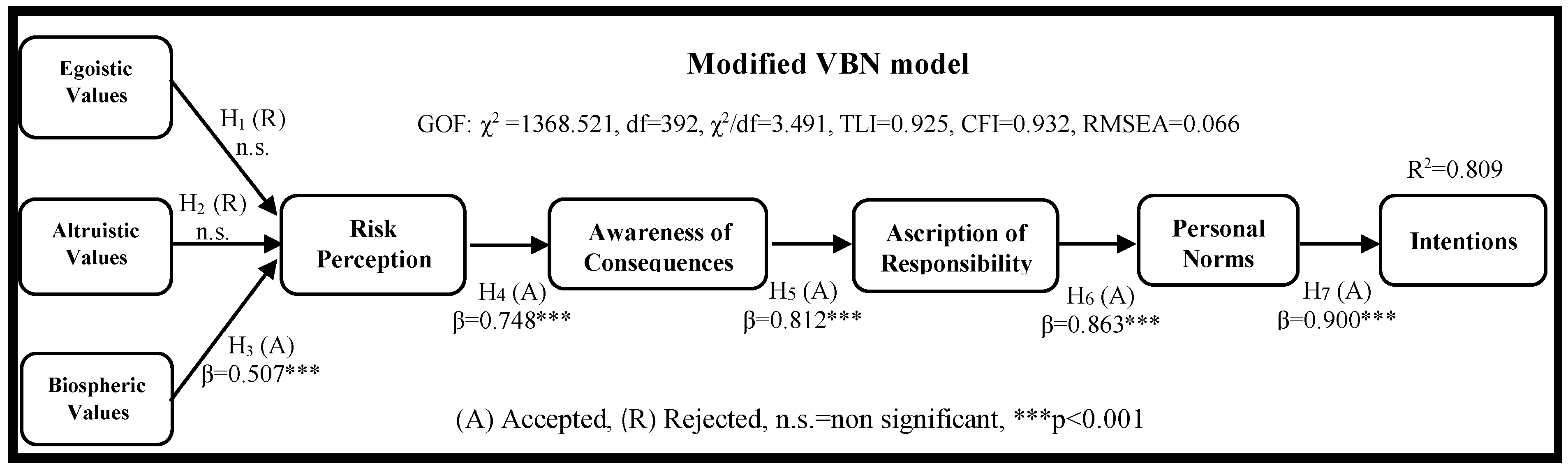
Therefore, the theoretical framework of this study (Figure 1) incorporates, in sequence, the three types of personal values, namely egoistic (EV), altruistic (AV), and biospheric values (BV), Leiserowitz’s [68] risk perception (RP), the more specific beliefs, namely awareness of consequences (AC) and ascription of responsibility (AR), leading to personal norms (PN) that are assumed able to predict intentions (Int). In VBN, it is suggested that each variable in the sequential chain of the framework should be causally related to the next one, while it might also be related to the following variables [50].

3. Literature Review and Hypotheses Development

3.1. Values

Schwartz [73] stated that values are “desirable, trans-situational goals, varying in importance, that serve as guiding principles in people’s lives”. Specifically, with regard to green hotels, Wang et al. [74] argued that those travellers who would visit a green hotel, in essence, react to their own feelings concerning a moral obligation to contribute to environmental protection. These people are most probably benevolent, self-transcendent individuals, who feel responsible for other people and the overall planet.

3.1.1. Egoistic Values

Stern [41] argued that egoistic values should be understood as a person’s focus solely on his own interests and enhancement. Such a mentality is in contrast to Schwartz’s [73] notion of self-transcendence, which has been widely accepted as the root of pro-environmental values. A person with strong egoistic values cannot be considered to be sensitive to socially oriented issues. Thus, an egoist cannot be assumed to be sensitive towards environmental deterioration, especially if any threats seem somewhat distant from his everyday life [58,75,76]. With regard to tourists’ intentions to visit green hotels, egoistic values have been incorporated in a few studies on various frameworks and produced mixed results. In Egypt, egoistic values were found to affect negatively the sense of obligation to visit green hotels [42], while in contrast to its theoretical foundation, in India [77] and Pakistan [22] they were found to affect positively environmental concern [77] and pro-environmental beliefs [22]. According to the theoretical framework of this study, it is hypothesised that
H1. 
Egoistic Values negatively affect Risk Perception.

3.1.2. Altruistic Values

Altruistic values primarily concern the effects of an individual’s behaviour on other people’s benefits [41]. Leiserowitz [56] argued that individuals who share stronger altruistic values than others also hold stronger perceptions of environmental risk because they do not focus just on their own welfare. They are sensitive towards other people’s troubles as well as towards general social and humanitarian conditions, while they are concerned about future generations. Indeed, previous research results verified the positive impact of altruistic values on environmental concern in India [77], on sense of obligation in Egypt [42], and on pro-environmental beliefs in Pakistan [22]. Therefore, the following hypothesis was set:
H2. 
Altruistic Values positively affect Risk Perception.

3.1.3. Biospheric Values

Stern [41] questioned whether a specific set of values, different from the egoistic, altruistic, traditional and open-to-change values [50]—that specifically would focus on nature conservation—should indicate an important factor of people’s pro-environmental support. Steg and his associates [75], who were among the first researchers to test VBN, found that, among the other set of values, only biospheric values seemed to be related to NEP, while they were also related to moral obligation. Thus, it was argued that biospheric values are most probably the main determinant able to explain people’s eco-friendly behaviours and decisions [78]. This was later verified as, in a comparison between socio-altruistic and biospheric values, the latter indicated a stronger influence on consumers’ pro-environmental attitudes and behaviours [79,80]. In more recent papers, biospheric values were found to positively affect NEP [81] and awareness of consequences [82] in the USA, environmental concern in India [77], sense of obligation in Egypt [42] and support for endangered animals, habitats and plants in China [83]. Therefore, the following hypothesis was set:
H3. 
Biospheric Values positively affect Risk Perception.

3.2. Beliefs

3.2.1. Risk Perception

Climate change risk perception (RP) has been included in some previous studies regarding pro-environmental behaviours. For example, in Van der Linden’s [76] study in the United Kingdom, in Xie’s et al. [84] study in Australia, and in Saari’s et al. [85] study in the European Union. In Greece, Tilikidou and Delistavrou [55] replaced NEP with Leiserowitz’s [56] risk perception construct in a VBN model about consumers’ intentions to buy eco-friendly cosmetics and detergents. Although the latter study influenced the design of the present study, the more recent construct of RP [68] was utilised. Therefore, it is hypothesised that risk perception should impact consumers’ beliefs regarding the consequences of global warming.
H4. 
Risk Perception positively affects Awareness of Consequences.
In VBN theory, beliefs are related to the thoughts of individuals towards environmental and human problems [41]. At this point, the two links of the chain concern the concepts of awareness of consequences and ascription of responsibility.

3.2.2. Awareness of Consequences

Awareness of consequences is a variable described as the consumers’ consciousness about the negative results caused by their own activities to the natural environment [41]. In the sector of green hotels, Choi et al. [82] and Wang et al. [8] found that awareness of consequences positively affects ascription of responsibility in the USA and Pakistan, respectively. Eid et al. [42] indicated that awareness of consequences positively affects the sense of obligation in Egypt.

3.2.3. Ascription of Responsibility

This concept refers to the accountability of individuals regarding the negative consequences that their own non-socially responsible behaviours may cause [86]. Further, personal norms represent the consumers’ moral obligation, which motivates them to engage in practices and support that are friendly to the environment [50]. They are supposed to be influenced directly by beliefs, and in reverse sequence by values, being eventually the key predictor of any pro-environmental behaviour [41]. Choi et al. [82], Fauzi et al. [2], and Wang et al. [8] found that ascription of responsibility positively affects personal norms in the USA, Malaysia and Pakistan, respectively. In this study, the following two hypotheses were set:
H5. 
Awareness of Consequences positively affects Ascription of Responsibility.
H6. 
Ascription of Responsibility positively affects Personal Norms.

3.3. Personal Norms and Intentions

A significant number of researchers valorised personal norms in modified VBN applications with regard to green hotels. Choi et al. [82] and Han [81] in the USA, Eid et al. [42] in Egypt, Wang et al. [1] in China, Wang et al. [8] in Malaysia and Waris et al. [22] in Pakistan indicated a statistically significant, positive impact of personal norms on behavioural intentions.
Some papers about green hotels found usefulness in adopting personal norms (sometimes with different variable labels, nonetheless always referring to moral obligation), although they did not apply a full VBN model. For example, Bashir et al. [87] in Malaysia, Kim and Yun [7] in South Korea and Majeed et al. [49] in the USA indicated statistically significant positive impacts on pro-environmental intentions or behaviours. All these studies essentially indicate the crucial impact of personal norms in formulating pro-environmental intentions and/or behaviour.
Intentions to perform a specific behaviour are considered the primary determinant of actual behaviour [41], related to the relative strength of one’s purpose to perform a specific behaviour [75]. In essence, it is assumed that if the relevant intentions are very strong, a specific behaviour will occur. In this study, following the typology of ethical tourism, the positive, negative and discursive aspects are simultaneously examined. Thus, the relevant variable encompasses future lodging customers’ intentions to prefer green and/or ethical hotels, avoid establishments accused of environmental degradation and/or unethical labour practices and engage in discussions with other people, share opinions and/or spread messages via social media. Accordingly, the following hypothesis was set:
H7. 
Personal Norms positively affect Intentions.

4. Methodology

Personal interviews were conducted with consumers in the urban area of Thessaloniki, Greece. A structured questionnaire was used for data collection. Before the main survey, a pretest was conducted with 12 consumers of representative age groups and professions. The pretest assisted in revising the questionnaire for clarity and wording.

4.1. Sampling

During the main survey, a combination of sampling methods was used to approach the highest feasible degree of representativeness. The combination included a random sampling method, namely area sampling, and a non-random sampling method, namely quota sampling [88,89]. Regarding area sampling, building blocks were randomly selected from the map of the Thessaloniki urban area. Quota sampling was applied to retrieve a representative sample proportional to the population’s age and gender. Area sampling ensured that each city block had a known and nonzero probability of being randomly selected in the first stage of the method implementation [89], while in the second stage, quota sampling enabled matching of the sample with the population’s demographic distribution in terms of gender and age [89]. According to the Hellenic Statistical Authority, the population size comes to 358,811 households residing in the Thessaloniki urban area [90]. The sample size was set to be n = 600 to ensure the suggested portion of 1.5/1000 by the Hellenic Statistical Authority for household surveys [91]. The procedure ended with 571 usable questionnaires.

4.2. Variables Measurement

The following variables were included in the questionnaire:
Biospheric Values (BV), Egoistic Values (EV) and Altruistic Values (AV), with four items each, were measured on a 7-point importance scale from 1 = absolutely unimportant to 7 = supremely important. Risk Perception (RP) of eight items was measured from 1 = not at all to 7 = very much. Awareness of Consequences (AC), Ascription of Responsibility (AR) and Personal Norms (PN) included five items each. Intentions (Int) consisted of six items. All items of Awareness of Consequences, Ascription of Responsibility, Personal Norms and Intentions were measured on a 7-point Likert scale from 1 = absolutely disagree to 7 = absolutely agree. In addition, five demographic variables were added, namely Gender, Age, Occupation, Income, and Education. The relevant scales were adopted from the Hellenic Statistical Authority [90].

5. Results and Analysis

The analyses were conducted by the utilisation of SPSS v.27 and AMOS v.20 for structural equation modelling (SEM). Before any statistical analyses were performed, the data were examined for missing values and outliers. No missing values or outliers were detected.

5.1. Demographics

The demographic characteristics of the sample are presented in Table 1. The chi-square test did not indicate any statistically significant differences between the sample and the population distributions of the Thessaloniki urban area.

5.2. Descriptive Statistics

Descriptive statistics of all variables are presented in Table 2. Consumers expressed a high level of Altruistic (Mean = 25.574, S.D. = 2.791) and Biospheric (Mean = 25.105, S.D. = 3.509) with a moderate level of Egoistic (Mean = 17.438, S.D. = 5.639) Values. Regarding Risk Perception, the descriptive statistics indicated that the respondents held a high level of Risk Perception (Mean = 45.408, S.D. = 10.376). They also expressed a high level of Awareness of Consequences (Mean = 28.152, S.D. = 5.133) but a moderate level of Ascription of Responsibility (Mean = 23.208, S.D. = 6.552) towards hotel’s environmental destruction and over-exploitation of workers. As for Personal Norms, it was indicated at a relatively high level (Mean = 25.343, S.D. = 6.287). They also had a relatively high level (Mean = 31.697, S.D. = 7.307) of Intentions to visit green and/or ethical hotels and to boycott hotels accused of environmental destruction and/or over-exploitation of workers (Table 2).

5.3. One-Way ANOVA

The One-Way ANOVAs in Intentions across all demographics were calculated. The results indicated a statistically significant (p < 0.001) relationship between gender and Intentions. Women (Mean = 33.266, S.D. = 6.063) were found to express higher Intentions than men (Mean = 30.078, S.D. = 8.099) to visit a green and/or an ethical hotel and to boycott hotels accused of environmental destruction and/or over-exploitation of workers.

5.4. Measurement Model

All items of all variables were entered in the initial measurement model analysis. Three items were excluded due to cross-loadings (Int6), error-covariances (PN3) and low (<0.5) factor loading (AR2). The goodness-of-fit (GOF) values (Table 2) indicated that the final measurement model fits the data well [94]. Unidimensionality of all constructs was tested by examining all items’ factor loadings, cross-loadings and error covariances. All factor loadings (Table 2) were above 0.5 [94], while cross-loadings and error covariances were low. Construct validity was examined through convergent validity, discriminant validity and nomological validity. Convergent validity of all constructs was assessed (Table 3) as factor loadings were higher than 0.5, average variances extracted (AVE) were higher than 0.5, and all construct reliabilities were higher than 0.8, indicating exemplary reliability [94]. In addition, discriminant validity (Table 3) indicated that the AVE value of each construct was greater than each squared correlation coefficient between the pairs of constructs [95] except for Personal Norms and Intentions (r2 > AVE). Finally, nomological validity was also assessed, as the statistically significant (p < 0.001) correlations between all pairs of constructs were in the hypothesised directions, apart from Egoistic Values to Risk Perception.

5.5. Structural Model

The initial GOF values indicated that the model did not fit the data well. The hypothesised consecutive relationships between Biospheric Values (BV), Risk Perception (RP), Awareness of Consequences (AC), Ascription of Responsibility (AR), Personal Norms (PN) and Intentions (Int) were found to be statistically significant (p < 0.001) and positive. Thus, hypotheses H3, H4, H5, H6, H7 were supported. However, the hypothesised relationships between Risk Perception (RP) and Egoistic Values (ΕV), as well as Altruistic Values (AV), were found to be statistically non-significant (p > 0.05). Therefore, hypotheses H1 and H2 were rejected, and the relevant constructs were excluded from the final structural model. The relevant GOF values exceeded the recommended cut-off points [94,96] and indicated that the final structural model fits the data well (Figure 1). The standardised regression weights indicated that there are statistically significant (p < 0.001) and positive relationships between Biospheric Values and Risk Perception (β = 0.507), Risk Perception and Awareness of Consequences (β = 0.748), Awareness of Consequences and Ascription of Responsibility (β = 0.812), Ascription of Responsibility and Personal Norms (β = 0.863), and Personal Norms and Intentions (β = 0.900). The squared multiple correlations indicated that the modified VBN model could explain 80.9% of the variance in Intentions to visit green and/or ethical hotels and boycott hotels accused of environmental destruction and/or over-exploitation of workers (Figure 1).

6. Conclusions and Discussion

The modified VBN model applied in this study was found to be powerful in explaining the 80.9% of the variance in the Greek future lodging customers’ intentions to choose a green and/or ethical hotel when travelling. It is concluded that travellers who hold higher values regarding the biosphere and respect for the goods nature offers to the humanity are more likely to perceive the risks of global warming more strongly. These perceptions of risks and threats, in turn, enable them to recognise the adverse consequences of the hospitality industry for both the environment and hotel employees’ working conditions. Individuals who are aware of these consequences are more likely to ascribe personal responsibility and to develop a sense of ethical obligation to fulfil their role in protecting the environment and support the hotel employees’ rights. This psychological mechanism ultimately leads to more favourable behavioural intentions, including the choice of ethical hotels, the avoidance of, as well as information sharing about, hotels accused of environmental harm and over-exploitation of employees.
Starting from the end of the chain, it is discussed that the results derived by univariate analysis indicated that travellers’ intentions to avoid a hotel are higher than their definite intentions to choose a green and/or ethical hotel (Int 3). More specifically, intentions to boycott a hotel accused of over-exploitation of workers (Int 5) were found to be higher than those towards hotels that cause excessive damage to the environment (Int 4). This evidence most probably highlights the important role of unions and citizen groups and associations that could and should expose and denounce extraordinary violations, especially regarding labour conditions. Women were found to hold higher intentions than men to visit a green and/or ethical hotel and to boycott hotels accused of over-exploitation of workers and/or environmental destruction. This is in line with findings by Tilikidou et al. [10] in the same geographical area.
The detailed findings of Personal Norms, as expected, mainly express the individual morality of a respondent who desires to be a better person (PN4) among others and is willing to act according to his/her moral norms (PN5). In this study, the impact of personal norms on intentions verifies their crucial significance in VBN. This fact has been emphasised many times, even in studies where the overall VBN chain had not been adopted (e.g., [7,49,87]. However, the extremely high coefficient estimated in this study should be further discussed with caution. With regard to responsibility, the higher Means were obtained in those items that concern beliefs of obligation to discuss with other people and/or spread negative messages through social media about those hotels that are accused of extremely unfair labour practices and exploitation of workers (AR5), as well as avoidance of hotels that are accused of severe environmental burden (AR3). As for consequences, the respondents were found to mostly acknowledge that long and difficult working hours in the hotel industry exhaust employees and cause serious physical and psychological effects to them (AC5).
Up to this point, the findings indicate that the respondents’ concerns regard primarily the unfair labour conditions followed by environmental destruction, while their intentions to avoid a hotel accused of these issues appear stronger than their intentions to prefer a green and/or ethical hotel. The overall picture of the results must be studied and evaluated carefully, as it could be deemed inaccurate or even contrary to reality. Indeed, qualitative studies have indicated that online reviews [46,97] and price [46] are the main factors of a hotel’s choice. Statistics from booking platforms indicate that customers prioritise criteria such as online hotel reviews, star ratings, and mobile accessibility [98], as well as location, price, and previous experience [99]. Further, with relevance to perceptions about risks and threats due to global warming, the respondents were found to be primarily worried about plants, animals and future human generations (RP8, RP7). It is to be commented that the respondents indicated a slightly higher level of risk perception regarding people in underdeveloped countries (RP6) compared to the relevant perceptions about themselves and the overall Greek population (RP4 and RP5). These findings align with Leiserowitz et al.’s [68] recent findings, indicating an impressive increase compared to earlier estimations [56] of Americans’ concerns about their own country and natural environment due to climate changes.
Last, but not least, it is to be underlined that just Biospheric Values were entered in the final structural model analysis. They indicated a relatively strong impact on Risk Perception, which in turn indicated a high impact on Awareness of Consequences, verifying the choice to replace NEP with those beliefs that focus on examining the most contemporary issue in environmental sciences, that of climate change. This finding is in line with the suggestion by Tilikidou and Delistavrou [55] to incorporate risk perceptions in consumer pro-environmental research, although their study was about a different topic. Egoistic Values, which were excluded from the final structural model in this study, have been excluded in some previous works, too [52,66,100,101]. Altruistic Values were excluded from the final Structural Model of this study; a finding that was not expected, as altruism is at the core of VBN and has been many times found to indicate strong impact on beliefs [44,61,102]. From a more coherent perspective, it can be argued that the values guiding pro-environmental behaviours in the present era are not primarily focused on altruism, which concerns other poor, disadvantaged individuals. It was not found that altruists have stronger intentions to prefer ethical tourism. However, it cannot be definitely concluded that altruism should be excluded from any ecologically related research subject. Nor that egoists are, by definition, excluded from pro-environmental intentions. The fact is that the values of altruism and egoism did not provide evidence of inclusion in the VBN chain of this study. It seems that, in Greece, the starting point of the VBN sequence primarily concerns those deep values of respect for the land and climate that are more than other values capable of strongly influencing respondents’ perceptions regarding the risks and threats due to climate change.
Finally, the structural model indicated that all relationships in the model were relatively high. It was indicated that the highest regression was found in the relationship between Personal Norms and Intentions (β = 0.900). The results indicated that standardised regression weights were increasing across the modified VBN model, confirming the shaping of behavioural variables by the additive gradual effect of the previous variable on the next one, verifying Stern’s [41] initial suggestions. The total percentage of variance explained in Intentions (R2 = 0.809) is impressive in comparison to previous findings regarding preferences towards green hotels ([81], R2 = 0.579; [1], R2 = 0.483; [8], R2 = 0.597 and [22], R2 = 0.402). However, the unusually high explanatory power should be interpreted with caution, as it may partly reflect common method bias, the conceptual proximity between personal norms and intentions, and the normative homogeneity of the urban sample.

7. Implications

7.1. Theoretical Implications

This paper is one of the very few studies that applied the VBN model without adding other variables, such as some of the TPB variables. Therefore, it contributes to clearly revealing the power of values as the roots of the consumers’ pro-environmental intentions. The study extended our knowledge regarding European consumers, as it was conducted in Greece, a geographical area in which pro-environmental research has been rather limited compared to other EU countries. Most probably, the primary theoretical contribution of this study is the expansion of research regarding just green hotels by the more inclusive ethical hotel concept. The examination included not only positive intentions to prefer a hotel but also negative and discursive consumer intentions. The theoretical conceptualisation of the overall investigation joins two societally significant issues, namely environmental protection and fair labour conditions, in the hotel sector. Part of the originality of this study is the suggestion to examine not just customers’ intentions to avoid a hotel due to accusations about extreme environmental damage but also due to over-exploitation of employees and further spread these messages to others via mostly digital communication. Another notable part of the theoretical contribution of this study is the employment of the most contemporary issue in pro-environmental research, that of climate change, by replacing NEP with risk perception. This modification of the VBN was, for the first time, attempted in hospitality research. It revealed previously unforeseen aspects that were found to be exclusively influenced by biosphere values and in turn, are capable of influencing awareness of consequences, thus significantly contributing to the sequential formation of intentions.

7.2. Practical Implications

Hotel managers who plan to build and promote an ecological or, even more, an ethical strategy for their hotel or hotel chain, have much to gain by studying carefully the details in the results of this study. They should firstly comprehend that their primary target joins those tourists that hold high norms regarding fair labour conditions and environmental protection. These are responsible people, who acknowledge the consequences due to the practices of conventional hotels that lead to long overtime, unfair labour relations, general over-exploitation of workers as well as about increased waste, and excessive energy/water consumption. They are sensitive people, who are worried about risks that threaten nature, humanity, and future generations, and all these beliefs are rooted in their deep biospheric values that concern respect for the overall planet.
All these findings should be taken into consideration when deciding the desired brand identity and the image of an ethical hotel and also when designing creative communication techniques. An ethical image can be built upon (a) certified pro-environmental hotel practices (e.g., green key, iso140001, etc.) and (b) pro-labour hotel practices in close communication and collaboration with the union of the hotel employees. The results of a fair work environment can be leveraged in the hotel’s marketing communication strategies. In the broader sense of ethical hospitality, it would be very useful if the managers and owners of some hotel chains were interested to propose the establishment of a hotel ethical certificate and/or label. This label could be similar but clearly broader than the Green Key certification, as its acquisition would require not only environmentally friendly but also work-friendly conditions when exercising hotel management. If global and/or EU tourism organisations were to support this initiative, the pursuit of such certification, as part of efforts to build an ethical image, could become a strong incentive for managerial change towards more ethical hotel practices.

8. Limitations and Further Research Suggestions

Most probably, the main limitation of this study is the social desirability effect, which is always present in any socially sensitive subject. Intentions are a crucial predisposition to behaviour but cannot be counted as actual behaviour. Therefore, examining past relevant experience as well as conducting qualitative techniques, such as focus groups, might enrich the study of this topic. Another limitation of this study is that the sample was derived from just one region of Greece, and thus, the generalisation of the results is somewhat confined. In addition to these potential sources of bias, there might be bias associated with just the urban (not rural) area of this study and from the respondents’ education levels, which appear somewhat higher than those of the general population. Therefore, replications of this research in larger geographical areas (urban, suburban, and rural) with a more closely proportionate sample in terms of education level are expected to provide a clearer vision of future lodging customers’ decision-making. Further, cultural factors might have influenced the findings of this study. Therefore, cross-cultural validation of the proposed framework through the investigation of cross-national samples would be a promising path for future research. It is also noted that the percentage of variance in this study was found to be at a surprisingly high level, indicating by all means the power of VBN. In any case, it has to be underlined that, as Balaji et al. [103] also commented, the understanding of values as roots of ethical consumer preferences seems to be more complex than just the estimations of statistically significant direct relationships. Therefore, it could be argued that a broader set of variables in future studies—possibly in a combination of models and other exogenous variables—is expected to add fruitfulness to our knowledge regarding travellers’ ethical identity and its role in shaping ethical consumer choices. A better understanding of behavioural trends could be achieved by combining survey data with information collected through hotel reservations or sales. This would likely yield a greater sense of accuracy regarding decision-making processes and the actual consumer behaviour of hotel guests.
Nonetheless, it is to be underlined that the implications of this study are strictly defined within the limits of the extracted results. The overall sustainability issue in tourism is multilevel, and its investigation should be extended to all tourism stakeholders. The performance of one single hotel or even a hotel chain will hardly make any difference in climate change mitigation. Cooperation between public regulations and private initiatives at the European and global level is required to take extensive environmental protection measures in hospitality. Furthermore, with regard to the specific perspective of this study, which includes the labour issue, additional synergies are also required on behalf of hotel workers’ unions to ensure fair labour conditions.

Author Contributions

Conceptualization, I.P., A.D. and I.T.; methodology, I.P., A.D. and I.T.; software, I.P. and A.D.; validation, A.D. and I.T.; formal analysis, I.P., A.D. and I.T.; investigation, I.P., A.D. and I.T.; resources, I.P. and A.D.; data curation, I.P., A.D. and I.T.; writing—original draft preparation, I.P. and I.T.; writing—review and editing, I.P., A.D. and I.T.; visualisation, I.P., A.D. and I.T.; project administration, A.D. All authors have read and agreed to the published version of the manuscript.

Funding

This research received no external funding.

Institutional Review Board Statement

The study was conducted in accordance with the Declaration of Helsinki, and approved by the Ethics Committee of the International Hellenic University (protocol code was 102/25 and date of approval was 7 November 2025).

Informed Consent Statement

Informed consent was obtained from all subjects involved in the study.

Data Availability Statement

The data of this study are available on request from the corresponding author.

Conflicts of Interest

The authors declare no conflicts of interest.

References

  1. Wang, C.P.; Zhang, Q.; Wong, P.P.W.; Wang, L. Consumers’ green purchase intention to visit green hotels: A Value-Belief-Norm theory perspective. Front. Psychol. 2023, 14, 1139116. [Google Scholar] [CrossRef]
  2. Fauzi, M.A.; Hanafiah, M.H.; Kunjuraman, V. Tourists’ intention to visit green hotels: Building on the Theory of Planned Behaviour and the Value-Belief-Norm theory. J. Tour. Futures 2024, 10, 255–276. [Google Scholar] [CrossRef]
  3. Taheri, B.; Olya, H.; Batat, W. Ethical consumption and climate change in hospitality and tourism: Challenges, solutions, and prospects: Guest Editorial. Int. J. Contemp. Hosp. Manag. 2024, 36, 1457–1466. [Google Scholar] [CrossRef]
  4. Kotler, P. The consumer in the age of coronavirus. J. Creat. Value 2020, 6, 12–15. [Google Scholar] [CrossRef]
  5. Demetriou, M.; Thrassou, A.; Efthymiou, L.; Sahyoun, K. The Impact of COVID-19 on sustainability and CSR Activities: An Empirical Study across Nine Sectors. In Business for Sustainability; Vrontis, D., Thrassou, A., Efthymiou, L., Weber, Y., Shams, S.M.R., Tsoukatos, E., Eds.; Palgrave Studies in Cross-disciplinary Business Research, In Association with EuroMed Academy of Business; Palgrave Macmillan: Cham, Switzerland, 2024; Volume II, pp. 97–116. [Google Scholar] [CrossRef]
  6. Kim, T.; Ha, J. An Investigation of Customer Psychological Perceptions of Green Consciousness in a Green Hotel Context: Applying a Extended Theory of Planned Behavior. Int. J. Environ. Res. Public Health 2022, 19, 6795. [Google Scholar] [CrossRef]
  7. Kim, T.; Yun, S. Research Framework Built Natural-Based Solutions (NBSs) as Green Hotels. Sustainability 2022, 14, 4282. [Google Scholar] [CrossRef]
  8. Wang, L.; Zhang, Q.; Wong, P.P.W. Reexamination of Consumers’ Willingness to Stay at Green Hotels: Rethinking the Role of Social Identity Theory, Value-Belief-Norm Theory, and Theory of Planned Behavior. J. Hosp. Mark. Manag. 2024, 33, 547–581. [Google Scholar] [CrossRef]
  9. Chang, L.H.; Tsai, C.H.; Yeh, S.S. Evaluation of Green Hotel Guests’ Behavioral Intention. Adv. Hosp. Leis. 2014, 10, 75–89. [Google Scholar] [CrossRef]
  10. Tilikidou, I.; Delistavrou, A.; Sapountzis, N. Customers’ Ethical Behaviour towards Hotels. Procedia Econ. Financ. 2014, 9, 425–432. [Google Scholar] [CrossRef][Green Version]
  11. Acampora, A.; Lucchetti, M.C.; Merli, R.; Ali, F. The Theoretical Development and Research Methodology in Green Hotels Research: A Systematic Literature Review. J. Hosp. Tour. Manag. 2022, 51, 512–528. [Google Scholar] [CrossRef]
  12. Bank of Greece. Annual Report 2023; Bank of Greece: Athens, Greece, 2024. [Google Scholar] [CrossRef]
  13. Vagena, A. Sustainability in the Hotel Sector: A Research Study in Greece. Qeios 2024, preprint. [Google Scholar] [CrossRef]
  14. Eurobarometer Climate Change, 2023. Available online: https://europa.eu/eurobarometer/surveys/detail/2954 (accessed on 27 February 2025).
  15. Metron Analysis Metron Analysis: Climate Change: The Most Important Problem on the Planet for Greeks, 2023. Available online: https://www.in.gr/2023/09/27/greece/metron-analysis-klimatiki-allagi-simantikotero-provlima-ston-planiti-gia-tous-ellines-akriveia-sti-xora/ (accessed on 25 February 2025).
  16. Foundation for Economic and Industrial Research. Public Attitudes to Climate Change and Renewable Energy in Greece; Thessaloniki, 2024. Available online: https://iobe.gr/wp-content/uploads/2026/01/RES_05_C_11092024_PRE_EN.pdf (accessed on 26 February 2025).
  17. Yfantidou, G.; Papaioannou, A.; Kriemadis, T. Green Hotel and Environmental Practices: The Challenge of Travel Behavior Change. Tourismos 2019, 14, 212–235. [Google Scholar] [CrossRef]
  18. Parpairis, D.A.; Lagos, D.G. The Ecological Footprint of Tourism: A Case Study of the Greek Hotel Sector; Cambridge Scholars Publishing: Newcastle upon Tyne, UK, 2021; Available online: https://books.google.gr/books?hl=el&lr=&id=gjYoEAAAQBAJ&oi=fnd&pg=PR5&dq=The+ecological+footprint+of+tourism+:+a+case+study+of+the+Greek+hotel+sector&ots=sOHlu5Lyb_&sig=Xih44wzAR52P6rAsfxxNjcfrSaA&redir_esc=y#v=onepage&q&f=false (accessed on 27 February 2025).
  19. Hellenic Chamber of Hotels Total Hotels in Greece, 2024. Available online: https://www.grhotels.gr/app/uploads/2025/02/01_Hotels_2024_Total.pdf (accessed on 27 February 2025).
  20. Karavasilis, G.; Nerantzaki, D.-M.; Pantelidis, P.; Paschaloudis, D.; Vrana, V. What Generation Y in Greece Thinks about Green Hotels. World J. Entrep. Manag. Sustain. Dev. 2015, 11, 268–280. [Google Scholar] [CrossRef]
  21. Papadopoulos, I.; Trigkas, M.; Papadopoulou, A.; Mallisiova, A.; Mpakogiorgou, F. Greek Consumers’ Awareness and Perceptions for Green Hotels and Green Furniture. In Proceedings of the Strategic Innovative Marketing and Tourism; Kavoura, A., Ed.; Springer Nature: Cham, Switzerland, 2019; pp. 583–592. [Google Scholar] [CrossRef]
  22. Waris, I.; Iqbal, A.; Ahmed, R.; Hashim, S.; Ahmed, A. Values and Information Publicity Shape Tourists’ Intentions to Visit Green Hotels: An Application of the Extended Value-Belief Norms Theory. Manag. Environ. Qual. 2024, 35, 780–798. [Google Scholar] [CrossRef]
  23. Wang, L.; Wong, P.P.W. Marketing of Environmentally Friendly Hotels in China through Religious Segmentation: A Theory of Planned Behaviour Approach. Tour. Rev. 2021, 76, 1164–1180. [Google Scholar] [CrossRef]
  24. Köseoglu, M.A.; Sehitoglu, Y.; Ross, G.; Parnell, J.A. The Evolution of Business Ethics Research in the Realm of Tourism and Hospitality: A Bibliometric Analysis. Int. J. Contemp. Hosp. Manag. 2016, 28, 1598–1621. [Google Scholar] [CrossRef]
  25. Oskam, J.A.; De Visser-Amundson, A. A Systematic Review of Ethical Issues in Hospitality and Tourism Innovation. J. Hosp. Tour. Insights 2022, 5, 782–803. [Google Scholar] [CrossRef]
  26. Weeden, C. Ethical Tourism: An Opportunity for Competitive Advantage? J. Vacat. Mark. 2002, 8, 141–153. [Google Scholar] [CrossRef]
  27. Lovelock, B.; Lovelock, K. The Ethics of Tourism: Critical and Applied Perspectives, 1st ed.; Routlege: Oxfordshire, UK, 2013. [Google Scholar] [CrossRef]
  28. Hassan, S.M.; Rahman, Z.; Paul, J. Consumer Ethics: A Review and Research Agenda. Psychol. Mark. 2022, 39, 111–130. [Google Scholar] [CrossRef]
  29. Santos, V.; Almeida, N. Ethical Marketing Model for Luxury Hotel Chains: Development and Validation of a Performance Evaluation Tool. Sustainability 2022, 14, 7382. [Google Scholar] [CrossRef]
  30. Teng, Y.; Ma, Z.; Jing, L. Explore the World Responsibly: The Antecedents of Ethical Tourism Behaviors in China. Sustainability 2021, 13, 4907. [Google Scholar] [CrossRef]
  31. Perera, P.; Jayakody, C.; Jayapali, U.; Newsome, D. Challenges and Opportunities for the Resumption of Nature Tourism in Post-Pandemic Sri Lanka. Int. J. Geoherit. Parks 2023, 11, 234–246. [Google Scholar] [CrossRef]
  32. Kim, E.J.; Kim, E.L.; Kim, M.; Tang, J. The Matching Effect of Local Food and Color on Ethical Dining Behaviors: The Roles of Credibility and Green Image. Int. J. Contemp. Hosp. Manag. 2024, 36, 1557–1576. [Google Scholar] [CrossRef]
  33. Farrukh, M.; Rafiq, M.; Raza, A.; Ansari, N.Y. Climate Change Needs Behavior Change: A Team Mechanism of Team Green Creative Behavior. Int. J. Contemp. Hosp. Manag. 2024, 36, 1577–1596. [Google Scholar] [CrossRef]
  34. Knani, M. Ethics in the Hospitality Industry: Review and Research Agenda. Int. J. Bus. Manag. 2014, 9, 1. [Google Scholar] [CrossRef]
  35. Myung, E. Progress in Hospitality Ethics Research: A Review and Implications for Future Research. Int. J. Hosp. Tour. Adm. 2018, 19, 26–51. [Google Scholar] [CrossRef]
  36. Choi, Y.H.; Myung, J.K.; Kim, J.D. The Effect of Employees’ Perceptions of CSR Activities on Employee Deviance: The Mediating Role of Anomie. Sustainability 2018, 10, 601. [Google Scholar] [CrossRef]
  37. Tilikidou, E.; Delistavrou, A. Do Beliefs Affect Customers’ Intentions to Choose Green Hotels? Int. J. Strateg. Innov. Mark. 2014, 1, 51–60. [Google Scholar] [CrossRef]
  38. Tilikidou, I.; Delistavrou, A. Preferring Green and Rejecting “Unethical” Hotels. EuroMed J. Bus. 2015, 10, 285–296. [Google Scholar] [CrossRef]
  39. Soliman, S.E. The Influence of Hotels’ Green Activities on Customers’ Ethical Behavior: The Case of Five-Star Hotels in Alexandria. Int. J. Herit. Tour. Hosp. 2017, 11, 136–158. [Google Scholar] [CrossRef]
  40. Ajzen, I. The Theory of Planned Behavior. Organ. Behav. Hum. Decis. Process. 1991, 50, 179–211. [Google Scholar] [CrossRef]
  41. Stern, P.C. Toward a Coherent Theory of Environmentally Significant Behavior. J. Soc. Issues 2000, 56, 407–424. [Google Scholar] [CrossRef]
  42. Eid, R.; Agag, G.; Shehawy, Y.M. Understanding Guests’ Intention to Visit Green Hotels. J. Hosp. Tour. Res. 2021, 45, 494–528. [Google Scholar] [CrossRef]
  43. Kim, W.H.; Kim, K.S. Pro-Environmental Intentions among Food Festival Attendees: An Application of the Value-Belief-Norm Model. Sustainability 2018, 10, 3894. [Google Scholar] [CrossRef]
  44. Hwang, J.; Kim, W.; Kim, J.J. Application of the Value-Belief-Norm Model to Environmentally Friendly Drone Food Delivery Services: The Moderating Role of Product Involvement. Int. J. Contemp. Hosp. Manag. 2020, 32, 1775–1794. [Google Scholar] [CrossRef]
  45. Megeirhi, H.A.; Woosnam, K.M.; Ribeiro, M.A.; Ramkissoon, H.; Denley, T.J. Employing a Value-Belief-Norm Framework to Gauge Carthage Residents’ Intentions to Support Sustainable Cultural Heritage Tourism. J. Sustain. Tour. 2020, 28, 1351–1370. [Google Scholar] [CrossRef]
  46. Noone, B.M.; McGuire, K.A. Pricing in a Social World: The Influence of Non-Price Information on Hotel Choice. J. Revenue Pricing Manag. 2013, 12, 385–401. [Google Scholar] [CrossRef]
  47. Yadav, R.; Balaji, M.S.; Jebarajakirthy, C. How Psychological and Contextual Factors Contribute to Travelers’ Propensity to Choose Green Hotels? Int. J. Hosp. Manag. 2019, 77, 385–395. [Google Scholar] [CrossRef]
  48. Crane, A.; Matten, D. Business Ethics: A European Perspective; Oxford University Press: Oxford, UK, 2004; Available online: https://www.researchgate.net/publication/235356495_Business_Ethics_A_European_Perspective (accessed on 27 February 2025).
  49. Majeed, S.; Kim, W.G.; Kim, T. Perceived Green Psychological Benefits and Customer Pro-Environment Behavior in the Value-Belief-Norm Theory: The Moderating Role of Perceived Green CSR. Int. J. Hosp. Manag. 2023, 113, 103502. [Google Scholar] [CrossRef]
  50. Stern, P.C.; Dietz, T.; Abel, T.; Guagnano, G.A. A Value-Belief-Norm Theory of Support for Social Movements: The Case of Environmentalism. Hum. Ecol. Rev. 1999, 6, 81–97. Available online: https://cedar.wwu.edu/hcop_facpubs/1 (accessed on 27 February 2025).
  51. Dunlap, R.E.; Van Liere, K.D. The “New Environmental Paradigm”. J. Environ. Educ. 1978, 9, 10–19. [Google Scholar] [CrossRef]
  52. Ünal, A.B.; Steg, L.; Granskaya, J. “To Support or Not to Support, That Is the Question”. Testing the VBN Theory in Predicting Support for Car Use Reduction Policies in Russia. Transp. Res. Part A Policy Pract. 2019, 119, 73–81. [Google Scholar] [CrossRef]
  53. Kang, J.; Moreno, F. Driving Values to Actions: Predictive Modeling for Environmentally Sustainable Product Purchases. Sustain. Prod. Consum. 2020, 23, 224–235. [Google Scholar] [CrossRef]
  54. Yeow, P.H.P.; Loo, W.H. Antecedents of Green Computer Purchase Behavior among Malaysian Consumers from the Perspective of Rational Choice and Moral Norm Factors. Sustain. Prod. Consum. 2022, 32, 550–561. [Google Scholar] [CrossRef]
  55. Tilikidou, I.; Delistavrou, A. Cosmetics and Detergents with Recycled CO2: A Cross-Country Study with a Modified by Risk Perception Values–Beliefs–Norms Model. Behav. Sci. 2023, 13, 518. [Google Scholar] [CrossRef]
  56. Leiserowitz, A. Climate Change Risk Perception and Policy Preferences: The Role of Affect, Imagery, and Values. Clim. Change 2006, 77, 45–72. [Google Scholar] [CrossRef]
  57. Olhoff, A.; Christensen, J.; Lamb, W.F.; Pathak, M.; Kuramochi, T.; den Elzen, M.; Fransen, T.; Rogelj, J.; den Elzen, M.; Portugal-Pereira, J.; et al. United Nations Broken Record. Temperatures Hit New Highs, yet World Fails to Cut Emissions (Again); United Nations Environment Programme (UNEP): Nairobi, Kenya, 2023. [Google Scholar] [CrossRef]
  58. Leiserowitz, A.; Maibach, E.; Roser-Renouf, C. Climate Change in the American Mind: Americans’ Global Warming Beliefs and Attitudes in January 2010; Yale University: New Haven, CT, USA, 2010. [Google Scholar] [CrossRef]
  59. United Nations Climate Change. UN Works with Global Hotel Industry to Reduce Emissions. 2018. Available online: https://unfccc.int/news/un-works-with-global-hotel-industry-to-reduce-emissions (accessed on 27 February 2025).
  60. Dunlap, R.E.; Van Liere, K.D.; Mertig, A.G.; Jones, R.E. Measuring Endorsement of the New Ecological Paradigm: A Revised NEP Scale. J. Soc. Issues 2000, 56, 425–442. [Google Scholar] [CrossRef]
  61. Chen, M.F. Selecting Environmental Psychology Theories to Predict People’s Consumption Intention of Locally Produced Organic Foods. Int. J. Consum. Stud. 2020, 44, 455–468. [Google Scholar] [CrossRef]
  62. Zhang, W.; Mas’od, A.; Sulaiman, Z. Moderating Effect of Collectivism on Chinese Consumers’ Intention to Adopt Electric Vehicles—An Adoption of VBN Framework. Sustainability 2022, 14, 12398. [Google Scholar] [CrossRef]
  63. Onel, N.; Mukherjee, A. Why Do Consumers Recycle? A Holistic Perspective Encompassing Moral Considerations, Affective Responses, and Self-Interest Motives. Psychol. Mark. 2017, 34, 956–971. [Google Scholar] [CrossRef]
  64. Fornara, F.; Molinario, E.; Scopelliti, M.; Bonnes, M.; Bonaiuto, F.; Cicero, L.; Admiraal, J.; Beringer, A.; Dedeurwaerdere, T.; de Groot, W.; et al. The Extended Value-Belief-Norm Theory Predicts Committed Action for Nature and Biodiversity in Europe. Environ. Impact Assess. Rev. 2020, 81, 106338. [Google Scholar] [CrossRef]
  65. Carfora, V.; Buscicchio, G.; Catellani, P. Integrating Personal and Pro-Environmental Motives to Explain Italian Women’s Purchase of Sustainable Clothing. Sustainability 2021, 13, 10841. [Google Scholar] [CrossRef]
  66. Hein, N. Factors Influencing the Purchase Intention for Recycled Products: Integrating Perceived Risk into Value-Belief-Norm Theory. Sustainability 2022, 14, 3877. [Google Scholar] [CrossRef]
  67. World Tourism Organization and International Transport Forum. Transport-Related CO2 Emissions of the Tourism Sector—Modelling Results; UNWTO: Madrid, Spain, 2019. [Google Scholar] [CrossRef]
  68. Leiserowitz, A.; Maibach, E.; Rosenthal, S.; Kotcher, J.; Lee, S.; Verner, M.; Ballew, M.; Carman, J.; Myers, T.; Goldberg, M.; et al. Climate Change in the American Mind: Beliefs & Attitudes; Yale University: New Haven, CT, USA, 2022; Available online: https://climatecommunication.yale.edu/wp-content/uploads/2023/07/international-public-opinion-on-climate-change-2022b.pdf (accessed on 22 April 2024).
  69. Tallontire, A.; Rentsendorj, E.; Blowfield, M. Ethical Consumers and Ethical Trade: A Review of Current Literature; Policy Series 12; Natural Resources Institute, University of Greenwich: Chatham, UK, 2001; ISBN 085954527X. Available online: https://gala.gre.ac.uk/id/eprint/11125/1/Doc-0182.pdf (accessed on 27 February 2025).
  70. Micheletti, M.; Stolle, D. A Case of Discursive Political Consumerism: The Nike E-Mail Exchange. In Proceedings of the Proceedings from the 2nd International Seminar on Political Consumerism, Oslo, Norway, 26–29 August 2004; TemaNord: Oslo, Norway, 2005; pp. 255–290. [Google Scholar] [CrossRef]
  71. Seyfi, S.; Hall, C.M.; Saarinen, J.; Vo-Thanh, T. Understanding Drivers and Barriers Affecting Tourists’ Engagement in Digitally Mediated pro-Sustainability Boycotts. J. Sustain. Tour. 2021, 31, 2526–2545. [Google Scholar] [CrossRef]
  72. Seyfi, S.; Rastegar, R.; Kuhzady, S.; Hall, C.M.; Saarinen, J. Whose Justice? Social (in) Justice in Tourism Boycotts. Ann. Tour. Res. Empir. Insights 2023, 4, 100103. [Google Scholar] [CrossRef]
  73. Schwartz, S.H. Value Priorities and Behavior: Applying a Theory of Integrated Value Systems. In The Psychology of Values; Psychology Press: East Sussex, UK, 1996. [Google Scholar] [CrossRef]
  74. Wang, L.; Wong, P.P.W.; Narayanan Alagas, E. Antecedents of Green Purchase Behaviour: An Examination of Altruism and Environmental Knowledge. Int. J. Cult. Tour. Hosp. Res. 2020, 14, 63–82. [Google Scholar] [CrossRef]
  75. Steg, L.; Dreijerink, L.; Abrahamse, W. Factors Influencing the Acceptability of Energy Policies: A Test of VBN Theory. J. Environ. Psychol. 2005, 25, 415–425. [Google Scholar] [CrossRef]
  76. van der Linden, S. The Social-Psychological Determinants of Climate Change Risk Perceptions: Towards a Comprehensive Model. J. Environ. Psychol. 2015, 41, 112–124. [Google Scholar] [CrossRef]
  77. Verma, V.K.; Chandra, B.; Kumar, S. Values and Ascribed Responsibility to Predict Consumers’ Attitude and Concern towards Green Hotel Visit Intention. J. Bus. Res. 2019, 96, 206–216. [Google Scholar] [CrossRef]
  78. De Groot, J.I.M.; Steg, L. Value Orientations and Environmental Beliefs in Five Countries: Validity of an Instrument to Measure Egoistic, Altruistic and Biospheric Value Orientations. J. Cross-Cult. Psychol. 2007, 38, 318–332. [Google Scholar] [CrossRef]
  79. Jakovcevic, A.; Steg, L. Sustainable Transportation in Argentina: Values, Beliefs, Norms and Car Use Reduction. Transp. Res. Part F Traffic Psychol. Behav. 2013, 20, 70–79. [Google Scholar] [CrossRef]
  80. Klöckner, C.A. A Comprehensive Model of the Psychology of Environmental Behaviour-A Meta-Analysis. Glob. Environ. Change 2013, 23, 1028–1038. [Google Scholar] [CrossRef]
  81. Han, H. Travelers’ pro-Environmental Behavior in a Green Lodging Context: Converging Value-Belief-Norm Theory and the Theory of Planned Behavior. Tour. Manag. 2015, 47, 164–177. [Google Scholar] [CrossRef]
  82. Choi, H.; Jang, J.; Kandampully, J. Application of the Extended VBN Theory to Understand Consumers’ Decisions about Green Hotels. Int. J. Hosp. Manag. 2015, 51, 87–95. [Google Scholar] [CrossRef]
  83. Wang, L.; Weng Wong, P.P.; Elangkovan, N.A. The Influence of Religiosity on Consumer’s Green Purchase Intention Towards Green Hotel Selection in China. J. China Tour. Res. 2020, 16, 319–345. [Google Scholar] [CrossRef]
  84. Xie, B.; Brewer, M.B.; Hayes, B.K.; McDonald, R.I.; Newell, B.R. Predicting Climate Change Risk Perception and Willingness to Act. J. Environ. Psychol. 2019, 65, 101331. [Google Scholar] [CrossRef]
  85. Saari, U.A.; Damberg, S.; Frömbling, L.; Ringle, C.M. Sustainable Consumption Behavior of Europeans: The Influence of Environmental Knowledge and Risk Perception on Environmental Concern and Behavioral Intention. Ecol. Econ. 2021, 189, 107155. [Google Scholar] [CrossRef]
  86. De Groot, J.; Steg, L. Morality and Prosocial Behavior: The Role of Awareness, Responsibility, and Norms in the Norm Activation Model. J. Soc. Psychol. 2009, 149, 425–449. [Google Scholar] [CrossRef]
  87. Bashir, S.; Khwaja, M.G.; Turi, J.A.; Toheed, H. Extension of Planned Behavioral Theory to Consumer Behaviors in Green Hotel. Heliyon 2019, 5, e02974. [Google Scholar] [CrossRef]
  88. Zikmund, W.G. Exploring Marketing Research, 8th ed.; Thomson/South-Western Publishers: Mason, OH, USA, 2003. [Google Scholar]
  89. Churchill, G.A., Jr.; Iacobucci, D. Marketing Research: Methodological Foundations, 9th ed.; Thomson/South Western Publishers: Mason, OH, USA, 2005; Available online: https://www.researchgate.net/publication/235361306_Marketing_research_Methodological_foundations (accessed on 27 February 2025).
  90. Hellenic Statistical Authority Population Census. Table B01. Gender and Age Distribution. Municipalities, 2021. Available online: https://www.statistics.gr/el/statistics/-/publication/SAM03/- (accessed on 11 November 2024).
  91. Hellenic Statistical Authority (H.S.A.). Household Budget Survey; Hellenic Statistical Authority: Piraeus, Greece, 2023. [Google Scholar]
  92. Delistavrou, A. Theory of Planned Behaviour and Boycotting: The Moderating Role of Socio-Political Control and Demographics. EuroMed J. Bus. 2022, 17, 270–287. [Google Scholar] [CrossRef]
  93. Han, H.; Hsu, L.T.; Sheu, C. Application of the Theory of Planned Behavior to Green Hotel Choice: Testing the Effect of Environmental Friendly Activities. Tour. Manag. 2010, 31, 325–334. [Google Scholar] [CrossRef]
  94. Joseph, H.; William, B.; Bary, B.; Rolph, A. Multivariate Data Analysis: A Global Perspective; Pearson: London, UK, 2010. [Google Scholar]
  95. Fornell, C.; Larcker, D.F. Structural Equation Models with Unobservable Variables and Measurement Error: Algebra. Source J. Mark. Res. 1981, 18, 382–388. [Google Scholar] [CrossRef]
  96. Marsh, H.W.; Hocevar, D. Application of Confirmatory Factor Analysis to the Study of Self-Concept: First-and Higher Order Factor Models and Their Invariance Across Groups. Psychol. Bull. 1985, 97, 562–582. Available online: https://psycnet.apa.org/doi/10.1037/0033-2909.97.3.562 (accessed on 27 February 2025). [CrossRef]
  97. Baka, V. The Becoming of User-Generated Reviews: Looking at the Past to Understand the Future of Managing Reputation in the Travel Sector. Tour. Manag. 2016, 53, 148–162. [Google Scholar] [CrossRef]
  98. Hinton, T. Online Hotel Reviews Are More to Consumers than Star Classification. Available online: https://www.statista.com/chart/28992/influenceing-factors-in-accommodation-booking-online (accessed on 24 February 2025).
  99. Barsky Jonathan Points, Price, Promotion? How Guest Selects Hotel around the World. 2012. Available online: http://bit.ly/1Rc3WaI (accessed on 26 February 2025).
  100. Nguyen, T.N.; Lobo, A.; Greenland, S. Pro-Environmental Purchase Behaviour: The Role of Consumers’ Biospheric Values. J. Retail. Consum. Serv. 2016, 33, 98–108. [Google Scholar] [CrossRef]
  101. Han, H.; Kim, W.; Kiatkawsin, K. Emerging Youth Tourism: Fostering Young Travelers’ Conservation Intentions. J. Travel Tour. Mark. 2017, 34, 905–918. [Google Scholar] [CrossRef]
  102. Trautwein, U.; Babazade, J.; Trautwein, S.; Lindenmeier, J. Exploring Pro-Environmental Behavior in Azerbaijan: An Extended Value-Belief-Norm Approach. J. Islam. Mark. 2023, 14, 523–543. [Google Scholar] [CrossRef]
  103. Balaji, M.S.; Jiang, Y.; Roy, S.K.; Lee, J. To or Not to Adopt P2P Accommodation: The Traveler’s Ethical Decision-Making. Int. J. Hosp. Manag. 2022, 100, 103085. [Google Scholar] [CrossRef]
Figure 1. Conceptual framework and results.
Sustainability 18 01455 g001
Table 1. Demographic characteristics.
n % n %
Total571100Total571100
Gender Annual Income
Men 281 49.2 <EUR 5000 30 5.3
Women 290 50.8 between EUR 5001 and 10,000 67 11.7
Other between EUR 10,001 and 15,000 89 15.6
Age between EUR 15,001 and 25,000 98 17.2
20–29 years old 110 19.3 between EUR 25,001 and 35,000 54 9.5
30–39 years old 111 19.4 between EUR 35,001 and 45,001 27 4.7
40–49 years old 109 19.1 between EUR 45,001 and 55,000 9 1.6
50–59 years old 120 21.0 EUR 55,001 and more 11 1.9
60–69 years old 79 13.8 No answer 186 32.5
70 years or older 40 7.0 Occupation
No answer 2 0.4 Professional 204 35.7
Education Private employee 215 37.7
Primary 10 1.8 Public employee 28 4.8
Secondary 184 32.2 Unemployed 18 3.2
Post-secondary 132 23.1 Houseperson 10 1.8
University graduate 194 34.0 Retired 70 12.1
Post-graduate 41 7.1 Student 26 4.6
Ph.D. 10 1.8
Table 2. Measurement model: GOFs, factor loadings, means and standard deviations.
GOF Values
χ2dfSig.χ2/dfTLICFIRMSEA
1778.792631p < 0.0012.8190.9220.9300.056
Mean Std. Dev. Factor Loading
Egoistic Values (EV) (range 4–28)17.438 5.639
Ego1Authority: the right to lead or command (adopted by Steg et al. [75])4.1451.8530.847 ***
Ego2Social power: control over others, dominance (adopted by Steg et al. [75])3.9121.8840.870 ***
Ego3Wealth: material possessions, money (adopted by Steg et al. [75])4.5251.7050.559 ***
Ego4Influential: having an impact on people and events (adopted by Steg et al. [75])4.8551.5770.598 ***
Altruistic Values (AV) (range 4–28)25.574 2.791
Alt1Social justice: correcting injustice, care for the weak (adopted by Steg et al. [75])6.2820.9020.743 ***
Alt2Helpful: working for the welfare of others (adopted by Steg et al. [75])6.2630.9050.743 ***
Alt3Equality: equal opportunity for all (adopted by Steg et al. [75])6.4060.9420.746 ***
Alt4The world at peace: free of war and conflict (adopted by Steg et al. [75])6.6230.7840.592 ***
Biospheric Values (BV) (range 4–28)25.105 3.509
Bio1Protecting the environment, preserving nature (adopted by Steg et al. [75])6.317 0.917 0.913 ***
Bio2Preventing pollution (adopted by Steg et al. [75])6.231 0.987 0.913 ***
Bio3Respecting the earth, live in harmony with other species (adopted by Steg et al. [75])6.398 0.867 0.871 ***
Bio4Respecting the climate: reducing carbon gases (Originally developed)6.159 1.097 0.809 ***
Risk Perception (RP) (range 8–56)45.408 10.376
RP1How sure are you that global warming is really happening and causing climate change? (adopted by Leiserowitz et al. [68])5.4031.6640.673 ***
RP2Do you think global warming is caused mostly by human activities? (adopted by Leiserowitz et al. [68])5.6781.5300.743 ***
RP3How worried are you about the severity of global warming? (adopted by Leiserowitz et al. [68])5.3871.5920.836 ***
How much do you think global warming will harm…
RP4You and your family? (adopted by Leiserowitz et al. [68])5.2981.6820.880 ***
RP5The population of Greece? (adopted by Leiserowitz et al. [68])5.4171.6150.898 ***
RP6The world’s poor in developing countries? (adopted by Leiserowitz et al. [68])5.7901.5780.848 ***
RP7Future people’s generations? (adopted by Leiserowitz et al. [68])6.2101.3550.814 ***
RP8Plant and animal species? (adopted by Leiserowitz et al. [68])6.2261.2800.778 ***
Awareness of Consequences (AC) (range 5–35)28.1525.133
AC1The practices of most hotels lead to long overtime, unfair labour practices and general over-exploitation of workers (Originally developed) 5.7371.2510.754 ***
AC2Some hotel practices lead to environmental problems such as increased waste, excessive energy/water consumption, etc. (Originally developed)5.7181.1620.841 ***
AC3The hotel industry excessively increases carbon emissions and thus contributes to global warming (Originally developed)5.1631.4610.724 ***
AC4Hotels generate environmental impacts on the neighbouring areas and the wider environment (adapted by Han [81])5.4131.3080.722 ***
AC5Long and difficult working hours in the hotel industry exhaust employees and cause serious physical and psychological effects (Originally developed)6.1211.1170.730 ***
Ascription of Responsibility (AR) (range 5–35)23.2086.552
AR1I feel jointly responsible for the environmental problems caused by the hotel industry, like the increase in waste, overconsumption of water/energy (Han [81] modified)4.3421.8710.510 ***
AR2I feel partly responsible for the extremely unfair labour practices and the exploitation of workers that prevail in the hotel industry (Originally developed) 3.7921796 Excluded
AR3I feel personally responsible to try to avoid (boycott) hotels accused of serious environmental burden (Originally developed)5.0741.6210.706 ***
AR4Concerning hotels that are accused of serious environmental burden, I believe that I should discuss with other people and/or spread negative messages through social media (Originally developed)4.8811.5830.913 ***
AR5Concerning hotels that are accused of extremely unfair labour practices and exploitation of workers, I believe that I should discuss with other people and/or spread negative messages through social media (Originally developed)5.1211.6100.843 ***
Personal Norms (PN) (range 5–35)25.343 6.287
PN1I feel obliged to choose a green hotel—instead of a conventional one—when travelling to contribute to the environmental protection (adapted by Han [81])4.4891.5720.777 ***
PN2I feel morally obliged to avoid hotels (or to participate in hotel boycotts) accused of environmental destruction (Originally developed)5.0121.5550.836 ***
PN3 I feel that I must discuss with other people and/or spread digital messages against hotels accused of environmental destruction (Originally developed) 4.7671.573 Excluded
PN4I would be a better person if I choose a green and/or ethical hotel, as in this way, I would contribute to environmental protection and/or fair labour relations (Choi et al. [82] modified)5.4501.4720.825 ***
PN5People like me should do our best to limit the environmental burdens and unfair labour practices that prevail in hotels (Choi et al. [82] modified)5.6251.3000.764 ***
Intentions (Int) (range 6–42)31.697 7.307
Int1I am thinking of staying at a green and/or ethical hotel on a future trip (Delistavrou [92] modified)5.3201.4350.837 ***
Int2I will make an effort to find a green and/or ethical hotel next time I travel (Han et al. [93] modified)5.1771.4860.922 ***
Int3I will definitely choose a green and/or ethical hotel next time I travel (Delistavrou [92] modified)4.5711.5920.856 ***
Int4I intend to avoid (boycott) hotels if I find out they are accused of environmental disasters (Tilikidou & Delistavrou [38] modified)5.5831.3740.707 ***
Int5I intend to avoid (boycott) hotels if I find out they are accused of extremely unfair labour conditions and exploitation of workers (Tilikidou & Delistavrou [38] modified)5.8601.3300.640 ***
Int6 I intend to discuss with my friends and/or spread digital messages against hotels accused of excessive environmental burden and/or over-exploitation of workers (Tilikidou & Delistavrou [38] modified) 5.1901.590 Excluded
Note: *** p < 0.001.
Table 3. Measurement model: reliability and validity.
Cronbach
Alpha
CR AVE Correlations (r)
Squared Correlations (r2)
EVAVBVRPACARPN
Egoistic Values (EV)0.8140.8170.536
Altruistic Values (AV)0.7970.8000.5030.046 n.s.
0.002
Biospheric Values (BV)0.9250.9300.7700.002 n.s.
0.000
0.660 ***
0.436
Risk Perception (RP)0.9410.9390.6590.019 n.s.
0.000
0.343 ***
0.118
0.488 ***
0.238
Awareness of
Consequences (AC)
0.8700.8690.571−0.043 n.s.
0.002
0.429 ***
0.184
0.514 ***
0.264
0.628 ***
0.394
Ascription of Responsibility (AR)0.8290.8390.576−0.061 n.s.
0.004
0.319 ***
0.102
0.453 ***
0.205
0.599 ***
0.394
0.609 ***
0.371
Personal Norms (PN)0.8950.8770.642−0.137 **
0.019
0.403 ***
0.162
0.610 ***
0.372
0.628 ***
0.394
0.688 ***
0.473
0.760 ***
0.578
Intentions (Int)0.9080.8970.639−0.133 **
0.018
0.353 ***
0.125
0.528 ***
0.279
0.592 ***
0.350
0.602 ***
0.362
0.664 ***
0.441
0.908 ***
0.824
Note: CR: Construct Reliability, AVE: Average Variance Extracted, *** p < 0.001, ** p < 0.05, n.s.: non-significant.
Disclaimer/Publisher’s Note: The statements, opinions and data contained in all publications are solely those of the individual author(s) and contributor(s) and not of MDPI and/or the editor(s). MDPI and/or the editor(s) disclaim responsibility for any injury to people or property resulting from any ideas, methods, instructions or products referred to in the content.