Article

New Quality Productive Forces and Forestry Development: Evidence from China

1
School of Economics and Management, Southwest Forestry University, Kunming 651000, China
2
School of Economics and Management, Beijing Forestry University, Beijing 100083, China
*
Author to whom correspondence should be addressed.
These authors contributed equally to this work.
Sustainability 2026, 18(3), 1450; https://doi.org/10.3390/su18031450
Submission received: 27 November 2025 / Revised: 19 January 2026 / Accepted: 21 January 2026 / Published: 1 February 2026

Abstract

This study proposes a comprehensive framework for evaluating New Quality Productive Forces (NQPF) in forestry, with a focus on human capital, technological innovation, and ecological efficiency as key drivers of sustainable development. Despite moderate growth in NQPF development in China from 2013 to 2022, significant regional disparities persist, with eastern regions outperforming the western regions in terms of forestry productivity and technological adoption. To assess NQPF development, we employ the improved variable-weight matter-element extension model (IVWME), combined with spatial correlation analysis, Gini coefficient measurement, and obstacle degree analysis. The results indicate that, while NQPF development remains stable, eastern regions benefit from superior access to technology and human capital, while western regions face challenges such as slower technological progress and limited labor force development. This study highlights the need for targeted policy interventions that focus on enhancing human capital, promoting technological innovation, and improving regional coordination. The framework provides valuable insights for policymakers in China and other countries facing similar challenges in sustainable forestry development, offering a practical approach to advancing forestry modernization through NQPF.

1. Introduction

The forestry sector plays a pivotal role in both ecological sustainability and economic development. As global efforts towards green transitions intensify and countries pursue carbon neutrality [1], the need for sustainable forestry practices has become even more critical [2]. In this context, New Quality Productive Forces (NQPF) have emerged as a strategic framework [3] to guide the modernization of forestry [4]. NQPF represents a shift away from traditional, resource-intensive growth models towards innovation-driven, eco-efficient development [5]. This shift aims to enhance labor quality, modernize production tools, and increase resource use efficiency, all of which are essential for achieving sustainable forestry practices.
Despite the growing importance of NQPF, empirical studies on its application in the forestry sector remain limited. Much of the existing research focuses on macro-level policies or isolated indicators [6] but fails to provide an integrated framework that encompasses the full complexity of NQPF [7]. While some studies examine specific dimensions such as economic productivity or technological innovation, few have explored the intersections of technological advancements, human capital, and institutional reforms [8], which are crucial for a comprehensive understanding of forestry modernization [9]. This gap in the literature highlights the need for more robust, integrated frameworks that can better evaluate NQPF across diverse ecological and economic contexts.
Moreover, although NQPF has been widely acknowledged in theory, its practical application and empirical evaluation, especially at the regional level, are still under-explored [10]. Current frameworks often overlook regional disparities, which are crucial for understanding the dynamic and spatiotemporal evolution of forestry systems [11]. In particular, the regional context in countries like China, with its diverse ecological, economic, and institutional landscapes, requires more nuanced frameworks to assess the adoption and effectiveness of NQPF [12].
To address these gaps, this study aims to develop a comprehensive and replicable framework for evaluating NQPF in forestry. By focusing on China’s forestry sector from 2013 to 2022, this study provides an empirical case to assess the development level and spatiotemporal evolution of NQPF. The framework integrates 17 indicators related to laborers, means of labor, and objects of labor, selected from national statistics and expert assessments. These indicators are designed to reflect the multifaceted nature of NQPF and can be applied across various ecological and economic contexts, offering a tool for broader application in forestry modernization research.
The methodology employed in this study includes spatial autocorrelation, Gini decomposition, and obstacle analysis, all of which are used to identify regional disparities, detect bottlenecks, and inform future strategies for forestry modernization. By linking these methodological approaches, the study seeks to provide insights into the role of technological innovation, human capital, and governance structures in fostering sustainable, high-quality development in the forestry sector.

2. Literature Review

2.1. NQPF and Green Productivity Measurement in Forestry

Amid global sustainability initiatives [13], New Quality Productive Forces (NQPF) provide a key framework for explaining how industries—particularly resource- and ecosystem-dependent sectors such as forestry—can modernize while safeguarding ecological integrity [14]. NQPF emphasizes a shift from resource-intensive growth to development pathways driven by innovation, human capital upgrading, and eco-efficient production and governance [15]. Grounded in Marxian productive forces theory, NQPF reframes “productivity” as a qualitative transformation that integrates technological progress, labor-quality upgrading, and institutional reform to support high-quality development [16]. This reframing is especially relevant to forestry because production outcomes are inseparable from ecosystem health and the provision of ecosystem services.
Green total factor productivity (green TFP) [17] is widely used to assess whether forestry development aligns with sustainability objectives [18]. By incorporating undesirable outputs (e. g., pollution) and ecological factors such as ecosystem services [19], green TFP extends conventional productivity analysis to better capture environmental constraints [20]. In China, green TFP has been widely applied to examine how technological progress [21] and innovation contribute to productivity growth [22] under environmental regulation and ecological pressure [23]. However, although green TFP captures performance outcomes, it does not fully represent the structural transformations implied by NQPF—especially when NQPF is conceptualized as a multi-dimensional system rather than a single indicator.

2.2. Technology–Human Capital–Institutional Innovation Nexus for Forestry Modernization

Forestry modernization is increasingly viewed as a multidimensional process shaped by technological innovation [24], human capital accumulation [25], and institutional innovation [26]. Technological advances—such as remote sensing, digital forest management, precision monitoring, and biotechnology—have improved management capacity, enhanced operational efficiency, and strengthened ecological risk control [27]. Empirical studies show that technology adoption can increase forest productivity while reducing resource and environmental pressures [28]. This, in turn, supports timber supply and ecosystem service provision [29] without accelerating resource depletion [30]. Overall, this literature indicates a shift from scale-driven expansion to a technology-enabled transition toward sustainability-oriented practices.
Human capital [31]—reflected in education and professional training—is widely regarded as a foundational prerequisite for technological innovation and effective resource governance [32]. Evidence suggests that regions with higher human capital are more likely to adopt sustainable practices [32] and achieve better governance outcomes [33]. This highlights the importance of capacity building, particularly in infrastructure-constrained areas where investment in human capital may be a key determinant of modernization quality [34].
Institutional innovation is another essential driver of sustainable forestry development. Public–private partnerships (PPPs) are frequently described as mechanisms for mobilizing resources and aligning public and private objectives [35]. Such arrangements can facilitate investment and the diffusion of sustainable forest management practices [36]. Localized governance arrangements and performance management systems, particularly in protected areas, are also considered important for balancing economic development with ecological preservation [37]. Taken together, these studies move beyond technological determinism and support an integrated approach to forestry modernization that emphasizes synergies among technology, human capital, and institutions.

2.3. Regional Disparity, Spatial Spillovers, and the Need for Context-Specific Interventions

Persistent regional disparities in forestry modernization underscore the need for context-specific interventions. Existing studies indicate that eastern China [38], supported by stronger technological infrastructure, higher human capital endowments, and more mature markets [39], generally outperforms western regions in forestry development outcomes [40]. Spatial econometric analyses and inequality decomposition studies further suggest that high-performing regions can generate positive spillovers [41], through which advanced practices [42], technologies, and governance models diffuse to neighboring areas [43]. However, while these approaches document the presence and direction of regional disparities, they often do not identify the specific barriers that hinder development. This limitation reduces their value for designing targeted policy measures.
Future research should move beyond descriptive comparisons by identifying which dimensions—such as technology, human capital, and institutional capacity—constitute binding constraints across regional contexts. A diagnostic approach would provide a clearer basis for designing differentiated interventions and accelerating the adoption of sustainable forestry practices.

2.4. The Improved Variable-Weight Matter-Element Extension Model (IVWME) for Multi-Indicator Evaluation of NQPF

To address methodological challenges in multi-dimensional, multi-grade evaluation under fuzzy thresholds, the IVWME model offers a structured analytical tool [44]. The model represents the evaluation object, its characteristics, and indicator values as a matter-element R = (N,C,V) and then defines classical and joint domains for each grade. Correlation functions are used to calculate grade-specific correlation degrees, and the final grade is assigned according to the maximum correlation principle. This approach is well suited to assessing forestry NQPF because outcomes are jointly shaped by technology, human capital, and institutional quality, and grade boundaries are often fuzzy.
Despite these strengths, traditional matter-element extension models often rely on fixed weights and maximum membership rules, which may not adequately capture fuzzy and nonlinear grade boundaries. To address this limitation, recent studies incorporate variable-weight mechanisms and closeness-based decision rules, improving the flexibility and realism of the evaluation [45]. These improvements are particularly relevant for forestry NQPF because nonlinear interactions among dimensions (e.g., technology, governance, and human capital) require a more adaptive multi-indicator assessment framework.

2.5. Remaining Gaps and This Study’s Focus

Despite the expanding body of research on forestry modernization, key gaps persist in the operationalization of NQPF. First, although NQPF has received increasing scholarly attention, a forestry-specific definition and an associated indicator system have yet to be established. Existing tools—such as green total factor productivity (green TFP)—primarily quantify performance outcomes but do not adequately capture the structural, institutional, and factor-upgrading transformations that lie at the core of NQPF.
Second, while many studies document regional disparities, few identify which dimensions (e.g., technology, human capital, or institutional quality) function as binding constraints on NQPF development. Although spatial analyses reveal pronounced regional heterogeneity, diagnostic frameworks capable of explaining the mechanisms underlying these disparities remain limited.
To address these limitations, this study (i) develops a forestry-oriented conceptualization of NQPF, (ii) constructs an integrated multi-grade evaluation framework, and (iii) conducts a spatially explicit diagnostic analysis of regional disparities. By explicitly linking governance, innovation, and factor upgrading to measurable forestry outcomes, this study provides a more actionable basis for advancing sustainable forestry modernization and informing targeted policy design. Empirically, the analysis draws on panel data from 2013 to 2022 for China and its 31 provincial-level administrative units. A multi-layer indicator system is constructed to operationalize forestry NQPF across core criterion dimensions. Key constraints evolved over time, shifting from early deficits in infrastructure and human capital toward deeper structural bottlenecks, including talent–structure mismatches and inadequate technological supply. These findings provide empirical evidence on the spatiotemporal dynamics and regional bottlenecks of forestry NQPF, thereby supporting the design of differentiated and context-specific policy interventions.

3. Materials and Methods

3.1. Research Framework

To comprehensively evaluate the development level of NQPF in China’s forestry sector, this study integrates quantitative evaluation with spatial and diagnostic analyses. The methodological framework consists of three components: (1) construction of a multi-level evaluation index system; (2) quantitative assessment using the IVWME model; and (3) spatial heterogeneity and obstacle-factor diagnosis using spatial autocorrelation, Dagum Gini decomposition, and an obstacle degree model. This framework enables the measurement of NQPF levels and the interpretation of their temporal evolution, spatial dependence, and binding constraints across provinces.

3.2. Rationale for the Improved Variable-Weight Matter-Element Extension (IVWME) Model

The matter-element extension model, rooted in Extenics theory, is an effective tool for solving complex, multi-criteria evaluation problems involving incompatible factors. However, traditional matter-element models often rely on constant indicator weights and the maximum membership degree principle for grade determination. These approaches can lead to a loss of critical information near grade boundaries and exhibit limited sensitivity to dynamic changes within the evaluated system [46].
To address these limitations, this study introduces two key modifications to the classical framework, resulting in the IVWME model:
Substitution with a Proximity Criterion: The traditional maximum membership principle is replaced by a proximity criterion. This change allows for a more nuanced capture of gradient differences between an evaluated object and various grade standards, significantly enhancing discrimination accuracy near classification boundaries.
Integration of a Dynamic Weighting Mechanism: By incorporating variable weight theory [46], the weights assigned to evaluation indicators are dynamically adjusted based on their state values. This mechanism helps mitigate potential subjectivity in static weight assignment and allows the model to reflect the specific characteristics of each evaluation case more responsively.

3.3. Mathematical Formulation of the IVWME Model

This section presents the formal mathematical definitions and computational procedures of the IVWME model.

3.3.1. Basic Matter-Element Definitions

In Extenics theory, a matter-element (R) is the fundamental unit for describing an object (P), defined as an ordered triple composed of the object, its characteristics (C), and the corresponding values (V) [47]. Based on this, the following core matter-elements are defined for the evaluation model:
(1) Classical Domain Matter-Element R j of NQPF
This defines the standard value ranges for all indicators at the j-th predetermined evaluation grade. It serves as the benchmark or criterion for each grade.
R j = ( P j , C i , V ij ) = P j c 1 v p 1 c 2 v p 2 c n v pn = P j c 1 < a p 1 , b p 1 > c 2 < a p 2 , b p 2 > c n < a pn , b pn >  
Among them, P j represents the jth evaluation level of NQPF; c 1 , c 2 ,…, c n are the n different characteristics of P j ; v 1 j , v 2 j ,…, v n j are the value ranges corresponding to c 1 , c 2 ,…, c n of P j , that is, the classical domain; a 1 j and b 1 j are the value boundaries of v i j .
(2) Joint Domain Matter-Element R p of NQPF
This defines the broadest allowable value range for each indicator, encompassing all possible values across all grades. It establishes the common universe of discourse for normalization.
R p = ( P , C i , V pj ) = P c 1 v p 1 c 2 v p 2 c n v pn = P j c 1 < a p 1 , b p 1 > c 2 < a p 2 , b p 2 > c n < a pn , b pn >
Among them, P represents the entire set of evaluation object grades; v p 1 , v p 2 ,…, v p n are the value ranges of P corresponding to c 1 , c 2 ,…, c n respectively, which are the intervals.
The joint-domain matter-element provides a unified evaluation scale, ensuring comparability across different grades.
(3) Matter-Element to be Evaluated R 0 of NQPF
This encapsulates the actual observed data of the specific case under assessment.
R 0 = ( P 0 , C i , V i ) = P j c 1 v 1 c 2 v 2 c n v n
Among them, R 0 represents the evaluated object parameter; v 1 , v 2 ,…, v n are the measured data of P 0 with respect to c 1 , c 2 ,…, c n respectively.
Based on the above matter-element definitions, the evaluation is conducted by measuring the proximity between the object-to-be-evaluated matter-element R 0 and the classical-domain matter-elements R j of different grades.
In essence, the evaluation compares the measured data ( R 0 ) against the benchmark for each grade ( R j ), using the joint domain ( R p ) as the common frame of reference to ensure comparability among different indicators. This approach is consistent with established applications of the model in related fields [46].

3.3.2. Normalization

Due to the different units of various indicators of NQPF in forestry, NQPF index R j of forestry is normalized, and the result is as follows:
R j = ( P j , C i , V ij ) = P j c 1 < a j 1 b p 1 , b j 1 b p 1 > c 2 < a j 2 b p 2 , b j 2 b p 2 > c n < a jn b pn , b jn b pn >
Performing normalization on the evaluation NQPF   R 0 , we obtain
R 0 = P j c 1 v 1 b p 1 c 2 v 2 b p 2 c n v n b pn

3.3.3. Variable Weights

The weights of each indicator are calculated based on the variable-weighting theory [47]. The basis of this theory is the factor space theory, which states: X =( x 1 , x 2 ,…, x n ) be the factor state variables, W =( w 1 , w 2 ,…, w n ) be the factor constant-weighting variables, and S n ( X ) =( S 1 ( X ) , S 2 ( X ) ,…, S n ( X ) ) be the state-weighting vectors. Then the variable-weighting vector W(X) = (w1(X),w2(X),…wn(X)) can be expressed using the normalized Hadamard product of W and S ( X ) , that is:
w 1 ( X )   =   w i S i ( X ) k = 1 n w k S k ( X ) , i = 1 , 2 , . . . , n , . . . , n
Among them, S i ( X ) = e α ( x i x ) and α are variable weighting factors. When α > 0, a n-dimensional positive feedback variable weighting vector is generated, reflecting a relatively lower requirement for the balance among the factors; when α < 0, a n-dimensional negative feedback variable weighting vector is produced, indicating some balance requirements for each factor; and when α = 0, this model becomes a common constant weighting model.
To reduce the influence of subjective factors when determining the weights of calculation indicators and to reflect the equality of all indicators in the evaluation process, the study sets the factor constant weights of each indicator as equal. Additionally, to reflect the active participation of the evaluated object in the evaluation process, the state variable weight vector is calculated based on the objective measured data corresponding to the evaluation indicators and the corresponding domains [48], thereby determining the formula for the indicator weights as follows:
w i ( X ) = exp α ( d imax     d imin i = 1 n exp α ( d imax     d imin ,   i   = 1 , 2 , . . . , n
Among them, d i m a x = m a x v i v i a i p ,   b i p v i , d i m i n = m i n v i v i a i p ,   b i p v i . In order to reflect the relative equality and balance of each indicator, we set α = −1.

3.3.4. Proximity Criterion and Grade Alignment

Previous studies [49] have conducted corresponding theoretical analyses using the proximity criterion instead of the maximum membership criterion. Based on the asymmetric proximity formula (p = 1) in this analysis, we can obtain
N = 1 1 n ( n + 1 ) i = 1 n DW i
Among them, N represents the proximity degree; D is the distance; w i is the weight. Further, the proximity degree corresponding to a certain level for the object to be evaluated is
N j ( p 0 ) = 1 1 n ( n + 1 ) i = 1 n D j ( v i ) w i ( X )
Here, D j ( v i ) = | v i     a ij + b ij 2 | 1 2 ( b ij     a ij ) refers to the distance between the normalized evaluation object R 0 and the normalized classical domain; w i ( X ) represents the weight of each indicator; n indicates the number of indicators.
From N j ( p 0 ) = m a x N j ( p 0 ) , it can be concluded that the object to be evaluated belongs to the j′ level. Let us calculate the following:
N J ¯ ( p 0 ) = N j ( p 0 ) min N j ( p 0 ) max N j ( p 0 ) min N j ( p 0 )
The development level index aggregates the normalized alignments:
j   j = j = 1 m j N J ¯ ( p 0 ) j = 1 m N J ¯ ( p 0 )
j serves as the comprehensive development index of NQPF and forms the data foundation for subsequent spatial and inequality analyses. The computed development index j , as described in Section 2.3, thus reflects both the productivity level and the relative land-use efficiency of forestry systems across provinces.

3.4. Spatial Analysis Methods

The spatial and heterogeneity analyses are all based on the development level indices j obtained from the IVWME model at both national and provincial scales.

3.4.1. Local Spatial Autocorrelation Analysis

Spatial autocorrelation was examined using the Local Moran’s I index, which identifies high–high and low–low clusters of NQPF development, as well as cross-regional spatial dependence. The local Moran’s I for province jj is defined as
I j I j = n ( x j x ) j w ij ( x j x ) j ( x j x ) 2
The test statistic for I j is
Z j = I j E ( I j ) VAR ( I j )
In the formula, w ij represents the spatial weight; x j represents the development level of new quality productive capacity of forestry in the province (region, municipality); x represents the average development level of new quality productive capacity of forestry; E ( I j ) represents the mathematical expectation; VAR ( I j ) represents the variance. Based on this, the spatial aggregation type of the city can be determined: I j I j   >   0 and Z j   >   0   represent high–high aggregation; I j   <   0 and Z j   >   0 represent high–low aggregation; I j   <   0 and Z j   <   0 represent low–low aggregation; I j   >   0 and Z j   <   0 represent low–high aggregation.

3.4.2. Dagum Gini Coefficient Decomposition

To quantify regional inequality in forestry productivity, the Dagum Gini coefficient was computed based on the same j indices.
This coefficient decomposes total inequality into three components:
(1)
Intra-regional disparity;
(2)
Inter-regional disparity;
(3)
Transvariation density, thereby distinguishing overlapping distributions and identifying the dominant sources of disparity among eastern, central, and western regions.

3.4.3. Obstacle Degree Model

Finally, to identify the key factors constraining NQPF development, the obstacle degree model was applied using the normalized indicator scores N j ( p 0 ) and their respective weights w j :
O j = ( 1     N j ) × w j j = 1 m ( 1     n j ) × w j
A higher O j value signifies a stronger inhibiting effect of the corresponding indicator on the overall development level, thereby revealing critical bottlenecks in human capital, technological innovation, and investment intensity.
The empirical application of the above analytical frameworks—spatial autocorrelation, Dagum Gini coefficient decomposition, and obstacle degree diagnosis—and their corresponding results are presented in Section 4. Specifically, the spatial clustering patterns are integrated into the discussion of the IVWME grading results in Section 4.2. The detailed decomposition of regional disparities based on the Dagum Gini coefficient is provided in Section 4.3, and the identification of key constraining factors via the obstacle degree model is analyzed in Section 4.4.

3.5. Construction of the Evaluation Index System

To comprehensively capture the multi-dimensional characteristics of NQPF in the forestry sector, this study constructs a three-dimensional, multi-level evaluation index system grounded in Marxist productivity theory and adapted to the specific context of forestry modernization in China.

3.5.1. Theoretical Basis and Dimension Design

Based on the Marxist theory of productive forces and the practical needs of modern productive force development, and in accordance with the principle of both completeness and data availability, referring to existing research [49], an index system is constructed based on the three essential elements of NQPF in forestry. In the context of forestry modernization, these components correspond to three key dimensions of NQPF:
New-quality forestry laborers, reflecting the quality, skills, and innovation capacity of the forestry workforce;
New-quality means of labor, representing technological and financial inputs such as investment, industrial upgrading, and efficiency of production tools;
New-quality objects of labor, describing the ecological and material foundations of forestry production, including forest resources, environmental protection, and ecosystem services.
Together, these dimensions capture both the economic and ecological attributes of forestry productivity, ensuring that the evaluation system reflects the dual goals of efficiency and sustainability.

3.5.2. Indicator Selection and Structure

Following the principles of scientificity, representativeness, and data availability, a three-tier hierarchical index system was established, including 3 guideline layers and 17 specific indicators (see Table 1).
The target layer (A) represents the overall level of NQPF development.
The guideline layers (B1–B3) correspond to the three key dimensions described above.
The indicator layer (C1–C17) consists of specific measurable indicators drawn from national statistics and expert assessments.

3.5.3. Data Sources and Reliability

Quantitative data for indicators (C1–C17) were primarily obtained from authoritative national datasets, including
  • China Statistical Yearbook (2013–2022);
  • China Forestry and Grassland Statistical Yearbook (2013–2022);
  • Bulletin of the Seventh National Population Census;
  • and official provincial statistical reports.
Qualitative indicators (C5, C10) were evaluated through a Delphi expert survey, involving forestry researchers, government officials, enterprise managers, and university scholars. Expert scores were normalized using the 0–1 linear scaling method to ensure comparability with quantitative indicators.
To ensure robustness, the final dataset underwent missing value interpolation, outlier screening, and consistency checks. The unified time frame (2013–2022) guarantees comparability across provinces and over time.

3.5.4. Rationale

The proposed index system extends beyond traditional forestry productivity measures by incorporating indicators of innovation, green transformation, and human capital, reflecting the essence of NQPF as a new paradigm of sustainable development. It thus provides the empirical foundation for the IVWME model and subsequent spatial–temporal analyses, ensuring a rigorous and comprehensive evaluation of forestry modernization in China.

4. Results

4.1. Temporal Evolution of NQPF Development in the Forestry Sector

Table 2 presents summary statistics for key NQPF indicators during this period, including average education levels (C1), forestry labor productivity (C3), and the proportion of forestry science and technology personnel (C2). These statistics provide insights into the distribution and variability of these indicators over time, helping to contextualize the observed trends in forestry productivity and human capital development.
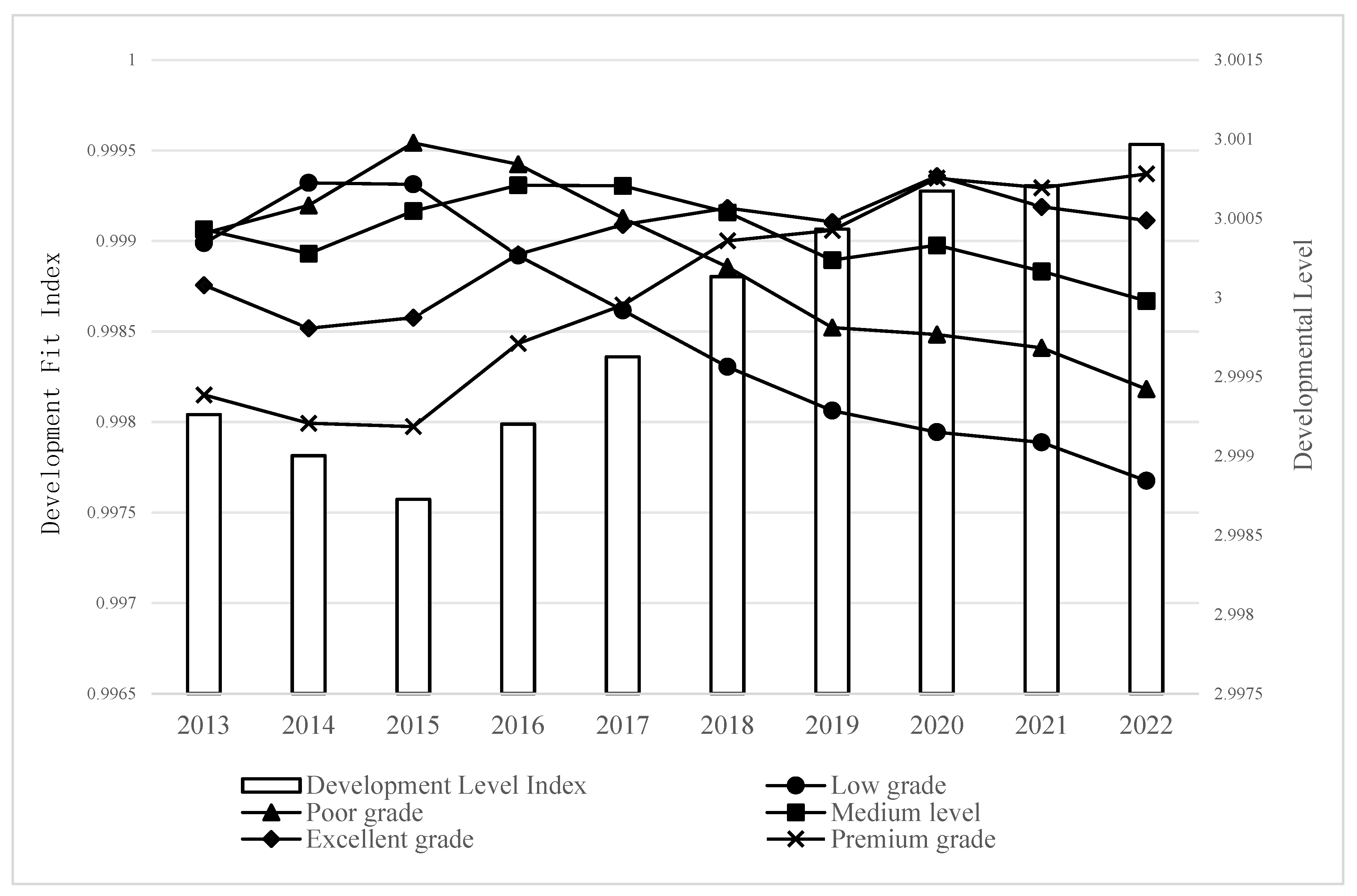
Using the IVWME model, this study calculates the comprehensive development level indices (j) of NQPF for China’s forestry sector from 2013 to 2022. The results indicate a generally stable yet moderate upward trend in the development index, which increased from 2.999 in 2013 to 3.001 in 2022 (Figure 1).
In the initial years (2013–2015), the index saw a slight decline, suggesting structural weaknesses in forestry development and inadequate coordination among production factors. This period likely reflects early-stage challenges in aligning policy goals with practical execution. However, between 2016 and 2018, the index experienced a marked rise, coinciding with an increase in national investments focused on ecological protection and forestry modernization. During this time, the policy dividend phase played a significant role, where improvements in infrastructure and institutional reforms temporarily boosted productivity growth.
From 2019 to 2022, the index fluctuated within a narrow range of 3.000–3.001, failing to exceed the “good” threshold. This indicates that while macro-level stability was achieved, the pace of breakthroughs in technological innovation and human capital quality remained limited, pointing to the need for further advancements in these areas.
The long-term trend suggests that China’s forestry sector has entered a phase of incremental improvement rather than rapid transformation. The simultaneous expansion of scale and the lack of innovation demonstrate that, despite policy support, the internal momentum required for high-quality growth remains insufficient.

4.2. Spatial Heterogeneity in NQPF and Regional Disparities

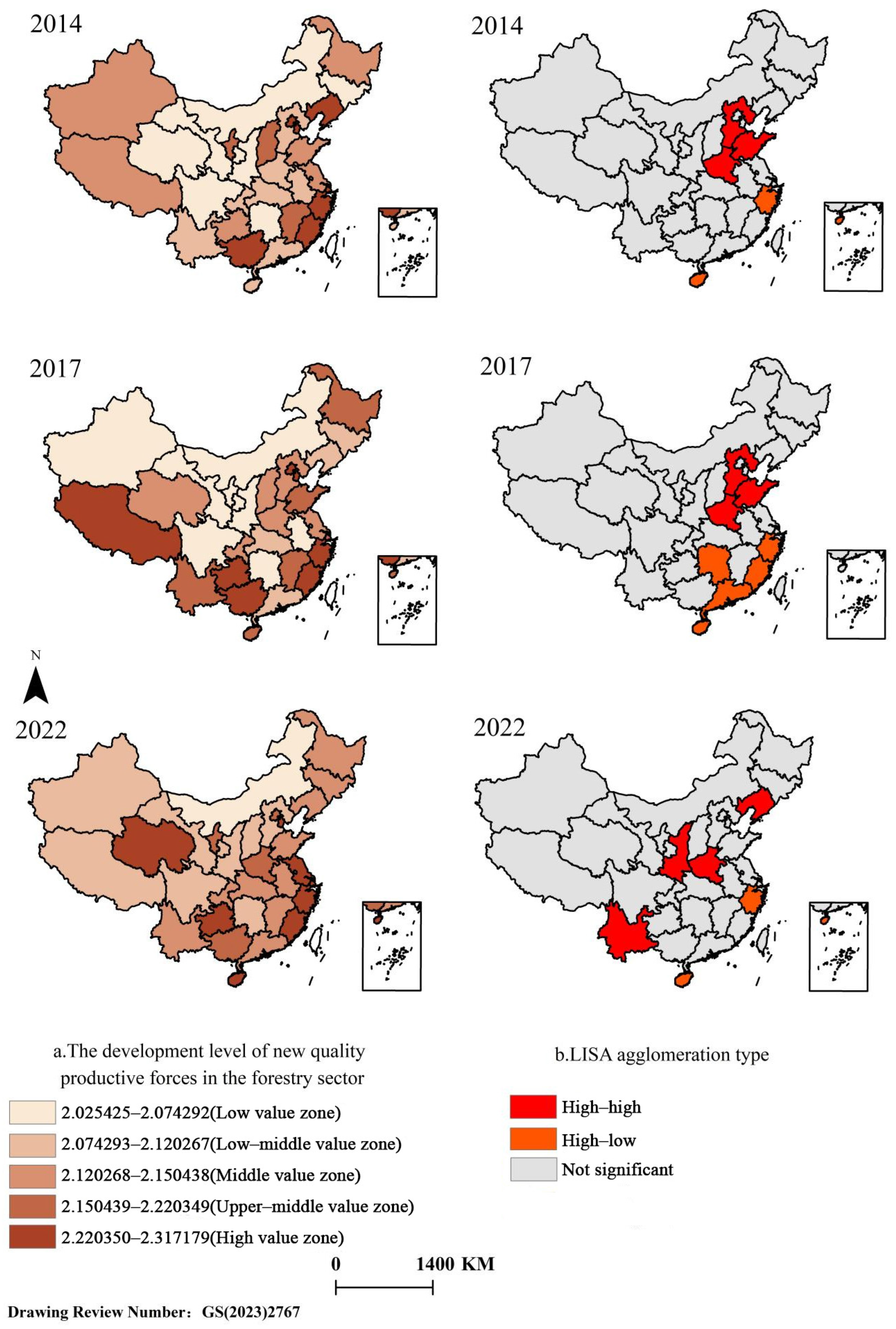
The analysis of spatial heterogeneity in NQPF development across China reveals a distinct “high in the east, low in the west” pattern, as illustrated in Figure 2. By applying Local Moran’s I, we identified high-high clusters in eastern provinces such as Jiangsu, Zhejiang, and Fujian, indicating higher levels of forestry productivity and technological adoption. In contrast, the western provinces, including Sichuan, Yunnan, and Gansu, exhibit lower productivity levels and notable spatial isolation. Despite land scarcity, provinces in the east, like Jiangsu and Zhejiang, have maintained the highest levels of NQPF development, a discrepancy that warrants further investigation into the underlying drivers of these regional disparities.

4.2.1. Land-Use Efficiency Through Technological Integration

Eastern coastal provinces have achieved high levels of forestry productivity despite limited land availability, primarily due to efficient land-use practices supported by technological integration. The adoption of precision forestry tools, such as remote sensing and GIS, enables these provinces to maximize land productivity by enhancing forest monitoring, improving data accuracy, and optimizing resource allocation. These technologies not only improve eco-efficiency but also allow for better management in regions with constrained land. In contrast, the western provinces, which possess more abundant land, face significant challenges in accessing these technologies, highlighting the critical role of technological advancement in overcoming land scarcity.

4.2.2. Economic and Institutional Support

In addition to technological factors, strong institutional frameworks in eastern provinces are pivotal in fostering high NQPF levels. These provinces benefit from government policies that promote innovation, green finance, and technological development in the forestry sector. The collaborative governance model, particularly public–private partnerships (PPPs), has played a key role in mobilizing both capital and technical expertise, thus facilitating the promotion of sustainable forestry practices. Furthermore, the education systems in these provinces ensure a skilled labor force capable of implementing modern forestry technologies. This is in stark contrast to the western provinces, where limited institutional support and a lack of human capital continue to hinder the progress of forestry modernization. The disparity in institutional support and human capital between regions is reflected in the spatial analysis presented in Figure 2.

4.2.3. Implications for Land-Use Efficiency and Policy

The findings from this study underscore that land-use efficiency, rather than mere land availability, is the key determinant of high-quality forestry development. The experience of the eastern provinces demonstrates that technological integration and efficient land management can significantly boost productivity, even in areas with limited land resources. This finding challenges the assumption that land abundance is the main driver of forestry success, suggesting instead that innovation and technology adoption are crucial to achieving sustainable development in land-scarce areas. As highlighted earlier, the eastern regions have been more successful in integrating technological solutions to overcome land constraints. For land-scarce regions, such as Europe and other parts of Asia, the strategies employed by eastern China offer valuable lessons on how technological integration can optimize land use and enhance forestry productivity. Future research could further explore multi-functional land-use and integrated management strategies to improve land-use efficiency in these regions.

4.3. Regional Disparities and Inequality Analysis

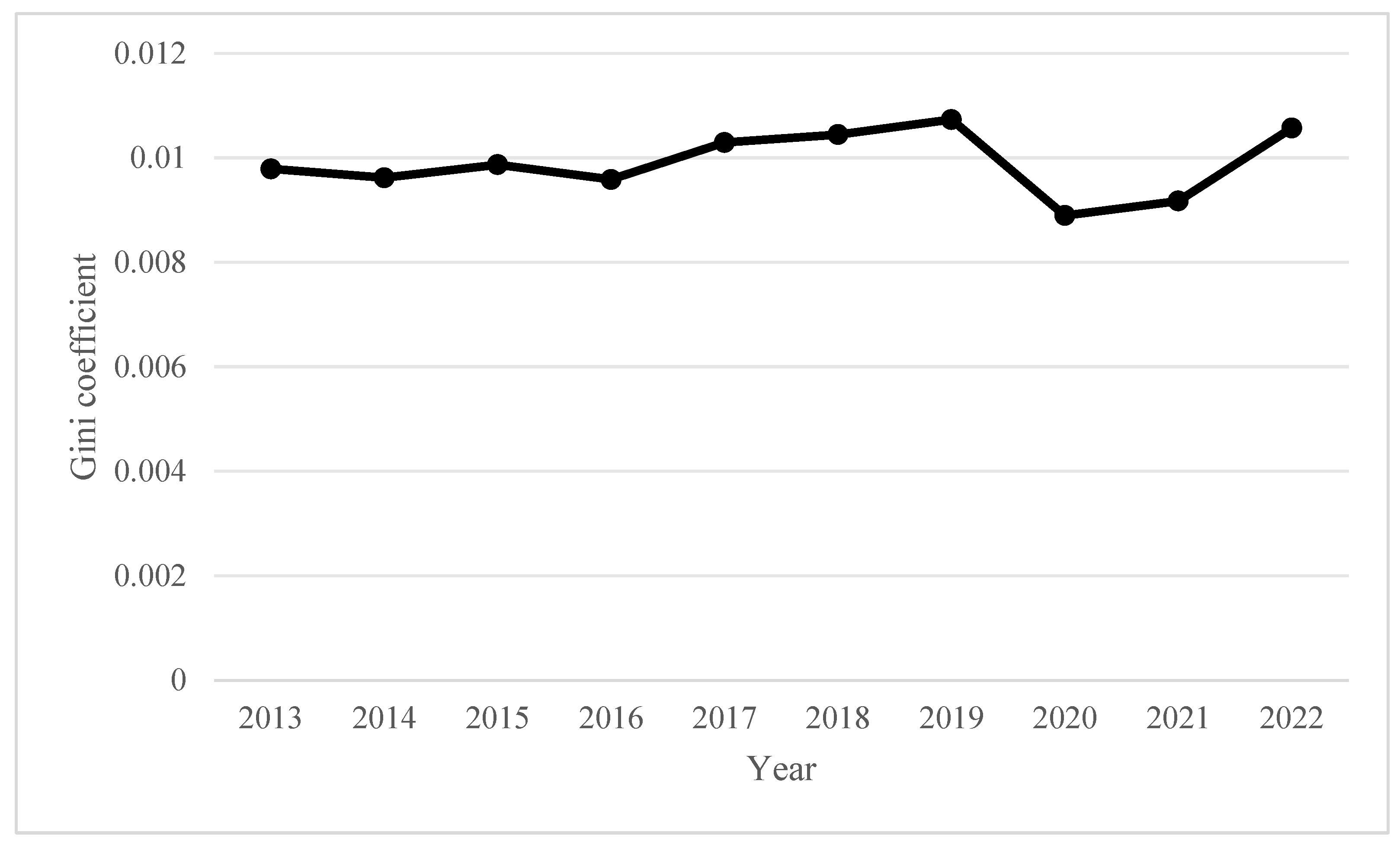
The Dagum Gini coefficient was calculated using the provincial j indices to quantify regional heterogeneity more precisely. From 2013 to 2022, the national Gini coefficient remained low and stable (0.009–0.011), indicating a generally balanced national distribution of NQPF levels (Figure 3).
Over time, disparities slightly decreased between 2013 and 2014, widened modestly from 2015 to 2019, and narrowed again after 2020. The inter-provincial gap between the best- and worst-performing regions never exceeded 8%, confirming a long-term trend towards equilibrium.
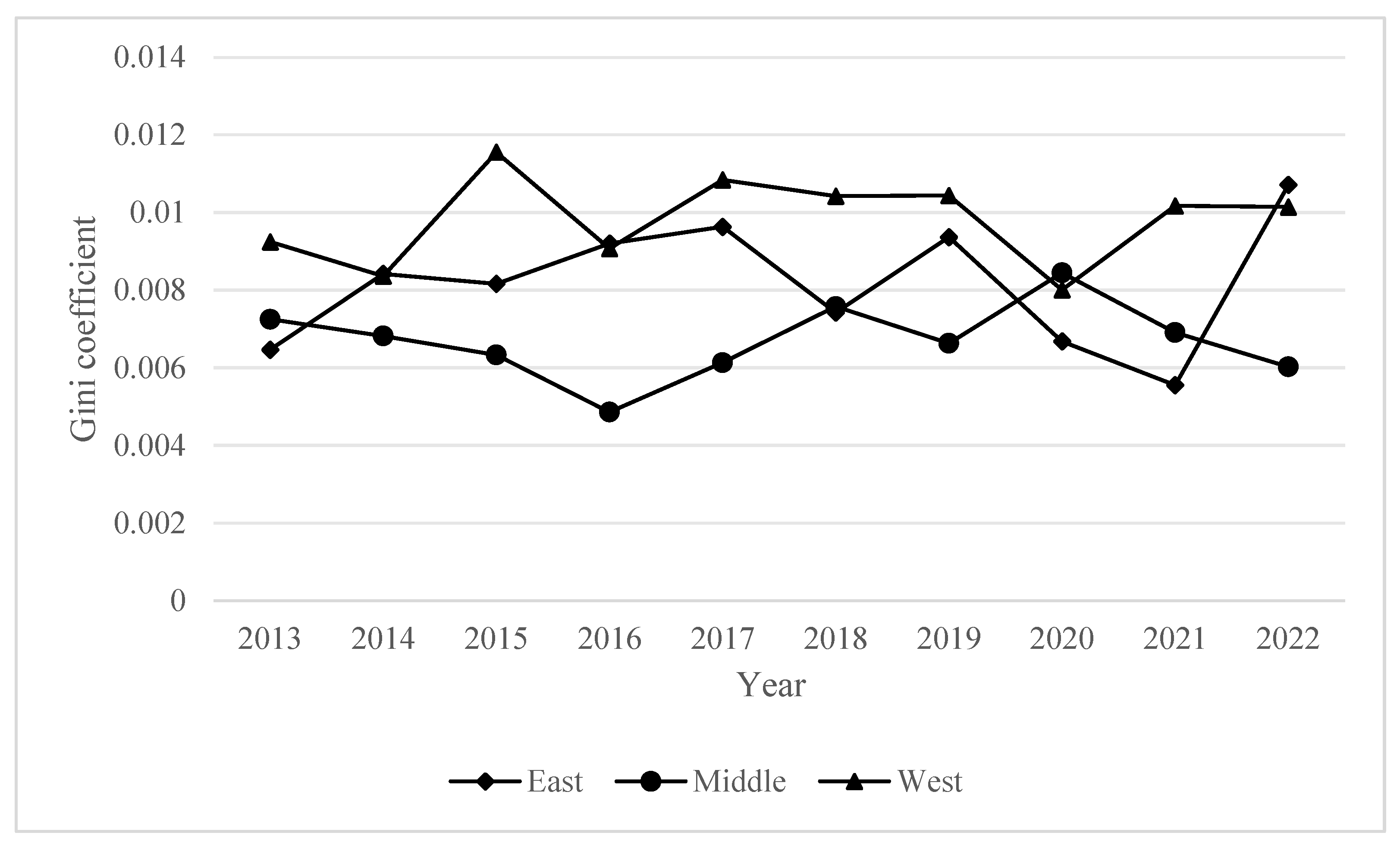
However, intra-regional analysis (Figure 4) shows structural differences:
The eastern region exhibits the highest internal disparity, but a clear convergence trend emerged after 2018, driven by the diffusion of digital and smart forestry technologies.
The central region shows periodic fluctuations, reflecting sensitivity to national investment cycles and resource reallocation policies.
The western region has the lowest but most stagnant NQPF levels, with little differentiation among provinces due to homogeneous resource-based economies.
Overall, the national convergence pattern masks distinct regional dynamics: eastern harmonization, central volatility, and western stagnation. These insights highlight the need for region-specific innovation and capacity-building strategies.

4.4. Obstacle Degree Diagnosis and Key Constraints

To identify the main factors hindering NQPF progress in China’s forestry sector, the obstacle degree model was applied using normalized indicator scores (Nj) and weights (Wj). The results reveal a consistent “core obstacle triangle” consisting of the following:
Average years of education (C1)—the dominant constraint across all years;
Proportion of forestry science and technology personnel (C2)—a persistent shortage of skilled professionals;
Forestry labor productivity (C3)—limited efficiency improvements despite industry expansion.
Between 2013 and 2015, constraints were primarily labor-driven, reflecting low human capital quality. However, from 2016 to 2022, the focus shifted towards the “dual bottlenecks of talent and capital,” as modernization demands outpaced investments in education and technology. The increasing intensity of C1 and C2 suggests that talent scarcity has evolved into a structural constraint.
Emergence of Forestry Investment Intensity (C6) as a New Bottleneck:
A key observation is the rise in forestry investment intensity (C6), which became one of the top five obstacles after 2018. Despite increased financial investments, forestry productivity has shown only modest improvements, indicating that capital allocation efficiency has become a critical issue.
The rise in investment intensity points to a mismatch between the increased financial resources and the sector’s productivity outcomes. Although funds have been allocated to forestry, the expected gains in modernization have been limited. This suggests that investments have been directed toward long-term projects, such as land acquisition and infrastructure, which do not yield immediate productivity improvements.
This highlights a misalignment in capital allocation, where high-return areas, such as technology adoption and human capital development, have not been prioritized. As a result, the funds are not being allocated effectively to boost short-term productivity and sustainability (Table 3).

4.5. Summary of Results

The empirical results indicate that
China’s forestry sector experienced moderate yet stable NQPF development from 2013 to 2022.
Spatial heterogeneity persists, with the eastern region leading and the western region trailing.
Regional inequality is low in magnitude but structurally varied.
The key bottlenecks relate to human capital and innovation capacity rather than resource constraints.
These findings provide a solid foundation for Section 5, where the underlying mechanisms and policy implications for enhancing NQPF and achieving high-quality forestry development will be examined.

5. Discussion

5.1. Interpretation of the Modest Growth in NQPF Development Index

The NQPF development index in China’s forestry sector increased modestly over the study period. Consistent with the temporal pattern reported in Section 4.1, the index declined slightly in the early years, rose more visibly during the policy–dividend phase, and then remained within a narrow range after 2019 without surpassing the “good” threshold defined in this study. Rather than indicating a lack of progress, this trajectory suggests a phase of incremental upgrading in which improvements accumulate slowly and are constrained by persistent structural factors [48]. These structural factors include insufficient industrial agglomeration [49] and disparities in regional innovation efficiency [50].
Several factors contribute to this slow growth. First, despite substantial investments, these have led to incremental changes rather than transformative shifts in forestry productivity. Many technological innovations and capacity-building efforts introduced over the last decade have long implementation timelines [51], meaning their full impact may not yet be reflected in productivity outcomes [52]. For instance, advanced forestry technologies may take years to show tangible improvements [53], especially in regions where technological infrastructure and labor force training are still in the early stages [54].
Moreover, the standardization methods used in the model, such as uniform scaling of indicators like human capital and technological adoption, may not capture regional variations in forestry development [55]. China’s “high-in-the-east, low-in-the-west” spatial disparity means that eastern provinces, which have made significant progress in adopting modern forestry practices, are likely to show less dramatic improvements compared to western provinces, where basic infrastructure and human capital remain limited [56]. This spatial variation could reduce the overall growth rate of the development index, as improvements in well-developed regions are masked by slower progress in lagging areas [57].

5.2. Sensitivity of the Model and Indicator Selection

The modest increase in the NQPF index calls for careful reflection on model responsiveness and indicator design. While the IVWME model framework allows weights to vary with indicator states [58], composite scores can still appear smooth when key indicators change slowly or when improvements are uneven across regions [59]. Future work could explore region-specific calibration [60] or alternative standardization schemes to better reflect heterogeneous development contexts, especially in less-developed regions where changes may be more discontinuous [61].
The weighting of indicators could be further refined to prioritize variables such as technological innovation and human capital, especially in regions where these factors remain underdeveloped [62]. Current weights may overemphasize capital investment [63], which, though important, is not always the most effective driver of productivity growth in underdeveloped regions where technical expertise and institutional capacity are the primary constraints [64]. Employing variable-weight models for dynamic assessment could help address this issue [65].

5.3. Overcoming Regional Disparities: The Role of Digitalization and Innovation

A central finding is the persistence of spatial heterogeneity in forestry NQPF, characterized by a “high-in-the-east, low-in-the-west” pattern and localized clustering. The Local Moran’s I results indicate high–high agglomerations in the eastern region and spatial isolation in parts of the west, suggesting that capability accumulation and diffusion processes are uneven across space [66]. Similar spatial gradients have also been documented in other forestry contexts [67], although the underlying drivers vary with institutional and economic conditions [68]. Importantly, the low overall inequality level does not imply homogeneous regional dynamics. As shown by the intra-regional analysis, the eastern region exhibits a tendency toward convergence after 2018 [69], the central region displays cyclical fluctuations [70], and the western region remains comparatively stagnant [71]. This combination helps explain why national-level improvements can remain modest even when leading regions continue to upgrade [72].
In this context, digitalization offers a potential solution to bridge the regional gap in forestry development. The use of digital tools—such as remote sensing, GIS mapping, and AI-driven decision support systems—can significantly enhance forest management and productivity in underdeveloped regions [73]. These technologies provide a cost-effective means to monitor forest health [74], assess carbon sequestration [75], and manage forest resources without requiring extensive on-the-ground infrastructure [76]. Global examples show how digital forestry platforms have been successfully implemented to improve resource allocation and optimize decision-making in regions that face geographical isolation or limited access to traditional technology [77]
For China’s western regions, integrating digital technologies into forestry management systems could offer a pathway to overcome spatial barriers and improve productivity, ecosystem services, and sustainability [78]. In addition to digital tools, leveraging regional networks for knowledge sharing and capacity building will be essential to foster local innovation and ensure equitable access to forestry technologies across regions [79].

5.4. Policy Implications: Beyond Education and Investment

While the policy recommendations in this study emphasize human capital, technological modernization, and regional coordination, they may still seem somewhat broad. The findings suggest that the “spatial lock-in” phenomenon, especially in China’s western regions, requires more targeted strategies to address specific barriers to forestry modernization [80].
Specifically, more localized solutions are needed, focusing on digitalization, technology transfer, and regional innovation hubs [81]. For instance, digital forestry platforms that combine remote sensing with real-time forest management could significantly improve the ability of local forestry agencies in remote regions to monitor forest health and make informed decisions [82]. Furthermore, policy simulations based on system dynamics can help design long-term interventions [83]. Additionally, training programs for forestry workers and local managers on digital tools, along with policy incentives for adopting green technologies, would foster sustainable practices in underdeveloped regions [84]. A comprehensive framework for evaluating policy effectiveness, such as the matter-element extension model, should also be incorporated [85].
Furthermore, policies should promote cross-regional collaboration to facilitate the sharing of knowledge, technologies, and best practices between the technologically advanced eastern provinces and underdeveloped western regions. These efforts may include joint R&D programs, regional innovation networks, and financial incentives to support sustainable forest management in the west [86]. Public-Private Partnership (PPP) models can also serve as a complementary mechanism [87].

5.5. Contribution to Theory and Future Research Directions

This study contributes to the theoretical understanding of forestry development and NQPF in several ways. By providing an operational framework for measuring NQPF in forestry, this research bridges the gap between theory and empirical measurement, offering a deeper understanding of how human capital, technological innovation, and ecological efficiency interact to drive forestry modernization [88]. The study’s spatial analysis of regional disparities also provides insights into the differential development of NQPF across China’s diverse landscape [89].
Future research should further refine the indicator selection process, with a particular focus on regional variations in forestry modernization. Cross-country comparisons of NQPF frameworks could also help identify universal principles of forestry innovation applicable across diverse ecological, economic, and institutional contexts [90]. Further exploration of spatial econometrics and multi-dimensional performance indicators could provide a more detailed understanding of the spatial dynamics in forestry productivity, helping to inform more region-specific policy interventions [79].

6. Conclusions

This study develops an integrated evaluation framework for new quality productive forces (NQPF) in China’s forestry sector, with an indicator system covering human capital, technological innovation, factor inputs, and ecological efficiency. Methodologically, we apply the IVWME model to conduct a province-level assessment and combine it with spatial correlation analysis, inequality measurement, and obstacle degree diagnosis to form a coherent analytical chain of “level measurement–spatial identification–structural decomposition–constraint localization”. This framework operationalizes NQPF in a forestry context and links composite evaluation with constraint identification, offering an operational measurement-and-diagnosis approach for forestry-related empirical studies.
Three main conclusions emerge from the empirical analysis. First, forestry NQPF exhibits a pattern of steady improvement but limited overall progress, which is consistent with a development process driven by cumulative capability building and gradual structural upgrading rather than short-term input expansion. In particular, the composite index remains within a narrow range in later years and does not surpass the “good” threshold defined in this study. Second, the dominant constraints on NQPF are concentrated in human capital supply and the conversion of inputs into productivity, and these constraints show notable persistence over time, pointing to persistent capability constraints in the forestry sector. This is corroborated by the obstacle diagnosis, which repeatedly highlights human capital- and productivity-related factors as dominant obstacles, and by the emergence of investment intensity as a prominent constraint in later years. Third, while the overall distribution of NQPF is relatively balanced, development trajectories and capability foundations differ across regions. A low overall inequality level masks distinct regional trajectories. Such differences are better interpreted in terms of heterogeneous technology diffusion capacity, institutional support, and factor absorption capability, rather than being attributed primarily to natural resource endowments.
The findings yield three implications for policy and management. First, enhancing forestry NQPF requires a shift from increasing inputs to improving conversion efficiency, with policy packages aligned along the “talent–technology–efficiency” chain so as to optimize input structures and incentives, strengthen factor allocation efficiency, and sustain innovation capacity. Policy priorities should be aligned with the persistently dominant obstacle factors identified by the diagnostic results rather than treated as generic prescriptions. Second, digital and intelligent tools should be treated not merely as optional technologies but as essential supports for reducing information costs, improving management efficiency, and enhancing resource allocation, which in turn helps narrow regional capability gaps. Third, given regional heterogeneity, differentiated strategies that emphasize capacity building are needed. Cross-regional collaboration and public technical service systems can improve technology accessibility and absorptive capacity in less-developed areas, thereby reinforcing the resilience of high-quality forestry development.
Several limitations should be acknowledged. First, due to data availability and statistical consistency, the indicator system relies primarily on macro-level observable variables and cannot fully capture micro-level differences such as technology application intensity, efficiency of research-to-application conversion, and organizational capacity of forestry business entities. This constraint may limit the interpretation of mechanisms related to technology diffusion and conversion efficiency. Second, composite evaluation results may be influenced by indicator selection, normalization procedures, and threshold settings; this study does not conduct a systematic sensitivity analysis on these settings, and future work should strengthen robustness through alternative indicators and sensitivity checks. Third, this study focuses on measurement and structural identification and does not provide strict causal tests of the mechanisms or spatial spillovers. Future research may integrate micro-level data with spatial econometric or quasi-experimental approaches to examine driving mechanisms and policy effects more rigorously, and to extend the framework to comparative applications in broader contexts.

Author Contributions

Conceptualization, Q.M. and J.C.; Methodology, L.Z. and R.X.; Software, L.Z.; Validation, L.Z. and R.X.; Formal analysis, L.Z.; Investigation, L.Z. and R.X.; Data curation, L.Z.; Writing—original draft preparation, L.Z.; Writing—review & editing, Q.M., R.X., X.L. and J.C.; Visualization, L.Z.; Supervision, Q.M. and J.C.; Project administration, Q.M.; Funding acquisition, Q.M. All authors have read and agreed to the published version of the manuscript.

Funding

National Natural Science Foundation of China (72363031).

Institutional Review Board Statement

Not applicable.

Informed Consent Statement

Not applicable.

Data Availability Statement

The original contributions presented in this study are included in the article. Further inquiries can be directed to the corresponding author.

Conflicts of Interest

The authors declare no conflicts of interest.

References

  1. Wang, W.; Liu, J. The Reshaping of Major Power Competition Rules Triggered by Carbon Neutrality—From the Perspective of Production Transformation and National Power Upgrading under Carbon Constraints. Explor. Controv. 2023, 7, 118–131+179. [Google Scholar]
  2. Yue, H. Study on the Sustainable Development of China’s Forestry Product International Trade. Acta Phytol. Sin. 2023, 58, 1029. [Google Scholar]
  3. Zhou, W.; Xu, L. On New Quality Productive Forces: Connotations, Characteristics, and Key Focus Areas. Reform 2023, 10, 1–13. [Google Scholar]
  4. Qiu, Y.; Yang, L. Empowering Forestry Modernization with New Quality Productive Forces: Scientific Connotations, Basic Logic, and Development Approaches. J. Chongqing Univ. (Soc. Sci. Ed.) 2025, 31, 1–12. Available online: https://kns.cnki.net/kcms2/article/abstract?v=PZRn9VlzpTZMOgqfj-XC3PUZPQpd97AZS5NOym5ayj6bl-dbRefiZNDQ4UwSKyQpaoj4SeCT2WN-DrQysTAWfpOZBon3RJmJGiVO68zowGvyc0NV0a_OtC-FRn5ROGLmy_4_KSjDhcPcX41WSHQlQx6GIexdwwD9&uniplatform=NZKPT (accessed on 20 January 2026).
  5. Xiang, H. The Internal Logic, Mechanism of Action, and Advancement Path of Smart Forestry Driving the New Quality Productive Forces in Forestry. J. Sichuan Agric. Univ. 2025, 43, 837–844. [Google Scholar]
  6. Pei, C.; Ni, J. Accelerating the Formation of Production Relations that Align with New Quality Productive Forces. Nanjing Soc. Sci. 2025, 1, 27–38. [Google Scholar]
  7. Wang, J.; Wang, R. New Quality Productive Forces: Indicator Construction and Spatiotemporal Evolution. J. Xi’an Univ. Financ. Econ. 2024, 37, 31–47. [Google Scholar]
  8. Gao, F. The Logical Foundation, Multidimensional Connotations, and Historical Significance of “New Quality Productive Forces”. Political Econ. Rev. 2023, 14, 127–145. [Google Scholar]
  9. Wang, S. New Quality Productive Forces, Economic Growth Models, and the Transformation of Driving Mechanisms. Party Gov. Stud. 2024, 5, 4–17+124. [Google Scholar] [CrossRef]
  10. Han, W.; Zhang, R.; Zhao, F. Measurement of New Quality Productive Forces and New Drivers of China’s Economic Growth. Quant. Econ. Tech. Econ. Res. 2024, 41, 5–25. [Google Scholar] [CrossRef]
  11. Liu, M. Interpreting the 13th Five-Year Plan for Forestry Development: Serving National Development Strategies and Forestry Modernization. For. Econ. 2016, 38, 3–8. [Google Scholar]
  12. Ma, J.; Zhong, Q.; Zhang, L. Industrial Agglomeration and Spatial Convergence of China’s Green Economy under the “Dual Carbon” Targets. Ecol. Econ. 2024, 40, 38–46. [Google Scholar]
  13. Shen, Y.; Wang, X.; Zhu, Z.; Lü, Q.J. Research Status and Prospects of Climate Change Adaptation from an Economic and Social Perspective. J. Zhejiang AF Univ. 2011, 28, 299–304. [Google Scholar]
  14. Xu, W.; Kong, X.; Bao, Q. Regional Disparities and Dynamic Evolution of Forestry Modernization Levels in China. For. Econ. Issues 2018, 38, 86–90+111. [Google Scholar] [CrossRef]
  15. Hu, J.; Zhou, J.; Wang, B. Endogenous Mechanism of Manufacturing Upgrading and Empirical Analysis of the China Sample. Macroecon. Res. 2023, 1, 42–60+83. [Google Scholar] [CrossRef]
  16. Zeng, X.; Chen, X. The Logical Mechanism and Practical Approach of New Quality Productive Forces Empowering Common Prosperity: A Contemporary Examination Based on Marxist Theory of Productive Forces. J. Henan Norm. Univ. (Philos. Soc. Sci. Ed.) 2025, 52, 1–8. [Google Scholar] [CrossRef]
  17. Wang, Q.; Tang, X. The Impact of Agricultural Development Support Systems on Agricultural Green Total Factor Productivity. China Agric. Resour. Reg. Plan. 2025, 1–16. Available online: https://link.cnki.net/urlid/11.3513.S.20251124.1940.016 (accessed on 20 January 2026).
  18. Chen, X.; Ji, Y.; Yang, H.; Zhu, J.R.; Liu, L.M.; Fan, S. The Impact of Digital Finance and Green Finance Synergy on Forestry Ecological Total Factor Productivity. For. Econ. Issues 2025, 45, 548–560. [Google Scholar]
  19. Lv, J.; Sun, J.; Cai, X. Spatiotemporal Evolution of Green Total Factor Productivity in Chinese Forestry. J. Agric. For. Econ. Manag. 2022, 21, 320–330. [Google Scholar]
  20. Han, H.; Qiu, J.; Wu, F. Regional Disparities and Dynamic Evolution of Green Total Factor Productivity of Agricultural Water Resources in China under Technological Heterogeneity. Arid Land Resour. Environ. 2025, 39, 60–70. [Google Scholar]
  21. Ji, X.; Dong, M. Green Technological Innovation, Ownership Structure, and Total Factor Productivity of Heavily Polluting Enterprises. Stat. Decis. 2023, 39, 164–168. [Google Scholar]
  22. Li, C. Green Finance, Digital Rural Development, and Agricultural Green Total Factor Productivity. Jiangxi Soc. Sci. 2025, 45, 57–70. [Google Scholar]
  23. Yu, L.; Wang, Y.; Chen, J. Green Total Factor Productivity of China’s Mining Industry Considering Environmental and Intergenerational Negative Externalities. Resour. Sci. 2019, 41, 2155–2171. [Google Scholar]
  24. Ma, S. “Unregistered System Personnel”: The Reconstruction of Forest Workers’ Status and Collective Mindset. Skeer 2025, 2, 161–171. [Google Scholar] [CrossRef]
  25. Liu, P.; Guo, F. Digital Technology, Agricultural and Rural Modernization, and Forestry Modernization. For. Econ. 2024, 46, 55–77. [Google Scholar]
  26. Liu, S.; Xiong, K.; Shu, T.; Deng, M.Z.R.; Zhang, Y. The Impact of Forestry Remote Sensing Development on China’s Forestry Economic Policies and Implications: A Quantitative Analysis Based on English Literature. For. Econ. 2020, 42, 88–96. [Google Scholar]
  27. Li, Z.; Chen, E. The Development of Forestry Remote Sensing in China. J. Remote Sens. 2021, 25, 292–301. [Google Scholar]
  28. Li, N.; Xu, Z. Research on Promoting the Development of New Quality Productive Forces by Improving Labor Quality. Haipai Econ. 2024, 22, 141–149. [Google Scholar]
  29. Ren, F.; Liu, X.; Kong, F. Pathways for Achieving Synergistic Improvement in Resource Conservation and Energy Security through the High-Quality Development of the Forestry Biomass Energy Industry. J. Nat. Resour. 2025, 40, 3394–3416. [Google Scholar]
  30. Xu, C.; Ren, Y.; Kong, F. The Impact of Human Capital on the Efficiency of Realizing the Value of Forest Ecological Products. J. Agric. For. Econ. Manag. 2025, 24, 418–429. [Google Scholar]
  31. Song, J.; Luo, A.; Hu, B. An Empirical Study on Multiple Occupations of Chinese Youth. Youth Stud. 2022, 1, 1–17+94. [Google Scholar]
  32. Li, C.; Zhang, K. Overall Trends, Driving Mechanisms, and Policy Recommendations for the Economic Disparities Between Eastern and Western China. Hebei Acad. J. 2025, 45, 142–151. [Google Scholar]
  33. Wang, S.; Nie, J. Regional Industrial Cluster Innovation Efficiency and Pathways: A Qualitative Comparative Analysis Based on Fuzzy Sets. Sci. Technol. Manag. Res. 2022, 42, 163–172. [Google Scholar]
  34. Fu, X.; Zhang, L.; Xiu, X. Theoretical Logic, Practical Dilemmas, and Solutions for Empowering Collective Forest Rights Reform with Digital Technology. For. Econ. Issues 2025, 45, 572–580. [Google Scholar]
  35. Mishenina, H.; Dvorak, J. Public–Private Partnership as a Form of Ensuring Sustainable Development of the Forest Management Sphere. Adm. Sci. 2022, 12, 156. [Google Scholar] [CrossRef]
  36. Burksiene, V.; Dvorak, J. Performance Management In Protected Areas: Localizing Governance Of The Curonian Spit National Park, Lithuania. Public Adm. Issues 2020, 5, 105–124. [Google Scholar] [CrossRef]
  37. Cai, Z. The Overall Approach and Institutional Guarantee for Developing New Quality Productive Forces Based on Local Conditions. New Horiz. 2025, 51–60. [Google Scholar]
  38. Tian, S. Evaluation of China’s Ecological Province Construction Level. Arid Land Resour. Environ. 2017, 31, 14–20. [Google Scholar]
  39. Qiangsheng, M.; Mengting, B.; Le, L. Study on the Dynamic Evolution and Regional Differences of the Level of High-Quality Economic and Social Development in China. Sustainability 2022, 15, 382. [Google Scholar] [CrossRef]
  40. Otto, P.; Illian, J. Advances in spatial econometrics and geostatistics: Methods, theory, and applications. AStA Adv. Stat. Anal. 2025, 109, 1–4. [Google Scholar] [CrossRef]
  41. Domenico, M. Fairness and Gini decomposition. Econ. Lett. 2023, 233, 111409. [Google Scholar] [CrossRef]
  42. Frank, C.; Ken, M. Regional inequalities: Causes and cures. Oxf. Rev. Econ. Policy 2021, 37, 1–16. [Google Scholar] [CrossRef] [PubMed]
  43. Qiao, X.; Li, H.; Wu, X. Green Finance Empowering Forestry New Quality Productivity: Mechanisms and Practical Paths. Forests 2025, 16, 1445. [Google Scholar] [CrossRef]
  44. Tang, Q.; Liu, S.; Liu, W. Evaluation of Metro Station Fire Safety Resilience Based on the Improved Variable-Weight Matter-Element Extension Model. J. Saf. Environ. 2024, 24, 1346–1355. [Google Scholar]
  45. Zhu, X.; Tian, B.; Quan, L.; Li, S.L.; Li, L.H. Evaluation of Permafrost Subgrade Stability Based on the Improved Matter-Element Extension Model. J. Highw. Transp. Sci. Technol. 2024, 41, 77–85. [Google Scholar]
  46. Gao, Y.; Liu, G. Research on Green Hydropower Evaluation Based on Improved Matter-Element Extension Model with Variable Weight. J. Sichuan Univ. (Nat. Sci. Ed.) 2021, 58, 81–89. [Google Scholar]
  47. Jiang, J.; Zhang, Q. Application of Matter-Element Theory in Optimal Selection of Ground Attack Targets. Fire Control. Command. Control. 2004, 5, 44–46+50. [Google Scholar]
  48. Álvarez, I.; Caprio, D.D.; Santos-Arteaga, J.F. Technological assimilation and divergence in times of crisis. Technol. Econ. Dev. Econ. 2016, 22, 254–273. [Google Scholar] [CrossRef]
  49. Yamano, N.; Ohkawara, T. The Regional Allocation of Public Investment: Efficiency or Equity? J. Reg. Sci. 2000, 40, 205–229. [Google Scholar] [CrossRef]
  50. Cui, M.; Wang, R.; Ji, W.; Zheng, F. The Non-Linear Impact of Highway Improvements on the Urban–Rural Income Gap in Underdeveloped Regions: A Mixed-Methods Approach. Sustainability 2025, 17, 1640. [Google Scholar] [CrossRef]
  51. Liu, J.; Wang, S.; Ji, J.; Chen, Z.; Li, S. Research on the Spatiotemporal Evolution Characteristics and Capital Driving Factors of Sustainable Economic Development in Northwest China. Sustainability 2024, 16, 10774. [Google Scholar] [CrossRef]
  52. Arevalo, J.; Mola-Yudego, B.; Pelkonen, P.; Qu, M. Students’ views on forestry education: A cross-national comparison across three universities in Brazil, China and Finland. For. Policy Econ. 2012, 25, 123–131. [Google Scholar] [CrossRef]
  53. Francesco, B.; Alessandro, A.; Marco, B.; Oreti, L.; Carbone, F. The Digitalization Framework of the National Forest System at 2020. Environ. Sci. Proc. 2022, 22, 36. [Google Scholar]
  54. Ling, S.; Gao, H.; Yuan, D. Catalytic role of the digital economy in fostering corporate green technology innovation: A mechanism for sustainability transformation in China. Econ. Anal. Policy 2024, 84, 278–292. [Google Scholar] [CrossRef]
  55. Tuulikki, H.; Jaana, L. To cut or not to cut—Emotions and forest conflicts in digital media. J. Rural. Stud. 2022, 94, 439–453. [Google Scholar]
  56. Pei, Y.; Zhang, J.; Tang, Z.; Liao, Z.; Liu, Y.; Liu, Y.; Shu, J. Rural Energy System Benefit Evaluation Based on Improved AHP Method and Combined Weighting of Variable-Weight Extension Cloud. South China Grid Technol. 2025, 1–16. Available online: https://link.cnki.net/urlid/44.1643.TK.20251226.0920.004 (accessed on 20 January 2026).
  57. Lu, K.; Qiao, F.; Ma, Y. Sintered Ore Quality Evaluation Based on the Variable-Weight Matter Element Extension Model. Control Eng. 2018, 25, 878–882. [Google Scholar]
  58. Zhang, X. Aggregation of Fuzzy Comprehensive Evaluation Results Based on Closeness. J. Shandong Univ. (Sci. Ed.) 2004, 2, 25–29. [Google Scholar]
  59. Ke, S.; Wan, S.; Kong, F. The Formation Logic, Spatiotemporal Evolution, and Barrier Factor Analysis of New Quality Productive Forces in Chinese Forestry. For. Sci. 2025, 61, 199–213. [Google Scholar]
  60. Liu, W.; Yang, N. Strategic Transformation Positioning of Chinese Forestry Enterprises Based on Sustainable Development: An Empirical Study. Ecol. Econ. 2014, 30, 67–71. [Google Scholar]
  61. Mai, Q.; Liu, Y.; Lü, X. Research on the Cluster Analysis of Forestry Sustainable Development Capability. Sci. Technol. Manag. Res. 2015, 35, 109–113. [Google Scholar]
  62. Li, H.; Guo, S.; Tang, H.; Li, C. Comprehensive Evaluation of Power Quality Based on the Improved Variable-weight Matter-element Extension Model. Electr. Power Technol. 2013, 37, 653–659. [Google Scholar]
  63. Shi, L.; Tang, D.; Meng, Y.; Hao, J.H. Urban Flood Risk Evaluation Based on the Improved Matter-element Extension Model. People’s Yellow River 2017, 39, 71–74+79. [Google Scholar]
  64. Li, Y.; Gong, R.; Dong, S.; Xia, B.; Shi, D. The theoretical basis and development of new quality productive forces in China’s ice and snow economy. J. Geogr. Sci. 2025, 35, 2161–2185. [Google Scholar] [CrossRef]
  65. Wang, L.; Hou, K.; Sun, H.; Sun, W. Slope Stability Evaluation Based on the Improved Game Theory-Variable-weight Matter-element Extension Model. Nonferrous Met. Eng. 2021, 11, 100–106. [Google Scholar]
  66. Hu, Z.; Huang, Z.; Zhu, Q.; Liu, S.Y. Safety Evaluation of Aerospace Equipment Maintenance Based on the Improved Variable-weight Matter-element Extension Model. Lab. Res. Explor. 2017, 36, 308–313. [Google Scholar]
  67. Wang, J.; Wang, X.; Liang, J.; Gao, J. Fleet Path Optimization of Shipping Companies Considering the Spatiotemporal Differences in Strait Traffic Risks. Transp. Syst. Eng. Inf. 2025, 1–15. Available online: https://kns.cnki.net/kcms2/article/abstract?v=PZRn9VlzpTavVZUadXQai_DQU_NKhs2AI5pxAXsmB6mgd-S_9kby7-9QuDz0KZPsHEEZk9e2zEwGdodzGNTwfmAttzxQ7KzkUVrXnCRIKxWY9bRaqkpW3VlaZR3ggMriNcEb2Mn0XRiHXY3fGr3BwF7m2nEKoiHRMcvb0ktoMlw=&uniplatform=NZKPT (accessed on 20 January 2026).
  68. Jing, H.; Li, L.; Li, T.; Hu, J. Safety Evaluation Method for Pile-anchor Deep Foundation Pit Considering the Randomness of Soil Parameters and Anchor Bearing Capacity. J. Saf. Sci. Technol. 2025, 21, 142–151. [Google Scholar]
  69. Xu, Z.; Chen, Y.; Deng, C.; Ding, L.; Ji, J. Study on the Stability Classification of Surrounding Rock Based on the Improved Entropy Weight Method and Multi-dimensional Cloud Model. Saf. Environ. J. 2025, 1–11. Available online: https://kns.cnki.net/kcms2/article/abstract?v=PZRn9VlzpTYCusnInzGVFOI0Bhoh_2EBXvHzzPFNFdATLn8THUwzJYpUrJKYuGU9eIUYAxb_3QPuuJ7ryVa9wLeN-ifdIge315xPPuj0OtlozY9HiIKSkr4qAn1wgRiR5o8BRJVonTbZwbVtgLq_qBvIwcau_dunLKcZEqW04rs=&uniplatform=NZKPT (accessed on 20 January 2026).
  70. Jiang, Y.; He, X. Simulation Analysis of Sustainable Development Strategy for Under-forest Economy Based on System Dynamics. China Soft Sci. 2014, 1, 105–114. [Google Scholar]
  71. Chou, Y.; Xu, J.; Ye, Y.; Zhang, Y.B.; Liu, H.; Zhou, F.X. Environmental Evaluation of Alpine Permafrost Based on Game Theory and Matter-element Cloud Theory—A Case Study of the Qilian Mountain Region along the Chaimu Railway. Glacier Permafr. 2025, 47, 1387–1400. [Google Scholar]
  72. Li, J.; Shen, J.; Tian, X.; Luo, X.H.; Chen, T. Study on the Stability Influencing Factors and Collapse Risk Evaluation of Altered Diabase Tunnels. J. Undergr. Space Eng. 2025, 21, 487–501. [Google Scholar]
  73. Chen, F.; Zhan, S.; Fan, G. A Matter-Elem. Action Framew. Spec. Innov. Enterp. Solve “Cold Start Paradox”. Res. Manag. 2025, 46, 103–114. [Google Scholar]
  74. Wang, Y.; Yan, Z.; Wang, Z.; Guo, H.N.; Wang, L.Y.; Zeng, M. Evaluation of the Operational Efficiency of Integrated Energy Systems in Mines Based on the OCC-IEGC Model. Power Syst. Prot. Control 2025, 53, 11–22. [Google Scholar]
  75. Du, J.; Luo, T.; Han, Y.; Jia, F.C.; Zhang, Y. Research on a Health Evaluation Method for Water Systems Based on Variable-weight Combined Game Theory. Hydrodyn. Res. Prog. A 2023, 38, 842–851. [Google Scholar]
  76. Peng, Y.; Zhang, L.; Gao, C. A Study on the Development Stages of the Theory of Extenics and its Comparison with WSR Methodology Based on Four-Stage Theory. Manag. Rev. 2023, 35, 257–271. [Google Scholar]
  77. Li, X.; Wang, Z. A Micro-map Road Network Quality Evaluation Method Based on Spatial Similarity. J. Earth Inf. Sci. 2024, 26, 212–224. [Google Scholar]
  78. Deng, Z.; Liu, Y.; Jiang, E.; Zhu, Z. Research on the Design of Freight Traction Vehicles Based on the FBS Model and Primitive Theory. Mech. Des. 2023, 40, 155–162. [Google Scholar]
  79. Zhang, Y.; Liu, J.; Liang, P.; Xia, Z.; Liang, P. Comprehensive Evaluation of Bridge Inspection Indicators Based on Entropy-weight Extension Matter-element Model. J. Chang’an Univ. (Nat. Sci. Ed.) 2022, 42, 42–52. [Google Scholar]
  80. Niu, L.; Hu, T. Evaluation of Water Resources Carrying Capacity in Liaoning Province Based on the Matter-element Cloud Model. J. Yangtze River Sci. Res. Inst. 2023, 40, 22–29. [Google Scholar]
  81. He, X.; Yu, M.; Chen, X. Research on the Impact of Uneven Terrain Changes in the Pearl River Delta on the Adaptability of Regional Gate Groups. J. Sediment Res. 2022, 47, 66–73. [Google Scholar]
  82. Zhang, Y.; Zhu, H.; Li, B. Study on the Impact of Dynamic Indicator Weights on the Health Evaluation of Lake Water Ecosystems. Environ. Monit. Manag. Technol. 2022, 34, 16–21. [Google Scholar]
  83. Zhang, Y.; Zhu, Y.; Chen, Y.; Tian, G.H. Resilience-Based Urban River Health Evaluation—A Case Study of Jinshui River in Zhengzhou City. Soil Water Conserv. Bull. 2022, 42, 238–246+257. [Google Scholar] [CrossRef]
  84. Jiang, J.; Liu, Z.; Gu, Z.; Li, C.Y. Safety Risk Evaluation of Prefabricated Building Hoisting Construction Based on Variable-weight Matter-element Extension Model. J. Wuhan Univ. (Eng. Ed.) 2024, 57, 1251–1260. [Google Scholar]
  85. Gao, Y.; Li, Y.; Gao, J.; Du, C.L.; Zhang, M.; Wu, J. Regional Water Resources Carrying Capacity Evaluation under Virtual Water Impact. Adv. Water Resour. Hydroelectr. Technol. 2022, 42, 22–27+77. [Google Scholar]
  86. Li, Z.; Mo, X.; Ge, W.; Wang, T. Comprehensive Evaluation of Dam Failure Consequences Based on Variable-weight Set Theory and Matter-element Coupling Model. Eng. Sci. Technol. 2022, 54, 64–71. [Google Scholar]
  87. Zhou, K.; Cao, L.; Li, J.; Zhang, W.; Yang, C.Y.; Zhang, X.P.; Gao, L. Numerical Analysis of Stability and Safety Grading Evaluation of Complex Goaf Areas. Gold Sci. Technol. 2022, 30, 324–332. [Google Scholar]
  88. Zheng, L.; Wan, Z.; Li, W. Research on the Construction of a System Dynamics Model for Sustainable Utilization of Forest Resources. Ecol. Econ. 2012, 9, 69–71+75. [Google Scholar]
  89. Wen, J. Emphasizing the Reform and Development of Forestry. For. Econ. 2009, 10, 3–4. [Google Scholar]
  90. Yu, J.; Yao, S.; Xue, C. Study on the Influencing Factors of Sustainable Development in Afforestation Projects. J. Northwest AF Univ. (Soc. Sci. Ed.) 2014, 14, 61–71. [Google Scholar]
Figure 1. Temporal evolution of the development level of NQPF in China’s forestry sector, 2013–2022.
Sustainability 18 01450 g001
Figure 2. Spatial evolution of NQPF development in China’s forestry sector, 2013–2022.
Sustainability 18 01450 g002
Figure 3. The overall non-equilibrium change characteristics of new quality productivity in China’s forestry from 2013 to 2022.
Sustainability 18 01450 g003
Figure 4. The Characteristics of Intra-regional Non-equilibrium Changes of New Quality Productivity in China’s Forestry from 2013 to 2022.
Sustainability 18 01450 g004
Table 1. Evaluation Index System and Calculation Method for the Development Level of New Quality Productivity in Forestry.
Target LayerGuideline LayerIndicator LayerCalculation Method
[A]
New
Quality
Productivity
[B1] New-type forestry workers[C1] Average Years of Education for the PopulationAverage Years of Education = (Number of people not attending school × 0 + Number of primary school students × 6 + Number of junior high school students × 9 + Number of senior high school students × 12 + Number of college students × 15 + Number of undergraduate students × 16 + Number of graduate students × 19)/Population aged 6 and above
[C2] Proportion of Forestry Science and Technology (Service) PersonnelResearch personnel in scientific and technological institutions within the forestry system (forestry system service personnel) Number/Total forestry workforce
[C3] Labor Productivity in Forestry UnitsTotal Output Value of Forestry/Total Number of Forestry Workers
[C4] Ratio of per capita income levels among forestry practitionersAnnual Average Wage of Employees in Forestry System Units/Annual Average Wage of Urban Unit Employees
[C5] Forestry Talent SuitabilityQualitative Analysis
[B2] New-Quality Labor Tools for Forestry[C6] Total forestry investmentForestry Investment Completed
[C7] Forestry Development Investment IntensityForestry Industry Development Investment/Total Forestry Investment × 100%
[C8] Share of Forestry, Cultural Tourism, and Economic OutputForestry Tourism, Wooden Crafts, and Wooden Educational, Cultural, and Sports Goods Output Value/Total Forestry Output Value × 100%
[C9] Forestry Energy
Consumption Rate
Total Energy Consumption/Total Forestry Output Value
[C10] Forest Resource Conversion CapacityQualitative analysis
[B3] New Quality Labor Objects in Forestry[C11] Forest coverage rate(Forest area/Total land area) × 100%
[C12] Forest Pest Control RateForest Pest Control Coverage Rate (Treated Area/Infested Area) × 100%
[C13] Intensity of Ecological Construction and ProtectionEcological Construction and Conservation Investment/Total Forestry Investment × 100%
[C14] Forestry Infrastructure Investment IntensityForestry Support and Guarantee Investment/Total Forestry Investment × 100%
[C15] Modernization of the Forestry Industry StructureValue Added of Forestry Tertiary Industry/Total Forestry Output Value × 100%
[C16] Share of New-Quality Forestry Industry Output ValueNon-forestry Industry Output Value/Total Forestry Output Value
[C17] Share of Output Value from Traditional and New-Quality Forestry IndustriesOutput Value of Forestry-Related Industries in the Tertiary Sector/Total Output Value of Forestry
Table 2. Descriptive Statistics of NQPF Indicators (2013–2022).
IndicatorsMinimum ValueMaximum ValueMean ValueStandard Deviation
C18.2168676839.6622933388.9311174410.493281123
C20.0580544360.2916407860.1815051210.093129692
C3369.1762691144.670166688.0016594253.0077291
C40.3675064440.4574088350.4231516350.031704218
C50.5320.6950.6036666670.05598214
C648083924817134339789628.812924857.56
C70.0762355340.4182597750.2844390850.11225675
C80.1008987810.201454150.15981350.037729905
C90.1190.8810.62540.272150367
C100.5750.7380.65580.05808576
C110.21630.22960.222950.007009715
C120.6296449220.8244462670.7375213010.071830451
C130.4200383230.5516642890.4850602310.041861601
C140.0086391660.2981239210.1335991650.106833028
C150.1260790020.2388879580.1941779060.043373993
C160.0394411830.0672658390.0442768590.008226157
C170.1125637840.2241757350.1801365420.042640215
Table 3. Top ten obstacle indicators for the development of NQPF in China’s forestry sector, 2013–2022.
2013201420152016201720182019202020212022
1C1C1C4C15C5C5C1C7C7C2
2C13C13C9C8C10C14C7C16C2C14
3C14C9C13C13C14C3C2C2C16C7
4C16C14C12C5C1C1C16C3C4C6
5C7C12C8C12C3C13C3C13C13C8
6C3C17C17C10C12C16C5C5C3C12
7C4C15C15C14C16C10C10C4C6C17
8C5C3C1C1C11C12C13C10C12C15
9C8C5C16C3C13C8C14C12C5C4
10C9C10C5C16C8C17C6C1C10C1
Disclaimer/Publisher’s Note: The statements, opinions and data contained in all publications are solely those of the individual author(s) and contributor(s) and not of MDPI and/or the editor(s). MDPI and/or the editor(s) disclaim responsibility for any injury to people or property resulting from any ideas, methods, instructions or products referred to in the content.