Article

Synergistic Effects of Subcritical Water Pretreatment and Anaerobic Digestion of Brewers’ Spent Grains for Biogas Production


by
William Gustavo Sganzerla
1,*,
Miriam Tena
1,
Luiz Eduardo Nochi Castro
2,
Tânia Forster Carneiro
2,
Rosario Solera
1 and
Montserrat Perez
1
1
Department of Environmental Technologies (IVAGRO), Faculty of Marine and Environmental Sciences (CASEM), University of Cádiz (UCA), Pol. Río San Pedro s/n, 11510 Puerto Real, Spain
2
School of Food Engineering (FEA), University of Campinas (UNICAMP), Campinas 13083-894, Brazil
*
Author to whom correspondence should be addressed.
Sustainability 2026, 18(3), 1410; https://doi.org/10.3390/su18031410
Submission received: 28 November 2025 / Revised: 16 January 2026 / Accepted: 26 January 2026 / Published: 31 January 2026
(This article belongs to the Special Issue Utilization of Biomass: Energy, Catalysts, and Applications)

Abstract

The sustainable management of brewer’s spent grain (BSG) is critical for advancing circular bioeconomy strategies in the brewing industry; however, its efficient conversion to bioenergy remains limited by lignocellulosic recalcitrance. In this study, subcritical water hydrolysis (SWH) is systematically evaluated under mild conditions as an environmentally friendly pretreatment to simultaneously enhance the solubilization of carbohydrates and proteins and improve the anaerobic digestion (AD) performance of BSG. Under relatively low-severity conditions (130 °C, 15 MPa), SWH promoted extensive depolymerization of BSG, releasing up to 146 mg g−1 of total reducing sugars and 18 mg albumin g−1 of soluble proteins, while generating organic acids that influenced hydrolysate pH. Unlike previous studies that primarily focused on solid BSG digestion or high-severity pretreatments, this work directly compares the biomethane potential of SWH-derived hydrolysate and solid BSG under controlled BMP assays. The hydrolysate supported stable microbial activity and efficient degradation of volatile fatty acids, achieving a maximum methane yield of 712 L CH4 kg−1 TVS, significantly exceeding the yield obtained at 12.5% solid BSG loading (469 L CH4 kg−1 TVS). These results demonstrate that mild SWH substantially enhances BSG biodegradability and methane recovery while revealing critical trade-offs between organic loading, conversion efficiency, and process stability. Overall, this study provides new process-level insights into the integrated use of SWH and AD for BSG valorization, positioning SWH as a scalable, low-chemical, and sustainable pretreatment strategy for maximizing renewable biogas production from agro-industrial residues.

1. Introduction

The global transition toward sustainable energy systems has accelerated interest in renewable and circular bioresources capable of supporting low-emission energy production [1,2]. Within this framework, agro-industrial by-products are increasingly recognized for their potential to serve as feedstocks for bioenergy generation while contributing to waste minimization and environmental protection [3,4]. Brewers’ spent grain (BSG), the primary by-product of the brewing process, represents one of the most abundant and underutilized lignocellulosic residues available from the food and beverage sector [3,5]. For every 100 L of beer produced, approximately 15 to 20 kg of wet BSG is generated. With global beer production exceeding 1.9 billion hectoliters annually, over 39 million tons of BSG are produced each year [6,7]. As a result, BSG is both spatially concentrated and produced year-round, making it an attractive feedstock for industrial scale biorefining processes [6].
Despite its nutritional and biochemical richness, BSG remains largely undervalued in current practice [8]. Its predominant use as low-cost cattle feed is constrained by perishability, high moisture content (approximately 75–80%), and limited shelf life [8]. Alternative disposal routes such as landfilling, incineration, and composting are environmentally suboptimal and economically inefficient, particularly for large-scale breweries [9,10]. In response to increasing demands for resource efficiency, climate mitigation, and circular economy implementation, research has progressively shifted toward upgrading BSG into higher-value energy carriers and bio-based products through appropriate pre-processing and conversion technologies [9,11].
BSG is composed primarily of hemicellulose, cellulose, lignin, proteins, lipids, and minerals. However, its compact lignocellulosic structure and strong lignin–carbohydrate associations restrict direct microbial access to fermentable sugars and nutrients [12]. This structural recalcitrance poses a significant challenge for biological conversion routes such as anaerobic digestion (AD) [13]. While AD is a mature and scalable technology for methane-rich biogas production, the limited hydrolysis rate of untreated BSG often results in incomplete organic matter conversion and modest methane yields [13], thereby reducing overall energy recovery and economic viability [13].
To mitigate these limitations, a variety of pre-processing and pretreatment methods have been investigated to improve the digestibility of BSG prior to AD [14,15]. Mechanical size reduction, drying, and milling can increase surface area but are energy intensive and provide limited disruption of the lignocellulosic matrix [15]. Chemical pretreatments using acids or alkalis can enhance solubilization but often involve corrosive reagents, high chemical consumption, and downstream neutralization requirements [16]. Biological pretreatments, such as fungal delignification, are environmentally benign but typically require long processing times and exhibit limited scalability [17].
Among physicochemical approaches, subcritical water hydrolysis (SWH) has emerged as a particularly promising pretreatment, as it combines effective biomass depolymerization with minimal chemical inputs and reduced environmental impact [16]. SWH involves treating biomass with water at temperatures between 100 and 374 °C and pressures of approximately 1–20 MPa to maintain the liquid phase [17,18]. Under these conditions, water exhibits altered dielectric properties and an increased ionic product, which significantly enhances its hydrolytic capacity [17,19]. SWH can selectively solubilize hemicellulose, partially disrupt lignin–carbohydrate complexes, and promote protein denaturation, generating a hydrolysate rich in sugars, organic acids, and soluble proteins [20]. Simultaneously, the residual solid fraction becomes more accessible to microbial degradation during downstream AD [21].
Although previous studies have explored either SWH pretreatment or the anaerobic digestion of BSG, most investigations focus on high-severity pretreatment conditions or on the digestion of solid BSG alone, with limited attention to the direct anaerobic digestion of SWH-derived hydrolysates produced under mild conditions. Furthermore, the combined influence of pre-processing severity and organic loading on digestion performance and stability remains insufficiently addressed. The integration of SWH with AD therefore represents an underexplored opportunity for maximizing energy recovery while enabling multi-stream valorization of BSG [17,22].
In this context, the present study investigates the integrated application of mild SWH and AD as a sustainable valorization pathway for BSG. Unlike prior work, this study directly compares the biochemical methane potential (BMP) of SWH-derived hydrolysate and solid BSG across different loading levels, while simultaneously evaluating sugar and protein solubilization, pH evolution, COD removal, and digestion kinetics. The results provide new process-level insights into how pre-processing severity and organic loading influence methane yield, conversion efficiency, and system stability, supporting the development of scalable and environmentally friendly biorefinery strategies for brewery residues.

2. Materials and Methods

2.1. Inoculum and Feedstock

Brewers’ spent grain (BSG) used in this study was obtained from the Heineken brewery located in Seville, Spain. Immediately after collection, the material was dried in an oven at 105 °C for 8 h, sealed, and preserved at −18 °C until experimentation. The inoculum for the biochemical methane potential (BMP) evaluation originated from the same facility, specifically from the granular sludge of a mesophilic (35 °C) full-scale anaerobic reactor in the brewery’s wastewater treatment plant. Before use, this inoculum was acclimated for 20 days in a 5 L lab-scale reactor operated at 35 °C and pH 7.5 with continuous stirring at 40 rpm. The initial chemical and physical characteristics of both inoculum and feedstocks are reported in Table 1.

2.2. SWH of BSG

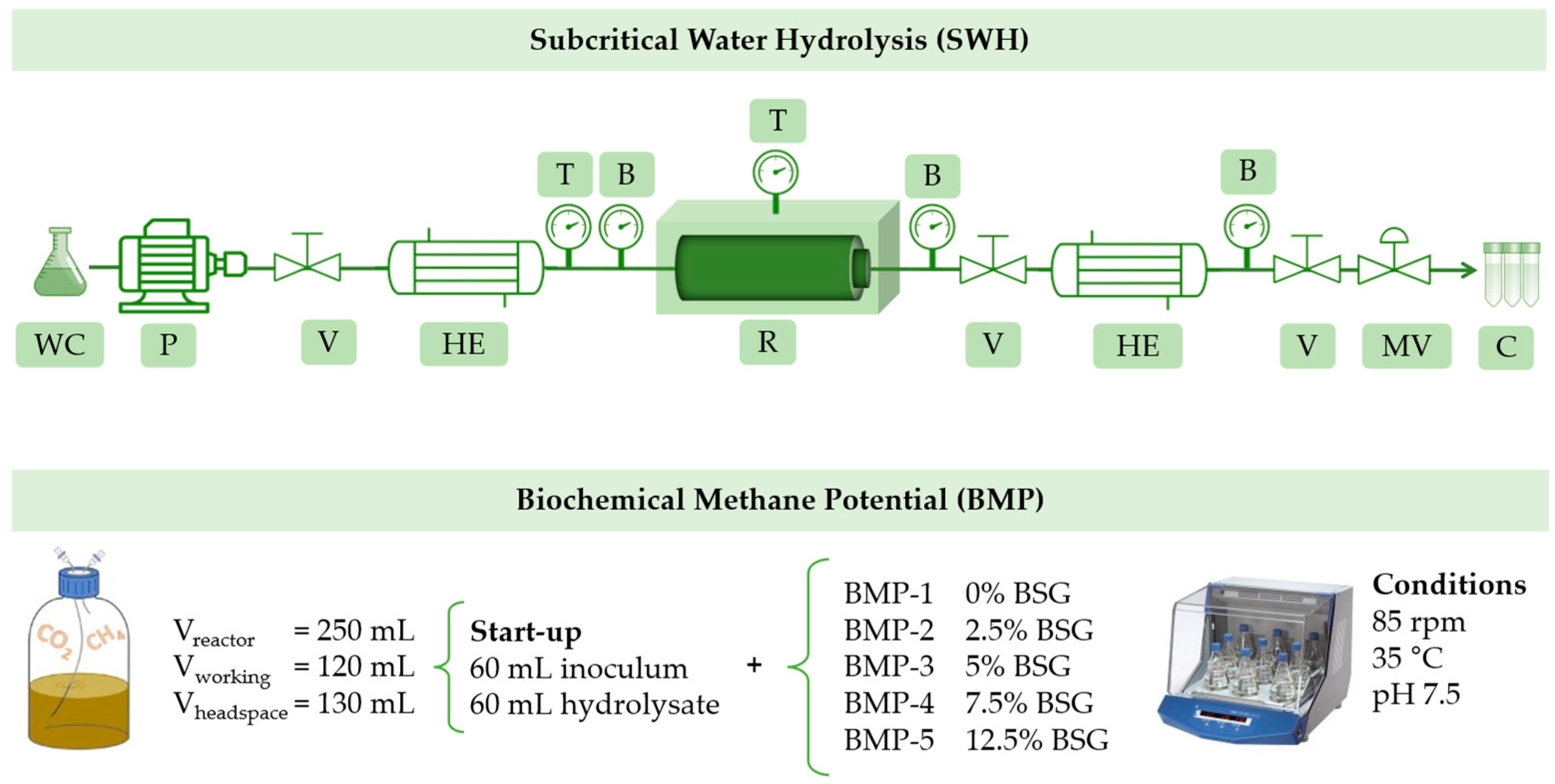
The semi-continuous setup employed for the SWH process is shown in Figure 1. Hydrolysis took place in a 110 mL 316 stainless steel reactor. Water was pumped at high pressure (Model 36, The Scientific Systems, Inc., State College, PA, USA) and preheated prior to entering the reaction chamber. The reactor was wrapped with ceramic fiber to reduce heat dissipation, while K-type thermocouples regulated temperature and manometers (WIKA, Klingenberg am Main, Germany, 0–48 MPa) monitored system pressure. Upon completion of the reaction, the hydrolysate was quickly cooled in a thermostatic bath (Model MA-184, Marconi, São Paulo, Brazil). A micrometer valve at the outlet-controlled system pressure.
The operating conditions for BSG hydrolysis were selected based on prior optimization studies [23]. The adopted parameters included 20 g of dried BSG, a reaction temperature of 150 °C, system pressure of 15 MPa, a water flow rate of 10 mL min−1, and a S/F of 22.5 g water g−1 BSG. Each run lasted 45 min, and to follow the reaction kinetics, liquid samples were withdrawn at 5 min intervals.

Operational Performance of the SWH Tests

Throughout the hydrolysis, pH was recorded using a calibrated meter (Model PG2000, GEHAKA, São Paulo, Brazil) at 25 °C. Total and reducing sugar content were quantified following a modified Somogyi–Nelson protocol [24], while soluble protein was measured by an adapted Bradford method [25]. All concentrations were expressed as mg per g of BSG dry weight.

2.3. Integration of SWH and AD

To investigate the combined process, BMP assays were carried out using mixtures of hydrolysate and BSG in different proportions. Experiments were conducted in 250 mL sealed bottles containing 120 mL working volume and a headspace of 130 mL. Each reactor received 60 mL of mesophilic inoculum and 60 mL of hydrolysate. Additional BSG was incorporated to adjust solids content: BMP-1 (no BSG, only hydrolysate), BMP-2 (2.5% BSG; 0.57 g), BMP-3 (5% BSG; 1.15 g), BMP-4 (7.5% BSG; 1.72 g), and BMP-5 (12.5% BSG; 2.88 g). A blank control, comprising only inoculum and deionized water, was included to correct methane yields for endogenous gas generation. All treatments were tested in triplicate.
The pH was standardized to 7.5 with 6 mol L−1 NaOH before sealing the bottles. To remove oxygen, nitrogen gas was sparged into each bottle for 30 s. Incubation was performed at 35 °C in an orbital shaker at 85 rpm. The specific formulation of each mixture (without inoculum) is listed in Table 1.

2.3.1. Operational Performance of the BMP Tests

Chemical analyses were performed before and after digestion for inoculum, feedstocks, mixtures, and digestates. Total solids (TS), total fixed solids (TFS), and total volatile solids (TVS) were determined gravimetrically according to Standard Methods for the Examination of Water and Wastewater [22], by drying samples at 105 °C and subsequent ignition at 550 °C. Total and soluble chemical oxygen demand (tCOD and sCOD) were measured using the closed reflux dichromate method [22], with sCOD analyzed after filtration through a 0.45 µm membrane filter. pH was measured using a calibrated digital pH meter. Total alkalinity was determined by acid titration to pH 4.3 in accordance with [22]. Ammonia (NH3), ammonium ions (NH4+), and ammoniacal nitrogen (N–NH3) were quantified using the phenate colorimetric method [22]. Total volatile solids (TVS) and COD removal efficiencies were calculated as the percentage decrease between initial and final concentrations. Volatile fatty acids (VFAs) were quantified using a gas chromatograph (Model GC-2010, Shimadzu Corporation, Kyoto, Japan) equipped with a flame ionization detector (FID) and a Nukol™ capillary column (30 m × 0.25 mm × 0.25 µm). The individual acids analyzed included acetic, propionic, isobutyric, butyric, isovaleric, valeric, isocaproic, and caproic acids. Quantification was performed using external calibration, and results were expressed as acetic acid equivalents.
Biogas volumes were tracked daily until methane production dropped to <1% of the cumulative total. Gas production was calculated from headspace pressure (kPa) and converted to volume via the ideal gas law (Equation (1)).
p   ×   V = n   ×   R   ×   T
where R = 8.314 L kPa K−1 mol−1, T = temperature (K), p = absolute pressure (kPa), V = volume (m3), and n = moles of CH4.
Gas composition (H2, O2, CH4, CO2) was determined with a Biogas 5000 analyzer (Geotech, København, Denmark). Methane values from the blank control were subtracted from test runs to obtain net production. Cumulative methane volume and yield were calculated using Equations (2) and (3), respectively.
Accumulated   methane   volume   L = n = 1 n i V n
Methane   yield   L   CH 4   kg 1   TVS = n = 1 n i V n ×   mCH 4 TVS
where TVS is the content of volatile solids in the reactor, mCH4 is the methane content in the biogas (%), V is the volume of biogas (L), and n is the number of days analyzed.

2.3.2. Kinetic Analysis of BMP Tests

Methane production kinetics were modeled using the modified Gompertz (Equation (4)), Cone (Equation (5)), and first-order (Equation (6)) models. Curve fitting and parameter estimation were performed using SigmaPlot® (Systat Inc., Palo Alto, CA, USA).
M   =   P     ×   exp exp R m   ×   e P λ     t   +   1
M   = P 1   +   ( k methane   ×   t ) n
M = P   ×   1 exp k methane   ×   t
where e = 2.718, kₘₑₜₕₐₙₑ is the hydrolysis rate constant (h−1), n is the shape factor, λ is the lag phase time (h), Rₘ is the maximum methane production rate (mL h−1), P is the methane production potential (mL), M is the cumulative methane volume (mL), and t represents the fermentation time (h).

2.4. Statistical Analysis

The influence of process variables and their interactions was assessed using analysis of variance (ANOVA). All statistical analyses were carried out with Statistica® v.10.0 (StatSoft Inc., Tulsa, OK, USA).

3. Results and Discussion

3.1. SWH of BSG

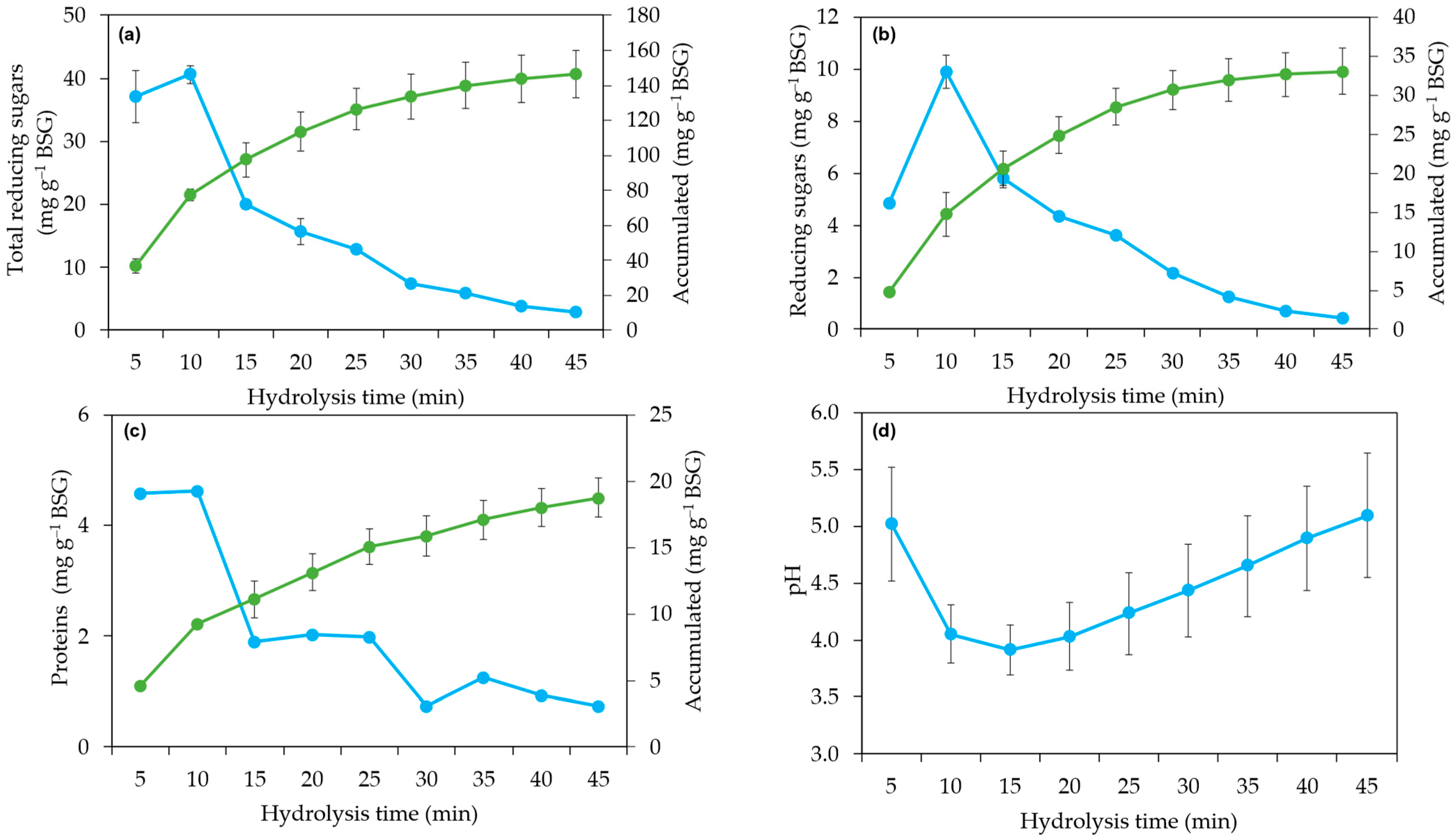
Figure 2 presents the production profile over time of reducing sugars, total reducing sugars, soluble proteins, and pH evolution in the hydrolysate obtained from the subcritical water hydrolysis (SWH) of brewer’s spent grain (BSG). The concentration of total reducing sugars at 5 and 10 min was 37.11 mg g−1 and 40.60 mg g−1, respectively, with a cumulative yield reaching 146.56 mg g−1 (Figure 2a). A similar kinetic trend was observed for reducing sugars, which increased sharply during the first 10 min, reaching 9.90 mg g−1, and continued to rise to 33.08 mg g−1 by the end of the SWH process (Figure 2b). This rapid initial increase reflects the fast hydrolysis of hemicellulose polymers and amorphous cellulose fractions, which are more susceptible to subcritical water conditions than crystalline cellulose and lignin.
The higher sugar yields obtained from BSG can be attributed to its chemical composition and structural characteristics. BSG contains a relatively high fraction of readily hydrolysable hemicelluloses and amorphous cellulose, as well as lower lignin recalcitrance compared to many agricultural residues, which facilitates carbohydrate solubilization under SWH conditions. Under subcritical conditions, water exhibits an increased ionic product and reduced dielectric constant, enabling it to act simultaneously as a solvent and acid–base catalyst. These properties promote the cleavage of glycosidic bonds in hemicellulose and partially disrupt lignin–carbohydrate complexes, thereby enhancing sugar release. In addition, the milder temperature applied in this study (130 °C) combined with high pressure favored selective hemicellulose depolymerization while minimizing sugar degradation reactions, leading to higher recoverable reducing sugar concentrations [26].
For comparison, under similar operational conditions (130 °C, 10 mL min−1, 15 MPa, and 45 min of hydrolysis) the SWH of corn stover yielded 126.79 mg g−1 of total reducing sugars. In contrast, the SWH of grape pomace produced 50 mg g−1 under conditions of 180 °C, 15 MPa, and 5 mL min−1 [23]. These differences highlight the influence of lignin content and structural heterogeneity on hydrothermal conversion efficiency, confirming that BSG exhibits a comparatively higher susceptibility to hydrolytic deconstruction. These results suggest that BSG has a higher sugar release potential under SWH conditions compared to other lignocellulosic biomasses.
Regarding protein solubilization, SWH led to a progressive increase in soluble protein concentration during the first 10 min of reaction (Figure 2c). By the end of the process, the hydrolysate contained 18.77 mg albumin g−1, indicating that SWH effectively disrupted protein–matrix interactions in brewer’s spent grain (BSG), thereby facilitating protein release into the liquid phase. Proteins in BSG are often embedded within or associated with lignocellulosic structures, and their release is promoted by the partial depolymerization of hemicellulose and the loosening of lignin–protein linkages during hydrothermal treatment.
The high protein recovery can be attributed to the intrinsic protein-rich nature of BSG and to the hydrothermal conditions applied, which promote protein denaturation and solubilization through the disruption of hydrogen bonding and hydrophobic interactions. Moreover, the relatively moderate temperature employed in this study favored protein extraction while limiting extensive peptide degradation or the formation of insoluble protein–carbohydrate complexes.
This recovery is substantially higher than that reported by Ramirez et al. [27], who achieved only 5.43% protein recovery from pea hulls at 120 °C. Similarly, Benito-Román et al. [28] obtained 12.8 mg g−1 of soluble protein from onion skin using SWH at 180 °C. The superior protein recovery observed here further supports the notion that BSG possesses a less condensed and more accessible lignocellulosic matrix, enabling effective solubilization under milder hydrothermal conditions.
The pH profile during SWH (Figure 2d) exhibited an initial value of approximately 5.2 at 5 min, followed by a noticeable decline to around 4.0 at 10 min. The pH then remained relatively stable, fluctuating slightly between 3.9 and 4.3 from 15 to 25 min. After this period, they rose steadily to about 5.1 by 45 min.
The initial acidification phase coincides with the sharp increase in total and reducing sugars (Figure 2a,b), indicating intense hemicellulose depolymerization and the release of organic acids and phenolic compounds formed during carbohydrate and lignin breakdown [23]. These acidic by-products, including acetic acid from acetyl group cleavage and low-molecular-weight phenolics from lignin fragmentation, contribute directly to the observed pH reduction [23]. The lowest pH values observed between 10 and 20 min correspond to the period of maximum solubilization activity, during which acidic hydrolysis by-products accumulated in the liquid phase.
The subsequent increase in pH after 25 min can be attributed to the dilution and partial consumption of acidic compounds, together with the progressive solubilization of proteins (Figure 2c), which may release nitrogen-containing compounds with buffering capacity. Additionally, the stabilization of pH suggests a reduction in further acid formation as easily hydrolysable fractions are depleted, while cellulose and lignin degradation proceeds more slowly. This pH stabilization and recovery likely contributed to limiting excessive sugar degradation, thereby supporting the sustained accumulation of reducing sugars observed at longer reaction times. Similar pH shifts have been observed in the SWH of grape pomace [23] and brewery by-products [29].
In summary, the SWH process proved effective for the recovery of sugars and soluble proteins from BSG. The enhanced solubilization observed is governed by selective hemicellulose hydrolysis, partial lignin depolymerization, and disruption of lignin–carbohydrate–protein complexes, which collectively improve substrate accessibility. Given the composition of the hydrolysate and the eco-friendly nature of SWH, this approach shows strong potential for integration into fermentative processes, such as anaerobic digestion for biogas production [30,31].

3.2. Integration of SWH and AD of BSG

3.2.1. Characterization of the BMP Tests

Table 2 shows the data related to the characterization of the BMP test, comparing the beginning and end of the fermentation. The progressive inclusion of BSG in the hydrolysate notably altered key physicochemical parameters throughout the AD process. These changes are attributed to the high organic and nitrogen content of BSG, which influenced the system’s organic load, buffering capacity, and nitrogen dynamics.
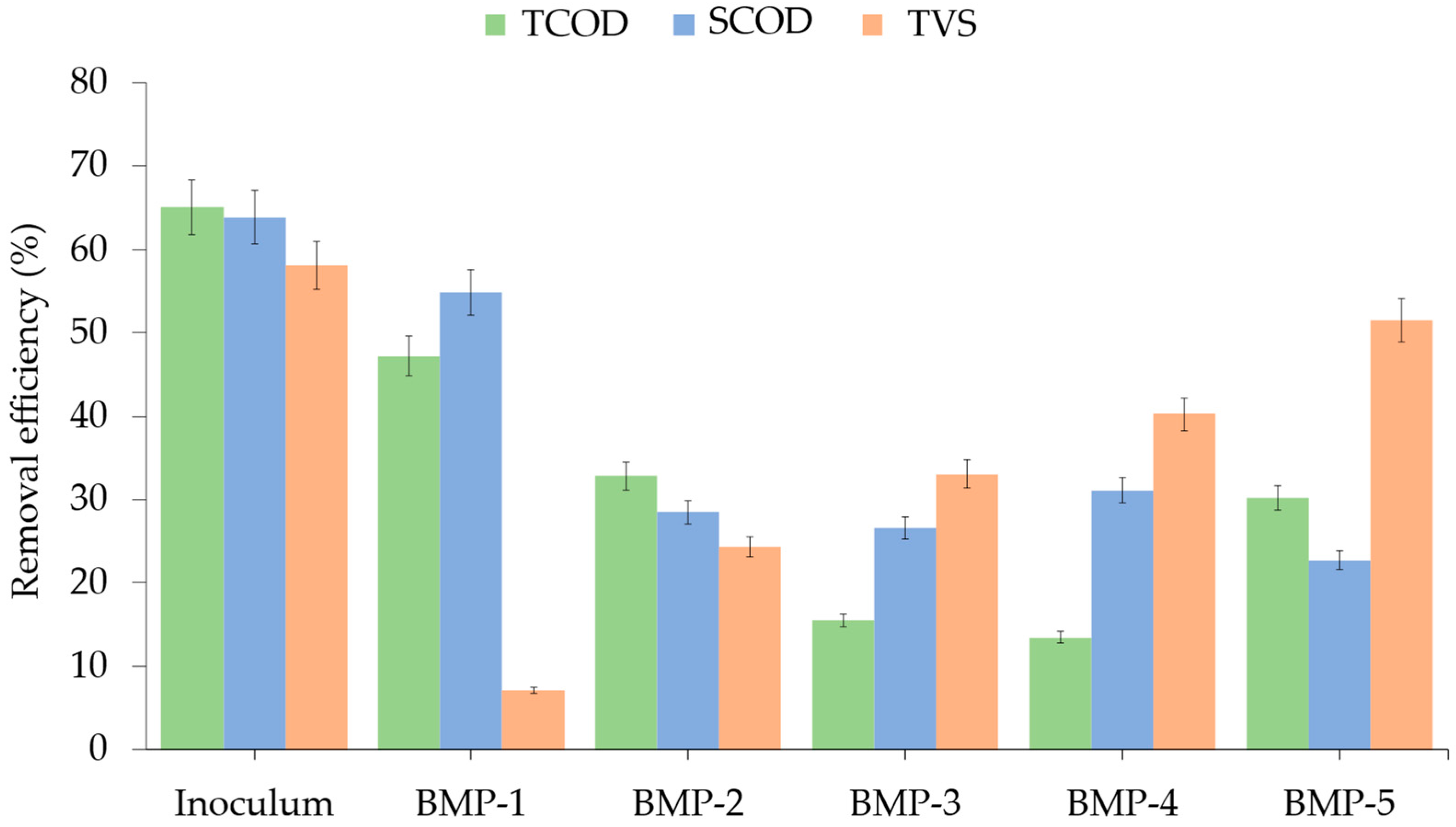
TS and TVS increased proportionally to BSG dosages. TS values rose from 3.28% (BMP-1) to 7.71% (BMP-5) as a direct result of the increasing dry BSG loading applied to the reactors, but declined by the end of the trials, indicating effective biodegradation of solid BSG. Similarly, in BMP-5, TVS dropped from 6.10% at the beginning to 2.96% at the end of the BMP test. Although the absolute TVS concentrations differed among batches, the removal efficiencies presented in Figure 3 reveal a consistent and interpretable trend. This trend is quantitatively shown in Figure 3, which presents TVS’ removal efficiency. The figure demonstrates that higher BSG loading (BMP-5) leads to greater TVS removal (≈50% TVS removal efficiency), likely due to the increased availability of biodegradable organic material [32,33]. The progressive increase in TVS removal from BMP-1 to BMP-5 indicates enhanced hydrolysis and solid disintegration at higher substrate loadings, reflecting robust microbial hydrolysis and acidogenesis, even under elevated solids conditions.
Alkalinity rose significantly from 498.33 mg L−1 in BMP-1 to more than 4976.7 mg L−1 in BMP-5, which enhanced the system’s buffering capacity and contributed to maintaining stable pH values ranging from 7.52 to 7.63. This increase in alkalinity is known to positively influence anaerobic digestion by accelerating pollutant removal and strengthening buffering capacity, thereby reducing inhibition of methanogenesis [34]. On the nitrogen side, BSG addition introduced substantial amounts of organic nitrogen and proteins, leading to higher levels of ammonium (NH4+) and free ammonia (NH3). For instance, NH4+ concentrations rose to approximately 1800 mg L−1 in BMP-5, while NH3 exceeded 300 mg L−1, levels that approach or surpass inhibitory thresholds for methanogenic populations. While nitrogen release supports microbial growth, the accumulation of ammonia, especially at neutral-to-alkaline pH, can partially inhibit methanogenesis and reduce overall reactor performance [35].
At the start of the BMP assays, the pH ranged from 7.52 to 7.63 after adjustment with 6 mol L−1 HCl, ensuring suitable conditions for microbial activity while preventing excessive alkalinity. During the initial hydrolysis and acidogenesis stages, complex organic matter was enzymatically converted into soluble intermediates and VFAs, which tend to decrease pH. However, no significant acidification was observed, indicating effective buffering capacity provided mainly by bicarbonate alkalinity in the inoculum.
As the digestion progressed, acetogenesis and methanogenesis became dominant, consuming VFAs and producing methane and carbon dioxide. The generation of bicarbonate ions during these stages contributed to pH stabilization, resulting in final pH values between 7.46 and 8.06. This stable pH range reflects a well-buffered system and confirms the balanced progression of anaerobic digestion during the BMP assays [23,29,36].
While the initial total COD increased markedly with increasing BSG addition (from 19.00 g L−1 in BMP-1 to 45.20 g L−1 in BMP-5), Figure 3 indicates a clear decline in COD removal efficiency as the organic loading increased. BMP-1 exhibited the highest COD removal efficiency, reflecting more complete degradation at lower organic load, whereas BMP-5 showed the lowest removal efficiency, despite having the highest initial COD. This suggests that at intermediate-to-high loadings, the system experienced kinetic limitations, where hydrolysis occurred but downstream conversion of solubilized organics was constrained.
The reduced COD removal at higher BSG concentrations can be attributed to the recalcitrant nature of lignocellulosic components in BSG and the potential inhibitory effects associated with elevated ammonia levels, which may limit microbial activity [37,38]. The increase in sCOD with BSG loading reflects enhanced solubilization of organic matter during hydrolysis, but the lower sCOD removal efficiencies indicate accumulation of soluble intermediates rather than complete methanogenic conversion [38]. However, the lower COD removal efficiencies suggest that the microbial consortia were unable to fully metabolize all solubilized compounds, likely due to kinetic constraints or inhibitory effects under high organic loading conditions [39,40].
Overall, the apparent discrepancies among TCOD, sCOD, and TVS trends arise from their different sensitivities to organic loading and digestion stage. When interpreted in terms of removal efficiencies rather than absolute concentrations, the results are consistent and reflect expected anaerobic digestion behavior under increasing dry BSG loading, with enhanced solids breakdown but limited soluble COD conversion at high organic loads.
The analysis of VFAs throughout the AD process revealed significant differences among the treatments, particularly as a function of increasing BSG addition to the hydrolysate, as shown in Table 3.
Acetic acid was the predominant VFA across all treatments, ranging from 1957.12 mg L−1 in BMP-1 to 3828.07 mg L−1 in BMP-5. By the end of the BMP, a significant reduction was observed, with concentrations dropping to 10.31 mg L−1 in BMP-1 and 48.81 mg L−1 in BMP-2, indicating efficient consumption by microbial consortium, likely coupled with methane production [41]. Propionic acid, which was initially detected only in BMP-1 (454.28 mg L−1), was nearly completely degraded by the end of the tests. Additional VFAs, including isobutyric, butyric, isovaleric, and caproic acids, were not present at the beginning of the digestion process but emerged during fermentation, particularly under higher BSG proportions. Isobutyric acid was detected in BMP-4 (34.78 mg L−1) and accumulated significantly in BMP-5 (228.97 mg L−1), reflecting amino acid fermentation, especially of valine [42]. Butyric acid was produced, with the highest concentration also in BMP-5 (88.59 mg L−1), indicating intensified saccharolytic fermentation [43]. These shifts reflect enhanced activity of fermentative bacteria, possibly at the expense of methanogenic conversion, and align with the higher residual COD observed in BMP-5. Isovaleric acid, commonly linked to leucine degradation, accumulated significantly by the end of the tests, particularly in BMP-5 (440.10 mg L−1) [44]. This trend further supports the hypothesis of intensified amino acid fermentation under increased BSG input [29,44].

3.2.2. Biomethane Production from SWH-AD

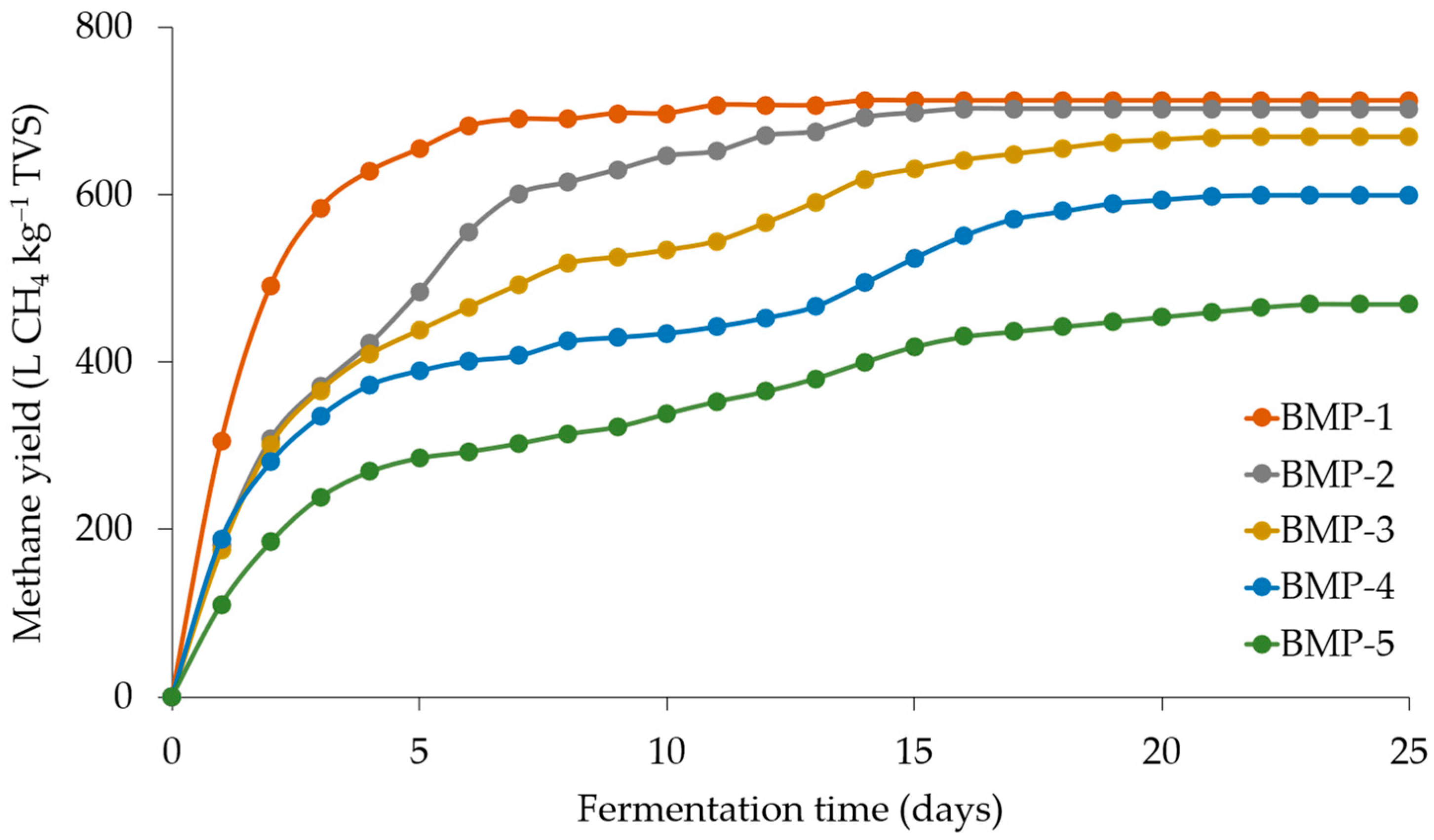
Figure 4 illustrates the cumulative methane yield obtained during the BMP tests. Both daily and cumulative biogas volumes were significantly higher in the reactors with greater proportions of BSG, particularly in BMP-4 and BMP-5. Fluctuations in both biogas production and methane content are commonly observed during the initial stages of AD, primarily due to the sequential nature of microbial activity. Different groups of microorganisms are responsible for each phase of the process, each with distinct optimal environmental and operational conditions [45]. Such instability is expected until the microbial consortia adapt and reach a balanced, steady-state performance.
Notably, methane production in all batches reached its maximum rate within the first 5–6 days. Although BSG is a lignocellulosic material, this rapid methane evolution can be attributed to the presence of readily biodegradable fractions (e.g., soluble carbohydrates, residual starch, and proteins) released during the SWH pretreatment [29]. The SWH process effectively disrupts the lignocellulosic structure, enhancing solubilization and making organic compounds more immediately available for microbial conversion. In addition, the use of a well-acclimated and active inoculum under BMP conditions further accelerated methanogenesis, leading to fast reactor start-up and early methane peaks.
In addition, the BMP-1 produced approximately 175 mL of methane, whereas the addition of 12.5% BSG (BMP-5) increased methane production to around 343 mL. This means that 168 mL of methane is attributed only to the presence of BSG in the BMP test. Based on this result, it is possible to underscore the positive effect of the SWH process on biogas generation when BSG is added as a co-substrate; additional methane can be recovered.
When normalizing the volumetric methane production to methane yield, a reduction in the methane yield is observed concerning the TVS added in the BMP tests. The highest methane yield was recorded for BMP-1, which reached 712 L CH4 kg−1 TVS, which is attributed to the low content of solids and rapid solubilization of the degraded material. This BMP test proves the efficiency of SWH pretreatment, since all the TVS and COD were degraded. In contrast, BMP-5 achieved a yield of 469 L CH4 kg−1 TVS. This decrease in specific methane yield with increasing BSG addition suggests that although BSG contributes to higher total methane volumes, its digestibility per unit of volatile solids may be lower, possibly due to its higher content of recalcitrant lignocellulosic compounds, which are more resistant to microbial degradation. Therefore, while BSG addition enhances volumetric productivity, it may compromise conversion efficiency per mass of substrate, highlighting a trade-off that must be considered in process optimization.
Comparing with the literature, Sillero et al. [46] reported a methane yield of approximately 22 L CH4 kg−1 TVS for the co-digestion of BSG and wastewater in BMP assays, a value notably lower than those obtained in the present study. This contrast underscores the positive impact of SWH in enhancing the biodegradability of BSG and accelerating reactor start-up. In line with this, Sganzerla et al. [29] observed methane yields around 747 L CH4 kg−1 TVS when BSG was subjected to SWH prior to AD, which aligns more closely with the results from this study and further supports the effectiveness of SWH in improving methane recovery. Moreover, Castro et al. [23] demonstrated that the application of subcritical water processing to grape pomace led to a sevenfold increase in methane yield, reaching up to 256 L CH4 kg−1 TVS. This remarkable enhancement highlights the broad potential of SWH to disrupt the lignocellulosic matrix of recalcitrant biomass, thereby improving hydrolysis efficiency and boosting methane-rich biogas production. Together, these findings reinforce the role of SWH as a powerful strategy to improve anaerobic digestion performance, particularly for agro-industrial residues like BSG, which typically present limited biodegradability in their raw form.

3.2.3. Kinetic Modelling and Optimization

The kinetic modeling of methane production provides deeper insights into the biodegradation dynamics of co-fermented substrates. In this study, three well-established models, Modified Gompertz, Cone, and First-order kinetics, were applied to evaluate the performance of methane production from brewery by-products (Table 4). These models support the interpretation of the degradation behavior and predict methane yield, rate, and lag time, contributing to the design and optimization of anaerobic digestion systems.
Among the kinetic models evaluated, the Modified Gompertz model adequately described the cumulative methane production trends for most BMP assays, although its performance varied among treatments. Higher goodness of fit was observed for BMP-1 to BMP-3 (R2 > 0.90), indicating strong agreement between experimental and modeled data. In contrast, lower R2 values were obtained for BMP-4 (0.808) and BMP-5 (0.882), suggesting a less accurate representation of the methane production kinetics under these conditions.
Despite the reduced R2 values, the Modified Gompertz model still captured the overall sigmoidal trend of methane production for BMP-4 and BMP-5, including the rapid onset of methanogenesis and the saturation phase. The lower goodness-of-fit in these assays may be attributed to increased substrate complexity and possible metabolic interactions during co-digestion, which can lead to deviations from the idealized growth behavior assumed by the model. Similar limitations of the Modified Gompertz model have been reported in systems with heterogeneous substrates or dynamic microbial responses [47].
The estimated maximum methane production rates (Rm) ranged from 1.46 to 1.68 mL h−1, while the lag-phase time (λ) was negligible in all treatments, indicating rapid microbial adaptation. Overall, while other tested models provided a more accurate kinetic description for BMP-4 and BMP-5, the Modified Gompertz model remains useful for comparative interpretation of methane production potential and process dynamics.
The Cone model also achieved strong predictive performance, with R2 values up to 0.999 and minimal residuals. The shape factor (n) and methane production rate constant (kmethane) showed a decrease with increased BSG content, suggesting that the addition of lignocellulosic material may slow the degradation rate, though the total methane yield remained high. The lowest deviation between experimental and predicted volumes was observed in BMP-1 (2.3%), while other treatments remained below 30%, indicating consistent model reliability.
Similarly, the First-order kinetic model offered robust fitting (R2 > 0.994) and predicted methane potentials (Pmodel) close to experimental values. The highest methane production constant (kmethane = 0.030 h−1) occurred in the BMP-1, decreasing progressively with the addition of BSG, reflecting the lower biodegradability of the co-substrate. Even with this decline, the difference between measured and predicted methane volumes remained relatively low (max 7.13% for BMP-3), confirming the model’s applicability to describe first-order degradation kinetics in co-digestion scenarios.
Overall, the strong statistical agreement (adjusted R2 > 0.87 for all models) and low RMSE and SEE values validate the use of these models for predicting methane production from brewery residues. The addition of BSG increased volumetric methane output but influenced degradation kinetics, especially the rate constants and shape parameters. This reinforces the role of kinetic modeling not only in fitting experimental data but also in optimizing substrate formulation and process control in anaerobic digestion.

4. Conclusions

This study demonstrates the effectiveness of subcritical water hydrolysis (SWH) as a pretreatment strategy for enhancing the valorization of brewer’s spent grain (BSG) for biogas production. SWH promoted substantial solubilization of key biodegradable fractions, yielding up to 146 mg g−1 of total reducing sugars and 18 mg albumin g−1 of soluble proteins, thereby significantly increasing the bioavailability of organic matter. When integrated into anaerobic digestion, both the SWH hydrolysate and solid BSG markedly influenced BMP performance, leading to enhanced volumetric methane production. Kinetic analysis using the Modified Gompertz model provided a satisfactory description of methane production trends and offered useful insights into process dynamics, confirming the positive impact of SWH on biodegradability and digestion kinetics. Overall, SWH pretreatment substantially improves the biochemical accessibility of BSG, facilitating its efficient integration into AD systems. While higher BSG loadings increased methane output, they also introduced trade-offs in conversion efficiency and process stability, highlighting the need for careful optimization of organic loading rates. Balancing substrate availability with microbial tolerance is therefore essential to maximize methane yield and ensure system robustness. These findings position SWH as a promising, scalable, and environmentally friendly approach for the sustainable valorization of agro-industrial residues.

Author Contributions

W.G.S.: Conceptualization, Formal analysis, Investigation, Methodology, Software, Validation, Visualization, Writing—original draft. M.T.: Investigation, Methodology, Software, Validation, Visualization, Writing—original draft. L.E.N.C.: Investigation, Methodology, Validation, Writing—original draft. T.F.-C.: Formal analysis, Investigation, Methodology, Software, Validation, Visualization, Writing—original draft. R.S.: Funding acquisition, Methodology, Project administration, Supervision, Validation, Visualization, Writing—review & editing. M.P.: Conceptualization, Data curation, Funding acquisition, Methodology, Project administration, Resources, Supervision, Validation, Writing—review & editing. All authors have read and agreed to the published version of the manuscript.

Funding

This research was funded by the Brazilian National Council for Scientific and Technological Development (CNPq, grant 302451/2021-8 awarded to T.F.-C.), and the Coordination for the Improvement of Higher Education Personnel (CAPES, Brazil, Finance Code 001). Additional support was provided by the São Paulo Research Foundation (FAPESP, Brazil) under process numbers 2018/14934-4, 2024/10205-3 (T.F.-C.), and 2021/04096-9 (L.E.N.C.).

Institutional Review Board Statement

Not applicable.

Informed Consent Statement

Not applicable.

Data Availability Statement

The original contributions presented in this study are included in the article. Further inquiries can be directed to the corresponding author.

Conflicts of Interest

The authors confirm that there are no financial or personal relationships that could be perceived as influencing the content or outcomes of this research.

References

  1. Moosavian, S.F.; Noorollahi, Y.; Shoaei, M. Renewable Energy Resources Utilization Planning for Sustainable Energy System Development on a Stand-Alone Island. J. Clean. Prod. 2024, 439, 140892. [Google Scholar] [CrossRef]
  2. Li, F.; Li, Y.; Novoselov, K.S.; Liang, F.; Meng, J.; Ho, S.-H.; Zhao, T.; Zhou, H.; Ahmad, A.; Zhu, Y.; et al. Bioresource Upgrade for Sustainable Energy, Environment, and Biomedicine. Nano-Micro Lett. 2023, 15, 35. [Google Scholar] [CrossRef]
  3. Henkin, J.M.; Mainali, K.; Sharma, B.K.; Yadav, M.P.; Ngo, H.; Sarker, M.I. A Review of Chemical and Physical Analysis, Processing, and Repurposing of Brewers’ Spent Grain. Biomass 2025, 5, 42. [Google Scholar] [CrossRef]
  4. Arpit Singh, T.; Sharma, M.; Sharma, M.; Dutt Sharma, G.; Kumar Passari, A.; Bhasin, S. Valorization of Agro-Industrial Residues for Production of Commercial Biorefinery Products. Fuel 2022, 322, 124284. [Google Scholar] [CrossRef]
  5. Marcus, A.; Fox, G. Fungal Biovalorization of a Brewing Industry Byproduct, Brewer’s Spent Grain: A Review. Foods 2021, 10, 2159. [Google Scholar] [CrossRef]
  6. Sganzerla, W.G.; Ampese, L.C.; Mussatto, S.I.; Forster-Carneiro, T. A Bibliometric Analysis on Potential Uses of Brewer’s Spent Grains in a Biorefinery for the Circular Economy Transition of the Beer Industry. Biofuels Bioprod. Biorefin. 2021, 15, 1965–1988. [Google Scholar] [CrossRef]
  7. Głowacki, S.; Salamon, A.; Sojak, M.; Tulej, W.; Bryś, A.; Hutsol, T.; Salamon, M.; Kukharets, S.; Janaszek-Mańkowska, M. The Use of Brewer’s Spent Grain after Beer Production for Energy Purposes. Materials 2022, 15, 3703. [Google Scholar] [CrossRef]
  8. Hejna, A.; Barczewski, M.; Skórczewska, K.; Szulc, J.; Chmielnicki, B.; Korol, J.; Formela, K. Sustainable Upcycling of Brewers’ Spent Grain by Thermo-Mechanical Treatment in Twin-Screw Extruder. J. Clean. Prod. 2021, 285, 124839. [Google Scholar] [CrossRef]
  9. Zhang, J.; Perez-Gavilan, A.; Cunha Neves, A. Determination of Functionalities of Proteins and Their Corresponding Hydrolysates from Brewers’ Spent Grain. J. Am. Soc. Brew. Chem. 2025, 83, 203–214. [Google Scholar] [CrossRef]
  10. da Fonseca, Y.A.; Fernandes, A.R.A.C.; Gurgel, L.V.A.; Baêta, B.E.L. Comparative Life Cycle Assessment of Early-Stage Technological Layouts for Brewers’ Spent Grain Upcycling: A Sustainable Approach for Adding Value to Waste. J. Water Process Eng. 2024, 66, 105904. [Google Scholar] [CrossRef]
  11. Pasquet, P.-L.; Villain-Gambier, M.; Trébouet, D. By-Product Valorization as a Means for the Brewing Industry to Move toward a Circular Bioeconomy. Sustainability 2024, 16, 3472. [Google Scholar] [CrossRef]
  12. Lorente, A.; Remón, J.; Salgado, M.; Huertas-Alonso, A.J.; Sánchez-Verdú, P.; Moreno, A.; Clark, J.H. Sustainable Production of Solid Biofuels and Biomaterials by Microwave-Assisted, Hydrothermal Carbonization (MA-HTC) of Brewers’ Spent Grain (BSG). ACS Sustain. Chem. Eng. 2020, 8, 18982–18991. [Google Scholar] [CrossRef]
  13. Bai, X.; Rebosura, M.J.; Jensen, P.D. Enhanced Anaerobic Digestion of Lignocellulosic Paunch Waste Using Potassium Hydroxide Pre-Treatment. Bioresour. Technol. 2025, 425, 132323. [Google Scholar] [CrossRef]
  14. Park, J.; Cayetano, R.D.A.; Kim, G.-B.; Jo, Y.; Kwon, Y.; Lei, Z.; Kim, S.-H. Sludge Disintegration and Anaerobic Digestion Enhancement by Alkaline-Thermal Pretreatment: Economic Evaluation and Microbial Population Analysis. Bioresour. Technol. 2022, 346, 126594. [Google Scholar] [CrossRef] [PubMed]
  15. Venegas, M.; Leiva, A.M.; Vidal, G. Influence of Anaerobic Digestion with Pretreatment on the Phytotoxicity of Sewage Sludge. Water Air Soil Pollut. 2018, 229, 381. [Google Scholar] [CrossRef]
  16. Cai, K.; Hou, B.; Hu, Y.; He, X.; Shan, Y. Subcritical Water Hydrolysis of Eggshell Membrane and Its Physicochemical Characteristics. Food Chem. 2025, 471, 142848. [Google Scholar] [CrossRef]
  17. dos Passos, F.R.; Fiorese, M.L.; da Silva, E.A.; Peiter, G.C.; Tres, M.V.; Cardozo-Filho, L.; da Silva, C. Subcritical Water Hydrolysis of Pereskia Aculeate Biomass to Produce Fermentable Sugars and Platform Chemicals. Results Chem. 2025, 16, 102501. [Google Scholar] [CrossRef]
  18. Hans, N.; Solanki, D.; Nagpal, T.; Amir, H.; Naik, S.; Malik, A. Process Optimization and Characterization of Hydrolysate from Underutilized Brown Macroalgae (Padina tetrastromatica) after Fucoidan Extraction through Subcritical Water Hydrolysis. J. Environ. Manag. 2024, 349, 119497. [Google Scholar] [CrossRef]
  19. Lee, J.W.; Choi, E.J.; Ryu, W.B.; Hong, G.-P. Characterization of Temperature-Dependent Subcritical Water Hydrolysis Pattern of Strong and Floury Rice Cultivars and Potential Utilizations of Their Hydrolysates. Food Chem. 2024, 445, 138737. [Google Scholar] [CrossRef]
  20. Lee, J.W.; Lee, S.; Lee, M.-Y.; Hong, G.-P. Subcritical Water Mediated Conversion of Spent Coffee Grounds into Physiologically Active Biomaterials for Utilization in Food Industry. LWT 2025, 218, 117476. [Google Scholar] [CrossRef]
  21. Son, C.-G.; Lee, J.W.; Lee, M.-Y.; Hong, G.-P. Conversion of Rice Husks into Antioxidative and Prebiotic Biomaterials Using Subcritical Water Pretreatment and Cellulase Incubation under High-Pressure. Food Sci. Biotechnol. 2025, 34, 1581–1588. [Google Scholar] [CrossRef] [PubMed]
  22. Rice, E.W.; Baird, R.B.; Eaton, A.D.; Clesceri, L.S.; Association, A.P.H.; Association, A.W.W.; Federation, W.E. Standard Methods for Examination of Water and Wastewater 2012; American Public Health Assn: Washington, DC, USA, 2012; ISBN 9780875530130. [Google Scholar]
  23. Castro, L.E.N.; Barroso, T.L.C.T.; Sganzerla, W.G.; Costa, J.M.; Saia, F.T.; Colpini, L.M.S.; Forster-Carneiro, T. Subcritical Water Hydrolysis of Grape Pomace as a Sustainable Pretreatment for Anaerobic Digestion in a Biorefinery Concept. Fuel 2024, 363, 130899. [Google Scholar] [CrossRef]
  24. Nelson, N. A Photometric Adaptation of the Somogyi Method for the Determination of Glucose. J. Biol. Chem. 1944, 153, 375–380. [Google Scholar] [CrossRef]
  25. Bradford, M.M. A Rapid and Sensitive Method for the Quantitation of Microgram Quantities of Protein Utilizing the Principle of Protein-Dye Binding. Anal. Biochem. 1976, 72, 248–254. [Google Scholar] [CrossRef]
  26. Castro, L.E.N.; Sganzerla, W.G.; Matheus, L.R.; Ferreira, V.C.; Rostagno, M.A.; Forster-Carneiro, T. Subcritical Water Processing of Grape Pomace (Vitis vinifera L.): Kinetic Evaluation of Sugar Production and By-Product Formation. Biomass 2025, 5, 34. [Google Scholar] [CrossRef]
  27. Ramirez, C.S.V.; Temelli, F.; Saldaña, M.D.A. Production of Pea Hull Soluble Fiber-Derived Oligosaccharides Using Subcritical Water with Carboxylic Acids. J. Supercrit. Fluids 2021, 178, 105349. [Google Scholar] [CrossRef]
  28. Benito-Román, Ó.; Alonso-Riaño, P.; Díaz de Cerio, E.; Sanz, M.T.; Beltrán, S. Semi-Continuous Hydrolysis of Onion Skin Wastes with Subcritical Water: Pectin Recovery and Oligomers Identification. J. Environ. Chem. Eng. 2022, 10, 107439. [Google Scholar] [CrossRef]
  29. Sganzerla, W.G.; Ampese, L.C.; Mussatto, S.I.; Forster-Carneiro, T. Subcritical Water Pretreatment Enhanced Methane-Rich Biogas Production from the Anaerobic Digestion of Brewer’s Spent Grains. Environ. Technol. 2022, 1–19. [Google Scholar] [CrossRef]
  30. Alonso-Riaño, P.; Ramos, C.; Trigueros, E.; Beltrán, S.; Sanz, M.T. Study of Subcritical Water Scale-up from Laboratory to Pilot System for Brewer’s Spent Grain Valorization. Ind. Crops Prod. 2023, 191, 115927. [Google Scholar] [CrossRef]
  31. Nunes, L.F.; Ugalde, G.A.; Anschau, K.F.; Müller, E.I.; Tres, M.V.; Zabot, G.L.; Kuhn, R.C. Clean Production of Sugars from Brewer’s Spent Grains Using Subcritical Water Hydrolysis and Steam Explosion. Sustain. Chem. 2024, 5, 308–323. [Google Scholar] [CrossRef]
  32. Musluoğlu, A.; Dereli, R.K.; Arıkan, O.A.; Övez, S.S. Comprehensive Experiences on the Operation of a Full-Scale Continuous Dry Anaerobic Digestion Plant Treating Mechanically Sorted OFMSW. Water Sci. Technol. 2025, 91, 1157–1171. [Google Scholar] [CrossRef]
  33. Leite, W.R.M.; Scandolara Magnus, B.; de Moraes, B.A.B.; Kato, M.T.; Florencio, L.; da Costa, R.H.R.; Belli Filho, P. Mesophilic Anaerobic Digestion of Waste Activated Sludge in an Intermittent Mixing Reactor: Effect of Hydraulic Retention Time and Organic Loading Rate. J. Environ. Manag. 2023, 338, 117839. [Google Scholar] [CrossRef]
  34. Jun, D.; Yong-sheng, Z.; Mei, H.; Wei-hong, Z. Influence of Alkalinity on the Stabilization of Municipal Solid Waste in Anaerobic Simulated Bioreactor. J. Hazard. Mater. 2009, 163, 717–722. [Google Scholar] [CrossRef] [PubMed]
  35. Yenigün, O.; Demirel, B. Ammonia Inhibition in Anaerobic Digestion: A Review. Process Biochem. 2013, 48, 901–911. [Google Scholar] [CrossRef]
  36. Kumar, A.; Samadder, S.R. Performance Evaluation of Anaerobic Digestion Technology for Energy Recovery from Organic Fraction of Municipal Solid Waste: A Review. Energy 2020, 197, 117253. [Google Scholar] [CrossRef]
  37. Ferguson, R.M.W.; Coulon, F.; Villa, R. Organic Loading Rate: A Promising Microbial Management Tool in Anaerobic Digestion. Water Res. 2016, 100, 348–356. [Google Scholar] [CrossRef]
  38. Tan, J.; Ye, M.; Lin, C.; Yu, B.; Li, Y.-Y.; Liu, J. Assigning Strategic COD Flow to Enhance Denitrification Coupled with Anaerobic Digestion and Anammox for Systematic Upgradation of Advanced Nitrogen Removal from Food Waste Digestate. Chem. Eng. J. 2024, 493, 152740. [Google Scholar] [CrossRef]
  39. Kusmayadi, A.; Lu, P.-H.; Huang, C.-Y.; Leong, Y.K.; Yen, H.-W.; Chang, J.-S. Integrating Anaerobic Digestion and Microalgae Cultivation for Dairy Wastewater Treatment and Potential Biochemicals Production from the Harvested Microalgal Biomass. Chemosphere 2022, 291, 133057. [Google Scholar] [CrossRef] [PubMed]
  40. Paulinetti, A.P.; Guerieri, F.F.; Augusto, I.M.G.; Lazaro, C.Z.; Albanez, R.; Lovato, G.; Ratusznei, S.M.; Domingues Rodrigues, J.A. Thermophilic and Mesophilic Anaerobic Digestion of Soybean Molasses: A Performance vs. Stability Trade-Off. J. Environ. Manag. 2024, 370, 122508. [Google Scholar] [CrossRef]
  41. Lukitawesa; Patinvoh, R.J.; Millati, R.; Sárvári-Horváth, I.; Taherzadeh, M.J. Factors Influencing Volatile Fatty Acids Production from Food Wastes via Anaerobic Digestion. Bioengineered 2020, 11, 39–52. [Google Scholar] [CrossRef]
  42. Elsden, S.R.; Hilton, M.G. Volatile Acid Production from Threonine, Valine, Leucine and Isoleucine by Clostridia. Arch. Microbiol. 1978, 117, 165–172. [Google Scholar] [CrossRef]
  43. Henningsson, Å.; Björck, I.; Nyman, M. Short-Chain Fatty Acid Formation at Fermentation of Indigestible Carbohydrates. Näringsforskning 2001, 45, 165–168. [Google Scholar] [CrossRef]
  44. Contreras-Dávila, C.A.; Carrión, V.J.; Vonk, V.R.; Buisman, C.N.J.; Strik, D.P.B.T.B. Consecutive Lactate Formation and Chain Elongation to Reduce Exogenous Chemicals Input in Repeated-Batch Food Waste Fermentation. Water Res. 2020, 169, 115215. [Google Scholar] [CrossRef] [PubMed]
  45. Meegoda, J.N.; Li, B.; Patel, K.; Wang, L.B. A Review of the Processes, Parameters, and Optimization of Anaerobic Digestion. Int. J. Environ. Res. Public Health 2018, 15, 2224. [Google Scholar] [CrossRef]
  46. Sillero, L.; Solera, R.; Perez, M. Effect of Temperature and Bagasse Addition on Anaerobic Co-Digestion of Brewery Waste by Biochemical Methane Potential Test. Fuel 2024, 357, 129737. [Google Scholar] [CrossRef]
  47. Cappai, G.; De Gioannis, G.; Friargiu, M.; Massi, E.; Muntoni, A.; Polettini, A.; Pomi, R.; Spiga, D. An Experimental Study on Fermentative H2 Production from Food Waste as Affected by PH. Waste Manag. 2014, 34, 1510–1519. [Google Scholar] [CrossRef] [PubMed]
Figure 1. Diagram of the process for SWH pretreatment and AD of BSG. Label: WC, water container; P, high-pressure pump; V, block valves; HE, heat exchanger; T, thermocouple; B, barometric pressure meter; R, reactor; MV, micrometric valve; C, collecting vessel.
Sustainability 18 01410 g001
Figure 2. Production profile over time during the SWH pretreatment of the BSG. (a) Total reducing sugars, (b) Reducing sugars, (c) Soluble protein, and (d) pH. The green line represents the cumulative values, while the blue line represents the instantaneous (kinetic) values over time.
Sustainability 18 01410 g002
Figure 3. Removal efficiencies of TCOD, sCOD, and TVS in the different BMP tests.
Sustainability 18 01410 g003
Figure 4. Methane yield obtained from the BMP tests.
Sustainability 18 01410 g004
Table 1. Initial characterization of the raw materials and mixtures (without inoculum).
ParametersBSGInoculumBMP-1BMP-2BMP-3BMP-4BMP-5Unit
TS90.71 ± 0.0613.49 ± 0.031.61 ± 0.022.09 ± 0.314.04 ± 0.356.90 ± 0.107.18 ± 0.19%
TFS3.65 ± 0.025.37 ± 0.050.11 ± 0.010.13 ± 0.000.20 ± 0.010.35 ± 0.050.33 ± 0.01%
TVS87.05 ± 0.068.12 ± 0.071.50 ± 0.031.96 ± 0.323.84 ± 0.346.56 ± 0.146.85 ± 0.19%
NH372.17 ± 1.5536.67 ± 4.71351.63 ± 10.23376.79 ± 0.59348.67 ± 3.23331.67 ± 4.11472.59 ± 7.17mg L−1
N-NH360.00 ± 0.4135.67 ± 3.30285.72 ± 5.50302.86 ± 5.91289.33 ± 4.99270.35 ± 2.23391.65 ± 5.42mg L−1
NH4+76.33 ± 1.0349.33 ± 1.70369.08 ± 7.90400.54 ± 3.73371.60 ± 5.67350.74 ± 3.49498.35 ± 3.26mg L−1
pH6.35 ± 0.237.3 ± 0.174.46 ± 0.354.66 ± 0.244.83 ± 0.324.93 ± 0.225.02 ± 0.25mg L−1
Alkalinity150.23 ± 4.722801.29 ± 13.96 260.23 ± 2.45160.45 ± 3.24 240.65 ± 5.23 200.21 ± 4.28 340.55 ± 2.43 mg L−1
TCOD28.01 ± 1.0442.80 ± 1.0421.53 ± 1.2422.09 ± 0.2421.48 ± 0.2721.57 ± 0.3622.29 ± 0.48g L−1
SCOD6.49 ± 0.721.11 ± 0.0021.25 ± 0.3419.75 ± 0.4419.93 ± 0.0719.80 ± 0.1522.68 ± 0.77g L−1
Acetic acid232.64 ± 12.431321.36 ± 12.544647.98 ± 17.595342.41 ± 965.095443.51 ± 1257.896705.32 ± 3208.135655.76 ± 173.74mg L−1
Isobutyric acidn.d.n.d.43.69 ± 40.0110.27 ± 14.52n.d.n.d.n.d.mg L−1
Valeric acidn.d.n.d.n.d.24.24 ± 3.7626.09 ± 5.6132.02 ± 14.9726.82 ± 1.11mg L−1
Isocaproic acidn.d.n.d.144.46 ± 7.11168.26 ± 20.11179.63 ± 37.40227.33 ± 108.36189.54 ± 2.67mg L−1
Caproic acidn.d.n.d.27.54 ± 1.1030.52 ± 4.8230.85 ± 7.8730.63 ± 11.9225.92 ± 0.56mg L−1
Label: BMP-1, 0% BSGadded; BMP-2, 2.5% BSGadded; BMP-3, 5% BSGadded; BMP-4, 7.5% BSGadded; BMP-5, 12.5% BSGadded; n.d., not detected.
Table 2. Initial and final characterization of BMP tests.
ParametersBMP-1BMP-2BMP-3BMP-4BMP-5InoculumUnit
TSInitial3.28 ± 0.464.28 ± 0.644.88 ± 0.565.54 ± 0.187.71 ± 1.036.74 ± 0.01%
Final3.31 ± 0.093.35 ± 0.133.77 ± 0.063.88 ± 0.334.48 ± 0.183.04 ± 0.07%
TFSInitial1.23 ± 0.181.18 ± 0.071.38 ± 0.171.48 ± 0.091.60 ± 0.202.68 ± 0.02%
Final1.40 ± 0.011.33 ± 0.021.43 ± 0.011.46 ± 0.081.52 ± 0.031.34 ± 0.01%
TVSInitial2.06 ± 0.292.66 ± 0.213.50 ± 0.394.05 ± 0.106.10 ± 0.844.06 ± 0.04%
Final1.91 ± 0.082.01 ± 0.112.34 ± 0.052.42 ± 0.252.96 ± 0.161.70 ± 0.06%
NH3Initial201.67 ± 2.36868.33 ± 934.58155.00 ± 4.08180.00 ± 4.08226.67 ± 6.2419.17 ± 3.12mg L−1
Final873.33 ± 2.491066.00 ± 4.901250.00 ± 8.161302.00 ± 4.901698.67 ± 3.40420.67 ± 2.49mg L−1
N-NH3Initial165.00 ± 4.08170.00 ± 4.08131.67 ± 6.24140.00 ± 4.08175.00 ± 8.1617.50 ± 2.04mg L−1
Final723.33 ± 3.40868.67 ± 6.601031.33 ± 12.041064.00 ± 17.281394.67 ± 4.11351.33 ± 3.40mg L−1
NH4+Initial220.00 ± 4.08205.00 ± 4.08163.33 ± 6.24190.00 ± 4.08225.00 ± 8.1625.00 ± 4.08mg L−1
Final922.67 ± 8.991122.67 ± 16.761308.67 ± 4.111390.00 ± 8.161794.67 ± 4.11450.67 ± 4.11mg L−1
pHInitial7.63 ± 0.247.52 ± 0.717.61 ± 0.677.59 ± 0.857.54 ± 0.657.30 ± 0.87
Final8.06 ± 0.637.99 ± 0.547.90 ± 0.527.76 ± 0.437.46 ± 0.627.84 ± 0.74
AlkalinityInitial498.33 ± 6.24416.67 ± 12.47508.33 ± 6.24548.33 ± 6.24400.00 ± 8.161396.6 ± 4.71mg L−1
Final4162.00 ± 4.324680.00 ± 16.334880.00 ± 16.334866.67 ± 24.944976.67 ± 20.552860.00 ± 16.33mg L−1
TCODInitial19.00 ± 2.8414.02 ± 0.4919.09 ± 0.4523.42 ± 0.4535.03 ± 2.6621.40 ± 0.52g L−1
Final10.04 ± 0.809.42 ± 0.4816.14 ± 0.1920.27 ± 0.2624.45 ± 0.387.48 ± 1.32g L−1
SCODInitial8.61 ± 0.437.26 ± 0.119.29 ± 0.218.86 ± 0.8515.25 ± 0.170.55 ± 0.00g L−1
Final3.89 ± 0.115.19 ± 0.196.81 ± 0.318.73 ± 0.2311.79 ± 1.571.82 ± 0.33g L−1
Label: BMP-1, 0% BSGadded; BMP-2, 2.5% BSGadded; BMP-3, 5% BSGadded; BMP-4, 7.5% BSGadded; BMP-5, 12.5% BSGadded.
Table 3. Characterization of VFA during the BMP tests.
ParametersBMP-1BMP-2BMP-3BMP-4BMP-5InoculumUnit
Acetic acidInitial1957.12 ± 32.053175.11 ± 426.353134.09 ± 70.893497.30 ± 852.983828.07 ± 1033.47n.d.mg L−1
Final10.31 ± 2.3448.81 ± 3.02177.86 ± 21.32247.91 ± 5.72988.04 ± 33.47n.d.mg L−1
Propionic acidInitial454.28 29.37n.d.n.d.n.d.n.d.n.d.mg L−1
Final2.07 ± 0.331.94 ± 0.0855.02 ± 0.051385.71 ± 7.413632.77 ± 64.17n.d.mg L−1
Isobutyric acidInitialn.d.n.d.n.d.n.d.n.d.n.d.mg L−1
Finaln.d.n.d.n.d.34.78 ± 4.21228.97 3.62n.d.mg L−1
Butyric acidInitialn.d.n.d.n.d.n.d.n.d.n.d.mg L−1
Final6.14 ± 0.082.51 ± 0.16n.d.n.d.88.59 ± 16.95n.d.mg L−1
Isovaleric acidInitialn.d.n.d.n.d.n.d.n.d.n.d.mg L−1
Final4.65 ± 0.01122.64 ± 3.73254.12 ± 12.88265.19 ± 9.83440.10 ± 0.61n.d.mg L−1
Valeric acidInitialn.d.n.d.n.d.n.d.10.64 ± 15.05n.d.mg L−1
Finaln.d.n.d.n.d.n.d.n.d.n.d.mg L−1
Isocaproic acidInitial86.70 ± 4.2199.52 ± 12.76100.75 ± 1.71110.80 ± 23.77123.97 ± 28.80n.d.mg L−1
Finaln.d.2.48 ± 0.123.74 ± 0.493.76 ± 0.82n.d.n.d.mg L−1
Caproic acidInitial17.82 ± 0.6219.96 ± 1.8921.48 ± 0.1823.81 ± 7.0922.40 ± 6.66n.d.mg L−1
Final1.45 ± 1.982.28 ± 0.401.74 ± 0.36n.d.n.d.n.d.mg L−1
Label: BMP-1, 0% BSGadded; BMP-2, 2.5% BSGadded; BMP-3, 5% BSGadded; BMP-4, 7.5% BSGadded; BMP-5, 12.5% BSGadded; n.d., not detected.
Table 4. Kinetic models applied to methane production based on the BMP test.
ModelParametersBMP-1BMP-2BMP-3BMP-4BMP-5
Pexperimental (mL)175.58223.85280.63291.37343.47
Modified GompertzPmodel (mL)173.25220.43265.14263.47319.22
Difference (%)2.333.4215.4927.9024.25
Rm (mL h−1)2.641.491.661.681.57
λ (h)00000
R20.9840.9770.9130.8080.882
Adjusted R20.9830.9750.9060.7910.871
SEE5.1139.26821.6832.2131.30
RSS601.301975.6210,812.1323,865.5322,544.01
RMSE7.3913.3931.3746.4745.28
ConePmodel (mL)177.88244.53375.62318.94352.18
Difference (%)2.320.6894.9927.5718.29
kmethane(h−1)0.0340.0140.00780.00740.001
n1.641.270.7650.3240.532
R20.9990.9920.9940.9790.990
Adjusted R20.9990.9920.9930.9770.989
SEE0.9785.2545.54310.528.99
RSS22.007635.08706.812547.391859.95
RMSE1.417.608.0115.2213.00
First-order kineticPmodel (mL)174.68225.27274.75277.23335.28
Difference (%)0.901.425.8814.1411.81
kmethane (h−1)0.0230.0100.00910.00860.0071
R20.9980.9960.9670.8920.947
Adjusted R20.9980.9960.9660.8870.945
SEE1.4333.712.98123.6220.36
RSS49.29330.044044.5213,392.559956.70
RMSE2.125.4819.1834.8930.08
Label: P methane production potential, Rm maximum methane production rate, λ lag phase time, kmethane hydrolysis rate constant, n shape factor, SEE standard error of estimate, RSS residual sum of squares, RMSE root mean square error.
Disclaimer/Publisher’s Note: The statements, opinions and data contained in all publications are solely those of the individual author(s) and contributor(s) and not of MDPI and/or the editor(s). MDPI and/or the editor(s) disclaim responsibility for any injury to people or property resulting from any ideas, methods, instructions or products referred to in the content.