Article

Optimization and Characterization of Bio-Oil from Arthrospira platensis Through a Single-Stage Fixed-Bed Catalytic Pyrolyzer Using Dual Cu-Doped Spent FCC and Fe-Doped Dolomite Catalyst


by
Witchakorn Charusiri
1,*,
Naphat Phowan
1,
Tharapong Vitidsant
2 and
Aminta Permpoonwiwat
3
1
Faculty of Environmental Culture and Ecotourism, Srinakharinwirot University, Bangkok 10110, Thailand
2
Department of Chemical Technology, Faculty of Science, Chulalongkorn University, Bangkok 10330, Thailand
3
School of Arts and Science, University of Vanderbilt, Nashville, TN 37240, USA
*
Author to whom correspondence should be addressed.
Sustainability 2026, 18(4), 2002; https://doi.org/10.3390/su18042002
Submission received: 29 December 2025 / Revised: 4 February 2026 / Accepted: 10 February 2026 / Published: 15 February 2026
(This article belongs to the Special Issue Utilization of Biomass: Energy, Catalysts, and Applications)

Abstract

The increasing energy demand and global dependence on conventional fuels have resulted in severe greenhouse gas (GHG) emissions, necessitating the development of sustainable bioenergy alternatives. Algal is recognized as a promising feedstock for the production of fourth-generation biofuels. This study optimizes catalytic pyrolysis of Arthrospira platensis for bio-oil production via a dual-bed catalyst system of iron-impregnated dolomite (Fe/DM) and a copper-impregnated spent fluid catalytic cracking catalyst (Cu/sFCC). A face-central composite design (FCCD) and response surface methodology (RSM) were used for the delineation of optimal conditions, ensuring that all experimental tests remained within feasible operating conditions of 500–600 °C, a reaction time of 45–75 min, a N2 flow rate of 50–200 mL/min, and a catalyst loading of 5–20 wt%. The bio-oil yield was maximized at 39.73 ± 2.86 wt% at 500 °C for 45 min, a N2 flow of 50 mL/min, and 5 wt% catalyst loading to feedstock with a 0.4:0.6 mass ratio of Fe/DM: Cu/sFCC. The dual-catalysts combined Brønsted and Lewis acid sites enhanced the catalytic activity, which promotes the cleavage of carbon–carbon and carbon–hydrogen bonds, including the mechanism of catalytic pathways such as dehydration, decarboxylation, oligomerization, aromatization, and further cracking reactions, and was successful in converting high-molecular-weight molecules into lighter hydrocarbons and significantly improving product selectivity, demonstrating a highly effective pathway for producing high-quality sustainable biofuel.

1. Introduction

Currently, energy demand has risen steadily, driven by economic and social expansion, population growth, and the rapid advancement of modern technologies. However, reliance on fossil fuels is the major effect of carbon dioxide emissions, exacerbating climate change [1]. Despite these increasing requirements, the biomass/feedstocks and conversion technologies for renewable energy have not yet achieved a scale and reliability comparable to the well-known fossil fuels. While growing global concerns regarding climate change, coupled with international commitments to carbon neutrality and Net Zero targets, have intensified the urgency of accelerating the transition toward sustainable fuels, several studies have focused on overcoming the challenges associated with the conversion of alternative energy sources derived from biomass and waste [2]. While biomass can be a renewable resource, its regeneration cycle, including cultivation and harvesting time for feedstocks like algae, must be considered. This makes biomass a candidate component in achieving sustainable development goals, which mitigate the effects of global warming [3]. Nevertheless, the conversion of biomass for biofuel production must be carefully considered in relation to potential impacts on the agricultural supply chain and food security. Therefore, the conversion of feedstocks into sustainable fuels not only requires cultivation, harvesting, and resource availability, but also the adoption of technologies capable of delivering high yields and chemical properties closely resembling those of established fourth-generation biofuels, which often involve genetically modified organisms to enhance fuel production and carbon capture, represent an advancement from third-generation fuels derived from non-food biomass like algae [3,4]. Such fuels must be compatible with existing industrial applications and transportation systems, ensuring safe use without engine modifications or adverse effects on performance.
Among the various biomass sources, microalgae and macroalgae have attracted considerable attention, owing to their rapid growth rates, high productivity per cultivation cycle, and ease of harvesting [5]. Algal is rich in carbon, hydrogen, oxygen, and nitrogen, the biochemical composition of algal contains functional groups associated with lipids and other hydrocarbon precursors. These characteristics make algae a particularly promising feedstock for thermochemical conversion processes, as they can be transformed into biofuels with fuel properties suitable for direct utilization in internal combustion engines [6,7]. In particular, Spirulina has gained increasing attention and is cultivated on a large scale in several farms across Thailand. This species is highly productive, contains significant amounts of nitrogen and fatty acids, and is utilized primarily for the production of bionutrients and food supplements. Owing to its high energy content and ability to grow autotrophically, Spirulina is a candidate biomass feedstock for conversion into sustainable biofuel [6,8]. While this species has been considered for bioenergy production through biochemical routes, including transesterification to produce biodiesel as a renewable fuel, pyrolysis offers a more economical and versatile approach for converting high-yield algae into low-carbon emission fuels and chemical compounds.
Pyrolysis is recognized as a promising thermochemical technology for converting a wide range of agricultural residues and wastes, including algae, into bio-oil, syngas, and biochar [9,10]. This process facilitates the valorization of agricultural waste and nonfood crops into fuels and chemicals that exhibit the thermal stability necessary for applications in the energy and transportation sectors. However, the pyrolysis pathway has limitations, such as the appearance of oxygenated compounds in bio-oil, which affects its thermal stability and corrosion during storage and utilization [1,9,11]. Therefore, catalytic pyrolysis has been extensively investigated as a more efficient route to produce bio-oil and chemical compounds [1,12]. The catalyst plays a critical role in determining the reaction pathways, chemical composition and bio-oil yield. Numerous studies have demonstrated that both acidic and basic catalysts can facilitate the scission of carbon–carbon and carbon–hydrogen bonds to volatile free radicals via decarboxylation and decarbonylation pathways, converting carboxylic functional groups into CO and CO2 [13,14]. Owing to their strong acidity and unique textural properties, including microporous structures and large surface areas, zeolite-based catalysts promote β-scission [15], depolymerization, hydrogenation and secondary cracking [16], oligomerization, and aromatization reactions [17], resulting in an increased yield of bio-oil with aromatic and polyaromatic hydrocarbons [16,18]. In contrast, basic catalysts such as dolomite or MgO act as effective adsorbents and facilitate decarboxylation and decarbonylation during the initial stages of thermal decomposition. Moreover, mesoporous catalysts with large pore structures provide pathways for the catalytic cracking of heavy hydrocarbon chains into medium-sized intermediates [19] prior to undergoing depolymerization, hydrogenation, secondary cracking, oligomerization [20], and subsequent transformation into hydrocarbon compounds within the C16–C18 range [19,21]. These reactions ultimately yield bio-oil containing both monoaromatic and polyaromatic hydrocarbons, along with other valuable chemical compounds.
Fluid-catalyzed cracking (FCC) catalysts, with their microporous structure, shape selectivity, and large surface area, are active in cracking [22], alkylation, aromatization [23,24] and isomerization reactions, enhancing the cleavage of large hydrocarbon chains into smaller ones [22,25]. In previous studies, catalyst performance was enhanced through the conventional incorporation of metals doped into spent fluid catalysts (sFCCs), which effectively converted oxygenated compounds to aromatics [26], but the deposition of carbonaceous materials on acidic active sites can limit catalytic activity, resulting in obstacles in the production of shortened aliphatic hydrocarbons through oligomerization and isomerization, resulting in the appearance of straight aliphatic hydrocarbons from the C9–C16 range [26,27,28]. Similarly, noble metal incorporation into the DM framework can enhance the catalytic pathways of individual DMs, revealing a significant role in accelerated cracking pathways resulting in the formation of unsaturated hydrocarbons and their conversion into aromatics and saturated hydrocarbon compounds [29,30]. It seems that the Cu modification of the sFCC catalyst and the Fe modification of the DM catalyst, within a doping range of 1–10 wt.%, did not significantly alter the textural structures of the parent catalysts [26,27,30,31,32]. Only minor changes were observed in the pore size and total surface area, which were negligible in terms of structural properties. Nonetheless, these modifications significantly influence the catalytic activity and chemical mechanism, favoring the production of hydrocarbons in the C9–C16 range.
Response surface methodology (RSM) is recognized as an effective tool that employs linear or quadratic polynomial functions to describe the correlations of parameters and response values and enables sustainable experimental design by reducing the number of trials and minimizing both cost and time while providing accurate predictions of process behavior [30,33,34]. RSM has been successfully applied to investigate optimal conditions and predict the maximum responses under various process variables, allowing rapid evaluation of the relationships among experimental variables [35,36]. In this study, a factorial experimental design and RSM were used to determine a key parameter to maximize the yield of bio-oil from the catalytic pyrolysis of Spirulina via a Cu/sFCC and Fe/DM dual-catalyst to correlate the optimal conditions and product distribution, providing insight into the efficiency of the dual-catalyst system and demonstrating the successful conversion of algae for sustainable biofuels.

2. Materials and Methods

2.1. Raw Material

Spirulina platensis (Spirulina), algae collected from an algae cultivation farm in Chachoengsao Province, Thailand, was employed as the feedstock for catalytic pyrolysis. Prior to the test, the harvested Spirulina biomass was initially air-dried for 3–5 days and subsequently dried overnight. Proximate analysis was used to determine the moisture, volatile matter, and ash contents, which followed the American Society for Testing and Materials (ASTM) standard. The amount of fixed carbon was calculated from the difference. Ultimate analysis was conducted with a LECO CHNS-628 elemental analyzer (LECO Corporation, St. Joseph, MI, USA) to determine the carbon, hydrogen and nitrogen contents according to ASTM D5373, and the sulfur content was determined according to ASTM D4239. The oxygen content was calculated from the difference after accounting for ash and the measured CHNS fractions. The ultimate analyses provided the overall elemental composition which is primarily composed of proteins, lipids, and carbohydrates which represent the primary components of Spirulina algae. However, precise quantification would require further compositional analysis. Thermal decomposition behavior was investigated via thermogravimetric analysis (TGA) using an 851e TGA/SDTA thermogravimetric analyzer (Mettler Toledo, Columbus, OH, USA). Approximately 10 mg of sample was heated at 10 °C/min from 40 °C to 800 °C under a nitrogen atmosphere of 50 mL/min. Mass loss and its first derivative were recorded continuously as functions of temperature and time. The TGA/DTG profiles allowed identification of the characteristic thermal decomposition stages, provided a preliminary assessment of lignocellulosic materials on the basis of their respective temperature ranges, and facilitated the selection of appropriate operating conditions for subsequent biomass thermal decomposition reactions, ultimately informing the establishment of optimal process parameters.

2.2. Catalyst Preparation and Characterization

Previous studies [26,30] have demonstrated that the 5 wt.% incorporating metal oxides provides a good balance between acid strength distribution and metal dispersion, as it provides a high, uniform dispersion of metal oxide particles across the support surface without significantly altering the textural properties of the parent template. This composition effectively promotes the conversion of large hydrocarbons via enhanced isomerization and cracking. Accordingly, this loading with 5 wt.% metal oxide loading was selected as an effective starting point for this investigation.
A copper-modified spent fluid catalytic cracking (Cu/sFCC) catalyst was prepared through the incorporation of metal via wet impregnation. The spent FCC (sFCC) obtained from Star Petroleum, Rayong, Thailand, was impregnated with an aqueous solution of copper(II) nitrate trihydrate (Kanto Chemical, Tokyo, Japan). The precursor solution was added dropwise to the sFCC support until saturation was reached, which was calculated to achieve a metal concentration of 5 wt.% loading to the catalyst support. The incipient wet catalyst was thoroughly washed with deionized water until nitrate ions were successfully removed. The catalyst was dried at 120 °C overnight and then calcined in a muffle furnace at 550 °C for 5 h. The posttreatment Cu/sFCC was first reduced under 20 mL/min of hydrogen (99.5% purity) at 400 °C for 2 h and further passivated at 1 vol% oxygen for 18 h to obtain a 5% Cu/sFCC catalyst.
Metal impregnation of iron into dolomite (DM) was a successful method for enhancing both Lewis and Brønsted acid active sites on the textural structure of the catalyst template, increasing the acidity distribution over the large surface area of the DM support to promote catalytic pyrolysis reactions. The parent DM was initially calcined at 800 °C for 3 h at a heating rate of 10 °C/min. A precursor solution containing 5 wt.% iron(III) nitrate nonahydrate (Kanto Chemical, Tokyo, Japan) was completely dissolved in deionized water and then introduced to the dolomite parent template via wet impregnation, where it was added dropwise until saturation and washed with deionized water to remove nitrate ions. The filtered precipitate was dried overnight at 120 °C and then calcined in a muffle furnace at 800 °C for 3 h under a N2 atmosphere to yield the 5%Fe/DM catalyst.
The prepared catalysts were characterized via several analytical techniques, and crystallographic analysis was conducted through X-ray diffraction on a Bruker D8 ADVANCE instrument (Bruker Corp., Bremen, Germany) at a wavelength of 1.5406 nm with Cu Kα radiation at scattering angles ranging from 5° to 60° and a scanning rate of 4°/min. A Bruker S8 TIGER X-ray fluorescence spectrometer (Bruker Corp., Bremen, Germany) was used to determine the elemental composition. The textural analyses were performed using a Micromeritics ASAP 2020 instrument (Micromeritics Instrument Corp., Norcross, GA, USA). Prior to the analyses, the catalyst samples were dried overnight at 105 °C and degassed under vacuum at 300 °C for 6 h to determine the catalyst textural properties, which were calculated via nitrogen physisorption at 77 K. Ammonia temperature-programmed desorption (NH3-TPD) was conducted to determine the distribution of the acid strength of the active sites, which was performed in a Micromeritics AutoChem II instrument (Micromeritics Instrument Corp., Norcross, GA, USA).

2.3. Pyrolysis Reaction

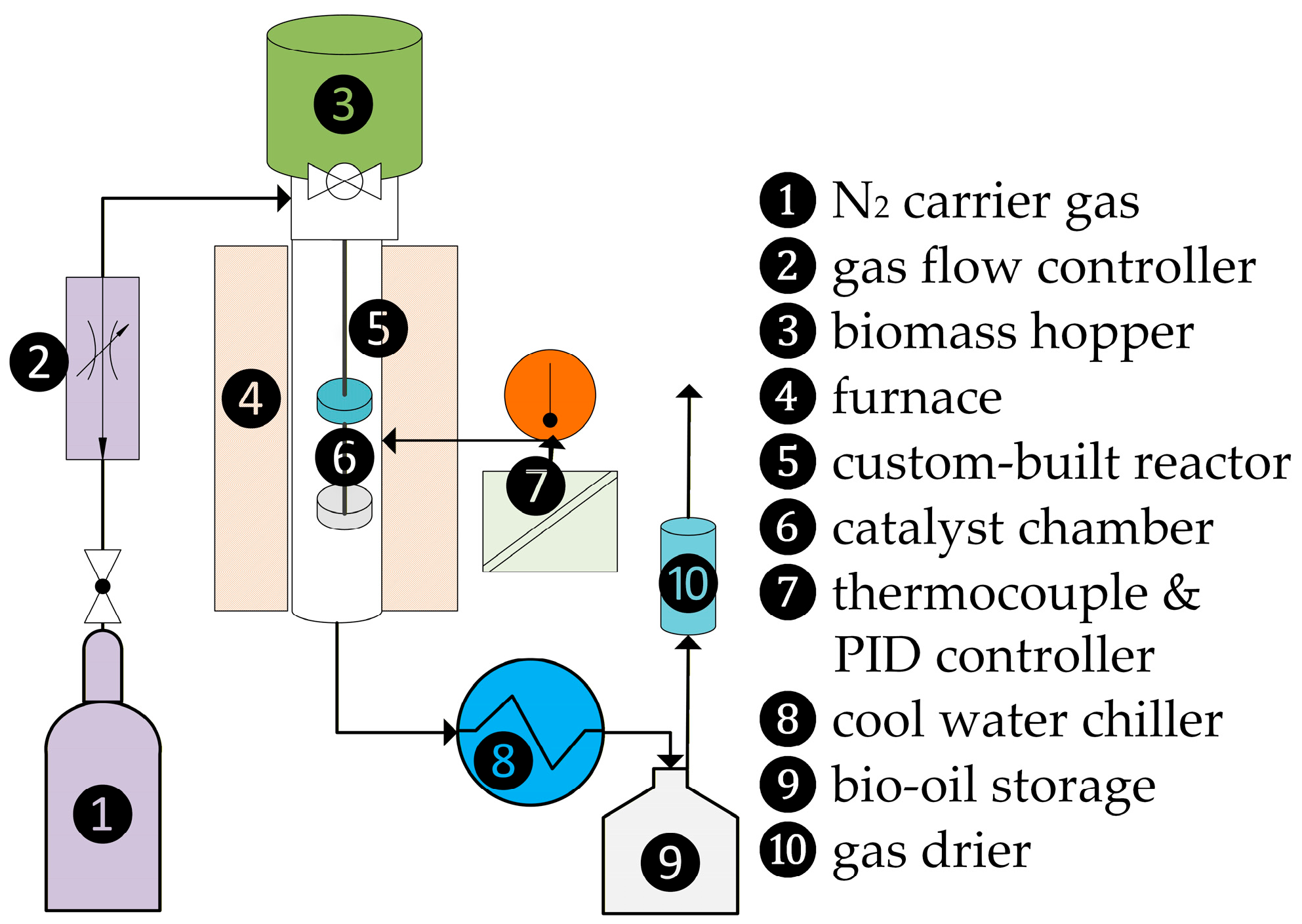
The catalytic pyrolysis of Spirulina algal was conducted in a 1200 mm long × 40 mm inner diameter stainless steel reactor installed vertically within an electrical furnace, as shown in Figure 1. Approximately 20 g of Spirulina algae was loaded into the hopper, which was installed on the top of the reactor. The catalyst was packed in a chamber positioned in the central reactor to ensure comprehensive volatilization of the algae prior to contact with the catalytic layer. This placement is intended to minimize physical contamination of the catalyst’s active sites by solid residues and carbonaceous char. The pyrolysis experiments were conducted at temperatures ranging from 500 to 600 °C, as detailed in the experimental design. A K-type thermocouple equipped with a PID controller was used to measure the temperature and control the electrical supply to the inductive heater. The reactor was heated at 20 °C/min to the desired conditions, and a N2 carrier gas was introduced at a designated flow rate. Once the desired temperature was established, the algae were rapidly released from the hopper into the reaction zone, enhance improve the diffusion of volatile vapors through the catalyst beds, with reaction times ranging from 45 to 75 min. The process facilitated simultaneous thermal degradation and catalytic pyrolysis; accelerated deoxygenation, decarbonylation, decarboxylation, and carbon-hydrogen and carbon-carbon bond scission within the catalyst pores; and led to conversion to lighter hydrocarbon species. The volatile vapors were cracked into lighter hydrocarbon compounds through a secondary cracking reaction before passing through a condensation unit consisting of a water chiller and an ice bath. The liquid product was collected, after which the organic phase was separated from the water-soluble phase via dichloromethane and evaporated via a rotary evaporator to yield bio-oil. The noncondensable gases were passed through a gas dryer prior to further compositional analysis.
Qualitative analysis to determine the chemical compounds of the pyrolysis bio-oil was characterized using an Agilent 7890B gas chromatograph coupled with an Agilent 7000C GC/MS system (Agilent Technologies, Santa Clara, CA, USA), equipped with an HP-5MS capillary column (30 m length × 0.25 mm inner diameter × 0.25 µm film thickness) and operated in split/splitless injection mode. The temperature was increased to 40 °C for 1 min and then raised to 270 °C at a heating rate of 20 °C/min, with helium gas supplied at a rate of 1.5 mL/min. The mass spectrometer was used at 70 eV ionization energy, 200 °C, and a scan range of 40–700 m/z. The chemical compounds were confirmed when their spectra were compared to those of the NIST2020/Wiley12th mass spectral library. The physicochemical property of bio-oil was analyzed in accordance with the ASTM standard method, e.g., the elemental composition of the bio-oil was characterized via a LECO CHN-628 analyzer, whereas the oxygen content was calculated from the difference. The density was measured via a pycnometer, whereas the kinematic viscosity at 40 °C was determined via an Eravisc X viscometer (Eralytics GmbH, Vienna, Austria). The modified acid number (MAN) was measured via a Metrohm 840-Trinoplus titrator (Metrohm, Cheshire, UK). The higher heating value was determined via a LECO AC-350 calorimeter (LECO, St. Joseph, MI, USA). The carbonaceous material was collected and weighed without any further processing. The noncondensable gas yield was calculated via the difference in mass balance, and the composition of the samples was neglected. The product distribution of catalytic pyrolysis was determined via Equations (1)–(5):
y i e l d   o f   l i q u i d   wt . % =   W 2 W 1   × 100
y i e l d   o f   b i o o i l   wt . % = W 3 W 1 × 100
y i e l d   o f   a q u e o u s   wt . % = l i q u i d   y i e l d b i o o i l   y i e l d  
y i e l d   o f   c a r b o n a c e o u s   wt . % = W 4 + ( W 6 W 5 ) W 1 × 100
y i e l d   o f   n o n c o n d e n s a b l e   g a s   wt . % = 100 y i e l d   o f   l i q u i d y i e l d   o f   c a r b o n a c e o u s
where
W1 = weight of Spirulina algae on a dry basis;
W2 = weight of total liquid in oil storage;
W3 = weight of bio-oil;
W4 = weight of collected solid and residue;
W5 = weight of total catalyst before the reaction;
W6 = weight of total catalyst separated after the reaction.

2.4. A 2-Level Factorial Design and Response Surface Methodology

Factorial designs offer significant advantages over univariate approaches facilitating the identification and ranking of significant parameters, providing a statistical basis for determining which variables exert the greatest impact on the process [36,37]. Furthermore, this approach accurately describes the main effects and their correlations, leading to a comprehensive understanding of the pathways involved. Adopting a two-level factorial design also enhances experimental sustainability by substantially reducing the required experimental runs, thereby saving time and cost [38].
Y = β 0 + i = 0 n β i X i
where
Y = response value;
β0 = constant coefficient;
βi = coefficient of the linear variables;
Xi = independent variables.
The independent variables investigated were temperature (X1, 500–600 °C), time of reaction (X2, 45–75 min), flow rate of N2 carrier (X3, 50–200 mL/min), and catalyst-to-feedstock percentage (X4, 5–20 wt.%).
As illustrated in Table 1, each factor was coded as (−1) or (1) to represent low or high values, respectively. The experimental design consisted of 22 runs, comprising 16 factorial points and 6 central points (0); the runs were performed in randomized order to minimize systematic errors. The dependent variables (responses) analyzed were the yield of noncondensable gas (Y1), liquid (Y2), aqueous phase (Y3), bio-oil phase (Y4), and carbonaceous (Y5). Variables significantly impacting the response were confirmed at the 95% confidence level. Significant main effects and interactions were determined via half-normal plot analysis and used to establish a first-order regression model. The validity of the model was confirmed via analysis of variance (ANOVA), while the coefficient of determination (R2) and adjusted R2 also represented the model’s goodness of fit. Central composite design (CCD) with RSM was performed to optimize catalytic pyrolysis using a dual-catalyst system. To maximize bio-oil production, four independent variables were investigated: temperature (A), reaction time (B), N2 flow rate (C), and catalyst loading (D). This study employed a Central Composite Design (CCD) for four independent variables (n=4). The design matrix consisted of 30 experimental runs, which included; 16 factorial runs (2n), 8 axial runs (2n) were selected to ensure rotatability, maintaining the variance of the prediction constant at points equidistant from the design center [39,40], and 6 center runs to assess experimental error and reproducibility. The relationship between the response and the coded variable is described by a second-order polynomial, as shown in Equation (7):
Y =   b 0 + i = 1 n b i X i + i = 1 n b i i X i 2 + i = 1 n 1 j = i + 1 n b i j X i X j
where
Y = predicted response;
b0 = constant coefficient;
bi = linear coefficients;
bii = quadratic coefficients;
bij = interaction coefficients;
Xi = coded values of factori;
Xj = coded values of factorj.
Table 1. The 2-level factorial design for the catalytic pyrolysis experiments.
Parameters−101
A: temperature (°C)500550600
B: reaction time (min)456075
C: N2 flow rate (mL/min)50125200
D: catalyst to feedstock ratio (wt.%)512.520
In the CCD framework, eight additional experimental runs were introduced at axial points at levels -α and +α. The value of α is typically defined as 2n/4, yielding a value of 2. However, owing to the operational constraints associated with the experimental setup, conducting runs at extreme levels of α = 2 was not suitable [41]. As a result, a α value of 1 was applied for this investigation. This modification classifies the approach as a face-centered central composite design (FCCCD), ensuring that all experimental runs remain within feasible operating conditions. The independent parameters and responses at each CCD run are illustrated in Table 2.

2.5. Synergistic Study of the Dual-Catalyst

To determine the effects of the Cu/sFCC and Fe/DM dual-catalysts on catalytic pyrolysis, the interaction of the two catalysts was examined according to the degree of synergy (Ydifference). The theoretical values (Ytheoretical), which assume no interaction between the catalysts, were calculated via the additivity rule [42] via data from individual catalyst experiments, as defined in Equations (8) and (9):
Y t h e o r e t i c a l = ( x 1 W 1 +   x 2 W 2 )
Y d i f f e r e n c e = Y e x p e r t o m e n t a l Y t h e o r e t i c a l
where x1 and x2 correspond to the yields derived from independent Cu/sFCC and Fe/DM in the catalytic pyrolysis runs, respectively, and W1 and W2 represent the mass fraction of each catalyst in the dual-catalyst system. A value of Ydifference > 0 signifies a positive synergistic effect, where the actual experimental yield surpasses the theoretical expectation, indicating a synergistic enhancement of the yield from both catalysts. In contrast, a negative synergistic effect (Ydifference < 0) was observed when the actual yield was lower than the calculated value, suggesting an inhibitory effect. The synergy can be attributed to the mechanism of the dual-catalyst in the pyrolysis reaction, where the interaction between the catalysts influences the promotion or inhibition of the bio-oil yield. This synergistic effect also likely identifies the dominant catalyst driving the conversion of algae into bio-oil.

3. Results and Discussion

3.1. Feedstock and Catalyst Characterization

Table 3 presents the physicochemical properties of Spirulina determined in accordance with ASTM standards. Proximate analysis revealed a composition of 5.73 ± 0.963 wt.% moisture, 76.48 ± 3.336 wt.% volatile matter, and 5.44 ± 1.127 wt.% ash; consequently, the fixed carbon content was calculated to differ at 12.35 ± 1.445 wt.%. The ultimate analysis revealed an elemental composition of 51.16 ± 1.639 wt.% carbon, 6.98 ± 1.754 wt.% hydrogen, and 39.01 ± 0.754 wt.% oxygen. A slight nitrogen content of 2.73 ± 0.218 wt.% was observed, which was likely attributed to structural proteins [7], whereas the sulfur content was only 0.13 ± 0.083 wt.%. Notably, the Spirulina algae presented a high atomic H/C = 1.64 and an O/C = 0.57, suggesting significant potential as a feedstock for high-energy fuel production. However, it notably that a high O/C ratio leads to decreased thermal stability [9], as analysis shows that bio-oil has a lower heat value.
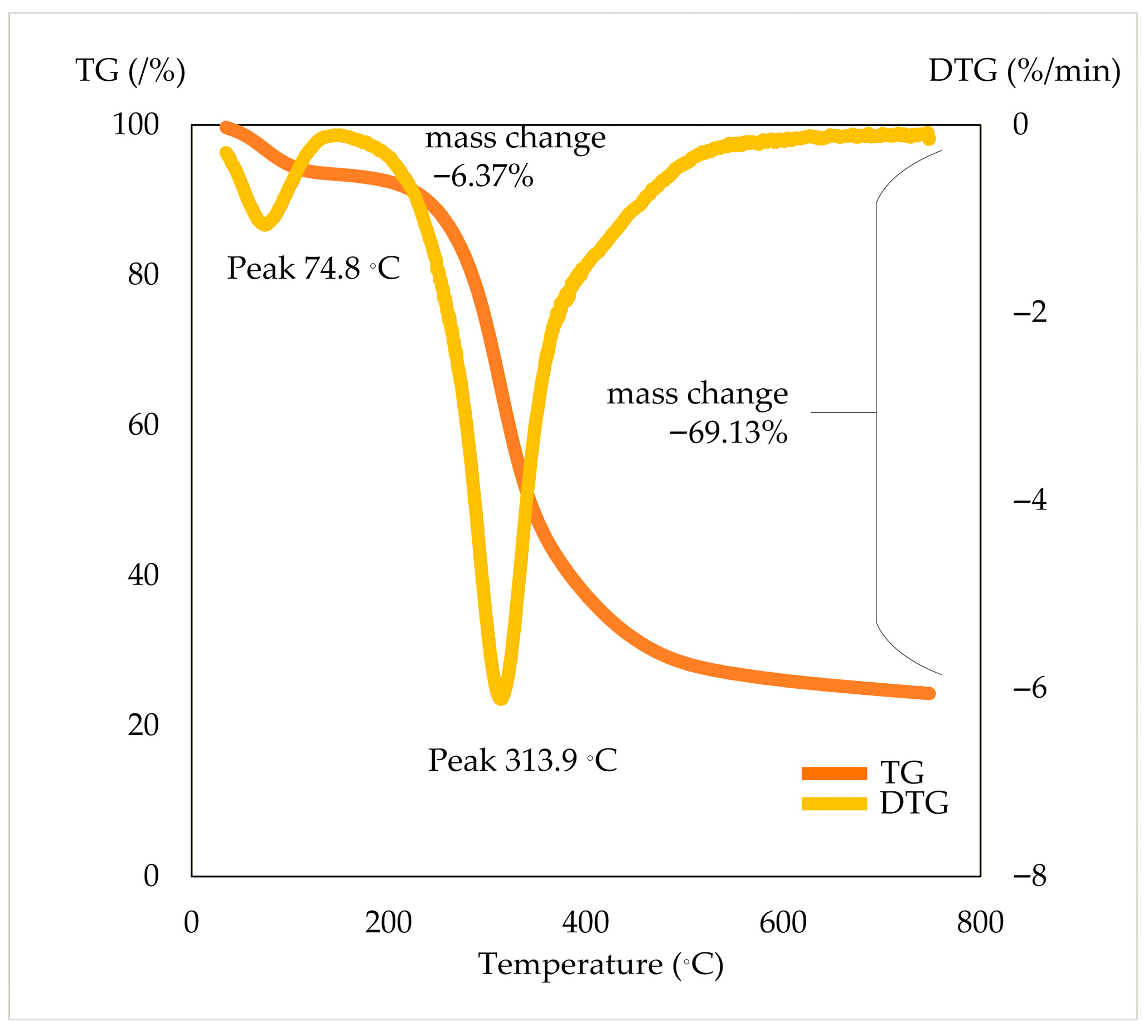
The thermogravimetric analysis (TGA) profile of Spirulina revealed a broad mass loss trend across the 30–800 °C range as illustrated in Figure 2. The initial gradual degradation, observed between 74.8 °C and 313.9 °C, was attributed primarily to moisture evaporation followed by the volatilization of biomass components via the decarbonylation and decarboxylation of lipids and proteins. Elevated temperatures significantly accelerated the thermal decomposition of the Spirulina structure. The increase in thermal degradation proceeded via free-radical mechanisms involving carbon–carbon and carbon–hydrogen bond scission, converting complex macromolecules into intermediate hydrocarbons. The most rapid thermal decomposition occurred at 210 °C and 350 °C; 50% of the algae mass was lost at approximately 336 °C, with complete decomposition occurring at approximately 490 °C.
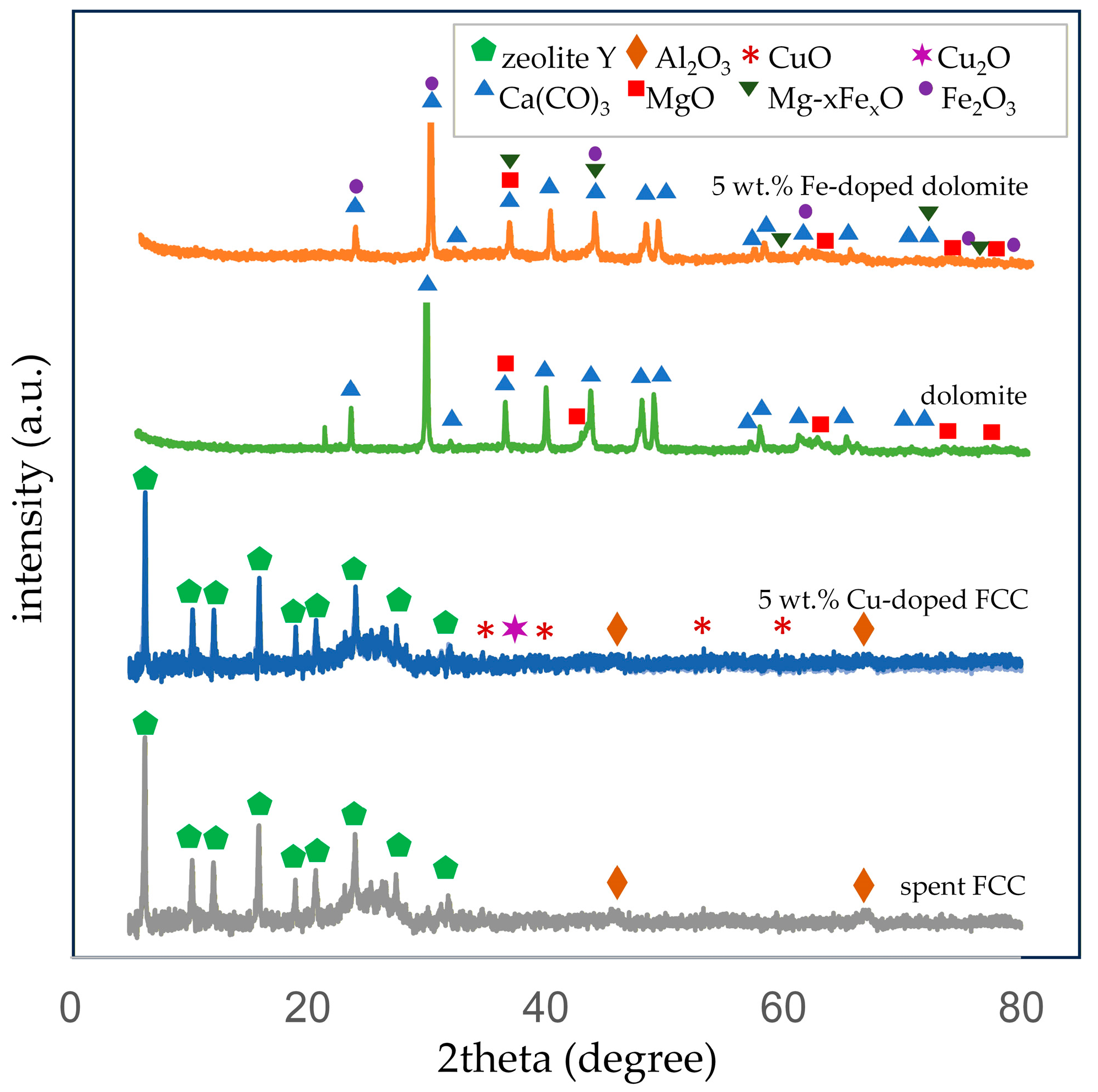
Figure 3 shows the XRD patterns of individual spent FCC and dolomite and their metals incorporated into the parent catalyst template. The pattern for the parent sFCC catalyst exhibited characteristic diffraction peaks at 2θ values of 6.2°, 10.2°, 15.6°, 23.6°, 27.1°, and 31.4°. These peaks align with the standard diffraction data for zeolite Y according to the Joint Committee on Powder Diffraction Standards (JCPDS) corresponding to JCPDS Card No. 01-077-1549. The incorporation of Cu into the sFCC and the fundamental crystalline structure of the spent FCC were not significantly altered. The relative peak intensities of the zeolite Y phase slightly decreased even if it contained CuO and Cu2O, which was consistent with the relatively low amount of copper metal incorporated.
The intense peaks observed at 2θ values of 35.6° and 38.2° correspond to the (002) and (111) crystallographic planes of monoclinic CuO, this pattern is compatible with the JCPDS Card No. 45-0937 [43], and the peak at 2θ values of 36.8° corresponds to the (111) planes of the cubic Cu2O structure in accordance to the JCPDS Card No. 05-0667 [44]. The XRD pattern of the parent dolomite (DM) contains highly intense diffraction peaks at 2θ values of 32.4°, 37.6°, 54.1°, 64.3°, and 67.4° corresponding to CaO (JCPDS 37-1497), whereas the intensities at 43.1°, 62.5°, 74.9°, and 78.8° are assigned to MgO with identified peaks according to the JCPDS Card No. 45-0946, indicating its well-defined crystalline nature [45].
Upon wet impregnation with 5 wt.% iron(III) nitrate nonahydrate, characteristic diffraction peaks at 2θ values of 23.5°, 31.4°, 36.5°, 42.5°, 61.2°, 74.4°, and 78.8° corresponding to γ-Fe2O3 (JCPDS 39-1346) appeared in the Fe/DM catalyst. Additionally, the peaks for MgO and CaO slightly decreased. These observations suggest that the iron oxide was well dispersed on the dolomite texture without significantly disrupting its primary crystalline structure [46]. As shown in Table 4, the XRF results confirmed the elemental composition of the Cu-impregnated spent FCC, revealing that the content of copper metal impregnated into the spent FCC was 6.63 wt.%. In addition, the modification of the Fe(NO3)3·9H2O precursor with the DM template resulted in an iron metal content corresponding to a weight percentage of Fe/DM of 5.82 wt.%.
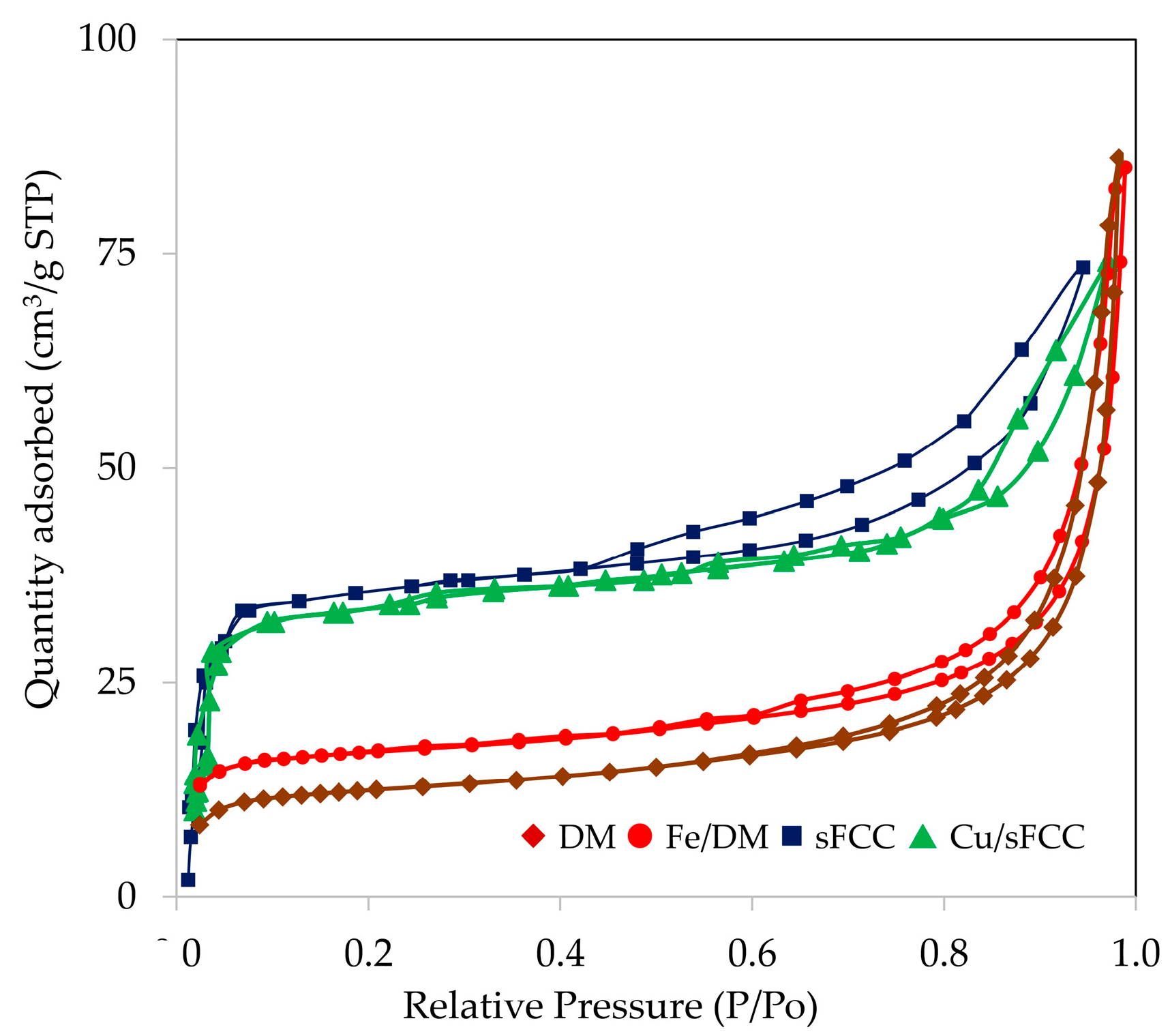
As shown in Figure 4, all catalysts exhibit the type IV isotherms for an apparent hysteresis loop of desorption at high relative pressures (P/P0 > 0.4), which is characteristic of materials with well-defined cylindrical-like mesoporous structures [47]. This confirms that the mesoporosity of the parent sFCC and DM was preserved after 5 wt.% Cu incorporated into the spent FCC, DM, and 5 wt.% Fe incorporated into the DM.
As illustrated in Table 5, the pore volume, pore size, and specific surface area of the individual catalyst and metal-incorporated catalyst correspond to the low metal oxide content, which results in the rate of nucleation being greater than the rate of increase in nucleation with increasing metal incorporation into the catalyst template, resulting in a slight increase in the crystallite size and a gradual decrease in the surface area when the metal concentration increases. As summarized in Table 5, the amount of ammonia desorbed, and the total number of Brønsted–Lewis acidic active sites were determined via NH3-TPD. The total acidity of the sFCC catalyst was 1.48 mmol/g NH3, and the incorporation of copper oxide into the sFCC framework slightly decreased the total acidity. This shift indicates that Cu incorporation increased the acidity of the catalyst by adding Brønsted acidic active sites, likely through the formation of new active sites or the modification of existing sites [47,48], whereas the distribution of Lewis acidic active sites decreased, revealing pore blockage. In contrast, the pristine DM catalyst presented a low total acidity of 0.28 mmol/g NH3, reflecting its intrinsic basicity. However, Fe oxide incorporation significantly altered this profile, driving an increase in total acidity, primarily through an increase to 0.48 mmol/g NH3. These results clarify the role of metal incorporation into the catalyst framework in increasing the acidity, which is attributed to the observed increase in acid strength from metal-induced surface modifications [49].

3.2. A 2-Level Factorial Experimental Design

As summarized in Table 6, analysis of variance (ANOVA) of a 2-level factorial design with 6 center points was used to investigate the effects of the variables of the process conditions.
As shown in Table 6, the main effects of temperature (A), reaction time (B), and the catalyst-to-feedstock weight ratio (D) are statistically significant. Furthermore, significant interactions were observed for AC, BC, BD, CD, ABC, ABD, ACD, and BCD, which were also found to significantly influence the product distribution, indicating that the interplay between these variables critically affects the thermal and catalytic conversion to produced bio-oil. The F value and p value (Prob > F) confirmed the significance of the model. The model F value of 45.82, with a p value < 0.0001, suggests that the model was highly significant [37,39]. This finding indicates that at least one of the selected process parameters has a main effect on the yield of bio-oil. The coefficient of determination (R2) indicated that 98.25% of the variation in the bio-oil yield could be attributed to the model. The adjusted R2 (0.9610) is high and consistent with the R2. Furthermore, the predicted R2 of 0.8955 is also reasonably consistent with the adjusted R2, demonstrating that the model has good predictive power for new observations [34,50]. The signal-to-noise ratio was 27.167, revealing that an adequate precision greater than 4 is desirable. These values indicate an excellent signal-to-noise ratio, demonstrating that this model can be effectively used for navigating the design space. The ratio of the standard error of the estimate to the mean value of the observed response (C.V.%) was 1.32%, suggesting a high degree of precision and reliability of the experimental responses [30,37,39]. The lack of fit (F value of 1.64) was insignificantly related to the pure error because the model adequately represented the correlation of the variables and the responses within the boundaries of the experiments.
A nonsignificant lack of fit provides confidence that the chosen model is appropriate [33,34,50]. The curve F value was 323.34 (p < 0.0001), which was highly significant. This result indicates a strong nonlinear correlation between the variables and the response. The significant curvature reveals that a first-order linear model, as initially represented by the factorial points, is insufficient to accurately describe the response surface. A significant difference between the average of the factorial point responses and the average of the center point response shows that the optimal conditions for maximizing bio-oil production are within the experimental design boundaries and that a higher-order model should be considered via response surface methodology with a p value < 0.05, which is considered statistically significant and is required for precise parametric study [30,37,39,44]. As illustrated in Table 6, all the main process parameter effects, e.g., temperature (A), time of reaction (B), and catalyst loading (D), were significant. Additionally, the two-way interactions of temperature and N2 flow rate (AC), time of reaction and N2 flow rate (BC), time of reaction and catalyst loading (BD), N2 flow rate and catalyst loading (CD), and three-way interactions, e.g., temperature–time of reaction-N2 flow rate (ABC), temperature–time of reaction-catalyst loading (ABD), temperature-N2 flow rate- catalyst loading (ACD), and time of reaction-N2 flow rate- catalyst loading (BCD), had highly significant effects on the bio-oil yield (p < 0.01 for all). This indicates a complex and highly interactive system, where the effect of one parameter is strongly dependent on the levels of the others. The final regression model for the bio-oil yield is represented by Equation (10):
Bio-oil yield (%) = 40.18 − 1.15A − 0.43B + 0.61D − 0.63AC − 1.00BC + 0.83BD
− 1.15CD − 0.77ABC − 0.79ABD + 0.46ACD − 1.29BCD
According to the regression model, which describes the yield in the bio-oil fraction by varying the conditions, the coefficient indicates the influence of the process parameter, e.g., a positive coefficient signifies an increase in factors such as temperature, residence time, or catalyst loading, which is correlated with bio-oil production. In contrast, a negative coefficient indicates an inverse relationship. A greater absolute value of the coefficient implies a more substantial influence when the variables are on the same scale. To compare the effects of variables measured in different units, standardized coefficients should be utilized. Additionally, it is essential to assess the statistical significance of each term, typically through p values and confidence intervals, to confirm that the observed influences are significantly different from zero. If the model incorporates quadratic or interaction terms, the sign and magnitude of their coefficients reveal nonlinearities and dependencies [37,38,39], wherein an interaction effect occurs when the influence of one factor is dependent on the level of another factor. Therefore, the adequacy of the overall model must be evaluated through metrics such as the coefficient of determination (R2) and diagnostics for multicollinearity to ensure a reliable interpretation of the influence of the process variable on the yield of bio-oil.
Main effects: The coefficient for temperature (A) was −1.15, indicating a negative effect on the bio-oil yield. Notably, as the temperature increased within the studied range, the yield of bio-oil significantly decreased. This phenomenon is attributable to enhanced accelerated thermal cracking of small volatiles to noncondensable gases, enhancing the thermal decomposition of primary vapor-phase products into noncondensable gases [13,14]. These noncondensable gases further participate in reforming and contribute to water–gas shift (WGS) reactions, as described by Equation (11):
CO + H2O ⇌ CO2 + H2
At high temperatures, the water–gas shift enhances the dissolution of polar oxygenates into the water-soluble phase [16] and is further influenced by high temperatures over prolonged reaction times, leading to secondary cracking reactions, which dramatically increase the yield of noncondensable gases. Notably, the water-soluble phase typically contains low-molecular-weight organics such as carboxylic acids and ketones resulting from both thermal cracking and secondary reactions, resulting in a decline in the overall yield of condensable liquids of both the water-soluble and bio-oil phases [20,21].
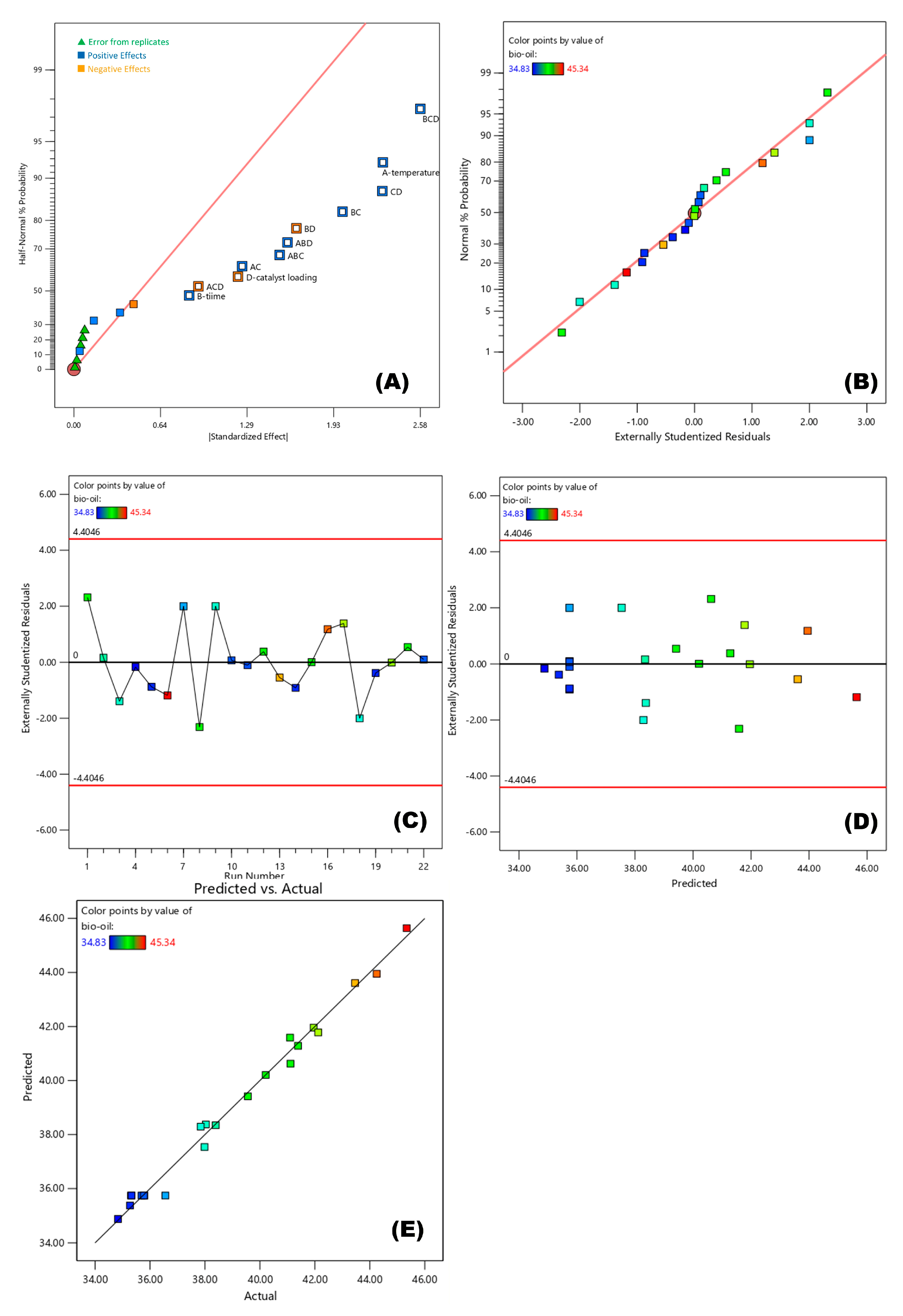
The influence of temperature (A) is a critical parameter in determining the composition of product distribution and enhances the acceleration of the WGS reaction, which converts CO and H2O into CO2 and H2 [13,14] and affects the formation of water–soluble components, resulting in an increase in oxygenated compounds, which corresponds to several studies on the pyrolysis of agricultural waste, where an optimal temperature exists for bio-oil production, beyond which gas yields are favored. The reaction time (B) also had a negative coefficient (−0.43), albeit with a smaller magnitude than the temperature. This implies that longer residence times in the reactor negatively impact the bio-oil yield. Prolonged exposure of pyrolysis vapors to high temperatures can increase the extent of secondary thermal decomposition, similar to the effect of increasing temperature, leading to a greater proportion of gaseous products. In contrast, catalyst loading (D) had a positive coefficient (+0.61). These findings indicate that an increase in catalyst loading enhances catalytic activity, which promotes the formation of shorter-chain volatile compounds, leading to an increased bio-oil yield. The catalyst likely plays a crucial role in promoting specific reaction pathways that favor the deoxygenation and conversion of algal biomass into desired liquid products while potentially suppressing pathways that lead to char and gas formation. An appropriate catalyst loading can improve the efficiency of the catalytic cracking and reforming reactions, thus maximizing the liquid fraction. The model’s validity was confirmed by the diagnostic plots, which were consistent with the half-normal and normal probability plots illustrated in Figure 5A,B, significantly indicating that both the main effects and interaction effects deviated from the fitted straight line, confirming their influence on the responses and indicating normally distributed errors [13]. Furthermore, as illustrated in Figure 5C,D, the plot of residuals versus run and the diagnostic comparison of the residuals versus predicted also demonstrate no systematic trends, with data points randomly distributed [14]. Additionally, Figure 5E illustrates that the correlation of the predicted values and experimental values illustrated no systematic trends, with the data points being randomly distributed. These diagnostic results confirm that the model developed from the 24 factorial design is reliable and confirm the effects of the operating parameters on the yield of bio-oil produced from the catalytic pyrolysis of Spirulina.
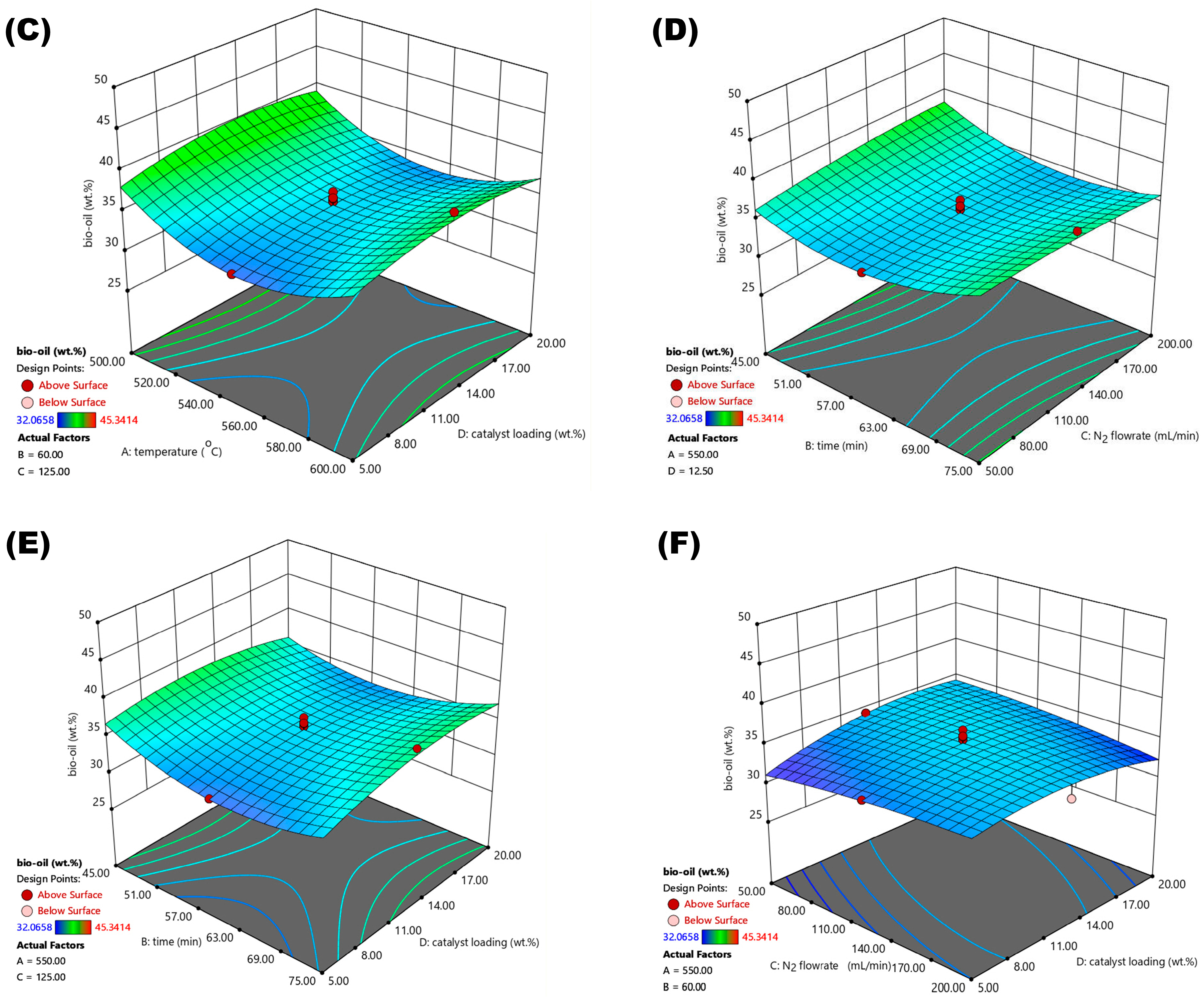
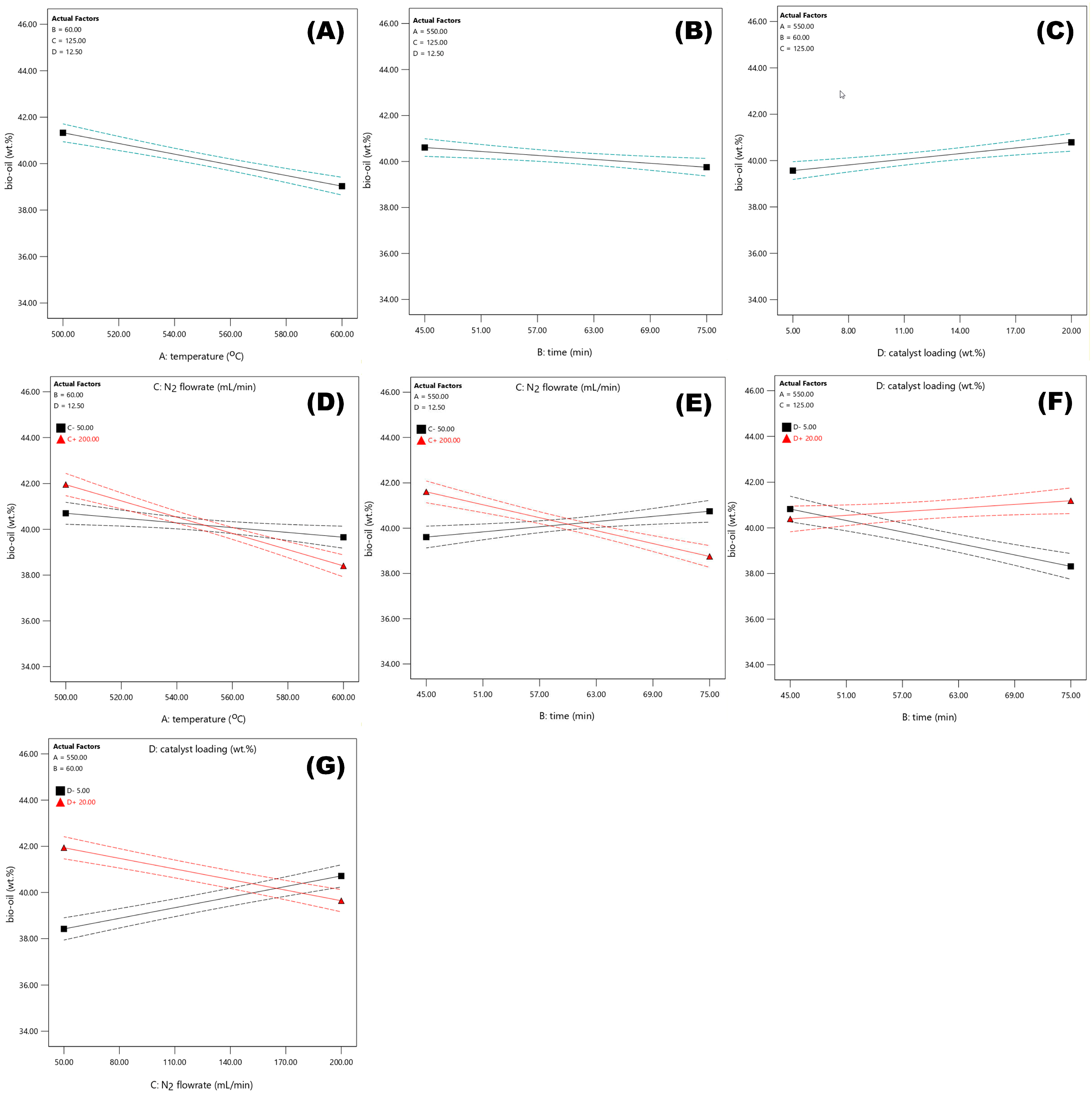
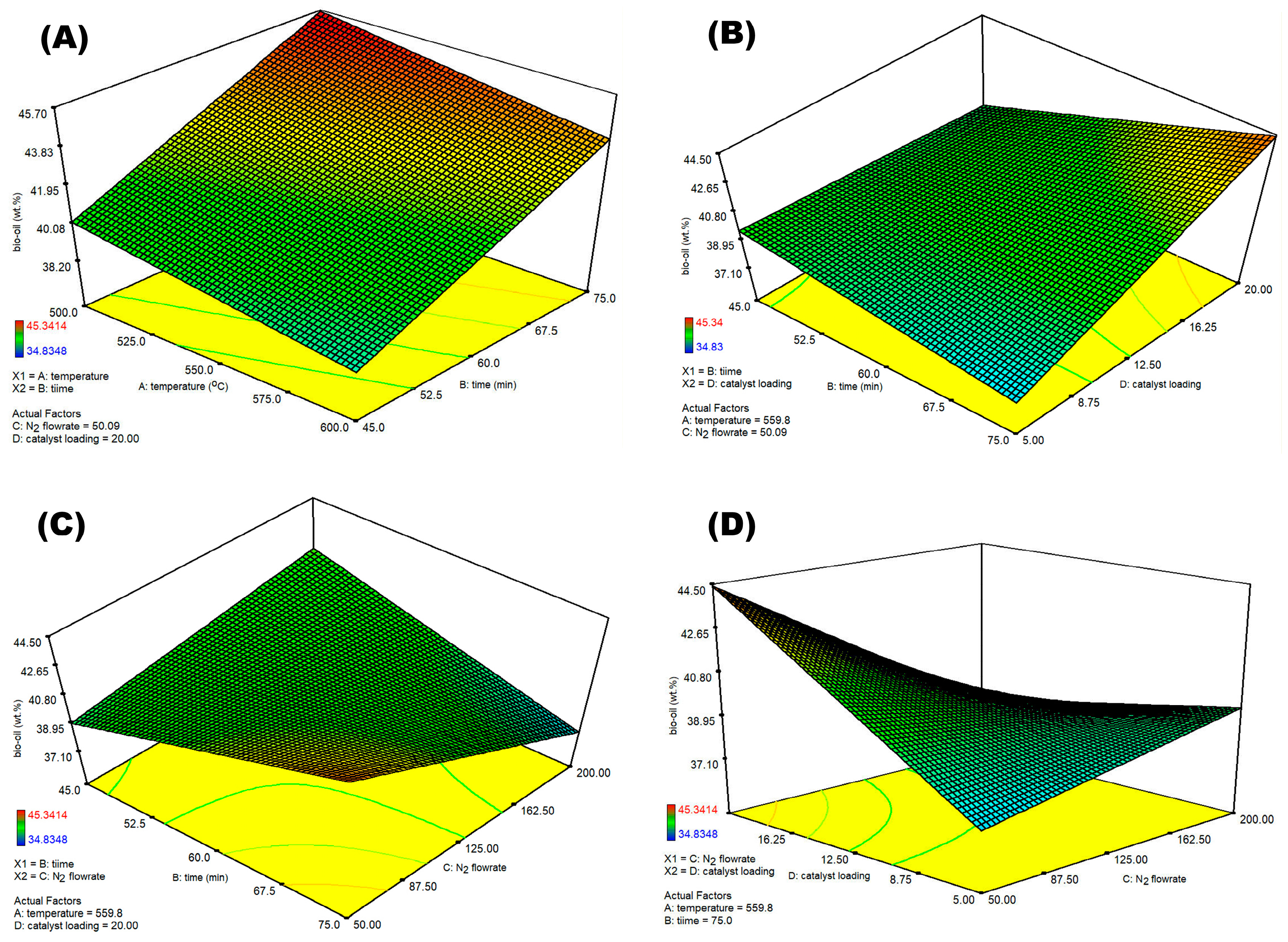
Figure 6A illustrates the influence of temperature on the yield of bio-oil. When the temperature increases to 500–550 °C, the amount of bio-oil tends to increase, which promotes the thermal degradation of the algae feedstock, which comprises proteins, carbohydrates, and lipids via random scission, producing unstable and reactive free radicals. Higher temperatures facilitate the thermal deposition of large hydrocarbon chains while simultaneously promoting decarbonylation and decarboxylation reactions, which convert fatty acid and carboxyl groups into CO and CO2 [13,14,16]. Higher temperatures promote the random scission of these macromolecules into highly reactive free radicals, which in turn facilitate the bond cleavage of large molecules into shorter medium-chain hydrocarbons via C–C bond cleavage and β-scission [19,20,30]. These thermally induced reactions are further enhanced by the acid strength active sites and textural structures of both dual-catalysts, which provide shape selectivity and a large surface area. The observed increase in the yield of the water-soluble phase is consistent with the promotion of the water–gas shift reaction [20], and further secondary cracking, hydrogenation, oligomerization, and aromatization enhanced the formation of the bio-oil phase. A slight increase in the water-soluble phase yield was observed at higher temperatures. This trend is attributed to the thermal cracking of volatile vapors into noncondensable gases, which subsequently accelerate the secondary cracking pathway via water–gas shift (WGS) reactions [20,21]. Furthermore, the formation of the water-soluble phase correlates with the elemental analyses of the Spirulina feedstock (H/C = 1.64; O/C = 0.57). The initial thermal decomposition induced moisture removal, and devolatilization involved the cleavage of carbon–carbon bonds and carbon–hydrogen bonds, including the deoxygenation pathway over the dolomite catalyst, both of which are influenced by high process temperatures, and the dolomite basic catalyst promoted the production of water–soluble byproducts. In contrast, Figure 6B reveals that increasing the reaction time negatively affected the bio-oil yield. High processing temperatures combined with prolonged residence times appear to intensify the thermal degradation of lipids. This leads to increased devolatilization via random bond scission into free radicals. Therefore, the intermediate volatile radicals during initial cleavage undergo sustained thermal and catalytic cracking through β-scission at the acid strength active sites of the dual-catalysts. These secondary cracking and water–gas shift (WGS) reactions convert volatile vapors into noncondensable gases, thereby reducing the recoverable bio-oil fraction. Figure 6C shows the positive effect of dual catalyst loading on bio-oil production. Increasing the catalyst-to-feedstock ratio increased the yield primarily by lowering the activation energy required for thermal cracking. The increased availability of acidic active sites and large surface area facilitated a suite of upgrading reactions, including hydrocracking, depolymerization, and oligomerization, to obtain shortened hydrocarbon compounds. The abundance of these strong acid sites ensures the effective conversion of short-chain volatiles and promotes secondary reactions that favor the formation of desirable hydrocarbons within the bio-oil range [16,17,18]. Figure 6D,E illustrates the correlations between independent parameters affecting bio-oil yield, which are further discussed in the Interaction Effects section.
Interaction effects: The presence of numerous significant interaction terms highlights the complexity of the catalytic pyrolysis process. The strongest interactions, on the basis of the magnitude of their coefficients, were BCD (−1.29), CD (−1.15), and BC (−1.00). The significant negative interaction between catalyst loading and temperature (CD) had a coefficient of −1.15, which is particularly noteworthy. This implies that the positive effect of catalyst loading is diminished at higher temperatures. While the catalyst promotes bio-oil formation, its effectiveness or stability may decrease at elevated temperatures, or the synergistic effect might lead to overcracking [20,21]. In other words, simply increasing both catalyst loading and temperature simultaneously does not guarantee a higher yield; in fact, it appears to be detrimental. This antagonistic interaction necessitates the judicious parametric study of both parameters.
The large negative interaction between the reaction time and the catalyst (BC) had a coefficient of −1.00, suggesting that the combination of increasing reaction time and high catalyst loading is unfavorable for bio-oil production. This could be due to prolonged contact time between the pyrolysis vapors and the active catalyst sites, leading to excessive secondary cracking into gases. The most dominant term in the model is the three-factor interaction BCD, which has a coefficient of −1.29. The negative sign indicates a complex antagonistic relationship. This suggests that the combined effect of increasing the reaction time, N2 flow rate and catalyst loading results in a significant decrease in the bio-oil yield. The interpretation of such high-order interactions is intricate but points to a finely balanced system where the optimal yield is achieved at a specific combination of intermediate factor levels rather than at the extremes [13,14,37,49,50]. Figure 6D–G shows the interaction of process parameters, e.g., temperature vs. N2 flow rate, reaction time vs. catalyst loading, and N2 flow rate vs. catalyst loading, which aligns with the model’s diagnostic. Finally, the statistical analysis, which was based on a 2-level factorial design, successfully developed a significant and predictive model for the yield of bio-oil, in which the temperature (A), reaction time (B), and catalyst loading (D) are critical parameters influencing the yield, as illustrated in the contour plot (Figure 7).

3.3. Response Surface Methodology

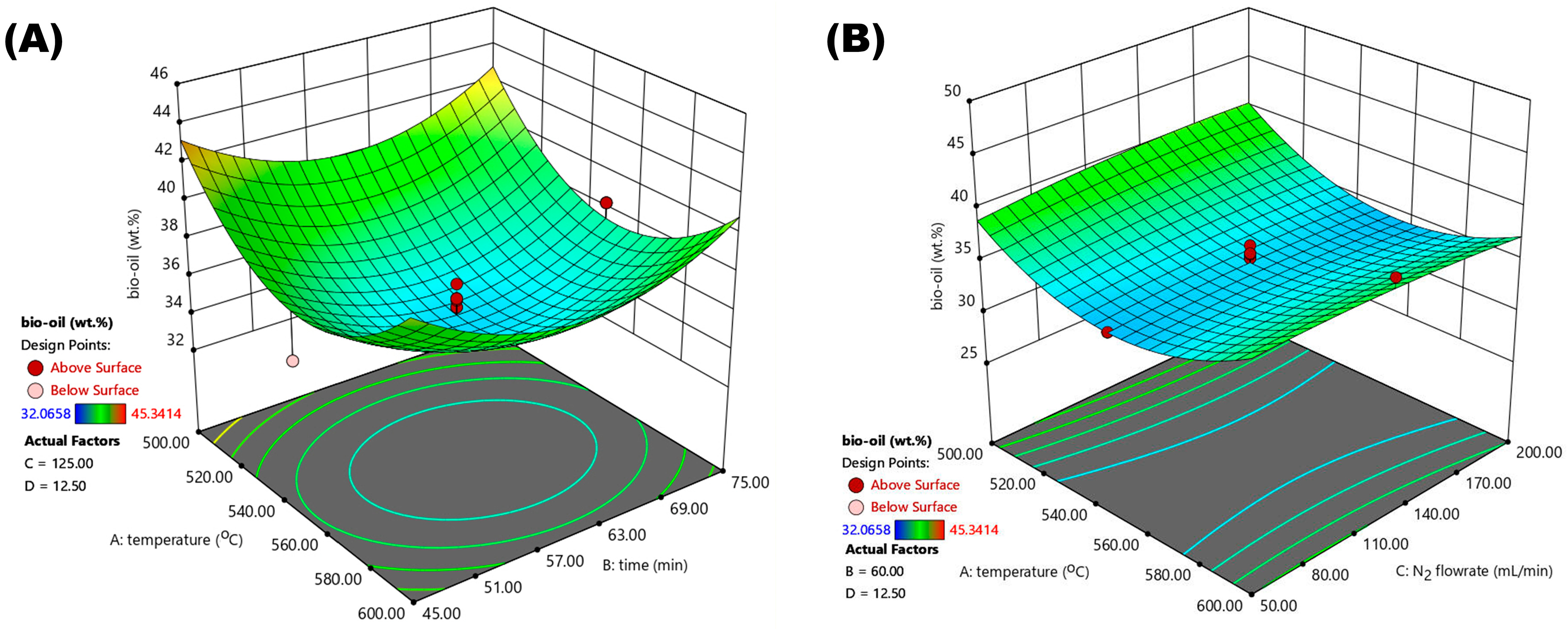
Generally, a central composite design (CCD) usually encourages working and requires axial points that extend beyond the primary factorial levels. These axial points may fall outside the feasible operational limits of the experimental setup, rendering them impossible experiments [13,39,40]. For this study, the CCD matrix consisted of 30 experimental runs, which consisted of 16 factorial, 8 axial, and 6 center runs, prerequisites for modeling and parametric study, and a face-centered central composite design (FCCD) was considered, characterized by α = 1.0, to ensure that all experimental runs remained within the established parameter boundaries [41,44]. In this configuration, the axial points are located on the faces of the factorial cube, corresponding to the same operational limits as the factorial points. This design is often chosen for practical reasons, particularly when operating conditions cannot be extended beyond the established factorial limits because equipment constraints and undesirable phenomena occur. The adequacy of the quadratic model was determined through analysis of variance from the 30 design runs fitted to polynomial models to identify the most suitable mathematical representation of the process, as detailed in Table 7. The coefficient of determination (R2) was calculated to be 0.7747, indicating that the model explains approximately 77.47% of the variability in bio-oil yield. While an of this magnitude suggests a strong correlation between predicted and experimental values, it also highlights the inherent complexity of the pyrolysis process. The Sequential Model Sum of Squares (SMSS) analysis further confirmed that the quadratic model provided the most appropriate fit compared to linear or cubic alternatives.
As presented in Table 8, the overall model’s statistical significance was confirmed with an F-value of 3.683 (p < 0.05). For this study, a p-value of less than 0.05 was adopted as the standard criterion for statistical significance [41]. The ANOVA results reveal that while the overall regression is significant, the influence of specific terms varies. The analysis indicates that the bio-oil yield is significantly influenced by the linear terms for temperature (A), reaction time (B), N2 flow rate (C), and catalyst loading ratio (D) as well as their quadratic counterparts (A2, B2, C2, and D2). Notably, temperature (A) demonstrated the most profound effect on the yield (F value = 15.19), driving the process dynamics more substantially than interaction effects
As shown in Table 8, the lack of fit has an F value of 37.972, with a p value = 0.0004. The highly significant lack of fit indicates a fundamental failure of the quadratic model to capture the true underlying correlation of the process parameters and the yield of bio-oil. This implies that the error attributable to the model’s lack of fit is significantly greater than the pure error derived from the experimental replicates. Although the developed quadratic model exhibited a significant lack of fit, limiting its direct predictive ability via regression equations, the central composite design (CCD) framework remained instrumental in navigating the experimental landscape. The inherent complexity of the catalytic pyrolysis of algal biomass also involves immediate cracking, deoxygenation, and polymerization, likely due to the complexity of the algal pyrolysis reaction, which likely introduces high-order nonlinearities that exceed the capacity of a second-order polynomial. However, the structured design matrix facilitated a detailed explanation of process variable trends. This systematic exploration effectively highlighted the operational zones that maximize bio-oil yield and identified critical parametric interactions. Therefore, the optimal operating boundaries were explicated on the basis of strong empirical observations derived from the experimental matrix, independent of the model’s mathematical goodness-of-fit. Consequently, the systematic deviation suggests that the response surface is more complex than a second-order polynomial can describe [14,50]. The presence of a significant lack of fit is a critical flaw, rendering the model unreliable for prediction, interpolation, or delineation of optimal conditions. A nonsignificant lack of fit is desirable, confirming that the model satisfactorily fits the experimental data [14,30,37,50]. Furthermore, the model’s inadequacy was confirmed by its regression coefficients and R-squared values. While the R2 value indicates that the model explains 77.5% of the variability in the bio-oil yield, this figure can be misleading. A significant decrease was observed for the adjusted R2 value, which penalizes the model for the inclusion of additional terms. This discrepancy strongly indicates that the model is overfit with numerous statistically insignificant terms. The most critical metric in this context is the predicted R2, which has a value of −0.5231. A negative predicted R2 is a definitive sign of an invalid model. This indicates that the model has worse predictive power than simply using the historical mean of the responses; the model’s predictions are, on average, further from the actual values than the mean is. This is corroborated by the large predicted residual sum of squares (PRESS) value of 536.88. The diagnostic statistics provide further understanding of the model’s reliability. The Adequate Precision value, which represents the signal-to-noise ratio, was found to be 7.024. Since a ratio greater than 4 is generally desirable, the model possesses an adequate signal to navigate the design space. However, a significant lack of fit was observed. Rather than rendering the model invalid, this lack of fit highlights the limitations of a second-order polynomial, which involves intricate reaction pathways such as random bond cleavage through free radical reactions, deoxygenation, and polymerization, which occur during algal biomass pyrolysis. Therefore, while the model is sufficient for identifying the significance of parameters and visualizing the curvature of the design space (Curvature F value = 323.34, p < 0.0001), it suggests that the actual optimum lies within a complex region that may require higher-order modeling for precise point prediction. However, the face-centered central composite design (FCCD) successfully fulfilled its primary objective by delineating the critical operational zones and confirming the dominant quadratic effect of temperature.
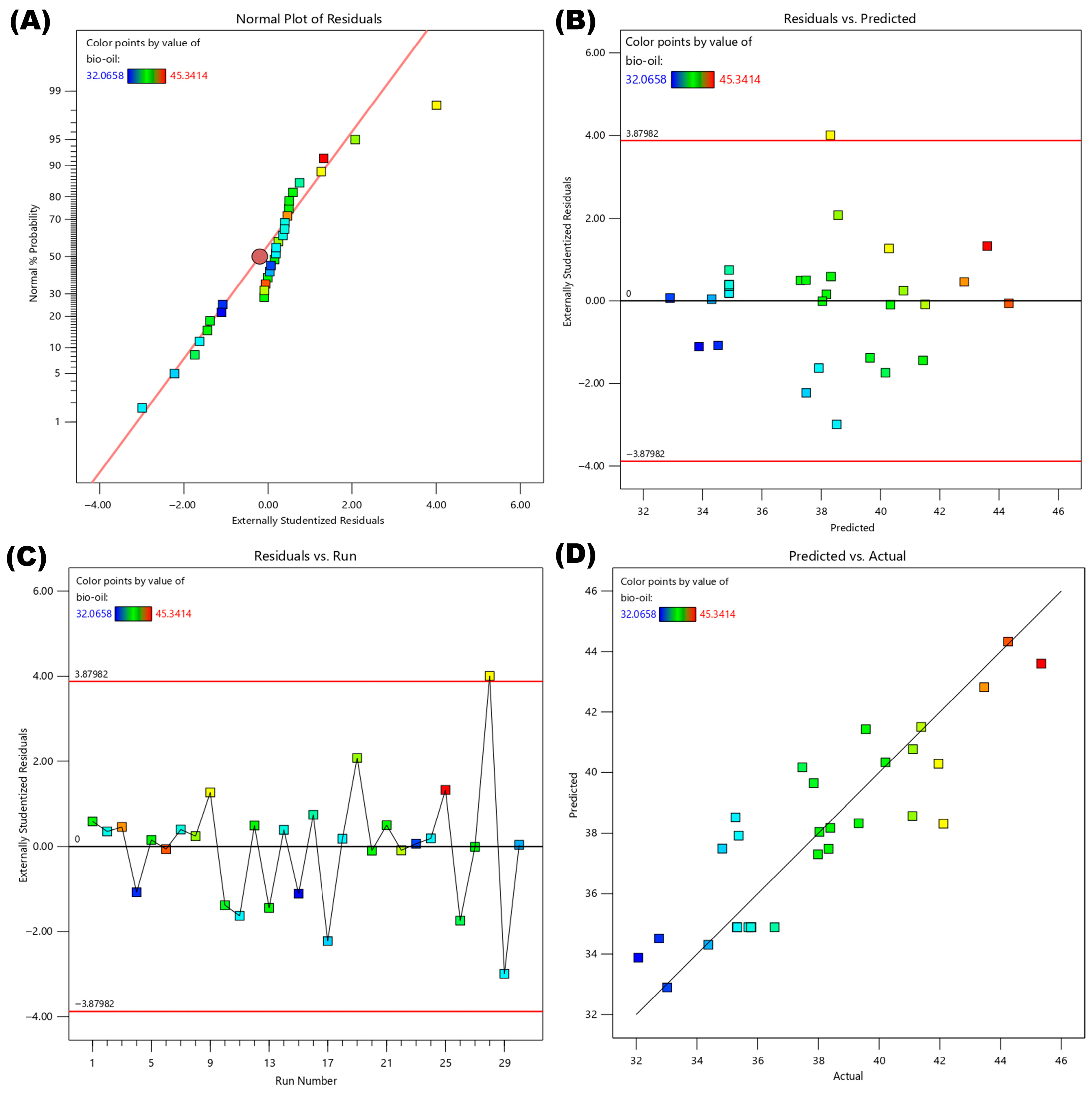
Although the linear coefficient for temperature (−0.92 A) is negative, the strong positive quadratic coefficient (4.35 A2) indicates a distinct nonlinear relationship (curvature) with respect to temperature. This suggests that while yield may initially fluctuate or decrease slightly within specific lower ranges, the quadratic effect dominates at higher levels, leading to a curvature in the response surface. This behavior confirms that the catalytic pyrolysis of Spirulina is a highly non-linear process; these factors do not exert a strong, direct, or simple interactive influence on the yield of bio-oil, indicating the existence of an optimal temperature for maximizing bio-oil yield within the experimental boundaries. This finding reveals a common and chemically sensible finding in pyrolysis, where temperature has a profound and complex effect, initially promoting decomposition to liquids but eventually favoring secondary cracking to gases at higher severities, thereby reducing bio-oil yield. However, the significance of this quadratic term, in concert with the insignificance of the linear term (p = 0.1110), strongly indicates that a simple linear assumption for the effect of temperature is incorrect and that an optimal temperature for bio-oil yield likely exists. As shown in Figure 8A, which is consistent with the normal probability plot, these specific parameters deviate from the straight line, confirming that their parameters affect the yield of bio-oil. Figure 8B,C illustrates the diagnostic comparison of the plot of residual versus predicted and the plot of residual versus run, respectively, confirming that the model’s diagnosis shows random scattering. Figure 8D shows that the correlation of the predicted and experimental values has no systematic trend, with the data points being randomly distributed.
These diagnostic results confirm that a face-centered central composite design (FCCD) model is reliable for describing the parameters influencing bio-oil yield. Therefore, the RSM study, which employs a face-centered CCD, successfully demonstrated that the catalytic pyrolysis of Spirulina is a highly nonlinear process dominated by the quadratic effect of temperature [13,14]. However, the resulting second-order model proved statistically invalid, suffering from a severe lack of fit and a complete absence of predictive power. This investigation serves as a crucial diagnostic step, highlighting the complexity of the system and the limitations of the standard quadratic RSM approach under the current experimental conditions illustrated in Figure 9.
A verification experiment was conducted to verify the optimal conditions identified through the experimental trends at a temperature of 501.53 °C, a reaction time of 45.10 min, a N2 flow rate of 141.91 mL/min, and a 13.49 wt.% catalyst-to-feedstock loading (at a 0.5:0.5:0.5 mass molar ratio), as illustrated in Table 9, indicating that the production distribution in the predicted value range yielded a maximum bio-oil content of 43.11 wt%, confirming this as the practical optimum on the basis of empirical evidence rather than a model-predicted value. Consequently, the noncondensable gas, water-soluble, and carbonaceous contents are 43.86 wt.%, 8.31 wt.% and 4.72 wt.%, respectively.

3.4. Synergistic Study

To understand the synergistic influence of the dual-catalysts, a univariate study was conducted by varying the Fe/DM: Cu/sFCC ratio at mass ratios of 0.9:0.1, 0.7:0.3, 0.5:0.5, 0.4:0.6 and 0.2:0.8. The experiments were conducted under optimal process conditions at a temperature of 500 °C, a reaction time of 45 min, an inert N2 flow rate of 150 mL/min, and a catalyst loading of 12.5 wt.%. The resulting bio-oil yields and product distributions were analyzed and compared with the yields obtained from individual catalysts and noncatalytic pyrolysis. Table 10 shows the yields of bio-oil and other products at several mass ratios with those of the individual catalysts and a noncatalytic process. The noncatalytic system presented a significantly high gas yield of 56.22 wt.%. High temperatures accelerated the thermal decomposition and deoxygenation of Spirulina, accelerating the thermal degradation of carbon–carbon and carbon–hydrogen bonds. This reaction promotes the cracking of volatile vapors into shorter-chain intermediates and promotes continuous secondary cracking into noncondensable gases. The water-soluble fraction in the noncatalytic run was approximately 6.75 wt.%, as the high temperature also enhanced the mechanism pathways through the WGS reaction, moisture removal and conversion of volatile vapors into water-soluble and oxygenated compounds, primarily ketones and carboxylic acids.
When individual Fe/DM was used in the catalytic pyrolysis of Spirulina, the noncondensable gas yield was 49.11 wt.%, whereas the bio-oil yield was 39.91 wt.%. These findings reveal the role of the dolomite (DM) template, which functions as both an adsorbent and a basic catalyst, enhancing deoxygenation and gasification by converting lipids and proteins into CO, CO2, H2, and methane. Whereas increasing the temperature accelerated the thermal degradation of proteins, lipids and carbohydrates into intermediate volatile vapors, the acid active sites from the Fe metal ions further induced catalytic activity, which cracked these intermediates into shorter-chain vapors that subsequently diffused into the mesopores of the DM template. Notably, the carbonaceous residue yield was not significantly different from that observed with other catalyst mass ratios.
The use of the individual Cu/sFCC as a single catalyst affected the production of a noncondensable gas yield (46.16 wt.%) and the highest bio-oil yield (43.69 wt.%), suggesting that the impregnation of Cu onto the sFCC template increased the number of Brønsted acid strength active sites over the mesopores with a large surface structure. The strong acidity of the sFCC induced catalytic activity, which promoted the generation of thermally derived volatile compounds from Spirulina, such as deoxygenation, dehydration, hydrogenation, and oligomerization reactions, which were enhanced, improving the formation of C11–C21 aliphatic hydrocarbons. However, further secondary cracking also occurred, contributing to the formation of noncondensable gases.
In the dual-catalyst system combining Fe/DM and Cu/sFCC, the bio-oil yield tended to decrease as the mass of Fe/DM increased. This was attributed to the basic catalytic function of the DM template, which promoted the thermal degradation of proteins, carbohydrates, and lipids through random bond scission, producing reactive free radicals. While higher temperatures facilitate the thermal degradation of large molecules to shorten volatiles and promote decarbonylation and decarboxylation, they also encourage random bond scission of these volatile vapors, facilitating the scission of large hydrocarbon molecules into medium-chain hydrocarbons via β-scission, which is enhanced by the catalytic activity at the Brønsted and Lewis acid sites within the pores of the dual-catalyst, resulting in shape selectivity. Notably, an increase in the yield of bio-oil corresponds with an increase in the water–gas shift pathway, secondary cracking, hydrogenation, and oligomerization. Furthermore, the presence of the Cu/sFCC catalyst, with its Brønsted acidic sites and selective mesoporous structure, particularly enhanced aromatization reactions.
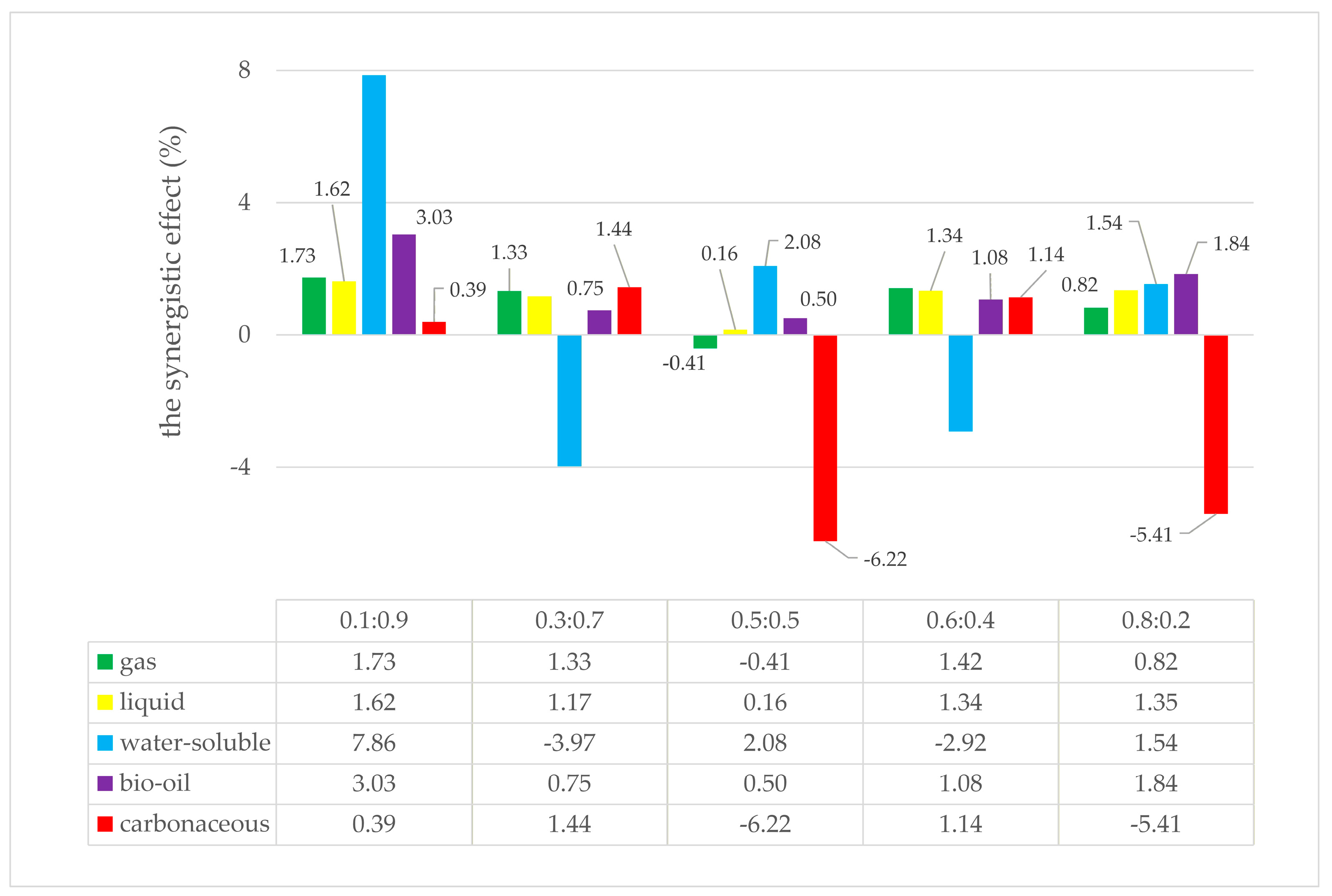
As illustrated in Figure 10, the comparison between the actual yields and theoretical values reveals the synergy of the Fe/DM-Cu/sFCC dual-catalyst at various mass ratios. A positive synergistic effect on the bio-oil yield was observed across all the Fe/DM and Cu/sFCC mass ratios, implying that the Brønsted–Lewis acidity active sites significantly increased the catalytic activity following the initial random thermal cracking of the algae. The resulting intermediate compounds underwent further deoxygenation, decarbonylation, decarboxylation, dehydration, hydrogenation, oligomerization, and aromatization pathways, driven by the Lewis and Brønsted acid sites, including the textual properties of both catalysts, thereby increasing the yield of bio-oil. The acidic active sites of the dual-catalyst system play a crucial role in the catalytic pyrolysis of Spirulina. The incorporation of the Fe/DM-Cu/sFCC dual-catalyst accelerated deoxygenation and bond scission of carbon–carbon and carbon–hydrogen, facilitating conversion into bio-oil and noncondensable gases. These findings are attributed to the incorporation of metal into the catalyst, resulting in increased strength of the Brønsted–Lewis acidity. Shortened volatile vapors and hydrocarbon intermediates diffuse into the porous structure, subject to mass transfer limitations, leading to secondary cracking into noncondensable gases. However, the Cu/sFCC component specifically promoted oligomerization and aromatization, supporting bio-oil retention.
Compared with noncatalytic pyrolysis, the dual-catalyst system yielded significantly more bio-oil and reduced noncondensable gas formation in the absence of a catalyst, and randomized thermal cracking promoted excessive secondary reactions that broke down bonds into short-chain vapors that favor gas production. Nevertheless, the synergy study between the experimental yields and those determined through theoretical calculations revealed no clear trend regarding noncondensable gases, the water-soluble fraction, or carbonaceous residues. This phenomenon is currently difficult to define with precision, as Spirulina is composed of complex lipids and proteins. These components undergo hydrolysis and conversion into nitrogen-derived compounds, presenting reaction pathways distinct from those of bond cleavage of carbon–carbon and carbon–hydrogen. Therefore, the catalytic influence of dual Brønsted–Lewis acid sites on these nitrogenous species differs from their activity on the general catalytic pyrolysis of short-chain hydrocarbons, which also complicates the theoretical prediction of product distribution.

3.5. Characterization of Bio-Oil and Its Physiochemical Analyses

Table 11 shows the characterization of the bio-oil derived from both thermal cracking and catalytic pyrolysis using Fe/DM and Cu/sFCC at mass ratios of 0.5:0.5 and 0.3:0.7, which were analyzed through gas chromatography/mass spectrometry, with the results quantified as the percentage of peak area. As detailed in Table 11, the identified compounds were classified into several functional groups, including alkanes, amides, carboxylic acids, heterocyclic organic compounds, ketones, and nitriles, with trace amounts of alcohols, alkenes, amines, benzene, and sulfides. The presence of long-chain organic compounds, specifically alkanes (C11–C21) and carboxylic acids, was noted. Notably, the pyrolysis of Spirulina, which does not contain a lignocellulosic structure, yielded only trace amounts of alcohols and no detectable phenols or their derivatives. This absence represents a significant advantage, suggesting that Spirulina-derived bio-oil is more stable than bio-oil from lignocellulosic feedstocks.
Table 11 clearly shows that the relative peak area of the straight-chain aliphatic hydrocarbons (C11–C21) increased from 12.81% during noncatalytic pyrolysis to 25.79% and 31.07% when the Fe/DM: Cu/sFCC dual-catalysts were used at mass ratios of 0.5:0.5 and 0.3:0.7, respectively. Notably, a significant decrease in the percentage of the peak area of amides was observed, decreasing from 39.00% (thermal cracking) to 32.15% and 24.12% for the 0.5:0.5 and 0.3:0.7 dual catalyst mass ratios, respectively. This decline suggests that the catalytic activity enhances the conversion of amides into other nitrogenous compounds. This finding is attributed to the high nitrogen content in Spirulina algae, as observed by the increase in the relative total area of amines and corresponding nitrites, which rose from 4.38% (thermal cracking) to 7.35% (0.5:0.5 Fe/DM: Cu/FCC) and 8.227% (0.3:0.7 Fe/DM: Cu/FCC) across the catalytic systems. The catalytic pyrolysis of Spirulina involves initial thermal decomposition of the lipid and protein structures via moisture removal, followed by dehydrolysis reaction into amino acids, followed by deamination, decarboxylation, and decarbonylation reactions on the catalyst’s acid sites to form nitriles, amines, and produce CO and CO2 [15,17]. At the same time, the initial cracking and hydrolysis into fatty acids and glycerol. Subsequently, the fatty acids undergo decarboxylation/decarbonylation to produce CO and CO2 included long-chain alkanes, while glycerol is converted via dehydration and other reactions [34,36]. Notably, the resulting gas phase was rich in CO and CO2, attributed to the prevalence of decarbonylation and decarboxylation reactions. The presence of H2 was also likely, originating from reforming and water-gas shift (WGS) reactions. These outcomes are consistent with the established literature, corresponding to initial hydrolysis and deoxygenation pathways catalyzed by thermal and Brønsted–Lewis acidic active sites. Although the composition analyses of the noncondensable gas was not empirically determined in the present study due to the online analysis of the noncondensable gas fraction using a gas chromatography (GC-TCD) to quantify the concentrations of H2, CO, CO2, and light hydrocarbons but the total gas yield having been quantified by mass balance. The Brønsted–Lewis catalytic activity observed in this study are characteristic of deoxygenation processes occurring over acidic catalysts. The reaction pathways are dominated by decarbonylation and decarboxylation, leading to a gaseous product is inferred to be rich in CO and CO2, a composition attributable to the prevalence of decarbonylation and decarboxylation reactions. Furthermore, the presence of H2 is anticipated from concomitant reforming and water-gas shift (WGS) pathways. The noncondensable gas product distribution is highly consistent with established literature on initial hydrolysis and deoxygenation mechanisms catalyzed by thermal and Brønsted–Lewis acidic active sites.
The dolomite (DM) component acts as both an adsorber and a promoter of deoxygenation [20,22,46], facilitating the primary cracking of the feedstock into hydrocarbon radicals through carbon–carbon bond scission [30,46]. The catalytic activity of both Fe/DM and Cu/sFCC drives further cracking and isomerization pathways. The Fe-impregnated DM template provides Lewis acid active sites for catalytic cracking, this active site in coordinating with carbonyl groups to facilitate decarboxylation, cleaving carbon–carbon and carbon–hydrogen bonds to form intermediate vapors resulted in CO and CO2 intermediate during the initial catalytic activity [19,20,21,30]. Notably, higher Fe2O3 concentrations can block pores, resulting in a reduction in pore volume and favoring thermal cracking over catalytic cracking, which promotes random cleavage into small intermediate radicals. However, the FCC catalyst contributes significantly to Brønsted acidity and microporosity, which are crucial for converting complex Spirulina-derived intermediates into aliphatic hydrocarbons. Furthermore, increased Cu impregnation introduces a high density of Brønsted acid active sites that facilitate and accelerate both dehydration and carbon–carbon bond scission at high temperatures resulted in promoting dehydration, hydrolysis, and cracking, allowing small volatile vapors to pass through the sFCC mesopores [26,27,28,49], indicating that the strong Brønsted acidity of the dual-catalyst system enhances the cleavage of carbon–carbon bonds in medium-length hydrocarbon chains to form the desired C11–C21 fraction, crucially without promoting oligomerization and aromatization reactions [27]. This outcome is a key distinction from the pyrolysis of lignocellulosic biomass, which typically yields phenolic and aromatic compounds as primary products. Notably, a slight relative peak area in benzene (<1% peak area) was observed during catalytic pyrolysis. This can be attributed to the cracking tendency of the FCC catalyst, which is correlated with its Brønsted acid strength active sites [26,27,30]. Notably, the observed dehydration activity was attributed to the weak acidity of the active sites in the Cu-incorporated sFCC catalyst.
As illustrated in Table 12, catalytic pyrolysis of Spirulina over a Fe/DM-Cu/sFCC dual-catalyst system demonstrably increased the higher heating value (HHV) of the bio crude oil under process parameter conditions (500 °C, 45 min, 50 mL/min N2 flow rate, and 10 wt.% catalyst loading). Notably, the HHV reached 33.5 ± 2.71 MJ/kg and 37.5 ± 0.98 MJ/kg at Fe/DM:Cu/sFCC mass ratios of 0.5:0.5 and 0.3:0.7, which are close to those of transportation-grade fuel but much lower than those of new sustainable aviation fuels (greater than or equal to 42.8 MJ/kg). In contrast, the HHV obtained from noncatalytic pyrolysis was only 29.9 ± 1.36 MJ/kg. This enhancement is attributed to the catalyst’s promotion of deoxygenation reactions, as previously reported [33,34], where an increased density of Brønsted and Lewis acid sites facilitates C–C and C–H bond scission to enrich the product in higher-energy hydrocarbons. and a reduction in acidic compounds. When the HHV approaches that of some conventional transportation fuels, it remains below the stringent requirement for sustainable aviation fuel (SAF; ≥42.8 MJ/kg). This position positions the product as a high-quality intermediate precursor that necessitates further refinement, as such upgrading is underscored by its physical properties. The bio crude oils obtained from both catalytic and noncatalytic pyrolysis presented densities ranging from 1.12 to 1.16 g/cm3, which are markedly higher than the range specified by ASTM D1655 for Jet A-1 fuels (0.775–0.840 g/cm3). However, these obtained biocrude oils are used as intermediate biofuel precursors, and a subsequent upgrading step, such as hydrodeoxygenation (HDO), is essential for reducing the oxygen content, viscosity, and density to meet the specifications for a drop-in transportation fuel. Additionally, the kinematic viscosity measured at 40 °C for bio-oil produced through the catalytic pyrolysis of Spirulina algae using a dual Fe/DM-Cu/sFCC catalyst at mass ratios of 0.5:0.5 and 0.3:0.7 was found to be 24.3 ± 1.59 mm2/s and 20.4 ± 3.68 mm2/s, respectively. The bio-oil from thermal cracking presented a kinematic viscosity of 38.7 ± 1.09 mm2/s. All the observed kinematic viscosity values notably exceeded the maximum limit of 8.0 mm2/s required for Jet A-1 fuel. Since the high viscosity of biofuels can adversely affect their thermal stability and combustion performance, the bio-oil strongly needs to be upgraded to comply with the kinematic viscosity standard. Furthermore, the acidity of the bio-oil was determined via automated titration according to the ASTM D664 standard. Under the thermal cracking reaction at 500 °C, a reaction time of 45 min, a N2 flow rate of 150 mL/min, and a catalyst-to-feedstock loading of 12.5 wt.%, the bio-oil produced from Spirulina presented an acid value of 62.5 ± 4.75 mg KOH/g. In contrast, employing a 10 wt.% dual-catalyst system of Fe/DM and Cu/sFCC (0.5:0.5 mass ratio) under the same process conditions resulted in a significant decrease in acidity to 29.3 ± 1.89 mg KOH/g. Altering the catalyst ratio to 0.3:0.7 (Fe/DM:Cu/sFCC) under the same conditions further decreased the acid value to 24.01 ± 2.22 mg KOH/g. The decrease in acidity can be attributed to the catalytic activity of the dual-catalysts. The dolomite (DM) support functions as both a basic catalyst and an adsorbent, while the incorporation of Fe plays a crucial role in enhancing deoxygenation by converting lipid-derived carbonyl and carboxyl groups into CO and CO2 through decarbonylation and decarboxylation reactions [15,16,17]. Moreover, the Cu/sFCC catalyst significantly facilitates the deoxygenation and dehydration of short-chain hydrocarbons through carbon–carbon and carbon–hydrogen bond cleavage [26,49]. This catalytic activity, driven by the acid strength of the active site and pore selectivity, also promotes the hydrogenation and oligomerization of hydrocarbon vapors, favoring the formation of C12–C21 straight-chain hydrocarbons and amide, carboxylic acid and heterocyclic hydrocarbon compounds. Additionally, catalytic activity enhances the cracking and subsequent aromatization of volatile vapors at high temperatures [20,21,27], as evidenced by the detection of benzene (C6H6), as shown in the GC/MS analyses. Notably, consistent with Spirulina, which is devoid of lignocellulosic material, the bio-oil was free of phenols and phenolic derivatives.
Physicochemical analyses of the catalytic pyrolysis revealed the key influence of the dual-catalyst in the catalytic chemical pathway. Metal incorporation onto the catalyst support clearly significantly enhanced the catalytic activity. Specifically, the strong Brønsted and Lewis acid active sites distributed across the large surface areas of both dolomite and spent FCC promoted deoxygenation reactions and facilitated the bond cleavage of intermediate volatile vapors into shorter hydrocarbon chains [16,19,26,30,49]. Furthermore, the reduction in metal species (Metal+ to Metal0) demonstrated the catalyst’s capacity to convert intermediates into aliphatic hydrocarbons through catalytic pathways such as dehydration, hydrogenation, hydrocracking, oligomerization, and aromatization reactions. Notably, the pyrolysis of the algal biomass did not yield phenol or phenolic derivatives; the absence of these compounds offers a significant advantage regarding the storage stability of the produced bio-oil.

4. Conclusions

This study successfully optimized the operating conditions for the catalytic pyrolysis of Spirulina algae via dual Fe/DM and Cu/sFCC catalysts in a single-stage fixed-bed reactor. A face-centered central composite design (FCCD) was used to systematically explore the multi-dimensional parameter space, which is used with diagnostic tools to delineate the optimal operational zones for maximizing bio-oil yield based on empirical evidence rather than model-based prediction, and also guide the delineation of process parameters, effectively ensuring that all experimental runs were confined within practical operating boundaries. The process parameters were as follows: a temperature of 500 °C, a reaction time of 45 min, a N2 flow rate of 50 mL/min, and a 10 wt.% catalyst-to-feedstock loading (at a 0.5:0.5 mass molar ratio), which yielded a maximum bio-oil content of 34.89 wt.%. Furthermore, an investigation of the synergistic effect of a dual Fe/DM and Cu/sFCC mass molar ratio revealed a positive synergistic effect, with a 0.4:0.6 mass molar ratio of Fe/DM to Cu/sFCC maximizing the bio-oil yield. The bio-oil characterization revealed an absence of phenolic compounds, which is a distinct feature of its stability compared to that of conventional bio-oil derived from lignocellulosic materials. The mesopores of the catalysts effectively accelerated carbon–hydrogen and carbon–carbon bond scission and promoted the cracking of high-molecular-weight molecules into lighter compounds. This enhancement is attributed to the dual-catalyst system, which combines Lewis and Brønsted acid sites whose strength is improved by metal incorporation. The synergy between these strong acid sites and the large surface area led to a significant improvement in product selectivity, corresponding to an increase in the proportion of valuable light hydrocarbon compounds. Ultimately, this study indicates that the catalytic pyrolysis of Spirulina is a highly effective pathway for producing high-quality algal bio-oil, positioning it as an intermediate biofuel precursor and requiring further upgrading for conversion to high-value chemicals and meeting the ASTM standard for sustainable biofuel production.

Author Contributions

Conceptualization: W.C. and T.V.; Methodology: W.C.; Investigation: W.C. and A.P.; Formal analysis: W.C., N.P. and A.P.; Validation: W.C., T.V. and A.P.; Visualization: W.C., N.P. and A.P.; Writing—original draft: W.C. and A.P.; Review and editing: W.C. and T.V.; Funding acquisition: W.C. All authors have read and agreed to the published version of the manuscript.

Funding

This work was supported by the Thailand Science and Research Innovation Fund (TSRI) and the National Science, Research and Innovation Fund (NSRF), which is allocated to Srinakharinwirot University, Fiscal year 2025 Grant number SWU 016/2568.

Institutional Review Board Statement

Not applicable.

Informed Consent Statement

Not applicable.

Data Availability Statement

Data will be made available on request.

Conflicts of Interest

The authors declare that they have no known competing financial interests or personal relationships that could have appeared to influence the work reported in this paper.

References

  1. Al-Mueed, M.M.; Ali, M.H. Pyrolysis of mango seeds in a fixed-bed reactor for production of bio-oil as an alternative fuel. Results Eng. 2025, 28, 108075. [Google Scholar] [CrossRef]
  2. Acharjee, S.A.; Bharali, P.; Ramachandran, D.; Kanagasabai, V.; Hazarika, S.; Dutta, N.; Mahalakshmi, B.; Manivannan, J. Bio-fabrication of biodegradable polyhydroxybutyrate/polycaprolactone based sorbent: A net zero-waste approach for sustainable management of intricate hydrophobic pollutants. Int. J. Biol. Macromol. 2025, 320, 145825. [Google Scholar] [CrossRef] [PubMed]
  3. Zhu, S.; Preuss, N.; You, F. Advancing sustainable development goals with machine learning and optimization for wet waste biomass to renewable energy conversion. J. Clean. Prod. 2023, 422, 138606. [Google Scholar] [CrossRef]
  4. Segers, B.; Nimmegeers, P.; Spiller, M.; Tofani, G.; Jasiukaitytė-Grojzdek, E.; Dace, E.; Kikas, T.; Marchetti, J.M.; Rajić, M.; Yildiz, G.; et al. Lignocellulosic biomass valorisation: A review of feedstocks, processes and potential value chains and their implications for the decision-making process. RSC Sustain. 2024, 2, 3730–3749. [Google Scholar] [CrossRef]
  5. Abdulqader, M.A.; Mohammed, M.M.; Saeed, L.I.; Habeeb, O.A. Co-pyrolysis of oily sludge and algal biomass. J. Environ. Manage. 2025, 394, 127617. [Google Scholar] [CrossRef]
  6. Goria, K.; Singh, H.M.; Singh, A.; Kothari, R.; Tyagi, V.V. Insights into biohydrogen production from algal biomass: Challenges, recent advancements and future directions. Int. J. Hydrogen Energy 2024, 52, 127–151. [Google Scholar] [CrossRef]
  7. Kumar, A.; Jamro, I.A.; Rong, H.; Kumari, L.; Laghari, A.A.; Cui, B.; Aborisade, M.A.; Oba, B.T.; Nkinahamira, F.; Ndagijimana, P.; et al. Assessing Bioenergy Prospects of Algal Biomass and Yard Waste Using an Integrated Hydrothermal Carbonization and Pyrolysis (HTC–PY): A Detailed Emission–to–Ash Characterization via Diverse Hyphenated Analytical Techniques and Modelling Strategies. Chem. Eng. J. 2024, 492, 152335. [Google Scholar] [CrossRef]
  8. Vellaiyan, S. Unlocking the potential of Spirulina microalgae: Cultivating in wastewater treatment for sustainable biofuel production. Sustain. Chem. Pharm. 2024, 41, 101705. [Google Scholar] [CrossRef]
  9. Jha, S.; Pattnaik, F.; Nanda, S.; Zapata, O.; Acharya, B.; Dalai, A.K. Investigations of thermal effects during pyrolysis of agro-forestry biomass and physicochemical characterizations of biofuel products. Biocatal. Agric. Biotechnol. 2024, 61, 103379. [Google Scholar] [CrossRef]
  10. Alam, S.N.; Singh, B.; Guldhe, A.; Raghuvanshi, S.; Sangwan, K.S. Sustainable valorization of macroalgae residual biomass, optimization of pyrolysis parameters and life cycle assessment. Sci. Total Environ. 2024, 919, 170797. [Google Scholar] [CrossRef]
  11. Tao, J.; Liu, Y.; Kumar, A.; Chen, G.; Sun, Y.; Li, J.; Guo, W.; Cheng, Z.; Yan, B. Effect of Landfilling Time on Physico-Chemical Properties of Combustible Fractions in Excavated Waste. Sci. Total Environ. 2024, 917, 170371. [Google Scholar] [CrossRef] [PubMed]
  12. Li, G.; Wang, Z.; Zuo, L.; Zhang, T.; Xiao, W.; Yang, T.; Tursunov, O.; Zhao, N.; Zhou, Y. Regulating phenol tar in pyrolysis of lignocellulosic biomass: Product characteristics and conversion mechanisms. Bioresour. Technol. 2024, 409, 131259. [Google Scholar] [CrossRef] [PubMed]
  13. Hosseini, M.-S.; Masteri-Farahani, M. Incorporation of one or dual Brønsted acidic sites within the mesopores of MCM-41: Synthesis and catalytic activity in acetalization reaction. J. Phys. Chem. Solids 2021, 157, 110220. [Google Scholar] [CrossRef]
  14. Wang, Y.; Wang, C.-H. Sustainable production of carbon nanotubes from plastic pyrolysis using Ni- and Fe-biochar catalysts synthesized via hydrothermal treatment. Appl. Catal. B Environ. Energy 2025, 373, 125340. [Google Scholar] [CrossRef]
  15. Jindal, M.; Uniyal, P.; Bhaskar, T. Reductive catalytic upgradation of bio-oil obtained through pyrolysis and RCF processes: A comparative study. Biomass Conv. Bioref. 2025, 15, 30657–30665. [Google Scholar] [CrossRef]
  16. Vasudev, V.; Tahir, M.H.; Ali, A.; Belaadi, A.; Chai, B.X.; Ghernaout, D. Catalytic pyrolysis of tea waste biomass: Enhancing sustainable phenols and (H2 + CO) production using a coke-resistant Fe-ZnO/Char catalyst. Ind. Crops Prod. 2025, 238, 122361. [Google Scholar] [CrossRef]
  17. Zhou, X.; Zhang, Z. Metal organic frameworks catalytic co-pyrolysis mechanism of waste wood and rubber for oil preparation. J. Energy Inst. 2025, 123, 102285. [Google Scholar] [CrossRef]
  18. Bhurse, R.; Gautam, N.; Singh, N.; Chaurasia, A. Study on Catalytic Pyrolysis of Rice Straw for Bio-oil Production. BioEnergy Res. 2025, 18, 49. [Google Scholar] [CrossRef]
  19. Shamsuddin, M.R.; Asikin-Mijan, N.; Marliza, T.S.; Miyamoto, M.; Uemiya, S.; Yarmo, M.A.; Taufiq-Yap, Y.H. Promoting dry reforming of methane via bifunctional NiO/dolomite catalysts for production of hydrogen-rich syngas. RSC Adv. 2021, 11, 6667–6681. [Google Scholar] [CrossRef]
  20. Muhammad, R.; Ali, Y.; Messaddeq, Y.; ur Rashid, H.; Martines, M.A.U.; Umar, M.N.; Khan, S.W.; Riaz, A. Conditions optimization and physiochemical analysis of oil obtained by catalytic pyrolysis of scrap tube rubber using MgO as catalyst. Catalysts 2021, 11, 357. [Google Scholar] [CrossRef]
  21. Mysore Prabhakara, H.; Bramer, E.A.; Brem, G. Biomass fast pyrolysis vapor upgrading over γ-Alumina, hydrotalcite, dolomite and effect of Na2CO3 loading: A pyro-probe-GC/MS study. Energies 2021, 14, 5397. [Google Scholar] [CrossRef]
  22. Fernandez, E.; Santamaria, L.; Artetxe, M.; Amutio, M.; Arregi, A.; Lopez, G.; Bilbao, J.; Olazar, M. In-line upgrading of biomass fast pyrolysis products using low-cost catalysts. Fuel 2021, 296, 120682. [Google Scholar] [CrossRef]
  23. Xia, S.; Wang, C.; Chen, Y.; Kang, S.; Zhao, K.; Zheng, A.; Zhao, Z.; Li, H. Sustainable aromatic production from catalytic fast pyrolysis of 2-Methylfuran over metal-modified ZSM-5. Catalysts 2022, 12, 1483. [Google Scholar] [CrossRef]
  24. Liu, J.; Xue, X.; Wu, L.; Liang, J. Production of bio-oils from the catalytic pyrolysis of neem sawdust: Comparative study of versatile zeolite parameters. Fuel Process. Technol. 2023, 247, 107808. [Google Scholar] [CrossRef]
  25. Mousavi, S.; Saeedi Dehaghani, S.A.H.; Seyed, A.H. Optimization of high-octane gasoline production from waste plastic via catalytic pyrolysis using nano zeolite: Effects of temperature, catalyst loading, and crystallinity. J. Environ. Chem. Eng. 2025, 13, 119364. [Google Scholar] [CrossRef]
  26. Charusiri, W.; Phowan, N.; Permpoonwiwat, A.; Vitidsant, T. Catalytic copyrolysis of used waste plastic and lubricating oil using Cu-modification of a spent fluid catalytic cracking catalyst for diesel-like fuel production. ACS Omega 2023, 8, 40785–40800. [Google Scholar] [CrossRef]
  27. Chaihad, N.; Anniwaer, A.; Az Zahra, A.C.; Kasai, Y.; Reubroycharoen, P.; Kusakabe, K.; Abudula, A.; Guan, G. In-Situ catalytic upgrading of bio-oil from rapid pyrolysis of biomass over hollow HZSM-5 with mesoporous shell. Bioresour. Technol. 2021, 341, 125874. [Google Scholar] [CrossRef]
  28. Li, J.; Sun, L.; Hua, D.; Lu, X.; Yang, D.; Wu, Z. Catalytic pyrolysis of cellulose biomass to aromatic Hydrocarbons using modified HZSM-5 zeolite. Nanomaterials 2025, 15, 751. [Google Scholar] [CrossRef]
  29. Iliopoulou, E.F.; Pachatouridou, E.; Marianou, A.A.; Michailof, C.; Kalogiannis, K.K.; Lappas, A.A. Catalytic pyrolysis of olive mill wastes towards advanced bio-fuels and bio-chemicals using metal oxide catalysts. Catal. Today 2023, 420, 114151. [Google Scholar] [CrossRef]
  30. Arjharnwong, O.; Vitidsant, T.; Permpoonwiwat, A.; Phowan, N.; Charusiri, W. Optimization of kerosene-like fuels produced via catalytic pyrolysis of packaging plastic waste via central composite design and response surface methodology: Performance of iron-doped dolomite and activated carbon. Molecules 2025, 30, 2884. [Google Scholar] [CrossRef]
  31. Iisa, K.; Kim, Y.; Orton, K.A.; Robichaud, D.J.; Katahira, R.; Watson, M.J.; Wegener, E.C.; Nimlos, M.R.; Schaidle, J.A.; Mukarakate, C.; et al. Ga/ZSM-5 catalyst improves hydrocarbon yields and increases alkene selectivity during catalytic fast pyrolysis of biomass with co-fed hydrogen. Green Chem. 2020, 22, 2403–2418. [Google Scholar] [CrossRef]
  32. Charusiri, W.; Phowan, P.; Vitidsant, T. Catalytic copyrolysis of sugarcane leaves and low-density polyethylene waste to produce bio-oil and chemicals using copper-doped HZSM-35. Energy Fuels 2022, 36, 2639–2655. [Google Scholar] [CrossRef]
  33. Hasan, M.M.; Rasul, M.G.; Jahirul, M.I.; Khan, M.M.K. Fast pyrolysis of macadamia nutshell in an auger reactor: Process optimization using response surface methodology (RSM) and oil characterization. Fuel 2023, 333, 126490. [Google Scholar] [CrossRef]
  34. Okokpujie, I.P.; Onokwai, A.O.; Onokpite, E.; Babaremu, K.; Ajisegiri, E.S.A.; Osueke, C.O.; Akinlabi, S.A.; Akinlabi, E.T. Modelling and optimisation of intermediate pyrolysis synthesis of bio-oil production from palm kernel shell. Clean. Eng. Technol. 2023, 16, 100672. [Google Scholar] [CrossRef]
  35. Farooq, M.Z.; Yu, H.; Lin, F.; Rajput, M.I.; Kumar, A.; Chen, G. Kinetic Insights and Pollution Mitigation in Waste Tire Pyrolysis: Targeting Sulfur, Nitrogen, and PAHs Emissions. J. Anal. Appl. Pyrolysis 2024, 181, 106626. [Google Scholar] [CrossRef]
  36. Álvarez-Chávez, B.J.; Godbout, S.; Le Roux, É.; Palacios, J.H.; Raghavan, V. Bio-oil yield and quality enhancement through fast pyrolysis and fractional condensation concepts. Biofuel Res. J. 2019, 6, 1054–1064. [Google Scholar] [CrossRef]
  37. Marquez-Negro, A.; Alejandro-Martín, S.; Arteaga-Pérez, L.E.; Ortiz, I.; Sanchez-Hervas, J.M. Valorization of municipal solid wastes via pyrolysis and hydropyrolysis: Unveiling the role of natural zeolites as catalysts and supports for Ni and Cu. J. Environ. Chem. Eng. 2024, 12, 114859. [Google Scholar] [CrossRef]
  38. Ore, O.T.; Adebiyi, F.M. Process lmodelling of waste tyre pyrolysis for gas production using response surface methodology. Unconv. Resour. 2024, 4, 100080. [Google Scholar] [CrossRef]
  39. Ferreira, G.F.; Hayward, J.S.; Nelson, M.; Slocombe, D.R.; Bartley, J.K. Optimised pyrolysis strategies for energy-dense bio-oil from Chlorella sp. Bioresour. Technol. 2026, 411, 133628. [Google Scholar] [CrossRef]
  40. Pattnaik, F.; Dhalsamant, K.; Nanda, S.; Dalai, A.K. Catalytic hydrothermal liquefaction of wheat straw and chemical profiling of bio-crude oil. Biomass Bioenergy 2025, 194, 107643. [Google Scholar] [CrossRef]
  41. Chua, H.S.; Langeswaran, D.; How, H.G.; Goh, T.T.; Tan, K.T.; Wong, L.-P.; Bashir, M.J.K. Sustainable bio-oil production from municipal solid waste: Optimising pyrolysis parameters for superior yield and quality. Results Eng. 2025, 26, 105445. [Google Scholar] [CrossRef]
  42. Mustapha, S.I.; Isa, Y.M. Catalytic co-pyrolysis of sewage sludge and softwood using CuO/CoO/CeO2/HZSM-5 hybrid catalysts: Influence of catalyst synthesis techniques on bio-oil product yields and quality. J. Environ. Chem. Eng. 2025, 13, 119621. [Google Scholar] [CrossRef]
  43. Hatefirad, P.; Hosseini, M.; Tavasoli, A. Effect of Fe/Cu catalysts supported on zeolite/active carbon hybrid on bio-oil quality derived from catalytic pyrolysis of granular bacteria biomass. Fuel 2022, 312, 122870. [Google Scholar] [CrossRef]
  44. Zhang, H.; Wu, G.; Liu, Q.; Liu, Z.; Yang, Q.; Cui, Q.; Bao, X.; Yuan, P. Bifunctional Cu-incorporated carbon nanospheres via in-situ complexation strategy as efficient toluene adsorbents and antibacterial agents. Chemosphere 2024, 349, 140876. [Google Scholar] [CrossRef]
  45. Hu, H.; Gao, M.; Wang, T.; Jiang, L. Efficient uranium adsorption and mineralization recycle by nano-MgO biochar with super-hydrophilic surface. J. Environ. Chem. Eng. 2023, 11, 110542. [Google Scholar] [CrossRef]
  46. Vo, T.A.; Kim, J.; Hwang, H.T.; Kim, S.-S. Fast pyrolysis of cashew nut shells in a bubbling fluidized bed reactor for producing high-heating value bio-oil using dolomite as a catalyst and carbon capture sorbent. Fuel 2024, 364, 131024. [Google Scholar] [CrossRef]
  47. Balaghi Inaloo, E.; Saidi, M. Catalytic pyrolysis of olive pomace for biofuel production: Application of metal oxide-modified zeolite catalysts. Biomass Bioenergy 2023, 177, 106947. [Google Scholar] [CrossRef]
  48. Deng, G.-z.; Tang, X.-d.; Li, J.-j.; Ma, X.-j.; Yang, Z. Impact of HZSM-5 supported Fe, Ni, and Mo catalysts on microcrystalline cellulose liquefied bio-oil composition. J. Anal. Appl. Pyrolysis 2024, 177, 106307. [Google Scholar] [CrossRef]
  49. Hunsiri, W.; Chaihad, N.; Ngamcharussrivichai, C.; Tungasmita, D.N.; Reubroycharoen, P.; Hinchiranan, N. Branched-chain biofuels derived from hydroisomerization of palm olein using Ni/modified beta zeolite catalysts for biojet fuel production. Fuel Process. Technol. 2023, 248, 107825. [Google Scholar] [CrossRef]
  50. Altamer, M.H.; Al-Omari, A.F.; Altamer, D.H.; Fadhil, A.B. Response surface methodology optimized co-pyrolysis of mixed date seeds and chicken bones for bio-oil production. J. Taiwan Inst. Chem. Eng. 2025, 171, 106070. [Google Scholar] [CrossRef]
Figure 1. Experimental diagram of the dual-catalyst bed pyrolyzer.
Sustainability 18 02002 g001
Figure 2. TG/DTG ratio of Spirulina algae.
Sustainability 18 02002 g002
Figure 3. XRD patterns of the metal-incorporated catalysts, individual spent FCC phases and dolomite.
Sustainability 18 02002 g003
Figure 4. Physisorption isotherms.
Sustainability 18 02002 g004
Figure 5. Diagnostic model from a 2-level factorial design for yielding bio-oil: (A) half-normal probability; (B) normal probability; (C) residuals and run; (D) residuals and predicted; (E) predicted and actual.
Sustainability 18 02002 g005
Figure 6. Effects of one factor and interaction on bio-oil yield from a 2-level factorial design: (A) temperature, (B) reaction time, (C) catalyst loading to feedstock ratio, (D) temperature and N2 flow rate, (E) reaction time and N2 flow rate. (F) reaction time and catalyst loading to feedstock ratio, (G) N2 flow rate and catalyst loading to feedstock ratio.
Sustainability 18 02002 g006
Figure 7. Interaction effects of various parameters on the yield of bio-oil: (A) temperature and reaction time, (B) reaction time and catalyst loading, (C) reaction time and N2 flow rate, and (D) N2 flow rate and catalyst loading to feedstock ratio.
Sustainability 18 02002 g007
Figure 8. Diagnostic model from a 2-level factorial design for the yield of bio-oil: (A) normal probability; (B) residuals and predicted; (C) residuals and run; (D) predicted and actual.
Sustainability 18 02002 g008
Figure 9. The interaction of parameters with the optimal conditions for the yield of bio-oil: (A) temperature and reaction time, (B) temperature and N2 flow rate, (C) temperature and catalyst loading to feedstock ratio, (D) reaction time and N2 flow rate, (E) reaction time and catalyst loading to feedstock ratio, (F) N2 flow rate and catalyst loading.
Sustainability 18 02002 g009aSustainability 18 02002 g009b
Figure 10. Synergy study of the effects of a dual-catalyst on the yields of bio-oil and other products.
Sustainability 18 02002 g010
Table 2. The 2-level factorial design and product yield.
Process Parametersproduct Distribution (wt.%)
Temperature (°C)Reaction Time
(min)
N2
Flowrate
(mL/min)
Catalyst
Loading
(wt.%)
GasLiquidAqueousBio-OilSolid
5004550545.3248.036.9341.106.65
6004550550.0445.977.5838.393.99
5007550550.7341.255.9835.278.02
6007550551.1845.047.0138.033.78
50045200544.1149.815.5644.256.08
60045200549.3646.927.3639.563.72
50075200549.9747.645.6841.962.39
60075200553.4444.436.4437.992.13
50045502049.4846.336.1240.214.19
60045502052.0945.097.2437.852.82
50075502044.853.167.8245.342.04
60075502046.0351.217.7543.462.76
500452002047.6248.717.3241.393.67
600452002048.8248.596.4742.122.59
500752002050.4246.905.7941.112.68
600752002055.0141.526.6934.833.47
5006012512.548.6746.218.7437.475.12
6006012512.548.8848.288.9539.332.84
5504512512.550.2743.748.3735.375.99
5507512512.550.9145.667.3238.343.43
550605012.553.0142.167.7934.374.83
5506020012.554.3540.607.8532.755.05
55060125553.9639.966.9433.026.08
550601252054.9338.156.0832.076.92
5506012512.550.6943.758.4435.315.56
5506012512.549.8344.098.7635.336.08
5506012512.550.0344.028.3335.695.95
5506012512.549.843.747.9535.796.46
5506012512.550.5442.986.4236.566.48
5506012512.549.9443.918.1335.786.15
Table 3. Proximate and ultimate analyses a.
ComponentsSpirulina AlgalStandard Method
proximate analysis (wt.%) ASTM D3302
Moisture5.73 ± 0.963
Volatile76.48 ± 3.336
Ash5.44 ± 1.127
fixed carbon12.35 ± 1.445
ultimate analysis (wt.%) ASTM D5373
C51.16 ± 1.639
H6.98 ± 1.754
N2.73 ± 0.218
S0.13 ± 0.083ASTM D4239
O b39.01 ± 0.754
H/C (mol/mol)1.64calculation
O/C (mol/mol)0.57calculation
HHV (MJ/kg)31.51 ± 0.199ASTM D240
a as determined basis; b by the difference calculation.
Table 4. XRF analyses.
ElementOxidesFCC5Cu/sFCCDM5Fe/DM
AlAl2O342.4535.860.190.22
SiSiO238.0842.590.390.67
TiTiO22.522.190.060.06
NaNa2O0.650.530.320.41
MgMgO0.370.2833.0131.82
PP2O50.190.120.020.02
CaCaO0.330.2659.8154.83
SSO30.280.510.060.11
FeFe2O32.352.520.235.82
CuCuO0.086.630.020.02
otherother12.78.515.896.02
Table 5. Textural structure properties and acidity determined via NH3-TPD.
CatalystBET Surface Area
(m2/g)
Pore Volume
(cm3/g)
Average Pore Size
(nm)
Acidity
(mmol/g NH3)
sFCC137.900.214.181.48
5Cu/SFCC116.260.169.251.46
DM19.950.1018.790.28
5Fe/DM18.770.1019.450.48
Table 6. ANOVA of the 2-level factorial experimental design.
SourceSum of
Squares
dfMean
Square
F Valuep Value
Prob > F
Model133.8211112.16645.824<0.0001significant
 A-temperature21.143121.14379.638<0.0001
  B-reaction time2.94512.94511.0920.0088
  D-catalyst loading5.96015.96022.4510.0011
  AC6.26916.26923.6140.0009
  BC15.980115.98060.192<0.0001
  BD10.963110.96341.2960.0001
  CD21.071121.07179.368<0.0001
  ABC9.37319.37335.3050.0002
  ABD10.103110.10338.0550.0002
  ACD3.43213.43212.9270.0058
 BCD26.582126.582100.128<0.0001
Curvature85.840185.840323.336<0.0001significant
Residual2.38990.265
Lack of Fit1.35740.3391.6430.2969not significant
Table 7. Analysis of the sequential model sum of squares.
SourceSum of
Squares
dfMean
Square
F Valuep Value
Prob > F
Sequential Model Sum of Squares [Type I]
Mean vs. Total43323.055143323.055 Suggested
Linear vs. Mean20.56045.1400.3870.8158
2FI vs. Linear54.37869.0630.6200.7117
Quadratic vs. 2FI198.126449.5319.3540.0005Suggested
Cubic vs. Quadratic67.65388.4575.02620.0234Aliased
Residual11.77771.682
Total43675.55301455.852
Lack of Fit Tests
Linear330.9022016.54580.137<0.0001
2FI276.5241419.75295.668<0.0001
Quadratic78.398107.84037.9720.0004Suggested
Cubic10.74525.37326.0220.0023Aliased
Pure Error1.03250.206
Table 8. Analysis of variance (ANOVA).
SourceSum of
Squares
dfMean
Square
F Valuep Value
Prob > F
Model273.0641419.5053.6830.0086significant
A-temperature15.191115.1912.8690.1110
B-reaction time0.84510.8450.1600.6952
C-N2 flowrate0.20810.2080.0390.8456
D-catalyst loading4.31614.3160.8150.3809
AB0.00710.0070.0010.9707
AC6.26916.2691.1840.2937
AD0.08810.0880.0170.8992
BC15.980115.9803.0180.1028
BD10.963110.9632.0700.1707
CD21.071121.0713.9790.0646
A249.119149.1199.2760.0082
B220.454120.4543.8630.0682
C20.60210.6020.1140.7407
D25.85815.8581.1060.3095
Residual79.430155.295
Lack of Fit78.398107.84037.9720.0004significant
Pure Error1.03250.206
Cor Total352.49429
Table 9. Verification and acceptable ranges for optimized pyrolysis bio-oil and chemicals.
ResponsePredictionSE Mean95% CISE Pred95% PIThe Actual
Experiment
LowHighLowHigh
gas43.861.4240.8446.882.2639.0448.6845.64
liquid51.421.8847.4155.423.0045.0257.8149.58
water-soluble8.310.577.109.510.906.3810.246.92
bio-oil43.111.8539.1747.052.9536.8249.4042.33
carbonaceous4.720.793.036.421.272.027.435.11
Table 10. Effects of a dual-catalyst in mass molar ratios on the yields of bio-oil and other products.
Mass RatioProduct Distribution (wt.%)
Fe/DMCu/sFCCGaseousLiquidWater-SolubleBio-OilCarbonaceous
-1.046.1649.756.0643.694.09
0.10.947.2648.676.6342.044.07
0.30.747.6748.316.0742.244.02
0.50.547.4448.226.6341.594.34
0.60.448.6147.376.3940.984.02
0.80.248.9246.796.8639.934.29
1.0-49.1146.846.9339.914.05
noncatalyst system56.2239.096.7532.344.69
Table 11. GC–MS analyses.
RT (min)Non
Catalyst
Fe/DM:Cu/sFCC
Mass Ratio
Chemical CompoundsChemical Formula
0.5:0.50.3:0.7
Alcohol
10.617 0.0743,4-Pyridinedimethanol, 6-methyl-C8H11NO2
14.4990.854 1,4-Benzenediol, 2,3,5-trimethyl-C9H12O2
alkane
3.856 0.528DecaneC10H22
4.806 0.2240.282UndecaneC11H24
5.3861.4323.1173.526DodecaneC12H26
6.1022.0335.6787.801TridecaneC13H26
6.7461.4252.9184.069TetradecaneC14H30
14.9010.5191.1232.344PentadecaneC15H32
16.0920.4951.4993.421HexadecaneC16H34
17.2211.2343.5773.044HeptadecaneC17H36
18.2990.3320.3862.648OctadecaneC18H38
20.3035.3414.6881.557EicosaneC19H40
21.242 2.5841.845HeneicosaneC20H42
alkene
3.3710.111 0.1182-Pentene, 4-methyl-, (E)-C6H12
17.144 0.7651-HeptadeceneC6H12
18.7170.6682.7282.288NeophytadieneC17H34
amide
3.8651.8560.9220.943AcetamideC2H5NO
5.421 0.3640.666PropanamideC3H7NO
6.1910.1260.2510.130Propanamide, 2-methyl-C4H9NO
7.7501.4341.8631.576Butanamide, 3-methyl-C5H11NO
10.358 1.991 1-Methyl-1H-imidazole-4-carboxamideC5H7N3O
10.3580.893 1.4442-Methylpyrazole-3-carboxamideC5H7N3O
17.3990.512 1.2103-Methyl-2,3,6,7,8,8a-hexahydropyrrolo[1,2-a]pyrazine-1,4-dioneC8H12N2O2
17.8691.0800.8210.637Pyrrolo[1,2-a]pyrazine-1,4-dione, hexahydro-C7H10N2O2
18.7932.7223.4972.483Cyclo(L-prolyl-L-valine)C7H10N2O2
19.6733.891 0.866Pyrrolo[1,2-a]pyrazine-1,4-dione, hexahydro-3-(2-methylpropyl)-C10H16N2O2
19.7800.896 Octahydrodipyrrolo[1,2-a:1′,2′-d]pyrazine-5,10-dione-, (5aR,10aR)(isomer 2)C10H14N2O2
19.782 1.8511.884Octahydrodipyrrolo[1,2-a:1′,2’-d]pyrazine-5,10-dione-, (5aR,10aR)(isomer 1)C10H14N2O2
21.99313.51313.1247.170HexadecanamideC11H18N2O2
23.5397.5036.5574.3349-Octadecenamide, (Z)-C16H33NO
23.7364.5760.9050.779OctadecanamideC18H35NO
amine
2.9560.060 2-Propanamine, N-(1-methylethylidene)-C6H13N
5.4450.354 0.4423-OctanamineC8H19N
7.0110.692 3-Amino-5-tert-butylpyrazoleC7H13N3
7.8600.2870.197 2-AminopyridineC5H6N2
monoaromatic hydrocarbon
2.4150.0680.0860.093BenzeneC6H6
carboxylic acid
2.8179.89711.9813.66Propanoic acidC3H6O2
3.8350.1710.1860.243Propanoic acid, 2-methyl-C4H8O2
4.1640.0600.0600.376Butanoic acidC4H8O2
5.209 0.0350.679Butanoic acid, 3-methyl-C5H10O2
5.3250.2240.4670.467Pentanoic acid, 4-methyl-C6H12O2
5.358 0.6480.980Butanoic acid, 2-methyl-C5H10O2
6.9700.3950.6170.931Pentanoic acid, 3-methyl-C6H12O2
10.498 0.1470.139Octanoic acidC8H16O2
19.995 0.102n-Hexadecanoic acidC16H32O2
21.6413.5436.1537.721Oleic AcidC18H34O2
heterocyclic hydrocarbon compounds
7.3290.684 1-Methyl-2-tert-butylpyrroleC9H15N
7.349 1.4480.885Pyrrole, 1-methyl-3-(1,1-dimethylethyl)-C9H15N
7.5915.5144.1901.376Pyridine, 2,4,6-trimethyl-C8H11N
10.6112.799 2-Ethyl-3,5-dimethylpyridineC9H13N
11.0423.165 Pyrazolo[1,5-a]pyridine, 3,3a,4,7-tetrahydro-2,3,3-trimethyl-, (3aS)-C10H16N2
11.3700.4220.5960.7711H-Pyrrole-2,5-dione, 3-ethyl-4-methyl-C7H9NO2
12.2605.5656.2226.485IndoleC8H7N
13.5203.5922.9023.0291H-Indole, 2-methyl-C8H7N
14.7440.4630.6480.8273-Ethyl-1H-indoleC10H11N
20.1742.0221.4360.6589H-Pyrido[3,4-b]indoleC10H11N
ketone
2.432 2-Propanone, 1-hydroxy-C3H6O2
3.354 0.0910.2723-Penten-2-one, (E)-C5H8O
3.4870.0380.0530.2135-Hexen-2-oneC6H10O
4.2170.8010.5380.8513-Penten-2-one, 4-methyl-C6H10O
4.8140.2250.2750.4352-Cyclopenten-1-oneC5H6O
4.9530.5310.6021.4132-Pentanone, 4-hydroxy-4-methyl-C6H12O2
11.2110.685 Spiro[5.5]undec-8-en-1-oneC11H16O
12.5581.168 1,2,4-Cyclopentanetrione, 3-(2-pentenyl)-C10H12O3
15.4050.9090.5400.4862(4H)-Benzofuranone, 5,6,7,7a-tetrahydro-4,4,7a-trimethyl-, (R)-C11H16O2
19.1562.231 1.240Linoleyl methyl ketoneC19H34O
nitrile
9.9680.699 0.463Benzyl nitrileC8H7N
11.4801.3851.5211.064BenzenepropanenitrileC9H9N
15.7370.8721.1061.9503-(4-Hydroxyphenyl)propionitrileC9H9NO
19.3441.4264.7204.750HexadecanenitrileC9H9NO
sulfide
7.189 0.1810.205Dimethyl trisulfideC2H6S3
Table 12. Physicochemical properties and elemental analysis of bio-oil a.
ComponentsBio-Oil Produced from Fe/Dm:Cu/sFCCStandard Method
Non-Catalytic0.5:0.50.3:0.7
ultimate analysis (wt.%) ASTM D5373
C59.4 ± 2.2566.2 ± 1.7566.7 ± 1.07
H7.1 ± 1.678.7 ± 2.0210.6 ± 1.43
N11.5 ± 1.9711.2 ± 2.2410.6 ± 1.75
S0.1 ± 0.090.2 ± 0.120.1 ± 0.07ASTM D4239
O b21.91 ± 2.0313.8 ± 1.1111.9 ± 1.84
H/C (mol/mol)1.441.581.91calculation
O/C (mol/mol)0.280.160.13calculation
HHV (MJ/kg)29.9 ± 1.3633.5 ± 2.7137.5 ± 0.98ASTM D240
density (kg/dm3)1.16 ± 0.471.16 ± 0.881.12 ± 0.59ASTM D4052
kinematic viscosity (mm2/s)38.7 ± 1.0924.3 ± 1.5920.4 ± 3.68ASTM D445
acidity (mgKOH/g)62.5 ± 4.7529.3 ± 1.8924.0 ± 2.22ASTM D664
a as determined basis; b by the difference calculation.
Disclaimer/Publisher’s Note: The statements, opinions and data contained in all publications are solely those of the individual author(s) and contributor(s) and not of MDPI and/or the editor(s). MDPI and/or the editor(s) disclaim responsibility for any injury to people or property resulting from any ideas, methods, instructions or products referred to in the content.