Farmers’ Land Sustainability Improvement with Soil, Geology, and Water Retention Assessment in North Kazakhstan
 ,
,  , , and
Abstract
1. Introduction
2. Materials and Methods
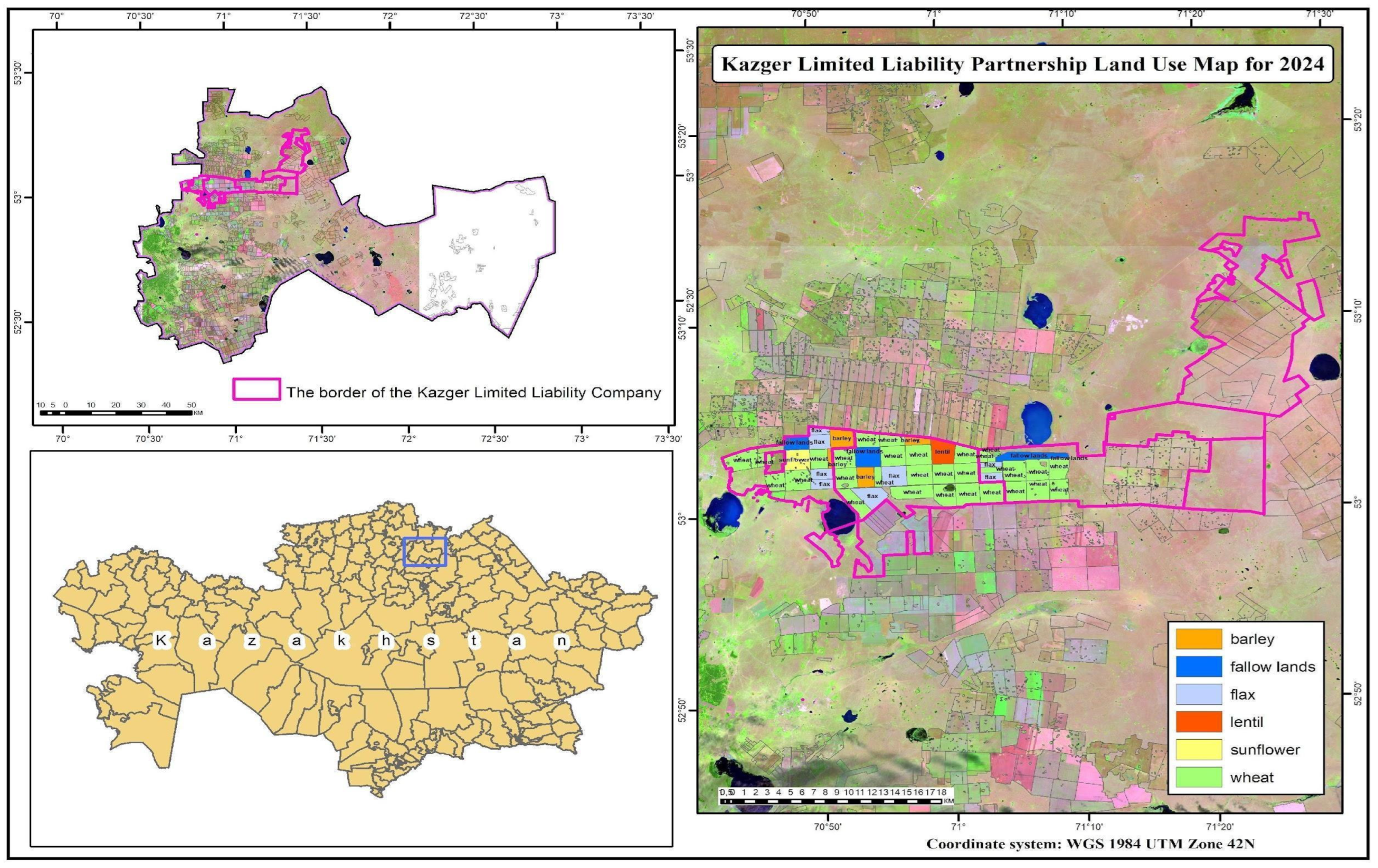
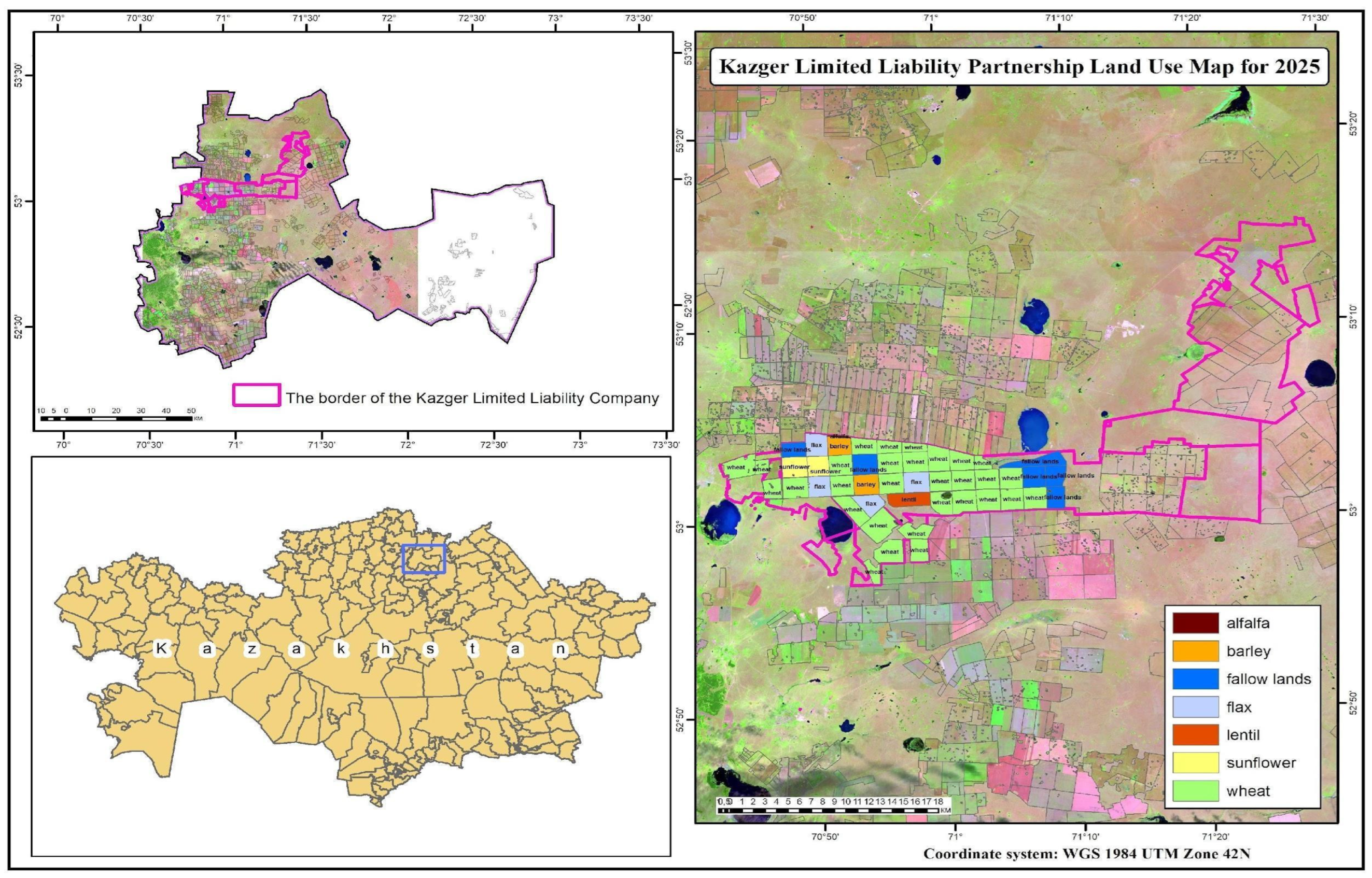
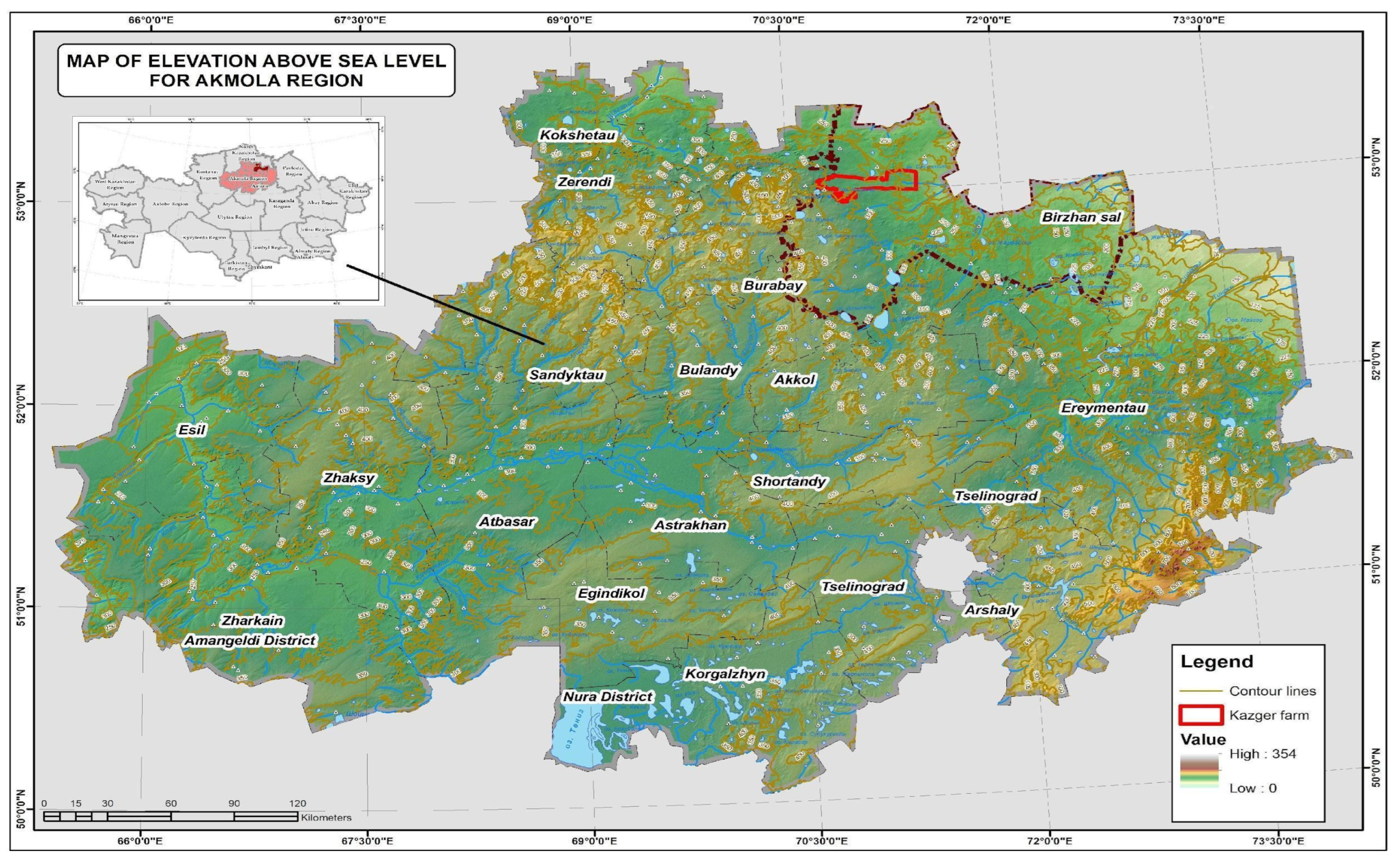
2.1. Study Area
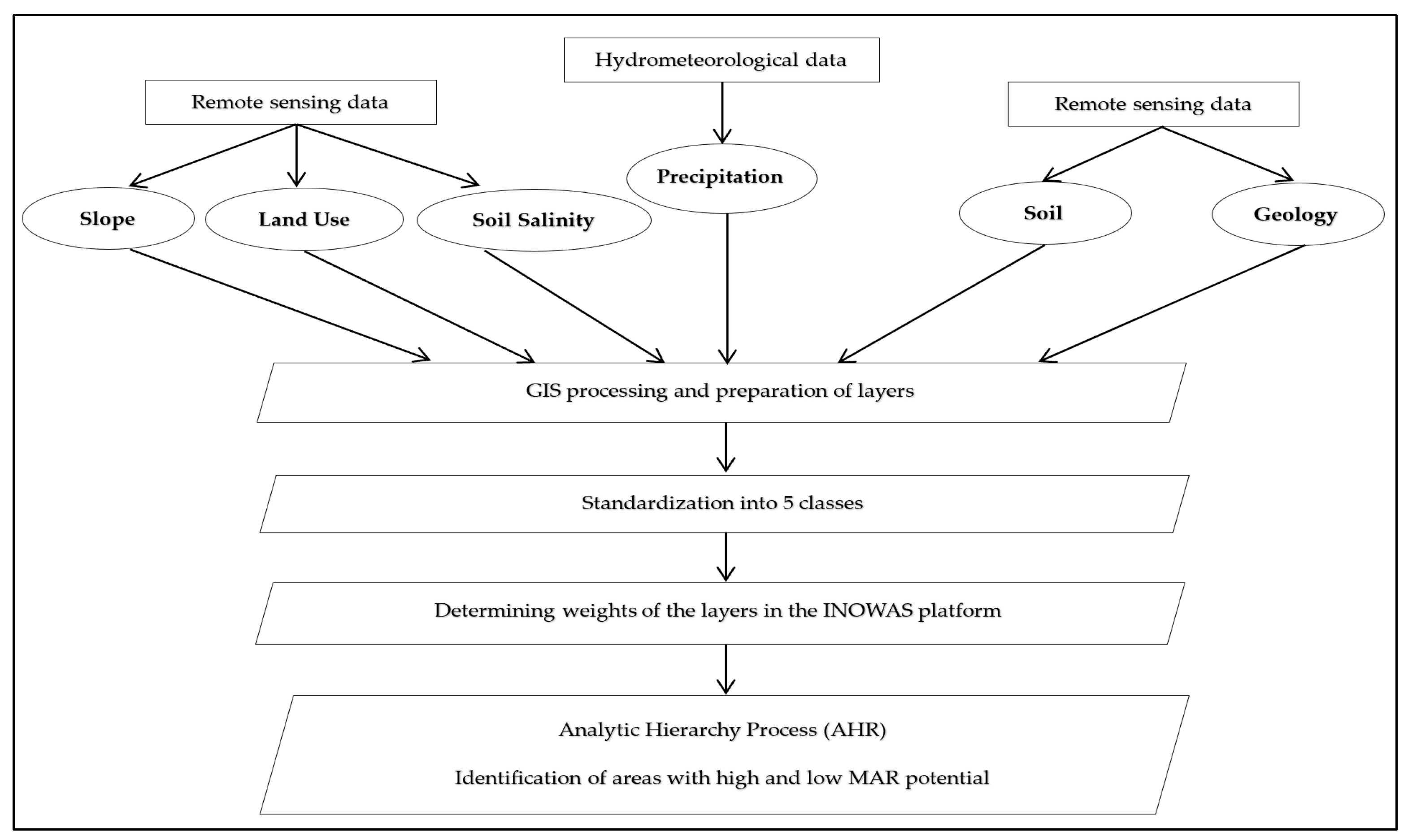
2.2. Overall Methodology
- (1)
- Data Acquisition: Collection of RS and hydrometeorological data.
- (2)
- Thematic Layer Generation: Creation of thematic layers (slope, land use, soil salinity, soil type, geology, and precipitation).
- (3)
- GIS Processing and Preparation: Processing and preparation of layers within the GIS environment.
- (4)
- Indicator Standardization: Standardization of indicators into a 5-class scale.
- (5)
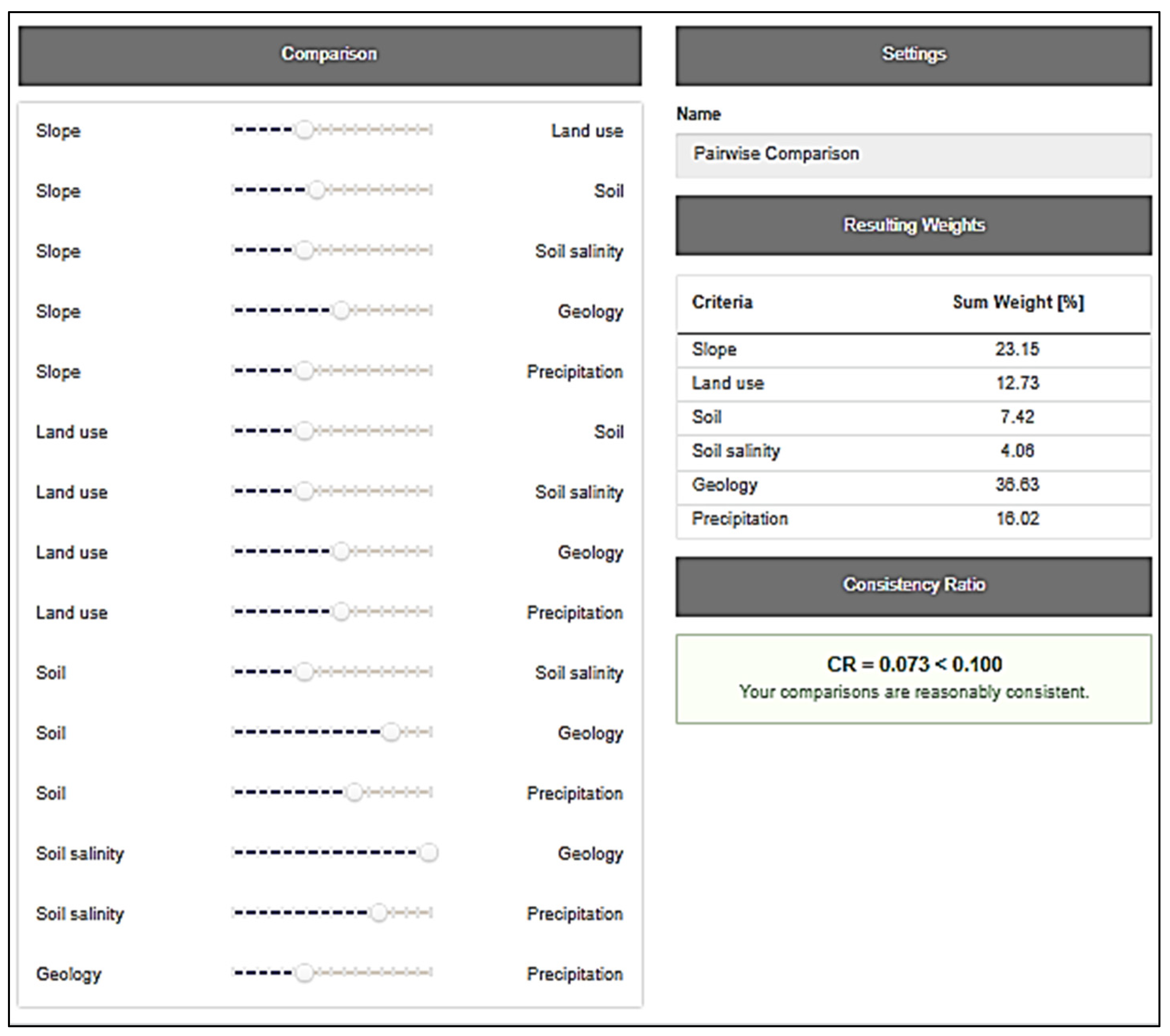
- Criteria Weight Determination: Determination of criteria weights using the Innovative Groundwater Solutions (INOWAS) platform.
- (6)
- Multi-Criteria Analysis: Application of the AHP method.
- (7)
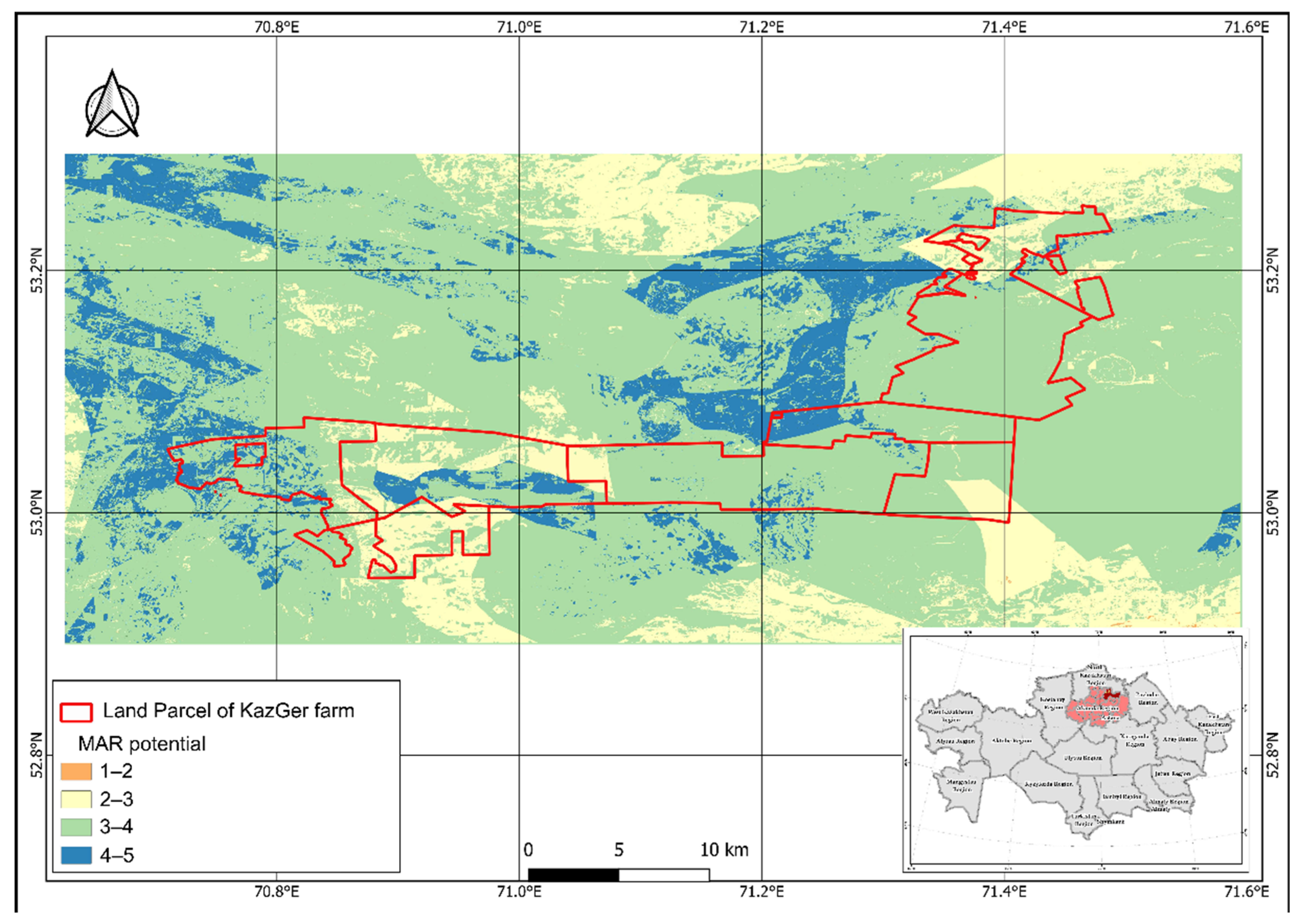
- Potential Mapping: Contour-strip land organization with MAR potentiality.
- –
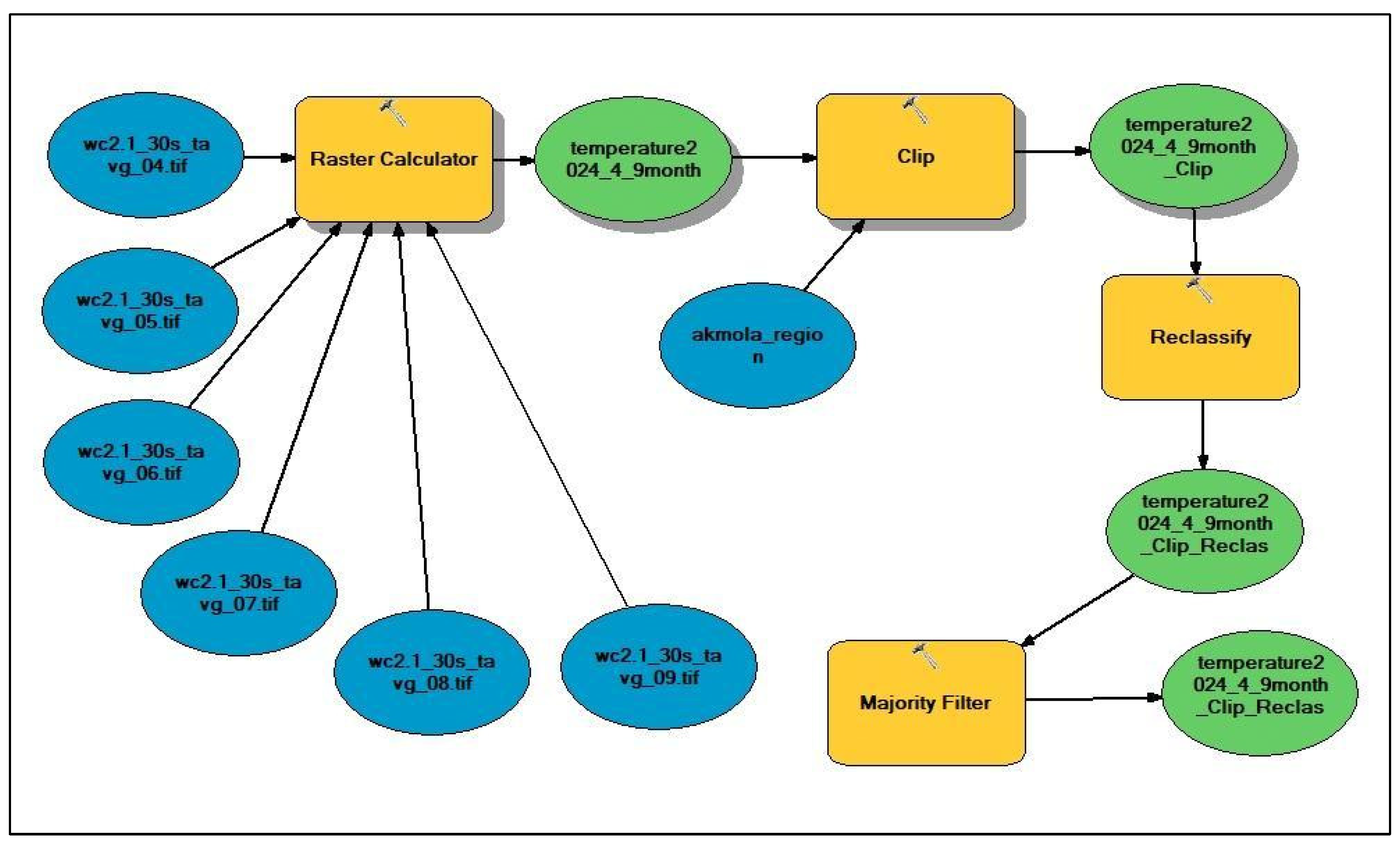
- Convenience: The scheme clearly demonstrates the logic and sequence of automated operations, making it easier for other users or researchers to reproduce the procedure.
- –
- Mobility: The model can be easily adapted to other regions and periods—it is sufficient to replace the input rasters and boundary layers. This ensures that the calculation process is fast, reproducible, and scalable.
- –
- Practical advantage: Automation of large climate datasets significantly reduces analysis time and minimizes the risk of human error during manual processing.
2.3. Methods
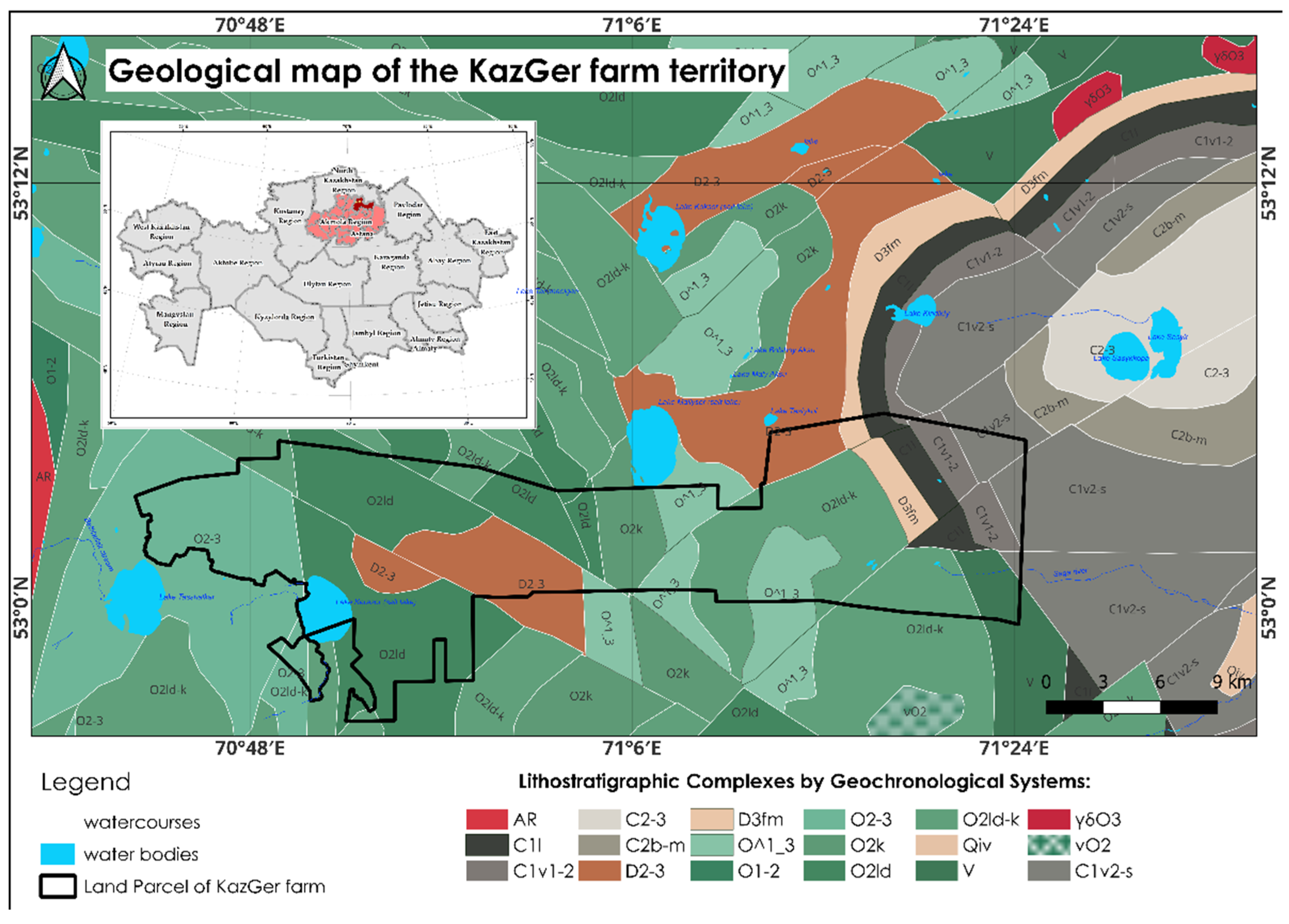
- Deep-water clay shales and siltstones of the OldLd formation O2ld—27.4%. These deposits are represented by siliceous interlayers and were formed in a deep-sea basin.
- Siltstone and clay rocks of the OldLd-k formation—21.4%. There is an alternation of shales, tuffites, sandstones, and possible basalt interlayers, which indicates a transition zone between tiers and possible volcanic activity.
- Carbonate rocks of the D2-3 formation—11.6%. This section is represented by limestones, dolomites, and more rarely sandstones and tuffaceous deposits. A special feature is the presence of reef structures (biotherm, biostrom).
- Limestones, dolomites, and siliceous shales of the O2-3 formation—11.1%. These were formed in near-fault marine basins, under rift or transgressive conditions.
- Siltstones and mudstones of the O13 formation—7.5%. These sediments are typical of shelves and coastal–marine basins, which indicates shallow-water sedimentation conditions.
- Limestones of the Ok formation—4.4%. These are represented by carbonate–silicate rocks typical of platform deposits of a stable shelf.
- Carbonate–clay formation CvV1-2—3.9%. This section includes limestones, dolomites, and clay shales, probably of marine origin, with signs of lagoon conditions.
- Coal-bearing strata and sandstones of the C1B formation C1b(Lower Bashkir stage)—3.8%. These are formed in a lagoon–marine environment with alternating coastal and shallow-water sediments.
- Fluvial–marine deposits of the CvV2-s formation—3.4%. These include limestones, clay shales, and carbonaceous interlayers that are promising for hydrocarbons.
- Carbonate rocks of the D1Fm formation—3.0%. The section is composed of limestones, dolomites, and marls that reflect the conditions of carbonate platforms in shallow marine basins.
- Conglomerates and metamorphosed shales of the V Formation—2.5%. These represent the basement of the Paleozoic sedimentary cover, composed of quartzites, phyllites, and subordinate shales.
- Sandstones and siltstones (O13, C1b, C1v2-s2, D2-3 ơ) have high permeability and can be considered as a promising reservoir for the accumulation and filtering of moisture;
- Limestone and dolomite (O2-3 ơ, Ok, D1fm, D2-3 ơ) in the fractured zones can form a natural aquifer;
- Clay and mudstone strata (OldLd, OldLd-k, CvV1-2, V) are characterized by low filtration and can serve as a screen or water barrier, contributing to the preservation of moisture in the underlying horizons.
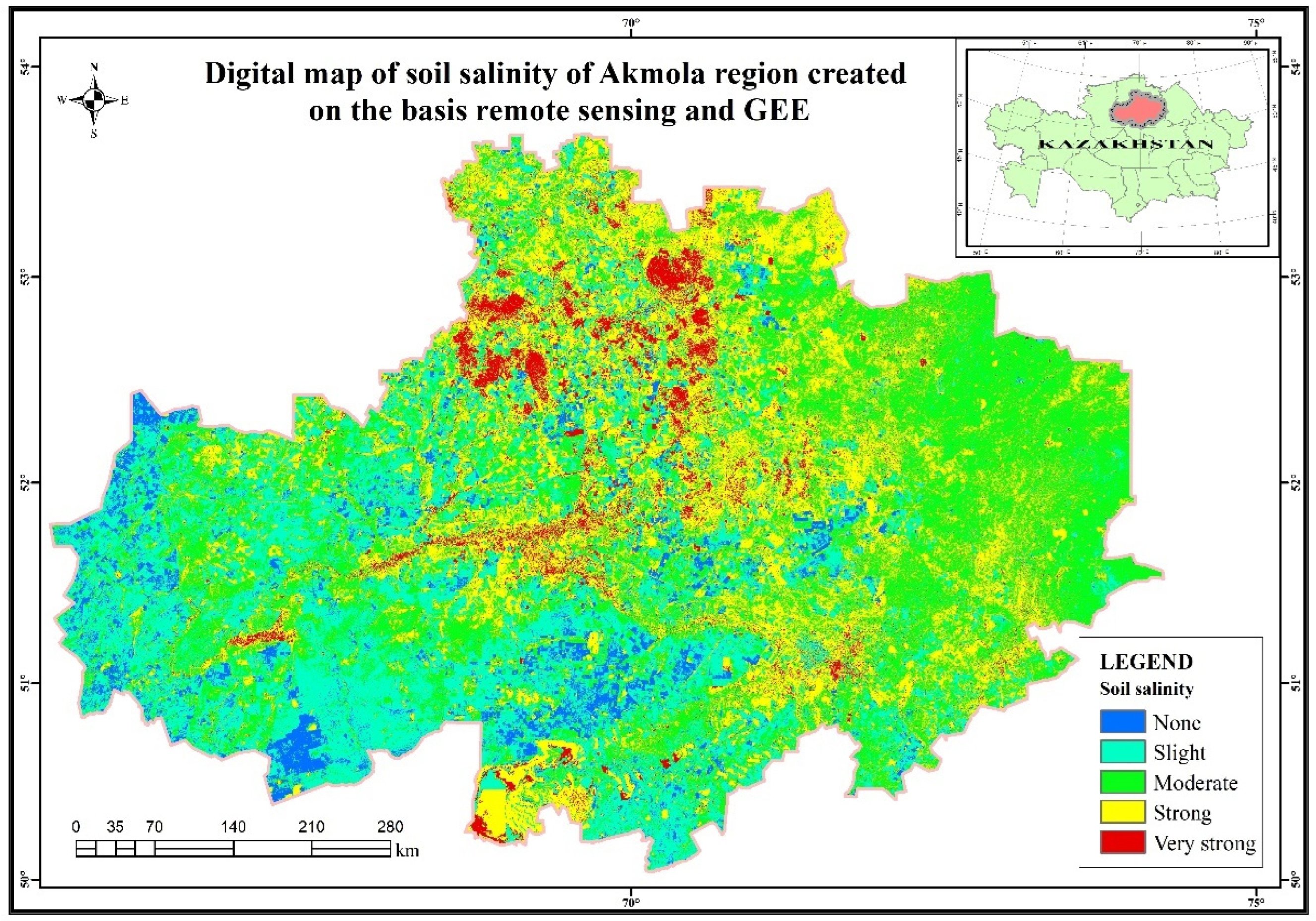
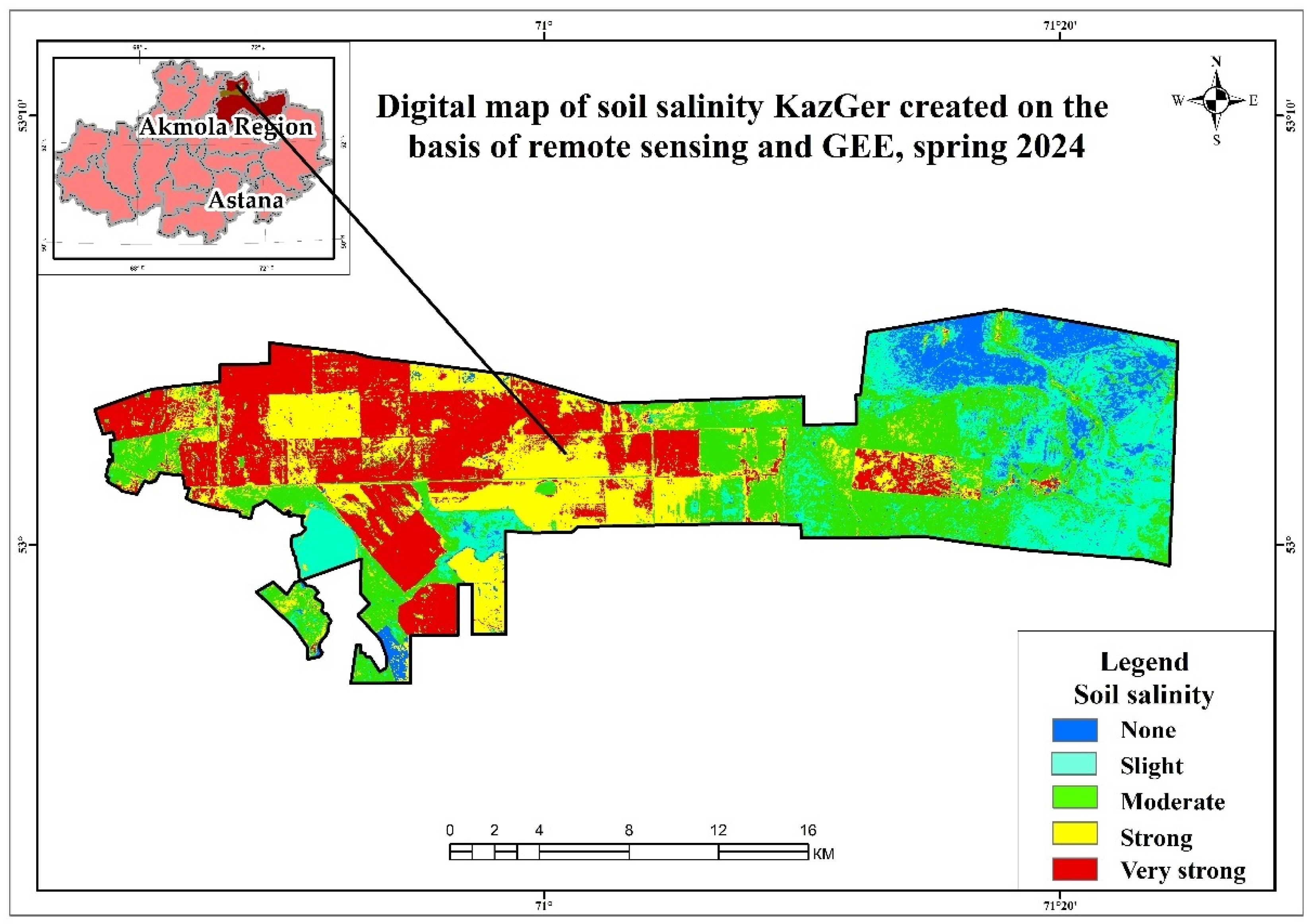
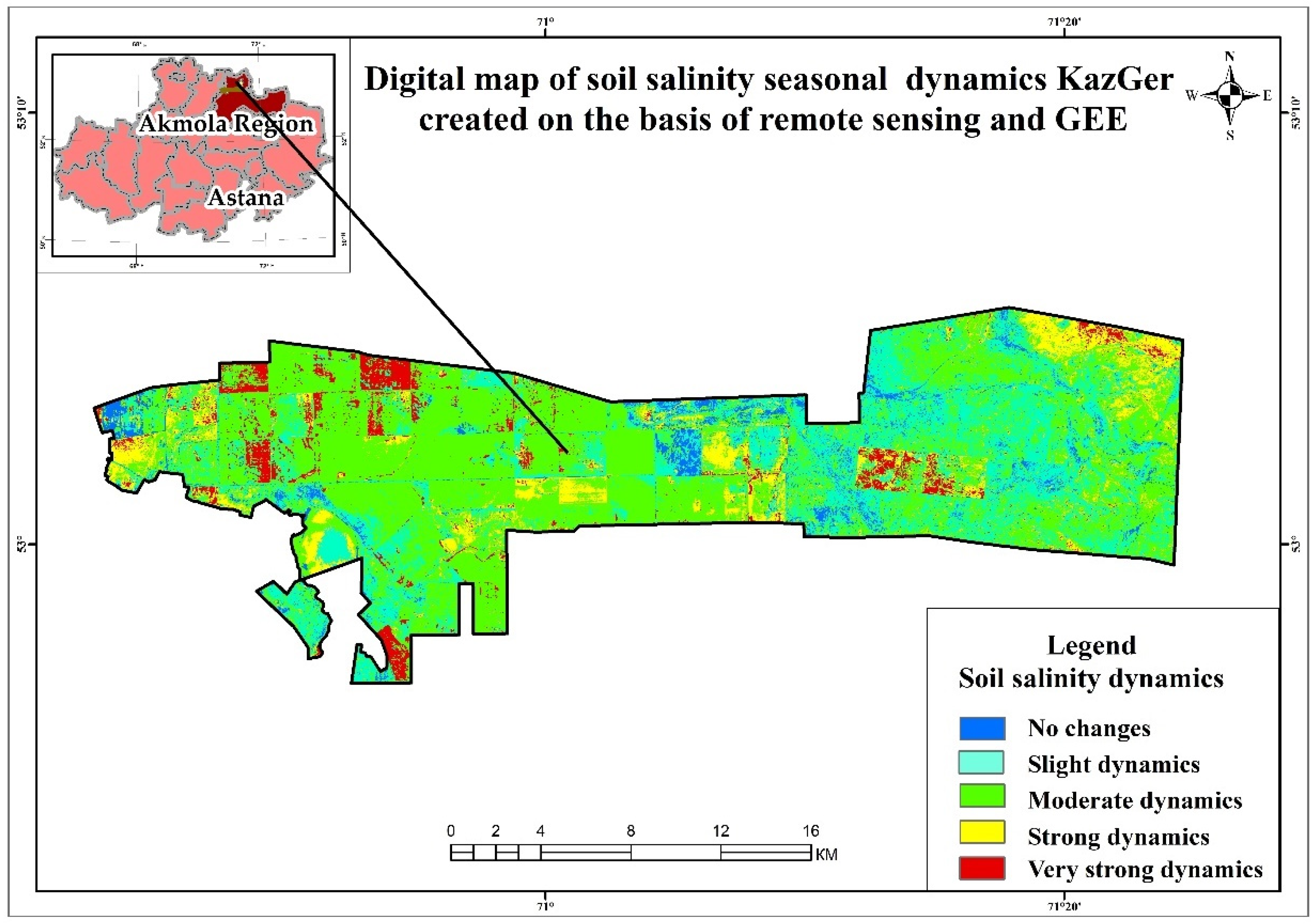
- During the spring season (Figure 14), areas with high and very high salinity levels (yellow and red) dominate, particularly in the western part of the region.
- A considerable proportion of highly saline soils are found on agricultural fields, which may be associated with snowmelt and the concentration of salts on the soil surface because of evaporation.
- Blue corresponds to areas with no salinity changes throughout the three seasons (stable soil conditions).
- Light blue indicates minor dynamics, where salinity fluctuations are small and may be associated with localized seasonal processes.
- Green represents moderate seasonal dynamics, typical for zones moderately influenced by salinization factors.
- Yellow denotes strong changes, indicating pronounced seasonal variations in salinity likely related to the combined effects of natural and anthropogenic factors (e.g., spring snowmelt and summer precipitation).
- Red highlights areas with very strong seasonal dynamics, where the amplitude of salinity changes reaches maximum values, suggesting high soil sensitivity to seasonal hydrogeochemical processes and potential degradation risks.
3. Results
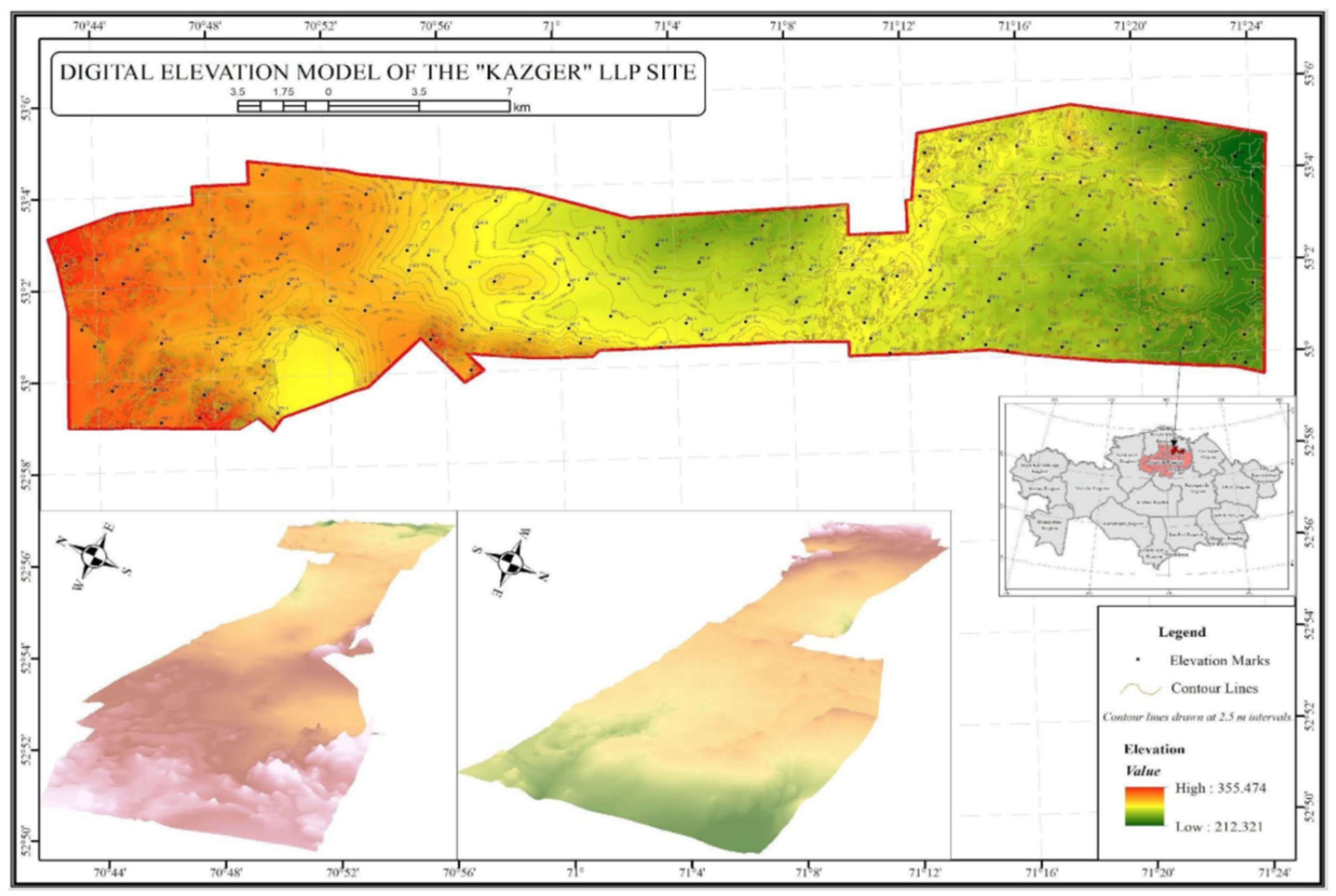
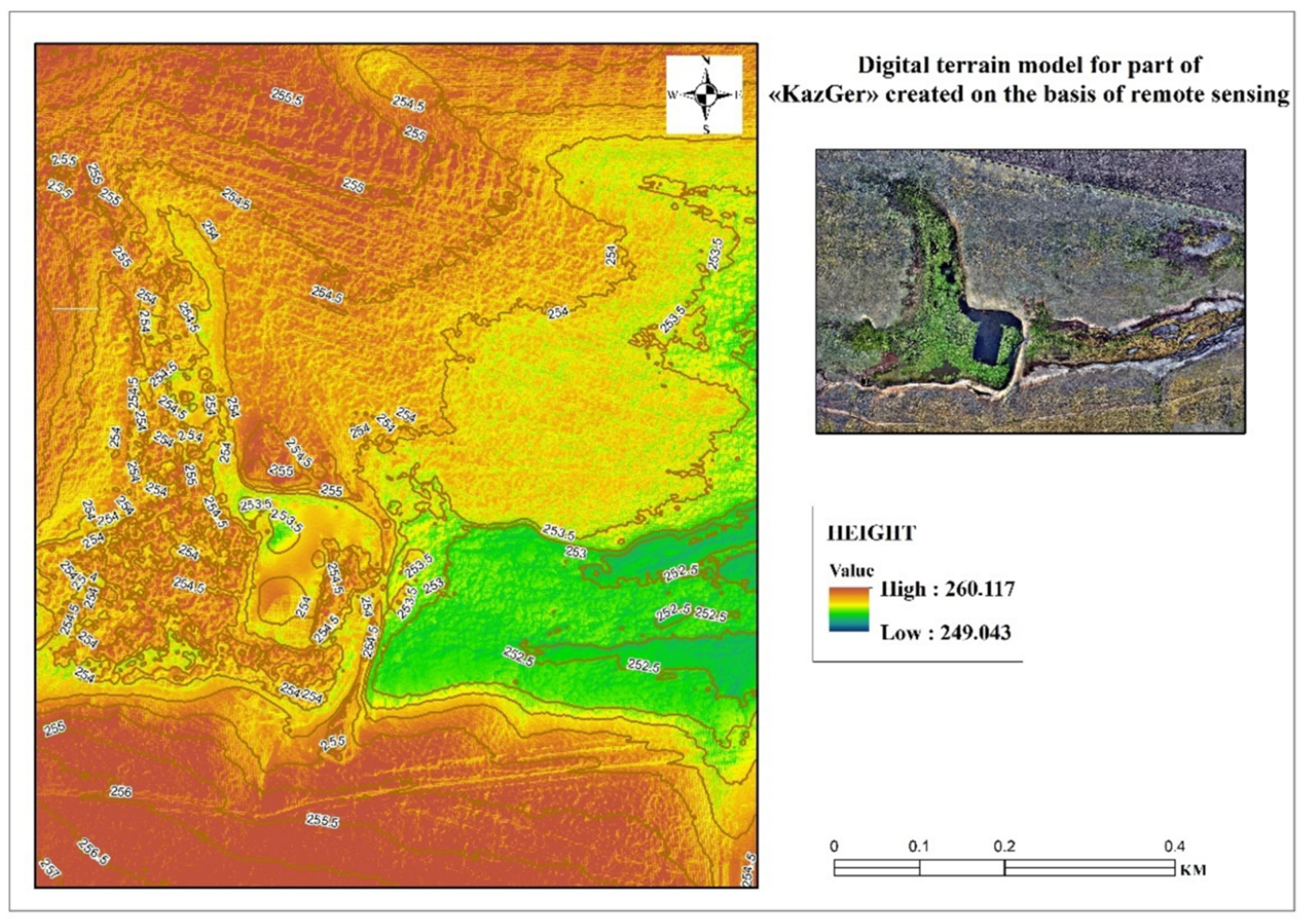
- Slope. The slope of the terrain has a significant impact on the processes of infiltration and surface runoff. More gently sloping areas contribute to the accumulation of moisture and recharge of groundwater, while steep slopes allow rapid runoff of precipitation, reducing the potential for erosion damage. The global model FABDEM (Forest and Buildings removed Digital Elevation Model (DEM)) was used to analyze the terrain, which is an improved version of the Copernicus DEM data with the effects of vegetation and buildings removed, in preparing the digital terrain model (DTM).
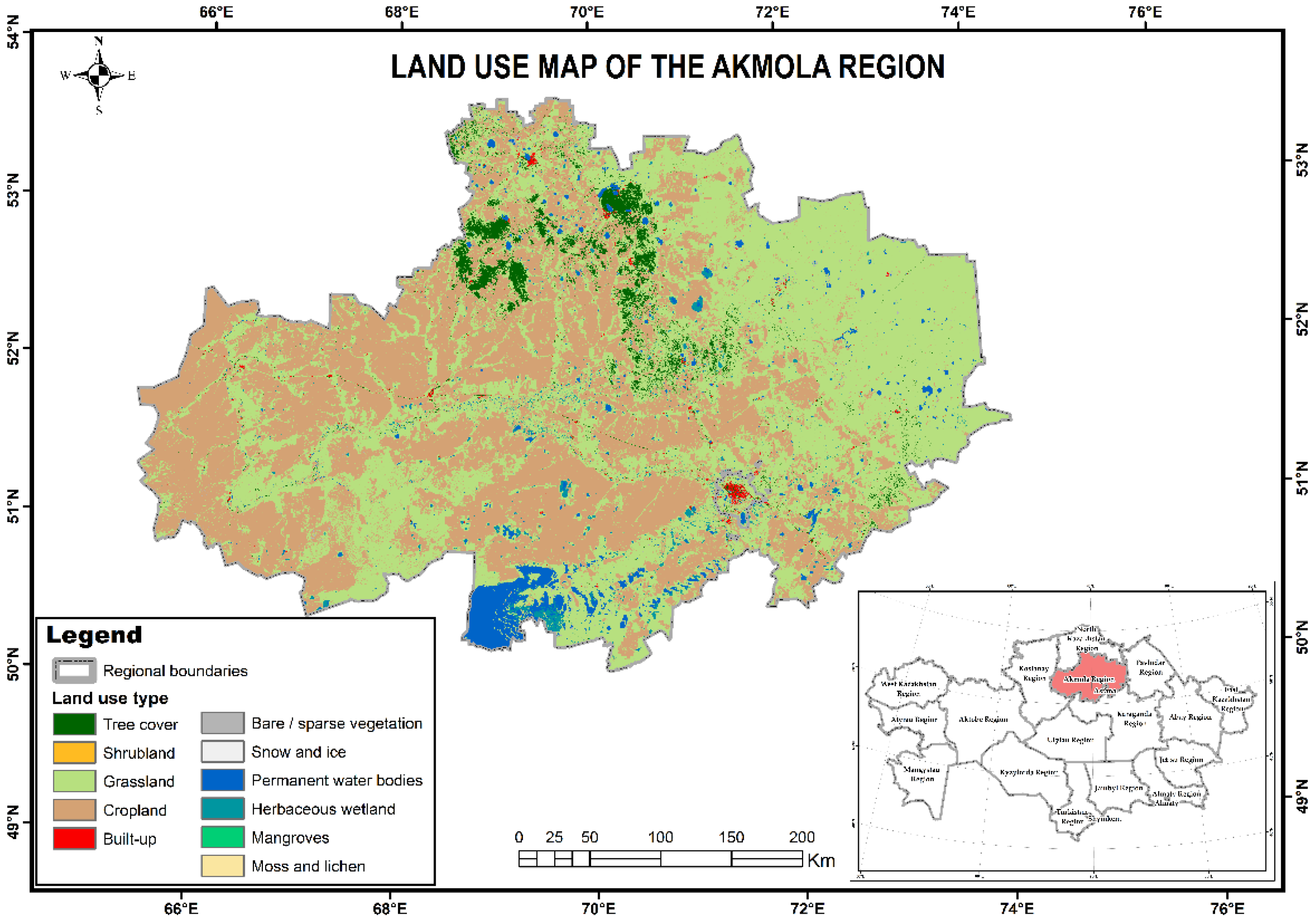
- Land Use. Land use is an important factor in determining potential groundwater recharge zones. Agricultural land and pastures contribute to better infiltration compared to urban areas, where the surface is covered with impermeable materials. Land use data was taken from the ESA WorldCover 2024 global dataset, which provides classification with a resolution of 10 m.
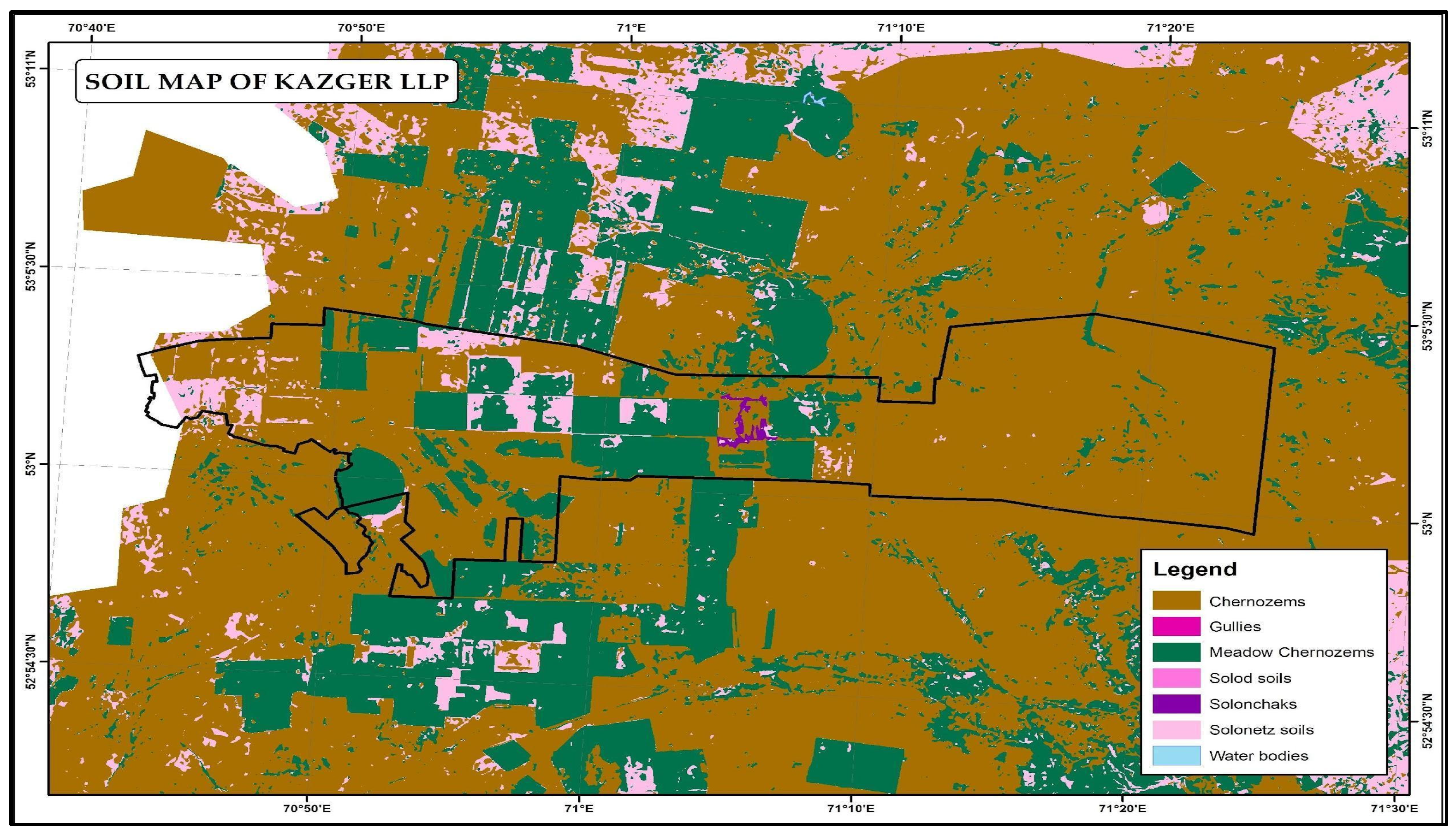
- Soil. The type of soil determines its water permeability and ability to retain moisture. Sandy and sandy loam soils have high infiltration potential, while clay soils limit water penetration.
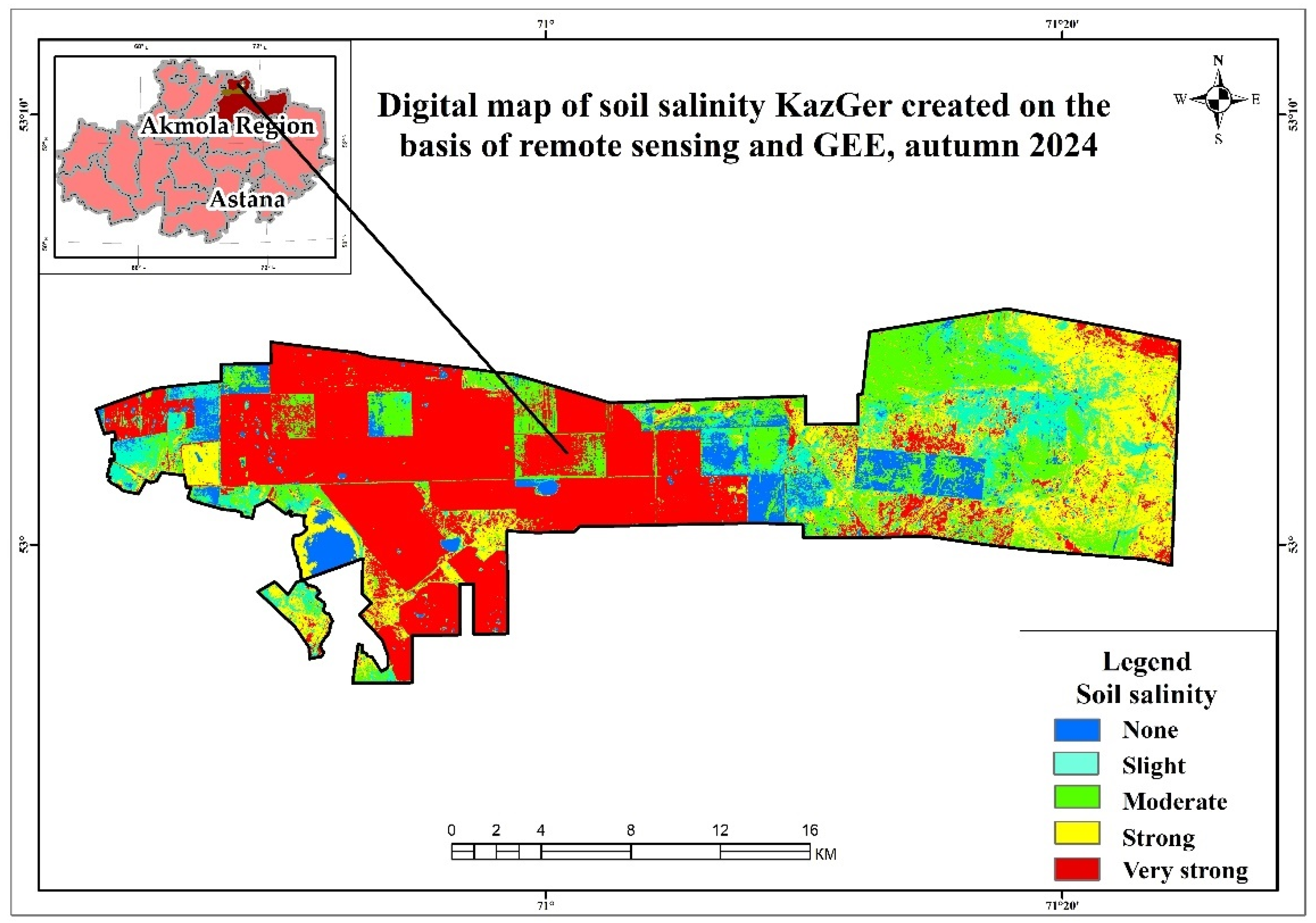
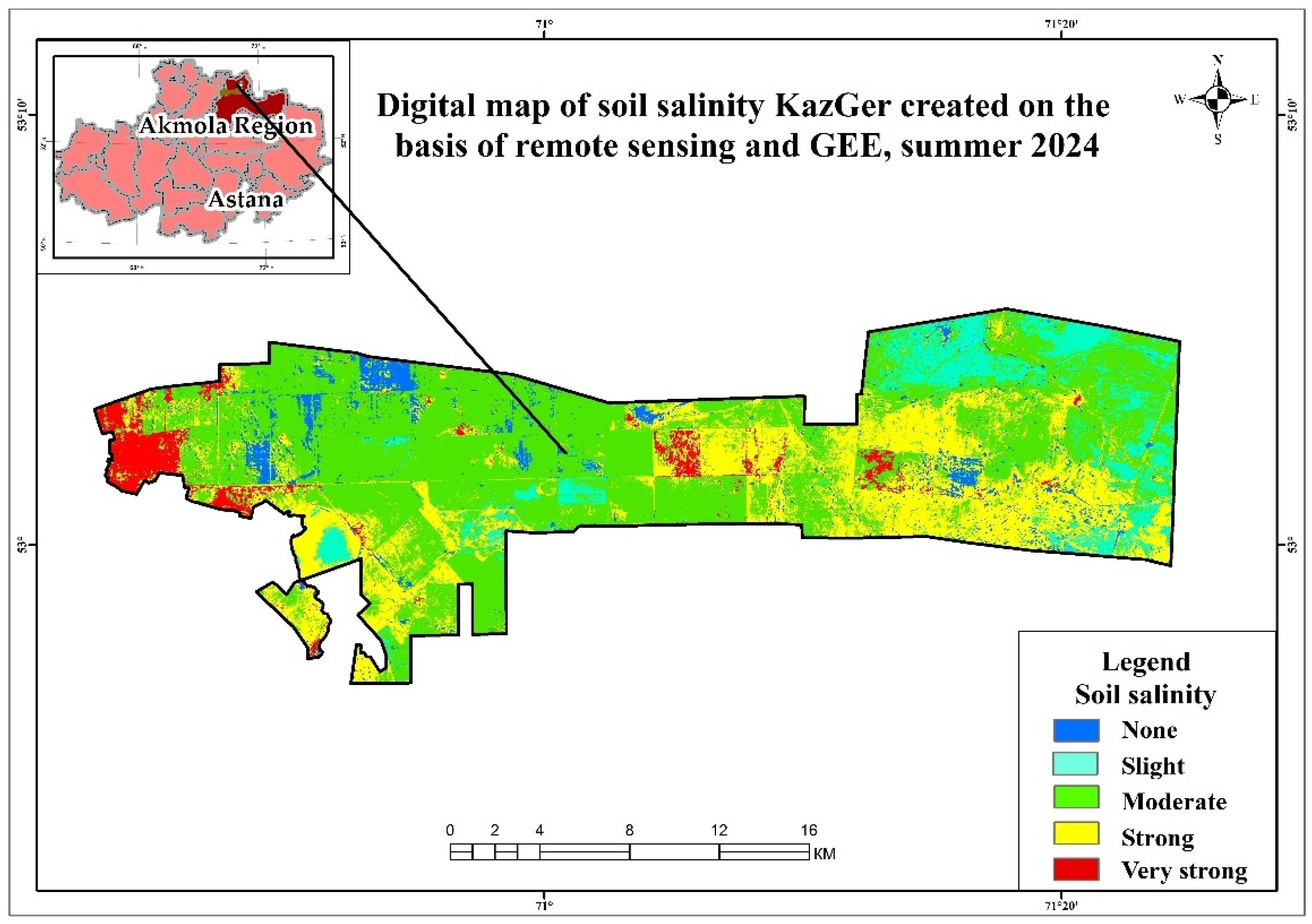
- Soil Salinity. Soil salinity has a direct impact on water permeability and on the possibility of using these areas for groundwater replenishment. High salt concentrations can limit filtration and degrade the quality of water entering the aquifer.
- Geology. The geological factor is key in determining the ability of rocks to accumulate and transfer groundwater. For the purposes of MAR modeling, all stratigraphic units were classified according to their water permeability and filtration capacity. Class 5—rocks with developed karst and fracturing, which have very high permeability. Class 4—carbonate and sandy rocks with good primary and secondary porosity. Class 3—sedimentary and magmatic complexes with mixed filtration properties. Class 2—clay and siliceous rocks with low water permeability. Class 1—dense igneous and metamorphic rocks with minimal filtration capacity. The largest area of the pilot zone belongs to the high (37.06%) and moderate (27.59%) classes, which indicates favorable conditions for the formation of underground runoff.
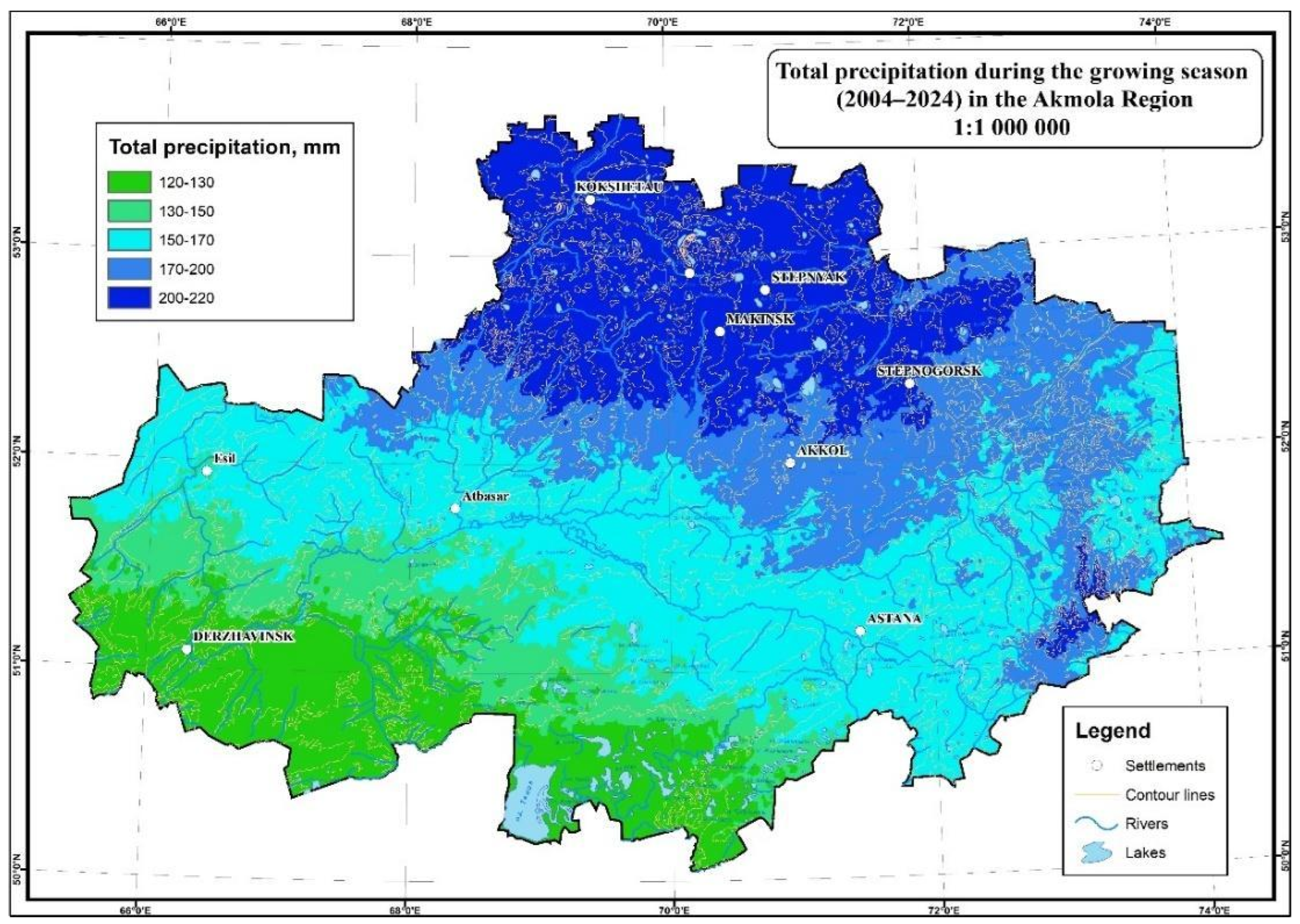
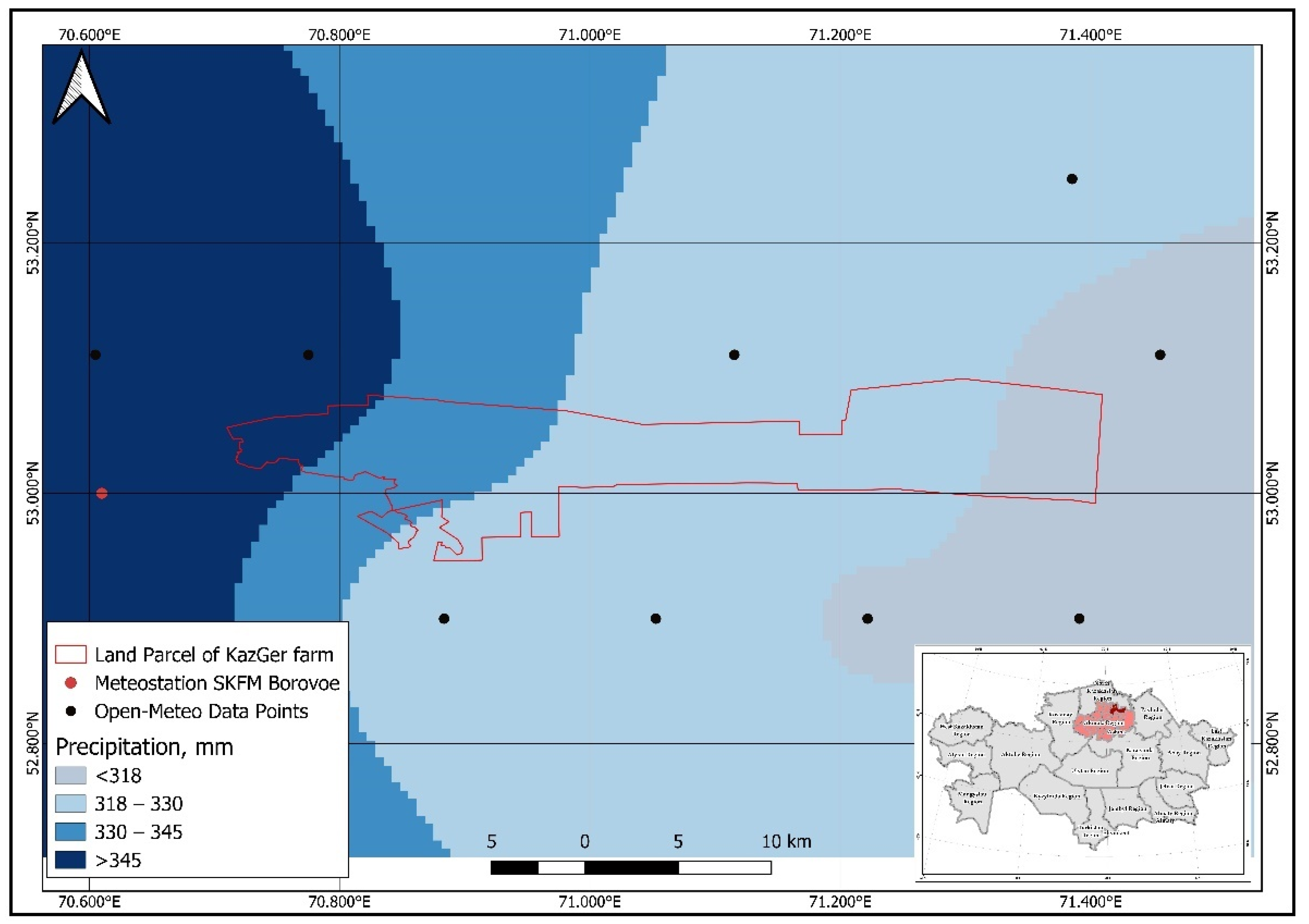
- Precipitation. Data from the ERA5-Land Monthly Aggregated-ECMWF Climate Reanalysis service was used to analyze precipitation. Within the pilot zone, 10 control points were identified, for which the values of total annual precipitation over the past 10 years were uploaded. Based on this data, the long-term average value for each point is calculated. The data source is the Historical Weather API, which is based on modern reanalysis models that combine information from weather stations; satellite observations; data from buoys and aircraft; and radar measurements. The applied model has a spatial resolution of 9 km, which makes it possible to consider local features of precipitation distribution in areas with complex terrain. As a result of the analysis, the average annual precipitation ranged from 366.63 mm to 445.07 mm.
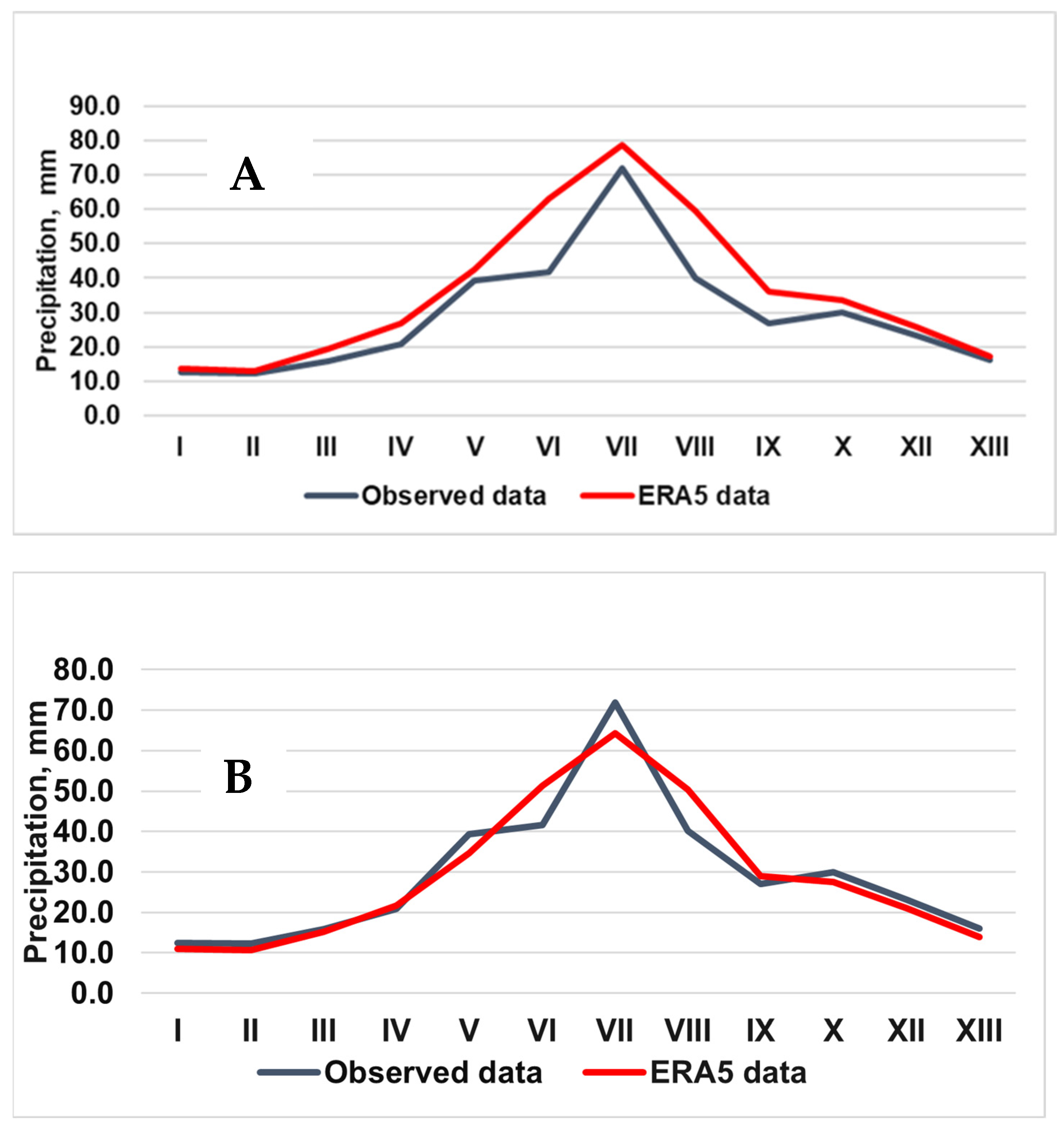
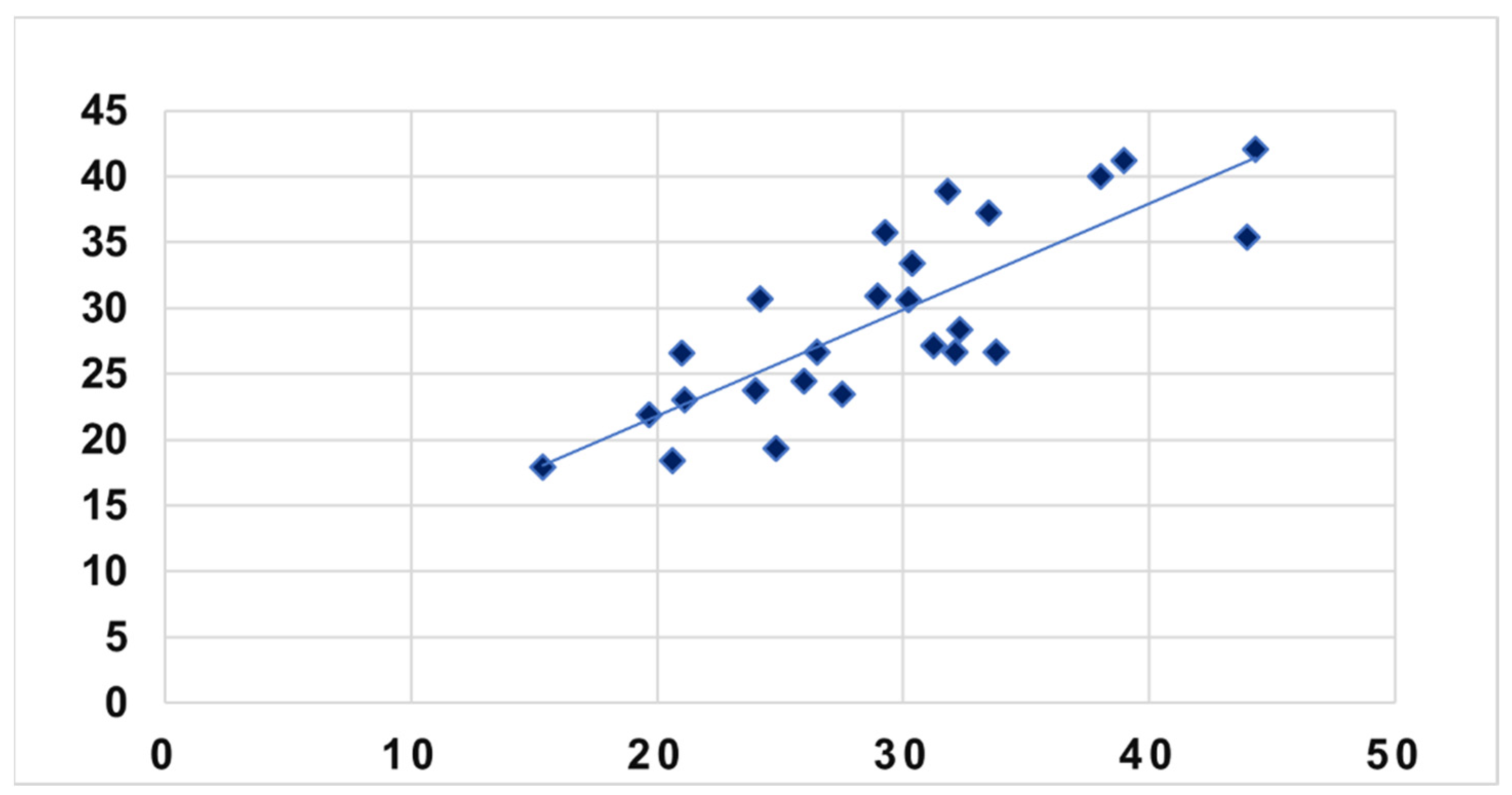
- Primary Bias Analysis: Comparison of the initial ERA5 series and the observation series showed a significant systematic overestimation of precipitation by an average of USD 22 (NBIAS = 0.22). Figure 1, Figure 2 and Figure 3 clearly show that the average monthly precipitation profile of ERA5 systematically exceeds the observation profile. At the same time, the efficiency of the model was at a satisfactory level (NSE = 0.57), and the coefficient of determination was 0.704, which justifies the applicability of rank-based correction methods (Figure 17).
- Correction Method: Empirical Quantile Matching (EQM) was applied to eliminate systematic error and match the distributions. The correction function was calibrated based on data from the Borovoe SFM station and then applied to all 10 control points within the pilot zone (local offset correction method).
- Validation Results (After Correction): The correction (EQM) resulted in a significant improvement in data quality. The systematic bias was eliminated (NBIAS = 0.00), and the model efficiency increased to NSE = 0.69, which corresponds to the classification of “Very good” data quality.
- –
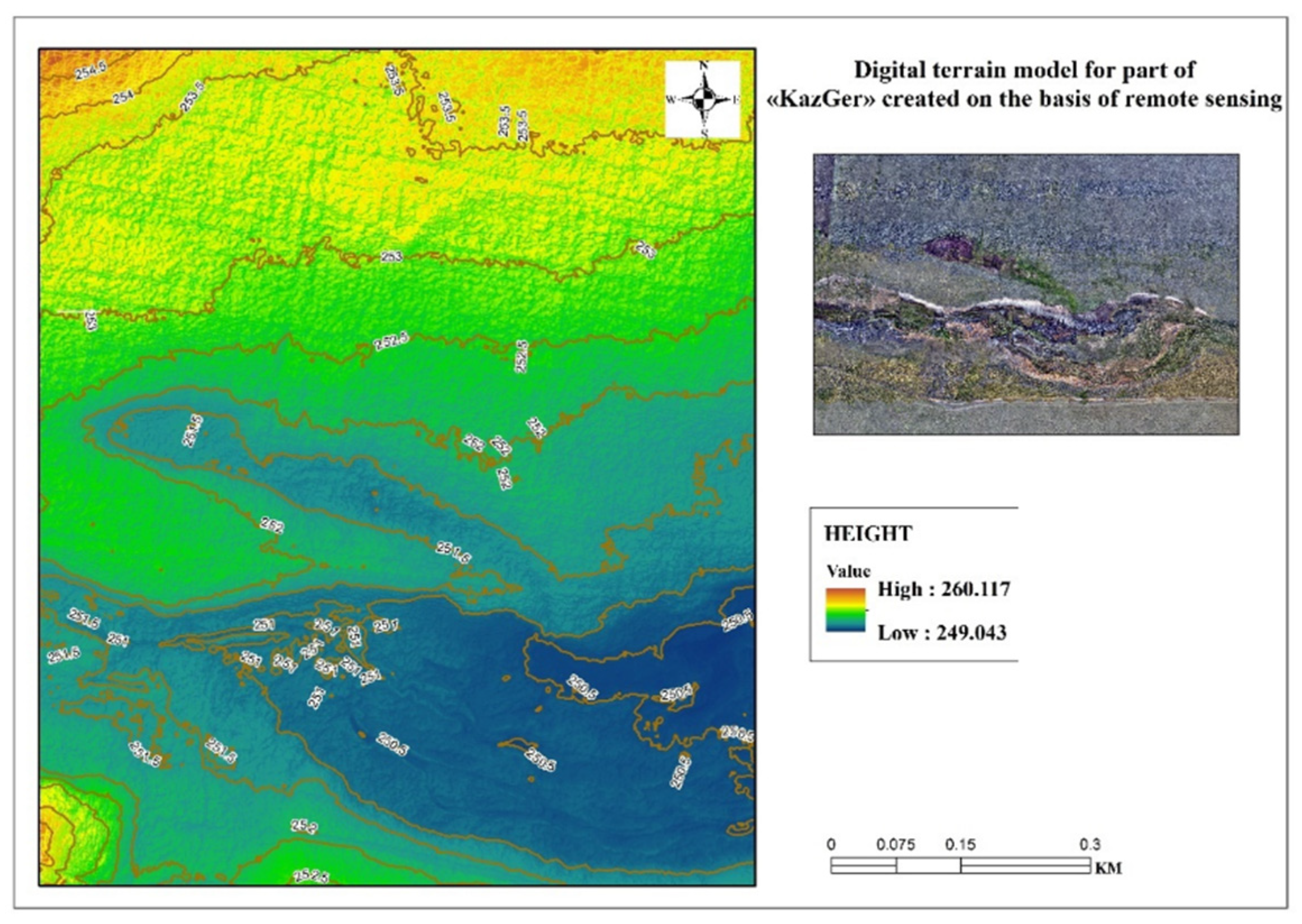
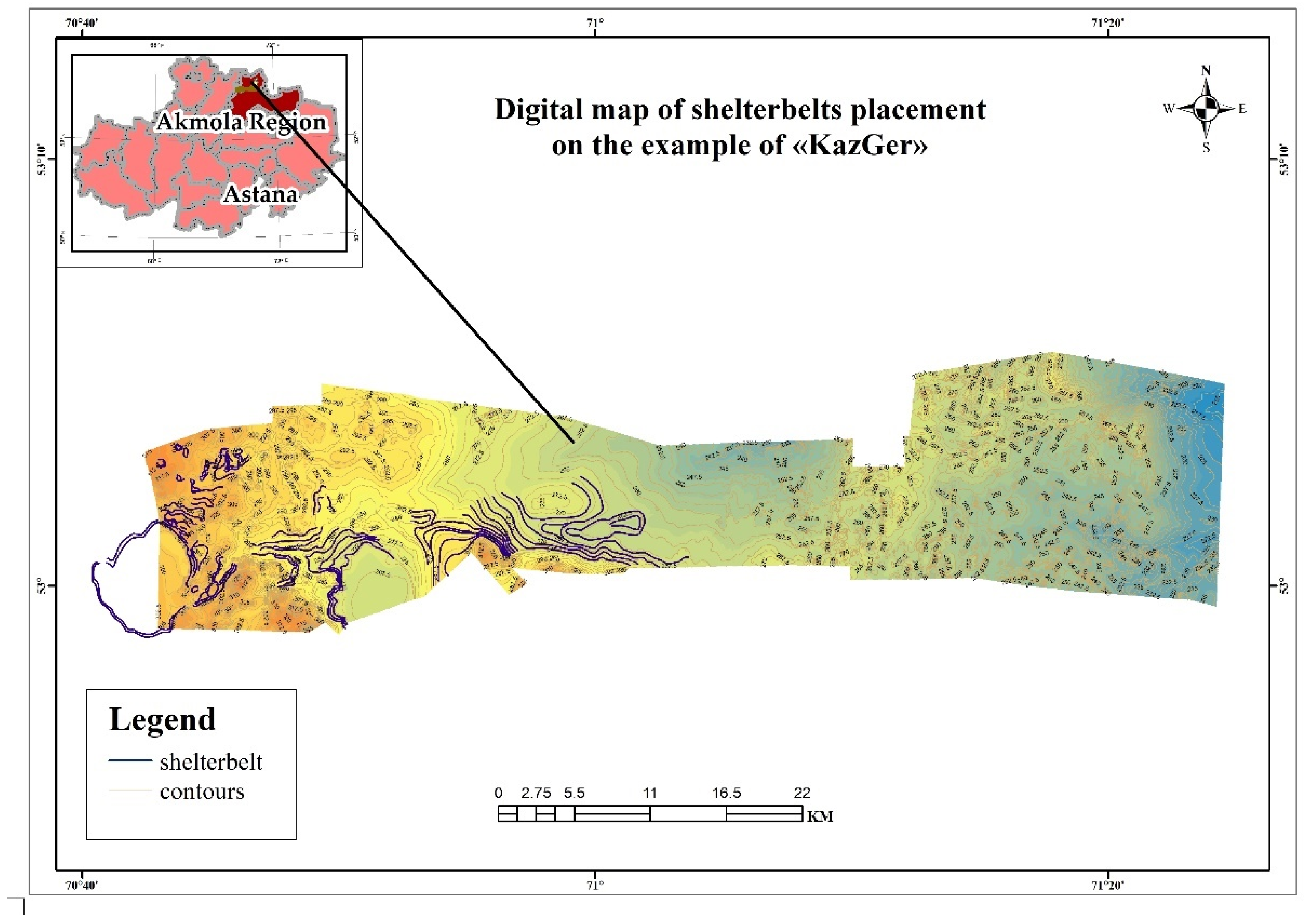
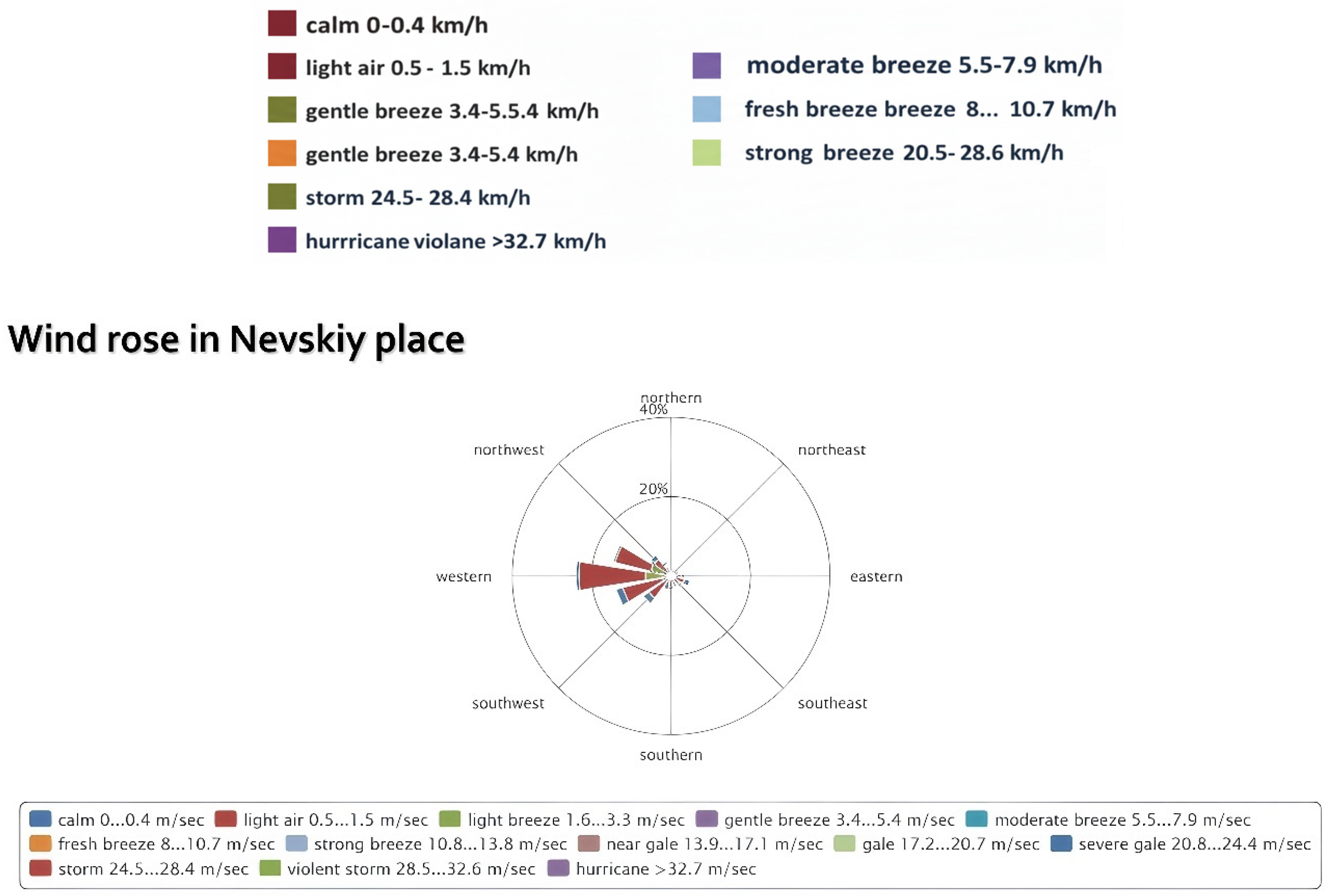
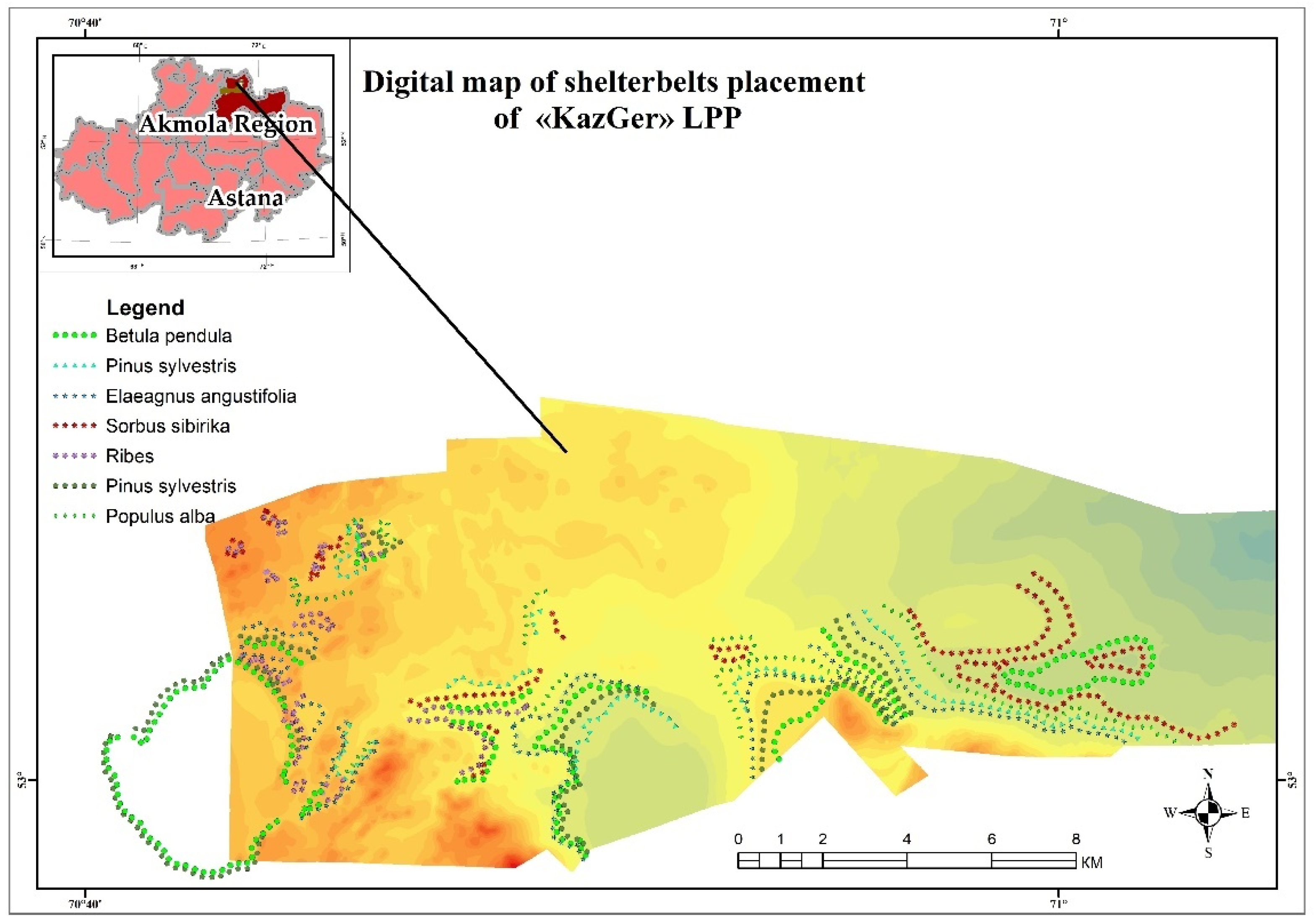
- In elevated areas, forest belts were oriented across the prevailing winds, which reduces wind speed and protects crops from deflation.
- –
- In lowlands, forest belts were formed to stabilize slopes and regulate surface runoff, which helps prevent soil erosion and improves the water balance of the agricultural landscape.
- 1.
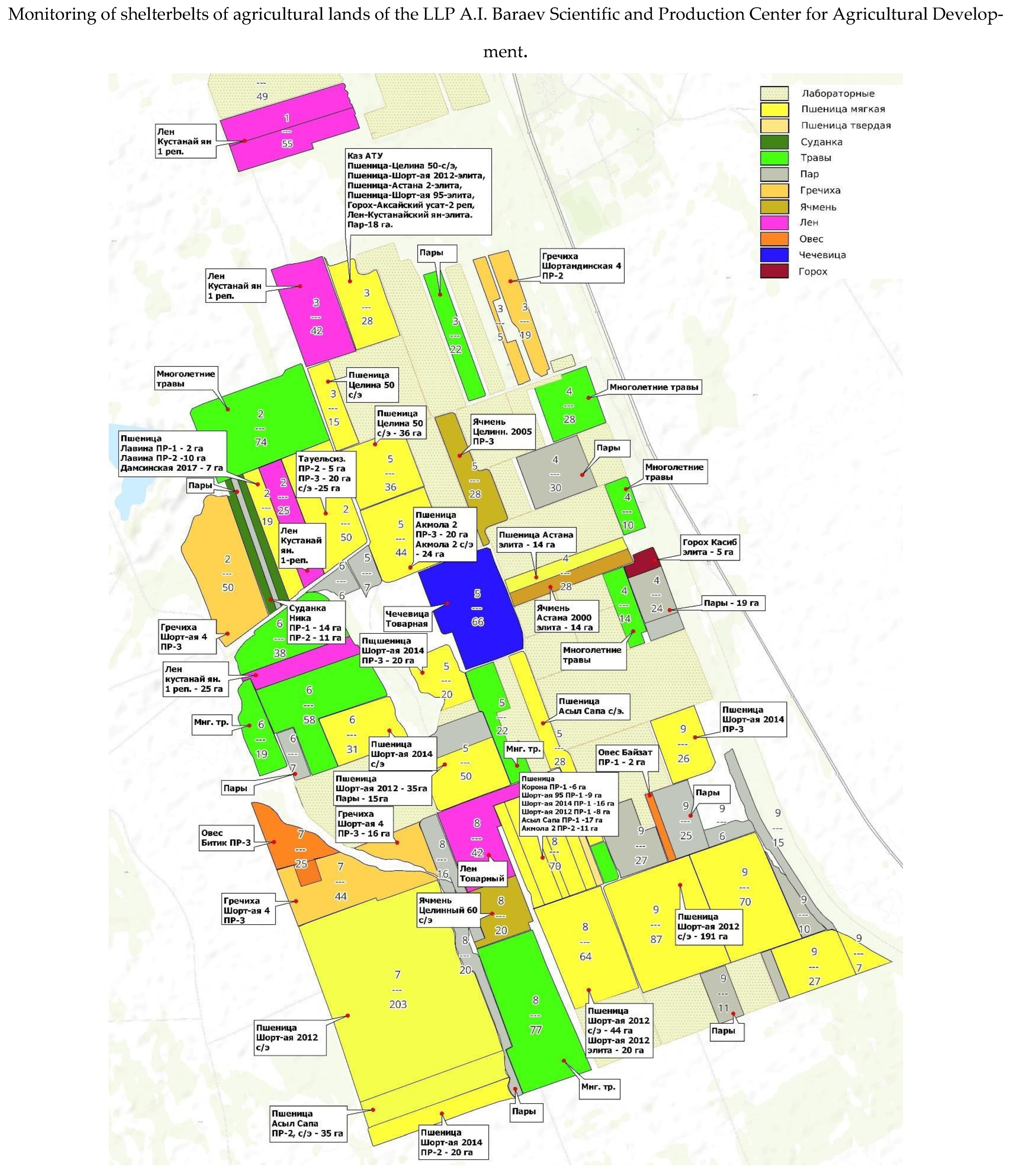
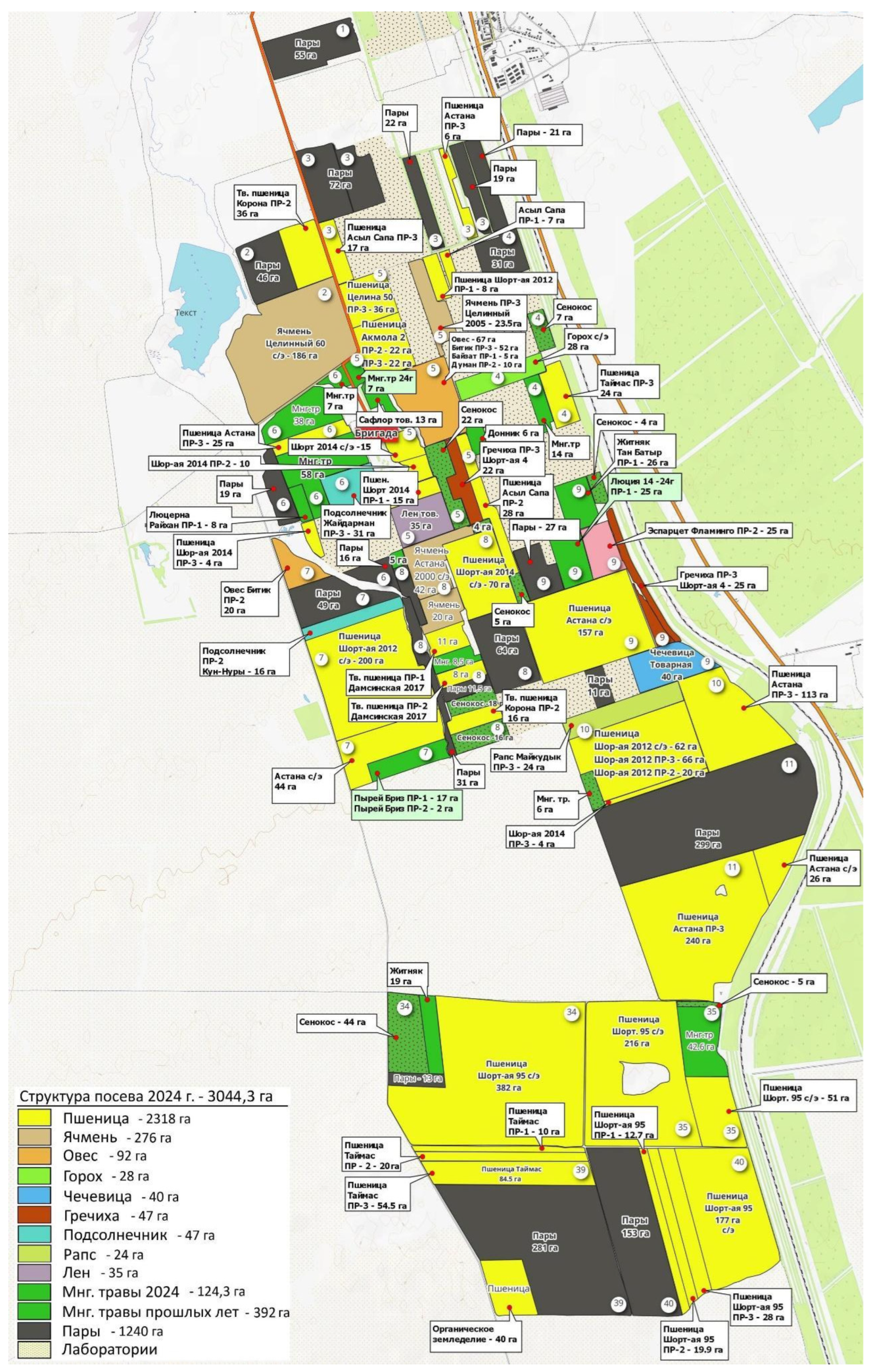
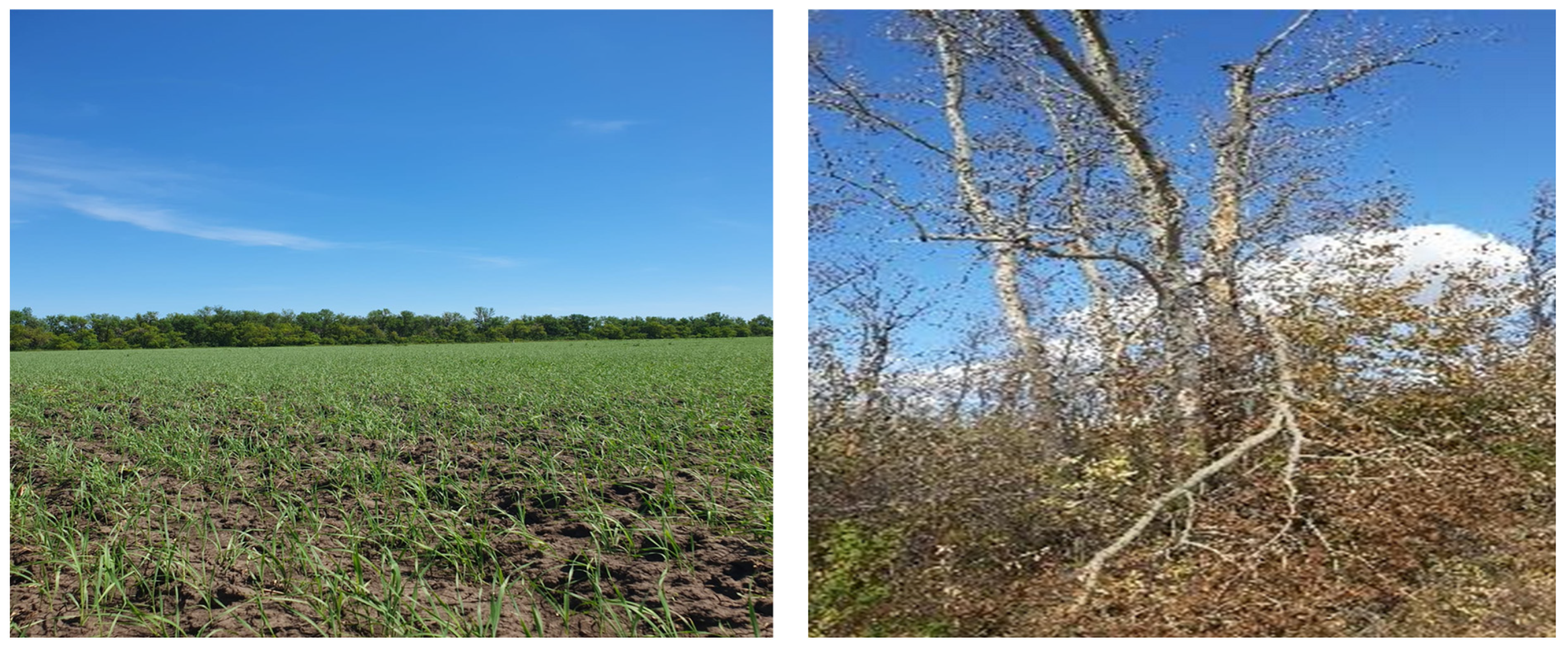
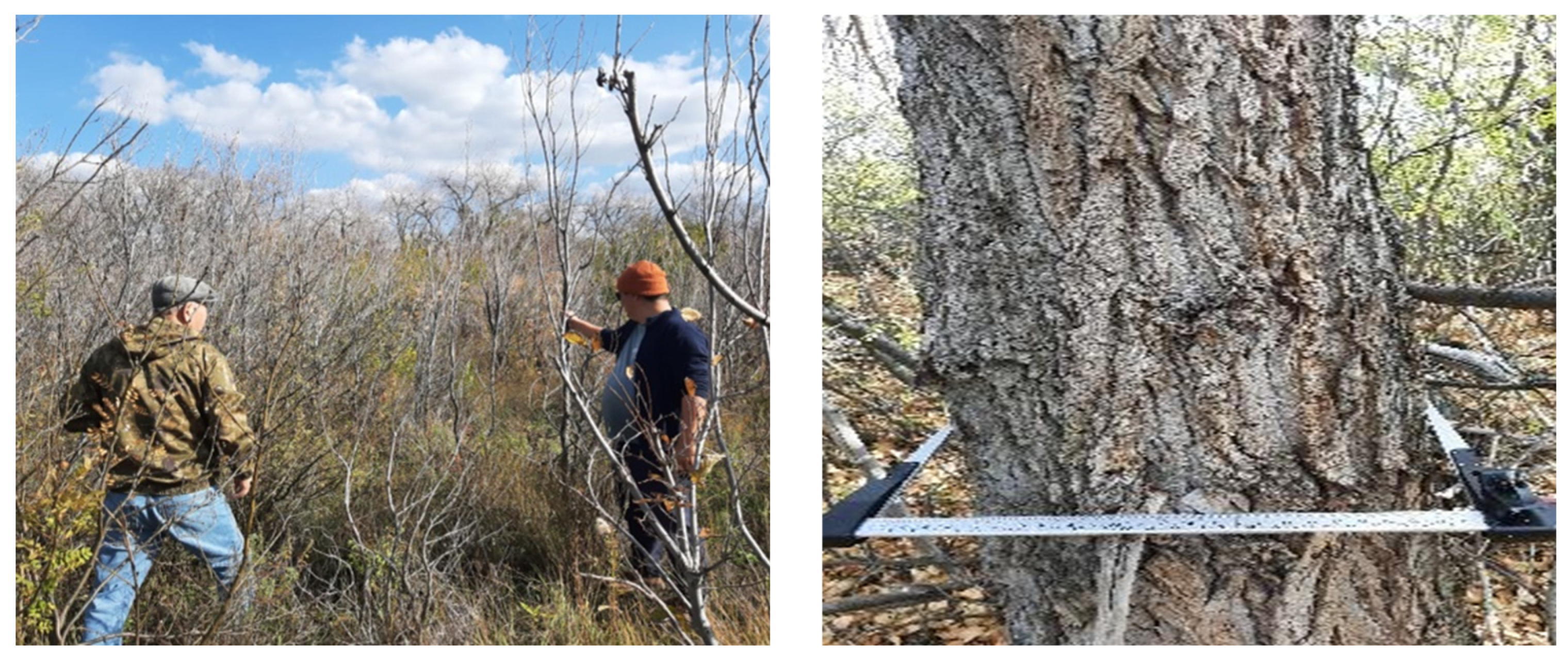
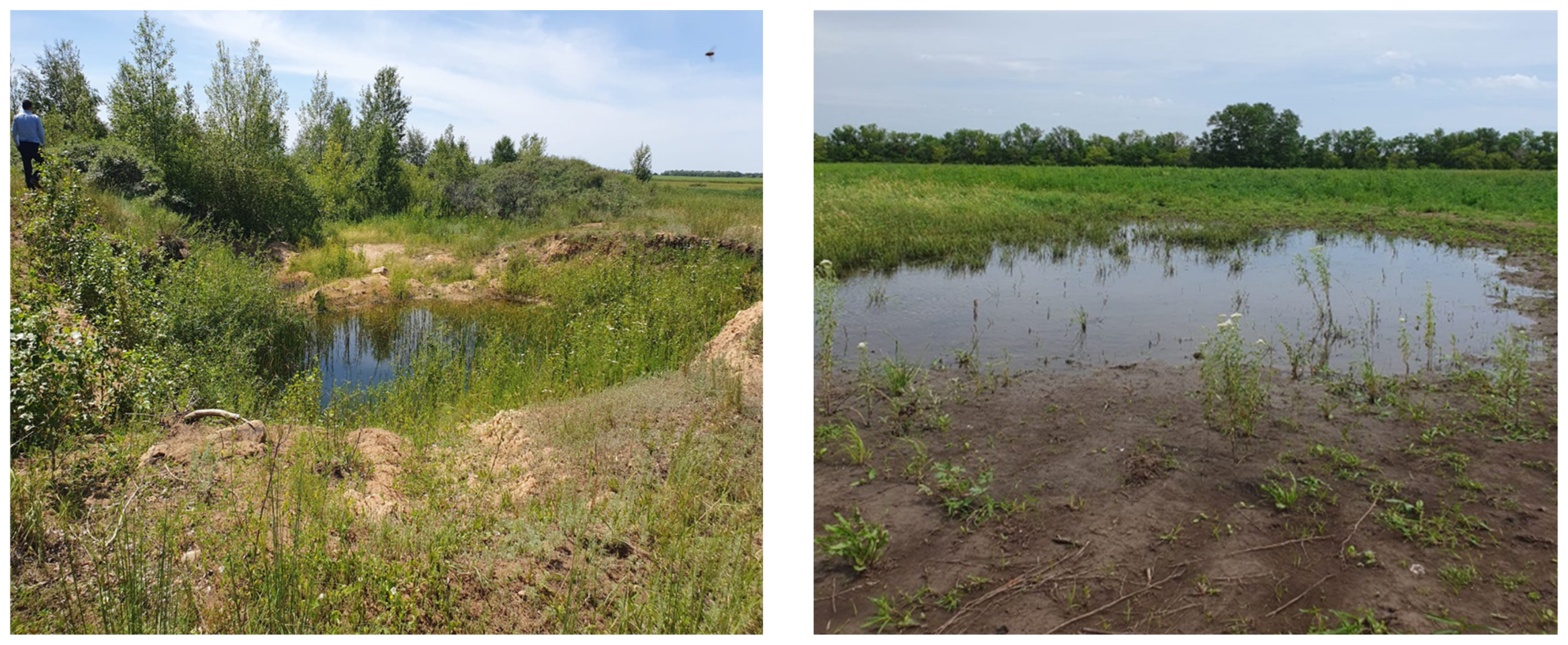
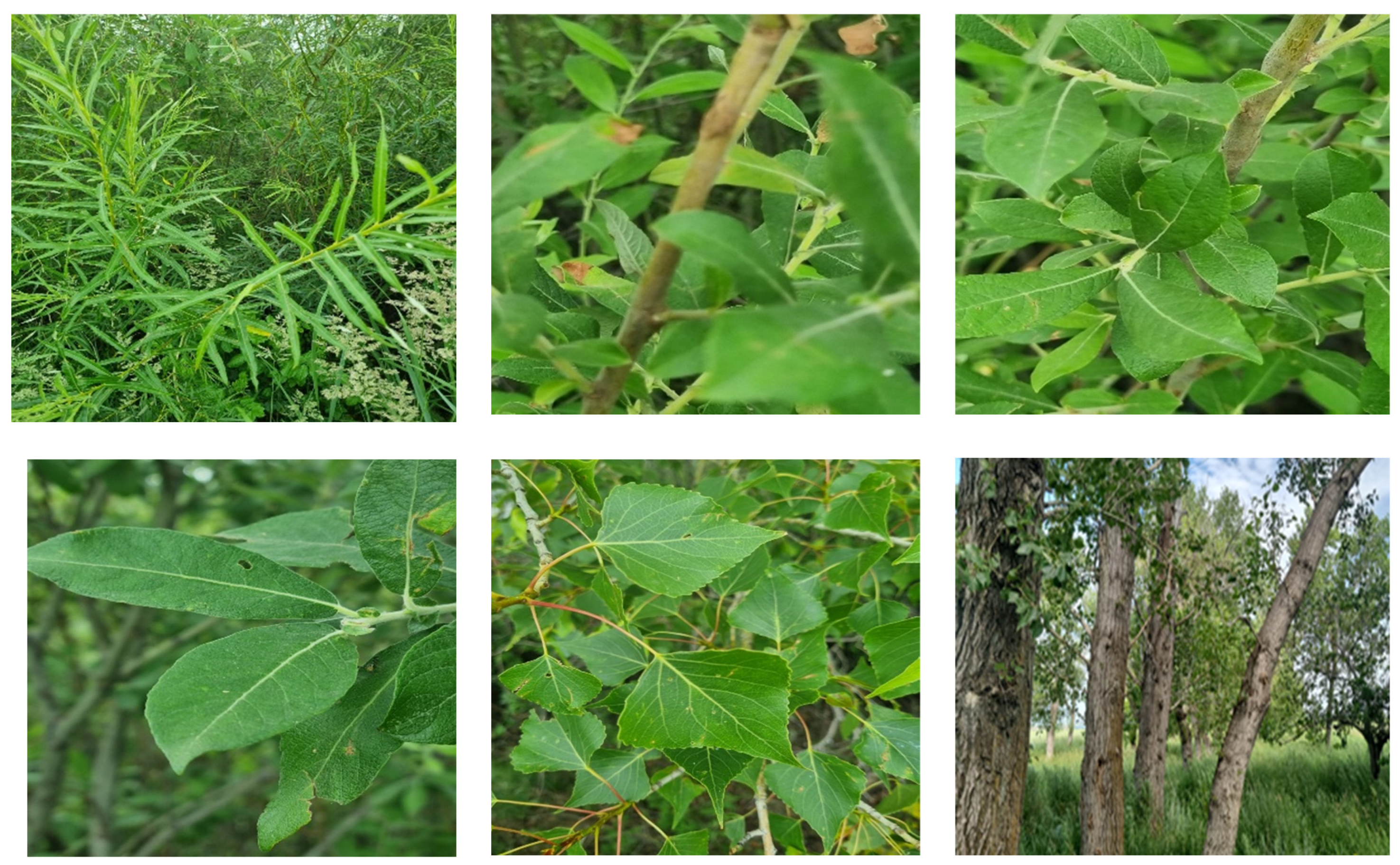
- Condition of Forest Belts and Yield (Appendix A, Table A5 and Table A6, Figure A1, Figure A2, Figure A3, Figure A4, Figure A5, Figure A6, Figure A7, Figure A8 and Figure A9).
- –
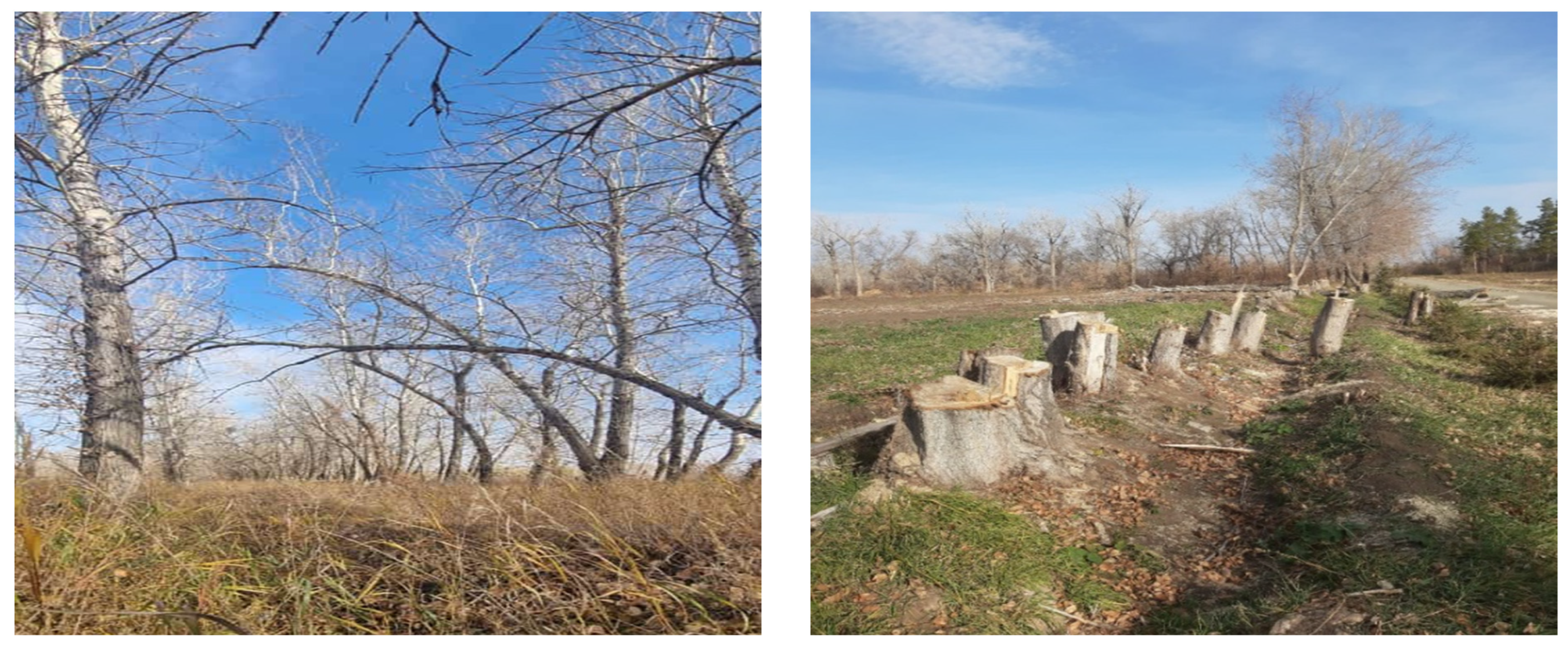
- Loss of Forest Belt Function: Field-protective forest belts in the investigated farms of the Akmola Region, including A. Barayev, Yesil-Agro, Rodina, KazGer, established in the 1970s–1980s, have lost their original purpose due to a lack of maintenance and reconstruction.
- –
- Need for Reconstruction: A forestry and ecological assessment was conducted, which showed that the forest belts require fundamental reconstruction (cutting down up to 80% of dry wood, thinning, planting new seedlings).
- –
- Yield Growth: A significant increase in the average yield of agricultural crops was noted in 2024 (up to 18 c/ha) compared to 2023 (8.1 c/ha), which may be partially attributed to improved moisture availability, although the forest belts currently do not have a significant impact in their present state.
- 2.
- Application of Geospatial Technologies (GIS and RS) (Appendix A, Table A7, Table A8, Table A9, Table A10, Table A11, Table A12 and Table A13).
- –
- Comprehensive Survey: A reconnaissance survey of forest belts and terrain was conducted by using GIS and RS technologies.
- –
- MAR Assessment: The field-protective potential of the forest belts was determined using the MAR technology and the Lukin–Potapenko–Zverev model.
- 3.
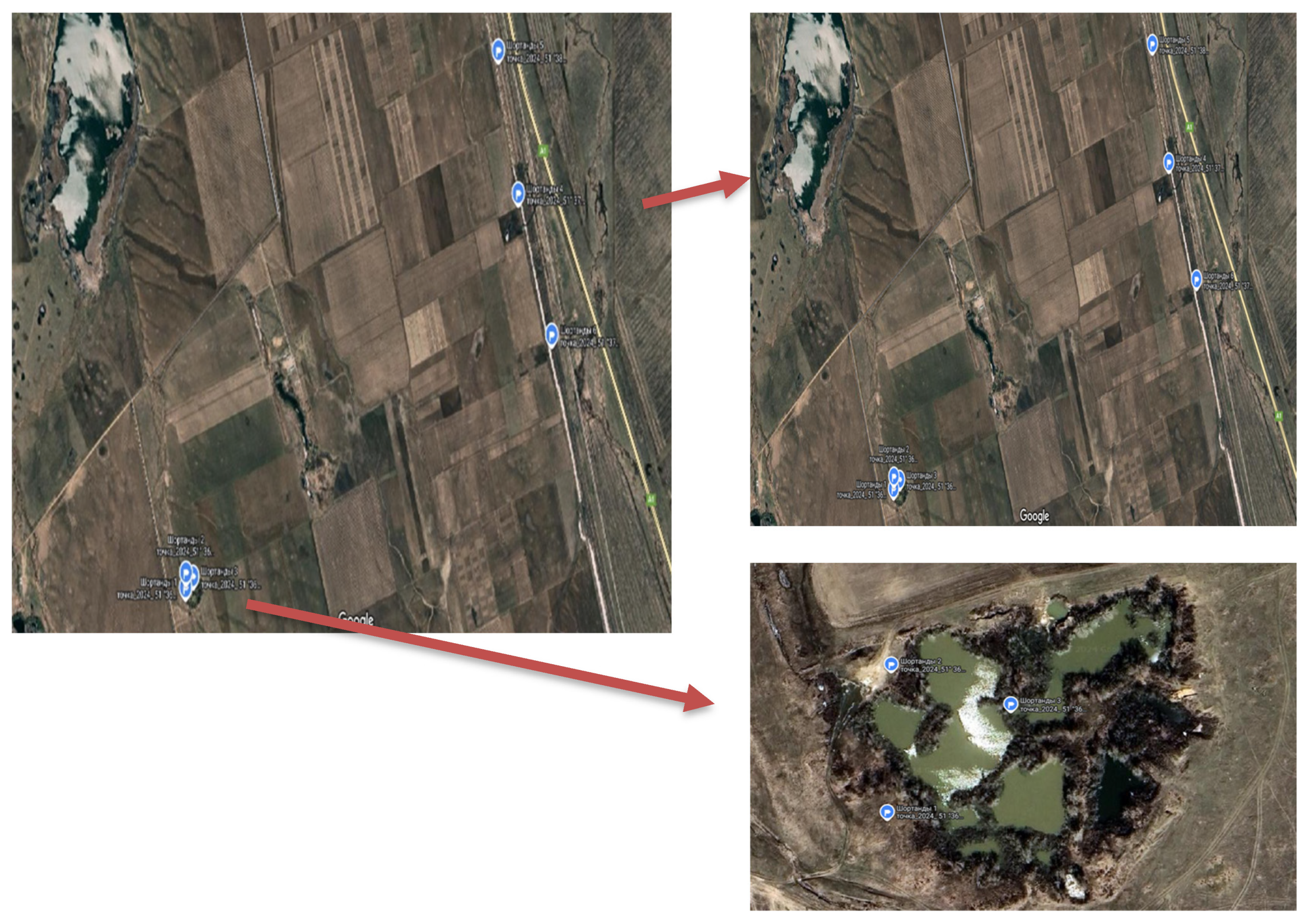
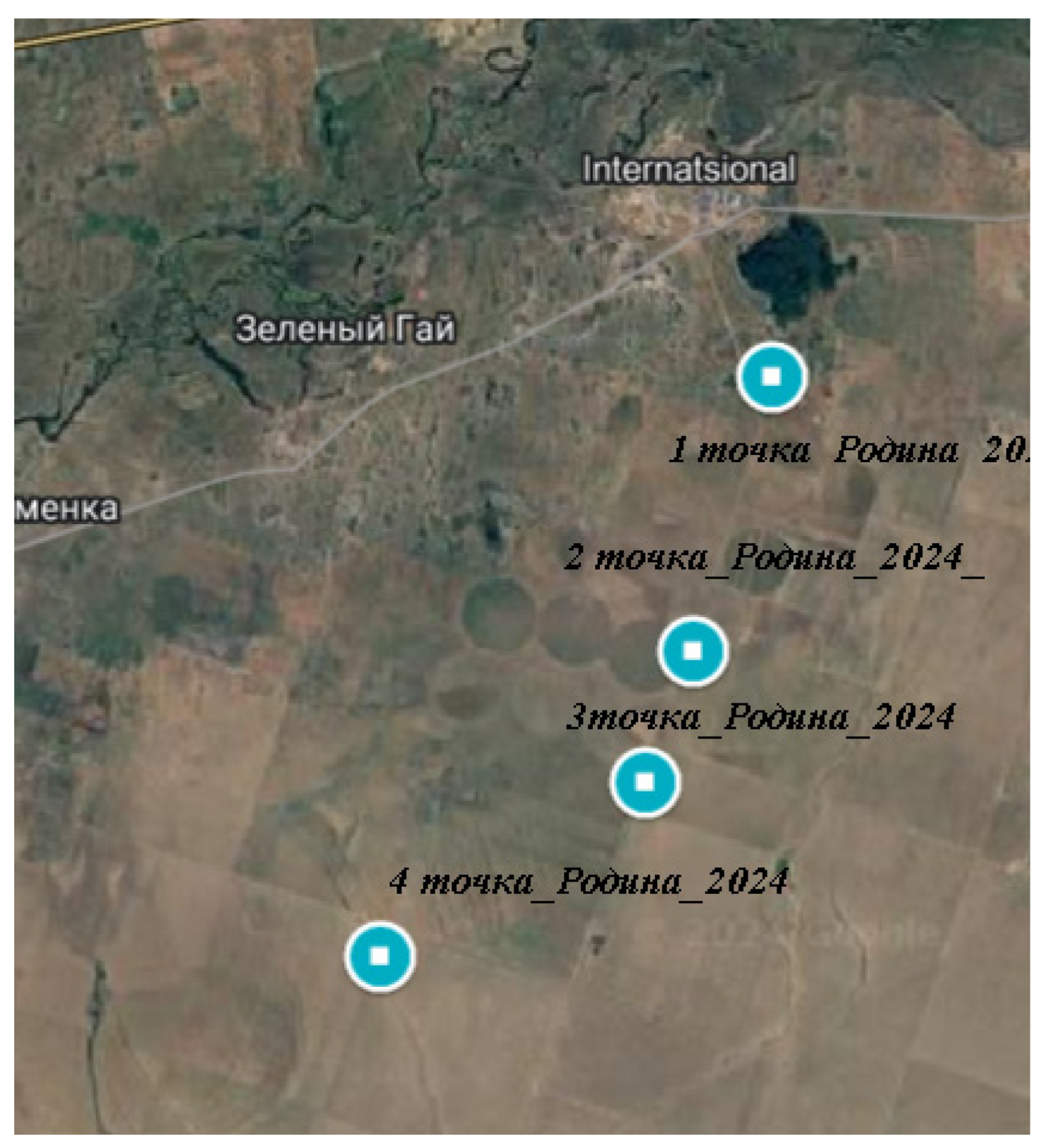
- Water Resources and Economic Effect (Appendix A, Table A14, Table A15 and Table A16, Figure A10, Figure A11, Figure A12, Figure A13, Figure A14, Figure A15 and Figure A16).
- –
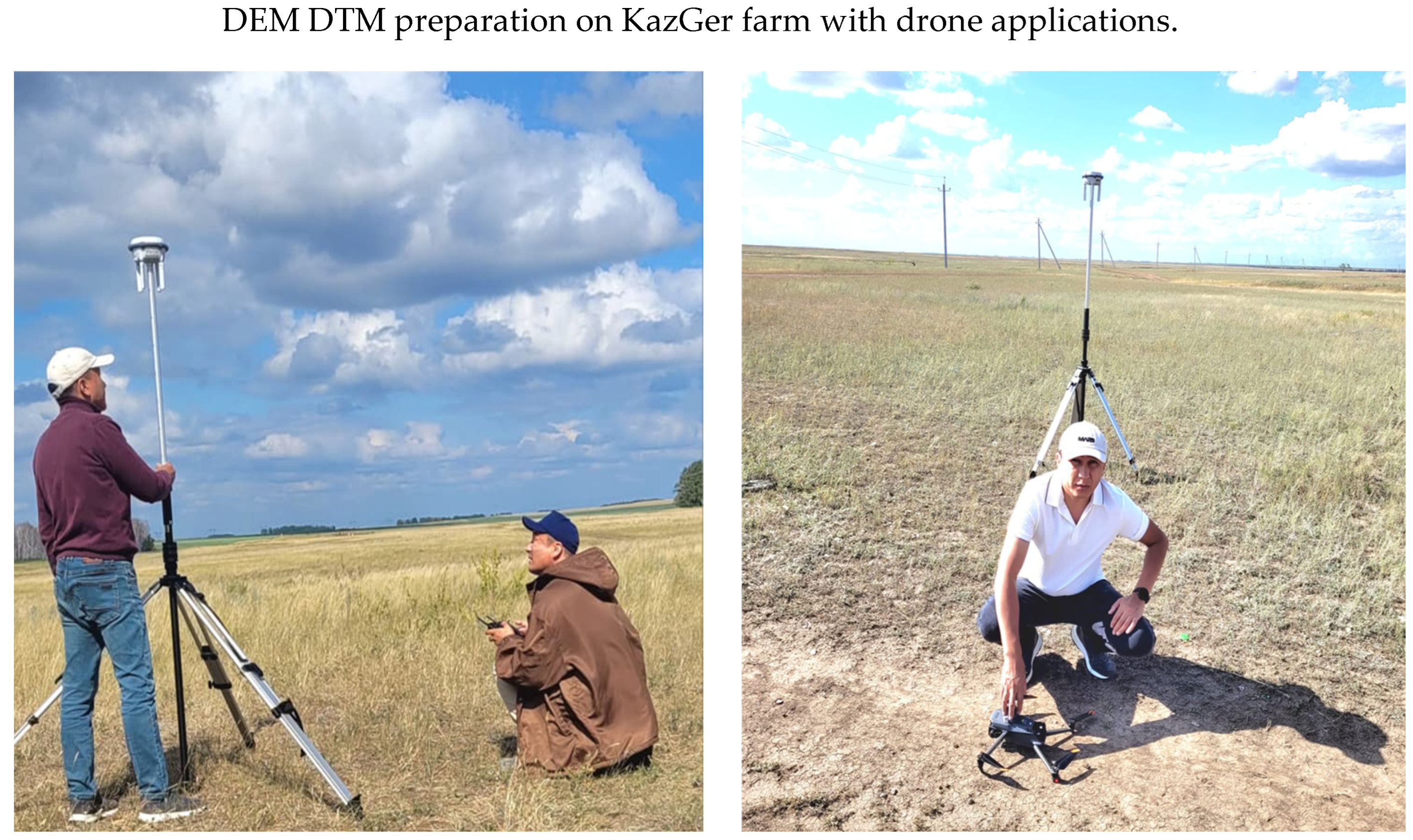
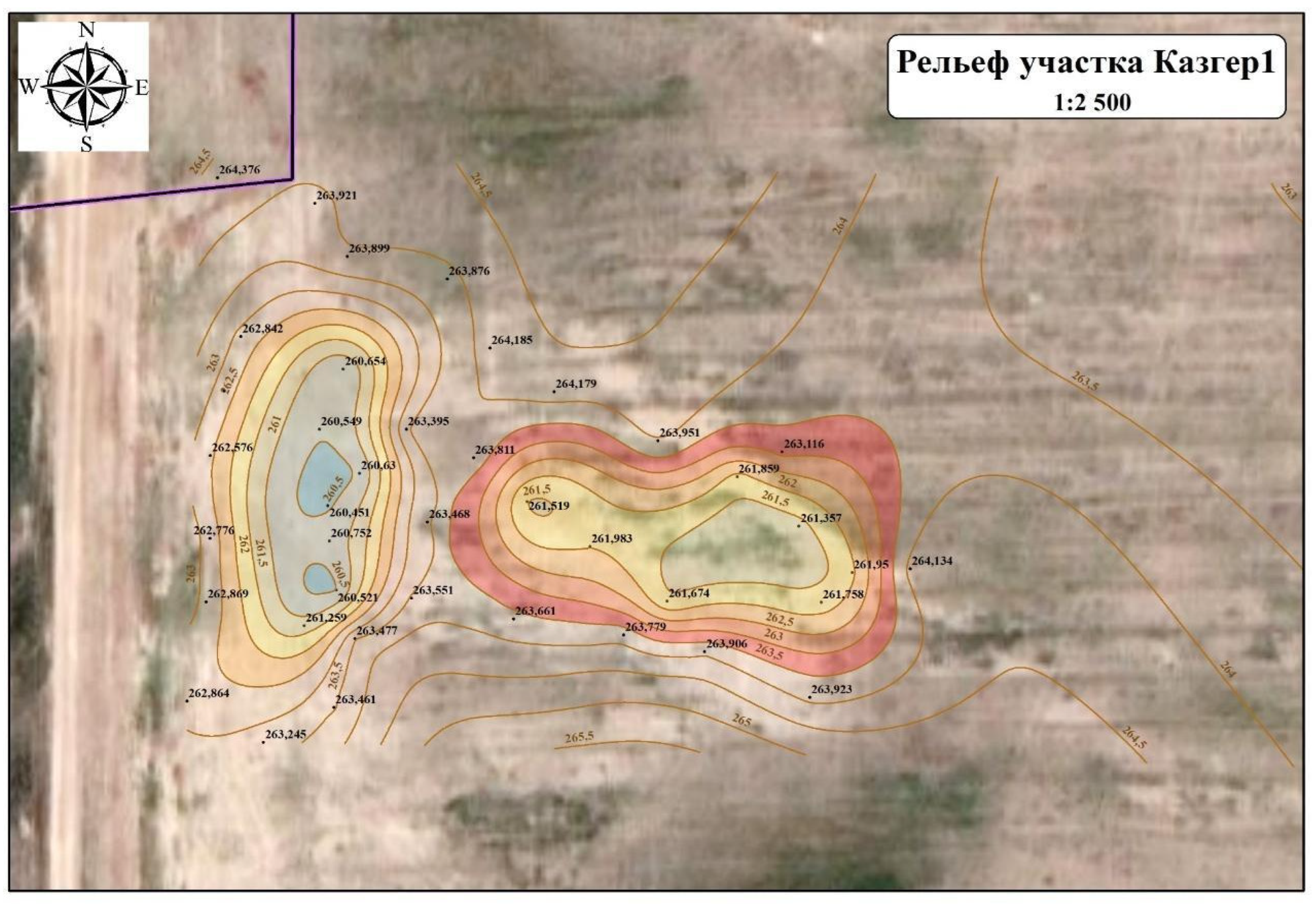
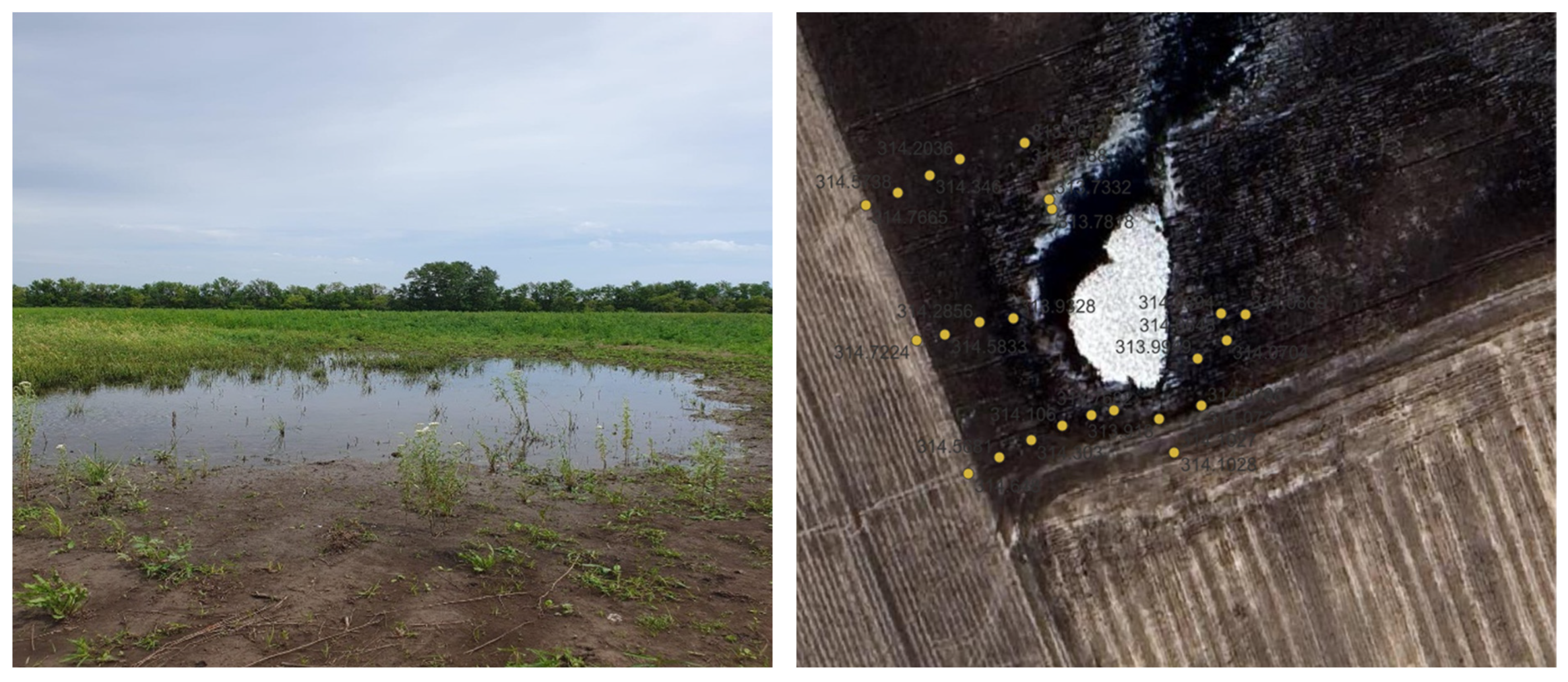
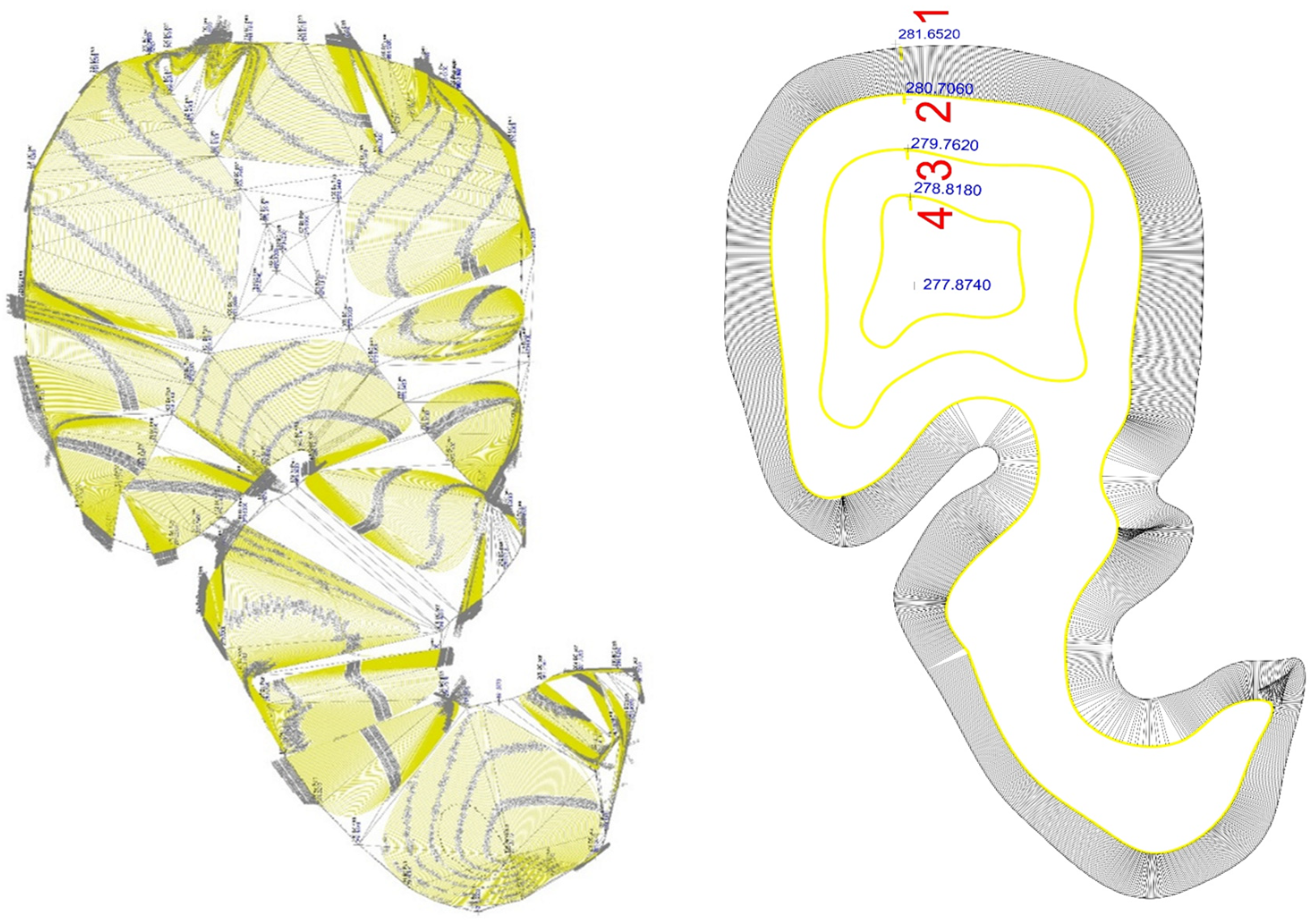
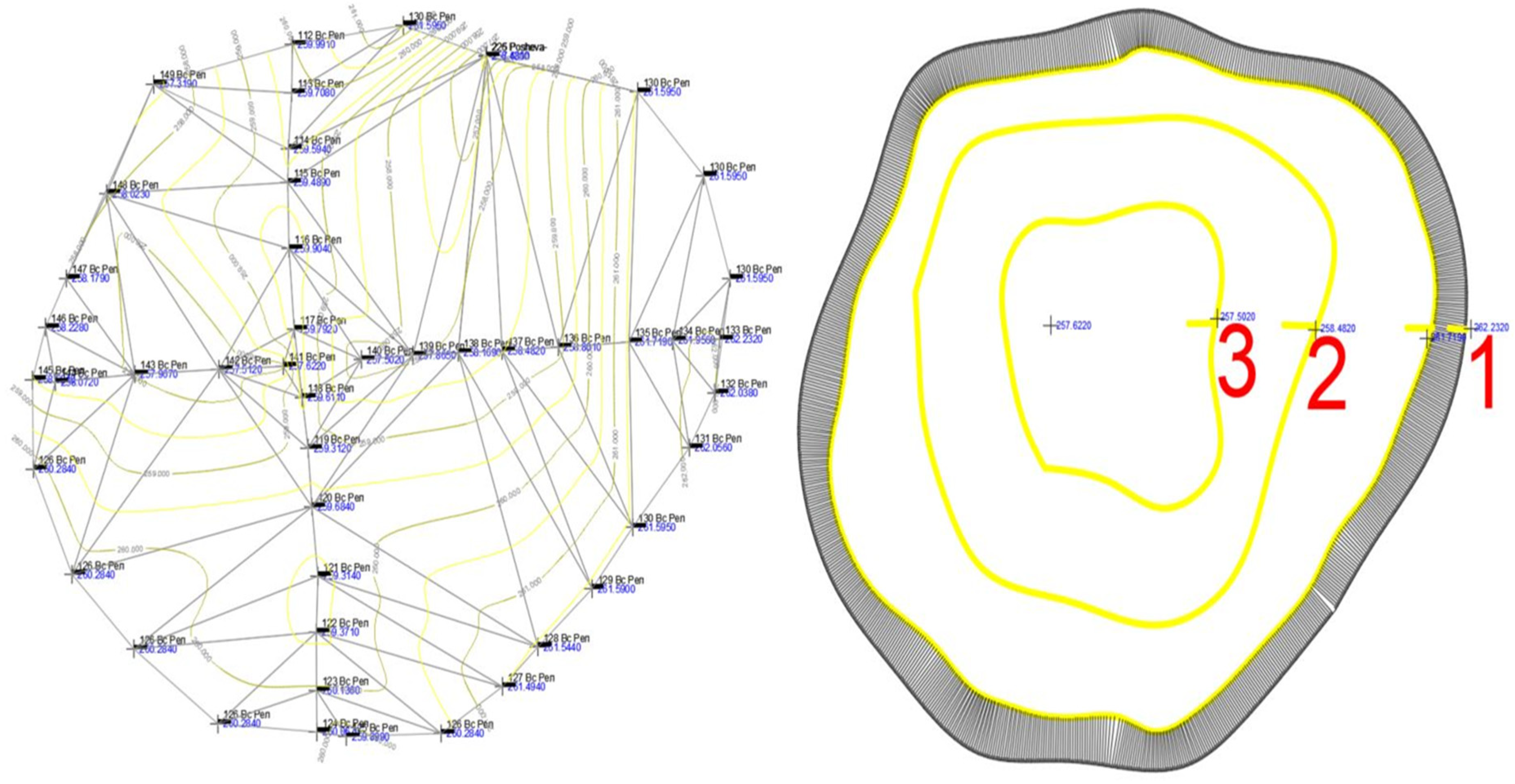
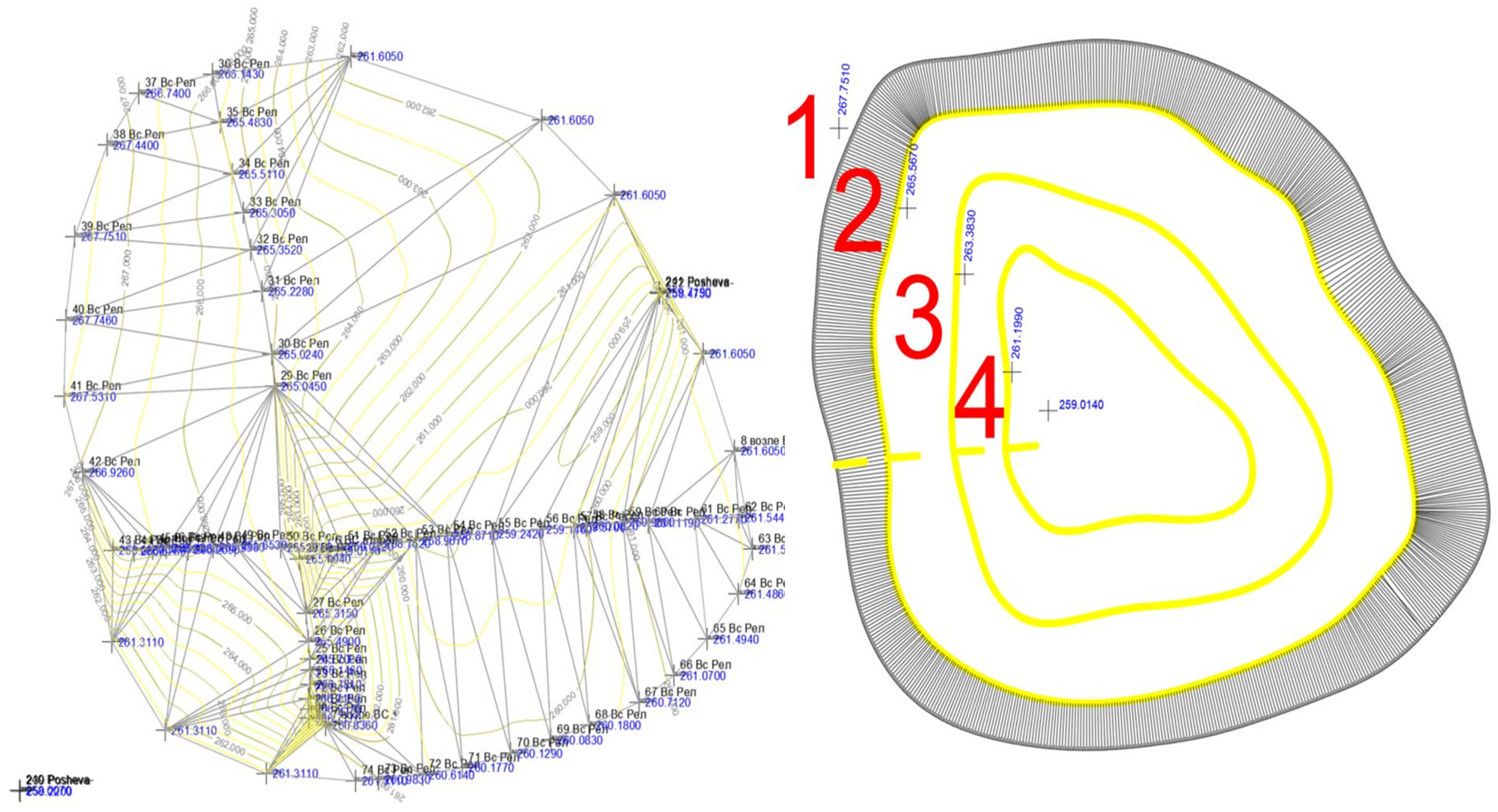
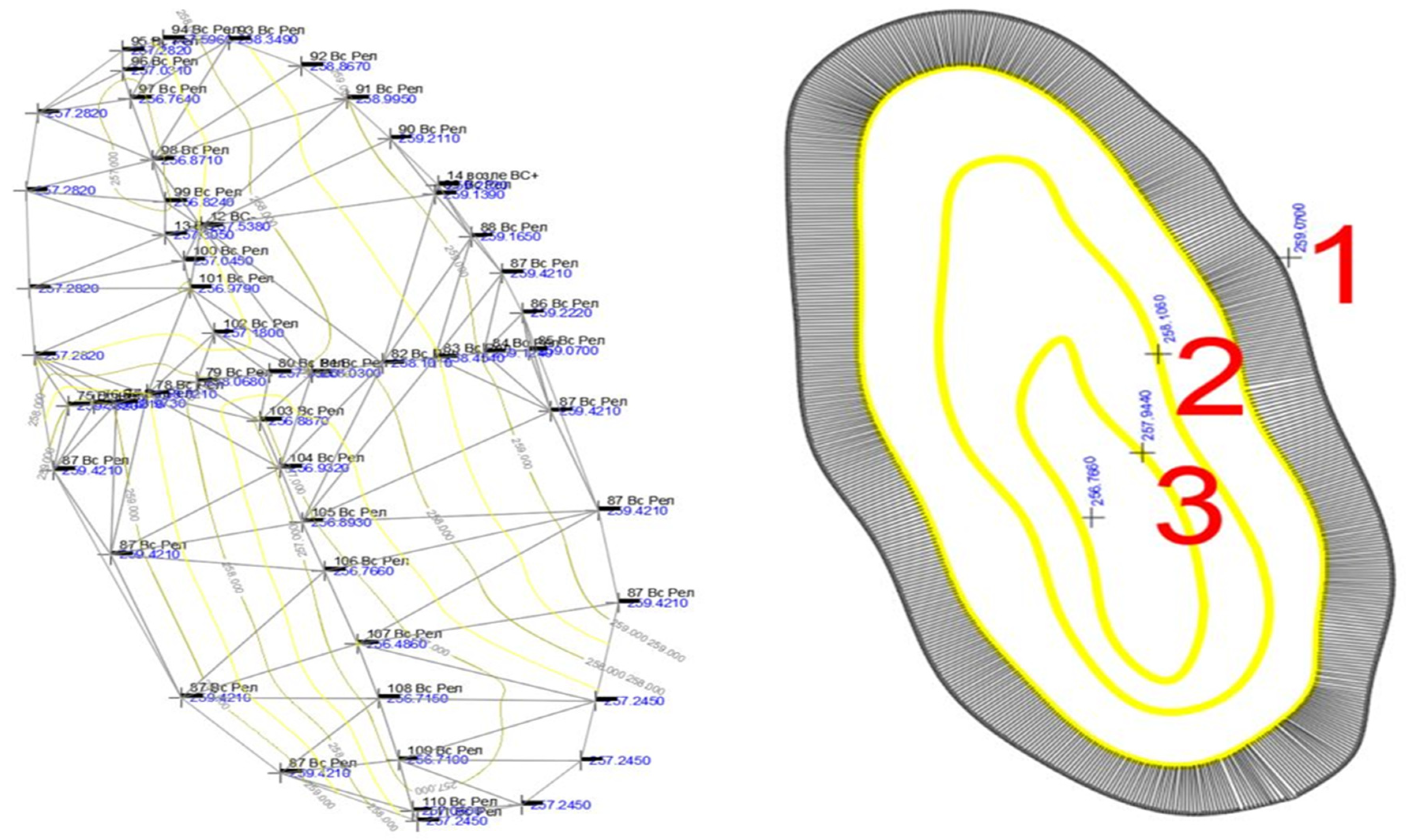
- Identification of Water Accumulation Sites: Geodetic and topographic surveys were carried out, which made it possible to determine potential locations for the accumulation of drainage meltwater on agricultural lands.
- –
- Agroclimatic Improvement: Forest shelterbelts in combination with MAR and considering the terrain are expected to lead to improved climatic conditions in the region and increased crop yields in the future.
- 4.
- Additional Research (Appendix A, Table A17, Table A18, Table A19, Table A20, Table A21, Table A22, Table A23 and Table A24, Figure A17 and Figure A18).
- –
- Monitoring of agrochemical soil indicators of agricultural lands and chemical analysis of the quality of natural surface waters were conducted.
- –
- A sociological survey of the rural population was carried out, and the vulnerability index of households to climate change was calculated.
- –
- A comparative analysis of the agroclimatic conditions of the region for the period from 1960 to 2024 was performed.
4. Discussion
- ✔
- Improved soil water regime: Local topographic depressions and areas with permeable soils ensure the accumulation and retention of meltwater.
- ✔
- Reduced erosion: The contour-strip organization of lands and the shelterbelt system protect soils from deflation (wind erosion) and water erosion, reducing the loss of the fertile layer.
- ✔
- Increased crop yields: Zones with high MAR potential demonstrate better productivity indicators due to improved moisture availability and microclimate regulation.
- ✔
- Slowed soil degradation: Analysis of soil salinity maps with the implementation of shelterbelts and rational land use contributes to a substantial reduction in secondary salinization, especially in areas of intensive industrial farming.
5. Conclusions
Author Contributions
Funding
Institutional Review Board Statement
Informed Consent Statement
Data Availability Statement
Acknowledgments
Conflicts of Interest
Appendix A. Agricultural Water Requirements for KazGer Farm Crops with CROPWAT Program

| Month | Minimum Temperature, °C | Maximum Temperature, °C | Relative Humidity, % | Wind Speed, km/day | Sundial, Watch | Radiation, MJ/m2/day | Evapotranspiration–Radiation, mm/day |
|---|---|---|---|---|---|---|---|
| January | −17.3 | −8.2 | 81 | 345 | 3.1 | 3.3 | 0.31 |
| February | −17.2 | −8.6 | 75 | 409 | 5.6 | 6.8 | 0.43 |
| March | −8.9 | 0 | 78 | 329 | 6.5 | 11.1 | 0.77 |
| April | 2.8 | 12.8 | 72 | 306 | 8.5 | 17.0 | 2.27 |
| May | 4.1 | 16.1 | 68 | 305 | 9.4 | 20.9 | 3.25 |
| June | 15.0 | 25.6 | 74 | 264 | 13.2 | 26.8 | 4.91 |
| July | 15.4 | 24.9 | 81 | 239 | 11.2 | 23.6 | 4.32 |
| August | 13.4 | 21.4 | 81 | 250 | 9.5 | 19.1 | 3.31 |
| September | 6.3 | 16.4 | 71 | 259 | 9.1 | 14.8 | 2.51 |
| October | −1.1 | 9.3 | 73 | 239 | 6.5 | 8.4 | 1.25 |
| November | −7.0 | 0.1 | 83 | 345 | 3.8 | 4.0 | 0.49 |
| December | −11.3 | −5.0 | 83 | 373 | 1.1 | 1.9 | 0.36 |
| Average | −0.5 | 8.7 | 77 | 305 | 7.3 | 13.1 | 2.02 |
| Month | I | II | III | IV | V | VI | VII | VIII | IX | X | XI | XII | Year |
|---|---|---|---|---|---|---|---|---|---|---|---|---|---|
| MC Kokshetau | −10.7 | −9.1 | −1.9 | 10.4 | 19.4 | 24.7 | 25.8 | 23.4 | 17.4 | 8.1 | −2.2 | −8.0 | 8.1 |
| MS SKFM Borovoe | −9.5 | −8.3 | −1.5 | 10.7 | 19.1 | 24.0 | 25.1 | 23.3 | 16.9 | 8.5 | −2.5 | −7.6 | 8.2 |
| Month | I | II | III | IV | V | VI | VII | VIII | IX | X | XI | XII | Year |
|---|---|---|---|---|---|---|---|---|---|---|---|---|---|
| MC Kokshetau | −19.2 | −18.5 | −11.4 | −0.5 | 6.4 | 11.9 | 14.0 | 11.7 | 6.3 | −0.3 | −9.4 | −15.9 | −2.1 |
| MS SKFM Borovoe | −18.9 | −18.1 | −11.4 | −1.3 | 4.9 | 10.1 | 12.4 | 10.3 | 4.6 | −1.1 | −10.4 | −16.3 | −2.9 |
| Station | Months | Season | |||||||||||||
|---|---|---|---|---|---|---|---|---|---|---|---|---|---|---|---|
| I | II | III | IV | V | VI | VII | VIII | IX | X | XI | XII | Year | XI-III | IV-X | |
| MC Kokshetau | 13 | 12 | 12 | 18 | 29 | 41 | 72 | 44 | 24 | 23 | 17 | 13 | 318 | 67 | 251 |
| MS SKFM Borovoe | 12 | 11 | 14 | 21 | 35 | 37 | 72 | 39 | 26 | 27 | 22 | 14 | 330 | 73 | 257 |

| № | Culture | Variety | Reproduction | Area, ha | Yield, c/ha | Gross Harvest, c |
|---|---|---|---|---|---|---|
| 1 | 2 | 3 | 4 | 5 | 6 | 7 |
| 8 | wheat | Shortandinskaya 95 st | GR 2 | 9.0 | 6.4 | 58.0 |
| 35 | wheat | Shortandinskaya 95 st | GR 3 | 57.0 | 5.7 | 326.0 |
| 35 | wheat | Shortandinskaya 95 st | s/elite | 209.0 | 9.4 | 1968.0 |
| 40 | wheat | Shortandinskaya 95 st | elite | 114.0 | 9.5 | 1088.0 |
| 34 | wheat | Shortandinskaya 95 st | elite | 200.0 | 6.9 | 1376.5 |
| 11 | wheat | Shortandinskaya 95 st | elite | 208.0 | 8.6 | 1778.5 |
| 3 | wheat | Shortandinskaya 95 st | green manure | 2.0 | 0 | 0 |
| Total | 799.0 | 8.3 | 6595.0 | |||
| 8 | wheat | Shortandinskaya 2014 | GR 2 | 16.0 | 10.6 | 169.0 |
| 7 | wheat | Shortandinskaya 2014 | GR 3 | 20.0 | 10.1 | 201.5 |
| 34 | wheat | Shortandinskaya 2014 | s/elite | 174.0 | 9.8 | 1707.0 |
| 9 | wheat | Shortandinskaya 2014 | s/elite | 26.0 | 10.1 | 262.0 |
| 5 | wheat | Shortandinskaya 2014 | s/elite | 20.0 | 7.7 | 153.5 |
| 10 | wheat | Shortandinskaya 2014 | elite | 113.0 | 11.2 | 1268.5 |
| 6 | wheat | Shortandinskaya 2014 | elite | 31.0 | 12.3 | 380.5 |
| Total | 400.0 | 10.4 | 4142.0 | |||
| 8 | wheat | Shortandinskaya 2012 | GR 2 | 8.0 | 15.4 | 123.0 |
| 10 | wheat | Shortandinskaya 2012 | GR 3 | 23.0 | 7.7 | 176.5 |
| 10 | wheat | Shortandinskaya 2012 | s/elite | 50.0 | 9.9 | 492.5 |
| 8 | wheat | Shortandinskaya 2012 | elite | 44.0 | 6.6 | 289.0 |
| 7 | wheat | Shortandinskaya 2012 | elite | 203.0 | 10.2 | 2063.0 |
| 5 | wheat | Shortandinskaya 2012 | elite | 35.0 | 9.3 | 324.5 |
| 9 | wheat | Shortandinskaya 2012 | elite | 191.0 | 7.8 | 1495.5 |
| 40 | wheat | Shortandinskaya 2012 | commodity | 8.0 | 8.7 | 69.5 |
| 8 | wheat | Shortandinskaya 2012 | commodity | 20.0 | 5.0 | 100.5 |
| 3 | wheat | Shortandinskaya 2012 | commodity | 2.0 | 4.0 | 8.0 |
| Total | 584.0 | 8.8 | 5142.0 | |||
| 11 | wheat | Astana 2 | elite | 100.0 | 10.5 | 1047.0 |
| 9 | wheat | Astana 2 | s/elite | 4.0 | 10.9 | 43.5 |
| 9 | wheat | Astana 2 | commodity | 7.0 | 0.9 | 6.3 |
| 3 | wheat | Astana 2 | commodity | 2.0 | 4.0 | 8.0 |
| Total | 113.0 | 9.8 | 1104.8 | |||
| 11 | wheat | Astana | s/elite | 75.0 | 11.1 | 835.5 |
| 11 | wheat | Astana | elite | 56.0 | 10.7 | 596.5 |
| 4 | wheat | Astana | commodity | 14.0 | 5.6 | 79.0 |
| Total | 145.0 | 10.4 | 1511.0 | |||
| 10 | wheat | Taimas | GR 2 | 5.0 | 11.2 | 56.0 |
| 10 | wheat | Taimas | GR 3 | 24.0 | 9.6 | 230.5 |
| 10 | wheat | Taimas | s/elite | 38.0 | 7.0 | 267.0 |
| Total | 67.0 | 8.3 | 553.5 | |||
| 2 | wheat | Independence 20 | GR 3 | 5.0 | 13.1 | 65.5 |
| 2 | wheat | Independence 20 | s/elite | 20.0 | 8.3 | 165.5 |
| 2 | wheat | Independence 20 | elite | 25.0 | 9.5 | 238.0 |
| Total | 50.0 | 9.4 | 469.0 | |||
| 1 | 2 | 3 | 4 | 5 | 6 | 7 |
| 8 | wheat | Akmola 2 | GR 3 | 11.0 | 11.1 | 122.5 |
| 5 | wheat | Akmola 2 | s/elite | 20.0 | 7.7 | 153.5 |
| 5 | wheat | Akmola 2 | elite | 24.0 | 7.7 | 184.0 |
| 8 | wheat | Akmola 2 | elite | 12.0 | 9.2 | 110.5 |
| 40 | wheat | Akmola 2 | commodity | 4.0 | 4.5 | 18.0 |
| Total | 71.0 | 8.3 | 588.5 | |||
| 5 | wheat | Celina 50 | s/elite | 15.0 | 5.4 | 81.0 |
| 5 | wheat | Celina 50 | elite | 36.0 | 7.3 | 261.0 |
| Total | 51.0 | 6.7 | 342 | |||
| 8 | wheat | Asyl Sapa | GR 2 | 17.0 | 8.0 | 136.5 |
| 7 | wheat | Asyl Sapa | GR 3 | 20.0 | 5.8 | 115.0 |
| 7 | wheat | Asyl Sapa | s/elite | 15.0 | 7.6 | 114.5 |
| 5 | wheat | Asyl Sapa | elite | 28.0 | 9.3 | 261.0 |
| Total | 80.0 | 7.8 | 627.0 | |||
| 8 | durum wheat | Korona | GR 2 | 6.0 | 10.4 | 62.5 |
| 10 | durum wheat | KOrona | GR 3 | 18.0 | 8.3 | 149.0 |
| 9 | durum wheat | Damsinskaya amber | s/elite | 0.5 | 7.6 | 3.8 |
| 2 | durum wheat | Damsinskaya 2017 | GR 2 | 6.5 | 3.6 | 23.5 |
| 2 | durum wheat | Lavina | GR 2 | 2.0 | 5.1 | 10.2 |
| 2 | durum wheat | Lavina | GR 3 | 10.0 | 3.5 | 35.3 |
| Total | 43.0 | 6.6 | 284.3 | |||
| 2403.0 | 8.9 | 21,359.0 | ||||
| 5 | barley | Virgin Lands 2005 | s/elite | 28.0 | 8.3 | 233.5 |
| 8 | barley | Astana 2000 | elite | 20.0 | 8.3 | 166.5 |
| 40 | barley | Astana 2000 | 1 rep | 175.0 | 11.7 | 2043.0 |
| 40 | barley | Astana 2000 | commodity | 12.0 | 9.7 | 116.5 |
| 4 | barley | Astana 2000 | commodity | 15.0 | 8.2 | 123.5 |
| Total | 250.0 | 10.7 | 2683.0 | |||
| 7 | oats | Bitik | s/elite | 24.0 | 4.8 | 114.5 |
| 9 | oats | Bayzat | elite | 2.0 | 13.8 | 27.5 |
| 1 | oats | Duman | commodity | 1.0 | 2.5 | 2.5 |
| Total | 27.0 | 5.4 | 144.5 | |||
| 3 | flax | Kustanai amber | commodity | 2.0 | 2.5 | 5.0 |
| 8 | flax | Kustanai amber | commodity | 42.0 | 2.7 | 111.5 |
| 3 | flax | Kustanai amber | commodity | 42.0 | 1.9 | 80.0 |
| 11 | flax | Kustanai amber | commodity | 33.0 | 2.1 | 70.0 |
| 6 | flax | Kustanai amber | commodity | 25.0 | 2.0 | 50.0 |
| 2 | flax | Kustanai amber | commodity | 25.0 | 2.7 | 67.0 |
| 1 | flax | Kustanai amber | commodity | 55.0 | 1.9 | 105.5 |
| Total | 224.0 | 2.2 | 489.0 | |||
| 3 | buckwheat | Shortandinskaya 4 | GR 3 | 5.0 | 2.0 | 10.0 |
| 3 | buckwheat | Shortandinskaya 4 | GR 3 | 19.0 | 2.1 | 40.0 |
| 7 | buckwheat | Shortandinskaya 4 | s/elite | 44.0 | 0.7 | 30.3 |
| 6 | buckwheat | Shortandinskaya 4 | s/elite | 16.0 | 0.7 | 11.2 |
| 2 | buckwheat | Shortandinskaya 4 | s/elite | 50.0 | 1.6 | 81.5 |
| Total | 134.0 | 1.3 | 173.0 | |||
| 40 | rape | Maikudyk | GR 3 | 12.0 | 0.7 | 8.0 |
| 10 | rape | Osiris | GR 3 | 14.0 | 5.7 | 79.5 |
| Total | 26.0 | 3.4 | 87.5 | |||
| 11 | mustard | Commodity | commodity | 90.0 | 8.0 | 723.5 |
| Total | 90.0 | 8.0 | 723.5 | |||
| 2 | Sudanese grass | Nika | GR 2 | 14.0 | 3.7 | 51.5 |
| 2 | Sudanese grass | Nika | GR 3 | 11.0 | 5.7 | 62.5 |
| Total | 25.0 | 4.6 | 114.0 | |||
| 34 | sunflower | Zhaidarman | GR 3 | 13.0 | 2.4 | 31.0 |
| Total | 13.0 | 2.4 | 31.0 | |||
| 4 | peas | Kasib | commodity | 5.0 | 6.2 | 31.0 |
| 3 | peas | Aksai mustachioed | commodity | 2.0 | 5.0 | 10.0 |
| Total | 7.0 | 5.9 | 41.0 | |||
| Sum | 3199.0 | 8.1 | 25,845.6 |

| № | Culture | Variety | Reproduction | Area, ha | Yield, c/ha | Gross Collection, t |
|---|---|---|---|---|---|---|
| 1 | 2 | 3 | 4 | 5 | 6 | 7 |
| 40 | wheat | Shortandinskaya 95 st | GR 2 | 12.7 | 17.3 | 22.0 |
| 40 | wheat | Shortandinskaya 95 st | GR 3 | 19.9 | 16.1 | 31.9 |
| 39 | wheat | Shortandinskaya 95 st | elite | 4.5 | 15.3 | 6.9 |
| 35 | wheat | Shortandinskaya 95 st | elite | 267.0 | 13.1 | 351.0 |
| 34 | wheat | Shortandinskaya 95 st | elite | 382.0 | 13.2 | 502.8 |
| 40 | wheat | Shortandinskaya 95 st | elite | 177.4 | 15.7 | 277.7 |
| 40 | wheat | Shortandinskaya 95 st | s/elite | 28.0 | 21.5 | 60.2 |
| Total | 891.5 | 16.0 | 1252.6 | |||
| 5 | wheat | Shortandinskaya 2014 | GR 3 | 15.0 | 25.5 | 38.3 |
| 5 | wheat | Shortandinskaya 2014 | GR 2 | 10.0 | 27.6 | 27.6 |
| 5 | wheat | Shortandinskaya 2014 | elite | 15.0 | 27.3 | 41.0 |
| 8 | wheat | Shortandinskaya 2014 | elite | 70.0 | 13.8 | 96.5 |
| 39 | wheat | Shortandinskaya 2014 | elite | 4.5 | 16.3 | 7.3 |
| 6 | wheat | Shortandinskaya 2014 | s/elite | 4.0 | 11.6 | 4.6 |
| 10 | wheat | Shortandinskaya 2014 | s/elite | 113.0 | 23.0 | 268.8 |
| Total | 231.5 | 20.7 | 484.3 | |||
| 4 | wheat | Shortandinskaya 2012 | GR 2 | 8.0 | 32.8 | 26.3 |
| 10 | wheat | Shortandinskaya 2012 | GR 3 | 20.0 | 15.6 | 31.3 |
| 10 | wheat | Shortandinskaya 2012 | elite | 62.0 | 15.2 | 94.2 |
| 7 | wheat | Shortandinskaya 2012 | elite | 200.0 | 19.7 | 394.0 |
| 10 | wheat | Shortandinskaya 2012 | s/elite | 66.0 | 22.4 | 147.7 |
| 39 | wheat | Shortandinskaya 2012 | commod | 4.5 | 9.6 | 4.3 |
| Total | 360.5 | 19.2 | 697.9 | |||
| 11 | wheat | Astana 2 | elite | 26.0 | 11.3 | 29.5 |
| 11 | wheat | Astana | s/elite | 240.0 | 17.3 | 415.6 |
| 3 | wheat | Astana | s/elite | 6.0 | 22.0 | 13.2 |
| 6 | wheat | Astana | s/elite | 25.0 | 21.9 | 54.7 |
| 7 | wheat | Astana | elite | 44.0 | 12.6 | 55.5 |
| 9 | wheat | Astana | elite | 157.0 | 16.8 | 263.7 |
| 4 | wheat | Astana | commod | 12.0 | 2.6 | 3.2 |
| Total | 510.0 | 14.9 | 835.4 | |||
| 39 | wheat | Taimas | GR 2 | 10.0 | 32.5 | 32.5 |
| 39 | wheat | Taimas | GR 3 | 20.0 | 33.1 | 66.1 |
| 39 | wheat | Taimas | s/elite | 50.0 | 38.3 | 191.6 |
| 4 | wheat | Taimas | s/elite | 24.0 | 14.3 | 34.4 |
| 39 | wheat | Taimas | s/elite | 54.5 | 22.5 | 10.1 |
| Total | 158.5 | 28.1 | 334.9 | |||
| 5 | wheat | Akmola 2 | GR 3 | 26.0 | 21.6 | 56.3 |
| 5 | wheat | Akmola 2 | s/elite | 18.0 | 31.1 | 55.95 |
| Total | 44.0 | 26.3 | 112.2 | |||
| 5 | wheat | Virgin Land 50 | s/elite | 36.0 | 18.6 | 66.85 |
| 4 | wheat | Asyl Sapa | GR 2 | 7.0 | 30.9 | 21.65 |
| 5 | wheat | Asyl Sapa | GR 3 | 28.0 | 24.3 | 68.15 |
| 3 | wheat | Asyl Sapa | s/elite | 17.0 | 14.5 | 24.6 |
| Total | 88.0 | 22.0 | 181.2 | |||
| 2 | durum wheat | Crown | GR 3 | 36.0 | 29.7 | 106.9 |
| 8 | durum wheat | Crown | GR 3 | 16.0 | 22.8 | 36.5 |
| 39 | durum wheat | Crown | s/elite | 4.5 | 14.4 | 6.5 |
| 8 | durum wheat | Damsinskaya 2017 | GR 2 | 11.0 | 32.6 | 35.8 |
| 8 | durum wheat | Damsinskaya 2017 | GR 3 | 8.0 | 25.6 | 20:4 |
| 39 | durum wheat | Damsinskaya 90 | GR 3 | 4.5 | 14.2 | 6.4 |
| Total | 80.0 | 23.3 | 212.6 | |||
| 2364.0 | 29.4 | 4111.0 | ||||
| 2 | barley | Tselinny 60 | elite | 186.0 | 26.1 | 486.45 |
| 8 | barley | Tselinny 60 | elite | 20.0 | 23.0 | 46.05 |
| 39 | barley | Tselinny 60 | commodity | 4.5 | 38.0 | 17.1 |
| 4 | barley | Virgin Lands 2005 | s/elite | 23.5 | 27.6 | 64.85 |
| 8 | barley | Astana 2000 | elite | 42.0 | 38.0 | 159.7 |
| Total | 276.0 | 30.5 | 774.1 | |||
| 5 | oats | Bayzat | GR 2 | 5.0 | 27.2 | 13.6 |
| 5 | oats | Duman | GR 3 | 10.0 | 34.3 | 34.3 |
| 39 | oats | Duman | commodity | 4.5 | 22.0 | 9.8 |
| 7 | oats | Bitik | GR 3 | 20.0 | 33.5 | 67.0 |
| 5 | oats | Bitik | s/elite | 52.5 | 34.0 | 178.4 |
| Total | 92.0 | 30.2 | 303.2 | |||
| 5 | buckwheat | Shortandinskaya 4 | s/elite | 22.0 | 12.60 | 27.8 |
| 9 | buckwheat | Shortandinskaya 4 | s/elite | 25.0 | 14.60 | 36.5 |
| 3 | buckwheat | Shortandinskaya 4 | commodity | 16.0 | 16.50 | 26.4 |
| Total | 98.0 | 14.0 | 133.1 | |||
| 7 | sunflower | Kun-Nur | GR 3 | 16.0 | 7.1 | 11.3 |
| 6 | sunflower | Zhaidarman | GR 3 | 31.0 | 5.5 | 17.1 |
| 47.0 | 6.3 | 28.5 | ||||
| 4 | peas | Status | commodity | 2.0 | 4.5 | 0.9 |
| 4 | peas | Orys | commodity | 26.0 | 6.2 | 16.2 |
| 28.0 | 5.3 | 17.1 | ||||
| 10 | rape | Maykudyk | s/elite | 24.0 | 11.2 | 26.8 |
| 5 | flax | Kustanai amber | commodity | 35.0 | 12.1 | 42.4 |
| 5 | safflower | commodity | commodity | 13.0 | 3.6 | 4.7 |
| 9 | lentils | commodity | commodity | 40.0 | 14.8 | 59.4 |
| Total | 112.0 | 10.4 | 133.3 | |||
| Sum | 3017.0 | 18.0 | 5500.3 |


| Class | Land Use Categories | Characteristic |
|---|---|---|
| 5 | meadow lands, shrubs | the most favorable areas with high permeability and minimal restrictions for infiltration |
| 4 | agricultural land | agricultural land with relatively high infiltration capacity |
| 3 | bare/sparse vegetation | moderate conditions: limited permeability of soils and vegetation |
| 2 | grassy wetlands, forest/tree cover | low permeability due to swampiness or dense forest vegetation |
| 1 | permanent water bodies, built-up areas | the least favorable areas where infiltration is practically impossible |
| № | Name of Breeds | Forest Vegetation Zones | Age, Years | Variety | Thickness of the Trunk at the Root Collar, Not Less Than, mm | Height of Aboveground Part, Not Less Than, cm |
|---|---|---|---|---|---|---|
| 1 | 2 | 3 | 4 | 5 | 6 | 7 |
| 1 | Silver birch Betula pendula Roth | all zones | 3–4 | 1 | 8 | 50 |
| 2 | 5 | 35 | ||||
| 2 | Small-leaved elm (elm) Ulmus pinnatoramosa | forest-steppe, steppe | 2–3 | 1 | 8 | 55 |
| 2 | 6 | 40 | ||||
| 3 | Common pear Pirus communis L. | all zones | 2–3 | 1 | 7 | 45 |
| 2 | 5 | 30 | ||||
| 4 | Caragana arborescens Caragana Arborescens. | all zones | 3–4 | 1 | 6 | 35 |
| 2 | 4 | 25 | ||||
| 5 | Norway maple Acer platanoides L. | all zones | 3–4 | 1 | 8 | 35 |
| 2 | 6 | 25 | ||||
| 6 | Small-leaved linden Tilia cordata Mill. | all zones | 3–4 | 1 | 9 | 50 |
| 2 | 5 | 30 | ||||
| 7 | Sea buckthorn Hippophae ramnoides L. | all zones | 3–4 | 1 | 9 | 35 |
| 2 | 7 | 25 | ||||
| 8 | Rowan tree Sorbus aucuparica L. | all zones | 3–4 | 1 | 9 | 35 |
| 2 | 7 | 25 | ||||
| 9 | Scots pine Pinus silvestris L. | forest-steppe | 3–4 | 1 | 8 | 25 |
| 2 | 5 | 20 | ||||
| 10 | White poplar Populus alba L. | forest-steppe, steppe | 2–3 | 1 | 10 | 100 |
| 2 | 7 | 70 | ||||
| 11 | Black poplar Populus nigra L. | 2 | 1 | 7 | 80 | |
| 2 | 6 | 60 | ||||
| 12 | Wild apple tree Malus silvestris (L.) | all zones | 2–3 | 1 | 8 | 45 |
| 2 | 6 | 30 | ||||
| 13 | Common ash Flaxinus excelsior L. | all zones | 3–4 | 1 | 9 | 35 |
| 2 | 7 | 25 |
| № | Names of Trees and Shrubs | Indexes |
|---|---|---|
| 1 | Beresa pendula (Betula pendula) | BB |
| 2 | Scots pine (Pinus sylvestris) | So |
| 3 | Elaeagnus angustifolia | Lh |
| 4 | Siberian elm (Ulmus pumilia) | Vz |
| 5 | White poplar (Populus alba) | Tb |
| 6 | Siberian rowan (Sorbus sibirika) | PC |
| 7 | Currants (Ribes) | Cm |
| Factors and Main Components of IPCC | |
|---|---|
| Contact | Human–wildlife conflict Natural disasters and climate change |
| Adaptive capacity | Life support strategies Natural resources Social media Infrastructure Socio-demographic profile Earth Finance and income |
| Sensitivity | Agriculture and food security Healthcare Type of housing Water resources and sanitation |
| IPCC Factors | Main Components—14 | Examples of Subcomponents—56 |
|---|---|---|
| Exposure | natural disasters and climate change | frequency of droughts, hail, livestock losses from predators |
| Sensitivity | health; agriculture and food security; water resources and sanitation | time to market; access to clean water; availability of permanent housing |
| Adaptive Capacity | socio-demographic profile; livelihood strategies; social networks; natural resources; infrastructure; finance and income | level of education; access to credit; income diversification |
| Component/Subcomponent | Data Source | Birzhan Sal | Burabaysky | Tselinogradsky | Shortandinsky | General (cf.) |
|---|---|---|---|---|---|---|
| 1 | 2 | 3 | 4 | 5 | 6 | 7 |
| SDP (socio-demographic profile) | statistics + survey | 0.389 | 0.702 | 0.705 | 0.669 | 0.616 |
| - % of female heads of households | statistics | 0.767 (76.7%) | 0.935 (93.5%) | 0.904 (90.4%) | 0.885 (88.5%) | 0.873 |
| - Population density (people/km2) | statistics | 0.182 (1.1) | 0.909 (11.9) | 0.864 (11.0) | 0.818 (5.7) | 0.693 |
| - Size DH (persons) | survey | 0.217 (1.3) | 0.261 (1.6) | 0.348 (2.1) | 0.304 (1.8) | 0.283 |
| LS (livelihood strategies) | statistics | 0.500 | 0.429 | 0.626 | 0.526 | 0.520 |
| - Cultivated area/person (ha/person) | statistics | 0.654 (0.48) | 0.571 (0.47) | 0.812 (0.51) | 0.948 (0.53) | 0.746 |
| - Cost of labor (tenge/worker) | statistics | 0.612 (2803) | 0.613 (2643) | 0.641 (2762) | 0.531 (2027) | 0.599 |
| - Number of livestock (heads) | statistics | 0.235 (98,351) | 0.103 (80,740) | 0.426 (419,387) | 0.100 (62,162) | 0.216 |
| Health | statistics for the region | 0.258 | 0.258 | 0.258 | 0.258 | 0.258 |
| - % stunting <5 years | S (UNICEF MICS 2024) | 0.162 (16.2%) | 0.162 (16.2%) | 0.162 (16.2%) | 0.162 (16.2%) | 0.162 |
| - Full vaccination 15–26 months, % | S (UNICEF MICS 2024) | 0.380 (62%) | 0.380 (62%) | 0.380 (62%) | 0.380 (62%) | 0.380 |
| - ECD index (%) | S (UNICEF MICS 2024) | 0.139 (86.1%) | 0.139 (86.1%) | 0.139 (86.1%) | 0.139 (86.1%) | 0.139 |
| - Low birth weight, % | S (UNICEF MICS 2024, North Kaz) | 0.090 (9%) | 0.090 (9%) | 0.090 (9%) | 0.090 (9%) | 0.090 |
| - Improved water sources, % | S (UNICEF MICS 2024) | 0.060 (94%) | 0.060 (94%) | 0.060 (94%) | 0.060 (94%) | 0.060 |
| Food | statistics | 0.404 | 0.430 | 0.463 | 0.388 | 0.421 |
| - Grain yield, c/ha | statistics | 0.421 (8.9) | 0.421 (7.5) | 0.447 (9.1) | 0.368 (5.2) | 0.414 |
| - Vegetable yield, c/ha | statistics | 0.387 (171.7) | 0.439 (175.4) | 0.479 (95.8) | 0.409 (163.6) | 0.429 |
| 1 | 2 | 3 | 4 | 5 | 6 | 7 |
| Water | data from the Ministry of Emergency Situations | 0.220 | 0.340 | 0.170 | 0.280 | 0.252 |
| - % with water deficit | survey | 0.200 (20%) | 0.300 (30%) | 0.150 (15%) | 0.250 (25%) | 0.225 |
| - Flood adjustment | data from the Ministry of Emergency Situations | +0.020 (1) | +0.040 (2) | +0.020 (1) | +0.030 (1.5) | +0.028 |
| Social networks | A (survey, 1.9/4.6/4.8/4.9) | 0.525 | 0.525 | 0.550 | 0.550 | 0.538 |
| - % with technologies | A (poll, 4.6) | 0.450 (0.55) | 0.500 (0.50) | 0.450 (0.55) | 0.400 (0.60) | 0.450 |
| - Financial literacy, % | A (poll, 1.9/4.8/4.9) | 0.600 (0.40) | 0.550 (0.45) | 0.650 (0.35) | 0.700 (0.30) | 0.625 |
| Exposure (climate risks) | data from the Ministry of Emergency Situations | 0.305 | 0.405 | 0.255 | 0.355 | 0.330 |
| - Frequency of floods (cases) | data from the Ministry of Emergency Situations | 0.300 (1.5) | 0.400 (2) | 0.250 (1.25) | 0.350 (1.75) | 0.325 |
| - Climate risks (low precipitation index) | Kazhydromet | 0.310 (0.155) | 0.410 (0.205) | 0.260 (0.13) | 0.360 (0.18) | 0.335 |
| Final LVI | aggregation | 0.380 | 0.447 | 0.433 | 0.415 | 0.419 |
| LVI-IPCC | aggregation | −0.045 | 0.040 | −0.025 | 0.035 | 0.001 |
| Minimum plot | 100 hectares | Explanation. The method requires digging windrow ditches per hectare: 50 m wide, 80 cm wide, and 1.5 m deep. In general, windrow ditches must be dug at intervals of 100 to 500 m, depending on the surface slope. The windrow ditches are planted with trees and shrubs at the top and bottom, and the bottom is lined with biomass. A topographic survey is required for planning, based on which the territory is planned. Soil monitoring is required at the entrance and exit for assessment. Monitoring visits are carried out throughout the entire cycle. |
| Cycle | 3 years | |
| Territory | Pastures/arable lands | |
| Distance between stripes, meters | 300 |


| A. General information about the farm |
| 1. Please indicate your age: years |
| 2. Your gender: (a) Male (b) Female |
| 3. Your level of education: (a) General average (b) Secondary specialized (c) Higher agricultural (d) Higher other |
| 4. Number of family members, including you: people. |
| 5. Number of workers in your household (except family members): _ people. |
| 6. Total area of your agricultural land: ha. |
| 7. Main type of agricultural activity: (a) Plant growing (b) Animal husbandry (c) Mixed type of farming |
| B. Vulnerability to climate risks |
| 8. What climate events have most often negatively impacted your farm over the past 5 years? (You can choose several options). (a) Drought (b) Excessive precipitation/flooding (c) Strong winds/dust storms (d) Sudden temperature changes/freezing (e) Other (specify): _____________________ |
| 9. How often have droughts caused significant crop losses over the past 5 years? (a) Every year (b) once every 2–3 years (c) Rarely or almost never happens |
| 10. Average level of crop losses on the farm due to weather conditions over the past 5 years: (a) Less than 10% (b) 10–30% (c) 30–50% (d) More than 50% |
| C. State of the economy’s natural resources (sensitivity) |
| 11. How would you rate the general condition of the soils on your farm? (a) Good (b) Satisfactory (c) Unsatisfactory (requires improvement) |
| 12. What are the main soil problems you notice on your plots? (You can choose several options). (a) Wind erosion (b) Water erosion (c) Formation of ravines (d) Soil salinization |
| (e) Lack of moisture (f) Loss of fertility (decrease in humus) (g) Others (specify): |
| 13. Do you have enough water for farming? (a) There is enough water (b) There is a periodic deficit (c) The water shortage is constant and significant |
| 14. Do you have forest shelterbelts in your fields? (a) Yes (b) No (if no, go to the next block) |
| 15. How do you assess the condition of these forest belts today? (a) Good (b) Satisfactory (c) Poor (significant degradation or drying out) |
| 16. What are the main causes of forest belt degradation on your farm? (You can choose several options.) (a) High costs for their maintenance and care (b) Age of trees (c) Drought and lack of moisture (d) Deforestation due to expansion of cultivated areas (e) Felling due to negative impact on the start of sowing work (f) Damage by insect pests (g) Other (specify): ____________________ |
| 17. What moisture-saving technologies are used in the fields? (Several options are possible) (a) Drip irrigation (b) Mulching (c) Soil fissure formation (d) Planting forest belts (e) Snow retention (f) Other (specify): ____________________ (g) No, it is not used. |
| D. Readiness to adapt (adaptive capacity) |
| 18. Are you familiar with the method of restoring the hydrological surface (ditches, tree planting, contour-strip organization of fields)? (a) Yes, I know him well. (b) I heard, but I don’t know the details. (c) No, I’m not familiar. |
| 19. Are you interested in implementing this method on your farm? (a) Yes, definitely (b) Possibly, with support (c) No, I’m not interested. |
| 20. What support do you need to participate in such projects? (a) financial support (b) Training and consultations (c) Machinery and equipment (d) Seedlings and planting material (e) Other (specify): |
| Information about the expert: |
| Full name: |
| Profession/specialization: |
| Work experience in the specialty: years |
| 1. Shortandy District - What are the key features of the relief and soil-hydrological conditions in the Shortandy district that should be considered when planning windrow ditches and shelterbelts? - Which areas in the vicinity of the KazGer farm are the most promising for the implementation of the method of restoring the hydrological surface (considering the contour-strip organization)? |
| 2. Birzhan salt district - What natural and landscape factors (e.g., topography, soil, water regime) typical for the Birzhan Sal region should be considered when organizing and planting forest belts? - In what specific places in the specified rural districts would you recommend creating new or restoring existing forest belts, considering climatic and soil characteristics? |
| 3. Tselinogradsky district - What are the specific natural conditions of the Tselinograd region (relief, soil type, water availability, etc.) that are important for the successful application of the method of restoring the hydrological surface and creating shelter belts? - Can you indicate specific areas of the Tselinograd district that are most suitable for the implementation of adaptation measures (windrow ditches, tree planting)? |
| 4. Burabay district - What soil and hydrological characteristics (e.g., proximity to groundwater, presence of seasonal reservoirs) should be considered in the Burabay district when selecting sites for creating windrow ditches and shelterbelts? - Which area in the vicinity of the Burabay district is most promising for the restoration of the hydrological regime and shelterbelt forest plantations? |
| 5. General recommendations (for all specified areas) - Which tree and shrub species do you consider most suitable for planting shelterbelts in the specified areas of the Akmola region and why? - What technical or natural risks should be considered when implementing the method of restoring the hydrological surface and creating forest belts in the specified areas? |
| 6. What measures do you recommend to include in the project to ensure the long-term sustainability and effectiveness of the created shelter belts (monitoring, maintenance, regular care)? |
| 7. Additional comments and suggestions Please provide any additional arguments and comments that you believe are important to consider when implementing the project in the specified districts and settlements of the Akmola region. |
| Factors and Main Components of IPCC | |
|---|---|
| Contact | Human–wildlife conflict Natural disasters and climate change |
| Adaptive capacity | Life support strategies Natural resources Social media Infrastructure Socio-demographic profile Earth Finance and income |
| Sensitivity | Agriculture and food security Healthcare Type of housing Water resources and sanitation |
| Research Objects | Smell, Points | Transparency, cm | Color, Degree | Suspended Solids, mg/dm3 |
|---|---|---|---|---|
| Reservoir №1 | 0 | >20 | <20 | <0.25 |
| Reservoir №2 | 0 | >20 | <20 | <0.25 |
| Reservoir №3 | 0 | >20 | <20 | <0.25 |
| Reservoir №4 | 0 | >20 | <20 | <0.25 |
| Reservoir №5 | 0 | >20 | <20 | <0.25 |
| Reservoir №6 | 0 | >20 | <20 | <0.25 |
| Reservoir №7 | 0 | >20 | <20 | <0.25 |
| Reservoir №8 | 0 | >20 | <20 | <0.25 |
| Reservoir №9 | 0 | >20 | <20 | <0.25 |
| Reservoir №10 | 0 | >20 | <20 | <0.25 |
| Reservoir №11 | 0 | >20 | <20 | <0.25 |
| Reservoir №12 | 0 | >20 | <20 | <0.25 |
| Object of Study | Standardized Indicators, mg/dm3 | GH, mg-eq/L | |||||||
|---|---|---|---|---|---|---|---|---|---|
| SO42− | Cl− | Ca2+ | Mg2+ | ∑Na + K | HCO3− | Dry Remainder | Totall Mineralization | ||
| Reservoir №1 | 38.0 | 14.0 | 52.0 | 6.0 | 43.0 | 232.0 | 270.0 | 386.0 | 3.1 |
| Reservoir №2 | 19.0 | 35.0 | 66.0 | 27.0 | 53.0 | 391.0 | 396.0 | 591.0 | 5.5 |
| Reservoir №3 | 19.0 | 14.0 | 36.0 | 6.0 | 34.0 | 183.0 | 202.0 | 293.0 | 2.3 |
| Reservoir №4 | 9.0 | 14.0 | 44.0 | 11.0 | 39.0 | 256.0 | 246.0 | 374.0 | 3.1 |
| Reservoir №5 | 19.0 | 7.0 | 52.0 | 6.0 | 25.0 | 220.0 | 220.0 | 329.0 | 3.1 |
| Reservoir №6 | 14.0 | 18.0 | 38.0 | 17.0 | 34.0 | 244.0 | 244.0 | 366.0 | 3.3 |
| Reservoir №7 | 215.0 | 585.0 | 160.0 | 85.0 | 285.0 | 391.0 | 1527.0 | 1723.0 | 15.0 |
| Reservoir №8 | 7.0 | 16.0 | 34.0 | 6.0 | 18.0 | 146.0 | 155.0 | 228.0 | 2.2 |
| Reservoir №9 | 14.0 | 11.0 | 36.0 | 5.0 | 18.0 | 146.0 | 158.0 | 231.0 | 2.2 |
| Reservoir №10 | 1681.0 | 3368.0 | 441.0 | 425.0 | 1786.0 | 287.0 | 7845.0 | 7989.0 | 57.0 |
| Reservoir №11 | 1680.0 | 3368.0 | 441.0 | 437.0 | 1766.0 | 293.0 | 7840.0 | 7986.0 | 58.0 |
| Reservoir №12 | 96.0 | 195.0 | 52.0 | 33.0 | 152.0 | 268.0 | 662.0 | 796.0 | 5.3 |
| Object of Study | Biogenic Substances, mg/dm3 | ||
|---|---|---|---|
| NO3− | NH4+ | Ptotal | |
| Reservoir №1 | 0.6 | 1.33 | 1.431 |
| Reservoir №2 | 0.4 | 0.23 | 0.330 |
| Reservoir №3 | <0.3 | 0.21 | 0.111 |
| Reservoir №4 | 0.5 | 0.40 | 0.469 |
| Reservoir №5 | <0.3 | 0.20 | 0.152 |
| Reservoir №6 | 0.7 | 0.54 | 13.026 |
| Reservoir №7 | 1.9 | - | - |
| Reservoir №8 | <0.3 | - | - |
| Reservoir №9 | <0.3 | - | - |
| Reservoir №10 | <0.3 | - | - |
| Reservoir №11 | 0.9 | - | - |
| Reservoir №12 | 0.4 | - | - |
| Object of Study | Standardized Indicators, mg/dm3 | |||||||
|---|---|---|---|---|---|---|---|---|
| Al3+ | Be2+ | ∑Fe2, Fe3+ | Pb2+ | Hgtotal | Zn2+ | Sr2+ | Astotal | |
| Reservoir №1 | 10.400 | 0.0006 | 0.16 | 0.006 | 0.00117 | 0.0430 | 0.2674 | <0.005 |
| Reservoir №2 | 1.276 | <0.0001 | - | <0.001 | 0.00069 | 0.0103 | 0.6398 | <0.005 |
| Reservoir №3 | 0.708 | <0.0001 | - | <0.001 | 0.00044 | 0.0110 | 0.2553 | <0.005 |
| Reservoir №4 | 0.652 | <0.0001 | 0.05 | <0.001 | 0.00020 | 0.0101 | 0.2962 | <0.005 |
| Reservoir №5 | 0.457 | <0.0001 | 0.16 | <0.001 | 0.00018 | 0.0124 | 0.2545 | <0.005 |
| Reservoir №6 | 19.675 | <0.0001 | 0.70 | 0.013 | 0.00032 | 0.1175 | 0.7207 | <0.005 |
| Reservoir №7 | 0.085 | <0.0001 | <0.05 | <0.001 | - | <0.005 | 1.9410 | <0.005 |
| Reservoir №8 | 0.123 | <0.0001 | <0.05 | <0.001 | - | <0.005 | 0.2125 | <0.005 |
| Reservoir №9 | 0.131 | <0.0001 | - | 0.0012 | - | <0.005 | 0.4729 | <0.005 |
| Reservoir №10 | 0.092 | <0.0001 | - | <0.001 | - | <0.005 | 6.0340 | <0.005 |
| Reservoir №11 | 0.349 | <0.0001 | - | <0.001 | - | 0.0051 | 6.0380 | <0.005 |
| Reservoir №12 | 0.080 | <0.0001 | - | <0.001 | - | <0.005 | 0.8249 | <0.005 |
| Object of Study | g-HCH (Lindane) | DDT (Sum of Isomers) | 2, 4D |
|---|---|---|---|
| Reservoir №7 | <0.00001 | <0.00001 | <0.0003 |
| Reservoir №8 | <0.00001 | <0.00001 | <0.0003 |
| Reservoir №9 | <0.00001 | <0.00001 | <0.0003 |
| Reservoir №10 | <0.00001 | <0.00001 | <0.0003 |
| Reservoir №11 | <0.00001 | <0.00001 | <0.0003 |
| Reservoir №12 | <0.00001 | <0.00001 | <0.0003 |
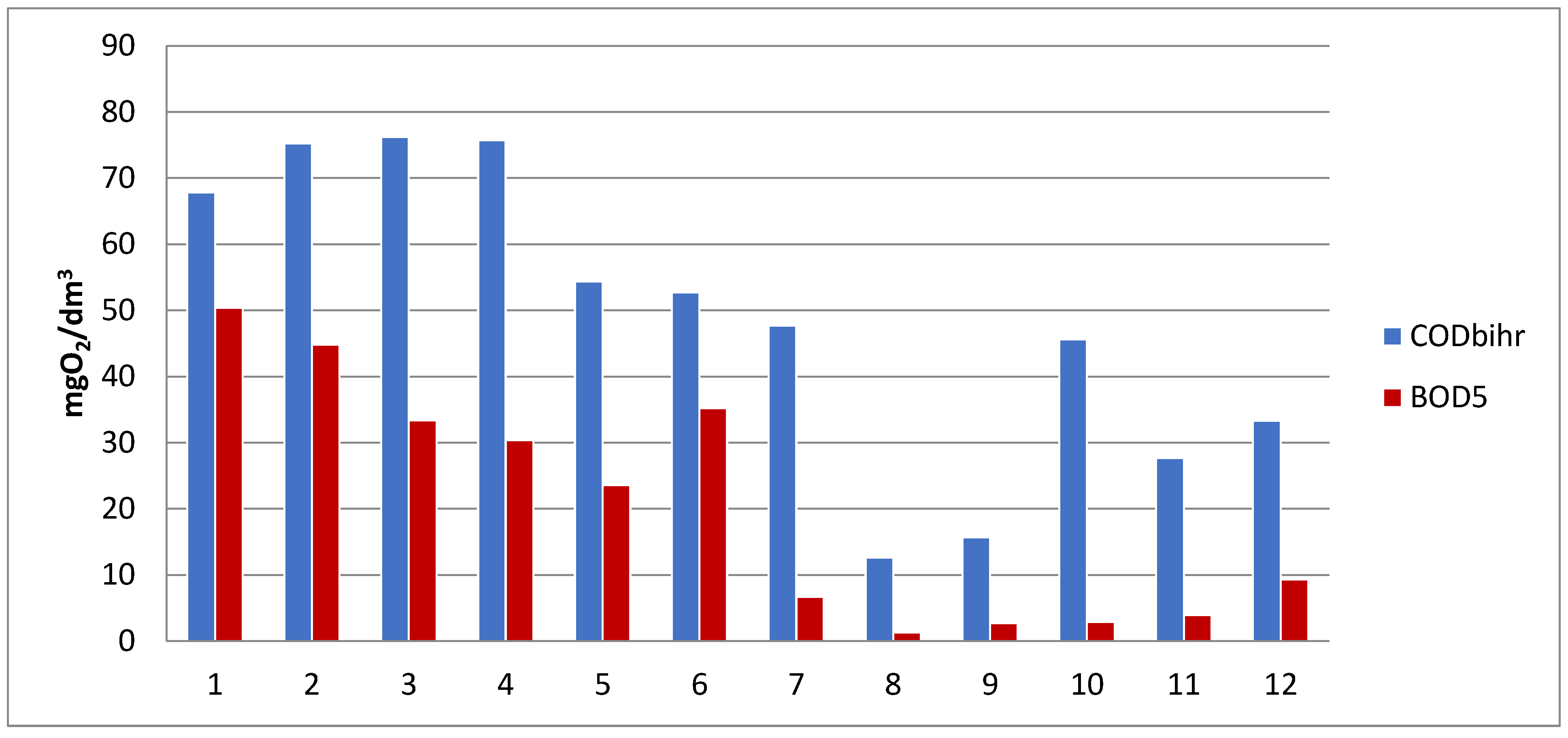
| Object of Study | CODbihr, mgO2/dm3 | BOD5, mgO2/dm3 | BOD20, mgO2/dm3 | pH Environment |
|---|---|---|---|---|
| Reservoir №1 | 67.8 | 50.4 | - | 6.9 |
| Reservoir №2 | 75.2 | 44.8 | - | 7.5 |
| Reservoir №3 | 76.2 | 33.4 | - | 7.3 |
| Reservoir №4 | 75.7 | 30.4 | - | 7.1 |
| Reservoir №5 | 54.4 | 23.6 | - | 7.0 |
| Reservoir №6 | 52.7 | 35.2 | - | 6.7 |
| Reservoir №7 | 47.7 | 6.7 | 34.6 | 6.4 |
| Reservoir №8 | 12.6 | 1.3 | 5.9 | 7.3 |
| Reservoir №9 | 15.7 | 2.7 | 4.5 | 7.5 |
| Reservoir №10 | 45.6 | 2.9 | 5.1 | 7.7 |
| Reservoir №11 | 27.7 | 3.9 | 8.9 | 7.8 |
| Reservoir №12 | 33.3 | 9.3 | 12.9 | 7.9 |


| № | Element | Symbol | MAC mg/kg | Clarke According to Wedepohl, mg/kg | Total Content of Elements in Samples, mg/kg | |||
|---|---|---|---|---|---|---|---|---|
| №1 | №2 | №3 | №4 | |||||
| 1 | Copper | Cu | 33.0 | 30.000 | 32.26 | 37.18 | 21.99 | 33.48 |
| 2 | Cadmium | CD | 0.5 | - | <3.00 | <3.00 | <3.00 | <3.00 |
| 3 | Lead | Pb | 32.0 | 15.000 | 22.02 | 25.85 | 22.04 | 21.12 |
| 4 | Manganese | Mn | 1500.0 | 690.000 | 647.71 | 920.21 | 775.59 | 617.88 |
| 5 | Arsenic | As | 2.0 | 1.700 | 14.27 | 15.15 | 13.35 | 20.33 |
| 6 | Aluminum | Al | - | 78,300 | 80,693.59 | 72,287.15 | 59,135.18 | 69,340.57 |
| 7 | Bismuth | Bi | - | 0.200 | <1.00 | <1.00 | <1.00 | <1.00 |
| 8 | Iron | Fe | - | 35,400 | 48,164.24 | 40,175.00 | 36,744.65 | 38,934.95 |
| 9 | Cobalt | Co | - | 12.000 | 18.66 | 16.72 | 15.23 | 15.51 |
| 10 | Hafnium | Hf | - | 3.000 | <5.00 | <5.00 | <5.00 | <5.00 |
| 11 | Nickel | Ni | - | 44.000 | 43.41 | 32.83 | 30.67 | 33.39 |
| 12 | Tin | Sc | - | 14.000 | <3.00 | <3.00 | <3.00 | <3.00 |
| 13 | Silver | Ag | - | 0.060 | <1.00 | <1.00 | <1.00 | <1.00 |
| 14 | Thallium | Tl | - | 1.300 | <10.00 | <10.00 | <10.00 | <10.00 |
| 15 | Chromium | Cr | - | 70.000 | 112.62 | 83.65 | 77.33 | 99.20 |
| 16 | Zinc | Zn | - | 60.000 | 106.18 | 96.44 | 73.58 | 90.69 |
| 17 | Vanadium | V | - | 95.000 | 139.20 | 109.53 | 99.17 | 115.87 |
| 18 | Antimony | Sb | - | - | <5.00 | <5.00 | <5.00 | <5.00 |
| 19 | Tungsten | W | - | 1.300 | 2.23 | 2.01 | 2.03 | 2.13 |
| 20 | Tantalum | Ta | - | 3.400 | <10.00 | <10.00 | <10.00 | <10.00 |
| 21 | Thorium | Th | - | 11.000 | <5.00 | <5.00 | <5.00 | <5.00 |
| 22 | Beryllium | Be | - | 2.000 | 2.00 | 2.00 | 2.00 | 2.00 |
| 23 | Ytterbium | Yb | - | 3.400 | 3.00 | <3.00 | <3.00 | <3.00 |
| 24 | Yttrium | Y | - | 34.000 | 27.31 | 29.07 | 20.85 | 25.45 |
| 25 | Lanthanum | La | - | 44.000 | 29.13 | 33.24 | 19.79 | 26.00 |
| 26 | Scandium | Sc | - | 14.000 | 17.03 | 13.34 | 11.14 | 13.74 |
| 27 | Cerium | Ce | - | 75.000 | 66.92 | 69.51 | 50.30 | 59.21 |
| 28 | Lithium | Li | - | 30.000 | 42.52 | 27.89 | 28.17 | 28.07 |
| 29 | Barium | Ba | - | 590.000 | 534.60 | 657.10 | 495.10 | 489.00 |
| 30 | Strontium | Sr | - | 290.000 | 92.09 | 111.10 | 92.46 | 92.53 |
| 31 | Gallium | Ga | - | 17.000 | 15.14 | 12.82 | 12.52 | 12.85 |
| 32 | Germanium | Ge | - | 1.300 | <5.00 | <5.00 | <5.00 | <5.00 |
| 33 | Indium | In | - | 0.070 | <5.00 | <5.00 | <5.00 | <5.00 |
| 34 | Zirconium | Zr | - | 160.000 | 83.41 | 72.78 | 69.24 | 78.10 |
| 35 | Molybdenum | Mo | - | 1.000 | <3.00 | <3 | 5.45 | 3.89 |
| 36 | Niobium | Nb | - | 20.000 | 9.94 | 8.38 | 8.88 | 9.36 |
| 37 | Tellurium | Te | - | 0.002 | <20.00 | <20.00 | <20.00 | <20.00 |
| 38 | Titanium | Ti | - | 4700.000 | 5765.40 | 4952.60 | 4645.40 | 5494.00 |
| 39 | Phosphorus | P | - | 810.000 | 1119.84 | 1698.10 | 896.83 | 1048.64 |
| 40 | Bor | B | - | 9.000 | 56.04 | 75.01 | 40.85 | 105.40 |
| Object of Study | CMPCI/MPC (CCi/Cph) | Object of Study | CMPCI/MPC (CCi/Cph) |
|---|---|---|---|
| Dry Reservoir №1 | CMPC (As) = 7.0 CCi (Fe) = 1.3 CCi (Co) = 1.3 CCi (Cr) = 1.6 CCi (Zn) = 1.7 CCi (V) = 1.4 CCi (W) = 1.7 CCi (Sc) = 1.2 CCi (Li) = 1.4 CCi (Ti) = 1.2 CCi (P) = 1.4 CCi (B) = 6.2 | Dried Reservoir №3 | CMPC (As) = 6.7 CCi (Co) = 1.3 CCi (Cr) = 1.1 CCi (Zn) = 1.2 CCi (V) = 1.0 CCi (W) = 1.5 CCi (Mo) = 5.4 CCi (P) = 1.1 CCi (B) = 4.5 |
| Dried Reservoir №2 | CMPC (As) = 7.5 CMPC (Cu) = 1.2 CCi (Co) = 1.4 CCi (Cr) = 1.1 CCi (Zn) = 1.6 CCi (V) = 1.1 CCi (W) = 1.5 CCi (Ba) = 1.1 CCi (Ti) = 1.0 CCi (P) = 2.0 CCi (B) = 8.3 | Dried Reservoir №4 | CMPC (As) = 10.0 CMPC (Cu) = 1.0 CCi (Co) = 1.3 CCi (Cr) = 1.4 CCi (Zn) = 1.5 CCi (V) = 1.2 CCi (W) = 1.6 CCi (Mo) = 3.9 CCi (Ti) = 1.1 CCi (P) = 1.3 CCi (B) = 11.7 |
References
- Gathagu, J.N.; Mourad, K.A.; Sang, J. Effectiveness of contour farming and filter strips on ecosystem services. Water 2018, 10, 1312. [Google Scholar] [CrossRef] [Scilit]
- Sahu, M.; Gu, R.R. Modeling the effects of riparian buffer zone and contour strips on stream water quality. Ecol. Eng. 2009, 35, 1167–1177. [Google Scholar] [CrossRef] [Scilit]
- Ellison, D.; Morris, C.E.; Locatelli, B.; Sheil, D.; Cohen, J.; Murdiyarso, D.; Gutierrez, V.; van Noordwijk, M.; Creed, I.F.; Pokorny, J.; et al. Trees, Forests and Water: Cool Insights for a Hot World. Glob. Environ. Chang. 2017, 43, 51–61. [Google Scholar] [CrossRef] [Scilit]
- Sligdi, E.E.; Morgan, R.P.C. Contour grass strips: A laboratory simulation of their role in soil erosion control. Soil Technol. 1995, 8, 109–117. [Google Scholar] [CrossRef] [Scilit]
- Sheil, D. Forests, Atmospheric Water and an Uncertain Future: The New Biology of the Global Water Cycle. For. Ecosyst. 2018, 5, 19. [Google Scholar] [CrossRef] [Scilit]
- Quine, T.A.; Walling, D.E.; Chakela, Q.K.; Mandiringana, O.T.; Zhang, X. Rates and patterns of tillage and water erosion on terraces and contour strips: Evidence from caesium-137 measurements. Catena 1999, 36, 115–142. [Google Scholar] [CrossRef] [Scilit]
- Kinama, J.M.; Stigter, C.J.; Ong, C.K.; Ng’ang’a, J.K.; Gichuki, F.N. Contour hedgerows and grass strips in erosion and runoff control on sloping land in semi-arid Kenya. Arid Land Res. Manag. 2007, 21, 1–19. [Google Scholar] [CrossRef] [Scilit]
- Dillon, P.; Stuyfzand, P.; Grischek, T.; Lluria, M.; Pyne, R.D.G.; Jain, R.C.; Bear, J.; Schwarz, J.; Wang, W.; Fernandez, E.; et al. Sixty years of global progress in managed aquifer recharge. Hydrogeol. J. 2019, 27, 1–30. [Google Scholar] [CrossRef] [Scilit]
- Stefan, C.; Ansems, N. Web-Based Global Inventory of Managed Aquifer Recharge Applications. Sustainability 2018, 10, 3667. [Google Scholar] [CrossRef] [Scilit]
- Leontieva, I.V.; Yannikova, S.A.; Struchkova, A.S. Modelling the Hydrodynamic Regime of the Metegero-Ichersky Aquifer After Resumption of the Exploitation of the “Mir” Deposit. Vestn. VSU. Ser. Geol. 2022, 54, 1. [Google Scholar] [CrossRef] [Scilit]
- Golovina, E.; Khloponina, V.; Tsiglianu, P.; Zhu, R. Organizational, Economic and Regulatory Aspects of Groundwater Resources Extraction by Individuals (Case of the Russian Federation). Resources 2023, 12, 89. [Google Scholar] [CrossRef] [Scilit]
- Serdyuk, O.V. Current Legal Problems of Groundwater Use. Probl. Zak. 2011. Available online: https://cyberleninka.ru/article/n/aktualnye-pravovye-problemy-ispolzovaniya-podzemnyh-vod (accessed on 11 November 2025). (In Russian)
- Bachand, P.A.M.; Roy, S.B.; Choperena, J.; Cameron, D.; Horwath, W.R. Implications of Using On-Farm Flood Flow Capture to Recharge Groundwater and Mitigate Flood Risks along the Kings River, California. Environ. Sci. Technol. 2014, 48, 13601–13609. [Google Scholar] [CrossRef] [Scilit]
- Dahlke, H.E.; Brown, A.G.; Orloff, S.; O’Geen, A.T. Managed Winter Flooding of Alfalfa Recharges Groundwater with Minimal Crop Damage. Calif. Agric. 2018, 72, 65–75. [Google Scholar] [CrossRef] [Scilit]
- Harter, T.; Dahlke, H. Out of Sight but Not Out of Mind: California Refocuses on Groundwater. Calif. Agric. 2014, 68, 54–64. [Google Scholar] [CrossRef] [Scilit]
- Massuel, S.; Perrin, J.; Mascre, C.; Mohamed, A.; Boisson, A.; Ahmed, S. Managed Aquifer Recharge in Irrigated Areas: Integration of Surface and Subsurface Water Management. Hydrogeol. J. 2014, 22, 1293–1306. [Google Scholar]
- Thapa, B.B.; Cassel, D.K.; Garrity, D.P. Ridge tillage and contour natural grass barrier strips reduce tillage erosion. Soil Tillage Res. 1999, 51, 341–356. [Google Scholar] [CrossRef] [Scilit]
- Tyndall, J.C.; Schulte Moore, L.A.; Liebman, M.; Helmers, M. Field-level financial assessment of contour prairie strips for enhancement of environmental quality. Environ. Manag. 2013, 52, 736–747. [Google Scholar] [CrossRef] [Scilit]
- Hwang, T.; Band, L.E.; Miniat, C.F.; Song, C.; Bolstad, P.V.; Vose, J.M.; Love, J.P. Divergent Phenological Response to Hydroclimate Variability in Forested Mountain Watersheds. Glob. Chang. Biol. 2014, 20, 2580–2595. [Google Scholar] [CrossRef] [Scilit]
- He, A.R.; Kong, F.F.; Shao, J. Novel curved roll contour technology for profile control in hot strip mills. Ironmak. Steelmak. 2015, 42, 55–62. [Google Scholar] [CrossRef] [Scilit]
- Tadesse, L.D.; Morgan, R.P.C. Contour grass strips: A laboratory simulation of their role in erosion control using live grasses. Soil Technol. 1996, 9, 83–89. [Google Scholar] [CrossRef] [Scilit]
- Garrity, D.P. Contour farming based on natural vegetative strips: Expanding the scope for increased food crop production on sloping lands in Asia. Environ. Dev. Sustain. 1999, 1, 323–336. [Google Scholar] [CrossRef] [Scilit]
- Makarov, O.A.; Demidov, V.V.; Karpova, D.V.; Shulga, P.S.; Abdulhanova, D.R.; Esafova, E.N.; Kubarev, E.N.; Mikhaylovskiy, V.I. Prospects for the Development of Economic Assessment of Eroded Soils. Vestn. Moskov. Univ. Ser. 17 Soil Sci. 2024, 79, 7–18. [Google Scholar]
- Hudson, N.W. Soil Conservation; Batsford Academic and Educational Ltd.: London, UK, 1981. [Google Scholar]
- Dahlke, H.E.; Brown, A.G.; Orloff, S.; Putnam, D.; O’Geen, A.T. Managed Aquifer Recharge as a Tool to Enhance Groundwater Sustainability. Calif. Agric. 2018, 72, 12–22. [Google Scholar]
- Scanlon, B.R.; Reedy, R.C.; Faunt, C.C.; Pool, D.; Uhlman, K. Enhancing Drought Resilience with Conjunctive Use and Managed Aquifer Recharge in California and Arizona. Environ. Res. Lett. 2016, 11, 035013. [Google Scholar] [CrossRef] [Scilit]
- Ghassemi, F.; White, I. Inter-Basin Water Transfer: Case Studies from Australia, United States, Canada, China and India; Cambridge University Press: Cambridge, UK, 2007. [Google Scholar]
- Suleymanov, V.K.; Kurbanismailova, A.S. Artificial Recharge of Groundwater Reserves as a Method for Protection Against Depletion. Proc. Inst. Geol. Far East. Branch RAS 2020, 41–45. [Google Scholar] [CrossRef] [Scilit]
- Kulik, K.N. Agroforestry Melioration: Protective Forest Plantings for Erosion and Land Degradation Control. Vopr. Lesn. Nauk. 2023, 123, 8–15. [Google Scholar] [CrossRef] [Scilit]
- Kryuchkov, S.N.; Belyaev, A.I.; Pugacheva, A.M. Effective Methods of Forest Breeding and Varietal Seed Production for Forest Reclamation of Arid Territories of European Russia. Sib. J. Life Sci. Agric. 2025, 17, 456–477. [Google Scholar] [CrossRef] [Scilit]
- Li, Z.; Zhu, Q.; Gold, C. Digital Terrain Modeling: Principles and Methodology; CRC Press: Boca Raton, FL, USA, 2004. [Google Scholar]
- Malczewski, J. GIS-Based Multicriteria Decision Analysis: A Survey of the Literature. Int. J. Geogr. Inf. Sci. 2006, 20, 703–726. [Google Scholar] [CrossRef] [Scilit]
- Saaty, T.L. The Analytic Hierarchy Process; McGraw-Hill: New York, NY, USA, 1980. [Google Scholar]
- Rahman, M.A.; Rusteberg, B.; Gogu, R.C.; Ferreira, J.P.L.; Sauter, M.; Kabir, S. A New Spatial Multi-Criteria Decision Support Tool for Site Selection for Implementation of Managed Aquifer Recharge. J. Environ. Manag. 2012, 99, 61–75. [Google Scholar] [CrossRef] [Scilit]
- Kort, J.; Collins, M.; Ditsch, D. A Review of Soil Erosion Potential Associated with Biomass Crops. Biomass Bioenergy 1998, 14, 351–359. [Google Scholar] [CrossRef] [Scilit]
- Kort, J. Benefits of Windbreaks to Field and Forage Crops. Agric. Ecosyst. Environ. 1988, 22/23, 165–190. [Google Scholar] [CrossRef] [Scilit]
- Brandle, J.R.; Hodges, L.; Zhou, X.H. Windbreaks in North American Agricultural Systems. Agrofor. Syst. 2004, 61–62, 65–78. [Google Scholar] [CrossRef] [Scilit]
- Koshelev, A.V.; Vedeneeva, V.A. Biological Reclamation of Disturbed Agricultural Lands in the Volgograd Trans-Volga Region. Res. Crops 2023, 24, 191–197. [Google Scholar] [CrossRef] [Scilit]
- Jose, S.; Bardhan, S. Agroforestry for Biomass Production and Carbon Sequestration: An Overview. Agrofor. Syst. 2012, 86, 105–111. [Google Scholar] [CrossRef] [Scilit]
- Mahdawi, Q.; Sagin, J.; Absametov, M.; Zaryab, A. Water Recharges Suitability in Kabul Aquifer System within the Upper Indus Basin. Water 2022, 14, 2390. [Google Scholar] [CrossRef] [Scilit]
- Muñoz Sabater, J. ERA5-Land Monthly Averaged Data from 1981 to Present. Copernicus Climate Change Service (C3S) Climate Data Store (CDS). Available online: https://cds.climate.copernicus.eu/datasets/reanalysis-era5-land-monthly-means?tab=overview (accessed on 11 November 2025).
- Arystanov, A.; Sagin, J.; Karabkina, N.; Arystanova, R.; Yermekov, F.; Kabzhanova, G.; Bekseitova, R.; Aktymbayeva, A.; Kutymova, N. Automatic Classification of Agricultural Crops Using Sentinel-2 Data in the Rainfed Zone of Southern Kazakhstan. Agronomy 2025, 15, 2040. [Google Scholar] [CrossRef] [Scilit]
- Arystanov, A.; Karabkina, N.; Sagin, J.; Nurguzhin, M.; King, R.; Bekseitova, R. Use of Indices Applied to Remote Sensing for Establishing Winter–Spring Cropping Areas in the Republic of Kazakhstan. Sustainability 2024, 16, 7548. [Google Scholar] [CrossRef] [Scilit]
- Kabzhanova, G.; Arystanova, R.; Bissembayev, A.; Arystanov, A.; Sagin, J.; Nasiyev, B.; Kurmasheva, A. Remote Sensing Applications for Pasture Assessment in Kazakhstan. Agronomy 2025, 15, 526. [Google Scholar] [CrossRef] [Scilit]
- Onglassynov, Z.; Berndtsson, R.; Rakhimova, V.; Rakhimov, T.; Jabassov, A.; Muratova, M.; Tussupova, K. GIS-Based Multi-Criteria Assessment of Managed Aquifer Recharge Zones: A Novel Framework Integrating Remote Sensing and AHP-MCDA Tailored for Central Asia. Water 2025, 17, 2774. [Google Scholar] [CrossRef] [Scilit]
- Vandala, B.; Mahed, G. Managed Aquifer Recharge (MAR) Site Suitability in Nelson Mandela Bay: The Application of Multi-Criteria Decision Analysis Techniques. Sustain. Water Resour. Manag. 2025, 11, 78. [Google Scholar] [CrossRef] [Scilit]
- Marwaha, N.; Kourakos, G.; Levintal, E.; Dahlke, H.E. Identifying Agricultural Managed Aquifer Recharge Locations Using a GIS-Based MCDA Coupled with Groundwater Modelling and Particle Tracking. Water Resour. Res. 2021, 57, 2020028811. [Google Scholar] [CrossRef] [Scilit]
- Martins, T.N.; Leitão, T.E.; Oliveira, M.M.; Panagiotou, C.F.; Stefan, C.; Chkirbene, A.; Portela, M.M. Proposal for a Managed Aquifer Recharge Feasibility Index Mapping Using MCDA: Application to Southern Portugal. J. Hydrol. 2024, 26, 101280. [Google Scholar]
- AbdelRahman, M.A.E.; Yossif, T.M.; Metwaly, M.M. Enhancing Land Suitability Assessment through Integration of AHP-GIS Based MCDA. Sci. Rep. 2025, 15, 31370. [Google Scholar] [CrossRef] [Scilit] [PubMed]
- Kumar, N.; Singh, S.K.; Obi Reddy, G.P.; Mishra, V.N.; Bajpai, R.K. Remote Sensing Applications in Mapping Salt Affected Soils. Agric. Rev. 2021, 42, 257–266. [Google Scholar] [CrossRef] [Scilit]
- Gichan, D.V.; Teben’kova, D.N. Overgrowth of Agricultural Lands by Woody Vegetation: Scale, Causes, Ways of Use. Vopr. Lesn. Nauk. For. Sci. Issues 2023, 3, 45–53. [Google Scholar]
- Mozgeris, G. Owner mapping for forest scenario modelling. For. Syst. 2017, 26, 39–49. [Google Scholar]
- Dolinska, A. Bringing Farmers into the Game: Strengthening Farmers’ Role in Irrigation Management Through a Simulation Game. Int. J. Water Resour. Dev. 2017, 33, 941–961. [Google Scholar]
- Fang, D. Combined Effects of Urbanization and Climate Change on Evapotranspiration in the Qinhuai River Basin. J. Hydrol. 2020, 586, 124863. [Google Scholar]
- Korneeva, E.A.; Belyaev, A.I. Assessment of the Impact of Forest Reclamation Measures for the Adaptation of Agriculture to Climate Change in the South of the Russian Plain. Forests 2023, 14, 1593. [Google Scholar] [CrossRef] [Scilit]
- Horak, C.N.; Assef, Y.A.; Miserendino, M.L. Assessing effects of confined animal production systems on water quality, ecological integrity, and macroinvertebrates at small piedmont streams (Patagonia, Argentina). Agric. Water Manag. 2019, 216, 242–253. [Google Scholar] [CrossRef] [Scilit]
- Al-Ghobari, H.M.; Dewidar, A.Z. Integrating deficit irrigation into surface and subsurface drip irrigation as a strategy to save water in arid regions. Agric. Water Manag. 2018, 209, 55–61. [Google Scholar] [CrossRef] [Scilit]
- Wang, Q.; Zhao, X.; Tian, P.; Liu, S.; Sun, Z. Bioclimate and arbuscular mycorrhizal fungi regulate continental biogeographic variations in the effect of nitrogen deposition on the temperature sensitivity of soil organic carbon decomposition. Land Degrad. Dev. 2021, 32, 4087–4098. [Google Scholar] [CrossRef] [Scilit]
- Terin, A.A. Formation of Forest Stands on Reclaimed Lands in the Pre-Forest Steppe of Sverdlovsk Region. Ph.D. Thesis, Altai State Agricultural University, Barnaul, Russia, 2014. Available online: https://www.dissercat.com/content/formirovanie-lesnykh-nasazhdenii-na-rekultivirovannykh-zemlyakh-v-podzone-predlesostepnykh-s (accessed on 11 November 2025).
- Golovina, E.I.; Grebneva, A.V. Management of Groundwater Resources in Transboundary Territories (the Case of the Russian Federation and the Republic of Estonia). J. Min. Inst. 2021, 252, 788–800. [Google Scholar] [CrossRef] [Scilit]
- FAO. Agroforestry and Climate Change Adaptation: Practices from Around the World; Food and Agriculture Organization of the United Nations: Rome, Italy, 2018. [Google Scholar]
- Gorohov, Y. Bio Sphere, Bio pump, Biosphere Civilization. 2025. Available online: http://dve100.com/sekciya-16-yu-i-gorohov (accessed on 25 October 2025).
- de Wekker, S.F.J.; Koutavas, A.; Betts, R.A. A Review of the Mechanisms Acting Behind the Strong Covariance Between the Great Plains Precipitation and the Boreal Forest SST ECV. Atmos. Chem. Phys. 2020, 20, 11569–11600. [Google Scholar]
- Forest, Rainfall Recycling: Trees as Rainmakers, 2010, The role of Forests in the Water Cycle in Focus at the Global Landscapes Forum, 2018. Available online: https://forestsnews.cifor.org/54600/rainfall-recycling-trees-rainmakers?fnl=en (accessed on 20 June 2025).
- Spracklen, D.V.; Arnold, S.R.; Taylor, C.M. Observations of Increased Tropical Rainfall Preceded by Air Passage over Forests. Nature 2012, 489, 282–285. [Google Scholar] [CrossRef] [Scilit] [PubMed]




| Criterion | Class Criteria | Standards (Class) |
|---|---|---|
| Geology | Wend (V) | 1 |
| Ordovician Lena-Dolina stage (O2ld) | 2 | |
| Ordovician Lena-Dolinian–Kugartian (O2ld-k); Ordovician granitoids and dacites (γδO3); Lower Visean Carboniferous 1-2 (C1v1-2); Lower Bashkir Carboniferous (C1I); Middle–Upper Carboniferous (C2-3) | 3 | |
| Upper Ordovician (O3); Middle–Upper Ordovician (O2-3); Ordovician Cougartian (O2k); Devonian Frasnian–Famennian (D3fm); Carboniferous Lower Visean–Serpukhovian (C1v2-s); Middle Moscow Carboniferous (C2bm) | 4 | |
| Devonian, middle–upper (D2-3) | 5 | |
| Slope | >5° | 1 |
| 2–5° | 2 | |
| 2–0.5° | 3 | |
| 0.2–0.5° | 4 | |
| 0–0.2° | 5 | |
| Precipitation | <379 mm | 1 |
| 379–392 mm | 2 | |
| 392–405 mm | 3 | |
| 405–418 mm | 4 | |
| >418 mm | 5 | |
| Soil | Salt marshes | 1 |
| Salt licks, solonetz | 2 | |
| Dark-gray forest, meadow | 3 | |
| Leached chernozems | 4 | |
| Chernozems | 5 | |
| Soil salinization | Very high (EC 8–15 dS/m) | 1 |
| High (EC 4–8 dS/m) | 2 | |
| Moderate (EC 2–4 dS/m) | 3 | |
| Weak (EC 0.75–2 dS/m) | 4 | |
| None (EC < 0.75 dS/m) | 5 | |
| Land use | Permanent reservoirs | 1 |
| Forest | 2 | |
| Sandy and rocky areas, sparse vegetation | 3 | |
| Arable land | 4 | |
| Natural grass pastures | 5 |
| Criteria | Weight, % |
|---|---|
| Slope | 22.90 |
| Land use | 10.03 |
| Soil | 17.44 |
| Soil salinization | 5.97 |
| Geology | 40.63 |
| Precipitation | 3.02 |
| Designation | Type | % | Lithology |
|---|---|---|---|
 | Ordovician, Middle, Lensko–Dolinsky Stage (OldLd) | 27.4 | deep-water clay shales, siltstones, siliceous deposits. |
 | Ordovician, Lensko–Dolinsky-Kugartsky (OldLd-k) | 21.4 | alternation of shales, tuffites, sandstones, possible basalt interlayers. interpretation: transition zone between tiers, possible signs of volcanic activity. |
 | Middle–Upper Devon (d2-3) | 11.6 | limestones, dolomites, more rarely sandstones and tuffaceous deposits. features: there are reef structures (bioherms, biostromes). |
 | Ordovician, Middle-Upper (O2-3) | 11.1 | limestones, dolomites, sometimes sandstones and siliceous shales. setting: fault-lined near-fault marine basins (possibly rift or transtension basins). |
 | Ordovician, Lower, Formation 3 (O13) | 7.5 | mainly siltstones, mudstones, and limestones; sandstones and siliceous shales occur in some places. shelf and coastal–marine basins, sedimentation in relatively shallow-water conditions. |
 | Ordovician, Kugart Stage (OkK) | 4.4 | limestones, carbonate–silicate rocks. environment: platform marine sediments (stable shelf). |
 | Carboniferous, Lower Visean 1-2 (CvV1-2) | 3.9 | carbonate–clay deposits (limestones, dolomites, clay shales). setting: marine, possibly with signs of lagoons. |
 | Carboniferous, Lower, Bashkir (Inzersky) Stage (CII) | 3.8 | coal-bearing strata, sandstones, siltstones. facies: lagoon–marine (alternating coastal and shallow-water deposits). |
 | Lower Visean 2–Serpukhov Carboniferous (CvV2-s) | 3.4 | fluvial–marine deposits (limestones, clay shales, carbonaceous interlayers). potential: promising for hydrocarbons. |
 | Devon, French–Famennian (D3fm) | 3.0 | limestones, dolomites, marls. conditions: carbonate platforms (shallow-sea basins). |
 | Vendian (V) | 2.5 | metamorphosed schists, quartzites, phyllites, and subordinate basalts. geological role: forms the foundation of the Paleozoic sedimentary cover. |
| Parameter | Recommendation |
|---|---|
| Lane type | Combined (tree and shrub) |
| Width | 20–30 m |
| Number of rows | 5–7 rows, alternating between high and low rocks |
| Planting density | 70–80% (moderate to avoid swirl zones) |
| Distance between lanes | 250–400 m for farmland, 100–150 m around settlements |
| Rock height | 10–15 m |
Disclaimer/Publisher’s Note: The statements, opinions and data contained in all publications are solely those of the individual author(s) and contributor(s) and not of MDPI and/or the editor(s). MDPI and/or the editor(s) disclaim responsibility for any injury to people or property resulting from any ideas, methods, instructions or products referred to in the content. |
© 2026 by the authors. Licensee MDPI, Basel, Switzerland. This article is an open access article distributed under the terms and conditions of the Creative Commons Attribution (CC BY) license.
Share and Cite
Sarsekova, D.; Sagin, J.; Perzadayeva, A.; Arystanova, R.; Arystanov, A.; Kezheneva, A.; Jumassultanova, S.; Satybaldiyeva, G.; Ospangaliyev, A. Farmers’ Land Sustainability Improvement with Soil, Geology, and Water Retention Assessment in North Kazakhstan. Sustainability 2026, 18, 1316. https://doi.org/10.3390/su18031316
Sarsekova D, Sagin J, Perzadayeva A, Arystanova R, Arystanov A, Kezheneva A, Jumassultanova S, Satybaldiyeva G, Ospangaliyev A. Farmers’ Land Sustainability Improvement with Soil, Geology, and Water Retention Assessment in North Kazakhstan. Sustainability. 2026; 18(3):1316. https://doi.org/10.3390/su18031316
Chicago/Turabian StyleSarsekova, Dani, Janay Sagin, Akmaral Perzadayeva, Ranida Arystanova, Asset Arystanov, Aruana Kezheneva, Saltanat Jumassultanova, Gulshat Satybaldiyeva, and Askhat Ospangaliyev. 2026. "Farmers’ Land Sustainability Improvement with Soil, Geology, and Water Retention Assessment in North Kazakhstan" Sustainability 18, no. 3: 1316. https://doi.org/10.3390/su18031316
APA StyleSarsekova, D., Sagin, J., Perzadayeva, A., Arystanova, R., Arystanov, A., Kezheneva, A., Jumassultanova, S., Satybaldiyeva, G., & Ospangaliyev, A. (2026). Farmers’ Land Sustainability Improvement with Soil, Geology, and Water Retention Assessment in North Kazakhstan. Sustainability, 18(3), 1316. https://doi.org/10.3390/su18031316