2. Literature Review
In recent years, the role of the ICT sector has significantly increased globally, but at the same time, understanding the connection between carbon emissions and ICT is necessary to determine whether ICT is advancing environmental sustainability or becoming a harmful factor. The Regional Comprehensive Economic Partnership has driven trade and technology to grow together, but now there is debate over whether this growth is environmentally friendly [
6]. ICT plays two roles: it helps drive industrialization and boost economic activity, but it also has a significant impact on the environment [
7]. Some scholars believe there is an inverse relationship between the development of the ICT industry and the amount of CO
2 emissions released into the atmosphere. However, other scholars emphasize that ICT is an essential element for growing the green economy, as we globally face climate change [
8]. ICT plays a significant role in developed countries, but its environmental impact remains unclear [
9]. According to World Bank data, the level of ICT has increased globally, and similarly, in Lithuania, the number of internet users has increased in the past few years [
10].
ICT use in Lithuania rose from 2020 to 2025. Among users, internet use in Lithuania in 2020 was significantly lower than in subsequent years. According to 2020 data, 78% of the population aged 16–74 used the internet via smartphones, and 82% of households had internet access at home. Meanwhile, in 2025, the number of internet users in Lithuania increased to 89.5%. Therefore, it can be stated that from 2020 to 2025, the share of the population using the internet increased from ~80% to ~89%, indicating a faster spread of ICT use in society. Further analysis of internet access in households in 2020 shows that about 82% of households have internet access, indicating a wide but not yet universal level of access. In 2024, according to the data, internet access at home reached 90.4%, up 8.3% from 2020. Since 2020, more and more residents have access to digital services and information technologies, which is an important indicator of ICT integration. When examining the growth of social and other digital activities, data from 2025 shows that the number of social network users is about 73.3% of the total population. The implementation of digital solutions in business and public services in Lithuania, using artificial intelligence (AI) and other modern information and communication technologies, significantly contributed to the development of ICT use. In 2025, internet access and connection quality improved in Lithuania, internet use increased, and mobile data connections advanced to 5G [
11,
12,
13,
14].
ICT and artificial intelligence (AI) are closely related, as AI is an advanced part of ICT. ICT forms the technological basis for the development, implementation, and application of AI. Therefore, ICT, as an indicator in this article, is essential and justifies its relevance. AI solutions cannot function without ICT infrastructure. Moreover, the latter consists of cloud computing, computer networks, servers, data transmission systems, and data repositories. ICT ensures data collection, transmission, and processing in real time, which is a prerequisite for the operation of AI algorithms. ICT provides an environment in which AI can function. AI is based on large amounts of data (Big Data) generated, stored, and managed in ICT systems. In the development of ICT, AI can be considered an advanced tool for data processing and analysis. AI expands the capabilities of traditional ICT, allowing not only the transmission or processing of information, but also its interpretation, prediction, and optimized decision-making [
15,
16,
17,
18].
A recent study examining the macroeconomic relationships among economic activity, electricity consumption, and CO
2 emissions in India from 1996 to 2020 found a long-term link between CO
2 emissions and economic dynamics. The study confirms that CO
2 emissions can be decoupled from economic activity if capital investment in the energy sector increases. The results of the study confirmed that economic activity and inflation increase CO
2 emissions, but the direct causal relationship between GDP and emissions is not established. In other words, it shows that economic activity does not necessarily automatically lead to an increase in emissions—it depends on other factors and their interactions [
19]. Scientific results from other authors have shown that ICT is significantly related to CO
2 emissions and economic activity in India. Empirical models show that the development of information and ICT has a statistically significant effect on CO
2 emissions and economic activity, often with a positive relationship, i.e., increasing ICT development is associated with higher GDP and CO
2 emissions. TROP (trade openness) shows a nonlinear relationship between ICT and CO
2 emissions. The results of the study reveal that the impact of ICT on CO
2 emissions is not linear but depends on specific regimes or threshold variables (e.g., the level of economic development or the degree of ICT diffusion). Holders have proven that ICT development has a positive effect on economic activity, especially in the long run, and the relationship between economic activity and CO
2 emissions depends on the level of ICT development. Nonlinear relationships between ICT, CO
2 emissions, and economic activity were found in models that include interactions between ICT and trade openness [
20]. The research, which examines the impact of three aspects of macroeconomic stability—growth stability, inflation stability, and exchange rate stability—on trade openness in the context of 20 Asian countries from 2011 to 2019, shows that trade openness has a negative relationship with growth stability in the short run, but contributes to improving growth stability in the long run. Meanwhile, the relationship between inflation stability and trade openness was not found to be significant [
21]. Other authors in the article propose the structure of new macroeconomic control-system models that allow analyzing the decoupling of emissions from economic activity (including GDP, capital, trade openness, energy use, and CO
2 emissions) across different economic cycles. trade openness is included as a significant macroeconomic factor to assess whether and how trade liberalization changes the relationship between economic activity and emissions. The study notes that the relationship between emissions and GDP is not constant or linear, especially in the context of high inflation, and finds that decoupling (separation of emissions from activity) is a stochastic phenomenon that depends on many macroeconomic factors and their interactions, including trade openness and inflation. The phenomenon of decoupling can manifest differently across economic activity (boom vs. recession periods), and trade openness can affect the ratio of CO
2 emissions to GDP, while inflation and energy import dynamics shape how decoupling unfolds in the post-crisis period. Increasing trade openness is often associated with both emissions and economic activity, but their interplay depends on other factors such as inflation, energy imports, and economic cycles. Although in some models, greater trade freedom may be associated with higher energy consumption and CO
2 emissions, especially in developing countries, where trade increases production. Inflation, as an intermediate factor in emissions dynamics, affects the relationship between CO
2 emissions and economic activity. Fluctuations in the economic cycle (spikes in inflation) modify emission trends, primarily through the energy and trade channels [
22].
In recent years, many academic works have examined the relationship between CO
2 emissions and trade openness [
23,
24,
25]. Global trade has been recognized in scientific research as one of the most important indicators influencing the environmental state [
26,
27]. While some research studies have shown that trade also contributes 20–30 percent of CO
2; this is interpreted as evidence of the need to reduce CO
2 from trade and to use sustainable practices to improve environmental conditions [
28]. In addition, trade emissions are imported and exported through trade in goods within an economy, known as net CO
2 emissions, embedded in trade. A positive value shows a country or region’s net importer of CO
2 emissions, whilst its net exporter is indicated by a negative value [
29]. One of the most important global concerns of the current period is striking a balance between economic growth in industrial countries and the need to preserve the environment. This issue arises from the requirement for socioeconomic progress, which enables people to live in society with ever higher standards of living [
30]. However, economic expansion also contributes to rising pollution levels and declining environmental standards [
31]. Furthermore, numerous papers have established that human economic activity is the primary producer of greenhouse gases. Nonetheless, economic expansion and fossil fuel consumption are positively associated with CO
2 emissions [
32,
33,
34].
In the reviewed scientific literature (as can be seen in the analysis presented in
Table A1, located in
Appendix A), several authors examine the relationships between economic activity, trade openness, ICT development, and CO
2 emissions. However, most existing studies are based on panel data from different countries, which may not capture the dynamics of a specific small country’s open economy, such as Lithuania’s. In addition, the literature often treats ICT as an energy-consuming technology or uses composite digital indices, and the role of ICT, measured by internet penetration as an indicator of digital integration, remains underexplored, especially in the context of one specific country’s time series. Relatively few studies simultaneously distinguish between the short- and long-term effects of industrialization, trade openness, and ICT on emissions using a linear ARDL model. However, the literature provides clear evidence that environmental impacts vary over time. Therefore, there is a lack of empirical studies in the scientific literature that reveal how trade openness and digitalization together affect the dynamics of CO
2 emissions in small, highly open, and digitally developed economies such as Lithuania. This research addresses the mentioned gaps and also provides valuable insights for future scholars who may study these areas in other regions or countries.
In the modern era, economic activities have increased due to ICT, which is linked to other sectors, such as the industrial sector, through trade openness. This research focuses on Lithuania, one of the top economies in the Baltic region and Europe, with a total population of 2.9 million and an area of 65,300 sq. km. Lithuania is a developed country with a strong economy, ranking 35th on the Human Development Index. Lithuania has the highest growth rates of ICT users in the Baltic States, with significant growth potential. The ICT sector generates 5.3% of Lithuania’s GDP and contributes to the development of other sectors. According to [
10], in Lithuania, agriculture accounted for about 4% of GDP in 2022, while industry and services accounted for 25% and 61% of GDP, respectively. Recently, emissions from the industrial sector have also risen. The average annual growth rate of industry is 14%. In addition, the results of this study can be adapted to other Baltic States, the European Union, and/or neighboring countries.
The following variables for the research were identified as relevant in the literature analysis: industrialization, ICT, trade openness, and economic activity, and their impact on CO
2 emissions. Electricity consumption per capita is excluded from the model because the study focuses on the indirect effects of ICT on CO
2 emissions rather than on the direct energy-consumption channel. The ICT variable in this research was used as the per-centage of internet users in the country [
6,
8,
35]. Moreover, it is not relevant to integrate electricity per capita data that values ICT impact, because it is not reflected in Lithuania’s national electricity consumption. Many studies analyze the ICT–CO
2 relationship without accounting for energy variables, treating ICT as internet penetration [
6,
8,
36,
37].
Based on the literature analysis and the identified academic gaps, taking into consideration that the literature is not unequivocal in the short term, when short-term effects can be temporary, contrary to long-run, or statistically insignificant.
The following hypotheses are formulated in this study: H1: Economic activity has a positive long-run effect on CO2 emissions (increases CO2 emissions). H2: Industrialization has a positive long-run effect on CO2 emissions. H3: Trade openness has a positive long-run effect on CO2 emissions. H4: ICT has a statistically significant long-run effect on CO2 emissions.
This research has the following objectives:
- 1.
To conduct the theoretical analysis of industrialization, ICT, economic activity, trade openness, and per capita CO2 in Lithuania.
- 2.
To design a model and evaluate the relationships among per capita CO2 and other complex variables, including industrialization, ICT, trade openness, and economic activity, in a short- and long-run perspective in Lithuania.
3. Materials and Methods
The goal of this research is to explore the relationships among industrialization, ICT, trade openness, and per capita CO2 in Lithuania from 2000 to 2024. This study contributes to the improvement of digital and environmental policy and advises policymakers by investigating the relationships among variables and their long- and short-run impacts in Lithuania. The study employs the Autoregressive Distributed Lag (ARDL) econometric method. This model is the most appropriate approach for evaluating both short- and long-run impacts of the chosen measures. Before applying the ARDL model, certain conditions must be fulfilled. To confirm these prerequisites, the Phillips–Perron (PP) unit root test and the Augmented Dickey–Fuller (ADF) test are used to assess whether the variables (industrialization, ICT, economic activity, trade openness, and per capita CO2) are stationary. Once the research part of checking the stationarity of measures is complete, the next step is to implement and test for cointegration among variables. The empirical approach used with the ARDL bounds test aims to determine whether a cointegrating relationship exists. If the measures are cointegrated, it indicates a long-term equilibrium relationship. Overall, if the described requirements are satisfied, the ARDL evaluation model is employed for planned analysis.
The application of natural logarithms to all selected variables in this research is motivated by standard econometric practice, as logarithmic transformation helps stabilize variance, reduce skewness, and allow coefficient interpretation in terms of elasticity. While this transformation is most applied to variables expressed in absolute values, its use for percentage-based variables is also well established in the empirical literature, provided that the variables are strictly positive and do not approach zero. For example, in this study, percentage-based variables (such as ICT penetration, measured by the share of internet users) remain well above zero throughout the sample period, ensuring the mathematical validity of the logarithmic transformation. Several empirical studies examining ICT diffusion, trade openness, and environmental outcomes apply logarithmic transformations to percentage variables in order to maintain consistency in the functional form and facilitate elasticity-based interpretation of coefficients [
6,
8,
27]. Moreover, using logarithms for percentage variables allows the estimated coefficients to be interpreted as semi-elasticities, capturing proportional changes rather than absolute changes, which is particularly relevant when assessing long-run relationships in ARDL frameworks. This approach also mitigates potential heteroskedasticity and improves model stability, especially in small samples. Nevertheless, it is acknowledged that logarithmic transformation of percentage variables may compress variation when values are bounded between 0 and 100. To address this concern, the results are interpreted cautiously, with the focus on statistical significance and effect direction rather than precise elasticity magnitudes.
In that study, multiple diagnostic tests are used to enhance the validity of the ARDL model results and ensure there are no issues with the model. The first part of the analysis consists of two parts: the first uses the ADF and PP unit root tests to assess the stationarity properties of the variables; the second section confirms the cointegration relationship across selected measures by applying the ARDL bounds test. The next step investigates the short- and long-run relationships using the ARDL model. The third part includes multiple diagnostic tests: serial correlation in the residuals is tested using the Breusch–Godfrey procedure; the Breusch–Pagan–Godfrey test examines heteroscedasticity; and the Ramsey RESET test is used to verify that the model is specified correctly. Moreover, the Variance Inflation Factor (VIF) is used to assess multicollinearity among the chosen variables.
This research is divided into several major sections. The
Section 1 is the introduction, which covers the background of the study. The
Section 2 analyses the scientific literature (literature review), which explains the findings of previous studies and their relevance to current research. In the
Section 3, the methodology is presented, describing the methods used and explaining how various tests are applied to achieve the research objectives. The
Section 4 presents the research results. In contrast, the
Section 5 and
Section 6 are dedicated to scientific discussion and the presentation of conclusions and recommendations for policymakers, along with a roadmap for future researchers.
3.1. CO2 and Industrialization
Over the past few years, the industrial sector has contributed to the country’s growth. However, this development has also created other environmental issues. The study by Patel et al. shows that industrial production is the primary driver of carbon emissions. Many scholars evaluating environmental issues have examined the association between industrialization and carbon emissions [
38,
39,
40,
41,
42,
43,
44,
45,
46]. According to [
44], the study’s empirical findings from OIC member nations between 1995 and 2020 indicate that industrialization has a positive influence on carbon emissions. Similarly, another study investigated the South Asian region from 1972 to 2021 and found that industrialization increased CO
2 emissions [
46]. However, single-country research conducted in Tunisia used data from 1980 to 2016 and found that industrialization worsened environmental conditions [
39].
3.2. CO2 and Information Communication and Technology
In recent years, carbon emissions and ICT have shown dual impacts. Some studies show a positive impact of ICT, while others indicate a negative one. Several research papers prove that ICT is helpful for environmental sustainability. Drawing on the literature analysis, this research investigates the impact of ICT on CO
2 emissions, a topic that remains debatable. In emerging economies, ICT helps reduce emissions and enhance environmental sustainability [
8]. In accordance with [
8], ICT in MENA countries not only contributes to environmental sustainability but also serves as a solution to environmental problems. A subsequent study found that in 26 high-income countries, ICT supports environmental sustainability and helps reduce emissions [
36], whereas another study found that ICT can harm the environment and increase emissions. Thus, research shows that ICT does not necessarily result in lower carbon emissions [
37]. Its environmental impact may vary depending on prevailing emission levels. Moreover, in China, ICT contributes to rising emissions and is considered one of the main factors driving this increase [
47]. In African regions, ICT has also been associated with higher emissions. More investment in the ICT sector is needed to help reduce these emissions [
48].
3.3. CO2 and Trade Openness
Earlier academic studies have examined the link between CO
2 emissions and trade openness, but the results have been inconsistent. For instance, Reference [
49] found that trade openness does not exert a statistically significant influence on CO
2 emissions in 64 developed countries between 2003 and 2017. Other scholars’ research findings show that trade openness in Africa is linked to higher carbon emissions in West, South, and North Africa; however, it has the opposite impact on CO
2 emissions in East and Central Africa [
50]. Additionally, using the ARDL tool, the regression results indicate that trade open-ness is a significant influencing factor on the sustainability of the environment in Serbia for the period 1995–2019 [
51]. The outcomes of a research study conducted in India show that, in the short term, trade openness has an inverse correlation with CO
2 emissions but a positive correlation with carbon emissions over the long run [
52]. In addition, in BRICS countries, trade openness as an element damages the environment [
53].
3.4. CO2 and Economic Activity
Economic expansion is geographically correlated with carbon emissions [
54]. Moreover, many studies show that economic growth and carbon emissions are positively associated [
55]. Meanwhile, other studies have found that economic growth and increased energy use have a substantial effect on CO
2 emissions [
56]. Nevertheless, economic activity is positively associated with CO
2 emissions in developed countries in Asia and Europe [
57]. For instance, in Turkey, research findings indicate that a 1% increase in CO
2 emissions results in a 0.553 and 0.297 increase in economic expansion. In simple terms, it implies that Turkey’s economic expansion may have a detrimental, long- and short-term impact on carbon emissions if it does not incorporate renewable energy [
28].
This research contributes to the economics literature and also provides a roadmap for future scholars who may extend this study to other regions. The uniqueness of this research lies in its investigation of the short- and long-run relationships among industrialization, ICT, economic activity, and trade openness on CO2 in a small economy—specifically a single-country context for Lithuania, a member of the Baltic States and the European Union. Per capita emissions (in tons) are used as proxies to measure the size of carbon emissions. To achieve the research objectives, this study employs the Augmented Dickey–Fuller and Phillips–Perron unit root tests, the ARDL bounds testing, the Variance Inflation Factor (VIF) test, the ARDL model, and diagnostic tests. The main goal of this research is to examine the long- and short-run relationships among ICT, industrialization, economic activity, and trade openness variables, and their impact on CO2 in Lithuania. By separating short-run from long-run dynamics, the analysis offers evidence on how the environmental effects of openness, growth, and digitalization unfold over time, using recent data up to 2024 and providing policy recommendations encouraging decarbonization strategies.
3.5. Research Methodology
This study adopts a quantitative research concept. The research database was designed using time-series data from reliable sources such as Our World in Data and the World Bank for the period 2000–2024. In this study, the dependent variable is defined as per capita CO2, while the main independent variables are industrialization, ICT, trade openness, and economic activity. Industrialization, trade openness, ICT, economic activity, and per capita CO2 were chosen as measures to evaluate the impact of the relationship in a short- and long-run perspective in Lithuania. The research employs Autoregressive Distributed Lag (ARDL) method. The ARDL method offers several advantages for this research. It is suitable for small datasets and produces valid results without errors. One of its main advantages is that it is the best approach for analyzing short- and long-run relationships within a single model among the primary variables and other independent measures. Moreover, before employing the ARDL model, certain conditions must be met. The PP and ADF unit root tests examine the stationarity properties of the measures at levels and first differences. Additionally, the ARDL bounds test provides evidence of cointegration among the measures. After verifying these conditions, the ARDL framework is utilized for subsequent investigation.
To improve the reliability of the research findings, several diagnostic tests are employed. The Breusch–Godfrey test is used to test for a serial correlation in the regression model. The absence of a serial correlation in the test results indicates that the model is correctly specified and that the estimated results are reliable. Similarly, the Breusch–Pagan–Godfrey test confirms heteroscedasticity. If the error variance is constant and the test detects no heteroscedasticity, the model’s standard errors can be considered reliable, allowing for accurate statistical inference and valid results. Likewise, the Ramsey RESET test checks whether the regression model is correctly specified, ensuring that the relationship between variables is accurately represented. If the test indicates that the model is well-specified, it implies no misspecification or omitted variables, leading to reliable results.
4. Results
Table 1 presents detailed information on complex measures and their respective sources of data.
The primary measure identified for this research is per capita CO
2, with other variables including industrialization, ICT, trade openness, and economic activity. The data for the chosen variables are for the period 2020–2024 and present full-year data. The data sources are presented in
Table 1.
The logarithmic transformation is most commonly applied to variables expressed in absolute terms; its use with percentages in this study is possible and is applied when the variables are positive. The following indicators are selected in percentages in this study: ICT and trade openness. They were transformed using the natural logarithm to ensure consistency across variables and to allow the estimated coefficients to be interpreted as elasticities. The logarithmic transformation also helps stabilize variance and improve comparability among variables measured in different units. Therefore, the ln specification is retained in the model and in the research results.
4.1. Model Formulation to Investigate Both the Long-Run and Short-Run Impact of Industrialization, ICT, Trade Openness, and Economic Activity on per Capita Emissions in Lithuania
General equations
The econometric research model can be presented in Equation (1):
here the chosen measures at a certain time
t that represent per capita carbon emissions, industrialization, ICT, trade openness, and economic activity are
,
,
,
and
, respectively.
The following
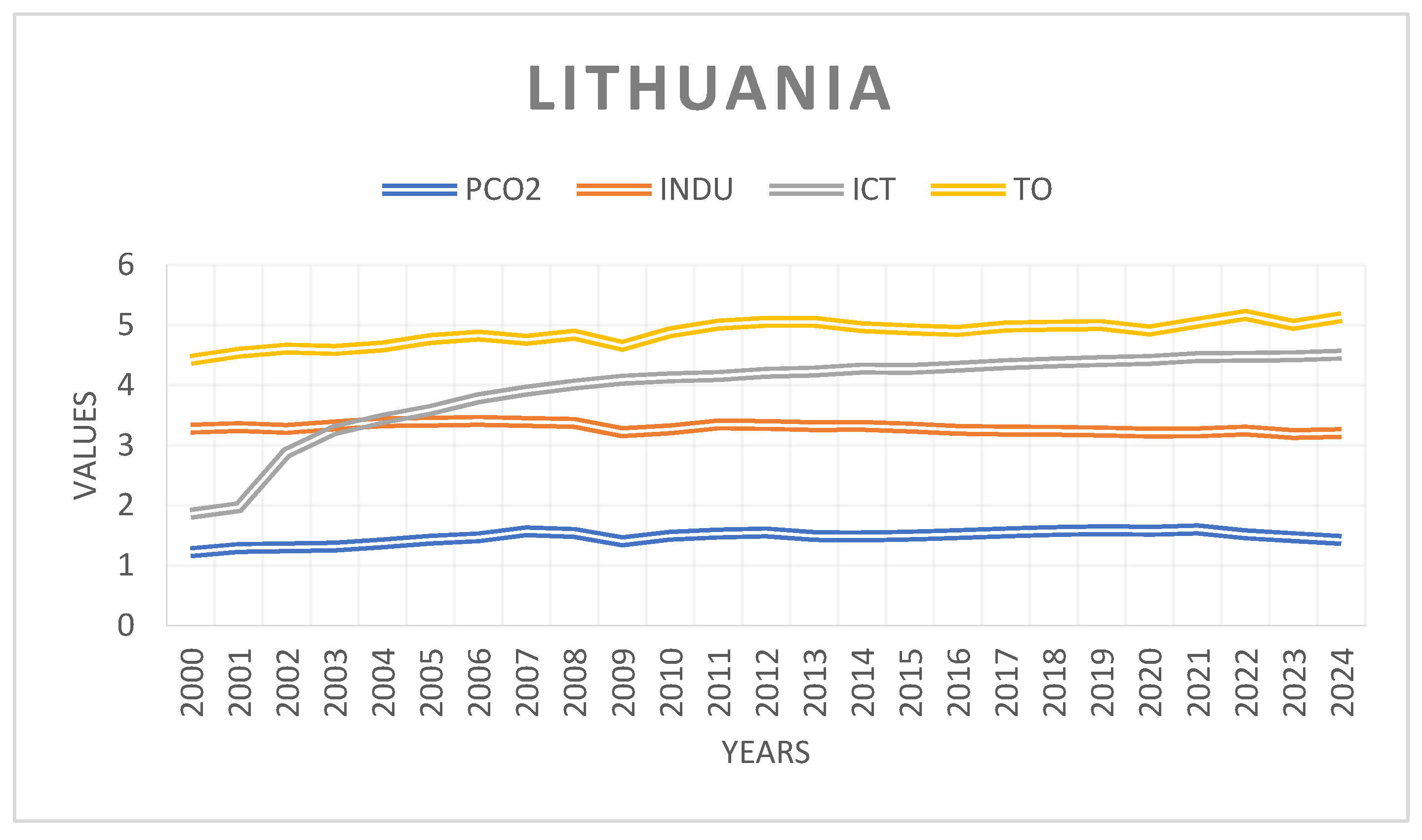
Figure 1 presents selected variables for Lithuania and their trends from 2000 to 2024. The sample size (2000–2024) is relatively small, although ARDL is suitable for small samples and can be applied to this research goal. Trend analysis refers to the process of examining data over time to identify patterns, trends, or changes in variables.
CO2 emissions per capita have fluctuated, including a temporary decrease during the global financial crisis. Around 2010, emissions remained relatively stable, increased slightly in the late 2010s, and decreased slightly after 2021. This indicates a general stabilization. Meanwhile, industrialization during the period analyzed shows a relatively stable situation. After a peak in the mid-2000s, the industrialization indicator gradually decreases, as industrialization moves away from industrial activities towards other sectors of the economy. Analyzing another indicator, ICT, shows that ICT penetration exhibits the most pronounced and consistent trend, indicating strong, continuous growth throughout the period. After rapid growth in the early 2000s, sustainable growth followed. This indicates rapid growth in internet users in Lithuania, the growth of users of other ICT technologies, and increasing digital integration. It can be seen that trade openness follows a general growth trajectory. After steady growth in the early and mid-2000s, it temporarily declines during periods of economic turmoil, but then resumes growth in subsequent years, indicating long-term integration into international trade.
4.2. ARDL Model Approach
This study employs the ARDL (Autoregressive Distributed Lag) econometric approach, which has been widely used in previous studies [
28,
58,
59]. Pesaran and Shin [
60] originally developed the ARDL model, which was later developed by Pesaran et al. [
61]. This model is considered one of the most effective econometric tools for analyzing both short- and long-run relationships within measures. In this study, the ARDL model is used, and the analysis is conducted in EViews 12 Student Version. Several important limitations must be met when applying this ARDL model. The first limitation involves ensuring the stationarity of the research measures. For this purpose, the Augmented Dickey–Fuller (ADF) unit root test, developed by Dickey et al. [
62], is applied to determine the stationarity of the measures—similarly, the Phillips–Perron unit root test, introduced by Pierre Perron and Peter C. B. Phillips is also used to test for stationarity. Furthermore, this study applies the ARDL bounds testing method proposed by Pesaran et al. (2001) [
60] to investigate cointegration among the variables. One of the key advantages of the ARDL method is its flexibility, which can be applied regardless of whether the data series are integrated at level I(0), first difference I(1), or a combination of both [
63]. Additionally, the ARDL approach is particularly appropriate for analyses with limited sample sizes, making it an ideal choice for this research [
61]. The following Equation (2) is intended for calculating the ARDL bounds as a testing framework:
In this specification, Δ denotes the first difference, εₜ represents the white noise error term, and α
0 captures the drift component. To determine the optimal lag length, the Akaike Information Criterion (AIC) is employed. To further investigate the short-run effects, first of all, the analysis employs the ECM to evaluate the correlation among measures over the long term. Equation (3) below presents the ECM form of Equation (2):
For short-run dynamics, denotes the ECM coefficients and Δ denotes first differences. At the same time, the error correction term reflects the speed at which deviations from long-run equilibrium are corrected after a short-run shock.
Evaluating the stationarity of measures through PP and ADF unit root test.
Ensuring the stability of all factors is important when examining and investigating econometric research [
64]. This study applies the PP and ADF unit root tests, with the corresponding results presented in
Table 2.
The PP unit root test is considered a robust test employed to verify the results of the ADF unit root test. The results indicate that CO2 emissions are stationary, as the null hypothesis of a unit root is rejected by both the ADF and PP tests at conventional significance levels. Therefore, CO2 is classified as integrated of order zero, I(0). Similarly, ICT is found to be stationary at levels, indicating that this variable is also I(0). In contrast, industrialization, trade openness, and economic activity are non-stationary at levels, as the unit root null hypothesis cannot be rejected. However, both the ADF and PP tests confirm stationarity, implying that these variables are integrated of order one, I(1). None of the variables is integrated of order two, I(2), which satisfies the necessary precondition for the application of the ARDL bounds testing approach. I(0) variables are lnPCO2 and lnICT; I(1) variables are lnINDU, lnTO, and InEA. When the first condition for using the ARDL approach is fulfilled, the next step is to conduct the ARDL bounds test.
The ARDL bound test is used to examine the existence of a cointegration relationship among selected variables.
Table 3 illustrates the outcomes of the ARDL bound test analysis. The value of the F-statistic, 15.89768, exceeds both the upper and lower limits at the 10%, 5%, 2.5%, and 1% statistical significance levels.
Based on the ARDL bound test outcomes, the measures are found to be cointegrated. Therefore, the findings from the ADF and PP unit root tests, together with the ARDL bound tests, suggest that the ARDL framework is suitable for analyzing both the long-run and short-run dynamics among the measures.
Autoregressive Distributed Lag (ARDL) model: Short-run and long-run effects.
Table 4 and
Table 5 summarize the present research findings, based on the ARDL model, which show that industrialization has a statistically significant positive impact on per capita carbon emissions in the short- and long-run. Moreover, a 1% increase in industrialization leads to a 0.8990% increase in CO
2 emissions in the short run and a 0.3771% increase in the long run. The empirical findings indicate that the effect of industrialization on CO
2 emissions is stronger in the short run than in the long run.
The long-run ARDL estimation results reveal that industrialization, ICT penetration, trade openness, and economic activity exert statistically positive and negative effects on CO2 emissions. However, the strength and direction of these relationships differ across variables. The coefficient of industrialization is statistically significant at the 5% level (t = 2.381; p = 0.0488) and has a statistically meaningful positive long-run association with CO2 emissions. The t-statistics exceed the 5% critical value, confirming that the estimated coefficient is significantly different from zero. The ICT variable is statistically significant at the 5% level (t = 2.8695; p = 0.024). This finding shows that ICT penetration, measured by the share of internet users, may have a long-term effect on CO2 emissions. The relatively high t-statistics indicate a stable and well-identified long-run relationship. However, since Lithuania does not host large data centers, it can be concluded that ICT reduces CO2 emissions in the country. Trade openness is statistically significant at the 1% level (t = −4.346; p = 0.0034). The considerable absolute value of the t-statistic provides strong evidence of a robust long-run relationship between trade openness and CO2 emissions. The result confirms that trade openness is a key long-run determinant of emissions. Economic activity exhibits a statistically significant positive long-run effect at the 5% level (t = 2.9377; p = 0.0218). The t-statistic’s significance indicates that economic activity is an important long-run factor influencing CO2 emissions.
Table 5 presents the short-run research results. The ARDL estimation results indicate heterogeneous impacts of industrialization, ICT penetration, trade openness, and economic activity on CO
2 emissions. The coefficient of industrialization is statistically significant at the 1% level (t = 7.2279;
p = 0.0002). This strong statistical significance shows that industrialization has a robust and meaningful effect on CO
2 emissions. The high t-statistic indicates that the estimated coefficient is precisely measured. The ICT variable is statistically insignificant at all conventional significance levels (t = 0.0907;
p = 0.9303). This implies that ICT penetration, measured by the share of internet users, does not exert a statistically detectable direct long-run effect on CO
2 emissions within the ARDL framework. In this case, ICT effects may operate through indirect or structural channels rather than through direct emissions. Trade openness is statistically significant at the 1% level (t = −12.0151;
p < 0.01). The considerable absolute value of the t-statistic confirms a strong, highly reliable relationship between trade openness and CO
2 emissions. Changes in trade openness are closely associated with changes in emissions, with the effect being consistently estimated. Economic activity has a statistically significant effect at the 1% level (t = 11.4959;
p < 0.01). The high t-statistic implies a stable and precise relationship, confirming that economic activity is an important determinant of CO
2 emissions in the long run. The error correction term (ECT) is negative and statistically significant at the 1% level (t = −11.1763;
p < 0.01). This result confirms the existence of a stable long-run equilibrium relationship among the variables. The statistical significance of the ECT indicates a rapid adjustment toward long-run equilibrium following short-run shocks. The error correction term (ECT) is negative and statistically significant, with a coefficient of −0.6873, confirming the existence of a stable long-run relationship among the variables. Approximately 69% of short-run disequilibrium is corrected within one period, according to diagnostic tests.
The diagnostic test results are presented in
Table 6. This study employs several diagnostic tests to verify the validity of the ARDL model results. Research findings show that there are no errors, the model specification is appropriate, and the results are reliable. Moreover, the results of the Breusch–Godfrey Serial Correlation LM test indicate the absence of serial correlation.
Similarly, the results of the Breusch–Pagan–Godfrey test indicate no heteroscedasticity among the research variables, and the estimated standard errors are robust, supporting sound statistical inference and valid empirical findings. Additionally, the Ramsey RESET test results confirm that the model is correctly specified.
Variance Inflation Factor (VIF).
The Variance Inflation Factor (VIF) test is used in this research to assess multicollinearity.
Research results of all chosen variables are presented in
Table 7.
A common rule of thumb for the VIF is that values below 10 indicate no significant multicollinearity. From
Table 7, the VIF test results indicate that all Variance Inflation Factors are below the threshold value of 10. Accordingly, the findings adhere to the commonly accepted threshold, indicating the absence of severe multicollinearity in the model.
6. Conclusions
This present research examines the influence of industrialization, ICT, economic activity, and trade openness on per capita carbon emissions in Lithuania from 2000 to 2024. In recent years, Empirical findings on the impact of industrialization, ICT, trade openness, and economic activity on per capita CO2 emissions remain inconclusive.
The empirical results indicate that industrialization is positively associated with per capita CO2 emissions, suggesting that industrialization contributes to higher emission levels in Lithuania. Economic activity is also positively associated with per capita CO2 emissions, indicating that these factors are linked to rising emissions in Lithuania. Moreover, trade openness and ICT contribute to enhancing environmental sustainability in Lithuania. The ARDL econometric approach is used to investigate the long- and short-run interrelationships among industrialization, ICT, trade openness, and per capita carbon emissions in Lithuania. This method is a favorable approach for examining the long- and short-run impacts of the variables on per capita emissions. The PP and ADF unit root test findings demonstrate that the research measures (industrialization, ICT, economic activity, trade openness, and per capita emissions) are stationary at both the level (implying stability in the data with no evident trend over time) and the first difference (implying that the series remains stable without a discernible trend in either direction). The PP unit root test outcomes are robust and confirm the ADF unit root test findings. Moreover, the ARDL bounds test findings confirm that the research variables (industrialization, ICT, trade openness, economic activity, and per capita emissions) have long-run relationships and are cointegrated (i.e., cointegration is established when the F-statistic exceeds both the lower and upper critical bounds). These two conditions must be satisfied before employing the ARDL econometric approach. Since both tests (PP and ADF unit root tests and ARDL bounds test) are favorable, the ARDL econometric model is used for further investigation. This research uses several diagnostic tests to increase the robustness of the ARDL findings. The Breusch–Godfrey test confirms the absence of serial correlation in the model’s residuals, indicating that the model is formulated correctly. The Breusch–Pagan–Godfrey test addresses heteroscedasticity, confirming that the standard errors are reliable and that the model exhibits no major specification issues. The Ramsey RESET test examines the accuracy of the relationship among the research variables and confirms that the model is correctly specified. Additionally, the Variance Inflation Factor (VIF) test was conducted to assess multicollinearity and verify that the independent variables are not excessively correlated; the results indicate no evidence of multicollinearity.
This research investigates whether industrialization, ICT, per capita carbon emissions, and trade openness are influencing the environment in Lithuania. The evidence points to a positive association between industrialization, economic activity, and per capita CO2 emissions, suggesting that these factors are associated with worsening environmental conditions. In contrast, trade openness and ICT are inversely associated with emissions, suggesting a beneficial effect on environmental well-being. Overall, the results demonstrate that while industrialization and economic activity may pose environmental challenges, trade openness appears to support environmental sustainability in Lithuania. Based on the research outcomes, several short- and long-run policy recommendations are made for Lithuania to support environmental sustainability.
Based on the positive short- and long-term effects of economic activity and industrialization on CO2 emissions, several recommendations are presented to Lithuanian policymakers. Priority should be given to decarbonizing economic activity from emissions. This could be achieved through policies that promote low-carbon technologies, such as energy-efficient production processes. It is also recommended to review carbon pricing models, encourage exporters to apply international environmental standards, and integrate environmental criteria into trade agreements. Other recommendations related to trade openness focus on promoting the use of green and digital channels. Since trade openness, in the short term, does not increase carbon emissions without the use of green technologies, it is politically important to recognize the long-term importance of increasing the efficiency of technologies. Therefore, in the case of Lithuania, it is recommended that the country’s policy be oriented towards green trade strategies, such as facilitating the import of clean technologies, requiring exporters to apply international environmental standards, and integrating environmental criteria into trade agreements. Since empirical results show that ICT penetration has no statistically significant impact on CO2 emissions in Lithuania and is environmentally neutral, it is recommended to continue promoting the use of ICT technologies that directly increase energy efficiency, such as smart logistics, digital industrial process monitoring, and remote working tools, while encouraging the use of low-carbon energy sources to support digital infrastructure and the use of green data. However, it is important to note that digital development policies must be aligned with national climate change objectives. The significant, relatively high speed of adjustment to the long-term equilibrium in the research results indicates that the economy responds quickly to shocks. To manage this phenomenon, targeted transitional policies are recommended, such as short-term support for cleaner production in Lithuania or during periods of trade growth. Governments are recommended to develop integrated digital and green environmental policies that would guide technological development toward greater emission-reduction efficiency, since, in Lithuania, as a small open economy, the impact of emissions from ICTs extends beyond national borders. Research results contribute to national development and promote environmental sustainability in Lithuania.
This research analyzes the relationships among industrialization, ICT, trade open-ness, and per capita emissions in Lithuania. It provides direction for future economics scholars who investigate similar research in a similar country with different variables or in other regions. Moreover, this research has some limitations that can be addressed in future studies. Since this is a single-country case study in a specific context, future scholars can expand the research to include all countries from the Baltic States and the European Union. The research limitation is the choice of the ICT variable in the calculation model, treated as an indirect influence on structural digitalization rather than a direct energy-use channel. Future research can also incorporate other variables such as energy use (both non-renewable and renewable), ICT as an energy dimension, urbanization, or foreign direct investment. Other linear methods, such as Bounds ARDL (BARDL) and Vector Error Correction Model (VECM), can also be used in other studies. This study relies on a linear ARDL model that assumes symmetric, linear relationships between variables. While this approach is appropriate given the mixed integration order and relatively small sample size, it does not capture possible nonlinear phenomena, threshold effects, or asymmetric responses described in the broader literature. Alternative approaches, such as nonlinear ARDL (NARDL), threshold regression, or regime switching models, could provide additional insights into whether the environmental impacts of trade openness, ICT, or economic activity vary across economic conditions or stages of development. As a single-country study, the findings may have limited external validity. While the applied estimation model allows for a detailed examination of Lithuania-specific dynamics, the results should be applied to other countries with caution. Future studies could extend the analysis by using econometric models to assess heterogeneity and spillover effects across countries.