The Integration of Creativity into Paragliding Tourism: The Case of Babadağ, Fethiye

Abstract
1. Introduction
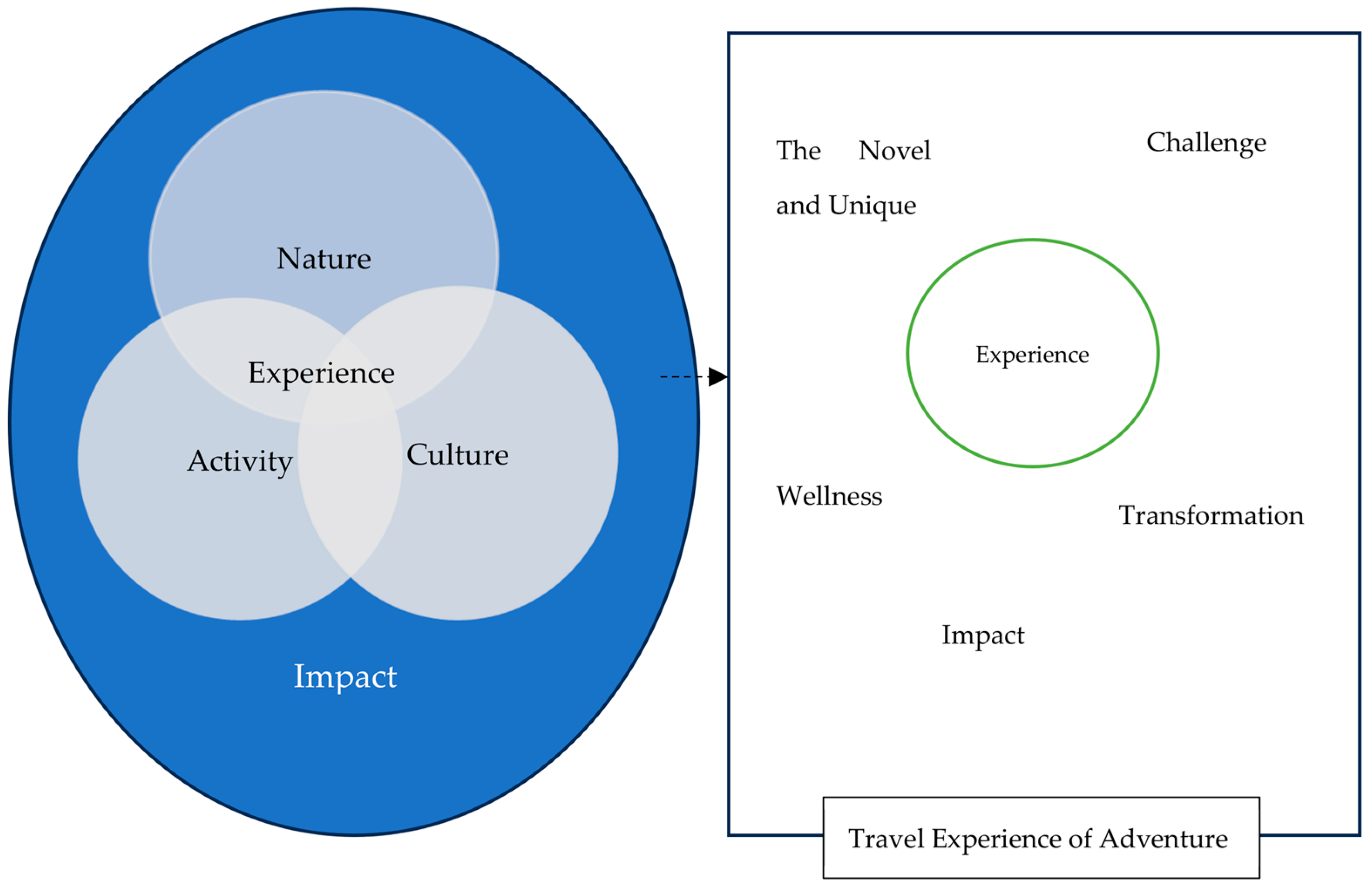
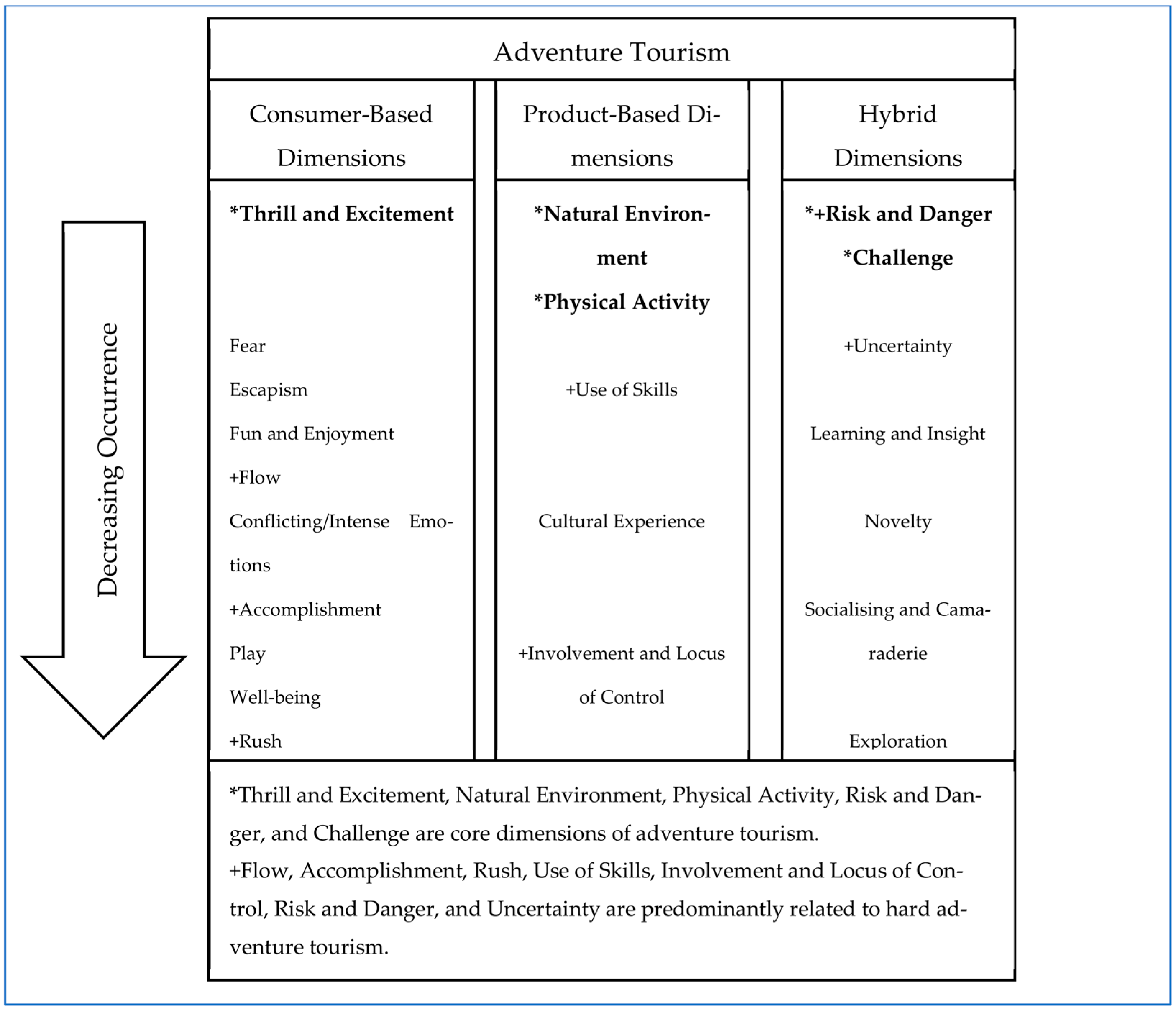
1.1. Adventure Tourism
1.2. Creativity and Creative Tourism
- A tool that offers new and creative destinations for tourists;
- A creative method that enables the evaluation of existing resources;
- Discovery and expression by visitors themselves;
- A resource for creating unique and creative environments at destinations;
- A strategic method to be used for the redesign and revitalization of the region.
1.3. Paragliding
2. Materials and Methods
2.1. Scale Adaptation and Measurement Instrument
2.2. Sampling Procedure and Data Collection
3. Results
3.1. Demographics
3.2. Measurement Model
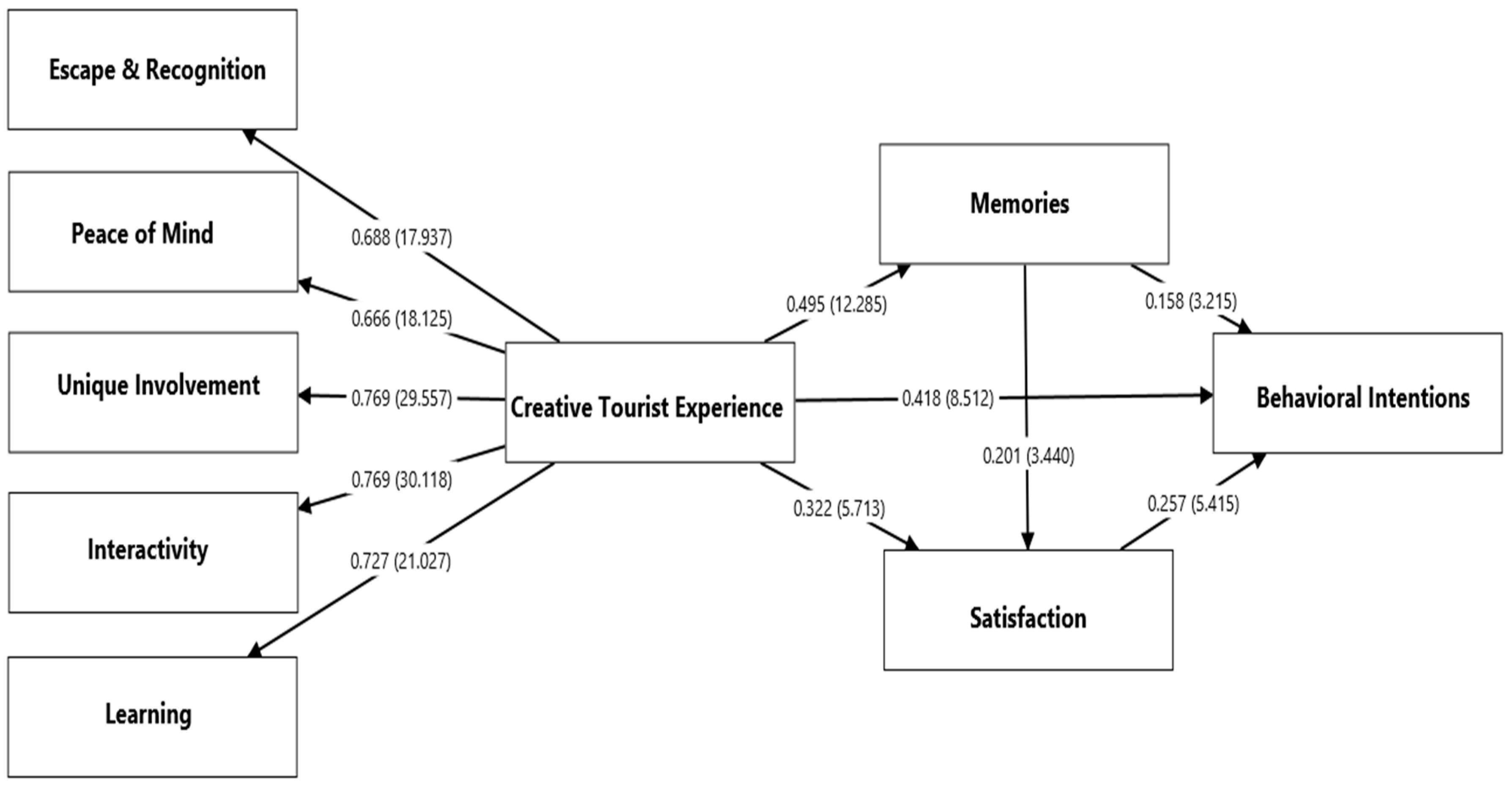
3.3. Structural Model
4. Discussion
5. Conclusions
Author Contributions
Funding
Institutional Review Board Statement
Informed Consent Statement
Data Availability Statement
Conflicts of Interest
Abbreviations
| ATTA | Adventure Travel Trade Association |
| UNWTO | United Nations World Tourism Organization |
References
- Holland, J.; Leslie, D. Tour Operators and Operations Development, Management and Responsibility; CABI: Oxfordshire, UK, 2018; pp. 15–16. [Google Scholar]
- Mata, C.; Carvalhinho, L. Security and risk management in outdoor sports–an exploratory systematic review. SPORT TK Rev. Euroam. de Cienc. del Deporte 2020, 9, 59–64. [Google Scholar]
- Williams, P.; Soutar, G.N. Value, satisfaction and behavioral intentions in an adventure tourism context. Ann. Tour. Res. 2009, 36, 413–438. [Google Scholar] [CrossRef] [Scilit]
- Weber, K. Outdoor adventure tourism a review of research approaches. Ann. Tour. Res. 2001, 28, 360–377. [Google Scholar] [CrossRef] [Scilit]
- Beames, S.; Mackenzie, S.H.; Raymond, E. How can we adventure sustainably? A systematized review of sustainability guidance for adventure tourism operators. J. Hosp. Tour. Manag. 2022, 50, 223–231. [Google Scholar] [CrossRef] [Scilit]
- Janowski, I.; Gardiner, S.; Kwek, A. Dimensions of adventure tourism. Tour. Manag. Perspect. 2021, 37, 100776. [Google Scholar] [CrossRef] [Scilit]
- Pomfret, G.; Sand, M.; May, C. Conceptualising the power of outdoor adventure activities for subjective well-being: A systematic literature review. J. Outdoor Tour. Recreat. 2023, 42, 100641. [Google Scholar] [CrossRef] [Scilit]
- Gross, S.; Sand, M. Adventure tourism: A perspective paper. Tour. Rev. 2020, 75, 153–157. [Google Scholar] [CrossRef] [Scilit]
- Ng, S.L. Bibliometric analysis of literature on mountain tourism in Scopus. J. Outdoor Recreat. Tour. 2022, 40, 100587. [Google Scholar] [CrossRef] [Scilit]
- Butler, R. Tourism destination development: The tourism area life cycle model. Tour. Geogr. 2024, 27, 599–607. [Google Scholar] [CrossRef] [Scilit]
- Dep, R.; Kondasani, R.K.R.; Das, A. Adventure tourism: Current state and future research direction. Tour. Rev. 2025, 80, 1581–1596. [Google Scholar]
- Boudreau, P.; Houge Mackenzie, S.; Hodge, K. Flow states in adventure recreation: A systematic review and thematic synthesis. Psychol. Sport Exerc. 2020, 46, 101611. [Google Scholar] [CrossRef] [Scilit]
- Doran, A.; Pomfret, G.; Adu-Ampong, E.A. Mind the gap: A systematic review of the knowledge contribution claims in adventure tourism research. J. Hosp. Tour. Manag. 2022, 51, 238–251. [Google Scholar] [CrossRef] [Scilit]
- Rantala, O.; Rokenes, A.; Valkonen, J. Is adventure tourism a coherent concept? A review of research approaches on adventure tourism. Ann. Leis. Res. 2018, 21, 539–552. [Google Scholar] [CrossRef] [Scilit]
- Pomfret, G.; Bramwell, B. The characteristics and motivational decisions of outdoor adventure tourists: A review and analysis. Curr. Issues Tour. 2016, 19, 1447–1478. [Google Scholar] [CrossRef] [Scilit]
- Adventure Travel Trade Association. ADTI Adventure Tourism Development Index. 2024. Available online: https://cdn-research.adventuretravel.biz/research/6772f609baad61.15956572/2024-ATDI-report-final.pdf (accessed on 2 December 2025).
- United Nations World Tourism Organization. UNWTO Tourism Definitions. 2019. Available online: https://www.e-unwto.org/doi/epdf/10.18111/9789284420858 (accessed on 14 December 2025).
- Cater, C.I. Playing with risk? participant perceptions of risk and management implications in adventure tourism. Tour. Manag. 2006, 27, 317–325. [Google Scholar] [CrossRef] [Scilit]
- Fredman, P.; Margaryan, L. 20 years of Nordic nature-based tourism research: A review and future research agenda. Scand. J. Hosp. Tour. 2021, 21, 14–25. [Google Scholar] [CrossRef] [Scilit]
- Spennemann, D.H.R. Extreme cultural tourism from Antarctica to Moon. Ann. Tour. Res. 2007, 34, 898–918. [Google Scholar] [CrossRef] [Scilit]
- Buckley, R. Rush as a key motivation in skilled adventure tourism: Resolving the risk recreation paradox. Tour. Manag. 2012, 33, 961–970. [Google Scholar] [CrossRef] [Scilit]
- Csikszentmihalyi, M. Beyond Boredom and Anxiety; Jossey-Bass: San Francisco, CA, USA, 1975. [Google Scholar]
- Apter, M.J. Reversal theory, cognitive synergy and the arts. Adv. Psychol. 1984, 19, 411–426. [Google Scholar]
- Lyng, S.; Snow, D. Vocabularies of motive and high-risk behaviour. The case of sky-diving. In Advances in Group Process; Lawler, E.J., Thye, S.R., Eds.; JAI: Greenwich, CT, USA, 1986; Volume 3, pp. 157–179. [Google Scholar]
- Csikszentmihalyi, M. Flow: The Psychology of Happiness; Rider: London, UK, 1992; Volume 6. [Google Scholar]
- Apter, M.J. The Experience of Motivation: The Theory of Psychological Reversals; Academic Press: London, UK, 1982. [Google Scholar]
- Lyng, S.H. Edgework: A social psychological analysis of voluntary risk-taking. Am. J. Sociol. 1990, 95, 851–886. [Google Scholar] [CrossRef] [Scilit]
- Öncü, T. Yaratıcılığın betimlenmesi ve yaratıcılık üzerine çevresel etkiler. Ank. Üniv. Dil Ve Tar.-Coğraf. Fak. Felsefe Böl. Derg. 1992, 14, 255–264. [Google Scholar]
- Ritchie, J.R.B.; Crouch, G.I. The Competitive Destination: A Sustainable Tourism Perspective; CABI: Oxfordshire, UK, 2003. [Google Scholar]
- Okutan, Y.A. Yaratıcı turizmin sürdürülebilir turizm kapsamında değerlendirilmesi. J. New Tour. Trends Technol. 2023, 4, 1–15. [Google Scholar]
- Emekli, G. Kent turizminde kültür ve yaratıcılık. Tücaum 2018, 30, 3–6. [Google Scholar]
- Richards, G. The experience industry and the creation of attractions. In Cultural Attractions and European Tourism; Richards, G., Ed.; CABI: Oxfordshire, UK, 2001; pp. 55–69. [Google Scholar]
- Richards, G.; Wilson, J. Developing creativity in tourist experiences: A solution to the serial reproduction of culture? Tour. Manag. 2006, 27, 1209–1223. [Google Scholar] [CrossRef] [Scilit]
- Wurzburger, R.; Aageson, T.; Pattakos, A.; Pratt, S. Creative Tourism: A Global Conversation: How to Provide Unique Creative Experiences for Travelers Worldwide; Sunstone Press: Santa Fe, NM, USA, 2009. [Google Scholar]
- Richards, G. Creativity and tourism: The state of the art. Ann. Tour. Res. 2011, 38, 1225–1253. [Google Scholar] [CrossRef] [Scilit]
- Ivanova, M. Creativity and sustainable tourism development. Economics 2013, 21, 108–120. [Google Scholar]
- Aşık, N. Yaratıcı (kreatif) turizm. Uluslararası Sos. Araştırmalar Derg. 2014, 7, 787–795. [Google Scholar]
- Zoğal, V.; Emekli, G. Yaratıcı turizme kavramsal ve coğrafi bir yaklaşım. Ege Coğrafya Derg. 2017, 26, 21–34. [Google Scholar]
- Richards, G.; Raymond, C. Creative tourism. ATLAS News 2000, 23, 16–20. [Google Scholar]
- Giuliana, L. Le Tourisme Créatif, Une Alternative Responsable Convaincante Pour Les Territoires. 2023. Available online: https://tourisme-en-transition.fr/tourisme-creatif-alternative-responsable-territoires/ (accessed on 30 December 2025).
- Pine, B.J., II; Gilmore, J.H. The Experience Economy: Work Is Theatre & Every Business a Stage; Harvard Business School Press: Brighton, MA, USA, 1999. [Google Scholar]
- Walle, A.H. Pursuing risk or insight: Marketing adventures. Ann. Tour. Res. 1997, 24, 265–282. [Google Scholar] [CrossRef] [Scilit]
- Csikszentmihalyi, M. Flow: The Psychology of Optimal Experience; Harper & Row: New York, NY, USA, 1990. [Google Scholar]
- Akbulut, O.; Çelik, T.; Ekin, Y.; Çelik Yetim, A. A research on Fethiye Babadag commercial tandem paragliding participants within the scope of experiential tourism. J. Outdoor Recreat. Tour. 2024, 47, 100806. [Google Scholar] [CrossRef] [Scilit]
- Ayazlar, R.A.; Yüksel, A. Flow experience in paragliding: Effects on experience and life satisfaction. Tour. Anal. 2018, 23, 461–473. [Google Scholar] [CrossRef] [Scilit]
- Davras, Ö.; Durgun, S.; Demircioğlu Dalgıç, A.S. The influences of paragliding flow experience on storytelling intention through satisfaction: A comparison of adventure-seekers and learning-seekers. J. Outdoor Recreat. Tour. 2025, 51, 100894. [Google Scholar] [CrossRef] [Scilit]
- Davras, Ö. Yamaç paraşütü yapan yerli ve yabancı turistlerin destinasyon memnuniyetleri: Bir AEPA uygulaması. Anatolia Tur. Araştırmaları Derg. 2023, 34, 83–95. [Google Scholar] [CrossRef] [Scilit]
- United Nations Educational, Scientific and Cultural Organization. Towards Sustainable Strategies for Creative Tourism: Discussion Report of the Planning Meeting for the 2008 International Conference on Creative Tourism. 2006. Available online: https://unesdoc.unesco.org/ark:/48223/pf0000159811 (accessed on 31 December 2025).
- Carvalho, R.M.F.; Costa, C.M.M.d.; Ferreira, A.M. Review of the theoretical underpinnings in the creative tourism research field. Tour. Manag. Stud. 2019, 15, 11–22. [Google Scholar] [CrossRef] [Scilit]
- Richards, G. Designing creative places: The role of creative tourism. Ann. Tour. Res. 2020, 85, 102922. [Google Scholar] [CrossRef] [Scilit]
- Pomfret, G. Mountaineering adventure tourists: A conceptual framework for research. Tour. Manag. 2006, 27, 113–123. [Google Scholar] [CrossRef] [Scilit]
- Buckley, R. Adventure Tourism Management; Butterworth-Heinemann: Oxford, UK, 2010. [Google Scholar]
- Swarbrooke, J.; Beard, C.; Leckie, S.; Pomfret, G. Adventure Tourism: The New Frontier; Butterworth-Heinemann: Oxford, UK, 2003. [Google Scholar]
- Prahalad, C.K.; Ramaswamy, V. Co-creation experiences: The next practice in value creation. J. Interact. Mark. 2004, 18, 5–14. [Google Scholar] [CrossRef] [Scilit]
- Vargo, S.L.; Lusch, R.F. Service-dominant logic: Continuing the evolution. J. Acad. Mark. Sci. 2008, 36, 1–10. [Google Scholar] [CrossRef] [Scilit]
- Binkhorst, E.; den Dekker, T. Agenda for co-creation tourism experience research. J. Hosp. Mark. Manag. 2009, 18, 311–327. [Google Scholar] [CrossRef] [Scilit]
- Petrick, J.F. The roles of quality, value, and satisfaction in predicting cruise passengers’ behavioral intentions. J. Travel Res. 2004, 42, 397–407. [Google Scholar] [CrossRef] [Scilit]
- Zeithaml, V.A.; Berry, L.L.; Parasuraman, A. The behavioral consequences of service quality. J. Mark. 1996, 60, 31–46. [Google Scholar] [CrossRef] [Scilit]
- Tung, V.W.S.; Ritchie, J.R.B. Exploring the essence of memorable tourism experiences. Ann. Tour. Res. 2011, 38, 1367–1386. [Google Scholar] [CrossRef] [Scilit]
- Kim, J.H.; Ritchie, J.R.B.; McCormick, B. Development of a scale to measure memorable tourism experiences. J. Travel Res. 2012, 51, 12–25. [Google Scholar] [CrossRef] [Scilit]
- Larsen, S. Aspects of a psychology of the tourist experience. Scand. J. Hosp. Tour. 2007, 7, 7–18. [Google Scholar] [CrossRef] [Scilit]
- Wirtz, D.; Kruger, J.; Scollon, C.N.; Diener, E. What to do on spring break? The role of predicted, on-line, and remembered experience in future choice. Psychol. Sci. 2003, 14, 520–524. [Google Scholar] [CrossRef] [Scilit]
- Oliver, R.L. Satisfaction: A Behavioral Perspective on the Consumer; McGraw-Hill: Columbus, OH, USA, 1997. [Google Scholar]
- Baker, D.A.; Crompton, J.L. Quality, satisfaction, and behavioral intentions. Ann. Tour. Res. 2000, 27, 785–804. [Google Scholar] [CrossRef] [Scilit]
- Oliver, R.L. Whence consumer loyalty? J. Mark. 1999, 63, 33–44. [Google Scholar] [CrossRef] [Scilit]
- Cronin, J.J., Jr.; Brady, M.K.; Hult, G.T.M. Assessing the effects of quality, value, and customer satisfaction on consumer behavioral intentions in service environments. J. Retail. 2000, 76, 193–218. [Google Scholar] [CrossRef] [Scilit]
- Schacter, D.L. The seven sins of memory: Insights from psychology and cognitive neuroscience. Am. Psychol. 1999, 54, 182–203. [Google Scholar] [CrossRef]
- Kahneman, D.; Fredrickson, B.L.; Schreiber, C.A.; Redelmeier, D.A. When more pain is preferred to less: Adding a better end. Psychol. Sci. 1993, 4, 401–405. [Google Scholar] [CrossRef] [Scilit]
- Ali, F.; Ryu, K.; Hussain, K. Influence of experiences on memories, satisfaction and behavioral intentions: A study of creative tourism. J. Travel Tour. Mark. 2016, 33, 85–100. [Google Scholar] [CrossRef] [Scilit]
- Tan, S.K.; Kung, S.F.; Luh, D.B. A taxonomy of creative tourists in creative tourism. Ann. Tour. Res. 2013, 41, 153–174. [Google Scholar] [CrossRef] [Scilit]
- Nunnally, J.C. Psychometric Theory, 2nd ed.; McGraw-Hill: Columbus, OH, USA, 1978. [Google Scholar]
- Hosany, S.; Witham, M. Dimensions of cruisers’ experiences, satisfaction, and intention to recommend. J. Travel Res. 2010, 49, 351–364. [Google Scholar] [CrossRef] [Scilit]
- Oh, H.; Fiore, A.M.; Jeoung, M. Measuring experience economy concepts: Tourism applications. J. Travel Res. 2007, 46, 119–132. [Google Scholar] [CrossRef] [Scilit]
- Veal, A.J. Research Methods for Leisure and Tourism: A Practical Guide, 5th ed.; Pearson: Harlow, UK, 2017. [Google Scholar]
- Altinay, L.; Paraskevas, A. Planning Research in Hospitality and Tourism; Butterworth-Heinemann: Oxford, UK, 2008. [Google Scholar]
- Hair, J.F.; Hult, G.T.M.; Ringle, C.M.; Sarstedt, M. A Primer on Partial Least Squares Structural Equation Modeling (PLS-SEM), 2nd ed.; Sage: Thousand Oaks, CA, USA, 2017. [Google Scholar]
- Goodhue, D.L.; Lewis, W.; Thompson, R. Does PLS have advantages for small sample size or non-normal data? MIS Q. 2012, 36, 981–1001. [Google Scholar] [CrossRef] [Scilit]
- Hair, J.F.; Hult, G.T.M.; Ringle, C.M.; Sarstedt, M. A Primer on Partial Least Squares Structural Equation Modeling (PLS-SEM), 3rd ed.; Sage: Thousand Oaks, CA, USA, 2021. [Google Scholar]
- Henseler, J.; Ringle, C.M.; Sinkovics, R.R. The use of partial least squares path modeling in international marketing. In Advances in International Marketing; Sinkovics, R.R., Ghauri, P.N., Eds.; Emerald: Leeds, UK, 2009; Volume 20, pp. 277–319. [Google Scholar]
- Hair, J.F.; Risher, J.J.; Sarstedt, M.; Ringle, C.M. When to use and how to report the results of PLS-SEM. Eur. Bus. Rev. 2019, 31, 2–24. [Google Scholar] [CrossRef] [Scilit]
- Fornell, C.; Larcker, D.F. Evaluating structural equation models with unobservable variables and measurement error. J. Mark. Res. 1981, 18, 39–50. [Google Scholar] [CrossRef] [Scilit]
- Henseler, J.; Ringle, C.M.; Sarstedt, M. A new criterion for assessing discriminant validity in variance-based structural equation modeling. J. Acad. Mark. Sci. 2015, 43, 115–135. [Google Scholar] [CrossRef] [Scilit]
- Becker, J.M.; Klein, K.; Wetzels, M. Hierarchical latent variable models in PLS path modeling: Guidelines for using reflective-formative type models. Long Range Plan. 2012, 45, 359–394. [Google Scholar] [CrossRef] [Scilit]
- Sarstedt, M.; Hair, J.F.; Cheah, J.H.; Becker, J.M.; Ringle, C.M. How to specify, estimate, and validate higher-order constructs in PLS-SEM. Australas. Mark. J. 2019, 27, 197–211. [Google Scholar] [CrossRef] [Scilit]
- Wetzels, M.; Odekerken-Schröder, G.; van Oppen, C. Using PLS path modeling for assessing hierarchical construct models: Guidelines and empirical illustration. MIS Q. 2009, 33, 177–195. [Google Scholar] [CrossRef] [Scilit]
- Nunnally, J.C.; Bernstein, I.H. Psychometric Theory, 3rd ed.; McGraw-Hill: Columbus, OH, USA, 1994. [Google Scholar]
- Hair, J.F.; Ringle, C.M.; Sarstedt, M. PLS-SEM: Indeed a silver bullet. J. Mark. Theory Pract. 2011, 19, 139–152. [Google Scholar] [CrossRef] [Scilit]
- Stone, M. Cross-validatory choice and assessment of statistical predictions. J. R. Stat. Soc. Ser. B (Methodol.) 1974, 36, 111–147. [Google Scholar] [CrossRef] [Scilit]
- Geisser, S. A predictive approach to the random effects model. Biometrika 1974, 61, 101–107. [Google Scholar] [CrossRef]



| Variable | Category | Frequency | Percentage |
|---|---|---|---|
| Gender | Female | 179 | 55.1 |
| Male | 146 | 44.9 | |
| Marital Status | Married | 140 | 43.1 |
| Single | 185 | 56.9 | |
| Age | 18 and Under | 4 | 1.2 |
| 19–25 | 104 | 32.0 | |
| 26–32 | 109 | 33.5 | |
| 33–39 | 60 | 18.5 | |
| 40 and Above | 48 | 14.8 | |
| Education | Primary School | 12 | 3.7 |
| High School | 57 | 17.5 | |
| Associate Degree | 59 | 18.2 | |
| Bachelor/Master’s | 197 | 60.6 | |
| Monthly Income (USD) | 0–750 | 36 | 11.1 |
| 751–1500 | 73 | 22.5 | |
| 1501–2250 | 90 | 27.7 | |
| 2251–3000 | 59 | 18.2 | |
| 3001–3750 | 28 | 8.6 | |
| 3751–4500 | 22 | 6.8 | |
| 4501 and Above | 17 | 5.2 | |
| Nationality | Chinese | 128 | 39.4 |
| Russian | 76 | 23.4 | |
| British | 45 | 13.8 | |
| German | 23 | 7.1 | |
| Other | 53 | 16.3 | |
| Q1: Have you ever done paragliding before? | Yes | 31 | 9.5 |
| No | 294 | 90.5 | |
| Q2: Who influenced you to participate in paragliding? | Yourself | 143 | 44.0 |
| Friends | 127 | 39.1 | |
| Family Members | 32 | 9.8 | |
| Travel Agency | 23 | 7.1 |
| Construct | Item | Outer Loading | AVE | CR | Cronbach’s Alpha |
|---|---|---|---|---|---|
| Escape and Recognition (ER) | 0.588 | 0.865 | 0.859 | ||
| ER1 | 0.805 | ||||
| ER2 | 0.805 | ||||
| ER3 | 0.799 | ||||
| ER4 | 0.727 | ||||
| ER5 | 0.755 | ||||
| ER6 | 0.703 | ||||
| Peace of Mind (PM) | 0.613 | 0.797 | 0.790 | ||
| PM1 | 0.797 | ||||
| PM2 | 0.834 | ||||
| PM3 | 0.770 | ||||
| PM4 | 0.728 | ||||
| Unique Involvement (UI) | 0.627 | 0.852 | 0.850 | ||
| UI1 | 0.858 | ||||
| UI2 | 0.791 | ||||
| UI3 | 0.803 | ||||
| UI4 | 0.742 | ||||
| UI5 | 0.759 | ||||
| Interactivity (I) | 0.679 | 0.777 | 0.763 | ||
| I1 | 0.864 | ||||
| I2 | 0.845 | ||||
| I3 | 0.760 | ||||
| Learning (L) | 0.626 | 0.812 | 0.801 | ||
| L1 | 0.829 | ||||
| L2 | 0.827 | ||||
| L3 | 0.770 | ||||
| L4 | 0.733 | ||||
| Memories (M) | 0.672 | 0.767 | 0.757 | ||
| M1 | 0.851 | ||||
| M2 | 0.823 | ||||
| M3 | 0.784 | ||||
| Satisfaction (Sat) | 0.742 | 0.753 | 0.753 | ||
| Sat1 | 0.867 | ||||
| Sat2 | 0.856 | ||||
| Behavioral Intentions (BI) | 0.836 | 0.911 | 0.850 | ||
| BI1 | 0.919 | ||||
| BI2 | 0.910 |
| ER | PM | UI | I | L | M | Sat | BI | |
|---|---|---|---|---|---|---|---|---|
| ER | - | |||||||
| PM | 0.547 | - | ||||||
| UI | 0.503 | 0.508 | - | |||||
| I | 0.476 | 0.485 | 0.597 | - | ||||
| L | 0.411 | 0.367 | 0.514 | 0.577 | - | |||
| M | 0.408 | 0.372 | 0.414 | 0.513 | 0.523 | - | ||
| Sat | 0.278 | 0.331 | 0.464 | 0.467 | 0.478 | 0.506 | - | |
| BI | 0.433 | 0.442 | 0.570 | 0.617 | 0.578 | 0.580 | 0.677 | - |
| Construct | R2 | Q2 |
|---|---|---|
| Memories | 0.245 | 0.227 |
| Satisfaction | 0.209 | 0.163 |
| Behavioral Intentions | 0.450 | 0.346 |
| Hypothesis | Path | Standard Beta | Standard Deviation | t-Statistics | Decision |
|---|---|---|---|---|---|
| H1 | Creative Tourist Experience → Behavioral Intentions | 0.418 | 0.049 | 8.512 ** | Supported |
| H2 | Creative Tourist Experience → Memories | 0.495 | 0.040 | 12.285 ** | Supported |
| H3 | Creative Tourist Experience → Satisfaction | 0.322 | 0.056 | 5.713 ** | Supported |
| H4 | Satisfaction → Behavioral Intentions | 0.257 | 0.047 | 5.415 ** | Supported |
| H5 | Memories → Behavioral Intentions | 0.158 | 0.049 | 3.215 * | Supported |
| H6 | Memories → Satisfaction | 0.201 | 0.059 | 3.440 * | Supported |
Disclaimer/Publisher’s Note: The statements, opinions and data contained in all publications are solely those of the individual author(s) and contributor(s) and not of MDPI and/or the editor(s). MDPI and/or the editor(s) disclaim responsibility for any injury to people or property resulting from any ideas, methods, instructions or products referred to in the content. |
© 2026 by the authors. Licensee MDPI, Basel, Switzerland. This article is an open access article distributed under the terms and conditions of the Creative Commons Attribution (CC BY) license.
Share and Cite
Akbulut, O.; Ekin, Y.; Celik, T. The Integration of Creativity into Paragliding Tourism: The Case of Babadağ, Fethiye. Sustainability 2026, 18, 1270. https://doi.org/10.3390/su18031270
Akbulut O, Ekin Y, Celik T. The Integration of Creativity into Paragliding Tourism: The Case of Babadağ, Fethiye. Sustainability. 2026; 18(3):1270. https://doi.org/10.3390/su18031270
Chicago/Turabian StyleAkbulut, Onur, Yakin Ekin, and Tunahan Celik. 2026. "The Integration of Creativity into Paragliding Tourism: The Case of Babadağ, Fethiye" Sustainability 18, no. 3: 1270. https://doi.org/10.3390/su18031270
APA StyleAkbulut, O., Ekin, Y., & Celik, T. (2026). The Integration of Creativity into Paragliding Tourism: The Case of Babadağ, Fethiye. Sustainability, 18(3), 1270. https://doi.org/10.3390/su18031270