The Anatomy of a Good Concept: A Systematic Review on Cyber Supply Chain Risk Management

Abstract
1. Introduction
2. Research Background: Setting the Conceptual Stage
3. Methodology
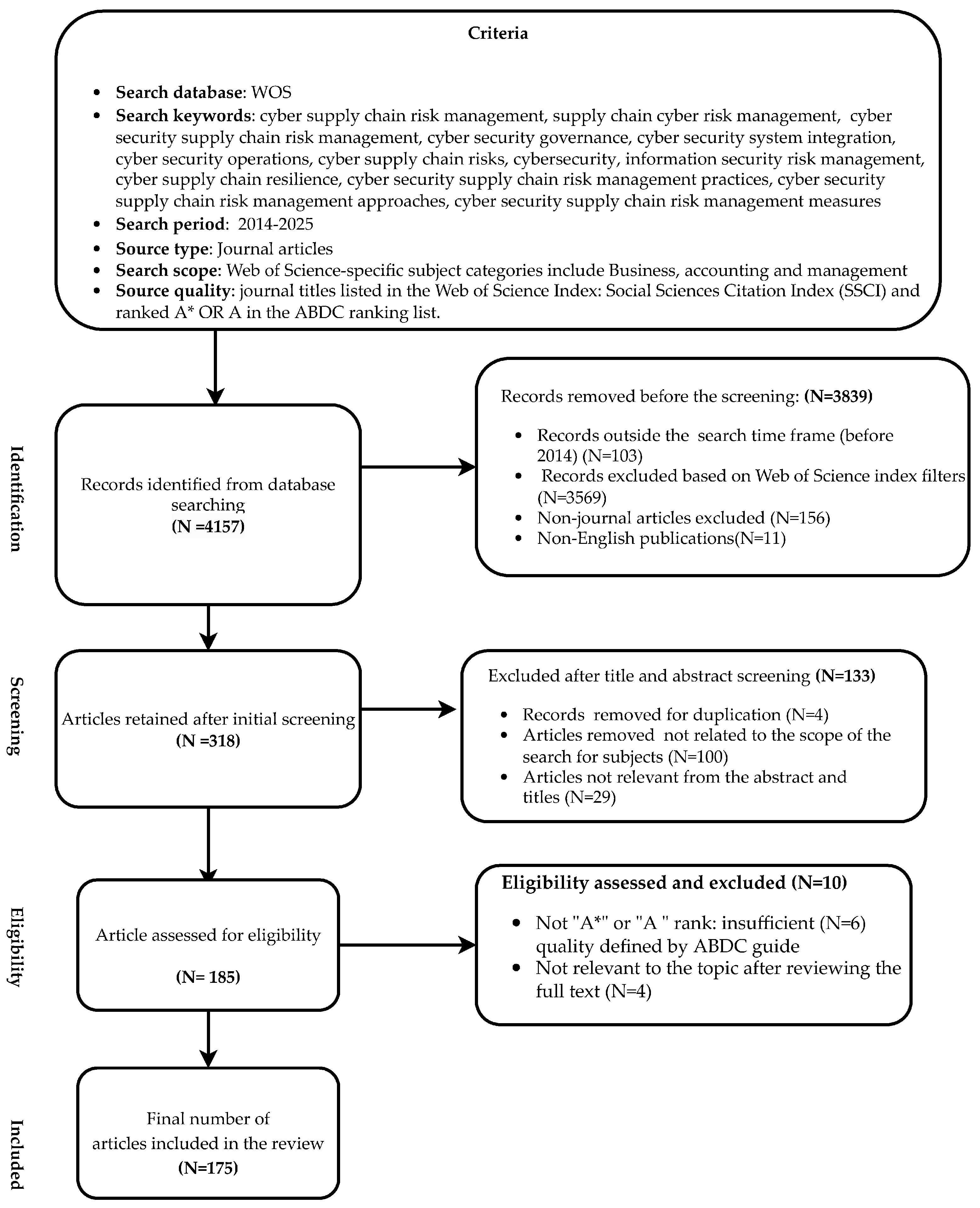
3.1. Data Sources and Search Strategy
3.2. Inclusion and Exclusion Criteria
3.3. Screening and Sample Selection
3.4. Data Preparation and Coding
3.5. Data Analysis Techniques
4. Publication Trends and Growth
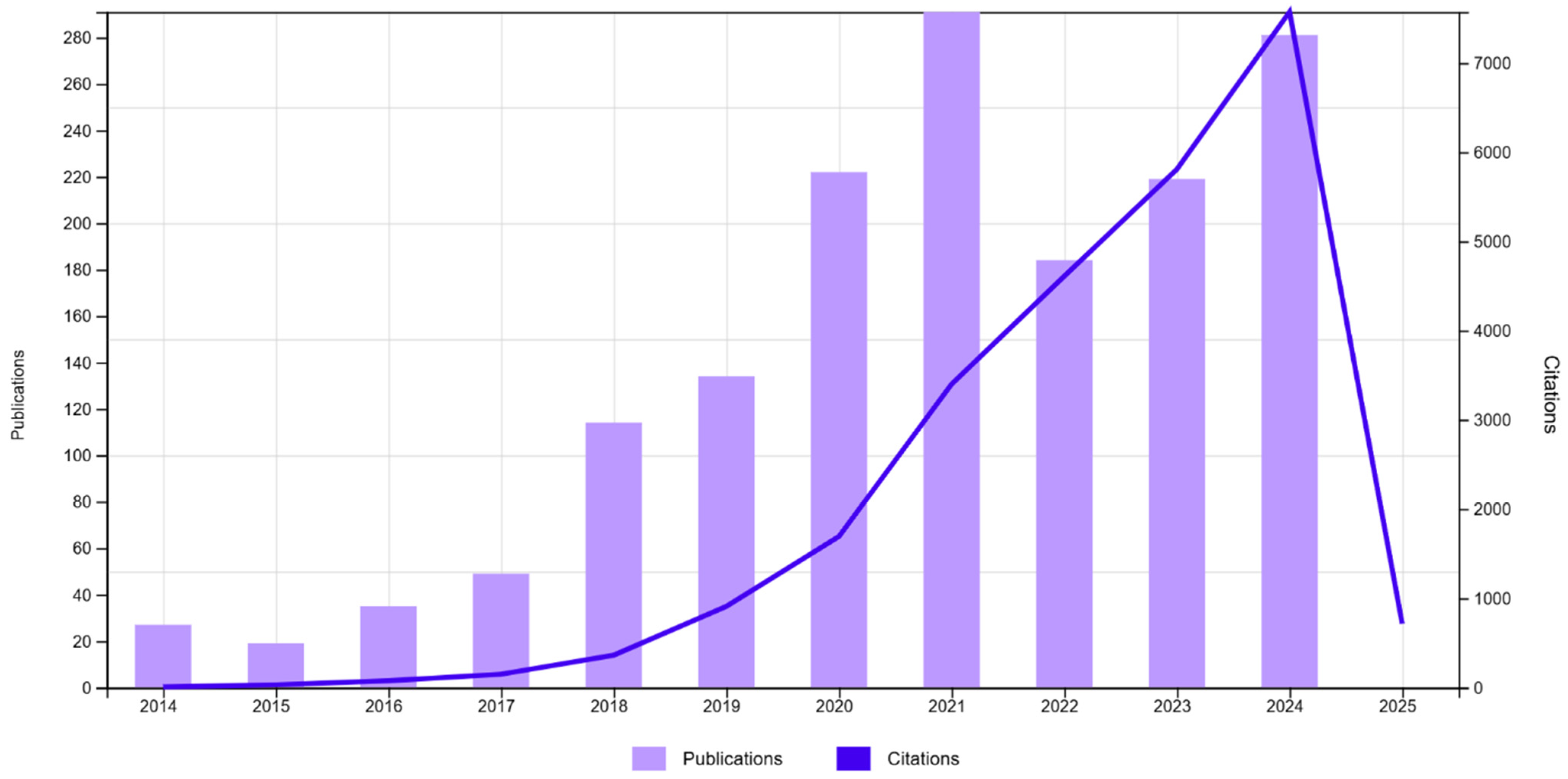
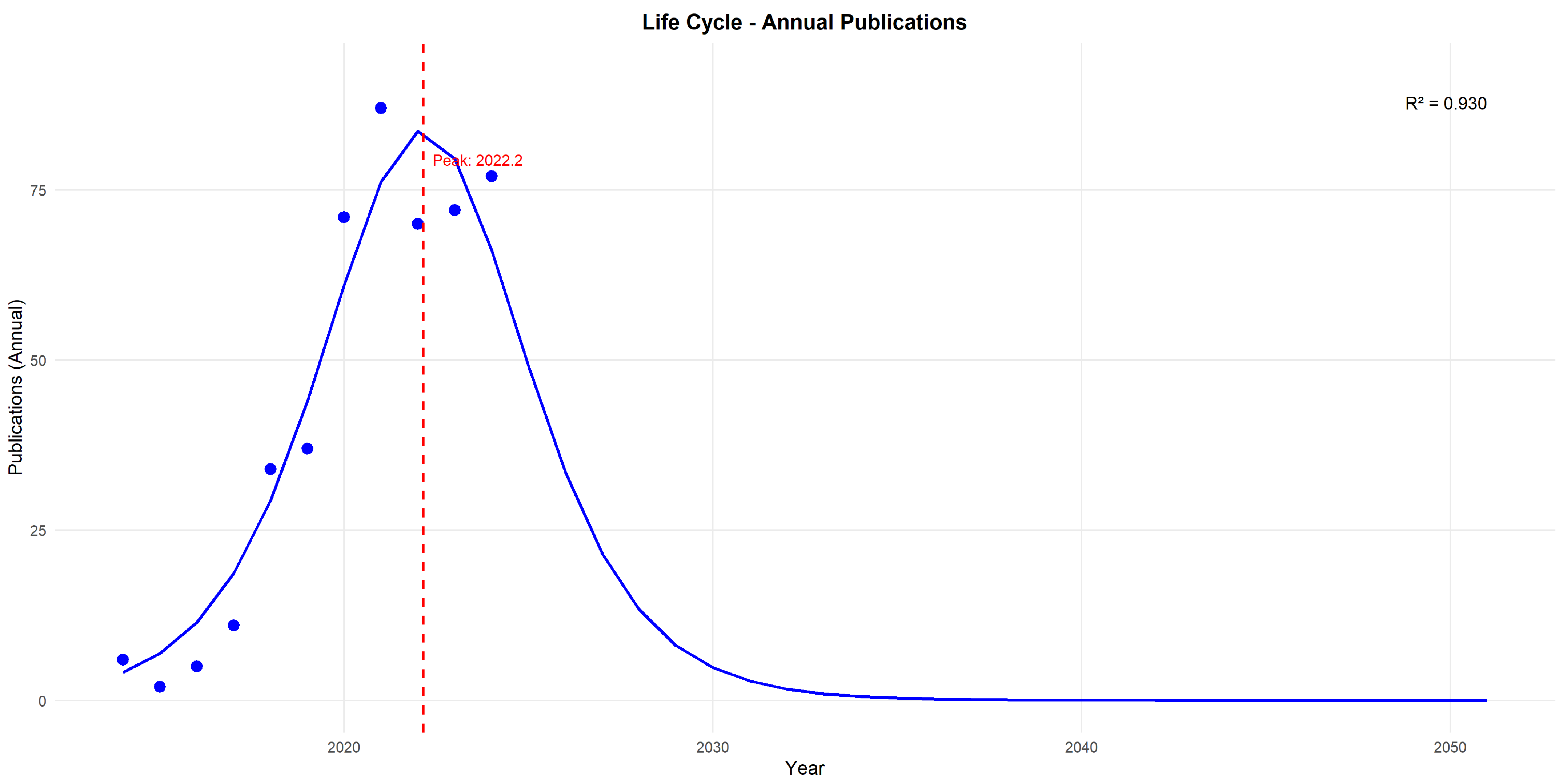
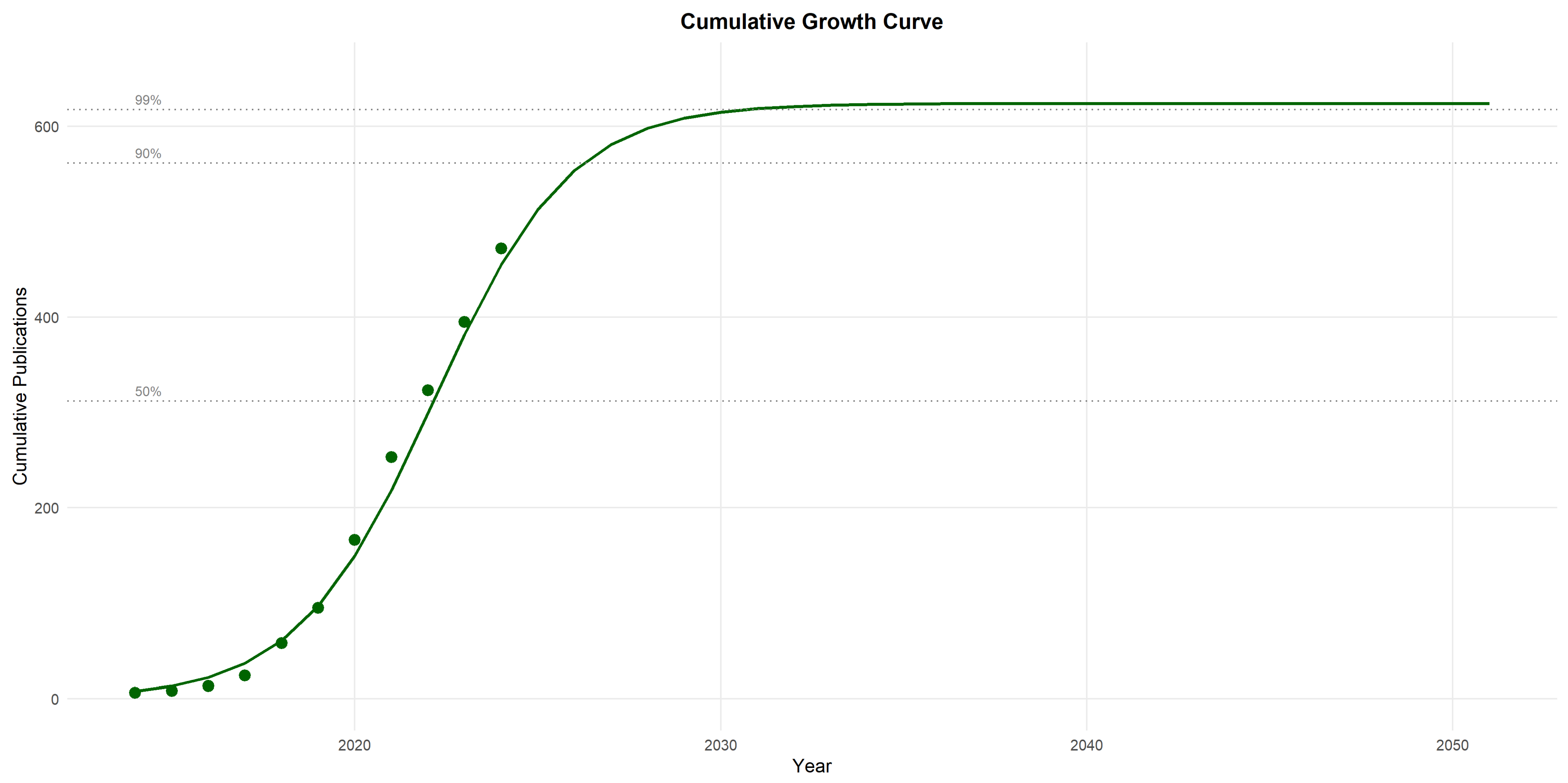
4.1. Temporal Evolution of C-SCRM Research
4.2. Journal Distribution and Publication Landscape
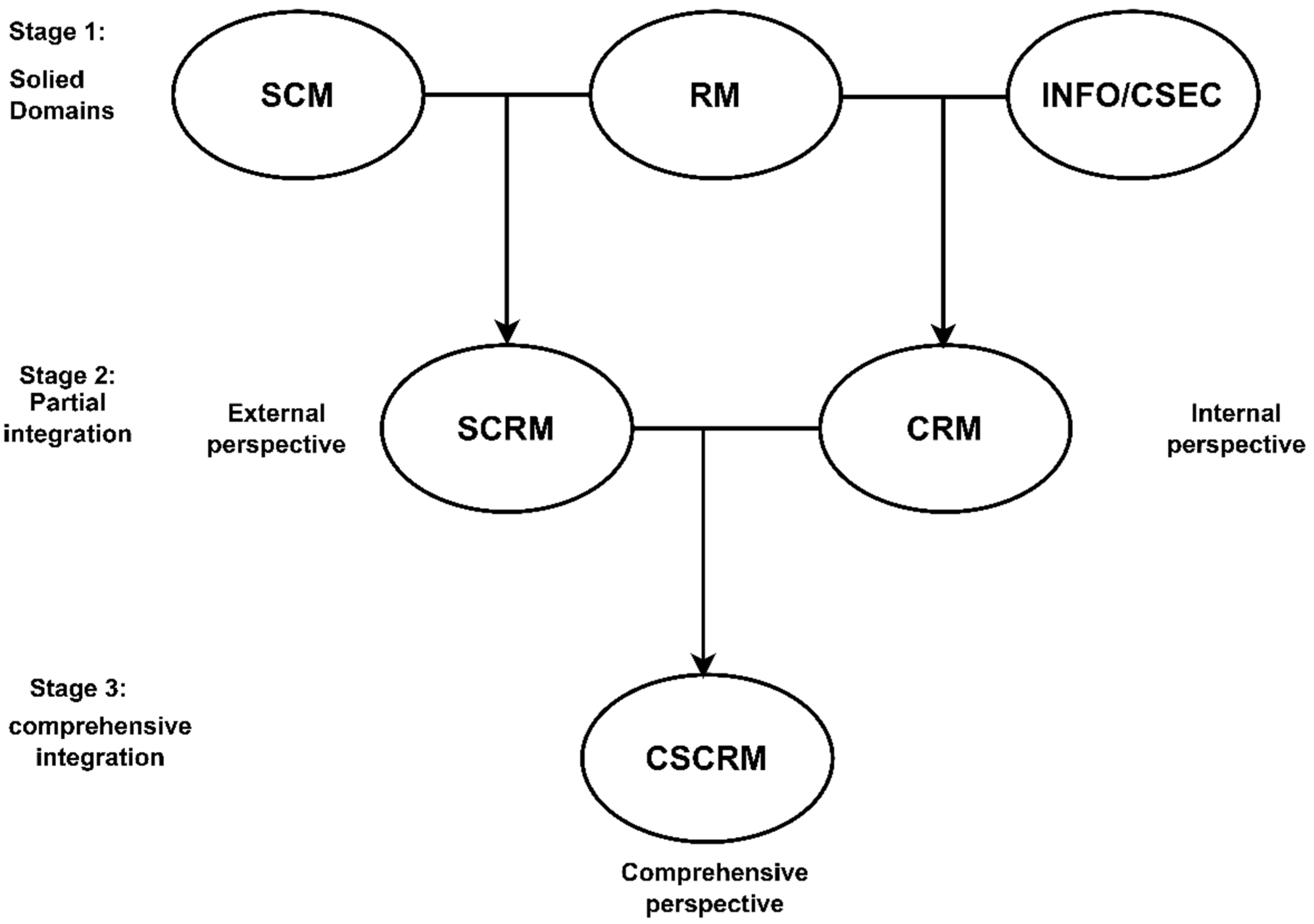
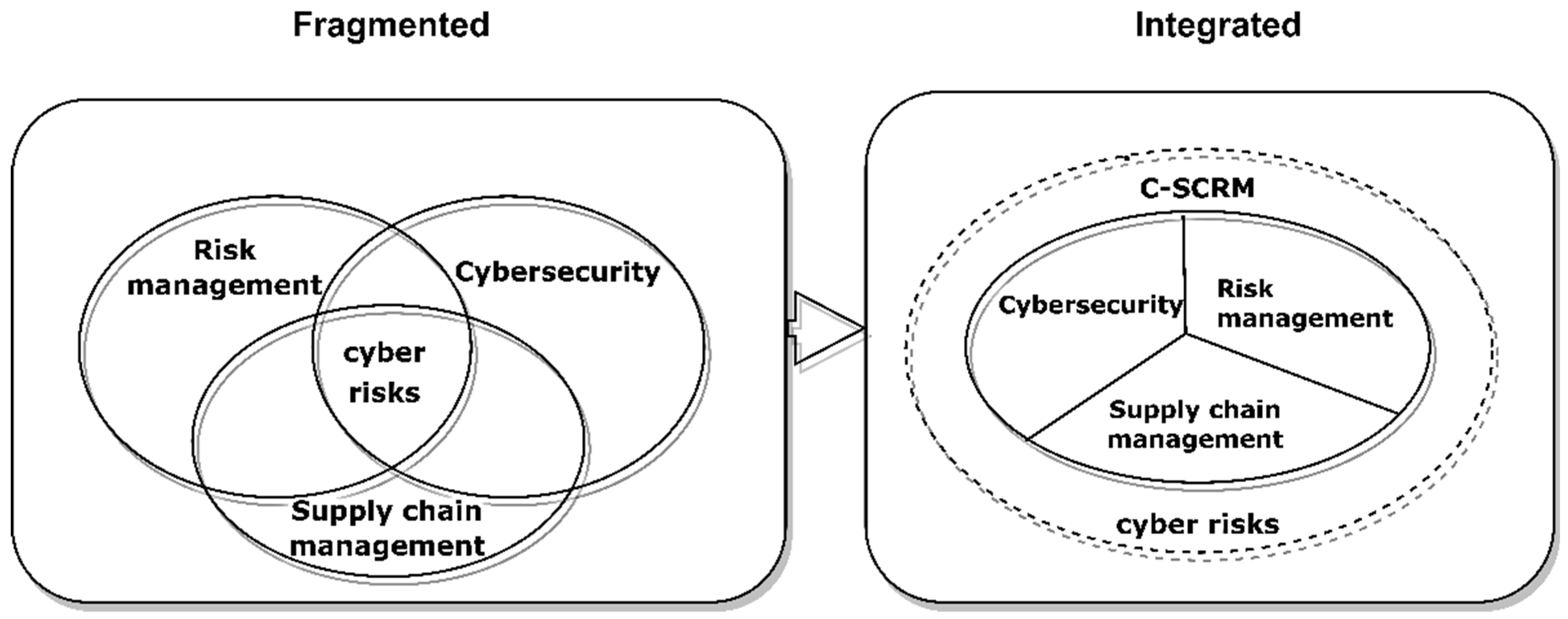
4.3. Domain Mapping and Conceptual Integration
4.4. Most Influential Publications
4.5. Most Influential Countries
5. Conceptualization Patterns
5.1. Definitional Analysis of C-SCRM Concept
5.2. Core Attributes of C-SCRM Definitions
5.3. Critical Evaluation of C-SCRM Concept
5.3.1. Differentiation
5.3.2. Resonance
5.3.3. Field Utility and Practical Relevance
5.3.4. Theoretical Utility and Depth
5.3.5. Parsimony and Conceptual Complexity
5.3.6. Coherence and Theoretical Integration
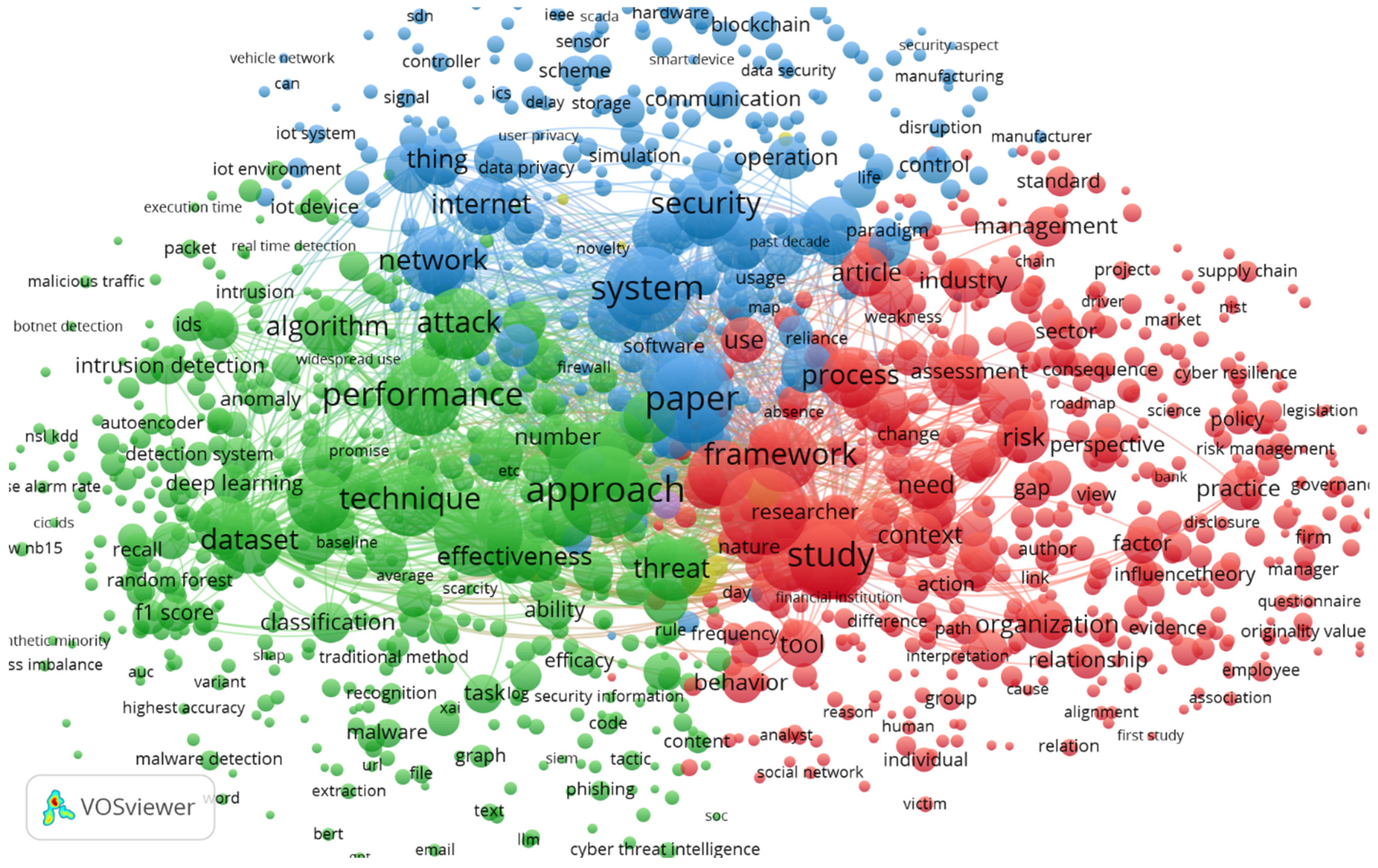
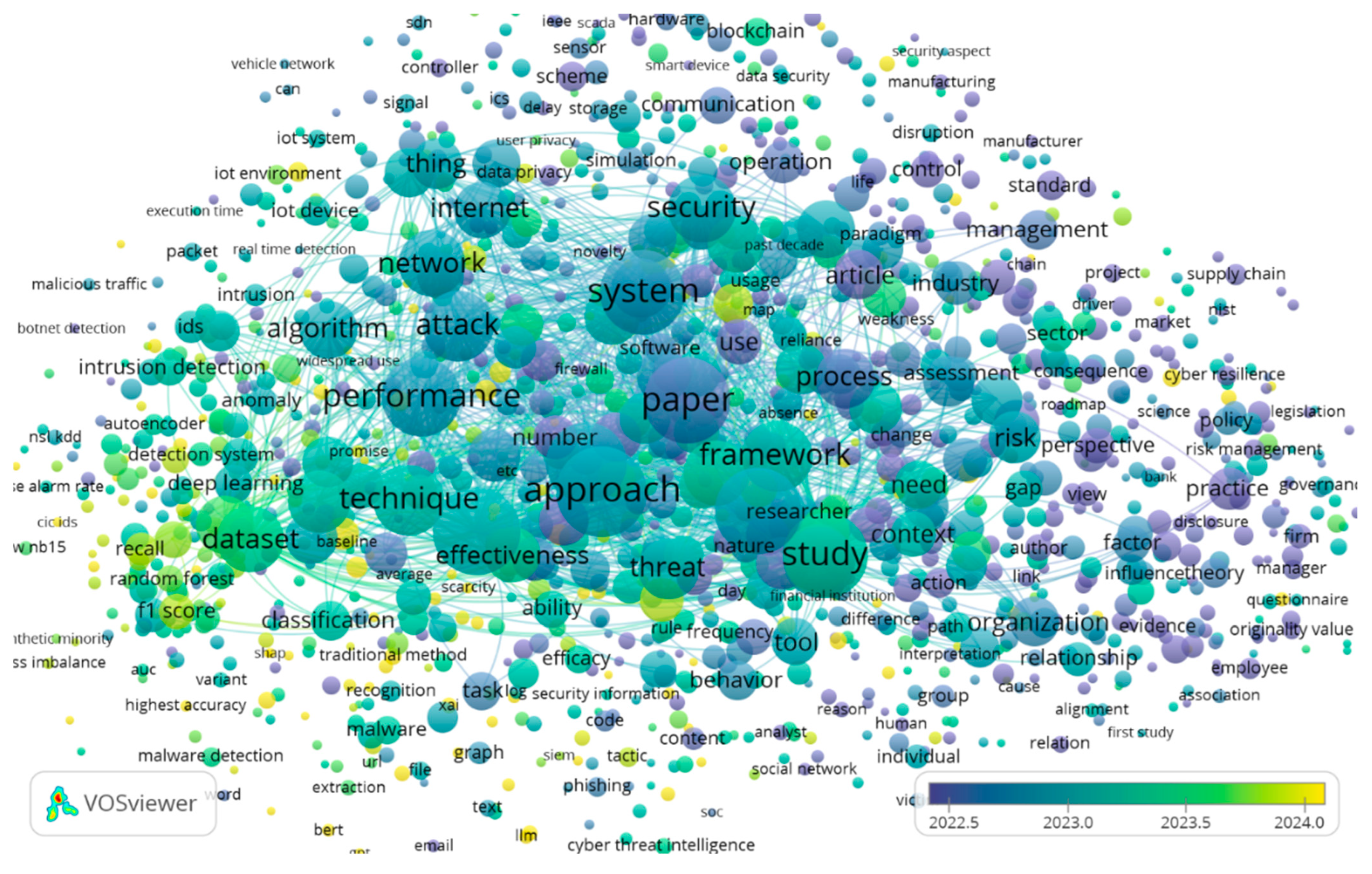
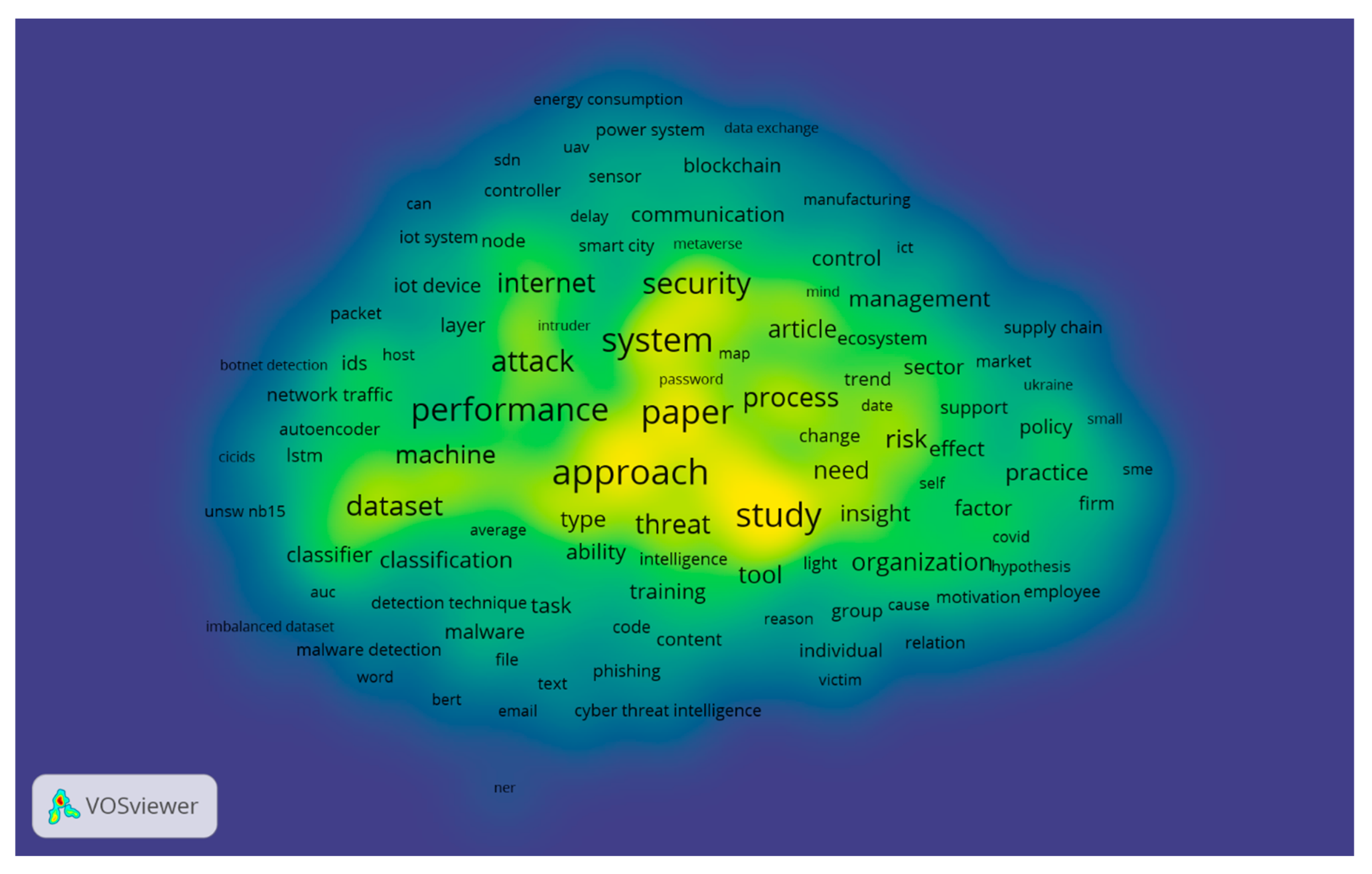
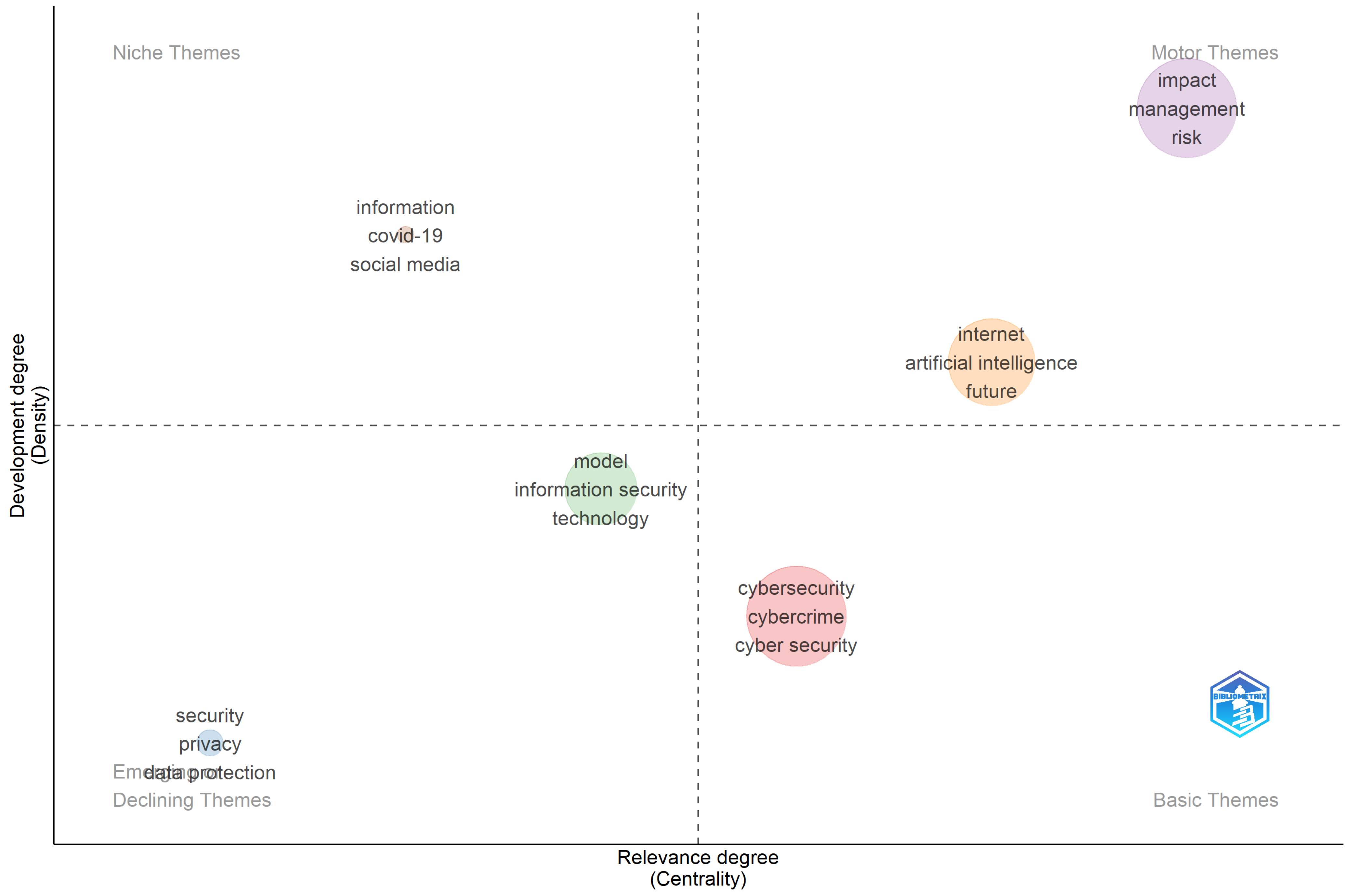
6. Thematic Evolution and Knowledge Domains
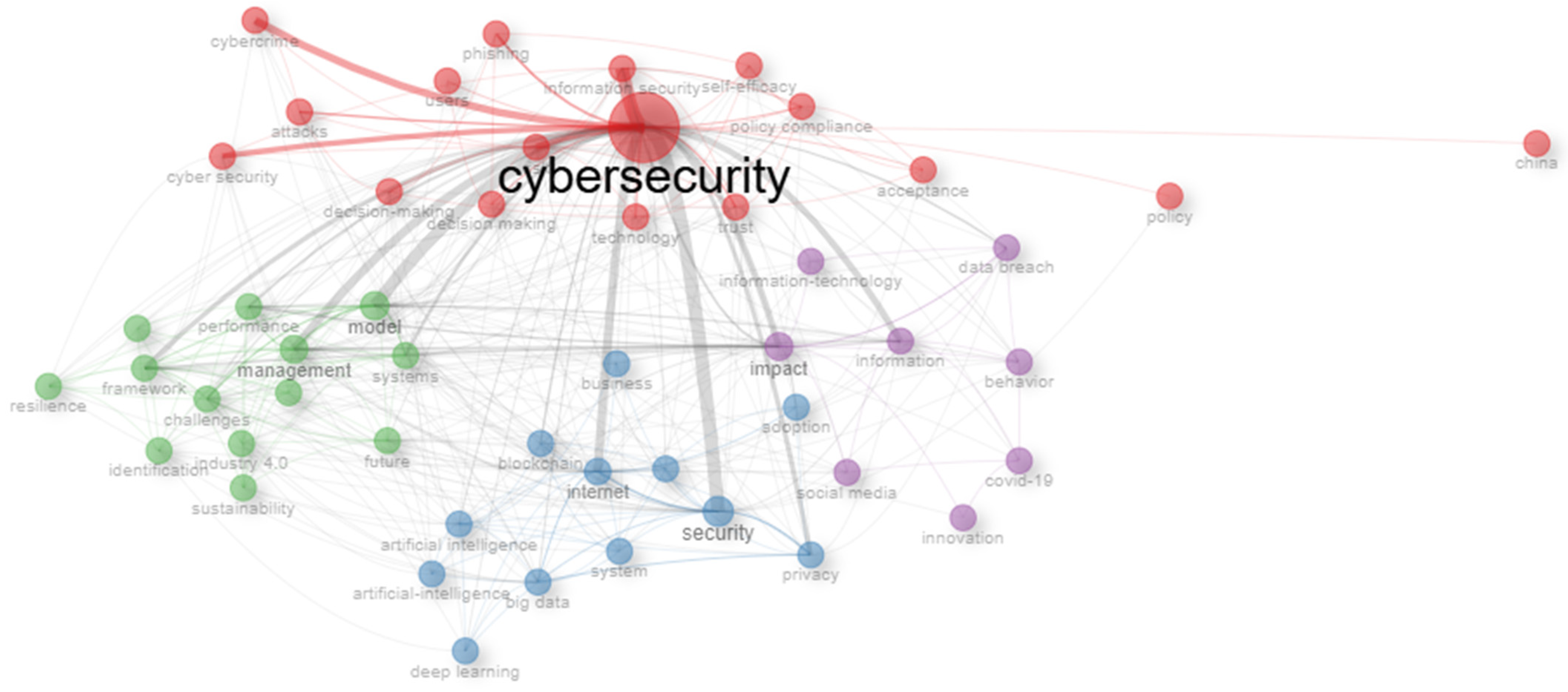
6.1. Red Cluster: Strategic-Organizational Perspective (38.9%)
6.2. Green Cluster: Operational-Analytical Perspective (36.6%)
6.3. Blue Cluster: Technical/System Integration (23.4%)
6.4. Yellow Cluster: Emerging Technologies & Innovation (1.0%)
6.5. Purple Cluster: Cross-Domain Integration (0.1%)
7. Discussion
7.1. Summary of Key Findings
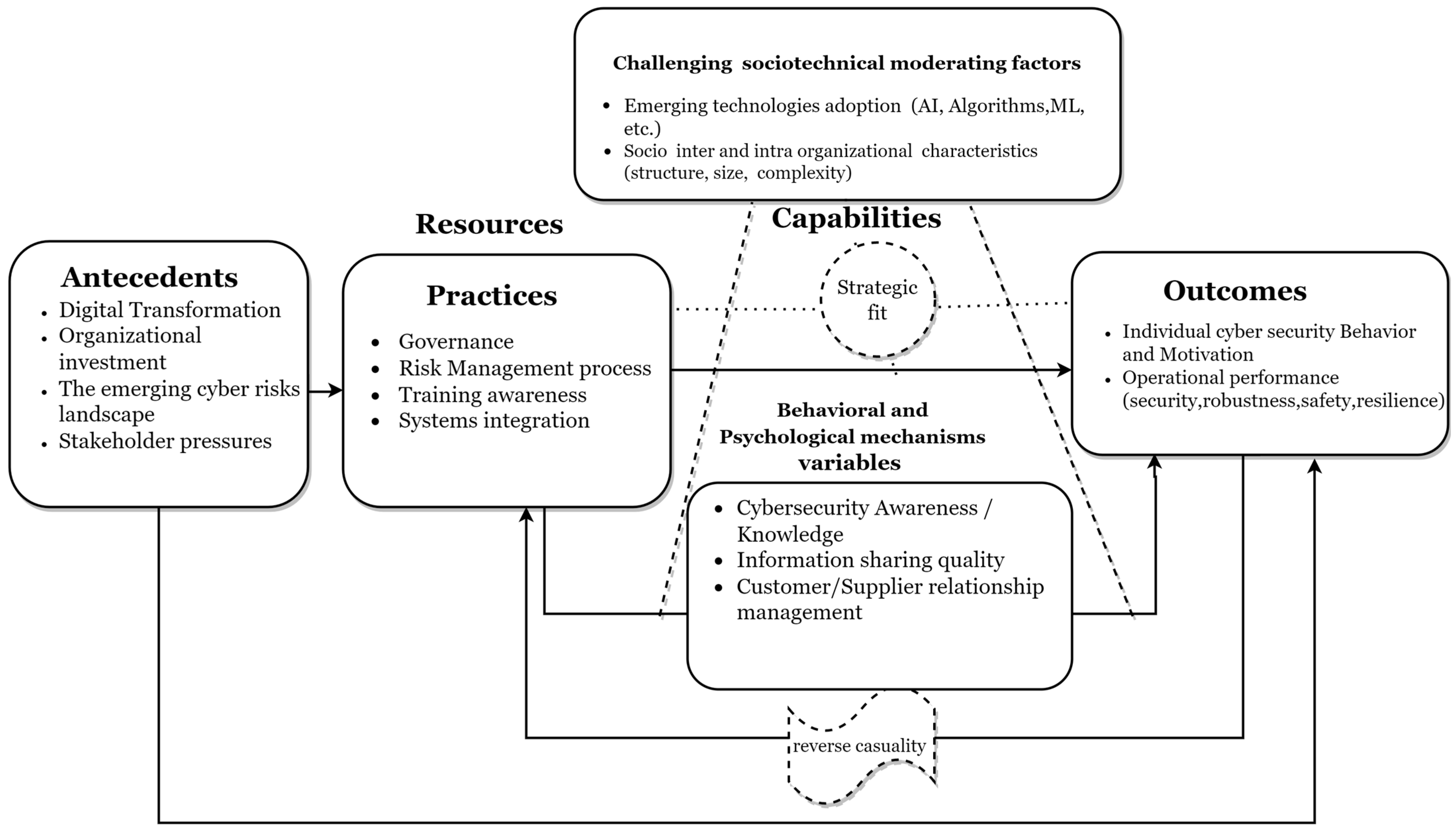
7.2. Theoretical Contributions
7.3. Practical Contributions
8. Future Research Directions
8.1. Strengthening Conceptual Clarity and Boundary Conditions
8.2. Advancing Measurement and Psychometric Rigor
8.3. Strengthening Theoretical Foundations and Mechanisms
8.4. Broadening Methodological Approaches
8.5. Expanding Outcomes and Multi-Level Perspectives
9. Limitations
10. Concluding Remarks
Author Contributions
Funding
Data Availability Statement
Acknowledgments
Conflicts of Interest
Appendix A

| Core Research Areas/Field | Journal | N | Foundational Phase | Emerging Phase | Expansion Phase | Maturation Phase |
|---|---|---|---|---|---|---|
| Supply Chain Management (N = 17) | Supply Chain Management: An International Journal | 5 | - | 1 | 2 | 2 |
| International Journal of Physical Distribution & Logistics Management | 2 | - | 2 | - | - | |
| Transportation Research Part E: Logistics and Transportation Review | 1 | - | - | 1 | - | |
| Transport Policy | 2 | - | 1 | 1 | - | |
| Production and Operations Management | 2 | - | 1 | 1 | - | |
| International Journal of Production Research | 2 | - | 2 | - | - | |
| European Journal of Operational Research | 1 | - | 1 | - | - | |
| Industrial Management & Data Systems | 2 | - | - | - | 2 | |
| Information systems (N = 115) | Computers & Security | 16 | - | 4 | 12 | - |
| Information & Management | 6 | - | 3 | 3 | - | |
| Information Systems Frontiers | 3 | - | - | 3 | - | |
| Information Systems Journal | 1 | - | - | 1 | - | |
| Information Systems Research | 1 | - | - | 1 | - | |
| European Journal of Information Systems | 3 | - | 1 | 2 | - | |
| International Journal of Information Management | 4 | 1 | 2 | 1 | - | |
| Journal of Computer Information Systems | 2 | - | - | 2 | - | |
| Journal of Enterprise Information Management | 4 | - | 1 | 3 | - | |
| Journal of Information Systems | 2 | - | - | 2 | - | |
| Journal of Management Information Systems | 3 | - | - | 3 | - | |
| Journal of Organizational Computing and Electronic Commerce | 2 | - | 1 | 1 | - | |
| Journal of Strategic Information Systems | 2 | - | 1 | 1 | - | |
| Journal of the Association for Information Systems | 1 | - | - | 1 | - | |
| MIS Quarterly | 4 | - | 2 | 2 | - | |
| MIS Quarterly Executive | 9 | - | 2 | 7 | - | |
| Data Base for Advances in Information Systems | 2 | - | - | 2 | - | |
| Electronic Commerce Research | 1 | - | - | 1 | - | |
| Internet Research | 1 | - | - | 1 | - | |
| Technology in Society | 8 | - | - | - | 8 | |
| International Journal of Accounting Information Systems | 9 | 1 | 3 | 5 | - | |
| Reliability Engineering and System Safety | 3 | - | - | 3 | - | |
| Safety Science | 2 | - | 1 | 1 | - | |
| IEEE Transactions on Engineering Management | 10 | - | - | 5 | 5 | |
| Technovation | 4 | - | 2 | 2 | - | |
| Technological Forecasting and Social Change | 6 | - | 3 | 3 | - | |
| Industrial Management & Data Systems | 2 | - | - | - | 2 | |
| Journal of Innovation & Knowledge | 2 | - | 1 | 1 | - | |
| Computers in Human Behavior | 2 | - | - | - | 2 | |
| risk management (N = 22) | Accident Analysis and Prevention | 1 | 1 | - | - | - |
| Decision Analysis | 2 | - | 1 | 1 | - | |
| Decision Support Systems | 2 | - | - | 2 | - | |
| Finance Research Letters | 2 | - | - | 2 | - | |
| International Journal of Forecasting | 1 | - | - | 1 | - | |
| International Review of Financial Analysis | 5 | - | 1 | 4 | - | |
| Journal of Accounting and Public Policy | 1 | - | - | - | 1 | |
| Journal of Banking & Finance | 1 | - | - | 1 | - | |
| Journal of Corporate Finance | 1 | - | - | 1 | - | |
| Journal of Business Finance & Accounting | 1 | - | - | 1 | - | |
| Managerial Auditing Journal | 3 | - | - | 3 | - | |
| Pacific-Basin Finance Journal | 1 | - | - | 1 | - | |
| International Journal of Auditing | 1 | - | - | 1 | - | |
| Others (N = 21) | ||||||
| Legal & Regulatory | American Business Law Journal | 1 | 1 | - | - | - |
| International & Comparative Law Quarterly | ||||||
| Policy & International Affairs | International Affairs | 6 | - | - | - | 6 |
| Journal of European Public Policy | 3 | - | - | - | 3 | |
| Public Administration Review | 1 | - | - | - | 1 | |
| Pacific Review | 1 | - | - | - | 1 | |
| Marine Policy | 1 | - | - | - | 1 | |
| Business & Management | Business Strategy and the Environment | 1 | - | - | 1 | - |
| Journal of Business Ethics | 1 | - | - | - | 1 | |
| Journal of Business and Psychology | 3 | - | - | - | 3 | |
| Small Business Economics | 1 | - | - | - | 1 | |
| Management Science | 1 | - | - | - | 1 | |
| Knowledge Management | Knowledge Management Research & Practice | 1 | - | - | - | 1 |
| Total | 175 | |||||
| Author(s)/ Year | No. of Dimensions | Dimensions | Setting | Instrument Type | Framework Basis | Respondents (n) | Main Findings |
|---|---|---|---|---|---|---|---|
| [10] | 3 | Governance, Systems Integration, and Operations | Conceptual | Conceptual—proposed multidimensional model | NIST CSF (implicit) | NA | Proposed multidimensional framework, but not operationalized into validated survey items. |
| [37] | 1 | NIST Risk Management Functions (Identify–Protect–Detect–Respond–Recover) | Conceptual | Conceptual—theoretical mapping | NIST CSF; ERM | NA | Validated measurement scale that emphasizes cyber risk lifecycle. |
| [20] | 3 | Governance, Systems Integration, and Operations | Malaysia—Manufacturing sector | Empirical—5-point Likert | NIST, ISO 27001, ISO 28000 | Managers (130) | Provide balanced validated organizational and operational practice-level scale. |
| [17] | 3 | Governance, Systems Integration, and Operations | Malaysia—Manufacturing sector | Empirical—5-point Likert | NIST CSF, COBIT 5, ISO 27001 | Managers (105) | Validated multidimensional behavioral scale across managerial and operational levels. |
| [14] | 4 | Cyber Risk Governance, Cybersecurity Training, Cyber Risk Control, and Cyber Risk Insurance | Italy—multi-sectoral organizations | Empirical—5-point Likert | NIST-aligned principles | Managers (304) | Focused on technical and control-oriented practices. |
| [15] | 1 | Strategic Cyber Risk Management (Identify–Protect–Detect–Respond–Recover) | United States—Manufacturing sector | Empirical—5-point Likert | NIST CSF alignment | Managers (388) | Mainly focused on lifecycle-based cyber risks. |
| [3] | 2 | Internal (intra-organizational) and External (inter-organizational) SCRM practices | Denmark—SMEs | Empirical—5-point Likert | NIST CSF 2.0 | Managers (248) | Combine organizational and inter-organizational practices. |
References
- Grylls, B. CrowdStrike outage impact on F&B supply chains. Food Manufacture. 2024. Available online: https://www.foodmanufacture.co.uk/Article/2024/07/19/Crowdstrike-outage-impact-on-F-B-supply-chains/ (accessed on 24 January 2025).
- Roush, T. CrowdStrike’s Massive Global Tech Outage: Airlines, Banks, 911 & State Services Impacted. Forbes, 19 July 2024. Available online: https://www.forbes.com/sites/tylerroush/2024/07/19/crowdstrikes-massive-global-tech-outage-airlines-banks-911-state-services-impacted/ (accessed on 24 January 2025).
- Stentoft, J.; Peressotti, M.; Mayer, P.; Wickstrøm, K.A.; Schmitt, O.; Keating, V.C.; Kankam-Boateng, J. The relationship between cybersecurity awareness, cybersecurity supply chain risk management, and firm performance. Supply Chain. Manag. Int. J. 2025, 30, 497–517. [Google Scholar] [CrossRef]
- Pandey, S.; Singh, R.K.; Gunasekaran, A.; Kaushik, A. Cyber security risks in globalized supply chains: A conceptual framework. J. Glob. Oper. Strateg. Sourc. 2020, 13, 103–128. [Google Scholar] [CrossRef]
- Gani, A.B.D.; Fernando, Y. Ten-year review of cyber supply chain security: Driving productivity with visibility. Int. J. Product. Qual. Manag. 2024, 42, 153–169. [Google Scholar] [CrossRef]
- Ivanov, D. Digital supply chain management and technology to enhance resilience by building and using end-to-end visibility during the COVID-19 pandemic. IEEE Trans. Eng. Manag. 2021, 71, 10485–10495. [Google Scholar] [CrossRef]
- Herburger, M.; Wankmüller, A.; Hüttner, C. Building supply chain resilience to cyber risks: A dynamic capabilities perspective. Supply Chain Manag. Int. J. 2024, 29, 28–50. [Google Scholar] [CrossRef]
- Friday, D.; Melnyk, S.A.; Altman, M.; Harrison, N.; Ryan, S. An inductive analysis of collaborative cybersecurity management capabilities, relational antecedents and supply chain cybersecurity parameters. Int. J. Phys. Distrib. Logist. Manag. 2024, 54, 476–500. [Google Scholar] [CrossRef]
- Wang, J.; Ho, C.Y.C.; Shan, Y.G. Does cybersecurity risk stifle corporate innovation activities? Int. Rev. Financ. Anal. 2024, 91, 103028. [Google Scholar] [CrossRef]
- Boyson, S. Cyber supply chain risk management: Revolutionizing the strategic control of critical IT systems. Technovation 2014, 34, 342–353. [Google Scholar] [CrossRef]
- Linton, J.D.; Boyson, S.; Aje, J. The challenge of cyber supply chain security to research and practice: An introduction. Technovation 2014, 34, 339–341. [Google Scholar] [CrossRef]
- Cheung, K.F.; Bell, M.G.H.; Bhattacharjya, J. Cybersecurity in logistics and supply chain management: An overview and future research directions. Transp. Res. Part E Logist. Transp. Rev. 2021, 146, 102217. [Google Scholar] [CrossRef]
- Carayannis, E.G.; Grigoroudis, E.; Rehman, S.S.; Samarakoon, N. Ambidextrous cybersecurity: The seven pillars (7Ps) of cyber resilience. IEEE Trans. Eng. Manag. 2021, 68, 223–234. [Google Scholar] [CrossRef]
- Gaudenzi, B.; Baldi, B. Cyber resilience in organisations and supply chains: From perceptions to actions. Int. J. Logist. Manag. 2024, 35, 99–122. [Google Scholar] [CrossRef]
- Jazairy, A.; Brho, M.; Manuj, I.; Goldsby, T.J. Cyber risk management strategies and integration: Toward supply chain cyber resilience and robustness. Int. J. Phys. Distrib. Logist. Manag. 2024, 54, 1–29. [Google Scholar] [CrossRef]
- Sadeghi, K.; Ojha, D.; Kaur, P.; Mahto, R.V.; Dhir, A. Explainable artificial intelligence and agile decision-making in supply chain cyber resilience. Decis. Support Syst. 2024, 180, 114194. [Google Scholar] [CrossRef]
- Fernando, Y.; Tseng, M.L.; Wahyuni-Td, I.S.; de Sousa Jabbour, A.B.L.; Chiappetta Jabbour, C.J.; Foropon, C. Cyber supply chain risk management and performance in Industry 4.0 era: Information system security practices in Malaysia. J. Ind. Prod. Eng. 2023, 40, 102–116. [Google Scholar] [CrossRef]
- Topping, C.; Dwyer, A.; Michalec, O.; Craggs, B.; Rashid, A. Beware suppliers bearing gifts! Analysing coverage of supply chain cybersecurity in critical national infrastructure frameworks. Comput. Secur. 2021, 108, 102324. [Google Scholar] [CrossRef]
- Creazza, A.; Colicchia, C.; Spiezia, S.; Dallari, F. Who cares? Supply chain managers’ perceptions regarding cyber supply chain risk management in the digital transformation era. Supply Chain Manag. Int. J. 2022, 27, 30–53. [Google Scholar] [CrossRef]
- Gani, A.B.D.; Fernando, Y.; Lan, S.; Lim, M.K.; Tseng, M.L. Interplay between cyber supply chain risk management practices and cybersecurity performance. Ind. Manag. Data Syst. 2023, 123, 843–861. [Google Scholar] [CrossRef]
- Bartol, N. Cyber supply chain security practices DNA: Filling in the puzzle using a diverse set of disciplines. Technovation. 2014, 34, 354–361. [Google Scholar] [CrossRef]
- Orji, I.J.; U-Dominic, C.M. Modelling the conundrums of cyber-risk management in logistics firms for supply chain social sustainability. J. Enterp. Inf. Manag. 2024, 37, 1885–1925. [Google Scholar] [CrossRef]
- Colicchia, C.; Creazza, A.; Menachof, D.A. Managing cyber and information risks in supply chains: Insights from an exploratory analysis. Supply Chain Manag. Int. J. 2019, 24, 215–240. [Google Scholar] [CrossRef]
- Ghadge, A.; Weiß, M.; Caldwell, N.D.; Wilding, R. Managing cyber risk in supply chains: A review and research agenda. Supply Chain Manag. Int. J. 2020, 25, 223–240. [Google Scholar] [CrossRef]
- Aarland, M. Cybersecurity in digital supply chains in the procurement process: Introducing the digital supply chain management framework. Inf. Comput. Secur. 2024, 33, 5–24. [Google Scholar] [CrossRef]
- Melnyk, S.A.; Schoenherr, T.; Speier-Pero, C.; Peters, C.; Chang, J.F.; Friday, D. New challenges in supply chain management: Cybersecurity across the supply chain. Int. J. Prod. Res. 2022, 60, 162–183. [Google Scholar] [CrossRef]
- Song, J.M.; Wang, T.; Yen, J.C.; Chen, Y.H. Does cybersecurity maturity level assurance improve cybersecurity risk management in supply chains? Int. J. Account. Inf. Syst. 2024, 54, 100695. [Google Scholar] [CrossRef]
- Dalal, R.S.; Howard, D.J.; Bennett, R.J.; Posey, C.; Zaccaro, S.J.; Brummel, B.J. Organizational science and cybersecurity: Abundant opportunities for research at the interface. J. Bus. Psychol. 2022, 37, 1–29. [Google Scholar] [CrossRef]
- Pala, A.; Zhuang, J. Information sharing in cybersecurity: A review. Decis. Anal. 2019, 16, 172–196. [Google Scholar] [CrossRef]
- Yang, A.; Kwon, Y.J.; Lee, S.Y.T. The impact of information sharing legislation on cybersecurity industry. Ind. Manag. Data Syst. 2020, 120, 1777–1794. [Google Scholar] [CrossRef]
- Kumar, S.; Biswas, B.; Bhatia, M.S.; Dora, M. Antecedents for enhanced level of cyber-security in organisations. J. Enterp. Inf. Manag. 2021, 34, 1597–1629. [Google Scholar] [CrossRef]
- Soares, L.O.; Reis, A.D.C.; Vieira, P.S.; Hernández-Callejo, L.; Boloy, R.A.M. Electric vehicle supply chain management: A bibliometric and systematic review. Energies 2023, 16, 1563. [Google Scholar] [CrossRef]
- Yu, W.; Yin, Q.; Yin, H.; Xiao, W.; Chang, T.; He, L.; Ni, L.; Ji, Q. A systematic review on password guessing tasks. Entropy 2023, 25, 1303. [Google Scholar] [CrossRef]
- Atstāja, D.; Mukem, K.W. Sustainable supply chain management in the oil and gas industry in developing countries as a part of the quadruple helix concept: A systematic literature review. Sustainability 2024, 16, 1776. [Google Scholar] [CrossRef]
- Kumar, A.; Shrivastav, S.K.; Shrivastava, A.K.; Panigrahi, R.R.; Mardani, A.; Cavallaro, F. Sustainable supply chain management, performance measurement, and management: A review. Sustainability 2023, 15, 5290. [Google Scholar] [CrossRef]
- Gerring, J. What makes a concept good? A criterial framework for understanding concept formation in the social sciences. Polity 1999, 31, 357–393. [Google Scholar] [CrossRef]
- Boyson, S.; Corsi, T.M.; Paraskevas, J.P. Defending digital supply chains: Evidence from a decade-long research program. Technovation 2022, 118, 102380. [Google Scholar] [CrossRef]
- Paul, J.; Lim, W.M.; O’Cass, A.; Hao, A.W.; Bresciani, S. Scientific procedures and rationales for systematic literature reviews (SPAR-4-SLR). Int. J. Consum. Stud. 2021, 45, O1–O16. [Google Scholar] [CrossRef]
- Erkan-Barlow, A.; Nguyen, T. Cybersecurity and executive compensation: Can inside debt-induced risk aversion improve cyber risk management effectiveness? Int. Rev. Financ. Anal. 2024, 93, 103173. [Google Scholar] [CrossRef]
- Van Eck, N.J.; Waltman, L. VOSviewer Manual; Leiden University: Leiden, The Netherlands, 2019; Available online: https://www.vosviewer.com/documentation/Manual_VOSviewer_1.6.13.pdf (accessed on 28 January 2025).
- Aria, M.; Cuccurullo, C. Bibliometrix: An R-tool for comprehensive science mapping analysis. J. Informetr. 2017, 11, 959–975. [Google Scholar] [CrossRef]
- Tonn, G.; Kesan, J.P.; Zhang, L.; Czajkowski, J. Cyber risk and insurance for transportation infrastructure. Transp. Policy 2019, 79, 103–114. [Google Scholar] [CrossRef]
- Erola, A.; Agrafiotis, I.; Nurse, J.R.C.; Axon, L.; Goldsmith, M.; Creese, S. A system to calculate cyber-value-at-risk. Comput. Secur. 2022, 113, 102545. [Google Scholar] [CrossRef]
- Skeoch, H.R. Expanding the Gordon–Loeb model to cyber-insurance. Comput. Secur. 2022, 112, 102533. [Google Scholar] [CrossRef]
- Tripathi, M.; Mukhopadhyay, A. Financial loss due to a data privacy breach: An empirical analysis. J. Organ. Comput. Electron. Commer. 2020, 30, 381–400. [Google Scholar] [CrossRef]
- Gordon, L.A.; Loeb, M.P.; Zhou, L.; Wilford, A.L. Empirical evidence on disclosing cyber breaches in an 8-K report: Initial exploratory evidence. J. Account. Public Policy 2024, 46, 107226. [Google Scholar] [CrossRef]
- Posey, C.; Shoss, M. Employees as a source of security issues in times of change and stress: A longitudinal examination of security violations during COVID-19. J. Bus. Psychol. 2024, 39, 1027–1048. [Google Scholar] [CrossRef]
- Goel, L.; Russell, D.; Williamson, S.; Zhang, J.Z. Information systems security resilience as a dynamic capability. J. Enterp. Inf. Manag. 2023, 36, 906–924. [Google Scholar] [CrossRef]
- Schatz, D.; Bashroush, R. Economic valuation for information security investment: A systematic literature review. Inf. Syst. Front. 2017, 19, 1205–1228. [Google Scholar] [CrossRef]
- Zwilling, M.; Klien, G.; Lesjak, D.; Wiechetek, Ł.; Cetin, F.; Basim, H.N. Cybersecurity awareness, knowledge, and behavior: A comparative study. J. Comput. Inf. Syst. 2022, 62, 82–97. [Google Scholar] [CrossRef]
- Li, L.; He, W.; Xu, L.; Ash, I.; Anwar, M.; Yuan, X. Investigating the impact of cybersecurity policy awareness on employees’ cybersecurity behavior. Int. J. Inf. Manag. 2019, 45, 13–24. [Google Scholar] [CrossRef]
- Connolly, L.Y.; Wall, D.S. The rise of crypto-ransomware in a changing cybercrime landscape: Taxonomising countermeasures. Comput. Secur. 2019, 87, 101568. [Google Scholar] [CrossRef]
- Jalali, M.S.; Siegel, M.; Madnick, S. Decision-making and biases in cybersecurity capability development: Evidence from a simulation game experiment. J. Strateg. Inf. Syst. 2019, 28, 66–82. [Google Scholar] [CrossRef]
- Bashir, M.; Wee, C.; Memon, N.; Guo, B. Profiling cybersecurity competition participants: Self-efficacy, decision-making and interests predict effectiveness of competitions as a recruitment tool. Comput. Secur. 2017, 65, 153–165. [Google Scholar] [CrossRef]
- Chatterjee, S.; Thekdi, S. An iterative learning and inference approach to managing dynamic cyber vulnerabilities of complex systems. Reliab. Eng. Syst. Saf. 2020, 193, 106664. [Google Scholar] [CrossRef]
- Choi, S.J.; Johnson, M.E. The relationship between cybersecurity ratings and the risk of hospital data breaches. J. Am. Med. Inform. Assoc. 2021, 28, 2085–2092. [Google Scholar] [CrossRef]
- D’Arcy, J.; Basoglu, K.A. The influences of public and institutional pressure on firms’ cybersecurity disclosures. J. Assoc. Inf. Syst. 2022, 23, 779–805. [Google Scholar] [CrossRef]
- Feng, C.Q.; Wang, T. Does CIO risk appetite matter? Evidence from information security breach incidents. Int. J. Account. Inf. Syst. 2019, 32, 59–75. [Google Scholar] [CrossRef]
- La Fleur, C.; Hoffman, B.; Gibson, C.B.; Buchler, N. Team performance in regional and national U.S. cybersecurity defense competitions. Comput. Secur. 2021, 104, 102229. [Google Scholar] [CrossRef]
- Gao, L.; Calderon, T.G.; Tang, F. Public companies’ cybersecurity risk disclosures. Int. J. Account. Inf. Syst. 2020, 38, 100468. [Google Scholar] [CrossRef]
- Islam, M.S.; Farah, N.; Stafford, T.F. Factors associated with security/cybersecurity audit by internal audit function: An international study. Manag. Audit. J. 2018, 33, 377–409. [Google Scholar] [CrossRef]
- Jiang, W. Cybersecurity risk and audit pricing: A machine learning-based analysis. J. Inf. Syst. 2024, 38, 91–117. [Google Scholar] [CrossRef]
- Kam, H.J.; Menard, P.; Ormond, D.; Crossler, R.E. Cultivating cybersecurity learning: An integration of self-determination and flow. Comput. Secur. 2020, 96, 101875. [Google Scholar] [CrossRef]
- Kappelman, L.; Johnson, V.; Torres, R.; Maurer, C.; McLean, E. A study of information systems issues, practices, and leadership in Europe. Eur. J. Inf. Syst. 2019, 28, 26–42. [Google Scholar] [CrossRef]
- Kappelman, L.; Torres, R.; McLean, E.R.; Maurer, C.; Johnson, V.L.; Snyder, M.; Guerra, K. The 2021 SIM IT issues and trends study. MIS Q. Exec. 2022, 21, 75–114. [Google Scholar] [CrossRef]
- Kwong, J.K.; Pearlson, K. How large companies can help small and medium-sized enterprise suppliers strengthen cybersecurity. MIS Q. Exec. 2024, 23, 387–398. [Google Scholar] [CrossRef]
- Li, H.; Yoo, S. Information systems sourcing strategies and organizational cybersecurity breaches. IEEE Trans. Eng. Manag. 2021, 71, 481–490. [Google Scholar] [CrossRef]
- Massimino, B.; Gray, J.V.; Lan, Y. On the inattention to digital confidentiality in operations and supply chain research. Prod. Oper. Manag. 2018, 27, 1492–1515. [Google Scholar] [CrossRef]
- Mhajne, A.; Crystal, W. A feminist cybersecurity: Addressing the crisis of cyber(in)security. Int. Aff. 2024, 100, 2341–2360. [Google Scholar] [CrossRef]
- Molinaro, K.A.; Bolton, M.L. Evaluating the applicability of the double system lens model to the analysis of phishing email judgments. Comput. Secur. 2018, 77, 128–137. [Google Scholar] [CrossRef]
- Norris, D.F.; Mateczun, L.; Hatcher, W.; Meares, W.L.; Heslen, J. Local government cyber insecurity: Causes and recommendations for improvement. Public Adm. Rev. 2024, 84, 651–659. [Google Scholar] [CrossRef]
- Pate-Cornell, M.E.; Kuypers, M.A. A probabilistic analysis of cyber risks. IEEE Trans. Eng. Manag. 2023, 70, 3–13. [Google Scholar] [CrossRef]
- Salimath, M.S.; Philip, J. Cyber management and value creation: An organisational learning-based approach. Knowl. Manag. Res. Pract. 2020, 18, 474–487. [Google Scholar] [CrossRef]
- Sen, R.; Choobineh, J.; Kumar, S. Determinants of software vulnerability disclosure timing. Prod. Oper. Manag. 2020, 29, 2532–2552. [Google Scholar] [CrossRef]
- Smith, T.; Tadesse, A.F.; Vincent, N.E. The impact of CIO characteristics on data breaches. Int. J. Account. Inf. Syst. 2021, 43, 100532. [Google Scholar] [CrossRef]
- Stafford, T.; Deitz, G.; Li, Y. The role of internal audit and user training in information security policy compliance. Manag. Audit. J. 2018, 33, 410–424. [Google Scholar] [CrossRef]
- Syed, R. Cybersecurity vulnerability management: A conceptual ontology and cyber intelligence alert system. Inf. Manag. 2020, 57, 103334. [Google Scholar] [CrossRef]
- Tayaksi, C.; Ada, E.; Kazancoglu, Y.; Sagnak, M. The financial impacts of information systems security breaches on publicly traded companies. J. Enterp. Inf. Manag. 2022, 35, 650–668. [Google Scholar] [CrossRef]
- Tejay, G.P.S.; Mohammed, Z.A. Cultivating security culture for information security success: A mixed-methods study. Inf. Manag. 2023, 60, 103751. [Google Scholar] [CrossRef]
- Torten, R.; Reaiche, C.; Boyle, S. The impact of security awareness on information technology professionals’ behavior. Comput. Secur. 2018, 79, 68–79. [Google Scholar] [CrossRef]
- Turel, O.; He, Q.; Wen, Y.; Trenz, M. Examining the neural basis of information security policy violations. MIS Q. 2021, 45, 1715–1744. [Google Scholar] [CrossRef]
- Yoo, C.W.; Goo, J.; Rao, H.R. Is cybersecurity a team sport? MIS Q. 2020, 44, 907–931. [Google Scholar] [CrossRef]
- Zhao, Y.; Huang, L.; Smidts, C.; Zhu, Q. Finite-horizon semi-Markov game for attack response and probabilistic risk assessment in nuclear power plants. Reliab. Eng. Syst. Saf. 2020, 201, 106878. [Google Scholar] [CrossRef]
- Johnson, V.; Torres, R.; Mohit, H.; Chatterjee, S.; Maurer, C.; Guerra, K.; Srivastava, S. The 2023 SIM IT issues and trends study. MIS Q. Exec. 2024, 23, 7. [Google Scholar] [CrossRef]
- Uddin, M.H.; Mollah, S.; Ali, M.H. Does cyber tech spending matter for bank stability? Int. Rev. Financ. Anal. 2020, 72, 101587. [Google Scholar] [CrossRef]
- French, A.; Storey, V.C.; Wallace, L. A typology of disinformation intentionality and impact. Inf. Syst. J. 2024, 34, 1324–1354. [Google Scholar] [CrossRef]
- Benaroch, M. Cyber failures and information technology capability reputation: Examining ex ante and ex post interplay effects. J. Manag. Inf. Syst. 2024, 41, 744–778. [Google Scholar] [CrossRef]
- Hiller, J.; Kisska-Schulze, K.; Shackelford, S. Cybersecurity carrots and sticks. Am. Bus. Law J. 2024, 61, 5–29. [Google Scholar] [CrossRef]
- Morrow, E. Scamming higher education: An analysis of phishing content and trends. Comput. Hum. Behav. 2024, 158, 108274. [Google Scholar] [CrossRef]
- Alshabib, H.N.; Martins, J.T. Cybersecurity: Perceived threats and policy responses in the Gulf Cooperation Council. IEEE Trans. Eng. Manag. 2022, 69, 3664–3675. [Google Scholar] [CrossRef]
- Arroyabe, M.F.; Arranz, C.F.A.; de Arroyabe, I.F.; de Arroyabe, J.C.F. The effect of IT security issues on the implementation of Industry 4.0 in SMEs: Barriers and challenges. Technol. Forecast. Soc. Change 2024, 199, 123051. [Google Scholar] [CrossRef]
- Arroyabe, M.F.; Arranz, C.F.A.; Fernández de Arroyabe, I.; Fernández de Arroyabe, J.C. Exploring the economic role of cybersecurity in SMEs: A case study of the UK. Technol. Soc. 2024, 78, 102670. [Google Scholar] [CrossRef]
- Carver, J. More bark than bite? European digital sovereignty discourse and changes to the European Union’s external relations policy. J. Eur. Public Policy 2024, 31, 2250–2286. [Google Scholar] [CrossRef]
- Garcia-Perez, A.; Cegarra-Navarro, J.G.; Sallos, M.P.; Martinez-Caro, E.; Chinnaswamy, A. Resilience in healthcare systems: Cybersecurity and digital transformation. Technovation 2023, 121, 102583. [Google Scholar] [CrossRef]
- Knight, R.; Nurse, J.R.C. A framework for effective corporate communication after cybersecurity incidents. Comput. Secur. 2020, 99, 102036. [Google Scholar] [CrossRef]
- Morris, D.; Madzudzo, G.; Garcia-Perez, A. Cybersecurity threats in the auto industry: Tensions in the knowledge environment. Technol. Forecast. Soc. Change 2020, 157, 120102. [Google Scholar] [CrossRef]
- Pescaroli, G.; Wicks, R.T.; Giacomello, G.; Alexander, D.E. Increasing resilience to cascading events: The M.OR.D.OR. scenario. Saf. Sci. 2018, 110, 131–140. [Google Scholar] [CrossRef]
- Renaud, K.; Warkentin, M.; Pogrebna, G.; van der Schyff, K. VISTA: An inclusive insider threat taxonomy with mitigation strategies. Inf. Manag. 2024, 61, 103877. [Google Scholar] [CrossRef]
- Sallos, M.P.; Garcia-Perez, A.; Bocanet, A. Organisational cyber resilience: A heuristic for bridging foundations and applications. J. Enterp. Inf. Manag. 2024, 37, 1926–1952. [Google Scholar] [CrossRef]
- Uchendu, B.; Nurse, J.R.C.; Bada, M.; Furnell, S. Developing a cybersecurity culture: Current practices and future needs. Comput. Secur. 2021, 109, 102387. [Google Scholar] [CrossRef]
- Cheng, S.; Li, J.; Luo, L.; Zhu, Y. Cybersecurity governance and digital finance: Evidence from sovereign states. Financ. Res. Lett. 2024, 65, 105533. [Google Scholar] [CrossRef]
- Chen, W.; Li, X.; Wu, H.; Zhang, L. The impact of managerial myopia on cybersecurity: Evidence from data breaches. J. Bank. Financ. 2024, 166, 107254. [Google Scholar] [CrossRef]
- Lee, J.K.; Chang, Y.; Kwon, H.Y.; Kim, B. Reconciliation of privacy with preventive cybersecurity: The bright internet approach. Inf. Syst. Front. 2020, 22, 45–57. [Google Scholar] [CrossRef]
- Li, Y.; Xu, L. Cybersecurity investments in a two-echelon supply chain with third-party risk propagation. Int. J. Prod. Res. 2021, 59, 1216–1238. [Google Scholar] [CrossRef]
- Li, Y.; Zhao, L. Collaborating with bounty hunters: Encouraging white-hat hackers’ participation in vulnerability crowdsourcing programs. Inf. Manag. 2022, 59, 103648. [Google Scholar] [CrossRef]
- Wang, F.; Wang, H.; Li, J. The effect of cybersecurity legislation on firm cost behavior: Evidence from China. Pac. Basin Financ. J. 2024, 86, 102460. [Google Scholar] [CrossRef]
- Wang, W.; Cova, G.; Zio, E. A clustering-based framework for searching vulnerabilities in cyber-physical energy systems. Reliab. Eng. Syst. Saf. 2022, 222, 108400. [Google Scholar] [CrossRef]
- Zeng, H.; Yunis, M.; Khalil, A.; Mirza, N. Toward a conceptual framework for AI-driven anomaly detection in smart city IoT networks. J. Innov. Knowl. 2024, 9, 100601. [Google Scholar] [CrossRef]
- Dennis, A.R.; Minas, R.K. Security on autopilot: Why current security theories hijack our thinking and lead us astray. ACM SIGMIS Database DATABASE Adv. Inf. Syst. 2018, 49, 16–37. [Google Scholar] [CrossRef]
- Mukhopadhyay, A.; Jain, S. A framework for cyber-risk insurance against ransomware: A mixed-method approach. Int. J. Inf. Manag. 2024, 74, 102724. [Google Scholar] [CrossRef]
- Rajan, R.; Rana, N.P.; Parameswar, N.; Dhir, S.; Dwivedi, Y.K. Developing a modified total interpretive structural model (M-TISM) for organizational strategic cybersecurity management. Technol. Forecast. Soc. Change 2021, 170, 120872. [Google Scholar] [CrossRef]
- Rajput, S. Analysis of Industry 4.0 technological enablers for sustainable supply chain transparency in a fuzzy environment. Bus. Strategy Environ. 2024, 33, 8616–8636. [Google Scholar] [CrossRef]
- Tripathi, M.; Mukhopadhyay, A. Does privacy breach affect firm performance? Inf. Manag. 2022, 59, 103707. [Google Scholar] [CrossRef]
- Cram, W.A.; D’Arcy, J.; Benlian, A. Time will tell: The case for an idiographic approach to behavioral cybersecurity research. MIS Q. 2024, 48, 95–136. [Google Scholar] [CrossRef]
- Hoong, Y.; Rezania, D.; Baker, R. When traditional SME managers encounter cybersecurity: Discourse analysis of opportunities and dilemmas in meeting the demands. Technol. Soc. 2024, 78, 102650. [Google Scholar] [CrossRef]
- Radu, C.; Smaili, N. Board gender diversity and corporate response to cyber risk: Evidence from cybersecurity-related disclosure. J. Bus. Ethics 2022, 177, 351–374. [Google Scholar] [CrossRef]
- Cram, W.A.; Proudfoot, J.G.; D’Arcy, J. Maximizing employee compliance with cybersecurity policies. MIS Q. Exec. 2020, 19, 183–198. [Google Scholar] [CrossRef]
- Armenia, S.; Angelini, M.; Nonino, F.; Palombi, G.; Schlitzer, M.F. A dynamic simulation approach to support the evaluation of cyber risks and security investments in SMEs. Decis. Support Syst. 2021, 147, 113580. [Google Scholar] [CrossRef]
- Calabrese, A.; Costa, R.; Tiburzi, L.; Brem, A. Merging two revolutions: A human–artificial intelligence method to study how sustainability and Industry 4.0 are intertwined. Technol. Forecast. Soc. Change 2023, 188, 122265. [Google Scholar] [CrossRef]
- Salvi, A.; Spagnoletti, P.; Noori, N.S. Cyber-resilience of critical cyber infrastructures: Integrating digital twins in the electric power ecosystem. Comput. Secur. 2022, 112, 102507. [Google Scholar] [CrossRef]
- De Nóbrega, K.M.; Rutkowski, A.F.; Saunders, C. The whole of cyber defense: Syncing practice and theory. J. Strateg. Inf. Syst. 2024, 33, 101861. [Google Scholar] [CrossRef]
- Dinkova, M.; El-Dardiry, R.; Overvest, B. Should firms invest more in cybersecurity? Small Bus. Econ. 2024, 63, 21–50. [Google Scholar] [CrossRef]
- Hassib, B.; Shires, J. Digital recognition: Cybersecurity and internet infrastructure in UAE–Israel diplomacy. Int. Aff. 2024, 100, 2399–2418. [Google Scholar] [CrossRef]
- Rone, J. The sovereign cloud in Europe: Diverging nation-state preferences and disputed institutional competences. J. Eur. Public Policy 2024, 31, 2343–2369. [Google Scholar] [CrossRef]
- Milevski, L. What makes a good strategic concept? Comp. Strategy 2023, 42, 718–728. [Google Scholar] [CrossRef]
- Fan, Y.; Stevenson, M. A review of supply chain risk management: Definition, theory, and research agenda. Int. J. Phys. Distrib. Logist. Manag. 2018, 48, 205–230. [Google Scholar] [CrossRef]
- Gani, A.B.D.; Fernando, Y. Cybersecurity governance in changing security psychology and security posture: Insights into e-procurement. Int. J. Procure. Manag. 2021, 14, 308–327. [Google Scholar] [CrossRef]
- Al-Momani, A.M.; Ramayah, T.; Al-Sharafi, M.A. Exploring the impact of cybersecurity on using electronic health records and their performance among healthcare professionals: A multi-analytical SEM-ANN approach. Technol. Soc. 2024, 77, 102592. [Google Scholar] [CrossRef]
- Cheraghali, H.; Molnár, P.; Storsveen, M.; Veliqi, F. The impact of cryptocurrency-related cyberattacks on return, volatility, and trading volume of cryptocurrencies and traditional financial assets. Int. Rev. Financ. Anal. 2024, 95, 103439. [Google Scholar] [CrossRef]
- Backman, S.; Stevens, T. Cyber risk logics and their implications for cybersecurity. Int. Aff. 2024, 100, 2441–2460. [Google Scholar] [CrossRef]
- Abhari, K.; Safaei Pour, M.; Shirazi, H. How to design a better cybersecurity readiness program. MIS Q. Exec. 2024, 23, 8. [Google Scholar] [CrossRef]
- Afshari-Mofrad, M.; Amrollahi, A.; Abedin, B. Adopt agile cybersecurity policymaking to counter emerging digital risks. MIS Q. Exec. 2024, 23, 371–386. [Google Scholar] [CrossRef]
- Nico, A.; Brechbühl, H. Identifying and filling gaps in operational technology cybersecurity. MIS Q. Exec. 2024, 23, 413–428. [Google Scholar] [CrossRef]
- Huang, J.A.; Murthy, U. The impact of cybersecurity risk management strategy disclosure on investors’ judgments and decisions. Int. J. Account. Inf. Syst. 2024, 54, 100696. [Google Scholar] [CrossRef]
- Kabanda, S.; Tanner, M.; Kent, C. Exploring SME cybersecurity practices in developing countries. J. Organ. Comput. Electron. Commer. 2018, 28, 269–282. [Google Scholar] [CrossRef]
- Le, A.T.; Huang, H.H.; Do, T.K. Navigating through cyberattacks: The role of tax aggressiveness. J. Corp. Financ. 2024, 88, 102649. [Google Scholar] [CrossRef]
- Khan, S.K.; Shiwakoti, N.; Stasinopoulos, P.; Chen, Y.; Warren, M. The impact of perceived cyber-risks on automated vehicle acceptance. Transp. Policy 2024, 152, 87–101. [Google Scholar] [CrossRef]
- Slapničar, S.; Vuko, T.; Čular, M.; Drašček, M. Effectiveness of cybersecurity audit. Int. J. Account. Inf. Syst. 2022, 44, 100548. [Google Scholar] [CrossRef]
- Huang, S.Y.; Wang, T.; Huang, Y.T.; Yeh, T.N. Information security risk items and management practices for mobile payment using non-financial-institution service providers: An exploratory study. Int. J. Account. Inf. Syst. 2024, 53, 100684. [Google Scholar] [CrossRef]
- Brooks, R.R.; Williams, K.J.; Lee, S.Y. Personal and contextual predictors of information security policy compliance: Evidence from a low-fidelity simulation. J. Bus. Psychol. 2024, 39, 657–677. [Google Scholar] [CrossRef]
- Georgiadou, A.; Mouzakitis, S.; Bounas, K.; Askounis, D. A Cyber-Security Culture Framework for Assessing Organization Readiness. J. Comput. Inf. Syst. 2022, 62, 452–462. [Google Scholar] [CrossRef]
- Li, H.; Sun, Z.; Huang, F. The impact of audit office cybersecurity experience on non-breach clients’ audit fees and cybersecurity risks. J. Inf. Syst. 2024, 38, 177–206. [Google Scholar]
- Malatji, M.; Marnewick, A.; von Solms, S. Validation of a socio-technical management process for optimising cybersecurity practices. Comput. Secur. 2020, 95, 101846. [Google Scholar] [CrossRef]
- Al-Emran, M.; Deveci, M. Unlocking the potential of cybersecurity behavior in the metaverse: Overview, opportunities, challenges, and future research agendas. Technol. Soc. 2024, 77, 102498. [Google Scholar] [CrossRef]
- Al-Emran, M.; Al-Sharafi, M.A.; Foroughi, B.; Iranmanesh, M.; Alsharida, R.A.; Al-Qaysi, N.; Ali, N. Evaluating the barriers affecting cybersecurity behavior in the metaverse using PLS-SEM and fuzzy sets (fsQCA). Comput. Hum. Behav. 2024, 159, 108315. [Google Scholar] [CrossRef]
- Donalds, C.; Osei-Bryson, K.M. Cybersecurity compliance behavior: Exploring the influences of individual decision style and other antecedents. Int. J. Inf. Manag. 2020, 51, 102056. [Google Scholar] [CrossRef]
- Kweon, E.; Lee, H.; Chai, S.; Yoo, K. The utility of information security training and education on cybersecurity incidents. Inf. Syst. Front. 2021, 23, 361–373. [Google Scholar] [CrossRef]
- Wang, M.; Parker, J.; Zhang, F.; Roberts, S.C. Assessing training and warning systems on drivers’ response to vehicle cyberattacks. Accid. Anal. Prev. 2024, 203, 107644. [Google Scholar] [CrossRef] [PubMed]
- Wong, L.W.; Lee, V.H.; Tan, G.W.H.; Ooi, K.B.; Sohal, A. The role of cybersecurity and policy awareness in shifting employee compliance attitudes. Int. J. Inf. Manag. 2022, 66, 102520. [Google Scholar] [CrossRef]
- Alshaikh, M.; Maynard, S.B.; Ahmad, A. Applying social marketing to evaluate current security education training and awareness programs in organisations. Comput. Secur. 2021, 100, 102090. [Google Scholar] [CrossRef]
- Obaydin, I.; Xu, L.; Zurbruegg, R. The unintended cost of data breach notification laws: Evidence from managerial bad news hoarding. J. Bus. Financ. Account. 2024, 51, 2709–2736. [Google Scholar] [CrossRef]
- Bartlett, B. Why do states engage in cybersecurity capacity-building assistance? Evidence from Japan. Pac. Rev. 2024, 37, 475–503. [Google Scholar] [CrossRef]
- Smith, K.; Gupta, M.; Prakash, P.; Rangan, N. Wealth effects of firms’ strategic technology investments: Evidence from the Ethereum blockchain. Internet Res. 2024, 34, 1775–1799. [Google Scholar] [CrossRef]
- Haag, S.; Eckhardt, A. Dealing effectively with shadow IT by managing both cybersecurity and user needs. MIS Q. Exec. 2024, 23, 399–412. [Google Scholar] [CrossRef]
- Kim, B.J.; Kim, M.J. The influence of work overload on cybersecurity behavior: A moderated mediation model of psychological contract breach, burnout, and self-efficacy in AI learning such as ChatGPT. Technol. Soc. 2024, 77, 102543. [Google Scholar] [CrossRef]
- Vrhovec, S.; Mihelič, A. Redefining threat appraisals of organizational insiders and the moderating role of fear. Comput. Secur. 2021, 106, 102309. [Google Scholar] [CrossRef]
- Wynn, D.; Salisbury, W.D.; Winemiller, M. Experiences and lessons learned at SMEs following ransomware attacks. MIS Q. Exec. 2024, 23, 429–446. [Google Scholar] [CrossRef]
- Saxena, A.; Sun, H.M. Tokendoc: Source authentication with a hybrid approach of smart contract and rnn-based models with aes encryption. IEEE Trans. Eng. Manag. 2023, 71, 12418–12432. [Google Scholar] [CrossRef]
- Zkik, K.; Sebbar, A.; Fadi, O.; Kamble, S.; Belhadi, A. Securing blockchain-based crowdfunding platforms. Electron. Commer. Res. 2024, 24, 497–533. [Google Scholar] [CrossRef]
- Gomez, Y.; Rios, J.; Insua, D.R.; Vila, J. Forecasting adversarial actions using judgment decomposition–recomposition. Int. J. Forecast. 2025, 41, 76–91. [Google Scholar] [CrossRef]
- Yalcin, H.; Daim, T.; Moughari, M.M.; Mermoud, A. Supercomputers and quantum computing on the axis of cybersecurity. Technol. Soc. 2024, 77, 102556. [Google Scholar] [CrossRef]
- Seaton Kelton, A.; Yang, Y.-W. Understanding cybersecurity breach contagion effects: The role of the loss heuristic and internal controls. Int. J. Account. Inf. Syst. 2024, 55, 100714. [Google Scholar] [CrossRef]
- Naseer, H.; Maynard, S.B.; Desouza, K.C. Demystifying analytical information processing capability: The case of cybersecurity incident response. Decis. Support Syst. 2021, 143, 113476. [Google Scholar] [CrossRef]
- Zhou, F.; Huang, J. Cybersecurity data breaches and internal control. Int. Rev. Financ. Anal. 2024, 93, 103174. [Google Scholar] [CrossRef]
- Cheung, K.F.; Bell, M.G.H. Improving connectivity of compromised digital networks via algebraic connectivity maximisation. Eur. J. Oper. Res. 2021, 294, 353–364. [Google Scholar] [CrossRef]
- Gilad, A.; Tishler, A. Measuring and mitigating the risk of advanced cyber attackers. Decis. Anal. 2024, 21, 215–234. [Google Scholar] [CrossRef]
- Hayat, R.F.; Aurangzeb, S.; Aleem, M.; Srivastava, G.; Lin, J.C.W. ML-DDoS: A blockchain-based multilevel DDoS mitigation mechanism for IoT environments. IEEE Trans. Eng. Manag. 2022, 71, 12605–12618. [Google Scholar] [CrossRef]
- Ampel, B.M.; Samtani, S.; Zhu, H.; Chen, H. Creating proactive cyber threat intelligence with hacker exploit labels: A deep transfer learning approach. MIS Q. 2024, 48, 137–166. [Google Scholar] [CrossRef]
- Ampel, B.M.; Samtani, S.; Zhu, H.; Chen, H.; Nunamaker, J.F., Jr. Improving threat mitigation through a cybersecurity risk management framework: A computational design science approach. J. Manag. Inf. Syst. 2024, 41, 236–265. [Google Scholar] [CrossRef]
- Le, T.D.; Le-Dinh, T.; Uwizeyemungu, S. Search engine optimization poisoning: A cybersecurity threat analysis and mitigation strategies for SMEs. Technol. Soc. 2024, 76, 102470. [Google Scholar] [CrossRef]
- Urrea, N.T.; Vishkaei, B.M.; De Giovanni, P. Operational risk management in e-commerce: A platform perspective. IEEE Trans. Eng. Manag. 2024, 71, 3807–3819. [Google Scholar] [CrossRef]
- Ullman, S.; Samtani, S.; Zhu, H.; Lazarine, B.; Chen, H.; Nunamaker, J.F. Enhancing vulnerability prioritization in cloud computing using multi-view representation learning. J. Manag. Inf. Syst. 2024, 41, 708–743. [Google Scholar] [CrossRef]
- Kotsias, J.; Ahmad, A.; Scheepers, R. Adopting and integrating cyber-threat intelligence in a commercial organisation. Eur. J. Inf. Syst. 2023, 32, 35–51. [Google Scholar] [CrossRef]
- Kahyaoglu, B.; Caliyurt, K. Cyber security assurance process from the internal audit perspective. Manag. Audit. J. 2018, 33, 360–376. [Google Scholar] [CrossRef]
- Rezaee, Z.; Zhou, G.; Bu, L.L. Corporate social irresponsibility and the occurrence of data breaches: A stakeholder management perspective. Int. J. Account. Inf. Syst. 2024, 53, 100677. [Google Scholar] [CrossRef]
- Alghamdi, S.; Daim, T.; Alzahrani, S. Technology assessment for cybersecurity organizational readiness: Case of airlines sector and electronic payment. IEEE Trans. Eng. Manag. 2024, 71, 7701–7718. [Google Scholar] [CrossRef]
- Gupta, S.; Modgil, S.; Meissonier, R.; Dwivedi, Y.K. Artificial intelligence and information system resilience to cope with supply chain disruption. IEEE Trans. Eng. Manag. 2021, 71, 10496–10506. [Google Scholar] [CrossRef]
- Arpaci, I. A multi-analytical SEM-ANN approach to investigate the social sustainability of AI chatbots based on cybersecurity and protection motivation theory. IEEE Trans. Eng. Manag. 2024, 71, 1714–1725. [Google Scholar] [CrossRef]
- Ma, W.; Li, W. Blockchain technology and internal control effectiveness. Financ. Res. Lett. 2024, 64, 105442. [Google Scholar] [CrossRef]
- Munim, Z.H.; Notteboom, T.; Haralambides, H.; Schøyen, H. Key determinants for the commercial feasibility of maritime autonomous surface ships (MASS). Mar. Policy 2025, 172, 106482. [Google Scholar] [CrossRef]
- Orero-Blat, M.; Palacios-Marqués, D.; Garzón, D. Knowledge assets for internationalization strategy proposal. J. Innov. Knowl. 2021, 6, 214–221. [Google Scholar] [CrossRef]
- Dunn Cavelty, M.; Pulver, T. The evolution of cyberconflict studies. Int. Aff. 2024, 100, 2317–2339. [Google Scholar] [CrossRef]
- Liebetrau, T.; Monsees, L. Cybersecurity and international relations: Developing thinking tools for digital world politics. Int. Aff. 2024, 100, 2303–2315. [Google Scholar] [CrossRef]
- Mishra, N.; Kugler, K. International community in the global digital economy: A case study on the African digital trade framework. Int. Comp. Law Q. 2024, 73, 853–889. [Google Scholar] [CrossRef]
- Formosa, P.; Wilson, M.; Richards, D. A principlist framework for cybersecurity ethics. Comput. Secur. 2021, 109, 102382. [Google Scholar] [CrossRef]
- Wang, Q.H.; Geng, R.; Kim, S.H. Chilling effects of computer misuse act enforcement. Inf. Syst. Res. 2024, 35, 1195–1215. [Google Scholar] [CrossRef]
- Ylönen, M.; Tugnoli, A.; Oliva, G.; Heikkilä, J.; Nissilä, M.; Iaiani, M.; Del Prete, E. Integrated management of safety and security in Seveso sites. Saf. Sci. 2022, 151, 105741. [Google Scholar] [CrossRef]
- Naseer, H.; Desouza, K.; Maynard, S.B.; Ahmad, A. Enabling cybersecurity incident response agility through dynamic capabilities: The role of real-time analytics. Eur. J. Inf. Syst. 2024, 33, 200–220. [Google Scholar]
- Agarwal, S.; Ghosh, P.; Ruan, T.; Zhang, Y. Transient customer response to data breaches of their information. Manag. Sci. 2024, 70, 4105–4114. [Google Scholar] [CrossRef]
- Donnelly, S.; Ríos Camacho, E.; Heidebrecht, S. Digital sovereignty as control: The regulation of digital finance in the European Union. J. Eur. Public Policy 2024, 31, 2226–2249. [Google Scholar] [CrossRef]
- Farrand, B.; Carrapico, H.; Turobov, A. The new geopolitics of EU cybersecurity: Security, economy and sovereignty. Int. Aff. 2024, 100, 2379–2397. [Google Scholar] [CrossRef]
- Vuko, T.; Slapničar, S.; Čular, M.; Drašček, M. Key drivers of cybersecurity audit effectiveness: A neo-institutional perspective. Int. J. Audit. 2025, 29, 188–206. [Google Scholar] [CrossRef]
- Baskerville, R.; Rowe, F.; Wolff, F.C. Integration of information systems and cybersecurity countermeasures: An exposure to risk perspective. ACM SIGMIS Database DATABASE Adv. Inf. Syst. 2018, 49, 33–52. [Google Scholar] [CrossRef]
- Datta, P.M.; Krancher, O. Cybersecurity end-user compliance: Password management versus update compliance. Inf. Manag. 2024, 61, 104060. [Google Scholar] [CrossRef]
- Audrin, B.; Audrin, C.; Salamin, X. Digital skills at work: Conceptual development and empirical validation of a measurement scale. Technol. Forecast. Soc. Change 2024, 202, 123279. [Google Scholar] [CrossRef]
- Bauldry, S.; Bollen, K.A. tetrad: A set of Stata commands for confirmatory tetrad analysis. Struct. Equ. Model. A Multidiscip. J. 2016, 23, 921–930. [Google Scholar] [CrossRef] [PubMed]
- Sarstedt, M.; Hair, J.F.; Cheah, J.H.; Becker, J.M.; Ringle, C.M. How to specify, estimate, and validate higher-order constructs in PLS-SEM. Australas. Mark. J. 2019, 27, 197–211. [Google Scholar] [CrossRef]


| Authors (Year) | N | Time Span | Review Type | Search Strategy | Selection Criteria | Quality Assessment | Key Research Area | AC |
|---|---|---|---|---|---|---|---|---|
| [29] | NS | 2003–2018 | Framework-based (2W+1H: Who, What, How) | Limited | NS | NR | Information-sharing and public–private partnerships | 13.5 |
| [24] | 39 | 1990–2017 | Structured Review (no framework) | Comprehensive | ES | Basic | Cyber risk taxonomy and propagation mechanisms | 45.6 |
| [28] | NS | NS | Framework-based (ADO: Antecedents–Decisions–Outcomes) | NR | NS | NR | Employee cybersecurity behavior and organizational interests | 8.5 |
| [12] | 160 | 2010–2019 | Structured Review (no framework) | Adequate | ES | Basic | Cybersecurity countermeasures across supply chain | 55.5 |
| [18] | 61 | NS | Structured Review (no framework) | NR | NS | NR | Critical infrastructure supply chain security | 9.5 |
| [8] | 137 | 2013–2022 | Structured Review (no framework) | Comprehensive | ES | Basic | Collaborative cybersecurity management capabilities between firms | 2.0 |
| [5] | 14 | 2012–2022 | Framework-based (ADO) | Very Limited | NS | NR | Supply chain visibility and cybersecurity framework alignment | 0.0 |
| Phase | Years | N | % | CAGR | Key Characteristics | Research Orientations | Key Incidents |
|---|---|---|---|---|---|---|---|
| Foundational | 2014–2016 | 2 | 1% | NA | Nascent | Special issue | |
| Emerging Phase | 2017–2019 | 20 | 11% | 115.4% | Early expansion | Case studies | NotPetya |
| Expansion Phase | 2020–2022 | 60 | 34% | 44.2% | Methodological diversification | Practical frameworks | SolarWinds, Colonial Pipeline, Kaseya attack |
| Maturation Phase | +2023 | 93 | 53% | 24.5% | Theoretical framework development | Cross-disciplinary integration | CrowdStrike |
| Total | 175 | 100% | - | - |
| Domain | N | % | Primary Focus Areas | Representative Journals |
|---|---|---|---|---|
| Cyber/Information Security- information systems | 115 | 65.71% | Technical vulnerabilities, security frameworks, threat management, information protection | Computers and Security, MIS Quarterly, Information Systems Research |
| Supply Chain Management | 17 | 9.71% | Network relationships, operational continuity, multi-tier supply chain management, supply chain security, robustness, and resilience | Supply Chain Management: An International Journal, Production and Operations Management |
| Risk Management | 22 | 12.57% | Risk assessment methodologies, financial impacts, governance frameworks, strategic risk management | International Review of Financial Analysis, Decision Support Systems |
| Others | 21 | 12.00% | Integrated approaches, policy implications, organizational perspectives | Technology in Society, International Affairs |
| Total | 175 | 100% | - | - |
| R | Authors (Year) | Title of Article | Focus Area | TC | AC | Journal | ABDC |
|---|---|---|---|---|---|---|---|
| 1 | [49] | Cyber Security Awareness, Knowledge, and Behavior: A Comparative Study | Internal behavioral area | 528 | 176.0 | Journal of Computer Information Systems | A |
| 2 | [50] | Investigating the impact of cybersecurity policy awareness on employees’ cybersecurity behavior | Internal behavioral area | 479 | 79.8 | International Journal of Information Management | A* |
| 3 | [24] | Managing cyber risk in supply chains: a review and research agenda | Supply chain perspective | 229 | 45.8 | Supply Chain Management: An International Journal | A |
| 4 | [10] | Cyber supply chain risk management: Revolutionizing the strategic control of critical IT systems | Strategic integrated management framework | 225 | 20.5 | Technovation | A |
| 5 | [51] | The rise of crypto ransomware in a changing cybercrime landscape: Taxonomizing countermeasures | Technical ransomware countermeasures | 189 | 47.3 | Computers & Security | A |
| R | Country | N | % | Research Characteristics | Representative References |
|---|---|---|---|---|---|
| 1 | United States | 74 | 42.3% | Policy-driven leadership, extensive funding | [10,21,26,28,29,30,37,42,47,50,52,53,54,55,56,57,58,59,60,61,62,63,64,65,66,67,68,69,70,71,72,73,74,75,76,77,78,79,80,81,82,83,84,85,86,87,88] |
| 2 | United Kingdom | 18 | 10.3% | Strong academic-industry collaboration | [18,23,24,43,44,48,51,89,90,91,92,93,94,95,96,97,98,99] |
| 3 | China | 9 | 5.1% | Rapid growth, technical focus | [22,100,101,102,103,104,105,106,107] |
| 4 | India | 6 | 3.4% | Emerging expertise, behavioral studies | [46,108,109,110,111,112] |
| 5 | Canada | 4 | 2.3% | Risk management specialization | [113,114,115,116] |
| 5 | Italy | 4 | 2.3% | Cross-disciplinary approaches | [19,117,118,119] |
| 5 | Netherlands | 4 | 2.3% | Policy and governance focus | [120,121,122,123] |
| Authors | Term Used | Definition | Journal | TC | Classification |
|---|---|---|---|---|---|
| [10] | Cyber supply chain risk management (C-SCRM) | Organizational strategies and programmatic activities across the entire IT system life cycle. | Technovation | 239 | Widely Cited |
| [37] | Cyber supply chain risk management (C-SCRM) | Systematic process to manage exposures to cybersecurity risks and develop appropriate response strategies, policies, and procedures. | Technovation | 50 | Moderately Cited |
| [19] | Cyber supply chain risk management (C-SCRM) | A process of extending control over cyber risks across the entire supply chain to foster continuous adaptive capacity and enhance overall resilience | Supply Chain Management: An International Journal | 128 | Widely Cited |
| [20] | Cyber supply chain risk management (C-SCRM) | A strategic approach to identify, evaluate, and mitigate potential cyber and information risks across the entire supply chain network. | Industrial Management & Data Systems | 20 | Moderately Cited |
| Others | |||||
| [25] | cybersecurity within digital supply chains | Systematically mitigate cybersecurity risks in the digital supply chain | Information & Computer Security | 7 | Emerging |
| [7] | Managing cyber risks in digital supply chains | understanding and addressing supply chain cyber threats and risks by developing supply chain dynamic capabilities of how supply chains proactively sense, seize, and transform their operations to build resilience. | Supply Chain Management: An International Journal | 13 | Emerging |
| [15] | Supply Chain Cyber Risk Management (SC-CRM) | Strategies used to establish outward-oriented capabilities in an attempt to deal with supply chain cyber risks. | International Journal of Physical Distribution & Logistics Management, | 11 | Emerging |
| [26] | Cybersecurity across the supply chain | A holistic approach that integrates measures related to technology, process, and people to protect the entire network from damage, attack, or unauthorized access. | International Journal of Production Research | 146 | Widely cited |
| [3] | Cybersecurity supply chain risk management (C-SCRM) | The development of internal and external practices in managing cybersecurity risks throughout supply chains. | Supply Chain Management: An International Journal. | 0 | Emerging |
| Aspect | Attribute | Explanation | Examples from References |
|---|---|---|---|
| Nature | Strategic approach/Programmatic activities Process | A strategic approach that aligns with broader enterprise goals. | [10,15,17] |
| Scope | End-to-End Supply Chain | Extends beyond internal IT systems to include the full range of supply chain partners (Tier 1, Tier 2, etc.), vendors, and service providers. | [3,20,23] |
| Cyber risk management process | Identify, assess risks, and develop mitigation strategies. | [20,37] | |
| Means | Resources/Capabilities | Adapt, respond, and recover from cyber disruptions across the supply chain. | [15,23] |
| Expected outcomes | Visibility, internal security, external security, resilience, robustness, financial performance | Aligns firm’s internal cybersecurity policies and external supplier or partner practices to create secure and resilient supply chain. | [3,17] |
| Dimension | Brief Explanation | Assessment | Assessment Rationale |
|---|---|---|---|
| Familiarity | The concept should be familiar to the target audience in terms of terms and ideas. | Medium | C-SCRM has become a well-known concept to scholars and practitioners in cybersecurity and IT fields, but it is still unfamiliar among audiences in management fields, particularly supply chain management. |
| Differentiation | The concept should have clear conceptual boundaries that distinguish it from similar concepts. | Low | C-SCRM blurs considerably with general supply chain risk management and cybersecurity risk management. |
| Field Utility | The concept should provide practical relevance for research, measurement, policy, and managerial application. | Strong | C-SCRM is relevant, applicable, and valuable within the broader fields of supply chain, risk, and cybersecurity management. It helps scholars and practitioners identify, analyze, and mitigate cyber risks across the entire supply chain. It also helps them generate explanations, insights, and/or hypotheses related to governance, visibility, systems integration, operation management, resilience, robustness, and digital integration |
| Resonance | The concept should align with important issues, debates, or concerns, ensuring both scholarly and practical relevance. | Strong | C-SCRM aligns with different cyber supply chain incidents that occurred, such as SolarWinds, CrowdStrike disruption, and other attacks, which highlighted the severity of cyber supply chain risks. |
| Parsimony | The concept should remain concise and avoid unnecessary complexity or redundancy. | Low | C-SCRM includes organizational processes, governance, operations, and inter-organizational relationships across multiple tiers. |
| Coherence | The internal elements of the concept should logically fit together without contradictions | Low | The dimensions of C-SCRM remain fragmented, including technical, operational, and strategic. |
| Theoretical Utility | The concept should refine theory building, generate hypotheses, or explain relationships. | Strong | C-SCRM integrates practices from supply chain, risk, and cybersecurity management. C-SCRM links well to existing management theories such as contingency theory, stakeholder theory, resource-based theory, and dynamic capability theory. Finally, it was empirically associated with security, resilience, trust, visibility, and power dynamics in supply chains in the existing studies |
| Depth | The concept should support multi-level and in-depth investigation of its attributes | Medium | C-SCRM builds upon or extends other fields, such as supply chain management or risk management. It is often seen as cyber risk management or supply chain risk management |
| Criteria | Supply Chain Management | Cybersecurity/Information Systems | Risk Management |
|---|---|---|---|
| Focus | Strategic end-to-end control of the entire supply chain | Protection of systems, data, and digital infrastructure against internal and external cyber threats | Identification, assessment, mitigation, and monitoring of enterprise-level risks. |
| Risk approach | A strategic network-based risk management capability | A technical and operational approach | A governance-oriented, cross-organization functional approach |
| Unit of Analysis | The extended supply chain systems | The internal IT systems | The enterprise systems |
| Key Concepts Used | Security, resilience, agility, adaptability, visibility, third-party management | Threats, vulnerabilities, exploits, access control, threat intelligence | Risk identification, risk appetite, controls, residual risk, compliance |
| Operationalization of C-SCRM | Supplier assessments, third-party cyber scorecards, supply chain resilience indices | firewalls, penetration testing, endpoint protection, threat monitoring | Risk matrices, KRIs (key risk indicators), control frameworks (e.g., COSO, ISO, enterprise risk dashboards |
| Orientation | Strategic & relational: | Technical and defensive: | compliance-driven |
| Outcome Measures | build trust and joint resilience Supply chain security, resilience, robustness | Attack mitigation, system uptime, threat reduction | Risk exposure reduction, compliance, residual risk improvement, audit readiness |
| Cluster | Items (n) | % | Research Stream Focus | Theoretical Foundation | Temporal Evolution | Key Characteristics | ||
|---|---|---|---|---|---|---|---|---|
| Red Cluster | 523 | 38.9% | Strategic-Organizational | Social | Resource-Based View, Institutional Theory | Exponential growth (2020+) | Strategic governance, human factors, organizational behavior | |
| Green Cluster | 490 | 36.6% | Operational- Analytical | Internal Technical | Operations Management, Capability Theory | Consistent growth | Detection systems, threat analysis, performance metrics | |
| Blue Cluster | 313 | 23.4% | Technical-Infrastructure | Systems Theory, Socio-Technical Systems | Foundational (2014–2019) | Infrastructure, system integration, data management | ||
| Yellow Cluster | 13 | 1.0% | Emerging Technologies and Innovation | Environmental | Dynamic capability, Technology Acceptance | Recent emergence (2022+) | AI, dynamic systems, rapid development | |
| Purple Cluster | 1 | 0.1% | Cross-Domain Integration | Nascent | Interdisciplinary approaches | |||
| Total | 1340 | 100% | - | - | - | |||
Disclaimer/Publisher’s Note: The statements, opinions and data contained in all publications are solely those of the individual author(s) and contributor(s) and not of MDPI and/or the editor(s). MDPI and/or the editor(s) disclaim responsibility for any injury to people or property resulting from any ideas, methods, instructions or products referred to in the content. |
© 2026 by the authors. Licensee MDPI, Basel, Switzerland. This article is an open access article distributed under the terms and conditions of the Creative Commons Attribution (CC BY) license.
Share and Cite
Afifi, Y.A.M.; Hashem, A.E.A.E.; Ahmed Younis, R.A. The Anatomy of a Good Concept: A Systematic Review on Cyber Supply Chain Risk Management. Sustainability 2026, 18, 1151. https://doi.org/10.3390/su18031151
Afifi YAM, Hashem AEAE, Ahmed Younis RA. The Anatomy of a Good Concept: A Systematic Review on Cyber Supply Chain Risk Management. Sustainability. 2026; 18(3):1151. https://doi.org/10.3390/su18031151
Chicago/Turabian StyleAfifi, Yasmine Afifi Mohamed, Abd Elazez Abd Eltawab Hashem, and Raghda Abulsaoud Ahmed Younis. 2026. "The Anatomy of a Good Concept: A Systematic Review on Cyber Supply Chain Risk Management" Sustainability 18, no. 3: 1151. https://doi.org/10.3390/su18031151
APA StyleAfifi, Y. A. M., Hashem, A. E. A. E., & Ahmed Younis, R. A. (2026). The Anatomy of a Good Concept: A Systematic Review on Cyber Supply Chain Risk Management. Sustainability, 18(3), 1151. https://doi.org/10.3390/su18031151