Article

Eco-Efficiency Assessment as an Enabler to Achieve Zero-Waste Manufacturing
1
INEGI—Institute of Science and Innovation in Mechanical and Industrial Engineering, Campus da FEUP, Rua Dr. Roberto Frias, 400, 4200-465 Porto, Portugal
2
Azimut, Via Martin Luther King 9/11, 10051 Avigliana, Italy
3
LAETA—Associate Laboratory for Energy, Transports and Aerospace, 4200-465 Porto, Portugal
*
Author to whom correspondence should be addressed.
Sustainability 2026, 18(2), 997; https://doi.org/10.3390/su18020997

Submission received: 23 September 2025 / Revised: 5 January 2026 / Accepted: 12 January 2026 / Published: 19 January 2026

Abstract

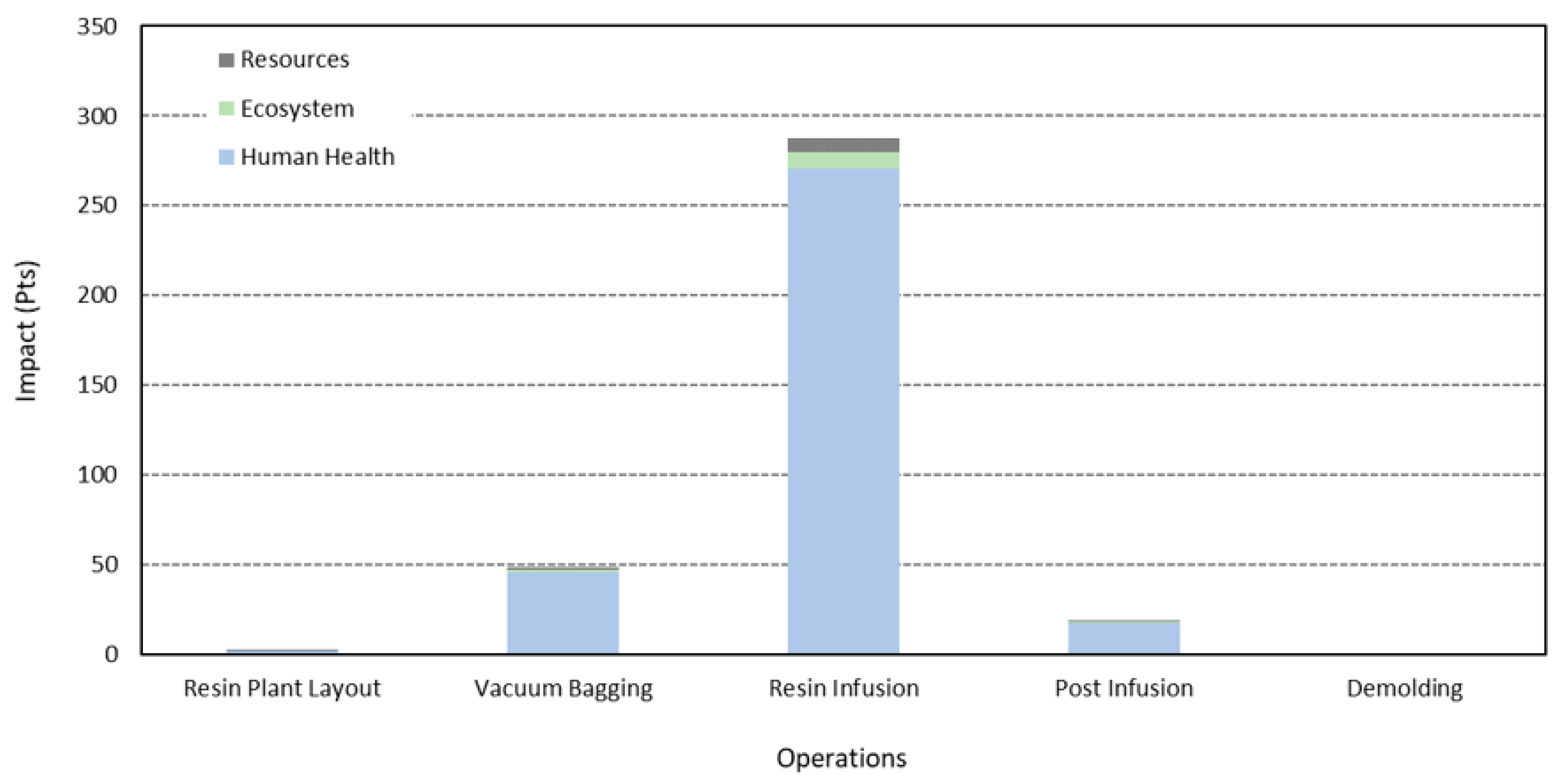
Achieving the ambitious EU goals of zero-waste manufacturing requires innovative tools and methodologies that address both efficiency and environmental sustainability. This study presents a comprehensive methodology for assessing the efficiency and eco-efficiency of industrial processes, in order to support zero-waste manufacturing strategies. The proposed approach assesses critical performance metrics while integrating environmental-impact analysis to provide a holistic view of process optimization. The methodology was applied to two industrial use cases in the composites sector, a field with significant environmental impact due to the resource-intensive nature of composite manufacturing and challenges associated with the end-of-life management. By implementing this dual assessment, the study identifies key areas for improvement in operational performance and sustainability, offering actionable insights for process optimization and waste reduction. The results reveal that labor costs emerged as the primary contributor to the total costs for both use cases, more than 50%. On the other hand, the resin infusion phase accounts for the majority of the environmental impacts, accounting for more than 70% of the total impacts. This analysis highlights that eco-efficiency assessments, integrating environmental and cost data, allow the identification of inefficiencies, helping industries to prioritize improvement areas. In this specific case, the high environmental impact of resin infusion needs enhanced waste monitoring and process optimization, while the labor-intensive operations need streamlined workflows to reduce operational time and associated costs. The present methodology intends to serve as a practical tool for industries aiming to balance high-performance manufacturing with reduced environmental impact.
Keywords: eco-efficiency; efficiency; multi-layer stream mapping; zero-waste manufacturing eco-efficiency; efficiency; multi-layer stream mapping; zero-waste manufacturing