Article

Impact of Tropical Climate Anomalies on Land Cover Changes in Sumatra’s Peatlands, Indonesia

by
Agus Dwi Saputra
1,
Muhammad Irfan
2,
Mokhamad Yusup Nur Khakim
2 and
Iskhaq Iskandar
1,2,*
1
Graduate School of Science, Faculty of Mathematics and Natural Sciences, Sriwijaya University, Palembang 30139, Indonesia
2
Department of Physics, Faculty of Mathematics and Natural Sciences, Sriwijaya University, Indralaya 30662, Indonesia
*
Author to whom correspondence should be addressed.
Sustainability 2026, 18(2), 919; https://doi.org/10.3390/su18020919
Submission received: 13 December 2025 / Revised: 1 January 2026 / Accepted: 12 January 2026 / Published: 16 January 2026
(This article belongs to the Special Issue Sustainable Development and Land Use Change in Tropical Ecosystems)

Abstract

Peatlands play a critical role in global and regional climate regulation by functioning as long-term carbon sinks, regulating hydrology, and modulating land–atmosphere energy exchange. Intact peat ecosystems store large amounts of organic carbon and stabilize local climate through high water retention and evapotranspiration, whereas peatland degradation disrupts these functions and can transform peatlands into significant sources of greenhouse gas emissions and climate extremes such as drought and fire. Indonesia contains approximately 13.6–40.5 Gt of carbon, around 40% of which is stored on the island of Sumatra. However, tropical peatlands in this region are highly vulnerable to climate anomalies and land-use change. This study investigates the impacts of major climate anomalies—specifically El Niño and positive Indian Ocean Dipole (pIOD) events in 1997/1998, 2015/2016, and 2019—on peatland cover change across South Sumatra, Jambi, Riau, and the Riau Islands. Landsat 5 Thematic Mapper and Landsat 8 Operational Land Imager/Thermal Infrared Sensor imagery were analyzed using a Random Forest machine learning classification approach. Climate anomaly periods were identified using El Niño-Southern Oscillation (ENSO) and IOD indices from the National Oceanic and Atmospheric Administration. To enhance classification accuracy and detect vegetation and hydrological stress, spectral indices including the Normalized Difference Vegetation Index (NDVI), Modified Soil Adjusted Vegetation Index (MSAVI), Normalized Difference Water Index (NDWI), and Normalized Difference Drought Index (NDDI) were integrated. The results show classification accuracies of 89–92%, with kappa values of 0.85–0.90. The 2015/2016 El Niño caused the most severe peatland degradation (>51%), followed by the 1997/1998 El Niño (23–38%), while impacts from the 2019 pIOD were comparatively limited. These findings emphasize the importance of peatlands in climate regulation and highlight the need for climate-informed monitoring and management strategies to mitigate peatland degradation and associated climate risks.

1. Introduction

Peatlands play a very important ecological and economic role, especially in supporting food security and climate change mitigation. Covering an area of approximately 14.9 million hectares in Indonesia, peat ecosystems store around 55 Gigatons of carbon, making them one of the largest carbon reserves in the world [1]. Indonesia is home to some of the largest tropical peatlands in the world. These cover an estimated total area of 13.4–14.9 million hectares, around 35–40% of which is located on the island of Sumatra. The peatlands on Sumatra are mostly concentrated in the eastern lowlands, particularly in the provinces of Riau, Jambi, and South Sumatra. These peatlands form extensive peat domes that are highly vulnerable to hydrological disturbances, fires, and climate anomalies [2]. Currently, peatlands are facing increasing pressure due to land conversion for agriculture, oil palm plantations, and unsustainable forestry exploitation. The drying of peatlands causes ecosystem degradation, increased greenhouse gas (GHG) emissions, and a decline in soil quality, which impacts agricultural productivity and food security [3,4].
In the context of climate change, peatlands play a paradoxical role. On the one hand, if they are maintained in their natural state, peatlands function as carbon sinks. On the other hand, if they are degraded, peatlands become significant sources of carbon emissions. Climate change has been shown to have a significant impact on land cover at various scales. Increased concentrations of greenhouse gases alter temperature and rainfall patterns globally, thereby affecting the function and distribution of ecosystems, including forests, grasslands, and agricultural land [5,6]. At the regional level, particularly in Southeast Asia, climate change interacts with human-driven factors such as urbanization and agricultural expansion, accelerating land use and land cover (LULC) change and affecting the hydrological cycle and surface temperature [7,8]. In Indonesia, interannual climate phenomena such as El Niño–Southern Oscillation (ENSO) and Indian Ocean Dipole (IOD) have been linked to variations in rainfall and vegetation conditions. Meanwhile, land conversion and forest degradation are exacerbating local and national land cover change [4,9].
Previous studies have shown that peatland fires in Sumatra can produce very high carbon emissions, far greater than emissions from ordinary forest fires [10]. Therefore, GHG emissions from peat burning need to be monitored and mitigated as part of Indonesia’s efforts to reduce GHG emissions. This effort is in line with Indonesia’s commitment to the 2015 United Nations Framework Convention on Climate Change (UNFCCC) in Paris. Indonesia’s commitment is outlined in the Nationally Determined Contribution (NDC) document, which states that Indonesia will reduce emissions by 29% without international support and by 41% with international support by 2030 [11].
Remote sensing and machine learning (ML) have developed as effective tools for monitoring land conditions in a spatial–temporal manner. Previous studies have demonstrated that remote sensing techniques can effectively assess peatland health, detect degradation processes, and support the analysis of ecosystem change dynamics. For instance, Harris et al. [12] and Stuart et al. [13] have used optical and SAR data to monitor vegetation conditions and peatland health, Torabi Haghighi et al. [14] and Zhou et al. [15] have identified degradation caused by drainage and changes in land use, and Lees et al. [16] and Bourgeau-Chavez et al. [17] have analyzed trends in ecosystem change related to hydrological and carbon dynamics. However, the main challenge in this research is how to integrate various remote sensing data indices with ML algorithms that are capable of providing accurate and interpretable spatial–temporal analysis of peatlands so that they can be utilized by stakeholders.
This study aims to analyze the dynamics of land cover change in peat swamp ecosystems on the island of Sumatra during periods of extreme climate anomalies. The focus will be on the years 1997–1998, 2015–2016, and 2019, within a spatial–temporal framework. During El Niño events, positive sea surface temperature (SST) anomalies in the central and eastern Pacific weaken the Walker circulation. This suppresses deep convection over the maritime continent and reduces rainfall in Sumatra, causing prolonged drought conditions [18,19,20]. Similarly, positive Indian Ocean Dipole (pIOD) events alter the zonal SST gradient in the Indian Ocean, resulting in anomalous subsidence and reduced rainfall in western Indonesia [9,21]. These climate-induced rainfall anomalies significantly increase the vulnerability of peatlands to degradation and fires. By integrating multi-temporal imagery with a machine learning approach in Google Earth Engine (GEE), this study provides an explicit, rapid spatial assessment of changes to peatland cover under extreme climatic stress. A comprehensive understanding of peatland degradation patterns and their implications for peatland-based agricultural systems is expected to inform data-driven recommendations for the sustainable management of peatlands and climate-resilient land use planning.

2. Data and Methods

2.1. Study Area

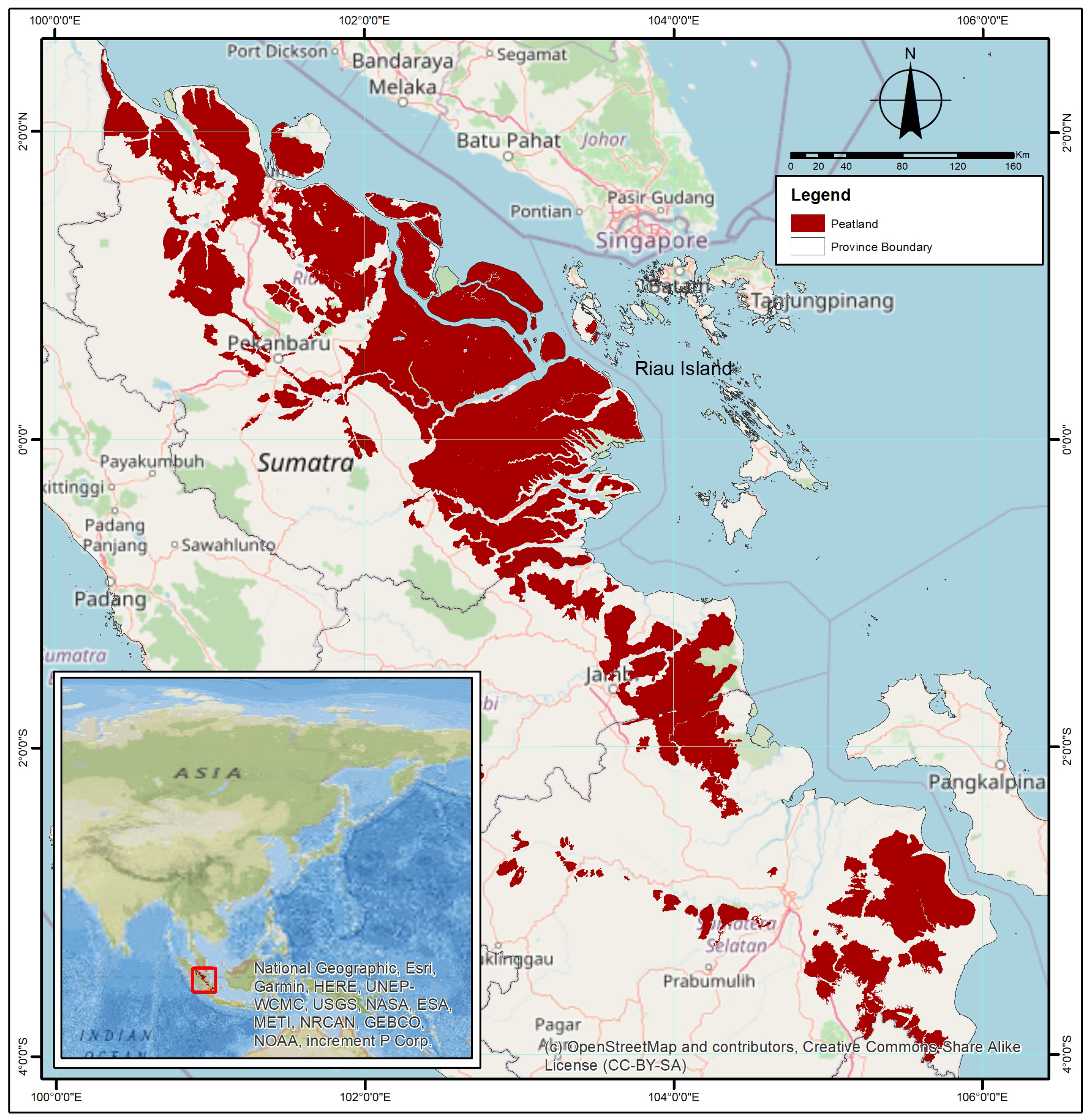
This study was conducted on peatlands on the island of Sumatra (Figure 1), covering the provinces of South Sumatra, Jambi, Riau, and Riau Islands. According to the Köppen–Geiger system, the region is predominantly classified as Af (tropical rainforest climate), with localized Am (tropical monsoon climate) conditions. The region experiences persistently high temperatures and high annual rainfall, with interannual climate variability strongly influenced by the Asian–Australian monsoon, as well as by large-scale climate modes such as El Niño and pIOD. These modes drive significant rainfall anomalies and drought extremes [9,18]. The land is mostly covered by tropical rainforest, peat swamp forest, mangroves, and extensive agricultural and plantation areas. In recent decades, changes in LULC have accelerated due to deforestation, agricultural expansion, and climate-related disturbances. Extreme El Niño and pIOD events have intensified vegetation stress, reduced soil and peat moisture, and increased fire susceptibility, thereby accelerating land cover transitions and ecosystem degradation [22,23]. Sumatra’s peatlands are part of Indonesia’s extensive peatland network, which covers more than 5.85 million hectares located on the islands of Sumatra and 4.54 million hectares in Kalimantan [2]. Historically, peat ecosystems have been able to withstand natural disturbances, but the increasing frequency of El Niño and pIOD events and sea level rise are now posing a serious threat [24].

2.2. Data

This study utilizes cloud computing-based devices that integrate AI-based ML methods in land cover classification. The analysis was conducted using the JavaScript programming language on the GEE platform. GEE is a cloud-based computing platform that works efficiently and is designed to facilitate large-scale geospatial data processing and analysis. This platform provides direct access to various remote sensing data sets, including Landsat, Sentinel, and Moderate Resolution Imaging Spectroradiometer (MODIS) satellite imagery, which have been proven to be relevant and widely used in land cover change studies [25,26].
The data to be used for land cover classification are Landsat 5 images from the period before and after the 1997/1998 El Niño event and Landsat 8 images from the period before and after the 2015/2016 El Niño event and pIOD 2019. Landsat 5 images have a Thematic Mapper (TM) sensor. The TM sensor on the Landsat 5 satellite records data in seven spectral bands, including thermal bands. The spatial resolution of Landsat 5 TM is 30 m for reflective bands and 120 m for thermal bands. These characteristics enable effective monitoring of natural resources and environmental changes on a medium scale [27].
Landsat 8 imagery has two sensors, namely the Operational Land Imager (OLI) and the Thermal Infrared Sensor (TIRS). Both sensors provide multispectral imagery data with relatively better resolution globally compared to Landsat 5 TM for mapping and monitoring environmental changes. OLI provides image data with a spatial resolution of 30 m for bands 1–7 and 9–11, and a spatial resolution of 15 m for band 8 (panchromatic). Meanwhile, TIR provides image data with a resolution of 100 m. The integration of data from the OLI and TIRSs enables more detailed land cover mapping and analysis of surface temperature variations with a high degree of accuracy [28]. This study also utilizes field validation data conducted by the Ministry of Forestry through the Forest Area Consolidation Agency. Details of the data used in this study are presented in Table 1.

2.3. Methods

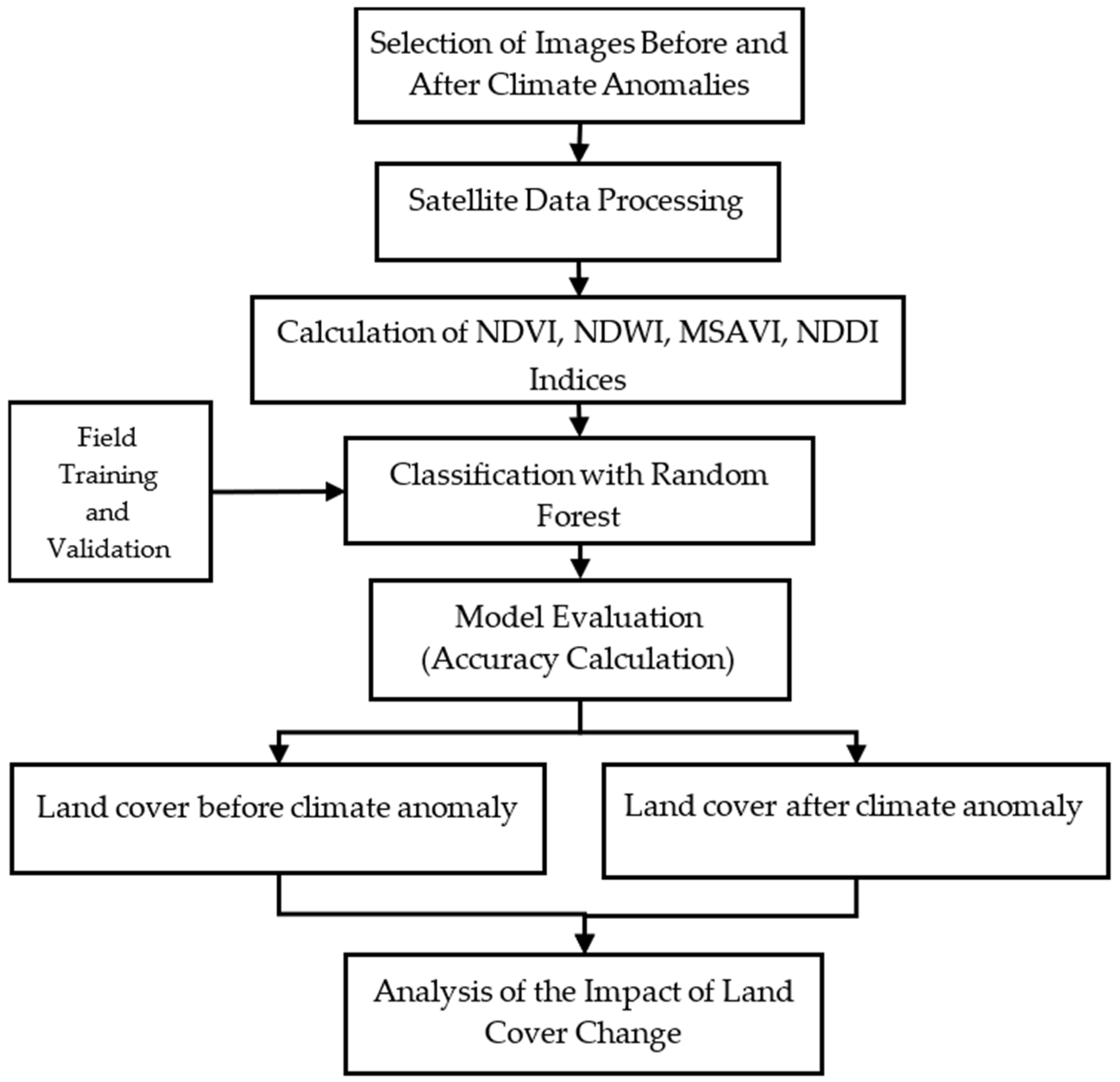
This study aims to analyze land cover changes that occurred during the extreme climate anomaly periods of 1997/1998, 2015/2016, and 2019 by comparing the results of peatland cover classification before and after the climate anomaly events. The research focuses on peat ecosystems in the provinces of Riau, Jambi, and South Sumatra, with a total area of 5.5 million hectares based on data from the Center for Agricultural Land Resources (BBSDLP). The classification process was carried out using ML algorithms by utilizing remote sensing variables, particularly indices relevant to detecting changes in peatlands, to construct a decision tree for determining land cover categories. Reference data from the Forest Area Stabilization Agency of the Ministry of Forestry was used as training data and validation data. Through this approach, the study is expected to produce a reliable classification method as a supporting instrument for climate change mitigation, particularly in the inventory of GHG emissions from the land use sector. The flowchart of the research stages is presented in Figure 2.

2.3.1. Satellite Image Selection

Land cover classification was conducted during the climate anomaly periods of 1997/1998, 2015/2016, and 2019, both before and after the anomalies occurred. The anomaly index data was sourced from the National Oceanic and Atmospheric Administration (NOAA), namely the Niño3.4 index and the Dipole Mode Index (DMI) [21,29,30]. This information was used as the basis for selecting the recording time for Landsat 5 TM and Landsat 8 OLI/TIRS images to be used in the classification process. The selection of this time range aims to enable a comprehensive comparison of changes in land cover, vegetation patterns, and hydrometeorological conditions as a result of climate anomalies.

2.3.2. Spectral Indices in the Classification Process

The classification process was carried out using a number of spectral indices calculated from a combination of satellite image bands. The spectral indices used were the Normalized Difference Vegetation Index (NDVI), Normalized Difference Water Index (NDWI), Modified Soil Adjust Vegetation Index (MSAVI), and Normalized Difference Drought Index (NDDI). These indices were chosen because they are capable of improving the detection and analysis of peatland conditions that are under pressure due to climate change [31,32].
NDVI is used to assess the density and health of vegetation in a landscape [33]. NDVI combines the red and Near Infra Red (NIR) bands. NDVI shows the greenness of plants, which is related to their efficiency in absorbing visible light radiation and reflecting infrared radiation [34]. The equation for calculating NDVI is
N D V I = ( N I R R e d ) ( N I R + R e d )
NDVI values range from −1 to 1, indicating the level of vegetation density.
NDWI is a spectral index used in remote sensing to monitor water bodies [35]. However, it can also be used to monitor vegetation moisture [36]. NDWI is calculated using green and NIR bands to improve the visibility of water features compared to land, while NIR and SWIR are used for vegetation moisture. The equation used to calculate vegetation moisture is shown in Equation (2):
N D W I = ( N I R S W I R 2 ) ( N I R + S W I R 2 )
NDWI is used to assess the severity of drought by linking NDWI values to vegetation water content. NDWI provides information on water availability and plant health under various climatic conditions. In peatlands, NDWI monitoring can help evaluate changes in soil moisture and vegetation conditions, which are greatly influenced by climate change and land use [37,38].
MSAVI is a vegetation index developed by Qi et al. [39] as an improvement on SAVI (Soil-Adjusted Vegetation Index). This index is designed to overcome the limitations of NDVI in distinguishing vegetation signals from soil background, especially in areas with sparse vegetation cover. MSAVI is calculated using reflectance from the NIR and Red bands with a multiplier constant of 2 to optimize sensitivity, and the square root to provide dynamic correction for soil influence [40]. Equation (3) is used to calculate the MSAVI value,
M S A V I = ( 2 × N I R + 1 2 × N I R + 1 2 8 N I R R e d ) 2
Furthermore, NDDI is an innovation in drought monitoring, especially when combined with remote sensing technology. This index is constructed from a combination of NDVI and NDWI, enabling it to identify drought conditions with higher sensitivity. This is particularly relevant for low vegetation such as shrubs and grasses, which are commonly found in peatland ecosystems. Previous studies have shown that NDDI responds more quickly to drought conditions than NDVI, making it an effective tool for assessing the severity of drought in various types of ecosystems, including peatlands [41]. Equation (4) is used to calculate NDDI,
N D D I = N D V I N D W I N D V I + N D W I
The bands and indices used in the ML classification process are presented in Table 2.

2.3.3. Index Calculation and Land Cover Classification

Land cover classification in tropical peatland ecosystems is a complex methodological challenge due to the unique spectral characteristics and high spatial heterogeneity of these ecosystems [42]. This study adopts an eight-class land cover classification approach that is representative of the specific characteristics of peatland ecosystems on the island of Sumatra. These classes include water bodies, swamp shrubs, mangroves, primary swamp forests, secondary swamp forests, plantations, mixed agriculture, and open land. This classification scheme is a strategic simplification of the 23 land cover classes of the Ministry of Forestry, Republic of Indonesia, which are adapted to the specific ecological conditions of peatlands to improve the accuracy of detecting changes related to extreme climate anomalies. The simplification of the classification scheme from the national system to eight specific peatland classes is based on scientific principles that have been proven in previous studies. Aulia et al. [43] showed that refining national land cover data through the fusion of optical satellite data can significantly improve classification accuracy, especially in the context of complex ecosystems such as peatlands. This approach is in line with the findings of Hamzah et al. [44], who reported that although simplification achieved a map accuracy of around 83%, the main challenge lies in the ability to distinguish between different levels of peat forest degradation, thus requiring a classification scheme tailored to specific ecosystem characteristics.
The methodological advantage of this eight-class approach lies in its ability to capture significant ecosystem variation while maintaining processing efficiency and consistency of interpretation [45]. Each selected land cover class has unique and distinct spectral and ecological characteristics. In the context of Sumatran peatlands, primary and secondary swamp forests represent a gradation of natural conditions, while plantations and mixed agriculture reflect different anthropogenic pressures on peat ecosystems [23].
The calculation of land cover indices and classification will be performed simultaneously using GEE. The algorithm to be used is Random Forest (RF). RF is known as an effective method for land cover classification, with superior performance across various types of data and conditions. A number of studies in non-peatland areas show that the RF algorithm generally performs better than other algorithms, especially in terms of accuracy and robustness to complex, high-dimensional data [46,47]. As an ensemble learning technique, this algorithm builds a number of decision trees during the training process and combines their prediction results to produce a final decision. This approach has proven to be very efficient in handling high-dimensional data, such as that found in satellite imagery [48,49]. The RF algorithm has also been proven to be flexible and applicable to various platforms, including GEE, which supports large-scale land cover mapping and analysis [25,50]. RF also demonstrates the ability to adapt to various types of satellite imagery, such as Landsat and Sentinel-2, which have varying spatial and temporal resolutions [51]. Training and validation samples were generated using the random split approach, whereby 70% of the samples were used to train the model, and the remaining 30% were reserved for validation purposes. Sample partitioning was implemented using a random column to ensure unbiased allocation. Cross-validation was not applied, but rather an independent hold-out validation strategy was employed to evaluate the classification performance. The RF model was trained using spectral bands and selected spectral indices as input features, enabling the algorithm to effectively capture variations in land cover influenced by climatic stress and anthropogenic factors [52].

2.3.4. Accuracy Test

Accuracy testing of ML-based land cover classification is generally performed using a confusion matrix, which compares the model’s classification results with reference data. This matrix contains important information such as true positives, false positives, true negatives, and false negatives, which are used to calculate various accuracy metrics. The main metrics produced include overall accuracy, producer accuracy, user accuracy, and the Kappa coefficient. Overall accuracy shows the proportion of correct classifications in general, while producer and user accuracy assess the success of identification from the perspective of reference and prediction. The Kappa coefficient is used to measure the level of agreement in classification, which indicates a measurement comparing classification results to values assigned by chance. Note that an increase in the Kappa coefficient corresponds to a more accurate classification [50,53].

3. Results and Discussion

3.1. Satellite Image Processing and Selection

The results of processing Landsat Surface Reflectance (SR) Collection 2 Tier 1 images on the GEE platform are composite images that have undergone a series of pre-processing stages to ensure optimal data quality. The initial stages include filtering images based on study area boundaries, time range, and a maximum cloud cover limit of 30%. This process aims to obtain images with appropriate coverage and minimal atmospheric disturbance. Next, cloud masking is performed using the Pixel Quality Assessment (QA_PIXEL) band with a bitmask approach to remove pixels identified as clouds, cloud shadows, or cirrus. This step has proven effective in cleaning images of pixels that do not represent actual surface conditions [54].
Then, reflectance values were calibrated against the optical bands (SR_B2 to SR_B7) using the appropriate scale factor, namely 2.75 × 10⁻⁵, multiplied by the digital number (DN) value and subtracted by 0.2, as recommended by the United States Geological Survey (USGS). This process aims to convert DN values into more radiometrically accurate surface reflectance (top-of-canopy reflectance) values. The calibrated images were then compiled into a composite using a mosaic function to select the best pixels based on the earliest acquisition time in the dataset. The final image obtained was then cropped to the boundaries of the study area within the peatland so that the analysis was limited to that area.
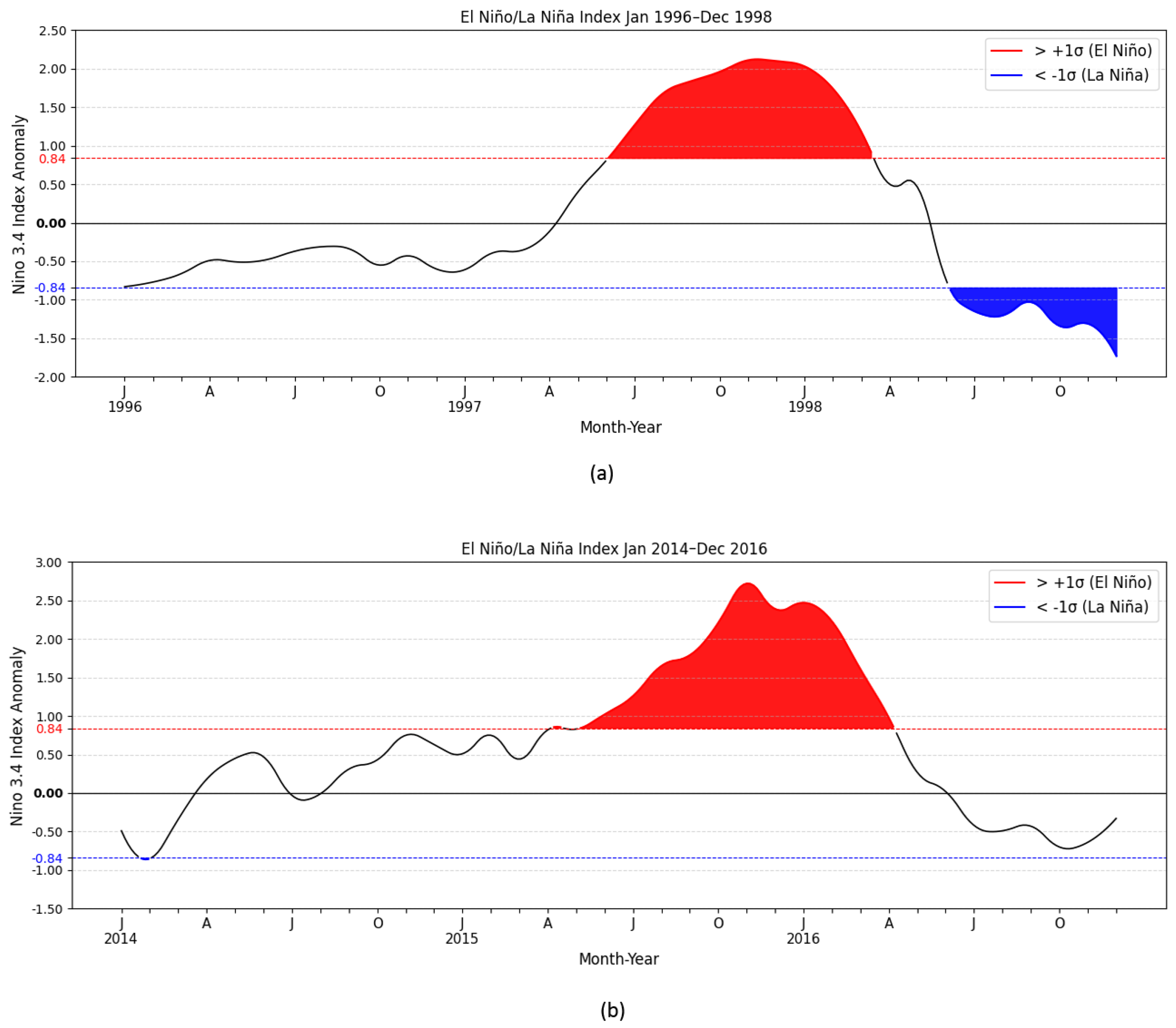
A total of 71 images (scenes) were obtained for the period before the 1997/1998 El Niño event, and 50 scenes after the El Niño event. For the 2015/2016 El Niño event, 83 scenes were used before and 42 scenes after the El Niño event. Figure 3a,b illustrate the temporal evolution of the Niño3.4 index during the 1997–1998 and 2015–2016 periods, which were characterized by two of the strongest El Niño events on record. During both periods, the Niño3.4 index surpassed the +0.84 threshold for several consecutive months, indicating a sustained increase in sea surface temperatures across the central and eastern Pacific. Such sustained positive anomalies are associated with a weakened Walker circulation, characterized by reduced ascending motion and suppressed deep convection over the Maritime Continent, including Indonesia. These conditions consequently lead to a significant reduction in regional precipitation over Sumatra, particularly during the peak phases of El Niño [19,20,55]. Following the El Niño peaks, the Niño3.4 index transitions into negative values, indicating the development of La Niña conditions. This phase is typically associated with enhanced convection over the western Pacific and increased rainfall over Indonesia.
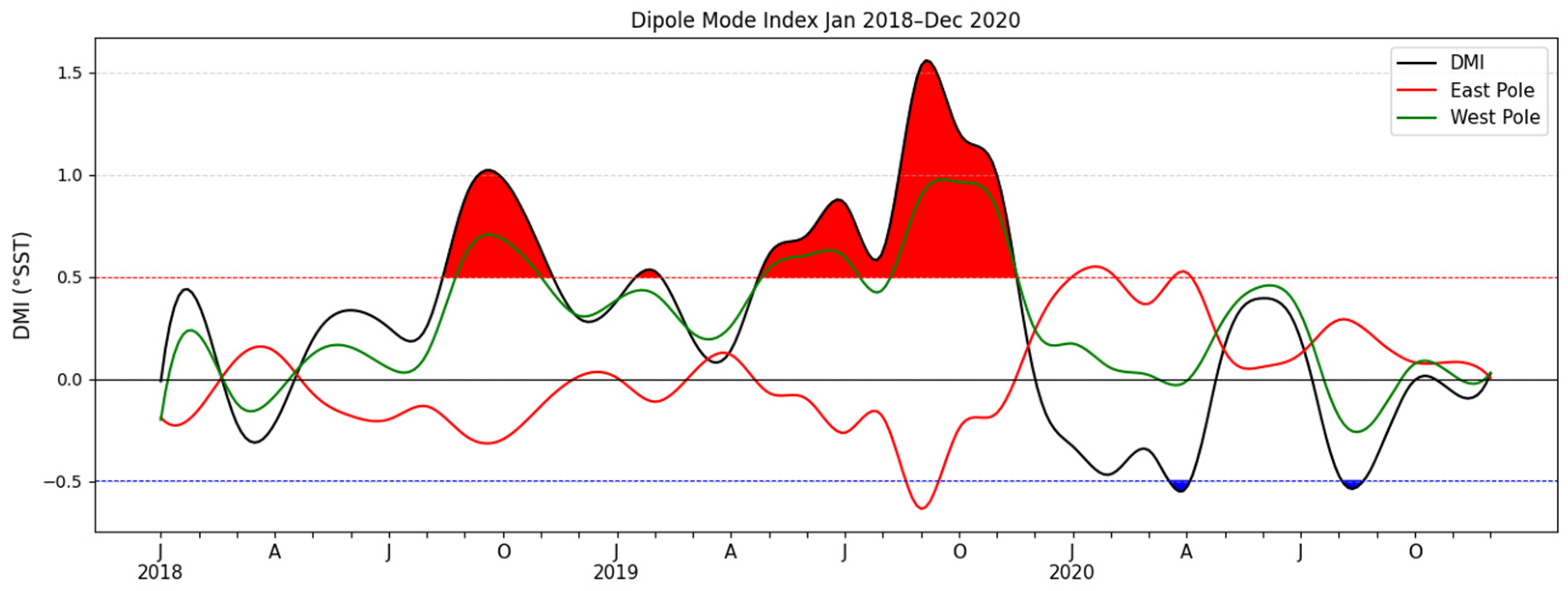
Meanwhile, for the 2019 pIOD event, satellite images prior to the pIOD were selected from January to April 2019 to record pre-anomaly conditions, while images after the pIOD were selected from late December 2019 to April 2020 to record the recovery process and transition back to a neutral condition [30]. The number of images produced before the anomaly was 83 scenes, and after the anomaly was 32 scenes. Figure 4 shows the Dipole Mode Index (DMI) depicting the evolution period of the 2019 pIOD event.
In more detail, the image recording period and the number of images used according to the type and time of the climate anomaly event are shown in Table 3.

3.2. Analysis of Classification and Accuracy

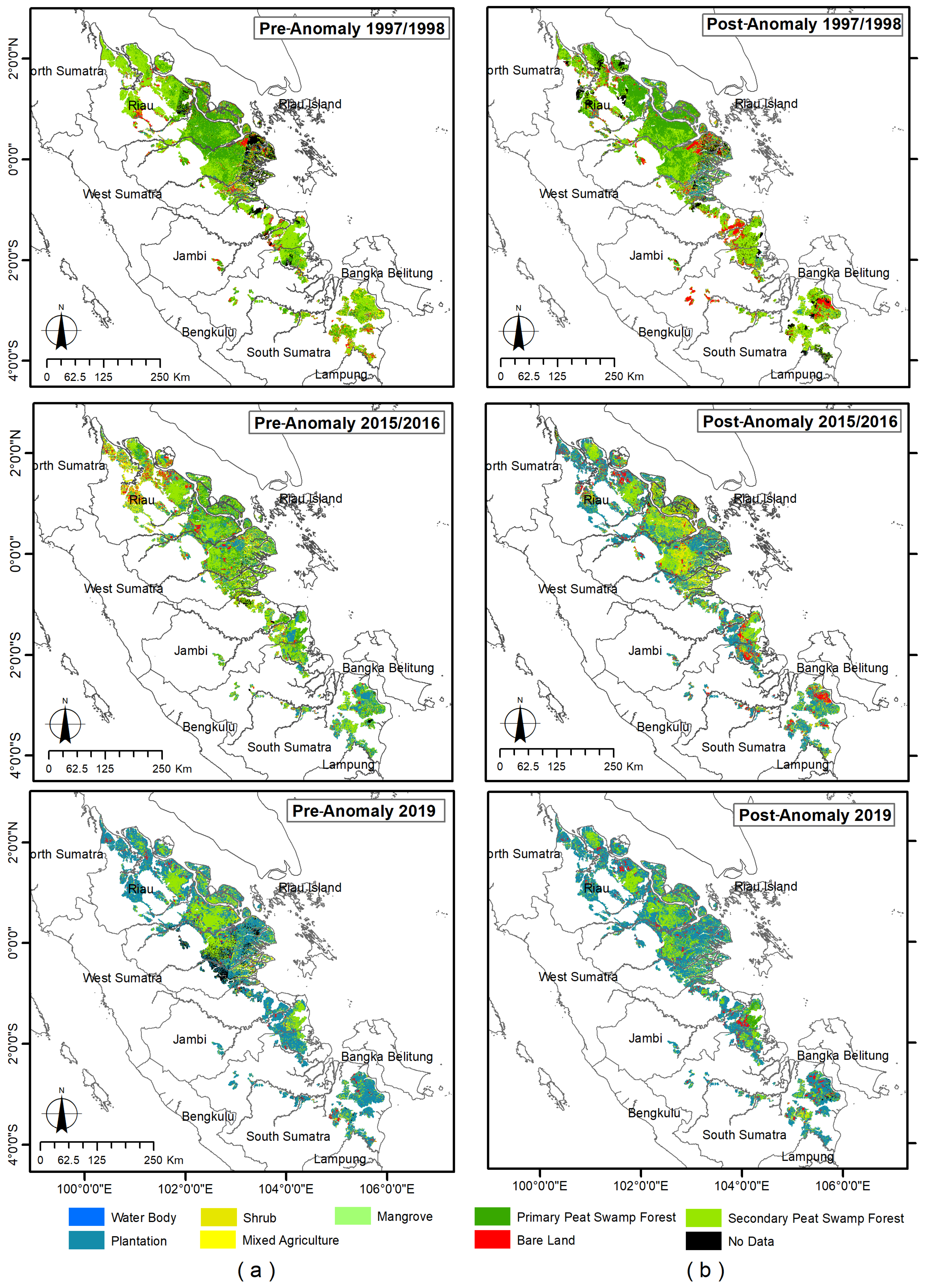
The results of land cover classification for the three periods of climate anomalies that have occurred are shown in Table 4 and Figure 5.
The classification results show significant changes in land cover during the three climate anomaly periods, with El Niño 1997/1998 showing the most drastic impact in the form of expansion of open land areas, while El Niño 2015/2016 was marked by significant expansion of plantations. These findings reinforce previous research that the proportion of forested peatlands in Sumatra declined dramatically from 75% to 28% between 1990 and 2010, equivalent to more than 30,000 km2 of peatland undergoing deforestation [23]. Provincial-level analysis shows that South Sumatra lost the majority of its peat forests in 2000, while deforestation continued at high rates in Riau and Jambi between 2000 and 2010 [23]. Table 5 shows the accuracy assessment data for the land cover classification process.

3.2.1. Overall Classification Performance

The RF algorithm showed excellent performance throughout the study period, with Overall Accuracy (OA) values ranging from 89% to 93% and Kappa coefficients between 0.85 and 0.90. These results exceed the minimum 85% OA recommended for land cover classification study [56], and indicate “near perfect agreement” according to the scale of Kappa statistics developed in previous study [57]. Kappa statistics consistently show high accuracy values across various climate anomaly periods. It shows how strong the algorithm is. This algorithm uses a combination of NDVI, NDWI, MSAVI, and NDDI spectral indices to classify peatland ecosystems in Sumatra.

3.2.2. Temporal Accuracy Variation Among Climate Anomaly Events

Classification accuracy showed different temporal patterns for each different climate anomaly event. During the 1997/1998 El Niño period, both OA and Kappa coefficient increased from pre-anomaly conditions (92% OA, κ = 0.86) to post-anomaly conditions (93% OA, κ = 0.90). This suggests that severe drought conditions may have increased the spectral separability between land cover classes. In contrast, the 2015/2016 El Niño period showed a lower decrease in classification performance from pre-anomaly (91% OA, κ = 0.88) to post-anomaly (90% OA, κ = 0.85). This indicates a more complex land cover transition or increased spectral confusion in the decision-making process within the algorithm during this period. The 2019 pIOD event showed a robust stability with minimal changes in accuracy metrics (90% to 89% OA, κ = 0.85 constant). This suggests that the changes caused by the pIOD may have different characteristics compared to the impact of El Niño on peatland ecosystems.

3.2.3. Accuracy Assessment per Land Cover Class

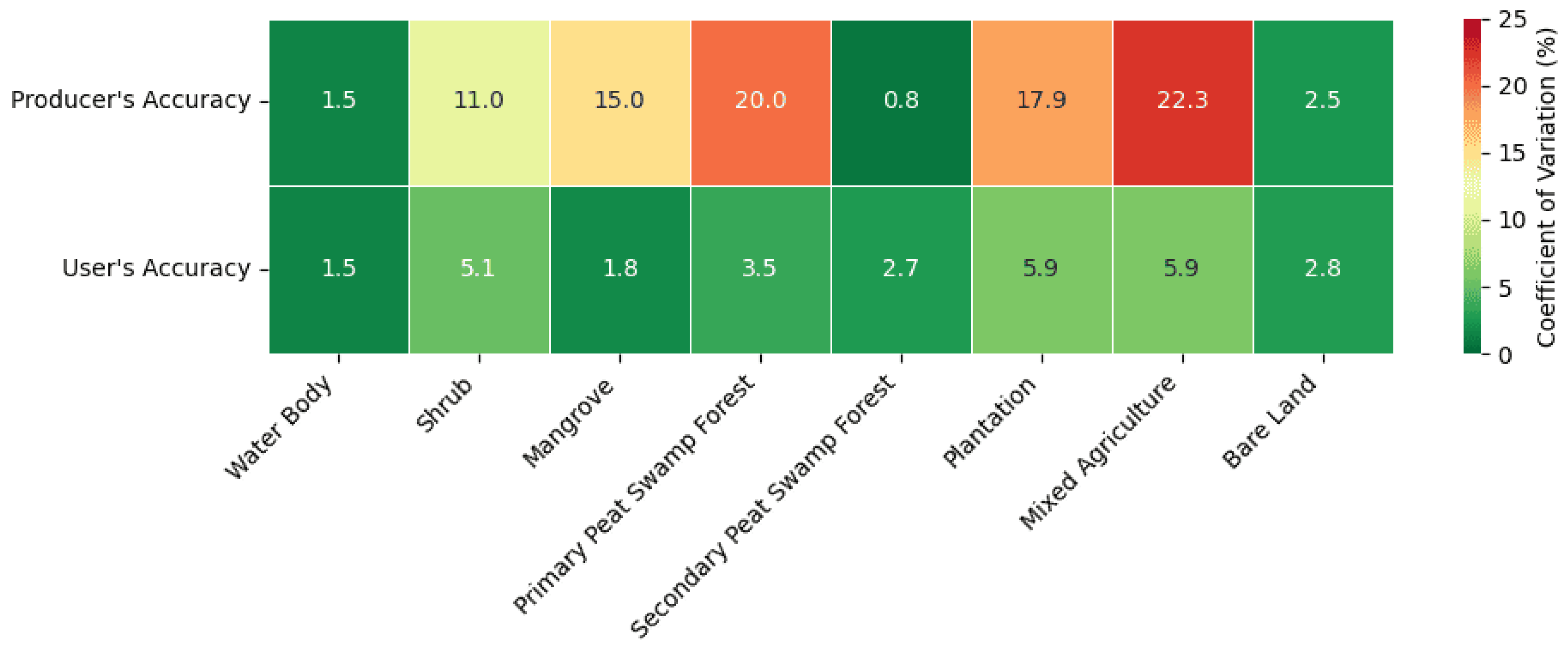
Accuracy analysis per class shows significant variation in classification performance among different types of land cover. Water bodies consistently achieved the highest accuracy across all periods, with Producer’s Accuracy (PA) values ranging from 95% to 99% and User’s Accuracy (UA) from 96% to 100%. This reflects the characteristic spectral signature of water in the near-infrared and shortwave infrared regions captured by the indices used. Primary and secondary peat swamp forests also showed consistently high accuracy levels (PA: 86–96%, UA: 86–95%), indicating that the combination of vegetation indices effectively captures the unique spectral characteristics of these critical peatland ecosystems. Classification of open land achieved similarly high performance (PA: 92–99%, UA: 90–98%). This demonstrates the distinctive reflectance properties compared to vegetated surfaces. In this analysis, the coefficient of variation (CV) was used to measure the temporal consistency of classification accuracy per land cover class. This approach is rarely used in the literature, but analogies are used in open land classification to assess the reliability of classification models [58]. Furthermore, the correlation analysis between PA and OA class accuracy provides a clear picture of the individual contribution of each class to the overall performance, as has been done in several recent studies on the correlation between Land Use Land Cover (LULC) features and environmental variables [59].
To measure classification stability, a stability index (SI) matrix was used, which allows the identification of land cover classes with the most reliable performance in a temporal period (Figure 6). The lower the SI value, the more stable the classification in that class. Based on the stability matrix, Water Bodies, Secondary Swamp Forests, and Open Land have good stability. Meanwhile, Primary Swamp Forest and Mixed Agriculture have fairly high variation coefficients. These results indicate that RF stability is not very good in these two classes. One of the reasons for this is that the training area and validation area are difficult to distinguish using the index, or the influence of cloud cover.
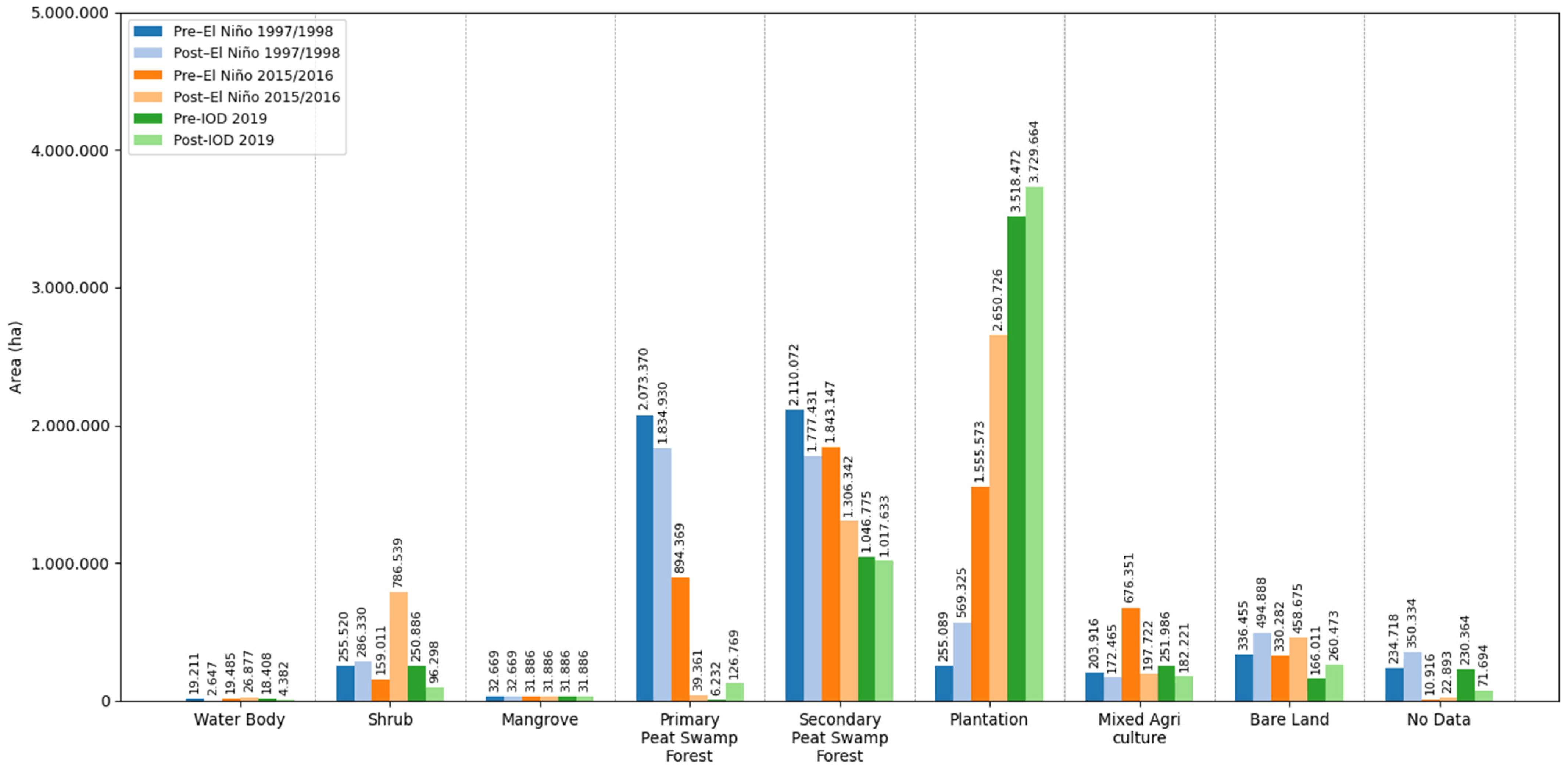
The land cover area produced in the classification process during the climate anomaly period is shown in Figure 7.
The analysis shows that plantation area increased after the climate anomaly (Figure 7). One contributing factor is that prior to the climate anomaly, the area was likely detected as scrubland, swamp forest, or plantations that had long undergone transition after harvesting, and was subsequently overgrown with trees that underwent natural succession. After the climate anomaly, the area was likely cleared as agricultural land due to land clearing caused by fires or other anthropogenic activities. For the primary swamp forest class, there was an increase in area after the 2019 climate anomaly (Figure 7). One of the reasons for this is that the image data used prior to the 2019 climate anomaly could not to properly identify primary swamp forests due to its low quality. Therefore, it looks like there are more primary swamp forests now than there were before the 2019 climate anomaly. This hypothesis is proven by the accuracy producer value of primary swamp forests before and after the climate anomaly, which is small, around 0.60–0.62, while the user accuracy is quite large (Table 5). This shows the inconsistency of the training area used. Meanwhile, there was no significant change in the area of mangroves because the area is not large and is concentrated in coastal areas (Figure 7).
In this study, water bodies are defined as rivers flowing within the study area and flooded lands. In the classification process, the NDWI was used, which utilizes NIR and SWIR to detect water content in vegetation as input for the classification process [46]. The analysis results show that there was a very significant decrease in water body area during the 1997/1998 El Niño and 2019 pIOD events. Conversely, during the 2015/2016 El Niño event, the water body area increased significantly (Figure 7). The area of shrubbery during the 2015/2016 climate anomaly changed significantly. The 2015/2016 climate anomaly period was longer than the 1997/1998 and 2019 climate anomaly periods. As a result, areas that had been burned in the early phase of the 2015/2016 climate anomaly evolved and grew into shrubs and grasses in the late phase of evolution. This caused the images recorded after the climate anomaly to be detected as shrubland.
The area of open land increased significantly after the climate anomaly. This indicates the magnitude of the impact of land fires on vegetation in the study area. Land fires have increased pressure on vegetation, making vegetation in burned areas susceptible to death. The classification accuracy for open land is quite high, with an average value above 0.9 (Table 5). This is because the characteristics of vegetation and open land are fairly easy for the RF algorithm to interpret. Meanwhile, the area of mixed agriculture is quite difficult to classify because its size and location are not very significant within the study area. The significant increase in plantation area from year to year in the study area is evidenced by increased land cover. Land conversion to plantation areas does not only occur during climate anomalies, but also occurs every year. The results of this analysis also prove that plantation clearing by burning occurs during climate anomalies. For the record, “No Data” refers to images that have cloud cover of more than 30% and do not have masking images on the closest specified recording date.

3.3. Variation in Spectral Indices in Land Cover

We evaluate the differences in the spectral index values of NDVI, NDWI, MSAVI, and NDDI used in the classification before and after the El Niño and pIOD climate anomalies. These four indices help the RF model make better decision, especially when it comes to show different types of land cover apart, even when they look similar [60]. Changes in index values were analyzed quantitatively by creating difference maps that compared pre- and post-climate anomaly conditions. This methodology enabled the precise spatial identification of areas undergoing significant biophysical transformations, such as vegetation degradation or soil moisture decline, which are directly related to the impacts of extreme drought. Statistical analysis was used to measure changes in spectral indices due to the influence of climate anomalies on the land cover classification process. This analysis used resampling of pixel values randomly distributed across 100,000 pixels in the study area. The statistical analysis of the indices used in the classification is shown in Table 6.

3.3.1. NDVI and MSAVI as a Response to Vegetation Density and Health

Analysis of the NDVI and MSAVI vegetation indices during three periods of climate anomalies shows a consistent downward trend in both mean and median values, although the magnitude varies. The 1997/1998 El Niño period showed the most significant decline, with NDVI falling by −2.17% (mean) and −4.17% (median), while MSAVI declined by −1.24% (mean) and −3.18% (median). The greater decline in the median compared to the mean indicates that the impact of the decline in vegetation productivity occurred in most areas, not just in a few areas with extreme changes.
During the 2015/2016 El Niño period, the decline in NDVI was relatively small, at −0.82% (mean) and −0.80% (median), while MSAVI fell by −0.57% (mean) and −0.73% (median). This indicates that although the 2015/2016 El Niño was known to be meteorologically strong, its impact on vegetation conditions in the study area was not as great as that of the 1997/1998 El Niño. This was likely influenced by ecosystem adaptation, variations in land use, or differences in the intensity of local droughts.
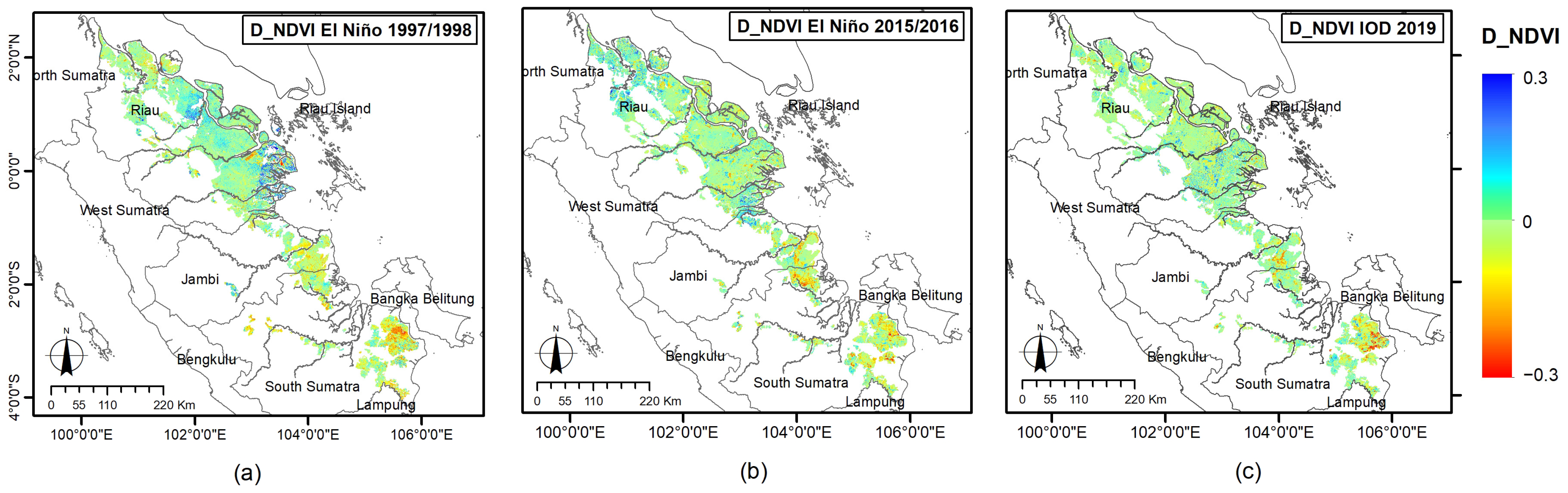
The 2019 pIOD period showed a decline in NDVI that was almost the same as the 2015/2016 El Niño period, namely −0.82% (mean) and −1.05% (median). Meanwhile, the MSAVI value experienced a smaller decline, namely −0.37% (mean) and −0.73% (median). Although the 2019 pIOD also triggered drought in some parts of Indonesia, its impact on vegetation as a whole was relatively limited compared to the two El Niño periods analyzed. Based on spatial change analysis (Figure 8), NDVI in the study area did not decrease significantly, remaining around −0.1 < NDVI < 0.1.
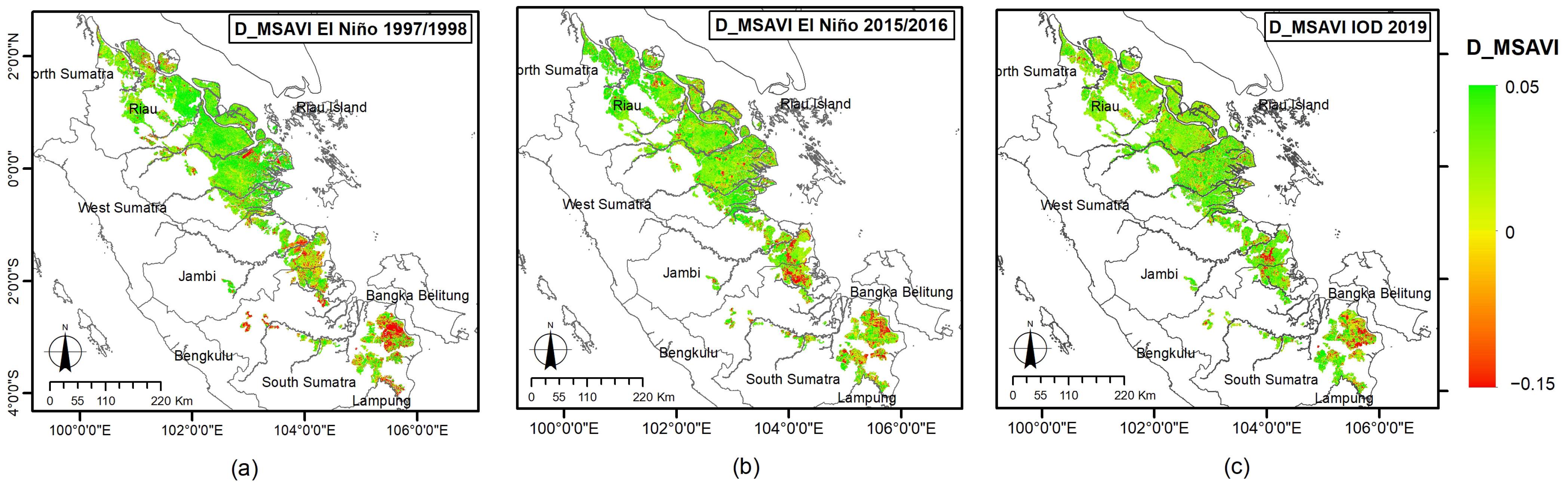
In general, the consistency in the direction of NDVI and MSAVI changes throughout the period indicates that both indices consistently reflect vegetation response to climate stress. MSAVI, which is designed to reduce the influence of soil on vegetation cover estimates, tends to show a slightly smaller decrease compared to NDVI, especially in areas with sparse vegetation. The MSAVI change map for the three climate anomaly periods is shown in Figure 9.
As can be seen from the D_NDVI map above, it can be seen that the red areas are areas that have experienced a decline in vegetation, while the dark blue areas have experienced an increase in vegetation, and the green areas indicate no significant change in vegetation (Figure 8). The D_MSAVI map also shows a decline in vegetation in the red areas, which in the land cover classification after the event were classified as open land (Figure 9).
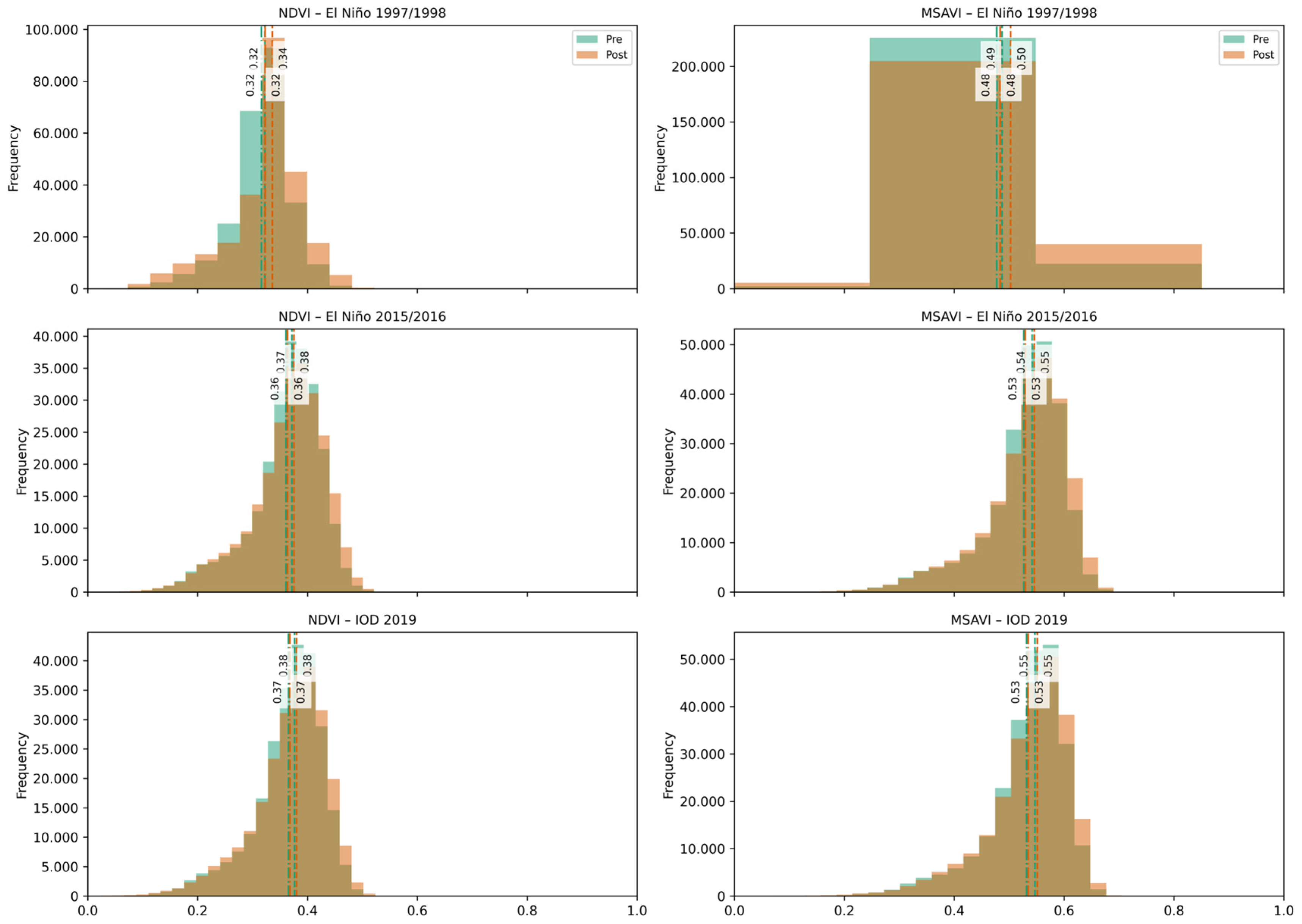
The NDVI and MSAVI histogram patterns in the three climate anomaly periods show a consistent shift in the distribution of values in response to the impact of the anomalies (Figure 10). During the 1997/1998 El Niño period, the NDVI histogram shifted most significantly towards lower values (to the left), accompanied by a broadening of the distribution. This shift reflects a widespread and uneven decline in vegetation biomass, which can be linked to extreme drought and land fires. Meanwhile, the MSAVI histogram in the same period also shifted to the left, but with a slightly smaller shift and less distribution widening than NDVI. This shows that MSAVI is more resistant to the influence of dry soil background than NDVI. MSAVI is designed with adaptive soil background correction factors, thereby reducing the contribution of soil reflectance to the index value. In contrast, NDVI is more sensitive to changes in soil reflectance, especially in areas with low vegetation cover or during the dry season, so that its decline tends to be more pronounced. Therefore, the decline in MSAVI values under dry conditions is not as large as the decline in NDVI [39,40].

3.3.2. NDWI and NDDI as Drought Indicators

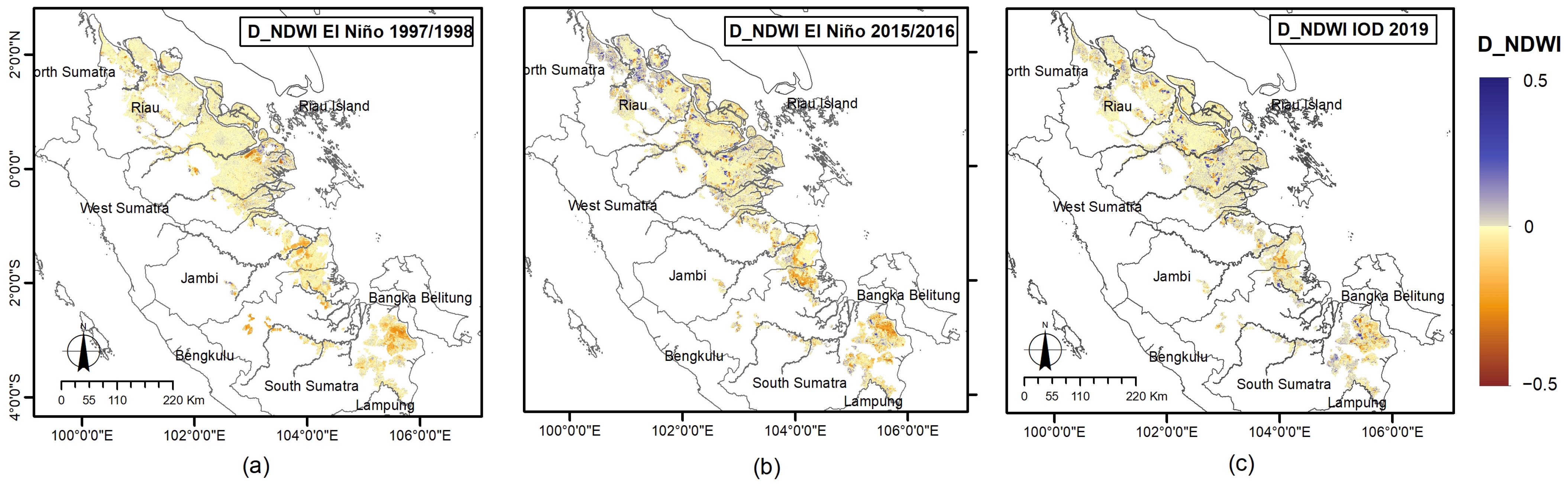
NDWI is a spectral index that uses a combination of NIR and SWIR bands to identify vegetation water content and indicate the level of sensitivity to water stress conditions in plants [61]. In this study, NDWI showed vegetation response to climate anomalies, with a significant increase of 11.3% (mean) during the 1997/1998 El Niño period and 2.2% (mean) during the 2015/2016 El Niño period. Meanwhile, during the 2019 pIOD event, NDWI values showed a contrasting change, indicating a decrease of −2.02% in line with general drought conditions. Although the average NDWI value showed an increase during the 1997/1998 and 2015/2016 El Niño periods, spatial distribution analysis revealed that the majority of areas (>70%) experienced a decrease in NDWI consistent with drought conditions (Figure 11). The recorded increase in the average NDWI value was due to the statistical effect of a minority of areas that were likely influenced by water bodies from deforestation and local hydrological changes. These findings emphasize the importance of spatial analysis in interpreting the NDWI spectral index in heterogeneous ecosystems, rather than using statistical data represented by only a few hundred thousand pixels. This is in accordance with the principle described by Wang [62] that NDWI uses a normalization ratio between water-sensitive and water-insensitive bands.
Validation of NDWI in peatland ecosystems shows a strong correlation with hydrological conditions. Research results on Selangor peatlands show that groundwater level monitoring fluctuates throughout the year and correlates with rainfall, with forested areas showing the highest groundwater levels and cultivated areas showing the lowest groundwater levels [63]. This supports the interpretation that the NDWI values in this study reflect the complex hydrological conditions of peatlands during periods of climate anomalies. Previous studies suggest that NDWI values above 0.8 indicate areas that do not experience water scarcity for vegetation, while low values (<0.8) indicate conditions of water deficiency for vegetation [64]. The results of the analysis in this study, presented in the form of a change map, show that during each period of climate anomaly, there was a decrease in water content in all vegetation (Figure 11).
NDDI is an integrated index that combines information from NDVI and NDWI to provide a comprehensive picture of drought conditions [65]. In this study, NDDI showed the most consistent response to the expected drought conditions, with a drastic decrease of 23.82% during the 1997/1998 El Niño period. This significant decline in NDDI values indicates extreme drought conditions in Sumatra’s peatland ecosystems. This significant decline is in line with the research by Affandy et al. [65], which shows that NDDI can identify various levels of drought with high accuracy, where 77% of the area can be categorized as severely dry based on NDDI analysis.
The sensitivity of NDDI to changes in drought conditions is reflected in a median decrease of 11.37% and a standard deviation of 35.15% during the 1997/1998 El Niño event, which indicates the homogenization of extreme drought conditions across the study area. The extreme decline in NDDI in this study also correlates with the documented occurrence of large-scale forest fires during the 1997/1998 El Niño period in Sumatra. Therefore, we argue that NDDI can be used as an early warning system for extreme drought conditions. Temporal comparisons show that the impacts of the 2015/2016 El Niño and the 2019 pIOD on NDDI were relatively more moderate. During the 2015/2016 El Niño event, NDDI values decreased by 6.20%, while during the 2019 pIOD event, NDDI values actually increased, albeit slightly, by 1.19%. These results indicate different intensities of climate anomalies and possibly accompanied by increased ecosystem resilience in the study area. The ability of NDDI to detect spatial and temporal variations in drought conditions as shown in this study indicates that this index is effective as a primary indicator for monitoring drought in peatland ecosystems.
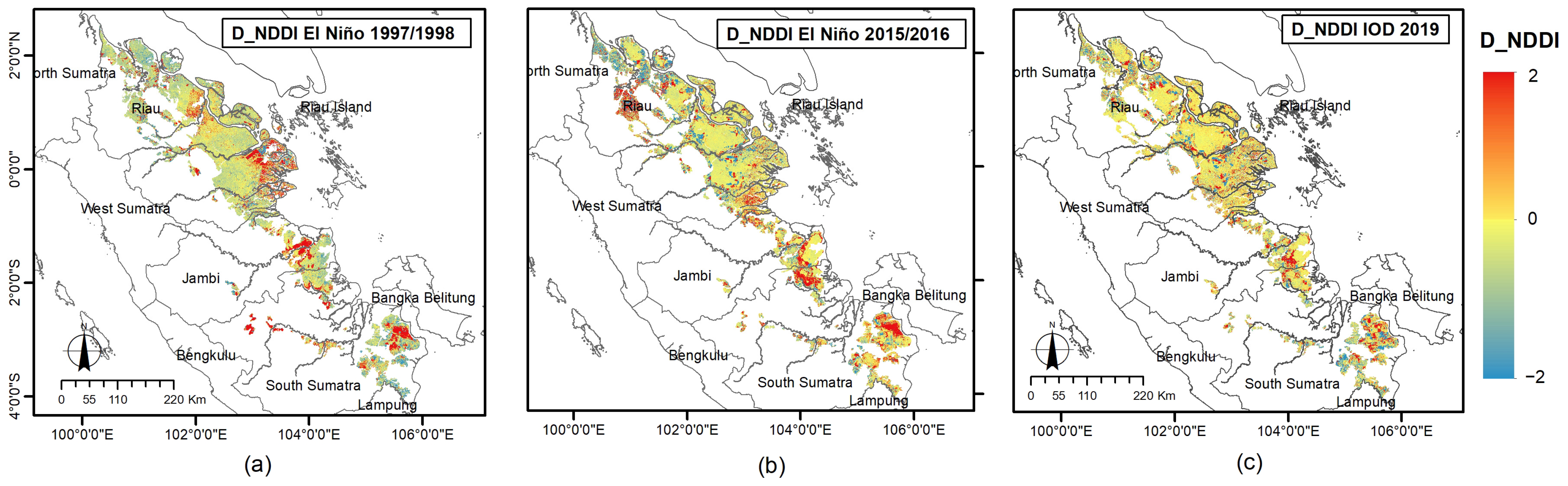
Based on the NDDI change map (Figure 12) above, there has been an increase in the drought index in peatlands in parts of South Sumatra, Jambi, and Riau during the 1997/1998, 2015/2016, and 2019 climate anomalies. During the evolution of these climate anomalies, peatland fires occurred in these areas.
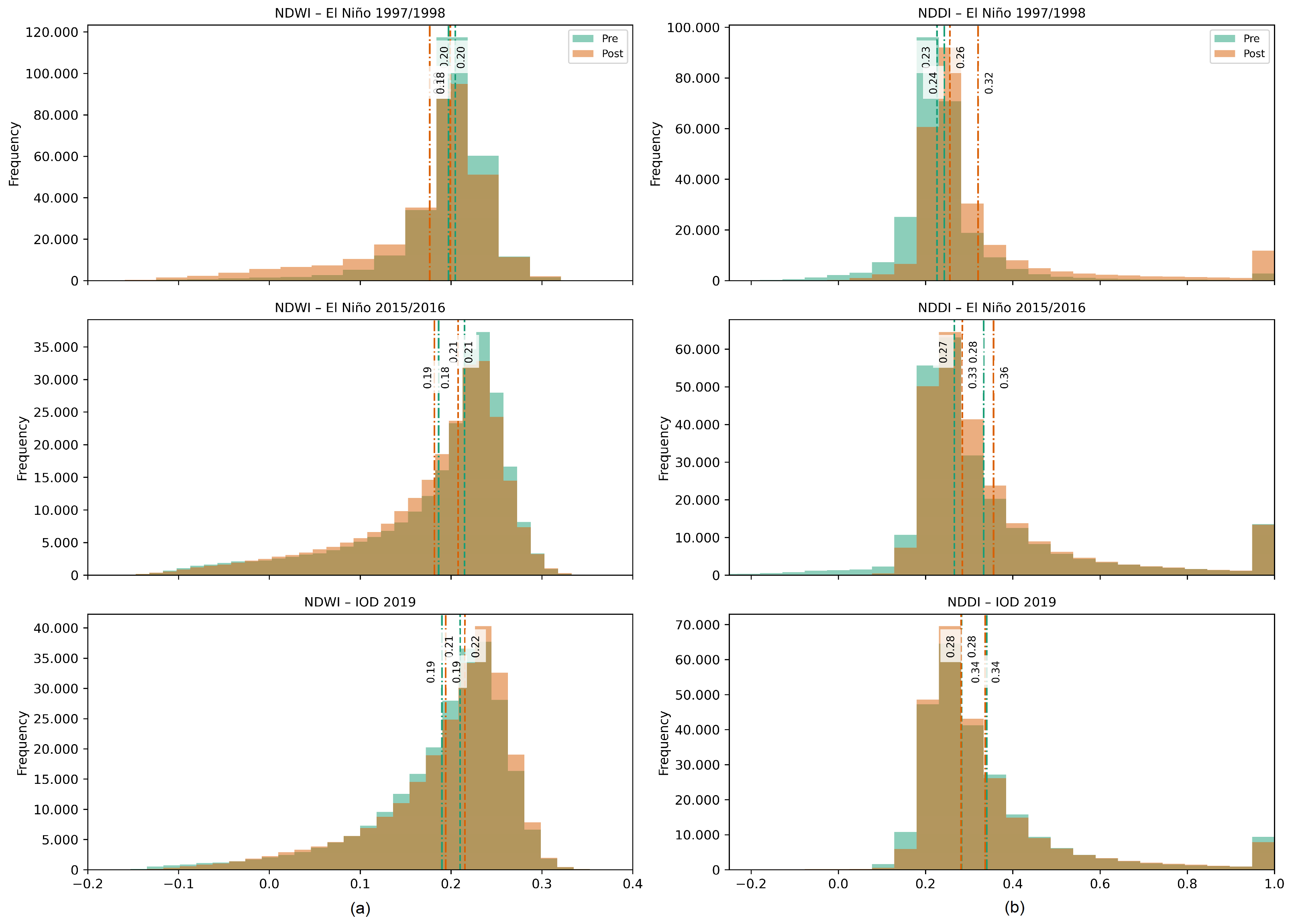
A comparison of the histogram distributions between NDWI and NDDI (Figure 13) reveals fundamental differences in the reliability of the two indices as indicators of drought conditions in peatland ecosystems. NDWI shows inconsistencies between descriptive statistics and histogram distributions, where a significant increase in the mean is not reflected in a proportional shift in the distribution. This indicates the presence of spatial bias or the influence of outliers that dominate statistical calculations. In contrast, NDDI shows high coherence between changes in descriptive statistics and shifts in histogram distribution, with a gradual and measurable shift pattern in accordance with different intensities of climate anomalies. These findings confirm that histogram distribution analysis is an essential component in spectral index validation, and NDDI has proven to be superior as a primary indicator for drought monitoring compared to NDWI in the context of peatland ecosystems experiencing extreme climate anomalies.

3.4. Analysis of Land Cover Change in Response to Climate Anomaly

To examine the impact of climate anomalies on land cover change, we began by constructing a transition matrix between classes using the post-classification comparison method. This method was chosen for its ability to generate detailed “from-to” change information, allowing the identification of not only the location of the change but also the specific nature of the transition [66,67]. Based on the ecosystem quality hierarchy that refers to the concepts of land degradation and restoration, the transition matrix is reduced to three categories of change: “Stable” (no class change), “Increasing” (transition to a more natural or higher quality ecosystem condition), and “Decreasing” (transition towards more degraded or anthropogenic conditions) [68]. The transition matrix used as the basis for decision-making in this study is presented in Table 7, which follows the transition analysis framework developed in the literature [69,70].
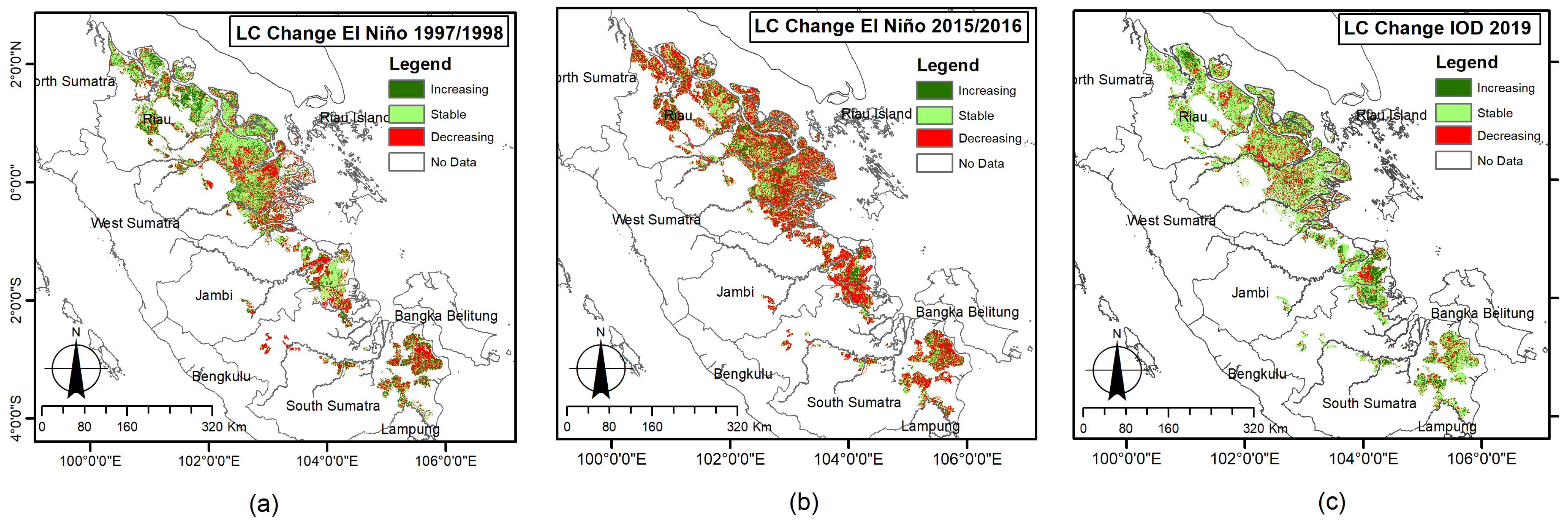
The classification was implemented using a Geographic Information System (GIS) tool that automates the assignment of change category values to each raster pixel. This classification refers to an approach that has been validated in various land cover change studies [71]. This approach offers computational efficiency in processing large-scale datasets while supporting advanced spatial analysis, including the detection of degradation locations and the identification of land recovery zones [72]. The accuracy of the post-classification comparison method depends on the quality of the individual classifications for each climate anomaly period. Previous studies have shown that the overall accuracy can exceed 85% when applied correctly [73]. The results of the land cover change classification are presented in the land cover change maps for each climate anomaly period shown in Figure 14.
Spatial analysis results show significant land degradation during the 1997/1998 El Niño event. During this period, the Niño3.4 index value was close to +2.7 during the period from May 2015 to April 2016 (Figure 3b). During this period, the regions of Jambi, South Sumatra, and Riau experienced a long dry season and a large rainfall deficit [20]. Land cover changes during the 2015/2016 El Niño were greater than those that occurred during the 1997/1998 El Niño. The 1997/1998 El Niño climate anomaly lasted for a shorter period and the maximum value of the Niño3.4 index was also lower than the value of the Niño3.4 index during the 2015/2016 El Niño (Figure 3a). Land cover changes as a result of the 2019 pIOD were the least significant compared to land cover changes during the 2015/2016 and 1997/1998 El Niño events. The evolution of the 2019 pIOD began in July 2019 and ended in November 2019 (Figure 4). During this period, rainfall in the peatland area of South Sumatra decreased from May to October 2019 by 70–80 mm/month from the previous 150–200 mm/month, then increased again in November 2019 to between 100 and 550 mm [74]. The extent of land cover change during the three periods of climate anomalies that occurred in the peatlands of Sumatra Island is presented in Table 8.
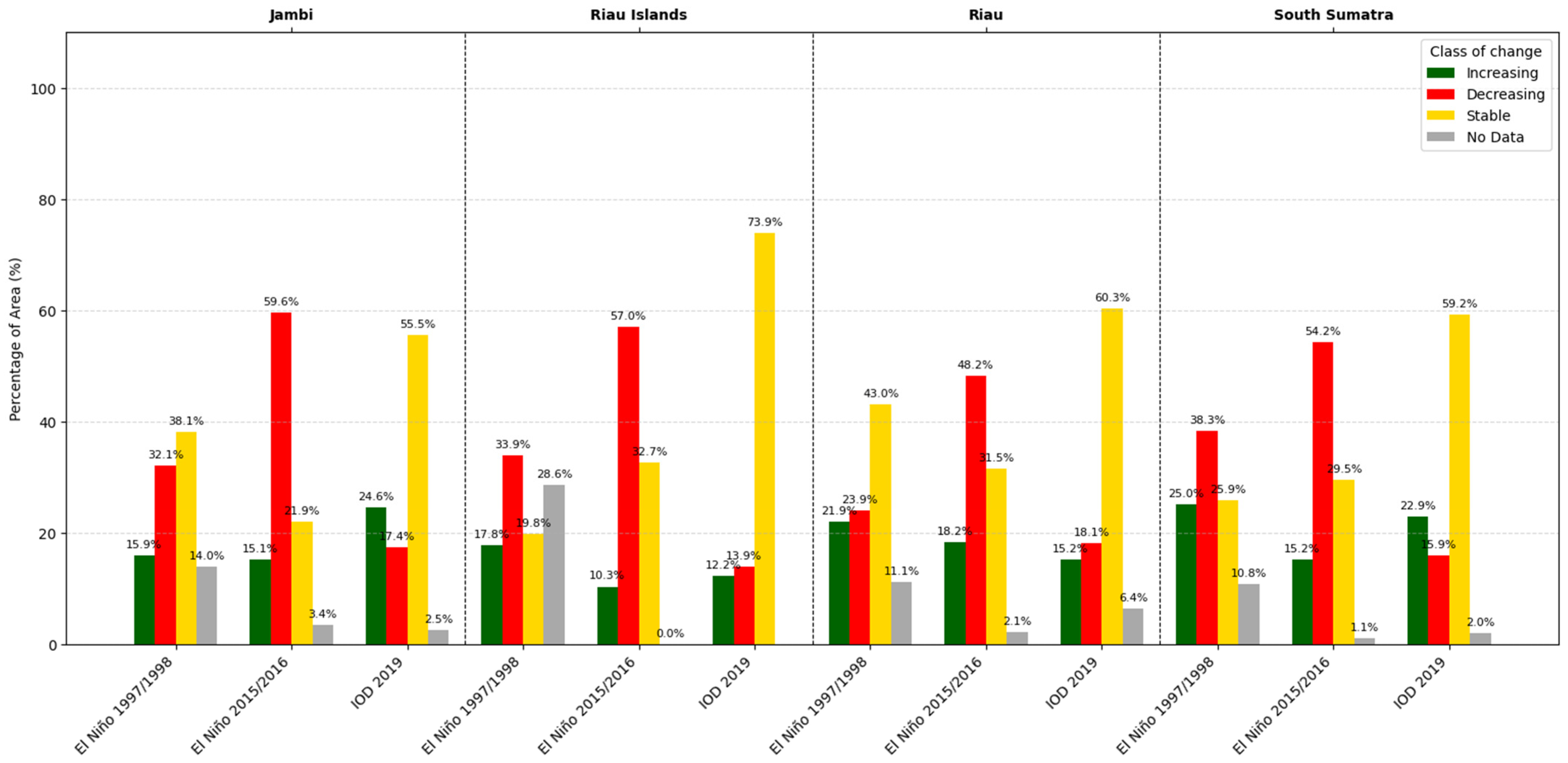
The analysis shows that the El Niño period, particularly in 2015/2016, resulted in a high proportion of degradation, especially in Jambi (~60%) and Riau (~48%) (Figure 15). This is in line with previous studies confirming that El Niño triggers extreme drought, drastically lowers the groundwater level (GWL), and increases vulnerability to fires [75,76]. During both El Niño events, there was a significant rainfall deficit, causing the GWL to drop by ≥1 m. As a result, peatlands became highly flammable, especially in provinces with fragile vegetation and high anthropogenic pressure, such as in South Sumatra [77].
In contrast, during the 2019 pIOD period, although it also triggered drought, the effects were more localized because rainfall and GWL returned to normal more quickly. These conditions allowed most of the land to remain in the unchanged category, as observed in the Riau Islands (~74%) and South Sumatra (~60%) [30,78].
These differences in patterns indicate that the intensity of climate anomalies and peatland hydrology connectivity are key factors in determining the level of degradation. Strong El Niño events tend to trigger widespread degradation due to a combination of extreme drought and large fires. Meanwhile, the pIOD, although it has an impact on hydrology, often does not cause significant degradation because its duration is shorter and its intensity is lower.
It should be noted that the impacts of large-scale climate anomalies on peatland systems need to be interpreted in the context of the known event-to-event variability of SST patterns and atmospheric circulation associated with El Niño and pIOD events. Differences in the intensity, spatial structure, and duration of these climate modes can lead to varying hydroclimatic responses across Indonesia. In this study, two strong El Niño events (1997/1998 and 2015/2016) and one major pIOD event (2019) were selected as representative high-impact cases that are widely recognized for generating severe drought conditions affecting tropical peatlands. Although the detailed spatial patterns and magnitudes of the anomalies differ among individual events, the results, particularly those presented in Figure 13, consistently indicate increased peatland stress and degradation under extreme warm and dry conditions. These findings support the relevance of El Niño- and pIOD-related climate extremes for peatland management and climate adaptation, while also highlighting the need for future studies using longer time series and multi-event analyses to further strengthen the statistical robustness of the conclusions.
The peatland land cover changes identified in this study are consistent with findings on a global, regional and national scale. Tropical peatlands are particularly vulnerable to extreme El Niño-induced droughts, which disrupt hydrological systems, increase stress on vegetation, and trigger fire-related degradation [4,75,77]. The pronounced degradation observed in Sumatra during the 1997/1998 and 2015/2016 El Niño events aligns with regional studies across Southeast Asia which report severe peat drying and widespread fires during strong El Niño event [55,79]. At the national level, previous studies have identified El Niño as a key amplifier of peatland degradation in Indonesia, with a greater impact than land use change alone [10,22,75]. In line with the findings of Khakim et al. [80], our results demonstrate extensive degradation in the peatlands of South Sumatra after 2015. In contrast, the relatively limited land cover changes observed in 2019 reflect the shorter and more spatially heterogeneous impacts of the pIOD [55,78]. Overall, these findings have important implications for peatland management and fire prevention policies. Effective adaptation strategies need to consider the characteristics of each type of climate anomaly, including the implementation of canal-based water management, water retention, and real-time GWL monitoring as an indicator of fire risk [29,30,74,81]. This approach will enhance the resilience of peatland ecosystems not only to El Niño but also to other climate anomalies in the future.

4. Conclusions

Analysis of land cover changes due to climate anomalies can be done quickly using the ML-RF computational method with NDVI, NDWI, MSAVI, and NDDI spectral indices, which are highly sensitive to peat ecosystems. The results of land cover classification conducted during three climate anomaly events showed good accuracy, with an OA value of 89–93% and a kappa value of 0.85–0.90. The NDVI and MSAVI indices statistically showed a strong relationship with the biophysical conditions of the land during climate anomalies. The NDDI clearly shows the drought conditions on peatlands, but the NDWI does not accurately describe the actual water content in the vegetation recorded during the climate anomaly period. Cloud cover in the satellite images used also affected the classification results. In this study, cloud cover was filtered by 30% and masked with images from the closest time range during data processing. However, the results still contain gaps (No Data). One of the reasons for this is the temporal resolution of Landsat satellites, which take 16 days to pass over the island of Sumatra. With a limited period for selecting images before and after the climate anomaly period (6–8 months), the possibility of spatial and temporal gaps is quite large.
Analysis of land cover change shows that the distribution of land cover change varies significantly between provinces and between periods of climate anomalies. The degraded category generally dominates during El Niño periods, with high percentages in all three provinces. This indicates that global climate disturbances have a direct impact on ecosystem degradation, especially on peatlands that are sensitive to decreases in soil moisture. Meanwhile, the improved category is relatively small during El Niño periods, but more prominent during pIOD periods, especially in provinces such as South Sumatra. This shows that vegetation recovery is better when climatic conditions return to normal. The unchanged category varies, but tends to be higher during the IOD+ period, indicating that the effects of drought during this pIOD event were not as severe as those during the El Niño event.
During the 2015/2016 El Niño event, there was a significant rainfall deficit, which triggered a decline in groundwater levels, causing the land to become very dry and prone to fires. These conditions were particularly dominant in the provinces of Riau and Jambi, which have high anthropogenic pressures such as land conversion and plantation development. The impact was seen in a much higher proportion of degraded land compared to improved land. In contrast, the 2019 pIOD, although it triggered drought, had a more localized and lower intensity impact. Rainfall and groundwater levels returned to normal more quickly, allowing some regions, such as South Sumatra, to maintain or even improve land cover quality, resulting in a higher proportion of unchanged and improved land cover compared to the El Niño period.
This study confirms that the vulnerability of land cover in Sumatra’s peatlands is strongly influenced by the interaction between climate pressures and the characteristics of the local ecosystem. Strong El Niño events and pIOD emerged as the most significant triggers of land degradation, particularly in disrupted hydrological systems where prolonged droughts increase stress on vegetation and make it more susceptible to fire [10]. These findings imply that mitigation strategies should prioritize peatland hydrological restoration, stricter control of land clearing, and enhanced early fire detection and warning systems during periods of climate anomaly. At the same time, the non-uniform response of land cover to climate anomalies highlights the need for province-specific adaptation policies that account for biophysical conditions and socio-economic contexts. This study was conducted despite limitations in data resolution, relatively high cloud coverage in the images, and uneven distribution of training and validation data. This study provides a robust basis for future investigations integrating higher-resolution multi-sensor data, hydrological indicators, and socio-economic drivers, in order to support climate-resilient peatland management.

Author Contributions

Conceptualization, A.D.S. and I.I.; methodology, A.D.S., I.I. and M.Y.N.K.; software, A.D.S.; validation, A.D.S., I.I. and M.I.; formal analysis, A.D.S. and I.I.; investigation, A.D.S.; resources, I.I. and M.I.; data curation, A.D.S.; writing—original draft preparation, A.D.S.; writing—review and editing, I.I. and M.Y.N.K.; visualization, A.D.S.; supervision, I.I., M.I. and M.Y.N.K.; project administration, A.D.S.; funding acquisition, I.I. All authors have read and agreed to the published version of the manuscript.

Funding

This research is part of the first author’s dissertation, supported by the Ministry of Higher Education, Science and Technology, Republic of Indonesia through Doctoral Dissertation Research Grant 2025, grant number 109/C3/DT.05.00/PL/2025.

Institutional Review Board Statement

Not applicable.

Informed Consent Statement

Not applicable.

Data Availability Statement

The original data presented in the study are openly available from the National Oceanic and Atmospheric Administration (NOAA), United States Geological Survey (USGS).

Acknowledgments

We thank Bambang, P. and Ariani, M. of the University of Sriwijaya for their opinions and knowledge sharing. This research was supported by the PDD 2025 research grant (Number: 109/C3/DT.05.00/PL/2025), awarded by the Ministry of Higher Education, Science and Technology, Republic of Indonesia, to the first author.

Conflicts of Interest

The authors declare no conflicts of interest.

References

  1. Page, S.E.; Rieley, J.O.; Banks, C.J. Global and Regional Importance of the Tropical Peatland Carbon Pool. Glob. Change Biol. 2011, 17, 798–818. [Google Scholar] [CrossRef]
  2. Yuwati, T.W.; Rachmanadi, D.; Pratiwi; Turjaman, M.; Indrajaya, Y.; Nugroho, H.Y.S.H.; Qirom, M.A.; Narendra, B.H.; Winarno, B.; Lestari, S.; et al. Restoration of Degraded Tropical Peatland in Indonesia: A Review. Land 2021, 10, 1170. [Google Scholar] [CrossRef]
  3. Lloyd, I.L.; Thomas, V.; Ofoegbu, C.; Bradley, A.V.; Bullard, P.; D’Acunha, B.; Delaney, B.; Driver, H.; Evans, C.D.; Faulkner, K.J.; et al. State of Knowledge on UK Agricultural Peatlands for Food Production and the Net Zero Transition. Sustainability 2023, 15, 16347. [Google Scholar] [CrossRef]
  4. Vetrita, Y.; Cochrane, M.A. Fire Frequency and Related Land-Use and Land-Cover Changes in Indonesia’s Peatlands. Remote Sens. 2019, 12, 5. [Google Scholar] [CrossRef]
  5. Bonan, G.B. Forests and Climate Change: Forcings, Feedbacks, and the Climate Benefits of Forests. Science 2008, 320, 1444–1449. [Google Scholar] [CrossRef] [PubMed]
  6. Intergovernmental Panel on Climate Change. Climate Change and Land; Cambridge University Press: Cambridge, UK, 2022; ISBN 9781009157988. [Google Scholar]
  7. Mohamed, A.; Lorestani, N.; Shabani, F. Impact of Urbanization on Land Surface Temperature: A Global Perspective. Curr. Res. Environ. Sustain. 2025, 10, 100315. [Google Scholar] [CrossRef]
  8. Woldesenbet, T.A.; Elagib, N.A.; Ribbe, L.; Heinrich, J. Hydrological responses to land use/cover changes in the source region of the Upper Blue Nile Basin, Ethiopia. Sci. Total Environ. 2017, 575, 724–741. [Google Scholar] [CrossRef]
  9. Saji, N.H.; Goswami, B.N.; Vinayachandran, P.N.; Yamagata, T. A Dipole Mode in the Tropical Indian Ocean. Nature 1999, 401, 360–363. [Google Scholar] [CrossRef] [PubMed]
  10. Page, S.E.; Siegert, F.; Rieley, J.O.; Boehm, H.-D.V.; Jaya, A.; Limin, S. The Amount of Carbon Released from Peat and Forest Fires in Indonesia during 1997. Nature 2002, 420, 61–65. [Google Scholar] [CrossRef]
  11. Suwatno, D.S.R. Ratifikasi terhadap traktat persetujuan paris (paris agreement) sebagai wujud implementasi komitmen indonesia dalam upaya mitigasi dan adaptasi perubahan iklim. J. Pendidik. Kewarganegaraan Undiksha 2023, 10, 328–340. (In Bahasa) [Google Scholar] [CrossRef]
  12. Harris, A.; Charnock, R.; Lucas, R.M. Hyperspectral Remote Sensing of Peatland Floristic Gradients. Remote Sens. Environ. 2015, 162, 99–111. [Google Scholar] [CrossRef]
  13. Stuart, M.B.; Davies, M.; Hobbs, M.J.; McGonigle, A.J.S.; Willmott, J.R. Peatland Plant Spectral Response as a Proxy for Peat Health, Analysis Using Low-Cost Hyperspectral Imaging Techniques. Remote Sens. 2022, 14, 3846. [Google Scholar] [CrossRef]
  14. Torabi Haghighi, A.; Menberu, M.W.; Darabi, H.; Akanegbu, J.; Kløve, B. Use of Remote Sensing to Analyse Peatland Changes after Drainage for Peat Extraction. Land Degrad. Dev. 2018, 29, 3479–3488. [Google Scholar] [CrossRef]
  15. Zhou, Y.; Sachs, T.; Li, Z.; Pang, Y.; Xu, J.; Kalhori, A.; Wille, C.; Peng, X.; Fu, X.; Wu, Y.; et al. Long-Term Effects of Rewetting and Drought on GPP in a Temperate Peatland Based on Satellite Remote Sensing Data. Sci. Total Environ. 2023, 882, 163395. [Google Scholar] [CrossRef]
  16. Lees, K.J.; Quaife, T.; Artz, R.R.E.; Khomik, M.; Clark, J.M. Potential for Using Remote Sensing to Estimate Carbon Fluxes across Northern Peatlands—A Review. Sci. Total Environ. 2018, 615, 857–874. [Google Scholar] [CrossRef]
  17. Bourgeau-Chavez, L.L.; Grelik, S.L.; Battaglia, M.J.; Leisman, D.J.; Chimner, R.A.; Hribljan, J.A.; Lilleskov, E.A.; Draper, F.C.; Zutta, B.R.; Hergoualc’h, K.; et al. Advances in Amazonian Peatland Discrimination with Multi-Temporal PALSAR Refines Estimates of Peatland Distribution, C Stocks and Deforestation. Front. Earth Sci. 2021, 9, 676748. [Google Scholar] [CrossRef]
  18. Aldrian, E.; Dwi Susanto, R. Identification of Three Dominant Rainfall Regions within Indonesia and Their Relationship to Sea Surface Temperature. Int. J. Climatol. 2003, 23, 1435–1452. [Google Scholar] [CrossRef]
  19. Paek, H.; Yu, J.Y.; Qian, C. Why Were the 2015/2016 and 1997/1998 Extreme El Niños Different? Geophys. Res. Lett. 2017, 44, 1848–1856. [Google Scholar] [CrossRef]
  20. Khoir, A.N.; D., Y.; N., A.R.; Safril, A. The Influence of Strong El Niño to Seasonal Variability in Sumatera. In Proceedings of the AIP Conference Proceedings, Yogyakarta, Indonesia, 18 July 2018; American Institute of Physics Inc.: College Park, MD, USA, 2018; Volume 1987, p. 020029. [Google Scholar]
  21. Hanifa, R.; Wiratmo, J. ENSO and IOD Influence on Extreme Rainfall in Indonesia: Historical and Future Analysis. Agromet 2024, 38, 78–87. [Google Scholar] [CrossRef]
  22. Crowson, M.; Warren-Thomas, E.; Hill, J.K.; Hariyadi, B.; Agus, F.; Saad, A.; Hamer, K.C.; Hodgson, J.A.; Kartika, W.D.; Lucey, J.; et al. A Comparison of Satellite Remote Sensing Data Fusion Methods to Map Peat Swamp Forest Loss in Sumatra, Indonesia. Remote Sens. Ecol. Conserv. 2019, 5, 247–258. [Google Scholar] [CrossRef]
  23. Miettinen, J.; Liew, S.C.; Kwoh, L.K. Decline of Sumatran Peat Swamp Forests since 1990. In Proceedings of the 34th International Symposium on Remote Sensing of Environment—The GEOSS Era, Sydney, Australia, 10–15 April 2011. [Google Scholar]
  24. Hapsari, K.A.; Jennerjahn, T.; Nugroho, S.H.; Yulianto, E.; Behling, H. Sea Level Rise and Climate Change Acting as Interactive Stressors on Development and Dynamics of Tropical Peatlands in Coastal Sumatra and South Borneo since the Last Glacial Maximum. Glob. Change Biol. 2022, 28, 3459–3479. [Google Scholar] [CrossRef]
  25. Amani, M.; Ghorbanian, A.; Mahdavi, S.; Mohammadzadeh, A. Iranian land cover mapping using Landsat-8 imagery and random forest algorithm. Int. Arch. Photogramm. Remote Sens. Spat. Inf. Sci. 2019, XLII-4/W18, 77–81. [Google Scholar] [CrossRef]
  26. Habibie, M.I. The application of machine learning using google earth engine for remote sensing analysis. J. Teknoinfo 2022, 16, 233. [Google Scholar] [CrossRef]
  27. Martínez-Barbáchano, R. Estimación de La Temperatura Superficial En Imágenes Históricas Landsat 5 Mediante Corrección Atmosférica Monocanal En El Térmico Para La Cuenca Del Río Tempisque-Bebedero (Costa Rica). Rev. Geográfica De América Cent. 2020, 2, 17–32. (In Spanish) [Google Scholar] [CrossRef]
  28. Small, C.; Zappa, C.J. Mapping the Diurnal Thermal Response of the Urban Heat Island with Landsat TIRS. In Proceedings of the 2017 Joint Urban Remote Sensing Event, Dubai, United Arab Emirates, 6–8 March 2017; pp. 1–4. [Google Scholar] [CrossRef]
  29. Akhsan, H.; Irfan, M.; Iskandar, I. El Niño Southern Oscillation (ENSO), Indian Ocean Dipole (IOD), and the Rise of Extreme Temperatures in Eastern Sumatra: Exploring Climate Change Dynamics. J. Penelit. Pendidik. IPA 2023, 9, 600–608. [Google Scholar] [CrossRef]
  30. Iskandar, I.; Lestari, D.O.; Saputra, A.D.; Setiawan, R.Y.; Wirasatriya, A.; Susanto, R.D.; Mardiansyah, W.; Irfan, M.; Rozirwan; Setiawan, J.D.; et al. Extreme Positive Indian Ocean Dipole in 2019 and Its Impact on Indonesia. Sustainability 2022, 14, 15155. [Google Scholar] [CrossRef]
  31. Ghazaryan, G.; Krupp, L.; Seyfried, S.; Landgraf, N.; Nendel, C. Enhancing Peatland Monitoring through Multisource Remote Sensing: Optical and Radar Data Applications. Int. J. Remote Sens. 2024, 45, 6372–6394. [Google Scholar] [CrossRef]
  32. Pratikasiwi, H.A.; Taufik, M.; Santikayasa, I.P.; Domiri, D.D. Identification of Peatland Burned Area Based on Multiple Spectral Indices and Adaptive Thresholding in Central Kalimantan. Agromet 2024, 38, 68–77. [Google Scholar] [CrossRef]
  33. Pettorelli, N.; Ryan, S.; Mueller, T.; Bunnefeld, N.; Jedrzejewska, B.; Lima, M.; Kausrud, K. The Normalized Difference Vegetation Index (NDVI): Unforeseen Successes in Animal Ecology. Clim. Res. 2011, 46, 15–27. [Google Scholar] [CrossRef]
  34. Escuin, S.; Navarro, R.; Fernández, P. Fire Severity Assessment by Using NBR (Normalized Burn Ratio) and NDVI (Normalized Difference Vegetation Index) Derived from LANDSAT TM/ETM Images. Int. J. Remote Sens. 2008, 29, 1053–1073. [Google Scholar] [CrossRef]
  35. McFeeters, S.K. Using the Normalized Difference Water Index (NDWI) Within a Geographic Information System to Detect Swimming Pools for Mosquito Abatement: A Practical Approach. Remote Sens. 2013, 5, 3544–3561. [Google Scholar] [CrossRef]
  36. Gao, B.C. NDWI—A Normalized Difference Water Index for Remote Sensing of Vegetation Liquid Water from Space. Remote Sens. Environ. 1996, 58, 257–266. [Google Scholar] [CrossRef]
  37. Patil, P. Drought Severity Estimation Using NDWI Index in Parbhani District of Maharashtra. J. Agrometeorol. 2024, 26, 225–227. [Google Scholar] [CrossRef]
  38. Zhao, Z. The PCA-NDWI Urban Water Extraction Model Based on Hyperspectral Remote Sensing. Water 2024, 16, 963. [Google Scholar] [CrossRef]
  39. Qi, J.; Chehbouni, A.; Huete, A.R.; Kerr, Y.H.; Sorooshian, S. A Modified Soil Adjusted Vegetation Index. Remote Sens. Environ. 1994, 48, 119–126. [Google Scholar] [CrossRef]
  40. Kareem, H.H.; Attaee, M.H.; Omran, Z.A. Evaluation the Soil-Adjusted Vegetation Indices SAVI and MSAVI for Bristol City, United Kingdom Using Landsat 8-OLI Through Geospatial Technology. Ecol. Eng. Environ. Technol. 2023, 24, 89–97. [Google Scholar] [CrossRef]
  41. Gu, Y.; Brown, J.F.; Verdin, J.P.; Wardlow, B. A Five-year Analysis of MODIS NDVI and NDWI for Grassland Drought Assessment over the Central Great Plains of the United States. Geophys. Res. Lett. 2007, 34, 1–6. [Google Scholar] [CrossRef]
  42. Manuri, S.; Andersen, H.-E.; Brack, C.; Doran, B. Advanced Land Cover Mapping of Tropical Peat Swamp Ecosystem Using Airborne Discrete Return Lidar. Geoplanning J. Geomat. Plan. 2017, 4, 1–8. [Google Scholar] [CrossRef]
  43. Aulia, O.D.; Apriani, I.; Juanda, A.; Barri, M.F.; Dewi, R.W.; Muharam, F.N.; Oktanine, B.; Phoa, T.B.; Condro, A.A. Refining National Forest Cover Data Based on Fusion Optical Satellite Imageries in Indonesia. Int. J. For. Res. 2023, 2023, 1–11. [Google Scholar] [CrossRef]
  44. Hamzah, K.A.; Idris, A.S.; Parlan, I.H. Classification of Degraded Peat Swamp Forest for Restoration Planning at Landscape Level Using Remote Sensing Technique. J. For. Environ. Sci. 2013, 29, 49. [Google Scholar] [CrossRef][Green Version]
  45. Erwin, E.; Saparudin, S.; Fachrurrozi, M. Segmentation and Classification Models Validation Area Mapping of Peat Lands as Initial Value of Fuzzy Kohonen Clustering Network. IOP Conf. Ser. Mater. Sci. Eng. 2016, 190, 012037. [Google Scholar] [CrossRef]
  46. Özbuldu, M.; Sekerli, Y.E. Comparative Analysis of Different Supervised Methods for Satellite-Based Land-Use Classification: A Case Study of Reyhanlı. Mustafa Kemal Üniversitesi Tarım Bilim. Derg. 2024, 29, 707–723. [Google Scholar] [CrossRef]
  47. Jadhav, T.; Tanishq; Jagadish, S.; Gaikwad, M.; Wagle, S.; Jayaswal, R.; Patil, S. Predicting Urban Land Cover Using Classification: A Machine Learning Approach. In Proceedings of the 2023 IEEE 11th Region 10 Humanitarian Technology Conference (R10-HTC), Rajkot, India, 16 October 2023; IEEE: New York, NY, USA, 2023; pp. 450–454. [Google Scholar]
  48. Li, X.; Fan, X.; Li, Q.; Zhao, X. RS-Net: Hyperspectral Image Land Cover Classification Based on Spectral Imager Combined with Random Forest Algorithm. Electronics 2024, 13, 4046. [Google Scholar] [CrossRef]
  49. Pachon, I.; Ramirez, S.; Fonseca, D.; Lozano-Rivera, P.; Ariza, C.; Paula Mancipe, M.; Villamizar, M.; Castro, H.; Cabrera, E.; Teresa Becerra, M. Random Forest Data Cube Based Algorithm for Land Cover Classification: A Colombian Case. In Proceedings of the IGARSS 2018—2018 IEEE International Geoscience and Remote Sensing Symposium, Valencia, Spain, 22–27 July 2018; IEEE: New York, NY, USA, 2018; pp. 8651–8654. [Google Scholar]
  50. Patil, A.; Panhalkar, S. A Comparative Analysis of Machine Learning Algorithms for Land Use and Land Cover Classification Using Google Earth Engine Platform. J. Geomat. 2023, 17, 111–118. [Google Scholar] [CrossRef]
  51. Tokar, O.; Havryliuk, S.; Korol, M.; Vovk, O.; Kolyasa, L. Using Multitemporal and Multisensoral Images for Land Cover Interpretation with Random Forest Algorithm in the Prykarpattya Region of Ukraine. In Proceedings of the Advances in Intelligent Systems and Computing III, Lviv, Ukraine, 20 November 2018; Springer International Publishing: Cham, Switzerland, 2018; pp. 48–64. [Google Scholar]
  52. Sparey, M.; Williamson, M.S.; Cox, P.M. Machine Learning for Global Bioclimatic Classification: Enhancing Land Cover Prediction through Random Forests. Atmosphere 2024, 15, 700. [Google Scholar] [CrossRef]
  53. Halabaku, E.; Bytyçi, E. Overfitting in Machine Learning: A Comparative Analysis of Decision Trees and Random Forests. Intell. Autom. Soft Comput. 2024, 39, 987–1006. [Google Scholar] [CrossRef]
  54. Li, H.; Wan, W.; Fang, Y.; Zhu, S.; Chen, X.; Liu, B.; Hong, Y. A Google Earth Engine-Enabled Software for Efficiently Generating High-Quality User-Ready Landsat Mosaic Images. Environ. Model. Softw. 2019, 112, 16–22. [Google Scholar] [CrossRef]
  55. Santoso, A.; Mcphaden, M.J.; Cai, W. The Defining Characteristics of ENSO Extremes and the Strong 2015/2016 El Niño. Rev. Geophys. 2017, 55, 1079–1129. [Google Scholar] [CrossRef]
  56. Foody, G.M. Status of Land Cover Classification Accuracy Assessment. Remote Sens. Environ. 2002, 80, 185–201. [Google Scholar] [CrossRef]
  57. Landis, J.R.; Koch, G.G. The Measurement of Observer Agreement for Categorical Data. Biometrics 1977, 33, 159. [Google Scholar] [CrossRef] [PubMed]
  58. Whelen, T.; Siqueira, P. Coefficient of Variation for Use in Crop Area Classification across Multiple Climates. Int. J. Appl. Earth Obs. Geoinf. 2018, 67, 114–122. [Google Scholar] [CrossRef]
  59. Stamou, A.; Dosiou, A.; Bakousi, A.; Karachaliou, E.; Tavantzis, I.; Stylianidis, E. Assessing Spatial Correlations Between Land Cover Types and Land Surface Temperature Trends Using Vegetation Index Techniques in Google Earth Engine: A Case Study of Thessaloniki, Greece. Remote Sens. 2025, 17, 403. [Google Scholar] [CrossRef]
  60. Aguilera, M.A.Z. Classication of Land-Cover Through Machine Learning Algorithms for Fusion of Sentinel-2a and Planetscope Imagery. In Proceedings of the 2020 IEEE Latin American GRSS & ISPRS Remote Sensing Conference (LAGIRS), Santiago, Chile, 22–26 March 2020; IEEE: New York, NY, USA, 2020; pp. 246–253. [Google Scholar]
  61. Chavhan, G.H.; Dandawate, Y.H.; Deshpande, M.S. A Comparative Analysis on Hyperspectral Imaging-Based Early Drought Stress Detection for Precision Agriculture in Indian Context. In Proceedings of International Conference on Communication and Artificial Intelligence; Goyal, V., Gupta, M., Trivedi, A., Kolhe, M.L., Eds.; Springer: Singapore, 2021; Volume 192, pp. 507–513. [Google Scholar]
  62. Wang, L.; Qu, J.J. NMDI: A Normalized Multi-band Drought Index for Monitoring Soil and Vegetation Moisture with Satellite Remote Sensing. Geophys. Res. Lett. 2007, 34, 1–5. [Google Scholar] [CrossRef]
  63. Lo, J. Ground Water Table Monitoring in North Selangor Peat Swamp Forest, Selangor, Peninsular Malaysia. Arch. Agric. Res. Technol. (AART) 2022, 3, 1029. [Google Scholar] [CrossRef]
  64. Cunha e Silva, D.C.; Sales, J.C.A.; Lourenço, R.W.; Oliveira, V.N.; Dominato, V.D.; Albuquerque Filho, J.L. Disponibilidade de água em bacias hidrográficas para a vegetação usando NDWI. In Anais do XVIII Simpósio Brasileiro de Sensoriamento Remoto (SBSR); Instituto Nacional de Pesquisas Espaciais (INPE): Santos, SP, Brasil, 2017; pp. 771–778. ISBN 978-85-17-00088-1. (In Portuguese) [Google Scholar]
  65. Affandy, N.A.; Iranata, D.; Anwar, N.; Maulana, M.A.; Prastyo, D.D.; Wardoyo, W.; Sukojo, B.M. Assessment of Agricultural Drought Using the Normalized Difference Drought Index (NDDI) to Prediction Drought at Corong River Basin. Int. J. Integr. Eng. 2024, 16, 320–330. [Google Scholar] [CrossRef]
  66. Garcia-Aguirre, M.C.; Alvarez, R.; Dirzo, R.; Bernal, A. Post-Classification Digital Change Detection Analysis of a Temperate Forest in the Southwest Basin of Mexico City, in a 16-Year Span. In Proceedings of the International Workshop on the Analysis of Multi-Temporal Remote Sensing Images, Biloxi, MS, USA, 16–18 May 2005; IEEE: New York, NY, USA, 2005; pp. 81–84. [Google Scholar]
  67. Affonso, A.A.; Mandai, S.S.; Portella, T.P.; Quintanilha, J.A.; Conti, L.A.; Grohmann, C.H. A Comparison between Supervised Classification Methods: Study Case on Land Cover Change Detection Caused by a Hydroelectric Complex Installation in the Brazilian Amazon. Sustainability 2023, 15, 1309. [Google Scholar] [CrossRef]
  68. Ghosh, A.; Rambaud, P.; Finegold, Y.; Jonckheere, I.; Martin-Ortega, P.; Jalal, R.; Adebayo, A.D.; Alvarez, A.; Borretti, M.; Caela, J.; et al. Monitoring Sustainable Development Goal Indicator 15.3.1 on Land Degradation Using SEPAL: Examples, Challenges and Prospects. Land 2024, 13, 1027. [Google Scholar] [CrossRef]
  69. Baker, W.L. A Review of Models of Landscape Change. Landsc. Ecol. 1989, 2, 111–133. [Google Scholar] [CrossRef]
  70. Pontius, R.G.; Shusas, E.; McEachern, M. Detecting Important Categorical Land Changes While Accounting for Persistence. Agric. Ecosyst. Environ. 2004, 101, 251–268. [Google Scholar] [CrossRef]
  71. Kulkarni, G.; Muley, A.; Deshmukh, N.; Bhalchandra, P. Land Use Land Cover Change Detection through GIS and Unsupervised Learning Technique. In Proceedings of the Proceedings of the International Conference on Data Science and Applications, Sydney, Australia, 7–9 July 2020; pp. 277–285. [Google Scholar]
  72. Pontius, R.G.; Millones, M. Death to Kappa: Birth of Quantity Disagreement and Allocation Disagreement for Accuracy Assessment. Int. J. Remote Sens. 2011, 32, 4407–4429. [Google Scholar] [CrossRef]
  73. Madanian, M.; Soffianian, A.; Fakheran, S. International Conference on Applied Life Sciences; Nejadkoorki, F., Ed.; IntechOpen: London, UK, 2012; Volume 190, ISBN 978-953-51-0725-5. [Google Scholar]
  74. Irfan, M.; Virgo, F.; Khakim, M.Y.N.; Ariani, M.; Sulaiman, A.; Iskandar, I. The Dynamics of Rainfall and Temperature on Peatland in South Sumatra during the 2019 Extreme Dry Season. J. Phys. Conf. Ser. 2021, 1940, 012030. [Google Scholar] [CrossRef]
  75. Khakim, M.Y.N.; Bama, A.A.; Yustian, I.; Poerwono, P.; Tsuji, T.; Matsuoka, T. Peatland Subsidence and Vegetation Cover Degradation as Impacts of the 2015 El Niño Event Revealed by Sentinel-1A SAR Data. Int. J. Appl. Earth Obs. Geoinf. 2020, 84, 101953. [Google Scholar] [CrossRef]
  76. Prasetyo, L.B.; Setiawan, Y.; Condro, A.A.; Kustiyo, K.; Putra, E.I.; Hayati, N.; Wijayanto, A.K.; Ramadhi, A.; Murdiyarso, D. Assessing Sumatran Peat Vulnerability to Fire under Various Condition of ENSO Phases Using Machine Learning Approaches. Forests 2022, 13, 828. [Google Scholar] [CrossRef]
  77. Irfan, M.; Koriyanti, E.; Saleh, K.; Hadi; Safrina, S.; Awaludin; Sulaiman, A.; Akhsan, H.; Suhadi; Suwignyo, R.A.; et al. Dynamics of Peatland Fires in South Sumatra in 2019: Role of Groundwater Levels. Land 2024, 13, 373. [Google Scholar] [CrossRef]
  78. Utari, P.A.; Khakim, M.Y.N.; Setiabudidaya, D.; Iskandar, I. Dynamics of 2015 Positive Indian Ocean Dipole. J. South. Hemisph. Earth Syst. Sci. 2019, 69, 75–83. [Google Scholar] [CrossRef]
  79. Huijnen, V.; Wooster, M.J.; Kaiser, J.W.; Gaveau, D.; Flemming, J.; Parrington, M.; Inness, A.; Murdiyarso, D.; Main, B.W.; van Weele, M. Fire Carbon Emissions over Maritime Southeast Asia in 2015 Largest Since 1997. Sci. Rep. 2016, 6, 26886. [Google Scholar] [CrossRef]
  80. Khakim, M.Y.N.; Bama, A.A.; Tsuji, T. Monitoring Land Cover Dynamics and Forest Degradation in South Sumatra Peatlands from 2015 to 2023 by Remote Sensing Application. Russ. J. Earth Sci. 2024, 24, 1–15. [Google Scholar] [CrossRef]
  81. Putra, R.; Sutriyono, E.; Kadir, S.; Iskandar, I.; Lestari, D.O. Dynamical Link of Peat Fires in South Sumatra and the Climate Modes in the Indo-Pacific Region. Indones. J. Geogr. 2019, 51, 18–22. [Google Scholar] [CrossRef][Green Version]
Figure 1. Map of peatland in South Sumatra, Jambi, Riau, and Riau Islands provinces (red).
Sustainability 18 00919 g001
Figure 2. Research flowchart.
Sustainability 18 00919 g002
Figure 3. The Niño3.4 index showing the El Niño event periods (a) in 1997–1998 and (b) in 2015–2016.
Sustainability 18 00919 g003
Figure 4. Dipole Mode Index (DMI) time series from January 2018 to December 2020.
Sustainability 18 00919 g004
Figure 5. Land cover classification results (a) before and (b) after climate anomaly events.
Sustainability 18 00919 g005
Figure 6. Stability matrix of the classification model.
Sustainability 18 00919 g006
Figure 7. Area of land cover classification results before and after climate anomalies.
Sustainability 18 00919 g007
Figure 8. Changes in NDVI values (D_NDVI) during (a) El Niño 1997/1998, (b) El Niño 2015/2016, and (c) pIOD 2019.
Sustainability 18 00919 g008
Figure 9. Changes in MSAVI values (D_MSAVI) during (a) El Niño 1997/1998, (b) El Niño 2015/2016, and (c) pIOD 2019.
Sustainability 18 00919 g009
Figure 10. Histogram of NDVI (left) and MSAVI (right) changes during the 1997/1998 El Niño climate anomaly period (top), the 2015/2016 El Niño period (middle), and the 2019 pIOD period (bottom).
Sustainability 18 00919 g010
Figure 11. Changes in NDWI values (D_NDWI) during events (a) El Niño 1997/1998, (b) El Niño 2015/2016, and (c) pIOD 2019.
Sustainability 18 00919 g011
Figure 12. Changes in NDDI values (D_NDDI) during (a) the 1997/1998 El Niño event, (b) the 2015/2016 El Niño, and (c) the 2019 pIOD.
Sustainability 18 00919 g012
Figure 13. Histogram of changes in (a) NDWI and (b) NDDI during the 1997/1998 El Niño event (top), the 2015/2016 El Niño event (middle), and the 2019 pIOD event (bottom).
Sustainability 18 00919 g013
Figure 14. Land cover change maps for climate anomaly periods of (a) El Niño 1997/1998, (b) El Niño 2015/2016, and (c) pIOD 2019.
Sustainability 18 00919 g014
Figure 15. Percentage of land cover change during periods of climate anomalies.
Sustainability 18 00919 g015
Table 1. Data types and sources.
Data TypeSource
Landsat 5 TM imageryUSGS (United States Geological Survey)
Landsat 8 OLI/TIRS imageryUSGS (United States Geological Survey)
Peat MapSemi-Detailed Soil Data BBSDLP (Center for Agricultural Land Resources), Republic of Indonesia
Climate Anomaly IndexNOAA (National Oceanic and Atmospheric Administration)
Field Validation DataForest Area Stabilization Center, Ministry of Forestry, Republic of Indonesia
Table 2. Bands and indices are used for the classification process.
SatelliteBands and Indices
Landsat 5 TMSR_B1, SR_B2, SR_B3, SR_B4, SR_B5, SR_B6, and NDVI, NDWI, MSAVI, NDDI
Landsat 8 OLI/TIRSSR_B2, SR_B3, SR_B4, SR_B5, SR_B6, SR_B7, and NDVI, NDWI, MSAVI, NDDI
Table 3. Image recording period and number of images used.
Anomaly PeriodAnomaly TypeImaging Time Before AnomalyNumber of Images
(Scene)
Recording Time After AnomalyNumber of Images
(Scene)
Maximum Cloud Cover
1997/1998El NiñoJune 1996–February 199771June 1998–February 19995030
2015/2016El NiñoJune 2013–March 201462June 2016–December 20164230
2019pIODJanuary–April 201971January 2020–December 20208930
Table 4. Area of land cover classification for climate anomaly periods in Sumatran peatlands.
Land CoverLand Cover Area (Ha)
El Niño 1997/1998El Niño 2015/2016pIOD 2019
PrePostPrePostPrePost
Water Agency19,211.132647.4419,484.9126,876.8818,408.424381.65
Swamp Forest255,519.81286,330.41159,011.02786,539.25250,886.3496,297.75
Mangrove32,668.9232,668.9231,886.0131,886.0131,886.0131,886.01
Primary Swamp Forest2,073,3701,834,929.75894,369.0039,360.876232.23126,768.87
Secondary Swamp Forest2,110,071.001,777,430.001,843,147.001,306,342.001,046,774.001,017,633.00
Plantations255,088.63569,325.441,555,572.002,650,725.003,518,471.003,729,664.00
Mixed Farming203,916.06172,464.56676,351.00197,721.63251,986.23182,221.11
Open Land336,454.91494,888.41330,282.19458,674.66166,010.58260,472.52
No Data234,718.42350,334.3310,915.8822,893.21230,363.8771,694.47
Total Area (Ha)5,521,018.885,521,019.265,521,019.015,521,019.515,521,018.685,521,019.38
Table 5. Accuracy assessment of land cover classification before and after climate anomalies.
Anomaly Period
Climate
κOAWater BodiesSwamp ShrubberyMangrovePrimary Swamp ForestSecondary Swamp ForestPlantationsAgricultureOpen Land
PAUAPAUAPAUAPAUAPAUAPAUAPAUAPAUA
Pre-El Niño 1997/19980.860.920.990.990.680.780.600.910.930.920.950.930.560.740.610.660.920.97
Post-El Niño 1997/19980.900.930.950.960.660.800.640.900.960.940.950.930.670.850.750.790.970.96
Pre-El Niño 2015/20160.880.910.990.960.690.880.820.930.860.860.950.920.890.900.600.790.990.98
Post-El Niño 2015/20160.850.900.991.00.670.750.910.920.630.860.930.870.920.870.460.760.960.95
Pre-pIOD 20190.850.900.990.970.540.780.850.950.620.920.950.950.930.830.430.770.970.90
Post-pIOD 2019 0.850.890.980.970.520.780.860.910.600.920.950.910.920.830.410.750.930.93
κ = Kappa coefficient; OA = Overall Accuracy; PA = Producer’s Accuracy; UA = User’s Accuracy.
Table 6. Spectral index statistics in the land cover classification process.
EventMeanMedianStandard DeviationMean
Change (%)
Media
Change (%)
Std
Change
(%)
PrePostPrePostPrePost
NDVIEl Niño 1997/19980.3230.3160.3360.3220.0690.054−2.17−4.17−21.74
El Niño 2015/20160.3640.3610.3750.3720.0690.065−0.82−0.80−5.80
pIOD 20190.3680.3650.3800.3760.0680.063−0.82−1.05−7.35
NDWIEl Niño 1997/19980.1770.1970.1990.2050.0730.04811.303.02−34.25
El Niño 2015/20160.1820.1860.2070.2140.0820.0842.203.382.44
pIOD 20190.1940.1900.2150.2100.0740.076−2.06−2.332.70
MSAVIEl Niño 1997/19980.4840.4780.5030.4870.0830.065−1.24−3.18−21.69
El Niño 2015/20160.5290.5260.5460.5420.0800.075−0.57−0.73−6.25
pIOD 20190.5340.5320.5510.5470.0770.072−0.37−0.73−6.49
NDDIEl Niño 1997/19980.3190.2430.2550.2260.2020.131−23.82−11.37−35.15
El Niño 2015/20160.3550.3330.2840.2660.2070.235−6.20−6.3413.53
pIOD 20190.3360.3400.2810.2830.1800.1861.190.713.33
Table 7. Eight-class land cover change transition matrix.
Pre\PostWater BodyShrub MangrovePS-PrimaryPS-SecondaryPlantationsMixed AgricultureOpen Land
Water BodyPermanentIncreasingIncreasingIncreasingIncreasingIncreasingIncreasingIncreasing
ShrubDecreasingStableIncreasingIncreasingIncreasingDecreasingDecreasingDecreasing
MangroveDecreasingDecliningStableIncreasingDecreasingDecreasingDecreasingDecreasing
PS-PrimaryDecreasingDecreasingDecreasingStableDecreasingDecreasingDecreasingDecreasing
PS-SecondaryDecreasingDecreasingIncreasingIncreasingStableDecreasingDecreasingDeclining
PlantationsDecreasingIncreasingIncreasingIncreasingIncreasingStableIncreasingDecreasing
Mixed AgricultureDecreasingIncreasingIncreasingIncreasingIncreasingDecreasingStableDecreasing
Open landDecreasingIncreasingIncreasingIncreasingIncreasingIncreasingIncreasingRemaining
Table 8. Area of land cover change as a result of climate anomalies.
Climate AnomalyChangeArea Change in Peatlands (Ha)
JambiRiau IslandsRiauSouth Sumatra
El Niño 1997/1998Decreasing189,488.952631.39916,658.88416,803.94
Fixed224,886.311536.861,645,590.45282,082.48
Increased93,980.111383.55839,929.89272,258.80
No Data82,470.462220.95425,957.11118,060.71
El Niño 2015/2016Decreasing351,983.874430.381,844,526.78590,019.26
Fixed129,454.932538.381,205,761.49321,624.41
Increased89,412.77801.93697,511.18165,836.75
No Data19,974.261.9780,333.7611,725.50
pIOD 2019Decreasing102,702.031081.13691,593.97173,061.74
Stable327,908.815736.652,307,730.00644,684.73
Increased145,353.77947.56582,085.16249,601.77
No Data14,851.49-246,602.9221,650.94
Disclaimer/Publisher’s Note: The statements, opinions and data contained in all publications are solely those of the individual author(s) and contributor(s) and not of MDPI and/or the editor(s). MDPI and/or the editor(s) disclaim responsibility for any injury to people or property resulting from any ideas, methods, instructions or products referred to in the content.