Article

A Study on Dynamic Gross Ecosystem Product (GEP) Accounting, Spatial Patterns, and Value Realization Pathways in Alpine Regions: A Case Study of Golog Tibetan Autonomous Prefecture, Qinghai Province, China

1
School of Economics and Management, University of Chinese Academy of Sciences, Beijing 100190, China
2
People’s Government of Dari County, Golog Tibetan Autonomous Prefecture, Golog 814299, China
*
Author to whom correspondence should be addressed.
Sustainability 2026, 18(2), 918; https://doi.org/10.3390/su18020918
Submission received: 18 December 2025 / Revised: 7 January 2026 / Accepted: 13 January 2026 / Published: 16 January 2026
(This article belongs to the Section Sustainable Products and Services)

Abstract

Promoting the value realization of ecological products is a central issue in practicing the concept that “lucid waters and lush mountains are invaluable assets.” This is particularly urgent for alpine regions, which are vital ecological security barriers but face stringent developmental constraints. This study takes Golog Tibetan Autonomous Prefecture in Qinghai Province as a case study. It establishes a Gross Ecosystem Product (GEP) accounting framework tailored to the characteristics of alpine ecosystems and conducts continuous empirical accounting for the period 2020–2023. The findings reveal that: (i) The total GEP of Golog is immense (reaching 655.586 billion yuan in 2023) but exhibits significant dynamic non-stationarity driven by climatic fluctuations, with a coefficient of variation as high as 11.48%. (ii) The value structure of the GEP is highly unbalanced, with regulatory services contributing over 97.6%. Water conservation and biodiversity protection are the two pillars, highlighting its role as a supplier of public ecological products and the predicament of market failure. (iii) The spatial distribution of GEP is highly heterogeneous. Maduo County, comprising 34% of the prefecture’s land area, contributes 48% of its total GEP, with its value per unit area being 1.68 times that of Gande County, revealing the spatial agglomeration of key ecosystem services. To address the dynamic, structural, and spatial constraints identified by these quantitative features, this paper proposes synergistic realization pathways centered on “monetizing regulatory services,” “precision policy regulation,” and “capacity and institution building”. The aim is to overcome the systemic bottlenecks—“difficulties in measurement, trading, coarse compensation, and weak incentives”—in alpine ecological functional zones. This provides a systematic theoretical and practical solution for fostering a virtuous cycle between ecological conservation and regional sustainable development.

1. Introduction

Ecological Product Value Accounting (Gross Ecosystem Product, GEP), as a novel national economic statistical indicator, aims to comprehensively assess the value of final products and services provided by ecosystems for human well-being and sustainable economic development [1]. Its theoretical foundations can be traced back to the rise of environmental economics and ecological economics in the 1970s. Holdren and Ehrlich (1974) [2] first introduced the concept of “ecosystem services.” In 1997, the groundbreaking study by Costanza et al. [3], “The value of the world’s ecosystem services and natural capital,” published in Nature, provided a pioneering quantification of the value of 17 ecosystem services across 16 global biomes. This landmark research laid the methodological groundwork for ecological product value accounting. The Millennium Ecosystem Assessment (MA) (2001–2005) launched by the United Nations [4,5,6] was the first systematic, multi-scale, and integrated assessment of the condition, trends, and impact on human well-being of global ecosystems. It classified ecosystem services into four categories, provisioning, regulating, cultural, and supporting services, establishing the taxonomic basis for ecological product value accounting.
With the advancement of environmental economics, methods for valuing ecosystem services have been progressively refined. De Groot (2002) proposed a framework for classifying ecosystem functions, providing a methodological foundation for subsequent research [7]. The TEEB (The Economics of Ecosystems and Biodiversity, 2007–2010) project further promoted the policy application of ecosystem service valuation [8]. TEEB emphasized integrating the value of natural capital into decision-making processes and developed systematic assessment guidelines, shifting focus from mere physical and monetary valuation to how assessment results influence decision-makers and public behavior, thereby facilitating the transition from valuation to policy action.
In recent years, international research on ecosystem service assessment has exhibited three distinct trends: First, standardization of assessment methods, exemplified by projects like the EU’s MAES (Mapping and Assessment of Ecosystems and their Services, 2024), which aims to establish unified assessment guidelines [9]. Second, spatially explicit assessment, achieving spatial visualization of ecosystem service values through spectral indices (e.g., NDVI) and remote sensing technology (Kamiński, J. et al., 2025) [10]. Third, dynamic assessment, focusing on the long-term impacts of land use and climate change on ecosystem service values (Schlemm et al., 2025) [11]. These trends reflect the evolution of ecosystem service assessment from static to dynamic, and from macro to granular, also making international research a crucial reference for China’s ecological product value accounting studies.
Simultaneously, current international research possesses certain limitations: First, pronounced cultural differences exist, as willingness-to-pay survey methods based on Western individualistic cultures have limited applicability in collectivist cultural contexts [12]. Second, insufficient attention is paid to regional specificities, with most assessment models lacking adaptability to unique ecosystems (e.g., alpine ecosystems). Third, institutional contexts differ, as market-based transaction models under private property regimes face applicability constraints in countries dominated by public ownership. These limitations necessitate localized innovation when drawing on international research, tailored to China’s unique political system, cultural background, and natural resource endowments. Particularly for alpine regions, the applicability of mainstream accounting methods faces more specific challenges. For instance, key parameters such as biomass and carbon density, fitted from observational data of lowland ecosystems, may lead to distorted valuations of carbon sequestration services when directly applied to alpine meadows and permafrost regions; and the engineering unit costs (e.g., construction cost per unit reservoir capacity) used in the Replacement Cost Method or Shadow Project Method are often based on standards for plain areas, making it difficult to reflect the true construction and maintenance costs in high-altitude, extreme environments, thereby potentially systematically underestimating the value of regulating services such as water conservation and soil retention. Therefore, constructing a GEP accounting system with locally calibrated parameters, capable of characterizing the unique ecological processes of alpine regions and supporting dynamic assessments, is key to filling current research gaps and enhancing the scientific basis for decision-making in relevant areas.
In recent years, Chinese scholars have actively explored ecological product value. Regarding theoretical and methodological research, Ouyang Zhiyun (2013) proposed the concept of Gross Ecosystem Product (GEP) [13], defining it for the first time as “the total value of final products and services provided by ecosystems in a specific region over a given period,” aiming to establish a statistical and accounting indicator corresponding to Gross Domestic Product (GDP) to measure ecosystem contributions [14]. In terms of accounting methods, the series of studies by Xie Gaodi et al. (2003; 2008; 2015) [15,16,17] on developing equivalent factor methods are most representative. By progressively refining equivalent factors for ecosystem service values, they established a basic equivalent factor table applicable to China’s terrestrial ecosystems, significantly promoting the nationwide application of ecosystem service value assessment. The Institute of Geographic Sciences and Natural Resources Research, Chinese Academy of Sciences (2023) explored methods for valuing ecosystem regulating services, proposing comprehensive technical pathways for quantifying the physical and monetary values of nine categories of regulating services, including water conservation and soil retention [18]. Guo Yan et al. (2024) systematically reviewed the research progress and application examples of methods like the functional price method, equivalent factor method, and energy value assessment [19]. Zhang Caiping et al. (2021) compared three methods—ecosystem type coefficient tables, localized ecological process models, and energy value equivalent substitution—noting their respective strengths and weaknesses in terms of accuracy, applicability, scalability, and computational convenience [20].
Regarding policy practice, China’s ecological product value accounting has evolved from local pilots to a national strategy. In 2020, Lishui City, Zhejiang Province [21], released the municipal local standard “Guidelines for Ecological Product Value Accounting,” providing replicable local experience nationwide. In 2021, the General Office of the Communist Party of China Central Committee and the General Office of the State Council [22] issued the “Opinions on Establishing and Improving the Realization Mechanism of Ecological Product Value,” explicitly calling for “establishing an ecological product value accounting system” and encouraging local pilot programs [23], marking the formal elevation of ecological product value accounting to a national strategy in China. Also in 2021, the Hainan Tropical Rainforest National Park pilot area took the lead nationally in conducting GEP accounting [24]. In 2023, the “Specifications for Gross Ecosystem Product Accounting” were officially formulated and issued by the National Development and Reform Commission and the National Bureau of Statistics [25], providing a standardized framework for ecological product value accounting. In 2024, Gansu Province [26] released DB62/T 4914-2024 “Ecological Asset Value Assessment—Technical Specifications for Gross Ecosystem Product (GEP) Accounting,” offering detailed guidance for provincial, municipal, and county-level administrative regions to conduct GEP accounting.
As of 2024, nearly 20 provinces and municipalities in China have released standards related to ecological product value accounting and conducted pilot programs in multiple regions. However, attention to accounting for special ecosystems, such as those in alpine regions, remains insufficient [27], lacking targeted accounting methods. As a typical representative of alpine ecology, the Qinghai–Tibet Plateau, known as the “Third Pole” and “Water Tower of Asia,” is a vital ecological security barrier for China and Asia [28]. Golog Tibetan Autonomous Prefecture (hereafter referred to as Golog or Golog Prefecture), located in the heart of the Qinghai–Tibet Plateau and the core area of the Three-River-Source National Park, possesses unique ecosystem types and rich, diverse ecological products. Yet, its ecological environment is fragile, facing severe ecological degradation. Simultaneously, as an economically underdeveloped region, Golog Prefecture suffers from limited monitoring capacity, insufficient historical data accumulation, and a shortage of professional talent. The problems of ecological products being “difficult to measure, mortgage, trade, and monetize” are particularly pronounced. How to develop accounting methods with strong applicability and moderate cost under existing conditions is a practical challenge for Golog’s ecological product value accounting.
Addressing the aforementioned shortcomings of GEP accounting in alpine regions concerning methodological adaptability, dynamic perspective, and spatial refinement, this paper takes Golog Tibetan Autonomous Prefecture in Qinghai Province as a typical case study, aiming to achieve the following three closely related objectives: (i) To construct and validate a parameter-localized dynamic GEP accounting framework for alpine regions. It focuses on resolving doubts about the applicability of generic parameters in alpine areas and explores methodological approaches for special processes such as permafrost carbon sequestration. (ii) To systematically reveal the temporal dynamics, structural characteristics, and spatial differentiation patterns of ecological product value in the case study area. It goes beyond merely accounting for the total value, placing greater emphasis on analyzing its interannual variability, service composition, and spatial agglomeration to provide a high-resolution empirical picture. (iii) To design a targeted, systematic pathway system for realizing ecological product value based on the core constraint characteristics revealed by the quantitative accounting results. This ensures a direct “problem–solution” logical connection between the implementation pathways and the empirical findings, providing decision-making references for the precise governance of alpine ecological functional zones.

2. Study Area Overview

2.1. Natural Resource Endowment and Ecological Status

Golog Prefecture is situated in the southeastern part of the Qinghai–Tibet Plateau and the southeastern region of Qinghai Province. Located between the Bayan Har Mountains and the Amne Machin Mountains in the heart of the plateau, it forms a core area of the Three-River-Source Nature Reserve. The prefecture covers a total area of 76,000 square kilometers, with an average altitude exceeding 4200 m. It serves as a crucial water conservation area and ecological functional zone for the headwaters of the Yellow River. The region is characterized by a dense network of rivers and numerous lakes. There are 471 rivers with a catchment area over 50 km2, including 28 rivers with a catchment area exceeding 1000 km2, belonging to the Yellow River and Yangtze River basins. The prefecture hosts over 4000 lakes of various sizes, including 40 lakes with a surface area greater than 1 km2, earning it the reputation as the “Prefecture of a Thousand Lakes.” The Yellow River flows through five counties in Golog: Maduo, Maqin, Gande, Dari, and Jiuzhi. Its basin area accounts for over 90% of the prefecture’s total area, making Golog a vital water conservation zone for the “Water Tower of China” and a significant “ecological source” and “climate source” for maintaining climate stability both nationally and globally.
The aforementioned natural baseline, characterized by high altitude, hypoxia, widespread permafrost development, and extensive lakes and wetlands, not only determines the ecosystem pattern in Golog Prefecture dominated by grasslands and wetlands (Table 1) but also mechanistically presets two potential key features of its ecological product value: First, strong climate sensitivity, where processes involving glaciers, permafrost, and wetland hydrology respond rapidly to changes in temperature and precipitation, potentially leading to significant interannual fluctuations in the value of regulating services. Second, marked spatial heterogeneity, where the uneven distribution of high-efficiency ecosystems like wetlands likely shapes highly agglomerated “ecological value highlands.” Subsequent GEP accounting will empirically test these inferences based on regional physiographic characteristics.
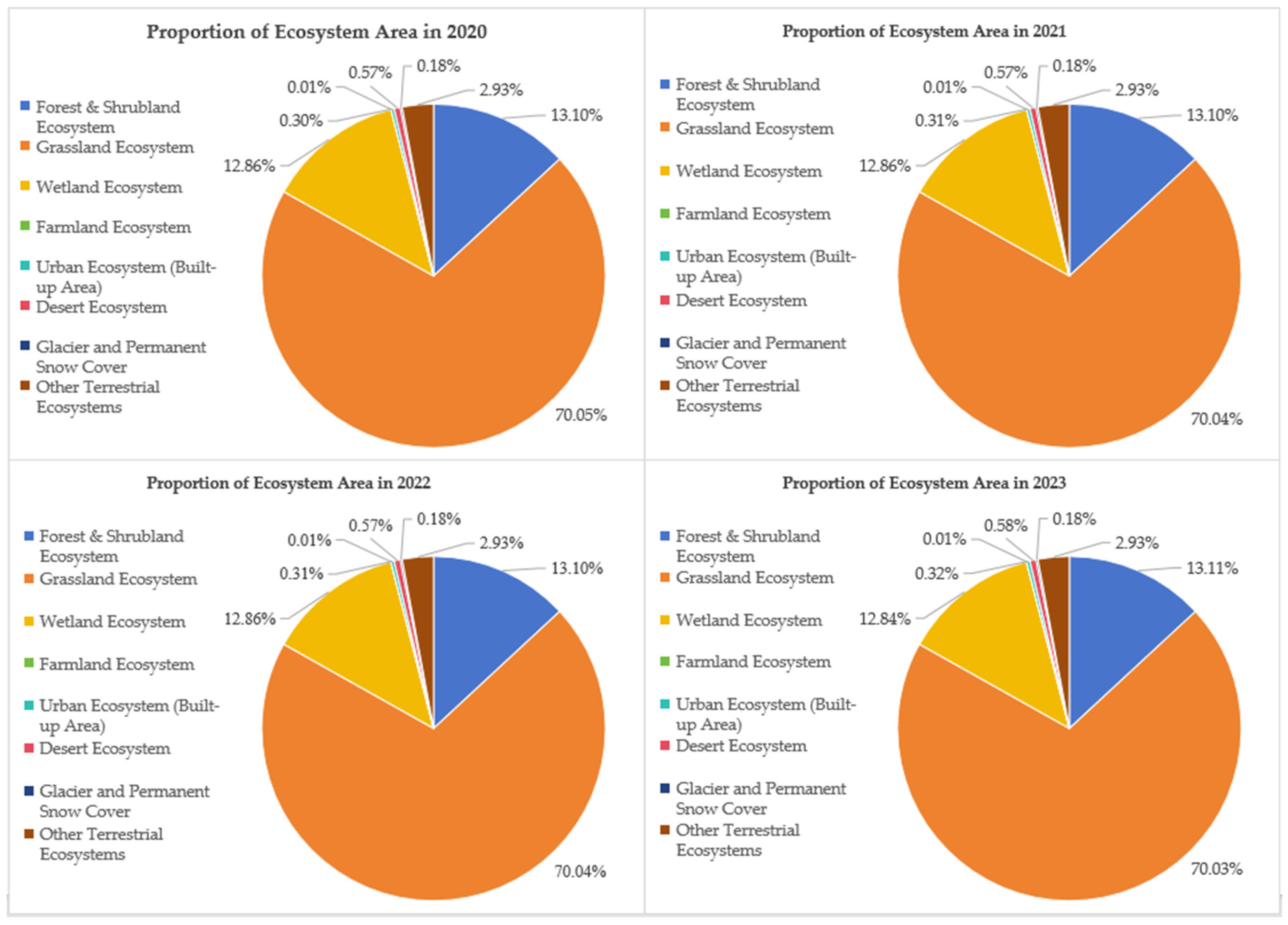
Table 1 shows that the area proportions of various ecosystem types remained highly stable between 2020 and 2023. This is mainly attributed to: First, the study area belongs to a national key ecological functional zone with strict land use policies, effectively curbing large-scale land cover type conversion. Second, this study utilized time-series remote sensing data that underwent unified preprocessing and consistency checks, minimizing errors caused by inconsistent data sources or classification standards. This stability of the area base ensures that subsequent temporal changes in GEP primarily stem from dynamic changes in ecosystem functions rather than land cover conversion, providing a reliable premise for interannual comparative analysis.
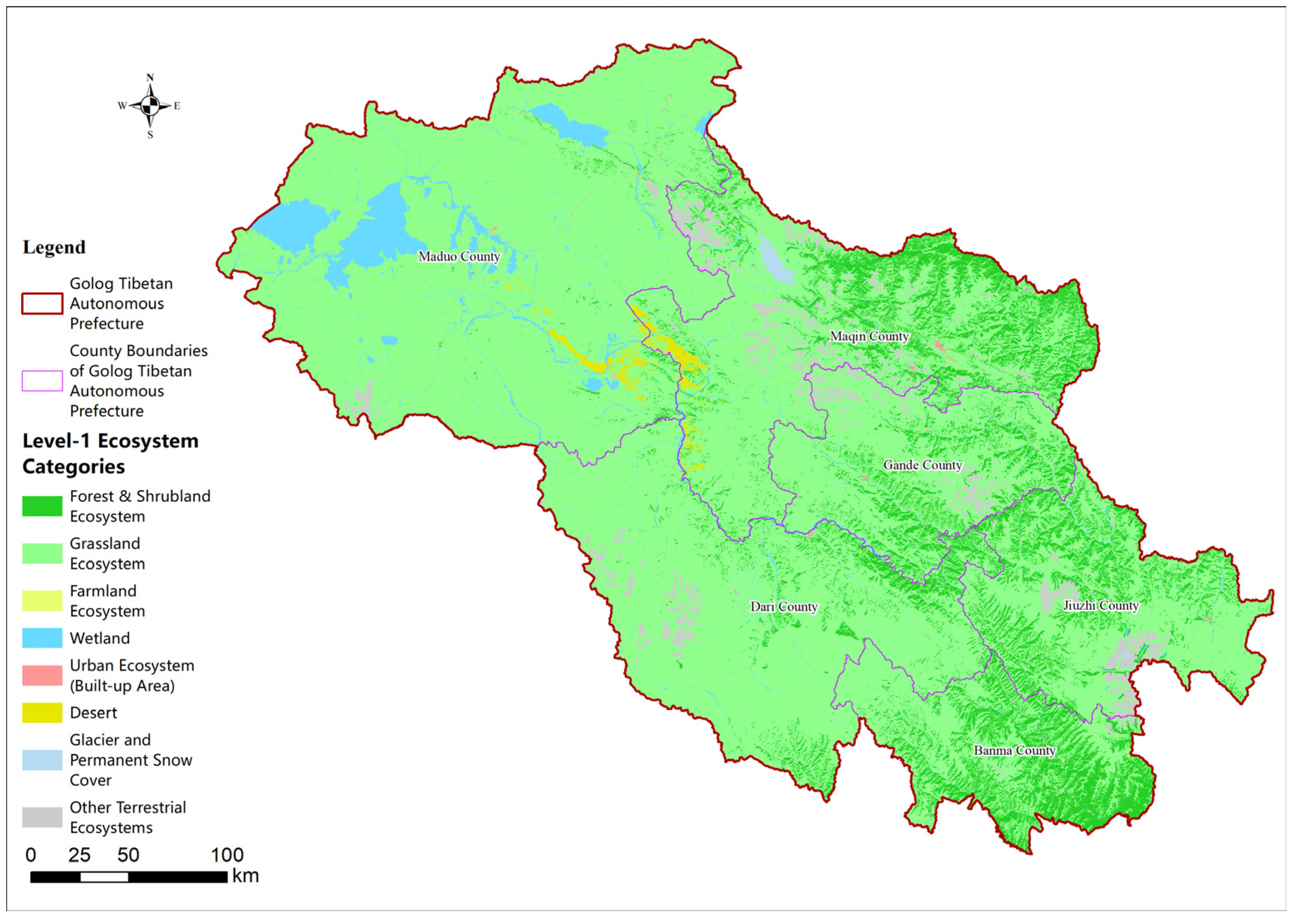
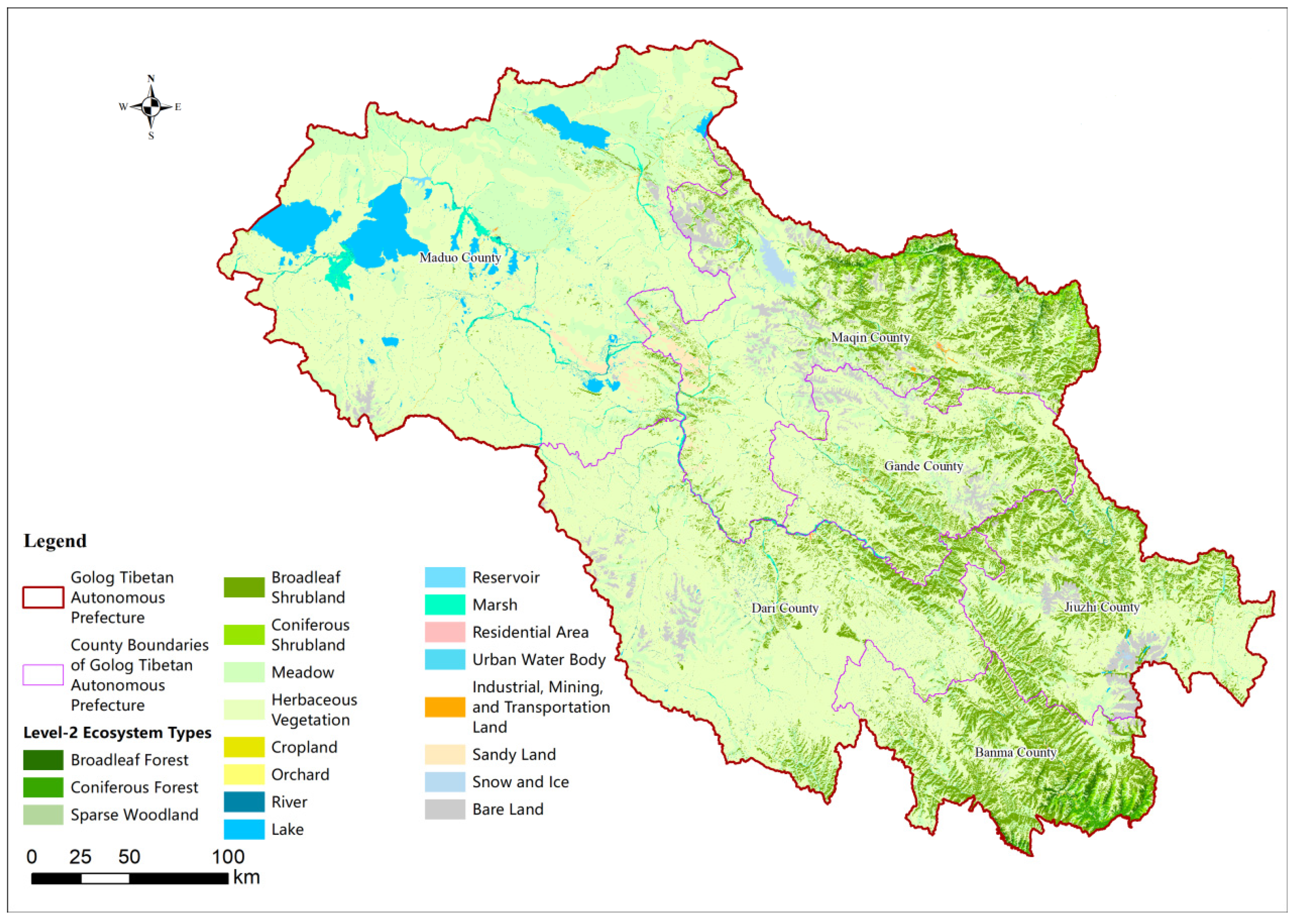
Golog Prefecture boasts diverse ecosystem types (Figure 1 and Figure 2). In 2023, grassland ecosystems accounted for approximately 70%, forest ecosystems for 13.12%, and wetland ecosystems for 12.86%. These ecosystems not only provide abundant ecological products for local communities but also play an irreplaceable role in maintaining ecological security for the Yellow River basin and the nation as a whole.
Golog Prefecture is rich in biodiversity and serves as a critical habitat for plateau-endemic species. It is home to valuable medicinal herbs such as Chinese cordyceps (Caterpillar fungus), fritillary bulb, and snow lotus, as well as rare wildlife including the Tibetan antelope, Tibetan wild ass, snow leopard, and black-necked crane. This rich biodiversity not only possesses significant intrinsic value but also provides a robust foundation for ecosystem stability and resilience, further ensuring the sustainable supply of ecological products.

2.2. Types and Distribution Characteristics of Ecological Products

Material Supply Products. This category primarily includes plateau-specific livestock products, agricultural products, forest products, and medicinal herbs, which possess direct market value and regional economic driving effects. As a nationally significant organic livestock production base, Golog has incorporated 68.2928 million mu (approx. 4.55 million hectares) of grassland and 1.1332 million head of yaks and Tibetan sheep into its organic monitoring system. The counties of Gande, Jiuzhi, and Maduo have been awarded key national organic agricultural product bases. Among these, “Maduo Sheep” and “Jiuzhi Yak” are listed in the National Catalogue of Livestock and Poultry Genetic Resources, highlighting their distinct breed and quality advantages. Furthermore, characteristic ecological products such as Tibetan snow tea, Ophiocordyceps sinensis (commonly known as Chinese caterpillar fungus or Dong Chong Xia Cao), Fritillary Bulb, and Rhubarb command a certain level of high market recognition and create added economic value.
Regulating Service Products. As the core component of Golog’s ecological products, regulating services mainly include functions such as water conservation, carbon sequestration, climate regulation, soil retention, flood mitigation, air purification, and biodiversity maintenance. Located in the core area of the Three-River-Source region, Golog’s water conservation service is particularly prominent, supplying a substantial amount of high-quality runoff to the middle and lower reaches of the Yellow River annually. Simultaneously, the vast grassland, wetland, and forest ecosystems possess significant carbon sequestration capacity. Although most of these services are non-marketable, they play a fundamental but irreplaceable role in maintaining regional ecological security and supporting sustainable development.
Cultural Service Products. Golog’s abundant natural landscapes and profound ethnic cultural heritage provide important resources for ecotourism, nature education, and scientific research. Representative resources include natural landscapes such as Amne Machin Snow Mountain, Nianbaoyuze, Gyaring Lake, and Ngoring Lake, as well as cultural heritage like Gesar Culture and Tibetan folk traditions. In recent years, such services have gradually been marketized through forms like ecotourism. In 2023, ecotourism revenue in the prefecture accounted for 18% of its GDP, creating employment for approximately 12,000 people, demonstrating significant development potential and socioeconomic benefits.
From a spatial pattern perspective, the distribution of ecological products in Golog Prefecture exhibits marked regional differentiation: The southeastern counties, such as Jiuzhi and Banma, have relatively high forest coverage rate, prominent biodiversity maintenance functions, and significant cultural service product value. The central counties, including Maqin and Gande, are dominated by grassland ecosystems, with strong material supply capacity from animal husbandry and a concentration of large-scale, standardized breeding bases. The northwestern counties, like Maduo and Dari, feature extensive wetlands and lakes, possessing extremely high water conservation and flood mitigation service value, constituting important water security functional zones.

3. Construction of the Ecological Product Value Accounting Indicator System and Methodology

3.1. Data Collection and Processing Plan

The accounting work in this study involves a massive, multi-source, multi-scale, and multi-temporal dataset. To ensure data consistency and reliability, a comprehensive collection and processing plan was constructed, integrating statistical data, ground-based monitoring data, remote sensing data, model simulation data, and social survey data. The specific composition is as follows:
Statistical Data: Primarily sourced from the Golog Prefecture Statistical Yearbook, Qinghai Province Statistical Yearbook, and authoritative statistical reports from various industry departments, covering core fields such as socio-economics, agricultural production, forestry resources, and water resource utilization.
Ground-based Monitoring Data: Integrating data from ground observation networks such as meteorological stations, hydrological stations, and environmental monitoring stations to obtain key ecological parameters like temperature, precipitation, evaporation, runoff, and water quality. Furthermore, six research projects independently established by the Golog Prefecture Meteorological Bureau (focusing on climate change, ecological assessment, and disaster monitoring) provided important local observational data support for this study.
Remote Sensing Data: Comprehensively utilizing satellite imagery from the Landsat, Sentinel, and MODIS series to retrieve spatially continuous parameters such as ecosystem types, vegetation coverage, leaf area index, and land surface temperature.
Model Simulation Data: Leveraging mainstream ecological process models like InVEST, CASA, and RUSLE to simulate and generate key ecological function data, including water conservation volume, carbon sink amount, and soil retention amount.
Social Survey Data: Collecting socio-economic value data, such as tourists’ willingness-to-pay and residents’ ecological perception, through structured questionnaires and semi-structured interviews.
Addressing the practical constraints of sparse monitoring stations and partial data gaps in Golog Prefecture, this study employed techniques such as spatial interpolation, remote sensing inversion, and model simulation for data supplementation and fusion. All data underwent standardized processing and quality control under a unified geographic coordinate system and spatiotemporal resolution. Finally, a thematic database for ecological product value accounting in Golog Prefecture was integratively constructed, laying the foundation for subsequent precise accounting.

3.2. Construction of the Accounting Indicator System

Ecological product value accounting is highly interdisciplinary, and the scientific and systematic nature of its indicator system directly determines the reliability and comparability of the accounting results. Based on a systematic review of mainstream domestic and international accounting frameworks (such as the UN System of Environmental-Economic Accounting—Ecosystem Accounting (SEEA EA) [29], China’s Specifications for Assessment of Forest Ecosystem Services [30], the Specifications for Gross Ecosystem Product Accounting (Trial), and the Qinghai Province Specifications for Gross Ecosystem Product Accounting (Trial)), and considering the regional characteristics of Golog Prefecture dominated by alpine grassland ecosystems, this study established an accounting framework covering eight ecosystem types: cropland, forest, grassland, wetland, urban, desert, glacier, and other terrestrial areas (see Table 2).
This study adheres to the classic theoretical framework of the tripartite division “Material Supply–Regulation Services–Cultural Services” and fully considers data availability, method robustness, and regional specificity to construct a hierarchical accounting indicator system:
Material Supply Value: Covers agricultural, livestock, forestry, fishery products, and freshwater resources. Given Golog Prefecture’s strategic position as a key water source area in the upper Yellow River, its water resource supply value is calculated based on the total surface water volume as the physical quantity foundation, with reference to provincial water resource pricing policies. Furthermore, this study innovatively includes renewable energy outputs such as hydro, wind, photovoltaic, and biomass energy within the material supply category to comprehensively reflect the material production capacity of regional ecosystems.
Regulation Service Value: Systematically assesses ten core functions: water conservation, soil retention, windbreak and sand fixation, flood regulation, carbon sequestration, oxygen release, air purification, water quality purification, biodiversity maintenance, and local climate regulation.
Cultural Service Value: Focuses on the tourism and health, leisure and recreation, and landscape appreciation value generated by ecotourism resources. To isolate the influence of human factors, this study strictly limits value accounting to tourism projects primarily based on natural and ecological resources.
Indicator selection comprehensively utilized frequency analysis (counting high-frequency indicators in authoritative domestic and international assessments) and the expert consultation method (soliciting opinions from scholars in the field and relevant management departments). This process ultimately formed the Golog Prefecture ecological product value accounting indicator system, comprising 3 functional categories, 16 primary indicators, and 32 secondary indicators (see Table 3). This system aims to minimize double-counting to the greatest extent and ensure the regional applicability and operability of the indicators.

3.3. Accounting Methods and Technical Pathway

A two-step technical pathway of “Physical Quantity Accounting→Monetary Value Assessment” was adopted. The selection of valuation methods follows these principles: priority is given to using market prices to directly reflect economic value; for services lacking market transactions, recognized methods such as the replacement cost method or shadow project method are used for indirect valuation; and the application scope of stated preference methods is treated with caution.
Physical Quantity Accounting: Based on the established thematic database, ecological models (e.g., InVEST), remote sensing inversion, and statistical analysis methods are comprehensively utilized to quantitatively estimate the physical output of various ecological products (e.g., cubic meters of water conservation, tons of carbon sink, number of tourist visits).
Monetary Value Accounting: (i) Material supply products primarily use the market value method, directly estimating based on local market prices and yield. (ii) Regulation service products are primarily monetized using the replacement cost method, shadow project method, etc., in accordance with national and provincial accounting specifications. Considering the limitations of the Contingent Valuation Method (CVM) in China’s ecosystem service valuation applications—such as relatively high uncertainty and result stability being greatly influenced by survey design—it was not used as the main method for valuing regulation services. (iii) Cultural service products are assessed using the Travel Cost Method (TCM) and market value method, aiming to objectively reflect their economic value through revealed preference data.
The entire technical pathway follows the process of “Data Collection and Preprocessing→Ecosystem Classification and Mapping→Physical Quantity Accounting→Monetary Value Accounting→Result Analysis and Verification,” ensuring the systematic, transparent, and reproducible nature of the accounting process.

3.3.1. Material Supply Accounting

The accounting of material supply value aims to monetize the tangible material products output by ecosystems. Following the framework of the UN System of Environmental-Economic Accounting—Experimental Ecosystem Accounting (SEEA-EEA) [29] and considering regional data availability, this study primarily accounts for the supply value of water resources, agricultural products, forestry products, livestock products, and renewable energy (hydro, wind, solar, biomass).
The accounting follows these principles and methods: For data already included in the official statistical system and having clear market output value (e.g., some agricultural, livestock, and forestry products), the output value data is directly used as its supply value to ensure alignment with macroeconomic statistics. For data without statistical output value or where output value cannot be directly obtained, the market value method is used for estimation. The basic formula is: Monetary Value = Physical Quantity × Market Price. Here, the physical quantity comes from statistical reports or survey data, and the market price adopts the local market average price during the accounting period or official guidance prices (e.g., water resources based on relevant pricing documents of Qinghai Province). The specific accounting indicators and methods for various material products are shown in Table 4.

3.3.2. Regulation Services Accounting

The accounting for regulating service value follows the framework of the “Specifications for Gross Ecosystem Product Accounting (Trial)” and the “Qinghai Province Specifications for Gross Ecosystem Product Accounting (Trial).” Given the particularities of alpine ecosystems, this paper requires careful consideration in parameter selection. We adopt the principle of “localization priority”: for parameters such as permafrost carbon flux, local research findings are prioritized; for generic parameters such as engineering replacement costs, we explicitly acknowledge the objective limitation of potential systematic underestimation in their application to high-altitude regions and clarify this impact in subsequent analysis. Specific accounting formulas are shown in Table 5. Furthermore, to ensure transparency in the research process and reproducibility of results, Table 6 details the values and sources of all key parameters and specifically evaluates their applicability and potential uncertainty in alpine regions.
It should be noted that the Replacement Cost Method and Market Value Method, primarily used in this paper, involve indirect valuation from the perspective of supply-side costs or market prices. Their results reflect the “replacement cost” or “analogous market value” of ecological services, differing conceptually from assessments based on beneficiaries’ willingness-to-pay (WTP). This choice aims to align with current accounting specifications to provide a policy-comparable baseline. Future research could explore the application of methods like the Contingent Valuation Method (CVM) in alpine regions to supplement demand-side value information, providing a more comprehensive reference for ecological compensation and market transaction pricing [37].

3.3.3. Cultural Services Accounting

Cultural services value accounting focuses on the non-material benefits that ecosystems provide to humans. Considering Golog Prefecture’s tourism resources, which are predominantly characterized by natural ecological landscapes, this study primarily accounts for three types of value: tourism and health, landscape appreciation, and leisure and recreation.
Tourism and Health Value: This is accounted for using the direct market value method. The total annual visitor trips to various natural scenic areas, as provided by the Golog Prefecture Department of Culture and Tourism, serves as the physical quantity. The corresponding total ticket revenue constitutes its direct market monetary value. This method effectively isolates tourism consumption primarily based on human-made facilities, ensuring the ecological nature of the value source.
Landscape Appreciation Value: This refers to the real estate value premium brought about by proximity to high-quality ecological landscapes (such as urban green spaces, water systems, and mountains). The accounting subjects include benefiting hotel guest rooms and commercial residential housing. The physical quantity is obtained through statistical data and open-source online data. The monetary value estimation formula is: Landscape Appreciation Value = (Number of Hotel Rooms × Average Room Rate + Benefiting Housing Area × Sales Unit Price) × Landscape Premium Coefficient. The landscape premium coefficient is determined through analysis of local real estate market data or by reference to similar studies.
Leisure and Recreation Value: This targets the value of leisure activities by urban residents in daily public ecological spaces (such as urban parks, green spaces). The physical quantity is estimated based on the urban population and the average weekly time per capita spent on such leisure activities (obtained through statistical data and sample surveys). The monetary value assessment is then conducted using the Travel Cost Method (TCM) or the unit time value method.

4. Ecological Product Value Accounting Results and Comprehensive Analysis for Golog Prefecture

4.1. Analysis of the Value Accounting Results and Characteristics of Material Supply Products

Based on the constructed accounting indicator system and methods, the material supply product value of Golog Prefecture from 2020 to 2023 was quantified and assessed. The results are shown in Table 7. During the accounting period, the total material supply value ranged between 7.839 billion and 9.830 billion CNY, showing certain interannual fluctuations. Its structural characteristics and evolutionary trends profoundly reflect the combined effects of regional resource endowment, climatic conditions, and policy interventions.

4.1.1. Analysis of Value Composition and Dominant Factors

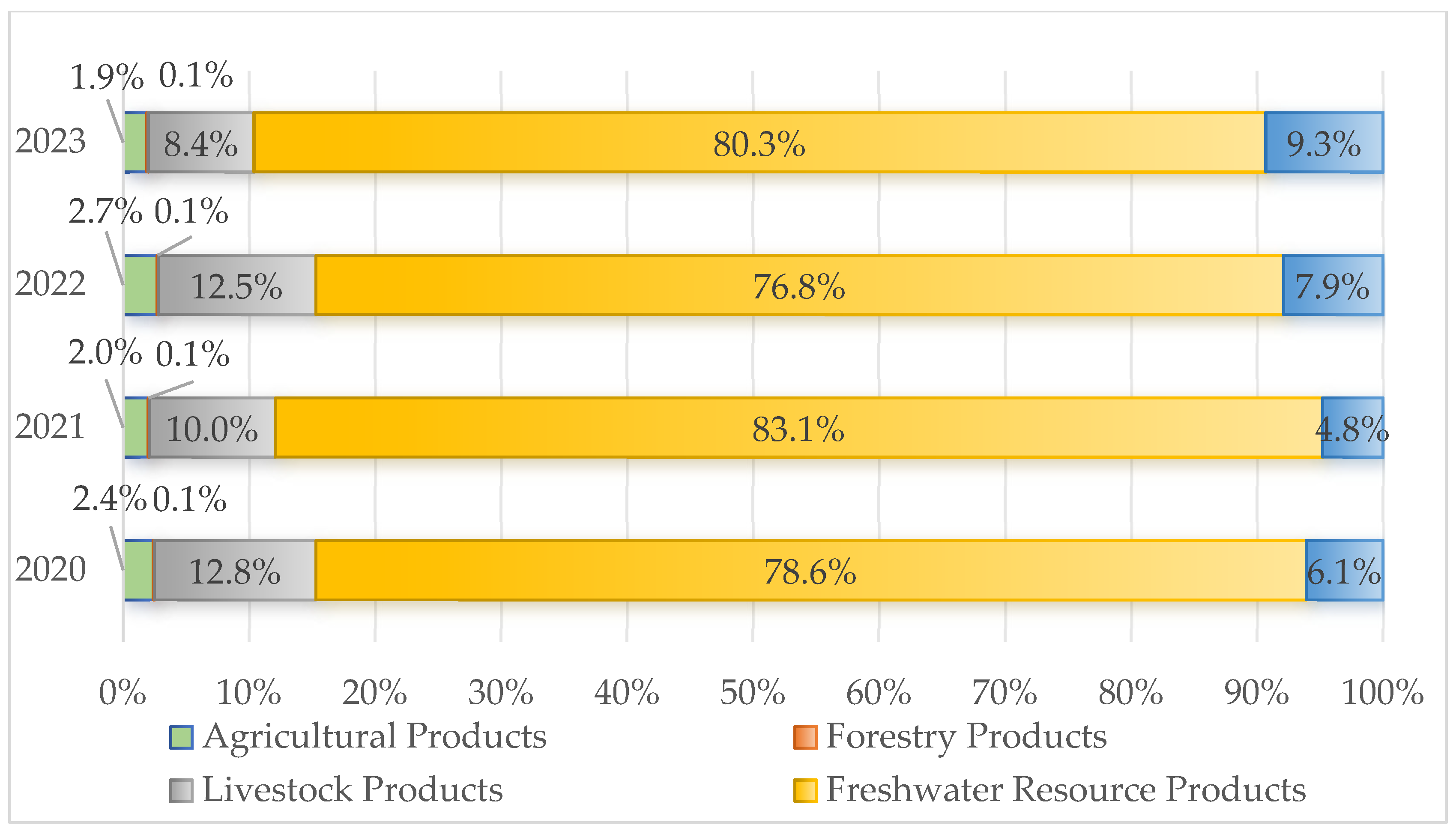
The accounting results indicate that the value of freshwater resource products is the overwhelmingly dominant component of the total material supply value, with its proportion remaining basically stable at around 80% during the accounting period (Figure 3). This structural characteristic highlights Golog Prefecture’s primary function as a water supply source in its role as the core area of the “Water Tower of China.” It is noteworthy that freshwater resource value exhibits significant interannual fluctuations, such as peaking at 8.167 billion CNY in 2021 and dropping to 6.024 billion CNY in 2022. Correlation analysis with concurrent hydrological and meteorological data reveals that its fluctuations are primarily driven by changes in precipitation. The high value in 2021 was directly related to abundant precipitation in the previous year and sufficient water storage in the underlying surface of the basin, while the decline in 2022 corresponded to a relatively dry year. This empirically confirms that climatic variability is the core natural driver regulating the supply services of key ecological products in alpine ecological regions.
The value of livestock products is the second largest source of material supply, but its value declined during the accounting period, from 967 million CNY in 2020 to 814 million CNY in 2023. In-depth analysis reveals that this change resulted from the combined effect of a decrease in the number of livestock and poultry slaughtered (down 8.38% in 2023 compared to 2020) and declining market prices. However, while traditional production models face challenges, regional branding initiatives show potential for enhancing the value chain. Represented by the regional public brand “Heaven and Earth Golog, River Source Pasture,” the market premium for authorized products reaches 15–20%. This provides a practical case for ecological livestock products to achieve value addition through quality certification and brand empowerment, revealing a sustainable development pathway that transcends mere output expansion.

4.1.2. Structural Changes and Emerging Growth Drivers

Renewable energy product value was the most significant growth pole during the accounting period, increasing rapidly from 466 million CNY in 2020 to 900 million CNY in 2023, with an average annual growth rate of 24.5%. This growth is mainly attributed to two factors: first, the improvement in accounting scope, as the inclusion of hydropower generation starting in 2022 directly contributed a substantial value increment; second, the rapid rise in the accounted value of biomass energy. The growth in biomass energy value (up 87.77% in 2023 compared to 2020) was primarily driven by rising market prices of standard coal, despite a slight decrease in livestock and poultry slaughtered during the same period. This reflects the transmission effect of external energy market price signals on the valuation of regional ecological resources and highlights the enormous potential of Golog Prefecture in developing clean energy.
In comparison, the value of agricultural and forestry products constitutes a negligible proportion of the total value (combined about 2–3%), which aligns with the natural conditions of the prefecture characterized by high altitude, hypoxia, and low forest coverage. However, their specialty products contain unique value. Agricultural products are supported by Ophiocordyceps sinensis, which is of excellent quality but faces pressure on resource quantity due to over-harvesting and climate change, pointing to the urgent need for sustainable resource management. Among forestry products, resources like Tibetan snow tea have embarked on marketization leveraging the regional brand, while resources like sea buckthorn are still in the early stages of development, indicating the potential for future value-added enhancement through deep processing.

4.1.3. Spatial Distribution Pattern

The 2023 accounting results at the county scale (Table 8) reveal the uneven spatial distribution of material supply value. Maqin County, Jiuzhi County, and Dari County have the highest values, consistent with their relatively better foundations for livestock development and their status as important Ophiocordyceps sinensis production areas. Although Maduo County covers a vast area, its ecosystems are more fragile, primarily serving functions like water conservation for regulation services, resulting in relatively low material output value. This spatial differentiation pattern is shaped by the combined effects of natural resource endowment, ecological function positioning, and intensity of human activities.
This section’s findings indicate that the material supply value of Golog Prefecture is highly dependent on climate-sensitive freshwater resources, while traditional livestock farming faces transformation pressure, and clean energy has become a new growth pillar. This value structure and its dynamic changes not only quantify the region’s ecological material output but also provide empirical evidence for understanding the vulnerability, resilience, and potential development directions of its ecological–economic system.

4.2. Analysis of Value Accounting Results and Driving Mechanism for Regulation Service Products

Regulation services constitute the absolute majority of the Gross Ecosystem Product (GEP) value in Golog Prefecture. The 2023 accounting results (see Table 9) show a total value as high as 640.111 billion CNY, which is 66.2 times the material supply value of the same year and accounts for 97.64% of the total GEP value. This structural characteristic quantitatively confirms that Golog Prefecture’s core function, as a national ecological security barrier, lies in providing intangible regulation benefits that maintain regional and global ecological security.

4.2.1. Value Structure, Dominant Services, and Their Temporal Variation Characteristics

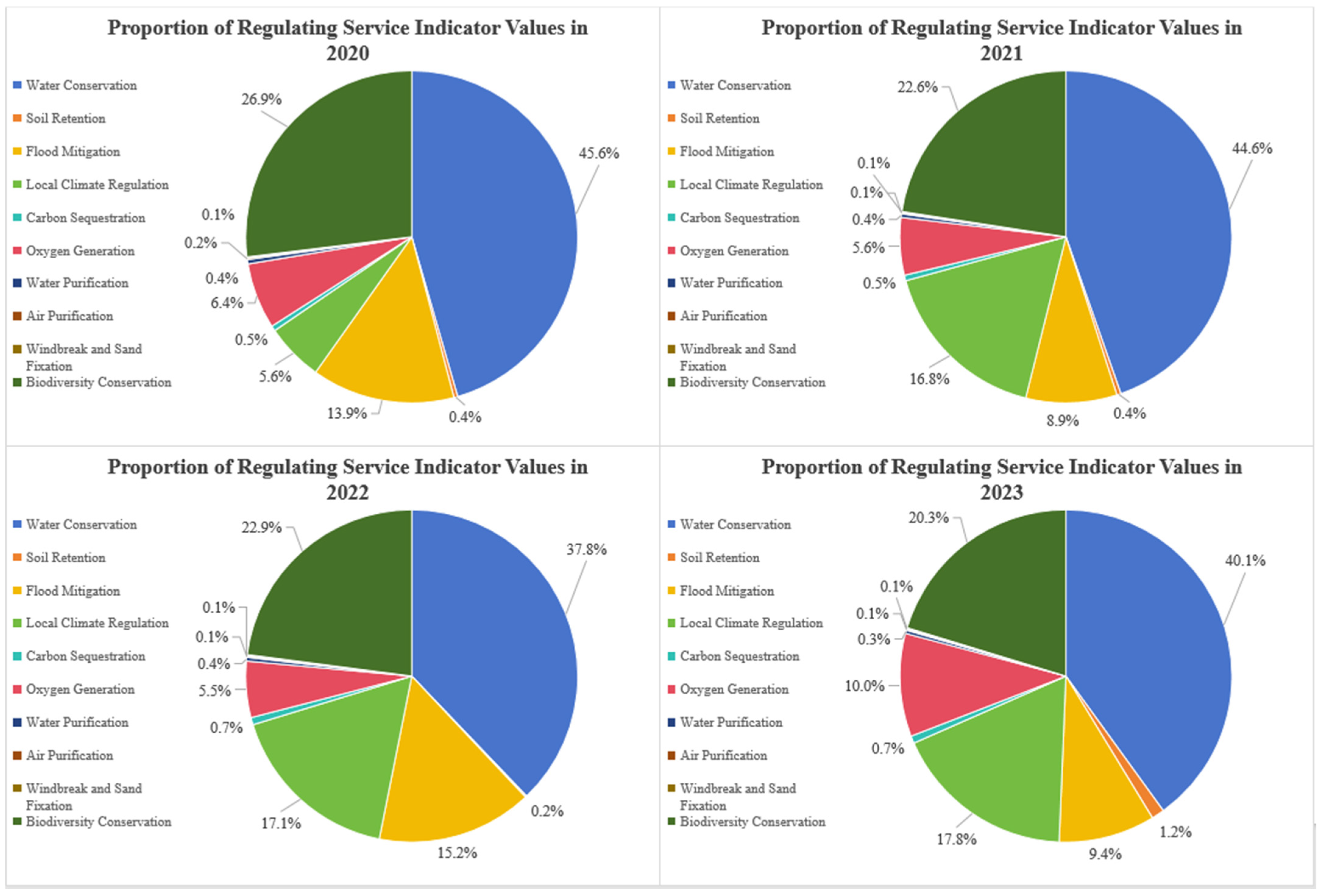
From the perspective of value structure (Figure 4), there is significant heterogeneity within regulation services. Water conservation and biodiversity conservation are the two pillar services, with values reaching 256.211 billion CNY (40.03%) and 129.887 billion CNY (20.29%, respectively, in 2023, together contributing over 60%. The high value of water conservation directly stems from Golog Prefecture’s wetland, alpine meadow, and forest ecosystems as the core area of the “Water Tower of China.” Its interannual fluctuations (e.g., a 16.6% decrease in 2022) show high synchronicity with precipitation changes (R2 = 0.92), once again confirming that hydro-climatic conditions are the primary natural driver regulating the supply of core regulation services in alpine ecological regions. The value of biodiversity conservation remained constant during the accounting period, which stems from the characteristics of its accounting method based on protected area size. While it does not reflect the dynamic changes in the ecosystem, it quantifies the basic static value of the existing conservation network.
The value of local climate regulation (113.644 billion CNY in 2023, 17.75%) exhibited strong interannual fluctuations, primarily driven by meteorological factors such as the number of high-temperature days, further corroborating the high sensitivity of ecosystem regulation services to climate change. In contrast, the absolute value and proportion of services such as soil retention, carbon sequestration, and water quality purification are relatively small (all < 1%). However, this does not diminish their ecological importance; rather, it reflects the limitations of current mainstream accounting methods (e.g., the replacement cost method) in capturing the full economic value of these services, or the relatively limited physical flux scale at the regional level.

4.2.2. Attribution of Key Service Value Fluctuations and Robustness Analysis of Accounting Results

The accounting results show that the values of some regulation services, such as soil retention and carbon sequestration, exhibited unusually significant fluctuations over a short period. In-depth analysis indicates that such fluctuations mainly originate from improvements in accounting methodology and the influence of exogenous parameter variables. This has important implications for objectively interpreting the temporal changes in GEP and assessing the robustness of the results.
Corrective Effect of Methodological Improvements on Accounting Results: Taking soil retention value as an example, its 2023 value (7.974 billion CNY) showed an order-of-magnitude increase compared to 2022 (811 million CNY). The core reason was the use of a superior spatial interpolation algorithm to correct a key driving factor (rainfall erosivity). This case profoundly illustrates that the quality of basic data and the accuracy of model algorithms are prerequisites determining the reliability of accounting results for specific services. The leap in value primarily reflects the refinement of the accounting system rather than a dramatic change in ecosystem function.
Compound Impact Mechanism of Multiple Driving Factors: The changes in carbon sequestration and oxygen release values (increasing by 88.05% and 107.16%, respectively, from 2020 to 2023) resulted from the combined effect of three mechanisms: (i) Changes in biophysical processes. The use of updated and more accurate remote sensing data (MODIS NPP) revealed an improvement in vegetation carbon sequestration capacity (physical quantity increased by 77.57%), while the potential loss of the permafrost carbon pool (physical quantity decreased by 17.36%) reflects the differential impact of climate change on different carbon pools. (ii) Updates to accounting parameters. The generational update of core data sources was one of the main reasons for the value change. (iii) Transmission of exogenous market signals. The increase in the national carbon trading average price and medical oxygen prices directly amplified the economic value of the physical quantities. This clearly indicates that the final monetary value is the product of the coupling between “ecological physical quantity” and the “contemporary economic value coefficient.” Its changes simultaneously carry information about both natural changes and socio-economic conditions.

4.2.3. Spatial Distribution Pattern

The value of regulation services shows a significantly uneven spatial distribution (Table 10). Maduo County, Maqin County, and Dari County are value highlands. This is closely related to Maduo County’s extensive lake and wetland systems (giving it strong water conservation capacity), Maqin County’s relatively diverse ecosystem types, and Dari County’s rich grassland and wetland resources. This distribution pattern is highly coupled with the spatial configuration of the dominant ecosystem types (Figure 1 and Figure 2), intuitively revealing the decisive role of the ecological baseline on service supply capacity.
This section’s findings reveal that the value of regulation services in Golog Prefecture is immense and dominated by water conservation and biodiversity conservation. Its interannual changes are directly driven by climatic fluctuations. Simultaneously, the value changes of some services profoundly reflect the effects of the evolution of accounting methodology (e.g., improvements in data sources and algorithms) and the transmission of external market price signals. The spatial distribution is closely dependent on the geographic pattern of key ecosystems such as wetlands and grasslands.

4.3. Analysis of Value Accounting Results and Dynamic Response for Cultural Service Products

Compared to supply and regulation services, cultural service value (Table 11) constitutes a relatively small proportion of GEP (only 0.9% in 2023). However, its interannual fluctuations are the most dramatic, exhibiting high sensitivity to major external shocks (e.g., public health events) and possessing unique socio-economic indicative significance.

4.3.1. Analysis of Value Composition and User Subjects

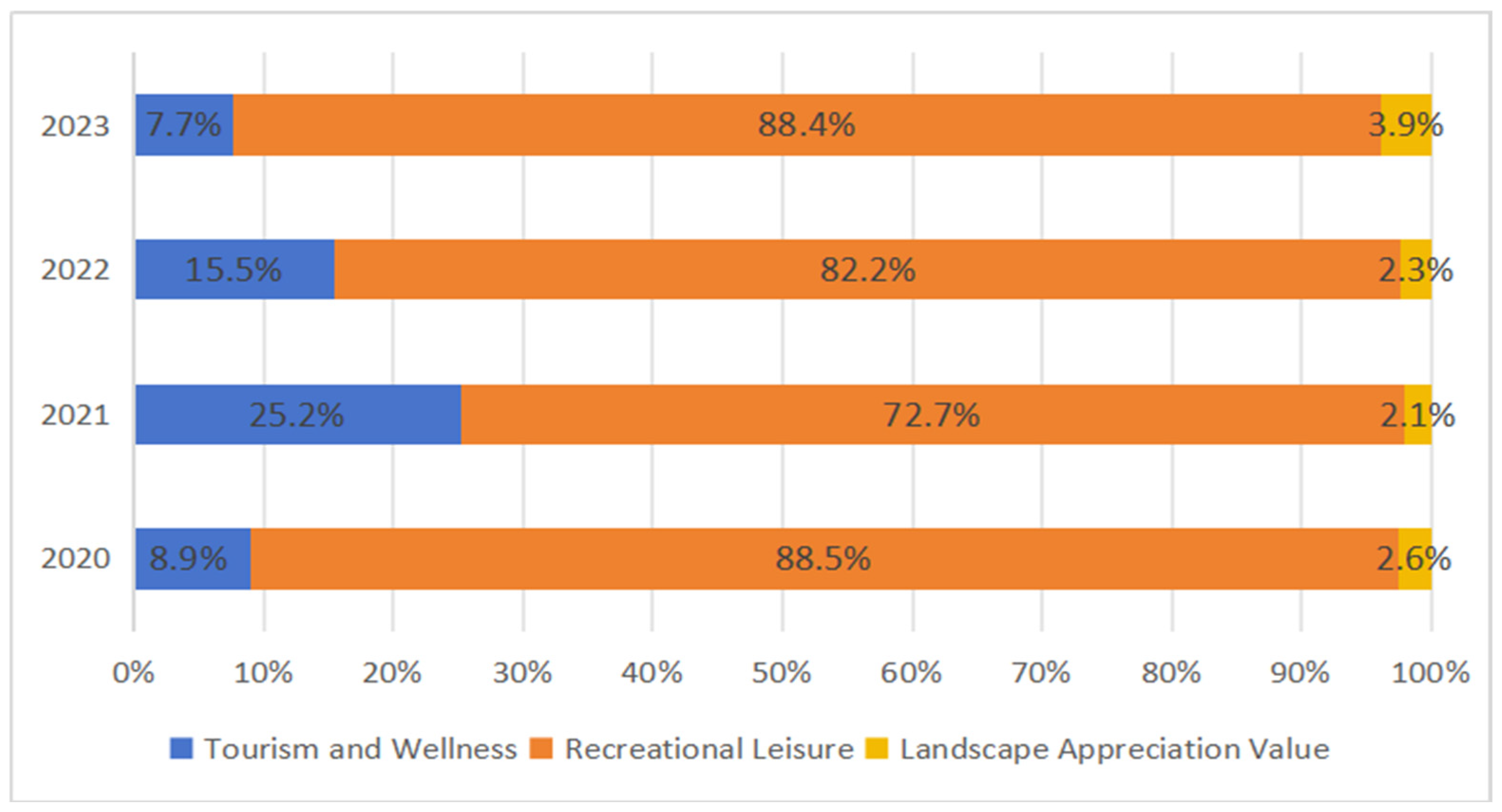
Looking at the internal composition (Figure 5), cultural service value mainly originates from leisure and recreation (88.4% in 2023), while the contributions of tourism and health (7.7% in 2023) and landscape appreciation (3.9% in 2023) are relatively small. This structural characteristic indicates that the cultural services currently provided by Golog Prefecture’s ecosystems benefit the daily well-being of local residents more (mainly reflected in the use of daily public ecological spaces) rather than attracting large-scale, high-consumption external tourism activities. This provides a quantitative basis for formulating urban-rural planning and public service policies centered on enhancing the ecological well-being of local residents.

4.3.2. The Impact of External Shocks in Value Fluctuations

The total value of cultural services underwent a process of “sharp decline-recovery-strong rebound” between 2020 and 2023. The low point in value in 2021 (1.731 billion CNY) coincided exactly with the period of strict travel and social restrictions during the COVID-19 pandemic; recovery began in 2022 following adjustments to control measures; by 2023, the value soared to 5.805 billion CNY, surpassing pre-pandemic levels, consistent with the macro trend of “strong tourism recovery post-pandemic.” This dynamic clearly shows that the cultural service component within GEP can serve as a sensitive “socio-ecological indicator,” effectively reflecting the impact and recovery process of major public crises on people’s ecological well-being and related economic activities.

4.3.3. Spatial Distribution Pattern

Cultural service value is relatively concentrated in space (Table 12). In 2023, Maqin County, where the prefecture capital is located, had the highest value (1.685 billion CNY), benefiting from its composite advantages as a population center, tourism hub, and public service hub. Gande County (1.114 billion CNY) and Dari County (1.073 billion CNY) ranked next due to their unique cultural heritage sites related to the Epic of King Gesar or natural landscapes, respectively. This distribution pattern reflects the spatial coupling relationship between cultural service value and population density, infrastructure accessibility, and specific cultural/natural capital.
This section’s findings indicate that while the total value of cultural services in Golog Prefecture is relatively small, its structure is oriented towards the well-being of local residents, and its dynamics are extremely sensitive to external socio-economic shocks. The realization of its value highly depends on population agglomeration areas and specific cultural/natural landmark sites, revealing the close spatial association between ecological–cultural value and human social activities.

4.4. Analysis of Gross Ecosystem Product Composition and Spatial Distribution Characteristics

Based on the item-by-item accounting above, this study calculates the Gross Ecosystem Product (GEP) value for Golog Prefecture using the following formula [25]:
GEP = Vmaterial + Vregulation + Vcultural
where GEP represents Gross Ecosystem Product (unit: 100 million CNY); Vmaterial represents Material Supply Value (unit: 100 million CNY); Vregulation represents Regulation Service Value (unit: 100 million CNY); Vcultural represents Cultural Service Value (unit: 100 million CNY).
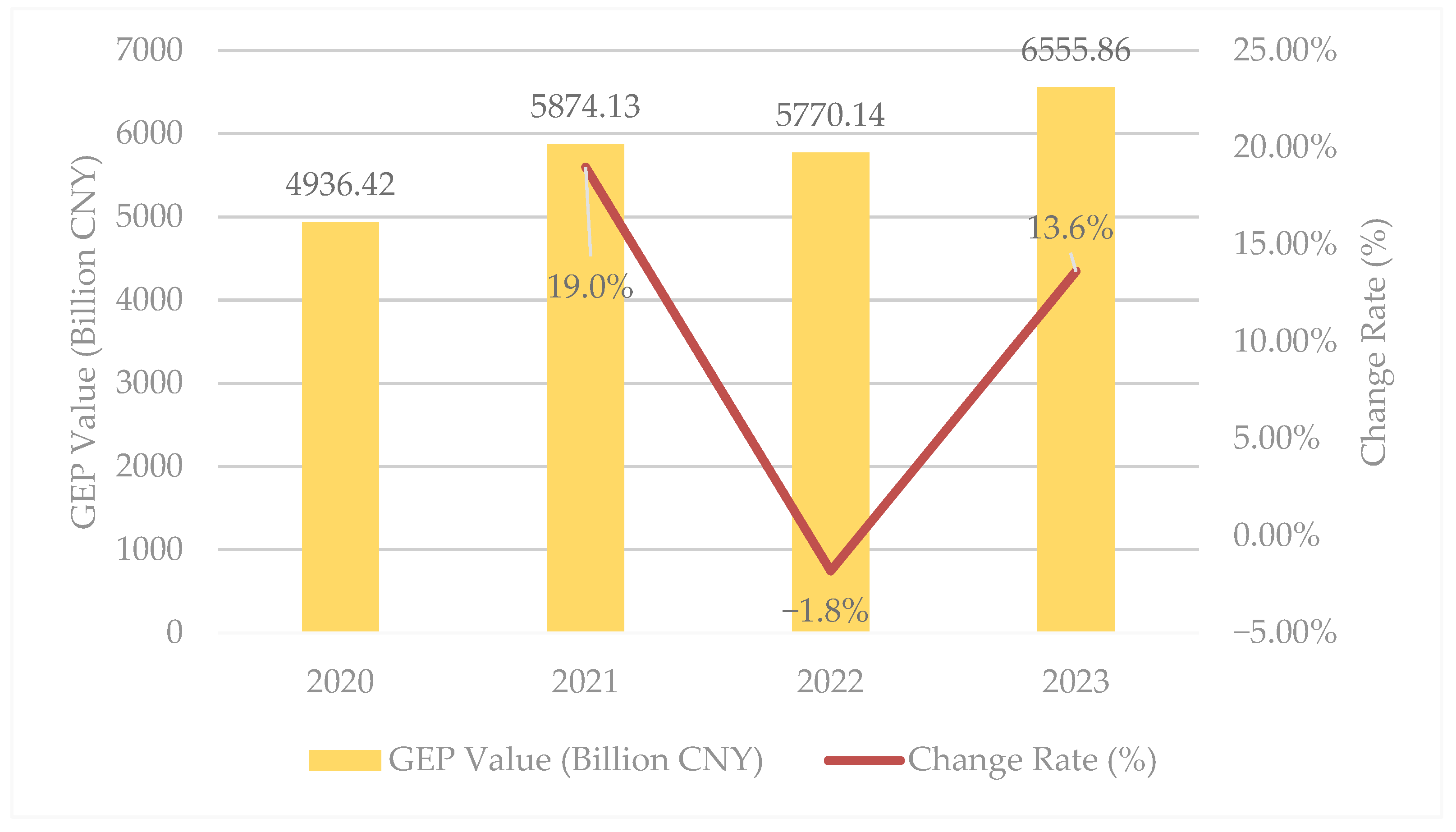
After calculation, the GEP of Golog Prefecture in 2023 was 655.586 billion CNY (Table 13). Its value composition and spatial distribution characteristics are as follows.

4.4.1. Total Value Composition and Structural Stability

From 2020 to 2023, the GEP of Golog Prefecture fluctuated between 493.642 billion and 655.586 billion CNY, with interannual changes primarily dominated by regulation service value driven by climatic conditions. In terms of structure (Table 12, Figure 6), regulation services consistently hold an overwhelmingly dominant position (proportion > 97.5%), while material supply and cultural services together account for less than 2.5%. This “regulation service absolute dominance” structure is a typical quantitative characteristic of key alpine ecological functional zones. It quantitatively confirms that Golog Prefecture’s core ecological value lies in its fundamental supporting functions for maintaining regional and even national ecological security (e.g., water conservation, biodiversity conservation), rather than in direct material output.

4.4.2. “Value-Economy” Mismatch Revealed by per Capita and per Unit Area Value

From the perspective of well-being and efficiency (Table 14), the per capita GEP of Golog Prefecture in 2023 was as high as 2.9531 million CNY, far exceeding the national average, highlighting the enormous contribution of its ecosystem to the well-being of the entire population. However, the per capita GDP of the prefecture in the same period was only about 40% of the national average. This stark contrast between a “highland of ecological value” and a “lowland of economic development” profoundly reveals the current contradiction between ecological conservation achievements and the direct economic benefits felt by local residents. It fundamentally underscores the extreme urgency of improving the realization mechanism for ecological product value, deepening ecological compensation, and promoting green industrial transformation.
On the other hand, the GEP per unit area of Golog Prefecture in 2023 was 8.83 CNY/km2, lower than the national average. This is consistent with the natural baseline of the prefecture being sparsely populated with low-productivity per unit area of alpine ecosystems. However, it must be emphasized that due to the uniqueness, irreplaceability, and enormous positive externalities generated by its ecosystems (e.g., wetlands, glaciers), the marginal social value of its ecological products far exceeds their locally manifested value.

4.4.3. Ecosystem Contributions and GEP Spatial Distribution Pattern

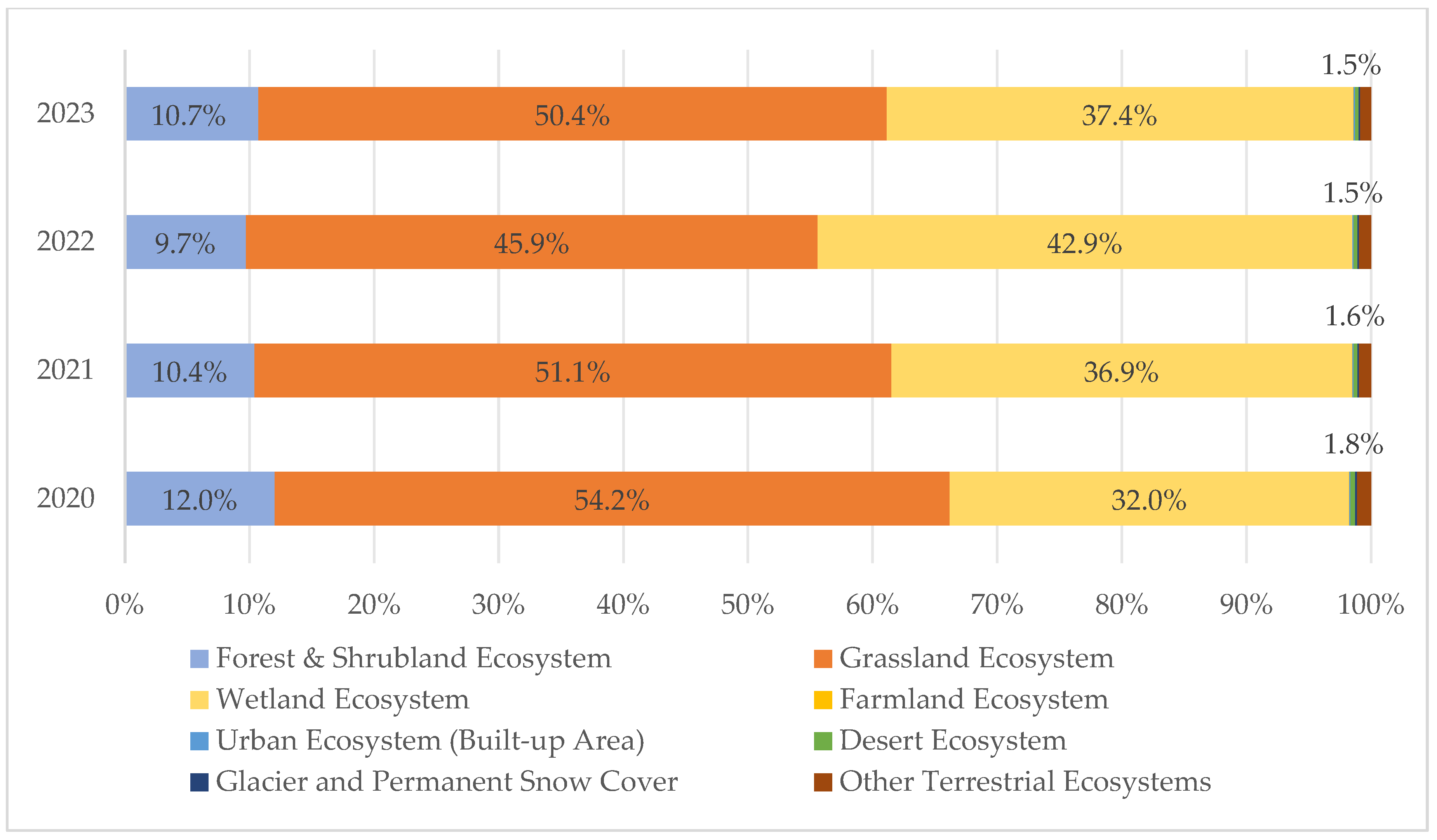
In terms of ecosystem contributions (Table 15, Figure 7), grassland, wetland, and forest are the three core contributors to GEP in Golog Prefecture, together contributing over 97% in 2023. Among them, the grassland ecosystem, by virtue of its largest area (proportion > 70%, Figure 8) and comprehensive functions, contributes 50.4% of GEP; the wetland ecosystem, with its powerful water conservation and climate regulation functions, contributes 37.4%; and the forest ecosystem contributes 10.7%. The contributions of other ecosystems are minimal.
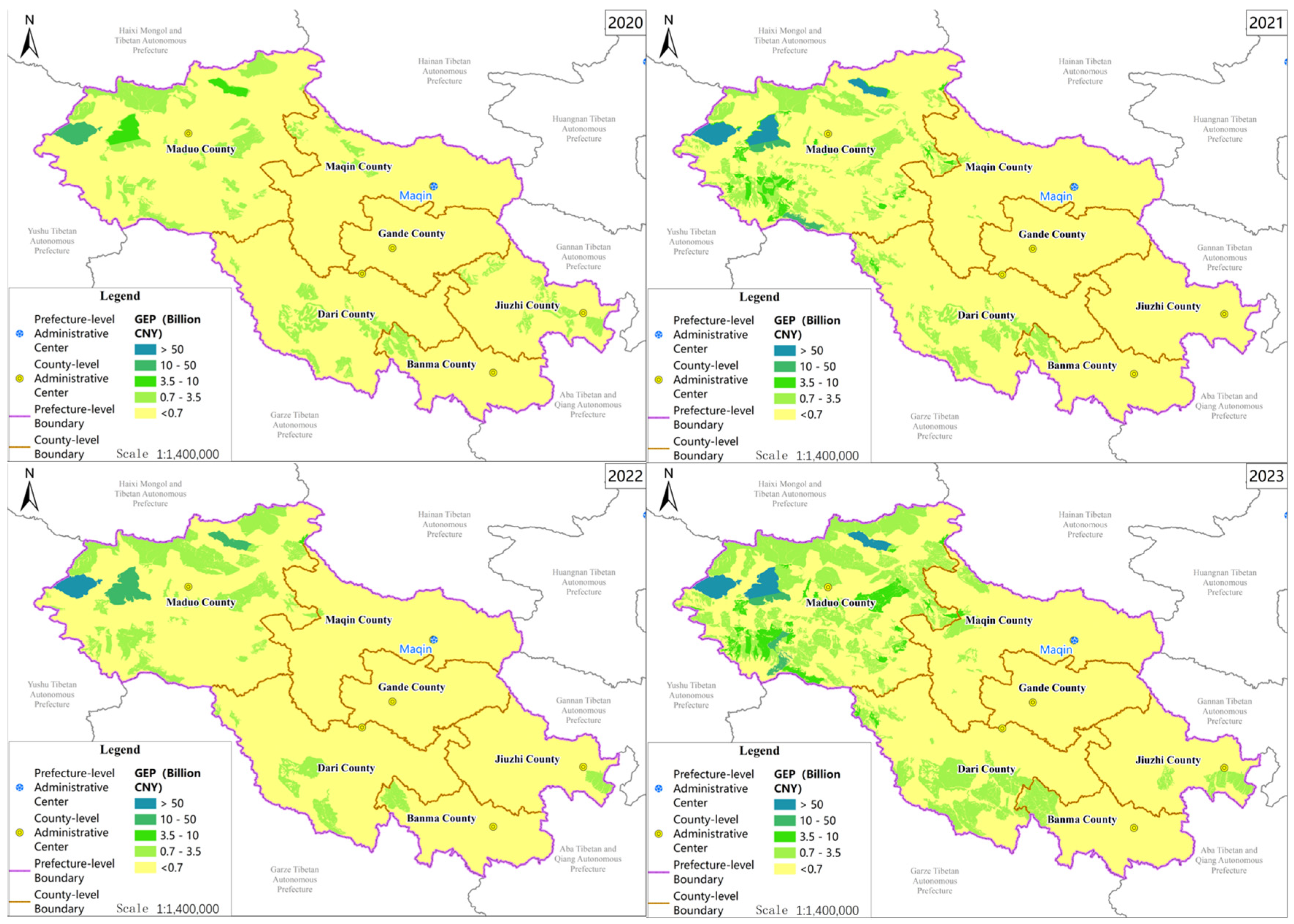
This pattern of ecosystem contributions directly shapes the spatial distribution of GEP (Figure 9, Table 16). Overall, GEP presents a pattern of “high in the northwest, low in the southeast.” Maduo County, as the area with the widest wetland distribution and largest area in the prefecture, has both the highest total GEP value (272.663 billion CNY) and the highest GEP per unit area (111,300 CNY/ha), making it the undisputed core water conservation functional area and value highland. Contributing 48% of the prefecture’s GEP with only 34% of its land area, this highly agglomerated spatial pattern results from the combined effect of multiple factors. (1) Baseline endowment-driven: The county possesses the largest area of wetland ecosystems in the prefecture, which are the main carriers of high-value water conservation and biodiversity maintenance services. (2) Functional intensity superposition: Its unique “thousand lakes” landscape and permafrost conditions enable higher per-unit-area hydrological regulation physical output from wetlands. (3) Accounting method manifestation: Using the Replacement Cost Method based on protected area size to account for biodiversity value objectively translates Maduo County’s institutional advantage as the core area of the Three-River-Source protected areas into monetary value. Therefore, this result is not an accounting artifact but a quantitative depiction of the irreplaceability of alpine wetland ecosystems and their uneven spatial distribution, providing conclusive evidence for implementing “spatially differentiated” ecological governance.
This section’s findings reveal that the GEP of Golog Prefecture exhibits a stable structure of “absolute dominance by regulating services.” The enormous total and per capita values fully demonstrate the excess magnitude of its ecological contribution. However, this stands in stark contrast to the actual state of regional economic development, profoundly revealing the systemic constraints faced in realizing the value of ecological products. These constraints are mainly reflected in three core dimensions: Structurally, the extremely high proportion of regulating service value (>97.6%) forms a prominent contrast with their weak capacity for direct market monetization. Dynamically, the significant interannual fluctuations in GEP driven by climate (coefficient of variation 11.48%) are difficult to match with current static compensation mechanisms. Spatially, the highly heterogeneous distribution of value (e.g., the GEP per unit area of Maduo County is 1.68 times that of Gande County) clearly mismatches with homogenized conservation investment. These structural, dynamic, and spatial constraints, coupled with the severe mismatch between ecological contribution and local benefits (per capita GEP nearly 3 million CNY, while per capita GDP is far below the national average), collectively constitute the fundamental challenges for realizing the value of ecological products in alpine regions. Therefore, systematically overcoming these constraints becomes the core issue in promoting the transition of value from accounting to realization, which is precisely the focus of the following discussion.

5. Research on Pathways for Realizing the Value of Ecological Products in Alpine Regions

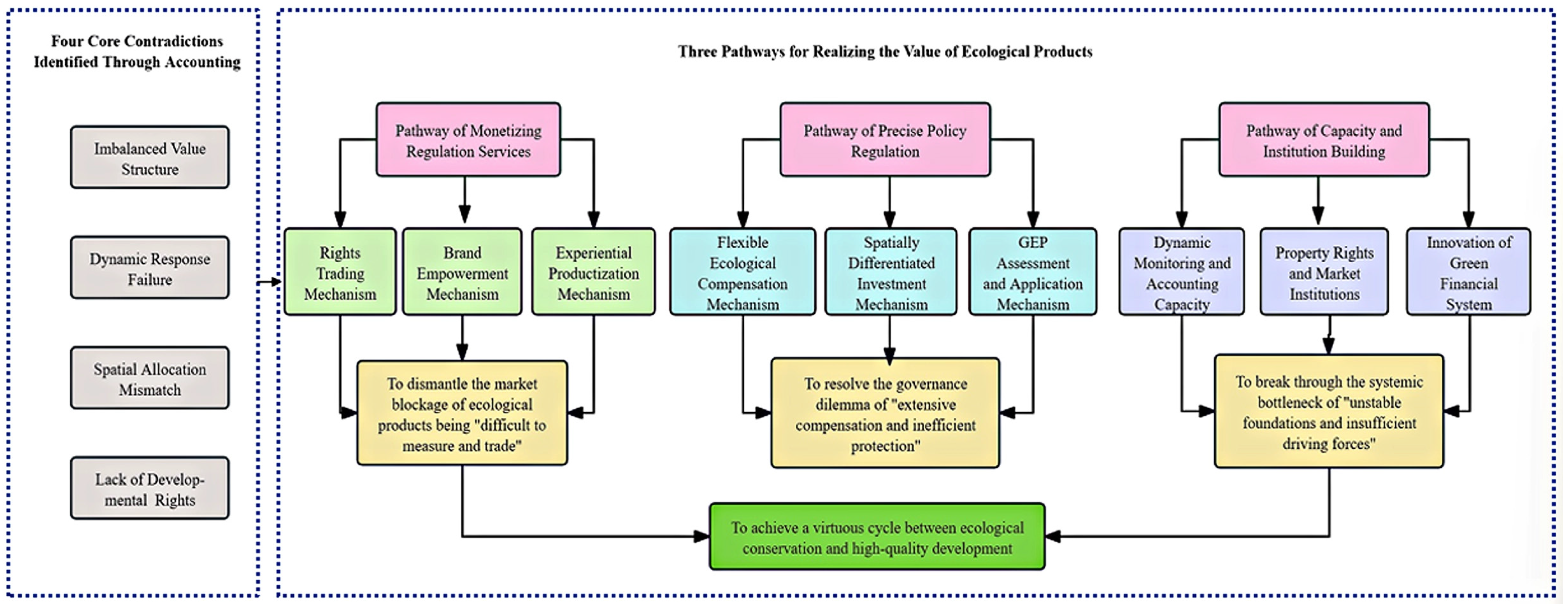
Based on the core constraints of GEP in terms of dynamism, structure, and spatiality revealed by the preceding accounting, this chapter aims to construct a systematic pathway system for realizing the value of ecological products in alpine regions (Figure 10). This system is designed to overcome the practical obstacles of “difficulty in measurement, transaction, coarse compensation, and weak motivation,” promoting a virtuous cycle between ecological conservation and regional sustainable development. The system comprises three synergistic and parallel pathways: The pathway of monetizing regulating services focuses on solving the core dilemma of the dominant ecological functions being “valued but not marketable”; The pathway of precise policy regulation aims to upgrade ecological governance from “extensive compensation” to “targeted incentives”; The pathway of capacity and institution building provides fundamental support and guarantees for the effective operation of the former two. These three pathways complement each other, collectively forming a synergistic governance framework of “market-driven, government-guided, foundation-supported.”

5.1. Pathway of Monetizing Regulation Services

Given that regulation services constitute the absolute majority of ecological value in alpine regions but have extremely weak direct market monetization capacity, this pathway aims to transform the dominant intangible regulating services into tradable, beneficial economic elements through institutional innovation, overcoming the dilemma of “high value, difficult market.”

5.1.1. Rights Trading Mechanism

The core is to explore and establish an integrated ecological rights market system of “accounting-standardization-trading.” For core regulation services such as water conservation, carbon sink, and biodiversity, standardized trading products can be developed, such as “water rights certificates” based on water volume, “alpine carbon sink packages” based on carbon sequestration function, and “biodiversity credits” based on habitat protection. Taking Golog Prefecture as an example, its average annual water conservation value is as high as 236.822 billion CNY, accounting for 40% of regulation service value, providing a massive value foundation for establishing market-based horizontal ecological compensation with downstream regions of the Yellow River Basin. By scientifically assessing and reasonably allocating initial rights, and establishing cross-regional negotiation and trading platforms, this mechanism can internalize externalities and provide sustainable market-based compensation for core ecological functional zones. The key to its successful implementation lies in cross-regional coordination mechanisms, unified accounting methods, and fair and transparent trading rules. However, implementing such rights trading in alpine regions faces practical challenges: defining trading subjects (especially cross-administrative water rights, habitat credits) is complex; the costs for monitoring, reporting, and verification (MRV) in remote alpine areas are high; and there is a lack of methodological standards for alpine carbon sinks and biodiversity credits. A feasible path is to draw on domestic pilot experiences in water rights trading and forestry carbon sinks [32], prioritizing project-level pilots in areas with better data foundations and relatively clear rights and responsibilities (e.g., horizontal compensation in specific watersheds), and gradually improving the rules.

5.1.2. Brand Empowerment Mechanism

Aiming at the characteristics of alpine regions where material products have distinct features but their value proportion is relatively low, a brand premium model of “ecological baseline certification-product quality traceability-market value transmission” is constructed. By establishing strict regional ecological labels and a full-chain blockchain traceability system, the value of the superior ecological environment (e.g., water source of the “Water Tower of China,” pure air) is internalized into characteristic agricultural and livestock products, achieving “superior quality, superior price.” The practice of the regional public brand “Heaven and Earth Golog, River Source Pasture” in Golog Prefecture shows that ecological empowerment can enable products to achieve a brand premium of 15–20%. This model can be replicated in other alpine pastoral areas to jointly enhance the core competitiveness and consumers’ willingness-to-pay for alpine ecological products by exploring differentiated ecological stories.

5.1.3. Experiential Productization Mechanism

This mechanism focuses on developing ecological research and study tours and high-end ecotourism centered on “ecological cognition-environmental education-deep experience,” transforming abstract ecosystem processes into perceivable, consumable knowledge products and services [38]. Scientific investigation routes, observation courses, and immersive experience projects can be designed around themes such as water formation, alpine carbon sinks, and species migration. For example, Golog Prefecture can leverage its unique positioning as the “Water Tower of China” to develop in-depth study products like Yellow River source hydrological observation and glacier visits. The key to this mechanism lies in establishing a scientific environmental carrying capacity assessment system, a professional interpretation system, and ensuring that most of the revenue is fed back into local communities and ecological protection, achieving a virtuous cycle of conservation and development. The key to this mechanism lies in constructing an operable implementation system: (1) Clarifying implementing entities: An operational consortium can be formed jointly by the Three-River-Source National Park management agency, local cultural tourism enterprises, community cooperatives, and research institutions. (2) Establishing a revenue feedback mechanism: The project charter should stipulate that 20–30% of total revenue from tickets or experiential services is directly injected into a community co-management fund and a special ecological conservation account, ensuring benefits are returned to conservators and the ecosystem itself. (3) Setting ecological safety prerequisites: Before project initiation, a scientific environmental carrying capacity assessment must be completed, and systems for visitor behavior norms, ecological damage compensation, and real-time environmental monitoring must be established to ensure all activities strictly remain within ecological thresholds.

5.2. Pathway of Precise Policy Regulation

To address the significant interannual fluctuations (dynamic contradiction) and high spatial heterogeneity (spatial allocation contradiction) shown by GEP accounting results, it is essential to promote the upgrade of ecological governance from a “one-size-fits-all” extensive model to an evidence-based precise model. This pathway aims to construct a policy toolkit centered on “flexible compensation” and “spatial differentiation.”

5.2.1. Flexible Ecological Compensation Mechanism

To overcome the mismatch between fixed compensation standards and dynamic ecological contributions, a flexible compensation mechanism of “baseline compensation + performance reward” should be explored [39]. Accounting results show that the interannual fluctuation amplitude of Golog Prefecture’s GEP exceeds 10%, therefore compensation standards must be dynamically linked to key performance indicators (KPIs) that reflect ecological quality improvement and GEP increment [40]. The baseline component ensures basic conservation investment, while the variable component reflects the incentive orientation of “more contribution, more benefit.” This mechanism requires the development of more refined annual GEP accounting and monitoring capabilities. The core formula design needs to comprehensively consider ecological restoration costs, opportunity costs, and the payer’s capacity [17], representing an important practical innovation in ecological compensation theory regarding the dimension of dynamism. This mechanism innovation can be extended to all alpine regions with important ecological functions and significant GEP fluctuations.

5.2.2. Spatially Differentiated Investment Mechanism

Ecological conservation resources must be optimally allocated based on value density [41]. Based on the significant spatial differentiation fact that the GEP per unit area of Maduo County (111,300 CNY/ha) is 1.68 times that of Gande County (66,200 CNY/ha), conservation resource allocation must be optimized based on value density and ecological importance. It is recommended to delineate three levels of control zones [42]: Primary Priority Zones (e.g., core wetlands in Maduo County), Secondary Key Zones, and General Control Zones. For Primary Priority Zones, specific policy tools should include: (1) Differentiated compensation standards: Their ecological compensation standards can be increased by 80–100% above the baseline. (2) Negative list for project admission: Prohibit any construction projects that may interfere with hydrological processes or compromise permafrost stability. (3) Conservation performance contracts: Sign agreements with local communities or management stations, linking a portion of compensation funds directly to monitorable assessment outcomes such as wetland area retention rate and key water quality indicators (e.g., total phosphorus, ammonia nitrogen concentration). Such spatially targeted governance thinking based on value assessment, referencing practices in other ecologically sensitive areas [43], can provide direct scientific basis for territorial spatial planning, optimization of ecological conservation redlines, and major project layout, maximizing conservation benefits.

5.2.3. GEP Assessment and Application Mechanism

This involves promoting the deep integration of GEP accounting results into the local government governance system and establishing a green performance assessment system guided by the core objectives of “GEP total stability and growth, structural optimization” [22]. By incorporating GEP-related indicators into the natural resource asset accountability audit for leading cadres upon leaving their posts [44] and the comprehensive evaluation system for high-quality development, and linking them to the allocation of ecological compensation funds and fiscal transfers, the performance view of “emphasizing economy over ecology” can be fundamentally changed. This mechanism requires designing a composite assessment system containing indicators such as total amount, per capita, per unit area, and structural change rate, and scientifically setting weights to accurately reflect the ecological conservation effectiveness of different functional zones.

5.3. Pathway of Capacity and Institution Building

To overcome the deeper capacity and institutional shortcomings behind the widespread “difficulty in measurement, mortgage, and transaction” in alpine regions, and to ensure the sustainable operation of the above market and policy pathways, it is essential to solidify their foundational support systems. This pathway focuses on solving fundamental constraints such as data, property rights, and financing currently faced.

5.3.1. Modernization of Dynamic Monitoring and Accounting Capacity

Addressing the challenge of data scarcity in alpine regions, an intelligent monitoring network integrating multiple sources of data such as satellite remote sensing, the Internet of Things (IoT), drones, and social sensing can be constructed—a “sky–air–ground integration” system. The focus should be on tackling key technologies like inversion of special alpine parameters, real-time simulation of ecological processes, and big data assimilation, promoting the transformation of GEP accounting from “static annual reporting” to operationalized “dynamic monthly reporting” or even “real-time monitoring.” This is the technical prerequisite for achieving flexible compensation and precise governance, and also the data cornerstone for ensuring the credibility of all market transactions and policy assessments.

5.3.2. Perfection of Property Rights and Market Institutions

Clear definition of property rights is a prerequisite for market transactions. Currently, it is necessary to accelerate the unified registration of natural resource assets [45], particularly exploring the definition and division of usufructuary rights for “flow”-type ecological products such as regulation services. On this basis, standardized ecological product trading platforms, valuation standards, third-party certification systems should be established, and fair and reasonable benefit-sharing mechanisms involving multiple stakeholders including government, enterprises, and communities should be designed. This is the institutional key to transforming ecological rights from a legal concept into tradable assets.

5.3.3. Innovation of Green Financial System

To alleviate excessive reliance of ecological conservation on fiscal funds, a diversified, market-oriented green financial toolkit needs to be constructed. Financial products linked to the stable growth expectations of GEP or the future revenue rights of specific ecological products (e.g., carbon sinks) can be explored and developed, such as “ecological compensation revenue right pledge loans” and “GEP-linked green bonds” [46]; regional ecological industry investment funds can be established. Simultaneously, supporting mechanisms for risk assessment models and collateral guarantee mechanisms adapted to the characteristics of alpine regions, such as long project cycles and high natural risks, need to be established, and the exploration of establishing governmental risk compensation funds should be considered to effectively attract and guide social capital.
In summary, the three pathways constructed in this paper are not isolated from each other but constitute an organic whole. The scientific basis of the dynamic compensation standards and assessment results relied upon by the Precise Policy Regulation pathway is rooted in the real-time monitoring data and property rights foundation provided by the Capacity and Institution Building pathway. Meanwhile, the marketization exploration of the Monetizing Regulation Services pathway relies on the incubation and catalysis of green financial tools within the Capacity and Institution Building pathway for its scale and sustainability. These three pathways complement each other, jointly weaving a systematic solution for realizing the value of ecological products in alpine regions.

6. Research Conclusions and Directions

6.1. Main Research Conclusions

Using Golog Tibetan Autonomous Prefecture in Qinghai Province as a typical case study, this paper conducted continuous empirical accounting and spatially explicit analysis for 2020–2023 by constructing a parameter-localized dynamic Gross Ecosystem Product (GEP) accounting framework for alpine regions. It systematically revealed the core characteristics and realization constraints of ecological product value in alpine regions. The main conclusions are as follows:
(1)
It revealed the “climate-driven dynamic fluctuation” pattern of GEP in alpine regions. During the accounting period, Golog Prefecture’s total GEP was enormous (reaching 655.586 billion CNY in 2023) but exhibited significant interannual variability (coefficient of variation 11.48%), and was highly correlated with key climatic factors such as precipitation (e.g., R2 = 0.92 between water conservation value and precipitation). This dynamic non-stationarity characteristic quantitatively revealed the fundamental contradiction between static compensation mechanisms and the dynamic changes in ecological contributions, providing core scientific evidence for establishing flexible, dynamic ecological compensation mechanisms.
(2)
It quantified the value structural characteristic of “absolute dominance by regulating services.” The proportion of regulating service value in GEP remained stable above 97.6%, with water conservation and biodiversity conservation being the two pillars. This quantitative structure confirmed the functional position of alpine ecological zones as core suppliers of national public ecological products, and fundamentally explained the reason why their ecological wealth faces the dilemma of being “valued but not marketable,” creating a stark contrast between a “highland of value” and a “lowland of market.”
(3)
It characterized the distribution pattern of “highly spatially agglomerated” ecological value. The spatial differentiation of GEP in Golog Prefecture was significant, showing high agglomeration. Maduo County contributed 48% of the GEP with only 34% of the land, and its value per unit area was 1.68 times that of Gande County. This pattern precisely identified the “ecological value highlands” centered on wetland ecosystems, clearly demanding that ecological governance policies must shift from “one-size-fits-all” to precise regulation based on spatial heterogeneity.
(4)
It constructed a “diagnosis–response” integrated value realization analytical framework. Addressing the aforementioned core constraints of dynamism, structure, and spatiality, this paper proposed a systematic pathway system involving the synergistic advancement of “monetizing regulating services,” “precise policy regulation,” and “capacity and institution building.” This framework aims to promote the paradigm shift of alpine ecological governance from “extensive control” to “evidence-driven, precise policy implementation,” providing a systematic solution for resolving the contradiction between conservation and development and empowering regional green revitalization.

6.2. Theoretical Contributions and Innovations

Based on the empirical study of Golog Prefecture, this paper achieves theoretical innovation and methodological breakthroughs in the following three aspects:
(1)
It reveals the “dynamic non-stationarity” of alpine ecological product value, promoting a theoretical cognitive shift from static valuation to dynamic assessment. Traditional ecological value assessments are mostly based on static cross-sectional data. Through continuous four-year temporal accounting, this paper is the first to systematically quantify and confirm the significant interannual fluctuation pattern of GEP in alpine regions driven by climatic and hydrological conditions. This discovery breaks through the theoretical presupposition in ecological economics regarding the relative stability of ecosystem service value, providing key scientific evidence for establishing an elastic ecological compensation theoretical framework that “adjusts with natural fluctuations.”
(2)
It constructs a GEP accounting and assessment framework integrating “spatiotemporal heterogeneity,” realizing a paradigm expansion from aggregate accounting to spatially explicit governance support. This paper not only addresses the applicability of accounting methods to alpine regions through parameter localization but also innovatively deepens GEP accounting from a single aggregate statistic into an analytical tool that reveals its internal structural characteristics and spatial differentiation patterns. This “spatially explicit” framework can precisely identify key areas for ecological conservation and core service types, providing directly implementable decision support for implementing zonal and categorized precise spatial governance, enriching analytical methods in the interdisciplinary field of geography and resource management.
(3)
It constructs a closed-loop research paradigm of “from value accounting to realization pathways,” achieving the leap from value cognition to value realization. This paper goes beyond the limitation of “accounting for accounting’s sake.” Instead, it deeply integrates quantitative assessment results with systematic policy design, forming a complete research closed loop of “accounting diagnoses problems–institutional design responds.” This paradigm not only promotes the substantive transformation of GEP accounting from academic language to policy language but also proposes differentiated realization pathways based on the “market–policy–capacity” trinity, grounded in value characteristics, providing theoretical guidance and practical solutions for the frontier field of ecological product value realization.

6.3. Research Limitations and Future Research Directions

6.3.1. Research Limitations

In the exploration from value accounting to value realization, this paper still has limitations in the following three key areas:
(1)
A theoretical gap exists in converting “accounting value” to “market value.” Current GEP accounting is mainly based on supply-side physical quantities and replacement costs, failing to fully anchor the real willingness-to-pay and payment ability on the demand side. This results in enormous nominal value being difficult to translate into effective market value. The underlying institutional obstacle lies in the fact that the property rights definition challenge for regulation services as public goods has not been fundamentally resolved in legal theory and practice.
(2)
The “incentive compatibility” of policy tool design needs to be tested in practice. The mechanism designs proposed in this paper, such as flexible compensation and GEP assessment, require long-term tracking evaluation and dynamic optimization in richer policy practice scenarios. It remains to be seen whether their internal incentive structures can effectively guide the behavior of various parties and avoid strategic responses and moral hazards in complex multi-objective, multi-stakeholder situations.
(3)
Insufficient attention is paid to the micro-mechanisms of sustainable “business models.” This paper focuses on pathway design at the macro and meso levels, but the discussion on the micro business models (e.g., profit models for specific projects, risk-sharing, community participation mechanisms) that support the implementation of various pathways and ensure their long-term sustainability is relatively lacking. This could lead to sustainability challenges for some pathways once initial policy support is withdrawn.

6.3.2. Future Research Directions

To break through current limitations, future research should focus on deepening and expanding three core directions:
(1)
Methodologically, promoting the integration of supply-side accounting and demand-side value assessment is needed. In the future, methods like the Contingent Valuation Method (CVM) can be explored in alpine regions to bridge the gap between “accounting value” and “willingness-to-pay” [37], providing a more comprehensive reference for transaction pricing.
(2)
In policy design, deepening the research on “incentive compatibility” mechanisms is required. In the future, methods such as behavioral experiments and contract theory can be applied to simulate and calibrate the incentive effects of tools proposed in this paper, such as flexible compensation and performance contracts [39], to prevent policy failure.
(3)
In practical operation, strengthening the incubation and verification of micro sustainable business models is needed. In the future, through cooperation with local governments, enterprises, and communities, “policy sandbox” pilots can be conducted in areas such as ecotourism and carbon sink projects to dissect and summarize replicable arrangements of rights, responsibilities, and benefits, as well as business models [46].
Taking Golog Prefecture as a mirror, this paper reveals that the core obstacle to transforming “lucid waters and lush mountains” into “invaluable assets” in alpine regions stems from the deep-seated contradictions between their ecological baselines and traditional governance models. Practice indicates that the key to resolving this dilemma lies in shifting from a static, homogeneous view of conservation to a new governance paradigm that is dynamic, precise, and capable of empowering local development. This is not only about exploring a path of green development for alpine regions but also about contributing a “Chinese solution” and academic reflection for ecologically sensitive areas worldwide to achieve synergy between ecological conservation and sustainable development.

Author Contributions

Conceptualization, Y.X. and Y.G.; methodology, Y.X. and Y.G.; software, Y.G.; validation, Y.X. and Y.G.; formal analysis, Y.G.; investigation, Y.G.; resources, Y.X. and Y.G.; data curation, Y.G.; writing—original draft preparation, Y.X. and Y.G.; writing—review and editing, Y.X. and Y.G.; visualization, Y.X. and Y.G.; supervision, Y.X.; project administration, Y.X.; funding acquisition, Y.X. All authors have read and agreed to the published version of the manuscript.

Funding

This research received no external funding.

Institutional Review Board Statement

This study has been approved by University of Chinese Academy of Sciences Science and Technology Ethics Committee with approval code UCASSTEC25-057.

Informed Consent Statement

The informed consent for participation was obtained from the participants of this study.

Data Availability Statement

The original contributions presented in this study are included in the article. Further inquiries can be directed to the corresponding authors.

Conflicts of Interest

The authors declare no conflicts of interest.

References

  1. Fan, Z.L.; Li, W.M. Research on the Value Realization Mechanism of Ecological Products: A Case Study of Guizhou Province. J. Hebei GEO Univ. 2020, 43, 82–90. [Google Scholar] [CrossRef]
  2. Holdren, J.P.; Ehrlich, P.R. Human Population and the Global Environment. Am. Sci. 1974, 62, 282–297. [Google Scholar]
  3. Costanza, R.; d’Arge, R.; de Groot, R.; Farber, S.; Grasso, M.; Hannon, B.; Limburg, K.; Naeem, S.; O’Neill, R.V.; Paruelo, J.; et al. The Value of the World’s Ecosystem Services and Natural Capital. Nature 1997, 387, 253–260. [Google Scholar] [CrossRef]
  4. Millennium Ecosystem Assessment. Ecosystems and Human Well-Being: Biodiversity Synthesis; World Resources Institute: Washington, DC, USA, 2005. [Google Scholar]
  5. Millennium Ecosystem Assessment Board. Ecosystems and Human Well-Being: Wetlands and Water Synthesis: A Report of the Millennium Ecosystem Assessment; World Resources Institute: Washington, DC, USA, 2005; pp. 1–18. [Google Scholar]
  6. Zhao, S.D.; Zhang, Y.M. Ecosystems and Human Well-being: Achievements, Contributions and Prospects of the Millennium Ecosystem Assessment. Adv. Earth Sci. 2006, 21, 895–902. [Google Scholar]
  7. De Groot, R.; Wilson, M.A.; Boumans, R. A Typology for the Classification, Description and Valuation of Ecosystem Functions, Goods and Services. Ecol. Econ. 2002, 41, 393–408. [Google Scholar] [CrossRef]
  8. Zhang, X.J. TEEB: New thinking on biodiversity conservation. Environ. Prot. Circ. Econ. 2018, 38, 1–4. [Google Scholar]
  9. Vădineanu, A.; Chiriță, M.A.; Borza, M.; Bănăduc, D.; Bănăduc, A.; Curtean-Bănăduc, A.; Ciobotaru, A.M.; Florescu, F.R. National Mapping and Assessment of Ecosystem Services Projects in Europe: Participants’ Experiences, State of the Art and Lessons Learned. Ecosyst. Serv. 2024, 65, 101592. [Google Scholar] [CrossRef]
  10. Kamiński, J.; Głowienka, E.; Soszynski, D.; Dąbrowska, A.; Fortuna-Antoszkiewicz, B.; Łukaszkiewicz, J. Integrating Expert Assessments and Spectral Methods to Evaluate Visual Attractiveness and Ecosystem Services of Urban Informal Green Spaces in the Context of Climate Adaptation. Sustainability 2025, 17, 1349. [Google Scholar] [CrossRef]
  11. Schlemmer, A.; Mulligan, M.; Agramont, A.; Drenkhan, F.; Gerold, F.; Van Soesbergen, A.; Vicuña, S.; Vorosmarty, C.J. Contributions of Stakeholder Perspectives and Biophysical Mapping to Assess Ecosystem Services in the Upper White Nile Basin. Ecosyst. Serv. 2025, 71, 101688. [Google Scholar] [CrossRef]
  12. McElwee, P.; He, J.; Hsu, M. Challenges to Understanding and Managing Cultural Ecosystem Services in the Global South. Ecol. Soc. 2022, 27, 23. [Google Scholar] [CrossRef]
  13. Ouyang, Z.Y.; Zhu, C.Q.; Yang, G.B.; Xu, W.H.; Zheng, H. Gross Ecosystem Product Accounting: Concepts, Accounting Methods and Case Studies. Acta Ecol. Sin. 2013, 33, 6747–6761. [Google Scholar] [CrossRef]
  14. Jin, D.; Bian, Z.F. Research on Ecological Civilization Accounting Method Based on Emergy and GEP in Xuzhou City. China Land Sci. 2013, 27, 88–94. [Google Scholar] [CrossRef]
  15. Xie, G.D.; Lu, C.X.; Leng, Y.F.; Zheng, D.; Li, S.C. Valuation of Ecological Assets on the Qinghai-Tibet Plateau. J. Nat. Resour. 2003, 18, 189–196. [Google Scholar]
  16. Xie, G.D.; Zhen, L.; Lu, C.X.; Xiao, Y.; Chen, C. An Expert Knowledge Based Approach to Valuation of Ecosystem Services. J. Nat. Resour. 2008, 23, 911–919. [Google Scholar]
  17. Xie, G.D.; Zhang, C.X.; Zhang, L.M.; Chen, W.H.; Li, S.M. Improvement of the Evaluation Method for Ecosystem Service Value Based on per Unit Area Value Equivalent Factor. J. Nat. Resour. 2015, 30, 1243–1254. [Google Scholar]
  18. Institute of Geographic Sciences and Natural Resources Research, Chinese Academy of Sciences. A Method for Accounting the Value of Ecosystem Regulation Services. Chinese Patent CN115689395B, 5 September 2023. [Google Scholar]
  19. Guo, Y.; Su, Z.L.; Fan, Z.L.; Lian, H.; Zhang, J.Y. Exploration on the Paths and Models of Realizing the Value of Watershed Ecological Products: A Case Study of the Yongding River Basin. Nat. Resour. Econ. China 2025, 38, 23–30. [Google Scholar] [CrossRef]
  20. Zhang, C.P.; Jiang, Z.W.; Han, B.L.; Wang, Z.Y.; Ouyang, Z.Y. A Review on Natural Capital Valuation Accounting. Acta Ecol. Sin. 2021, 41, 9174–9185. [Google Scholar]
  21. DB3311/T 139—2020; Guidelines for Accounting the Value of Ecological Products. Lishui Municipal Administration for Market Regulation of Zhejiang Province: Lishui, China, 2020.
  22. General Office of the Central Committee of the Communist Party of China, General Office of the State Council. Opinions on Establishing and Improving the Mechanism for Realizing the Value of Ecological Products. 26 April 2021. Available online: https://www.gov.cn/zhengce/2021-04/26/content_5602763.htm (accessed on 9 October 2025).
  23. Luo, J.Y.; Wei, X.Y.; Pan, Y.Y.; Zhang, X.F.; Su, K.; Li, Y.H. Application of Multi-Source Data in Accounting the Value of Cultural Ecosystem Services in Chengjiang City. Chin. J. Ecol. 2025, 44, 2808–2816. [Google Scholar] [CrossRef]
  24. Chen, Z.Z.; Lei, J.R.; Wu, T.T.; Yang, C.; Chen, D.X.; Yang, H.Y. Gross Ecosystem Product Accounting for National Parks: A Case Study of Hainan Tropical Rainforest National Park. Chin. J. Appl. Ecol. 2021, 32, 3883–3892. [Google Scholar] [CrossRef]
  25. National Development and Reform Commission, National Bureau of Statistics. Technical Specification for Gross Ecosystem Product Accounting (for Trial Implementation); People’s Publishing House: Beijing, China, 2022.
  26. DB62/T 4914—2024; Technical Specification for Ecological Asset Valuation—Gross Ecosystem Product (GEP) Accounting. Gansu Provincial Administration for Market Regulation: Lanzhou, China, 2024.
  27. Li, P.C.; Yang, H.Z. Study on the Value Accounting of Grassland Ecological Products in Alpine Regions: A Case Study of Tianjun County. Mod. Agric. 2024, 49, 98–104. [Google Scholar] [CrossRef]
  28. Duan, J.; Xu, Y.; Sun, X.Y. Changes of Grain Production, Consumption and Security Risk Pattern on the Qinghai-Tibet Plateau. J. Nat. Resour. 2019, 34, 673–688. [Google Scholar]
  29. United Nations. System of Environmental-Economic Accounting: Ecosystem Accounting (SEEA EA); United Nations: New York, NY, USA, 2021. [Google Scholar]
  30. GB/T 38582—2020; Specifications for Assessment of Forest Ecosystem Service Functions. Standards Press of China: Beijing, China, 2020.
  31. Qinghai Provincial Bureau of Statistics. Qinghai Statistical Yearbook 2021; China Statistics Press: Beijing, China, 2021.
  32. Qinghai Provincial Bureau of Statistics. Qinghai Statistical Yearbook 2022; China Statistics Press: Beijing, China, 2022.
  33. Qinghai Provincial Bureau of Statistics. Qinghai Statistical Yearbook 2023; China Statistics Press: Beijing, China, 2023.
  34. Qinghai Provincial Bureau of Statistics. Qinghai Statistical Yearbook 2024; China Statistics Press: Beijing, China, 2024.
  35. Qinghai Provincial Development and Reform Commission. Notice on the Standards for Water Resource Fee Collection and Related Issues in Our Province (No. 958 [2015]); Qinghai Provincial Development and Reform Commission: Xining, China, 2015.
  36. Qinghai Provincial Development and Reform Commission. Notice on Transmission and Distribution Prices for the Third Regulatory Cycle of Qinghai Power Grid and Related Matters (No. 317 [2023]); Qinghai Provincial Development and Reform Commission: Xining, China, 2023.
  37. Liu, J.; Su, X.; Liu, Y.; Chen, Y.; Wu, C. A Review of Research on Progress in the Theory and Practice of Eco-Product Value Realization. Land 2024, 13, 316. [Google Scholar] [CrossRef]
  38. Yang, Y.; Xiong, K.; Huang, H.; Wang, Q.; Zhang, Y. A Commented Review of Eco-Product Value Realization and Ecological Industry and Its Enlightenment for Agroforestry Ecosystem Services in the Karst Ecological Restoration. Forests 2023, 14, 448. [Google Scholar] [CrossRef]
  39. Li, Y.; Wang, H.; Liu, C.; Chen, J.; Wu, J. Optimizing the Valuation and Implementation Path of the Gross Ecosystem Product: A Case Study of Tonglu County, Hangzhou City. Sustainability 2024, 16, 1408. [Google Scholar] [CrossRef]
  40. Li, W.H. Theory, Method and Application of Valuation of Ecosystem Service Functions; China Renmin University Press: Beijing, China, 2008. [Google Scholar]
  41. Ouyang, Z.Y. Research on Valuation of Ecosystem Services in China; Science Press: Beijing, China, 2019. [Google Scholar]
  42. Fan, J. Theory and Technical Methods of National Major Function Zoning; Science Press: Beijing, China, 2019. [Google Scholar]
  43. Yang, B.; Zhang, Y.; Xiong, K.; Huang, H.; Yang, Y. A Review of Eco-Product Value Realization and Eco-Industry with Enlightenment toward the Forest Ecosystem Services in Karst Ecological Restoration. Forests 2023, 14, 729. [Google Scholar] [CrossRef]
  44. General Office of the Central Committee of the Communist Party of China; General Office of the State Council. Provisions on the Audit of Natural Resource Assets of Outgoing Leading Cadres (for Trial Implementation). 2017. Available online: https://www.gov.cn/xinwen/2017-11/28/content_5242955.htm (accessed on 9 October 2025).
  45. Wang, J.N. Research on the Realization of Ecological Product Value and the Property Rights Trading Mechanism; China Environmental Science Press: Beijing, China, 2020. [Google Scholar]
  46. Huang, H.; Xiong, K.; Li, Y.; Wang, Q.; Yang, B.; Zhang, Y. Green Finance and Value Realization of Forest Ecological Products in Karst Areas: A Mediating-Effect Perspective Based on the Level of Karst Desertification. Forests 2024, 15, 2189. [Google Scholar] [CrossRef]
Figure 1. Spatial distribution schematic of primary ecosystem classes in Golog Prefecture.
Sustainability 18 00918 g001
Figure 2. Spatial distribution schematic of secondary ecosystem classes in Golog Prefecture. Note: The base data in Figure 1 and Figure 2 are sourced from the Third National Land Survey, the Second Class Forest Resource Inventory, and the 1:1,000,000 Vegetation Map of China. These data have undergone spatial registration, boundary fusion, and attribute reclassification to form a unified ecosystem-type dataset. The classification system follows the Specifications for Gross Ecosystem Product Accounting issued by the National Development and Reform Commission and the National Bureau of Statistics.
Sustainability 18 00918 g002
Figure 3. Proportion of internal indicators of material supply in Golog Prefecture, 2020–2023.
Sustainability 18 00918 g003
Figure 4. Proportion of internal indicator values of regulation services in Golog Prefecture, 2020–2023.
Sustainability 18 00918 g004
Figure 5. Proportion of internal indicator values of cultural services in Golog Prefecture, 2020–2023.
Sustainability 18 00918 g005
Figure 6. Gross ecosystem product value and change rate for Golog Prefecture, 2020–2023.
Sustainability 18 00918 g006
Figure 7. Proportion of GEP value by ecosystem in Golog Prefecture, 2020–2023.
Sustainability 18 00918 g007
Figure 8. Proportion of Area by Ecosystem in Golog Prefecture, 2020–2023.
Sustainability 18 00918 g008
Figure 9. Schematic diagram of spatial distribution of Gross Ecosystem Product Value in Golog Prefecture, 2020–2023.
Sustainability 18 00918 g009
Figure 10. Pathway system for realizing the value of ecological products in alpine regions.
Sustainability 18 00918 g010
Table 1. Proportion of major ecosystem types in Golog Prefecture.
YearEcosystem TypeForestGrasslandWetlandFarmlandUrbanDesertGlacierOtherTotal
2020Area (104 hm2)97.29520.0595.470.072.204.261.3721.77742.48
Percentage (%)13.1070.0512.860.010.300.570.182.93100.00
2021Area (104 hm2)97.29519.9995.470.072.254.261.3721.78742.48
Percentage (%)13.1070.0412.860.010.310.570.182.93100.00
2022Area (104 hm2)97.29519.9795.460.072.294.251.3721.78742.48
Percentage (%)13.1070.0412.860.010.310.570.182.93100.00
2023Area (104 hm2)97.33519.9195.360.072.404.261.3721.78742.48
Percentage (%)13.1270.0212.840.010.320.580.182.93100.00
Table 2. Ecological product value accounting framework for Golog Prefecture.
Accounting IndicatorMaterial SupplyRegulation ServicesCultural Services
Ecosystem Type Water ConservationSoil RetentionWindbreak and Sand FixationFlood RegulationCarbon SequestrationOxygen ReleaseAir PurificationWater PurificationBiodiversity ConservationLocal Climate RegulationTourism and HealthLeisure and Recreation 2Landscape Appreciation 2
Cropland---
Forest---
Grassland---
Wetland--
Urban 1-
Desert-----
Glacier-----
Other Terrestrial-----
Note: 1 refers to the scope of the urban built-up area (or urban development boundary). 2 Only leisure and recreation and landscape appreciation value within urban areas are accounted for.
Table 3. Ecological product value accounting indicator system for Golog Prefecture.
Service CategoryService CategoryUnit
PrimarySecondaryTertiary
Material SupplyBiomass SupplyAgricultural ProductsGrain, Vegetables, Fruit, etc., yieldt
Forestry ProductsOutput of Raw Timber, etc.10 k roots, hm2
Livestock ProductsMeat, Eggs, Milk, etc., yieldt, head, animal unit
Fishery ProductsFish, Shrimp, etc., yieldt
Freshwater Resource ProductsSurface Water ResourcesYellow River Basin100 million m3
Yangtze River Basin
Southwestern/Northwestern Rivers
Renewable Energy ProductsHydropower GenerationUtilization of Water Resources100 million kWh
Wind Power GenerationUtilization of Wind Energy
Photovoltaic Power GenerationUtilization of Solar Energy
Biomass EnergyUtilization of Livestock Manure10 k t
Regulation ServicesWater ConservationWater ConservationWater Conservation Volume100 million m3
Soil RetentionReduction in SiltationReduced Siltation Volume10 k m3
Reduction in Non-point Source PollutionReduced Non-point Source Pollution Load10 k t
Flood RegulationVegetation Flood RegulationVegetation Flood Regulation Volume100 million m3
Reservoir Flood RegulationReservoir Flood Regulation Volume100 million m3
Lake Flood RegulationLake Flood Regulation Volume100 million m3
Marsh Flood RegulationMarsh Flood Regulation Volume100 million m3
Local Climate RegulationLocal Climate RegulationEvapotranspiration from Vegetation, Water Bodies100 million kWh
Carbon SequestrationVegetation and Soil Carbon SequestrationVegetation and Soil Carbon Sequestration Volume10 k t
Permafrost Carbon SequestrationPermafrost Carbon Sequestration Volume10 k t
Oxygen ReleaseOxygen ReleaseOxygen Release Volume10 k t
Water Quality PurificationCOD PurificationCOD Purification Load10 k t
Total Nitrogen PurificationTotal Nitrogen Purification Load10 k t
Total Phosphorus PurificationTotal Phosphorus Purification Load10 k t
Air PurificationSulfur Dioxide PurificationSulfur Dioxide Purification Load10 k t
Nitrogen Oxide PurificationNitrogen Oxide Purification Load10 k t
Dust PurificationDust Purification Load10 k t
Windbreak and Sand FixationWindbreak and Sand FixationReduced Wind Erosion Volume10 k t
Biodiversity ConservationBiodiversity ConservationSpecies Conservation Amount10 k hm2
Cultural ServicesTourism and HealthEcotourismTotal Visitor Trips to Natural Eco-Scenic Areasperson-trips
Leisure and RecreationLeisure and RecreationResidents’ Leisure Timeperson-hours
Landscape AppreciationHotel Landscape AppreciationBenefiting Hotel Guest Roomsroom-nights
Housing Landscape AppreciationBenefiting Self-owned Housing Area100 million m2
Table 4. Monetary value accounting for material supply.
Primary IndicatorSecondary IndicatorTertiary IndicatorData Source
Agricultural ProductsGrainsWheatData were obtained from the Qinghai Statistical Yearbook [31,32,33,34]
Highland Barley
Coarse GrainsCorn
Others
TubersSweet Potato
Potato
PulsesBroad Bean
Oil CropsRapeseed
VegetablesVegetables
Chinese Medicinal HerbsChinese Medicinal Herbs
Edible FungiEdible Fungi
Specialty CropsWolfberry
Livestock ProductsMeatBeef
Mutton
Poultry EggsPoultry Eggs
MilkCow Milk
Animal HairSheep Wool
Goat Hair
Yak Hair
Forestry ProductsTimber and Non-Timber Forest Product SupplyTimber
Forestry ServicesForest Tending
Freshwater Resource ProductsNatural Annual RunoffYellow River BasinThe standards for water resource fee collection in this study were implemented in accordance with the provincial regulatory notice [35]
Yangtze River Basin
Southwestern/Northwestern Rivers
Renewable EnergyBiomass EnergyBiomass EnergyThe key parameters for the calculation were derived from the Provincial Development and Reform Commission’s notice regarding transmission and distribution prices [36]
Hydropower GenerationHydropower Generation
Photovoltaic Power GenerationPhotovoltaic Power Generation
Table 5. Monetary value accounting for regulation services.
Ecological FunctionMonetary Valuation MethodCalculation FormulaParameters and Their Definitions
Water ConservationReplacement Cost MethodVwr = Qwr × (Cwe + Pwe ×Dr)Vwr–Monetary value of ecosystem water conservation (CNY/a); Qwr—Physical quantity of ecosystem water conservation (m3/a); Cwe—Unit construction cost of reservoir storage capacity (CNY/m3); Pwe—Annual unit operation and maintenance cost of reservoir storage capacity (CNY/(m3·a)); Dr—Annual depreciation rate of the reservoir
Soil RetentionReplacement Cost MethodVsr = Vsd + Vdpd
Vsd = λ × (Qsr/ρ) × c
V dpd = i = 1 n Q sr × c i × p i
Vsr—Total monetary value of ecosystem soil retention (CNY/a); Vsd—Value of reduced siltation (CNY/a); Vdpd—Value of reduced non-point source pollution (CNY/a); λ—Siltation coefficient (dimensionless); Qsr—Physical quantity of ecosystem soil retention (t/a); ρ—Soil bulk density (t/m3); c—Unit cost of reservoir dredging project (CNY/m3); Ci—Pure content of the k-th pollutant (e.g., N, P) in soil (%); Pi—Unit treatment cost of the i-th pollutant (CNY/t); i—Category of pollutant in soil, i = 1, 2, 3, …, n; n—Number of pollutant categories in soil
Flood RegulationReplacement Cost MethodVfm= Cfm × (Cwe + Pwe × Dr)Vfm—Monetary value of ecosystem flood regulation (CNY/a); Cfm—Physical quantity of ecosystem flood regulation (m3/a); Cwe—Unit construction cost of reservoir storage capacity (CNY/m3); Pwe—Annual unit operation and maintenance cost of reservoir storage capacity (CNY/(m3·a)); Dr—Annual depreciation rate of the reservoir
Water PurificationReplacement Cost Method V wp = i = 1 n Q wpi × c i Vwp–Monetary value of ecosystem water purification (CNY/a); Qwpi—Purification quantity of the i-th water pollutant (t/a); Ci—Unit treatment cost of the i-th water pollutant (CNY/t); i—Category of water pollutant, i = 1, 2, 3, …, n; n—Number of water pollutant categories
Air PurificationReplacement Cost Method V ap = i = 1 n Q i × c i Vap—Monetary value of ecosystem air purification (CNY/a); Qi—Purification quantity of the i-th air pollutant (t/a); i—Category of air pollutant, i = 1, 2, 3, …, n; n—Number of air pollutant categories; Ci–Unit treatment cost of the i-th air pollutant (CNY/t)
Carbon SequestrationMarket Value MethodVcf = QtCO2 × CCO2
QtCO2 = QCO2+ RCO2
Vcf—Monetary value of ecosystem carbon sequestration (CNY/a); QtCO2—Total ecosystem carbon sequestration (t CO2/a); CCO2—Price of carbon dioxide (CNY/t CO2); QCO2–Carbon sequestration by vegetation and soil (t CO2/a); RCO2—Net carbon sequestration by permafrost relative to thawed soil (t CO2/a)
Oxygen ReleaseMarket Value MethodVop = Qop × CoVop—Total monetary value of ecosystem oxygen release (CNY/a); Qop—Physical quantity of ecosystem oxygen release (t O2/a); Co—Industrial oxygen production price (CNY/t)
Local Climate RegulationReplacement Cost MethodVtt = Ett × PeVtt—Total monetary value of ecosystem local climate regulation (CNY/a); Ett—Total energy consumed by ecosystem in regulating temperature and humidity (kWh/a); Pe—Local residential electricity price (CNY/kWh)
Windbreak and Sand FixationReplacement Cost MethodVsf = (Qsf/(ρ × d)) × CVsf—Monetary value of ecosystem windbreak and sand fixation (CNY/a); Qsf—Physical quantity of ecosystem windbreak and sand fixation (t/a); ρ—Soil bulk density (t/m3); h—Thickness of sand coverage for soil desertification (m); C—Unit cost of sand control project or vegetation restoration (CNY/m2)
Biodiversity ConservationReplacement Cost MethodVbiop = Gbiopg × Scg + Gbiops × ScsVbiop—Monetary value of ecosystem biodiversity conservation (CNY/a); Gbiopg—Physical quantity (area) of biodiversity conservation in national nature reserves (hm2); Gbiops—Physical quantity (area) of biodiversity conservation in provincial nature reserves (hm2); Scs—Unit area conservation cost for provincial nature reserves (CNY/hm2); Scg—Unit area conservation cost for national nature reserves (CNY/hm2)
Table 6. Description of key parameters for valuing regulation services.
Ecological FunctionKey ParameterParameter Value/SourceApplicability Assessment and Uncertainty Analysis for Alpine Regions
Water ConservationUnit construction cost of reservoir storage capacity (Cc)6.67 CNY/m3; based on Quotation for Water Conservancy Construction Projects in Qinghai ProvinceApplicability: The quota reflects the provincial average level.
Uncertainty: Actual costs in alpine regions may be significantly higher than this value due to harsh construction conditions, short construction windows, and stringent environmental requirements. This likely leads to a conservative (underestimated) accounting result.
Soil RetentionReservoir dredging cost (Cd);
Unit treatment cost for Total Nitrogen (TN) & Total Phosphorus (TP) (Pi)
Cd: 25 CNY/m3; based on relevant dredging quotas for water conservancy projects in Qinghai Province.
TN: 15,000 CNY/t; TP: 25,000 CNY/t; based on Qinghai Provincial Specifications for Gross Ecosystem Product Accounting (Trial).
Applicability: These are generic engineering and pollution control parameters.
Uncertainty: 1. Dredging costs also carry the risk of being underestimated for alpine construction. 2. The pollution treatment cost parameters originate from wastewater treatment processes in plain areas. Their applicability—in terms of both the technological pathway and cost—for valuing soil nutrient retention in alpine pastoral regions is uncertain.
Flood RegulationUnit reservoir storage capacity cost & annual O&M costSame as the parameter for Water Conservation.Applicability: The same replacement engineering project is used.
Uncertainty: Beyond the cost underestimation risk, this method fails to fully capture the added values of natural lake and marsh wetland regulation processes, such as ecological synergies and biodiversity maintenance.
Local Climate RegulationLocal residential electricity price0.39 CNY/kW·h; based on the Qinghai Power Grid sales tariff.Applicability: A generic energy price is used.
Uncertainty: The validity of equating the energy consumed by vegetation evapotranspiration to electricity used for air conditioning, as well as the sensitivity of the price parameter, require further discussion.
Carbon SequestrationCarbon dioxide price (PCO2);
Vegetation & soil carbon sequestration quantity (Qvc)
PCO2 adopted in this study is the National Carbon Market annual average transaction price (2023: 55.12 CNY/t CO2).
Qvc is calculated based on NPP data from the CASA model and carbon conversion coefficients.
Applicability: 1. Reflects national carbon price signals. 2. The CASA model is a common ecological process model.
Uncertainty: 1. Carbon prices are highly volatile, and the additional ecological value of alpine carbon sinks is not reflected. 2. The accuracy of CASA model productivity simulation in alpine regions is limited by the quality of climate driver data and vegetation parameters.
Carbon Sequestration (Permafrost)Net carbon sequestration rate of permafrost relative to thawed soilDetermined comprehensively based on observational studies in the permafrost regions of the Qinghai–Tibet Plateau. Applicability: The parameter source is region-specific.
Uncertainty: Permafrost carbon cycling is complex, observational data are scarce, and estimates vary significantly between studies. This represents one of the most uncertain components in the accounting.
Oxygen ReleaseIndustrial oxygen production price1000 CNY/t O2; recommended value from Qinghai Provincial Specifications for Gross Ecosystem Product Accounting (Trial).Applicability: This is a generic industrial product price.
Uncertainty: The additional ecological benefits of oxygen production in alpine regions (e.g., supporting survival of plateau biota) are not considered. Also, note the risk of double-counting, as oxygen release value and carbon sequestration value originate from the same photosynthetic process.
Water PurificationUnit treatment cost for COD, TN, TPCOD: 2500 CNY/t; TN: 15,000 CNY/t; TP: 25,000 CNY/t; based on Qinghai Provincial Specifications for Gross Ecosystem Product Accounting (Trial).Applicability: These are standardized wastewater treatment costs.
Uncertainty: These costs reflect end-of-pipe, centralized treatment, whereas ecosystem purification is a distributed, continuous process—the two are not completely equivalent in techno-economic terms. The relationship between natural purification efficiency and artificial treatment costs in the low-temperature alpine environment requires further study.
Air PurificationUnit treatment cost for SO2, NOx, DustSO2: 6000 CNY/t; NOx: 8000 CNY/t; Dust: 1500 CNY/t; based on Qinghai Provincial Specifications for Gross Ecosystem Product Accounting (Trial) and relevant standards from environmental departments.Applicability: These are generic control technology cost parameters.
Uncertainty: Air diffusion conditions and pollutant deposition processes differ in alpine regions compared to lowlands, but the parameters are not differentiated accordingly. Differences also exist between vegetation uptake of pollutants and the physico-chemical processes of artificial treatment.
Windbreak and Sand FixationUnit area cost of sand control project22,500 CNY/hm2; based on Qinghai Provincial Specifications for Gross Ecosystem Product Accounting (Trial).Applicability: References provincial sand control project standards.
Uncertainty: Soil wind erosion processes and vegetation restoration costs have their specificities in alpine regions. Whether this provincial average cost accurately reflects the actual situation in Golog Prefecture needs verification.
Biodiversity ConservationUnit area conservation cost for nature reserves (Cnat, Cprov)National-level: 82.5 CNY/hm2; Provincial-level: 45.0 CNY/hm2; calculated based on the average management and protection expenditure over the past three years for the Three-River-Source National Park and provincial nature reserves in Qinghai.Applicability: Based on actual local conservation investment, offering a high degree of localization.
Uncertainty: This method implies the assumption that “input equals value.” It fails to dynamically reflect changes in conservation efficiency or capture the intrinsic value of biodiversity (e.g., existence value, bequest value).
Table 7. Material supply value accounting results for Golog Prefecture, 2020–2023.
YearTotal Material Supply
(100 Million CNY)
Agricultural ProductsForestry ProductsLivestock ProductsFreshwater Resource ProductsRenewable Energy
202075.711.800.079.6759.524.66
202198.301.940.089.8581.674.76
202278.392.130.049.7960.246.19
202396.701.850.058.1477.669.00
Table 8. Spatial distribution of material supply value by county in Golog Prefecture, 2023.
YearTotal Material Supply
(100 Million CNY)
Maduo
County
Maqin
County
Gande
County
Dari
County
Jiuzhi
County
Banma
County
202396.715.5722.359.6617.4218.8312.87
Note: Accounting for 2020–2022 was limited to prefecture-level aggregated data; county-level decomposition was achieved starting in 2023 based on the new system.
Table 9. Regulation service value accounting results for Golog Prefecture, 2020–2023.
YearTotal Regulation Service Value
(100 Million CNY)
Water ConservationSoil RetentionFlood RegulationLocal Climate RegulationCarbon SequestrationOxygen ReleaseWater Quality PurificationAir PurificationWindbreak and Sand FixationBiodiversity Conservation
20204822.252196.2417.77671.28271.3324.43309.7220.477.264.881298.87
20215758.522570.2923.25510.01970.5231.20321.3820.497.265.251298.87
20225665.292144.248.11857.99971.0040.11309.6620.497.687.141298.87
20236401.112562.1179.74600.131136.4445.94641.6320.757.657.851298.87
Table 10. Spatial distribution of regulation service value by county in Golog Prefecture, 2020–2023.
YearTotal Regulation Service Value
(100 Million CNY)
Maduo
County
Maqin
County
Gande
County
Dari
County
Jiuzhi
County
Banma
County
20204822.252036.92778.08325.35669.31590.39422.19
20215758.522635.54883.49376.58870.06568.01424.82
20225665.292736.9830.87345.52771.17570.42410.41
20236401.112707.271037.31451.42973.33735.11496.67
Table 11. Cultural service value accounting results for Golog Prefecture, 2020–2023.
YearTotal Cultural Service Value
(100 Million CNY)
Tourism and HealthLeisure and RecreationLandscape Appreciation
202038.463.4334.040.99
202117.314.3612.580.37
202226.464.1021.740.62
202358.054.4651.322.27
Table 12. Spatial distribution of cultural service value by county in Golog Prefecture, 2023.
YearTotal Cultural Service Value
(100 Million CNY)
Maduo
County
Maqin
County
Gande
County
Dari
County
Jiuzhi
County
Banma
County
202359.273.7916.8511.1410.738.368.4
Note: Cultural service data for 2020–2022 were only available at the prefecture aggregated level; county-level decomposition was achieved starting in 2023.
Table 13. Composition of Gross Ecosystem Product (GEP) for Golog Prefecture, 2020–2023.
YearTotal GEP Value
(100 Million CNY)
Material SupplyRegulation ServiceCultural Service
20204936.4275.714822.2538.46
20215874.1398.305758.5217.31
20225770.1478.395665.2926.46
20236555.8696.706401.1158.05
Table 14. Per capita and per unit area Gross Ecosystem Product for Golog Prefecture, 2020–2023.
YearTotal GEP Value
(100 Million CNY)
Area
(10 k ha)
GEP per Unit Area
(10 k CNY/ha)
Population
(10 k Persons)
Per Capita GEP
(10 k CNY/Person)
20204936.42742.486.6521.56228.96
20215874.13742.487.9121.57272.33
20225770.14742.487.7722.2259.92
20236555.86742.488.8322.2295.31
Table 15. GEP contributions by ecosystem in Golog Prefecture, 2020–2023.
YearMaterial Supply + Regulation Service + Cultural Service Value (100 Million CNY)
ForestGrasslandWetlandCroplandUrbanDesertGlacierOther Terrestrial
2020594.322673.951581.240.365.6217.937.4755.54
2021612.343001.632170.432.514.9818.007.4956.75
2022560.682647.802475.680.354.6017.957.5555.53
2023702.513306.422452.681.619.0418.047.6257.94
Note: Material supply and cultural service values are allocated according to the area of each ecosystem.
Table 16. Gross Ecosystem Product by county in Golog Prefecture, 2020–2023.
County NameGEP Total Value (100 Million CNY)Value per Unit Area (10 k CNY/ha)
20202021202220232020202120222023
Maqin County795.53897.54845.71076.515.916.676.288
Banma County430.76431.58417.65517.946.736.756.538.1
Gande County336.66385.32354.93472.224.725.44.986.62
Dari County684.2884.76785.011001.484.726.115.426.91
Jiuzhi County600.13576.28578.86762.37.256.966.999.21
Maduo County2089.132698.632787.982726.638.5311.0211.3811.13
Disclaimer/Publisher’s Note: The statements, opinions and data contained in all publications are solely those of the individual author(s) and contributor(s) and not of MDPI and/or the editor(s). MDPI and/or the editor(s) disclaim responsibility for any injury to people or property resulting from any ideas, methods, instructions or products referred to in the content.