
The Natural Attenuation of Bioavailable Sulfur Loads in Soil Around a Coal-Fired Power Plant 20 Years After Ceasing Pollution: The Case of Plomin, Croatia


Abstract
1. Introduction
2. Materials and Methods
2.1. Study Area
2.2. Sampling
2.3. Sample Preparation
2.4. Analyses
3. Results and Discussion
3.1. Mineral Compositions
3.2. Sulfur in Coal and Ash
3.3. Sulfur in Soil
3.4. Isotopic Composition of Sulfur
4. Conclusions
- (1)
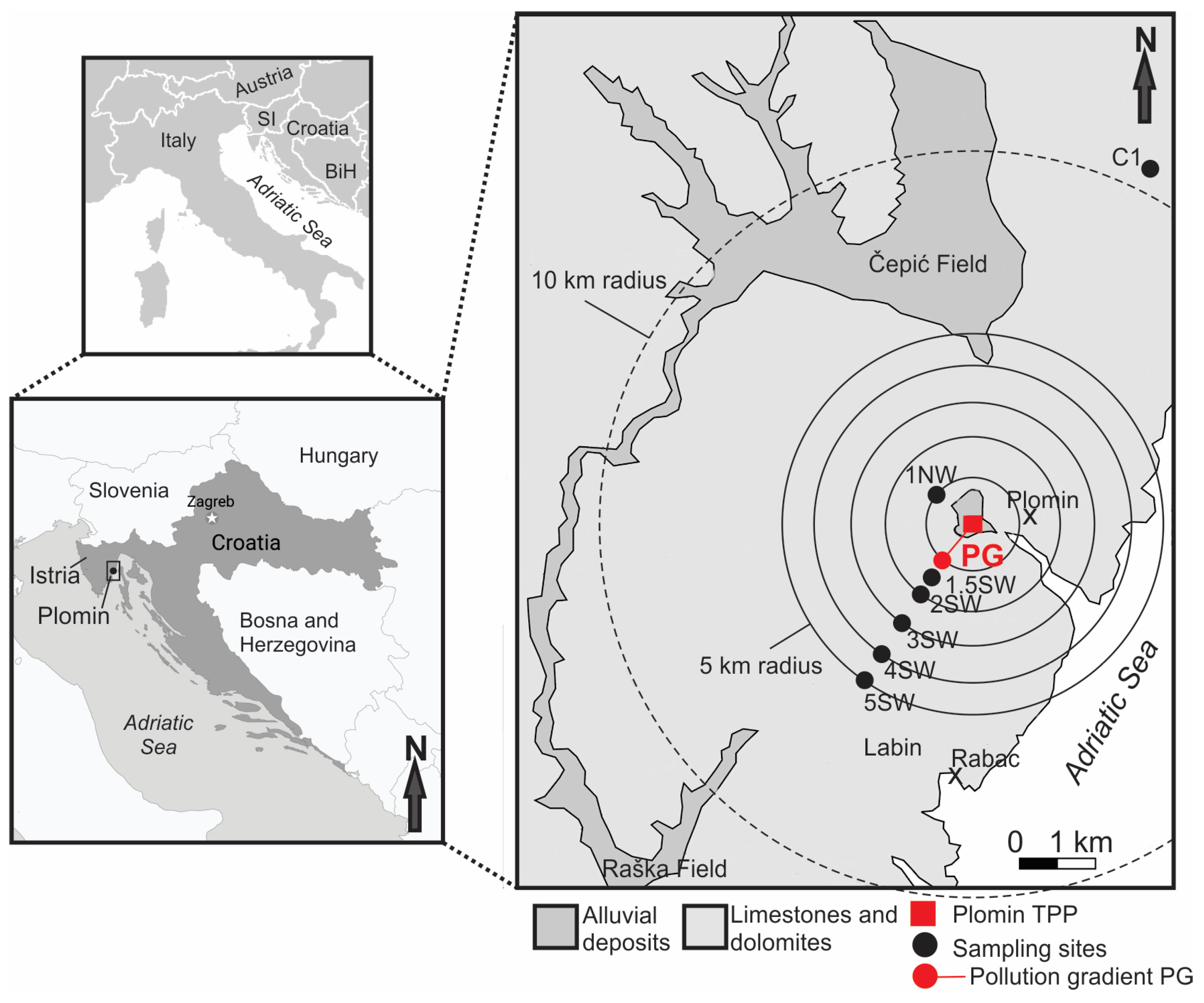
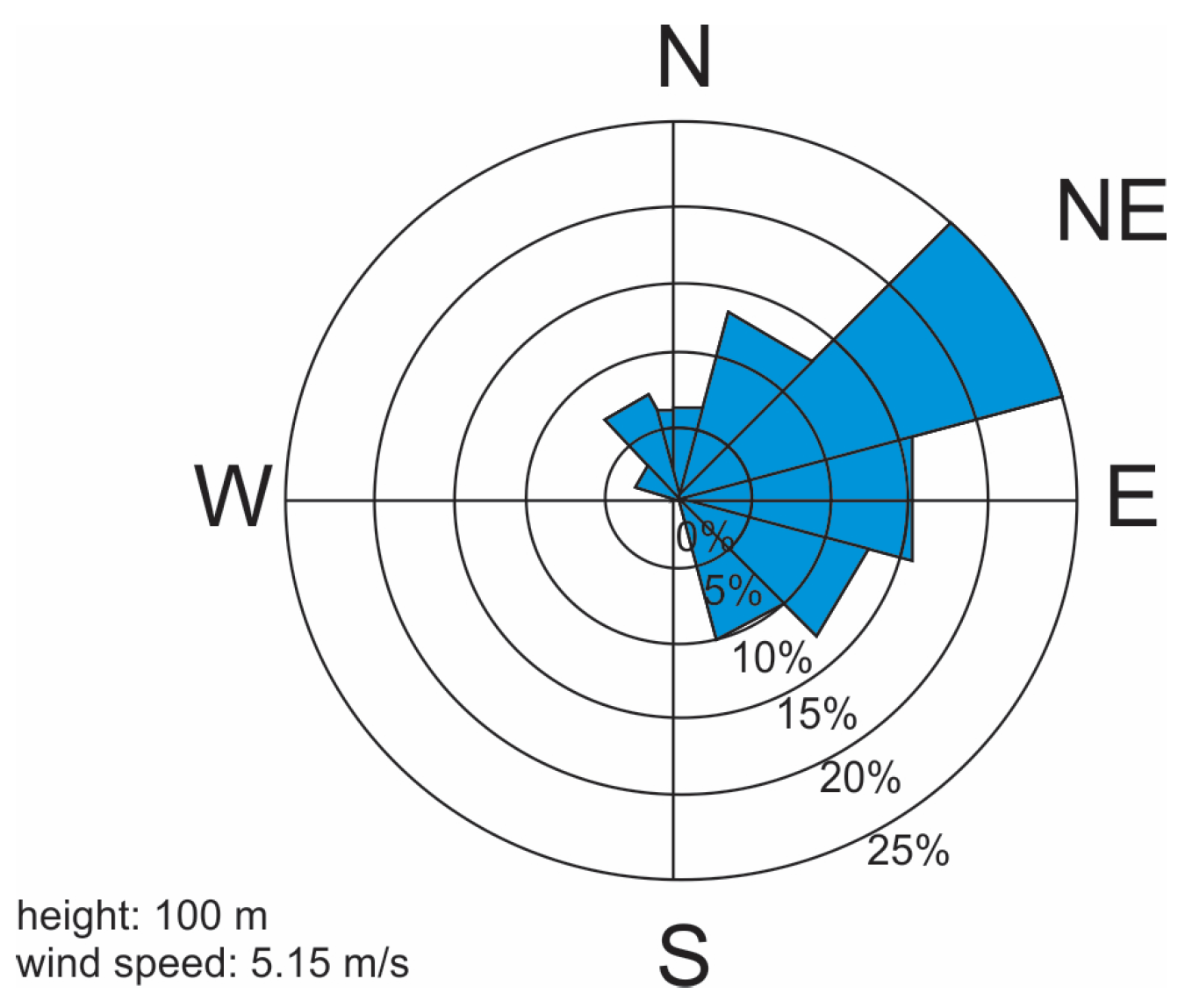
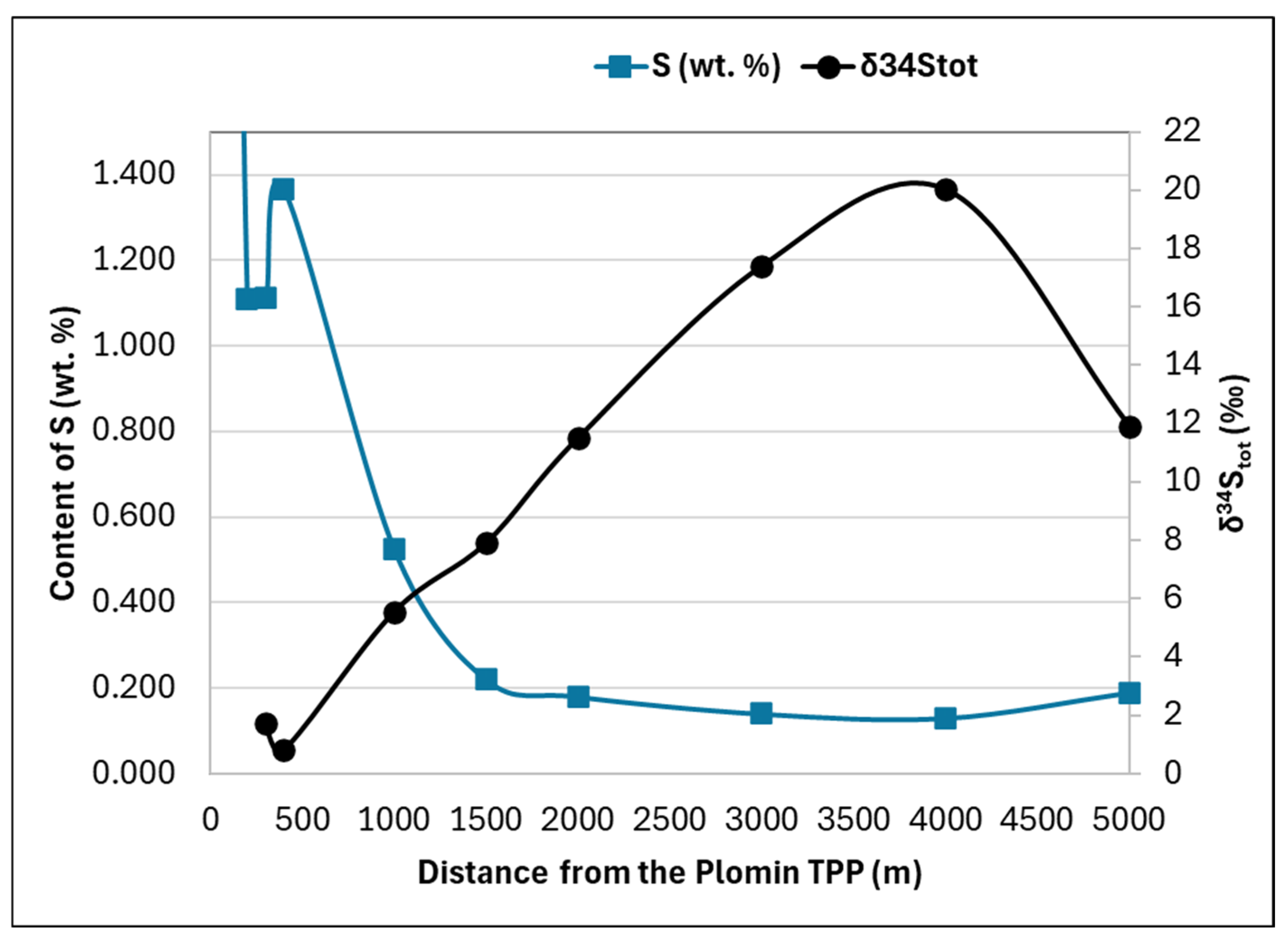
- The spatial distribution of sulfur contamination in the soil is closely related to the distance from the Plomin TPP and is strongly influenced by the prevailing wind direction (SW). The sulfur content in the soil decreases with distance along the pollution gradient (PG) from the Plomin TPP, reaching background levels more than 10 km away in the NE direction (control site C1), consistent with typical agricultural soils (0.03 wt.%).
- (2)
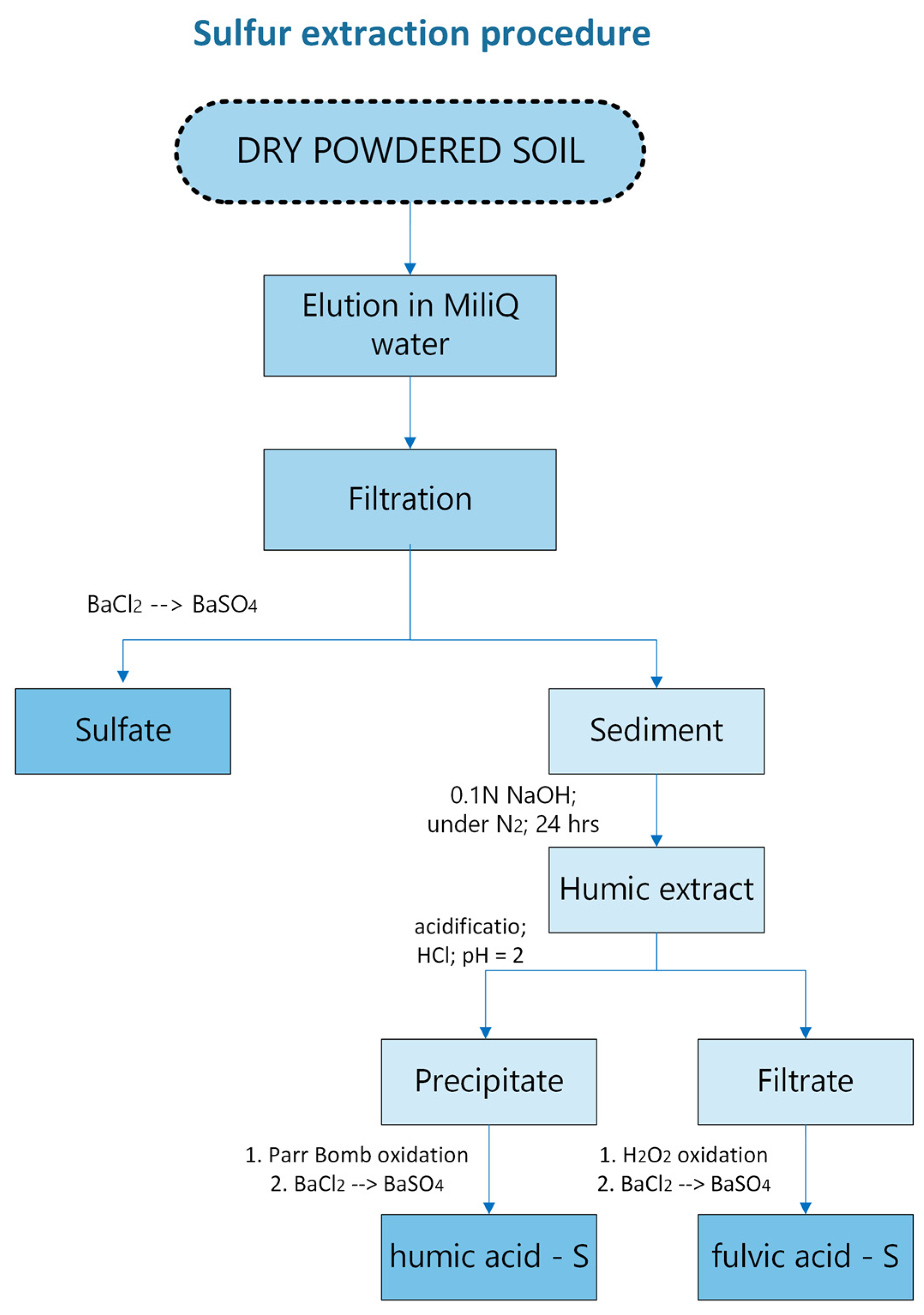
- Sulfur speciation in soil reveals the dominance of organically bound sulfur (>98%), primarily associated with humic acids (>95%). The low proportion of sulfate indicates rapid microbial assimilation and transformation of sulfur into organic form. This suggests that natural processes have efficiently reduced sulfate levels in the soil since emissions ceased.
- (3)
- The S isotopic composition (δ34S) varies with distance from the Plomin TPP, confirming that 34S-depleted emissions from Raša coal combustion were the primary source of anthropogenic contamination. Increasing δ34S values with distance suggest an increasing influence of marine sulfate and natural soil processes.
- (4)
- These findings demonstrate that the legacy of sulfur pollution can persist in organic forms long after emissions cease, with important implications for long-term soil biogeochemistry. Although current sulfate levels are low, residual organic sulfur may still undergo mineralization and potentially release sulfate under changing environmental conditions. Due to the elevated sulfur content in the soil, continued monitoring is necessary to assess potential environmental impacts and long-term changes.
- (5)
- The observed transformation of sulfur forms highlights the role of natural attenuation in enhancing long-term soil resilience and provides a scientific basis for the sustainable management of sites historically affected by anthropogenic atmospheric sulfur deposition.
Author Contributions
Funding
Institutional Review Board Statement
Informed Consent Statement
Data Availability Statement
Acknowledgments
Conflicts of Interest
References
- Wedepohl, K.H. The composition of the continental crust. Geochim. Cosmochim. Acta 1995, 59, 1217–1232. [Google Scholar] [CrossRef]
- Rudnick, R.L.; Gao, S. Composition of the Continental Crust. In Treatise on Geochemistry, 2nd ed.; Holland, H.D., Turekian, K.K., Eds.; Elsevier Science: Amsterdam, The Netherlands, 2003; Volume 4.1, pp. 1–51. [Google Scholar]
- Balík, J.; Kulhánek, M.; Černý, J.; Száková, J.; Pavlíková, D.; Čermák, P. Differences in soil sulfur fractions due to limitation of atmospheric deposition. Plant Soil Environ. 2009, 55, 344–352. [Google Scholar] [CrossRef]
- Sharma, R.K.; Cox, M.S.; Oglesby, C.; Dhillon, J.S. Revisiting the role of sulfur in crop production: A narrative review. J. Agric. Food Res. 2024, 15, 101013. [Google Scholar] [CrossRef]
- International Energy Agency. Available online: https://www.iea.org/ (accessed on 10 November 2025).
- Medunić, G.; Rađenović, A.; Bajramović, M.; Švec, M.; Tomac, M. Once grand, now forgotten: What do we know about the superhigh-organic-sulphur Raša coal? Rud.-Geološko-Naft. Zb. 2016, 31, 27–45. [Google Scholar] [CrossRef]
- White, C.M.; Douglas, L.J.; Anderson, R.R.; Schmidt, C.E.; Gray, R.J. Organosulfur Constituents in Rasa Coal. In Geochemistry of Sulfur in Fossil Fuels; Orr, W.L., White, C.M., Eds.; American Chemical Society: Washington, DC, USA, 1990; Volume 429, pp. 261–286. [Google Scholar]
- Chou, C.L. Sulfur in coals: A review of geochemistry and origins. Int. J. Coal Geol. 2012, 100, 1–13. [Google Scholar] [CrossRef]
- Medunić, G.; Grigore, M.; Dai, S.; Berti, D.; Hochella, M.F.; Mastalerz, M.; Valentim, B.; Guedes, A.; Hower, J.C. Characterization of superhigh-organic-sulfur Raša coal, Istria, Croatia, and its environmental implication. Int. J. Coal Geol. 2020, 217, 103344. [Google Scholar] [CrossRef]
- Lieberman, N.R.; Izquierdo, M.; Muñoz-Quirós, C.; Cohen, H.; Chenery, S.R. Geochemical signature of superhigh organic sulphur Raša coals and the mobility of toxic trace elements from combustion products and polluted soils near the Plomin coal-fired power station in Croatia. Appl. Geochem. 2020, 114, 104472. [Google Scholar] [CrossRef]
- Marović, G.; Senčar, J.; Kovač, J.; Prlić, I. Improvement of the radiological environmental situation due to remedial actions at a coal-fired power plant. J. Radioanal. Nucl. Chem. 2004, 261, 451–455. [Google Scholar] [CrossRef]
- Medunić, G.; Ahel, M.; Mihalić, I.B.; Srček, V.G.; Kopjar, N.; Fiket, Ž.; Bituh, T.; Mikac, I. Toxic airborne S, PAH, and trace element legacy of the superhigh-organic-sulphur Raša coal combustion: Cytotoxicity and genotoxicity assessment of soil and ash. Sci. Total Environ. 2016, 566–567, 306–319. [Google Scholar] [CrossRef]
- Lovrenčić Mikelić, I.; Ernečić, G.; Barišić, D. Natural and anthropogenic radionuclides in soil around coal-fired Plomin thermal power plant (Istria, Croatia): What is the plant influence and what controls it? Fuel 2024, 371, 131971. [Google Scholar] [CrossRef]
- Medunić, G.; Mihalić, I.B.; Ahel, M.; Mikac, I.; Kopjar, N.; Srček, V.G. Toxicity risk assessment of sulfur and PAHs in soil surrounding a coal-fired power plant. In Proceedings of the 27th International Applied Geochemistry Symposium, Tucson, AZ, USA, 20–24 April 2015; pp. 1–17. [Google Scholar]
- Miko, S.; Durn, G.; Adamcová, R.; Čović, M.; Dubíková, M.; Skalský, R.; Kapelj, S.; Ottner, F. Heavy metal distribution in karst soils from Croatia and Slovakia. Environ. Geol. 2003, 45, 262–272. [Google Scholar] [CrossRef]
- Peh, Z.; Miko, S.; Hasan, O. Geochemical background in soils: A linear process domain? An example from Istria (Croatia). Environ. Earth Sci. 2010, 59, 1367–1383. [Google Scholar] [CrossRef]
- Orešcanin, V.; Franekic-Colic, J.; Durgo, K.; Valkovic, V. Investigation of mutagenic effect of metals in the plomin bay sediments by modified preincubation ames assay. J. Trace Microprobe Tech. 2002, 20, 69–77. [Google Scholar] [CrossRef]
- Mohorovic, L. First two months of pregnancy—Critical time for preterm delivery and low birthweight caused by adverse effects of coal combustion toxics. Early Hum. Dev. 2004, 80, 115–123. [Google Scholar] [CrossRef]
- Mohorovic, L. The level of maternal methemoglobin during pregnancy in an air-polluted environment. Environ. Health Perspect. 2003, 111, 1902–1905. [Google Scholar] [CrossRef]
- Cesar, V.; Užarević, Z.; Potočić, N.; Seletković, I.; Lepeduš, H. Preliminary report on epicuticular wax structure in Black pine needles affected by SO2 emitted from thermal power plant Plomin (Croatia). Period. Biol. 2005, 107, 357–360. [Google Scholar]
- Radić, S.; Medunić, G.; Kuharić, Ž.; Roje, V.; Maldini, K.; Vujčić, V.; Krivohlavek, A. The effect of hazardous pollutants from coal combustion activity: Phytotoxicity assessment of aqueous soil extracts. Chemosphere 2018, 199, 191–200. [Google Scholar] [CrossRef]
- Gutiérrez, F.; Parise, M.; De Waele, J.; Jourde, H. A review on natural and human-induced geohazards and impacts in karst. Earth-Sci. Rev. 2014, 138, 61–88. [Google Scholar] [CrossRef]
- Parise, M.; Gunn, J. Natural and anthropogenic hazards in karst areas: An introduction. Geol. Soc. Lond. Spec. Publ. 2007, 279, 1–3. [Google Scholar] [CrossRef]
- Vlahović, I.; Tišljar, J.; Velić, I.; Matičec, D. Evolution of the Adriatic Carbonate Platform: Palaeogeography, main events and depositional dynamics. Palaeogeogr. Palaeoclimatol. Palaeoecol. 2005, 220, 333–360. [Google Scholar] [CrossRef]
- Durn, G.; Ottner, F.; Slovenec, D. Mineralogical and geochemical indicators of the polygenetic nature of terra rossa in Istria, Croatia. Geoderma 1999, 91, 125–150. [Google Scholar] [CrossRef]
- The Global Wind Atlas. Available online: https://globalwindatlas.info/en/ (accessed on 10 November 2025).
- Brüchert, V.; Pratt, L.M. Contemporaneous early diagenetic formation of organic and inorganic sulfur in estuarine sediments from St. Andrew Bay, Florida, USA. Geochim. Cosmochim. Acta 1996, 60, 2325–2332. [Google Scholar] [CrossRef]
- Lojen, S.; Čermelj, B.; Wartel, M. Sulfur cycling and the sulfurization of humic and fulvic acids in the sediments of the rivers Rupel (Belgium) and Authie (northern France). Oceanol. Hydrobiol. Stud. 2007, 36, 83–101. [Google Scholar] [CrossRef]
- Mott, R.A.; Wilkinson, H.C. The use of the Eschka method for the determination of high sulphur contents. J. Appl. Chem. 1953, 3, 218–223. [Google Scholar] [CrossRef]
- USGS Laboratory Management System (LIMS). Available online: https://water.usgs.gov/water-resources/software/RSIL-LIMS/ (accessed on 13 November 2025).
- Halas, S.; Szaran, J. Improved thermal decomposition of sulfates to SO2 and mass spectrometric determination of δ34S of IAEA SO-5, IAEA SO-6 and NBS-127 sulfate standards. Rapid Commun. Mass Spectrom. 2001, 15, 1618–1620. [Google Scholar] [CrossRef]
- Valković, V.; Makjanić, J.; Jaksić, M.; Popović, S.; Bos, A.J.J.; Vis, R.D.; Wiederspahn, K.; Verheul, H. Analysis of fly ash by X-ray emission spectroscopy and proton microbeam analysis. Fuel 1984, 63, 1357–1362. [Google Scholar] [CrossRef]
- Škorić, A.; Mayer, B.; Vranković, A.; Bašić, F. Pedološka Karta Istre 1:150,000; Projektni Zavod za Izradu Pedološke Karte SR Hrvatske: Zagreb, Croatia, 1983. [Google Scholar]
- Zupančič, N.; Turniški, R.; Miler, M.; Grčman, H. Geochemical fingerprint of insoluble material in soil on different limestone formation. CATENA 2018, 170, 10–24. [Google Scholar] [CrossRef]
- Dai, S.; Finkelman, R.B.; Hower, J.C.; French, D.; Graham, I.T.; Zhao, L. Inorganic Geochemistry of Coal, 1st ed.; Elsevier: Amsterdam, The Netherlands, 2023; p. 438. [Google Scholar]
- Spörl, R.; Maier, J.; Scheffknecht, G. Sulphur oxide emissions from dust-fired oxy-fuel combustion of coal. Energy Procedia 2013, 37, 1435–1447. [Google Scholar] [CrossRef]
- Müller, M.; Schnell, U.; Scheffknecht, G. Modelling the fate of sulphur during pulverized coal combustion under conventional and oxy-fuel conditions. Energy Procedia 2013, 37, 1377–1388. [Google Scholar] [CrossRef]
- Vassileva, C.G.; Vassilev, S.V. Behaviour of inorganic matter during heating of Bulgarian coals: 1. Lignites. Fuel Process. Technol. 2005, 86, 1297–1333. [Google Scholar] [CrossRef]
- Huang, F.; Xin, S.; Mi, T.; Zhang, L. Investigation on the transformation behaviours of Fe-bearing minerals of coal in O2/CO2 combustion atmosphere containing H2O. RSC Adv. 2021, 11, 10635–10645. [Google Scholar] [CrossRef]
- Wei, Q.; Song, W. Mineralogical and Chemical Characteristics of Coal Ashes from Two High-Sulfur Coal-Fired Power Plants in Wuhai, Inner Mongolia, China. Minerals 2020, 10, 323. [Google Scholar] [CrossRef]
- Shao, P.; Hou, H.; Wang, W.; Wang, W. Geochemistry and mineralogy of fly ash from the high-alumina coal, Datong Coalfield, Shanxi, China. Ore Geol. Rev. 2023, 158, 105476. [Google Scholar] [CrossRef]
- Wilcox, J.; Wang, B.; Rupp, E.; Taggart, R.; Hsu-Kim, H.; Oliveira, M.L.S.; Cutruneo, C.M.N.L.; Taffarel, S.; Silva, L.F.O.; Hopps, S.D.; et al. Observations and Assessment of Fly Ashes from High-Sulfur Bituminous Coals and Blends of High-Sulfur Bituminous and Subbituminous Coals: Environmental Processes Recorded at the Macro- and Nanometer Scale. Energy Fuels 2015, 29, 7168–7177. [Google Scholar] [CrossRef]
- Shen, Y.; Zhang, Q.; Xu, Y.; Thiemens, M.H. Sulfur isotope anomalies in coal combustion: Applications to the present and early Earth environments. Proc. Natl. Acad. Sci. USA 2024, 121, e2408199121. [Google Scholar] [CrossRef]
- Aguilera, M.; De la Luz Mora, M.; Borie, G.; Peirano, P.; Zunino, H. Balance and distribution of sulphur in volcanic ash-derived soils in Chile. Soil Biol. Biochem. 2002, 34, 1355–1361. [Google Scholar] [CrossRef]
- Reimann, C.; Demetriades, A.; Birke, M.; Filzmoser, P.; O’Connor, P.; Halamić, J.; Ladenberger, A. The GEMAS Project Team. Agricultural and grazing land soil of Europe. In Chemistry of Europe’s Agricultural Soils, Part A—Methodology and Interpretation of the GEMAS Data Set, 1st ed.; Reimann, C., Birke, M., Demetriades, A., Filzmoser, P., O’Connor, P., Eds.; Schweizerbart Science Publishers: Stuttgart, Germany, 2014; pp. 101–472. [Google Scholar]
- Novák, M.; Kirchner, J.W.; Fottová, D.; Přechová, E.; Jăcková, I.; Krám, P.; Hruska, J. Isotopic evidence for processes of sulfur retention/release in 13 forested catchments spanning a strong pollution gradient (Czech Republic, central Europe). Glob. Biogeochem. Cycles 2005, 19. [Google Scholar] [CrossRef]
- Cicek, A.; Koparal, A.S. Accumulation of sulfur and heavy metals in soil and tree leaves sampled from the surroundings of Tunçbilek Thermal Power Plant. Chemosphere 2004, 57, 1031–1036. [Google Scholar] [CrossRef]
- Likus-Cieślik, J.; Pietrzykowski, M.; Chodak, M. Chemistry of sulfur-contaminated soil substrate from a former frasch extraction method sulfur mine leachate with various forms of litter in a controlled experiment. Water Air Soil Pollut. 2018, 229, 71. [Google Scholar] [CrossRef]
- Tabatabai, M.A. Methods of measurement of sulphur in soils, plant materials and waters. In Sulphur Cycling on the Continents—Wetlands, Terrestrial Ecosystems and Associated Water Bodies; SCOPE 48; Howarth, R.W., Stewart, J.W.B., Ivanov, M.V., Eds.; John Wiley & Sons: New York, NY, USA, 1992. [Google Scholar]
- Scherer, H.W. Sulphur in crop production—Invited paper. Eur. J. Agron. 2001, 14, 81–111. [Google Scholar] [CrossRef]
- Strickland, T.C.; Fitzgerald, J.W. Incorporation of sulphate-sulphur into organic matter extracts of litter and soil: Involvement of ATP sulphurylase. Soil Biol. Biochem. 1985, 17, 779–784. [Google Scholar] [CrossRef]
- Magnucka, E.; Kulczycki, G.; Oksińska, M.P.; Kucińska, J.; Pawęska, K.; Milo, L.; Pietr, S. The effect of various forms of sulfur on soil organic matter fractions and microorganisms in a pot experiment with perennial ryegrass (Lolium perenne L.). Plants 2023, 12, 2649. [Google Scholar] [CrossRef]
- Patsis, A.C.; Schuler, C.J.; Toner, B.M.; Santelli, C.M.; Sheik, C.S. The potential for coupled organic and inorganic sulfur cycles across the terrestrial deep subsurface biosphere. Nat. Commun. 2025, 16, 3827. [Google Scholar] [CrossRef]
- Fakhraee, M.; Li, J.; Katsev, S. Significant role of organic sulfur in supporting sedimentary sulfate reduction in low-sulfate environments. Geochim. Cosmochim. Acta 2017, 213, 502–516. [Google Scholar] [CrossRef]
- Schroth, A.W.; Bostick, B.C.; Graham, M.; Kaste, J.M.; Mitchell, M.J.; Friedland, A.J. Sulfur species behavior in soil organic matter during decomposition. JGR Biogeosci. 2007, 112. [Google Scholar] [CrossRef]
- Davidian, J.-C.; Kopriva, S. Regulation of sulfate uptake and assimilation--the same or not the same? Mol. Plant 2010, 3, 314–325. [Google Scholar] [CrossRef]
- Cao, Y.W.; Wang, X.B.; Wang, C.; Bai, E.; Wu, N. Sulfur biogeochemical dynamics of grassland soils in northern China transect along an aridity gradient. Geoderma 2024, 451, 117073. [Google Scholar] [CrossRef]
- Howarth, R.W.; Stewart, J.W.B.; Ivanov, M.V. Sulphur Cycling on the Continents: Wetlands, Terrestrial Ecosystems, and Associated Waterbodies; Chichester: New York, NY, USA, 1992; 350p. [Google Scholar]
- Zenda, T.; Liu, S.; Dong, A.; Duan, H. Revisiting sulphur—The once neglected nutrient: It’s roles in plant growth, metabolism, stress tolerance and crop production. Agriculture 2021, 11, 626. [Google Scholar] [CrossRef]
- Edwards, P.J. Sulfur Cycling, Retention, and Mobility in Soils: A Review; NE-250; USDA Forest Service: Delaware, OH, USA, 1998; 18p. [Google Scholar]
- Ranadev, P.; Ashwin, R.; Bagyaraj, D.J.; Shinde, A.H. Sulfur oxidizing bacteria in agro ecosystem and its role in plant productivity—A review. J. Appl. Microbiol. 2023, 134, lxad161. [Google Scholar] [CrossRef]
- Churka Blum, S.; Lehmann, J.; Solomon, D.; Caires, E.F.; Alleoni, L.R.F. Sulfur forms in organic substrates affecting S mineralization in soil. Geoderma 2013, 200–201, 156–164. [Google Scholar] [CrossRef]
- Xiao, H.Y.; Liu, C.Q. The elemental and isotopic composition of sulfur and nitrogen in Chinese coals. Org. Geochem. 2011, 42, 84–93. [Google Scholar] [CrossRef]
- Chen, S.; Guo, Z.; Guo, Z.; Guo, Q.; Zhang, Y.; Zhu, B.; Zhang, H. Sulfur isotopic fractionation and its implication: Sulfate formation in PM2.5 and coal combustion under different conditions. Atmos. Res. 2017, 194, 142–149. [Google Scholar] [CrossRef]
- Thode, H.G. Sulphur isotopes in nature and the environment: An overview. In SCOPE 43: Stable Isotopes: Natural and Anthropogenic Sulphur in the Environment Krouse; Krouse, H.R., Grinenko, V.A., Eds.; John Wiley & Sons Ltd.: Hoboken, NJ, USA, 1991; pp. 1–26. [Google Scholar]
- Jiang, Y.; Elswick, E.R.; Mastalerz, M. Progression in sulfur isotopic compositions from coal to fly ash: Examples from single-source combustion in Indiana. Int. J. Coal Geol. 2008, 73, 273–284. [Google Scholar] [CrossRef]
- Canfield, D.E. Factors influencing organic carbon preservation in marine sediments. Chem. Geol. 1994, 114, 315–329. [Google Scholar] [CrossRef]
- Amrani, A.; Aizenshtat, Z. Mechanisms of sulfur introduction chemically controlled: δ34S imprint. Org. Geochem. 2004, 35, 1319–1336. [Google Scholar] [CrossRef]
- Raven, M.R.; Fike, D.A.; Gomes, M.L.; Webb, S.M. Chemical and isotopic evidence for organic matter sulfurization in redox gradients around mangrove roots. Front. Earth Sci. 2019, 7, 98. [Google Scholar] [CrossRef]
- Meija, J.; Coplen, T.B.; Berglund, M.; Brand, W.A.; De Bièvre, P.; Gröning, M.; Holden, N.E.; Irrgeher, J.; Loss, R.D.; Walczyk, T.; et al. Atomic weights of the elements 2013 (IUPAC Technical Report). Pure Appl. Chem. 2016, 88, 265–291. [Google Scholar] [CrossRef]
- Alewell, C.; Gehre, M. Patterns of stable S isotopes in a forested catchment as indicators for biological S turnover. Biogeochemistry 1999, 47, 317–331. [Google Scholar] [CrossRef]
- Tcherkez, G.; Tea, I. 32S/34S isotope fractionation in plant sulphur metabolism. New Phytol. 2013, 200, 44–53. [Google Scholar] [CrossRef]
- Habicht, K.S.; Canfield, D.E.; Rethmeier, J. Sulfur isotope fractionation during bacterial reduction and disproportionation of thiosulfate and sulfite. Geochim. Cosmochim. Acta 1998, 62, 2585–2595. [Google Scholar] [CrossRef]



| Sample | Distance (m) | N | E |
|---|---|---|---|
| 19 | 100 | 45°8′2.6″ | 14°9′27.4″ |
| 20 | 200 | 45°8′0.4″ | 14°9′23.3″ |
| 21 | 300 | 45°7′58.1″ | 14°9′19.3″ |
| 22 | 400 | 45°7′55.6″ | 14°9′16.2″ |
| 28 | 1000 | 45°7′42.1″ | 14°8′51.8″ |
| 1.5 KM (SW) | 1500 | 45°7′28.2″ | 14°9′3.7″ |
| 2 KM (SW) | 2000 | 45°7′20.2″ | 14°8′48.8″ |
| 3 KM (SW) | 3000 | 45°6′55.12″ | 14°8′20.5″ |
| 4 KM (SW) | 4000 | 45°6′28.3″ | 14°8′7.9″ |
| 5 KM (SW) | 5000 | 45°6′10.5″ | 14°8′24.6″ |
| 1 KM (NW) | 1000 | 45°8′50″ | 14°9′15.2″ |
| C1 | >10,000 | 45°14′29.32″ | 14°15′18.66″ |
| Mineral | Coal | Ash | Soil |
|---|---|---|---|
| Calcite (CaCO3) | ~70% | ~50% | |
| Dolomite (CaMg(CO3)2) | ~20% | ||
| Anhydrite (CaSO4) | ~30% | ||
| Aragonite (CaCO3) | ~5% | ||
| Gypsum (CaSO4∙2H2O) | <3% | <3% | |
| Pyrite (FeS2) | <3% | ||
| Periclase (MgO) | <3% | ||
| Portlandite (Ca(OH)2) | <3% | ||
| Magnesite (MgCO3) | <3% | ||
| Barite (BaSO4) | <3% | ||
| Bassanite (CaSO4∙0.5H2O) | <3% | ||
| Quartz (SiO2) | ~70% | ||
| Muscovite/Illite * | ~25% | ||
| Albite (NaAlSi3O8) | <3% |
| Sample | S (wt.%) | δ34S (‰) |
|---|---|---|
| coal VIII/20 | 13.05 | −5.50 |
| coal VIII/99 | 6.50 | −7.10 |
| coal VIII/112 | 8.50 | −5.80 |
| coal 07 | 9.00 | −9.20 |
| coal 15 | 7.30 | −6.20 |
| coal 61 | 8.00 | −9.60 |
| min | 7.30 | −9.60 |
| max | 9.00 | −5.80 |
| average | 8.73 | −7.23 |
| ash P–18 | 9.20 | −3.51 |
| ash P33 | 11.30 | −3.38 |
| ash P2 | 10.24 | −3.49 |
| min | 9.20 | −3.51 |
| max | 11.30 | −3.49 |
| average | 10.25 | −3.46 |
| Sample | D | Dist. (m) | Stot (wt.%) | δ34Stot (‰) | SSO4 (wt.%) | δ34SSO4 (‰) | SFA (wt.%) | δ34SFA (‰) | SHA (wt.%) | δ34SHA (‰) |
|---|---|---|---|---|---|---|---|---|---|---|
| 19 | SW | 100 | 4.108 | / | / | / | / | / | / | / |
| 20 | SW | 200 | 1.110 | / | 0.0009 | / | 0.019 | +4.2 | 0.801 | −3.2 |
| 21 | SW | 300 | 1.112 | +1.71 | 0.003 | +1.7 | 0.027 | +5.8 | 0.601 | −3.6 |
| 22 | SW | 400 | 1.365 | +0.81 | 0.0051 | +0.8 | 0.019 | +4.8 | 0.522 | +5.9 |
| 28 | SW | 1000 | 0.524 | +5.54 | 0.0014 | +5.5 | 0.011 | / | / | / |
| 1.5 KM | SW | 1500 | 0.220 | +7.90 | bd | / | 0.005 | / | 0.347 | / |
| 2 KM | SW | 2000 | 0.180 | +11.50 | bd | / | 0.001 | / | 0.192 | / |
| 3 KM | SW | 3000 | 0.140 | +17.40 | bd | / | / | / | / | / |
| 4 KM | SW | 4000 | 0.130 | +20.02 | bd | / | / | / | / | / |
| 5 KM | SW | 5000 | 0.190 | +11.90 | bd | / | 0.002 | / | 0.241 | / |
| C1 | NE | >10,000 | 0.036 | / | bd | / | bd | / | bd | / |
| 1 KM | NW | 1000 | 0.160 | +24.80 | bd | / | / | / | / | / |
| Variable | Distance | Stot | δ34S |
|---|---|---|---|
| Distance | 1.0 | −0.91 | 0.90 |
| Stot | −0.91 | 1.0 | −0.98 |
| δ34S | 0.90 | −0.98 | 1.0 |
Disclaimer/Publisher’s Note: The statements, opinions and data contained in all publications are solely those of the individual author(s) and contributor(s) and not of MDPI and/or the editor(s). MDPI and/or the editor(s) disclaim responsibility for any injury to people or property resulting from any ideas, methods, instructions or products referred to in the content. |
© 2026 by the authors. Licensee MDPI, Basel, Switzerland. This article is an open access article distributed under the terms and conditions of the Creative Commons Attribution (CC BY) license.
Share and Cite
Malenšek Andolšek, N.; Lojen, S.; Zupančič, N. The Natural Attenuation of Bioavailable Sulfur Loads in Soil Around a Coal-Fired Power Plant 20 Years After Ceasing Pollution: The Case of Plomin, Croatia. Sustainability 2026, 18, 747. https://doi.org/10.3390/su18020747
Malenšek Andolšek N, Lojen S, Zupančič N. The Natural Attenuation of Bioavailable Sulfur Loads in Soil Around a Coal-Fired Power Plant 20 Years After Ceasing Pollution: The Case of Plomin, Croatia. Sustainability. 2026; 18(2):747. https://doi.org/10.3390/su18020747
Chicago/Turabian StyleMalenšek Andolšek, Neža, Sonja Lojen, and Nina Zupančič. 2026. "The Natural Attenuation of Bioavailable Sulfur Loads in Soil Around a Coal-Fired Power Plant 20 Years After Ceasing Pollution: The Case of Plomin, Croatia" Sustainability 18, no. 2: 747. https://doi.org/10.3390/su18020747
APA StyleMalenšek Andolšek, N., Lojen, S., & Zupančič, N. (2026). The Natural Attenuation of Bioavailable Sulfur Loads in Soil Around a Coal-Fired Power Plant 20 Years After Ceasing Pollution: The Case of Plomin, Croatia. Sustainability, 18(2), 747. https://doi.org/10.3390/su18020747