Article

Organizational Learning, Problem-Solving Competency, and Effectiveness in Online Travel Agencies: The Moderating Role of Digital Empowerment

College of Business Administration, Kangwon National University, Chuncheon 24341, Republic of Korea
*
Author to whom correspondence should be addressed.
Sustainability 2026, 18(2), 563; https://doi.org/10.3390/su18020563
Submission received: 6 October 2025 / Revised: 30 October 2025 / Accepted: 7 November 2025 / Published: 6 January 2026

Abstract

This study empirically examines how organizational learning influences problem-solving competency and organizational effectiveness in the context of online travel agencies (OTAs) and tests the moderating role of digital empowerment. Using agency lists registered under Korea’s Tourism Promotion Act, we employed stratified sampling by region and simple random sampling within strata. Data collection was commissioned by the Tourism/Leisure HRD Council. A survey was carried out from 2 to 19 June 2025; of the 210 questionnaires returned, 204 valid responses were analyzed. Measures were adapted from prior studies on a five-point Likert scale. Analyses conducted in SPSS 27.0 included descriptive statistics, exploratory factor analysis (EFA), reliability testing (Cronbach’s α), correlation analysis, and simple and hierarchical regressions. The results indicate that (1) organizational learning has a significant positive effect on problem-solving competency (β = 0.541, p < 0.001, R2 = 0.293); (2) organizational learning positively affects organizational effectiveness (β = 0.436, p < 0.001, R2 = 0.190); and (3) problem-solving competency positively influences organizational effectiveness (β = 0.624, p < 0.001, R2 = 0.389). Regarding moderation, digital empowerment did not significantly moderate the organizational learning → problem-solving link but did significantly moderate the organizational learning → organizational effectiveness relationship (p < 0.05), suggesting that digital empowerment enhances the conversion efficiency of learning into performance. Theoretically, this study substantiates the learning–problem-solving–performance mechanism in a service/tourism setting and identifies digital empowerment as a catalytic moderator that strengthens the translation of learning into organizational outcomes. Practically, the findings imply that OTAs can amplify organizational effectiveness by building digital empowerment structures—data-driven decision systems, process automation, and real-time customer-response capabilities—which enable learned knowledge to materialize into performance. Future research should incorporate digital maturity, leadership, customer orientation, and related variables into extended models.

1. Introduction

The contemporary travel industry, where recovery and innovation coexist, demands both digital capabilities and professional expertise. The COVID-19 pandemic brought the industry to a prolonged halt, leading to large-scale furloughs and layoffs, while many experienced travel agency employees left the sector for other industries [1]. Although the tourism sector has entered a recovery phase in the post-pandemic era, the return of skilled labor has been slow. The workforce now consists of a mix of employees reentering after a long career gap and newly hired staff, while tourism infrastructure itself remains in the process of expanding its digital foundation [2,3]. In response to the surge in travel demand, many hastily established agencies exhibit weaknesses in both digital competencies and professional expertise. Newly recruited employees often lack not only on-site experience but also sufficient proficiency in digital tools [4]. Constrained by repetitive tasks, limited decision-making authority, and insufficient opportunities for education or digital training, these employees find it difficult to build the professionalism and innovative capacity required in the field. Therefore, the most pressing challenge for the industry today is the development and retention of competent, sustainable talent capable of adapting to digital environments and strengthening professional expertise [5].
The professional functions of traditional travel agency employees differ substantially from those performed within online travel agencies (OTAs), which rely predominantly on online searches, automated reservations, and contactless services. Travel involves a complex journey—ranging from expectations and planning before departure, to experiences during the trip, and evaluations upon return—throughout which diverse demands, emotions, and unexpected situations may arise [6,7]. Within this multifaceted consumer journey, the tasks undertaken by travel agency staff—such as planning, booking, guiding, and handling complaints—constitute the core services of the industry. The travel experience obtained through these services is directly tied to the competitiveness of the sector [8,9]. Travel agency employees are not simply guides or booking intermediaries; they function as pivotal actors in shaping the quality of the customer experience. This role requires professional competencies that enable them to anticipate circumstances, coordinate problem resolution, and respond effectively to unforeseen contingencies [10]. Such capabilities are not developed solely through individual experience but can be systematically enhanced through organizational learning and collective knowledge sharing [11]. Organizational learning goes beyond simple information transfer or basic training; it enables members to learn autonomously in problem situations and to derive effective solutions based on that learning [12]. In the rapidly evolving tourism industry, where customer expectations shift quickly, supporting employees’ continuous learning and competency development is essential [13,14].
When employees within an organization are empowered to make autonomous decisions and take initiative in problem-solving based on digital technologies, it can have positive effects on job satisfaction, organizational commitment, and ultimately organizational effectiveness [15]. Digital empowerment provides a critical foundation that enables members to actively manage their tasks, exercise ownership, and respond effectively to various situations through the use of data and digital tools [16]. In industries such as tourism, where unexpected on-site issues or customer complaints require prompt and appropriate responses, digital empowerment can be regarded as a key factor for effective problem-solving and improving service quality [17,18]. Organizational learning, problem-solving competency, digital empowerment, and organizational effectiveness have long been central themes of research. Previous studies have shown that organizational learning enhances both problem-solving ability and organizational effectiveness [19,20,21] and contributes to corporate performance and service innovation [22,23,24]. Digital empowerment has also been proven to increase employees’ sense of ownership and commitment through autonomous decision-making and the use of digital tools, thereby fostering creativity and innovative behavior [25,26]. However, empirical studies that examine these relationships from the perspective of the competencies required in the digital transformation of the tourism industry remain limited. While prior research has largely examined individual outcomes and organizational performance from a traditional human resource management (HR) perspective, few studies have empirically explored the moderating role of digital empowerment. This study analyzes the structural relationships among organizational learning, problem-solving competency, and organizational effectiveness within the context of digital transformation, highlighting how these relationships foster the sustainability and resilience of online travel agencies by enhancing their adaptive capacity and long-term viability.
Accordingly, the purpose of this study is to examine the effect of organizational learning on problem-solving competency and organizational effectiveness in the context of online travel agencies (OTAs). In addition, this study empirically tests the moderating role of digital empowerment in the relationships between organizational learning and problem-solving competency, as well as between organizational learning and organizational effectiveness. Ultimately, this study seeks to extend existing theories by integrating organizational learning and digital transformation research, while also offering practical implications for OTAs seeking to establish digitally empowered learning organizations and to enhance their organizational performance.

2. Review of the Literature and Hypotheses Development

2.1. Organizational Learning

Organizational learning is the process by which members of an organization share their knowledge and experiences, gradually modify their behaviors, and ultimately enhance the organization’s capabilities [27]. Crossan et al. (1999) [28] emphasized that such learning does not remain confined to the individual level but spreads throughout the entire organization through four processes: intuition, interpretation, integration, and institutionalization. In this way, organizations achieve sustainable development by systematically accumulating and sharing knowledge and experiences in order to adapt to environmental changes and maximize performance [22,29].
Early discussions on organizational learning primarily focused on corrective actions in response to problems and on the mechanisms through which organizations adapt to external environmental changes. Argyris (1996) [30] classified organizational learning into single-loop learning and double-loop learning, depending on how problems are addressed. This distinction illustrates whether organizations remain at the level of correcting errors or engage in deeper reflection and transformation that generates new knowledge [31]. Single-loop learning has been explained as adaptive learning, which pursues optimal performance within external constraints [32]. In contrast, double-loop learning, or generative learning, involves critically examining and reconstructing organizational premises and assumptions, thereby enabling higher-level, innovative, and creative change [33]. Cook and Yanow (1993) [34] further argued that organizational learning should not be understood merely as knowledge accumulation or procedural improvement, but as a sociocultural process closely tied to organizational culture.
In more recent research, organizational learning has evolved into a broader and more dynamic concept, linked to digital transformation, knowledge sharing, and innovation culture. Marsick and Watkins (2003) [22] highlighted the seven dimensions of a learning organization—continuous learning, inquiry and dialog, team-based learning, systems thinking, leadership support, strategic alignment, and connection to the environment—as elements that must be integrated throughout the organization. They stressed that learning becomes effective when embedded in everyday workflows and when members are provided with an environment that encourages autonomous learning and knowledge sharing. Dörner and Rundel (2021) [21] contended that, in the digital era, organizational learning should be conceptualized not merely as the accumulation of knowledge but as a theoretical framework through which organizations internalize new digital technologies, restructure processes, and secure continuous innovation and competitive advantage. Similarly, Gardner (2022) [35] emphasized that organizational learning in digital transformation goes beyond abstract technology adoption. Rather, through situated learning, employees embody digital capabilities within real work contexts and create new work practices.
Tourism-related studies also support this perspective. Khoshkhoo and Nadalipour (2016) [36] found that intensified competition drives organizational learning in tourism SMEs from the individual to the organizational level. Digital technologies, while intensifying competition, simultaneously promote knowledge sharing and collaboration, thereby reinforcing the foundation for learning. Schönherr et al. (2023) [37] further demonstrated that digital transformation facilitates knowledge creation and sharing within tourism organizations, strengthening organizational learning and contributing to the realization of sustainable tourism.

2.2. Problem-Solving Competency

Problem-solving competency represents a core dimension of job performance, referring to the cognitive and behavioral processes through which individuals identify problems, generate appropriate solutions, and implement them effectively [38]. It entails strategic thinking skills such as situational analysis, the integration of complex information, and the selection of optimal solutions among alternatives [39]. This competency is closely linked not only to individual performance but also to the broader efficiency and innovation of the organization [40].
From the perspective of organizational behavior, problem-solving competency is also understood as a behavioral capability that is organically connected with creativity, critical thinking, and collaboration among members [41,42]. Creative problem-solving by employees in challenging situations acts as a critical catalyst for organizational innovation [23]. Furthermore, organizations characterized by high levels of autonomy and inclusiveness are more likely to foster creative approaches to problem-solving among their members [43,44]. Fischer et al. (2015) [45] distinguished between two approaches in assessing problem-solving competency (PSC): Analytic Problem Solving (APS) and Interactive Problem Solving (IPS). While APS, based on logical and systematic analysis, is useful in explaining academic achievement, IPS captures strategic thinking and adaptive problem-solving skills in dynamic contexts. Similarly, Li et al. (2011) [46] demonstrated that a team’s problem-solving competency in IS development projects is a critical factor in overcoming requirement uncertainty and improving system quality in terms of efficiency, flexibility, and responsiveness.
At the organizational level, problem-solving competency influences learning capacity, adaptability to change, customer satisfaction, and the effectiveness of service recovery strategies. In service industries in particular, it is evaluated as the capability to respond to customer-facing issues in real time [40]. This suggests that problem-solving competency extends beyond internal operational efficiency to directly impact customer experience and service quality. When combined with learning capacity and creative thinking, organizations can provide swift and differentiated value even in unexpected problem situations [44,47]. Tsai (2017) [48], in a study on Taiwanese travel agency managers, found that the employability of graduates was most strongly associated with professional attitudes, discipline, and career planning. Specifically, communication skills, lifelong learning, work commitment, crisis management, self-marketing, teamwork, and the ability to plan and execute travel were identified as critical elements. Likewise, Chou et al. (2019) [24] showed that creative problem-solving pedagogy effectively enhances hospitality management students’ sustainable service innovation competencies and creative thinking for addressing environmental issues.

2.3. Organizational Effectiveness

Organizational effectiveness is a core construct that assesses the extent to which an organization achieves its stated goals, and its definition and measurement have been approached from multiple perspectives. Traditionally, research on organizational effectiveness has focused on four major models: the goal-attainment model, the resource-based approach, the internal process approach, and the strategic constituencies approach [49]. The goal-attainment model emphasizes the degree to which organizational outputs are realized, whereas the resource-based approach views effectiveness in terms of an organization’s ability to secure and utilize external resources [50,51]. The internal process approach highlights communication, coordination, and information flow within the organization, while the strategic constituencies approach evaluates effectiveness by the extent to which the organization meets the expectations of key stakeholders [52,53].
Subsequent research has expanded organizational effectiveness beyond the level of goal achievement to encompass a multidimensional concept that includes satisfying members’ needs through rewards that exceed expectations, achieving financial performance, and fulfilling corporate social responsibility. Quinn and Rohrbaugh (1983) [54], through the Competing Values Framework (CVF), argued that organizational effectiveness should be assessed by balancing conflicting values such as internal stability and external adaptability, as well as short-term efficiency and long-term innovation. Similarly, Richard et al. (2009) [55] emphasized that effectiveness should be measured not only in terms of financial performance but also from the stakeholder perspective, including customer satisfaction, employee engagement, and social contributions. This perspective reframes organizations as complex systems that generate both individual growth and social value, rather than mere mechanisms for achieving performance outcomes [56,57].
More recent approaches to organizational effectiveness have evolved into comprehensive indicator frameworks tailored to industry and sector contexts, such as strategic alignment (Balanced Scorecard, BSC), Performance Prism, the EFQM Excellence Model, and multi-dimensional methodological assessments. Naqshbandi et al. (2024) [58] confirmed that a learning-oriented organizational culture positively influences effectiveness, with this relationship mediated by employee work engagement. Similarly, Dhoopar et al. (2023) [59], through a systematic review of more than 134 studies, identified modern antecedents of organizational effectiveness such as business intelligence, organizational agility, operational coordination, and an innovative organizational climate. They emphasized that organizational effectiveness must be redefined as a concept tightly linked to the ability to adapt to environmental change, operational flexibility, and innovative capacity. Sharma and Singh (2019) [60] further proposed a Unified Model of Organizational Effectiveness, integrating goal-attainment, resource-based, internal process, and stakeholder approaches. They argued that effectiveness should be assessed not as a single dimension, but through multi-dimensional criteria, including external performance such as adaptation and resource acquisition, internal processes such as communication and coordination, and stakeholder satisfaction.
Synthesizing these prior studies, a strong theoretical foundation emerges that positions organizational learning as a key mechanism that enhances employees’ problem-solving competency and, in turn, organizational effectiveness. On this basis, the following hypotheses are proposed:
Hypothesis 1 (H1).
Organizational learning will have a positive effect on travel agency employees’ problem-solving competency.
Hypothesis 2 (H2).
Organizational learning will have a positive effect on organizational effectiveness in travel agencies.
Hypothesis 3 (H3).
Travel agency employees’ problem-solving competency will have a positive effect on organizational effectiveness.

2.4. Digital Empowerment

Digital empowerment refers to the process by which organizations and individuals leverage digital technologies to expand autonomy and capabilities, thereby being granted the authority to generate innovative outcomes [61]. Beyond the mere adoption of technology, it encompasses employees’ ability to utilize data and digital tools to learn, collaborate, and creatively solve problems [62].
At the organizational level, digital empowerment is manifested in enhanced access to information and data utilization, the automation of work processes, and the strengthening of data-driven decision-making structures. These changes ultimately increase organizational agility, innovation, and market responsiveness [63], while providing a foundation for employees to engage in self-directed learning and knowledge sharing [64]. In service industries where customer contact is critical, digital empowerment is directly linked to improved customer experience and enhanced real-time problem-solving capacity. Digital authority enables employees to rapidly identify and respond to customer needs through real-time feedback systems and CRM (Customer Relationship Management) data, thereby improving both the speed of problem resolution and the precision of personalized service delivery [65]. Furthermore, digital empowerment facilitates data-driven decision-making in omnichannel customer interactions, thereby contributing to higher customer satisfaction and the optimization of service recovery strategies [66].
Digital empowerment serves as a critical moderating factor in the process linking organizational learning and problem-solving competency to organizational effectiveness [67]. In other words, as learned knowledge and problem-solving skills are translated into actual organizational outcomes, digital empowerment strengthens effectiveness not only by fostering employees’ autonomous participation and creative initiatives, but also by enhancing the speed and quality of information acquisition in organizational learning and by reducing managers’ cognitive load during problem-solving processes [68]. Li et al. (2022) [69] demonstrated that organizational capability for technological internalization and adaptation functions as a moderating factor that strengthens the relationship between digital empowerment and technological innovation. Similarly, Nam (2023) [70], in a study on online service usage in Korea, found that digital empowerment mitigated the negative effects of age, such that individuals with higher digital competence and accessibility were less constrained by age. Zhang et al. (2024) [71] also revealed that while digital empowerment positively influenced export quality, the strength of this effect varied depending on market segmentation strategies.
Based on these insights, this study proposes that digital empowerment goes beyond simple technological application and plays both mediating and moderating roles in transforming organizational learning and problem-solving competency into actual performance outcomes. Accordingly, the following hypotheses are established:
Hypothesis 4-1 (H4-1).
Digital empowerment will moderate the relationship between organizational learning and problem-solving competency.
Hypothesis 4-2 (H4-2).
Digital empowerment will moderate the relationship between organizational learning and organizational effectiveness.

3. Research Method

3.1. Research Model

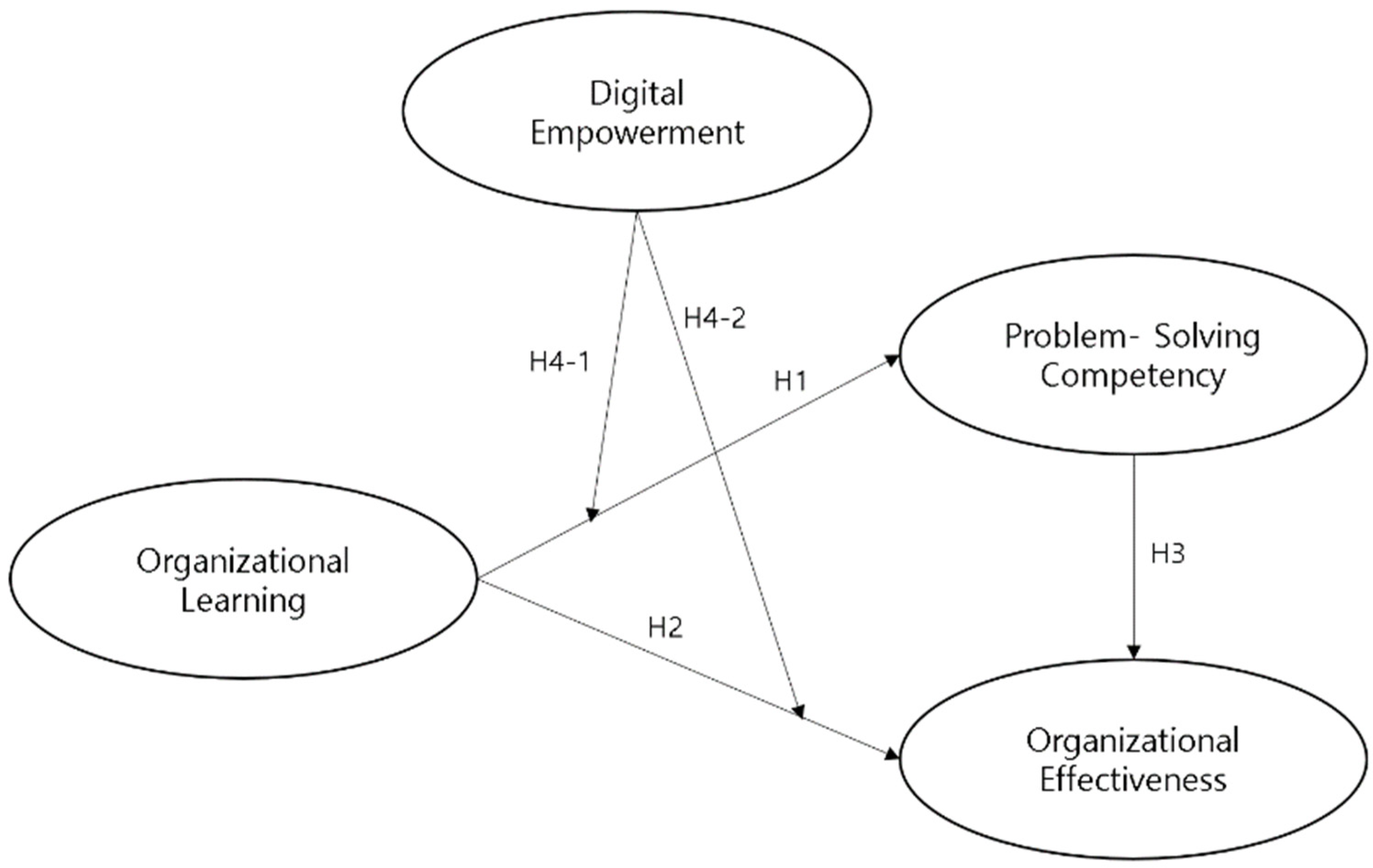
The research model of this study is designed to examine the effects of organizational learning on problem-solving competency and organizational effectiveness. Specifically, organizational learning is proposed to enhance employees’ problem-solving competency, which in turn contributes to organizational effectiveness [21,35,36]. Problem-solving competency is conceptualized as a mediating factor that positively influences organizational effectiveness [41,42,48].
In addition, digital empowerment is introduced as a moderating variable in the relationships between organizational learning and problem-solving competency, as well as between organizational learning and organizational effectiveness. It is expected to strengthen the link between organizational learning outcomes and performance creation in digital environments [59,70,71].
Accordingly, the purpose of this study is to empirically test the process through which organizational learning leads to problem-solving competency and organizational effectiveness, and to verify the moderating role of digital empowerment in this relationship. Based on this framework, the research model is presented in Figure 1.

3.2. Operational Definitions and Measurement of Variables

This study focuses on four major variables—organizational learning, problem-solving competency, organizational effectiveness, and digital empowerment—and develops measurement instruments accordingly. All items were adapted from previously validated scales in the literature, with some modifications to suit the purpose of this study. Responses were collected using a five-point Likert scale (1 = strongly disagree to 5 = strongly agree) to effectively capture respondents’ subjective perceptions.
Organizational learning was conceptualized as the process through which employees share knowledge and experiences, embrace new ideas, and are supported at the organizational level in adapting to environmental changes and solving problems. Drawing on the Dimensions of the Learning Organization Questionnaire (DLOQ) developed by Marsick and Watkins (2003) [22], organizational learning was assessed in terms of learning from mistakes, knowledge sharing, innovation receptiveness, environmental responsiveness, and external benchmarking, resulting in five items (OL1–OL5). Problem-solving competency was defined as the cognitive and behavioral capacity to identify problems arising during job performance, analyze relevant information, explore alternatives, and implement solutions. Based on the model of Mumford et al. (2000) [39], this construct was measured through five items (PS1–PS5) that reflect problem recognition, information analysis, alternative generation, post-implementation application, and self-directed resolution. Organizational effectiveness was understood as the extent to which organizations achieve their goals while also reflecting work efficiency, member satisfaction, and overall organizational performance. Following the measurement approaches of Naqshbandi et al. (2024) [58] and Sharma and Singh (2019) [60], this variable was measured through five items (OE1–OE5) encompassing goal achievement, efficiency, and member satisfaction. Finally, digital empowerment was defined as the degree to which organizations and their members expand autonomy and capability by utilizing digital technologies, thereby enabling innovative performance outcomes. Drawing on Chatterjee et al. (2023) [65], Abdul Rahim et al. (2024) [66], and Nam (2023) [70], digital empowerment was measured through five items (DE1–DE5) that reflect information accessibility, data utilization, process automation, data-driven decision-making, and customer responsiveness.

3.3. Data Collection and Analysis

The target population of this study was set as travel agencies in Korea that distribute and sell online travel agency (OTA) products. Based on the list of domestic and international travel agencies registered in each city and province under the Tourism Promotion Act, the sample was stratified by region—including Seoul, the metropolitan area, major metropolitan cities, and small- to medium-sized cities—to minimize regional bias. Within each stratum, simple random sampling was applied. The combination of stratified and simple random sampling allows the sample to more accurately reflect the structural characteristics of the population by dividing it into heterogeneous subgroups and applying probabilistic procedures within each stratum. This method is recognized as effective in minimizing estimation bias and enhancing statistical efficiency [72]. Sample collection was carried out by the Tourism & Leisure Industrial Skills Council in Korea. This council, supported by the Ministry of Employment and Labor and the Human Resources Development Service of Korea, is a specialized institution with extensive experience in workforce supply-demand surveys, job analyses, and talent development projects in the tourism and leisure sectors. It is recognized for its systematic research and analytical capabilities and maintains broad industrial networks through collaborative partnerships with leading companies and institutions representing Korea’s tourism and leisure industries.
A total of 90 travel agencies were surveyed from 2 to 19 June 2025. Questionnaires were distributed via mail and email, and completed responses were collected through the same channels. In total, 210 questionnaires were returned, of which 6 were excluded due to incomplete or insincere responses. The final dataset consisted of 204 valid responses, which were used for analysis. The data collected were analyzed using SPSS 27.0. Frequency analysis was conducted for descriptive statistics. To ensure validity and reliability, exploratory factor analysis and reliability testing using Cronbach’s α were performed. In addition, correlation analysis was carried out to examine relationships among the variables, and both simple regression analysis and hierarchical regression analysis were used to test the research hypotheses.

4. Empirical Analysis

4.1. Demographic Characteristics

The demographic characteristics of the respondents are presented in Table 1. In terms of gender distribution, 40.7% were male and 59.3% were female, indicating a higher proportion of female respondents. Regarding length of service, 26.5% had less than 5 years, 28.9% had 5–10 years, 22.1% had 10–15 years, and 22.5% had more than 15 years, showing an overall balanced distribution. By job position, 11.8% were staff-level employees, 21.6% assistant managers, 37.7% managers or deputy managers, and 28.9% department heads or higher, with the largest group being managers and deputy managers. For job type, operations and sales accounted for the largest proportion at 67.2%, followed by airline counter staff at 7.4%, tour conductors at 5.4%, and general or administrative managers at 20.1%.

4.2. Validity and Reliability Analysis of Constructs

To verify the construct validity of the measurement variables, an Exploratory Factor Analysis (EFA) based on principal component analysis was conducted. The Varimax orthogonal rotation method was applied, and the criteria for factor extraction were set as follows: communality ≥ 0.40, eigenvalue ≥ 1.0, and factor loading ≥ 0.50. For reliability testing, Cronbach’s α coefficients were calculated, adopting the commonly accepted threshold of α ≥ 0.60 for academic research [73].
The initial analysis revealed that the item PS5 (Self-resolution) under problem-solving competency and DE3 (Process automation) under digital empowerment showed factor loadings below 0.50 and were therefore excluded from the measurement scale. After their removal, reanalysis confirmed that all extracted factors had eigenvalues greater than 1.0 and factor loadings above 0.50. As shown in Table 2, organizational learning items loaded between 0.689 and 0.752 (eigenvalue = 2.140; Cronbach’s α = 0.812), problem-solving competency items ranged from 0.544 to 0.755 (eigenvalue = 1.004; α = 0.801), organizational effectiveness items loaded between 0.753 and 0.801 (eigenvalue = 6.311; α = 0.884), and digital empowerment items ranged from 0.665 to 0.785 (eigenvalue = 1.753; α = 0.741). The cumulative variance explained by the four constructs was 62.27%, with a KMO value of 0.899 and Bartlett’s χ2 = 1497.936, df = 153, p < 0.001, supporting the adequacy of the factor model. Moreover, Cronbach’s α values for all constructs exceeded 0.70, indicating a satisfactory level of internal consistency.

4.3. Correlation Analysis

To examine the relationships and directions among the variables whose convergent validity was verified through factor analysis and reliability testing, a discriminant validity test was conducted using correlation analysis. As shown in Table 3, organizational learning among travel agency employees was significantly correlated with problem-solving competency (r = 0.541, p < 0.01) and organizational effectiveness (r = 0.436, p < 0.01). In addition, problem-solving competency demonstrated a significant positive correlation with organizational effectiveness (r = 0.624, p < 0.01). Digital empowerment was also significantly correlated with problem-solving competency (r = 0.319, p < 0.01) and organizational effectiveness (r = 0.204, p < 0.01); however, its correlation with organizational learning (r = 0.135) did not reach statistical significance.

4.4. Hypothesis Testing

4.4.1. Relationship Between Organizational Learning, Problem-Solving Competency, and Organizational Effectiveness

The results of testing Hypothesis 1, which proposed that organizational learning of travel agency employees would have a positive effect on problem-solving competency, showed that the effect was statistically significant (t = 9.144, p < 0.001). The regression model yielded an R2 of 0.293, indicating that organizational learning explained 29.3% of the variance in problem-solving competency. This finding suggests that employees’ ability to recognize and solve problems is enhanced through organizational-level learning systems and knowledge-sharing environments, highlighting the contribution of organizational learning to the improvement of cognitive and behavioral competencies.
For Hypothesis 2, which posited that organizational learning would positively affect organizational effectiveness, the results also demonstrated statistical significance (t = 6.884, p < 0.001). The regression model yielded an R2 of 0.190, indicating that organizational learning accounted for 19.0% of the variance in organizational effectiveness. These results, as summarized in Table 4, confirm that employees’ organizational learning contributes to achieving organizational goals and improving overall performance.

4.4.2. Relationship Between Problem-Solving Competency and Organizational Effectiveness

The results of testing Hypothesis 3, which proposed that employees’ problem-solving competency would have a positive effect on organizational effectiveness, revealed a statistically significant relationship (t = 11.343, p < 0.001). The regression model yielded an R2 of 0.389, indicating that problem-solving competency explained 38.9% of the variance in organizational effectiveness. As shown in Table 5, this result demonstrates that employees’ problem-solving competency substantially contributes to achieving organizational goals, improving operational efficiency, and enhancing internal satisfaction within organizations.

4.4.3. Moderating Effect of Digital Empowerment

To examine the moderating role of digital empowerment in the relationships between organizational learning, problem-solving competency, and organizational effectiveness, a hierarchical regression analysis was conducted.
For the effect of organizational learning on problem-solving competency, the explanatory power of the model increased from 28.9% (Model 1) to 34.8% (Model 2) when digital empowerment was included. However, when the interaction term (organizational learning × digital empowerment) was entered in Model 3, the R2 slightly decreased to 34.5%. As shown in Table 6, while the change in F from Model 1 to Model 2 was statistically significant (p < 0.001), the change in F for Model 3 was not significant (p = 0.812). Therefore, Hypothesis 4-1 was not supported, suggesting that differences in the level of digital empowerment did not significantly alter the effect of organizational learning on problem-solving competency.
In contrast, the relationship between organizational learning and organizational effectiveness exhibited incremental improvements in explanatory power across the models. Specifically, R2 increased from 18.6% (Model 1) to 20.4% (Model 2) and further to 21.7% (Model 3). As presented in Table 7, the changes in F for both Model 2 (p = 0.020) and Model 3 (p = 0.039) were statistically significant, satisfying the threshold of p < 0.05. Thus, Hypothesis 4-2 was supported, indicating that digital empowerment significantly moderates the effect of organizational learning on organizational effectiveness.

4.5. Discussion

This study empirically examined the structural relationships among organizational learning, problem-solving competency, and organizational effectiveness, thereby complementing existing theoretical discussions with empirical evidence. In particular, testing the moderating effect of digital empowerment contributes academically by highlighting the critical role of digital environments in the process of generating organizational outcomes.
First, the findings demonstrate that organizational learning exerts a positive influence on both problem-solving competency and organizational effectiveness. This suggests that when knowledge sharing and a culture of learning are systematically embedded at the organizational level, employees’ cognitive and behavioral competencies are enhanced, ultimately leading to improved organizational performance. This result supports previous studies [22,58]. Moreover, in the context of the tourism and service industries, the study confirms that organizational learning is not limited to strengthening internal capabilities but also translates into customer satisfaction and service quality enhancement. This indicates that the effects of organizational learning are closely linked to industry-specific outcomes.
Second, the findings identified problem-solving competency as a key antecedent of organizational effectiveness. In other words, employees’ ability to recognize problems, explore diverse alternatives, and execute and utilize solutions directly contributes to the achievement of organizational goals, operational efficiency, and employee satisfaction. This confirms that problem-solving competency is not merely an individual-level performance capability but a critical factor that explains organizational-level outcomes [23,42]. Particularly in service industries characterized by rapidly changing customer demands and high uncertainty, the study empirically demonstrates that problem-solving competency functions as a core factor that enhances organizational agility and adaptability. Thus, problem-solving competency can be understood as a strategic resource for ensuring organizational sustainability and competitive advantage, underscoring the need for institutional and organizational support as well as training and education to strengthen this capability.
Third, the partial confirmation of the moderating effect of digital empowerment provides an important theoretical contribution. Specifically, while no moderating effect was found in the relationship between organizational learning and problem-solving competency, digital empowerment significantly influenced the relationship between organizational learning and organizational effectiveness. This indicates that digital capability serves as a catalyst in transforming learning activities into tangible outcomes, suggesting that organizational learning translates into organizational performance only when combined with digital competencies rather than remaining at the level of knowledge sharing and experiential accumulation.

5. Conclusions and Implications

5.1. Theoretical Implications

This study empirically validated the structural relationships among organizational learning, problem-solving competency, and organizational effectiveness among travel agency employees, while also examining the moderating effect of digital empowerment. In doing so, it provides both theoretical and industry-level contributions.
First, by confirming that organizational learning positively influences both problem-solving competency and organizational effectiveness, the study empirically supports the process through which a learning culture translates into organizational outcomes [20,22]. This highlights the mediating mechanism whereby organizational learning not only functions as a form of knowledge management but also strengthens employees’ cognitive and behavioral competencies, ultimately contributing to performance improvement. Second, the findings establish problem-solving competency as a critical antecedent of organizational effectiveness. They demonstrate that it is not limited to the individual level but also serves as a key determinant of organizational outcomes [19,45]. Particularly in service industries characterized by uncertainty and diverse customer demands, problem-solving competency was empirically shown to be a central factor in explaining organizational performance. This complements prior research by addressing an industry-specific contextual dimension that has often been overlooked. Third, the study extends prior research by verifying the catalytic role of digital empowerment in the relationship between organizational learning and organizational effectiveness. It suggests that digital capability operates as a moderating variable that enables learning to be translated into tangible performance outcomes. Importantly, this indicates that digital empowerment does not directly influence the learning process itself but plays a catalytic role in the transition process from learning to outcomes [74].

5.2. Practical and Industry Implications

This study offers several important implications from both industrial and managerial perspectives.
First, in the service industry at large—and particularly in the travel sector, where customer interaction constitutes a core source of competitiveness—organizational learning plays a critical role in enhancing employees’ problem-solving competency, thereby improving service quality and overall organizational performance. This underscores the need to institutionalize a learning-oriented organizational culture as a foundation for sustainable competitive advantage. Companies should therefore implement systematic mechanisms such as case-based learning, knowledge-sharing sessions, and continuous on-the-job training to strengthen employee competencies in a structured and long-term manner [75]. Such initiatives become essential in tourism contexts, where the quality of the customer experience hinges directly on employees’ ability to adapt to rapidly changing expectations and demands.
Second, problem-solving competency is validated as a strategic resource that underpins organizational agility and adaptability in uncertain environments characterized by diverse and rapidly evolving customer needs [42]. This finding suggests that firms must move beyond traditional performance indicators—such as sales or customer satisfaction—and integrate the development and application of problem-solving skills into their human resource management and performance evaluation systems. Practical approaches include incorporating creativity- and problem-solving-focused training programs, leveraging digital learning platforms, and fostering collaborative learning environments. In doing so, organizations can secure sustainable competitive advantage and innovative capacity, even under conditions of heightened uncertainty.
Third, digital empowerment emerges as a catalytic enabler that facilitates the translation of organizational learning into tangible outcomes. Importantly, it does not directly alter the learning process itself but operates in the transition stage, where acquired knowledge and problem-solving skills are transformed into measurable organizational performance [76]. Specifically, digital empowerment strengthens data-driven decision-making, process automation, and real-time customer response capabilities. To establish a virtuous cycle of learning, capability-building, and performance in the digital era, companies should focus on building robust data-driven decision-making systems, automating operational processes, and adopting mechanisms for real-time customer feedback collection and response. Such strategies move beyond the mere adoption of digital tools and instead position organizations to secure sustainability and resilience, ensuring long-term viability in digitally transforming service environments.

5.3. Limitations and Suggestions for Future Research

Although this study provides both theoretical and practical implications, it is not without limitations, and several directions for future research can be suggested. First, the moderating effect of digital empowerment was only partially confirmed, which may reflect the limited consideration of an organization’s overall implementation capacity. In particular, this study did not sufficiently take into account individual attitudes toward technology adoption, the maturity of organizational digital infrastructure, or leadership characteristics. Second, although the research model was designed around four major constructs, it failed to incorporate critical variables that explain organizational performance in the service industry context—such as customer orientation, innovation culture, and emotional labor—and therefore did not fully capture these structural relationships.
Based on these limitations, future research should consider the following directions. First, to more rigorously examine the moderating effect of digital empowerment, advanced theoretical frameworks such as the Technology Acceptance Model (TAM), digital maturity indices, and the Technology–Organization–Environment (TOE) framework should be employed. In addition, the application of structural equation modeling (SEM) or other sophisticated structural approaches is necessary to capture both direct and indirect effects, allowing for a more comprehensive integration of factors, including individual attitudes toward technology adoption, organizational digital maturity, and external environmental conditions. Second, given the dynamic and complex nature of the service industry, future studies should design an expanded research model that incorporates not only customer orientation, innovation culture, and emotional labor but also emerging variables such as digital customer experience management, the level of service automation, and AI-based decision support. Such an approach would make it possible to identify multidimensional and evolving structural relationships that explain organizational performance in digitally transforming service environments.


Author Contributions

Conceptualization, Y.J.; Methodology, J.M.; Software, J.M.; Validation, J.M.; Formal analysis, J.M.; Investigation, J.M.; Resources, J.M.; Data curation, J.M.; Writing—original draft, J.M.; Writing—review & editing, Y.J.; Visualization, Y.J.; Supervision, Y.J.; Project administration, Y.J.; Funding acquisition, Y.J. All authors have read and agreed to the published version of the manuscript.

Funding

This work was supported by the Innovative Human Resource Development for Local Intellectualization program through the Institute of Information and Communications Technology Planning and Evaluation (IITP) grant funded by the Korean government (MSIT) (IITP-2025-RS-2023-00260267).

Institutional Review Board Statement

This study is waived for ethical review as this study involved human participants; however, no personally identifiable information (e.g., ID numbers, contact details) was collected. The scope of the research was limited to examining perceptions of food delivery applications. this study qualifies for exemption by the Research Ethics Review Regulations of Kangwon National University.

Informed Consent Statement

Informed consent was obtained from all subjects involved in the study.

Data Availability Statement

Data are contained within the article.

Conflicts of Interest

The authors declare no conflicts of interest.

References

  1. Jeffrey, H.L.; Sposato, M. Post Pandemic “Revenge Travel”: Developing Organizations to Address Staff Shortage. Dev. Learn. Organ. 2023, 37, 18–20. [Google Scholar] [CrossRef]
  2. Talwar, S.; Kaur, P.; Nunkoo, R.; Dhir, A. Digitalization and Sustainability: Virtual Reality Tourism in a Post Pandemic World. J. Sustain. Tour. 2023, 31, 2564–2591. [Google Scholar] [CrossRef]
  3. OECD. Tourism Trends and Policies 2024; OECD Publishing: Paris, France, 2024. [Google Scholar]
  4. Benabderrahmane, N. The Impact of Digital Challenges on the Development of Startups in the Tourism Sector in Algeria. SocioEcon. Chall. 2024, 8, 177–190. [Google Scholar] [CrossRef]
  5. Zeqiri, A.; Ben Youssef, A.; Maherzi Zahar, T. The Role of Digital Tourism Platforms in Advancing Sustainable Development Goals in the Industry 4.0 Era. Sustainability 2025, 17, 3482. [Google Scholar] [CrossRef]
  6. Yu, H.; Ye, X.; Liu, L.; Wang, T.; Yan, X.; Chen, J.; Ran, B. Analyzing Multi-Factor Effects on Travel Well-Being, Including Non-Linear Relationship and Interaction. Transp. Plan. Technol. 2024, 47, 419–447. [Google Scholar] [CrossRef]
  7. Shin, H.; Kim, Y.; Kim, M.; Lee, H. Conceptualization and Measurement of Happy Travel Experiences Using Hedonic, Eudaimonic, and Engagement Aspects. J. Travel Res. 2025, 64, 541–558. [Google Scholar] [CrossRef]
  8. Chang, K.C. Examining the Effect of Tour Guide Performance, Tourist Trust, Tourist Satisfaction, and Flow Experience on Tourists’ Shopping Behavior. Asia Pac. J. Tour. Res. 2014, 19, 219–247. [Google Scholar] [CrossRef]
  9. Rinaldi, M. Safe Travels: Travel Checklist for Children with Allergies. InnovAiT 2025, 18, 371–374. [Google Scholar] [CrossRef]
  10. Foss, N.J. Firms, incomplete contracts, and organizational learning. Hum. Syst. Manag. 1996, 15, 17–26. [Google Scholar] [CrossRef]
  11. Yang, J.T. The Impact of Knowledge Sharing on Organizational Learning and Effectiveness. J. Knowl. Manag. 2007, 11, 83–90. [Google Scholar] [CrossRef]
  12. Meyer, H.D. The New Managerialism in Education Management: Corporatization or Organizational Learning? J. Educ. Adm. 2002, 40, 534–551. [Google Scholar] [CrossRef]
  13. Abrate, G.; Bruno, C.; Erbetta, F.; Fraquelli, G. Which Future for Traditional Travel Agencies? A Dynamic Capabilities Approach. J. Travel Res. 2020, 59, 777–791. [Google Scholar] [CrossRef]
  14. Ku, E.C. Opportunity or Destiny: How Do Market Knowledge Resources and Absorptive Capacities Lead to Competitive Advantage for Travel Agencies? J. Travel Tour. Mark. 2024, 41, 673–688. [Google Scholar] [CrossRef]
  15. Hermawan, F.; Purnomo, H.; Kusumastuti, D.; Fitriana, R.; Octaleny, E.; Ie, M.; Sudadi, S. The Role of Transformational Leadership, Job Satisfaction and Organizational Commitment on Organizational Citizenship Behavior (OCB) of SMEs Employees in the Digital Era. J. Infrastruct. Policy Dev. 2024, 8, 5194. [Google Scholar] [CrossRef]
  16. Jiang, Y.; Zhao, X.; Zhai, L. Digital Empowerment to Improve the Operational Profitability in E-Commerce Supply Chain. Electron. Commer. Res. Appl. 2023, 58, 101253. [Google Scholar] [CrossRef]
  17. Pencarelli, T. The Digital Revolution in the Travel and Tourism Industry. Inf. Technol. Tour. 2020, 22, 455–476. [Google Scholar] [CrossRef]
  18. Han, X. Empowering the Global Tourism Workforce: How Digital Transformation Influences HR Development. J. Knowl. Econ. 2025, 16, 9873–9897. [Google Scholar] [CrossRef]
  19. Coriat, B.; Dosi, G. Problem-Solving and Coordination-Governance: Advances in a Competence-Based Perspective on the Theory of the Firm. Rev. Bras. Inov. 2002, 1, 49–84. [Google Scholar] [CrossRef][Green Version]
  20. Egan, T.M.; Yang, B.; Bartlett, K.R. The Effects of Organizational Learning Culture and Job Satisfaction on Motivation to Transfer Learning and Turnover Intention. Hum. Resour. Dev. Q. 2004, 15, 279–301. [Google Scholar] [CrossRef]
  21. Dörner, O.; Rundel, S. Organizational Learning and Digital Transformation: A Theoretical Framework. In Digital Transformation of Learning Organizations; Springer: Cham, Switzerland, 2021; pp. 61–75. [Google Scholar]
  22. Marsick, V.J.; Watkins, K.E. Demonstrating the Value of an Organization’s Learning Culture: The Dimensions of the Learning Organization Questionnaire. Adv. Dev. Hum. Resour. 2003, 5, 132–151. [Google Scholar] [CrossRef]
  23. Sousa, F.; Monteiro, I.; Pellissier, R. Creativity and Problem Solving in the Development of Organizational Innovation. Spat. Organ. Dyn. 2009, 1, 29–41. [Google Scholar]
  24. Chou, S.F.; Horng, J.S.; Liu, C.H.; Hsiao, H.L. Effect of Creative Problem-Solving Teaching on the Sustainable Service Innovation Literacy of Undergraduate Hospitality Students. J. Hosp. Leis. Sport Tour. Educ. 2019, 24, 190–201. [Google Scholar] [CrossRef]
  25. Fischer, C.; Pöhler, A. Supporting the Change to Digitalized Production Environments through Learning Organization Development. In The Impact of Digitalization in the Workplace: An Educational View; Springer: Cham, Switzerland, 2017; pp. 141–160. [Google Scholar]
  26. Balkaş, J. Learning Organizations in the Digital Age: An Assessment from Employee Perspective. In Digitalization in Business and Economy (Blockchain, Cryptocurrencies, Industry 4.0, Digital Transformation); Springer: Cham, Switzerland, 2022; pp. 189–204. [Google Scholar]
  27. Levitt, B.; March, J.G. Organizational Learning. Annu. Rev. Sociol. 1988, 14, 319–338. [Google Scholar] [CrossRef]
  28. Crossan, M.M.; Lane, H.W.; White, R.E. An Organizational Learning Framework: From Intuition to Institution. Acad. Manag. Rev. 1999, 24, 522–537. [Google Scholar] [CrossRef]
  29. Mai, N.K.; Do, T.T.; Ho Nguyen, D.T. The Impact of Leadership Competences, Organizational Learning and Organizational Innovation on Business Performance. Bus. Process Manag. J. 2022, 28, 1391–1411. [Google Scholar] [CrossRef]
  30. Argyris, C. Organizational Learning II: Theory, Method, and Practice; Addison-Wesley: Reading, MA, USA, 1996. [Google Scholar]
  31. Blackman, D.; Connelly, J.; Henderson, S. Does Double Loop Learning Create Reliable Knowledge? Learn. Organ. 2004, 11, 11–27. [Google Scholar]
  32. Chiva, R.; Grandío, A.; Alegre, J. Adaptive and Generative Learning: Implications from Complexity Theories. Int. J. Manag. Rev. 2010, 12, 114–129. [Google Scholar] [CrossRef]
  33. Auqui-Caceres, M.V.; Furlan, A. Revitalizing Double-Loop Learning in Organizational Contexts: A Systematic Review and Research Agenda. Eur. Manag. Rev. 2023, 20, 741–761. [Google Scholar] [CrossRef]
  34. Cook, S.D.; Yanow, D. Culture and Organizational Learning. J. Manag. Inq. 1993, 2, 373–390. [Google Scholar] [CrossRef]
  35. Gardner, N. Digital Transformation and Organizational Learning: Situated Perspectives on Becoming Digital in Architectural Design Practice. Front. Built Environ. 2022, 8, 905455. [Google Scholar] [CrossRef]
  36. Khoshkhoo, M.H.I.; Nadalipour, Z. Tourism SMEs and Organizational Learning in a Competitive Environment: A Longitudinal Research on Organizational Learning in Travel and Tourism Agencies Located in the City of Ahvaz, Iran. Learn. Organ. 2016, 23, 184–200. [Google Scholar] [CrossRef]
  37. Schönherr, S.; Eller, R.; Kallmuenzer, A.; Peters, M. Organisational Learning and Sustainable Tourism: The Enabling Role of Digital Transformation. J. Knowl. Manag. 2023, 27, 82–100. [Google Scholar] [CrossRef]
  38. Baumann, M.R.; Bonner, B.L. The Effects of Variability and Expectations on Utilization of Member Expertise and Group Performance. Organ. Behav. Hum. Decis. Process. 2004, 93, 89–101. [Google Scholar] [CrossRef]
  39. Mumford, M.D.; Zaccaro, S.J.; Harding, F.D.; Jacobs, T.O.; Fleishman, E.A. Leadership Skills for a Changing World: Solving Complex Social Problems. Leadersh. Q. 2000, 11, 11–35. [Google Scholar] [CrossRef]
  40. Podsakoff, P.M.; MacKenzie, S.B.; Paine, J.B.; Bachrach, D.G. Organizational Citizenship Behaviors: A Critical Review of the Theoretical and Empirical Literature and Suggestions for Future Research. J. Manag. 2000, 26, 513–563. [Google Scholar] [CrossRef]
  41. Dosi, G.; Hobday, M.; Marengo, L. Problem-Solving Behaviors, Organizational Forms, and the Complexity of Tasks. In The SMS Blackwell Handbook of Organizational Capabilities; Wiley: Hoboken, NJ, USA, 2017; pp. 167–192. [Google Scholar]
  42. Sun, C.; Shute, V.J.; Stewart, A.; Yonehiro, J.; Duran, N.; D’Mello, S. Towards a Generalized Competency Model of Collaborative Problem Solving. Comput. Educ. 2020, 143, 103672. [Google Scholar] [CrossRef]
  43. Çekmecelioğlu, H.G.; Günsel, A. Promoting creativity among employees of mature industries: The effects of autonomy and role stress on creative behaviors and job performance. Procedia-Soc. Behav. Sci. 2011, 24, 889–895. [Google Scholar] [CrossRef]
  44. Reiter-Palmon, R.; Illies, J.J. Leadership and creativity: Understanding leadership from a creative problem-solving perspective. Leadersh. Q. 2004, 15, 55–77. [Google Scholar] [CrossRef]
  45. Fischer, A.; Greiff, S.; Wüstenberg, S.; Fleischer, J.; Buchwald, F.; Funke, J. Assessing Analytic and Interactive Aspects of Problem-Solving Competency. Learn. Individ. Differ. 2015, 39, 172–179. [Google Scholar] [CrossRef]
  46. Li, Y.; Yang, M.H.; Klein, G.; Chen, H.G. The Role of Team Problem Solving Competency in Information System Development Projects. Int. J. Proj. Manag. 2011, 29, 911–922. [Google Scholar] [CrossRef]
  47. Edmondson, A. Psychological Safety and Learning Behavior in Work Teams. Adm. Sci. Q. 1999, 44, 350–383. [Google Scholar] [CrossRef]
  48. Tsai, Y.H. Travel Agency Managers’ Perceptions of Tourism Industry Employability. J. Hosp. Leis. Sport Tour. Educ. 2017, 20, 122–133. [Google Scholar] [CrossRef]
  49. Ashraf, G. A Review on the Models of Organizational Effectiveness: A Look at Cameron’s Model in Higher Education. Int. Educ. Stud. 2012, 5, 80–87. [Google Scholar] [CrossRef]
  50. Briggs, R.O.; Reinig, B.A.; De Vreede, G.J. Meeting Satisfaction for Technology-Supported Groups: An Empirical Validation of a Goal-Attainment Model. Small Group Res. 2006, 37, 585–611. [Google Scholar] [CrossRef]
  51. Yang, Y.F. An Investigation of Group Interaction Functioning Stimulated by Transformational Leadership on Employee Intrinsic and Extrinsic Job Satisfaction: An Extension of the Resource-Based Theory Perspective. Soc. Behav. Personal. 2009, 37, 1259–1275. [Google Scholar] [CrossRef]
  52. Bolton, S.C.; Kim, R.C.H.; O’Gorman, K.D. Corporate Social Responsibility as a Dynamic Internal Organizational Process: A Case Study. J. Bus. Ethics 2011, 101, 61–74. [Google Scholar] [CrossRef]
  53. Prajogo, D.; Toy, J.; Bhattacharya, A.; Oke, A.; Cheng, T.C.E. The relationships between information management, process management and operational performance: Internal and external contexts. Int. J. Prod. Econ. 2018, 199, 95–103. [Google Scholar] [CrossRef]
  54. Quinn, R.E.; Rohrbaugh, J. A Spatial Model of Effectiveness Criteria: Towards a Competing Values Approach to Organizational Analysis. Manag. Sci. 1983, 29, 363–377. [Google Scholar] [CrossRef]
  55. Richard, P.J.; Devinney, T.M.; Yip, G.S.; Johnson, G. Measuring organizational performance: Towards methodological best practice. J. Manag. 2009, 35, 718–804. [Google Scholar] [CrossRef]
  56. Hitt, M.A.; Ireland, R.D.; Sirmon, D.G.; Trahms, C.A. Strategic entrepreneurship: Creating value for individuals, organizations, and society. Acad. Manag. Perspect. 2011, 25, 57–75. [Google Scholar]
  57. Crucke, S.; Decramer, A. The Development of a Measurement Instrument for the Organizational Performance of Social Enterprises. Sustainability 2016, 8, 161. [Google Scholar] [CrossRef]
  58. Naqshbandi, M.M.; Farhana Said, T.; Hisa, A. Organizational Effectiveness: The Role of Culture and Work Engagement. Manag. Decis. 2024, 62, 3633–3658. [Google Scholar] [CrossRef]
  59. Dhoopar, A.; Sihag, P.; Gupta, B. Antecedents and Measures of Organizational Effectiveness: A Systematic Review of Literature. Hum. Resour. Manag. Rev. 2023, 33, 100915. [Google Scholar] [CrossRef]
  60. Sharma, N.; Singh, R.K. A Unified Model of Organizational Effectiveness. J. Organ. Eff. People Perform. 2019, 6, 114–128. [Google Scholar] [CrossRef]
  61. Brynjolfsson, E.; McAfee, E. The Second Machine Age: Work, Progress, and Prosperity in a Time of Brilliant Technologies; W. W. Norton & Company: New York, NY, USA, 2014. [Google Scholar]
  62. Hardiah, S. Digital collaboration in teaching and learning activities: The reflexivity study on educational digital empowerment. Int. J. Learn. Teach. Educ. Res. 2020, 19, 355–370. [Google Scholar]
  63. Verhoef, P.C.; Broekhuizen, T.; Bart, Y.; Bhattacharya, A.; Dong, J.Q.; Fabian, N.; Haenlein, M. Digital Transformation: A Multidisciplinary Reflection and Research Agenda. J. Bus. Res. 2021, 122, 889–901. [Google Scholar] [CrossRef]
  64. Gong, C.; Ribiere, V. Developing a Unified Definition of Digital Transformation. Technovation 2021, 102, 102217. [Google Scholar] [CrossRef]
  65. Chatterjee, S.; Chaudhuri, R.; Vrontis, D.; Giovando, G. Digital Workplace and Organization Performance: Moderating Role of Digital Leadership Capability. J. Innov. Knowl. 2023, 8, 100334. [Google Scholar] [CrossRef]
  66. Abdul Rahim, M.A.; Piaralal, S.K.; Rethina, V.S. Factors Influencing Service Recovery Performance among Educators of Open and Distance Learning in Malaysia: Exploring the Moderating Effects of Educators’ Job Experience. Int. J. Acad. Res. Bus. Soc. Sci. 2024, 14, 72–90. [Google Scholar] [CrossRef]
  67. Ahearne, M.; Mathieu, J.; Rapp, A. To empower or not to empower your sales force? An empirical examination of the influence of leadership empowerment behavior on customer satisfaction and performance. J. Appl. Psychol. 2005, 90, 945–955. [Google Scholar] [CrossRef]
  68. Zhang, X.; Bartol, K.M. Linking empowering leadership and employee creativity: The influence of psychological empowerment, intrinsic motivation, and creative process engagement. Acad. Manag. J. 2010, 53, 107–128. [Google Scholar] [CrossRef]
  69. Li, L.; Zhu, W.; Wei, L.; Yang, S. How can digital collaboration capability boost service innovation? Evidence from the information technology industry. Technol. Forecast. Soc. Chang. 2022, 182, 121830. [Google Scholar] [CrossRef]
  70. Nam, S.J. Moderating effect of digital empowerment on the relationship between age and online services related to the 2019 coronavirus disease in Korea. Asia Pac. J. Public Health 2023, 35, 197–199. [Google Scholar] [CrossRef]
  71. Zhang, Q.; Duan, Y. Digital Empowerment and Export Quality: The Moderate Effect of Market Segmentation. Financ. Res. Lett. 2024, 63, 105334. [Google Scholar] [CrossRef]
  72. Yadava, S.S.; Singh, R. Optimum Stratification for Allocation Proportional to Strata Totals for Simple Random Sampling Scheme. Commun. Stat. Theory Methods 1984, 13, 2793–2806. [Google Scholar] [CrossRef]
  73. Nunnally, J.C. An Overview of Psychological Measurement. In Clinical Diagnosis of Mental Disorders: A Handbook; Springer: Boston, MA, USA, 1978; pp. 97–146. [Google Scholar]
  74. Aramburuzabala, P.; Culcasi, I.; Cerrillo, R. Service-Learning and Digital Empowerment: The Potential for the Digital Education Transition in Higher Education. Sustainability 2024, 16, 2448. [Google Scholar] [CrossRef]
  75. Wang, F.K. Applying Case-Based Reasoning in Knowledge Management to Support Organizational Performance. Perform. Improv. Q. 2006, 19, 173–188. [Google Scholar] [CrossRef]
  76. Alharbi, S.S. Gear up for development: The automation advantage for sustainability in manufacturing in the Kingdom of Saudi Arabia. Sustainability 2024, 16, 4386. [Google Scholar] [CrossRef]
Figure 1. Research Model.
Sustainability 18 00563 g001
Table 1. Demographic Characteristics of Respondents (n = 204).
CategorySubcategoryFrequency (n)Percentage (%)CategorySubcategoryFrequency (n)Percentage (%)
GenderMale8340.7Employment TypeRegular19696.1
Female12159.3 Contract83.9
Age20s2311.3Job TypeOperations/Sales13767.2
30s6632.4 Airline Counter157.4
40s7637.3 Tour Conductor115.4
50s3416.7 Middle Management4120.1
60s and above52.5
PositionStaff2411.8Tenure1–5 years5426.5
Assistant Manager4421.6 5–10 years5928.9
Manager/Deputy7737.7 10–15 years4522.1
Department Head5928.9 15 years or more4622.5
Table 2. Results of Exploratory Factor Analysis (EFA).
ConstructMeasurement ItemFactor LoadingCommunalityEigenvalueVariance Explained (%)Cronbach’s α
Organizational LearningOur company shares causes of mistakes and seeks improvements.0.7520.6112.14011.890.812
Our company frequently shares work tips and information.0.7450.588
Our company welcomes new ideas and suggestions.0.6980.540
Our company responds quickly to market changes and customer needs.0.6890.565
Provides opportunities to learn from other companies’ cases.0.7190.562
Problem-Solving CompetencyI clearly recognize situations and solve problems step by step.0.5440.4971.0045.580.801
I consider multiple options before making a judgment.0.6830.680
I can adapt flexibly to sudden requests or schedule changes.0.6650.643
I apply solved problems to similar future situations.0.7550.687
Organizational EffectivenessOur company has clear goals and consistently achieves results.0.8010.7036.31135.060.884
Our company emphasizes efficiency and productivity.0.7590.682
Continuous improvement is made for customer satisfaction.0.7730.704
Employees cooperate and communicate effectively.0.8000.694
I evaluate the company positively.0.7530.667
Digital EmpowermentI can quickly access updated information through digital systems.0.7260.6201.7539.740.741
I have the ability to analyze and utilize data.0.7720.643
Managerial decisions in our organization are based on data analysis results.0.6650.479
I can promptly respond to customer needs through digital systems.0.7850.645
Note. Cumulative variance explained = 62.27%; KMO = 0.899; df = 153; Bartlett’s χ2 = 1497.936, p < 0.001.
Table 3. Correlation Analysis Results.
VariableMeanSD1234
1. Organizational Learning3.850.501
2. Problem-Solving Competency4.180.540.541 **1
3. Organizational Effectiveness4.120.680.436 **0.624 **1
4. Digital Empowerment3.570.530.1350.319 **0.204 **1
Note. n = 204. **: p < 0.01 (two-tailed).
Table 4. Regression Analysis Results: Organizational Learning, Problem-Solving Competency, and Organizational Effectiveness.
Independent VariableDependent VariableSEβtpToleranceVIF
Organizational LearningProblem-Solving Competency0.0640.5419.144<0.001 **1.0001.000
Model Fit: R = 0.541, R2 = 0.293, Adj. R2 = 0.289, F = 83.615, p < 0.001
Organizational LearningOrganizational Effectiveness0.0850.4366.884<0.001 **1.0001.000
Model Fit: R = 0.436, R2 = 0.190, Adj. R2 = 0.186, F = 47.393, p < 0.001
Note. n = 204. **: p < 0.001 (two-tailed).
Table 5. Regression Analysis Results: Problem-Solving Competency and Organizational Effectiveness.
Independent VariableDependent VariableSEβtpToleranceVIF
Problem-Solving CompetencyOrganizational Effectiveness0.0680.62411.343<0.001 **1.0001.000
Model Fit: R = 0.624, R2 = 0.389, Adj. R2 = 0.386, F = 128.661, p < 0.001
Note. n = 204. **: p < 0.001 (two-tailed).
Table 6. Moderating Effect of Digital Empowerment on the Relationship between Organizational Learning and Problem-Solving Competency.
ModelRR2Adj. R2SE EstimateΔR2ΔFdf1df2Sig. ΔF
10.5410.2930.2890.457370.29383.6151202<0.001 **
20.5950.3540.3480.438110.06219.1471201<0.001 **
30.5950.3540.3450.439140.0000.05712000.812
Note. n = 204. **: p < 0.001.
Table 7. Moderating Effect of Digital Empowerment on the Relationship between Organizational Learning and Organizational Effectiveness.
ModelRR2Adj. R2SE EstimateΔR2ΔFdf1df2Sig. ΔF
10.4360.1900.1860.609210.19047.3931202<0.001 **
20.4600.2120.2040.602530.0225.50112010.020 *
30.4780.2280.2170.597610.0174.32212000.039 *
Note. n = 204. *: p < 0.05, **: p < 0.001.
Disclaimer/Publisher’s Note: The statements, opinions and data contained in all publications are solely those of the individual author(s) and contributor(s) and not of MDPI and/or the editor(s). MDPI and/or the editor(s) disclaim responsibility for any injury to people or property resulting from any ideas, methods, instructions or products referred to in the content.