_Li.png)
Fostering Sustainable Innovation Through Communication Quality: The Sequential Role of Trust in Leadership and Organizational Commitment in Team-Based Enterprises


Abstract
1. Introduction
- RQ1: Does communication quality positively influence employee innovation?
- RQ2: Does trust in leadership mediate the relationship between communication quality and employee innovation?
- RQ3: Does organizational commitment mediate the relationship between communication quality and employee innovation?
- RQ4: Do trust in leadership and organizational commitment sequentially mediate the relationship between communication quality and employee innovation?
- RQ5: Does organizational commitment moderate the relationship between communication quality and employee innovation, such that the relationship is stronger when organizational commitment is high?
2. Theoretical Framework and Hypotheses Development
2.1. Social Exchange Theory
2.2. Communication Quality in Organizations
2.3. Communication Quality and Employee Innovation
2.4. The Mediating Role of Trust in Leadership
2.5. The Mediating Role of Organizational Commitment
2.6. Sequential Mediation of Trust and Commitment
2.7. Moderating Role of Organizational Commitment
3. Methodology
3.1. Study Context
3.2. Sampling and Data Collection
3.3. Demographic Profile
3.4. Operationalization of Variables
3.4.1. Dependent Variable
3.4.2. Independent Variable
3.4.3. Mediating Variables
3.4.4. Control Variables
3.5. Common Method Variance
4. Results
4.1. Data Analysis
4.2. Results of the Measurement Model
4.3. Predictive Relevance and Model Fit Assessment
4.4. Results of the Structural Model
4.5. Results of the Moderation Effect
4.6. Explanatory Power of the Structural Model
4.7. Strength of Moderating Effect
4.8. Post Hoc Analyses
4.9. Summary of Findings
5. Discussion
6. Conclusions
6.1. Theoretical Implications
6.2. Practical Implications
6.3. Limitations and Future Research Directions
Author Contributions
Funding
Institutional Review Board Statement
Informed Consent Statement
Data Availability Statement
Conflicts of Interest
Appendix A

| Path Tested | β | p-Value | Significance |
| Direct and Simple Mediation Effects | |||
| CQ → EI | 0.188 | <0.001 | Significant |
| CQ → TL → EI | 0.177 | <0.010 | Significant |
| Trust in Leadership → Commitment Dimensions (Simple Mediation) | |||
| CQ → TL → AC | 0.133 | <0.010 | Significant |
| CQ → TL → CC | 0.191 | <0.001 | Significant |
| CQ → TL → NC | 0.317 | <0.001 | Significant |
| Commitment Dimensions → Employee Innovation (Simple Mediation) | |||
| CQ → AC → EI | 0.086 | <0.010 | Significant |
| CQ → CC → EI | 0.038 | >0.100 | Not significant |
| CQ → NC → EI | 0.036 | >0.100 | Not significant |
| Sequential Mediation (CQ → TL → Commitment Dimension → EI) | |||
| Sequential via AC | 0.055 | <0.010 | Significant |
| Sequential via CC | 0.017 | >0.100 | Not significant |
| Sequential via NC | 0.023 | >0.100 | Not significant |
| Moderation Effects (CQ × Commitment Dimensions → EI) | |||
| CQ × AC → EI | −0.011 | >0.100 | Not significant |
| CQ × CC → EI | 0.007 | >0.100 | Not significant |
| CQ × NC → EI | 0.112 | <0.050 | Significant |
References
- Kozlowski, S.W.J.; Ilgen, D.R. Enhancing the Effectiveness of Work Groups and Teams. Psychol. Sci. Public. Interest. 2006, 7, 77–124. [Google Scholar] [CrossRef] [Scilit]
- Huo, W.; Xu, X.; Li, X.; Xie, J.; Sun, L. Work-Related Use of Information and Communication Technologies after-Hours (W_ICTs) and Employee Innovation Behavior: A Dual-Path Model. Inf. Technol. People 2022, 36, 2259–2279. [Google Scholar] [CrossRef] [Scilit]
- Iddrisu, I. Understanding the Nexus between Organizational Culture and Trust: The Mediating Roles of Communication, Leadership, and Employee Relationships. Sustain. Futures 2025, 9, 100555. [Google Scholar] [CrossRef] [Scilit]
- Paredes-Saavedra, M.; Vallejos, M.; Huancahuire-Vega, S.; Morales-García, W.C.; Geraldo-Campos, L.A. Work Team Effectiveness: Importance of Organizational Culture, Work Climate, Leadership, Creative Synergy, and Emotional Intelligence in University Employees. Adm. Sci. 2024, 14, 280. [Google Scholar] [CrossRef] [Scilit]
- Barker Scott, B.A.; Manning, M.R. Designing the Collaborative Organization: A Framework for How Collaborative Work, Relationships, and Behaviors Generate Collaborative Capacity. J. Appl. Behav. Sci. 2024, 60, 149–193. [Google Scholar] [CrossRef] [Scilit]
- Phan, N. Transforming Internal Communication: Strategies for Engagement and Organizational Success. Bus. Prof. Commun. Q. 2025, 23294906251378735. [Google Scholar] [CrossRef] [Scilit]
- Asamani, L.; Acquah-Coleman, R.; Senayah, W.K.; Oppong, S. Interactive Roles of Resource Availability, Role Clarity and Employee Motivation in Enhancing Organisational Effectiveness through Employee Performance and Job Satisfaction. Discov. Psychol. 2025, 5, 12. [Google Scholar] [CrossRef] [Scilit]
- Cao, G.; Duan, Y.; Edwards, J.S. Organizational Culture, Digital Transformation, and Product Innovation. Inf. Manag. 2025, 62, 104135. [Google Scholar] [CrossRef] [Scilit]
- Liu, L.; Tai, H.-W.; Cheng, K.-T.; Wei, C.-C.; Lee, C.-Y.; Chen, Y.-H. The Multi-Dimensional Interaction Effect of Culture, Leadership Style, and Organizational Commitment on Employee Involvement within Engineering Enterprises: Empirical Study in Taiwan. Sustainability 2022, 14, 9963. [Google Scholar] [CrossRef] [Scilit]
- Pirrotta, L.; Ferrari, A.; Cantarelli, P.; Belle, N. Communication and Job Satisfaction among Public Employees: Evidence from Large-Scale Surveys with Healthcare Professionals. Int. J. Public Sect. Manag. 2024, 38, 541–560. [Google Scholar] [CrossRef] [Scilit]
- Kement, Ü.; Zeybek, B.; Soylu, S.; Erkol Bayram, G.; Raza, A. The Effect of Transformational Leadership on Restaurant Employees on Trust, Altruistic Intention and Organizational Commitment: The Moderation Effect of Surface Acting. Eur. Bus. Rev. 2024, 36, 613–638. [Google Scholar] [CrossRef] [Scilit]
- Tatoglu, E.; Glaister, A.J.; Demirbag, M. Talent Management Motives and Practices in an Emerging Market: A Comparison between MNEs and Local Firms. J. World Bus. 2016, 51, 278–293. [Google Scholar] [CrossRef] [Scilit]
- Kim, Y.; Uysal, N. Transparent Communication and Employee Outcomes: The Mediating Role of Workplace Sense of Community in Enhancing Voice, Loyalty, and Positive Work Behaviors. Int. J. Bus. Commun. 2025, 23294884251349496. [Google Scholar] [CrossRef] [Scilit]
- Agarwal, U.A.; Anantatmula, V. Psychological Safety Effects on Knowledge Sharing in Project Teams. IEEE Trans. Eng. Manag. 2023, 70, 3876–3886. [Google Scholar] [CrossRef] [Scilit]
- Ali, M.; Iyiola, K.; Alzubi, A.; Aljuhmani, H.Y. Using Safety-Specific Transformational Leadership to Improve Safety Behavior Among Construction Workers: Exploring the Role of Knowledge Sharing and Psychological Safety. Buildings 2025, 15, 3340. [Google Scholar] [CrossRef] [Scilit]
- Edmondson, A. Psychological Safety and Learning Behavior in Work Teams. Adm. Sci. Q. 1999, 44, 350–383. [Google Scholar] [CrossRef] [Scilit]
- Edmondson, A.C. The Fearless Organization: Creating Psychological Safety in the Workplace for Learning, Innovation, and Growth, 1st ed.; Wiley: Hoboken, NJ, USA, 2018; ISBN 978-1-119-47724-2. [Google Scholar]
- Buvik, M.P.; Tvedt, S.D. The Influence of Project Commitment and Team Commitment on the Relationship between Trust and Knowledge Sharing in Project Teams. Proj. Manag. J. 2017, 48, 5–21. [Google Scholar] [CrossRef] [Scilit]
- Carmeli, A.; Spreitzer, G.M. Trust, Connectivity, and Thriving: Implications for Innovative Behaviors at Work. J. Creat. Behav. 2009, 43, 169–191. [Google Scholar] [CrossRef] [Scilit]
- Hwang, K.Y.; Sung, E.H.; Shenkoya, T. The Mediating and Combined Effects of Trust and Satisfaction in the Relationship between Collaboration and the Performance of Innovation in Industry—Public Research Institute Partnerships. Sustainability 2022, 14, 2128. [Google Scholar] [CrossRef] [Scilit]
- Liu, T.; Lu, S.; Mao, Y. Impact of Advice Network Centrality on Innovative Work Behavior: The Moderating Role of Multiplex Network Embeddedness. Eur. J. Innov. Manag. 2025, 28, 4604–4627. [Google Scholar] [CrossRef] [Scilit]
- Dirks, K.T.; Ferrin, D.L. Trust in Leadership: Meta-Analytic Findings and Implications for Research and Practice. J. Appl. Psychol. 2002, 87, 611–628. [Google Scholar] [CrossRef] [Scilit]
- Rai, S.S.; Koodamara, N.K. Trust in Leader, Organizational Commitment and Employee Silence: The Moderating Role of Ethical Leadership. Int. J. Ethics Syst. 2025. [Google Scholar] [CrossRef] [Scilit]
- Toseef, M.; Kiran, A.; Zhuo, S.; Jahangir, M.; Riaz, S.; Wei, Z.; Ghauri, T.A.; Ullah, I.; Ahmad, S.B. Inspirational Leadership and Innovative Communication in Sustainable Organizations: A Mediating Role of Mutual Trust. Front. Psychol. 2022, 13, 846128. [Google Scholar] [CrossRef] [Scilit] [PubMed]
- Men, L.R.; Yue, C.A. Creating a Positive Emotional Culture: Effect of Internal Communication and Impact on Employee Supportive Behaviors. Public Relat. Rev. 2019, 45, 101764. [Google Scholar] [CrossRef] [Scilit]
- Sarin, S.; McDermott, C. The Effect of Team Leader Characteristics on Learning, Knowledge Application, and Performance of Cross-Functional New Product Development Teams. Decis. Sci. 2003, 34, 707–739. [Google Scholar] [CrossRef] [Scilit]
- Meyer, J.P.; Allen, N.J. A Three-Component Conceptualization of Organizational Commitment. Hum. Resour. Manag. Rev. 1991, 1, 61–89. [Google Scholar] [CrossRef] [Scilit]
- Saxena, P.K.; Seetharaman, A.; Shawarikar, G. Factors That Influence Sustainable Innovation in Organizations: A Systematic Literature Review. Sustainability 2024, 16, 4978. [Google Scholar] [CrossRef] [Scilit]
- Chowdhury, S.R.; Mendy, J.; Rahman, M. A Systematic Literature Review of GHRM: Organizational Sustainable Performance Reimagined Using a New Holistic Framework. Sustainability 2023, 15, 7513. [Google Scholar] [CrossRef] [Scilit]
- Curado, C. Human Resource Management Contribution to Innovation in Small and Medium-Sized Enterprises: A Mixed Methods Approach. Creat. Innov. Manag. 2018, 27, 79–90. [Google Scholar] [CrossRef] [Scilit]
- Kramar, R. Beyond Strategic Human Resource Management: Is Sustainable Human Resource Management the next Approach? The Int. J. Hum. Resour. Manag. 2014, 25, 1069–1089. [Google Scholar] [CrossRef] [Scilit]
- Blau, P. Exchange and Power in Social Life; John Wiley and Sons: New York, NY, USA, 1964; ISBN 978-0-471-08030-5. [Google Scholar]
- Cropanzano, R.; Mitchell, M.S. Social Exchange Theory: An Interdisciplinary Review. J. Manag. 2005, 31, 874–900. [Google Scholar] [CrossRef] [Scilit]
- Meng, J.; Pan, P.-L.; Cacciatore, M.A.; Sanchez, K.R. The Integrated Role of Adaptive Leadership, Sense of Empathy and Communication Transparency: Trust Building in Corporate Communication during the Pandemic. Corp. Commun. Int. J. 2024, 29, 503–515. [Google Scholar] [CrossRef] [Scilit]
- Raza, M.; Khokhar, M.F.; Zubair, M.; Rubab, M. Impact of Transparent Communication in HR Governance: Fostering Employee Trust and Engagement. Bull. Bus. Econ. BBE 2023, 12, 558–566. [Google Scholar] [CrossRef] [Scilit] [PubMed]
- Bai, B. Exploring Sustainable HRM Through the Lens of Employee Wellbeing. Sustainability 2025, 17, 5646. [Google Scholar] [CrossRef] [Scilit]
- Wu, H.; Lv, H. A Meta-Analysis on Social Exchange Relationships and Employee Innovation in Teams. Humanit. Soc. Sci. Commun. 2024, 11, 1555. [Google Scholar] [CrossRef] [Scilit]
- Xiao, S.; Roh, T.; Park, B.I.; AL-Tabbaa, O.; Seo, K. Unpacking the Role of Digital Dynamic Capabilities in ESG Performance: A Social Exchange Perspective on Organizational Trust and Identification. Bus. Strategy Environ. 2025, bse.70273. [Google Scholar] [CrossRef] [Scilit]
- Ha, Y.; Kim, K.N.; Jeong, S. The Impact of Transformational Leadership on Knowledge Creation: A Serial Mediation of Interpersonal Relationships and Learning Organizations. Eur. J. Train. Dev. 2025, 49, 50–66. [Google Scholar] [CrossRef] [Scilit]
- Emerson, R.M. Social Exchange Theory. Annu. Rev. Sociol. 1976, 2, 335–362. [Google Scholar] [CrossRef] [Scilit]
- Rajâa, O.; Mekkaoui, A. Revealing the Impact of Social Exchange Theory on Financial Performance: A Systematic Review of the Mediating Role of Human Resource Performance. Cogent Bus. Manag. 2025, 12, 2475983. [Google Scholar] [CrossRef] [Scilit]
- Saeed, B.B.; Afsar, B.; Cheema, S.; Javed, F. Leader-Member Exchange and Innovative Work Behavior: The Role of Creative Process Engagement, Core Self-Evaluation, and Domain Knowledge. Eur. J. Innov. Manag. 2018, 22, 105–124. [Google Scholar] [CrossRef] [Scilit]
- Liao, H.; Liu, D.; Loi, R. Looking at Both Sides of the Social Exchange Coin: A Social Cognitive Perspective on the Joint Effects of Relationship Quality and Differentiation on Creativity. AMJ 2010, 53, 1090–1109. [Google Scholar] [CrossRef] [Scilit]
- Montani, F.; Courcy, F.; Vandenberghe, C. Innovating under Stress: The Role of Commitment and Leader-Member Exchange. J. Bus. Res. 2017, 77, 1–13. [Google Scholar] [CrossRef] [Scilit]
- Graen, G.B.; Uhl-Bien, M. Relationship-Based Approach to Leadership: Development of Leader-Member Exchange (LMX) Theory of Leadership over 25 Years: Applying a Multi-Level Multi-Domain Perspective. Leadersh. Q. 1995, 6, 219–247. [Google Scholar] [CrossRef] [Scilit]
- Chernyak-Hai, L.; Rabenu, E. The New Era Workplace Relationships: Is Social Exchange Theory Still Relevant? Ind. Organ. Psychol. 2018, 11, 456–481. [Google Scholar] [CrossRef] [Scilit]
- Garcia-Pereyra, F.; Miralles-de-Imperial, J.; Armstrong, R. The Relevance of Leader–Member Exchange during a Crisis: Assessing the Mediating Role of Social Exchange Relationships to Predict Intention to Leave. Leadersh. Health Serv. Bradf. Engl. 2025, 38, 495–512. [Google Scholar] [CrossRef] [Scilit]
- Nazir, S.; Qun, W.; Hui, L.; Shafi, A. Influence of Social Exchange Relationships on Affective Commitment and Innovative Behavior: Role of Perceived Organizational Support. Sustainability 2018, 10, 4418. [Google Scholar] [CrossRef] [Scilit]
- Kang, S.M.; Pahng, P.H.; Kang, Y.J. When Team Members Retaliate: The Effect of LMX Differentiation on Team CWB. Acta Psychol. 2023, 241, 104090. [Google Scholar] [CrossRef] [Scilit] [PubMed]
- Buengeler, C.; Piccolo, R.F.; Locklear, L.R. LMX Differentiation and Group Outcomes: A Framework and Review Drawing on Group Diversity Insights. J. Manag. 2021, 47, 260–287. [Google Scholar] [CrossRef] [Scilit]
- Chen, Y.; Yu, E.; Son, J. Beyond Leader–Member Exchange (LMX) Differentiation: An Indigenous Approach to Leader–Member Relationship Differentiation. Leadersh. Q. 2014, 25, 611–627. [Google Scholar] [CrossRef] [Scilit]
- Liu, X.; Kim, S.; Love, A. The Impact of Social Exchange on Referees’ Job Satisfaction: Mediating Effect of Organizational Trust. SAGE Open 2025, 15, 21582440251329538. [Google Scholar] [CrossRef] [Scilit]
- Tang, X.; Mai, S.; Wang, L.; Na, M. The Influence of Organizational Fairness, Identity and Empowerment on Employee Creativity: Mediating Role of Corporate Social Responsibility. SAGE Open 2025, 15, 21582440251328475. [Google Scholar] [CrossRef] [Scilit]
- Umrani, W.A.; Siyal, S.; Al Riyami, S.; Memon, M.A.; Siyal, A.W. Inclusive Leadership and Innovative Work Behaviours: Social Exchange Perspective. Curr. Psychol. 2024, 43, 24774–24788. [Google Scholar] [CrossRef] [Scilit]
- Cole, M.S.; Schaninger, W.S., Jr.; Harris, S.G. The Workplace Social Exchange Network: A Multilevel, Conceptual Examination. Group Organ. Manag. 2002, 27, 142–167. [Google Scholar] [CrossRef] [Scilit]
- Sarin, S.; O’Connor, G.C. First among Equals: The Effect of Team Leader Characteristics on the Internal Dynamics of Cross-Functional Product Development Teams. J. Prod. Innov. Manag. 2009, 26, 188–205. [Google Scholar] [CrossRef] [Scilit]
- Li, Q.; Abdul Ghani Azmi, I.B.; Norman, A.A. binti Enhancing Sustainable Innovation through Workplace Well-Being and Digital Capability: A Systematic Literature Review toward Responsible and Cleaner Consumption. Clean. Responsible Consum. 2025, 18, 100305. [Google Scholar] [CrossRef] [Scilit]
- Elkhweildi, M.; Vetbuje, B.; Alzubi, A.B.; Aljuhmani, H.Y. Leading with Green Ethics: How Environmentally Specific Ethical Leadership Enhances Employee Job Performance Through Communication and Engagement. Sustainability 2025, 17, 7923. [Google Scholar] [CrossRef] [Scilit]
- Stewart, K.J.; Gosain, S. The Impact of Ideology on Effectiveness in Open Source Software Development Teams. MIS Q. 2006, 30, 291–314. [Google Scholar] [CrossRef] [Scilit]
- Huda, M. Trust as a Key Element for Quality Communication and Information Management: Insights into Developing Safe Cyber-Organisational Sustainability. Int. J. Organ. Anal. 2023, 32, 1539–1558. [Google Scholar] [CrossRef] [Scilit]
- Awwad, R.A.; Aljuhmani, H.Y.; Hamdan, S. How AI-Driven Chatbots Shape Corporate Reputation: The Interplay of Information Asymmetry and Communication Quality in the Insurance Industry. In Sustainability in Light of Governance and Artificial Intelligence Applications; Awwad, B.S., Ed.; Emerald Publishing Limited: Leeds, UK, 2025; ISBN 978-1-83708-199-8. [Google Scholar]
- Park, J.; Lee, J.; Lee, H.; Truex, D. Exploring the Impact of Communication Effectiveness on Service Quality, Trust and Relationship Commitment in IT Services. Int. J. Inf. Manag. 2012, 32, 459–468. [Google Scholar] [CrossRef] [Scilit]
- Chen, X. Transactive Memory System, Communication Quality, and Knowledge Sharing in Distributed Teams: An Empirical Examination in Open Source Software Project Teams. In Proceedings of the 2014 Tenth International Conference on Computational Intelligence and Security (CIS), Kunming, China, 15–16 November 2014. [Google Scholar]
- Marlow, S.L.; Lacerenza, C.N.; Paoletti, J.; Burke, C.S.; Salas, E. Does Team Communication Represent a One-Size-Fits-All Approach? A Meta-Analysis of Team Communication and Performance. Organ. Behav. Hum. Decis. Process. 2018, 144, 145–170. [Google Scholar] [CrossRef] [Scilit]
- Tang, F. When Communication Quality Is Trustworthy? Transactive Memory Systems and the Mediating Role of Trust in Software Development Teams. RD Manag. 2015, 45, 41–59. [Google Scholar] [CrossRef] [Scilit]
- Chen, C.C.; Wu, J.; Ma, M.; Knight, M.B. Enhancing Virtual Learning Team Performance: A Leadership Perspective. Hum. Syst. Manag. 2011, 30, 215–228. [Google Scholar] [CrossRef] [Scilit]
- Lee, J.-C.; Chou, I.-C.; Chen, C.-Y. The Effect of Process Tailoring on Software Project Performance: The Role of Team Absorptive Capacity and Its Knowledge-Based Enablers. Inf. Syst. J. 2021, 31, 120–147. [Google Scholar] [CrossRef] [Scilit]
- Paulus, P. The Role of Psychological Safety in Team Communication: Implications for Human Resource Practices. GRMILF 2023, 3, 156–166. [Google Scholar] [CrossRef] [Scilit]
- Carmeli, A.; Gittell, J.H. High-Quality Relationships, Psychological Safety, and Learning from Failures in Work Organizations. J. Organ. Behav. 2009, 30, 709–729. [Google Scholar] [CrossRef] [Scilit]
- Jain, A.K.; Fennell, M.L.; Chagpar, A.B.; Connolly, H.K.; Nembhard, I.M. Moving Toward Improved Teamwork in Cancer Care: The Role of Psychological Safety in Team Communication. JOP 2016, 12, 1000–1011. [Google Scholar] [CrossRef] [Scilit] [PubMed]
- Chen, X.; Li, X.; Clark, J.G.; Dietrich, G.B. Knowledge Sharing in Open Source Software Project Teams: A Transactive Memory System Perspective. Int. J. Inf. Manag. 2013, 33, 553–563. [Google Scholar] [CrossRef] [Scilit]
- Kmieciak, R. Trust, Knowledge Sharing, and Innovative Work Behavior: Empirical Evidence from Poland. Eur. J. Innov. Manag. 2020, 24, 1832–1859. [Google Scholar] [CrossRef] [Scilit]
- Zahedi, M.; Akhavan, P.; Naghdi Khanachah, S. Evaluation of Knowledge Sharing and Its Role in Organisational Innovation Using Structural Equation Modelling: A Case Study of Civil Aviation Organisation. Technol. Anal. Strateg. Manag. 2024, 36, 692–706. [Google Scholar] [CrossRef] [Scilit]
- Paulus, P. Groups, Teams, and Creativity: The Creative Potential of Idea-Generating Groups. Appl. Psychol. 2000, 49, 237–262. [Google Scholar] [CrossRef] [Scilit]
- Liang, L.; Zhang, X.; Tian, G.; Tian, Y. An Empirical Study of the Effect of Communication Visibility on Innovation Behavior. Manag. Commun. Q. 2022, 36, 418–439. [Google Scholar] [CrossRef] [Scilit]
- Qin, Y.S. Inspiring Employee Engagement in Remote Work: The Influence of Leadership Communication and Trust in Leadership. Int. J. Strateg. Commun. 2024, 19, 458–475. [Google Scholar] [CrossRef] [Scilit]
- Legood, A.; van der Werff, L.; Lee, A.; Den Hartog, D. A Meta-Analysis of the Role of Trust in the Leadership- Performance Relationship. Eur. J. Work Organ. Psychol. 2021, 30, 1–22. [Google Scholar] [CrossRef] [Scilit]
- De Jong, B.A.; Dirks, K.T.; Gillespie, N. Trust and Team Performance: A Meta-Analysis of Main Effects, Moderators, and Covariates. J. Appl. Psychol. 2016, 101, 1134–1150. [Google Scholar] [CrossRef] [Scilit]
- Ndlovu, T.; Quaye, E.S.; Saini, Y.K. Predicting Organisational Commitment: The Role of Line Manager Communication, Employee Trust and Job Satisfaction. S. Afr. J. Bus. Manag. 2021, 52, 11. [Google Scholar] [CrossRef] [Scilit]
- Kulachai, W. Exploring the Pathway to Innovation: The Mediating Role of Employee Engagement in the Trust-Creativity Nexus. Int. Rev. Public Adm. 2025, 30, 1–22. [Google Scholar] [CrossRef] [Scilit]
- Griep, Y. Breaking Promises, Breaking Trust: How Psychological Contract Breach Relates to Trust Trajectories and Performance. Eur. Manag. J 2025. [Google Scholar] [CrossRef] [Scilit]
- Boies, K.; Fiset, J.; Gill, H. Communication and Trust Are Key: Unlocking the Relationship between Leadership and Team Performance and Creativity. Leadersh. Q. 2015, 26, 1080–1094. [Google Scholar] [CrossRef] [Scilit]
- Khassawneh, O.; Mohammad, T.; Ben-Abdallah, R. The Impact of Leadership on Boosting Employee Creativity: The Role of Knowledge Sharing as a Mediator. Adm. Sci. 2022, 12, 175. [Google Scholar] [CrossRef] [Scilit]
- Akhtar, S.; Khan, K.U.; Hassan, S.; Irfan, M.; Atlas, F. Antecedents of Task Performance: An Examination of Transformation Leadership, Team Communication, Team Creativity, and Team Trust. J. Public Aff. 2019, 19, e1927. [Google Scholar] [CrossRef] [Scilit]
- Guzeller, C.O.; Celiker, N. Examining the Relationship between Organizational Commitment and Turnover Intention via a Meta-Analysis. Int. J. Cult. Tour. Hosp. Res. 2019, 14, 102–120. [Google Scholar] [CrossRef] [Scilit]
- Mathieu, J.E.; Zajac, D.M. A Review and Meta-Analysis of the Antecedents, Correlates, and Consequences of Organizational Commitment. Psychol. Bull. 1990, 108, 171–194. [Google Scholar] [CrossRef] [Scilit]
- Lo, Y.-C.; Lu, C.; Chang, Y.-P.; Wu, S.-F. Examining the Influence of Organizational Commitment on Service Quality through the Lens of Job Involvement as a Mediator and Emotional Labor and Organizational Climate as Moderators. Heliyon 2024, 10, e24130. [Google Scholar] [CrossRef] [Scilit]
- Lee, Y.; Kim, J. The Impacts of CEO Leadership Behaviors on Employees’ Affective Commitment and Scouting Behavior: The Mediating Role of Symmetrical Internal Communication. Leadersh. Organ. Dev. J. 2022, 43, 261–278. [Google Scholar] [CrossRef] [Scilit]
- Curado, C.; Vieira, S. Trust, Knowledge Sharing and Organizational Commitment in SMEs. Pers. Rev. 2019, 48, 1449–1468. [Google Scholar] [CrossRef] [Scilit]
- Chen, J.K.C.; Sriphon, T. Authentic Leadership, Trust, and Social Exchange Relationships under the Influence of Leader Behavior. Sustainability 2022, 14, 5883. [Google Scholar] [CrossRef] [Scilit]
- Rai, S.S.; Koodamara, N.K. How Does Trust in Leader Influences Organizational Commitment? A Test of a Moderated Mediation Model. Acta Psychol. 2025, 257, 105092. [Google Scholar] [CrossRef] [Scilit] [PubMed]
- Zia, M.Q.; Saraih, U.N.; Ramish, M.S.; Faisal, A.; Naveed, M. Proactive, Trustworthy and Adaptable? Linking Ethical Leadership and Adaptive Performance through Sequential Mediation of Trust in Leaders and Job Crafting. J. Hosp. Tour. Insights 2025, 8, 2400–2417. [Google Scholar] [CrossRef] [Scilit]
- Kashyap, V.; Rangnekar, S. Servant Leadership, Employer Brand Perception, Trust in Leaders and Turnover Intentions: A Sequential Mediation Model. Rev. Manag. Sci. 2016, 10, 437–461. [Google Scholar] [CrossRef] [Scilit]
- Mohi Ud Din, Q.; Zhang, L. Leadership Impact on Innovation: A Sequential Mediation of Trust and Safety. WORK 2025, 80, 1990–2004. [Google Scholar] [CrossRef] [Scilit]
- Shin, I.; Park, J.G.; Chae, H. What Turns Task Crafters into High Performers? Affective Commitment and Strategic Alignment as Critical Levers. Behav. Sci. 2025, 15, 678. [Google Scholar] [CrossRef] [Scilit]
- Sang, L.; Xia, D.; Ni, G.; Cui, Q.; Wang, J.; Wang, W. Influence Mechanism of Job Satisfaction and Positive Affect on Knowledge Sharing among Project Members: Moderator Role of Organizational Commitment. Eng. Constr. Archit. Manag. 2019, 27, 245–269. [Google Scholar] [CrossRef] [Scilit]
- Gašić, D.; Berber, N.; Slavić, A.; Strugar Jelača, M.; Marić, S.; Bjekić, R.; Aleksić, M. The Key Role of Employee Commitment in the Relationship Between Flexible Work Arrangements and Employee Behavior. Sustainability 2024, 16, 10067. [Google Scholar] [CrossRef] [Scilit]
- Umrani, W.A.; Channa, N.A.; Yousaf, A.; Ahmed, U.; Pahi, M.H.; Ramayah, T. Greening the Workforce to Achieve Environmental Performance in Hotel Industry: A Serial Mediation Model. J. Hosp. Tour. Manag. 2020, 44, 50–60. [Google Scholar] [CrossRef] [Scilit]
- Yavuz, O.; Uner, M.M.; Okumus, F.; Karatepe, O.M. Industry 4.0 Technologies, Sustainable Operations Practices and Their Impacts on Sustainable Performance. J. Clean. Prod. 2023, 387, 135951. [Google Scholar] [CrossRef] [Scilit]
- Deloitte Turkey TÜBİSAD Information and Communications Technology Sector Reports. 2023. Available online: https://www.tubisad.org.tr/en/images/pdf/tubisad-bit-2023-en.pdf (accessed on 19 December 2024).
- Bayraktar, E.; Tatoglu, E.; Aydiner, A.S.; Delen, D. Business Analytics Adoption and Technological Intensity: An Efficiency Analysis. Inf. Syst. Front. 2024, 26, 1509–1526. [Google Scholar] [CrossRef] [Scilit]
- Ben Ghrbeia, S.; Alzubi, A. Building Micro-Foundations for Digital Transformation: A Moderated Mediation Model of the Interplay between Digital Literacy and Digital Transformation. Sustainability 2024, 16, 3749. [Google Scholar] [CrossRef] [Scilit]
- Ekmekcioglu, E.B.; Nabawanuka, H. How Discretionary HR Practices Influence Employee Job Satisfaction: The Mediating Role of Job Crafting. Empl. Relat. 2023, 45, 776–793. [Google Scholar] [CrossRef] [Scilit]
- Tokdemir, G. Software Professionals during the COVID-19 Pandemic in Turkey: Factors Affecting Their Mental Well-Being and Work Engagement in the Home-Based Work Setting. J. Syst. Softw. 2022, 188, 111286. [Google Scholar] [CrossRef] [Scilit]
- Anderson, N.; Potočnik, K.; Zhou, J. Innovation and Creativity in Organizations: A State-of-the-Science Review, Prospective Commentary, and Guiding Framework. J. Manag. 2014, 40, 1297–1333. [Google Scholar] [CrossRef] [Scilit]
- Gibson, C.B.; Randel, A.E.; Earley, P.C. Understanding Group Efficacy: An Empirical Test of Multiple Assessment Methods. Group Organ. Manag. 2000, 25, 67–97. [Google Scholar] [CrossRef] [Scilit]
- Morgeson, F.P.; Humphrey, S.E. The Work Design Questionnaire (WDQ): Developing and Validating a Comprehensive Measure for Assessing Job Design and the Nature of Work. J. Appl. Psychol. 2006, 91, 1321–1339. [Google Scholar] [CrossRef] [Scilit]
- Faul, F.; Erdfelder, E.; Buchner, A.; Lang, A.-G. Statistical Power Analyses Using G*Power 3.1: Tests for Correlation and Regression Analyses. Behav. Res. Methods 2009, 41, 1149–1160. [Google Scholar] [CrossRef] [Scilit]
- Memon, M.A.; Hiram, T.; Jun-Hwa, C.; Ramayah, T.; Francis, C.; Cham, T.H. Sample Size for Survey Research: Review and Recommendations. J. Appl. Struct. Equ. Model. 2020, 4, 1–20. [Google Scholar] [CrossRef] [Scilit]
- Aljuhmani, H.Y.; Emeagwali, O.L.; Ababneh, B. The Relationships between CEOs’ Psychological Attributes, Top Management Team Behavioral Integration and Firm Performance. Int. J. Organ. Theory Behav. 2021, 24, 126–145. [Google Scholar] [CrossRef] [Scilit]
- Hair, J.F.; Risher, J.J.; Sarstedt, M.; Ringle, C.M. When to Use and How to Report the Results of PLS-SEM. Eur. Bus. Rev. 2019, 31, 2–24. [Google Scholar] [CrossRef] [Scilit]
- Dillman, D.A.; Smyth, J.D.; Christian, L.M. Internet, Phone, Mail, and Mixed-Mode Surveys: The Tailored Design Method, 4th ed.; Wiley: Hoboken, NJ, USA, 2014; ISBN 978-1-118-45614-9. [Google Scholar]
- Conway, J.M.; Lance, C.E. What Reviewers Should Expect from Authors Regarding Common Method Bias in Organizational Research. J. Bus. Psychol. 2010, 25, 325–334. [Google Scholar] [CrossRef] [Scilit]
- Podsakoff, P.M.; MacKenzie, S.B.; Lee, J.-Y.; Podsakoff, N.P. Common Method Biases in Behavioral Research: A Critical Review of the Literature and Recommended Remedies. J. Appl. Psychol. 2003, 88, 879–903. [Google Scholar] [CrossRef] [Scilit]
- Fairchild, A.J.; McDaniel, H.L. Best (but Oft-Forgotten) Practices: Mediation Analysis. Am. J. Clin. Nutr. 2017, 105, 1259–1271. [Google Scholar] [CrossRef] [Scilit]
- Cole, D.A.; Maxwell, S.E. Testing Mediational Models with Longitudinal Data: Questions and Tips in the Use of Structural Equation Modeling. J. Abnorm. Psychol. 2003, 112, 558–577. [Google Scholar] [CrossRef] [Scilit] [PubMed]
- Baruch, Y.; Holtom, B.C. Survey Response Rate Levels and Trends in Organizational Research. Hum. Relat. 2008, 61, 1139–1160. [Google Scholar] [CrossRef] [Scilit]
- Basfirinci, C.; Cilingir Uk, Z.; Karaoglu, S.; Onbas, K. Implicit Occupational Gender Stereotypes: A Research among Turkish University Students. Gend. Manag. Int. J. 2019, 34, 157–184. [Google Scholar] [CrossRef] [Scilit]
- Kadayifci, E.P. Social Construction of Gendered Engineering Culture in Turkey. Int. J. Gend. Sci. Technol. 2017, 9, 221–243. [Google Scholar]
- Gorkey, S. Women’s Employment in Turkey’s ICT Sector: An Examination from a Social Inclusion Perspective. In Research Anthology on Changing Dynamics of Diversity and Safety in the Workforce; IGI Global Scientific Publishing: Hershey, PA, USA, 2022; pp. 1064–1086. ISBN 978-1-6684-2405-6. [Google Scholar]
- Hoke, N.; Simay Karaalp-Orhan, H. Technology, Gender, and Women’s Employment. In Digitalization and Women’s Rights; CRC Press: Boca Raton, FL, USA, 2025; pp. 238–257. ISBN 978-1-003-50703-1. [Google Scholar]
- Ageli, R.; Alzubi, A.B.; Aljuhmani, H.Y.; Iyiola, K. How and When Entrepreneurial Leadership Drives Sustainable Bank Performance: Unpacking the Roles of Employee Creativity and Innovation-Oriented Climate. Sustainability 2025, 17, 9259. [Google Scholar] [CrossRef] [Scilit]
- Brislin, R.W. The Wording and Translation of Research Instruments. In Field Methods in Cross-Cultural Research; Cross-Cultural Research and Methodology Series; SAGE Publications, Inc.: Thousand Oaks, CA, USA, 1986; Volume 8, pp. 137–164. ISBN 978-0-8039-2549-6. [Google Scholar]
- McGorry, S.Y. Measurement in a Cross-cultural Environment: Survey Translation Issues. Qual. Mark. Res. Int. J. 2000, 3, 74–81. [Google Scholar] [CrossRef] [Scilit]
- Scott, S.G.; Bruce, R.A. Determinants of Innovative Behavior: A Path Model of Individual Innovation in the Workplace. AMJ 1994, 37, 580–607. [Google Scholar] [CrossRef] [Scilit]
- Janssen, O. Job Demands, Perceptions of Effort-Reward Fairness and Innovative Work Behaviour. J. Occup. Organ. Psychol. 2000, 73, 287–302. [Google Scholar] [CrossRef] [Scilit]
- Lukes, M.; Stephan, U. Measuring Employee Innovation: A Review of Existing Scales and the Development of the Innovative Behavior and Innovation Support Inventories across Cultures. Int. J. Entrep. Behav. Res. 2017, 23, 136–158. [Google Scholar] [CrossRef] [Scilit]
- McAllister, D.J. Affect- and Cognition-Based Trust as Foundations for Interpersonal Cooperation in Organizations. AMJ 1995, 38, 24–59. [Google Scholar] [CrossRef] [Scilit]
- Hassan, F.S.U.; Ikramullah, M. Transformational Leadership and Employees’ Work Engagement: The Simple and Parallel Mediation of Self-Efficacy and Trust in the Leader. J. Organ. Eff. People Perform. 2023, 11, 448–465. [Google Scholar] [CrossRef] [Scilit]
- Lee, C.; Li, Y.; Yeh, W.; Yu, Z. The Effects of Leader Emotional Intelligence, Leadership Styles, Organizational Commitment, and Trust on Job Performance in the Real Estate Brokerage Industry. Front. Psychol. 2022, 13, 881725. [Google Scholar] [CrossRef] [Scilit]
- Gunay, T. Linking Green Transformational Leadership to Employee Green Resilience: A Sequential Mediation Model of Environmental Commitment, Engagement, and Green HR Practices in Green Hotels. Sustainability 2025, 17, 6315. [Google Scholar] [CrossRef] [Scilit]
- Hülsheger, U.R.; Anderson, N.; Salgado, J.F. Team-Level Predictors of Innovation at Work: A Comprehensive Meta-Analysis Spanning Three Decades of Research. J. Appl. Psychol. 2009, 94, 1128–1145. [Google Scholar] [CrossRef] [Scilit]
- Slil, E.; Iyiola, K.; Alzubi, A.; Aljuhmani, H.Y. Impact of Safety Leadership and Employee Morale on Safety Performance: The Moderating Role of Harmonious Safety Passion. Buildings 2025, 15, 186. [Google Scholar] [CrossRef] [Scilit]
- Kock, N.; Lynn, G. Lateral Collinearity and Misleading Results in Variance-Based SEM: An Illustration and Recommendations. J. Assoc. Inf. Syst. 2012, 13, 546–580. [Google Scholar] [CrossRef] [Scilit]
- Al’Ararah, K.; Çağlar, D.; Aljuhmani, H.Y. Mitigating Job Burnout in Jordanian Public Healthcare: The Interplay between Ethical Leadership, Organizational Climate, and Role Overload. Behav. Sci. 2024, 14, 490. [Google Scholar] [CrossRef] [Scilit] [PubMed]
- Kock, N. Common Method Bias in PLS-SEM: A Full Collinearity Assessment Approach. IJeC 2015, 11, 1–10. [Google Scholar] [CrossRef] [Scilit]
- Hair, J.F.; Sarstedt, M.; Ringle, C.M.; Gudergan, S.P. Advanced Issues in Partial Least Squares Structural Equation Modeling, 2nd ed.; SAGE Publications, Inc: Thousand Oaks, CA, USA, 2024; ISBN 978-1-0718-6250-6. [Google Scholar]
- Anderson, J.C.; Gerbing, D.W. Structural Equation Modeling in Practice: A Review and Recommended Two-Step Approach. Psychol. Bull. 1988, 103, 411–423. [Google Scholar] [CrossRef]
- Hair, J.F.; Howard, M.C.; Nitzl, C. Assessing Measurement Model Quality in PLS-SEM Using Confirmatory Composite Analysis. J. Bus. Res. 2020, 109, 101–110. [Google Scholar] [CrossRef] [Scilit]
- Dash, G.; Paul, J. CB-SEM vs PLS-SEM Methods for Research in Social Sciences and Technology Forecasting. Technol. Forecast. Soc. Change 2021, 173, 121092. [Google Scholar] [CrossRef] [Scilit]
- Henseler, J.; Schuberth, F. Using Confirmatory Composite Analysis to Assess Emergent Variables in Business Research. J. Bus. Res. 2020, 120, 147–156. [Google Scholar] [CrossRef] [Scilit]
- Henseler, J.; Hubona, G.; Ray, P.A. Using PLS Path Modeling in New Technology Research: Updated Guidelines. Ind. Manag. Data Syst. 2016, 116, 2–20. [Google Scholar] [CrossRef] [Scilit]
- Nunnally, J.C. Psychometric Theory, 2nd ed.; McGraw-Hill Companies: New York, NY, USA, 1978. [Google Scholar]
- Fornell, C.; Larcker, D.F. Evaluating Structural Equation Models with Unobservable Variables and Measurement Error. J. Mark. Res. 1981, 18, 39–50. [Google Scholar] [CrossRef] [Scilit]
- Henseler, J.; Ringle, C.M.; Sarstedt, M. A New Criterion for Assessing Discriminant Validity in Variance-Based Structural Equation Modeling. J. Acad. Mark. Sci. 2015, 43, 115–135. [Google Scholar] [CrossRef] [Scilit]
- Chin, W.W. The Partial Least Squares Approach for Structural Equation Modeling. In Modern Methods for Business Research; Methodology for Business and Management; Lawrence Erlbaum Associates Publishers: Mahwah, NJ, USA, 1998; pp. 295–336. ISBN 978-0-8058-2677-7. [Google Scholar]
- Henseler, J.; Dijkstra, T.K.; Sarstedt, M.; Ringle, C.M.; Diamantopoulos, A.; Straub, D.W.; Ketchen, D.J.; Hair, J.F.; Hult, G.T.M.; Calantone, R.J. Common Beliefs and Reality About PLS: Comments on Rönkkö and Evermann (2013). Organ. Res. Methods 2014, 17, 182–209. [Google Scholar] [CrossRef] [Scilit]
- Dijkstra, T.K.; Henseler, J. Consistent Partial Least Squares Path Modeling. MIS Q. 2015, 39, 297–316. [Google Scholar] [CrossRef] [Scilit]
- Aljuhmani, H.Y.; Awwad, R.I.; Albuhisi, B.; Hamdan, S. The Impact of Digital Transformation Leadership Competencies on Firm Performance Through the Lens of Organizational Creativity and Digital Strategy. In Innovative and Intelligent Digital Technologies; Towards an Increased Efficiency; Al Mubarak, M., Hamdan, A., Eds.; Springer Nature Switzerland: Cham, Switzerland, 2024; Volume 1, pp. 283–293. ISBN 978-3-031-70399-7. [Google Scholar]
- Hair, J.F.; Ringle, C.M.; Sarstedt, M. PLS-SEM: Indeed a Silver Bullet. J. Mark. Theory Pract. 2011, 19, 139–152. [Google Scholar] [CrossRef] [Scilit]
- Henseler, J.; Fassott, G. Testing Moderating Effects in PLS Path Models: An Illustration of Available Procedures. In Handbook of Partial Least Squares: Concepts, Methods and Applications; Esposito Vinzi, V., Chin, W.W., Henseler, J., Wang, H., Eds.; Springer: Berlin/Heidelberg, Germany, 2010; pp. 713–735. ISBN 978-3-540-32827-8. [Google Scholar]
- Rihal, J.; Alzubi, A.; Aljuhmani, H.Y.; Berberoğlu, A. From Ethics to Ecology: How Ethical Leadership Drives Environmental Performance through Green Organizational Identity and Culture. PLoS ONE 2025, 20, e0336608. [Google Scholar] [CrossRef] [Scilit]
- Cohen, J. Statistical Power Analysis for the Behavioral Sciences, 2nd ed.; Routledge: Hillsdale, NJ, USA, 1988; ISBN 978-0-8058-0283-2. [Google Scholar]
- Chin, W.W. How to Write Up and Report PLS Analyses. In Handbook of Partial Least Squares: Concepts, Methods and Applications; Esposito Vinzi, V., Chin, W.W., Henseler, J., Wang, H., Eds.; Springer: Berlin/Heidelberg, Germany, 2010; pp. 655–690. ISBN 978-3-540-32827-8. [Google Scholar]
- Austen, A.; Piwowar-Sulej, K. An Integrative Literature Review on Sustainability-Oriented HRM: How Multilevel Thinking May Help to Extend the State of the Art. J. Change Manag. 2025, 25, 229–259. [Google Scholar] [CrossRef] [Scilit]
- Mostepaniuk, A.; Nasr, E.; Awwad, R.I.; Hamdan, S.; Aljuhmani, H.Y. Managing a Relationship between Corporate Social Responsibility and Sustainability: A Systematic Review. Sustainability 2022, 14, 11203. [Google Scholar] [CrossRef] [Scilit]
- Hosseini, A.; Ganji, S.F.G.; Dana, L.-P. Gender, Emotional Support and Innovative Behavior: Psychological Capital as a Mediator. Manag. Decis. 2024, 62, 4095–4117. [Google Scholar] [CrossRef] [Scilit]
- Roth, P.L.; Purvis, K.L.; Bobko, P. A Meta-Analysis of Gender Group Differences for Measures of Job Performance in Field Studies. J. Manag. 2012, 38, 719–739. [Google Scholar] [CrossRef] [Scilit]
- Vuchkovski, D.; Zalaznik, M.; Mitręga, M.; Pfajfar, G. A Look at the Future of Work: The Digital Transformation of Teams from Conventional to Virtual. J. Bus. Res. 2023, 163, 113912. [Google Scholar] [CrossRef] [Scilit]


| Characteristics | Number | % | |
|---|---|---|---|
| Respondent’s position | Project manager/Team leader | 77 | 22.7 |
| ICT professional | 262 | 77.3 | |
| Gender | Male | 213 | 62.8 |
| Female | 126 | 37.2 | |
| Educational level | High school degree | 6 | 1.8 |
| Bachelor’s degree | 240 | 70.8 | |
| Master’s degree | 55 | 16.2 | |
| PhD degree | 38 | 11.2 | |
| Work experience | 1–5 years | 78 | 23.0 |
| 6–10 | 124 | 36.6 | |
| 11–15 | 71 | 20.9 | |
| 16–20 | 58 | 17.1 | |
| >21 years | 8 | 2.4 | |
| Firm age | <5 years | 75 | 22.1 |
| 5–14 | 106 | 31.3 | |
| 15–24 | 97 | 28.6 | |
| ≥25 years | 61 | 18.0 | |
| Firm size | Medium-size (<250) | 134 | 39.5 |
| Large-size (≥250) | 205 | 60.5 | |
| Total | 339 | 100% | |
| Constructs/Items | Outer Loadings | VIF | Cronbach’s Alpha | CR | AVE |
|---|---|---|---|---|---|
| Trust in Leadership (TL) | 0.912 | 0.925 | 0.530 | ||
| Affect-based trust (AT) | 0.855 | 0.895 | 0.631 | ||
| AT1 | 0.777 | 1.836 | |||
| AT2 | 0.820 | 1.987 | |||
| AT3 | 0.836 | 1.800 | |||
| AT4 | 0.757 | 1.953 | |||
| AT5 | 0.780 | 1.768 | |||
| Cognition-based trust (CT) | 0.865 | 0.897 | 0.593 | ||
| CT1 | 0.791 | 1.857 | |||
| CT2 | 0.789 | 1.795 | |||
| CT3 | 0.811 | 1.790 | |||
| CT4 | 0.760 | 1.912 | |||
| CT5 | 0.744 | 1.678 | |||
| CT6 | 0.723 | 1.834 | |||
| Communication Quality (CQ) | 0.712 | 0.830 | 0.622 | ||
| CQ1 | 0.856 | 1.633 | |||
| CQ2 | 0.831 | 1.636 | |||
| CQ3 | 0.765 | 1.162 | |||
| CQ4 * | - | - | |||
| Organizational Commitment (OC) | 0.894 | 0.900 | 0.519 | ||
| Affective commitment (AC) | 0.861 | 0.892 | 0.542 | ||
| AC1 | 0.758 | 1.979 | |||
| AC2 | 0.735 | 2.345 | |||
| AC3 | 0.726 | 1.687 | |||
| AC4 * | - | - | |||
| AC5 | 0.721 | 1.682 | |||
| AC6 | 0.810 | 2.595 | |||
| AC7 | 0.763 | 2.260 | |||
| AC8 | 0.732 | 1.652 | |||
| Continuance commitment (CC) | 0.732 | 0.804 | 0.517 | ||
| CC1 | 0.793 | 1.293 | |||
| CC2 | 0.785 | 1.437 | |||
| CC3 | 0.773 | 1.696 | |||
| CC4 * | - | - | |||
| CC5 | 0.748 | 2.096 | |||
| CC6 | 0.758 | 2.113 | |||
| CC7 | 0.638 | 1.127 | |||
| CC8 * | - | - | |||
| Normative commitment (NC) | 0.872 | 0.883 | 0.525 | ||
| NC1 | 0.840 | 2.595 | |||
| NC2 | 0.812 | 2.319 | |||
| NC3 | 0.796 | 2.265 | |||
| NC4 | 0.804 | 2.034 | |||
| NC5 | 0.772 | 1.590 | |||
| NC6 | 0.683 | 1.718 | |||
| NC7 | 0.738 | 1.731 | |||
| NC8 * | - | - | |||
| Employee Innovation (EI) | 0.897 | 0.921 | 0.660 | ||
| EI1 | 0.825 | 2.232 | |||
| EI2 | 0.782 | 1.879 | |||
| EI3 | 0.793 | 2.247 | |||
| EI4 | 0.820 | 2.536 | |||
| EI5 | 0.819 | 2.418 | |||
| EI6 | 0.833 | 2.307 | |||
| Constructs | 1 | 2 | 3 | 4 | 5 | 6 | 7 |
|---|---|---|---|---|---|---|---|
| 1. Affective commitment | 0 | ||||||
| 2. Affect-based trust | 0.231 | 0 | |||||
| 3. Continuance commitment | 0.482 | 0.511 | 0 | ||||
| 4. Communication Quality | 0.113 | 0.770 | 0.437 | 0 | |||
| 5. Cognition-based trust | 0.348 | 0.755 | 0.534 | 0.792 | 0 | ||
| 6. Employee Innovation | 0.569 | 0.447 | 0.541 | 0.448 | 0.570 | 0 | |
| 7. Normative commitment | 0.480 | 0.730 | 0.711 | 0.510 | 0.636 | 0.544 | 0 |
| Relationships | β | SE | t-Values | f-Square | p-Values | CIs | Results | |
|---|---|---|---|---|---|---|---|---|
| 2.5% | 97.5% | |||||||
| Direct Effects | ||||||||
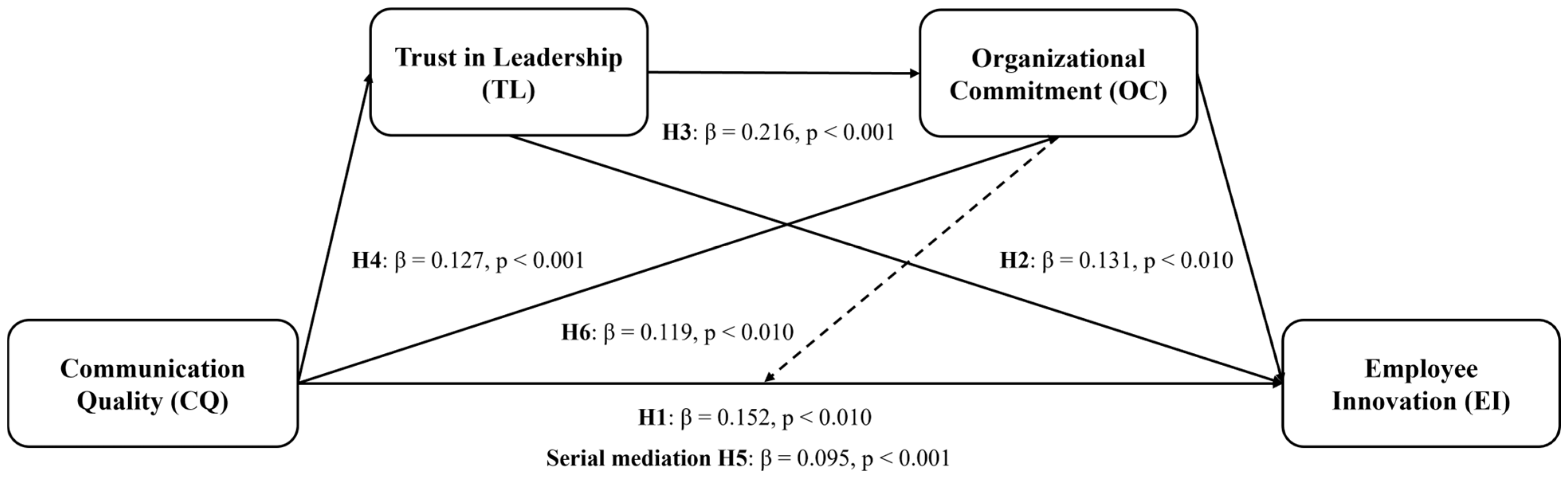
| CQ → EI | 0.152 ** | 0.052 | 2.928 | 0.083 | 0.003 | 0.055 | 0.256 | Supported |
| CQ → TL | 0.635 *** | 0.040 | 15.877 | 0.676 | 0.001 | 0.558 | 0.711 | Supported |
| CQ → OC | 0.289 *** | 0.059 | 4.884 | 0.177 | 0.001 | 0.170 | 0.403 | Supported |
| TL → OC | 0.340 *** | 0.059 | 5.796 | 0.108 | 0.001 | 0.224 | 0.453 | Supported |
| TL → EI | 0.206 ** | 0.061 | 3.388 | 0.068 | 0.002 | 0.084 | 0.326 | Supported |
| OC → EI | 0.438 *** | 0.057 | 7.620 | 0.215 | 0.001 | 0.323 | 0.551 | Supported |
| Mediation Analysis | ||||||||
| CQ → TL → EI | 0.131 ** | 0.041 | 3.156 | - | 0.002 | 0.052 | 0.217 | Supported |
| CQ → TL → OC | 0.216 *** | 0.042 | 5.219 | - | 0.001 | 0.138 | 0.301 | Supported |
| CQ → OC → EI | 0.127 *** | 0.032 | 3.947 | - | 0.001 | 0.069 | 0.197 | Supported |
| Serial Mediation Analysis | ||||||||
| CQ → TL → OC → EI | 0.095 *** | 0.022 | 4.279 | - | 0.001 | 0.056 | 0.142 | Supported |
| Control Variables | ||||||||
| Firm age → EI | −0.035 | 0.046 | 0.755 | - | −0.124 | 0.055 | 0.450 | NS |
| Firm size → EI | 0.175 * | 0.086 | 2.024 | - | 0.001 | 0.336 | 0.043 | Significant |
| Work experience → EI | −0.032 | 0.047 | 0.675 | - | −0.124 | 0.060 | 0.500 | NS |
| Job position → EI | 0.047 | 0.098 | 0.484 | - | −0.143 | 0.241 | 0.628 | NS |
| Relationships | β | SE | t-Values | p-Values | CIs | Results | |
|---|---|---|---|---|---|---|---|
| 2.5% | 97.5% | ||||||
| Moderation analysis | |||||||
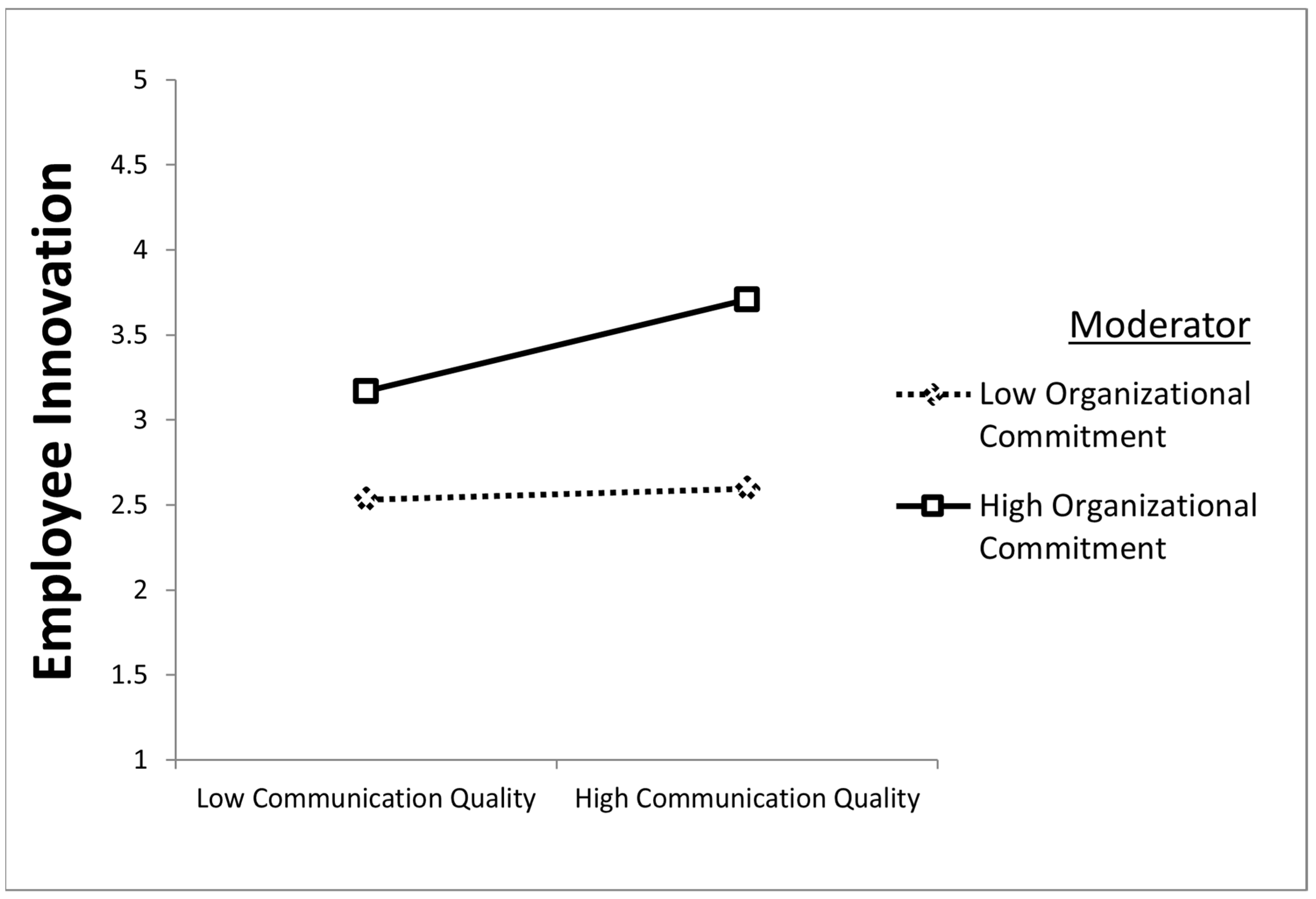
| CQ × OC → EI | 0.119 ** | 0.036 | 3.308 | 0.002 | 0.050 | 0.194 | Supported |
| Interaction Effect | R2 | f2 | Effect Size | |
|---|---|---|---|---|
| R2 with the Moderator | R2 Without the Moderator | |||
| CQ × OC → EI | 0.413 | 0.265 | 0.252 | Moderate |
| Hypothesis | Relationship Tested | Result | Supported |
|---|---|---|---|
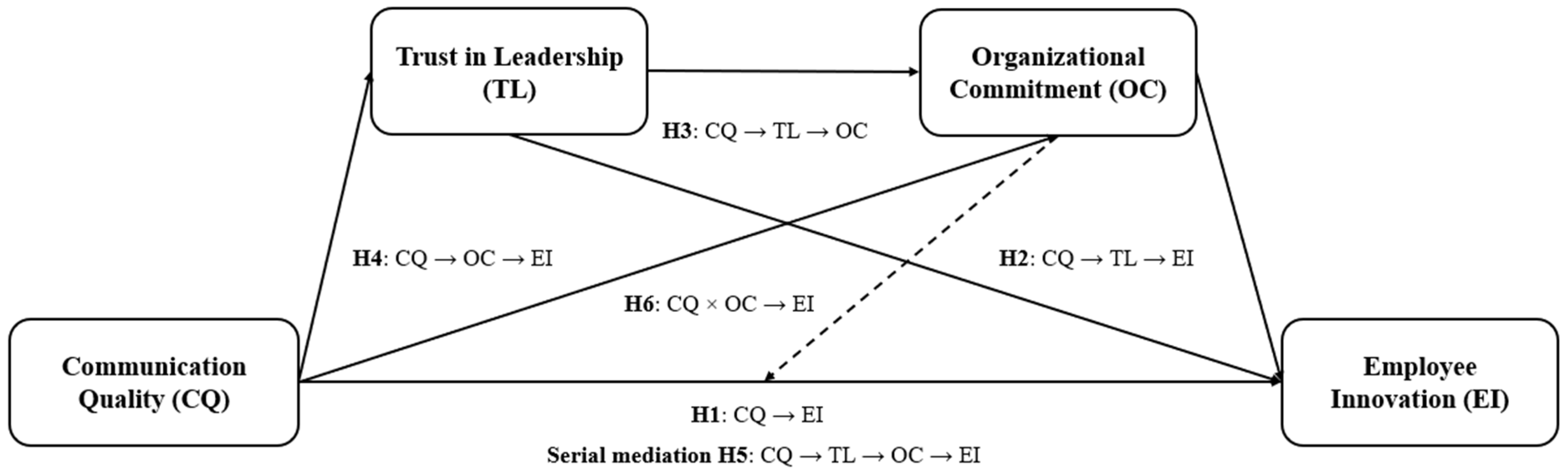
| H1 | CQ → EI | Direct effect | Supported |
| H2 | CQ → TL → EI | Mediation effect | Supported |
| H3 | CQ → TL → OC | Mediation effect | Supported |
| H4 | CQ → OC → EI | Mediation effect | Supported |
| H5 | CQ → TL → OC → EI | Serial mediation | Supported |
| H6 | CQ × OC → EI | Moderation effect | Supported |
Disclaimer/Publisher’s Note: The statements, opinions and data contained in all publications are solely those of the individual author(s) and contributor(s) and not of MDPI and/or the editor(s). MDPI and/or the editor(s) disclaim responsibility for any injury to people or property resulting from any ideas, methods, instructions or products referred to in the content. |
© 2025 by the authors. Licensee MDPI, Basel, Switzerland. This article is an open access article distributed under the terms and conditions of the Creative Commons Attribution (CC BY) license.
Share and Cite
Rajhi, M.; Aljuhmani, H.Y. Fostering Sustainable Innovation Through Communication Quality: The Sequential Role of Trust in Leadership and Organizational Commitment in Team-Based Enterprises. Sustainability 2026, 18, 554. https://doi.org/10.3390/su18020554
Rajhi M, Aljuhmani HY. Fostering Sustainable Innovation Through Communication Quality: The Sequential Role of Trust in Leadership and Organizational Commitment in Team-Based Enterprises. Sustainability. 2026; 18(2):554. https://doi.org/10.3390/su18020554
Chicago/Turabian StyleRajhi, Mohamed, and Hasan Yousef Aljuhmani. 2026. "Fostering Sustainable Innovation Through Communication Quality: The Sequential Role of Trust in Leadership and Organizational Commitment in Team-Based Enterprises" Sustainability 18, no. 2: 554. https://doi.org/10.3390/su18020554
APA StyleRajhi, M., & Aljuhmani, H. Y. (2026). Fostering Sustainable Innovation Through Communication Quality: The Sequential Role of Trust in Leadership and Organizational Commitment in Team-Based Enterprises. Sustainability, 18(2), 554. https://doi.org/10.3390/su18020554