Article

Robust Optimization Algorithm of Multi-Objective and Multi-Scenario Performance for Uncertain Microgrids Based on Lexicographic Order Method

Faculty of Artificial Intelligence, Shanghai University of Electric Power, Shanghai 200090, China
*
Author to whom correspondence should be addressed.
Sustainability 2026, 18(2), 1100; https://doi.org/10.3390/su18021100
Submission received: 26 December 2025 / Revised: 18 January 2026 / Accepted: 20 January 2026 / Published: 21 January 2026
(This article belongs to the Section Energy Sustainability)

Abstract

For microgrids with uncertainties in renewable energy generation and normal load demand, a robust multi-objective and multi-scenario performance optimization algorithm based on lexicographic order is proposed, which considers system economic cost, environmental cost, and user comfort as the objective functions. At first, historical data are processed using K-means clustering to extract typical scenario sequences. In the day-ahead scheduling stage, a lexicographic order method is applied to sequentially optimize the three objectives: economic cost, environmental cost, and user comfort. For each objective, robust optimization is performed by adopting the probability-weighted sum of the cost functions as the objective function. It obtains the optimal solution that ensures superior performance for typical scenarios. Subsequently, a robustness test is conducted under constraints that guarantee normal equipment operation and power balance for all scenarios. In the intraday scheduling stage, measured data of renewable energy and normal load are employed, and deviations in conventional power generation and grid interaction are penalized based on the day-ahead scheduling results. This adjustment improves the economic efficiency of the microgrid operation.

1. Introduction

Faced with the dual challenges of climate change and the energy crisis, the development and utilization of renewable energy have become pivotal for global green and low-carbon development [1,2]. As a power system composed of distributed generation units, the microgrid plays an important role in promoting the large-scale integration of renewables. Wind power, photovoltaic (PV) generation, and other renewable sources are key components of microgrids, but their outputs depend on natural conditions. The inherent intermittency and uncertainty of these sources introduce significant complexity into the optimal operation of microgrids [3,4].
For microgrid systems subject to uncertainty, commonly used optimal scheduling methods include stochastic programming, robust optimization, and distributionally robust optimization. Stochastic optimization primarily analyzes the probability distributions of uncertain parameters [5,6,7], and its performance hinges on whether the distributional characteristics of random variables can be accurately captured—this factor directly affects the accuracy of the optimal scheduling results. Ref. [8] proposed a method for generating typical microgrid operating scenarios based on deep temporal clustering. Compared with traditional clustering methods, the proposed approach demonstrates a stronger capability to extract complex temporal features and thus yields more representative typical operating scenarios. To address random fluctuations in PV output and normal load demand in a PV–storage–hydrogen DC microgrid, Ref. [9] developed an optimization strategy based on chance-constrained programming. To deal with renewable power uncertainty, Ref. [10] adopted a stochastic optimization approach that integrates scenario generation and reduction techniques.
Robust optimization can obtain the fluctuation bounds of uncertain parameters from historical data (without requiring prior knowledge of scenario probability distributions). It enforces constraint satisfaction for all scenarios within the uncertainty set, thereby computing the optimal solution corresponding to the worst-case scenario. For multi-element microgrid systems, Ref. [11] considered operational constraints and coordinated control of controllable distributed generation, demand-side loads, and storage, establishing a two-stage robust optimization model with a min–max–min structure. This model was solved using strong duality and a column-and-constraint generation algorithm [12] to obtain the optimal scheduling solution. Ref. [13] proposed a multi-time-scale optimal scheduling model that integrates demand response, analyzes system capacity and cost linkages, and further incorporates failure rates under typhoon disaster scenarios to construct a complete day-ahead and intraday scheduling framework. Ref. [14] used the expected-scenario system economy as the optimization objective and then adjusted the scheduling solution via robustness test, thereby achieving the system goal of “optimal performance under the expected scenario and feasibility under the worst scenario”.
Distributionally robust optimization (DRO) combines stochastic programming and robust optimization in handling microgrid uncertainty; it generates ambiguity sets of probability distributions from historical data to characterize uncertain variables. Ref. [15] designed a distributionally robust algorithm for microgrids that seeks the worst-case probability distribution within the ambiguity set and then computes the optimal device outputs under that worst-case distribution. Ref. [16] generated typical daily scenarios via an improved K-means clustering algorithm and constrained the uncertainty probability distribution’s confidence set using both the 1-norm and the ∞-norm. Ref. [17] proposed a two-stage distributionally robust optimization method for multi-energy microgrids, constructing a Wasserstein ambiguity set to characterize source-and-load uncertainty by combining covariates with multivariate decision-tree regression. Ref. [18] used Copula functions to construct an ambiguity set that captures dependence, and based on this set and chance constraints, established a distributionally robust chance-constrained optimal scheduling model for multi-energy microgrids that accounts for uncertainty correlation.
In robust multi-objective optimization research, multi-objective intelligent algorithms can obtain Pareto fronts for economic and environmental costs [19,20,21]. Microgrid operation optimization must also account for multiple other factors such as system stability and energy efficiency, which increases scheduling complexity. Ref. [22], while comprehensively balancing microgrid economy and user comfort, compared shiftable and non-shiftable states of interruptible loads but paid insufficient attention to the effects on multiple types of mixed loads. Ref. [23] constructed an improved user satisfaction model to accommodate multiple classes of mixed loads and solved the problem using an enhanced multi-objective grey wolf optimizer.
Although Refs. [5,6,7,8,9,10,11,12,13,14,15,16,17,18] can handle uncertainty, they focus only on single-objective performance. Refs. [19,20,21,22,23] can optimize multiple objectives but do so only for preset deterministic scenarios, lacking responsiveness to uncertainty and failing to guarantee multi-scenario performance. When real scenarios deviate from the preset deterministic ones, these algorithms tend to be conservative. In summary, to balance multi-objective performance (multi-scenario performance), this paper draws on the concept of lexicographic optimization and proposes a robust optimization algorithm of multi-objective and multi-scenario performance for uncertain microgrids. Specifically, in the day-ahead scheduling stage, K-means clustering is first applied to extract typical scenarios from historical wind and PV data. Next, a lexicographic multi-objective optimization method is adopted—primarily optimizing economic cost while also considering environmental cost and user comfort—and multi-scenario performance optimization is conducted on the representative scenario set. Finally, the scheduling solution is adjusted through robustness tests to achieve the system objective of “optimal performance for typical scenarios and feasibility under the worst scenario”, thereby providing decision support for practical operation. In the intra-day scheduling stage, penalties are imposed on gas-turbine power deviations and deviations in power exchange with the main grid to further refine and adjust the day-ahead optimization solution.

2. Structure and Mathematical Model of Grid-Connected Microgrids

2.1. Basic Structure of Microgrids

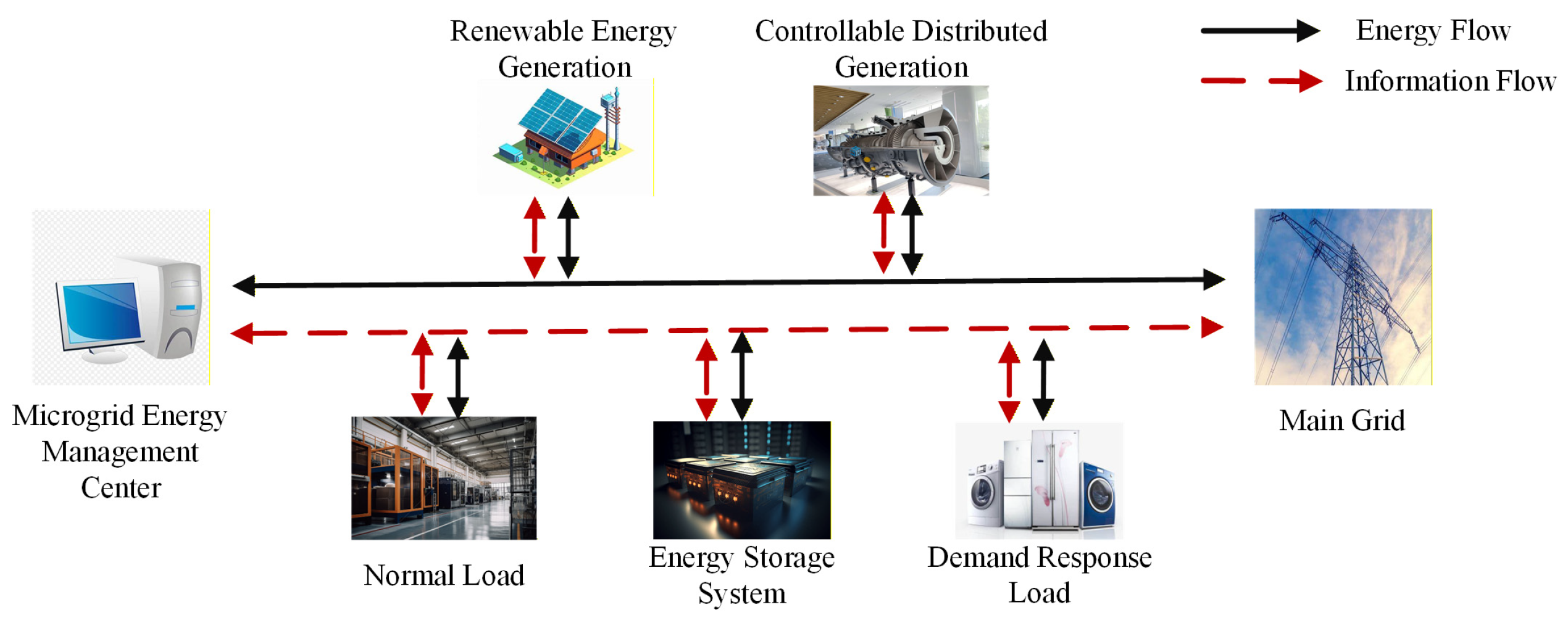
This study investigates a grid-connected microgrid composed of photovoltaic (PV) generation units, controllable distributed generators, energy storage systems, conventional normal loads, and demand response loads, as illustrated in Figure 1.

2.2. Mathematical Model of the Microgrid

2.2.1. Model of Controllable Distributed Generators

In this study, micro gas turbines are used as representative controllable distributed generation units. During operation, micro gas turbines are constrained not only by their installed capacity and minimum/maximum output limits but also by ramping capabilities:
P M T min P M T ( t ) P M T max
Δ P M T min P M T ( t ) P M T ( t 1 ) Δ P M T max
where P M T ( t ) is the output power of the micro gas turbine at time t; P M T min and P M T max are the maximum and minimum output limits of the micro gas turbine, respectively; Δ P M T min and Δ P M T max are the minimum and maximum ramp power of the micro gas turbine, respectively.
Its cost function is given by:
C M T ( t ) = ( C M T a + C M T b ) P M T ( t )
where C M T a and C M T b represent the fuel cost coefficient and the maintenance cost coefficient of the micro gas turbine, respectively.

2.2.2. Energy Storage System (ESS) Model

The energy storage system (ESS) can effectively mitigate the inherent intermittency and variability of renewable energy sources such as wind and solar power. Through charging and discharging operations, it enables temporal shifting of energy, playing a key role in peak shaving and valley filling. In the event of grid faults, the ESS can rapidly switch to provide backup power, ensuring uninterrupted supply to critical normal loads and enhancing both supply reliability and power quality. During microgrid operation and scheduling, the dynamics of ESS can be described by the following charging and discharging equations:
E ES ( t ) = E ES ( 0 ) + μ c t = 1 t [ P ES c h ( t ) Δ t ] 1 μ d t = 1 t [ P ES d i s ( t ) Δ t ]
E ES ( 0 ) = E ES ( N T )
E ES min E ES ( t ) E ES max
where the state variable E ES ( t ) represents the state of charge of the energy storage system at time t. E ES ( 0 ) is the initial state of charge of the energy storage system. μ c and μ d denote the charging efficiency and discharging efficiency of the energy storage system, respectively. P ES d i s ( t ) and P ES c h ( t ) represent the charging power and discharging power of the energy storage system, respectively. Equation (4) describes the evolution of the state of charge from the initial condition E ES ( 0 ) according to charging and discharging actions during the interval. N T represents the scheduling period, typically set to 24 h. Equation (5) indicates that the ESS must satisfy the condition that its initial and final energy levels are equal, which can facilitate cyclic scheduling of the microgrid [11]. E ES min and E ES max represent the minimum and maximum state-of-charge limits of the energy storage system, respectively. The boundary conditions (6) ensure that the energy storage operates within its physical capacity limits over the entire scheduling horizon.
The following charging and discharging constraints must also be satisfied during the operation of the energy storage system:
0 P ES c h ( t ) U ES ( t ) P ES max ( t )
0 P ES dis ( t ) [ 1 U ES ( t ) ] P ES max ( t )
where P ES d i s ( t ) and P ES c h ( t ) represent the charging power and discharging power of the energy storage system, respectively. U ES ( t ) represents the charging/discharging state of the energy storage system, and U ES ( t ) = 1 indicates charging, while U ES ( t ) = 0 indicates discharging. P ES max ( t ) denotes the maximum allowable charging/discharging power of the energy storage system.
Charging and discharging cost of the energy storage system:
C ES ( t ) = C ES k [ P ES d i s ( t ) / μ d + P ES c h ( t ) μ c ]
where C ES k is the cost coefficient of charging and discharging.

2.2.3. Demand-Response Load Model

During fluctuations in microgrid power demand, demand-response loads can be adjusted to alleviate the load stress on the microgrid. However, such adjustments may impact user experience, and thus appropriate compensation to users is required.
The operational constraints that demand-response loads must satisfy are as follows:
P DR min P DR ( t ) P DR max
t = 1 N T P DR ( t ) = D DR
where P DR ( t ) represents the actual power of the demand-response load at time t. P DR min and P DR max denote the minimum and maximum limits of the demand-response load, respectively. D DR represents the total energy of the demand-response load over the entire scheduling period.
The compensation cost is given by:
C DR ( t ) = K DR P DR ( t ) P DR ( t ) Δ t
where K DR is the compensation cost coefficient for the demand-response load. P DR ( t ) denotes the scheduled power of the demand-response load at time t. By introducing auxiliary variables P DR 1 t and P DR 2 t , Equation (12) is linearized as follows:
C DR t = K DR P DR 1 t + P DR 2 t Δ t
P DR t P DR t + P DR 1 t P DR 2 t = 0
P DR 1 t 0 , P DR 2 t 0

2.2.4. Power Interaction Model of Microgrid

To ensure the safe operation of the microgrid, power exchange with the main grid is necessary to maintain power balance. The power exchanged between the microgrid and the main grid must satisfy the following constraints:
0 P G b u y t U G t P G max
0 P G s e l l t 1 U G t P G max
where P G b u y t and P G s e l l t represent the microgrid’s power purchased from and sold to the main grid, respectively. U G t is a binary variable, and U G t = 1 indicates purchasing power from the main grid, while U G t = 0 indicates selling power to the main grid. P G max denotes the maximum allowable power exchange between the microgrid and the main grid.
The cost function for power exchange with the main grid is given by:
C G t = K G t P G b u y t P G s e l l t Δ t
where K G t is the day-ahead electricity price of the main grid.

2.2.5. Environmental Management Model

The treatment cost of pollutants generated during the operation of the gas turbine is given by:
C M T . E N ( t ) = i = 1 M 10 3 C i p c ξ i P M T t
The treatment cost of pollutants generated during power exchange between the microgrid and the main grid is given by:
C G . E N ( t ) = i = 1 M 10 3 C i p c ξ G . i P G b u y t
where M denotes the number of types of emitted pollutants. i represents the types of emitted pollutants, such as C O 2 , S O 2 and N O X . C i p c is the cost of treating 1 kg of pollutant i . ξ i is the penalty coefficient for pollutant i generated during the operation of the gas turbine. ξ G . i denotes the penalty coefficient for pollutant i generated during power exchange with the main grid.

2.2.6. Power Balance Constraint

The microgrid must satisfy the power balance constraint at all time periods:
P M T t + P E S d i s t + P P V t + P G b u y t = P E S c h t + P D R t + P L t + P G s e l l t
where P L t denotes normal load. This constraint ensures supply–demand balance within the microgrid at each time step.

2.3. Objective Functions of the Model

Based on the above basic structure of the microgrid, this study proposes three objective functions for the management of grid-connected microgrids.

2.3.1. Economic Cost of the Microgrid System

f e c o = t = 1 N T C M T ( t ) + C E S ( t ) + C D R ( t ) + C G ( t )

2.3.2. Environmental Protection Cost of the Microgrid

f e n = t = 1 N T C M T . E N ( t ) + C G . E N ( t )

2.3.3. User Comfort

The shifting rate of demand-response loads is given by:
f c o m = t = 1 N T P DR ( t ) P DR ( t ) t = 1 T P DR ( t )
User comfort is defined as:
M = 1 f c o m
Since maximizing user comfort M is equivalent to minimizing the shifting rate f c o m , the following sections of this study carry out user comfort optimization by minimizing the shifting rate f c o m .

3. Typical Scenario Set

3.1. Uncertainty Set

Renewable generation and conventional normal loads typically exhibit fluctuations during microgrid operation and are thus uncertain. This study employs a polyhedral uncertainty set to represent the uncertainties in generation and normal load power within the microgrid:
U : = u = u P V t , u L t T R N T × 2 , t = 1 , 2 N T | u P V t u ^ P V t Δ u P V max t , u ^ P V t + Δ u P V max t u L t u ^ L t Δ u L max t , u ^ L t + Δ u L max t
where u ^ P V t and u ^ L t represent the predicted values of renewable generation and normal load power, respectively. Δ u P V max t and Δ u L max t denote the maximum fluctuation ranges of renewable generation and normal load power, respectively.

3.2. Typical Scenario

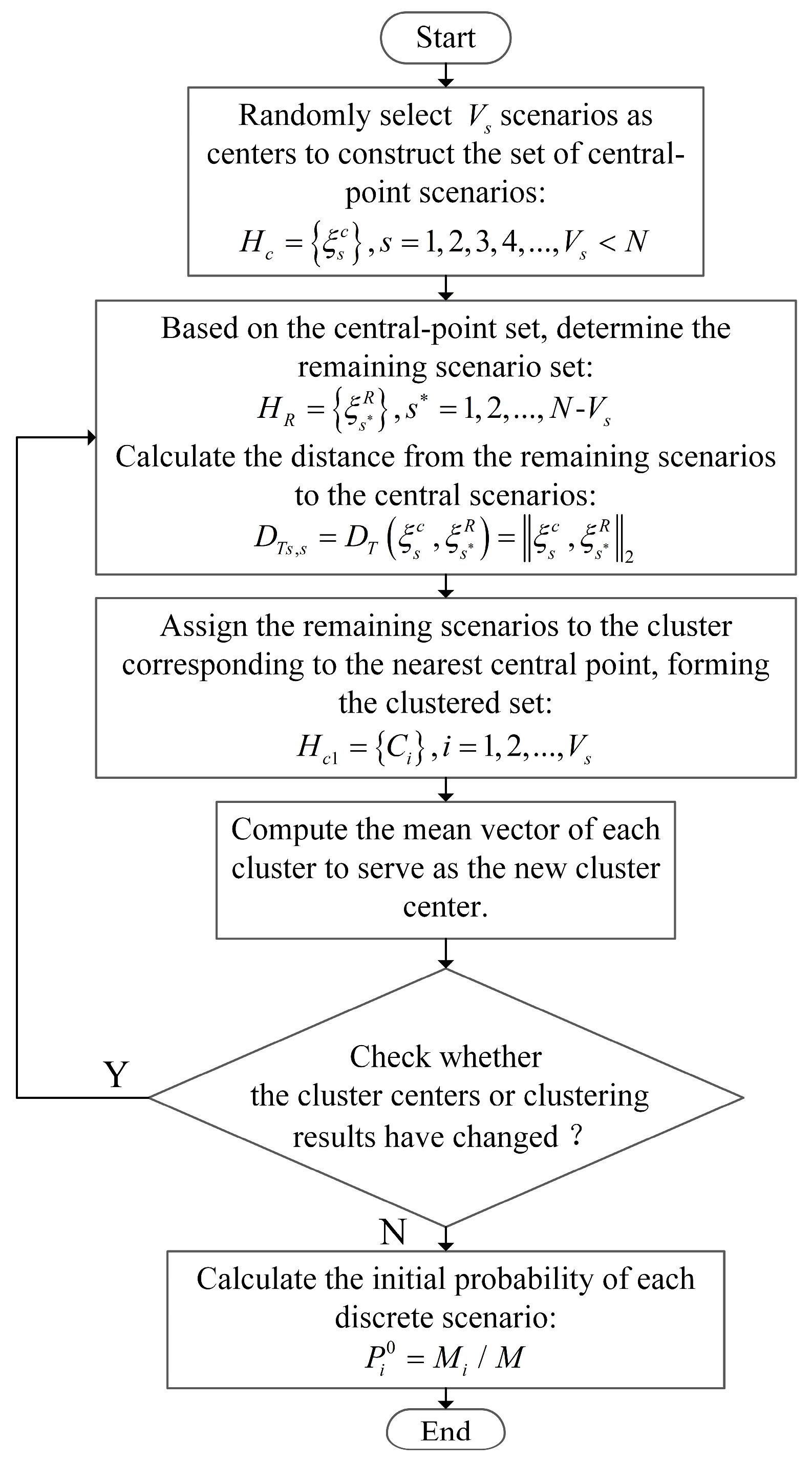
In microgrid optimal scheduling, due to the significant uncertainty and variability of wind and photovoltaic (PV) generation, directly using all historical power data for optimization often results in a huge computational burden and makes it difficult to capture key operational characteristics. This study employs the K-means clustering algorithm [24] to reduce dimensionality and summarize historical data, condensing numerous possible output profiles into a limited number of typical output patterns that represent different operational states, referred to as typical scenarios. Utilizing typical scenarios not only greatly reduces the number of scenarios and improves computational efficiency but also ensures robust system performance under various representative operating conditions. First, let the number of historical scenarios be M , using the K-means clustering algorithm, K scenario clusters U i i = 1 , , K are obtained, with each cluster containing M i historical scenarios, then i = 1 K M i = M . The centre of each scenario cluster U i i = 1 , , K serves as the typical scenario u i , approximately representing the other scenarios within the cluster. Its corresponding initial probability is calculated as: P i 0 = M i / M , and the typical scenario sequence is constructed based on the set of typical scenarios: U d = u 1 , u 2 , , u K . The specific procedure is illustrated in Figure 2.
Considering that the worst-case scenarios for photovoltaic generation and normal load usually occur at the boundaries, the following sequence of typical scenario sets Ω d is constructed based on the typical scenario sequence U d :
Ω d : = u d u P V , d ( t ) , u L , d ( t ) T N T × 2 , t = 1 , 2 N T u j , d t = u j , d t + τ j , d , t + τ j , d , t Δ u j , d t τ j , d , t + , τ j , d , t 0 , 1 τ j , d , t + + τ j , d , t 1 t = 1 N T τ j , d , t + + τ j , d , t Γ j , d   , j P V , L
where u j , d ( t ) represents the actual operating power of photovoltaic generation and normal load. u j , d ( t ) and Δ u j , d t represent the expected value of the forecasted operation and the maximum deviation from the forecasted expectation, respectively. τ j , d , t + and τ j , d , t represent the robustness parameters of photovoltaic generation and normal load, respectively.

3.3. Optimization Model Based on Typical Scenario

The following symbols are defined:
x = U E S t , U G t T y = P M T t ,   P E S c h t ,   P E S d i s t ,   P DR t ,   P DR 1 t ,         P DR 2 t ,   P G b u y t ,   P G s e l l t ,   P P V t ,   P L t T         t = ( 1 , 2 , , N T ) f 1 ( x , y ) = f e c o = c e c o T y f 2 ( x , y ) = f e n = c e n T y f 3 ( x , y ) = f c o m = c c o m T y
where vectors c e c o , c e n and c c o m represent the coefficients corresponding to the economic cost, environmental cost, and comfort functions, respectively.
The priority of objectives is independent of the scenario and is fixed. Firstly, within power system dispatch, the primary objectives are ensuring economic viability and fundamental safety. Secondly, environmental goals (such as meeting emission standards) are pursued only after these prerequisites are satisfied. Finally, while balancing cost and environmental considerations, efforts are made to minimize disruption to users to enhance acceptance. Therefore, the optimization model of the microgrid can be further described in a compact form as follows:
min x , y   max u U d ( f 1 ( x , y ) ,   f 2 ( x , y ) , f 3 ( x , y ) )
s . t .     D x + F y G u H x = ( x 1 , x 2 , x 2 N T ) T x i 0 , 1 , i 1 , 2 , , 2 N T
y 0
where D , F , G and H are, respectively, the coefficient matrices and constant column vector corresponding to constraints (1), (2), (4)–(8), (10), (11), (13)–(17) and (21). Thus, Equation (30) guarantees that x and y must satisfy the above constraints across all scenarios. The optimization model (29) can be solved to determine the optimal equipment output x and y for the microgrid, thereby enhancing its system performance.

4. Robust Optimization Algorithm of Multi-Objective and Multi-Scenario Performance for Uncertain Microgrids Based on Lexicographic Order Method (MOMSPLO)

4.1. Day-Ahead Scheduling Stage

Traditional multi-objective computation methods include weighted summation and ε-constraint approaches. The weighted summation method relies on weight selection, which introduces subjective arbitrariness. The lexicographical method strictly adheres to a predefined objective priority sequence, thereby eliminating subjective trade-offs entirely and thus outperforming weighted summation in terms of performance. The ε-constraint method necessitates cumbersome iterative adjustments, whereas the lexicographical approach demonstrates superior computational efficiency, rendering it also preferable to the ε-constraint method.
By use of lexicographical order method, the optimization processes multiple targets in a layered manner according to a predefined priority sequence based on their importance. It incorporates the optimal solution of the previous layer as a constraint in the subsequent layer. The final solution of the last layer is taken as the solution to the overall multi-objective problem [25]. The specific procedure is as follows: first, the most important objective is optimized independently to obtain its optimal value, which is then used as a constraint for optimizing the second most important objective. Subsequently, the optimal values of the first two objectives are used as constraints to optimize the third objective, and this process continues sequentially until all objectives are addressed according to their priority. In this study, the procedure is implemented in three steps as follows:
1.
Taking the economic cost of the microgrid system as the primary objective, the performance corresponding to the sequence of typical scenarios is optimized. The optimization model can be formulated as:
min x , y   α 1
s . t . m = 1 K p m c e c o T y m α 1     D x + F y 1 G u 1 H     D x + F y K G u K H
x X , y 0
where the objective function (32) takes into account the probability of each typical scenario and its corresponding economic cost, thereby balancing the economic performance across all scenarios. The solution to optimization problem (32) is denoted as α 1 for convenience of reference in the subsequent discussion.
2.
With the microgrid’s environmental protection cost taken as the second-level optimization objective and the microgrid system’s economic cost treated as a constraint, the following objective function can be formulated as:
min x , y   α 2
s . t . m = 1 K p m c e n T y m α 2   m = 1 K p m c e c o T y m ( 1 + θ 1 ) α 1     D x + F y 1 G u 1 H     D x + F y K G u K H
x X , y 0
where 0 θ 1 1 is the preset value introduced to achieve balance between economic performance and environmental performance. Here, the solution to optimization problem (35) is denoted as α 2 for ease of reference in subsequent discussions.
3.
Subsequently, user comfort—represented by minimizing the demand response load shifting rate—is set as the third-level optimization objective. By incorporating the optimal values obtained from the first two steps as constraints, a compromise solution is obtained that maximizes user satisfaction while maintaining prioritized economic operation and environmental performance. The objective function is expressed as:
min x , y m = 1 K p m c c o m T y m
s . t . m = 1 K p m c e n T y m ( 1 + θ 2 ) α 2   m = 1 K p m c e c o T y m ( 1 + θ 1 ) α 1     D x + F y 1 G u 1 H     D x + F y K G u K H
x X , y 0
where 0 θ 2 1 is the preset value introduced to achieve balance among economic performance, environmental performance, and user comfort. The optimal value of x obtained from solving optimization Equation (38) is denoted as x for ease of reference in subsequent discussions.

4.2. Robustness Test Model

To ensure that the day-ahead scheduling solution is robust against uncertainties, researchers typically adopt the concept of a two-stage zero-sum game [26]. In this study, during the day-ahead scheduling stage, the pre-scheduling solution is obtained by optimizing performance across multiple scenarios, and its performance under the worst-case scenario is evaluated through a robustness test process to ensure that the power balance constraints are satisfied. This verification confirms the stability and feasibility of the pre-scheduling solution under various scenarios. The approach not only enables the pre-scheduling solution to accommodate diverse scenario demands but also effectively addresses the challenges posed by uncertainties, thereby ensuring the safe operation of the microgrid system.
First, slack variables r t + and r t are introduced, and the power balance constraint is transformed into:
P G buy t + P MT t + P ES dis t + P PV t = P G sell t + P ES ch t + P DR t + P L t + r t + r t
A robustness test is performed on the final day-ahead scheduling solution, which can be mathematically expressed as follows:
R = max u Ω d   min y , r t + , r t t = 1 N T r t + + r t
s . t . u Ω d , y : F y G u D x H y 0
where Formula (43) represents the constraints related to y , specifically corresponding to (1), (2), (4)–(8), (10), (11), (13)–(17) and (27). R ( x ) = 0 indicates that the microgrid system can still satisfy the power balance when photovoltaic generation and normal load fluctuate within the polyhedral uncertainty set.
By applying strong duality theory, optimization problem (42) is reformulated into a maximization form, and the final robustness test model is expressed as follows:
R = max φ t + , φ t , λ t + , λ t , μ t + , β t + , π t + , π t , θ t + , θ t , κ t , ε t + , ω t + , σ t , ψ ,   z j , d , t + , z j , d , t , τ j , d , t + , τ j , d , t t = 1 N T P M T max φ t + + P M T min φ t + E E S max + E E S 0 π t + + E E S min E E S 0 π t U E S t P E S max μ t + + U E S t 1 P E S max β t +   + D D R γ t P D R max θ t + + P D R min θ t + P D R t κ t U G t P G max ε t + + U G t 1 P G max ω t + + λ 1 + P M T 0 Δ P M T max + λ 1 P M T 0 + Δ P M T min + ψ E E S 0 + t = 2 N T λ t + Δ P M T max + λ t Δ P M T min + [ u ^ L , d t u ^ P V , d t ] σ t + Δ u L , d ( t ) ( z L , d , t + z L , d , t ) Δ u P V , d ( t ) ( z P V , d , t + z P V , d , t )
s . t .   λ t + 1 φ t + + φ t + σ t 0 , t 1 , N T 1       μ t + + μ t η Δ t π t + σ t 0 , t 1 , N T 1       β t + + β t 1 η Δ t π t + + σ t 0 , t 1 , N T 1       1 σ t 1 , t 1 , N T         γ t θ t + + θ t + σ t 0 , t 1 , N T       ε t + + ε t + σ t 0 , t 1 , N T       ω t + + ω t σ t 0 , t 1 , N T       e t + + e t α t + 1 + α t 0 , t 1 , N T       λ N T + + λ N T φ N T + + φ N T + σ N T 0       e N T + + e N T + α N T + ψ 0         τ j , d , t + , τ j , d , t 0 , 1         τ j , d , t + + τ j , d , t 1         t = 1 N T τ j , d , t + + τ j , d , t Γ j , d   , j PV , L
Formula (43) contains constraints (1), (2), (4)–(8), (10), (11), (13)–(17), and (27). φ t + , φ t , λ t + , λ t , μ t + , μ t , β t + , β t , π t + , π t , θ t + , θ t , κ t , ε t + , ε t , ω t + , ω t , ψ , e t + , e t , α t , σ t , z j , d , t + , z j , d , t , τ j , d , t + , τ j , d , t are dual variables introduced for the above constraints, all taking non-negative values. Based on these dual variables, we can transform optimization problem (42) into (44) and transform Formula (43) into (45) by duality theory.
The robustness test of Formulas (44) and (45) is dense. However, it should be noted that the robustness test involves mathematical transformations based on strong duality theory. This mathematical transformation itself is a well-established theory, and the mathematical description of the transformation process is extremely lengthy. To present the mathematical transformations would disrupt the structure of the paper. Therefore, this paper only reports the conclusions of the robustness test. For detailed mathematical transformation, please refer to Ref. [27].
Let P M T t , P D R t , P G b u y t , P G s e l l t , P E S c h t , and P E S d i s t denote power output of the micro gas turbine, demand response load, power purchased from and sold to the main grid, and charging/discharging power of energy storage obtained in the day-ahead scheduling stage, respectively, for ease of reference in subsequent discussions.

4.3. Intraday Scheduling Stage

During the intraday scheduling stage, the adjustment of day-ahead optimal solution is executed based on real-time measurements of renewable generation and normal load. Due to the strong temporal coupling of the energy storage system and to maintain user experience, the charging/discharging states and power of the storage are kept unchanged. In this study, only the micro gas turbine output and the power exchanged with the main grid, as determined by the day-ahead stage, are adjusted to minimize the adjustment cost. The adjustment cost function is defined as follows:
C ADJ ( t ) = C MT ADJ ( t ) + C G ADJ ( t )
where C MT ADJ ( t ) represents the real-time adjustment cost of the micro gas turbine. C G ADJ ( t ) represents the real-time adjustment cost between the microgrid and the main grid.
(1)
Adjustment Cost of Micro Gas Turbine during Intraday Scheduling Stage
C MT ADJ ( t ) = K MT Δ P MT ( t ) + C MT p e n t
C MT p e n t = K MT a d d Δ P MT ( t ) 2 + Δ P MT ( t ) 2 + K MT d e c Δ P MT ( t ) 2 Δ P MT ( t ) 2
where K MT = K MT r + K MT m , Δ P MT ( t ) = P ^ MT ( t ) P MT ( t ) , P MT t represents the day-ahead optimal solution of the micro gas turbine, Δ P MT ( t ) represents the deviation, and K MT a d d / K MT d e c represent the penalty coefficients for the micro gas turbine power, respectively.
By introducing auxiliary variables P MT 1 t and P MT 2 t , Equation (48) can be transformed into a linear form:
C MT p e n t = K MT a d d + K MT d e c Δ P MT ( t ) 2 + K MT a d d K MT d e c P MT 1 t + P MT 2 t 2
Δ P MT ( t ) + P MT 1 t P MT 2 t = 0
P MT 1 t 0 , P MT 2 t 0
(2)
Real-Time Adjustment Cost of Microgrid and Main Grid
C G p e n t = K G t K G a d d max Δ P G b u y t , 0 + K G d e c min Δ P G b u y t , 0 + K G a d d max Δ P G s e l l t , 0 + K G d e c min Δ P G s e l l t , 0
where Δ P G b u y t = P ^ G b u y t P G b u y t , K G a d d and K G d e c represent the penalty coefficients for the power deviation when purchasing from and selling to the main grid, respectively. Δ P G s e l l t = P ^ G s e l l t P G s e l l t , P G b u y t represents the day-ahead scheduled power purchased from the main grid by the microgrid. P G s e l l t represents the day-ahead scheduled power sold from the microgrid to the main grid. Δ P G b u y t represents the power deviation of the interaction between the microgrid and the main grid. Δ P G s e l l t represents the power deviation of the microgrid’s electricity sold to the main grid.
Equation (52) is transformed into:
C G p e n t = λ t K G a d d P ^ G b u y t P G b u y t 2 + P ^ G b u y t P G b u y t 2 + K G d e c P ^ G b u y t P G b u y t 2 P ^ G b u y t P G b u y t 2 + K G a d d P ^ G s e l l t P G s e l l t 2 + P ^ G s e l l t P G s e l l t 2 + K G d e c P ^ G s e l l t P G s e l l t 2 P ^ G s e l l t P G s e l l t 2
By further introducing auxiliary variables P G 1 b u y , P G 2 b u y , P G 1 s e l l , and P G 2 s e l l , Equation (53) is transformed into:
C G p e n t = K G t { K G a d d + K G d e c Δ P G b u y t 2 + K G a d d K G d e c Δ P G b u y t 2 + K G a d d + K G d e c Δ P G s e l l t 2 + K G a d d K G d e c Δ P G s e l l t 2
Δ P G s e l l t + P G 1 s e l l t P G 2 s e l l t = 0
Δ P G b u y t + P G 1 b u y t P G 2 b u y t = 0
P G 1 s e l l t 0 , P G 2 s e l l t 0 P G 1 b u y t 0 , P G 2 b u y t 0
The power balance equation for the intraday scheduling stage is:
Δ P G b u y t + Δ P M T t + Δ P P V t = Δ P G s e l l t + Δ P L t
where Δ P PV t and Δ P L t represent the deviation power of photovoltaic generation and normal load, respectively.
Minimizing the intraday scheduling adjustment cost can be formulated as the following optimization model:
min Δ P M T ,   P M T 1 ,   P M T 2 , Δ P G b u y ,   Δ P G s e l l ,   P G 1 b u y ,   P G 2 b u y ,   P G 1 s e l l ,   P G 2 s e l l C M T a d j t + C G a d j t
s . t . 1 2 , 16 17 50 51 , 55 58
Additionally, with g = Δ P M T t , P M T 1 t , P M T 2 t , Δ P G b u y t ,   Δ P G s e l l t , P G 1 b u y t , P G 2 b u y t , P G 1 s e l l t , P G s e l l t , the model can be expressed in the following compact linear programming form:
min g   d T g s . t .   Q g v u r w D x k
where u r = P ^ P V t , P ^ L t , x k represents the robust feasible solution obtained in the day-ahead scheduling stage. The model is a deterministic mathematical programming problem, from which the power output of the micro gas turbine and the microgrid’s power purchased from or sold to the main grid can be obtained.

4.4. MOMSPLO Algorithm Flow

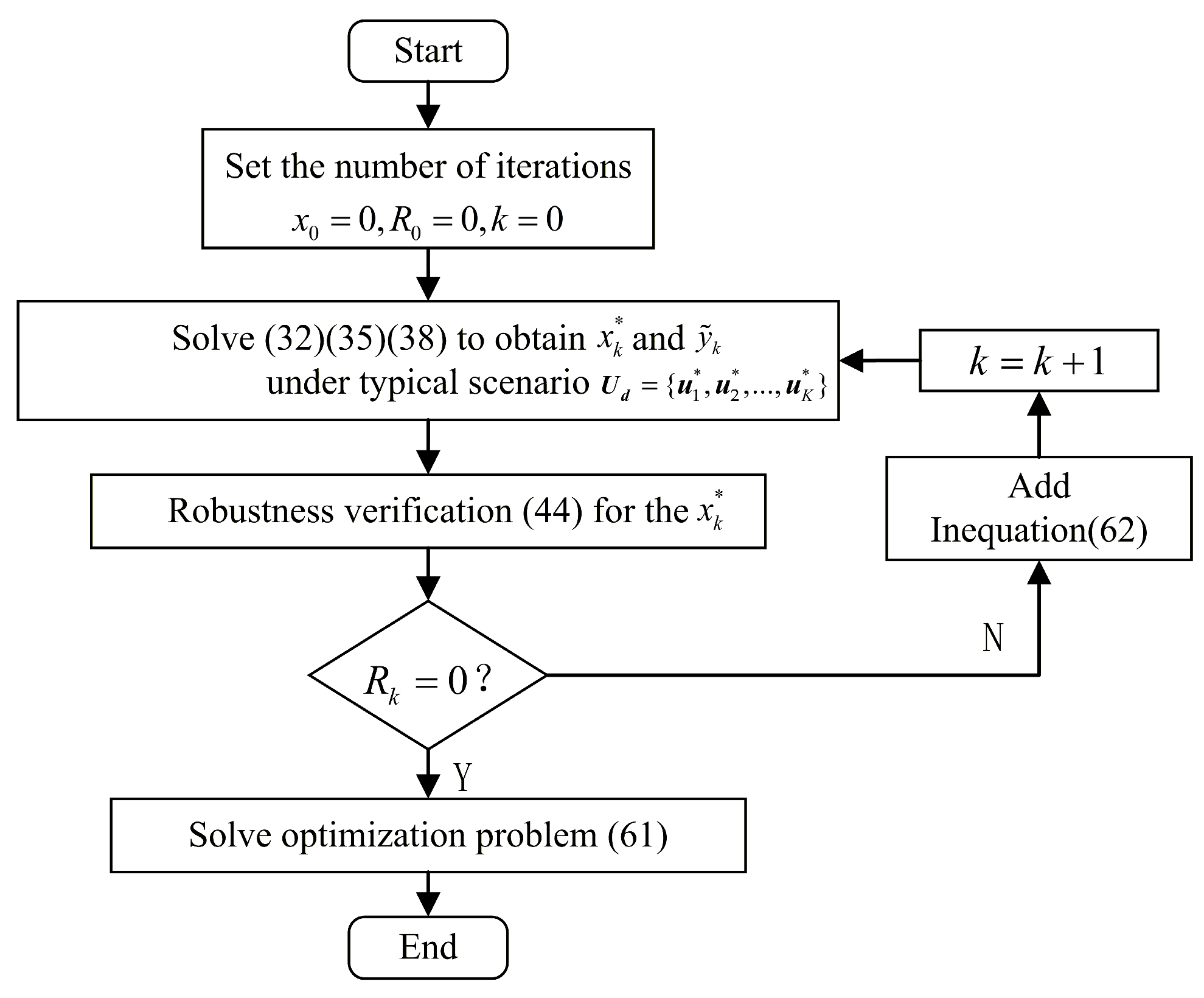
The specific algorithmic steps of the lexicographic multi-objective robust economic optimization algorithm for microgrids are as follows:
1.
Initialize parameters: set the number of clusters K , set the number of iterations k = 0 and the power gap R 0 = 0 ;
2.
obtain typical scenarios U i through K-means clustering, and use Equation (27) to construct the typical scenario set Ud;
3.
In the day-ahead scheduling stage, substitute U d = u 1 , u 2 , , u K into the pre-scheduling models Equations (32), (35) and (38) to obtain the pre-scheduling solutions x k and y ˜ k ;
4.
Perform robustness test (44) on the pre-scheduling solution x k . If R k = 0 , then x k is a robust feasible solution and proceed to step (5); if R k 0 , add the constraint in inequality (62):
D x + F y k + 1 G u k + 1 H
where u k + 1 represents the scenario optimization solution obtained from the robustness test (44);
Set k = k + 1 and return to step 3.
5.
During the intraday scheduling stage, based on real-time data of photovoltaic generation and normal load, solve the deterministic optimization problem (61) to obtain the intraday scheduling optimization solution.
Robust optimization algorithm of multi-objective and multi-scenario performance for uncertain microgrids based on lexicographic order method is presented in Figure 3.

5. Case Study

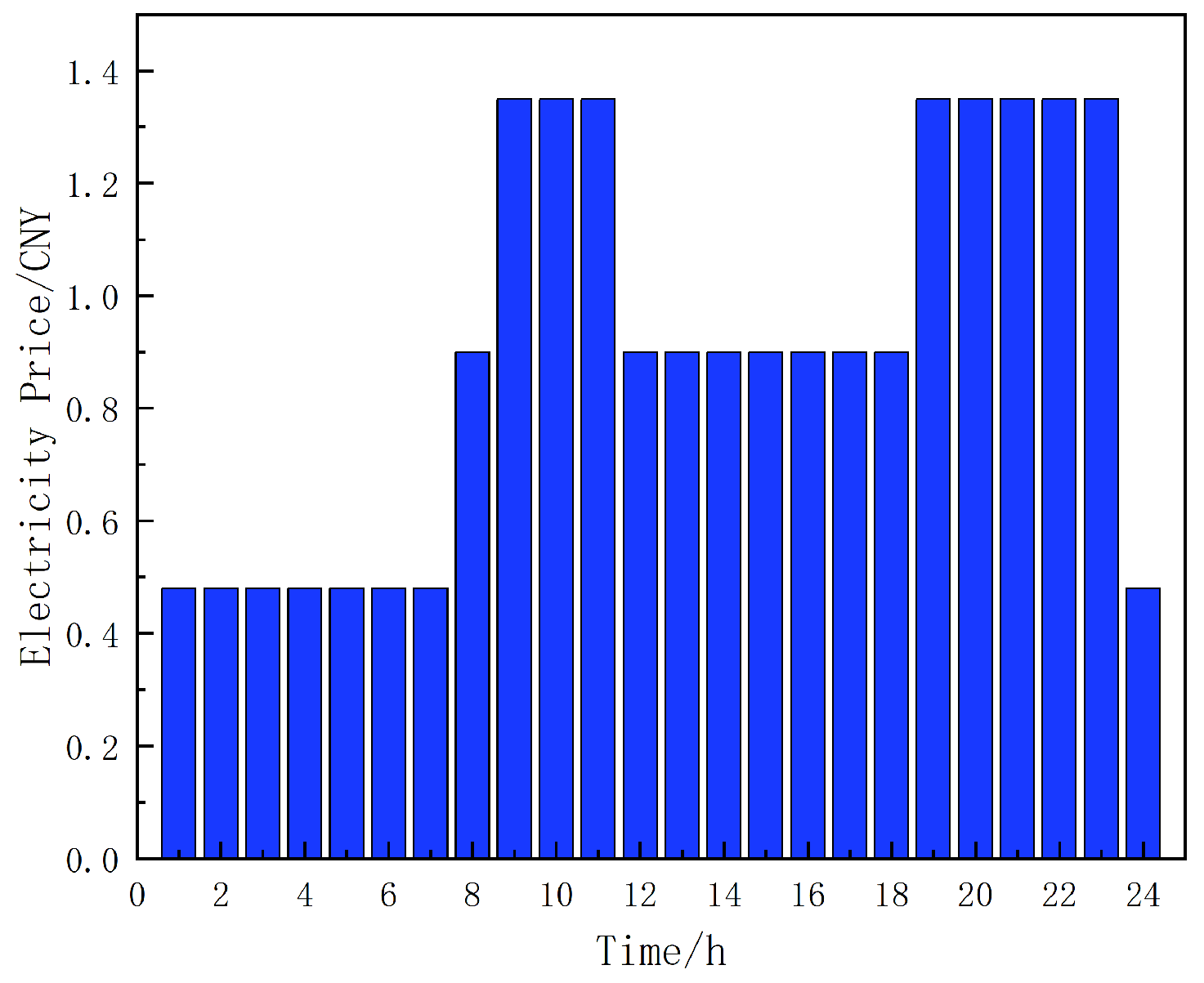
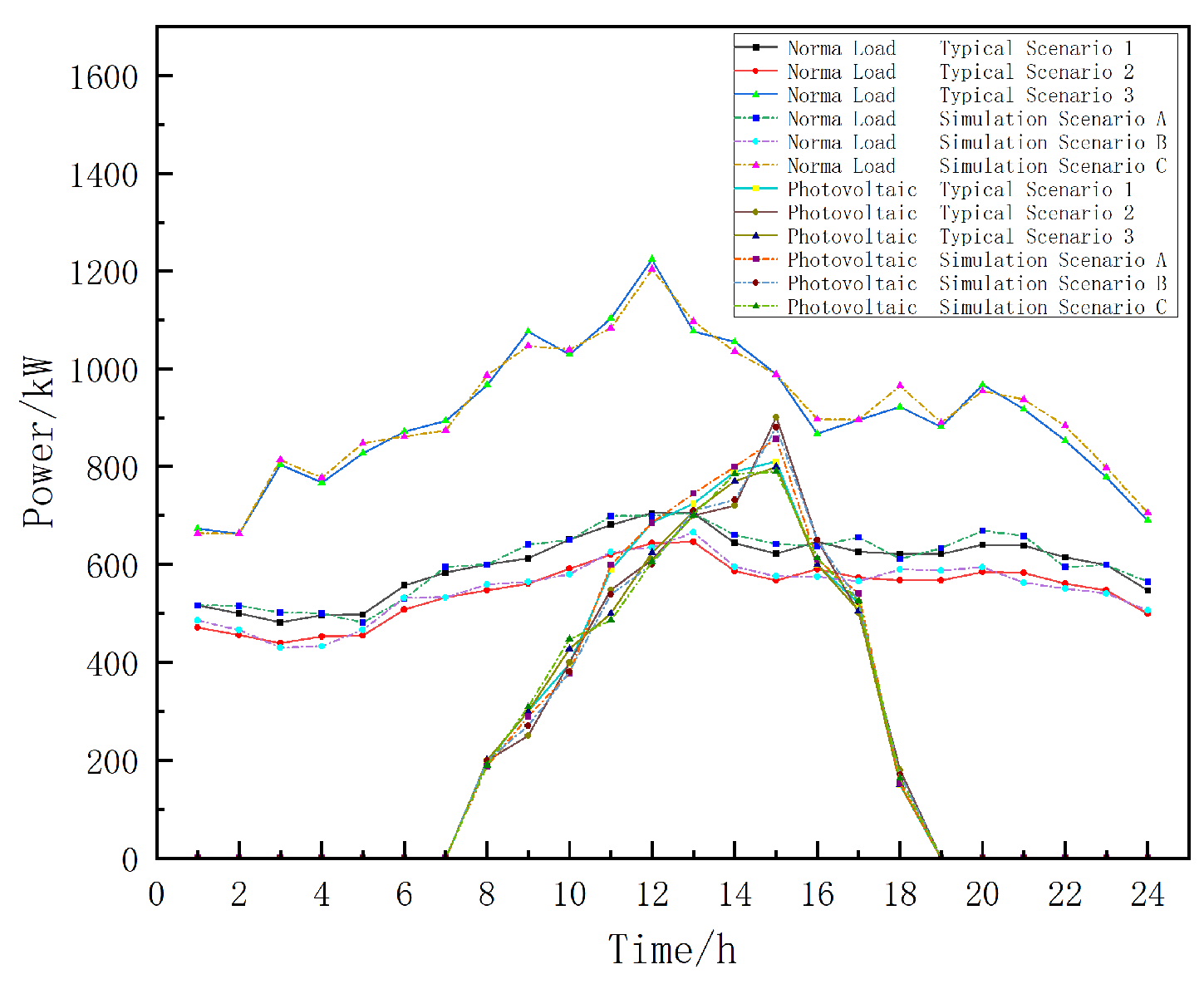
This study takes the grid-connected microgrid shown in Figure 1 as the simulation object to verify the feasibility of the proposed algorithm. Table 1 summarizes the main parameters of various devices in the microgrid. Table 2 summarizes pollutant emission factors and treatment costs. During the simulation, the time-of-use electricity prices of a certain city are used as the trading prices between the microgrid and the main grid (see Figure 4). Based on a large amount of historical photovoltaic and normal load scenario data, the number of clusters is set to K = 3 for data classification, and the resulting typical scenario sequences are shown in Figure 5.
Three simulation scenarios are considered in this study: Scenario A, Scenario B, and Scenario C, as shown in Figure 5.
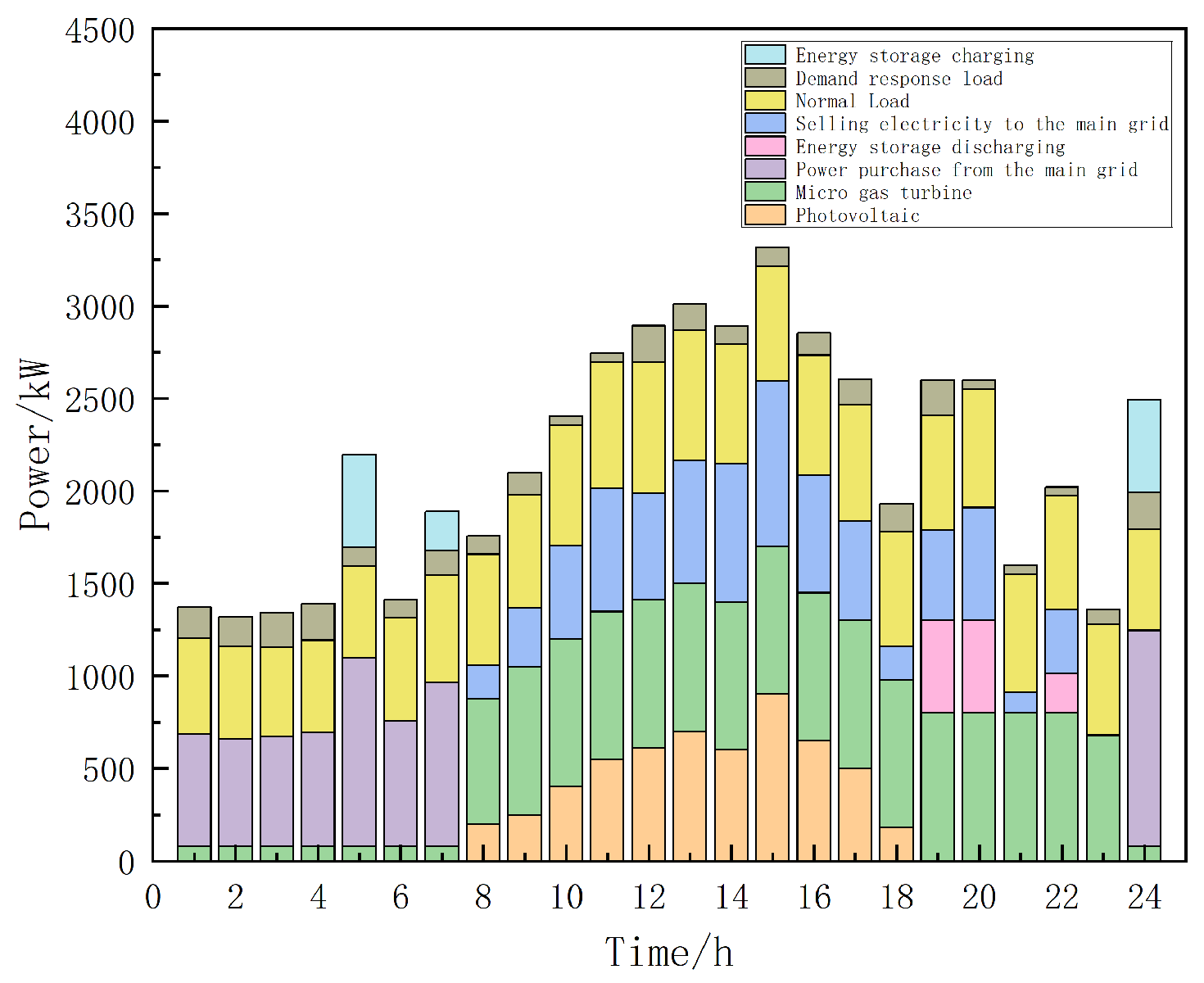
All simulations in this study were conducted on a computer using the commercial software IBM ILOG CPLEX 12.10.0. First, for Scenario A, the simulation results obtained using the proposed MOMSPLO method are presented in Figure 6 and Figure 7.
As shown in Figure 6, the micro gas turbine generates no power when photovoltaic output is available during the 1–7 h and 19–24 h periods. During 1–7 h and the 24th hour, the day-ahead electricity price (off-peak) is lower than the gas turbine’s generation cost. Consequently, the micro gas turbine operates at minimum power during these periods, while during higher price periods (10–22 h), it operates at maximum power to increase electricity sales to the main grid, thereby reducing the overall operational cost of the microgrid. The energy storage system charges at 5 h, 7 h, and 24 h, and discharges during 19–20 h and 22 h, performing peak shaving and valley filling to further lower the economic cost. During off-peak periods (1–7 h and 24 h), the microgrid purchases a large amount of electricity from the main grid to both meet normal load demand and charge the storage system, allowing it to supply the normal load or sell electricity at higher prices for profit. In the remaining periods, the microgrid sells surplus electricity to the grid while ensuring that power demand is met, thus obtaining additional revenue.
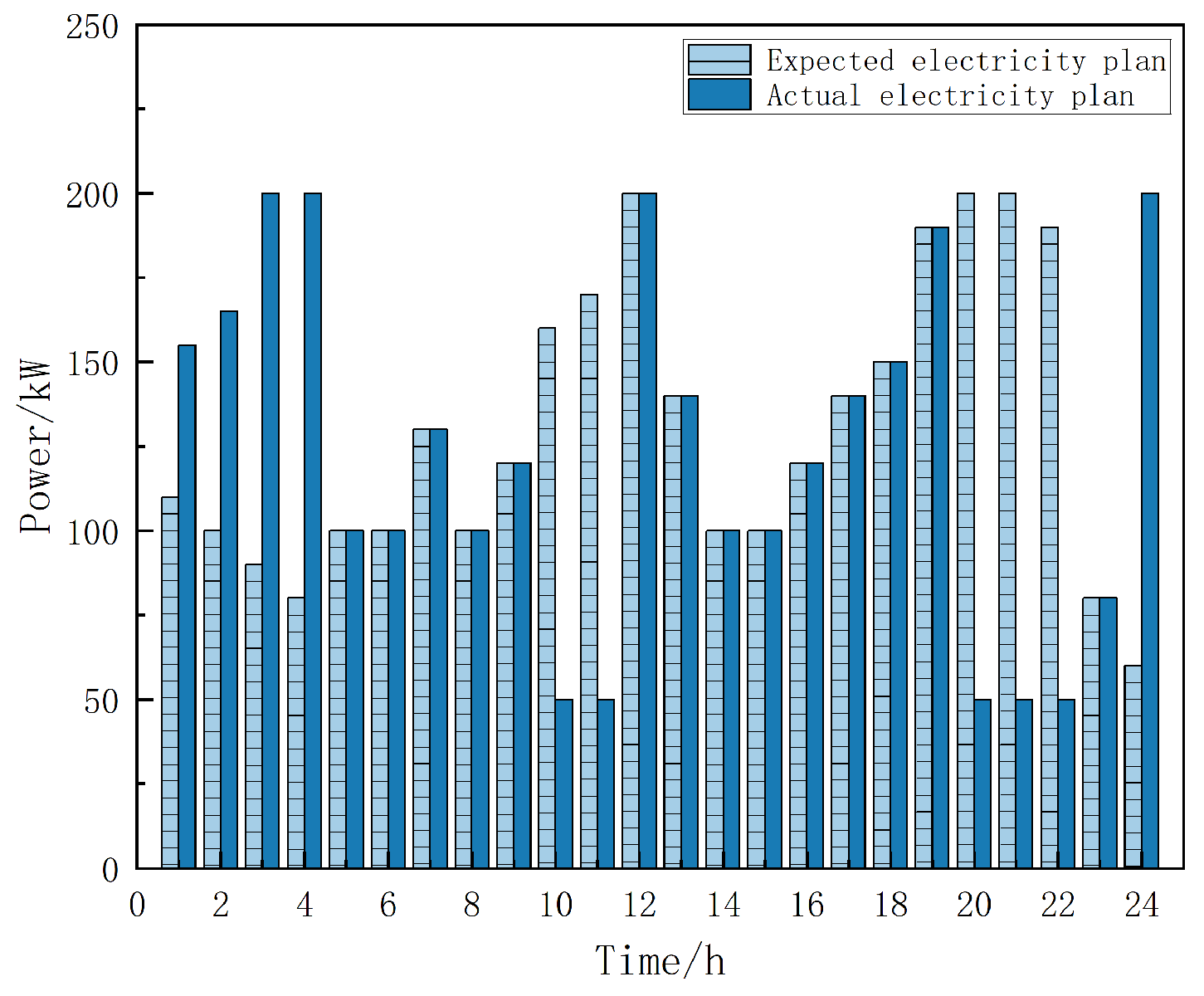
Figure 7 illustrates the expected and actual electricity consumption of the demand response load. During certain off-peak periods (1–4 h, 24 h), the actual consumption exceeds the expected consumption, whereas during some peak periods (10–11 h and 20–22 h), the actual consumption is lower than expected. By shifting deferrable loads from peak to off-peak periods, the economic cost of the microgrid is effectively reduced.
Ref. [11] optimizes the economic performance under the worst-case scenario of the microgrid, whereas Ref. [14] focuses on the economic performance under the expected scenario. Since neither Ref. [11] nor Ref. [14] considers environmental costs and user comfort in the day-ahead stage, nor includes gas turbine penalty costs in the intraday scheduling stage, the methods from these two references is modified by incorporating environmental costs, user comfort, and gas turbine penalty costs. These modifications enable a simulation comparison for the current case study, and the modified methods are denoted as Ref [ 11 ] and Ref [ 14 ] , respectively.
As we know, method Ref [ 11 ] optimizes the performance corresponding to the worst-case scenario, method Ref [ 14 ] optimizes the performance of the expected scenario, and the MOMSPLO algorithm optimizes the performance of multiple scenarios. Table 3 shows that in the day-ahead scheduling stage, method Ref [ 11 ] results in the highest day-ahead economic cost; method Ref [ 14 ] yields the lowest day-ahead economic cost. The MOMSPLO algorithm achieves a day-ahead economic cost between those of Ref [ 11 ] and Ref [ 14 ] . Meanwhile, since the MOMSPLO algorithm employs a lexicographic optimization approach in its model to optimize economic cost, environmental cost, and user comfort indices, it balances economic efficiency, environmental benefits, and user comfort. It is noteworthy that the environmental benefits and user comfort of the MOMSPLO algorithm are superior to those of Ref [ 11 ] and Ref [ 14 ] .
In the intraday scheduling stage, for simulation scenarios A and B, the adjustment costs of the MOMSPLO algorithm are lower than those of Ref [ 11 ] and Ref [ 14 ] . This is because the MOMSPLO algorithm considers the economic costs of multiple scenarios during the day-ahead scheduling stage, producing day-ahead optimal solutions that better match the actual intraday scenarios. Further analysis of simulation scenario C (a relatively adverse scenario) shows that although the MOMSPLO algorithm’s intraday adjustment cost is not the lowest, it still achieves a lower total cost overall. This is due to the broader coverage of the typical scenario set, which more closely approximates the real scenario space and effectively handles relatively adverse conditions (scenarios deviating from the preset scenarios). When such adverse scenarios occur during the intraday stage, the microgrid can still achieve favorable economic performance. This demonstrates that the typical scenario set model not only performs well under normal conditions but also possesses strong adaptability in more challenging situations, capable of coping with complex and variable real-world operations.
In summary, the MOMSPLO algorithm simultaneously considers multiple objectives, demonstrating excellent performance in economic efficiency, environmental benefits, and user comfort across various simulation scenarios. Under highly uncertain and complex operational conditions, it effectively controls the total cost, thereby comprehensively enhancing the overall performance of the microgrid system. The algorithm provides both theoretical and practical support for the design and scheduling management of microgrids in future applications.

6. Conclusions

With economic cost, environmental benefits, and user comfort as multiple objectives, the multi-objective and multi-scenario robust optimization algorithm based on lexicographic order method for uncertain microgrids is proposed. The effectiveness of the method is validated through simulation cases, and the results demonstrate the following:
  • Based on historical data of renewable generation and normal load in the microgrid, typical scenario sequences and their probabilities are generated using K-means clustering. This approach not only significantly reduces the number of scenarios to improve the computational efficiency of the proposed optimization algorithm but also ensures the robustness of the resulting solutions.
  • In the day-ahead scheduling stage, the performance of typical scenario sequence is optimized while ensuring that other scenarios satisfy the microgrid constraints. By employing the lexicographic optimization approach, the MOMSPLO algorithm simultaneously considers economic cost, environmental benefits, and user comfort. It optimizes the performance corresponding to the typical scenario sequence to account for multi-scenario performance, and robustness testing is then conducted to ensure feasibility under all scenarios.
  • In the intraday scheduling stage, based on real-time measured data of renewable generation and normal load, the day-ahead optimal solutions are further adjusted to improve the economic performance of the microgrid.
The core decision objects in microgrid dispatch—the SOC trajectory of ESS and the dispatch plan—are fundamentally time-indexed curves (i.e., time functions). Treating the microgrid dispatch plan as a time-indexed decision and framing it within a functional data analysis framework from the perspective of high-dimensional function responses driven by scalar factors [28,29] offers an alternative approach and can be studied in the future.

Author Contributions

Conceptualization, J.X., P.Z., C.W. and G.S.; Methodology, J.X., P.Z., C.W. and G.S.; Software, J.X.; Validation, J.X.; Formal analysis, J.X., P.Z. and C.W.; Investigation, J.X. and P.Z.; Resources, P.Z.; Data curation, J.X. and P.Z.; Writing—original draft, J.X.; Writing—review & editing, J.X. and P.Z.; Visualization, J.X.; Supervision, P.Z.; Project administration, J.X. and P.Z.; Funding acquisition, P.Z. All authors have read and agreed to the published version of the manuscript.

Funding

This research was funded by the National Natural Science Foundation of China, grant number 61573239.

Institutional Review Board Statement

Not applicable.

Informed Consent Statement

Not applicable.

Data Availability Statement

The datasets used and analyzed in the current study are available from the corresponding author on reasonable request.

Conflicts of Interest

The authors declare no conflict of interest.

References

  1. Wen, Y.; Lan, Y.; Yu, X.; Zhang, M.; Wang, X. The development status and trends of renewable energies. Environ. Prot. 2024, 52, 68–72. [Google Scholar]
  2. Wu, J.; Wang, Y.; Yang, J.; Wang, X.; Wang, E. Research progress on membraneless water electrolysis for hydrogen production. Sci. Sin. Chim. 2025, 55, 433–443. [Google Scholar] [CrossRef]
  3. Du, G.; Zhao, D.; Liu, X.; Wu, Z.; Li, C. Probability distribution of wind power fluctuation characteristics based on heavy-tailed distribution. Electr. Power Autom. Equip. 2021, 41, 52–57, 72. [Google Scholar]
  4. Chen, X.; Wang, X.; Chen, J.; Zhu, Z.; Zhang, L.; Liu, H. Optimal collaborative scheduling of wind power operators and electric vehicle charging stations considering distributed renewable energy trading. Power Syst. Technol. 2023, 47, 4598–4610. [Google Scholar]
  5. Fazlalipour, P.; Ehsan, M.; Mohammadi-Ivatloo, B. Risk-aware stochastic bidding strategy of renewable micro-grids in day-ahead and real-time markets. Energy 2019, 171, 689–700. [Google Scholar] [CrossRef]
  6. Hou, H.; Xie, Y.; Zhao, B.; Zhang, L.; Xie, C.; Dong, C. Review of optimal scheduling for port multi-energy microgrid with energy and transportation coupling. Electr. Power Autom. Equip. 2025, 45, 50–63. [Google Scholar]
  7. Yang, L.; Ren, X.; Cai, Z.; Qi, Q.; Li, Z.; Xia, X.; Nian, H. Review on voltage control strategies for high PV penetration distribution networks. Power Syst. Technol. 2024, 48, 5056–5070. [Google Scholar]
  8. Zhuang, Y.; Cheng, L.; Qi, N.; Cheng, W.; Wu, X.; Yao, Z. Typical scenario generation algorithm for microgrid based on deep temporal clustering. Autom. Electr. Power Syst. 2023, 47, 95–103. [Google Scholar]
  9. Zhang, X.; Ge, Y.; Hu, S.; Wu, J.; Xun, S.; Wang, X. Research on optimization planning of light hydrogen storage DC microgrid based on sequence operations. Renew. Energy Resour. 2024, 42, 1408–1415. [Google Scholar]
  10. Karimi, H.; Jadid, S. Optimal energy management for multi-microgrid considering demand response programs: A stochastic multi-objective framework. Energy 2020, 195, 116992. [Google Scholar] [CrossRef]
  11. Liu, Y.; Guo, L.; Wang, C. Economic dispatch of microgrid based on two stage robust optimization. Proc. CSEE 2018, 38, 4013–4022+4307. [Google Scholar]
  12. Zeng, B.; Zhao, L. Solving Two-stage Robust Optimization Problems by a Constraint-and-Column Generation Method. Oper. Res. Lett. 2013, 41, 457–461. [Google Scholar] [CrossRef]
  13. Hang, H.; Yang, L.; Gan, W.; Sun, Y.; Yang, H.; Li, Z. Multi-time scale optimal dispatch strategy considering demand response in high elastic power grid. J. North China Electr. Power Univ. 2021, 48, 40–488. [Google Scholar]
  14. Sang, B.; Zhang, T.; Liu, Y.; Liu, L.; Zhu, J.; Wang, R. Two-stage robust optimal scheduling of grid-connected microgrid under expected scenarios. Proc. CSEE 2020, 40, 6161–6173. [Google Scholar]
  15. Bian, Q.; Xin, H.; Wang, Z.; Gan, D.; Wong, K.P. Distributionally robust solution to the reserve scheduling problem with partial information of wind power. IEEE Trans. Power Syst. 2015, 30, 2822–2823. [Google Scholar] [CrossRef]
  16. Yi, G.; Zhao, H.; Wang, H.; Yue, Y. Research on capacity configuration methods for wind-solar-hydrogen microgrids based on distributionally robust optimization. Renew. Energy Resour. 2024, 42, 1519–1526. [Google Scholar]
  17. Li, H.; Zhu, J.; Dong, H. Two-stage distributionally robust optimization scheduling for multi-energy microgrid considering covariate factors. Proc. CSEE 2025, 45, 822–834. [Google Scholar]
  18. Li, J.; Sun, Q.; Wang, Q.; Ye, Y.; Hu, H.; Zhang, X. Multi-Energy Microgrid Data-Driven Distributionally Robust Optimization Dispatch Considering Uncertainty Correlation. Electr. Power Constr. 2025, 46, 22–33. [Google Scholar]
  19. Sun, B.; Zhao, G.; Li, J.; Zhao, Z. Multi-objective microgrid optimal scheduling based on improved bird flock algorithm. Smart Power 2024, 52, 46–53+99. [Google Scholar]
  20. Shuai, M.; Xiong, G.; Hu, X.; Chen, J. Economic Emission Dispatch of Power System Based on Improved Bare-bone Multi-objective Particle Swarm Optimization Algorithm. Control Decis. 2022, 37, 997–1004. [Google Scholar]
  21. Li, S.; Qiao, J.; Gao, Z.; Zeng, J. Capacity optimization configuration of wind-PV-storage microgrids based on improved grey wolf optimizer. Smart Power 2025, 53, 11–19. [Google Scholar]
  22. Zeng, J.; Xu, D.; Liu, J.; Li, C. Multi-objective optimization method for microgrid operation considering load satisfaction. Proc. CSEE 2016, 36, 3325–3334. [Google Scholar]
  23. Lu, Y.; Yin, L.; Xu, G.; Zhao, Y. Multi-Objective Optimization for Combined Heat and Power Microgrid Based on Incentive-Based Demand Response. South. Power Syst. Technol. 2025, 19, 51–62+77. [Google Scholar]
  24. Lin, L.; Pan, X.; Zhang, L.; Zhao, S. The K-means clustering algorithm for wind farm based on immune-outlier data and immune-sensitive initial center. Proc. CSEE 2016, 36, 5461–5468+5722. [Google Scholar]
  25. He, D.; Zhang, Y.; Xu, S. Multi-objective economic predictive control of biomass CFBB combustion processes. Chin. High Technol. Lett. 2019, 29, 668–674. [Google Scholar]
  26. Bertsimas, D.; Litvinov, E.; Sun, X.A.; Zhao, J.; Zheng, T. Adaptive Robust Optimization for the Security Constrained Unit Commitment Problem. IEEE Trans. Power Syst. 2013, 28, 52–63. [Google Scholar] [CrossRef]
  27. Yang, C. Research on the Micro-Grid Energy Management Based on Two-Stage Robust Optimization with the Consideration of Expected Scenarios. Master’s Thesis, National University of Defense Technology, Changsha, China, 2018. [Google Scholar] [CrossRef]
  28. Kokoszka, P.; Reimherr, M. Introduction to Functional Data Analysis; Chapman and Hall/CRC: Boca Raton, FL, USA, 2017. [Google Scholar]
  29. Fan, Z.; Reimherr, M. High-dimensional adaptive function-on-scalar regression. Econom. Stat. 2017, 1, 167–183. [Google Scholar] [CrossRef][Green Version]
Figure 1. Schematic diagram of grid-connected microgrid structure.
Sustainability 18 01100 g001
Figure 2. Flowchart for generating typical scenarios based on the K-means clustering algorithm.
Sustainability 18 01100 g002
Figure 3. Flowchart of MOMSPLO algorithm.
Sustainability 18 01100 g003
Figure 4. Daily electricity price distribution chart for the power market.
Sustainability 18 01100 g004
Figure 5. Typical scenario curves and simulation scenarios for PV/normal load.
Sustainability 18 01100 g005
Figure 6. Optimized dispatch results for microgrids.
Sustainability 18 01100 g006
Figure 7. Expected/actual electricity plan of demand response load.
Sustainability 18 01100 g007
Table 1. Microgrid operating parameters.
UnitParametersValues
Micro gas turbine P MT min / P MT max / k W 80/800
Δ P MT min / Δ P MT max / k W −600/600
K MT r / K MT m / CNY / kWh 0.5/0.15
K MT add / K MT dec / CNY / kWh 0.5/−0.5
Energy Storage System P ES max / k W 500
E ES min / E ES max / kWh 300/1500
E ES 0 / k W h 1000
K ES / CNY / kWh 0.38
η 0.95
Demand Response Load D TL / k W h 2940
P TL min / P TL max / k W 30/200
K DR / C N Y / k W h 0.32
Distribution network interaction power P G max / k W h 1500
K G add / K G dec / CNY / kWh 1.0/−0.8
Table 2. Pollutant emission factors and treatment costs.
Pollutant Type Treatment   Cost   CNY / kg Emission   Factor   g / k W h
PVMTG
C O 2 0.0230724889
S O 2 600.00361.8
N O X 800.21.6
Table 3. Performance comparison of different algorithms.
Simulation ScenarioMethodsDay-Ahead Economic CostDay-Ahead Environmental CostUser ComfortIntra-Day Adjustment CostTotal Cost
Simulation Scenario A Ref 11 5801.9796.70.441525.78124.3
Ref 14 5635.4790.80.461675.78101.9
MOMSPLO5705.5646.40.591324.37676.2
Simulation Scenario B Ref 11 5801.9796.70.441549.58148.1
Ref 14 5635.4790.80.461415.97842.1
MOMSPLO5705.5646.40.591260.77612.6
Simulation Scenario C Ref 11 5801.9796.70.442235.58834.1
Ref 14 5635.4790.80.462618.49044.6
MOMSPLO5705.5646.40.592293.38645.2
Disclaimer/Publisher’s Note: The statements, opinions and data contained in all publications are solely those of the individual author(s) and contributor(s) and not of MDPI and/or the editor(s). MDPI and/or the editor(s) disclaim responsibility for any injury to people or property resulting from any ideas, methods, instructions or products referred to in the content.