Article

Pedestrian Traffic Stress Levels (PTSL) in School Zones: A Pedestrian Safety Assessment for Sustainable School Environments—Evidence from the Caferağa Case Study


by
Yunus Emre Yılmaz
* and
Mustafa Gürsoy
Department of Civil Engineering, Yildiz Technical University, 34220 Istanbul, Türkiye
*
Author to whom correspondence should be addressed.
Sustainability 2026, 18(2), 1042; https://doi.org/10.3390/su18021042
Submission received: 16 December 2025 / Revised: 15 January 2026 / Accepted: 15 January 2026 / Published: 20 January 2026

Abstract

Pedestrian safety in school zones is shaped by traffic conditions and street design characteristics, whose combined effects involve uncertainty and gradual transitions rather than sharp thresholds. This study presents an integrated assessment framework based on the analytic hierarchy process (AHP) and fuzzy logic to evaluate pedestrian traffic stress level (PTSL) at the street-segment scale in school environments. AHP is used to derive input-variable weights from expert judgments, while a Mamdani-type fuzzy inference system models the relationships between traffic and geometric variables and pedestrian stress. The model incorporates vehicle density, pedestrian density, lane width, sidewalk width, buffer zone, and estimated traffic flow speed as input variables, represented using triangular membership functions. Genetic Algorithm (GA) optimization is applied to calibrate membership-function parameters, improving numerical consistency without altering the linguistic structure of the model. A comprehensive rule base is implemented in MATLAB (R2024b) to generate a continuous traffic stress score ranging from 0 to 10. The framework is applied to street segments surrounding major schools in the study area, enabling comparison of spatial variations in pedestrian stress. The results demonstrate how combinations of traffic intensity and street geometry influence stress levels, supporting data-driven pedestrian safety interventions for sustainable school environments and low-stress urban mobility.

1. Introduction

1.1. Significance and Rationale of the Study

Pedestrian safety and traffic-related stress are essential elements of urban transportation, particularly in school zones. Variations in children’s physical and cognitive development lead to differing levels of awareness and reaction to surrounding traffic conditions. Low traffic awareness and long reaction times among younger age groups make these areas more dangerous. At the same time, high traffic density and uncontrolled speeds increase pedestrians’ feelings of insecurity and stress levels.
The physical infrastructure of pedestrian paths and crossing points heavily used by students must be safe, accessible, and low-stress. Inadequate sidewalks, high traffic volume, narrow lane widths, lack of pedestrian crossings, and the absence of vehicle-pedestrian separation are among the factors that cause stress for pedestrians in school zones. However, these stress factors are rarely quantified, making it challenging to address them within a scientific framework.
This study aims to analyze pedestrian traffic stress level (PTSL) in school zones and to evaluate it using a numerical model. Specifically, a main street in the Caferağa neighborhood of Moda will be examined as an area with heavy motor vehicle traffic and pedestrian movement from students of different ages. The fact that this area has an asphalt surface, unlike the rest of the neighborhood where the study was conducted, that it functions as a main artery, and that it is located along the route of many schools are the key factors that determined the site selection for the study.
The term “pedestrian traffic stress level (PTSL)” used in this study is a composite index that numerically represents the potential impact of physical environmental conditions on pedestrians. It reflects the combined effects of factors such as perceived safety, adequacy of pedestrian infrastructure, and vehicle–pedestrian interaction and is derived from observable environmental and traffic-related characteristics rather than psychological attributes.
In this context, the proposed PTSL framework is also directly relevant to the objectives of the United Nations 2030 Agenda for Sustainable Development. By focusing on pedestrian safety, perceived stress, and micro-scale street design in school environments, the study contributes to Sustainable Development Goal (SDG) 3 (Good Health and Well-Being) by addressing everyday exposure to traffic-related risks that affect children’s physical safety and overall well-being. At the same time, the emphasis on low-stress, inclusive, and safe pedestrian environments in dense urban settings aligns with SDG 11 (Sustainable Cities and Communities), particularly its targets related to safe, inclusive, and accessible public spaces. In this respect, the proposed model provides a practical, data-driven tool that can support local decision-makers in identifying critical street segments and prioritizing design and traffic-management interventions in school zones [1].

1.2. Literature Review

Pedestrian safety has long been a priority in global road safety agendas. The World Health Organization emphasizes that pedestrians represent a substantial share of road traffic fatalities and highlights speed management, alcohol use, infrastructure quality, and visibility as key determinants of pedestrian injury risk and related traffic stress [2]. In a similar vein, the OECD/ITF report on walking in urban areas notes that, despite the health benefits of walking, pedestrians in dense urban centers often face safety and comfort constraints that discourage walking and elevate perceived traffic stress [3]. Taken together, these strategic documents frame pedestrian traffic stress as a product of both road-user behavior and the design and operation of urban street environments.
Within academic literature, a substantial body of work has examined how the built environment shapes walking behavior, perceived safety, and pedestrian stress. Ewing and Handy systematized the “3Ds” framework (density, diversity, and design) and proposed measurable urban design indicators to explain walking outcomes and perceived walking quality [4]. Building on this foundation, Stoker et al. reviewed evidence linking street connectivity, land-use patterns, and traffic conditions to pedestrian safety and comfort, underscoring that design-oriented interventions complement behavioral and enforcement strategies [5].
At the local scale, Kaplan et al. provide an illustrative example from Ankara’s Kızılay district, using a qualitative, indicator-based approach that distinguishes macro-, meso-, and micro-scale built-environment elements [6]. Their findings highlight how network continuity, crossing design, and sidewalk conditions relate to perceived pedestrian safety, supporting the broader argument that street-level attributes can materially influence pedestrians’ experienced conditions.
Following early conceptual work on the built environment, subsequent studies have focused on operationalizing pedestrian conditions through micro-scale, stress- and performance-oriented indicators. Rodriguez-Valencia et al. and Nabipour et al. proposed street-segment-level frameworks that incorporate variables such as traffic speed and volume, sidewalk width, physical separation, and crossing complexity to classify pedestrian environments [7,8]. These approaches shift the analytical focus from aggregate urban form measures to fine-grained street attributes, allowing pedestrian conditions to be evaluated at the scale where daily interactions with traffic occur.
Empirical evidence further suggests that pedestrian stress is better represented as a continuous outcome shaped by combinations of street-level design and traffic exposure. Specktor and Shiftan identify sidewalk width and physical separation from traffic as among the most influential determinants of perceived pedestrian stress, with vulnerable user groups consistently reporting higher stress levels under similar conditions [9]. This finding reinforces the notion that pedestrian stress does not arise from isolated factors but from the cumulative effects of spatial constraints and vehicle–pedestrian interactions at the street level.
Data-driven approaches provide complementary evidence for this perspective. Paul et al., Shu et al., and Zhang et al. show that detailed street-level indicators outperform aggregated walkability measures in explaining variations in pedestrian comfort and performance [10,11,12]. Using machine learning or regression-based inference, these studies show that the influence of design and operational variables is often nonlinear and context-dependent, further supporting the need for micro-scale, indicator-based assessment frameworks.
Within school environments, these methodological considerations become particularly relevant. Fernández-Arango et al. show that routing approaches based solely on geometry or shortest paths can misrepresent pedestrian mobility when effective sidewalk width, obstacles, and available walking space are ignored [13]. Their findings demonstrate that street-level design constraints can skew evaluations of pedestrian accessibility and comfort in school environments, highlighting the necessity for stress-sensitive and exposure-aware assessment methodologies. These insights provide a basis for examining how pedestrian stress in school zones is further shaped by everyday behaviors and real-time interactions between pedestrians and vehicles.
Beyond physical street characteristics, a growing body of research emphasizes the role of behavior and everyday interactions in shaping pedestrian safety and stress. Özen et al. show that both driver- and pedestrian-related behaviors play a decisive role in crash occurrences, thereby influencing pedestrians’ perceived exposure to traffic risks and daily stressors [14]. Similarly, Çıkrıkçı et al. identify failure to yield, frequent honking, and non-compliance with traffic rules as common sources of stress for pedestrians in mixed-traffic environments [15]. These findings highlight that pedestrian stress is not solely a function of infrastructure but also of how traffic rules are enacted in practice.
In the context of school travel, behavioral factors intersect with environmental exposure in particularly sensitive ways. A systematic review by Wong et al. demonstrates that traffic safety, crossing quality, and environmental conditions are among the most influential determinants of children’s walking behavior and safety perceptions [16]. Given children’s limited traffic awareness and slower reaction times, everyday interactions with vehicles can generate stress even in the absence of recorded crashes.
Research focusing explicitly on school zones further shows that pedestrian stress in these environments extends beyond crash outcomes. Cloutier et al., adopting a Safe System perspective, emphasize the combined roles of the built environment, driver behavior, and vehicle characteristics in shaping child pedestrian safety, and stress the importance of translating evidence into concrete design and policy interventions [17]. Joseph and Archana’s empirical studies, along with naturalistic and video-based observations by Bina et al. and Campisi et al., record frequent near-miss incidents, unsafe crossings, distractions, and avoidance behaviors in proximity to schools, directly correlating these actions with real-time pedestrian-vehicle interactions [18,19,20].
Evidence from low- and middle-income urban contexts reinforces these observations. Osuret et al. show that how children cross streets in school zones is strongly shaped by traffic speed, vehicle flow characteristics, and the absence of protective design elements at crossings [21]. Complementary data-driven analyses by Lu and Liu, and by Ištoka Otković et al., further demonstrate that abrupt stopping and path-deviation behaviors among child pedestrians are primarily driven by operational traffic characteristics, such as vehicle speed and volume [22,23]. These studies indicate that pedestrian stress in school environments arises from routine behavioral interactions in mixed traffic conditions, rather than being captured solely by crash records. These behavioral insights reinforce the need for assessment frameworks that can integrate traffic exposure, street design, and user experience into systematic, comparable measures of pedestrian conditions.
Several strands of research have sought to formalize pedestrian conditions through indices and level-of-service frameworks. Early pedestrian-level-of-service (PLOS) models, most notably those introduced by Fruin, focused on flow, density, and capacity measures derived from time–space concepts and later embedded in the Highway Capacity Manual tradition [24]. While these models provided a systematic basis for evaluating pedestrian movement efficiency, they primarily emphasized operational capacity rather than perceived safety or stress.
Subsequent frameworks expanded PLOS concepts by incorporating urban design and safety-related variables. Asadi-Shekari et al. proposed a comprehensive PLOS method for campus streets that integrates geometric, operational, and streetscape indicators into a composite service index [25]. Rodriguez-Valencia et al. also classify urban street segments based on traffic volumes, speeds, crossing complexity, and sidewalk conditions. This creates stress-oriented categories that can help with network planning and street design decisions [26]. These approaches mark a shift from purely capacity-driven evaluations to more user-oriented, context-sensitive assessments.
Recent evaluation frameworks based on geometry and rules further showcase the ability to convert objective street-level attributes into continuous pedestrian performance scores. Noronha et al. demonstrate how computational methods can be used to evaluate street retrofitting interventions by systematically comparing pre- and post-intervention scenarios at the street-segment level [27]. Such approaches illustrate the potential of continuous metrics to capture incremental changes in pedestrian conditions that categorical grading systems may overlook.
Building on these developments, PLOS-oriented research has increasingly adopted data-driven and fuzzy modeling techniques to better capture nonlinear relationships, gradual transitions, and uncertainty in pedestrian experience. This line of research recognizes that walking conditions are shaped by continuous effects rather than sharp thresholds. In this context, studies by Shu et al. and Zhang et al. demonstrate that the effects of geometric and operational variables on perceived walking conditions vary with pedestrian density and traffic exposure, highlighting strong context dependence at the street-segment level [11,28]. These findings challenge the suitability of rigid categorical grading systems and motivate the use of flexible, data-driven modeling approaches.
Machine-learning-based PLOS models further extend this perspective. Paul et al. and Ankunda et al. show that pedestrian comfort and performance can be effectively explained using micro-scale design and traffic-related variables, such as vehicle buffer distances, pedestrian density, and surface quality, yielding continuous or clustered service metrics rather than discrete classes [10,29]. These approaches demonstrate improved explanatory power but often operate as black-box models, limiting interpretability for planning and design applications.
Complementary multi-criteria and survey-based frameworks proposed by Ujjwal and Bandyopadhyaya, as well as Fatema et al., emphasize the importance of integrating subjective pedestrian experience with objective street characteristics [30,31]. While these approaches enrich the evaluation of pedestrian environments, they also reveal limitations associated with purely perception-based or purely data-driven methods when used in isolation.
Index-based assessments conducted in low- and middle-income urban contexts by Feudjio et al. confirm that infrastructure-oriented indicators—such as sidewalk continuity, crossings, lighting, and barriers—can yield consistent and comparable evaluations of pedestrian safety and walkability across diverse settings [32]. However, these studies also underscore the need for adaptable frameworks that can accommodate local conditions and uncertainty in pedestrian–vehicle interactions.
Together, these strands of research highlight the importance of modeling frameworks that can integrate heterogeneous indicators, account for uncertainty, and retain interpretability—features central to fuzzy and rule-based approaches.
A related conceptual stream has gained prominence through low-stress network approaches, primarily in the context of cycling. Mekuria et al. introduced a stress-based classification of bicycle facilities and a methodology for constructing low-stress networks that connect origins and destinations through links with tolerable levels of traffic stress [33]. Rather than focusing solely on shortest paths or capacity, this approach emphasizes users’ perceived comfort and willingness to use the network.
Subsequent work by Furth et al. refined the low-stress network concept by examining how different facility types and intersection treatments affect the continuity of low-stress routes at the city scale [34]. Their findings demonstrate that network usability depends not only on individual links but also on interactions between links and nodes, where stress levels can change abruptly.
Although these studies focus on cycling, they are conceptually relevant to pedestrian analysis because they frame traffic stress as an emergent property of link- and node-level attributes rather than as a single location-specific risk. This perspective is particularly applicable to school-zone environments, where pedestrian stress accumulates along short walking corridors shaped by repeated interactions with traffic, intersections, and changing street conditions.
Beyond network-level concepts, recent research has also sought to measure pedestrian stress more directly through experimental, sensor-based, and observational approaches.
Research has increasingly sought to measure pedestrian stress more directly through experimental and sensor-based methods. Kamal et al. used virtual reality environments to simulate pedestrian–vehicle interactions involving automated vehicles and modeled perceived stress using an ordered logit framework based on physiological responses such as skin conductance [35]. Their results show that vehicle behavior and crossing design can significantly influence pedestrian stress levels under controlled conditions.
Complementary evidence is provided by sensor-based field studies. Begum et al. employed wearable devices across multiple urban sites to monitor physiological stress responses as participants walked along different routes, linking spikes in stress indicators to local traffic conditions, noise, and built-environment characteristics [36]. These findings demonstrate that pedestrian stress can be empirically associated with specific street-level attributes beyond self-reported perceptions.
While experimental and sensor-based approaches offer valuable insights, their applicability in everyday school-zone assessments remains limited due to cost, scalability, and data-collection constraints. In response to these limitations, recent school-focused research suggests that pedestrian stress can be approximated through observable behavioral proxies such as avoidance maneuvers, waiting behavior, and unsafe crossing responses under real traffic conditions.
Naturalistic and video-based studies conducted in school environments by Bina et al. and Lu and Liu show that avoidance maneuvers, abrupt trajectory changes, and hesitation behaviors are strongly associated with traffic speed, vehicle interactions, and crossing design [19,22]. These observable responses reflect heightened stress and perceived risk even in the absence of physiological measurements, providing a practical basis for stress-sensitive assessment in real-world school zones.
Together, these approaches underline the importance of frameworks that can translate observable traffic exposure and street characteristics into interpretable stress indicators applicable at scale.
Beyond physiological measurements and observational proxies, pedestrian stress has also been assessed through perceived safety and psychological perceptions. Oestreich et al. assessed students’ perceptions of traffic safety near schools utilizing survey data and employed fuzzy-logic modeling to convert these perceptions into comprehensible outputs. Their findings indicate that perceived safety varies systematically with micro-scale contextual features such as crossing visibility, sidewalk continuity, and traffic density, reinforcing the role of street-level conditions in shaping perceived pedestrian stress in school environments [37].
Delphi-based research provides additional support for the relevance of street-level inputs in school-environment assessments. Cerro-Herrero et al. identify sidewalk quality, crossing characteristics, traffic conditions, and environmental safety as priority factors influencing school-area walkability, supporting their inclusion in operational and stress-oriented evaluation models, even when stress is not directly quantified [38]. In parallel, perception-oriented approaches across different urban contexts by Rodriguez-Valencia et al., Paul et al., and Specktor and Shiftan similarly confirm that pedestrians’ experienced comfort and stress are strongly shaped by street-level characteristics and traffic exposure, and can be systematically expressed through fuzzy or data-driven evaluative frameworks [7,9,10].
Taken together, perception-based evidence and expert-elicitation studies strengthen the case for interpretable modeling frameworks that can integrate heterogeneous street-level indicators into transparent, stress-sensitive assessments.
Alongside empirical and perception-based studies, a growing body of research has employed algorithmic and fuzzy-logic approaches to model pedestrian safety and risk under uncertainty. Sharaf AlKheder and AlRukaibi developed a fuzzy-logic traffic signal control system that adapts signal timing to pedestrian behavior and traffic volumes, demonstrating reductions in both vehicle delay and pedestrian risk [39]. Such applications illustrate the suitability of fuzzy systems for representing gradual transitions and imprecise boundaries in pedestrian–vehicle interaction.
In school-zone contexts, algorithmic and simulation-based studies further highlight the relevance of integrating traffic operations and infrastructure design. Rahman et al. evaluated speed management and traffic control strategies at school zones using a microscopic simulation, demonstrating measurable safety benefits from operational and engineering countermeasures [40]. Complementary analyses by Rothman et al. emphasize how roadway design features, traffic exposure, and neighborhood-level characteristics jointly shape injury patterns for child pedestrians, indicating the importance of integrative assessment frameworks [41].
More recent developments extend fuzzy-logic concepts into intelligent and connected environments. Chauhan et al. proposed a fuzzy-logic system embedded in smart-pole infrastructure to support pedestrian–vehicle communication and safer crossing decisions, demonstrating improved performance in complex traffic settings [42]. These studies highlight how fuzzy inference can translate heterogeneous inputs into interpretable safety or stress-related outputs.
Hybrid frameworks combining fuzzy logic with data-driven techniques have also gained prominence. GIS-supported fuzzy and machine-learning models developed by Katanalp and Eren, Matongo and Chimba, and Li et al. show that traffic speed, exposure, street geometry, and land-use context interact nonlinearly to shape pedestrian risk at the road-segment level [43,44,45]. By integrating spatial data with algorithmic inference, these approaches highlight that deterministic models alone often fail to capture the complexity of pedestrian safety in mixed-traffic environments.
Structured weighting techniques such as the Analytic Hierarchy Process (AHP) have been increasingly used to prioritize heterogeneous risk factors and enhance interpretability. Studies by Han et al. and Zalesinska and Wandachowicz demonstrate how expert-based weighting can support prevention-oriented safety evaluation and transparent decision-making in pedestrian-related contexts [46,47]. When combined with fuzzy or rule-based models, such methods provide a systematic way to embed expert judgment within quantitative assessment frameworks.
Despite methodological advances in pedestrian safety and stress assessment, recent school-zone–focused research continues to highlight the limitations of relying on aggregate indicators or crash-based analyses. Zhang et al.’s interpretable machine-learning studies show that micro-scale street features like enclosure, walkability, openness, and imageability have strong nonlinear relationships with fatal and severe pedestrian injury rates around schools. This shows how important it is to look at street-level details when assessing school-zone safety [12]. These findings suggest that aggregate walkability or safety indices may obscure critical stressors experienced by child pedestrians.
Spatial analyses further indicate that pedestrian risk and stress in school environments often extend beyond formally designated school-zone boundaries. Studies by Rothman et al. and Koloushani et al. show that the risk of child pedestrian injuries is strongly influenced by local traffic exposure, street design, and neighborhood characteristics surrounding schools rather than by school frontage alone [48,49]. This spatial diffusion of risk illustrates the importance of corridor- and segment-level assessment approaches that capture cumulative exposure along school walking routes.
Evidence from large-scale intervention studies reinforces the importance of operational traffic conditions. Howard et al. demonstrate that speed management and enforcement strategies can substantially reduce the risk of child pedestrian injuries in school environments [50]. Complementary simulation- and observation-based research by Swami et al. further shows that street-level geometric interventions—such as wider sidewalks, guardrails, improved crossings, and traffic calming—significantly influence pedestrian behavior and safety outcomes around schools, even when stress is not explicitly quantified [51].
Other recent studies caution against assuming a direct correspondence between higher pedestrian activity and safer conditions. Chun et al. indicate that increased walkability or pedestrian volumes do not necessarily translate into reduced injury risk for children, as higher exposure may offset design-related benefits when traffic stressors remain unmitigated [52]. This finding reinforces the distinction between pedestrian activity levels and experienced safety or stress.
Within the broader methodological literature, multi-criteria decision-making (MCDM) frameworks increasingly combine expert judgement with performance-based data. In this context, the AHP has been widely applied—often in combination with data envelopment analysis—to evaluate and rank transport and infrastructure alternatives by linking subjective expert-based weights with objective efficiency measures. Although these approaches are not inherently pedestrian-specific, the application by Li et al. demonstrates their relevance for assessing the quality of service of urban pedestrian road systems by integrating multiple design, operational, and performance attributes within a unified evaluation structure. In the pedestrian-focused evaluation contexts, such frameworks complement PLOS and stress-based indices by providing tools to calibrate indicator weights and to support the validation of composite service or performance scores [53].
Overall, the literature indicates that (i) pedestrian traffic stress is increasingly recognized as a distinct construct linked to, but not fully captured by, conventional safety or walkability measures; (ii) built-environment and operational indicators have been formalized through PLOS, level-of-stress, and low-stress network concepts for walking and cycling; (iii) school zones and child pedestrians have been identified as priority contexts, with consistent evidence highlighting the role of infrastructure design and traffic management; and (iv) fuzzy-logic and other rule-based models are well suited to handling the uncertainty inherent in pedestrian–vehicle interactions. Despite these advances, there remains a limited number of studies that develop a pedestrian traffic stress level (PTSL) index explicitly tailored to school-zone environments, based on on-site counts and detailed street level indicators such as pedestrian and vehicle density, lane and sidewalk widths, buffer zone, and traffic flow speeds.
Building on these strands of literature, the present study adopts a fuzzy-logic framework, which enables the integration of heterogeneous street-level indicators and the translation of expert knowledge into an interpretable rule base. This approach is particularly appropriate for complex school-zone environments, where pedestrian–vehicle interactions are uncertain and context-dependent. Within this framework, AHP is used to systematically represent the relative importance of the selected variables and to support both the traffic speed estimation component and the subsequent PTSL inference structure. Consequently, the proposed methodology operationalizes the literature on stress- and level-of-service-based approaches and fuzzy rule-based modeling as a segment-level, data-driven assessment tool that can be applied to real street segments in school-zone corridors.

1.3. Research Gap and Contribution

Research assessing pedestrian stress in urban transportation examines bicycle lanes, pedestrian mobility, and perceived safety. Nonetheless, quantitative evaluations of PTSL in school zones are scarce. There are hardly any studies in Türkiye that offer a systematic approach to issues such as PTSL.
This study proposes a new methodology for measuring PTSL using the Level of Traffic Stress approach and a fuzzy logic-based model. The original aspects of the study are as follows:
  • The combined use of different variables to analyze PTSL in school zones (sidewalk width, lane width, vehicle density, etc.).
  • Developing a speed estimation model due to the lack of traffic flow speed data.
  • Modeling PTSL more flexibly using fuzzy logic.
  • Integrating AHP-based weighting into both the traffic flow speed estimation and the fuzzy rule-generation process, ensuring a systematic representation of the relative importance of the input variables.
  • Optimizing fuzzy membership functions using a genetic algorithm (GA) to improve the internal consistency and robustness of PTSL outputs without altering the rule structure.
  • Presenting a local case study using the example of the Caferağa Neighborhood (Moda) in Kadıköy, İstanbul.
In this context, the study aims not only to address the Caferağa example but also to present a methodological approach to PTSL in school zones in general.

2. Materials and Methods

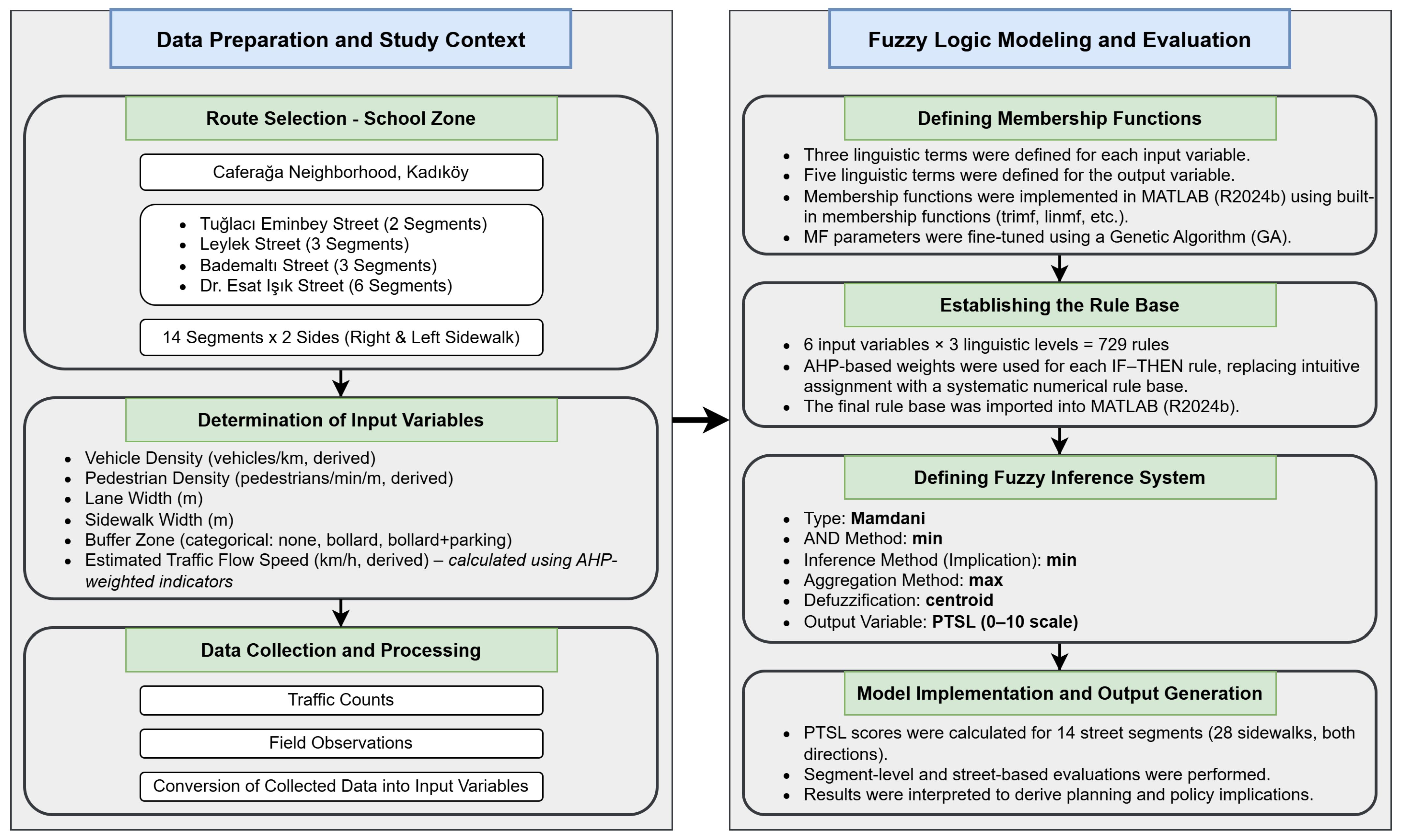
In this study, the fuzzy-logic model-based method for determining PTSL in school zones has been designed as a multi-stage process. Figure 1 presents the methodological steps comprehensively.

2.1. Route Selection and Determination of Segments

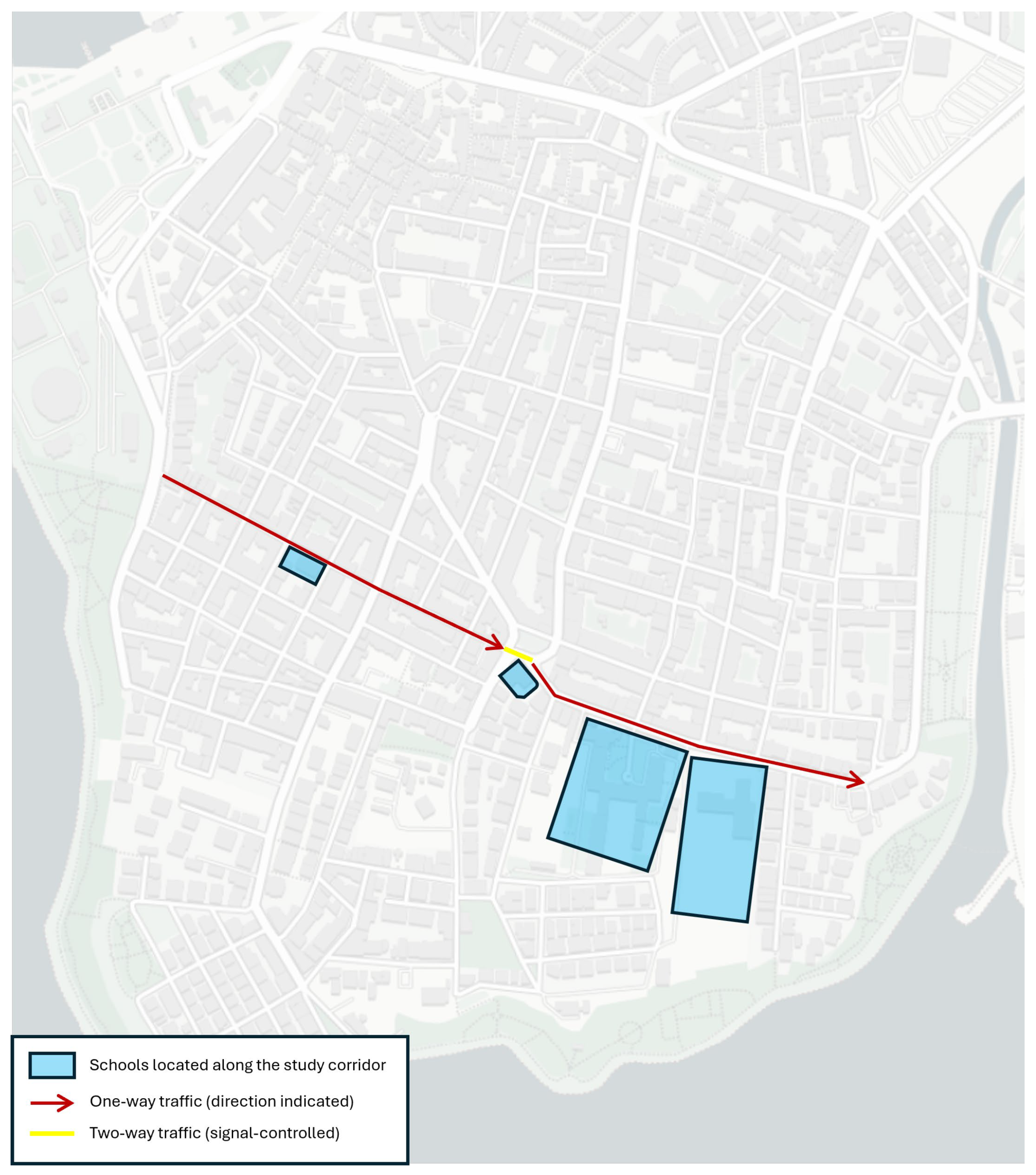
This study was conducted to evaluate PTSL in a school zone located in the Caferağa neighborhood of the Kadıköy district, İstanbul. The area provides an appropriate case study due to its high pedestrian activity levels, the presence of multiple schools and other educational institutions along the corridor, and periods of intense motor vehicle traffic. The selected study corridor predominantly operates under a one-way traffic configuration; however, a short segment near a signalized intersection allows alternating bidirectional movements controlled by traffic signals (Figure 2). Although numerous schools are located in the surrounding area, only four are situated directly along the selected route. These schools, listed from left to right, are as follows:
  • Private Aramyan Uncuyan Armenian Primary and Secondary School
  • Moda Elementary School
  • Saint-Joseph French High School
  • Kadıköy Anatolian High School
Figure 2. Study corridor and school locations in the Caferağa neighborhood (Kadıköy), with prevailing traffic flow direction (Prepared by the authors).
Sustainability 18 01042 g002
The Caferağa Neighborhood is one of the main arteries leading to Moda and is an urban area heavily used by both the local population and visitors for education, trade, and social activities. The schools in the study area provide both primary and secondary education, and pedestrian access to them is significant for students’ daily transportation.
The selected route is asphalt-paved, in contrast to the predominantly stone-paved local streets in the surrounding neighborhood. This asphalt surface can lead to smoother motor vehicle traffic and higher speed levels. Particularly during school entry and exit times, both vehicle density and pedestrian traffic increase significantly. Furthermore, the use of minibuses, taxis, and private vehicles is also a crucial factor affecting pedestrian mobility and traffic dynamics in the area.
Examining the pedestrian infrastructure in the area reveals insufficient sidewalk widths in some segments. In other places, sidewalks cannot be used effectively due to various uses (e.g., vehicle parking or irregularly placed street furniture). Furthermore, the location of traffic lights and pedestrian crossings is among the factors affecting pedestrians’ ability to cross safely. In this context, the study area—a school zone with intense pedestrian and vehicular interaction—is an important site for measuring PTSL.
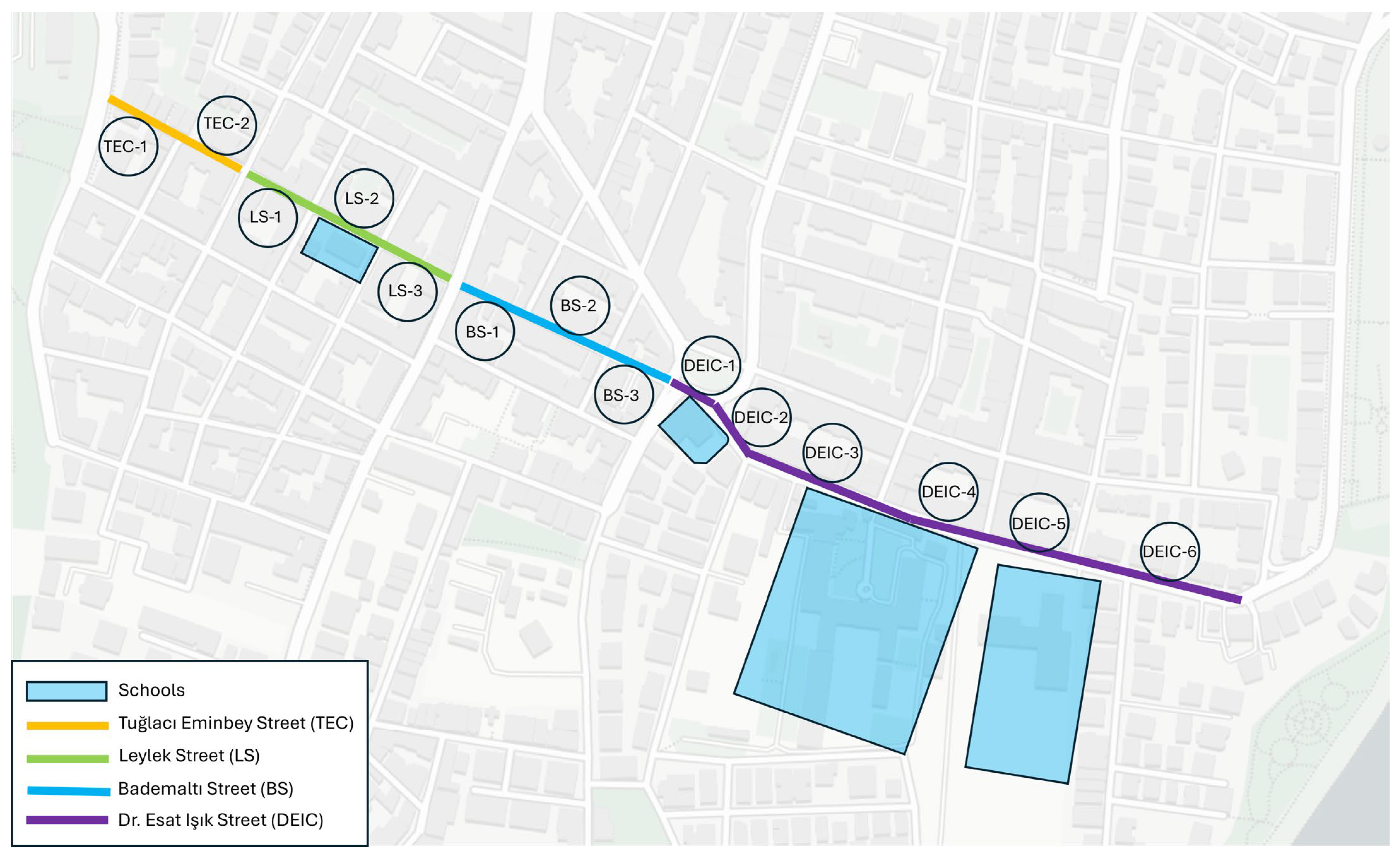
The study was conducted on the following four streets: Tuğlacı Emin Bey Caddesi, Leylek Sokak, Bademaltı Sokak, and Dr. Esat Işık Caddesi. A total of fourteen segments were identified on these streets, each divided into two parts: right and left. This segmentation allowed for a more detailed assessment of the sidewalk and buffer zone conditions on both sides of each relevant segment. Thus, a total of twenty-eight segments were included in the modeling.
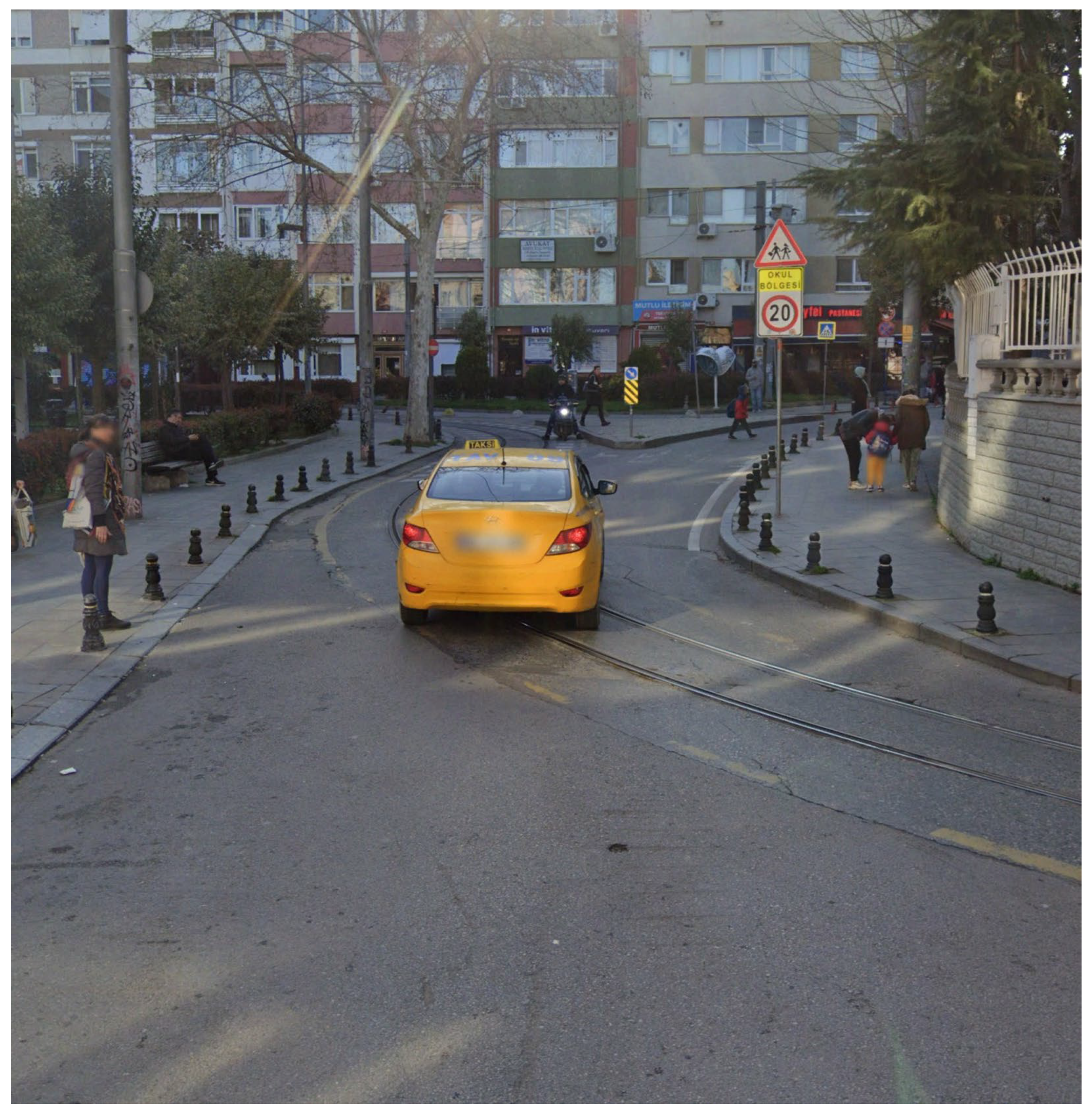
The route segmentation adopted in this study is illustrated in Figure 3. With the exception of Segment 1 on Dr. Esat Işık Street (DEIC-1), all analysis segments operate as single-lane road sections. Dr. Esat Işık Street, which forms part of the circulation around Mehmet Avvaltaş Square, includes sections with two physical lanes—one for each direction—shared with the nostalgic tram line. However, due to the existing signalized traffic control that regulates directional movements and prevents simultaneous two-way operation, this segment functions operationally as a single-lane facility. Accordingly, Segment 1 on Dr. Esat Işık Street (DEIC-1) is treated as a single-lane segment in the PTSL analysis. A photographic illustration of this segment is provided in Figure 4.

2.2. Data Collection, Processing, and Determination of Input Variables

The data collection process consists of two main stages:
  • Traffic and pedestrian counts were conducted manually at specified locations and during defined time periods.
  • Infrastructure and physical environment observations included sidewalk width, lane width, and buffer zone presence.
After data collection, they were processed in Microsoft Excel (Microsoft 365, Version 2512) and used to derive the six variables listed below. These six basic variables, which serve as model inputs, were selected from the literature for their effectiveness in pedestrian comfort and safety. In this study, the term “input variable” refers to the parameters directly used in the fuzzy PTSL model. In contrast, indicators denote intermediate variables used to estimate traffic flow speed, which is then incorporated into the fuzzy PTSL model as an input variable.
  • Vehicle density (vehicles/km): Derived using traffic flow and estimated speed.
  • Pedestrian density (persons/min/m): Derived from pedestrian counts obtained from traffic counts.
  • Lane width (m): Determined by physical measurement in the field.
  • Sidewalk width (m): Determined by physical measurement in the field.
  • Buffer zone (categorical; 0: none, 1: bollard, 2: bollard + parking): Coded based on observation.
  • Estimated traffic flow speed (km/h): This variable was calculated using the AHP method, accounting for ten physical and operational indicators for the study route segments. The model uses traffic density, pedestrian density, lane width, sidewalk width, the presence of buffer zones, the speed limit, the parking status, the total number of movement directions, traffic lights, and the number of intersections as indicators. Comparative matrices were created for each indicator based on expert opinions, and indicator weights were derived from these matrices, which were checked for consistency ratio (CR). Using the obtained weights, a composite score was calculated for each road segment, and the corresponding estimated traffic flow speed was determined. This approach produced a numerical traffic flow speed profile for each segment that can be compared, enabling analysis of the spatial distribution on maps and tables. The detailed calculation procedure underlying the traffic flow speed estimation is described in Section 3.
These six variables, whether obtained through direct observation, derived, or estimated, were defined as input variables for the model in the system.

2.3. Defining Membership Functions

For each designated input variable, three linguistic values (often low, medium, and high) have been delineated; these values are depicted by distinct membership functions (trimf, linsmf, and linzmf). Correspondingly, five linguistic levels have been established for the model’s output variable, PTSL: very low, low, medium, high, and very high. All membership functions have been established and visually validated in the MATLAB (R2024b) Fuzzy Logic Toolbox. Additionally, their parameters were fine-tuned using a Genetic Algorithm (GA) to enhance model calibration.

2.4. Establishing the Rule Base

In the fuzzy model, six input variables were defined at three linguistic levels each, and all combinations were systematically generated, resulting in a total of 729 (36) rules. This rule set was automatically structured in Microsoft Excel (Microsoft 365, Version 2512) and then transferred to the MATLAB (R2024b) environment.
To counteract the tendency toward intuitive rule definitions commonly emphasized in literature, the rules in this study were structured in a data-driven manner. Specifically, expert-based weights were determined for each variable using the AHP, an MCDM method, and used within the scope of the score-based rule generation approach.
According to this method, the scores corresponding to the linguistic values of each variable were multiplied by the weights obtained with AHP, and composite scores were created for all rule combinations. Thus, the effect of each input combination in the system on the output was modeled quantitatively rather than intuitively. The obtained scores were used as weights (w ∈ [0, 1]) for each if-then rule in the rule base, which was then integrated into the fuzzy inference system in MATLAB (R2024b).
With this approach, the need for intuitive intervention, often encountered in classical fuzzy systems, has been eliminated; the effect of the rules is modeled using a weighted structure, often referred to as rule weighting schemes in literature. Thus, both the integrity of the model and the rule contributions have been preserved, and the rule contributions have been represented more fairly and transparently.
As a result, this study has created a complete set of rules covering all rule combinations, aiming for a consistent, optimizable structure free of heuristics.

2.5. Defining Fuzzy Inference Systems

After establishing the rule base and membership functions, the model’s inference system was developed. The employed system is a Mamdani-type fuzzy logic model. The Mamdani model is favored for examining human perception, environmental uncertainties, and intuitive variables, primarily because of its framework that accommodates language descriptions of inputs and outputs. In this respect, it provides a suitable framework for the intuitive evaluation of the physical, interpretable variables used in the study, such as “sidewalk width”, “buffer zone”, and “pedestrian density”.
Other parameters used in the model are as follows:
  • Type: Mamdani
  • AND method: min
  • Inference method (implication): min
  • Aggregation method: max
  • Defuzzification method: centroid
  • Output variable: PTSL (continuous value between 0 and 10)
The min/max approach offers the advantage of limiting the effect of extreme values on the model by selecting the most representative membership value from each fuzzy set. This approach facilitates the production of more stable outputs when field data is limited and sometimes unbalanced. The centroid (center of gravity) method is the most used method in the sharpening stage. It provides a balanced result that is sensitive to the average because it considers the overall distribution of the output. The centroid method balances the impact of multiple weighted inputs, reduces the influence of outliers, and represents the overall trend stably. The corresponding defuzzification formula is given in Equation (1).
y = x μ ( x ) d x μ ( x ) d x
Here,
  • μ ( x ) is the membership degree of the aggregated output membership function.
  • x is the universe variable of the output (PTSL).
  • y denotes the defuzzified output value.
This formula produces a definitive PTSL score by taking the weighted average of all possible output values. This parameter choice maintains the model’s structure while promoting stable numerical behavior and reliable reproducibility of results.

2.6. Model Implementation and Output Generation

The model was applied to the twenty-eight identified sidewalk directions, producing a PTSL score in the range [0–10] for each. Segments exhibiting elevated PTSL levels, particularly in school zones, were evaluated in detail. These findings enabled comparisons of directional variations, sidewalk conditions, and patterns of vehicle-pedestrian interaction in each area.

3. Model Implementation

The study has six input variables. A prediction model has been developed for one of these variables, traffic flow speed. As defined in the methodology, traffic flow speed is not directly observed but is estimated using indicator-based inputs derived from traffic and infrastructure characteristics, which are subsequently incorporated into the fuzzy PTSL model as an input variable.
The speed estimation method scales the scores for the segments between zero and the safe traffic speed limit (0–30 km/h) based on their position relative to the maximum and minimum values they can theoretically take. This method allows the traffic flow speed to be systematically estimated for each segment based on the existing traffic and infrastructure characteristics.
The indicators used in the traffic flow speed prediction model were selected to reflect the effect of traffic flow, road geometry, and infrastructure elements on traffic flow speed. For each indicator, weight coefficients were determined using the AHP method, based on pairwise comparisons and expert opinions, and decision matrices were created. These coefficients numerically reflect the magnitude of each indicator’s effect on traffic flow speed; the validity of the process was verified using the CR. The indicators used and the calculated coefficients are listed below:
  • Speed effect based on the relationship between traffic flow (q, vehicles/hour) and density (k, represented by Google traffic congestion level): To understand how congestion conditions influence traffic flow speed, we compared field-measured traffic flow (vehicles/hour) with Google Maps congestion level data. Segments that operated near their flow capacity were treated as stable zones—locations where traffic flow speed was assumed to remain constant regardless of changes in congestion. In other parts of the network, flow values and congestion categories were jointly evaluated to interpret whether traffic flow speed was likely to increase or decrease. Google congestion levels (1–4) were averaged across four observation periods: Thursday and Friday, during both school opening and closing hours. Field flow measurements were collected during the same periods to ensure temporal consistency and strengthen the reliability of the comparison. During analysis, the maximum flow rate (qmax) was taken as 800 vehicles/hour. The four Google congestion levels (1–4) were converted into equal 25% ranges, with k = 1 corresponding to the lowest congestion and k = 4 to the highest. In this study, traffic flow and Google traffic congestion levels are derived from different data sources and at different temporal resolutions. Traffic flow values come from manual counts done in the field over continuous 30 min intervals on certain survey dates. Google congestion levels, on the other hand, are based on algorithms that use short time slices (5 min) and may show average or typical conditions instead of exact volumes for the same observation period. Therefore, a direct linear correspondence between these two measures is not expected. Instead, they are treated as complementary inputs whose joint interpretation informs the flow-density-based indicator.
  • Lane width (m): Wider lanes can increase vehicle speed levels because they allow vehicles to move more freely. Azin et al. show that each 30 cm increase in lane width is associated with an increase of approximately 1.63 km/h in the 85th percentile speed. This relationship was observed for urban arterial streets with lane widths ranging from about 9.43 to 14.91 ft, with most observations concentrated in the 10–14 ft interval, which corresponds to the typical lane-width range analyzed in their study [54]. Numerous studies reviewed by the Parsons Transportation Group indicate that vehicle speeds tend to increase with increasing lane width. In addition, the review highlights that narrower lanes can strengthen drivers’ perceptions of road safety by encouraging more cautious driving behavior [55].
  • Number of sidewalks (2: two-sided, 1: one-sided, 0: none): Pedestrian access to safe areas can affect vehicle speeds. Ivan et al. show that streets with more extensive sidewalk provision are associated with lower vehicle speeds, whereas roads without sidewalks tend to exhibit higher average vehicle speeds than those with pedestrian facilities [56].
  • Total sidewalk width (m): Although no studies link sidewalk width to traffic flow speed, as with the number of sidewalks, wider pedestrian infrastructure requires drivers to be more careful and can reduce speed.
  • Traffic lights (1: present, 0: absent): Traffic signals affect how fast vehicles move. Galusca et al. show that vehicle speeds decrease at signalized intersections, although drivers may accelerate as they approach a changing signal, leading to local speed fluctuations [57]. Such behavior can raise vehicle speed fluctuations at these points. Because the study site is a compact, busy urban area, traffic signals were expected to reduce overall vehicle speeds.
  • Number of intersections: Drivers tend to slow down when they encounter streets with frequent intersections, as the likelihood of conflict points increases. Basu et al. support this relationship by showing that higher intersection density is associated with lower operating speeds and more frequent speed reductions, reflecting heightened risk perception among drivers [58]. This indicator is particularly relevant near pedestrian crossings and within dense urban networks.
  • Total number of movement directions (number of entry and exit directions): The number of entry and exit routes at an intersection can affect traffic flow and, consequently, speed levels. Celko et al. show that an increasing share of turning maneuvers at intersections—particularly right and left turns—leads to reductions in operating speeds, as turning vehicles introduce deceleration and flow disruptions that propagate upstream, resulting in speed losses [59].
  • Parking status (2: double-sided, 1: single-sided, 0: none): The presence of vehicles parked along the roadside is associated with reductions in mean and 85th percentile speeds. Praburam and Koorey show that on-street parking affects traffic flow by lowering vehicle speeds, and that as the density of parked vehicles increases, drivers’ tendency to slow down becomes more pronounced [60].
  • Speed limit (km/h): As the speed limit increases, actual driving speeds also tend to increase. However, Shinar shows that drivers do not determine their actual speed preferences based solely on the legal speed limit; instead, they adjust their speed according to levels they perceive as enjoyable, safe, or economical. When speed limits are raised, drivers increase their speed in parallel with this change, but they may still choose to drive below or above the specified limit [61].
  • Speed Hump (1: present, 0: absent): Vehicle speed levels are expected to decrease in road sections with speed bumps. Huang et al. show that speed bumps can significantly reduce vehicle speeds by encouraging drivers to slow down as they approach the device, with speeds typically increasing again after passing it, indicating that the speed reduction effect is distributed over a certain distance [62].
The assessments were conducted with the participation of seven experts from the public sector (İstanbul Metropolitan Municipality, Kadıköy Municipality), academia (Sakarya University of Applied Sciences), civil society (Active Life Association), and international organizations (World Resources Institute, Deutsche Gesellschaft für Internationale Zusammenarbeit). Participants included urban planners, transportation engineers, and academics, with an average of approximately 15 years of professional experience.
The pairwise comparison matrices obtained from the experts were normalized on an individual basis; then, group weights were calculated by combining them using the geometric mean method. The consistency of the AHP outputs was checked using the CR, which yielded a value of 0.0248 (CR < 0.1 → consistent). Thus, the weights assigned to the indicators were determined based on both expert opinions and mathematical consistency. Table 1 summarizes the AHP coefficients for each indicator and their potential effects on traffic flow speed, with the direction of increase indicated.
Table 2 shows the indicators for each segment and their corresponding values. Only the traffic flow and Google traffic congestion level, which are used as the basis for the “speed effect based on the relationship between traffic flow and density” indicator, are also shared in Table 2, which summarizes these values. Hereafter, TEC, LS, BS, and DEIC are used as location codes referring to Tuğlacı Eminbey Street, Leylek Street, Bademaltı Street, and Dr. Esat Işık Street, respectively. Each column represents a separate segment, and there are fourteen segments in total.
Subsequently, each of the other indicators, except the “speed effect based on the relationship between traffic flow and density” indicator, was normalized to a 0–10 scale. For the “speed effect based on the relationship between traffic flow and density” indicator, normalization was performed by assigning values of +10 to “Increases,” 0 to “No effect,” and −10 to “Decreases.” For all remaining indicators, normalization was performed using the formula in Equation (2).
S c o r e n o r m a l i z e d = S c o r e c u r r e n t S c o r e m i n S c o r e m a x S c o r e m i n × 10
Using this procedure, all indicators were standardized to minimize scale-related inconsistencies. The normalized values were then multiplied by their corresponding coefficients to compute a total score for each segment. Since some indicators increase traffic flow speed while others decrease it, indicators with an increasing effect were assigned a positive sign, whereas those with a decreasing effect were assigned a negative sign. The only exception is the “speed effect based on the relationship between traffic flow and density” indicator, which was already normalized categorically (+10/0/−10) based on its direction of impact on traffic flow speed. The final total score table is shown in Table 3.
As presented in Table 3, the maximum computed score reached 0.954, whereas the minimum was −5.135. All indicators—except one—were normalized to a 0–10 scale, and each received a specific coefficient. For the indicator “speed effect based on the relationship between traffic flow and density”, the attainable range was −8.103 to 3.099.
In the final calculation, the score’s position within this interval was used to estimate traffic flow speed. The upper bound (3.099) corresponded to a theoretical speed of 30 km/h, considered an appropriate and safe value for the corridor, while the lower bound (−8.103) corresponded to a potential minimum of 0 km/h. The corresponding computation is given in Equation (3).
T r a f f i c   F l o w   S p e e d e s t i m a t e d = S c o r e c u r r e n t S c o r e m i n S c o r e m a x S c o r e m i n × 30
The estimated traffic flow speeds for each segment are shown in Table 4.
After the traffic flow speed variable was estimated, the remaining variables were organized to assess PTSL. A fuzzy logic model was then developed using these inputs. As previously described, six key variables formed the model’s input set:
  • Vehicle density (vehicles/km)
  • Pedestrian density (persons/minute/meter)
  • Lane width (m)
  • Sidewalk width (m)
  • Buffer zone (0: none, 1: bollard, 2: bollard + parking)
  • Estimated traffic flow speed (km/h)
In this study, each input variable was represented by three linguistic terms (low, medium, high) using triangular or linear membership functions (S- or Z-shaped), guided by relevant literature, expert judgment, and the local characteristics of the study corridor. Rather than relying on strict deterministic thresholds, the initial ranges were set to reflect both typical values reported in previous studies and the observed distribution of the field data, ensuring meaningful coverage of conditions encountered in the study area.
A Genetic Algorithm (GA) was then used to fine-tune the numerical parameters of these initial membership functions within predefined bounds, aiming to improve the model’s numerical consistency and robustness. The GA adjusted only the function parameters, without altering the linguistic categories or the conceptual structure of the membership functions. Categorical variables were excluded from the optimization.
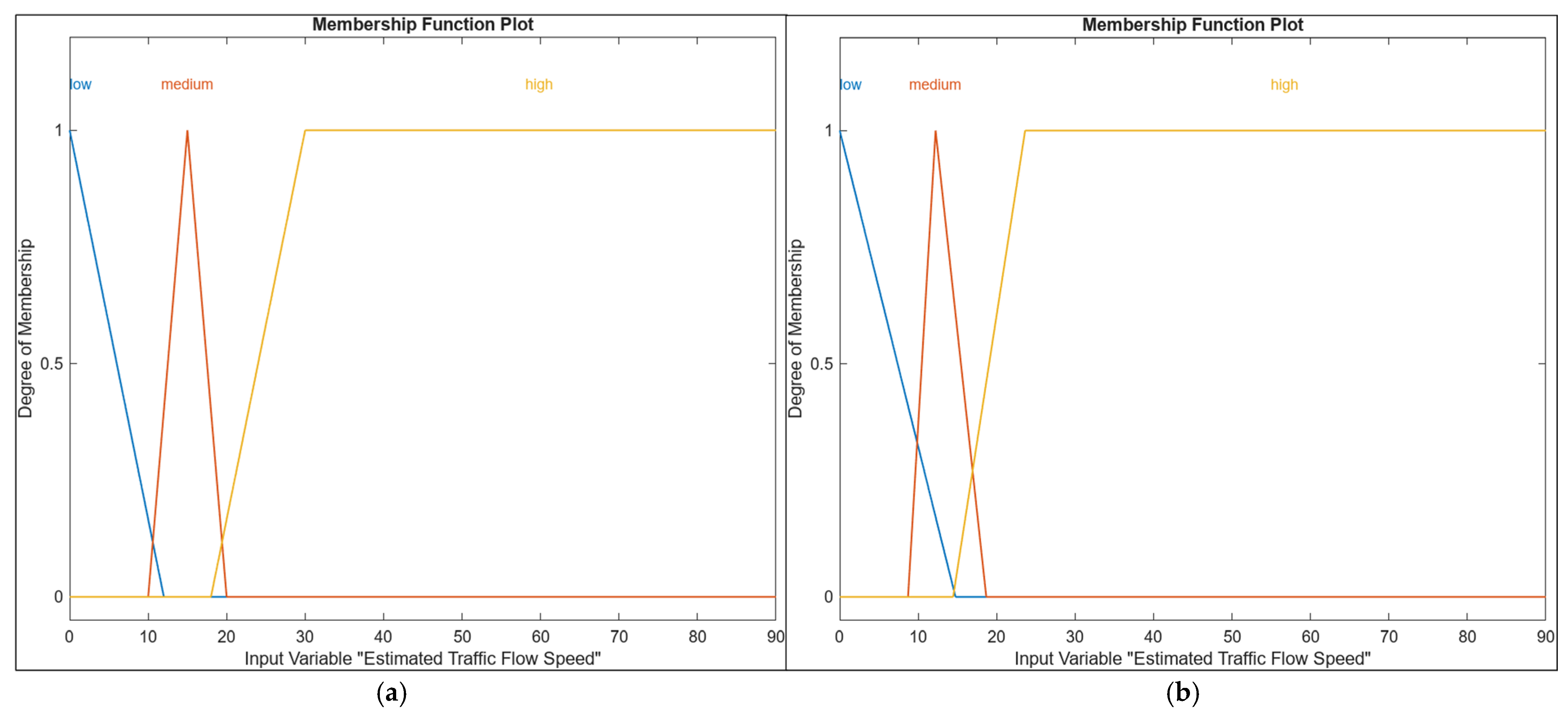
As an illustrative example, the membership function definitions for the estimated traffic flow speed variable are presented in Table 5, and their graphical representations are shown in Figure 5. The low and medium levels are modeled using triangular membership functions, while the high level is modeled using an S-shaped membership function.
In the basic configuration (Figure 5a), three linguistic terms—low, medium, and high—are represented using triangular and S-shaped membership functions. The low and medium levels are modeled with triangular functions to capture gradual transitions within commonly observed speed ranges, whereas the high level is represented using an S-shaped function to reflect a smoother saturation effect at higher speeds. The overlap between adjacent membership functions reflects the inherent uncertainty in classifying traffic flow speed near threshold values, a fundamental characteristic of fuzzy logic modeling.
After GA optimization (Figure 5b), the overall form, ordering, and linguistic interpretation of the membership functions remain unchanged. However, the transition points between adjacent membership functions are slightly shifted. These adjustments improve the numerical alignment of the membership functions with the observed distribution of estimated traffic flow speed values, leading to more balanced overlaps between linguistic terms. Importantly, the optimization process fine-tunes only the numerical parameters of the functions and does not redefine the linguistic categories or introduce new thresholds.
From an interpretative perspective, the comparison between Figure 5a,b demonstrates that the GA does not fundamentally alter how traffic flow speed is conceptually categorized as low, medium, or high. Instead, it enhances the internal consistency of the fuzzy representation by ensuring that membership transitions better reflect empirical conditions along the study corridor. This refined representation provides a more stable basis for subsequent fuzzy rule evaluation and contributes to the robustness of the overall PTSL estimation.
For example, for an estimated traffic flow speed value located near the transition between the medium and high linguistic terms, both membership functions are partially activated. This overlap allows the same input value to simultaneously contribute to multiple rules with different strengths, ensuring smooth transitions rather than abrupt changes between linguistic categories. Figure 5 illustrates that the GA-optimized membership functions make slight adjustments to these transition regions while preserving the original linguistic structure, which improves numerical coherence without changing the conceptual interpretation of low, medium, and high-speed levels.
The same procedure was applied to the remaining variables (vehicle density, pedestrian density, lane width, and sidewalk width). The buffer zone variable (0: none, 1: barrier, 2: barrier + parking) was modeled using narrow triangular membership functions centered on its discrete values to preserve its categorical nature and was not included in the GA optimization.
In the model, three membership functions are defined for each of the six input variables, yielding a total of 729 if–then rules. The rules were prepared in Microsoft Excel (Microsoft 365, Version 2512) and imported into MATLAB (R2024b). In creating the rules, numerical representation values (1, 2, 3) were assigned corresponding to the verbal membership values defined for each variable (“low,” “medium,” “high”). Then, the weights representing the relative impact of each variable on PTSL were determined using the AHP method, with the participation of seven experts. Thus, the AHP weights obtained for each variable were multiplied by the membership levels, and total weighted scores were calculated for each rule combination.
In this study, the rule base was generated automatically using a numerical scoring procedure rather than traditional, intuitive assignments. Each variable’s linguistic membership level (e.g., low–medium–high) was converted into numerical equivalents and multiplied by the weights obtained through the AHP, resulting in a total “rule score” for each if–then combination. Based on these scores, rule outputs were assigned in an objective and repeatable manner, thereby minimizing the problem of intuitive output-value assignment commonly observed in fuzzy systems. This approach is inspired by data-driven fuzzy rule generation methods introduced by Wang and Mendel and adaptive neuro-fuzzy inference frameworks proposed by Jang and is implemented in this study through the integrated use of these components [63,64].
Since the variables affecting PTSL operate in different directions, their directional effects were explicitly accounted for in the score calculation. Variables that increase PTSL and those that reduce it were evaluated separately, and variables with a stress-reducing effect were inversely transformed to ensure directional consistency in the composite score, such that higher values of these variables would correspond to lower PTSL contributions (e.g., wider sidewalks yielding lower PTSL values).
The weights determined using the AHP method are given in Table 6.
The rule score for each if-then combination was computed using the weighted variable structure, as given in Equation (4).
R u l e   S c o r e = ( T D × w 1 ) + ( P D × w 2 ) + ( L W × w 3 ) + ( ( 4 S W ) × w 4 ) + ( ( 4 B Z ) × w 5 ) + ( E T F S × w 6 )
As shown in Equation (4), membership levels with values 1–3 were weighted according to the direction of each variable’s effect. For variables that reduce PTSL—such as sidewalk width and buffer zone—the (4 − x) transformation was applied to ensure that their inverse effects were accurately represented. This adjustment enabled the generation of an objective, internally consistent PTSL score for every rule combination. The resulting scores were then matched with the output membership functions to determine their corresponding values within the fuzzy model.
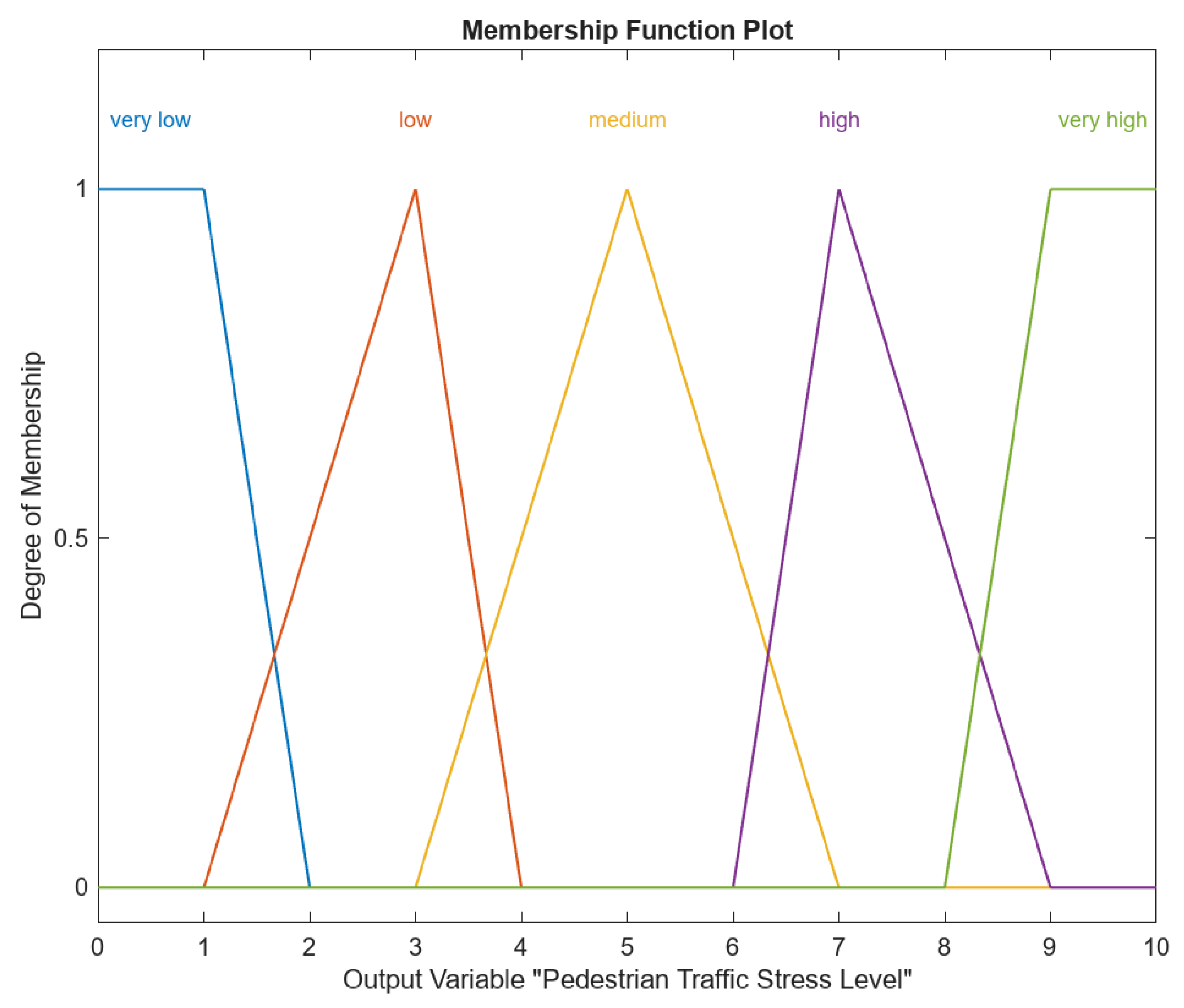
The model’s output variable, PTSL, produces a continuous value in the range [0–10]. Five membership functions have been defined for this variable. The numerical definitions of these membership functions are provided in Table 7, and their graphical representations are shown in Figure 6.
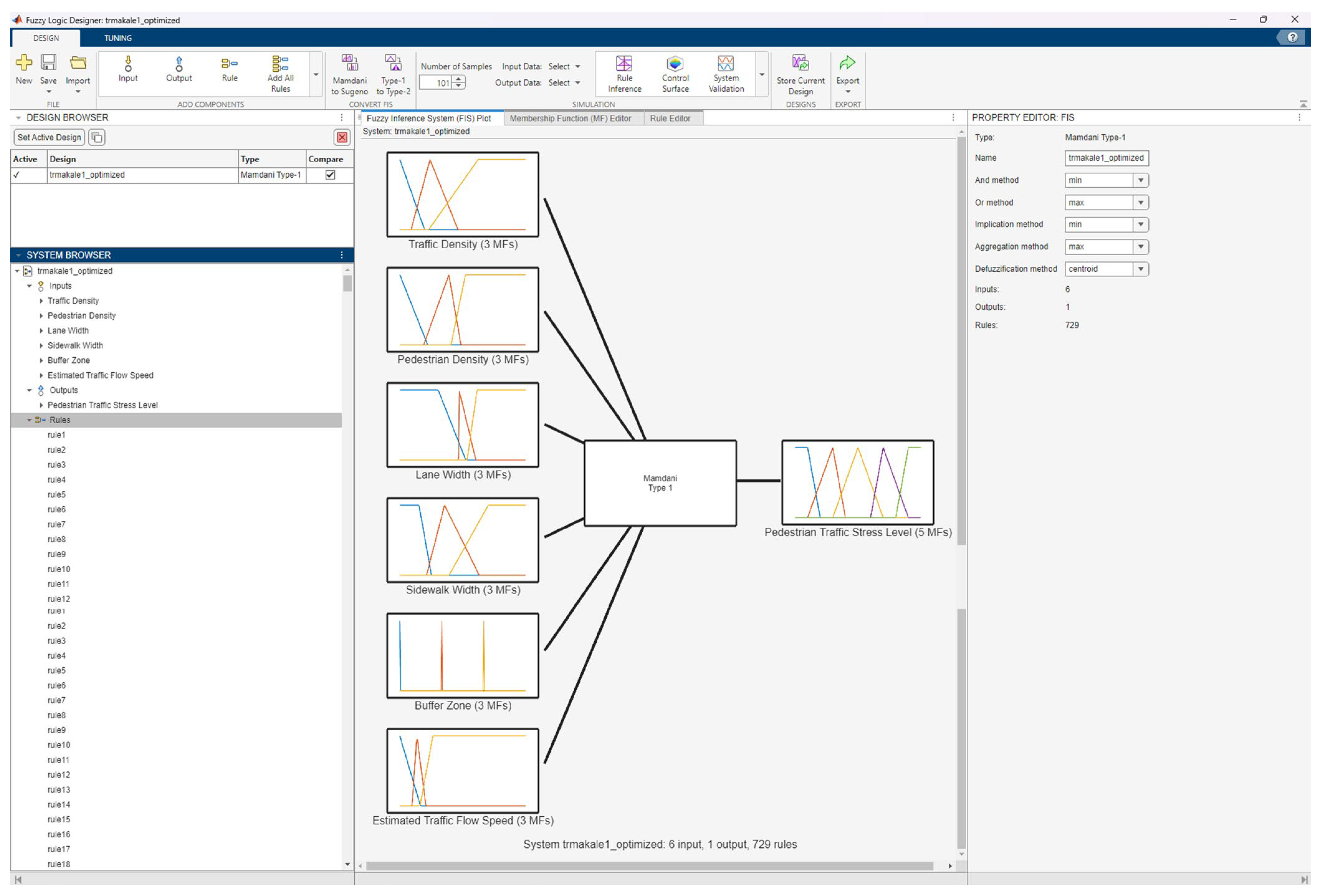
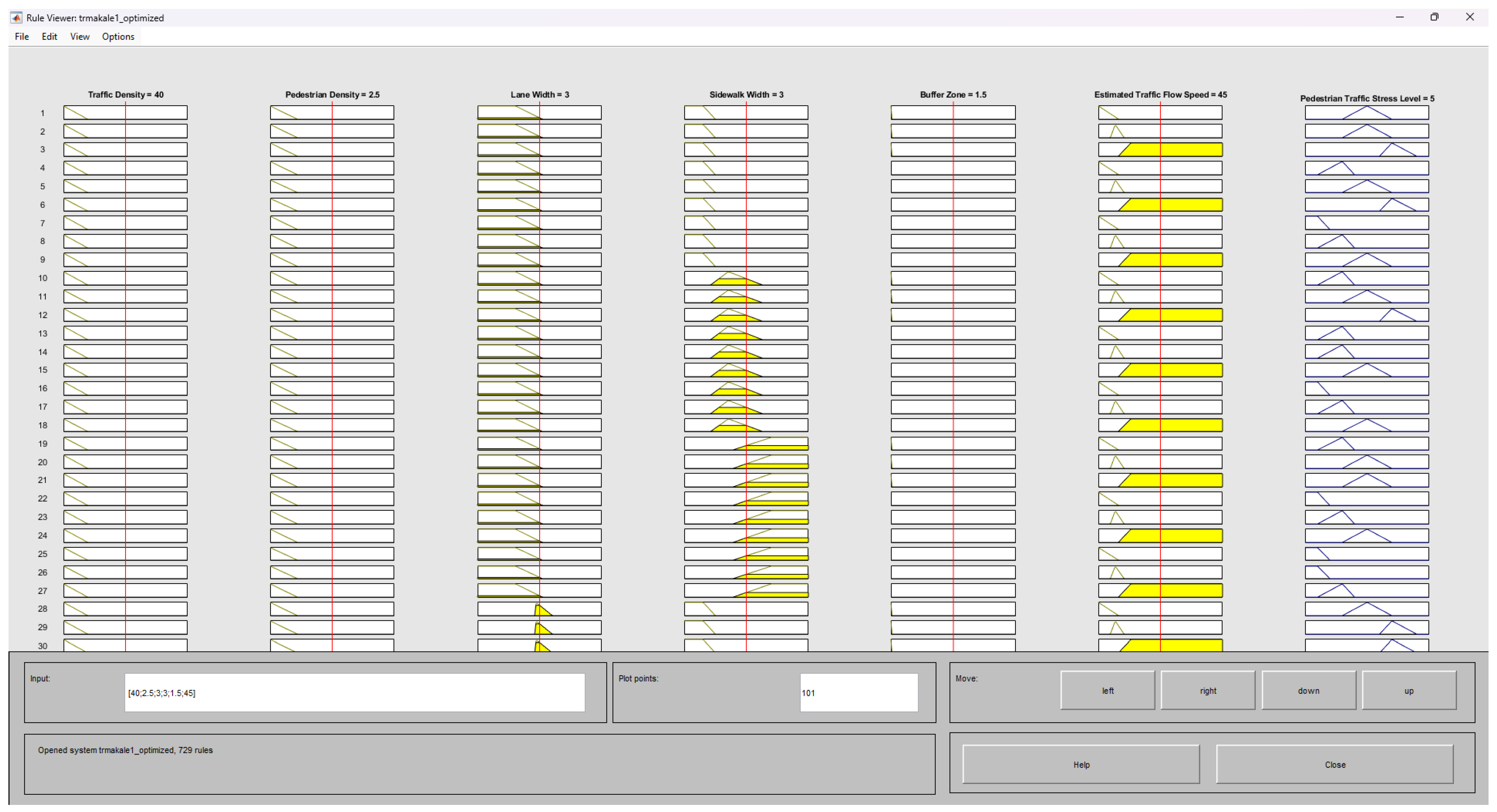
This structure enables the system to interpret the PTSL that pedestrians encounter in uncertain traffic environments using multiple criteria. The solution window for this analysis, performed using MATLAB (R2024b), is shown in Figure 7. Additionally, after the rules are introduced, Figure 8 presents a visual representation of the rule screen, indicating which result corresponds to each input position.
Figure 7 provides an integrated overview of the fuzzy inference system used in the PTSL model, illustrating how the six input variables are combined through the rule base to generate a pedestrian traffic stress output. The figure visualizes the overall model architecture, including the structure of the input membership functions, the aggregation of rules within the Mamdani inference framework, and the defuzzification process leading to the final PTSL value. In this sense, Figure 7 serves as a conceptual bridge between the input-level computations described earlier in the methodology and the resulting stress-level estimates used in the analysis.
Figure 8 further illustrates the internal behavior of the fuzzy logic model through the rule viewer interface. For a given set of input values, the figure shows the activation levels of the relevant membership functions, the subset of rules that are fired, and the resulting aggregation that determines the PTSL output. This visualization enhances the transparency and interpretability of the model by explicitly demonstrating how multiple rules can be partially activated and jointly contribute to the final stress level.

4. Results

The defined fuzzy-logic model generated PTSL for each road segment based on six variables. The results reported in this section are derived from the optimized model, for which membership functions were calibrated using a GA.
In the model application, each road segment was evaluated separately for both the right and left sidewalks. This choice ensured that physical and functional differences between the two sides of the same segment, such as sidewalk width, buffer zone condition, and pedestrian density, could be modeled. All schools along the studied route are on the right side, making the right-hand sidewalks more critical for pedestrian safety. The model was designed to reflect these spatial sensitivities and to directly reflect right-left direction distinctions in the results.
Tuğlacı Eminbey Street (TEC) follows with an average PTSL score of 5.89. Vehicle and pedestrian densities on TEC are below the route average; however, the street has one of the highest traffic flow speeds (21.87 km/h) and relatively narrow sidewalks (1.76 m). Buffer zone protection is limited on the left side, where only bollards are present, while the right side includes a bollard–parking arrangement. These characteristics collectively explain the elevated PTSL on TEC.
The TEC-1 and TEC-2 segments form part of the broader school-zone corridor, although they are not directly adjacent to school entrances. These segments are among the corridor’s parts with the highest estimated traffic flow speeds. On the right sidewalks, a combination of bollards and on-street parking provides stronger physical separation from traffic, resulting in moderate PTSL values around 5.00. On the left sidewalks, where only bollards are present and sidewalk widths are slightly narrower, the same high speeds generate higher pedestrian stress, with PTSL values reaching 6.61 in TEC-1 and 6.95 in TEC-2.
Leylek Street (LS) records the third-highest average PTSL (5.71). Sidewalk widths on both sides remain below the route average (approximately 1.80 m), and buffer zone conditions are weak. Although estimated traffic flow speed on LS (17.63 km/h) is close to the overall average, the combination of limited sidewalk space and partial physical separation contributes to moderately high PTSL along this corridor.
In LS-1, estimated traffic flow speed is above the route average. The right sidewalk has a narrow width of 1.80 m and includes a bollard–parking buffer, producing a moderate PTSL score of 5.00. The left sidewalk is even narrower (1.50 m), and only bollards provide separation. These geometric and protective differences lead to a higher PTSL score of 6.16 on the left side, despite similar traffic and pedestrian densities.
The highest PTSL occurs in LS-2. PTSL reaches 7.07 on the right sidewalk and 7.57 on the left, the highest value in the study. The right sidewalk width (2.40 m) is slightly above the route average (2.25 m), whereas the left sidewalk is significantly narrower (1.35 m). When combined with higher traffic flow speeds and a limited buffer configuration, these conditions create a highly stressful environment at the school entrance.
In LS-3, PTSL decreases to 4.30 on the right sidewalk and 4.19 on the left. The right sidewalk width (2.25 m) is close to the route average, whereas the left sidewalk (1.50 m) remains narrow. This segment has one of the lowest traffic flow speeds along the entire route, which reduces pedestrian exposure. As a result, LS-3 generates lower PTSL even though one sidewalk is narrow and the other is only slightly wider than the route average.
Bademaltı Street (BS) has the highest average PTSL along the route (6.63). Although vehicle density on BS is below the route average, the corridor exhibits the highest estimated traffic flow speed (21.92 km/h) and the lowest average sidewalk width (1.75 m). BS is also one of the most disadvantaged segments in terms of buffer zone conditions (1.17), like LS. This combination makes BS one of the least comfortable walking environments despite moderate pedestrian activity. The BS segments exhibit varying PTSL driven by differences in pedestrian activity, sidewalk width, buffer conditions, and traffic flow speed.
In BS-1, vehicle density is below the route average, but pedestrian density is notably high due to the connection with Moda Street. Sidewalks are narrow except for the right side, and only bollards are present as buffers. With traffic flow speeds being the second-highest along the corridor, these conditions combine to produce elevated PTSL scores of 6.80 (right) and 7.44 (left).
In BS-2, pedestrian density is slightly above the route average on the left side and slightly below it on the right side, but sidewalk widths remain limited, and buffer protection is again minimal across both directions. This segment also contains the highest traffic flow speeds recorded on the route, which explains the consistently high PTSL score of 7.44 on both sides.
In BS-3, both vehicle and pedestrian densities fall below the corridor average, and traffic flow speed is close to the route average. The right sidewalk benefits from stronger physical separation through a bollard-plus-parking buffer, resulting in a lower PTSL score of 4.32, while the left sidewalk—with narrower space and only bollards—yields a higher value of 6.33.
Evaluating field data grouped by street reveals that streets with different physical characteristics and usage intensities differ in PTSL. Dr. Esat Işık Caddesi (DEIC) has the highest values in terms of average vehicle density (42.5 vehicles/km), average pedestrian density (1.68 persons/min/m), average lane width (4.08 m), and average sidewalk width (2.89 m), and its estimated traffic flow speed is also lower than other streets (14.52 km/h). This avenue is characterized as a street operating at high density but is physically partially protected. The average PTSL for DEIC was calculated as 5.30, making it the street with the lowest average score.
In DEIC-1, both sidewalks produced a PTSL score of 6.05. Sidewalks in this segment are wide (3.0 m), and pedestrian density is above the route average. Only bollards serve as a buffer, and the lane width is relatively wide due to the intersection layout. These conditions explain the moderate-to-high PTSL even though traffic flow speed is close to the route average.
In DEIC-2, PTSL remains elevated, with 6.65 on the right sidewalk and 6.45 on the left. Pedestrian density continues to be high, and sidewalk widths (2.7 m and 2.4 m) are above and slightly above the route average, respectively. Buffer conditions differ between directions: the right sidewalk includes only bollards, whereas the left sidewalk has bollards and parking, providing slightly more separation. Traffic flow speed in this segment also remains close to the route average. The combination of high pedestrian activity and limited protection—particularly on the right side—results in higher PTSL around this part of the school frontage.
DEIC-3 produced the lowest PTSL on the entire route (4.00 on the right; 2.58 on the left). This segment also has the lowest traffic flow speed along the route. Vehicle density is high, sidewalks are wide (2.9 m and 3.7 m), and buffer conditions differ slightly between directions, with bollards on the right and bollards combined with parking on the left. The very low traffic flow speed is the dominant factor reducing PTSL despite heavy traffic.
DEIC-4 shows medium PTSL (5.29 on the right; 5.46 on the left). Vehicle density remains high, and sidewalk widths are slightly above the route average. Pedestrian density is above average on the right side, while the left side is slightly below the route average. Traffic is slightly below the average. These conditions result in moderate PTSL on both sidewalks.
DEIC-5 has the highest vehicle density on the entire route. Sidewalks are very wide on the right (4.75 m) and above average on the left (2.7 m). Traffic flow speed is below the route average. Despite favorable sidewalk widths, the extremely high traffic density elevates PTSL to 5.53 on the right and 4.51 on the left.
DEIC-6 marks the end of the corridor segment. Vehicle density remains above the route average but is lower than DEIC-3, DEIC-4, and DEIC-5. Pedestrian density decreases compared to earlier segments. Sidewalk width is wide on the right (3.1 m) and below average on the left (1.9 m), and traffic flow speed is below the route average. These conditions produce a medium PTSL score of 5.33 on the right and 5.66 on the left.
Taken together, the street-level and segment-level results indicate a wide range of PTSL along the corridor. From an overall corridor-level perspective, the calculated PTSL ranged from 2.58 to 7.57. The lowest PTSL (2.58) was found on the left sidewalk of DEIC-3. A generous 3.3 m width, a buffer zone of bollards, and a parking lane provide clear physical separation. Traffic here moves at a moderate pace (30.6 vehicles/km) and at a low traffic flow speed (7.95 km/h). These conditions jointly explain the low PTSL value, reflecting the combined effects of greater sidewalk width, effective physical separation from traffic, and low traffic flow speed.
The highest PTSL outputs are observed in the following order: LS-2 left segment, BS-2 right segment, BS-2 left segment, and BS-1 left segment. These groups produced PTSL scores ranging from 7.57 to 7.44. Compared to the entire route, these segments have higher traffic flow speeds. In addition, the sidewalk widths are narrower than the rest of the route. These segments only have tactical bollards as buffers.
The most significant difference along the route is the average sidewalk width on the right and left sides of the road. In this sense, the average sidewalk width is higher on the right side of the road, where schools are also located. The other variables showed no differences, but buffer zones and pedestrian density differed slightly. Along the route, bollards and parking are more common on the left side of the road, and pedestrian density is slightly higher there as well.
A comparison of the PTSL values obtained using the basic and GA-optimized membership functions is presented in Table 8, providing a segment-level illustration of how optimization affects stress evaluation across the study corridor.
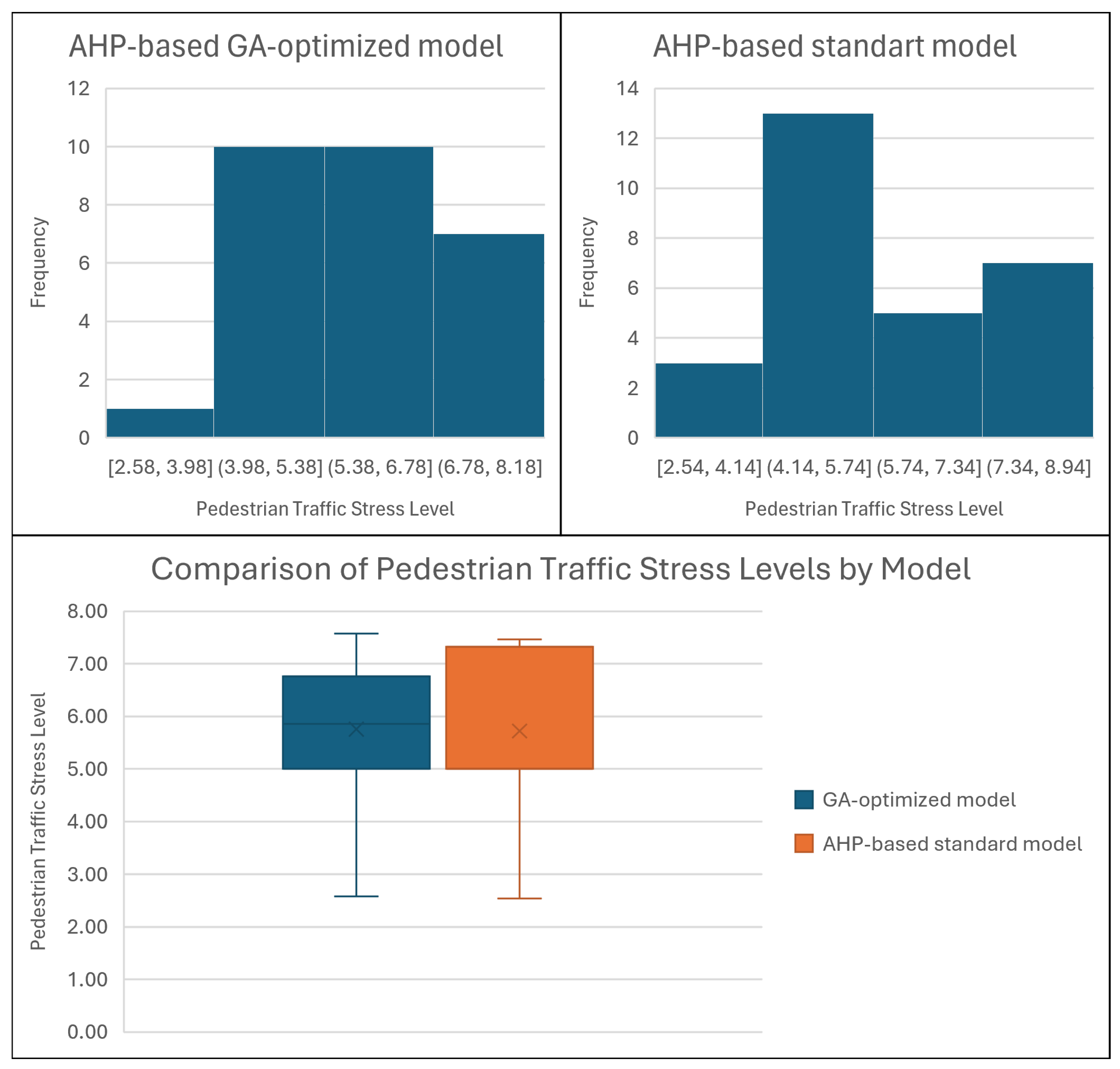
To evaluate the behavior of the model outputs, the AHP-based standard model and the GA-optimized model were compared. The comparison results indicate a strong linear relationship between the two models (Pearson r = 0.76). However, their distributional characteristics differ. In the GA-optimized model, the variance of PTSL scores (1.57) and the standard deviation (1.25) are lower than those of the standard model (1.83 and 1.35). In addition, the number of segments with values below 5 is higher in the GA model (n = 6), whereas the number of segments above 7 is lower (n = 5). As illustrated in the histogram and box plots in Figure 9, the GA-optimized model produces outputs within a narrower range. Accordingly, while GA optimization increases the statistical consistency of the model, it captures the spatial variability observed in field data to a lesser extent.
Figure 9 further clarifies this behavior by jointly presenting histograms and box plots for both model versions. While the central tendency of PTSL values remains similar across models, the GA-optimized model shows a visibly tighter interquartile range and fewer extreme values, indicating reduced dispersion rather than a systematic shift in stress levels. This visual evidence supports the interpretation that GA optimization stabilizes model outputs without masking spatial variability.
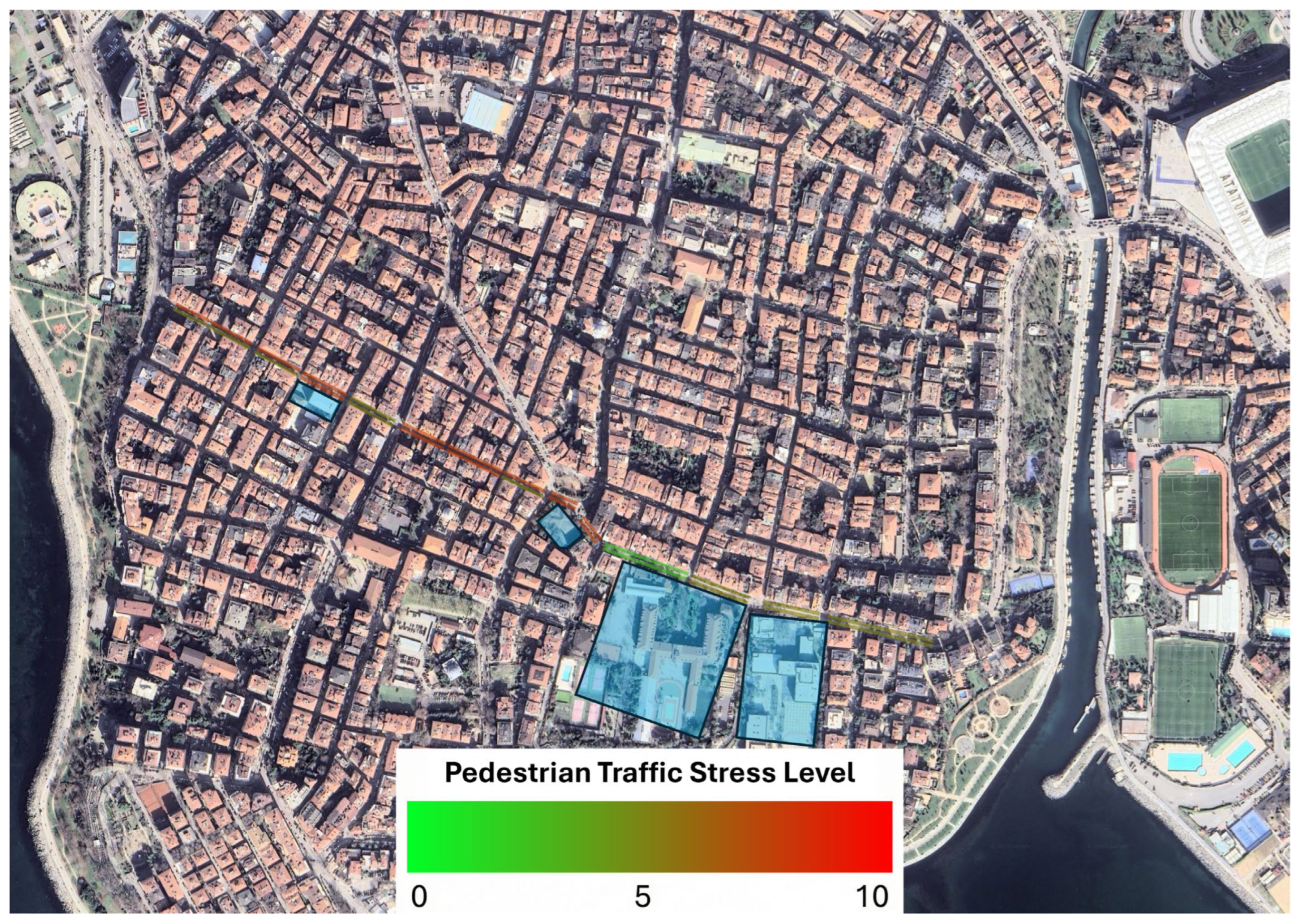
Beyond the numerical and distributional comparisons, the spatial representation of PTSL values offers additional information about how pedestrian stress varies along the school-zone corridor. To complement the segment-level results, the spatial distribution of the final PTSL values is presented in Figure 10.

5. Discussion, Conclusions, Limitations, and Future Research

The fuzzy-logic-based model developed in this study enabled the joint evaluation of physical variables that affect PTSL. The membership functions and rule base used in the model were created based on weights determined using the AHP method and field observation data. Thus, the model presented a structure supported by both quantitative measurements and expert evaluations. Six inputs (vehicle density, pedestrian density, lane and sidewalk widths, buffer zone, and estimated traffic flow speed) and one output (PTSL) were used in the Mamdani-type fuzzy inference structure; a total of 729 rules were defined. This design reflected in detail the effects of different spatial conditions on PTSL, accounting for interactions among variables.
One of the model’s key features is its ability to identify directional differences between the right- and left-hand sidewalks along the same road segment. When physical variables such as sidewalk width, buffer zone, and pedestrian density were considered directionally, PTSL increased in segments where high vehicle density or traffic flow speed was combined with limited sidewalk width/insufficient buffer conditions. This finding demonstrates that the model can sensitively distinguish critical pedestrian-safety areas across different physical configurations.
At the corridor scale, the spatial behavior of the AHP-based model reveals meaningful physical patterns. This directional sensitivity is also reflected numerically in the model results. For example, the LS-2 segment exhibits a right–left PTSL difference of 0.50 (7.07 vs. 7.57), whereas DEIC-3 shows a much larger directional contrast of 1.42 (4.00 vs. 2.58). At the corridor level, the average PTSL on left sidewalks (5.96) is higher than on right sidewalks (5.56), and left sidewalks provide less walking space on average (2.01 m vs. 2.49 m), together with slightly higher pedestrian density, while buffer zone conditions are broadly similar on both sides. These differences demonstrate that the model systematically captures directional variations arising from asymmetric sidewalk capacity and pedestrian use along the corridor.
This pattern indicates that a single land-use context (e.g., school frontages) does not sufficiently explain the variation in PTSL across the corridor. Instead, the interplay of traffic flow speed, traffic density, sidewalk width, and buffer protection is decisive, and the model captures these combined effects in a differentiated manner. The results reveal that segments with high traffic flow speeds combined with insufficient sidewalk width or buffer zones tend to exhibit increased PTSL, whereas PTSL decreases significantly in segments with sufficient sidewalk width and continuous physical protection.
As a result, the proposed fuzzy-logic model provides a practical and flexible framework for understanding PTSL from both analytical and spatial perspectives. Using AHP-based weighting enabled the quantification of expert insights and improved the reliability of the rule structure. In addition, the GA-optimized implementation of the same AHP-based model was used as a complementary evaluation tool to examine the statistical behavior of the outputs. GA optimization reduced the variance of PTSL scores and slightly narrowed their range, indicating more statistically coherent results, whereas the non-optimized implementation preserved greater spatial variability, reflecting local heterogeneity that complements the statistically stabilized patterns obtained through GA optimization. Applying the model across different urban areas and integrating perceptual and behavioral data would further enhance its generalizability.
The model provides decision-makers at the planning and design scale with an objective tool for jointly assessing directional differences, speed–density relationships for sidewalks and buffers, and local physical conditions. Particularly in areas such as school zones, public transport access points, and corridors with high pedestrian flow, the model outputs are of sufficient quality to serve as a basis for both prioritization and design improvement plans. In practical terms, the proposed framework can be applied as an analytical screening tool at the corridor or segment scale to identify priority intervention areas, compare alternative design scenarios, and support evidence-based decisions related to sidewalk allocation, buffer provision, and speed management. The segment-level and directional outputs enable planners to move beyond corridor averages and directly link model results to site-specific design and traffic-management actions.
In this broader perspective, the outcomes of the proposed PTSL framework also have direct implications for sustainable urban policy and school-zone planning. By enabling the identification of high-stress pedestrian environments and supporting targeted design and traffic-management interventions, the model contributes to the objectives of SDG 3 (Good Health and Well-Being) by reducing everyday traffic-related risks for children. At the same time, its emphasis on safe, inclusive, and pedestrian-oriented street environments aligns with SDG 11 (Sustainable Cities and Communities), supporting local authorities in developing safer and more accessible urban spaces through evidence-based decision-making.
An evaluation of the results together with the AHP-derived weights (Table 6) indicates that pedestrian traffic stress in the study area is primarily driven by factors related to traffic flow speed, the absence or weakness of buffer zones, and limited sidewalk widths. In particular, the high relative importance assigned to estimated traffic flow speed and buffer zones is consistent with the PTSL outputs, which show elevated stress levels in segments where vehicle speeds are higher and physical or visual separation between pedestrians and traffic is insufficient. Narrow sidewalks further intensify these conditions by reducing pedestrians’ perceived safety and increasing exposure to moving vehicles, while high traffic density amplifies the potential for distraction and conflict. These findings suggest that pedestrian stress in school environments is shaped less by a single factor and more by the combined effect of speed, spatial constraints, and vehicle-pedestrian interaction.
Beyond the specific case examined in this study, the proposed PTSL framework offers a transferable methodological structure that can be adapted to different urban contexts. The input-based and normalized nature of the model, together with its AHP-weighted fuzzy-logic architecture, allows local characteristics such as traffic conditions, street geometry, and pedestrian activity to be incorporated using context-specific data. While the numerical thresholds and parameter settings are inherently dependent on local conditions, the overall framework provides a replicable approach for assessing pedestrian traffic stress in school zones and similar urban environments.
In line with these findings, recommendations for implementation in the study area and similar urban contexts are summarized below:
  • Infrastructure reinforcement: Widening sidewalks and ensuring barrier-free access in high-pedestrian-traffic areas.
  • Speed management measures: Limiting speed to 20 km/h in school zones and streets with heavy pedestrian traffic, using structural speed-reducing elements.
  • Physical separation measures: Reducing vehicle-pedestrian interaction with physical elements such as bollards, parking lanes, or green belts.
  • Pedestrian priority and visibility: Clarifying crossing designs and strengthening pedestrian priority markings.
In addition to the model-based assessment, an independent neighborhood survey conducted in the Caferağa Neighborhood as part of an ongoing urban mobility research project provides contextual support for the dominant stress factors identified by the PTSL framework. A large share of respondents reported that pedestrian conditions are adversely affected by heavy vehicle and pedestrian congestion, frequent sidewalk encroachment by parked vehicles, and the intense presence of motorcycles and couriers. These perceived stressors are directionally consistent with the physical and operational determinants emphasized by the PTSL structure, particularly vehicle–pedestrian interaction, constrained sidewalk space, and traffic pressure. These survey findings offer complementary contextual insight, suggesting that the dominant stress mechanisms identified by the model are also commonly experienced by local users in the study area.
As a result, the developed model contributes to the data-driven approach to urban pedestrian safety policies by providing both a spatially sensitive and repeatable analysis infrastructure. Despite these contributions, it is important to acknowledge several methodological limitations when interpreting the results of this study. The proposed framework is intentionally designed as a micro-scale, context-sensitive approach, prioritizing detailed spatial and operational characteristics over broad generalization. Accordingly, the limitations reflect both the scope of the case study and the methodological choices adopted in the analysis while also indicating directions for future research.
The model’s structure, membership functions, and rule base were constructed using weights derived through the AHP method and expert judgment. Given that a relatively small expert group informed these weights, validation could be strengthened by engaging a broader range of specialists and assessing the model in varied geographical settings. In its current form, the model focuses exclusively on physical variables—vehicle and pedestrian density, sidewalk and lane width, buffer zone, and traffic flow speed—without yet integrating subjective factors such as behavior, perceived safety, or environmental comfort.
Moreover, the analysis’s temporal scope is defined by school entrance and exit periods, reflecting the study’s specific focus on school-zone environments. Given the consistently high pedestrian and vehicle activity in the study area, particularly in central districts such as Moda, the selected time windows aim to capture representative traffic conditions relevant to children’s daily exposure rather than extreme peak situations. To reduce potential bias arising from short-term anomalies, average values within the selected observation periods were used. While this approach supports a context-specific and robust assessment aligned with the study objectives, future studies may extend the analysis by incorporating dynamic traffic patterns across different time periods.
In this study, the GA was used to refine the initial AHP-based membership functions, and the optimized model served as the primary analytical framework. While the GA-optimized model produced statistically more coherent outputs, the optimization process remained dependent on the structure of the initial membership definitions, indicating that further refinements in generalization could be achieved. Future research should explore advanced or hybrid optimization approaches that enable the membership functions to adapt dynamically across different urban contexts, thereby enhancing both the model’s generalization ability and sensitivity.
The model is designed with flexibility to be easily adapted to different urban environments. In this context, future studies should focus on the following:
  • Integrating the model with user perception and behavior data (surveys, observations, interaction analysis).
  • Integrating the model with time series data to account for intraday variability in traffic dynamics.
  • Defining separate membership functions for different user groups (children, elderly, individuals with limited mobility, etc.),
  • Integrating it with policy simulations to make it usable as a decision support tool.
  • Expanding the expert pool used in the AHP weighting process to examine the stability of weights across a larger and more diverse group of specialists.
These are among the future development directions being evaluated.

Author Contributions

Conceptualization, Y.E.Y. and M.G.; methodology, Y.E.Y. and M.G.; software, Y.E.Y.; validation, Y.E.Y. and M.G.; formal analysis, Y.E.Y.; investigation, Y.E.Y.; resources, Y.E.Y.; data curation, Y.E.Y.; writing—original draft preparation, Y.E.Y.; writing—review and editing, Y.E.Y. and M.G.; visualization, Y.E.Y.; supervision, M.G. All authors have read and agreed to the published version of the manuscript.

Funding

This research received no external funding.

Institutional Review Board Statement

Not applicable.

Informed Consent Statement

Not applicable.

Data Availability Statement

The aggregated data analyzed in this study are available from the corresponding author upon reasonable request.

Conflicts of Interest

The authors declare no conflicts of interest.

Abbreviations

The following abbreviations are used in this manuscript:
PTSLPedestrian Traffic Stress Level
AHPAnalytic Hierarchy Process
PLOSPedestrian Level of Service
CRConsistency Ratio
GAGenetic Algorithm
MCDMMulti-Criteria Decision-Making
SDGSustainable Development Goal

References

  1. United Nations General Assembly. Transforming Our World: The 2030 Agenda for Sustainable Development; Resolution A/RES/70/1; United Nations: New York, NY, USA, 2015; Available online: https://sdgs.un.org/2030agenda (accessed on 2 January 2026).
  2. World Health Organization. Pedestrian Safety: A Road Safety Manual for Decision-Makers and Practitioners; World Health Organization: Geneva, Switzerland, 2013; Available online: https://www.who.int/publications/i/item/pedestrian-safety-a-road-safety-manual-for-decision-makers-and-practitioners (accessed on 17 November 2025).
  3. International Transport Forum. Pedestrian Safety, Urban Space and Health; OECD Publishing: Paris, France, 2012. [Google Scholar] [CrossRef]
  4. Ewing, R.; Handy, S. Measuring the unmeasurable: Urban design qualities related to walkability. J. Urban Des. 2009, 14, 65–84. [Google Scholar] [CrossRef]
  5. Stoker, P.; Garfinkel-Castro, A.; Khayesi, M.; Odero, W.; Mwangi, M.N.; Peden, M.; Ewing, R. Pedestrian safety and the built environment: A review of the risk factors. J. Plan. Lit. 2015, 30, 377–392. [Google Scholar] [CrossRef]
  6. Kaplan, H.; Alpan, A.; Hayırlı, C. Kent merkezlerinde yaya güvenliği ve trafikte güvenilirliğin irdelenmesi: Ankara Kızılay kent merkezi örneklem çalışması. In Sürdürülebilir Ulaşım için Yol ve Trafik Güvenliği Ulusal Kongresi (ROTRASA 2015) Bildiri Kitabı; KUTEM, Gazi Üniversitesi: Ankara, Türkiye, 2016; pp. 256–264. [Google Scholar]
  7. Rodriguez-Valencia, A.; Vallejo-Borda, J.A.; Barrero, G.A.; Ortiz-Ramirez, H.A. Towards an enriched framework of service evaluation for pedestrian and bicyclist infrastructure: Acknowledging the power of users’ perceptions. Transportation 2022, 49, 791–814. [Google Scholar] [CrossRef]
  8. Nabipour, M.; Nasseri, S.H.; Tavakoli Saber, E. Comparison and Evaluation of Built Environment Factors for Developing Pedestrian Urban Travels. Fuzzy Inf. Eng. 2021, 13, 505–521. [Google Scholar] [CrossRef]
  9. Specktor, M.; Shiftan, Y. Pedestrian Stress Perception in the Age of E-Scooters: An Epistemological and Thematic Analysis of Tel Aviv. J. Urban Mobil. 2025, 8, 100145. [Google Scholar] [CrossRef]
  10. Paul, D.; Moridpour, S.; Venkatesan, S.; Withanagamage, N. Evaluating the Pedestrian Level of Service for Varying Trip Purposes Using Machine Learning Algorithms. Sci. Rep. 2024, 14, 2813. [Google Scholar] [CrossRef]
  11. Shu, S.; Bian, Y.; Zhao, L.; Rong, J.; Liu, X. Modelling Pedestrian Level of Service on Sidewalks with Multi-Factors Based on Different Pedestrian Flow Rates. Transport 2021, 36, 486–498. [Google Scholar] [CrossRef]
  12. Zhang, K.; Tamakloe, R.; Cao, M.; Kim, I. Exploring Fatal/Severe Pedestrian Injury Crash Frequency at School Zone Crash Hotspots: Using Interpretable Machine Learning to Assess the Micro-Level Street Environment. J. Transp. Geogr. 2024, 121, 104034. [Google Scholar] [CrossRef]
  13. Fernández-Arango, D.; Varela-García, F.-A.; Esmorís, A.M. Methodology for Identifying Optimal Pedestrian Paths in an Urban Environment: A Case Study of a School Environment in A Coruña, Spain. Smart Cities 2024, 7, 1441–1461. [Google Scholar] [CrossRef]
  14. Özen, E.; Genç, E.; Kaya, Z. Trafik kazalarının nedenlerine ilişkin düşünceler ve trafikte farkındalık: Uşak ili örneği. Optim. Ekon. Yönetim Bilim. Derg. 2014, 1, 1–19. Available online: https://dergipark.org.tr/en/download/article-file/202149 (accessed on 17 November 2025).
  15. Çıkrıkçı, N.; Yalçın, S.; Ayan, C.; Şahin Kürşad, M.; Kamış, Ö. Trafikten şikâyetim var! Yaya ve sürücü gözüyle. Trafik Ulaşım Araştırmaları Derg. 2021, 4, 15–27. [Google Scholar] [CrossRef]
  16. Wong, B.Y.-M.; Faulkner, G.; Buliung, R. GIS-measured environmental correlates of active school transport: A systematic review of 14 studies. Int. J. Behav. Nutr. Phys. Act. 2011, 8, 39. [Google Scholar] [CrossRef] [PubMed]
  17. Cloutier, M.-S.; Beaulieu, E.; Fridman, L.; Macpherson, A.K.; Hagel, B.E.; Howard, A.W.; Churchill, T.; Fuselli, P.; Macarthur, C.; Rothman, L. State-of-the-art review: Preventing child and youth pedestrian motor vehicle collisions: Critical issues and future directions. Inj. Prev. 2021, 27, 77–84. [Google Scholar] [CrossRef] [PubMed]
  18. Joseph, N.S.; Archana, S. Pedestrian safety analysis at school zones. Int. Res. J. Eng. Technol. 2019, 6, 1014–1020. Available online: https://www.irjet.net/archives/V6/i6/IRJET-V6I6268.pdf (accessed on 15 December 2025).
  19. Bina, M.; Confalonieri, F.; Abati, D.; Villa, D.; Biassoni, F. Analysis of Traffic upon School Departure: Environment, Behaviour, Well-Being and Risk Factors for Road Crashes. J. Transp. Health 2021, 22, 101119. [Google Scholar] [CrossRef]
  20. Campisi, T.; Ištoka Otković, I.; Šurdonja, S.; Deluka-Tibljaš, A. Impact of Social and Technological Distraction on Pedestrian Crossing Behaviour: A Case Study in Enna, Sicily. Transp. Res. Procedia 2022, 60, 100–107. [Google Scholar] [CrossRef]
  21. Osuret, J.; Van Niekerk, A.; Kobusingye, O.; Atuyambe, L.; Nankabirwa, V. Child Pedestrian Crossing Behaviour and Associated Risk Factors in School Zones: A Video-Based Observational Study in Kampala, Uganda. Inj. Prev. 2024, 30, 216–223. [Google Scholar] [CrossRef]
  22. Lu, G.; Liu, M. Research on Pedestrian Avoidance Behavior for School Section Based on Improved BP Neural Network and XGBoost Algorithm. Appl. Sci. 2025, 15, 4724. [Google Scholar] [CrossRef]
  23. Ištoka Otković, I.; Deluka-Tibljaš, A.; Šurdonja, S.; Campisi, T. Analysis of Influencing Parameters on Children’s Crossing Speeds at Non-Signalized Crosswalks Using Neural Network Models. Transp. Res. Procedia 2025, 90, 543–550. [Google Scholar] [CrossRef]
  24. Fruin, J.J. Pedestrian Planning and Design; Metropolitan Association of Urban Designers and Environmental Planners: New York, NY, USA, 1971. [Google Scholar]
  25. Asadi-Shekari, Z.; Moeinaddini, M.; Zaly Shah, M. A pedestrian level of service method for evaluating and promoting walking facilities on campus streets. Land Use Policy 2014, 38, 175–193. [Google Scholar] [CrossRef]
  26. Rodriguez-Valencia, A.; Ortiz-Ramirez, H.A.; Simancas, W.; Vallejo-Borda, J.A. Level of pedestrian stress in urban streetscapes. Transp. Res. Rec. 2022, 2676, 87–98. [Google Scholar] [CrossRef]
  27. Noronha, M.; Celani, G.; Duarte, J.P. Computationally Evaluating Street Retrofitting Interventions. Nexus Netw. J. 2022, 24, 481–502. [Google Scholar] [CrossRef]
  28. Zhang, H.; Zhang, D.; Wang, R. Evaluation of Pedestrian Level of Service at Signalised Intersections from the Elderly Perspective. Promet–Traffic Transp. 2023, 35, 434–445. [Google Scholar] [CrossRef]
  29. Ankunda, A.; Mohanty, M.; Ranjan Samal, S. Development of Pedestrian Level of Service (PLOS) for Jaywalking Pedestrians at Unsignalised Intersections on Urban Arterials Using ANN and Clustering: A Case Study in India. Commun. Sci. Lett. Univ. Zilina 2025, 27, D25–D37. [Google Scholar] [CrossRef]
  30. Ujjwal, J.; Bandyopadhyaya, R. Development of Pedestrian Level of Service (PLOS) Model and Satisfaction Perception Rating Models for Pedestrian Infrastructure for Mixed Land-Use Urban Areas. Transportation 2023, 50, 355–381. [Google Scholar] [CrossRef]
  31. Fatema, K.; Rahman, S.; Sarkar, S.K.; Saroar, M.M. Pedestrian Walkability in Khulna City of Bangladesh. Transp. Res. Interdiscip. Perspect. 2025, 33, 101615. [Google Scholar] [CrossRef]
  32. Feudjio, S.L.T.; Tchaheu, D.T.; Fondzenyuy, S.K.; Jackai, I.N., II; Usami, D.S.; Persia, L. Investigating and Improving Pedestrian Safety in an Urban Environment of a Low- or Middle-Income Country: A Case Study of Yaoundé, Cameroon. Future Transp. 2024, 4, 548–578. [Google Scholar] [CrossRef]
  33. Mekuria, M.C.; Furth, P.G.; Nixon, H. Low-Stress Bicycling and Network Connectivity (Report 11–19); Mineta Transportation Institute, San José State University: San José, CA, USA, 2012; Available online: https://transweb.sjsu.edu/sites/default/files/1005-low-stress-bicycling-network-connectivity.pdf (accessed on 16 November 2025).
  34. Furth, P.G.; Mekuria, M.C.; Nixon, H. Network connectivity for low-stress bicycling. Transp. Res. Rec. 2016, 2587, 41–49. [Google Scholar] [CrossRef]
  35. Kamal, K.; Farooq, B.; Mudassar, M.; Kalatian, A. Ordered-logit pedestrian stress model for traffic flow with automated vehicles. In Proceedings of the 2022 IEEE Intelligent Vehicles Symposium (IV), Aachen, Germany, 4–9 June 2022; IEEE: New York, NY, USA, 2022; pp. 1831–1834. [Google Scholar] [CrossRef]
  36. Begum, R.; Aqlan, F.; Brockman, J.B.; Marie, H. Urban walkability and pedestrian stress: A sensor-based study across three sites. In Proceedings of the 2025 ASEE Annual Conference & Exposition, Montreal, QC, Canada, 22–25 June 2025; ASEE: Washington, DC, USA, 2025. [Google Scholar] [CrossRef]
  37. Oestreich, L.; Torres, T.B.; Ruiz-Padillo, A. Fuzzy analysis of students’ perception of traffic safety in school environments: The case of a small Brazilian city. Int. J. Inj. Control Saf. Promot. 2021, 28, 255–265. [Google Scholar] [CrossRef]
  38. Cerro-Herrero, D.; Prieto-Prieto, J.; Vaquero-Solis, M.; Tapia-Serrano, M.Á.; Sánchez-Miguel, P.A. Analysis of Variables That Influence the Walkability of School Environments Based on the Delphi Method. Int. J. Environ. Res. Public Health 2022, 19, 14201. [Google Scholar] [CrossRef]
  39. AlKheder, S.; AlRukaibi, F. Enhancing pedestrian safety, walkability and traffic flow with fuzzy logic. Sci. Total Environ. 2020, 701, 134454. [Google Scholar] [CrossRef] [PubMed]
  40. Rahman, M.H.; Abdel-Aty, M.; Lee, J.; Rahman, M.S. Enhancing traffic safety at school zones by operation and engineering countermeasures: A microscopic simulation approach. Simul. Model. Pract. Theory 2019, 94, 334–348. [Google Scholar] [CrossRef]
  41. Rothman, L.; Buliung, R.; To, T.; Macarthur, C.; Macpherson, A.; Howard, A. Associations between parents’ perception of traffic danger, the built environment and walking to school. J. Transp. Health 2015, 2, 327–335. [Google Scholar] [CrossRef]
  42. Chauhan, V.; Chang, C.-M.; Javanmardi, E.; Nakazato, J.; Lin, P.; Igarashi, T.; Tsukada, M. Fostering fuzzy logic in enhancing pedestrian safety: Harnessing smart pole interaction unit for autonomous vehicle-to-pedestrian communication and decision optimization. Electronics 2023, 12, 4207. [Google Scholar] [CrossRef]
  43. Katanalp, B.Y.; Eren, E. GIS-Based Assessment of Pedestrian–Vehicle Accidents in Terms of Safety with Four Different ML Models. J. Transp. Saf. Secur. 2022, 14, 1598–1632. [Google Scholar] [CrossRef]
  44. Matongo, T.; Chimba, D. Analytical Assessment of Pedestrian Crashes on Low-Speed Corridors. Safety 2025, 11, 123. [Google Scholar] [CrossRef]
  45. Li, C.-Y.; Liu, S.-K.; Xu, G.-M.; Cen, X.-K. Influence of Driver’s Yielding Behavior on Pedestrian–Vehicle Conflicts at a Two-Lane Roundabout Using Fuzzy Cellular Automata. J. Cent. S. Univ. 2022, 29, 346–358. [Google Scholar] [CrossRef]
  46. Han, H.; Lee, S.; Jeong, J.; Lee, J. Structured Risk Identification for Sustainable Safety in Mixed Autonomous Traffic: A Layered Data-Driven Approach. Sustainability 2025, 17, 7284. [Google Scholar] [CrossRef]
  47. Zalesinska, M.; Wandachowicz, K. On the Quality of Street Lighting in Pedestrian Crossings. Energies 2021, 14, 7349. [Google Scholar] [CrossRef]
  48. Rothman, L.; Hagel, B.E.; Howard, A.W.; Schwartz, N.; Cloutier, M.S.; Macpherson, A.K. Is Higher School Neighbourhood Walk Score Associated with Greater Child Pedestrian Safety near Schools? Inj. Prev. 2023, 29, 363–366. [Google Scholar] [CrossRef]
  49. Koloushani, M.; Ghorbanzadeh, M.; Ozguven, E.E.; Ermagun, A. A Conceptualization of the Spatial Relationship Associated with School-Related Crashes: A Case Study in Northwest Florida. Transp. Plan. Technol. 2023, 46, 795–817. [Google Scholar] [CrossRef]
  50. Howard, A.W.; Batomen, B.; Zubair, S.; Cloutier, M.-S.; Macpherson, A.K.; Rothman, L. Automated Speed Enforcement Reduced Vehicle Speeds in School Zones in Toronto: A Prospective Quasi-Experimental Study. Inj. Prev. 2025. [Google Scholar] [CrossRef] [PubMed]
  51. Swami, M.; Pathak, C.; Swami, S.; Jeihani, M. Promoting Sustainable Mobility: A Walkability Analysis for School Zone Safety. Sustainability 2024, 16, 9118. [Google Scholar] [CrossRef]
  52. Chun, U.; Lim, J.; Kim, H. Analysis of Hotspots in and outside School Zones: A Case Study of Seoul. J. Adv. Transp. 2024, 2024, 6613603. [Google Scholar] [CrossRef]
  53. Li, H.; Lin, Y.; Wang, Y.; Liu, J.; Liang, S.; Guo, S.; Qiang, T. Multi-criteria analysis of a people-oriented urban pedestrian road system using an integrated fuzzy AHP and DEA approach: A case study in Harbin, China. Symmetry 2021, 13, 2214. [Google Scholar] [CrossRef]
  54. Azin, B.; Ewing, R.; Yang, W.; Promy, N.S.; Kalantari, H.A.; Tabassum, N. Urban arterial lane width versus speed and crash rates: A comprehensive study of road safety. Sustainability 2025, 17, 628. [Google Scholar] [CrossRef]
  55. Parsons Transportation Group. Relationship Between Lane Width and Speed: Review of Relevant Literature; Columbia Pike Street Space Planning Task Force: Arlington, VA, USA, 2003. [Google Scholar]
  56. Ivan, J.N.; Garrick, N.W.; Hanson, G. Designing Roads That Guide Drivers to Choose Safer Speeds (JHR 09-321; Project 04-6); Connecticut Transportation Institute, University of Connecticut: Storrs, CT, USA, 2009; Available online: https://www.cti.uconn.edu/Document.asp?DocID=8655 (accessed on 8 December 2025).
  57. Galusca, N.-I.; Iriciuc, S.-C.; Gimiga, G.-R.; Dima, D.-N.; Scutaru, M.-C. Crossing speeds of cars through signalized intersections. J. Eng. Sci. 2023, 30, 26–34. [Google Scholar] [CrossRef]
  58. Basu, S.; Ferrante, C.; De Blasiis, M.R. Influence of intersection density on risk perception of drivers in rural roadways: A driving simulator study. Sustainability 2022, 14, 7750. [Google Scholar] [CrossRef]
  59. Celko, J.; Kovac, M.; Huszarova, K. Influence of selected vehicle maneuvers on reduction of urban roads capacity. Commun.—Sci. Lett. Univ. Žilina 2019, 21, 81–89. [Google Scholar] [CrossRef]
  60. Praburam, G.; Koorey, G. Effect of on-street parking on traffic speeds. In Proceedings of the IPENZ Transportation Group Conference, Christchurch, New Zealand, 22–24 March 2015; IPENZ: Christchurch, New Zealand, 2015; Available online: https://ir.canterbury.ac.nz/server/api/core/bitstreams/9b4df808-2841-44b3-80b7-aef1a7901841/content (accessed on 8 December 2025).
  61. Shinar, D. Driving speed relative to the speed limit and relative to the perception of safe, enjoyable, and economical speed. In Traffic Safety on Three Continents: International Conference in Moscow, Russia, 19–21 September 2001; VTI: Linköping, Sweden, 2001; Volume 18, p. 8. Available online: https://cris.bgu.ac.il/en/publications/driving-speed-relative-to-the-speed-limit-and-relative-to-the-per (accessed on 8 December 2025).
  62. Huang, J.; Liu, P.; Zhang, X.; Wan, J.; Li, Z. Evaluating the speed reduction effectiveness of speed bumps on local streets. In Proceedings of ICCTP 2011, Nanjing, China, 14–17 August 2011; American Society of Civil Engineers: Reston, VA, USA, 2011; pp. 2348–2357. [Google Scholar] [CrossRef]
  63. Wang, L.-X.; Mendel, J.M. Generating fuzzy rules by learning from examples. IEEE Trans. Syst. Man Cybern. 1992, 22, 1414–1427. [Google Scholar] [CrossRef]
  64. Jang, J.-S.R. ANFIS: Adaptive-network-based fuzzy inference system. IEEE Trans. Syst. Man Cybern. 1993, 23, 665–685. [Google Scholar] [CrossRef]
Figure 1. Methodological workflow of the fuzzy-logic-based PTSL model (Prepared by the authors).
Sustainability 18 01042 g001
Figure 3. Division of the selected school-zone route into analysis segments across four streets in the Caferağa neighborhood (Prepared by the authors).
Sustainability 18 01042 g003
Figure 4. A road segment on Dr. Esat Işık Street operates under signal-controlled alternating two-way traffic. (Source: Google Maps Street View).
Sustainability 18 01042 g004
Figure 5. Membership functions for the estimated traffic flow speed variable: (a) basic definitions; (b) GA-optimized definitions (Prepared by the authors).
Sustainability 18 01042 g005
Figure 6. Membership functions of the output variable (PTSL) (Prepared by the authors).
Sustainability 18 01042 g006
Figure 7. MATLAB (R2024b) Fuzzy Inference System interface and structure of the PTSL model (Prepared by the authors).
Sustainability 18 01042 g007
Figure 8. Rule Viewer interface of the fuzzy logic model showing input variables and resulting PTSL output (Prepared by the authors).
Sustainability 18 01042 g008
Figure 9. Comparison of PTSL distributions for the two model versions. The upper-left panel shows the histogram of the AHP-based GA-optimized model; the upper-right panel shows the histogram of the AHP-based non-optimized model; and the bottom panel presents a box-plot comparison of both models. In the box plots, the “X” symbol denotes the mean Pedestrian Traffic Stress Level for each model (Prepared by the authors).
Sustainability 18 01042 g009
Figure 10. Spatial distribution of PTSL along the school-zone corridor (Prepared by the authors).
Sustainability 18 01042 g010
Table 1. AHP-derived indicator weights and their expected directional effects on traffic flow speed (Prepared by the authors).
IndicatorsCoefficientsEffect on Traffic Flow Speed as the Indicator Increases
Speed effect based on the relationship between traffic flow and density 0.120258265
  • If q/qmax > 0.6 → No effect
Otherwise:
  • If k < 2.0 → Increases
  • If k > 3.0 → Decreases
  • If k is in the range 2.0–3.0 → No effect
Lane width (m)0.062194701Increases
Number of sidewalks (2: two-sided, 1: one-sided, 0: none)0.028222929Decreases
Total sidewalk width (m)0.028453502Decreases
Traffic lights (1: present, 0: absent)0.084255969Decreases
Number of intersections0.087300739Decreases
Total number of movement directions (number of entry and exit directions)0.093870178Decreases
Parking status (2: double-sided, 1: single-sided, 0: none)0.103927174Decreases
Speed limit (km/h)0.127492367Increases
Speed Hump (1: present, 0: absent)0.264024176Decreases
Table 2. Segment-level indicators for fourteen street segments (Prepared by the authors).
IndicatorsTuğlacı Eminbey Street (TEC)Leylek
Street
(LS)
Bademaltı
Street
(BS)
Dr.
Esat Işık
Street
(DEIC)
12123123123456
Traffic flow
(vehicle/hour)—Average *
294294209375485310317182420400508666794498
Google traffic congestion level
(1 = lowest congestion, 4 = highest
congestion)—Average *
1.001.001.251.251.251.501.751.752.001.751.501.251.001.00
Speed effect based on the relationship
between traffic flow and density
Inc.Inc.Inc.Inc.No eff.Inc.Inc.Inc.No eff.Inc.No eff.No eff.No eff.No eff.
Lane width (m)3.303.303.503.503.503.503.503.506.003.703.703.703.703.70
Number of sidewalks
(2: two-sided, 1: one-sided, 0: none)
22222222222222
Total sidewalk width (m)3.303.753.303.753.753.903.603.006.005.106.204.907.455.00
Traffic lights (1: present, 0: absent)00001001100000
Number of intersections22222222222222
Total number of movement directions (number of entry and exit directions)35667658654444
Parking status (2: double-sided,
1: single-sided, 0: none)
11101001011111
Speed limit (km/h)5050502020505050202020202020
Speed Hump
(1: present, 0: absent)
00000000001000
* The first two rows (average traffic flow and average Google traffic congestion level) are used as inputs to evaluate the flow–density–based indicator. For each street segment, these values are substituted into the predefined flow-density rule set, and the resulting outcome is classified as Inc., Dec., or No eff., indicating a speed-increasing, speed-reducing, or no-effect impact on traffic flow speed, respectively.
Table 3. Composite pre-speed score for each street segment—based on weighted built-environment indicators—(Prepared by the authors).
SegmentsTEC-1TEC-2LS-1LS-2LS-3BS-1BS-2BS-3DEIC-1DEIC-2DEIC-3DEIC-4DEIC-5DEIC-6
Total Score+0.264−0.140−0.253−0.518−3.790+0.748+0.954−1.452−2.131−1.410−5.135−2.412−2.575−2.418
Table 4. Estimated traffic flow speeds for each street segment—derived from composite scores—(Prepared by the authors).
SegmentsTEC-1TEC-2LS-1LS-2LS-3BS-1BS-2BS-3DEIC-1DEIC-2DEIC-3DEIC-4DEIC-5DEIC-6
Estimated Traffic Flow Speed (km/h)22.4121.3221.0220.3111.5523.7024.2617.8115.9917.937.9515.2414.8115.22
Table 5. Comparison of Basic and GA-Optimized Membership Functions for the Estimated Traffic Flow Speed Variable (Prepared by the authors).
Linguistic TermBasic Membership FeaturesOptimized Membership Features
Low
(triangular)
Parameters: [0, 0, 12]
μ_low(x) =
{ 0,
{ x,
{ 0,


x ≤ 0
0 < x ≤ 12
x > 12
Parameters: [0, 0, 14.7564]
μ_low(x) =
{ 0,
{ x/14.7564,
{ 0,


x ≤ 0
0 < x ≤ 14.7564
x > 14.7564
Medium
(triangular)
Parameters: [10, 15, 20]
μ_medium(x) =
{ 0,
{ (x − 10)/5,
{ (20 − x)/5,
{ 0,


x ≤ 10
10 < x ≤ 15
15 < x < 20
x ≥ 20
Parameters: [8.7003, 12.2155, 18.6792]
μ_medium(x) =
{ 0,
{ (x − 8.7003)/(12.2155 − 8.7003),
{ (18.6792 − x)/(18.6792 − 12.2155),
{ 0,


x ≤ 8.7003
8.7003 < x ≤ 12.2155
12.2155 < x < 18.6792
x ≥ 18.6792
High
(linear
S-curve)
Parameters: [18, 30]
μ_high(x) =
{ 0,
{ (x − 18)/12,
{ 1,


x ≤ 18
18 < x < 30
x ≥ 30
Parameters: [14.4473, 23.6252]
μ_high(x) =
{ 0,
{ (x − 14.4473)/(23.6252 − 14.4473),
{ 1,


x ≤ 14.4473
14.4473 < x < 23.6252
x ≥ 23.6252
Table 6. AHP-derived weights and variable symbols used in the rule-scoring formula (Prepared by the authors).
SymbolVariableWeight (w)
TDTraffic Densityw1 = 0.119393057
PDPedestrian Densityw2 = 0.065571418
LWLane Widthw3 = 0.055355589
SWSidewalk Widthw4 = 0.189524635
BZBuffer Zonew5 = 0.234862264
ETFSEstimated Traffic Flow Speedw6 = 0.335293037
Table 7. Membership function definitions for the PTSL output variable (very low to very high) (Prepared by the authors).
Linguistic TermOutput Membership Features
Very low (trapezoidal)Parameters: [0, 0, 1, 2]
μ_verylow(x) =
{ 0,
{ (x − 0)/(1 − 0),
{ 1,
{ (2 − x)/(2 − 1),


x ≤ 0
0 < x ≤ 1
1 < x ≤ 2
x > 2
Low (triangular)Parameters: [1, 3, 4]
μ_low(x) =
{ 0,
{ (x − 1)/2,
{ (4 − x)/1,
{ 0,


x ≤ 1
1 < x ≤ 3
3 < x < 4
x ≥ 4
Medium (triangular)Parameters: [3, 5, 7]
μ_medium(x) =
{ 0,
{ (x − 3)/2,
{ (7 − x)/2,
{ 0,


x ≤ 3
3 < x ≤ 5
5 < x < 7
x ≥ 7
High (triangular)Parameters: [6, 7, 9]
μ_high(x) =
{ 0,
{ (x − 6)/1,
{ (9 − x)/2,
{ 0,


x ≤ 6
6 < x ≤ 7
7 < x < 9
x ≥ 9
Very high (trapezoidal)Parameters: [8, 9, 10, 10]
μ_veryhigh(x) =
{ 0,
{ (x − 8)/1,
{ 1,


x ≤ 8
8 < x ≤ 9
9 < x ≤ 10
Table 8. Comparison of PTSL values obtained using basic and GA-optimized membership functions for each street segment (Prepared by the authors).
SegmentsPTSLPTSL (Optimized Membership Functions)
TEC-1 RIGHT5.905.00
TEC-1 LEFT7.006.61
TEC-2 RIGHT6.005.00
TEC-2 LEFT7.466.95
LS-1 RIGHT5.005.00
LS-1 LEFT7.446.16
LS-2 RIGHT7.457.07
LS-2 LEFT7.457.57
LS-3 RIGHT4.804.30
LS-3 LEFT6.974.19
BS-1 RIGHT7.146.80
BS-1 LEFT7.417.44
BS-2 RIGHT7.387.44
BS-2 LEFT7.427.44
BS-3 RIGHT4.784.32
BS-3 LEFT5.006.33
DEIC-1 RIGHT5.006.05
DEIC-1 LEFT5.006.05
DEIC-2 RIGHT5.006.65
DEIC-2 LEFT5.006.45
DEIC-3 RIGHT3.864.00
DEIC-3 LEFT2.542.58
DEIC-4 RIGHT5.005.29
DEIC-4 LEFT5.005.46
DEIC-5 RIGHT5.005.53
DEIC-5 LEFT4.134.51
DEIC-6 RIGHT5.005.33
DEIC-6 LEFT5.005.66
Disclaimer/Publisher’s Note: The statements, opinions and data contained in all publications are solely those of the individual author(s) and contributor(s) and not of MDPI and/or the editor(s). MDPI and/or the editor(s) disclaim responsibility for any injury to people or property resulting from any ideas, methods, instructions or products referred to in the content.