Risk Assessment of Grid-Integrated Energy Service Projects: A Hybrid Indicator-Based Fuzzy-Entropy-BP Evaluation Framework

Abstract
1. Introduction
- Existing studies predominantly focus on either economic or environmental dimensions and do not provide a unified life-cycle-oriented risk evaluation system, leading to static assessments that inadequately capture dynamic risk evolution throughout the project life cycle.
- Existing methods remain overly reliant on traditional evaluation tools, including the AHP, FAHP, and matter-element extension, which are limited in effectively modeling complex nonlinear interdependencies in high-dimensional indicator systems.
- Section 2.1 establishes a unified hierarchical risk evaluation system integrating economic, environmental, and safety dimensions to characterize the multi-faceted and high-dimensional risk profile of GIES beyond traditional single-dimension and static assessments.
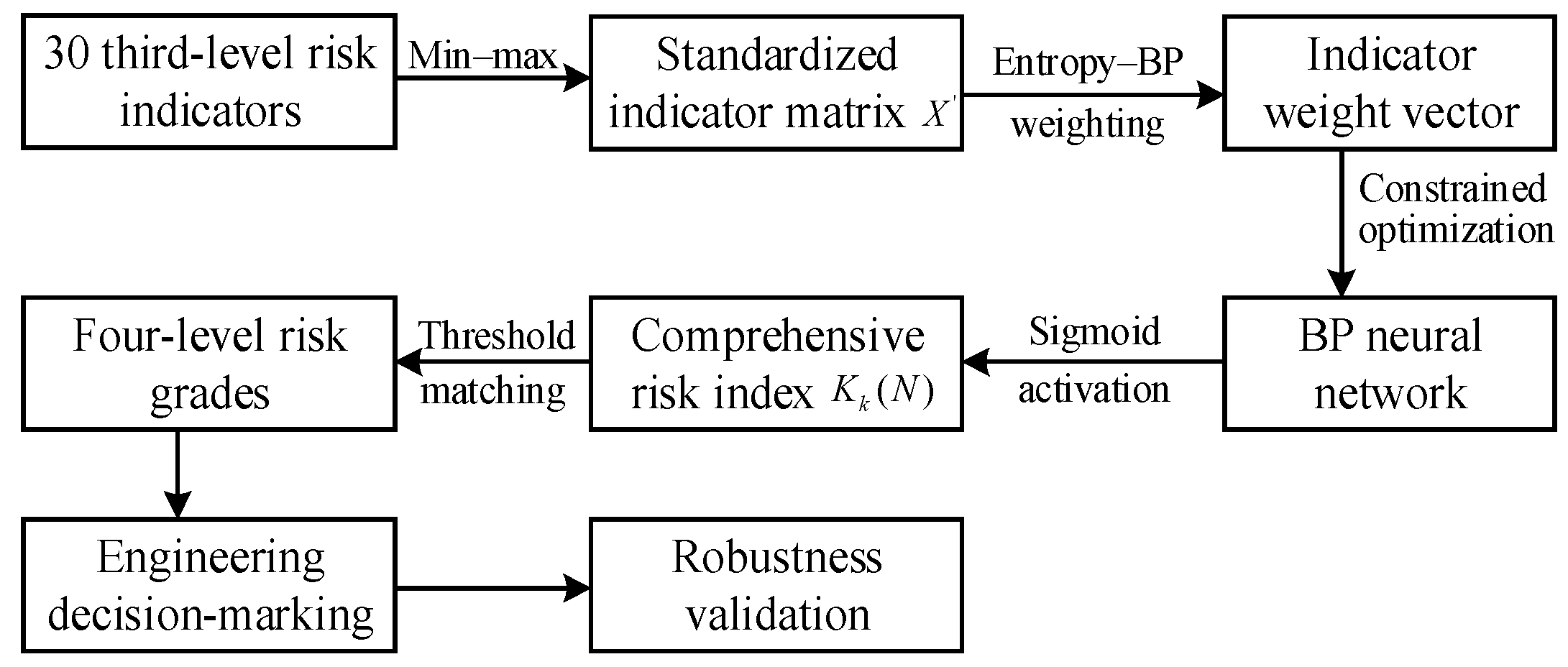
- Section 2.2 develops a life-cycle dynamic hybrid evaluation approach that combines entropy-based weighting, BP networks, and fuzzy matter-element theory to address weight rigidity and capture nonlinear risk interactions in high-dimensional GIES risk evaluation.
- Section 3 validates the proposed model using a regional GIES case study, showing its capability to identify dominant risk factors, discriminate risk levels among competing scenarios, and maintain high predictive accuracy.
2. Multidimensional Risk Evaluation Framework for GIES Projects
2.1. Multidimensional Risk Evaluation Index System
2.2. Hybrid Entropy-BP-Based Risk Evaluation Model
2.2.1. Integrated Risk Evaluation Methods Overview
2.2.2. Hybrid BP–Entropy Weighting Model
2.2.3. Overall Risk Evaluation Procedure
3. Case Study
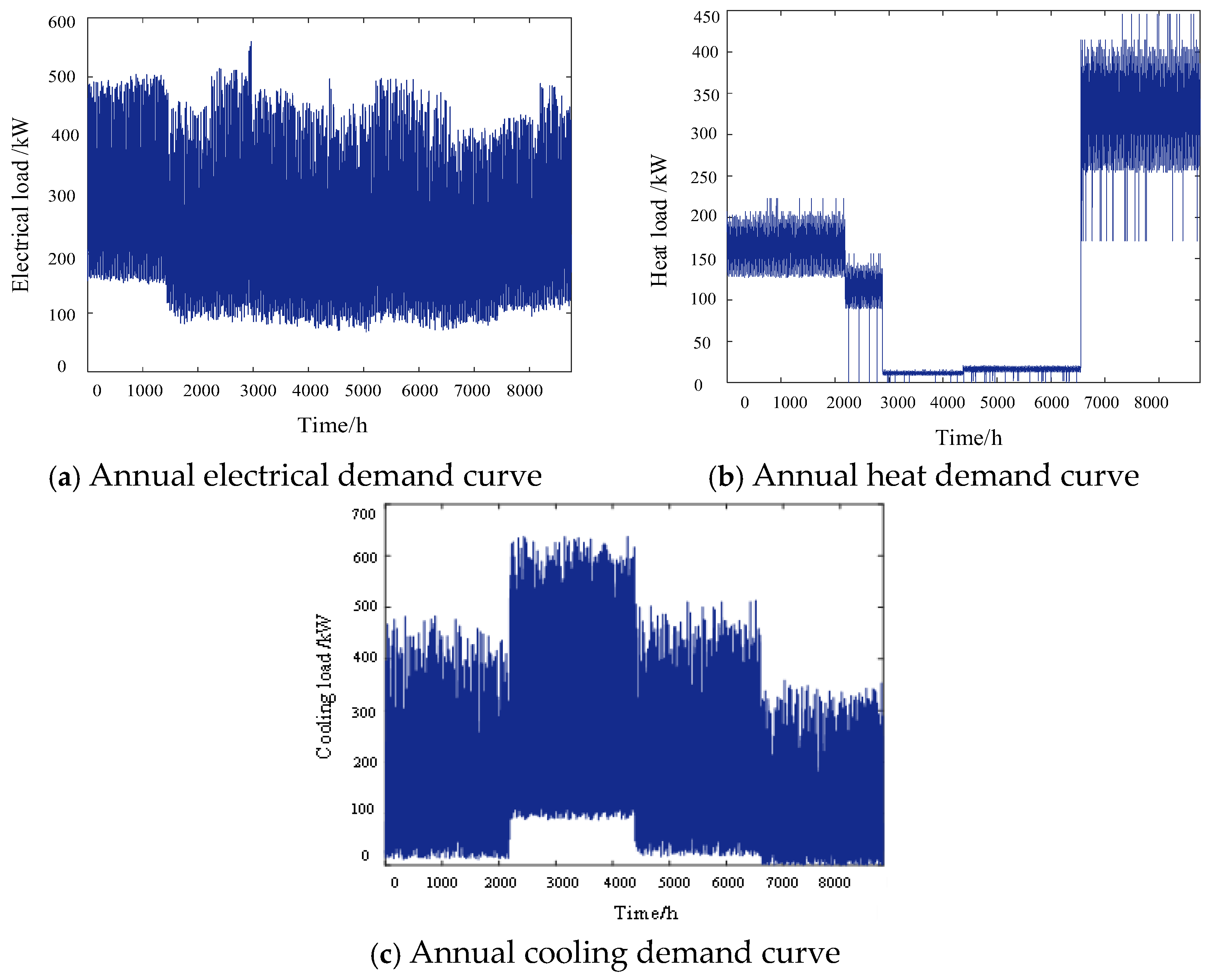
3.1. GIES Project Description and Data Configuration
3.2. Evaluation Results and Model Validation
3.2.1. Indicator Data Description
3.2.2. Risk Level Classification Scheme
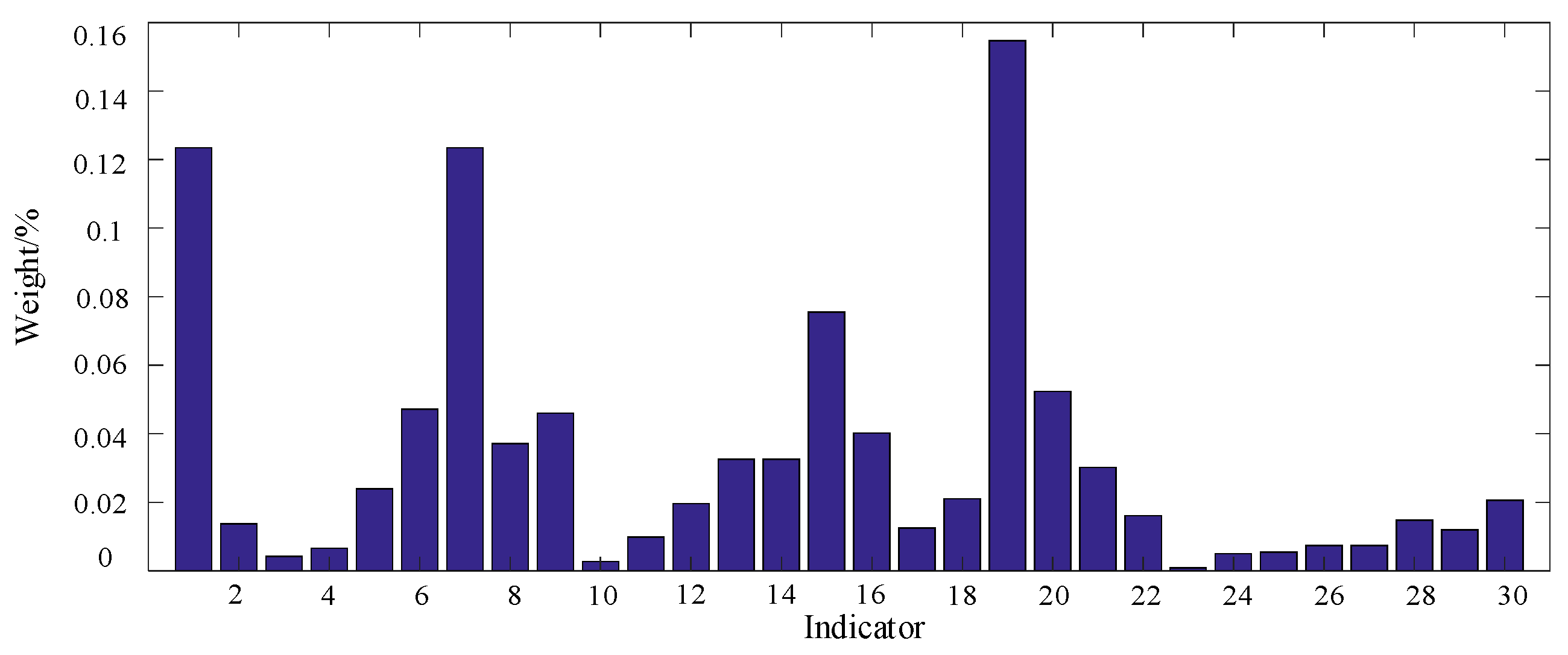
3.2.3. Indicator Weight Determination
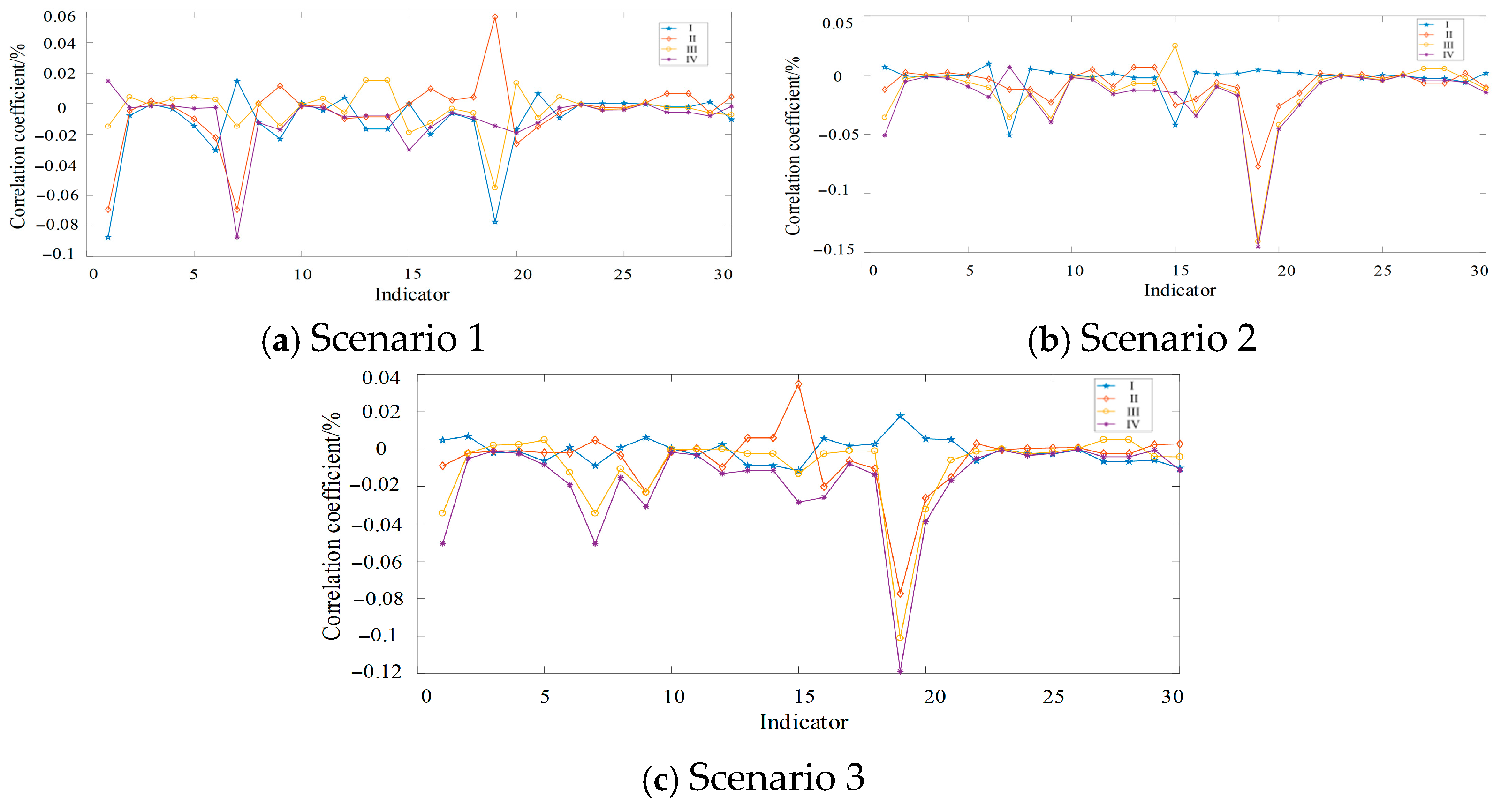
3.2.4. Indicator Relevance Analysis
3.2.5. Comprehensive Risk Level Evaluation
3.3. BP-Based Model Performance Validation
4. Conclusions
Author Contributions
Funding
Institutional Review Board Statement
Informed Consent Statement
Data Availability Statement
Acknowledgments
Conflicts of Interest
References
- Li, Y.; Yang, X.; Du, E.; Liu, Y.; Zhang, S.; Yang, C.; Zhang, N.; Liu, C. A review on carbon emission accounting approaches for the electricity power industry. Appl. Energy 2024, 359, 122681. [Google Scholar] [CrossRef]
- Jiang, Q.; Jia, H.; Mu, Y.; Yu, X.; Wang, Z. Bilateral planning and operation for integrated energy service provider and prosumers—A Nash bargaining-based method. Appl. Energy 2024, 368, 123506. [Google Scholar] [CrossRef]
- Liu, J.; Tang, Z.; Yu, M.; Ren, P.; Zeng, P.; Jia, W. Robust expansion planning model of integrated energy system with energy hubs integrated. Electr. Power Syst. Res. 2024, 226, 109947. [Google Scholar] [CrossRef]
- Dai, M.; Dong, Y.; Jia, Y. Learning equilibrium mean-variance strategy. Math. Financ. 2023, 33, 1166–1212. [Google Scholar] [CrossRef]
- Hashish, M.S.; Hasanien, H.M.; Ji, H.; Alkuhayli, A.; Alharbi, M.; Akmaral, T.; Turky, R.A.; Jurado, F.; Badr, A.O. Monte Carlo simulation and a clustering technique for solving the probabilistic optimal power flow problem for hybrid renewable energy systems. Sustainability 2023, 15, 783. [Google Scholar] [CrossRef]
- Li, Z.; Du, P.; Li, T. Comprehensive risk assessment of smart energy information security: An enhanced MCDM-based approach. Sustainability 2025, 17, 3417. [Google Scholar] [CrossRef]
- Ma, Y.; Zhang, T.; Deng, L.; Song, Z.; Li, T. Research on investment selection of park-level integrated energy system considering electricity-heat-cooling-storage based on matter element extension. Energy 2024, 304, 132054. [Google Scholar] [CrossRef]
- Saad, M.S.H.; Ali, M.I.; Razi, P.Z.; Bawono, A.S.; Ramli, N.I. A preliminary study on the fuzzy analytical hierarchy process for the prioritization of flash flood risk index in development projects. IOP Conf. Ser. Earth Environ. Sci. 2024, 1444, 012015. [Google Scholar] [CrossRef]
- Dong, H.; Wu, Y.; Zhou, J.; Chen, W. Optimal selection for wind power coupled hydrogen energy storage from a risk perspective, considering the participation of multi-stakeholder. J. Clean. Prod. 2022, 356, 131853. [Google Scholar] [CrossRef]
- Yang, C.; Wu, Z.; Li, X.; Fars, A. Risk-constrained stochastic scheduling for energy hub: Integrating renewables, demand response, and electric vehicles. Energy 2023, 265, 129680. [Google Scholar] [CrossRef]
- Zhao, E.; Li, Z.; Zhang, J. Stochastic real-time economic dispatch for integrated electric and gas systems considering uncertainty propagation and pipeline leakage. arXiv 2024, arXiv:2408.08101. [Google Scholar] [CrossRef]
- Zare Banadkouki, M.R. Selection of strategies to improve energy efficiency in industry: A hybrid approach using entropy weight method and fuzzy TOPSIS. Energy 2023, 279, 128070. [Google Scholar] [CrossRef]
- Li, Y.; Lin, S.; Zhen, Z.; He, D.; Qian, J.; Xie, W. Evaluation method of GA-BP neural network programming ability based on entropy weight-deviation. In Proceedings of the 10th International Forum on Electrical Engineering and Automation (IFEEA), Nanjing, China, 3–5 November 2023; pp. 1183–1187. [Google Scholar] [CrossRef]
- Jiao, P.; Chen, J.; Cai, X.; Zhao, Y. Fuzzy semi-entropy based downside risk to low-carbon oriented multi-energy dispatch considering multiple dependent uncertainties. Energy 2024, 287, 129717. [Google Scholar] [CrossRef]
- He, P.; Guo, Y.; Wang, X.; Zhang, S.; Zhong, Z. A multi-level fuzzy evaluation method for the reliability of integrated energy systems. Appl. Sci. 2023, 13, 274. [Google Scholar] [CrossRef]
- Qiao, D.; Zhou, P.; Li, M.; Guo, S. Parameters optimization and precision enhancement of Takagi–Sugeno fuzzy neural network. Soft Comput. 2024, 28, 9509–9520. [Google Scholar] [CrossRef]
- Wang, J.; Kumbasar, T. Parameter optimization of interval type-2 fuzzy neural networks based on PSO and BBBC methods. IEEE/CAA J. Autom. Sin. 2019, 6, 247–257. [Google Scholar] [CrossRef]
- Xu, F.; Gao, K.; Xiao, B.; Liu, J.; Wu, Z. Risk assessment for the integrated energy system using a hesitant fuzzy multi-criteria decision-making framework. Energy Rep. 2022, 8, 7892–7907. [Google Scholar] [CrossRef]
- Gambhir, A.; Albert, M.J.; Doe, S.S.P.; Donges, J.F.; Farajalla, N.; Giatti, L.L.; Gundimeda, H.; Hendel-Blackford, S.; Homer-Dixon, T.; Hoyer, D.; et al. A systemic risk assessment methodological framework for the global polycrisis. Nat. Commun. 2025, 16, 7382. [Google Scholar] [CrossRef]
- Escrig-Olmedo, E.; Fernández-Izquierdo, M.Á.; Ferrero-Ferrero, I.; Rivera-Lirio, J.M.; Muñoz-Torres, M.J. A framework for assessing corporate sustainability risks along global supply chains: An application in the mobile phone industry. J. Environ. Plan. Manag. 2024, 67, 3244–3275. [Google Scholar] [CrossRef]
- Liu, Y.; Wang, Y.; Li, T.; Ma, R.; Xu, K.; Xu, W. Evaluation of new power system based on entropy weight-TOPSIS method. Math. Probl. Eng. 2022, 2022, 7669139. [Google Scholar] [CrossRef]
- Wu, G.; Lan, Z.; Wu, X.; Huang, X.; Mao, L. Intelligent forecasting algorithm of power industry expansion based on time series and entropy weight method. Appl. Intell. 2025, 55, 457. [Google Scholar] [CrossRef]
- Zhang, L.; Wang, F.; Sun, T.; Xu, B. A constrained optimization method based on BP neural network. Neural Comput. Appl. 2016, 29, 413–421. [Google Scholar] [CrossRef]
- Su, Z.; Zheng, G.; Hu, M.; Kong, L.; Wang, G. Short-term load forecasting of regional integrated energy system based on spatio-temporal convolutional graph neural network. Electr. Power Syst. Res. 2024, 232, 110427. [Google Scholar] [CrossRef]
- Wang, J.; Wang, X.; Du, W.; Li, Y.; Tang, C.; Liu, G. Proximal policy optimization algorithm for integrated energy system operation with adaptive learning rate decay strategy. In Proceedings of the 4th International Conference on Smart Grid and Energy Engineering (SGEE), Zhengzhou, China, 24–26 November 2023; pp. 545–549. [Google Scholar] [CrossRef]
- Lin, Z.; Lin, T.; Li, J.; Li, C. A novel short-term multi-energy load forecasting method for integrated energy system based on two-layer joint modal decomposition and dynamic optimal ensemble learning. Appl. Energy 2025, 378, 124798. [Google Scholar] [CrossRef]
- Feng, C.; Liao, X. An overview of “Energy + Internet” in China. J. Clean. Prod. 2020, 258, 120630. [Google Scholar] [CrossRef]
- GB 13223-2011; Emission Standard of Air Pollutants for Thermal Power Plants. China Environmental Science Press: Beijing, China, 2011.
- Ma, X.; Yang, J.; Sun, D.; Zhang, R.; Xiao, X.; Xia, J. Fine allocation of sectoral carbon emissions at block scale and contribution of functional zones. Ecol. Inform. 2023, 78, 102293. [Google Scholar] [CrossRef]
- Yan, C.; Bie, Z.; Liu, S.; Urgun, D.; Singh, C.; Xie, L. A reliability model for integrated energy system considering multi-energy correlation. J. Mod. Power Syst. Clean Energy 2021, 9, 811–825. [Google Scholar] [CrossRef]
- National Aeronautics and Space Administration. Prediction of Worldwide Energy Resources (POWER) Global Meteorology Data, Surface, Version 3 [Dataset]; NASA: Washington, DC, USA, 2023. Available online: https://power.larc.nasa.gov/ (accessed on 15 January 2026).
- Mu, Y.; Wang, C.; Cao, Y.; Jia, H.; Zhang, Q.; Yu, X. A CVaR-based risk assessment method for park-level integrated energy system considering the uncertainties and correlation of energy prices. Energy 2022, 247, 123549. [Google Scholar] [CrossRef]
- DL/T 2443-2021; Specification for Economic and Technical Indices of Gas-Fired Distributed Energy Stations. China Electric Power Press: Beijing, China, 2021.
- GB/T 39775-2021; General Principles for Energy Management Performance Assessment. Standards Press of China: Beijing, China, 2021.
- T/CET 103-2024; General Principles of Integrated Smart Energy Technology. China Electric Power Technology Market Association: Beijing, China, 2024.
- GB/T 50866-2013; Design Code for Photovoltaic Power Station Connecting to Power Systems. China Planning Press: Beijing, China, 2013.
- GB/T 32900-2025; Technical Requirements for Relaying Protection of Photovoltaic Power Station. Standards Press of China: Beijing, China, 2025.


| Primary Indicators | Secondary Indicators | Third-Level Indicators | ||
|---|---|---|---|---|
| Indicator Names | Indicator Types | Indicator Label | ||
| Economic risk: A1 | Cost risk: B1 | Initial investment (×104 $) | Cost | C1 |
| Annualized total cost (×104 $/year) | C2 | |||
| Annual energy cost (×104 $/year) | C3 | |||
| Investment cost per unit load ($/kW×year) | C4 | |||
| Cost per unit load ($/kW×year) | C5 | |||
| Revenue risk: B2 | Annual profit (×104 $/year) | Benefit | C6 | |
| Present value of total revenue (×104 $) | C7 | |||
| Cost-to-revenue ratio (%) | Cost | C8 | ||
| Net profit margin (%) | Benefit | C9 | ||
| Long-term development risk: B3 | Internal rate of return (%) | C10 | ||
| Payback period (Years) | Cost | C11 | ||
| Annual return on investment (%) | Benefit | C12 | ||
| Environmental risk: A2 | Pollutant emission risk: B4 | Total pollutant equivalent (×104 kg/year) | Cost | C13 |
| Emission intensity per unit load (kg/kW) | C14 | |||
| Pollutant emission reduction rate (%) | Benefit | C15 | ||
| Renewable energy integration risk: B5 | Renewable energy penetration rate (%) | C16 | ||
| Share of renewable installed capacity (%) | C17 | |||
| Total renewable energy generation (×104 kWh/year) | C18 | |||
| Total installed renewable capacity (kW) | C19 | |||
| Share of clean energy consumption (%) | C20 | |||
| Safety & reliability risk: A3 | Energy supply reliability: B6 | Energy self-sufficiency rate (%) | C21 | |
| Share of imported electricity (%) | Cost | C22 | ||
| Energy supply adequacy (%) | Benefit | C23 | ||
| Maximum electricity supply capacity (kW) | C24 | |||
| Maximum heating/cooling supply capacity (kW) | C25 | |||
| Energy supply safety: B7 | Loss-of-load probability (%) | Cost | C26 | |
| Maximum grid load factor (%) | C27 | |||
| Maximum heating/cooling network load factor (%) | C28 | |||
| Grid operational safety: B8 | Maximum peak-shaving capability (kW) | Benefit | C29 | |
| Maximum valley-filling capability (kW) | C30 | |||
| Symbols | Explanation |
|---|---|
| Original value of the . indicator for the sample | |
| Standardized value of the indicator for the sample | |
| Proportion of the indicator for the sample | |
| Entropy-based weight of the indicator | |
| Weight of the indicator obtained from the BP neural network | |
| Comprehensive weight of the indicator | |
| Compensation constant | |
| evaluation indicator | |
| Information entropy of the indicator | |
| Value of indicator | |
| Correlation degree of indicator with respect to the risk grade | |
| Comprehensive correlation degree of project with respect to the risk grade | |
| Evaluated GIES project | |
| Number of samples | |
| Number of evaluation indicators |
| GIES-Specific Risks | Risk Manifestations | Associated Indicators |
|---|---|---|
| Cross-energy coupling | Demand–generation mismatch across electricity, heating, and cooling | C19; C23; C29 |
| Long investment cycles | Long-term revenue uncertainty due to policy and market fluctuations | C10; C11; C12 |
| Policy uncertainties | Changes in carbon policy constraints on emissions and renewable subsidies | C15; C17; C20 |
| System operation | Typhoon-driven operational risks | C26; C27 |
| Evaluation Factors | Indicators | Scenario 1 | Scenario 2 | Scenario 3 |
|---|---|---|---|---|
| Cost risk: B1 | C1 (×104 $) | 36,410.15 | 26,105.41 | 26,575.20 |
| C2 (×104 $/year) | 6647.93 | 5885.61 | 6055.32 | |
| C3 (×104 $/year) | 3671.93 | 3817.40 | 3942.85 | |
| C4 ($/kW×year) | 6.83 | 6.27 | 6.41 | |
| C5 ($/kW×year) | 0.1514 | 0.1278 | 0.1382 | |
| Revenue risk: B2 | C6 (×104 $/year) | 4784.23 | 3998.88 | 3838.89 |
| C7 (×104 $) | 44,056.28 | 31,587.54 | 32,155.99 | |
| C8 (%) | 30.91 | 25.05 | 28.83 | |
| C9 (%) | 13.37 | 16.92 | 15.52 | |
| Long-term development risk: B3 | C10 (%) | 6.91 | 7.32 | 7.08 |
| C11 (Years) | 8.9 | 7.98 | 8.5 | |
| C12 (%) | 13.14 | 15.32 | 14.45 | |
| Pollutant emission risk: B4 | C13 (×104 kg/year) | 365.56 | 299.86 | 330.28 |
| C14 (kg/kW) | 0.2652 | 0.2176 | 0.2396 | |
| C15 (%) | 17.97 | 24.02 | 19.65 | |
| Renewable energy integration risk: B5 | C16 (%) | 16.87 | 21.04 | 19.16 |
| C17 (%) | 23.19 | 26.22 | 24.71 | |
| C18 (×104 kWh/year) | 332.52 | 389.99 | 364.09 | |
| C19 (kW) | 1500 | 2300 | 2100 | |
| C20 (%) | 32.03 | 40.91 | 38.72 | |
| Energy supply reliability: B6 | C21 (%) | 38.48 | 46.40 | 41.20 |
| C22 (%) | 61.52 | 53.60 | 58.80 | |
| C23 (%) | 1.52 | 1.47 | 1.49 | |
| C24 (kW) | 16,000 | 14,800 | 15,500 | |
| C25 (kW) | 9000 | 9200 | 8500 | |
| Energy supply safety: B7 | C26 (%) | 0.0001 | 0.0001 | 0.0001 |
| C27 (%) | 37.29 | 42.01 | 41.84 | |
| C28 (%) | 35.43 | 39.91 | 39.75 | |
| Grid operational safety: B8 | C29 (kW) | 6200 | 5900 | 5500 |
| C30 (kW) | 6500 | 7600 | 7200 |
| Third-Level Indicators | Risk Intervals by Grade | Sources of Threshold Values | ||||
|---|---|---|---|---|---|---|
| Names | Types | Grade I | Grade II | Grade III | Grade IV | |
| Initial investment: C1 (×104 $) | Cost | 0–3000 | 3000–3500 | 3500–4000 | >4000 | DL/T 2443-2021 [33]: Investment upper limits for gas-fired distributed energy stations |
| Annualized total cost: C2 (×104 $/year) | 0–800 | 800–850 | 850–900 | >900 | GB/T 39775-2021 [34]: Operating cost control criteria | |
| Annual energy cost: C3 (×104 $/year) | 0–520 | 520–540 | 540–560 | >560 | TCET 103-2024 [35]: Energy consumption benchmarking criteria | |
| Investment cost per unit load: C4 ($/kW×year) | 0–0.9 | 0.9–0.93 | 0.93–0.96 | >0.96 | DL/T 2443-2021 [33]: Unit investment criteria for distributed energy systems | |
| Cost per unit load: C5 ($/kW×year) | 0–0.13 | 0.13–0.14 | 0.14–0.15 | >0.15 | Industry specification for distributed energy cost accounting (2025) | |
| Annual profit: C6 (×104 $/year) | Benefit | >600 | 550–600 | 500–550 | <500 | Industry benchmarks for economic evaluation of integrated energy projects |
| Present value of total revenue: C7 (×104 $) | >5000 | 4000–5000 | 3500–4000 | <3500 | GB/T 50866-2013 [36]: Extended economic analysis criteria | |
| Cost-to-revenue ratio: C8 (%) | Cost | 0–26 | 26–29 | 29–32 | >32 | Industry thresholds for energy project revenue risk control |
| Net profit margin: C9 (%) | Benefit | >16 | 14–16 | 12–14 | <12 | Industry standards for profitability evaluation of distributed energy projects |
| Internal rate of return: C10 (%) | >7.2 | 7–7.2 | 6.8–7 | <6.8 | Benchmark IRR reference for distributed energy industry | |
| Payback period: C11 (Years) | Cost | 0–8 | 8–8.5 | 8.5–9 | >9 | Payback period benchmarks for PV projects |
| Annual return on investment: C12 (%) | Benefit | >15 | 14–15 | 13–14 | <13 | Industry benchmarks for investment returns of integrated energy projects |
| Total pollutant equivalent: C13 (×104 kg/year) | Cost | 0–300 | 300–330 | 330–360 | >360 | GB 13223-2011 [28]: Special emission limits for thermal power plants |
| Emission intensity per unit load: C14 (kg/kW) | 0–0.22 | 0.22–0.24 | 0.24–0.27 | >0.27 | GB 13223-2011 [28]: Emission limit conversion for gas turbine units | |
| Pollutant emission reduction rate: C15 (%) | Benefit | >23 | 20–23 | 17–20 | <17 | 14th FYP target for 18% reduction in CO2 emissions per unit GDP |
| Renewable energy penetration rate: C16 (%) | >20 | 18–20 | 16–18 | <16 | Renewable energy configuration standards for zero-carbon parks | |
| Share of renewable installed capacity: C17 (%) | >26 | 24–26 | 22–24 | <22 | Renewable energy share requirements for energy transition | |
| Total renewable energy generation: C18 (×104 kWh/year) | >380 | 350–380 | 320–350 | <320 | Generation evaluation criteria for distributed PV systems | |
| Total installed renewable capacity: C19 (kW) | >2200 | 1900–2200 | 1600–1900 | <1600 | GB/T 32900-2025 [37]: Supporting capacity criteria for PV stations | |
| Share of clean energy consumption: C20 (%) | >40 | 37–40 | 34–37 | <34 | Optimization standards for zero-carbon energy consumption structure | |
| Energy self-sufficiency rate: C21 (%) | >45 | 40–45 | 37–40 | <37 | Industry requirements for energy network self-sufficiency rate | |
| Share of imported electricity: C22 (%) | Cost | 0–55 | 55–59 | 59–63 | >63 | Threshold criteria for energy supply security |
| Energy supply adequacy: C23 (%) | Benefit | >1.5 | 1.48–1.5 | 1.46–1.48 | <1.46 | Reliability evaluation criteria for integrated energy systems |
| Maximum electricity supply capacity: C24 (kW) | >15,500 | 15,000–15,500 | 14,500–15,000 | <14,500 | Industry standards for regional load supply assurance | |
| Maximum heating/cooling supply capacity: C25 (kW) | >9000 | 8700–9000 | 8400–8700 | <8400 | Configuration standards for CCHP systems | |
| Loss-of-load probability: C26 (%) | Cost | <0.00008 | 0.00008–0.00010 | 0.000010–0.00012 | >0.00012 | Four-level risk classification criteria for power grid security |
| Maximum grid load factor: C27 (%) | 41–45 | 39–41 | 37–39 | <37 | Safety and stability thresholds for power grid operation | |
| Maximum heating/cooling network load factor: C28 (%) | 39–43 | 37–39 | 35–37 | <35 | Industry standards for heating and cooling network efficiency | |
| Maximum peak-shaving capability: C29 (kW) | Benefit | >6000 | 5700–6000 | 5400–5700 | <5400 | Peak-regulation capability requirements for new-type power systems |
| Maximum valley-filling capability: C30 (kW) | >7500 | 7000–7500 | 6500–7000 | <6500 | Technical specifications for power grid valley-filling operation | |
| Correlation Degree | Scenario 1 | Grades | |||||
|---|---|---|---|---|---|---|---|
| Grade I | Grade II | Grade III | Grade IV | Scenario 1 | Scenario 2 | Scenario 3 | |
| C1 | −0.08731 | −0.06920 | −0.01487 | 0.01486 | IV | I | I |
| C2 | −0.0077 | −0.00467 | 0.00438 | −0.00268 | III | II | I |
| C3 | −0.00059 | 0.00178 | −0.00077 | −0.00160 | II | II | III |
| C4 | −0.0034 | −0.00178 | 0.00305 | −0.00159 | III | II | III |
| C5 | −0.01457 | −0.00987 | 0.00420 | −0.00311 | III | I | III |
| C6 | −0.03053 | −0.02220 | 0.002768 | −0.00248 | III | I | I |
| C7 | 0.01486 | −0.06920 | −0.01487 | −0.08731 | I | IV | II |
| C8 | −0.01238 | 1.33402 | −6.7 × 10⁻¹⁷ | −0.01238 | II | I | I |
| C9 | −0.02302 | 0.01165 | −0.01472 | −0.01709 | II | I | I |
| C10 | 0.00037 | −0.00139 | −0.00053 | −0.00158 | I | I | I |
| C11 | −0.00443 | −0.00169 | 0.00339 | −0.00281 | III | III | II |
| C12 | 0.00391 | −0.00982 | −0.00560 | −0.00875 | I | I | I |
| C13 | −0.01661 | −0.00861 | 0.01535 | −0.00791 | III | II | II |
| C14 | −0.01661 | −0.00861 | 0.01535 | −0.00791 | III | II | II |
| C15 | 7.56 × 10⁻⁵ | −0.00012 | −0.01893 | −0.03022 | I | III | II |
| C16 | −0.02014 | 0.00982 | −0.01269 | −0.01542 | II | I | I |
| C17 | −0.00625 | 0.00223 | −0.00331 | −0.00599 | II | I | I |
| C18 | −0.01053 | 0.00428 | −0.00608 | −0.00925 | II | I | I |
| C19 | −0.07735 | 0.05678 | −0.05500 | −0.0145 | II | I | I |
| C20 | −0.0169 | −0.02620 | 0.01357 | −0.01907 | III | I | I |
| C21 | 0.00670 | −0.01511 | −0.00913 | −0.01246 | I | I | I |
| C22 | −0.00932 | −0.00591 | 0.00429 | −0.0028 | III | II | II |
| C23 | 3.85 × 10⁻⁵ | −0.00047 | −0.00059 | −0.00071 | I | I | I |
| C24 | 0.00016 | −0.00254 | −0.00382 | −0.00424 | I | II | II |
| C25 | 0.00029 | −0.00274 | −0.00325 | −0.004 | I | I | II |
| C26 | −0.00037 | 0.00068 | 0.00023 | −0.00023 | II | II | II |
| C27 | −0.00222 | 0.00665 | −0.00263 | −0.0056 | II | I | II |
| C28 | −0.00222 | 0.00665 | −0.00263 | −0.0056 | II | I | II |
| C29 | 0.00108 | −0.00597 | −0.00602 | −0.008 | I | II | II |
| C30 | −0.01030 | 0.00447 | −0.00728 | −0.00175 | II | I | II |
| Evaluation Factors | Scenario 1 | Grades | |||||
|---|---|---|---|---|---|---|---|
| Grade I | Grade II | Grade III | Grade IV | Scenario 1 | Scenario 2 | Scenario 3 | |
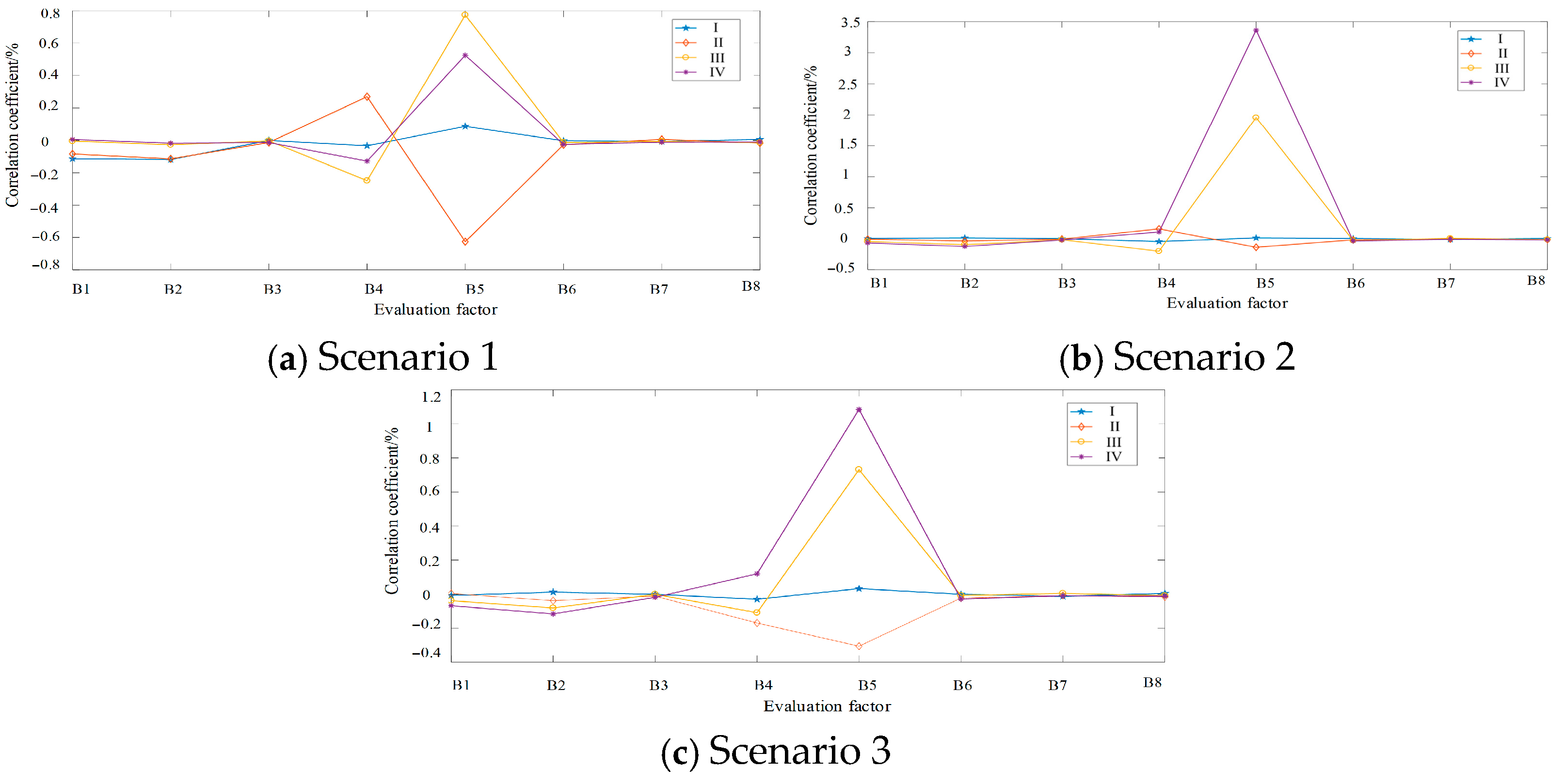
| B1 | −0.11358 | −0.08376 | −0.00399 | 0.005887 | IV | I | II |
| B2 | −0.11857 | −0.11443 | −0.02682 | −0.01708 | IV | I | II |
| B3 | −0.00014 | −0.01292 | −0.00273 | −0.01314 | I | II | II |
| B4 | −0.03314 | 0.269489 | −0.24875 | −0.1283 | II | II | IV |
| B5 | 0.086702 | −0.62609 | 0.773287 | 0.524869 | III | IV | IV |
| B6 | −0.00212 | −0.02679 | −0.0125 | −0.02421 | I | I | II |
| B7 | −0.0058 | 0.006283 | −0.00641 | −0.01086 | II | III | III |
| B8 | 0.005554 | −0.01627 | −0.0133 | −0.00975 | I | I | I |
| Scenarios | Grade I | Grade II | Grade III | Grade IV | Evaluation Grade | Extension Index |
|---|---|---|---|---|---|---|
| Scenario 1 | −0.17974 | −0.39869 | −0.14680 | −0.17975 | III | 2.68255647 |
| Scenario 2 | −0.02715 | −0.24494 | −0.42520 | −0.57900 | I | 1.61715564 |
| Scenario 3 | −0.18200 | −0.00042 | −0.28093 | −0.50744 | II | 1.73510216 |
| Method Types | Risk Weights | RMSE | MAE |
|---|---|---|---|
| Entropy method-only | 0.68 | 0.041 | 0.035 |
| BP-only | 0.72 | 0.038 | 0.032 |
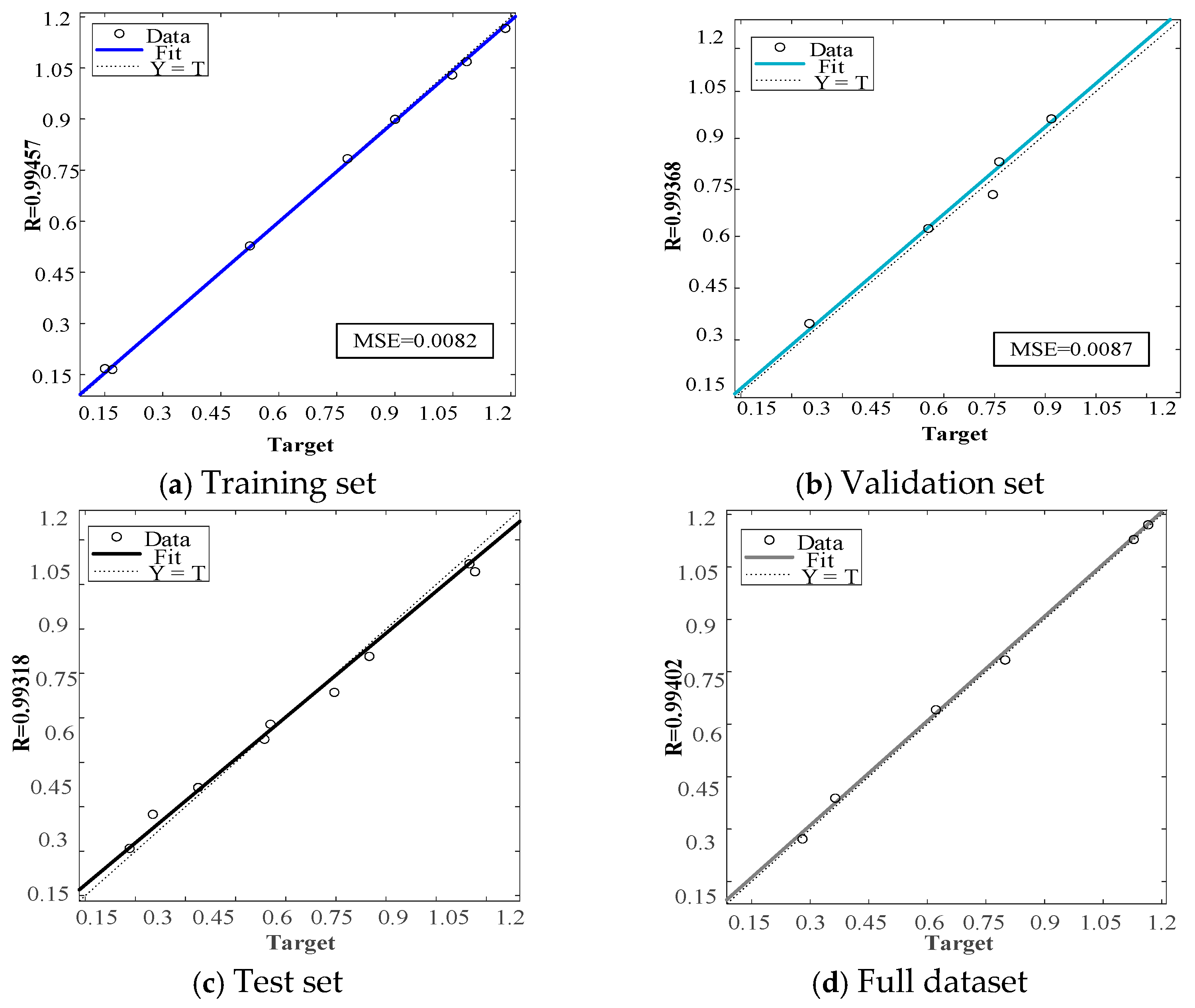
| BP-entropy combined method | 0.70 | 0.023 | 0.018 |
Disclaimer/Publisher’s Note: The statements, opinions and data contained in all publications are solely those of the individual author(s) and contributor(s) and not of MDPI and/or the editor(s). MDPI and/or the editor(s) disclaim responsibility for any injury to people or property resulting from any ideas, methods, instructions or products referred to in the content. |
© 2026 by the authors. Licensee MDPI, Basel, Switzerland. This article is an open access article distributed under the terms and conditions of the Creative Commons Attribution (CC BY) license.
Share and Cite
Du, H.; Sun, Y. Risk Assessment of Grid-Integrated Energy Service Projects: A Hybrid Indicator-Based Fuzzy-Entropy-BP Evaluation Framework. Sustainability 2026, 18, 1002. https://doi.org/10.3390/su18021002
Du H, Sun Y. Risk Assessment of Grid-Integrated Energy Service Projects: A Hybrid Indicator-Based Fuzzy-Entropy-BP Evaluation Framework. Sustainability. 2026; 18(2):1002. https://doi.org/10.3390/su18021002
Chicago/Turabian StyleDu, Haoran, and Yaling Sun. 2026. "Risk Assessment of Grid-Integrated Energy Service Projects: A Hybrid Indicator-Based Fuzzy-Entropy-BP Evaluation Framework" Sustainability 18, no. 2: 1002. https://doi.org/10.3390/su18021002
APA StyleDu, H., & Sun, Y. (2026). Risk Assessment of Grid-Integrated Energy Service Projects: A Hybrid Indicator-Based Fuzzy-Entropy-BP Evaluation Framework. Sustainability, 18(2), 1002. https://doi.org/10.3390/su18021002