Article

Toward Sustainable Crop Monitoring: An RGB-Based Non-Destructive System for Predicting Chlorophyll Content in Peanut Leaves

School of Food and Biological Engineering, Bengbu University, Bengbu 233030, China
*
Authors to whom correspondence should be addressed.
Sustainability 2026, 18(2), 1001; https://doi.org/10.3390/su18021001
Submission received: 19 November 2025 / Revised: 12 January 2026 / Accepted: 16 January 2026 / Published: 19 January 2026

Abstract

Accurate assessment of plant photosynthetic responses under drought and high-temperature stress is critical for understanding crop resilience. Chlorophyll content is a key indicator of photosynthetic efficiency, but conventional methods are destructive and time-consuming. Here, we developed a non-destructive detection system that captures Red (R), Green (G), and Blue (B) values from peanut (Arachis hypogaea L.) leaves and predicts chlorophyll content using machine learning. We optimized sensor distance (3–6 mm) and found 3 mm provided the most reliable RGB readings. Among Bayesian ridge and linear regression models, linear regression performed best (coefficient of determination R2 = 0.93), yielding a robust predictive formula: chlorophyll = [−0.0308 × [2 × G − R − B] + 4.386]. Integration of this formula into the detection system enabled real-time estimation of chlorophyll as a proxy for photosynthetic status and stress response. By enabling low-cost, non-destructive and rapid chlorophyll monitoring, this framework can help support resource-efficient crop monitoring and high-throughput screening for stress-resilient cultivars, with potential relevance to sustainable production in water-limited environments.

1. Introduction

Peanut (Arachis hypogaea L.), a key leguminous crop, is renowned for its high-quality edible oil and rich protein content. In regions such as Asia and Africa, where populations rely heavily on plant-based proteins, peanut serves as a vital dietary component [1]. However, approximately 70% of global peanut production takes place in arid and semi-arid environments, where drought and heat stress are widespread and significantly reduce crop yields [2,3]. These environmental constraints not only limit water availability but also intensify thermal stress, leading to marked declines in peanut growth, pod development, and seed quality. Among these abiotic stresses, drought is the most detrimental [4,5,6].
To survive and adapt under drought conditions, plants have developed a variety of morpho-physiological and molecular mechanisms [7,8]. One of the earliest and most visible responses to environmental stress, particularly water deficit, is the alteration of leaf color, closely associated with changes in chlorophyll content [9,10,11]. As the central pigment in photosynthesis, chlorophyll is directly linked to plant productivity, stress adaptation, and overall vitality [6]. Recent studies have shown that chlorophyll content often exhibits more pronounced decline under abiotic stresses (e.g., low temperature, high humidity, soil pollution) than carotenoids, making chlorophyll a useful proxy indicator of environmental stress [12,13,14].
Reliable estimation of leaf chlorophyll is essential for assessing plant responses under environmental stress, especially in large-scale genotypic screening. Conventional methods typically involve solvent-based pigment extraction followed by spectrophotometric or chromatographic analysis [15,16]. While accurate, these techniques are destructive, labor-intensive, and unsuitable for repeated or high-throughput measurements [9,17]. They also require specialized equipment and cannot track temporal changes in the same leaf, limiting their field applicability [18]. To address these limitations, non-destructive approaches such as optical sensing and chlorophyll meters have gained popularity. Devices like the SPAD-502 (The Soil–Plant Analysis Development (SPAD) unit, developed by Minolta (Osaka, Japan), is a hand-held, dual-wavelength chlorophyll meter (models 501 and 502) used in plant physiology for rapid, non-destructive field measurement of chlorophyll content) estimate chlorophyll indirectly by measuring light transmittance at specific wavelengths and have shown strong correlation with actual chlorophyll content [19,20,21]. However, the high cost of such instruments (ranging from 2000 to 3000 USD) limits their accessibility and widespread adoption, particularly in resource-constrained environments. In contrast, recent advancements in artificial intelligence (AI) and machine learning (ML) present promising alternatives. These approaches enable the integration of low-cost imaging devices with automated data analysis pipelines, facilitating rapid, scalable, and cost-effective solutions for addressing complex challenges in agricultural research across diverse production systems [22,23,24,25].
In recent years, proximal optical sensors, particularly low-cost RGB imaging devices have emerged as valuable tools for monitoring plant physiological status [26,27]. These sensors enable real-time, non-destructive measurements and are highly portable, making them well suited for high-throughput phenotyping across diverse environmental conditions. For instance, consumer-grade RGB cameras have been successfully employed to capture subtle stress-induced changes in leaf color and morphology, providing insights into physiological responses to water deficit or nutrient limitations [28,29]. Furthermore, integrated thermal-RGB imaging systems have demonstrated enhanced sensitivity for detecting water stress by combining canopy temperature data with visible color features, allowing for earlier and more reliable stress detection compared with RGB data alone [30,31]. Additionally, proximal spectral-thermal fusion platforms have been implemented in precision agriculture to monitor plant water status, underscoring the practical advantages of sensor configurations that optimize cost, responsiveness, and measurement sensitivity [32,33].
RGB-based chlorophyll estimation has progressed toward standardized acquisition and learning-based modeling for practical low-cost phenotyping [22,34] (Table S1). Leaf-scale smartphone/contact RGB imaging with compact machine learning/deep learning predictors has shown promising performance, but robustness depends strongly on illumination; recent work demonstrates the need for illumination-aware calibration or multi-light training [22,35]. Complementary efforts include handheld RGB-sensor devices with controlled light for rapid chlorophyll a/b and total chlorophyll quantification, as well as improved RGB-derived indices and recent reviews that summarize RGB pipelines and emphasize calibration/transferability as key limitations [34,36,37]. Crop-specific demonstrations (e.g., tomato) further support applicability under appropriate calibration [38].
In peanut, drought stress frequently suppresses photosynthesis and leads to a marked decline in leaf chlorophyll, making chlorophyll a sensitive indicator of stress severity [6]. Given that peanut is a major oilseed crop predominantly cultivated in arid and semi-arid regions, developing an RGB-based chlorophyll estimation system could provide a scalable, low-cost complement to expensive SPAD meters and destructive laboratory assays, enabling rapid monitoring and high-throughput screening under drought conditions. Despite recent progress in RGB-based chlorophyll/SPAD estimation, practical use for peanut drought monitoring still has challenges. Many models are trained on other crops and specific imaging setups, so their performance may not transfer well to peanut because leaf optical properties differ among crops and cultivars, and RGB signals can be sensitive to lighting and measurement geometry. In addition, methods based on uncontrolled field photography or complex models may show reduced repeatability and may be less suitable for low-cost, on-device use. Moreover, studies that directly validate RGB-based predictions against destructive biochemical assays under drought-stress conditions in peanut are still limited.
To help address these issues, we developed a low-cost (the parts cost of the system developed in this study is approximately 22 USD (Table S3)) detection system to estimate chlorophyll content in peanut leaves using RGB-derived color traits, together with a standardized measurement setup intended to reduce lighting-related variation. We built predictive models linking RGB features to chlorophyll content and evaluated them under simulated drought stress by comparing model outputs with conventional biochemical assays. Within the tested conditions, the proposed leaf-color-based system shows potential as a practical tool for rapid chlorophyll monitoring in peanut, and it may be adaptable to other crops after calibration, supporting high-throughput phenotyping and drought-stress assessment.
Therefore, this study aimed to:
(a)
develop a low-cost leaf-color-based detection system for estimating chlorophyll content in peanut leaves;
(b)
construct and validate predictive models linking RGB-derived color features with chlorophyll content under drought-stress conditions;
(c)
evaluate the system’s accuracy and applicability by comparing model predictions with conventional biochemical assays to assess its potential for high-throughput stress monitoring.

2. Materials and Methods

2.1. Hardware and Software Components of the Color Detection System

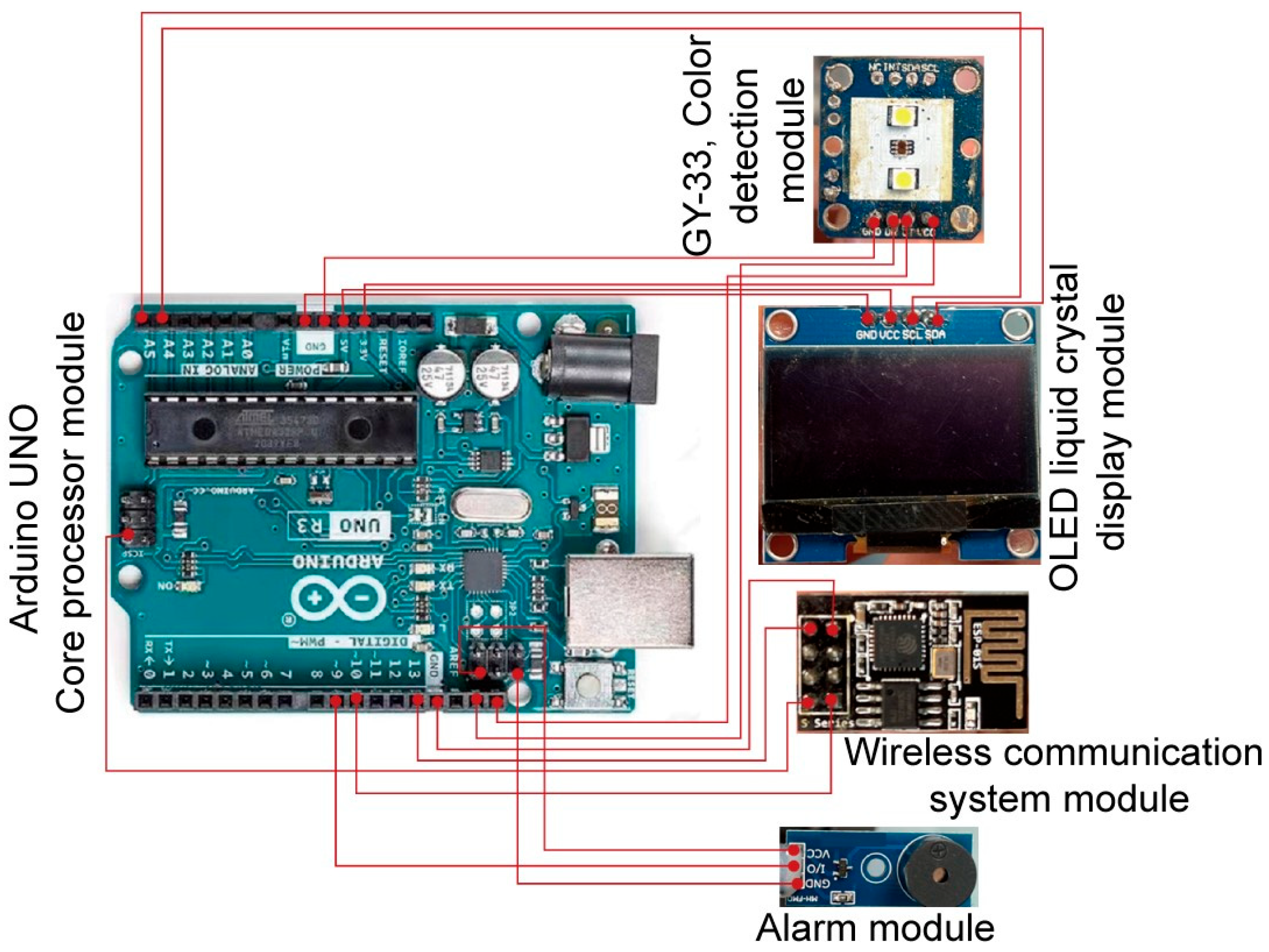
The chlorophyll content detection system includes two components: a hardware system and a software system. The hardware system consists of an Arduino UNO microprocessor (Core processor model, ATmega328P; SIMMTECH Co., Ltd., Suzhou, China) for the whole circuit and a color acquisition system (Color detection module, GY-33 TCS34725; SIMMTECH Co., Ltd.) consisting of a microcontroller, a “TCS34725” chip, and two white light LEDs, which are used to light the object being measured. When the light reflected or transmitted by the object enters the sensor, it passes through a filter, and the light intensities for the R, G, and B color channels are separately captured. The hardware also includes a wireless communication system (Wireless communication system modules, ESP8266-WIFI; SIMMTECH Co., Ltd.), a display system (OLED liquid crystal display module, SSD1306; SIMMTECH Co., Ltd.), and an alarm system (Active buzzer module, MH-FMD; SIMMTECH Co., Ltd.). The RGB value range for normal peanut leaves is predefined in the Arduino UNO microprocessor. When the RGB values detected by the color sensor and input into the processor exceed the predefined range, the alarm system will be triggered. The software system includes Arduino IDE (Arduino IDE version 1.8.19, the software programming environment of Arduino UNO) and the Bafa Cloud Platform (https://bemfa.com/). The specific structure is illustrated in Figure 1.
The chlorophyll content detection system uses Arduino UNO as a microprocessor. Arduino UNO controls the realization of each function through programming in Arduino IDE, including controlling the color acquisition system to obtain the plant leaf R, G, and B values. The chlorophyll content is calculated separately based on the R, G, and B values and the formulas. The resulting values for chlorophyll content are transmitted to the display system for real-time display using the Inter-Integrated Circuit (IIC) method; at the same time, the values for chlorophyll content in the leaf are uploaded to the Bafa Cloud Platform in real time through a wireless communication system to realize remote plant monitoring.
The color acquisition module was the GY-33, which integrates the TCS34725 color light-to-digital converter and on-board white LEDs (Table S2). The sensor provides four channels (red, green, blue, and clear; RGBC) with digital output and includes an IR-blocking filter to reduce infrared contamination in color sensing. The TCS34725 supports programmable analog gain (1×/4×/16×/60×) and programmable integration time in 2.4-ms steps (integration time = 2.4 ms × (256 − ATIME)), and communicates via a digital interface (I2C; fast-mode compatible). In this study, the GY-33 module outputs 8-bit RGB values (0–255) computed by its on-board MCU after white balancing.
Before data collection, the GY-33 module was white-balanced using the vendor PC software (ATK-XCOM, version 2.3) by sending the command [0 × A5 + 0 × BB + 0 × 60] with a white reference under the built-in LEDs. This white-balance setting is stored by the module and retained after power cycling. During measurements, a light-shielding structure and a fixed sensor-to-leaf geometry were used to minimize ambient-light interference and reduce variability caused by viewing angle or distance. For each leaf sample, RGB readings were collected at multiple positions and the mean value was used for subsequent analysis. The RGB values used in model development were the module outputs after white balance (not raw sensor register counts), and the regression index [2G − R − B] was computed from these RGB values.

2.2. Light-Shielding Structure and Measurement Geometry for RGB Acquisition

To minimize the influence of variable ambient illumination on RGB measurements, a custom light-shielding structure was used during data acquisition (Supplementary Figure S2). The target leaf region was positioned inside a semi-enclosed measurement cavity that surrounds the sensor’s field of view. During measurement, the cavity limits the entry of external light from lateral and overhead directions, so that the reflected signal recorded by the sensor is dominated by the module’s built-in LED illumination rather than room or laboratory lighting. In addition, the shield provides a fixed opening and a constrained sensor–leaf geometry, which helps reduce variability caused by changes in angle, distance, or positioning between measurements. The key dimensions of the light shield are shown in Supplementary Figure S2; the gap parameter (d) can be adjusted according to leaf thickness to ensure consistent contact/spacing and repeatable positioning.

2.3. Plant Growth and Treatment Conditions

The peanut (Arachis hypogaea L.) cultivars ‘Yue you 7’, ‘Yue you 13’, ‘Zhong hua 16’, and ‘Pu hua 36’ were provided by the Crop Research Institute, Guangdong Academy of Agricultural Sciences, China. The seeds (Medicago sativa L., Zhong mu 1; Arabidopsis thaliana (L.) Heynh., Columbia-0; Stevia rebaudiana Hemsl.) were soaked in water for 12 h, placed on moist filter paper, and transferred to a growth chamber (Guang Qi, GHP-160, Shanghai, China) with a cycle of 16 h light from fluorescent and incandescent lamps (200 µmol m−2s−1) at 26 °C, followed by 8 h darkness at 22 °C. The plants were cultivated as previously described [39]. To simulate the effects of drought, the peanut taproot was treated with 20% (w/v) polyethylene glycol 6000 (PEG 6000) (Sinopharm Chemical Reagent Co., Ltd., Cat No. 30151728, Shanghai, China) for 24 h or 48 h. Whole peanut plants were subjected to a high-temperature treatment at 45 °C in a plant incubator.

2.4. Determination of Chlorophyll Content

Chlorophyll was extracted as follows. Approximately 0.2 g of fresh peanut leaf tissue was weighed and immersed in 6 mL of a 1:1 (v/v) acetone–ethanol mixture. The samples were kept in darkness for 24 h to allow thorough pigment diffusion into the solvent while minimizing light-induced chlorophyll degradation. After 24 h, the extract was filtered, and the residual tissue was re-extracted with an additional 2 mL of the same solvent in darkness for another 12 h to recover remaining pigments. The two extracts were combined, and absorbance was measured at 645 nm and 663 nm using a Multi-scan GO Microplate Photometer (Thermo Fisher Scientific Inc., Waltham, MA, USA), with the acetone–ethanol (1:1, v/v) mixture used as the blank. Chlorophyll content was calculated as follows: Chlorophyll content (mg/g FW) = [[20.21 × OD645 + 8.02 × OD663] × V]/[1000 × W], where OD645 and OD663 are the absorbance values at 645 nm and 663 nm, respectively; V is the extract volume, and W is the fresh weight of leaf tissue (g).

2.5. Acquisition of Actual RGB Values for Peanut Leaves

To obtain the actual RGB values of peanut leaves, leaves were collected from plants at the four-leaf stage, and RGB values were measured using a Hunter Lab Agera (A) colorimeter (Shanion Creative Inc., Shanghai, China) at 460 nm, 140 Lux (parameters consistent with those used by the chlorophyll content detection system’s color sensor).

2.6. Predictive Modeling of Physiological Parameters in Peanut

Regression modeling was performed in Python using scikit-learn. The input variables were RGB values (R, G, B) output by the GY-33 module after the white-balance procedure described in Section 2.1. For each sample, an RGB-derived index was computed as [2G − R − B]. The response variable was the biochemically measured chlorophyll content (mg/g FW). Candidate RGB combinations were screened by Pearson correlation analysis, and [2G − R − B] was used as the predictor for the regression models as described in Section 3.2.
Five regression algorithms were evaluated: Linear Regression, Bayesian Ridge, Elastic Net, SVR, and Gradient Boosting Regressor (scikit-learn). The dataset was split into training and test sets at a 70:30 ratio. Model fitting was performed on the training set. Five-fold cross-validation was conducted within the training set. The held-out test set was used for final evaluation.
Model performance was quantified using explained variance (EV), mean absolute error (MAE), mean squared error (MSE), root mean squared error (RMSE), and coefficient of determination (R2). Linear regression has no tunable hyperparameters. For Bayesian ridge regression, Elastic Net, SVR, and Gradient Boosting Regressor, the default scikit-learn parameter settings were used, and the software version and all relevant parameters are reported in the revised manuscript for reproducibility. Where a random state argument was available, it was fixed.

2.7. Data Analysis

Pearson’s correlation coefficient analysis, significance testing, and paired t-tests were conducted using IBM SPSS Statistics 25 software. The predictive model of the in vivo chlorophyll content from peanut leaf color eigenvalues was established using machine learning regression algorithms in Python (Python 3.11.0). Plots were generated in Origin Pro 2025 (64-bit) SR1 (Origin Pro Student Version). Quantitative data were expressed as mean ± SD. The statistical significance of experimental data was assessed by Student t-test using IBM SPSS Statistics 25 software.

3. Results

3.1. Evaluation and Optimization of Our Chlorophyll Content Detection System Based on the R, G, and B Values of Peanut Leaves

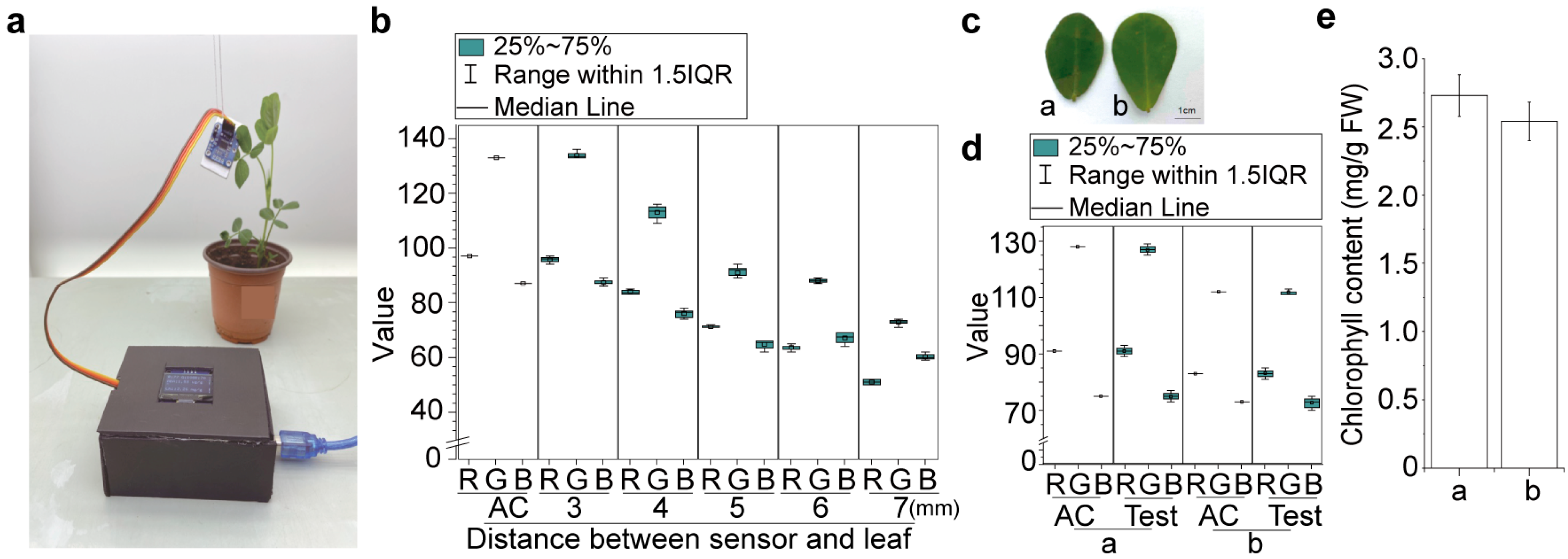
To evaluate the accuracy of the leaf color detection system developed in this study, we determined its optimal working distance by measuring the R, G, and B values of peanut leaves from seedlings at the four-leaf stage at distances of 3, 4, 5, or 6 mm from the color sensor (Figure 2a). At 3 mm, the R, G, and B values obtained by the color detection system were tightly grouped and closely aligned with the actual values estimated from the colorimeter (referred to as ‘Actual Color, AC’). As the distance increased, however, the R, G, and B values measured by the system gradually dropped and deviated from the true values (Figure 2b and Figure S1a). To validate this finding, we selected two visually distinct peanut leaves, labeled ‘a’ and ‘b’ (Figure 2c), and used the color detection system to measure their R, G, and B values. The values measured with our detection system (at 3 mm) were close to the values estimated using the colorimeter (Figure 2d). We also measured the chlorophyll content of leaves ‘a’ and ‘b’ via biochemical assays, revealing notable differences in their chlorophyll levels (Figure 2e). These findings indicate that the chlorophyll content detection system developed in this study can accurately capture the R, G, and B values of peanut leaves and that leaves with different RGB profiles have distinct chlorophyll content.

3.2. Prediction of Peanut Leaf Chlorophyll Content Using RGB-Derived Index [2 × G − R − B]

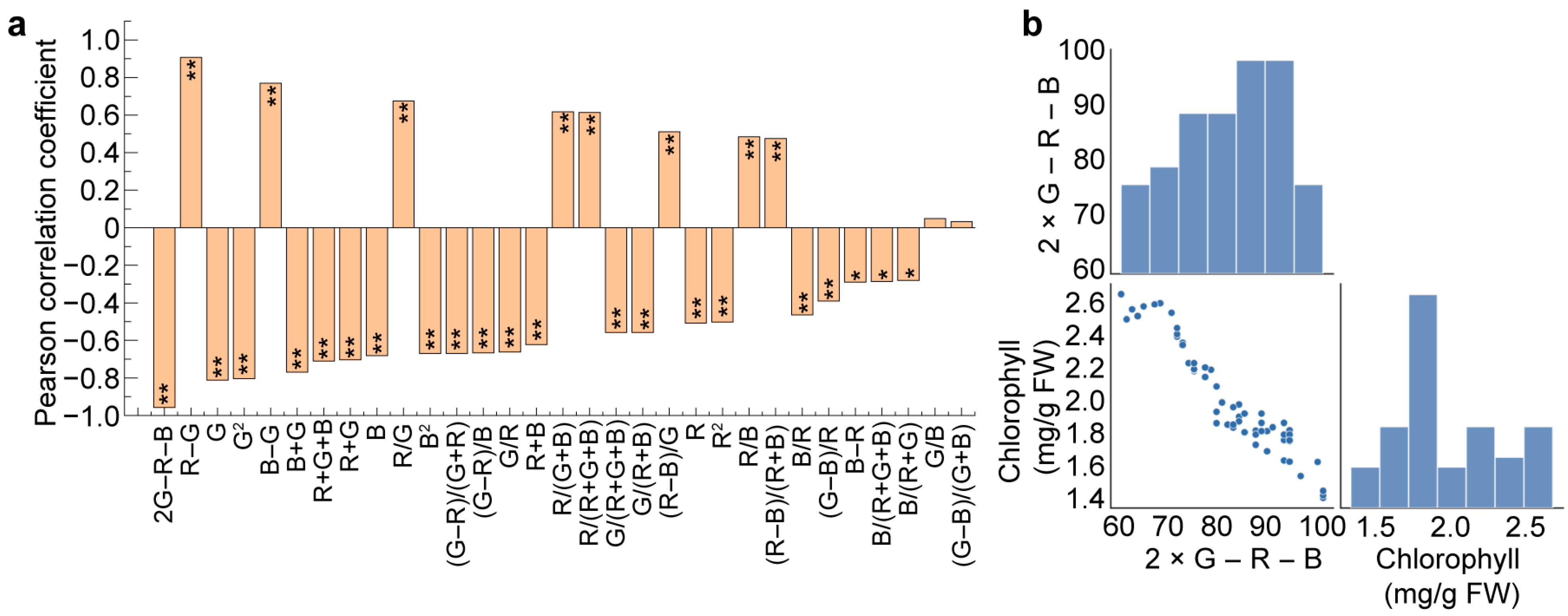
To establish a mathematical relationship to predict the chlorophyll content of peanut leaves from their RGB profiles, we used our chlorophyll content detection system to measure the R, G, and B values from 147 leaf samples collected from peanut plants grown under normal or drought conditions. We then detected their chlorophyll content. Following the approach described by Xing Liu et al. [6], we calculated the Pearson’s correlation coefficient between measured chlorophyll content and combinations of R, G, and B values (Figure 3a). We obtained the highest absolute correlation coefficients between chlorophyll content and [2 × G − R − B] values, with coefficient of −0.957. A scatterplot of chlorophyll content as a function of [2 × G − R − B] value confirmed the linear relationship among these parameters (Figure 3b). These results demonstrate that the [2 × G − R − B] index is a reliable predictor of chlorophyll content in peanut leaves.

3.3. Establishment of a Mathematical Model for Predicting Chlorophyll Content in Peanut Leaves Using RGB Values and Machine Learning Regression

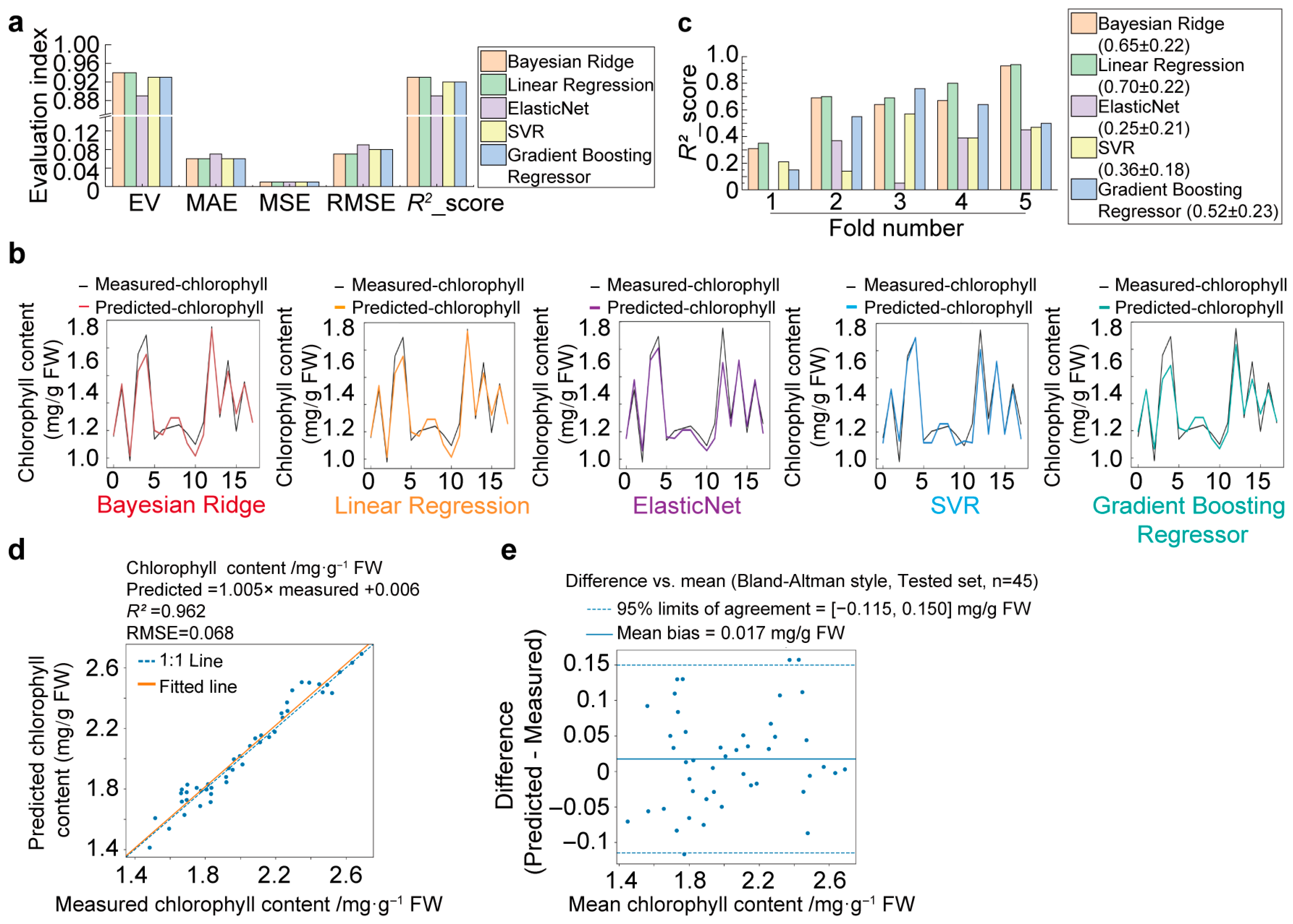
We employed five machine learning regression algorithms for model development, dividing the datasets for chlorophyll content, [2 × G − R − B] value into a training set and a testing set at a 70:30 ratio (102:45 leaves). The Bayesian ridge and linear regression models resulted in the highest explained variance (EV) and coefficient of determination (R2) score, both reaching 0.94 and 0.93, respectively. Additionally, the Bayesian ridge and linear regression models exhibited lower mean absolute error (MAE), and root mean squared error (RMSE) values than the other three regression models, suggesting their superior predictive performance (Figure 4a). Notably, the chlorophyll content predicted from the Bayesian ridge and linear regression models were close to the true measured values, indicating better fitting performance (Figure 4b). In internal five-fold cross validation, the linear regression model emerged as the most effective, producing the smallest relative variation coefficient of determination (R2) score (Figure 4c). The linear regression model performed better in the analyses and can generate prediction formulas for real-time display. By contrast, the other models are more complex and do not readily produce formulas for real-time, uniform calculations. To visualize overall prediction performance on the held-out test set, we plotted predicted versus biochemically measured chlorophyll values, showing high agreement (Figure 4d). A Bland–Altman style difference-versus-mean plot further indicated a small bias (0.017 mg g−1 FW) and no strong concentration-dependent error (Figure 4e). We therefore selected the linear regression model for predicting chlorophyll content, with the formula: Chlorophyll = [−0.0308 × [2 × G − R − B] + 4.386, using the [2 × G − R − B] value as predictors of chlorophyll content.

3.4. Assessment of the Rapid Detection System for Measuring Chlorophyll Content in the Leaves of Peanut Plants Exposed to Stress or Different Peanut Cultivars

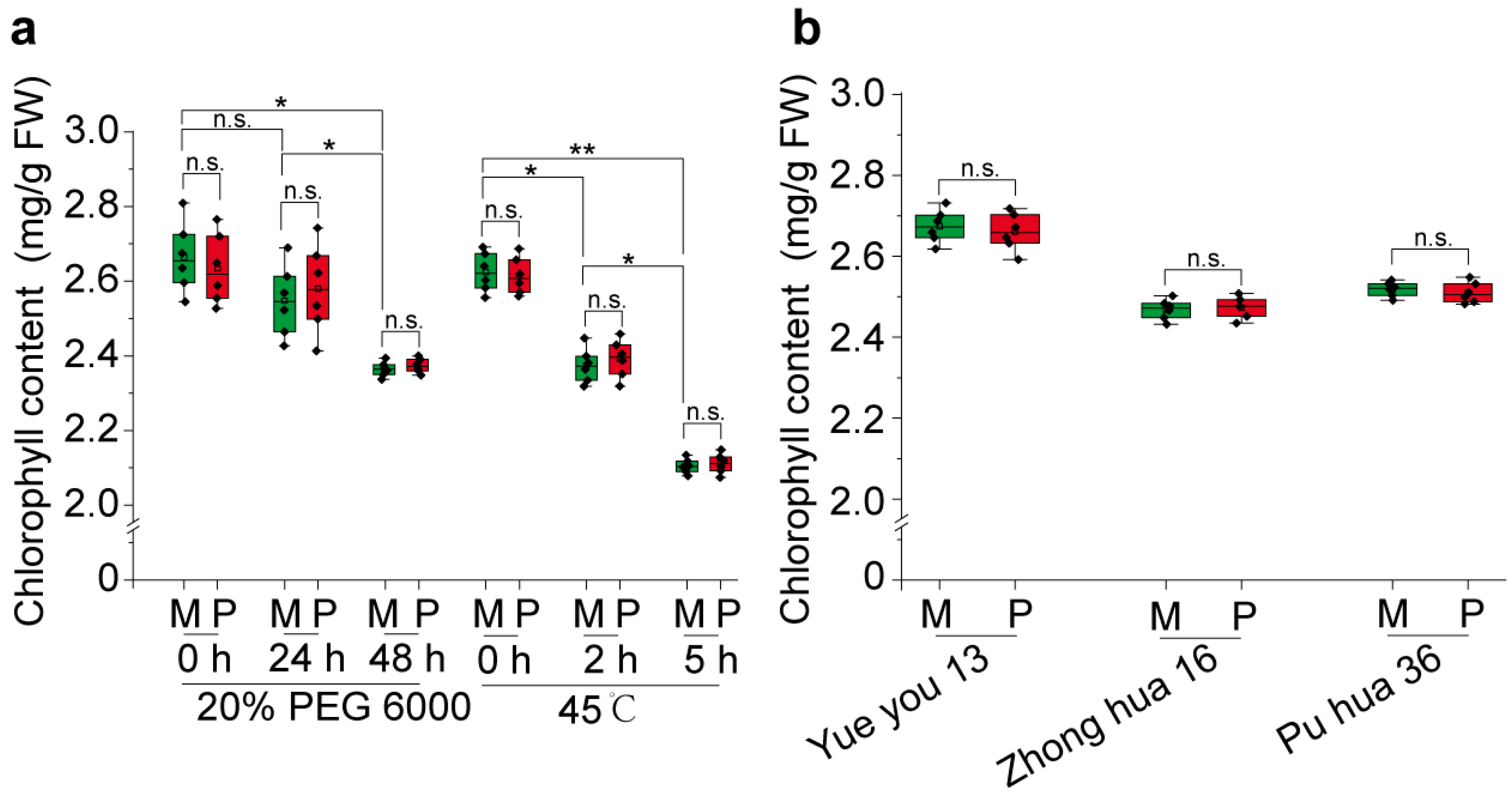
To further evaluate the applicability of the chlorophyll content detection system across different scenarios, we predicted the chlorophyll content of leaves from peanut plants (Predicted-chlorophyll) subjected to drought or high-temperature stress. In parallel, we measured the chlorophyll content via biochemical assays (Measured-chlorophyll). The chlorophyll content of leaves from peanut plants experiencing drought or high-temperature conditions was lower than that of the control (Figure 5a); these results are consistent with previous studies showing that drought and high-temperature stress inhibit chlorophyll biosynthesis and accelerate chlorophyll degradation, resulting in decreased leaf chlorophyll content [40,41]. The rapid detection system yielded similar results to biochemical assays for chlorophyll content across all conditions. Similarly, we assessed the chlorophyll content of leaves from three cultivated peanut varieties. We predicted the highest chlorophyll levels in Yue you 13, followed by Pu hua 36 and Zhong hua 16 (Figure 5b). These chlorophyll content aligned with prior findings on the photosynthetic capacity of these varieties [42]. Again, the rapid detection system and biochemical assays produced comparable results.

4. Discussion

In this study, an Arduino-based color detection system was developed to acquire peanut leaf RGB values and to estimate chlorophyll content using lightweight regression models. The measurement setup was optimized experimentally, and a sensor-leaf distance of 3 mm produced the most stable RGB readings and the closest agreement with reference color measurements (Figure 2 and Figure S1). Using biochemically quantified chlorophyll as reference measurements, correlation analysis identified [2G − R − B] as the most informative predictors for chlorophyll within the collected datasets (Figure 3). Model comparison across five regression algorithms supported selecting linear regression as a deployable option that balances predictive performance with an explicit analytic equation suitable for on-device implementation (Figure 4). Within the tested controlled treatments and genotypes, predicted values followed trends consistent with biochemical measurements (Figure 5 and Figure S3). Thus, the RGB sensor in the chlorophyll content detection system designed in this study provides a low-cost and repeatable approach for acquiring peanut leaf RGB profiles under controlled illumination and fixed geometry.
As key participants in photosynthesis, leaves significantly contribute to plant growth and development. Changes in leaf coloration reflect changes in pigment contents, which are closely associated with plant nutrient and water status [6,41,43,44,45]. Abiotic stress induced symptoms often manifest in distinct patterns in plants, which can be effectively predicted using color sensing [46,47]. Although multispectral and hyperspectral sensors, including those in the NIR range, offer deeper insights into vegetation, such as vegetation health, chlorophyll content, and nutrient deficiencies, RGB-based sensors provide a more cost-effective solution for detecting stress indicators [48,49,50]. RGB sensing provides a low-cost option for capturing visible-color traits with minimal computational requirements, which is advantageous for portable and embedded devices [51,52]. In this study, RGB acquisition depended on controlled illumination and fixed geometry: the optimized 3 mm distance reduced ambient-light effects and improved repeatability of the measured RGB values (Figure 2b and Figure S1). These results support using simple RGB features as inputs for rapid estimation under controlled measurement conditions.
Additionally, a device was designed to shield against ambient light interference, addressing the sensitivity of RGB sensors to external illumination (Figure S2). In practice, transferability and long-term stability may be improved by controlling illumination geometry, calibrating different units with a standard reference target, and periodically re-checking the reference to monitor drift and re-calibrate as needed. In field applications, measurement data can be transferred to a computer via USB or wireless networks or stored locally for later analysis [50]. In this study, a wireless communication system (ESP8266-WIFI), a display system (OLED) were integrated into the chlorophyll content detection system, enabling on-site data recording or remote transmission (Figure 1). The selection of an RGB sensor as the core component of the chlorophyll content detection system provides a practical and repeatable way to capture leaf color characteristics, enabling quantitative estimation of chlorophyll content under controlled conditions.
To keep the predictor simple and interpretable, we used a single RGB-derived index, [2G − R − B], as the input feature (Figure 3). This index can be viewed as a visible-band descriptor of leaf greenness. It is closely related to the core idea used in the Excess Green family and other RGB greenness indices that assign more weight to the green channel while reducing the contribution of red and blue, and such indices have been used in RGB-based plant phenotyping and vegetation color analyses as practical descriptors of leaf greenness and color variation [34,50]. Using one index also allows the final model to be written as an explicit linear equation, which is convenient for integration into the Arduino-based device for real-time calculation and display (Figure 4). In the current study, 147 sets of leaf RGB profiles were used to develop predictive models for estimating chlorophyll content in peanut leaves. Despite the limited number of data points, the predicted chlorophyll content was comparable across all plant and conditions, validating the accuracy and reliability of the rapid detection system (Figure 5 and Figure S3). However, the models were developed and evaluated mainly under controlled experimental settings; further validation using larger and more diverse datasets, including field-grown plants and broader environmental conditions, will be necessary to fully assess generalization. In addition, PEG-induced osmotic stress and constant 45 °C chamber heat are controlled proxies that do not fully reproduce field drought and heat, which involve progressive soil drying, heterogeneous root–soil interactions, fluctuating radiation and vapor pressure deficit, and diurnal temperature cycles [53]. Therefore, applying the current models beyond the tested controlled settings will require re-calibration and validation using field-grown plants and broader environmental variability.
While our system was developed and validated using peanut leaves, the underlying principle of predicting chlorophyll content from RGB color metrics has broad potential across other crops [26]. Non-destructive RGB-based approaches have been successfully applied in Arabidopsis, rice, and Hami melon, showing strong concordance with biochemical assays and SPAD measurements [21,54]. These studies indicate that, although the optimal color indices and regression formulas may differ among species, the general strategy can be transferable after appropriate calibration. However, the present study was evaluated under controlled laboratory conditions with a fixed measurement configuration (built-in LEDs, light shielding, and fixed sensor–leaf geometry) (Figure 5 and Figure S2). A key limitation is that RGB-based greenness indices can be sensitive to illumination; changes in ambient light intensity and spectrum may shift measured RGB values and affect prediction performance, as noted in prior image-based/SPAD prediction and RGB phenotyping workflows [34,35]. Another limitation is the lack of benchmarking against a conventional SPAD meter, which we plan to include in subsequent validation studies to assess comparability across instruments and operating conditions. In addition, leaf surface conditions (e.g., gloss, dust, or water droplets) and variations in measurement angle or contact pressure can introduce variability that may reduce transferability across environments. Therefore, although the current device uses on-board LEDs and a light shield to reduce ambient-light interference (Figure S2), the model has not yet been validated for open-field use. For outdoor deployment, additional calibration and validation across variable sunlight and field microclimates will be required, and a simple reference-based procedure (e.g., periodic checking with a white/gray target) could be introduced to support calibration under irregular lighting conditions. Future work will expand the dataset using field-grown plants and test robustness across environments, following common practice in sensor-based plant phenotyping and proximal/remote sensing applications.
Beyond methodological performance, the proposed system has practical sustainability implications. Its low component cost and non-destructive workflow can reduce dependence on consumables and solvent-based extraction when frequent measurements are needed, and it enables higher-frequency monitoring to support timely, resource-efficient management under drought and heat. In addition, the same framework can facilitate high-throughput phenotyping for selecting stress-resilient genotypes, which is relevant to sustaining productivity in water-limited production regions. Overall, this study shows that combining RGB color sensing with regression modeling can support a practical, non-destructive estimation of leaf chlorophyll for peanut under the measurement configuration tested here. The proposed workflow—standardized RGB acquisition, reference biochemical measurement, and simple model deployment—may provide a useful basis for developing similar rapid estimation tools in other plant species, provided that appropriate calibration and validation are conducted for the new species and environments.

5. Conclusions

In summary, this study developed a low-cost, non-destructive RGB-based sensing system to estimate chlorophyll content in peanut leaves under a standardized measurement configuration. By pairing leaf RGB readings acquired with an integrated LED illumination and light-shielding structure with biochemically quantified chlorophyll as the reference, we identified an interpretable RGB-derived index [2G − R − B] that strongly correlates with chlorophyll content and established a simple linear regression model (R2 = 0.93). The resulting explicit equation, chlorophyll = [−0.0308 × [2G − R − B] + 4.386], can be implemented on-device to support real-time chlorophyll estimation. Within the tested scope, the predicted chlorophyll values showed trends consistent with destructive biochemical assays. These results indicate that the proposed system can serve as a practical complementary tool for rapid screening and high-frequency monitoring of chlorophyll dynamics when destructive assays are impractical and conventional meters are not readily accessible.
Several limitations should be noted. The models were developed and evaluated under controlled laboratory conditions with a fixed sensor-leaf geometry, and RGB-based indices can be sensitive to illumination, leaf surface properties, and measurement handling; therefore, extension to other growth stages, field environments, or additional species will require recalibration and independent validation. In addition, we did not benchmark the device against a conventional SPAD meter in this study, which limits direct cross-instrument comparability for routine field users. Future work will focus on expanding the dataset across developmental stages and environments, conducting outdoor/field validation under variable sunlight, developing simple reference-based calibration procedures, and performing cross-instrument benchmarking (including SPAD) to improve robustness and transferability. In practice, integrating the sensor into a clip-like holder could further improve crop-specific adaptability by standardizing contact/spacing across leaves with different thickness, lamina size, or dense trichomes, thereby supporting more scalable measurements across crops. Overall, by directly linking low-cost RGB traits to chlorophyll content with a deployable, interpretable on-device equation, this study provides a practical framework that complements destructive biochemical assays for rapid photosynthetic status monitoring in peanut under standardized measurement conditions.

Supplementary Materials

The following supporting information can be downloaded at: https://www.mdpi.com/article/10.3390/su18021001/s1, Figure S1: RGB values measured by the chlorophyll content detection system using an RGB sensor at distances of 3, 4, 5, 6, or 7 mm, and RGB values measured using a colorimeter (AC, Actual Color) (n = 10 measurements taken for each leaf at each distance.). IQR, interquartile range. Figure S2: Light-shielding chamber for RGB acquisition in the chlorophyll detection system. Views from multiple angles with key dimensions (mm). Panel ‘a’ corresponds to the setup shown in Figure 2a. The units are in mm. Figure S3: Cross-species evaluation of the RGB-based chlorophyll detection system. (a) Representative plants of Medicago sativa, Arabidopsis thaliana, and Stevia rebaudiana (light-green) and Stevia rebaudiana (normal) used for leaf chlorophyll measurements; (b) Leaf chlorophyll content of the above species under normal conditions, estimated by the RGB-based chlorophyll content detection system (Predicted, P) and measured by biochemical assays (Measured, M). Asterisks indicate significant differences, as determined by a Student t-test; n.s., not significant. Table S1: Quantitative RGB chlorophyll comparison. Table S2: GY33-TCS34725 specifications. Table S3: Hardware costs of RGB-based chlorophyll predicted system.

Author Contributions

Conceptualization, K.G. and C.T.; methodology, H.L., X.F.; software, Y.W.; validation, J.Z., J.H.; formal analysis, K.G., H.L.; investigation, K.G., H.L.; resources, K.G.; data curation, K.G.; writing—original draft preparation, K.G.; writing—review and editing, K.G., C.T.; visualization, Y.W.; supervision, K.G. and C.T.; project administration, K.G.; funding acquisition, Y.W. All authors have read and agreed to the published version of the manuscript.

Funding

This research was funded by the Talent Introduction Project of Bengbu University, grant number 2025GQD014, and the Higher Education Research Project (Youth Program) of the Education Department of Anhui Province, grant 2025AHGXZK40614, to Kui Ge; and the Innovation and Entrepreneurship Training Project of College Student of Bengbu University (S202511305084 to Xinqi Fan and Yixuan Wang; S202511305085 to Juan Zhao and Jiatong Huang).

Institutional Review Board Statement

Not applicable.

Informed Consent Statement

Not applicable.

Data Availability Statement

Data will be made available on request.

Conflicts of Interest

The authors declare no conflicts of interest.

Abbreviations

The following abbreviations are used in this manuscript:
RRed
GGreen
BBlue
R2Coefficient of determination
SPADSoil–Plant Analysis Development
USDUnited States Dollar
AIArtificial intelligence
MLMachine learning
SVRSupport vector machine regression
EVExplained variance
MAEMean absolute error
MSEMean squared error
RMSERoot mean squared error
ACActual Color
MMeasured
PPredicted

References

  1. Li, W.; Yoo, E.; Lee, S.; Sung, J.; Noh, H.J.; Hwang, S.J.; Desta, K.T.; Lee, G.-A. Seed Weight and Genotype Influence the Total Oil Content and Fatty Acid Composition of Peanut Seeds. Foods 2022, 11, 3463. [Google Scholar] [CrossRef]
  2. Pokhrel, S.; Kharel, P.; Pandey, S.; Botton, S.; Nugraha, G.T.; Holbrook, C.; Ozias-Akins, P. Understanding the impacts of drought on peanuts (Arachis hypogaea L.): Exploring physio-genetic mechanisms to develop drought-resilient peanut cultivars. Front. Genet. 2025, 15, 1492434. [Google Scholar] [CrossRef]
  3. Reddy, T.; Reddy, V.; Anbumozhi, V. Physiological responses of groundnut (Arachis hypogea L.) to drought stress and its amelioration: A critical review. Plant Growth Regul. 2003, 41, 75–88. [Google Scholar] [CrossRef]
  4. Hamidou, F.; Ratnakumar, P.; Halilou, O.; Mponda, O.; Kapewa, T.; Monyo, E.; Faye, I.; Ntare, B.; Nigam, S.; Upadhyaya, H.; et al. Selection of intermittent drought tolerant lines across years and locations in the reference collection of ground-nut (Arachis hypogaea L.). Field Crops Res. 2012, 126, 189–199. [Google Scholar] [CrossRef]
  5. Attia, Z.; Pogoda, C.S.; Reinert, S.; Kane, N.C.; Hulke, B.S. Breeding for sustainable oilseed crop yield and quality in a changing climate. Theor. Appl. Genet. 2021, 134, 1817–1827. [Google Scholar] [CrossRef] [PubMed]
  6. Liu, X.; Li, L.; Li, M.; Su, L.; Lian, S.; Zhang, B.; Li, X.; Ge, K.; Li, L. AhGLK1 affects chlorophyll biosynthesis and photosynthesis in peanut leaves during recovery from drought. Sci. Rep. 2018, 8, 2250. [Google Scholar] [CrossRef]
  7. Wei, Y.S.; Javed, T.; Liu, T.T.; Ali, A.; Gao, S.J. Mechanisms of abscisic acid (ABA)-mediated plant defense responses: An updated review. Plant Stress 2025, 15, 100724. [Google Scholar] [CrossRef]
  8. Liu, S.; Li, M.; Su, L.; Ge, K.; Li, L.; Li, X.; Liu, X.; Li, L. Negative feedback regulation of ABA biosynthesis in peanut (Arachis hypogaea): A transcription factor complex inhibits AhNCED1 expression during water stress. Sci. Rep. 2016, 6, 37943. [Google Scholar] [CrossRef]
  9. Ren, J.; Guo, P.; Zhao, X.; Ma, X.; Ai, X.; Wang, J.; Zou, H.; Yu, H. Differential photosynthetic responses to drought stress in peanut varieties: Insights from transcriptome profiling and JIP-Test analysis. BMC Plant Biol. 2025, 25, 957. [Google Scholar] [CrossRef] [PubMed]
  10. Shafi, S.; Zaffar, A.; Riyaz, I.; Zargar, S.M.; Najeeb, S.; Sofi, P.A. A non-destructive, low cost and high throughput colorimetric method for chlorophyll estimation in rice (Oryza sativa L.). Discov. Plants 2024, 1, 2. [Google Scholar] [CrossRef]
  11. Yan, W.; Lu, Y.; Guo, L.; Liu, Y.; Li, M.; Zhang, B.; Zhang, B.; Zhang, L.; Qin, D.; Huo, J. Effects of Drought Stress on Photosynthesis and Chlorophyll Fluorescence in Blue Honeysuckle. Plants 2024, 13, 2115. [Google Scholar] [CrossRef] [PubMed]
  12. Amin, B.; Atif, M.J.; Kandegama, W.; Nasar, J.; Alam, P.; Fang, Z.; Cheng, Z. Low temperature and high humidity affect dynamics of chlorophyll biosynthesis and secondary metabolites in Cucumber. BMC Plant Biol. 2024, 24, 903. [Google Scholar] [CrossRef]
  13. Xu, P.; Yu, J.; Ma, R.; Ji, Y.; Hu, Q.; Mao, Y.; Ding, C.; Li, Z.; Ge, S.; Deng, W.-W.; et al. Chlorophyll and Carotenoid Metabolism Varies with Growth Temperatures among Tea Genotypes with Different Leaf Colors in Camellia sinensis. Int. J. Mol. Sci. 2024, 25, 10772. [Google Scholar] [CrossRef]
  14. Tomaškinová, J.; Tomaškin, J.; Drimal, M.; Bellido, J. The Impact of Abiotic Environmental Stressors on Fluorescence and Chlorophyll Content in Glycine max (L.) Merrill. Agronomy 2025, 15, 263. [Google Scholar] [CrossRef]
  15. Porra, R.J.; Thompson, W.A.; Kriedemann, P.E. Determination of accurate extinction coefficients and simultaneous equations for assaying chlorophylls a and b extracted with four different solvents: Verification of the concentration of chlorophyll standards by atomic absorption spectroscopy. Biochim. Biophys. Acta BBA Bioenerg. 1989, 975, 384–394. [Google Scholar] [CrossRef]
  16. Couture, J.J.; Singh, A.; Rubert-Nason, K.F.; Serbin, S.P.; Lindroth, R.L.; Townsend, P.A. Spectroscopic determination of ecologically relevant plant secondary metabolites. Methods Ecol. Evol. 2016, 7, 1402–1412. [Google Scholar] [CrossRef]
  17. Wang, Z.J.; Wang, J.H.; Liu, L.Y.; Huang, W.J.; Zhao, C.J.; Wang, C.Z. Prediction of grain protein content in winter wheat (Triticum aestivum L.) using plant pigment ratio (PPR). Field Crops Res. 2004, 90, 311–321. [Google Scholar] [CrossRef]
  18. Li, Y.; Sun, Y.; Jiang, J.; Liu, J. Spectroscopic determination of leaf chlorophyll content and color for genetic selection on Sassafras tzumu. Plant Methods 2019, 15, 73. [Google Scholar] [CrossRef]
  19. Gholizadeh, A.; Amin, M.S.M.; Anuar, A.R.; Aimrun, W. Evaluation of SPAD chlorophyll meter in two different rice growth stages and its temporal variability. Eur. J. Sci. Res. 2009, 37, 591–598. [Google Scholar]
  20. Shah, S.H.; Houborg, R.; McCabe, M.F. Response of chlorophyll, carotenoid and SPAD-502 measurement to salinity and nutrient stress in wheat (Triticum aestivum L.). Agronomy 2017, 7, 61. [Google Scholar] [CrossRef]
  21. Liang, Y.; Urano, D.; Liao, K.-L.; Hedrick, T.L.; Gao, Y.; Jones, A.M. A nondestructive method to estimate the chlorophyll content of Arabidopsis seedlings. Plant Methods 2017, 13, 26. [Google Scholar] [CrossRef]
  22. Barman, U.; Saikia, M.J. Smartphone contact imaging and 1-D CNN for leaf chlorophyll estimation in agriculture. Agriculture 2024, 14, 1262. [Google Scholar] [CrossRef]
  23. Lopin, P.; Nawsang, P.; Laywisadkul, S.; Lopin, K.V. Evaluation of Low-Cost Multi-Spectral Sensors for Measuring Chlorophyll Levels Across Diverse Leaf Types. Sensors 2025, 25, 2198. [Google Scholar] [CrossRef]
  24. Wacker, K.; Kim, C.; van Iersel, M.W.; Sidore, B.; Pham, T.; Haidekker, M.; Seymour, L.; Ferrarezi, R.S. Development of an Automated Low-Cost Multispectral Imaging System to Quantify Canopy Size and Pigmentation. Sensors 2024, 24, 5515. [Google Scholar] [CrossRef] [PubMed]
  25. Singhal, G.; Choudhury, B.U.; Singh, N.; Goswami, J. An enhanced chlorophyll estimation model with a canopy structural trait in maize crops: Use of multi-spectral UAV images and machine learning algorithm. Ecol. Inform. 2024, 83, 102811. [Google Scholar] [CrossRef]
  26. Wang, R.-F.; Qu, H.-R.; Su, W.-H. From sensors to insights: Technological trends in image-based high-throughput plant phenotyping. Smart Agric. Technol. 2025, 12, 101257. [Google Scholar] [CrossRef]
  27. Anshori, M.F.; Dirpan, A.; Sitaresmi, T.; Rossi, R.; Farid, M.; Hairmansis, A.; Purwoko, B.; Suwarno, W.B.; Nugraha, Y. An overview of image-based phenotyping as an adaptive 4.0 technology for studying plant abiotic stress: A bibliometric and literature review. Heliyon 2023, 9, e21650. [Google Scholar] [CrossRef] [PubMed]
  28. Niu, Y.; Xu, X.; Huang, W.; Li, J.; Li, S.; Zhao, N.; Li, B.; Xu, C.; Lu, S. RGB Imaging and Irrigation Management Reveal Water Stress Thresholds in Three Urban Shrubs in Northern China. Plants 2025, 14, 2253. [Google Scholar] [CrossRef]
  29. Samsuzzaman; Islam, S.; Ali, M.R.; Dey, P.K.; Bicamumakuba, E.; Reza, M.N.; Chung, S.O. Quantification of Light, Photoperiod, Temperature, and Water Stress Symptoms Using Image Features for Smart Vegetable Seedling Production. Horticulturae 2025, 11, 1340. [Google Scholar] [CrossRef]
  30. Chandel, N.S.; Rajwade, Y.A.; Dubey, K.; Chandel, A.K.; Subeesh, A.; Tiwari, M.K. Water Stress Identification of Winter Wheat Crop with State-of-the-Art AI Techniques and High-Resolution Thermal-RGB Imagery. Plants 2022, 11, 3344. [Google Scholar] [CrossRef]
  31. Zhou, Z.; Diverres, G.; Kang, C.; Thapa, S.; Karkee, M.; Zhang, Q.; Keller, M. Ground-based thermal imaging for assessing crop water status in grapevines over a growing season. Agronomy 2022, 12, 322. [Google Scholar] [CrossRef]
  32. Sánchez-Virosta, A.; Gómez-Candón, D.; Montoya, F.; Pérez-García, Y.; Jiménez, V.; Martínez-López, J.A.; González-Piqueras, J.; López-Urrea, R.; Sánchez, J.M. Remote and proximal sensing assessment of water status and its correlation with yield on almond orchards in Southeast Spain. Precis. Agric. 2025, 26, 92. [Google Scholar] [CrossRef]
  33. Mertens, S.; Verbraeken, L.; Sprenger, H.; De Meyer, S.; Demuynck, K.; Cannoot, B.; Merchie, J.; De Block, J.; Vogel, J.T.; Bruce, W.; et al. Monitoring of drought stress and transpiration rate using proximal thermal and hyperspectral imaging in an indoor automated plant phenotyping platform. Plant Methods 2023, 19, 132. [Google Scholar] [CrossRef]
  34. Kior, A.; Yudina, L.; Zolin, Y.; Sukhov, V.; Sukhova, E. RGB Imaging as a Tool for Remote Sensing of Characteristics of Terrestrial Plants: A Review. Plants 2024, 13, 1262. [Google Scholar] [CrossRef] [PubMed]
  35. Kamiwaki, Y.; Fukuda, S. Effect of the Light Environment on Image-Based SPAD Value Prediction of Radish Leaves. Algorithms 2023, 17, 16. [Google Scholar] [CrossRef]
  36. Agarwal, A.; Colwell, F.D.J.; Galvis, V.A.C.; Hill, T.R.; Boonham, N.; Prashar, A. Two-fold red excess (TREx): A simple and novel digital color index that enables non-invasive real-time monitoring of green-leaved as well as anthocyanin-rich crops. Plant Methods 2025, 21, 24. [Google Scholar] [CrossRef]
  37. Pan, W.; Ma, H.; Wang, R.; Wang, H.; Wang, D.; Guo, W.; Guo, X. Development of a handheld chlorophyll content detector on wheat and maize leaves based on RGB sensor. Front. Plant Sci. 2025, 16, 1606413. [Google Scholar] [CrossRef]
  38. Zhang, X.; Yu, H.; Yan, J.; Meng, X. Study on the Detection of Chlorophyll Content in Tomato Leaves Based on RGB Images. Horticulturae 2025, 11, 593. [Google Scholar] [CrossRef]
  39. Ge, K.; Liu, X.; Li, X.; Hu, B.; Li, L. Isolation of an ABA Transporter-Like 1 Gene from Arachis hypogaea That Affects ABA Import and Reduces ABA Sensitivity in Arabidopsis. Front. Plant Sci. 2017, 8, 1150. [Google Scholar] [CrossRef]
  40. Ma, Y.; Dias, M.C.; Freitas, H. Drought and Salinity Stress Responses and Microbe-Induced Tolerance in Plants. Front. Plant Sci. 2020, 11, 591911. [Google Scholar] [CrossRef]
  41. He, K.; Xu, Y.; Ding, H.; Guo, Q.; Ci, D.; Zhang, J.; Qin, F.; Xu, M.; Zhang, G. The Impact of Short-Term Drought on the Photosynthetic Characteristics and Yield of Peanuts Grown in Saline Alkali Soil. Plants 2024, 13, 2920. [Google Scholar] [CrossRef]
  42. Hao, X.; Zhang, J.; Liu, J.; Zang, X.; Zhu, S.; Tang, F. Evaluation of drought resistance in different peanut varieties. J. Peanut Sci. 2020, 49, 47–51. (In Chinese) [Google Scholar]
  43. Ge, K.; Lv, Q.; Chen, S.; Guo, Z.; Peng, Y.; Chen, Y.; Sun, S.; Wang, X. The nodule-specific transcriptional repressor Top Hub 4 regulates nodule structure and nitrogen fixation capacity in soybean. J. Genet. Genom. 2024, 51, 96–99. [Google Scholar] [CrossRef]
  44. Wang, M.; Lee, J.; Choi, B.; Park, Y.; Sim, H.J.; Kim, H.; Hwang, I. Physiological and Molecular Processes Associated with Long Duration of ABA Treatment. Front. Plant Sci. 2018, 9, 176. [Google Scholar] [CrossRef]
  45. Menzies, I.J.; Youard, L.W.; Lord, J.M.; Carpenter, K.L.; Van Klink, J.W.; Perry, N.B.; Schaefer, H.M.; Gould, K.S. Leaf colour polymorphisms: A balance between plant defence and photosynthesis. J. Ecol. 2016, 104, 104–113. [Google Scholar] [CrossRef]
  46. Zandi, A.; Hosseinirad, S.; Zadeh, H.K.; Tavakolian, K.; Cho, B.-K.; Vasefi, F.; Kim, M.S.; Tavakolian, P. A systematic review of multi-mode analytics for enhanced plant stress evaluation. Front. Plant Sci. 2025, 16, 1545025. [Google Scholar] [CrossRef] [PubMed]
  47. Pérez-Patricio, M.; Osuna-Coutiño, J.A.d.J.; Ríos-Toledo, G.; Aguilar-González, A.; Camas-Anzueto, J.L.; Morales-Navarro, N.A.; Velázquez-González, J.R.; Cundapí-López, L.Á. Plant Stress Detection Using a Three-Dimensional Analysis from a Single RGB Image. Sensors 2024, 24, 7860. [Google Scholar] [CrossRef] [PubMed]
  48. Tao, M.; Ma, X.; Huang, X.; Liu, C.; Deng, R.; Liang, K.; Qi, L. Smartphone-based detection of leaf color levels in rice plants. Comput. Electron. Agric. 2020, 173, 105431. [Google Scholar] [CrossRef]
  49. Ponti, M.P. Segmentation of low-cost remote sensing images combining vegetation indices and mean shift. IEEE Geosci. Remote Sens. Lett. 2012, 10, 67–70. [Google Scholar] [CrossRef]
  50. Bodor-Pesti, P.; Nguyen, L.L.P.; Nguyen, T.B.; Dam, M.S.; Taranyi, D.; Baranyai, L. LeafLaminaMap: Exploring Leaf Color Patterns Using RGB Color Indices. AgriEngineering 2025, 7, 39. [Google Scholar] [CrossRef]
  51. Coelho, F.G.T.; Maciel, G.M.; Siquieroli, A.C.S.; Gallis, R.B.d.A.; de Oliveira, C.S.; Ribeiro, A.L.A.; Pereira, L.M. High-throughput phenotyping for the evaluation of agronomic potential and root quality in tropical carrot using RGB sensors. Agriculture 2024, 14, 710. [Google Scholar] [CrossRef]
  52. Furbank, R.T.; Jimenez-Berni, J.A.; George-Jaeggli, B.; Potgieter, A.B.; Deery, D.M. Field crop phenomics: Enabling breeding for radiation use efficiency and biomass in cereal crops. New Phytol. 2019, 223, 1714–1727. [Google Scholar] [CrossRef] [PubMed]
  53. Zhang, M.; Wang, L.-F.; Zhang, K.; Liu, F.-Z.; Wan, Y.-S. Drought-induced responses of organic osmolytes and proline metabolism during pre-flowering stage in leaves of peanut (Arachis hypogaea L.). J. Integr. Agric. 2017, 16, 2197–2205. [Google Scholar] [CrossRef]
  54. Baek, S.-H.; Park, K.-H.; Jeon, J.-S.; Kwak, T.-Y. A Novel Method for Calibration of Digital Soil Images Captured under Irregular Lighting Conditions. Sensors 2022, 23, 296. [Google Scholar] [CrossRef]
Figure 1. Overview of the RGB-based chlorophyll content detection system.
Sustainability 18 01001 g001
Figure 2. Measurements of RGB values and chlorophyll content in the leaves of peanut seedlings at the four-leaf stage using RGB sensors and biochemical methods. (a) Photograph of the chlorophyll content detection system used to acquire the red (R), green (G), and blue (B) values from four different sections of peanut leaves. (b) Box plots illustrating the RGB values measured from the leaves of peanut seedlings at the four-leaf stage, obtained at distances of 3, 4, 5, 6, or 7 mm from the leaf using RGB sensors. As reference, the RGB values of the same leaf measured with a colorimeter (AC, Actual Color) are shown (n = 10 the number of measurements taken for each leaf at each distance.). IQR, interquartile range. (c) Photograph of the two peanut leaves from seedlings at the four-leaf stage whose RGB values were measured with our detection system. a, left leaf; b, right leaf. (d) Box plots showing the R, G, and B values of the two leaves a and b in (c), measured using a colorimeter (AC, Actual Color) (colorimeter-estimated values) and RGB sensors at a distance of 3 mm from the leaves (n = 6 technical replicate measurements). (e) Chlorophyll content of the two leaves labeled a and b in (c), measured using biochemical assays (n = 6 technical replicate measurements).
Sustainability 18 01001 g002
Figure 3. Analysis of chlorophyll contents in leaves from peanut seedlings at the four-leaf stage using RGB values. (a) Pairwise Pearson’s correlation coefficients between combinations of leaf RGB values, obtained with our detection system, and the leaf chlorophyll content measured by biochemical assays at 0 h (control), 24 h, and 48 h into drought treatment from seedlings at the four-leaf stage. The coefficients were calculated using SPSS software. Asterisks indicate significant differences as determined by a Student’s t-test: * p < 0.05; ** p < 0.001. (RGB values and chlorophyll content were measured in 147 leaf samples); (b) Scatterplots showing the pairwise correlation between the indicated RGB values [2 × G − R − B] and chlorophyll content in the same leaves. The histograms along the diagonal show the data distribution for each set of values.
Sustainability 18 01001 g003
Figure 4. Analysis and prediction of chlorophyll content in leaves from peanut seedlings at the four-leaf stage using RGB values and machine learning models. (a) Evaluation indices from the use of each of five machine learning regression algorithms (Linear regression, Bayesian ridge, Elastic Net, SVR, and Gradient Boosting Regressor) using 70% of the data from the chlorophyll content [2 × G – R − B] value as the training set. The explained variance (EV), mean absolute error (MAE), mean squared error (MSE), root mean squared error (RMSE), and coefficient of determination (R2) values for each model were calculated. (b) Predicted and ground truth values for chlorophyll content by the five machine learning regression algorithms (Linear regression, Bayesian ridge, Elastic Net, SVR, and Gradient Boosting Regressor) models, using the [2 × G − R − B] value from 17 individual leaf samples, representing 30% of all leaf samples in the test dataset. Black lines, chlorophyll content obtained from biochemical experiments. (c) Five-fold cross-validation of the coefficient of determination (R2) scores obtained from the outputs of each of the five training models. The data are the average of R2 scores ± SE. (d) Predicted vs. measured chlorophyll content on the held-out test set. (e) Agreement and error analysis using a Bland–Altman style difference-versus-mean plot (test set).
Sustainability 18 01001 g004
Figure 5. Analysis of chlorophyll content in leaves from peanut seedlings at the four-leaf stage under different conditions and in different cultivars. (a) Chlorophyll content in the leaves of peanut seedlings at the four-leaf stage, estimated by the chlorophyll content detection system (Predicted-chlorophyll, P) or biochemical assays (Measured-chlorophyll, M) under the following conditions: 20% (w/v) PEG6000 treatment for 0 h, 24 h, or 48 h, and high-temperature stress treatment at 45 °C for 0 h, 2 h, or 5 h. (b) Chlorophyll content in the leaves of peanut seedlings at the four-leaf stage from cultivars Yue you 13, Zhong hua 16, and Pu hua 36 grown under normal conditions, estimated by the chlorophyll content detection system or biochemical assays. Asterisks indicate significant differences, as determined by a Student t-test; * p < 0.05; ** p < 0.001; n.s.: not significant.
Sustainability 18 01001 g005
Disclaimer/Publisher’s Note: The statements, opinions and data contained in all publications are solely those of the individual author(s) and contributor(s) and not of MDPI and/or the editor(s). MDPI and/or the editor(s) disclaim responsibility for any injury to people or property resulting from any ideas, methods, instructions or products referred to in the content.