1. Introduction
Air filtration is a key element of exposure control in healthcare, public buildings, transport systems, industrial environments, and other occupied spaces in which airborne particulate matter and bioaerosols may affect human health. Conventional fibrous filters are designed primarily to capture suspended particles, including microorganisms, but filtration does not necessarily eliminate the biological activity of the deposited material. Viable bacteria and fungi retained within a filter can survive and, under favorable temperature and humidity conditions, may proliferate on the fibrous substrate, creating a potential source of secondary contamination during prolonged use [
1,
2,
3]. Consequently, the development of filtration media that combine efficient particle capture with antimicrobial functionality has become an important direction in advanced filter design [
1,
2,
3].
A wide range of antimicrobial strategies has been investigated for nonwoven filtration media. Inorganic systems based on silver, copper, zinc oxide, titanium dioxide, and metal–organic frameworks are among the most extensively studied because of their broad-spectrum activity and relatively high chemical stability [
1,
4,
5,
6,
7]. Silver nanoparticles (AgNPs), in particular, can provide strong antibacterial effects through the release of Ag+ ions and associated disruption of cell membranes, enzymatic processes, and nucleic acid function [
6]. Organic and polymer-compatible alternatives, including quaternary ammonium compounds, N-halamines, chitosan, and other bio-derived agents, have also attracted considerable attention [
1,
8,
9]. However, the selection of an antimicrobial additive should not be based on antimicrobial performance alone. In this study, the choice of antimicrobial agents is considered from a Safe-and-Sustainable-by-Design (SSbD) perspective, following the methodological guidance of the European Commission Joint Research Centre [
10]. In particular, the SSbD aspects relevant to the present material include the following:
- (i)
Safety, including potential hazards and the release of the antimicrobial component during processing and use;
- (ii)
Environmental sustainability, including the use of potentially persistent materials and their behavior throughout the material life cycle;
- (iii)
End-of-life and circularity considerations, particularly the compatibility of the additive with material recovery and recycling [
10].
Metallic nanoparticles, such as silver ones, may introduce additional concerns related to their release, persistence, separation, and fate during manufacture, use, recycling, and disposal [
10,
11]. For example, the development of Ag-loaded nonwoven fabrics requires specific consideration of the recovery and recyclability of the silver-containing material [
11]. In contrast, the use of cinnamon and turmeric as bio-based antimicrobial additives provides a potentially more favorable starting point with respect to the use of bio-based feedstocks and the avoidance of intentionally introduced metallic nanoparticles. These considerations are not intended to constitute a full SSbD assessment or life cycle, which would require additional data on hazard, exposure, environmental impacts, resource use, and end-of-life scenarios, but rather to provide an SSbD-informed framework for interpreting the antimicrobial and material performance results obtained in this study.
In this context, poly(lactic acid) (PLA) is an attractive polymer matrix for the development of fibrous filtration materials because it is a bio-based thermoplastic polyester that can be processed into micro- and submicron fibers. Replacing conventional petroleum-derived filter polymers with PLA can reduce dependence on fossil feedstocks, while functionalization with plant-derived antimicrobial compounds may further reduce reliance on persistent inorganic biocides. Natural products are especially attractive when they can provide antimicrobial functionality without compromising the processability and transport properties of the filter. At the same time, the use of a natural additive introduces a materials-processing challenge: compounds extracted or dispersed from plant matter can alter polymer–solvent interactions, solution viscosity, interfacial properties, and jet stability. For fibrous filtration media, such changes are important because even modest modifications of the fiber-forming process can affect the morphology and packing of the nonwoven mat and, consequently, both filtration efficiency and pressure drop.
Cinnamon and turmeric are particularly interesting candidates for this type of multifunctional material. Cinnamon contains several biologically active constituents, with cinnamaldehyde being widely associated with its antimicrobial action, whereas turmeric is a source of curcuminoids, especially curcumin, which has been extensively investigated as a natural antibacterial and antioxidant compound [
12,
13,
14,
15]. Previous studies have demonstrated that cinnamon-derived and curcumin-based active phases can be incorporated into polymeric fibrous systems while retaining antimicrobial functionality [
16,
17]. More recent work has also confirmed continuing interest in biodegradable PLA-based nanofibers containing natural phenolic antimicrobial compounds [
18]. Importantly, Kalluraya et al. [
19] study reported solution blow-spun turmeric/PLGA fiber mats with antibacterial activity, illustrating the growing relevance of combining plant-derived bioactive compounds with aerodynamically produced fibrous polymer structures. These reports support the feasibility of plant-functionalized fibrous materials, but they also highlight the need to move beyond demonstration of antimicrobial activity and examine the coupled relationships among formulation, fiber-forming behavior, nonwoven structure, and end-use filtration performance.
The selection of cinnamon and turmeric was based on their wide availability, low cost, established antimicrobial constituents, and previous successful incorporation into polymeric fibrous systems. In the present study, they were used as two chemically distinct and practically accessible plant-derived additive systems with which to examine the coupled effects of bioactive functionalization on PLA solution rheology, SBS processability, fiber morphology, filtration performance, and bacteriostatic behavior. Their selection is not intended to imply that cinnamon and turmeric are universally superior to other natural phenolic additives.
Solution blow spinning (SBS) is well suited to such an investigation because fiber formation is driven by aerodynamic forces rather than by the high-voltage electric field used in electrospinning. In SBS, a polymer solution emerging from a nozzle is accelerated and stretched using a high-velocity gas stream while solvent evaporation progressively solidifies the jet [
20,
21]. The process can produce micro- and submicron fibers and has already been applied to PLA-based materials [
20,
21,
22]. Nevertheless, successful SBS depends on a relatively narrow balance among solution rheology, polymer feed rate, gas flow conditions, surface and extensional properties, and solvent evaporation. Rheological modifications caused by a bioactive additive may therefore have two competing effects: they can suppress capillary breakup and stabilize fiber formation, but excessive viscous resistance can also limit jet stretching or promote droplet formation. From the perspective of filtration, the key question is not only whether continuous fibers can be produced, but whether the modified formulation preserves a favorable combination of fiber morphology, particle removal efficiency, air permeability, and antimicrobial function.
Despite increasing research on antimicrobial nanofibers and bioactive PLA systems, the combined effect of plant-derived additives on SBS processability and air filtration performance remains insufficiently characterized. In particular, there is a need for studies that connect the rheological response of the spinning solution with the practical SBS processing window and then relate these processing changes to fiber diameter distribution, pressure drop, filtration efficiency, and biological activity. Such an integrated approach is important because a formulation that exhibits strong antimicrobial activity but substantially increases air flow resistance, destabilizes fiber formation, or produces an unsuitable fiber architecture would have limited practical value as a filter medium. Conversely, a bioactive additive that modifies solution behavior while maintaining submicron fiber formation and improving the efficiency–resistance balance could provide a route toward multifunctional filters with a more favorable sustainability profile.
Accordingly, the aim of this study was to develop PLA fibrous mats containing cinnamon or turmeric as plant-derived bioactive additives using solution blow spinning and to determine how these additives influence the complete chain from solution properties to filter functionality. The investigated materials were characterized in terms of shear rheology and Ostwald–de Waele model parameters, SBS processing window, fiber morphology and diameter distribution, initial filtration efficiency, pressure drop, filtration quality factor, and qualitative bacteriostatic activity. Particular attention was given to whether the rheological changes induced by the additives modify processability more strongly than the final fiber diameter and whether the resulting nonwoven structures can maintain filtration efficiency while reducing air flow resistance. The results show that both additives can be incorporated into SBS-produced PLA mats while preserving predominantly submicron fiber morphology and bacteriostatic activity. At the same time, the modified mats exhibit lower pressure drop and improved filtration quality factors relative to neat PLA under selected processing conditions, indicating that plant-derived functionalization can contribute not only to antimicrobial activity but also to the overall performance balance of a PLA-based filtration material with selected SSbD-relevant design features.
2. Materials and Methods
2.1. Materials
Poly(L-lactic acid) (PLA, Ingeo™ 6202D) was supplied by NatureWorks LLC (Minneapolis, MN, USA). Turmeric and cinnamon powders were purchased from Prymat (Jastrzębie-Zdrój, Poland). Acetone and chloroform were obtained from Sigma-Aldrich (Poznań, Poland).
2.2. Preparation of PLA Solutions Containing Turmeric or Cinnamon
A 10.0 wt.% PLA solution in an acetone/chloroform mixture (1:3, v/v) was used for both the solution blow spinning process and rheological measurements. The required amount of PLA was dissolved in the solvent mixture in a tightly sealed container and stirred at room temperature for 24 h.
Cinnamon (0.42 and 1.00 wt.%) and turmeric (0.86 and 1.10 wt.%) were used as bioactive additives. Before being incorporated into the PLA solution, both additives were ground in a ceramic mortar using acetone as the grinding medium. The resulting paste was dispersed in the PLA solution and magnetically stirred for 48 h. The suspensions were then left undisturbed to allow the undissolved particles to settle. The clear supernatant was subsequently used for both solution blow spinning and rheological measurements. Sedimentation was purely gravitational; no centrifugation was employed. The reported cinnamon and turmeric concentrations therefore represent the nominal amounts introduced during formulation. Because the sedimented fraction and the chemical composition of the supernatant were not quantified, these values should not be interpreted as analytically determined concentrations of dissolved bioactive compounds in the supernatant.
2.3. Rheological Measurements
The rheological properties of the prepared solutions were characterized using an oscillatory rheometer (MCR102, Anton Paar, Graz, Austria) controlled with Anton Paar software (Anton Paar 1.25). Measurements were carried out using a parallel plate geometry (50 mm diameter) with a gap of 1 mm at 20 °C. A Peltier temperature control system and an evaporation protection cover were used to ensure constant testing conditions.
Apparent viscosity was determined over a shear rate range of 1–100 1/s. Each solution was tested at least three times, and the results presented in this study correspond to the arithmetic mean of the measurements.
2.4. Solution Blow Spinning
The solution blow spinning system consisted of the following:
A pressure regulator with a pressure gauge controlling the compressed dry air supply;
A mass flow controller (SFC5500-200slm, Sensirion, Zurich, Switzerland) adjusted to provide an airflow rate of 200 L/min;
A syringe pump (Legato 270, KD Scientific, Holliston, MA, USA) equipped with a 60 mL plastic syringe for controlling the polymer solution feed rate;
A coaxial solution blow spinning nozzle with an inner diameter of 1 mm and an outer diameter of 5 mm;
A cylindrical collector covered with a nonwoven substrate and positioned 37 cm from the nozzle outlet;
A fan located behind the collector to improve fiber collection efficiency.
Only a brief description of the experimental setup is provided here. A detailed description of the system design, construction, operating principle, and installation layout has been reported in our previous publication [
22].
2.5. SEM Analysis
The morphology of the produced fibers was examined using a scanning electron microscope (Hitachi TM1000 Tabletop SEM, Tokyo, Japan). Fibers samples were collected from different regions of each nonwoven mat and sputter-coated with a thin gold layer using a K550X EMITECH Quorum sputter coater (Laughton, East Sussex, UK) with argon as the process gas.
Fiber diameters were measured using ImageJ software (ImageJ 1.54).
For each formulation, three independently prepared fiber mats were analyzed. From each mat, fibers were collected from 3–5 different locations to account for possible spatial variability within the mat. SEM images were then analyzed by measuring, whenever possible, all clearly distinguishable fibers present in the selected images. This resulted in approximately 700–800 individual fiber diameter measurements per formulation.
The fiber diameter distribution, arithmetic mean diameter, and median diameter were subsequently determined from the collected individual fiber diameter measurements. The median was included as an additional descriptor because the measured fiber diameter distributions were right skewed.
2.6. Filtration Efficiency and Pressure Drop
Filtration efficiency and pressure drop were evaluated using a Palas MFP 2000 filtration test system (Palas GmbH, Karlsruhe, Germany). The measurements were performed under the following operating conditions:
Filtration area: 100 cm2;
Face velocity: 20.0 cm/s;
Aerosol concentration: 150.0 mg/m3;
Volumetric flow rate: 120 L/min;
Loading time: 40 s;
Arizona Fine Test Dust ISO 12103-1 (Powder Technology Inc., Arden Hills, MN, USA) was used as the challenge aerosol. The particle size ranged from 0.2 to 16 µm, with a mean particle diameter of 0.35–0.45 µm.
The MFP 2000 system consisted of the following:
A piston brush aerosol generator (RBG 1000, Palas GmbH, Karlsruhe, Germany);
A pneumatic filter holder;
An optical particle counter (PCS 2010, Palas GmbH, Karlsruhe, Germany);
A charge neutralizer (CD 2000, Palas GmbH, Karlsruhe, Germany);
A vacuum pump (ASP 2000, Palas GmbH, Karlsruhe, Germany).
A detailed description of the measurement procedure and the experimental setup has been presented in our previous publication [
23].
The presented results for initial filtration efficiency and pressure drop are averages of measurements performed on three different samples. The standard deviation (
SD) was calculated using the following formula:
2.7. Bacteriostatic Performance
Bacteriostatic activity was evaluated using LB culture medium (Sigma-Aldrich, Poznań, Poland). The medium was prepared according to the manufacturer’s protocol by dissolving the appropriate amount of powder in ultrapure water and sterilizing the solution in an autoclave at 121 °C for 20 min. After sterilization, the medium was poured into sterile Petri dishes.
Samples of the produced fiber mats (4 mg each) were sterilized under UV radiation for 20 min and placed on the solidified medium. Fibers produced from pure PLA served as the control sample. Each test was repeated six times on six independent mats.
The media were inoculated with a suspension of environmental bacteria collected from frequently touched surfaces (door handles and computer keyboards). The collected bacteria were suspended in water and incubated for 24 h at room temperature before inoculation. After inoculation, all Petri dishes were incubated at 28 °C for 24–48 h. Bacteriostatic activity was assessed based on the presence of a growth inhibition zone (“halo effect”) surrounding the fiber samples.
The present study provides only a preliminary qualitative evaluation of the bacteriostatic properties of the developed fiber mats. The use of environmental bacteria was intended to demonstrate the potential antimicrobial activity of the materials. Comprehensive microbiological studies employing reference bacterial strains and standardized methods are planned for future work. The mixed environmental population was selected for proof-of-concept screening and does not provide a standardized baseline for antibacterial efficacy. Consequently, the present results cannot be directly compared with quantitative tests using reference strains such as Escherichia coli or Staphylococcus aureus. Standardized testing with reference microorganisms and an appropriate validated ISO/ASTM method is a priority for future work.
3. Results
3.1. Rheological Properties of the Spinning Solutions
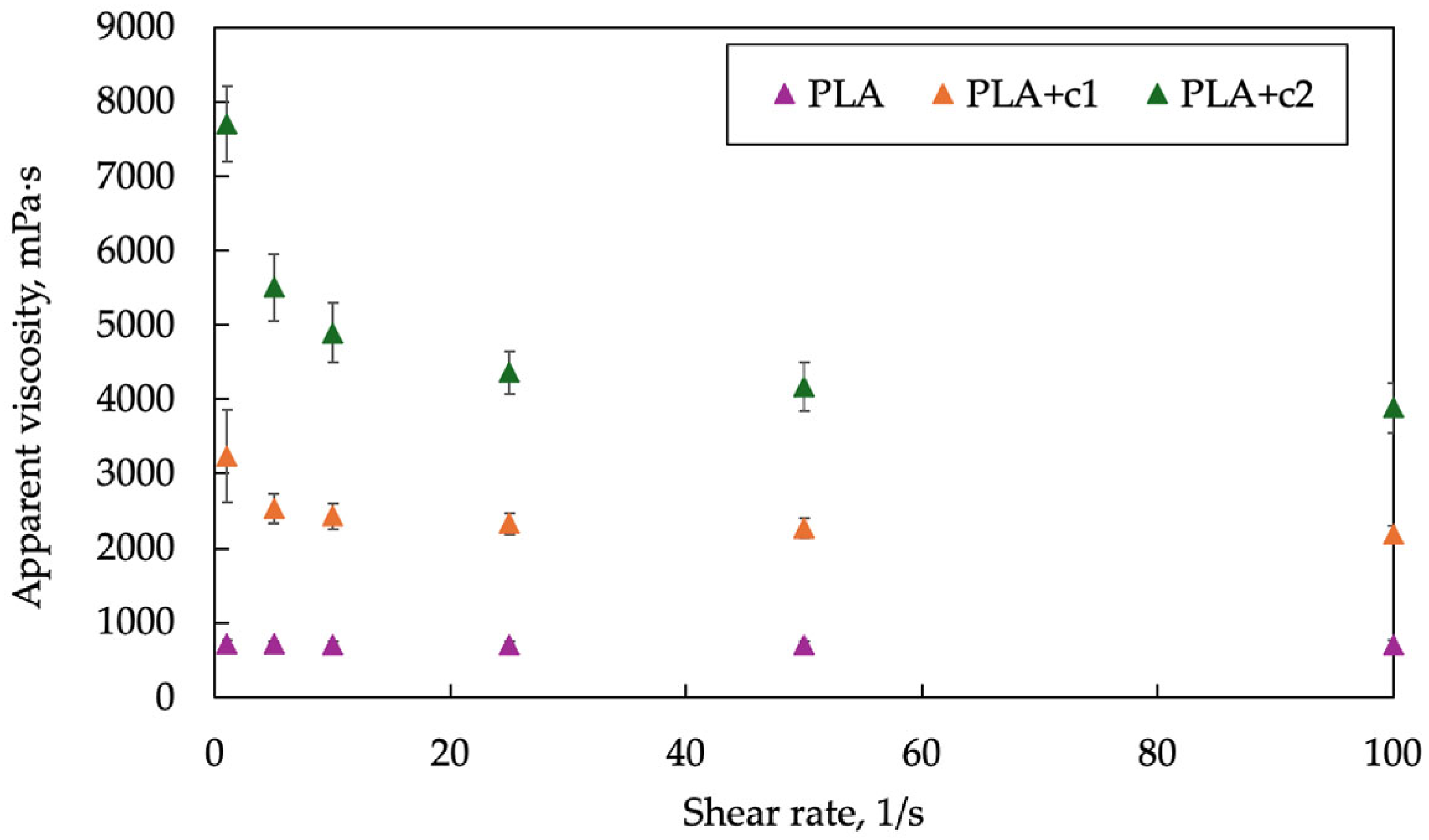
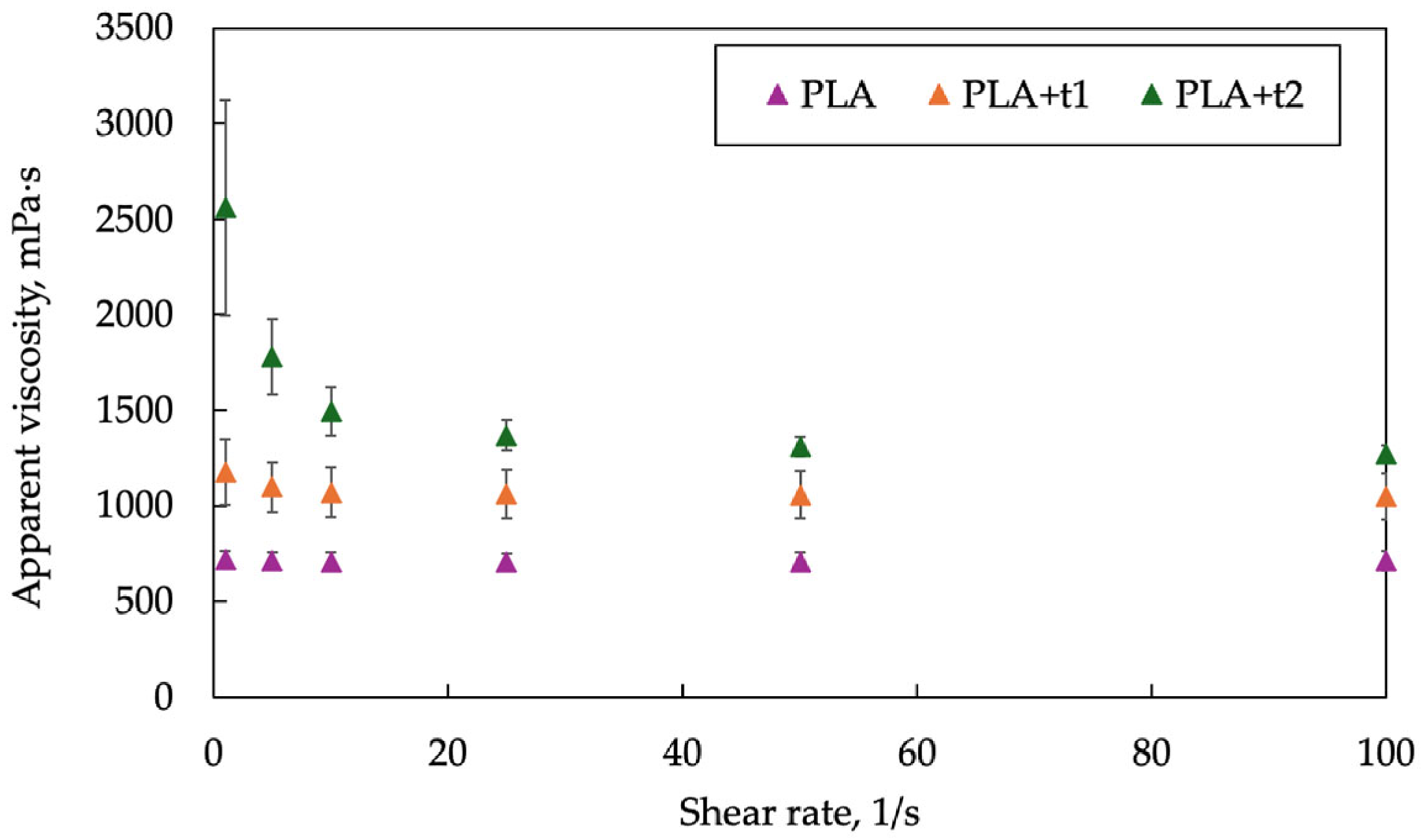
The apparent viscosity measurements showed a systematic effect of both the type and concentration of the bioactive additive. Over the investigated shear rate range of 1–100 1/s, all formulations showed decreasing apparent viscosity with increasing shear rate (
Figure 1 and
Figure 2). At a given additive type, the formulation containing the higher additive concentration exhibited the higher apparent viscosity. Across the investigated formulations, the apparent viscosity followed the general order PLA + c2 > PLA + c1 > PLA + t2 > PLA + t1 > PLA. Relative to neat PLA, the apparent viscosity increased by approximately 1.5–2 times for the turmeric-containing solutions and by approximately 4–6 times for the cinnamon-containing solutions.
The relationship between shear stress and shear rate was described using the Ostwald–de Waele power law model:
where
τ is a shear stress (Pa),
k is a flow consistency index (Pa·s
n),
γ is a shear rate (1/s), and
n is flow behavior index (-).
The model parameters were obtained from the logarithmic form:
The coefficient of determination (R2) was calculated from the logarithmically transformed experimental shear stress and shear rate data (log τ versus log ), consistently with the linearized form of the Ostwald–de Waele model.
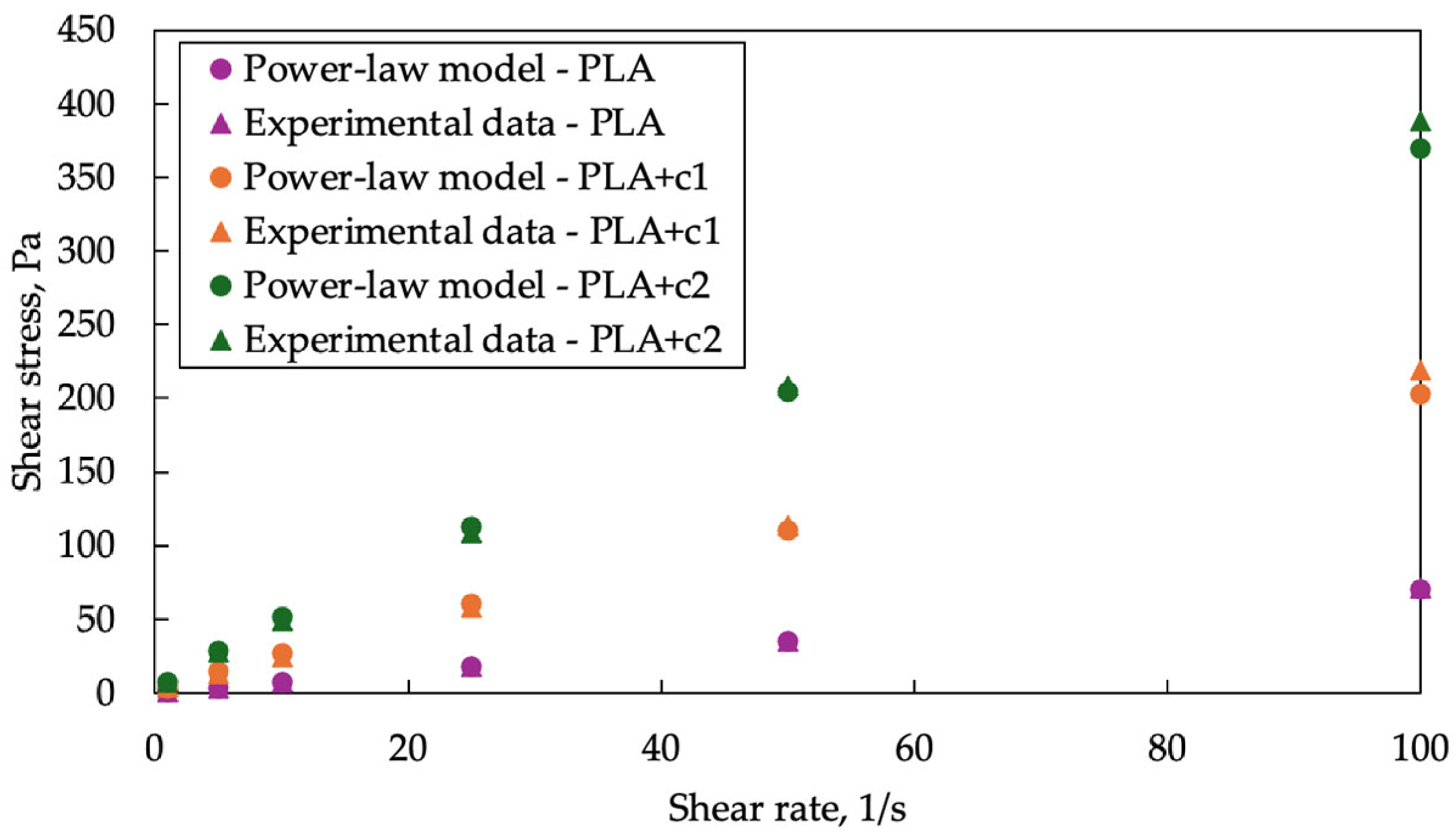
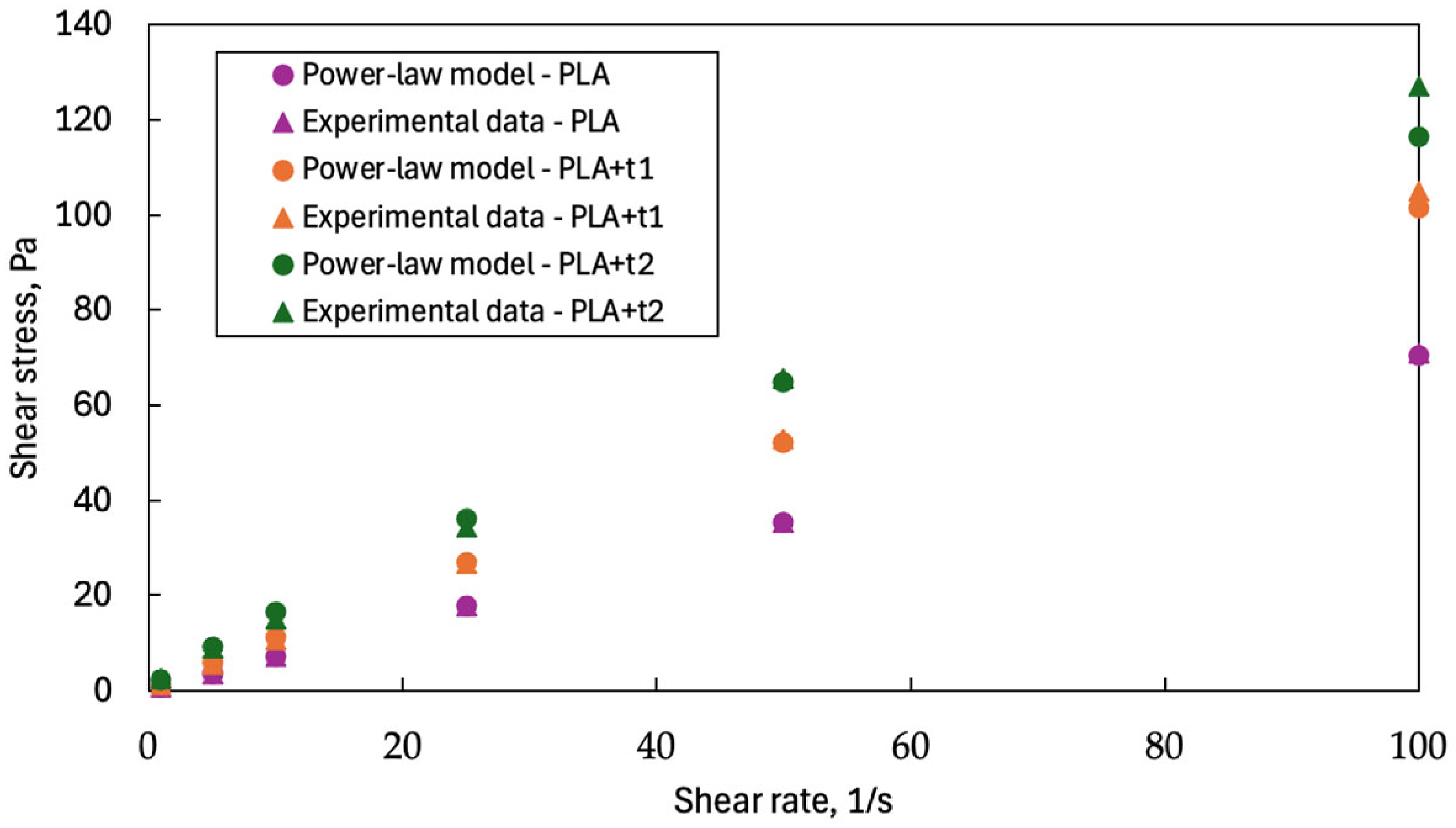
The experimental data and model fits are presented in
Figure 3 and
Figure 4, and the fitted values are summarized in
Table 1. The coefficients of determination were high for all formulations (R
2 ≥ 0.9968), indicating a very good fit of the linearized Ostwald–de Waele model to the experimental data. Neat PLA had
n = 0.996 and
k = 0.717, whereas all additive-containing solutions showed lower
n and higher
k values. The highest
k value was obtained for PLA + c2 (7.246), while the lowest
n values were obtained for PLA + t2 (0.848) and PLA + c2 (0.854).
3.2. Fiber Production and SBS Processing Window
Fiber formation was evaluated at polymer solution flow rates from 0.1 to 0.8 mL/min at a constant air flow rate of 200 L/min. The observed process outcomes are summarized in
Table 2. Neat PLA exhibited the broadest range of stable fiber production. Very numerous fibers were obtained from 0.2 to 0.7 mL/min. However, no fibers were obtained at 0.1 mL/min, and droplet formation was observed at 0.8 mL/min.
For PLA + c1, very numerous fibers were obtained only at 0.4 and 0.5 mL/min, followed by droplet formation at 0.6–0.8 mL/min. PLA + c2 showed a wider stable range than PLA + c1, with very numerous fibers at 0.4–0.6 mL/min, mixed fiber/droplet formation at 0.7 mL/min, and droplets at 0.8 mL/min. PLA + t1 produced very numerous fibers at 0.3–0.4 mL/min, followed by mixed fiber/droplet formation at 0.5 mL/min, and droplets at higher flow rates. PLA + t2 produced few fibers at 0.2–0.3 mL/min, very numerous fibers at 0.4–0.6 mL/min, mixed fiber/droplet formation at 0.7 mL/min, and droplets at 0.8 mL/min. Thus, among the modified formulations, PLA + c2 and PLA + t2 showed the broadest range of conditions yielding very numerous fibers.
3.3. Fiber Morphology and Diameter Distribution
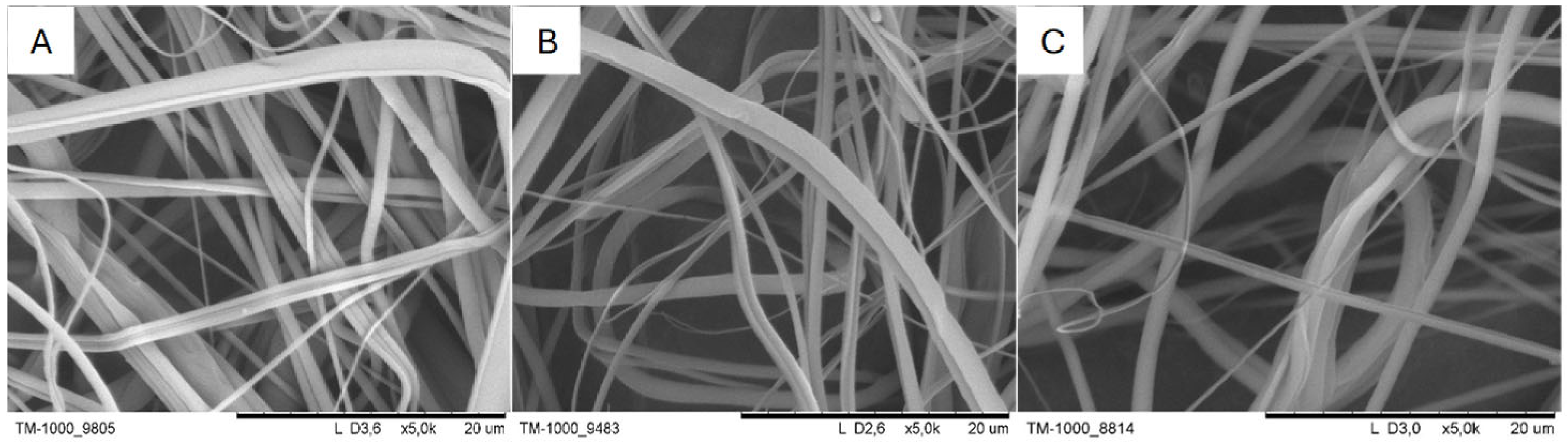
Because of their narrower processing windows, the lower additive formulations PLA + c1 (0.42 wt.% cinnamon) and PLA + t1 (0.86 wt.% turmeric) were not included in the subsequent morphology and filtration analyses. SEM observations were therefore performed for neat PLA, PLA + c2, and PLA + t2. Representative micrographs obtained for samples produced at a polymer flow rate of 0.5 mL/min and an air flow rate of 200 L/min are shown in
Figure 5. All three materials consisted predominantly of smooth, cylindrical fibers, with no qualitative change in the basic fiber shape between neat and additive containing PLA.
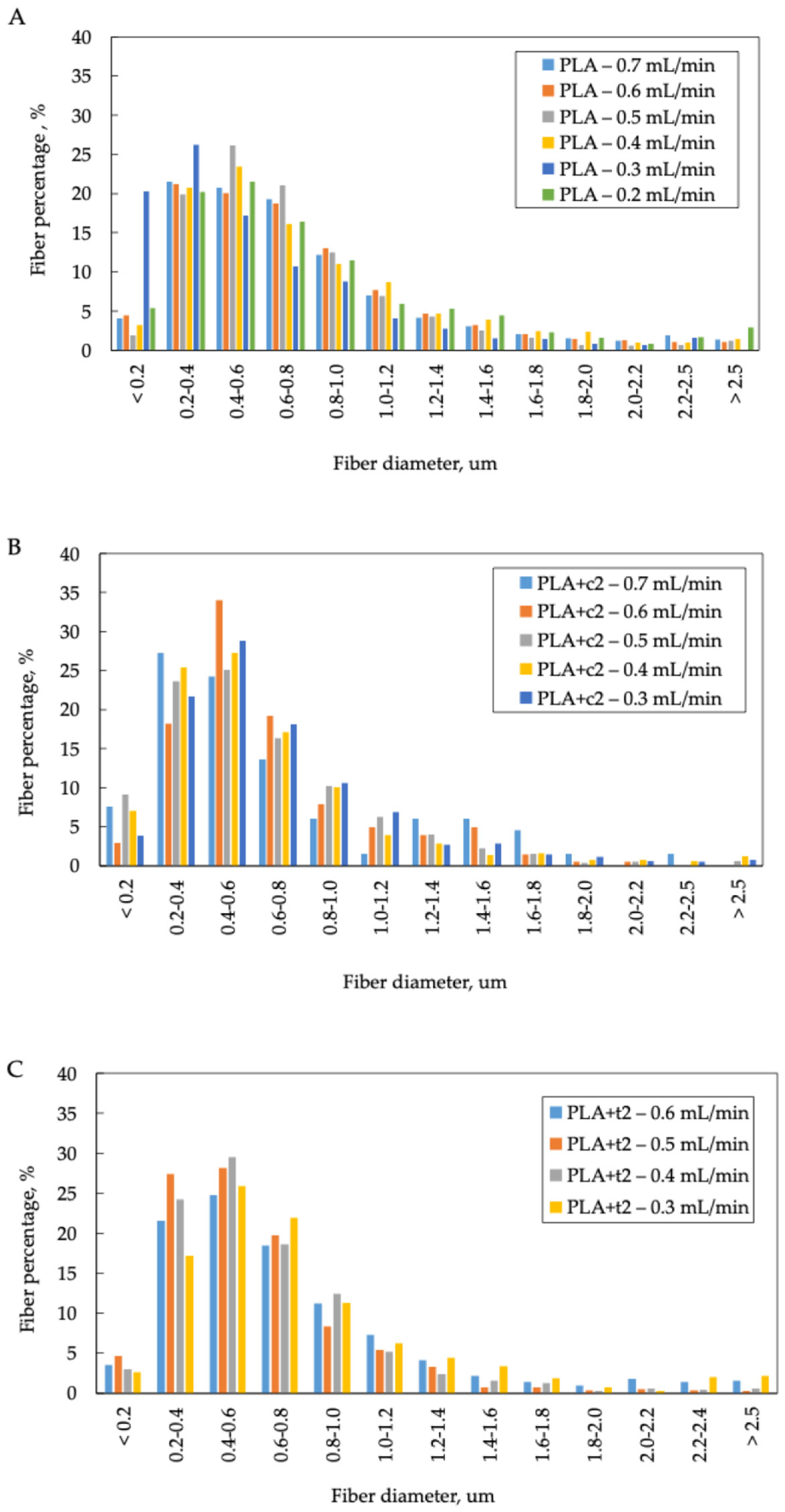
The fiber diameter distributions are shown in
Figure 6, and the corresponding arithmetic mean and median diameters are listed in
Table 3. The distributions were right-skewed, with the majority of measured fibers within approximately 0.2–0.8 μm. Across all formulations and investigated flow rates, the mean fiber diameter ranged from 0.604 to 0.819 μm, whereas the median diameter ranged from 0.515 to 0.646 μm. The median was consistently lower than the corresponding arithmetic mean, confirming the right-skewed character of the distributions and indicating that the mean values were influenced by the less frequent larger diameter fibers. Therefore, both the mean and median values, together with the full distributions shown in
Figure 6, were considered when comparing fiber morphology.
For neat PLA, the mean diameter varied from 0.731 to 0.819 μm. For PLA + c2, the corresponding range was 0.677–0.759 μm. For PLA + t2, it was 0.604–0.784 μm. The lowest mean diameter was recorded for PLA + t2 at 0.5 mL/min (0.604 μm), while the highest value was recorded for neat PLA at 0.2 mL/min (0.819 μm). At the common flow rate of 0.5 mL/min, the mean diameters were 0.731 μm for PLA, 0.677 μm for PLA + c2, and 0.604 μm for PLA + t2. At this common flow rate, the corresponding median diameters were 0.614 μm for PLA, 0.534 μm for PLA + c2, and 0.534 μm for PLA + t2. No monotonic increase or decrease in mean fiber diameter with polymer solution flow rate was observed within the stable processing ranges.
3.4. Filtration Properties
The initial filtration efficiency values are summarized in
Table 4. Neat PLA showed efficiencies ranging from 82.971 to 84.976%. PLA + c2 showed values from 82.552 to 83.568%, while PLA + t2 showed values from 82.554 to 83.145%. Within each formulation, the variation in initial efficiency over the investigated polymer flow rates was relatively small compared with the differences observed in pressure drop.
The initial pressure drop showed larger differences between formulations (
Table 5). For neat PLA, ΔP ranged from 9.67 to 23.05 Pa. For PLA + c2, values ranged from 8.55 to 14.65 Pa. For PLA + t2, values ranged from 9.57 to 11.75 Pa. At polymer flow rates of 0.5 and 0.6 mL/min, the pressure drop was 18.93 and 23.05 Pa for neat PLA, respectively, compared with 10.38 and 12.21 Pa for PLA + c2 and 9.57 and 10.38 Pa for PLA + t2. At 0.4 mL/min. The lowest measured pressure drop was obtained for PLA + c2 (8.55 Pa).
The filtration quality factor (
Qf) was calculated from the initial filtration efficiency
E and initial pressure drop Δ
P according to the following formula:
where
E is initial filtration efficiency (%) and Δ
P is initial pressure drop (Pa).
The calculated values are presented in
Table 6. For all directly comparable polymer flow rates, PLA + c2 showed a higher quality factor than neat PLA. PLA + t2 likewise showed higher values than neat PLA at the directly comparable flow rates of 0.3–0.6 mL/min. The highest quality factor in the complete data set was 0.211 1/Pa for PLA + c2 produced at 0.4 mL/min. The maximum value measured for PLA + t2 was 0.182 1/Pa, obtained at both 0.3 and 0.5 mL/min. For neat PLA, the quality factor ranged from 0.082 to 0.183 1/Pa over the investigated processing conditions.
3.5. Bacteriostatic Properties
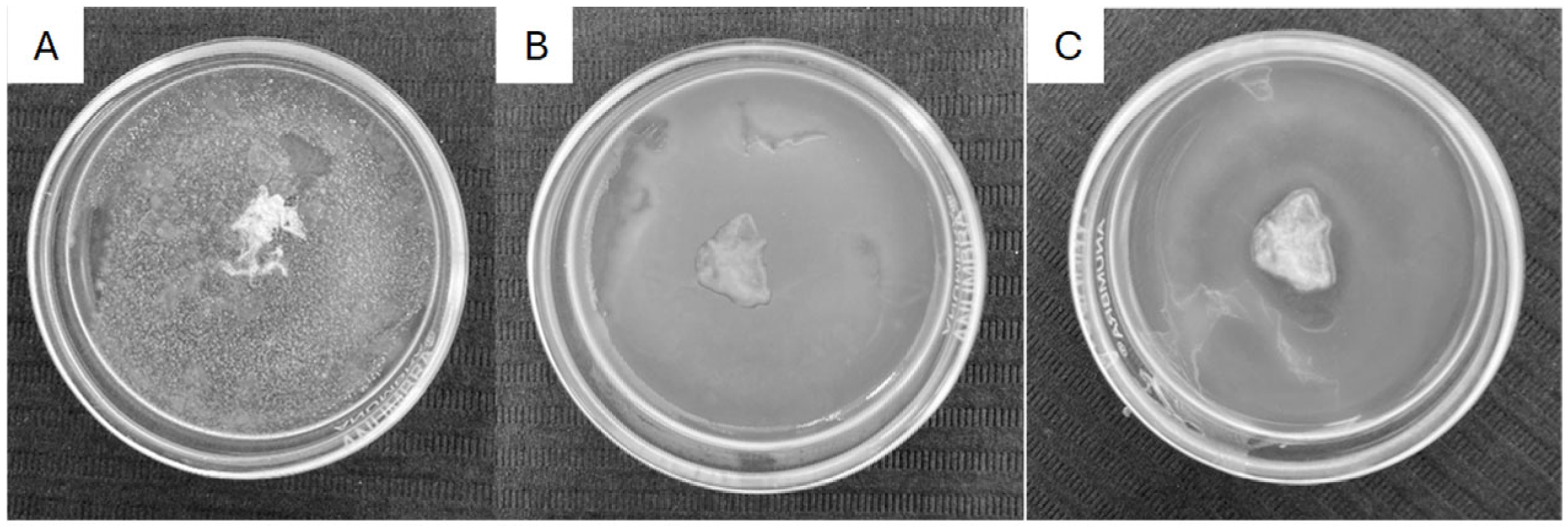
Representative agar plates are shown in
Figure 7.
No visible inhibition zone was observed around neat PLA in any of the independent repetitions. In contrast, inhibition zones were observed for the additive-containing fibers in approximately half of the independent tests. The results therefore indicate detectable but variable bacteriostatic activity of the additive-containing materials under the applied qualitative test conditions. The observed variability may be related, at least in part, to the uncontrolled qualitative and quantitative composition of the mixed environmental bacterial population used in this preliminary screening assay.
Because the test was performed using a mixed population of environmental bacteria and the inhibition zones were assessed qualitatively, no quantitative antibacterial efficacy, inhibition zone diameter, minimum inhibitory concentration, or viable cell reduction was determined in the present study. Accordingly, the bacteriostatic result is reported here as a qualitative material property observation; its mechanistic and application significance is addressed in the Discussion. Residual acetone and chloroform in the produced fibers were not quantified. Neat PLA, produced from the same solvent system under the same SBS conditions, showed no visible inhibition halo, which argues against the solvent system alone being responsible for the observed effect; nevertheless, without analytical residual-solvent measurements, a contribution from residual solvent cannot be definitively excluded.
4. Discussion
4.1. Rheological Modification and SBS Processability
The results show that the incorporation of cinnamon and turmeric into the PLA spinning solution did not merely introduce an antimicrobial component; it substantially changed the flow behavior of the polymer system. This point is central to interpreting the entire set of results because, in solution blow spinning (SBS), the final fiber morphology is determined by the competition among viscous resistance, elastic response, capillary instability, aerodynamic stretching, and solvent evaporation. The apparent viscosity increased by approximately 1.5–2 times for the turmeric-containing formulations and by about 4–6 times for the cinnamon-containing formulations. Consistently, the Ostwald–de Waele analysis showed a marked increase in the consistency index
k together with a reduction in the flow behavior index
n. For neat PLA,
k was 0.717 Pa·s and
n was 0.996, whereas for PLA + c2 the corresponding values were 7.246 Pa·s and 0.854. The turmeric formulations also became more pseudoplastic, with PLA + t2 reaching
k = 3.581 Pa·s and
n = 0.848. Thus, the additives shifted the solutions from nearly Newtonian behavior toward progressively stronger shear-thinning behavior. This observation is consistent with the general understanding that polymer–additive interactions, dispersed species, and temporary physical associations can increase resistance to flow and modify chain mobility [
24,
25,
26].
The stronger rheological response produced by cinnamon is particularly noteworthy. Since the experimental procedure involved sedimentation of undissolved material and the clear supernatant was used for spinning, the effect cannot be interpreted simply as a consequence of the presence of coarse spice particles. Instead, it suggests that soluble or finely dispersed constituents originating from cinnamon and turmeric modified the effective polymer–solvent environment and, consequently, the degree of chain association and entanglement. At the present stage, however, the specific molecular origin of this effect cannot be assigned. Cinnamon and turmeric are chemically complex natural materials, and no compositional analysis of the supernatant was performed. Therefore, attributing the rheological changes exclusively to cinnamaldehyde, curcumin, or any other single compound would be premature. The observed effects should therefore be considered as resulting from the overall chemical composition of the respective plant-derived additives, rather than from the action of a specific constituent.
The processing data further demonstrate that increased viscosity alone cannot be treated as a universal predictor of SBS spinnability. Neat PLA, despite exhibiting the lowest viscosity, showed the broadest processing window, with stable fiber production over approximately 0.2–0.7 mL/min. In contrast, addition of the bioactive components narrowed the overall operating window. Nevertheless, within each additive series, the higher-concentration formulation was more stable than the corresponding lower-concentration formulation. This apparently paradoxical behavior indicates the existence of an optimum rheological domain rather than a monotonic relationship between viscosity and fiber formation. At too low a liquid throughput, the polymer supply may be insufficient to sustain a continuous jet, whereas at excessive throughput the aerodynamic stress and solvent evaporation rate are no longer sufficient to stabilize and solidify the jet before capillary breakup. The role of viscosity must therefore be considered together with the feed rate and the fixed air flow of 200 L/min, in agreement with previous descriptions of the coupled rheological and aerodynamic control of SBS [
20,
21,
24]. At the fixed air flow setpoint of 200 standard L/min, the estimated dry air mass flow was approximately 241 g/min. For a spinning solution feed rate Q
s (mL/min) and solution density ρ
s (g/mL), the air-to-solution mass flow ratio was therefore approximately 241/(ρ
sQ
s). Assuming ρ
s = 1.0 g/mL for illustration, this ratio ranged from approximately 2400 at 0.1 mL/min to 300 at 0.8 mL/min and was approximately 480 at the common comparison rate of 0.5 mL/min. These are estimates for the complete spinning solution since solution densities and effective polymer concentrations in the supernatants were not measured. Because the gas and liquid feed rates were identical across formulations at a given comparison point, the throughput ratio alone cannot explain the differences in fiber diameter. The similar diameters despite different shear viscosities are consistent with the combined influence of aerodynamic stretching, extensional rheology, interfacial forces, and solvent evaporation; they do not establish the magnitude of any individual contribution.
An additional implication is that shear viscosity, although experimentally convenient, only partially describes the state of the solution during fiber formation. The jet experiences strong elongational deformation after leaving the coaxial nozzle, and extensional viscosity can therefore become more relevant than the shear viscosity measured in a rotational test. The present results already suggest this limitation: formulations with substantially different shear viscosities ultimately produced fibers of similar diameters once stable spinning was achieved. A more complete mechanistic description would therefore require, in addition to shear rheology, measurements of extensional response, surface tension, and solvent evaporation kinetics. Such data would help distinguish whether the observed improvement in jet stability at higher additive concentration results mainly from enhanced chain entanglement, altered interfacial properties, modified solvent quality, or a combination of these effects.
4.2. Decoupling of Viscosity from Fiber Diameter
Despite the pronounced differences in rheology, both the mean and median fiber diameters remained within relatively narrow ranges across the investigated processing conditions. The mean diameters ranged from 0.604 to 0.819 μm, while the median diameters ranged from 0.515 to 0.646 μm. The consistently lower median values confirm the right-skewed nature of the diameter distributions and indicate the presence of a smaller population of relatively large fibers that shifts the arithmetic mean toward higher values. Nevertheless, neither the mean nor the median values showed evidence of a systematic increase in fiber diameter associated with the substantially higher viscosity of the additive-containing solutions.
The most plausible interpretation is that, once a stable jet had been established, the aerodynamic stretching imposed by the 200 L/min gas stream dominated the final thinning stage. Under these conditions, differences in viscous resistance were apparently compensated by the high tensile stress exerted by the surrounding air. Rapid evaporation of acetone/chloroform then arrested the thinning process and fixed the fiber dimensions. The finding that PLA + t2 produced particularly fine fibers at 0.5 mL/min, despite its higher viscosity than neat PLA, supports the view that the final diameter emerges from a dynamic balance among liquid delivery, aerodynamic stress, and solidification rate rather than from viscosity alone. This interpretation is consistent with the multiparametric nature of SBS described in the literature [
20,
21]. This compensation should be regarded as a mechanistic interpretation rather than a quantitatively demonstrated balance because extensional rheology, local gas velocity/stress, and effective polymer mass flow were not measured directly.
The SEM observations provide an additional constraint on this interpretation. All investigated materials showed smooth, cylindrical fibers without an obvious transition to bead-dominated morphologies under the selected stable conditions. Therefore, the bioactive additives altered processability more strongly than they altered the local shape of individual fibers. In other words, the additives primarily affected whether a stable fibrous jet could be maintained, whereas the diameter of fibers produced inside the stable processing window remained comparatively robust. This distinction between process stability and fiber size is scientifically important and is one of the principal findings of the study.
At the same time, the broad diameter distributions indicate that the process is still highly polydisperse. Although the inclusion of median values provides a more robust description of the central tendency of these right-skewed distributions, neither the mean nor the median alone fully describes the polydisperse fiber morphology relevant to filtration. The fraction of very fine fibers, the presence of occasional thicker fibers, fiber intersections, and local packing heterogeneity may influence pressure drop and particle capture even when the arithmetic mean diameter changes only slightly. Consequently, future optimization should consider not only the mean fiber diameter but also distribution width and preferably structural descriptors of the entire nonwoven mat, such as thickness, basis weight, porosity, and pore size distribution.
4.3. Filtration Performance and Nonwoven Architecture
The filtration results reveal a second important decoupling. Neat PLA showed the highest initial filtration efficiency, approximately 82.97–84.98%, whereas the cinnamon- and turmeric-containing materials generally remained within approximately 82.55–83.57%. The absolute reduction in efficiency was therefore modest. In contrast, the pressure drop changed much more strongly: neat PLA reached values above 20 Pa under some production conditions, whereas the modified materials generally remained below 15 Pa. As a consequence, the quality factor increased, and the maximum value of 0.211 1/Pa was obtained for PLA + c2 produced at 0.4 mL/min. This value was more than three times the value of 0.065 1/Pa cited for electrospun PLA membranes by Wang et al. [
27], although direct numerical comparison between studies should be made cautiously because filtration quality factor depends strongly on the test aerosol, face velocity, filter thickness, basis weight, and experimental protocol. While the initial filtration efficiency and pressure drop provide important information on the filtration performance of the obtained fibrous mats, their stability during prolonged particle loading and the corresponding evolution of pressure drop remain to be investigated in future studies.
The key mechanistic point is that this reduction in pressure drop cannot be explained by a major decrease in fiber diameter because the SEM analysis showed comparable submicron diameters for neat and modified PLA. The improvement in air permeability must therefore originate predominantly from the mesoscale architecture of the deposited mat rather than from the size of a single fiber. Possible contributors include changes in fiber packing density, mat thickness, basis weight, fiber orientation, inter-fiber spacing, and pore size distribution. The rheology-induced modification of jet stability may alter how fibers are deposited on the collector and how densely they pack, even when their individual diameters remain similar. This provides a coherent structure–process–property interpretation of the results. Specifically, the additives modify the solution rheology. The modified rheology changes jet dynamics and deposition, and the resulting nonwoven architecture controls air flow resistance. The present experiments do not allow the filtration contribution of individual fiber size classes to be separated quantitatively because filtration was measured for the complete nonwoven mats rather than isolated diameter fractions. Importantly, however, the lower pressure drop cannot be explained by a simple shift toward larger mean fibers. At the common feed rate of 0.5 mL/min, the mean diameter decreased from 0.731 μm for neat PLA to 0.677 μm for PLA + c2 and 0.604 μm for PLA + t2. The lower resistance is therefore more plausibly associated with changes in bulk mat architecture, although porosity, thickness, basis weight, and pore size distribution were not quantified in the present study.
The slightly lower filtration efficiency of the modified filters is consistent with this interpretation. A more open porous structure would be expected to reduce pressure drop but may also reduce the probability of particle capture. In the present case, however, the decrease in efficiency was relatively small compared with the reduction in pressure drop, so the overall quality factor improved. This suggests that the modified mats moved toward a more favorable efficiency–resistance compromise rather than simply becoming less dense filters. The PLA + c2 formulation appears particularly promising because it combined stable fiber formation, submicron morphology, and the highest measured quality factor.
4.4. Antibacterial Functionality and Mechanistic Interpretation
The bacteriostatic tests demonstrate that the functionalization was not lost during solution preparation and SBS processing. Neat PLA produced no visible inhibition zone, whereas both PLA + c2 and PLA + t2 generated clear halos around the fibrous samples. The most direct conclusion is therefore that biologically active, diffusible compounds originating from cinnamon and turmeric remained present in the produced fibers in a form capable of suppressing bacterial growth. This is consistent with the extensive literature describing antimicrobial activity of cinnamon-derived compounds and turmeric/curcumin against a range of bacterial species [
12,
13,
14,
15] and with previous reports of antimicrobial PLA-based fibrous systems containing cinnamaldehyde- or curcumin-related active phases [
16,
17].
The halo test also provides information about the probable mode of action of the material. Formation of an inhibition zone requires migration of active species from the fiber mat into the agar medium. The observed bacteriostatic effect is therefore likely to include a release-mediated component rather than being exclusively a contact killing phenomenon. This can be advantageous for suppressing microbial growth around deposited particles, but it also raises questions that are important for real filtration applications: the release rate, duration of activity, retention of compounds during storage, sensitivity to humidity and air flow, and the possibility of depletion during prolonged operation. Release kinetics were not measured, and the present halo test cannot distinguish sustained release from an initial burst release. It therefore does not establish that bacteriostatic activity will persist throughout the service life of a filter. Time-resolved release measurements and repeated antimicrobial testing after controlled ageing and air flow exposure will be required to determine depletion kinetics and functional lifetime.
The use of environmental bacteria was appropriate as a screening experiment because it demonstrated activity against a mixed, practically relevant microbial population. However, it prevents quantitative comparison with standard antimicrobial performance metrics. The current results should therefore be interpreted as proof of bacteriostatic functionality rather than as a definitive measure of antibacterial efficacy.
A further limitation arises from the chemical complexity of the plant-derived additives. Cinnamon and turmeric contain multiple compounds with different volatility, polarity, and antimicrobial mechanisms. The experiment confirms the functionality of the final material but does not identify which compounds are present in nonwoven mats after 48 h mixing, sedimentation, and exposure to the high-velocity air stream during SBS. Chemical analysis of the starting additive, spinning supernatant, and final fibers would therefore substantially strengthen the mechanistic interpretation. Such analysis would also enable correlation of retained active compound concentration with rheological modification and antibacterial response, linking composition, processability, and biological function within a single framework.
4.5. Sustainability Implications and Comparison with Nanoparticle-Based Filters
The sustainability argument for replacing or reducing metallic antimicrobial additives is attractive, but it should be formulated on the basis of the complete functional profile rather than antimicrobial activity alone. Conventional Ag
+ and Ag/Cu-based nonwovens can provide strong and durable antimicrobial performance [
4,
6,
11], but the use of metallic nanoparticles introduces issues related to resource demand, nanoparticle release, persistence, and end-of-life management. These concerns are increasingly discussed within Safe-and-Sustainable-by-Design approaches [
10,
28]. In this context, a PLA matrix functionalized with plant-derived additives offers a conceptually different route. Both the structural polymer and the active phase can be derived from renewable or bio-based resources, while the need for precious metal antimicrobial components can potentially be reduced.
Beyond metallic antimicrobial systems, the present approach can also be considered in the context of other multifunctional PLA-based filtration materials. For example, electrospun PLA/chitosan composite membranes have been reported to combine a filtration efficiency of 98.99% with a pressure drop of 147.6 Pa at a face velocity of 14 cm/s, together with antibacterial activity against
E. coli and
S. aureus [
29]. Antimicrobial air filtration functionality has also been introduced into PLA/PHB nanofibers using ammonium-based ionic liquids [
30], while multiscale PLA nanofiber membranes functionalized with quaternary ammonium and N-halamine groups have demonstrated high antibacterial activity while retaining filtration functionality [
31]. More recently, solution blow-spun PLA fibers containing ZnO–Ag nanoparticles have demonstrated that antibacterial functionality can also be integrated directly into PLA using the same general fiber production technique employed in the present study [
32]. These studies demonstrate the range of strategies available for producing multifunctional PLA-based filters. The present approach differs principally in using minimally processed plant-derived additives rather than metallic nanoparticles or specifically synthesized antimicrobial agents. Direct numerical comparison of filtration or antimicrobial performance should, however, be made cautiously because the studies differ substantially in fiber architecture, antimicrobial test methodology, challenge aerosol, face velocity, and filtration test conditions.
The present results support this concept at the materials performance level. Incorporation of cinnamon or turmeric did not destroy fiber-forming capability, did not cause a substantial increase in fiber diameter, preserved filtration efficiency close to that of neat PLA, reduced pressure drop, and introduced measurable bacteriostatic activity. This combination is more important than any individual result because multifunctional filter development is inherently a multi-objective optimization problem. A bioactive material that strongly inhibits bacteria but causes excessive pressure drop would have limited practical value; similarly, a low-resistance filter that loses antimicrobial function during processing would not meet the intended design objective. The modified PLA mats, particularly PLA + c2, demonstrate that these requirements can be combined within a single SBS-produced structure.
However, the environmental advantage should currently be described as potential rather than fully demonstrated. No life-cycle assessment, biodegradation test, leaching study or comparative cost analysis was performed. The present work establishes a bio-based, plant-functionalized material concept but does not by itself prove rapid degradation under ambient conditions or quantify its superiority to AgNP-based filters over the full life cycle. A rigorous sustainability comparison would need to include raw material sourcing, solvent use, compressed air demand during SBS, filter lifetime, antimicrobial durability, disposal route, and potential emissions from the active phase.
Natural additives also introduce challenges that differ from those associated with inorganic nanoparticles. Their composition can vary with botanical source, harvest conditions, storage, and processing, potentially affecting both rheology and antimicrobial activity. This variability is especially relevant here because the same additive influences two critical functions simultaneously: it modifies the spinning solution and provides bioactivity. Standardization of the extractable fraction or the use of chemically characterized plant extracts may therefore be necessary for industrial scale-up. Industrial translation would therefore require raw material specifications and quality control criteria, for example compositional fingerprinting or defined marker compound ranges, together with rheological acceptance windows for the prepared spinning solution. The reproducibility demonstrated here should be understood as laboratory process reproducibility under a fixed preparation protocol rather than evidence that uncontrolled botanical batches would behave identically.
5. Conclusions
The results support an integrated structure–process–property–function relationship. Cinnamon and turmeric modify the rheological state of the PLA solution. This changes the range of feed rates over which stable SBS can be sustained. Once a stable jet is formed, strong aerodynamic stretching limits the influence of viscosity on fiber diameter. Changes in jet stability and deposition appear to modify the bulk architecture of the nonwoven mat, leading to lower pressure drop while largely preserving filtration efficiency. In addition, retained plant-derived compounds provide bacteriostatic functionality; however, their chemical identity and concentration in nonwoven mat was not determined. This chain of effects explains why the additives can significantly influence filter performance even though the mean fiber diameter remains almost unchanged.
Among the investigated formulations, PLA + c2 provides the most convincing overall balance. It showed the strongest rheological modification, a stable spinning region at intermediate feed rates, submicron fibers, distinctly reduced pressure drop, the highest quality factor of 0.211 1/Pa, and a clear bacteriostatic halo. Turmeric-containing fibers also showed favorable filtration resistance and antibacterial activity, demonstrating that the concept is not specific to a single plant additive. At the same time, the data show that increasing additive concentration does not simply improve every parameter. The optimum formulation must balance spinnability, collection efficiency, mat architecture, pressure drop, particle capture, and antimicrobial performance. Within the scope of the parameters measured here, PLA + c2 can therefore be regarded as the preferred formulation on the basis of the overall processability/filtration performance balance together with demonstrated qualitative bacteriostatic activity. This conclusion should not be interpreted as showing greater antimicrobial efficacy of cinnamon than turmeric because inhibition-zone diameter and viable cell reduction were not quantified.
Accordingly, the significance of the present work lies not only in demonstrating that cinnamon and turmeric can be incorporated into SBS-produced PLA fibers but in showing that plant-derived functionalization can simultaneously alter processing behavior, nonwoven transport properties, and biological performance. The results therefore provide a rational basis for further development of bio-based antimicrobial filtration media in which formulation is used deliberately as a tool for controlling both fiber manufacture and end-use functionality.
The present results demonstrate feasibility but do not establish cinnamon- or turmeric-functionalized PLA as a direct replacement for metallic biocides. Metallic systems may provide advantages in antimicrobial potency, spectrum, and long-term stability that were not evaluated comparatively here, whereas plant-derived additives offer a different design route based on bio-based sourcing and avoidance of intentionally introduced persistent metallic nanoparticles. Their suitability as substitutes must therefore be established for the intended application through standardized comparative efficacy, durability, exposure, and life cycle assessment.
Future work should prioritize quantitative antibacterial testing with reference microorganisms using an appropriate validated ISO/ASTM protocol. Complementary studies should include residual solvent analysis, time-resolved release and durability testing, compositional characterization and batch-to-batch control of the botanical additives, and quantitative characterization of mat thickness, basis weight, porosity, packing, and pore-size distribution. These measurements are required before long-term filter performance or direct replacement of established metallic antimicrobial systems can be assessed.