1. Introduction
The Fourth Industrial Revolution is transforming business operations with automation and highly integrated manufacturing technologies, thereby enabling more sustainable and digitally integrated service ecosystems. Similarly, with the advent of integrated applications and pervasive information, customers are now more demanding and pickier than ever before [
1]. Thus, engaging customers in business operations is a key challenge for service providers [
1,
2]. Service engagement is the extent to which care is delivered by the provider to receivers in a way that enriches customer experience [
3]. Service engagement is essential, as it creates better coordination and understanding between customers and service providers, and boosts value co-creation processes. Moreover, prior studies have established that service engagement enhances agility and flexibility in service operations, which, in turn, improves firm performance and supports long-term organizational sustainability [
1,
2]. Although previous studies have examined service engagement in different contexts, including healthcare [
4], limited attention has been devoted to explaining how technological and organizational factors jointly influence service engagement and firm performance in the logistics industry [
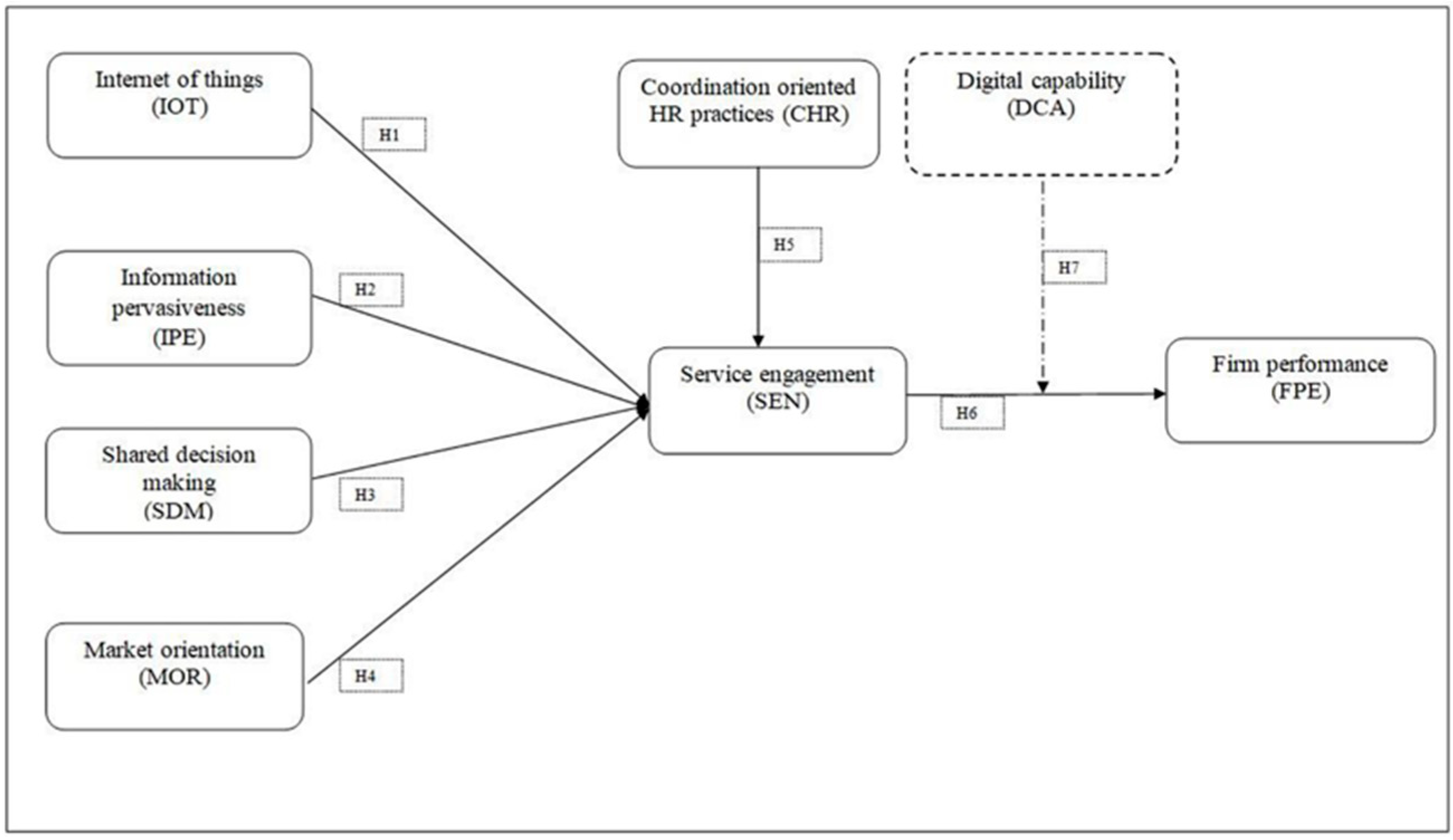
5]. In particular, the combined effects of the IoT, information pervasiveness, shared decision-making, market orientation, and coordination-oriented HR practices remain underexplored. This study addresses this research gap by developing an integrated service engagement framework for the logistics industry.
According to ref. [
1], services are highly intangible; therefore, service engagement can be enhanced through cognitive and relational factors. Consistent with the above argument, the research model of this study underpinned factors such as the Internet of Things, information pervasiveness, shared decision-making, market orientation, and coordination-oriented human resource practices to investigate individual behavior towards service engagement. These factors have substantial support from the resource-based view theory and dynamic capability theory. For instance, the resource-based view suggests that firms achieve competitive advantages by possessing and effectively utilizing valuable, rare, inimitable, and non-substitutable resources. In the context of digital transformation, technological resources such as Internet of Things (IoT) capabilities and information accessibility represent important organizational resources that enable firms to collect, process, and utilize information more effectively. However, technological resources alone cannot automatically generate superior service outcomes. Their value depends on the organization’s capability to integrate resources with strategic orientation and internal management practices [
6].
Building on the RBV perspective, dynamic capability theory explains how firms develop the ability to adapt, integrate, and reconfigure their resources in response to changing environmental conditions. In the logistics industry, where customer expectations, technological developments, and market conditions are rapidly evolving, digital capability represents an important dynamic capability that allows firms to transform digital resources into improved service processes and performance outcomes [
7]. Therefore, digital capability is expected to strengthen the relationship between service engagement and firm performance by enabling organizations to effectively utilize digital technologies and respond to market demands. Furthermore, service-dominant logistics emphasize that value creation increasingly occurs through interactions among multiple actors rather than through the unilateral delivery of services by firms. From this perspective, service engagement represents an important mechanism through which organizations, customers, and technological systems jointly contribute to value creation. In logistics operations, effective service engagement requires not only technological support, but also organizational coordination, market responsiveness, and human resource capabilities [
8]. Accordingly, this study examines the effects of the Internet of Things, information pervasiveness, shared decision-making, market orientation, and coordination-oriented HR practices on service engagement while investigating the moderating role of digital capability in the relationship between service engagement and firm performance.
The Internet of Things (IoT) is increasingly regarded as a critical enabler of service engagement, as it facilitates interactive, personalized, and value-enhancing service experiences that attract and retain customers. Previous studies [
5] have stated that IoT in service ecosystems has unlocked unprecedented opportunities for service innovation and customer engagement. Similarly, information pervasiveness and shared decision-making have shown a positive impact on improving service engagement [
4,
9,
10]. In addition, this study established that market orientation and coordination-oriented HR practices boost individual behavior towards service engagement [
5,
11,
12,
13]. Based on the above theoretical arguments, this study proposes that technological resources (IOT and information accessibility) and organizational capabilities (market orientation and coordination-oriented human resource practices) contribute to service engagement by improving information processing, organizational responsiveness, and service coordination. Furthermore, digital capability strengthens firms’ ability to transform service engagement into improved firm performance. Thus, the proposed framework extends existing research by explaining not only whether these relationships exist, but also why and under what conditions these relationships occur within the logistics industry context. Furthermore, the proposed framework contributes to the sustainability literature by explaining how digital and organizational capabilities support sustainable service engagement and long-term firm performance in logistics firms. The remainder of this paper includes a detailed literature review, methodology, data analysis, discussion, contributions to theory and practice, conclusions, limitations, and future research directions.
5. Discussion
Global access to products and services has completely transformed business operations. Moreover, with the proliferation of technology, customers are choosier and more demanding than ever. Therefore, the ongoing challenge for service providers is how to engage customers in services to enrich their experience. Simultaneously, service providers are increasingly expected to deliver these services in ways that support sustainable operational performance and long-term customer value. To address this issue, current research has developed a research model that combines factors such as the Internet of Things, information pervasiveness, shared decision-making, market orientation, and coordination-oriented human resource practices, and investigates customer behavior in relation to service engagement. The research model of this study was empirically tested using a structural equation modeling approach. The findings provide empirical evidence that integrating technological and organizational capabilities contributes to sustainable service engagement in logistics firms. In addition, a comparison was made to understand how the findings of the current study differ from those of prior studies. This study has confirmed the positive impact of the IoT in measuring service engagement, which is consistent with prior studies [
5,
18]. Similarly, information pervasiveness has shown a positive influence on service engagement, which is in line with previous research [
4,
19]. Nevertheless, this study has revealed an insignificant relationship between decision-making and service engagement, and hence, negates arguments developed by prior studies [
4,
9,
10].
Pointing to marketing factors, this study has revealed the positive impact of market orientation towards service engagement, which is consistent with prior studies [
5,
13]. Likewise, the relationship between coordination-oriented HR practices and service engagement was found to be significant and consistent with previous studies [
11,
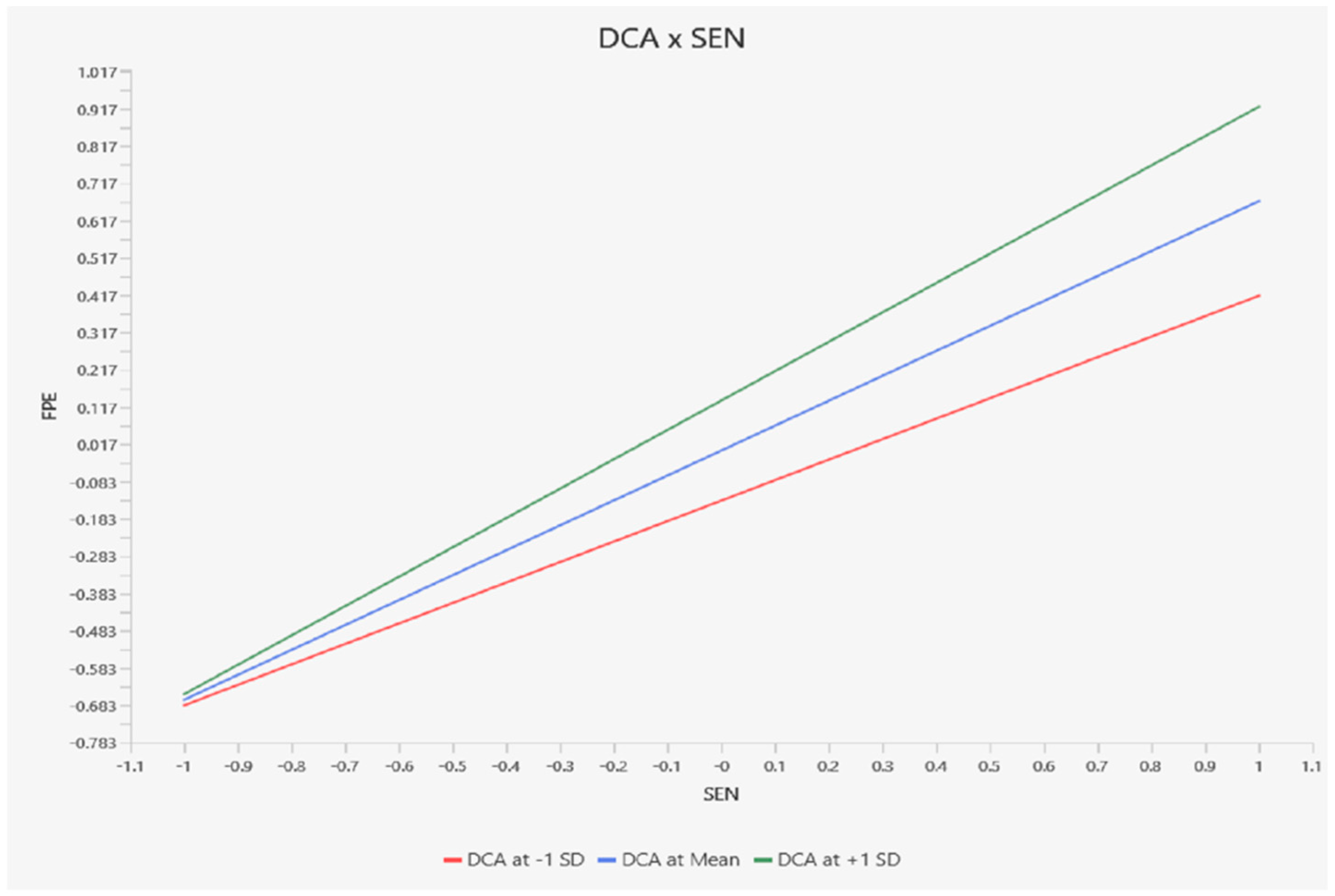
12]. The research model is further evaluated, and statistical analysis has revealed that digital capability positively moderates the relationship between service engagement and firm performance, supporting arguments established by prior researchers [
21]. A comparison was also made to determine the effect sizes of the factors. Nevertheless, this study revealed that coordination-oriented HR practices have a large effect size f
2 in measuring service engagement. Therefore, if policymakers want to engage customers in services, they must adopt coordination-oriented HR practices to boost employee confidence, resulting in increased service engagement. Moreover, the effect size f
2 has also demonstrated that, for logistics, firm performance service engagement is the core factor. Therefore, improvements in service engagement increase logistics firm performance. These findings further suggest that strengthening service engagement enables logistics firms to improve their operational sustainability through better responsiveness, coordination, and customer value creation. Another important analysis, namely, IPMA analysis, was conducted to obtain an overview of the outlined factors. The IPMA analysis results have suggested that coordination-oriented HR practices, digital capability, information pervasiveness, and service engagement have an attractive level of importance in measuring firm performance, and therefore must be considered while developing new strategies. Overall, this study provides new insights into customer behavior related to service engagement, while demonstrating how technological, organizational, and digital capabilities jointly support sustainable firm performance in the logistics industry.
5.1. Theoretical Contributions
The overarching objective of this study is to advance the understanding of how technological, organizational, and strategic capabilities shape service engagement and subsequently enhance firm performance in the logistics context. Drawing on the Resource-Based View and Dynamic Capability Theory, this study develops a theoretical framework to explain how firms can leverage digital resources, information capabilities, managerial practices, and human resource systems to strengthen service engagement and achieve superior performance outcomes. First, it contributes to the service and digital transformation literature by explaining the mechanisms through which technological capabilities influence service engagement. Specifically, the findings demonstrate that the Internet of Things (IoT) and information pervasiveness are not merely technological investments, but strategic resources that improve information availability, operational responsiveness, and service interaction quality. By highlighting how digital technologies facilitate value creation through enhanced service engagement, this study extends the existing research that has primarily examined technology adoption from an operational perspective. Second, this study contributes to the understanding of the organizational and strategic antecedents of service engagement by demonstrating the role of shared decision-making and market orientation. Shared decision-making reflects the importance of managerial and organizational processes in integrating knowledge and improving responsiveness, whereas market orientation highlights how customer-focused strategic practices facilitate value co-creation. By positioning these factors as drivers of service engagement, this study provides a broader theoretical explanation of how internal capabilities and external market focus jointly influence service-related outcomes. Third, this study extends human resource management literature by introducing coordination-oriented HR practices as an important antecedent of service engagement. Previous studies have examined supportive and flexible HR practices; however, limited attention has been paid to how coordination-focused HR systems enhance collaboration, employee confidence, and the ability to deliver effective services. This study advances the existing knowledge by explaining the role of coordinated human resource practices in strengthening service engagement within logistics firms. Furthermore, this study contributes to the literature by conceptualizing digital capability as an important boundary condition that determines the extent to which service engagement translates into firm performance. The findings indicate that firms with stronger digital capabilities are more able to convert service engagement into improved performance outcomes, highlighting the strategic importance of digital capability beyond direct operational benefits. Collectively, the findings provide empirical support for the proposed framework, with the antecedent factors explaining the substantial variance in service engagement (R2 = 0.526), while service engagement and digital capability explain the substantial variance in firm performance (R2 = 0.546). These results reinforce the theoretical relevance of the model, and demonstrate how technological, organizational, and strategic capabilities collectively contribute to service engagement and sustainable firm performance in a logistics setting. In addition, the findings extend sustainability literature by demonstrating that sustainable firm performance can be achieved through the integration of digital technologies, organizational capabilities, and coordination-oriented human resource practices.
5.2. Contribution to Theory
The findings of this research could help policymakers recognize the factors that boost service engagement and firm performance. Current research has summarized that factors such as the Internet of Things, information pervasiveness, market orientation, and coordination-oriented human resource practices are key factors that enhance service engagement and enrich customer experiences. This study revealed that the coordination of human resource practices has a large effect size in measuring service engagement. The strong effect size of coordination HR practices has also demonstrated that with strong coordination, employees get ample knowledge to entrain customers and hence secure better customer engagement in services. This finding indicates that policymakers could enhance service engagement through the implementation of coordinated human resource practices in logistic firms. Moreover, firm performance was predicted using digital capability and service engagement. Nevertheless, the statistical findings confirm that firm performance can be achieved with a high level of service engagement. Although hypothesis testing revealed the nature of the relationship, the research framework was examined further with IPMA analysis. The results show that factors such as coordination-oriented HR practices, digital capability, information pervasiveness, and service engagement have considerable importance in measuring firm performance, and therefore, must be considered in developing new strategies. Moving further, this study has also instructed policymakers to enhance service engagement and firm performance through the intervention of digital capability. For example, the moderating effect of digital capability shows that a higher level of digital capability of a firm will boost service engagement and logistics performance. Finally, this research has shown that factors such as the Internet of Things, information pervasiveness, market orientation, and coordination-oriented human resource practices are core factors that enhance service engagement. Therefore, policymakers should consider these factors to improve the performance of the logistics firm. These managerial actions can also support more sustainable logistics operations by strengthening long-term service quality, digital responsiveness, and organizational competitiveness.
6. Conclusions and Policy Recommendations
The rising intensity of global competition and rapid advances in artificial intelligence (AI) and digital technologies have significantly transformed business operations, particularly within the logistics sector. Customers now have greater access to products and services across geographical boundaries and, consequently, have increasingly demanding expectations regarding service quality, responsiveness, accessibility, and overall experience. In this changing business environment, logistics firms face the continuing challenge of identifying and developing technological, organizational, and human resource capabilities that can strengthen customer service engagement, while simultaneously improving long-term firm performance. To address this issue, this study developed and empirically tested a research model integrating IoT, information pervasiveness, shared decision-making, market orientation, and coordination-oriented human resource practices as antecedents of service engagement. In addition, this study examines the moderating role of digital capability in the relationship between service engagement and firm performance.
The empirical findings lead to several important conclusions. The hypothesis testing results demonstrate that IoT, information pervasiveness, market orientation, and coordination-oriented human resource practices have significant effects on service engagement, whereas shared decision-making does not demonstrate a significant effect. These findings suggest that technological and organizational capabilities play an important role in strengthening service engagement within logistics firms. Furthermore, the five exogenous factors collectively explain the substantial variance in service engagement, with an R2 value of 0.526. This indicates that the proposed model explains 52.6% of the variance in service engagement, and provides substantial empirical support for understanding the factors that contribute to customer-oriented service engagement in the logistics context.
The findings further demonstrate that service engagement is an important determinant of a logistics firm’s performance. Service engagement and digital capability jointly explain the substantial variance in firm performance, with an R2 value of 0.546. Moreover, moderation analysis confirms that digital capability strengthens the positive relationship between service engagement and firm performance. Thus, logistics firms with stronger digital capabilities are better positioned to convert service engagement into improved organizational performance. The effect size analysis further demonstrates that coordination-oriented human resource practices have a large effect on service engagement, while service engagement has a large effect on firm performance. These results highlight the importance of integrating technological capabilities with organizational and human resource capabilities, rather than relying on a single source of competitive advantage.
These findings also have important implications for policymakers. First, policymakers should encourage and facilitate the adoption of coordination-oriented human resource practices within logistics firms. The large effect size identified for coordination-oriented HR practices demonstrates their importance in strengthening service engagement. Effective coordination among employees can improve information-sharing, knowledge exchange, communication, and employees’ ability to understand and respond to customer requirements. Employees with timely and relevant knowledge are more able to interact with customers, address service needs, and provide responsive solutions. Therefore, policymakers and relevant industry authorities can promote human resource development frameworks, training initiatives, interdepartmental coordination mechanisms, and organizational practices that strengthen employee collaboration and knowledge-sharing within logistics firms.
Second, policymakers should support the development and adoption of IoT technologies in the logistics sector. The significant relationship between IoT and service engagement indicates that connected technologies can contribute to a better service experience. IoT-enabled logistics systems can facilitate real-time monitoring, tracking, information exchange, and operational visibility, thereby improving service responsiveness and customer confidence. Accordingly, policymakers could develop supportive digital infrastructure, technology adoption programs, industry standards, and incentives that encourage logistics firms, particularly smaller ones, to adopt IoT-enabled operational systems. Such interventions could contribute to more responsive and transparent logistics services.
Third, policymakers should prioritize information pervasiveness as an important component of digital logistics development. The empirical results identify information pervasiveness as a significant factor in enhancing service engagement, while the IPMA results further indicate its importance for firm performance. Policymakers could, therefore, encourage logistics firms to establish systems that ensure accurate, timely, accessible, and widely available information across relevant organizational and customer interfaces. Policies supporting data integration, information-sharing standards, digital information platforms, and interoperability among logistics stakeholders can improve the availability and usefulness of information throughout the service process.
Fourth, policymakers should encourage logistics firms to strengthen their market orientations. The significant influence of market orientation on service engagement indicates that firms that continuously identify customer needs, monitor market development, and respond to changing customer expectations are more capable of creating meaningful service experiences. Policymakers and industry institutions can support market-oriented development through sector-specific market intelligence initiatives, customer-service training, industry benchmarking, and programs that help logistics firms better understand evolving customer expectations. Such measures can strengthen firms’ responsiveness to changing market conditions, and contribute to sustainable service quality.
Fifth, the findings highlight the importance of digital capabilities in improving logistics firm performance. This significant moderating effect demonstrates that higher digital capability strengthens the relationship between service engagement and firm performance. Therefore, policymakers should consider digital capability development as a strategic priority in logistics sector policies. This may include support for digital transformation programs, employee digital skills development, technology training, digital infrastructure, and initiatives that help firms integrate digital technologies into their core operations. Strengthening digital capabilities can enable logistics firms to respond more effectively to customers and translate service engagement into stronger organizational performance.
Sixth, the IPMA results provide further guidance for prioritizing strategic interventions. The analysis indicates that coordination-oriented HR practices, digital capability, information pervasiveness, and service engagement are important in explaining firm performance. Therefore, these factors should receive particular attention when policymakers and industry stakeholders formulate new strategies for improving the logistics sector’s competitiveness. Rather than focusing exclusively on technological investment, policy initiatives should adopt an integrated approach that combines digital transformation with employee capabilities, organizational coordination, information accessibility, and customer engagement.
Finally, empirical evidence demonstrates that service engagement is a central mechanism connecting organizational and technological capabilities with firm performance. Although shared decision-making did not show a significant direct effect on service engagement in the present study, the findings do not diminish the broader importance of organizational participation; rather, they indicate that, within the specific research context and empirical model, other capabilities demonstrated stronger explanatory power. Policymakers and logistics-sector stakeholders should, therefore, prioritize the factors supported by empirical evidence while continuing to evaluate organizational practices in different contexts.
Overall, the present study demonstrates that integrating technological, organizational, market-oriented, and human resource capabilities can enable logistics firms to strengthen service engagement and improve firm performance in an increasingly digital business environment. These findings provide a basis for policymakers to formulate targeted interventions focusing on IoT adoption, information accessibility, market orientation, coordination-oriented HR practices, and digital capability development. These policy directions can support logistics firms in improving their service quality, customer responsiveness, digital adaptability, and organizational competitiveness. In the long term, such interventions can also contribute to more sustainable logistics operations by strengthening service quality, organizational resilience, digital responsiveness, and competitiveness. Thus, the present study provides empirical evidence regarding the determinants of service engagement and firm performance, as well as actionable implications for policymakers and industry stakeholders seeking to develop a more digitally capable, customer-oriented, and sustainable logistics sector.
There are some limitations to this study that are acknowledged and should be addressed in future studies. First, this research has focused on IoT technology; however, big data analytics and artificial intelligence are other important factors that need to be investigated. Therefore, future researchers should examine the role of big data analytics and artificial intelligence in improving service engagement. Second, although the coordination of human resource practices addresses the key role of HR practices in the management context, there are still some other important factors that need consideration, such as employee empowerment and supportive leadership. Moreover, the research model of this study has tested direct hypotheses and moderating paths to analyze the research model; however, adding a mediating factor could reveal more interesting findings. Future research should investigate the mediating role of service engagement between exogenous and endogenous factors. Regarding the research methodology, the use of a probability sampling approach could enhance the strength of the data; therefore, future researchers should choose sampling methods derived through probability sampling. In terms of the time horizon, this research is cross-sectional; however, a longitudinal method could enhance the generalizability of this research. As this study employed a cross-sectional design, the findings should be interpreted as associative rather than definitive causal relationships.