Sensing, Analytics, and Trust: An Integrated AI-IoT-Blockchain Framework for Cleaner Production



Abstract
1. Introduction
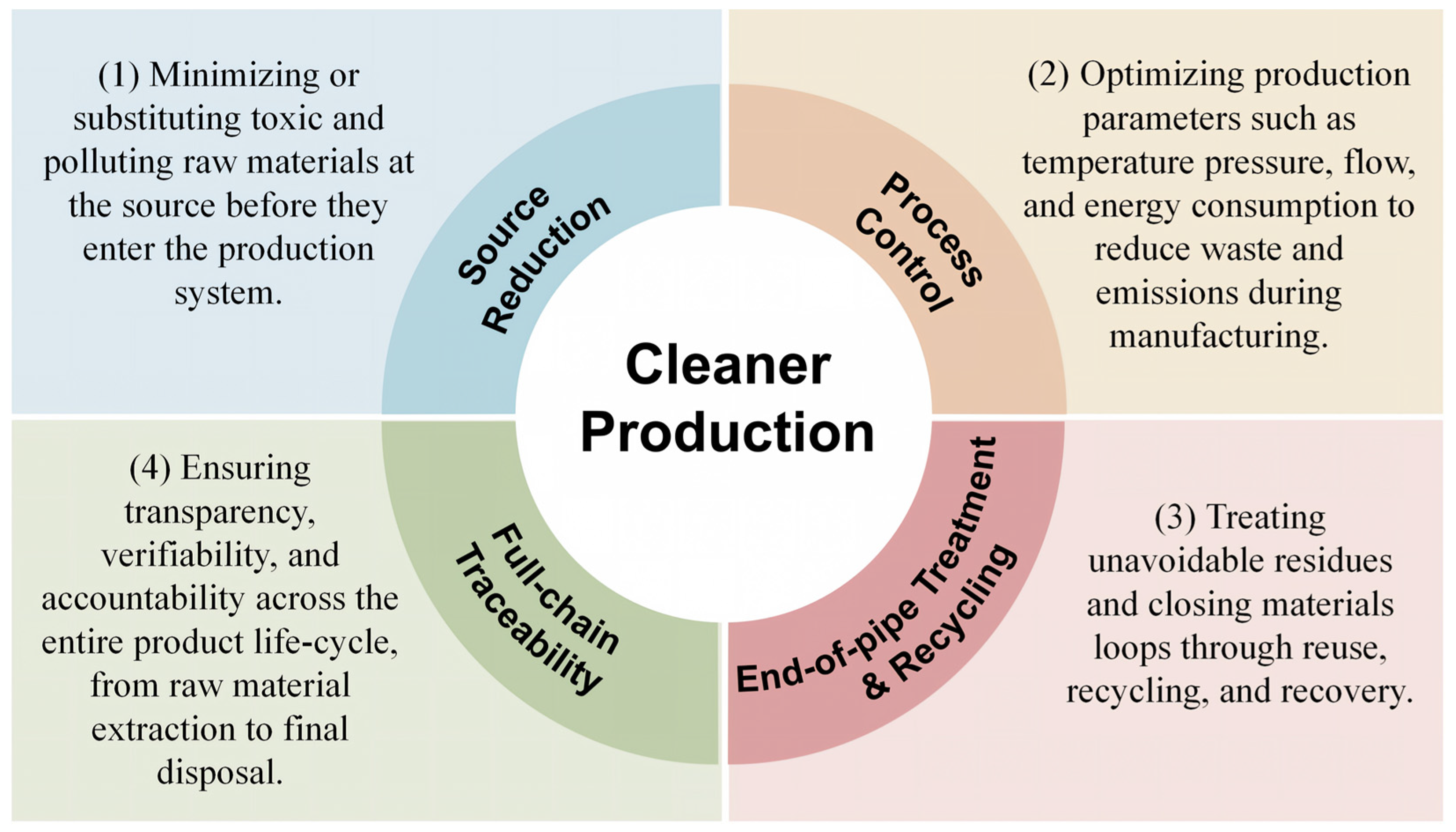
2. Core Technologies and Their Stage-Specific Applications in Cleaner Production
2.1. Source Reduction
2.2. Process Control
2.3. End-of-Pipe Treatment and Recycling
2.4. Full-Chain Traceability
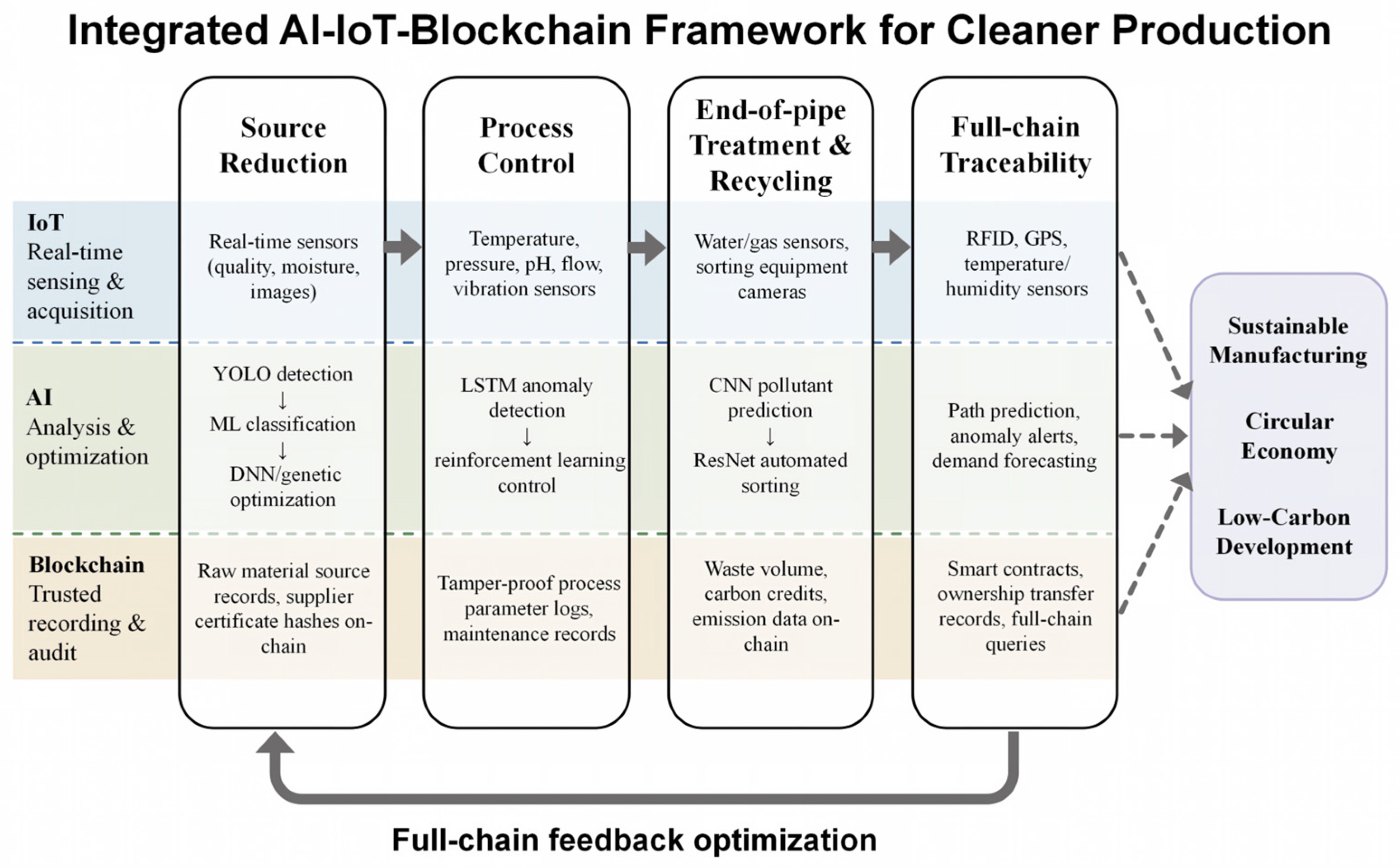
2.5. An Integrated AI-IoT-Blockchain Framework Based on Three Layers
2.6. Cross-Sector Transferability of the Framework
3. Scaling Challenges and Strategic Solutions
3.1. Sensing Layer (IoT)
3.2. Analytics Layer (AI)
3.3. Trust Layer (Blockchain)
3.4. Cross-Layer Challenges and Dynamic Feedback
4. Conclusions and Future Perspectives
Author Contributions
Funding
Institutional Review Board Statement
Informed Consent Statement
Data Availability Statement
Conflicts of Interest
Abbreviations
| AOI | Automated Optical Inspection |
| CORSIA | Carbon Offsetting and Reduction Scheme for International Aviation |
| EC | Electrical Conductivity |
| FFNN | Feedforward Neural Network |
| GPR | Gaussian Process Regression |
| GRU | Gated Recurrent Unit |
| LIME | Local Interpretable Model-Agnostic Explanations |
| LSTM | Long Short-Term Memory |
| MRV | Monitoring, Reporting, and Verification |
| NPK | Nitrogen–Phosphorus–Potassium |
| PBFT | Practical Byzantine Fault Tolerance |
| PoS | Proof-of-Stake |
| RED II | Renewable Energy Directive II |
| SCADA | Supervisory Control and Data Acquisition |
| SHAP | SHapley Additive exPlanations |
| SPC | Statistical Process Control |
| SVR | Support Vector Regression |
| SVM | Support Vector Machine |
| XAI | Explainable Artificial Intelligence |
References
- UN Environment Programme. Environmental Agreements and Cleaner Production. Available online: https://www.unep.org/resources/report/environmental-agreements-and-cleaner-production (accessed on 16 June 2026).
- Satyro, W.C.; Contador, J.C.; Monken, S.F.d.P.; Lima, A.F.d.; Soares Junior, G.G.; Gomes, J.A.; Neves, J.V.S.; do Nascimento, J.R.; de Araújo, J.L.; Correa, E.d.S.; et al. Industry 4.0 Implementation Projects: The Cleaner Production Strategy—A Literature Review. Sustainability 2023, 15, 2161. [Google Scholar] [CrossRef] [Scilit]
- Gonlugur, M.E. Chapter 1: Sustainable Production Methods in Textile Industry. In Textile Industry and Environment; Körlü, A., Ed.; IntechOpen: London, UK, 2019; pp. 10–17. [Google Scholar] [CrossRef] [Scilit]
- Garcia-Quevedo, J.; Martinez-Ros, E.; Tchorzewska, K.B. End-of-pipe and cleaner production technologies. Do policy instruments and organizational capabilities matter? Evidence from Spanish firms. J. Clean. Prod. 2022, 340, 130307. [Google Scholar] [CrossRef] [Scilit]
- Matos, L.M.; Anholon, R.; da Silva, D.; Cooper Ordoñez, R.E.; Gonçalves Quelhas, O.L.; Filho, W.L.; de Santa-Eulalia, L.A. Implementation of cleaner production: A ten-year retrospective on benefits and difficulties found. J. Clean. Prod. 2018, 187, 409–420. [Google Scholar] [CrossRef] [Scilit]
- Vieira, L.C.; Amaral, F.G. Barriers and strategies applying Cleaner Production: A systematic review. J. Clean. Prod. 2016, 113, 5–16. [Google Scholar] [CrossRef] [Scilit]
- Pourrahimian, P.; Seyedzadeh, S.; Arabi, B.; Kahani, D.; Lotfian, S. Digital Enablers of the Circular Economy: A Systematic Review of Applications, Barriers, and Future Directions. J. Manuf. Mater. Process. 2026, 10, 112. [Google Scholar] [CrossRef] [Scilit]
- Antony Jose, S.; Tonner, A.; Feliciano, M.; Roy, T.; Shackleford, A.; Menezes, P.L. Smart Manufacturing for High-Performance Materials: Advances, Challenges, and Future Directions. Materials 2025, 18, 2255. [Google Scholar] [CrossRef] [Scilit]
- Zhang, J. AI-based data intelligence system for sustainable ecological governance and smart environmental management. Microchem. J. 2025, 219, 115850. [Google Scholar] [CrossRef] [Scilit]
- Liu, L.; Omote, K. A traceable authentication system based on blockchain for decentralized physical infrastructure networks. Sci. Rep. 2025, 15, 16708. [Google Scholar] [CrossRef] [Scilit]
- Tang, W.; Xie, X.; Huang, Y.; Qian, T.; Li, W.; Li, X.; Xu, Z. Exploring the Potential of IoT-Blockchain Integration Technology for Energy Community Trading: Opportunities, Benefits, and Challenges. CSEE J. Power Energy Syst. 2025, 11, 521–537. [Google Scholar] [CrossRef] [Scilit]
- Patthi, S.; Karthiga, M.; Sinha, K.P.; Mandala, S.K.; Anusha, P.V.; Bhagyalakshmi, L.; Sreelatha, P.; Alagarsamy, M. Integration of Internet of Things blockchain and artificial intelligence for scalable and secure precision environmental management. Sustain. Comput. Inform. Syst. 2025, 48, 101251. [Google Scholar] [CrossRef] [Scilit]
- Liu, Z.; Yu, X.; Liu, N.; Liu, C.; Jiang, A.; Chen, L. Integrating AI with detection methods, IoT, and blockchain to achieve food authenticity and traceability from farm-to-table. Trends Food Sci. Technol. 2025, 158, 104925. [Google Scholar] [CrossRef] [Scilit]
- Chandran, P.J.I.; Khalil, H.A.; Hashir, P.K.; Veerasingam, S. Smart technologies in aquaculture: An integrated IoT, AI, and blockchain framework for sustainable growth. Aquac. Eng. 2025, 111, 102584. [Google Scholar] [CrossRef] [Scilit]
- Zepeda, D.M.; Díaz-Montaño, D.M. Assessment of physical, biological, chemical, and normative defects in Agave tequilana Weber as operational criteria for raw material quality control in tequila production. Appl. Food Res. 2026, 6, 102211. [Google Scholar] [CrossRef] [Scilit]
- Valente, F.; Henriques, J.; Paredes, S.; Rocha, T.; de Carvalho, P.; Morais, J. A new approach for interpretability and reliability in clinical risk prediction: Acute coronary syndrome scenario. Artif. Intell. Med. 2021, 117, 102113. [Google Scholar] [CrossRef] [Scilit]
- Jebbor, I.; Benmamoun, Z.; Hachmi, H. Revolutionizing cleaner production: The role of artificial intelligence in enhancing sustainability across industries. J. Infrastruct. Policy Dev. 2024, 8, 7455. [Google Scholar] [CrossRef] [Scilit]
- Mohd Ali, M.; Hashim, N.; Abd Aziz, S.; Lasekan, O. Quality Inspection of Food and Agricultural Products using Artificial Intelligence. Adv. Agric. Food Res. J. 2021, 2, a0000237. [Google Scholar] [CrossRef] [Scilit]
- Tao, X.; Cao, L.; Zhang, W.; Hou, B.; Jiao, Z. Machine vision for visible mold detection in stored oil-bearing raw materials under simulated conveying conditions. J. Stored Prod. Res. 2026, 118, 103098. [Google Scholar] [CrossRef] [Scilit]
- Nuzzi, C.; Pasinetti, S.; Bassi, I.; Bello, V. On the applicability of speckle pattern imaging combined with AI for raw milk classification. Meas. J. Int. Meas. Confed. 2026, 258, 119246. [Google Scholar] [CrossRef] [Scilit]
- Liu, J.; Tang, Z.; Xu, P.; Liu, W.; Zhang, J.; Zhu, J. Quality-related monitoring and grading of granulated products by weibull-distribution modeling of visual images with semi-supervised learning. Sensors 2016, 16, 998. [Google Scholar] [CrossRef] [Scilit]
- Aqeel, M.; Sohaib, A.; Iqbal, M.; Ullah, S.S. Hyperspectral Identification of Milk Adulteration Using Advance Deep Learning. IEEE Access 2024, 12, 174965–174982. [Google Scholar] [CrossRef] [Scilit]
- Yakoubi, S. Enhancing plant-based cheese formulation through molecular docking and dynamic simulation of tocopherol and retinol complexes with zein, soy and almond proteins via SVM-machine learning integration. Food Chem. 2024, 452, 139520. [Google Scholar] [CrossRef] [Scilit]
- Ferro, P.; Spiller, S.; Tang, K.; Berto, F.; Bonollo, F. Sustainable ductile iron design: Leveraging machine learning and genetic algorithms for critical raw materials reduction. Eng. Appl. Artif. Intell. 2026, 163, 113117. [Google Scholar] [CrossRef] [Scilit]
- Shi, A.; Bergsagel, D.; Owen, J.; Heisel, F. Scalable AI-driven automation for visual lumber grading. J. Clean. Prod. 2025, 533, 146986. [Google Scholar] [CrossRef] [Scilit]
- Engell, S. Feedback control for optimal process operation. J. Process Control 2007, 17, 203–219. [Google Scholar] [CrossRef] [Scilit]
- Duan, G.J.; Yan, X. A Real-Time Quality Control System Based on Manufacturing Process Data. IEEE Access 2020, 8, 208506–208517. [Google Scholar] [CrossRef] [Scilit]
- Visconti, P.; Rausa, G.; Del-Valle-Soto, C.; Velázquez, R.; Cafagna, D.; De Fazio, R. Machine Learning and IoT-Based Solutions in Industrial Applications for Smart Manufacturing: A Critical Review. Future Internet 2024, 16, 394. [Google Scholar] [CrossRef] [Scilit]
- Popescu, S.M.; Mansoor, S.; Wani, O.A.; Kumar, S.S.; Sharma, V.; Sharma, A.; Arya, V.M.; Kirkham, M.B.; Hou, D.; Bolan, N.; et al. Artificial intelligence and IoT-driven technologies for environmental pollution monitoring and management. Front. Environ. Sci. 2024, 12, 1336088. [Google Scholar] [CrossRef] [Scilit]
- Lončar, B.; Pezo, L.; Iličić, M.; Kanurić, K.; Vukić, D.; Degenek, J.; Vukić, V. Modeling and Optimization of Herb-Fortified Fresh Kombucha Cheese: An Artificial Neural Network Approach for Enhancing Quality Characteristics. Foods 2024, 13, 548. [Google Scholar] [CrossRef] [Scilit]
- Hernández-Ramos, P.A.; Vivar-Quintana, A.M.; Revilla, I. Estimation of somatic cell count levels of hard cheeses using physicochemical composition and artificial neural networks. J. Dairy Sci. 2019, 102, 1014–1024. [Google Scholar] [CrossRef] [Scilit]
- Horiuchi, J.; Shimada, T.; Funahashi, H.; Tada, K.; Kobayashi, M.; Kanno, T. Artificial neural network model with a culture database for prediction of acidification step in cheese production. J. Food Eng. 2004, 63, 459–465. [Google Scholar] [CrossRef] [Scilit]
- Ray, A.; Sinha, C.; Sharma, A.K.; Khamrui, K.; Hussain, S.A.; Dabas, J.K.; Mohanty, T.K. AI-driven real-time monitoring and predictive control system for yoghurt fermentation. Food Control 2026, 182, 111857. [Google Scholar] [CrossRef] [Scilit]
- Adeleke, I.; Nwulu, N.; Adebo, O.A. A digital twin approach for real-time monitoring of amasi acidity using non-invasive computer vision, IoT, and machine learning. Food Control 2026, 182, 111809. [Google Scholar] [CrossRef] [Scilit]
- Matin, A.; Islam, M.R.; Wang, X.; Huo, H.; Xu, G. AIoT for sustainable manufacturing: Overview, challenges, and opportunities. Internet Things 2023, 24, 100901. [Google Scholar] [CrossRef] [Scilit]
- Yang, Y.; Guo, C.; Xu, M.; Hu, F. Plant wearable sensors enable closed-loop intelligent agriculture: Real-Time monitoring to precision management. TrAC-Trends Anal. Chem. 2026, 198, 118761. [Google Scholar] [CrossRef] [Scilit]
- Zhang, C.; Wang, Y.; Zhao, Z.; Chen, X.; Ye, H.; Liu, S.; Yang, Y.; Peng, K. Performance-driven closed-loop optimization and control for smart manufacturing processes in the cloud-edge-device collaborative architecture: A review and new perspectives. Comput. Ind. 2024, 162, 104131. [Google Scholar] [CrossRef] [Scilit]
- Ramesh, D.; Gladison, G.S.; Mani, U.; Rathnasamy, S. Artificial Intelligence of Things (AIoT) as a process intensification strategy for sustainable enzyme manufacturing: A critical review of physical field-assisted fermentation. Chem. Eng. Process. Process Intensif. 2026, 228, 110991. [Google Scholar] [CrossRef] [Scilit]
- Manoharan, A.; Chong, J.J.; Choong, Z.J.; Lambert, S.; Gupta, R.K.; Chandra, D.; Jain, A.; Rao, A.; Sharma, A. Optimizing lithium-ion battery manufacturing with digitalization and AI-driven frameworks. Int. J. Adv. Manuf. Technol. 2026, 142, 1–37. [Google Scholar] [CrossRef] [Scilit]
- Patel, K.; Kolla, D.; Yadav, G.; Waghmode, U.; Mannava, S.K.; Narayanan, A. IoT-Enabled Predictive Maintenance System for Smart Manufacturing Plants. In Proceedings of the 2025 10th International Conference on Communication and Electronics Systems (ICCES), Coimbatore, India, 28–30 October 2025; pp. 309–314. [Google Scholar] [CrossRef] [Scilit]
- Alloun, W.; Calvio, C. Bio-Driven Sustainable Extraction and AI-Optimized Recovery of Functional Compounds from Plant Waste: A Comprehensive Review. Fermentation 2024, 10, 126. [Google Scholar] [CrossRef] [Scilit]
- Shrivastava, A.; Al-Jawahry, H.M.; Lakhanpal, S.; Varshney, N.; Sireesha, B.; Dwivedi, S.P. IoT and Machine Learning Framework for Precision Agri-Business and Smart Crop Forecasting. In Proceedings of the 2025 IEEE 5th International Conference on ICT in Business Industry & Government (ICTBIG), Indore, Madhya Pradesh, India, 12–13 December 2025; pp. 1–6. [Google Scholar] [CrossRef] [Scilit]
- Anitha, B.; Sharmitha, K.; Sashini, M.; Manikandan, K. Machine Learning-based Smart Solar Energy Management and Weather Prediction Model. In Proceedings of the 2025 4th International Conference on Automation, Computing and Renewable Systems (ICACRS), Pudukkottai, India, 10–12 December 2025; pp. 644–648. [Google Scholar] [CrossRef] [Scilit]
- Patel, N.A.; Parmar, D.K.; Dave, S.K. Environmental Protection Through Cleaner Production. Int. Adv. Res. J. Sci. Eng. Technol. 2017, 4, 33–35. [Google Scholar] [CrossRef] [Scilit]
- Li, X.; Hamblin, D. Factors impacting on cleaner production: Case studies of Chinese pharmaceutical manufacturers in Tianjin, China. J. Clean. Prod. 2016, 131, 121–132. [Google Scholar] [CrossRef] [Scilit]
- Pop, E.; Mihăescu, L.; Safta, C.A.; Pop, H.L.; Negreanu, G.P.; Pîsă, I. Solutions for Energy and Raw Material Recovery from Sewage Sludge Within the Concept of Circular Economy. Sustainability 2025, 17, 3181. [Google Scholar] [CrossRef] [Scilit]
- Zhao, L.; Sun, Y.; Ren, J.; Gao, H.; Xiao, G. Construction of waste-to-resource knowledge graph for industrial symbiosis identification using large language models. Nat. Commun. 2026, 17, 26. [Google Scholar] [CrossRef] [Scilit]
- Munonye, W.C.; Ajonye, G.O.; Akinloye, O.A. Industrial symbiosis in circular economies through policy and practice for waste-to-resource innovation. Discov. Sustain. 2025, 6, 1371. [Google Scholar] [CrossRef] [Scilit]
- Bishayee, B.; Rai, A.; Kumar, A.; Kamila, B.; Ruj, B.; Dutta, S. End-of-pipe treatment of secondary treated coke-oven wastewater for removal of fluoride, cyanide, phenol, ammoniacal-N and nitrate using waste material: Experiment, modelling and optimization. Chem. Eng. Res. Des. 2023, 194, 439–460. [Google Scholar] [CrossRef] [Scilit]
- Ramasamy, S.S.; Subramanian, V.; Varadarajan, L.; Joseph, A. Real-Time Pollutant Forecasting Using Edge–AI Fusion in Wastewater Treatment Facilities. Eng. Proc. 2025, 117, 31. [Google Scholar] [CrossRef] [Scilit]
- Zakur, Y.; Márquez, F.; Al-Taie, A.; Alsaidi, S.; Alsadoon, A.; Mirashrafi, S.B.; Flaih, L.; Zakoor, Y. Artificial intelligence techniques applications in the wastewater: A comprehensive review. E3S Web Conf. 2025, 605, 03006. [Google Scholar] [CrossRef] [Scilit]
- Dimassi, O. Exploring the Potential of Kishk-like Novel Product in Solving the Acidic Whey Conundrum in the Dairy Industry. Asian J. Dairy Food Res. 2025, 44, 179–184. [Google Scholar] [CrossRef] [Scilit]
- Robbins, C. WHEY; USDA-ARS; Northwest Irrigation and Soils Research Laboratory: Kimberly, ID, USA, 1995. Available online: https://www.ars.usda.gov/research/publications/publication/?seqNo115=66149 (accessed on 7 August 2026).
- Food and Agriculture Organization of the United Nations. Livestock Processed (Global, National—Annual)—FAOSTAT. Available online: https://data.apps.fao.org/catalog/iso/86b5e021-e5a1-4dcd-8219-6087bc16077a (accessed on 5 August 2026).
- Besediuk, V.; Yatskov, M.; Korchyk, N.; Kucherova, A.; Maletskyi, Z. Whey—From waste to a valuable resource. J. Agric. Food Res. 2024, 18, 101280. [Google Scholar] [CrossRef] [Scilit]
- Kotoulas, A.; Agathou, D.; Triantaphyllidou, I.E.; Tatoulis, T.I.; Akratos, C.S.; Tekerlekopoulou, A.G.; Vayenas, D.V. Zeolite as a Potential Medium for Ammonium Recovery and Second Cheese Whey Treatment. Water 2019, 11, 136. [Google Scholar] [CrossRef] [Scilit]
- Yu, J.; Li, G. Evaluating Artificial Intelligence-Based Industrial Wastewater Anaerobic Ammonium Oxidation Treatment Optimization and Its Environmental, Economic, and Social Benefits Using a Life Cycle Assessment–System Dynamics Model. Processes 2025, 13, 59. [Google Scholar] [CrossRef] [Scilit]
- Arun, M. Investigation of a deep learning-based waste recovery framework for sustainability and a clean environment using IoT. Sustain. Food Technol. 2025, 3, 599–611. [Google Scholar] [CrossRef] [Scilit]
- Aremu, O.S.; Liu, C.; Xin, G. A smart AI–IoT–blockchain framework for sustainable coal gangue waste systems and circular resource recovery. Clean. Waste Syst. 2026, 14, 100497. [Google Scholar] [CrossRef] [Scilit]
- Arunasiri, R.A.D.S.; Barenji, R.V. Assessing the sustainability of using blockchain technology in supply chain management. Clean. Logist. Supply Chain 2026, 19, 100336. [Google Scholar] [CrossRef] [Scilit]
- Khanfar, A.A.A.; Iranmanesh, M.; Ghobakhloo, M.; Senali, M.G.; Fathi, M. Applications of blockchain technology in sustainable manufacturing and supply chain management: A systematic review. Sustainability 2021, 13, 7870. [Google Scholar] [CrossRef] [Scilit]
- Liu, C.; Nie, Q. A blockchain-based LLM-driven energy-efficient scheduling system towards distributed multi-agent manufacturing scenario of new energy vehicles within the circular economy. Comput. Ind. Eng. 2025, 201, 110889. [Google Scholar] [CrossRef] [Scilit]
- Wong, E.K.S.; Ting, H.Y.; Atanda, A.F. Enhancing Supply Chain Traceability Through Blockchain and IoT Integration: A Comprehensive Review. Green Intell. Syst. Appl. 2024, 4, 11–28. [Google Scholar] [CrossRef] [Scilit]
- Duong, C.D. Blockchain technology and organic food consumption: A polynomial regression-based approach to explore the role of trust in retailers and producers. Technol. Forecast. Soc. Change 2026, 228, 124672. [Google Scholar] [CrossRef] [Scilit]
- Saurabh, S.; Dey, K. Blockchain technology adoption, architecture, and sustainable agricultural supply chains. J. Clean. Prod. 2021, 284, 124731. [Google Scholar] [CrossRef] [Scilit]
- Vasileiou, M.; Kyrgiakos, L.S.; Kleisiari, C.; Lappas, P.Z.; Tsinopoulos, C.; Kleftodimos, G.; Netmou, A.; Kateris, D.; Moulogianni, C.; Vlontzos, G. Digital Transformation of Food Supply Chain Management Using Blockchain: A Systematic Literature Review Towards Food Safety and Traceability. Bus. Inf. Syst. Eng. 2026, 68, 919–946. [Google Scholar] [CrossRef] [Scilit]
- Harriz, M.A.; Setiyowati, H.; Akbariani, N.V. A literature review on IoT applications in fishery cold chains: Integrating blue economy principles for sustainable food security. J. Food Technol. Res. 2025, 12, 380–393. [Google Scholar] [CrossRef] [Scilit]
- Rehman, K.U.; Andleeb, S.; Ashfaq, M.; Akram, N.; Akram, M.W. Blockchain-enabled smart agriculture: Enhancing data-driven decision making and ensuring food security. J. Clean. Prod. 2023, 427, 138900. [Google Scholar] [CrossRef] [Scilit]
- Figueiredo, K.; Hammad, A.W.A.; Haddad, A.; Tam, V.W.Y. Assessing the usability of blockchain for sustainability: Extending key themes to the construction industry. J. Clean. Prod. 2022, 343, 131047. [Google Scholar] [CrossRef] [Scilit]
- Wilson, S.; Adu-Duodu, K.; Li, Y.; Sham, R.; Wang, Y.; Solaiman, E.; Perera, C.; Ranjan, R.; Rana, O. Trustworthy Second-hand Marketplace for Built Environment. arXiv 2025, arXiv:2509.04085. [Google Scholar] [CrossRef] [Scilit]
- Bathaei, A.; Bahramimianrood, B.; Awang, S.R. Blockchain-enabled circular economy: Rethinking waste management in global manufacturing. Transform. Sustain. 2025, 1, 118–131. [Google Scholar] [CrossRef] [Scilit]
- Caballero-Gil, C.; Molina-Gil, J.; Hernández-Goya, C.; Diaz-Santos, S.; Burmester, M. Design of a Blockchain-Based Ubiquitous System for the Supply Chain with Autonomous Vehicles. Electronics 2025, 14, 4744. [Google Scholar] [CrossRef] [Scilit]
- Neumannová, R.; Štofková, K.R. Industry 4.0 in Transportation: Blockchain technology. Transp. Res. Procedia 2026, 93, 884–890. [Google Scholar] [CrossRef] [Scilit]
- Zhang, Y.; Mohsin, S.M.; Mujlid, H.; Sadiq, M.; Akber, S.M.A.; Aslam, S.; Liang, J. AI-driven blockchain technology in smart healthcare system: Opportunities, challenges and future implications. Comput. Sci. Rev. 2026, 60, 100909. [Google Scholar] [CrossRef] [Scilit]
- Rajak, D.K.; Khanal, B.; Ansari, M.S.A. Scalable blockchain-based solution for drug tracking in pharmaceutical supply chain. Comput. Ind. Eng. 2026, 211, 111655. [Google Scholar] [CrossRef] [Scilit]
- Nemomsa, S.K.; Dejene, N.D.; Efa, D.A.; Negari, D.T.; Ifa, D.A.; Kumar, D.H. Clean energy demand in industry 4.0: Trends, challenges, and opportunities. Results Eng. 2025, 28, 107260. [Google Scholar] [CrossRef] [Scilit]
- Nori, I.; Khallaki, K.; Touil, S. A hybrid blockchain–AI–IoT framework for low-cost digital MRV in sustainable bioethanol supply chains. Next Energy 2026, 12, 100640. [Google Scholar] [CrossRef] [Scilit]
- Rustemi, A.; Dalipi, F. Synergizing IoT, AI, and blockchain for smart agriculture: Challenges, opportunities, and future directions. Internet Things 2025, 34, 101778. [Google Scholar] [CrossRef] [Scilit]
- Priyadharshini, S.; Adeyeye, S.A. Advances in the application and use of AI, IoT and blockchain in microbial analysis and safety of food: A comprehensive review. Food Control 2026, 189, 112285. [Google Scholar] [CrossRef] [Scilit]
- Jebbor, I.; Benmamoun, Z.; Hachimi, H. Leveraging Digital Twins an Metaverse Technologies for Sustainable Circular Operations: A Comprehensive Literature Review. Circ. Econ. Sust. 2025, 5, 5795–5848. [Google Scholar] [CrossRef] [Scilit]
- Zhao, W.; Chen, H.; Bulis, A. How are Industry 4.0 technologies transforming a sustainable society across industries? Digit. Transform. Soc. 2025, 4, 363–380. [Google Scholar] [CrossRef] [Scilit]
- Lyu, J.; Gao, Z.; Li, Y.; Zhang, Q. The Two-Way Street: How AI and Clean Energy Affect Each Other. Energy Econ. 2025, 147, 108566. [Google Scholar] [CrossRef] [Scilit]
- Muhammed, D.; Ahvar, E.; Ahvar, S.; Trocan, M.; Montpetit, M.-J.; Ehsani, R. Artificial Intelligence of Things (AIoT) for smart agriculture: A review of architectures, technologies and solutions. J. Netw. Comput. Appl. 2024, 228, 103905. [Google Scholar] [CrossRef] [Scilit]
- Semiconductor Today. Perceptra Secures €1.2 m Funding from PhotonDelta. Optoelectronics, 9 January 2026. Available online: https://www.semiconductor-today.com/news_items/2026/jan/perceptra-090126.shtml (accessed on 25 July 2026).
- Margarit-Taulé, J.M.; Martín-Ezquerra, M.; Escudé-Pujol, R.; Jiménez-Jorquera, C.; Liu, S.C. Cross-compensation of FET sensor drift and matrix effects in the industrial continuous monitoring of ion concentrations. Sens. Actuators B Chem. 2022, 353, 131123. [Google Scholar] [CrossRef] [Scilit]
- Koziel, S.; Pietrenko-Dabrowska, A.; Wojcikowski, M. Efficient field correction of low-cost particulate matter sensors using machine learning, mixed multiplicative/additive scaling and extended calibration inputs. Sci. Rep. 2025, 15, 18573. [Google Scholar] [CrossRef] [Scilit]
- Elmobark, N.; El-ghareeb, H.; Elhishi, S. BlueEdge neural network approach and its application to automated data type classification in mobile edge computing. Sci. Rep. 2025, 15, 43823. [Google Scholar] [CrossRef] [Scilit]
- Saeed, N.; Ashour, M.; Mashaly, M. Comprehensive Review of Federated Learning Challenges: A Data Preparation Viewpoint. J. Big Data 2025, 12, 153. [Google Scholar] [CrossRef] [Scilit]
- Fang, J.; Shi, Y.; Xu, M. MSFGAN: A Multi-Source Federated Generative Learning Paradigm for Robust Traffic Data Imputation. Knowl. Based Syst. 2025, 330, 114721. [Google Scholar] [CrossRef] [Scilit]
- Jena, M.C.; Sahoo, J.M.; Iqbal, S.; Sahoo, R. Application of artificial intelligence in sustainable manufacturing. Environ. Prog. Sustain. Energy 2026, 45, e70361. [Google Scholar] [CrossRef] [Scilit]
- Wang, Y.; Azad, M.A.; Zafar, M.; Gul, A. Enhancing AI transparency in IoT intrusion detection using explainable AI techniques. Internet Things 2025, 33, 101714. [Google Scholar] [CrossRef] [Scilit]
- Leng, J.; Li, R.; Xie, J.; Zhou, X.; Li, X.; Liu, Q.; Chen, X.; Shen, W.; Wang, L. Federated learning-empowered smart manufacturing and product lifecycle management: A review. Adv. Eng. Inform. 2025, 65, 103179. [Google Scholar] [CrossRef] [Scilit]
- Xiong, H.; Zhao, Y.; Xia, Y.; Zhang, M.; Yeh, K.-H. DA-FL: Blockchain Empowered Secure and Private Federated Learning with Anonymous Authentication. IEEE Trans. Reliab. 2025, 74, 5133–5146. [Google Scholar] [CrossRef] [Scilit]
- Wang, P.; Susilo, W. Data Security Storage Model of the Internet of Things Based on Blockchain. Comput. Syst. Sci. Eng. 2021, 36, 213–224. [Google Scholar] [CrossRef] [Scilit]
- Zimba, A.; Phiri, K.O.; Mulenga, M. A systematic literature review of blockchain technology and energy efficiency based on consensus mechanisms, architectural innovations, and sustainable solutions. Discov. Anal. 2025, 3, 14. [Google Scholar] [CrossRef] [Scilit]
- Rana, S.K.; Rana, S.K.; Nisar, K.; Ag Ibrahim, A.A.; Rana, A.K.; Goyal, N.; Chawla, P. Blockchain Technology and Artificial Intelligence Based Decentralized Access Control Model to Enable Secure Interoperability for Healthcare. Sustainability 2022, 14, 9471. [Google Scholar] [CrossRef] [Scilit]
- Lkhalidi, Y.; Majid, H.; Kharraz Aroussi, H.; Tifernine, A. Privacy in IoT Networks: A Zero-Knowledge Proof Approach for Sharded Blockchain Architectures. J. Theor. Appl. Inf. Technol. 2025, 103, 9213–9229. [Google Scholar]
- Hyperledger Foundation. Hyperledger Foundation Charter. Available online: https://hyperledger.github.io/governance/charter.html (accessed on 27 July 2026).
- Dua, A.; Ang, T.F.; Ku, C.S.; Mohammed, O.; Luo, Y.; Chen, J.; Bhatti, U.A.; Por, L.Y. Security and Privacy in Permissioned Blockchain Interoperability: A Systematic Review. Comput. Mater. Contin. 2025, 85, 2579–2624. [Google Scholar] [CrossRef] [Scilit]
- Luo, Y.; Shen, J.; Liang, H.; Sun, L.; Dong, L. Carbon monitoring, reporting and verification (MRV) for cleaner built environment: Developing a solar photovoltaic blockchain tool and applications in Hong Kong’s building sector. J. Clean. Prod. 2024, 471, 143456. [Google Scholar] [CrossRef] [Scilit]
- Fazel, E.; Zahedian Nezhad, M.; Rezazadeh, J.; Moradi, M.; Ayoade, J. IoT Convergence with Machine Learning & Blockchain: A Review. Internet Things 2024, 26, 101187. [Google Scholar] [CrossRef] [Scilit]
- Aounzou, Y.; Boulaalam, A.; Kalloubi, F. Convergence of Blockchain, IoT, and Machine Learning: Exploring Opportunities and Challenges -A Systematic Review. Int. J. Smart Sens. Intell. Syst. 2025, 18, 1–32. [Google Scholar] [CrossRef] [Scilit]
- Adere, K.; Hailu, S.; Abebe, M.; Kemal, A.; Silassie, S.W.; Tseghai, A.; Haile, G.; Tamirat, B.; Bitew, W.; Regassa, D.; et al. A Systematic Review of Artificial Intelligence Applications in Internet of Things, Blockchain, and Quantum Cryptography. Discov. Artif. Intell. 2026, 6, 270. [Google Scholar] [CrossRef] [Scilit]
- Feng, J.; Iranmanesh, F.; Taner, M.; Baghaei, S.; Bayram, M. Enabling sustainable development through integration of new technologies: Harnessing the power of blockchain to tackle environmental challenges. Eng. Appl. Artif. Intell. 2026, 179, 115163. [Google Scholar] [CrossRef] [Scilit]
- Khlie, K.; Aruna, M.; Jebor, M. A systematic review of sustainability and environmental, social, and governance (ESG) integration in UAE higher education. Discov. Sustain. 2026, 7, 645. [Google Scholar] [CrossRef] [Scilit]
- Buscemi, A.; Simonetto, T.; Pagani, D.; Castignani, G.; Cordy, M.; Cabot, J. The Sandbox Configurator: A Framework to Support Technical Assessment in AI Regulatory Sandboxes. arXiv 2025, arXiv:2509.25256. [Google Scholar] [CrossRef] [Scilit]
- You, M.; Xiao, Y.; Yao, H.; Tian, X.-Q.; Shi, L.-W.; Qiu, Y.-P. Evaluation and Regulation of Medical Artificial Intelligence Applications in China. Chin. Med. Sci. J. 2025, 40, 3–8. [Google Scholar] [CrossRef] [Scilit]
- Elhidaoui, S. A cost deployment framework for Industry 5.0 in green supply Chains: Integrating AHP and Fuzzy-QFD with empirical validation from a Manufacturing case study. Clean. Logist. Supply Chain 2026, 19, 100306. [Google Scholar] [CrossRef] [Scilit]
- IEC 62541-3:2025; OPC Unified Architecture—Part 3: Address Space Model. International Electrotechnical Commission: Geneva, Switzerland, 2025.
- Huebner, J.E.; Ihlenfeldt, S. Semantic interoperability in Industry 4.0: A systematic mapping study on integrating knowledge graphs with AAS and OPC UA. J. Mach. Eng. 2026, 26, 36. [Google Scholar] [CrossRef] [Scilit]
- EPCIS 2.0; Electronic Product Code Information Services Standard, Release 2.0. GS1: Brussels, Belgium, 2022.
- Oh, S.E.; Kim, J.-H.; Kim, J.-Y.; Ahn, J.-H. Food Safety Distribution Systems Using Private Blockchain: Ensuring Traceability and Data Integrity Verification. Foods 2025, 14, 1405. [Google Scholar] [CrossRef] [Scilit]
- ISO 50001:2018; Energy Management Systems: Requirements with Guidance for Use. International Organization for Standardization: Geneva, Switzerland, 2018.
- ISO 14001:2026; Environmental Management Systems: Requirements with Guidance for Use. International Organization for Standardization: Geneva, Switzerland, 2026.
- Qureshi, M.I.; Khan, N.; Bhatti, S.H. Regulations, policies, and standards for digital platforms in enhancing energy efficiency. In Digital Platforms for Sustainable Business; Qureshi, M.I., Liu, J., Saritas, O., Khan, N., Eds.; Elsevier: Amsterdam, The Netherlands, 2026; pp. 365–405. [Google Scholar] [CrossRef] [Scilit]
- IEC 62443:2009; Industrial Communication Networks: Network and System Security—Part 1-1: Terminology, Concepts and Models. International Electrotechnical Commission: Geneva, Switzerland, 2009.
- Lalaoui Hassani, H.; Bahnasse, A.; Martin, E.; Roland, C.; Bouattane, O.; El Mehdi Diouri, M. Vulnerability and security risk assessment in a IIoT environment in compliance with standard IEC 62443. Procedia Comput. Sci. 2021, 191, 33–40. [Google Scholar] [CrossRef] [Scilit]
- EU ESPR European Parliament and Council of the European Union. Regulation (EU) 2024/1781–Ecodesign for Sustainable Products Regulation (ESPR); European Parliament and Council of the European Union: Brussels, Belgium, 2024. [Google Scholar]
- Khairy, S.; Falcitelli, M. A DLT- and ZKP-Enabled Framework for Privacy-Preserving Digital Product Passports in Maritime Container Logistics. Logistics 2026, 10, 177. [Google Scholar] [CrossRef] [Scilit]
- Saripudi, K. Energy-Efficient AI Models for Large-Scale Technical Data Collection in Cyber-Physical Systems. In Proceedings of the 2026 1st International Conference on Artificial Intelligence & Machine Learning in Communication and Power Systems (AIMLCPS), Berhampur, India, 20–21 February 2026; pp. 1–6. [Google Scholar] [CrossRef] [Scilit]
- Kim, D.; Yun, S.; Lee, S.; Lee, J.; Quek, T.Q.S. Reinforcement Learning-Based Sensing Decision for Data Freshness in Blockchain-Empowered Wireless Networks. IEEE Wirel. Commun. Lett. 2024, 13, 3276–3280. [Google Scholar] [CrossRef] [Scilit]
- Lee, S.; Kim, M.; Lee, J.; Hsu, R.-H.; Quek, T.Q.S. Is Blockchain Suitable for Data Freshness? An Age-of-Information Perspective. IEEE Netw. 2021, 35, 96–103. [Google Scholar] [CrossRef] [Scilit]



| Domain | Sensing Layer | Analytics Layer | Trust Layer | Key Outcome | Evidence Base |
|---|---|---|---|---|---|
| Solid waste [59] | IoT sensors for real-time material monitoring | ResNet-50 CNN for automated sorting | Blockchain ledger for transactions and carbon records | Reduced emissions, energy use, and water contamination | Simulation |
| Aquaculture [14] | IoT-enabled cold-chain monitoring | AI-driven fraud detection | Blockchain-based custody transfer records | Reduced fraud and spoilage | Multi-site deployment/Pilot/Lab validation |
| Agriculture [78] | IoT sensors, UAVs, edge devices for real-time farm data collection | AI (ML/DL) for predictive analytics, disease detection, resource optimization | Blockchain for data security, traceability, and smart contracts | Enhanced productivity, resource efficiency, and supply chain transparency | Multi-site deployment/Pilot/Simulation |
| Energy [77] | IoT sensors for feedstock traceability and process monitoring | AI (Random Forest) for preconsensus anomaly detection | Hybrid PoS-PBFT blockchain for compliance MRV | Low-cost digital MRV for SMEs under RED II and CORSIA | Multi-site deployment/Pilot/Simulation |
| Food [79] | IoT sensors, smart packaging for real-time microbial monitoring | AI (ML/DL) for pathogen detection and risk prediction | Blockchain for immutable safety data records | Enhanced traceability, proactive risk management from reactive to predictive | Lab validation |
| Reference | Scope | Stages Covered | Sectors | Evidence Base |
|---|---|---|---|---|
| [12] | Integrated AI-IoT-blockchain framework for precision environmental management | Process control | Agriculture, smart cities | Multi-site deployment |
| [13] | Integrated AI-IoT-blockchain framework for food authenticity and traceability | Full-chain traceability | Food | Lab validation |
| [14] | Integrated AI-IoT-blockchain framework for aquaculture | Process control, Full-chain traceability | Aquaculture | Multi-site deployment/Pilot/Lab validation |
| [59] | Integrated AI-IoT-blockchain framework for coal gangue recycling | End-of-pipe treatment and recycling | Solid waste management | Simulation |
| [77] | Integrated AI-IoT-blockchain framework for low-cost digital MRV in bioethanol supply chains | Full-chain traceability | Energy | Multi-site deployment/Pilot/Simulation |
| [79] | Integrated AI-IoT-blockchain framework for food microbial analysis and safety | Process control, Full-chain traceability | Food | Lab validation |
| This study | Integrated AI-IoT-blockchain framework for cleaner production; proposes a three-layer architecture mapped onto the full cleaner production chain | Source reduction, Process control, End-of-pipe treatment and recycling, Full-chain traceability | Cross-sector transferability (energy, agriculture, manufacturing, etc.) | Multi-site deployment/Pilot/Simulation/Lab validation |
| Target Industries | Common Characteristics | Technology Applications | Expected Benefits | Evidence Base |
|---|---|---|---|---|
| Energy Production | Real-time operational data; supply-demand balance; multi-party transactions | IoT: Irradiance/wind sensors; grid monitors; smart meters AI: PV/wind forecasting (LSTM); load forecasting; fault diagnosis; storage dispatch Blockchain: Green certificates/carbon credits on-chain; provenance tracking; P2P trading with smart contracts | Wind/solar curtailment reduced; improved forecast accuracy [82] | Multi-site deployment/Pilot |
| Agriculture | Environmental data (soil/weather/pests); precision inputs; long traceability chains | IoT: Soil sensors (moisture/EC/pH/NPK); weather stations; drone/satellite imagery AI: Yield prediction; pest/disease detection (CNN); fertilization/pesticide optimization; irrigation optimization (RL) Blockchain: Seed-to-harvest traceability; certification on-chain; input records; smart contracts | Water and agrochemical consumption reduced; yield prediction accuracy improved; supply chain traceability time shortened [83] | Multi-site deployment/Pilot |
| Manufacturing | Equipment data (vibration/temperature/current); process optimization; multi-tier supply chains | IoT: Vibration/temperature/current sensors; AOI vision; PLC/SCADA AI: Predictive maintenance; quality prediction (SPC); scheduling optimization; yield root-cause analysis Blockchain: Raw material traceability; quality records on-chain per process step; maintenance logs; Digital Product Passport | Equipment reliability and operational efficiency improved [39]. Unplanned downtime reduced through predictive maintenance [40]; faster supply chain traceability | Multi-site deployment/Single case study/Simulation |
| Specific Challenge | Affected Layer(s) | Affected Cleaner Production Stage(s) | Mitigation Strategy | Key References |
|---|---|---|---|---|
| Data quality issues (noise, drift, incompleteness) | Sensing (IoT) | Process control, End-of-pipe | Edge AI data cleaning; ML-based field calibration | [14,86,87,88,89] |
| High deployment and maintenance costs | Sensing (IoT) | All stages | Photonic chip-based sensors; AI-driven cost reductions | [14,84] |
| Model opacity (black-box) eroding operator trust | Analytics (AI) | Source reduction, Process control, End-of-pipe | Explainable AI (SHAP, LIME) | [57,91] |
| Fragmented training data across stakeholders | Analytics (AI) | Source reduction, Process control, Traceability | Federated learning | [92,93] |
| Escalating energy demand of AI infrastructure | Analytics (AI) | Process control | Energy-efficient AI architectures | [82,90] |
| Transparency-privacy trade-off | Trust (Blockchain) | Traceability | Permissioned blockchains; zero-knowledge proofs | [9,64,94,96,97] |
| High PoW energy consumption | Trust (Blockchain) | Traceability | PoS/PBFT hybrid consensus; permissioned architectures | [77,95] |
| Data interoperability gaps across layers | All layers | All stages | Unified frameworks (e.g., Hyperledger); industry standards | [98,99,101,102,103] |
| Scarce interdisciplinary talent | All layers | All stages | Cross-disciplinary training; university-industry partnerships | [14,105] |
| Undeveloped regulatory frameworks | All layers | Traceability | Regulatory sandboxes; multi-stakeholder governance | [69,104,106,107] |
Disclaimer/Publisher’s Note: The statements, opinions and data contained in all publications are solely those of the individual author(s) and contributor(s) and not of MDPI and/or the editor(s). MDPI and/or the editor(s) disclaim responsibility for any injury to people or property resulting from any ideas, methods, instructions or products referred to in the content. |
© 2026 by the authors. Licensee MDPI, Basel, Switzerland. This article is an open access article distributed under the terms and conditions of the Creative Commons Attribution (CC BY) license.
Share and Cite
Liu, M.; Qiao, Y.; Qiu, S.; Cheng, Z.; Jiang, X. Sensing, Analytics, and Trust: An Integrated AI-IoT-Blockchain Framework for Cleaner Production. Sustainability 2026, 18, 8745. https://doi.org/10.3390/su18178745
Liu M, Qiao Y, Qiu S, Cheng Z, Jiang X. Sensing, Analytics, and Trust: An Integrated AI-IoT-Blockchain Framework for Cleaner Production. Sustainability. 2026; 18(17):8745. https://doi.org/10.3390/su18178745
Chicago/Turabian StyleLiu, Minjie, Yu Qiao, Sitong Qiu, Zihang Cheng, and Xueding Jiang. 2026. "Sensing, Analytics, and Trust: An Integrated AI-IoT-Blockchain Framework for Cleaner Production" Sustainability 18, no. 17: 8745. https://doi.org/10.3390/su18178745
APA StyleLiu, M., Qiao, Y., Qiu, S., Cheng, Z., & Jiang, X. (2026). Sensing, Analytics, and Trust: An Integrated AI-IoT-Blockchain Framework for Cleaner Production. Sustainability, 18(17), 8745. https://doi.org/10.3390/su18178745