1. Introduction
Energy transition refers to more than the increasing share of renewable energy sources or the gradual reduction in fossil-fuel use. It also involves changes in energy demand, energy productivity, import dependency, household energy conditions, transport structures, and resource-management capacity [
1,
2,
3,
4,
5,
6,
7]. In this broader perspective, sustainable energy transition is understood as a systemic process that strengthens the resilience and adaptive capacity of economies while supporting the objectives of sustainable development and a just transition. Decarbonisation therefore changes not only technologies but also the conditions under which national economies produce, consume energy, organise mobility, manage resources, and respond to external shocks [
7,
8].
For this reason, the energy transition should not be analysed solely through individual technologies or isolated policy instruments [
4,
9,
10,
11,
12]. A system-level perspective is needed to capture observable properties such as efficiency, vulnerability, energy affordability, energy demand, transport structure, resource efficiency, and environmental pressure [
13,
14,
15]. These properties do not reflect the full technical complexity of national energy systems. However, they provide a narrower but empirically comparable basis for analysing adjustment conditions in selected European countries [
16,
17,
18]. From this perspective, sustainable development depends not only on technological change but also on the capacity of energy systems to use resources efficiently and adjust to evolving environmental and socio-economic conditions. This system-level perspective is also reflected in the European Union policy framework. The Energy Union Strategy identifies energy security, energy efficiency, decarbonisation, market integration, and research and innovation as interconnected dimensions of a resilient European energy system. Complementarily, the Circular Economy Action Plan emphasises resource efficiency, sustainable production, waste prevention, and the transformation of resource-intensive value chains as key components of a cleaner and more competitive European [
19,
20].
The relationship between these properties and labour-market dynamics is not assumed to be direct. Energy productivity reflects the relationship between energy use and economic output. Energy import dependency indicates exposure to external supply and price risks [
21,
22,
23]. Final and primary energy consumption describe different aspects of energy demand and system scale. Household energy conditions indicate social constraints related to access to energy services. Transport structure, recycling capacity, and environmental pressure describe broader infrastructural and environmental conditions [
24]. These dimensions may be associated with employment dynamics through delayed production, investment, and infrastructure-related adjustment processes.
In this study, labour-market dynamics are not interpreted as the direct result of energy policy, renewable-energy deployment, or the implementation of the Sustainable Development Goals [
1,
25]. The dependent variable is the employment rate by citizenship, treated as an observable indicator of economic adjustment under changing energy and environmental conditions. This interpretation is deliberately limited. The analysis does not claim to identify causal effects of energy-system characteristics on employment. Instead, it examines whether selected indicators are statistically associated with employment-rate dynamics over time.
Previous research has provided extensive evidence on renewable-energy deployment, energy efficiency, energy security, transport decarbonisation, circular-economy development and the macro-economic consequences of low-carbon transition [
26]. However, these strands of literature are still often examined separately. As a result, the adjustment implications of energy transition are frequently analysed through individual technologies, policy instruments or single indicators, while less attention is paid to the combined configuration of energy demand, energy productivity, import dependency, household energy conditions, transport structure, resource efficiency and environmental pressure.
This creates an important research gap. First, there is still limited empirical evidence on whether multiple measurable properties of energy and environmental systems are jointly associated with labour-market adjustment in European countries. Second, employment outcomes are often interpreted as direct effects of renewable-energy deployment or green policy measures, whereas they may also reflect broader and delayed adjustment processes related to production structures, investment, infrastructure modernisation and resource reallocation [
27]. Third, comparative studies require harmonised indicators that are sufficiently consistent across countries and over time, but these indicators are not always used within a coherent energy-systems framework.
The present study addresses this gap by using harmonised Eurostat indicators as empirical proxies for selected characteristics of national energy and environmental systems. The analysis does not assess Sustainable Development Goals as normative policy targets. Instead, it uses the Eurostat SDG monitoring framework as a coherent and comparable empirical basis for operationalising energy vulnerability, energy demand, energy productivity, household energy conditions, transport structure, recycling capacity, and environmental pressure. Consequently, the study examines labour-market adjustment as one observable dimension of sustainable energy-system transformation by integrating energy, environmental, and socio-economic system characteristics within a unified empirical framework [
28,
29].
Against this background, the aim of this study is to examine whether selected energy and environmental-system indicators are statistically associated with employment-rate dynamics in selected European countries over the period 2005–2022. The empirical sample includes countries reporting complete and comparable data to Eurostat over the analysed period. The study applies a dynamic panel-data model with autoregressive and distributed lag components, because adjustment between system-level energy and environmental conditions and labour-market outcomes may occur with delays. The estimated coefficients are therefore interpreted as conditional dynamic associations rather than strict causal effects.
This study makes three contributions to sustainability, energy-transition, and environmental-system research. First, it shifts the analytical focus from single transition indicators towards a broader configuration of energy and environmental-system characteristics. Second, it operationalises these characteristics using harmonised and comparable Eurostat indicators. Third, it provides dynamic panel evidence on delayed associations between energy vulnerability, energy demand, energy productivity, resource efficiency, environmental pressure and employment-rate adjustment in Europe. In doing so, the study positions labour-market dynamics as one dimension of the broader socio-economic response to sustainable energy-system transformation.
2. Theoretical Background and Analytical Development
2.1. Structural Characteristics of European Energy Systems
The literature relevant to this study can be grouped into four related research streams. The first stream conceptualises energy systems as integrated socio-technical systems [
30,
31,
32,
33,
34]. Within these systems, technologies, infrastructures, institutions, regulations and users jointly shape the production, distribution and use of energy. These studies have shown that energy transitions are not linear technology-substitution processes, but involve changes in infrastructures, governance arrangements, user practices and market organisation. The second stream focuses on measurable dimensions of energy-system performance, including energy efficiency, energy productivity, energy security, import dependency, affordability and consumption patterns [
9,
18,
21,
35,
36,
37,
38,
39,
40,
41]. This literature demonstrates that energy-system performance depends on the interaction between efficiency, demand, security and affordability rather than on a single indicator.
The third stream examines the macro-economic consequences of decarbonisation, including structural change, competitiveness, investment reallocation and employment-related adjustment [
13,
18,
22,
35,
38,
42,
43,
44,
45,
46]. Previous studies in this area show that the low-carbon transition may generate both opportunities and adjustment costs. The balance between them depends on sectoral structure, investment capacity and the ability of economies to reallocate resources. The fourth stream concerns the use of harmonised indicator frameworks, including Eurostat SDG indicators, for comparative assessment of energy and environmental conditions. Recent bibliometric evidence also shows that renewable energy research is increasingly structured around the SDG–energy nexus, with renewable energy framed as a strategic mechanism for achieving Sustainable Development Goals [
47]. Such frameworks make it possible to compare countries using consistent definitions and time-series data. This study builds on these strands but differs from much of the existing literature by linking selected energy and environmental-system indicators with employment-rate dynamics in a dynamic panel framework.
Previous studies on energy transition have shown that energy systems should not be reduced to single technologies or individual energy sources. Single-country evidence further shows that the implications of energy transition are strongly conditioned by national industrial structures, regional economic linkages and policy pathways. Evidence from Germany documents regional employment effects associated with renewable-energy expansion [
46], while research from Poland highlights the wider network of indirect and dependent employment surrounding coal-sector restructuring [
48]. Danish studies, in turn, demonstrate how national energy-system design and long-term policy strategies shape the technical pathway of transition [
11,
12]. Contemporary energy systems operate as complex socio-technical structures in which technical infrastructures interact with economic conditions, institutions, regulations and societal actors [
32]. From this perspective, energy-system performance reflects the ability of a system to provide secure, affordable, efficient, reliable and environmentally sustainable energy. This performance must be maintained under changing technological, economic and geopolitical conditions. This systems perspective is particularly relevant in Europe, where decarbonisation, energy security, affordability and industrial competitiveness have become closely connected research and policy concerns [
35,
41].
In this study, structural characteristics are understood as observable properties describing selected technical, economic, environmental and institutional dimensions of national energy systems [
37,
49,
50]. Efficiency-related indicators, including energy productivity and energy intensity, describe the relationship between energy use and economic output [
38]. Security-related indicators, such as energy import dependency, capture exposure to external supply and price risks [
40]. Demand-related indicators, including final and primary energy consumption, reflect the scale and structure of energy use. Socio-economic indicators, such as energy affordability and access to energy services, describe constraints affecting households [
1,
5,
51]. They may also influence social acceptance of transition pathways. Environmental and resource-related indicators capture the ecological burden and resource-efficiency context in which energy systems operate [
51,
52].
Previous research has also emphasised that these characteristics should not be interpreted independently. Improvements in one dimension may generate synergies or trade-offs in others [
10,
15]. For example, renewable-energy deployment may reduce carbon intensity and import dependency, but it also requires investment in grids, storage capacity, flexibility and regulatory adaptation [
11]. Similarly, higher energy productivity may support competitiveness, while persistent affordability problems may weaken social acceptance of transition measures [
7,
23]. Therefore, the performance of an energy system depends on the interaction of several structural properties rather than on changes in a single indicator.
This multidimensional perspective explains why studies focused only on individual technologies provide an incomplete picture of energy transition. Previous studies have analysed renewable-energy deployment, energy security, green finance, transport decarbonisation and employment effects as important but often separate domains [
37,
39,
42,
53,
54,
55]. These contributions have advanced knowledge within specific areas, but they do not always capture how energy-system efficiency, vulnerability, affordability, demand patterns and environmental pressure interact at the national level. A system-oriented approach is therefore useful for identifying relationships that remain less visible when technologies, policies or indicators are examined in isolation [
34].
For the empirical purposes of this study, Eurostat indicators provide a harmonised and internationally comparable source of data [
40]. Selected variables are used to represent measurable properties of energy and environmental systems, including energy productivity, energy consumption, import dependency, affordability, transport structure, recycling capacity and environmental pressure. This approach does not capture the full complexity of national energy systems, but it provides a consistent basis for comparative panel analysis across selected European countries.
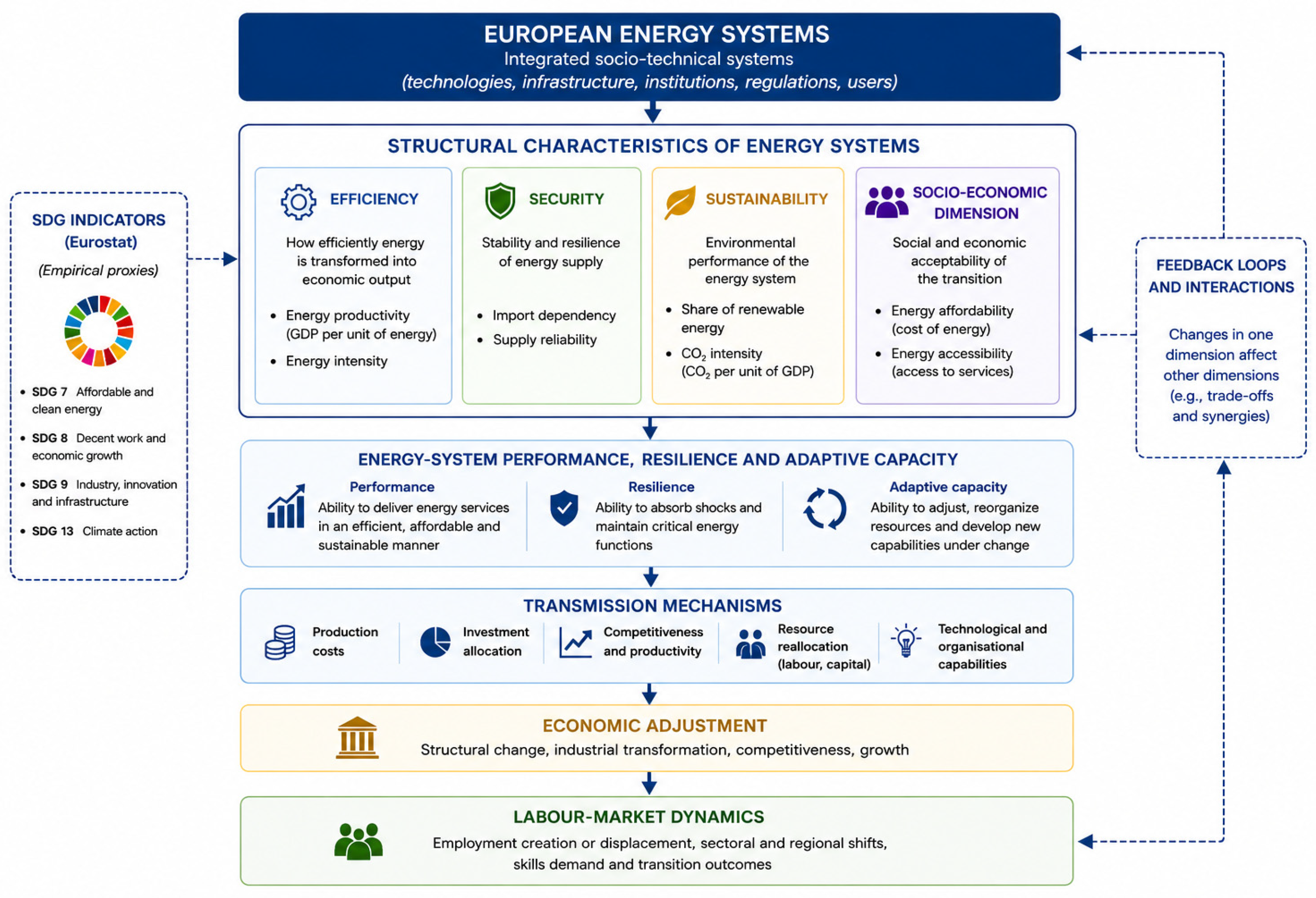
This literature provides the basis for the conceptual framework presented in
Figure 1. The framework links selected structural characteristics of energy and environmental systems with system performance, vulnerability and adjustment conditions. It further assumes that these characteristics may be associated with economic adjustment through production, investment, infrastructure and resource-allocation channels. Labour-market dynamics are treated as one observable manifestation of this broader adjustment process rather than as an isolated economic outcome.
2.2. Energy-System Structures and Transmission Mechanisms of Environmental and Economic Adjustment
Building on the systems perspective developed in
Section 2.1, this study treats energy-system structures as sets of technical, economic and environmental properties. These properties describe how energy is produced, converted, distributed and used within national economies. In environmental engineering and energy studies, these properties extend beyond the energy mix and include energy productivity, energy demand, import dependency, affordability, transport structure, resource efficiency, recycling capacity and environmental pressure.
Previous studies have identified several channels through which energy-system characteristics may be linked with economic adjustment. The first channel concerns system performance. Energy productivity, final energy consumption, primary energy consumption and import dependency describe different aspects of efficiency, demand and vulnerability [
40,
56,
57]. High import dependency increases exposure to supply disruptions and energy-price volatility. Inefficient energy use may, in turn, increase production costs and environmental pressure. Conversely, improved energy productivity and resource efficiency may support economic activity with a lower energy and environmental burden.
The second channel concerns production and technological conditions. Energy-intensive sectors are particularly exposed to energy prices, emission constraints, infrastructure quality and decarbonisation requirements. Previous research has shown that these pressures may affect production costs, operational efficiency, technological choices and industrial competitiveness [
18,
57,
58,
59]. Energy-system characteristics therefore form part of the boundary conditions under which firms, sectors and regions adjust to transition pressures. This is particularly visible in hard-to-abate and energy-intensive industries. In these sectors, decarbonisation requires coordinated technological, infrastructural and policy adaptation rather than isolated technological substitution [
30].
The third channel relates to investment and infrastructure modernisation. Studies on low-carbon transition emphasise that improvements in energy-system performance may support new investment [
58,
59]. This may include investment in energy efficiency, renewable energy, grid modernisation, clean transport, circular-economy solutions and industrial process innovation. Persistent structural weaknesses, including high import dependency, inefficient energy use or limited resource efficiency, may constrain investment decisions and slow adjustment. Investment is therefore an important mechanism through which energy and environmental conditions are transmitted to the wider economy.
The fourth channel concerns resource reallocation. During the low-carbon transition, capital, labour and technological capabilities may shift across sectors [
45,
60]. They may move towards activities characterised by higher energy efficiency, lower environmental pressure and stronger compatibility with decarbonisation pathways. This process is not uniform. Countries, sectors and regions with less favourable energy-system conditions may face adjustment costs related to declining competitiveness, technological lock-in, infrastructure deficits or restructuring pressure. This helps explain why the consequences of energy transition are spatially and sectorally heterogeneous.
The labour-market dimension should therefore be interpreted cautiously. Employment outcomes are not treated in this study as the immediate result of individual energy policies or specific low-carbon technologies. Rather, employment-rate dynamics are considered an observable indicator of wider economic adjustment under changing energy and environmental conditions. This interpretation is consistent with studies linking low-carbon transition with structural change, investment reallocation and sectoral adjustment, but it does not imply a direct causal relationship between energy indicators and employment [
6,
7,
23,
42,
53,
54,
55].
This transmission perspective provides the bridge between the theoretical discussion and the empirical model. The study examines whether selected energy and environmental-system indicators are statistically associated with employment-rate dynamics over time. The estimated relationships are interpreted as conditional dynamic associations within the transmission framework outlined above.
2.3. Research Gap and Research Questions
The literature reviewed above provides a strong basis for understanding energy transition as a multidimensional system process. Previous studies have examined renewable-energy deployment, energy efficiency, energy security, transport decarbonisation, green finance, circular-economy solutions and the macro-economic consequences of decarbonisation [
8,
24,
26,
42,
61]. However, much of this literature still focuses on individual technologies, policy instruments or isolated indicators. Less attention has been paid to whether several measurable properties of energy and environmental systems are jointly associated with labour-market adjustment in a dynamic cross-country framework.
A second limitation concerns the treatment of employment outcomes. Employment is often analysed either as a sector-specific effect of renewable-energy deployment or as a direct consequence of green policies [
6,
7,
23,
42,
53,
54,
55]. These approaches are important, but they do not fully capture the broader adjustment context. Energy productivity, energy consumption, import dependency, affordability, transport structure and environmental pressure may be linked with employment-rate dynamics. From the perspective adopted in this study, labour-market dynamics are treated as an observable indicator of economic adjustment under changing energy and environmental conditions.
A third limitation concerns measurement. National energy systems differ in terms of efficiency, demand, vulnerability, affordability, transport structures, resource efficiency and environmental pressure. Yet, these dimensions are not always analysed within a coherent empirical framework. Harmonised Eurostat indicators provide a useful basis for addressing this limitation because they allow selected energy and environmental properties to be compared across countries and over time [
51]. In this study, these indicators are used as empirical proxies for system-level properties rather than as a normative assessment of SDG implementation.
Taken together, these limitations indicate a research gap at the intersection of energy-system analysis, environmental-system indicators and labour-market adjustment. The present study addresses this gap by examining whether selected measurable properties of energy and environmental systems are statistically associated with employment-rate dynamics in selected European countries. In doing so, the study shifts the focus from isolated transition components. It adopts a system-level empirical specification linking energy vulnerability, energy demand, energy productivity, transport structure, recycling capacity and environmental pressure with labour-market adjustment.
Based on this theoretical and empirical background, the study is guided by the following research questions:
RQ1. Are selected energy and environmental-system indicators statistically associated with employment-rate dynamics in European countries?
This question reflects the assumption that labour-market adjustment should not be analysed independently of the system conditions under which economies adapt to energy and environmental transition. Energy productivity, energy consumption patterns, import dependency, affordability, resource efficiency, transport structure and environmental pressure jointly describe adjustment conditions that may be relevant to employment-rate dynamics.
RQ2. Do energy vulnerability, energy demand and energy-system efficiency indicators display different dynamic associations with employment-rate adjustment?
This question concerns the role of energy import dependency, final and primary energy consumption, household energy demand and energy productivity. These indicators capture different aspects of system vulnerability, demand, scale and efficiency. Their associations with employment-rate dynamics are not expected to be uniform because they may reflect different adjustment mechanisms, including exposure to external energy risks, production scale, restructuring, technological change and delayed adaptation.
RQ3. Are complementary environmental and infrastructural system indicators relevant to labour-market adjustment beyond core energy-system variables?
This question recognises that energy transition is not limited to the energy sector itself. Transport structure, recycling capacity, road-safety conditions and hazardous waste generation describe broader infrastructural and environmental settings that may be associated with the adaptive capacity of national economies.
These research questions do not imply a deterministic relationship between energy systems and employment. Rather, they guide the empirical analysis of whether employment-rate dynamics are statistically associated with selected energy and environmental-system indicators. The empirical model therefore tests conditional dynamic associations rather than strict causal effects.
2.4. Analytical Expectations
Building on the conceptual framework and the three research questions, the empirical analysis examines whether different groups of energy-system and environmental-system characteristics display distinct dynamic associations with labour-market adjustment. Rather than testing a set of predefined statistical hypotheses, the study adopts a research-question approach because the expected direction of several relationships may depend on delayed adjustment processes, structural change and interactions among multiple system characteristics. The analysis therefore focuses on identifying the direction, timing and persistence of conditional dynamic associations within an integrated system perspective. Accordingly, RQ1 concerns the role of core energy-system characteristics, RQ2 focuses on indicators related to energy vulnerability and demand, while RQ3 examines whether broader environmental and infrastructural conditions contribute to labour-market adjustment beyond the core energy-system variables.
3. Materials and Methods
3.1. Data and Variables
The empirical analysis is based on panel data obtained from the Eurostat database and covering European Union Member States over the period 2005–2022. The dataset includes harmonised indicators from the European Sustainable Development Goals monitoring framework. The use of Eurostat data ensures cross-country comparability, methodological consistency, and temporal coherence across the analysed economies.
The initial dataset covered all 27 European Union Member States. Malta was excluded during the preliminary analysis because its values differed substantially from those observed for the remaining countries, largely due to the country’s exceptionally small size. The final dataset therefore comprised a balanced panel of 26 countries observed over 18 years (26 × 18 observations). Descriptive statistics for all variables included in the empirical analysis are provided in
Supplementary Table S1.
A limited number of missing observations were identified for three variables. Missing values at the beginning or end of an individual country series were approximated using the trend equation providing the best fit, as indicated by the highest coefficient of determination (R2). Missing observations within individual series were estimated using piecewise linear interpolation. This procedure was applied to 17 records. For the indicator Generation of waste by hazardousness, which was available at a biennial frequency, intermediate annual values were obtained using piecewise linear interpolation.
Although the selected variables belong to the Eurostat SDG monitoring framework, they are used in this study as harmonised empirical proxies for selected characteristics of national energy and environmental systems rather than as direct measures of SDG implementation or achievement. This approach is consistent with the theoretical framework developed in
Section 2, where energy systems are understood as socio-technical and environmental structures embedded in national economies [
62]. This approach is consistent with the theoretical framework developed in
Section 2, where energy systems are understood as socio-technical and environmental structures embedded in national economies.
The selection of explanatory variables followed a two-stage procedure. In the first stage, a broader set of Eurostat SDG indicators was screened according to their theoretical relevance to the structural characteristics of energy and environmental systems. Indicators were considered only if they could be interpreted as observable proxies for energy-system performance, energy vulnerability, energy demand, infrastructure, resource efficiency or environmental pressure. In the second stage, the final empirical specification was obtained by considering data availability, cross-country comparability, lag structure, multicollinearity, diagnostic properties and consistency with the theoretical framework developed in
Section 2. Therefore, the final set of variables should not be interpreted as an arbitrary selection of SDG indicators but as a theory-guided empirical specification derived from a theoretically restricted group of energy- and environment-related indicators.
The dependent variable is the employment rate by citizenship [
63]. According to Eurostat, the indicator measures the share of employed persons aged 20–64 in the corresponding population. In this study, employment is not interpreted as the direct outcome of individual energy policies or specific low-carbon technologies. Rather, it is treated as an observable indicator of labour-market adjustment and as one measurable manifestation of broader environmental and economic adjustment processes associated with the structural characteristics of energy and environmental systems. This indicator was selected because it is part of the harmonised Eurostat SDG monitoring framework and provides a consistent cross-country measure of employment-rate dynamics over the analysed period. It was preferred to a general aggregate employment measure because it is directly embedded in the harmonised Eurostat SDG monitoring framework used consistently for the explanatory indicators, thereby ensuring methodological coherence and cross-country comparability within the empirical dataset. The analysis uses the series classified by Eurostat as “Country of citizenship: Reporting country”. Therefore, citizenship is not examined as a separate analytical dimension but reflects the technical classification of the indicator in the Eurostat database [
64,
65].
The explanatory variables were selected to capture the multidimensional nature of energy-system and environmental-system structures. Energy-related indicators include energy poverty, energy import dependency, energy productivity, household final energy consumption, final energy consumption, and primary energy consumption. These variables reflect key dimensions of energy-system performance, including affordability, efficiency, energy demand, external vulnerability, and the scale of energy use. Additional variables related to public transport, municipal waste recycling, road traffic deaths, and hazardous waste generation capture complementary environmental, infrastructural, and resource-efficiency dimensions relevant to the broader process of energy and environmental transition.
The empirical specification is not intended to model the technical operation of national energy systems directly. Rather, it uses harmonised system-level indicators to identify whether selected characteristics of energy-system performance, vulnerability, infrastructure, resource efficiency, and environmental pressure are conditionally associated with labour-market adjustment over time. For analytical purposes, the explanatory variables are divided into two complementary groups. The first comprises core energy-system indicators, including energy demand, energy productivity, import dependency, and household energy conditions. The second comprises environmental and infrastructural indicators, including collective transport, municipal waste recycling, road traffic deaths, and hazardous waste generation. The latter variables are not interpreted as direct measures of energy-system performance but as proxies for broader infrastructural, resource-efficiency, and environmental conditions that may shape socio-economic adjustment during the energy transition [
66]. The variables used in the empirical analysis are presented in
Table 1.
This variable selection allows the empirical model to operationalise the system-level perspective developed in
Section 2.
3.2. Empirical Model Specification
As a first step, the stationarity properties of the variables were examined using the Im–Pesaran–Shin (IPS) panel unit-root test based on augmented Dickey–Fuller regressions with an intercept. The results are reported in
Table 2.
The results indicate that the variables included in the analysis are either stationary in levels, I(0), or become stationary after first differencing, I(1). No variable was found to require second differencing. The presence of both I(0) and I(1) variables supports the use of an ARDL-type dynamic specification.
To capture delayed adjustment mechanisms, this study applies a dynamic panel-data model with autoregressive and distributed lag components. Dynamic panel-data modelling provides a well-established framework for analysing persistence, delayed adjustment and unobserved heterogeneity in repeated cross-country observations [
67,
68]. The use of lagged variables is theoretically justified by the assumption that changes in energy-system and environmental-system characteristics are not immediately reflected in labour-market outcomes. Instead, their associations may materialise gradually through production conditions, investment behaviour, technological modernisation, infrastructure adjustment, resource reallocation and broader environmental–economic adaptation [
69,
70,
71].
The general specification can be written as follows:
where
denotes the dependent variable in country i and year ; means -th explanatory variable included with lag ; captures country-specific fixed effects; denotes coefficients of the lagged dependent variable; denotes coefficients of the current or lagged explanatory variables; and is the error term. The symbol denotes the set of lags included for the k-th explanatory variable.
The maximum lag order considered in the empirical specification was the third order. However, not all explanatory variables enter the final model with the same lag structure. The use of allows different variables to be included with different current and lagged terms. This is consistent with the assumption that energy demand, energy vulnerability, resource efficiency, transport-related conditions and environmental pressure may be associated with labour-market adjustment over different time horizons.
The autoregressive component captures the persistence of employment-rate dynamics, while the distributed lag structure accounts for delayed associations between energy and environmental-system characteristics and labour-market adjustment. The model is therefore used to identify conditional dynamic associations rather than strict causal effects.
As an alternative dynamic specification, error-correction models (ECMs) were also estimated. Their general form can be written as follows:
The ECM specifications were estimated using panel OLS, weighted least squares (WLS), fixed-effects (FE), and random-effects (RE) estimators.
In addition, a two-step dynamic GMM specification was estimated as a further robustness assessment of the dynamic panel relationships. The validity of the adopted instrument set was assessed using Hansen’s J test of overidentifying restrictions. The test did not reject the null hypothesis of instrument validity (p = 1.000), providing no statistical evidence against the validity of the instruments used in this specification.
3.3. Logarithmic Specification and Elasticity Interpretation
Because the model specified in Equation (1) is estimated in logarithmic form, it corresponds to a power-form specification. This transformation allows the coefficients of continuous explanatory variables to be interpreted as elasticities. In this framework, the parameters represent short-term elasticities associated with current and lagged values of the explanatory variables.
Long-term elasticities are calculated as cumulative associations after accounting for the autoregressive structure of the model:
where
denotes the long-term elasticity of the k-th explanatory variable, denotes the set of lags included for this variable, denotes the coefficient of the k-th explanatory variable at lag j, and denotes the autoregressive coefficient of the dependent variable at lag j.
This formulation makes it possible to distinguish between immediate associations and longer-term adjustment effects. However, because the autoregressive component may indicate a high degree of persistence in employment dynamics, long-term elasticities should be interpreted with caution. In particular, when the sum of autoregressive parameters is close to one, long-term elasticities become more sensitive to the dynamic structure of the model [
72].
Long-term elasticity in the econometric model is a measure of the final percentage change in the explained variable under the influence of a constant, one-percent increase in the explanatory variable, after taking into account the full system response time. It describes a state in which the delays have passed and the adjustment process has been completed. Given the high persistence of the autoregressive component, the resulting long-term elasticities should be regarded as cumulative conditional associations whose magnitude is sensitive to the adopted dynamic specification, rather than as structural equilibrium parameters suitable for precise policy forecasting.
Long-term elasticities were calculated only for variables for which the lag structure allowed a meaningful cumulative interpretation. For primary energy consumption (Z77), the long-term elasticity is not reported in the final specification. This variable is therefore interpreted only in terms of its statistically significant delayed short-term association.
3.4. Estimation Method
Cross-country panel data may exhibit heterogeneous error variances, which can affect estimation efficiency and statistical inference in linear panel models [
73,
74]. The final specification was estimated using weighted least squares (WLS), as implemented in the GRETL econometric package (version 2025c).
In the final specification, four additional country-years dummy variables were introduced to control for selected non-standard observations identified during model diagnostics. These variables capture exceptional country-specific disturbances and deviations occurring during the analysed period that were not sufficiently represented by the remaining explanatory variables. Their inclusion reduces the influence of atypical observations on the estimated coefficients and improves the overall specification of the model. They are therefore treated as diagnostic control terms rather than substantive explanatory variables.:
where
denotes dummy variables identifying the
m-th selected country-period-specific deviation, and
denotes its coefficient. In the final model,
M = 4.
Positive deviations are observed for Lithuania (2011) and Croatia (2014), while negative deviations are observed for Romania (2021) and Bulgaria (2018). These controls are intended to reduce the influence of exceptional country-year observations on the estimated dynamic relationships, but they do not change the theoretical interpretation of the main explanatory variables.
3.5. Diagnostic Considerations and Interpretation Limits
The model should be interpreted as a dynamic panel-data specification designed to identify conditional associations between selected structural characteristics of energy and environmental systems and labour-market dynamics [
75,
76]. It does not provide evidence of strict causality. Potential endogeneity cannot be fully excluded, particularly because feedback mechanisms may exist between employment, energy consumption, transport demand, household energy use and production structures. For example, higher employment may itself contribute to increased energy consumption, transport activity or resource use. The inclusion of lagged explanatory variables helps to account for temporal ordering and delayed adjustment mechanisms, but it does not eliminate potential endogeneity arising from reverse causality, omitted variables or bidirectional feedback. Moreover, the final WLS specification does not rely on instrumental variables for causal identification, although a two-step dynamic GMM model was estimated as an additional robustness check.
Therefore, the estimated coefficients are interpreted as conditional dynamic associations rather than direct causal effects. The terms “positive elasticity” and “negative elasticity” refer to the direction and relative strength of statistical associations within the adopted model specification, not to deterministic causal impacts. Similarly, long-term elasticities should be interpreted as cumulative model-based associations rather than as structural equilibrium or causal effects.
Model adequacy was assessed using goodness-of-fit measures, the F statistic and residual diagnostics. Residual diagnostics were used to evaluate the distributional properties of the error term and to identify selected non-standard observations. The results of these diagnostic checks are reported together with the empirical findings.
4. Results
4.1. Dynamic Panel Estimates
Table 3 and
Table 4 presents the results of the dynamic panel-data model estimated using weighted least squares. For improved readability,
Table 3 reports the estimated coefficients and long-term elasticities for the energy and environmental-system indicators, whereas
Table 4 presents the constant, autoregressive component and diagnostic country-year controls.
The autoregressive component is statistically significant, indicating strong persistence in employment-rate dynamics. The coefficient of the first lag of the dependent variable is positive and statistically significant, while the second lag is negative and statistically significant. The sum of the autoregressive parameters is high which confirms that employment-rate dynamics are strongly path-dependent. This also implies that long-term elasticities should be interpreted with caution, because cumulative estimates are sensitive to the dynamic structure of the model.
The model displays a high goodness of fit and the overall F statistic is statistically significant . This result indicates that the dynamic specification captures a substantial part of the variation in the dependent variable. However, the high value of should be interpreted in the context of the autoregressive structure of the model, which accounts for a large part of the persistence in employment-rate dynamics.
To provide a clearer overview of the cumulative associations,
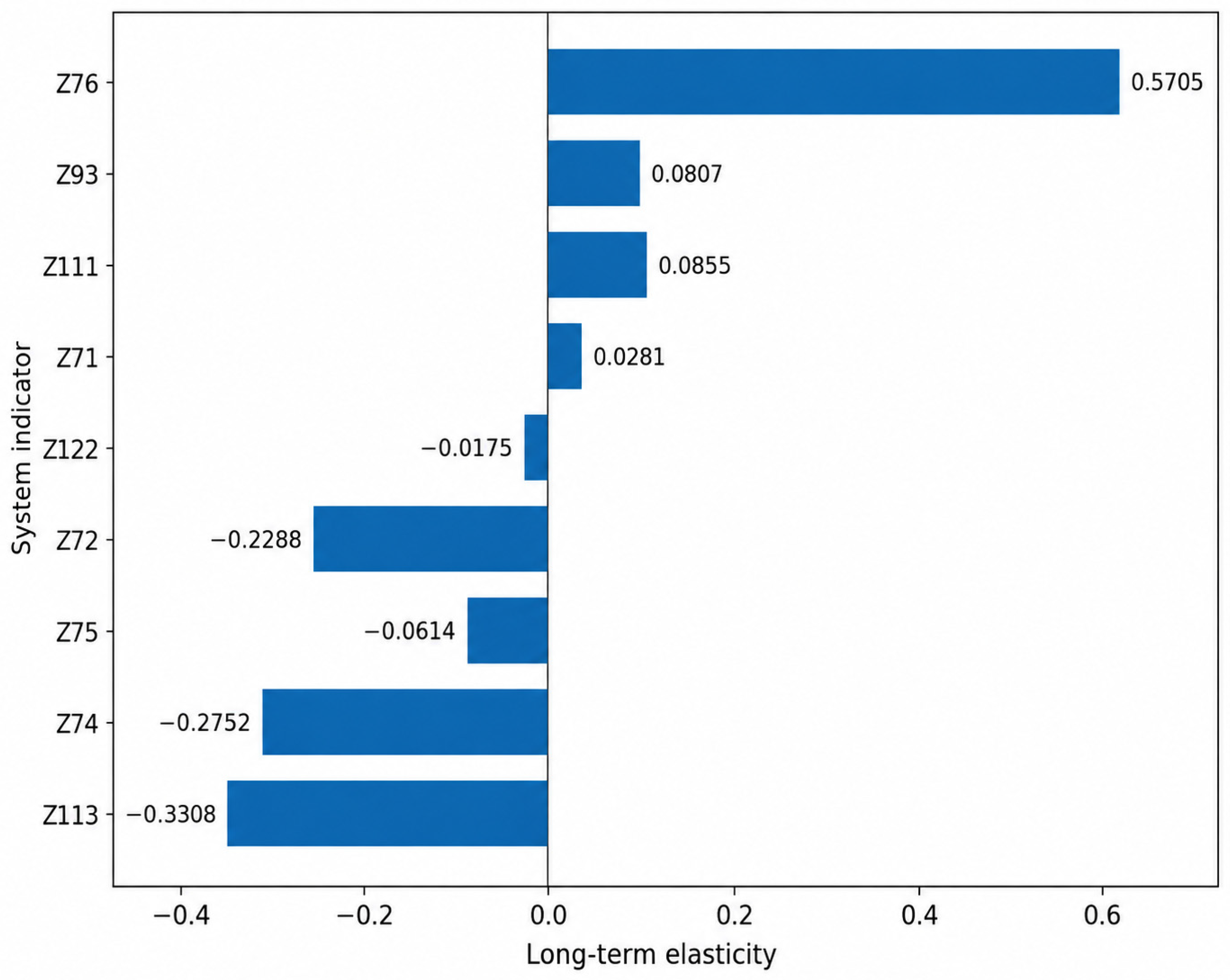
Figure 2 presents the long-term elasticities estimated for the energy and environmental-system indicators included in the final dynamic specification.
Because the autoregressive component indicates high persistence, the reported long-term elasticities should be treated as sensitivity-prone cumulative estimates rather than structural long-run effects.
As shown in
Figure 2, the estimated long-term elasticities differ substantially in both sign and magnitude. Final energy consumption (Z76) shows the largest positive long-term elasticity, while energy productivity (Z74) and road traffic deaths (Z113) display the strongest negative long-term associations. Positive long-term elasticities are also observed for collective transport (Z93), municipal waste recycling (Z111), and household energy affordability conditions (Z71), although their magnitudes are considerably smaller. Negative long-term elasticities are observed for energy import dependency (Z72), household final energy consumption per capita (Z75) hazardous waste generation (Z122), energy productivity (Z74), and road traffic deaths (Z113). These patterns reveal marked differences in the direction and magnitude of the cumulative relationships between system-level indicators and employment-rate dynamics.
Overall, several energy and environmental-system indicators carry meaningful statistical weight in explaining employment-rate dynamics. Their coefficients display divergent temporal patterns, indicating that adjustment mechanisms vary across system dimensions and time horizons.
4.2. Energy Vulnerability, Energy Demand and Employment-Rate Dynamics
Energy import dependency (Z72) exhibits a statistically meaningful sequence of lagged relationships with employment-rate dynamics. The first and third lags are negative, while the second lag is positive. The long-term elasticity is negative (−0.2288), indicating that higher external energy vulnerability is associated with less favourable employment-rate dynamics within the adopted dynamic specification. This result is consistent with the interpretation of import dependency as a source of exposure to external supply risks and energy-price volatility.
Final energy consumption (Z76) has a positive current coefficient and a negative first-lag coefficient. The long-term elasticity is positive (0.5705), suggesting that final energy demand is positively associated with employment-rate dynamics in the longer-run specification. This result should not be interpreted as evidence that higher energy consumption is inherently beneficial. Rather, final energy consumption may capture the scale of productive activity, demand conditions and the broader level of economic activity in national economies.
Primary energy consumption (Z77) enters the model through a statistically significant second lag with a negative coefficient. The long-term elasticity is not reported for this variable in the final specification. Therefore, Z77 is interpreted only in terms of its statistically significant delayed short-term association. The negative delayed coefficient suggests that higher primary energy-system pressure may be associated with less favourable employment-rate adjustment after a delay.
Viewed jointly, the results for Z72, Z76 and Z77 show that energy vulnerability and energy demand matter for employment-rate dynamics, although their temporal adjustment patterns differ. Final energy consumption appears to capture the scale of economic activity, while import dependency and primary energy consumption reflect vulnerability and system pressure.
4.3. Energy Productivity and Household Energy Conditions
Energy productivity (Z74) shows a positive current association and a stronger negative delayed association. The resulting long-term elasticity is negative (−0.2752). This result requires careful contextual interpretation. It does not imply that higher energy productivity is economically unfavourable. Rather, the negative long-term association may reflect restructuring processes, technological upgrading, sectoral shifts or changes towards less labour-intensive activity patterns [
77]. In this sense, improvements in energy productivity may coincide with adjustment processes that are not immediately reflected in higher employment rates.
Household-related energy indicators display mixed dynamic patterns. The indicator of the population unable to keep the home adequately warm (Z71) has a positive first-lag coefficient and a negative second-lag coefficient, with a small positive long-term elasticity (0.0281). This suggests that household energy affordability conditions are statistically relevant, but their relationship with employment-rate dynamics is weak and changes over time.
Final energy consumption in households per capita (Z75) shows a negative current coefficient and a positive first-lag coefficient. Its long-term elasticity is weakly negative (−0.0614). This result requires careful contextual interpretation. The mixed signs suggest that household energy conditions should not be interpreted as a simple linear driver of employment outcomes.
Overall, energy productivity and household energy conditions contribute significantly to the model, although their temporal effects follow divergent patterns. They are better interpreted as indicators of adjustment conditions rather than as direct determinants of labour-market outcomes.
4.4. Transport Structure, Resource Efficiency and Environmental Pressure
The share of buses and trains in inland passenger transport (Z93) is negatively associated with employment-rate dynamics in the first lag and positively associated in the third lag. The long-term elasticity is positive (0.0807). This pattern suggests that collective transport structures may be associated with employment-rate adjustment over a longer time horizon rather than immediately. The delayed positive association is consistent with the interpretation of transport structure as part of broader infrastructural conditions supporting economic adjustment.
The recycling rate of municipal waste (Z111) has alternating short-term coefficients and a positive long-term elasticity (0.0855). The non-uniform short-run effects may reflect the fact that the environmental and economic benefits of recycling depend partly on the energy intensity and technological characteristics of waste-processing operations [
78]. In the longer-run specification, stronger resource-management capacity corresponds to more favourable employment-rate dynamics. The effectiveness of waste-management systems also depends on regulatory incentives, emission monitoring, reporting transparency, and institutional enforcement [
79]. These findings support the view that circular-economy-related system properties may be relevant to broader economic adjustment processes.
Road traffic deaths (Z113) show a positive current coefficient and a stronger negative delayed coefficient, resulting in a negative long-term elasticity (−0.3308). The result points to a meaningful relationship between road-safety conditions, transport-system performance and labour-market adjustment. The negative long-term association may reflect broader infrastructural weaknesses rather than a direct relationship between road fatalities and employment.
Hazardous waste generation (Z122) has a positive current coefficient and a negative first-lag coefficient, with a negative long-term elasticity (−0.0175). In the longer-run specification, greater environmental pressure coincides with less favourable employment-rate dynamics. The magnitude of the long-term elasticity is small, but the result is relevant because it confirms that environmental-system pressure remains statistically connected with labour-market adjustment.
These results show that complementary infrastructural and environmental indicators are not peripheral to the model. Transport structure, recycling capacity, road-safety conditions and hazardous waste generation are statistically associated with employment-rate dynamics, although their signs and timing differ across variables.
4.5. Diagnostic Controls and Residual Diagnostics
Four country-period dummy variables were included as diagnostic controls for selected non-standard observations identified during model diagnostics. Their coefficients are statistically significant and should not be interpreted as elasticities. They represent log-point deviations from the fitted dynamic specification for specific country-period observations that are not fully captured by the main explanatory variables.
Positive deviations are observed for Lithuania (2011) and Croatia (2014), while negative deviations are observed for Romania (2021) and Bulgaria (2018). These controls are intended to reduce the influence of exceptional country-year observations on the estimated dynamic relationships, but they do not change the theoretical interpretation of the main explanatory variables. The residual normality test indicates statistically significant deviations from the normal distribution (). This result is likely related to a small number of non-standard residuals visible in the lower part of the distribution. Therefore, the diagnostic results should be interpreted with caution. Nevertheless, the model remains useful for identifying delayed conditional associations between energy and environmental-system characteristics and employment-rate dynamics. The results should not be interpreted as strict causal effects.
To assess the robustness of the estimated coefficient signs and lag structure, alternative ARDL specifications with maximum lag orders ranging from one to three were estimated using WLS. The baseline results were additionally compared with those obtained using panel OLS.
Table 5 summarises the direction and statistical significance of the coefficients across these alternative specifications.
Overall, the alternative specifications show broad consistency in the directions of the estimated relationships, although the statistical significance and selected lag structure vary across models. The most notable differences concern Z93, for which the sign at lag 1 depends on the maximum lag order, and Z122, which is not statistically significant in the panel OLS specification. For most of the remaining variables, the principal pattern of positive and negative lagged associations is preserved across the alternative specifications. These findings support the general robustness of the baseline results, while indicating that individual lag-specific coefficients should be interpreted cautiously.
As a complementary robustness check, the corresponding ECM representations were estimated using alternative estimation methods.
Table 6 compares the resulting parameter estimates to assess the consistency of the short- and long-run relationships across panel OLS, WLS, fixed-effects, and random-effects specifications.
The ECM estimates provide broadly consistent information on the direction of the short-term relationships across the alternative estimation methods. In particular, the coefficients for changes in energy productivity (ΔZ74), household final energy consumption (ΔZ75), final energy consumption (ΔZ76), primary energy consumption (ΔZ77) and municipal waste recycling (ΔZ111) retain the same sign across the reported estimators. Greater variation is observed in selected lagged level terms, particularly for energy productivity (Z74) and primary energy consumption (Z77). The ECM results therefore support the general robustness of the principal directional relationships while also indicating that some longer-term associations remain sensitive to model specification.
The single-equation models should nevertheless be regarded as indicative representations of the analysed relationships rather than as structural causal models. The observed associations may operate with delays, and feedback mechanisms between employment, energy demand, production activity and other system characteristics cannot be excluded. Their identification is constrained by the relatively short macro-economic time series available for individual countries and by persistent cross-country heterogeneity in national energy and economic policies. Although panel estimation makes it possible to exploit both temporal and cross-sectional variation, some country-specific effects may offset one another at the aggregate panel level. In addition, incomplete information and overlap among variables resulting from their construction and measurement may generate residual endogeneity. These limitations should therefore be taken into account when interpreting the estimated relationships.
These empirical patterns provide the basis for the discussion of the research hypotheses and their theoretical implications in the following section.
5. Discussion
5.1. Assessment of the Research Questions
The empirical findings provide support for RQ1, which assumed that structural characteristics of national energy and environmental systems are significantly associated with labour-market dynamics in European countries. Several indicators representing energy vulnerability, energy demand, energy productivity, household energy conditions, transport structure, recycling capacity and environmental pressure are statistically significant in the dynamic specification. This indicates that employment-rate dynamics are not associated with a single component of energy transition, but with a broader configuration of energy, infrastructural and environmental conditions that shape the resilience and adaptive capacity of national systems. The finding accords with the system-level perspective adopted in this study. Energy systems are not treated as sets of isolated technologies, but as socio-technical and environmental structures in which infrastructure, institutions, regulations, users and economic conditions interact. The empirical relevance of several groups of indicators therefore supports the view that labour-market adjustment should be analysed in relation to system-level conditions rather than through individual transition indicators alone. This interpretation is consistent with previous studies that conceptualise energy transitions as socio-technical and system-level processes rather than as simple technology-substitution pathways [
26,
28,
30,
31].
RQ2 is partially supported. Indicators of energy-system efficiency and structural vulnerability are statistically significant, but their signs and lag structures are heterogeneous. Energy import dependency shows a negative long-term association with employment-rate dynamics. This pattern accords with the interpretation of import dependency as a proxy for external energy vulnerability, including exposure to supply risks, energy-price volatility and dependence on imported energy sources. It also aligns with the energy-security literature, which identifies import dependency as an important source of system vulnerability and macro-economic exposure [
30,
38].
The result for energy productivity is more complex. Energy productivity shows a positive contemporaneous association and a stronger negative delayed association, resulting in a negative long-term elasticity. From an engineering perspective, higher energy productivity remains a desirable outcome because it indicates that more economic output is generated per unit of energy used. Accordingly, the estimated negative association should not be viewed as evidence that improvements in energy productivity are economically or environmentally unfavourable. A more cautious interpretation is that improvements in energy productivity may coincide with technological modernisation, automation and structural changes associated with the energy transition. Such processes may improve the efficiency of energy use. At the same time, they may reduce labour demand in some sectors or delay labour-market adjustment. Similar interpretations have been suggested in studies linking energy-efficiency improvements and decarbonisation with technological change, structural transformation and sectoral reallocation rather than with immediate employment expansion [
6,
7,
18]. The results also provide an affirmative answer to RQ3. Complementary environmental and infrastructural indicators, including collective transport, municipal waste recycling, road-safety conditions and hazardous waste generation, are statistically associated with employment-rate dynamics. The evidence indicates that labour-market adjustment extends not only beyond core energy variables but also into broader environmental and infrastructural and circular-economy conditions. However, these indicators should be interpreted as proxies for adjustment context rather than as direct determinants of employment change [
30,
49,
60].
From an environmental engineering and energy-systems perspective, the labour market should be analysed as part of a broader system response. This response includes changes in energy demand, import vulnerability, resource efficiency and infrastructure-related environmental conditions. This reinforces the need to evaluate sustainable energy-transition pathways not only through technological indicators but also through the resilience, adaptive capacity and socio-economic adjustment of national systems. In this sense, employment-rate dynamics represent one observable dimension of a broader and potentially just energy-system transformation.
5.2. Interpretation of Dynamic Associations
An important finding of the study is the heterogeneity of signs across current and lagged terms. The indicators display divergent temporal adjustment patterns across the lag structure. Such variation provides additional justification for the dynamic rather than static specification. Labour-market adjustment to changing energy and environmental conditions may occur gradually through production costs, investment decisions, technological modernisation, infrastructure development and resource reallocation. The heterogeneous lag structure therefore reflects the temporal complexity of sustainable energy-system transformation, in which technological, infrastructural and socio-economic adjustments do not occur simultaneously [
6,
7,
18,
47,
49,
50,
51].
The negative long-term association between energy productivity and employment differs from studies reporting positive labour-market effects of improvements in energy efficiency or productivity. Such positive effects may arise when efficiency gains stimulate investment, technological innovation, the expansion of energy services and the development of low-carbon industries. However, the relationship is not necessarily uniform. Higher energy productivity may also result from automation, capital deepening, industrial restructuring and a shift away from energy- and labour-intensive activities. Under these conditions, economic output may increase relative to energy use without an immediate or proportionate increase in employment.
The difference may also reflect the design of the present study. The analysis uses aggregated national data and estimates energy productivity jointly with indicators of energy vulnerability, energy demand, household conditions, infrastructure and environmental pressure. The estimated elasticity should therefore be interpreted as a conditional system-level association rather than as the isolated effect of energy productivity. Moreover, the dynamic specification captures current and lagged adjustment processes that may be overlooked in static or single-variable regressions. The negative long-term coefficient does not imply that improvements in energy productivity are undesirable from an engineering or sustainability perspective. Instead, it suggests that their labour-market effects depend on the technological, sectoral and temporal pathways through which productivity gains are achieved.
The positive long-term elasticity of final energy consumption requires particular caution. This result does not imply that higher energy consumption is desirable or that increasing energy use improves labour-market outcomes. Rather, final energy consumption may capture the scale of productive activity, final demand and the intensity of economic processes in national economies. In this sense, the positive association with employment may reflect the fact that economies with a larger scale of production and services generate both higher energy demand and stronger labour absorption. This interpretation is consistent with studies that treat energy demand as closely connected with production scale, economic activity and structural characteristics of national economies [
36,
57].
The negative long-term association of energy import dependency points to the relevance of vulnerability-related system characteristics. High dependence on imported energy may worsen adjustment conditions through greater exposure to price shocks, supply disruptions and cost uncertainty. This does not imply a direct causal effect of import dependency on employment, but it suggests that external energy vulnerability may be part of the broader environment shaping labour-market adjustment. This interpretation is consistent with the literature on energy security and import dependence as dimensions of system resilience and macro-economic vulnerability [
37,
57].
Household energy indicators reveal a less uniform pattern. Both the inability to keep the home adequately warm and household final energy consumption show changing signs across lags. Household energy conditions remain statistically relevant, although their relationship with employment-rate dynamics is temporally uneven. These variables may simultaneously reflect income conditions, energy costs, housing quality, consumption structures and social exposure to energy-price changes. Therefore, they should be interpreted as indicators of household-level energy constraints rather than as direct determinants of employment outcomes [
1,
5,
39]. Their relevance nevertheless indicates that the social dimension of energy vulnerability should be considered when assessing whether transition pathways are resilient and socially inclusive.
The positive long-term associations observed for collective transport and municipal waste recycling suggest that infrastructural and resource-efficiency conditions may be linked with more favourable adjustment patterns. This does not mean that an increase in the share of collective transport or recycling directly raises employment. Rather, these variables may reflect broader organisational, infrastructural and environmental capacities of national economies. Such an interpretation is in line with research emphasising that transport decarbonisation and circular-economy development require coordinated infrastructure, investment and institutional capacity [
30,
49,
60].
The opposite pattern is observed for road traffic deaths and hazardous waste generation. Their negative long-term associations suggest that weaker infrastructural conditions and higher environmental pressure may coexist with less favourable employment-rate dynamics. Again, these indicators should not be interpreted as direct causes of labour-market change. They are better understood as proxies for broader infrastructural and environmental-system conditions that may shape the context of economic adjustment.
The analysed period also encompasses several major external shocks, including the global financial crisis, the COVID-19 pandemic and the recent European energy crisis. These events may have influenced both energy-system conditions and labour-market adjustment through changes in production activity, energy demand, energy prices, investment and employment. The present model was not designed to identify the separate causal effects of these episodes, and the diagnostic country-year controls should not be interpreted as direct proxies for them. Nevertheless, these shocks form part of the broader macro-economic context in which the estimated dynamic associations should be interpreted.
Taken together, the dynamic associations indicate that labour-market adjustment is embedded in a wider configuration of energy vulnerability, demand, infrastructure, resource efficiency and environmental pressure. The results therefore support an interpretation of sustainable energy transition as a multidimensional and temporally differentiated process, in which resilience depends on both energy-system characteristics and the broader capacity of national economies to adapt to structural change.
5.3. Contribution to Sustainability, Energy-System and Environmental-Transition Research
This study contributes to sustainability, energy-system and environmental-transition research in three main ways. First, it shifts the empirical focus from individual components of energy transition to a broader set of measurable characteristics of energy and environmental systems. Previous studies have often analysed renewable-energy deployment, energy efficiency, energy security, transport decarbonisation, green finance, circular-economy solutions or employment effects as separate research domains [
45,
46,
47,
49,
50,
80]. In contrast, this study examines these dimensions as elements of a broader system-level configuration relevant to sustainable energy-system transformation.
Second, the article uses harmonised Eurostat SDG indicators as comparable empirical proxies for selected energy and environmental-system characteristics, rather than as measures of SDG implementation. These include energy vulnerability, energy demand, energy productivity, household energy conditions, resource efficiency, transport structure and environmental pressure. This approach enables several dimensions of sustainable energy-system transformation to be examined within a coherent analytical framework while maintaining the focus on system characteristics rather than on SDG performance itself [
39,
53,
66].
Third, the study links an energy-systems perspective with labour-market adjustment in a dynamic panel-data framework. Employment is not treated as a direct outcome of energy policy, renewable-energy deployment or a single transition instrument. Instead, it is interpreted as an observable indicator of broader economic adjustment under changing energy and environmental conditions. This provides a more cautious and system-oriented interpretation of the relationship between energy transition and labour-market dynamics, complementing studies that focus on direct green-job effects or sector-specific employment impacts [
6,
7,
18,
47,
49,
50,
51]. By incorporating the social dimension of adjustment, the study also contributes to the discussion of resilient and socially inclusive transition pathways, while not claiming to measure the fairness of the transition directly.
5.4. Limitations and Future Research
The findings should be interpreted in light of several limitations. First, the model identifies conditional dynamic associations rather than strict causal effects. The inclusion of lagged variables helps to capture delayed adjustment patterns, but it does not eliminate potential endogeneity. Feedback mechanisms may exist between employment, energy consumption, household energy conditions, transport demand and production structures. This limitation is common in dynamic panel specifications when the underlying mechanisms are complex and mutually reinforcing [
67,
68].
A related limitation concerns the absence of conventional macro-economic controls, such as GDP growth, unemployment and inflation. These factors may affect both labour-market outcomes and energy-system characteristics, and their omission means that some of the estimated associations may partly reflect broader macro-economic developments. This potential omitted-variable bias provides an additional reason for interpreting the results as conditional associations rather than causal effects.
The study is based on aggregated country-level data. Such data make it possible to compare a broad group of countries over a relatively long period, but they do not fully capture sectoral, regional and technological heterogeneity. Differences between energy-intensive industries, services, transport activities and low-carbon technology sectors may be particularly important for understanding labour-market adjustment during the energy transition.
Eurostat indicators ensure cross-country comparability, but they do not capture the full technical complexity of national energy systems. The model does not directly include the electricity-generation mix, the share of renewable energy sources, electrification levels, grid development and constraints, energy-storage capacity, industrial energy intensity, regional industrial concentration or firm-level adaptation strategies [
81]. Therefore, the selected indicators should be interpreted as empirical proxies for selected system characteristics, not as a complete representation of national energy systems.
Long-term elasticities should be interpreted with caution because the autoregressive component indicates strong persistence in employment-rate dynamics. A high sum of autoregressive coefficients makes cumulative estimates sensitive to the dynamic structure of the model. For this reason, the long-term elasticity for primary energy consumption was not reported and this variable was interpreted only through its statistically significant delayed short-term association.
The inclusion of diagnostic country-year controls indicates that some observations had a non-standard character. These controls reduce the influence of selected exceptional observations on the estimated dynamic specification, but they also suggest that future research should examine country-specific shocks, institutional conditions and crisis-related adjustment mechanisms in greater detail.
Several directions for future research follow directly from the limitations of the present study. Sectoral disaggregation would help reduce the aggregation bias inherent in national-level data and reveal whether the estimated relationships differ between energy-intensive manufacturing, transport, services and low-carbon technology sectors. Such analyses could also distinguish between transition-related job creation, employment displacement and labour reallocation across sectors and regions.
Regional panel data at the NUTS2 level would make it possible to capture subnational disparities in energy vulnerability, industrial structure, infrastructure access and labour-market adjustment that are obscured by country-level averages. This would be particularly relevant for regions dependent on carbon-intensive industries or characterised by uneven access to low-carbon investment.
More detailed technological variables should be incorporated to examine the role of electricity-generation structure, renewable-energy deployment, electrification, grid constraints, energy storage and industrial energy intensity. These extensions would provide a more complete representation of the technical pathways through which energy-system transformation may be associated with employment dynamics.
Finally, complementary analytical approaches could be used to investigate the mechanisms underlying the observed associations. In particular, Logarithmic Mean Divisia Index decomposition could help separate the contributions of activity effects, energy intensity, fuel structure and other structural changes, while multi-criteria and system-based modelling could provide a broader assessment of interacting system conditions [
82]. Taken together, such extensions would make it possible to assess more directly how technological change, energy vulnerability, infrastructure development and resource efficiency shape the resilience, social inclusiveness and long-term sustainability of energy-transition pathways.
6. Conclusions and Policy Implications
This study examined whether selected characteristics of national energy and environmental systems are statistically associated with employment-rate dynamics in selected European countries over the period 2005–2022. The analysis was based on harmonised Eurostat indicators and a dynamic panel-data model with autoregressive and distributed lag components. The adopted approach was not intended to identify direct causal effects of the energy transition on employment, but to assess conditional dynamic associations between selected system-level characteristics and labour-market adjustment within the broader process of sustainable energy-system transformation.
The results indicate that employment-rate dynamics are associated with a configuration of energy, infrastructural and environmental conditions rather than with a single transition indicator. Core energy-system characteristics, including import vulnerability, energy demand and energy productivity, as well as broader conditions related to household energy constraints, transport structure, recycling capacity and environmental pressure, are statistically relevant. The heterogeneous signs and lag structures of the estimated coefficients confirm that labour-market adjustment is neither immediate nor one-dimensional.
The positive long-term association between final energy consumption and employment should not be interpreted as evidence that higher energy consumption is beneficial or should be encouraged. Rather, it may reflect the greater scale of productive and service activity in national economies, which is associated with both higher energy demand and higher employment.
The main conclusion of the study is that the relationship between energy transition and labour-market dynamics should be analysed from a system-level perspective. Employment should not be interpreted as a simple outcome of energy policy, renewable-energy deployment or progress towards the Sustainable Development Goals. Instead, employment-rate dynamics are treated as an observable dimension of broader socio-economic adjustment under changing energy and environmental-system conditions. This captures the complexity of sustainable transition processes more effectively than approaches based on individual technologies, policy instruments or isolated energy indicators.
The contribution of the article lies in linking an energy-systems perspective with the analysis of dynamic labour-market adjustment and, in doing so, extending sustainability research beyond narrowly defined technological or environmental outcomes. Harmonised Eurostat SDG indicators provide a coherent empirical basis for operationalising energy vulnerability, energy demand, energy productivity, household energy conditions, resource efficiency, transport structure and environmental pressure. The SDG framework is used as an analytical data source rather than as the object of normative assessment. The findings suggest that resilience, circular-economy capacity and socio-economic adaptability should be considered complementary dimensions of sustainable energy-system transformation.
From a policy perspective, the negative long-term association observed for energy import dependency highlights the importance of strengthening energy-system resilience and limiting exposure to external supply and price risks. This finding should not be interpreted as evidence of a direct causal effect on employment. It nevertheless suggests that energy-security measures may also form part of the broader conditions supporting more stable socio-economic adjustment during the energy transition.
The results also indicate that improvements in energy productivity should be accompanied by measures supporting labour-market adaptation. Technological modernisation and efficiency gains may involve restructuring, delayed employment responses and shifts in labour demand. Policies concerning workforce reskilling, labour mobility and support for affected regions may therefore complement investments in energy efficiency. At the same time, collective transport, municipal waste recycling, transport safety and hazardous waste management should be treated as elements of an integrated transition framework rather than as isolated environmental measures. Coordinating energy, environmental, infrastructure and labour policies may help European economies pursue a more resilient and socially inclusive transition.
The findings should nevertheless be interpreted with caution. The model identifies conditional dynamic associations rather than strict causal relationships. The use of aggregated country-level data limits the ability to capture sectoral, regional and technological heterogeneity. Future research should therefore use sectoral and regional data, indicators for energy-intensive industries and more detailed technological variables. It should also distinguish between transition-related job creation, employment displacement and labour reallocation across sectors and regions. Such extensions would allow the resilience, social inclusiveness and long-term sustainability of energy-transition pathways to be assessed more directly.