1. Introduction
Against the backdrop of global supply chain reconfiguration, the rapid development of the digital economy, and the continuous advancement of China’s “dual circulation” strategic paradigm, urban–rural logistics systems have evolved from traditional commodity circulation vectors into critical infrastructure supporting rural revitalization, facilitating the bidirectional flow of urban–rural factors, and enhancing regional economic resilience. Particularly in rural areas, logistics networks not only handle the bidirectional distribution functions of transporting industrial goods to the countryside and agricultural products to cities but also serve as a vital backbone for extending agricultural value chains, boosting farmers’ incomes, and achieving integrated urban–rural development. However, in comparison to rapidly expanding logistics demands, China’s rural logistics system remains plagued by prominent structural challenges such as high distribution costs, unstable service quality, and suboptimal resource utilization efficiency [
1]. The spatial fragmentation of rural settlements and low order density trap terminal delivery in a persistent state of insufficient economies of scale [
2]. Furthermore, the upstream flow of fresh agricultural products suffers from widespread deficiencies in cold chain facilities and high transport spoilage rates, which severely constrain the realization of agricultural value [
3]. Concurrently, order fragmentation and increasing network complexity continuously elevate the operational and managerial burdens on logistics enterprises [
4]. Consequently, how to balance service quality assurance with operational cost containment to realize the high-quality development of the urban–rural logistics system has become a pivotal research agenda in the domain of logistics management.
To navigate these challenges, logistics enterprises are progressively intensifying their investments in digitalization and specialization [
5], with intelligent technology application and cold chain infrastructure development emerging as two core initiatives to optimize logistics operational performance [
6]. Intelligent technology—leveraging digital instruments such as automated sorting, algorithmic path optimization, and Internet of Things (IoT) real-time monitoring—enhances logistics information transparency and resource allocation efficiency, thereby effectively minimizing human operational errors, streamlining distribution routing, and accelerating network responsiveness. Concurrently, cold chain logistics establishes a rigid, continuous temperature-controlled system that provides a stable transit environment for fresh produce and temperature-sensitive goods, which not only dramatically curbs transport cargo loss but also enhances delivery reliability and customer satisfaction [
6]. Therefore, a dominant stream of research posits that intelligent technology and cold chain construction serve as the primary impetuses driving the transformation and upgrading of modern logistics systems.
Nevertheless, existing literature remains inconclusive regarding whether these dual capabilities can invariably translate into enhanced logistics performance. On one hand, intelligent technology application entails substantial upfront capital expenditures and system integration friction, and its ultimate efficacy is closely contingent upon the firm’s organizational capacity, business scale, and network environment [
7]. Within rural logistics networks, the highly dispersed distribution demands and intricate operational scenarios frequently impede the empirical execution of mathematically optimal algorithmic solutions, meaning that technology investments do not automatically yield expected returns [
8]. On the other hand, although cold chain logistics significantly elevates service quality, its construction and operation exhibit intense asset specificity. High fixed asset investments and continuous energy consumption can exponentially inflate operational outlays; if business volume is insufficient or network utilization rates remain low, cold chain investments may fail to cross the scale economy threshold [
9]. Hence, relying solely on technology- or facility-centric views to explain logistics performance variation leaves a glaring question unanswered: why do significant performance discrepancies persist across different regions and enterprises in reality?
The root cause of this performance variance may lie not within the technology itself but within the organizational governance environment in which the technology is embedded. In recent years, alongside the sustained growth of rural logistics demands and the deepening integration of logistics resources, collaborative models such as “postal–express cooperation,” “centralized warehousing with joint distribution,” and “pooled delivery” have expanded rapidly, establishing joint distribution as a dominant organizational form in China’s urban–rural logistics paradigm [
10,
11]. By pooling warehousing facilities, transportation vehicles, and terminal delivery networks, joint distribution improves vehicle loading rates, curbs duplicated distribution outlays, and alleviates the redundancy of infrastructure development in rural areas [
11]. Crucially, however, joint distribution denotes not only resource pooling but also heightened organizational complexity among multiple heterogeneous logistics agents [
12]. Inter-firm information system compatibility, the alignment of operational delivery standards, and benefit-sharing allocation mechanisms all profoundly dictate network running efficiency, thereby reshaping the external configurations under which technology and specialized services operate.
Specifically, during the execution of intelligent technology, algorithmic optimization typically depends on unified data standards, seamless information sharing, and centralized scheduling mechanisms [
13]. Conversely, joint distribution networks are inherently characterized by multi-party participation, decentralized information, and organizational heterogeneity; the resulting data walls and inter-firm coordination friction can severely impair the operational velocity of intelligent systems [
14]. Similarly, the value of cold chain logistics hinges on the rigorous continuity of temperature control standards throughout the entire fulfillment chain. However, multiple handovers, mixed loading transport, and cross-boundary collaborative management within joint distribution networks expand the risk of institutional “broken chains,” thereby eroding the competitive advantage of cold chain services [
15]. Concurrently, the scale economies engineered by joint distribution may conversely upgrade facility utilization efficiency, amortize cold chain development costs, and widen the application scope of intelligent technologies. Thus, joint distribution exhibits a dual, non-symmetric nature: it can act either as a structural catalyst for unlocking technological asset dividends or as an efficiency constraint due to organizational friction and transaction costs, leaving its net direction of interaction highly ambiguous.
Regrettably, most existing studies investigate intelligent technology, cold chain logistics, or joint distribution as isolated determinants of logistics performance [
10], paying scant attention to how joint distribution, as an overarching organizational governance context, shapes the performance manifestation of intelligent technology and cold chain capabilities. In other words, while the literature robustly answers whether technology can upgrade logistics performance, it rarely unearths under what organizational environments technology yields the maximum return. For urban–rural logistics networks, technological asset deployment and organizational governance are not parallel tracks but are deeply intertwined forces that jointly dictate operational efficiency. Neglecting the organizational governance context risks overestimating the universality of technological investments and fails to reconcile the stark heterogeneity observed in empirical performance outcomes. Therefore, it is imperative to integrate joint distribution into a unified analytical framework to systematically scrutinize the moderating mechanics of organizational governance on the technology-performance link, thereby illuminating the inner operational logic of urban–rural logistics performance generation.
To address these gaps, this study constructs an integrated analytical framework of “Technological Capability–Organizational Governance–Logistics Performance.” Utilizing a monthly unbalanced panel dataset spanning 2017 to 2023 across 150 terminal operating outlets belonging to a municipal branch of China Post in a representative agricultural and demographic region, we implement a two-way fixed-effects design and moderating effect specifications to systematically dissect the impacts of intelligent technology application and cold chain coverage on logistics operational performance, alongside the strategic moderating role played by joint distribution intensity. We focus on two fundamental research questions: First, do intelligent technology application and cold chain coverage significantly improve logistics operational performance? Second, does joint distribution intensity fundamentally reshape these relationships, thereby altering the marginal returns and asset dividends of technological investments and specialized service capabilities?
The theoretical and practical contributions of this paper are threefold. First, it breaks away from the conventional analytical boundaries that focus strictly on single technological factors, incorporating joint distribution as a vital organizational governance dimension into a unified framework, thereby broadening the analytical horizons of logistics performance mechanisms. Second, it unearths the contingency role of organizational governance in the technology-performance nexus, providing a novel theoretical explanation for why technology investments exhibit stark performance heterogeneity in urban–rural logistics settings, thereby enriching the empirical application of both the resource-based view (RBV) and Organizational Governance Theory within the logistics field. Third, leveraging long-term granular operational data from a grassroots postal logistics network, this study provides robust empirical evidence to help logistics firms optimize their intelligent system construction, cold chain network topologies, and joint distribution governance configurations, while offering highly contextualized managerial implications for promoting the high-quality development of urban–rural logistics networks.
2. Literature Review
2.1. Connotation, Measurement, and Research Progress of Logistics Operational Performance
Logistics operational performance serves as a pivotal metric evaluating the resource allocation efficiency, service capacity, and value creation level of a logistics system, providing a crucial benchmark for assessing supply chain quality and firm competitiveness. Along with the continuous evolution of supply chain management paradigms, the connotation of logistics operational performance has expanded from its early, narrow focus on cost containment to a multidimensional spectrum encompassing efficiency, service quality, customer value, and sustainable development. Concurrently, its evaluation framework has transitioned from relying on isolated financial metrics toward comprehensive, multidimensional, and integrated evaluation systems.
Early studies predominantly gauged logistics performance via financial indicators such as logistics costs, return on investment (ROI), and inventory turnover rates, underscoring the contribution of logistics activities to corporate operational efficiency. As competition increasingly shifted from inter-firm rivalries to supply chain ecosystems, researchers began examining logistics performance through a holistic supply chain lens. Gunasekaran et al. [
16] pioneered a supply chain performance evaluation framework that extended logistics assessment to the entire lifecycle, including procurement, production, and distribution. Subsequently, Gunasekaran et al. [
17] constructed a tiered performance evaluation matrix across strategic, tactical, and operational levels, accelerating the paradigm shift of logistics performance evaluation from single indicators to systematic configurations. Neely et al. [
18] systematically reviewed performance measurement scholarship and noted that logistics evaluation has converged into a comprehensive framework balancing financial and non-financial metrics, efficiency and effectiveness, and short- and long-term objectives.
Building upon these foundations, logistics performance evaluation further expanded into multidimensional value creation. Fugate et al. [
19] proposed that logistics performance must simultaneously encompass three dimensions: efficiency, effectiveness, and differentiation, emphasizing the coordination and alignment among cost control, service capabilities, and competitive advantage. Moving a step further, Gimenez and Ventura [
20] and Li et al. [
21] empirically verified that internal cross-functional alignment and supply chain integration significantly elevate logistics operational performance. With the rise of green supply chains and sustainability paradigms, Pagell and Wu [
22] incorporated environmental and social performance into the logistics evaluation system, thereby expanding the theoretical boundaries of logistics performance research.
Beyond the continuous refinement of measurement frameworks, the methodology of logistics performance research has undergone a transition from qualitative analysis to rigorous quantitative causal identification, and recently to deep mechanism analysis. Early inquiries heavily relied on case studies and theoretical derivation to identify key determinants of logistics performance. Subsequently, econometric and statistical methods, such as two-way fixed-effects models, structural equation modeling (SEM), and hierarchical linear modeling (HLM), became widely adopted. In recent years, an increasing volume of research has pivoted toward the underlying mechanisms and boundary conditions shaping logistics performance. For instance, Karaman et al. [
23] utilized cross-national panel data to unravel the generation mechanisms of green logistics performance. Le et al. [
24] found that environmental dynamism significantly dampens the positive impact of digital transformation on logistics performance. Bag and Gupta [
25] leveraged a PLS-SEM model to validate the moderating role of organizational and managerial factors in performance formation. These trends signal that logistics performance scholarship has progressively matured from “factor identification” to “mechanism explanation”.
Collectively, existing literature has established a robust evaluation system for logistics performance and has increasingly sharpened its focus on causal identification and mechanism analysis. However, a significant portion of research remains confined to the isolated impacts of individual factors on performance, paying insufficient attention to how multiple distinct resources—such as technological capabilities, specialized services, and organizational governance—jointly interact to shape logistics operational performance. Particularly within the context of urban–rural logistics networks, which represent a classic multi-party collaborative environment, a systematic and theoretical explanation of how these heterogeneous resources interact remains visibly lacking.
2.2. Research Progress on Core Drivers and Logistics Operational Performance
Logistics operational performance is synthetically configured by the interplay of resource investments, technological capabilities, and organizational governance. In recent years, a burgeoning body of literature has explored the isolated effects of cold chain logistics, intelligent technology application, and joint distribution on performance optimization. However, existing studies have predominantly conceptualized these three dimensions as independent parallel paths, leaving the strategic alignment and interaction mechanisms among them undertheorized.
Cold chain logistics represents a vital specialized infrastructure designed to safeguard the quality of temperature-sensitive commodities (such as fresh produce and pharmaceutical supplies) and serves as an essential guarantee for elevating delivery reliability. Scholarly consensus acknowledges that robust cold chain systems mitigate in-transit cargo loss, enhance delivery precision, and foster customer satisfaction. Christopher [
26] argued that cold chain infrastructure provides a foundational support for supply chain service reliability, while Hsiao et al. [
27] empirically verified that end-to-end temperature control substantially curbed logistics spoilage rates. Grounded in the time-marginal value theory, Blackburn and Scudder [
28] demonstrated that deploying responsive cold chain transportation for high-time-value products generates higher economic returns, providing a solid theoretical justification for cold chain investments.
Concurrently, a substantial stream of research has focused on cold chain network optimization. Govindan et al. [
29] and Sinha and Anand [
30] leveraged network optimization models to prove that a rational configuration of cold chain facilities strikes an optimal balance among distribution costs, transit times, and product quality. Domestic scholarship similarly focuses on cold chain vehicle routing, scheduling algorithms, and customer satisfaction, collectively confirming that cold chain development upgrades service quality and accelerates agricultural circulation efficiency.
Nevertheless, whether cold chain investments invariably improve firm-level economic performance remains a subject of ongoing debate. While cold chain systems enhance delivery quality by reducing product spoilage, they possess an intense asset specificity. The high upfront capital expenditures and continuous operational energy outlays can severely inflate a firm’s cost structure. When regional logistics demand is fragmented or facility utilization rates remain suboptimal, cold chain investments fail to cross the scale economy threshold [
9]. Consequently, the performance dividends of cold chain logistics are heavily contingent upon the overarching organizational environment and network configuration rather than being determined solely by the infrastructure itself.
Driven by the digital economy, intelligent technology application has emerged as a fundamental engine propelling the structural transformation of the logistics sector. Digital instruments—including automated sorting, artificial intelligence, big data analytics, the Internet of Things (IoT), and digital twins—have been extensively integrated into logistics networks, systematically improving resource allocation efficiency and operational governance. Kache and Seuring [
31] noted that big data analytics significantly advances supply chain resource configurations, and Wamba et al. [
32] identified that blockchain adoption dramatically upgrades supply chain transparency and operational margins.
Recently, the analytical locus of the literature has shifted from the standalone attributes of technology to the complementarity between technological and organizational resources. Dubey et al. [
33] posited that digital technologies only fully unlock their strategic value when aligned with corporate culture and administrative capabilities. Yet, despite the massive empirical evidence supporting the technology-performance link, a unified theoretical explanation for the widespread heterogeneity in technological returns is missing. Prior literature has predominantly treated environmental dynamism and market competition as external contingencies [
24], while largely overlooking the unique conditions of multi-agent collaborative networks that characterize urban–rural logistics settings. Whether intelligent technology can maintain a stable performance dividend in highly collaborative joint distribution environments remains a critical open question.
Existing studies have increasingly recognized that the performance consequences of logistics capabilities depend not only on the existence of physical and technological resources but also on the mechanisms through which these resources are converted into operational outcomes. For cold chain coverage, the primary mechanism lies in quality preservation and risk mitigation. By maintaining temperature-controlled transportation conditions, cold chain systems reduce product deterioration, minimize delivery failures caused by quality loss, and enhance service reliability, particularly for time-sensitive agricultural products. In addition, when sufficient demand exists, cold chain infrastructure can improve asset utilization and facilitate fixed-cost amortization, thereby contributing to operational efficiency.
For intelligent sorting, the key mechanism lies in information processing improvement and operational standardization. Intelligent sorting systems reduce human errors, improve parcel identification accuracy, and enhance coordination between sorting and delivery processes. These capabilities allow logistics networks to achieve higher service reliability while reducing labor-intensive processing costs and operational frictions. Therefore, the performance impact of intelligent sorting depends not only on technology adoption itself but also on whether the operational environment allows these digital capabilities to be effectively utilized.
Joint distribution represents a crucial organizational model for consolidating rural-urban logistics resources, with its core mechanism lying in the pooling of transportation assets, warehousing facilities, and terminal delivery networks to optimize resource utilization and eliminate redundant distribution costs. Existing literature generally validates its prominent economies of scale. Pan et al. [
34] and Cleophas et al. [
35] both demonstrated that joint distribution increases vehicle loading rates, minimizes transit mileage, and optimizes holistic logistics efficiency.
Crucially, however, joint distribution denotes not merely a resource-sharing mode but an intricate organizational governance mechanism. As the network expands to incorporate diverse stakeholders, multi-party collaboration inevitably introduces complex governance frictions regarding information symmetry, boundary enforcement, benefit allocation, and operational standardization. Boysen et al. [
36] indicated that joint distribution multiplies organizational coordination difficulties and exacerbates the risk of ambiguous responsibility boundaries. Grounded in transaction cost economics (TCE), Ketchen and Hult [
37] argued that multi-agent alliances generate massive inter-firm coordination outlays, and Govindan and Chaudhuri [
38] found that inadequate organizational governance amplifies risk propagation across supply chains. Consequently, contemporary research increasingly focuses on the structural stability and internal governance configurations of joint distribution alliances, highlighting that a rational benefit-sharing mechanism is imperative for sustaining collaborative networks.
Importantly, the majority of existing studies evaluate joint distribution as an isolated operational model, rarely conceptualizing it as an overarching organizational governance context that shapes the performance returns of other resources. In reality, while joint distribution can upgrade facility utilization through resource pooling—thereby amplifying the efficacy of cold chain and intelligent assets—it can also trigger high inter-firm transaction costs, institutional data walls, and strategic shirking due to blurred boundaries, which ultimately dilute and erode the returns on technological and specialized service investments. Thus, joint distribution acts less as a direct performance determinant and more as a powerful boundary condition governing the efficacy of a firm’s internal capabilities.
A synthesis of the existing literature reveals three distinct theoretical gaps: First, Fragmented Analytical Focus: Prior research predominantly examines cold chain logistics, intelligent technology, and joint distribution in isolation, conspicuously lacking a unified, integrated theoretical framework capable of capturing their simultaneous deployment. Second, Overestimation of Technological Universality: Existing inquiries focus heavily on the standalone asset attributes of technology investments while overlooking how the macro- or micro-organizational governance environment moderates and penalizes technological asset dividends. Third, Empirical Scarcity in Multi-Agent Networks: Within the typical multi-agent collaborative networks of urban–rural logistics, large-scale micro-econometric evidence regarding how joint distribution shifts the performance returns of cold chain and intelligent tech investments remains noticeably absent. To bridge these gaps, this study treats joint distribution intensity as an external organizational governance contingency, constructing an integrated analytical model of “Cold Chain Coverage–Intelligent Technology–Joint Distribution–Logistics Operational Performance.” This framework unearths the underlying governance matching mechanisms shaping logistics outcomes, laying a rigorous foundation for the subsequent theoretical derivation and hypothesis formulation.
3. Theoretical Framework and Hypotheses
The resource-based view (RBV) posits that a firm’s competitive advantage stems from strategic resources that are valuable, rare, inimitable, and non-substitutable (VRIN). For logistics enterprises, cold chain facilities, intelligent technologies, and their supporting operational capabilities represent not only tangible assets but, more fundamentally, organizational and resource allocation capabilities accumulated over the long term. Such capabilities are instrumental in optimizing the utilization efficiency of logistics resources and enhancing service quality, thereby ultimately converting into superior logistics operational performance.
However, resource advantages do not automatically translate into performance dividends; their value release is strictly contingent upon the organizational environment in which these resources are embedded. Transaction cost theory (TCT) indicates that as inter-organizational collaboration deepens, multi-agent cooperation inevitably engenders transaction costs such as information asymmetry, contract enforcement, interest coordination, and supervisory monitoring. As organizational complexity intensifies, even if an enterprise commands advanced technological resources, the marginal performance gains may be severely constrained by organizational friction and coordination expenses. Consequently, merely examining the direct impacts of cold chain coverage or intelligent technology application fails to fully capture the performance formation mechanisms within urban–rural logistics networks, necessitating a deeper examination of the moderating role played by joint distribution as a distinct organizational governance context.
Drawing upon the synthesis of the resource-based view and transaction cost theory, this study constructs an integrated theoretical framework of “Resource Capability–Organizational Governance–Logistics Operational Performance.” Within this overarching paradigm, cold chain coverage and intelligent technology application represent the enterprise’s resource capabilities, joint distribution reflects the external organizational governance context, and logistics operational performance is operationalized through the dual dimensions of service quality and operational efficiency, measured by the delivery success rate and unit delivery cost, respectively.
3.1. Cold Chain Coverage and Logistics Performance
Cold chain logistics, as a core component of modern urban–rural circulation infrastructure, is not only a strategic resource for logistics enterprises to build a differentiated competitive advantage but, from the perspective of New Institutional Economics (NIE), represents a highly specialized capability configuration with intense asset specificity. According to resource orchestration theory and transaction cost theory, the introduction of specific assets fundamentally reshapes the operational paradigms and contractual environments of micro-outlets, thereby exerting profound and complex non-linear impacts on the service quality (delivery success rate) and operational efficiency (unit delivery cost) dimensions of terminal logistics performance.
The underlying mechanism of cold chain coverage on the delivery success rate is as follows. The positive effect of increasing cold chain coverage on the delivery quality of terminal networks (delivery success rate) is primarily realized through three layers of micro-level core mechanisms:
The “quality assurance and spatio-temporal risk hedging” mechanism: Perishable items like fresh agricultural products exhibit highly time-sensitive characteristics and degrade rapidly under suboptimal conditions. “Fulfillment delays” under ambient temperature environments are highly susceptible to inducing “quality misalignment,” thereby triggering a high frequency of objective rejections [
39]. End-to-end cold chain coverage utilizes the rigid constraints of temperature-controlled equipment to physically isolate the negative interference of external environmental fluctuations on package quality. This provides vital mitigation for long-distance and long-cycle terminal distribution, thereby substantially minimizing objective rejection rates caused by product damage and deterioration.
The “quality signaling and trust enhancement” mechanism: In the urban–rural circulation market characterized by asymmetric information, the completeness of end-to-end cold chain infrastructure serves as a powerful “quality signal” transmitted by logistics firms to end consumers. The traceability of temperature control records significantly eliminates consumers’ apprehensions regarding in-transit quality, thereby effectively curtailing “speculative rejections” or proactive returns implemented due to subjective quality concerns.
The “long-tail customer retention and behavioral alignment” mechanism: Outlets equipped with reliable cold chain supply capabilities can dynamically retain high-value, high-time-sensitivity, quality-oriented customer segments. These customer groups typically demonstrate superior delivery compliance (e.g., a higher propensity for on-time signing and proactively coordinating self-pickup times). This micro-level behavioral alignment imperceptibly fortifies the predictability and certainty of terminal delivery.
On the one hand, cold chain coverage enhances logistics service quality and improves the delivery success rate. For temperature-sensitive goods such as fresh agricultural products and pharmaceuticals, end-to-end temperature-controlled transport can effectively mitigate transportation losses, safeguard product quality, and secure distribution reliability, thus minimizing rejections triggered by product damage, deterioration, or expiration. Concurrently, stable cold chain services solidify customers’ trust in the logistics enterprise’s fulfillment capabilities, thereby elevating customer satisfaction and distribution acceptance rates. Consequently, as the cold chain coverage rate continuously rises, logistics enterprises can achieve higher delivery success rates. Hence, we propose the following hypothesis:
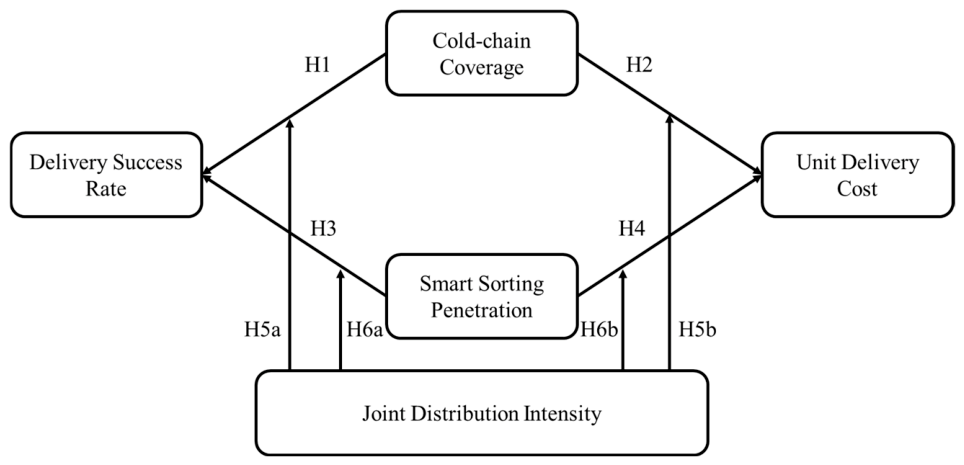
Hypothesis 1 (H1). Cold chain coverage has a significant positive impact on the delivery success rate.
The underlying mechanism of cold chain coverage on unit delivery costs. Regarding the impact of cold chain coverage on unit delivery costs, traditional academic perspectives often fall into a linear mindset that “high asset specificity inevitably penalizes operational costs”. However, grounded in resource orchestration theory, under a highly integrated and vertically scheduled network environment governed by a single entity, cold chain coverage can activate deeper cost-reduction mechanisms through the organic bundling and restructuring of network elements.
The mechanism of “fixed cost amortization under network integration”: The initial deployment of refrigerated vehicles, cold storage nodes, and temperature monitoring systems admittedly incurs substantial specific asset depreciation and sunk costs. Yet, within a circulation network characterized by a mature three-tier network architecture, as the cold chain coverage rate climbs, the continuous volume of business passing through the outlets provides high-frequency “capacity fulfillment” for these cold chain hardware assets. Once the business scale surpasses a critical threshold, high-density parcel flows rapidly dilute the single-item fixed asset depreciation and daily energy consumption outlays, transforming upfront heavy-asset pressures into scale economy dividends.
Enhanced “error governance cost” mechanism: Spoilage resulting from ambient-temperature delivery of temperature-sensitive parcels is frequently accompanied by exorbitant reverse logistics costs (such as return delivery), customer compensation fees, and the labor costs of misdelivered re-routing. The rigid control over delivery quality exerted by cold chain systems causes a massive collapse of reverse and punitive variable expenses generated by product damage, achieving a systematic net cost reduction through the implicit governance channel of “error-proofing”. Accordingly, this study proposes the following hypothesis:
Hypothesis 2 (H2). Cold chain coverage has a significant negative impact on unit delivery costs.
3.2. Intelligent Sorting and Logistics Performance
The systematic enhancement of terminal delivery quality through intelligent technology application (such as intelligent sorting systems, IoT monitoring, and path optimization algorithms) primarily relies on the following three layers of digital empowerment mechanisms: The “precision identification and error governance at the source” mechanism: Traditional terminal delivery often suffers from a high frequency of mis-sorting, omissions, and cross-warehouse package mismatches due to manual sorting fatigue and human visual errors, which constitutes the core technical pain point leading to first-time delivery failures. Conversely, the intelligent sorting system comprehensively utilizes rigid standardized technologies such as Optical Character Recognition (OCR) and robotic arm precision gripping to achieve automated, second-level reading of package barcodes and error-free classification. This enables long-tail packages to seamlessly and precisely match the correct delivery routes and couriers, blocking error transmission at the operational source and improving the accuracy of first-time delivery [
40]. The “algorithmic scheduling and precise spatio-temporal coupling” mechanism: Terminal distribution faces a complex many-to-many urban–rural geographic space, where traditional dispatching heavily relies on the localized experience of individual couriers, frequently missing the optimal delivery windows due to redundant routing or disordered spatio-temporal alignment. Dynamic routing optimization algorithms can compute globally optimal solutions based on real-time traffic conditions, immediate outlet workloads, and customer profile characteristics, outputting precise, minute-level terminal delivery schedules. This tightly coupled spatio-temporal delivery scheme shortens package transit times and minimizes customer rejections or secondary redistributions caused by the “spatio-temporal mismatch between couriers and cargo.”. The “dynamic perception and full-process visualized early warning” mechanism: Relying on IoT monitoring and smart sensing technologies, the logistics network achieves a “transparent” operation across the entire operational chain. The management dashboard can sense vehicle locations, cargo statuses, and external weather fluctuations in real time, executing millisecond-level proactive early warnings and dynamic re-adjustments for potential delays or anomalies (such as severe weather and traffic congestion). This highly elastic technical resilience enhances the anti-interference capability of the terminal network, ensuring a stable and reliable service experience. Based on the above analysis, this study proposes the following hypothesis:
Hypothesis 3 (H3). Intelligent technology application has a significant positive impact on the delivery success rate.
Regarding the impact of intelligent technology on operational costs, conventional wisdom frequently focuses on the exorbitant upfront fixed asset investments—such as equipment procurement, system integration, and organizational alignment—arguing that it deteriorates the firm’s cost structure in the short term. However, from a long-term dynamic evolutionary perspective, as the depth of technological application scales up and synergizes organically with business volume, intelligent technology will exhibit robust factor substitution and cost-hedging dividends: The mechanism of “long-cycle amortization of hardware and software assets alongside scale dividends”: Although the deployment of intelligent sorting and digital management hubs represents a classic heavy-asset investment, during the multi-year observation period of deep network advancement within the case city, the steady stream of parcels flowing through the outlets provided saturated “capacity fulfillment” for this digital foundation as intelligent processing volume continuously expanded. Once the processing scale surpasses the break-even threshold, the rigid fixed costs of upfront system deployment are diluted by the massive volume of high-frequency operations, converting into scale dividends characterized by increasing marginal returns. The mechanism of “rigid labor substitution and operational efficiency extraction”: As a typical labor-intensive industry, urban–rural terminal logistics has long endured the rigid pressure of escalating costs driven by the depletion of the demographic dividend and rising per capita wages. The introduction of automated equipment shatters the linear growth paradigm that “growth in business volume must be accompanied by an equivalent expansion of personnel”. It achieves low-marginal-cost machine substitution in warehousing and dispatching segments, where labor intensity is highest. Moreover, the average daily mileage per vehicle is significantly curtailed via algorithmic reconfiguration, fundamentally reducing substantial fuel energy consumption and labor-hour costs. The mitigation of misallocation friction losses: Mis-sorting and missed deliveries caused by non-standardized manual operations incur exorbitant implicit governance costs in subsequent stages, including the transport capacity wasted on the reverse logistics of anomalous packages, double labor penalties for re-routing misdirected shipments, and customer compensation losses. Through full-process “error-proofing” and “standardization constraints,” intellectualization fundamentally uproots these circulation friction losses induced by non-compliant operations, achieving a systematic net cost reduction through the channel of implicit leakage control. Accordingly, this study proposes the following hypothesis:
Hypothesis 4 (H4). Intelligent technology application has a significant negative impact on unit delivery costs.
3.3. The Moderating Role of Joint Distribution
Joint distribution, widely endorsed as a prominent organizational model for integrated urban–rural logistics development, leverages inter-organizational resource sharing, capacity integration, and terminal outlet co-construction to reduce the long-tail costs associated with the rural logistics “last mile” through intensive operations. However, from the perspectives of New Institutional Economics (NIE) and network governance theory, joint distribution not only generates collaborative benefits but also fundamentally reshapes the governance architecture of terminal networks. Specifically, it transforms a “rigid integrated network” controlled by a single entity into a “distributed shared network” characterized by strategic interactions among heterogeneous stakeholders.
Although joint distribution can theoretically generate positive synergy effects through resource pooling, improved asset utilization, and reduced duplicated infrastructure investment, we argue that the negative moderating mechanism is more likely to dominate in the context of urban–rural logistics networks. This is because cold chain infrastructure and intelligent sorting systems represent highly specialized resources whose value creation depends heavily on operational standardization, information integration, and process consistency.
Compared with vertically integrated logistics networks operated by a single organization, joint distribution involves multiple heterogeneous actors with different operational procedures, information systems, and incentive structures. As collaboration intensity increases, maintaining standardized processes requires additional coordination efforts and governance arrangements. When these coordination requirements exceed the efficiency gains generated by resource sharing, joint distribution may weaken rather than enhance the performance returns of specialized and digital capabilities.
Therefore, although joint distribution may create positive scale effects under effective governance conditions, we expect its dominant moderating role in the current setting to be negative because coordination frictions associated with multi-agent collaboration are particularly relevant for technology-intensive and asset-specific logistics capabilities.
According to transaction cost economics (TCE), the embedding of multiple heterogeneous agents inevitably triggers a significant escalation in transaction outlays, including information communication, interest alignment, cross-boundary responsibility delineation, and inter-firm compliance enforcement. Consequently, joint distribution intensity (Joint) is far from a mere catalyst for efficiency; rather, it functions as a critical cross-organizational shared governance contingency variable. It profoundly constrains and reshapes the boundary conditions governing the conversion of a firm’s internal asset capabilities (cold chain coverage and intelligent technology application) into ultimate operational performance, potentially inducing a systemic “synergy trap”.
When cross-boundary networked shared governance (joint distribution) runs in parallel with specialized services characterized by high asset specificity (cold chain coverage), it is highly susceptible to imposing an asymmetric dilutive penalty on the quality-improving and cost-reducing dividends that the cold chain is supposed to unleash, primarily due to “organizational governance friction”.
On one hand, an escalation in joint distribution intensity exerts a “negative dilution” effect on the quality assurance function of cold chain coverage. As a quintessential heavy-asset specific investment, the value creation of cold chain logistics depends tightly on the end-to-end continuity of temperature control and the rigid alignment of operational specifications. However, when terminal outlets introduce large-scale, cross-boundary joint distribution (such as loose postal–express cooperation or multi-station integration), the operational heterogeneity of diverse logistics entities (e.g., postal operations and private express companies) begins to interfere with the temperature-controlled chain. Delivery personnel from different firms often struggle to achieve complete compliance in micro-operations such as non-standardized handling, handover verification, and refrigeration equipment calibration. High-frequency cross-boundary handovers within this distributed network significantly amplify information asymmetry, making it remarkably easy to induce latent “broken chain” quality risks during workflow transitions, which subsequently dilutes and weakens the positive quality dividends of cold chain coverage on the delivery success rate (DS). Accordingly, this study proposes the following hypothesis:
Hypothesis 5a (H5a). Joint distribution intensity negatively moderates the positive relationship between cold chain coverage and the delivery success rate.
On the other hand, high-intensity joint distribution generates substantial cross-organizational transaction costs, thereby eroding the space for cold chain cost optimization. As previously noted, within a single-controlled network, cold chain coverage can achieve a net cost reduction through integrated general-and-cold capacity scheduling. However, when the network evolves into a multi-party shared configuration, in order to sustain the rigid continuity of the cold chain within a collaborative chain rife with potential opportunistic behaviors, a single focal actor (e.g., the postal outlet) is compelled to inject massive implicit administrative resources and coordination efforts into cross-organizational contract design, rigorous process monitoring, and dispute enforcement regarding cargo damage liability. Economically, such skyrocketing cross-organizational transaction costs, triggered by blurred organizational boundaries, impose an “offsetting penalty” on the economies of scale and fixed cost amortization mechanisms unlocked by cold chain capacity reconfiguration. In the empirical model, this manifests as a significantly positive interaction term, indicating that the cost-saving dividends of the cold chain are hindered and diluted. Accordingly, this study proposes the following hypothesis:
Hypothesis 5b (H5b). Joint distribution intensity positively moderates the relationship between cold chain coverage and the unit delivery cost (i.e., weakening the cost-reduction effect of cold chain coverage).
Similarly, a profound conflict in managerial logic and systemic adaptation friction exists between centralized decision-making standardized technological assets (intelligent technology application) and the distributed shared network governance mode (joint distribution). First, the complexity of joint distribution networks tends to impair the positive effect of intelligent technology application on delivery service quality. The efficiency release of standardized assets—such as automated sorting, IoT tracking, and algorithmic path optimization—is strictly contingent upon clean, complete, and unified data interfaces, as well as a centralized command-and-control black box. Yet, in multi-agent joint distribution scenarios, participating enterprises operate independently. Their underlying heterogeneous information systems, non-standardized barcode dimensions, and fragmented operational rules can easily generate institutional “data silos” at terminal network intersections. When heterogeneous general freight flows and non-standardized parcels flood into the shared delivery network at high frequencies, the technology platform fails to execute end-to-end, seamless dynamic data sensing. This causes the centralized internal smart algorithms of the outlets to suffer from “algorithmic mismatch” and decision latency when confronting distributed multi-agent dispatching, thereby diluting the technological dividends of intellectualization on improving the terminal delivery success rate (DS). Accordingly, this study proposes the following hypothesis:
Hypothesis 6a (H6a). Joint distribution intensity negatively moderates the positive relationship between intelligent technology application and the delivery success rate.
Second, the inter-organizational alignment and contractual conflict costs generated by multi-agent collaboration significantly cannibalize the economic value of digital transformation. The essence of intellectualization-driven cost reduction lies in utilizing standardized workflows to eliminate circulation leakage and achieve the long-cycle amortization of fixed inputs. However, within high-intensity joint distribution networks, due to the lack of unified revenue-sharing and coordination mechanisms, the residual claim and control rights spawned by technological upgrading can hardly be equitably allocated across the collaborative network. Strategic gaming behaviors among distinct agents regarding system interface upgrade cost-sharing and the symmetric allocation of operational liabilities create exorbitant ex-ante search and negotiation costs, alongside severe ex-post monitoring and execution friction. Such massive inter-firm governance friction outlays escalate rapidly in the short term, directly offsetting and outplaying the marginal cost-saving dividends engineered by intelligent hardware through machine-for-human substitution and error elimination. This induces a “synergy trap” at the empirical level, wherein the net cost-reduction dividends of intellectualization are markedly eroded as joint distribution intensity increases. Accordingly, this study proposes the following hypothesis:
Hypothesis 6b (H6b). Joint distribution intensity positively moderates the relationship between intelligent technology application and the unit delivery cost (i.e., weakening the cost-reduction effect of intelligent technology application).
The conceptual framework and the hypothesized relationships among logistics capabilities, joint distribution intensity, and operational sustainability are presented in
Figure 1.
4. Research Design
4.1. Data, Sample, and Variable Measurement
This study utilizes granular operational data from a municipal branch of China Post, located in a representative agricultural and demographic region, from 2017 to 2023 to construct an outlet-level unbalanced panel dataset. The sample covers 150 terminal operating outlets spanning urban districts, rural towns, and village-level stations, yielding a total of 10,950 outlet-month observations. This comprehensive dataset effectively captures the cross-sectional dynamics and operational traits of urban–rural logistics networks.
The research data are integrated from three primary channels: the Internal Corporate Operational Database: Used to extract core operational metrics for each branch, including distribution volumes, localized operational outlays, cold chain facility construction, and the deployment velocity of intelligent equipment. Local Statistical Yearbooks and Bulletins: Used to obtain macro-level control variables, such as regional economic development indicators and transportation infrastructure capacity. Public Meteorological Databases: Used to capture exogenous environmental shocks, specifically the monthly frequency of extreme weather events. The fusion of these multi-source datasets mitigates potential omitted variable bias and enhances the empirical reliability of the causal identification. To ensure data integrity, the raw dataset underwent a standardized preprocessing procedure. First, observations with missing values in any key variables were excluded from the sample. Second, to eliminate the distorting influence of outliers, all continuous variables were subjected to a 1% two-sided Winsorization. Finally, to eliminate the confounding effects of price level fluctuations over the seven-year period, all monetary variables were deflated using the regional consumer price index with 2017 as the base year.
Grounded in the aforementioned theoretical framework, the variables in this study are classified into four main categories. The key variables of interest are identified based on their theoretical roles in the proposed research framework rather than statistical criteria. Specifically, the selection of key variables follows the logic that logistics capabilities represent resource inputs, joint distribution represents the organizational governance context, and operational sustainability represents the performance outcomes.
Accordingly, this study includes five key variables of interest. The dependent variables are delivery success rate and the unit delivery cost, which capture the two dimensions of operational sustainability: service reliability and economic efficiency. The core independent variables are cold chain coverage and smart sorting penetration, representing specialized logistics capabilities and digital technology capabilities, respectively. The moderating variable is joint distribution intensity, which captures the degree of inter-organizational collaborative governance.
The control variables are included to mitigate potential omitted variable bias and cover parcel characteristics, outlet structural traits, exogenous environmental conditions, and regional economic development indicators. The detailed definition and measurement of each variable are reported in
Table 1.
For the key explanatory variables, cold chain coverage and smart sorting penetration are constructed based on outlet-level operational records provided by the postal network. Cold chain coverage is measured as the proportion of parcels transported through temperature-controlled channels relative to the total parcel volume handled by each outlet in a given month. This measure captures the extent to which an outlet’s logistics operations rely on temperature-controlled transportation capabilities.
Smart sorting penetration is measured as the proportion of parcels processed through intelligent sorting equipment relative to the total parcel volume handled by each outlet in a given month. This indicator reflects the degree of adoption and utilization of intelligent sorting technologies in terminal logistics operations. A higher value indicates that a larger share of parcel processing relies on standardized and technology-enabled sorting procedures.
Both variables are measured at the outlet-month level, allowing the analysis to capture temporal variations in logistics capability deployment across outlets. These operational measures reflect actual utilization rather than merely the presence of logistics infrastructure or technology availability, making them particularly suitable for examining how resource capabilities are converted into operational performance.
Table 2 reports the descriptive statistics for the principal variables used in the empirical analysis. An overview of the dataset confirms that no anomalous outliers exist across the distributions, and the standard deviations reside within highly reasonable ranges. This confirms that the unbalanced panel sample exhibits an appropriate degree of statistical dispersion, establishing a reliable data foundation for the subsequent econometric estimations.
4.2. Econometric Model Specification
To examine the impacts of cold chain coverage and intelligent technology application on logistics operational performance, this paper employs a two-way fixed-effects model for estimation, so as to control for unobserved heterogeneity at the logistics outlet level and annual common shocks. All empirical analyses were conducted using Stata 18.0. The baseline model is specified as follows:
where the subscripts i and t denote the logistics outlet and month, respectively. Y
it represents the logistics operational performance of outlet
i in period t, operationalized alternately by the delivery success rate (Delivery success rate) and unit delivery cost (Unit cost). Cold chain coverage
it and Smart sorting penetration
it serve as the core independent variables, representing the cold chain coverage rate and intelligent technology application level, respectively; Controls signifies the vector of control variables. To further examine the contingency effects of the organizational governance environment, interaction terms are integrated into the econometric specifications. Where Joint
it represents the joint distribution intensity, and the interaction terms are utilized to test whether joint distribution alters the impacts of cold chain coverage and intelligent technology application on logistics operational performance. A statistically significant coefficient on the interaction term indicates the presence of a significant moderating effect. Considering that potential serial correlation may exist among observations within the same logistics outlet across different periods, this study employs clustered robust standard errors at the logistics outlet level for statistical inference to enhance the empirical robustness of parameter estimations.
5. Empirical Results
5.1. Benchmark Results
This study first employs a two-way fixed effects model to examine the direct impacts of cold chain coverage and intelligent technology application on logistics operational performance; the empirical results are reported in
Table 3. Models (1) to (4) alternatively investigate the impacts of the cold chain coverage rate and intelligent sorting penetration on the delivery success rate and unit delivery cost. All econometric specifications rigorously control for outlet fixed effects and time fixed effects, encompassing an unbalanced sample of 10,950 outlet-month observations. Regarding the goodness-of-fit, the R
2 values across the models range from 0.887 to 0.950, indicating that the empirical models exhibit strong explanatory power for variations in logistics operational performance. Furthermore, the estimated coefficients of the core independent variables demonstrate a high degree of statistical significance, establishing a robust foundation for the subsequent analysis of the moderating role of joint distribution.
The impacts of cold chain coverage and intelligent technology on the delivery success rate. The empirical results in Models (1) and (3) demonstrate that the estimated coefficients for cold chain coverage (cold chain coverage) and intelligent sorting penetration (smart sorting penetration) are 0.044 and 0.065, respectively, both of which are statistically significant at the 1% level. This indicates that, after controlling for other confounding factors, expanding cold chain coverage and advancing intelligent technology applications can significantly elevate the delivery success rate of the logistics network. Specifically, an increase in the cold chain coverage rate implies that logistics enterprises possess more robust temperature-controlled transit capabilities, which helps mitigate in-transit cargo damage risks and enhance the reliability of distribution services. Concurrently, intelligent sorting technology optimizes information processing efficiency and operational accuracy, thereby reducing manual operational errors and reinforcing the stability of the entire logistics flow. Therefore, both cold chain capabilities and intelligent technology capabilities can effectively upgrade terminal logistics service quality. These findings empirically validate the theoretical expectations proposed in
Section 3, confirming that the appreciation of an enterprise’s resource capabilities actively drives the optimization of logistics operational performance. Consequently, Hypotheses H1 and H3 are fully supported.
The impacts of cold chain coverage and intelligent technology on unit delivery costs. Models (2) and (4) further examine the direct effects of these core elements on the operational cost dimension. The empirical results reveal that the estimated coefficient for the cold chain coverage rate is −0.003 (p < 0.01), and that for intelligent sorting penetration is −0.026 (p < 0.01), with both core coefficients being significantly negative at the 1% level.
Beyond statistical significance, the estimated coefficients also indicate economically meaningful performance improvements. Specifically, the coefficient of cold chain coverage on delivery success rate is 0.044, implying that a one percentage-point increase in cold chain coverage is associated with a 0.044 percentage-point increase in delivery success rate. Given that the average delivery success rate in the sample is 92.752%, as reported in
Table 2, a 10 percentage-point increase in cold chain coverage corresponds to approximately a 0.47% relative improvement in delivery success rate, which represents a meaningful improvement for logistics networks where service reliability is already relatively high.
Similarly, the coefficient of smart sorting penetration on delivery success rate is 0.065, suggesting that a 10 percentage-point increase in smart sorting penetration is associated with a 0.65 percentage-point increase in delivery success rate. Considering the large operational scale of postal logistics networks, even relatively small improvements in delivery reliability may translate into substantial reductions in failed deliveries and associated operational frictions.
Regarding cost efficiency, the coefficient of cold chain coverage is −0.003, indicating that greater utilization of temperature-controlled transportation is associated with lower unit delivery costs. Although the magnitude appears small, the cumulative effect can be economically relevant when applied to large-scale logistics networks with high parcel volumes. The coefficient of smart sorting penetration is −0.026, suggesting a stronger cost-reduction association, consistent with the labor-saving and standardization advantages of intelligent sorting technologies.
This finding strongly challenges the conventional industry stereotypes that “cold chain operations inevitably penalize operational costs” and that “digital transformation merely acts as an expensive cost center.” The underlying mechanism for this prominent net cost-reduction dividend at the baseline level resides in two aspects. First, it relies on the economies of scale generated by the highly integrated urban–rural postal network in the case city. In a network operated by a single entity and vertically coordinated, the daily general freight capacity of the outlets can be holistically scheduled and synergized with cold chain capacity. This significantly maximizes the loading rate and two-way transit efficiency of heavy-asset refrigerated vehicles, thereby successfully activating the fixed-cost amortization mechanism. Second, the standardization and popularization of intelligent technology yield distinct temporal dynamics and variable cost-saving dividends. Throughout the long-cycle observation period from 2017 to 2023, as the depth of technology adoption scaled past the initial implementation phase, the rigid upfront expenditures on system integration and hardware deployment were continuously diluted by high-frequency business volumes. Meanwhile, marginal dividends—driven by the sharp reduction in variable costs related to secondary re-routing, returns, and mis-delivery compensations caused by human errors, alongside machine-for-labor substitution—began to dominate, ultimately driving a significant decrease in unit delivery costs.
In conclusion, the baseline regression results clearly delineate that within a highly integrated and centralized network operated by a single focal entity, specialized services and technological empowerment can generate an ideal state of simultaneous optimization in both service value and cost efficiency; thus, Hypotheses H2 and H4 are confirmed. Crucially, the maintenance of this optimal state heavily depends on the structural integration and completeness of the existing network governance configuration. This establishes a logically seamless baseline for subsequently exploring whether the system will trigger a “synergy trap” and dilute these dividends when the network governance mode transitions into a multi-agent, distributed “joint distribution” shared network.
5.2. Moderating Effect Test
To further examine how the organizational governance environment shapes the transmission of resource capabilities into logistics performance, this study introduces joint distribution intensity (Joint) as a moderating variable. We systematically test its moderating impacts on the relationships linking cold chain coverage and intelligent technology application to logistics operational performance. The empirical results of the moderating effects are reported in
Table 4.
The moderating effects of joint distribution intensity on cold chain assets. Models (1) and (2) report the interactive effects of joint distribution intensity on the performance release of highly asset-specific cold chain resources.
Regarding the service quality dimension (Column 1): The interaction coefficient between the cold chain coverage rate and joint distribution intensity is −0.003, which is statistically significant and negative at the 5% level. This finding indicates that an increase in joint distribution intensity exerts a significant negative moderating (dilutive) effect on the original quality-enhancing impact of the cold chain, thereby validating theoretical Hypothesis H5a. The underlying mechanism is that cold chain logistics entails extremely high asset specificity and strict continuity of temperature control, and its value creation depends heavily on uniform, standardized operational specifications. When terminal outlets deeply integrate into a multi-agent joint distribution network (such as executing loose postal-express cooperation), the heterogeneous operational habits, loose handover processes, and disparate equipment standards of diverse carriers can easily induce latent “broken chain” quality risks within workflow transitions, thereby compromising the rigid capability of the cold chain to safeguard the delivery success rate.
Regarding the operational cost dimension (Column 2): The interaction coefficient between the two variables is 0.002, which is statistically significant and positive at the 1% level. Given that the main effect of cold chain coverage on the unit delivery cost in the baseline regression is significantly negative (−0.010), this positive interaction coefficient economically implies that joint distribution intensity weakens the original cost-reduction dividends of the cold chain, supporting theoretical Hypothesis H5b. According to the logic of transaction cost economics, to maintain the rigid quality of specific assets within a shared distribution network fraught with multi-party strategic gaming, enterprises are compelled to invest substantial implicit administrative resources in cross-organizational contract design, full-process monitoring, and dispute enforcement friction. The resulting surge in transaction outlays imposes an “offsetting penalty” on the cold chain’s inherent economies of scale, preventing its unit cost advantage from being fully amortized.
The moderating effects of joint distribution intensity on intelligent technology. Models (3) and (4) further examine the conflict and constraint patterns between joint distribution and the empowerment efficacy of standardized intelligent technology.
Regarding the service quality dimension (Column 3): The interaction coefficient between intelligent sorting penetration and joint distribution intensity is −0.002, which is significantly negative at the 1% level. This demonstrates that joint distribution significantly impairs the positive effect of intelligent technology on the delivery success rate, aligning with the theoretical expectations of Hypothesis H6a. A plausible explanation is that the efficiency release of standardized assets, such as automated sorting and precision algorithmic path planning, is strictly contingent upon centralized rigid commands and a clean, closed-loop standardized data environment. However, high-density cross-organizational joint distribution imparts a distributed character to the terminal network. The distinct operational workflows and heterogeneous information systems of various private express entities give rise to pronounced “information silos.” Consequently, the centralized algorithmic dispatch schemes encounter high-frequency friction and decision latency during actual front-line operations, thereby diluting the technological dividends of intelligent technology on service reliability.
Regarding the operational cost dimension (Column 4): The interaction coefficient is statistically significant and positive at the 1% level. Since the main effect of intelligent technology is negative, this indicates that joint distribution intensity significantly suppresses and weakens the net cost-reduction dividends that intellectualization should have yielded, supporting Hypothesis H6b. This forcefully demonstrates a structural tension in managerial logic between multi-agent distributed collaboration and the centralized standardized technology inside the outlets. Under multi-agent collaborative operations, opportunistic behaviors driven by heterogeneous information system adaptation, the mixed handling of non-standardized parcels, and inequitable cross-organizational revenue sharing significantly escalate inter-firm adaptation costs. In the short term, these exorbitant organizational adaptation transaction costs override and cannibalize the comprehensive factor dividends created by intellectualization through labor substitution and routing optimization.
Joint interpretation of the moderating effects. Taken together, the interaction estimates indicate that higher joint-distribution intensity attenuates the estimated service-quality and cost-efficiency returns to cold chain coverage and intelligent sorting. We interpret this pattern as a governance-induced attenuation effect rather than direct evidence of the specific coordination mechanisms discussed above.
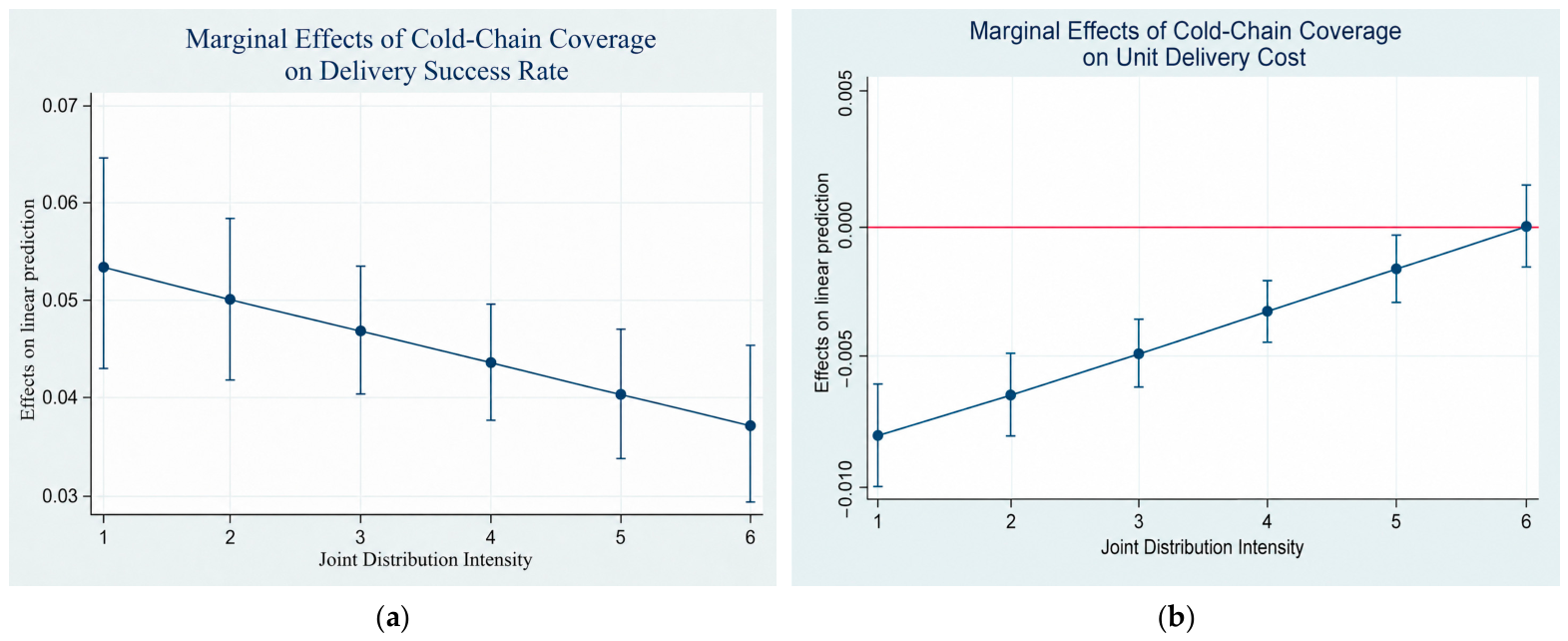
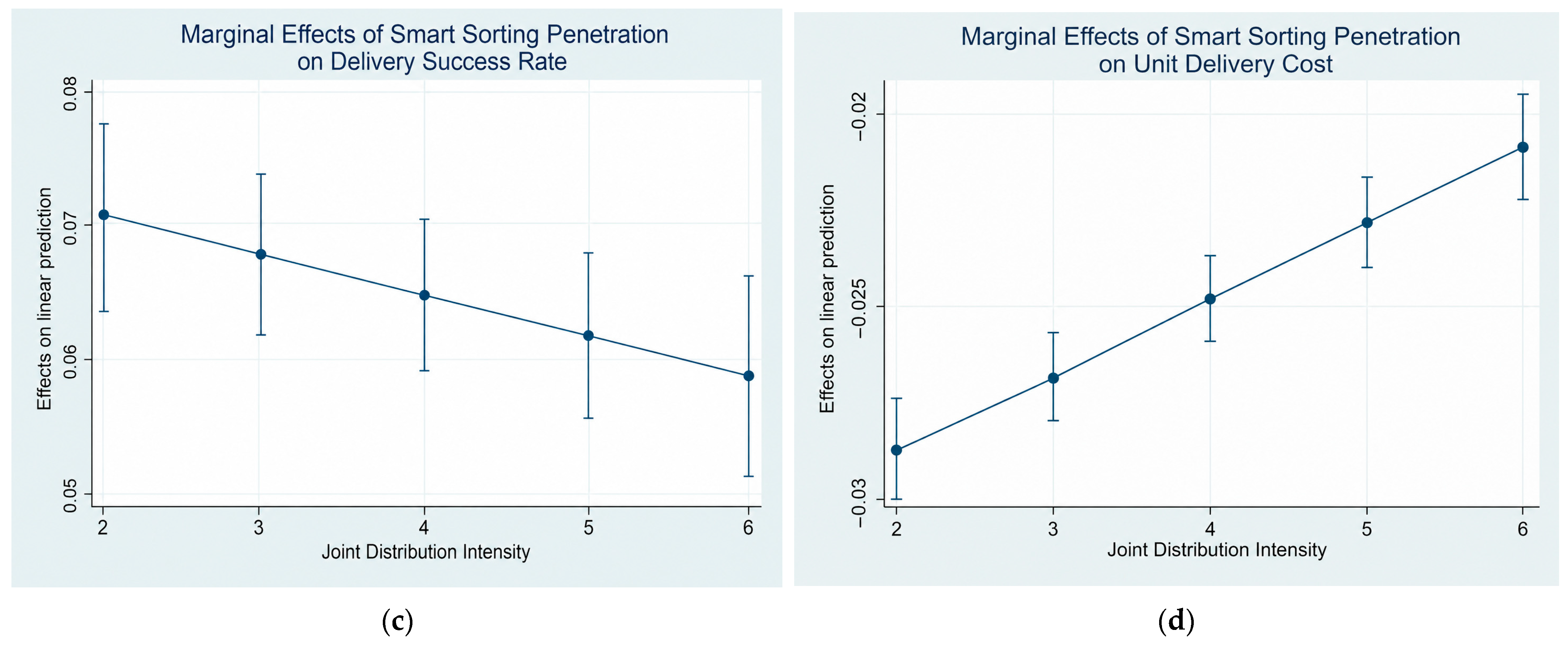
To further illustrate how the moderating effects vary across different levels of joint distribution intensity, we plot the marginal effects of cold chain coverage and intelligent sorting penetration at different levels of joint distribution intensity (
Figure 2). The marginal effect plots show that the performance-enhancing effects of both logistics capabilities gradually decline as joint distribution intensity increases. Specifically, the positive association between cold chain coverage and delivery success rate becomes weaker with increasing joint distribution intensity, while its cost-reduction association is progressively attenuated. A similar pattern is observed for intelligent sorting penetration.
Comparing the magnitude of the moderating effects, the interaction coefficients suggest that joint distribution exerts a stronger moderating influence on the cost dimension than on the service-quality dimension. For cold chain coverage, the interaction coefficient is −0.003 for delivery success rate and 0.002 for unit delivery cost. For intelligent sorting penetration, the corresponding coefficients are −0.002 and 0.005, respectively. This indicates that coordination frictions associated with joint distribution may have a particularly strong influence on the conversion of specialized and digital resources into cost efficiency gains.
Taken together, the interaction estimates indicate that resource pooling and technological investment do not necessarily produce additive performance gains. A plausible interpretation is that shared distribution networks introduce additional requirements for operational standardization, information compatibility, and responsibility allocation. These organizational conditions may attenuate the returns to outlet-level cold chain and intelligent-sorting investments. The results therefore emphasize alignment between resource attributes and cross-organizational governance.
To provide a concise overview of the hypothesis evaluation,
Table 5 summarizes the empirical results of all hypotheses. The results indicate that all six hypotheses receive empirical support. Specifically, cold chain coverage is positively associated with delivery success rate and negatively associated with unit delivery cost, supporting H1 and H2. Similarly, intelligent sorting penetration demonstrates positive associations with service reliability and negative associations with unit delivery cost, supporting H3 and H4. Furthermore, the interaction results show that joint distribution intensity negatively moderates the relationships between logistics capabilities and operational performance, supporting H5a, H5b, H6a, and H6b.
5.3. Robustness Checks
To verify whether the baseline regression results are sensitive to model specifications, sample selection biases, or anomalous observations, this study conducts a battery of robustness checks. Specifically, we re-estimate the relationships between the core independent variables and logistics operational performance by excluding specialized subsamples and applying alternative outlier handling treatments, respectively.
Table 6 and
Table 7 report the empirical results of the robustness tests for the cold chain coverage rate and intelligent sorting penetration, respectively.
Robustness results for cold chain coverage.
Table 6 shows that the coefficient of cold chain coverage remains positive for delivery success and negative for unit delivery cost under both alternative outlier handling and the restricted-sample specification. The corrected coefficient in Column (2) is 0.007 (
p < 0.01). The consistency of coefficient signs and statistical significance supports the baseline associations.
Robustness results for intelligent sorting.
Table 7 reports the results under alternative outlier handling in Columns (1) and (3) and after excluding outliers in Columns (2) and (4). Intelligent sorting penetration remains positively associated with delivery success and negatively associated with unit delivery cost across all four specifications. The signs and statistical significance are consistent with the baseline estimates.
5.4. Heterogenity Analysis
The preceding analysis demonstrates that cold chain coverage and intelligent technology application can significantly enhance logistics operational performance. Nevertheless, owing to distinct regional disparities in industrial foundations, demand structures, and spatial organizational configurations, identical resource endowments may yield divergent performance outcomes. Consequently, this study further investigates the heterogeneous performance of logistics capability construction across diverse regional contexts.
Considering the industrial and spatial variation within the study region, the heterogeneity analysis uses two dimensions. The industrial dimension distinguishes agricultural from non-agricultural counties. The spatial dimension distinguishes geographically concentrated service areas, where outlets and parcel flows are relatively clustered, from geographically dispersed service areas characterized by scattered settlements and larger delivery radii. The corresponding subsample estimates are reported in
Table 8 and
Table 9.
Table 8 reports subsample estimates for cold chain coverage. In agricultural counties, cold chain coverage is positively associated with delivery success and negatively associated with unit delivery cost, whereas the corresponding estimates for non-agricultural counties are not statistically significant. In spatial terms, the performance-enhancing associations are concentrated in geographically concentrated service areas: cold chain coverage is associated with a higher delivery success rate and a lower unit delivery cost. The corresponding estimates for geographically dispersed areas are not statistically significant.
The agricultural county indicator and spatial concentration indicator used in this study were provided by the data provider based on enterprise-level operational information. Due to confidentiality restrictions, the underlying continuous measures of agricultural intensity and spatial concentration cannot be directly accessed. Therefore, the heterogeneity analysis relies on enterprise-defined classification indicators rather than continuous interaction measures.
One possible explanation is that concentrated agricultural demand raises the utilization of cold chain assets and facilitates the allocation of fixed operating costs across a larger volume of temperature-sensitive parcels. More specifically, agricultural logistics demand differs from general logistics demand in several important aspects, including higher perishability, stronger seasonality, and greater sensitivity to transportation delays. These characteristics increase the marginal value of cold chain infrastructure because temperature-controlled transportation can reduce quality deterioration risks and improve delivery reliability. This mechanism is theoretically plausible but is not tested directly because asset utilization and product-loss measures are unavailable in the present analysis.
The estimates for geographically concentrated areas are consistent with the possibility that spatial concentration increases shipment density, improves vehicle and cold chain capacity utilization, and facilitates fixed-cost allocation. In addition, geographically concentrated service areas may benefit from shorter delivery radii and more stable parcel flows, which allow specialized logistics assets to achieve higher utilization rates and stronger scale economies.
Table 9 reports subsample estimates for intelligent sorting penetration. In agricultural counties, intelligent sorting penetration is positively associated with delivery success and negatively associated with unit delivery cost; neither association is statistically significant in non-agricultural counties. The same pattern appears across spatial groups: intelligent sorting is associated with higher delivery success and lower unit cost in geographically concentrated service areas, whereas the corresponding estimates for geographically dispersed areas are not statistically significant.
A plausible interpretation is that concentrated and frequent agricultural parcel flows improve the utilization of intelligent sorting equipment, allowing standardized processing and fewer sorting errors to translate into better operational outcomes. The demand characteristics of agricultural products, including seasonal concentration and relatively standardized distribution requirements, may further enhance the effectiveness of intelligent sorting systems by increasing processing volume and reducing operational uncertainty. In geographically concentrated service areas, denser parcel flows may increase equipment utilization and allow standardized sorting to generate stronger scale economies.
Given the confidentiality constraints of the enterprise data, we are unable to construct continuous measures of agricultural intensity, shipment density, or spatial concentration for additional interaction analyses. Future research using more granular logistics data could further examine whether these mechanisms operate through continuous variations in demand characteristics and network density.
Overall, the subsample estimates show that the performance associations of cold chain coverage and intelligent sorting are concentrated in agricultural counties and geographically concentrated service areas. This pattern is consistent with the importance of demand density and spatial concentration for asset utilization and operational efficiency.
These subsample results indicate that local industrial demand and spatial network concentration condition the operational returns on logistics investments.
From a managerial perspective, the results favor context-sensitive investment rather than uniform deployment. Agricultural areas may benefit from aligning cold chain and sorting capacity with concentrated parcel demand, while geographically concentrated networks may be better positioned to convert infrastructure and intelligent sorting into higher delivery reliability and lower unit costs.
6. Discussion
6.1. Interpretation and Theoretical Contribution
The findings extend sustainable logistics research in two respects. First, they connect specialized infrastructure and digital capability with two dimensions of operational sustainability: service reliability and long-term cost efficiency. From the perspective of the resource-based view (RBV), this study extends existing research by showing that valuable logistics resources do not automatically generate performance advantages. Instead, the returns on specialized resources depend on whether firms can effectively deploy and utilize these capabilities in appropriate operational contexts. The findings demonstrate that cold chain coverage and intelligent sorting penetration represent important resource capabilities, but their performance value varies according to local demand characteristics and network conditions.
Second, this study contributes to transaction-cost theory (TCT) by demonstrating how inter-organizational governance conditions influence the conversion of internal capabilities into operational outcomes. While previous RBV-oriented studies often emphasize the value creation potential of strategic resources, our findings highlight that resource value realization can be constrained by coordination requirements arising from multi-agent collaboration. Specifically, joint distribution may generate resource-sharing benefits but may also introduce governance frictions that weaken the performance returns of specialized and digital capabilities. This finding extends TCT by showing that transaction costs do not merely affect organizational boundaries or collaboration decisions but also shape the effectiveness of capability deployment within collaborative logistics networks.
More broadly, this study integrates the RBV and TCT by developing a “Resource Capability–Organizational Governance–Logistics Operational Performance” framework. This framework suggests that logistics performance is determined not only by whether firms possess valuable resources but also by whether the surrounding governance environment enables these resources to be effectively transformed into operational benefits.
6.2. Sustainability and Managerial Implications
For rural logistics operators, the results suggest that technology investment and collaborative governance should be designed jointly. Cold chain capacity and intelligent sorting can support the economic and social dimensions of operational sustainability by lowering unit costs and improving reliable access to logistics services. Their benefits may be diminished, however, when collaborating organizations use incompatible information systems, operating standards, or responsibility-allocation rules. Standardized data interfaces, common handling protocols, and transparent cost- and revenue-sharing arrangements may therefore be as important as additional hardware investment.
More specifically, logistics managers should adopt a context-dependent investment strategy rather than uniformly deploying advanced logistics resources across all service areas. In agricultural-oriented areas with a high proportion of temperature-sensitive products, cold chain investment is likely to generate greater operational benefits because reducing product deterioration and delivery failures creates higher marginal value. In contrast, in areas with limited demand for temperature-controlled products, excessive cold chain deployment may result in underutilized assets and higher fixed operating costs.
Similarly, intelligent sorting investment should be prioritized in service areas with relatively concentrated parcel flows, where sufficient processing volume can improve equipment utilization and allow standardized operations to generate scale economies. For geographically dispersed areas with fragmented demand, logistics operators should carefully evaluate whether the expected efficiency gains can offset the fixed costs of technology adoption.
Furthermore, the moderating results indicate that infrastructure investment cannot be separated from governance arrangements. Although joint distribution can improve resource sharing and reduce duplicated logistics activities, higher collaboration intensity may also introduce coordination frictions. Therefore, before expanding joint distribution networks, managers should establish compatible information systems, standardized operating procedures, and clear cost- and revenue-sharing mechanisms to avoid weakening the returns on cold chain and digital investments.
Beyond operational improvements, future development of sustainable urban–rural logistics networks may also require broader environmental policy instruments. Recent research on green supply chain management highlights that appropriately designed economic incentives, such as transportation-based carbon penalties, can influence supply chain decisions and encourage emission-reduction behaviors while considering economic trade-offs [
41]. In the context of rural logistics, operational improvements generated by cold chain optimization, intelligent technologies, and collaborative governance could be complemented by carbon-related policy mechanisms that encourage low-carbon transportation choices and sustainable network configurations. However, because the present study does not directly measure energy consumption, emissions, or carbon-related outcomes, the environmental implications of these mechanisms remain beyond the scope of this analysis and warrant further investigation.
6.3. Limitations and Future Research
This study has several limitations. The sample comes from outlets within one regional postal network, which limits generalizability to other firms and institutional contexts. The observational fixed-effects design reduces bias from time-invariant outlet characteristics and common time shocks but cannot eliminate reverse causality or time-varying omitted variables.
Although outlet and time fixed effects control for stable differences across outlets and common temporal shocks, some time-varying factors may still influence both logistics capability deployment and operational performance. For example, changes in local market competition, managerial practices, business expansion strategies, or regional demand conditions may simultaneously affect the adoption of cold chain infrastructure and intelligent sorting technologies and the observed logistics outcomes. Therefore, the estimated relationships should be interpreted as conditional associations rather than definitive causal effects.
Future research could strengthen causal identification by exploiting exogenous variations in logistics technology adoption or organizational reforms. Potential approaches include instrumental variable strategies based on external shocks, difference-in-differences designs using staggered technology implementation, or natural experiments generated by policy changes affecting logistics infrastructure deployment.
The analysis measures intelligent technology using sorting penetration and therefore cannot isolate the effects of routing algorithms, Internet of Things monitoring, or other digital tools. In addition, potential measurement errors may exist in the key variables. Although cold chain coverage and smart sorting penetration are constructed from enterprise operational records, these measures may not fully capture the underlying quality, intensity, or effectiveness of the corresponding capabilities. For example, cold chain coverage reflects the proportion of parcels transported through temperature-controlled channels but does not directly measure temperature-control quality or loss prevention performance. Similarly, smart sorting penetration captures the proportion of parcels processed through intelligent equipment but does not fully reflect algorithm quality, system integration, or actual efficiency improvements. Measurement errors in these variables may attenuate the estimated coefficients and lead to conservative estimates of the relationships between logistics capabilities and operational performance.
The proposed governance mechanisms are theoretically inferred rather than directly measured. Finally, delivery success and unit cost capture operational sustainability but not environmental outcomes. Future research should combine operational records with parcel volume, labor input, vehicle mileage, energy use, emissions, product loss, and direct measures of inter-organizational coordination, and should exploit exogenous or staggered technology adoption where possible.
7. Implication and Conclusions
This study examined how cold chain coverage and intelligent sorting are associated with the operational sustainability of urban–rural logistics and how joint distribution conditions these relationships. Using monthly panel data from 150 outlets in a Chinese postal network during 2017–2023, the analysis considered delivery success as a service-reliability outcome and unit delivery cost as an economic-efficiency outcome.
The fixed-effects estimates show that greater cold chain coverage and intelligent sorting penetration are associated with higher delivery success rates and lower unit delivery costs. These findings suggest that specialized and digital logistics resources are positively associated with service reliability and cost efficiency in the observed logistics context. However, given the observational research design, these results should be interpreted as conditional associations rather than definitive causal effects.
The subsample estimates further suggest that these relationships vary across industrial and spatial contexts. Statistically significant performance improvements are concentrated in agricultural counties and geographically concentrated service areas. These findings indicate that logistics resource deployment should be matched with local demand characteristics and network conditions rather than uniformly implemented across regions. Specifically, cold chain investment is more likely to generate operational benefits in agricultural-oriented areas where temperature-sensitive products create stronger demand for quality preservation, while intelligent sorting investment may be more effective in geographically concentrated areas where higher parcel density and operational scale improve technology utilization.
Joint distribution intensity attenuates the estimated service-quality and cost-reduction associations of both cold chain coverage and intelligent sorting. Therefore, collaborative logistics arrangements should not focus solely on resource sharing but should also consider governance compatibility. Effective joint distribution requires standardized operating procedures, compatible information systems, and transparent responsibility and benefit-sharing mechanisms. The key trade-off is that joint distribution can improve resource utilization and reduce redundant investment while potentially increasing coordination requirements that weaken the returns of specialized and digital resources.
Several limitations should be acknowledged. The study relies on observational enterprise-level panel data from a single regional postal network, and fixed-effects models cannot fully eliminate potential bias arising from time-varying unobserved factors. In addition, the proposed governance mechanisms are theoretically interpreted rather than directly measured. Future research could combine more granular logistics data with stronger identification strategies, such as instrumental variables, policy shocks, or staggered technology adoption designs, to further examine causal mechanisms.
For managers, the practical implication is to coordinate physical infrastructure, digital systems, and collaborative governance rather than treating them as independent investments. Deployment decisions should reflect local demand density and network geography, while joint-distribution arrangements should include common data standards, operating protocols, and transparent allocation of responsibilities and returns.
For policymakers, support for rural logistics should combine infrastructure investment with interoperable digital platforms and shared operational standards. Such an integrated approach may strengthen the financial viability and service accessibility of rural logistics networks.