
Article

Burnt and Unburnt Ceramic Waste Powder with Magnetized Water for Durable and Sustainable Concrete


by
Seleem S. E. Ahmad
1,*,
Mahmoud Soliman
1,
Yasmine Elmenshawy
1 and
Mohamed A. R. Elmahdy
2
1
Faculty of Engineering, Zagazig University, Zagazig 44519, Egypt
2
Civil Engineering Department, Misr Higher Institute of Eng. & Tech, Mansoura 35516, Egypt
*
Author to whom correspondence should be addressed.
Sustainability 2026, 18(16), 8184; https://doi.org/10.3390/su18168184
Submission received: 2 July 2026 / Revised: 28 July 2026 / Accepted: 5 August 2026 / Published: 10 August 2026

Abstract

The combined use of ceramic waste powder (CWP) as a supplementary cementitious material and magnetized water (MW) as mixing water represents a promising strategy for producing sustainable concrete with reduced cement consumption while maintaining mechanical performance and durability. However, the synergistic effects of burnt ceramic waste powder (BCWP) and unburnt ceramic waste powder (UBCWP) combined with MW, particularly under aggressive environmental conditions, remain insufficiently investigated. This study evaluates the influence of BCWP and UBCWP, used as partial replacements for ordinary Portland cement (OPC) at replacement levels of 10%, 20%, and 30% by weight, together with conventional tap water (TW) and MW produced using a dual-field magnetic device (0.9 T and 1.5 T). A total of fourteen concrete mixtures were investigated through compressive strength tests at 7, 28, and 120 days; indirect tensile and flexural strength tests at 28 and 120 days; sulfate resistance after 120 days of MgSO4 immersion; residual strength after thermal exposure at 200 °C; and microstructural characterization using scanning electron microscopy (SEM), energy-dispersive X-ray spectroscopy (EDS), and X-ray diffraction (XRD). The results indicate that increasing the CWP replacement level progressively reduced the mechanical properties of concrete; however, MW consistently mitigated these reductions by promoting cement hydration and producing a denser cementitious matrix. The mixture containing 20% BCWP with MW achieved a 120-day compressive strength comparable to that of the TW control, demonstrating that cement consumption can be reduced without compromising structural performance. Furthermore, MW mixtures exhibited significantly improved durability, with compressive strength losses of only 16–28% after sulfate attack compared with up to 42% for TW mixtures, and 1–13% after thermal exposure compared with up to 53% for TW mixtures. SEM and XRD analyses confirmed the development of denser microstructures with enhanced C–S–H gel formation in MW–CWP concretes. Overall, the findings demonstrate that the synergistic combination of ceramic waste powder and magnetized water provides an effective strategy for producing sustainable concrete with enhanced long-term mechanical performance, improved durability under aggressive environmental conditions, and reduced environmental impact.

1. Introduction

Sustainable building practices significantly contribute to modern society by aiming to reduce the environmental impact of construction while also addressing the social and economic challenges related to the built environment [1,2]. Sustainable concrete is distinguished from traditional concrete by its incorporation of industrial, agricultural, and medical waste, or other resources [3,4]. Concrete is the most widely consumed manufactured material on Earth. Global production is of the order of 30 billion tonnes annually, and it is underpinned by a cement industry producing approximately 4.1 billion tonnes per year, which alone accounts for about 7–8% of global anthropogenic carbon dioxide emissions [5]. World ceramic tile production exceeds 17 billion square meters per year, and between 3% and 7% of the output of a typical plant is rejected or lost as powder during the forming, firing and polishing stages. The resulting waste is chemically inert, generated continuously at fixed industrial locations, and is at present largely landfilled at a cost to the producer [6,7]. From an economic perspective, while the conventional concrete sector accounts for a massive global market share exceeding USD 600 billion, the global green concrete market is expanding rapidly—valued at around USD 37 billion and forecasted to exceed USD 70–190 billion by 2030–2036. This growth reflects the economic transition toward valorizing waste streams into high-value construction components, thereby offsetting raw material costs and reducing environmental liabilities [8,9].
Using waste materials in sustainable recycled concrete, the overall greenhouse gas effect may be decreased, and a sustainable and healthy environment for future generations would result from the successful use of alternative materials whose production uses fewer natural resources, is more affordable, and harms the environment less when used as a binder in concrete [5]. Utilizing inorganic industrial waste to produce construction materials, particularly as raw materials for concrete production, is one of the most natural methods of recycling to reduce the amount of waste deposited and limit the processing of aggregate mineral deposits. This recycling method has benefits for the environment [10]. Many studies have been done on utilizing agricultural and industrial waste, such as rice husk ash, palm oil fuel ash (POFA), bagasse ash (BA), wood waste ash, bamboo leaf ash (BLA), corn cob ash (CCA), silica fume, fly ash, and slag [11,12,13,14,15]. Therefore, utilizing these recycled materials will reduce production costs and increase sustainability without significantly affecting the strength and durability of concrete. The construction industry is a major source of global CO2 emissions and natural resource consumption, largely due to the energy-intensive production of Portland cement. Consequently, the use of supplementary cementitious materials derived from industrial waste has become an effective strategy for reducing cement consumption, lowering environmental impacts, and advancing circular economy principles in concrete production [16].
The huge amounts of wasted ceramics produced every day are increasing pressure on the ceramics industry to develop effective solutions [6]. When ceramic materials from construction and demolition operations are thrown into landfills, they harm the environment [7,17]. Crushed ceramic waste can be used as a conventional aggregate or to replace a portion of a certain aggregate size [18,19,20], utilizing ceramic waste powder, a high-silica pozzolanic material, in place of some of the cement in the concrete mixture [21,22,23]. Cement was partially replaced with 0–40% ceramic waste powder (CWP) in concrete, and the results showed that increasing the replacement level reduced the 28-day compressive strength. The reductions were 2.7% and 17.3% when 10% and 40% of the cement were replaced with ceramic waste powder (CWP) [24].
Ceramic aggregate (CA) has high strength, wear and fire resistance, chemical inertness, long-term durability, and heat and abrasion resistance. It also has a low coefficient of thermal expansion [18]. In the previous study, the coarse and fine aggregates of concrete mixes were replaced with ceramic tiles. The results showed that after 28 days, the strength of concrete with 100% ceramic coarse aggregate (CCA) was approximately 36.1% higher than that of the control mix. In addition, the compressive strength of the ceramic fine aggregate (CFA) concretes increased with the replacement percentage of the aggregate, reaching 22.1% at 100% replacement [25]. The concrete used ceramic tile as a 15% replacement for fine aggregate, achieving optimum flexural and compressive strengths [26]. When concrete contains 50% recycled ceramic fine aggregates (CFA) and 75% recycled ceramic coarse aggregates (CCA), it exhibits higher compressive strength than standard concrete [27].
The compressive strength indicates that the optimum replacement of coarse aggregate is a combination of 1.5% superplasticizer and 50% ceramic waste aggregate, which gives a compressive strength higher than the concrete design strength by 0.06%, but the replacement of 50% of coarse aggregate with ceramic waste resulted in a reduction in the compressive strength of self-compacting concrete [28]. It has been shown that replacing 10–20% of cement with ceramic waste powder (CWP) gradually reduces the strength and durability of concrete due to the dilution effect, which affects hydration processes and increases overall porosity [29]. On the other hand, the compressive strength increased by 8.75% when 10% of cement was replaced with ceramic waste powder and decreased by 10.3% when 20% of cement was replaced with CWP [30]. Additionally, using ceramic waste powder as a 10% replacement in cement increases the compressive strength by 6.9% [31]. The performance of ceramic waste powder depends not only on the replacement level but also on its mineralogical composition, degree of crystallinity, and particle characteristics. Thermal treatment partially transforms crystalline phases into more reactive amorphous phases, thereby enhancing pozzolanic activity and promoting the formation of additional calcium silicate hydrate (C–S–H) during long-term curing. Consequently, burnt ceramic waste powder is generally expected to exhibit higher reactivity and superior mechanical performance than unburnt ceramic waste powder at equivalent replacement levels [6].
In recent years, magnetic water (MW) has been used in concrete manufacturing to improve its fresh, hardened, and durability properties [32,33,34]. When water passes through a constant magnetic field, it becomes magnetized, causing considerable changes in its molecular properties that, in turn, improve cement hydration and reduce the delay in setting time [35]. The compressive strength, splitting tensile strength, and flexural strength of concrete increased by 12.5%, 13%, and 9%, respectively, after 28 days of curing when magnetized water was used instead of ordinary tap water [36]. Using magnetic water with fly ash can increase the compressive strength of concrete by 15–20% at magnetic field strengths of 0.8 or 1.2 T [37]. Compared with tap water, using 2 T magnetized water increased compressive, split tensile, and flexural strengths by about 30% after 28 days, whereas using 0.986 T increased them by about 14% [38]. The application of magnetized water for 30 min increased the compressive strength by 2.2–6.8% and electrical resistivity by 4.6%, while the addition of 6% nano silica with magnetic water increased the compressive strength by 14.1%, electrical resistivity by 38.4%, and decreased mass loss and absorption by about 33% and 32%, respectively [39]. The use of magnetized water with 5% silica fume significantly improved the compressive and tensile strengths of concrete at 7 and 28 days, whereas a higher silica fume percentage (15%) reduced strength [33]. The effectiveness of magnetized water is particularly important for sustainable concrete incorporating supplementary cementitious materials, where enhanced hydration may compensate for the dilution effect associated with partial cement replacement and contribute to maintaining long-term mechanical performance and durability [40].
Despite the promising improvements reported for magnetized water, the mechanisms responsible for its influence on cement hydration and concrete performance have not yet been fully clarified. Most previous studies have primarily focused on mechanical properties, whereas relatively few have systematically correlated mechanical performance with microstructural characteristics under aggressive environmental conditions. Therefore, further investigations integrating mechanical, durability, and microstructural analyses are required to better understand the role of magnetized water in sustainable cementitious composites [41,42].
High temperatures affect concrete and can cause a component to lose bearing strength, significantly reduce mechanical properties, threaten structural stability, and perhaps lead to building collapse. Cracks and deformations should be visually monitored, and tests performed to assess concrete loss and strength [43]. At 200 °C, the residual compressive strength decreases to 80–90% of the initial value, and the residual compressive strength drops to around 70% of its initial value at 300 °C because of the breakdown of silicate hydrate. At temperatures of 500 °C or above, the dehydration of silicate hydrates occurs, leading to a decrease in residual compressive strength to 30–40% [44]. The residual compressive strength at higher temperatures is generally lower. At 400 °C, the residual compressive strength decreases rapidly to 60%, and then to 10% at 800 °C [45]. The compressive strength of air-entrained concrete (AEC) generally decreases with increasing temperature, and the reduction is more pronounced above 200 °C [43].
Magnesium sulfate attack enhances the vulnerability of concrete to degradation by generating significant amounts of corrosion products via magnesium ions and by engaging them in ion-exchange reactions with cement hydration products. This reaction produces magnesium silicate hydrates, which are less cementitious and have low compressive strength [46]. The recycled aggregate concrete with 30% coal ash exhibited good resistance to sulfate attack after being immersed in a 5% MgSO4 solution for 15 weeks [47]. The specimens of carbon sequestration foamed concrete, with 30% serpentine in MgSO4 solution after 30 days of exposure showed good durability with almost no change in their compressive strength compared to that of distilled water, while the specimens of carbon sequestration foamed concrete with 0% serpentine in Mg SO4 had the maximum absolute strength of 0.81 MPa. Under sulfate attack, strength was reduced by up to 20% [48]. Although numerous studies have separately investigated the effects of elevated temperature or sulfate attack on sustainable concrete, relatively limited attention has been devoted to evaluating both deterioration mechanisms within the same experimental program. Since concrete structures are frequently exposed to multiple aggressive environmental conditions throughout their service life, assessing concrete performance under different durability scenarios is essential for determining the practical applicability of sustainable concrete mixtures [49,50,51].

Research Significance and Scope of the Study

Although ceramic waste powder (CWP) and magnetized water (MW) have each demonstrated considerable potential for improving the sustainability and performance of cementitious materials, their combined application remains largely unexplored. Moreover, limited research has systematically compared the performance of burnt ceramic waste powder (BCWP) and unburnt ceramic waste powder (UBCWP) within a unified experimental framework or examined their behavior under multiple aggressive environmental conditions. This study addresses these knowledge gaps by comprehensively investigating the synergistic effects of BCWP, UBCWP, and dual-field magnetized water on the mechanical performance, durability, and microstructural evolution of sustainable concrete. The scope of the research includes the assessment of compressive, indirect tensile, and flexural strengths at different curing ages, durability following prolonged magnesium sulfate (MgSO4) exposure and elevated-temperature exposure (200 °C), and microstructural characterization using scanning electron microscopy (SEM), energy-dispersive X-ray spectroscopy (EDS), and X-ray diffraction (XRD). By integrating mechanical, durability, and microstructural evaluations within a single experimental program, this study establishes a direct relationship between hydration characteristics, microstructural development, and engineering performance. The findings demonstrate that the combined use of ceramic waste powder and magnetized water can effectively compensate for the strength reduction associated with cement replacement while significantly enhancing durability under aggressive service conditions. Consequently, this work provides a comprehensive scientific basis for utilizing industrial ceramic waste and magnetized water as complementary strategies to produce durable, high-performance, and environmentally sustainable concrete with reduced cement consumption.

2. Materials and Methods

2.1. Experimental Outline

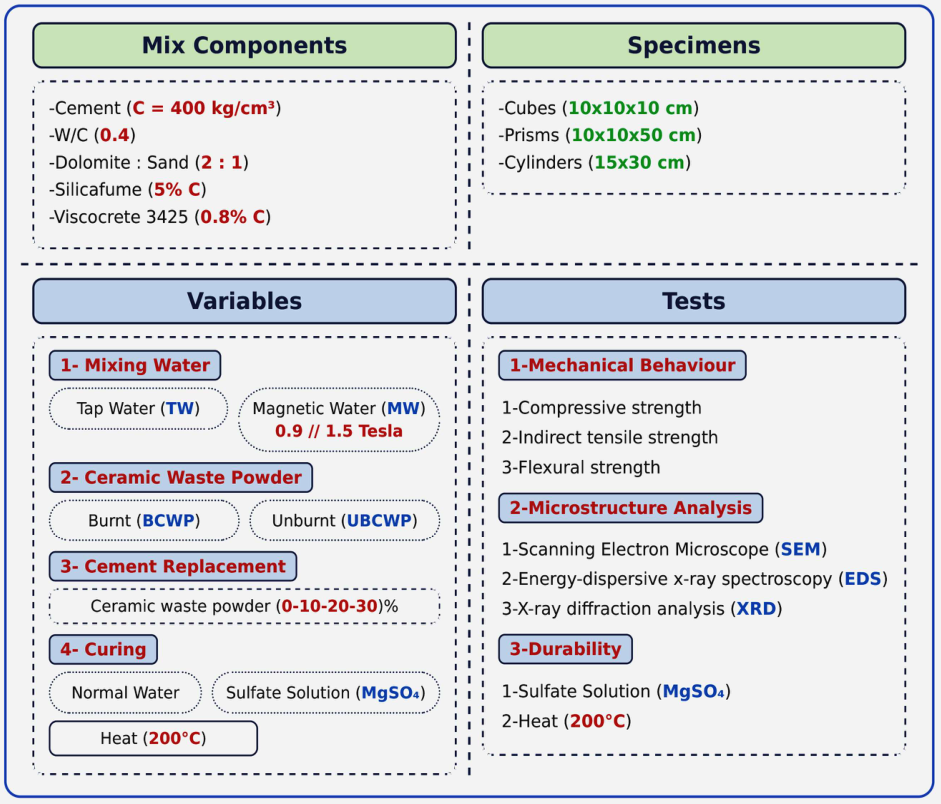
This research examines the constituents of concrete mixtures, the casting method, the use of magnetic water, the amounts of ceramic waste used, the preparation process, and the tests conducted on concrete mixtures. A total of 14 concrete mixtures were prepared using ceramic waste as a cement replacement at 10%, 20%, and 30%, and they were tested at 7, 28, and 120 days. The concrete mixes were evaluated after 120 days of immersion in a magnesium sulfate solution and heat-treated at 200 °C for the same duration. All results were compared between concrete mixtures using tap water (TW) and magnetic water (MW), as shown in Figure 1.

2.2. Materials

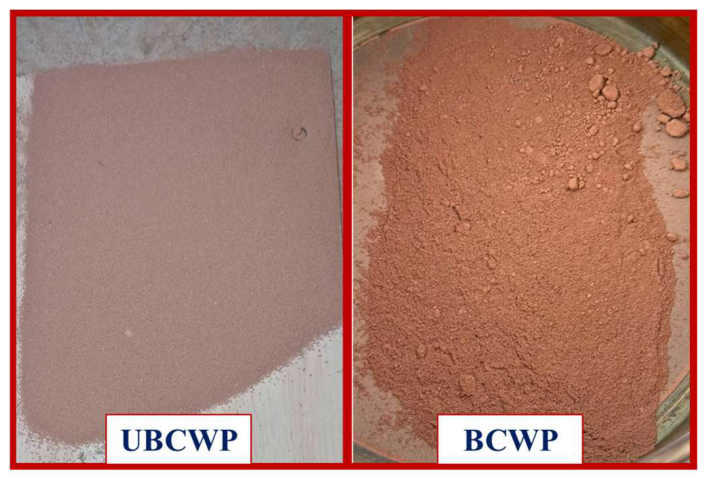
Ordinary Portland cement (CEM I 52.5 N), conforming to Egyptian Standard Specification E.S.S. 4756-1/2022, was used as the primary binder in all concrete mixtures [52]. Laboratory tests confirmed that the chemical composition and physical properties of the cement satisfied the requirements of the relevant standard. The cement had a specific gravity of 3.15, a specific surface area of 3600 cm2/g, an initial setting time of 75 min, and a final setting time of 265 min. In addition, the 2-day and 28-day compressive strengths were 23.6 MPa and 57.2 MPa, respectively. The cement content and water-to-cement ratio were maintained constant at 400 kg/m3 and 0.40, respectively, for all mixtures, while either fresh tap water or magnetized water was used as the mixing water. Ceramic waste powder (CWP) was obtained from Al-Amir Ceramics Factory in two forms: unburnt ceramic waste powder (UBCWP), collected before the firing stage of ceramic production, and burnt ceramic waste powder (BCWP), collected after the firing process, as shown in Figure 2. Both materials exhibited high silica contents, indicating their potential pozzolanic activity, while BCWP showed slightly higher contents of SiO2, Na2O, K2O, and CaO, together with a noticeable reduction in SO3 compared with UBCWP. The specific gravity of the ceramic waste powder was 2.38. The chemical compositions of the cement, UBCWP, and BCWP are presented in Table 1.
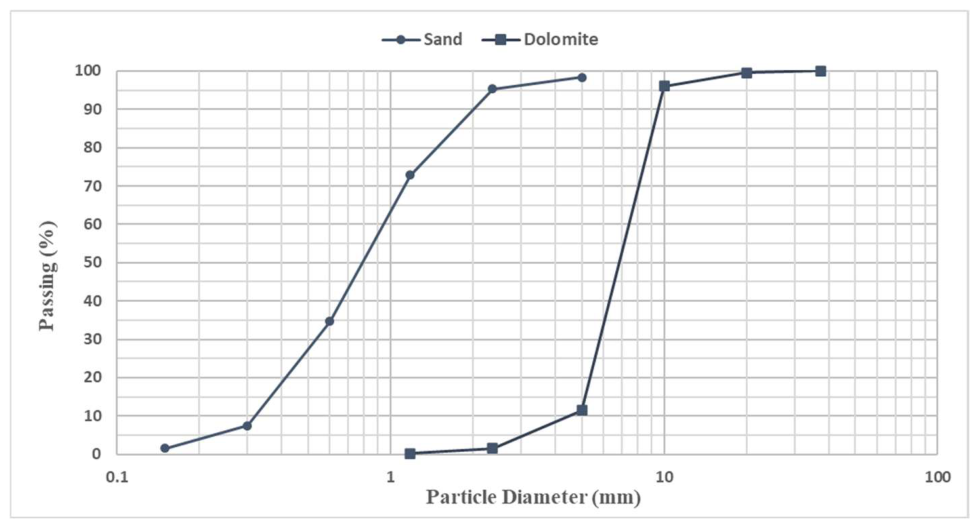
The aggregates used in this study consisted of natural siliceous sand as fine aggregate and dolomite with a nominal maximum size of 14 mm as coarse aggregate. Before use, the dolomite was washed and air-dried for 24 h to remove adhering fine particles. Both aggregates complied with the requirements of Egyptian Standard ESS 1109/2021 [53]. The fine aggregate had a specific gravity of 2.85, a bulk density of 1.52 t/m3, a fineness modulus of 2.9, and 2.6% of the material passing the No. 200 sieve, which is below the specified limit of 3%. The coarse aggregate had a specific gravity of 2.50, a bulk density of 1.36 t/m3, a Los Angeles abrasion value of 20%, an aggregate impact value of 18.2%, a crushing value of 28.5%, a water absorption of 1.7%, and a clay and fine dust content of 1.2%, all within the permissible limits. The sieve analysis of both aggregates is summarized in Table 2, while their particle size distribution curves are presented in Figure 3, confirming compliance with the grading limits specified by ESS 1109/2021 [53].
The mineral admixture silica fume was supplied by Sika Egypt, according to ASTM C-1240-20 [54]. The physical properties of silica fume, based on the manufacturer’s information, are a surface area of 170,000 cm2/gm, a particle size of 8.00 µm, and a specific gravity of 2.25. A constant silica fume replacement level of 5% by weight of cement was adopted throughout this study to provide matrix densification while minimizing its influence, thereby allowing the individual effects of ceramic waste powder and magnetized water to be evaluated more reliably. This study used Sika Viscocrete-3425, a high-performance, third-generation superplasticizer designed to produce uniform concrete mixtures. It conforms to ASTM C-494-2020 [55] specifications for superplasticizers of types G and F. The properties of Sika Viscocrete-3425: Appearance: Clear liquid; density: 1.08 kg/L; pH: 4.0 solids content by weight: 40% (as specified by the manufacturer).
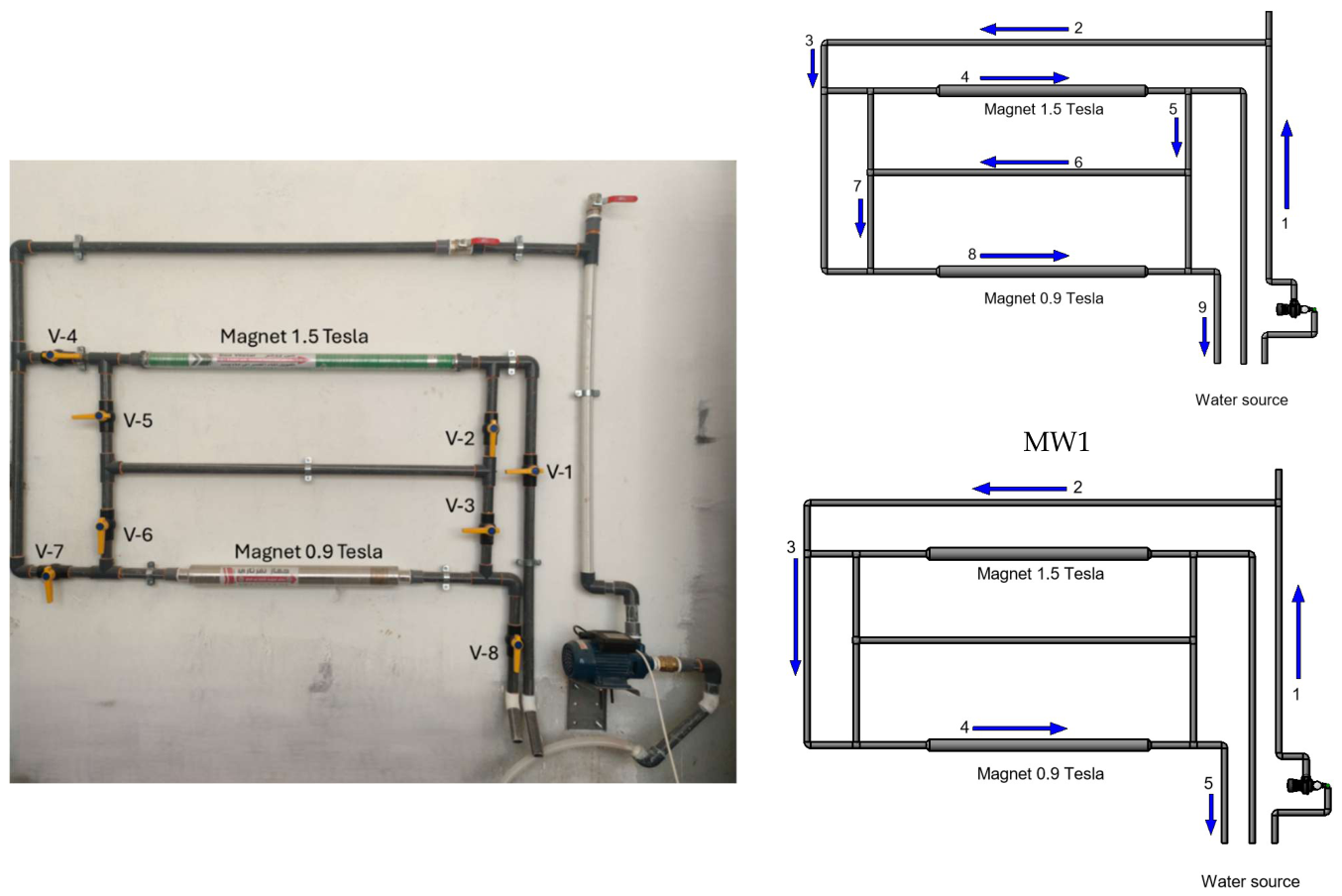
In this study, the magnetized water was prepared by passing ordinary water through a Nefertary magnetic device at magnetic field densities of 0.6 and 1.5 Tesla for 150 cycles, as described in [56]. The operating parameters of the magnetization system are summarized in Table 3. First, tap water was exposed to 1.5 Tesla and later to 0.9 Tesla to check whether a higher initial magnetic field (1.5 T) can induce increased chemical modifications in water molecules, such as destroying hydrogen bonds and creating a smaller cluster size, which may be retained or increased after exposure to a reduced field of 0.9 T. The water retained its magnetization for approximately 100 min. Although mechanical mixing may partially reduce water magnetization, the magnetized water was used immediately after treatment, and the short mixing time was well within its reported effective period. Therefore, the magnetic effect was expected to persist during early hydration, while the quantitative influence of mechanical shear remains beyond the scope of this study. The water magnetizing system had a 0.5 HP water pump to provide a steady flow, valves to direct the water’s path, and a water tank, as shown in Figure 4. Table 4 presents the valve system for the magnetization methods. A previous study found that water parameters (pH, TDS, and conductivity) and concrete compressive strength improved after 150 magnetic cycles. Increasing the cycles did not show any further improvement. This can be explained by the fact that the magnetic treatment is effective only for a limited number of cycles, and then its effect decreases [57].

2.3. Mixes Details

Thirteen concrete mixes were designed and tested using varying proportions of five factors: magnetic water, unburnt ceramic waste powder (UCWP), burnt ceramic waste powder (BCWP), sulfate solution (MgSO4), and temperature (200 °C). (The proportions of the mixes used in the experimental program are detailed in Table 5). The water/cement ratio was 0.40, and the dolomite/sand ratio was 2:1 by weight in all concrete mixes. Concrete mixtures were prepared using ceramic waste as a replacement for cement, with weight percentages of 10%, 20%, and 30%. All concrete mixes were mixed once with tap water (TW) and once with magnetic water (MW). The silica fume content was 5% (1.094 kg/m3), and the Viscocrete 3425 content was 0.8% (0.164 kg/m3) by weight of cement for all concrete mixes.

2.4. Concrete Mixing, Casting, and Curing

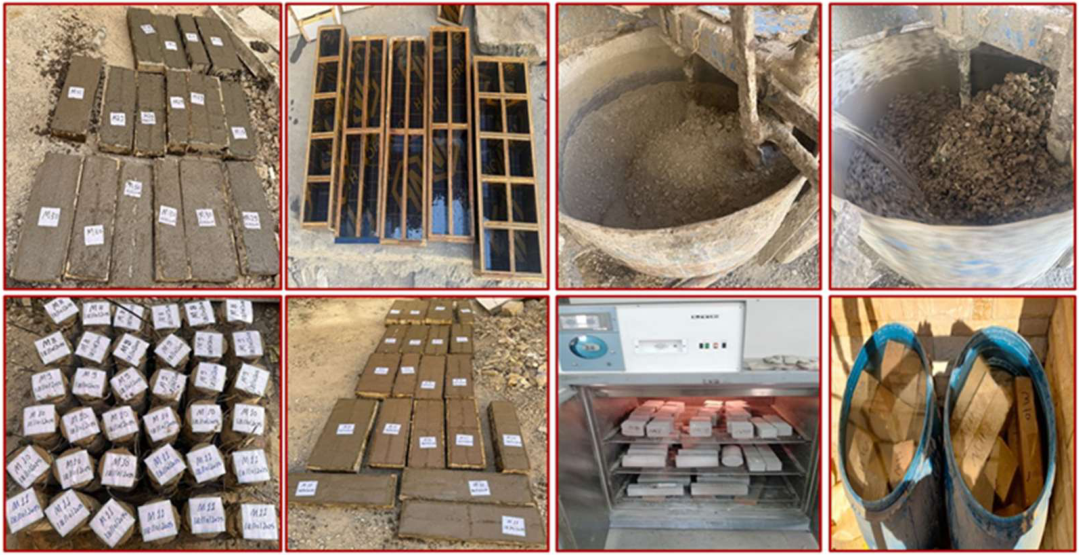
In this study, a mechanical horizontal pan mixer was used to mix the measured amounts of cement, CWP, dolomite, sand, and water for two minutes. Silica fume was added to the mixture, which was then stirred for 2 min, as shown in Figure 5. Thereafter, water and the superplasticizer (Viscocrete 3425) were covered for approximately 5 min to ensure thorough mixing. After casting, specimens were demolded after 24 h and cured in water at room temperature until the designated testing ages of 7, 28, and 120 days. Some samples were exposed to a temperature of 200 °C inside the oven at the age of 120 days, while other samples were immersed in a magnesium sulfate solution after the first casting day for 120 days to test the sulfate’s attack on the concrete, which are standard testing intervals for determining the strength development of concrete at early, standard, and later ages, respectively, according to the Egyptian Code ECP 203:2020 [58]. A curing age of 120 days was selected to evaluate the medium- to long-term performance of the concrete mixtures after sufficient development of the pozzolanic reaction and hydration processes, providing a reliable basis for mechanical, durability, and microstructural assessment.

2.5. Heating Procedure

After 120 days of curing in tap water, the samples were heated under controlled conditions to evaluate the effect of elevated temperature on the concrete mix. The specimens were placed in an electric oven to reach a target temperature of about 200 °C, as shown in Figure 5. A heating rate of about 2.5 °C per minute was used to maintain a constant temperature increase. The samples were held at 200 °C for 2 h after reaching the target temperature. At the end of the heating period, the samples were cooled slowly in the oven to room temperature to minimize thermal shock. The samples were then removed from the oven and prepared for the necessary testing. The elevated-temperature investigation was intentionally limited to 200 °C to evaluate the influence of MW and CWP during the initial stage of fire exposure, where dehydration reactions begin while the concrete matrix largely retains its structural integrity, prior to the severe thermal degradation associated with higher temperatures.

2.6. Immersion in Magnesium Sulfate Solution

After the first day of pouring, concrete samples were immersed in a magnesium sulfate solution in tap water at a concentration of 50 g/L for 120 days, as shown in Figure 3. Then, they were removed from the solution and left to air-dry. Tests were carried out to determine how sulfates affect the properties and durability of concrete, as well as how well it resists such chemical attacks.

2.7. Hard Concrete Tests

2.7.1. Compression Test

The compressive strength was measured for all samples after 7, 28, and 120 days of casting in air, following BS EN 12390-3:2019 [59]. Each mix was tested using three specimen cubes (10 × 10 × 10 cm) at all testing ages. The compressive test was conducted in the concrete laboratory of Zagazig University, Faculty of Engineering, using hydraulic testing equipment with a 2000 kN capacity and 5 kN precision. For each mixture, the average of three concrete samples was calculated.

2.7.2. Indirect Tensile Test

After 28 and 120 days, indirect tensile tests were performed on concrete mixtures using three cylindrical specimens per mixture. Each cylinder had a diameter of 150 mm and a height of 300 mm, as specified in BS EN 12390-6:2023 [60].

2.7.3. Flexural Test

Three-point bending tests were performed on concrete beams measuring 100 × 100 × 500 mm. These tests followed the guidelines in BS EN 12390-5:2019 [61]. We used hydraulic testing equipment with a 300 KN capacity and a loading rate of 5 N/cm2/s until it broke. For each blend, an average of three samples was measured. Strength was tested at 28 and 120 days of age.

2.7.4. Scanning Electron Microscope (SEM), Energy-Dispersive X-Ray Spectroscopy (EDS), and X-Ray Diffraction Analysis (XRD) Tests

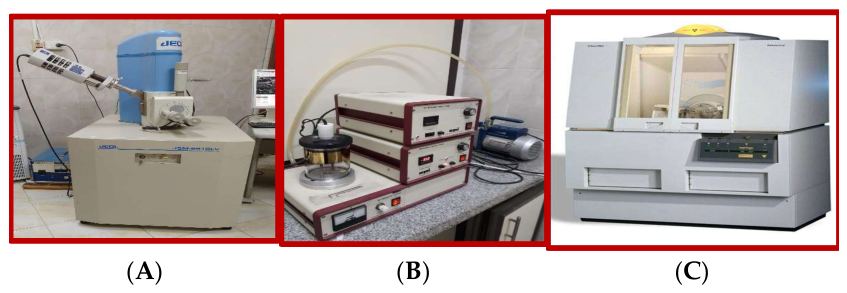
The six samples (M0, M3, M6, M7, M10, and M13) were tested using SEM and EDS at 120 days of age. SEM and EDS analyses were also performed on the two samples, M6 (30% BCWP, TW) and M13 (30% BCWP, MW), after one exposure to 200 °C and a subsequent immersion in magnesium sulfate solution at 120 days to analyze the concrete microstructure. The test was performed at the Faculty of Agriculture, Mansoura University, Egypt, using an electron microscope (JEOL JSM-651OLV) (Tokyo, Japan), as shown in Figure 6A, with a magnification of up to 300,000×. Specimens were examined at 1000× and 2000× magnification. The entire sample preparation method is described below. The experimental concrete samples were collected from the deepest core of the crushed samples after 120 days of the compressive strength test. The samples were dried to a constant weight at 70 °C and then adhered to the holders with carbon adhesive. The dried samples were then coated with gold using a sputter-coating evaporator to obtain a sharper, clearer image of the microstructural surface. Energy-dispersive X-ray spectroscopy (EDS) type (Oxford X-Max 20) (Abingdon, Oxfordshire, UK) was also used to study the composition of the observed specimens, as seen in Figure 6B.
The microstructure of the concrete was studied using X-ray diffraction (XRD) of six samples (M0, M3, M6, M7, M10, and M13) at 120 days. Two samples (M6 and M13) were also analyzed by XRD after exposure to 200 °C and immersion in a magnesium sulfate solution at 120 days of age. The test was conducted in the central laboratories sector of the Egyptian Mineral Resources Authority using the PANalytical X-Ray Diffraction equipment model X’Pert PRO with a Secondary Monochromator (Figure 6C) and Cu radiation (λ = 1.542 Å) at 45 kV, 35 mA, and a scanning speed of 0.04°/s. The diffraction peaks were obtained in the range 2θ = 2° − 60°; the corresponding spacings (d, Å) and relative intensities (I/Io) are given. The diffraction charts and the relative intensities were obtained and compared with the ICDD files.

3. Results and Discussion

Table 6 presents the concrete compressive strength values for all mixes examined after normal water curing, exposure to 200 °C, and sulfate attack.

3.1. Behavior of Compressive Strength of Burnt and Unburnt Ceramic Waste Powder Concrete

This section introduces the compressive strength, fc, of concrete mixes in which Ordinary Portland Cement (OPC) was partially replaced with burnt ceramic waste powder (BCWP) and unburnt ceramic waste powder (UBCWP) at substitution levels of 0%, 10%, 20%, and 30% by weight. Two curing media were employed: conventional tap water (TW) and magnetic water (MW). Compressive strength was evaluated at three curing ages: 7, 28, and 120 days under ambient (air) conditions. Additional durability assessments were conducted under two aggressive exposure scenarios: elevated temperature at 200 °C and sulfate attack immersion.

3.1.1. Effect of Mixing Water Type on the Concrete Compressive Strength

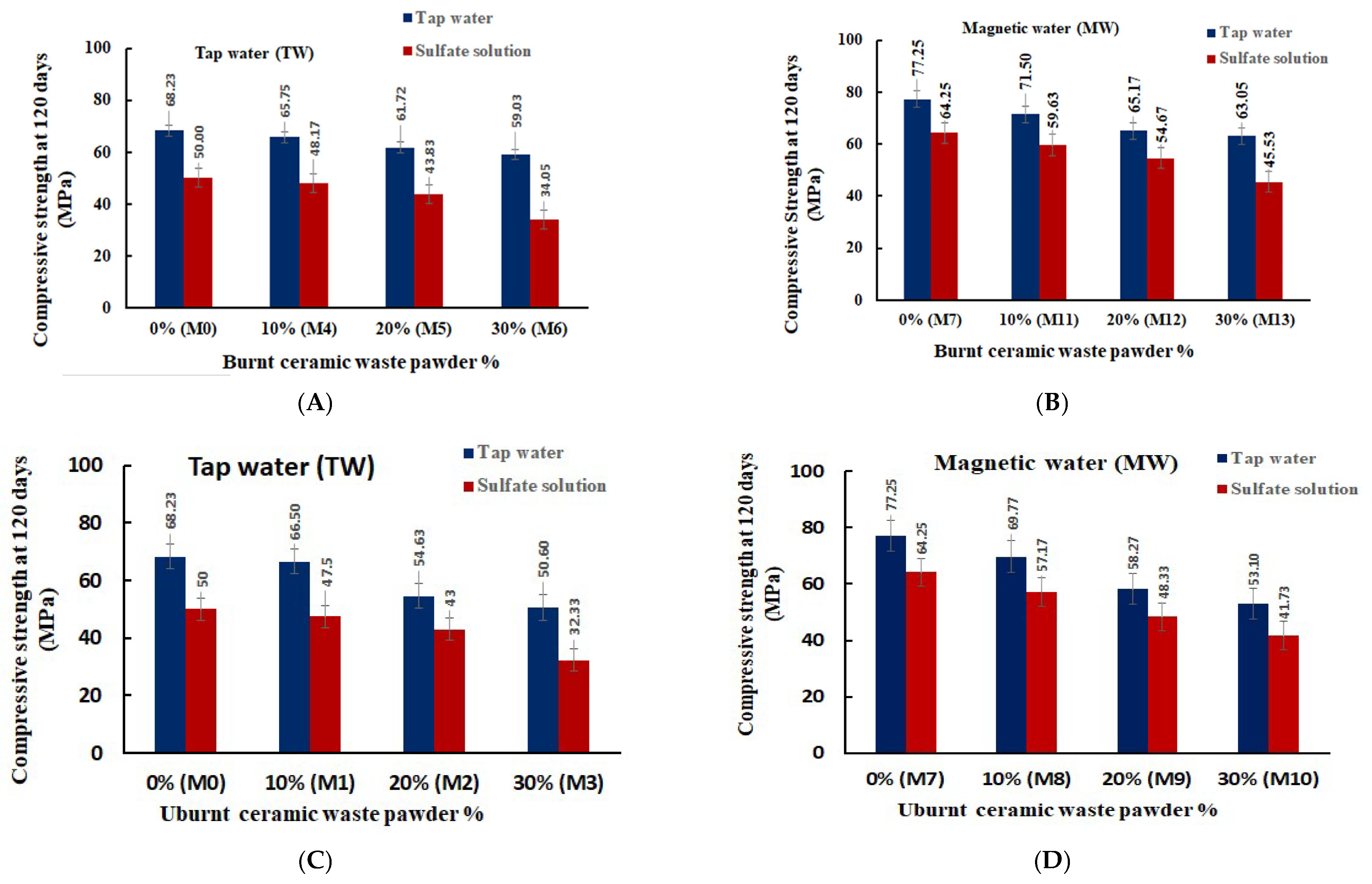
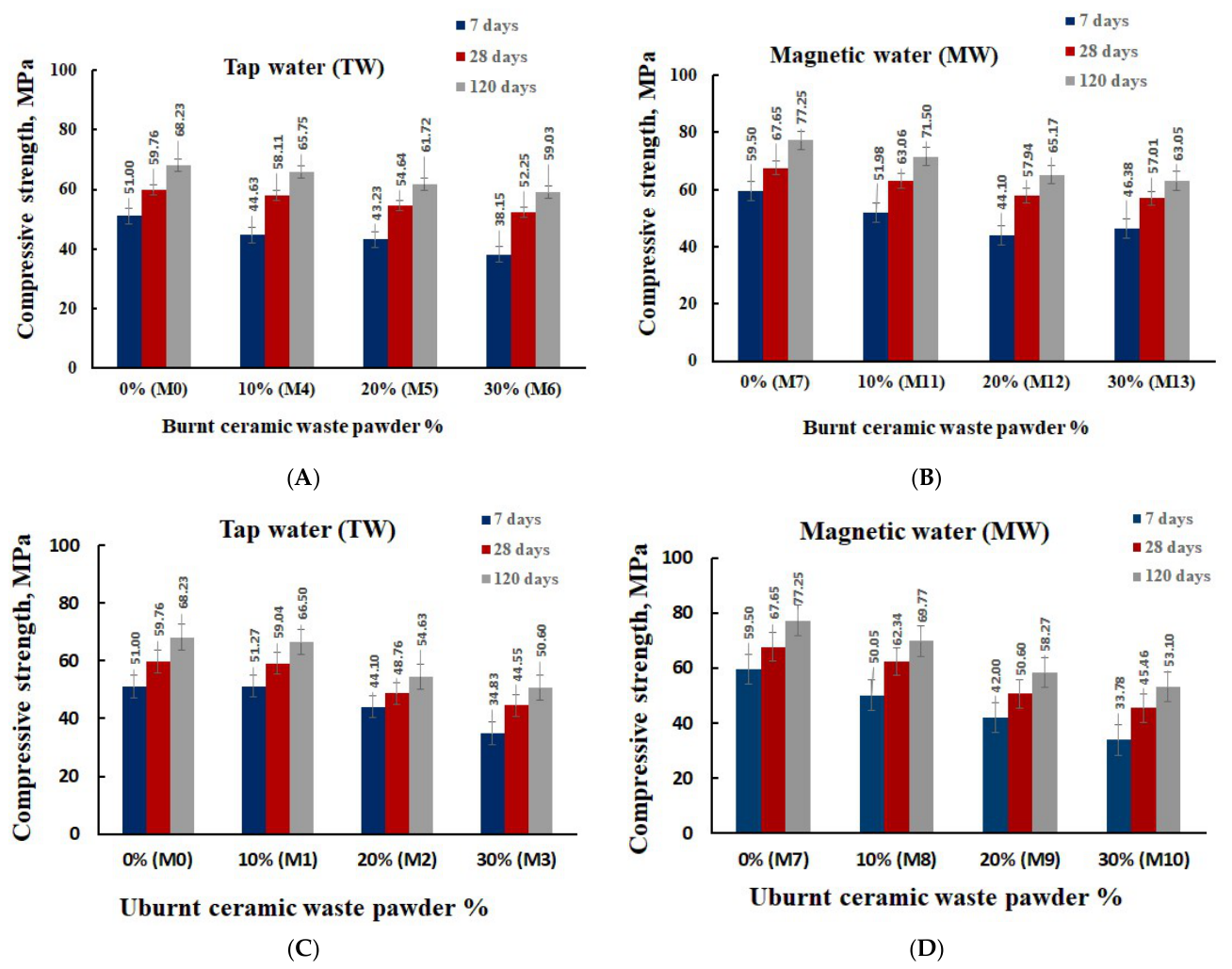
As shown in Figure 7A, the control mix (M0, 0% BCWP, tap water) exhibited the highest compressive strength across all curing ages: 51.00 MPa at 7 days, 59.76 MPa at 28 days, and 68.23 MPa at 120 days. A consistent decline in compressive strength was observed as the BCWP content increased across all ages. For the mix with 0% BCWP (M0), the compressive strength values were 51.00 MPa at 7 days, 59.76 MPa at 28 days, and 68.23 MPa at 120 days. However, the mix with 10% BCWP (M4) recorded lower strengths of 44.63 MPa at 7 days, 58.11 MPa at 28 days, and 65.75 MPa at 120 days. The addition of BCWP further increased the compressive strength of mix M5 with 20% replacement to 43.23 MPa at 7 days, 54.64 MPa at 28 days, and 61.72 MPa at 120 days. This trend indicates that as BCWP increases, compressive strength decreases with time. The strength reduction at 30% replacement was about 25.2% at 7 days compared to the control, decreasing to 13.5% at 120 days. The convergence of strength values over a longer curing time is typical of pozzolanic activity. The BCWP provides amorphous silica and alumina phases, which react with calcium hydroxide (Ca(OH)2) released during cement hydration and produce additional calcium silicate hydrate (C-S-H) gel over time [1,2]. The pozzolanic nature of ceramic-derived powders has been widely demonstrated in the literature using X-ray diffraction and thermogravimetric analysis [3]. Another important point is that at 10% replacement (M4), the 28- and 120-day strengths (58.11 and 65.75 MPa) remain close to the control values. This behavior is consistent with previous studies reporting that low ceramic powder replacement levels provide sufficient reactive silica to sustain secondary pozzolanic reactions without causing excessive cement dilution. Similar observations have been reported by several researchers, who concluded that replacement levels of approximately 10–20% represent the optimum range for balancing sustainability and mechanical performance [62,63].
This means that this level of substitution offers a good balance between reducing cement use and structural adequacy, which is an important consideration for sustainable construction practices [4].
The magnetic water blends consistently exhibited higher compressive strengths than their tap water counterparts at all ages and replacement levels. The beneficial effect of MW was more pronounced at later curing ages than at 7 days, indicating that magnetic treatment primarily enhances the long-term hydration process rather than producing only an early-age strength gain. This observation agrees well with previous investigations, which reported that MW contributes to continuous hydration and a more compact cementitious matrix during prolonged curing [64,65]. The results are shown in Figure 7B. The compressive strength of the M7 mix (0% BCWP) was 59.50, 67.65, and 77.25 MPa at 7, 28, and 120 days, respectively. On the other hand, the mix with 10% BCWP replacement, i.e., M11, showed compressive strengths of 51.98 MPa at 7 days, 63.06 MPa at 28 days, and 71.50 MPa at 120 days. Finally, the M12 mix with a 20% BCWP replacement achieved compressive strengths of 44.10 MPa, 57.94 MPa, and 65.17 MPa at 7, 28, and 120 days, respectively. These results emphasize the effects of different BCWP replacement levels on the compressive strength of magnetic water mixes over time.
The control mix M7 (0% BCWP, magnetic water) achieved 77.25 MPa at 120 days, an increase of 13.2% compared to the tap water control M0 (68.23 MPa). This improvement is related to changes in the physicochemical properties of magnetically treated water. The magnetic treatment changes the hydrogen-bond network of water, reduces surface tension, and improves ionic activity, thereby improving the dispersion of cement particles, accelerating the hydration kinetics, and promoting a denser microstructure with lower porosity [5,10].
Importantly, at 120 days, mix M12 (20% BCWP, magnetic water) achieved 65.17 MPa, close to the tap water control M0 (68.23 MPa). This shows a synergistic interaction; the microstructural densification induced by the magnetic water compensates for the reduced clinker content in moderate replacement blends, leading to acceptable structural performance at a significantly reduced cement content. This combination shows promising potential to reduce the carbon footprint of concrete without compromising long-term strength [11].
Figure 7C shows the highest compressive strength of the control mix (M0, 0% UBCWP, tap water) at all curing ages, i.e., 51.00 MPa at 7 days, 59.76 MPa at 28 days, and 68.23 MPa at 120 days. The data show that across all ages, compressive strength decreased uniformly with increasing UBCWP concentration. The compressive strength values for the mix with 0% UBCWP (M0) were 51.00 MPa at 7 days, 59.76 MPa at 28 days, and 68.23 MPa at 120 days. The compressive strength increased slightly to 51.27 MPa at 7 days, then decreased to 59.04 MPa at 28 days and to 66.50 MPa at 120 days in the mix with 10% UBCWP (M1).
However, the compressive strength of the mix with 20% UBCWP (M2) decreased drastically to 44.10 MPa at 7 days, 48.76 MPa at 28 days, and 54.63 MPa at 120 days, indicating a trend of strength reduction with increasing UBCWP content. These findings further confirm that thermal activation plays a decisive role in improving the pozzolanic reactivity of ceramic waste powder. Similar trends have been reported by previous studies, which attributed the superior performance of calcined ceramic powders to the formation of highly reactive amorphous phases capable of consuming calcium hydroxide and generating additional C–S–H gel [66,67].
The drop in compressive strength with burnt ceramic waste powder at 20% and 30% is much lower than that with unburnt ceramic waste powder in concrete blends. The compressive strengths of magnetic water mixtures were always higher than those of tap water mixtures at all ages and replacement percentages. The results are shown in Figure 7D. The compressive strength values of mix M8 with 10% UBCWP replacement at 7, 28, and 120 days were 50.05 MPa, 62.34 MPa, and 69.77 MPa, respectively, and mix M9 with 20% UBCWP replacement showed compressive strengths of 42.00 MPa, 50.60 MPa, and 58.27 MPa at 7, 28, and 120 days, respectively. For M10, with 30% replacement of CWP, the compressive strength obtained was 33.78 MPa at 7 days, 45.46 MPa at 28 days, and 53.10 MPa at 120 days. The results indicate the effect of the UBCWP replacement levels on the compressive strength of magnetic water mixes over time. The compressive strength results at curing ages of 7, 28, and 120 days clearly illustrate the specific effects of burnt ceramic waste powder (BCWP), unburnt ceramic waste powder (UBCWP), and magnetic water (MW) on concrete behavior. For tap water mixes, the control (M0) gave 51.00, 59.76, and 68.23 MPa at 7, 28, and 120 days, respectively. Progressive replacement of BCWP resulted in consistent but moderate strength reduction. The reduction was only 25.2% at 7 days for 30% replacement, and the difference decreased to 13.5% at 120 days, which is characteristic of pozzolanic activity where the amorphous silica and alumina phases in BCWP react with liberated Ca(OH)2 to produce additional calcium silicate hydrate (C-S-H) gel over time with prolonged curing [68,69]. The strengths of 58.11 MPa at 28 days and 65.75 MPa at 120 days for the 10% BCWP mix (M4) are very similar to those of the control, indicating that this is the best replacement percentage for achieving structural adequacy in sustainable concrete [70]. On the other hand, UBCWP exhibited worse strength penalties due to its lower reactivity. The 20% UBCWP mixture (M2) had only 44.10, 48.76, and 54.63 MPa at 7, 28, and 120 days, respectively, which were much lower than those for the 20% BCWP substitution, highlighting the importance of thermal activation in improving the pozzolanic activity of ceramic powders [71]. Magnetic water was always found to enhance the compressive strength for all mixes and curing periods; the MW control (M7) achieved 77.25 MPa at 120 days, an enhancement of 13.2% in comparison with the equivalent tap water (M0), due to the reduction of the surface tension, ionic activity, and the acceleration of hydration kinetics caused by the magnetic treatment, which leads to a denser microstructure with less porosity [72,73]. Interestingly, mix M12 (20% BCWP, MW) achieved 65.17 MPa at 120 days, which was very close to the tap water control (68.23 MPa), showing a synergistic compensatory mechanism between microstructural densification and reduction of clinker content, suggesting a promising direction for low-carbon and high-performance sustainable concrete fabrication [72,73]. Overall, the compressive strength results clearly demonstrate that the performance of sustainable concrete is governed by the combined influence of ceramic powder reactivity and the hydration-promoting effect of magnetized water. While increasing CWP replacement inevitably introduces a cement dilution effect, thermal activation of ceramic waste and magnetic treatment of the mixing water effectively mitigate this drawback by enhancing the formation of hydration products and refining the concrete microstructure. The observed trends are in close agreement with previous studies on calcined ceramic waste and magnetized water, thereby confirming the reliability of the proposed approach for producing durable and environmentally sustainable concrete [74,75]. These trends align closely with the published literature while extending it in one respect. The 2.8% loss at 10% BCWP and the progressive loss at higher levels reproduce the pattern reported by Kannan et al. [24], who recorded 2.7% and 17.3% reductions at 10% and 40% replacement, and are consistent with AlArab et al. [29]. The 13.2% gain obtained with magnetized water alone falls within the 14–30% range reported by Venkatesh et al. [38] for fields of 0.986 T and 2 T respectively, and slightly below the 15–20% reported by Su and Wu [37] for magnetized water combined with fly ash—the difference being reasonably attributed to our lower dual-field configuration and to the fact that our reference mix already contains 5% silica fume and is therefore comparatively dense to begin with. The extension offered here concerns the interaction: whereas Li et al. [30] found a 10.3% loss at 20% ceramic powder with ordinary water, the same replacement level with magnetized water in the present study (M12) reaches 95.5% of the reference strength at 120 days. This supports the conclusion of Eltawil et al. [76], obtained in geopolymer systems, that magnetization can compensate for the dilution penalty of ceramic powder and demonstrates it for the first time in ordinary Portland cement concrete.

3.1.2. The Impact of Thermal Exposure at 200 °C on the 120-Day Compressive Strength of Concrete

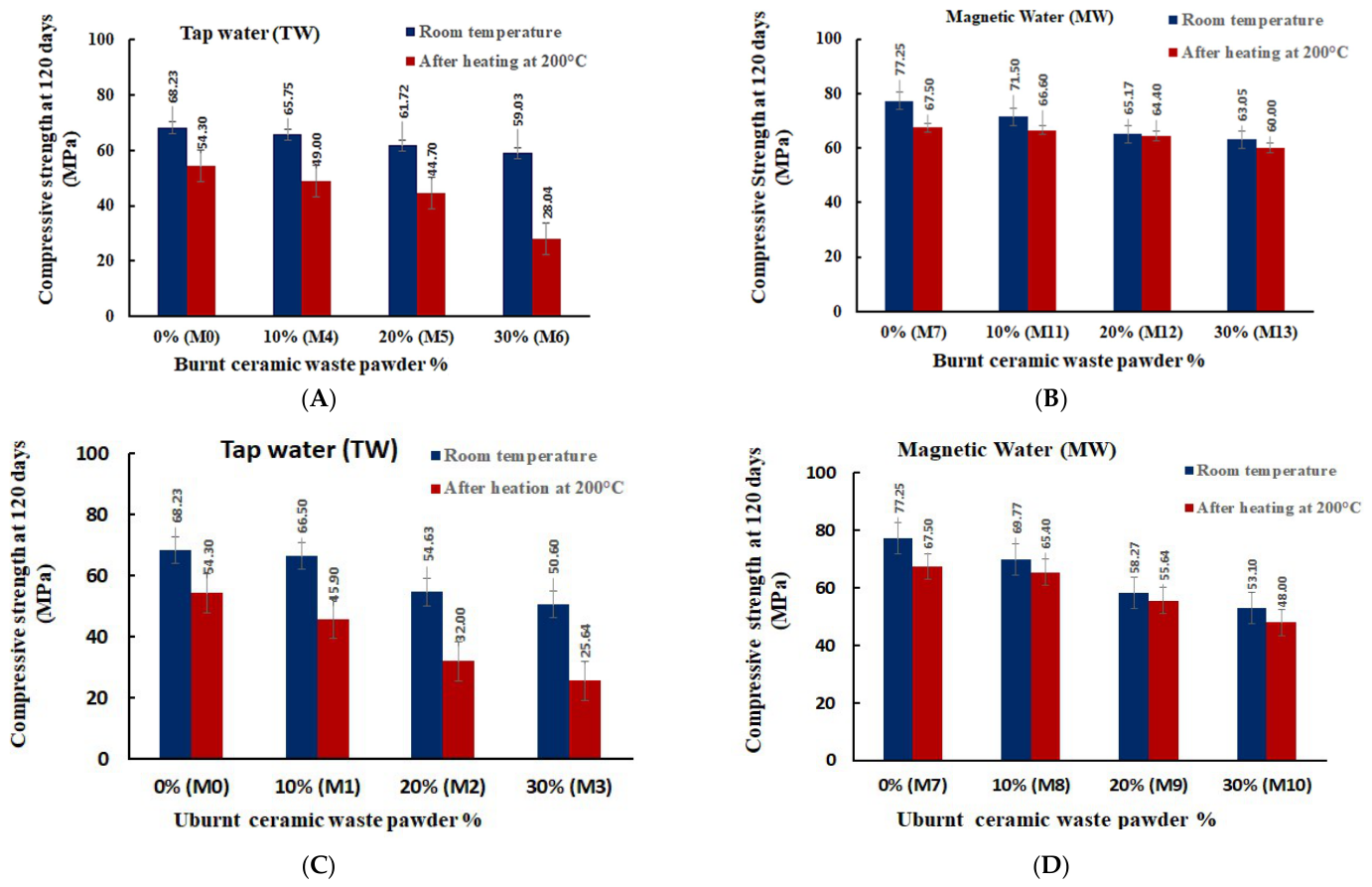
The comparison of the 120-day compressive strength of the specimens with normal curing and after exposure to 200 °C for tap and magnetic water is shown in Figure 8. High temperatures mean that service conditions in industrial structures and building elements are at risk of fire [12]. The distinction between sustained service-temperature exposure and short fire exposure is not merely one of duration. In situ investigations of structures held at elevated temperatures for extended periods show deterioration mechanisms—progressive dehydration of the binder, redistribution of moisture, and the accumulation of thermal stress at the paste–aggregate interface—that differ from those produced by a rapid thermal transient [77]. Tap water mixtures exhibited a severe, gradual loss of strength upon heat exposure, which increased considerably as BCWP replacement levels increased. The M0 (0% BCWP) mix showed a compressive strength of 68.23 MPa, which decreased to 54.30 MPa after heat exposure (Figure 8A). This corresponds to a strength loss of 20.41%. The strength of the M4 blend with 10% BCWP was 65.75 MPa and decreased to 49.00 MPa after heat exposure (a 25.48% loss in strength). Finally, the M5 mixture with 20% BCWP achieved a compressive strength of 61.72 MPa, which was reduced to 44.70 MPa after heat exposure. This is a loss in strength of 27.58%. The maximum loss was observed in M6 (30% BCWP mix), where the compressive strength dropped to 28.04 MPa, indicating a reduction of more than 52.50%. This is related to the dissolution of C-S-H gel at temperatures above 105–120 °C, increased capillary porosity due to moisture loss, and microcracking caused by differential thermal expansion between the aggregate and the paste [13,14]. These effects are greater with increased BCWP content. The additional C-S-H produced by the pozzolanic reaction, which is beneficial at room temperature, appears less stable under long exposure to moderate temperatures, and the simultaneous decrease of primary hydration products from clinker further contributes to the overall degradation of the matrix.
On the other hand, magnetic water mixes exhibited significantly improved thermal stability across all BCWP replacement percentages, as shown in Figure 8B. The loss of compressive strength after 120 days of curing under normal conditions, followed by heat exposure at 200 °C at various percentages, is shown for magnetic water mixes. The compressive strength of Mix M7 with 0% BCWP reduced from 77.25 MPa under normal curing to 67.50 MPa under heat exposure, which is a loss of 12.62%. The mix M11 with 10% BCWP had a compressive strength of 66.60 MPa, reduced from 71.50 MPa, resulting in a loss of 6.85% in strength. The M12 mix with 20% BCWP showed the smallest reduction, from 65.17 MPa to 64.40 MPa, with a reduction in strength of 1.18%. M13 mixed with 30% BCWP dropped from 63.05 MPa to 60,00 MPa (a loss of 4.84%). The magnetic water mixes showed strength losses ranging from 1.18% to 12.62%, while tap water mixes showed losses ranging from 20.41% to 52.50%.
Remarkably, mix M11 (10% BCWP, magnetic water) retained 66.60 MPa after heat treatment, nearly matching the ambient-cured tap water control (M0 = 68.23 MPa). The denser, more refined pore structure developed under magnetic water curing substantially reduces capillary porosity and permeability, thereby limiting moisture-driven damage and vapor pressure buildup during heating [15]. Among all MW mixes, M12 (20% BCWP, MW) exhibited the smallest proportional strength loss (1.18%), suggesting that this substitution level may represent an optimum for thermal resistance in magnetically cured concretes. The combination of a denser ITZ (interfacial transition zone), a moderate contribution from pozzolanic C-S-H, and reduced porosity appears to confer maximum resilience under thermal stress. Overall, the results indicate that the type of ceramic waste powder and the type of mixing water significantly influence the residual compressive strength of concrete after exposure to 200 °C. The observed behavior is generally consistent with previous studies on ceramic-based supplementary cementitious materials and magnetized water under moderately elevated temperatures. These findings further highlight the potential of ceramic waste powder as a sustainable cement replacement material and magnetized water as an alternative mixing water for improving the thermal performance of concrete [78,79,80].

3.1.3. Impact of Sulfate Attack on Compressive Strength

Sulfate attack is among the most prevalent and destructive forms of chemical deterioration in concrete. Sulfate ions (SO42−) penetrate the concrete matrix and react with hydration products, particularly calcium hydroxide and aluminate phases, to form expansive secondary ettringite and gypsum, causing internal tensile stresses, cracking, and loss of cohesion [6,7]. Figure 9 compares the 120-day strengths of water-cured specimens versus sulfate-exposed specimens.
The compressive strength of burnt ceramic waste powder (BCWP) mixtures exposed to sulfate solutions also showed a reduction in strength ranging from moderate to severe, relative to tap water (TW) mixtures. The compressive strength of M0 (0% CWP) after 120 days under curing conditions, as shown in Table 6, was 68.23 MPa; after 120 days of exposure to magnesium sulfate (MgSO4), it dropped to 50.00 MPa, a reduction of 26.72%. The strength of M4 (10%) BCWP mixtures was 26.74% lower than their TW counterpart, declining from 65.75 MPa to 48.17 MPa. BCWP mixtures with 20% replacement had an approximate reduction of 28.99% in strength, retaining compressive strengths from 61.72 MPa to 43.83 MPa after 120 days of exposure to MgSO4. M6 specimens would best represent the strength loss due to sulfate exposure, with a reduction in compressive strength from 59.03 to 34.05 MPa (a 42.32% reduction). The modest losses seen at the two lowest percentage levels (0% and 10% BCWP) (approximately 26.72% and 26.74%, respectively) indicate that the pozzolanic consumption of Ca(OH)2 to create gypsum at these low replacement levels is less than or equal to the amount of sulfate damage (lowering of compressive strength) that occurs. However, at 30% replacement, insufficient clinker content may leave the matrix both chemically vulnerable and microstructurally permeable, compounding sulfate ingress [13,17]. The results demonstrate that the sulfate resistance of concrete depends on the ceramic waste powder replacement level. Moderate replacement levels showed relatively limited strength losses, whereas higher replacement levels exhibited greater deterioration due to increased matrix permeability and reduced cementitious hydration products. This behavior is consistent with previous studies on ceramic-based supplementary cementitious materials exposed to sulfate environments [81,82].
Magnetized water (MW) mixtures demonstrated significantly greater resistance to sulfate attack than tap water mixtures. The M7 (0% CWP) mix developed a 120-day strength of 77.25 MPa, which decreased to 64.25 MPa after sulfate exposure, representing a 16.83% reduction. The compressive strength of M11 with 10% BCWP decreased from 71.50 MPa to 59.63 MPa, representing a loss of 16.60%. The compressive strength of M12 with 20% BCWP decreased from 65.17 MPa to 54.67 MPa, representing a loss of 16.11%. The M13 with 30% BCWP reduced from 63.05 MPa to 45.53 MPa, a loss of 27.79%. The explanation for these consistently lower percentage losses in magnetized water mixtures is the denser microstructure developed in magnetized water, which reduces pore connectivity and restricts the entry of sulfate ions.
The strength loss in tap water mixes with UBCWP in MgSO4 for 120 days was found to be as follows: M0 (0% CWP), 68.23 MPa to 50.00 MPa (loss 26.72%); M1 (10% UBCWP), 66.50 MPa to 47.50 MPa (loss 28.57%); M2 (20% UBCWP), 54.63 MPa to 43.00 MPa (loss 21.29%); and M3 (30% UBCWP), 50.60 MPa to 32.33 MPa (loss 36.11%). The maximum strength loss was 36.11% at the 30% replacement level, indicating that the vulnerability of the concrete matrix to sulfate attack increases progressively with increasing UBCWP content.
The combination of magnetized water with UBCWP showed good resistance to sulfate attack, with strength losses ranging from 16.83% to 21.41%: M7 (0% CWP) from 77.25 MPa to 64.25 MPa (loss 16.83%); M8 with 10% UBCWP from 69.77 MPa to 57.17 MPa (loss 18.06%); M9 with 20% UBCWP from 58.27 MPa to 48.33 MPa (loss 17.06%); and M10 with 30% UBCWP from 53.10 MPa to 41.73 MPa (loss 21.41%). The best relative performance was observed for M8 (10% UBCWP), with a mere 18.06% reduction in sulfate durability for the UBCWP-magnetized water mixes, further highlighting the synergistic benefit of magnetized water and a moderate content of ceramic waste powder in enhancing sulfate durability.

3.2. Indirect Tensile Strength of Burnt and Unburnt Ceramic Waste Powder Concrete

The indirect tensile strength of concrete mixes with Ordinary Portland Cement (OPC), mainly replaced by burnt ceramic waste powder (BCWP) and unburnt ceramic waste powder (UBCWP) at 0%, 10%, 20%, and 30% replacement levels by weight, is presented in this section. Curing techniques of normal tap water (TW) and magnetized water (MW) were used. The indirect tensile strength was determined for two curing periods, i.e., 28 and 120 days. Durability tests were also carried out under two extreme exposure conditions: high temperature (200 °C) and full immersion in a sulfate solution. The results of the indirect tensile strength test are presented in Table 7.

3.2.1. Effect of Mixing Water Type on Indirect Tensile Strength

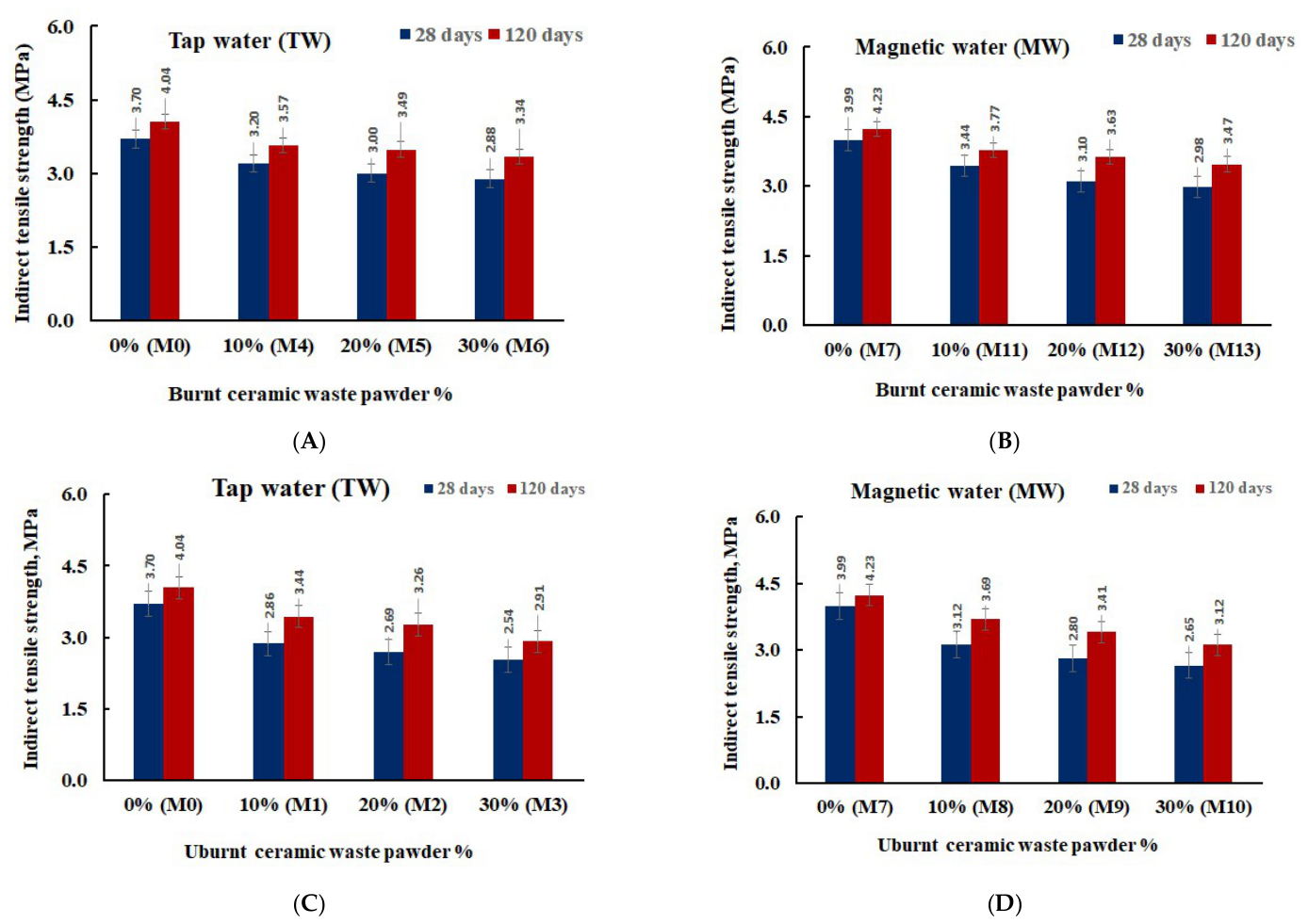
As shown in Figure 10A, the control mix (M0, 0% CWP, tap water) exhibited the highest indirect tensile strength across all curing ages: 3.7 MPa at 28 days and 4.04 MPa at 120 days. A consistent decline in tensile strength was observed as CWP content increased. For tap water mixes, the indirect tensile strength at 28 days and 120 days, respectively, was as follows: 10% BCWP (M4) gave 3.20 MPa and 3.57 MPa; 20% BCWP (M5) gave 3.00 MPa and 3.49 MPa; and 30% BCWP (M6) gave 2.88 MPa and 3.34 MPa. Compared to the control, the reduction in indirect tensile strength was 11.8% for 10% BCWP, 13.8% for 20% BCWP, and 17.3% for 30% BCWP. This drop is attributed to the angular arrangement of BCWP particles, which increases internal friction and reduces the material’s ability to resist bending stresses.
The magnetic water mixes had higher indirect tensile strength than the tap water mixes at all ages and replacement levels. The results are shown in Figure 10B. The mix was classified as M7 with 0% CWP; the indirect tensile strength obtained was 3.99 MPa at 28 days and 4.23 MPa at 120 days. On the other hand, M11 with a 10% BCWP substitution showed an indirect tensile strength of 3.44 MPa at 28 days and 3.77 MPa at 120 days. Finally, the M12 mix with a 20% BCWP substitution had indirect tensile strengths of 3.10 MPa at 28 days and 3.63 MPa at 120 days. The results demonstrate the effects of varying BCWP replacement amounts on the indirect tensile strength of magnetic water mixtures over time.
The control mix M7 (0% CWP, magnetic water) exhibited 4.23 MPa at 120 days, a 4.7% increase above the tap water control M0 (4.04 MPa). This improvement is due to MW’s ability to minimize water cluster size, resulting in better hydration and a more uniform distribution of hydration products. The enhanced hydration process results in a denser, more cohesive matrix, thereby increasing the load-bearing capacity of the composite under tensile stress [76].
Figure 10C shows that, for tap water mixes with UBCWP, the maximum tensile strength, after the control mix, was observed in M1 (10% UBCWP) at all curing ages: 2.86 MPa at 28 days and 3.44 MPa at 120 days. The results were as follows: M2 (20% UBCWP) gave 2.69 MPa at 28 days and 3.26 MPa at 120 days; M3 (30% UBCWP) gave 2.54 MPa at 28 days and 2.91 MPa at 120 days. The reduction in tensile strength compared to control (M0, 3.7 MPa at 28 days, 4.04 MPa at 120 days) was 14.96% for 10% UBCWP, 19.29% for 20% UBCWP, and 27.95% for 30% UBCWP.
Magnetic water mixes again demonstrated higher tensile strength than tap water mixes. For magnetic water mixes with UBCWP, M8 (10%) achieved 3.12 MPa at 28 days and 3.69 MPa at 120 days; M9 (20%) achieved 2.80 MPa at 28 days and 3.41 MPa at 120 days; and M10 (30%) achieved 2.65 MPa at 28 days and 3.12 MPa at 120 days, as shown in Figure 10C. The indirect tensile strength results indicate that the tensile behavior of concrete is primarily governed by the ceramic waste powder replacement level and the type of mixing water. Increasing the replacement level progressively reduced the tensile strength because of the cement dilution effect and the corresponding reduction in hydration products available to resist tensile cracking. In contrast, the use of magnetized water consistently enhanced the indirect tensile strength at both curing ages and for all replacement levels by promoting more efficient cement hydration and the development of a denser cementitious matrix. The results also demonstrate that BCWP generally exhibited higher tensile strength than UBCWP at the same replacement level, highlighting the beneficial effect of thermal activation on the pozzolanic reactivity of ceramic waste powder. These observations are consistent with previous studies reporting that moderate ceramic waste powder replacement can maintain satisfactory tensile performance, while magnetized water enhances the hydration process and improves the mechanical behavior of cement-based materials [76,83].

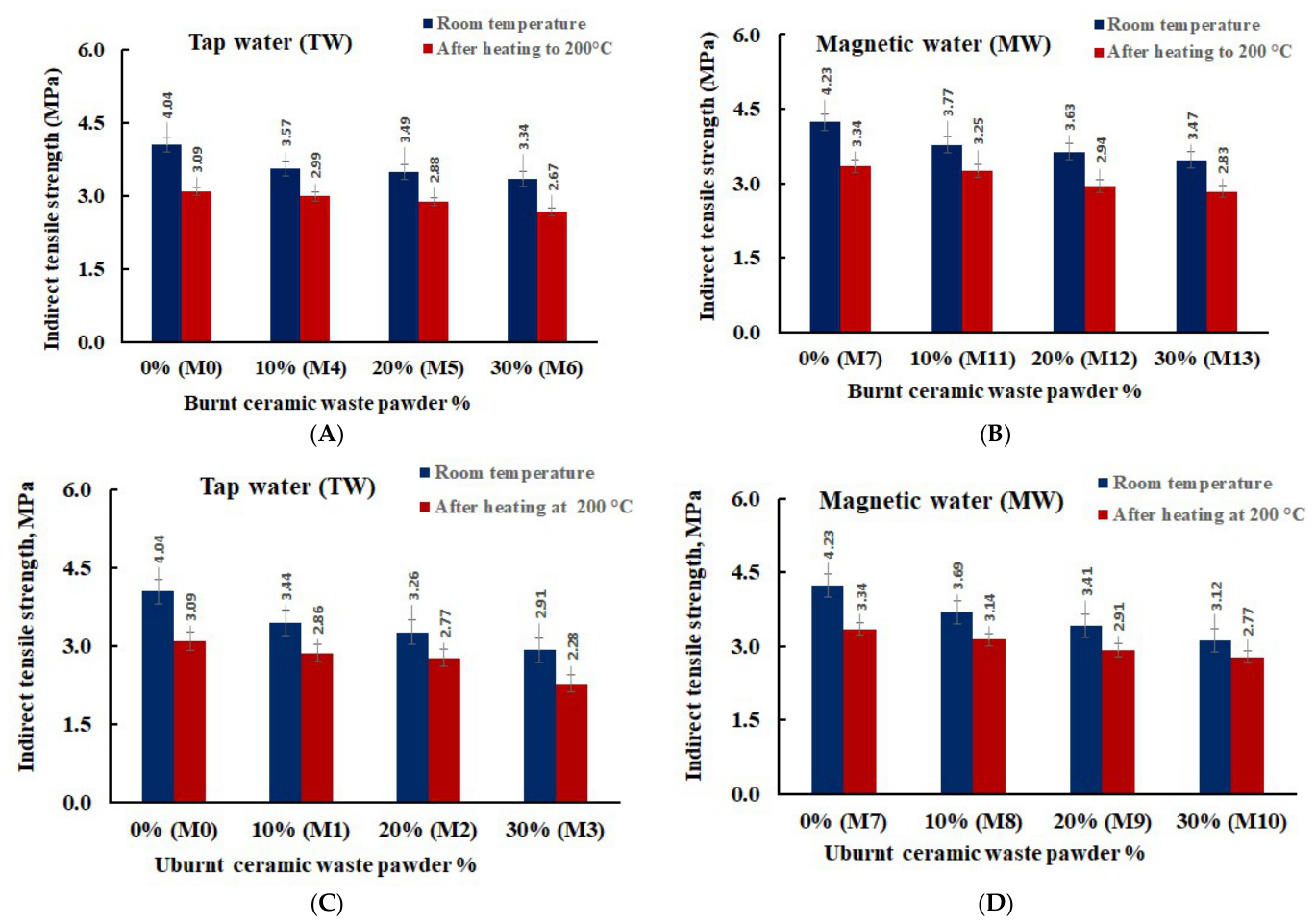
3.2.2. The Impact of Thermal Exposure at 200 °C on the Indirect Tensile Strength of Concrete

Figure 11 compares the 120-day indirect tensile strength of the specimen cured in tap water with that of the specimen subjected to a temperature of 200 °C for tap and magnetic water. The mix with 0% CWP, classified as M0, had a tensile strength of 4.04 MPa; when exposed to heat, it dropped to 3.09 MPa, a loss of 23.6%. After heat exposure, the strength of M4 with 10% BCWP decreased from 3.57 MPa to 2.86 MPa, representing a 19.64% loss. The tap water tensile strength of M5 with 20% BCWP was 3.49 MPa and decreased to 2.79 MPa after heat exposure, representing a 20.1% loss. Lastly, M6 with 30% BCWP had a tap water tensile strength of 3.34 MPa, which decreased to 2.58 MPa after heat exposure, representing a 22.85% loss in strength, as shown in Figure 11A.
Magnetic water mixtures, in contrast, exhibited enhanced thermal resistance at all CWP replacement levels. As shown in Figure 11B, the strength losses for the magnetic water mixes were 7.90–11.3%, whereas for the tap water mixes, they were 19.64–23.6%. The comparison of the 120-day indirect tensile strength of specimens cured in ambient air and of specimens treated at a constant temperature of 200 °C with tap and magnetic water, using UCWP, is shown in Figure 11C,D. After heat exposure, the air strength of M1 with 10% UCWP decreased from 3.44 MPa to 2.82 MPa, indicating an 18.10% loss of strength. The air tensile strength of M2 with 20% UCWP was 3.26 MPa, which decreased to 2.64 MPa after heat exposure, representing a 19.02% loss. Finally, M3 containing 30% UCWP had an air tensile strength of 2.91 MPa, which decreased to 2.23 MPa after heat exposure, representing a 23.5% loss. On the other hand, the thermal resistance of magnetic water mixes increased at all levels of UCWP replacement. The strength losses were 6.63–11.3% for the magnetic water mixes and 18.1–23.6% for the tap water mixes. For example, the magnetic water with 0% CWP (M7) achieved a 120-day indirect tensile strength of 4.23 MPa, which decreased to 3.76 MPa after exposure to 200 °C, indicating an 11.3% reduction. The initial strength of the mix with 10% UBCWP (M8) was 3.69 MPa, and the reduced strength was 3.34 MPa, which was a loss of 9.48%. The 20% UBCWP mix (M9) began at 3.41 MPa and then dropped to 3.16 MPa, indicating a 7.2% loss in strength. Finally, the mix with 30% UBCWP (M10) had an initial strength of 3.12 MPa, which reduced to 2.91 MPa, with a loss of 6.63%.

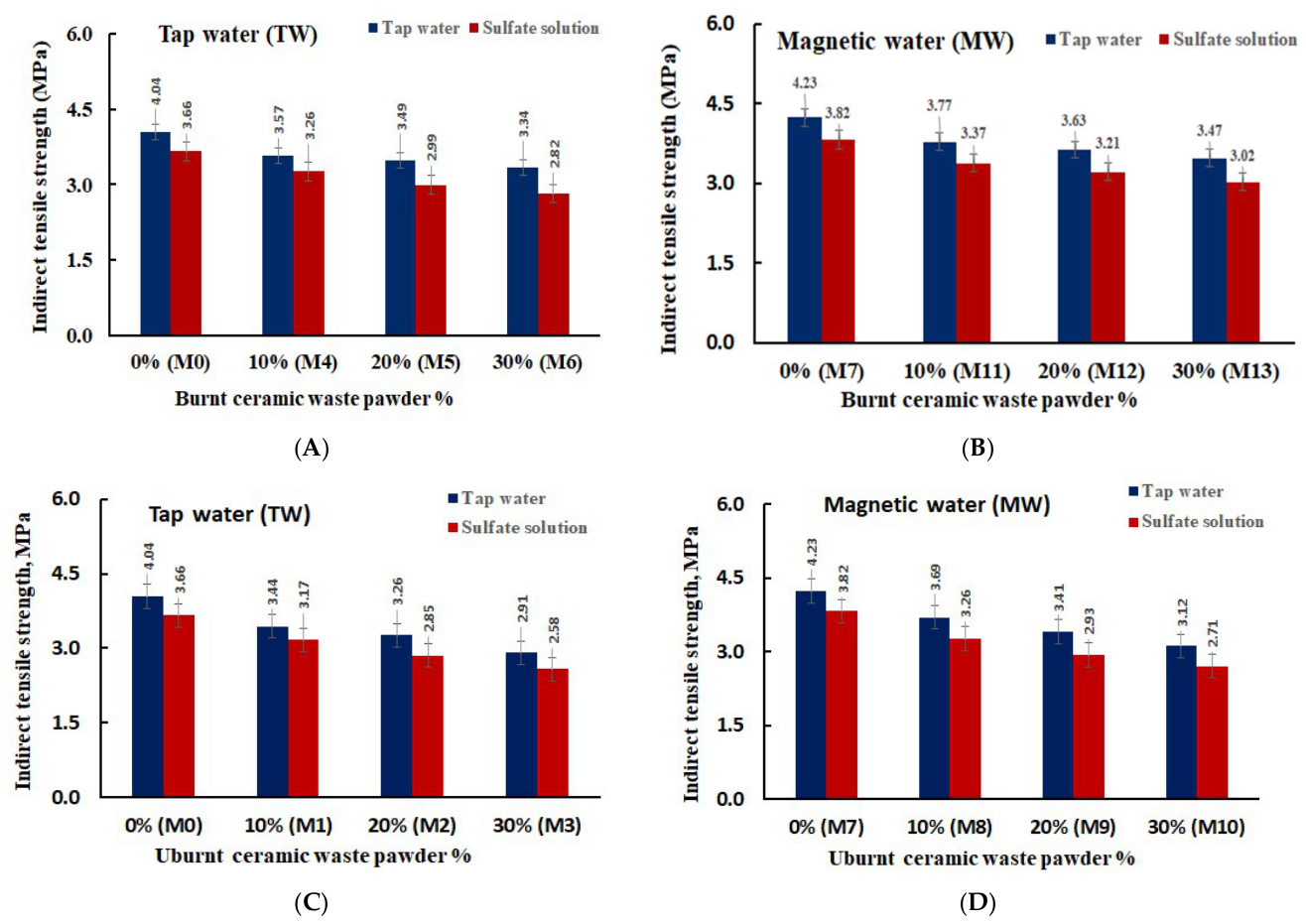
3.2.3. Impact of Sulfate Attack on Indirect Tensile Strength

Figure 12A,B compare the indirect tensile strength of specimens submerged in magnesium sulfate (MgSO4) for 120 days, using tap water and magnetized water in the concrete mixes (BCWP). For tap water mixes submerged in magnesium sulfate (MgSO4) for 120 days, the strength losses were as follows: M0 (0% CWP) from 4.04 MPa to 3.66 MPa (loss 9.4%); M4 (10% BCWP) from 3.57 MPa to 3.14 MPa (loss 12.0%); M5 (20% BCWP) from 3.49 MPa to 2.99 MPa (loss 14.3%); M6 (30% BCWP) from 3.34 MPa to 2.82 MPa (loss 15.6%). The maximum loss (15.6%) occurred with the 30% replacement mix (M6).
Magnetized water mixes showed good resistance to sulfate attack. Strength losses for magnetized water mixes (BCWP) ranged from 9.7% to 13.0%: M7 (0% CWP) from 4.23 MPa to 3.82 MPa (loss 9.7%); M11 (10% BCWP) from 3.77 MPa to 3.37 MPa (loss 10.6%); M12 (20% BCWP) from 3.63 MPa to 3.21 MPa (loss 11.6%); M13 (30% BCWP) from 3.47 MPa to 3.02 MPa (loss 13.0%). M11 (10% BCWP, MW) showed the best relative performance among the BCWP replacement mixes, with only a 10.6% reduction.
Figure 12C,D compare the indirect tensile strength of specimens immersed in magnesium sulfate (MgSO4) for 120 days, using tap water and magnetized water in the concrete mixes (UBCWP). For tap water mixes submerged in magnesium sulfate (MgSO4) for 120 days, the strength losses were as follows: M0 (0% CWP) from 4.04 MPa to 3.66 MPa (loss 9.4%); M1 (10% UBCWP) from 3.44 MPa to 3.17 MPa (loss 7.8%); M2 (20% UBCWP) from 3.26 MPa to 2.85 MPa (loss 12.6%); M3 (30% UBCWP) from 2.91 MPa to 2.58 MPa (loss 11.3%). The strength losses ranged from 7.8% to 12.6% for the tap water mixtures.
Magnetized water mixes showed good resistance to sulfate attack. Strength losses for magnetized water mixes (UBCWP) ranged from 9.7% to 14.1%: M7 (0% CWP) from 4.23 MPa to 3.82 MPa (loss 9.7%); M8 (10% UBCWP) from 3.69 MPa to 3.26 MPa (loss 11.7%); M9 (20% UBCWP) from 3.41 MPa to 2.93 MPa (loss 14.1%); M10 (30% UBCWP) from 3.12 MPa to 2.71 MPa (loss 13.1%). M8 (10% UBCWP, MW) showed the best relative performance among the UBCWP replacement mixes, with only an 11.7% reduction.

3.3. Flexural Strength of Burnt and Unburnt Ceramic Waste Powder Concrete

This section presents the flexural strength of concrete mixes with 0%, 10%, 20%, and 30% replacement by weight of Ordinary Portland Cement (OPC) with burnt ceramic waste powder (BCWP) and unburnt ceramic waste powder (UBCWP). Normal tap water (TW) and magnetic water (MW) were used as two curing media. The flexural strength was tested at two curing ages: 28 and 120 days. Further tests were conducted to assess durability under two aggressive exposure conditions: high temperature (200 °C) and full immersion in a sulfate solution. Table 8 presents the test results of flexural strength.

3.3.1. Effect of Mixing Water Type on Concrete Flexure Strength

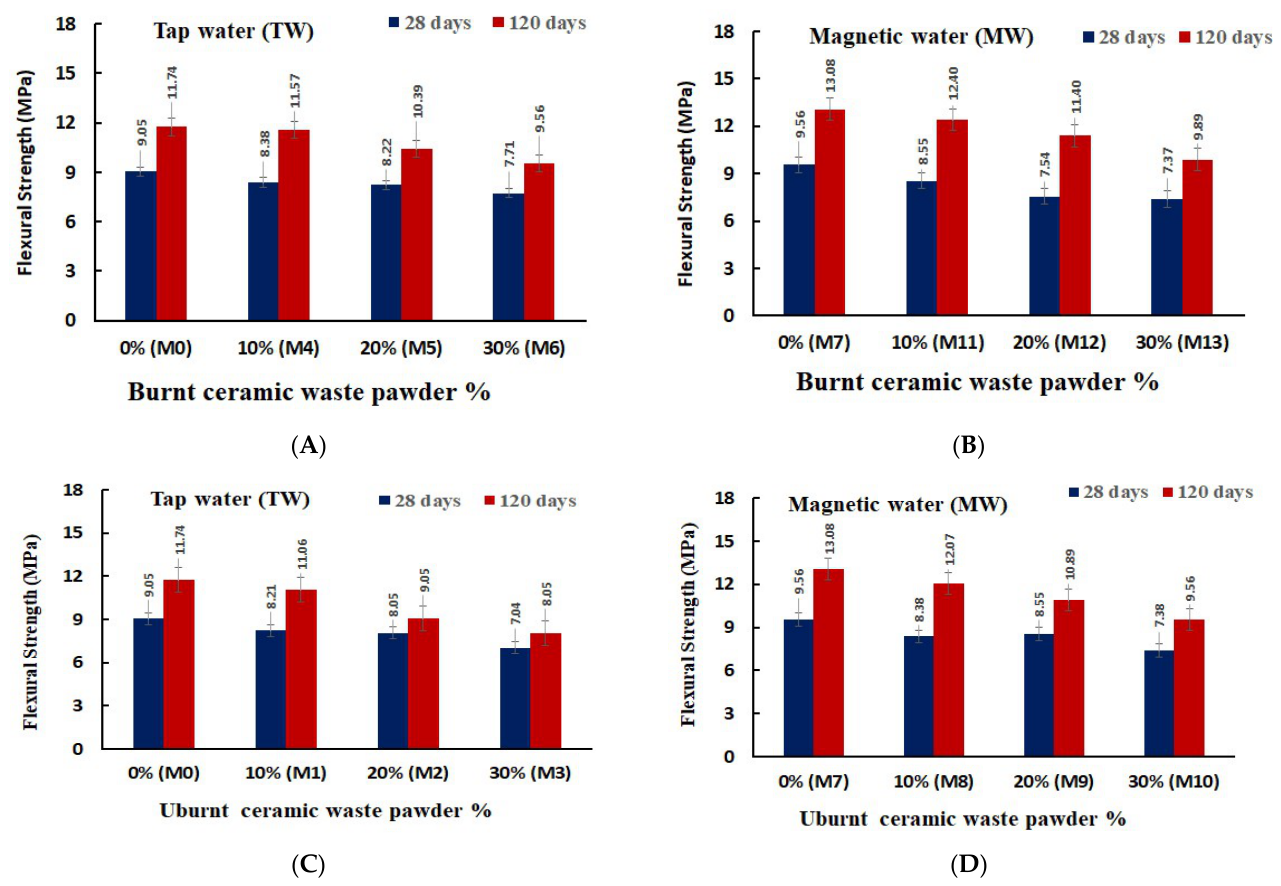
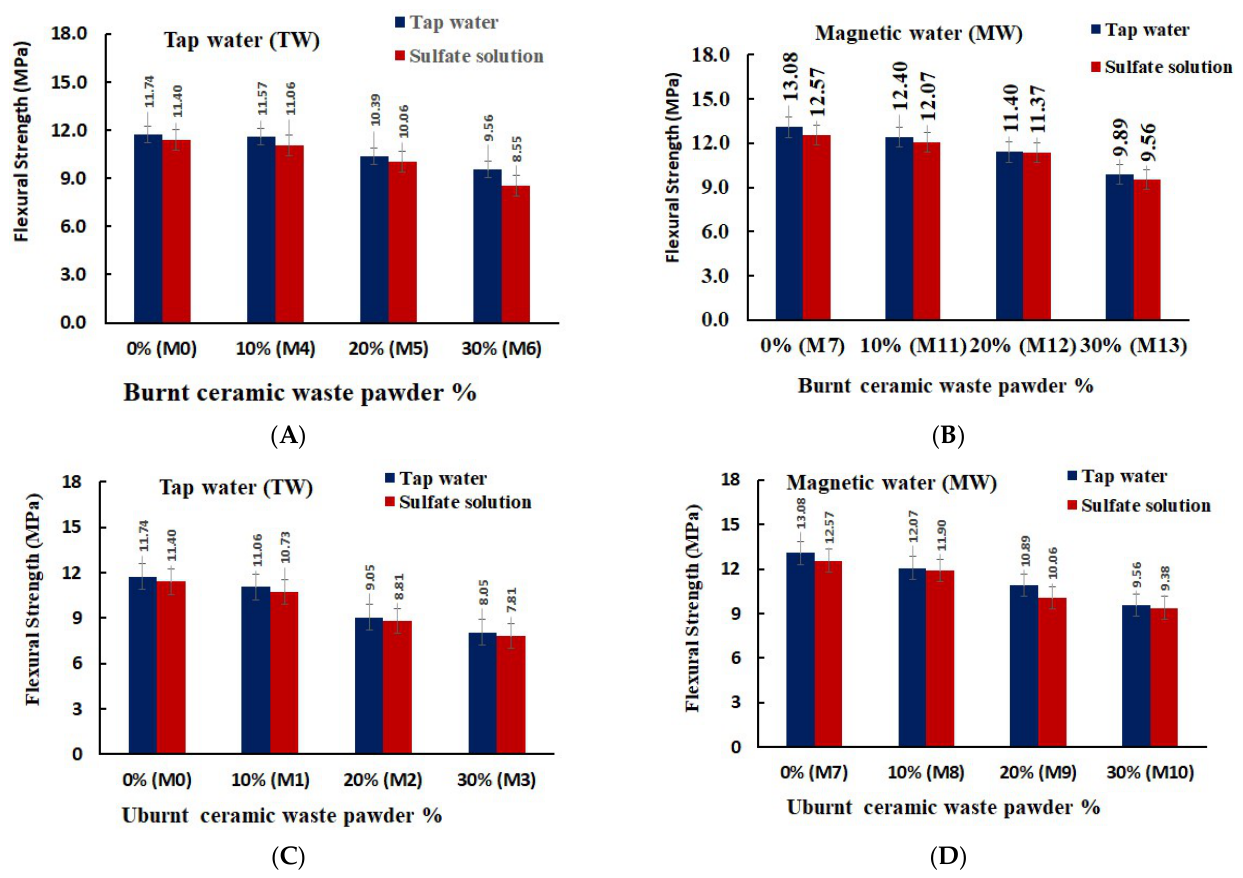
The control mix (M0, 0% CWP, tap water) exhibited the maximum flexure strength across all curing ages, as shown in Figure 13: 9.05 MPa at 28 days and 11.74 MPa at 120 days. The flexure strength of the M4 mix with 10% BCWP replacement was 8.38 MPa at 28 days and 11.57 MPa at 120 days. The flexure strength of the M5 mix with 20% BCWP replacement was 8.22 MPa at 28 days and 10.39 MPa at 120 days. The M6 mix with 30% BCWP replacement achieved flexural strengths of 7.71 MPa at 28 days and 9.56 MPa at 120 days. The flexure strength decreased as CWP concentration increased across all ages.
Effect of BCWP content on flexural strength in tap water (0%, 10%, 20%, and 30%): the data show a clear pattern: flexural strength decreases with increasing BCWP concentration. The control mix (M0, 0% CWP) reached the maximum flexural strength at both testing ages. At 120 days, the reduction in flexure strength relative to M0 was 1.4% for 10% BCWP (M4), 11.5% for 20% BCWP (M5), and 18.6% for 30% BCWP (M6).
The flexural strength of the mixes with magnetic water was greater than that of the mixes with tap water at all ages and at all replacement levels. The control mix M7 (0% CWP, magnetic water) had a flexural strength of 9.56 MPa at 28 days and 13.08 MPa at 120 days. The flexure strength of M11 with 10% BCWP replacement was 8.55 MPa at 28 days and 12.40 MPa at 120 days. The flexure strength of M12 with 20% BCWP replacement was 7.54 MPa at 28 days and 11.40 MPa at 120 days. The M13 mix with a 30% BCWP replacement showed flexural strengths of 7.37 MPa at 28 days and 9.89 MPa at 120 days. The results confirm the influence of magnetic water at various BCWP replacement concentrations over time. The control mix M7 (0% CWP, magnetic water) produced 13.08 MPa at 120 days, which was 11.4% higher than the tap water control M0 (11.74 MPa). The flexural strength results followed trends similar to those observed for compressive and indirect tensile strengths, confirming that both the ceramic waste powder replacement level and the type of mixing water significantly influence the mechanical performance of concrete. The 10% BCWP replacement level maintained flexural strength close to that of the control mix after prolonged curing, whereas higher replacement levels resulted in progressively greater strength reductions due to the combined effects of cement dilution and the lower availability of hydration products. In contrast, the use of magnetized water consistently improved flexural strength at all curing ages and replacement levels by promoting more efficient cement hydration and the development of a denser cementitious matrix, thereby enhancing the resistance of concrete to crack initiation and propagation under flexural loading. These observations are consistent with previous studies reporting that moderate ceramic waste powder replacement, together with improved hydration, contributes to enhanced flexural performance and long-term mechanical stability [6,38].

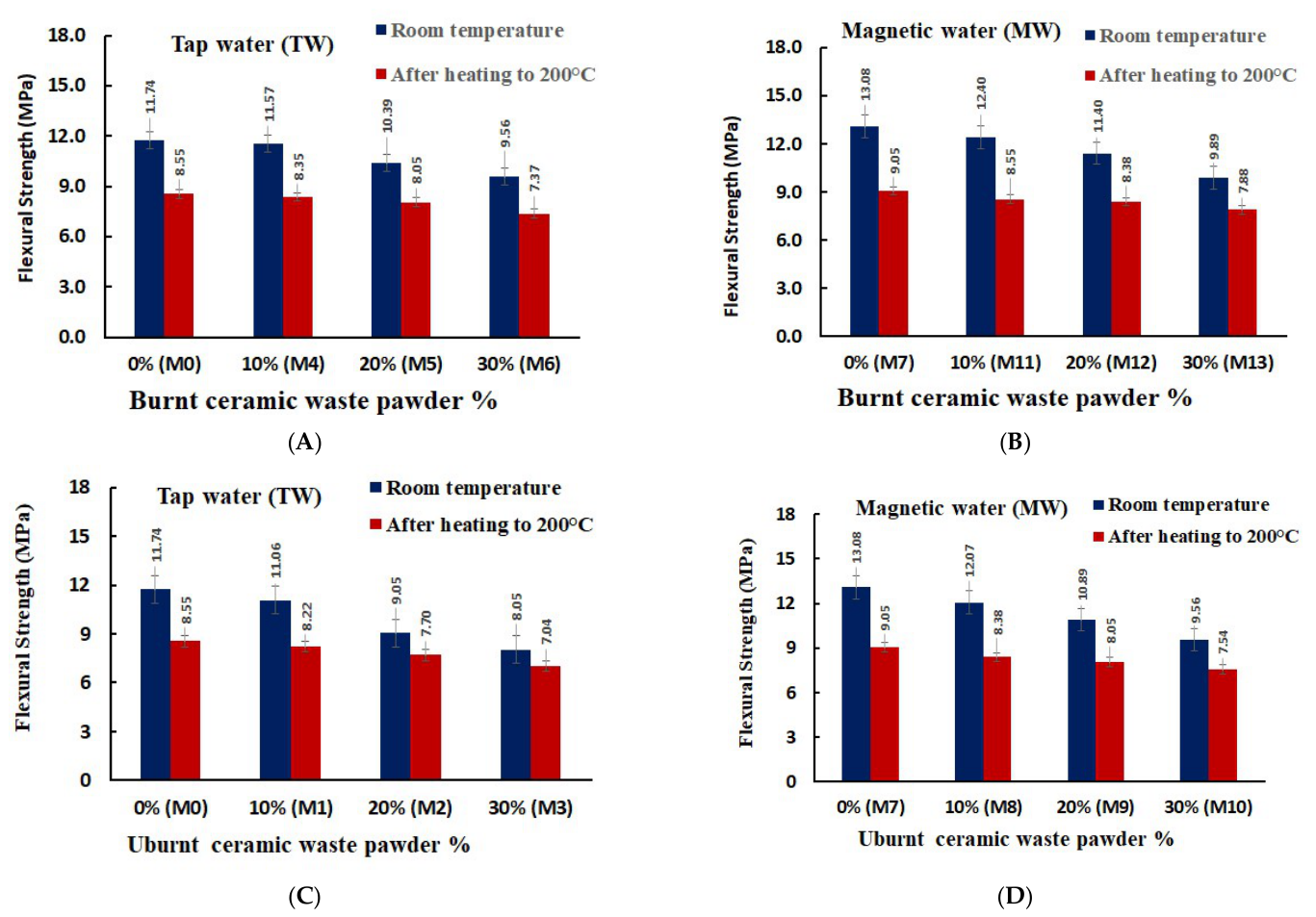
3.3.2. The Impact of Thermal Exposure at 200 °C on the Flexural Strength of Concrete

Figure 14 compares the 120-day flexural strength of specimens with normal curing to specimens exposed to a constant temperature of 200 °C for both tap water and magnetic water mixes. The mix with 0% CWP (M0) had a flexural strength of 11.74 MPa, which decreased to 8.55 MPa upon heating, representing a strength loss of 27.2%. After heat exposure, the flexural strength of M4 (10% BCWP) decreased from 11.57 MPa to 8.35 MPa, representing a 27.8% reduction. The flexural strength of M5 (20% BCWP) was 10.39 MPa, which decreased to 8.05 MPa after heat treatment, a 22.5% reduction. Finally, M6 (30% BCWP) had a flexural strength of 9.56 MPa, which decreased to 7.37 MPa after heat exposure, representing a 22.9% loss. Strength losses for tap water mixes ranged from 22.5% to 27.8%.
On the other hand, the magnetic water mixtures retained higher absolute flexural strength values after thermal exposure than the tap water mixtures at all CWP replacement levels. The strength losses for magnetic water mixes ranged from 20.3% to 31.0%. For example, M7 (0% CWP, magnetic water) had a flexural strength of 13.08 MPa at 120 days, which decreased to 9.05 MPa after exposure to 200 °C, representing a 30.8% loss. The initial strength of M11 (10% BCWP) was 12.40 MPa, which reduced to 8.55 MPa after heating, a loss of 31.0%. M12 (20% BCWP) started at 11.40 MPa and decreased to 8.38 MPa, representing a 26.5% loss. Finally, M13 (30% BCWP) had an initial strength of 9.89 MPa, which decreased to 7.88 MPa, a 20.3% loss in strength.

3.3.3. Impact of Sulfate Attack on Flexural Strength

Figure 15 shows the comparison of the 120-day flexural strength of water-cured specimens with sulfate-exposed specimens. Sulfate treatment reduced the flexural strength of TW mixes. The flexural strength of M0 (0% CWP) was 11.74 MPa, which decreased to 11.40 MPa after 120 days of immersion in magnesium sulfate (MgSO4), representing a 2.9% loss. The flexural strength of M4 (10% BCWP) reduced from 11.57 MPa to 11.06 MPa, representing a 4.4% loss. The flexural strength of M5 (20% BCWP) was 10.39 MPa and decreased to 10.06 MPa, representing a 3.2% loss. Finally, M6 (30% BCWP) showed a flexural strength of 9.56 MPa, which decreased to 8.55 MPa after sulfate immersion, a reduction of 10.6%.
Magnetic water mixtures demonstrated superior resistance to sulfate attack compared to tap water mixes. The flexural strength of M7 (0% CWP) was 13.08 MPa, which decreased to 12.57 MPa after 120 days of immersion in MgSO4, a loss of 3.9%. The flexural strength of M11 (10% BCWP) was lowered from 12.40 MPa to 12.07 MPa, a loss of 2.7%. M12 (20% BCWP) had a flexural strength of 11.40 MPa, which decreased negligibly to 11.37 MPa, representing only a 0.3% loss. Finally, M13 (30% BCWP) showed a flexural strength of 9.89 MPa, which decreased to 9.56 MPa, representing a 3.3% reduction.

3.4. Microstructure Results

3.4.1. Scanning Electron Microscope (SEM)

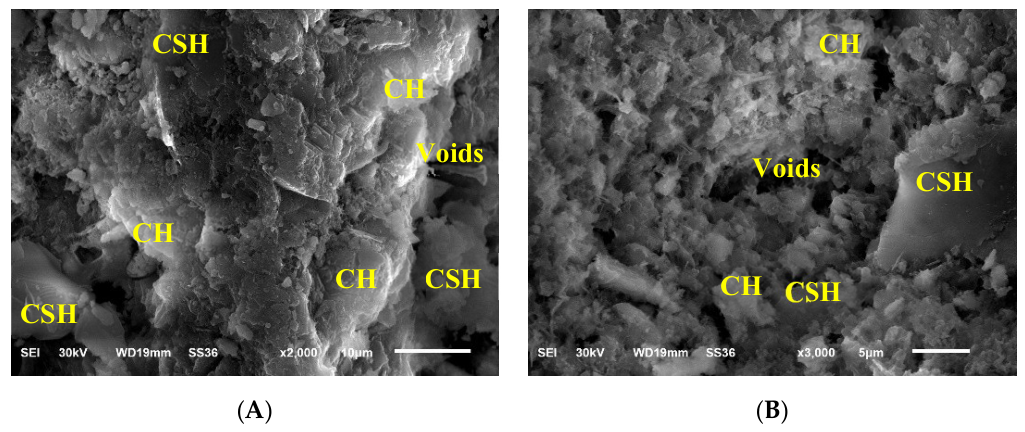
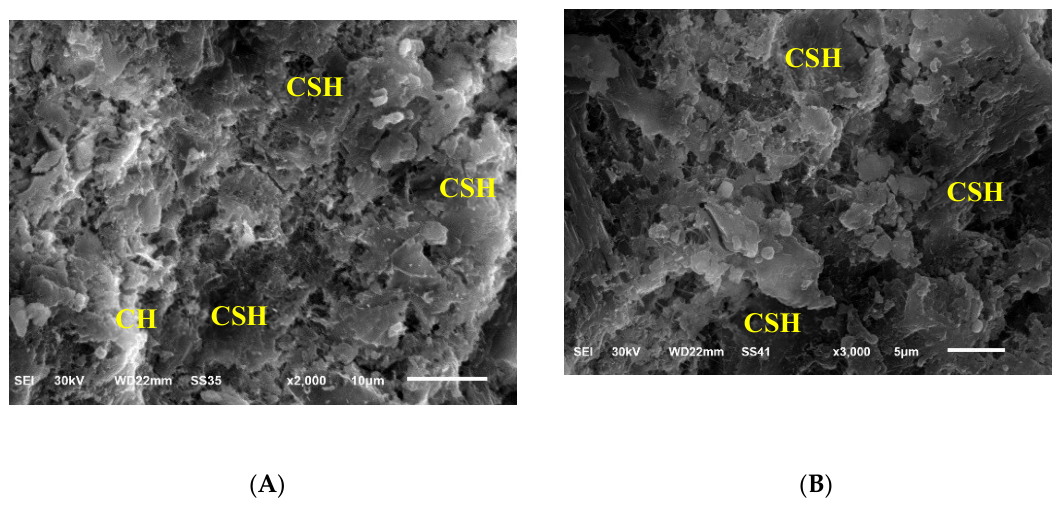
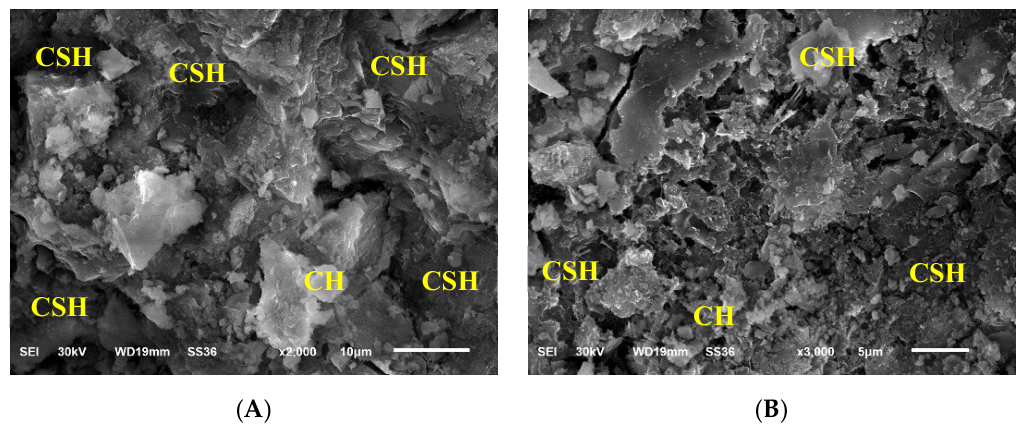
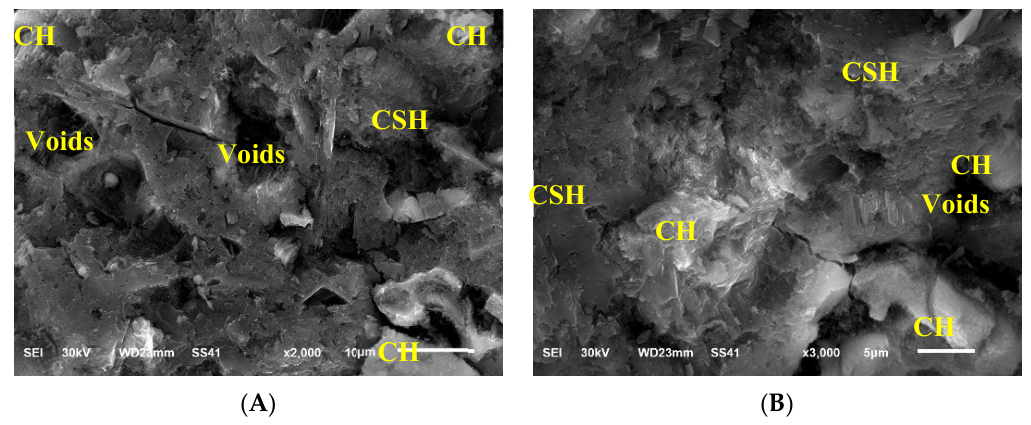
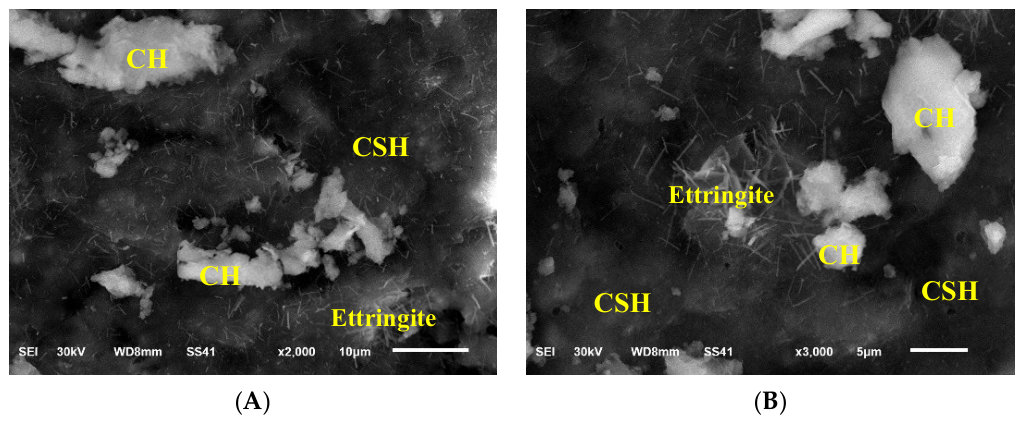
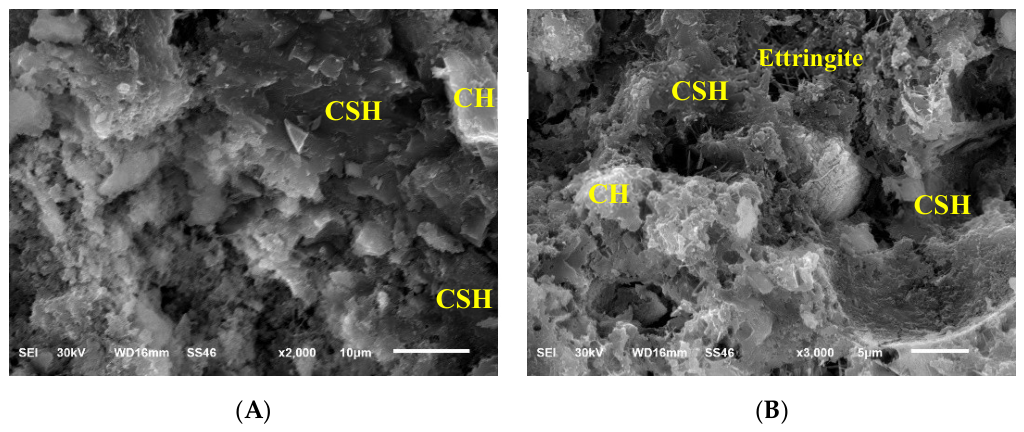
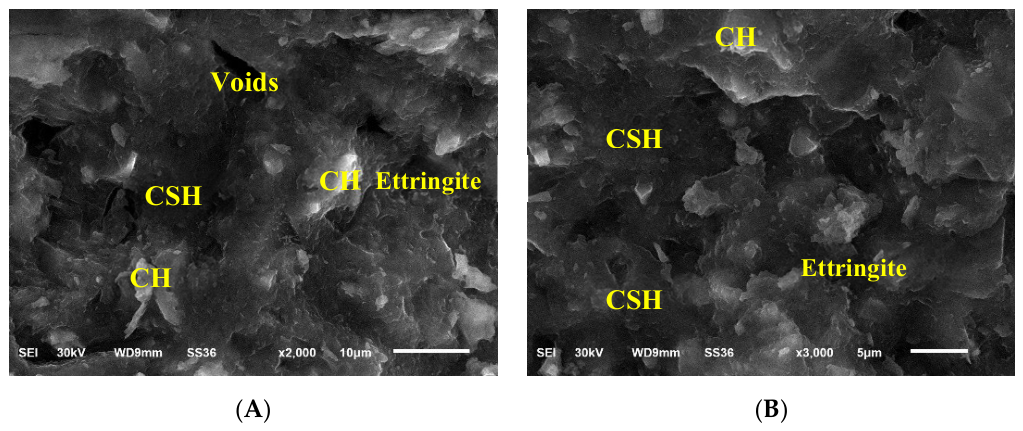
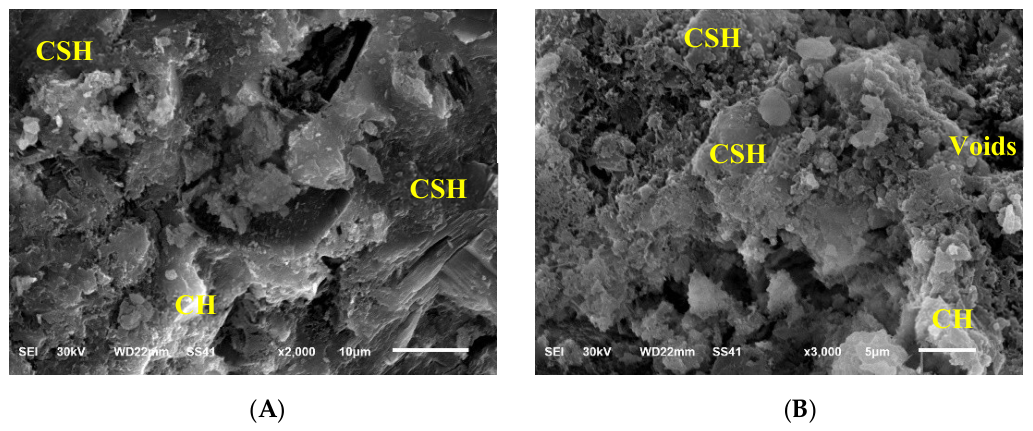
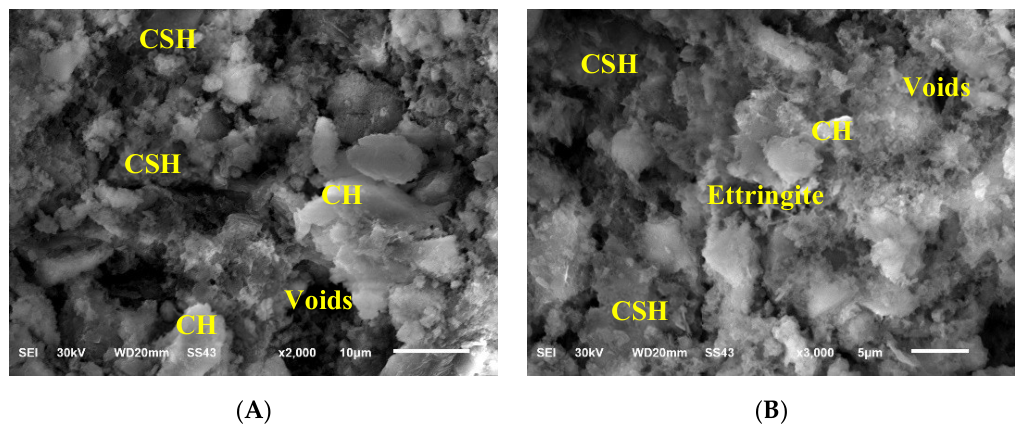
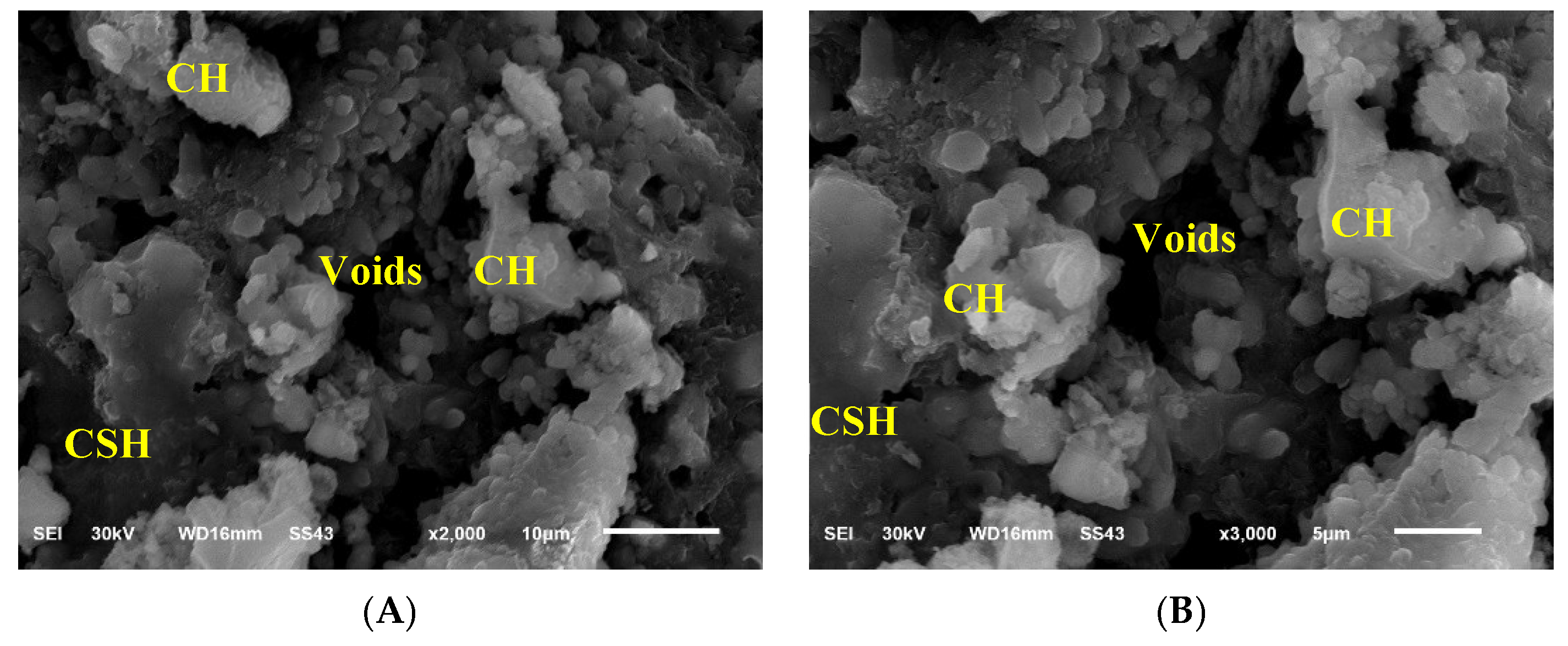
The mechanical performance of the investigated concrete mixes is deeply related to the microstructural configuration of the hydrated cementitious matrix and its corresponding pore geometry, as shown in Figure 16, Figure 17, Figure 18, Figure 19, Figure 20, Figure 21, Figure 22, Figure 23, Figure 24 and Figure 25. The performance of mix M7 using magnetized water induces autonomous microstructural densification and homogenization, in contrast to the normal, porous hydration microstructure of the TW control mix M0, which is hindered by water clustering into hydrogen-bonded molecules. The magnetic field reduces fluid surface tension and accelerates hydration kinetics by breaking up large water clusters into high-mobility molecules. This leads to deeper penetration of clinker and an ultra-dense C–S–H gel network, while dispersing weak CH phases into localized crack-intercepting anchors [73,84].
However, there is severe microstructural regression when 30% cement is replaced with UBCWP in mix M3, resulting in a poorly consolidated matrix and a weak interfacial transition zone (ITZ). On the other hand, applying MW to mix M10 successfully mitigates this deterioration, as the altered water configuration accelerates the hydration of the remaining clinker, thereby refining the pore structure [76]. The microstructural interpretation presented here rests on the relationship between pore structure and mechanical performance that has been established quantitatively in other cementitious systems. Studies employing low-field nuclear magnetic resonance relaxometry have shown that the refinement of the pore-size distribution, particularly the conversion of harmful pores above 1 µm into gel and capillary pores, correlates directly with strength development and with resistance to ionic ingress [85].
By contrast, using BCWP in mix M6 leads to autonomous microstructural recovery through pozzolanic activity, in which secondary C–S–H gel, which improves matrix cohesion and seals internal capillary voids, is precipitated by amorphous aluminosilicates that consume fragile CH crystals [86]. Also, high chemical synergy is realized in mix M13 by combining the BCWP with MW. In this case, the low surface tension of MW accelerates pozzolanic precipitation and silica dissolution, creating an ultra-dense, highly polymerized C–S–H network that compensates for the reduction of cement and reinstates structural integrity [72].
The thermal dehydroxylation and dehydration that occur when mix M6 is exposed to 200 °C using TW result in severe decomposition and cracking of its microstructure. Also, the dehydration of C–S–H gel induces volume shrinkage and internal tensile stresses, leading to severe cracking that transforms the binding phases into a porous, calcium-rich matrix [87]. It is worth emphasizing that the cracks observed in the SEM micrographs represent the final stage of a damage process that is generally considered to initiate at the nanoscale. During thermal exposure, dehydration of the C–S–H gel may generate localized tensile stresses and nanoscale discontinuities, which subsequently coalesce into microcracks detectable by SEM [88]. This mechanism may also explain the improved thermal performance of the magnetized-water mixtures. The lower strength loss of mix M13 compared with M6 may be associated with a denser hydration structure that reduces nanoscale crack initiation and subsequent crack propagation. While the present study provides indirect evidence through SEM and EDS, direct nanoscale characterization remains beyond its scope and is recommended for future research [89].
Conversely, mixing M13 using MW maintains its structural microstructure and cohesion. The matrix resists the rise in internal vapor pressure due to thermal heating, locking hydration products in a stable configuration that prevents chemical bond breakdown and maintains structural integrity, owing to the dense initial packing and high degree of polymerization of the C-S-H gel achieved through magnetic activation [90].
The SEM results clearly show microstructural degradation of the concrete under sulfate attack. In the tap-water mix M6, an interconnected pore network allows the ingress of SO42−, which reacts with calcium aluminates, resulting in the formation of expansive ettringite needles. Their crystallization pressure causes micro-cracking and cohesive failure [91]. Rather, results demonstrate the chemical shielding and reduced ettringite formation of the magnetized composite M13; the combined effect of the pore refinement of the magnetized water and the void-filling of the BCWP pozzolanic products removes the transport paths, preventing the ingress of sulfate and protecting the C–S–H gel and the structural integrity of the composite [36,92].

3.4.2. Energy-Dispersive X-Ray Spectroscopy (EDS)

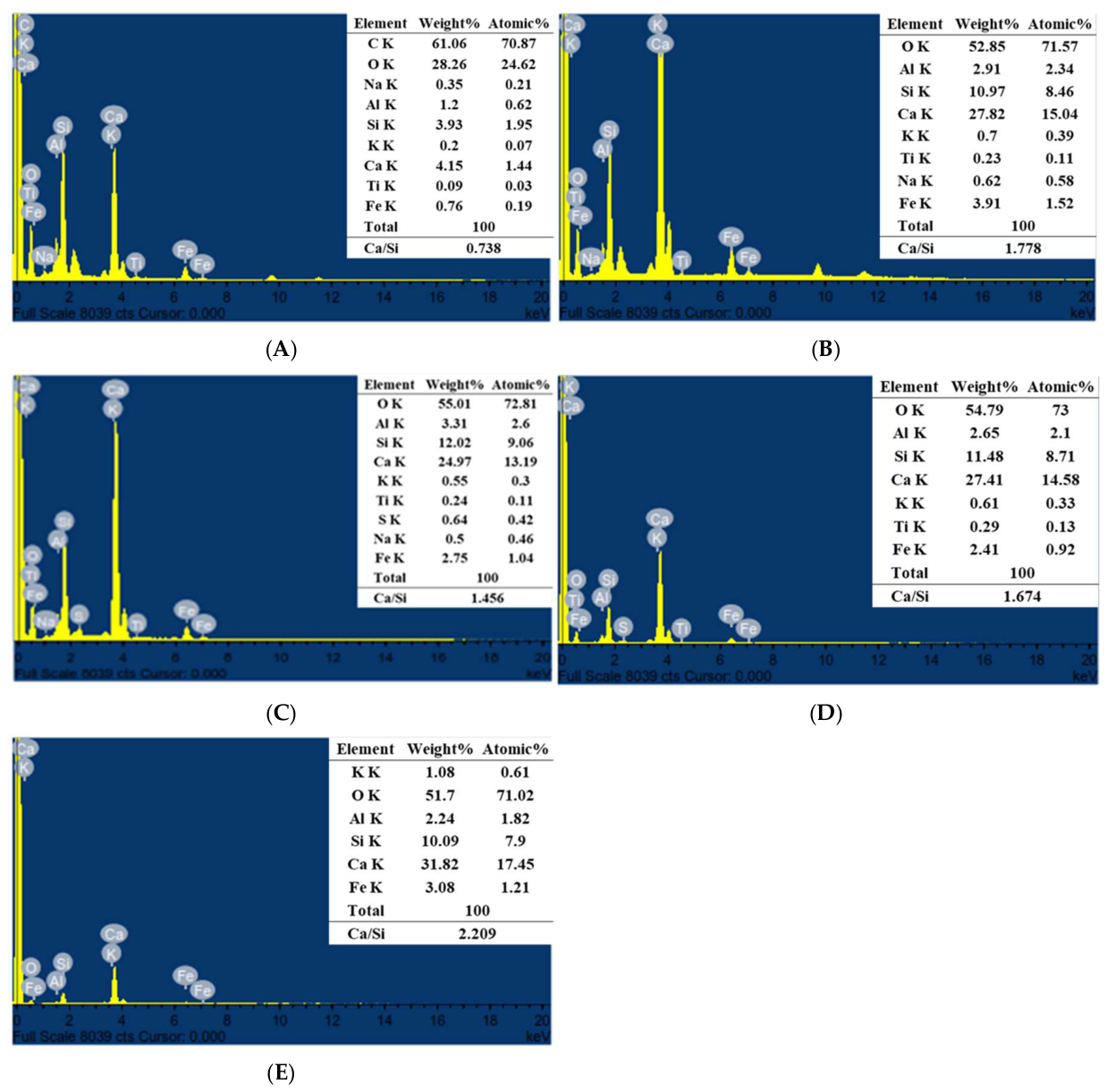
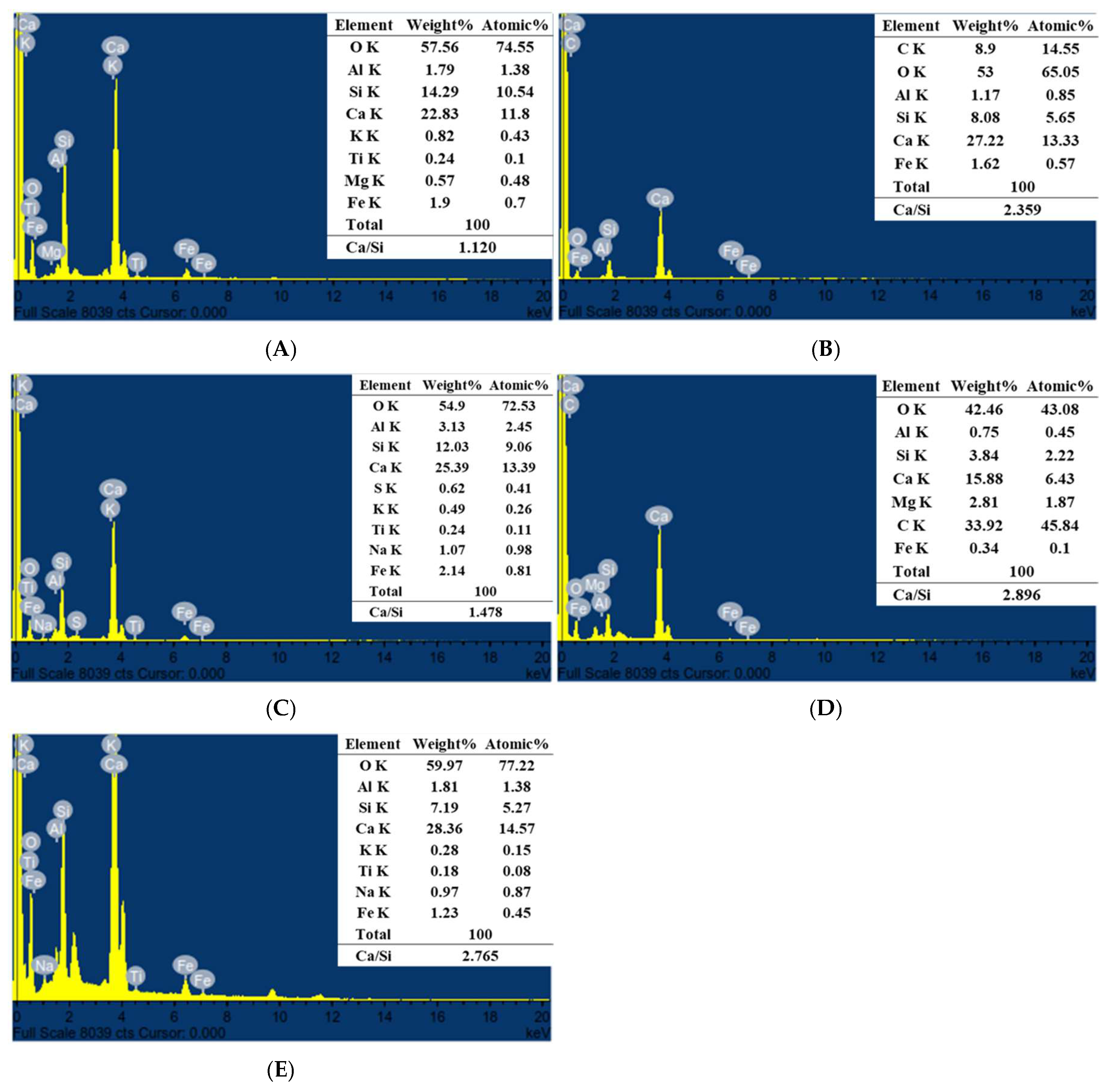
The EDS analysis results reveal that the partial substitution of cement with ceramic waste powders (CWP) and the activation of magnetized water (MW) significantly influence the elemental composition of concrete hydration products, as shown in Figure 26 and Figure 27. This influence is directly observed in the calcium-to-silicon (Ca/Si) ratio values and is in perfect correlation with the mechanical trends. The development of compressive strength is driven by the formation of a dense, highly polymerized, and structurally stable calcium–silicate–hydrate (C–S–H) gel network. Low (Ca/Si) ratios in cementitious matrices are strongly correlated with this formation. On the other hand, high ratios usually indicate the presence of chemically weaker, less dense hydration products or unreacted phases [2].
The control mix (M0, 0% CWP) using TW showed a balanced hydration profile with a low (Ca/Si) ratio of 1.120, which promotes optimal development of baseline compressive strength. The (Ca/Si) ratio was significantly higher (2.359) at a high level of substitution of cement by unburnt ceramic waste powder (UBCWP) using TW in mix M3. The sharp elemental shift provides microstructural evidence of the initial drop in strength observed in high-CWP mixes that suffered from clinker dilution and decelerated early hydration kinetics [93].
The mechanical performance across CWP concrete mixtures reflects a distinct structural equilibration driven by pozzolanic activity. The amorphous silica and alumina phases in the CWP consume the liberated calcium hydroxide, Ca(OH)2, to form supplementary (C-S-H) gel [71]. The addition of 30% BCWP using tap water to mix M6 chemically confirms the pozzolanic refinement by producing a (Ca/Si) ratio of 1.478, implying better polymerization of the silicon network than in the unburnt analog, mix M3.
Compared with the control mix using TW, the control mix (M7, 0% CWP) using MW exhibits autonomous densification, with a highly refined Ca/Si ratio of 0.738, resulting in a notable improvement in long-term compressive strength. Therefore, when 30% (BCWP) was added to mix M13, the synergistic effect of magnetic water treatment and burnt pozzolan helped to stabilize the (Ca/Si) ratio at 1.456. This demonstrates that MW-induced microstructural densification and enhanced hydration kinetics can effectively compensate for a decrease in clinker content to achieve the desired structural integrity [94].
The thermal dehydroxylation of the binder led to the upward shift of the (Ca/Si) ratios of the investigated concrete mixtures at 200 °C and initiated the microstructural disintegration of the (C–S–H) gel into weaker, calcium-rich phases [95]. At these higher temperatures, the CWP mixture M6 using TW showed a pronounced increase in its (Ca/Si) ratio to 2.896, indicating a substantial breakdown of the matrix structure. Interestingly, the magnetized CWP mixture M13 exhibited better thermal stability, maintaining a (Ca/Si) ratio of 1.674 at 200 °C. This lower value confirms that the combination of (BCWP) and (MW) stabilizes the main hydration products under thermal stress and successfully mimics the significantly lower thermal strength loss observed in MW mixes compared to TW mixes [95].
In addition, resistance to chemical attack was evaluated by exposure to harsh environments such as MgSO4, which typically causes calcification, degradation of the silicate framework, and the formation of expanded ettringite phases [96]. After exposure to sulfate attack, mixing M6 with TW showed a significant increase in the (Ca/Si) ratio to 2.765, indicating extensive chemical change and decalcification in the concrete matrix. However, compared to mix M6, the Ca/Si ratio in mix M13 (using MW) was lower at 2.209, indicating high chemical stability. The enhanced resistance to sulfate ions can be attributed to synergistic effects caused by improved pore structure and condensation (CSH) resulting from the combination of (MW) and (BCWP). When magnetized water is used in concrete, decalcification from sulfate attack is greatly reduced because the water cannot penetrate, thereby maintaining strength [64].

3.4.3. X-Ray Diffraction

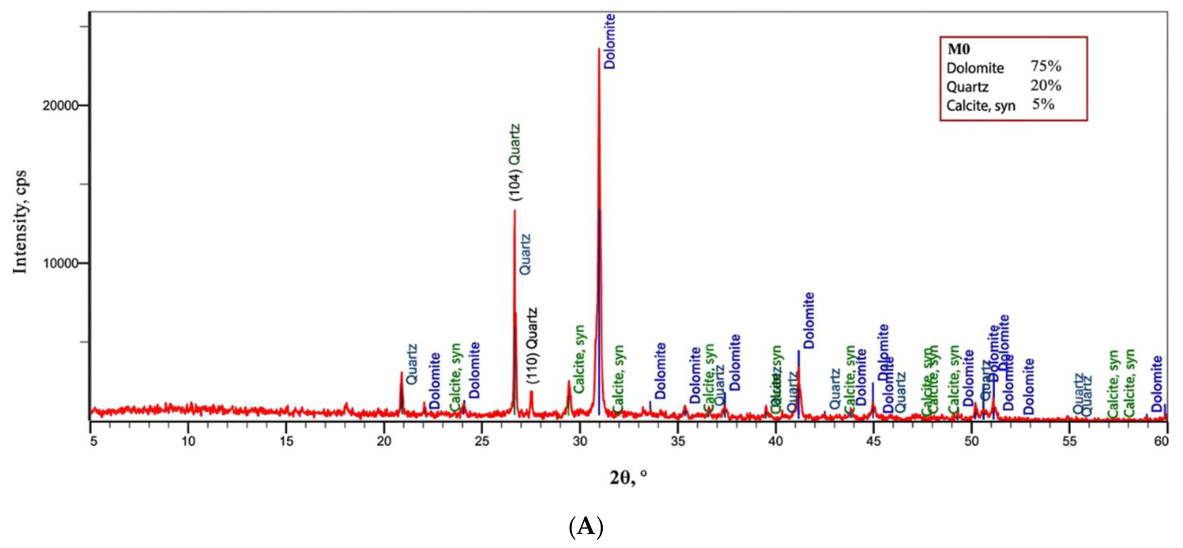
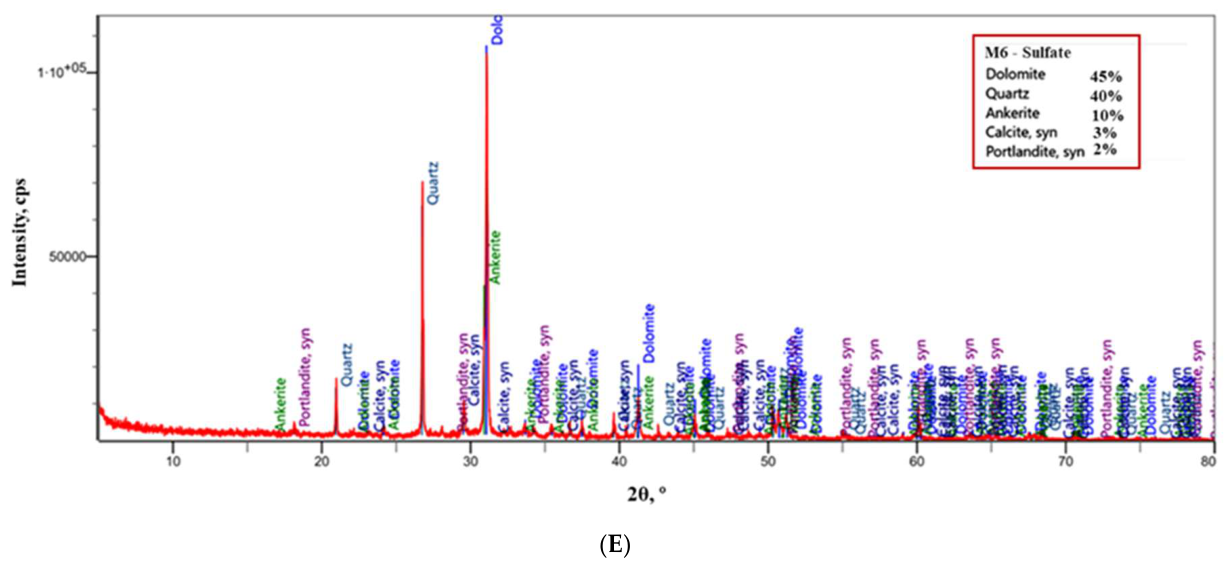
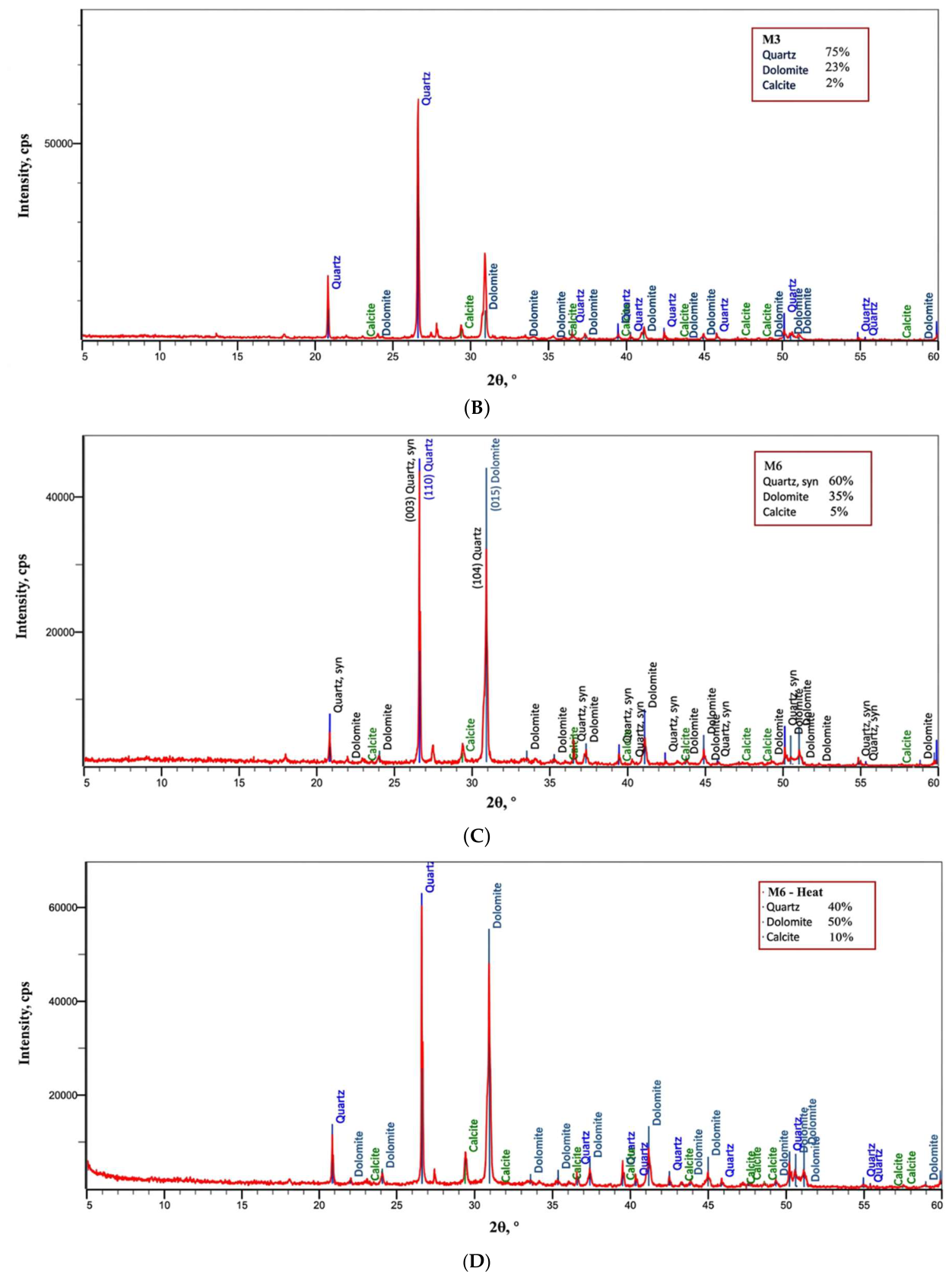
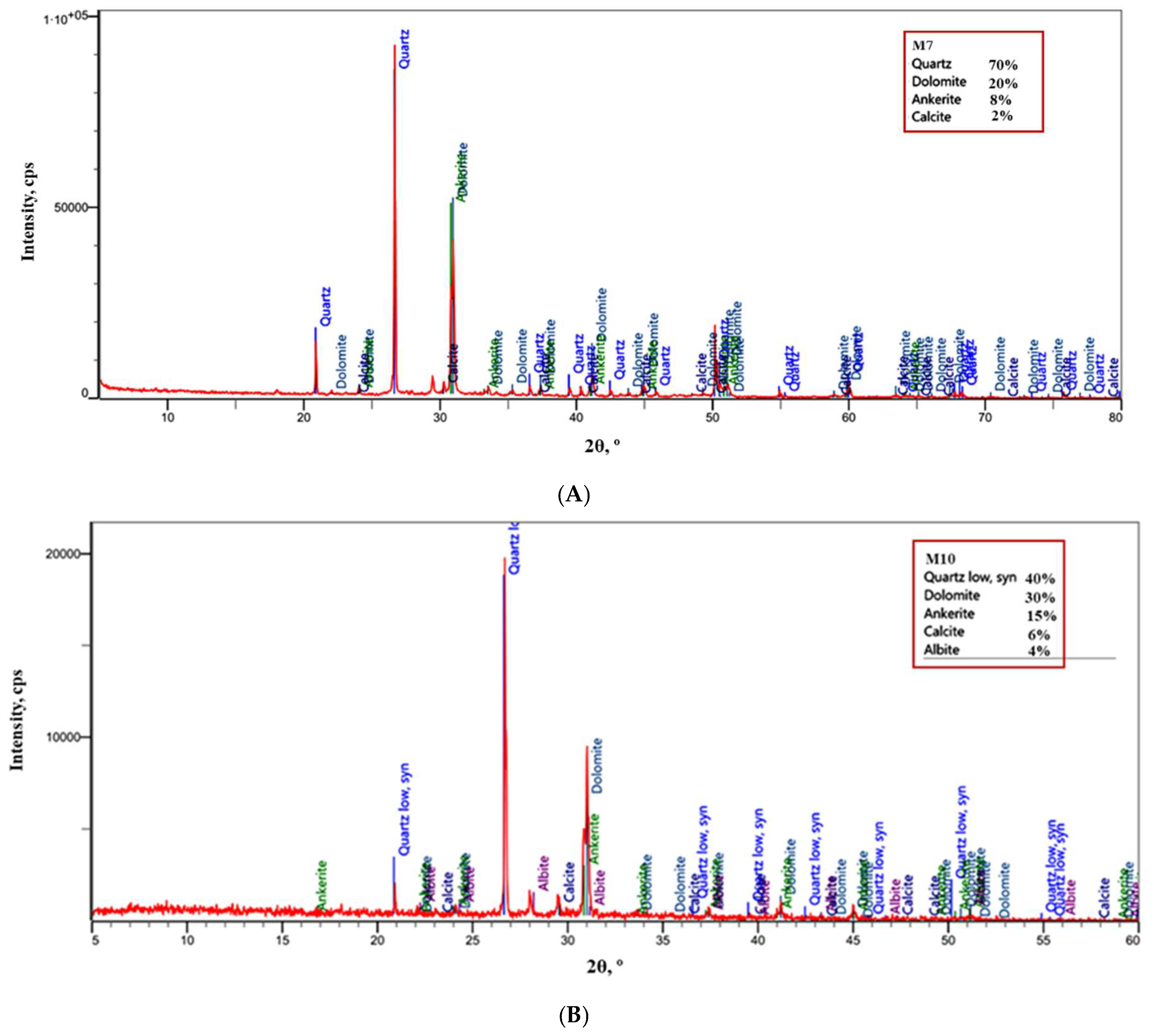
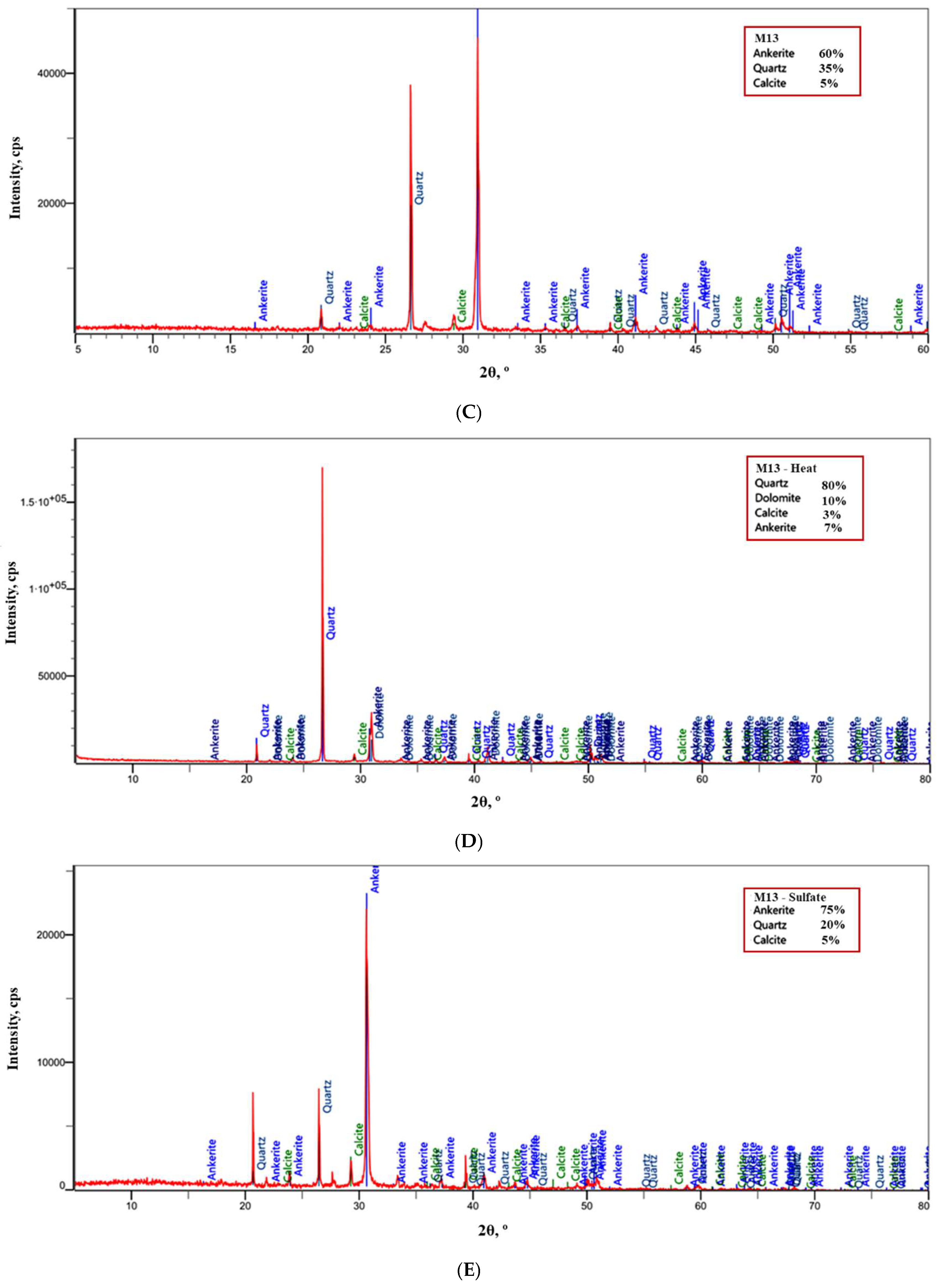
The qualitative and quantitative X-ray diffraction (XRD) analyses indicate a complex mineralogical evolution controlled by the initial mix designs and subsequent environmental and thermal exposures, as shown in Figure 28 and Figure 29. In the control and unexposed crystalline matrices, such as M0, M3, M6, and M7, the microstructural framework is dominated by intense diffraction peaks from quartz and dolomite, with minor traces of stable calcite. The distinct, sharp reflections of quartz (SiO2) at 2θ around 26.6° and dolomite (CaMg(CO3)2) at 31.0° indicate a highly crystalline matrix with dense packing of structural aggregates. This mineralogical density is directly responsible for the high mechanical strength of these systems, where the structural integrity of the solid crystalline phases ensures an efficient distribution of stresses under load [97].
However, at high temperatures, the stability of the crystal depends on the constituent mineral phases that directly control the residual mechanical response. In the M6 system, high-temperature treatment leads to structural degradation, driven by the destabilization of carbonate phases and their partial transformation to secondary calcite. On the contrary, the M13 system shows excellent thermal stability, as evidenced by XRD patterns indicating a clear shift towards a silica-rich matrix, with quartz as the predominant phase. It is a rigid, fire-resistant skeleton of a very stable quartz framework that inhibits thermal micro-cracking and slows down thermal dissociation common to heavy carbonate systems, preserving structural and load-bearing integrity [98].
The microstructural response to chemical aggression is governed by the initial mineral configuration of the matrices and the presence of calcium hydrates. In the M6-Sulfate system, mechanical degradation is driven by portlandite (Ca(OH)2), which provides the free calcium ions required to drive expansive sulfate reactions. On the other hand, the M13-Sulfate system reveals a different degradation pathway due to the absolute preponderance of the ankerite phase (Ca(Fe, Mg)(CO3)2) up to 75% and the total absence of portlandite. The mechanism shifts from traditional expansive product crystallization to a progressive chemical leaching, decalcification, and network destabilization of the carbonate-dominated matrix. Such structural softening greatly reduces the interlocking efficiency of the mineral framework, explaining the loss of mechanical strength without requiring secondary expansive phase crystallization [99,100].

3.5. Interpretation of Mechanical Performance with the Microstructural Results and Sustainability Benefits

Scanning electron microscopy (SEM) showed that the mechanical behavior of all mixes was directly related to the microstructural arrangement of the hydrated cementitious matrix. The tap-water control (M0) showed a relatively porous matrix with visible calcium hydroxide (CH) crystals and a limited calcium silicate hydrate (C–S–H) gel network [73,84]. Replacing 30% of the cement with unburnt ceramic waste powder (UBCWP) in mix M3 resulted in poor matrix consolidation and a weak interfacial transition zone (ITZ), consistent with the large reductions in compressive strength observed in high-replacement mixes [76]. In contrast, the substitution of burnt ceramic waste powder (BCWP) in mix M6 enabled pozzolanic recovery, in which amorphous aluminosilicates consumed the brittle CH crystals and formed secondary C–S–H gel, thereby improving the cohesion of the matrix and sealing the internal capillary voids [86].
MW in mix M7 induced self-driven microstructural densification by breaking up large hydrogen-bonded water clusters into high-mobility molecules, reducing surface tension and increasing hydration kinetics to form an ultra-dense C–S–H gel network, while dispersing weak CH phases into localized crack-intercepting anchors [73,84]. The best microstructural quality was obtained in mix M13 (30% BCWP + MW), where MW reduced surface tension, thereby improving pozzolanic precipitation and silica dissolution, leading to the formation of a highly polymerized C–S–H network that restored structural integrity even with a 30% cement reduction [72]. M6 (TW) experienced severe C–S–H dehydration and internal micro-cracking under thermal exposure at 200 °C. M13 (MW) exhibited cohesion due to denser initial packing and a higher degree of C–S–H polymerization [90]. M6 exhibited extensive ettringite crystallization and cohesive failure due to sulfate exposure, whereas M13 showed much less ettringite formation, with pozzolanic reaction products that improved pore connectivity and filled voids [91,92].
The SEM observations were confirmed by EDS analysis of Ca/Si ratios, which are strongly correlated with mechanical strength and C–S–H gel quality. The lowest Ca/Si ratio of 0.738 was observed for the MW control (M7), indicating a highly polymerized, dense C–S–H network consistent with its superior 120-day compressive strength of 77.25 MPa [94]. The high Ca/Si ratio of 2.359 for mix M3 (30% UBCWP, TW) confirmed the presence of chemically weak hydration products and severe clinker dilution [93]. The synergistic effect of MW and BCWP compensates for the reduction in cement content, thereby maintaining structural integrity, as evidenced by M13 stabilized at a Ca/Si ratio of 1.456 [94]. The Ca/Si ratio of M6 sharply increased to 2.896 on thermal exposure, indicating extensive breakdown of the matrix, while that of M13 was restricted to 1.674, confirming the superior thermal stability of MW–BCWP mixes [95]. Sulfate attack increased the Ca/Si ratio of M6 to 2.765, but that of M13 was 2.209, indicating much less decalcification in the MW-treated composite [64].
XRD analysis showed the presence of dense quartz and dolomite crystalline phases in the reference mixes, whose structural integrity guaranteed efficient stress distribution and high mechanical strength [97]. Under thermal stress, M13 shifted to an 80% quartz-dominant matrix, creating a rigid, fire-resistant skeleton that prevented thermal micro-cracking, in contrast to M6, which showed destabilization of the carbonate phase and secondary calcite formation [98]. Under sulfate attack, M6 retained portlandite (Ca(OH)2), which provided the free calcium ions required for expansive ettringite formation, whereas M13 showed predominance of the ankerite phase (Ca (Fe, Mg) (CO3)2) at 75% and a complete absence of portlandite, diverting degradation from expansive crystallization to a milder progressive leaching pathway and thus preserving a greater proportion of mechanical strength [99,100].
The combination of ceramic waste powder and magnetized water simultaneously meets environmental, economic, and technical sustainability. Large quantities of industrial ceramic waste are produced and diverted from landfills, thereby contributing to environmental damage [6,7]. Partial cement replacement up to 20% directly reduces CO2 emissions associated with clinker production [5]. The 120-day compressive strength of mix M12 (20% BCWP + MW) was 65.17 MPa, close to the tap-water control (68.23 MPa), confirming that structural adequacy is maintained while cement consumption is cut by 20% [70,72]. Magnetized water, without any chemical admixtures, naturally improves hydration kinetics and has high durability under thermal and sulfate exposures with low environmental impact [72,73]. Together, these approaches show a feasible route to sustainable, high-performance concrete with a greatly reduced environmental impact.

4. Conclusions

This work evaluates the mechanical properties (compressive, tensile and flexural strengths) of concrete with 10–30% CWP (burnt and unburnt) mixed with MW at 7, 28 and 120 days; the durability after 120 days of sulfate immersion; and sustained heating at 200 °C. It also characterizes the microstructural changes using scanning electron microscopy (SEM), energy dispersive spectrometry (EDS) and X-ray diffraction (XRD). The conclusions are based on experimentally measured mechanical, durability, and microstructural performance, corroborated by SEM, EDS, and XRD analyses, while the direct physicochemical characterization of the processed magnetized water was outside the scope of this investigation. Accordingly, the following conclusions can be drawn:
  • The increase in CWP replacement from 0% to 30% was found to gradually decrease all mechanical strengths; however, the 10% BCWP substitution was able to maintain compressive strength near that of the control mix.
  • BCWP was always better than UBCWP since thermal pre-treatment significantly increases the amorphous silica content, thus increasing the pozzolanic reactivity and long-term mechanical performance of concrete.
  • Magnetized water consistently improved all mechanical properties at all ages, with the MW control reaching 13.2% higher compressive strength at 120 days than tap water.
  • M12 (20% BCWP with magnetized water) achieved 65.17 MPa at 120 days, which is almost the same strength as the tap-water control, despite using 20% less cement.
  • Tap-water mixes at 200 °C lost 20–53% of compressive strength, whereas magnetized water mixes lost only 1–13% due to their denser microstructure.
  • MW mixes lost only 16–28% of their compressive strength after 120-day MgSO4 immersion, which is significantly less than the tap-water mixes that lost up to 42%.
  • A 20% replacement of CWP is the best compromise between mechanical strength and durability; above 30%, the concrete matrix is microstructurally and chemically vulnerable.
  • SEM showed denser and more homogeneous matrices in mixes with magnetized water, whereas XRD indicated increased formation of secondary C–S–H gel in the CWP–MW concrete combinations.
  • Indirect tensile and flexural strengths reflected compressive strength trends, with MW–BCWP mixes showing 9.7–13.0% sulfate-induced tensile losses and 0.3–3.9% flexural losses.
  • The use of ceramic waste powder with magnetized water reduces the burden on landfills, reduces the amount of cement by 20%, and produces durable concrete with significantly improved environmental, economic, and technical sustainability simultaneously.
Future Work: Future research should investigate higher ceramic waste powder (CWP) replacement levels (>30%) together with different magnetic field intensities to determine the optimum balance between mechanical performance, durability, and sustainability. Further studies are recommended to evaluate the time-dependent workability of MW–CWP concrete, including slump retention, setting time, rheological properties, and its performance during transportation, pumping, and casting, to facilitate its practical implementation in large-scale construction applications. The long-term durability of MW–CWP concrete should also be investigated under combined aggressive environments, including chloride exposure, sulfate attack, and cyclic environmental conditions. Future studies should also evaluate the performance of MW–CWP concrete under combined and sequential aggressive environments (e.g., sulfate attack and elevated temperatures) to better represent real service conditions. Moreover, future studies should evaluate the thermal performance of MW–CWP concrete under elevated temperatures beyond the initial fire stage (>200 °C), encompassing a wider temperature range (200–800 °C), to establish its complete fire-resistance profile and correlate the evolution of mechanical properties with the associated physicochemical and microstructural degradation. In addition, the applicability of MW–CWP concrete should be validated through structural-scale testing of reinforced concrete members, such as beams and columns, as well as by investigating ceramic waste as coarse and fine aggregate replacements. Finally, comprehensive life-cycle assessment (LCA), carbon footprint quantification, and techno-economic analyses, including the operational energy consumption of the dual-field magnetization system, are recommended to evaluate the environmental and economic feasibility of this technology for large-scale industrial implementation.
Further studies are recommended to evaluate the time-dependent workability of MW–CWP concrete, including slump retention, setting time, rheological properties, and its performance during transportation, pumping, and casting, to facilitate its practical implementation in large-scale construction applications.

Author Contributions

Conceptualization S.S.E.A., Y.E. and M.A.R.E.; Methodology, M.S., M.A.R.E. and Y.E.; Validation, S.S.E.A., Y.E. and M.A.R.E.; Formal analysis, M.S., Y.E. and M.A.R.E.; Investigation, S.S.E.A., Y.E. and M.A.R.E.; Data curation, M.S., M.A.R.E. and Y.E.; Writing—original draft, M.S., S.S.E.A., Y.E. and M.A.R.E.; Writing—review & editing, M.S., S.S.E.A., Y.E. and M.A.R.E. All authors have read and agreed to the published version of the manuscript.

Funding

This research received no external funding.

Institutional Review Board Statement

Not applicable.

Informed Consent Statement

Not applicable.

Data Availability Statement

The original contributions presented in this study are included in the article. Further inquiries can be directed to the corresponding author.

Acknowledgments

This work is part of the experimental research for the second author’s thesis.

Conflicts of Interest

The authors declare no conflicts of interest.

References

  1. Ahmad, S.S.E.; Elmahdy, M.A.R.; Elshami, A.A.; Yousry, E.-S.M. Bacterial sustainable concrete for repair and rehabilitation of structural cracks. J. Sustain. Cem.-Based Mater. 2023, 12, 627–646. [Google Scholar] [CrossRef]
  2. Essam, O.; Elmahdy, M.A.R.; Elmenshawy, Y.; Elshami, A.A.; Ahmad, S.S.E.; Aboubakr, A. Experimental investigation on the recycling of medical waste for sustainable fiber-reinforced concrete production. Case Stud. Constr. Mater. 2025, 22, e04675. [Google Scholar] [CrossRef]
  3. Saad, A.G.; Sakr, M.A.; Khalifa, T.M.; Darwish, E.A. Structural Performance of Concrete Reinforced with Crumb Rubber: A Review of Current Research. Iran. J. Sci. Technol. Trans. Civ. Eng. 2025, 49, 3211–3254. [Google Scholar] [CrossRef]
  4. Elshazly, M.A.; Elakhras, A.A.; Elshami, A.A.; Ahmad, S.S.E.; Elmahdy, M.A.R. Investigating the effectiveness of a bacterial self-healing mechanism for repairing cracks in sustainable cement mortar at low temperatures. Results Eng. 2025, 25, 103907. [Google Scholar] [CrossRef]
  5. Mohamad, N.; Muthusamy, K.; Embong, R.; Kusbiantoro, A.; Hashim, M.H. Environmental impact of cement production and Solutions: A review. Mater. Today Proc. 2022, 48, 741–746. [Google Scholar] [CrossRef]
  6. Taher, M.J.; Abed, E.; Hashim, M.S. Using ceramic waste tile powder as a sustainable and eco-friendly partial cement replacement in concrete production. Mater. Today Proc. 2023. [Google Scholar] [CrossRef]
  7. Tanash, A.O.; Muthusamy, K.; Budiea, A.M.A.; Fauzi, M.A.; Jokhio, G.; Jose, R. A review on the utilization of ceramic tile waste as cement and aggregates replacement in cement based composite and a bibliometric assessment. Clean. Eng. Technol. 2023, 17, 100699. [Google Scholar] [CrossRef]
  8. Tazmeen, T.; Mir, F.Q. Sustainability through materials: A review of green options in construction. Results Surf. Interfaces 2024, 14, 100206. [Google Scholar] [CrossRef]
  9. Rissman, J. Zero-Carbon Industry: Transformative Technologies and Policies to Achieve Sustainable Prosperity; Columbia University Press: New York, NY, USA, 2024. [Google Scholar]
  10. Halicka, A.; Ogrodnik, P.; Zegardlo, B. Using ceramic sanitary ware waste as concrete aggregate. Constr. Build. Mater. 2013, 48, 295–305. [Google Scholar] [CrossRef]
  11. Al-Hamrani, A.; Kucukvar, M.; Alnahhal, W.; Mahdi, E.; Onat, N.C. Green concrete for a circular economy: A review on sustainability, durability, and structural properties. Materials 2021, 14, 351. [Google Scholar] [CrossRef] [PubMed]
  12. Parron-Rubio, M.E.; Kissi, B.; Perez-García, F.; Rubio-Cintas, M.D. Development in sustainable concrete with the replacement of fume dust and slag from the steel industry. Materials 2022, 15, 5980. [Google Scholar] [CrossRef] [PubMed]
  13. Ahmad, S.S.; Ahmed, S.A.; Elshami, A.A.; Elmenshawy, Y. The Impact of Recycled Glass and Demolition Sand on Delayed Ettringite Formation and Mechanical Performance of Sustainable Concrete. Infrastructures 2026, 11, 68. [Google Scholar] [CrossRef]
  14. Nduka, D.O.; Olawuyi, B.J.; Ajao, A.M.; Okoye, V.C.; Okigbo, O.M. Mechanical and durability property dimensions of sustainable bamboo leaf ash in high-performance concrete. Clean. Eng. Technol. 2022, 11, 100583. [Google Scholar] [CrossRef]
  15. Jahanzaib Khalil, M.; Aslam, M.; Ahmad, S. Utilization of sugarcane bagasse ash as cement replacement for the production of sustainable concrete—A review. Constr. Build. Mater. 2021, 270, 121371. [Google Scholar] [CrossRef]
  16. Nodehi, M.; Taghvaee, V.M. Applying Circular Economy to Construction Industry through Use of Waste Materials: A Review of Supplementary Cementitious Materials, Plastics, and Ceramics. Circ. Econ. Sustain. 2022, 2, 987–1020. [Google Scholar] [CrossRef]
  17. Aly, S.T.; El-Dieb, A.S.; Taha, M.R. Ceramic waste powder for eco-friendly self-compacting concrete (SCC). Adv. Civ. Eng. Mater. 2018, 7, 426–446. [Google Scholar] [CrossRef]
  18. Medina, C.; Sánchez de Rojas, M.I.; Frías, M. Reuse of sanitary ceramic wastes as coarse aggregate in eco-efficient concretes. Cem. Concr. Compos. 2012, 34, 48–54. [Google Scholar] [CrossRef]
  19. Higashiyama, H.; Sappakittipakorn, M.; Sano, M.; Yagishita, F. Chloride ion penetration into mortar containing ceramic waste aggregate. Constr. Build. Mater. 2012, 33, 48–54. [Google Scholar] [CrossRef]
  20. Senthamarai, R.M.; Manoharan, P.D.; Gobinath, D. Concrete made from ceramic industry waste: Durability properties. Constr. Build. Mater. 2011, 25, 2413–2419. [Google Scholar] [CrossRef]
  21. Bignozzi, M.C.; Bonduà, S. Alternative blended cement with ceramic residues: Corrosion resistance investigation on reinforced mortar. Cem. Concr. Res. 2011, 41, 947–954. [Google Scholar] [CrossRef]
  22. Binici, H.; Kapur, S.; Arocena, J.; Kaplan, H. The sulphate resistance of cements containing red brick dust and ground basaltic pumice with sub-microscopic evidence of intra-pore gypsum and ettringite as strengtheners. Cem. Concr. Compos. 2012, 34, 279–287. [Google Scholar] [CrossRef]
  23. Pereira-de-Oliveira, L.A.; Castro-Gomes, J.P.; Santos, P.M. The potential pozzolanic activity of glass and red-clay ceramic waste as cement mortars components. Constr. Build. Mater. 2012, 31, 197–203. [Google Scholar] [CrossRef]
  24. Kannan, D.M.; Aboubakr, S.H.; El-Dieb, A.S.; Reda Taha, M.M. High performance concrete incorporating ceramic waste powder as large partial replacement of Portland cement. Constr. Build. Mater. 2017, 144, 35–41. [Google Scholar] [CrossRef]
  25. Awoyera, P.O.; Ndambuki, J.M.; Akinmusuru, J.O.; Omole, D.O. Characterization of ceramic waste aggregate concrete. HBRC J. 2018, 14, 282–287. [Google Scholar] [CrossRef]
  26. Yahya, N.; Razak, S.; Othman, M.; Noor, S.; Muhamad, K.; Jaih, M. Mechanical and rheological properties of concrete with ceramic tile waste as partial replacement of fine aggregate. IOP Conf. Ser. Mater. Sci. Eng. 2020, 743, 012033. [Google Scholar] [CrossRef]
  27. Peter, D.; Awang, A.; Sam, A.; Ma, C.; Loo, P. Eco-efficient concrete containing recycled ceramic wastes aggregate. IOP Conf. Ser. Mater. Sci. Eng. 2020, 849, 012035. [Google Scholar] [CrossRef]
  28. Meillyta, M.; Wahyuni, W.; Fahmi, Z. Mechanical Behaviour of Self-Compacting Concrete Using Ceramic Waste. IOP Conf. Ser. Earth Environ. Sci. 2023, 1140, 012024. [Google Scholar] [CrossRef]
  29. AlArab, A.; Hamad, B.; Assaad, J.J. Strength and durability of concrete containing ceramic waste powder and blast furnace slag. J. Mater. Civ. Eng. 2022, 34, 04021392. [Google Scholar] [CrossRef]
  30. Li, L.; Joseph, P.; Zhang, X.; Zhang, L. A study of some relevant properties of concrete incorporating waste ceramic powder as a cement replacement agent. J. Build. Eng. 2024, 87, 109106. [Google Scholar] [CrossRef]
  31. Parashar, A.K.; Sharma, P.; Sharma, N. An investigation on Properties of Concrete with the adding of Waste of Ceramic and micro silica. Mater. Today Proc. 2022, 62, 4036–4040. [Google Scholar] [CrossRef]
  32. Ghorbani, S.; Mohammadi-Khatami, M.; Ghorbani, S.; Elmi, A.; Farzan, M.; Soleimani, V.; Negahban, M.; Tam, V.W.Y.; Tavakkolizadeh, M. Effect of magnetized water on the fresh, hardened and durability properties of mortar mixes with marble waste dust as partial replacement of cement. Constr. Build. Mater. 2021, 267, 121049. [Google Scholar] [CrossRef]
  33. Barham, W.S.; Albiss, B.; Latayfeh, O. Influence of magnetic field treated water on the compressive strength and bond strength of concrete containing silica fume. J. Build. Eng. 2021, 33, 101544. [Google Scholar] [CrossRef]
  34. Abdel-Magid, T.I.M.; Hamdan, R.M.; Abdelgader, A.A.B.; Omer, M.E.A.; Ahmed, N.M.R.-A. Effect of Magnetized Water on Workability and Compressive Strength of Concrete. Procedia Eng. 2017, 193, 494–500. [Google Scholar] [CrossRef]
  35. Wei, H.; Wang, Y.; Luo, J. Influence of magnetic water on early-age shrinkage cracking of concrete. Constr. Build. Mater. 2017, 147, 91–100. [Google Scholar] [CrossRef]
  36. Ghorbani, S.; Gholizadeh, M.; De Brito, J. Effect of Magnetized Water on the Mechanical and Durability Properties of Concrete Block Pavers. Materials 2018, 11, 1647. [Google Scholar] [CrossRef] [PubMed]
  37. Su, N.; Wu, C.-F. Effect of magnetic field treated water on mortar and concrete containing fly ash. Cem. Concr. Compos. 2003, 25, 681–688. [Google Scholar] [CrossRef]
  38. Venkatesh, S.; Jagannathan, P.; Prasath Kumar, V.R. An Experimental Study on the Effect of Magnetized Water on Mechanical Properties of Concrete. IOP Conf. Ser. Mater. Sci. Eng. 2020, 912, 032081. [Google Scholar] [CrossRef]
  39. Bamshad, O.; Salehi, S.; Habibi, A.; Manouchehri, N.; Montazeri, P.; Hakamian, I.; Mahdikhani, M. Sulfuric acid corrosion resistance of recycled aggregate concrete containing magnetized water. Sci. Rep. 2026, 16, 7770. [Google Scholar] [CrossRef] [PubMed]
  40. ELShami, A.A.; Essam, N.; Yousry, E.S.M. Improvement of hydration products for self-compacting concrete by using magnetized water. Fract. Struct. Integr. 2022, 16, 352–371. [Google Scholar] [CrossRef]
  41. Youssef, A.A.; Esfahani, M.R. Influence of Magnetized Water on Mechanical Properties and Durability of Recycled Aggregate Concrete. Adv. Mater. Res. 2022, 1174, 25–46. [Google Scholar] [CrossRef]
  42. Mohammadnezhad, A.; Azizi, S.; Sousanabadi Farahani, H.; Tashan, J.; Habibnejad Korayem, A. Understanding the magnetizing process of water and its effects on cementitious materials: A critical review. Constr. Build. Mater. 2022, 356, 129076. [Google Scholar] [CrossRef]
  43. Holan, J.; Novák, J.; Müller, P.; Štefan, R. Experimental investigation of the compressive strength of normal-strength air-entrained concrete at high temperatures. Constr. Build. Mater. 2020, 248, 118662. [Google Scholar] [CrossRef]
  44. Dos Santos, J.R.; Branco, F.A.; de Brito, J. Assessment of concrete structures subjected to fire—The FBTest. Mag. Concr. Res. 2002, 54, 203–208. [Google Scholar] [CrossRef]
  45. Lee, J.; Choi, K.; Hong, K. Color and Material Property Changes in Concrete Exposed to High Temperatures. J. Asian Archit. Build. Eng. 2009, 8, 175–782. [Google Scholar] [CrossRef]
  46. Qiu, W.; Chen, Z.; Fang, Y.; Yuan, C.; Wang, C.; Ding, S.; Zhao, G. Coupled degradation mechanisms of cast-in-situ concrete with iron tailing aggregate: In the Mg2+ and SO42- rich environments. Constr. Build. Mater. 2025, 472, 140935. [Google Scholar] [CrossRef]
  47. Bedoya, M.A.; Tobón, J.I. Incidence of recycled aggregates and ternary cements on the compressive strength and durability of ecological mortars. Case Stud. Constr. Mater. 2022, 17, e01192. [Google Scholar] [CrossRef]
  48. Zhang, X.; Liu, S.; Wu, K.; Yuan, Z.; Zhao, Z.; Cai, G. Durability and CO2 sequestration capacity of carbon sequestration foamed concrete under magnesium and sodium sulfate attacks. Constr. Build. Mater. 2026, 514, 145506. [Google Scholar] [CrossRef]
  49. Pulkit, U.; Adhikary, S.D. Effect of micro-structural changes on concrete properties at elevated temperature: Current knowledge and outlook. Struct. Concr. 2022, 23, 1995–2014. [Google Scholar] [CrossRef]
  50. Scrivener, K.L.; John, V.M.; Gartner, E.M. Eco-efficient cements: Potential economically viable solutions for a low-CO2 cement-based materials industry. Cem. Concr. Res. 2018, 114, 2–26. [Google Scholar] [CrossRef]
  51. Aneja, A.; Sharma, R.L.; Singh, H. Mechanical and durability properties of biochar concrete. Mater. Today Proc. 2022, 65, 3724–3730. [Google Scholar] [CrossRef]
  52. ES 4756-1; Ordinary Portland Cement—Part 1: Composition, Specifications, and Conformity Criteria. Egyptian Organization for Standards and Quality: Cairo, Egypt, 2022.
  53. 1109/2021; Egyptian Standard Specification, Aggregates For Concrete. Egyptian Organization for Standards and Quality: Cairo, Egypt, 2021.
  54. ASTM C1240-20; Standard Specification for Silica Fume Used in Cementitious Mixtures. ASTM International: West Conshohocken, PA, USA, 2020.
  55. ASTM C494/C494M-20; Standard Specification for Chemical Admixtures for Concrete. ASTM International: West Conshohocken, PA, USA, 2020.
  56. Ahmed, A.S.; Elshikh, M.M.Y.; Elemam, W.E.; Youssf, O. Influence of Mixing-Water Magnetization Method on the Performance of Silica Fume Concrete. Buildings 2023, 13, 44. [Google Scholar] [CrossRef]
  57. Ebrahimi Jouzdani, B.; Reisi, M. Effect of magnetized water characteristics on fresh and hardened properties of self-compacting concrete. Constr. Build. Mater. 2020, 242, 118196. [Google Scholar] [CrossRef]
  58. ECP 203-2007; The Egyptian Code for Design and Construction of Concrete Structures. Housing and Building Research Center: Giza, Egypt, 2020.
  59. BS EN 12390-3:2019; Testing Hardened Concrete—Part 3: Compressive Strength of Test Specimens. British Standards Institution: London, UK, 2019.
  60. BS EN 12390-6:2023; Testing Hardened Concrete—Part 6: Tensile Splitting Strength of Test Specimens. British Standards Institution: London, UK, 2023.
  61. BS EN 12390-5:2019; Testing Hardened Concrete—Part 5: Flexural Strength of Test Specimens. British Standards Institution: London, UK, 2019.
  62. Nasr, D.; Babagoli, R.; Dehaghani, A.K. Enhancing sustainable concrete using waste ceramic powder and natural pozzolan through experimental and machine learning approaches. Sci. Rep. 2025, 15, 44198. [Google Scholar] [CrossRef] [PubMed]
  63. Sondarva, P.R.; Pitroda, J.R.; Gujar, R.; Soni, J. An Experimental Investigation on the Strength Properties of Ceramic Tiles Waste Powder based Bacterial Concrete. Mater. Today Proc. 2022, 62, 7062–7067. [Google Scholar] [CrossRef]
  64. Ovi, M.H.; Bintu, B.O.; Chowdhury, S.R.; Sarker, B. Enhancing Concrete Performance: A Comprehensive Review of Magnetic-Field Treated Water Mixtures. Adv. Civ. Eng. 2026, 2026, 6282823. [Google Scholar] [CrossRef]
  65. Ahmad, S.S.E.; Nassar, E.A.; Abdallah, M.A.; Yousry, E.-S.M.; Elshami, A.A.; Elmenshawy, Y. The Combined Effect of Magnetized Water and Bacillus megaterium on the Strength, Microstructure, and Self-Healing Efficiency of Sustainable Concrete Under Different Environmental Curing Regimes. Sustainability 2026, 18, 1021. [Google Scholar] [CrossRef]
  66. Wu, H.; Xu, J.; Yang, D.; Ma, Z. Utilizing thermal activation treatment to improve the properties of waste cementitious powder and its newmade cementitious materials. J. Clean. Prod. 2021, 322, 129074. [Google Scholar] [CrossRef]
  67. Kaptan, K.; Cunha, S.; Aguiar, J. The Effect of Activation Methods on the Mechanical Properties of Cement Mortars with Recycled Powder from Concrete Waste as a Cement Partial Replacement: A Review. Sustainability 2025, 17, 4502. [Google Scholar] [CrossRef]
  68. Özkılıç, Y.O.; Bahrami, A.; Güzel, Y.; Soğancı, A.S.; Karalar, M.; Althaqafi, E.; Çelik, A.İ.; Zeybek, Ö.; Jagadesh, P. Waste ceramic powder for sustainable concrete production as supplementary cementitious material. Front. Mater. 2025, 11, 1450824. [Google Scholar] [CrossRef]
  69. Mahmoud, A.A.; El-Sayed, A.A.; Aboraya, A.M.; Fathy, I.N.; Abouelnour, M.A.; Elfakharany, M.E.; Fattouh, M.S.; Alahmer, A.E.; Nabil, I.M. Influence of elevated temperature exposure on the residual compressive strength and radiation shielding efficiency of ordinary concrete incorporating granodiorite and ceramic powders. Sci. Rep. 2025, 15, 3572. [Google Scholar] [CrossRef] [PubMed]
  70. Alotaibi, J.G.; Alajmi, A.E.; Alsaeed, T.; Khalaf, J.A.; Yousif, B.F.F. On the incorporation of waste ceramic powder into concrete. Front. Mech. Eng. 2024, 10, 1469727. [Google Scholar] [CrossRef]
  71. Murali, G.; Hassas, N.; Abdelgader, H.S. Ceramic waste as a sustainable cementitious resource: Pathways to cleaner and high-performance concrete. Clean. Mater. 2025, 18, 100352. [Google Scholar] [CrossRef]
  72. Ramalingam, M.; Narayanan, K.; Masilamani, A.; Kathirvel, P.; Murali, G.; Vatin, N.I. Influence of Magnetic Water on Concrete Properties with Different Magnetic Field Exposure Times. Materials 2022, 15, 4291. [Google Scholar] [CrossRef] [PubMed]
  73. Ramalingam, M.; Narayanan, K. Evaluating the mechanical properties of magnetized water concrete and quantification of the hydrated products by XRD and SEM in function of stoppage hydration techniques. Multiscale Multidiscip. Model. Exp. Des. 2024, 7, 6171–6190. [Google Scholar] [CrossRef]
  74. Alakara, E.H.; Sevim, O.; Günel, G.; Demir, İ. Effect of Calcined Marble Powder and Magnetized Water on the Performance of Cement-Based Composites. Appl. Sci. 2024, 14, 11923. [Google Scholar] [CrossRef]
  75. Youssf, O.; Eltawil, K.A.; Elshikh, M.M.Y.; Keshta, M.M. Performance of High Strength Fiber Reinforced Mortar Made with Ceramic Powder, Metakaolin, and Magnetized Water. Infrastructures 2025, 10, 124. [Google Scholar] [CrossRef]
  76. Eltawil, K.A.; Keshta, M.M.; Yousry Elshikh, M.M.; Youssf, O. Innovative production of sustainable engineered geopolymer composites using ceramic powder and magnetized water. Constr. Build. Mater. 2026, 506, 144845. [Google Scholar] [CrossRef]
  77. Lin, H.; Jiang, Y.; Li, S.; Li, W.; Zhu, D.; Chen, J.; Teng, T.; Xue, Y.; Cao, Z. In Situ Study on High-Temperature Performance and Structural Deterioration Mechanism of Concrete. Processes 2026, 14, 1753. [Google Scholar] [CrossRef]
  78. Abd Ellatief, M.; Abadel, A.A.; Federowicz, K.; Abd Elrahman, M. Mechanical properties, high temperature resistance and microstructure of eco-friendly ultra-high performance geopolymer concrete: Role of ceramic waste addition. Constr. Build. Mater. 2023, 401, 132677. [Google Scholar] [CrossRef]
  79. Najm, H.M.; Nanayakkara, O.; Ahmad, M.; Sabri Sabri, M.M. Mechanical Properties, Crack Width, and Propagation of Waste Ceramic Concrete Subjected to Elevated Temperatures: A Comprehensive Study. Materials 2022, 15, 2371. [Google Scholar] [CrossRef] [PubMed]
  80. Barham, W.; AL-Maabreh, A.; Latayfeh, O. Effect of using magnetic water on the mechanical properties of concrete exposed to elevated temperature. Int. J. Build. Pathol. Adapt. 2021, 41, 1086–1098. [Google Scholar] [CrossRef]
  81. Kulovaná, T.; Vejmelková, E.; Keppert, M.; Rovnaníková, P.; Keršner, Z.; Černý, R. Mechanical, durability and hygrothermal properties of concrete produced using Portland cement-ceramic powder blends. Struct. Concr. 2016, 17, 105–115. [Google Scholar] [CrossRef]
  82. Abdel-Rahman, H.A.; Younes, M.M. Performance of irradiated blended cement paste composites containing ceramic waste powder towards sulfates, chlorides, and seawater attack. J. Vinyl Addit. Technol. 2020, 26, 24–34. [Google Scholar] [CrossRef]
  83. Ramalingam, M.; Narayanan, K.; Sivamani, J.; Kathirvel, P.; Murali, G.; Vatin, N.I. Experimental Investigation on the Potential Use of Magnetic Water as a Water Reducing Agent in High Strength Concrete. Materials 2022, 15, 5219. [Google Scholar] [CrossRef] [PubMed]
  84. Ramalingam, M.; Narayanan, K.; Arunvivek, G.K.; Kumar, P.; Rout, M.K.D.; Sembeta, R.Y. Enhancing sustainability in RC beams with magnetically treated mixing water for improved flexural performance. Sci. Rep. 2025, 15, 34603. [Google Scholar] [CrossRef] [PubMed]
  85. Wang, L.; Xue, Y.; Wang, X.; Zhu, L.; Cao, X.; Ge, R. Effect of aggregate gradation on pore structure evolution and mechanical performance of coal gangue-fly ash cemented backfill: Insights from NMR. Powder Technol. 2026, 482, 122775. [Google Scholar] [CrossRef]
  86. Asonibare, I.; Abdulwahab, R.; Adisa, M. Effect of pulverized burnt clay waste as a partial replacement of cement on the fresh and mechanical properties of concrete. Discov. Concr. Cem. 2025, 1, 15. [Google Scholar] [CrossRef]
  87. Elmenshawy, Y.; Elmahdy, M.A.R.; Moawad, M.; Elshami, A.A.; Ahmad, S.S.E.; Nagai, K. Investigating the bacterial sustainable self-healing capabilities of cracks in structural concrete at different temperatures. Case Stud. Constr. Mater. 2024, 20, e03188. [Google Scholar] [CrossRef]
  88. Magazzù, A.; Marcuello, C. Investigation of Soft Matter Nanomechanics by Atomic Force Microscopy and Optical Tweezers: A Comprehensive Review. Nanomaterials 2023, 13, 963. [Google Scholar] [CrossRef] [PubMed]
  89. Jiang, H.; Sui, H.; Zou, F.; Yu, S.; Qian, W.; Liu, B.; Liu, Y.; Gao, Y. Mechanical performance and crack propagation characteristics of the recycled concrete using fractal gradation. Constr. Build. Mater. 2025, 492, 143101. [Google Scholar] [CrossRef]
  90. Rashed, M.; Zahid, M.Z.A.M.; Bakar, B.H.A.; Jaafar, Z.F.M. A Mechanical Investigation on the Recovery of Thermally Damaged Self-Compacting Concrete Using Magnetized Water. Eng. Technol. Appl. Sci. Res. 2026, 16, 30898–30905. [Google Scholar] [CrossRef]
  91. Ahmad, S.; Elmenshawy, Y.; El Gammal, Y.O.; El-Sheikh, H.M.; Moawad, M.; Elshami, A.A.; Elmahdy, M.A. Investigating the repair of cracks through bacterial self-healing for sustainable concrete in aggressive sulfate attack environments. Fract. Struct. Integr. 2024, 19, 194–210. [Google Scholar] [CrossRef]
  92. Hatem, W.A.; Rashid, F.L.; Al-Obaidi, M.A.; Dulaimi, A.; Mydin, M.A.O. A bibliometric analysis and comprehensive review of magnetized water effects on concrete properties. Asian J. Civ. Eng. 2024, 25, 5017–5032. [Google Scholar] [CrossRef]
  93. Ikotun, J.O.; Adedeji, P.O.; Babafemi, A.J. A Comprehensive Review on the Performance of Low-Carbon Ceramic Waste Powder as Cement Replacement Material in Concrete. Appl. Sci. 2025, 15, 6037. [Google Scholar] [CrossRef]
  94. Elkerany, A.M.; Elshikh, M.M.Y.; Elshami, A.A.; Youssf, O. Effect of Water Magnetization Technique on the Properties of Metakaolin-Based Sustainable Concrete. Constr. Mater. 2023, 3, 434–448. [Google Scholar] [CrossRef]
  95. Im, S.; Jee, H.; Suh, H.; Kanematsu, M.; Morooka, S.; Taku, K.; Yuhei, N.; Machida, A.; Kim, J.; Bae, S. Temperature effects on local structure, phase transformation, and mechanical properties of calcium silicate hydrates. J. Am. Ceram. Soc. 2021, 104, 4803–4818. [Google Scholar] [CrossRef]
  96. Hou, W.; Liu, J.; Liu, Z.; He, F.; Zhu, J.; Cui, Y.; Jinyang, W. Calcium transfer process of cement paste for ettringite formation under different sulfate concentrations. Constr. Build. Mater. 2022, 348, 128706. [Google Scholar] [CrossRef]
  97. Tawfik, T.A.; Sičáková, A.; Kuzielová, E.; Kušnír, Š.; Eštoková, A.; Bálintová, M.; Junáková, N. Sustainable reuse of waste ceramic tiles powder and waste brick powder as a replacement for cement on green high strength concrete properties. Innov. Infrastruct. Solut. 2024, 9, 166. [Google Scholar] [CrossRef]
  98. Yang, C.; Xu, X.; Lei, Z.; Sun, J.; Wang, Y.; Luo, G.; Yao, H.; Mei, Y. Enhancing mechanical properties of three-dimensional concrete at elevated temperatures through recycled ceramic powder treatment methods. J. Mater. Res. Technol. 2024, 31, 434–446. [Google Scholar] [CrossRef]
  99. Mohammadhosseini, H.; Lim, N.H.A.S.; Tahir, M.M.; Alyousef, R.; Samadi, M.; Alabduljabbar, H.; Mohamed, A.M. Effects of Waste Ceramic as Cement and Fine Aggregate on Durability Performance of Sustainable Mortar. Arab. J. Sci. Eng. 2020, 45, 3623–3634. [Google Scholar] [CrossRef]
  100. Zhang, G.-Y.; Ahn, Y.-H.; Lin, R.-S.; Wang, X.-Y. Effect of Waste Ceramic Powder on Properties of Alkali-Activated Blast Furnace Slag Paste and Mortar. Polymers 2021, 13, 2817. [Google Scholar] [CrossRef] [PubMed]
Figure 1. Outline of the experimental work.
Sustainability 18 08184 g001
Figure 2. Unburnt ceramic waste powder (UBCWP) and burnt ceramic waste powder (BCWP) used in this study.
Sustainability 18 08184 g002
Figure 3. Particle size distribution curves of the used sand and dolomite aggregates in accordance with ESS 1109/2021 [53].
Sustainability 18 08184 g003
Figure 4. The components of the magnetic device and water flow.
Sustainability 18 08184 g004
Figure 5. Concrete manufacturing, heating procedure, and immersion in sulfate solution.
Sustainability 18 08184 g005
Figure 6. Devices used in (A) scanning electron microscope (SEM), (B) energy-dispersive X-ray spectroscopy (EDS), and (C) X-ray diffraction analysis (XRD) testing.
Sustainability 18 08184 g006
Figure 7. The effect of CWP percent on the concrete compressive strength using (A) BCWP and TW, (B) BCWP and MW, (C) UBCWP and TW, and (D) UBCWP and MW.
Sustainability 18 08184 g007
Figure 8. The effect of 200 °C heat exposure on the compressive strength at 120 days using (A) BCWP and TW, (B) BCWP and MW, (C) UBCWP and TW, and (D) UBCWP and MW.
Sustainability 18 08184 g008
Figure 9. The effect of sulfate attack on the concrete compressive strength at 120 days using (A) BCWP and TW, (B) BCWP and MW, (C) UBCWP and TW, and (D) UBCWP and MW.
Sustainability 18 08184 g009
Figure 10. The effect of CWP percent on the concrete indirect tensile strength using (A) BCWP and TW, (B) BCWP and MW, (C) UBCWP and TW, and (D) UBCWP and MW.
Sustainability 18 08184 g010
Figure 11. The effect of 200 °C heat exposure on the indirect tensile strength at 120 days using (A) BCWP and TW, (B) BCWP and MW, (C) UBCWP and TW, and (D) UBCWP and MW.
Sustainability 18 08184 g011
Figure 12. The effect of sulfate attack on the concrete indirect tensile strength at 120 days using (A) BCWP and TW, (B) BCWP and MW, (C) UBCWP and TW, and (D) UBCWP and MW.
Sustainability 18 08184 g012
Figure 13. The effect of CWP percent on the concrete flexural strength using (A) BCWP and TW, (B) BCWP and MW, (C) UBCWP and TW, and (D) UBCWP and MW.
Sustainability 18 08184 g013
Figure 14. The effect of 200 °C heat exposure on the flexural strength at 120 days using (A) BCWP and TW, (B) BCWP and MW, (C) UBCWP and TW, and (D) UBCWP and MW.
Sustainability 18 08184 g014
Figure 15. The effect of sulfate attack on the concrete flexural strength at 120 days using (A) BCWP and TW, (B) BCWP and MW, (C) UBCWP and TW, and (D) UBCWP and MW.
Sustainability 18 08184 g015
Figure 16. SEM images for mix M0 using 0% CWP and TW: (A) 2000× and (B) 3000×.
Sustainability 18 08184 g016
Figure 17. SEM images for mix M3 using 30% UBCWP and TW: (A) 2000× and (B) 3000×.
Sustainability 18 08184 g017
Figure 18. SEM images for mix M6 using 30% BCWP and TW: (A) 2000× and (B) 3000×.
Sustainability 18 08184 g018
Figure 19. SEM images for mix M6 using 30% BCWP and TW at 200 °C: (A) 2000× and (B) 3000×.
Sustainability 18 08184 g019
Figure 20. SEM images for mix M6 using 30% BCWP and TW exposed to sulfate: (A) 2000× and (B) 3000×.
Sustainability 18 08184 g020
Figure 21. SEM images for mix M7 using 0% CWP and MW: (A) 2000× and (B) 3000×.
Sustainability 18 08184 g021
Figure 22. SEM images for mix M10 using 30% UBCWP and MW: (A) 2000× and (B) 3000×.
Sustainability 18 08184 g022
Figure 23. SEM images for mix M13 using 30% BCWP and MW: (A) 2000× and (B) 3000×.
Sustainability 18 08184 g023
Figure 24. SEM images for mix M13 using 30% BCWP and MW at 200 °C: (A) 2000× and (B) 3000×.
Sustainability 18 08184 g024
Figure 25. SEM images for mix M13 using 30% BCWP and MW exposed to sulfate: (A) 2000× and (B) 3000×.
Sustainability 18 08184 g025
Figure 26. EDS spectra of mixes using tap water (A) M0, (B) M3, (C) M6, (D) M6 exposed to 200 °C, and (E) M6 exposed to sulfate.
Sustainability 18 08184 g026
Figure 27. EDS spectra of mixes using tap water (A) M7, (B) M10, (C) M13, (D) M13 exposed to 200 °C, and (E) M13 exposed to sulfate.
Sustainability 18 08184 g027
Figure 28. XRD results of mixes using tap water (A) M0, (B) M3, (C) M6, (D) M6 exposed to 200 °C, and (E) M6 exposed to sulfate.
Sustainability 18 08184 g028aSustainability 18 08184 g028bSustainability 18 08184 g028c
Figure 29. XRD results of mixes using magnetic water (A) M7, (B) M10, (C) M13, (D) M13 exposed to 200 °C, and (E) M13 exposed to sulfate.
Sustainability 18 08184 g029aSustainability 18 08184 g029b
Table 1. Chemical composition of the used cement, UBCWP, and BCWP.
Oxide CompositionSiO2Fe2O3Al2O3CaONa2OSO3K2OZnOBaOCr2O3
Cement20.23.695.0964.060.343.190.21---------
Percent by Weight (%)UBCWP58.136.9925.171.172.10.523.290.0170.0330.007
BCWP59.746.9022.831.333.00.023.700.0110.0410.009
Table 2. Sieve analysis of the fine and coarse aggregates used in the study.
Sieve opening, mm37.5201052.361.180.60.30.15
Sand Passing%10010010098.395.372.834.657.511.53
Dolomite Passing%10099.59611.51.50.25---
Table 3. Operating parameters of the magnetized water preparation system.
ParameterValue
Magnetic field intensity (1st stage)1.5 T
Magnetic field intensity (2nd stage)0.9 T
Number of circulation cycles150
Circulation methodClosed-loop circulation
Water volume in the tank20 L
Flow rate30 L/min
Time per cycle40 s
Total treatment time100 min
Water pump power0.5 HP
Table 4. System of valves during methods of magnetization.
ValvesV-1V-2V-3V-4V-5V-6V-7V-8
closedopenedclosedopenedclosedopenedclosedopened
Table 5. Mix proportions in the experimental program.
Mix No.Mixing Water TypeCWP Type% of Ceramic Waste Powder as a Replacement for CementCement (Kg)UBCWP (Kg)BCWP (Kg)Water (lit)Dolomite (Kg)Sand (Kg)
M0TW021.89008.7568.5234.26
M1UBCWP10%19.702.1908.7568.5234.26
M2UBCWP20%17.514.3808.7568.5234.26
M3UBCWP30%15.326.5708.7568.5234.26
M4BCWP10%19.7002.198.7568.5234.26
M5BCWP20%17.5104.388.7568.5234.26
M6BCWP30%15.3206.578.7568.5234.26
M7MW021.89008.7568.5234.26
M8UBCWP10%19.702.1908.7568.5234.26
M9UBCWP20%17.514.3808.7568.5234.26
M10UBCWP30%15.326.5708.7568.5234.26
M11BCWP10%19.7002.198.7568.5234.26
M12BCWP20%17.5104.388.7568.5234.26
M13BCWP30%15.3206.578.7568.5234.26
TW: Tap Water; MW: Magnetic Water; UBCWP: Unburnt ceramic waste powder; BCWP: Burnet ceramic waste powder.
Table 6. Concrete compressive strength results.
Mix No.Water TypeCWP TypeCWP (%)Compressive Strength, fc (MPa)
7 Days28 Days120 Days120 Days,
Heat at 200 °C
120 Days in MgSO4
M0TW0%51.0059.7668.2354.3050.00
M1UBCWP10%51.2759.0466.5045.9047.5
M2UBCWP20%44.1048.7654.6332.0043
M3UBCWP30%34.8344.5550.6025.6432.33
M4BCWP10%44.6358.1165.7549.0048.17
M5BCWP20%43.2354.6461.7244.7043.83
M6BCWP30%38.1552.2559.0328.0434.05
M7MW0%59.5067.6577.2567.5064.25
M8UBCWP10%50.0562.3469.7765.4057.17
M9UBCWP20%42.0050.6058.2755.6448.33
M10UBCWP30%33.7845.4653.1048.0041.73
M11BCWP10%51.9863.0671.5066.6059.63
M12BCWP20%44.1057.9465.1764.4054.67
M13BCWP30%46.3857.0163.0560.0045.53
TW = Tap water; MW = Magnetized water; UBCWP = Unburnt ceramic waste powder; BCWP = Burnt ceramic waste powder; fc = Compressive strength (MPa).
Table 7. The test results of indirect tensile strength.
Mix No.Water TypeCWP TypeCWP (%)Indirect Tensile Strength, fts, (MPa)
28 Days120 Days120 Days,
Heat at 200 °C
120 Days in MgSO4
M0TW0%3.704.043.093.66
M1UBCWP10%2.863.442.863.17
M2UBCWP20%2.693.262.772.85
M3UBCWP30%2.542.912.282.58
M4BCWP10%3.203.572.863.14
M5BCWP20%3.003.492.792.99
M6BCWP30%2.883.342.582.82
M7MW0%3.994.233.343.82
M8UBCWP10%3.123.693.143.26
M9UBCWP20%2.803.412.912.93
M10UBCWP30%2.653.122.772.71
M11BCWP10%3.443.773.253.37
M12BCWP20%3.103.632.943.21
M13BCWP30%2.983.472.833.02
TW = Tap water; MW = Magnetized water (dual-field: 1.5 T then 0.9 T); UBCWP = Unburnt ceramic waste powder; BCWP = Burnt ceramic waste powder; fts = Indirect tensile strength (MPa).
Table 8. The test results of flexural strength.
Mix No.Water TypeCWP TypeCWP (%)Flexural Strength, ff (MPa)
28 Days120 Days120 Days,
Heat at 200 °C
120 Days in MgSO4
M0TW0%9.0511.748.5511.40
M1UBCWP10%8.2111.068.2210.73
M2UBCWP20%8.059.057.708.81
M3UBCWP30%7.048.057.047.81
M4BCWP10%8.3811.578.3511.06
M5BCWP20%8.2210.398.0510.06
M6BCWP30%7.719.567.378.55
M7MW0%9.5613.089.0512.57
M8UBCWP10%8.3812.078.3811.90
M9UBCWP20%8.5510.898.0510.06
M10UBCWP30%7.389.567.549.38
M11BCWP10%8.5512.408.5512.07
M12BCWP20%7.5411.408.3811.37
M13BCWP30%7.379.897.889.56
TW = Tap water; MW = Magnetized water (dual-field: 1.5 T then 0.9 T); UBCWP = Unburnt ceramic waste powder; BCWP = Burnt ceramic waste powder; ff = Flexural strength (MPa).
Disclaimer/Publisher’s Note: The statements, opinions and data contained in all publications are solely those of the individual author(s) and contributor(s) and not of MDPI and/or the editor(s). MDPI and/or the editor(s) disclaim responsibility for any injury to people or property resulting from any ideas, methods, instructions or products referred to in the content.