Article

Dynamic Response and Stability-Sensitive Zone Identification of a Vibro-Compaction Sand-Pile Composite Foundation for Sustainable Nearshore Breakwater Design


1
State Key Laboratory of Tropic Ocean Engineering Materials and Materials Evaluation, Hainan University, Haikou 570228, China
2
School of Civil and Architectural Engineering, Hainan University, Haikou 570228, China
3
Marine Science and Technology Collaborative Innovation Center, Hainan University, Haikou 570228, China
*
Author to whom correspondence should be addressed.
Sustainability 2026, 18(13), 6799; https://doi.org/10.3390/su18136799 (registering DOI)
Submission received: 13 June 2026 / Revised: 28 June 2026 / Accepted: 30 June 2026 / Published: 4 July 2026

Abstract

Ensuring the long-term serviceability of nearshore breakwaters constructed on weak seabeds is important for sustainable port infrastructure. This study investigates the wave-induced dynamic response of a vibro-compaction sand-pile composite foundation used in the Jinpai Port breakwater project in Lingao, Hainan, China. A coupled wave–structure–seabed numerical model was established using FssiCAS. Four representative monitoring points were selected inside and outside the structural influence zone and at different burial depths. The displacement, effective stress, shear stress, and pore water pressure responses were analyzed by combining full-field contour distributions with local time-history results. The results show that the foundation response is strongly location-dependent. The maximum horizontal displacement follows the order D > C > A > B, with values of approximately 10.8, 7.6, 0.5, and 0.3 mm, respectively. The final settlement follows the order A > B > C > D, with values of approximately 84, 43, 31, and 19 mm, respectively. Residual pore pressure is more significant beneath the breakwater, especially at Point B. The breakwater toes, structural boundaries, shallow seabed, and improved–natural foundation transition zones are identified as stability-sensitive zones, providing guidance for targeted monitoring, local reinforcement, drainage improvement, and maintenance planning.

1. Introduction

With the continuous extension of nearshore breakwaters, port waterways, and offshore infrastructure into marine environments characterized by harsher hydrodynamic conditions and weaker seabed foundations, the dynamic response and stability of seabed soils under wave loading have become issues of increasing concern. For breakwaters and their foundations, the seabed not only provides support for the static loads transmitted from the superstructure, but is also subjected to long-term cyclic disturbances induced by waves. Under such repeated loading, excess pore water pressure may gradually accumulate, leading to a reduction in effective stress and triggering localized softening or even liquefaction of the foundation soils. These processes may further result in progressive deformation of the seabed, a reduction in foundation bearing capacity, and deterioration in the serviceability and safety of the breakwater structure [1,2,3].
Existing experimental and numerical studies have shown that the seabed response in the vicinity of breakwaters is typically characterized by significant spatial non-uniformity. Areas near structural boundaries, around the breakwater toe, and within the shallow seabed are particularly susceptible to intensified pore water pressure fluctuations, stress redistribution, and localized deformation concentration. As a result, for the foundations of nearshore structures, assessments based solely on the overall average response are often inadequate for identifying the critical zones that govern foundation stability and structural safety [1,3,4].
In terms of research methodology, the analysis of wave-induced seabed response has gradually evolved from early wave-seabed models to more advanced coupled frameworks that simultaneously account for the interactions among fluid, structure, and seabed. In recent years, the development of dynamic u-p models, SPH-FEM coupling approaches, and generalized two-way coupling frameworks has made it possible to describe oscillatory response, residual response, and localized structural effects within a unified computational framework. These advances have also substantially improved the applicability and reliability of numerical analysis for marine geotechnical problems under complex hydrodynamic conditions [5,6,7]. Concurrently, the continued advancement of two-way coupled models and OpenFOAM-based wave–structure–seabed analysis tools has provided a more engineering-practical technical pathway for the integrated assessment of pore water pressure, stress, and deformation responses around breakwater structures [8,9]. On this basis, further studies on spatially heterogeneous seabeds, layered foundations, and offshore breakwaters have demonstrated that stratigraphic characteristics, spatial variability, and structural geometry can all significantly influence the distribution of local dynamic responses and the location of critical unfavorable zones [10,11]. In addition to conventional cross-sections, increasing attention has also been directed toward seabed responses at breakwater heads, in estuarine areas, and under sloping seabed conditions. Relevant studies have shown that topographic undulations, slope variations, and structural boundary effects may further amplify local pore water pressure accumulation and differences in stability, thereby causing the wave-induced seabed response to exhibit stronger spatial dependence [12,13].
From the perspective of engineering application, the FssiCAS model and related integrated frameworks have been applied to the stability analysis of composite breakwaters, the prediction of seabed settlement, and the response computation of porous elasto-plastic seabed foundations, thereby demonstrating the capability of coupled analysis approaches in addressing complex structure–foundation interaction problems [14,15]. Closely related studies on semi-coupled and integrated modeling approaches have further established the methodological basis for the numerical implementation, model validation, and engineering application of wave–structure–seabed interaction analysis [16,17]. Studies on wave-induced liquefaction and seabed response over gently sloping seabeds and under shallow-water conditions have shown that seabed slope, water depth, and wave nonlinearity all exert significant influences on pore water pressure development, liquefaction depth, and displacement response. These factors are likewise of considerable importance and should not be overlooked in the analysis of nearshore breakwater foundations [18,19,20]. From the perspective of mechanism analysis, current studies on wave-induced pore water pressure, effective stress, and liquefaction assessment still rely on porous media theory and the classical models of wave-induced seabed response as their principal theoretical foundations. The introduction of elasto-plastic liquefaction models, however, has enabled the description of cumulative pore water pressure development and deformation evolution to more closely reflect actual soil behavior [21,22,23].
In summary, substantial progress has been achieved in existing studies on wave–seabed coupled responses, the stability of foundations adjacent to marine structures, and the prediction of settlement and liquefaction. However, the research focus has remained primarily on natural seabeds, conventional breakwater foundations, or foundations around general marine structures. In contrast, studies on the local differential response of vibro-compaction sand-pile composite foundations under wave loading remain relatively limited, particularly with respect to comparative analyses of dynamic response characteristics inside and outside the structural influence zone and at different burial depths. Most existing studies have emphasized overall response patterns or analyses at single representative locations, whereas a systematic understanding of the coupled evolution of multiple response variables within composite foundations—including horizontal displacement, vertical settlement, effective stress, shear stress, and pore water pressure—remains lacking. This has, in turn, constrained the accurate identification of stability-sensitive zones. Against this background, this study focuses on the vibro-compaction sand-pile composite foundation of a nearshore breakwater. Based on numerical results obtained from the FssiCAS model, four representative monitoring points were selected, and the dynamic response characteristics under different horizontal positions and burial depths were systematically compared by combining global contour distributions with local time-history responses. By integrating full-field contour distributions with local time-history responses, this study provides a multi-index identification of settlement-sensitive, horizontal-deformation-sensitive, and pore-pressure-sensitive zones in a vibro-compaction sand-pile composite foundation, thereby offering a more targeted basis for monitoring layout, local reinforcement, drainage improvement, and maintenance planning of nearshore breakwater foundations under cyclic wave loading.

2. Engineering Background and Numerical Modeling

2.1. Engineering Background

As shown in Figure 1, the project is situated in the nearshore open-water area of the Jinpai Port Development Zone, Lingao County, Hainan Province, with a total length of 1079.53 m. The structure is classified as Safety Class II, with a design service life of 50 years and a crest elevation of +5.0 m. A thick mucky soil layer, approximately 6–22 m in thickness, is distributed over the surficial seabed within the project area. This stratum is generally in a fluid-plastic state and is characterized by low bearing capacity and high compressibility, thus constituting the principal target of ground improvement. Sand compaction piles are adopted to reinforce the weak seabed foundation so as to enhance its bearing capacity and overall stability.
The design water levels comprise an extreme high water level of +3.73 m, a design high water level of +2.24 m, a design low water level of −0.75 m, and an extreme low water level of −1.52 m. Waves in the project sea area are predominantly wind-generated. Under the 50-year return period condition, the design wave height reaches 4.2–6.5 m at different sections along the breakwater alignment, accompanied by relatively long wave periods. Under the long-term action of cyclic wave loading, the seabed foundation may develop significant dynamic responses and localized adverse deformation.

2.2. Numerical Method and Overview of the FssiCAS Model

The domestic software package FssiCAS v3.5.1 employs the dynamic Biot equations to describe the dynamic response of porous media under dynamic loading such as earthquakes and wave action. The dynamic Biot formulation, also referred to as the u-p formulation, explicitly accounts for the accelerations of both the pore water and the soil skeleton.
σ x x + τ x z z = p s x + ρ 2 u s t 2
τ x z x + σ z z + ρ g = p s z + ρ 2 w s t 2
k 2 p s n γ w β p s t + k ρ f 2 ε v t 2 = γ w ε v t
In these equations, u s denotes the horizontal displacement of the soil, and w s denotes the vertical displacement of the soil; n is the soil porosity; σ x and σ z are the effective stresses in the horizontal and vertical directions, respectively; τ x z is the shear stress; p s is the pore water pressure; ρ = ρ f n + ρ s 1 n , in which ρ f is the fluid density and ρ s is the solid density; k is the Darcy permeability coefficient; g is the gravitational acceleration; γ w is the unit weight of water; and ε v is the volumetric strain [24].
In the foregoing equations, the pore-fluid compressibility coefficient and the volumetric strain are defined as follows:
β = 1 K f + 1 S r p w o ,     ε v = u s x + w s z
where S r denotes the degree of saturation of the seabed; p w o denotes the quasi-static pore water pressure; and K f denotes the bulk modulus of pore water, which is commonly taken as:
K f = 2.24 × 10 6   kPa
The above governing equations, Equations (1)–(3), are solved using the finite element method, and the discretized governing equations can be expressed as follows:
M u ¨ + K u Q p = f 1
G u ¨ + Q T u ˙ + S p ˙ + H p = f 2
In solving the above discrete equations, time integration is performed using the p-order generalized Newmark scheme for the j-th equation. Where M, K, Q, G, S, and H are coefficient matrices, and f 1   and f 2 are load vectors [24]. In the baseline simulation, the degree of saturation of the seabed soil was taken as S r = 1.0. This assumption was adopted because the analyzed foundation is located below the still water level and remains submerged during service. The shallow seabed in the project area is mainly composed of mucky soil and muddy silty clay with high water content and low permeability. Therefore, the seabed foundation was treated as fully saturated in the present numerical model. Since Sr affects the pore-fluid compressibility coefficient in the Biot formulation, its influence on pore pressure response is acknowledged. In this study, the full-saturation assumption was used as the baseline condition for identifying the relative spatial distribution of displacement, stress, and pore water pressure. The influence of partial saturation will be further examined when additional site-specific saturation and dynamic pore pressure data are available.
To ensure the reliability of the numerical analysis, the present study adopts the FssiCAS framework, which has been systematically verified and applied in previous studies on wave–structure–seabed interaction. Ye et al. developed and validated two-dimensional and three-dimensional semi-coupled numerical models for fluid–structure–seabed interaction, demonstrating their capability to reproduce wave-induced pore water pressure, effective stress, and seabed deformation responses [17,25]. In addition, FssiCAS has been successfully applied to practical breakwater engineering problems, including the stability assessment of a composite breakwater and the settlement prediction of a rubble mound breakwater at Yantai Port [14,24]. These studies provide a methodological basis for using FssiCAS to analyze the coupled response of breakwater–seabed foundation systems. On this basis, the present model is established using the project geometry, design wave parameters, and geotechnical properties of the Jinpai Port breakwater. The analysis focuses on the spatial distribution of dynamic responses and the identification of stability-sensitive zones in the vibro-compaction sand-pile composite foundation, which provides a basis for monitoring layout and local optimization design.
In this simulation, wave loading is imposed through an analytical solution for random waves based on the JONSWAP spectrum, with the fundamental parameters listed in Table 1. The selected wave parameters correspond to the design wave condition of the Jinpai Port breakwater section and are used to represent the unfavorable cyclic loading condition for the foundation response analysis.
The elasto-plastic constitutive model PZIII is adopted to describe the mechanical behaviour of the seabed foundation. The PZIII model, proposed by Pastor et al. [26] based on generalized plasticity theory, is suitable for describing the nonlinear stress–strain response of saturated soils under cyclic loading. In the present coupled formulation, the deformation of the soil skeleton and the variation in pore water pressure are calculated through the dynamic Biot u-p equations. Therefore, pore water pressure generation, dissipation, and the corresponding effective stress adjustment can be considered during cyclic wave loading.
The basic model parameters were estimated from laboratory test results and measured geotechnical properties. For parameters that are difficult to determine directly from routine tests, the empirical parameter estimation approach adopted in previous FssiCAS applications for breakwater foundation analysis was followed in this study [14]. This approach combines measured basic soil properties with empirical parameter correlations required by the PZIII constitutive model and has been applied in wave-induced seabed response and breakwater foundation analyses. The estimated material parameters for the sand compaction piles are listed in Table 2.

2.3. Computational Section, Material Parameters, and Layout of Monitoring Points

The computational section comprises the breakwater structure, the sand compaction pile improvement zone, the weak seabed, and the surrounding foundation soils. As listed in Table 3, the seabed consists of multiple soil strata, including silt, silty clay, muddy silty clay, and sandy interlayered silty clay. A sand compaction pile composite foundation is arranged beneath the breakwater to enhance the bearing capacity and deformation resistance of the weak seabed. The shear strength parameters φ′ and c′ listed in Table 3 were obtained from the geotechnical investigation data of the Jinpai Port project, based mainly on quick direct shear and consolidated quick direct shear tests on undisturbed cohesive soil samples. These parameters were adopted as basic strength indices for estimating the PZIII model parameters.
The vibro-compaction sand-pile composite foundation was adopted to improve the weak seabed beneath the breakwater. According to the construction and design documents, the sand piles were arranged within the reinforced foundation zone beneath the breakwater. The main design parameters used to describe the sand-pile improved foundation are summarized in Table 4.
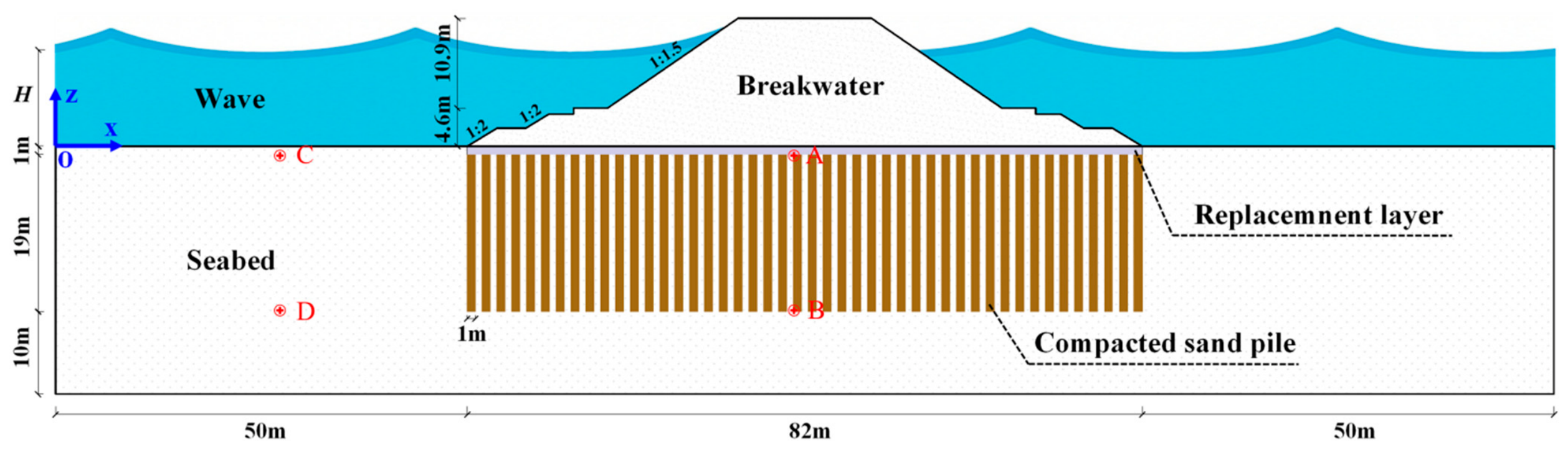
As shown in Figure 2, four representative monitoring points were selected to analyse the differences in dynamic response at different spatial locations. Their coordinates are A (x = 90.6 m, z = −1 m), B (x = 90.6 m, z = −19 m), C (x = 30 m, z = −1 m), and D (x = 30 m, z = −19 m). Points A and B are located within the zone influenced by the structure and represent the shallow and deep responses, respectively. Points C and D are located at another horizontal position, in the seabed region outside the structure, and likewise represent the shallow and deep responses, respectively. This arrangement takes into account both horizontal spatial variation and burial depth effects, and is therefore conducive to a comparative analysis of the dynamic response characteristics of the seabed at different locations under wave loading.
It should be noted that the four monitoring points were selected to compare typical responses at different horizontal positions and burial depths. Points A–D were therefore used mainly to provide representative time-history information for shallow/deep and inside/outside locations relative to the structural influence zone. They were not intended to independently represent all local high-gradient regions within the composite foundation.
The identification of stability-sensitive zones in this study was mainly based on the full-field contour distributions of displacement, effective stress, shear stress, and pore water pressure. The monitoring-point time histories were used as supplementary evidence to explain the temporal evolution of typical locations. In particular, local high-gradient regions such as the breakwater toes, structural boundaries, and the transition zones between the improved foundation and the surrounding natural seabed were identified primarily from the contour results.

2.4. Numerical Implementation and Model Reliability

The present finite element model contained 95,810 elements and 179,521 nodes. The lateral boundaries were constrained in the horizontal direction, and the bottom boundary was fixed in both the horizontal and vertical directions. The seabed surface was treated as permeable, while the bottom boundary was assumed to be impermeable. The initial stress field was generated under self-weight before cyclic wave loading. The vibro-compaction sand-pile foundation was represented as an equivalent improved foundation zone rather than by explicitly modelling each individual pile.
This section supplements the numerical analysis with parameter sensitivity and time-step convergence checks to improve the reproducibility and reliability of the model. First, a sensitivity analysis was conducted for the failure stress ratio M f to examine the influence of the selected PZIII parameter on the numerical results. Three values of M f were considered: 1.17, 1.30, and 1.43, corresponding to −10%, baseline, and +10% variations, respectively. The comparison was based on the final settlement at Point A, the maximum excess pore water pressure at Point B, and the final residual pore pressure at Point B.
The results show that increasing M f slightly reduces the settlement and pore pressure responses (Table 5). The final settlement at Point A changes from 84.05 mm to 82.64 mm, while the maximum excess pore water pressure at Point B decreases from 101.07 kPa to 90.20 kPa. The final residual pore pressure at Point B shows a similar decreasing trend. Although the response magnitude changes to some extent, the overall deformation pattern and the identification of stability-sensitive zones remain unchanged. This indicates that the main conclusions are not dependent on a single arbitrary value of M f .
A basic time-step convergence check was further conducted to examine the influence of temporal discretization on the main settlement response. Two time-step sizes, 0.1 s and 0.05 s, were compared while the mesh, boundary conditions, wave parameters, material parameters, and calculation duration were kept unchanged. The comparison was based on the final settlements at Points A and B, which are the main deformation indicators within the structural influence zone beneath the breakwater.
The relative differences in the final settlements at Points A and B are 4.27% and 2.07%, respectively (Table 6). Both values are within 5%, indicating that the baseline time-step size of 0.1 s provides stable predictions for the main settlement response. Therefore, the baseline time-step size of 0.1 s was adopted in the numerical simulation.
It should be noted that previous studies support the applicability of the FssiCAS framework, but they do not constitute direct field validation of the present Jinpai Port case. At the current stage, project-specific field monitoring data of displacement, stress, and pore water pressure are not yet available. Therefore, the numerical results are interpreted mainly in terms of relative spatial response patterns and stability-sensitive zones rather than deterministic predictions of absolute field responses.
The vibro-compaction sand-pile composite foundation was represented as an equivalent improved foundation zone. The pile diameter, spacing, triangular arrangement, pile length, and area replacement ratio were used to define the improved zone and characterize the reinforcement layout at the breakwater-foundation scale. This approach is suitable for identifying overall response patterns, but it does not explicitly resolve local pile–soil interaction around individual piles.
The failure stress ratio M f was selected for sensitivity analysis because it is a key PZIII parameter related to the elasto-plastic response of soil under cyclic loading. Other factors, including permeability, saturation degree, stiffness parameters, and wave height, may also affect pore pressure accumulation and deformation response. In addition, a systematic mesh convergence analysis was not performed due to the computational cost of the coupled model. These aspects are acknowledged as limitations and should be further examined in future work.

3. Results and Discussion

3.1. Characteristics of Displacement Response

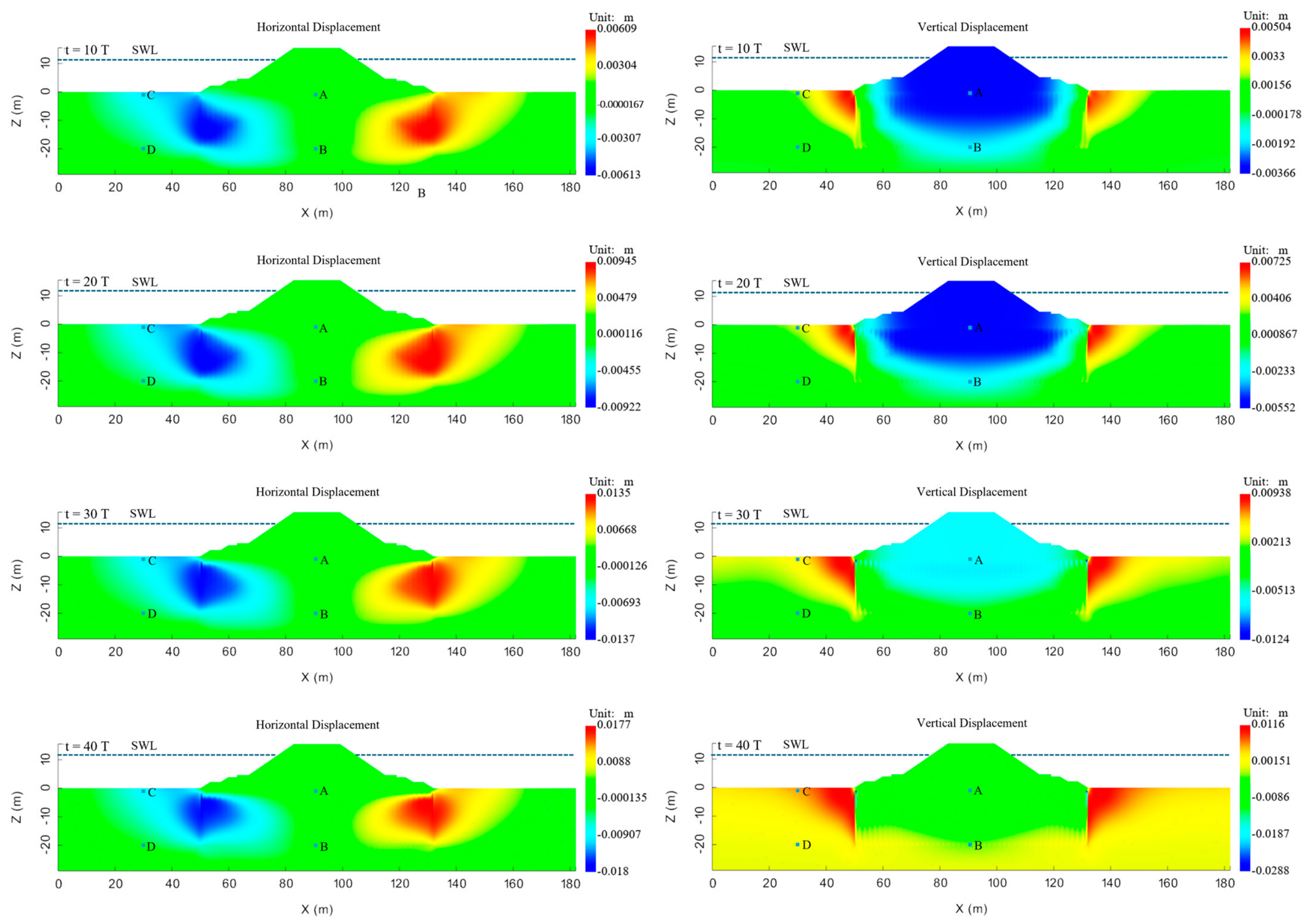
As shown in Figure 3, the horizontal and vertical displacement distributions of the breakwater and seabed under wave action at different time instants indicate that the displacement response of the composite foundation reinforced with compacted sand piles exhibits pronounced spatial non-uniformity under wave loading. The high-value zone of horizontal displacement is mainly distributed on both sides of the breakwater structure and in the structure–seabed transition zone, with opposite displacement directions observed on the two sides. This indicates that, under the sustained action of cyclic wave loading, the seabed around the structure undergoes significant horizontal oscillation and lateral extrusion. In contrast, the high-value zone of vertical displacement is concentrated mainly beneath the structure and in the underlying area. As the loading duration increases, it gradually develops from 10 T to 40 T into a more continuous settlement zone, indicating that, under the combined effects of structural loading and cyclic wave loading, more pronounced cumulative compaction deformation occurs in the composite foundation near the base of the structure. These results indicate that foundation deformation under wave action does not develop synchronously throughout the entire ground, but is jointly governed by structural location, reinforcement extent, and embedment depth.
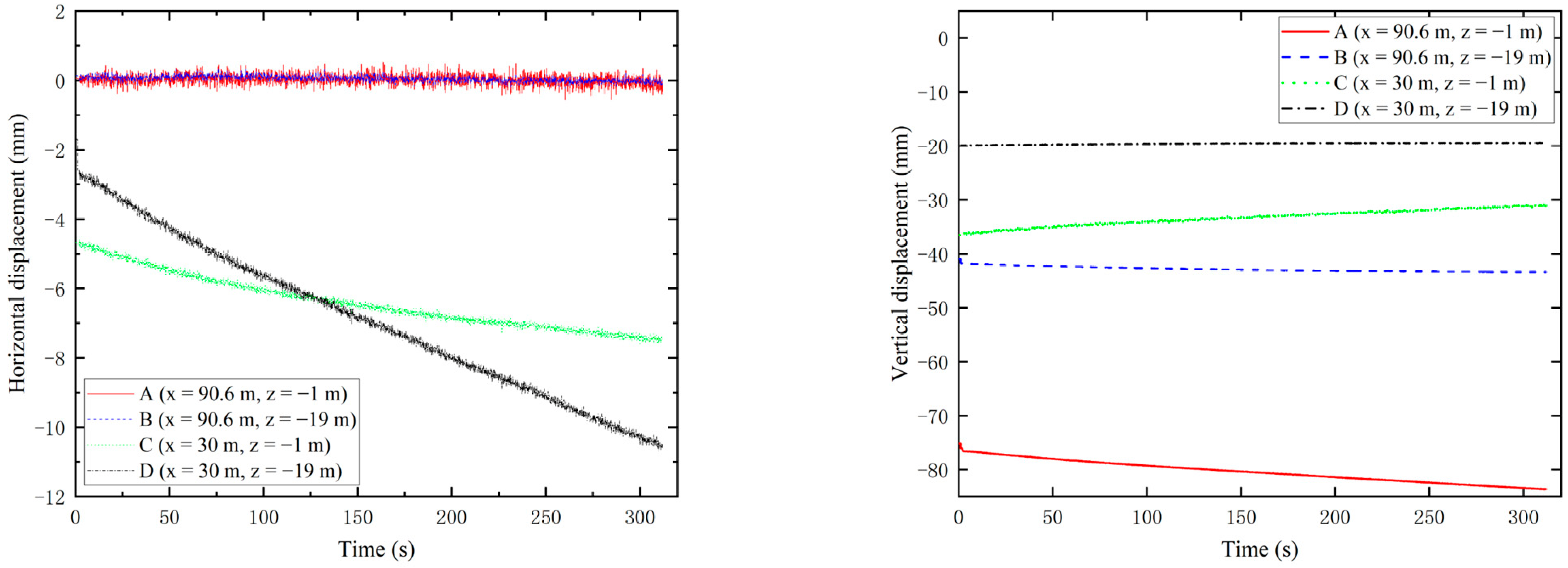
As shown in Figure 4, the displacement time histories at the four monitoring points in the seabed show different horizontal and vertical response characteristics under cyclic wave loading. The horizontal displacement at Points A and B remains relatively small and mainly fluctuates around the initial position, indicating that the horizontal movement within the structural influence zone is limited at the selected monitoring locations. In contrast, Points C and D show more evident horizontal displacement accumulation, especially Point D in the deeper seabed outside the main structural influence zone. This suggests that the horizontal response is more pronounced in the outer foundation region than directly beneath the breakwater section.
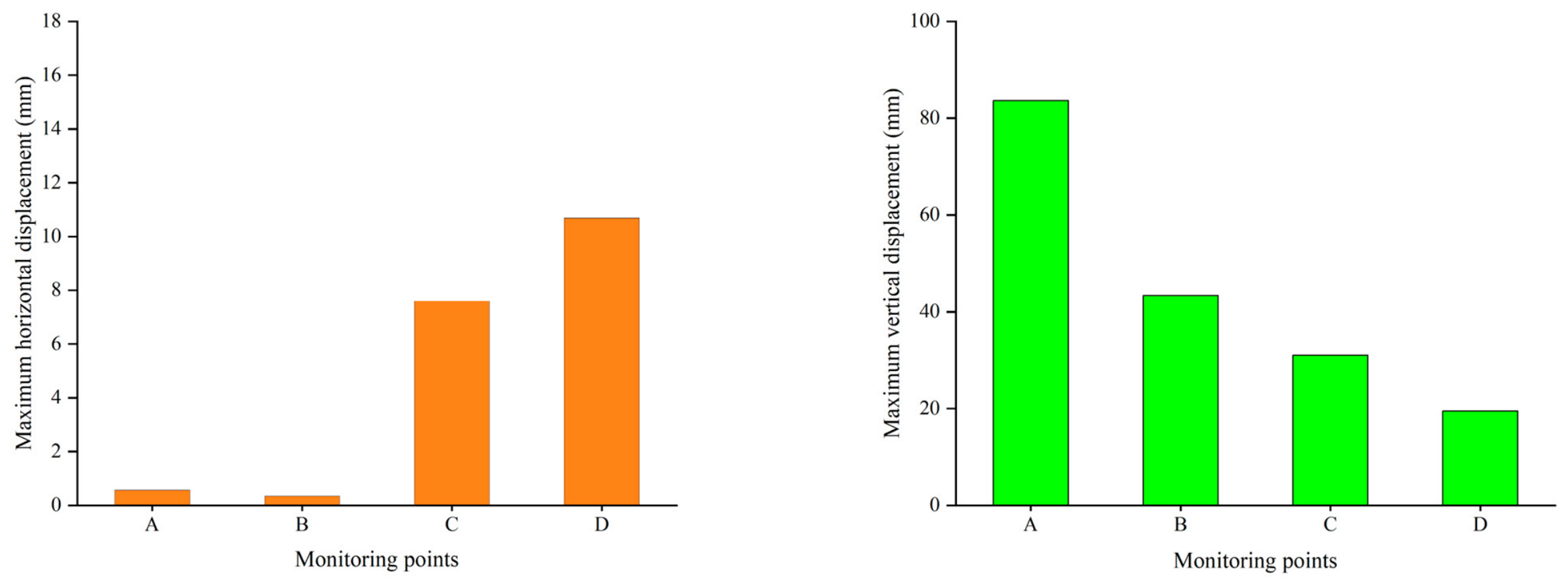
The vertical displacement response is dominated by cumulative settlement rather than reciprocal fluctuations about zero. Points A and B, located within the structural influence zone, exhibit larger downward displacement than Points C and D. Combined with the maximum displacement statistics in Figure 5, the maximum horizontal displacement follows the order D > C > A > B, with corresponding values of approximately 10.8 mm, 7.6 mm, 0.5 mm, and 0.3 mm, respectively. The final vertical settlement follows the order A > B > C > D, with corresponding values of approximately 84 mm, 43 mm, 31 mm, and 19 mm, respectively. These results indicate that the deformation response of the composite foundation should be evaluated separately in terms of horizontal deformation and vertical settlement. The settlement-sensitive zone is mainly located beneath the breakwater, especially in the shallow structural influence zone, whereas the horizontal-deformation-sensitive response is more evident in the outer and deeper seabed region.

3.2. Characteristics of Effective Stress Response

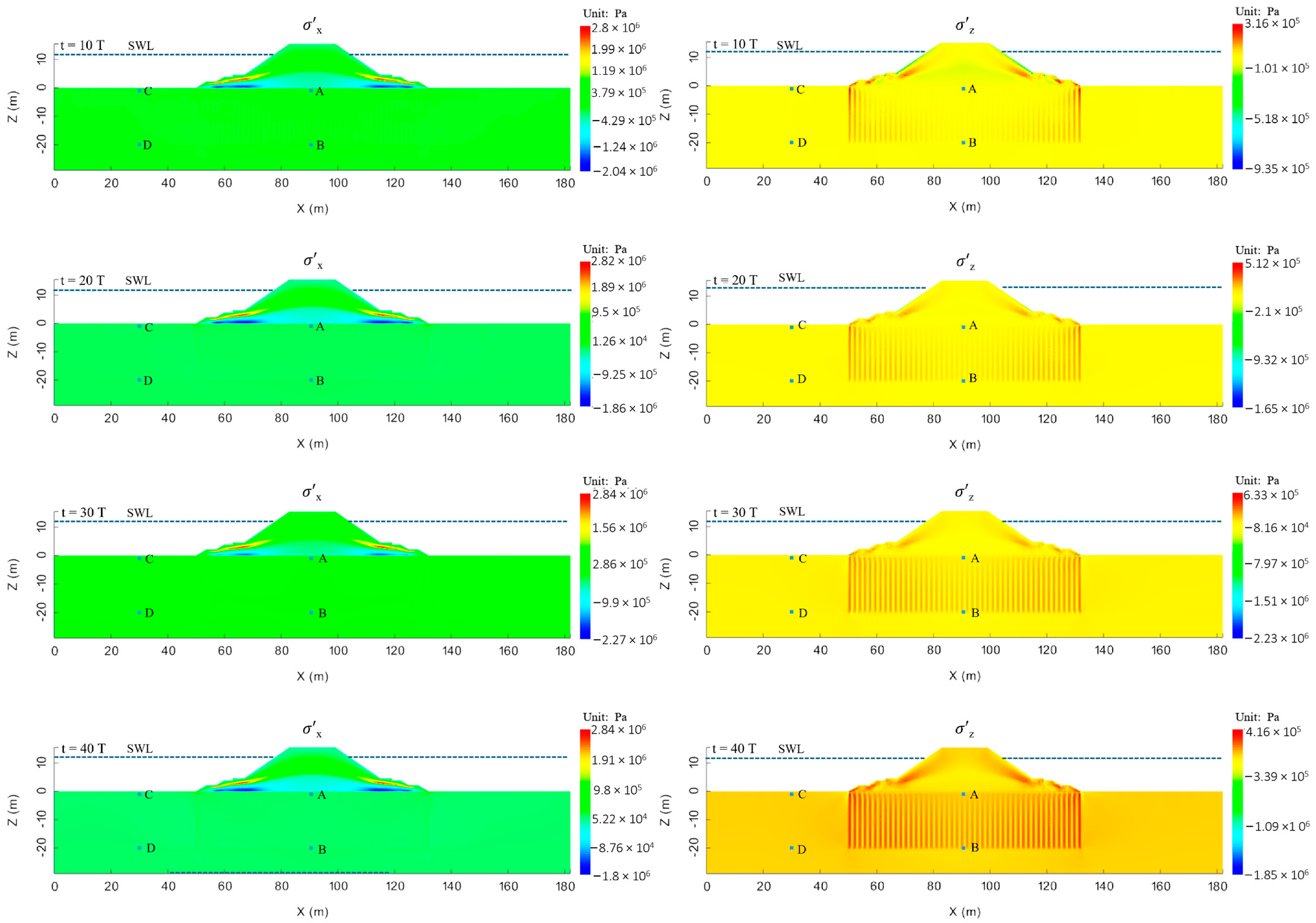
As shown in Figure 6, a pronounced redistribution of effective stress occurs within the composite foundation under wave loading. Zones of relatively high horizontal effective stress are mainly concentrated near the structural boundaries, around the toe region, and at locations where the structural profile changes markedly, indicating that boundary constraints and geometric discontinuities significantly alter the internal stress transfer path of the soil. In contrast, the vertical effective stress is primarily concentrated beneath the structure and within the reinforced zone, and remains at a relatively high level across multiple calculation time steps. This suggests that, after the wave load is transmitted to the foundation through the breakwater, the underlying soil beneath the structure is subjected to a more concentrated vertical load. Overall, the areas beneath the structure and near the structural boundaries are the regions where effective stress adjustment is most pronounced, and also the locations where wave–structure–seabed coupling is strongest.
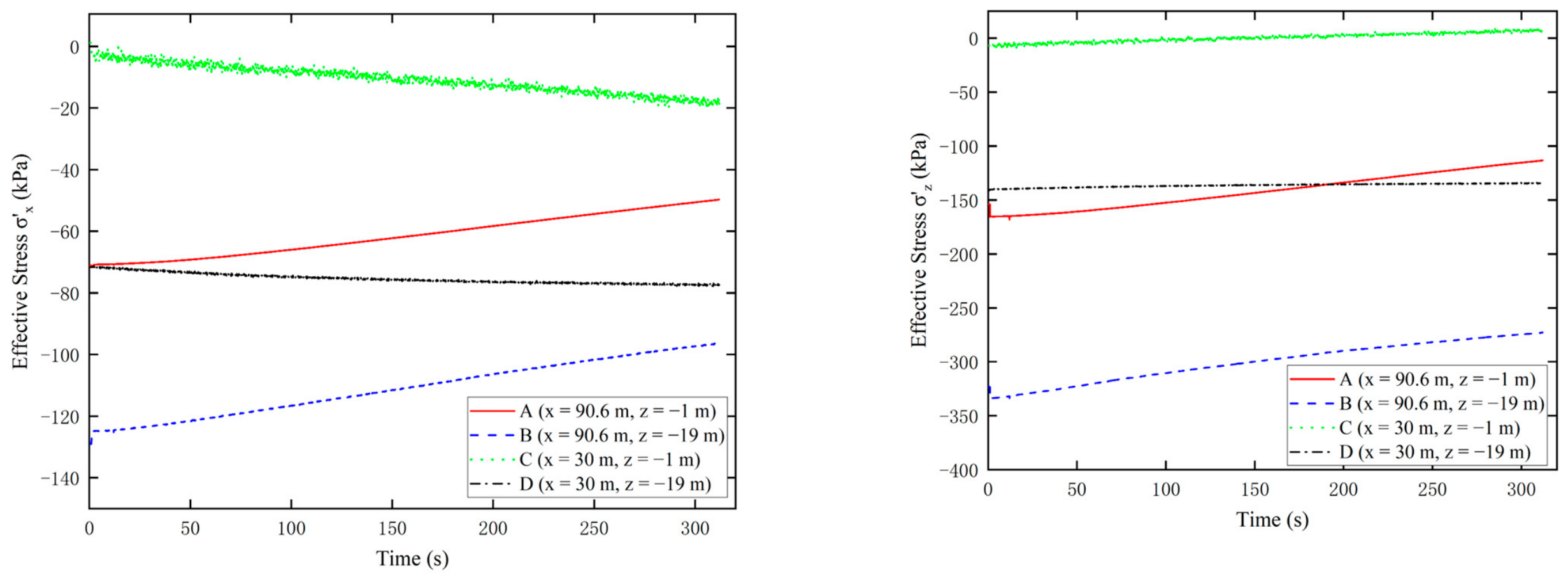
As shown in Figure 7, points A and B, located within the structural influence zone, both exhibit relatively continuous evolution in both horizontal and vertical directions. Among them, Point B shows consistently larger absolute values of effective stress, indicating that the deep portion of the structural influence zone is subjected to more intense stress readjustment. Although Point A is located at a shallower depth, its stress variation remains evident, suggesting that the shallow part of the structural influence zone is also strongly disturbed.
In contrast, the responses at Points C and D, located outside the structure, are relatively weaker, though not identical. Point C more readily exhibits the characteristics of a shallow-layer response, whereas Point D reflects the gradual adjustment of deeper soil subjected to boundary-induced disturbance. This indicates that wave loading does not propagate uniformly through the composite foundation; rather, the spatial distribution of effective stress is jointly governed by the structural boundary, the extent of the improved zone, and burial depth.
Overall, the effective stress response is most sensitive beneath the structure, near the structural boundaries, and within the structural influence zone. These areas are not only the principal load-transfer paths through which wave loading is transmitted from the structure to the foundation, but also the key zones that should be emphasized in subsequent analyses of local stability and unfavorable stress conditions.

3.3. Analysis of Shear Stress and Pore Water Pressure Response Characteristics

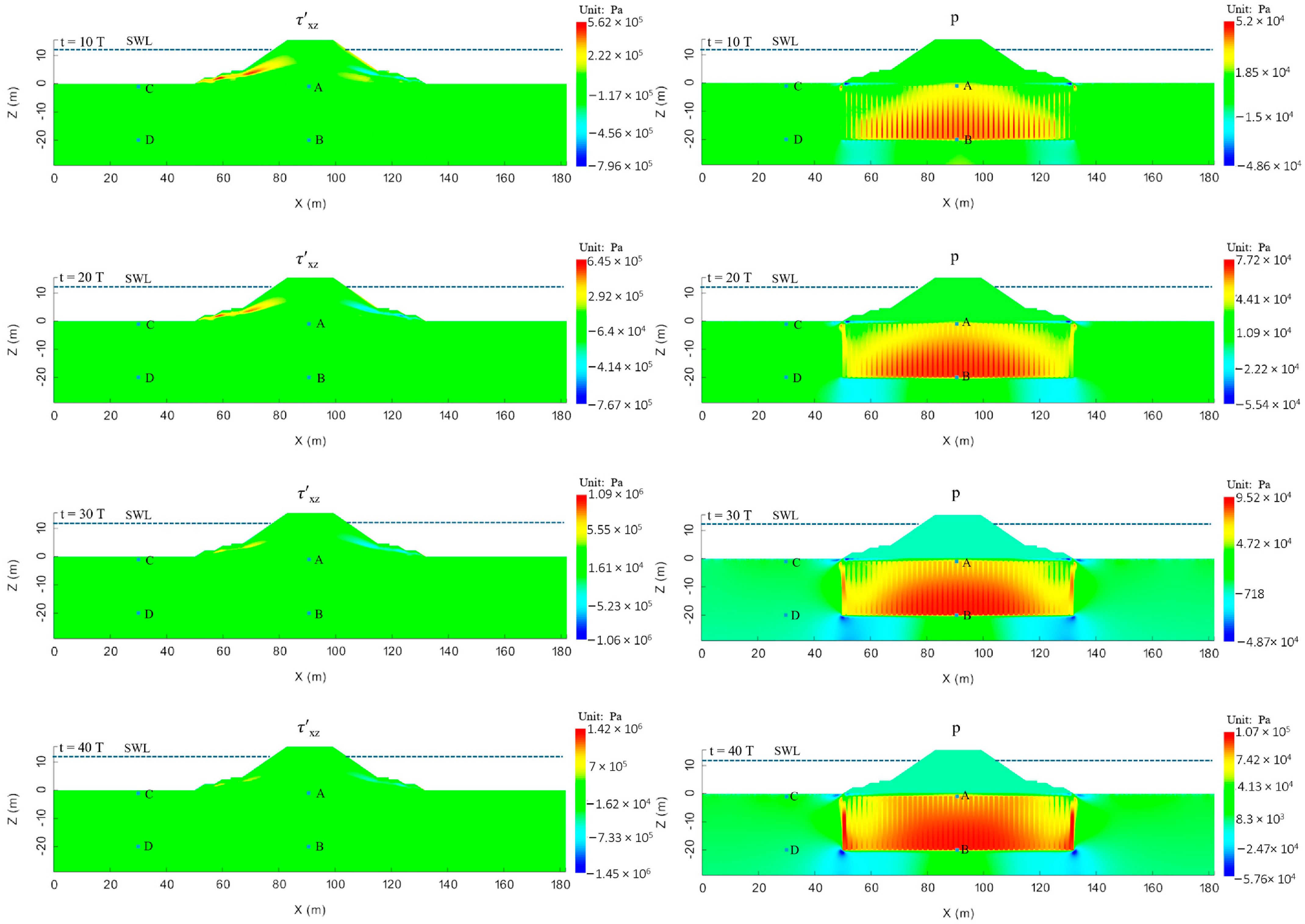
As shown in the contour plots of shear stress and pore water pressure in Figure 8, the high-value zones of shear stress within the composite foundation under wave loading are mainly distributed at the toe regions on both sides of the breakwater, along the structural boundary, and at the transition zone between the reinforced area and the natural foundation, exhibiting relatively pronounced local gradients. This indicates that, during the sustained action of cyclic wave loading, the region near the structural boundary is subjected not only to normal compressive effects but also to strong tangential disturbance, making it more susceptible to local shear concentration. As wave loading progresses from the early stage to the later stage, these high-stress zones persist, suggesting that shear stress concentration is not a transient phenomenon but rather exhibits strong persistence.
The high-value zones of pore water pressure are mainly concentrated within the reinforced area beneath the structure and its adjacent regions, forming a relatively continuous high-pressure band within the structural influence zone. As the wave loading duration increases, the extent of the high-pressure zone gradually expands, and the internal high pore water pressure distribution becomes more pronounced, indicating that a continuous pore water pressure accumulation process occurs within the composite foundation beneath the structure under cyclic loading. Meanwhile, the pore water pressure gradient near the structural boundary is relatively large, suggesting that this region is more sensitive to wave-induced disturbance and is prone to a stronger localized seepage–stress coupling response.
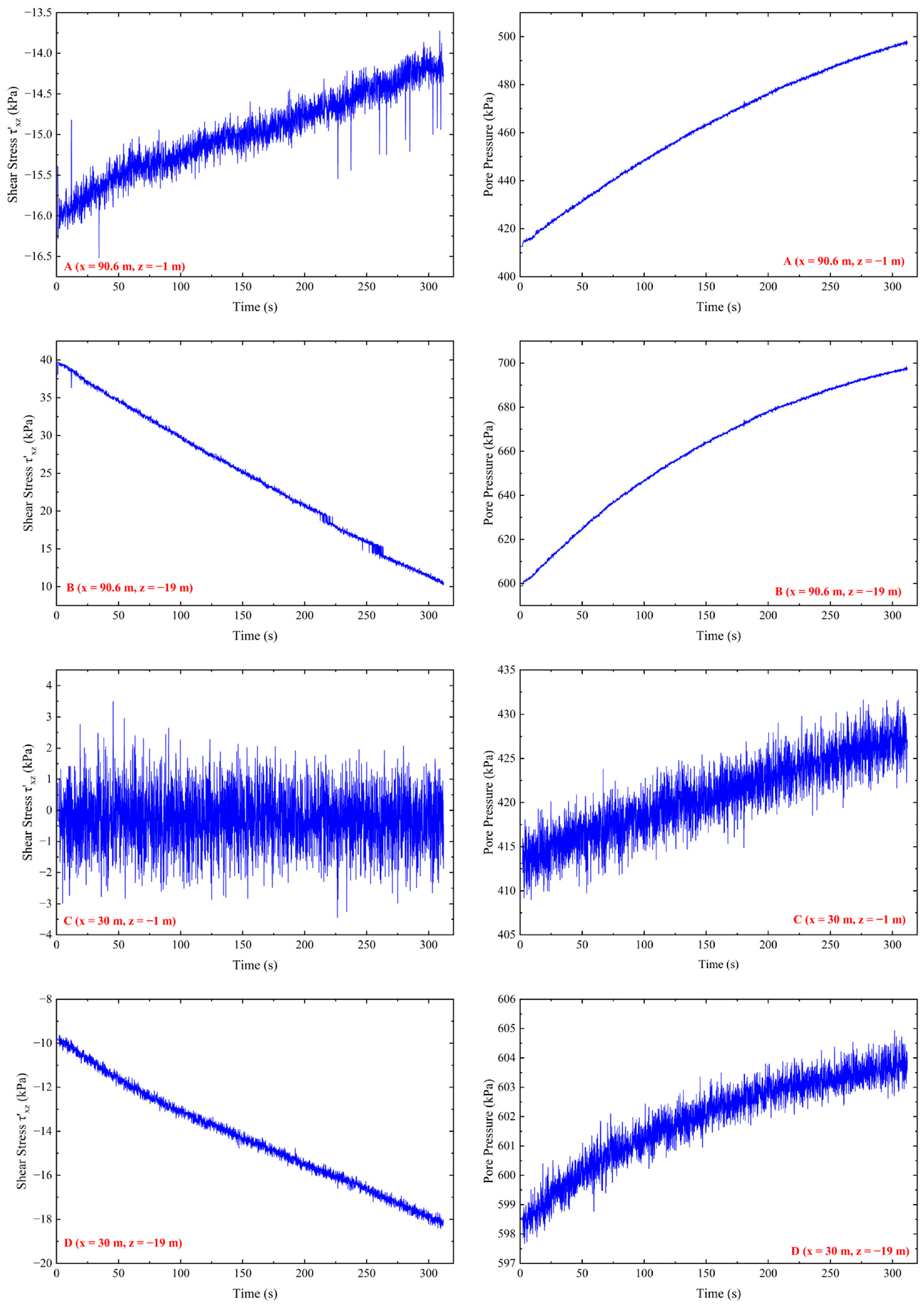
As shown in Figure 9, the comparison of the time histories of shear stress and pore water pressure indicates that the temporal variation in shear stress at different monitoring points exhibits significant differences. At Point A, the shear stress remains predominantly negative but shows a gradual upward trend over time, indicating that the point is continuously subjected to shear action, although the absolute value progressively decreases. At Point B, the shear stress remains predominantly positive and decreases continuously with time, suggesting that the shear stress state in the deep portion of the structural influence zone undergoes persistent adjustment under cyclic loading. At Point C, the shear stress fluctuates mainly at a high frequency around zero, reflecting that the shallow zone outside the structure is more directly controlled by wave-induced oscillation. In contrast, Point D exhibits negative shear stress with a continuous downward trend, indicating a more pronounced cumulative shear adjustment in the deep zone outside the structure. These results demonstrate that the shear stress patterns of the soil vary significantly with location and burial depth, and that clear differences exist between shallow and deep zones as well as between areas inside and outside the structural influence zone.
The pore water pressure at all four monitoring points shows an overall increasing trend, although the magnitude and mode of variation differ markedly. Point B exhibits the most pronounced increase in pore water pressure, indicating that sustained pore water pressure accumulation is more likely to occur in the deep part of the structural influence zone. Point A also shows a noticeable increase in pore water pressure, suggesting that the shallow part of the structural influence zone is likewise subjected to strong disturbance. At Point C, the overall pore water pressure level remains relatively low, but distinct fluctuations are observed throughout the loading process, indicating that the shallow region outside the structure is characterized mainly by an oscillatory response. Point D has a relatively high initial pore water pressure level, but its subsequent increase is comparatively limited, suggesting that although it remains under a relatively high pressure state, its sustained accumulation rate is weaker than that at the monitoring points within the structural influence zone. These results indicate that the pore water pressure response is governed not only by burial depth, but also closely related to whether the point is located within the structural influence zone.
From the perspective of local stability, the shear stress response provides a strong indication for identifying unfavorable stress-concentration zones. In particular, the structural boundary, the toe region, and the transition zone between the reinforced area and the surrounding foundation are more likely to become regions of shear concentration, as they are simultaneously influenced by structural load transfer, wave-induced disturbance, and stiffness differences within the foundation. These areas should therefore be treated as key zones in local stability assessment and structural optimization. In conjunction with the effective stress results, it can be further inferred that the continuous increase in pore water pressure directly leads to effective stress readjustment and may consequently weaken the local stability of the soil. This is especially evident in the structural influence zone, the shallow seabed, and the boundary transition zone of the improved area, where displacement concentration, stress concentration, and pore water pressure buildup often occur simultaneously. Therefore, in stability evaluation, pore water pressure should be regarded as an important indicator for identifying critical unfavorable zones, and should be assessed jointly with displacement, effective stress, and shear stress.
The above results indicate that the stability-sensitive zones are controlled by the coupled evolution of stress, deformation, and pore water pressure. Under cyclic wave loading, the load transmitted through the breakwater causes repeated shear and compression in the seabed foundation. In regions with strong structural constraint or stiffness contrast, such as the breakwater toes, structural boundaries, and improved–natural foundation transition zones, shear stress concentration is more likely to occur. Meanwhile, pore water pressure accumulation reduces the effective stress carried by the soil skeleton, weakens the local shear resistance, and promotes deformation concentration. Therefore, the observed displacement differences are closely related to stress redistribution, cyclic compression, pore pressure buildup, and effective stress adjustment rather than to geometric location alone.
To further distinguish the oscillatory and residual characteristics of pore water pressure, the pore pressure time histories at the four monitoring points were decomposed. The excess pore pressure was first obtained by subtracting the initial pore pressure from the original pore pressure time history. Then, the residual pore pressure was calculated by averaging the excess pore pressure over each wave cycle, with the wave period T = 7.7 s.
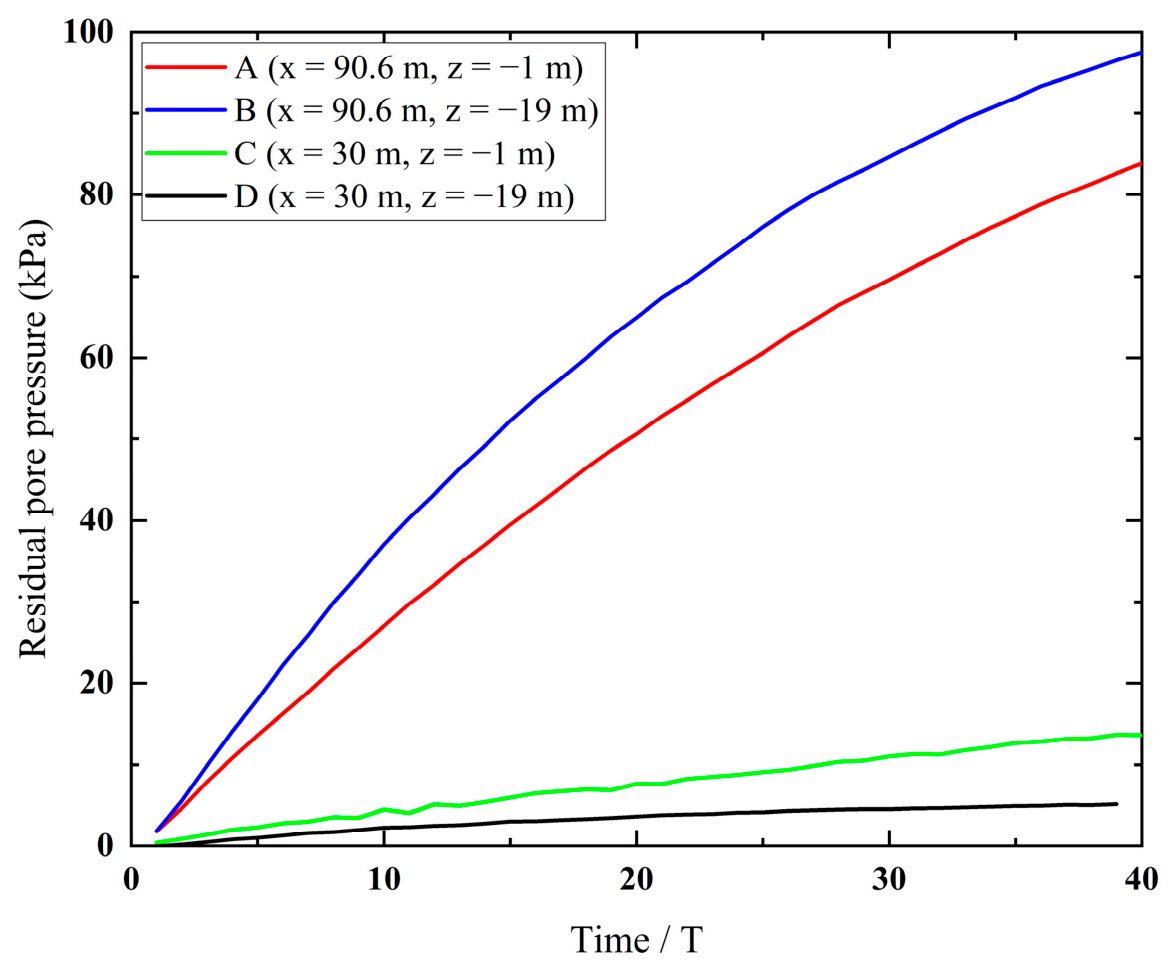
As shown in Figure 10, the residual pore pressure accumulation differs significantly among the four monitoring points. At 40 T, the residual pore pressures at Points A, B, C, and D are approximately 83.87 kPa, 97.57 kPa, 13.67 kPa, and 5.24 kPa, respectively. Point B shows the largest residual pore pressure, followed by Point A, indicating that the structural influence zone is more prone to cumulative pore pressure buildup under cyclic wave loading. In contrast, Points C and D exhibit much smaller residual components, suggesting that the regions outside the main structural influence zone are less affected by continuous pore pressure accumulation.
These results indicate that pore water pressure evaluation should not rely only on instantaneous fluctuation. The residual pore pressure component shown in Figure 10 is more closely related to effective stress reduction and local weakening of the soil skeleton. Therefore, the stronger residual pore pressure accumulation at Points A and B further supports the identification of the structural influence zone, especially its deeper part, as a stability-sensitive region.

3.4. Implications for Sustainable Breakwater Foundation Design

To make the identification of stability-sensitive zones more objective, a contour-based normalized response index IX was introduced. For each response variable, IX was calculated as the ratio of the absolute local response value to the maximum absolute value of the same variable in the computational domain at the same time instant:
IX = |X|/|X|max
Here, X denotes the selected response variable, including horizontal displacement, vertical displacement, effective stress variation, shear stress, or pore water pressure, and |X|max denotes the maximum absolute value of the corresponding variable in the computational domain at the same time instant. Regions with IX ≥ 0.70 were regarded as high-response zones for the corresponding variable. Stability-sensitive zones were then identified based on the spatial overlap of high-response zones for multiple variables.
Based on the normalized response criterion, the stability-sensitive zones were not determined solely from the four monitoring-point time histories. Instead, they were mainly identified from the full-field contour distributions shown in Figure 3, Figure 6 and Figure 8, while the monitoring-point results in Figure 4, Figure 7, Figure 9 and Figure 10 were used as supplementary time-history evidence.
The results indicate that the controlling response indices are spatially differentiated. Vertical settlement is mainly concentrated beneath the breakwater, especially in the shallow structural influence zone, whereas horizontal displacement is more evident in the outer foundation region, especially near Points C and D. The combined distributions of effective stress, shear stress, and pore water pressure further show that the breakwater toes, structural boundaries, shallow seabed, and improved–natural foundation transition zones are the main stability-sensitive zones. These zones are characterized by stress redistribution, shear stress concentration, pore water pressure accumulation, and intensified deformation response.
The threshold IX ≥ 0.70 was adopted as an engineering judgment criterion to identify relative high-response zones. It is not intended to represent an absolute failure criterion, but provides a semi-quantitative basis for comparing the spatial distribution of different response variables.
The proposed stability-sensitive zoning does not directly quantify carbon reduction, cost saving, or life-cycle performance. Instead, it provides a semi-quantitative basis for targeted monitoring, drainage improvement, local reinforcement, and maintenance planning. The actual material-saving, cost-saving, and carbon-reduction effects require further life-cycle assessment and engineering verification.

4. Conclusions

Based on the FssiCAS numerical analysis of the Jinpai Port nearshore breakwater project, this study investigated the wave-induced dynamic response and stability-sensitive zones of a vibro-compaction sand-pile composite foundation. The main conclusions are as follows.
(1)
The composite foundation shows a clear spatially non-uniform response under cyclic wave loading. Full-field contour results indicate that vertical displacement is mainly concentrated beneath the breakwater and in the underlying foundation, whereas horizontal deformation is more evident around the breakwater sides and the structure–seabed transition region.
(2)
The monitoring-point results show different horizontal and vertical deformation patterns. The maximum horizontal displacement follows the order D > C > A > B, with values of approximately 10.8 mm, 7.6 mm, 0.5 mm, and 0.3 mm, respectively. The final settlement follows the order A > B > C > D, with values of approximately 84 mm, 43 mm, 31 mm, and 19 mm, respectively. This indicates that settlement control should focus on the shallow structural influence zone beneath the breakwater, while horizontal deformation should be considered mainly in the outer and deeper seabed region.
(3)
Pore water pressure response shows evident residual accumulation. At 40 T, the residual pore pressures at Points A, B, C, and D are approximately 83.87 kPa, 97.57 kPa, 13.67 kPa, and 5.24 kPa, respectively. The larger residual pore pressure at Points A and B indicates that the structural influence zone is more prone to cumulative pore pressure buildup, effective stress reduction, and local weakening.
(4)
The breakwater toes, structural boundaries, shallow seabed, and improved–natural foundation transition zones are identified as the main stability-sensitive zones. These zones should be prioritized for monitoring layout, local reinforcement, drainage improvement, and maintenance planning. Such targeted measures can reduce unnecessary treatment in low-response regions and support the sustainable design and long-term serviceability of nearshore breakwater foundations.
This study has several limitations. Direct field validation for the Jinpai Port case was not available at this stage, the time-history analysis was based on four representative monitoring points, and the sand-pile composite foundation was represented as an equivalent improved zone. Future work should include field monitoring data, additional response profiles near the breakwater toes and transition zones, mesh convergence analysis, and further sensitivity analyses of permeability, saturation degree, stiffness parameters, and wave conditions.

Author Contributions

Conceptualization, M.T.; methodology, J.H. and Y.Z.; software, M.T. and Y.Z.; formal analysis, M.T.; resources, J.H.; data curation, M.T.; writing—original draft preparation, M.T.; writing—review and editing, J.H.; visualization, M.T. and Y.Z.; supervision, J.H.; funding acquisition, J.H. All authors have read and agreed to the published version of the manuscript.

Funding

This research was funded by the Self-directed Research Fund of the State Key Laboratory of Tropic Ocean Engineering Materials and Materials Evaluation, grant number STOEM99272619; the National Natural Science Foundation of China, grant number 42467019; the Hainan Provincial Natural Science Foundation Enterprise Talent Project, grant number 525QY918; and the 2025 Hainan Province Construction Science and Technology Program, grant number 12.

Institutional Review Board Statement

Not applicable.

Informed Consent Statement

Not applicable.

Data Availability Statement

The original contributions presented in this study are included in the article. Further inquiries can be directed to the corresponding author.

Conflicts of Interest

The authors declare no conflicts of interest. The funders had no role in the design of the study; in the collection, analyses, or interpretation of data; in the writing of the manuscript; or in the decision to publish the results.

References

  1. Chen, H.; Zhang, J.; Liu, J.; Feng, L.; Guo, Y.; Guan, D. Experimental Study of Wave-Induced Dynamic Response within the Seabed around an Impermeable Sloping Breakwater. Ocean Eng. 2024, 313, 119494. [Google Scholar] [CrossRef]
  2. Lin, J.; Jeng, D.-S.; Zhao, H.; Gao, Y.; Liu, J.; Guo, Y. Recent Advances of Seabed Liquefaction around the Vicinity of Marine Structures. Ocean Eng. 2023, 280, 114660. [Google Scholar] [CrossRef]
  3. Wang, L.; Zhang, J.; Jeng, D.-S.; Zhang, Q.; Chen, T. Experimental Study on the Dynamic Response of a Silty Seabed under Waves. Ocean Eng. 2023, 269, 113554. [Google Scholar] [CrossRef]
  4. Cui, L.; Jeng, D.-S. Two-Dimensional One-Way Coupled Modelling for Fluid-Structure-Seabed Interactions around a Semicircular Breakwater Using OpenFOAM. Appl. Ocean Res. 2024, 153, 104249. [Google Scholar] [CrossRef]
  5. He, K.; Zhu, H.; Ye, J. An Integrated Model for Fluid-Structure-Seabed Interaction Based on SPH-FEM: Validation and a Practical Engineering Application. Ocean Eng. 2024, 313, 119636. [Google Scholar] [CrossRef]
  6. Wan, Z.; Cui, L.; Jeng, D.-S. Partial Dynamic (u − p) Integrated Model for Both Oscillatory and Residual Soil Response in a Poro-Elastic Seabed. Ocean Eng. 2024, 310, 118721. [Google Scholar] [CrossRef]
  7. Ye, J.; Zhou, H.; He, K. A Generalized Framework of Two-Way Coupled Numerical Model for Fluid-Structure-Seabed Interaction (FSSI): Explicit Algorithm. Eng. Geol. 2024, 340, 107679. [Google Scholar] [CrossRef]
  8. Li, Y.; Ong, M.C.; Tang, T. A Numerical Toolbox for Wave-Induced Seabed Response Analysis around Marine Structures in the OpenFOAM® Framework. Ocean Eng. 2020, 195, 106678. [Google Scholar] [CrossRef]
  9. Zhai, H.; Jeng, D.-S. Two-Way Coupling Model for Wave-Induced Oscillatory Soil Response around Marine Structures. Ocean Eng. 2022, 249, 110791. [Google Scholar] [CrossRef]
  10. Cui, L.; Jeng, D.-S.; Liu, J. Seabed Foundation Stability around Offshore Detached Breakwaters. Appl. Ocean Res. 2021, 111, 102672. [Google Scholar] [CrossRef]
  11. Li, Z.; Jeng, D.-S. Dynamic Soil Response around Two-Layered Detached Breakwaters: Three-Dimensional OpenFOAM Model. Ocean Eng. 2023, 268, 113582. [Google Scholar] [CrossRef]
  12. Cui, L.; Jeng, D.-S. Seabed Liquefaction around Breakwater Heads at a River Mouth: An Integrated 3D Model. Ocean Eng. 2021, 242, 110036. [Google Scholar] [CrossRef]
  13. Rafiei, A.; Rahman, M.S.; Gabr, M.A. Coupled Analysis for Response and Instability of Sloping Seabed under Wave Action. Appl. Ocean Res. 2019, 88, 99–110. [Google Scholar] [CrossRef]
  14. He, K.; Huang, T.; Ye, J. Stability Analysis of a Composite Breakwater at Yantai Port, China: An Application of FSSI-CAS-2D. Ocean Eng. 2018, 168, 95–107. [Google Scholar] [CrossRef]
  15. Ye, J.; Jeng, D.; Wang, R.; Zhu, C. Numerical Simulation of the Wave-Induced Dynamic Response of Poro-Elastoplastic Seabed Foundations and a Composite Breakwater. Appl. Math. Model. 2015, 39, 322–347. [Google Scholar] [CrossRef]
  16. Jeng, D.-S.; Ye, J.-H.; Zhang, J.-S.; Liu, P.L.-F. An Integrated Model for the Wave-Induced Seabed Response around Marine Structures: Model Verifications and Applications. Coast. Eng. 2013, 72, 1–19. [Google Scholar] [CrossRef]
  17. Ye, J.; Jeng, D.; Wang, R.; Zhu, C. Validation of a 2-D Semi-Coupled Numerical Model for Fluid–Structure–Seabed Interaction. J. Fluids Struct. 2013, 42, 333–357. [Google Scholar] [CrossRef]
  18. Hsu, C.-J.; Tsai, C.-C.; Chen, Y.-Y. Wave-Induced Seabed Momentary Liquefaction in Shallow Water. Appl. Ocean Res. 2021, 115, 102819. [Google Scholar] [CrossRef]
  19. Hsu, C.-J.; Chen, Y.-Y.; Tsai, C.-C. Wave-Induced Seabed Response in Shallow Water. Appl. Ocean Res. 2019, 89, 211–223. [Google Scholar] [CrossRef]
  20. Xu, L.-Y.; Zhang, J.; Wang, L.; Chen, W.-Y.; Cai, F.; Xue, Y.-Y.; Chen, G.-X. Wave-Induced Liquefaction Analysis of Mildly Sloping Sandy Seabed. Soil Dyn. Earthq. Eng. 2024, 185, 108873. [Google Scholar] [CrossRef]
  21. Liao, C.C.; Zhao, H.; Jeng, D.-S. Poro-Elasto-Plastic Model for the Wave-Induced Liquefaction1. J. Offshore Mech. Arct. Eng. 2015, 137, 042001. [Google Scholar] [CrossRef]
  22. Madsen, O.S. Wave-Induced Pore Pressures and Effective Stresses in a Porous Bed. Geotechnique 1978, 28, 377–393. [Google Scholar] [CrossRef]
  23. Mei, C.C.; Foda, M.A. Wave-Induced Responses in a Fluid-Filled Poro-Elastic Solid with a Free Surface?A Boundary Layer Theory. Geophys. J. Int. 1981, 66, 597–631. [Google Scholar] [CrossRef]
  24. Ye, J.; He, K.; Zhou, L. Subsidence Prediction of a Rubble Mound Breakwater at Yantai Port: A Application of FSSI-CAS 2D. Ocean Eng. 2021, 219, 108349. [Google Scholar] [CrossRef]
  25. Ye, J.; Jeng, D.; Wang, R.; Zhu, C. A 3-D Semi-Coupled Numerical Model for Fluid–Structures–Seabed-Interaction (FSSI-CAS 3D): Model and Verification. J. Fluids Struct. 2013, 40, 148–162. [Google Scholar] [CrossRef]
  26. Pastor, M.; Zienkiewicz, O.C.; Chan, A.H.C. Generalized Plasticity and the Modelling of Soil Behaviour. Int. J. Numer. Anal. Methods Geomech. 1990, 14, 151–190. [Google Scholar] [CrossRef]
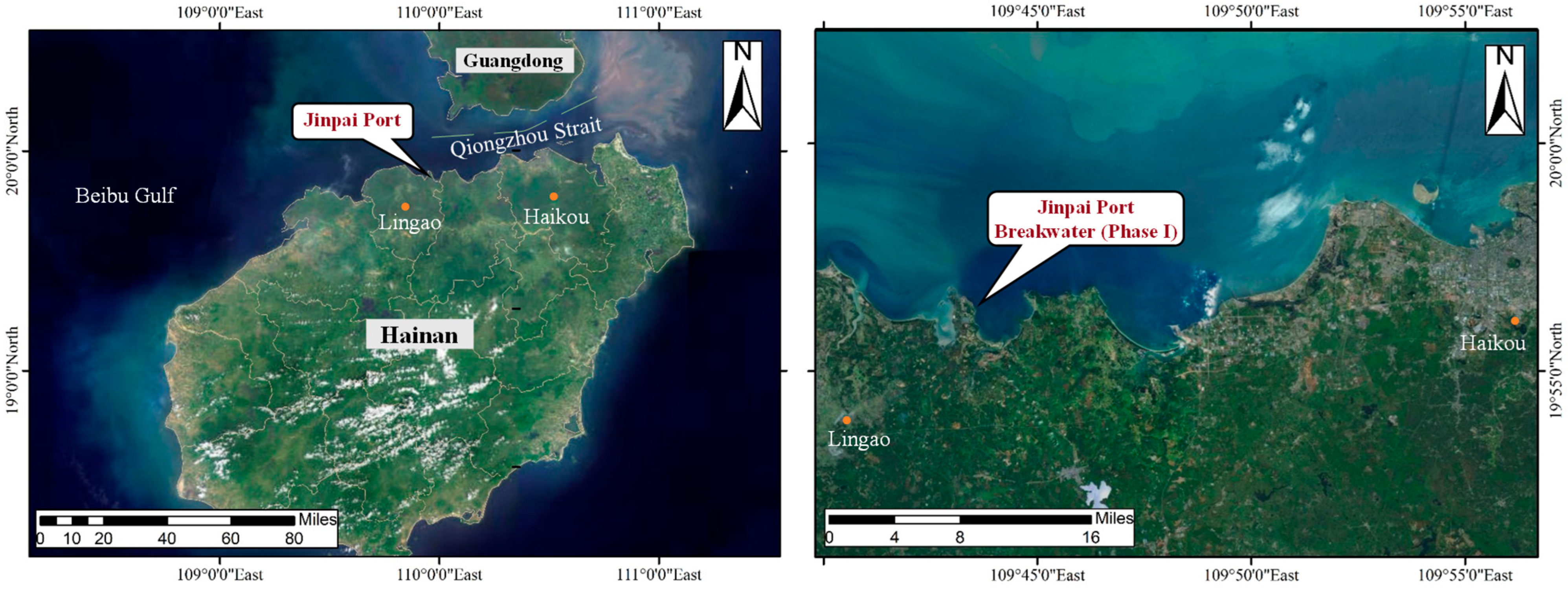
Figure 1. Location of Jinpai Port.
Sustainability 18 06799 g001
Figure 2. Numerical domain and geometry of the Jinpai Port breakwater.
Sustainability 18 06799 g002
Figure 3. Distribution of horizontal and vertical displacements of the breakwater and seabed under wave action at t = 10 T, t = 20 T, t = 30 T, and t = 40 T.
Sustainability 18 06799 g003
Figure 4. Comparison of time histories of displacement at seabed points A (x = 90.6 m, z = −1 m), B (x = 90.6 m, z = −19 m), C (x = 30 m, z = −1 m), and D (x = 30 m, z = −19 m).
Sustainability 18 06799 g004
Figure 5. Comparison of maximum horizontal and vertical displacements at seabed points A (x = 90.6 m, z = −1 m), B (x = 90.6 m, z = −19 m), C (x = 30 m, z = −1 m), and D (x = 30 m, z = −19 m).
Sustainability 18 06799 g005
Figure 6. Distribution of horizontal and vertical effective stresses in the breakwater and seabed under wave action at t = 10 T, t = 20 T, t = 30 T, and t = 40 T.
Sustainability 18 06799 g006
Figure 7. Comparison of the time histories of effective stress at seabed points A (x = 90.6 m, z = −1 m), B (x = 90.6 m, z = −19 m), C (x = 30 m, z = −1 m), and D (x = 30 m, z = −19 m).
Sustainability 18 06799 g007
Figure 8. Distribution of shear stress and pore water pressure in the breakwater and seabed under wave action at t = 10 T, t = 20 T, t = 30 T, and t = 40 T.
Sustainability 18 06799 g008
Figure 9. Comparison of the time histories of shear stress and pore water pressure at seabed points A (x = 90.6 m, z = −1 m), B (x = 90.6 m, z = −19 m), C (x = 30 m, z = −1 m), and D (x = 30 m, z = −19 m).
Sustainability 18 06799 g009
Figure 10. Residual pore pressure components at monitoring points A–D.
Sustainability 18 06799 g010
Table 1. Wave parameters for the breakwater.
DesignationWave Height (m)Water Depth (m)Wave Period (s)
Value5.7511.087.7
Table 2. Parameters of the PZIII constitutive for the sand compaction piles in the seabed.
Parameterαg M g M f αfβ1β0γuγDM P 0
(kPa)
K evo
(kPa)
G eso
(kPa)
H 0
(MPa)
Hu 0
(MPa)
Value0.451.341.30.450.24.22.00.04.152042497654314
Table 3. Geotechnical properties of the seabed strata.
Stratumw
(%)
av0.1–0.2
(MPa−1)
Es0–0.5
(MPa)
SPT
(N)
WL
(%)
Wp
(%)
Cv
(m2/s)
Ch
(m2/s)
φ
(°)
c
(kPa)
eIpIL
Silt ①56.781.210.721.040.0823.560.550.7313.412.21.6016.522.04
Silty clay ②22.650.442.701340.4123.775.595.7018.625.50.9816.640.52
Muddy silty clay ③48.210.920.941.038.0622.730.871.0916.313.91.4615.321.71
Silty clay with sand ④30.360.333.01836.7321.86.167.0315.943.90.9914.930.72
Note: The circled numbers ①–④ denote the sequence numbers of different seabed strata in the engineering geological investigation report.
Table 4. Main design parameters of the vibro-compaction sand piles.
ItemValue
Pile diameter1.0 m
Pile spacing1.8 m
Layout patternRegular triangular arrangement
Pile lengthVariable, maximum 22 m
Area replacement ratioApproximately 28%
Improved soil layerMucky soil and muddy silty clay
Table 5. Sensitivity analysis of the failure stress ratio M f .
CaseMfFinal Settlement at Point A (mm)Maximum Excess Pore Water Pressure at Point B (kPa)Final Residual Pore Pressure at Point B (kPa)
S11.1784.05101.07100.19
Baseline1.3084.0098.3897.57
S21.4382.6490.2089.50
Table 6. Time-step convergence check.
IndicatorTime-Step Size = 0.1 sTime-Step Size = 0.05 sRelative Difference
Final settlement at Point A (mm)83.6287.194.27%
Final settlement at Point B (mm)43.3742.482.07%
Disclaimer/Publisher’s Note: The statements, opinions and data contained in all publications are solely those of the individual author(s) and contributor(s) and not of MDPI and/or the editor(s). MDPI and/or the editor(s) disclaim responsibility for any injury to people or property resulting from any ideas, methods, instructions or products referred to in the content.