Determinants of Women’s Well-Being in Sustainable Operations Management: A Human-Centric, Industry 5.0 Perspective on the Moroccan Automotive Industry

Abstract
1. Introduction
2. Theoretical Background and Hypotheses
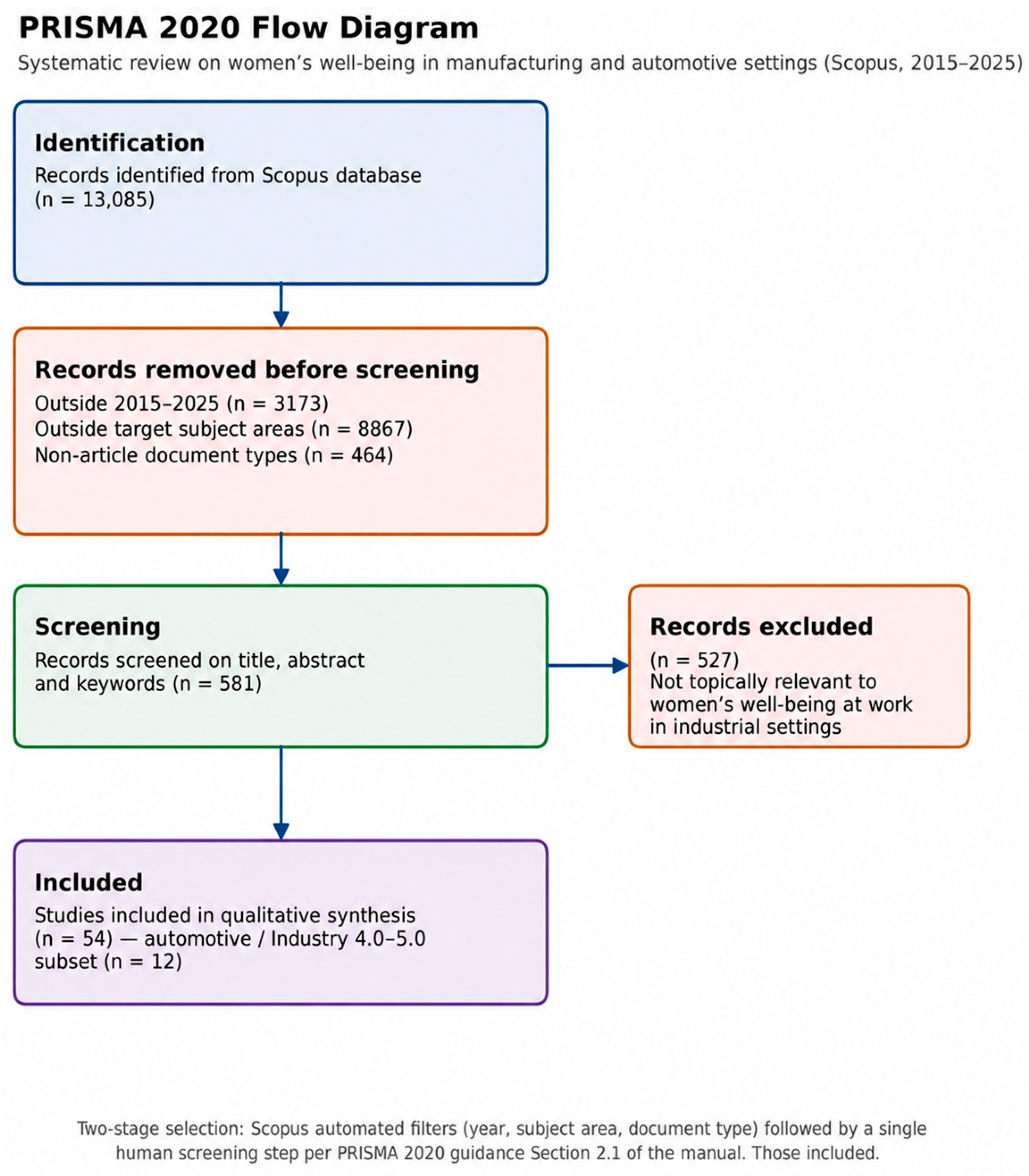
2.1. Systematic Review Protocol (Scopus, 2015–2025)
2.2. Industry 5.0 and Human-Centric Operations Management
2.3. Well-Being at Work: Conceptualisation
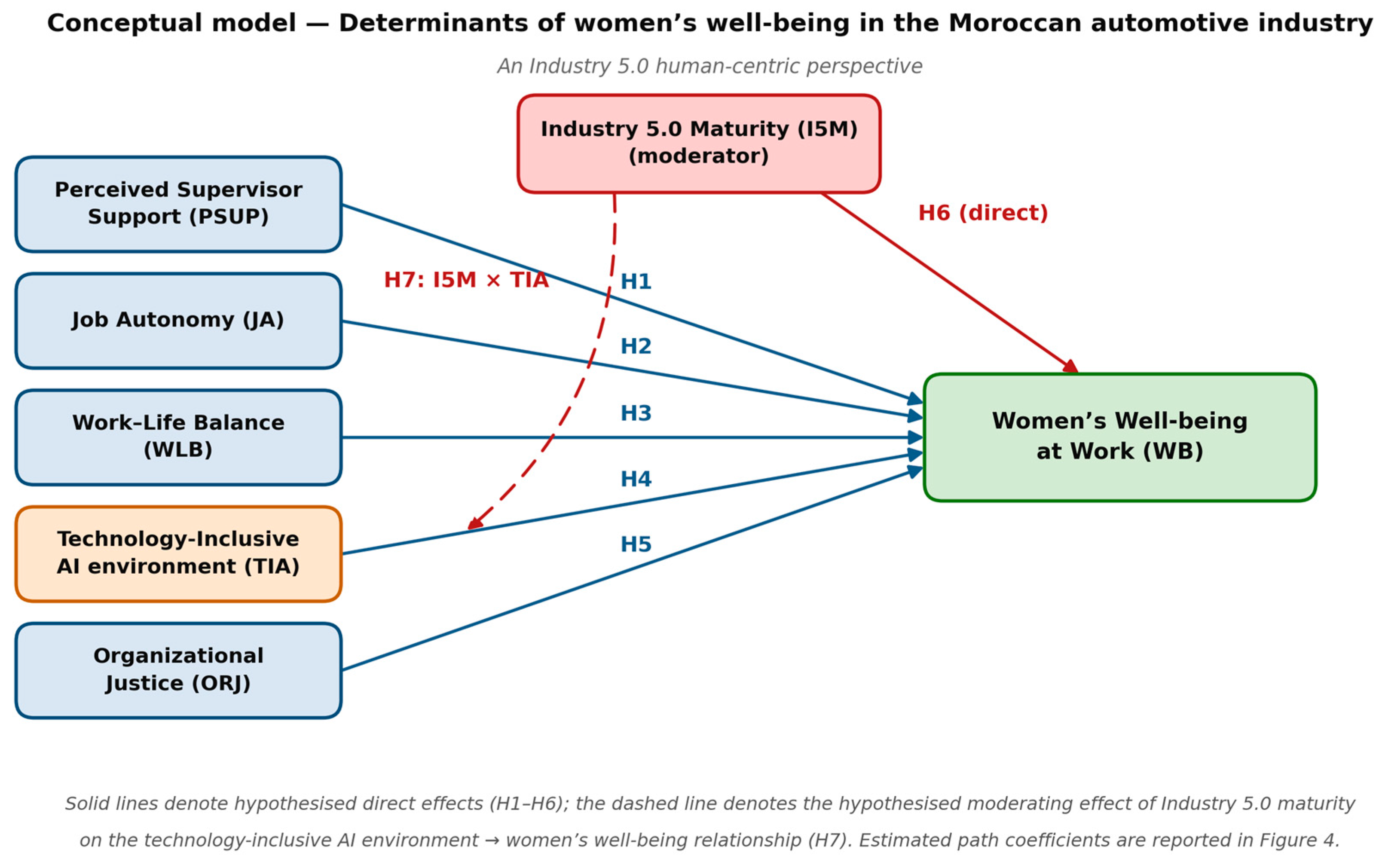
2.4. Hypotheses
3. Materials and Methods
3.1. Research Design and Sampling
3.2. Measurement Instruments
3.3. Sample Characteristics
3.4. Analytical Strategy
4. Results
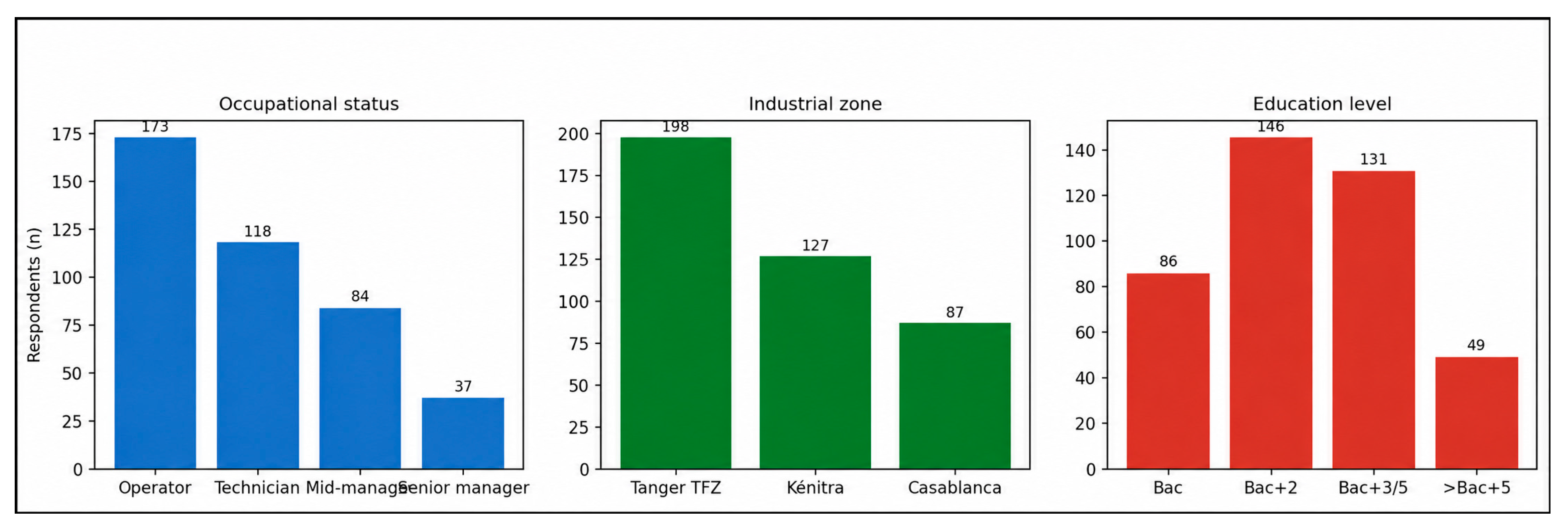
4.1. Descriptive Statistics and Demographic Distribution
4.2. Assessment of the Measurement Model
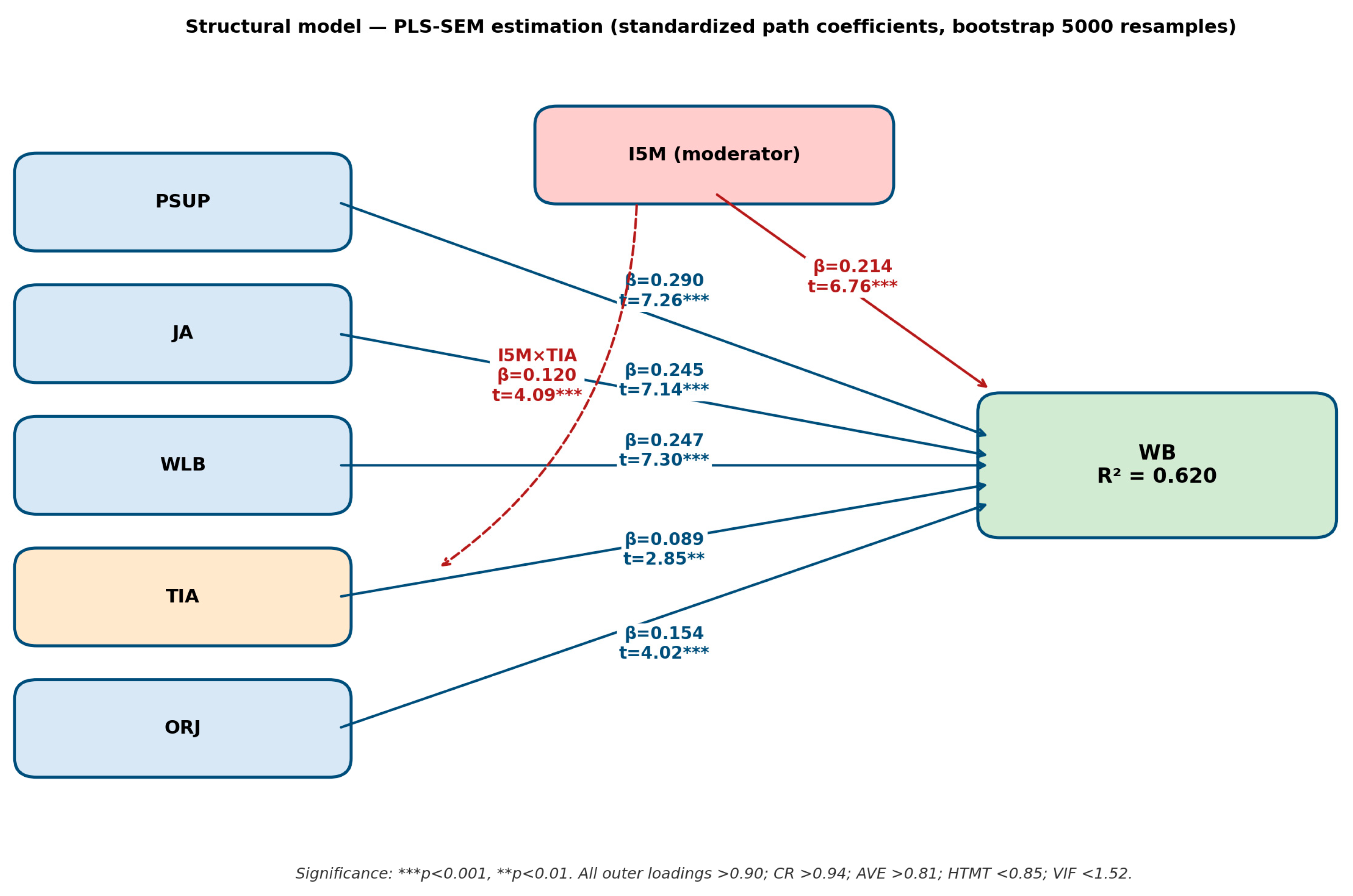
4.3. Assessment of the Structural Model
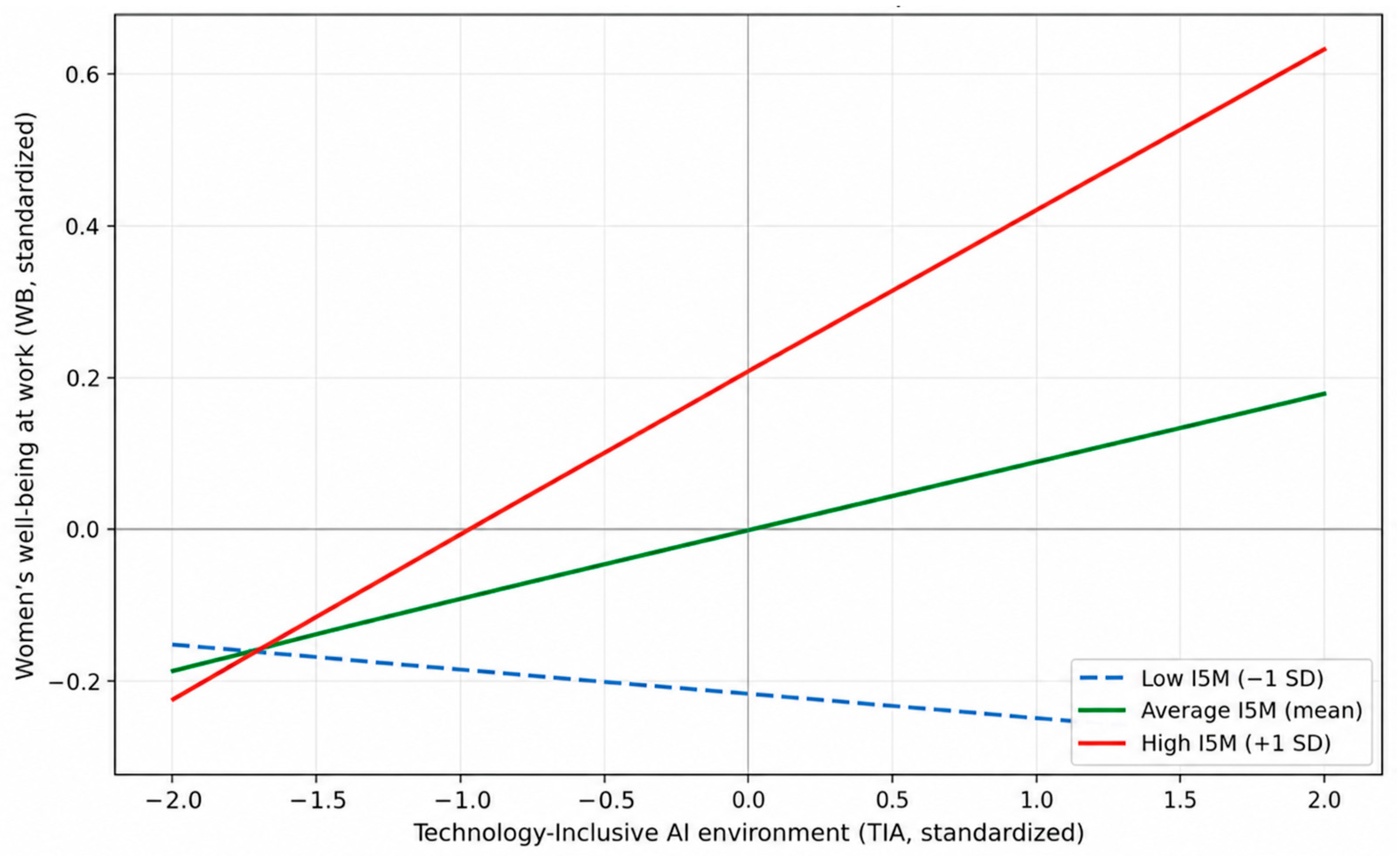
4.4. Moderation Analysis
5. Discussion
5.1. Theoretical Implications
5.2. Managerial and Policy Implications
5.3. Limitations and Future Research
6. Conclusions
Supplementary Materials
Author Contributions
Funding
Institutional Review Board Statement
Informed Consent Statement
Data Availability Statement
Acknowledgments
Conflicts of Interest
Abbreviations
| AI | Artificial Intelligence |
| AMICA | Moroccan Association for the Automotive Industry and Trade |
| AVE | Average Variance Extracted |
| CR | Composite Reliability |
| HTMT | Heterotrait–Monotrait Ratio of Correlations |
| I5M | Industry 5.0 Maturity |
| JA | Job Autonomy |
| JD-R | Job Demands–Resources (model) |
| ORJ | Organisational Justice |
| PLS-SEM | Partial Least Squares Structural Equation Modelling |
| PSUP | Perceived Supervisor Support |
| TIA | Technology-Inclusive AI Environment |
| VIF | Variance Inflation Factor |
| WB | Women’s Well-Being at Work |
| WLB | Work–Life Balance |
Appendix A

| Construct | Items | Mean | SD | Skewness | Kurtosis |
|---|---|---|---|---|---|
| PSUP | 4 | 4.02 | 1.05 | −0.18 | −0.41 |
| JA | 4 | 4.14 | 0.92 | −0.07 | −0.22 |
| WLB | 4 | 4.19 | 1.08 | −0.24 | −0.37 |
| TIA | 4 | 3.96 | 0.98 | +0.11 | −0.30 |
| ORJ | 4 | 4.08 | 1.03 | −0.12 | −0.33 |
| I5M | 3 | 4.03 | 1.01 | +0.05 | −0.28 |
| WB | 6 | 4.36 | 1.01 | −0.21 | −0.19 |
| Construct | Sample Item |
|---|---|
| PSUP | My direct supervisor really cares about my well-being at work. |
| JA | I can decide on my own how to organise my tasks during a shift. |
| WLB | My current work schedule allows me to fulfil my family responsibilities. |
| TIA | The AI-based tools I use at work are transparent about how they make recommendations. |
| ORJ | Decisions about promotions in my unit are made through fair and consistent procedures. |
| I5M | My company explicitly integrates worker well-being and sustainability into its digital transformation roadmap. |
| WB | Most of the time, I feel engaged and enthusiastic while performing my job. |
References
- Xu, X.; Lu, Y.; Vogel-Heuser, B.; Wang, L. Industry 4.0 and Industry 5.0—Inception, Conception and Perception. J. Manuf. Syst. 2021, 61, 530–535. [Google Scholar] [CrossRef]
- Leng, J.; Sha, W.; Wang, B.; Zheng, P.; Zhuang, C.; Liu, Q.; Wuest, T.; Mourtzis, D.; Wang, L. Industry 5.0: Prospect and Retrospect. J. Manuf. Syst. 2022, 65, 279–295. [Google Scholar] [CrossRef]
- Breque, M.; De Nul, L.; Petridis, A. Industry 5.0: Towards a Sustainable, Human-Centric and Resilient European Industry; European Commission, Directorate-General for Research and Innovation, Publications Office of the European Union: Luxembourg, 2021. [CrossRef] [PubMed]
- Nahavandi, S. Industry 5.0—A Human-Centric Solution. Sustainability 2019, 11, 4371. [Google Scholar] [CrossRef]
- Ivanov, D. The Industry 5.0 Framework: Viability-Based Integration of the Resilience, Sustainability and Human-Centricity Perspectives. Int. J. Prod. Res. 2023, 61, 1683–1695. [Google Scholar] [CrossRef]
- International Labour Organization. The Future of Work in the Automotive Industry: The Need to Invest in People’s Capabilities and Decent and Sustainable Work; ILO: Geneva, Switzerland, 2021. [Google Scholar]
- Ghislieri, C.; Molino, M.; Cortese, C.G. Work and Organizational Psychology Looks at the Fourth Industrial Revolution: How to Support Workers and Organizations? Front. Psychol. 2018, 9, 2365. [Google Scholar] [CrossRef] [PubMed]
- Pansini, M.; Buonomo, I.; De Vincenzi, C.; Ferrara, B.; Benevene, P. Positioning Technostress in the JD-R Model Perspective: A Systematic Literature Review. Healthcare 2023, 11, 446. [Google Scholar] [CrossRef] [PubMed]
- Kadir, B.A.; Broberg, O.; Souza da Conceição, C. Current Research and Future Perspectives on Human Factors and Ergonomics in Industry 4.0. Comput. Ind. Eng. 2019, 137, 106004. [Google Scholar] [CrossRef]
- Parent-Rocheleau, X.; Parker, S.K. Algorithms as Work Designers: How Algorithmic Management Influences the Design of Jobs. Hum. Resour. Manag. Rev. 2022, 32, 100838. [Google Scholar] [CrossRef]
- Howard, M.C.; Gutworth, M.B. A Meta-Analysis of Virtual Reality Training Programs for Social Skill Development. Comput. Educ. 2020, 144, 103707. [Google Scholar] [CrossRef]
- Moroccan Ministry of Industry and Trade. Automotive Sector in Morocco: Key Figures 2024; Ministry of Industry and Trade: Rabat, Morocco, 2024.
- Cotrino, A.; Sebastián, M.A.; González-Gaya, C. Industry 4.0 Roadmap: Implementation for Small and Medium-Sized Enterprises. Appl. Sci. 2020, 10, 8566. [Google Scholar] [CrossRef]
- Lu, Y.; Zheng, H.; Chand, S.; Xia, W.; Liu, Z.; Xu, X.; Wang, L.; Qin, Z.; Bao, J. Outlook on Human-Centric Manufacturing towards Industry 5.0. J. Manuf. Syst. 2022, 62, 612–627. [Google Scholar] [CrossRef]
- Alvesson, M.; Billing, Y.D. Understanding Gender and Organizations, 3rd ed.; Sage: London, UK, 2022. [Google Scholar]
- Page, M.J.; McKenzie, J.E.; Bossuyt, P.M.; Boutron, I.; Hoffmann, T.C.; Mulrow, C.D.; Shamseer, L.; Tetzlaff, J.M.; Akl, E.A.; Brennan, S.E.; et al. The PRISMA 2020 Statement: An Updated Guideline for Reporting Systematic Reviews. BMJ 2021, 372, n71. [Google Scholar] [CrossRef] [PubMed]
- Hong, Q.N.; Fàbregues, S.; Bartlett, G.; Boardman, F.; Cargo, M.; Dagenais, P.; Gagnon, M.-P.; Griffiths, F.; Nicolau, B.; O’Cathain, A.; et al. The Mixed Methods Appraisal Tool (MMAT) Version 2018 for Information Professionals and Researchers. Educ. Inf. 2018, 34, 285–291. [Google Scholar] [CrossRef]
- Sharma, L.; Srivastava, M. A scale to measure organizational stress among women workers in the garment industry. Eur. J. Train. Dev. 2022, 46, 820–846. [Google Scholar] [CrossRef]
- Sasikumar, G.M.; Sujatha, S. Perceptions of Women Employees on the Quality of Work Life Practices in The Electronics Manufacturing Industry-an Analysis. Qubahan Acad. J. 2024, 4, 129–152. [Google Scholar] [CrossRef]
- Farrukh, A.; Mehddi, A.; Sajjad, A. Female social sustainability initiatives in the textile industry: An institutional theory and social resource-based view. Int. J. Logist. Manag. 2025. Epub ahead of printing. [Google Scholar] [CrossRef]
- D’souza, C.P.; Tapas, P. Stereotypes, struggles and SDG 5: Supporting “sheroes” of supply chain. Int. J. Logist. Manag. 2025. Epub ahead of printing. [Google Scholar] [CrossRef]
- Rastogi, M.; Rangnekar, S.; Rastogi, R. Enhancing quality of work life in India: The role of workplace flexibility. Ind. Commer. Train. 2018, 50, 234–249. [Google Scholar] [CrossRef]
- Petreski, M.; Petreski, B.; Tanevski, S. Soft skills, hard results: The productivity impact of employer-supported soft skills training, with focus on women. Eur. J. Train. Dev. 2025, 50, 313–339. [Google Scholar] [CrossRef]
- Kokubun, K.; Yasui, M. Gender differences in organizational commitment and rewards within Japanese manufacturing companies in China. Cross Cult. Strateg. Manag. 2020, 28, 501–529. [Google Scholar] [CrossRef]
- Hinge, P.; Salunkhe, H.A.; Boralkar, M.; Bang, S.; Thakur, A.; Adhegaonkar, V.R. Measuring employee attrition intention in an auto-component manufacturing organisation. SA J. Hum. Resour. Manag. 2025, 23, 11. [Google Scholar] [CrossRef]
- Dahiya, R.; Rangnekar, S. Validation of satisfaction with life scale in the Indian manufacturing sector. Asia-Pac. J. Bus. Adm. 2020, 12, 251–268. [Google Scholar] [CrossRef]
- Thaiduong, N. Navigating male-dominated industries: Factors in the career development of women leaders in Vietnamese manufacturing and technology. Humanit. Soc. Sci. Commun. 2025, 12, 848. [Google Scholar] [CrossRef]
- Ganiyu, I.O.; Derera, E.; Atiku, S.O.; Fields, Z. Measuring the effectiveness of work–life balance strategies in the manufacturing sector. SA J. Hum. Resour. Manag. 2020, 18, 10. [Google Scholar] [CrossRef]
- Siddika, A.; Lund-Thomsen, P.; Hammer, A.; Vahl, M.; Rayat. ‘Our Backs Are Against the Wall’: The Story of a Bangladeshi Woman Garment Worker in the COVID-19 ‘New Normal’. Work. Employ. Soc. 2024, 38, 1725–1735. [Google Scholar] [CrossRef]
- EL Aissoug, C.; Kim, T.Y.; Choi, H.; Choi, D.-H. Revisiting the concept of decent work: Exploring work values and job satisfaction in the era of Logistics 4.0. Int. J. Phys. Distrib. Logist. Manag. 2025, 56, 109–137. [Google Scholar] [CrossRef]
- Lin-Hi, N.; Gao-Urhahn, X.; Biemann, T.; Koch-Bayram, I.F. Internal CSR and blue-collar workers’ attitudes and behaviors in China: A combination of a cross-sectional study and a field experiment. Asian Bus. Manag. 2023, 22, 1185–1213. [Google Scholar] [CrossRef]
- Salvadorinho, J.; Hines, P.; Kumar, M.; Ferreira, C.; Teixeira, L. Empowering Generation Z in manufacturing organizations: A 6-factor self-determination extension. J. Work.-Appl. Manag. 2024, 18, 130–149. [Google Scholar] [CrossRef]
- Johnson, R.C.; Eatough, E.M.; Chang, C.-H.D.; Hammer, L.B.; Truxilllo, D. Home is where the mind is: Family interference with work and safety performance in two high risk industries. J. Vocat. Behav. 2019, 110, 117–130. [Google Scholar] [CrossRef]
- Chuang, Y.-T.; Chiang, H.-L.; Lin, A.-P. Insights from the Job Demands–Resources Model: AI’s dual impact on employees’ work and life well-being. Int. J. Inf. Manag. 2025, 83, 102887. [Google Scholar] [CrossRef]
- Kamboj, J.; A., E. Mapping the complex interactions between work-family conflict, AI technostress, work-life balance and employees’ well-being: Moderated mediation analysis. Int. J. Confl. Manag. 2025, 37, 713–741. [Google Scholar] [CrossRef]
- Kong, H.; Yin, Z.; Baruch, Y.; Yuan, Y. The impact of trust in AI on career sustainability: The role of employee–AI collaboration and protean career orientation. J. Vocat. Behav. 2023, 146, 103928. [Google Scholar] [CrossRef]
- Kokot, K.; Kokotec, I.Đ.; Čalopa, M.K. Digital Leadership and Maturity as a Key to Successful Digital Transformation: Country Case Study of Croatia. TEM J. 2023, 12, 192–199. [Google Scholar] [CrossRef]
- Tucker, G. Sustainable product lifecycle management, industrial big data, and internet of things sensing networks in cyber-physical system-based smart factories. J. Self-Gov. Manag. Econ. 2021, 6, 9. [Google Scholar] [CrossRef]
- Samadhiya, A.; Agrawal, R.; Luthra, S.; Kumar, A.; Garza-Reyes, J.A.; Srivastava, D.K. Total productive maintenance and Industry 4.0 in a sustainability context: Exploring the mediating effect of circular economy. Int. J. Logist. Manag. 2023, 34, 818–846. [Google Scholar] [CrossRef]
- Shen, Y.; Zhang, X. The impact of artificial intelligence on employment: The role of virtual agglomeration. Humanit. Soc. Sci. Commun. 2024, 11, 122. [Google Scholar] [CrossRef]
- Begum, G.T. Achieving sustainable development goals for mental health and gender equality through work-life balance and emotional intelligence. Gend. Manag. 2025, 40, 134–150. [Google Scholar] [CrossRef]
- Stankevičienė, A.; Šimelytė, A.; Tamaševičius, V.; Petkinytė, E. The Impact of Sociodemographic Factors and Work-Family Conflict on the Relationship Between Organizational Support and Women’s Burnout. Probl. Perspect. Manag. 2023, 21, 497–510. [Google Scholar] [CrossRef]
- Agbanyo, G.K.; Jiang, J. Two-instance moderating dilemma between responsible leadership and family-supportive supervisor behavior on women’s career sustainability. Humanit. Soc. Sci. Commun. 2025, 12, 688. [Google Scholar] [CrossRef]
- Rasheed, M.; Iqbal, S.; Mustafa, F. Work-family conflict and female employees’ turnover intentions. Gend. Manag. 2018, 33, 636–653. [Google Scholar] [CrossRef]
- Takawira, N. Predictors of career satisfaction among working women: Mediating role of supportive resources. SA J. Hum. Resour. Manag. 2025, 23, 9. [Google Scholar] [CrossRef]
- Jamunarani, H.S.; Syed, R. Flexible work arrangements and their impact on women’s job satisfaction and quality of life: The mediating role of work-life balance. Probl. Perspect. Manag. 2025, 23, 130–144. [Google Scholar] [CrossRef] [PubMed]
- Steffan, B.; Loretto, W. Menopause, work and mid-life: Challenging the ideal worker stereotype. Gend. Work. Organ. 2025, 32, 116–131. [Google Scholar] [CrossRef]
- El-Kot, G.; Burke, R.J.; Fiksenbaum, L.M. Egyptian women supervisory empowerment behaviors on well-being outcomes. Gend. Manag. 2019, 34, 350–365. [Google Scholar] [CrossRef]
- Snipes, R.L.; Pitts, J.P.; Bryant, P.C.; Huning, T.M.; Snipes, A. Job Satisfaction and Politics in the Modern Workplace: An Empirical Examination of the Moderating Effects of Gender and Age on the Perception of Organizational Politics-Job Satisfaction Relationship. Empl. Responsib. Rights J. 2024, 36, 337–365. [Google Scholar] [CrossRef]
- Olckers, C.; Koekemoer, E. Decent work and work fulfilment: The mediating role of work engagement and the moderating role of psychological ownership. Aust. J. Career Dev. 2024, 33, 242–253. [Google Scholar] [CrossRef]
- Máynez-Guaderrama, A.I.; Cavazos-Arroyo, J. Background and Effects of Emotional Exhaustion: Structural Model and Multigroup Analysis; [Antecedentes y efectos del agotamiento emocional: Modelo estructural y análisis multigrupo]. Estud. Gerenciales 2025, 41, 156–168. [Google Scholar] [CrossRef]
- Alzadjali, B.; Ahmad, S.Z. The impacts of a high commitment work system on well-being: The mediating role of organization support and employee work-life balance. Ind. Commer. Train. 2024, 56, 53–77. [Google Scholar] [CrossRef]
- Nabawanuka, H.; Ekmekcioglu, E.B. Millennials in the workplace: Perceived supervisor support, work–life balance and employee well–being. Ind. Commer. Train. 2021, 54, 123–144. [Google Scholar] [CrossRef]
- Rueda-López, R.; Aja-Valle, J.; García-García, L.; Vázquez-García, M.J. The Influence of Inclusive Leadership on the Well-Being of Employees; [La influencia del liderazgo inclusivo sobre el bienestar laboral de las personas trabajadoras]. Rev. Galega De Econ. 2024, 33, 1–25. [Google Scholar] [CrossRef]
- Atarah, B.A.; Frimpong, N.; Ahwireng, P.O. Occupational health and safety management policies and employee quality of life in developing countries: Insights from Ghana. Bus. Strategy Dev. 2023, 6, 859–872. [Google Scholar] [CrossRef]
- Sorribes, J.; Celma, D.; Martínez-Garcia, E. Sustainable human resources management in crisis contexts: Interaction of socially responsible labour practices for the wellbeing of employees. Corp. Soc. Responsib. Environ. Manag. 2021, 28, 936–952. [Google Scholar] [CrossRef]
- Noermijati, N.; Farhiya, D.; Kurniawati, D.T.; Rosita, F.; Masyhuri, M. Utilizing Flexible Working Arrangement into Organizational Citizenship Behavior: A Double Mediation Model. Bus. Manag. Econ. Eng. 2025, 23, 280–301. [Google Scholar] [CrossRef]
- Sareminia, S.; Sajedi Haji, F. Enhancing employees’ quality of work life and engagement to foster corporate social responsibility: A data mining approach. Ind. Commer. Train. 2024, 56, 213–239. [Google Scholar] [CrossRef]
- Pathak, A.; Singh, N.; Singh, S.; Prasad, K.D.V.; Dave, K.K.; Kothari, H. Relationship between Emotional Maturity and Employer Satisfaction: An Empirical Study Concerning Telecom Industry Employees. Empl. Responsib. Rights J. 2024. [Google Scholar] [CrossRef]
- Al-Fayez, D.; Goodman, D. Health-Related Assistance Programs, Leadership Support, and Organizational Performance: Evidence From the U.S. Federal Agencies. Public Pers. Manag. 2024, 53, 6–35. [Google Scholar] [CrossRef]
- Ngqeza, K.; Dhanpat, N. Investigating the effects of employee empowerment on turnover intention in a mining organisation. SA J. Hum. Resour. Manag. 2021, 19, 12. [Google Scholar] [CrossRef]
- Sims, R.L.; Ruppel, C.P.; Zeidler, P. Work strain, job satisfaction, and intention to quit: The Moderating Effect of Long-Term Orientation. Int. J. Stress Manag. 2016, 23, 23–43. [Google Scholar] [CrossRef]
- Potnuru, R.K.G.; Sahoo, C.K.; Sharma, R. Team building, employee empowerment and employee competencies: Moderating role of organizational learning culture. Eur. J. Train. Dev. 2019, 43, 39–60. [Google Scholar] [CrossRef]
- Boyatzis, R.; Rochford, K.; Cavanagh, K.V. Emotional intelligence competencies in engineer’s effectiveness and engagement. Career Dev. Int. 2017, 22, 70–86. [Google Scholar] [CrossRef]
- Islam, T.; Abdullah, H.; Samreen, U.; Arfat, Y. Walking on thin ice: A moderated mediation path from distributive injustice to organizational deviant behavior. Ind. Commer. Train. 2025, 57, 388–404. [Google Scholar] [CrossRef]
- Waqas, M.; Fatima, T.; Anjum, Z.U.Z. Does basic need satisfaction foster engagement by serving as a personal demand? A mediation model based on a self-determination perspective. Asia-Pac. J. Bus. Adm. 2024, 16, 1015–1036. [Google Scholar] [CrossRef]
- Badri, M.; Al Khaili, M.; Al Dhaheri, H.; Yang, G.; Albahar, M. The job security well-being nexus: A path analysis of economic, social, and mental health outcomes. Humanit. Soc. Sci. Lett. 2025, 13, 1256–1268. [Google Scholar] [CrossRef]
- Hamouche, S.; Marchand, A. Occupational identity, work, psychological distress and gender in management: Results from SALVEO study. Gend. Manag. 2022, 37, 638–658. [Google Scholar] [CrossRef]
- Hammond, L.-S.; Coetzee, M. An exploration of factors influencing the retention of senior female employees in a financial services organisation. SA J. Hum. Resour. Manag. 2022, 20, 10. [Google Scholar] [CrossRef]
- Echebiri, C.; Mathibe, M.; Echebiri, C.M.; Osuigwe, U.U.S. Work From Home Model: An Exploration Into the Experiences of Working Mothers in the Service Sector: The Case of Nigeria and South Africa. Gend. Work. Organ. 2025, 32, 1758–1770. [Google Scholar] [CrossRef]
- Latif, Z.; Choudhary, M.A.; Sarwar, S.Z. The impact of work-life connectivity on professional women: A case study of telecom industry. Knowl. Manag. E-Learn. Int. J. 2016, 8, 271–291. [Google Scholar] [CrossRef]
- Maddikunta, P.K.R.; Pham, Q.-V.; Prabadevi, B.; Deepa, N.; Dev, K.; Gadekallu, T.R.; Ruby, R.; Liyanage, M. Industry 5.0: A Survey on Enabling Technologies and Potential Applications. J. Ind. Inf. Integr. 2022, 26, 100257. [Google Scholar] [CrossRef]
- Romero, D.; Stahre, J.; Taisch, M. The Operator 4.0: Towards Socially Sustainable Factories of the Future. Comput. Ind. Eng. 2020, 139, 106128. [Google Scholar] [CrossRef]
- Cimini, C.; Lagorio, A.; Romero, D.; Cavalieri, S.; Stahre, J. Smart Logistics and the Logistics Operator 4.0. IFAC-PapersOnLine 2020, 53, 10615–10620. [Google Scholar] [CrossRef]
- Fraga-Lamas, P.; Lopes, S.I.; Fernández-Caramés, T.M. Green IoT and Edge AI as Key Technological Enablers for a Sustainable Digital Transition towards a Smart Circular Economy: An Industry 5.0 Use Case. Sensors 2021, 21, 5745. [Google Scholar] [CrossRef] [PubMed]
- Hilbert, M. Digital Gender Divide or Technologically Empowered Women in Developing Countries? A Typical Case of Lies, Damned Lies, and Statistics. Women’s Stud. Int. Forum 2011, 34, 479–489. [Google Scholar] [CrossRef]
- Warr, P. The Measurement of Well-Being and Other Aspects of Mental Health. J. Occup. Psychol. 1990, 63, 193–210. [Google Scholar] [CrossRef]
- Bakker, A.B.; Oerlemans, W.G.M. Subjective Well-Being in Organizations. In The Oxford Handbook of Positive Organizational Scholarship; Cameron, K.S., Spreitzer, G.M., Eds.; Oxford University Press: Oxford, UK, 2011; pp. 178–189. [Google Scholar]
- Diener, E.; Wirtz, D.; Tov, W.; Kim-Prieto, C.; Choi, D.; Oishi, S.; Biswas-Diener, R. New Well-Being Measures: Short Scales to Assess Flourishing and Positive and Negative Feelings. Soc. Indic. Res. 2010, 97, 143–156. [Google Scholar] [CrossRef]
- Bakker, A.B.; Demerouti, E. Job Demands–Resources Theory: Taking Stock and Looking Forward. J. Occup. Health Psychol. 2017, 22, 273–285. [Google Scholar] [CrossRef] [PubMed]
- Schaufeli, W.B.; Taris, T.W. A Critical Review of the Job Demands–Resources Model: Implications for Improving Work and Health. In Bridging Occupational, Organizational and Public Health; Bauer, G.F., Hämmig, O., Eds.; Springer: Dordrecht, The Netherlands, 2014; pp. 43–68. [Google Scholar]
- Tarafdar, M.; Cooper, C.L.; Stich, J.F. The Technostress Trifecta—Techno Eustress, Techno Distress and Design: Theoretical Directions and an Agenda for Research. Inf. Syst. J. 2019, 29, 6–42. [Google Scholar] [CrossRef]
- Bakker, A.B.; Demerouti, E.; Sanz-Vergel, A. Job Demands–Resources Theory: Ten Years Later. Annu. Rev. Organ. Psychol. Organ. Behav. 2023, 10, 25–53. [Google Scholar] [CrossRef]
- Eisenberger, R.; Stinglhamber, F.; Vandenberghe, C.; Sucharski, I.L.; Rhoades, L. Perceived Supervisor Support: Contributions to Perceived Organizational Support and Employee Retention. J. Appl. Psychol. 2002, 87, 565–573. [Google Scholar] [CrossRef] [PubMed]
- Kurtessis, J.N.; Eisenberger, R.; Ford, M.T.; Buffardi, L.C.; Stewart, K.A.; Adis, C.S. Perceived Organizational Support: A Meta-Analytic Evaluation of Organizational Support Theory. J. Manag. 2017, 43, 1854–1884. [Google Scholar] [CrossRef]
- Fischer, T.; Riedl, R. Technostress Research: A Nurturing Ground for Measurement Pluralism? Commun. Assoc. Inf. Syst. 2017, 40, 375–401. [Google Scholar] [CrossRef]
- Edmondson, A.C.; Lei, Z. Psychological Safety: The History, Renaissance, and Future of an Interpersonal Construct. Annu. Rev. Organ. Psychol. Organ. Behav. 2014, 1, 23–43. [Google Scholar] [CrossRef]
- Morgeson, F.P.; Humphrey, S.E. The Work Design Questionnaire (WDQ): Developing and Validating a Comprehensive Measure for Assessing Job Design and the Nature of Work. J. Appl. Psychol. 2006, 91, 1321–1339. [Google Scholar] [CrossRef] [PubMed]
- Deci, E.L.; Olafsen, A.H.; Ryan, R.M. Self-Determination Theory in Work Organizations: The State of a Science. Annu. Rev. Organ. Psychol. Organ. Behav. 2017, 4, 19–43. [Google Scholar] [CrossRef]
- Humphrey, S.E.; Nahrgang, J.D.; Morgeson, F.P. Integrating Motivational, Social, and Contextual Work Design Features: A Meta-Analytic Summary. J. Appl. Psychol. 2007, 92, 1332–1356. [Google Scholar] [CrossRef] [PubMed]
- Lorente, L.; Salanova, M.; Martínez, I.M.; Vera, M. How Personal Resources Predict Work Engagement and Self-Rated Performance among Construction Workers: A Social Cognitive Perspective. Int. J. Psychol. 2014, 49, 200–207. [Google Scholar] [CrossRef] [PubMed]
- Haar, J.M.; Russo, M.; Suñe, A.; Ollier-Malaterre, A. Outcomes of Work–Life Balance on Job Satisfaction, Life Satisfaction and Mental Health: A Study across Seven Cultures. J. Vocat. Behav. 2014, 85, 361–373. [Google Scholar] [CrossRef]
- Greenhaus, J.H.; Allen, T.D. Work–Family Balance: A Review and Extension of the Literature. In Handbook of Occupational Health Psychology, 2nd ed.; Tetrick, L.E., Quick, J.C., Eds.; American Psychological Association: Washington, DC, USA, 2011; pp. 165–183. [Google Scholar]
- Allen, T.D.; French, K.A.; Dumani, S.; Shockley, K.M. A Cross-National Meta-Analytic Examination of Predictors and Outcomes Associated with Work–Family Conflict. J. Appl. Psychol. 2020, 105, 539–576. [Google Scholar] [CrossRef] [PubMed]
- Shneiderman, B. Human-Centered Artificial Intelligence: Three Fresh Ideas. AIS Trans. Hum. Comput. Interact. 2020, 12, 109–124. [Google Scholar] [CrossRef]
- Raisch, S.; Krakowski, S. Artificial Intelligence and Management: The Automation–Augmentation Paradox. Acad. Manag. Rev. 2021, 46, 192–210. [Google Scholar] [CrossRef]
- Kellogg, K.C.; Valentine, M.A.; Christin, A. Algorithms at Work: The New Contested Terrain of Control. Acad. Manag. Ann. 2020, 14, 366–410. [Google Scholar] [CrossRef]
- Glikson, E.; Woolley, A.W. Human Trust in Artificial Intelligence: Review of Empirical Research. Acad. Manag. Ann. 2020, 14, 627–660. [Google Scholar] [CrossRef]
- Colquitt, J.A. On the Dimensionality of Organizational Justice: A Construct Validation of a Measure. J. Appl. Psychol. 2001, 86, 386–400. [Google Scholar] [CrossRef] [PubMed]
- Colquitt, J.A.; Scott, B.A.; Rodell, J.B.; Long, D.M.; Zapata, C.P.; Conlon, D.E.; Wesson, M.J. Justice at the Millennium, a Decade Later: A Meta-Analytic Test of Social Exchange and Affect-Based Perspectives. J. Appl. Psychol. 2013, 98, 199–236. [Google Scholar] [CrossRef] [PubMed]
- Ely, R.J.; Meyerson, D.E. An Organizational Approach to Undoing Gender: The Unlikely Case of Offshore Oil Platforms. Res. Organ. Behav. 2010, 30, 3–34. [Google Scholar] [CrossRef]
- Stamarski, C.S.; Son Hing, L.S. Gender Inequalities in the Workplace: The Effects of Organizational Structures, Processes, Practices, and Decision Makers’ Sexism. Front. Psychol. 2015, 6, 1400. [Google Scholar] [CrossRef] [PubMed]
- Barrientos, S.; Bianchi, L.; Berman, C. Gender and Governance of Global Value Chains: Promoting the Rights of Women Workers. Int. Labour Rev. 2019, 158, 729–752. [Google Scholar] [CrossRef]
- Hair, J.F.; Hult, G.T.M.; Ringle, C.M.; Sarstedt, M. A Primer on Partial Least Squares Structural Equation Modeling (PLS-SEM), 3rd ed.; Sage: Thousand Oaks, CA, USA, 2022. [Google Scholar]
- Sarstedt, M.; Ringle, C.M.; Hair, J.F. Partial Least Squares Structural Equation Modeling. In Handbook of Market Research; Homburg, C., Klarmann, M., Vomberg, A., Eds.; Springer: Cham, Switzerland, 2022; pp. 587–632. [Google Scholar]
- Henseler, J.; Chin, W.W. A Comparison of Approaches for the Analysis of Interaction Effects between Latent Variables Using Partial Least Squares Path Modeling. Struct. Equ. Model. 2010, 17, 82–109. [Google Scholar] [CrossRef]
- Kock, N. Common Method Bias in PLS-SEM: A Full Collinearity Assessment Approach. Int. J. e-Collab. 2015, 11, 1–10. [Google Scholar] [CrossRef]
- Fornell, C.; Larcker, D.F. Evaluating Structural Equation Models with Unobservable Variables and Measurement Error. J. Mark. Res. 1981, 18, 39–50. [Google Scholar] [CrossRef]


| Variable | Category | n | % |
|---|---|---|---|
| Occupational status | Operator | 173 | 42.0 |
| Technician | 118 | 28.6 | |
| Mid-level manager | 84 | 20.4 | |
| Senior manager | 37 | 9.0 | |
| Education | Baccalauréat | 86 | 20.9 |
| Bac + 2 | 146 | 35.4 | |
| Bac + 3 to Bac + 5 | 131 | 31.8 | |
| >Bac + 5 | 49 | 11.9 | |
| Industrial zone | Tangier Free Zone | 198 | 48.1 |
| Kénitra | 127 | 30.8 | |
| Casablanca | 87 | 21.1 | |
| Firm size | SME (<250) | 116 | 28.2 |
| Large (≥250) | 296 | 71.8 | |
| Marital status | Single | 157 | 38.1 |
| Married | 227 | 55.1 | |
| Other | 28 | 6.8 | |
| Children | 0 | 181 | 43.9 |
| 1 | 98 | 23.8 | |
| 2 | 99 | 24.0 | |
| ≥3 | 34 | 8.3 |
| Construct | Items | Loadings Range | Cronbach’s α | CR | AVE |
|---|---|---|---|---|---|
| PSUP | 4 | 0.903–0.909 | 0.928 | 0.948 | 0.819 |
| JA | 4 | 0.897–0.906 | 0.926 | 0.946 | 0.813 |
| WLB | 4 | 0.918–0.925 | 0.937 | 0.957 | 0.849 |
| TIA | 4 | 0.919–0.926 | 0.938 | 0.958 | 0.849 |
| ORJ | 4 | 0.901–0.919 | 0.930 | 0.950 | 0.827 |
| I5M | 3 | 0.904–0.929 | 0.920 | 0.940 | 0.839 |
| WB | 6 | 0.897–0.910 | 0.943 | 0.963 | 0.810 |
| PSUP | JA | WLB | TIA | ORJ | I5M | |
|---|---|---|---|---|---|---|
| JA | 0.422 | — | — | — | — | — |
| WLB | 0.323 | 0.282 | — | — | — | — |
| TIA | 0.196 | 0.236 | 0.101 | — | — | — |
| ORJ | 0.531 | 0.316 | 0.199 | 0.195 | — | — |
| I5M | 0.180 | 0.136 | 0.128 | 0.287 | 0.280 | — |
| WB | 0.626 | 0.549 | 0.491 | 0.333 | 0.523 | 0.426 |
| Hypothesis/Path | β | SE | t | p | 95% CI | f2 | Decision |
|---|---|---|---|---|---|---|---|
| H1. PSUP → WB | +0.290 | 0.040 | 7.26 | <0.001 | [0.211; 0.368] | 0.116 | Supported |
| H2. JA → WB | +0.245 | 0.034 | 7.14 | <0.001 | [0.179; 0.313] | 0.101 | Supported |
| H3. WLB → WB | +0.247 | 0.034 | 7.30 | <0.001 | [0.180; 0.313] | 0.119 | Supported |
| H4. TIA → WB | +0.089 | 0.031 | 2.85 | 0.004 | [0.030; 0.152] | 0.016 | Supported |
| H5. ORJ → WB | +0.154 | 0.038 | 4.02 | <0.001 | [0.077; 0.229] | 0.042 | Supported |
| H6. I5M → WB | +0.214 | 0.032 | 6.76 | <0.001 | [0.152; 0.277] | 0.059 | Supported |
| H7. I5M × TIA → WB | +0.120 | 0.029 | 4.09 | <0.001 | [0.063; 0.179] | 0.023 | Supported |
Disclaimer/Publisher’s Note: The statements, opinions and data contained in all publications are solely those of the individual author(s) and contributor(s) and not of MDPI and/or the editor(s). MDPI and/or the editor(s) disclaim responsibility for any injury to people or property resulting from any ideas, methods, instructions or products referred to in the content. |
© 2026 by the authors. Licensee MDPI, Basel, Switzerland. This article is an open access article distributed under the terms and conditions of the Creative Commons Attribution (CC BY) license.
Share and Cite
Chandad, A.; Benchekroun, M.A.; Abakouy, M. Determinants of Women’s Well-Being in Sustainable Operations Management: A Human-Centric, Industry 5.0 Perspective on the Moroccan Automotive Industry. Sustainability 2026, 18, 8055. https://doi.org/10.3390/su18168055
Chandad A, Benchekroun MA, Abakouy M. Determinants of Women’s Well-Being in Sustainable Operations Management: A Human-Centric, Industry 5.0 Perspective on the Moroccan Automotive Industry. Sustainability. 2026; 18(16):8055. https://doi.org/10.3390/su18168055
Chicago/Turabian StyleChandad, Amina, Mohamed Amine Benchekroun, and Mostafa Abakouy. 2026. "Determinants of Women’s Well-Being in Sustainable Operations Management: A Human-Centric, Industry 5.0 Perspective on the Moroccan Automotive Industry" Sustainability 18, no. 16: 8055. https://doi.org/10.3390/su18168055
APA StyleChandad, A., Benchekroun, M. A., & Abakouy, M. (2026). Determinants of Women’s Well-Being in Sustainable Operations Management: A Human-Centric, Industry 5.0 Perspective on the Moroccan Automotive Industry. Sustainability, 18(16), 8055. https://doi.org/10.3390/su18168055