Development of Lightweight Alkali-Activated Foams from Roof Tile and Marble Wastes: Pore Structure Evolution and Thermal Performance Optimization


Abstract
1. Introduction
2. Materials and Methods
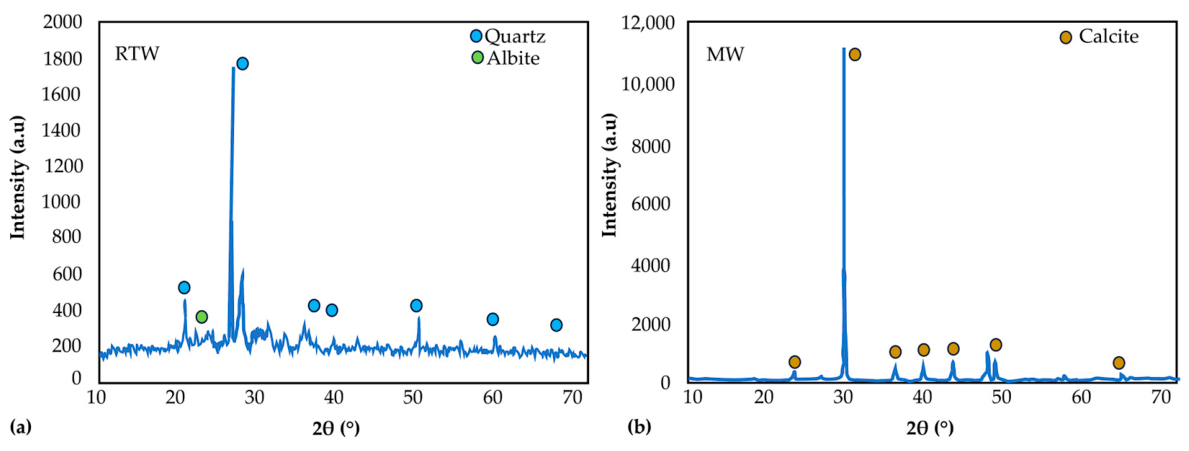
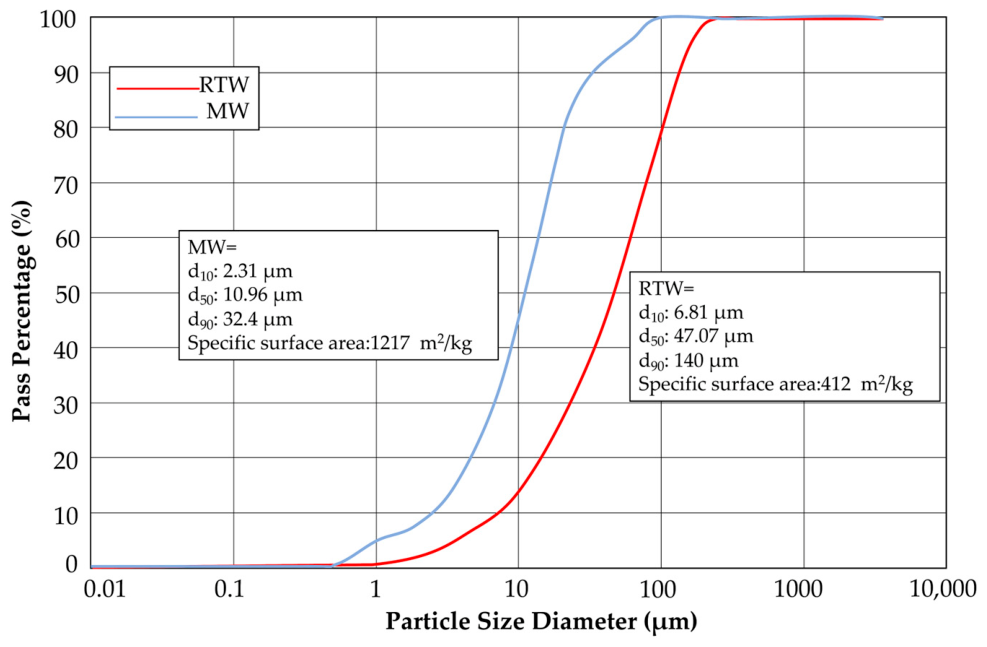
2.1. Raw Materials
2.2. Mixture Design
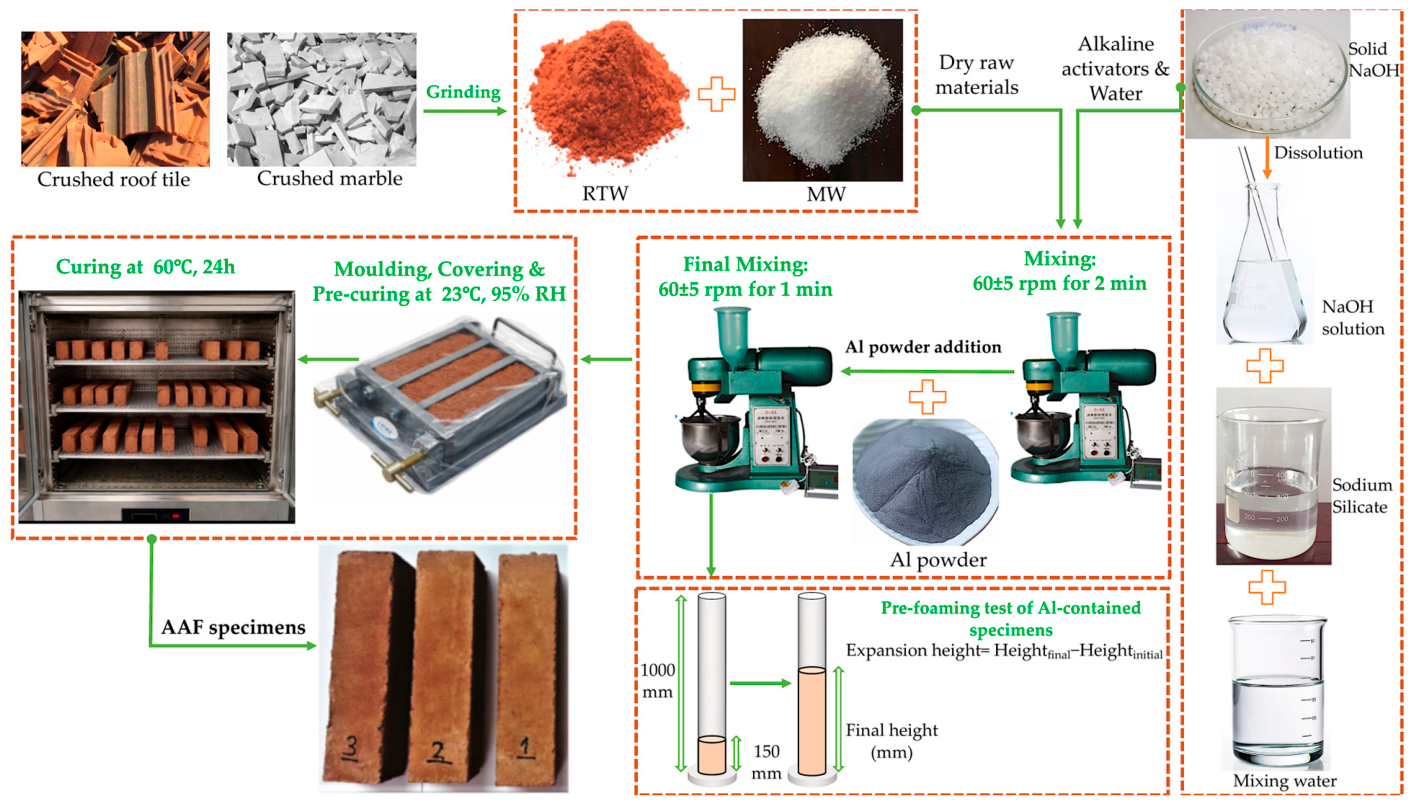
2.3. Specimen Fabrication
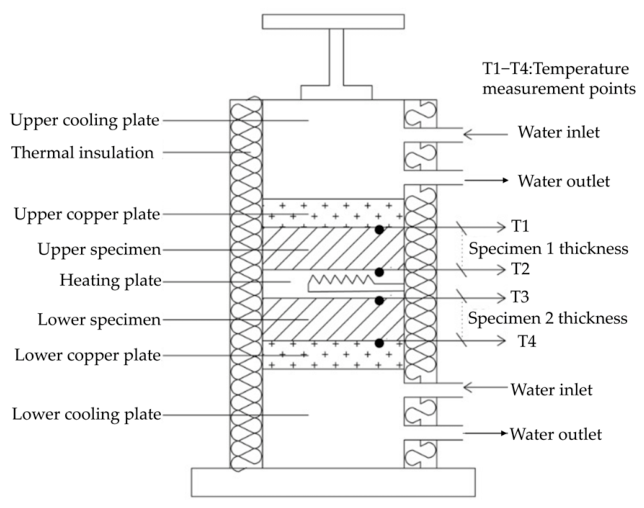
2.4. Applied Experimental Tests
3. Results and Discussion
3.1. Properties of Alkali-Activated Binders
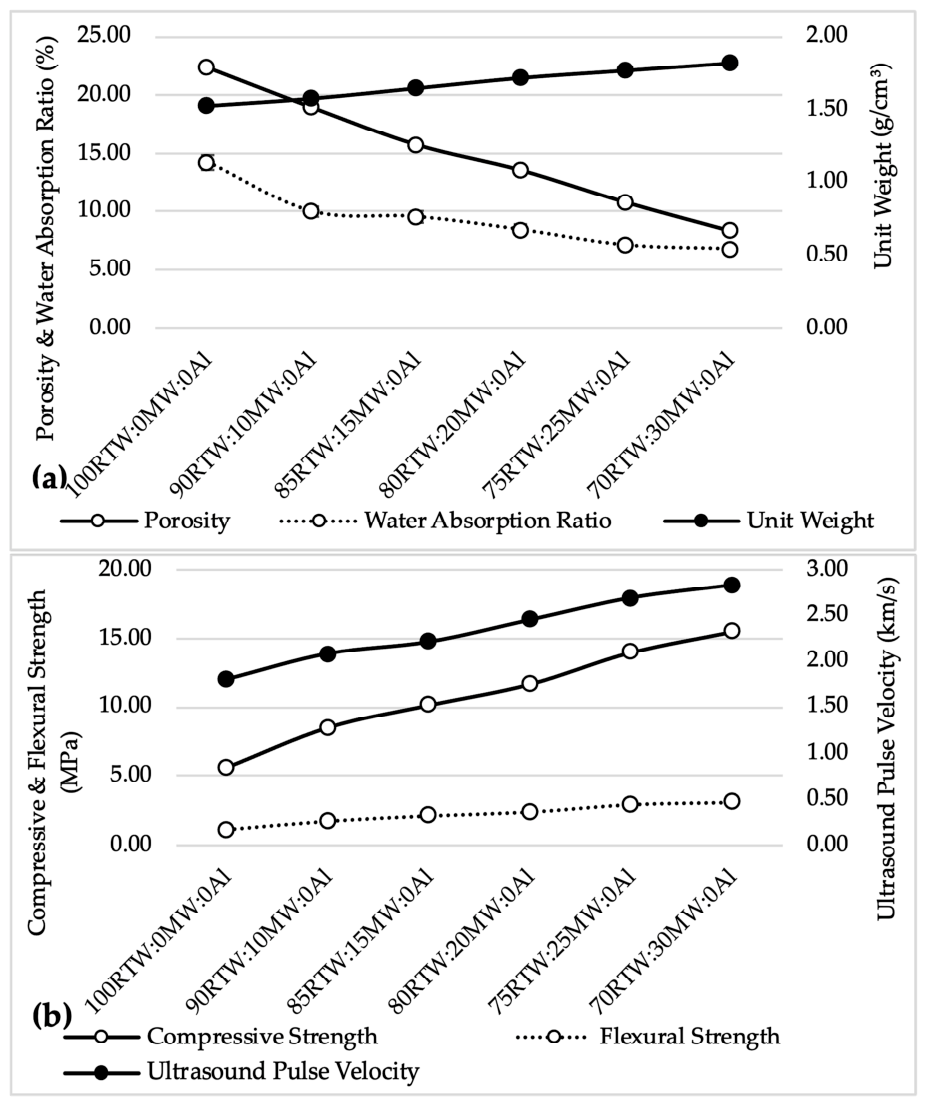
3.1.1. Physical and Mechanical Properties of AABs
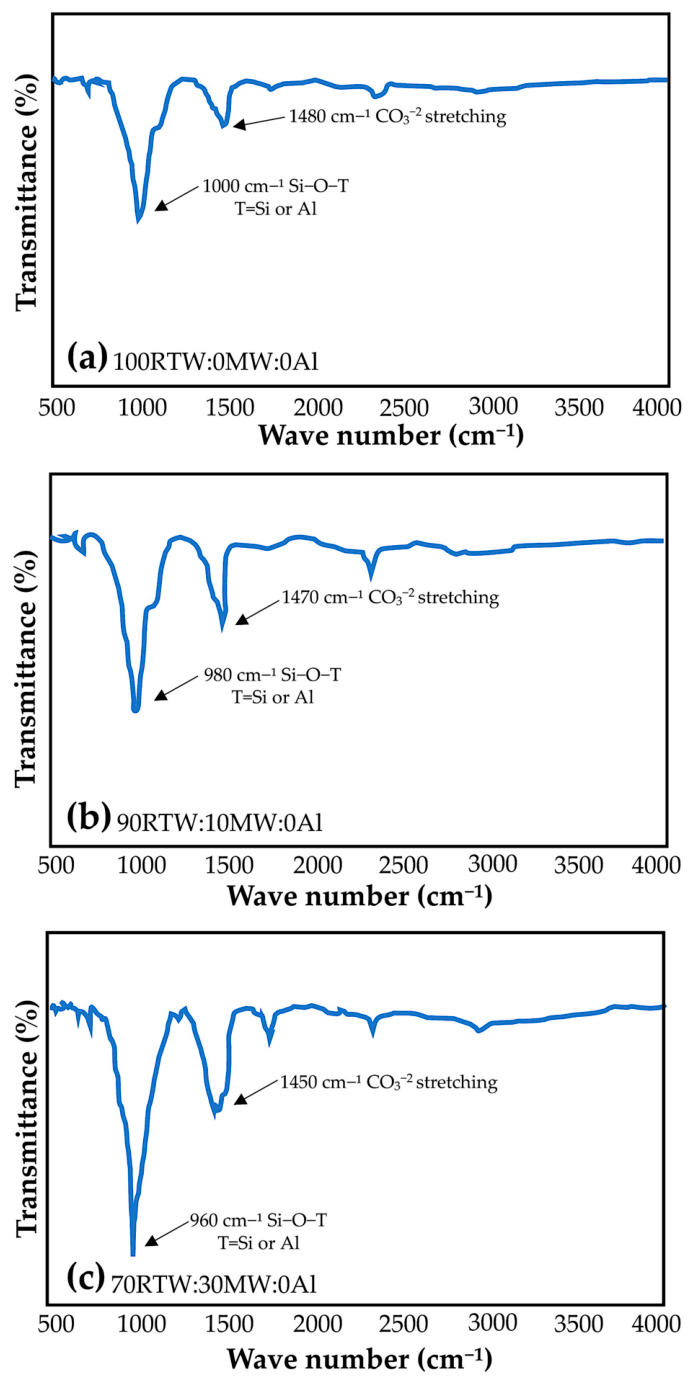
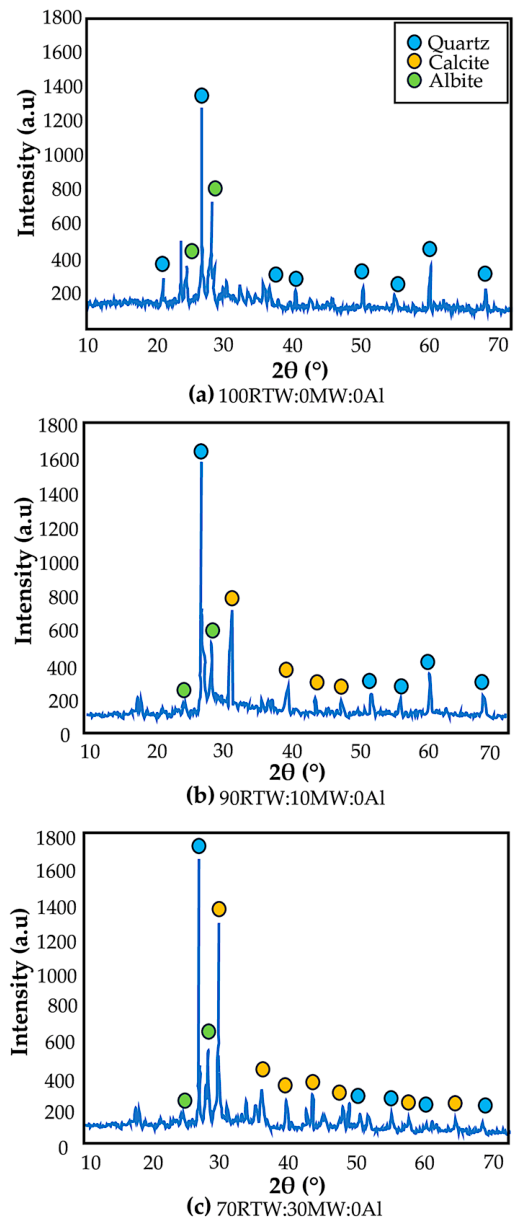
3.1.2. Microstructural and Phase Analysis of AABs
3.2. Properties of Alkali-Activated Foams
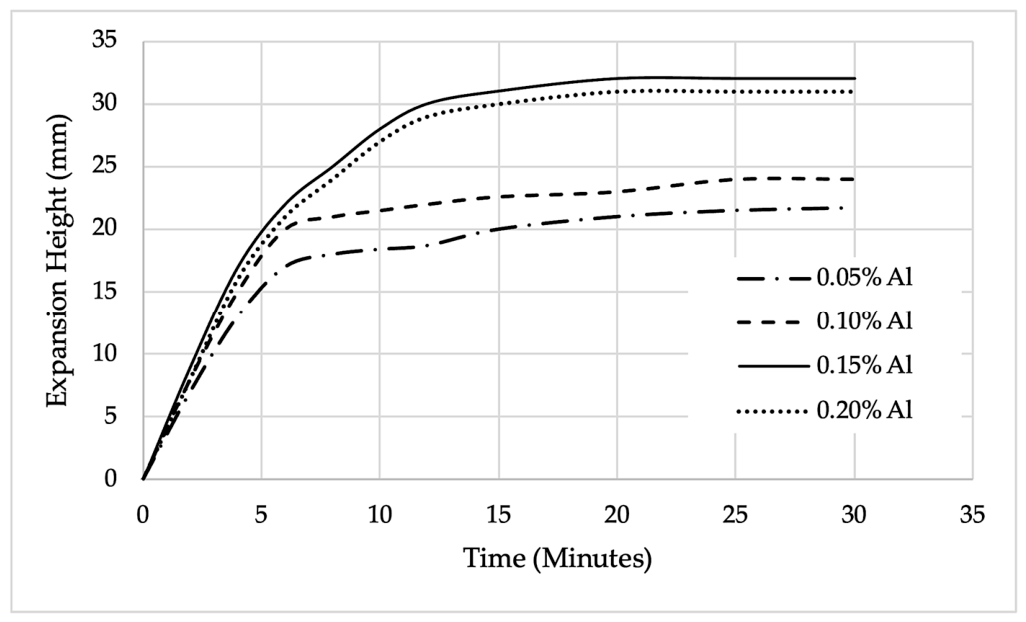
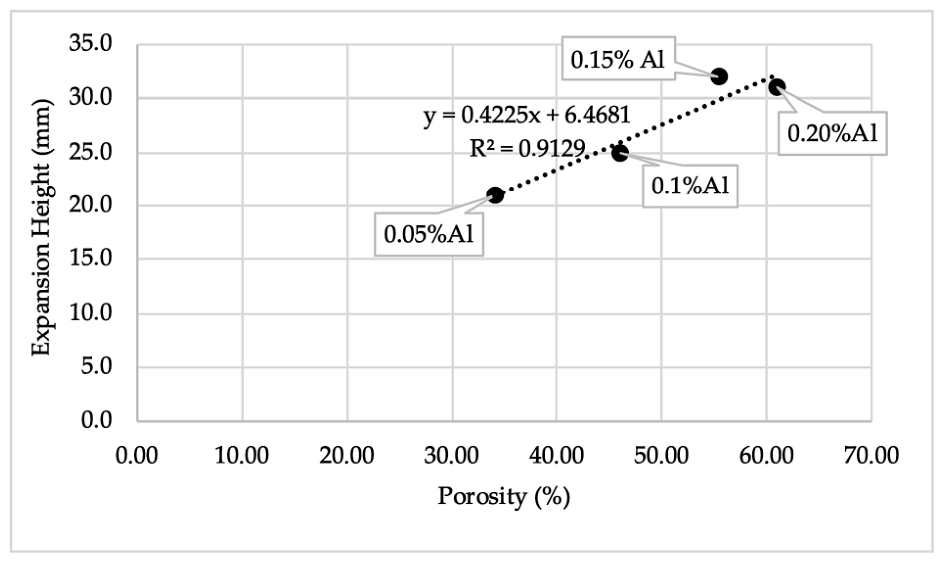
3.2.1. Pre-Foaming Behavior and Expansion Performance of AAFs
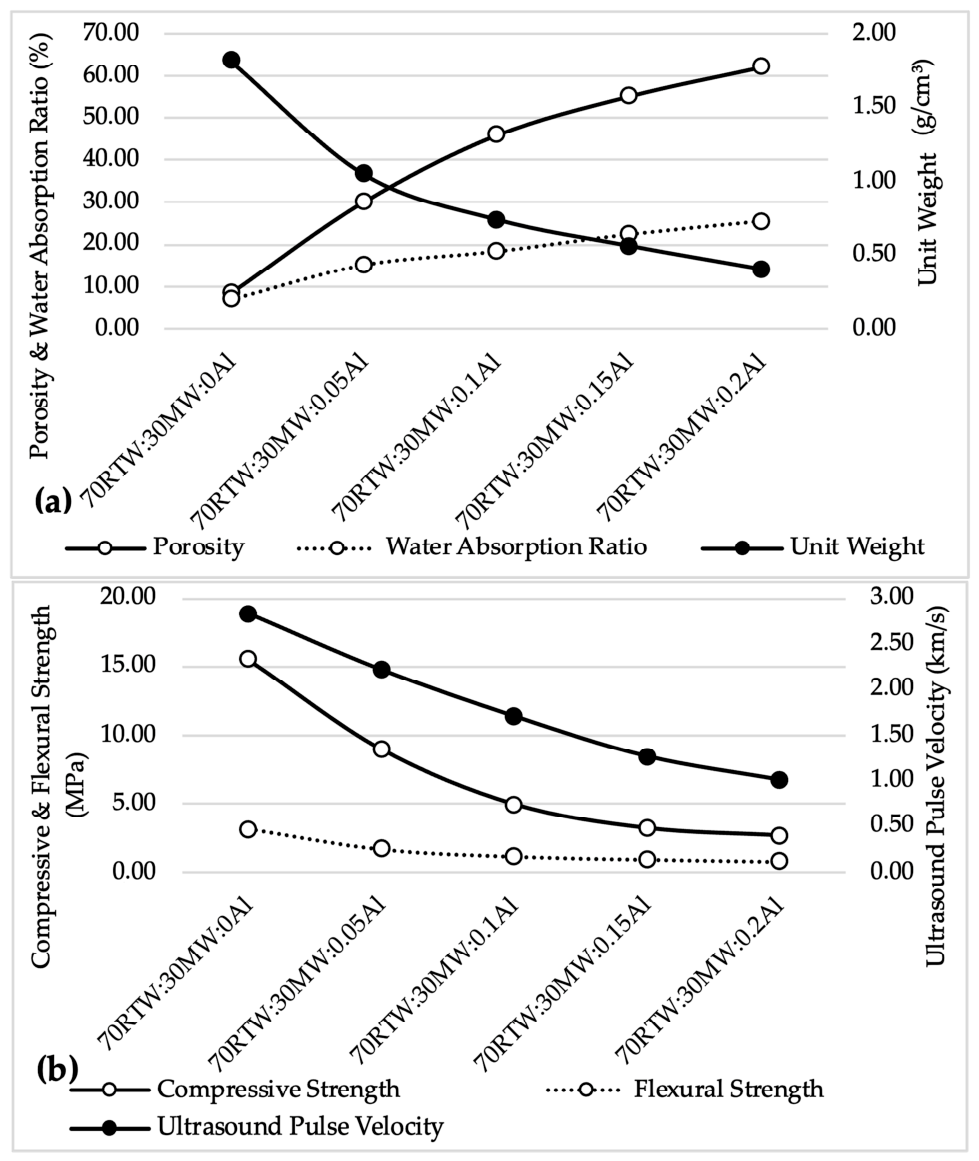
3.2.2. Physical and Mechanical Properties of AAFs
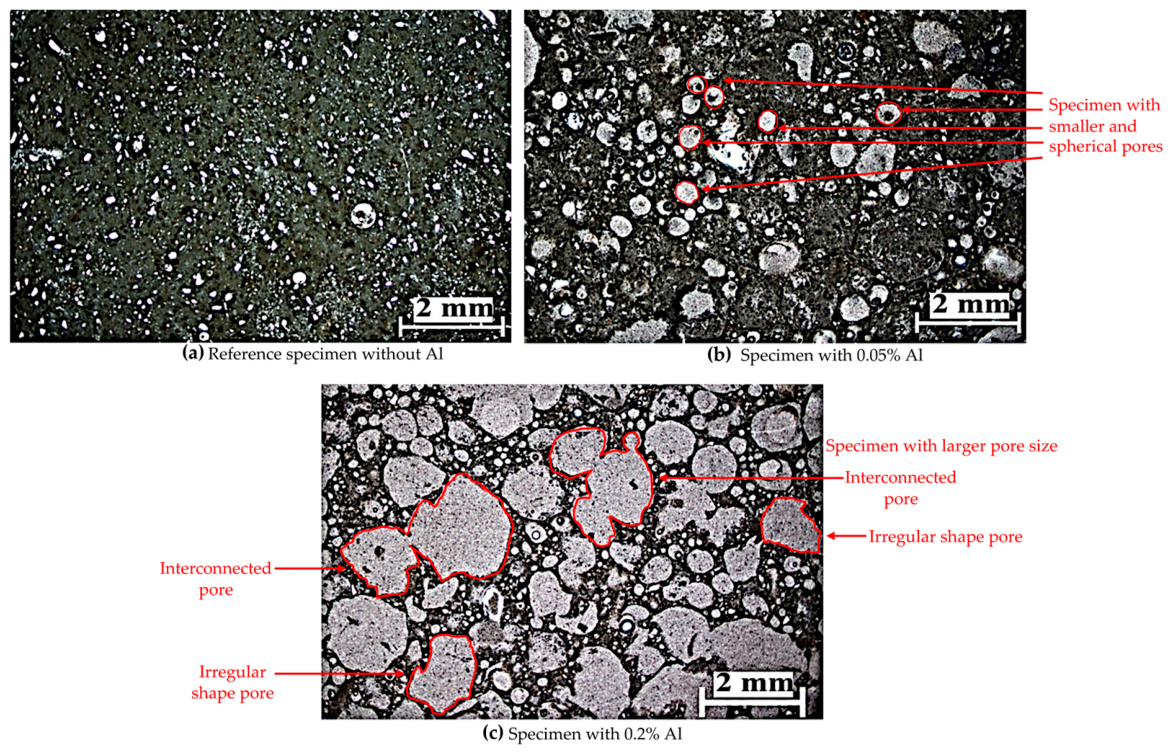
3.2.3. Optical Microstructure of AAFs
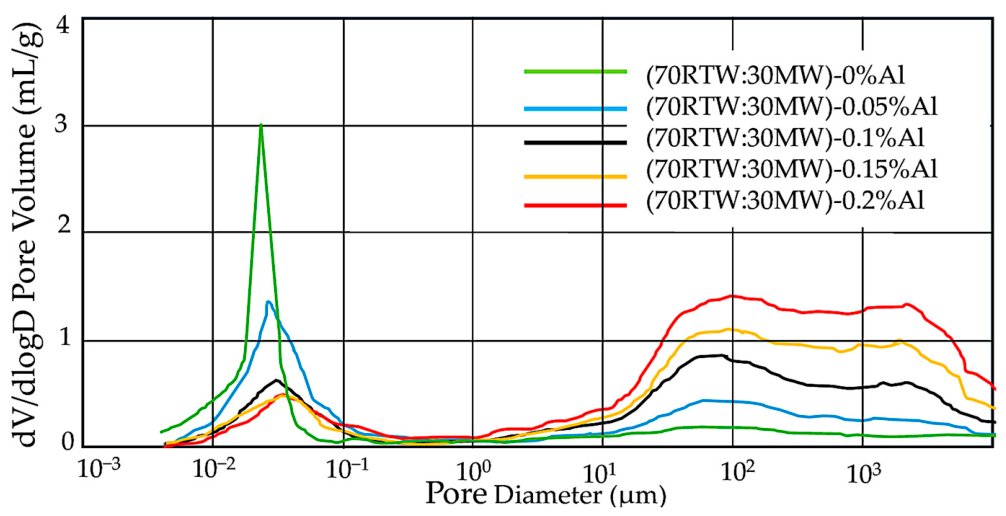
3.2.4. Pore Structure Analysis of AAFs
3.2.5. Thermal Properties of AAFs
3.3. Quantitative Sustainability Assessment of AAF Mixtures
3.3.1. Waste Incorporation and Resource Efficiency Assessment
3.3.2. Material-Based Embodied Carbon Assessment
3.3.3. Eco-Efficiency Performance Assessment
4. Conclusions
Funding
Institutional Review Board Statement
Informed Consent Statement
Data Availability Statement
Acknowledgments
Conflicts of Interest
Abbreviations
| AAB | Alkali-activated binder |
| AAF | Alkali-activated foam |
| Al | Aluminum powder |
| ATR | Attenuated total reflectance |
| BW | Brick waste |
| CC | Calcined clay |
| CDW | Construction and demolition waste |
| FA | Fly ash |
| FTIR | Fourier-transform infrared spectroscopy |
| GGBS | Ground granulated blast furnace slag |
| LCA | Life cycle assessment |
| LOI | Loss on ignition |
| M | Molarity |
| MIP | Mercury intrusion porosimetry |
| MK | Metakaolin |
| MW | Marble waste |
| OPC | Ordinary Portland cement |
| PE | Polyethylene |
| PST | Porcelain stoneware tile |
| RH | Relative humidity |
| RHA | Rice husk ash |
| RTW | Roof tile waste |
| SF | Silica fume |
| UPV | Ultrasound pulse velocity |
| WAR | Water absorption ratio |
| WGC | Waste green ceramic |
| XRD | X-ray diffraction |
| XRF | X-ray fluorescence |
References
- Georgiades, M.; Shah, I.H.; Steubing, B.; Cheeseman, C.; Myers, R.J. Prospective life cycle assessment of European cement production. Resour. Conserv. Recycl. 2023, 194, 106998. [Google Scholar] [CrossRef] [Scilit]
- Sbahieh, S.; McKay, G.; Al-Ghamdi, S.G. Comprehensive analysis of geopolymer materials: Properties, environmental impacts, and applications. Materials 2023, 16, 7363. [Google Scholar] [CrossRef] [Scilit] [PubMed]
- Liu, J.; Liu, B.; Li, Q.; Zhang, Q.; An, C.; Sun, Z.; Wei, S.; Fan, J. Review of solid waste-based geopolymers: Preparation, deterioration and durability. Mater. Today Commun. 2025, 43, 111820. [Google Scholar] [CrossRef] [Scilit]
- Sbi, S.; Aboulayt, A.; Ounacer, M.; Manoun, B.; Sajieddine, M.; Mansouri, S.; Samih, Y.; Semlal, N.; Kriven, W.M.; Tamraoui, Y.; et al. Assessing the long-term structural changes of metakaolin geopolymers encapsulating pyrite cinder: Environmental, microstructural and structure studies. Sustain. Mater. Technol. 2025, 45, e01459. [Google Scholar] [CrossRef] [Scilit]
- Ma, X.; Yang, Y. Single-component low-carbon sustainable geopolymer synthesis using calcium carbide residue, gypsum, sewage sludge ash, and ground granulated blast slag. Sustain. Mater. Technol. 2025, 43, e01314. [Google Scholar] [CrossRef] [Scilit]
- Pacheco-Torgal, F. Introduction to handbook of alkali-activated cements, mortars and concretes. In Handbook of Alkali-Activated Cements, Mortars and Concretes, 2nd ed.; Pacheco-Torgal, F., Labrincha, J.A., Leonelli, C., Palomo, A., Chindaprasirt, P., Eds.; Woodhead Publishing Limited: Cambridge, UK, 2015; Volume 1, pp. 1–16. [Google Scholar]
- Santos, A.; Andrejkovičová, S.; Řimnáčová, D.; Perná, I.; Almeida, F.; Rocha, F. Synthesis and characterization of lightweight foamed geopolymers from iron tailings for energy-efficient construction. J. Build. Eng. 2026, 120, 115414. [Google Scholar] [CrossRef] [Scilit]
- Soto-Paz, J.; Arroyo, O.; Torres-Guevara, L.E.; Parra-Orobio, B.A.; Casallas-Ojeda, M. The circular economy in the construction and demolition waste management: A comparative analysis in emerging and developed countries. J. Build. Eng. 2023, 78, 107724. [Google Scholar] [CrossRef] [Scilit]
- Faraji, M.F.; Türkel, I.; Ozkan, I.G.M.; Bayraktar, O.Y.; Kaplan, G.; Bayram, M.; Aydın, A.C.; Ozbakkaloglu, T. Fly ash and waste brick powder-based one-part geopolymer foam concrete with enhanced thermal performance: A circular approach to construction and demolition waste utilization. J. Build. Eng. 2026, 117, 114850. [Google Scholar] [CrossRef] [Scilit]
- Simão, L.; Hotza, D.; Ribeiro, M.J.; Novais, R.M.; Montedo, O.R.K.; Raupp-Pereira, F. Development of new geopolymers based on stone cutting waste. Constr. Build. Mater. 2020, 257, 119525. [Google Scholar] [CrossRef] [Scilit]
- Altheeb, A. Engineering attributes of alkali-activated mortars containing ceramic tiles waste as aggregates replacement: Effect of high-volume fly ash inclusion. Mater. Today Proc. 2023, 1–9. [Google Scholar]
- Sarkar, M.; Dana, K. Partial replacement of metakaolin with red ceramic waste in geopolymer. Ceram. Int. 2021, 47, 3473–3483. [Google Scholar] [CrossRef] [Scilit]
- Fugazzotto, M.; Cultrone, G.; Mazzoleni, P.; Barone, G. Suitability of ceramic industrial waste recycling by alkaline activation for use as construction and restoration materials. Ceram. Int. 2023, 49, 9465–9478. [Google Scholar] [CrossRef] [Scilit]
- Geraldo, R.H.; Ouellet-Plamondon, C.; Muianga, E.A.D.; Camarini, G. Alkali-activated binder containing wastes: A study with rice husk ash and red ceramic. Cerâmica 2017, 63, 44–51. [Google Scholar] [CrossRef] [Scilit]
- Khater, H.M.; Elnagar, A.M. Optimization of alkali activated grog/ceramic wastes geopolymer bricks. Int. J. Innov. Res. Sci. Eng. Technol. 2016, 5, 37–46. [Google Scholar]
- Bezerra, B.P.; Soares, G.; Morelli, M.R.; Da Luz, A.P. Recycling of roof tile waste in the manufacturing of high-temperature metakaolin-based geopolymer composites. Cerâmica 2023, 69, 242–247. [Google Scholar] [CrossRef] [Scilit]
- Abadel, A.A.; Alghamdi, H. Effect of high volume tile ceramic wastes on resistance of geopolymer mortars to abrasion and freezing-thawing cycles: Experimental and deep learning modelling. Ceram. Int. 2023, 49, 15065–15081. [Google Scholar] [CrossRef] [Scilit]
- Li, X.; Bai, C.; Qiao, Y.; Wang, X.; Yang, K.; Colombo, P. Preparation, properties and applications of fly ash-based porous geopolymers: A review. J. Clean. Prod. 2022, 359, 132043. [Google Scholar] [CrossRef] [Scilit]
- Novais, R.M.; Pullar, R.C.; Labrincha, J.A. Geopolymer foams: An overview of recent advancements. Prog. Mater. Sci. 2020, 109, 100621. [Google Scholar] [CrossRef] [Scilit]
- Lertcumfu, N.; Kaewapai, K.; Jaita, P.; Tunkasiri, T.; Sirisoonthorn, S.; Rujijanagul, G. Effects of olive oil on physical and mechanical properties of ceramic waste-based geopolymer foam. J. Reinf. Plast. Compos. 2019, 39, 111–118. [Google Scholar] [CrossRef] [Scilit]
- Horvat, B.; Ducman, V. Potential of green ceramics waste for alkali activated foams. Materials 2019, 12, 3563. [Google Scholar] [CrossRef] [Scilit] [PubMed]
- Masi, G.; Tugnoli, A.; Bignozzi, M.C. Lightweight alkali activated composites by direct foaming based on ceramic tile waste and fly ash. Ceram. Int. 2024, 50, 55410–55420. [Google Scholar] [CrossRef] [Scilit]
- Li, Z. Resource utilization of red mud in low-carbon binders: A review of reaction mechanisms, performance, and microstructure. Buildings 2026, 16, 2140. [Google Scholar] [CrossRef] [Scilit]
- ASTM C618; Standard Specification for Coal Fly Ash and Raw or Calcined Natural Pozzolan for Use in Concrete. ASTM International: West Conshohocken, PA, USA, 2023.
- Kaya, M.; Köksal, F.; Bayram, M.; Nodehi, M.; Gencel, O.; Ozbakkaloglu, T. The effect of marble powder on physico-mechanical and microstructural properties of kaolin-based geopolymer pastes. Struct. Concr. 2023, 24, 6485–6504. [Google Scholar]
- Alharthy, S.E.; Hodhod, O.A.; Abdelkadir, B.A. Developing a geopolymer pastes using marble dust. Water Sci. 2022, 36, 144–153. [Google Scholar] [CrossRef] [Scilit]
- Duxson, P.; Fernández-Jiménez, A.; Provis, J.L.; Lukey, G.C.; Palomo, A.; van Deventer, J.S.J. Geopolymer technology: The current state of the art. J. Mater. Sci. 2007, 42, 2917–2933. [Google Scholar] [CrossRef] [Scilit]
- Siyal, A.A.; Radin Mohamed, R.M.S.; Shamsuddin, R.; Ridzuan, M.B. A comprehensive review of synthesis kinetics and formation mechanism of geopolymers. RSC Adv. 2024, 14, 446–462. [Google Scholar] [CrossRef] [Scilit] [PubMed]
- Tayyab, S.; Ferdous, W.; Lokuge, W.; Ngo, T.; Gerdes, A.; Manalo, A. Influence of mix design parameters on fresh and hardened properties of geopolymer concrete: A state-of-the-art review. Polymers 2026, 18, 854. [Google Scholar] [CrossRef] [Scilit] [PubMed]
- Chen, G.; Luo, R.; Cai, Y.; Lin, J.X.; Guo, Y.C. Workability and mechanical properties of alkali-activated materials: Regulatory mechanisms dominated by composite alkali activator. Constr. Build. Mater. 2025, 505, 144672. [Google Scholar] [CrossRef] [Scilit]
- Zhang, Z.; Provis, J.L.; Reid, A.; Wang, H. Geopolymer foam concrete: An emerging material for sustainable construction. Constr. Build. Mater. 2014, 56, 113–127. [Google Scholar] [CrossRef] [Scilit]
- TS EN 1015-10; Methods of Test for Mortar for Masonry—Part 10: Determination of Dry Bulk Density of Hardened Mortar. Turkish Standards Institution: Ankara, Türkiye, 2001.
- TS EN 13755; Natural Stone Test Methods—Determination of Water Absorption at Atmospheric Pressure. Turkish Standards Institution: Ankara, Türkiye, 2008.
- TS 699; Natural Building Stones—Methods of Inspection and Laboratory Testing. Turkish Standards Institution: Ankara, Türkiye, 2009.
- TS EN 14579; Natural Stone Test Methods—Determination of Sound Speed Propagation. Turkish Standards Institution: Ankara, Türkiye, 2005.
- TS EN 196-1; Methods of Testing Cement—Part 1: Determination of Strength. Turkish Standards Institution: Ankara, Türkiye, 2016.
- ASTM C518-17; Standard Test Method for Steady-State Thermal Transmission Properties by Means of the Heat Flow Meter Apparatus. ASTM International: West Conshohocken, PA, USA, 2017.
- Statistical Rejection of “Bad” Data–Chauvenet’s Criterion. Available online: https://www.waterproperties.ca/osd_data_archive/Cruise_Data/2009/2009-020/DOC/Individual%20Reports/chauvenet.pdf (accessed on 12 April 2026).
- Kabirova, A.; Uysal, M.; Hüsem, M.; Aygörmez, Y.; Dehghanpour, H.; Pul, S.; Canpolat, O. Physical and mechanical properties of metakaolin-based geopolymer mortars containing various waste powders. Eur. J. Environ. Civ. Eng. 2023, 27, 437–456. [Google Scholar]
- Uysal, M.; Aygörmez, Y.; Canpolat, O.; Cosgun, T.; Kuranlı, O.F. Investigation of using waste marble powder, brick powder, ceramic powder, glass powder, and rice husk ash as eco-friendly aggregate in sustainable red mud-metakaolin based geopolymer composites. Constr. Build. Mater. 2022, 361, 129718. [Google Scholar] [CrossRef] [Scilit]
- Mahmood, A.Z.; Babaee, M.; Foster, S.J.; Castel, A. Capturing the early-age physicochemical transformations of alkali-activated fly ash and slag using ultrasonic pulse velocity technique. Cem. Concr. Compos. 2022, 130, 104529. [Google Scholar] [CrossRef] [Scilit]
- Krol, M.; Minkiewicz, J.; Mozgawa, W. IR spectroscopy studies of zeolites in geopolymeric materials derived from kaolinite. J. Mol. Struct. 2016, 1126, 200–206. [Google Scholar] [CrossRef] [Scilit]
- Vasić, M.V.; Terzić, A.; Radovanović, Ž.; Radojević, Z.; Warr, L.N. Alkali-activated geopolymerization of a low illitic raw clay and waste brick mixture. An alternative to traditional ceramics. Appl. Clay Sci. 2022, 218, 106410. [Google Scholar] [CrossRef] [Scilit]
- Xu, Z.; Jiang, Z.; Wu, D.; Peng, X.; Xu, Y.; Li, N.; Qi, Y.; Li, P. Immobilization of strontium-loaded zeolite A by metakaolin based-geopolymer. Ceram. Int. 2017, 43, 4434–4439. [Google Scholar] [CrossRef] [Scilit]
- Kaya, M.; Munir, M.J.; Kazmi, S.M.S.; Gencel, O. Valorization of tile waste in geopolymer mortars: A sustainable approach using marble powder, fly ash, and silica fume. Powder Technol. 2026, 469, 121866. [Google Scholar] [CrossRef] [Scilit]
- Hu, X.; Ge, X.; Zhou, M.; Zhang, Y.; Wang, Y.; Yang, H.; Zhang, Y. Recycling hazardous secondary aluminum dross as a functional foaming agent in fly ash/slag-based foamed geopolymer concrete. J. Build. Eng. 2026, 120, 115558. [Google Scholar] [CrossRef] [Scilit]
- Ramakrishnan, S.; Ramesh, A.; Pasupathy, K.; Manalo, A.C.; Sanjayan, J. Regulating the chemical foaming and pore distribution in aerated geopolymer concrete. Mater. Today Sustain. 2026, 33, 101276. [Google Scholar] [CrossRef] [Scilit]
- Provis, J.L.; van Deventer, J.S.J. Alkali Activated Materials: State-of-the-Art Report, RILEM TC 224-AAM, 1st ed.; Springer: Dordrecht, The Netherlands, 2014; pp. 34–69. [Google Scholar]
- Chen, S.; Ruan, S.; Zeng, Q.; Liu, Y.; Zhang, M.; Tian, Y.; Yan, D. Pore structure of geopolymer materials and its correlations to engineering properties: A review. Constr. Build. Mater. 2022, 328, 127064. [Google Scholar] [CrossRef] [Scilit]
- Zhang, Z.; Wang, H. The pore characteristics of geopolymer foam concrete and their impact on the compressive strength and modulus. Front. Mater. 2016, 3, 38. [Google Scholar] [CrossRef] [Scilit]
- Liu, J.; Liu, Y.; Ma, X.; Xu, H.; Wu, X.; Liu, M.; Zhuge, Y. Thermal performance optimisation of foam concrete for energy-efficient construction: A state-of-the-art review. J. Build. Eng. 2025, 112, 113899. [Google Scholar] [CrossRef] [Scilit]
- Pasupathy, K.; Ramakrishnan, S.; Sanjayan, J. Formulating eco-friendly geopolymer foam concrete by alkali-activation of ground brick waste. J. Clean. Prod. 2021, 325, 129180. [Google Scholar] [CrossRef] [Scilit]
- Dang, J.; Tang, X.; Xiao, J.; Han, A. Influence of alkaline activator and precursor on the foam characterization and alkali-activated foamed concrete properties. Cem. Concr. Compos. 2024, 145, 105341. [Google Scholar] [CrossRef] [Scilit]
- TS 825; Thermal Insulation Requirements for Buildings—Rules for Heat Insulation in Buildings. Turkish Standards Institution: Ankara, Türkiye, 2024.
- Bernal, S.A.; Rodríguez, E.D.; Kirchheim, A.P.; Provis, J.L. Management and valorisation of wastes through use in producing alkali-activated cement materials. J. Chem. Technol. Biotechnol. 2016, 91, 2365–2388. [Google Scholar] [CrossRef] [Scilit]
- ISO 14021:2016; Environmental Labels and Declarations—Self-Declared Environmental Claims (Type II Environmental Labelling). International Organization for Standardization: Geneva, Switzerland, 2016.
- Yang, K.H.; Song, J.K.; Song, K. Assessment of CO2 reduction of alkali-activated concrete. J. Clean. Prod. 2013, 39, 265–272. [Google Scholar] [CrossRef] [Scilit]
- Suarez-Riera, D.; Restuccia, L.; Falliano, D.; Ferro, G.A.; Tuliani, J.-M.; Pavese, M.; Lavagna, L. An overview of methods to enhance the environmental performance of cement-based materials. Infrastructures 2024, 9, 94. [Google Scholar] [CrossRef] [Scilit]
- Miller, S.A.; Juenger, M.; Kurtis, K.E.; Weiss, J. Cement and alternatives in the anthropocene. Annu. Rev. Environ. Resour. 2024, 49, 309–335. [Google Scholar] [CrossRef] [Scilit]
- Purnell, P.; Black, L. Embodied carbon dioxide in concrete: Variation with common mix design parameters. Cem. Concr. Res. 2012, 42, 874–877. [Google Scholar] [CrossRef] [Scilit]






| Chemical Composition (%) | SiO2 | Al2O3 | Fe2O3 | CaO | MgO | K2O | Na2O | TiO2 | ZrO2 | LOI |
|---|---|---|---|---|---|---|---|---|---|---|
| RTW | 72.33 | 16.40 | 1.14 | 1.67 | 0.62 | 1.87 | 2.83 | 0.75 | 0.36 | 2.03 |
| MW | 0.34 | 0.17 | - | 55.80 | 0.26 | - | - | - | 43.43 |
| Stage | Specimen Code | RTW (g) | MW (g) | NaOH Solution (7.5 M) (g) | Sodium Silicate Solution (g) | Additional Water (g) | Al Powder (g) | Total Liquid: Binder Ratio | Effective Total Water: Binder Ratio | Activator: Binder Ratio |
|---|---|---|---|---|---|---|---|---|---|---|
| I | 100RTW:0MW:0Al | 400 | 0 | 33.3 | 66.6 | 20.1 | 0 | 0.30 | 0.23 | 1:4 |
| 90RTW:10MW:0Al | 360 | 40 | ||||||||
| 85RTW:15MW:0Al | 340 | 60 | ||||||||
| 80RTW:20MW:0Al | 320 | 80 | ||||||||
| 75RTW:25MW:0Al | 300 | 100 | ||||||||
| 70RTW:30MW:0Al | 280 | 120 | ||||||||
| II | 70RTW:30MW:0.05Al | 280 | 120 | 0.2 | ||||||
| 70RTW:30MW:0.10Al | 0.4 | |||||||||
| 70RTW:30MW:0.15Al | 0.6 | |||||||||
| 70RTW:30MW:0.20Al | 0.8 |
| Specimens | Pore Volume (mL/g) | Total Pore Volume (mL/g) | ||
|---|---|---|---|---|
| 0.002–0.1 µm (Level-3) | 0.1–10 µm (Level-2) | ≥10 µm (Level-1) | ||
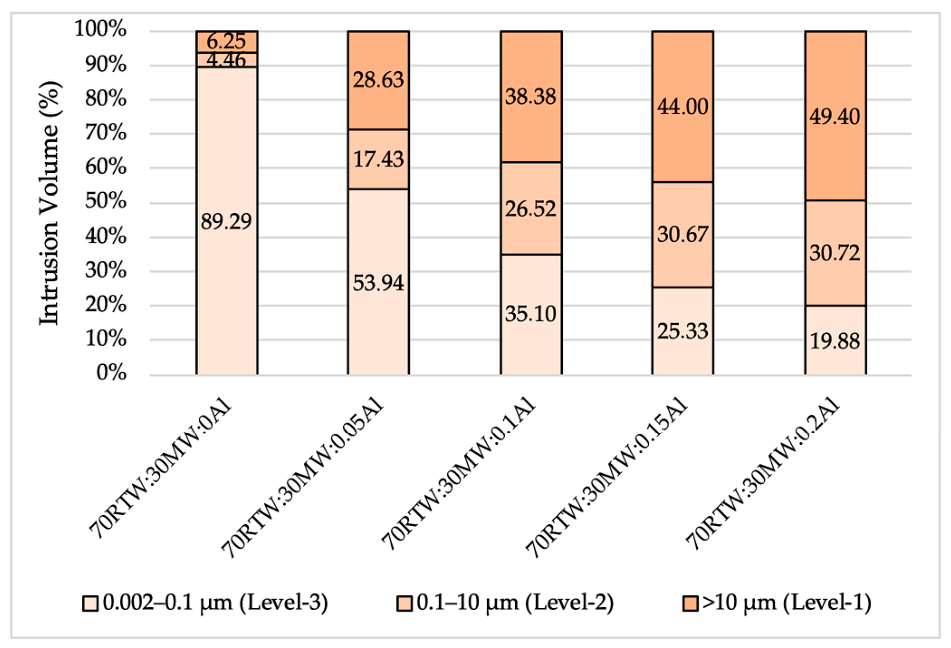
| 70RTW:30MW:0Al | 0.300 | 0.015 | 0.021 | 0.336 |
| 70RTW:30MW:0.05Al | 0.260 | 0.084 | 0.138 | 0.482 |
| 70RTW:30MW:0.10Al | 0.225 | 0.170 | 0.246 | 0.641 |
| 70RTW:30MW:0.15Al | 0.190 | 0.230 | 0.330 | 0.750 |
| 70RTW:30MW:0.20Al | 0.165 | 0.255 | 0.410 | 0.830 |
| Ref. | Precursor | Foaming Agent (wt%) | Unit Weight (g/cm3) | Porosity (%) | Thermal Conduct. (W/m·K) | Compressive Strength (MPa) | Pore-Forming Mechanism | Dominant Pore Feature |
|---|---|---|---|---|---|---|---|---|
| [20] | CC + MK | H2O2 (0.24) | 0.73–0.82 | 63–69 | - | 3.64–7.60 | O2 release | Closed spherical pores |
| [21] | WGC | Na-perborate (5) | 0.80 | - | - | 1.70 | Hydrolysis-induced O2 generation | Uniform fine pore network |
| H2O2 (10) | 0.70 | 4.60 | O2 release | Fine and relatively homogeneous pores | ||||
| Al (1) | 0.70 | 2.80 | H2 release | Large closed macropores | ||||
| [22] | FA + PST | H2O2 (0.5–2.5) | 1.05–1.20 | - | - | - | O2 release | Uniform macropore distribution |
| Na-bicarbonate (5–10) | 1.07–1.28 | - | - | - | CO2 generation by thermal decomposition | Elongated and unstable macropores | ||
| Al (0.2–1) | 1.09–1.29 | - | - | - | H2 release | Non-uniform localized macro voids | ||
| [52] | BW | Al (0.15) | 0.77–0.83 | - | 0.22–0.27 | 0.70–2.42 | H2 release | Fine spherical pores |
| [53] | GGBS + BW | Precast foam (0.17) | - | 65 | 0.11–0.12 | 1.33–3.34 | Bubble stability-controlled pore formation | Spherical closed pores at low alkalinity; irregular interconnected pores at high alkalinity |
| This study | RTW + MW | Al powder (0.05–0.2) | 0.40–1.05 | 30.1–62.1 | 0.09–0.38 | 2.58–8.95 | H2 evolution; matrix stability controlled | Fine and spherical pores at low Al contents; larger, irregular, and partially interconnected macropores at high Al contents. |
| Non-loadbearing Wall Materials | Unit Weight (g/cm3) | Thermal Conduct. (W/m·K) | Compressive Strength (MPa) |
|---|---|---|---|
| Lightweight aggregate concrete [54] | 0.8–2.0 | 0.39–1.6 | >4.0 |
| Pumice concrete [54] | 0.4–1.3 | 0.11–0.46 | 2.5–7.5 |
| Autoclaved aerated concrete [54] | 0.4–1.0 | 0.10–0.30 | >4.0 |
| Clay-based perforated brick [54] | 0.6–1.0 | 0.33–0.45 | 2.5–5.0 |
| Sand-lime brick [54] | 0.7–2.2 | 0.35–1.30 | 5.0–20.0 |
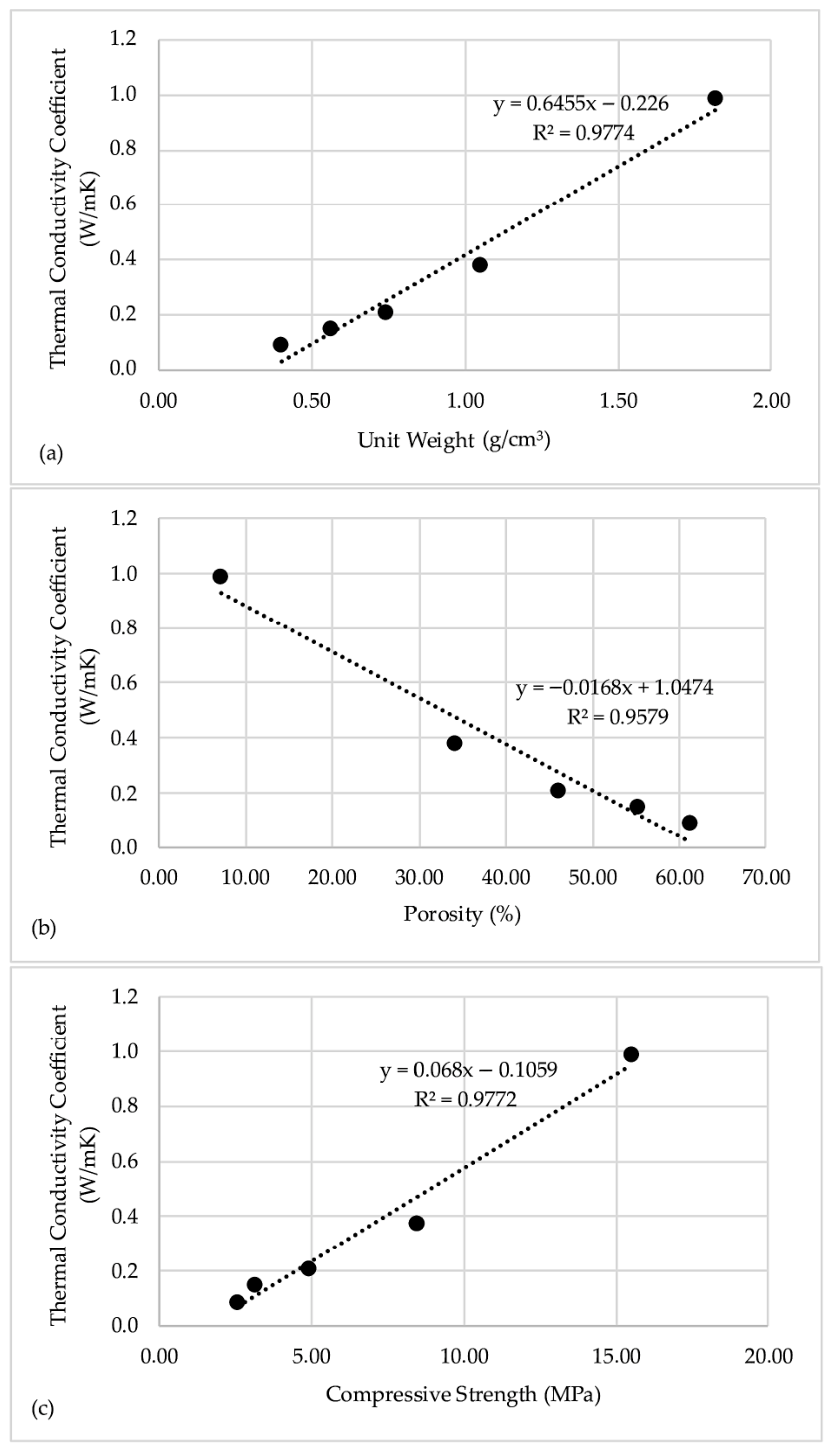
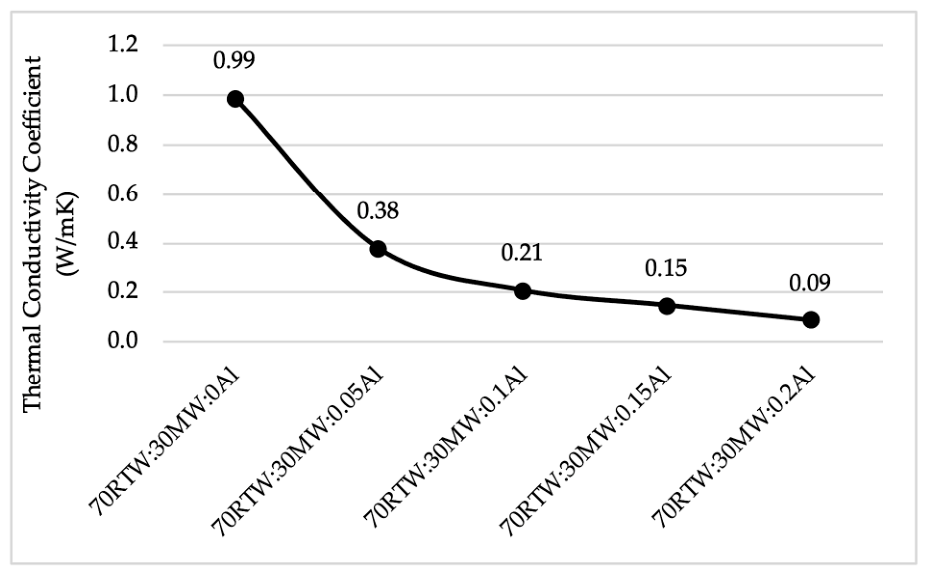
| 70RTW:30MW:0Al | 1.82 | 0.99 | 15.5 |
| 70RTW:30MW:0.05Al | 1.05 | 0.38 | 8.95 |
| 70RTW:30MW:0.10Al | 0.74 | 0.21 | 4.89 |
| 70RTW:30MW:0.15Al | 0.56 | 0.15 | 3.12 |
| 70RTW:30MW:0.20Al | 0.40 | 0.09 | 2.58 |
| Waste Incorporation Parameter | Equation | Calculation | Result (%) |
|---|---|---|---|
| WIRp | WIRp = [(mRTW + mMW)/(mprecursor)] × 100 | WIRp = [(280 + 120)/(400)] × 100 | 100 |
| WIRt | WIRt = [(mRTW + mMW)/(mtotal mixture)] × 100 | WIRt = [(280 + 120)/(280 + 120 + 33.3 + 66.6 + 0.6)] × 100 | 79.9 |
| Component | Amount (kg) | Emission Factor (EF, kg CO2-eq/kg) | Calculation | CO2 Contribution (kg CO2-eq) |
|---|---|---|---|---|
| RTW | 0.280 | 0 | 0.280 × 0 | 0 |
| MW | 0.120 | 0 | 0.120 × 0 | 0 |
| NaOH | 0.033 | 1.232 [57] | 0.033 × 1.232 | 0.041 |
| Na2SiO3 | 0.066 | 1.320 [57] | 0.066 × 1.320 | 0.088 |
| ECAAF | 0.129 | |||
| ECOPC | 0.400 | 0.944 [57] | 0.400 × 0.944 | 0.378 |
| Environmental/Functional Indicator | Value | Unit | Interpretation |
|---|---|---|---|
| WIRt | 79.9 | % | High waste utilization capacity |
| Material-based embodied carbon (ECAAF) | 0.129 | kg CO2-eq | Material-based embodied carbon within the defined system boundary |
| Material-based embodied carbon reduction | 65.9 | % | Relative to the OPC reference binder (material-based assessment) |
| Material-based embodied carbon per unit compressive strength (EC/Cs) | 0.129/3.12 = 0.041 | kg CO2-eq/MPa | Environmental efficiency normalized by compressive strength |
| Compressive strength | 3.12 | MPa | Suitable for lightweight non-loadbearing wall |
| Thermal conductivity | 0.15 | W/m·K | High thermal insulation performance under dry conditions |
Disclaimer/Publisher’s Note: The statements, opinions and data contained in all publications are solely those of the individual author(s) and contributor(s) and not of MDPI and/or the editor(s). MDPI and/or the editor(s) disclaim responsibility for any injury to people or property resulting from any ideas, methods, instructions or products referred to in the content. |
© 2026 by the author. Licensee MDPI, Basel, Switzerland. This article is an open access article distributed under the terms and conditions of the Creative Commons Attribution (CC BY) license.
Share and Cite
Barış, K.E. Development of Lightweight Alkali-Activated Foams from Roof Tile and Marble Wastes: Pore Structure Evolution and Thermal Performance Optimization. Sustainability 2026, 18, 7458. https://doi.org/10.3390/su18147458
Barış KE. Development of Lightweight Alkali-Activated Foams from Roof Tile and Marble Wastes: Pore Structure Evolution and Thermal Performance Optimization. Sustainability. 2026; 18(14):7458. https://doi.org/10.3390/su18147458
Chicago/Turabian StyleBarış, Kübra Ekiz. 2026. "Development of Lightweight Alkali-Activated Foams from Roof Tile and Marble Wastes: Pore Structure Evolution and Thermal Performance Optimization" Sustainability 18, no. 14: 7458. https://doi.org/10.3390/su18147458
APA StyleBarış, K. E. (2026). Development of Lightweight Alkali-Activated Foams from Roof Tile and Marble Wastes: Pore Structure Evolution and Thermal Performance Optimization. Sustainability, 18(14), 7458. https://doi.org/10.3390/su18147458