Article

Hydrogen for Heat: A District Heating Case Study from Latvia

1
Faculty of Computer Science, Information Technology and Energy, Riga Technical University, 12-1 Azenes Str., LV-1048 Riga, Latvia
2
Faculty of Civil and Mechanical Engineering, Riga Technical University, 6A Kipsala Street, LV-1048 Riga, Latvia
3
JSC “Rigas Siltums”, 3A Cesu Street, LV-1012 Riga, Latvia
4
Riga Nordic University, 1-5 Valerijas Seiles Str., LV-1019 Riga, Latvia
*
Author to whom correspondence should be addressed.
Sustainability 2026, 18(14), 7217; https://doi.org/10.3390/su18147217
Submission received: 22 April 2026 / Revised: 3 July 2026 / Accepted: 9 July 2026 / Published: 15 July 2026
(This article belongs to the Section Energy Sustainability)

Abstract

Decarbonization of district heating (DH) systems requires practical solutions that can reduce greenhouse-gas (GHG) emissions while utilizing existing infrastructure. Therefore, the study experimentally evaluates hydrogen–methane-based gas co-combustion in a real urban DH installation in Riga, Latvia, using a 6.3 MW hot-water boiler operating under commercial conditions without equipment modification. Experiments were conducted under steady-state operating conditions by blending hydrogen with the baseline methane-based gas at volumetric fractions of 0%, 10%, and 20%. Thermal performance and emissions (CO2, NOx, and CO) were monitored during 30 min measurement periods, and three independent experiments were performed for each hydrogen blending level. The experimental data were analyzed using one-way analysis of variance (ANOVA) to evaluate the statistical significance of the observed changes. Stable ignition, flame anchoring, and load-following performance were maintained under all investigated conditions, and no flashback or blow-off events occurred. Boiler efficiency remained essentially constant at approximately 92% (92.1–91.9%), while thermal output was maintained at 6.3 MW. When CO2 emissions were normalized to useful thermal energy output (kg CO2/MWh), the specific CO2 emission intensity decreased from 202 kg/MWh for pure methane-based gas operation to 161 kg/MWh at 20 vol.% hydrogen addition, corresponding to an approximately 20% reduction in the carbon intensity of delivered heat under the investigated operating conditions. Carbon monoxide (CO) emissions remained low (~6–7 mg/kWh) and particulate matter concentrations remained below 1 mg/m3. Nitrogen oxide emissions increased moderately from approximately 40 mg/kWh to 52 mg/kWh due to enhanced combustion temperatures but remained within applicable regulatory limits. No degradation of safety systems, fuel metering equipment, or infrastructure and no leakage events were observed during the experiments. The results demonstrate that hydrogen blending up to 20 vol.% can achieve substantial reductions in the carbon intensity of heat generation while preserving boiler performance and operational safety, confirming hydrogen co-combustion as a practical transitional decarbonization pathway for existing DH systems. They also uncover the potential of hydrogen blending to support the sustainable decarbonization of DH systems by reducing GHG emissions while preserving existing infrastructure and operational reliability.

1. Introduction

The energy transition and transformation of power systems represent a fundamental shift from centralized, fossil-based generation toward decentralized, low-carbon, and increasingly electrified energy infrastructure. The transition is driven by the rapid deployment of renewable energy sources, particularly wind and solar, whose variability introduces new operational challenges related to system balancing, flexibility, and reliability. In this regard, sector coupling has emerged as a key strategy, linking electricity, heating, and gas systems to enhance energy system efficiency and resilience. DH networks are gaining renewed importance as flexible energy sinks capable of integrating excess renewable electricity through technologies such as power-to-heat and hybrid fuel systems.
At the same time, the decarbonization of gaseous energy carriers is becoming a critical component of power system transformation, with green hydrogen playing a central role as a low-carbon energy vector. The integration of hydrogen into existing natural gas infrastructure, particularly through blending pathways, offers a transitional option that leverages existing assets while reducing GHG emissions. However, this approach raises important technical, economic, and regulatory questions, particularly concerning combustion performance, infrastructure compatibility, and end-use efficiency.
The decarbonization of DH systems is an important component of European climate-neutrality objectives. Among the available transition pathways, hydrogen blending into existing methane-based gas infrastructure has attracted considerable interest because it can reduce the carbon intensity of heat generation while utilizing existing gas transmission, distribution, and combustion assets. European decarbonization policies have further stimulated interest in hydrogen utilization within existing gas and DH infrastructure [1,2,3,4,5,6,7,8,9,10,11,12,13,14,15,16,17,18,19,20,21,22,23,24,25].
Hydrogen is increasingly recognized as a versatile energy carrier with applications in industrial processes, heating systems, transportation, power generation, and electrochemical energy conversion technologies such as proton exchange membrane fuel cells, highlighting its potential to support energy-system decarbonization across multiple sectors. While the present study focuses on hydrogen utilization in DH combustion systems, it contributes to the wider transition toward hydrogen-based energy solutions.
Compared with methane, hydrogen exhibits higher flame speed, lower ignition energy, and wider flammability limits, which can significantly influence combustion stability, heat release, and emission formation [26,27]. As a result, the practical feasibility of hydrogen blending must be validated under real operating conditions using full and pilot-scale installations.
While numerous laboratory-scale studies and numerical simulations have investigated hydrogen–methane-based gas combustion [28,29,30,31,32,33], empirical evidence from operational DH plants remains limited. Existing studies often focus on small burners or controlled kilowatt-scale test rigs, which do not fully capture the complexity of industrial installations, such as dynamic load variations, integrated control systems, and long-duration operations. Variations in boiler design, burner technology, and control strategies necessitate site-specific validation to ensure reliable and safe deployment [33]. Therefore, experimental demonstrations conducted in real-world industrial installations play a crucial role in bridging the gap between the theoretical potential of methane-based gas and hydrogen gas blending and its practical implementation.
At the same time, over the past decade, hydrogen blending into methane-based gas networks has received increasing attention as a practical pathway for reducing GHG emissions while utilizing existing energy infrastructure. Previous investigations have demonstrated that moderate hydrogen admixtures can substantially decrease the carbon intensity of gaseous fuels without requiring complete replacement of transmission and distribution systems [34]. In most cases, hydrogen-enriched mixtures exhibit enhanced reactivity and improved combustion completeness owing to the high diffusivity and rapid oxidation kinetics of hydrogen [35]. At the same time, the higher reactivity of hydrogen may increase combustion temperatures and modify flame structure, potentially affecting emission formation mechanisms and operational safety [36].
A considerable body of research, such as [37], has examined hydrogen-methane co-combustion through laboratory experiments and numerical simulations. These studies generally indicate that hydrogen fractions of up to approximately 20% by volume can be accommodated by existing combustion systems while maintaining stable operation and acceptable performance. Several studies have reported reductions in ignition delay and improvements in flame stability due to the lower minimum ignition energy and wider flammability range of hydrogen [38]. Other studies have demonstrated that hydrogen enrichment can increase laminar flame speed and accelerate combustion processes, resulting in more rapid heat release and improved fuel conversion efficiency. However, elevated flame temperatures may also intensify thermal nitrogen oxide formation, creating a trade-off between carbon reduction and pollutant emissions that requires careful combustion control [39].
The environmental implications of hydrogen blending have also been widely investigated. Most published studies have reported significant reductions in CO2 emissions as the hydrogen fraction increases because hydrogen combustion does not directly generate carbon emissions [39]. Simultaneously, CO emissions generally remain low owing to improved combustion completeness, while particulate matter emissions are often negligible because gaseous fuels do not contain significant solid-phase precursors.
Several major hydrogen demonstration projects, including HyDeploy, GRHYD, THyGA, HYFLEXPOWER, and HyCoFlex, have confirmed the technical feasibility of hydrogen integration in gas networks, end-use appliances, and industrial energy systems. However, these projects primarily focused on infrastructure compatibility, appliance performance, or power generation rather than DH boilers [9,40,41,42,43,44,45].
Experimental investigations of hydrogen-enriched natural gas combustion in MW-scale DH boilers remain limited, particularly under full-scale industrial operating conditions. Ref. [46] conducted field tests on a 2 t/h industrial steam boiler with approximately 10 vol.% hydrogen and demonstrated stable operation while evaluating thermal efficiency and NOx emissions. At the same time, Ref. [47] investigated condensing boilers operating with up to 23 vol.% hydrogen and reported CO2 reductions without significant performance penalties. Ref. [48] again examined hydrogen blending up to 30 vol.% in a natural-gas-fired boiler and observed changes in combustion and emission characteristics.
To address this gap, the present study investigates hydrogen–natural gas blends containing up to 20 vol.% hydrogen DH boiler operating in the Nordic region, in Latvia. In this country DH continues to play an important role in urban energy supply, covering a share of 36–92% of the total heat supply [49]. Existing gas-fired DH systems represent substantial infrastructure assets that are expected to remain operational during the energy transition and therefore require practical decarbonization solutions that can be implemented without extensive equipment replacement. In this context, experimental validation under real commercial conditions becomes essential for assessing whether hydrogen blending can simultaneously reduce carbon intensity, preserve thermal efficiency, maintain combustion stability, and satisfy operational safety requirements. There is a clear need for additional full-scale investigations that provide high-quality empirical evidence regarding the practical feasibility of hydrogen integration in existing DH systems and support informed decisions by system operators, policymakers, and energy planners [50].
The study provides experimental evidence from a 6.3 MW district-heating boiler operating under commercial conditions, thereby extending the available knowledge from laboratory- and small-scale systems to medium-scale heat-generation infrastructure.
It addresses experimental co-combustion of hydrogen and methane-based fuel at boiler house A, which houses a hot water boiler with a nominal thermal capacity of 6.3 megawatt (MW). The selected facility represents an element of urban DH systems widely deployed across the EU, thereby providing a relevant and replicable case study [51]. The operational tests were designed to assess the technical feasibility, environmental performance, and operational stability of hydrogen blending under normal commercial operating conditions without any system modification.
The study hypothesizes that hydrogen blending up to 20% by volume can be implemented in an existing methane-based gas-fired DH boiler without compromising combustion stability, thermal efficiency, or operational safety, while reducing the carbon intensity of heat production. Because hydrogen possesses a substantially lower volumetric heating value than methane, the magnitude of CO2 reduction is not assumed to be directly proportional to the volumetric hydrogen fraction and depends on the emission normalization basis and operating conditions. The hypothesis aligns with current infrastructure compatibility thresholds and with emerging European regulatory and policy frameworks that consider hydrogen blending as a transitional measure for decarbonizing the gas sector [52,53].
To test the hypothesis, the study addresses several interrelated questions: (1) How does hydrogen blending influence combustion behavior, including ignition stability, flame characteristics, and heat release dynamics, under real operating conditions? (2) What is the impact of hydrogen addition on thermal performance indicators such as boiler efficiency, stack gas temperature, and heat recovery performance? (3) How do gaseous emissions, particularly CO2 and NOx, evolve as a function of hydrogen volumetric fraction, and can regulatory compliance be maintained through existing control strategies? (4) Does hydrogen blending introduce measurable operational or safety risks related to fuel supply infrastructure, control systems, or material integrity?
The novelty of this study lies in the experimental evaluation of hydrogen–methane co-combustion in a full-scale 6.3 MW DH boiler operating under real industrial conditions in Latvia. Unlike most previous studies based on laboratory-scale experiments, residential applications, or numerical simulations, the present work provides experimentally validated data on combustion stability, boiler efficiency, CO2 emissions, NOx formation, operational safety, and system compatibility for hydrogen blending ratios of up to 20 vol.%. The study is particularly relevant in the Latvian and broader Baltic and Nordic context, where DH systems remain important components of urban energy supply and are undergoing progressive decarbonization [54,55]. By providing practical evidence from a commercial-scale facility, the work contributes to the limited body of full-scale hydrogen-combustion demonstrations currently available in the region.
Despite its comprehensive scope, the study is subject to certain limitations that must be stressed. The operational tests conducted in this study were focused on short-term system performance and therefore did not include evaluation of long-term material behavior or durability. The experiments did not assess cumulative degradation processes, such as hydrogen embrittlement, microstructural alterations in metallic components, or ageing-related deterioration of seals and gaskets, which typically develop over prolonged exposure periods and under cyclic thermal and mechanical loading conditions [56,57]. As a result, while the findings provide valuable insight into the immediate operational feasibility of hydrogen blending, they do not allow for a comprehensive assessment of long-term structural integrity and component lifetime. Addressing these aspects requires dedicated long-duration testing and material-level investigations, which are recommended for future research.

2. Materials and Methods

The methodological approach adopted in this study is based on a structured experimental protocol implemented directly within the operational DH plant. Hydrogen was introduced into the methane-based gas supply through a dedicated volumetric blending manifold located upstream of the burner system. Hydrogen flow was regulated by a calibrated thermal mass flow controller and mixed with the methane-based gas stream under turbulent conditions to ensure homogeneous composition prior to combustion. Three fuel blend configurations were examined, corresponding to hydrogen volumetric fractions of 0, 10, and 20%. These fractions were selected to represent realistic near-term deployment scenarios while remaining within widely accepted compatibility limits for existing gas infrastructure [58,59].
The experimental methodology integrates continuous monitoring of combustion parameters, thermal performance indicators, and emission concentrations using the boiler house’s digital control and data acquisition systems. Combustion control was achieved through automated regulation of excess air based on real-time oxygen (O2) concentration measurements, allowing stable operation across varying fuel compositions. Emission measurements were conducted in accordance with applicable European standards, ensuring consistency and comparability with regulatory requirements. Operational safety was addressed through enhanced monitoring, hydrogen-sensitive detection systems, and validated emergency shutdown procedures.
The present study does not employ advanced combustion diagnostics or detailed kinetic modelling to investigate flame structure, radical formation, or reaction mechanisms at a fundamental level, and therefore provides a system-level rather than micro-scale characterization of hydrogen-enriched combustion.
The maximum hydrogen blending ratio was limited to 20% vol., thus the findings cannot be directly extrapolated to higher hydrogen concentrations or to pure hydrogen operation. In addition, the results are specific to the investigated boiler and burner configuration, and variations may occur in systems with different designs or control strategies. Nevertheless, the study provides solid empirical evidence supporting hydrogen co-combustion as a technically viable and environmentally effective transition solution for DH decarbonization. By demonstrating stable operation, regulatory compliance, and proportional emission reductions under real-world conditions, the findings contribute to the growing evidence base needed to scale hydrogen integration within the gas sector. The case study thus offers policymakers, system operators, and energy planners’ valuable insights into practical pathways toward climate-neutral thermal energy systems.

2.1. Methodological Setup

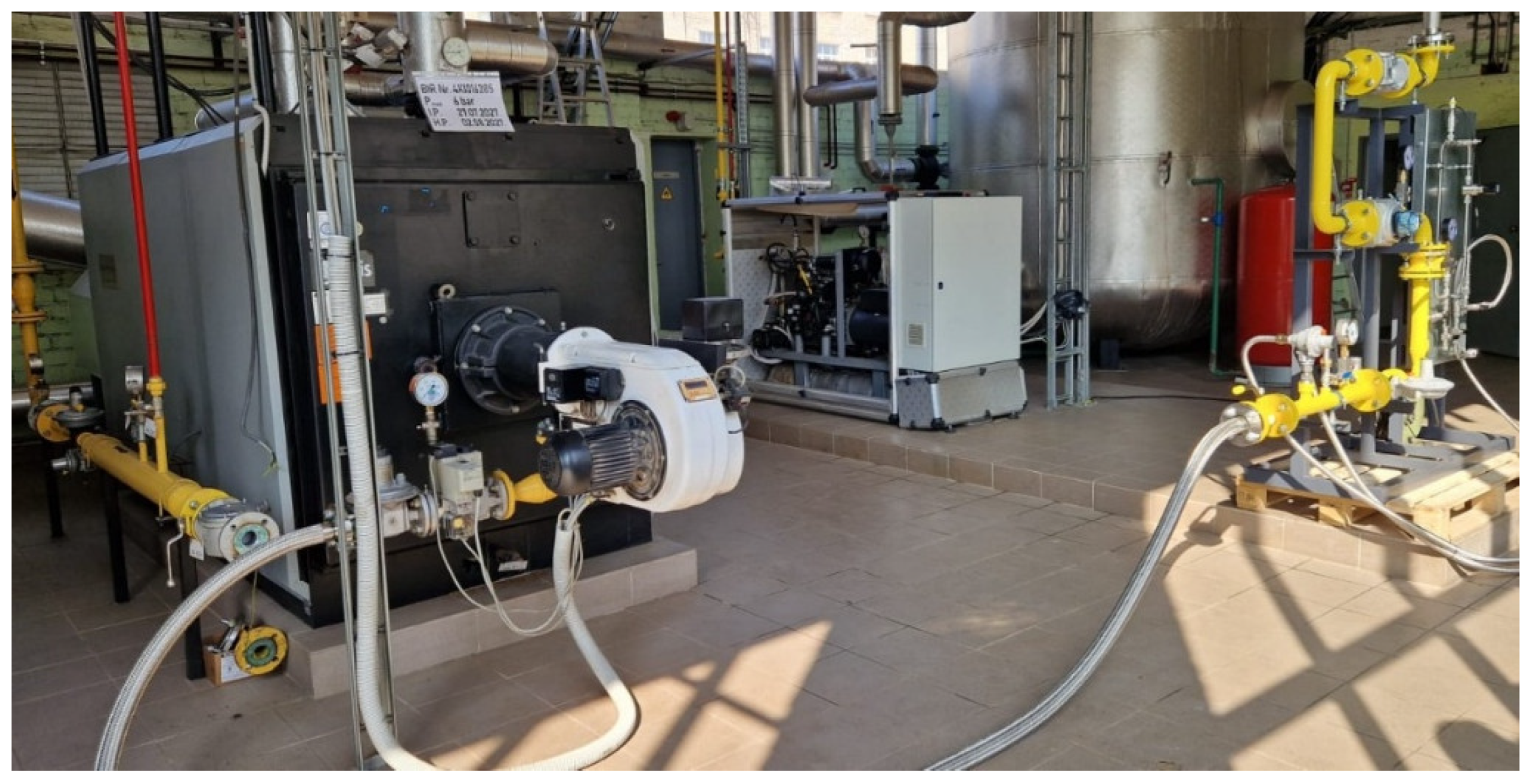
The study was conducted at DH boiler house A, using an operational methane-based gas–fired hot water boiler with a nominal thermal capacity of 6.3 MW. The power plant is in Riga, on the right bank of the Daugava River’s heat supply zone. The plant represents a typical medium-scale DH installation widely deployed across the EU urban areas, thereby ensuring industrial relevance and transferability of the results. The boiler is equipped with a low-NOx gas burner, forced-draft combustion air supply, and automated control system. The main technical parameters of the experimental setup are shown in Table 1. At the same time, Figure 1 shows the actual gas boiler with a hydrogen supply line attached.
The study was designed as a controlled experimental investigation to assess the impact of hydrogen blending on combustion performance, emissions, and operational stability in DH boilers under real operating conditions. Hydrogen volumetric fraction in the fuel mixture was defined as the independent variable, with three discrete levels: 0%, 10%, and 20%.
The upper blending limit of 20 vol.% hydrogen was selected because this range is widely considered a practically achievable near-term hydrogen admixture level for existing natural gas infrastructure and end-use combustion equipment without major modifications. Furthermore, blending levels up to 20 vol.% are frequently investigated in the literature and demonstration projects as a transitional decarbonization strategy, thereby facilitating comparison of the present results with previous studies.
Hydrogen fractions are reported on a volumetric basis. Because hydrogen has a lower volumetric heating value than methane, the relationship between hydrogen volume fraction and CO2 emissions is inherently non-linear on an energy basis. Therefore, emissions in this study are reported per unit of useful thermal energy output (kg/MWh and mg/kWh), while boiler thermal output was maintained at approximately 6.3 MW under all test conditions. This normalization allows direct comparison of carbon intensity between fuel blends under equivalent heat delivery conditions.
The dependent variables included gaseous emissions (CO2, NOx, CO), boiler thermal efficiency, thermal output, ignition delay, stack gas temperature, and flame stability characteristics. All other operating parameters were maintained constantly as practically achievable, enabling direct attribution of observed changes to hydrogen concentration.
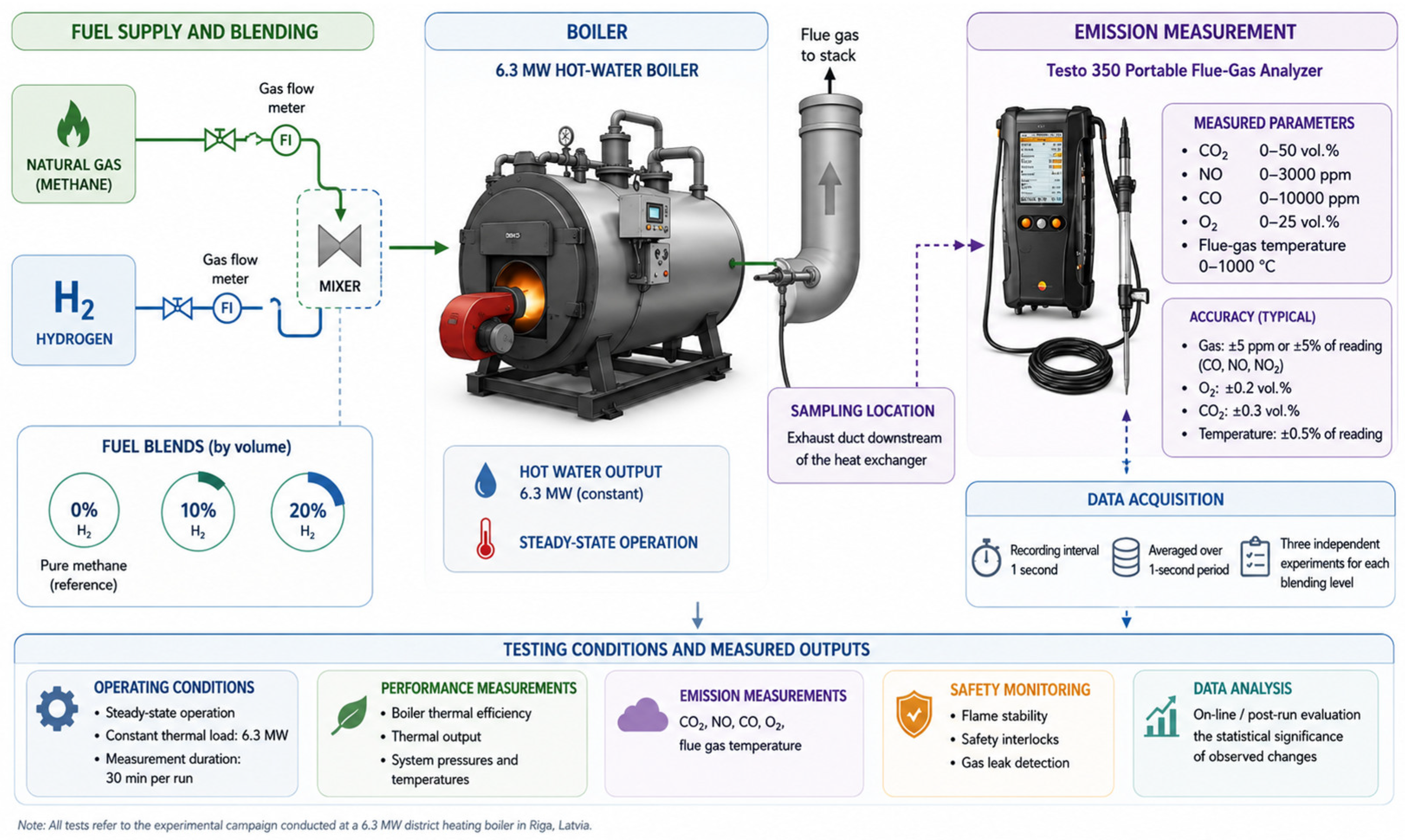
The upper blending limit was defined based on material compatibility, combustion stability, and safety considerations. Fuel composition was continuously monitored during all test conditions to maintain blending accuracy within ±1%. To provide an integrated overview of the experimental methodology, Figure 2 depicts the overall research design and workflow applied in this study. It illustrates the fuel blending strategy, the range of hydrogen volumetric fractions, the operational test conditions, and the key performance and emission parameters monitored during the operational tests. This schematic representation highlights the logical sequence of the experimental steps and clarifies the relationship between fuel composition, combustion control, and the evaluated technical, environmental, and safety outcomes.
In Figure 2, the arrows represent different physical and logical processes within the experimental setup. The solid green arrows indicate the flow direction of the methane-based gas and the blended fuel mixture toward the boiler, whereas the solid blue arrow denotes the hydrogen supply line entering the mixer. The curved blue arrows within the dashed mixer box illustrate the turbulent circulation and homogenization of methane-based gas and hydrogen, resulting in a uniform fuel mixture prior to combustion. The upward gray arrow in the stack represents the movement of flue gases from the boiler to the chimney. The purple dashed arrow extending from the sampling location to the Testo 350 flue-gas analyzer denotes the extraction of flue-gas samples for emission measurements rather than the actual flue-gas flow path. The blue dashed arrows beneath the analyzer represent the transfer of measurement data to the data acquisition stage, while the blue downward arrow from the boiler to the lower section of the figure indicates the progression of the experimental workflow from boiler operation to the evaluation of testing conditions, performance, emissions, safety monitoring, and statistical analysis. Thus, the arrows distinguish between physical fuel and flue-gas flows, sampling paths, data-transfer processes, and the logical sequence of the experimental methodology.
Initially, the boiler was operated using methane-based gas (0% H2) until nominal operating conditions (6.3 MW thermal output) were achieved, establishing the baseline for subsequent hydrogen blending tests. Step by step experimental protocol and timing for hydrogen blending tests are summarized in Table 2.
The system was then allowed to stabilize for at least 15 min to ensure steady-state conditions. Their operation was defined by stack gas temperature variation within ±2 °C, O2 concentration variation within ±0.1% maintained over a continuous 10 min interval. Following stabilization, measurement data were recorded continuously over a minimum testing period of 30 min for each fuel composition.
Hydrogen was subsequently introduced to achieve a 10% volumetric fraction. After reaching the target composition, the system was allowed to stabilize again for 15 min, followed by a 30 min data acquisition period under steady-state conditions.
The same procedure was repeated for the 20% hydrogen blending condition. To ensure repeatability and statistical robustness, each hydrogen blending condition (0%, 10%, and 20% H2 by volume) was evaluated in three independent experimental runs (n = 3). Each independent run consisted of a separate stabilization period followed by a 30 min steady-state measurement interval. Measurements acquired at 1 s intervals during a given run were averaged to obtain a single representative value for that experiment and were not treated as independent replicates in the statistical analysis. All experiments were conducted under continuous boiler operation, including standard load control behavior.
Combustion air was supplied using a forced-draft system with automated excess air regulation. The air-to-fuel ratio was dynamically adjusted based on real-time O2 concentration measurements in the flue gas to ensure stable combustion across varying fuel compositions. Low-NOx burner settings were maintained throughout the operational tests. Start-up, shutdown, and load modulation procedures followed standard operational protocols used during conventional gas operations.
Thermal performance was evaluated by measuring boiler thermal output, efficiency, and heat recovery characteristics for each fuel-blending condition. Thermal output was calculated from measured fuel input and the heat delivered to the DH network. Boiler efficiency was determined using the indirect method, incorporating measurements of flue gas temperature and composition. Stack gas temperature and return water temperature were continuously recorded to assess potential impacts on condensing heat recovery performance.
Data dispersion within each experimental condition was quantified using the standard deviation (SD), providing a measure of variability and measurement uncertainty. For each operating condition, the reported mean values, standard deviations, and 95% confidence intervals were calculated from the independent experimental runs (n = 3). The standard deviation therefore reflects run-to-run variability rather than the variability of individual high-frequency measurements recorded within a single experimental period. All reported experimental values are presented as mean ± SD calculated from three independent experimental runs (n = 3). Error bars shown in the figures represent the SD of the independent experiments.
The SD was calculated as:
S D = 1 n 1 i = 1 n ( x i x - ) 2
where:
x i —individual measurements, x - —mean value, n —the number of observations within a given steady-state dataset.
The calculated mean values and associated standard deviations were subsequently used as input for statistical hypothesis testing. To evaluate the effect of hydrogen blending on performance and emission parameters, a one-way analysis of variance (ANOVA) was applied at a 95% confidence level (p < 0.05). The ANOVA test compares the variance between group means (different hydrogen fractions) with the variance within groups (measurement variability) to determine whether observed differences are statistically significant.
Operational safety was ensured through enhanced monitoring and procedural controls tailored to hydrogen-enriched methane-based gas operations. Hydrogen-sensitive gas detectors were installed in critical areas of the boiler room, and ventilation performance was verified before hydrogen introduction. Emergency shutdown systems and alarm functions were tested under simulated fault scenarios. Personnel involved in the experimental operation received targeted training on hydrogen-specific safety procedures. The implemented safety systems, monitoring locations, and response thresholds are shown in Table 3.
Data acquisition was performed continuously at a sampling interval of 1 s using the boiler supervisory control and data acquisition system. Only steady-state data were retained for analysis, and all reported values represent 30 min averages after exclusion of transient periods. Transient periods, including fuel switching and stabilization phases, were excluded. For each test condition, measured parameters were averaged over the 30 min steady-state measurement interval to obtain representative values. Outliers were removed based on deviation from defined steady-state criteria. Repeat measurements were used to verify consistency and reproducibility.
The baseline fuel used in the experiments was a gas mixture supplied from the Latvian gas distribution network. Its composition reflects the actual gas delivered through the grid during the experimental period. Biomethane injection into the natural gas grid in Latvia reached approximately 100 gigawatt-hours in 2025, corresponding to approximately 3.5% of total gas consumption. Therefore, the baseline fuel in this study can be described as a natural gas–biomethane mixture representative of real grid conditions, where the biomethane fraction is low and does not introduce significant variability in key combustion properties. It should be noted that, under Latvian gas quality regulations for biomethane injection into the gas distribution network, biomethane must comply with strict specifications regarding calorific value, Wobbe index, methane content, and impurity limits [60]. Biomethane injection into the natural gas grid in Latvia aligns with the requirements of EN 16723, which ensures that its physicochemical and combustion properties are equivalent to those of natural gas, thereby enabling full interchangeability [61].
The experiments were performed using methane-based gas supplied from the Latvian transmission network. Since continuous gas chromatographic measurements were not available during the experimental campaign, the baseline gas composition was assumed to comply with the gas quality specifications applicable to the Latvian gas system and representative values reported by the network operator. The corresponding ranges of CH4, higher hydrocarbons, CO2, and N2 concentrations together with the associated LHV, HHV, and Wobbe Index values are summarized in Table 4.
Continuous gas chromatographic measurements were not available during the experimental campaign. Therefore, baseline natural gas properties were derived from certified gas-quality specifications and representative operating data provided by the Latvian gas transmission system operator. While minor variations in gas composition may introduce uncertainty into calculated heating values and emission factors, all test conditions were evaluated under the same gas supply conditions, limiting their influence on the comparative assessment of hydrogen blending scenarios.
The experimental methodology isolates the effect of hydrogen blending by varying only the hydrogen fraction while maintaining all other operational parameters constant. In this regard, observed variations in emissions, combustion behavior, and thermal performance can be directly attributed to changes in fuel composition.

2.2. Fuel Blending, Instrumentation, and Data Acquisition

Hydrogen was introduced into the fuel supply line through a dedicated injection manifold installed upstream of the burner train. Blending was performed on a volumetric basis by controlled co-injection of hydrogen into the methane-based gas stream. The hydrogen flow rate was regulated using a calibrated thermal mass flow controller, while the methane-based gas flow was measured using the boiler’s custody-transfer gas meter. The target hydrogen fractions of 10% and 20% by volume were maintained within ±1% during the experiments.
The composition of the fuel mixture was verified through continuously monitored methane and hydrogen flow rates, from which the target volumetric blending ratios were calculated and maintained throughout the experiments.
Hydrogen blending ratios were defined on a volumetric basis (0%, 10%, and 20% H2 by volume). However, carbon dioxide emissions were normalized to the useful thermal energy delivered by the boiler and are therefore reported in units of kg CO2/MWh. Because hydrogen has a substantially lower volumetric heating value than methane, the relationship between hydrogen volume fraction and CO2 reduction is not inherently linear. To enable comparison between different fuel blends under constant-load conditions, carbon dioxide emissions were normalized to the useful thermal energy delivered by the boiler. The specific CO2 emission intensity was calculated as follows:
C I C O 2 = m ˙ C O 2 Q ˙ u s e f u l
where:
  • C I C O 2 = carbon intensity (kg CO2/MWh),
  • m ˙ C O 2 = CO2 mass emission rate (kg/h),
  • Q ˙ u s e f u l = useful boiler heat output (MWh/h).
Specific CO2 emissions were calculated from the carbon content and lower heating value (LHV) of the fuel mixture and expressed per unit of useful thermal energy output (kg CO2/MWh). Emission factors for natural gas and hydrogen were derived from standard fuel-property data and the corresponding fuel-mixture composition.
Methane and hydrogen volumetric flow rates were continuously monitored and converted to fuel energy input using LHV. The reported CO2 reductions therefore represent the carbon intensity of useful heat generation under constant-load operation and should not be interpreted as directly proportional to the volumetric hydrogen fraction.
The low-NOx burner operated under its standard industrial control settings throughout the experiments. Boiler load was maintained at the nominal thermal output of 6.3 MW using the existing automatic load control system. Combustion air was supplied by a forced-draft fan and regulated through closed-loop excess-air control based on continuous flue gas oxygen measurements. The excess oxygen concentration was maintained within ±0.1% during steady-state operation.
A Testo 350 portable flue-gas analyzer was connected to the stack sampling port and used for continuous emission measurements during each 30 min steady-state experimental period. CO2, NOx, and CO concentrations were recorded throughout each 30 min steady-state measurement period. The analyzer was calibrated in accordance with the manufacturer’s recommendations before the experimental campaign, and measurements were acquired at 1 s intervals and subsequently averaged for each independent experiment. The measurement accuracy and associated uncertainties of the monitoring equipment are summarized in Table 5.
The analyzer was calibrated before each experimental campaign using certified reference gases and zero-gas procedures in accordance with the manufacturers’ recommendations. Span verification was repeated following completion of the measurements to confirm instrument stability and absence of significant drift.
Hydrogen fractions of 0%, 10%, and 20% were defined on a volumetric basis. Carbon dioxide emissions were not normalized to fuel volume but to useful thermal energy delivered by the boiler and are therefore reported in units of kg CO2/MWh. Boiler thermal output was maintained at approximately 6.3 MW during all steady-state experiments.
The methane-based gas and hydrogen volumetric flow rates were continuously monitored and used to determine the LHV-based fuel energy input. The lower heating values adopted in the calculations were 35.8 MJ/Nm3 for methane and 10.8 MJ/Nm3 for hydrogen. The CO2 emission factor of hydrogen was assumed to be zero, whereas methane-based gas combustion was considered the sole source of direct CO2 emissions.
The investigated boiler is classified as a medium combustion plant (MCP) with a rated thermal input of 6.3 MW and is therefore subject to the requirements of Directive (EU) 2015/2193 and the corresponding Latvian regulations governing emissions from medium combustion plants. Under this regulatory framework, emission limit values for natural gas-fired MCPs are expressed in mg/Nm3 on a dry basis and normalized to a reference oxygen concentration of 3 vol.% O2. For compliance verification, the measured NOx concentrations were additionally evaluated against these regulatory reference conditions, although the results are reported in energy-specific units (mg/kWh) to facilitate comparison of environmental performance. In the present study, measured emissions were primarily reported in energy-specific units (mg/kWh) to facilitate direct comparison of environmental performance per unit of useful heat delivered. No direct conversion of the measured values from mg/kWh to mg/Nm3 was performed, as the objective of the study was to evaluate energy-specific emissions associated with useful heat production.
Process variables, including fuel flow rates, hydrogen fraction, flue gas composition, temperatures, and boiler operating parameters, were recorded automatically by the boiler supervisory control and data acquisition system. Measurements were acquired at 1 s intervals and averaged over the 30 min steady-state recording period used for subsequent analysis. Transient periods associated with fuel switching and system stabilization were excluded.
Measurement uncertainty was evaluated from instrument specifications and repeatability tests. Expanded measurement uncertainties (k = 2, corresponding to an approximate 95% confidence level) were estimated by combining instrument accuracies provided by the manufacturers with the standard deviations obtained from repeated experimental runs. For calculated quantities, including specific CO2 emissions (kg CO2/MWh), uncertainties were determined by propagation of the uncertainties associated with gas flow measurements, emission measurements, and boiler thermal output. The resulting uncertainties remained small relative to the observed differences between hydrogen blending scenarios and therefore do not affect the principal conclusions of the study.
All reported gaseous emission concentrations were determined on a dry flue-gas basis and were subsequently converted to the units reported in the manuscript (mg/kWh and kg/MWh) using measured oxygen concentrations and standard reference conditions.

3. Results

The operational tests demonstrated stable, repeatable, and controllable co-combustion behaviour of natural gas, biomethane and hydrogen across all tested operating regimes at boiler house A. Fuel blending accuracy remained within ±1% of the target hydrogen volumetric fraction throughout the test period, indicating reliable control of the gas mixing process. The combustion properties and emission characteristics are summarised in Table 6.
The data presented in Table 6 demonstrates a clear and systematic shift in combustion characteristics as hydrogen is introduced into the methane-based fuel mixture. The increase in adiabatic flame temperature from 1950 °C to 2100 °C, accompanied by a rise in flame speed from 0.38 m/s to 0.52 m/s, indicates enhanced combustion intensity and reactivity with higher hydrogen fractions. These trends are consistent with the intrinsic physicochemical properties of hydrogen, particularly its higher laminar flame speed and lower ignition energy. From a combustion dynamics perspective, the faster reaction kinetics promote more rapid heat release and improved flame stabilization, which aligns with the observed absence of instability phenomena such as blow-off or flashback. However, the elevated flame temperature also suggests a higher thermal load within the combustion zone, which has direct implications for emission formation mechanisms, particularly for temperature-dependent species such as NOx.
Environmentally, the results highlight a distinct trade-off between carbon reduction and NOx formation. CO2 emissions decrease nearly linearly with increasing hydrogen content, achieving a reduction of approximately 20% at 20% hydrogen blending, which directly reflects the lower carbon intensity of the fuel mixture. At the same time, NOx emissions increase from 40 mg/kWh to 52 mg/kWh, indicating intensified thermal NOx formation driven by higher flame temperatures and increased radical concentrations. In contrast, CO emissions remain low and stable, while particulate matter remains negligible across all conditions, confirming that combustion completeness is maintained despite changes in fuel composition.

3.1. The Operational Test Results

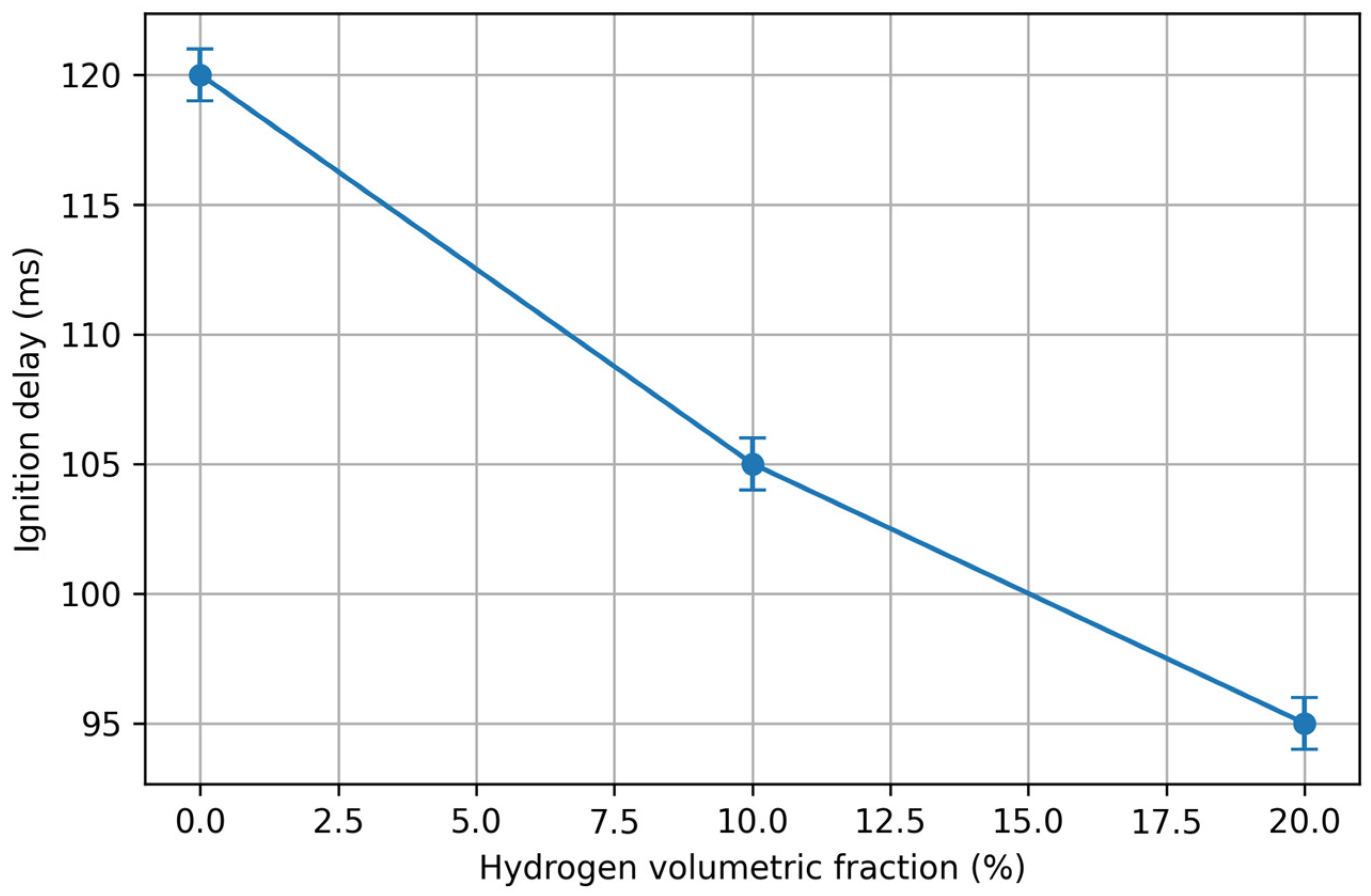
The introduction of hydrogen led to a measurable increase in combustion reactivity, thereby improving ignition stability, particularly at lower load conditions. This effect is quantified in Figure 3, which shows a systematic reduction in ignition delay with increasing hydrogen volumetric fraction, indicating enhanced fuel reactivity and improved ignition performance.
Figure 3 shows that the ignition delay decreases markedly with increasing hydrogen fraction, confirming the enhanced reactivity of the fuel mixture. The ignition delay is reduced from 120 ms at 0% H2 to 105 ms at 10% H2 and further to 95 ms at 20% H2, corresponding to an overall reduction of about 10–11% across the investigated range. This reduction reflects the lower ignition energy and higher diffusivity of hydrogen, which facilitate faster initiation of combustion reactions. The observed trend indicates that hydrogen addition accelerates the pre-flame chemical processes, particularly through increased availability of reactive radicals such as H, O, and OH, which promote chain-branching reactions and shorten ignition times [62]. As a result, the combustion process becomes more stable, especially under conditions where ignition would otherwise be delayed, such as at reduced loads or during transient operation.
From an operational viewpoint, the decrease in ignition delay contributes to improved flame anchoring and reduced risk of flame instability or blow-off. The relatively linear reduction observed in Figure 3 also suggests a predictable and controllable relationship between hydrogen fraction and ignition behavior, which is advantageous for combustion system optimization.
The data presented in Table 7 indicate that combustion stability is largely maintained across the investigated hydrogen blending range, with stable operation observed up to at least 20% hydrogen by volume.
Key stability indicators show only minor deviations, with fluctuations in flame behavior remaining within a narrow margin (typically below 3–5% variation compared to the baseline case of 100% methane). No instances of flame instability or blow-off were recorded, suggesting that the boiler system accommodated moderate hydrogen admixtures without compromising operational safety. Under the investigated operating conditions, no measurable decrease in boiler efficiency was observed with increasing hydrogen fraction.
Additionally, combustion characteristics such as flame speed and heat release rate exhibit measurable changes, with hydrogen-enriched mixtures showing faster combustion kinetics. This can enhance mixing and combustion completeness but may also require minor adjustments in burner control settings to maintain optimal air–fuel ratios. Despite these changes, the overall thermal output of the system remains relatively stable, with deviations generally within ±2% across the tested scenarios.
Also, thermal output and boiler efficiency remain constant across all tested fuel compositions, indicating that hydrogen substitution does not introduce efficiency penalties under short-term nominal operating conditions. A systematic reduction in ignition delay is observed with increasing hydrogen content, reflecting enhanced fuel reactivity and improved ignition characteristics.
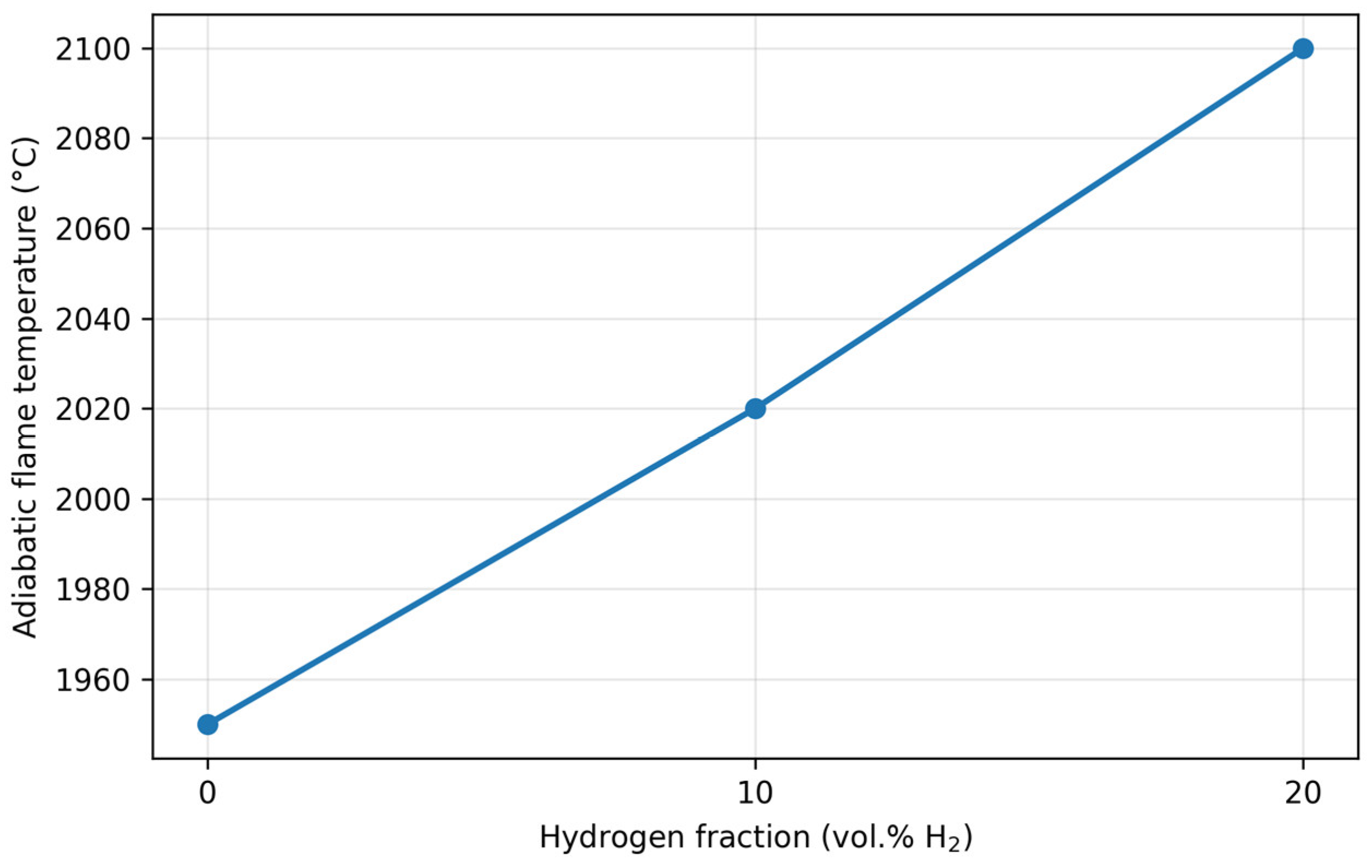
As shown in Figure 4, hydrogen enrichment leads to a systematic modification of key combustion characteristics. The adiabatic flame temperature increases from 1950 °C at 0% H2 to 2020 °C at 10% H2 and 2100 °C at 20% H2, corresponding to an overall increase of approximately 5.1%.
This trend is accompanied by a rise in laminar flame speed from 0.38 m/s to 0.45 m/s and 0.52 m/s, representing an increase of nearly 37%, which reflects the enhanced reactivity and faster combustion kinetics associated with hydrogen addition.
Because only three hydrogen blending ratios (0%, 10%, and 20%) were experimentally investigated, the curve shown in Figure 4 is intended only to facilitate visualization of the observed trend and should not be interpreted as a fitted mathematical relationship.
In terms of emissions, when expressed per unit of useful thermal energy delivered by the boiler, CO2 intensity decreased from 202 kg/MWh for pure methane operation to 181 kg/MWh at 10 vol.% H2 and to 161 kg/MWh at 20 vol.% H2. The observed reduction reflects the lower carbon intensity of the blended fuel under constant-load operation and should not be interpreted as implying a universally proportional relationship between volumetric hydrogen substitution and energy-normalized CO2 emissions. Conversely, NOx emissions increase from 40 mg/kWh at 0% H2 to 45 mg/kWh at 10% H2 and 52 mg/kWh at 20% H2, corresponding to a relative increase of approximately 30%, primarily due to elevated flame temperatures and intensified thermal NOx formation pathways.
CO emissions remain low and stable, decreasing slightly from 7 mg/kWh to 6 mg/kWh at higher hydrogen fractions, indicating consistently complete combustion. Particulate matter emissions remain below the detection limit (<1 mg/m3) across all conditions, confirming the absence of solid-phase formation mechanisms in the gaseous fuel system.
From a GHG emissions perspective again, and as shown in Table 8, CO2 emissions decreased linearly with increasing hydrogen fraction, while CO emissions remained low and stable across all test conditions, with measured values of 7 mg/kWh at 0% H2 and 6 mg/kWh at both 10% and 20% H2, indicating complete combustion with no measurable formation of incomplete oxidation products. Particulate matter (PM) emissions were below the detection limit of the measurement system (<1 mg/m3) throughout all operational tests, which is consistent with the absence of solid-phase precursors in the gaseous fuel mixture.
In contrast, NOx emissions increased from 40 mg/kWh at 0% H2 to 45 mg/kWh at 10% H2 and 52 mg/kWh at 20% H2, corresponding to an overall increase of approximately 30% across the investigated hydrogen blending range. This increase is attributed to elevated flame temperatures and enhanced thermal NOx formation mechanisms associated with hydrogen-enriched combustion.
CO2 emissions decreased systematically with increasing hydrogen substitution, from 202 kg/MWh at 0% H2 to 181 kg/MWh at 10% H2 and 161 kg/MWh at 20% H2, corresponding to an overall reduction of approximately 20% across the investigated hydrogen blending range. Although the decrease in CO2 emissions closely followed the increase in hydrogen fraction under the investigated operating conditions, this relationship should not be interpreted as universally linear because it is influenced by the lower volumetric energy density of hydrogen and by the normalization of emissions to delivered thermal energy.
This trend closely follows theoretical expectations based on the reduced carbon content of the fuel mixture, confirming that the observed emission reductions are primarily governed by fuel composition rather than operational variability. The nearly linear decrease in CO2 emissions indicates stable combustion conditions and consistent fuel–air mixing across all test cases, with no evidence of incomplete combustion or efficiency losses. These results demonstrate that hydrogen blending provides a direct and effective pathway for reducing carbon intensity in thermal energy production without adversely affecting combustion performance.
These results demonstrate that the environmental benefits of hydrogen blending can be achieved without compromising emission compliance when appropriate combustion control strategies are applied.
In terms of emissions, the combined effect of increased excess air and implicit air staging plays a key role in controlling NOx formation. While hydrogen addition promotes NOx formation through higher flame temperatures and radical concentrations, the applied control strategy effectively limits peak temperatures and stabilizes combustion. Consequently, NOx emissions remained within applicable regulatory limits across all tested conditions.
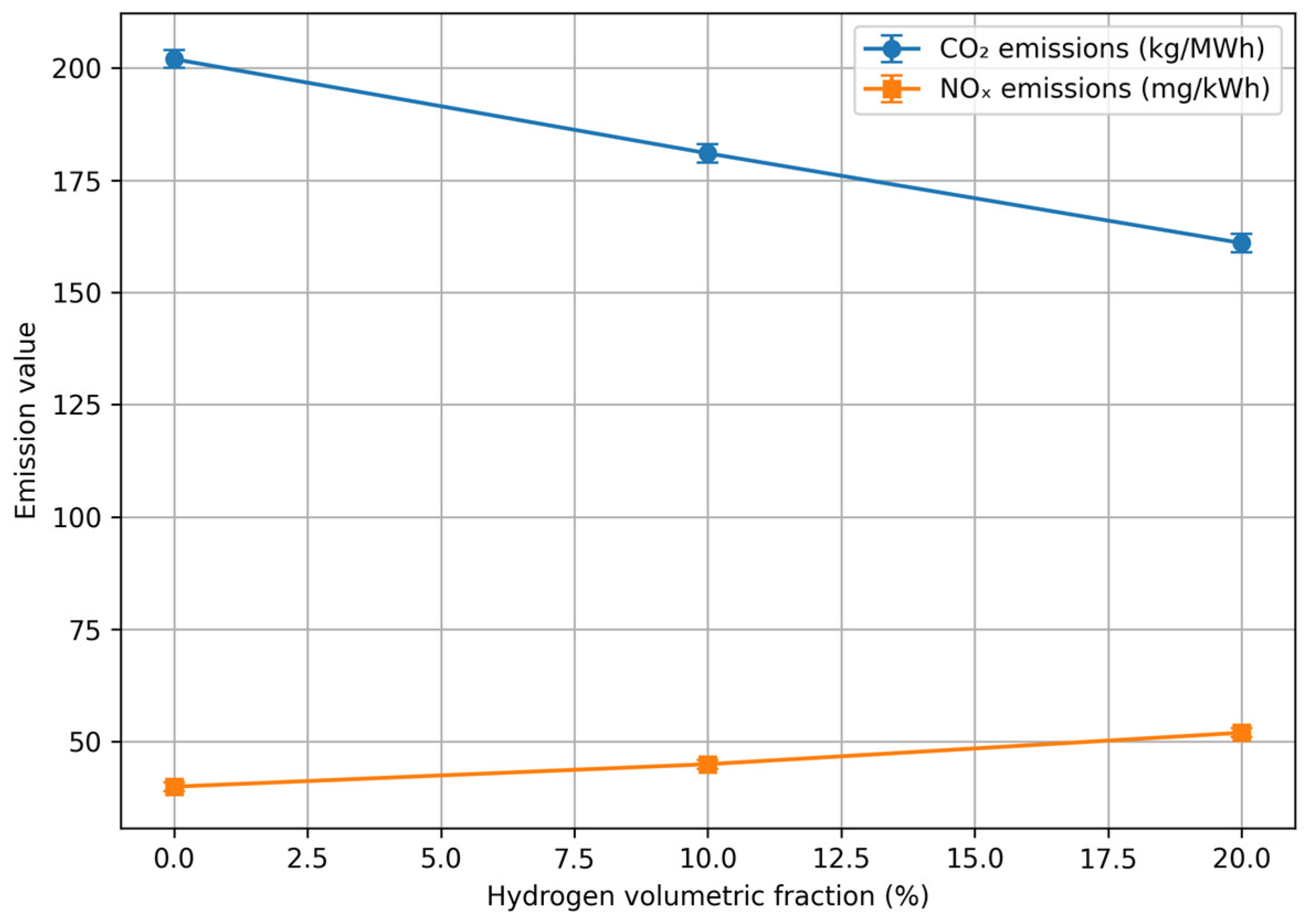
The combined emission trends for CO2 and NOx as a function of hydrogen blending ratio are shown in Figure 5, highlighting the trade-off between GHG emission reduction and NOx formation.
The observed trade-off between reduced CO2 emissions and increased NOx formation represents a key challenge in the implementation of hydrogen-enriched combustion systems. While the reduction in CO2 emissions is directly linked to the lower carbon content of the fuel mixture, the increase in NOx emissions can be attributed primarily to elevated flame temperatures and enhanced reaction kinetics associated with hydrogen addition. The higher adiabatic flame temperature promotes thermal NOx formation via the Zeldovich mechanism [63], leading to the increasing trend observed in Figure 5.
This trade-off has important implications for the operation and retrofitting of existing DH boilers. Although hydrogen blending contributes to decarbonization goals, the corresponding rise in NOx emissions may necessitate the implementation of additional emission control strategies to ensure compliance with environmental regulations. These may include optimization of excess air ratios, staged combustion techniques, flue gas recirculation, or the integration of post-combustion treatment systems such as selective non-catalytic reduction or selective catalytic reduction. Furthermore, the balance between CO2 reduction and NOx increase must be evaluated in the context of system-level optimization, where operational parameters are adjusted to minimize total environmental impact rather than a single emission component. This highlights the importance of integrated approaches combining fuel composition control, combustion tuning, and emission mitigation technologies.
The measured NOx emissions remained within applicable regulatory limits throughout all experimental conditions. In the context of the study, these limits are defined by the EU Industrial Emissions Directive [64] and corresponding national Latvian regulations for medium-scale combustion plants, which typically specify NOx emission thresholds in the range of 100–200 mg/Nm3, depending on plant classification and operating regime.
At the highest investigated hydrogen blending ratio (20% H2), NOx emissions approached the upper range of baseline values but remained safely below the applicable emission limits, indicating that hydrogen enrichment at this level does not compromise regulatory compliance under the tested conditions. Nevertheless, the observed increasing trend highlights the importance of active combustion control to prevent exceedance at higher hydrogen fractions or under transient operation. To maintain compliance, the boiler control system continuously adjusted key operational parameters, particularly the air-to-fuel ratio and excess air coefficient, based on real-time feedback from oxygen sensors and flue gas measurements. This dynamic control strategy enabled stabilization of combustion temperature and oxygen availability, thereby limiting thermal NOx formation. In addition, implicit air staging effects, resulting from burner design and flow distribution, contributed to moderating peak flame temperatures. The combination of these control mechanisms ensured that NOx emissions remained within regulatory thresholds while preserving stable and efficient boiler operation.
Slight, non-critical variations in the Wobbe index associated with hydrogen addition, shown in Table 9, were also observed.
This trend indicates the significantly lower volumetric energy density of hydrogen compared to methane, despite hydrogen’s high gravimetric energy content. As the hydrogen fraction rises from 0% to 20%, the reduction in Wobbe Index suggests that, under constant pressure conditions, a larger volumetric flow rate of fuel would be required to deliver the same thermal input. This has direct implications for the compatibility of existing gas infrastructure and end-use appliances, particularly those calibrated for a narrow Wobbe Index range. Although the observed decrease remains within tolerable limits for many conventional gas systems, indicating that moderate hydrogen blending can be accommodated without substantial hardware modifications. However, the gradual shift in gas quality parameters may influence burner performance, air–fuel mixing behavior, and combustion efficiency. Therefore, while the results support the technical feasibility of methane-based gas and hydrogen blending from a calorific standpoint, they also highlight the importance of regulatory standards and adaptive control strategies to ensure safe and efficient operation across varying blend compositions.
During the operational tests, hydrogen-sensitive monitoring systems detected no leakage, and ventilation systems-maintained hydrogen concentrations well below safety thresholds. Emergency shutdown systems responded correctly during simulated fault conditions, and control system alarms functioned as designed. Operator workload did not increase during blended-fuel operation, and routine maintenance requirements remained unchanged compared with baseline methane-based gas operation.
Post-test material inspections revealed no visible degradation of pipelines, valves, seals, or heat exchanger components. No evidence of hydrogen-induced embrittlement or abnormal corrosion was observed after the gas mixture exposure period. However, it should be noted that the tests were conducted over relatively short-term operating intervals, which are not sufficient to capture long-term material degradation mechanisms. Phenomena such as hydrogen embrittlement, microstructural changes, and cumulative corrosion effects typically develop over extended exposure durations and under cyclic loading conditions. While the results indicate that no immediate or short-term material compatibility issues arise under the tested hydrogen blending conditions, these findings cannot be directly extrapolated to long-term operation.
Instrumentation performance was uninterrupted despite increased moisture content in the flue gas, and data-acquisition systems provided high-resolution diagnostics of combustion behaviour and emissions. Repeatability tests conducted under identical operating conditions confirmed the consistency and robustness of the experimental results, with system availability maintained at 100% throughout the operational tests.
The results generally confirmed that hydrogen co-combustion up to a 20% volumetric share is technically feasible, operationally stable, and environmentally effective for medium-scale DH applications. The system demonstrated sufficient adaptability to accommodate changes in fuel composition without compromising safety, performance, or regulatory compliance. The experimental outcomes align closely with findings reported in comparable pilot projects and provide strong evidence supporting hydrogen blending as a near-term decarbonization pathway. Boiler house A case study, therefore, serves as a highly replicable reference for similar DH installations across the EU and provides a solid empirical basis for future scale-up, long-term operation, and policy-supported deployment.
Boiler thermal efficiency remained statistically unchanged across all investigated hydrogen blending ratios (0%, 10%, and 20% H2), with observed variations remaining within the bounds of measurement uncertainty (±0.5%). Statistical analysis confirmed that the differences between the mean efficiency values at different hydrogen fractions were not statistically significant (p > 0.05), indicating that hydrogen addition had no measurable effect on the overall energy conversion efficiency under steady-state operating conditions.
Thermodynamically, the stability of thermal efficiency can be explained by the balance between two opposing effects. On the one hand, hydrogen has a lower volumetric calorific value compared to methane, which could potentially reduce the energy density of the fuel mixture. On the other hand, hydrogen exhibits higher reactivity and flame speed, promoting more complete combustion and efficient heat release. The experimental results indicate that these effects compensate each other, resulting in no measurable efficiency penalty.
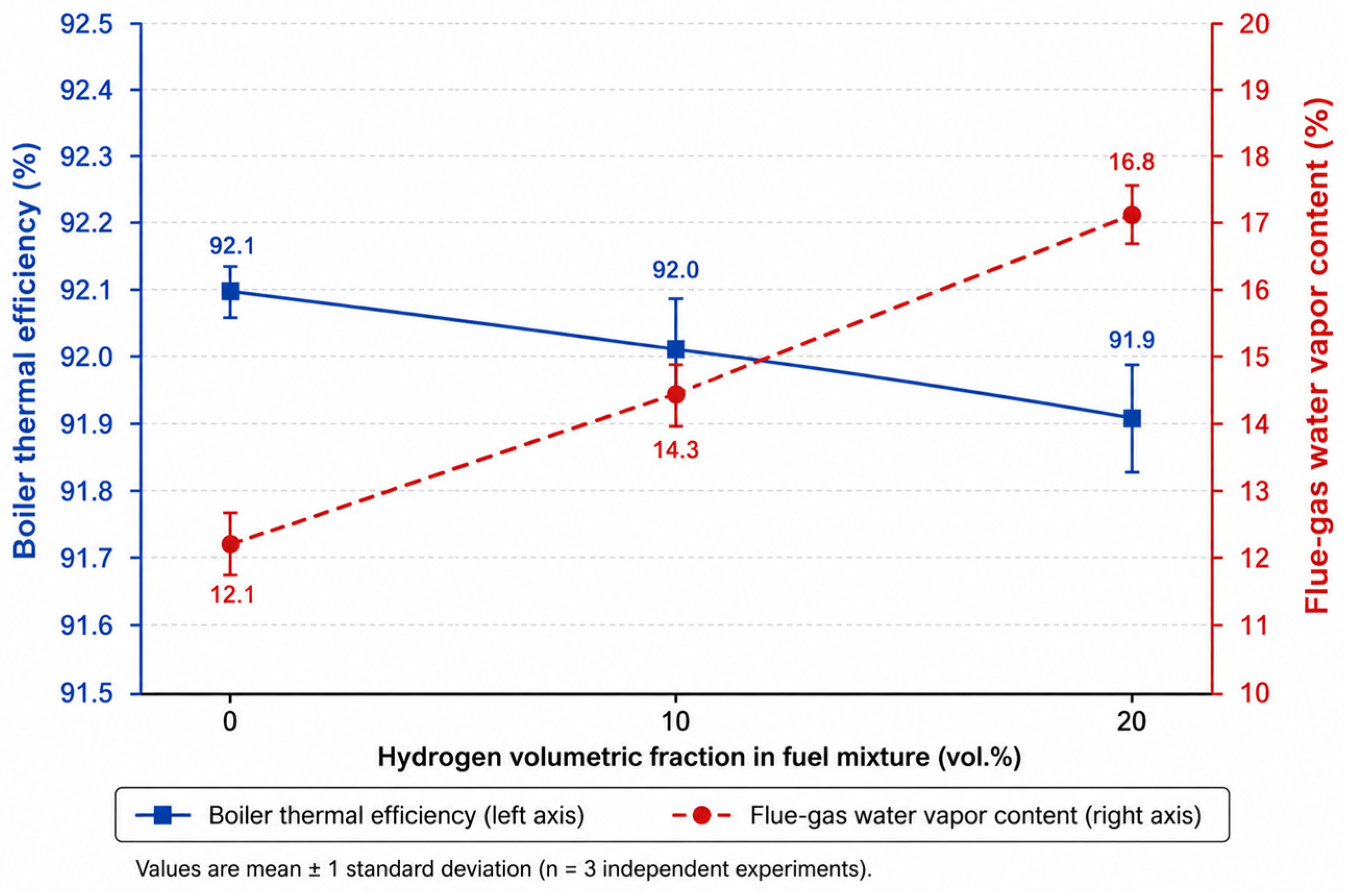
The results also demonstrate that condensing heat recovery performance was not negatively affected by increased water vapor content. On the contrary, the elevated water vapor fraction may enhance the potential for latent heat recovery, if flue gas temperatures remain below the dew point. Although the increased water vapor content may influence condensation behavior and latent heat recovery, the present experimental results showed no measurable change in overall boiler efficiency under the investigated operating conditions. Relationship between hydrogen fraction and boiler performance parameters is visualized in Figure 6.
The figure presents the variation of boiler thermal efficiency and flue gas water vapor content as a function of hydrogen volumetric fraction in the fuel mixture (0–20%). The results demonstrate that thermal efficiency remains effectively constant across the investigated range, with only minor fluctuations that fall within the measurement uncertainty (±0.5%). This indicates that the substitution of methane with hydrogen does not lead to any measurable deterioration in the overall energy conversion efficiency of the boiler under steady-state operating conditions.
In contrast, the water vapor content in the flue gas exhibits a clear increasing trend with rising hydrogen fraction, reflecting the higher hydrogen-to-carbon ratio of the fuel mixture and the corresponding increase in water formation during combustion. This behavior is consistent with stoichiometric combustion principles, whereby hydrogen oxidation produces a greater proportion of water vapor compared to methane-based fuels.

3.2. Statistical Evaluation of Experimental Results

The statistical analysis was performed using the mean values obtained from independent experimental runs. For each hydrogen blending level (0%, 10%, and 20% H2), three independent experiments were conducted (n = 3), yielding a total sample size of nine observations for ANOVA. High-frequency measurements collected at 1 s intervals during each 30 min steady-state period were used solely to calculate representative run averages and associated variability and were not considered independent observations in the ANOVA procedure.
Prior to ANOVA application, the underlying assumptions were evaluated. The normality of residuals was assessed using the Shapiro–Wilk test, while homogeneity of variances was verified using Levene’s test. In all cases, no statistically significant violations were detected (p > 0.05), confirming the suitability of parametric statistical analysis. The results of the ANOVA are summarized in Table 10.
The analysis indicates that hydrogen blending has no statistically significant effect on thermal efficiency (F = 0.84, p = 0.46), which is consistent with the experimentally observed variation of less than ±0.2 percentage points across all test conditions. The corresponding effect size (η2 = 0.07) is small, further confirming that hydrogen addition does not meaningfully influence energy conversion efficiency under steady-state operation.
In contrast, a highly significant effect of hydrogen fraction on CO2 emissions was identified (F = 152.3, p < 0.001), with a very large effect size (η2 = 0.94). This result reflects the direct dependence of CO2 formation on the carbon content of the fuel and confirms that the observed emission reductions (202 to 161 kg/MWh) are primarily driven by fuel substitution rather than experimental variability. Post hoc comparisons using Tukey’s HSD test indicate that differences between all hydrogen blending levels are statistically significant.
Similarly, NOx emissions were found to be significantly affected by hydrogen blending (F = 48.7, p < 0.001), with a large effect size (η2 = 0.86). The increase from 40 to 52 mg/kWh is therefore statistically robust and can be attributed to elevated flame temperatures and enhanced thermal NOx formation mechanisms. Post hoc analysis confirms that the increase is statistically significant, particularly between 0% and 20% H2 conditions.
For CO emissions, no statistically significant effect was observed (F = 1.92, p = 0.21), and the associated effect size (η2 = 0.14) indicates only a minor influence of hydrogen blending. This is consistent with the stable and low measured values (6–7 mg/kWh), confirming complete combustion across all operating conditions.
Particulate matter emissions were below the detection limit of the measurement system in all experiments and were therefore not subjected to statistical analysis. This result further supports the conclusion that hydrogen– methane-based gas combustion does not promote particulate formation under the investigated conditions.
The performed statistical analysis confirmed that the observed trends in CO2 and NOx emissions are both statistically significant and practically meaningful, while variations in thermal efficiency and CO emissions remain statistically insignificant and within measurement uncertainty.


4. Discussion

The study results show that hydrogen blending can be introduced into an existing DH boiler without hardware modification, demonstrating compatibility with current methane-based gas infrastructure. Stable ignition and flame anchoring were maintained at 0–20% H2, and the ignition delay decreased from 120 ms to 95 ms due to the higher reactivity and flame speed of hydrogen-enriched mixtures. No flashback or blow-off occurred, indicating that proper air–fuel ratio control can manage typical hydrogen combustion risks. Boiler efficiency remained approximately 92% and thermal output stayed at 6.3 MW, showing that decarbonization through hydrogen substitution does not compromise performance.
The observed trends are consistent with the combustion characteristics of hydrogen. Its higher laminar flame speed and wider flammability limits promote faster heat release and more complete combustion, helping to maintain stable boiler efficiency despite changes in fuel composition. The reduction in specific CO2 emissions results directly from the lower carbon content of the blended fuel, whereas the increase in NOx emissions is associated with enhanced thermal NOx formation under higher local flame temperatures and accelerated reaction kinetics. Similar interactions between combustion behavior, heat-transfer processes, and system performance have been reported in advanced combustion-system studies [35,36,37,38,39,46,47,48].
The main environmental benefit was a CO2 reduction from 202 to 161 kg/MWh at 20% hydrogen blending. CO and PM remained low, while NOx increased moderately due to higher flame temperatures but stayed within regulatory limits. No leakage, corrosion, or material degradation was observed, and safety systems operated reliably during the experimental campaign; however, these observations are limited to the duration of the test period and do not constitute an assessment of long-term equipment integrity or durability.
While the present study demonstrates the technical feasibility of hydrogen blending up to 20% under real operating conditions, further study is required to support its role in the broader transition towards climate-neutral energy systems. In line with the objectives of the EU Hydrogen Strategy and the European Green Deal, hydrogen is expected to play a key role in decarbonizing hard-to-abate sectors, including DH. Such study should be complemented by material-level analyses, including post-operation assessment of critical components (burners, heat exchangers, pipelines) to identify potential degradation mechanisms such as hydrogen embrittlement, corrosion, and thermal fatigue under prolonged exposure.
The progressive scaling of hydrogen use envisioned at the European level necessitates investigation of higher hydrogen blending ratios (>20%), as well as their implications for combustion stability, emission formation (particularly NOx), and heat transfer performance. These studies should be integrated with system-level modelling and techno-economic assessments to evaluate the viability of hydrogen blending relative to alternative decarbonization pathways within DH systems. Advancing from short-term feasibility studies toward long-term, system-integrated study will be essential to align experimental findings with the Latvian and European policy objectives and to support the safe and efficient deployment of hydrogen technologies in existing energy infrastructure.
From a sustainability perspective, the observed reduction in combustion-related carbon emissions combined with the preservation of boiler performance and operational safety indicates that moderate hydrogen blending may contribute to more sustainable DH systems. By enabling partial decarbonization of heat production without major equipment modifications, hydrogen co-combustion may facilitate the gradual transition toward lower-carbon energy systems while maintaining the reliability and affordability of heat supply. Beyond the direct reduction in combustion-related emissions, the proposed approach promotes resource efficiency by extending the service life of existing DH infrastructure and reducing the need for carbon-intensive equipment replacement, thereby contributing to the long-term sustainability of urban energy systems.
It should also be noted that the present study focuses exclusively on combustion-phase emissions and does not include a full life cycle assessment (LCA) of hydrogen production, processing, transport, and integration into the gas network. As a result, the reported reduction in CO2 emissions reflects only the direct impact of fuel substitution at the point of use. The overall decarbonization potential of hydrogen blending is strongly dependent on the carbon intensity of the hydrogen supply pathway, which may vary significantly depending on production methods (electrolysis using renewable electricity versus fossil-based reforming). A comprehensive LCA is required to accurately quantify system-wide environmental benefits and trade-offs. Such analysis is beyond the scope of the present study but represents an important direction for future research, particularly in the context of large-scale implementation within DH systems.
The results of this study are limited to short-term operation of the investigated 6.3 MW DH boiler under steady-state conditions with hydrogen blending ratios of up to 20 vol.%. Consequently, the findings should not be interpreted as evidence of long-term material compatibility, infrastructure integrity, or resistance to hydrogen-induced degradation mechanisms, including embrittlement. In addition, the experimental campaign was conducted under controlled operating conditions and did not address transient load variations, start-up and shutdown procedures, or fluctuations in fuel composition that may occur in practical DH applications. Further long-term investigations and dynamic-operating-condition assessments are therefore required to establish the broader applicability of hydrogen blending in DH systems.

5. Conclusions

The study presents a comprehensive experimental investigation of hydrogen–methane-based gas co-combustion in a commercial-scale DH boiler under real operating conditions. The results provide robust, quantitatively validated insights into the effects of hydrogen blending on combustion performance, emissions, and system operability. The findings demonstrate that hydrogen blending of up to 20 vol.% can be integrated into existing DH boiler systems while maintaining stable operation, regulatory compliance, and thermal performance.
  • The experimental results demonstrate that hydrogen blending of up to 20 vol.% can be implemented in an existing 6.3 MW DH boiler without hardware modifications while maintaining stable combustion, thermal output, and operational safety. This confirms the technical compatibility of moderate hydrogen admixtures with existing DH infrastructure under steady-state operating conditions.
  • The observed combustion stability across all investigated hydrogen blending ratios indicates that the enhanced reactivity and flame propagation characteristics of hydrogen can be accommodated within existing boiler operating regimes, supporting reliable heat generation without compromising thermal performance.
  • The primary environmental benefit of hydrogen blending is the reduction in the carbon intensity of heat production. The observed decrease in CO2 emissions confirms that hydrogen substitution provides a practical near-term pathway for decarbonizing natural-gas-based DH systems while preserving operational performance.
  • Although hydrogen enrichment promotes thermal NOx formation due to higher combustion temperatures, the measured emissions remained within applicable regulatory limits. This demonstrates that the environmental trade-off associated with hydrogen blending can be managed through appropriate combustion control and boiler operation.
  • The consistently low CO emissions and negligible particulate matter concentrations indicate that hydrogen blending does not adversely affect combustion completeness or introduce additional air-quality concerns under the investigated operating conditions.
  • From an engineering perspective, the results support hydrogen–methane co-combustion as a transitional decarbonization strategy for existing DH systems. The ability to reduce carbon emissions without major infrastructure modifications suggests a practical pathway for integrating hydrogen into current heat-generation assets while broader hydrogen supply chains and dedicated hydrogen technologies continue to develop.
  • From a sustainability viewpoint, the findings demonstrate that hydrogen blending in existing DH systems can contribute to the transition towards more sustainable urban energy systems by reducing the carbon intensity of heat generation without requiring major infrastructure replacement. This approach supports more efficient utilization of existing assets, lowers GHG emissions, and enables a gradual transition towards renewable and low-carbon energy carriers while maintaining system reliability, operational safety, and energy security. As the result, the proposed solution contributes to several Sustainable Development Goals (SDGs), particularly SDG 7 (Affordable and Clean Energy), SDG 9 (Industry, Innovation and Infrastructure), SDG 11 (Sustainable Cities and Communities), and SDG 13 (Climate Action). By providing full-scale experimental evidence from a commercial DH installation, this study supports policymakers, DH network operators, and energy planners in developing practical decarbonization strategies that facilitate the sustainable transformation of existing heat supply systems.
The findings are limited to short-term operation of the investigated boiler under steady-state conditions and hydrogen blending ratios of up to 20 vol.%. Further research is required to evaluate long-term material compatibility, hydrogen-induced degradation mechanisms, and performance under transient operating conditions before broader deployment can be fully assessed.

Author Contributions

Conceptualization, D.K., L.J. and L.Z.; methodology, I.B., L.J., L.Z. and D.K.; software, L.J. and I.G.; validation, D.K., E.D. and L.Z.; formal analysis, D.K., L.J., R.E. and I.B.; investigation, D.K. and L.Z.; resources, I.B., R.E. and L.J.; data curation, D.K. and I.G.; writing—original draft preparation, D.K. and L.J.; writing—review and editing, R.E., I.B., E.D. and L.Z.; visualization, L.Z. and I.G.; supervision, I.B. and R.E.; project administration, L.Z.; funding acquisition, D.K. and L.Z. All authors have read and agreed to the published version of the manuscript.

Funding

The study has been supported by The EU Recovery and Resilience Facility within Project No 5.2.1.1.i.0/2/24/I/CFLA/003 and “Implementation of Consolidation and Management Changes at Riga Technical University, Liepaja University, Rezekne Academy of Technology, Latvian Maritime Academy and Liepaja Maritime College for the Progress towards Excellence in Higher Education, Science and Innovation” academic career doctoral grant (ID 1014).

Institutional Review Board Statement

Not applicable.

Informed Consent Statement

Not applicable.

Data Availability Statement

The data sets used during and/or analyzed during the current study are available from the corresponding author on reasonable request.

Conflicts of Interest

Author Raivis Ellins was employed by the company JSC “Rigas Siltums”. Author Ilmars Bode was employed by the company JSC “Rigas Siltums”. The remaining authors declare that the research was conducted in the absence of any commercial or financial relationships that could be construed as a potential conflict of interest.

References

  1. Manz, P.; Kermeli, K.; Persson, U.; Neuwirth, M.; Fleiter, T.; Crijns-Graus, W. Decarbonising District Heating in EU-27 + UK: How Much Excess Heat Is Available from Industrial Sites? Sustainability 2021, 13, 1439. [Google Scholar] [CrossRef] [Scilit]
  2. Ricci, M.; Sdringola, P.; Tamburrino, S.; Puglisi, G.; Donato, E.D.; Ancona, M.A.; Melino, F. Efficient District Heating in a Decarbonisation Perspective: A Case Study in Italy. Energies 2022, 15, 948. [Google Scholar] [CrossRef] [Scilit]
  3. Malcher, X.; Tenorio-Rodriguez, F.C.; Finkbeiner, M.; González-Salazar, M. Decarbonization of district heating: A systematic review of carbon footprint and key mitigation strategies. Renew. Sustain. Energy Rev. 2025, 215, 115602. [Google Scholar] [CrossRef] [Scilit]
  4. Bahadori, R.; Speich, M.; Ulli-Beer, S. Modernizing District Heating Networks: A Strategic Decision-Support Framework for Sustainable Retrofitting. Energies 2025, 18, 3759. [Google Scholar] [CrossRef] [Scilit]
  5. Fernandes, J.; Remédios, S.; Gérard, F.; Bačan, A.; Stroleny, M.; Drosou, V.; Christodoulaki, R. The Decarbonisation of Heating and Cooling Following EU Directives. Energies 2025, 18, 3432. [Google Scholar] [CrossRef] [Scilit]
  6. Kosakiewicz, M.; Sitek, W.; Kurcjusz, M.; Jakimiuk, A. Decarbonization-Oriented Selection of Heating, Ventilation and Domestic Hot Water Systems in Multi-Family Buildings: Economic, Environmental, and Social Perspectives. Sustainability 2026, 18, 5603. [Google Scholar] [CrossRef] [Scilit]
  7. EC. Electricity and Heat Statistics. Available online: https://ec.europa.eu/eurostat/statistics-explained/SEPDF/cache/34226.pdf (accessed on 16 January 2026).
  8. EC. District Heating: The Essential Base for a Successful Detox. Available online: https://eu-mayors.ec.europa.eu/en/news/district-heating-essential-base-successful-detox (accessed on 31 January 2026).
  9. Mahajan, D.; Tan, K.; Venkatesh, T.; Kileti, P.; Clayton, C.R. Hydrogen Blending in Gas Pipeline Networks—A Review. Energies 2022, 15, 3582. [Google Scholar] [CrossRef] [Scilit]
  10. Jansons, L.; Zemite, L.; Zeltins, N.; Geipele, I.; Backurs, A. Green and Sustainable Hydrogen in Emerging European Smart Energy Framework. Latv. J. Phys. Tech. Sci. 2023, 60, 24–38–38. [Google Scholar] [CrossRef] [Scilit]
  11. Zemite, L.; Jansons, L.; Zeltins, N.; Lapuke, S.; Bode, I. Blending Hydrogen with Natural Gas/Biomethane and Transportation in Existing Gas Networks. Latv. J. Phys. Tech. Sci. 2023, 60, 43–55. [Google Scholar] [CrossRef] [Scilit]
  12. Ficco, G.; Cigolotti, V.; Cortellessa, G.; Monteleone, G.; Dell’Isola, M. Impact of Hydrogen-Enriched Natural Gas on the Accuracy of Odorant Measurements. Sensors 2025, 25, 4394. [Google Scholar] [CrossRef] [Scilit] [PubMed]
  13. Vespasiano, D.; Sgaramella, A.; Lo Basso, G.; de Santoli, L.; Pastore, L.M. Hydrogen Blending in Natural Gas Grid: Energy, Environmental, and Economic Implications in the Residential Sector. Buildings 2024, 14, 2284. [Google Scholar] [CrossRef] [Scilit]
  14. Franco, A.; Rocca, M. Hydrogen Injection into Natural Gas Grids as a Flexibility Option for Renewable Energy Integration and Storage. Hydrogen 2025, 6, 112. [Google Scholar] [CrossRef] [Scilit]
  15. Zagrodzki, I.; Bryk, M.; Ziółkowski, P.J.; Kowalczyk, T.; Cabrera Santana, P.J.; Badur, J. Sustainable District-Heating Transition in Poland: The Case of the City of Ustka. Sustainability 2026, 18, 4971. [Google Scholar] [CrossRef] [Scilit]
  16. Pous Cabello, J.; Mykhei, M.; Pantelakis, D.; Amez, I.; Taušová, M.; Tauš, P. Estimation of the Potential for Green Hydrogen Production from Untapped Renewable Energy Sources in Spain in 2024. Appl. Sci. 2025, 15, 11873. [Google Scholar] [CrossRef] [Scilit]
  17. Caban, J.; Małek, A.; Siemiątkowski, Z. Probabilistic Assessment of Solar-Based Hydrogen Production Using PVGIS, Metalog Distributions, and LCOH Modeling. Energies 2025, 18, 4972. [Google Scholar] [CrossRef] [Scilit]
  18. Jansons, L.; Backurs, A.; Zemite, L.; Zeltins, N.; Laizans, A. System Design and Economic Feasibility Study of Large-Scale Hydrogen Storage in Aquifers. Hydrogen 2025, 6, 109. [Google Scholar] [CrossRef] [Scilit]
  19. Orlova, S.; Mezeckis, N.; Vasudev, V.P.K. Compression of Hydrogen Gas for Energy Storage: A Review. Latv. J. Phys. Tech. Sci. 2023, 60, 4–16. [Google Scholar] [CrossRef] [Scilit]
  20. Małachowska, A.; Łukasik, N.; Mioduska, J.; Gębicki, J. Hydrogen Storage in Geological Formations—The Potential of Salt Caverns. Energies 2022, 15, 5038. [Google Scholar] [CrossRef] [Scilit]
  21. Reddy, V.J.; Hariram, N.P.; Maity, R.; Ghazali, M.F.; Kumarasamy, S. Sustainable E-Fuels: Green Hydrogen, Methanol and Ammonia for Carbon-Neutral Transportation. World Electr. Veh. J. 2023, 14, 349. [Google Scholar] [CrossRef] [Scilit]
  22. Dell’Aversano, S.; Villante, C.; Gallucci, K.; Vanga, G.; Di Giuliano, A. E-Fuels: A Comprehensive Review of the Most Promising Technological Alternatives towards an Energy Transition. Energies 2024, 17, 3995. [Google Scholar] [CrossRef] [Scilit]
  23. Graczyk, A.; Brusiło, P.; Graczyk, A.M. Hydrogen as a Renewable Fuel of Non-Biological Origins in the European Union—The Emerging Market and Regulatory Framework. Energies 2025, 18, 617. [Google Scholar] [CrossRef] [Scilit]
  24. Pereira, J.; Souza, R.; Oliveira, J.; Moita, A. Hydrogen Production, Transporting and Storage Processes—A Brief Review. Clean. Technol. 2024, 6, 1260–1313. [Google Scholar] [CrossRef] [Scilit]
  25. Backurs, A.; Jansons, L.; Laizans, A. Water electrolysis technologies: Comparison of maturity, operational and cost efficiency. In Proceedings of the 24th International Scientific Conference “Engineering for Rural Development”: Proceedings, Jelgava, Latvia, 21–23 May 2025; Latvia University of Life Sciences and Technologies: Jelgava, Latvia, 2025; pp. 275–285. [Google Scholar] [CrossRef] [Scilit]
  26. Jankowski, R.; Ślefarski, R.; Bauma, I.; Varlamov, G. Thermal and Emission Performance Evaluation of Hydrogen-Enriched Natural Gas-Fired Domestic Condensing Boilers. Energies 2025, 18, 3240. [Google Scholar] [CrossRef] [Scilit]
  27. Shchepakina, E.A.; Zubrilin, I.A.; Kuznetsov, A.Y.; Tsapenkov, K.D.; Antonov, D.V.; Strizhak, P.A.; Yakushkin, D.V.; Ulitichev, A.G.; Dolinskiy, V.A.; Hernandez Morales, M. Physical and Chemical Features of Hydrogen Combustion and Their Influence on the Characteristics of Gas Turbine Combustion Chambers. Appl. Sci. 2023, 13, 3754. [Google Scholar] [CrossRef] [Scilit]
  28. Pinto, B.M.; Pacheco, G.P.; Mendes, M.A.A.; Coelho, P.J. Numerical Simulation of Natural Gas/Hydrogen Combustion in a Novel Laboratory Combustor. Appl. Sci. 2025, 15, 7123. [Google Scholar] [CrossRef] [Scilit]
  29. Jung, L.; Mages, A.; Sauer, A. Numerical Investigation and Simulation of Hydrogen Blending into Natural Gas Combustion. Energies 2024, 17, 3819. [Google Scholar] [CrossRef] [Scilit]
  30. Li, S.; Li, X.; Jin, H.; Liu, Y.; Wu, Y. A Numerical Simulation Study on the Combustion of Natural Gas Mixed with Hydrogen in a Partially Premixed Gas Water Heater. Energies 2024, 17, 4069. [Google Scholar] [CrossRef] [Scilit]
  31. Swaminathan, S.; Spijker, C.; Gruber, M.; Kofler, I.; Raupenstrauch, H. Numerical Simulation and Performance Evaluation of Hydrogen-Enriched Natural Gas for an Industrial Burner in a Testing Chamber. Energies 2023, 16, 6380. [Google Scholar] [CrossRef] [Scilit]
  32. Li, T.; Xiao, J.; Zhang, H.; Cheng, J.; Li, K.; Wang, Y.; Lin, Y. Numerical Simulation Study of Gas Stratification in Hydrogen-Enriched Natural Gas Pipelines. Energies 2025, 18, 3181. [Google Scholar] [CrossRef] [Scilit]
  33. Rusovs, D.; Jansons, L.; Zeltins, N.; Geipele, I. Efficient Heat Recovery from Hydrogen and Natural Gas Blend Combustion Products. Latv. J. Phys. Tech. Sci. 2023, 60, 31–42. [Google Scholar] [CrossRef] [Scilit]
  34. Faleni, N.; Shoyiga, H.O.; Dyantyi, N.; Taziwa, R. Hydrogen’s Role in Decarbonising the Global Energy Sector: An Insightful Perspective. Hydrogen 2026, 7, 72. [Google Scholar] [CrossRef] [Scilit]
  35. Wang, J.; Cheng, F.; Zhou, M.; Luo, Z.; Xin, S.; Chen, X. Research progress on the reaction kinetics mechanism of hydrogen-blended fuel combustion. Int. J. Hydrogen Energy 2025, 139, 359–379. [Google Scholar] [CrossRef] [Scilit]
  36. Giacomazzi, E.; Troiani, G.; Di Nardo, A.; Calchetti, G.; Cecere, D.; Messina, G.; Carpenella, S. Hydrogen Combustion: Features and Barriers to Its Exploitation in the Energy Transition. Energies 2023, 16, 7174. [Google Scholar] [CrossRef] [Scilit]
  37. Xia, Y.; Guan, X.; Zhou, X.; Xu, X.; Cheng, Z.; Li, Y. Research Status and Technical Progress of Hydrogen-Fueled Gas Turbine. Energies 2026, 19, 1312. [Google Scholar] [CrossRef] [Scilit]
  38. Stepien, Z. Analysis of the Challenges and Development of Hydrogen-Powered Combustion Piston Engines. Energies 2026, 19, 1898. [Google Scholar] [CrossRef] [Scilit]
  39. Ghazal, R.M.; Akroot, A.; Abdul Wahhab, H.A.; Alhamd, A.E.J.; Hamzah, A.H.; Bdaiwi, M. The Influence of Gas Fuel Enrichment with Hydrogen on the Combustion Characteristics of Combustors: A Review. Sustainability 2024, 16, 9423. [Google Scholar] [CrossRef] [Scilit]
  40. Isaac, T. HyDeploy: The UK’s First Hydrogen Blending Deployment Project. Clean Energy 2019, 3, 114–125. [Google Scholar] [CrossRef] [Scilit]
  41. Keele University. Pioneering Trial Shows Vast Potential of Hydrogen for Reducing CO2 in UK Gas Network. Available online: https://www.keele.ac.uk/about/news/2021/september/hydeploy-trial/hydrogen-gas-blending.php (accessed on 24 June 2026).
  42. GEM. HyDeploy2 Project: Winlaton Trial Report. Available online: https://www.h2knowledgecentre.com/docserver/fulltext/cadenthydeployreportv3.pdf?expires=1782297161&id=id&accname=guest&checksum=99585D317019FC6CCCC16200DAF384B3 (accessed on 24 June 2026).
  43. GERG. THyGA: Testing Hydrogen Admixture for Gas Applications. Available online: https://www.gerg.eu/projects/hydrogen/thyga-testing-hydrogen-admixture-for-gas-applications/ (accessed on 24 June 2026).
  44. Gie. M/R HELLE–Hydrogen Injection. Available online: https://www.gie.eu/m-r-helle-hydrogen-injection/ (accessed on 24 June 2026).
  45. Clean Hydrogen Partnership. Hydrogen for Cogeneration in Flexible Operation. Available online: https://www.clean-hydrogen.europa.eu/projects-dashboard/projects-repository/hycoflex_en (accessed on 24 June 2026).
  46. Sun, C.; Wang, T.; Wang, P.; Zhang, Y.; Cui, C.; Lu, Y.; Liu, W.; Zhang, Y.; Zhang, Y. Numerical Simulation and Field Experimental Study of Combustion Characteristics of Hydrogen-Enriched Natural Gas. Processes 2024, 12, 1325. [Google Scholar] [CrossRef] [Scilit]
  47. Calotă, R.; Antonescu, N.N.; Stănescu, D.-P.; Năstase, I. The Direct Effect of Enriching the Gaseous Combustible with 23% Hydrogen in Condensing Boilers’ Operation. Energies 2022, 15, 9373. [Google Scholar] [CrossRef] [Scilit]
  48. Xu, W.; Jiang, R.; Zhang, B.; Chen, Y.; Jiang, Y. Comparative Assessment of Hydrogen and Methanol-Derived Fuel Co-Combustion for Improved Natural Gas Boiler Performance and Sustainability. Sustainability 2025, 17, 929. [Google Scholar] [CrossRef] [Scilit]
  49. Balode, L.; Dolge, K.; Blumberga, D. The Contradictions between District and Individual Heating towards Green Deal Targets. Sustainability 2021, 13, 3370. [Google Scholar] [CrossRef] [Scilit]
  50. Ameli, H.; Strbac, G.; Pudjianto, D.; Ameli, M.T. A Review of the Role of Hydrogen in the Heat Decarbonization of Future Energy Systems: Insights and Perspectives. Energies 2024, 17, 1688. [Google Scholar] [CrossRef] [Scilit]
  51. EC. Overview of District Heating and Cooling Markets and Regulatory Frameworks Under the Revised Renewable Energy Directive. 2021. Available online: https://dbdh.org/wp-content/uploads/2022/07/Overview-of-District-Heating-and-Cooling-Markets.pdf (accessed on 21 May 2026).
  52. Paglini, R.; Minuto, F.D.; Lanzini, A. Estimating Greenhouse Gas Emissions from Hydrogen-Blended Natural Gas Networks. Energies 2024, 17, 6369. [Google Scholar] [CrossRef] [Scilit]
  53. Muhsen, H.; Tarawneh, R. Hydrogen Blending as a Transitional Solution for Decarbonizing the Jordanian Electricity Generation Sector. Hydrogen 2025, 6, 101. [Google Scholar] [CrossRef] [Scilit]
  54. Sîrbu, T.M.; Iolu, C.E.; Prisecaru, T. Combustion Characteristics of Hydrogen-Enriched Natural Gas with a Focus on Residential Appliances: A Review. Hydrogen 2026, 7, 20. [Google Scholar] [CrossRef] [Scilit]
  55. Valente, R.; Costa, J.M.; Domingues, N.S. Natural Gas–Hydrogen Blends to Power: Equipment Adaptation and Experimental Study. Energies 2025, 18, 1922. [Google Scholar] [CrossRef] [Scilit]
  56. The Public Utilities Commission. Available online: https://www.sprk.gov.lv/content/siltumenergija-0 (accessed on 23 March 2026).
  57. The Ministry of Climate and Energy. The Latvian Energy and Climate Plan. Available online: https://likumi.lv/ta/id/353615-aktualizetais-nacionalais-energetikas-un-klimata-plans-2021-2030-gadam (accessed on 30 March 2026).
  58. Kim, Y.S.; Kim, W.C.; Jain, J.; Huang, E.-W.; Lee, S.Y. Hydrogen Embrittlement of a Boiler Water Wall Tube in a District Heating System. Metals 2022, 12, 1276. [Google Scholar] [CrossRef] [Scilit]
  59. Gregorovičová, E.; Pospíšil, J. Hydrogen Safety in Energy Infrastructure: A Review. Energies 2025, 18, 5470. [Google Scholar] [CrossRef] [Scilit]
  60. Cabinet of Ministers. Noteikumi par Prasībām Gāzveida Stāvoklī Pārvērstas Sašķidrinātās Dabasgāzes, no Atjaunīgajiem Energoresursiem Saražota vai Iegūta Gāzveida Kurināmā un Mazoglekļa Gāzveida Kurināmā Ievadīšanai Dabasgāzes Pārvades un Sadales Sistēmā. Available online: https://www.vestnesis.lv/op/2025/15.11 (accessed on 22 March 2026).
  61. EN 16723-1:2016; Natural Gas and Biomethane for Use in Transport and Biomethane for Injection in the Natural Gas Network-Part 1: Specifications for Biomethane for Injection in the Natural Gas Network. Available online: https://standards.iteh.ai/catalog/standards/cen/55154af1-529b-407d-89°C-b9e16c935898/en-16723-1-2016?srsltid=AfmBOop1bmMD9iS8Sc4tcErM_8EfAmtOX-N_vwOSVaqo8cpQgsfxGIDy (accessed on 10 March 2026).
  62. Nguyen, M.T.; Luong, V.V.; Pham, Q.T.; Phung, M.T.; Do, P.N. Effect of Ignition Energy and Hydrogen Addition on Laminar Flame Speed, Ignition Delay Time, and Flame Rising Time of Lean Methane/Air Mixtures. Energies 2022, 15, 1940. [Google Scholar] [CrossRef] [Scilit]
  63. Doppalapudi, A.T.; Azad, A.K. Advanced Numerical Analysis of In-Cylinder Combustion and NOx Formation Using Different Chamber Geometries. Fire 2024, 7, 35. [Google Scholar] [CrossRef] [Scilit]
  64. Directive 2010/75/EU of the European Parliament and of the Council of 24 November 2010 on Industrial Emissions (Integrated Pollution Prevention and Control). Available online: https://eur-lex.europa.eu/eli/dir/2010/75/oj/eng (accessed on 17 March 2026).
Figure 1. The gas boiler with a hydrogen supply line attachment.
Sustainability 18 07217 g001
Figure 2. Research design for methane-based gas and hydrogen co-combustion.
Sustainability 18 07217 g002
Figure 3. Effect of hydrogen blending on ignition delay (ms, %). Data points represent mean values from three independent experimental runs (n = 3). Error bars indicate ±1 standard deviation.
Sustainability 18 07217 g003
Figure 4. The adiabatic flame temperature as a function of hydrogen content increase (°C, %). The smooth curve is included solely as a visual guide to illustrate the observed trend and does not represent a statistical regression or predictive model.
Sustainability 18 07217 g004
Figure 5. Effect of hydrogen blending on CO2 and NOx emissions. Data points represent mean values from three independent experimental runs (n = 3). Error bars indicate ±1 standard deviation.
Sustainability 18 07217 g005
Figure 6. Relationship between hydrogen fraction and boiler performance parameters. Data points represent mean values from three independent experimental runs (n = 3). Error bars indicate ±1 standard deviation.
Sustainability 18 07217 g006
Table 1. Main technical parameters of the experimental setup.
ParameterDescription
FacilityBoiler house A
Boiler thermal capacity6.3 MW
Primary fuelNatural gas, biomethane
Secondary fuelHydrogen
Hydrogen blending ratioUp to 20% (volumetric)
Combustion air supplyForced draft with excess air control
Burner typeLow-NOx gas burner
Operating conditionsNormal pressure and temperature
Table 2. Experimental protocol and timing for hydrogen blending tests.
StepH2 Fraction (%)DescriptionStabilization CriteriaStabilization Time (min)Measurement Time (min)Notes
10% (baseline)Boiler operated under nominal conditions until steady state reachedStack gas temperature ±2 °C; O2 ±0.1% over 10 min≥15≥30Baseline methane-based gas
210% H2Hydrogen introduced to reach target volumetric fractionSame as above≥15≥30Steady-state maintained before recording
320% H2Hydrogen fraction increased to 20%Same as above≥15≥30Same protocol repeated
4Repeat testsSelected conditions repeated to ensure reproducibilitySame as aboveIncludedIncludedTotal duration per condition: ~90–120 min
5Continuous operationAll tests conducted under normal boiler operationLoad and control system active--Real operating conditions maintained
Table 3. Safety systems and monitoring measures for hydrogen-enriched boiler operation.
Safety CategoryImplemented MeasureMonitoring/LocationResponse Threshold/Action
Gas leak detectionHydrogen-sensitive gas detectors installedCritical areas of the boiler roomAlarm activation and operator notification upon H2 detection above the set limit
Ventilation safetyVentilation performance verified before H2 introductionBoiler room ventilation systemHydrogen operation is permitted only after ventilation meets the required performance.
Emergency protectionEmergency shutdown system enabled and verifiedBoiler control and shutdown circuitAutomatic shutdown under fault condition or emergency trigger
Alarm reliabilityAlarm functions tested using simulated fault scenariosControl room/alarm panelAlarm confirmation and corrective action were initiated immediately
Personnel readinessTargeted training on hydrogen-specific safety proceduresOperating staff involved in experimentsOnly trained personnel authorized for hydrogen-enriched operation
Table 4. Representative composition and properties of the methane-based gas supplied from the Latvian transmission network (reference fuel during the experiment) *.
ParameterRepresentative Value/Range
Methane, CH4 (vol.%)95.0–98.0
Ethane, C2H6 (vol.%)0.5–2.0
Propane and higher hydrocarbons, C3+ (vol.%)<0.5
Carbon dioxide, CO2 (vol.%)<2.5
Nitrogen, N2 (vol.%)<3.0
Hydrogen, H2 (vol.%)0
Lower Heating Value (LHV) (MJ/Nm3)34.0–36.0
Higher Heating Value (HHV) (MJ/Nm3)37.5–40.0
Wobbe Index (MJ/Nm3)48.0–52.0
* Values represent the gas quality specifications and representative operating ranges of the Latvian natural gas transmission system and were used as reference fuel properties because continuous gas chromatographic measurements were not available during the experiment.
Table 5. Specifications and measurement uncertainties of the gas analysis instrumentation.
ParameterMeasurement RangeAccuracy
Oxygen (O2)0–25 vol.%±0.2 vol.%
Carbon dioxide (CO2) *0–50 vol.%±0.3 vol.%
Carbon monoxide (CO)0–10,000 ppm±5 ppm or ±5% of reading
Nitric oxide (NO)0–3000 ppm±5 ppm or ±5% of reading
Nitrogen dioxide (NO2)0–500 ppm±5 ppm or ±5% of reading
Nitrogen oxides (NOx) **Calculated from NO and NO2 measurementsDerived from NO and NO2 uncertainties
Flue-gas temperature0–1000 °C±0.5% of measured value
* CO2 concentration was calculated by the analyzer based on measured O2 concentration and fuel parameters. ** NOx values were determined as the sum of measured NO and NO2 concentrations.
Table 6. Combustion properties and emission characteristics (100% CH4; 90% CH4, 10% H2; 80%—CH4, 20%—H2).
Indicator100% CH4 (0% H2)90% CH4, 10% H280% CH4, 20% H2
Adiabatic flame temperature (°C)195020002100
Flame speed (m/s)0.380.450.52
CO2 emissions (kg/MWh)202181161
NOx emissions (mg/kWh)404552
CO emissions (mg/kWh)766
Particulate matter (mg/m3)<1<1<1
Table 7. Combustion stability and thermal performance of the boiler under different hydrogen blending ratios **.
ParameterUnit0% H210% H220% H2
Thermal outputMW6.36.36.3
Boiler efficiency%92.192.091.9
Ignition delay *ms12010595
Flame stability-StableStableStable
Flashback/blow-off----
Stack gas temperature°C145148152
*—Ignition delay values represent experimentally measured mean values obtained from three independent experimental runs (n = 3). **—Values represent mean ± SD from three independent experimental runs (n = 3).
Table 8. Measured emission performance as a function of hydrogen blending ratio *.
EmissionUnit100%-CH4, 0%-H290%-CH4, 10%-H280%-CH4, 20%-H2
CO2kg/MWh202181161
NOxmg/kWh404552
COmg/kWh766
PMmg/m3<1<1<1
*—Values represent mean ± SD from three independent experimental runs (n = 3). PM concentrations remained below the detection limit; therefore, SD values are not reported.
Table 9. Wobbe Index (LHV) for CH4–H2 blends.
Fuel Mixture (vol%)Wobbe Index (MJ/Nm3)
100-CH450.0
95-CH4, 5-H249.6
90-CH4, 10-H249.2
80-CH4, 20-H248.4
Table 10. ANOVA results in the effect of hydrogen blending ratio on key performance parameters.
ParameterF-Valuep-Valueη2 (Effect Size)
Thermal efficiency0.840.460.07
CO2 emissions152.3<0.0010.94
NOx emissions48.7<0.0010.86
CO emissions1.920.210.14
PM emissions
Disclaimer/Publisher’s Note: The statements, opinions and data contained in all publications are solely those of the individual author(s) and contributor(s) and not of MDPI and/or the editor(s). MDPI and/or the editor(s) disclaim responsibility for any injury to people or property resulting from any ideas, methods, instructions or products referred to in the content.