1. Introduction
The global imperative to achieve the United Nations Sustainable Development Goals (SDGs) by 2030 has significantly elevated the role of entrepreneurship as a catalyst for social, economic, and environmental transformation [
1]. Entrepreneurship, when oriented toward sustainability, can generate systemic innovations that address complex challenges related to climate change, inequality, and resource depletion [
2,
3]. Universities have consequently assumed a central position in this transition, embedding sustainability principles into entrepreneurship curricula and seeking to develop graduates capable of integrating ecological, social, and economic values into their ventures [
4,
5].
Despite this growing institutional commitment, most educational models focus primarily on technical competencies and business skills, often neglecting the psychological and cognitive factors that underpin sustainability-oriented action [
6]. Research increasingly demonstrates that students’ emotional wellbeing and cognitive complexity, particularly their capacity for systems thinking, are critical determinants of their ability to envision and engage in sustainable entrepreneurship [
7,
8,
9]. This suggests that the formation of sustainable entrepreneurial intention is not merely an educational or motivational process, but also a deeply psychological and cognitive one.
Academic burnout, defined as a state of chronic stress manifested through emotional exhaustion, cynicism, and reduced personal accomplishment, represents a particularly salient barrier in contemporary university environments [
10,
11,
12]. A growing body of evidence documents escalating rates of burnout among university students globally [
13]. At the same time, positive mental health—characterized by emotional vitality, psychological functioning, and a sense of purpose—has been associated with higher levels of proactive behavior, creativity, and long-term thinking [
14,
15].
Systems thinking is the cognitive capacity to understand dynamic, interconnected systems and anticipate emergent consequences, and has been widely recognized as a foundational competency in education for sustainable development [
8]. Wiek et al. [
8] positioned it as the centerpiece of sustainability literacy in higher education, a view reaffirmed by Brundiers et al. [
7] and by Redman and Wiek [
9]. However, empirical research examining how psychological states condition students’ capacity to develop and apply systems thinking remains sparse [
8,
9,
16].
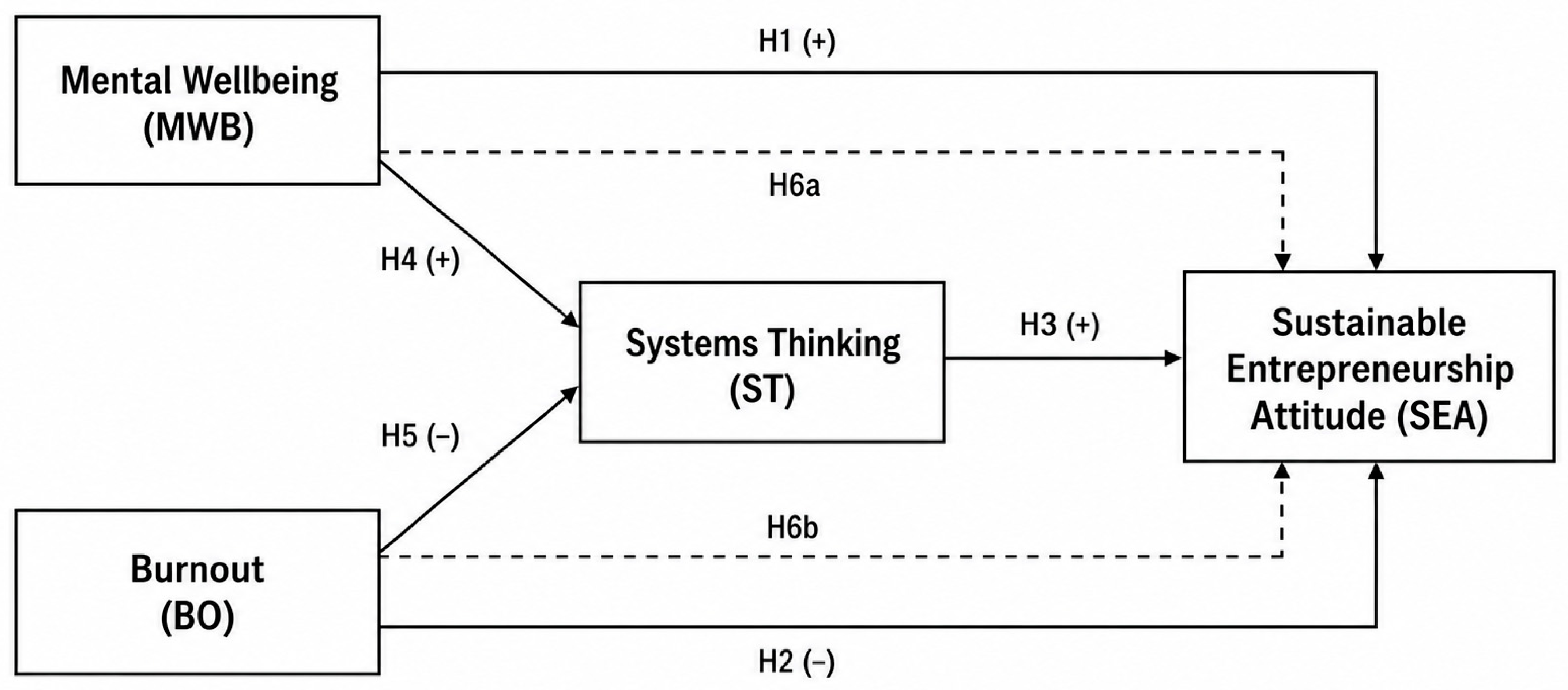
This study addresses this gap by proposing and testing an integrative model in which mental wellbeing and burnout function as affective antecedents of systems thinking, which in turn shapes students’ sustainable entrepreneurship attitude (SEA). By applying PLS-SEM to a sample of Mexican university students, this research offers empirical evidence on the interplay between psychological, cognitive, and attitudinal dimensions of sustainable entrepreneurial formation.
This study makes three distinct contributions. First, it integrates mental wellbeing, academic burnout, and systems thinking into a single empirically testable model of sustainable entrepreneurship attitude formation, an integration not previously tested in the sustainability education or entrepreneurial cognition literature [
6,
7,
8]. Second, it advances theory by conceptualizing systems thinking not merely as an outcome of sustainability education, but as a cognitive mediating mechanism through which affective states are translated into sustainability-oriented entrepreneurial attitudes, bridging sustainability competency frameworks [
8,
9] with psychological antecedent models of entrepreneurial cognition [
17]. Third, it strengthens the connection between higher education research and the SDG agenda: mental wellbeing supports SDG 3 (Good Health and Wellbeing) and SDG 4 (Quality Education), and through its positive structural association with SEA, a key driver of sustainability-oriented ventures [
18], contributes to SDG 8 (Decent Work and Economic Growth) [
1,
4,
18].
3. Materials and Methods
3.1. Research Design
This study employed a quantitative, cross-sectional, explanatory design. The analytical method was Partial Least Squares Structural Equation Modeling (PLS-SEM), selected for its suitability in evaluating complex models with latent variables, reflective constructs, and indirect effects, particularly when the objective is exploratory explanation and prediction rather than confirmatory theory testing [
19,
28,
35,
36].
PLS-SEM was preferred over covariance-based SEM (CB-SEM) for three reasons: (1) the model is theory-exploratory rather than confirmatory, making predictive accuracy a primary criterion [
19,
39]; (2) PLS-SEM performs well under conditions of non-normal data distributions and complex mediation structures [
38]; and (3) the sample size and model complexity are well-suited to PLS-SEM’s algorithmic requirements [
38]. SmartPLS 4.0 [
40] was used for all estimation and bootstrapping procedures.
A large-language-model-based writing assistant (Perplexity AI) was used only to support English language editing. The AI tool was not used to generate or modify the study’s research questions, theoretical framework, methodology, data analysis, results, or interpretation.
3.2. Population and Sample
The study followed the ethical principles of the Declaration of Helsinki and the internal guidelines for research involving human participants at Universidad de Monterrey; participation was anonymous and voluntary, and no directly identifiable personal data were collected.
Data collection took place between April and June 2025 via an online questionnaire distributed through institutional learning management systems, student associations, and faculty networks. Approximately 510 students were initially contacted, yielding 412 raw responses (response rate ≈ 81%). Of these, 45 questionnaires were excluded due to incompleteness (missing more than 10% of items) or evidence of straight-lining (identical responses across five or more consecutive items), leaving 367 valid responses. Respondents were distributed across the three participating institutions as follows: Universidad de Monterrey—UDEM (48%), Tecnológico de Monterrey (28%), and Universidad Regiomontana (24%). Approximately 72% were undergraduate students and 28% were enrolled in graduate programs.
The demographic profile was 59% female and 41% male, with a mean age of 22.4 years (SD = 2.6). Approximately 68% of respondents were enrolled in business-related programs, while 32% were in engineering or social sciences with sustainability components in their curricula. A non-probabilistic purposive sampling approach was adopted [
34].
3.3. Measurement Instruments
The survey instrument was structured around four latent constructs (
Table 1), all measured with validated scales adapted from the peer-reviewed literature. Items were scored on a 5-point Likert scale (1 = strongly disagree; 5 = strongly agree). The instrument was pre-tested with a convenience subsample of 30 students prior to full deployment [
41].
All scales were originally in English and were translated into Spanish following a forward–backward translation protocol consistent with cross-cultural adaptation best practices [
42]: two bilingual academics independently translated the items; discrepancies were resolved through consensus; and a back-translation was reviewed for equivalence by a third bilingual expert [
12,
19,
42]. Reverse-coded items (BO_3R, BO_5R) were re-coded prior to analysis so that higher scores consistently reflect higher burnout levels [
12].
Table 1.
Complete measurement items for all four constructs.
Table 1.
Complete measurement items for all four constructs.
| Construct | Item Code | Item Text (English) | Source |
|---|
| Mental Wellbeing (MWB) | MWB_1 | I have been feeling optimistic about the future. | Tennant et al. (2007) [10] |
| Mental Wellbeing (MWB) | MWB_2 | I have been feeling useful. | Tennant et al. (2007) [10] |
| Mental Wellbeing (MWB) | MWB_3 | I have been feeling relaxed. | Tennant et al. (2007) [10] |
| Mental Wellbeing (MWB) | MWB_4 | I have been dealing with problems well. | Tennant et al. (2007) [10] |
| Mental Wellbeing (MWB) | MWB_5 | I have been thinking clearly. | Tennant et al. (2007) [10] |
| Mental Wellbeing (MWB) | MWB_6 | I have been feeling close to other people. | Tennant et al. (2007) [10] |
| Mental Wellbeing (MWB) | MWB_7 | I have been able to make up my own mind about things. | Tennant et al. (2007) [10] |
| Burnout (BO) | BO_1 | I feel emotionally drained by my academic activities. | Schaufeli et al. (2002) [12] |
| Burnout (BO) | BO_2 | I feel burned out by my studies. | Schaufeli et al. (2002) [12] |
| Burnout (BO) | BO_3R | I feel enthusiastic about my studies. (R) | Schaufeli et al. (2002) [12] |
| Burnout (BO) | BO_4 | I doubt the significance of my studies. | Schaufeli et al. (2002) [12] |
| Burnout (BO) | BO_5R | I feel stimulated when I achieve something in my studies. (R) | Schaufeli et al. (2002) [12] |
| Systems Thinking (ST) | ST_1 | I am able to see how events in a system are interconnected. | Wiek et al. (2011) [8]; Brundiers et al. (2021) [7] |
| Systems Thinking (ST) | ST_2 | I can identify the long-term consequences of actions in a complex system. | Wiek et al. (2011) [8] |
| Systems Thinking (ST) | ST_3 | I understand how changes in one part of a system affect other parts. | Brundiers et al. (2021) [7] |
| Systems Thinking (ST) | ST_4 | I can recognize feedback loops and unintended consequences. | Redman & Wiek (2021) [9] |
| Sustainable Entrepreneurship Attitude (SEA) | SEA_1 | I want to start a business that contributes positively to environmental sustainability. | Ploum et al. (2018) [4] |
| Sustainable Entrepreneurship Attitude (SEA) | SEA_2 | I am motivated to create ventures that address social and environmental problems. | Ploum et al. (2018) [4] |
| Sustainable Entrepreneurship Attitude (SEA) | SEA_3 | I believe economic growth and environmental responsibility can be combined in a business. | Ploum et al. (2018) [4] |
| Sustainable Entrepreneurship Attitude (SEA) | SEA_4 | I would prefer a business that generates social impact over one that maximizes profit alone. | Ploum et al. (2018) [4] |
| Sustainable Entrepreneurship Attitude (SEA) | SEA_5 | I feel personally committed to developing entrepreneurial solutions to sustainability challenges. | Ploum et al. (2018) [4] |
3.4. Data Collection and Ethical Considerations
Data collection was conducted via an online questionnaire administered through institutional learning management systems, student associations, and faculty networks. Participation was entirely voluntary, and informed digital consent was obtained at the beginning of each survey. No personally identifiable information was collected. The study was conducted in accordance with the ethical guidelines of the authors’ institution and followed the Declaration of Helsinki principles for research involving human participants.
To mitigate common method bias (CMB), procedural remedies were implemented including reverse-coded items for construct balance and explicit assurance of response anonymity [
45]. Post hoc diagnostics included: (1) Harman’s single-factor test—no single factor exceeded 30% of total variance (exploratory diagnostic only [
45]); and (2) full collinearity VIF assessment following Kock [
46]—all construct-level VIF values fell below 3.3, indicating that CMB is unlikely to constitute a serious threat [
46]. These combined remedies reduce the probability that method-related artifacts drive the observed results, although they do not constitute definitive proof of the absence of CMB [
45,
46].
3.5. Analytical Procedure
The PLS-SEM analysis followed the established two-step evaluation procedure [
19,
28,
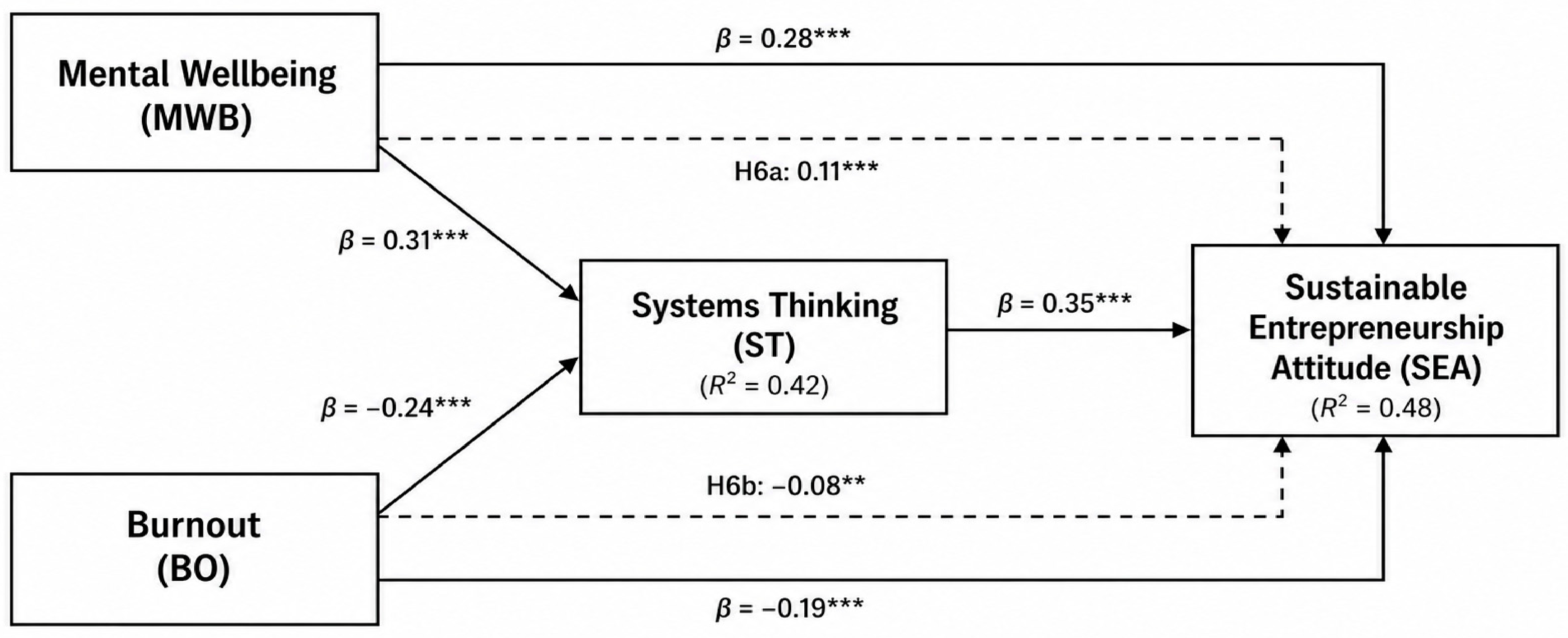
35]. Step 1—measurement model: Cronbach’s alpha, Composite Reliability, AVE (>0.50), and HTMT ratio. Step 2—structural model: path coefficients (β) with 95% bootstrapped confidence intervals (5000 resamples), R
2, f
2, Q
2 via blindfolding, and SRMR as a global fit index.
A sensitivity analysis was conducted by comparing the full model (MWB, BO → ST → SEA) with a reduced model (MWB, BO → SEA directly) to assess the robustness of the mediation pattern. A 10-fold cross-validated predictive assessment analogous to PLSpredict [
39] was also implemented to evaluate out-of-sample predictive accuracy for SEA. Missing data represented less than 2% of responses across retained items and were handled via mean imputation at the construct level prior to PLS-SEM estimation.
8. Conclusions
This study presents and empirically validates an integrative framework linking mental wellbeing, academic burnout, systems thinking, and sustainable entrepreneurship attitude (SEA) among university students in Mexico. The PLS-SEM analysis confirmed all six hypotheses, demonstrating structural associations consistent with the hypothesized model: (1) mental wellbeing is positively associated with both ST and SEA; (2) burnout is negatively associated with both; (3) ST is the strongest structural predictor of SEA; and (4) ST partially mediates the structural relationships of wellbeing and burnout on SEA. Because the design is cross-sectional, findings reflect associations consistent with the theoretical model and do not establish causal ordering.
The theoretical significance lies in demonstrating that sustainability competency development is not merely cognitive but deeply psychological. Students depleted by burnout are less likely to develop the systems thinking competency underlying sustainability-oriented action, while psychologically thriving students are better positioned to develop it. This bridges sustainability education theory, positive psychology, and entrepreneurial cognition in ways directly relevant to SDG 3, SDG 4, and SDG 8 [
1,
4,
18]—and to the broader goal of cultivating sustainability-oriented entrepreneurs, as articulated by Shepherd and Patzelt [
18].