1. Introduction
Renewable energy consumption has become a strategic indicator of energy-system transformation because it links decarbonization, energy security, technology adoption, infrastructure planning, and sectoral demand. Forecasting this quantity is technically demanding: renewable portfolios combine mature resources with strong annual cycles, emerging sources with delayed adoption and rapid growth, and aggregate categories that may overlap with component series. A credible forecasting design must therefore retain monthly timing, preserve sector–source heterogeneity, benchmark against strong seasonal alternatives, quantify uncertainty, and expose the drivers and fragilities of model behavior. Against this background, the study develops a methodologically rigorous monthly forecasting framework for U.S. renewable energy consumption. The analysis integrates a recent literature review, formal mathematical notation, leakage-safe machine learning methodology, uncertainty-aware forecast diagnostics, and figure-based empirical interpretation.
This study does not propose a new forecasting algorithm. Rather, it develops an integrated empirical forecasting and planning evaluation framework for monthly multisector renewable energy consumption. The framework combines historical diagnostics, rolling-origin forecast benchmarking, probabilistic uncertainty assessment, hierarchical reconciliation, scenario analysis, and decision-focused planning evaluation. Historical trend and structural-regime analyses are used to characterize the data-generating context and motivate validation design; they are not presented as causal explanations of renewable energy change.
1.1. Renewable Energy Transition and the Forecasting Imperative
Renewable energy forecasting has become a central analytic problem because renewable deployment is no longer marginal to power systems, energy planning, or climate-policy evaluation. The U.S. Energy Information Administration defines renewable energy as energy from sources that are naturally replenishing but flow-limited, with major categories including biomass, hydropower, geothermal, wind, and solar energy. This definition is important for the current study because the data structure includes both aggregate renewable energy and component sources, including hydroelectric power, geothermal energy, solar energy, wind energy, wood energy, waste energy, biofuels, renewable diesel fuel, and total renewable energy. Forecasting such a portfolio requires methods that can accommodate mature sources with long historical records, emerging sources with many zero-valued early observations, and aggregate variables that may overlap with component series.
The policy and planning need for advanced renewable energy forecasting is amplified by the scale of current and projected growth. The International Energy Agency projected that global renewable power capacity would increase by almost 4600 GW between 2025 and 2030, with solar photovoltaic expansion accounting for nearly 80% of worldwide renewable electricity capacity growth [
1]. In the United States, the EIA reported that solar and wind energy production increased by 25% and 8%, respectively, in 2024 as new generators came online [
2]. These patterns underscore a central methodological challenge: renewable energy systems evolve through both slow structural shifts and abrupt changes in source mix, infrastructure deployment, policy regimes, and technology costs. A forecasting model that ignores temporal dynamics, source-specific growth profiles, and regime changes risks producing forecasts that look smooth but fail to represent the evolving renewable portfolio.
For energy planners, utilities, policy analysts, and researchers, forecasting renewable energy consumption differs from forecasting renewable generation. Renewable generation, especially solar and wind, is often dominated by meteorological variability, plant availability, and grid dispatch. Renewable energy consumption, by contrast, reflects the interaction of supply availability, sectoral demand, technology adoption, electrification, biofuel use, policy incentives, industrial structure, and reporting categories. Therefore, a multisector monthly analysis must account not only for seasonality and trend but also for compositional heterogeneity across sectors and sources. This article responds to that requirement by modeling monthly renewable energy consumption in a panel format rather than reducing the dataset to a single annual aggregate or a simple row-index regression problem.
In addition to aggregate renewable energy growth, energy-system planning is also shaped by technology-level efficiency improvements, heat-transfer performance, and low-emission end-use systems. Future extensions should also consider end-use technology and energy-efficiency variables. Recent work by Li et al. [
3] on a premixed low-nitrogen heating boiler demonstrates that equipment-level thermal optimization can substantially improve energy efficiency and emissions performance. Using a porous-media model for a metal fiber burner and finned-tube heat exchanger, the study identified α = 1.3 as the optimal excess air coefficient and further improved boiler efficiency from 94.6% to 97.1% through burner-flow redistribution, waste-heat recovery, and dual flue-gas outlet design. Although this type of boiler-performance study differs from national renewable energy forecasting, it highlights an important future modeling direction: renewable energy consumption forecasts may become more policy-relevant when they include technology-efficiency, heating-demand, waste-heat recovery, building-sector, and emissions-control indicators as exogenous drivers.
1.2. Classical Forecasting and the Continuing Importance of Baselines
Although recent energy forecasting research often emphasizes advanced machine learning, classical forecasting models remain essential in renewable energy studies. Seasonal naive, exponential smoothing, ARIMA, Theta, and related statistical approaches provide strong baselines for monthly series because they encode simple but powerful assumptions: repeated annual seasonality, local trend, autoregressive dependence, and error correction. In many applied energy datasets, especially those with short histories, sparse emerging sources, or strong annual patterns, these models can outperform more complex neural architectures. Consequently, model sophistication should be judged by out-of-sample forecasting skill rather than by algorithmic novelty alone.
Recent review work supports this position. A systematic review of forecasting energy demand and generation using time-series models concluded that classical methods remain well suited to linear and seasonal dynamics, whereas more flexible artificial intelligence models are useful when the data contain nonlinear, high-dimensional, or multiseasonal patterns [
4]. Similarly, broad time-series forecasting surveys emphasize that deep learning and Transformer models are not automatically superior to simpler alternatives; their advantage depends on data volume, cross-series learning opportunities, covariates, horizon length, and distributional stability [
5]. In the present article, this evidence justifies the use of SeasonalNaive, AutoETS, AutoARIMA, Theta, and other statistical comparators alongside machine learning and deep learning models. A model that cannot outperform seasonal naive forecasting on mean absolute scaled error should not be considered a reliable improvement, regardless of architectural complexity.
The baseline principle is especially important for renewable energy consumption because some series have long periods of low or zero activity followed by growth. For example, solar energy, wind energy, biodiesel, renewable diesel fuel, and other biofuels may exhibit delayed emergence and rapid growth after policy or technology changes. In such cases, annual seasonal repetition may be strong for mature sources but inadequate for emerging ones. A robust methodology therefore requires both simple baselines and flexible alternatives, evaluated under identical temporal holdout rules. This article adopts that benchmarking logic by ranking models with MASE, sMAPE, MAAPE, MAE, and RMSE rather than relying on visual fit or in-sample error.
1.3. Machine Learning and Ensemble Forecasting in Renewable Energy
Machine learning approaches have become prominent in energy forecasting because they can model nonlinear relationships among lagged values, rolling summaries, calendar effects, categorical identifiers, and exogenous variables. Tree-based ensembles such as Random Forest, Extra Trees, XGBoost, LightGBM, and CatBoost are particularly common in structured energy datasets because they handle nonlinear interactions, mixed feature types, non-Gaussian errors, and heterogeneous scales with relatively modest preprocessing. These models are also attractive for monthly renewable energy consumption panels because they can learn shared patterns across source and sector identifiers while still using time-series features such as seasonal lags and rolling means.
Recent high-impact energy literature illustrates the strength of this family of methods. Sariman and colleagues developed a global renewable energy forecasting framework that integrated machine learning, deep learning, and statistical models across more than 200 countries and calibrated performance to economic and regional conditions [
4]. Their results showed that sequence models such as GRU and LSTM performed best in data-rich cohorts, while classical and machine learning models retained value in less data-rich settings. This finding is directly relevant to the current study because U.S. renewable energy consumption contains both long historical series and source-specific segments with sparse early histories. The implication is that model class should be selected empirically by source, sector, and horizon rather than imposed uniformly.
A second example is Colak’s recent renewable energy study, which proposed a hybrid stacking framework based on Extra Trees, CatBoost, and LightGBM for renewable energy production forecasting [
6]. The model compared multiple tree-based learners and demonstrated that ensemble stacking can reduce error relative to individual models. This supports the present article’s inclusion of rank-weighted ensembling and multiple gradient-boosting alternatives. However, the current study extends this literature by applying tree ensembles to a multisector monthly consumption panel, using recursive multi-step prediction, and comparing tree-based models against statistical baselines and supplementary neural or foundation model approaches.
Machine learning reviews in building and electrical energy consumption also emphasize the importance of preprocessing, feature construction, scale handling, and model selection. Chen et al. reviewed machine learning techniques for building electrical energy consumption prediction and argued that the energy transition benefits from data-driven forecasting, but that modeling choices must align with the phase of analysis, including feature selection, preprocessing, loss functions, and high-fluctuation behavior. Although building-level electricity forecasting differs from national renewable energy consumption forecasting, both problems share common methodological concerns: temporal leakage, high variability, exogenous regime shifts, and the need to match algorithms to data structure. The present article responds by generating lag, rolling, calendar, sector, and source features from prior observations only, fitting supervised regression models on log-transformed targets, and producing non-negative recursive forecasts.
1.4. Deep Learning for Renewable Demand and Energy Time Series
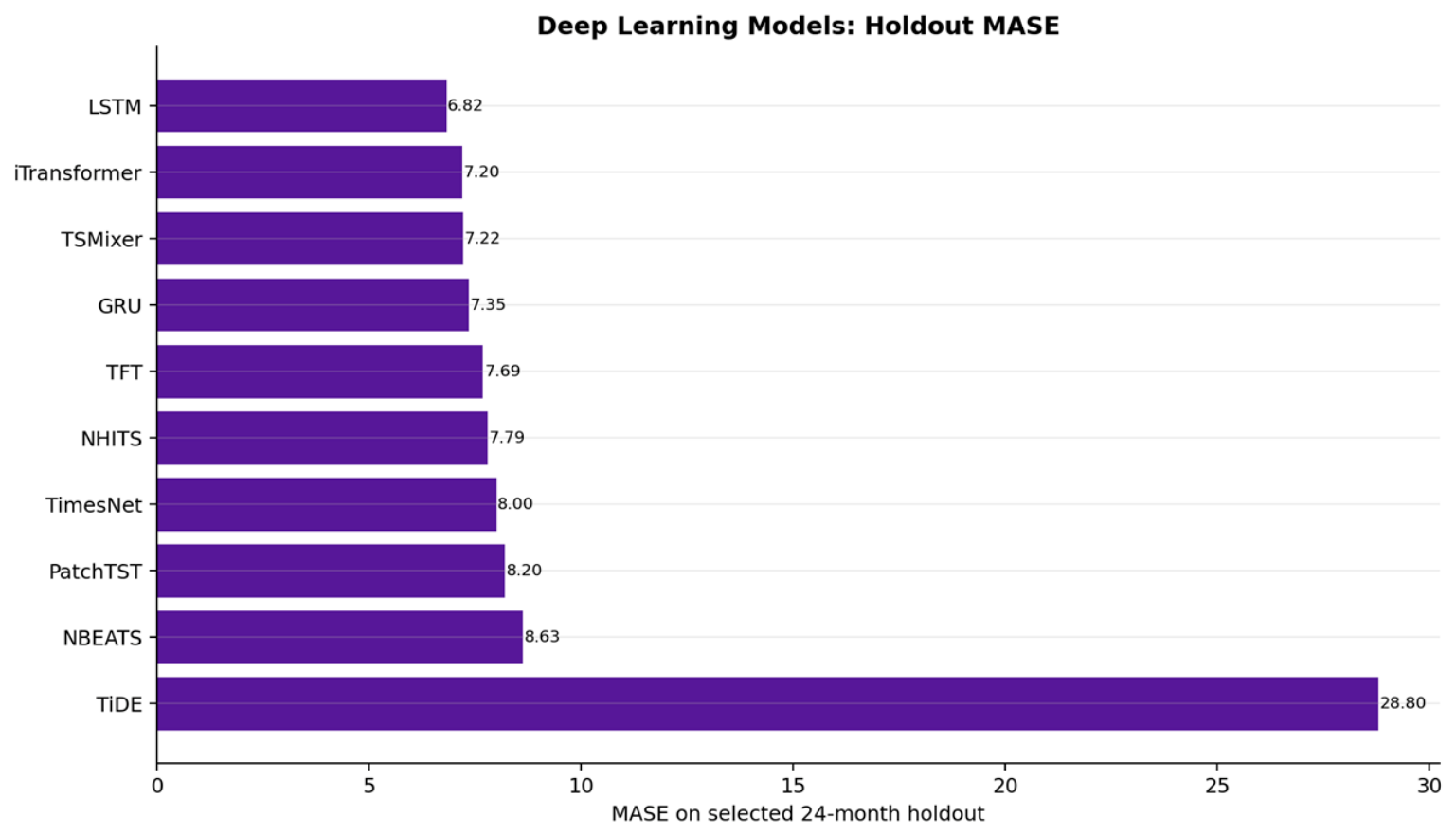
Deep learning has expanded the modeling frontier for energy forecasting by enabling nonlinear sequence learning, multi-horizon prediction, and cross-series representation learning. Recurrent neural networks, long short-term memory networks, gated recurrent units, convolutional sequence models, N-BEATS, N-HiTS, Temporal Fusion Transformer, PatchTST, iTransformer, TimesNet, TiDE, and TSMixer-style models have all been applied to time-series forecasting problems. Their appeal is not simply that they are complex, but that they can learn temporal dependencies across multiple scales: short-term momentum, annual seasonality, long-term trend, and interactions among related series.
In renewable-demand forecasting, Kim et al. proposed a deep learning framework that combined variational auto-encoder sampling with bidirectional LSTM modeling for large-scale renewable electricity demand [
7]. Their approach used generated samples to address data-distribution challenges and then built a Bi-LSTM model for demand forecasting. The reported improvement relative to GRU, LSTM, ANN, DNN, SVR, and ARIMA comparators illustrates the potential value of hybrid deep learning pipelines in renewable energy settings. However, the study also highlights a broader issue: deep learning gains frequently depend on careful preprocessing, data augmentation, and validation design. A simple recurrent model trained on row index or annual ordering is inadequate because it does not learn the monthly structure, sectoral identifiers, or source-specific dynamics that characterize renewable energy consumption data.
Modern neural forecasting architectures attempt to address these limitations in different ways. N-BEATS introduced a fully neural approach for univariate time-series forecasting, while N-HiTS extended this logic through hierarchical interpolation and multi-rate sampling to improve long-horizon forecasting stability [
8,
9]. Temporal Fusion Transformer combines recurrent processing, attention, gating, and variable selection to support interpretable multi-horizon forecasting [
10]. TiDE and other efficient encoder-decoder models challenge the assumption that attention is always necessary, showing that well-designed dense architectures can perform strongly for long-term forecasting. For the present article, these methods justify the supplementary NeuralForecast benchmark rather than reliance on a single SimpleRNN. They also reinforce a central design principle: neural models should be benchmarked against statistical and feature-based machine learning baselines under the same holdout horizon.
Deep learning is particularly relevant for multisource renewable energy consumption because different energy sources have different temporal signatures. Hydroelectric consumption may reflect mature infrastructure and seasonal water conditions; wind and solar may show expansion-driven trends and increasing seasonal amplitude; biofuel variables may reflect transportation, industrial, and policy dynamics; and aggregate total renewable energy may combine several component regimes. A global neural model can, in principle, learn common representations across these related series. Nevertheless, the literature cautions that neural models can be sensitive to sample size, scaling, horizon length, and distribution shift. The current analysis therefore treats modern neural models as empirical competitors rather than presumed winners.
1.5. Transformer-Based Forecasting and Long-Horizon Modeling
Transformer architectures have rapidly reshaped time-series forecasting because they offer flexible mechanisms for modeling long-range dependencies, cross-variable interactions, and multi-horizon structure. In energy applications, Transformers are especially appealing when the forecast horizon is long, when historical context spans multiple seasons, and when multiple sources or locations must be modeled jointly. However, vanilla Transformers also face well-known challenges: quadratic attention costs, difficulty learning meaningful temporal order without proper embedding, sensitivity to nonstationarity, and vulnerability to overfitting when data are limited.
Recent review evidence reflects both the promise and caution surrounding this family of models. Hussan et al. published a comprehensive review of Transformer-based renewable energy forecasting in
Renewable and Sustainable Energy Reviews, emphasizing that Transformer models can capture sequential dependencies and spatiotemporal patterns for renewable energy sources while also facing deployment and interpretability challenges [
5]. The review is relevant to the present article because it situates models such as TFT, PatchTST, iTransformer, and related architectures within a broader renewable energy forecasting framework. It also supports the article’s decision to evaluate Transformer-style models only after establishing classical and machine learning baselines.
Several recent architecture papers are particularly relevant. PatchTST reframed a time series as patches rather than individual points, reducing attention complexity and allowing models to attend to longer historical windows [
11]. This is useful for monthly renewable energy consumption because meaningful patterns may extend across multiple years rather than a few adjacent months. iTransformer inverted the usual time-series Transformer representation by treating variates as tokens and using attention to learn multivariate correlations [
12]. This design is conceptually aligned with renewable source-mix forecasting, where dependencies among solar, wind, biomass, hydroelectric, and total renewable series may be more informative than independent source-specific modeling. The Graph Patch Informer proposed by Liu and Fu integrated graph attention, patching, and self-supervised pretraining for renewable energy forecasting and reported large error reductions relative to Autoformer baselines [
13]. Together, these studies justify the inclusion of Transformer-family models in the analytical workflow but also motivate strict temporal validation because architectural complexity alone does not guarantee real forecasting skill.
For the current U.S. renewable energy consumption article, Transformer models are most defensible as comparative methods rather than as the sole modeling framework. Monthly national and sectoral series contain fewer time points than high-frequency smart-meter or meteorological datasets. Therefore, a Transformer model must borrow strength across sources and sectors or use pretraining to avoid overfitting. The present analysis addresses this issue by formulating the dataset as a panel, using a 24-month validation horizon, reserving a 36-month production-style forecast, and preserving seasonal baselines. This design is consistent with the recent literature’s caution that powerful neural architectures must be evaluated against parsimonious models and should be interpreted with regard to data volume and regime shifts.
1.6. Time-Series Foundation Models and Zero-Shot Forecasting
The most recent methodological development in forecasting is the rise of time-series foundation models. Unlike task-specific neural models trained only on a single dataset, foundation models are pretrained on large and diverse collections of time series and then applied zero-shot, few-shot, or fine-tuned to new forecasting tasks. This paradigm is especially attractive for renewable energy forecasting because it promises reusable temporal representations, cross-domain generalization, and reduced need for task-specific training data. It is also still unsettled: foundation models can perform very well in some energy settings, but their calibration, robustness, horizon sensitivity, and practical value must be evaluated task by task.
Ferdaus et al. provided a recent review of foundation models for clean-energy forecasting, emphasizing wind and solar applications and distinguishing foundation models from conventional deep learning through their scale, pretraining strategies, and cross-domain generalization capacity [
14]. The review noted opportunities in zero-shot forecasting for new installations, multimodal integration, uncertainty quantification, and long-horizon renewable forecasting, while also highlighting computational cost, benchmark gaps, and deployment challenges. This directly supports the present article’s foundation model benchmarking strategy. The appropriate claim is not that foundation models are automatically superior; rather, they represent a new benchmark class that should be scored on the same holdout data as seasonal naive, tree ensembles, and neural models.
Several foundation models are especially relevant. TimesFM is a Google Research time-series foundation model designed for forecasting and described as a decoder-only model pretrained on very large time-series corpora [
15]. Chronos transforms time-series values into token sequences through scaling and quantization, trains language model architectures on those tokens, and produces probabilistic forecasts by sampling future trajectories [
16]. Moirai, introduced through the Uni2TS framework, was trained on the Large-scale Open Time Series Archive containing more than 27 billion observations across nine domains and demonstrated competitive or superior zero-shot performance relative to full-shot models [
17]. TimeGPT [
18] is another general-purpose time-series foundation model designed for zero-shot forecasting and anomaly detection [
18]. These models are methodologically important because they make it possible to benchmark renewable energy consumption forecasts against pretrained temporal representations rather than only models fitted from scratch.
Recent energy-specific evaluations of foundation models indicate both promise and caution. Work on short-term household load forecasting has benchmarked Chronos, TimesFM, and related models against trained-from-scratch Transformer models, arguing that foundation models can perform competitively and may reduce the need for domain-specific training [
19]. Decision-focused fine-tuning work using Moirai in energy-system optimization has argued that forecasts should be evaluated not only by prediction error but also by downstream operational value, such as dispatch or cost outcomes [
20]. A 2026 benchmark of time-series foundation models for energy load forecasting further emphasized calibration, robustness under distribution shift, context-length sensitivity, and deployment feasibility on consumer hardware [
21]. These studies are relevant even though the current article forecasts monthly renewable energy consumption rather than hourly load. They show that foundation model evaluation should include accuracy, uncertainty, stability, and practical interpretability—not simply point-error rankings.
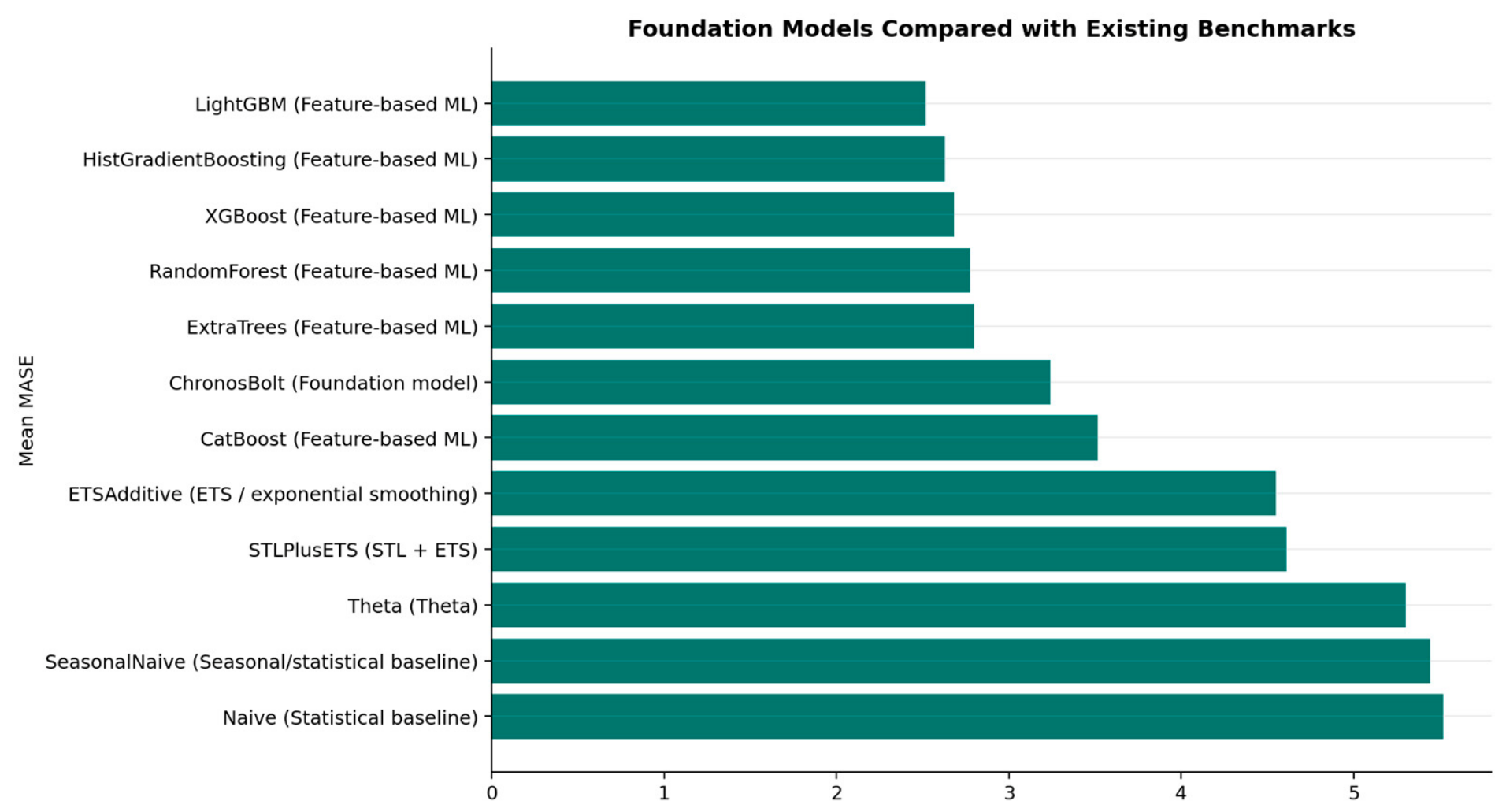
The present article, therefore, evaluates foundation models in a disciplined way. The analytical workflow includes benchmarking hooks for TimeGPT, Chronos-Bolt/Chronos-family models, TimesFM, and Moirai/Uni2TS-style models, but it does not allow those methods to replace the core leaderboard unless they are evaluated under the same temporal holdout split and metric definitions. This safeguard is essential because foundation models may be useful for sparse histories, unusual regimes, or limited training data, yet their zero-shot priors may also mismatch long-run U.S. renewable energy consumption trends, policy-driven structural breaks, or dataset-specific reporting categories. Consequently, the study treats foundation models as an advanced benchmarking layer rather than a substitute for rigorous validation.
1.7. Probabilistic Forecasting, Conformal Intervals, and Uncertainty Quantification
Renewable energy forecasting is not only a point-prediction problem. Energy planners require uncertainty information because forecast errors can affect procurement, grid balancing, infrastructure investment, policy evaluation, and risk management. This is especially true for renewable sources because output and consumption patterns may be affected by weather variability, technology deployment, policy incentives, supply-chain constraints, and abrupt regime shifts. A point forecast without uncertainty may understate the risk of deviations around rapid growth periods or structural breaks.
Recent applied energy work has increasingly incorporated probabilistic forecasting and distribution-free uncertainty methods. Jonkers et al. proposed a day-ahead regional and probabilistic wind power forecasting framework using deep convolutional networks and conformalized regression forests in Applied Energy [
22]. The study is relevant to the present article because it demonstrates how advanced renewable forecasting can combine deep learning with conformal prediction to produce probabilistic information rather than only point estimates. Although wind power forecasting is a generation task and the current article studies monthly renewable energy consumption, the methodological principle carries over: forecast uncertainty should be estimated on validation residuals and communicated alongside point forecasts.
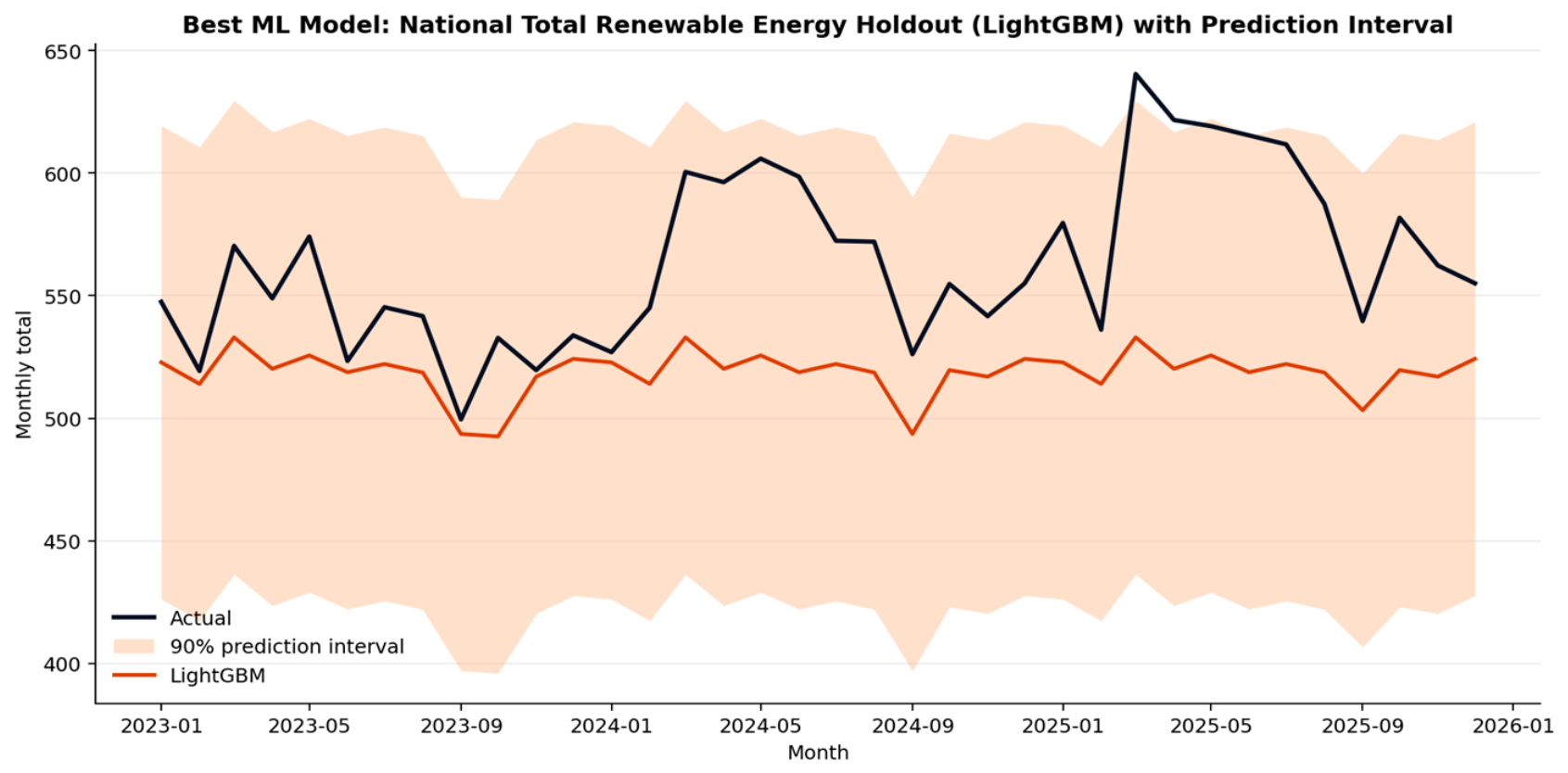
This study uses residual-calibrated, conformal-style prediction intervals to quantify forecast uncertainty. Absolute residuals from the validation window are summarized both globally and by individual series, and the corresponding empirical quantiles are used to construct non-negative lower and upper forecast intervals. Because this procedure is model-agnostic, it can be applied consistently across seasonal naive benchmarks, tree-based ensembles, neural forecasting models, and time-series foundation models. The intervals are not presented as estimates from a fully specified distributional probabilistic model. Instead, they provide practical uncertainty bands calibrated to recent out-of-sample forecast errors. This approach supports methodological rigor, reproducibility, and consistent comparison across diverse forecasting model classes.
Uncertainty analysis also helps prevent overinterpretation of emerging-source forecasts. For example, renewable diesel fuel, other biofuels, solar energy, or wind energy may show rapid growth but also high uncertainty due to policy changes, technology adoption, and reporting changes. Interval forecasts communicate that the future trajectory is not a single deterministic path. They also support more responsible policy interpretation by distinguishing the model’s central tendency from plausible forecast variation.
1.8. Interpretability, Diagnostics, and Hierarchical Coherence
A sophisticated renewable energy forecasting study must go beyond the leaderboard. In energy applications, interpretability is important because researchers and policy audiences need to understand whether forecasts are driven by seasonal lag structure, long-term trend, short-term momentum, sector identifiers, source composition, or artifacts of data preprocessing. Interpretability is also necessary because high-performing models can fail under structural shifts or rely on spurious patterns [
23]. Recent energy-consumption and forecasting reviews emphasize that preprocessing, feature selection, temporal validation, and domain-aware interpretation are as important as algorithm selection [
24,
25,
26].
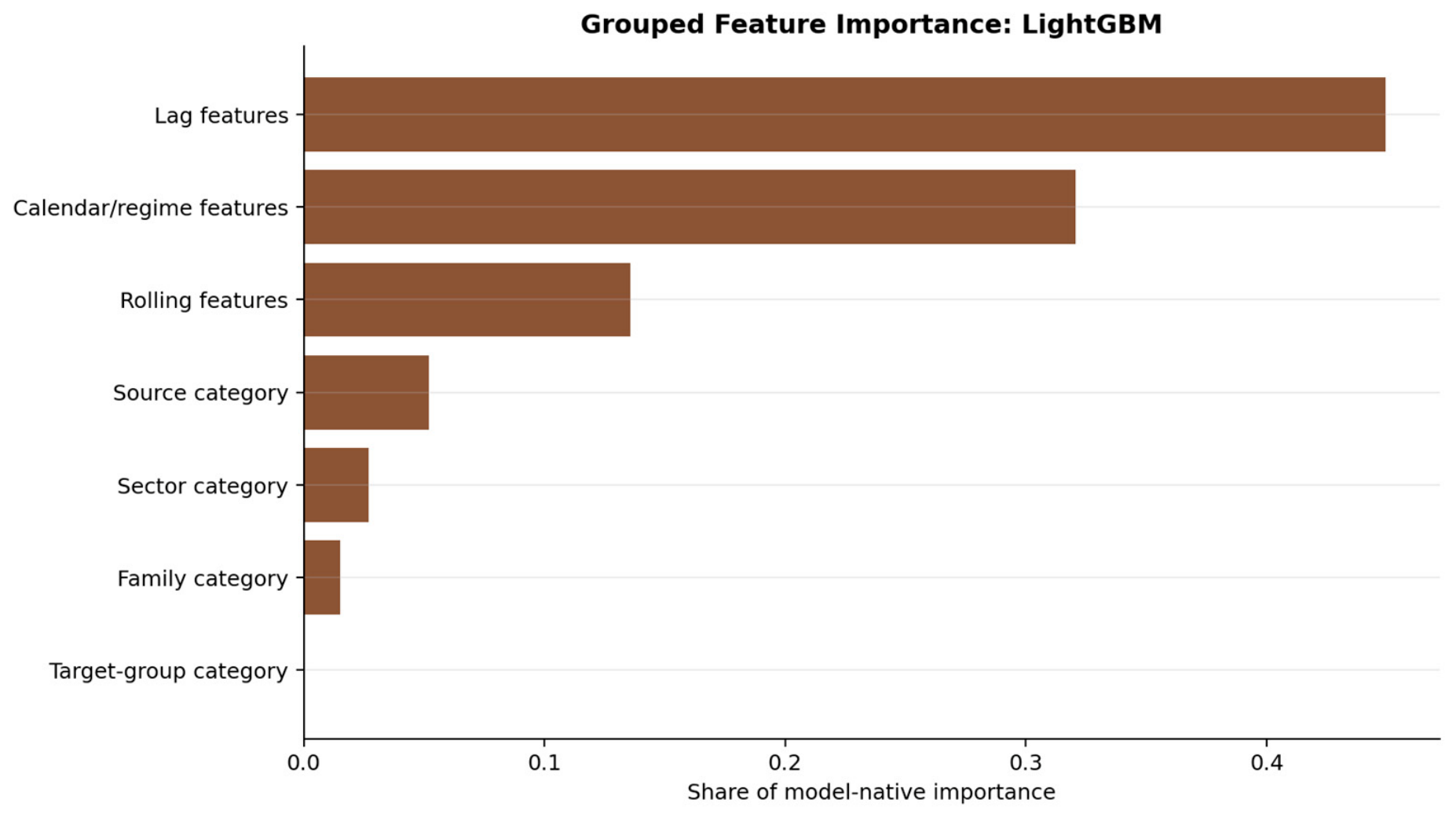
For feature-based machine learning models, lag and rolling features provide a transparent bridge between time-series forecasting and supervised regression. The 12-month lag and annual rolling summaries capture seasonality; short lags capture momentum; expanding means capture long-run level; calendar features represent seasonal and temporal position; and sector/source identifiers permit cross-series learning. Feature-importance and permutation-importance analyses can then identify whether the final model primarily uses seasonal repetition, recent changes, long-term trend, or categorical source/sector differences. Supplementary SHAP analysis can provide a more detailed decomposition of nonlinear tree-based forecasts, although it is computationally heavier and must be interpreted carefully when features are correlated.
Structural-change and anomaly diagnostics are equally important for renewable energy consumption. Change-point detection can reveal candidate regime shifts in aggregate renewable energy consumption, such as periods associated with policy changes, technology adoption, economic shocks, or reporting changes [
27]. Isolation Forest or similar anomaly methods can identify months whose source mix is unusual relative to the historical multivariate pattern. These diagnostics are not causal evidence by themselves, but they strengthen the analysis by identifying where purely pattern-based forecasting may be most fragile. The present article includes these diagnostic layers to support careful interpretation of model outputs and to avoid treating machine learning forecasts as mechanically self-explanatory.
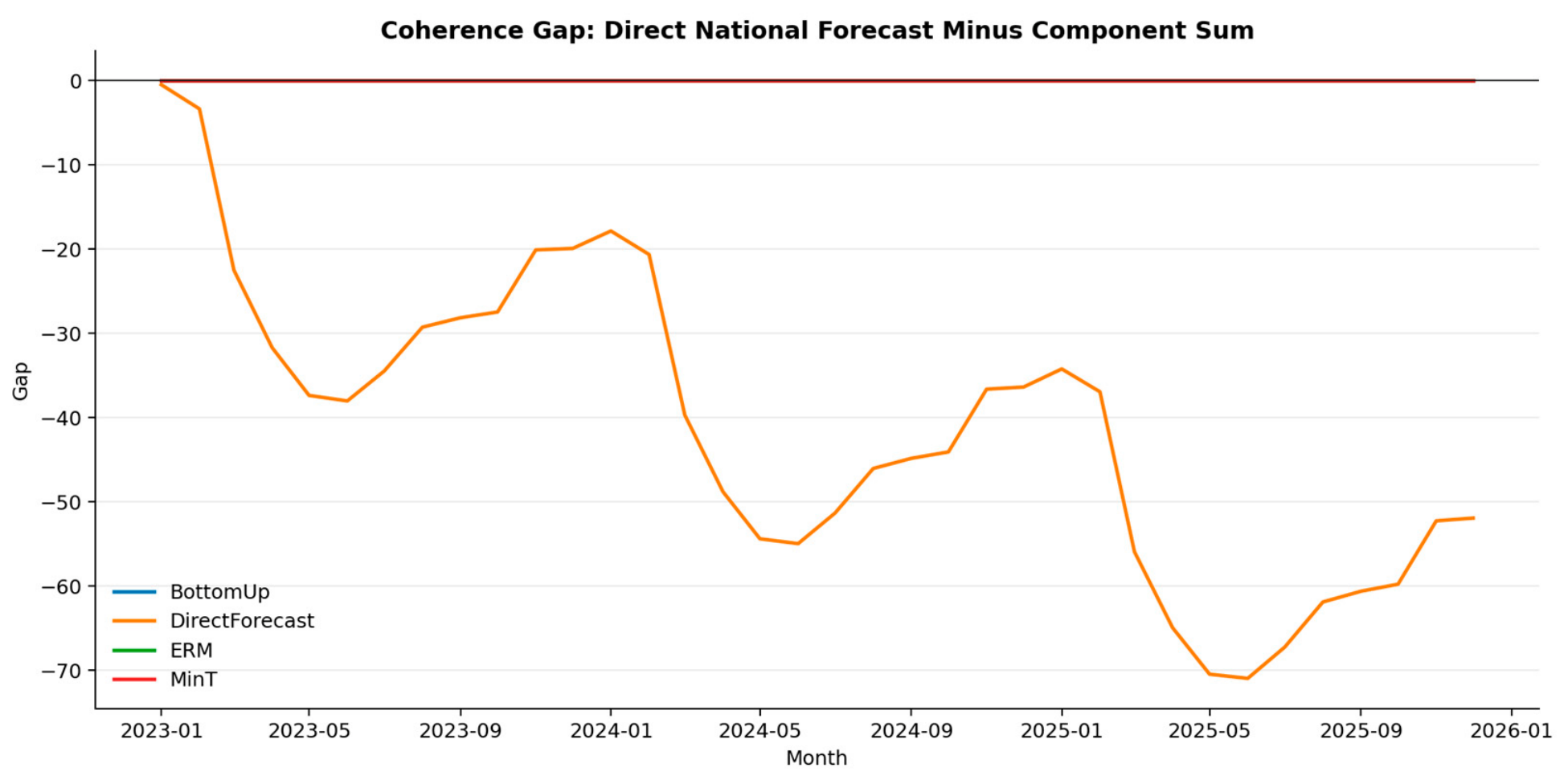
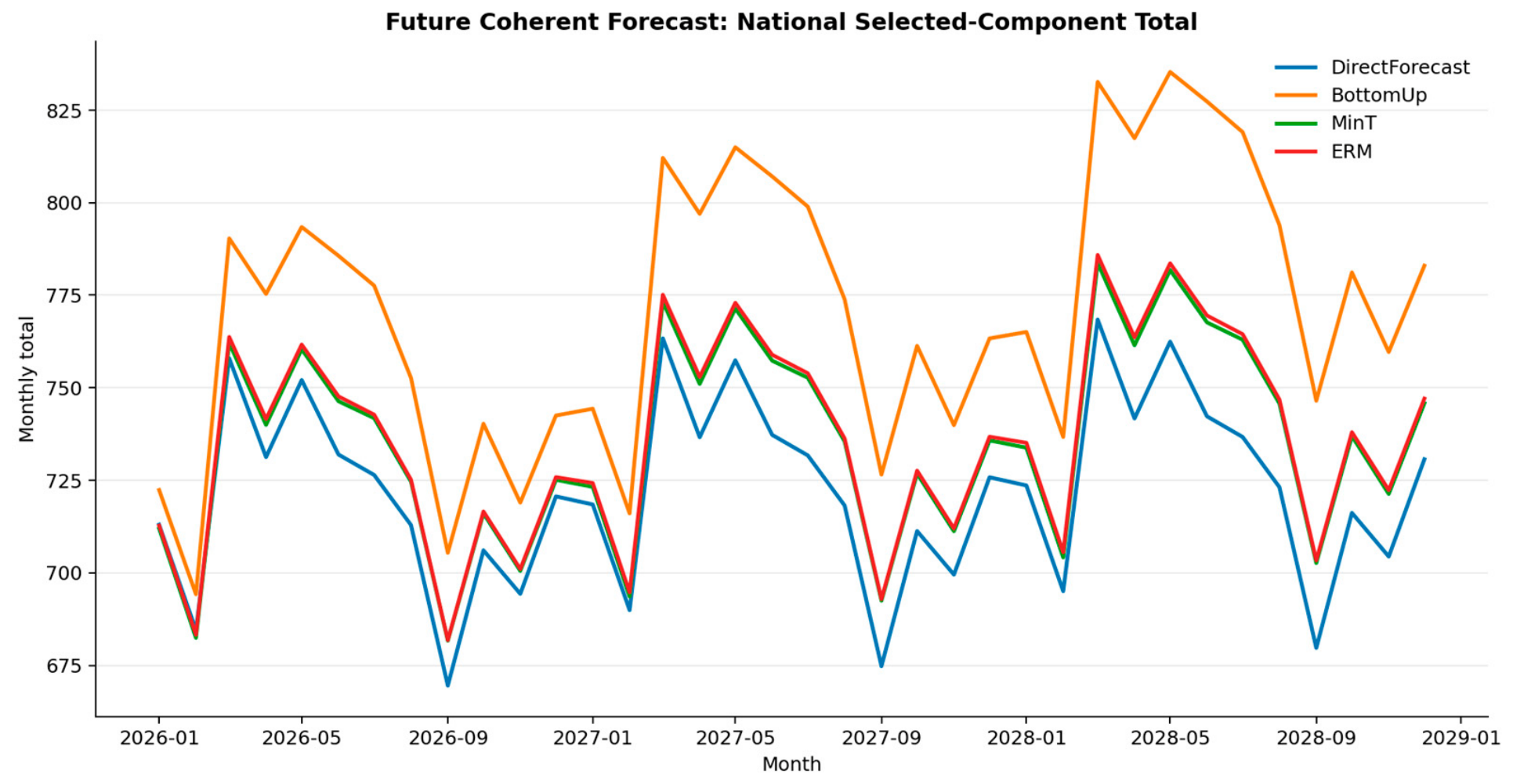
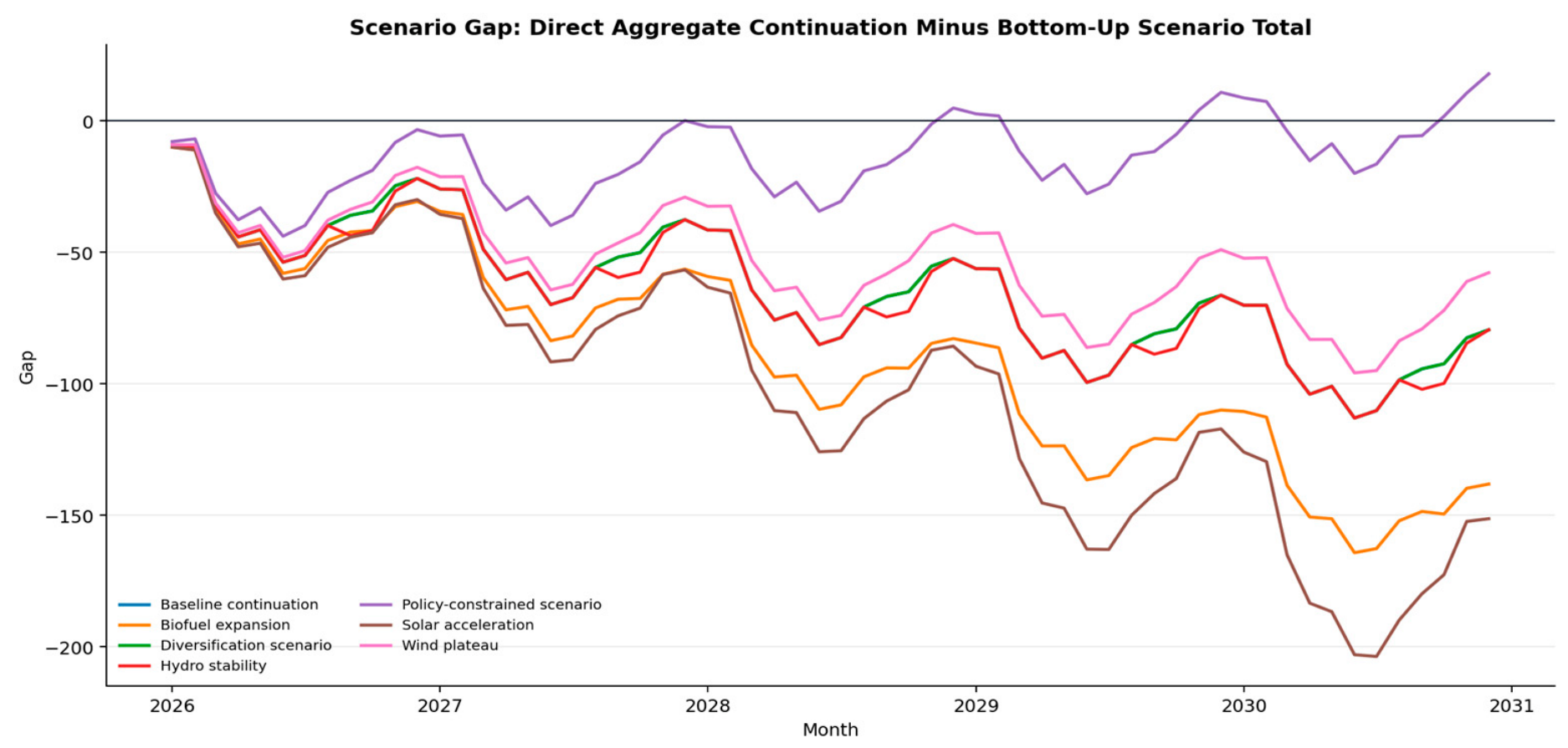
Finally, hierarchy and coherence are distinct issues in renewable energy datasets because the same table may contain both component variables and aggregate variables. For example, Total Renewable Energy and Biomass Energy may overlap with source-specific variables such as wood energy, waste energy, fuel ethanol, biodiesel, and renewable diesel fuel. Naively summing all columns can therefore double-count energy. The analytical workflow avoids this problem by comparing directly forecasted Total Renewable Energy with a selected bottom-up component sum and exporting the direct-minus-bottom-up difference as a diagnostic, rather than forcing reconciliation on potentially overlapping categories. This is a more defensible strategy for a manuscript because it acknowledges the structure of the data and avoids falsely precise hierarchical claims.
1.9. Research Gap and Contribution of the Present Study
The recent literature establishes that renewable energy forecasting has moved from isolated statistical models to hybrid machine learning, deep learning, Transformer, and foundation model frameworks. However, several gaps remain. First, many studies focus on renewable generation, especially wind or solar power, rather than multisector renewable energy consumption. Generation studies are essential, but they do not fully capture consumption patterns across the Commercial, Electric Power, Industrial, Residential, and Transportation sectors. Second, much of the literature uses high-frequency plant-level or load-level data, while long historical monthly national consumption datasets pose different challenges: fewer time points, changing source categories, long-run structural shifts, and emerging variables with delayed nonzero histories. Third, many applied forecasting papers emphasize a small number of advanced models without anchoring performance to strong seasonal baselines such as SeasonalNaive, AutoETS, AutoARIMA, and Theta. Fourth, uncertainty intervals, anomaly diagnostics, change-point detection, and hierarchy/coherence checks are often treated as supplementary rather than integral components of a forecasting study. Fifth, foundation models are increasingly discussed, but few renewable energy consumption studies evaluate them alongside classical, feature-based, and neural models under identical validation rules.
This study addresses these gaps through a multisector monthly forecasting framework for U.S. renewable energy consumption. Its contribution is methodological as well as empirical. Methodologically, the study replaces annual index-based forecasting with a panel time-series design; preserves sector and energy-source identifiers; constructs leakage-safe lag, rolling, and calendar features; ranks models using MASE and complementary metrics; generates recursive multi-step forecasts; adds residual-calibrated uncertainty intervals; and incorporates neural and foundation model benchmarking as disciplined extensions. Empirically, it applies these methods to a long historical U.S. dataset covering renewable energy sources and sectors from the early 1970s through the most recent available period, while carefully treating incomplete final-year data in annual analysis. This combination of long historical scope, multisector structure, model benchmarking, uncertainty, and modern forecasting architecture distinguishes the study from single-model or single-source renewable forecasting papers.
The article’s central methodological argument is that sophistication in renewable energy forecasting should be measured by validation discipline, diagnostic completeness, and interpretability, not merely by the novelty of the algorithm. A foundation model, Transformer, or boosted ensemble is valuable only if it improves out-of-sample skill relative to seasonal baselines and produces interpretable, non-negative, uncertainty-aware forecasts. By embedding advanced models within a conservative validation architecture, the study offers a reproducible framework for evaluating the next generation of renewable energy consumption forecasts.
1.10. Purpose and Intended Use of Multisector Renewable Energy Consumption Forecasting
The purpose of this study is not to replace operational renewable electricity generation forecasts used for day-ahead dispatch, grid balancing, or unit commitment. Those applications require high-frequency forecasts of variable wind and solar generation and are fundamentally different from the monthly multisector consumption forecasting problem studied here. Instead, the present framework is designed for medium- to long-run empirical benchmarking and planning analysis. Multisector renewable energy consumption forecasts can support researchers, energy-statistics analysts, policy analysts, and long-term planning audiences by quantifying the historical and projected evolution of renewable energy consumption across sectors and source families, refer to
Table 1. Such forecasts are useful for evaluating source-mix diversification, identifying sector–source heterogeneity, comparing future scenario pathways, estimating uncertainty buffers, assessing hierarchical coherence between aggregate and component projections, and measuring decision-focused planning value. The framework should therefore be interpreted as a strategic planning and research benchmark rather than as an operational dispatch tool.
2. Materials and Methods
2.1. Experimental Setup and Computational Environment
All analyses were implemented in a reproducible Python 3.14.6 workflow using a fixed temporal validation design. Randomized algorithms were initialized with fixed seeds, and stochastic neural experiments were run under the same train/validation/holdout definitions used for statistical and tree-based benchmarks. For each deep learning and foundation model comparator, the analysis recorded the model source, context length, forecast horizon, inference mode, available hardware, runtime, and completion status. Foundation model outputs were treated as completed empirical results only when the model successfully produced forecasts under the same target definitions, validation horizon, and metric definitions used for the rest of the benchmark.
2.2. Data Source and Study Design
We conducted a retrospective monthly time-series and panel-forecasting study using a multisector U.S. renewable energy consumption workbook covering January 1973 through December 2025. The dataset contained 3180 sector–month observations, 17 columns, 636 monthly periods, and five reporting sectors: Commercial, Electric Power, Industrial, Residential, and Transportation. Each calendar month contained one row per sector. No missing values were detected in the raw workbook, and the data audit identified one negative value before cleaning in the Hydroelectric Power column. The study design was observational and computational. It did not involve prospective intervention; rather, it evaluated historical renewable energy consumption, source-mix diversification, sector–source heterogeneity, model-forecasting performance, uncertainty, hierarchical coherence, and scenario-based planning value.
All energy-consumption quantities in the empirical dataset are reported in trillion British thermal units (trillion Btu), following the U.S. Energy Information Administration Monthly Energy Review renewable energy tables. Monthly observations are measured in trillion Btu per month, whereas annual totals are calendar-year sums reported in trillion Btu per year. For scale, 1000 trillion Btu equals 1 quadrillion Btu, so the annual reported total renewable energy values of 2475.547 trillion Btu in 1973 and 7050.214 trillion Btu in 2025 correspond to approximately 2.476 and 7.050 quadrillion Btu, respectively. Source shares, concentration indices, normalized entropy, MASE, and percentage growth rates are dimensionless unless otherwise noted.
The raw monthly panel was denoted by
where
indexes a sector or sector–source entity,
indexes month,
denotes the reported sector,
denotes the renewable energy variable or source family, and
is the observed monthly consumption value.
The reported national monthly total for any selected target set
was computed as
Because the workbook contains both aggregate variables and component variables, set was restricted to mutually exclusive source families whenever source shares, portfolio concentration, hierarchical reconciliation, or scenario totals were calculated.
2.3. Analytical Targets, Source Families, and Scenario Definitions
The primary descriptive target was reported Total Renewable Energy, aggregated across sectors and evaluated at monthly and annual frequencies. Secondary targets included national source-level totals, sector totals, and sector–source entities. The forecast benchmark was not restricted to a single aggregate series; instead, it evaluated national total renewable energy, national source-level series, sector-level totals, and selected sector–source series. This design allowed model performance to be compared across aggregation levels, for more details, refer to
Table 2.
Energy variables were classified into interpretable renewable families. This classification was necessary because variables such as Total Renewable Energy and Biomass Energy can overlap with component variables. The reported panel preserved original variables and labels. The harmonized analytical panel was used for source-share, diversification, reconciliation, and scenario analyses that require mutually exclusive components.
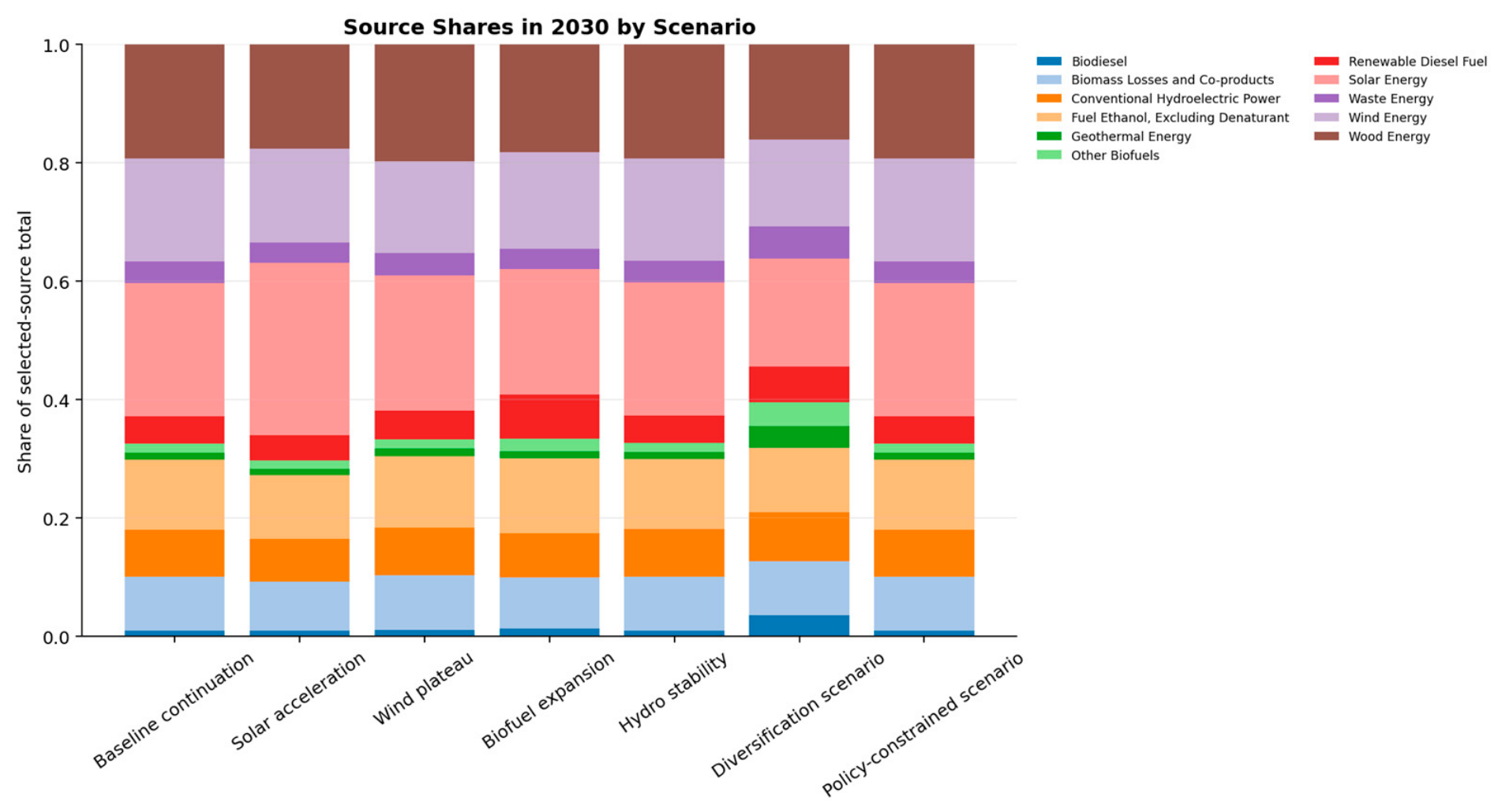
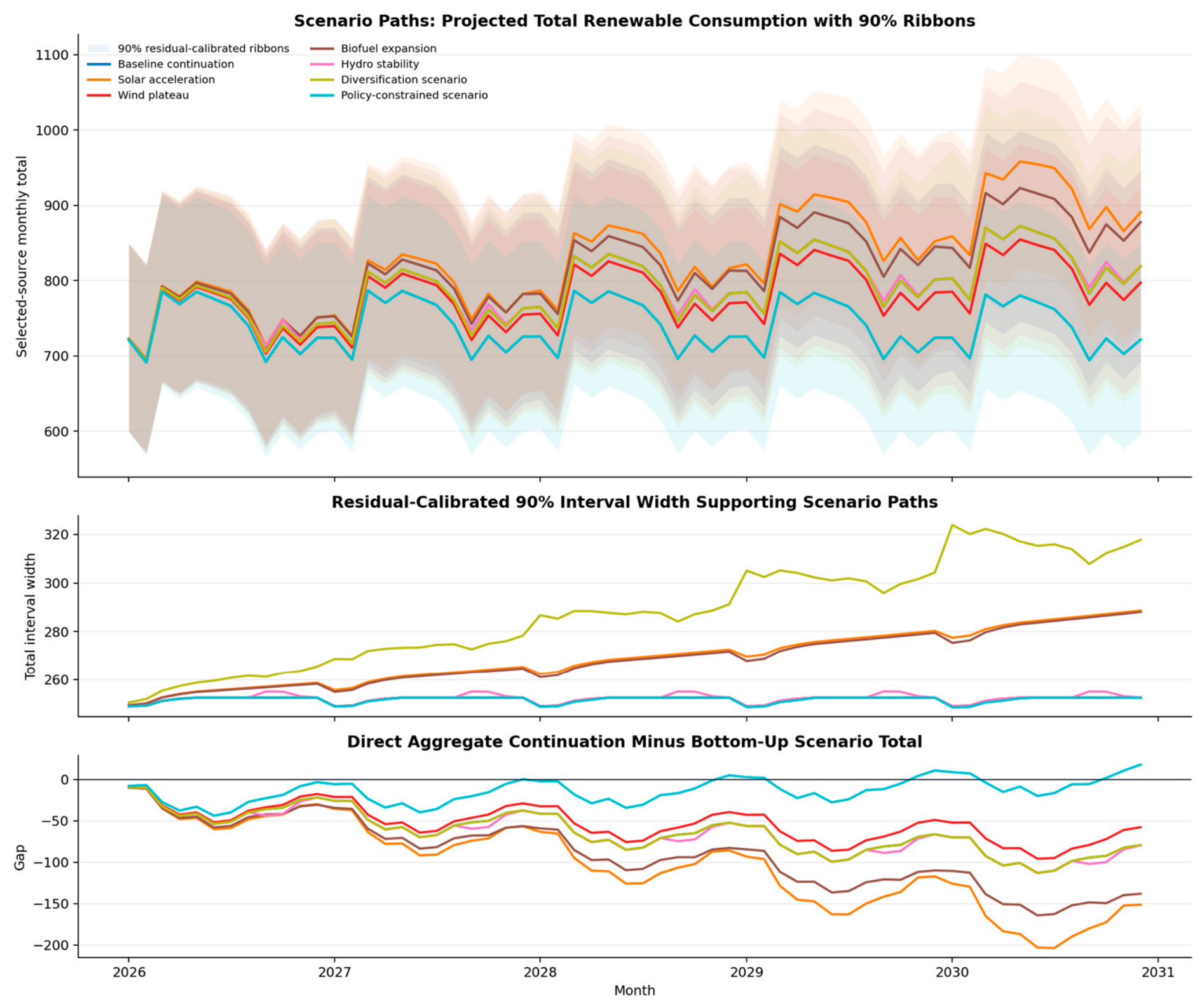
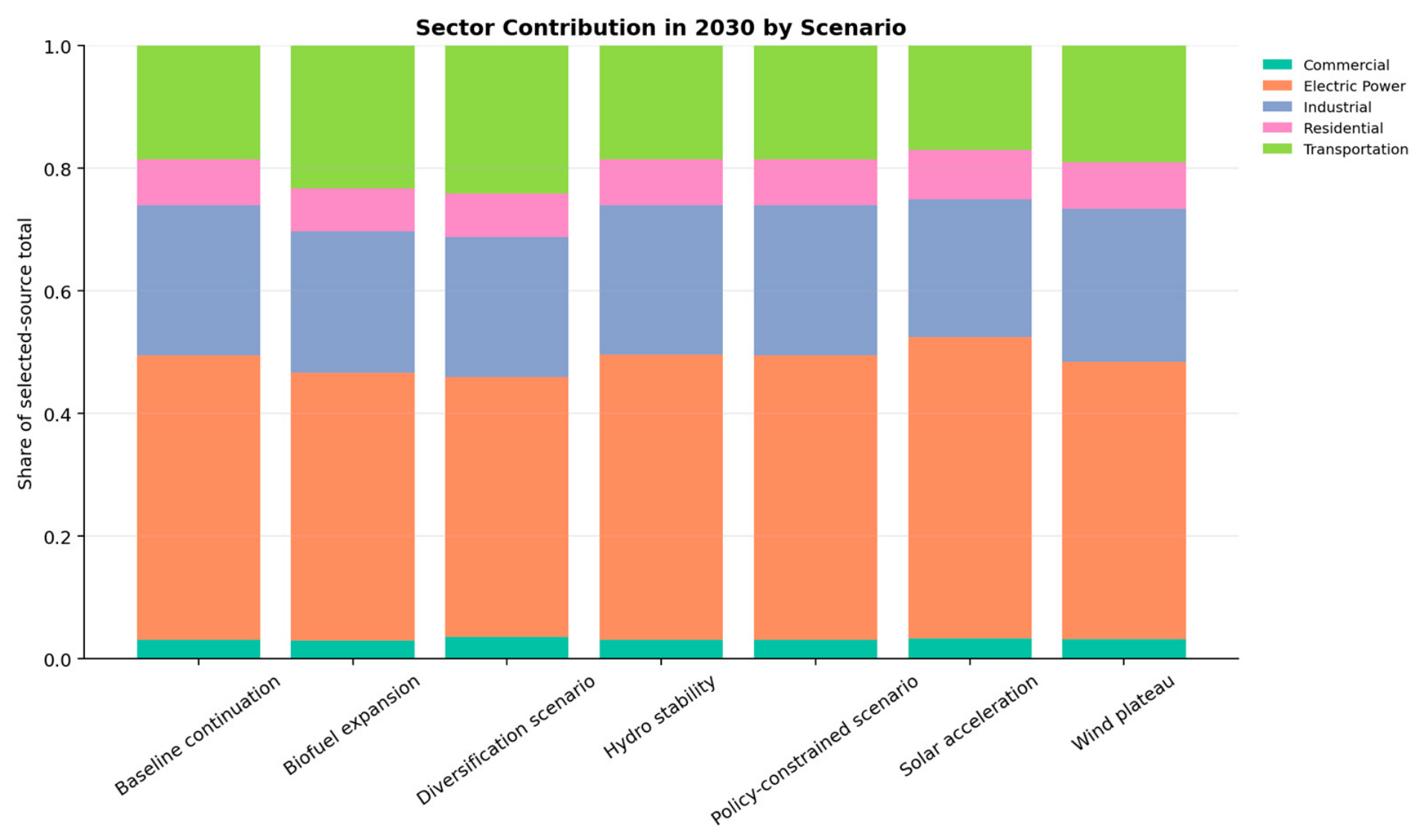
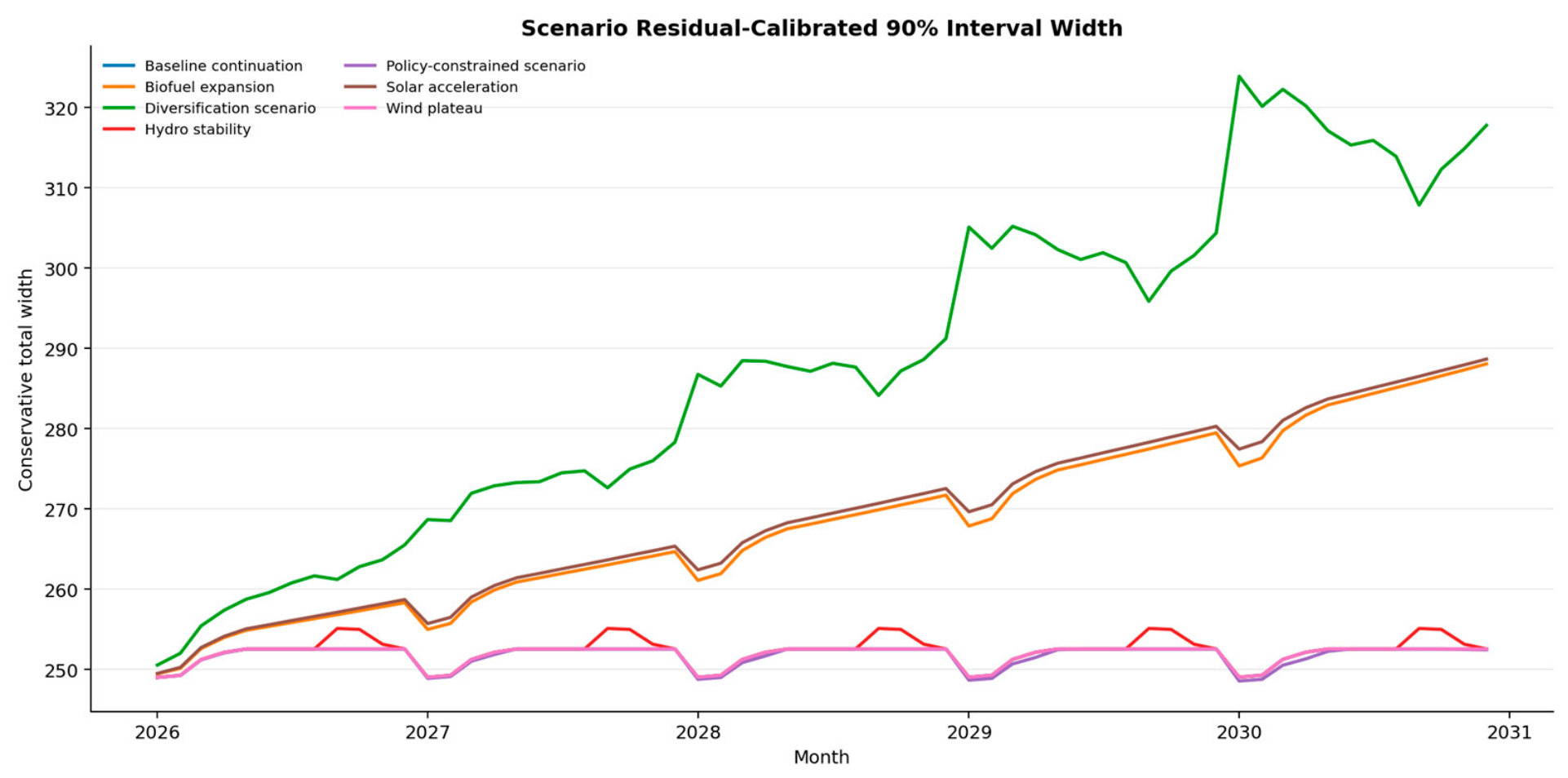
Seven future scenarios were evaluated: baseline continuation, solar acceleration, wind plateau, biofuel expansion, hydro stability, diversification, and policy-constrained growth. Each scenario was defined at the source-family level and then summarized through projected totals, source shares, sector contributions, portfolio concentration, uncertainty width, and coherence gaps, for more details, refer to
Table 3.
2.4. Data Preprocessing and Harmonization
The preprocessing pipeline standardized sector labels created a monthly timestamp, audited nonpositive and impossible values, and produced reported and harmonized analytical panels. The monthly timestamp was defined as
A cleaned value was obtained using an explicit impossible-value rule:
Annual sector–source totals were then computed from cleaned monthly values:
The national annual total for a mutually exclusive analytical family set
was
The distinction between reported and harmonized panels was maintained throughout the analysis. Reported Total Renewable Energy was used to describe official aggregate trajectories. Harmonized, mutually exclusive source-family totals were used for source shares, diversification indices, hierarchical reconciliation, and bottom-up scenario construction.
2.5. Long-Run Trend, Growth, and Volatility Analysis
The first empirical layer quantified long-run change in U.S. renewable energy consumption. Annual totals, monthly trajectories, rolling means, rolling volatility, and pre/post-2010 growth comparisons were generated. The post-2010 period was prespecified as the modern acceleration window because descriptive figures show a distinct increase in growth momentum after 2010.
Monthly proportional growth was calculated as
The compound annual growth rate between baseline year
and terminal
was
The 12-month rolling average was
Rolling volatility was measured as the 12-month standard deviation of monthly growth:
These descriptive measures were used to identify long-run growth, cyclical and seasonal variation, and changes in volatility relevant to forecast evaluation.
2.6. Source-Mix Dynamics and Diversification Analysis
Source-mix dynamics were evaluated using annual source shares, rolling shares, the Herfindahl-Hirschman Index, normalized Shannon entropy, and sector–source heatmaps. Source shares were computed only from mutually exclusive source-family totals to prevent double-counting aggregate and component variables.
The annual share of source family
was defined as
Portfolio concentration was measured using the Herfindahl–Hirschman Index:
A lower
indicates a less concentrated renewable energy portfolio. Normalized Shannon entropy was calculated as
where
approaches 1 when the portfolio is more evenly distributed across source families.
A rolling
-year share was calculated as
These metrics allowed the analysis to distinguish aggregate growth from compositional transformation.
2.7. Decomposition, Structural-Break Screening, and Panel Diagnostics
Because the dataset spans more than five decades, structural diagnostics were included to avoid assuming one stationary trend. Seasonal-trend decomposition, change-point screening, segmented trend diagnostics, CUSUM stability statistics, rolling slopes, and event-window comparisons were applied to the national total and selected source-specific series.
The additive decomposition was
where
is the long-run trend,
is the seasonal component, and
is the residual component.
PELT-style change-point detection minimized the penalized within-segment cost:
where
is a segment cost function and
β penalizes excessive breaks.
A segmented trend screen was specified as
CUSUM stability was based on cumulative standardized residuals:
For panel diagnostics, the wide dataset was reshaped into a long sector–source panel. A two-way fixed-effects representation was used descriptively:
where
captures sector–source heterogeneity and
captures common monthly effects.
A dynamic extension was expressed as
2.8. Forecast Model Development
Forecasting models were compared as benchmark families rather than as a single preferred algorithm. Statistical baselines included Seasonal Naïve, Naïve, Rolling Mean, ETS, STL plus ETS, Theta, linear trend-seasonal models, and dynamic harmonic regression. Feature-based machine learning models included Ridge, ElasticNet, RandomForest, ExtraTrees, HistGradientBoosting, LightGBM, and related tree-based approaches. Deep learning models were evaluated as a benchmark family, including recurrent, multilayer perceptron, decomposition-inspired, and Transformer-style architectures. Foundation models were evaluated as zero-shot or few-shot comparators where implementation was available.
For rolling origin
, the training sample and forecast horizon were defined as
The seasonal naïve forecast for monthly data was
Lag and rolling features for machine learning models were constructed only from past information:
Monthly seasonality was encoded using sine and cosine transformations:
A generic feature-based forecasting model was written as
where
contains lagged values, rolling summaries, calendar variables, source indicators, sector indicators, target-group indicators, and regime variables.
Neural multi-horizon models were trained to minimize
A foundation model forecast was represented as
where
is a pretrained forecasting function and
denotes available contextual information.
2.9. Rolling-Origin Validation and Forecast Evaluation
All forecasting models were evaluated under rolling-origin validation rather than random splitting because random sampling would allow future information to influence assessment and would not represent an operational forecasting task. The validation windows were selected to cover historically distinct portions of the modern renewable energy transition while preserving chronological order. The 2010–2015 window represents the early post-2010 acceleration period, when wind, biofuel, and electric power renewable contributions became increasingly visible. The 2016–2019 window represents the immediately pre-pandemic expansion period, with continued diversification but without the large pandemic-related disruption present in later data. The 2020–2022 window captures the pandemic and early recovery period, when energy consumption, transportation activity, supply chains, and sectoral demand patterns were unusually volatile. The 2023–2025 window was reserved as the most recent high-renewable holdout period and provides a practical test of performance under current source-mix conditions. These windows were not interpreted as causal policy regimes; instead, they were used as sequential robustness blocks motivated by the structural-regime diagnostics and the need to evaluate performance across changing historical conditions.
Performance was reported by horizon, validation window, target group, and model family. This design prevents a single aggregate statistic from concealing horizon-specific deterioration, window-specific instability, or target-group failure. The model comparison therefore emphasizes temporal robustness and practical forecast behavior rather than a single leaderboard value.
The horizon-specific error for model
was
Mean absolute scaled error was the primary scale-free metric:
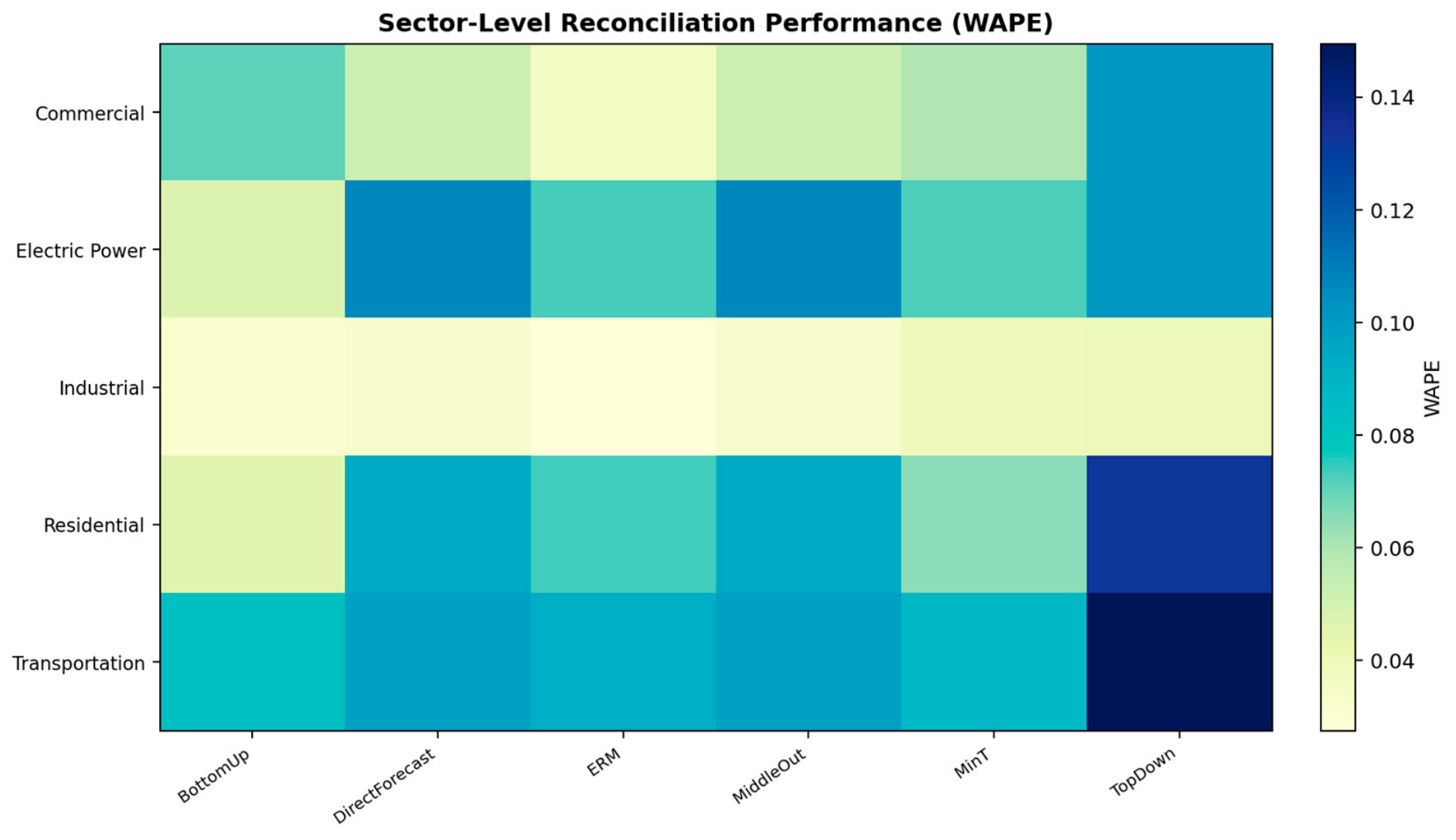
Weighted absolute percentage error was used for selected hierarchical and sector-level summaries:
Root mean squared error was calculated as
Performance was reported by horizon, validation window, target group, and model family to prevent a single summary statistic from concealing target- or horizon-specific failures.
2.10. Probabilistic Forecasting and Interval Assessment
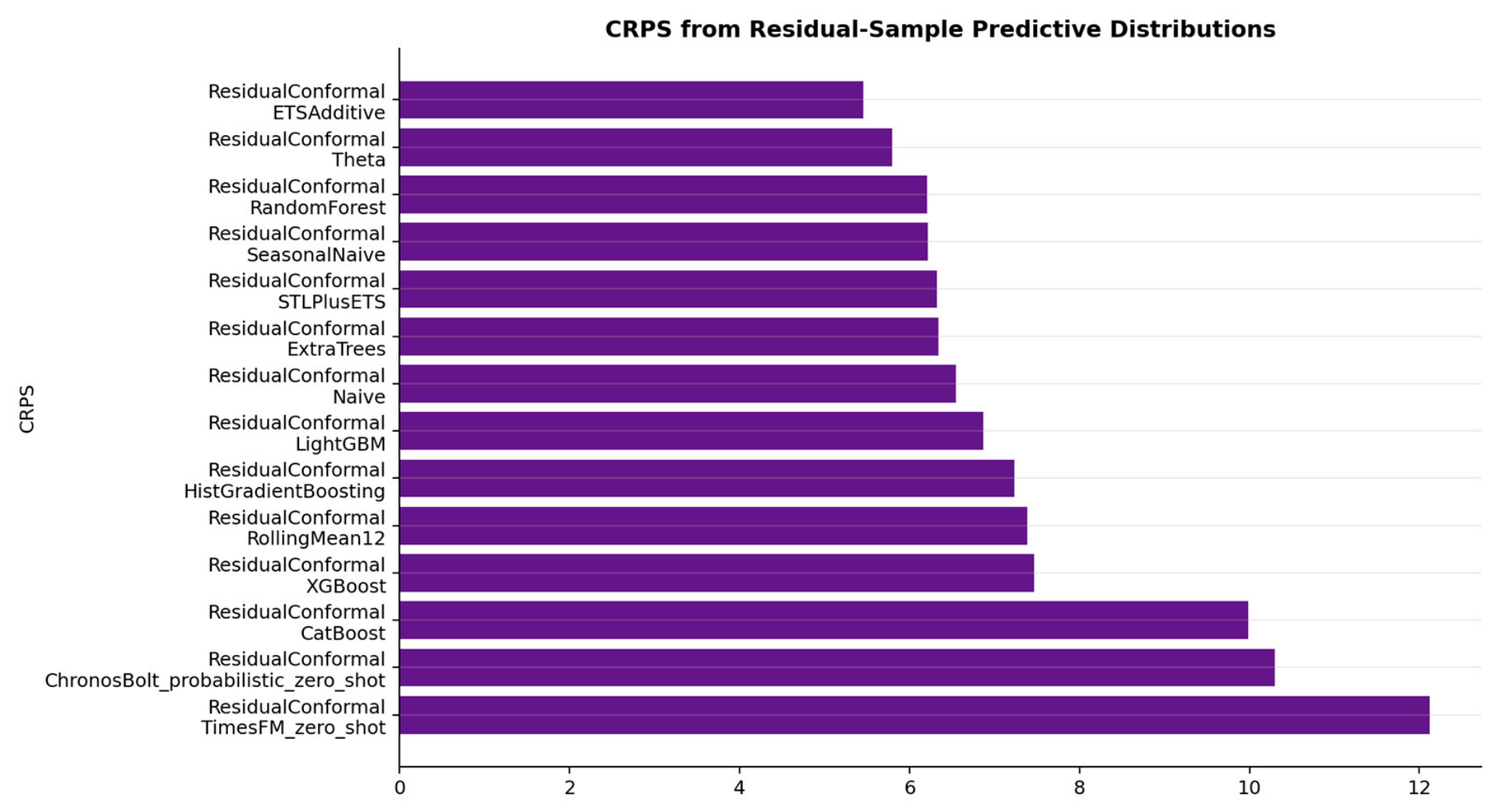
Probabilistic forecasts were evaluated through interval coverage, interval width, Winkler score, and residual-sample CRPS.
Prediction interval coverage probability for a nominal interval
was
Prediction interval normalized average width was
where
is the observed range of the target.
For nominal coverage
, the Winkler score was
For a predictive cumulative distribution
, CRPS was defined as
These diagnostics were interpreted jointly because a model can have high coverage simply by producing intervals that are too wide for planning.
2.11. Hierarchical Reconciliation and Coherence Diagnostics
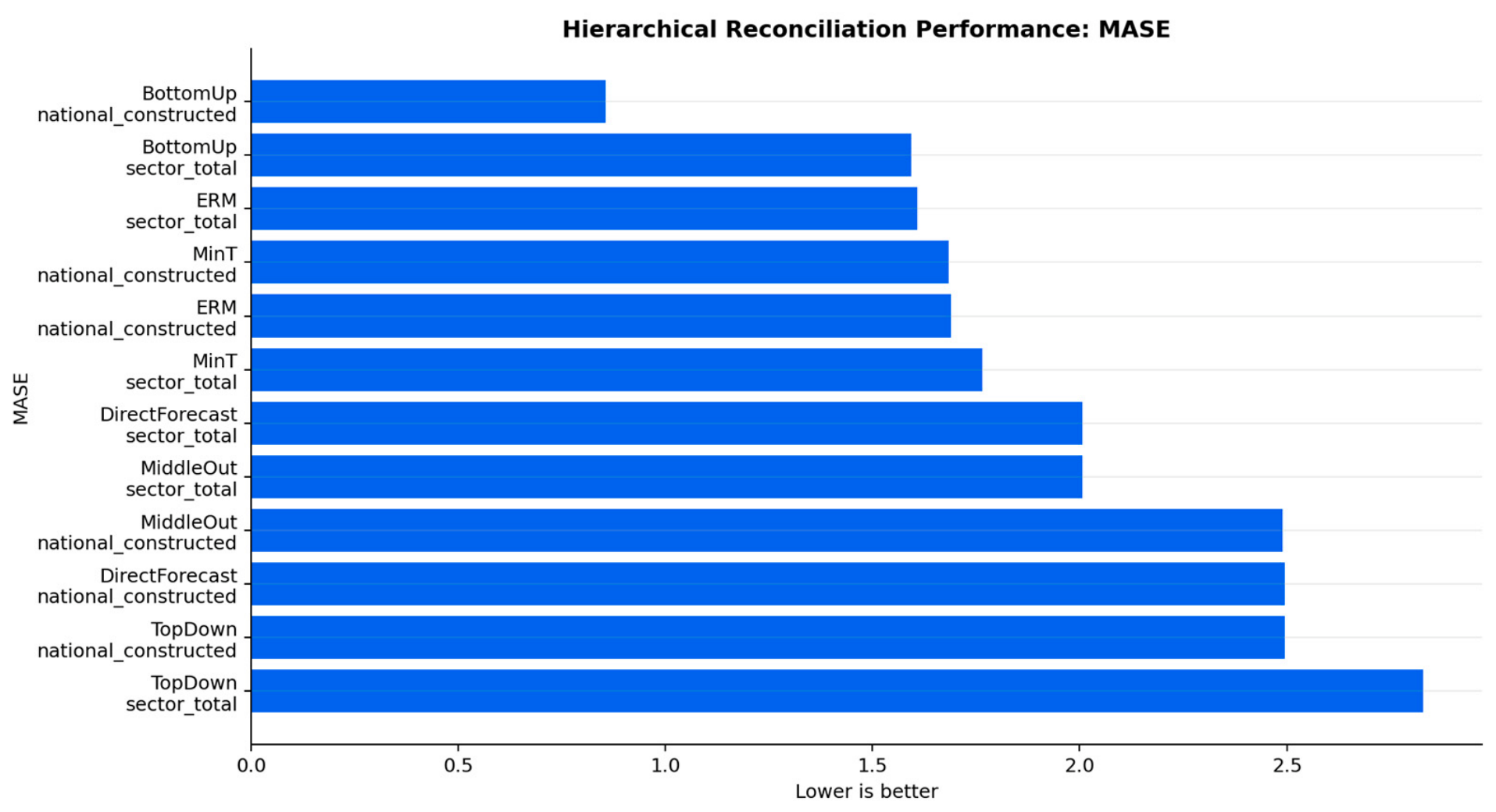
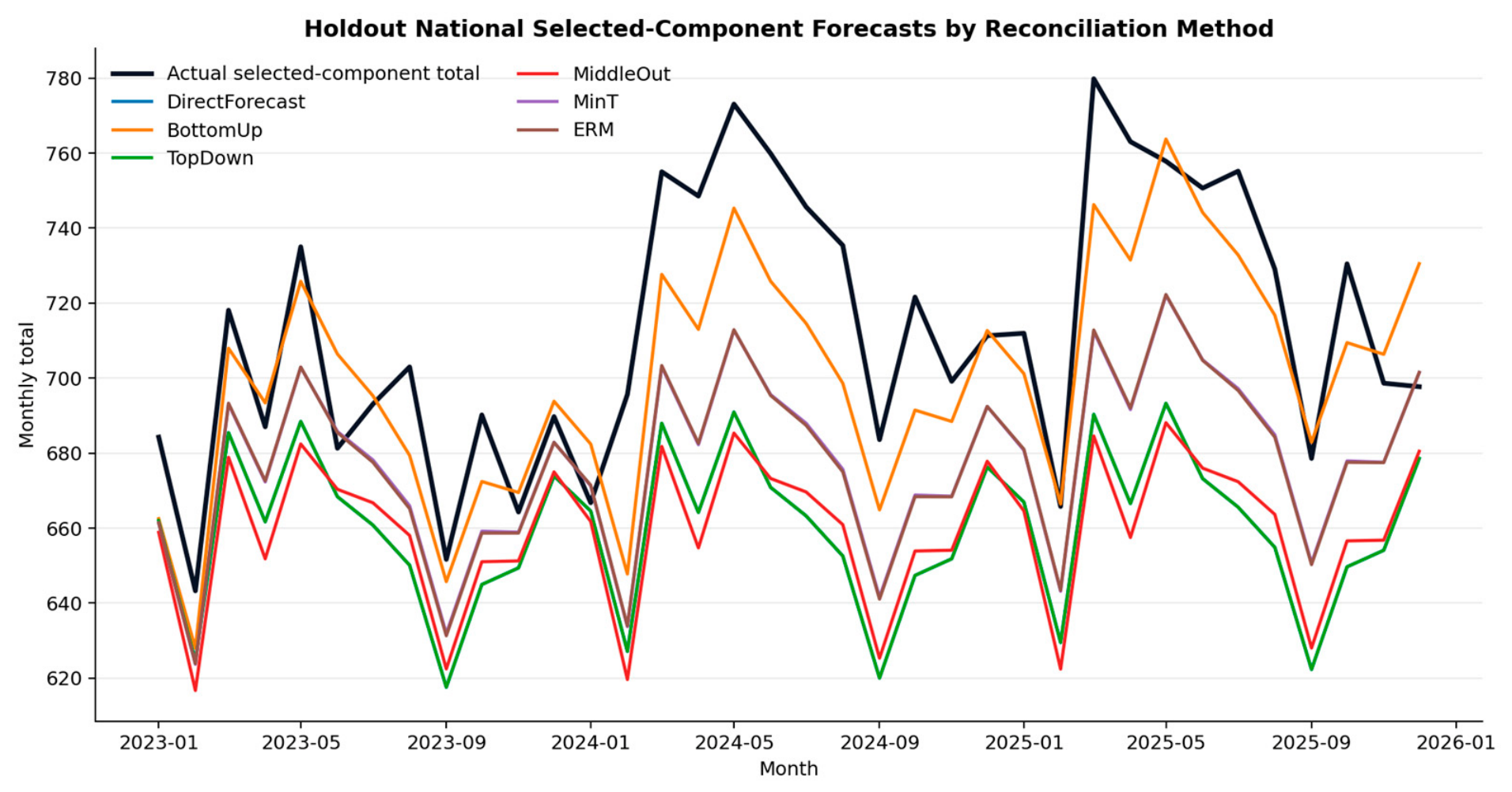
Renewable energy consumption naturally forms an aggregation hierarchy, from sector–source components to sector totals, source totals, and national totals. Formal reconciliation was applied only to mutually exclusive source families to avoid reconciling overlapping aggregate and component variables.
The hierarchy was represented as
where
is the vector of bottom-level component series and
is the summing matrix.
Bottom-up reconciliation was
A general linear reconciliation was
For MinT reconciliation, the reconciliation matrix was expressed as
The direct-versus-component coherence gap was
A nonzero gap indicates that separately modeled aggregate and component forecasts disagree.
2.12. Scenario Design and Decision-Focused Evaluation
Scenario analysis translated forecast outputs into policy-relevant pathways. A source-specific scenario adjustment was applied to a baseline forecast as
where
is the adjustment for source family
under scenario
.
Scenario source shares were then calculated as
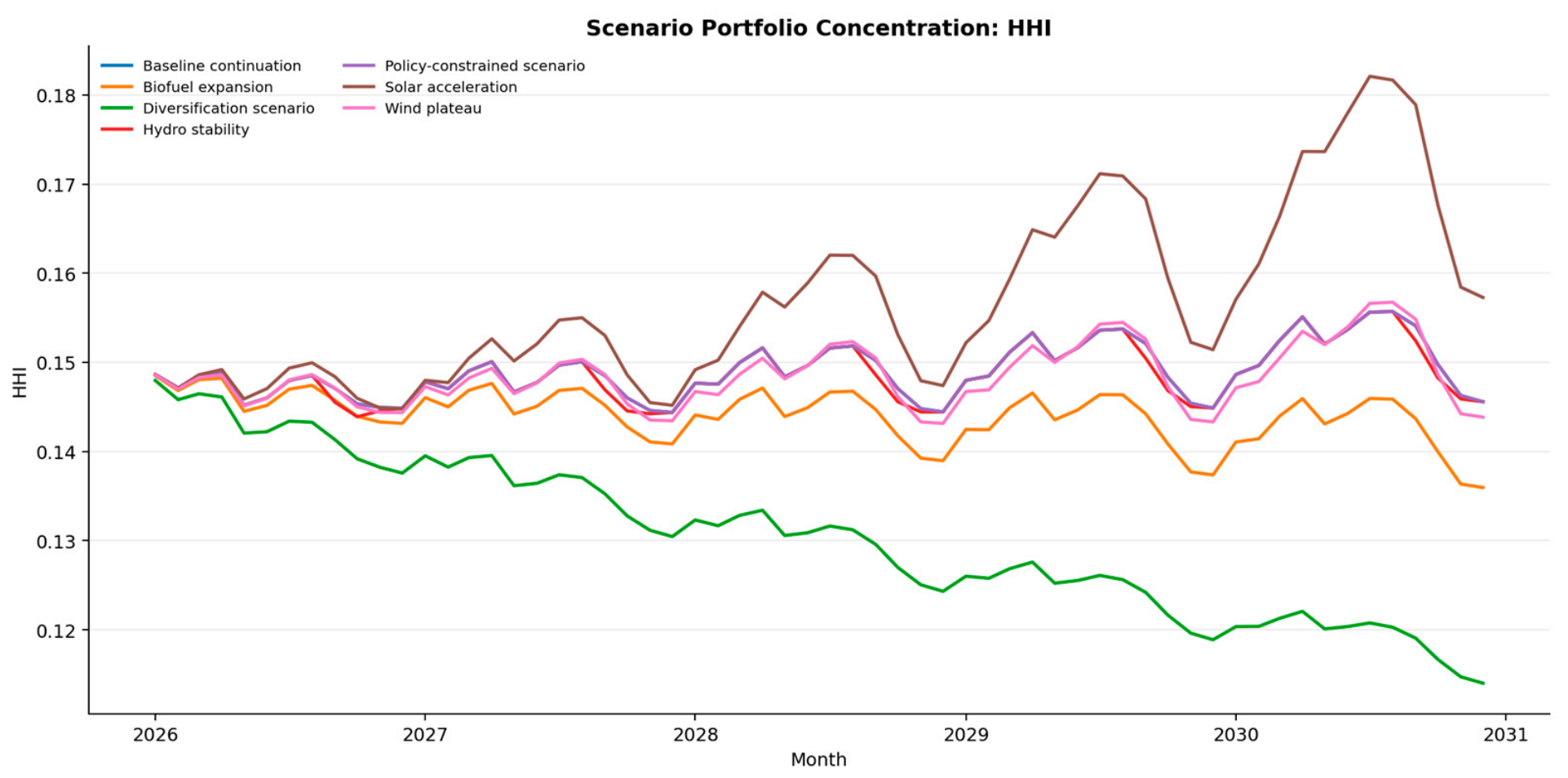
Scenario concentration was measured as
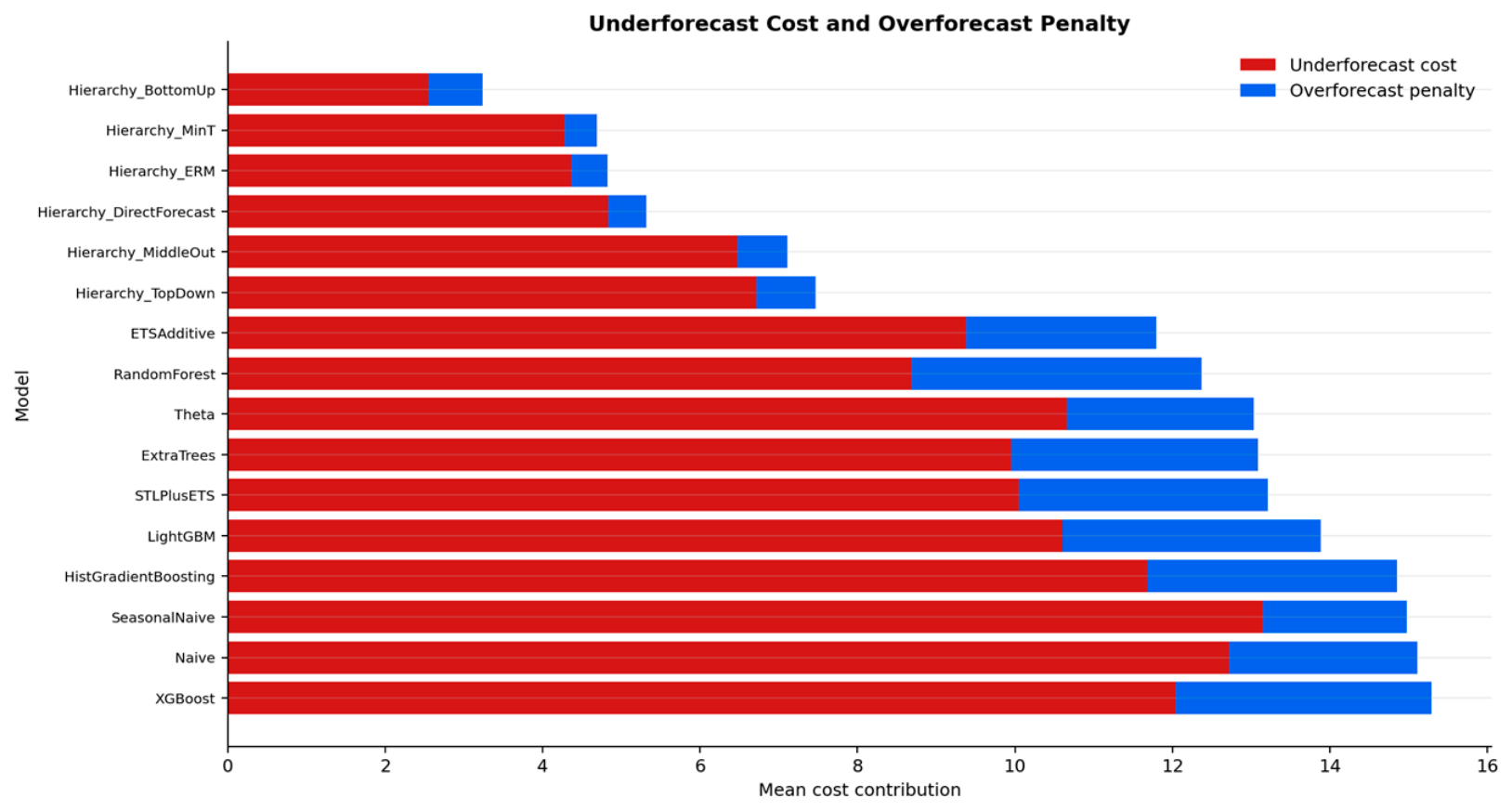
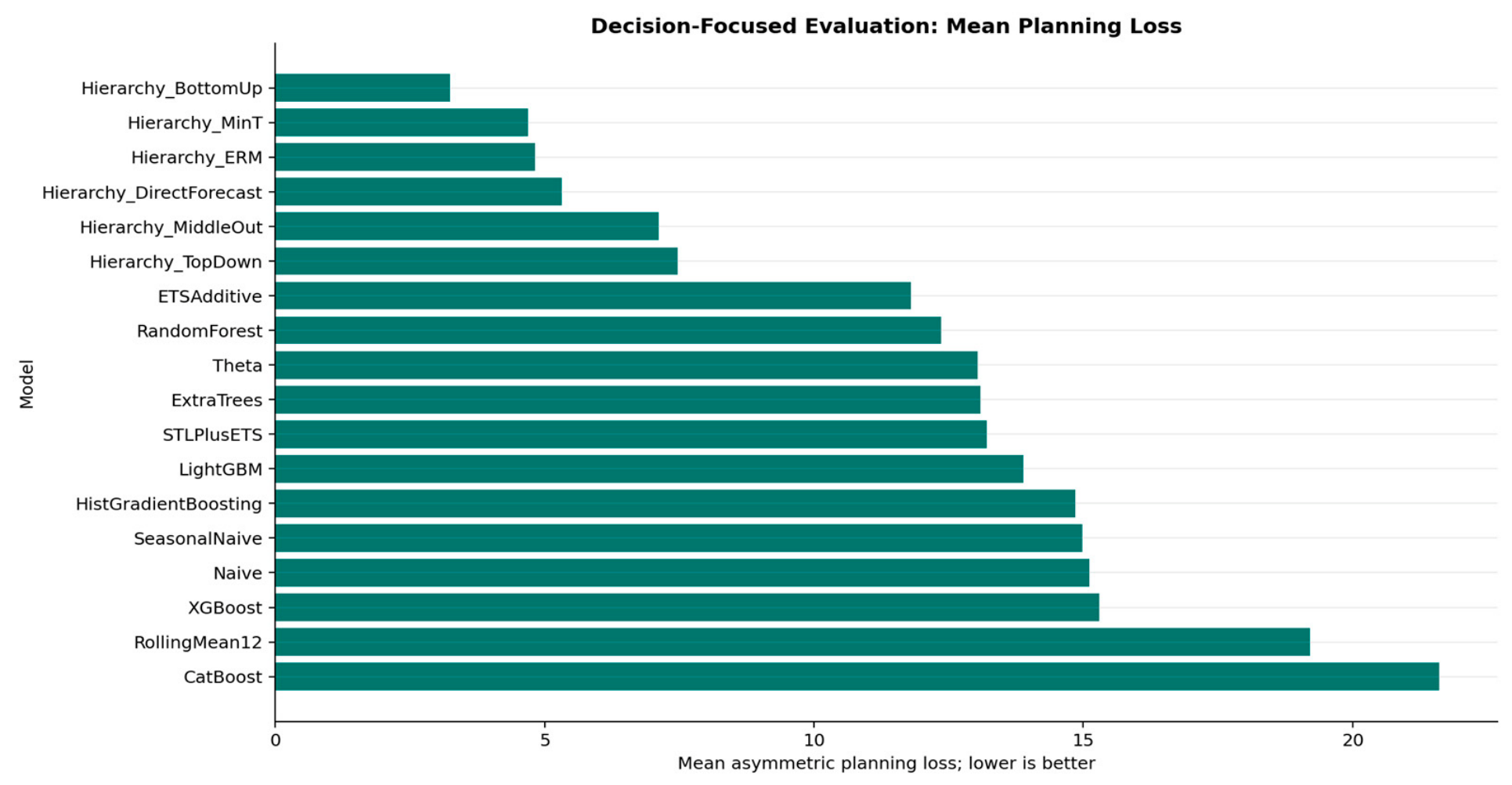
Decision-focused evaluation used an asymmetric planning loss function:
where
and
are underforecasting and overforecasting costs. Mean planning loss was
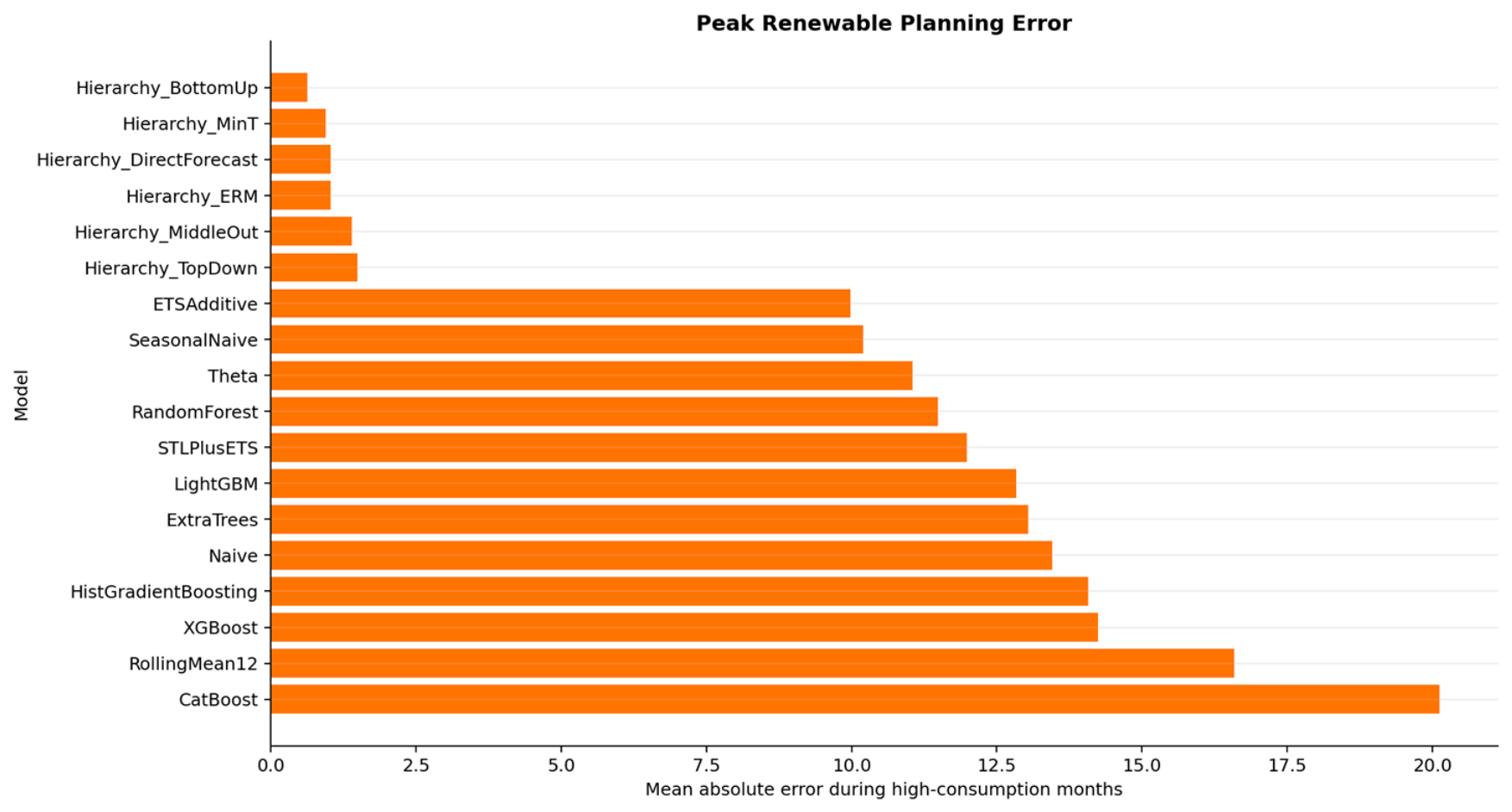
Peak-month planning error was
where
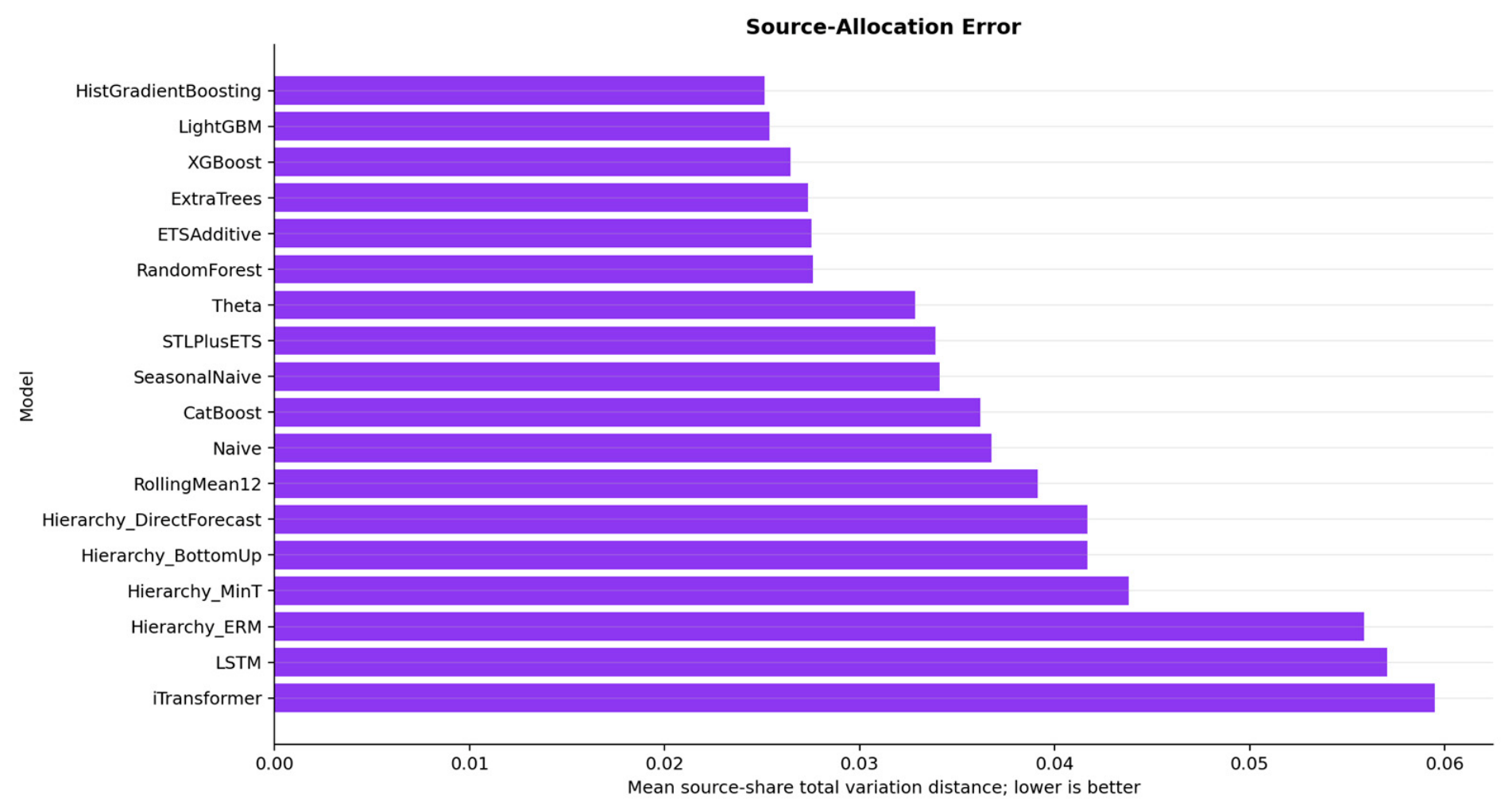
denotes high-consumption months. Source-allocation error was measured using total variation distance:
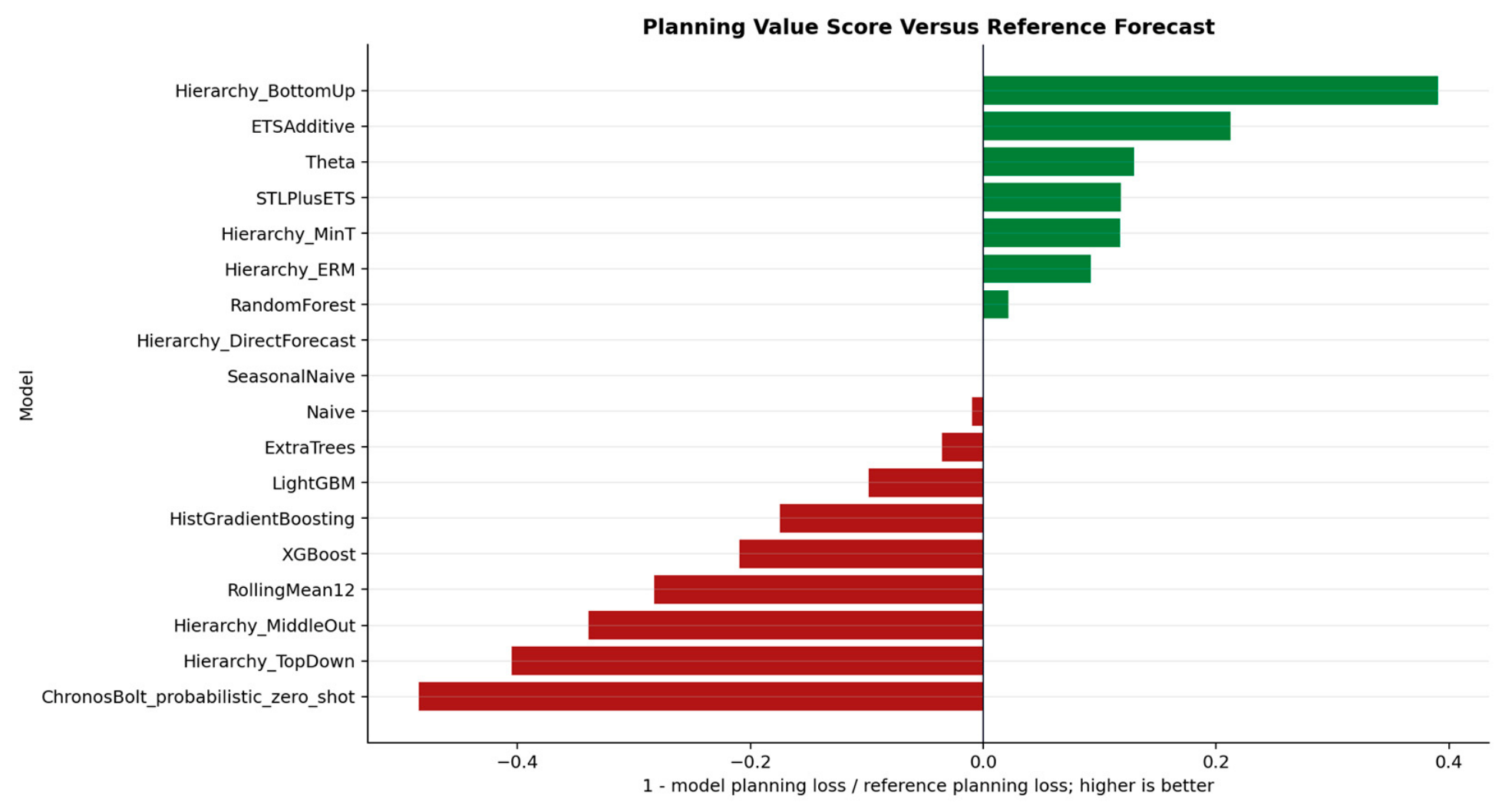
Planning value relative to a reference forecast was
Positive planning value indicates improvement over the reference forecast. On the one hand,
Table 4 summarizes the integrated evaluation workflow. On the other hand,
Table 5 provides the validation, uncertainty, hierarchy, and planning workflow. Additionally,
Table 6 indicates the future scenario definitions.
2.13. Reporting and Reproducibility
Results were reported to align with reproducible forecasting standards: explicit data definitions, separate reported and harmonized panels, transparent preprocessing, formal mathematical definitions, temporally valid validation, model-family comparisons, probabilistic interval diagnostics, hierarchy-specific coherence checks, and decision-focused metrics. All figures were interpreted with attention to whether they represented reported totals, mutually exclusive source-family totals, forecast holdouts, future scenario projections, or planning-loss summaries. Foundation model availability and runtime constraints were reported transparently to avoid overstating incomplete comparisons.
3. Results
3.1. Dataset Composition and Analytical Design
The results are based on a complete monthly multisector renewable energy panel spanning January 1973 through December 2025, more details about the dataset profile and retained forecast-target coverage are available in
Table 7. The analytic file contained 3180 sector–month observations, representing 636 monthly periods and five reporting sectors: Commercial, Electric Power, Industrial, Residential, and Transportation. Each month contained one record per sector. No raw missing values were identified, which allowed the empirical workflow to focus on harmonization, source-family construction, structural diagnostics, forecast validation, uncertainty assessment, and planning-oriented evaluation rather than missing-data imputation. One negative hydroelectric value was detected during the audit and corrected as an impossible-value issue before downstream analysis. The results should be interpreted with a clear distinction between reported aggregate totals and harmonized mutually exclusive source-family totals. Reported Total Renewable Energy was used to describe national trajectories, whereas source-mix, diversification, reconciliation, and scenario analyses used non-overlapping source families to avoid double counting aggregate and component variables.
3.2. Long-Run Renewable Energy Trends and Post-2010 Acceleration
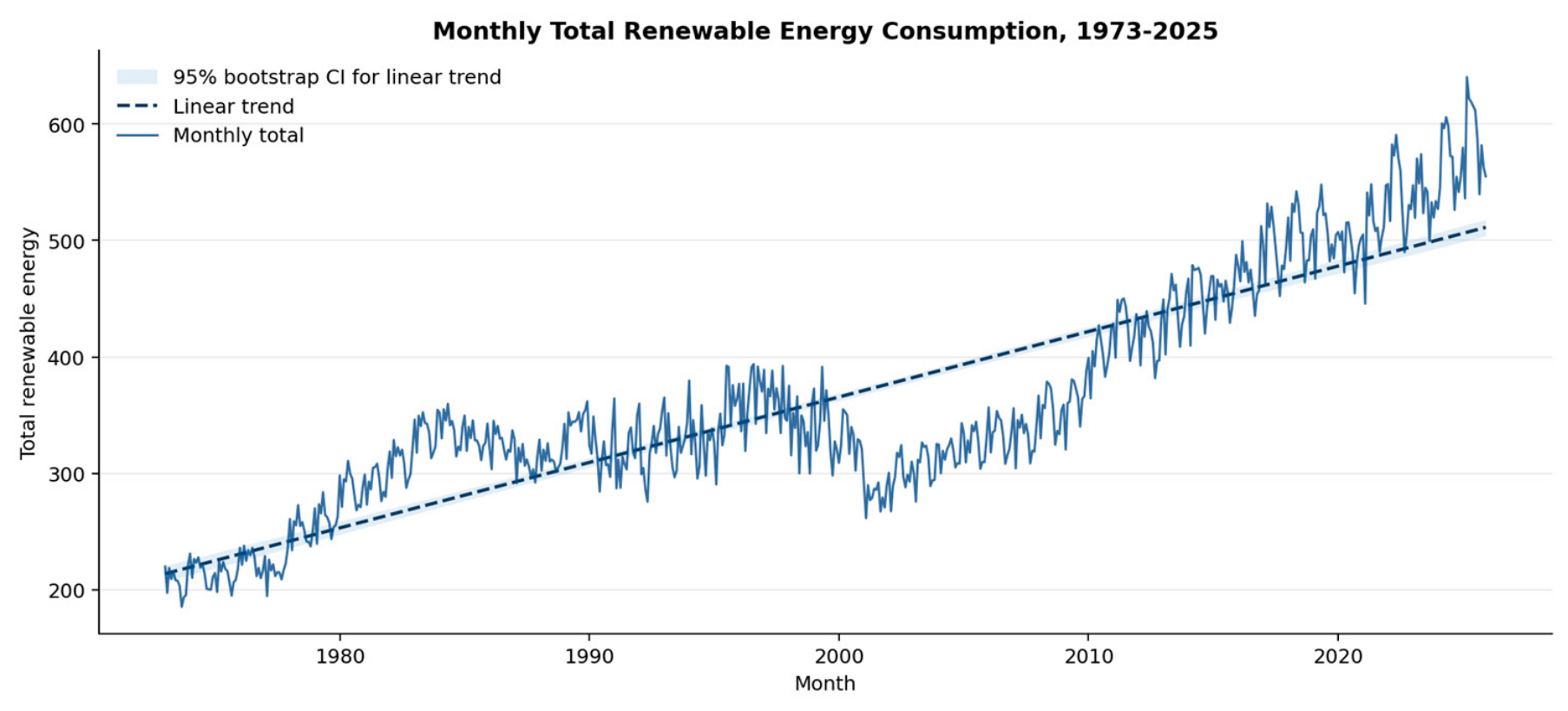
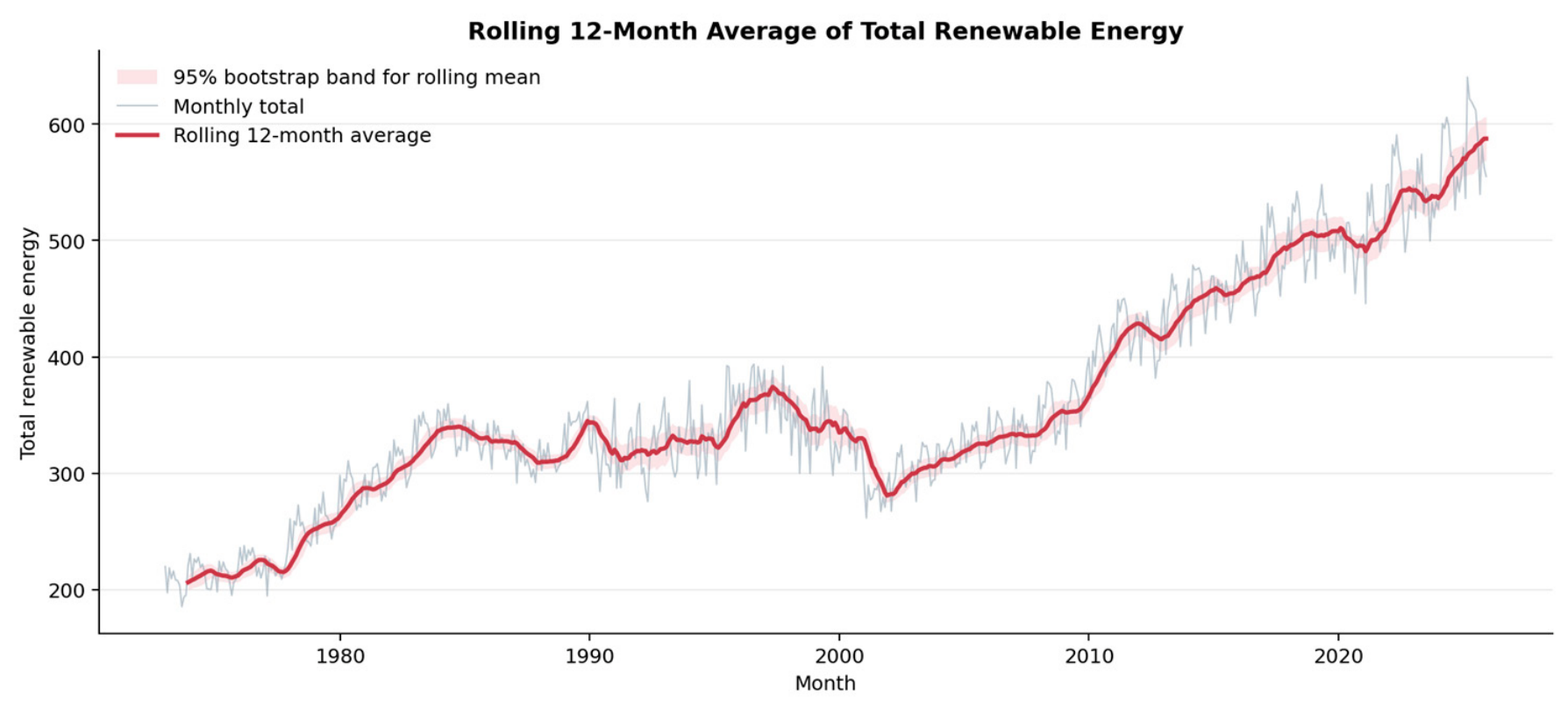
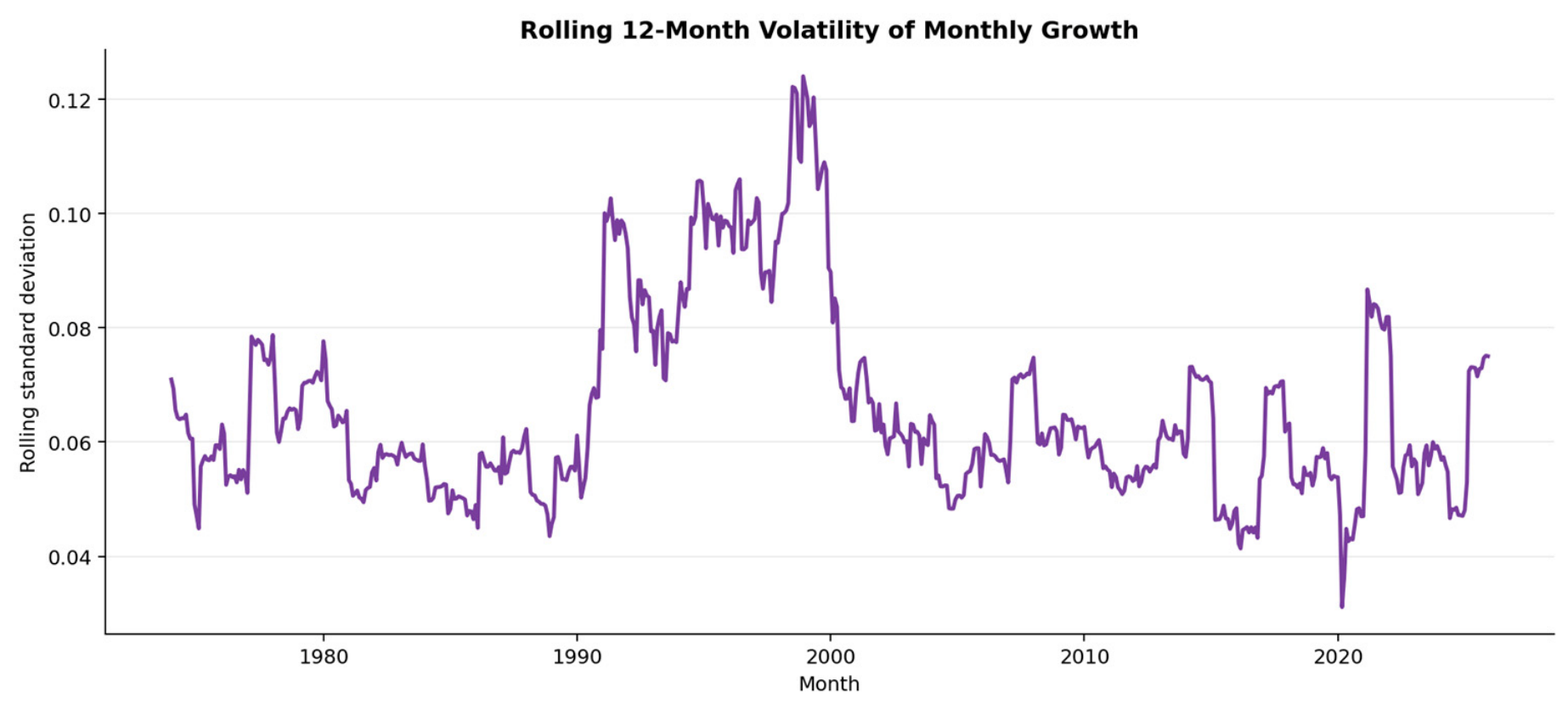
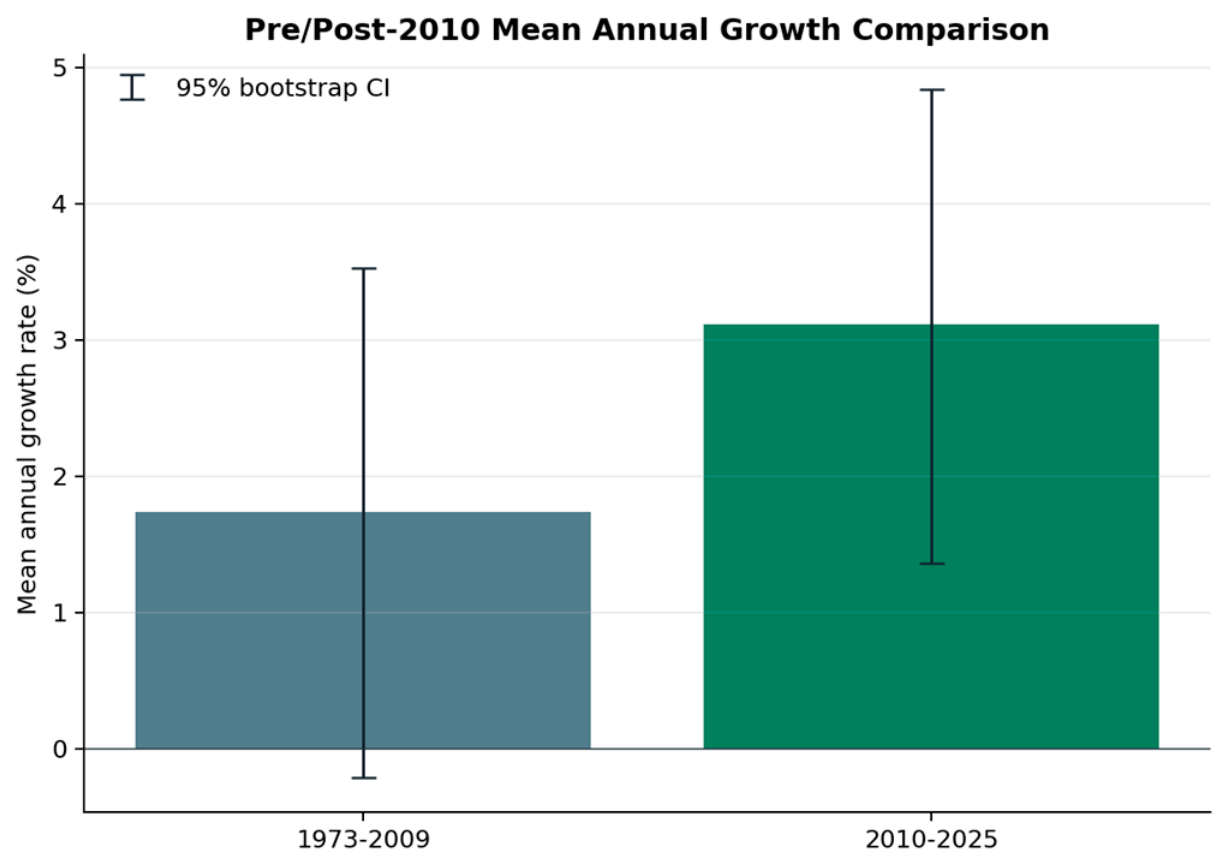
Figure 1,
Figure 2,
Figure 3,
Figure 4,
Figure 5,
Figure 6,
Figure 7 and
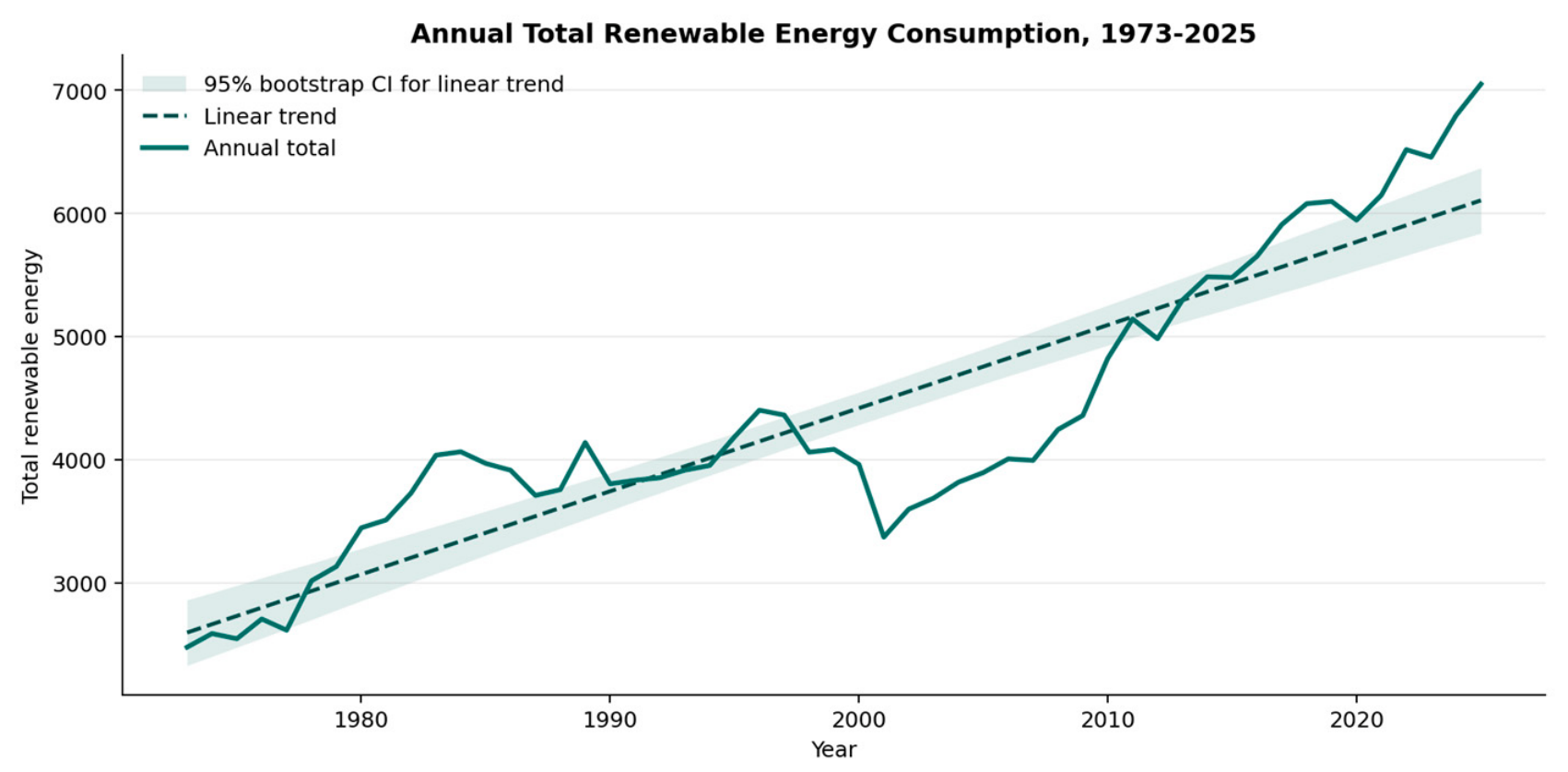
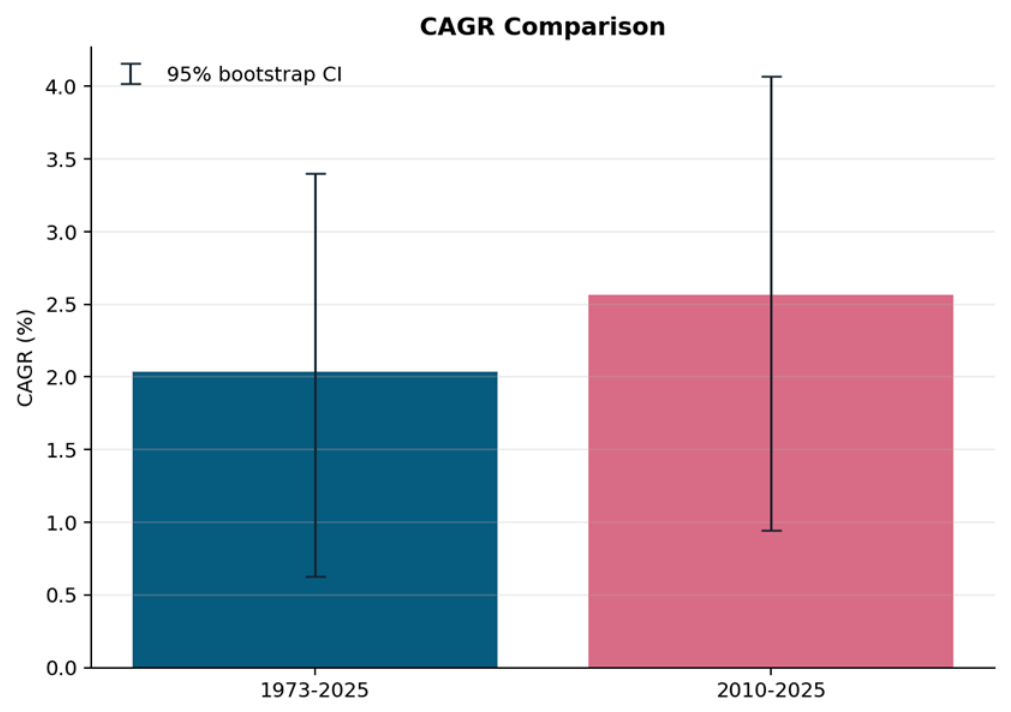
Figure 8 summarize the historical growth profile of U.S. renewable energy consumption. The main result is a sustained long-run increase, with stronger growth after 2010. Annual reported Total Renewable Energy increased from 2475.547 trillion Btu in 1973 to 7050.214 trillion Btu in 2025. The full-period CAGR was 2.03% per year, whereas the 2010–2025 CAGR was 2.57% per year. In response to reviewer concerns about uncertainty visualization,
Figure 1,
Figure 3,
Figure 5 and
Figure 6 now include confidence intervals, bootstrap trend bands, or error bars where applicable. These uncertainty displays strengthen the descriptive interpretation of long-run growth and post-2010 acceleration while avoiding causal overstatement. The figures also show that the expansion was not a smooth monotonic process; it included recurrent monthly seasonality, time-varying volatility, sector-specific source use, and a modern acceleration phase.
Figure 1 shows the annual trajectory of reported total U.S. renewable energy consumption from 1973 through 2025, with the uncertainty around the fitted long-run trend summarized by a 95% confidence or bootstrap trend band. The observed annual series increased substantially over the full study period, rising from the 1970s baseline to the highest levels in the final years of the sample. The uncertainty band supports the interpretation that the long-run increase is not driven by isolated annual fluctuations; instead, the fitted trend remains upward across the full sample. The figure also suggests visually distinct historical phases, including early expansion through the 1980s, a slower transitional period around the late 1990s and early 2000s, and renewed acceleration after 2010. Because the interval represents uncertainty around the estimated trend rather than causal evidence, the result should be interpreted as a statistically supported descriptive trend, not as proof of a specific policy or market cause.
Figure 2 documents the monthly scale of the renewable energy consumption series rather than presenting seasonality as an unexpected finding. The figure shows that annual growth is accompanied by substantial within-year variation, recurring seasonal structure, short-run deviations, and changing amplitude over time. These features are expected in monthly energy data, but they are methodologically important because they are not visible in annual totals alone. The monthly pattern motivates the use of seasonally aware statistical baselines, rolling-origin validation, prediction intervals, visual forecast-path inspection, and peak-sensitive planning metrics. Thus,
Figure 2 is used as a diagnostic justification for the forecasting design rather than as evidence of a novel historical fact.
Figure 3 smooths short-run monthly fluctuations using a rolling 12-month average and adds uncertainty around the smoothed trajectory through a 95% confidence or bootstrap trend band. The smoothed path clarifies the multi-stage growth profile: renewable energy consumption rose during the early expansion period, softened around the late 1990s and early 2000s, and increased more sharply after 2010. The confidence band indicates that the post-2010 increase is not merely a temporary monthly spike but a persistent shift in the smoothed level of consumption. At the same time, the band widens during periods of greater monthly variability, showing that trend interpretation should account for time-varying uncertainty. This figure therefore supports the use of regime-aware validation windows and reinforces the need to evaluate forecasts across historically distinct periods.
Figure 4 reports the rolling 12-month standard deviation of monthly renewable energy growth, providing a descriptive measure of time-varying volatility. The series shows that growth variability was not constant across the study period. Volatility increased during transitional periods, especially around the 1990s and early 2000s, and remained uneven during the modern expansion period. This result is important because it shows that the renewable energy series cannot be adequately represented by a single, fixed-variance assumption. The volatility evidence supports the later use of probabilistic forecast evaluation, interval width diagnostics, Winkler score, CRPS, and decision-focused planning metrics. In contrast to
Figure 1 and
Figure 3,
Figure 4 is best interpreted as a descriptive volatility diagnostic rather than a formal test of trend significance.
Figure 5 compares mean annual growth before and after 2010, with uncertainty summarized using 95% confidence intervals or bootstrap error bars. The post-2010 period shows a visibly higher mean annual growth rate than the 1973–2009 period. The addition of uncertainty intervals strengthens the interpretation of post-2010 acceleration by showing the sampling uncertainty around each period-specific growth estimate. If the displayed intervals show limited overlap, the figure supports treating the modern period as a distinct acceleration regime for descriptive interpretation and model-validation design. If the intervals overlap, the result should still be reported as directionally consistent with acceleration, but with more cautious language. In either case, the figure should be interpreted as evidence of a historical growth-rate difference rather than a causal estimate of the effect of any single policy, technology, or market event.
Figure 6 compares the full-period compound annual growth rate with the post-2010 compound annual growth rate, with uncertainty summarized using bootstrap confidence intervals or error bars. The full-period CAGR is approximately 2.03% per year, whereas the 2010–2025 CAGR is approximately 2.57% per year. The higher post-2010 estimate indicates that recent renewable energy growth exceeded the average compounded rate observed over the complete 1973–2025 period. The uncertainty intervals provide important context for this comparison by showing the range of plausible compounded growth estimates under resampling or interval estimation. This revised figure, therefore, strengthens the acceleration claim while keeping the interpretation appropriately descriptive: the post-2010 period exhibits faster compounded growth, but the figure does not by itself identify the causal drivers of that acceleration.
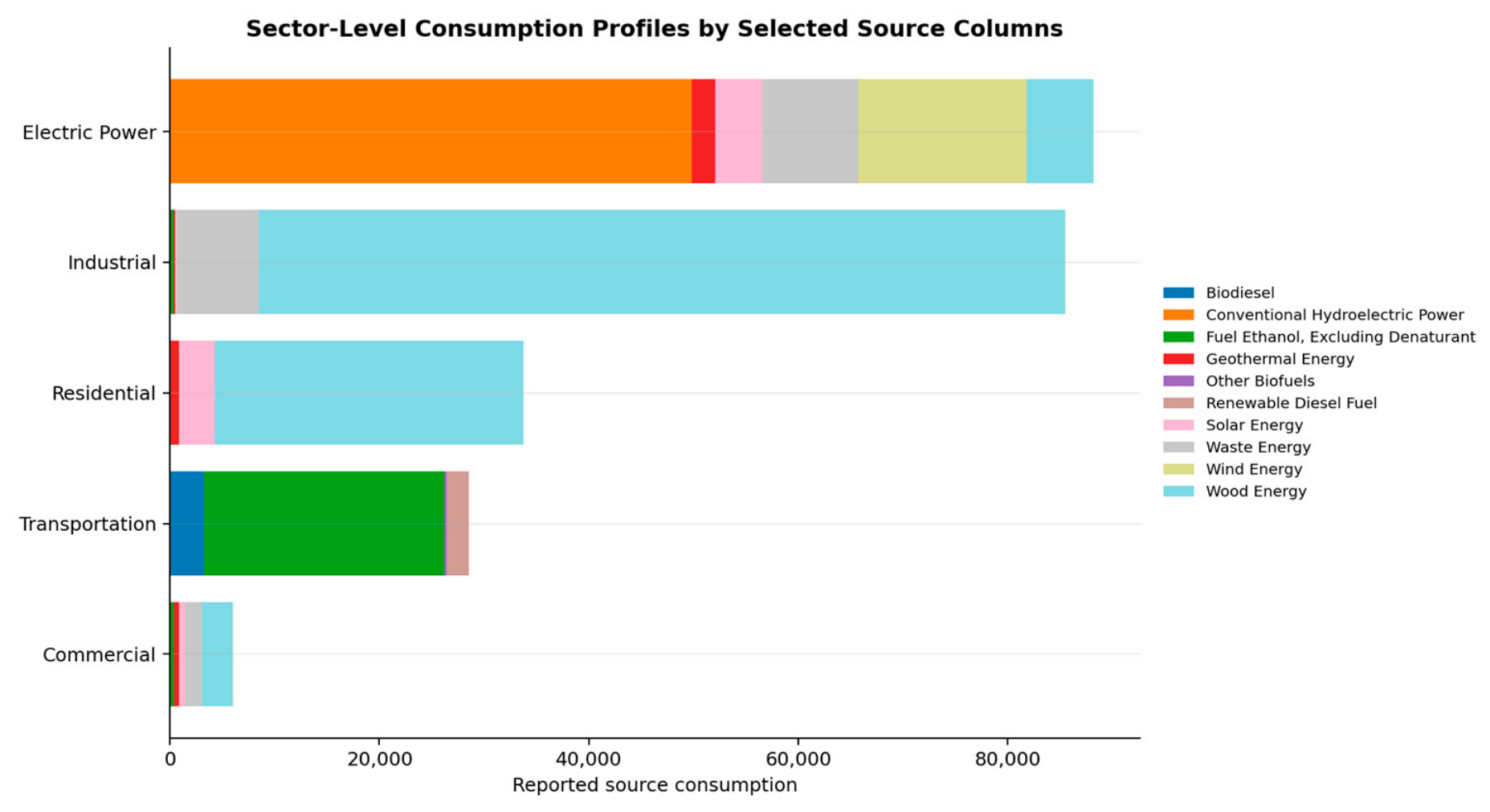
Figure 7 shows strong sectoral heterogeneity. Electric Power and Industrial account for the largest reported consumption among the selected renewable-source columns. Transportation is dominated by fuel-ethanol and biofuel-related categories, while Residential and Commercial are smaller and more source-specific. The figure demonstrates why a national-only model is insufficient for explaining renewable energy consumption patterns.
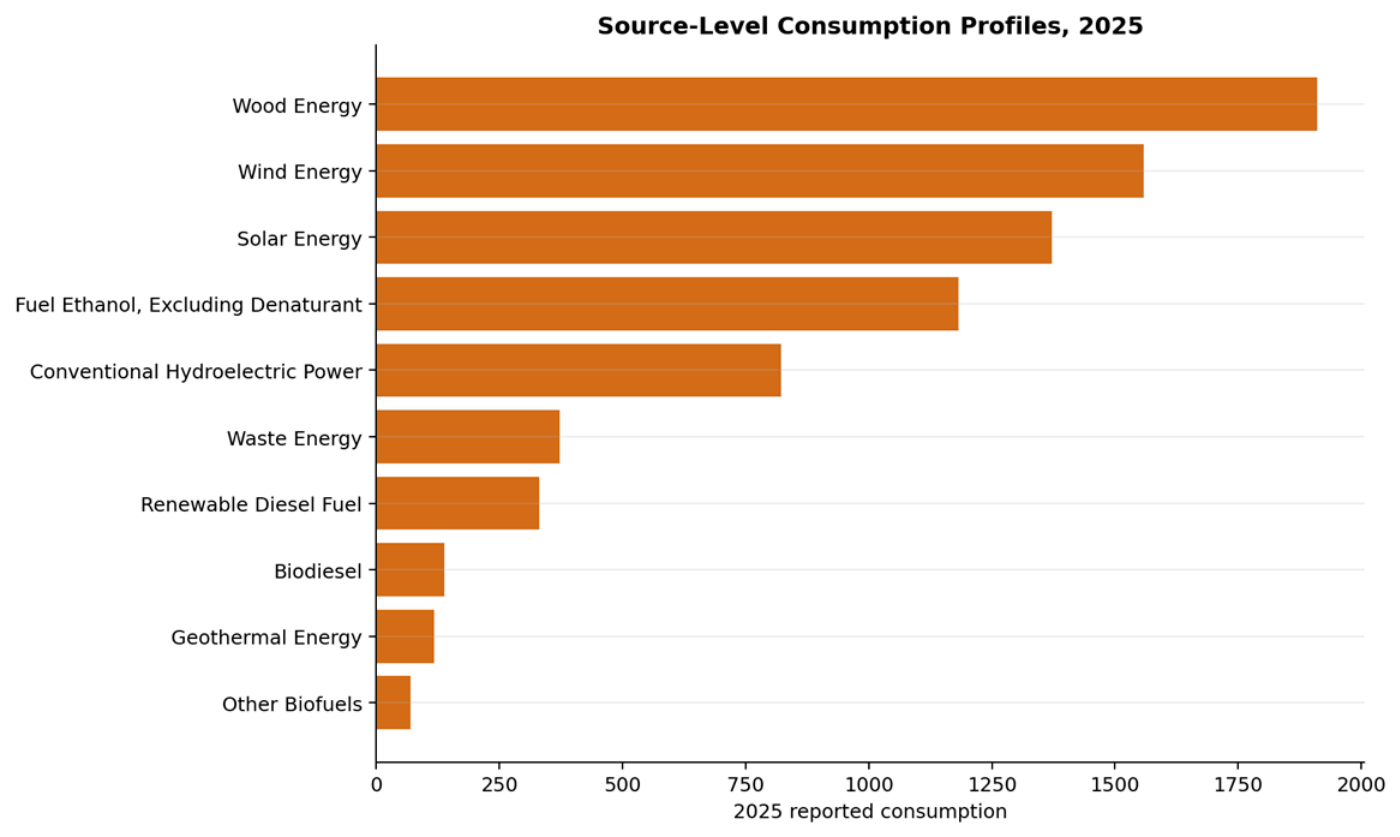
Figure 8 shows that Wood Energy, Wind Energy, Solar Energy, Fuel Ethanol, and Conventional Hydroelectric Power are the largest reported sources in 2025. The ranking indicates that legacy sources remain important, but wind and solar have become central contributors. The final-year profile therefore supports a source-mix transition interpretation rather than a simple aggregate-growth story.
Table 8 provides information about the trend and source-profile synthesis.
3.3. Source-Mix Diversification and Sector-Specific Composition
Figure 9,
Figure 10,
Figure 11 and
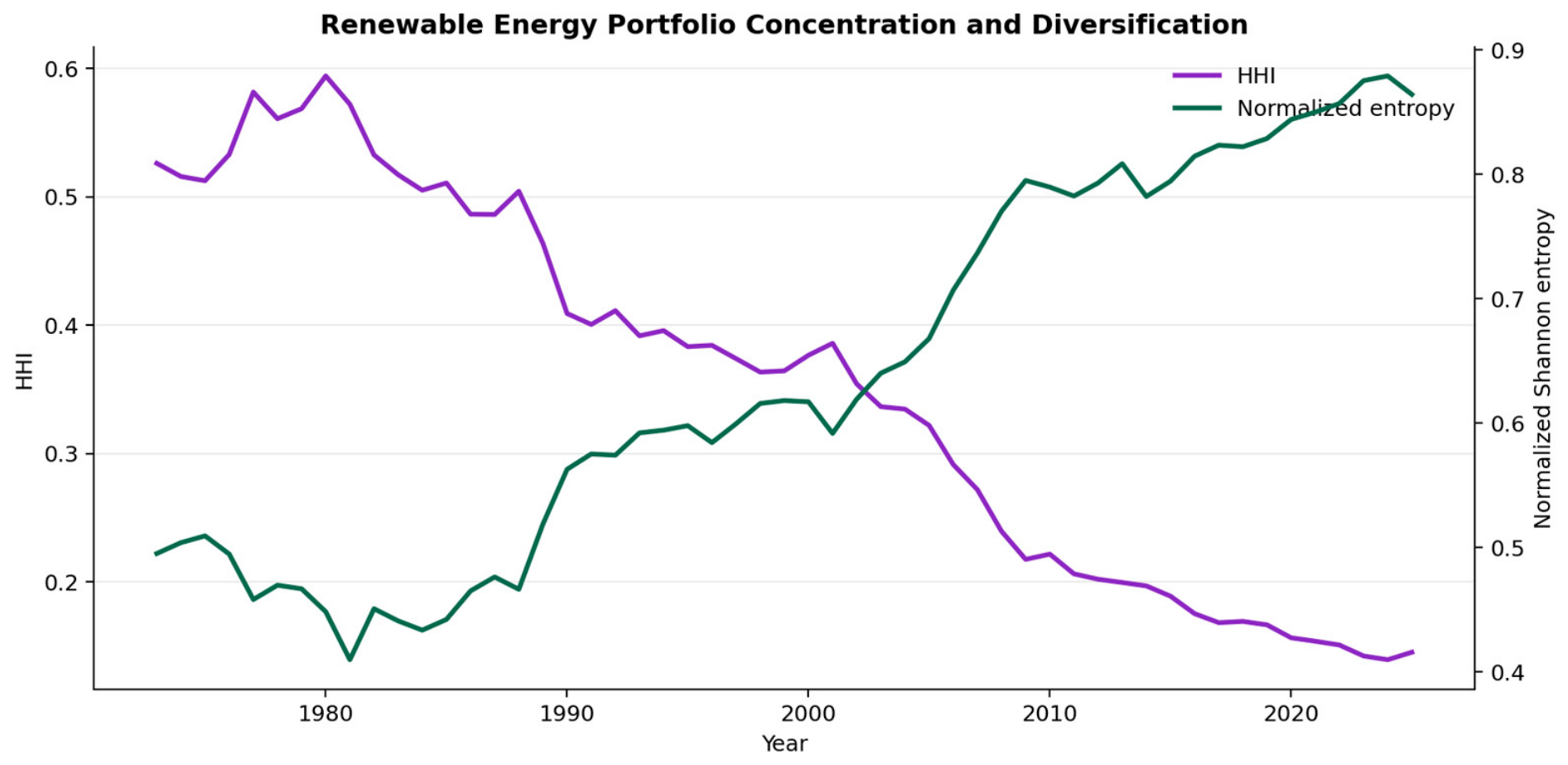
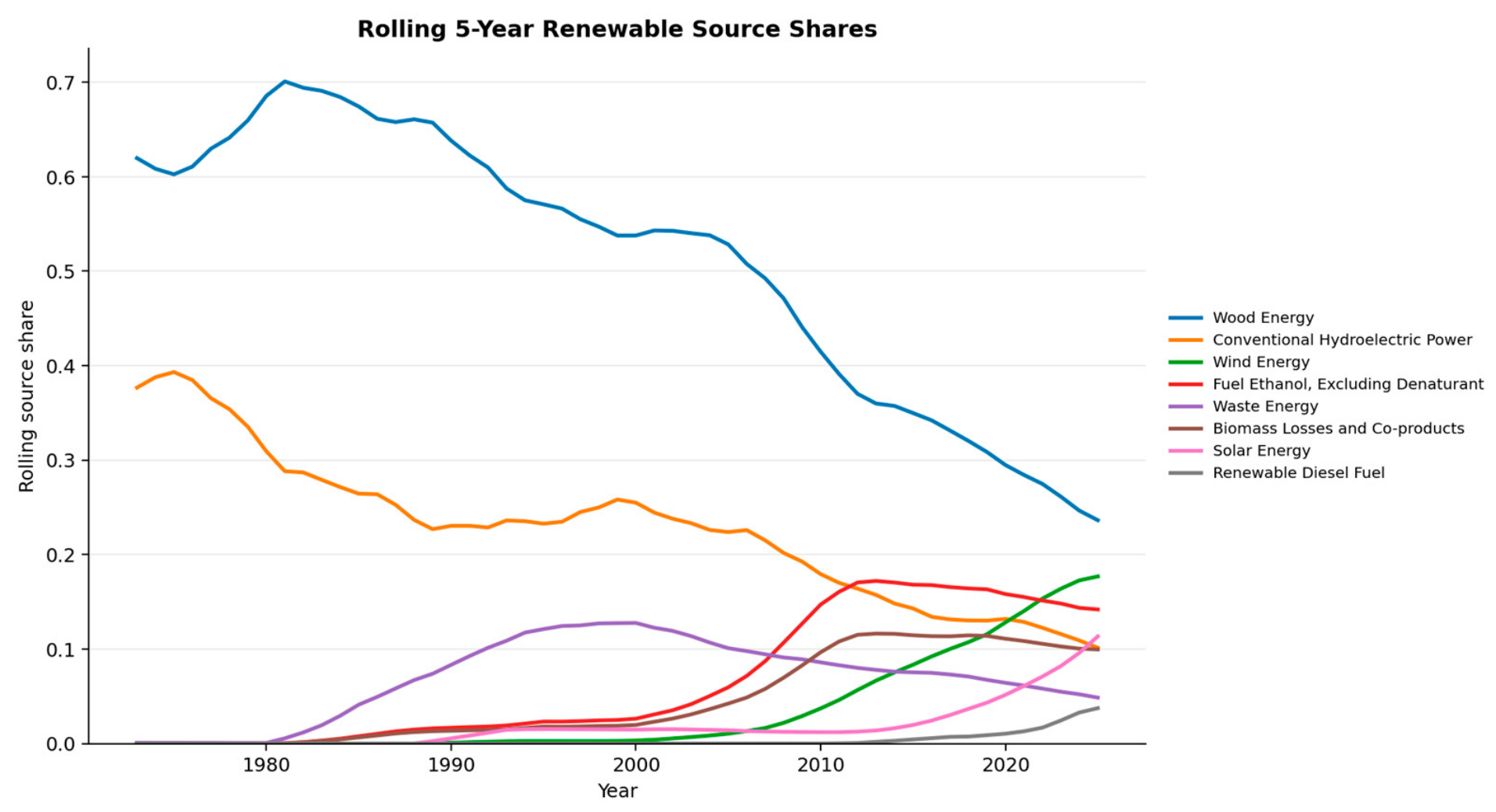
Figure 12 evaluate whether renewable energy growth was accompanied by portfolio diversification. The concentration, entropy, rolling-share, and heatmap figures show that the U.S. renewable portfolio became less dependent on a narrow set of legacy sources and increasingly incorporated wind, solar, transportation biofuels, renewable diesel, waste, wood, and hydro. The key result is that expansion and diversification occurred together.
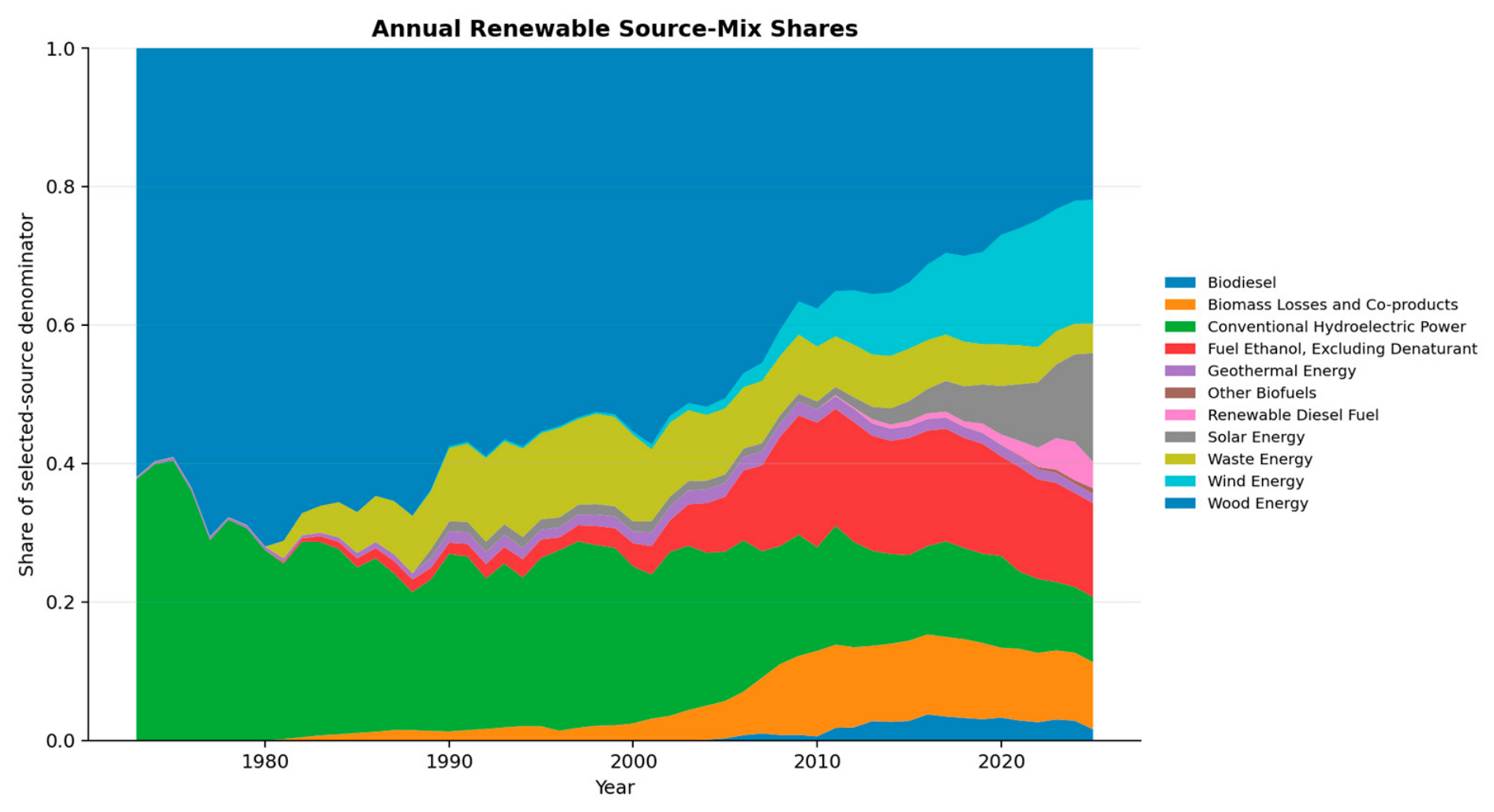
Figure 9 shows a gradual shift away from the historical dominance of wood and conventional hydroelectric sources toward a more diversified renewable energy portfolio. In the later years of the sample, wind, solar, fuel ethanol, waste, and renewable diesel account for larger shares of total renewable energy consumption. The revised legend now follows the same visual ordering as the stacked graph, making the compositional transition easier to interpret. Overall, the figure shows that U.S. renewable energy growth was accompanied by substantial source-mix transformation rather than by an increase in aggregate consumption alone.
Figure 10 provides quantitative evidence of diversification. The Herfindahl–Hirschman Index declines over time, while normalized entropy increases. These opposing movements indicate that the renewable energy portfolio became less concentrated and more evenly distributed across source families.
Figure 11 confirms that the source transition was gradual and cumulative. Wood and conventional hydro lose share over the long run, while wind, solar, fuel ethanol, and renewable diesel gain importance. The rolling shares show that diversification unfolded through a sequence of source-specific increases rather than a single abrupt change.
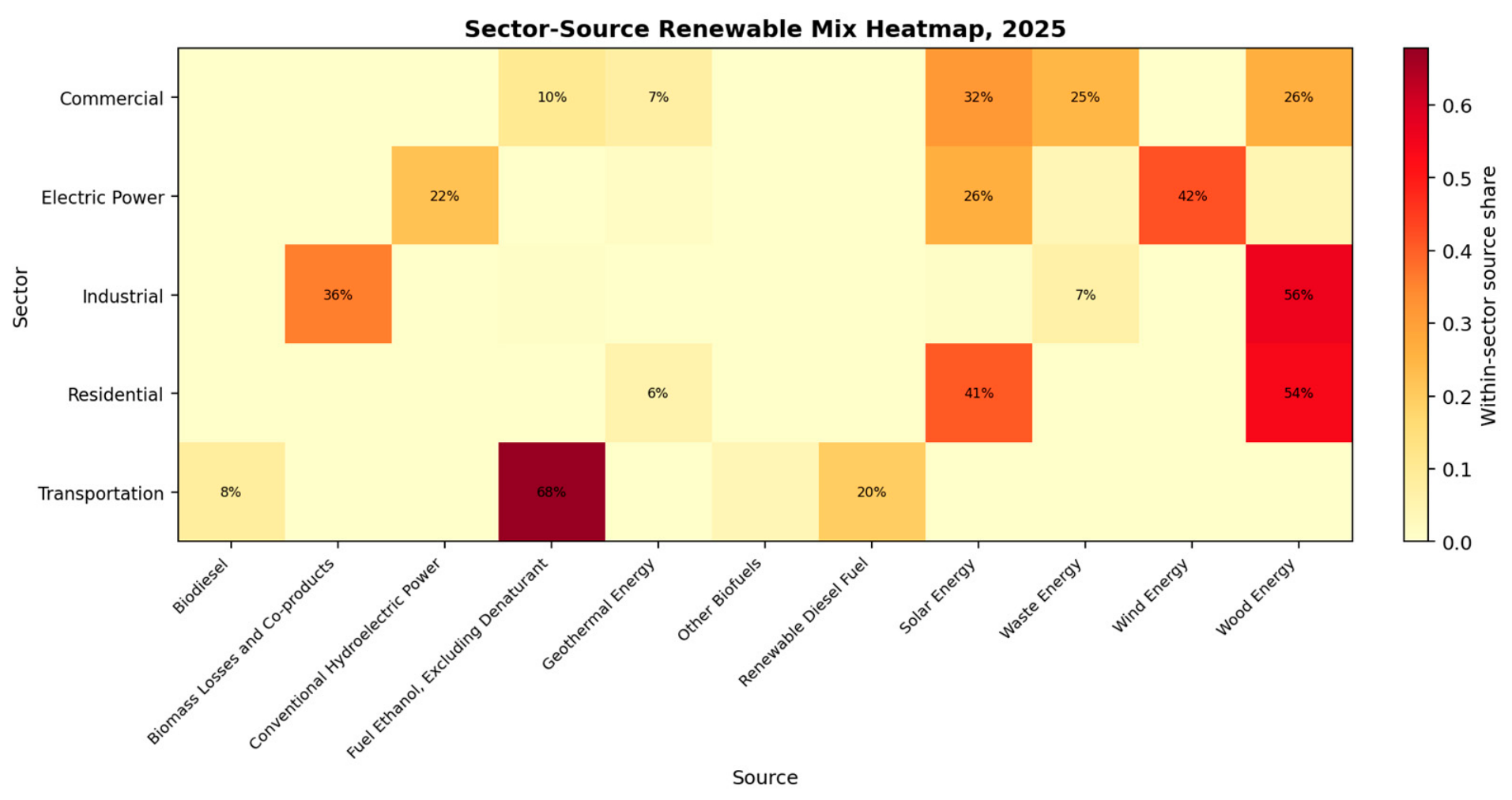
Figure 12 reveals strong sector–source specialization in 2025. Transportation is concentrated in fuel ethanol and related biofuels, Residential and Industrial retain strong wood-energy roles, and Electric Power contains a more diversified hydro-wind-solar mix. The heatmap supports the use of panel and hierarchical methods that preserve sector–source structure.
Taken together,
Figure 9,
Figure 10,
Figure 11 and
Figure 12 show that the renewable energy transition is not only an increase in total consumption. It is also a portfolio transition in which historical dependence on wood and hydro is gradually replaced by a broader mix of wind, solar, biofuels, and other renewable sources. This result strengthens the substantive contribution of the article because it links growth, diversification, and sectoral specialization.
3.4. Structural Breaks, Decomposition, and Regime Diagnostics
Structural-regime behavior was evaluated using complementary diagnostics rather than a single visual break claim. STL decomposition separated long-run trend, recurrent seasonality, and residual variation, while change-point screening, segmented-trend analysis, CUSUM stability statistics, rolling-slope estimation, and event-window comparisons were used to assess whether the renewable energy series followed a single stationary path or a sequence of evolving regimes. In response to reviewer concerns about statistical reliability, the structural-break figures include uncertainty or significance information where appropriate, including bootstrap change-point windows, Bai–Perron-style break-date confidence intervals, p-values for segmented breaks, a CUSUM 5% critical-value reference line, rolling-slope 95% confidence bands, and event-window bootstrap confidence intervals.
The structural figures should be interpreted as evidence of nonstationary historical behavior rather than as causal proof that any specific policy, market event, or shock produced a particular break. The diagnostics identify statistically supported or visually stable candidate regimes, but causal attribution would require a separate identification strategy using exogenous policy, economic, market, and climate covariates. Therefore, the results are used here to justify temporally ordered validation, source-specific forecasting, and caution against random splitting or single-regime modeling.
Figure 13,
Figure 14,
Figure 15,
Figure 16,
Figure 17,
Figure 18 and
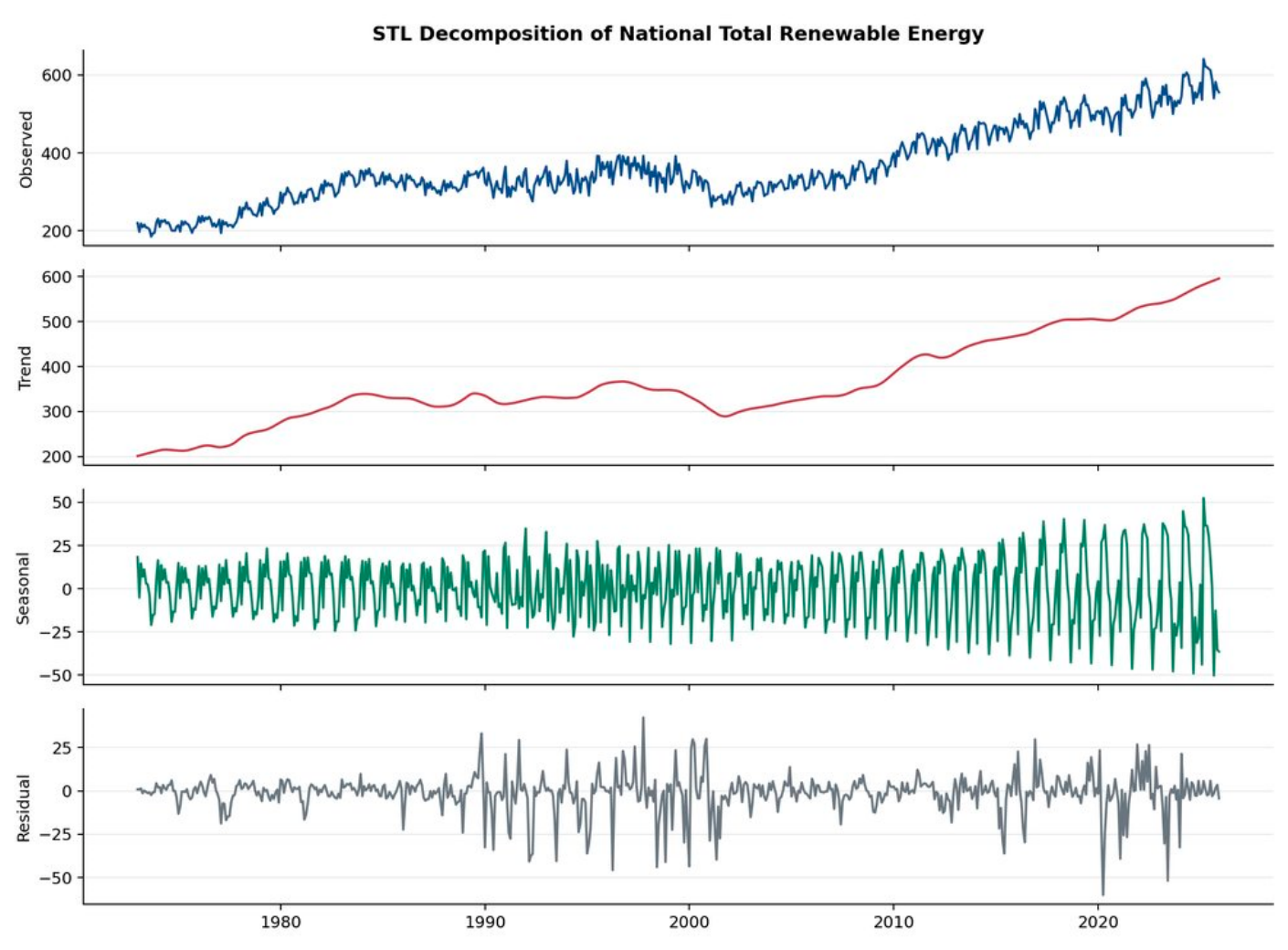
Figure 19 show that the 1973–2025 renewable energy series contains trend, seasonal, residual, and structural-regime behavior. STL decomposition supports the presence of long-run growth and changing seasonal amplitude, while the change-point and segmented-trend figures show that several break locations are statistically or bootstrap-supported. Source-specific stability and rolling-slope diagnostics further show that emerging renewable energy sources are more structurally variable than the aggregate national total. Together, these results support a regime-aware interpretation of U.S. renewable energy consumption.
Figure 13,
Figure 14,
Figure 15,
Figure 16,
Figure 17,
Figure 18 and
Figure 19 show that the 1973–2025 renewable energy series contains trend, seasonal, residual, and structural-break behavior. The structural-diagnostic figures provide evidence against a single stationary path. STL decomposition confirms long-run growth and increasing seasonal amplitude, while change-point and segmented-trend screens identify distinct historical regimes. Source-specific stability diagnostics show that emerging sources are more structurally unstable than the aggregate national total.
Figure 13 separates the national monthly series into observed, trend, seasonal, and residual components. The trend confirms long-run growth and post-2010 acceleration. The seasonal component becomes more pronounced in the later sample, while residual variation is visible around transitional periods. This decomposition shows why persistent trend, recurrent seasonality, and irregular shocks should be interpreted separately.
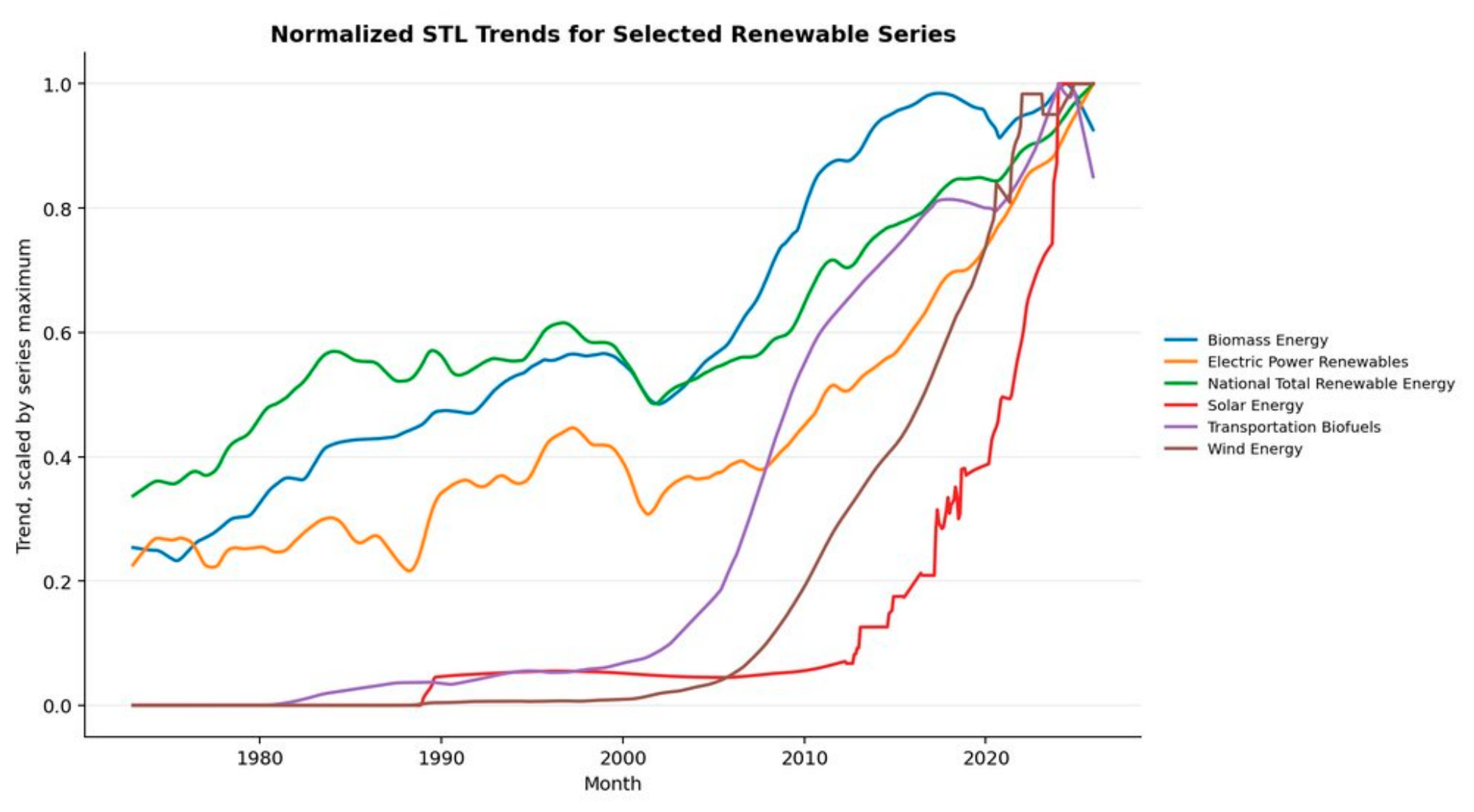
Figure 14 shows that source-specific growth trajectories differ substantially. Wind, solar, transportation biofuels, and electric power renewables accelerate at different times and rates. Mature sources show slower relative expansion, while newer sources rise sharply in the modern period. Structural change is therefore source-specific rather than uniform across renewable technologies.
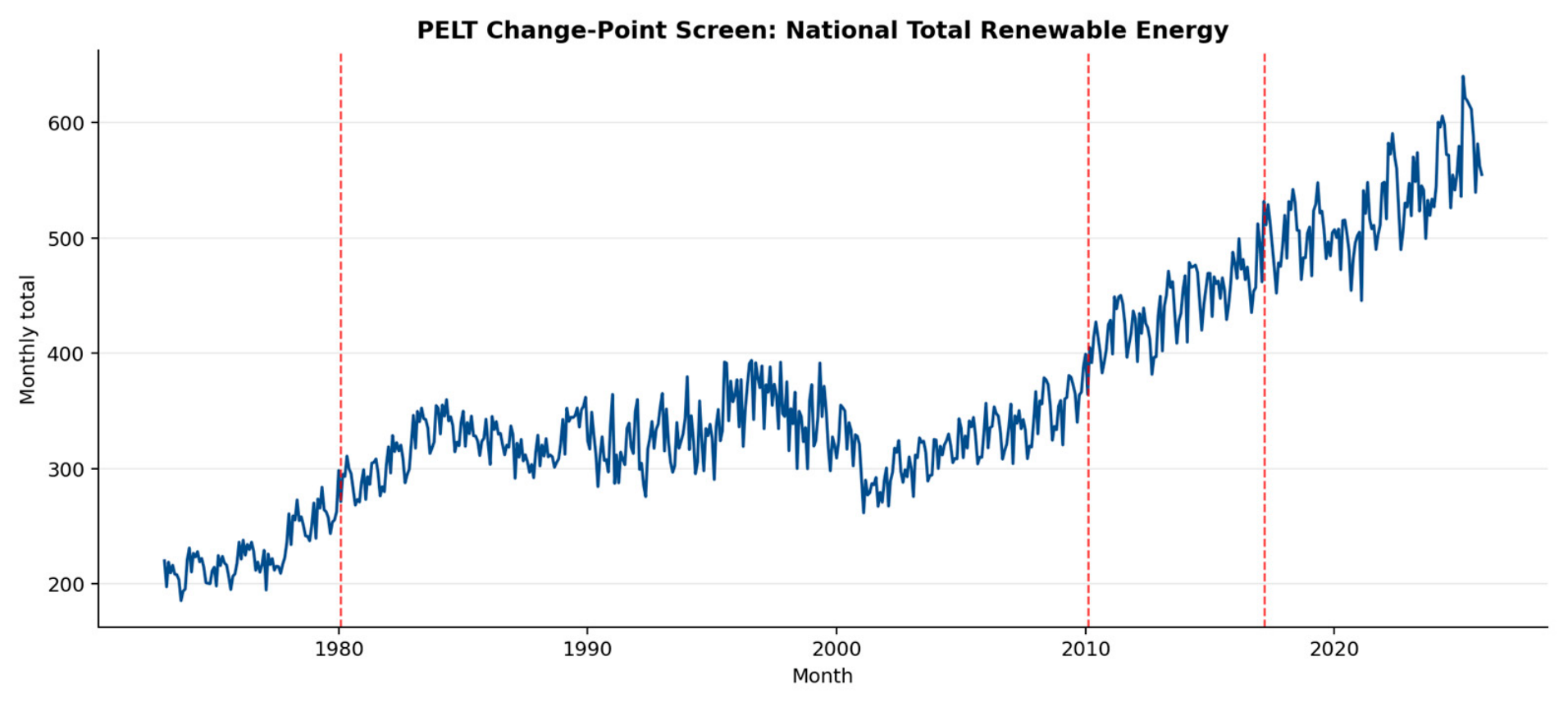
Figure 15 presents the PELT change-point screen for the national monthly total renewable energy series. The figure adds 95% bootstrap windows around the candidate break dates, allowing the detected transitions to be interpreted with uncertainty rather than as exact, deterministic dates. The screen identifies major candidate breaks around 1980, 2010, and 2017, each shown with high bootstrap stability in the figure. These break locations align with visible changes in the aggregate trajectory: early expansion around the late 1970s and early 1980s, renewed acceleration around 2010, and a later high-growth transition in the late 2010s. Because PELT is used here as a structural-regime screen, the breaks should be interpreted as statistically supported candidate changes in the time-series pattern, not as causal estimates of specific policy or market effects.
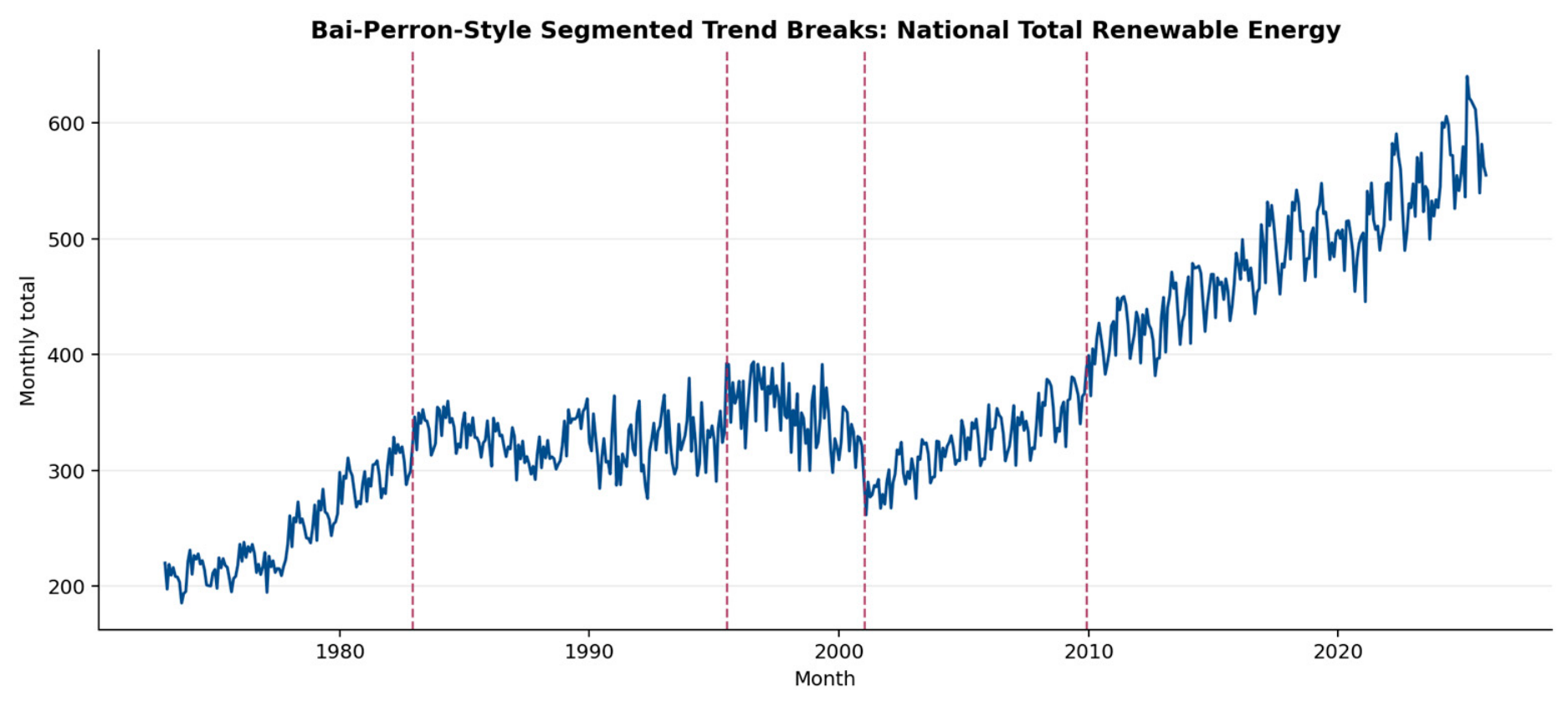
Figure 16 provides a complementary segmented-trend analysis using Bai–Perron-style break selection. The figure strengthens the structural-break interpretation by showing BIC-selected break dates, 95% bootstrap date confidence intervals, and
p-values for the selected breaks. The national renewable energy series is divided into multiple historical regimes, with statistically supported breaks around 1982, 1995, 2001, and 2009. These break dates separate periods of early expansion, mid-sample stabilization or transition, early-2000s adjustment, and post-2010 acceleration. The small
p-values shown in the figure indicate that the segmented-trend specification provides stronger support for multiple slope regimes than a single linear trajectory. However, the segmented breaks still describe changes in the statistical behavior of the series; they do not establish the causal effect of any individual policy, technology, or market event.
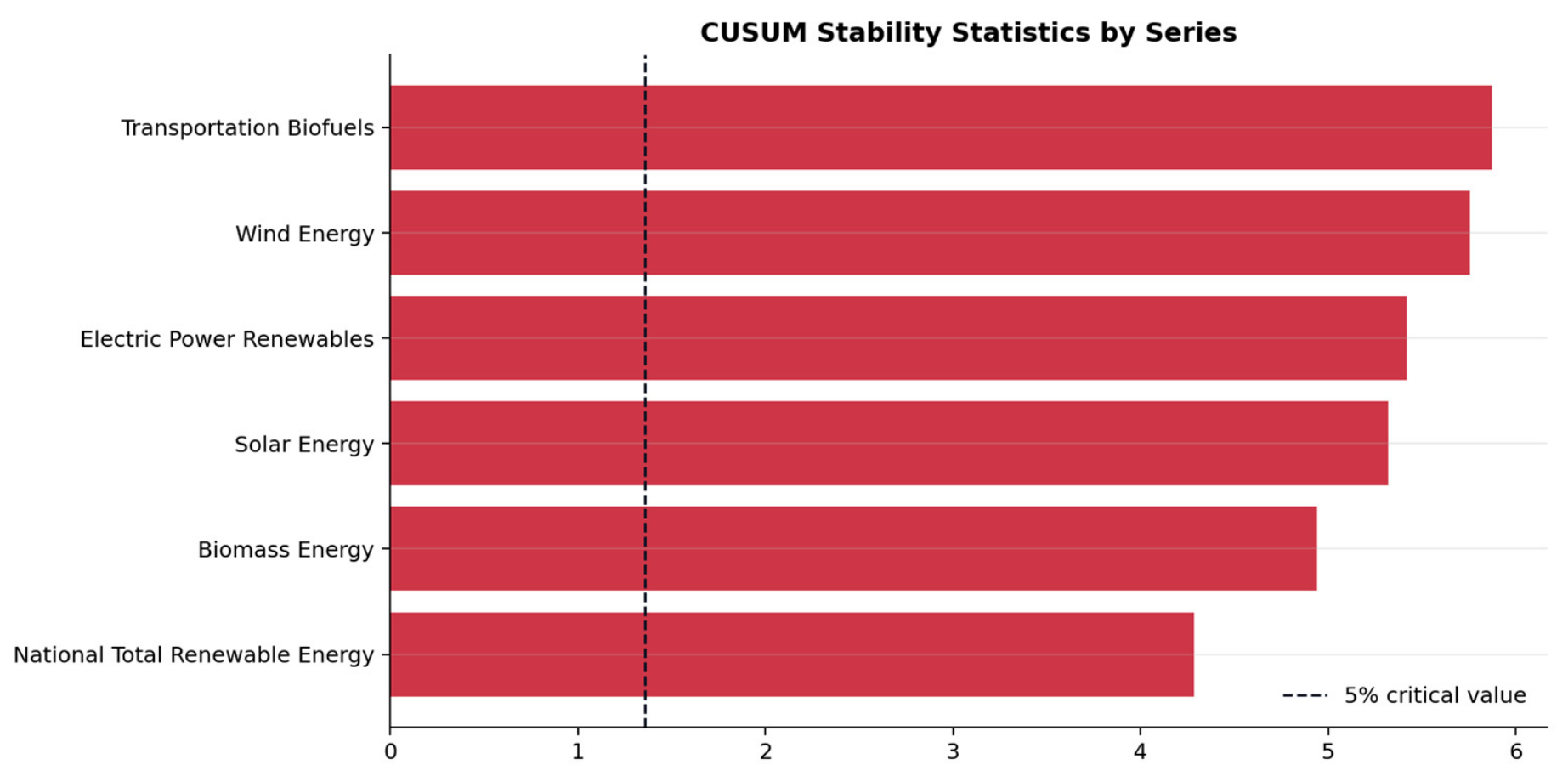
Figure 17 compares CUSUM stability statistics across the national aggregate and selected renewable energy source series. The figure includes a 5% critical-value reference line, which allows the instability statistics to be interpreted against a formal threshold rather than as a descriptive ranking alone. All displayed series exceed the critical-value reference line, indicating evidence of structural instability over the long sample period. The largest CUSUM statistics occur for Transportation Biofuels, Wind Energy, Electric Power Renewables, and Solar Energy, while the national aggregate shows a lower but still threshold-exceeding statistic. This pattern indicates that the aggregate national total smooths some of the instability present in rapidly evolving component series. The result supports the need for source-specific diagnostics and forecast evaluation rather than relying only on aggregate national behavior.
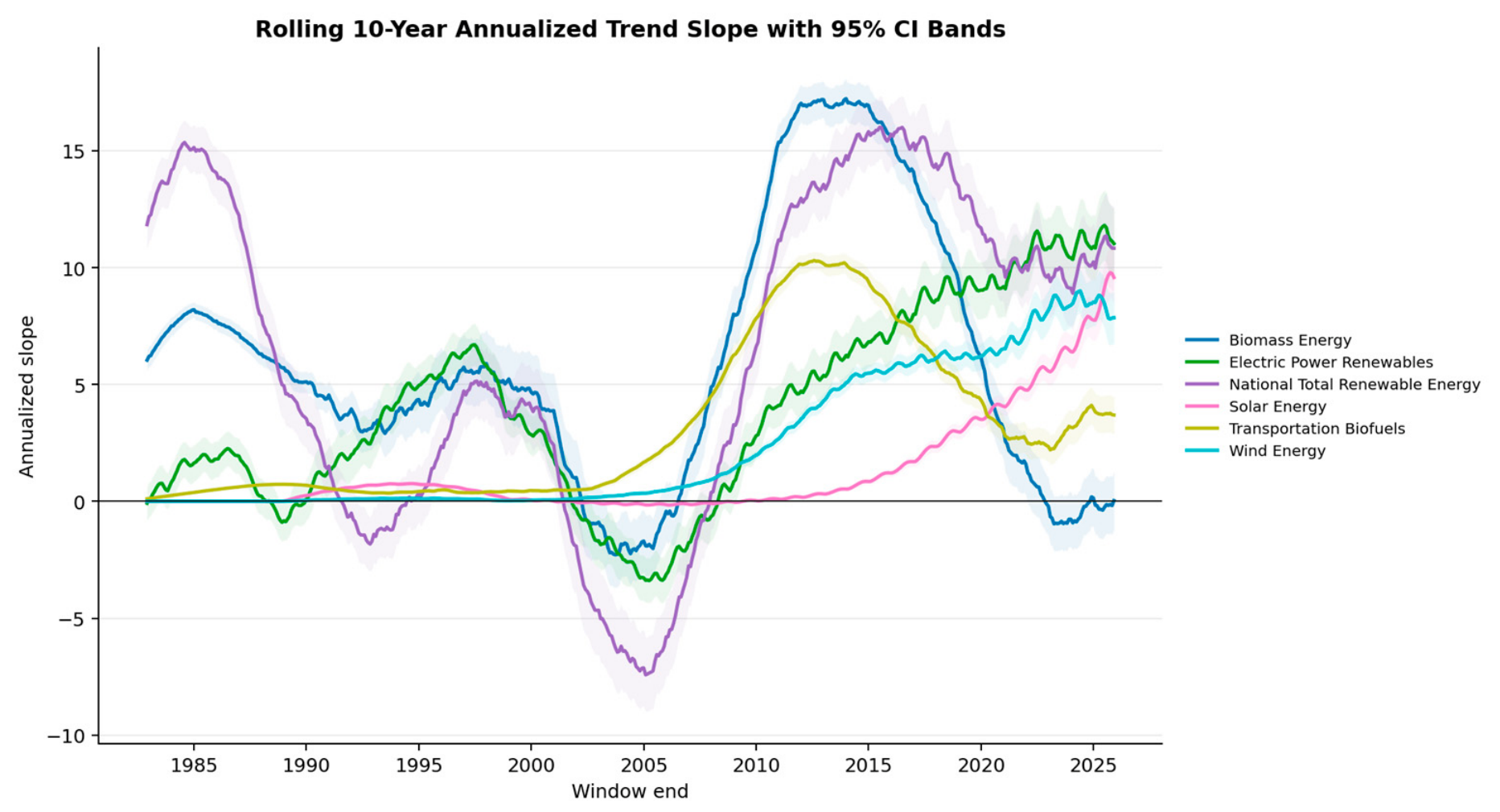
Figure 18 shows rolling 10-year annualized trend slopes for selected renewable energy series, with 95% confidence bands around each trajectory. The confidence bands clarify when changes in growth momentum are visually and statistically more stable versus when slope estimates are more uncertain. The figure shows that renewable energy growth is episodic and source-specific. National total renewable energy growth weakens around the early 2000s, then strengthens sharply during the post-2010 period before moderating in the most recent years. Wind and solar show persistent modern-period positive momentum, although solar acceleration occurs later and from a lower base. Electric Power Renewables strengthen in the modern period, whereas Transportation Biofuels rise strongly around the early 2010s and then moderate. Biomass shows earlier growth momentum but weakens substantially in the later period. These patterns support the interpretation that the renewable energy transition is not a uniform, monotonic expansion across all sources; instead, each source family follows a distinct growth regime with different uncertainty around its estimated slope.
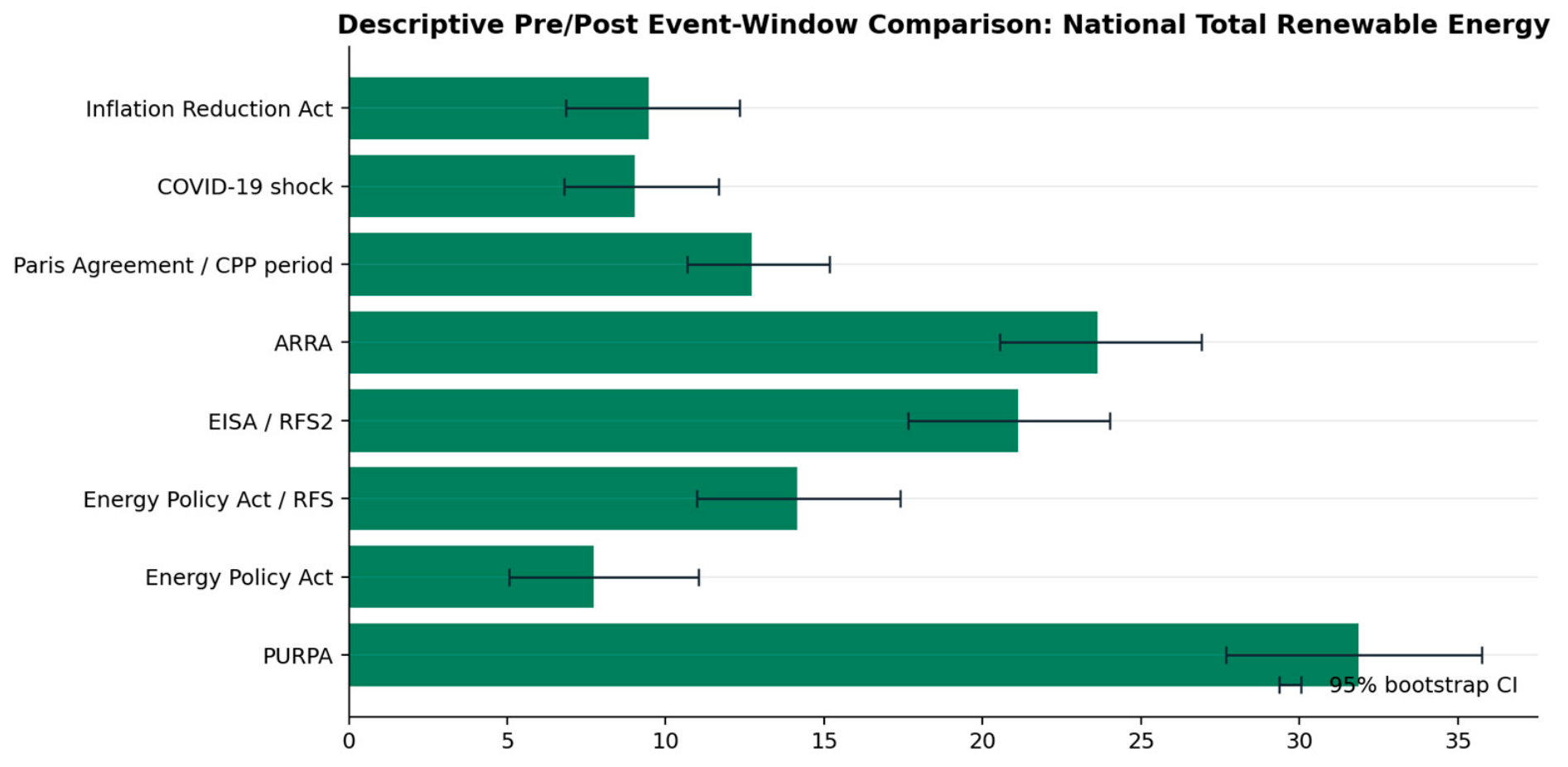
Figure 19 reports descriptive pre-/post-event -window changes in national total renewable energy consumption, with 95% bootstrap confidence intervals around each event-window estimate. The error bars provide uncertainty context for comparing changes across policy, market, and shock periods. PURPA is associated with the largest descriptive event-window change, while ARRA and EISA/RFS2 also show large positive changes. The Paris Agreement/Clean Power Plan period and the Energy Policy Act/RFS window show moderate increases, whereas the Inflation Reduction Act and COVID-19 windows show smaller short-run aggregate changes in the national total. These comparisons should be interpreted cautiously because event windows differ in length, overlap with broader technology and market trends, and aggregate multiple sector- and source-specific responses. The figure is therefore best framed as a descriptive historical comparison rather than a causal policy-impact analysis.
The structural diagnostics support three implications. First, forecast validation should remain temporally ordered and should span historically distinct windows because the national series is not well described by a single stationary growth regime. Second, component-level series require source-specific interpretation because emerging renewable technologies such as wind, solar, and transportation biofuels show stronger instability and changing slope behavior than the aggregate national total. Third, uncertainty visualization materially strengthens the structural interpretation: bootstrap windows, segmented-break confidence intervals, CUSUM critical values, rolling-slope confidence bands, and event-window confidence intervals all help distinguish robust descriptive patterns from weaker visual impressions. These diagnostics support regime-aware forecasting and planning, while avoiding causal overstatement.
3.5. Sector–Source Panel Heterogeneity
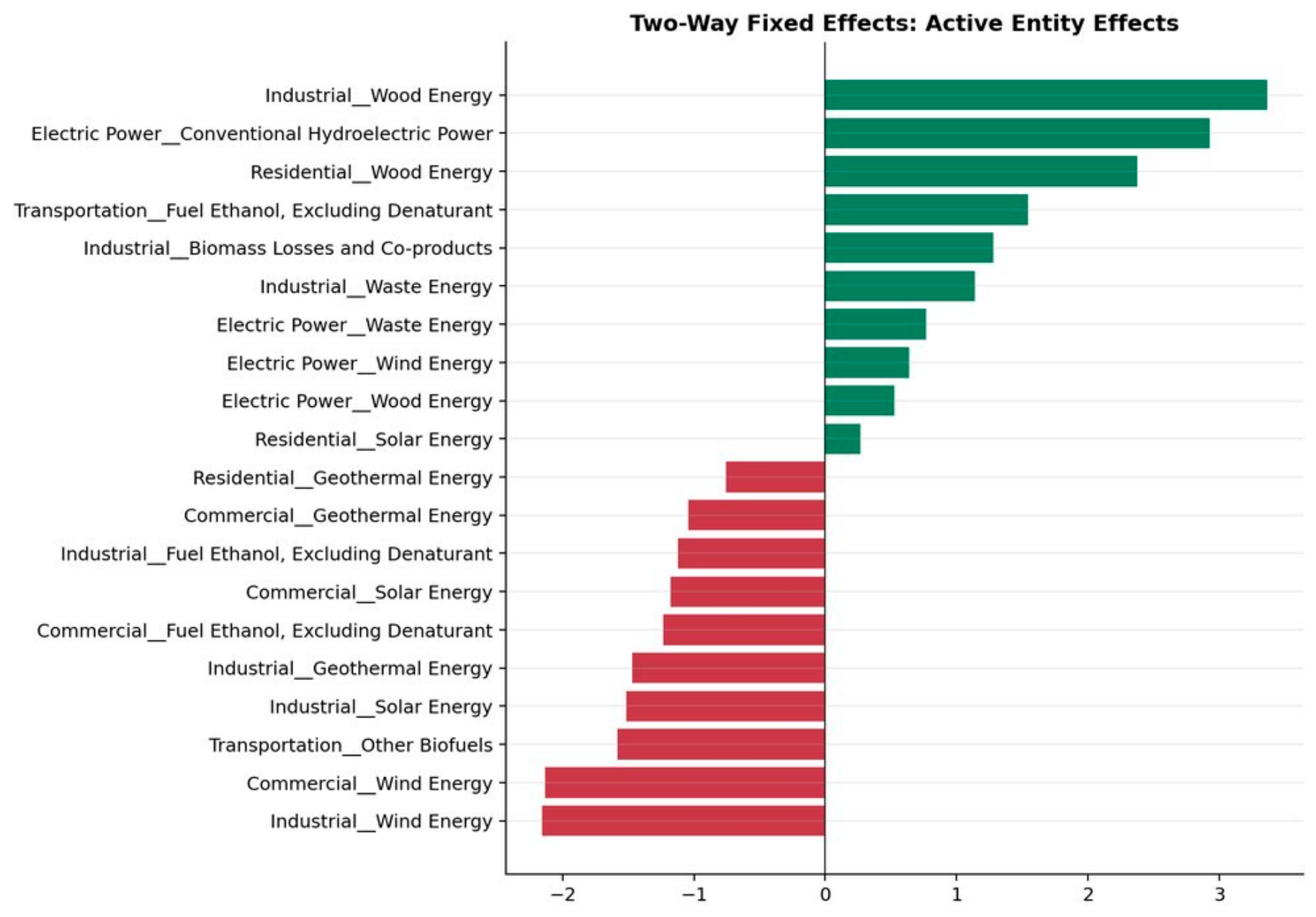
Figure 20 and
Figure 21 show that the monthly data are heterogeneous across sector–source entities. Coverage is uneven, with a small number of large, persistent sector–source combinations dominating reported consumption and many smaller combinations remaining sparse. This justifies panel diagnostics, target-group-specific forecasting, and partial pooling rather than treating the dataset as a single homogeneous national time series.
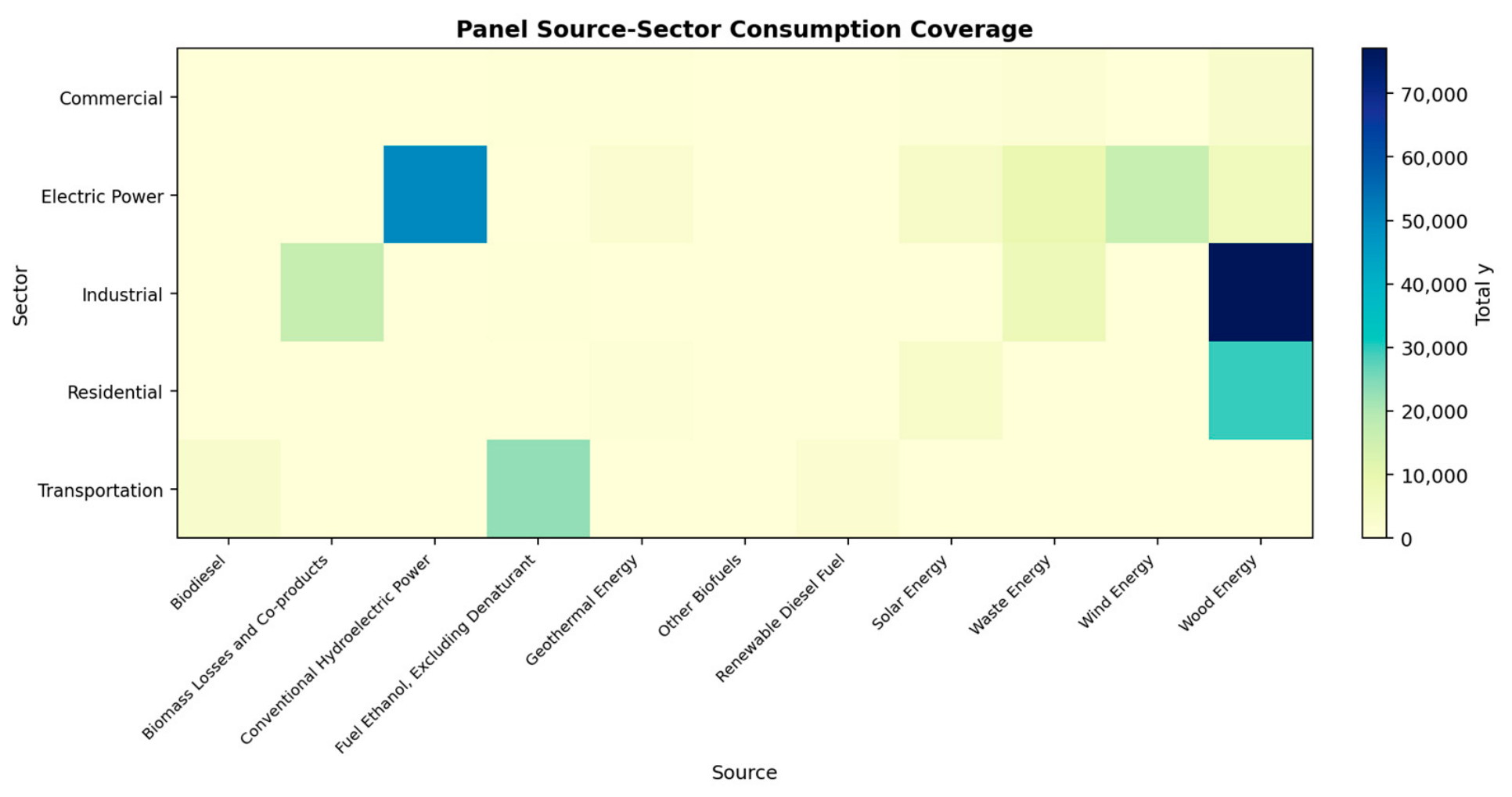
Figure 20 confirms that sector–source coverage is highly uneven. Large cells are concentrated in persistent combinations such as industrial wood energy and electric power hydro-related sources, while many other sector–source cells are sparse or near zero. This unevenness supports panel methods that account for entity-level differences.
Figure 21 shows that large and persistent combinations have positive fixed effects, including Industrial-Wood Energy, Electric Power-Conventional Hydroelectric Power, Residential-Wood Energy, and Transportation-Fuel Ethanol. Negative effects appear in smaller or less persistent combinations. The fixed-effect ranking confirms meaningful cross-sectional heterogeneity in the renewable energy panel.
The panel evidence shows that the national total is useful for describing system-level growth, but it cannot explain which sector–source entities drive the transition. Subsequent forecasting and scenario results therefore need to be interpreted at multiple aggregation levels.
3.6. Forecast Benchmark Coverage and Rolling-Origin Validation
Figure 22,
Figure 23,
Figure 24 and
Figure 25 summarize the benchmark design and the first rolling-origin diagnostics. The benchmark spans national total, national source-level, sector-level, and sector–source targets, allowing forecasting performance to be evaluated across aggregation levels rather than only for one national series. The rolling-origin design also shows that model performance depends on forecast horizon and validation window. Errors generally increase as the horizon lengthens, model rankings vary across historical windows, and forecast-path inspection reveals failures that average error metrics alone can obscure.
The forecast-path figures strengthen this interpretation by adding uncertainty information to representative holdout trajectories. This is important because a point forecast can appear plausible on average while still failing to cover high-consumption months, producing overly wide uncertainty bands, or generating implausible extrapolations.
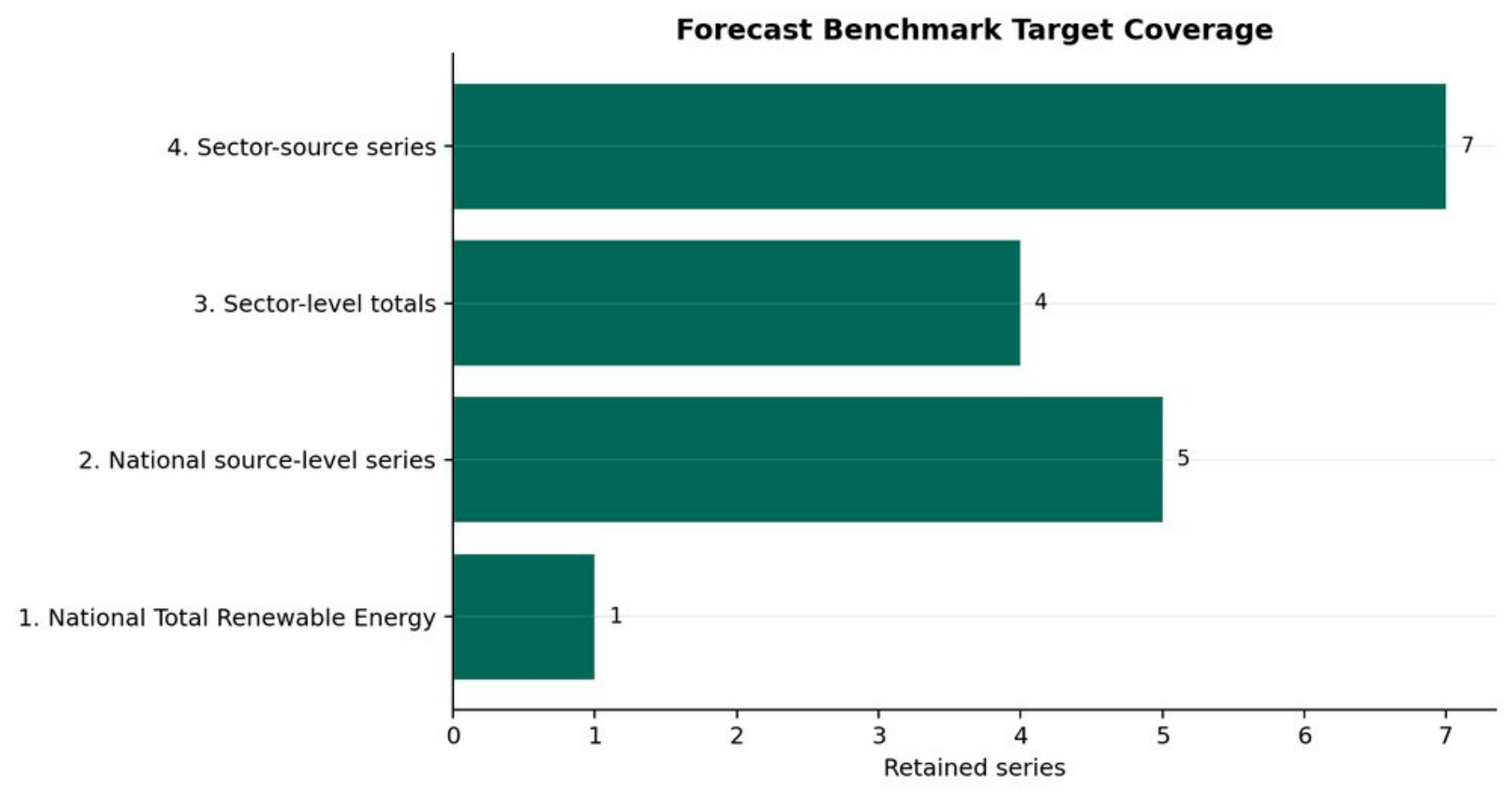
Figure 22 documents the breadth of the benchmark. The retained target set includes one national total target, five national source-level targets, four sector-level totals, and seven sector–source series. This design tests whether models generalize across aggregation levels rather than performing well only on one national aggregate.
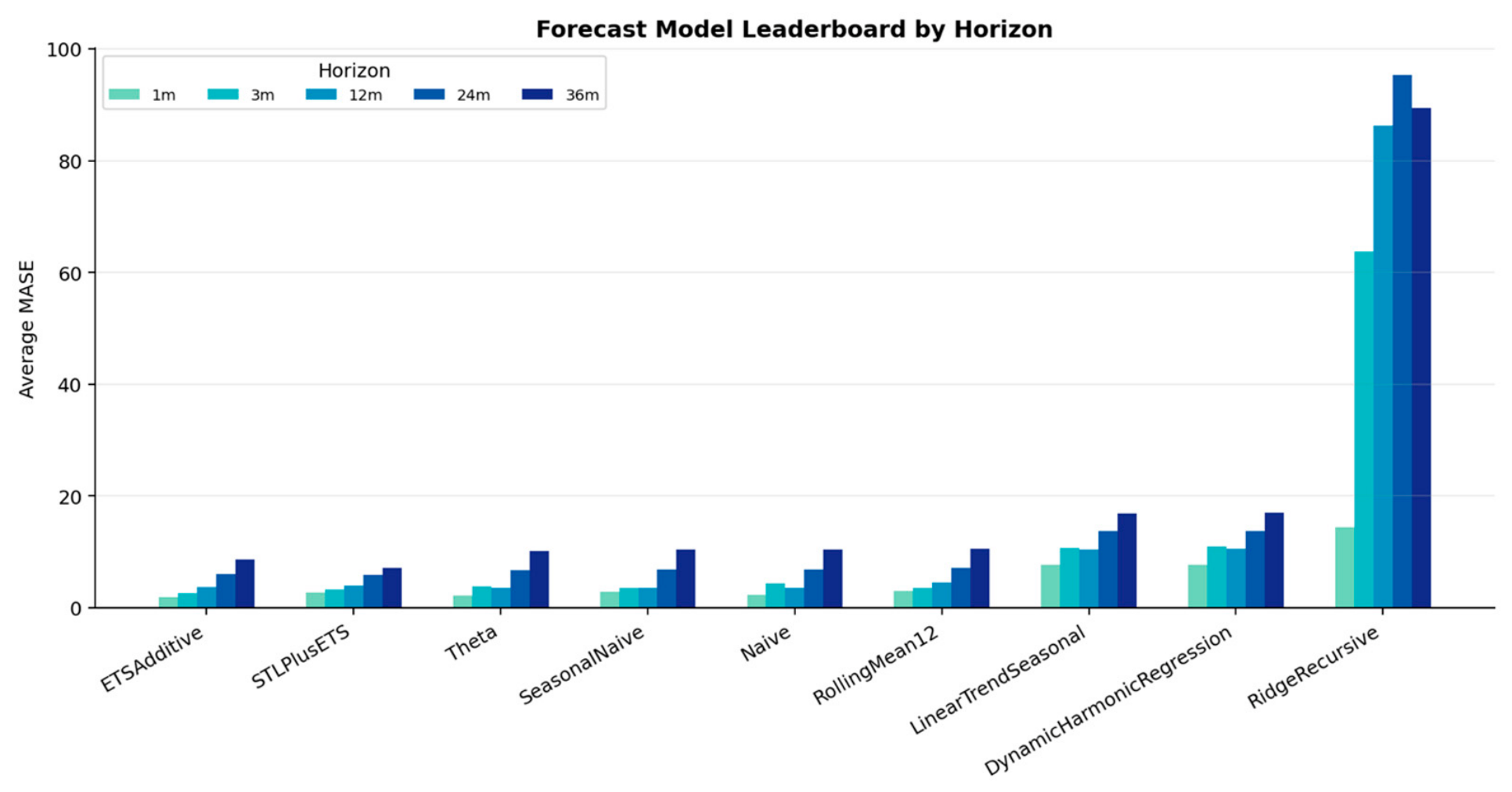
Figure 23 shows that forecast error generally increases as the horizon lengthens. ETS additive, STL plus ETS, Theta, and related baselines remain comparatively stable at shorter horizons, whereas the ridge-recursive benchmark deteriorates severely as the horizon extends. The figure demonstrates that long-horizon performance cannot be inferred from short-horizon performance.
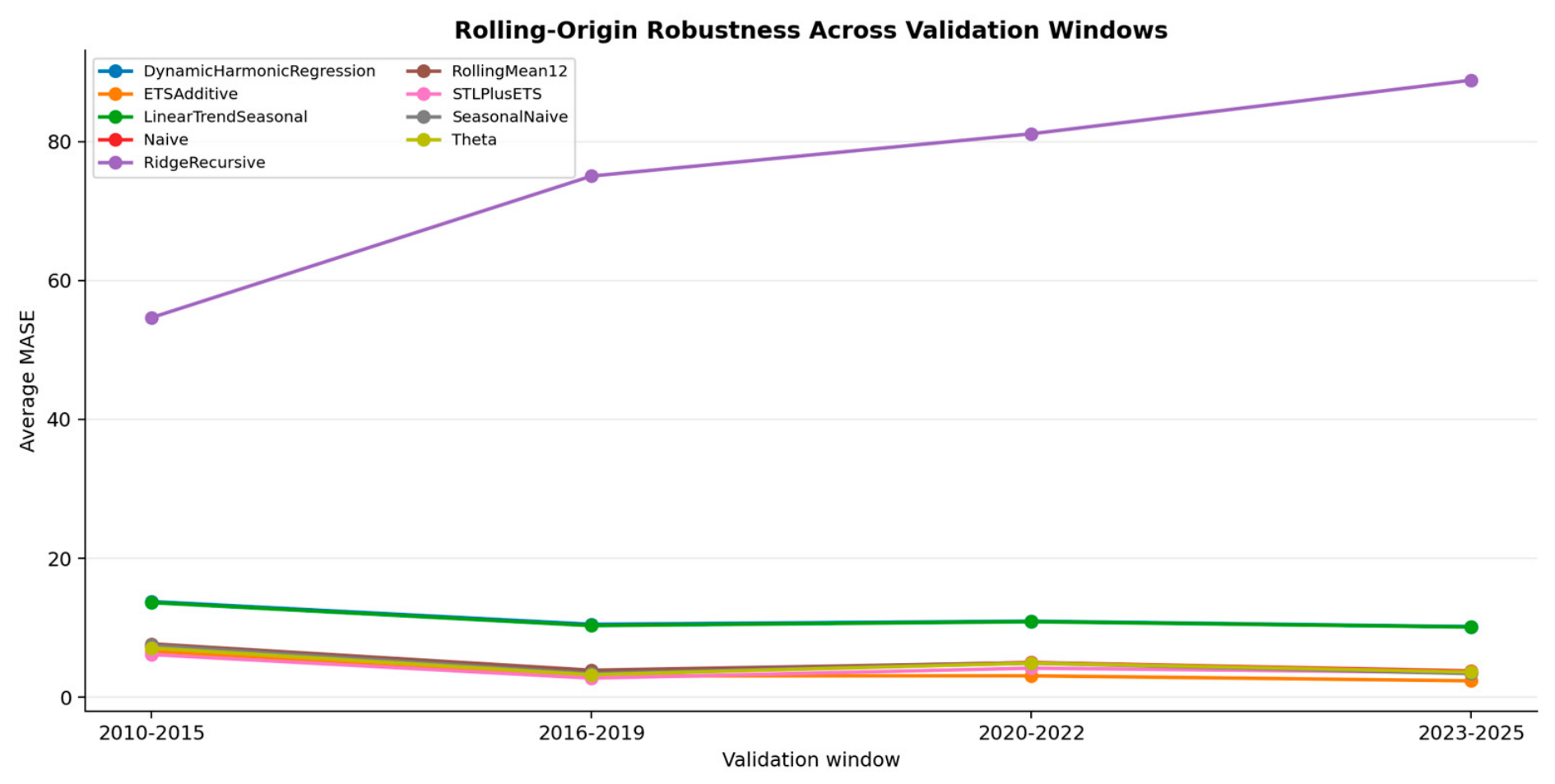
Figure 24 shows that model robustness varies by validation window. The ridge-recursive approach remains unstable and worsens across later windows, while stronger statistical and tree-based alternatives remain much lower. The windowed evaluation confirms that a single holdout period would be insufficient for a credible forecasting claim.
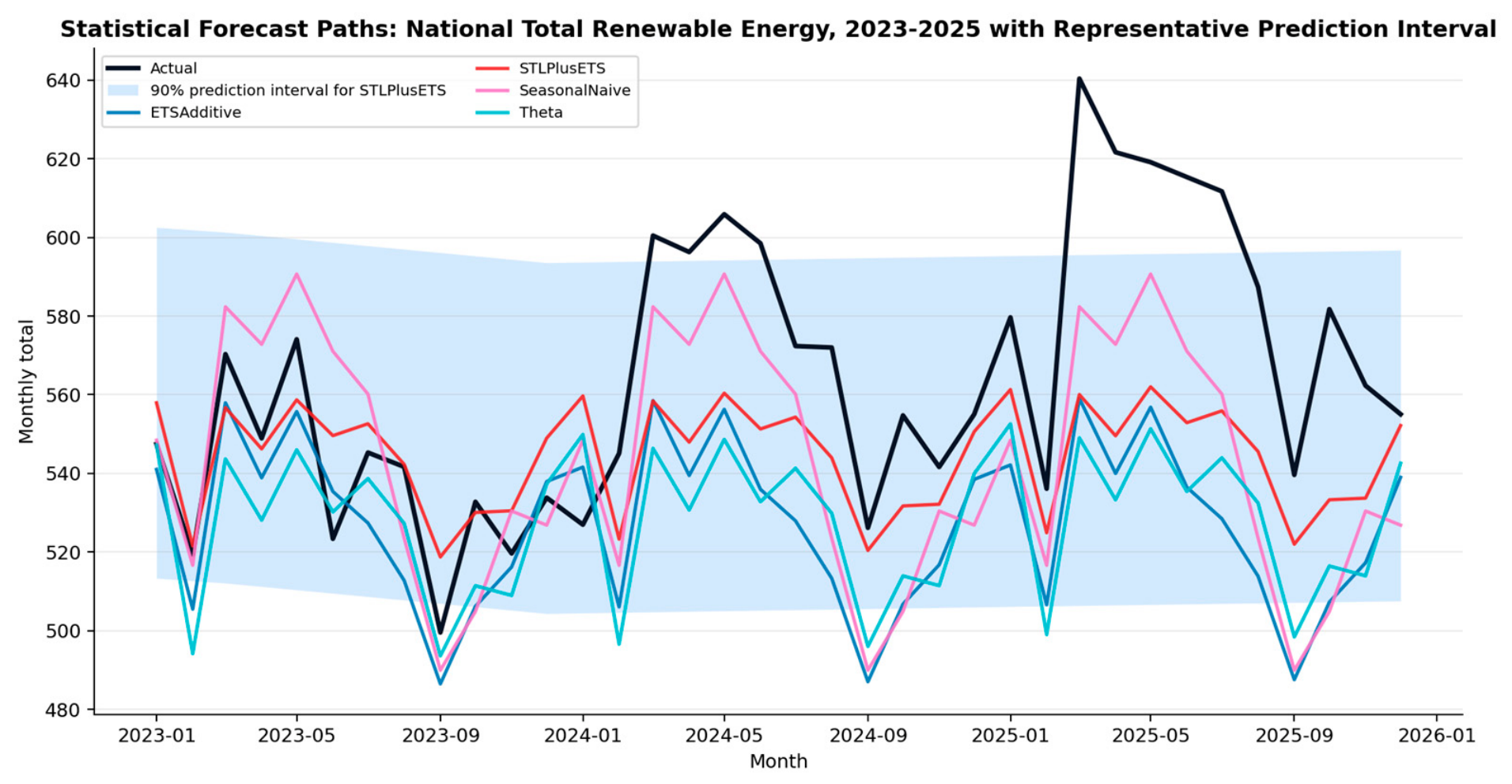
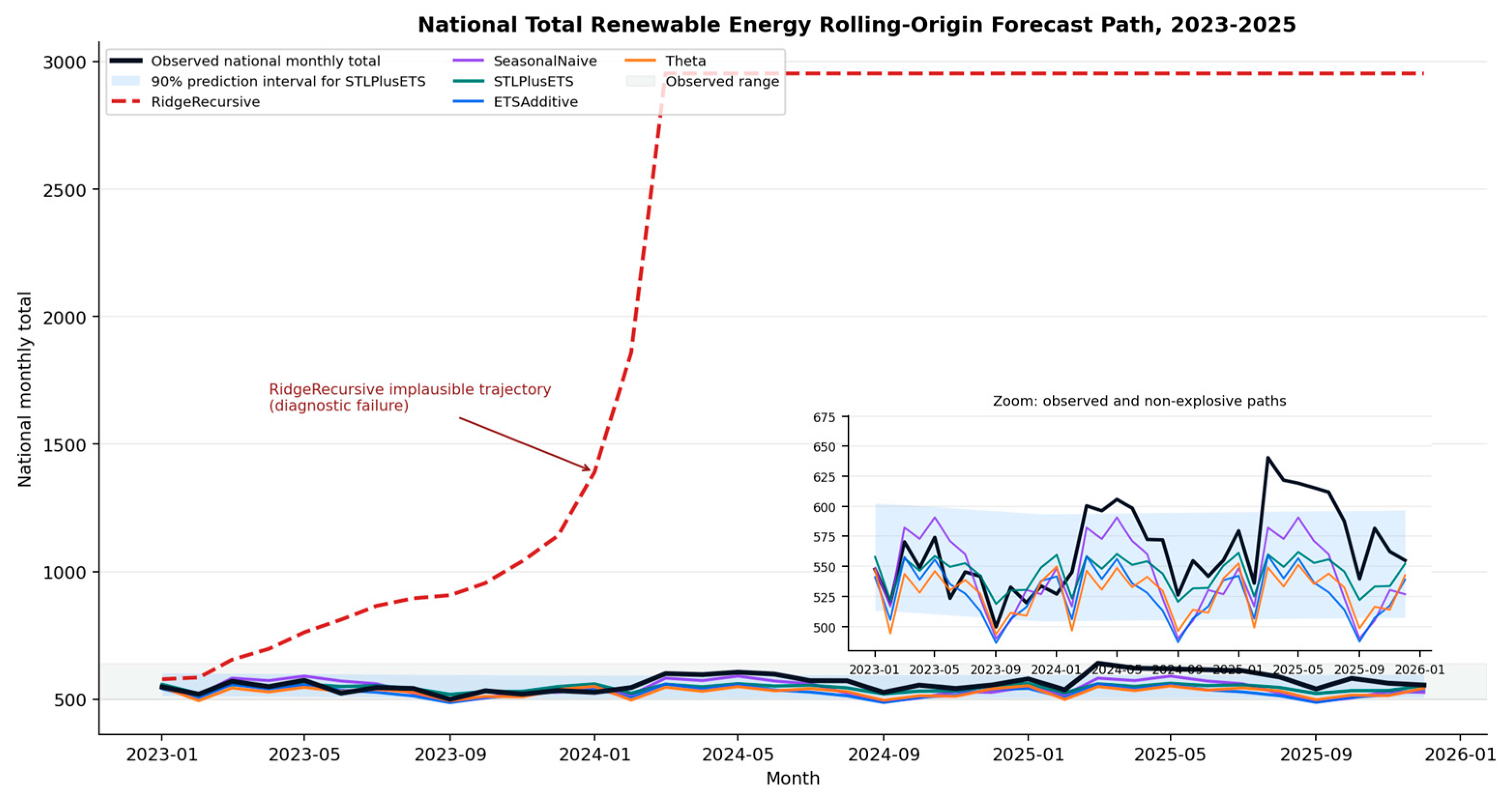
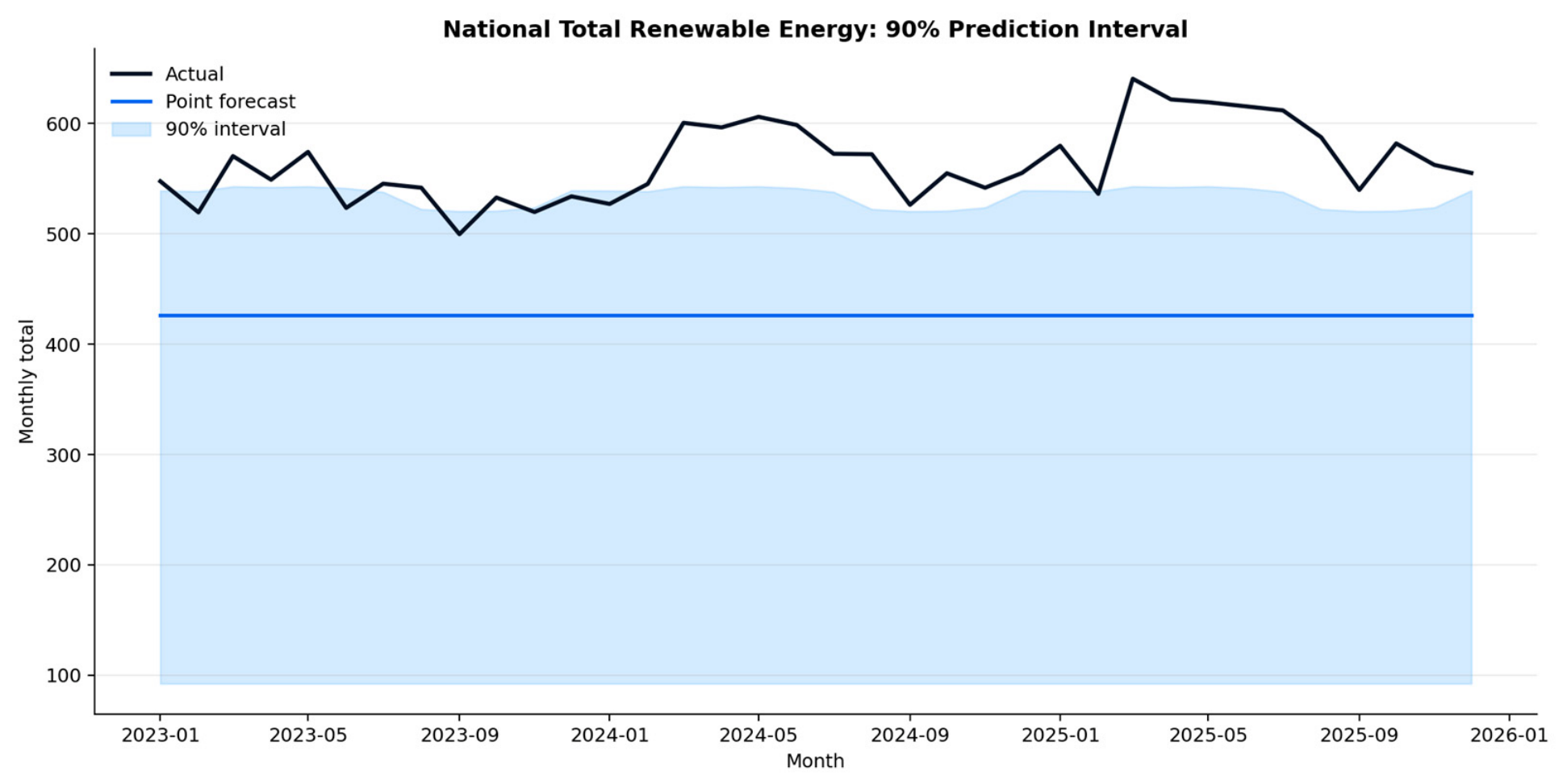
Figure 25 demonstrates why forecast-path inspection must accompany numerical error metrics in renewable energy forecasting. Most statistical benchmark forecasts remain near the observed 2023–2025 national monthly total, although they smooth several high-consumption months and do not fully reproduce peak amplitude. The STLPlusETS 90% prediction interval provides uncertainty context, showing that several observed peaks approach the upper portion of the interval and that stable point forecasts may still underrepresent peak-month variability.
In contrast, the RidgeRecursive forecast becomes implausibly explosive, rising far above the observed national monthly totals. This behavior should be interpreted as a diagnostic failure of recursive multi-step forecasting rather than as a usable renewable energy projection. In recursive forecasting, predicted values are fed back into later forecast steps; when the fitted lag structure is unstable, small errors can compound across the forecast horizon and generate unrealistic trajectories. The inset therefore focuses on the observed series and non-explosive forecast paths so that the plausible benchmark forecasts can be evaluated without the distorted scale created by the RidgeRecursive path.
Overall, the rolling-origin results show that forecast evaluation must be horizon-specific, window-specific, uncertainty-aware, and visually audited. A model may appear acceptable under a summary metric but fail at longer horizons, underestimate peak months, or produce an implausible trajectory.
Figure 25 therefore supports the use of prediction intervals, forecast-path diagnostics, peak-sensitive metrics, and decision-focused planning evaluation in addition to conventional point-error measures.
3.7. Statistical Forecasting Benchmarks
Figure 26,
Figure 27,
Figure 28 and
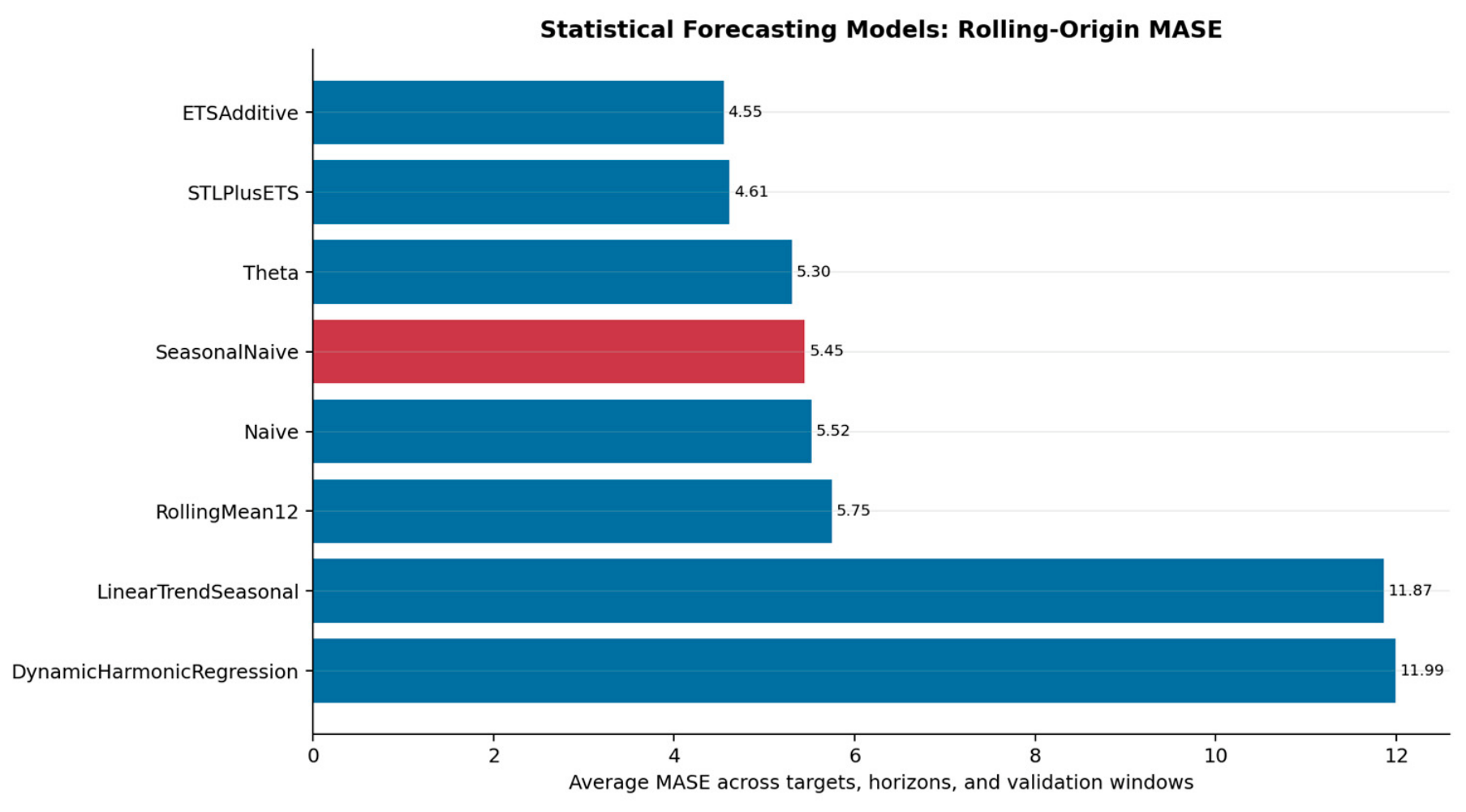
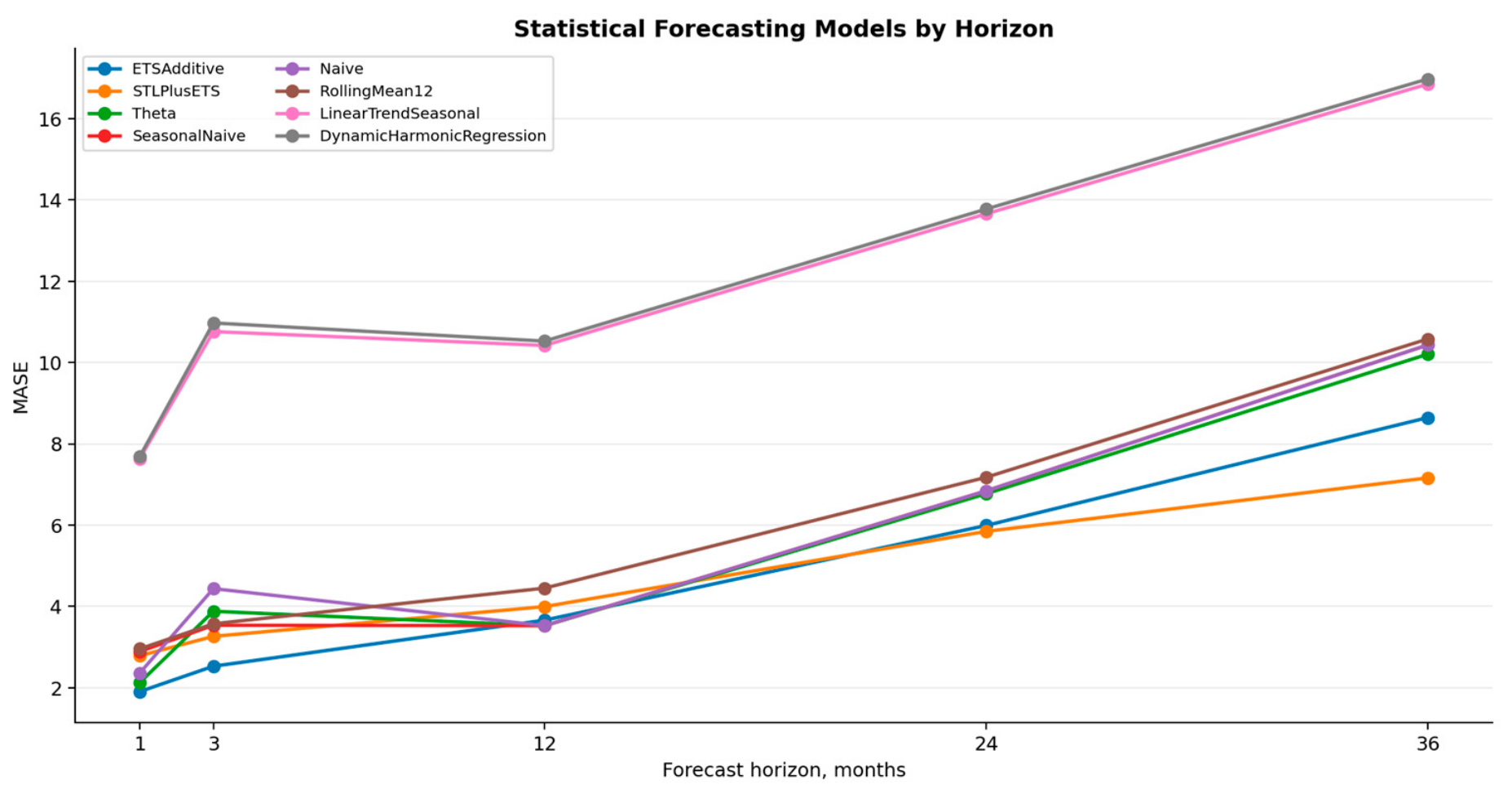
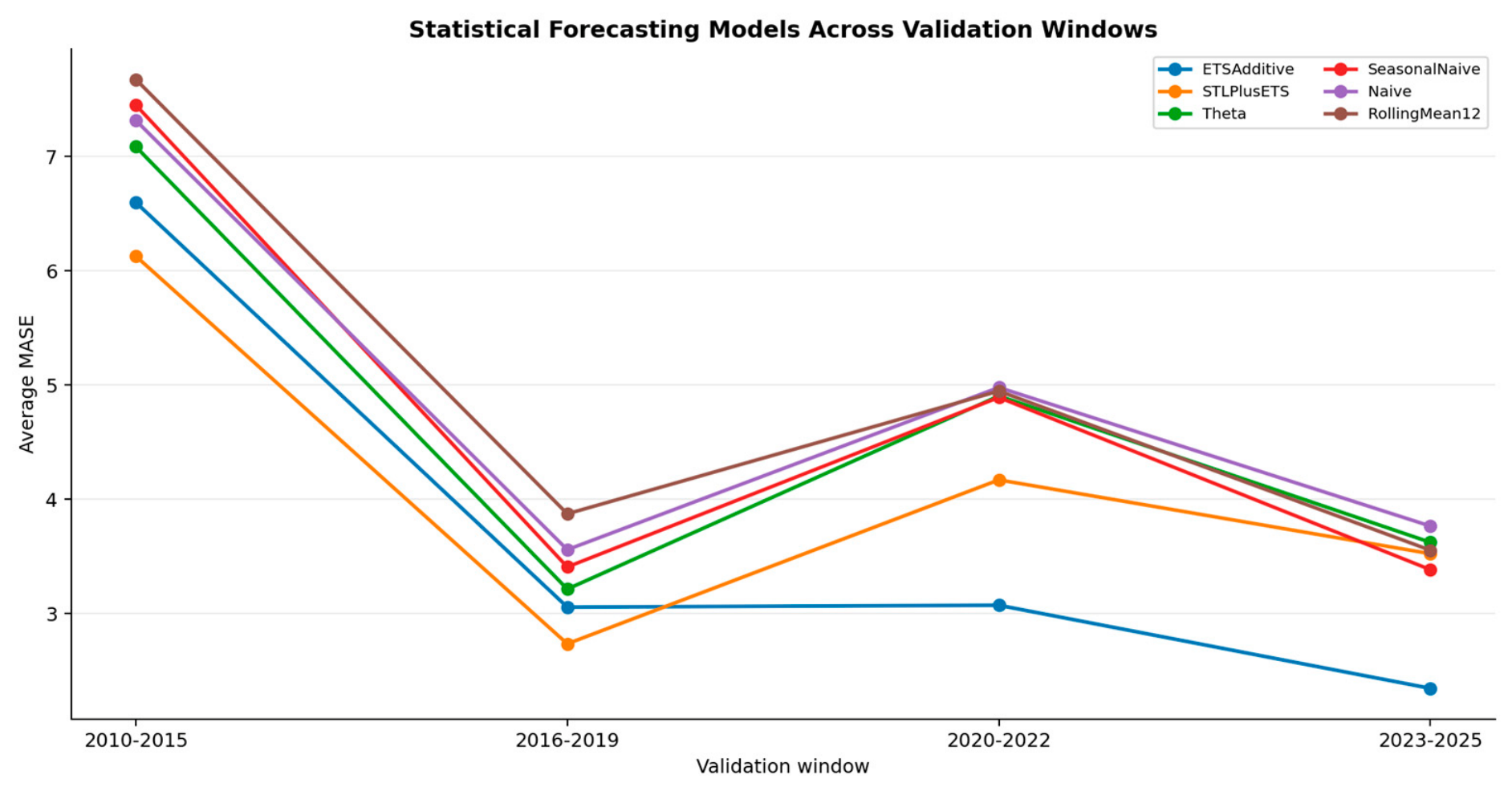
Figure 29 report the statistical baseline results. These models provide transparent comparators that advanced machine learning, deep learning, and foundation model approaches must outperform. ETS additive, STL plus ETS, and Theta remain the strongest statistical baselines, whereas linear trend-seasonal and dynamic harmonic regression models are less stable.
Figure 29 adds a representative prediction interval to the statistical holdout path, allowing the statistical benchmark to be assessed not only by average MASE but also by whether its uncertainty band is centered and wide enough to cover high-consumption periods.
The statistical results show that simple, well-specified baseline models remain competitive, but they also reveal a recurring limitation: statistical forecasts often reproduce seasonal structure while smoothing peak amplitudes. This means that a model can provide a useful transparent benchmark and still be insufficient for peak-sensitive renewable energy planning unless interval calibration and peak-month performance are evaluated directly.
Figure 26 shows that ETS additive, STL plus ETS, and Theta produce the lowest average MASE among the statistical baselines. Seasonal Naive and Naive remain useful reference models, while linear trend-seasonal and dynamic harmonic regression have much larger errors. Advanced models should therefore be evaluated against strong statistical baselines, not only against weak linear trend models.
Figure 27 shows that most statistical models experience increasing error as the forecast horizon lengthens. ETS and STL plus ETS remain comparatively stable, whereas linear trend-seasonal and dynamic harmonic regression deteriorate sharply. Medium-term and long-horizon renewable energy forecasting are therefore materially more difficult than one-month-ahead forecasting.
Figure 28 indicates that performance varies across historical validation windows. The 2010–2015 window is generally more difficult, the 2016–2019 window is easier for several models, and the 2020–2022 window again introduces additional difficulty. This reinforces the need for rolling-origin validation across multiple regimes.
Figure 29 shows that the statistical forecasts reproduce recurrent seasonal structure but remain smoother than the observed national series. ETS additive, STL plus ETS, Theta, and Seasonal Naive follow the broad monthly pattern, but several high-consumption months in 2024–2025 are underestimated. The added 90% prediction interval provides important uncertainty context. Although the interval covers many ordinary months, the highest observed values approach or exceed the upper portion of the band, indicating that nominal interval coverage may not be adequate for peak-sensitive planning. The figure therefore shows that statistical baselines are useful and competitive, but they should not be judged only by average point-error measures. Their planning relevance depends on whether the interval is sufficiently calibrated, centered, and sharp during high-consumption periods. The statistical benchmark therefore remains essential: any advanced model should demonstrate improvement not only over ETS additive, STL plus ETS, Theta, and Seasonal Naive in average error, but also in interval calibration, peak coverage, and visual forecast plausibility.
3.8. Feature-Based Machine Learning Models
Figure 30,
Figure 31,
Figure 32 and
Figure 33 evaluate feature-based machine learning models constructed from lagged values, rolling summaries, calendar and regime indicators, and source–sector labels. The results show a clear division between tree-based ensemble models and regularized linear models. LightGBM is the strongest model in the displayed machine learning holdout ranking, closely followed by HistGradientBoosting, XGBoost, RandomForest, and ExtraTrees. Ridge and ElasticNet fail as stable extrapolators for the national renewable energy target.
LightGBM produces a stable forecast path and avoids the extreme extrapolation seen in weaker linear models, but its median forecast remains too smooth and systematically low during several high-consumption months. The interval band captures part of this uncertainty, yet high observed values still approach or exceed the upper portion of the interval. This indicates that strong average machine learning performance does not automatically guarantee calibrated uncertainty or adequate peak planning performance.
Figure 30 shows that LightGBM has the lowest machine learning holdout MASE, followed closely by HistGradientBoosting, XGBoost, RandomForest, and ExtraTrees. CatBoost is less competitive in this holdout, while Ridge and ElasticNet produce extremely large errors. The result indicates that nonlinear lag interactions are important for the renewable energy panel and that regularized linear benchmarks are not robust in this setting.
Figure 31 shows that the target group matters. Tree-based models are comparatively stable across national total, source-level, sector-level, and sector–source targets, while Ridge and ElasticNet are particularly unstable for aggregate and source-level forecasting. The figure demonstrates that a model can be unacceptable for one aggregation level even if it appears more reasonable for another.
Figure 32 shows that lag features dominate the LightGBM importance profile, followed by calendar/regime features and rolling summaries. Source, sector, family, and target-group categories contribute much less. The figure indicates that recent historical values and regime-aware calendar structure provide the main forecasting signal.
The feature-based machine learning results are strong relative to the broader benchmark, but
Figure 33 shows why point-error rankings must be interpreted together with prediction intervals, peak diagnostics, and decision-focused planning metrics.
3.9. Deep Learning and Foundation Model Benchmarks
Figure 34,
Figure 35,
Figure 36,
Figure 37,
Figure 38,
Figure 39,
Figure 40,
Figure 41 and
Figure 42 compare neural and time-series foundation model outputs with statistical and feature-based machine learning benchmarks. The neural benchmark shows that model complexity alone does not ensure superior forecasting performance for this monthly renewable energy panel. Several deep learning architectures are less competitive than strong statistical baselines and tree-based models, although LSTM and selected Transformer-style or mixer models provide useful comparators.
The foundation model comparison is reported as a completed-comparator benchmark rather than as an exhaustive evaluation of all available pretrained time-series models. Noticeably, ChronosBolt, TimesFM, Moirai/Uni2TS, TimeGPT, and LagLlama [
28] all produced usable outputs under the implemented environment. However, the forecast-path evidence shows that pretrained model outputs still require horizon-specific validation, calibration, runtime reporting, and visual inspection before being treated as planning-ready. The foundation model forecast-path figure adds prediction intervals, making it clearer that several foundation model trajectories are smoother than the observed national series and do not fully capture the amplitude of high-consumption months.
Figure 34 shows that LSTM is the best-performing neural model in the displayed holdout, followed by iTransformer, TSMixer, GRU, TFT, N-HiTS, TimesNet, PatchTST, and N-BEATS. TiDE performs much worse than the other neural candidates. Overall, the neural benchmark does not support the assumption that more complex deep learning architectures automatically outperform simpler baselines for this monthly renewable energy panel.
Figure 35 shows that feature-based tree models occupy the strongest part of the displayed benchmark, with LightGBM, HistGradientBoosting, XGBoost, RandomForest, and ExtraTrees ahead of several statistical baselines. ETS additive and STL plus ETS remain competitive among transparent statistical models. The result supports empirical model selection rather than architecture-driven claims.
Figure 36 shows that ChronosBolt improves on several statistical baselines but does not outperform the strongest feature-based tree models. It performs better than CatBoost and the weaker statistical references, but LightGBM, HistGradientBoosting, XGBoost, RandomForest, and ExtraTrees remain stronger in the displayed mean-MASE comparison.
Figure 37 shows substantial horizon-specific variation across foundation models. ChronosBolt is generally the most stable and lowest-error foundation model, while LagLlama has the largest errors and a marked deterioration in the middle-to-late holdout steps. Moirai/Uni2TS and TimesFM show intermediate behavior, with errors rising during higher-volatility parts of the holdout.
Figure 38 confirms the RMSE pattern using MASE. ChronosBolt maintains the most favorable foundation model horizon profile, while LagLlama remains substantially worse across many steps. TimesFM and Moirai/Uni2TS improve during some early and late steps but show larger errors during the middle portion of the holdout. Foundation model performance should therefore be reported by horizon rather than summarized only by one average value.
Figure 39 shows the holdout forecast paths for the completed foundation model comparators with prediction intervals. The observed national total exhibits sharp, high-consumption months in 2024–2025, while several foundation model median paths remain smoother than the actual series. ChronosBolt provides one of the more stable foundation model paths, TimesFM tracks some peak directions more visibly, Moirai/Uni2TS remains comparatively smooth, and LagLlama is systematically lower than the observed national path for much of the holdout. The added prediction intervals show that foundation model uncertainty is substantial and model-dependent. Although the intervals improve the interpretability of the forecast paths, the highest observed peaks still challenge the upper portions of some bands, indicating that native or calibrated foundation model intervals should not be treated as final planning margins without additional validation. Overall, the figure supports the conclusion that foundation models are useful modern comparators, but they do not automatically displace strong feature-based tree models and require calibration before peak-sensitive renewable energy planning.
Figure 40 shows that the native ChronosBolt 80% interval is informative but not fully calibrated for the national target. Several high observed values approach or exceed the upper band, while the median forecast remains smoother than the actual series. The interval should therefore be interpreted as a model-native uncertainty estimate rather than a final planning interval.
Figure 41 shows a modestly rising future median with recurrent seasonal structure and a widening native interval. The projection is useful as a foundation model scenario comparator, but it should not be treated as a final planning forecast without historical calibration and reconciliation checks.
Figure 42 shows foundation model runtime and availability. Runtime is reported in seconds for each completed time-series foundation model comparator. ChronosBolt completed fastest, followed by TimesFM, Moirai/Uni2TS, TimeGPT, and LagLlama.
The runtime analysis showed substantial differences in computational feasibility across foundation model implementations. ChronosBolt was the fastest completed comparator, requiring 0.195 s, followed by TimesFM at 3.111 s, Moirai/Uni2TS at 6.724 s, TimeGPT at 11.186 s, and LagLlama at 37.917 s. Thus, TimeGPT completed successfully with an intermediate runtime: slower than ChronosBolt, TimesFM, and Moirai/Uni2TS, but substantially faster than LagLlama.
In summary, statistical baselines and feature-based tree models remain highly competitive, while deep learning and foundation model approaches provide useful comparators but do not automatically outperform simpler or more structured alternatives. More importantly, the addition of prediction intervals shows that model evaluation cannot rely on point forecasts alone. Several models that appear reasonable by average error still smooth high-consumption months, produce intervals that are too wide for precise planning, or fail to cover peak observations. Therefore, the benchmark should be interpreted as an uncertainty-aware and planning-oriented evaluation rather than a single-model leaderboard.
Table 9 summarizes the main forecasting results by model family and provides an interpretive synthesis of the benchmark findings. Rather than reporting individual error values, the table highlights the dominant empirical pattern for each group of models and explains its relevance for renewable energy forecasting. The results show that strong statistical baselines remained highly competitive, feature-based tree ensembles were among the strongest point-forecasting approaches, and several deep learning and foundation models required additional calibration, runtime assessment, and visual forecast-path inspection before being considered planning-ready. The table therefore serves as a concise synthesis of the broader benchmark evidence and links model performance to practical forecasting and energy-planning implications.
3.10. Probabilistic Forecasting and Interval Diagnostics
Figure 43,
Figure 44,
Figure 45 and
Figure 46 evaluate forecast uncertainty. The figures show why interval coverage, interval width, Winkler score, CRPS, and visual inspection must be interpreted jointly. Many methods meet or exceed nominal 90% coverage at the benchmark level, but the national interval plot exposes underforecast bias and poor peak coverage for a specific target. Coverage alone is therefore insufficient evidence of reliable planning uncertainty.
Figure 43 shows that many interval methods meet or exceed the nominal 90% coverage line. However, coverage can be achieved by intervals that are too wide or poorly centered. The PICP results must therefore be evaluated together with interval width and interval-score diagnostics.
Figure 44 shows that residual-conformal and selected ETS/Theta-style intervals are comparatively narrow and have more favorable Winkler scores, while several alternatives incur larger width or penalty values. The paired panels demonstrate that a useful interval must balance calibration with sharpness.
Figure 45 is a diagnostic example of interval failure. The point forecast is nearly flat and lies well below much of the observed national series. Several actual values approach or exceed the upper interval boundary, while the lower interval extends unrealistically toward very low values. The figure indicates underforecast bias, poor peak coverage, and weak interval centering for the national total.
Figure 46 shows that residual-conformal ETS additive and Theta-style distributions are among the better-scoring probabilistic methods, whereas several neural or foundation model variants have higher CRPS values. Distributional forecast quality does not always follow point-forecast ranking and must be evaluated directly.
The probabilistic results show that interval evaluation must include both numerical and graphical diagnostics. A forecast interval can look visually reassuring but still under-cover high actual values or be too broad to guide planning. For renewable energy planning, calibrated and sharp intervals are at least as important as point forecasts.
3.11. Hierarchical Coherence and Reconciliation
Figure 47,
Figure 48,
Figure 49,
Figure 50 and
Figure 51 show that direct national forecasts and component-based forecasts can diverge substantially. Because renewable energy consumption is naturally hierarchical, coherence diagnostics are necessary when source-level forecasts are aggregated into national planning totals. The figures show that bottom-up and reconciled methods reduce aggregate-component inconsistency and improve planning interpretability.
Figure 47 shows that the direct aggregate forecast is the incoherent path in this diagnostic. Its gap is negative for much of the holdout period, meaning that the bottom-up component sum exceeds the direct national forecast. Bottom-up, MinT, and ERM remain close to the zero line, indicating much better coherence.
Figure 48 shows that bottom-up reconciliation at the national constructed level has the lowest displayed MASE. Sector-level bottom-up and ERM approaches are also competitive, whereas middle-out, top-down, and some direct strategies have higher errors. Component-level information can therefore improve aggregate planning when the hierarchy is carefully defined.
Figure 49 shows that reconciliation methods preserve broad seasonal patterns but differ in level. Bottom-up forecasts are generally higher, direct forecasts are lower, and MinT/ERM occupy intermediate positions. These level differences are large enough to affect planning and scenario interpretation.
Figure 50 shows that reconciliation performance varies by sector. Industrial errors are generally lower, while the Transportation and Residential sectors contain larger WAPE values under several methods. The heatmap indicates that no single reconciliation strategy is uniformly optimal for every sector.
Figure 51 shows that all coherent future forecasts retain seasonal structure, but projected levels differ by reconciliation method. Bottom-up remains higher than the direct path, with MinT and ERM positioned between the alternatives. Reconciliation affects future totals, not only historical fit.
The coherence results indicate that national renewable energy planning should not rely only on separately fitted aggregate forecasts. A coherent source-family hierarchy is necessary when forecasts are used for source allocation, scenario construction, and policy planning.
The superiority of bottom-up reconciliation in this application is theoretically plausible because the renewable energy hierarchy contains heterogeneous source and sector components. Emerging sources such as solar, wind, renewable diesel, and transportation biofuels have different growth timing, seasonal behavior, and volatility from mature sources such as wood and conventional hydroelectric power. A direct aggregate forecast can smooth these heterogeneous component-level movements and under-react to peak or transition periods. Bottom-up reconciliation preserves component-specific information by forecasting the lowest mutually exclusive source–sector entities and then aggregating them through the summing matrix. This mechanism can improve coherence and planning interpretability when component-level signals are strong.
The result does not imply that bottom-up methods are universally superior. Top-down and middle-out approaches can be useful when aggregate forecasts are more stable than disaggregated series, but they may distribute future totals according to historical shares and therefore miss source-mix transformation. MinT reconciliation can be statistically efficient when the forecast-error covariance matrix is well estimated, but covariance estimation may be unstable when the hierarchy contains sparse or rapidly changing component series. ERM-style reconciliation can improve coherence under alternative loss definitions but depends on the optimization objective and error structure. In this study, bottom-up and related reconciled methods performed well because renewable-source heterogeneity was central to the transition, whereas direct aggregate forecasts and historically allocated approaches were less able to preserve changing source composition.
3.12. Scenario-Based Planning Results
Figure 52,
Figure 53,
Figure 54,
Figure 55,
Figure 56 and
Figure 57 translate the forecasting framework into future renewable energy planning pathways.
Figure 52 reports the projected selected-source renewable energy consumption trajectories under the baseline and alternative scenarios, while
Figure 56 and
Figure 57 provide the uncertainty and coherence diagnostics needed to interpret those trajectories for planning. This combined interpretation is important because the scenario with the highest projected renewable energy consumption total is not necessarily the most stable, least uncertain, or most coherent pathway. Solar acceleration produces the highest projected selected-source total, but it also increases portfolio concentration and creates the largest negative gap relative to direct aggregate continuation. Diversification lowers portfolio concentration but requires the widest residual-calibrated uncertainty buffer. Policy-constrained growth produces the lowest total trajectory and remains closest to the direct aggregate continuation. Thus, the scenario results should be interpreted as a multi-criteria planning comparison involving projected volume, source composition, sector contribution, concentration, uncertainty width, and hierarchical coherence.
Figure 52 shows that scenario assumptions materially alter the projected selected-source renewable energy consumption trajectory. Solar acceleration produces the highest projected total over the forecast horizon, while biofuel expansion is the second-highest expansionary pathway. Hydro stability remains above baseline during several high-consumption periods, whereas the policy-constrained scenario remains consistently lower than the other pathways. The separation among scenarios widens toward 2029–2030, indicating that source-specific assumptions become more influential as the forecast horizon lengthens. However,
Figure 52 should not be interpreted only as a ranking of total projected volume. The planning relevance of each pathway also depends on uncertainty width and hierarchical coherence, which are evaluated in
Figure 56 and
Figure 57. Therefore, solar acceleration represents the largest expansion pathway, but not necessarily the lowest-risk or most coherent planning pathway.
Figure 53 shows that scenario assumptions change the 2030 source composition. Solar acceleration raises solar’s relative role, biofuel expansion increases transportation biofuel shares, and diversification produces the most balanced composition. Future planning therefore depends on source composition as well as total projected volume.
Figure 54 shows that the diversification scenario lowers HHI over time, indicating a less concentrated portfolio. Solar acceleration produces the highest HHI by the end of the horizon because rapid growth in one source increases portfolio dominance. Portfolio risk therefore depends on the pathway pursued, not only on total renewable energy consumption.
Figure 55 shows that Electric Power remains the largest sectoral contributor across scenarios, accounting for roughly half of the selected-source total. Industrial and Transportation remain the next largest contributors, while Residential and Commercial are smaller. The sector structure is relatively stable even when source assumptions change.
After comparing total scenario paths, source shares, concentration, and sector contributions,
Figure 56 and
Figure 57 evaluate whether the scenario pathways are planning-reliable from two additional perspectives: uncertainty and hierarchical coherence. These diagnostics are essential because similar projected totals can imply different planning buffers, and high-growth bottom-up scenarios can diverge substantially from direct aggregate continuation.
Figure 56 shows that scenario uncertainty increases over time and differs substantially across planning pathways. Diversification has the largest residual-calibrated 90% interval width, particularly after 2028, indicating that a more balanced source portfolio can reduce concentration while still requiring a wider planning buffer. Solar acceleration and biofuel expansion form a higher widening tier than the more stable hydro, wind plateau, and policy-constrained scenarios. This result qualifies the interpretation of
Figure 52: a pathway with a favorable projected total may still require a larger uncertainty reserve. Scenario planning should therefore evaluate not only expected renewable energy consumption volume but also the uncertainty width associated with each pathway.
Figure 57 shows that most scenario gaps are negative, meaning that bottom-up scenario totals exceed the direct aggregate continuation. Solar acceleration creates the deepest negative gap by 2030, followed by biofuel expansion, indicating that high-growth component-based scenarios can diverge substantially from an aggregate continuation forecast. The policy-constrained scenario remains closest to zero and briefly becomes positive near the end of the horizon, suggesting stronger coherence with the direct aggregate continuation.
Together,
Figure 52,
Figure 53,
Figure 54,
Figure 55,
Figure 56 and
Figure 57 show that scenario selection involves trade-offs rather than a single best pathway. Solar acceleration maximizes projected selected-source renewable energy consumption, but it increases concentration and produces the largest direct-versus-bottom-up coherence gap. Diversification lowers concentration and produces a more balanced source mix, but it also requires the widest uncertainty buffer. Biofuel expansion raises projected totals but shifts the portfolio toward transportation-related renewable fuels. Policy-constrained growth produces the lowest total pathway but remains closest to direct aggregate continuation. These findings show why scenario analysis should be reported as a planning dashboard rather than as a simple ranking of projected totals. For renewable energy planning, projected volume, source allocation, sector contribution, portfolio concentration, uncertainty width, and hierarchical coherence must be evaluated jointly.
3.13. Decision-Focused Forecast Evaluation
Figure 58,
Figure 59,
Figure 60,
Figure 61 and
Figure 62 translate forecast errors into planning consequences and therefore provide one of the most important evaluation layers in the study. Conventional metrics such as MASE, RMSE, and WAPE summarize average forecast accuracy, but renewable energy planning also depends on whether models underestimate high-consumption periods, preserve source-share composition, remain coherent across aggregation levels, and improve decisions relative to a reference forecast. For this reason, the evaluation included five planning-oriented diagnostics: mean asymmetric planning loss, decomposed underforecast and overforecast cost, peak-month planning error, source-allocation error, and planning value relative to a reference forecast.
The decision-focused results change the model-selection narrative. The best planning model is not necessarily the most complex model, nor is it always the model with the strongest average point-forecast score. Hierarchical methods, especially Hierarchy_BottomUp, produced the strongest planning-loss and planning-value profile. Hierarchy_MinT and Hierarchy_ERM also performed well, confirming that reconciliation and aggregate-component coherence are important for downstream planning. Selected statistical baselines, particularly ETSAdditive, Theta, and STLPlusETS, retained practical planning value despite their relative simplicity. In contrast, several feature-based tree models that performed well in point-forecast or source-allocation comparisons did not always translate into positive asymmetric planning value.
The results also show that planning objectives are multidimensional.
Figure 58,
Figure 59 and
Figure 60 favor hierarchical methods because they reduce asymmetric planning loss, underforecast exposure, and peak-month errors.
Figure 61 shows a different pattern: source-allocation accuracy is strongest for selected feature-based tree models, including HistGradientBoosting, LightGBM, XGBoost, and ExtraTrees, as well as ETSAdditive and RandomForest.
Figure 62 then integrates these planning consequences relative to a reference forecast and shows that Hierarchy_BottomUp provides the largest positive planning value. Together, these figures demonstrate that renewable energy forecast evaluation should not be limited to average error. A planning-ready model must be judged by total accuracy, underforecast risk, peak-period reliability, source-allocation fidelity, hierarchical coherence, and value relative to a practical reference.
Figure 58 shows that Hierarchy_BottomUp achieves the lowest mean asymmetric planning loss, indicating the strongest overall planning performance under the specified cost structure. Hierarchy_MinT, Hierarchy_ERM, and Hierarchy_DirectForecast form the next-best group, while Hierarchy_MiddleOut and Hierarchy_TopDown remain better than many non-hierarchical alternatives but are less favorable than bottom-up and reconciliation-based strategies. Among non-hierarchical models, ETSAdditive and RandomForest are the strongest planning-loss comparators, followed by models such as Theta, ExtraTrees, and STLPlusETS. RollingMean12 and CatBoost produce the largest planning losses. This ranking differs from a pure point-error leaderboard and shows that hierarchical coherence can provide substantial practical value when forecast errors are evaluated as planning consequences.
Figure 59 decomposes planning loss into underforecast and overforecast components. The dominant pattern is that underforecasting accounts for most of the planning loss for many models. This is important for renewable energy planning because underestimating future renewable energy consumption can lead to insufficient capacity preparation, inadequate source allocation, or underestimated planning buffers. Hierarchical methods have the smallest total cost contributions, with Hierarchy_BottomUp showing the most favorable balance of underforecast and overforecast penalties. Hierarchy_MinT, Hierarchy_ERM, and Hierarchy_DirectForecast also keep both cost components relatively low. In contrast, several non-hierarchical methods accumulate larger underforecast costs, even when their overforecast penalties are moderate. The figure therefore explains why average error metrics are not sufficient: two models with similar point-forecast accuracy can create very different planning risks depending on whether their errors are concentrated in underforecasting or overforecasting.
Figure 60 focuses on high-consumption months, where forecasting errors have greater operational and planning implications. Hierarchy_BottomUp produces the lowest peak-month error, followed closely by Hierarchy_MinT, Hierarchy_DirectForecast, and Hierarchy_ERM. This indicates that hierarchical approaches are especially useful when the planning objective is to avoid large errors during peak renewable energy consumption periods. Statistical baselines and tree-based methods show larger peak errors, even when some of them perform competitively under average-error metrics. RollingMean12 and CatBoost perform poorly during high-consumption months. This figure supports the main planning argument of the study: models should not be selected only because they perform well on average; they must also be evaluated for peak-period reliability, because peak underestimation can create disproportionate planning risk.
Figure 61 shows that source-allocation accuracy produces a different model ranking from planning-loss and peak-error metrics. HistGradientBoosting, LightGBM, XGBoost, and ExtraTrees have the lowest source-allocation errors, followed closely by ETSAdditive and RandomForest. This indicates that selected feature-based tree models are particularly effective at preserving renewable-source composition, even when they are not always the best models under asymmetric planning loss. Several hierarchical and neural models show higher source-share total variation distance, demonstrating that coherent aggregate forecasting does not automatically guarantee accurate source allocation. This distinction is important for energy planning because planners need both reliable total renewable energy consumption forecasts and credible estimates of how that total is distributed across renewable sources.
Figure 61 therefore supports a task-specific interpretation of model choice: hierarchical models are strongest for coherent total planning, whereas selected tree-based models may be preferable when the primary objective is preserving source-share composition.
Figure 62 summarizes planning value relative to a reference forecast. Hierarchy_BottomUp produces the largest positive planning value, providing the strongest decision-focused evidence for prioritizing bottom-up hierarchical forecasting in planning applications. ETSAdditive, Theta, STLPlusETS, Hierarchy_MinT, and Hierarchy_ERM also provide positive planning value, while RandomForest contributes a smaller but still positive improvement. Hierarchy_DirectForecast and SeasonalNaive are close to the reference level, indicating limited added planning value. Several models show negative planning value under the asymmetric loss function, including LightGBM, HistGradientBoosting, XGBoost, RollingMean12, Hierarchy_MiddleOut, Hierarchy_TopDown, and ChronosBolt_probabilistic_zero_shot. This does not mean that these models are universally poor; rather, it means that under this specific decision-focused planning objective, their errors were less useful than the reference forecast. The figure reinforces the central conclusion that planning value is not identical to average forecast accuracy. Forecasts must be evaluated according to the downstream decision context in which they will be used.
The combined evidence from
Figure 58,
Figure 59,
Figure 60,
Figure 61 and
Figure 62 shows why decision-focused evaluation should be treated as a main result rather than a supplementary diagnostic. Hierarchical bottom-up and reconciled forecasts provide the strongest planning-loss, underforecast-risk, peak-error, and planning-value profiles. However, source-allocation accuracy favors selected tree-based methods, especially HistGradientBoosting, LightGBM, XGBoost, and ExtraTrees. Therefore, the study does not identify one universally superior model. Instead, it shows that model selection depends on the planning objective: bottom-up and reconciled hierarchical methods are preferable for coherent aggregate planning and asymmetric-loss reduction, whereas selected feature-based tree models are useful when the primary goal is preserving the future renewable-source mix.
Table 10 summarizes the probabilistic, hierarchical, scenario-based, and decision-focused findings from the extended evaluation framework. It shows that forecast assessment cannot rely on point accuracy alone. Instead, publication-level evaluation should jointly consider interval calibration, probabilistic scoring, aggregate-component coherence, scenario behavior, and decision-focused planning loss. This synthesis highlights why uncertainty diagnostics, reconciliation, source-allocation accuracy, and asymmetric planning value are necessary for determining whether a model is suitable for renewable energy planning.
4. Discussion
In this complete monthly multisector U.S. renewable energy cohort spanning January 1973 through December 2025, the empirical evidence supports interpreting U.S. renewable energy consumption as a dynamic, diversified, hierarchical, and planning-sensitive system rather than as a single aggregate forecasting problem. The revised analysis strengthens this framing by combining harmonized source-family construction, uncertainty-aware trend visualization, formalized structural-regime diagnostics, rolling-origin forecast benchmarking, probabilistic interval assessment, hierarchical reconciliation, scenario pathways, foundation model runtime reporting, and decision-focused planning metrics. This integrated design reduces the risk that the findings are driven by one validation period, one modeling family, one aggregation level, or one average-error score.
The historical diagnostics describe the evolution of U.S. renewable energy consumption, while the forecasting modules evaluate whether alternative model families can generate reliable, coherent, uncertainty-aware, and planning-relevant forecasts under temporally ordered validation. Therefore, the paper should be interpreted as a forecasting and planning evaluation framework supported by historical diagnostics, not as a purely retrospective explanation of historical trends.
The historical results confirm a substantial long-run expansion of U.S. renewable energy consumption. Reported annual Total Renewable Energy increased from 2475.547 trillion Btu in 1973 to 7050.214 trillion Btu in 2025, corresponding to a full-period compound annual growth rate of 2.03%. Growth was faster after 2010, with a post-2010 compound annual growth rate of 2.57%. The revised trend and rolling-average figures now include confidence bands, bootstrap trend bands, or error bars where appropriate, which strengthens the descriptive evidence for sustained long-run growth and modern-period acceleration. At the same time, the monthly and volatility diagnostics show that this expansion was not smooth: renewable energy consumption evolved with recurrent seasonality, changing variance, and high-consumption peaks that are important for planning.
The source-mix findings show that the U.S. renewable energy transition is not adequately summarized by higher aggregate totals alone. Growth was accompanied by a compositional transformation in which the renewable portfolio became less concentrated as wind, solar, transportation biofuels, renewable diesel, waste, and other emerging renewable sources gained importance alongside legacy wood and hydroelectric power. The decline in portfolio concentration and the increase in diversification indicate that the national renewable energy system has become broader and more heterogeneous. This matters for forecasting because a diversified portfolio can reduce dependence on any single source while also increasing the complexity of source allocation, sector contribution, and scenario interpretation.
Sector–source heterogeneity provides a second essential layer of interpretation. The Electric Power, Industrial, Residential, Commercial, and Transportation sectors do not share the same renewable-source profiles. Electric Power reflects a more diversified hydro-wind-solar structure, Industrial and Residential retain strong biomass and wood-energy components, and Transportation is dominated by ethanol and other biofuel-related categories. The sector–source panel also contains persistent high-consumption combinations alongside sparse or near-zero combinations. These patterns justify the use of source-level, sector-level, sector–source, and hierarchical analyses; a national-only model can estimate total consumption but cannot identify which technologies and sectors are driving the transition.
The structural-regime results address the need for statistical reliability in trend and break interpretation. The figures report bootstrap windows for PELT-style change points, Bai–Perron-style break-date confidence intervals and p-values, a CUSUM 5% critical-value reference line, rolling-slope confidence bands, and event-window bootstrap confidence intervals. These additions strengthen the evidence that the renewable energy series does not follow one stationary growth path. They also show that emerging sources such as wind, solar, transportation biofuels, and electric power renewables exhibit stronger instability and changing growth momentum than the smoothed national aggregate. However, these diagnostics remain evidence of structural association and candidate regime changes, not causal estimates of policy, technology, or market effects.
The temporal validation windows are therefore appropriate as regime-aware forecasting tests rather than arbitrary sample partitions. The 2010–2015 window captures the early modern acceleration period after the major post-2010 shift; the 2016–2019 window reflects a later pre-pandemic expansion period; the 2020–2022 window captures the pandemic and immediate recovery period, when energy consumption patterns and sector activity were disrupted; and the 2023–2025 window evaluates the most recent high-renewable energy consumption period with larger peaks and more diversified source contributions. Evaluating models across these windows provides a more conservative assessment than a single holdout period because it tests whether model rankings persist across structurally different historical conditions.
The forecast-benchmark results show that model choice should be empirical rather than architecture-driven. Strong statistical baselines, especially ETS additive, STL plus ETS, and Theta-style methods, remained competitive and provided important transparent comparators. Feature-based tree models, particularly LightGBM and related boosting or ensemble methods, captured nonlinear lag structure and regime-sensitive interactions better than unstable regularized linear models. RidgeRecursive was retained as a diagnostic failure because its recursive multi-step forecasts became implausibly explosive, demonstrating that a model can appear methodologically reasonable but still fail as a stable extrapolator in a structurally changing energy series.
The deep learning and foundation model results reinforce the same caution. Several neural architectures were less competitive than strong statistical and tree-based benchmarks, showing that architecture complexity alone does not guarantee superior renewable energy forecasts for monthly multisector data. In the revised foundation model implementation, all five selected foundation model comparators completed successfully: ChronosBolt, TimesFM, Moirai/Uni2TS, TimeGPT, and LagLlama. ChronosBolt was the fastest completed comparator at 0.195 s, followed by TimesFM at 3.111 s, Moirai/Uni2TS at 6.724 s, TimeGPT at 11.186 s, and LagLlama at 37.917 s. Although this revision resolves the earlier TimeGPT implementation limitation and improves reproducibility, the completed foundation model forecasts still did not displace the strongest feature-based tree models and remained comparatively smooth for peak-sensitive planning.
The revised forecast-path figures clarify why visual and uncertainty-aware forecast inspection is essential.
Figure 25,
Figure 29,
Figure 33 and
Figure 39 now include representative prediction intervals or uncertainty ribbons for key forecast paths. These additions show that several models can remain near the observed level while still smoothing peak months or producing intervals that do not fully cover high-consumption observations. The LightGBM and statistical forecast paths are more stable than the failing RidgeRecursive trajectory, but they still underreact to several 2024–2025 peaks. Foundation model paths also capture broad levels while underrepresenting peak amplitude. Therefore, model evaluation must consider point-error scores, interval behavior, forecast-path plausibility, and peak sensitivity together.
The probabilistic results further demonstrate that nominal coverage alone is insufficient. Some methods achieved acceptable or high prediction-interval coverage, but interval width, Winkler score, CRPS, and visual calibration revealed target-specific miscalibration and underforecast bias. A forecast distribution can appear adequate by aggregate coverage while still being poorly centered, too wide for actionable planning, or unreliable during peak months. The study therefore supports reporting multiple probabilistic diagnostics jointly, especially when forecasts may inform capacity planning, source allocation, procurement, or policy analysis.
Hierarchical reconciliation is a central planning contribution of the study. Direct aggregate forecasts and bottom-up component forecasts diverged, showing that separately fitted aggregate and source-level forecasts can be internally inconsistent. Bottom-up and reconciled approaches reduced this mismatch and provided stronger planning-loss and planning-value profiles. The relative strength of bottom-up reconciliation is theoretically plausible in this setting because the renewable energy hierarchy contains heterogeneous source and sector components with different growth timing, seasonal patterns, sparsity, and volatility. A direct aggregate forecast can smooth these component-level signals, whereas bottom-up aggregation preserves source-specific information before forming the national total. This does not imply that bottom-up reconciliation is universally superior, but it explains why it performed well in the present diversified renewable energy hierarchy.
Scenario analysis translates the benchmark into planning-relevant pathways. The revised narrative links
Figure 52,
Figure 53,
Figure 54,
Figure 55,
Figure 56 and
Figure 57 so that scenario totals are interpreted together with residual-calibrated interval width and direct-versus-bottom-up coherence gaps. Solar acceleration produces the highest projected selected-source total, but it also increases portfolio concentration and creates the largest negative coherence gap relative to direct aggregate continuation. Diversification reduces concentration and produces a more balanced source mix, but it requires the widest uncertainty buffer. Policy-constrained growth produces the lowest pathway and remains closest to direct aggregate continuation. Thus, the highest-volume scenario is not necessarily the least uncertain or most coherent scenario.
The decision-focused evaluation changes the model-selection narrative most directly.
Figure 58,
Figure 59,
Figure 60,
Figure 61 and
Figure 62 elevate planning-oriented metrics from secondary diagnostics to primary evaluation evidence. Hierarchy_BottomUp produced the lowest mean asymmetric planning loss and the largest positive planning value relative to the reference forecast. Hierarchy_MinT and Hierarchy_ERM also performed well, indicating that coherence across aggregation levels can improve downstream planning outcomes. Underforecasting accounted for most planning loss for many models, and peak-month errors showed that high-consumption periods require special evaluation. These results show why MASE, RMSE, and WAPE are not sufficient on their own for renewable energy planning.
Source-allocation error provides a complementary finding. HistGradientBoosting, LightGBM, XGBoost, ExtraTrees, ETS additive, and RandomForest had the lowest source-share total-variation distances, whereas several hierarchical and neural methods showed higher allocation error. This means that a model that is strong for coherent total planning is not necessarily the best model for preserving renewable-source composition. For practical energy planning, model choice should therefore depend on the decision objective: bottom-up and reconciled hierarchical forecasts are preferable for coherent aggregate planning and asymmetric-loss reduction, while selected tree-based models may be preferable when the primary goal is preserving the future source mix.
Day-ahead renewable electricity generation forecasts are primarily used in power-system operation because wind and solar output are variable and must be balanced in real time. The present study addresses a different forecasting problem. It evaluates monthly U.S. renewable energy consumption across sectors and sources to support medium- to long-run analysis of the renewable energy transition. The intended use is not dispatch or real-time grid balancing, but strategic benchmarking and planning: evaluating whether renewable energy consumption is growing and diversifying, identifying sector–source drivers, comparing model families, quantifying uncertainty, testing hierarchical coherence, and assessing scenario and planning-value consequences. In this sense, the study contributes a reproducible evaluation framework for researchers and policy-analysis audiences rather than a direct operational forecasting product.
The forecasting and scenario results should not be interpreted as deterministic predictions of renewable energy consumption many years into the future. Long-term renewable energy consumption depends on uncertain factors that cannot be inferred from historical consumption alone, including technology development, technology cost reductions, changes in government and policy priorities, electricity and fuel prices, climate variability, infrastructure constraints, and macroeconomic conditions. Therefore, the future pathways reported in this study are best interpreted as conditional scenario projections and model-behavior diagnostics rather than unconditional long-range forecasts. The purpose of the framework is to evaluate forecast reliability, uncertainty, coherence, source allocation, and planning value under transparent assumptions, not to claim that future renewable energy consumption can be predicted with high precision over 10-, 15-, or 20-year horizons.
Several limitations should be considered. First, the study is observational and descriptive. Trend changes, event-window differences, and structural-regime diagnostics identify temporal patterns and candidate transitions, but they do not establish causal effects of specific policies, market shocks, technology changes, weather events, or macroeconomic conditions. Second, the analytical hierarchy required source-family harmonization because the original data contain both aggregate and component variables. Although reported totals were separated from mutually exclusive analytical source families, source-family construction remains an analytical choice. Third, the empirical benchmark intentionally used endogenous historical consumption features; policy, price, climate, and macroeconomic variables were not incorporated in the current model comparisons. Fourth, probabilistic intervals and scenario pathways require further calibration before they can be used as final operational planning margins. Finally, the foundation model benchmark reflects selected accessible implementations under the reported environment and should not be interpreted as an exhaustive evaluation of all pretrained time-series models.
Limitations and Future Work
Future work should first extend the framework through external validation. The present benchmark is reproducible within the EIA monthly renewable energy series, but generalizability should be tested using updated EIA releases, regional or state-level renewable energy data, utility-level or balancing-authority data, and independent energy-consumption or generation datasets. External validation would clarify whether the relative strength of statistical baselines, tree-based methods, hierarchical reconciliation, and selected foundation models persists across different geographic scales, reporting systems, and market structures.
A second priority is exogenous-variable modeling. The current study intentionally focused on an endogenous monthly panel so that statistical, machine learning, deep learning, and foundation model approaches could be compared under a common historical data structure. Future models should incorporate exogenous drivers that are observable or knowable at the forecast origin, including renewable portfolio standards, federal tax credits and incentive periods, renewable fuel standard phases, electricity prices, technology costs, heating and cooling degree days, precipitation, drought and hydroclimatic indicators, industrial production, transportation activity, employment, inflation-adjusted output, and electricity demand. These variables must be lagged or treated as known future inputs to avoid look-ahead bias. Their added value should be assessed against the present endogenous benchmark using the same rolling-origin windows and both conventional and planning-oriented metrics.
A third priority is causal inference. Because the present structural-break and event-window analyses are descriptive, future research should link the forecasting framework to designs capable of policy attribution. Appropriate extensions may include difference-in-differences around state or regional policy adoption, event-study models with explicit treatment timing, synthetic-control comparisons, local projections for policy or price shocks, instrumental-variable strategies where defensible, or structural models that jointly incorporate policy, market, climate, and macroeconomic drivers. This distinction is important because a forecasting framework can be highly useful for planning without identifying the causal effect of any single policy or external shock.
Future work should also improve uncertainty quantification. The current results show that nominal coverage, interval width, Winkler score, CRPS, and visual interval inspection can yield different conclusions. Future studies should evaluate recalibrated probabilistic forecasts, conformalized hierarchical intervals, source-specific interval calibration, multivariate coherent uncertainty sets, and scenario-dependent uncertainty propagation. This is particularly important for peak-sensitive planning, where underforecasting high-consumption months can be more costly than moderate overforecasting.
Foundation model and deep learning evaluation should also be expanded. The revised analysis successfully executed ChronosBolt, TimesFM, Moirai/Uni2TS, TimeGPT, and LagLlama, but future studies should evaluate additional model variants, context lengths, fine-tuning strategies, covariate-enabled versions, probabilistic outputs, and energy-specific calibration. Runtime, hardware, package versions, hyperparameters, random seeds, API settings, completion status, and failure modes should be reported systematically so that foundation model claims remain reproducible and practically interpretable. Future work could also test whether source-specific fine-tuning or hybrid tree-foundation ensembles improve peak coverage and source-allocation accuracy.
A further limitation is that the empirical benchmark is primarily endogenous and historical. Although lagged consumption, seasonality, source–sector structure, and structural-regime diagnostics contain useful information for short- to medium-horizon benchmarking, they cannot fully anticipate future technology shocks, cost breakthroughs, political changes, energy-price shifts, climate events, or policy interventions. For this reason, the scenario results should be interpreted as planning experiments rather than forecasts of what will necessarily occur. Future work should extend the framework using exogenous variables that are lagged or known at the forecast origin, including policy indicators, energy prices, technology-cost measures, climate and hydroclimatic variables, macroeconomic indicators, and infrastructure constraints.
Finally, future scenario and planning studies should move from descriptive pathway comparison toward operational decision support. Scenario pathways could be linked to explicit assumptions about technology costs, grid interconnection, transmission constraints, fuel markets, renewable-credit policy, hydroclimatic variability, and electrification-driven demand. Decision-focused training could optimize asymmetric planning loss directly, and prospective evaluations could test whether forecast-guided planning improves capacity allocation, source-mix preparation, and robustness to high-consumption months. Such extensions would preserve the main contribution of the present study while making the framework more directly usable for renewable energy planning agencies, utilities, and policy analysts.
Overall, the evidence supports a balanced conclusion. The study does not claim that one advanced algorithm universally dominates U.S. renewable energy forecasting. Instead, it provides a reproducible, uncertainty-aware, and planning-oriented framework showing that renewable energy consumption should be evaluated through growth, diversification, structural regimes, forecast accuracy, interval reliability, hierarchical coherence, scenario trade-offs, and decision-focused planning value.
5. Conclusions
Using a complete monthly multisector panel of U.S. renewable energy consumption from January 1973 through December 2025, this study developed an integrated empirical, forecasting, uncertainty, reconciliation, scenario, and decision-focused planning framework. The analytic dataset contained 3180 sector–month observations across 636 monthly periods and five reporting sectors: Commercial, Electric Power, Industrial, Residential, and Transportation. The revised methodology strengthened the study by distinguishing reported aggregate totals from harmonized, mutually exclusive source-family totals, adding uncertainty information to historical trend figures, formalizing structural-regime diagnostics, clarifying validation-window selection, reporting foundation model runtime and completion status, and elevating planning-oriented metrics alongside conventional forecast accuracy measures.
The historical findings show that U.S. renewable energy consumption increased substantially over the study period and accelerated after 2010. Reported annual Total Renewable Energy increased from 2475.547 trillion Btu in 1973 to 7050.214 trillion Btu in 2025. The full-period compound annual growth rate was 2.03%, whereas the 2010–2025 compound annual growth rate was 2.57%. The revised trend figures, which include confidence bands, bootstrap trend bands, or error bars where appropriate, support the interpretation of sustained long-run growth and post-2010 acceleration while keeping the claims descriptive rather than causal. Structural-regime diagnostics, including bootstrap change-point windows, Bai–Perron-style segmented break-date intervals, CUSUM critical thresholds, rolling-slope confidence bands, and event-window uncertainty intervals, further show that the national series is not well described by a single stationary regime.
The source-mix results demonstrate that the U.S. renewable energy transition was not only an aggregate growth process but also a compositional transformation. The renewable portfolio became less concentrated as wind, solar, transportation biofuels, renewable diesel, waste, and other emerging sources gained importance alongside legacy wood and hydroelectric power. Sector–source heterogeneity was also substantial. Electric Power, Industrial, Residential, and Transportation sectors displayed distinct renewable-source profiles, and the sector–source panel contained persistent high-consumption entities alongside sparse combinations. These findings show that national aggregate analysis should be complemented by source-level, sector-level, and sector–source diagnostics.
The forecasting results show that model performance depends strongly on model family, forecast horizon, validation window, target group, and evaluation lens. Strong statistical baselines, particularly ETS additive, STL plus ETS, and Theta-style models, remained essential transparent comparators. Feature-based tree models, including LightGBM, HistGradientBoosting, XGBoost, RandomForest, and ExtraTrees, captured nonlinear lag and source–sector interactions more effectively than unstable, regularized linear alternatives. The revised forecast-path figures also show why visual auditing is necessary: the RidgeRecursive model produced an implausibly explosive trajectory, illustrating that a model can fail as a usable forecasting tool even when it is included in a numerical benchmark.
Deep learning and time-series foundation model results provide important modern comparators but do not support an architecture-driven conclusion that greater model complexity automatically improves monthly renewable energy forecasting. In the revised implementation, all five selected foundation model comparators completed successfully: ChronosBolt, TimesFM, Moirai/Uni2TS, TimeGPT, and LagLlama. ChronosBolt completed fastest at 0.195 s, followed by TimesFM at 3.111 s, Moirai/Uni2TS at 6.724 s, TimeGPT at 11.186 s, and LagLlama at 37.917 s. Although this revision resolves the earlier TimeGPT availability issue and improves reproducibility, the completed foundation model forecasts did not displace the strongest feature-based tree models in the point-forecast benchmark and remained comparatively smooth for peak-sensitive planning. Foundation model results should therefore be interpreted as a useful benchmark layer requiring calibration, runtime reporting, implementation transparency, and horizon-specific validation.
The probabilistic, hierarchical, and scenario results show that average point-forecast accuracy is insufficient for renewable energy planning. Prediction interval coverage must be interpreted together with interval width, Winkler score, CRPS, and visual calibration because nominal coverage can mask underforecast bias or inadequate peak coverage. Hierarchical reconciliation is also necessary because direct national forecasts and bottom-up component forecasts can diverge. Bottom-up, MinT, and ERM reconciliation improved coherence and produced stronger planning-loss and planning-value profiles than many nominally advanced alternatives. Scenario analysis further showed that solar acceleration generated the highest projected selected-source total but also increased concentration and produced the largest direct-versus-bottom-up coherence gap. Diversification reduced concentration but required the widest uncertainty buffer, while policy-constrained growth produced the lowest trajectory and remained closest to direct aggregate continuation.
The decision-focused evaluation provides the strongest planning interpretation. Hierarchy_BottomUp produced the lowest mean asymmetric planning loss and the largest positive planning value relative to the reference forecast, while Hierarchy_MinT and Hierarchy_ERM also performed well. Underforecasting accounted for a large share of planning loss for many models, and peak-month diagnostics showed that high-consumption periods require separate evaluation beyond average error. At the same time, source-allocation error favored selected feature-based tree models, including HistGradientBoosting, LightGBM, XGBoost, ExtraTrees, ETS additive, and RandomForest. Thus, the study does not identify one universally superior model. Instead, it shows that model choice should depend on the planning objective: hierarchical methods are strongest for coherent total planning and asymmetric-loss reduction, while selected tree-based models are useful for preserving renewable-source composition.
The proposed framework should therefore be interpreted as a medium- to long-run empirical benchmarking and planning tool for multisector renewable energy consumption, not as a substitute for operational day-ahead renewable generation forecasting or official policy-target modeling.
Overall, the central conclusion is that U.S. renewable energy consumption should be analyzed as a dynamic, diversified, hierarchical, and planning-sensitive system. The most defensible contribution of this study is not a single-model forecasting claim, but an integrated evaluation framework that combines data harmonization, historical interpretation, source-mix diversification, structural diagnostics, rolling-origin validation, statistical and machine learning benchmarks, deep learning and foundation model comparators, probabilistic intervals, hierarchical reconciliation, scenario pathways, and decision-focused planning value. Future work should extend this endogenous benchmark with external validation, regional and utility-level data, lagged or forecast-origin-known exogenous covariates, recalibrated probabilistic intervals, source-specific foundation model fine-tuning, formal causal designs, and prospective decision-focused evaluation.