Beyond the Last Mile: A Systematic Review Exploring Indoor Delivery-UAV Requirements in the Last-Meter Context

Abstract
1. Introduction
2. Theoretical Framework
2.1. Last-Mile Delivery as a Socio-Technical System
2.2. Multi-Dimensional Frameworks for UAV Last-Mile Delivery
2.3. Deriving the Last-Meter Framework from Two Literature Streams
- (i)
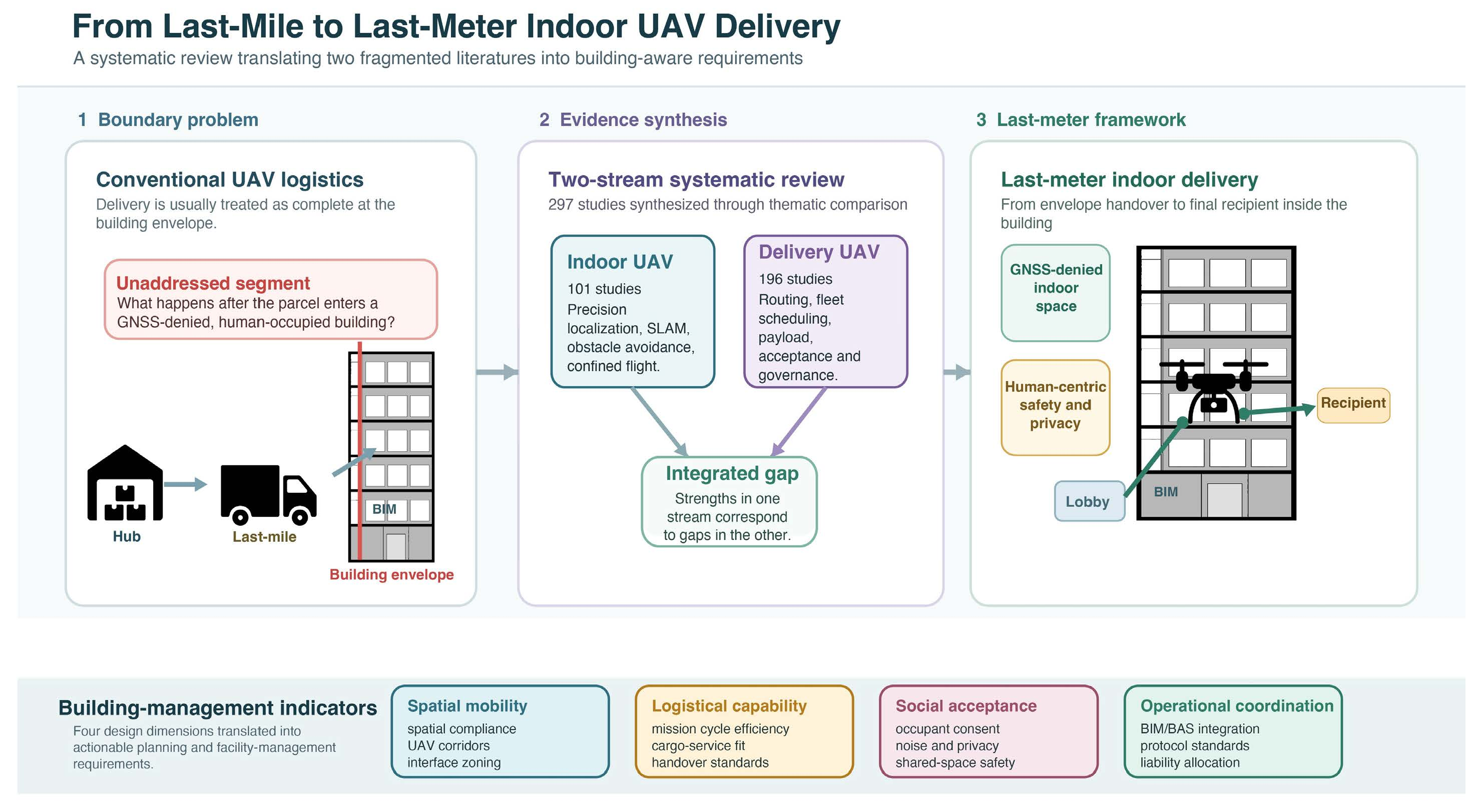
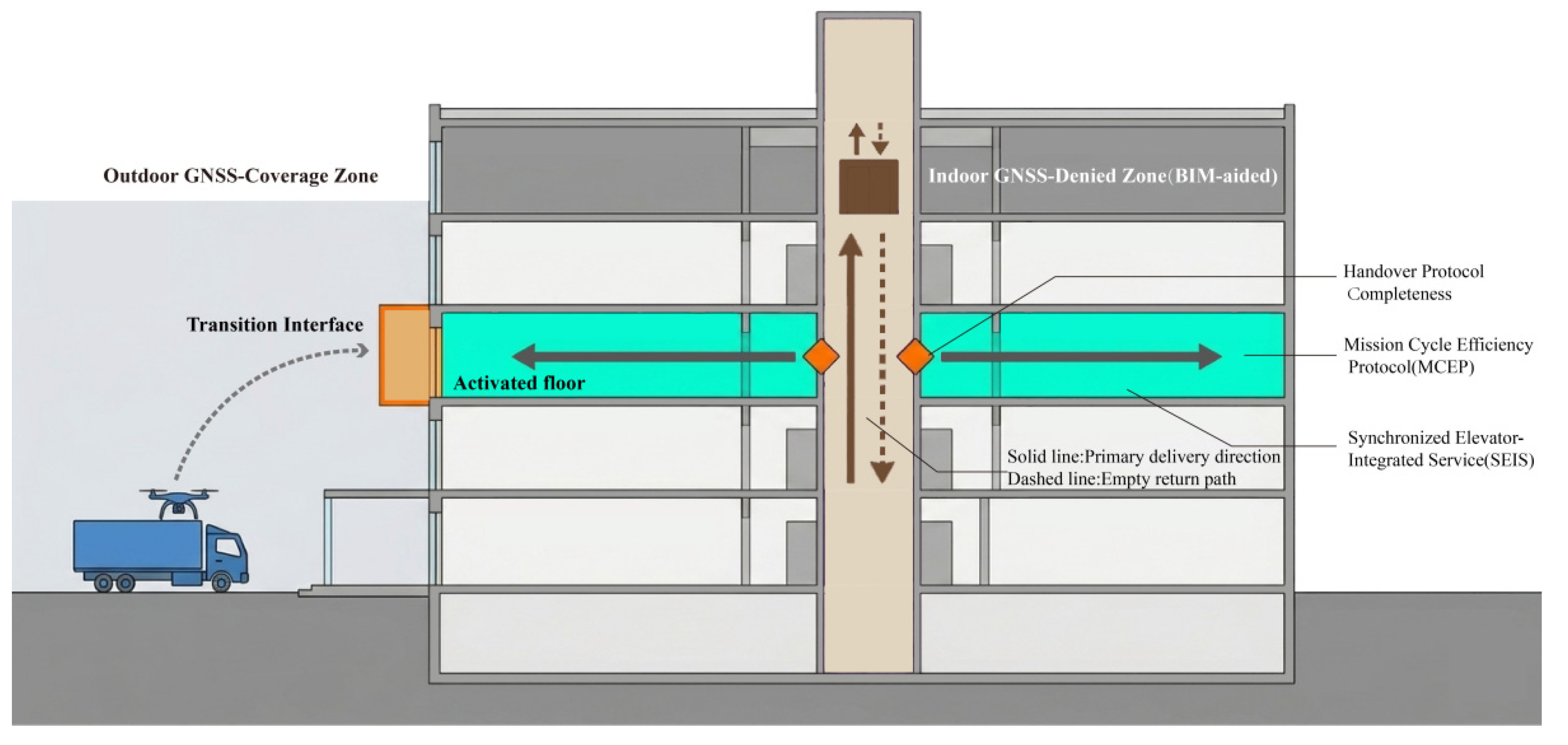
- Spatial boundary: The delivery segment begins at the outdoor–indoor transition interface of a building (e.g., balcony, window, rooftop access, or ground-floor lobby) and terminates at the point of final handover to the recipient inside the building. Typical travel distances fall within the order of 100–102 m, distinguishing this stage from last-mile delivery (103–104 m, outdoor, hub-to-building) and from the last-centimeter concept (<5 km, outdoor person-to-person).
- (ii)
- Technical boundary: the operational environment is GNSS-denied and requires sub-meter navigation precision under strict geometric clearances, relying on onboard SLAM, UWB, visual-inertial, or infrastructure-assisted localization rather than satellite positioning.
- (iii)
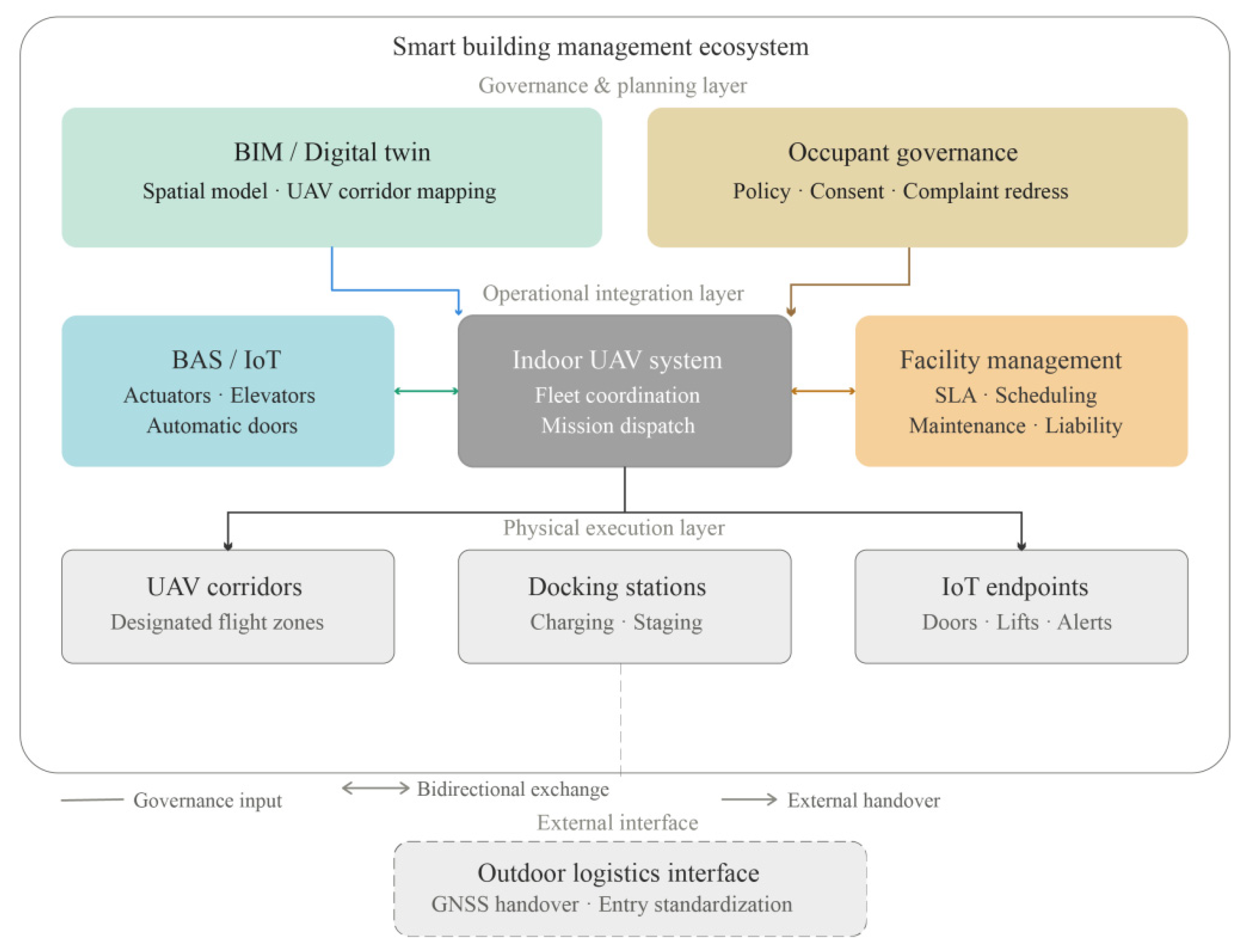
- Governance boundary: While such operations remain subject to the oversight of national civil aviation authorities, particularly rules governing flights near people, beyond visual line of sight (BVLOS), and for commercial purposes, the indoor airspace is, in practical terms, primarily administered by building owners and facility managers as the site-access and operational authority, rather than being managed solely through the public-airspace unmanned traffic management (UTM) or equivalent traffic-management frameworks that govern outdoor delivery. Last-meter delivery therefore sits at the interface between aviation regulation and building-level governance.
3. Methods
3.1. Systematic Review and Inclusion Criteria

3.2. Screening Criteria and Study Selection
3.3. PRISMA-Based Classification and Analysis
4. Results
4.1. Overview of the Reviewed Literature
4.2. Analyzing Indoor-UAV and Delivery-UAV Characteristics in Four Dimensions
4.2.1. Spatial Mobility
4.2.2. Logistical Capability
4.2.3. Social Acceptance
4.2.4. Operational Coordination
5. Discussion
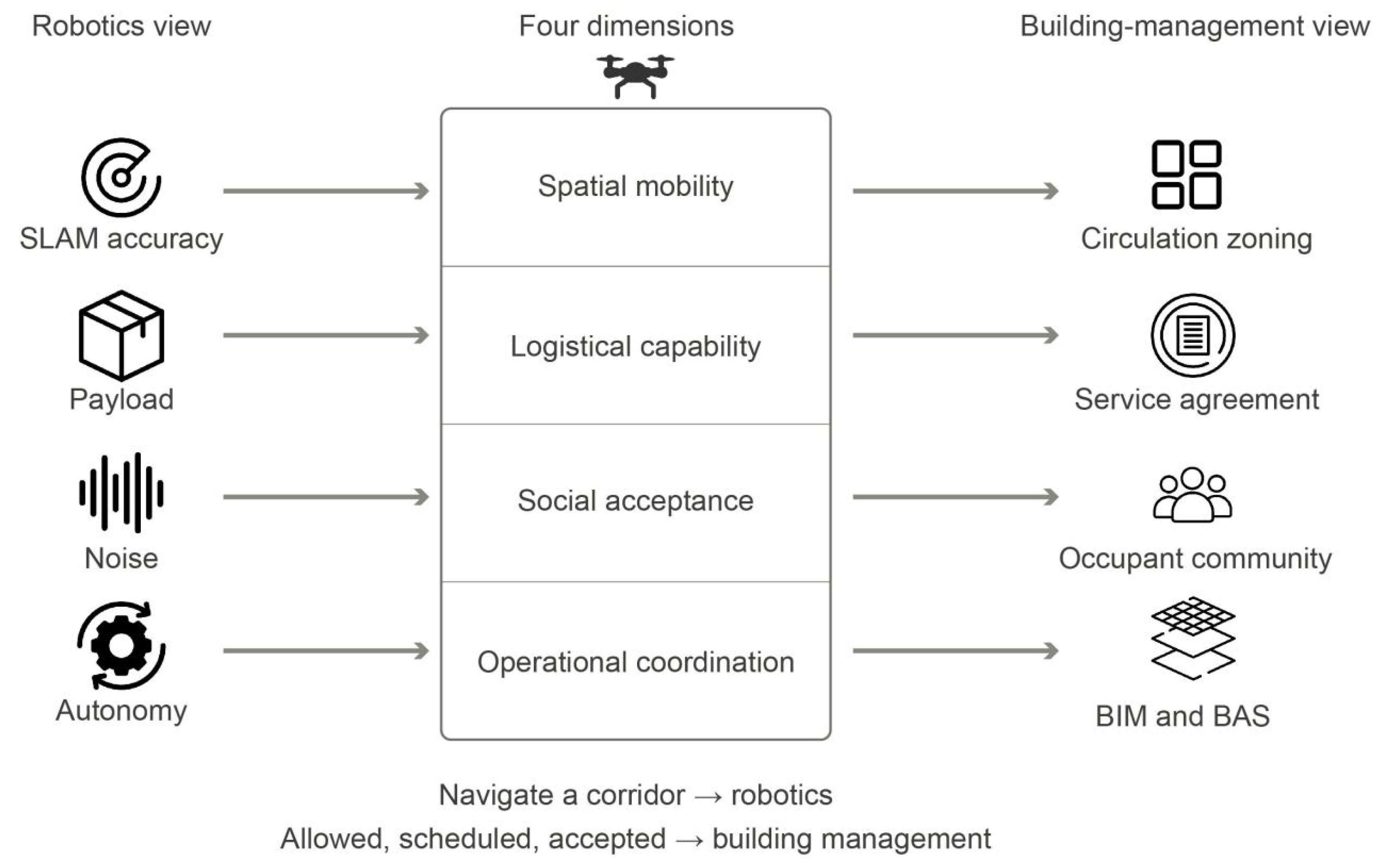
5.1. Proposed Challenges and Indicators for Last-Meter Delivery

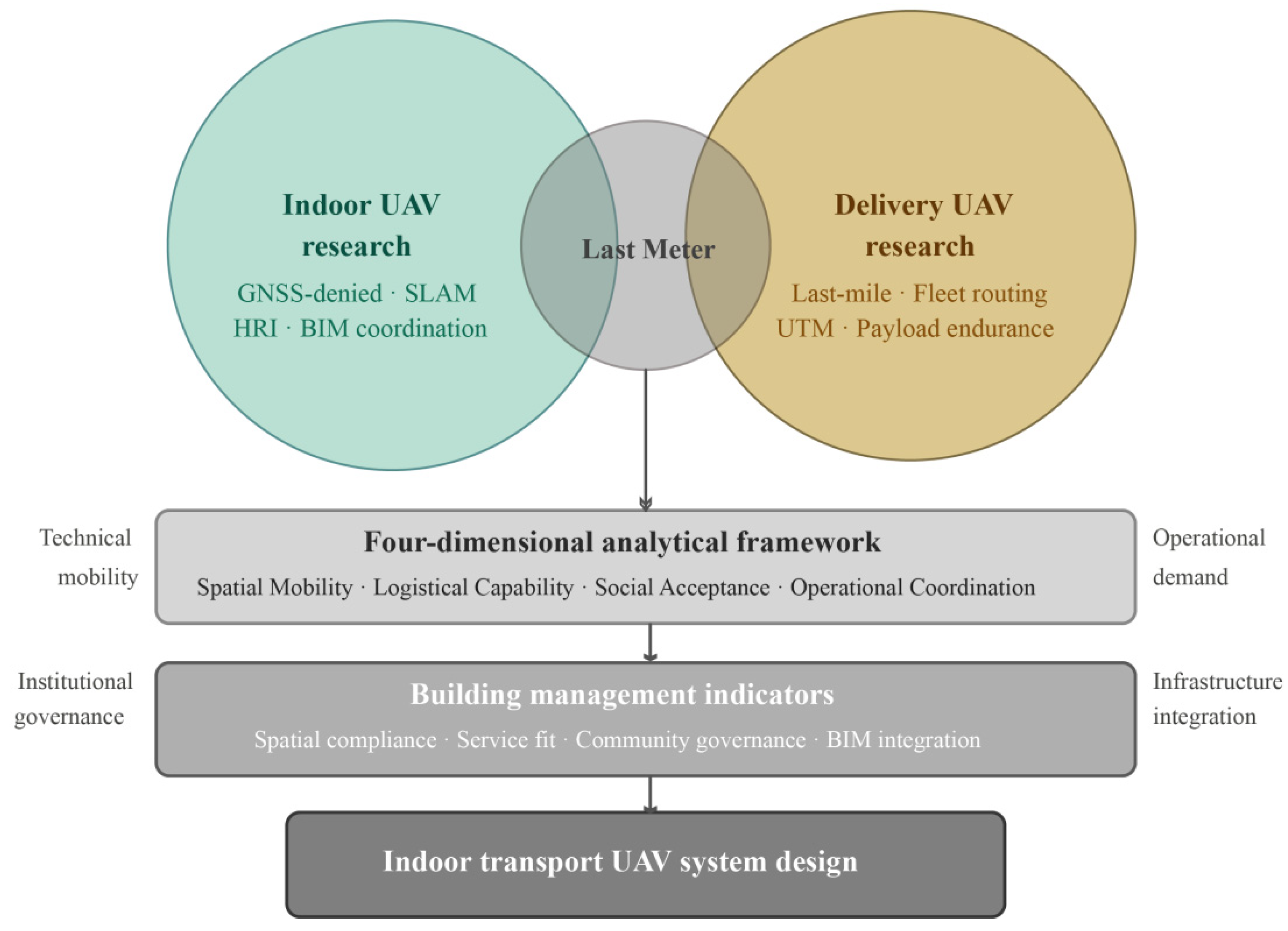
| Dimension | Critical Gap/Challenge | Specific Requirements for Indoor Delivery | Article |
|---|---|---|---|
| Spatial Mobility | Spatial designation gap: UAV routes have no standing within existing building circulation hierarchies (passenger, service, emergency flows). | Spatial compliance rate: % of UAV flight path conforming to designated zones, access rules, and egress clearances. | [82,83,84] |
| Handover interface standardization: existence of formally designated outdoor-to-indoor transition points (balconies, windows, lobbies) with defined entry protocols. | [8,9,50,85] | ||
| Vertical mobility coordination protocol: defined procedure for multi-floor delivery that avoids conflict with elevator scheduling and stairwell evacuation routes. | [49,85,86] | ||
| Dynamic occupancy sensitivity: capacity to adjust routing in response to real-time building occupancy data (event scheduling, peak hours). | [32,87,88] | ||
| Logistical Capability | Service integration gap: no standardized framework exists to embed UAV delivery into building service agreements, maintenance schedules, or cargo classification systems. | Mission cycle efficiency: total time from task dispatch to completed delivery and UAV return to staging station, benchmarked against existing building logistics alternatives. | [12,33,89,90] |
| Service fit index: formal classification of cargo types (documents, pharmaceuticals, consumables) eligible for aerial delivery, with packaging and labelling standards. | [91,92,93] | ||
| Handover protocol completeness: existence of standardized procedures for recipient interaction, proof-of-delivery recording, and failed-delivery contingency. | [7,8,52] | ||
| Operational turnaround capacity: defined staging, charging, and resetting workflow per building, with capacity benchmarks per building typology (hospital, residential tower, office). | [10,94] | ||
| Social Acceptance | Community governance gap: UAV introduction affects shared acoustic, visual, and safety environments of all occupants, yet current frameworks address only individual user consent. | Occupant policy literacy score: % of building occupants who are aware of UAV operating rules, corridor locations, and their rights regarding noise and privacy. | [52,54,95] |
| Consent and opt-out coverage: proportion of occupants in proximity to UAV corridors who have been offered formal opt-out or scheduling preference options. | [55,56,96,97] | ||
| Acoustic environment compliance: UAV noise impact assessed against building-type acoustic standards rather than generic dB limits. | [57,98] | ||
| Operational Coordination | Institutional interoperability gap: UAV systems lack formal integration with building management infrastructure (BMS, BAS, BIM, security), creating coordination voids and liability ambiguities. | BIM/digital twin integration completeness: degree to which UAV docking stations, corridors, and handover points are represented and schedulable within the building’s digital management platform. | [20,75,99] |
| Facility management service level agreement (SLA) coverage: existence of contractual obligations defining UAV uptime, incident response time, maintenance responsibilities, and performance benchmarks. | [100,101,102] | ||
| Liability and incident governance clarity: defined allocation of responsibility among building operator, UAV service provider, and recipient in cases of delivery failure, property damage, or data breach. | [36,56,103] |
5.2. Limitations and Recommendations
6. Conclusions
Supplementary Materials
Author Contributions
Funding
Institutional Review Board Statement
Informed Consent Statement
Data Availability Statement
Conflicts of Interest
Nomenclature
| AR | Augmented reality |
| BAS | Building automation system |
| BIM | Building information modeling |
| BVLOS | Beyond visual line of sight |
| GNSS | Global Navigation Satellite System |
| GPS | Global Positioning System |
| HRI | Human–robot interaction |
| IoT | Internet of things |
| LiDAR | Light Detection and Ranging |
| PESTLE | Political, Economic, Social, Technological, Legal, and Environmental (analysis) |
| PRISMA | Preferred Reporting Items for Systematic Reviews and Meta-Analyses |
| RPA | Remotely piloted aircraft |
| SLAM | Simultaneous Localization and Mapping |
| TOE | Technology–Organization–Environment (framework) |
| UAV | Unmanned aerial vehicle |
| UTAUT | Unified Theory of Acceptance and Use of Technology |
| UTM | Unmanned traffic management |
| VRP(-D) | Vehicle routing problem (with drones) |
References
- Badshah, I.; Bridgelall, R.; Thompson, E.A. GIS-Enabled Truck-Drone Hybrid Systems for Agricultural Last-Mile Delivery: A Multidisciplinary Review with Insights from a Rural Region. Drones 2025, 9, 868. [Google Scholar] [CrossRef]
- Koshta, N.; Devi, Y.; Chauhan, C. Evaluating Barriers to the Adoption of Delivery Drones in Rural Healthcare Supply Chains: Preparing the Healthcare System for the Future. IEEE Trans. Eng. Manag. 2022, 71, 13096–13108. [Google Scholar] [CrossRef]
- Shao, P.C.; Lin, C.E.; Tsai, K.H. UAS Medical Delivery in Rural/Mountain Areas under UTM Surveillance. In Proceedings of the 2022 Integrated Communication, Navigation and Surveillance Conference (ICNS), Dulles, VA, USA, 5–7 April 2022. [Google Scholar] [CrossRef]
- Xiao, J.; Li, Y.; Cao, Z.; Xiao, J. Cooperative trucks and drones for rural last-mile delivery with steep roads. Comput. Ind. Eng. 2024, 187, 109849. [Google Scholar] [CrossRef]
- Eskandaripour, H.; Boldsaikhan, E. Last-Mile Drone Delivery: Past, Present, and Future. Drones 2023, 7, 77. [Google Scholar] [CrossRef]
- Garg, V.; Niranjan, S.; Prybutok, V.; Pohlen, T.; Gligor, D. Drones in last-mile delivery: A systematic review on Efficiency, Accessibility, and Sustainability. Transp. Res. Part D Transp. Environ. 2023, 123, 103831. [Google Scholar] [CrossRef]
- Kornatowski, P.M.; Bhaskaran, A.; Heitz, G.M.; Mintchev, S.; Floreano, D. Last-Centimeter Personal Drone Delivery: Field Deployment and User Interaction. IEEE Robot. Autom. Lett. 2018, 3, 3813–3820. [Google Scholar] [CrossRef]
- Suarez, A.; Gonzalez, A.; Alvarez, C.; Ollero, A. Through-Window Home Aerial Delivery System with In-Flight Parcel Load and Handover: Design and Validation in Indoor Scenario. Int. J. Soc. Robot. 2024, 16, 2109–2132. [Google Scholar] [CrossRef]
- Brunner, G.; Szebedy, B.; Tanner, S.; Wattenhofer, R. The Urban Last Mile Problem: Autonomous Drone Delivery to Your Balcony. In Proceedings of the 2019 International Conference on Unmanned Aircraft Systems (ICUAS), Atlanta, GA, USA, 11–14 June 2019; pp. 1005–1012. [Google Scholar] [CrossRef]
- Arenzana, A.O.; Macias, J.J.E.; Angeloudis, P. Design of Hospital Delivery Networks Using Unmanned Aerial Vehicles. Transp. Res. Rec. J. Transp. Res. Board 2020, 2674, 405–418. [Google Scholar] [CrossRef]
- Popp, M.; Scholz, G.; Prophet, S.; Trommer, G.F. A laser and image based navigation and guidance system for autonomous outdoor-indoor transition flights of MAVs. In Proceedings of the 2015 DGON Inertial Sensors and Systems Symposium (ISS), Karlsruhe, Germany, 22–23 September 2015; pp. 1–18. [Google Scholar] [CrossRef]
- Silvestri, S.D.; Pagliarani, M.; Tomasello, F.; Trojaniello, D.; Sanna, A. Design of a Service for Hospital Internal Transport of Urgent Pharmaceuticals via Drones. Drones 2022, 6, 70. [Google Scholar] [CrossRef]
- Fragapane, G.I.; Biriita Bertnum, A.; Hvolby, H.-H.; Strandhagen, J.O. Material Distribution and Transportation in a Norwegian Hospital: A Case Study. IFAC-Pap. 2018, 51, 352–357. [Google Scholar] [CrossRef]
- Yu, J.; Zhu, G.; Cui, K.; Yu, D.; Bayartaikishigtai, D.; Chen, Z.; Zhou, Z. Comparison of the speed and quality of innovative and traditional pneumatic tube system transport outside of an emergency laboratory. Heliyon 2024, 10, e31511. [Google Scholar] [CrossRef] [PubMed]
- Fragapane, G.; De Koster, R.; Sgarbossa, F.; Strandhagen, J.O. Planning and control of autonomous mobile robots for intralogistics: Literature review and research agenda. Eur. J. Oper. Res. 2021, 294, 405–426. [Google Scholar] [CrossRef]
- Permann, S. Automated Guided Vehicles and Autonomous Mobile Robots in Hospitals. Doctoral Dissertation, Vienna University of Technology, Vienna, Austria, 2021. [Google Scholar]
- Orgeira-Crespo, P.; Ulloa, C.; Rey-Gonzalez, G.; García, J.A.P. Methodology for Indoor Positioning and Landing of an Unmanned Aerial Vehicle in a Smart Manufacturing Plant for Light Part Delivery. Electronics 2020, 9, 1680. [Google Scholar] [CrossRef]
- Alsayed, A.; Nabawy, M.R.; Arvin, F. Autonomous Aerial Mapping Using a Swarm of Unmanned Aerial Vehicles. In Proceedings of the AIAA Aviation 2022 Forum, Chicago, IL, USA, 27 June–1 July 2022. [Google Scholar]
- Brogaard, R.Y.; Boukas, E. Autonomous GPU-based UAS for inspection of confined spaces: Application to marine vessel classification. Robot. Auton. Syst. 2024, 172, 104590. [Google Scholar] [CrossRef]
- Dupont, Q.F.M.; Chua, D.K.H.; Tashrif, A.; Abbott, E.L.S. Potential Applications of Along the Construction’s Value Chain. Procedia Eng. 2017, 182, 165–173. [Google Scholar] [CrossRef]
- Mizutani, S.; Okada, Y.; Salaan, C.J.; Ishii, T.; Ohno, K.; Tadokoro, S. Proposal and Experimental Validation of a Design Strategy for a UAV with a Passive Rotating Spherical Shell. In Proceedings of the 2015 IEEE/RSJ International Conference on Intelligent Robots and Systems (IROS), Hamburg, Germany, 28 September–2 October 2015; pp. 1271–1278. [Google Scholar]
- Jazairy, A.; Persson, E.; Brho, M.; von Haartman, R.; Hilletofth, P. Drones in last-mile delivery: A systematic literature review from a logistics management perspective. Int. J. Logist. Manag. 2024, 36, 1–62. [Google Scholar] [CrossRef]
- Beck, K.; Esquillor, J.; Zarei, M.M.; Froes, I.; Hauswald, I.; Giannakopoulou, A.; Flämig, H. Making last mile logistics models aware of customer choices, demand sustainability and data economy. Eur. Transp. Res. Rev. 2025, 17, 29. [Google Scholar] [CrossRef]
- Bertolini, M.; Matteis, G.D.; Nava, A. Sustainable Last-Mile Logistics in Economics Studies: A Systematic Literature Review. Sustainability 2024, 16, 1205. [Google Scholar] [CrossRef]
- Boysen, N.; Fedtke, S.; Schwerdfeger, S. Last-mile delivery concepts: A survey from an operational research perspective. OR Spectr. 2021, 43, 1–58. [Google Scholar] [CrossRef]
- Olsson, J.; Hellström, D.; Pålsson, H. Framework of Last Mile Logistics Research: A Systematic Review of the Literature. Sustainability 2019, 11, 7131. [Google Scholar] [CrossRef]
- Pourmohammadreza, N.; Jokar, M.R.A.; Van Woensel, T. Last-Mile Logistics with Alternative Delivery Locations: A Systematic Literature Review. Results Eng. 2025, 25, 104085. [Google Scholar] [CrossRef]
- Bakogianni, M.A.; Malindretos, G. «Last Mile Deliveries» in the Framework of Urban Distribution and Supply Chain Management: Review of Best Practices. Dev. Manag. Entrep. Methods Transp. (ONMU) 2021, 2, 38–64. [Google Scholar] [CrossRef]
- Mohamed, A.; Mohamed, M. Unmanned Aerial Vehicles in Last-Mile Parcel Delivery: A State-of-the-Art Review. Drones 2025, 9, 413. [Google Scholar] [CrossRef]
- Amiri, M.S.; Ramli, R.; Faizal, A.H. Simultaneous Localization and Mapping and Tag-Based Navigation for Unmanned Aerial Vehicles. Int. J. Integr. Eng. 2023, 15, 225–232. [Google Scholar] [CrossRef]
- Moher, D.; Liberati, A.; Tetzlaff, J.; Altman, D.G.; The PRISMA Group. Preferred Reporting Items for Systematic Reviews and Meta-Analyses: The PRISMA Statement. PLoS Med. 2009, 6, e1000097. [Google Scholar] [CrossRef] [PubMed]
- Escribano, J.; Chang, H.; Angeloudis, P. Integrated Path Planning and Task Assignment Model for On-Demand Last-Mile UAV-Based Delivery; DeArmas, J., Ramalhinho, H., Voss, S., Eds.; Springer: Cham, Switzerland, 2022; Volume 13557, pp. 198–213. [Google Scholar] [CrossRef]
- San, K.T.; Chang, Y.S. Drone-based delivery: A concurrent heuristic approach using a genetic algorithm. Aircr. Eng. Aerosp. Technol. 2022, 94, 1312–1326. [Google Scholar] [CrossRef]
- Singh, S. Drone-assisted delivery optimization: Balancing time and cost with multiple truck routes for efficient service. Comput. Ind. Eng. 2025, 203, 111061. [Google Scholar] [CrossRef]
- de Oliveira, F.M.C.; Bittencourt, L.F.; Bianchi, R.A.C.; Kamienski, C.A. Drones in the Big City: Autonomous Collision Avoidance for Aerial Delivery Services. IEEE Trans. Intell. Transp. Syst. 2023, 25, 4657–4674. [Google Scholar] [CrossRef]
- Chandran, N.K.; Sultan, M.T.H.; Łukaszewicz, A.; Shahar, F.S.; Holovatyy, A.; Giernacki, W. Review on Type of Sensors and Detection Method of Anti-Collision System of Unmanned Aerial Vehicle. Sensors 2023, 23, 6810. [Google Scholar] [CrossRef] [PubMed]
- Luo, H.; Chen, T.; Li, X.; Li, S.; Zhang, C.; Zhao, G.; Liu, X. KeepEdge: A Knowledge Distillation Empowered Edge Intelligence Framework for Visual Assisted Positioning in UAV Delivery. IEEE Trans. Mob. Comput. 2022, 22, 4729–4741. [Google Scholar] [CrossRef]
- Alghamdi, S.; Alahmari, S.; Yonbawi, S.; Alsaleem, K.; Ateeq, F.; Almushir, F. Autonomous Navigation Systems in GPS-Denied Environments: A Review of Techniques and Applications. In Proceedings of the 2025 11th International Conference on Automation, Robotics, and Applications (ICARA), Zagreb, Croatia, 12–14 February 2025; pp. 290–299. [Google Scholar] [CrossRef]
- Moon, S.; Eom, W.; Gong, H. Development of Large-scale 3D Map Generation System for Indoor Autonomous Navigation Flight—Work in Progress. Procedia Eng. 2015, 99, 1132–1136. [Google Scholar] [CrossRef][Green Version]
- Cui, Y.; Zhang, Y.; Bai, D.; Diao, Y.; Wang, Y. 3D map and mmWave radar-based self-localization for UAVs in GNSS-denied environments. Veh. Commun. 2026, 57, 100986. [Google Scholar] [CrossRef]
- Jung, S.; Lee, H.; Shim, D.H.; Agha-mohammadi, A. Collision-free local planner for unknown subterranean navigation. ETRI J. 2021, 43, 580–593. [Google Scholar] [CrossRef]
- Lam, M.; Herrera, J.; Afzal, S.S.; Zhou, K.; Adib, F. MiNav: Autonomous Drone Navigation Indoors Using Millimeter-Waves. Proc. ACM Interact. Mob. Wearable Ubiquitous Technol. 2025, 9, 97. [Google Scholar] [CrossRef]
- He, X.; Kou, G.; Calaf, M.; Leang, K.K. In-Ground-Effect Modeling and Nonlinear-Disturbance Observer for Multirotor Unmanned Aerial Vehicle Control. J. Dyn. Syst. Meas. Control. 2019, 141, 071013. [Google Scholar] [CrossRef]
- Bhuiyan, T.H.; Walker, V.; Roni, M.; Ahmed, I. Aerial drone fleet deployment optimization with endogenous battery replacements for direct delivery of time-sensitive products. Expert Syst. Appl. 2024, 252, 124172. [Google Scholar] [CrossRef]
- Ragupati, J.; Chatterjee, S.; Kim, B.; Lee, S. Battery drones versus hydrogen fuel cell drones for last-mile delivery. Comput. Ind. Eng. 2026, 212, 111735. [Google Scholar] [CrossRef]
- Moadab, A.; Farajzadeh, F.; Valilai, O.F. Drone routing problem model for last-mile delivery using the public transportation capacity as moving charging stations. Sci. Rep. 2022, 12, 6361. [Google Scholar] [CrossRef] [PubMed]
- Cokyasar, T.; Dong, W.; Jin, M.; Verbas, I.Ö. Designing a drone delivery network with automated battery swapping machines. Comput. Oper. Res. 2021, 129, 105177. [Google Scholar] [CrossRef]
- Hong, I.; Kuby, M.; Murray, A.T. A range-restricted recharging station coverage model for drone delivery service planning. Transp. Res. Part C Emerg. Technol. 2018, 90, 198–212. [Google Scholar] [CrossRef]
- Eeshwaroju, S.; Jakkula, P.; Abdellatif, I. An IoT based Three-Dimensional Dynamic Drone Delivery (3D4) System. In Proceedings of the 2020 IEEE Cloud Summit, Harrisburg, PA, USA, 21–22 October 2020; pp. 119–123. [Google Scholar] [CrossRef]
- Seth, A.; James, A.; Kuantama, E.; Mukhopadhyay, S.; Han, R. Drone High-Rise Aerial Delivery with Vertical Grid Screening. Drones 2023, 7, 300. [Google Scholar] [CrossRef]
- Norton, A.; Ahmadzadeh, R.; Jerath, K.; Robinette, P.; Weitzen, J.; Wickramarathne, T.; Yanco, H.; Choi, M.; Donald, R.; Donoghue, B.; et al. Decisive Test Methods Handbook. arXiv 2022, arXiv:2211.01801. [Google Scholar]
- Lingam, S.N.; Verstegen, R.; Petermeijer, S.M.; Martens, M. Human interactions with delivery drones in public spaces: Design recommendations from recipient and bystander perspectives. Front. Robot. AI 2025, 12, 1580289. [Google Scholar] [CrossRef] [PubMed]
- Liu, M.; Zhang, Y. Exploring common spatial characteristics to integrate ecological and visual landscape qualities: A systematic review and meta-analysis. Urban For. Urban Green. 2025, 112, 129007. [Google Scholar] [CrossRef]
- Wu, J.; Chen, Z.; Zhang, Z.; Cen, M. Examining the acceptance of drone delivery services among Chinese consumers: A perspective from urban and rural areas. PLoS ONE 2025, 20, e0333422. [Google Scholar] [CrossRef] [PubMed]
- Irshad, A.; Farooq, M.; Mahmood, K.; Mallah, G.A.; Chaudhry, S.A. DAC-MD: A privacy preserving drone-access control scheme for last mile delivery. Trans. Emerg. Telecommun. Technol. 2024, 35, e4958. [Google Scholar] [CrossRef]
- Tu, Y.-J.; Piramuthu, S. Security and privacy risks in drone-based last mile delivery. Eur. J. Inf. Syst. 2024, 33, 617–630. [Google Scholar] [CrossRef]
- Schäffer, B.; Pieren, R.; Heutschi, K.; Wunderli, J.M.; Becker, S. Drone Noise Emission Characteristics and Noise Effects on Humans—A Systematic Review. Int. J. Environ. Res. Public Health 2021, 18, 5940. [Google Scholar] [CrossRef] [PubMed]
- Wojciechowska, A.; Frey, J.; Sass, S.; Shafir, R.; Cauchard, J.R. Collocated Human-Drone Interaction: Methodology and Approach Strategy. In Proceedings of the 2019 14th ACM/IEEE International Conference on Human-Robot Interaction (HRI), Daegu, Republic of Korea, 11–14 March 2019; pp. 172–181. [Google Scholar] [CrossRef]
- Bevins, A.; Kunde, S.; Duncan, B.A. User-Designed Human-UAV Interaction in a Social Indoor Environment. In Proceedings of the 2024 ACM/IEEE International Conference on Human-Robot Interaction, HRI’24, Boulder, CO, USA, 11–15 March 2024; pp. 23–31. [Google Scholar] [CrossRef]
- Wang, Z.; Wu, Y.; Yang, S.; Chen, X.; Rohles, B.; Fjeld, M. Exploring Intended Functions of Indoor Flying Robots Interacting With Humans in Proximity. In Proceedings of the 2024 CHI Conference on Human Factors in Computing Systems, CHI’24, Honolulu, HI, USA, 11–16 May 2024; pp. 1–16. [Google Scholar] [CrossRef]
- Wüstenhagen, R.; Wolsink, M.; Bürer, M.J. Social acceptance of renewable energy innovation: An introduction to the concept. Energy Policy 2007, 35, 2683–2691. [Google Scholar] [CrossRef]
- Kotlinski, M.; Calkowska, J.K. U-Space and UTM Deployment as an Opportunity for More Complex UAV Operations Including UAV Medical Transport. J. Intell. Robot. Syst. 2022, 106, 12. [Google Scholar] [CrossRef] [PubMed]
- Zhang, H.; Wang, F.; Feng, D.; Du, S.; Zhong, G.; Deng, C.; Zhou, J. A Logistics UAV Parcel-Receiving Station and Public Air-Route Planning Method Based on Bi-Layer Optimization. Appl. Sci. 2023, 13, 1842. [Google Scholar] [CrossRef]
- Sorbelli, F.B.; Corò, F.; Das, S.K.; Pinotti, C.M.; Shende, A. Dispatching point selection for a drone-based delivery system operating in a mixed Euclidean-Manhattan grid. Ann. Oper. Res. 2025, 351, 203–222. [Google Scholar] [CrossRef]
- Pan, J.-S.; Song, P.-C.; Chu, S.-C.; Peng, Y.-J. Improved Compact Cuckoo Search Algorithm Applied to Location of Drone Logistics Hub. Mathematics 2020, 8, 333. [Google Scholar] [CrossRef]
- Lamb, J.S.; Wirasinghe, S.C.; Waters, N.M. Planning delivery-by-drone micro-fulfilment centres. Transp. A-Transp. Sci. 2024, 20, 24–32. [Google Scholar] [CrossRef]
- Yi, J.; Zhang, H.; Li, S.; Feng, O.; Zhong, G.; Liu, H. Logistics UAV Air Route Network Capacity Evaluation Method Based on Traffic Flow Allocation. IEEE Access 2023, 11, 63701–63713. [Google Scholar] [CrossRef]
- Zhang, H.; Wu, S.; Feng, O.; Tian, T.; Huang, Y.; Zhong, G. Research on Demand-Based Scheduling Scheme of Urban Low-Altitude Logistics UAVs. Appl. Sci. 2023, 13, 5370. [Google Scholar] [CrossRef]
- Lin, J.; Alkouz, B.; Bouguettaya, A.; Abu Safia, A. Dynamic and Immersive Framework for Drone Delivery Services in Skyway Networks. ACM Trans. Internet Technol. 2025, 25, 7. [Google Scholar] [CrossRef]
- Jana, S.; Mandal, P.S. Approximation algorithms for drone delivery scheduling with a fixed number of drones. Theor. Comput. Sci. 2024, 991, 114442. [Google Scholar] [CrossRef]
- Banjar, A.; Jemmali, M.; Melhim, L.K.B.; Boulila, W.; Ladhari, T.; Sarhan, A.Y. Intelligent Scheduling Algorithms for the Enhancement of Drone-Based Innovative Logistic Supply Chain Systems. IEEE Access 2023, 11, 102418–102429. [Google Scholar] [CrossRef]
- Ding, Y.; Xiong, H.; Shi, X.; Liu, J.; Chen, Y.; Wang, J. Self-Organized Reynolds Swarms of Unmanned Aerial Vehicles in Dense Environments; Yan, L., Duan, H., Deng, Y., Eds.; Advances in Guidance, Navigation and Control; Springer Nature: Singapore, 2025; pp. 345–355. [Google Scholar] [CrossRef]
- Schioler, H.; Totu, L.; Dimon, J.; Larsen, K.G.; Taankvist, J.H. Time Optimal Robust Fleet Management of micro UAV through Timed Games formulation. In Proceedings of the 2018 IEEE Conference on Control Technology and Applications (CCTA), Copenhagen, Denmark, 21–24 August 2018; pp. 146–152. [Google Scholar]
- Li, N.; Tan, J.; Wu, Y.; Xu, J.; Wang, H.; Wu, W. Multi-UAV Cooperative Exploring for the Unknown Indoor Environment Based on Dynamic Target Tracking; Gao, H., Wang, X., Eds.; Springer: Cham, Switzerland, 2021; Volume 406, pp. 191–209. [Google Scholar] [CrossRef]
- Mourtzis, D.; Angelopoulos, J.; Panopoulos, N. Unmanned Aerial Vehicle (UAV) path planning and control assisted by Augmented Reality (AR): The case of indoor drones. Int. J. Prod. Res. 2024, 62, 3361–3382. [Google Scholar] [CrossRef]
- Opoku, D.-G.J.; Perera, S.; Osei-Kyei, R.; Rashidi, M. Digital twin application in the construction industry: A literature review. J. Build. Eng. 2021, 40, 102726. [Google Scholar] [CrossRef]
- Jia, M.; Komeily, A.; Wang, Y.; Srinivasan, R.S. Adopting Internet of Things for the development of smart buildings: A review of enabling technologies and applications. Autom. Constr. 2019, 101, 111–126. [Google Scholar] [CrossRef]
- Stöcker, C.; Bennett, R.; Nex, F.; Gerke, M.; Zevenbergen, J. Review of the current state of UAV regulations. Remote Sens. 2017, 9, 459. [Google Scholar] [CrossRef]
- Civil Aviation Safety Authority. CASA EX88/25—Indoor Operation of RPA Near People and BVLOS (Training and Use) Exemption 2025 (F2025L01210). Federal Register of Legislation, Australian Government. 2025. Available online: https://www.legislation.gov.au/F2025L01210/latest/text (accessed on 30 September 2025).
- Finn, R.L.; Wright, D. Unmanned aircraft systems: Surveillance, ethics and privacy in civil applications. Comput. Law Secur. Rev. 2012, 28, 184–194. [Google Scholar] [CrossRef]
- Yaacoub, J.-P.; Noura, H.; Salman, O.; Chehab, A. Security analysis of drones systems: Attacks, limitations, and recommendations. Internet Things 2020, 11, 100218. [Google Scholar] [CrossRef] [PubMed]
- Bae, S.; Shin, H.; Tsourdos, A. A New Graph-Based Flight Planning Algorithm for Unmanned Aircraft System Traffic Management. In Proceedings of the 2018 IEEE/AIAA 37th Digital Avionics Systems Conference (DASC), London, UK, 23–27 September 2018; pp. 186–194. [Google Scholar]
- Bilgin, G.; Anbaroglu, B. Extending INSPIRE to accommodate urban drone logistics. Geocarto Int. 2022, 37, 12536–12560. [Google Scholar] [CrossRef]
- Rosa, R.; Saadi, M.; Rodríguez, D.; Gew, L.; Nordin, R.; Ali, R.; Ming, L. Integer Linear Programming for Optimizing Drone-Based Delivery Routes. Eng. J. 2025, 29, 23–38. [Google Scholar] [CrossRef]
- Kim, J.; Moon, H.; Jung, H. Drone-Based Parcel Delivery Using the Rooftops of City Buildings: Model and Solution. Appl. Sci. 2020, 10, 4362. [Google Scholar] [CrossRef]
- Kim, J.; Jung, H. Robot Routing Problem of Last-Mile Delivery in Indoor Environments. Appl. Sci. 2022, 12, 9111. [Google Scholar] [CrossRef]
- Liu, M.; Liu, X.; Zhu, M.; Zheng, F. Stochastic Drone Fleet Deployment and Planning Problem Considering Multiple-Type Delivery Service. Sustainability 2019, 11, 3871. [Google Scholar] [CrossRef]
- Paul, A.; Levin, M.W.; Waller, S.T.; Rey, D. Data-driven optimization for drone delivery service planning with online demand. Transp. Res. Part E-Logist. Transp. Rev. 2025, 198, 104095. [Google Scholar] [CrossRef]
- Moshref-Javadi, M.; Hemmati, A.; Winkenbach, M. A comparative analysis of synchronized truck-and-drone delivery models. Comput. Ind. Eng. 2021, 162, 107648. [Google Scholar] [CrossRef]
- Porter, J.; Cherrett, T.; Oakey, A. Understanding the viability of drone logistics for assisting pathology transportation: A case study in Dorset, UK. Int. J. Logist.-Res. Appl. 2025, 28, 1159–1190. [Google Scholar] [CrossRef]
- Daultani, Y.; Chan, F.T.S.; Pratap, S.; Goswami, M. Modeling drone-enabled last-mile blood delivery systems for emergency healthcare. Int. J. Logist.-Res. Appl. 2025, 1–22. [Google Scholar] [CrossRef]
- Sigari, C.; Biberthaler, P. Medical drones: Disruptive technology makes the future happen. Unfallchirurg 2021, 124, 974–976. [Google Scholar] [CrossRef] [PubMed]
- Zieher, S.; Olcay, E.; Kefferpütz, K.; Salamat, B.; Olzem, S.; Elsbacher, G.; Meeß, H. Drones for automated parcel delivery: Use case identification and derivation of technical requirements. Transp. Res. Interdiscip. Perspect. 2024, 28, 101253. [Google Scholar] [CrossRef]
- Zhang, G.; Zhang, J.; He, B.; Zhang, R.; Zou, X. An optimisation model of hierarchical facility location problem for urban last-mile delivery with drones. Transp. A-Transp. Sci. 2024, 1–29. [Google Scholar] [CrossRef]
- Sah, B.; Gupta, R.; Bani-Hani, D. Analysis of barriers to implement drone logistics. Int. J. Logist.-Res. Appl. 2021, 24, 531–550. [Google Scholar] [CrossRef]
- Labib, N.S.; Brust, M.R.; Danoy, G.; Bouvry, P. The Rise of Drones in Internet of Things: A Survey on the Evolution, Prospects and Challenges of Unmanned Aerial Vehicles. IEEE Access 2021, 9, 115466–115487. [Google Scholar] [CrossRef]
- Leon, S.; Chen, C.; Ratcliffe, A. Consumers’ perceptions of last mile drone delivery. Int. J. Logist.-Res. Appl. 2023, 26, 345–364. [Google Scholar] [CrossRef]
- Kapoor, R.; Kloet, N.; Gardi, A.; Mohamed, A.; Sabatini, R. Sound Propagation Modelling for Manned and Unmanned Aircraft Noise Assessment and Mitigation: A Review. Atmosphere 2021, 12, 1424. [Google Scholar] [CrossRef]
- Khosiawan, Y.; Nielsen, I.; Do, N.A.D.; Yahya, B.N. Concept of Indoor 3D-Route UAV Scheduling System; Borzemski, L., Grzech, A., Swiatek, J., Wilimowska, Z., Eds.; Springer: Cham, Switzerland, 2016; Volume 429, pp. 29–40. [Google Scholar] [CrossRef]
- Cho, S.; Kim, H.; Chung, J.; Shin, D. Analysis of Drone Flight Stability for Building a Korean Urban Air Traffic (K-UAM) Delivery System. Appl. Sci. 2025, 15, 8492. [Google Scholar] [CrossRef]
- Yi, J.; Zhang, H.; Wang, F.; Ning, C.; Liu, H.; Zhong, G. An Operational Capacity Assessment Method for an Urban Low-Altitude Unmanned Aerial Vehicle Logistics Route Network. Drones 2023, 7, 582. [Google Scholar] [CrossRef]
- Zhang, Y.; Zhao, Q.; Mao, P.; Bai, Q.; Li, F.; Pavlova, S. Design and Control of an Ultra-Low-Cost Logistic Delivery Fixed-Wing UAV. Appl. Sci. 2024, 14, 4358. [Google Scholar] [CrossRef]
- Sun, X.; Li, X. A Drone-Driven Delivery Network Design for an On-Demand O2O Platform Considering Hazard Risks and Customer Heterogeneity. Asia-Pac. J. Oper. Res. 2024, 41, 2440004. [Google Scholar] [CrossRef]
- Ezaki, T.; Fujitsuka, K.; Imura, N.; Nishinari, K. Drone-based vertical delivery system for high-rise buildings: Multiple drones vs. a single elevator. Commun. Transp. Res. 2024, 4, 100130. [Google Scholar] [CrossRef]
- Lee, W.; Shahzaad, B.; Alkouz, B.; Bouguettaya, A. Reactive Composition of UAV Delivery Services in Urban Environments. IEEE Trans. Intell. Transp. Syst. 2024, 25, 13453–13466. [Google Scholar] [CrossRef]
- Chen, C.; Leon, S.; Ractham, P. Will customers adopt last-mile drone delivery services? An analysis of drone delivery in the emerging market economy. Cogent Bus. Manag. 2022, 9, 2074340. [Google Scholar] [CrossRef]
- Gomes, S.; Lopes, J.M.; Trancoso, T. Aerial pathways to resilience: The acceptance of drones in logistics transformation. Future Bus. J. 2025, 11, 102. [Google Scholar] [CrossRef]
- Shahzaad, B.; Alkouz, B.; Janszen, J.; Bouguettaya, A. Optimizing Drone Delivery in Smart Cities. IEEE Internet Comput. 2023, 27, 32–39. [Google Scholar] [CrossRef]
- Farah, M.F.; Mrad, M.; Ramadan, Z.; Hamdane, H. Handle with Care: Adoption of Drone Delivery Services. In Advances in National Brand and Private Label Marketing; Springer: Cham, Switzerland, 2020. [Google Scholar] [CrossRef]
- Tan, H.; Lee, J.; Gao, G.; Machinery, A.C. Human-Drone Interaction: Drone Delivery & Services for Social Events. In Proceedings of the DIS’18 Companion: Proceedings of the 2018 ACM Conference Companion Publication on Designing Interactive Systems, Hong Kong, 9–13 June 2018. [Google Scholar] [CrossRef]
- Chi, N.T.K.; Phong, L.T.; Hanh, N.T. The drone delivery services: An innovative application in an emerging economy. Asian J. Shipp. Logist. 2023, 39, 39–45. [Google Scholar] [CrossRef]
- Jeong, H.Y.; Song, B.D.; Lee, S. The Flying Warehouse Delivery System: A Quantitative Approach for the Optimal Operation Policy of Airborne Fulfillment Center. IEEE Trans. Intell. Transp. Syst. 2021, 22, 7521–7530. [Google Scholar] [CrossRef]
- Xu, Y.; Guo, R.; Kua, J.; Luo, H.; Zhang, Z.; Liu, X. We Will Find You: An Edge-Based Multi-UAV Multi-Recipient Identification Method in Smart Delivery Services. In Algorithms and Architectures for Parallel Processing; Springer: Cham, Switzerland, 2024. [Google Scholar] [CrossRef]
- Seo, S.-H.; Won, J.; Bertino, E.; Kang, Y.; Choi, D. A Security Framework for a Drone Delivery Service. In Proceedings of the DroNet’16: Proceedings of the 2nd Workshop on Micro Aerial Vehicle Networks, Systems, and Applications for Civilian Use, Singapore, 26 June 2016. [Google Scholar] [CrossRef]
- Huang, H.; Savkin, A.V. Deployment of Charging Stations for Drone Delivery Assisted by Public Transportation Vehicles. IEEE Trans. Intell. Transp. Syst. 2022, 23, 15043–15054. [Google Scholar] [CrossRef]
- Mishra, D.; Tiwari, M.K. Integrated truck drone delivery services with an optimal charging stations. Expert Syst. Appl. 2024, 254, 124254. [Google Scholar] [CrossRef]
- Levin, M.W.; Rey, D. Branch-and-Price for Drone Delivery Service Planning in Urban Airspace. Transp. Sci. 2023, 57, 843–865. [Google Scholar] [CrossRef]
- Mezni, H.; Sellami, M.; Elmannai, H.; Alkanhel, R. Federated resource prediction in UAV networks for efficient composition of drone delivery services. Comput. Netw. 2025, 271, 111642. [Google Scholar] [CrossRef]
- Valencia-Arias, A.; Rodríguez-Correa, P.A.; Patiño-Vanegas, J.C.; Benjumea-Arias, M.; De la Cruz-Vargas, J.; Moreno-López, G. Factors Associated with the Adoption of Drones for Product Delivery in the Context of the COVID-19 Pandemic in Medellin, Colombia. Drones 2022, 6, 225. [Google Scholar] [CrossRef]
- Jasim, N.I.; Kasim, H.; Mahmoud, M.A. Towards the Development of Smart and Sustainable Transportation System for Foodservice Industry: Modelling Factors Influencing Customer’s Intention to Adopt Drone Food Delivery (DFD) Services. Sustainability 2022, 14, 2852. [Google Scholar] [CrossRef]
- Xu, Y.; Luan, F.; Kua, J.; Luo, H.; Wang, Z.; Liu, X. Multi-UAV Collaborative Face Recognition for Goods Receiver in Edge-Based Smart Delivery Services. In Algorithms and Architectures for Parallel Processing; Springer: Cham, Switzerland, 2024. [Google Scholar] [CrossRef]
- Yoo, W.; Yu, E.; Jung, J. Drone delivery: Factors affecting the public’s attitude and intention to adopt. Telemat. Inform. 2018, 35, 1687–1700. [Google Scholar] [CrossRef]
- Sawadsitang, S.; Niyato, D.; Tan, P.-S.; Wang, P. Joint Ground and Aerial Package Delivery Services: A Stochastic Optimization Approach. IEEE Trans. Intell. Transp. Syst. 2019, 20, 2241–2254. [Google Scholar] [CrossRef]
- Park, S.; Zhang, L.; Chakraborty, S. Design Space Exploration of Drone Infrastructure for Large-Scale Delivery Services. In Proceedings of the ICCAD’16: Proceedings of the 35th International Conference on Computer-Aided Design, Austin, TX, USA, 7–10 November 2016. [Google Scholar] [CrossRef]
- Li, Z. Research on Real-Time Endurance of Drone Swarms for Express Delivery Dispatch. In Proceedings of the CSAIDE’24: Proceedings of the 2024 3rd International Conference on Cyber Security, Artificial Intelligence and Digital Economy, Jinan, China, 8–10 March 2024. [Google Scholar] [CrossRef]
- Perera, S.; Dawande, M.; Janakiraman, G.; Mookerjee, V. Retail Deliveries by Drones: How Will Logistics Networks Change? Prod. Oper. Manag. 2020, 29, 2019–2034. [Google Scholar] [CrossRef]
- Masoud, M.; Ibrahim, O.A.; Elhenawy, M. Employing Hybrid Pointer Networks With Deep Reinforcement Learning for Drone Routing in Delivery Using Public Transportation as Carriers. IEEE Access 2025, 13, 33424–33435. [Google Scholar] [CrossRef]
- He, X.; Li, L.; Mo, Y.; Huang, J.; Qin, S.J. A distributed route network planning method with congestion pricing for drone delivery services in cities. Transp. Res. Part C-Emerg. Technol. 2024, 160, 104536. [Google Scholar] [CrossRef]
- Mezni, H.; Sellami, M.; Elmannai, H.; Alkanhel, R. Daas composition: Enhancing UAV delivery services via LSTM-based resource prediction and flight patterns mining. Computing 2025, 107, 78. [Google Scholar] [CrossRef]
- Jeong, H.Y.; Song, B.D.; Lee, S. Optimal scheduling and quantitative analysis for multi-flying warehouse scheduling problem: Amazon airborne fulfillment center. Transp. Res. Part C-Emerg. Technol. 2022, 143, 103831. [Google Scholar] [CrossRef]
- Raivi, A.M.; Huda, S.M.A.; Alam, M.M.; Moh, S. Drone Routing for Drone-Based Delivery Systems: A Review of Trajectory Planning, Charging, and Security. Sensors 2023, 23, 1463. [Google Scholar] [CrossRef] [PubMed]
- Skoufi, E.; Filiopoulou, E.; Skoufis, A.; Michalakelis, C. Last Mile Delivery by Drone: A Technoeconomic Approach. In Economics of Grids, Clouds, Systems, and Services; Springer: Cham, Switzerland, 2021. [Google Scholar] [CrossRef]
- Xhafa, F.; Domínguez, C.; Juan, A. Last Mile Drone Delivery: Complexity and Research Challenges. In Decision Sciences; Springer: Cham, Switzerland, 2025. [Google Scholar] [CrossRef]
- Niu, B.; Zhang, J.; Xie, F. Drone logistics’ resilient development: Impacts of consumer choice, competition, and regulation. Transp. Res. Part A-Policy Pract. 2024, 185, 104126. [Google Scholar] [CrossRef]
- Borghetti, F.; Caballini, C.; Carboni, A.; Grossato, G.; Maja, R.; Barabino, B. The Use of Drones for Last-Mile Delivery: A Numerical Case Study in Milan, Italy. Sustainability 2022, 14, 1766. [Google Scholar] [CrossRef]
- Kong, J.; Xie, M.; Wang, H. Integrating Autonomous Vehicles and Drones for Last-Mile Delivery: A Routing Problem with Two Types of Drones and Multiple Visits. Drones 2025, 9, 280. [Google Scholar] [CrossRef]
- Yoo, H.; Chankov, S. Drone-delivery Using Autonomous Mobility: An Innovative Approach to Future Last-mile Delivery Problems. In Proceedings of the 2018 IEEE International Conference on Industrial Engineering and Engineering Management (IEEM), Bangkok, Thailand, 16–19 December 2018. [Google Scholar]
- Faiçal, B.S.; Marcondes, C.A.C.; Loubach, D.S.; Sbruzzi, E.F.; Verri, F.A.N.; Marques, J.C.; Pereira, L.A.; Maximo, M.R.O.A.; Curtis, V.V. A Cyber-Physical System’s Roadmap to Last-Mile Delivery Drones. IEEE Aerosp. Electron. Syst. Mag. 2023, 38, 6–19. [Google Scholar] [CrossRef]
- Mokhtari-Moghadam, A.; Salhi, A.; Yang, X.; Nguyen, T.T.; Pourhejazy, P. A multi-objective approach for the integrated planning of drone and robot assisted truck operations in last-mile delivery. Expert Syst. Appl. 2025, 269, 126434. [Google Scholar] [CrossRef]
- Ahmadi, E.; Wicaksono, H.; Valilai, O.F. Extending the Last Mile Delivery Routing Problem for Enhancing Sustainability by Drones Using a Sentiment Analysis Approach. In Proceedings of the 2021 IEEE International Conference on Industrial Engineering and Engineering Management (IEEM), Singapore, 13–16 December 2021. [Google Scholar] [CrossRef]
- Madani, B.; Ndiaye, M. Hybrid Truck-Drone Delivery Systems: A Systematic Literature Review. IEEE Access 2022, 10, 92854–92878. [Google Scholar] [CrossRef]
- Moshref-Javadi, M.; Winkenbach, M. Applications and Research avenues for drone-based models in logistics: A classification and review. Expert Syst. Appl. 2021, 177, 114854. [Google Scholar] [CrossRef]
- Pinto, R.; Lagorio, A. Point-to-point drone-based delivery network design with intermediate charging stations. Transp. Res. Part C-Emerg. Technol. 2022, 135, 103506. [Google Scholar] [CrossRef]
- Jana, S.; Italiano, G.F.; Kashyop, M.J.; Konstantinidis, A.L.; Kosinas, E.; Mandal, P.S. Online Drone Scheduling for Last-Mile Delivery. In Structural Information and Communication Complexity; Springer: Cham, Switzerland, 2024. [Google Scholar] [CrossRef]
- Franco, J.L.; Curtis, V.V.; Senne, E.L.F.; Verri, F.A.N. An exact method and a heuristic for last-mile delivery drones routing with centralized graph-based airspace control. Comput. Oper. Res. 2025, 178, 107006. [Google Scholar] [CrossRef]
- San, K.T.; Mun, S.J.; Choe, Y.H.; Chang, Y.S. UAV Delivery Monitoring System. MATEC Web Conf. 2018, 151, 04011. [Google Scholar] [CrossRef]
- Müller, S.; Rudolph, C.; Janke, C. Drones for last mile logistics: Baloney or part of the solution? Transp. Res. Procedia 2019, 41, 73–87. [Google Scholar] [CrossRef]
- Faramarzzadeh, M.; Akpinar, S. A literature review of collaborative truck and drone in last-mile delivery. Comput. Ind. Eng. 2025, 209, 111477. [Google Scholar] [CrossRef]
- Shuaibu, A.S.; Mahmoud, A.S.; Sheltami, T.R. A Review of Last-Mile Delivery Optimization: Strategies, Technologies, Drone Integration, and Future Trends. Drones 2025, 9, 158. [Google Scholar] [CrossRef]
- Kim, D.; Ko, C.S.; Moon, I. Coordinated logistics with trucks and drones for premium delivery. Transp. A-Transp. Sci. 2025, 21, 2282963. [Google Scholar] [CrossRef]
- Khalid, R.; Chankov, S.M. Drone Delivery Using Public Transport: An Agent-Based Modelling and Simulation Approach. In Dynamics in Logistics; Springer: Cham, Switzerland, 2020. [Google Scholar] [CrossRef]
- Behroozi, M.; Ma, D. Crowdsourced Delivery with Drones in Last Mile Logistics. In Proceedings of the Symposium on Algorithmic Approaches for Transportation Modelling, Optimization, and Systems (ATMOS), Pisa, Italy, 7–8 September 2020. [Google Scholar] [CrossRef]
- Ngah, A.H.; Thurasamy, R.; Rahi, S.; Kamalrulzaman, N.I.; Rashid, A.; Long, F. Flying to your home yard: The mediation and moderation model of the intention to employ drones for last-mile delivery. Kybernetes 2025, 54, 7795–7812. [Google Scholar] [CrossRef]
- Boschetti, M.A.; Novellani, S. Last-mile delivery with drone and lockers. Networks 2024, 83, 213–235. [Google Scholar] [CrossRef]
- Hong, S.; Zang, J.; Wang, Z. The Delivery Time Performance Study of a Novel Collaborative Delivery System Integrating Drones and Ground Public Transit for Urban Last-Mile Delivery. J. Adv. Transp. 2025, 2025, 3995437. [Google Scholar] [CrossRef]
- Bruni, M.E.; Khodaparasti, S.; Perboli, G. Energy Efficient UAV-Based Last-Mile Delivery: A Tactical-Operational Model With Shared Depots and Non-Linear Energy Consumption. IEEE Access 2023, 11, 18560–18570. [Google Scholar] [CrossRef]
- Kitjacharoenchai, P.; Lee, S. Vehicle Routing Problem with Drones for Last Mile Delivery. Procedia Manuf. 2019, 39, 314–324. [Google Scholar] [CrossRef]
- Gómez-Lagos, J.; Candia-Véjar, A.; Encina, F. A New Truck-Drone Routing Problem for Parcel Delivery Services Aided by Parking Lots. IEEE Access 2021, 9, 11091–11108. [Google Scholar] [CrossRef]
- Mokarrari, K.R.; Shirazian, S.; Aghsami, A.; Jolai, F. A stochastic-fuzzy multi-objective model for the last-mile delivery problem using drones and ground vehicles, a case study. Sci. Iran. 2024, 31, 847–865. [Google Scholar] [CrossRef]
- Kumar, G.; Tanvir, O.; Kumar, A.; Goswami, M. Optimal drone deployment for cost-effective and sustainable last-mile delivery operations. Int. Trans. Oper. Res. 2025, 32, 3259–3295. [Google Scholar] [CrossRef]
- Toraman, Y.; Öz, T. The Use of New Technologies in Logistics: Drone (UAV) Use in Last Mile Delivery. Sosyoekonomi 2023, 31, 105–124. [Google Scholar] [CrossRef]
- Osakwe, C.N.; Hudik, M.; Ríha, D.; Stros, M.; Ramayah, T. Critical factors characterizing consumers’ intentions to use drones for last-mile delivery: Does delivery risk matter? J. Retail. Consum. Serv. 2022, 65, 102865. [Google Scholar] [CrossRef]
- Kumbhani, C.; Kant, R.; Shankar, R. Drone adoption for sustainable urban food delivery: Economic and environmental benefits. Transp. Res. Part D-Transp. Environ. 2026, 150, 105086. [Google Scholar] [CrossRef]
- Xue, Z.; Chen, J.; Cao, Y.; Zhang, Z.; Liu, X. Multi-UAV Logistics Planning Problem Based on Improved Genetic Simulated Annealing Algorithm. In Advances in Guidance, Navigation and Control; Springer: Cham, Switzerland, 2023. [Google Scholar] [CrossRef]
- Ndiaye, M.; Osman, A.; Salhi, S.; Madani, B. The truck-drone routing optimization problem: Mathematical model and a VNS approach. Optim. Lett. 2024, 18, 1023–1052. [Google Scholar] [CrossRef]
- Jana, S.; Mandal, P.S. Approximation Algorithms for Drone Delivery Packing Problem. In Proceedings of the ICDCN’23: Proceedings of the 24th International Conference on Distributed Computing and Networking, Chennai, India, 4–7 January 2023. [Google Scholar] [CrossRef]
- Zhang, R.; Dou, L.; Xin, B.; Chen, C.; Deng, F.; Chen, J. A Review on the Truck and Drone Cooperative Delivery Problem. Unmanned Syst. 2024, 12, 823–847. [Google Scholar] [CrossRef]
- Zou, B.; Wu, S.; Gong, Y.; Yuan, Z.; Shi, Y. Delivery network design of a locker-drone delivery system. Int. J. Prod. Res. 2024, 62, 4097–4121. [Google Scholar] [CrossRef]
- Madani, B.; Ndiaye, M.; Salhi, S. Optimization of a Last Mile Delivery Model with a Truck and a Drone Using Mathematical Formulation and a VNS Algorithm. In Metaheuristics; Springer: Cham, Switzerland, 2024. [Google Scholar] [CrossRef]
- Pei, Z.; Liu, Y.; Dai, X.; Yuan, Y.; Liu, C. When drone delivery meets human courier: A co-sourcing perspective. Transp. Res. Part C-Emerg. Technol. 2023, 156, 104333. [Google Scholar] [CrossRef]
- Han, B.; Chi, T.; Sun, Z. Collaborative delivery problem of trucks and multiple drones: An en-route operation with flexible launch positions. Int. Trans. Oper. Res. 2025, 33, 4072–4109. [Google Scholar] [CrossRef]
- Rave, A.; Fontaine, P.; Kuhn, H. Drone location and vehicle fleet planning with trucks and aerial drones. Eur. J. Oper. Res. 2023, 308, 113–130. [Google Scholar] [CrossRef]
- Yamada, K.; Karuno, Y.; Kataoka, R.; Sawada, S. Drone scheduling for parcel delivery with an access grade to stops on a fixed truck route. J. Adv. Mech. Des. Syst. Manuf. 2024, 18, JAMDSM0021. [Google Scholar] [CrossRef]
- Mara, S.T.W.; Sarker, R.; Essam, D.; Elsayed, S. An Adaptive Memetic Algorithm for a Cost-Optimal Electric Vehicle-Drone Routing Problem. IEEE Trans. Intell. Transp. Syst. 2024, 25, 19619–19632. [Google Scholar] [CrossRef]
- Dang, S.; Liu, Y.; Luo, Z.; Liu, Z.; Shi, J. A Survey of the Routing Problem for Cooperated Trucks and Drones. Drones 2024, 8, 550. [Google Scholar] [CrossRef]
- Conea, S.I.; Niminet, V. Innovative Research on Transportation using Trucks and Drones. Brain-Broad Res. Artif. Intell. Neurosci. 2025, 16, 366–376. [Google Scholar] [CrossRef]
- Chu, X.; Chen, S.; Wang, K.; Wu, L.; Xu, G. A cost-efficiency analysis of drones in revolutionizing intra-city express services. Adv. Eng. Inform. 2025, 65, 103324. [Google Scholar] [CrossRef]
- Troudi, A.; Addouche, S.-A.; Dellagi, S.; El Mhamedi, A. Logistics Support Approach for Drone Delivery Fleet. In Smart Cities; Springer: Cham, Switzerland, 2017. [Google Scholar] [CrossRef]
- Bi, Z.; Guo, X.; Wang, J.; Qin, S.; Liu, G. Deep Reinforcement Learning for Truck-Drone Delivery Problem. Drones 2023, 7, 445. [Google Scholar] [CrossRef]
- Izco, I.; Serrano-Hernandez, A.; Faulin, J. Optimal Charging Station Deployment for Drone-Assisted Delivery. In Decision Sciences; Springer: Cham, Switzerland, 2025. [Google Scholar] [CrossRef]
- Li, Y.; Liu, M.; Jiang, D. Application of Unmanned Aerial Vehicles in Logistics: A Literature Review. Sustainability 2022, 14, 14473. [Google Scholar] [CrossRef]
- Liang, Y.-J.; Luo, Z.-X. A Survey of Truck-Drone Routing Problem: Literature Review and Research Prospects. J. Oper. Res. Soc. China 2022, 10, 343–377. [Google Scholar] [CrossRef]
- Burns, A.; Michalek, J.; Samaras, C. Rapid Package Delivery: Comparing Speed and Emissions of Hitchhiking Drones on Transit Buses to Traditional Alternatives. Transp. Res. Rec. J. Transp. Res. Board 2025, 2680, 125–137. [Google Scholar] [CrossRef]
- She, R.; Ouyang, Y. Hybrid truck-drone delivery under aerial traffic congestion. Transp. Res. Part B-Methodol. 2024, 185, 102970. [Google Scholar] [CrossRef]
- Jeon, A.; Kang, J.; Choi, B.; Kim, N.; Eun, J.; Cheong, T. Unmanned Aerial Vehicle Last-Mile Delivery Considering Backhauls. IEEE Access 2021, 9, 85017–85033. [Google Scholar] [CrossRef]
- Pavithran, R.; Lalith, V.; Naveen, C.; Sabari, S.P.; Kumar, M.A.; Hariprasad, V. A Prototype of Fixed Wing UAV for Delivery of Medical Supplies. In Proceedings of the IOP Conference Series: Materials Science and Engineering, Volume 995, International Conference on Mechatronics in Energy and Environment Protection (ICMEEP 2020), Erode, India, 16–17 October 2020. [Google Scholar] [CrossRef]
- Murray, C.C.; Raj, R. The multiple flying sidekicks traveling salesman problem: Parcel delivery with multiple drones. Transp. Res. Part C-Emerg. Technol. 2020, 110, 368–398. [Google Scholar] [CrossRef]
- Choi, Y.; Robertson, B.; Choi, Y.; Mavris, D. A Multi-Trip Vehicle Routing Problem for Small Unmanned Aircraft Systems-Based Urban Delivery. J. Aircr. 2019, 56, 2309–2323. [Google Scholar] [CrossRef]
- Chen, X.-L.; Liao, X.-C.; Wei, F.-F.; Chen, W.-N. An Order-aware Adaptive Iterative Local Search Metaheuristic for Multi-Depot UAV Pickup and Delivery Problem. In Proceedings of the GECCO’24: Proceedings of the Genetic and Evolutionary Computation Conference, Melbourne, Australia, 14–18 July 2024. [Google Scholar]
- Wu, M.; Pei, Z. Multi-Location Assortment Optimization with Drone and Human Courier Joint Delivery. Appl. Sci. 2023, 13, 5441. [Google Scholar] [CrossRef]
- Dong, C.; Jiang, F.; Chen, S.; Liu, X. Continuous Authentication for UAV Delivery Systems Under Zero-Trust Security Framework. In Proceedings of the 2022 IEEE International Conference on Edge Computing and Communications (EDGE), Barcelona, Spain, 10–16 July 2022. [Google Scholar] [CrossRef]
- Xing, J.; Guo, T.; Tong, L. Reliable truck-drone routing with dynamic synchronization: A high-dimensional network programming approach. Transp. Res. Part C-Emerg. Technol. 2024, 165, 104698. [Google Scholar] [CrossRef]
- Zhang, Z.; Li, Y.; He, J.; Chen, J.; Hong, H. Optimization Study on the Hybrid Scheduling of Truck-Drone Delivery System. J. Transp. Eng. Part A-Syst. 2025, 151, 04025066. [Google Scholar] [CrossRef]
- Binh, N.T.M.; Hue, N.T.H.; Huyen, D.T.N.; Quang, N.N. Efficient Approaches for Drone-Assisted Vehicle Parcel Delivery Routing Problems in IoT Logistics Ensuring Optimized Energy Consumption. In Intelligence of Things: Technologies and Applications; Springer: Cham, Switzerland, 2024. [Google Scholar] [CrossRef]
- Mulumba, T.; Najy, W.; Diabat, A. The drone-assisted pickup and delivery problem: An adaptive large neighborhood search metaheuristic. Comput. Oper. Res. 2024, 161, 106435. [Google Scholar] [CrossRef]
- Xydianou, T.; Nathanail, E. The Use of Drones in City Logistics-A Case Study Application. In Smart Energy for Smart Transport; Springer: Cham, Switzerland, 2023. [Google Scholar] [CrossRef]
- Dukkanci, O.; Campbell, J.F.; Kara, B.Y. Facility location decisions for drone delivery with riding: A literature review. Comput. Oper. Res. 2024, 167, 106672. [Google Scholar] [CrossRef]
- Lai, M.-C.; Liu, D.; Tsay, W.-D. Functional Deployment of Drone Logistics. In Proceedings of the 2020 IEEE 2nd Eurasia Conference on Biomedical Engineering, Healthcare and Sustainability (ECBIOS), Tainan, Taiwan, 29–31 May 2020. [Google Scholar]
- Kitjacharoenchai, P.; Min, B.-C.; Lee, S. Two echelon vehicle routing problem with drones in last mile delivery. Int. J. Prod. Econ. 2020, 225, 107598. [Google Scholar] [CrossRef]
- Lan, B.; Suzuki, Y. Using intermediate points in parcel delivery operations with truck-based autonomous drones. Decis. Sci. 2025, 56, 213–228. [Google Scholar] [CrossRef]
- Gonzalez, R.P.; Canca, D.; Andrade-Pineda, J.L.; Calle, M.; Leon-Blanco, J.M. Truck-drone team logistics: A heuristic approach to multi-drop route planning. Transp. Res. Part C-Emerg. Technol. 2020, 114, 657–680. [Google Scholar] [CrossRef]
- Luo, Z.; Gu, R.; Poon, M.; Liu, Z.; Lim, A. A last-mile drone-assisted one-to-one pickup and delivery problem with multi-visit drone trips. Comput. Oper. Res. 2022, 148, 106015. [Google Scholar] [CrossRef]
- Liu, X.; Wang, Y.; Le, M.; Wang, Z.; Zhang, H. A Scheduling Model for Optimizing Joint UAV-Truck Operations in Last-Mile Logistics Distribution. Aerospace 2025, 12, 967. [Google Scholar] [CrossRef]
- Aldao, E.; Veiga-López, F.; Chanel, C.P.; Watanabe, Y.; González-Jorge, H. Dynamic UAV trajectory optimisation for parcel delivery with integrated third-party risk mitigation. Reliab. Eng. Syst. Saf. 2025, 262, 111178. [Google Scholar] [CrossRef]
- Zheng, L.; Xu, G.; Chen, W. Using Improved Particle Swarm Optimization Algorithm for Location Problem of Drone Logistics Hub. Comput. Mater. Contin. 2024, 78, 935–957. [Google Scholar] [CrossRef]
- Matsutani, K.; Kimura, S. Delivery Routing to Reduce Calculation Load of Drones on Divided Logistics Areas for Drone Logistics Networks. In Proceedings of the 2022 Tenth International Symposium on Computing and Networking Workshops (CANDARW), Himeji, Japan, 21–24 November 2022. [Google Scholar] [CrossRef]
- Kong, J.; Wang, H.; Xie, M. Autonomous delivery vehicle routing problem with drones based on multiple delivery modes. Comput. Oper. Res. 2025, 179, 107032. [Google Scholar] [CrossRef]
- Pugliese, L.D.P.; Guerriero, F.; Macrina, G. Using drones for parcels delivery process. Procedia Manuf. 2020, 42, 488–497. [Google Scholar] [CrossRef]
- Salama, M.; Srinivas, S. Joint optimization of customer location clustering and drone-based routing for last-mile deliveries. Transp. Res. Part C-Emerg. Technol. 2020, 114, 620–642. [Google Scholar] [CrossRef]
- Kumar, A.; Prybutok, V.; Sangana, V.K.R. Environmental Implications of Drone-Based Delivery Systems: A Structured Literature Review. Clean Technol. 2025, 7, 24. [Google Scholar] [CrossRef]
- Guo, H.; Tong, X.; Sun, Y.; Cheng, J.; Yuan, C.; Bai, Y.; Li, H.; Guo, C. Two-stage heuristic genetic optimization algorithm for multi-UAV logistics task allocation. Int. J. Mach. Learn. Cybern. 2025, 16, 9145–9163. [Google Scholar] [CrossRef]
- Poeschl, R.; Kunze, S. Concept for a Short-Range Fallback Communication System for Drones in Medical Applications. In Proceedings of the 2022 3rd URSI Atlantic and Asia Pacific Radio Science Meeting (AT-AP-RASC), Gran Canaria, Spain, 30 May–4 June 2022. [Google Scholar]
- Attenni, G.; Arrigoni, V.; Bartolini, N.; Maselli, G. Drone-Based Delivery Systems: A Survey on Route Planning. IEEE Access 2023, 11, 123476–123504. [Google Scholar] [CrossRef]
- Aggarwal, S.; Gupta, P.; Mahajan, N.; Balaji, S.; Singh, K.J.; Bhargava, B.; Panda, S. Implementation of drone based delivery of medical supplies in North-East India: Experiences, challenges and adopted strategies. Front. Public Health 2023, 11, 1128886. [Google Scholar] [CrossRef] [PubMed]
- Dudek, T.; Kaskosz, K. Optimizing drone logistics in complex urban industrial infrastructure. Transp. Res. Part D-Transp. Environ. 2025, 140, 104610. [Google Scholar] [CrossRef]
- Song, B.D.; Park, K.; Kim, J. Persistent UAV delivery logistics: MILP formulation and efficient heuristic. Comput. Ind. Eng. 2018, 120, 418–428. [Google Scholar] [CrossRef]
- Sachdeva, P.; Kaur, J.; Huhn, A.; Schwotzer, T. Open-Source, Decentralized Autonomous Drone-Based Delivery System. In Proceedings of the International Conference on Ubiquitous Computing & Ambient Intelligence (UCAmI 2022); Springer: Cham, Switzerland, 2023. [Google Scholar] [CrossRef]
- Park, J.; Kim, S.; Suh, K. A Comparative Analysis of the Environmental Benefits of Drone-Based Delivery Services in Urban and Rural Areas. Sustainability 2018, 10, 888. [Google Scholar] [CrossRef]
- Yadav, V.; Narasimhamurthy, A. A Heuristics Based Approach for Optimizing Delivery Schedule of an Unmanned Aerial Vehicle (Drone) Based Delivery System. In Proceedings of the 2017 Ninth International Conference on Advances in Pattern Recognition (ICAPR), Bangalore, India, 27–30 December 2017. [Google Scholar]
- Gatteschi, V.; Lamberti, F.; Paravati, G.; Sanna, A.; Demartini, C.; Lisanti, A.; Venezia, G. New Frontiers of Delivery Services Using Drones: A Prototype System Exploiting: A Quadcopter for Autonomous Drug Shipments. In Proceedings of the 2015 IEEE 39th Annual Computer Software and Applications Conference, Taichung, Taiwan, 1–5 July 2015. [Google Scholar] [CrossRef]
- Wen, X.; Wu, G.; Liu, J.; Ong, Y.-S. Transfer Optimization for Heterogeneous Drone Delivery and Pickup Problem. IEEE Trans. Emerg. Top. Comput. Intell. 2025, 9, 347–364. [Google Scholar] [CrossRef]
- Tadic, S.; Kovac, M.; Cokorilo, O. The Application of Drones in City Logistics Concepts. Promet-Traffic Transp. 2021, 33, 451–462. [Google Scholar] [CrossRef]
- Sorbelli, F.B.; Pinotti, C.M.; Rigoni, G. On the Evaluation of a Drone-Based Delivery System on a Mixed Euclidean-Manhattan Grid. IEEE Trans. Intell. Transp. Syst. 2023, 24, 1276–1287. [Google Scholar] [CrossRef]
- Sorbelli, F.B. UAV-Based Delivery Systems: A Systematic Review, Current Trends, and Research Challenges. ACM J. Auton. Transp. Syst. 2024, 1, 12. [Google Scholar] [CrossRef]
- Gheisari, M.; Costa, D.B.; Irizarry, J. Unmanned Aerial System Applications in Construction; Routledge: Oxfordshire, UK, 2020. [Google Scholar]
- Yan, Y.; Wang, K.; Qu, X. Urban air mobility (UAM) and ground transportation integration: A survey. Front. Eng. Manag. 2024, 11, 734–758. [Google Scholar] [CrossRef]
- García, I.Q.; Vélez, N.V.; Martínez, P.A.; Ull, J.V.; Gallo, B.F. A Quickly Deployed and UAS-Based Logistics Network for Delivery of Critical Medical Goods during Healthcare System Stress Periods: A Real Use Case in Valencia (Spain). Drones 2021, 5, 13. [Google Scholar] [CrossRef]
- SESAR Joint Undertaking. European Drones Outlook Study: Unlocking the Value for Europe; Publications Office of the European Union: Luxembourg, 2017. [Google Scholar]
- Ghaffar, M.A.; Peng, L.; Aslam, M.U.; Adeel, M.; Dassari, S. Vehicle-UAV Integrated Routing Optimization Problem for Emergency Delivery of Medical Supplies. Electronics 2024, 13, 3650. [Google Scholar] [CrossRef]
- Stierlin, N.; Loertscher, F.; Renz, H.; Risch, L.; Risch, M. Preanalytic Integrity of Blood Samples in Uncrewed Aerial Vehicle (UAV) Medical Transport: A Comparative Study. Drones 2024, 8, 517. [Google Scholar] [CrossRef]
- Macias, J.E.; Angeloudis, P.; Ochieng, W. Optimal hub selection for rapid medical deliveries using unmanned aerial vehicles. Transp. Res. Part C Emerg. Technol. 2020, 110, 56–80. [Google Scholar] [CrossRef]
- Garrow, L.A.; German, B.J.; Leonard, C.E. Urban air mobility: A comprehensive review and comparative analysis with autonomous and electric ground transportation for informing future research. Transp. Res. Part C Emerg. Technol. 2021, 132, 103377. [Google Scholar] [CrossRef]
- Zhao, Y.; Feng, T. Strategic integration of vertiport planning in multimodal transportation for urban air mobility: A case study in Beijing, China. J. Clean. Prod. 2024, 467, 142988. [Google Scholar] [CrossRef]
- Decker, C.; Chiambaretto, P. Economic policy choices and trade-offs for Unmanned aircraft systems Traffic Management (UTM): Insights from Europe and the United States. Transp. Res. Part A Policy Pract. 2022, 157, 40–58. [Google Scholar] [CrossRef]
- Liao, X.; Qu, W.; Xu, C.; He, H. A review of urban air mobility and its new infrastructure low-altitude public routes. Acta Aeronaut. Astronaut. Sin. 2023, 44, 6–34. [Google Scholar] [CrossRef]
- Wu, Z.; Zhang, Y. Integrated Network Design and Demand Forecast for On-Demand Urban Air Mobility. Engineering 2021, 7, 473–487. [Google Scholar] [CrossRef]
- Zingg, S.; Scaramuzza, D.; Weiss, S.; Siegwart, R. MAV navigation through indoor corridors using optical flow. In Proceedings of the 2010 IEEE International Conference on Robotics and Automation, Anchorage, AK, USA, 3–7 May 2010. [Google Scholar] [CrossRef]
- Yeh, A.; Ratsamee, P.; Kiyokawa, K.; Uranishi, Y.; Mashita, T.; Takemura, H.; Fjeld, M.; Obaid, M. Exploring Proxemics for Human-Drone Interaction. In Proceedings of the 5th International Conference on Human Agent Interaction, Bielefeld, Germany, 17–20 October 2017. [Google Scholar] [CrossRef]
- Rudol, P.; Wzorek, M.; Doherty, P. Vision-based pose estimation for autonomous indoor navigation of micro-scale Unmanned Aircraft Systems. In Proceedings of the 2010 IEEE International Conference on Robotics and Automation, Anchorage, AK, USA, 3–7 May 2010. [Google Scholar] [CrossRef]
- Alsayed, A.; Nabawy, M.R.A.; Yunusa-Kaltungo, A.; Quinn, M.K.; Arvin, F. An Autonomous Mapping Approach for Confined Spaces Using Flying Robots. In Towards Autonomous Robotic Systems; Springer: Cham, Switzerland, 2021. [Google Scholar] [CrossRef]
- Hosseini, Z.; Martinuzzi, R.J.; Serrano, A.R. Analyzing the Performance of a Hovering Ducted Rotor in Ground/Wall Effects to Improve the Controlling Aspects of Vtol Vehicles in Confined Spaces. In Proceedings of the ASME Fluids Engineering Division Summer Conference, Montreal, QC, Canada, 1–5 August 2010. [Google Scholar]
- Sabetghadam, B.; Cunha, R.; Pascoal, A. Trajectory Generation for Drones in Confined Spaces Using an Ellipsoid Model of the Body. IEEE Control. Syst. Lett. 2022, 6, 1022–1027. [Google Scholar] [CrossRef]
- Wang, F.; Wang, K.; Lai, S.; Phang, S.K.; Chen, B.M.; Lee, T.H. An Efficient UAV Navigation Solution for Confined but Partially Known Indoor Environments. In Proceedings of the 11th IEEE International Conference on Control and Automation (ICCA), Taichung, Taiwan, 18–20 June 2014. [Google Scholar]
- Chowdhary, G.; Johnson, E.N.; Magree, D.; Wu, A.; Shein, A. GPS-denied Indoor and Outdoor Monocular Vision Aided Navigation and Control of Unmanned Aircraft. J. Field Robot. 2013, 30, 415–438. [Google Scholar] [CrossRef]
- Fabris, A.; Kirchgeorg, S.; Mintchev, S. A Soft Drone with Multi-modal Mobility for the Exploration of Confined Spaces. In Proceedings of the 2021 IEEE International Symposium on Safety, Security, and Rescue Robotics (SSRR), New York, NY, USA, 25–27 October 2021. [Google Scholar] [CrossRef]
- Bharadwaj, A.S.; de Haag, M.U. Keynote: Navigating Small-UAS in Tunnels for Maintenance and Surveillance Operations. In Proceedings of the ION 2017 Pacific PNT Meeting, Honolulu, HI, USA, 1–4 May 2017. [Google Scholar] [CrossRef]
- Ariante, G.; Ponte, S.; Del Core, G. Bluetooth Low Energy based Technology for Small UAS Indoor Positioning. In Proceedings of the 2022 IEEE 9th International Workshop on Metrology for AeroSpace (MetroAeroSpace), Pisa, Italy, 27–29 June 2022. [Google Scholar] [CrossRef]
- Xu, X.; Sun, B.; Xiao, Y. A novel reconfigurable UAV design and control based on the parallel linkage. Comput. Electr. Eng. 2024, 119, 109557. [Google Scholar] [CrossRef]
- Antonopoulos, A.; Lagoudakis, M.G.; Partsinevelos, P. A ROS Multi-Tier UAV Localization Module Based on GNSS, Inertial and Visual-Depth Data. Drones 2022, 6, 135. [Google Scholar] [CrossRef]
- Browning, D.; Wilhelm, J.; Hook, R.V.; Gallagher, J. Micro-UAV tracking framework for EO exploitation. Evol. Bio-Inspired Comput. Theory Appl. VI 2012, 8402, 212. [Google Scholar] [CrossRef]
- Jin, Q.; Hu, Q.; Zhao, P.; Wang, S.; Ai, M. An Improved Probabilistic Roadmap Planning Method for Safe Indoor Flights of Unmanned Aerial Vehicles. Drones 2023, 7, 92. [Google Scholar] [CrossRef]
- Chhikara, P.; Tekchandani, R.; Kumar, N.; Chamola, V.; Guizani, M. DCNN-GA: A Deep Neural Net Architecture for Navigation of UAV in Indoor Environment. IEEE Internet Things J. 2021, 8, 4448–4460. [Google Scholar] [CrossRef]
- Marković, L.; Kovač, M.; Milijas, R.; Car, M.; Bogdan, S. Error State Extended Kalman Filter Multi-Sensor Fusion for Unmanned Aerial Vehicle Localization in GPS and Magnetometer Denied Indoor Environments. In Proceedings of the 2022 International Conference on Unmanned Aircraft Systems (ICUAS), Dubrovnik, Croatia, 21–24 June 2022. [Google Scholar] [CrossRef]
- Debnath, S.; Nayak, J. Visual Odometry Data Fusion for Indoor Localization of an Unmanned Aerial Vehicle. In Proceedings of the 2017 IEEE International Conference on Power, Control, Signals and Instrumentation Engineering (ICPCSI), Chennai, India, 21–22 September 2017. [Google Scholar]
- Lee, J.O.; Kang, T.; Lee, K.H.; Im, S.K.; Park, J. Vision-Based Indoor Localization for Unmanned Aerial Vehicles. J. Aerosp. Eng. 2011, 24, 373–377. [Google Scholar] [CrossRef]
- AlShabi, M.; Gadsden, S.A.; Obaideen, K.; Bonny, T. High-precision indoor localization using the extended Kalman filter approach. In Laser Radar Technology and Applications XXIX; SPIE: Cergy-Pontoise, France, 2024. [Google Scholar] [CrossRef]
- Xu, W.; Lin, Z.; Wang, W. A Localization and Trajectory Planning Method for UAVs with Visual-Inertial Odometry. In Proceedings of the 2022 IEEE/ASME International Conference on Advanced Intelligent Mechatronics (AIM), Sapporo, Japan, 11–15 July 2022. [Google Scholar] [CrossRef]
- Phang, S.K.; Ahmed, S.Z.; Hamid, M.R.A. Design, Dynamics Modelling and Control of a H-Shape Multi-rotor System for Indoor Navigation. In Proceedings of the 2019 1st International Conference on Unmanned Vehicle Systems-Oman (UVS), Muscat, Oman, 5–7 February 2019. [Google Scholar] [CrossRef]
- You, W.; Li, F.; Liao, L.; Huang, M. Data Fusion of UWB and IMU Based on Unscented Kalman Filter for Indoor Localization of Quadrotor UAV. IEEE Access 2020, 8, 64971–64981. [Google Scholar] [CrossRef]
- Darani, H.S.; Noormohammadi-Asl, A.; Taghirad, H.D. Path Planning for a UAV by Considering Motion Model Uncertainty. In Proceedings of the 2019 7th International Conference on Robotics and Mechatronics (ICROM 2019), Tehran, Iran, 20–21 November 2020. [Google Scholar]
- Xu, S.; Wu, L.; Bhavani Shankar, M.R.; Babu, P. Integrated Trajectory Optimization and Cubature Kalman Filter for UAV-Based Target Tracking with Unknown Initial Position. In Proceedings of the 2022 IEEE 12th Sensor Array and Multichannel Signal Processing Workshop (SAM), Trondheim, Norway, 20–23 June 2022. [Google Scholar] [CrossRef]
- Tenniche, N.; Mendil, B. New compact water cycle algorithm-based trajectory planning and control frameworks for indoor assistant UAVs. Aerosp. Sci. Technol. 2025, 167, 110684. [Google Scholar] [CrossRef]
- Labbadi, M.; Chatri, C.; Boubaker, S.; Kamel, S. Fixed-Time Controller for Altitude/Yaw Control of Mini-Drones: Real-Time Implementation with Uncertainties. Mathematics 2023, 11, 2703. [Google Scholar] [CrossRef]
- Kim, K.; Seon, J.; Kim, J.; Kim, J.; Sun, Y.; Lee, S.; Kim, S.; Hwang, B.; Lee, M.; Kim, J. Robust UAV Path Planning Using RSS in GPS-Denied and Dense Environments Based on Deep Reinforcement Learning. Electronics 2025, 14, 3844. [Google Scholar] [CrossRef]
- Jia, J.; Tian, B.; Li, W.; Fan, D.; Guo, K.; Yu, X.; Guo, L. Composite Disturbance Filtering for Onboard UWB-Based Relative Localization of Tiny UAVs in Unknown Confined Spaces. IEEE Trans. Autom. Sci. Eng. 2025, 22, 4840–4854. [Google Scholar] [CrossRef]
- Rau, D.; Rodina, J.; Stec, F. Generating instant trajectory of an indoor UAV with respect to its dynamics. In Proceedings of the 2020 23rd International Symposium on Measurement and Control in Robotics (ISMCR), Budapest, Hungary, 15–17 October 2020. [Google Scholar] [CrossRef]
- Du, M.; Gargioni, G.; Doyle, D.; Black, J. Assessment of Tracking Small UAS Using IR Based Laser and Monocular-Vision Pose Estimation. In Proceedings of the 2020 IEEE Aerospace Conference, Big Sky, MT, USA, 7–14 March 2020. [Google Scholar] [CrossRef]
- Scannapieco, A.; Renga, A.; Moccia, A. Performance Analysis of Millimeter Wave FMCW InSAR for UAS Indoor Operations. In Proceedings of the 2015 IEEE International Geoscience and Remote Sensing Symposium (IGARSS), Milan, Italy, 26–31 July 2015. [Google Scholar]
- Odelga, M.; Stegagno, P.; Kochanek, N.; Bülthoff, H. A Self-contained Teleoperated Quadrotor: On-board State-Estimation and Indoor Obstacle Avoidance. In Proceedings of the 2018 IEEE International Conference on Robotics and Automation (ICRA), Brisbane, Australia, 21–25 May 2018. [Google Scholar]
- Schioler, H.; Totu, L.; La Cour-Harbo, A.; Leth, J.; Larsen, J. Easy 3D Mapping for Indoor Navigation of Micro UAVs. In Proceedings of the 14th International Conference on Informatics in Control, Automation and Robotics, Madrid, Spain, 26–28 July 2017. [Google Scholar] [CrossRef]
- Ponte, S.; Ariante, G.; Greco, A.; Del Core, G. Differential Positioning with Bluetooth Low Energy (BLE) Beacons for UAS Indoor Operations: Analysis and Results. Sensors 2024, 24, 7170. [Google Scholar] [CrossRef] [PubMed]
- Mikhaylov, I.; Kukhtiaeva, V. Algorithm of Autonomous UAV Orientation for Applying in Complex Indoor Environment. In Proceedings of the 2017 IEEE Conference of Russian Young Researchers in Electrical and Electronic Engineering (EIConRus), Moscow, Russia, 1–3 February 2017. [Google Scholar]
- Lin, H.-Y.; Zhan, J.-R. GNSS-denied UAV indoor navigation with UWB incorporated visual inertial odometry. Measurement 2023, 206, 112256. [Google Scholar] [CrossRef]
- Saravanakumar, A.; Ayyasamy, T.; Senthilkumar, K. Enhanced UAV localization in GPS-denied environments using acoustic TDOA and EKF integration. Intell. Serv. Robot. 2025, 18, 307–324. [Google Scholar] [CrossRef]
- Kapoor, R.; Gardi, A.; Sabatini, R. Network Optimization for Multistatic Ultrasonic Sensors Based Indoor Navigation System. In Proceedings of the 2018 5th IEEE International Workshop on Metrology for AeroSpace (MetroAeroSpace), Rome, Italy, 20–22 June 2018. [Google Scholar]
- Ramos, A.; Sanchez-Cuevas, P.; Heredia, G.; Ollero, A. Spherical Fully Covered UAV with Autonomous Indoor Localization. In Robot 2019: Fourth Iberian Robotics Conference; Springer: Cham, Switzerland, 2020. [Google Scholar] [CrossRef]
- Wang, C.; Li, K.; Liang, G.; Chen, H.; Huang, S.; Wu, X. A Heterogeneous Sensing System-Based Method for Unmanned Aerial Vehicle Indoor Positioning. Sensors 2017, 17, 1842. [Google Scholar] [CrossRef] [PubMed]
- Zhang, S.; Wang, S.; Li, C.; Liu, G.; Hao, Q. An Integrated UAV Navigation System Based on Geo-Registered 3D Point Cloud. In Proceedings of the 2017 IEEE International Conference on Multisensor Fusion and Integration for Intelligent Systems (MFI), Daegu, Republic of Korea, 16–18 November 2017. [Google Scholar]
- Li, J.; Xu, S.; Liu, Y.; Liu, X.; Li, Z.; Zhang, F. Real-time Indoor Navigation of UAV Based on Visual Delay Compensation. In Proceedings of the 2019 IEEE International Conference on Mechatronics and Automation (ICMA), Tianjin, China, 4–7 August 2019. [Google Scholar] [CrossRef]
- Hoobler, R.D.; Wiberg, D.C.; Akella, M.R. RGB-LiDAR Pipeline for 3D Bounding Box Estimation in Low SWaP-C Indoor Navigation Applications. In Proceedings of the 2023 American Control Conference (ACC), San Diego, CA, USA, 31 May–2 June 2023. [Google Scholar] [CrossRef]
- Savvakis, P.; Vosniakos, G.-C.; Stathatos, E.; Debar-Monclair, A.; Chodnicki, M.; Benardos, P. UWB-Based Indoor Navigation in a Flexible Manufacturing System Using a Custom Quadrotor UAV. In Flexible Automation and Intelligent Manufacturing: Establishing Bridges for More Sustainable Manufacturing Systems; Springer: Cham, Switzerland, 2024. [Google Scholar] [CrossRef] [PubMed]
- Gümüsboga, I. Design of an automated stock-taking system based on unmanned aerial vehicles. J. Fac. Eng. Archit. Gazi Univ. 2022, 37, 1767–1781. [Google Scholar] [CrossRef]
- Sani, M.F.; Shoaran, M.; Karimian, G. Automatic landing of a low-cost quadrotor using monocular vision and Kalman filter in GPS-denied environments. Turk. J. Electr. Eng. Comput. Sci. 2019, 27, 1821–1838. [Google Scholar] [CrossRef]
- Zhang, R.; Dou, L.; Wang, Q.; Xin, B.; Ding, Y. Ability-Restricted Indoor Reconnaissance Task Planning for Multiple UAVs. Electronics 2022, 11, 4227. [Google Scholar] [CrossRef]
- Xu, J.; Qi, H.; Xu, M.; Zang, Y.; Li, Z.; Zhang, X.; Liu, X. Tracking and Mapping Strategy for Indoor UAV Based on Entropy Theory: An ORB-SLAM3 Extension. In Proceedings of the 2022 41st Chinese Control Conference (CCC), Hefei, China, 25–27 July 2022. [Google Scholar]
- Park, J.; Jang, S.; Shin, Y. Indoor Path Planning for an Unmanned Aerial Vehicle via Curriculum Learning. In Proceedings of the 2021 21st International Conference on Control, Automation and Systems (ICCAS), Jeju, Republic of Korea, 12–15 October 2021. [Google Scholar]
- Zahran, S.; Moussa, A.M.; Sesay, A.B.; El-Sheimy, N. A New Velocity Meter Based on Hall Effect Sensors for UAV Indoor Navigation. IEEE Sens. J. 2019, 19, 3067–3076. [Google Scholar] [CrossRef]
- Sandamini, C.; Maduranga, M.W.P.; Tilwari, V.; Yahaya, J.; Qamar, F.; Nguyen, Q.N.; Ibrahim, S.R.A. A Review of Indoor Positioning Systems for UAV Localization with Machine Learning Algorithms. Electronics 2023, 12, 1533. [Google Scholar] [CrossRef]
- Zeng, Q.; Wang, Y.; Liu, J.; Chen, R.; Deng, X. Integrating Monocular Vision and Laser point for Indoor UAV SLAM. In Proceedings of the 2014 Ubiquitous Positioning Indoor Navigation and Location Based Service (UPINLBS), Corpus Christi, TX, USA, 20–21 November 2014. [Google Scholar]
- Liao, F.; Hu, Y.; Cui, J.; Tang, Y.; Lao, M.; Lin, F.; Teo, R.; Lai, S.; Wang, J. Motion Planning of UAV Platooning in Unknown Cluttered Environment. In Proceedings of the 2017 11th Asian Control Conference (ASCC), Gold Coast, Australia, 17–20 December 2017. [Google Scholar]
- Ma, Y.; Xu, Y. A DDQN-Based Path Planning Method for Multi-UAVs in a 3D Indoor Environment. In Proceedings of the 2022 4th International Conference on Control and Robotics (ICCR), Guangzhou, China, 2–4 December 2022. [Google Scholar] [CrossRef]
- Raja, G.; Suresh, S.; Anbalagan, S.; Ganapathisubramaniyan, A.; Kumar, N. PFIN: An Efficient Particle Filter-Based Indoor Navigation Framework for UAVs. IEEE Trans. Veh. Technol. 2021, 70, 4984–4992. [Google Scholar] [CrossRef]
- Zhao, P.; Zhang, H.; Liu, G.; Cui, X.; Lu, M. A UWB-AOA/IMU Integrated Navigation System for 6-DoF Indoor UAV Localization. Drones 2025, 9, 546. [Google Scholar] [CrossRef]
- Wang, G.; Qiu, G.; Zhao, W.; Chen, X.; Li, J. A real-time visual compass from two planes for indoor unmanned aerial vehicles (UAVs). Expert Syst. Appl. 2023, 229, 120390. [Google Scholar] [CrossRef]
- Zhang, L.; Zhou, X.; Li, D.; Yang, Z. HCCNet: Hybrid Coupled Cooperative Network for Robust Indoor Localization. ACM Trans. Sens. Netw. 2024, 20, 100. [Google Scholar] [CrossRef]
- Xiao, R.; Du, H.; Xu, C.; Wang, W. An Efficient Real-Time Indoor Autonomous Navigation and Path Planning System for Drones Based on RGB-D Sensor. In Proceedings of 2019 Chinese Intelligent Automation Conference; Springer: Cham, Switzerland, 2020. [Google Scholar] [CrossRef]
- Li, F.; Zlatanova, S.; Koopman, M.; Bai, X.; Diakité, A. Universal path planning for an indoor drone. Autom. Constr. 2018, 95, 275–283. [Google Scholar] [CrossRef]
- Pasricha, S. AI-Driven Indoor Navigation with Mobile Embedded Systems. In Proceedings of the 2024 International Conference on Hardware/Software Codesign and System Synthesis (CODES + ISSS), Raleigh, NC, USA, 29 September–4 October 2024. [Google Scholar] [CrossRef]
- Famili, A.; Stavrou, A.; Wang, H.; Park, J.-M.-J. SPIN: Sensor Placement for Indoor Navigation of Drones. In Proceedings of the 2022 IEEE Latin-American Conference on Communications (LATINCOM), Rio de Janeiro, Brazil, 30 November–2 December 2022. [Google Scholar] [CrossRef]
- Isop, W.A.; Fraundorfer, F. SLIM—A Scalable and Lightweight Indoor-Navigation MAV as Research and Education Platform. In Robotics in Education; Springer: Cham, Switzerland, 2020. [Google Scholar] [CrossRef]
- Hulaj, A.; Bytyci, E.; Kadriu, V. An Efficient Tasks Scheduling Algorithm for Drone Operations in the Indoor Environment. Int. J. Online Biomed. Eng. 2022, 18, 42–57. [Google Scholar] [CrossRef]
- Wang, S.; Hu, T. ROS-Gazebo Supported Platform for Tag-in-Loop Indoor Localization of Quadrocopter. In Intelligent Autonomous Systems 14; Springer: Cham, Switzerland, 2017. [Google Scholar] [CrossRef]
- de Croon, G.; De Wagter, C.; Kosecka, J. Challenges of Autonomous Flight in Indoor Environments. In Proceedings of the 2018 IEEE/RSJ International Conference on Intelligent Robots and Systems (IROS), Madrid, Spain, 1–5 October 2018. [Google Scholar]
- Sun, Y.; Wang, W.; Mottola, L.; Zhang, J.; Wang, R.; He, Y. Indoor Drone Localization and Tracking Based on Acoustic Inertial Measurement. IEEE Trans. Mob. Comput. 2024, 23, 7537–7551. [Google Scholar] [CrossRef]
- Tipantuña-Topanta, G.-J.; Abad, F.; Mollá, R.; Poza-Lujan, J.-J.; Posadas-Yagüe, J.-L. Intelligent Flight in Indoor Drones. In Distributed Computing and Artificial Intelligence, 15th International Conference; Springer: Cham, Switzerland, 2019. [Google Scholar] [CrossRef]
- Pereira, A.A.; Espada, J.P.; Crespo, R.G.; Aguilar, S.R. Platform for controlling and getting data from network connected drones in indoor environments. Future Gener. Comput. Syst. 2019, 92, 656–662. [Google Scholar] [CrossRef]
- Onishi, Y.; Watanabe, H.; Nakamura, M.; Hashizume, H.; Sugimoto, M. Indoor Drone 3-D Tracking Using Reflected Light From Floor Surfaces. IEEE J. Indoor Seamless Position. Navig. 2024, 2, 251–262. [Google Scholar] [CrossRef]
- Abioye, A.O.; Bidgood, L.; Ramchurn, S.D.; Soorati, M.D. Mapping Safe Zones for Co-located Human-UAV Interaction. In Proceedings of the TAS’24: Proceedings of the Second International Symposium on Trustworthy Autonomous Systems, Austin, TX, USA, 15–18 September 2024. [Google Scholar] [CrossRef]
- Martin, T.; Blanco, J.R.; Mouret, J.B.; Raharijaona, T. Compact Docking Station for Sub-150g UAV Indoor Precise Landing. In Proceedings of the 2024 International Conference on Unmanned Aircraft Systems (ICUAS), Chania, Greece, 4–7 June 2024. [Google Scholar] [CrossRef]
- Cheng, C.; Li, X.; Xie, L.; Li, L. A Unmanned Aerial Vehicle (UAV)/Unmanned Ground Vehicle (UGV) Dynamic Autonomous Docking Scheme in GPS-Denied Environments. Drones 2023, 7, 613. [Google Scholar] [CrossRef]
- Lee, H.; Cho, S.; Jung, H. Real-time collision-free landing path planning for drone deliveries in urban environments. ETRI J. 2023, 45, 746–757. [Google Scholar] [CrossRef]
- Ding, P.; Yu, J.; Wang, C.; Liu, X. EResearch of UAV Logistics Distribution based on Vision. In Proceedings of the Conference Proceedings of the 6th International Symposium on Project Management (ISPM2018), Chongqing, China, 21–23 July 2018. [Google Scholar]
- Rinaldi, M.; Primatesta, S.; Bugaj, M.; Rostás, J.; Guglieri, G. Urban Air Logistics with Unmanned Aerial Vehicles (UAVs): Double-Chromosome Genetic Task Scheduling with Safe Route Planning. Smart Cities 2024, 7, 2842–2860. [Google Scholar] [CrossRef]
- Kong, F.; Li, J.; Jiang, B.; Wang, H.; Song, H. Trajectory Optimization for Drone Logistics Delivery via Attention-Based Pointer Network. IEEE Trans. Intell. Transp. Syst. 2023, 24, 4519–4531. [Google Scholar] [CrossRef]


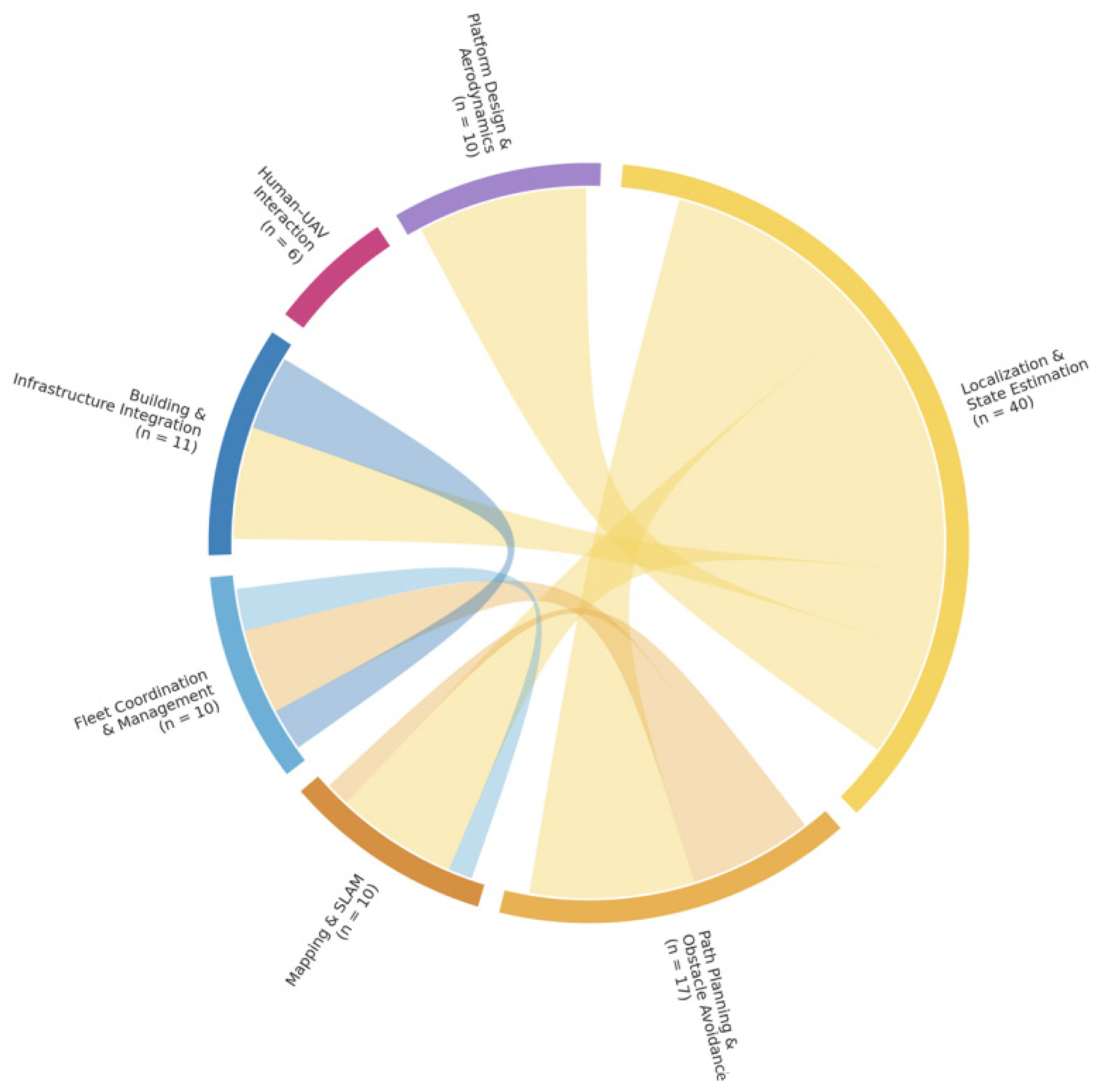


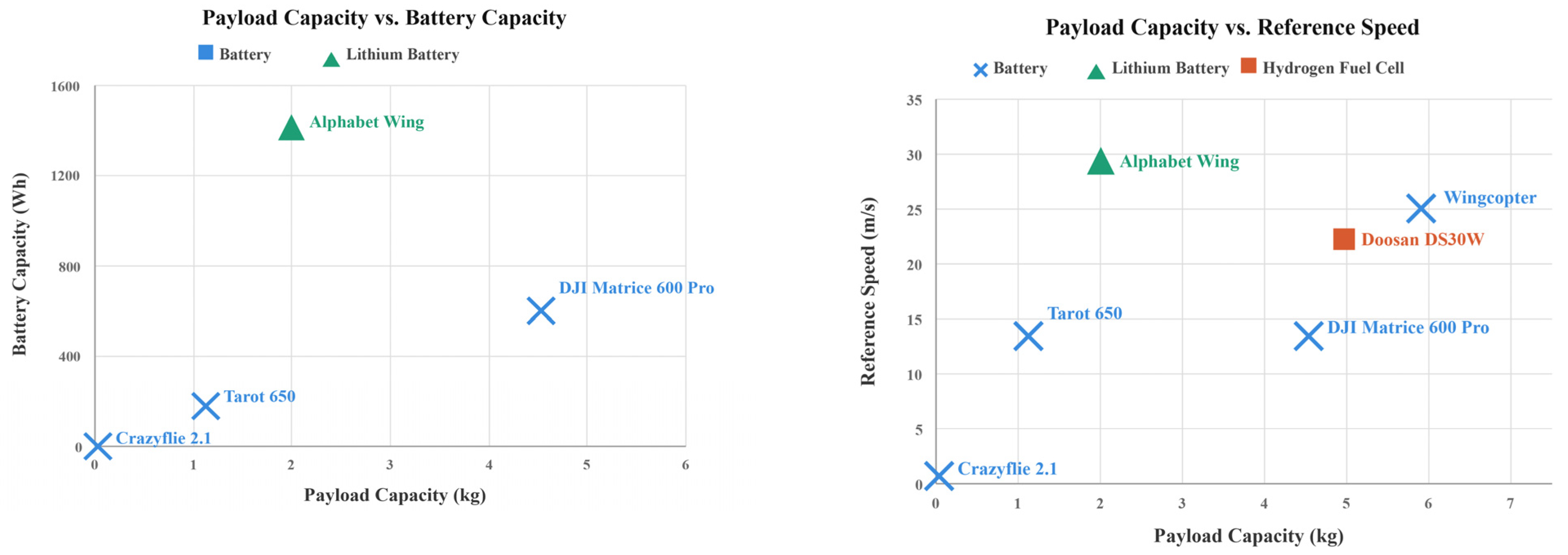


| Reference | Core Concept/Framework | Transportation Scope | Cargo Type | Transport Modes |
|---|---|---|---|---|
| [25] | Conceptualizes last-mile delivery as a structured process chain (storage–transport–handover) and analyzes delivery concepts through infrastructure design, fleet sizing, and routing/scheduling from an operations research perspective | Urban scale, from city depots or micro-hubs to end users | Small- to medium-sized parcels | Vans; bikes; drones; autonomous ground delivery robots |
| [26] | A multi-layered system encompassing planning, execution, and control of goods flows, structured around fulfillment, transport, and final delivery activities within urban logistics systems | Urban, depot-to-destination | Parcels; retail goods; groceries | Vans; bikes; EVs; drones |
| [27] | A customer-facing urban delivery system emphasizing alternative delivery locations to improve flexibility, efficiency, and sustainability | Urban, hub-to-receiver | Parcels; retail goods | Vans; lockers; pickup points; drones |
| [24] | Frames last-mile logistics as an urban delivery system shaped by economic, environmental, and policy dimensions, emphasizing sustainability and stakeholder interactions | Urban, city-to-recipient | Parcels; groceries; retail goods | Vans; cargo bikes; EVs; drones |
| [23] | A city-scale delivery system influenced by customer choices, demand patterns, and sustainability performance, linking logistics operations with urban policy and data-driven decision-making | Urban, city-to-recipient | Parcels; retail goods; groceries | Vans; cargo bikes; EVs; drones |
| [28] | A component of urban supply chain management, shaped by interactions among public authorities, logistics operators, and end users, with strong emphasis on sustainability and policy context | Urban, hub-to-city | Parcels; retail goods; groceries | Trucks; vans; cargo bikes; drones |
| Dimension | Evaluation Criteria | Reference |
|---|---|---|
| Operational and Technical | Payload capacity, battery capacity, MTOW, cargo distribution and payload allocation | [1,5,6,22,29] |
| Flight range or endurance | [1,6,22,29] | |
| Routing and scheduling complexity | [1,5,6,22] | |
| Speed, delivery time | [1,6,22,29] | |
| Reach accessibility | [22] | |
| Energy infrastructure, charging time and station capacity, launch pads, docking stations, charging networks, depots | [1,6,22,29] | |
| Energy consumption, energy–speed–weight relationship | [1,5,6,29] | |
| Delivery models (PD/SM) | [1,5,6,29] | |
| Economic and System | Cost efficiency, truck–drone coordination savings, operating cost sensitivity | [1,5,6,22,29] |
| Scalability, fleet size | [6,22] | |
| Safety, Regulation | Airspace safety | [1,22,29] |
| Public acceptance | [5,6,22] | |
| Noise | [6,29] | |
| Policy and infrastructure readiness | [5,6,22] | |
| Data security and privacy | [1] | |
| Cargo Characteristics | Item condition sensitivity | [22] |
| Barrier avoidance | [6] | |
| Service coverage | [6,29] | |
| Data communication reliability | [1,5] | |
| Navigation accuracy | [5] | |
| Environmental Performance | Life-cycle impacts | [5,29] |
| GHG emissions | [1,5,29] | |
| Electricity mix, renewable integration | [29] |
| Dimension | Indoor-UAV | Delivery-UAVs |
|---|---|---|
| Spatial Mobility | Precision and Micro-Navigation: The capability of the UAV to operate in GNSS-denied environments. The focus is on localization accuracy and stability within confined spaces using visual or sensor-based SLAM methods. | Efficiency and Coverage: The ability to traverse distances effectively to reach the destination. The focus is on barrier avoidance and maintaining navigation accuracy over longer ranges, typically utilizing GPS or hybrid systems outdoors. |
| Logistical Capability | Compactness and Agility: The physical constraints required to navigate human-centric architecture (e.g., doors, corridors). While current indoor research focuses on mobility, last-meter delivery requires adapting these platforms to carry loads without compromising agility. | Payload and Endurance: The capacity to transport goods efficiently. Critical metrics include payload capacity, battery endurance, and the trade-off between cargo weight and flight range (energy–speed–weight relationship). |
| Social Acceptance | Interaction: The immediate human–robot interaction (HRI) within shared spaces. It involves human reaction to the drone’s presence, requiring sophisticated interaction technologies to ensure psychological safety and physical safety in close proximity. | Privacy and Public Safety: The broader impact on the community and customer. Key concerns include noise pollution, data privacy protection, and general public acceptance of drones operating in residential or commercial areas. |
| Operational Coordination | Decentralized autonomy and building integration: The system’s ability to function in communication-denied environments through edge computing and semantic interaction. The focus is on multi-agent swarm coordination (without a central server) and utilizing building information modeling (BIM) or digital twins to navigate logical spaces (rooms, corridors) and interact with IoT infrastructure (e.g., automatic doors/windows). | Hierarchical management and network optimization: The governance structure required to manage large-scale fleets in public airspace. The focus is on centralized UTM (unmanned traffic management) for safety and conflict avoidance, supported by cloud-based algorithms to optimize global path planning (VRP) and the strategic deployment of physical infrastructure (hubs, lockers, charging stations). |
| Article | Model | Type | Power Source | Battery Capacity | Payload | Reference Speed | Cost |
|---|---|---|---|---|---|---|---|
| [44] | DJI Matrice 600 Pro | Rotary hexacopter | Battery | 600 Wh | 4.54 kg (experimental max) | 13.41 m/s | $8000 |
| Tarot 650 | Quadcopter | Battery | 177.6 Wh | 1.13 kg | 13.41 m/s | $4000 | |
| Wingcopter | Fixed-wing VTOL | Battery | 5.9 kg | 25 m/s | |||
| [45] | Alphabet Wing | Electric multi-rotor | Lithium Battery | 1400 Wh | 2 kg (actual) | 29 m/s | $147/h |
| Doosan DS30W | Hydrogen multi-rotor | Hydrogen Fuel Cell | 250 g | 5 kg (actual) | 22 m/s | $122/h | |
| [51] | Crazyflie 2.1 | Nano-UAV (Nano Drone) | Battery | 250 mAh | 35 g (effective payload < 10 g) | 0.5–1.0 m/s (indoor test) |
Disclaimer/Publisher’s Note: The statements, opinions and data contained in all publications are solely those of the individual author(s) and contributor(s) and not of MDPI and/or the editor(s). MDPI and/or the editor(s) disclaim responsibility for any injury to people or property resulting from any ideas, methods, instructions or products referred to in the content. |
© 2026 by the authors. Licensee MDPI, Basel, Switzerland. This article is an open access article distributed under the terms and conditions of the Creative Commons Attribution (CC BY) license.
Share and Cite
Li, Y.; Ng, S.T.; Ling, M.; Pan, Q. Beyond the Last Mile: A Systematic Review Exploring Indoor Delivery-UAV Requirements in the Last-Meter Context. Sustainability 2026, 18, 6728. https://doi.org/10.3390/su18136728
Li Y, Ng ST, Ling M, Pan Q. Beyond the Last Mile: A Systematic Review Exploring Indoor Delivery-UAV Requirements in the Last-Meter Context. Sustainability. 2026; 18(13):6728. https://doi.org/10.3390/su18136728
Chicago/Turabian StyleLi, Yutong, S. Thomas Ng, Mingzhuo Ling, and Qi Pan. 2026. "Beyond the Last Mile: A Systematic Review Exploring Indoor Delivery-UAV Requirements in the Last-Meter Context" Sustainability 18, no. 13: 6728. https://doi.org/10.3390/su18136728
APA StyleLi, Y., Ng, S. T., Ling, M., & Pan, Q. (2026). Beyond the Last Mile: A Systematic Review Exploring Indoor Delivery-UAV Requirements in the Last-Meter Context. Sustainability, 18(13), 6728. https://doi.org/10.3390/su18136728