Toward a Digital Twin Framework for Small-Scale Renewable Energy Microgrids with Integrated Energy Management Control


Abstract
1. Introduction
1.1. Background of Renewable Energy Integration and the Need for Digitalization
1.2. Concept and Importance of Digital Twins in Modern Power Systems
1.3. Motivation for Developing a Digital Twin of a Small-Scale Microgrid
2. Context and Literature Review
2.1. Overview of Existing Digital Twin Applications in Power Systems
2.2. Related Works on Microgrid and Simulation
2.3. Current Challenges and Research Gaps in Microgrid Digitalization
2.4. Aim and Objective of the Study
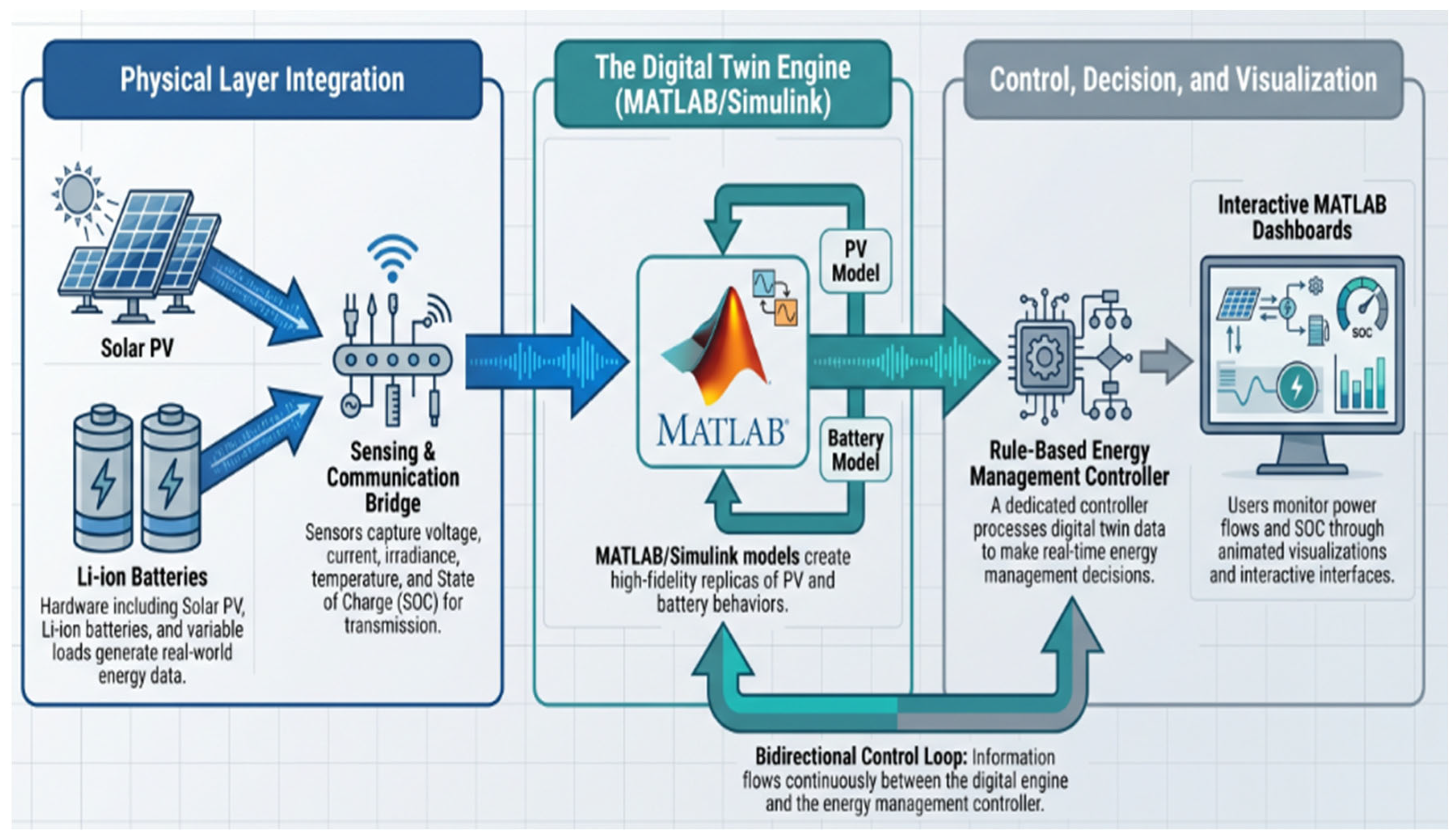
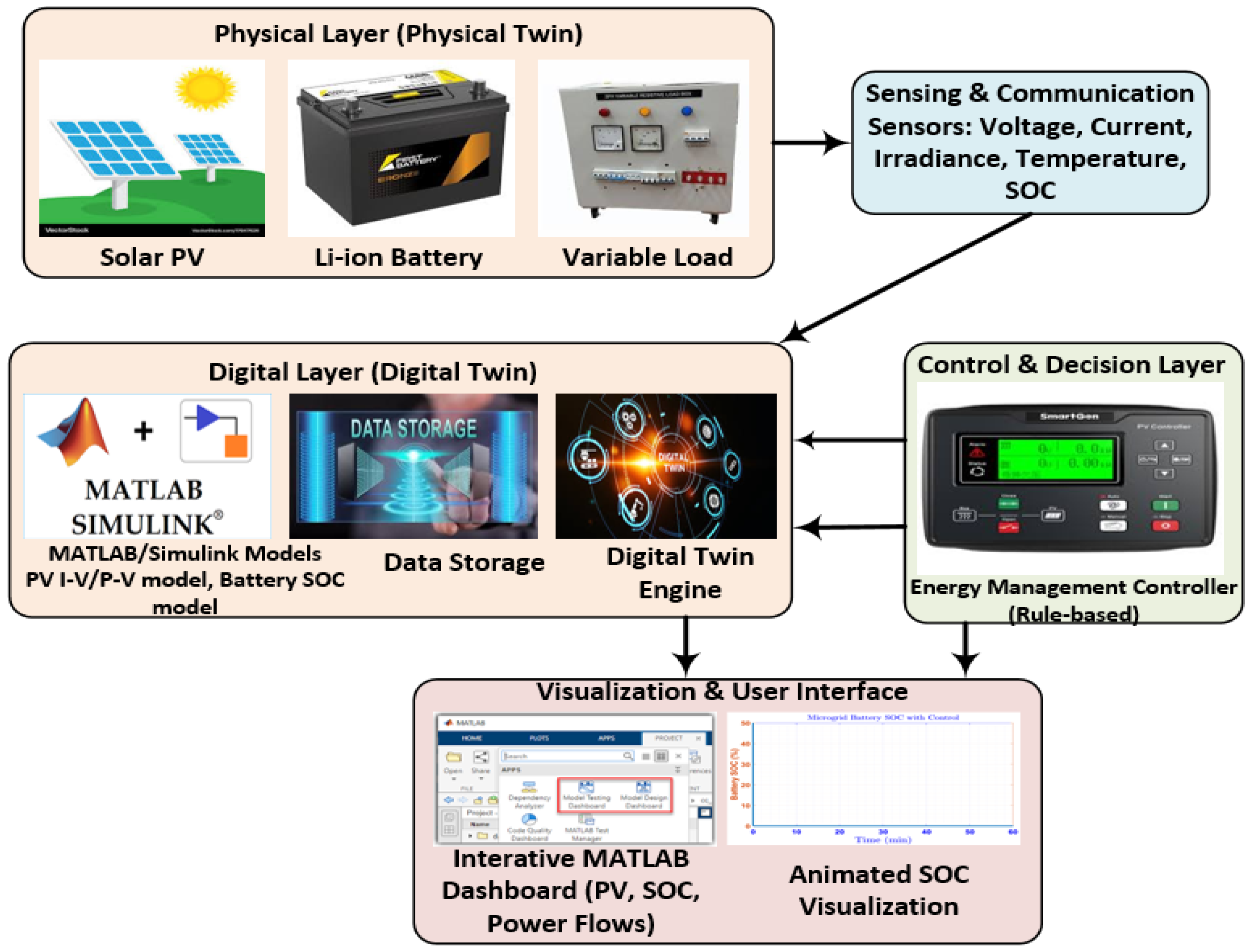
- This study presents a unified framework that integrates a solar photovoltaic (PV) system, battery energy storage system, and variable load within a MATLAB/Simulink environment to represent the operational behavior of a small-scale renewable energy microgrid.
- A rule-based energy management strategy is incorporated to coordinate power flow among generation, storage, and demand; maintain battery state-of-charge (SOC) within predefined limits; and enhance the reliability of microgrid operation.
- The framework is used to assess microgrid performance under varying renewable generation and load demand scenarios, demonstrating improvements in renewable energy utilization, energy efficiency, battery management, and system reliability.
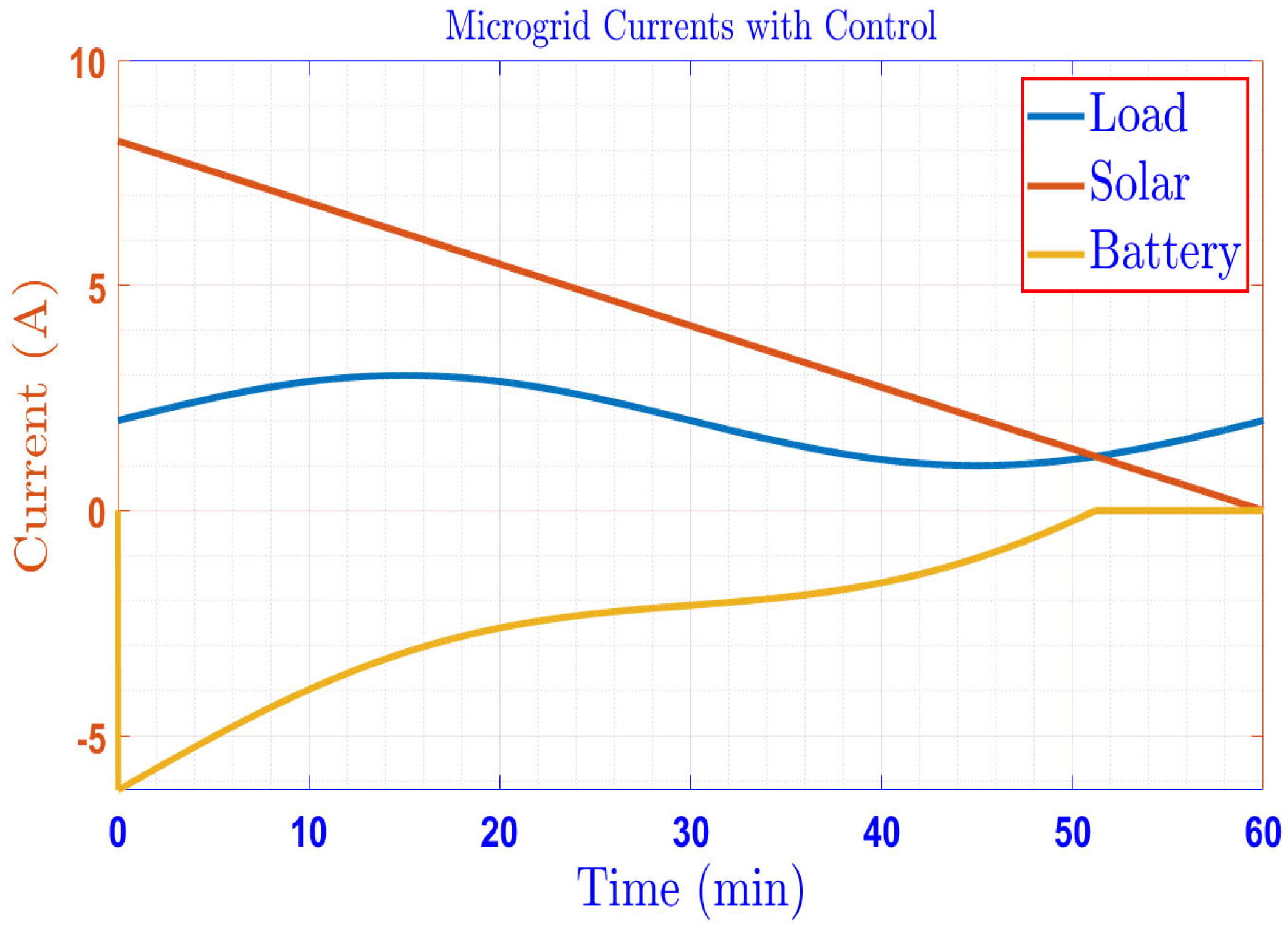
- An interactive dashboard is developed to provide dynamic visualization within the simulation environment of key system variables, including battery SOC, current profiles, and power flow, thereby improving system observability and operational understanding.
- This study establishes a scalable and accessible platform for microgrid analysis and control, providing a foundation for future enhancements such as real-time data synchronization, IoT integration, predictive analytics, machine learning, and advanced optimization-based energy management strategies.
3. System Architecture and Design
4. System Mathematical Modeling Approach
4.1. Modeling Assumptions and Limitations
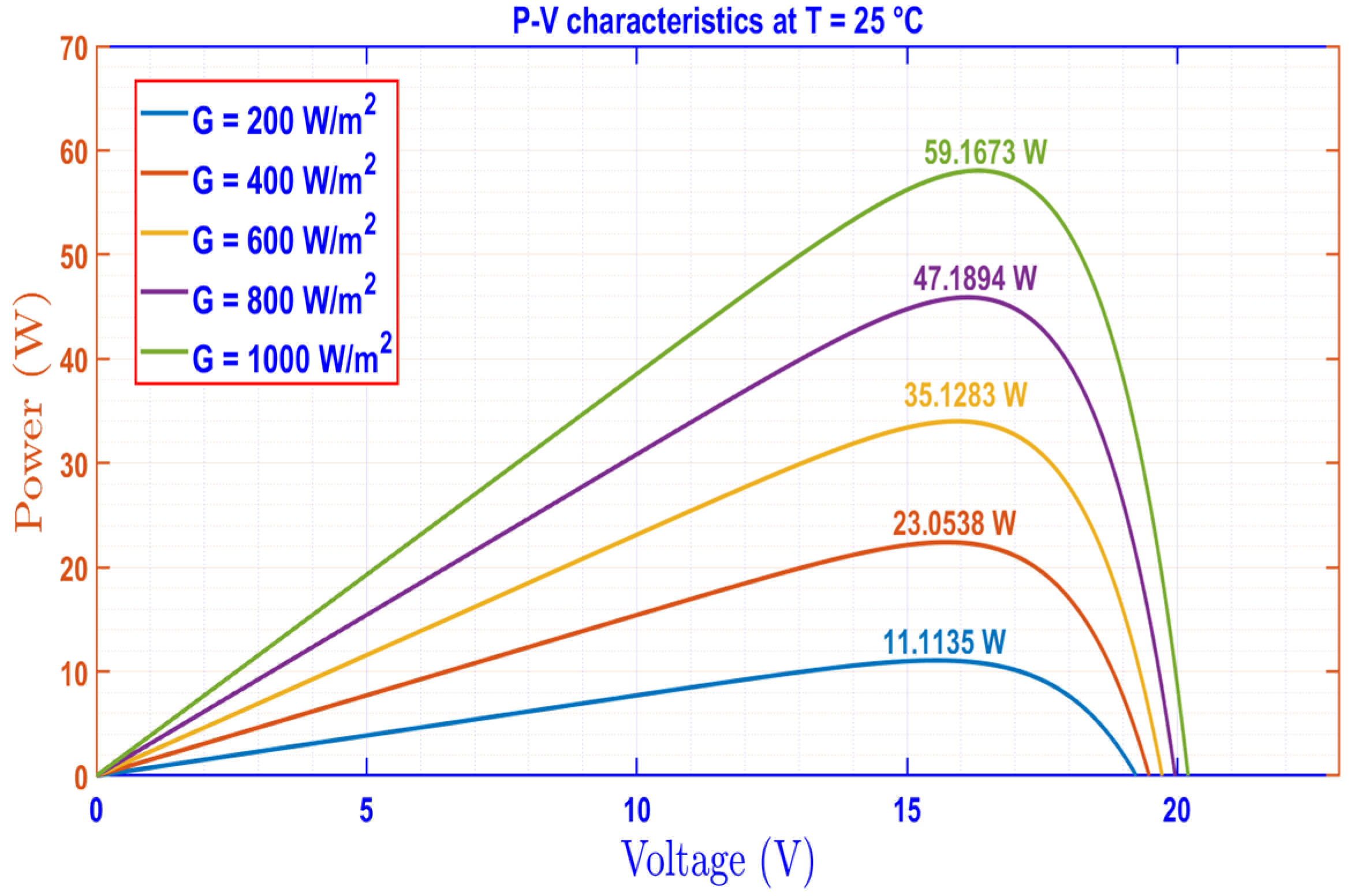
4.2. Solar Photovoltaic Model
4.3. Battery Energy Storage Model
4.4. Variable Load Model
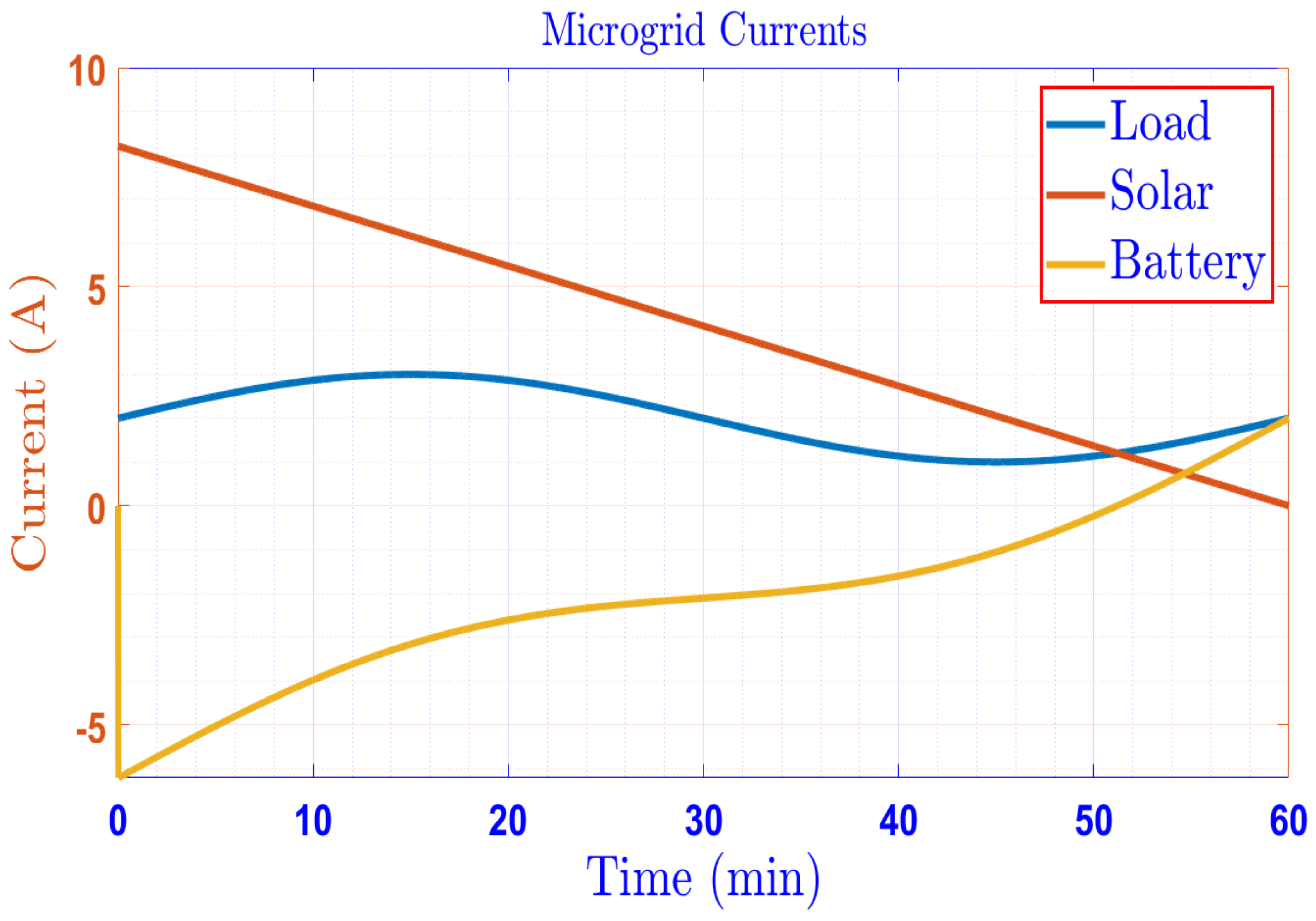
4.5. Energy Flow and Control Equations
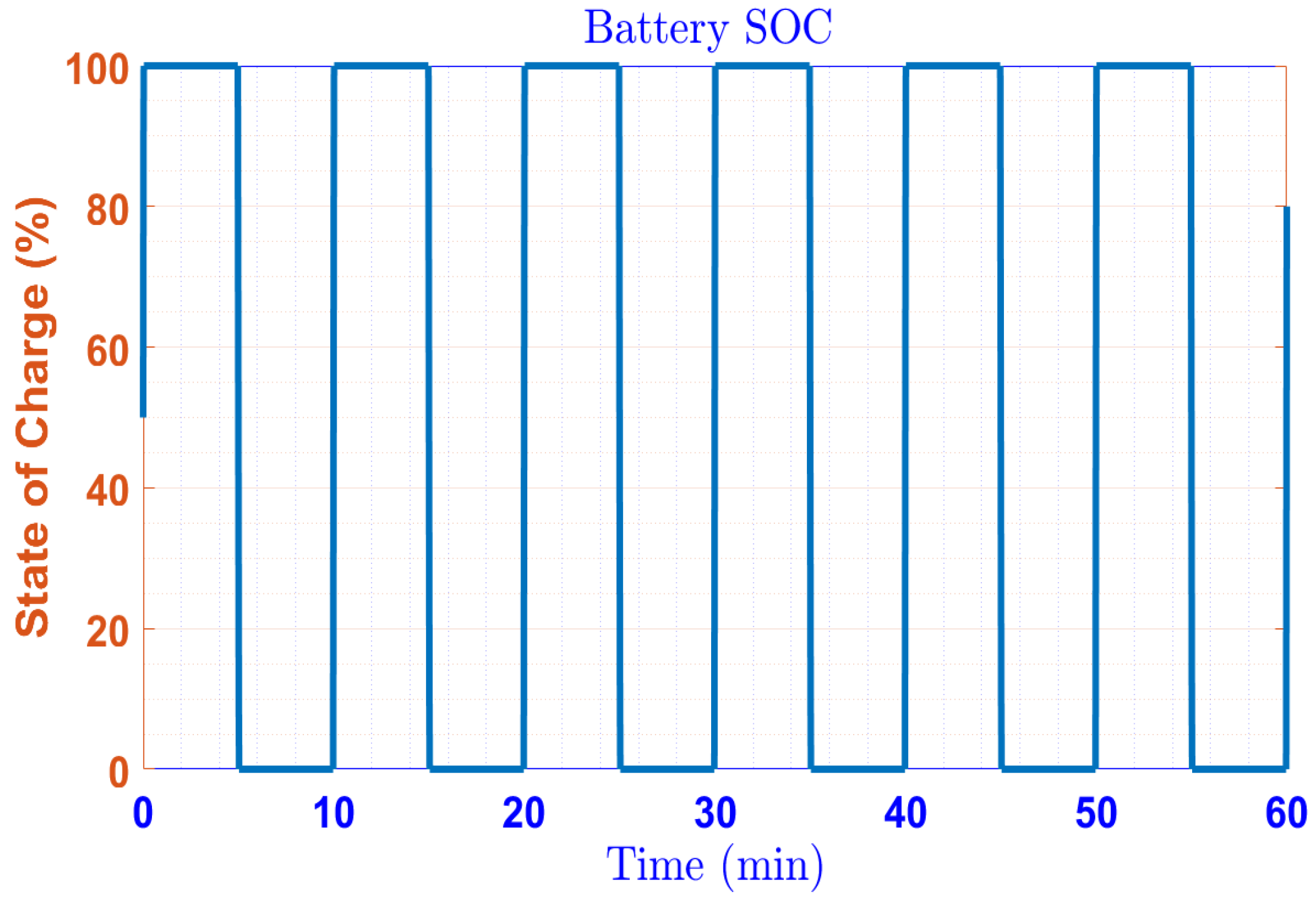
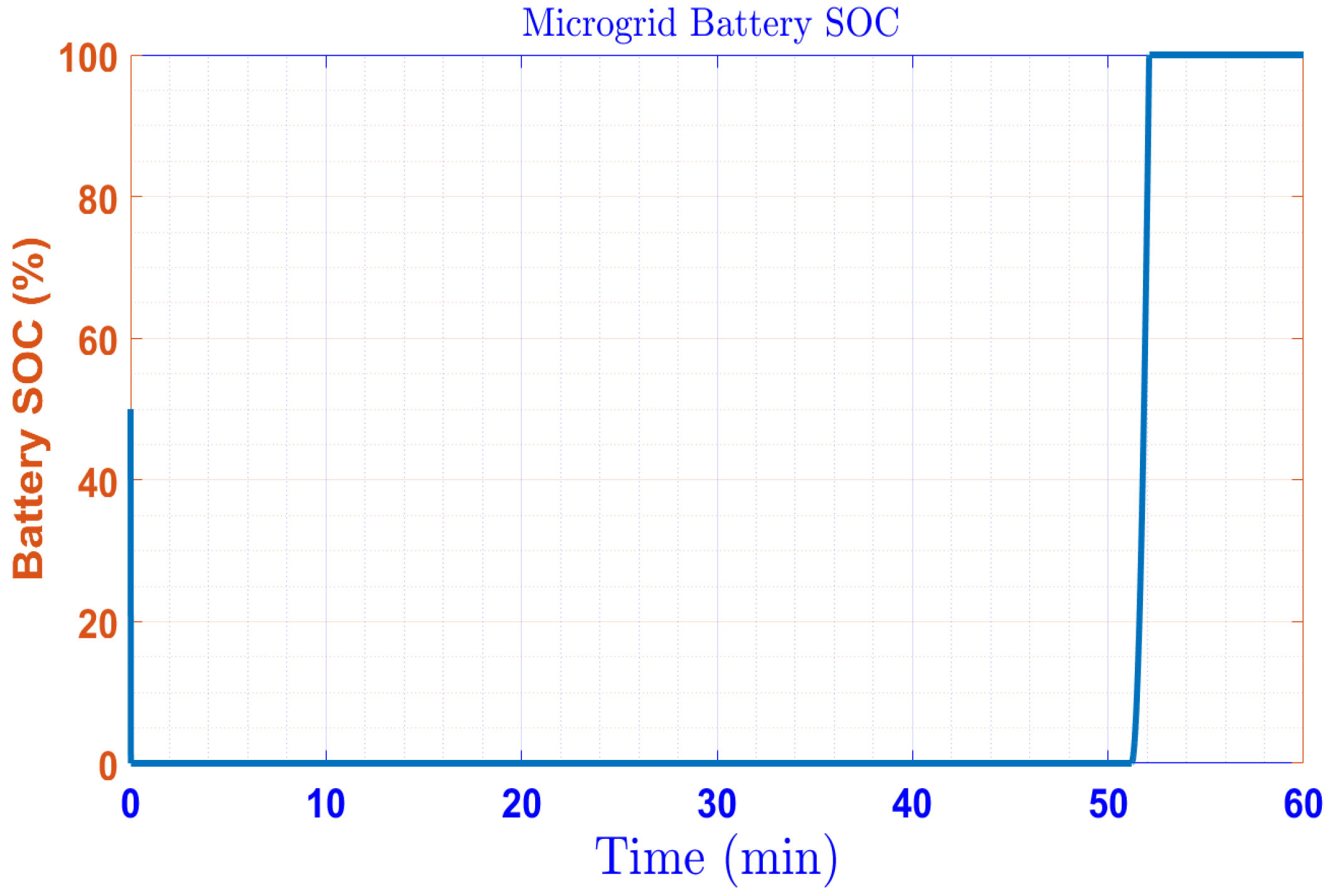
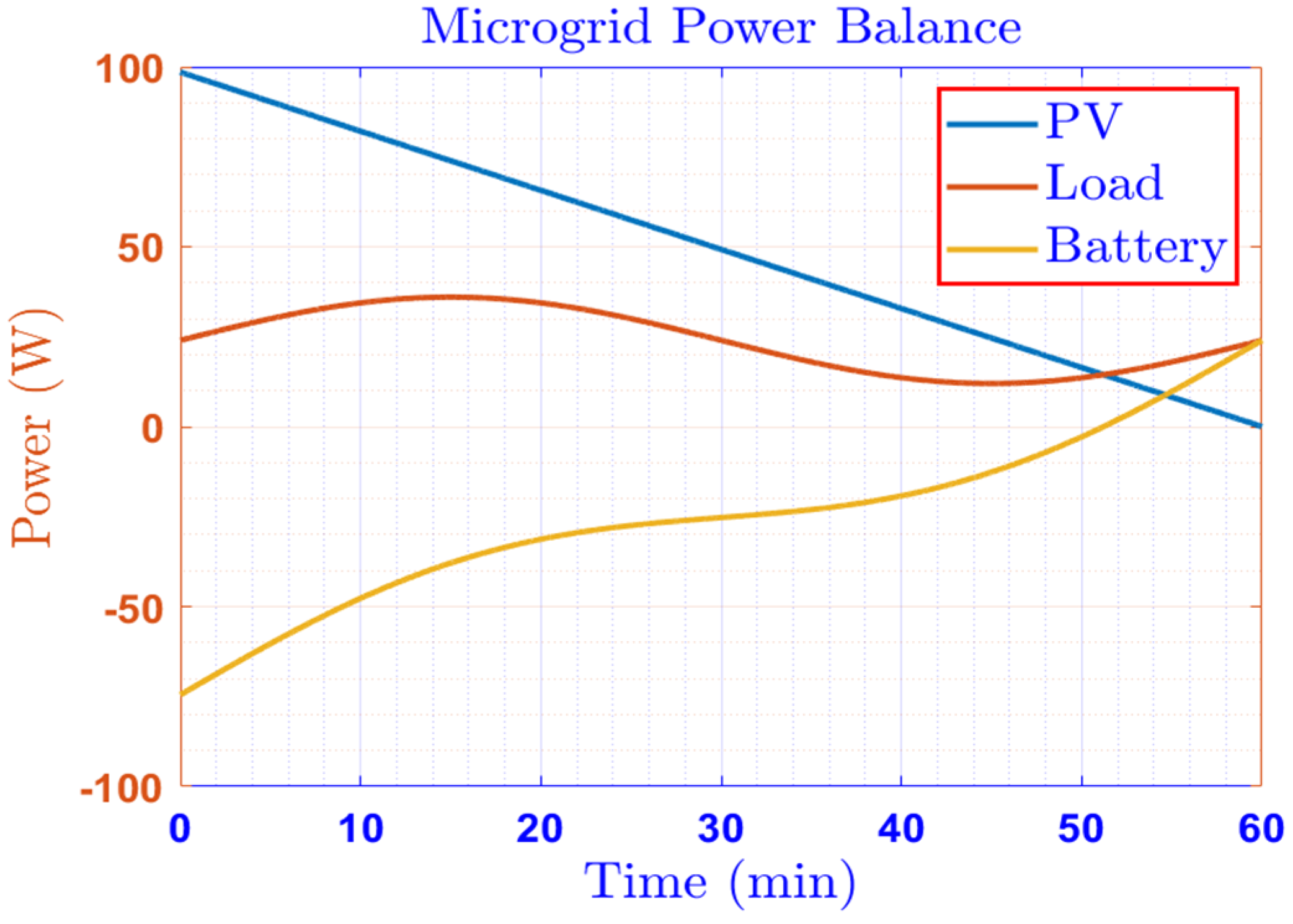
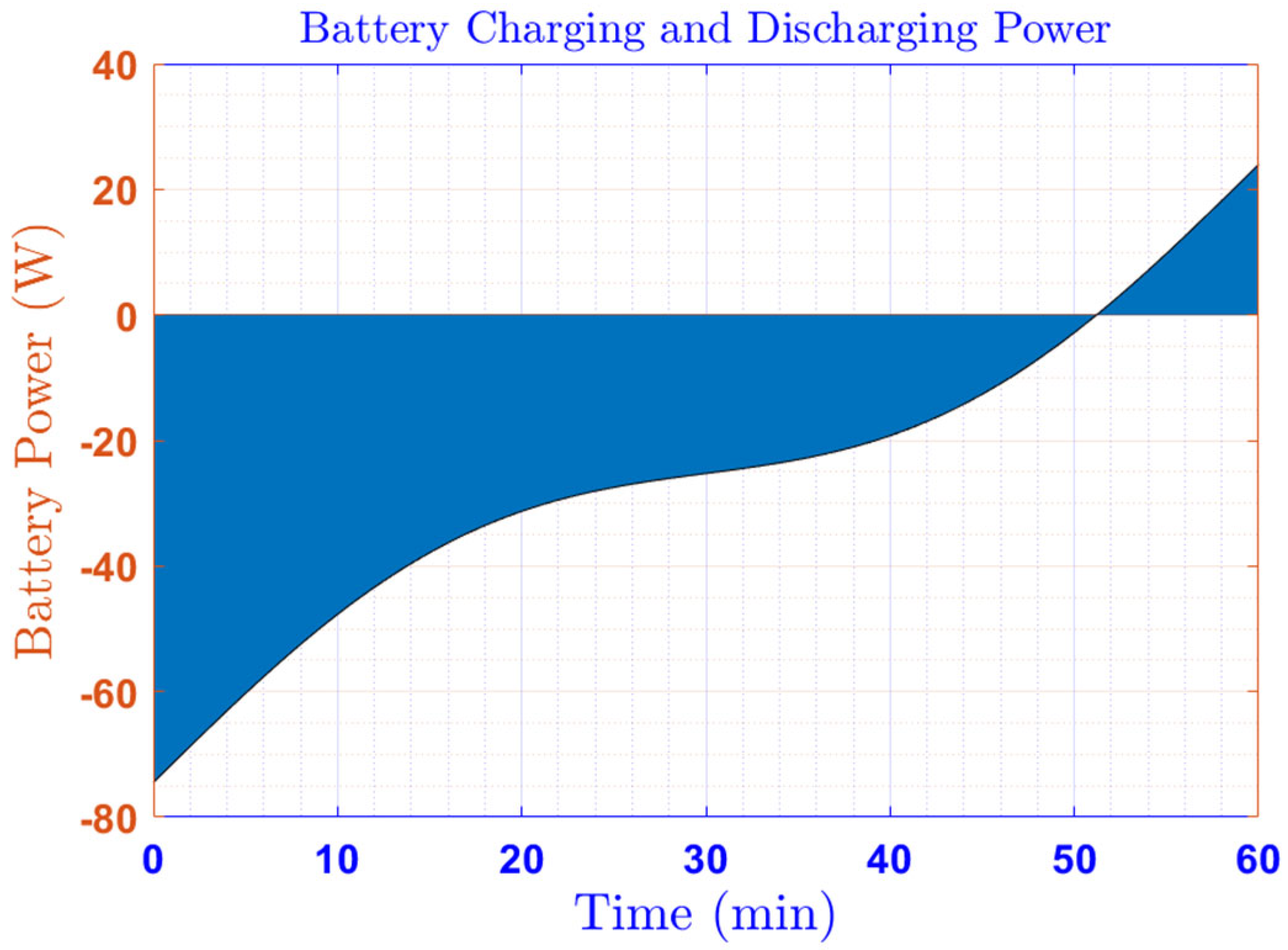
- When solar generation exceeds the load demand, the excess energy charges the battery until the SOC reaches 90%. If , the surplus power charges the battery.
- When solar generation is insufficient, the battery discharges to support the load until the SOC drops to 30%. If and , the battery discharges to meet demand.
- When both PV output and battery charge are insufficient, the system simulates a deficit condition, prompting a load-shedding response or external grid dependency. If and , the system enters a power deficit state, prompting load shedding or external support, if available.
5. Control Strategy for Energy Management
5.1. Control Algorithm Design
- Excess PV Generation:
- If , the surplus power is used to charge the battery until the SOC reaches its upper limit ().
- Any remaining excess can be logged or considered for hypothetical grid export.
- Deficit in Generation:
- If and (30%), the battery discharges to meet the load demand.
- The discharge current is calculated based on the load shortfall:
- Critical SOC Condition:
- If and the system simulates a power deficit scenario, signaling load shedding or external supply dependency.
- Battery Idle:
5.2. Logic Flow and Implementation
- Read inputs: PV voltage/current, load power, and battery SOC.
- Evaluate generation versus load: Compute surplus or deficit power.
- Decide battery action based on SOC and energy balance: Charge, discharge, or remain idle.
- Update the battery SOC based on charging/discharging currents and efficiency.
- Display updated values on the interactive dashboard and visualize the SOC in real time.
| Algorithm 1. Algorithm Implementation of DT microgrid energy management | |
| Pseudocode: Digital Twin-Oriented Microgrid Energy Management | |
| 01: | BEGIN // Digital Twin Microgrid |
| 02: | // --- 1. Initialization --- |
| 03: | SET Simulation time = 24 h |
| 04: | SET |
| 05 | // PV parameters |
| 06: | INPUT PV rated power, PV voltage, PV current |
| 07: | INPUT Irradiance profile, Temperature profile |
| 08: | // Battery parameters |
| 09: | INPUT Battery nominal voltage, Battery capacity |
| 10: | SET SOC min = 30% |
| 11: | SET SOC max = 90% |
| 12: | SET SOC initial = 50% |
| 13: | SET Charging efficiency = 0.9 |
| 14: | SET Discharging efficiency = 0.9 |
| 15: | // Load parameters |
| 16: | INPUT Load profile (time-dependent) |
| 17: | // --- 2. Simulation Loop --- |
| 18: | FOR t = 0 TO simulation time STEP timestep |
| 19: | // 2.1 Update PV output based on irradiance and temperature |
| 20: | PV current, PV voltage = Calculate PV Output (Irradiance profile[t], Temperature profile[t]) |
| 21: | PV power = PV current * PV voltage |
| 22: | // 2.2 Read Load demand |
| 23: | Load power = Load profile[t] |
| 24 | // 2.3 Compute Power difference |
| 25: | Power diff = PV power–Load power |
| 26: | // --- 2.4 Energy Management Control --- |
| 27: | IF Power diff > 0 THEN |
| 28: | // Excess PV generation |
| 29: | IF SOC < SOC max THEN |
| 30: | Battery charge current = Power diff / Battery nominal voltage |
| 31: | SOC = SOC + (Battery charge current * Charging efficiency * Δt) / Battery capacity |
| 32: | ELSE |
| 33: | Battery charge current = 0 |
| 34: | // Optional: Log surplus for grid export |
| 35: | END IF |
| 36: | ELSE IF Power diff < 0 THEN |
| 37: | // PV deficit |
| 38: | IF SOC > SOC min THEN |
| 39: | Battery discharge current = ABS (Power diff) / Battery nominal voltage |
| 40: | SOC = SOC - (Battery discharge current * Δt) / (Battery capacity * Discharging efficiency) |
| 41: | ELSE |
| 42: | Battery discharge current = 0 |
| 43: | // Optional: Trigger load shedding or external supply |
| 44: | END IF |
| 45: | ELSE |
| 46: | // PV matches load |
| 47: | Battery charge current = 0 |
| 48: | Battery discharge current = 0 |
| 49: | END IF |
| 50: | END |
5.3. Integration of Energy Management Control Within the Framework
6. Simulation Results
6.1. Renewable Energy Utilization Efficiency
6.2. Reliability Metrics
7. Discussion
Limitations of the Study
8. Conclusions and Future Work
8.1. Conclusions
8.2. Future Work
Author Contributions
Funding
Institutional Review Board Statement
Informed Consent Statement
Data Availability Statement
Acknowledgments
Conflicts of Interest
Abbreviations
| DT | Digital Twin |
| PV | Photovoltaic |
| DERs | Distributed Energy Resources |
| SOC | State-of-Charge |
| EMS | Energy Management System |
| Maximum State-of-Charge limit | |
| Minimum State-of-Charge limit | |
| P | Power |
| I | Current |
| V | Voltage |
| DC | Direct Current |
| AC | Alternating Current |
| SCADA | Supervisory Control and Data Acquisition |
| AI | Artificial Intelligence |
| ANN | Artificial Neural Network |
| WCA | Water Cycle Algorithm |
| TLBO | Teaching–Learning-Based Optimization |
| HEMS | Home Energy Management System |
| IoT | Internet of Things |
| BESS | Battery Energy Storage System |
| MATLAB | Matrix Laboratory (MATLAB simulation environment) |
| MPP | Maximum Power Point |
| P-V | Power–Voltage |
| I-V | Current–Voltage |
| MPC | Model Predictive Control |
| PVHC | Photovoltaic Hosting Capacity |
References
- Mohanraj, R.; Balaji, S.N. Digital Twin Technology: A Comprehensive Review of Modeling, Applications, Challenges and Future Directions in Complex System Integration. Arch. Comput. Methods Eng. 2025, 33, 3291–3316. [Google Scholar] [CrossRef]
- Horo-Mustajbašić, N.; Hai, I.U.; Nassereddine, H.; Castillo, M.A.P.; Ghazouani, H.; Sher, F.; Borysiak, O.; Safdar, M.; Hussain, Z.; Daci, M. Design and digitalization of renewable energy technologies and infrastructures. In Renewable Energy Technologies; Elsevier: Amsterdam, The Netherlands, 2026; pp. 799–825. [Google Scholar]
- Eskandari, A.; Emamian, M.; Nedaei, A.; Aghaei, M. Digital twin technology in microgrid systems. In Digital Twin Technology for the Energy Sector; Elsevier: Amsterdam, The Netherlands, 2025; pp. 111–141. [Google Scholar]
- Sakthivel, S.; Arivukarasi, M.; Charulatha, G.; Nithisha, J.; Abirami, B.; Jaithunbi, A.K.; Kumar, V.S. A multi strategy optimization framework using AI digital twins for smart grid carbon emission reduction. Sci. Rep. 2026, 16, 8570. [Google Scholar] [CrossRef] [PubMed]
- Savoia, M.; Annunziata, D.; Thakur, D.; Fortino, G.; Piccialli, F. Federated continual learning meets digital twins: A survey on methods, intersections and perspectives. Neurocomputing 2026, 681, 133366. [Google Scholar] [CrossRef]
- Wang, S.; Tian, C.; Zhou, C.; Wu, Y.; Ametefe, D.S.; John, D.; Ametefe, M.A. The Role of Digital Twin Technology in Enhancing Energy Efficiency in Buildings: A Systematic Literature Review. Energy Sci. Eng. 2026, 14, 1036–1066. [Google Scholar] [CrossRef]
- Bhatia, M.; Kumar, V. The role of digital twin in urban infrastructure and building management: A global scientometric perspective. Clust. Comput. 2026, 29, 38. [Google Scholar]
- Wu, Y.; Guerrero, J.M.; Wu, Y.; Bazmohammadi, N.; Vasquez, J.C.; Cabrera, A.J.; Lu, N. Digital twins for microgrids: Opening a new dimension in the power system. IEEE Power Energy Mag. 2024, 22, 35–42. [Google Scholar] [CrossRef]
- Idlbi, B.; Graeber, D. Towards Digital Twin of Distribution Grids with High Share of Distributed Energy Systems Environment for State Estimation and Congestion Management. Energies 2026, 19, 720. [Google Scholar] [CrossRef]
- Atef, M.; Alahakoon, S.; Wolfs, P.; Mumtahina, U.; Khatib, T.; Uddin, M. Energy Management in Microgrids: Commercial, Industrial, and Residential Perspectives. Energies 2026, 19, 419. [Google Scholar] [CrossRef]
- Gbadega, P.A.; Sun, Y.; Balogun, O.A. Real-Time Simulation Testbed for Energy Management and Control of Renewable Energy-Based Microgrids. In 2024 5th International Symposium on New Energy and Electrical Technology (ISNEET); IEEE: New York, NY, USA, 2024. [Google Scholar]
- Kumari, N.; Sharma, A.; Tran, B.; Chilamkurti, N.; Alahakoon, D. A comprehensive review of digital twin technology for grid-connected microgrid systems: State of the art, potential and challenges faced. Energies 2023, 16, 5525. [Google Scholar] [CrossRef]
- Park, H.-A.; Byeon, G.; Son, W.; Jo, H.-C.; Kim, J.; Kim, S. Digital twin for operation of microgrid: Optimal scheduling in virtual space of digital twin. Energies 2020, 13, 5504. [Google Scholar] [CrossRef]
- Subramanian, N.; Stonier, A.A. Digital twin applications and case studies in modern power grid management. Energy Rep. 2026, 15, 109218. [Google Scholar] [CrossRef]
- Arboleya, P.; Méndez, A. Real-Time Grid Digital Twins: The backbone of the next generation of network technology for distribution system operators. IEEE Electrif. Mag. 2024, 12, 39–49. [Google Scholar] [CrossRef]
- Sifat, M.M.H.; Choudhury, S.M.; Das, S.K.; Pota, H.; Yang, F. Novel abstractions and experimental validation for digital twin microgrid design: Lab scale studies and large scale proposals. Appl. Energy 2025, 377, 124621. [Google Scholar]
- Pilakkat, D.; Balasubramanian, K.; Rajendran, S.R. Toward Intelligent Digital Twins for PV Systems: A Unified Framework for Control, Forecasting, and Grid Integration. IEEE Access 2025, 13, 213362–213376. [Google Scholar] [CrossRef]
- Bickford, J.F.; Bozada, T.A.; Chen, W.W. The Future of Digital Twin Research and Development. J. Comput. Inf. Sci. Eng. 2025, 25, 080801-1. [Google Scholar] [CrossRef]
- Wang, K.; Cheng, L.; Yin, M.; Zhang, K.; Wang, R.; Zhang, M.; Sun, R. Evolutionary Game Theory in Energy Storage Systems: A Systematic Review of Collaborative Decision-Making, Operational Strategies, and Coordination Mechanisms for Renewable Energy Integration. Sustainability 2025, 17, 7400. [Google Scholar] [CrossRef]
- Ramkumar, M.S.; Subramani, J.; Sivaramkrishnan, M.; Munimathan, A.; Michael, G.K.O.; Alam, M.M. Optimal energy management for multi-energy microgrids using hybrid solutions to address renewable energy source uncertainty. Sci. Rep. 2025, 15, 7755. [Google Scholar] [CrossRef] [PubMed]
- Sahoo, B.; Panda, S.; Rout, P.K.; Bajaj, M.; Blazek, V. Digital twin enabled smart microgrid system for complete automation: An overview. Results Eng. 2025, 25, 104010. [Google Scholar] [CrossRef]
- Mchirgui, N.; Quadar, N.; Kraiem, H.; Lakhssassi, A. The applications and challenges of digital twin technology in smart grids: A comprehensive review. Appl. Sci. 2024, 14, 10933. [Google Scholar] [CrossRef]
- Kabir, M.R.; Halder, D.; Ray, S. Digital twins for IoT-driven energy systems: A survey. IEEE Access 2024, 12, 177123–177143. [Google Scholar]
- Clennar, T.; Du, Y.; Liu, Z. Lab-scale green hydrogen and fuel cell microgrid digital twin. Energy Convers. Manag. 2026, 350, 120928. [Google Scholar]
- Al-Shetwi, A.Q.; Atawi, I.E.; El-Hameed, M.A.; Abuelrub, A. Digital Twin Technology for Renewable Energy, Smart Grids, Energy Storage and Vehicle-to-Grid Integration: Advancements, applications, key players, challenges and future perspectives in modernising sustainable grids. IET Smart Grid 2025, 8, e70026. [Google Scholar]
- Alilou, M.; Younesi, A.; Siano, P. A sustainable approach to hybrid microgrid design: Optimal sizing and energy management. Renew. Energy 2026, 256, 124078. [Google Scholar]
- Jiang, H.; Tjandra, R.; Soh, C.B.; Cao, S.; Soh, D.C.L.; Tan, K.T.; Tseng, K.J.; Krishnan, S.B. Digital twin of microgrid for predictive power control to buildings. Sustainability 2024, 16, 482. [Google Scholar] [CrossRef]
- Salaorni, D.; Bianchi, F.; Colnago, S.; Barisione, A.; Trovò, F.; Restelli, M. A novel digital twin for battery energy storage systems in micro-grids. J. Energy Storage 2025, 132, 117745. [Google Scholar] [CrossRef]
- Calderón, D.; Folgado, F.J.; González, I.; Calderón, A.J. Development and real-world implementation of a Digital Twin-enhanced supervisory system for RES-green hydrogen microgrid. Energy Convers. Manag. 2026, 348, 120822. [Google Scholar]
- Pilakkat, D.; Balasubramanian, K.; Rajendran, S.R. Digital Twins Beyond Monitoring: A Survey on Predictive Control, Cybersecurity, and Storage Integration in PV-Enabled Smart Grids. IEEE Access 2026, 14, 46858–46874. [Google Scholar] [CrossRef]
- Sajjadi, S.S.; Moghadassi, A.; Rashidizadeh-Kermani, H.; Kia, R.; Shafie-Khah, M. AI-driven forecasting for battery energy management in digital twin-integrated microgrids using machine learning techniques. J. Energy Storage 2026, 143, 119556. [Google Scholar]
- Awad, H.; Bayoumi, E.H. Electrical Grid Architectures for Smart Cities from Digitalized Power Systems to AI-Enabled Urban Energy Ecosystems. Smart Cities 2026, 9, 96. [Google Scholar] [CrossRef]
- Zinoviev, V.; Koeva, D.; Tsankov, P.; Kutkarska, R. Review of Artificial Intelligence Applications in the Digital Energy and Renewable Energy Infrastructures. Energies 2026, 19, 1250. [Google Scholar] [CrossRef]
- Alenezi, A.; Alabaiadly, Y. Digital Twins and Edge AI for Small/Off-Grid Water Systems—A Review. IEEE Access 2026, 14, 39960–39978. [Google Scholar]
- Akinmejiwa, O.; Gbadega, P.; Ajibola, A. Synergizing Renewable Energy Integration for Enhanced Energy Management and Control in Smart Grids: A Review. In 2024 IEEE 5th International Conference on Electro-Computing Technologies for Humanity (NIGERCON); IEEE: New York, NY, USA, 2024. [Google Scholar]
- Amole, A.O.; Oladipo, S.; Olabode, O.E.; Makinde, K.A.; Gbadega, P. Analysis of grid/solar photovoltaic power generation for improved village energy supply: A case of Ikose in Oyo State Nigeria. Renew. Energy Focus 2023, 44, 186–211. [Google Scholar] [CrossRef]
- Padmawansa, N.; Gunawardane, K.; Madanian, S.; Oo, A.M.T. Battery energy storage capacity estimation for microgrids using digital twin concept. Energies 2023, 16, 4540. [Google Scholar] [CrossRef]
- Zhao, X.; Zhang, Y. Integrated management of urban resources toward Net-Zero smart cities considering renewable energies uncertainty and modeling in Digital Twin. Sustain. Energy Technol. Assess. 2024, 64, 103656. [Google Scholar] [CrossRef]
- Muhsen, H.; Allahham, A.; Al-Halhouli, A.; Qandil, M. A digital twin framework for flexibility management using electric vehicle aggregators with embedded cyber-attack detection. Sustain. Energy Grids Netw. 2026, 46, 102307. [Google Scholar] [CrossRef]
- Tsegaye, S.; Sanjeevikumar, P. Impact of artificial intelligence-driven digital twins and lean six sigma-assisted power system asset management on long-term investment planning. Sci. Rep. 2026, 16, 13881. [Google Scholar] [PubMed]
- Heluany, J.B.; Gkioulos, V. A review on digital twins for power generation and distribution. Int. J. Inf. Secur. 2024, 23, 1171–1195. [Google Scholar]
- Felez, R.; Felez, J. Intelligent HVAC control in residential buildings: A review of advanced techniques and AI applications. Appl. Sci. 2026, 16, 2006. [Google Scholar] [CrossRef]
- Vanitha, P.; Anand, A.J. Intelligent energy management of a grid-connected PV–battery electric vehicle charging station using CNN-BiLSTM-based control. J. Power Sources 2026, 670, 239505. [Google Scholar]
- Kumar, J.; Vijayakumar, P.; Paramasivam, S.; Kumar, A.; Gatto, G. Hybrid WbOA–APINN framework for sustainable and intelligent energy management in renewable microgrids with hybrid energy storage. Electr. Power Syst. Res. 2026, 252, 112349. [Google Scholar]
- Abtahi, M.; Rueda, L.; Delcroix, B.; Athienitis, A. Semantic digital twinning for cost-optimal HVAC operation: Real-time application to a house with smart thermostats and PV/battery under a time-of-use tariff. Energy Build. 2025, 343, 115938. [Google Scholar]
- Prauzek, M.; Gaiova, K.; Kucova, T.; Konecny, J. Fuzzy energy management strategies for energy harvesting IoT nodes based on a digital twin concept. Future Gener. Comput. Syst. 2025, 166, 107717. [Google Scholar] [CrossRef]
- Bashir, F.M.; Almatared, M.; Sulaiman, M.; Nasrallah, E.; Rassas, N.H.; Dodo, Y.A. An operational digital twin for co-optimizing HVAC, PV/battery, and wall shading under time-of-use tariffs: A real-world online whole-home study with economic model predictive control. J. Build. Eng. 2026, 121, 115705. [Google Scholar] [CrossRef]
- Chen, F.; Fang, G. Harnessing digital twin and IoT for real-time monitoring, diagnostics, and error correction in domestic solar energy storage. Energy Rep. 2024, 11, 3614–3623. [Google Scholar]
- Weerakoon, A.S.; Assadi, M. Experimental Assessment and Digital Twin Modeling of Integrated AEM Electrolyzer–PEM Fuel Cell–BESS for Smart Hydrogen Energy Applications. Energies 2025, 18, 6318. [Google Scholar]
- Ye, Y.; Xu, B.; Wang, H.; Zhang, J.; Lawler, B.; Ayalew, B. Deep reinforcement learning-based energy management system enhancement using digital twin for electric vehicles. Energy 2024, 312, 133384. [Google Scholar] [CrossRef]
- Testasecca, T.; Bellesini, F.; Arnone, D.; Beccali, M. A Digital Twin for Real-Time and Predictive Optimization of Electric Vehicle Charging in Microgrids Integrating Renewable Energy Sources. Energies 2025, 18, 5605. [Google Scholar] [CrossRef]
- Yadav, I.C.; Bajpai, R.S.; Gupta, S.; Shukla, A. Hybrid fuzzy-MPC based multi-objective control strategy for fast charging of electric vehicles with advanced battery thermal management and renewable grid support. Sci. Rep. 2025, 15, 42342. [Google Scholar] [PubMed]





| Ref. | Methodology | System Configuration | Key Objectives | Key Findings | Limitations |
|---|---|---|---|---|---|
| [25] | Review-based DT framework integrating real-time monitoring, analytics, and simulation | Grid-connected microgrids with DERs | Assess DT potential in microgrid monitoring and control | Identified DT benefits in predictive maintenance, fault detection, and system optimization | Limited practical implementation; challenges in real-time data synchronization |
| [26] | Optimization-based DT with virtual simulation environment | Microgrid with distributed generation and storage | Enable optimal scheduling using DT environment | Demonstrated improved operational scheduling and energy efficiency | Focus on scheduling only; limited real-time adaptability |
| [8] | DT-based real-time monitoring and visualization framework | Smart microgrid systems | Enhance situational awareness and operational reliability | Improved fault detection, visualization, and decision-making capabilities | High dependency on communication infrastructure |
| [12] | Data-driven DT integrated with machine learning techniques | Renewable-based microgrid (PV, storage, loads) | Improve automation and adaptive control | Enabled intelligent system response and improved coordination among components | Computational complexity and large data requirements |
| [21] | DT-enabled automation framework using simulation models | Smart microgrid with renewable integration | Achieve full automation of microgrid operation | Demonstrated enhanced system efficiency and autonomous control capability | Limited validation under real-world conditions |
| [27] | Predictive control-based DT for building-integrated microgrid | Building microgrid with PV and storage | Optimize power control and energy usage | Improved predictive control accuracy and energy efficiency | Narrow application scope (building-level systems) |
| [28] | DT model for battery energy storage systems (BESSs) | Microgrid with battery storage integration | Improve battery monitoring and lifecycle management | Enhanced SOC estimation and predictive maintenance of batteries | Focus limited to storage subsystem rather than full microgrid |
| [29] | DT-enhanced supervisory control system with real-world implementation | Renewable microgrid with hydrogen integration | Improve real-time monitoring and supervisory control | Demonstrated real-world applicability and improved operational reliability | High system complexity and implementation cost |
| [30] | DT framework integrating predictive control and cybersecurity features | PV-enabled smart grid/microgrid | Enhance predictive control and system security | Addressed cybersecurity and advanced forecasting challenges | Conceptual focus with limited experimental validation |
| [31] | AI-driven DT using machine learning for forecasting and EMS | Microgrid with battery and renewable sources | Improve energy management through forecasting | Achieved accurate load and generation prediction for optimized EMS | Requires large datasets and high computational resources |
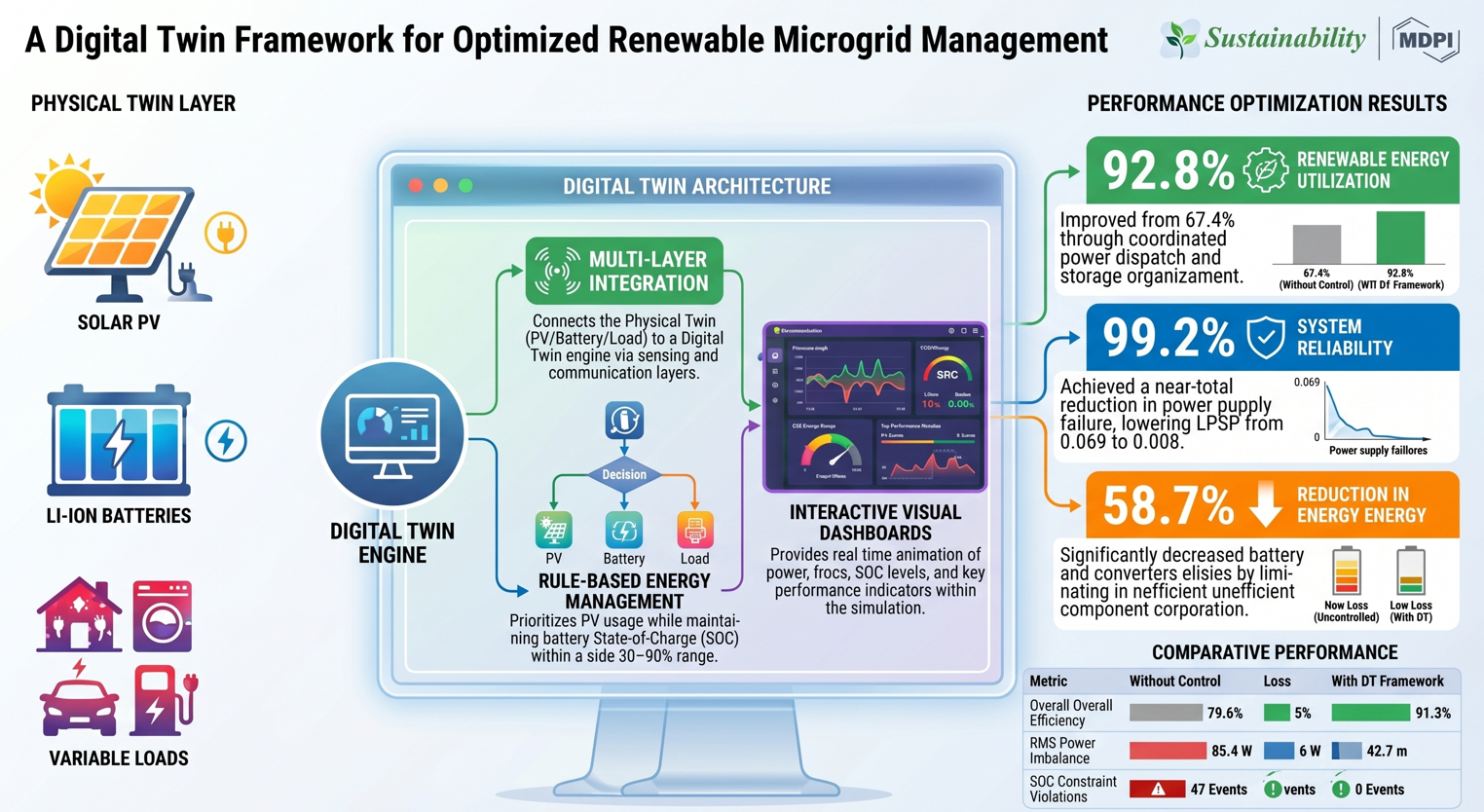
| This Work | MATLAB/Simulink-based digital twin-oriented framework with rule-based energy management control and interactive dashboard visualization | Solar PV system, lithium-ion battery energy storage system, and variable load | To develop a digital twin-oriented microgrid framework for monitoring, energy management, visualization, and performance evaluation of small-scale renewable energy systems | Maintained battery SOC within 30–90%; improved renewable energy utilization from 67.4% to 92.8%; reduced energy losses by 58.7%; improved reliability from 93.1% to 99.2%; reduced LPSP from 0.069 to 0.008; provided visualization within the simulation environment of the microgrid operation | Does not include physical system integration, real-time sensor synchronization, hardware-in-the-loop validation, advanced EMS algorithms, battery degradation modeling, or MPPT implementation; currently represents a digital twin-oriented simulation framework rather than a fully synchronized digital twin |
| Metric | Definition | Equation | Input Data | Assumptions |
|---|---|---|---|---|
| Renewable Energy Utilization Efficiency (REUE) (%) | Percentage of PV energy effectively utilized by the load or battery | Total PV energy generated, PV energy supplied to load, PV energy stored in battery | All curtailed or unused PV energy is treated as renewable energy loss | |
| Overall System Efficiency (%) | Ratio of useful delivered energy to total generated energy | PV generation energy, load-served energy | Converter and battery losses included | |
| Reliability Index (%) | Percentage of load demand successfully supplied | Total load demand, supplied load energy | Continuous operation assumed during simulation period | |
| Loss of Power Supply Probability (LPSP) | Fraction of load demand not supplied | Unmet load energy, total load demand | Lower values indicate higher reliability | |
| RMS Power Imbalance (kW) | Measures mismatch between generation and demand | PV power, battery power, load power | Computed over all simulation time steps | |
| Energy Losses (kWh) | Total energy lost in battery and converter | Battery losses, converter losses | Constant efficiencies assumed | |
| Battery Energy Losses (kWh) | Energy dissipated during charging/discharging | Battery throughput energy | Computed over all simulation time steps | |
| Converter Losses (kWh) | Energy lost in power conversion stages | Energy passing through converter | Computed over all simulation time steps | |
| SOC Constraint Violations | Number of instances SOC exceeds limits | SOC profile | Safe operating range: 30–90% | |
| Load-Shedding Duration (h) | Total time load demand exceeds available supply | Unmet load intervals | Calculated over entire simulation | |
| Renewable Energy Curtailment (%) | PV energy not utilized | Total PV generation, utilized PV energy | Excess energy discarded |
| Variables and Parameters | Values | Units |
|---|---|---|
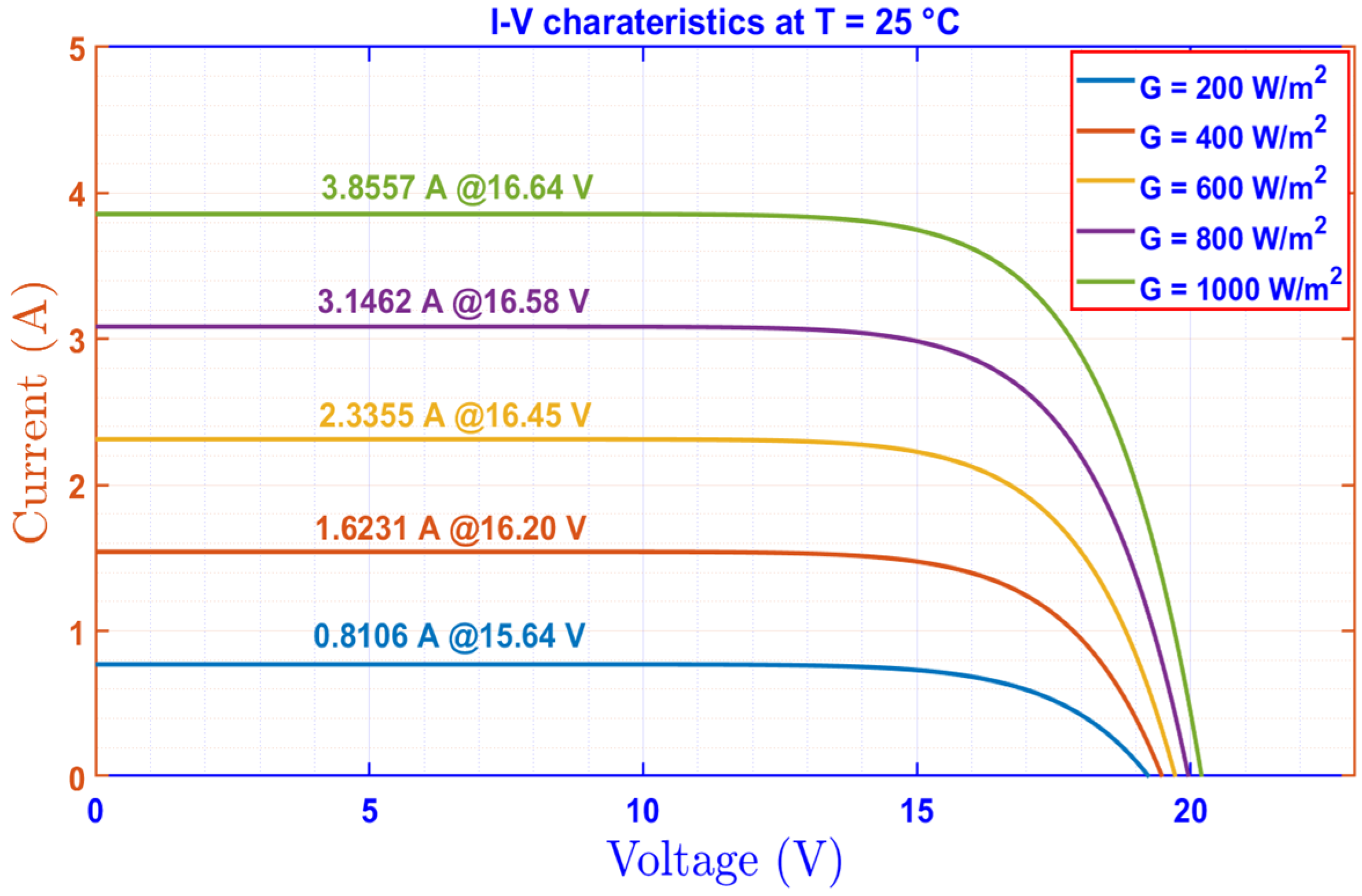
| ) | 200–1000 | W/m2 |
| ) | 25 | °C |
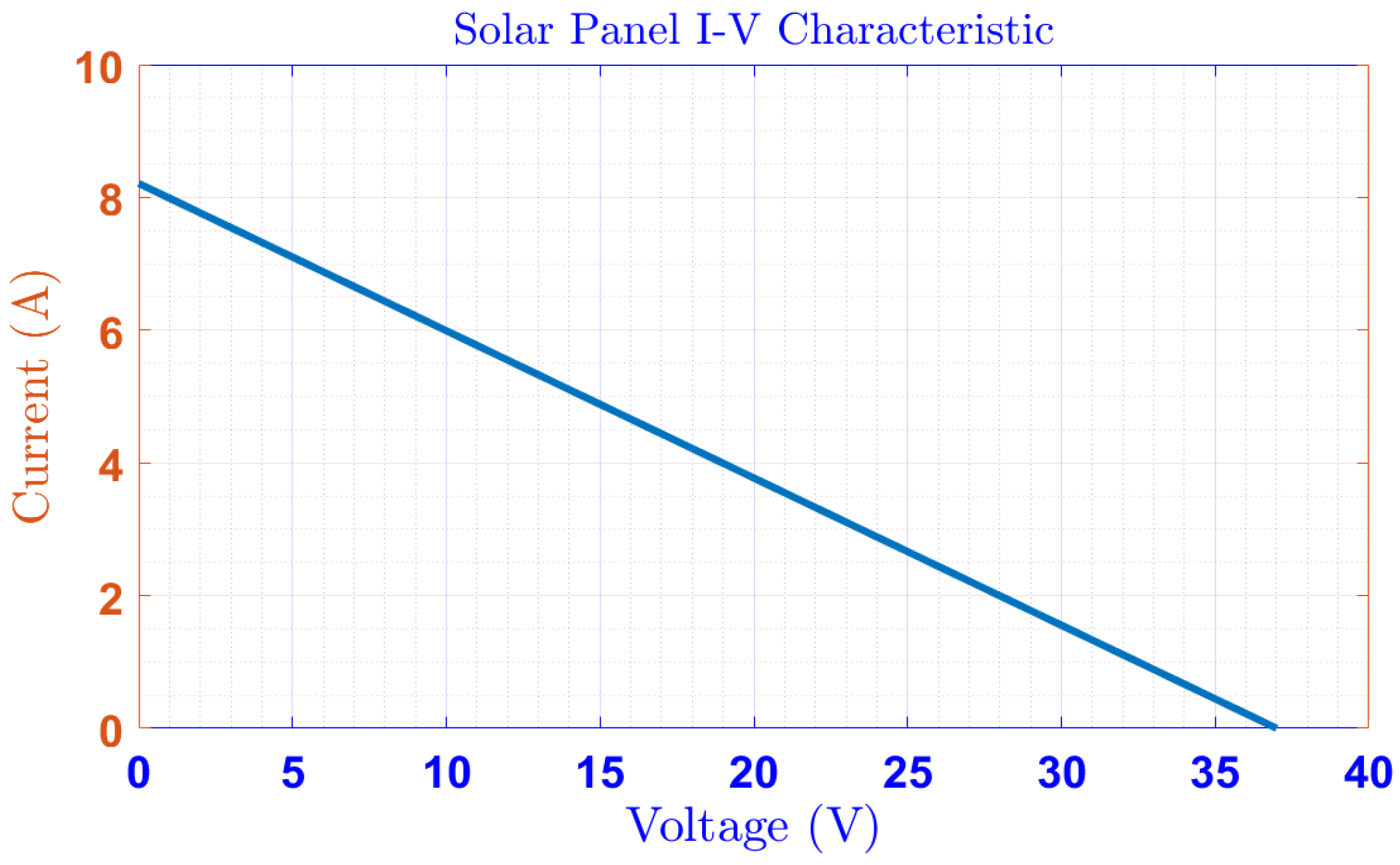
| Open-circuit voltage | 37 | V |
| Short-circuit current | 8.21 | A |
| 12 | V | |
| 5 Ah (60) | Wh | |
| 50 | % | |
| SOC limits | 30–90 | % |
| Charging/discharging efficiency | 0.9 | - |
| 2 | A | |
| 1.5 | A | |
| 0.90 | p.u. | |
| 0.90 | p.u. | |
| AC/DC conversion efficiency | 0.94 | - |
| 12–36 | W | |
| 1 | min | |
| 45.713 | Wh | |
| 49.26 | Wh | |
| 23.81 | Wh | |
| 0.19 | Wh |
| Performance Metric | Without EMS | With EMS | Improvement |
|---|---|---|---|
| Energy supplied to load (Wh) | 24.0 | 24.0 | 0 |
| Renewable energy utilization (%) | 67.4 | 92.8 | 37.7 |
| Battery charge energy (Wh) | 18.5 | 15.2 | Better regulated |
| Battery discharge energy (Wh) | 19.1 | 14.8 | Better regulated |
| Energy losses (Wh) | 24.6 | 12.2 | 50.4 |
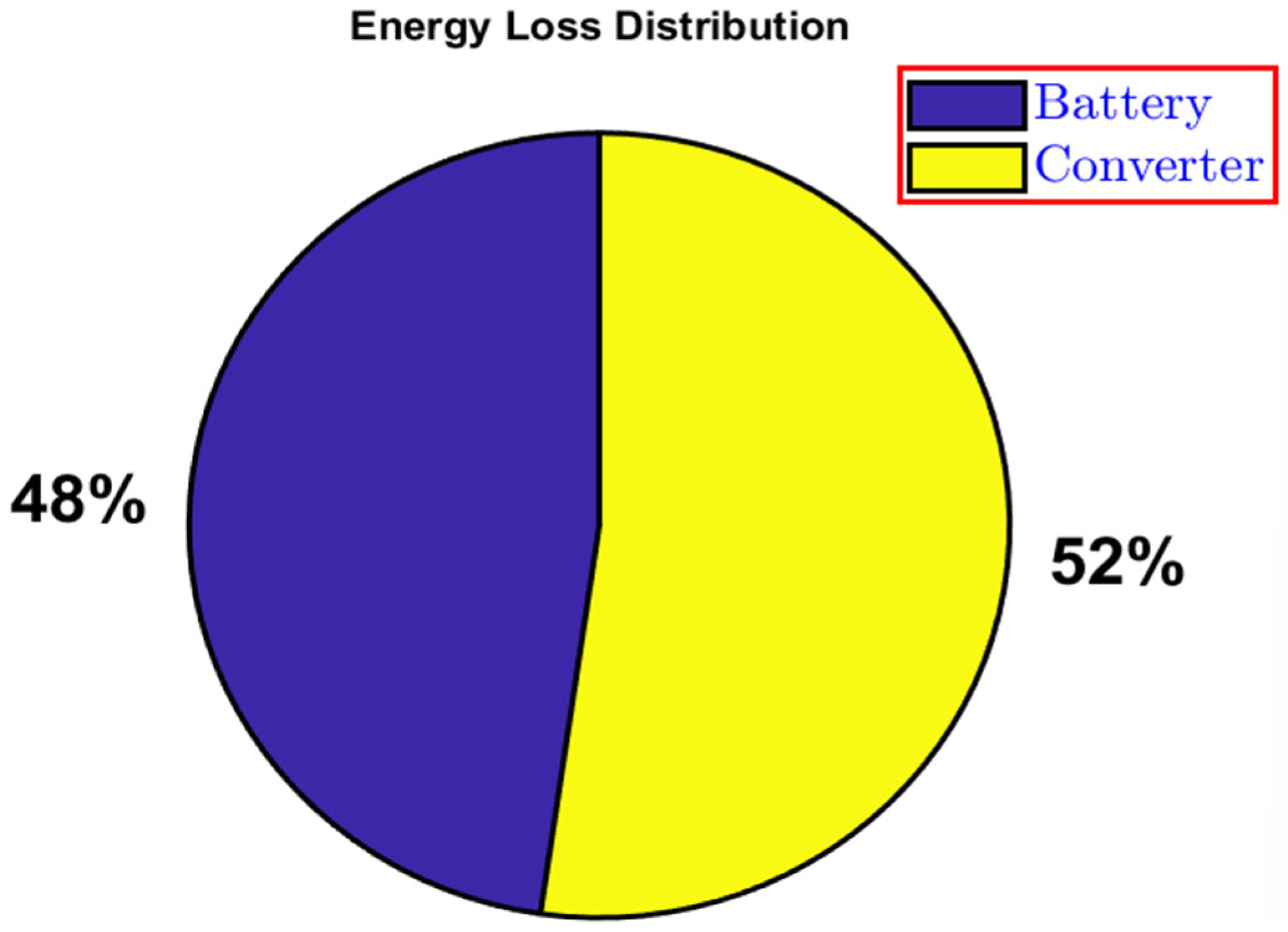
| Battery Energy Losses (Wh) | 11.8 (48%) | 4.9 | 58.5 |
| Converter Energy Losses (Wh) | 12.8 (52%) | 7.3 | 43.0 |
| Load shedding duration (h) | 0.24 | 0.03 | 87.5 |
| Average battery SOC (%) | 54.2 | 67.5 | 24.5 |
| SOC violations (events) | 47 | 0 | 100 |
| System reliability (%) | 93.1 | 99.2 | 6.5 |
| Overall system efficiency (%) | 79.6 | 91.3 | 14.7 |
| LPSP | 0.069 | 0.008 | 88.4 |
| Battery Charge/Discharge Cycles | 18 | 10 | 44.4 |
| RMS power imbalance (W) | 85.4 | 42.7 | 50 |
| Battery operating range (%) | 0–100 | 30–90 | Controlled |
| Renewable Energy Curtailment (%) | 32.6 | 7.2 | 77.9 |
| Ref. | PV | Battery | EMS Strategy | Digital Twin Features | Renewable Energy Utilization (%) | Renewable Energy Curtailment (%) | System Efficiency (%) | Reliability (%) | LPSP | Energy Loss Reduction (%) | SOC Management | Validation Method |
|---|---|---|---|---|---|---|---|---|---|---|---|---|
| [45] | √ | √ | Rule-Based | Monitoring | 72.3 | 27.7 | 81.5 | 94.1 | 0.059 | 18.4 | Basic | Simulation |
| [46] | √ | √ | Fuzzy Logic | DT Visualization | 84.6 | 15.4 | 87.2 | 96.8 | 0.032 | 31.5 | Good | Simulation |
| [47] | √ | √ | MPC | Real-Time DT | 91.4 | 8.6 | 92.1 | 98.7 | 0.013 | 45.2 | Excellent | HIL |
| [48] | √ | √ | Optimization | Monitoring | 86.2 | 13.8 | 88.9 | 97.3 | 0.027 | 36.8 | Good | Simulation |
| [49] | √ | √ | ANN-Based EMS | DT Platform | 89.5 | 10.5 | 90.3 | 98.1 | 0.019 | 42.4 | Excellent | Experimental |
| [50] | √ | √ | Reinforcement Learning | Real-Time DT | 93.1 | 6.9 | 93.8 | 99.0 | 0.010 | 51.3 | Excellent | HIL |
| [30] | √ | √ | Rule-Based | Monitoring | 75.8 | 24.2 | 83.4 | 95.2 | 0.048 | 22.1 | Moderate | Simulation |
| [51] | √ | √ | Multi-Agent EMS | Digital Twin | 90.7 | 9.3 | 91.5 | 98.5 | 0.015 | 47.6 | Excellent | Experimental |
| [52] | √ | √ | Hybrid Fuzzy-MPC | DT Visualization | 92.2 | 7.8 | 92.7 | 98.9 | 0.011 | 49.8 | Excellent | HIL |
| [51] | √ | √ | Optimization-Based EMS | Digital Twin | 88.4 | 11.6 | 89.6 | 97.8 | 0.022 | 39.7 | Good | Simulation |
| This Work | √ | √ | Rule-Based EMS | Interactive Visualization + DT-Oriented Framework | 92.8 | 7.2 | 94.1 | 99.2 | 0.008 | 58.7 | SOC maintained within 30–90% | Simulation |
Disclaimer/Publisher’s Note: The statements, opinions and data contained in all publications are solely those of the individual author(s) and contributor(s) and not of MDPI and/or the editor(s). MDPI and/or the editor(s) disclaim responsibility for any injury to people or property resulting from any ideas, methods, instructions or products referred to in the content. |
© 2026 by the authors. Licensee MDPI, Basel, Switzerland. This article is an open access article distributed under the terms and conditions of the Creative Commons Attribution (CC BY) license.
Share and Cite
Gbadega, P.A.; Loji, K. Toward a Digital Twin Framework for Small-Scale Renewable Energy Microgrids with Integrated Energy Management Control. Sustainability 2026, 18, 6732. https://doi.org/10.3390/su18136732
Gbadega PA, Loji K. Toward a Digital Twin Framework for Small-Scale Renewable Energy Microgrids with Integrated Energy Management Control. Sustainability. 2026; 18(13):6732. https://doi.org/10.3390/su18136732
Chicago/Turabian StyleGbadega, Peter Anuoluwapo, and Kabulo Loji. 2026. "Toward a Digital Twin Framework for Small-Scale Renewable Energy Microgrids with Integrated Energy Management Control" Sustainability 18, no. 13: 6732. https://doi.org/10.3390/su18136732
APA StyleGbadega, P. A., & Loji, K. (2026). Toward a Digital Twin Framework for Small-Scale Renewable Energy Microgrids with Integrated Energy Management Control. Sustainability, 18(13), 6732. https://doi.org/10.3390/su18136732