1. Introduction
According to the World Commission on Environment and Development [
1], sustainability fundamentally requires the efficient use of resources to meet present and future needs. When this core principle is operationalized in business through Elkington’s [
2] Triple Bottom Line, economic performance emerges as a foundational and non-negotiable pillar of sustainability, given that environmental protection or social equity can rarely be structurally maintained by a bankrupt firm. Therefore, while Technological Entrepreneurial Activity (TechTEA) empirically captures the emergence of medium- and high-tech firms, it is conceptually understood within this framework as a critical prerequisite and baseline enabler for addressing broader societal issues and building resilient, green industries [
3,
4]. Rather than disconnecting TechTEA from the multidimensional nature of sustainability, this exploratory approach acknowledges that for medium and high tech ventures to successfully deliver substantive environmental and social value over time, they must first survive by successfully navigating the complex, primary interplay between knowledge creation and financial sufficiency.
In alignment with this economic prerequisite, technological entrepreneurship has been documented as a powerful mechanism to create wealth, drive economic development, and enhance employment and productivity across nations [
5,
6]. While entrepreneurship encompasses a full spectrum of productive activities, its ability to foster long-term resilience is increasingly associated with systemic innovation and technology-driven ventures [
5]. In this context, technological entrepreneurship has gained significant global attention due to the unique capacity of high-tech firms to convert disruptive scientific knowledge into tangible market value [
7,
8]. However, modern discourse suggests that the ultimate goal of these ecosystemic efforts must transcend short-term market entry, aiming instead toward the execution of a sustainable technological venture that ensures the long-term viability of the firm and its contributions to society.
Technological Entrepreneurial Activity has been studied at individual and organizational levels. At the individual level, studies on technological entrepreneurs investigate how founders learn from their customers and convert those learnings into sources of information or into a co-creation process [
9]. Technological entrepreneurs may be influenced by non-economic goals when developing a new business. Usually, technological entrepreneurs come from the academic field, and this academic identity, or the proself, is a non-economic motivator for developing the technology needed for the nascent firm, but it could also lead to lower growth aspirations [
10,
11]. At the organizational level, the absorptive and adaptive capacities of technology firms help them exploit business opportunities, thereby increasing their business resilience in times of crisis [
12]. Other factors contributing to the success of technology firms included business model innovation, the founders’ prior professional experience, and inter-organizational learning [
3].
Although individual and organizational perspectives exist in the technological entrepreneurship literature, studies at the entrepreneurial ecosystem level are missing, creating a gap regarding the determinants of entrepreneurial technological activities at the ecosystem level.
The entrepreneurial ecosystem (EE) components are exceptionally broad, and analyzing all systemic aspects simultaneously presents a significant methodological challenge due to its inherent complexity [
13]. Consequently, this study unifies the entire model under the framework of the Extended Resource-Based View (RBV) applied to entrepreneurial ecosystems [
14,
15]. Grounded in this unified framework, we replace generic ecosystem concepts with a more specific formulation: we focus strictly on the interaction between knowledge-based resources (operationalized as the level of R&D transfer) and financial resources (operationalized as the sufficiency of financing for entrepreneurs) [
16]. Following this Extended RBV logic, environmental dimensions within an ecosystem do not operate in isolation; rather, they function as bundles of complementary assets that require mutual mobilization to unlock commercial value [
17].
Furthermore, technological activities are inherently capital-, talent-, and knowledge-intensive [
8,
12]. As a result, R&D efforts by individuals or organizations can be heavily constrained by the institutional voids embedding their entrepreneurial ecosystems [
4,
18], ultimately limiting technology’s potential to deliver broader social benefits. Finally, unlike advanced economies, Technological EEs in emerging markets are typically created artificially through public institutional support and international connectivity, often lacking natural, organic resource providers [
4]. Isolating this specific dimension of the Technological EE is therefore crucial, as its dynamics operate under fundamentally different rules in emerging contexts.
This paper examines ways to foster technological entrepreneurship through the variables of R&D transfer and financing sufficiency. Analyzing these variables is critical, as they enhance a country’s economic growth and reduce its vulnerability to external shocks. Fostering technological entrepreneurship through R&D and targeted financing serves as a pivotal leverage point that allows emerging markets to escape economic crises more rapidly [
18,
19]. Furthermore, studying the interplay among financing, R&D, and technological entrepreneurial activity helps identify mechanisms to prevent instability in highly vulnerable, tech-dependent strategic sectors [
20].
Although the study of technological entrepreneurial activities has traditionally been approached from an institutional standpoint—such as through national innovation systems or financial environments—these frameworks often analyze the isolated effects of innovation [
18,
19]. Rather than evaluating these components in isolation, we adopt an entrepreneurial ecosystem perspective based on the interaction between two distinct dimensions: the R&D level of transfer and entrepreneurial financing. We present these two variables as key enablers of technological entrepreneurship. Ultimately, studying innovation and technology from an entrepreneurial ecosystem perspective is necessary to generate a meaningful societal impact through technology. Therefore, this study analyzes the specific mechanisms through which R&D transfer and sufficiency of financing for entrepreneurs enable technological entrepreneurial activities in emerging economies.
This paper also contributes to the literature on entrepreneurial ecosystems by focusing on emerging markets, a context that is particularly relevant due to its distinctive characteristics, including institutional voids—especially capital market imperfections—as well as knowledge deserts and limited absorptive capacity for knowledge from foreign technological firms operating in these economies [
4,
21].
This study examines the direct effects of knowledge-based resources (the level of R&D transfer) and financial resources (the sufficiency of financing for entrepreneurs) on Technological Total Entrepreneurial Activity (TechTEA), as well as the mediating role of financing within emerging economies. Utilizing data from the Global Entrepreneurship Monitor (GEM)—specifically the National Expert Survey (NES) and the Adult Population Survey (APS)—we analyze a sample of 26 emerging countries, leveraging individual expert evaluations to capture the qualitative nuances of these ecosystems. The structural relationships among variables are evaluated using variance-based structural equation modeling (PLS-SEM).
The findings reveal that R&D transfer has a significant positive effect on the sufficiency of financing available to entrepreneurs. However, R&D transfer shows a significant negative direct effect on TechTEA, suggesting that isolated technology transfer introduces systemic friction. In contrast, the sufficiency of financing has a positive impact on TechTEA, acting as an inconsistent mediator that neutralizes the negative direct friction of R&D and unlocks its positive indirect potential. Crucially, our exploratory model’s low overall explanatory power challenges the status quo in the technological entrepreneurship literature, delivering a critical diagnostic insight: in emerging economies, the traditional assumption that technical knowledge and capital injections are the primary, self-sufficient drivers of high-tech ventures does not hold true, as these pillars explain a mere 1.5% of the phenomenon. While financial resources act as a localized vehicle to offset the negative friction of isolated technology transfer, widespread macro-level TechTEA depends on a much broader, multi-layered configuration of institutional governance and market alignment. Consequently, this empirical result suggests that explaining technological entrepreneurship in developing contexts requires looking far beyond the traditional resource variables emphasized in Western-centric models [
22]. Those traditional models—rooted in classical Resource-Based View (RBV) and linear innovation theories—typically focus strictly on isolating supply-side factors such as national R&D activities and capital availability [
23,
24,
25]. By indicating that these classical inputs leave 98.5% of the variance unexplained, our exploratory study provides an initial baseline suggesting that Western-centric frameworks may be structurally incomplete for emerging markets. This supports Bruton et al. (2010) [
26], who argue that entrepreneurship in developing contexts requires shifting from purely resource-centric views toward institutional lenses due to environmental constraints and institutional voids.
In this sense, macro-level analyses like ours can serve as a foundation for future research aimed at uncovering the microfoundations of entrepreneurial ecosystems’ resource allocation in the technology sector within emerging markets, particularly by guiding attention toward the interactions and processes that drive variation in entrepreneurial activity and outcomes across contexts [
22,
27].
The paper is organized as follows. First, it presents the literature review. Next, it describes the PLS-SEM methodology employed in the study.
Section 5 begins with an assessment of the construct’s reliability and validity, followed by the presentation of direct and indirect effects.
Section 6 follows, and the paper concludes with the study’s main conclusions and implications.
4. Method
PLS-SEM is an exploratory causal modeling technique that estimates path coefficients, enabling the examination of relationships among latent variables through the testing of theoretically grounded hypotheses [
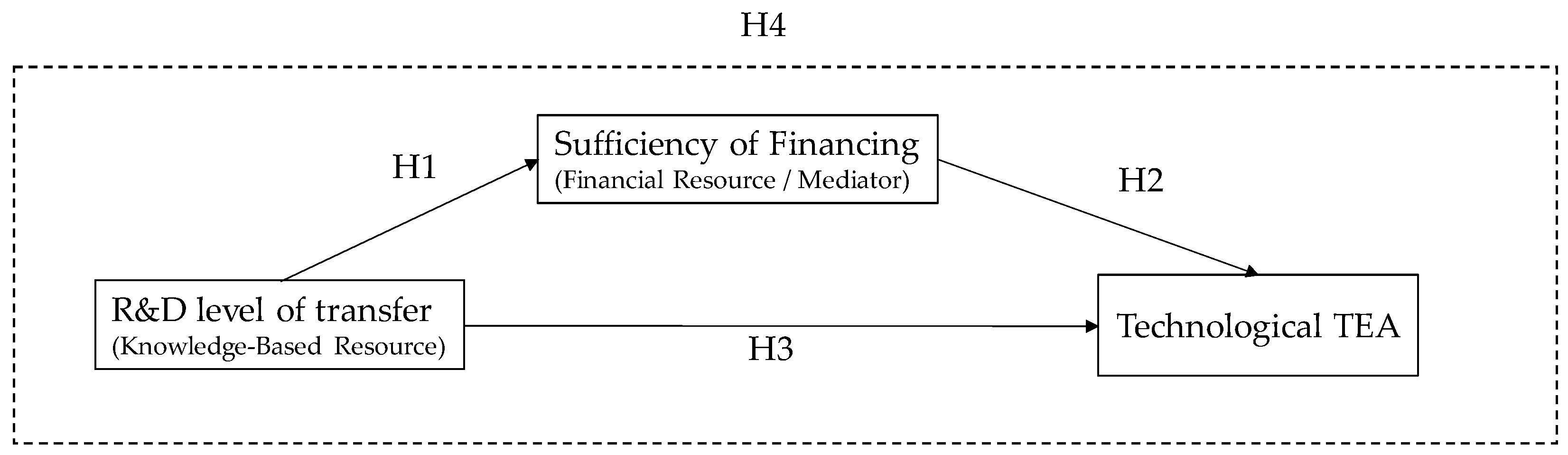
47]. Unlike simple correlation analysis, which does not imply causality, PLS-SEM allows for the estimation of direct causal relationships between constructs. For this reason, it is particularly well suited to the objective of this study, which is to explore the causal relationships among key variables—namely, Sufficiency of Financing for Entrepreneurship, R&D Level of Transfer, and Technological Total Entrepreneurial Activity (see
Figure 1).
Using PLS-SEM in this context offers methodological advantages over alternative approaches, such as panel data analysis or regression-based mediation. In emerging economies, comprehensive information regarding entrepreneurial ecosystems is frequently scarce, and compiling multi-year or objective quantitative data is highly challenging due to severe data fragmentation and shifting institutional definitions across borders [
48]. These systemic constraints heavily justify the cross-sectional, exploratory nature of this study. Furthermore, traditional regression or panel data models typically sacrifice the granular richness of individual indicators by relying on aggregated construct averages. In contrast, PLS-SEM preserves the variance of each specific item, preventing the loss of critical diagnostic information.
Methodologically, this study relies on individual expert-level responses from the Global Entrepreneurship Monitor (GEM) database. Rather than treating experts as aggregate country averages, keeping them as individual observations allows them to act as comprehensive sensors capable of perceiving and evaluating the subtle, qualitative nuances of financial sufficiency and R&D transfer within their respective environments [
49]. By linking these individual expert perceptions directly to the country-level technological entrepreneurship indicator (TechTEA), the model effectively captures how the perceived institutional reality of an ecosystem functions as a catalyst for actual entrepreneurial outcomes.
The study is based on data from the Global Entrepreneurship Monitor (GEM), specifically the National Experts Survey (NES) and the Adult Population Survey (APS), collected in 2021. The NES questionnaire is used to collect the views of experts on a wide range of items, each of which was designed to capture a different dimension of the entrepreneurial framework conditions, and the GEM APS is a unique instrument used to measure the level and nature of entrepreneurial activity around the world [
50]. The NES and APS databases were grouped into one region based on the Below-median Human Development Index (BHDI) classification. The concept of below-median is embedded within a broader analytical framework that considers different population percentiles. Examining multiple quantiles (below, above, and intermediate ranges) provides a richer, more nuanced understanding of human development than relying solely on averages. In this context, the BHDI captures the average achievements of individuals below the median within a country across key dimensions of human development: the Below-median Life Expectancy Index (LEIB), the Below-median Income Index (IIB), the Below-median Mean Years of Schooling Index (MYSIB), and the Below-median Expected Years of Schooling Index (EYSIB) [
51].
According to the BHDI from the total of countries available on the Global Entrepreneurship Monitor (NES and APS), the emerging markets are: Russia, Egypt, South Africa, Greece, Romania, Brazil, Chile, Colombia, Turkey, India, Iran, Morocco, Sudan, Cyprus, Belarus, Croatia, Slovak Republic, Guatemala, Panama, Uruguay, Kazakhstan, Saudy Arabia, Oman, United Arab Emirates, Qatar and Dominica. The sample sizes were balanced with 992 observations from 26 emerging markets and an average of 37 respondents per country. The 26 countries were chosen because they are the most representative of emerging markets according to the Below-median Human Development Index (BHDI) [
51], and their information was available.
The data analysis was conducted using a variance-based structural equation modeling approach, specifically partial least squares (PLS-SEM), implemented in SmartPLS version 3.0. This technique was selected because it is a second-generation statistical method widely used in empirical social science research, particularly suited for modeling latent (unobservable) variables measured indirectly through indicator variables [
47].
The latent constructs in this study were derived from the National Expert Survey (NES), which captures informed assessments of national entrepreneurial framework conditions. On average, the NES includes responses from 37 experts per country. These national and regional experts are selected based on their reputation and experience, through a convenience sampling approach. The use of latent variables is also justified by the difficulty of harmonizing comparable indicators across the 26 countries included in the analysis.
As illustrated in
Figure 1, the structural design of our empirical model is fully unified under the framework of the Extended Resource-Based View (RBV) applied to entrepreneurial ecosystems. Rather than analyzing independent, isolated pillars, this structural model captures the fundamental principles of resource interdependence and complementarity within emerging economies. Specifically, the framework unifies the model by positioning the level of R&D transfer as a core knowledge-based resource whose capacity to drive Technological Total Entrepreneurial Activity (TechTEA) is conditionally mediated by a critical, complementary financial resource (Sufficiency of Financing). By structuring these paths simultaneously, the model operationalizes how configuration and resource interaction—rather than a static inventory of assets—determine high-tech venture outcomes in resource-constrained environments.
Measurement of the Study Variables
Given the complexity of institutional voids and the scarcity of synchronized data in emerging economies, this exploratory study adopts a PLS-SEM approach to uncover the mediating mechanisms that govern technological entrepreneurship.
The Sufficiency of Financing for Entrepreneurship and the Level of Transfer in R&D in this study were operationalized using standardized measures derived from the Global Entrepreneurship Monitor (GEM) datasets. Specifically, the constructs of R&D Level of Transfer and Sufficiency of Financing for Entrepreneurship were measured using an 11-point Likert-type scale ranging from 0 to 10, with higher values indicating more favorable conditions.
Technological Total Early Stage Entrepreneurial Activity (TechTEA) was measured as the percentage of the population aged 18–64 in a country who are either nascent entrepreneurs or owner-managers of new businesses (less than three years old). From this group, we specifically consider only those engaged in medium- and high-technology ventures.
Following the contemporary literature that utilizes Global Entrepreneurship Monitor (GEM) data within PLS-SEM frameworks [
52], the constructs for R&D Level of Transfer and Sufficiency of Financing for Entrepreneurs were operationalized as reflective. While both constructs conceptually encompass multiple dimensions, the GEM National Expert Survey evaluates these conditions through unified, perceptual Likert scales designed to capture the overarching systemic adequacy of the ecosystem rather than tracking additive, independent causes. This reflective specification aligns with standardized practices for analyzing perceptual macroeconomic indicators. Empirically, this operational choice is fully supported by robust indicator outer loadings, excellent Composite Reliability, and an Average Variance Extracted comfortably exceeding the 0.50 benchmark, confirming that the items reflect a high degree of shared variance.
The Global Entrepreneurship Monitor created the measurement of each variable; the items of the variables are the following:
Sufficiency of Financing for Entrepreneurship: This condition was measured with eight items on an eleven-point Likert scale comprising the following statements: (a) In my country there is sufficient: equity funding (understood as entrepreneurs’ own financial resources) available for new and growing firms; (b) In my country there is sufficient: debt funding (understood as bank loans and similar) available for new and growing firms; (c) In my country there is sufficient: government subsidies available for new and growing firms; (d) In my country there is sufficient: informal investor funding (family, friends and colleagues who are private individuals other than founders) for new and growing firms; (e) In my country there is sufficient: professional business angel funding (individuals who provide capital in exchange for convertible debt or ownership equity) for new and growing firms; (f) In my country there is sufficient: venture capital funding (pooled investment funds for private equity stakes) for new and growing firms; (g) In my country there is sufficient: IPO (initial public offering) funding available for new and growing firms; (h) In my country there is sufficient: micro funding (for example crowdfunding from a large number of individuals contributing a relatively small amount, typically via the internet) for new and growing firms.
R&D Level of Transfer: This condition was measured with six items on an eleven-point Likert scale comprising the following statements: (a) In my country, new technology, science, and other knowledge are efficiently transferred from universities and public research centers to new and growing firms; (b) In my country, new and growing firms have just as much access to new research and technology as large, established firms; (c) In my country, new and growing firms can afford the latest technology; (d) In my country, there are adequate government subsidies for new and growing firms to acquire new technology; (e) In my country, the science and technology base efficiently supports the creation of world-class new technology-based ventures in at least one area; (f) In my country, there is good support available for engineers and scientists to have their ideas commercialized through new and growing firms.
7. Conclusions
Regarding the model’s overall explanatory power, the defining contribution of this study lies in demonstrating that the principles of the Resource-Based View (RBV) operate in a fundamentally distinct manner within emerging economies compared to advanced markets. Our results challenge the status quo of the traditional literature by offering empirical proof that the conventional RBV assumption—which dictates that combining traditional knowledge assets (R&D transfer) and capital injections (sufficiency of financing) is a self-sufficient driver of high-tech ventures—does not hold true in developing contexts. This stark mismatch highlights a critical challenge for ecosystem sustainability: the absence of a comprehensive institutional framework prevents the Triple Bottom Line from being fully realized, as technological potential struggles to achieve the economic viability necessary for long-term societal impact (Elkington, 1997) [
2]. Consequently, these insights suggest that under an emerging-market RBV logic, policymakers cannot rely on isolated asset injections. Instead, future strategies must pivot toward comprehensive ecosystem orchestration—prioritizing institutional friction-reduction mechanisms, unified regulatory governance, and firm-level absorptive capacity—to allow technological ventures to scale and survive over time.
At the variable level, the structural relationships within our model explain the specific mechanisms behind this friction. Grounded in this Extended RBV for entrepreneurial ecosystems, our exploratory model reveals that the isolated transfer of knowledge-based resources plays a counterproductive role, directly introducing systemic friction that can constrain active venture creation. While efforts in knowledge transfer do significantly increase the availability of complementary financial resources, financing does not act as a traditional growth multiplier in these environments. Instead, it functions merely as an emergency institutional buffer—a structural counterweight required to neutralize the negative direct friction of R&D and unlock its latent indirect potential. From a sustainability perspective, understanding this micro-level tension is vital to ensure that intellectual capital is not wasted, aligning with the principle of efficient resource use proposed by the World Commission on Environment and Development (1987) [
1] to allow technological ventures to survive, counterbalance structural risk, and scale over time.
7.1. Theoretical Implications
A critical starting point for the explorative theoretical implications of this study is our model’s constrained explanatory power. Traditional, Western-centric frameworks operate under the implicit assumption that a combination of knowledge-based resources (R&D transfer) and financial resources is the primary, self-sufficient driver of high-tech ventures [
25,
39,
40]. Our results disrupt this baseline assumption, delivering a profound diagnostic insight: in emerging economies, simply injecting R&D and financing does not guarantee technological entrepreneurship. The fact that 98.5% of the variance remains unexplained proves that widespread macro-level TechTEA depends on a much broader, decentralized matrix of unobserved institutional governance, regulatory quality, and market alignment that extends far beyond the traditional resource variables isolated in standard models [
26].
Rather than showing a classical positive synergy or a simple full mediation, our exploratory analysis reveals that the knowledge-based resource (R&D transfer) introduces negative direct friction. However, this negative path is statistically counterweighted and suppressed by the positive indirect pathway of the complementary financial resource.
When viewed through the lens of the Extended Resource-Based View (RBV) applied to entrepreneurial ecosystems, this suppression dynamic serves as an empirical manifestation of structural tension in developing contexts. Traditionally, the EE literature suggests that environmental pillars function as bundles of complementary assets requiring mutual mobilization [
15,
16]. Our findings refine this logic for emerging economies: an isolated knowledge resource (R&D transfer) represents raw market potential that acts as an institutional liability—generating friction and bottlenecks—unless it is effectively backed by a complementary financial resource to act as an absorptive bridge. Theoretically, this indicates that financing does not function as a growth multiplier in these entrepreneurial ecosystems, but rather as a localized, defensive institutional buffer required merely to neutralize the inherent risks of uncoordinated technology transfer. This study demonstrates that resource complementarity in emerging economies is an intensely conditional process where traditional resource availability is secondary to broader ecosystem orchestration.
7.2. Practical Implications
The discussion on entrepreneurial ecosystems has traditionally focused on mere resource accumulation. However, our exploratory findings indicate that resources such as R&D transfer and financing are insufficient on their own; their efficacy is dependent upon the institutional architecture and the specific conversion mechanisms that connect research institutions, investors, entrepreneurs, and markets. To translate these exploratory trends into actionable insights, the implications are categorized into three systemic levels.
7.2.1. Policy Implications
Public policy must shift away from isolated resources injections and focus on establishing a cohesive, multi-branch institutional architecture where government agencies act as ecosystem orchestrators rather than simple funding providers [
66]. Grounded in the necessity of cross-sector coherence [
67], governments should deploy three concrete, actionable instruments:
Inter-Ministerial Policy Integration: National governments should establish a centralized inter-ministerial council to align industrial, educational, and financial regulations. This mechanism explicitly prevents structural contradictions where one public agency subsidizes academic R&D while another maintains bureaucratic hurdles that stifle technological venture registration or private capital mobilization.
Institutional Risk-Mitigation Infrastructure: To convert risk-averse capital into active early-stage investment, policymakers must strengthen intellectual property (IP) protection and accelerate contract enforcement protocols. Public governance must provide legal certainty to ensure that private investors can confidently back high-risk, technology-based startups.
Co-Investment and Market-Linking Programs: State agencies should operationalize coordinated governance by implementing public–private seed funds and matching grants designed to explicitly de-risk early-stage private equity. Additionally, following successful international benchmarks, public policies should mandate university–industry commercialization programs that actively connect technology-based ventures with international markets from inception, effectively bypassing small or underdeveloped domestic demand constraints [
4].
7.2.2. Managerial Implications for Universities and Technology Transfer Offices (TTOs)
For universities and TTOs, the traditional focus on securing patents must shift toward market validation and ecosystem orchestration. R&D transfer yields localized value only when accompanied by specialized cognitive and managerial support to overcome the absence of commercialization mechanisms.
TTO managers should implement structured customer-discovery programs (such as Lean LaunchPad methodologies) to ensure that laboratory technologies align with actual market needs before deploying capital. Additionally, universities must establish dedicated IP commercialization offices that operate with corporate flexibility rather than academic bureaucracy. To bridge the gap caused by limited human capital and specialized skills in small ventures, TTOs should actively collaborate with venture studios and venture builders. These emerging actors play a key role in selecting new venture projects, evaluating technological initiatives, and injecting the strategic, complementary managerial capabilities needed to structure scientific projects into viable businesses [
68].
7.2.3. Investment Implications for Venture Capital and Angel Networks
Our exploratory finding regarding the inconsistent mediation effect underscores that financial capital cannot act as a blind resource; it must function as an absorptive bridge. For angel networks and venture capital (VC) firms in emerging markets, this requires moving away from traditional collateral-based lending or late-stage investing, and moving toward accelerator-linked investment models.
Investors should deploy early-stage proof-of-concept (PoC) funding to test the commercial viability of high-tech academic spin-offs. Furthermore, the relationship between entrepreneurs and investors requires initial flexibility to allow startups to pivot and discover their markets. Aligning the strategic objectives of both parties is essential to balance investors’ return expectations with the technological and sustainable impact pursued by the entrepreneurs [
37,
63]. Financing mechanisms must allow startups the operational room to navigate conflicting goals during their initial growth phase, transforming raw technology into sustainable market value.
7.3. Limitations
The primary limitation of this study lies in its reliance on cross-sectional data. Future research using longitudinal data could provide deeper insights into how R&D transfer and financing influence technological entrepreneurial activity over time. A longitudinal perspective is particularly important given the extended time horizons required for technological development to reach market readiness.
One limitation of this study is its exclusive focus on the resource provision component of the entrepreneurial ecosystem. While isolating this specific dimension allowed for a precise analysis of resource interdependence, a broader, more holistic perspective of the phenomenon could provide a more comprehensive understanding of the entrepreneurial ecosystem in emerging economies. Future research should integrate other systemic pillars—such as cultural norms and entrepreneurial connectors—to capture the full complexity of these developing environments.
A limitation of this study is the risk of systematic bias when utilizing expert surveys rather than objective indicators of formal financing availability and R&D transfer. The omission of a robustness test like adding traditional macroeconomic control variables reflects a broader, structural limitation within the field: standardized global datasets, such as those from the World Bank, still lack consistent and complete indicators for all the emerging economies included in our sample. Furthermore, as highlighted by Acs et al. (2008) [
48], official national data sources differ significantly in how they define core economic variables, rendering cross-country controls, for example in real financing availability, highly problematic and conceptually incompatible.
While the GEM framework effectively bypasses these national bureaucratic inconsistencies by applying a uniform, harmonized measurement infrastructure, we acknowledge that the necessary granular data to perfectly control for these dynamics is not yet fully available. Nevertheless, it is critical not to paralyze research due to these institutional data gaps. Presenting exploratory studies in emerging economies is a necessary and urgent point of departure; waiting for flawless macroeconomic data would mean systematically excluding these vulnerable ecosystems from the academic literature. Therefore, this exploratory model establishes an essential baseline so that future research can implement advanced robustness checks as data infrastructure matures in these developing nations.
Additionally, the study relies on expert perceptions within each entrepreneurial ecosystem. Future research could incorporate more objective, directly observable measures, such as investment in technology firms, startup debt levels, R&D activity volumes, and patent counts, to more accurately capture the variables of interest.