Article

Network Intensities and Power Disparities Influence Policy and Governance Outcomes in Large Carnivore Conservation

by
Nimisha Srivastava
1,*,
Claudia Sattler
2,
Christine Fuerst
1,3,
Hannes J. Koenig
4,
Ramesh Krishnamurthy
5 and
John D. C. Linnell
6,7
1
Department Sustainable Landscape Development, Martin Luther University Halle-Wittenberg, 06120 Halle, Germany
2
Leibniz Centre for Agricultural Landscape Research (ZALF), 15374 Müncheberg, Germany
3
German Centre for Integrative Biodiversity Research (iDiv) Halle-Jena-Leipzig, 04103 Leipzig, Germany
4
Thaer-Institute of Agricultural and Horticultural Sciences, Humboldt Universität zu Berlin, 10117 Berlin, Germany
5
Department Landscape Level Planning and Management, Wildlife Institute of India, Dehradun 248002, India
6
Department of Forestry and Wildlife Management, University of Inland Norway, 2406 Elverum, Norway
7
Norwegian Institute for Nature Research, 7034 Trondheim, Norway
*
Author to whom correspondence should be addressed.
Sustainability 2026, 18(13), 6563; https://doi.org/10.3390/su18136563
Submission received: 20 May 2026 / Revised: 16 June 2026 / Accepted: 21 June 2026 / Published: 29 June 2026
(This article belongs to the Section Sustainability, Biodiversity and Conservation)

Abstract

Large carnivore conservation (LCC) presents complex social–ecological challenges in environmental governance, yet limited research has examined how institutional design influences conservation outcomes. This study compares community-based conservation (CBC) in India’s tiger conservation with collaborative governance regimes (CGR) in Germany’s wolf conservation. We conducted a policy-network analysis using Net-Map interviews with formal policy actors involved in LCC governance (India: n = 21. Germany: n = 15). Network structures were analyzed across four tie categories—information-sharing, instructions, influence, and advice—while structural and perceived power distributions were compared across governance levels. Results show that information-sharing dominated governance interactions in both countries, whereas advice ties remained weak. India’s CBC exhibited ties concentrated largely within the forest department administration. Despite stronger local stakeholder integration, social justice framing affected direct inclusivity in policy decisions. Germany’s CGR demonstrated fragmented policy centers with most power concentrated at the German federal state levels. Environmental justice framing allows stronger influence by powerful non-state actors but alienates local stakeholders from policy decisions. Discrepancies between structural and perceived power were evident in both systems, highlighting participation–power disconnects within conservation governance. The findings suggest that effective and sustainable LCC governance requires stronger cross level coordination, institutionalized scientific advice mechanisms, and meaningful inclusion of local stakeholders in policy processes for sustainable LCC.

1. Introduction

The conservation of large carnivores represents one of the most complex challenges in contemporary environmental and sustainability governance, requiring the integration of complex realities in social–ecological systems [1,2]. In recent decades, a global shift from conventional top-down exclusionary conservation models has been observed, with the establishment of participatory governance mechanisms to enable trust, transparency and cooperation of stakeholders. The goal is to enhance support and acceptance of conservation policies among stakeholders [3]. This transformation reflects growing recognition that effective large carnivore conservation (LCC) requires a deeper understanding of institutional arrangements, inclusive policy-making processes, and the power relations that shape the policy and decision outcomes [4].
More broadly, LCC governance has evolved toward participatory models, though these take different forms globally. Community-based conservation (CBC) in many countries of the Global South emphasizes local ownership and benefit-sharing within ‘social justice’ premise [5], while collaborative governance regimes (CGR) in Europe emphasize procedural rights and multi-stakeholder engagement through frameworks like the Aarhus Convention—embedded within ‘environmental justice’ framings [6]. Despite different institutional origins, both models face similar challenges with power distribution and meaningful participation. CBC practices often suffer from tokenistic engagement rather than genuine empowerment [7], while CGR approaches struggle with legitimacy deficits and difficulties reconciling conflicting stakeholder interests [8].
Despite growing theoretical interest in participatory conservation governance, empirical research on the institutional designs that foster or constrain participatory mechanisms within multi-level governance remains limited [9,10]. This gap is particularly critical in carnivore conservation, where international legal frameworks must cascade through national and subnational levels of governance, making vertical policy cohesion essential for legitimacy [11]. Power asymmetries may exacerbate high-stake conflicts despite horizontal participatory mechanisms [9,12].
This study addresses these gaps by examining how institutional design—including actor diversity, network centralization, and clustering characteristics—influences policy-making effectiveness and stakeholder participation in carnivore conservation. To do so, it conducts a comparative policy network analysis (PNA) and quantifies power dynamics for LCC, focusing on India’s CBC for tiger (Panthera tigris) conservation and Germany’s CGR for wolf (Canis lupus) conservation.

Rationale for Case and Species Selection

India and Germany were selected because both represent internationally recognized instances of successful large carnivore recovery yet rely on fundamentally contrasting governance models—community-based conservation (CBC) in India and collaborative governance regimes (CGR) in Germany. Tigers and wolves were chosen as focal species because both occupy a central place in national conservation and human–carnivore conflict management policy in their respective countries. The comparison focuses on governance arrangements rather than species ecology or management outcomes.
India’s tiger conservation operates within a state-led, land-sparing framework, where site level and operational decisions are administered at the protected area level. Accordingly, two tiger reserve (TR) landscapes—Corbett TR (Uttarakhand) and Panna TR (Madhya Pradesh)—were selected as sub-national units of analysis, representing regions with established tiger populations and active conservation governance. In Germany, site level policies are formulated at the federal state (Länder) level, making states the appropriate sub-national unit. Two states with well-established wolf populations and active governance structures—Lower Saxony and Brandenburg—were therefore selected. This sub-national variation in governance structure, rather than geography, guided the selection of jurisdictions in each country. Further details on the governance context and policy frameworks of each case are provided in Supplementary Material S2.
Although tigers and wolves differ markedly in their ecological characteristics, the study’s objective is not to compare species ecology but to investigate how institutional design mediates participation, influence, and justice within LCC governance. By juxtaposing CBC and CGR across Global South and Global North contexts, the study advances understanding of the extent to which participatory mechanisms translate into substantive influence in conservation decision-making.
PNA offers quantitative methods to examine institutional design and how they influence information-sharing, power distribution, and policy-making effectiveness [13,14,15]. Critically, formal network positions—reflecting structural power—may not correspond with the influence that actors perceive themselves to hold, revealing participation–power disconnects that formal governance design alone cannot capture [16,17,18,19]. This analytical approach is therefore particularly suited to examining whether CBC and CGR models translate participatory structures into meaningful influence for the stakeholders directly affected by LCC policies.
A central assumption of this study is that social and environmental justice framings shape institutional design in ways that may or may not ensure effective inclusion of the stakeholders directly affected by conservation policies—particularly farmers, sheep herders, and local communities sharing space with carnivores. We argue that contemporary conservation needs to move beyond justice framing dichotomies (social versus environmental) toward ensuring holistic inclusivity across governance levels and management scales. The study contributes as follows: (1) by comparing participatory governance models across Global South and North contexts; (2) by integrating structural and perceived power analyses; and (3) by examining how justice framings shape actor inclusion across governance scales. Our specific research objectives, questions, and hypotheses are presented in Table 1.

2. Materials and Methods

2.1. Data Collection

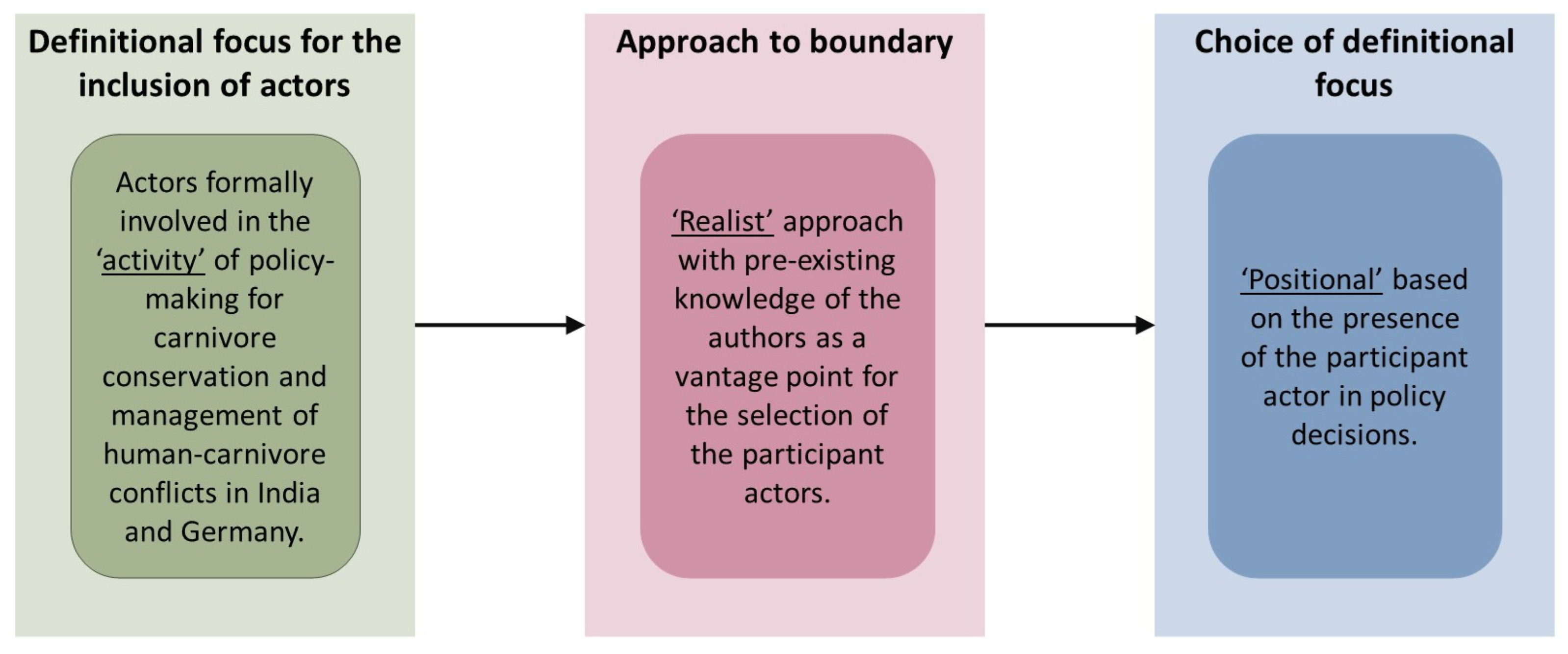
Network boundary definition followed the Laumann–Marsden–Prensky framework [20], using a realist approach guided by the authors’ pre-existing knowledge of LCC governance in both countries (Figure 1). Interviewee selection applied a positional rule, restricting inclusion to actors formally involved in tiger and wolf conservation policy decisions under India’s CBC and Germany’s CGR, respectively. A total of 15 policy actors in India and 13 policy actors in Germany, were identified. Details on the policy actor categories can be found in Supplementary Material S3. Targeted saturation was reached when at least one representative from each identified formal policy actor category—spanning state and non-state institutions—was included (Supplementary Material S4). Data collection was achieved despite varying response rates across the two countries, described below.
Net-Map was used as the primary policy network analysis and stakeholder mapping tool, enabling interviewees to interactively construct governance networks through a structured interview process [21]. Interviews were conducted between March 2024 and January 2025 with formal policy actors within India’s CBC and Germany’s CGR. Contact was established via email in both countries, supplemented by WhatsApp in India and official website contact forms in Germany. Interview guidelines are provided in Supplementary Material S1.
The Indian component involved 21 Net-Map interviews with state and non-state actors formally recognized within the tiger conservation governance network. The majority of sessions were face-to-face (90%), with the remainder conducted virtually, achieving a response rate of 91.3%. Interviews were conducted in Hindi, or a mix of Hindi and English, by the first author, and lasted approximately 80 min on average.
German data collection encompassed 15 Net-Map interviews with state and non-state actors within the wolf management policy network. All sessions were conducted virtually, achieving a 38.5% participation rate. Non-participation resulted from unresponsive contacts or personnel changes. Given that 53% of German participants preferred their native language, a trained German-speaking research assistant conducted interviews independently under the supervision of the first author. Interviews averaged 79 min. The lower participation rate in Germany likely reflects the absence of institutional affiliation comparable to the Wildlife Institute of India, which lent legitimacy to interview requests in the Indian context. However, despite stark differences in the response rates, interviewees represented all governance levels and policy actors identified in the study (Table 2). Supplementary Material S4 provides a list of interviewees interviewed in the study with their representations in the two countries.
While Sattler et al. [23] highlighted challenges with online Net-Map interviews using collaborative whiteboard applications like Mural, the present study employed the Notability application on iPad. This digital approach effectively replicated the pen-and-paper methodology used in face-to-face sessions, ensuring consistency in interview flow and time duration across both in-person and virtual formats.
Key questions guiding the interviews included information on networking for policy-making between policy actors and interviewees’ power perspectives. Table 3 provides details on the key questions guiding the interviews. We specifically categorized networking into four tie types, namely, information-sharing, instructions, influence, and advice (Table 4). Power was analyzed in two forms: structural power, derived from network position within each governance model, and perceived power, captured as interviewees’ assessments of actor influence over policy outcomes on a scale of 0 to 10 [24].

2.2. Data Analysis

We used UCINET software (version 6.813) [25] to analyze network centrality measures and Gephi (version 0.10.1) [26] for network map generation. Weighted network densities (WND) were calculated to quantify the strength of ties in policy-networks in both cases. Given the variation in sample sizes between the two countries (n = 21 in India and n = 15 in Germany), the data were normalized to enable a comparative approach. WND is calculated as the ratio of actual ties between nodes to all possible ties in a network:
W N D =   i j   w i j n ( n 1 )
where (i ≠ j) signifies directed ties—no self-loops, w i j represents the weight of the tie from node i to j, ‘n’ signifies the total number of nodes, n (n − 1) presents number of possible ties.
To identify actors holding structurally powerful positions, ties across all four categories were aggregated to produce an overall policy network for each country. Structural power was assessed using degree centrality (DC), which captures the connectivity of each actor node. In-degree reflects incoming ties—indicating an actor’s role as a recipient of network flows—while out-degree reflects outgoing ties, indicating an actor’s reach within the network [27]:
c i d e g g = d i g n 1
where ci is the centrality of node i and di is the degree of a node i in network g.
Perceived power was derived from power scores assigned by interviewees to nodes within their Net-Map (scale: 0–10). Not all interviewees provided power: 12 out of 21 participants did so in India, and 13 out of 15 in Germany. To aggregate power perceptions across multiple Net-Map interviews, we developed a Power Perception Index (PPI) that combines both intensity and breadth of power attribution:
PPI = mean score × recognition rate
where
mean   score = ( S u m   o f   a l l   p o w e r   s c o r e s ) ( T o t a l   n u m b e r   o f   p a r t i c i p a n t s )
recognition   rate = ( N u m b e r   o f   r a t i n g s ) ( T o t a l   n u m b e r   o f   p a r t i c i p a n t s )
The PPI is the product of the normalized mean power score and the recognition rate across total participants. This formulation distinguishes non-recognition—where an actor is absent from a participant’s network map—from an explicit low-power rating of zero, reflecting that Net-Map participants construct bounded network perceptions based on their positional knowledge. The PPI score ranged from 0 (lowest) to 10 (highest).

3. Results

3.1. Forms of Networks Dominant in India’s CBC vs. Germany’s CGR

Comparative analysis of weighted network densities (WND) indicates that Germany’s wolf conservation governance network exhibited a higher overall density (WND = 0.82) than India’s tiger conservation governance network (WND = 0.68), suggesting stronger average connectivity among actors in the German policy network. Though both displayed similar dispersion in tie strength, as reflected by their comparable standard deviations (Table 5). However, the composition of network ties differs between the two governance models. Information-sharing constituted the most prominent form of network interaction in both countries. In India, instructions represented the second most dense type of tie, followed by influence and advice. In contrast, influence was the second most prominent tie type in Germany, followed by instructions and advice. Despite these differences, advice ties remained the least dense form of interaction in both governance networks.

3.2. Inclusion of Policy Actors Within CBC vs. CGR Models

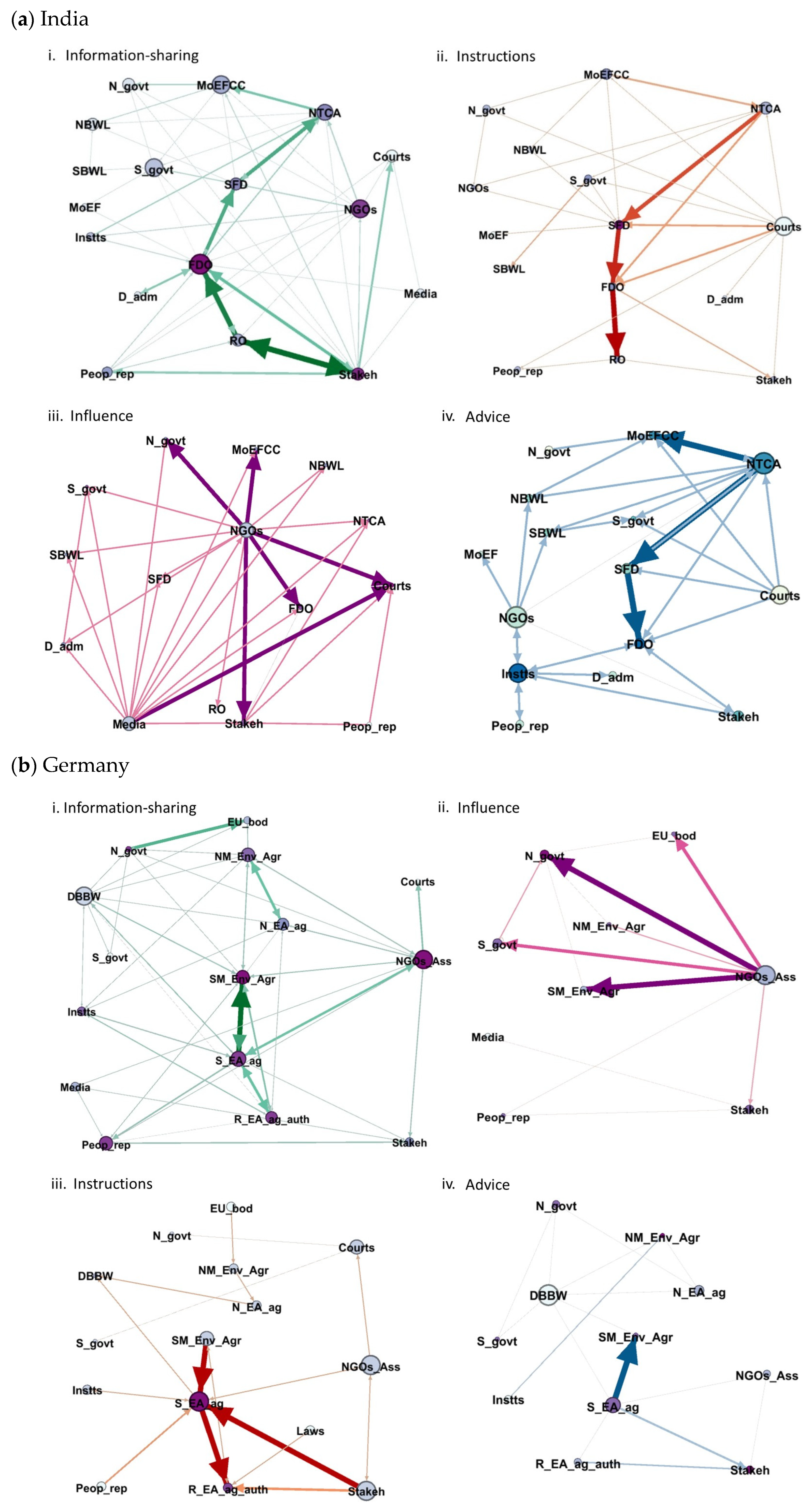
Policy-network analysis of India’s CBC for tiger conservation and Germany’s CGR for wolf conservation reveal distinct patterns (Figure 2). Additional information on degree centrality measures for actors’ inclusion/exclusion can be found in Supplementary Material S5.

3.2.1. Information-Sharing Ties

In India, the majority of actors remain connected for information-sharing (17 out of 18 total actors, excluding only laws that were presented as a key actor within tiger conservation governance). A high level of both out- and in-degree for information flow (node size and color) reveals multiple actors playing a crucial role in knowledge dissemination and integration (Figure 2(ai)). However, most actors remain peripheral, except for the ones responsible under the forest department administration, including local stakeholders as EDCs and JFMs, the NTCA and India’s national ministry responsible for conservation governance (MoEFCC).
Network ties between core actors present a contiguous bottom-up flow of information with relatively weaker reciprocity except at the local levels that exhibit bi-directional flow (between the range office (RO) and the stakeholders (Stakeh). Information-sharing included different aspects of tiger conservation within tiger conservation plans. This largely represented conservation priorities, incidences and trends of human-tiger conflict (HTC), poaching incidents, and budget allocation for site level conservation and management [Interviewee ID (In_ID hereon): C002; I006; D008; R012]. At the operational level (district, regional and local) specifically, information-sharing included reporting for protected area management, information on HTC incidences, HTC mitigation plans, conservation, HTC and management-related awareness, eco-development, and alternate livelihood generation for local communities [In_ID: D007; L013; L015; L017; L018]. Top-down information-sharing included providing updates on policies and guidelines for smoother implementation [In_ID: D008; R012], as well as permissions to capture a tiger for conflict management [In_ID: R011].
Similar to India’s case, Germany follows the pattern where all mentioned policy actors—except laws (interviewees in both countries perceived laws as an actor within which other policy actors function)—remain integrated within information-sharing ties. However, the core versus peripheral knowledge consolidation patterns exhibits contrasting results. State ministries of environment and agriculture and their agencies seem to emerge as core players in Germany’s wolf conservation governance, followed by other actors such as regional agencies, NGOs and stakeholder associations and national government, ministries, their agencies and the EU bodies (Figure 2(bi)).
Unlike India’s contiguous flow of information across governance levels, Germany’s wolf conservation governance reflected the federal nature of its governance. Stronger ties were observed between few policy actors at the state level, followed by the regional level. Reciprocal ties were also observed between national ministries and their agencies, followed by bottom-up tie from Germany’s national government to the EU bodies. Information-sharing was largely associated with information on wolf monitoring data and measures for livestock protection [In_ID: C014, C001, SR007 and CS004]. DBBW as an information hub represents an attempt to overcome this fragmentation through centralized nation-wide data aggregation. Its high out-degree suggests its role as an online website that provides public information on wolf population status, etc. NGOs and stakeholder representatives represent another key policy actor with high in- and out-degrees that presents them as vital in information aggregation and dissemination. Information largely included wolf population monitoring, especially from the state of Lower Saxony where data on wolf monitoring is collected by the state hunters’ organization [In_ID: S002; R009; S010]. Other information included support for or against wolf population management with lethal measures in policy decisions [In_ID: CS004; S015], whereas regional conservation NGOs also worked for awareness programs including herd protection measures from wolves [In_ID: R006; R009].

3.2.2. Instructions Ties

In India, instruction ties involved similar core actors to that of information-sharing, yet 15 out of 18 actors were involved within the networks. The ties excluded institutes, NGOs and laws. The ties served to gain specific information for policy decisions reflecting the top-down flow in information-seeking within the overall policy-networks. This form of networking was dominant at several centers—the national environment ministry (MoEFCC) to the NTCA, to the SFD, FDO, and the RO within India’s hierarchical forest department administration (Figure 2(aii)). The second relatively weaker cluster includes instructions by the courts to the SFD and the FDO, instigated through petitions/suo moto (when courts initiate their own motions to address issues often of public interest) [In_ID: C001 and C002] and the S_govt to the SBWL for tasks related to wildlife and forest clearance or other matters related to conservation [Interviewee ID: C001 and CS004]. Instruction ties directly between the NTCA and the FDO represent top-down oversight for tiger conservation and conflict management at the protected area level policy decisions [In_ID: C003, D007, S020]. Instructions from the Field Director Office to the stakeholders represented, for example, to restrict forest use in zoned areas [In_ID: L015; L017]. This also involves initiating consultation meetings for policy-making with the local communities [Interviewee ID: D007; L013; L015] and for rapid response with village volunteers during a crisis situation (such as when a carnivore has strolled inside a village) [Interviewee ID: R011].
Compared to India’s hierarchical administrative structure, Germany’s federal structure consists of weaker instruction ties; however only the law remained excluded within this form of networking. The clustering largely remained centered at the state level and was followed within administrative bodies, i.e., between the state environment and agriculture ministries to their agencies at the state and regional levels in a top-down administrative structure (Figure 2(biii)). This largely involved seeking information on wolf population data (for EU wolf population monitoring) [In_ID: C014], whereas bottom-up ties from the stakeholders to the state agencies was to seek information upon an incident of human–wolf interaction(s) largely including compensation at the events of livestock depredation by wolves [In_ID: S002 and R006].

3.2.3. Influence Ties

In India, fifteen actors (except institutes, laws and the state environment ministry) were included with influence ties. Actors such as NGOs and media held a central position in influencing other policy actors (Figure 2(aiii)). The policy actors being influenced were largely the FDO, local stakeholders, and courts, but was extended to the NTCA and state governments. However, overall intensity remained low (for values please refer to Supplementary Material S5). The agenda for influence was ascribed to demand for better management of HTC, or informing court decisions through litigations [In_ID: C001; C003; C004]. Influence ties from local stakeholders to NTCA were attributed to PILs such as regarding NTCA’s decision on the developmental project around PAs [IN_ID: C003].
However, in Germany, nine out of sixteen actors were involved with influence ties, excluding scientific institutes, laws, DBBW, courts, and agencies across governance levels. NGOs and stakeholder associations act as key actors towards influencing policy-makers across governance levels (Figure 2(bii). The goal largely remained to influence policy decisions at the EU, national and state to policies managing wolf populations through easier hunting reforms (by the NGOs and stakeholder associations for the farmers, hunters, and shepherds) and/or to limit hunting policies for wolf conservation by the conservation NGOs and associations [In_ID: S015 and SR007]. Recipients of influence included legislative bodies across governance levels, indicating direct policy influence. Interestingly, interviewees also reported laws to be influenced for or against wolf population management through hunting, depending upon the interests of lobby groups (NGOs and stakeholder associations).

3.2.4. Advice Ties

In India, multiple policy actors served the role of advising for tiger conservation and HTC management, except RO, laws, and media. Core actors included the NTCA, NGOs, scientific institutes, courts, the SFD, and local stakeholders (Figure 2(aiv). It was interesting to note that key conservation governance bodies, such as the NTCA, FDO, the MoEFCC, and scientific institutes were also at the receiving end. Guidance on conservation planning and inputs for HTC management were some of the reported forms of advice provided to different policy actors, such as by the NTCA, NGOs, and SFD [In_ID: C001; IC005; S021]. India’s CBC allowed stakeholder inclusion for advising FDO in site level planning, specifically to manage HTC; however, this was reported to be informal and upon discretion of the FDO [In_ID: L017]. NGOs also served the role of advising local stakeholders through EDCs [In_ID: I006]. Courts were reported to provide ‘advice’ for case-specific issues, such as for HTC management or for/against development projects around PAs [In_ID: C003; CS004].
In comparison to India’s multiple centers for advice, Germany’s wolf CGR was largely advised by the state environment and agricultural agencies, to the state environment and agriculture ministries (Figure 2(biv)). However, five actors remain excluded, including EU bodies, courts, laws, media, and peoples’ representatives at local level. Advices included designing state wolf management policies within the national and EU laws [In_ID: R006; C011] and for better conflict mitigation, prevention strategies, and funding [In_ID: SR017; C014]. DBBW served as an advice provider to several policy actors across levels of governance, although it was provided only when demanded—attributed to a lack of funding to actively support other policy actors through advice (Figure 2(biii)) [In_ID: C005]. At the local level, county councils or mayors may convene advisory events for the local communities which provide a platform for the regional environment agencies and authorities to generate awareness when an event(s) of HWI has occurred [Interviewee ID: SR007; C011]. Key actors, such as EU bodies, national and state environment, and agriculture ministries, surprisingly, were not reported to provide advice by any interviewee. This could possibly be because advice published by EU bodies, such as the LCIE, is published as reports for all EU Member Countries that may or may not be relevant for site and operational level planning and management.

3.3. Network-Derived Power Versus Perceived Power

A combined network ties for policy processes within India’s CBC for tiger conservation and Germany’s CGR for wolf conservation reveals interesting patterns on how different models produce institutional design that constrain or promote respective justice framings. Table 6 presents structural power measures (indicated by network centrality measures—degree and eigenvector centralities) alongside perceived power indices (PPI) for actors in both governance models, revealing systematic discrepancies between structural position and perceived influence.

3.3.1. India: Polycentric Structure with Implementation Constraints

Structural power measures reveal a polycentric governance structure with distributed power across governance levels. Relatively higher power values at the site to operational levels suggest decentralization of power in India’s CBC. Though power was also distributed at the state and center (for site and strategic level policy-making). The Field Director’s Office (FDO) that officially manages site and operational level policy-making and governance exhibits the highest structural power, followed by state level officers of the forest department (SFD) and local stakeholders. The Range Office (RO) also demonstrates substantial structural power that works in close collaborations with the local stakeholders and FDO for operational level management.
However, perceived power indices reveal significant discrepancies. The FDO holds the highest perceived power, followed by the NTCA and SFD, indicating recognition of their formal authority. Critically, the RO received no power attribution from participants despite high network centrality, and stakeholders received relatively low perceived power. Power attributed to stakeholders was associated with ‘public interest litigation’ (PIL) mechanisms that enable local beneficiaries to seek judicial intervention against policy decisions through courts rather than direct participation in policy formulation [In_ID: C001, C003 and L016].
NTCA shows alignment between structural power and perceived power, whereas MoEFCC exhibits lower network centrality but substantial perceived power. The National Board for Wildlife (NBWL) remains peripheral in both structural and perceived power. NGOs largely remain less powerful in India’s case, despite their representation in key institutions such as the NTCA, NBWL, and SBWL.

3.3.2. Germany: Federal Power Concentration with Collaborative Elements

Network-derived power measures reveal power concentration at the state level and among interest groups. State environment and agriculture agencies (S_EA_ag) exhibit the highest centrality, closely followed by the state ministry for environment and agriculture (SM_Env_Agr). NGOs and stakeholder associations demonstrate substantial structural power, reflecting collaborative governance mechanisms.
Perceived power indices, however, reveal a different hierarchy. EU bodies hold the highest perceived power, despite weak network centrality, reflecting the ultimate legislative authority of EU directives. State government (S_govt) and the state ministry for environment and agriculture (SM_Env_Agr) are perceived as highly powerful, with SM_Env_Agr’s perceived power aligning with its network position. However, state agencies (S_EA_ag), despite the highest network centrality, have substantially lower perceived power, indicating that executive implementation roles are not perceived as holding decision-making authority.
NGOs and associations show relatively high perceived power that aligns with their network position, confirming their recognized influence in policy processes. Regional agencies and authorities demonstrate alignment between network position and perceived power. Notably, stakeholders and people’s representatives receive no power attribution alongside weak network presence.
Several interviewees revealed that ‘round tables’ designed to include non-state actors in policy decisions have ceased due to frustrations over laws limiting wolf hunting in German states [Interviewee ID: S015, SR007, CS004 and R009]. Other reasons attributed include political motivations, hopes for changes in elected government, and anticipated changes in EU policies regarding wolf protection status [In_ID: S015].

4. Discussion

Our comparative analysis of India’s CBC for tigers and Germany’s CGR for wolves reveals fundamental structural differences in how participatory governance operates across distinct institutional contexts. While both models claim to advance participatory decision-making—India within social justice frameworks and Germany through environmental justice mandates—our network analysis reveals critical gaps between governance ideals and structural realities, challenging simplistic social versus environmental justice framings in conservation discourse.

4.1. Network Tie Densities

Our first research question examined what forms of network ties dominate in CBC versus CGR models. Hypothesis 1 predicted both models would exhibit similar network tie densities, with CGR showing higher influence densities reflecting environmental justice framings. Our findings strongly support this prediction while revealing critical nuances about participation quality.
The predominance of information-sharing ties in both systems initially suggests that knowledge-transfer infrastructure constitutes the foundation of participatory governance regardless of institutional design. However, India’s CBC features higher instruction ties as compared to Germany’s CGR with influence as the second highest density, supporting our hypothesis H1. This suggests that CGR framed within environmental justice framings allows more space for non-state actors to influence policy decisions, as compared to India’s CBC. While instructions served as the second most dominant feature in India’s tiger conservation governance, we discuss further in Section 4.2 how these ties affect policy processes in both countries.
The consistently low density for ‘advice’ networks in both systems reveals a critical gap given the complex ecological and social dimensions of carnivore conservation. This paucity explains the reactive, rather than proactive, governance approaches observed by [28] and constrains the opportunities for collaborative learning and knowledge co-production necessary for effective human–carnivore conflict management [29].

4.2. Inclusion of Policy Actors: Institutional Design and Justice Framings

The policy network analysis reveals how distinct justice framings—social justice in India’s CBC and environmental justice in Germany’s CGR—shape actor inclusion patterns and create paradoxical trade-offs between local engagement and formal decision-making authority. H2 predicted (a) high actor diversity in information-sharing networks with reciprocal ties; (b) top-down administrative concentration in instruction ties; (c) higher out-degree for non-state actors to influence policy decisions; and (d) higher scientific institution and regulatory bodies’ centrality in ‘advice’ networks. Our findings provide partial support with important revelations about inclusion quality.
H2a receives strong support: information-sharing networks demonstrate extensive actor inclusion across all governance levels in both models (Figure 2). However, the quality of inclusion diverges substantially. India exhibits contiguous bottom-up information flows with bidirectional exchange at local levels (RO↔stakeholders), creating structural capacity for vertical knowledge integration. This suggests greater adaptability in policy-formulations considered to enhance the ‘fit’ of conservation policies with local level management [30]. However, the domination of the forest department administration points to a lack of diversity in the types of knowledge considered. While NGOs seem active as knowledge-sharing groups, reflected through high out- and in-degree, the weak strength of ties reflects inadequate inclusion.
Germany’s CGR model exhibits reciprocal flow that may indicate a balance in information-sharing, likely to increase trust between policy actors, such as in environmental governance [31]. However, a critical finding is the fragmented nature of information-sharing largely restricted to site level planning (state level) that reveals cross level fragmentation and a hub-and-spoke pattern. NGOs and stakeholder associations seem to bridge several actors across the levels of governance; however, their inclusion remains limited and segregated based on the specificity of providing wolf monitoring data from one of the study states. For example, a regional officer [In_ID: R006] explains, “DBBW is indeed Germany’s voice for wolf statistics, but they work very slowly. For example, they released numbers today about pack sizes, but the data is so outdated that you wonder why they don’t have more current figures. They don’t proactively send this information to all the federal states. If you ask for information, it’s fine, but if you don’t, it’s not readily available. Honestly, knowing how many packs exist in Germany doesn’t help me protect livestock from wolves. I need practical information—how to set up effective electric fences, whether lighting or other deterrents work, or at what point a wolf might jump over a fence. These are real facts we need.” These patterns may partially contribute to the ‘blame game’ observed in German wolf conservation [22,32], where disconnected policy actors shift responsibility across governance levels. Limited scope of information within wolf monitoring data questions the effectiveness and quality of preventive measures to reduce HWI in Germany.
H2b is confirmed for India but only partially supported for Germany. India’s ‘instruction’ networks concentrate within formal administrative hierarchies, fully validating the prediction. Germany’s ‘instruction’ networks, with comparatively lesser tie density for instructions than India’s, still flow primarily through administrative channels (EU→Federal→State→Regional agencies), which remain largely dominant between state ministries and their agencies. This suggests that environmental justice frameworks do not eliminate hierarchical coordination within multi-level governance but reconfigure it around different institutional actors—state and regional agencies, similar to the forest department in India. We could not establish if hierarchical information-seeking has a negative role in policy-making processes as it seems to acknowledge knowledge acquisition that promotes bottom-up knowledge transfer. However, a range officer in India expressed “we report about all important information required by the FDO to design the management plan, but we do not receive information on the plan but only instructions of what needs to be done…”. On the contrary, an interviewee from a regional agency in Germany suggested, “there is a need for clearer instructions… when required the authorities like X (original name of the authority not mentioned to anonymize the interviewee) is responsible but often unprepared, even though the ministry provides resources… Authorities need clear plans and guidelines ready in advance so they don’t scramble in emergencies…” [In_ID: R006].
H2c receives partial support with important caveats. Both India and Germany portray non-state actors such as NGOs and stakeholder associations as central actors with high out-degrees indicating their role in influencing policy decisions. However, a lack of strong stakeholder association directly related with the agenda of stakeholder empowerment within conservation governance was observed in India, whereas Germany demonstrates substantially higher stakeholder association (pers. obsv.). However, the empowerment concentrates among recognized associations representing diverse interests (conservation NGOs, farmers’ associations, hunters’ organizations). This confirms that environmental justice frameworks empower non-state organizational actors as hypothesized but developing versus developed economies suggests that strength of stakeholder associations may vary. Interesting to note is that, in both cases, local stakeholders remain at the receiving end of influence that was largely associated with awareness programs (for tiger conservation in India and for or against wolf conservation in Germany). Hence, both cases exclude local stakeholders from directly influencing policy processes.
H2d is partially supported. In India, advice roles are distributed across multiple actors that remain dominated by the NTCA (regulatory body), followed by courts, NGOs, and scientific institutes. High in-degree of key policy actors, such as FDO, MoEFCC, and NTCA suggests some degree of scientific expertise in tiger conservation, perhaps playing a role in successful tiger conservation despite several challenges [33]. However, other key regulatory bodies such as NBWL and SBWL remain peripheral. Conversely, Germany’s advice provision concentrates at state agencies advising state ministries, with DBBW (online platform managed by government contracted institutions) serving advice functions only when specifically requested (attributed to lack of funding). Other key policy actors such as EU bodies as well as national and state environment and agriculture ministries provided a negligible advisory role. This finding suggests an important institutional limitation within Germany’s wolf conservation governance, where advisory ties and scientific integration may not yet be sufficiently embedded within policy processes. For example, an interviewee from Germany notes, “the policy-making in Germany does not directly involve scientific agencies but lobby groups… my time of working in state Y, we were never consulted by the ministries and politicians ruled out our ideas…” [In_ID: SR007]. This weak institutionalization of scientific advisory mechanisms in both models, but especially in Germany, explains persistent conflicts—policies formulated without robust expert input struggle to address the complex ecological and social dynamics of human–carnivore interactions.

4.3. Structural Versus Perceived Power: The Participation–Power Disconnect

Our third research question examined which policy actors hold powerful positions as derived by institutional design versus power perceived by interviewed actors. Hypothesis 3 predicted both models would exhibit discrepancies between structural and perceived power, with the power ascribed by institutional design not corresponding to the actors’ perceived influence. Our findings provide strong empirical support for H3, revealing systematic participation–power disconnects in both governance models (Table 6). However, the patterns of misalignment differ in revealing ways, shaped by underlying justice framings.
In India, power is distributed to at least one policy actor across MLG, largely within the forest department administration. The institutional design for CBC for tigers decentralizes structural power at the site and operational levels (district to local policy actors). However, these levels also represent stark discrepancies in structural versus perceived power. For example, local stakeholders demonstrate similar structural power to that of the FDO; however, perceived power remains largely weak and is attributed to the power of filing public interest litigation at the High courts and the Supreme Court of India. This finding suggests that the participatory potential embedded within India’s institutional design has not yet been fully realized in practice. At present, regular exchanges with the stakeholders allow the building of trust between the department and communities [In_ID: L018]. For example, local stakeholders understand the laws that limit the extent to which the forest department can support certain activities, as expressed by an EDC secretary: “they always work within the jurisdiction of law” [In_ID: L016]. The claim of “policing” was also rejected by another EDC secretary with “…the establishment of EDC relations between the department and villagers has developed, if we have a problem, we can go directly to the Range Officer or even to the Field Director…”. Issues reported by the interviewees included a lack of budget, including for the mitigation of human–carnivore interactions.
Germany’s power asymmetries operate differently but produce similar exclusionary outcomes. NGOs and stakeholder associations show consistent results in structural as well as perceived powers, suggesting functional effectiveness of environmental justice. Yet, discrepancies in power with other policy actors suggest a gap in realising the effectiveness of current institutional design. For example, EU bodies hold minimal involvement through institutional design yet have maximum perceived power, reflecting the nature of multi-level governance where legislative authority resides at strategic levels distant from the operational level. An interviewee from Germany [In_ID: CS004] puts it, “While the EU’s role is crucial, the practical issues people face locally—such as predation incidents, population increases, or public concerns about safety in rural areas—are more directly influenced by state-level management and public outreach efforts. These are far more impactful in addressing immediate challenges than high-level decisions by the EU Commission”. This gap is aggravated when policy actors at the national level remain largely excluded (as per networking based on the policy networks) but with relatively higher perceived power, owing to their role in influencing strategic level policies. Similarly, state governments remain peripheral within the institutional design of wolf conservation governance yet have significant influence in policy decisions based on their perceived power. These findings support our previous observation of how the ‘wolf topic’ has become a subject of politics in Germany.
Interestingly, environmental and agricultural agencies at the state and regional levels demonstrate contrasting findings for structural versus perceived power disparities. State agencies show one of the highest powers derived by institutional design, yet with comparatively lesser perceived power, whereas regional authorities, despite having relatively moderate structural power, showcase perceived power to that of the states. This points to similar powers in executive implementation roles despite varying centrality within wolf conservation governance. In contrast to India’s CBC, both local stakeholders and democratically elected representatives lack power within environmental justice framings. While engaged in reactive information provision following wolf incidents, local actors lack substantive pathways to proactively influence policy decisions. This functional asymmetry—participation in information flows but exclusion from decision-making—erodes trust between communities and conservation authorities, a critical gap that India’s CBC has achieved despite flaws. This design gap within environmental justice framings within human–wildlife conflict management has been observed by Alba-Patiño et al. [34] who highlight how the framing neglects the inclusion of local stakeholders into conservation policy and decision-making processes worldwide.

4.4. Synthesis: Comparing CBC and CGR Governance Structures

Bringing together the network density, actor inclusion, and structural versus perceived power findings discussed above, Table 7 summarises the principal structural differences between India’s CBC and Germany’s CGR for large carnivore conservation governance. The structural participation–power disconnects identified in both models suggest that these challenges are not idiosyncratic to India or Germany but reflect broader institutional path dependencies within each governance tradition. These patterns are likely comparable to other middle- to high-income democratic federal states governing large carnivores through similar CBC or CGR models and could be empirically tested across such systems in future research.

4.5. Recommendations for Conservation Governance as a Social–Ecological System

Conservation governance requires careful navigation through multi-dimensional social–ecological systems [35], necessitating integrative, multi-stakeholder cooperation to co-design policies across governance levels [22,36,37]. We suggest the following recommendations for our case studies that may also be relevant for conservation governance contexts globally.
Institutionalising knowledge co-production: Both governance models exhibit persistently weak advice ties—the least dense tie type in both India and Germany—indicating that expert and local knowledge remain insufficiently embedded within policy processes. In India, scientific inputs are often filtered through administrative hierarchies, while in Germany, politically expedient responses and lobbying pressures can overshadow systematic advice processes. Although India’s statutory bodies—such as the NBWL and SBWL—formally embody plural knowledge representation under the WP(A)A (2006), their potential of providing advice is not fully realized, limiting transdisciplinary integration for long-term planning. In Germany, the DBBW’s advisory function remains demand-driven and chronically under-resourced, leaving state ministries without proactive scientific inputs. Strengthening regulatory and advisory mandates of state environment and agriculture agencies, alongside enhancing the coordinating function of the DBBW could create a centralized yet accessible scientific knowledge hub.
More broadly, institutionalizing knowledge co-production platforms that convene managers, scientists, social researchers, stakeholders, and local communities [29,38] would enable a transition from reactive crisis response to proactive, evidence-based coexistence planning [28].
Addressing power disparities through integrated participatory design: Our findings show that both models produce participation–power disconnects, though through different mechanisms. In India, local stakeholders hold structural power comparable to that of the FDO within the network, yet their perceived power remains negligible, confined largely to PIL mechanisms rather than direct policy participation. In Germany, local stakeholders and democratically elected representatives are absent from both the structural and perceived power hierarchies despite being most directly affected by wolf-related conflicts. These empirical patterns point to a shared design failure: formal inclusion in governance networks does not translate into substantive decision-making authority. Institutional design must therefore move beyond actor presence toward co-decision mandates at site and operational levels, formalising active engagement strategies that prevent tokenism and elite capture [7,34,39]. Governance systems should additionally strengthen vertically and horizontally cohesive polycentric structures, ensuring contiguous and diverse information, advice, and influence flows across levels. Clear feedback loops between EU or national directives and local implementation can reduce fragmentation and blame-shifting in Germany [11], while embedding cross level coordination platforms with defined authority could better align structural and perceived power across both systems.
Insulating scientific advice from political influence: As noted above, weak advice ties in both systems are compounded by the vulnerability of advisory processes to partisan and lobby influence—particularly evident in Germany, where interviewees reported that scientific agencies were routinely bypassed in favour of lobby-driven policy inputs [In_ID: SR007]. Mandatory advice integration mechanisms—rather than discretionary consultation—can enhance legitimacy and adaptive capacity in managing human–carnivore interactions [13,29]. Independent scientific advisory bodies with formalized mandates and stable funding would reduce the reactive, conflict-driven governance patterns observed in both countries.
Moving beyond justice framing dichotomies: A central finding of this study is that social and environmental justice framings, taken individually, produce characteristic blind spots in actor inclusion. India’s social justice framing structurally integrates local communities but concentrates decision-making authority within the forest department administration. Germany’s environmental justice framing empowers organized non-state actors but systematically excludes local stakeholders from substantive policy influence. Neither framing alone is sufficient. Effective and equitable LCC governance requires combining the distributive equity provisions characteristic of social justice frameworks with the procedural rights and multi-actor participation mechanisms of environmental justice frameworks—embedded within a broader social–ecological systems approach [35]. Such integration would reconcile equity with ecological effectiveness, strengthening trust, accountability, and long-term conservation outcomes across governance levels.

4.6. Limitations and Future Research

This study’s reliance on Net-Map interviews with actors recognized by the institutional design may underrepresent informal relationships and community perspectives. This was particularly evident for Germany’s case where a lack of interviewees representing the local level may undermine informal connections; however, representatives from other levels expressed a lack of formal engagements with local stakeholders that were restricted to reactive awareness-raising meetings. Moreover, the relatively small sample size and focus on only two states in each country position this study as exploratory in nature. Despite a representation of all relevant policy actors, the findings should not be considered representative of national governance networks and cannot be directly generalized to the country level. Instead, they provide insights into the governance dynamics observed within the selected case-study contexts.
Future research should employ complementary methods—including ethnographic observation and broader stakeholder surveys—to capture governance network complexity. Longitudinal network analysis could reveal how governance structures evolve with changing ecological conditions and policy interventions. The approach could also help to understand whether high instructions (India) and influence (Germany) ties are good or bad; that could not be established by our study. This could be particularly valuable in Germany, where wolf management policies are currently evolving following changes to wolf protection status.
While our comparison illuminates structural differences between CBC and CGR models, it does not establish causal relationships between institutional design and conservation outcomes. Integrating network analysis with conservation effectiveness metrics (e.g., conflict trends, population viability, stakeholder satisfaction) would strengthen the understanding of which governance structures yield better socio–ecological outcomes [40].

5. Conclusions

Our network analysis reveals that both India and Germany have institutionalized according to the ideals of respective justice framings. India’s tiger CBC within social justice premise empowers local stakeholders through eco-development programs, whereas Germany’s wolf CGR within environmental justice framing provides policy platforms for inclusivity. Yet, both models fail to adapt the institutional design that may foster coexistence within vertically cohesive, scientifically robust policies, and principally acknowledging local stakeholders as the pillar of site and operational level policy and decision-making processes. These patterns appear to transcend the Global North–South divides, suggesting that structural barriers to meaningful participation may be shaped by institutional path dependencies and power distributions rather than solely by the levels of economic development. The comparison therefore challenges the assumption that either CBC or CGR models, as currently designed, reliably deliver on their participatory promises.
Effective carnivore conservation governance requires more than formal arrangements—it demands structural features enabling meaningful power-sharing and information exchange. Moving beyond social justice versus environmental justice binaries, both frameworks must integrate participatory policy decisions with knowledge co-production for social and economic equity. India could transition from passive to active networking by strengthening reciprocal information ties and advisory networks. Germany could bridge fragmented policy centers and integrate marginalized stakeholders through formalized coordination mechanisms. Both models demonstrate that participatory mechanisms can coexist with power asymmetries that undermine effectiveness, necessitating structural reforms addressing not merely actor presence but connection quality and decision-making authority distribution. We observed that India’s CBC requires diversification from forest department domination to allow knowledge diversity, whereas Germany’s CGR may remain vulnerable to politicization and fragmented accountability, but stronger integration of advisory mechanisms and local stakeholders could support long-term coexistence goals.

Supplementary Materials

The following supporting information can be downloaded at: https://www.mdpi.com/article/10.3390/su18136563/s1. S1: Interview guidelines. S2: An introduction to the case studies and underlying policies that guide CBC and CGR mandates in India and Germany. S3: List of policy actors identified by interviewees along with pre-determined policy actor types. S4: A list of interviewees, S5: Degree centrality measures. References [41,42,43,44,45] are cited in Supplementary Materials.

Author Contributions

Conceptualization, N.S., and J.D.C.L.; methodology, N.S., C.S. and J.D.C.L.; software, N.S.; validation, N.S. and C.S.; formal analysis, N.S.; investigation, N.S.; resources, C.F., H.J.K. and R.K.; data curation, N.S.; writing—original draft preparation, N.S.; writing—review and editing, N.S., C.S., H.J.K., J.D.C.L., R.K. and C.F.; visualization, N.S.; project administration, N.S.; funding acquisition, N.S. All authors have read and agreed to the published version of the manuscript.

Funding

The research was supported by the World Wildlife Fund (WWF)—Germany (contract number: 15295) including conducting field research work in Germany, equipment costs, and attending conference and German Academic Exchange Service (DAAD) (grant number—57552340) by providing monthly stipend to NS. The open access publication fund of the Martin Luther University Halle-Wittenberg covered the cost of publication fee for the journal. JDCL was funded by the European Biodiversity Partnership in the context of the TransWILD project under the 2021–2022 BiodivProtect joint call, co-funded by the European Commission (GA No. 101052342) and the Research Council of Norway (project 342821) and the CoCo project funded by the EU’s Horizon Europe programme (grant agreement 101181958).

Institutional Review Board Statement

The manuscript uses interview data for which written informed consent was received from the interviewees. We followed European General Data Regulation, 2018 for data privacy and ethical statement; all the authors agreed to the ethical and privacy guidelines followed for data collection. Since the study did not deal with critical individual information (health, economics, etc.) an ethical review and approval board was not applicable.

Informed Consent Statement

Written informed consent was obtained from all subjects involved in the study for the interviews and the use of data for research purposes, including publication.

Data Availability Statement

The data presented in this study are available on request from the corresponding author due to privacy restrictions as the interviewees were promised anonymity.

Acknowledgments

The authors sincerely thank the interviewees for their valuable time and knowledge, which greatly contributed to the development of this manuscript. The authors also acknowledge the funding and scholarship agencies for their support to both the first author and the co-author. We thank Vanessa Göthner for her assistance with the Net-Map interviews in Germany and the translation and transcription of the data.

Conflicts of Interest

The authors declare no conflicts of interest. The funders had no role in the design of the study; in the collection, analyses, or interpretation of data; in the writing of the manuscript; or in the decision to publish the results.

Abbreviations

The following abbreviations are used in this manuscript:
D_admDistrict administration
DBBWFederal Documentation and Consultation Centre on Wolves (online platform)
EU_bodiesEuropean Union bodies, including parliament, the Council of Europe and EU Commission
FDOField Director’s Office (district level forest department administrative office—both in the tiger reserve and neighboring protected area)
InsttsScientific institutes
MoEFState Ministry of Forest and Environment
MoEFCCMinistry of Environment, Forest and Climate Change
N_EA_agNational Environment and Agriculture agencies
N_govtNational government
NBWLNational Board for Wildlife
NGOs_AssNGOs and stakeholder associations
NM_Env_AgrNational Ministries for Environment and Agriculture
NTCANational Tiger Conservation Authority
Peop_repPeople’s representatives
R_EA_ag_authRegional Environment and Agriculture agencies and authorities
RORange Office (regional to local level forest department administrative officer and staff)
S_govtState government including parliament
S_EA_agState Environment and Agriculture agencies
SBWLState Board for Wildlife
SFDState level officers of the Forest Department
SM_Env_AgrState Ministry(s) for Environment and Agriculture
StakehLocal Stakeholders (in India’s case co-management bodies that include local communities within the body, sharing land with tigers; in Germany these are local communities, including villagers, farmers, shepherds, hunters, etc., sharing land with wolves)

References

  1. Mason, T.H.; Pollard, C.R.; Chimalakonda, D.; Guerrero, A.M.; Kerr-Smith, C.; Milheiras, S.A.; Roberts, M.; Ngafack, P.R.; Bunnefeld, N. Wicked conflict: Using wicked problem thinking for holistic management of conservation conflict. Conserv. Lett. 2018, 11, e12460. [Google Scholar] [CrossRef] [PubMed]
  2. Bell, E.; Raycraft, J. Livelihoods and large carnivores: Identifying social-ecological drivers of interaction dynamics in northern Tanzania to foster coexistence. J. Environ. Manag. 2025, 392, 126703. [Google Scholar] [CrossRef] [PubMed]
  3. Collins, Y.A.; Maguire-Rajpaul, V.; Krauss, J.E.; Asiyanbi, A.; Jiminez, A.; Mabele, M.B.; Alexander-Owen, M. Plotting the coloniality of conservation. J. Pol. Ecol. 2021, 28, 968–989. [Google Scholar] [CrossRef]
  4. Rai, N.D.; Devy, M.S.; Ganesh, T.; Ganesan, R.; Setty, S.R.; Hiremath, A.J.; Khaling, S.; Rajan, P.D. Beyond fortress conservation: The long-term integration of natural and social science research for an inclusive conservation practice in India. Biol. Conserv. 2021, 254, 108888. [Google Scholar] [CrossRef]
  5. Berkes, F. Community-based conservation in a globalized world. Proc. Natl. Acad. Sci. USA 2007, 104, 15188–15193. [Google Scholar] [CrossRef] [PubMed]
  6. Emerson, K.; Nabatchi, T. Evaluating the productivity of collaborative governance regimes: A performance matrix. Pub. Perfor. Manag. Rev. 2015, 38, 717–747. [Google Scholar] [CrossRef]
  7. Kansky, R. Unpacking the challenges of wildlife governance in community-based conservation programs to promote human–wildlife coexistence. Conserv. Sci. Prac. 2022, 4, e12791. [Google Scholar] [CrossRef]
  8. Ulibarri, N.; Emerson, K.; Imperial, M.T.; Jager, N.W.; Newig, J.; Weber, E. How does collaborative governance evolve? Insights from a medium-n case comparison. Policy Soc. 2020, 39, 617–637. [Google Scholar] [CrossRef]
  9. Salvatori, V.; Balian, E.; Blanco, J.C.; Carbonell, X.; Ciucci, P.; Demeter, L.; Marino, A.; Panzavolta, A.; Sólyom, A.; von Korff, Y.; et al. Are large carnivores the real issue? Solutions for improving conflict management through stakeholder participation. Sustainability 2021, 13, 4482. [Google Scholar] [CrossRef]
  10. Vucetich, J.A.; Bruskotter, J.T.; Macdonald, D.W. Can Deliberative Democracy Favor a Flourishing Relationship Between Humans and Carnivores? Front. Conserv. Sci. 2021, 2, 680925. [Google Scholar] [CrossRef]
  11. Gabehart, K.M.; Stefes, C.H. Signing Globally, Implementing Locally: Protecting Endangered Wildlife and the Predicament of Germany’s Federalism. Ger. Polit. 2024, 34, 609–639. [Google Scholar] [CrossRef]
  12. Hovardas, T. Addressing human dimensions in large carnivore conservation and management: Insights from environmental social science and social psychology. In Large Carnivore Conservation and Management; Hovardas, T., Ed.; Routledge: Abingdon, UK, 2018; pp. 3–18. [Google Scholar] [CrossRef]
  13. Scott, T.A.; Lubell, M.; Arnold, G. The evolution of environmental policy network analysis. In The Sage Handbook of Social Network Analysis, 2nd ed.; McLevey, J., Scott, J., Carrington, P.J., Eds.; Sage: London, UK, 2023; pp. 92–115. [Google Scholar]
  14. Provan, K.G.; Kenis, P. Modes of network governance: Structure, management, and effectiveness. J. Pub. Adm. Res. Theory 2008, 18, 229–252. [Google Scholar] [CrossRef]
  15. Knoke, D.; Kostiuchenko, T. Power structures of policy networks. In The Oxford Handbook of Political Networks; Victor, J.N., Montgomery, A.H., Lubell, M., Eds.; Oxford Academic: Oxford, UK, 2016; pp. 91–114. [Google Scholar] [CrossRef]
  16. Purdy, J.M. A framework for assessing power in collaborative governance processes. Pub. Adm. Rev. 2012, 72, 409–417. [Google Scholar] [CrossRef]
  17. Ran, B.; Qi, H. Contingencies of power sharing in collaborative governance. Am. Rev. Pub. Adm. 2018, 48, 836–851. [Google Scholar] [CrossRef]
  18. Avelino, F.; Rotmans, J. Power in transition: An interdisciplinary framework to study power in relation to structural change. Eur. J. Soc. Theory 2009, 12, 543–569. [Google Scholar] [CrossRef]
  19. Vallet, A.; Locatelli, B.; Barnaud, C.; Makowski, D.; Conde, Y.Q.; Levrel, H. Power asymmetries in social networks of ecosystem services governance. Environ. Sci. Policy 2020, 114, 329–340. [Google Scholar] [CrossRef]
  20. Laumann, E.O.; Marsden, P.V.; Prensky, D. The boundary specification problem in network analysis. In Research Methods in Social Network Analysis; Freeman, L.C., White, D.R., Romney, A.K., Eds.; Bloomsbury Academic: London, UK, 1989; Volume 61, pp. 61–87. ISBN 1560005696. [Google Scholar]
  21. Schiffer, E.; Hauck, J. Net-Map: Collecting social network data and facilitating network learning through participatory influence network mapping. Field Methods 2010, 22, 231–249. [Google Scholar] [CrossRef]
  22. Srivastava, N.; Linnell, J.D.C.; Sattler, C.; Kleemann, J.; König, H.J.; Krishnamurthy, R.; Fürst, C. Claws, Laws, and Coexistence: Governance of carnivore conservation—The cases of tiger in India and wolf in Germany. Curr. Res. Environ. Sust. 2026, 11, 100361. [Google Scholar] [CrossRef]
  23. Sattler, C.; Rommel, J.; Chen, C.; García-Llorente, M.; Gutiérrez-Briceño, I.; Prager, K.; Reyes, M.F.; Schröter, B.; Schulze, C.; van Bussel, L.G.; et al. Participatory research in times of COVID-19 and beyond: Adjusting your methodological toolkits. One Earth 2022, 5, 62–73. [Google Scholar] [CrossRef] [PubMed]
  24. Moon, K. Naming it is not enough: An orienting map for understanding conservation’s entanglement with power. Conserv. Lett. 2025, 18, e13146. [Google Scholar] [CrossRef]
  25. Borgatti, S.P.; Everett, M.G.; Freeman, L.C. UCINET for Windows: Software for Social Network Analysis; Analytic Technologies: Harvard, MA, USA, 2002. [Google Scholar]
  26. Bastian, M.; Heymann, S.; Jacomy, M. Gephi: An open source software for exploring and manipulating networks. In Proceedings of the International AAAI Conference on Web and Social Media; The Association for the Advancement of Artificial Intelligence: Washington, DC, USA, 2009; Volume 3, pp. 361–362. [Google Scholar] [CrossRef]
  27. Borgatti, S.P.; Everett, M.G.; Johnson, J.C. Analyzing Social Networks, 2nd ed.; Sage Publications: London, UK, 2018; ISBN 978-1-5264-0409-1. [Google Scholar]
  28. Srivastava, N.; Linnell, J.D.C.; König, H.J.; Krishnamurthy, R.; Fürst, C. Beyond Kill or No-Kill: Institutional Analysis of Lethal Control Decision-Making in Large Carnivore Management. Ambio 2015, 55, 1039–1060. [Google Scholar] [CrossRef] [PubMed]
  29. Martínez-Harms, M.J.; Estévez, R.A.; Álvarez-Miranda, E. Conservation triage in action: Planning, governance and knowledge co-production for biodiversity protection. J. Appl. Eco. 2024, 61, 2328–2334. [Google Scholar] [CrossRef]
  30. Mpofu, E.; Penker, M.; Musakwa, W.; Radinger-Peer, V.; Gugerell, K. Fragmented Governance, Shared Landscapes: Policy and Functional (In) Coherence Insights from the Great Limpopo Transfrontier Conservation Area. Environ. Manag. 2025, 76, 1. [Google Scholar] [CrossRef] [PubMed]
  31. Bodin, Ö.; Baird, J.; Schultz, L.; Plummer, R.; Armitage, D. The impacts of trust, cost and risk on collaboration in environmental governance. Peop. Nat. 2020, 2, 734–749. [Google Scholar] [CrossRef]
  32. Niedziałkowski, K. Between Europeanisation and politicisation: Wolf policy and politics in Germany. Environ. Pol. 2023, 32, 793–814. [Google Scholar] [CrossRef]
  33. Jhala, Y.V.; Mungi, N.A.; Gopal, R.; Qureshi, Q. Tiger recovery amid people and poverty. Science 2025, 387, 505–510. [Google Scholar] [CrossRef] [PubMed]
  34. Alba-Patiño, D.; Martín-López, B.; Delibes-Mateos, M.; Requena-Mullor, J.M.; Castro, A.J. Environmental justice gaps in human-wildlife conflict research from a social-ecological systems perspective. Biol. Conserv. 2025, 312, 111515. [Google Scholar] [CrossRef]
  35. Carter, N.H.; Linnell, J.D.C. Building a resilient coexistence with wildlife in a more crowded world. PNAS Nexus 2023, 2, pgad030. [Google Scholar] [CrossRef] [PubMed]
  36. Linnell, J.D.C. Defining scales for managing biodiversity and natural resources in the face of conflicts. In Conflicts in Conservation: Navigating Towards Solutions; Redpath, S.M., Gutierrez, R.J., Kevin, A.W., Young, J.A., Eds.; Cambridge University Press (Ecological Reviews): Cambridge, UK, 2015; pp. 212–225. [Google Scholar] [CrossRef]
  37. König, H.J.; Kiffner, C.; Kramer-Schadt, S.; Fürst, C.; Keuling, O.; Ford, A.T. Human–wildlife coexistence in a changing world. Conserv. Biol. 2020, 34, 786–794. [Google Scholar] [CrossRef] [PubMed]
  38. Govindarajulu, D.; Gupta, D.; Choksi, P.; Dhyani, S.; Chandi, M.; Shahabuddin, G. Bridging Conservation and Communities: Integrating Conservation Social Science Research in India’s Tiger Conservation Efforts. Available online: https://ssrn.com/abstract=5297620 (accessed on 20 May 2026).
  39. Esmail, N.; McPherson, J.M.; Abulu, L.; Amend, T.; Amit, R.; Bhatia, S.; Bikaba, D.; Brichieri-Colombi, T.A.; Brown, J.; Buschman, V.; et al. What’s on the horizon for community-based conservation? Emerging threats and opportunities. Trends Ecol. Evol. 2023, 38, 666–680. [Google Scholar] [CrossRef] [PubMed]
  40. Jager, N.W.; Newig, J.; Challies, E.; Kochskämper, E. Pathways to implementation: Evidence on how participation in environmental governance impacts on environmental outcomes. J. Pub. Admin. Res. Theory 2020, 30, 383–399. [Google Scholar] [CrossRef]
  41. National Tiger Conservation Authority (NTCA). Guidelines for Preparation of Tiger Conservation Plan. 2007. Available online: https://ntca.gov.in/assets/uploads/guidelines/tc_plan.pdf (accessed on 10 October 2025).
  42. Ministry of Environment, Forest and Climate Change (MoEFCC). National Human-Wildlife Conflict Mitigation Strategy and Action Plan of India, 2021–2026. 2021. Available online: https://moef.gov.in/uploads/2022/01/National-Human-Wildlife-Conflict-Mitigation-Strategy-and-Action-Plan-of-India-2.pdf (accessed on 21 October 2025).
  43. Ostermann-Miyashita, E.F.; Kirkland, H.; Eklund, A.; Hare, D.; Jansman, H.A.; Kiffner, C.; Linnell, J.D.; Rigg, R.; Stone, S.A.; Uthes, S.; et al. Bridging the gap between science, policy and stakeholders: Towards sustainable wolf–livestock coexistence in human-dominated landscapes. Peop. Nat. 2025, 1–8. [Google Scholar] [CrossRef]
  44. Di Bernardi, C.; Chapron, G.; Kaczensky, P.; Álvares, F.; Andrén, H.; Balys, V.; Blanco, J.C.; Chiriac, S.; Ćirović, D.; Drouet-Hoguet, N.; et al. Continuing recovery of wolves in Europe. PLoS Sus. Transf. 2025, 4, e0000158. [Google Scholar] [CrossRef]
  45. Robinson, O.C. Sampling in interview-based qualitative research: A theoretical and practical guide. Qual. Res. Psych. 2014, 11, 25–41. [Google Scholar] [CrossRef]
Figure 1. Approach to data collection following the Laumann–Marsden–Prensky framework [20]. Selection of interviewees and questions designed for Net-Map interviews were based on the ‘activity’ of policy-making for India’s tiger and Germany’s wolf conservation decisions, specifically focusing on the management of human–carnivore interactions in both countries. The network boundary delineation was based on a ‘realist’ approach that allowed authors to select interviewees based on pre-existing knowledge of the authors. This included actors that are formally defined by laws as policy actors involved in the conservation decisions in both countries as a ‘positional’ rule.
Sustainability 18 06563 g001
Figure 2. Policy-network maps for actors within the policy-making processes for tiger conservation in India (a) and wolf conservation in Germany (b). The maps provide an overview of policy actors (nodes) and the networking (arrows) through four forms of pre-defined network tie types. The size of the node represents the ‘out-degree’, i.e., number of outgoing ties, whereas the colour of the nodes represents the ‘in-degree’, i.e., number of incoming ties—darker colour signifying higher value. Thickness, colour, and direction of the arrows represent the strength of ties between the nodes. Details of the abbreviations used in the figure can be found in the Abbreviations Section.
Sustainability 18 06563 g002
Table 1. Research objectives, questions and hypotheses guiding the study of comparison of community-based conservation (CBC) versus collaborative governance regime (CGR) in the cases of tiger conservation in India and wolf conservation in Germany, respectively.
Research ObjectiveResearch QuestionsHypotheses
  • To determine the effect of justice framings in the institutional design of CBC versus CGR models.
  • What forms of network ties are dominant in CBC versus CGR models?
H1. Both CBC and CGR models exhibit similar network tie densities for four categorized tie types. However, CGR may have higher influence densities reflecting its environmental justice framings.
2.
How are different policy actors involved in policy-making processes in CBC versus CGR models within multi-level governance?
H2. Both conservation models (a) ensure ‘information-sharing’ with multiple policy actors in reciprocal ties distributed across governance levels; (b) ‘instructions’ for information-seeking occurs top-down only between formal actors showcasing administrative structure; (c) ‘influence’ in policy decisions is dominated by non-state actors with high out-degree (outward flow); (d) scientific institutes and regulatory bodies dominate ‘advice’ ties with high out-degree.
II.
To understand structural versus perceived power experienced by policy actors that affect conservation policy outcomes.
3.
Which policy actors hold powerful positions as derived by the institutional design and how different are they in practice based on power perceived by interviewed policy actors?
H3. Both models grapple with discrepancies between structural power and perceived power, indicating structural misalignments in governance. Formal network positions do not correspond with actors’ perceived influence in policy processes, revealing participation–power disconnects in both models.
Table 2. Composition of interview participants across governance levels and policy actor categories involved in large carnivore conservation (LCC) governance in India and Germany. Percentages indicate the representation of interviewees within each governance level (out of total interviewees; India = 21; Germany = 15) and actor category (out of total policy actor categories identified; India = 15; Germany = 13). Strategic level = formulation of overarching conservation laws and policy frameworks; Site level = development and coordination of landscape- or region-specific management measures; Operational level = implementation and day-to-day management actions; Cross level actors = organizations operating across multiple governance levels through research, advisory, advocacy, or coordination roles [22].
India
S. No.Governance Level and Representation (%)Policy Actor Types and Representation (%)
1.Strategic levelInternational1.0
National23.8National ministry6.7
National institutions (NTCA, NBWL)26.7
State19.0State SFD officers20.0
State institutions (SBWL)6.7
2.Site levelDistrict (PA level)19.0District SFD officers26.7
3.Operational levelRegional14.3Regional SFD officers and staff26.7
Local (village level)28.6EDCs26.7
Peoples’ representatives6.7
4.Cross levelsInstitutes13.4
NGOs13.4
Germany
S. No.Governance Level and Representation (%)Policy Actor Types and Representation (%)
1.Strategic levelInternational/EU6.0
National46.7National ministries7.7
National agencies7.7
2.Site levelState40.0State ministries15.4
State agencies23.1
3.Operational levelDistrict/Regional26.7Regional agencies30.8
4.Cross levelsNGOs and stakeholder associations15.4
Institutes23.1
Table 3. Key interview questions that guided the Net-Map interviews to draw policy network maps regarding carnivore conservation policies in India and Germany, across multiple levels of governance; (inter)national to local.
S. No.Questions
1.Who are the actors involved in the policy-making process for carnivore conservation, specifically in relation to mitigating human–carnivore conflicts across different levels of governance—international to local?
2.What are the links between the actors with respect to information-sharing, instructions, influence, and advice for policy-making?
2.1Which actors do you connect with, and in what form?
2.2What is the intensity of networking—frequent (daily to weekly), medium (quarterly to yearly), low (rarely—context specific)?
3.How would you rate the power an actor has in designing conservation policy?
Table 4. Definitions of four pre-determined tie types and justification for deploying them in the present study. The four types of tie allowed the assessment of the quantity, but also the quality, of connection in India’s tiger and Germany’s wolf conservation governance, specifically to manage human–carnivore conflicts.
S. No.Network Tie TypeDefinitionJustification
1.Information-sharingExchange of information, data, or knowledge between actors.Captures the baseline connectivity and communication patterns in governance networks, revealing how information flows across organizational and institutional boundaries in conservation and human–carnivore conflict management.
2.InstructionsTies where one actor provides directives, mandates, or formal commands to another actor, largely to seek information.Identifies formal hierarchical relationships in governance structures, distinguishing between active and passive information-sharing in conservation decision-making.
3.InfluenceInformal ties through which actors shape decisions, agendas, or policy outcomes with or without formal authority.Reveals informal power dynamics and the capacity of non-state actors, such as NGOs and stakeholders and/or their representatives to affect conservation policy priorities, particularly important for understanding how marginalized stakeholders navigate formal governance structures.
4.AdviceTies established for provision of technical, scientific, or expert knowledge to inform policy formulation and implementation.Distinguishes knowledge-based relationships from other tie types, enabling assessment of how scientific information is integrated into policy processes and which actors serve as knowledge brokers in conservation governance.
Table 5. Values of the weighted network densities for different forms of policy-network ties in India’s tiger versus Germany’s wolf conservation policy-making processes across different levels of governance. The standard deviation represents the variation of tie strengths within the network (i.e., how disperse a network is) rather than variability in the mean values.
Whole Network Densities
(WND)
India (n = 21)Germany (n = 15)
WNDStd. Dev.WNDStd. Dev.
Overall0.6790.0980.8160.114
Information-sharing0.4910.0870.5220.083
Instructions0.1580.0390.1230.035
Influence0.0970.0180.1380.047
Advice0.0960.0170.1170.040
Table 6. Structural versus perceived power values for policy actors within (a) India’s community-based tiger conservation and (b) Germany’s collaborative governance for wolf conservation. The policy-making includes the management of human–carnivore interactions. Power values indicated in bold letters highlight dissimilarities in structural versus perceived power actors, whereas values in italics suggest similarities between structural and perceived power in conservation governance in respective countries. The green colour scales represent low (lighter shade) to high (darker shade) values. For details on the abbreviations used in the table, please refer to the Abbreviations Section.
(a) India
ActorLevelPolicy LevelDegree of CentralityPerceived Power
Out-DegreeIn-DegreePPIMeanStd. Dev.Recognition
CourtsOverallOverall0.620.431.107.672.6214.29
LawsOverallOverall0.000.000.9510.000.009.52
NGOsOverallOverall0.930.670.384.003.009.52
MediaOverallOverall0.240.190.337.000.004.76
InsttsOverallOverall0.530.38NANANA0.00
NTCANationalStrategic and site levels1.191.142.249.400.8023.81
MoEFCCNationalStrategic0.480.721.528.002.9219.05
N_govtNationalStrategic0.100.340.4810.000.004.76
NBWLNationalStrategic and site levels0.140.290.245.000.004.76
SFDStateStrategic and site levels1.221.531.717.201.9423.81
MoEFStateStrategic0.120.100.388.000.004.76
S_govtStateStrategic and site levels0.310.480.388.000.004.76
SBWLStateSite level0.140.190.194.000.004.76
FDODistrictSite and operational levels1.982.263.387.893.0742.86
D_admDistrictOperational level0.310.33NANANA0.00
RORegionalOperational level1.331.33NANANA0.00
StakehLocalOperational level1.981.451.055.503.5019.05
Peop_repLocalOperational level0.620.410.000.000.004.76
(b) Germany
ActorLevelPolicy LevelDegree of CentralityPerceived Power
Out-DegreeIn-DegreePPIMeanStd. Dev.Recognition
NGOs_AssOverallOverall2.800.922.077.751.7926.67
MediaOverallOverall0.270.200.6710.000.006.67
InsttsOverallOverall0.500.400.609.000.006.67
DBBWOverallOverall1.020.340.609.000.006.67
CourtsOverallOverall0.000.27NANANA0.00
LawsOverallOverall0.070.00NANANA0.00
EU_bodEuropeStrategic level0.170.904.0010.000.0040.00
NM_Env_AgrNationalStrategic level0.831.231.939.670.4720.00
N_govtNationalStrategic level0.601.031.809.000.8220.00
N_EA_agNationalStrategic level0.700.67NANANA0.00
S_govtStateSite level0.130.503.079.200.4033.33
SM_Env_AgrStateSite level1.421.873.009.001.1033.33
S_EA_agStateSite level2.252.131.209.001.0013.33
R_EA_ag_authRegionalOperational level1.001.051.138.501.5013.33
Peop_repLocalOperational level0.500.68NANANA0.00
StakehLocalOperational level0.730.87NANANA0.00
Table 7. Comparative summary of India’s CBC and Germany’s CGR for large carnivore conservation governance.
FeatureIndia—CBC (Tiger)Germany—CGR (Wolf)
Justice framingSocial justiceEnvironmental justice
Governance modelState-led, land-sparing protected area systemFederal, multi-actor collaborative regime
Dominant network tieInformation-sharingInformation-sharing
Second dominant tieInstructionsInfluence
Weakest tieAdviceAdvice
Power concentrationSite and operational levelsSite (Länder) level
Non-state actor rolePeripheral; limited formal influenceCentral; high formal influence
Local stakeholder inclusionFormally integrated (EDCs, JFMs); low perceived powerReactive and informal; no perceived power
Scientific advice integrationModerate; filtered through administrationWeak; demand-driven only
Cross level coordinationContiguous but top-downFragmented; hub-and-spoke
Key structural challengeForest department dominance; tokenistic local inclusionPolitical fragmentation; alienation of local actors
Disclaimer/Publisher’s Note: The statements, opinions and data contained in all publications are solely those of the individual author(s) and contributor(s) and not of MDPI and/or the editor(s). MDPI and/or the editor(s) disclaim responsibility for any injury to people or property resulting from any ideas, methods, instructions or products referred to in the content.